April 5, 1761 Sybil’s Ride

Sybil Ludington received the thanks of family and friends and even that of George Washington.  She then stepped off the pages of history.

“Listen my children and you shall hear,
Of the midnight ride of”…Sybil Ludington.

Wait…What?

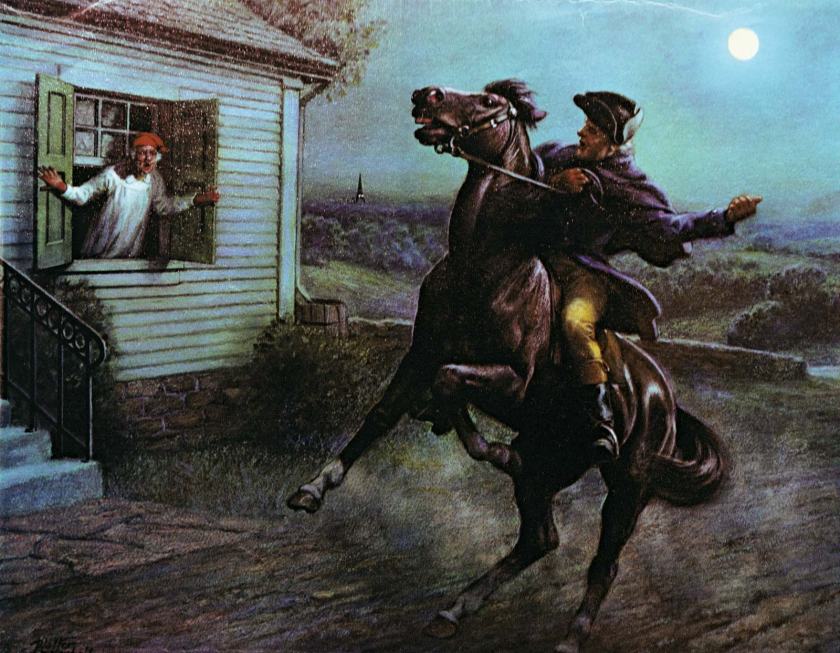
Paul Revere’s famous “midnight ride” began on the night of April 18, 1775.  Revere was one of two riders, soon joined by a third, fanning out from Boston to warn of an oncoming column of “regulars”, come to destroy the stockpile of gunpowder, ammunition, and cannon in Concord.

paul-revereRevere himself covered barely 12 miles before being captured, his horse confiscated to replace the tired mount of a British sergeant.  Revere would finish his “ride” on foot, arriving at sunrise on the 19th to witness the last moments of the battle on Lexington Green.
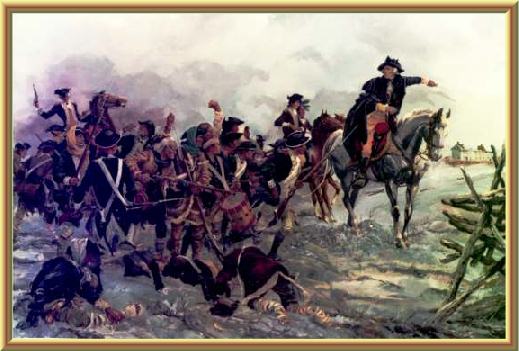
Two years later, Patriot forces maintained a similar supply depot, in the southwest Connecticut town of Danbury.

William Tryon was the Royal Governor of New York, and long-standing advocate for attacks on civilian targets.  In 1777, Tryon was major-general of the provincial army.  On April 25th, the General set sail for the Connecticut coast of Long Island Sound with a force of 1,800, intending to destroy Danbury.

Battle3

Patriot Colonel Joseph Cooke’s small Danbury garrison was caught and quickly overpowered on the 26th, trying to remove food supplies, uniforms, and equipment.  Facing little if any opposition, Tryon’s forces went on a bender, burning homes, farms and storehouses.  Thousands of barrels of pork, beef, and flour were destroyed, along with 5,000 pairs of shoes, 2,000 bushels of grain, and 1,600 tents.

Colonel Henry Ludington was a farmer and father of 12, with a long military career.  A long-standing and loyal subject of the British crown, Ludington switched sides in 1773, joining the rebel cause and rising to command the 7th Regiment of the Dutchess County Militia, in New York’s Hudson Valley.

908d9d26ffc8bb0c9e8a59b25da92429--american-revolutionary-war-paul-revereIn April 1777, Ludington’s militia was disbanded for planting season, and spread across the countryside.  An exhausted rider arrived at the Ludington farm on a blown horse, on the evening of the 26th, asking for help.  15 miles away, British regulars and a force of loyalists were burning Danbury to the ground.

The Dutchess County Militia had to be called up.  The Colonel had one night to prepare for battle, and this rider was done.  The job would have to go to Colonel Ludington’s first-born, his daughter, Sybil.

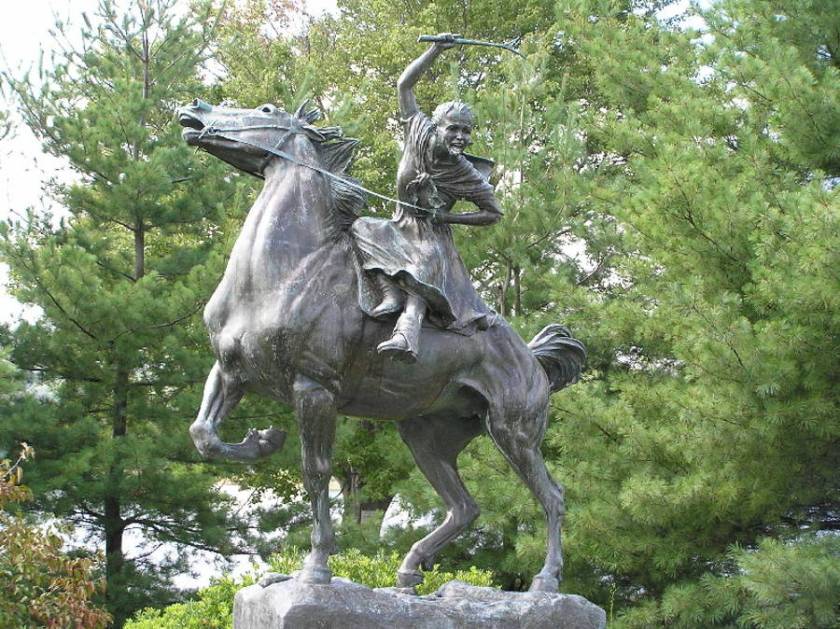
Born April 5, 1761, Sybil Ludington was barely sixteen at the time of her ride.  From Poughkeepsie to what is now Putnam County and back, the “Female Paul Revere” rode across the lower Hudson River Valley, covering 40 miles in the pitch dark of night, alerting her father’s militia to the danger and urging them to come out and fight.  She’d use a stick to knock on doors, even using it once, to fight off a highway bandit.

By the time Sybil returned the next morning, cold, rain-soaked, and exhausted, most of 400 militia were ready to march.

Arnold’s forces arrived too late to save Danbury, but inflicted a nasty surprise on the British rearguard as the column approached nearby Ridgefield.  Never outnumbered by less than three-to-one, Connecticut militia was able to slow the British advance until Ludington’s New York Militia arrived on the following day.  The last phase of the action saw the same type of swarming harassment, as seen on the British retreat from Concord to Boston, early in the war.35 miles to the east of Danbury, General Benedict Arnold was gathering a force of 500 regular and irregular Connecticut militia, with Generals David Wooster and Gold Selleck Silliman.

Though the British operation was a tactical success, the mauling inflicted by these colonials ensured that this was the last hostile British landing on the Connecticut coast.

The British raid on Danbury destroyed at least 19 houses and 22 stores and barns.  Town officials submitted £16,000 in claims to Congress, for which town selectmen received £500 reimbursement.  Further claims were made to the General Assembly of Connecticut in 1787, for which Danbury was awarded land.  In Ohio.

Keeler_tavern_ridgefield_cannonball_2006At the time, Benedict Arnold planned to travel to Philadelphia, to protest the promotion of officers junior to himself, to Major General.  Arnold, who’d had two horses shot out from under him at Ridgefield, was promoted to Major General in recognition for his role in the battle.  Along with that promotion came a horse, “properly caparisoned as a token of … approbation of his gallant conduct … in the late enterprize to Danbury.”  For now, the pride which would one day be his undoing, was assuaged.The Keeler Tavern in Ridgefield is now a museum.  The British cannonball fired into the side of the building, remains there to this day.

Henry Ludington would become Aide-de-Camp to General George Washington, and grandfather to Harrison Ludington, mayor of Milwaukee and 12th Governor of Wisconsin.

Gold Silliman was kidnapped with his son by a first marriage by Tory neighbors, and held for Nearly seven months at a New York farmhouse.  Having no hostage of equal rank with whom to exchange for the General, Patriot forces went out and kidnapped one of their own, in the person of Chief Justice Judge Thomas Jones, of Long Island.

Mary Silliman was left to run the farm, including caring for her own midwife, who was brutally raped by English forces for denying them the use of her home.  The 1993 made-for-TV movie “Mary Silliman’s War” tells the story of non-combatants, pregnant mothers and farm wives during the Revolution, as well as Mary’s own negotiations for her husband’s release from his Loyalist captors.

IMG_6632General David Wooster was mortally wounded at the Battle of Ridgefield, moments after shouting “Come on my boys! Never mind such random shots!”  Today, an archway marks the entrance to Wooster Square, in the East Rock Neighborhood of New Haven.  Sybil_Ludington_stamp
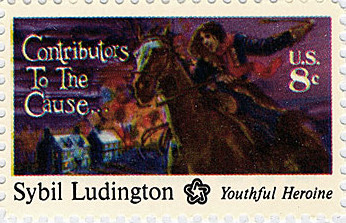
Sybil Ludington received the thanks of family and friends and even that of George Washington.  She then stepped off the pages of history.

Paul Revere’s famous ride would have likewise faded into obscurity, but for the poetry of Henry Wadsworth Longfellow.  Eighty-six years, later.

Page break

“Listen my children and you shall hear
Of the midnight ride of Paul Revere,
On the eighteenth of April, in Seventy-five;
Hardly a man is now alive
Who remembers that famous day and year.
He said to his friend, “If the British march
By land or sea from the town to-night,
Hang a lantern aloft in the belfry arch
Of the North Church tower as a signal light,–
One if by land, and two if by sea;
And I on the opposite shore will be,
Ready to ride and spread the alarm
Through every Middlesex village and farm,
For the country folk to be up and to arm.”
Then he said “Good-night!” and with muffled oar
Silently rowed to the Charlestown shore,
Just as the moon rose over the bay,
Where swinging wide at her moorings lay
The Somerset, British man-of-war;
A phantom ship, with each mast and spar
Across the moon like a prison bar,
And a huge black hulk, that was magnified
By its own reflection in the tide.
Meanwhile, his friend through alley and street
Wanders and watches, with eager ears,
Till in the silence around him he hears
The muster of men at the barrack door,
The sound of arms, and the tramp of feet,
And the measured tread of the grenadiers,
Marching down to their boats on the shore.
Then he climbed the tower of the Old North Church,
By the wooden stairs, with stealthy tread,
To the belfry chamber overhead,
And startled the pigeons from their perch
On the sombre rafters, that round him made
Masses and moving shapes of shade,–
By the trembling ladder, steep and tall,
To the highest window in the wall,
Where he paused to listen and look down
A moment on the roofs of the town
And the moonlight flowing over all.
Beneath, in the churchyard, lay the dead,
In their night encampment on the hill,
Wrapped in silence so deep and still
That he could hear, like a sentinel’s tread,
The watchful night-wind, as it went
Creeping along from tent to tent,
And seeming to whisper, “All is well!”
A moment only he feels the spell
Of the place and the hour, and the secret dread
Of the lonely belfry and the dead;
For suddenly all his thoughts are bent
On a shadowy something far away,
Where the river widens to meet the bay,–
A line of black that bends and floats
On the rising tide like a bridge of boats.
Meanwhile, impatient to mount and ride,
Booted and spurred, with a heavy stride
On the opposite shore walked Paul Revere.
Now he patted his horse’s side,
Now he gazed at the landscape far and near,
Then, impetuous, stamped the earth,
And turned and tightened his saddle girth;
But mostly he watched with eager search
The belfry tower of the Old North Church,
As it rose above the graves on the hill,
Lonely and spectral and sombre and still.
And lo! as he looks, on the belfry’s height
A glimmer, and then a gleam of light!
He springs to the saddle, the bridle he turns,
But lingers and gazes, till full on his sight
A second lamp in the belfry burns.
A hurry of hoofs in a village street,
A shape in the moonlight, a bulk in the dark,
And beneath, from the pebbles, in passing, a spark
Struck out by a steed flying fearless and fleet;
That was all! And yet, through the gloom and the light,
The fate of a nation was riding that night;
And the spark struck out by that steed, in his flight,
Kindled the land into flame with its heat.
He has left the village and mounted the steep,
And beneath him, tranquil and broad and deep,
Is the Mystic, meeting the ocean tides;
And under the alders that skirt its edge,
Now soft on the sand, now loud on the ledge,
Is heard the tramp of his steed as he rides.
It was twelve by the village clock
When he crossed the bridge into Medford town.
He heard the crowing of the cock,
And the barking of the farmer’s dog,
And felt the damp of the river fog,
That rises after the sun goes down.
It was one by the village clock,
When he galloped into Lexington.
He saw the gilded weathercock
Swim in the moonlight as he passed,
And the meeting-house windows, black and bare,
Gaze at him with a spectral glare,
As if they already stood aghast
At the bloody work they would look upon.
It was two by the village clock,
When he came to the bridge in Concord town.
He heard the bleating of the flock,
And the twitter of birds among the trees,
And felt the breath of the morning breeze
Blowing over the meadow brown.
And one was safe and asleep in his bed
Who at the bridge would be first to fall,
Who that day would be lying dead,
Pierced by a British musket ball.
You know the rest. In the books you have read
How the British Regulars fired and fled,—
How the farmers gave them ball for ball,
From behind each fence and farmyard wall,
Chasing the redcoats down the lane,
Then crossing the fields to emerge again
Under the trees at the turn of the road,
And only pausing to fire and load.
So through the night rode Paul Revere;
And so through the night went his cry of alarm
To every Middlesex village and farm,—
A cry of defiance, and not of fear,
A voice in the darkness, a knock at the door,
And a word that shall echo for evermore!
For, borne on the night-wind of the Past,
Through all our history, to the last,
In the hour of darkness and peril and need,
The people will waken and listen to hear
The hurrying hoof-beats of that steed,
And the midnight message of Paul Revere”.
ludington-statue.jpg

Founding Mother
Fatherless at age three and orphaned at twelve, Mary Ball learned a sense of independence, at an early age. Mary was wed at age 22 in a “semi-arranged” marriage by her guardian, George Eskridge. Mary’s first and only husband was Augustine “Gus” Washington, father of six borne of the union. Gus died when the eldest was only eleven and Mary thirty-five, leaving Mary to raise Eskridge’s namesake and four surviving siblings, alone. Today, little is written about Martha Ball Washington, a woman whose personal strength of character, taught her son to lead by example. Though himself childless, eleven-year-old George would grow to become a General in the cause of Liberty, first President of the United States and “Father of his Country’.

April 4, 1926  American War Dog

With the exception of a few sled dogs in Alaska, the US was the only country to take part in World War I, with virtually no service dogs in its military.

sgt_stubby_7 (1)By the last year of the Great War, the French, British and Belgians had at least 20,000 dogs on the battlefield.  Imperial Germany had 30,000.
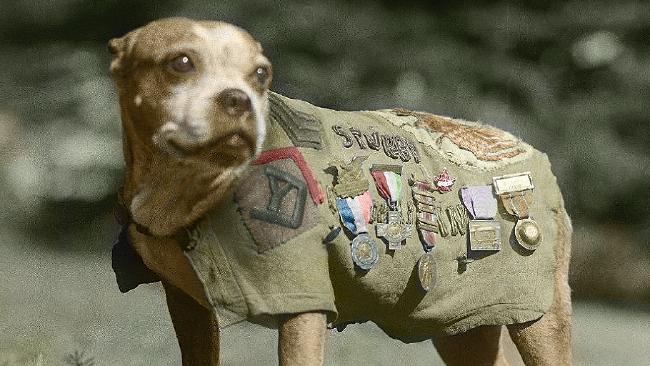
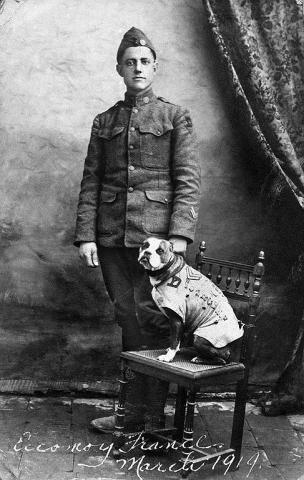
General Headquarters of the American Expeditionary Force recommended the use of dogs as sentries, messengers and draft animals in the spring of 1918. However, with the exception of a few sled dogs in Alaska, the US was the only country to take part in World War I, with virtually no service dogs in its military.

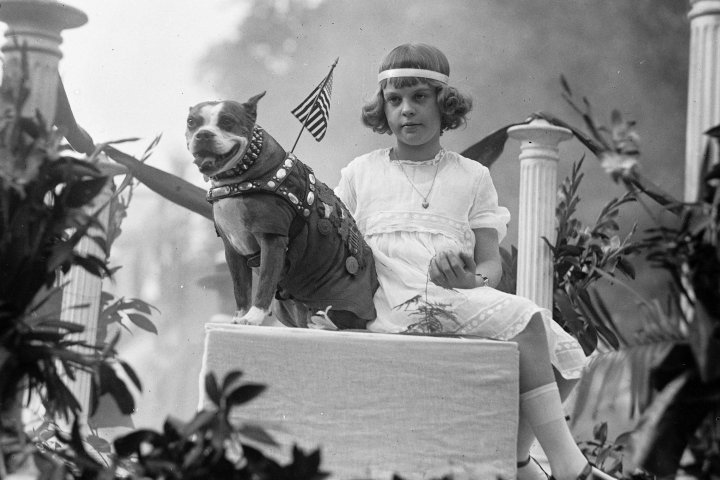
America’s first war dog, “Stubby”, got there by accident, and served 18 months ‘over there’, participating in seventeen battles on the Western Front.

He looked like a terrier of some kind, similar to a pit bull.  Nobody knows anything more about him.  He showed up as a stray at Yale Field in New Haven, Connecticut, while a group of soldiers were training. The dog hung around as the men drilled and one soldier, Corporal Robert Conroy, started taking care of him. Conroy hid Stubby on board the troop ship when the outfit shipped out in 1917.

363979bced264e59159a02578ebda717

Stubby saved his regiment from surprise \gas attacks, located and comforted the wounded, and even once caught a German spy by the seat of his pants. The Hun, who’d been prowling behind allied lines at the time, was mapping trenches for artillery bombardment.   He was found spinning in circles with a large, muscular terrier affixed to his behind.  The Bosch was easily disarmed, but it took a considerable amount of coaxing before Stubby could be persuaded to let go of that German’s rear end.

Stubby-Conroy-HistoricalStubby saw his first action at Chemin des Dames. Since the boom of artillery fire didn’t faze him, he learned to follow the men’s example of ducking when the big ones came close. It became a great game to see who could hit the dugout, first.  After a few days, the guys were watching him for a signal. Stubby was always the first to hear incoming fire.  We can only guess how many lives were spared by his early warning.
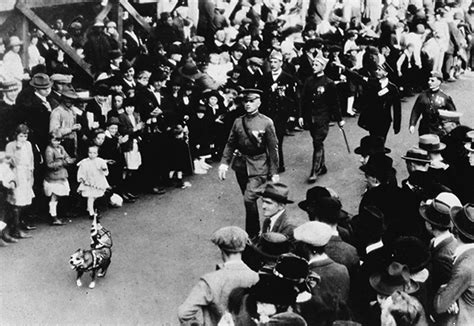
Following the Armistice, Stubby returned home as a nationally acclaimed hero, and was eventually received by presidents Harding and Coolidge. Even General John “Black Jack” Pershing, who commanded the AEF during the war, presented Stubby with a gold medal made by the Humane Society, declaring him to be a “hero of the highest caliber.”

Stubby toured the country by invitation and probably led more parades than any dog in American history.  He was promoted to honorary Sergeant by the Legion, becoming the highest ranking dog to ever serve in the Army.

download - 2019-04-04T044834.137

Old age caught up with the small warrior on April 4th, 1926, as he took ill and died in his master’s arms.

Sergeant Stubby and a few of his contemporaries were instrumental in inspiring the creation of the US K-9 Corps.  Just in time for World War ll.


A Trivial Matter
On returning home following service during WW2, only 4 of 592 Marine Corps dogs failed to adapt to civil life.

April 3, 1946 Death March

Arriving at Nagoya #7 prison camp, Tonelli was handed a piece of paper. Scribbled on it was a 58. He was prisoner number 58, the same number he had once worn on his football Jersey. “From that point on,” he said, “I knew I was going to make it”.

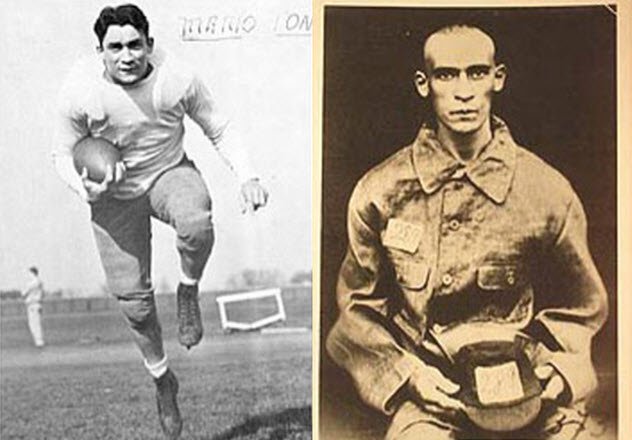
The game was November 27, 1937.  Late in the 4th quarter, Notre Dame was tied 6-6 with Southern California. The “Fighting Irish” needed a miracle. Notre Dame #58 Mario “Motts” Tonelli took the hand-off deep in Notre Dame territory and ran the ball 70 yards back before being tackled. Seconds later, the 5’11”, 195-pound fullback scored the game winning touchdown.

Tonelli (1)In some ways, Mario Tonelli himself was the miracle. Years earlier at the age of 6, he’d been burned over 80% of his body, when a trash compactor toppled over on him. Mario’s immigrant father Celi, a laborer from a northern Italian marble quarry, refused to believe the doctor who said his son would never walk again. Fixing four wheels to a door, the elder Tonelli taught his first American-born son to move about with his arms.
By 1935, Mario Tonelli was a football, basketball and track star at Chicago’s DePaul Academy.

After a year coaching at Providence College in 1939 and a year playing professional football for the Chicago Cardinals in 1940, Tonelli joined the Army in early 1941, assigned to the 200th Coast Artillery Regiment in Manila.

He’d hoped to fulfill his one years’ commitment and return to the Cardinals for the 1942 season, but it wasn’t meant to be.  The radio crackled to life at 2:30am local time on December 7, 1941. “Air raid on Pearl Harbor. This is no drill!”

pearl-harbor-4
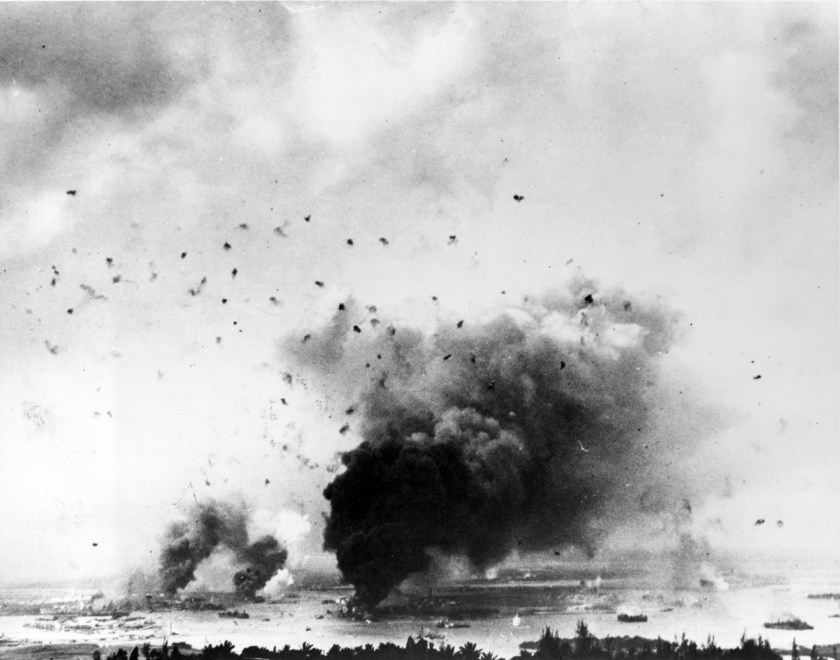
“A view of Pearl Harbor looking southwest from the hills towards the north. Taken during the Japanese raid, with anti-aircraft shell bursts overhead. Large column of smoke in lower center is from USS Arizona”. – H/T fstoppers.com

Military forces of Imperial Japan appeared unstoppable in the early months of World War Two, attacking first Thailand, then the British possessions of Malaya, Singapore, and Hong Kong as well as US military bases in Hawaii, Wake Island, Guam and the Philippines.

The United States was grotesquely unprepared to fight a World War in 1942, and dedicated itself to beating Adolf Hitler first. General Douglas MacArthur abandoned the “Alamo of the Pacific” on March 11 saying “I shall return”, leaving 90,000 American and Filipino troops without food, supplies or support with which to fight off the Japanese offensive.

bataan-death-march-route-mapOn April 9, 75,000 surrendered the Bataan peninsula, beginning a 65 mile, five-day slog into captivity through the heat of the Philippine jungle. Japanese guards were sadistic. Some would beat the marchers at random, or bayonet those too weak to walk. Japanese tanks would swerve out of the way to run over anyone who had fallen and was too slow in getting up. Some were burned alive. Already crippled from tropical disease and starving from the long siege of Luzon, thousands perished in what came to be known as the Bataan Death March.
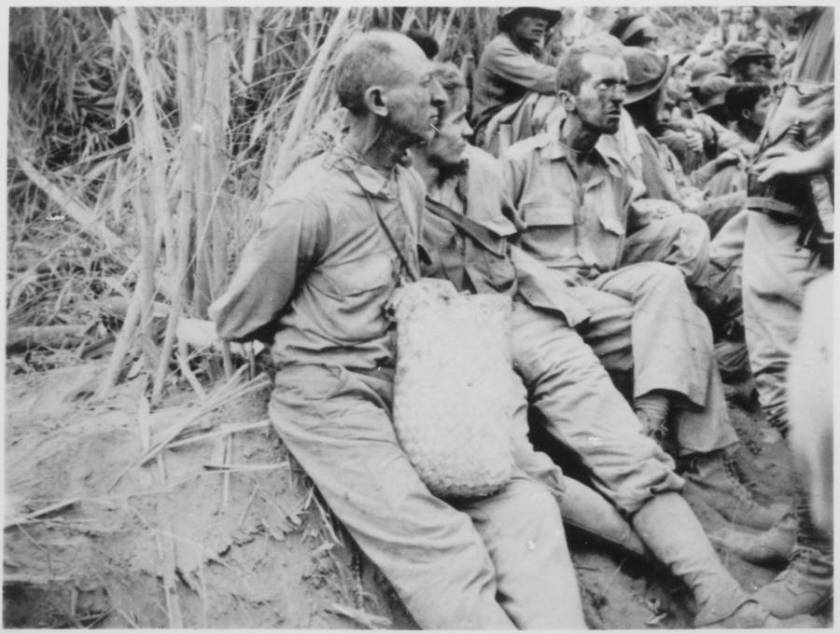
Exhausted, sunburned and aching with thirst, Tonelli still refused when a Japanese soldier demanded his Notre Dame class ring. As the guard reached for his sword, a nearby prisoner shouted “Give it to him. It’s not worth dying for”.

Minutes later, a Japanese officer appeared, speaking perfect English. “Did one of my men take something from you?” “Yes”, Tonelli replied. “My school ring”. “Here,” said the officer, pressing the ring into his hand. “Hide it somewhere. You may not get it back next time”. Tonelli was speechless. “I was educated in America”, the officer said. “At the University of Southern California. I know a little about the famous Notre Dame football team. In fact, I watched you beat USC in 1937. I know how much this ring means to you, so I wanted to get it back to you”.

prisoners-tied-up

Nearly 700 Americans and more than 10,000 Filipinos died on the Bataan death march. For the survivors, the ordeal was only beginning. For 2½ years Tonelli suffered starvation, disease and endless beatings in the squalid prison camps known as O’Donnell and Cabanatuan.  He was later transferred to Davo Penal Colony (“Dapecol”), in Panabo City.   Of an estimated 2,009 to enter Dapecol between October 1942- June 1944, only 805 survived the war.

Throughout the ordeal, Tonelli kept his ring.  Buried in a soap dish.  He’d take it out from time to time to remind himself.  Life used to be better than this. It gave him something to hope for.

Death March

The hellish 60-day journey aboard the filthy, cramped merchant vessel began in late 1944, destined for slave labor camps in mainland Japan. Tonelli was barely 100 pounds on arrival, his body ravaged by malaria and intestinal parasites. He was barely half the man who once played fullback at Notre Dame Stadium, Soldier Field and Comiskey Park.

Arriving at Nagoya #7 prison camp, Tonelli was handed a piece of paper. Scribbled on it was a 58. He was prisoner number 58, the same number he had once worn on his football Jersey. “From that point on,” he said, “I knew I was going to make it”.

mario-tonelli-ringAn American military tribunal conducted after the war held Lieutenant General Homma Masaharu, commander of the Japanese invasion forces in the Philippines, guilty of war crimes. He was executed by firing squad on April 3, 1946.

Mario Tonelli always hoped to meet the officer who’d returned his ring, but it wasn’t meant to be. He probably didn’t survive the war.  Mario “Motts” Tonelli passed away in 2003, at the age of eighty-six.  He still had that ring.


Afterward

In 1989, ROTC students at New Mexico State University held a memorial “Death March”.  Since 1992, the Army installation at the White Sands Missile Range near Las Cruces has been host to the memorial. It’s two events, really, participants competing in “heavy” and “light” division wearing full uniform with rucksack or full running gear. Marchers in both divisions compete over a full marathon course of 26.2 miles of hilly desert terrain, or a shorter 14.2 mile course.

Two weeks ago, 8,631 registered participants gathered from fifty states and a dozen nations, to commemorate the Battle of Bataan and the death march, 77 years ago.

Five actual survivors were in attendance for the opening ceremony, wrapped in blankets to ward off the pre-dawn cold.  They were Harold Bergbower, age 98.  James Bollich, age 97.  Valdemar DeHerrera, age 99.  Paul Kerchum, age 99.  Ben Skardon, age 101.

Mister Skardon actually marched in the March 17, 2019 event, covering three miles at the head of Skardon’s Brigade”.

The day began with a symbolic roll call.  Most of the names were met with silence. Twelve more than the same event, last year.

765f8607-5f56-4cbe-9a41-0fe13f1745ac-HK8A7509
“At 101 years old, Ben Skardon, center, is the oldest living Bataan Death March survivor to attend the memorial event at White Sands Missile Range. This year, he led “Ben’s Brigade” in an 3-mile march through the course on Sunday, March 17, 2019. (Photo: Kaitlin Englund/For the Sun-News)” H/T Ruidoso News
A Trivial Matter
Japanese guards made prisoners roast for hours the scorching Filipino sun, a torture known as “the sun treatment.” With little food and no water, Filipino civilians tried to throw food at the marchers. Most who did this were killed on the spot, by Japanese soldiers.


April 2, 1722 The Silence Dogood Letters

“Without freedom of thought there can be no such thing as wisdom and no such thing as public liberty without freedom of speech.” – Silence Dogood

The fifteenth child of Josiah and Abiah Franklin was born in a little house on Milk Street in Boston, across from the Old South Church.

The family moved to a larger house at Union & Hanover Street, when little Ben was six. As the tenth son, Benjamin Franklin was destined to be “tithed” to the church, but Josiah changed his mind after the boy’s first year in Boston Latin School. In light of the small salary, it was too expensive to educate a minister of the church.

The boy was sent to George Brownell’s English school for writing and arithmetic where he stayed until age ten, when he went to work in his father’s shop making tallow candles and boiling soap. After 1714, “Dr.” Benjamin Franklin’s education came exclusively from the books he picked up along the way.

By twelve the boy was “Hankering to go to sea”.  His father was concerned about his running away. Knowing of the boy’s love of books, the elder Franklin apprenticed his son to the print shop of James Franklin, one of his elder sons, where he went to work setting type for books. And reading them.  He would often “borrow” a book at night, returning it “early in the Morning lest it should be miss’d or wanted.”

benjamin-franklin-apprentice_1718By 1720, James Franklin began to publish The New England Courant, only the second newspaper to appear in the American colony.
Franklin often published essays and articles written by his friends, a group described as “The Hell-Fire Club”. Benjamin desperately wanted to be one of them, but James seemed to feel that sixteen-year-old little brothers should be seen, and not heard..

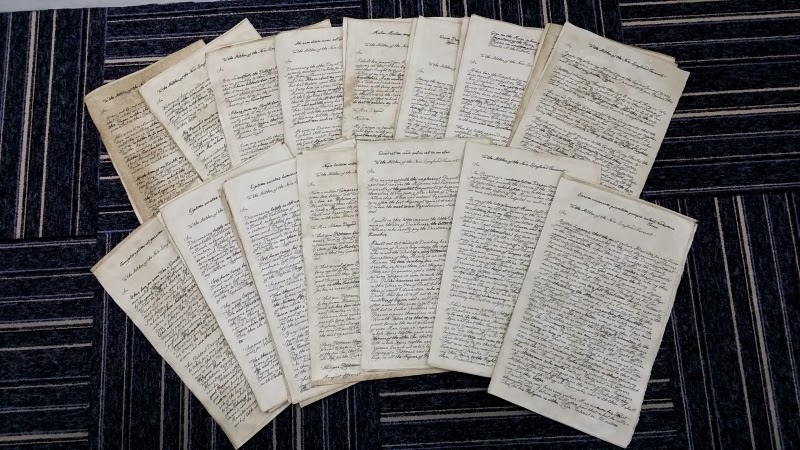
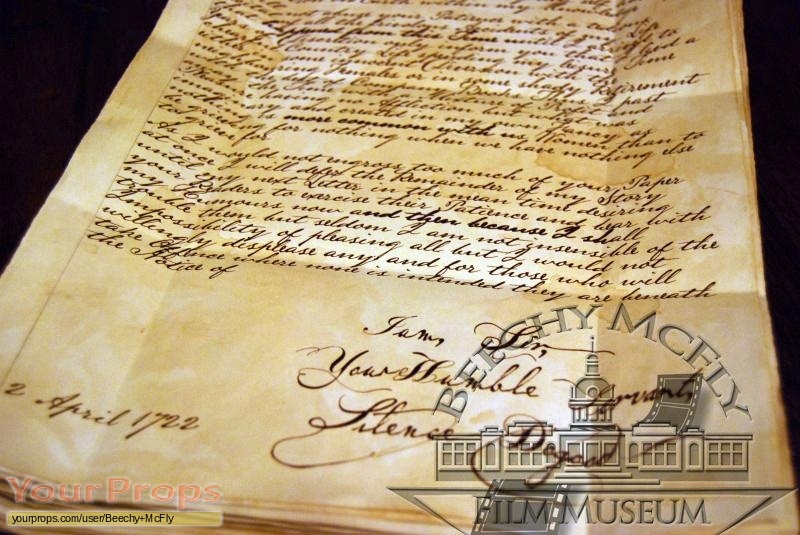
Sometime in March 1722, a letter appeared beneath the print shop door. “Sir, It may not be improper in the first Place to inform your Readers, that I intend once a Fortnight to present them, by the Help of this Paper, with a short Epistle, which I presume will add somewhat to their Entertainment”. The letter went on in some detail to describe the life of its author, Mrs. Silence Dogood.

National-Treasure-The-Complete-Silence-Dogood-Letters-4

That first letter was published on April 2.  True to her word, Silence Dogood wrote again in two weeks.  And then again, and again.  Once every two weeks, for 28 weeks.  Her letters were delightful, cleverly mocking the manners of Boston “Society”, and freely giving advice, particularly on the way that women should be treated. Nothing was sacred.  One letter suggested that the only thing students learned at Harvard College, was conceit.

dogood_illustrationJames Franklin and his literary friends loved the letters, and published every one. All of Boston was charmed with Silence Dogood’s subtle mockery of the city’s Old School Puritan elite. Proposals of marriage came into the print shop, when the widow Dogood coyly suggested that she would welcome suitors.
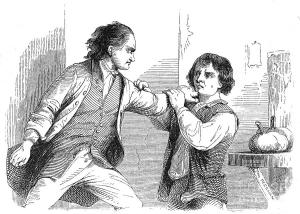
James was jailed at one point, for printing “scandalous libel” about Massachusetts Governor Joseph Dudley.  The younger Franklin ran the shop in his absence, when Mrs. Dogood came to his defense.  Quoting Cato, she proclaimed:  “Without freedom of thought there can be no such thing as wisdom and no such thing as public liberty without freedom of speech.

And then the letters stopped, much to the dismay of the Courant and its readership. One wrote to the editor, saying the paper had “lost a very valuable Correspondent, and the Public been depriv’d of many profitable Amusements.”

On December 3, James Franklin ran an ad. “If any Person . . . will give a true Account of Mrs. Silence Dogood, whether Dead or alive, Married or unmarried, in Town or Country, . . . they shall have Thanks for their Pains.” It was only then that his sixteen-year-old brother fessed up.  Benjamin Franklin was the author of the Silence Dogood letters.

benjamin-james-franklin-grangerAll of Boston was amused by the hoax, but not James. He was furious with his little brother, who soon broke the terms of his apprenticeship and fled to Pennsylvania.

So it was that a future Founding Father of the Republic, the inventor, scientist, writer and philosopher, the statesmen who appears on our $100 bill, came to Philadelphia.  Within a few years Franklin had set up his own print shop, publishing the Philadelphia Gazette as well as his own book bindery, in addition to buying and selling books.

Benjamin Franklin’s efforts are in no small part a reason why literacy standards were higher in Colonial America, than among the landed gentry of 18th century England. Higher, I expect, than even today.

Franklin’s diplomacy to the Court of Versailles was every bit as important to the success of the Revolution, as the Generalship of the Father of the Republic, George Washington. Signatory to both the Declaration of Independence and the Constitution, it is arguably Ben Franklin who broke the impasse of the Convention of 1787, paving the way for ratification of the United States Constitution.

b66a0356-04ff-459f-8838-9f8438937061-bannerBy then too old and frail to deliver his own speech, Franklin had someone else read his words to the deadlocked convention.

“On the whole, sir, I can not help expressing a wish that every member of the convention who may still have objections to it, would, with me, on this occasion, doubt a little of his own infallibility, and, to make manifest our unanimity, put his name to this instrument”.

As I witness the disintegration of civil society, over politics, I cannot deny the wish that my countrymen might, each in his turn, doubt a little of his own infallibility.


A Trivial Matter
Despite ending his formal education at age ten, Benjamin Franklin is considered to be one of the great polymaths along with the likes of Aristotle, Leonardo da Vinci and Albert Schweitzer. A prolific inventor, Franklin never patented a single one, believing such innovations should be shared, freely. A brief list of Franklin’s inventions include bifocal glasses, the lighting rod and the Franklin stove.  The founding father’s personal favorite was a musical instrument which came to be played by the likes of Mozart and Beethoven: the Glass Armonica

April 1, 1961 Wonder Drug

Despite documented cases of fetal alcohol syndrome, scientists believed no drug could pass the placental barrier, passing from mother to unborn child. Within three years, the new compound was licensed to 14 pharmaceutical companies under 37 different trade names and sold in 46 countries.

In 380BC, Plato described a system of state-controlled human breeding in the Socratic dialogue “The Republic”, introducing a “guardian class” to watch over over his ideal society.

In the 19th century, the British statistician Francis Galton studied the theories of his cousin Charles Darwin on the evolution of species, applying them to a system of selective breeding intended to bring “better” human beings into the world.  He called this his theory of “Eugenics”.

Eugenics gained worldwide respectability in the early 20th century, when countries from Brazil to Japan adopted policies regarding the involuntary sterilization of certain mental patients.

1935sterilization-map
1935 Sterilization map. H/T PBS.org

In the United States, 30 states passed legislation at the height of the movement, legalizing the involuntary sterilization of individuals considered “unfit” for reproduction. All told, some 60,000 individuals were forcibly sterilized in state-sanctioned procedures.

The race to perfect worldwide “genetic hygiene” reached its zenith with the “sterilization law” enacted in Nazi Germany on July 14, 1933. The German measure borrowed heavily from the statutes of American educator and Eugenics Record Office (ERO) Director Harry H. Laughlin, taking such measures a step further by allowing compulsory sterilization of any citizen displaying one of a long list of supposed genetic disorders, not just those confined to institutions.

Thalidomide_syntehsis
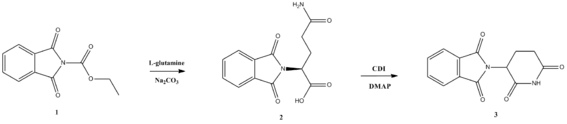
Two-Step Thalidomide Synthesis

In the wake of World War II, West German authorities were loath to apply such strict congenital examination. Pathologist Franz Büchner would go on to propagate his theories of Teratology, stating that healthy nutrition and behavior of expecting mothers was more important for the health of the child, than genetic considerations. The idea would prove to be a disastrous oversight.

The German company Chemie Grünenthal (now Grünenthal GmbH) was established to address the urgent need for antibiotics. and other pharmaceuticals. In 1953, company scientists developed a two-step procedure for synthesizing a new molecule. The compound underwent rodent testing and further revision, the new drug “Thalidomide” introduced in 1956, as a sedative.

3e93c73a1a9458fb334b946337310185
Life Magazine

Researchers at Chemie Grünenthal found the drug an effective remedy for vomiting and nausea, an important remedy for morning sickness in expectant mothers. It was a “wonder drug”, a cure for ailments from insomnia to coughs and colds, claiming to cure “anxiety…gastritis, and tension”.

Despite documented cases of fetal alcohol syndrome, scientists believed no drug could pass the placental barrier, passing from mother to unborn child. Within three years, the new compound was licensed to 14 pharmaceutical companies under 37 different trade names and sold in 46 countries.

Thalidomide acceptance was far from universal. Regulatory authorities in East Germany refused approval. In the United States, the U.S. Food and Drug Administration (FDA) denied widespread marketing and distribution though large quantities were released, for testing.  Approximately 875 people were involved in such trials, including a number of pregnant women.

playing-blocks
Phillipa Bradbourne, a Thalidomide baby born without arms. 1963. H/T allthatsinteresting.com

The drug first arrived in Canada on this day in 1961. Several variants entered the Canadian market, the most common sold under the name, Talimol. Within two months, pharmaceutical companies were warning physicians of the risk of birth defects. Canadian authorities banned all variants within a year, instructing physicians to destroy stockpiles.

The first birth defects began to appear around 1958, peripheral nerve palsies or Phocomelia, a malformation or entire absence of arms and/or legs, hands & feet.  Some cases showed malformation of eyes, ears and internal organs, others born with no anus and no genitals and doomed to die.  Some five to seven thousand children were born with such birth defects in West Germany alone, four-in-ten of whom, survived.  Worldwide, some 10,000 “Thalidomide babies” were born with such defects, half of whom survived infancy.  An estimated 123,000 others miscarried, or were stillborn.

“Today, fewer than 3,000 are still alive. In Britain, it’s about 470. Among the nearly 50 countries affected are Japan (approximately 300 survivors), Canada and Sweden (both more than 100), and Australia (45). Spain’s government only recently acknowledged the drug was ever distributed there. No-one knows how many Spanish survivors there are. It could be hundreds”. H/T BBC

Despite such egregious side effects, Thalidomide remains in use today, albeit under conditions of strict birth control.  Thalidomide is in fact a “wonder drug” for the treatment of certain skin conditions related to leprosy, and is useful for treatments relating to HIV, Crohn’s Disease and certain cancers.

Sadly, Brazilian strictures are not so severe, leading to the birth of a whole new generation of “thalidomiders”, as adult survivors call themselves.  Research has uncovered circumstantial evidence connecting Thalidomide’s origins to Dr. Otto Ambros, the “Devil’s Chemist”,  alleging Dr. Ambros helped develop the nerve agent sarin, while experimenting on thalidomide as an antidote on concentration camp inmates.

Eight years ago, German survivors’ marked the fifty-year mark, in the Thalidomide debacle. Spokesman Gernot Stracke quipped:

“On 26 November – 50 years on – we, the German survivors, will march, waddle, limp or roll in wheelchairs from the Brandenburg Gate to the Federal Chancellery in Berlin.  To celebrate that we are still alive, and to remember those who never lived”.

Feature image, top of page:  Survivors tell tales of frequent falls leading to scores of stitches as the armless and legless attempt navigation with contraptions like the British prosthesis, on the left.  Right, young German girl uses crude boxing glove-like prostheses, in place of hands.  H/T Life Magazine.


A Trivial Matter
In the United States, federal regulator Dr. Frances Oldham Kelsey denied no fewer than six applications to bring Thalidomide to market, on the basis of insufficient testing.  Thanks to her stubborn refusal, such cases were held to seventeen in this country, a fact which earned Dr. Kelsey a Presidential award for distinguished service from the federal government.

March 31, 2005 Arlington Ladies

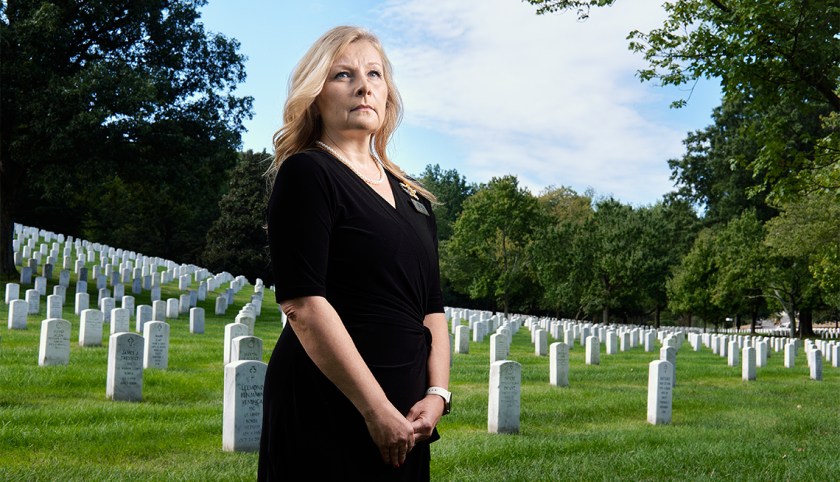
The job of the Arlington Ladies is to honor, not to grieve, but it doesn’t always work out that way.  Linda Willey of the Air Force Ladies describes the difficulty of burying Pentagon friends after 9/11, while pieces of debris yet littered the cemetery. Paula McKinley of the Navy Ladies still chokes up, over the hug of a ten-year old girl who had just lost both parents. Margaret Mensch speaks of the heartbreak of burying one of her own young escorts after he was killed in Afghanistan, in 2009.

The first military burial at Arlington National Cemetery was that of Private William Henry Christman, 67th Pennsylvania Infantry, interred on May 13, 1864. Two more joined Christman that day, the trickle soon turning into a flood. By the end of the war between the states, that number was 17,000 and rising.

In modern times, an average week will see 80 to 100 burials in the 612 acres of Arlington.

1200px-SMA_Dunway_Burial_at_Arlington_National_Cemetery_2008Fourteen years ago, a news release from the Department of Defense reported “Private First Class Michael A. Arciola, 20, of Elmsford, New York, died February 15, 2005, in Al Ramadi, Iraq, from injuries sustained from enemy small arms fire. Arciola was assigned to the 1st Battalion, 503d Infantry Regiment, 2nd Infantry Division, Camp Casey, Korea”.
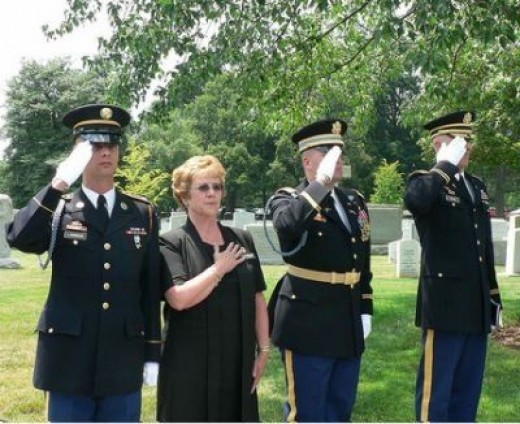
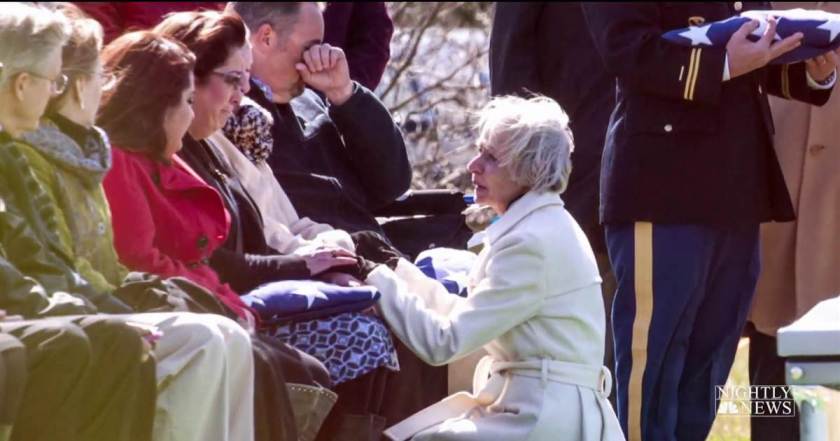
Private Arciola joined a quarter-million buried in our nation’s most hallowed ground on March 31. Two hundred or more mourners attended his funeral, a tribute befitting the tragedy of the loss of one so young.

9917514_f520

Sixteen others were buried that same Friday. Most were considerably older. Some brought only a dozen or so mourners. Others had no friends or family members whatsoever, on-hand to say goodbye.

Save for a volunteer, from the Arlington Ladies.

In 1948, Air Force Chief of Staff General Hoyt Vandenberg and the general’s wife Gladys, regularly attended funeral services at Arlington National cemetery.

nn_lho_arlington_ladies_180102_1920x1080.nbcnews-fp-1200-630Sometimes, a military chaplain was the only one present at these services. Both Vandenbergs felt that a member of the Air Force family should be present at these funerals.  Gladys began to invite other officer’s wives. Over time, a group of women from the Officer’s Wives Club were formed for the purpose.

In 1973, General Creighton Abrams’ wife Julia did the same for the Army, forming a group calling themselves “Arlington Ladies”. Groups of Navy and Coast guard wives followed suit, in 1985 and 2006.

arlington-ladies3

Traditionally, the Marine Corps Commandant sends an official representative of the Corps to all Marine funerals.  The Marine Corps Arlington Ladies were formed in 2016.

Arlington Ladies’ Chairman Margaret Mensch explained “We’ve been accused of being professional mourners, but that isn’t true. I fight that perception all the time. What we’re doing is paying homage to Soldiers who have given their lives for our country.”

arlington_lady_joayn_bahr_at_funeral_es_053011The casual visitor cannot help but being struck with the solemnity of such an occasion. Air Force Ladies’ Chairman Sue Ellen Lansell spoke of one service where the only other guest was “one elderly gentlemen who stood at the curb and would not come to the grave site. He was from the Soldier’s Home in Washington, D. C. One soldier walked up to invite him closer, but he said no, he was not family”.

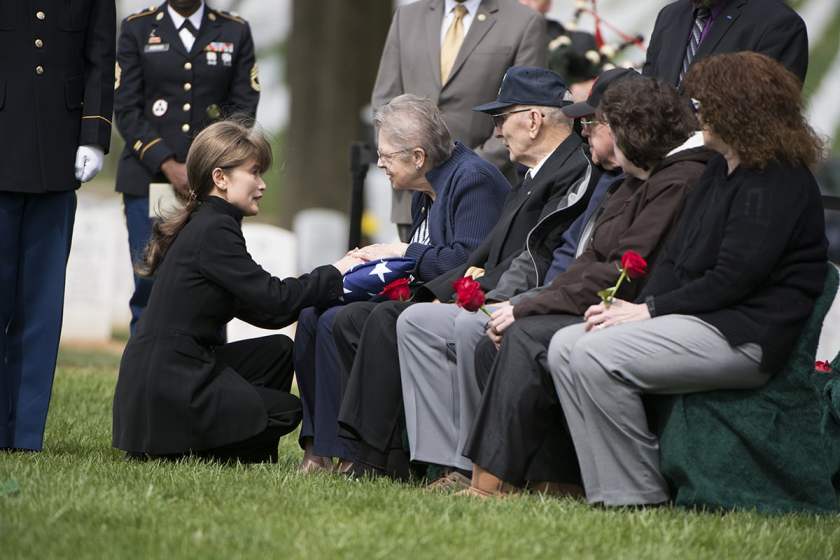
The organization was traditionally formed of current or former military wives. Today their number includes daughters and even one “Arlington Gentleman”. 46 years ago they came alone, or in pairs. Today, 145 or so volunteers from four military branches are a recognized part of all funeral ceremonies at Arlington National Cemetery, their motto: “No Soldier will ever be buried alone.”

arlington-ladies2

The volunteer arrives with a military escort from the Navy or the United States Army 3rd Infantry Regiment, the “Old Guard”. The horse-drawn caisson arrives from the old post chapel, carrying the flag draped casket. Joining the procession, she will quietly walk to the burial site, her arm inside that of her escort. A few words are spoken over the deceased, followed by the three-volley salute. Off in the distance, a solitary bugler sounds Taps.

The folded flag is presented to the grieving widow, or next of kin. Only then will she break her silence, stepping forward with a word of condolence and two cards: one from the service branch Chief of Staff and his wife and a second, from herself.

Arlington-Ladies-2 (1)

Joyce Johnson buried her husband Lieutenant Colonel Dennis Johnson in 2001, a victim of the Islamist terrorist attack on the Pentagon. Johnson remembers the Arlington Ladies’ volunteer as “a touchingly, human presence in a sea of starched uniforms and salutes”. Three years later, Joyce Johnson paid it forward, and became one herself.

Any given funeral may be that of a young military service member killed in service to the nation, or a veteran of Korea or WWII, who spent his last days in the old soldier’s home. It could be a four-star General or a Private. It matters not a whit.

“We’re not professional mourners. We’re here because we’re representing the Air Force family and because, one day, our families are going to be sitting there in that chair”. – Sandra Griffin, Air Force volunteer, Arlington Ladies

Individual volunteers attend about five funerals a day, sometimes as many as eight. As with the Tomb of the Unknown sentinels who hold their vigil heedless of weather, funeral services pay no mind, to weather conditions. The funeral will proceed on the date and time scheduled irrespective of rain, snow or heat. Regardless of weather, an Arlington Lady Will be in attendance.

The job of the Arlington Ladies is to honor, not to grieve, but it doesn’t always work out that way.  Linda Willey of the Air Force Ladies describes the difficulty of burying Pentagon friends after 9/11, while pieces of debris yet littered the cemetery. Paula McKinley of the Navy Ladies still chokes up, over the hug of a ten-year old girl who had just lost both parents. Margaret Mensch speaks of the heartbreak of burying one of her own young escorts after he was killed in Afghanistan, in 2009.

Barbara Benson was herself a soldier, an Army flight nurse during WWII. She is the longest serving Arlington Lady. “I always try to add something personal”, Benson said, “especially for a much older woman. I always ask how long they were married. They like to tell you they were married 50 or 60 years…I don’t know how to say it really, I guess because I identify with Soldiers. That was my life for 31 years, so it just seems like the natural thing to do.”

1000w_q95 (2)

Elinore Riedel was chairman of the Air Force Ladies during the War in Vietnam, when none of the other military branches had women representatives. “Most of the funerals were for young men,” she said. “I saw little boys running little airplanes over their father’s coffins. It is a gripping thing, and it makes you realize the awful sacrifices people made. Not only those who died, but those left behind.”

Mrs. Reidel is a minister’s daughter, who grew up watching her father serve those in need. “It doesn’t matter whether you know a person or not”, she said, “whether you will ever see them again. It calls upon the best in all of us to respond to someone in deep despair. I call it grace…I honestly feel we all need more grace in our lives.”

1140-sandra-griffin-ladies-of-arlington.imgcache.rev1477409052107 (1)
23-year veteran of the United States Air Force Sandra Griffin, now serves as an Arlington Lady.
This “Today in History” is dedicated to the man for whom I am namesake. United States Army Lieutenant Colonel (retired) Richard B. “Rick” Long, Sr., 2/25/37 – 3/31/18. Rest In Peace, Dad. You left us too soon.

March 30, 1945 We’re All Jews Here

“We’re not doing that.  We’re all turning out”.

“First they came for the socialists, and I did not speak out—because I was not a socialist. Then they came for the trade unionists, and I did not speak out— because I was not a trade unionist. Then they came for the Jews, and I did not speak out—because I was not a Jew. Then they came for me—and there was no one left to speak for me”. – Martin Niemöller

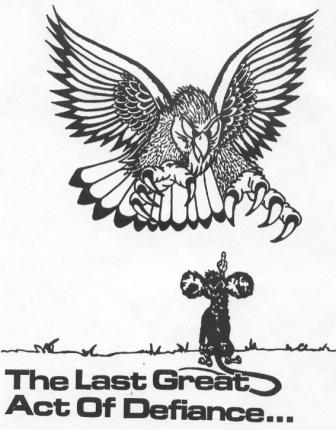
last_great_act_of_defiance1Before the age of the internet meme,  office jokes and bits of folk wisdom were passed around and copied and copied again.  There was one, “The Last great of Defiance“, which will live for all time as my favorite.  The picture speaks for itself.  I had one on the wall, for years.
This is one of those stories.

The last great effort of German arms burst out of the frozen Ardennes forest on December 16, 1944, aiming for the vital port at Antwerp.

Unternehmen Wacht am Rhein“, (“Operation Watch on the Rhine”) was a tactical surprise for the Wehrmacht, as allied forces were driven back through the densely forested regions of France, Belgium and Luxembourg. Wartime news maps showed a great inward “bulge” in the lines, and the name stuck. The Battle of the Bulge was the largest and bloodiest battle fought by American forces in World War 2, fought in the harshest winter conditions in recorded history and involving some 610,000 GIs.

malmed1Prisoners were swept up by the thousands, and faced an uncertain future.  In Malmedy, Belgium, seventy-five captured Americans were marched into an open field and machine gunned by members of the 1st SS Panzer Division (Leibstandarte Adolf Hitler), a part of 6th Panzer Army.
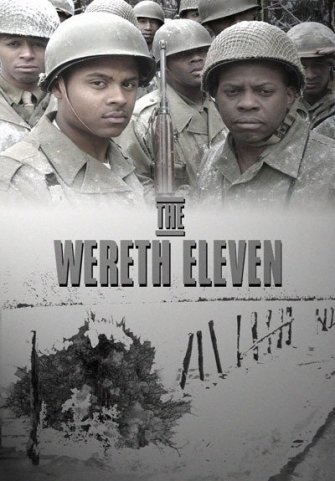
On December 16, the all-black 333rd Field Artillery Battalion of the racially segregated US Army put up an heroic defense outside the town of Wereth, Belgium, using their 155mm guns to delay the German advance. Desperately outnumbered, the 333rd was overrun the following day, groups of men scattering to escape as best they could. Eleven soldiers made their way to the home of Mathias Langer, the Mayor of Wereth.

To shelter allied troops under German occupation was to risk summary execution. Despite the obvious risk to their own lives, Matthias and his wife Maria took these men in and attempted to hide them, in their home. When German troops arrived, the eleven surrendered rather than risk the lives of their benefactors.

the-wereth-eleven-578359l
Movie poster for the 2011 film, “The Wereth Eleven”

The prisoners were marched out of sight and murdered, every one of them. The Wereth 11 were lost in the confusion of the Bulge, their bodies hidden under the snow until Spring melt. Their story was lost to history, for the next fifty years.

Nazi atrocities were not limited to Allied troops.  By some accounts, more civilians were killed during the Battle of the Bulge than the last four years.  When the fighting was over, more than 115 bodies were found in the towns of Ster and Parfondruy, alone.

For Master Sargent Roderick “Roddie” Edmonds, the war ended on December 19, swept up with hundreds of American troops and taken prisoner.  These were the lucky ones, escaping those first white-hot moments of capture to be sent to a German prisoner-of-war camp.  He was later transferred to another camp near Ziegenhain, Germany.  At 24, M/Sgt Roddie Edmonds was the senior non-commissioned officer at Stalag IX-A, responsible for 1,275 American POWs.

The Wehrmacht had harsh anti-Jew policies and kept Jewish POWs in strict segregation.  In the East, Russian Jewish POWs were sent directly to extermination camps.  The future was more uncertain for Jewish POWs, in the west.  Many were worked to death in slave labor camps.

Home_Slider_Image-1024x666

On January 27, the first day at Stalag IX-A, commandant Siegmann ordered Edmonds: All American Jews were to identify themselves, at the following day’s assembly.  The word went out to all five barracks:  “We’re not doing that.  We’re all turning out“.

The following morning, 1,275 POWs presented themselves.  Every. Single. Man.

Siegmann was perplexed.  “They can’t all be Jews!”  As senior NCO, Edmonds spoke for the group.  “We’re all Jews here“.  The Nazi commandant was apoplectic, pressing a Luger into Edmonds’ forehead.  This is your last chance.

Edmonds gave his name, rank and serial number, and then said:  ‘If you are going to shoot, you are going to have to shoot all of us because we know who you are and you’ll be tried for war crimes when we win this war.'”  Siegmann was incandescent, white with rage, but the moment had passed.  He was beaten.

The 1,275 American POWs held at Stalag IX-A were liberated this day in 1945, including some 200 Jews.

Roddie Edmonds was again recruited for the war in Korea.  He never told his family about any of it.

Chris Edmonds is the Pastor at Piney Grove Baptist Church in Maryville, Tennessee. Following his father’s death in 1985, Chris’ mother gave him his father’s  war diary, where he found a brief mention of this story.  Chris scoured the news for more information, around the time Richard Nixon was looking for his post-Presidential home.  As it happened, Nixon bought his posh, upper-east side home from Lester Tanner, a prominent New York Lawyer who mentioned in passing, he owed his life to Roddie Edmonds.

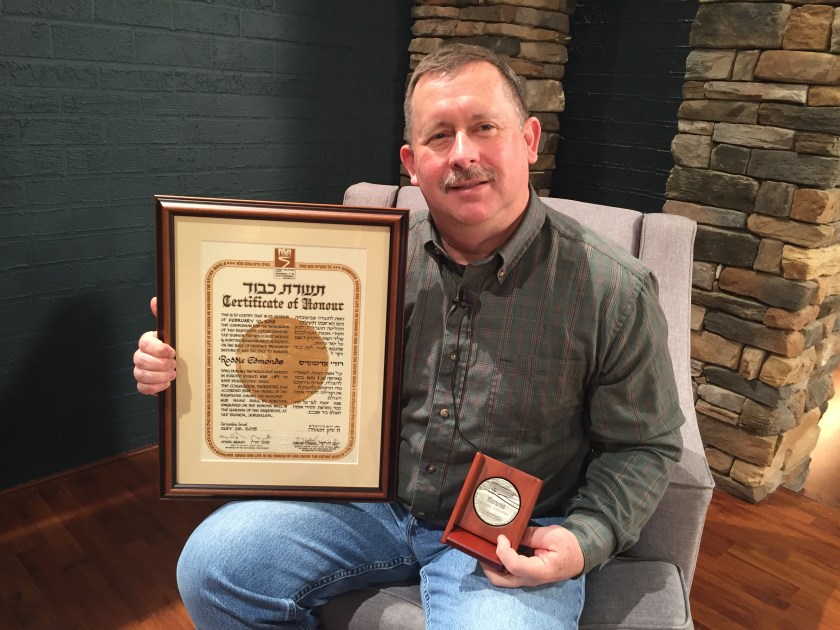
So it was, this story came to light.  In 2015, Edmonds was honored as “Righteous among the Nations”, the first American soldier, so honored.  It’s the highest honor bestowed by the state of Israel, on non-Jews who risked their lives to save Jews from the Nazi death machine.  President Barack Obama recognized Edmonds heroism in a 2016 speech before the Israeli embassy.  The United States Congress bestowed the Congressional Gold Medal in 2017.  As I write this, Pastor Edmonds and the Jewish veterans saved by M/Sgt Edmonds are pushing for the Knoxville, Tennessee native to receive the Medal of Honor.

Pastor Edmonds says he always looked up to his father, the man had always been, his hero.  “I just didn’t know he had a cape in his closet“.

Chris Edmonds_1455424082776_247114_ver1.0.JPG

March 29, 1848 When Niagara Falls Ran Dry

Only once in recorded history did Niagara Falls run dry.  On this day in 1848, roughly 212,000 cubic feet per second dried, to a trickle.

As Athens and Sparta vied for control of the Peloponnese, the earliest tribes settled in the Niagara valley of modern-day Ontario and western New York.  These aboriginal settlers were the Onguiaahra, a farming people growing corn, beans and squash in the rich soil of the Niagara escarpment, hunting deer and elk and fishing the tributary waterways of the Niagara valley.

They were 12,000 in number when French explorer Samuel de Champlain came to the region in 1615.  French explorers called them “Neutrals”, the peace makers between the perpetually warring tribes of the Seneca, Cayuga, Onondaga, Oneida and Mohawk Nations to the south, and the Huron to the north.  Vying for control of the rich French fur trade, peoples of this “Iroquois Confederacy” systematically destroyed the villages of the neutrals, killing their people or driving them east, toward Albany.  The Onguiaahra ceased to exist as a people by 1653 but their name lives on, in a word translating as “Thunder of Waters”.

Niagara_falls_panorama

Niagara Falls are three in number, 3,160 tons of water cascading over the precipice every second, hitting the bottom at American and Bridal Veil Falls with 280 tons of force, and an astonishing 2,509 striking the Canadian side, at the famous Horseshoe Falls.

Pictures have been around since the age of photography, purporting to show Niagara Falls “frozen solid”.  That’s not so unusual.  The Washington Post reports:

“Niagara Falls gets cold every year. The average temperature in Niagara Falls in January is between 16 and 32 degrees. Naturally, it being that cold, ice floes and giant icicles form on the falls, and in the Niagara River above and below the falls, every year. The ice at the base of the falls, called the ice bridge, sometimes gets so thick that people used to build concession stands and walk to Canada on it. It’s nothing out of the ordinary. It is not, to put it bluntly, big polar vortex news”.

Niagara “Frozen” in 1906, 1902 and 1936.  Hat Tip Snopes.com

Despite appearances, water flows in abundance under those bridges of ice.  Only once in recorded history did Niagara Falls run dry.  On this day in 1848, roughly 212,000 cubic feet per second dried, to a trickle.  Not dried, really, nor did it freeze.  Strong southwest winds had driven massive amounts of ice to the head of Niagara River, effectively putting a cork in the bottle.

NiagaraFallsMaybe1848

Fish flopped in the dry riverbed as, upstream, factories ground to a halt.  Souvenir hunters and daredevils walked out on the dry river bed.  Some even drove buggies.   One unit of the United States Army cavalry paraded back and forth, across the river.  Treasure hunters found artifacts from the War of 1812:  muskets, bayonets, even tomahawks.  At the base of the Falls, Maid of the Mist owners took the opportunity to dynamite rocks, which had endangered their boat.

That much water is not to be denied.  The ice dam broke on March 31 and, by that evening, the flow was back to normal.

Lifelong “Stooges” fans will appreciate this classic comedy bit, “Niagara Falls”

The Falls “dried up” once more in 1961 but, this time, on purpose.  Over three days and 1,264 truckloads of fill, the US Army Corps of Engineers built a cofferdam that June, diverting water to the Canadian side.  There was concern that rock falls were going to cause erosion, “shutting down” the Falls.  On inspection, engineers determined that removing the rocks would accelerate erosion.  The idea was abandoned by November and the cofferdam, blown up.  To this day, the waters of Niagara flow unvexed, to the sea.

Dryniagara


A Trivial Matter
In 1901, Schoolteacher Annie Edson Taylor became the first person to go over Niagara Falls, in a barrel.  Sixteen others have followed, at least on purpose.  Five of them died, including the guy who went over in a kayak, and the one on the jet ski.  On Saturday, July 9, 1960, seven-year-old Roger Woodward was accidentally swept over Horsehoe Falls and miraculously survived the 162-foot plunge, wearing only a bathing suit and a life jacket. Sadly, James Honeycutt was killed, attempting his rescue.  90% of fish who go over the Falls, live to tell the tale.

March 28, 1892 Two-Gun Hart, Prohibition Cowboy

By 1930, Richard James Hart was so famous as to receive a letter addressed only to “Hart”, along with the sketch of a brace of pistols.

In 2002, the Martin Scorcese film Gangs of New York told the story of Civil War-era street gangs, the violent underworld of a city run by Tammany Hall “Machine” politician William “Boss” Tweed. The slum tenements of turn-of-the century New York were borne of this earlier period, a vicious, teeming underworld of petty criminals and street gangs including the Five Point, Whyos, Chichester and a score of others.

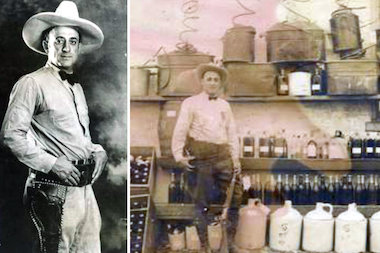
James Vincenzo was born into this world on this day in 1892, a world of gang violence where rivalries were brutal and fights armed and often, to the death. James ran to the defense of his younger brother Al after one gang-banger slashed the boy across the face, hurling his little brother’s attacker through a plate glass window.

While many of the boys of this day grew into the criminals of another era, James left New York City for the life of a circus roustabout.

Hart
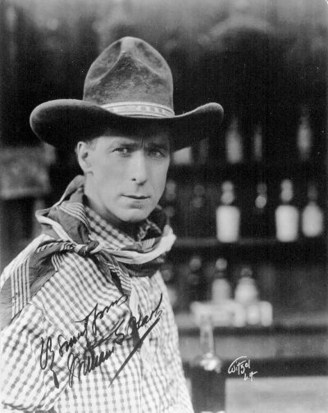
Silent film cowboy star William S Hart

This was the age of the silent film, William S. Hart one of the great “cowboy” stars of the era. Hart was larger than life, the six-gun toting cow-punching gunslinger from a bygone era.

The roustabout so idolized the silent film star he adopted the mannerisms, the low-slung six-shooters, red bandanna and the ten-gallon hat. Not content with merely aping all that cinematic charisma, James went so far as to adopt the man’s name.

Richard James Hart stepped off the freight train in 1919, a walking, talking anachronism. He was a 19th century Wild West gunfighter, from his cowboy boots to his embroidered vest to that broad-brimmed stetson hat. This was Homer Nebraska, a small town of about 500, some seventeen miles from Sioux City Iowa.

He claimed to be a hero of the Great War, personally decorated by General John J. Pershing. Intelligent, ambitious and not afraid of a little hard work, Hart took jobs as paper hanger, house painter, whatever it took.

He was short and powerfully built with the look of a man who carried mixed Indian or Mexican blood, regaling veterans at the local American Legion with tales of his exploits, against the Hun.

The man could fight and he knew how to use those guns, amazing onlookers with feats of marksmanship, behind the Legion post.

Any doubts about Hart’s physical courage were put to rest that May when a flash-flood nearly killed the Winch family of neighboring Emerson Nebraska. Hart dashed across the raging flood time after time to bring the family to safety.  Nineteen-year-old Kathleen was so taken with her savior she married the man that Fall, a marriage which would produce four boys.

1a51f078610f1e077ce9a551f2b1cecaThe small town was enthralled by this new arrival, the town council appointing Hart as Marshall. He was a big fish in a small pond, elected commander of the Legion post and district commissioner for the Boy Scouts of America.
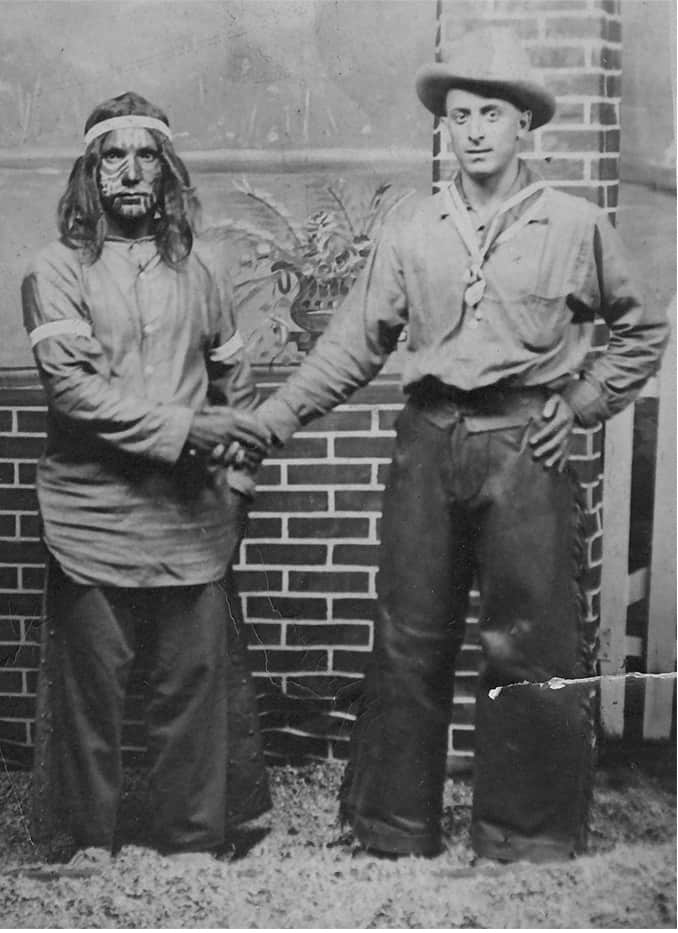
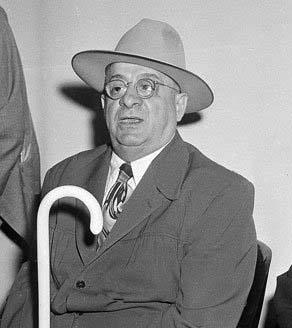
The 18th Amendment to the Constitution was ratified on January 16 of that year, the Volstead Act passed by the United States Congress over the veto of President Woodrow Wilson on October 29. “Prohibition” had descended across the land. It was now illegal to produce, import, transport or sell intoxicating liquor.

Richard Hart became Prohibition Agent in the Summer of 1920 and went immediately to work, destroying stills and arresting area bootleggers.

Hart was loved by Temperance types and hated by the “wets”, and famous across the state of Nebraska. The Homer Star reported their hometown hero was “becoming such a menace in the state that his name alone carries terror to the heart of every criminal.

Officials at the federal Bureau of Indian Affairs took note and before long, Hart was performing the more difficult (and dangerous) job of liquor suppression on the reservations.

Hart brought his chaps and his six-shooters to South Dakota, where the Yanktown reservation superintendent reported to his superiors in Washington “I wish to commend Mr. Hart in highest terms for his fearless and untiring efforts to bring these liquor peddlers and moonshiners to justice. …This man Hart is a go-getter.”

Richard-shaking-hand

Hart became proficient in Lakota and Omaha dialects. Tribal leaders called him “Two Gun”, after the twin revolvers he wore. Some members of the Oglala tribe called him “Soiko”, the name roughly translating as “Big hairy boogey-man”.

By 1927, Two-Guns Hart had achieved such a reputation as to be appointed bodyguard to President Calvin Coolidge, on a trip through the Black Hills of South Dakota.

By 1930, Richard James Hart was so famous as to receive a letter addressed only to “Hart”, along with the sketch of a brace of pistols.

181580_maxHart became livestock inspector after repeal of prohibition, and special agent assigned to the Winnebago and Omaha reservations.  He was re-appointed Marshall of his adopted home town but, depression-era Nebraska was tough.  The money was minuscule and the Marshall was caught, stealing cans of food.
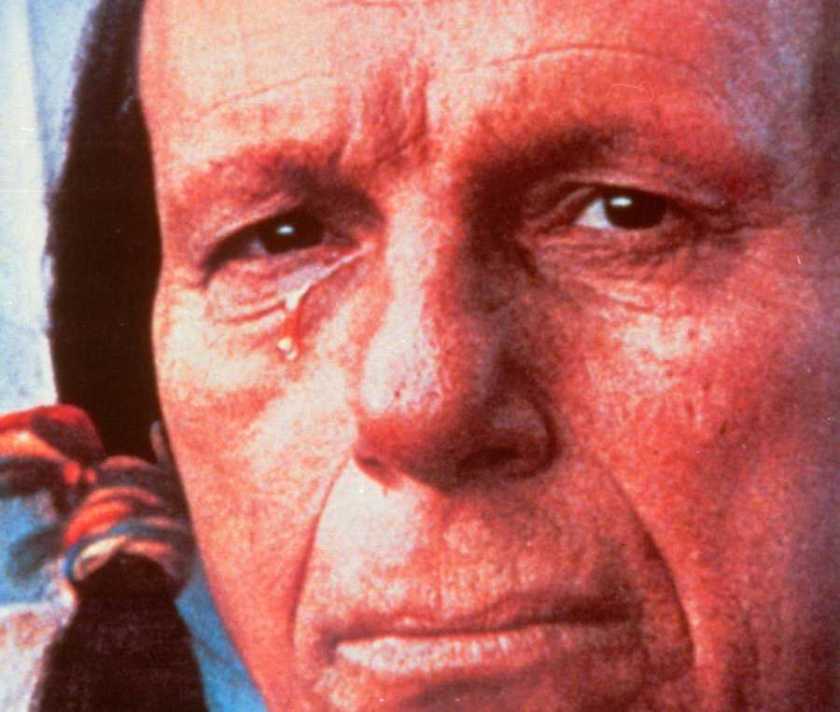
The relatives of one bootlegging victim of his earlier days tracked him down and beat him so severely with brass knuckles,  the Prohibition Cowboy lost sight in one eye.

Fellow members of the American Legion had by this time contacted the Army to learn Hart’s WW1 tales, were all fake.  Richard James Hart was never in the Army though his namesake Richard Jr. died fighting for the nation, in World War 2.

Turns out that other parts of the lawman’s story were fraudulent, too.  Like the Italian American actor Espera Oscar de Corti better known as “Iron Eyes Cody”, the “crying Indian” of those commercials had no Native American blood.  Nor did the Italian American Richard James Hart.

CryingIndian

The Lawman had left the slums of Brooklyn to become a Prohibition Cowboy while that little brother slashed across the face, had pursued a life of crime.  Richard James Hart was James Vincenzo Capone, long lost brother of Alphonse “Scarface” Capone.

two-gun-hart-lawman-cowboy-and-longlost-brother-of-al-capone-1-638


A Trivial Matter
James Vincenzo Capone’s strange double-life came to the public eye for the first time in 1951, when defense attorneys subpoenaed Richard Hart to testify on behalf of his brother Ralph Capone. Hart faded into anonymity following a rash of newspaper stories, and died within a year at his adopted home town of Homer, the small Nebraska town where he stepped off that freight train, some 33 years earlier.

March 27, 1794 Quasi War

On this day in 1794, the United States Government established a permanent navy and authorized the building of six frigates..  One of them, USS Constitution, saw its first combat in the Quasi-War and remains in service to this day, the oldest commissioned warship in the United States Navy.

Imagine you consider yourself to be somewhere in the political center.  Maybe a little to the left. Now imagine that, in the space of two years, national politics have shifted to the point you find yourself on the “reactionary right”, subject to execution as such by your government.

And your personal convictions have never so much as wavered.

America’s strongest Revolution-era ally lost its collective mind in 1792, when France descended into a revolution of its own.    17,000 Frenchmen were officially tried and executed during the 1793-’94 “Reign of Terror” alone, including King Louis XVI and Queen consort, Marie Antoinette.  Untold thousands died in prison or without benefit of trial.

OSS-FrenchRevolutionMythsThe monarchical powers of Europe were quick to intervene.  For the 32nd time since the Norman invasion of 1066, England and France once again found themselves in a state of war.

France was the American patriot’s strongest supporter during America’s revolution, yet the US remained neutral in the later conflict, straining relations between the former allies.  Making matters worse, America repudiated its war debt in 1794, arguing that it owed money to “l’ancien régime”, not to the French First Republic which had overthrown it and executed its King.

Both sides in the European conflict seized neutral ships in the act of trading with their adversary.  The “Treaty of Amity, Commerce, and Navigation” with Great Britain, better known as the “Jay Treaty”, all but destroyed relations with the French 1st Republic.  France retaliated by stepping up attacks on American merchant shipping, seizing 316 American civilian ships in one eleven-month period, alone.

In 1796, the French Republic formally broke diplomatic relations with the United States, rejecting the credentials of President Washington’s representative Ambassador Charles Cotesworth Pinckney.

The following year, President John Adams dispatched a delegation of two.  They were the future Chief Justice of the Supreme Court John Marshall, and future Massachusetts Governor Elbridge Gerry, he who lends his name to the term “Gerrymander”.  Their instructions were to join with Pinckney in negotiating a treaty with France, with terms similar to those of the Jay treaty with Great Britain.

quasi-war-1798-1801 (1)

The American commission arrived in Paris in October 1797, requesting a meeting with the French Foreign Minister, Charles Maurice de Talleyrand.  Talleyrand, unkindly disposed toward the Adams administration to begin with, demanded money before meeting with the American delegation.  The practice was not uncommon in European diplomacy of the time, but the Americans blanched.

Documents later released by the Adams administration describe Nicholas Hubbard, an English banker identified only as “W”.  W introduced “X” (Baron Jean-Conrad Hottinguer) as a “man of honor”, who wished an informal meeting with Pinckney.  Pinckney agreed and Hottinguer reiterated Talleyrand’s demands, specifying the payment of a large “loan” to the French government, and a £50,000 bribe to Talleyrand himself.  Met with flat refusal by the American commission, X then introduced Pierre Bellamy (“Y”) to the Americans, followed by Lucien Hauteval (“Z”), sent by Talleyrand to meet with Elbridge Gerry.  X, Y and Z, each in their turn, reiterated the Foreign Minister’s demand for a loan, and a bribe.

Believing that Adams sought war by exaggerating the French position, Jeffersonian members of Congress joined with the more warlike Federalists in demanding the release of the commissioner’s communications.  It was these dispatches, released in redacted form, which gave the name “X-Y-Z Affair” to the diplomatic and military crisis which followed.

American politics were sharply divided over the European war.  President Adams and his Federalists, always the believers in strong, central government, took the side of the Monarchists.  Thomas Jefferson and his “Democratic-Republicans” found more in common with the “liberté, égalité, fraternité” espoused by revolutionaries.

In the United Kingdom, the ruling class enjoyed the chaos.  One British political cartoon of the time depicted the United States, represented by a woman being groped by five Frenchmen while John Bull, the fictional personification of all England, looks on laughing from a nearby hilltop.

xyz (1)

Adams’ commission left without entering formal negotiations, the failure leading to a political firestorm in the United States.  Congress rescinded all existing treaties with France on July 7, 1798, the date beginning the undeclared “Quasi-War” with France.  Four days later, President John Adams signed “An Act for Establishing and Organizing a Marine Corps,” permanently establishing the United States Marine Corps as an independent service branch, in order to defend the American merchant fleet.

At this point, the United States had no other means of fighting back.  The government had disbanded the Navy along with its Marine contingent at the end of the Revolution, selling the last warship in 1785 and retaining only a handful of “revenue cutters” for purposes of customs enforcement.  On this day in 1794, the United States Government established a permanent navy and authorized the building of six frigates..  One of them, USS Constitution, saw its first combat in the Quasi-War and remains in service to this day, the oldest commissioned warship in the United States Navy.

6921747106_a537d83de4_k-e1508207760237

American military involvement proved decisive.  Before armed intervention, the conflict with France resulted in the loss of over 2,000 merchant ships captured, with 28 Americans killed and another 42 wounded.   Military escalation with the French First Republic cost the Americans 54 killed and 43 wounded, with only a single ship lost.  That one, was later recaptured.

By the turn of the century, the naval power of the English speaking nations brought about a more agreeable negotiating position with the government of First Consul Napoleon Bonaparte. The Convention of 1800 ended the Quasi-War, asserting American rights and ending the alliance with France.

The entangling French alliance of 1778, was dead.   The Napoleonic Wars would be fought entirely on European soil.


A Trivial Matter
Between 1803 and 1812, the Royal Navy’s manpower needs greatly exceeded voluntary enlistment.  5,000 to 9,000 American sailors were forcibly “impressed” (kidnapped) into service, becoming a major casus belli for the war of 1812.