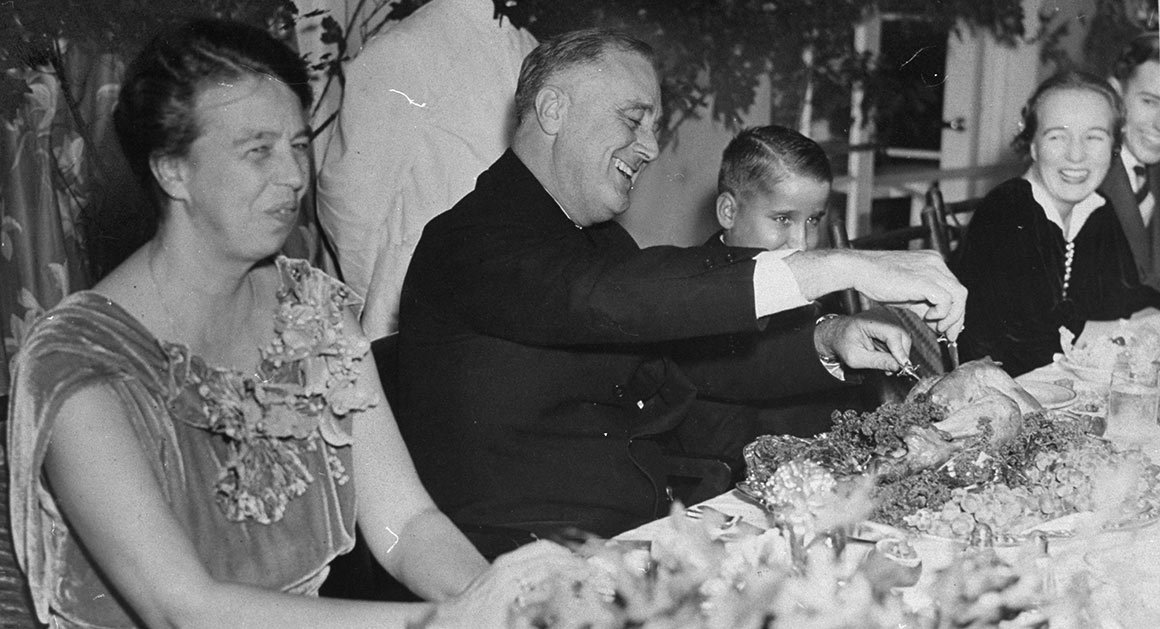
November 26, 1941, Franksgiving

Popular comedians of the day got a laugh out of the Franksgiving ruckus including Burns & Allen, and Jack Benny. One 1940 Warner Brothers cartoon shows two Thanksgivings, one “for Democrats” and one a week later “for Republicans.”

The first Autumn feast of Thanksgiving dates well before the European settlement of North America.

OldCrowafriendly

Historian Michael Gannon writes that the “real first Thanksgiving” in America took place in 1565, when Pedro Menéndez de Avilés landed in modern-day Florida, and “had the Indians fed and then dined himself.”

Likely, it was salt-pork stew with garbanzo beans. Yum.

According to the Library of Congress, the English colony of Popham in present-day Maine held a “harvest feast and prayer meeting” with the Abenaki people in 1607, twenty-four years before that “first Thanksgiving” at Plymouth.

George Washington proclaimed the first Presidential National day of Thanksgiving on November 26, 1783, “to recommend to the People of the United States a day of public thanksgiving and prayer to be observed by acknowledging with grateful hearts the many signal favors of Almighty God especially by affording them an opportunity peaceably to establish a form of government for their safety and happiness“.

So much for the “separation of Church and state”.

President Abraham Lincoln followed suit in 1863, declaring a general day of Thanksgiving to be observed on the last Thursday of November.  The date seemed to work out OK and the tradition stuck, until 1939.

Roughly two in every seven Novembers, contain an extra Thursday.  November 1939, was one of them.

franksgiving2

In those days, it was considered poor form for retailers to put up Christmas displays or run Christmas sales, before Thanksgiving.  Lew Hahn, General Manager of the Retail Dry Goods Association, was afraid that extra week was going to cut into Christmas sales.

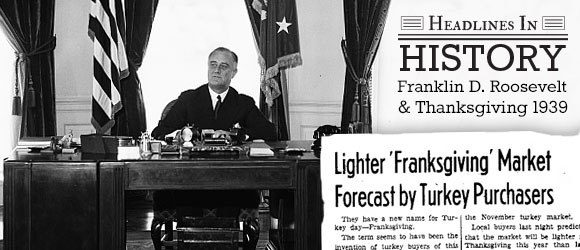
Ten years into the Great Depression with no end in sight, the Federal government was afraid of the same thing. By late August, President Franklin Delano Roosevelt decided to deviate from the customary last Thursday and declared the fourth Thursday, November 23, to be a national day of prayer and thanksgiving.

Opposition to the plan was quick to form.  Alf Landon, Roosevelt’s Republican challenger in the earlier election, complained of Roosevelt’s impulsiveness and resulting confusion.  “More time should have been taken working it out” Landon said, “instead of springing it upon an unprepared country with the omnipotence of a Hitler.”

252_84_738_450

In Plymouth Massachusetts, self-described home of the “first Thanksgiving”, Chairman of the Board of Selectmen James Frasier, “heartily disapproved”.

The short-notice change in schedule disrupted vacation plans for millions of Americans. Traditional Thanksgiving day football rivalries between school teams across the nation, were turned upside down.

Unsurprisingly, support for Roosevelt’s plan broke along ideological lines.  A late 1939 Gallup poll reported Democrats favoring the move by a 52% to 48% majority, with Republicans opposing the move, 79% to 21%.

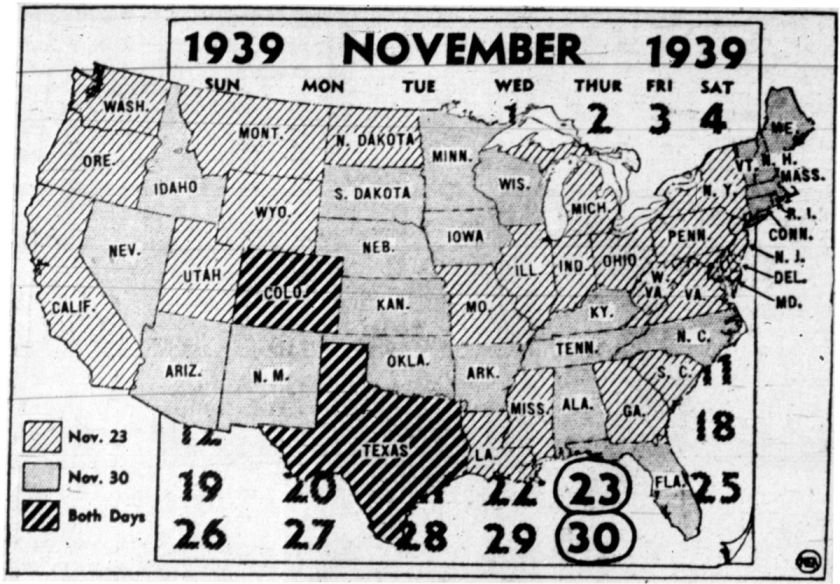
Such proclamations represent little more than the “’moral authority” of the Presidency. States are free to do as they please.  Twenty-three states and the District of Columbia observed Thanksgiving day on the non-traditional date, and twenty-two kept Thanksgiving on the 30th.  Colorado, Mississippi and Texas, did both.

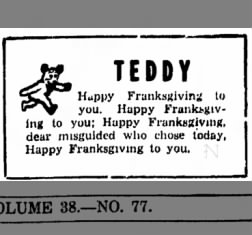
The next two years, thirty-two states and the District of Columbia celebrated what came to be called “Franksgiving” on the third Thursday of the month, while the remainder observed a more traditional “Republican Thanksgiving” on the last.

Franksgiving calendar

In 1941, a Commerce Department survey demonstrated little difference in Christmas sales between those states observing Franksgiving, and those observing the more traditional date. A joint resolution of Congress declared the fourth Thursday beginning the following year to be a national day of Thanksgiving. President Roosevelt signed the measure into law on November 26.

Interestingly, the phrase “Thanksgiving Day” appeared only once in the 20th century prior to the 1941 resolution, that in President Calvin Coolidge’s first of six such proclamations.

Most state legislatures followed suit with the Federal fourth-Thursday approach, but not all.  In 1945, the next year with five November Thursdays, Arkansas, Florida, Georgia, Idaho, Nebraska, Tennessee, Texas, and Virginia reverted to the last Thursday.  Texas held out the longest, celebrating its fifth-Thursday Thanksgiving for the last time in 1956.

To this day, the years 1939, ’40 and ’41 remain the only outliers, outside the fourth-Thursday tradition.

Popular comedians of the day got a laugh out of the Franksgiving ruckus including Burns & Allen, and Jack Benny.  One 1940 Warner Brothers cartoon shows two Thanksgivings, one “for Democrats” and one a week later “for Republicans.”

The Three Stooges short film of the same year has Moe questioning Curly, why he put the fourth of July in October.  “You never can tell”, he replies.  “Look what they did to Thanksgiving!”

Joe Toye, the “Easy Company” character in the 2001 HBO miniseries “A Band of Brothers”, may have had the last word on Franksgiving.  Explaining his plan to get the war over quickly, the paratrooper quips “Hitler gets one of these [knives] right across the windpipe, Roosevelt changes Thanksgiving to Joe Toye Day, [and] pays me ten grand a year for the rest of my f*****g life.

Sounds like a plan.

November 24, 1917 Anarchy

The 1917 incident accounted for the largest single-incident loss of life in the history of United States law enforcement, a record which would stand until September 11, 2001.


On the morning of November 24, 1917, 10-year-old Josie Spicciatti found a package in a narrow passage next to St. Anne’s Italian Evangelical Church in Milwaukee. She was the daughter of the cleaning lady, and apparently recognized it as a bomb.  She brought it into the church anyway, and went to work.

Only that afternoon did she go looking for Maude Richter, a social worker at the church. At about 4:00, Maude dragged the 20-pound bomb into the church basement, banging it on the steps all the way down. She later told a reporter, “I saw the vial, which contained a brown fluid” (it was sulfuric acid), “and took it out. In the hole, where it had been placed, was a yellow substance like powder.”

1917-police-station-bomb-anniversary_fullsize_story1

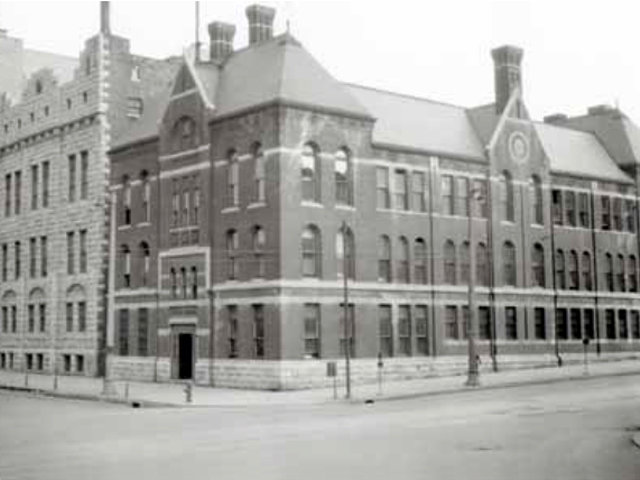
She then decided that things should be left as they’d been found, so she carefully reassembled the device and called Sam Mazzone, the janitor, to take the bomb to the police station. Mazzone explained to Desk Sergeant Henry Deckert that the bomb may be linked to a near riot which had erupted several months earlier, killing two parishioners and wounding 5, including two police officers.

mpdmemorialvertical

Policemen on duty were told there was a bomb in the station, but it seems that few took it seriously. Captain of Detectives John Sullivan remarked “It looked like a big dinner pail and innocent enough.”

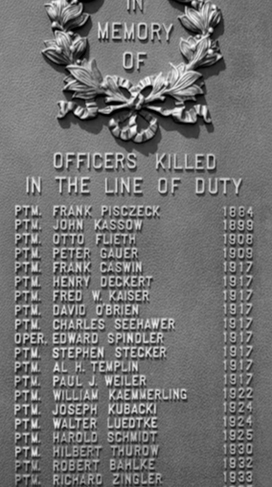
Sergeant Deckert took the bomb into the office of Lieutenant Robert Flood, saying, “Look at the new kind of bomb I’ve got.” “Get that thing out of here”, said Flood. “Don’t fool around with anything like that!” Deckert then brought the bomb into the squad assembly room, where a group of detectives gathered to examine the device.

That’s when the thing went off.

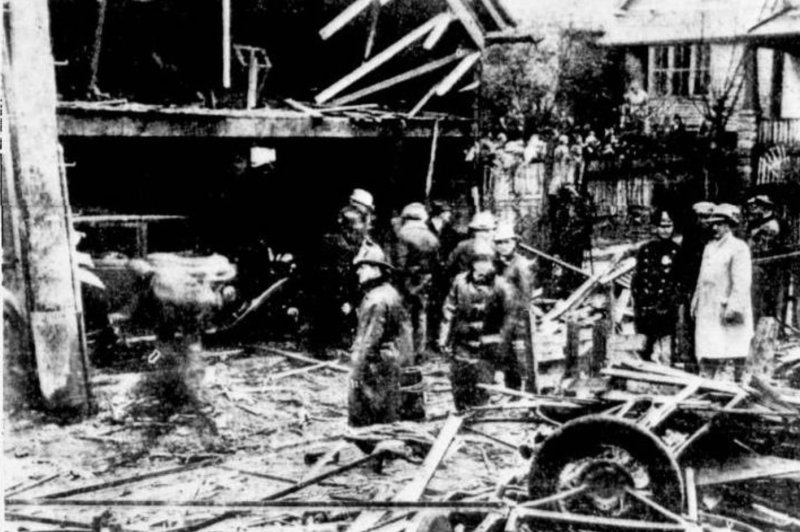
Eight officers were killed in a fraction of a second as was Catherine Walker, who had come to the station to file a complaint against her boyfriend. Operator Edward Spindler was working the switchboard on the second floor. Shrapnel blasted through the floor, entering his body at the waist and exiting through his head, killing him instantly.

One detective’s wedding band was blown from his finger. A shoe hung from the ceiling. A hat hung on a shard of glass.  One detective’s watch was found, face up on a windowsill, the hands had stopped at 7:33PM. Sergeant Deckert’s body was never found. He was identified only by the stripe of his uniform trousers leg.

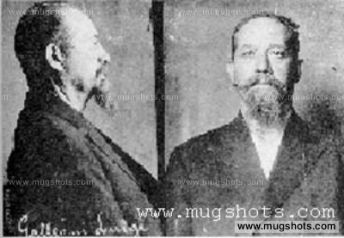
Luigi_Galleani_mugshot.400x800
Luigi Galleani

A group led by Italian Anarcho-Communist Luigi Galleani was suspected of placing the bomb, though no one was ever charged with the crime.

Many years later, interviews with surviving members of the anarchist organization indicated that Mario Buda, chief bomb maker for the Galleanists, may have constructed the Milwaukee device. The bomb had been intended for the small Italian church and its outspoken and patriotic pastor, Reverend August Giuliani.

The Milwaukee police station bombing accounted for the largest single-incident loss of life in the history of United States law enforcement, a record which would stand until September 11, 2001.

November 23, 1932 Holodomor

Warm and well fed with Russian mistress comfortably ensconced in Moscow, French wife hidden away on the Riviera, the British born New York Times Times reporter-turned international playboy opined, “You can’t make an omelet without breaking eggs.”

In 1928, Soviet Dictator Josef Stalin introduced a program of agricultural collectivization in Ukraine, the “Bread Basket” of the Soviet Union, forcing family farmers off their land and into state-owned collective farms.

Ukrainian “kulaks”, peasant farmers successful enough to hire labor or own farm machinery, refused to join the collectives, regarding such as a return to the serfdom of earlier centuries. Stalin claimed that these factory collectives would not only feed industrial workers in the cities, but would also provide a surplus to be sold abroad, raising money to further his industrialization plans.

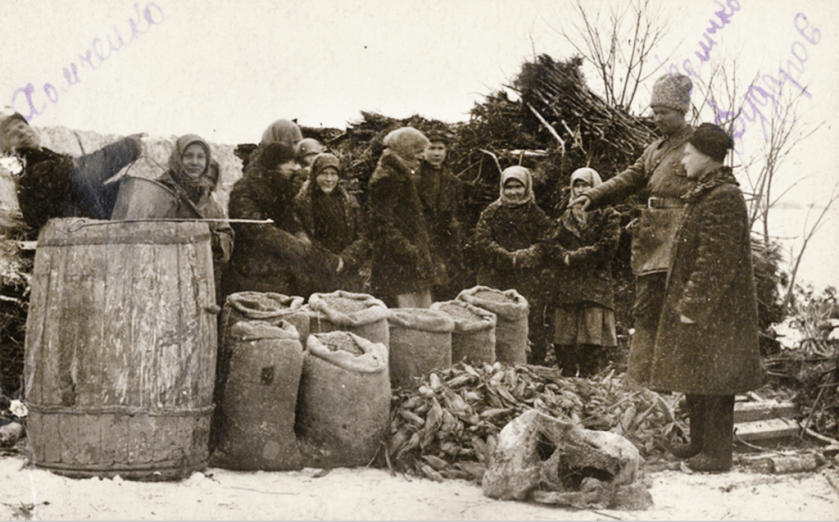
Holodomor_Novo-Krasne_Odessa_11_1932.pngArmed “dekulakization brigades” confiscated land, livestock and other property by force, evicting entire families. Nearly half a million individuals were dragged from their homes in 1930-’31 alone, packed into freight trains and shipped off to remote areas like Siberia and often left without food or shelter.  Many of them, especially children, died in transit or soon after arrival.
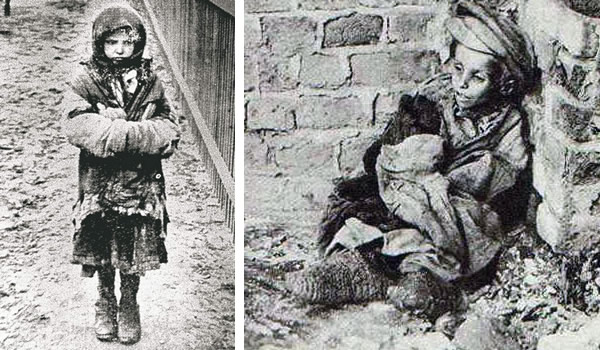
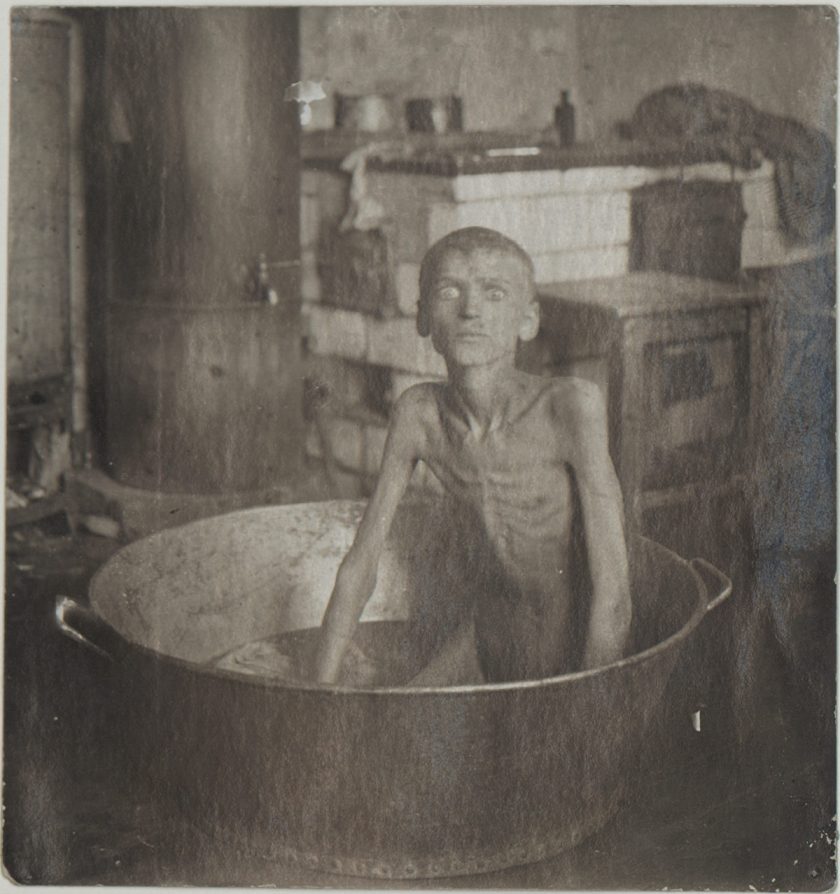
Resistance continued, which the Soviet government could not abide. Ukraine’s production quotas were sharply increased in 1932-’33, making it impossible for farmers to meet assignments and feed themselves, at the same time. Starvation became widespread, as the Soviet government decreed that any person, even a child, would be arrested for taking as little as a few stalks of wheat from the fields in which they worked.

pic_giant_110913_D-2

Military blockades were erected around villages preventing the transportation of food, while brigades of young activists from other regions were brought in to sweep through villages and confiscate hidden grain.

Eventually all food was confiscated from farmers’ homes, as Stalin determined to “teach a lesson through famine” to the Ukrainian rural population.

no-nb_blds_01867-beskåret-1200x1278.jpgAt the height of the famine, Ukrainians starved to death at a rate of 22,000 per day, almost a third of those, children 10 and under. How many died in total, is anyone’s guess. Estimates range from two million Ukrainian citizens murdered by their own government, to well over ten million.
Millions of tons of grain were exported during this time, more than enough to save every man, woman and child.

Holodomor, children.png

2,500 people were arrested and convicted during this time, for eating the flesh of their neighbors. The problem was so widespread that the Soviet government put up signs reminding survivors: “To eat your own children is a barbarian act.”

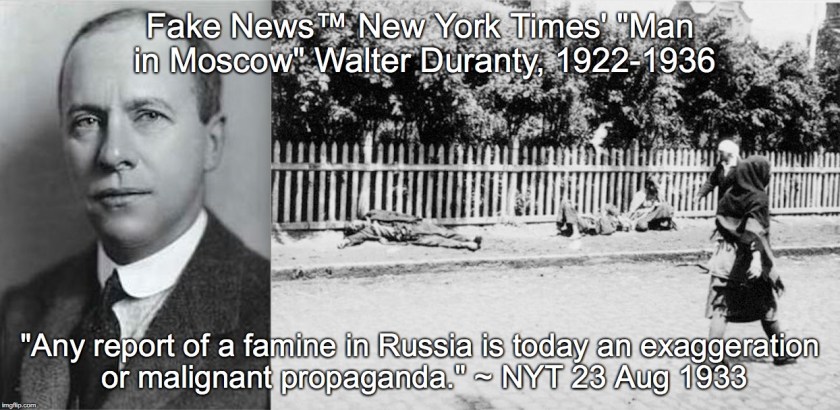
Stalin denied to the world there was any famine in Ukraine, a position supported by the likes of Louis Fischer reporting for “The Nation”, and Walter Duranty of the New York Times. Duranty went on to win the Pulitzer Prize for his “coverage”, with comments like “any report of a famine in Russia is today an exaggeration or malignant propaganda”. Such stories were “mostly bunk,” according to the New York Times.

Warm and well fed with Russian mistress comfortably ensconced in Moscow, French wife hidden away on the Riviera, the British born New York Times Times reporter-turned international playboy opined, “You can’t make an omelet without breaking eggs.”

1um1ow.jpgTo this day, the New York Times has failed to repudiate Walter Duranty’s Pulitzer.
Like many on the international Left, Canadian journalist Rhea Clyman had great expectations of the “worker’s paradise” built by the Communist state, where no one was unemployed, everyone was “equal”, and Everyman had what he needed.

Unlike most, Clyman went to the Soviet Union to see for herself.

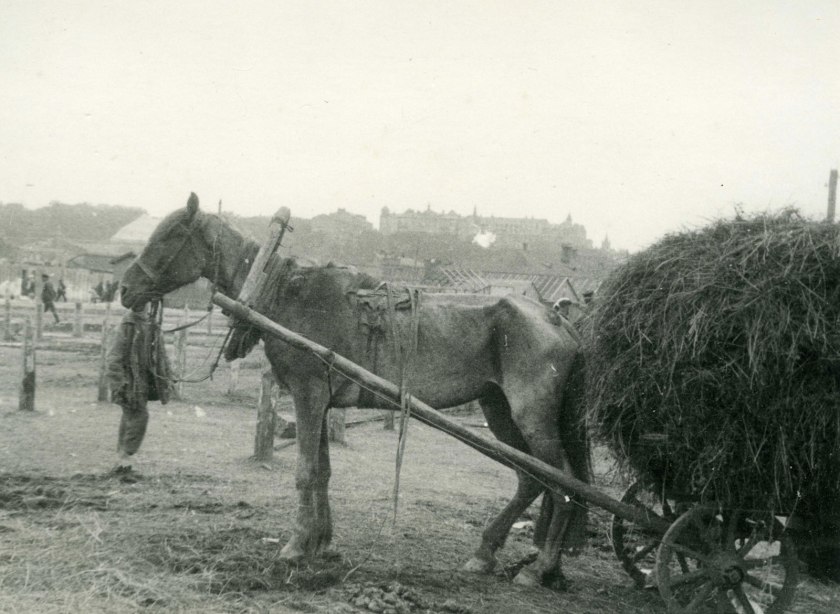
Holodomor-Great-Famine-Ukraine-emaciated-horse-1932-1933-Alexander-Wienerberger-photographer.jpgTo do so at all was an act of courage.  single Jewish woman who’d lost part of a leg in a childhood streetcar accident, traveling to a place where the Russian empire and its successor state had a long and wretched history.  Particularly when it came to the treatment of its own Jews.
Virtually all of the international press preferred the comfortable confines of Moscow, cosseted in a world of Soviet propaganda and ignorant of the world as it was.

Duranty’s idea of “bon voyage” was the cynical offer, to write her obituary.

RheaClyman6.jpg
Rhea Clyman

In four years, Clyman not only learned the language, but set out on a 5,000-mile odyssey to discover the Soviet countryside, as it really was.

It is through this “Special Correspondent in Russia of The Toronto Evening Telegram, London Daily Express, and Other Newspapers“, that we know much about the government’s extermination of its own citizens in Ukraine.

To read what Clyman wrote about abandoned villages, is haunting.  The moment of discovery:  “They wanted something of me, but I could not make out what it was. At last someone went off for a little crippled lad of fourteen, and when he came hobbling up, the mystery was explained. This was the Village of Isoomka, the lad told me. I was from Moscow, yes; we were a delegation studying conditions in the Ukraine, yes. Well, they wanted me to take a petition back to the Kremlin, from this village and the one I had just been in. “Tell the Kremlin we are starving; we have no bread!”

A tall, bearded peasant was spokesman. His two sons and the rest of the men and women nodded approval at every word. The little crippled boy stood with his right hand on his crutch, translating everything he said into Russian for me, word by word.  “We are good, hard-working peasants, loyal Soviet citizens, but the village Soviet has taken our land from us. We are in the collective farm, but we do not get any grain. Everything, land, cows and horses, have been taken from us, and we have nothing to eat. Our children were eating grass in the spring….” 

I must have looked unbelieving at this, for a tall, gaunt woman started to take the children’s clothes off. She undressed them one by one, prodded their sagging bellies, pointed to their spindly legs, ran her hand up and down their tortured, mis-shapen, twisted little bodies to make me understand that this was real famine. I shut my eyes, I could not bear to look at all this horror. “Yes,” the woman insisted, and the boy repeated, “they were down on all fours like animals, eating grass. There was nothing else for them.”  What have you to eat now?” I asked them, still keeping my eyes averted from those tortured bodies. “Are all the villages round here the same? Who gets the grain?”” – Rhea Clyman, Toronto Telegram, 16 May 1933

22,000 of these poor people starved to death, every day. Pitifully, many yet believed the government in Moscow was going to help. If only comrade Stalin knew…

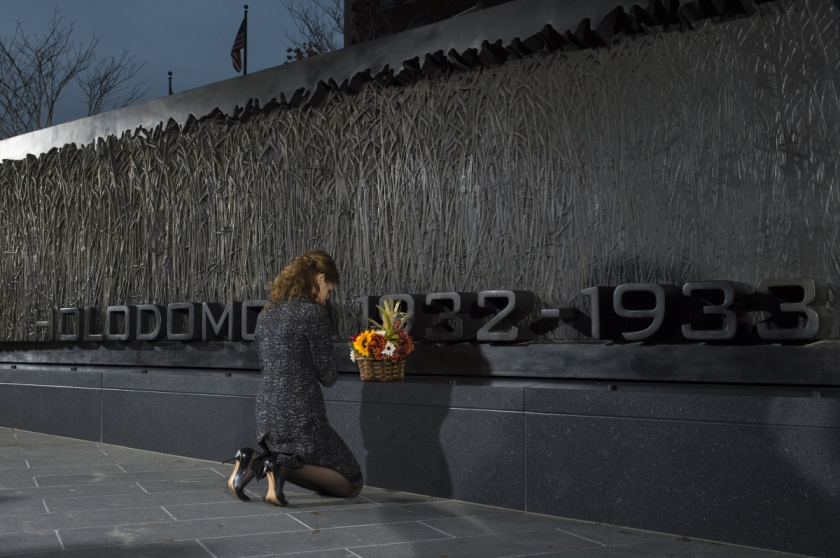
holodomor-1.jpgThe Holodomor Memorial to Victims of the Ukrainian Famine-Genocide of 1932–1933 was opened in Washington, D.C. on November 7, 2015
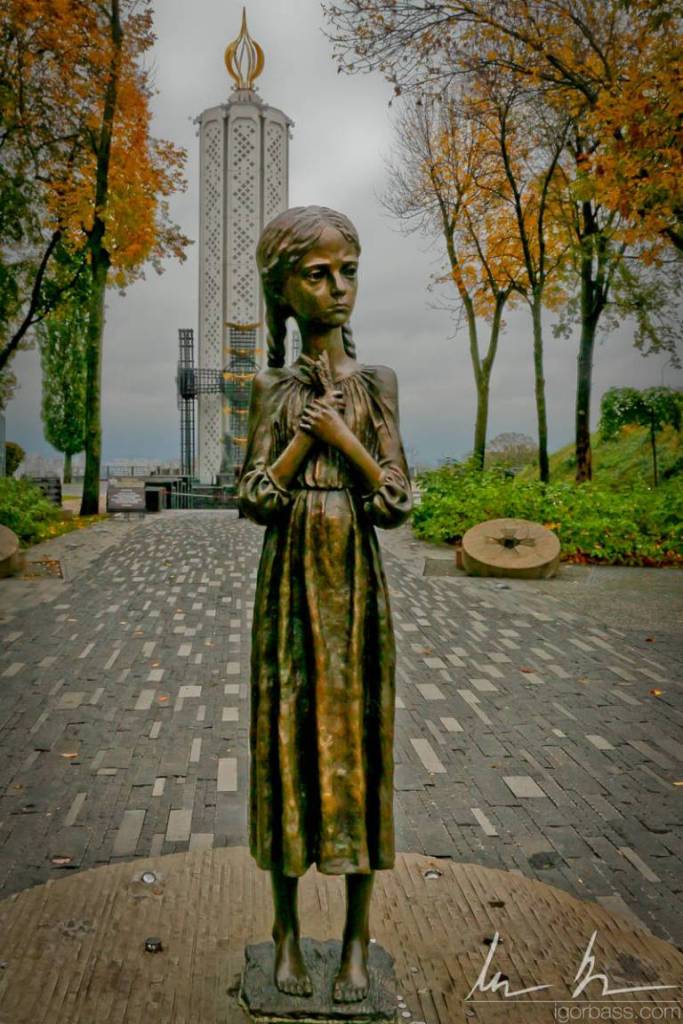
Today, the province of Alberta is home to about 300,000 Canadians of Ukrainian Heritage. Alberta Premier Rachel Notley once explained “Holodomor is a combination of two Ukrainian words: Holod, meaning hunger, and moryty, meaning a slow, cruel death. That is exactly what Ukrainians suffered during this deliberate starvation of an entire people“.

Ukrainians around the world recognize November 23 as Holodomor Memorial Day, commemorated by a simple statue in Kiev. A barefoot little girl, gaunt and hollow eyed, clutches a few stalks of wheat.

Holodomor memorial. The Holodomor/????????? was a man-made famine in the Ukrainian SSR between 1932 and 1933. During the famine, 2.4 – 7.5 millions of Ukrainians died of starvation.

Here in the United States, you could line up 100 randomly selected adults. I don’t believe that five could tell you what Holodomor even means. We are a self-governing Republic. All 100 should be well acquainted with the term.

November 22, 1923 Black Tom

The first and most overt reaction from the Kaiser came in the form of unrestrained submarine warfare, when even vessels flying the flags of neutral nations, were attacked. Less apparent at the time, was the covert campaign of sabotage carried out by German agents on US soil.


In the early months of the Great War, Britain’s Royal Navy swept the seas of the Kaiser’s ships and blockaded ports in Germany. The United States was neutral at the time, when over a hundred German vessels sought refuge in American harbors.

maxresdefault

The blockade made it impossible for the Central Powers of Germany and Austria-Hungary to import war materiel from overseas while Great Britain, France, and Russia continued to buy products from US farms and factories. American businessmen were happy to sell to any foreign customer who had the cash but for all intents and purposes, such trade was limited to the allies.

To the Central Powers, this trade had the sole purpose of killing their boys on the battlefields of Europe.

The first and most overt reaction from the Kaiser came in the form of unrestrained submarine warfare, when even vessels flying the flags of neutral nations, were attacked. Less apparent at the time, was the covert campaign of sabotage carried out by German agents on US soil.

Black_Tom_4

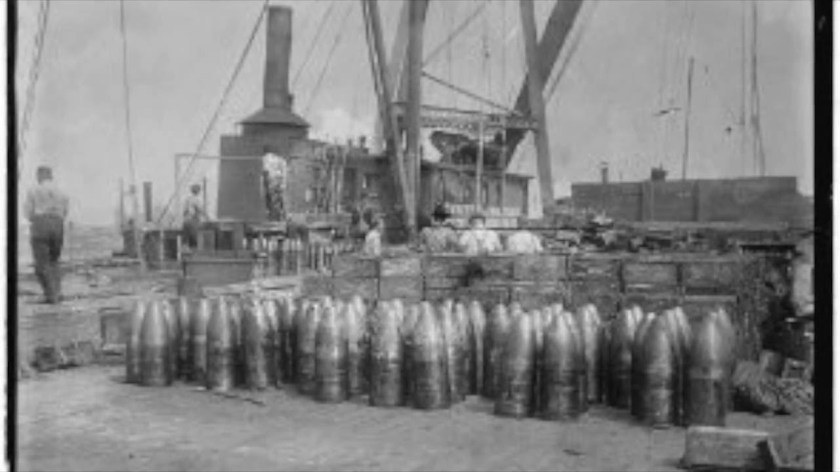
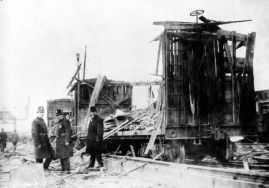
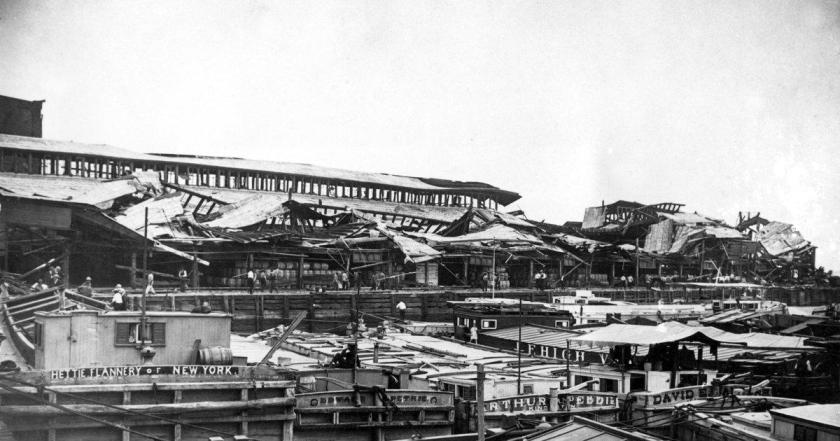
“Black Tom” was originally an island in New York Harbor, next to Liberty Island. So called after a former resident, by WWI, landfill had expanded the island to become part of Jersey City. The area contained a mile-long pier with warehouses and rail lines and served as a major hub in the trade of war materiel to the allies.

On July 30, 1916, the Black Tom terminal contained over two million pounds of ammunition in freight cars, and a hundred thousand pounds of TNT on a nearby Barge.

Around 2:00 that morning, guards discovered a series of small fires. Some of them tried to put them out while others fled, fearing an explosion. The first and loudest blast took place at 2:08am, a massive detonation estimated at 5.5 on the Richter scale.  People from Maryland to Connecticut were awakened in what many believed was an earthquake. The walls of Jersey City’s City Hall were cracked as shrapnel flew through the air. Windows broke as far as 25 miles away while fragments embedded themselves in the clock tower at the Jersey Journal building in Journal Square, over a mile away. The clock stopped at 2:12 am.

Black_Tom_3

Stained Glass windows were shattered at St. Patrick’s Church and Ellis Island was evacuated to Manhattan.  Damage done to the Statue of Liberty alone was valued at over $2 million in today’s dollars. To this day, the ladder to Liberty’s torch, remains off limits to visitors.

Known fatalities in the explosion included a Jersey City police officer, a Lehigh Valley Railroad Chief of Police, one ten-week-old infant and a barge captain.

Black Tom 2

The explosion at Black Tom was the most spectacular but by no means the only such attack. The archives at cia.gov reports: “[B]etween 1915 and spring 1917, 43 American factories suffered explosions or fires of mysterious origin, in addition to the bombs set on some four dozen ships carrying war supplies to the Allies”.

black-tom-island-explosion

Among those responsible for the Black Tom explosion was Naval Lieutenant Lothar Witzke, arrested on February 1, 1918, in Nogales, AZ. Witzke was convicted by court martial and sentenced to death. President Woodrow Wilson later commuted his sentence, to life.

By 1923, most nations were releasing POWs from the “Great War”, including spies. A prison report from Leavenworth shows Witzke heroically risking his own life in prison, entering a boiler room after an explosion and almost surely averting disaster. It may be on that basis that he was finally released.  Imperial German Navy Lieutenant Lothar Witzke was pardoned by President Calvin Coolidge on November 22, 1923 and deported to Berlin, where a grateful nation awarded him the Iron Cross, 1st and 2nd Class.

November 21, 1916 Unsinkable

There was denial aplenty that night, from the well dressed passengers filing onto the decks. Violet Jessop counted the lighted portholes as the small boat creaked ever downward. One row, then two: every abandoned stateroom a tableau. Three, and four: feathered hats on dressers, scattered jewels, sparkling abandoned, on table tops. Five and then six: each lighted circle revealing a snapshot, a last glimpse, soon to slip out of sight.

The maiden voyage of the largest ship afloat left the port of Southampton, England on April 10, 1912, carrying 2,224 passengers and crew. An accident was narrowly averted only minutes later, as Titanic passed the moored liners SS City of New York and Oceanic.

The smaller ships lifted in the bow wave formed by Titanic’s passing, then dropped into the trough. New York’s mooring cables snapped, swinging her about, stern-first. Collision was averted by a bare 4-feet as the panicked crew of the tugboat Vulcan struggled to bring New York under tow.

Edward Smith

By the evening of the 14th, Titanic was 400 miles off the coast of Newfoundland, conditions clear, calm and cold. There were warnings of drifting ice from other ships in the area, but it was generally believed that ice posed little danger to large vessels at this time. 

Captain Edward Smith opined that he “[couldn’t] imagine any condition which would cause a ship to founder. Modern shipbuilding has gone beyond that.”

Lookout Frederick Fleet alerted the bridge of an iceberg dead ahead at 11:40pm. First Officer William Murdoch ordered the engines put in reverse, veering the ship to the left. Lookouts were relieved, thinking that collision was averted. Below the surface, the starboard side ground into the iceberg, opening a gash the length of a football field.

Violet_jessop_titanic

The ship was built to survive flooding in four watertight compartments. The iceberg had opened five. As Titanic began to lower at the bow, it soon became clear. The great ship was doomed.

Those aboard were poorly prepared for such an emergency. The vessel was built for 64 wooden lifeboats, enough for 4,000, but the White Star Liner carried only 16 wooden lifeboats and four collapsibles.

Regulations then in effect required enough room for 990 people. Titanic carried enough to accommodate 1,178.

As it was there was room for over half of those on board, provided that each boat was filled to capacity. So strictly did Royal Navy officer Charles Lightoller adhere to the “women and children first” directive, that evacuation took the form of women and children, only. Many boats were launched, half-full. The first lifeboat in the water, rated at 65 passengers, launched with 28 aboard.
Lightoller himself survived, only by clinging to the bottom of an overturned raft.

titanic-01-wallpaper

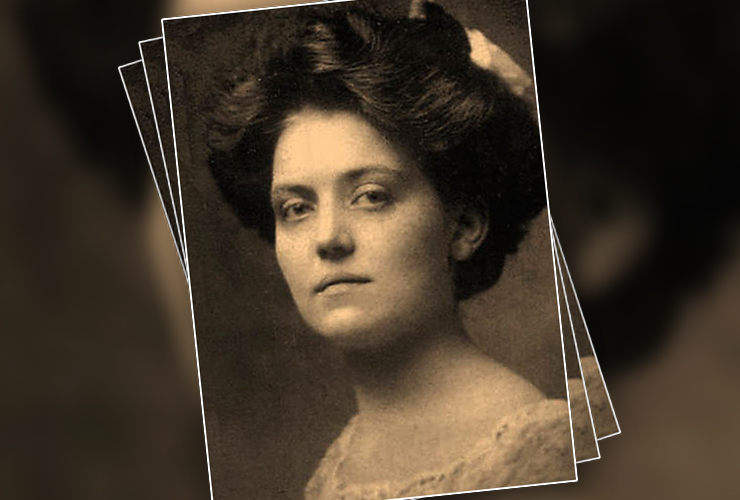
Violet Jessop was among those first to leave. A man tossed her a bundle with the words, “ look after this, will you?“. It was a baby.

As ship’s nurse, Jessop was there to look after the comfort of the White Star Line passengers. Now, this small boat full of disoriented women was being lowered into the cold and darkness of night, while all aboard the great vessel was light, and comfort, and warmth.

Denial is a funny thing, that psychological defense mechanism described by Sigmund Freud, in which a person rejects a plain fact too uncomfortable to contemplate. There was denial aplenty that night, from the well dressed passengers filing onto the decks. Violet Jessop counted the lighted portholes as the small boat creaked ever downward. One row, then two: every abandoned stateroom a tableau. Three, and four: feathered hats on dressers, scattered jewels, sparkling abandoned, on table tops. Five and then six: each lighted circle revealing a snapshot, a last glimpse, soon to slip out of sight.

Floating on the still, frigid waters of the north Atlantic, Jessop must have wondered about Captain Smith. This was not their first cruise together. This wasn’t even their first shipwreck.

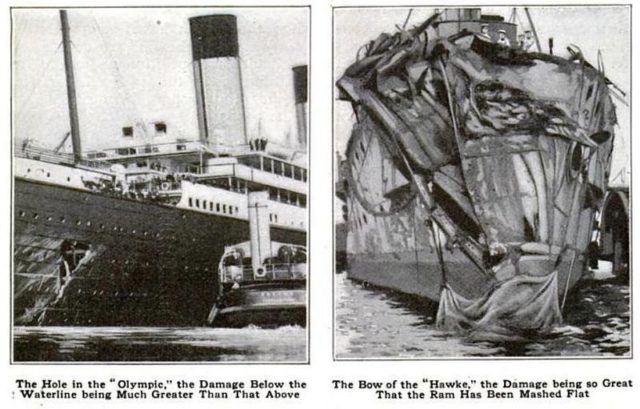
The White Star Line’s RMS Olympic set sail for New York seven months earlier with Captain Edward Smith, commanding. Violet Jessop was on duty as the Royal Navy cruiser HMS Hawke performed mechanical tests, on a course parallel to the trans-Atlantic liner. Something went wrong and the tiller froze, swinging the bow of the Edgar-class cruiser toward the liner. Hydrodynamic forces took over and the two ships collided, just after noon. The hull of the cruiser was smashed, two great gashes carved into the side of Olympic. One was below the water line.

Two compartments flooded, but the watertight doors did their job. Olympic limped back to Southampton for repairs. Captain Smith and Violet Jessop moved on to the maiden voyage of her sister ship, the unsinkable RMS Titanic.

197-640x409

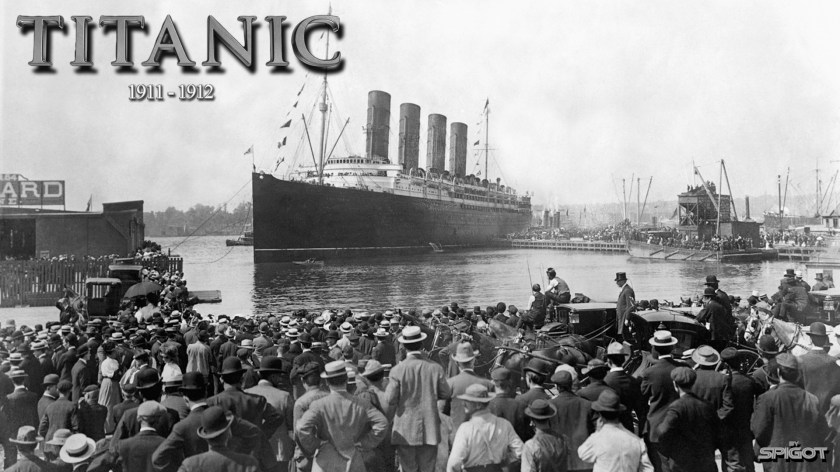
Denial turned to horror that frigid April night in 1912, when six rows of lights became five and then four, and Titanic began to rise by the stern.  RMS Carpathia arrived on the scene around 4am in response to distress calls, and diverted to New York with survivors.  Four days later, a crowd of 40,000 awaited the arrival of 705 survivors , in spite of a cold, driving rain.  It would take four full days to compile and release the list of casualties.

Violet Jessop survived that night.  Captain Smith, did not.

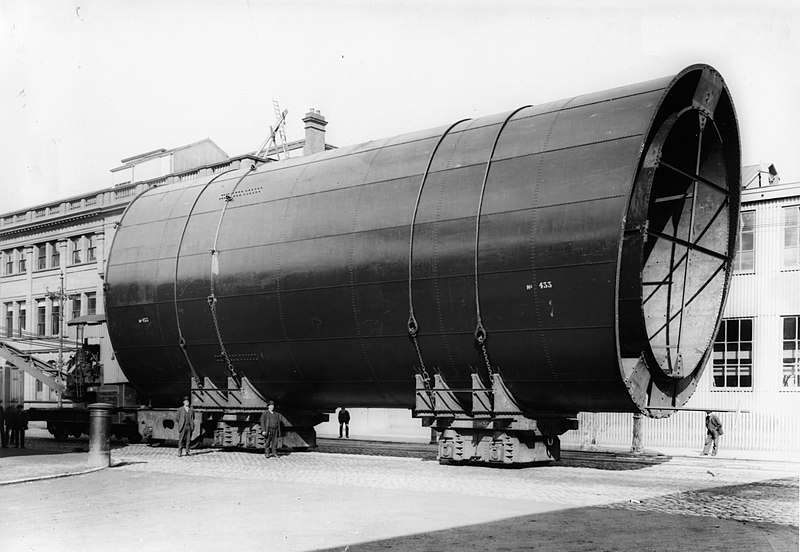
Back in 1907, Director General of the White Star Line J. Bruce Ismay planned a series of three sister ships, to compete with the Cunard lines’ Mauritania, and Lusitania. What these lacked in speed would be made up in size, and luxurious comfort. The three vessels were to be named OlympicTitanic and Gigantic.

800px-Britannic_Funnel_in_transport
One of Britannic’s funnels, in transit to the ship

That last name was quietly changed following the Titanic disaster and, on December 12, 1915, the newly christened Britannic was ready for service.

Two years later, the world was at war. Nurse Jessop was working aboard HMHS (His Majesty’s Hospital Ship) Britannic. On November 21, 1916, HMHS Britannic was on station near Kea in the Aegean Sea when she was struck by a German mine, or torpedo. Violet Jessop calmly made her way to her cabin, She’d been here, before. There she collected a ring, a clock and a prayer book, and even helped another nurse collect her composure.

maxresdefault

After the Carpathia rescue, Jessop complained to friends and family that she missed her toothbrush. Her wisecracking brother Patrick had quipped next time you wreck, “look after your toothbrush”.

This time, she didn’t forget her toothbrush.

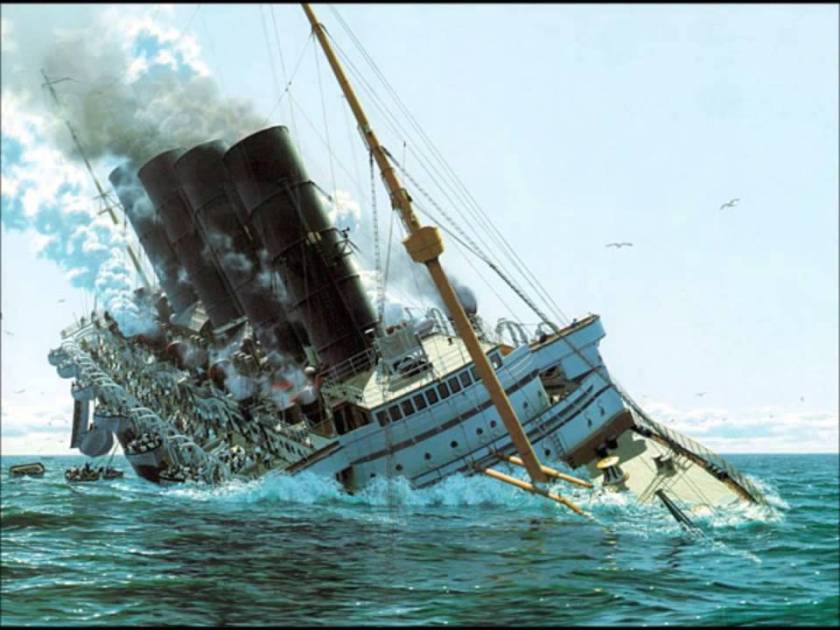
Britannic should have survived even with five watertight compartments filled, but nurses defied orders and opened the windows, to ventilate the wards.   In fifty-five minutes, HMHS Britannic replaced her sister ship Titanic, as the largest vessel on the bottom of the sea.

Fortunately, daytime hours combined with warmer weather and more numerous lifeboats, to lessen the cost in lives.  1,035 were safely evacuated from the sinking vessel, keeping the death toll in the Britannic wreck, to thirty.

Violet Jessop survived three of the most famous shipwrecks of her age, and never tired of working at sea. She returned to work as stewardess aboard RMS Olympic after the war, before retiring to private life and passing away, in 1971.

John Maxtone-Graham, editor of “Titanic Survivor”, the story of Jessop’s life, remembers one last story about “Miss Unsinkable”. Fifty-nine years after the wreck, the phone rang late one night, during a violent thunderstorm. A woman’s voice at the other end asked “Is this the Violet Jessop who was a stewardess on the Titanic and rescued a baby?” “Yes” came the reply, “who is this?” The woman laughed: “I was that baby.”

November 20, 1820 Call me Ishmael

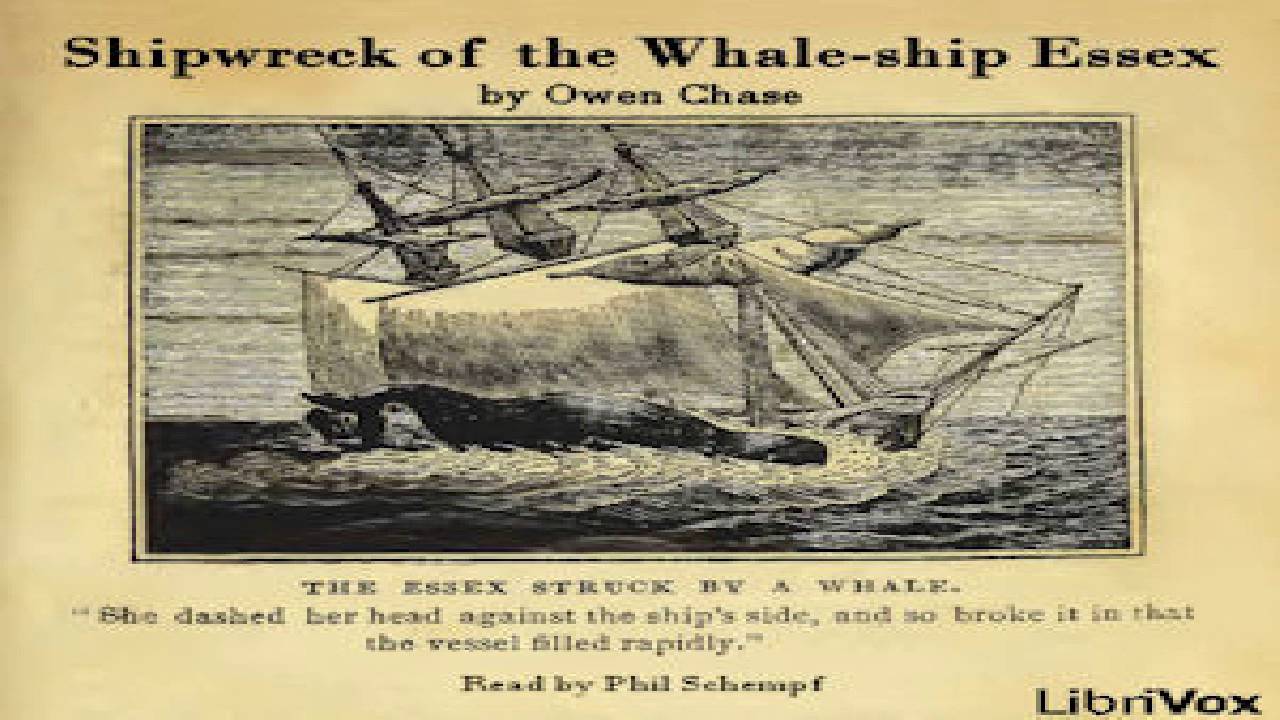
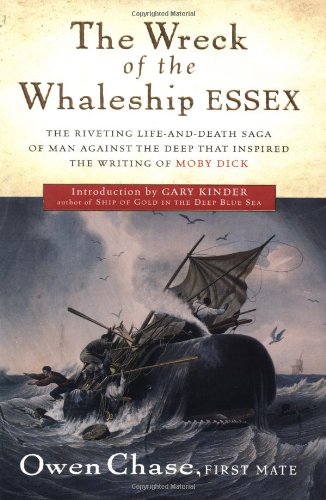
Never in the history of the whale fishery had a whale been known to attack a ship unprovoked. What was happening now was unmistakable.


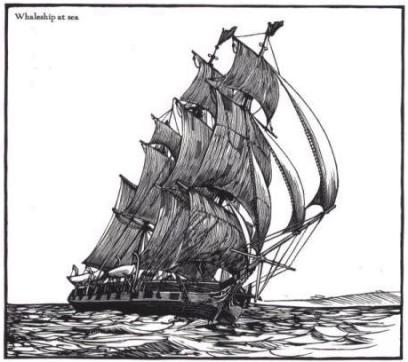
The whaleship Essex set sail from Nantucket in August 1819, the month Herman Melville was born.  The 21-man crew expected to spend 2-3 years hunting sperm whales, filling the ship’s hold with oil before returning to split the profits of the voyage.

Whaleship at sea

Essex sailed down the coast of South America, rounding the Horn and entering the Pacific Ocean.  There they heard that the whaling grounds near Chile and Peru were exhausted so they sailed for the “offshore grounds”, almost 2,000 miles from the nearest land.

That’s exactly where they were there on November 20, 1820, with two of Essex’ three boats out hunting whales.  The lookout spotted a huge bull sperm whale, behaving oddly, lying motionless on the surface with his head facing the ship. He was a large animal, much larger than most, estimated at 85 feet long and 80 tons.  In moments, he began to move. Picking up speed it soon became clear, this beast was charging the ship.   

The powerful tail churned the water to froth as the great beast closed the distance, striking the port side so hard, it shook the ship.

Wreck of the whale ship Essex

Never in the history of the whale fishery had a whale been known to attack a ship unprovoked. What was happening now was unmistakable.

The huge animal seemed dazed at first by the impact, floating to the surface and resting near the ship’s side.  He then turned and swam away for several hundred yards before turning to resume the attack.  He came in at the great speed of 24 knots according to First Mate Owen Chase, ramming the port bow and driving the stern into the water.  Oak planking cracked and splintered as the whale worked his tail up and down, driving the 238-ton vessel backward.  Essex had already started to go down when the whale broke off his attack, diving below the surface, never to return.

Essex_photo

Captain George Pollard’s boat was the first to make it back. Staring in disbelief, Pollard asked “My God, Mr. Chase, what is the matter?” The first mate replied:   “We have been stove by a whale”.

The whale ship Essex was dying. No force on earth could save her. The crew divided into groups of seven and boarded the three boats.  It wasn’t long before Essex sank out of sight. 21 men now alone, stranded in 28-foot open boats, about as far from land as it was mathematically possible to be.

The whalers believed that cannibals inhabited the Marquesa islands, 1,200 miles to the west. So they headed south, parallel to the coast of South America.  Before the ordeal was over, they themselves were destined to become the cannibals.

With good winds, they might reach the coast of Chile in 56 days.  There were enough rations to last 60 provided they were distributed at starvation levels, but much of it turned out to be ruined, by salt water.  There was a brief reprieve in December, when the three small boats landed on a small island in the Pitcairn chain.  There they were able to get their fill of birds, eggs, crabs, and peppergrass. Within a week the island was stripped clean.  The men decided to move on save for three who refused to get back in the boats and were left behind.

Essex

None of them knew it but this was Henderson Island, only 104 miles from Pitcairn Island where survivors from the 1789 Mutiny on HMS Bounty had managed to survive for the past 36 years.

After two months at sea, the boats had long separated from one another.  Starving men were beginning to die and the survivors came to an unthinkable conclusion.  They would have to eat their own dead.

When those were gone, the survivors drew lots to see who would die, that the others might live.  Captain Pollard’s 17-year-old cousin Owen Coffin, whom he had sworn to protect, drew the black spot.   Pollard protested, offering to take his place, but the boy declined. “No”, he said, “I like my lot as well as any other.”  Again, lots were drawn to see who would be Coffin’s executioner.  Owen’s friend, Charles Ramsdell, drew the black spot.

On February 18, the British whaleship Indian spotted a boat containing Owen Chase, Benjamin Lawrence and Thomas Nickerson.  It was 90 days sink Essex sank out of sight.  Five days later, the Nantucket whaleship Dauphin pulled alongside another boat, to find Captain Pollard and Charles Ramsdell inside.  The pair was so far gone they didn’t even notice at first, gnawing on the bones of their comrades.

The three left on Henderson Island were later rescued.  The third whaleboat was found beached on a Pacific island several years later, with four skeletons on board.

The Essex was the first ship recorded to have been sunk by a whale, though she would not be the last.  The Pusie Hall was attacked in 1835. The Lydia and the Two Generals were both attacked by whales a year later. The Pocahontas and the Ann Alexander were sunk by whales in 1850 and 1851.

31 years after the Essex’ sinking a sailor turned novelist published his sixth work, beginning with these words: “Call me Ishmael”.

November 19, 1904 The Hunted

We rarely hear about the work of the spy or the saboteur in times of war. These are the Heroes who work behind enemy lines, with little to protect them but their own guts and cleverness. We rarely know their names and yet, there are times when the lives of millions hang in the balance.

We rarely hear about the work of the spy or the saboteur in times of war. These are the Heroes who work behind enemy lines, with little to protect them but their own guts and cleverness. We rarely know their names and yet, there are times when the lives of millions hang in the balance.

Sven Somme

One such was Iacob Sømme, a Norwegian who was caught, tortured and executed by the Gestapo, for his role in sabotaging the Nazi heavy water plant in Telemark, in 1943.

But for the work of men such as this, we are left only to imagine a world in which the Nazi Swastika was painted on the sides of “Little boy” and “Fat Man”. We may thank the likes of Iacob Sømme that such a world remains merely one of nightmare imagination.

Another such man was Iacob’s brother Sven, born this day, November 19, 1904.

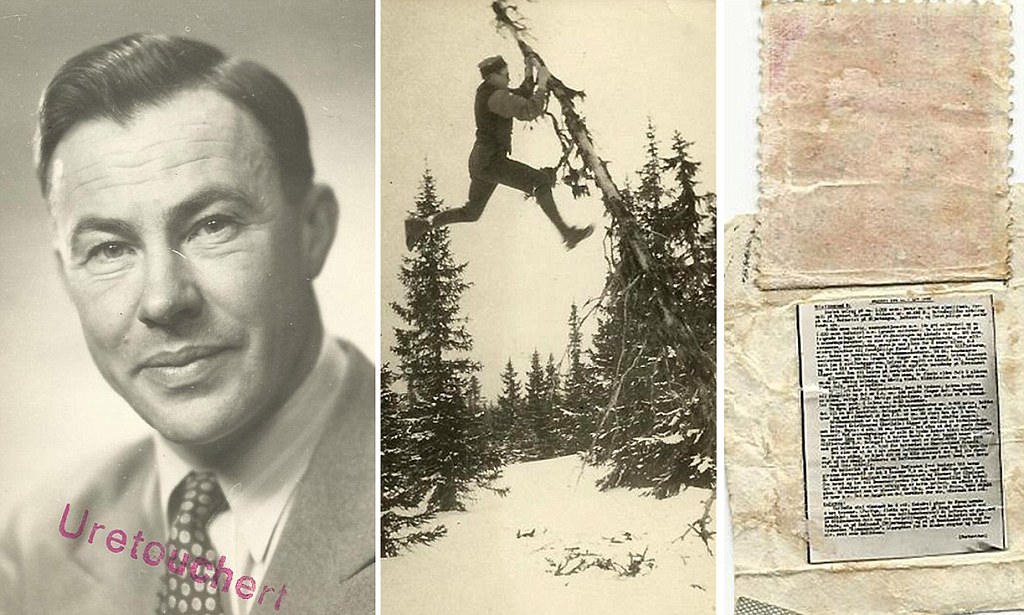
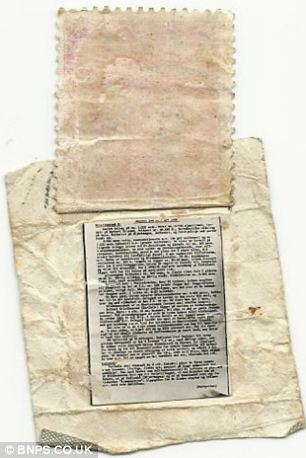
Like his brother, Sven Sømme joined the Norwegian Resistance to fight the Nazis who had occupied his country since 1940. A scientist and fisheries officer, Somme joined the Resistance. He would photograph strategic German military bases using a miniature camera, sending covert maps, photographs and intelligence reports to the Allies hidden under the postage stamps, on letters.

In 1944, guards saw the sun glint off a camera’s lens, and came running. Sømme had been caught, taking pictures of a German U-boat base on Otteroy island. Sven tried hiding the tiny camera under a rock, but the Germans quickly found it. He was put in cuffs.

The penalty for what he was doing, was the firing squad. He would be lucky not to be tortured to death.

That night, Sømme managed to slip his handcuffs and creep past his sleeping guard. What followed was a nightmare race to freedom. A relentless hunt two months in duration, across 200 miles of snow covered mountains.

The Norwegian had barely an hour’s head start. The Nazis couldn’t let this man escape. He knew too much. Pursued by 900 troops and a pack of bloodhounds, Sømme worked his way through icy streams and across ravines moving ever higher, into the mountains.

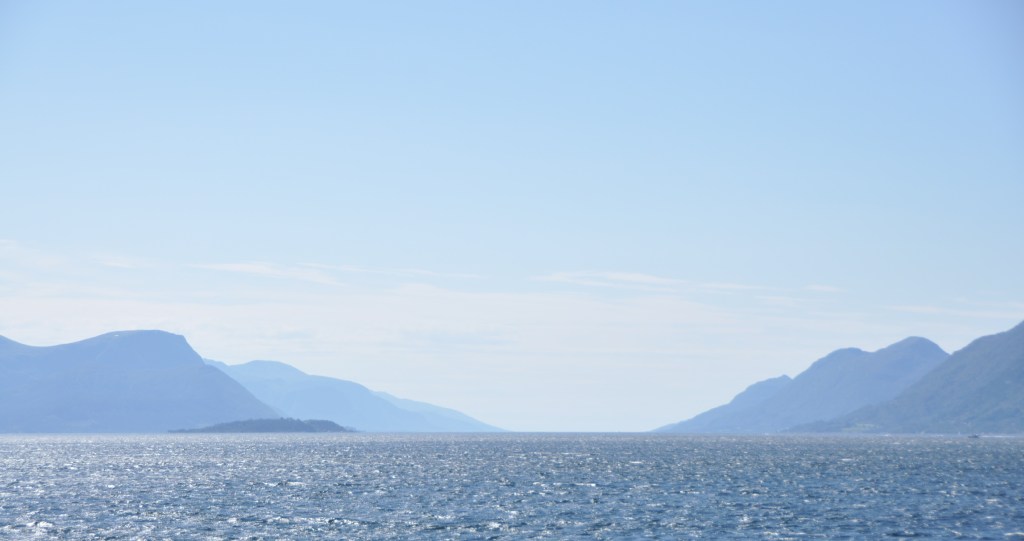
Otrøya island (right) where Sømme photographed the torpedo base, at Midfjorden. H/T Wikipedia

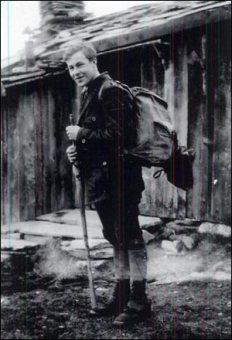
He wore a pair of beat up dress shoes and certainly would have succumbed to frostbite in the mountains, had he not been taken in for a time by a friendly family. He couldn’t stay for long, but the family’s 19-year-old son Andre gave him the pair of mountain boots.

Sven Somme, tree

Sømme would wade through icy streams to avoid leaving tracks in the snow, or leap from one tree to another, a game he‘d once learned, as a kid. He trekked 200 miles through the mountains in this manner dodging bears and wolves. That baying horde was never far from his heels.

At last he made it to neutral Sweden, where he was taken to England. There he met the exiled King of Norway, and the woman who would one day become his wife and mother of his three daughters, an English woman named Primrose.

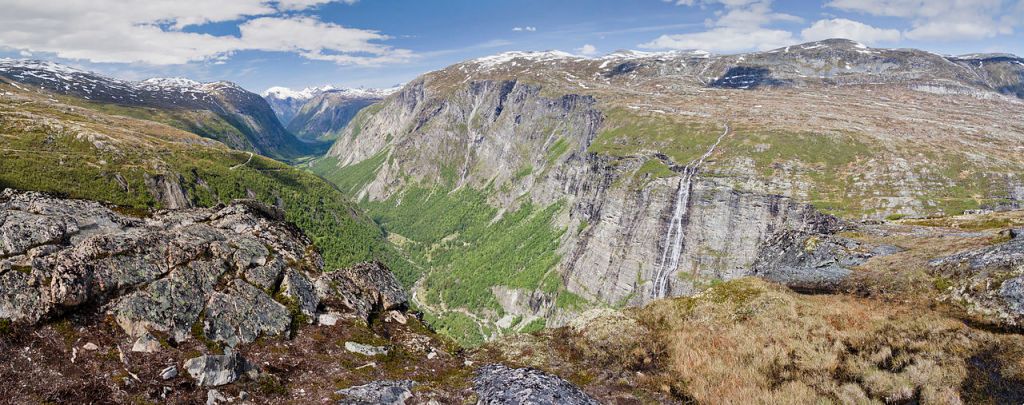
Mountaineer Arne Randers Heen guided Sømme through the steep mountains from Isfjord to Eikesdalen (photo) and locals in Eikesdal helped him through the difficult terrain in from Eikesdal to Aursjøen lake. From there he walked across Norway to Sweden. H/T Wikipedia

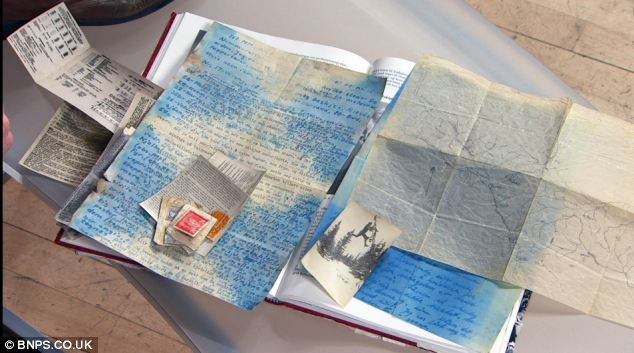
Sven Sømme passed away in 1961 following a battle with cancer. Primrose died not long after. It was only in going through her things after she passed, that the three girls discovered their father’s history. The photographs, the letters, even an arrest warrant, written out in German and Norwegian.

Documents: His daughter has now found an incredible archive of secret documents he collected while working as a spy” H/T UK Daily Mail

Sømme had written a memoir about his escape. He called it “Another Man’s Shoes”. In 2004, his daughters used the book to retrace their father’s epic flight across the mountains. They even met the family who had sheltered him and, to their amazement, they still had his old shoes. The book is still in print as far as I know. It has a forward by his daughter Ellie, describing their emotional meeting with the family who had sheltered her father.

It must be one hell of a story.

November 18, 1863 The Gettysburg Address

Oddly, we don’t know the precise form in which the President delivered his address. Lincoln wrote his own speeches, lining out words and writing into margins as he developed his thought process. That working copy is lost.

Have you ever crossed that field at Gettysburg? The site of the final assault on the third day? You can feel the sense of history, stepping off Seminary Ridge. Only a mile to go. You are awe struck at the mental image of thousands of blue clad soldiers, awaiting your advance. Halfway across and just coming into small arms range, you enter a low spot on what seemed like a flat plain. It’s almost imperceptible but the “copse of trees”, drops out of sight. You can’t help a sense of relief as you cross the draw. If you can’t see them they can’t shoot you. Right?

Then you look to your right and realize. Cannon would have been firing down the length of your lines that day, from Little Round Top. From your left, the guns of Cemetery Hill tear into your lines. Rising out of the draw you are now in full sight of Union infantry. You quicken your pace as your lines are torn apart from the front and sides. Fences hold in some spots along the Emmitsburg Road. Hundreds of your comrades are shot down in the attempt to climb over.

Finally you are over and now it’s a dead run. There’s a savage struggle to possess an angle in a stone wall, but it is not enough. The Bloody Angle. You have reached the “high water mark of the Confederacy”. The shattered remains of that splendid Multitude you joined only moments before, retreat. It is over.

The hill from which the Union center repulsed Longstreet’s assault of the third day was selected for a national cemetery, within the four months following the battle of Gettysburg. Work began to re-inter the dead from the carnage of July, on October 27.

Three weeks later, Abraham Lincoln boarded a train in Washington.  He’d been asked to make “a few dedicatory remarks” on the following day, consecrating the new National Cemetery at Gettysburg where, even now on this day in 1863, workmen yet labored.

Lincoln was the President of a country torn by Civil War, a war so terrible that, before it was over, would kill more Americans than all the wars from the Declaration of Independence to the Global War on Terror, combined.

November 18, 1863. President Lincoln takes a break at the Hanover junction Station (PA), waiting to be joined by Pennsylvania Governor Andrew Curtin. Curtin’s train was late and the President moved on, without him. The Governor would have to find find another route to join the President, the following day.

Lincoln had been feeling poorly the day of the train ride, telling his secretary John Hay, he was feeling weak.  He would feel worse before that day was over. Hay noted that Lincoln’s face was ‘a ghastly color’, the day of the address.  No one knew it at the time. The President had entered the first stages, of smallpox.

His was not the keynote address.  That would be a 13,607 word, two-hour oration delivered by Boston politician Edward Everett.

gtsburgaddress2
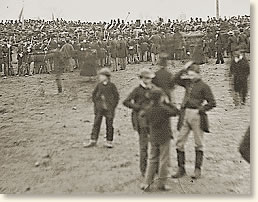
“A rare photo of the ceremonies. A group of boys stand at the fringe of a crowd. In the distance, several men wearing sashes can be seen standing on the speakers’ platform. Analysis of an enlargement of this photo reveals the image of Lincoln sitting to the left of these men”. Tip of the hat to http://www.eyewitnesstohistory.com, for this image

After Everett’s speech, photographers began the careful preparation and setting, of glass plates. Each an thought he had all the time in the world. He did not.

There is no photograph of President Lincoln delivering the Gettysburg address.

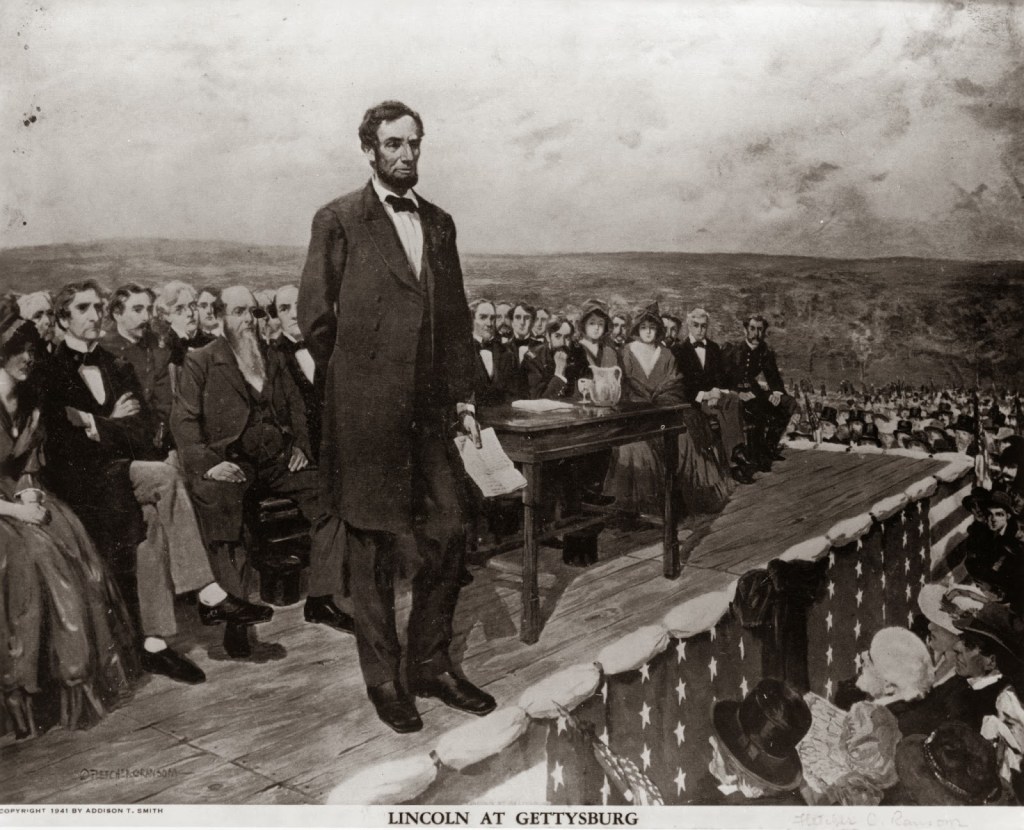
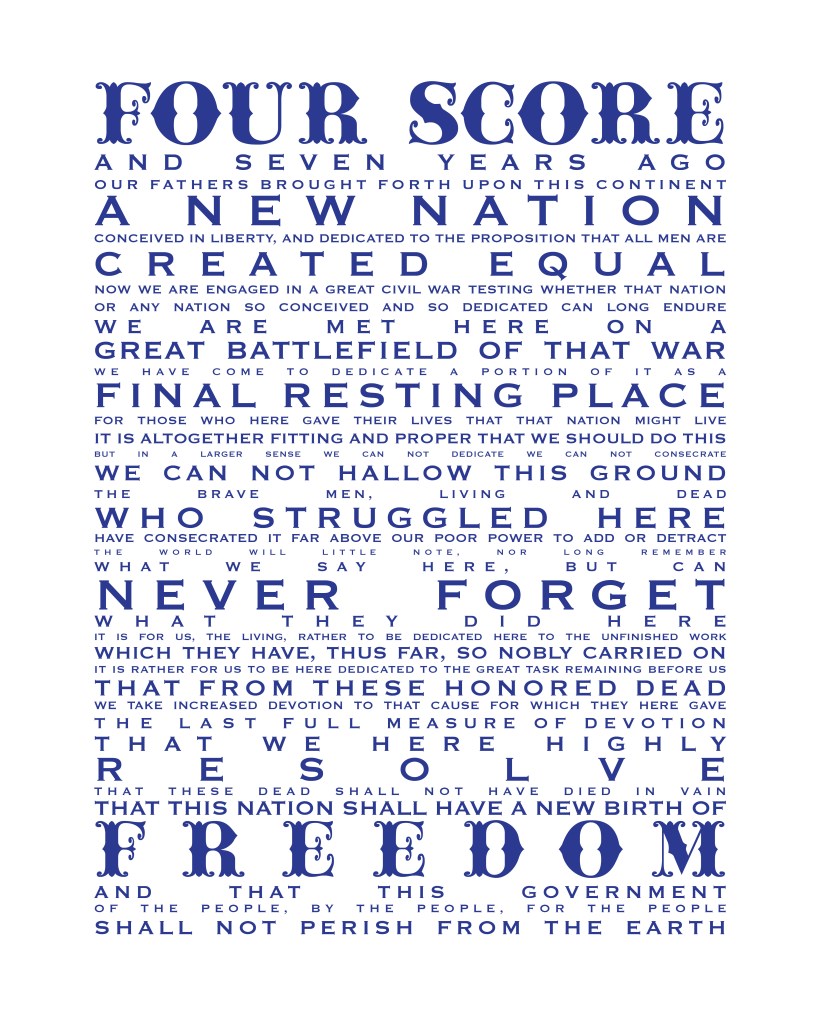
The 16th President of the United States stepped to the rostrum and delivered 271 words, in ten sentences.  In just over two minutes, Lincoln captured an entire vision of where the country was at that moment in time, where it had been, and where it was going.

Lincoln himself thought his speech a flop, but Everett later wrote to him, saying “I wish that I could flatter myself that I had come as near to the central idea of the occasion in two hours as you did in two minutes.”

Then as now there were haters, a peanut gallery firing spitballs, from secure positions on the sidelines.  The Chicago Times described Lincoln’s remarks as “silly, flat and dish-watery utterances”. It all came out in the end.  Lincoln’s address is remembered as one of the finest English language orations since Henry V’s St. Crispin’s Day speech, at Agincourt.  The names of those croaking tree frogs at the Chicago Times, are all but forgotten.

Oddly, we don’t know the precise form in which the President delivered his address.  Lincoln wrote his own speeches, lining out words and writing into margins as he developed his thought process.  That working copy is lost.

objectathand_dec08_631
“The only known image of Abraham Lincoln at Gettysburg was uncovered in 1952 at the National Archives. It was taken by photographer Mathew Brady. (Library of Congress)” H/T Smithsonian.com, for this image

There are five known copies of the Gettysburg address, written in Lincoln’s own hand. Each varies slightly in wording and punctuation.  He wrote two after the address, giving them to his two personal secretaries, John Hay and John Nicolay.  He sent one to Edward Everett early in 1864 and another to George Bancroft, the former Secretary of the Navy turned historian.  Lincoln wrote a fifth copy in February known as the Bliss copy, for Colonel Alexander Bliss, upon learning the Bancroft version was unsuitable for publication. Preproduction technologies were unsuitable at that time, for documents written on both sides of the same page.

images (11)

Lincoln signed, dated and titled the Bliss copy.  This is the version inscribed on the South wall of the Lincoln Memorial.

One of my stranger childhood notions, was the idea that sounds never disappeared. They only diminished as they spread outward, like ripples on a pond.  If that was true (thought my nine-year-old self), could we not somehow capture and listen to the Gettysburg address, as it was actually delivered?

It’s a funny thing how some ideas, even the goofy ones, never completely die away.

November 17, 1968 The Heidi Bowl

Sportswriter Jack Clary quipped, “The football fans were indignant when they saw what they had missed. The Heidi audience was peeved at having an ambulatory football score intrude on one of the story’s more touching moments. Short of pre-empting Heidi for a skin flick, NBC could not have managed to alienate more viewers that evening.”


For football fans, November 17, 1968 was shaping up to be one hell of a game.  The second-best team in the world Oakland Raiders if the results of Super Bowl II were any indication, against the future American Football League champion and Super Bowl III winner, New York Jets.

raiders-jets-heidi-bowl

NBC executives were thrilled.  The AFL was only eight years old in 1968 and as yet unproven, compared with the older league. The NFL/AFL merger was still two years in the future. 

This game was expected to keep viewers in their seats, adding to the already large audience anticipated for the 7:00pm presentation of Heidi, a modern remake of the children’s classic story from 1880.

In those days, most pro football games were played in 2½ hours. Network executives scheduled this one, for three.  The contract with Heidi prime sponsor Timex specified a 7:00 start. And so the order went down, to network affiliates.  There will be no delays.

The game didn’t disappoint, In fact it was voted among the ten most memorable games in professional football history in 1997, and the most memorable regular season contest, ever.  The rivalry between the two clubs was intense, a high-scoring game where the lead changed, no fewer than eight times.  

image-952333-860_poster_16x9-yegb-952333

As early as 6:20, network brass began to worry that the game wouldn’t end on time.  7:00 arrived with a minute & five seconds left to play. The Jets were ahead, 32-29. 

Network and affiliate switchboards began to light up, with fans demanding the game be broadcast in its entirety. Others wanted to know if Heidi would begin, on time.  

NBC Sports executive producer Don “Scotty” Connal and network president Julian Goodman had by this time agreed to “slide the network”, to begin Heidi as soon as Curt Gowdy signed off from the game.

All well and good but by this time, phone switchboards were jammed. Solid.  NBC’s CIrcle-7 phone exchange blew twenty-six fuses, in one hour.  NYPD switchboards, broke down. Broadcast Operations Control (BOC) supervisor Dick Cline nervously watched the clock as Connal frantically redialed, but couldn’t get through.

The television audience watched Oakland running back Charlie Smith return the kickoff from the end zone to the Oakland 22-yard line with 1:01 remaining on the clock. And then the feed was broken.

Heads exploded across the nation as callers reached out to newspapers and television stations, even local police departments, to demand the score.  And Loooord, did they bitch.   Humorist Art Buchwald wrote “Men who wouldn’t get out of their chairs in an earthquake rushed to the phone to scream obscenities [at the network].”

Meanwhile, the Oakland Raiders staged the most amazing come-from-behind rally in the history of sports, scoring two touchdowns in 42 seconds.  Gamblers were apoplectic on learning the news, that the Raiders had beat the 7½ point spread.

The film was just reaching a most tear-jerking moment as Heidi’s paralyzed cousin Clara was taking her first halting steps, as NBC broke in: “SPORTS BULLETIN: RAIDERS DEFEAT JETS 43-32”.

If half the nation hated NBC at that moment, now the other half did, as well. Sportswriter Jack Clary quipped, “The football fans were indignant when they saw what they had missed. The Heidi audience was peeved at having an ambulatory football score intrude on one of the story’s more touching moments. Short of pre-empting Heidi for a skin flick, NBC could not have managed to alienate more viewers that evening.”

The “Heidi Bowl” was prime time news the following night, on all three networks. NBC’s Huntley-Brinkley Report aired the last sixty seconds. ABC Evening News anchor Frank Reynolds read excerpts from the movie, with clips of the Raiders’ two touchdowns cut in. CBS Evening News’ Harry Reasoner announced the “result” of the game: “Heidi married the goat-herder“.

NBC had no option but self-mockery, to redeem itself from the fiasco. One testimonial read “I didn’t get a chance to see it, but I hear it was great”. It was signed by Joe Namath.

A special “Heidi phone” was installed in the BOC, to prevent future such disasters. In 2005, TV Guide listed the Heidi Bowl at #6 of the “100 Most Unexpected TV Moments” in television history.

Actress Jennifer Edwards in the title role of the film, may have the final word in this story: “My gravestone is gonna say, ‘She was a great moment in sports’”.

maxresdefault (18)

November 16, 1959 Pepsi’s Navy

Coca Cola’s 1985 introduction of “New Coke” has been described as the “marketing blunder of the ages” but, what really turned business rivalry to blood feud, was when Pepsi bought it’s own navy.

Coca-Cola was first introduced in 1886. Pepsi appeared seven years later, in 1893. The most famous rivalry in the soft drink business really heated up in the 1930s, when Pepsi offered a 12-oz. bottle for the same 5¢ as Coca Cola’s six ounces.

The Coca Cola Company’s flagship brand had a 60% share by the end of WWII, but that declined to less than 24% by the early 80s. Most of the difference was lost to Pepsi and their “Pepsi challenge” blind taste test promotions, of the late 1970s.

Coca Cola’s 1985 introduction of “New Coke” has been described as the “marketing blunder of the ages” but, what really turned business rivalry to blood feud, was when Pepsi bought it’s own navy.

Alright, it didn’t happen quite that way but, still. The company did have its own navy. Not a little one, either. In 1990, Pepsi owned the 6th largest navy, in the world.

Permit me to rewind, just a bit. The “Cold War” experienced a period of thaw in 1959. Chairman of the Council of Ministers Nikita Kruschev came to visit President Eisenhower in the White house, and the two agreed on a bit of cultural exchange. A display of each civilization for the benefit of the other’s citizens.

So it was the American National Exhibition came to Moscow in the summer of 1959 followed by a Soviet display, in New York.

An argument broke out between Vice President Richard Nixon and Leader Kruschev, over the benefits of Capitalism vs Communism. A heated debate really, it was July, and the Soviet leader looked thirsty.

Pepsi Cola VP Donald McIntosh Kendall thought it was a swell idea, to offer the man a Pepsi. That’s Kendall, pouring, below. That drink was a propaganda coup, the image itself a victory, so much so that on this day in 1959…nothing happened. The “Sound of Music” opened on Broadway. I don’t know, maybe they were all distracted, but one thing is certain. Nikita Kruschev loved him a Pepsi

The exhibition opened the way to the Soviet market for several American companies including IBM, Dixie-cup, Disney and…you got it…Pepsi. That image was a coup for Kendall as well. Within a few years he was CEO and, in 1972 Pepsi negotiated an exclusive marketing agreement, for the Soviet consumer. Coke was out. Pepsi was in. It was the first popular consumer product to make its way to the soviet consumer, a market which would come to be worth $3 Billion, with a capital “B”.

There was a problem however, in the form of payment. The Ruble was no good on the international currency exchange. There had to be a more…umm…liquid form of transfer.

Vodka.

The Russians had tons of the stuff, and so it was agreed. Pepsi would be transferred in exchange for…Vodka.

The system worked so nicely that “Stoli’s” become a household word but, by the late 80s, it was time to renegotiate. Pepsi had 20 bottling plants on Soviet soil. Vodka wasn’t about to pay for all that. Did I mention the USSR was a $3 Billion market for sugary, bubbly water?

It happened by this time, the Soviet Union was looking to get rid of surplus equipment from the Cold War, including a Destroyer, a Cruiser, 17 Submarines and a Frigate.

So it was, at least for a time, Pepsi became owner of the 6th largest navy, on the planet.

Lucky for Coke, the Cola Wars were destined to remain cold. Ice cold. The Pepsi Fleet was sold to a Swedish outfit, for $3 Billion worth of scrap. Donald Kendall left this world on September 19 of this year but we must give him the last word, in this story.

According to his New York Times obituary Kendall once quipped to Brent Scowcroft, National Security Advisor to President George H. W. Bush: “We’re disarming the Soviet Union faster than you are”.