January 18, 1983 Athlete of the Century

Future President Dwight Eisenhower played against Thorpe during the 1912 season and said this, in a 1961 speech: “Here and there, there are some people who are supremely endowed. My memory goes back to Jim Thorpe. He never practiced in his life, and he could do anything better than any other football player I ever saw”.

He was born in Oklahoma Indian territory around 1887, to parents of mixed Caucasian and Indian ancestry. According to custom he was named after something that happened, around the time of his birth. Lighting had lit up the trail to the house in which he was born. So it is he was known by the native name, Wa-Tho-Huk. “Bright Path”. He was raised a Catholic, a faith he would practice all his life with the baptismal name, Jacobus Francis Thorpe. He would grow to be the finest all-round athlete of the first half of the 20th century and maybe, for the next 100 years. We remember him as Jim Thorpe.

Thorpe was an indifferent student and ran away from school several times, especially after his twin brother Charlie died of pneumonia, at age 9. His father sent him to the Haskell Institute, an Indian boarding school in Lawrence, Kansas, hoping he wouldn’t run away again.

Two years later, his mother died in childbirth. That was it. After several arguments with his father, he left to take work at a horse ranch. Thorpe returned to his father at 16 and agreed to attend the Carlisle Indian Industrial School in Carlisle, Pennsylvania.

One day in 1907, Thorpe was walking past the school track. Several high jumpers were at practice and he decided to give it a try. With no warm-up and still in street clothes, Thorpe beat them all on his first try with a high jump of 5-feet, 9-inches.

In those days, Glenn Scobey “Pop” Warner, yeah, THAT Pop Warner, coached football at the Indian School.

Reluctant to let his best track & field athlete try a contact sport, Warner relented and let Thorpe carry the ball on two rushing plays. He’d be easily tackled and change his mind thought Warner, but Thorpe ran circles around the defenders. Twice. Flipping the ball to coach Warner, Thorpe quipped, “Nobody is going to tackle Jim“.

Thorpe came to compete in football, baseball, lacrosse and even ballroom dancing, winning the intercollegiate ballroom dancing championship, in 1912. I can’t help but respect that, as someone who moves, like a refrigerator.

Jim Thorpe in 1912

Thorpe came to national attention in 1911, after scoring all four field goals in an upset victory over Harvard, 18-15. In a 1912 victory over Army, Thorpe’s 92-yard touchdown run was called back, due to a teammate’s penalty. He ran it in again on the following play, this time running 97-yards.

He didn’t compete in track & field in 1910 or ’11 but, in the spring of 1912, he started training for the Olympics. At the 1912 Summer Olympics in Stockholm, somebody stole his shoes. He scrounged a pair from somewhere including one from a garbage can and won the decathlon, and pentathlon.

It was his first and only decathlon.

Martin Sheridan, champion athlete of the Irish American Athletic Club and five-time Olympic gold medalist told a reporter from the New York World: “Thorpe is the greatest athlete that ever lived. He has me beaten fifty ways. Even when I was in my prime, I could not do what he did today.”

The New York Times wrote in his 1953 obituary, that Thorpe “could run the 100-yard dash in 10 seconds flat; the 220 in 21.8 seconds; the 440 in 51.8 seconds; the 880 in 1:57, the mile in 4:35; the 120-yard high hurdles in 15 seconds; and the 220-yard low hurdles in 24 seconds. He could long jump 23 ft 6 in and high-jump 6 ft 5 in.[7] He could pole vault 11 feet; put the shot 47 ft 9 in; throw the javelin 163 feet; and throw the discus 136 feet“.

In today’s Olympics, we’re all supposed to be excited when professional athletes paid tens of millions of dollars to play basketball, defeat some kids from Croatia.

That wasn’t so in 1912. There were strict amateur rules. Sports teachers, professional athletes and anyone who ever competed against them were strictly forbidden from amateur sports, particularly when someone noticed.

In 1909 and 1910, Thorpe played baseball for the Rocky Mount Railroaders of the Eastern Carolina League. They were the worst team in the league despite the presence of Jim Thorpe, but no matter. The man was paid $2 a game, and $35 a week, to play baseball.

The fact was widely known but, in 1913, the Worcester Telegram published an article, stating that Thorpe had played professional baseball. Other papers picked up the story. Plausible deniability thus denied, Amateur Athletic Union (AAU) Secretary James Edward Sullivan, sprang into action.

Thorpe wrote a letter, hoping it would help: “I hope I will be partly excused by the fact that I was simply an Indian schoolboy and did not know all about such things. In fact, I did not know that I was doing wrong, because I was doing what I knew several other college men had done, except that they did not use their own names …”

It didn’t. Despite a 30-day rule for such challenges, the AAU retroactively withdrew his amateur status. The International Olympic Committee (IOC) stripped him of his awards, and medals.

Jim Thorpe first signed with the New York Giants in 1913 and played six seasons in the major leagues, between 1913 and 1919. He joined the American Football League Canton Bulldogs in 1915 helping the team to three championships before joining the National Football League where he played, for six years. All the while he would barnstorm around the country with an all-Indian professional basketball team. He was President of the American Football league in 1920 which later became, the NFL.

Jim Thorpe would play professional sports until he was 41. Depression was upon the land on those days and Thorpe struggled to hold down a job. Bouncer. Security Guard. Ditch digger. He briefly joined the Merchant Marine, in 1945. He appeared in several films sometimes sometimes as himself, and sometimes a bit player. He became a chronic alcoholic, married three times and divorced twice, with 8 kids. He was hospitalized with lip cancer in 1950 and admitted, as a charity case.

Jim Thorpe went into heart failure in 1953 while dining with his third wife, Patricia. He was revived and spoke to those around him, but later lost consciousness. Jim Thorpe died at the couple’s home in Lomita, California on March 28, 1953.

Over the years, supporters tried to have his medals restored and Olympic titles, reinstated.

Former teammate and IOC President Avery Brundage would have none of it, saying “ignorance is no excuse.”

In 1981, author Bob Wheeler published Jim Thorpe: World’s Greatest Athlete. Wheeler and his wife Florence Ridlon, herself a PhD and author of several books, may be Thorpe’s greatest supporters.

The couple founded the Jim Thorpe Foundation in 1982 and, that October, the IOC executive committee approved Thorpe’s reinstatement. Sort of.

Jim Thorpe was declared “co-champion” with Ferdinand Bie and Hugo Wieslander, athletes who had always said, that Thorpe had won. On this day in 1983 the IOC presented commemorative medals to two of Thorpe’s children, Gale and Bill. Today, the IOC lists Thorpe as “co-medalist’.

In 1954, the communities of Mauch Chunk and East Mauch Chunk of Carbon County Pennsylvania merged to form the borough of Jim Thorpe.

Thorpe’s original medals were at one time in museums but since stolen, and never recovered.

In 2020, a petition called upon the IOC to reinstate Thorpe as the sole winner of the 1912 events. Pictureworks Entertainment, a company producing a film about Thorpe supports the petition as does 1964 gold medalist, Billy Mills.

January 16, 27BC Republic

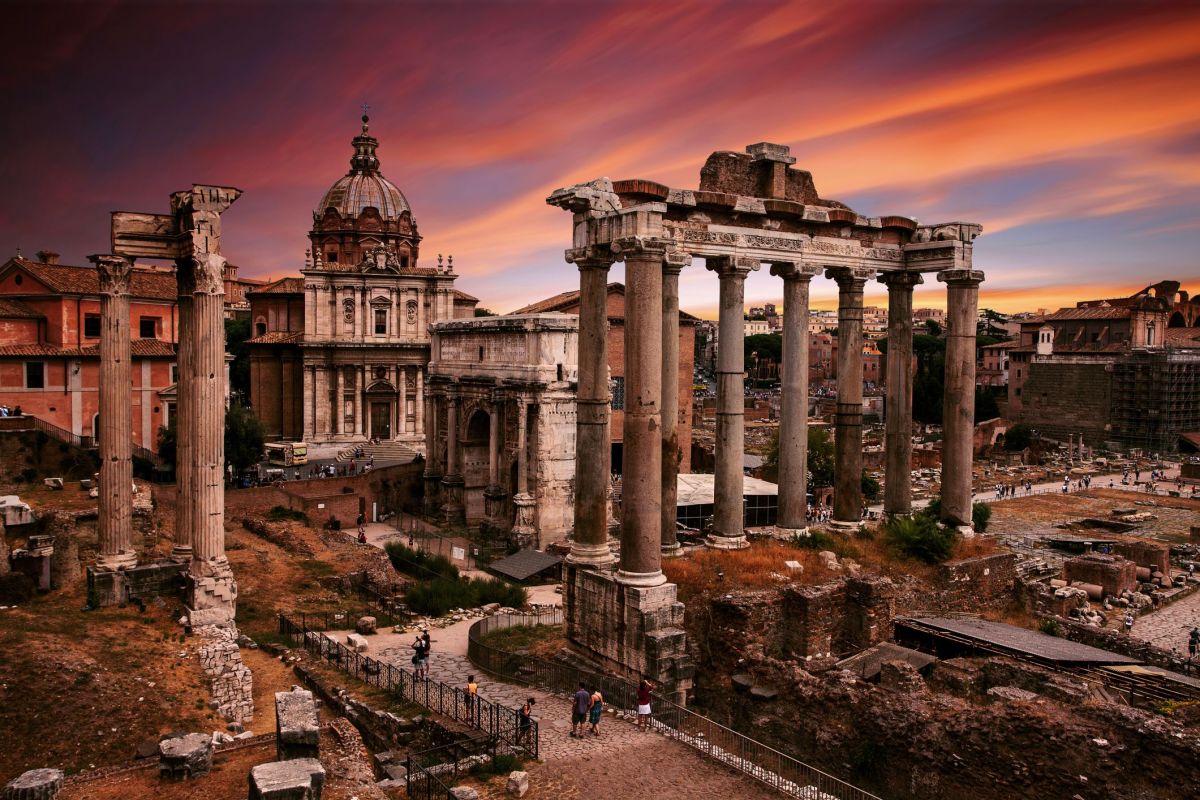
“Many Romans themselves put the key turning point in 133 BC. This was the year when a young aristocrat, Tiberius Sempronius Gracchus, held the office of ‘tribune’ (a junior magistracy which had originally been founded to protect the interests of the common people). As one ancient writer put it, this was when ‘daggers first entered the forum”. – BBC

According to legend, Romulus and Remus were the sons of Rhea Silvia, the daughter of King Numitor of Alba Longa, a mythical city located in the Alban Hills southeast of what would become Rome.  Numitor was deposed by his younger brother Amulius, who forced Rhea to become a vestal virgin so that she would not give birth to rival claimants to his throne. She however, was already pregnant by the war god Mars, destined to give birth, to twins.

Romulus and Remus, by Rubens

Learning of the birth, Amulius ordered the infants Romulus and Remus drowned in the Tiber river. The twins survived, washing ashore at the foot of the Palatine hill, where the two were suckled by a she-wolf.

Later discovered by the shepherd Faustulus, the boys were reared by he and his wife. Much later, the brothers became leaders of a band of young shepherd warriors. On learning their true identity, the twins attacked Alba Longa, killed King Amulius, and restored their grandfather to the throne.

Romulus and Remus founded a town on the site of their salvation, the traditional date being April 21, 753BC. Romulus later murdered his brother after some petty quarrel, making himself sole ruler of the settlement which he modestly called “Rome”, in his own honor.

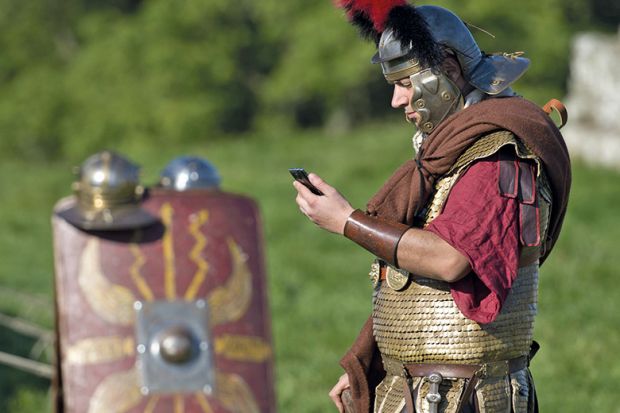
Except, the whole story, is nonsense. Much like a centurion with a cell phone.

It’s more likely that first three hundred years were a scrap for survival. If anyone had time to write down a serious history, it’s been lost.

Sparse factual material was embellished by later generations with some facts exaggerated or invented outright, while the more embarrassing episodes, were “disappeared”. This early or Regal period is said to be a time of six Kings, benevolent rulers all except for the seventh, a cruel tyrant known as Lucius Tarquinius Superbus.

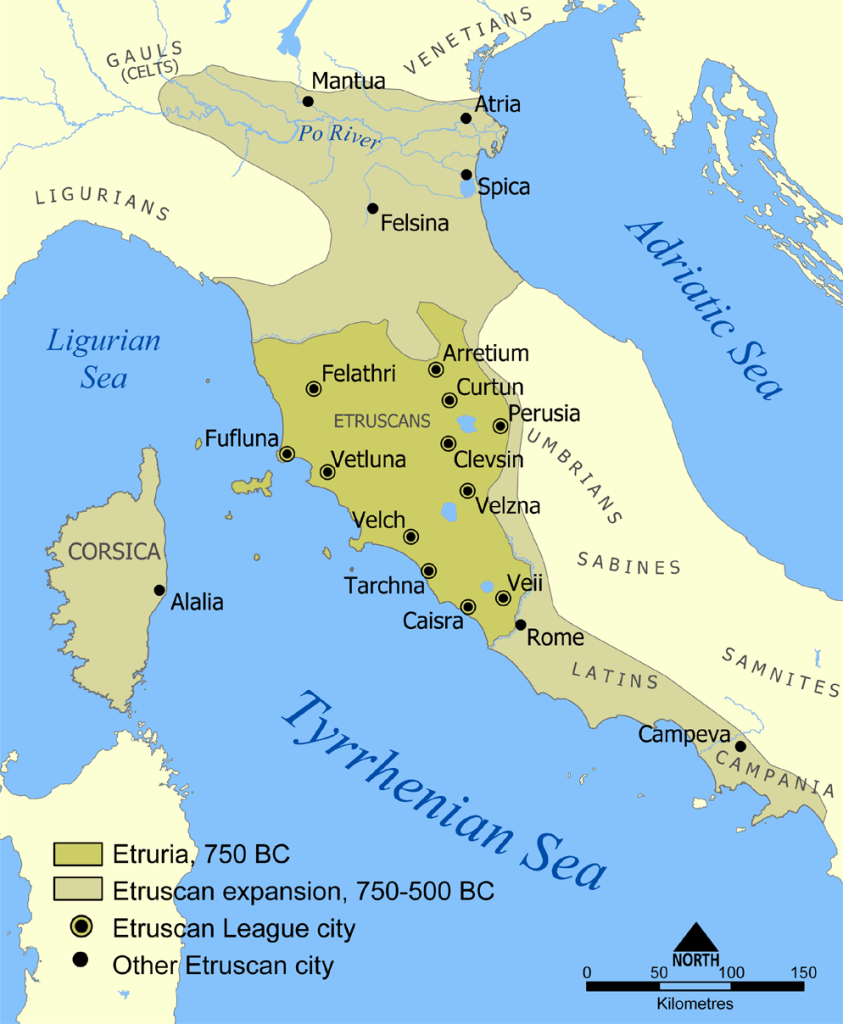
According to legend, Tarquin was overthrown by public uprising, around 509/510BC. Etruscan civilization, dominant over the Italian peninsula since 900BC, had begun to lose hold. A series of wars would see the ascension of the Latin League (albeit temporarily), at the expense of the Etruscan league. The siege of Veii in 396BC brought the ancient Etruscan city into the Roman orbit.

The last remnants were absorbed in 27BC as Republic morphed into Empire, but now I’m getting ahead of the story.

Rather than restoring the monarchy, the Romans replaced the kingship with two annually elected magistrates, or Consuls. The Republic, was born.

The historian Livy tells us, the first 200 years of Republic was a never ending struggle between two social orders: Patricians and Plebeians. The privileged classes, and the common citizen.

The republic built a governing system of three branches with checks and balances and a strong aversion to the concentration of power.

The executive branch or Consuls (usually two) were primarily Generals, whose job was to lead the republican military in war. In times of national emergency, Rome would appoint a dictator in place of Consuls, a military leader entrusted with supreme command for no more than six months.

The Senate consisted of 300 who served, for life. Primarily an advisory body, the Senate focused mostly on foreign policy but exercised considerable jurisdiction over civil affairs, as the Senate controlled the treasury. At first exclusive to ex-consuls and other members of the Patrician class, the Senate would later open to members of the Plebian class.

Last came the Assemblies, the most democratic branch of Republican government, of which there were four.

Within fifteen years, the crushing debt of endless wars and the excesses of the publicani, the ruthless, usurious contractors hired by the state to collect taxes, brought the Plebeians to open revolt. There was talk of assassinating a Consul. The Plebs seceded in 493BC in much the same way, as a modern labor strike. With the economy ground to a halt, the popular ex-consul Agrippa Menenius was sent to negotiate, resulting in a direct representative of the common man, in the Assembly. This was the Tribune of the Plebs of which there were two, and later ten.

With their physical person sacrosanct, anyone who laid a hand on them was subject to death, the Tribune of the Plebs was uniquely able to propose and veto legislation and to rescue commoners, from the hands of Patrician magistrates. Several important offices opened to the Plebs by the 4th century BC, up to and including that of Consul, and Dictator

The working classes left the city en masse, leaving the wealthy elite, to fend for themselves.

In theory, the Tribune of the Plebs brought representation for the common citizen. In practice, such powers in the hands of demagogues, would bring about the death of the Republic.

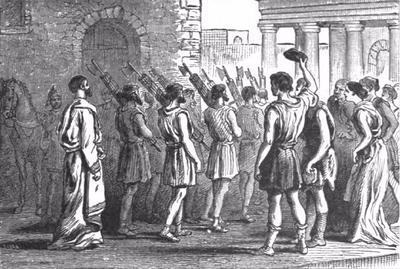
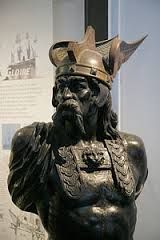
By the 5th century, the people of Gaul (modern-day France, parts of Belgium, western Germany and northern Italy) migrated south to the Mediterranean coast. Disaster struck in 390BC as war bands of the Gallic Chieftain Brennus swept out of the north, easily defeating Roman defenses at the river Allia and capturing and sacking much of Rome, itself.

The sack of Rome doesn’t seem to have been the disaster, described in Roman legend. Little archeological evidence exists to support the idea of a sustained sack and burning of the city. Very possibly, Brennus and his band were headed south to sign on as mercenaries, in service to Dionysius of Syracuse.

Maybe all they wanted was the sort of plunder easily carried away. Like the gold they were paid to get out of town which they happily did, following a 7-month siege.

There followed forty years of hard fighting in Latium and Etruria to restore the power of Rome. Be that as it may, the Gallic bogey man would live on in the Roman psyche.

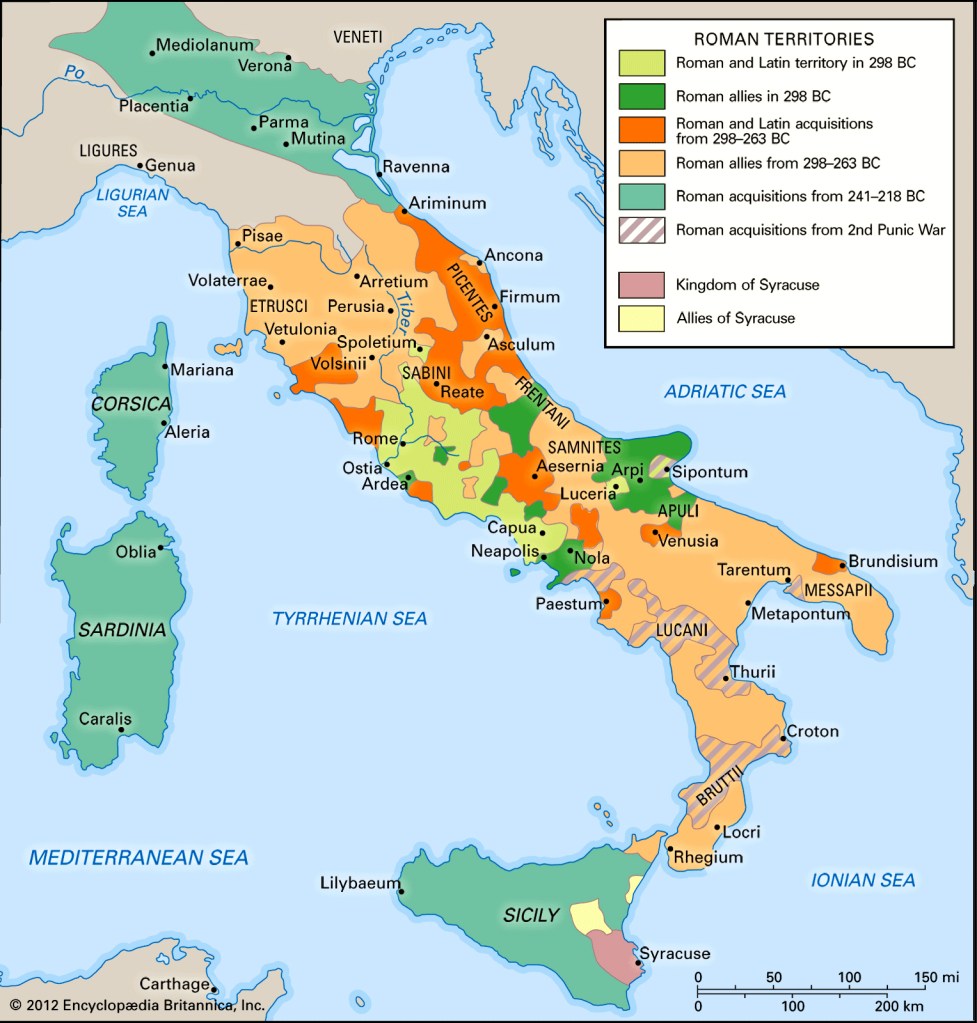
The Latin war of 340-338BC ended in victory for the Republic, placing Rome in control of central Italy. The next three decades saw the conquest and colonization of the Samnites to the north and the Greek principalities, to the south. By 275BC, Rome was master of all Italy.

Meanwhile, a child was born in Carthage some 1,500 miles to the south, who would rock the Roman world. His name was Hamilcar Barca.

The 3rd century BC was a time of endless military campaign for the Roman Republic, no fewer than 68 of them.

Outward expansion inevitably brought the Republic into conflict with the other major Mediterranean power of the age, the ancient Phoenician seafaring civilization long since settled in north Africa, called Carthage.

Hamilcar Barca was a great general in the first of three wars between Rome and Carthage, the longest continuous conflict and the greatest naval war, of antiquity. The 1st Punic War went badly for Carthage and ended on harsh terms, including the loss of that famous navy. Hamilcar died in 228BC most likely drowning in the Jucar River but he lived on in a way, in the form of the Roman’s worst nightmare – Hamilcar’s sons sworn to eternal hate for Rome, Hasdrubal, Mago and possibly the greatest field commander in history, the general Hannibal.

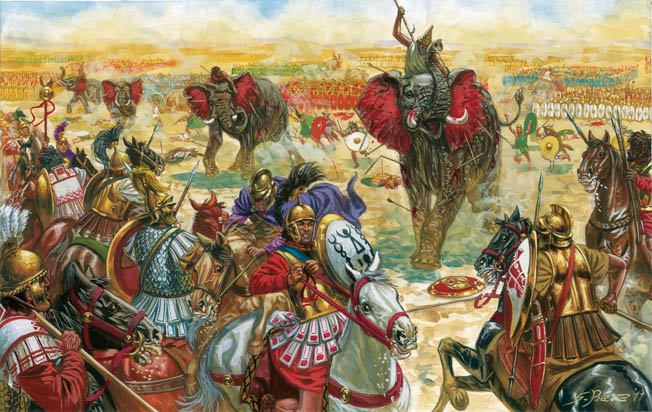
In 218BC, Hannibal crossed into hostile Gaul at the head of 38,000 infantry, 8,000 cavalry, and 37 war elephants. His crossing of the Alps that winter is one of the great feats of military history, costing almost half of his force before entering Italy that December.

The first of several major battles took place on December 18, 218BC, on the banks of the Trebia River. The army of Hannibal was near invincible, defeating Roman legions in one major engagement after another. Trebia, Lake Trasimene, Cannae: where Hannibal annihilated nearly down to the man, the largest Roman army, ever assembled. For sixteen years, Hannibal’s Carthaginians were virtually unbeatable, devastating the Italian countryside as Rome drafted one army after another only to see them crushed, yet again. Meanwhile, Carthage itself was politically divided. Hannibal never did receive any significant support from home. In the end, he had to leave Italy to defend his homeland in North Africa.

Hannibal was soundly defeated by his own tactics on October 19, 202BC at the Battle of Zama, ending the second Punic war under humiliating terms for Carthage.

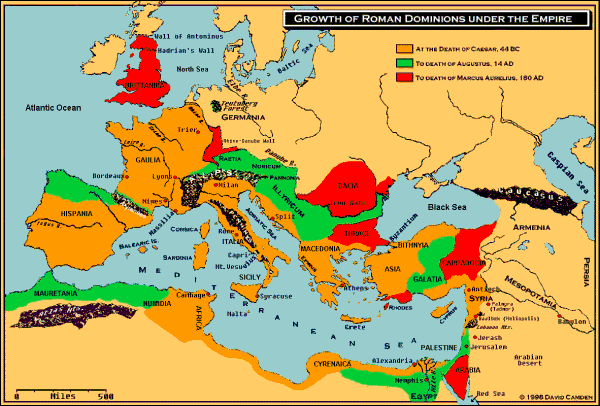
By the 1st century BC, Roman power all but encircled the Mediterranean, from modern-day Spain to Syria, from Normandy to North Africa.

Such diverse, conquered peoples proved ever more difficult to govern as troops were stationed literally everywhere, ready to use force, if necessary. In Rome itself, citizens suffered under a government that always seemed to be looking, elsewhere. Roman made goods and produce became ever more expensive as locals found themselves unable to compete, with the provinces. Many migrated to the city where, increasingly, those in public service sought to placate the masses with handouts, and lavish entertainments.

In the late first and early second centuries (AD), the Roman poet Juvenal spoke of the period in his Satires, of a population no longer dedicated to the sacred birthright of public service, of civic engagement, preferring instead panem et circenses. Bread and circuses.

In the end, the Republic died by its own hand, a victim of internal politics.

In the middle years of the Republic, legionaries were required to serve out entire campaigns, regardless of length. Larger homesteads could always count on the labor of slaves while smaller farms were left in the hands of wives and children. These often went bankrupt, properties bought cheaply by an increasingly wealthy and avaricious, upper class.

According to Plutarch, “[W]hen Tiberius on his way to Numantia passed through Etruria and found the country almost depopulated and its husbandmen and shepherds imported barbarian slaves, he first conceived the policy which was to be the source of countless ills to himself and to his brother.”

Tiberius and his brother were the Gracchus brothers, important populist politicians of the late Republic. Tiberius, a hero of the 3rd Punic war, instituted reforms redistributing lands, back to the poor. Tiberius became a hero to the poorer classes and hated by the wealthy, so much so that he and 300 supporters were beaten to death with stones and clubs, in 132BC.

The Senate attempted to placate the Plebs by enforcing Gracchus’ land reforms but, ten years later, Tiberius’ younger brother and heir to his populist politics Gaius, would share the fate of his brother.

The Gracchi were gone but the animus between Populares and Optimates, had never been greater.

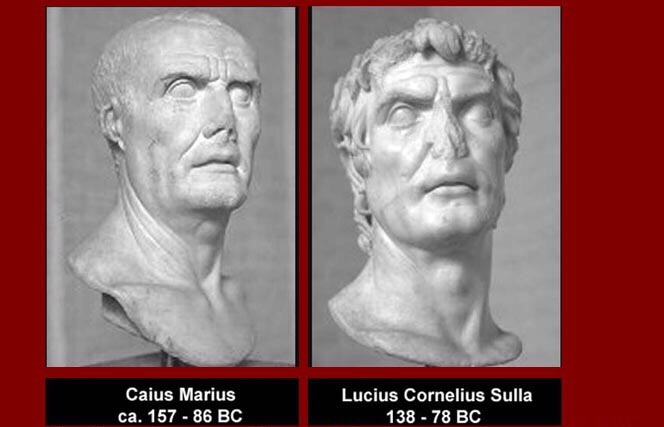
The first of several civil wars began in 88BC with a struggle for power between two men.

Elected Consul an unprecedented seven times, Gaius Marius implemented military reforms, transforming the loyalty of the soldiery from the republic, to their commander. Lucius Cornelius Sulla was the ambitious son of a Patrician family.

Outmaneuvered by Marius for supreme command of the 1st war against King Mithradates of Pontus (eastern Turkey), Sulla gathered his allies and marched under arms, against Rome. It was an unprecedented act of hostility duplicated by Marius himself and his allies, on Sulla’s return to Pontus. The murderous “reforms” of Marius and his Populares paled in comparison to the second return of Sulla and his Optimates.

Imagine finding your name on a list published by your government, knowing that meant you were “proscribed”. Whosoever of your fellow citizens who found and killed you, was entitled to your worldly possessions. The names of as many 4,700 “enemies of the state” were nailed to the wall of the Roman Forum during the “proscriptions” of the Dictator Sulla.

Forty years later, a General’s marching on Rome at the head of an army was still an act of war, though hardly “unprecedented”. With the words “the die is cast”, Julius Caesar crossed the Rubicon river on January 10, 49BC, igniting another civil war. Caesar emerged victorious in early 44BC to be appointed, “Dictator for Life”. The very idea was an affront to traditional Roman sensibilities. Caesar was murdered by a cabal of Senators on March 15. The “Ides of March“.

Caesar’s killers believed they were saving the Republic but their actions, had the opposite effect. The assassination sparked a period of civil war and political instability from which Octavian, the adopted son of Julius Caesar, emerged victorious over Marc Antony and his Greek princess ally turned Egyptian Queen, Cleopatra.

Octavian was crowned the first emperor of Rome on January 16, 27BC and given the honorific title, “Augustus”. The Republic was dead. The era of Empire, had begun.

January 15, 1987 An Innocent Man

Wrongful convictions happen for many reasons. Prosecutors hide evidence. Incompetent defense counsel. Mistaken identity and ulterior motives, on the part of witnesses.

Were there a catalog of lies, there may be none more egregious than the false accusation.  No matter how he tries, the victim of such a falsehood will never prove a negative.

Wrongful convictions happen for many reasons. Prosecutors hide evidence. Incompetent defense counsel. Mistaken identity and ulterior motives, on the part of witnesses.

Interior views of traditional prison

Accurate numbers are all but impossible to determine, but we can make an educated guess. A study conducted by Ohio State University surveyed 188 judges, prosecutors, public defenders, sheriffs and police chiefs. The survey found that 75% of respondents believed that more than zero and less than 1 percent of convictions, were unjust. Taking the middle number of .5 percent and a rough estimate of 195,000 convictions per year works out to 9,750 wrongful convictions. Every year. (H/T Housley Law blog for these statistics, which states there have been 1,962 exonerations nationwide, since 1989).

Feel free to make any assumptions you like concerning these numbers but one thing is sure. To assume there are no wrongful convictions is to believe that government does everything right, all of the time.

Graduating from Allegheny College in 1961, Robert Budd Dwyer set his sights on elective office.  The future looked bright.

First elected State Rep in 1964, the Pennsylvania Republican ran successfully for state Senate in 1970 and then for state-wide office, elected Treasurer, in 1980.

In 1986, Pennsylvania officials discovered that state employees had overpaid millions in FICA taxes, due to errors in state withholding. Several accounting firms bid for the contract to determine, how much compensation was due each employee. The contract was awarded to California based Computer Technology Associates (CTA), owned by Harrisburg native, John Torquato Jr.

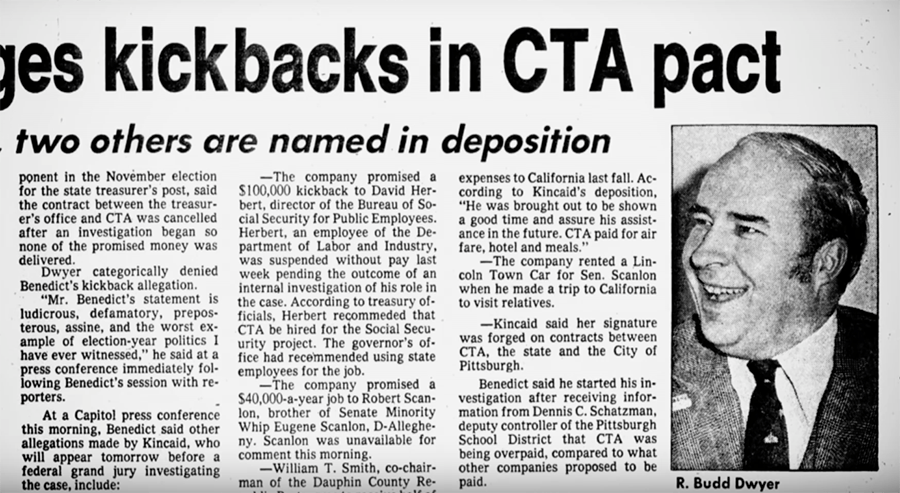
Governor Dick Thornburg received an anonymous memo a few weeks later, alleging bribery in the award of the CTA contract. R. Budd Dwyer was named as one of the people receiving kickbacks in the deal along with Republican committee member Bob Asher, and CTA attorney William ‘Bill’ Smith.

Anonymous accusations are such a cowardly tactic.

No money ever changed hands. The CTA contract was canceled two months after it was signed. Even so, prosecutors pushed the case for everything it was worth.

Most criminal cases end in plea deals, and not in trials. Smith pleaded guilty to offering Dwyer and Asher $300,000 in bribes and received a reduced sentence. Torquato also pleaded guilty and received a sentence, of 4 years. Adamantly proclaiming his innocence, Budd Dwyer refused a plea deal: a guilty plea on one count and a sentence, of five years. Dwyer was adamant, and demanded a trial. “I absolutely did nothing wrong”.

On December 18, 1986, Budd Dwyer was found guilty. Conspiracy, mail fraud, perjury and interstate transportation in aid of racketeering. Eleven counts.

Judge Malcolm Muir hinted at a sentence, of 55 years. Many believe the man wanted to make an example, of Budd Dwyer. Sentencing was scheduled for January 23, 1987.

On December 15, 1987, Dwyer held a meeting at his home with press secretary James Horshock, and Deputy Treasurer Don Johnson. With a week to go before sentencing, Dwyer wanted to make a statement, to the press.

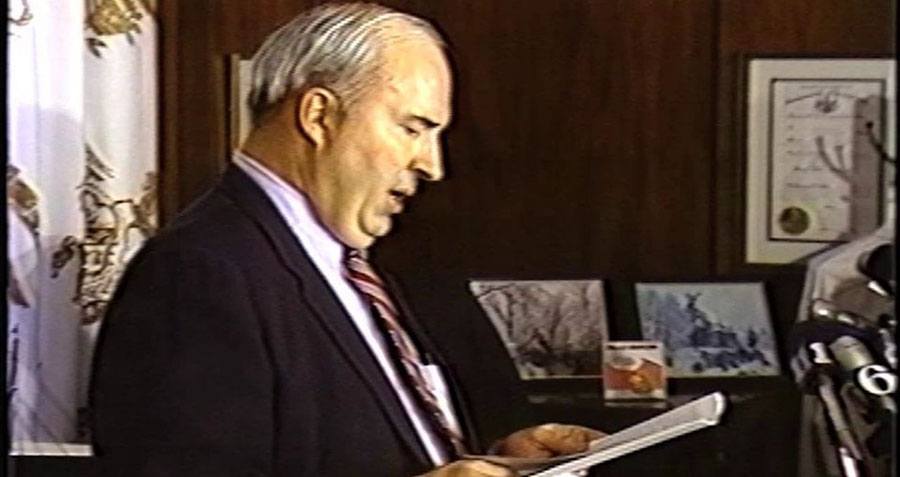
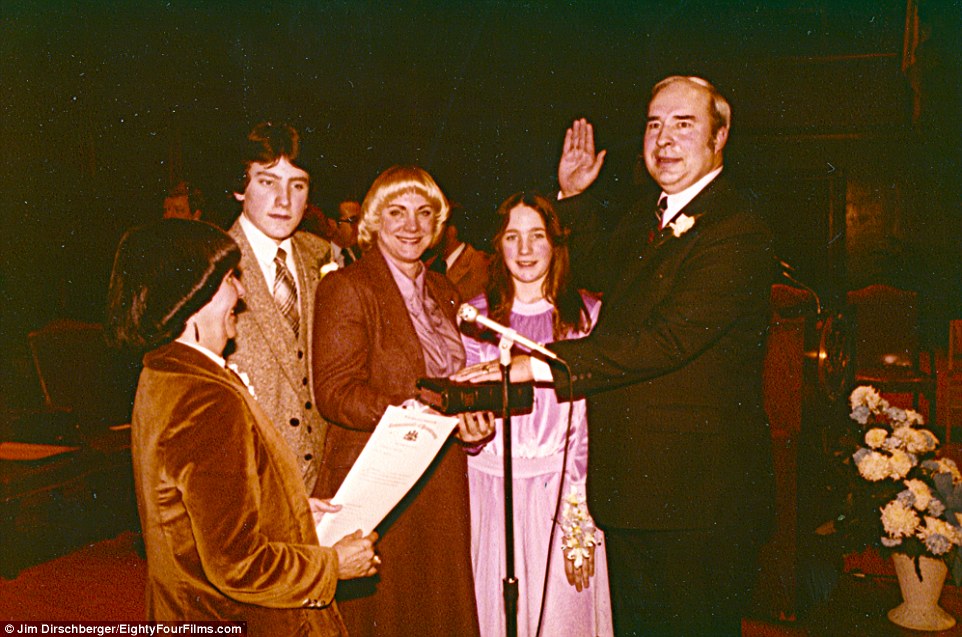
Budd Dwyer addresses the press on January 22, 1987. It would be his last press conference.

The meeting was scheduled for January 22, the day before sentencing.

In a rambling speech before the press, R. Budd Dwyer proclaimed his innocence. He said how much he’d enjoyed his life with his wife Joanne and the couple’s kids, Rob and Dyan. He reflected on what a bright future it could have been.

“I am going to die in office” he said, “in an effort to ‘…see if the shame[-ful] facts, spread out in all their shame, will not burn through our civic shamelessness and set fire to American pride.’ Please tell my story on every radio and television station and in every newspaper and magazine in the U.S.

Please leave immediately if you have a weak stomach or mind since I don’t want to cause physical or mental distress.

Joanne, Rob, DeeDee [sic] – I love you! Thank you for making my life so happy. Goodbye to you all on the count of 3. Please make sure that the sacrifice of my life is not in vain.”

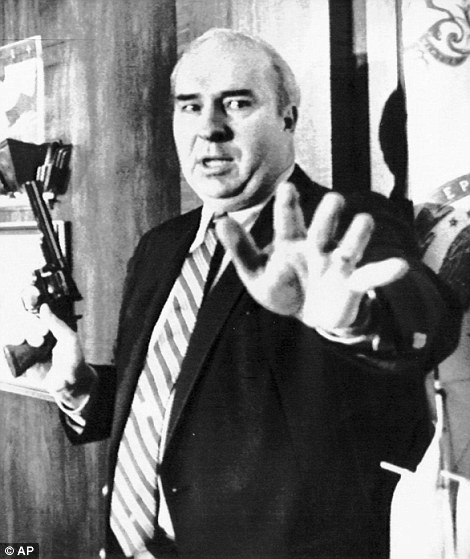
Pandemonium broke out as R. Budd Dwyer took out a briefcase, and a .357 magnum pistol. He put the gun in his mouth and blew his brains out.

You can find the video online if you want, it was all on camera. I’m not going to show it.

Joanne never for a moment doubted her husband’s innocence but she never forgave herself for failing to notice, how the man was struggling. She took heavily to drink, perhaps to self-medicate and died in 2009, an alcoholic.

Former chair of the Dauphin County Republican Committee Bill Smith has made contradictory statements under oath and expressed regret for lying, and the role it played in Dwyer’s death.

Subsequent court proceedings never did overturn Dwyer’s conviction, but the Treasurer was able to provide for his family. Having died in office, Dwyer’s widow Jo received full survivor’s benefits of $1.28 million.

Dyan “DeeDee”, now a married mother of two, has lived a private life. Rob, now a realtor in Arizona, has been quite public about his own difficulties, in dealing with his father’s suicide. ‘I’d tell anyone thinking about suicide’ he said, ‘that the scars and the emotional toll that it leaves on those left behind, is immense.

January 14, 1969 Fire at Sea

For every multi-ton flying fuel tank hurtling from bow-mounted catapults bristling with armaments, a controlled crash landing of that same aircraft, takes place in the stern. Combine all that chaos with a heaping helping of Murphy’s law and the table is set, for disaster.

From the WW1-era launch of the first modern aircraft carrier to the present day, the carrier sailor has literally lived and worked, surrounded by the means of his own destruction.

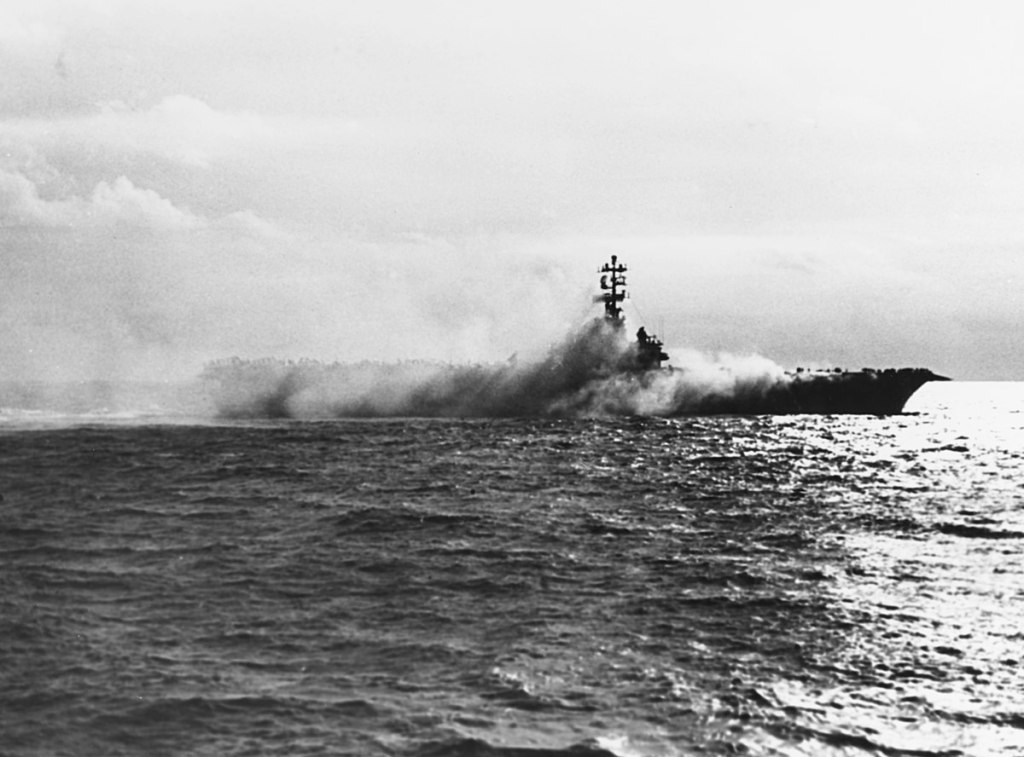
In March 1953, a Corsair fighter off the coast of Korea landed on the decks of USS Oriskany, with a bomb still attached. The thing fell off and exploded, piercing the wingtip tanks of several F9F-5 Panthers, spilling flaming fuel across the decks. That time, fire crews were able to put out the fire, before the flames reached ordnance lockers. Loss of life was limited to two sailors killed and another fifteen, wounded. A decade later, the “Mighty O” wouldn’t get off, so lightly.

USS Oriskany

Oriskany began her second tour off the Vietnam coast in July, 1966. The carrier’s five fighter squadrons launched nearly 8,000 sorties in the first four months, a pace taxing to man and machine, alike.

On October 26, apprentice seamen George James, 18, and James Sider, 17, were ordered to stow 117 parachute flares. Untrained and unsupervised, Sider snagged a lanyard , and accidentally set one off. Panicked, blinded by the brilliant light of white phosphorus, Sider tossed the flare into the storage locker.

The bin already contained some 650 flares and 2¾-inch air-launched rockets, each carrying a 6-pound warhead. Temperatures inside the locker soared to 4,500° Fahrenheit and the main hatch exploded as steel bulkheads began to sag and buckle.

Water is worse than useless against a magnesium fire. Anyone who’s seen the Hindenburg tape understands why. Water breaks down to oxygen and hydrogen at temperatures over 3,000°, literally transforming into fuel, for the inferno.

Magnesium fires burn as hot as 5,600°, Fahrenheit. As a point of reference, volcanic lava ranges from 1,470° to 2,190°.

As helicopters burned and ammunition cooked off, the courage of individual firemen is scarcely to be believed. Literally surrounded by bombs staged for loading, firemen trained water hoses to cool these monsters even as their paint blistered, and fuze inlets began to smoke.

Oriskany fire, October 1966

Had the bombs gone off, the probable result would be the death of the carrier itself.

Down below, murderous heat and noxious fumes killed men where they stood. Lt. Cmdr. Marvin Reynolds wrapped a wet blanket around himself and fumbled in the darkness, for the wrench to open his porthole. “If you let this wrench slip and lose it in the smoke” he thought, “you’ve bought the farm.” Reynolds managed to open his porthole, holding his head out the small opening until a sailor passed him a breathing mask, and fire hose.

In the end, firemen could do little but hose the edge of the fire, while the inferno burned itself out. 44 men were killed and another 156, injured. So much water was pumped onboard that scuba teams were required, to rescue men trapped on lower decks.

8 months later, USS Forrestal met a similar fate. This one is personal as a close family member, was involved.

In 1967, the carrier bombing campaign against North Vietnam reached an intensity unrivaled, in US Naval history.

USS Forrestal, departing San Francisco bay.

Combat operations were literally outpacing ordnance resupply, which soon included AN-M65A1 “Fat Boy” bombs, left over from the war in Korea.  Handlers feared these old bombs might spontaneously explode from the shock of a catapult takeoff.

Before the cruise, damage control firefighting teams were shown training films of Navy ordnance tests, demonstrating how a 1000-lb bomb could be directly exposed to a jet fuel fire for a full 10 minutes. Tests were conducted using the new Mark 83 bomb featuring a thicker, heat resistant wall compared with older munitions and “H6” explosive, designed to burn off at high temperatures, like a huge sparkler.

The problem was, the old ordnance was thinner-skinned than the modern bombs, and armed with 10+ year-old “Composition B” explosive.  Already more sensitive to heat and shock than the newer ordnance, composition B becomes more volatile as the explosive ages.  The stuff becomes more powerful too, as much as 50%, by weight.

On the morning of July 29, preparations were underway for the second strike of the day.  Twenty-seven aircraft were on deck, fully loaded with fuel, ammunition, bombs and “Zuni” unguided rockets. 

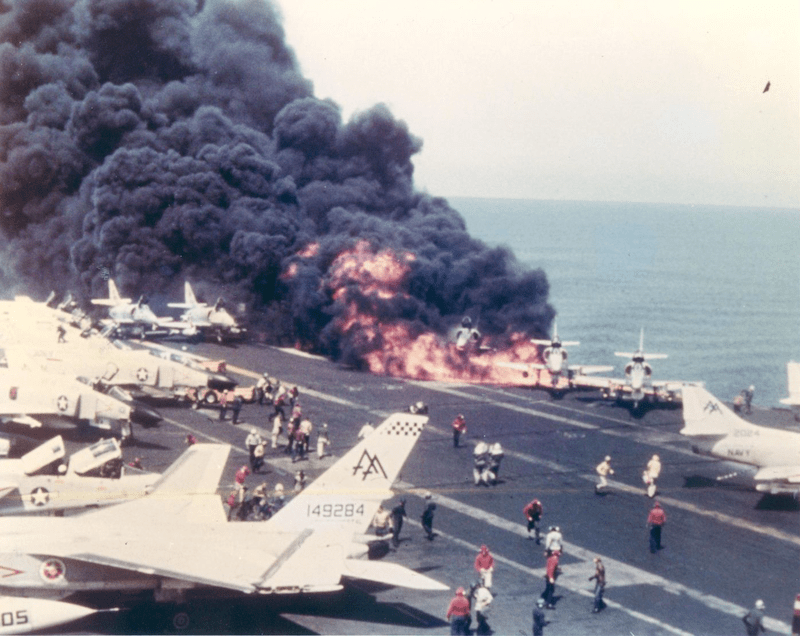
An electrical malfunction fired a rocket across the flight deck, severing the arm of one crew member and piercing the 400-gallon fuel tank of an A-4E Skyhawk. The rocket’s safety mechanism prevented the weapon from exploding, but the A-4’s torn fuel tank was spewing flaming jet fuel onto the deck. Other tanks soon overheated and exploded, adding to the conflagration.

800px-USS_Forrestal_A-4_Skyhawk_burning.png

During WW2, virtually all carrier sailors were trained to fight fires. That all changed by the Vietnam era in favor of small, highly trained teams of fire fighters. Damage Control came into action immediately, as Team #8 Chief Gerald Farrier spotted a Fat Boy bomb turning cherry red, in the flames.  Without protective clothing, Farrier held a fire extinguisher on the 1000-pound bomb, hoping to keep it cool enough to prevent cooking off as his team brought the conflagration under control.

Firefighters were confident that their ten-minute window would hold, but composition B proved as unstable as the ordnance people had feared.  Farrier “simply disappeared” in the first of a dozen or more explosions, in the first few minutes.  By the third such explosion, Damage Control Team #8 had all but ceased to exist.

There were nine major explosions on deck during the first five minutes.

The port quarter of the Forrestal ceased to exist in the violence of the blasts. Office furniture was thrown to the floor, five decks below.  Huge holes were torn through the flight deck while 40,000 gallons of flaming jet fuel, poured through ventilation ducts and into living quarters below.

USS_Forrestal_fire_1_1967

Future United States Senator John McCain managed to scramble out of his cockpit and down the fuel probe.  Seconds later, Lieutenant Commander Fred White wasn’t so lucky.

With the life of the carrier itself at stake, tales of incredible courage, were commonplace. Medical officers worked for hours in the most dangerous conditions imaginable. Explosive ordnance demolition officer LT(JG) Robert Cates “noticed that there was a 500-pound bomb and a 750-pound bomb in the middle of the flight deck… that were still smoking. They hadn’t detonated or anything; they were just setting there smoking. So I went up and defused them and had them jettisoned.” Sailors volunteered to be lowered through the flight decks into flaming and smoked-filled compartments, to defuse live bombs.

The fire burned until 4:00 the next morning. 21 of the 73 aircraft on board were destroyed and another 40, damaged. 134 crewmen died in the conflagration. Another 161 received non-fatal injuries. It was the worst loss of life on a US Navy vessel, since World War 2.

They say bad luck comes in threes. On this day in 1969, the nuclear carrier USS Enterprise finished the list.

Since the age of the Wright brothers, aircraft designers have often left out the excess weight of starters and batteries. Early piston engines were startd by hand and, in the jet age, gas turbines often use auxiliary starters powered by gas or other combustible material.

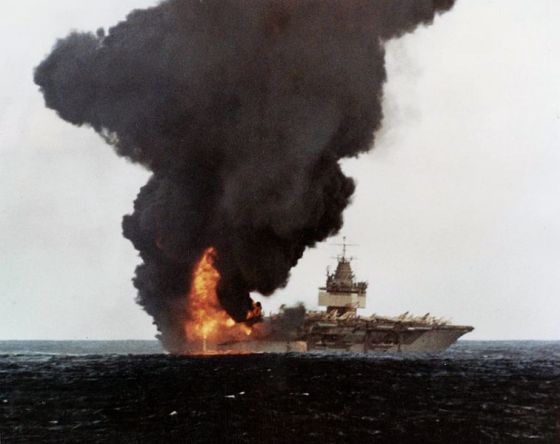
On the morning of January 14, 1969, USS Enterprise was training 70-miles off Hawaii, preparing for her 4th tour of Vietnam. Her flight deck was crowded with F-4 Phantoms and A-7 Corsair II bombers, each loaded with Zuni rocket pods and 500-pound Mk-82 bombs. At 8:18am, an MD-3A “Huffer” aircraft engine starter was parked near the wing of an F4 Phantom, its exhaust a mere 24-inches from a rocket pod.

The 15-pound warhead on a Zuni rocket, goes off at 358° Fahrenheit. A Huffer exhaust burns between 362° and 590°. For a minute and 18 seconds, no fewer than four crew members were aware of the problem. None took steps to fix it and each, paid the ultimate price.

In the flash of an eye the exploding rocket ruptured several nearby fuel tanks as fuel vaporized and immediately, burst into flames. That’s when all hell, broke loose. The nearest 15 aircraft carried a combined fuel load of 15,000 gallons with a combined armament of 30 500-pound bombs and 40 Zuni rockets. 18 massive explosions went off in close succession, tearing great holes in 2½-inch deck armor.

Men and machines were tossed by each explosion, “like dust”. Three bombs went off at once opening a 22-foot hole in the deck, damaging a nearby tanker and spilling burning fuel, six floors below.

Knocked unconscious in the initial blast, Petty Officer 3rd Class Frank Neumayer of Fighter Squadron VF-96 awoke to find his goggles melting and his clothing, on fire. “The roar of the fire was just horrendous,” he later said. “It just blotted out any other sound. The stench… was horrible.” He managed to crawl to the catwalk below just as 2 500-pound bombs went off, not 30-feet from his previous position. Neumayer lost his left leg in the blast and twice received last rites, but survived.

The Destroyers USS Bainbridge and Rodgers came alongside, to lend their hoses. Helicopters arrived within two hours from Pearl Harbor, to medevac the wounded. Within three hours the last flames, were out.

The USS Enterprise fire resulted in the death of 34 men and another 341 non-fatal injuries. The fire resulted in a redesign of the Huffer starter and repair costs equivalent to $912 million, today. No formal inquiry was ever held, to determine fault. Everyone plausibly to blame for the catastrophe, had been among the first to die.

January 13, 1920 Fake News

In the English Standard Version of the Bible, proverbs 12:15 translates: “The way of a fool is right in his own eyes, but a wise man listens to advice”. Socrates famously observed “I know one thing, that I know nothing. The only true wisdom is in knowing you know nothing.”

It was a fine day in Pittsburg, Pennsylvania. A good day to rob a bank. So thought 44-year-old McArthur Wheeler, but Mr. Wheeler was no ordinary crook. As they might say in the Shiddy o’ Bwahshtun, McArthur Wheeler was schmaht. Wikid schmaht.

“Ignorance more frequently begets confidence than does knowledge”. – Charles Darwin

As any 10-year-old will tell you, lemon juice makes a great, invisible ink. What better way to make Yourself invisible to bank cameras, (thought McArthur Wheeler), than to smear your face with lemon juice. The man even ran an experiment. A Polaroid selfie. The experiment was a success, notwithstanding the polaroid’s tendency to “wash out” subjects photographed, too close-up. No matter. The photo showed an over-illuminated blob where the face was supposed to be. Hypothesis: correct. Lemon juice Did make your face invisible, to cameras.

With his face slathered in lemon juice, McArthur Wheeler robbed not one bank on that day in 1995, but two. Law enforcement released surveillance video. By the end of the day, Pittsburg police had their man, incredulous though he was, that such a well-laid plan could have somehow, come off the rails.

That video must have been faked.

Cornell University psychologists David Dunning and Justin Kruger got wind of the caper and thought they’d study the episode, a little more closely. PsychologyToday.com tells us: “The pair tested participants on their logic, grammar, and sense of humor, and found that those who performed in the bottom quartile rated their skills far above average. For example, those in the 12th percentile self-rated their expertise to be, on average, in the 62nd percentile”.

The article continues: “The Dunning-Kruger effect results in what’s known as a “double curse:” Not only do people perform poorly, but they are not self-aware enough to judge themselves accurately—and are thus unlikely to learn and grow”.

If you’re thinking that explains a lot about certain politicians, you’re probably not alone. And what of the ‘News’? The one thing we all expect whether Democrat, Republican or Libertarian, is accurate information. From our politicians and from our “News” media.

Are we then to believe an industry, merely because it buys ink by the proverbial barrel? After the last few years, I certainly hope not. From the Russia “Collusion” hoax to Fox News’ reporting that President Obama…”at the end of his rope…sent [a] rambling, 75,000-word email to the entire nation” (it was an Onion story), our news and information media have worked overtime to earn the epithet, “Fake News”.

In October 2019, ABC “News” broadcast man-on-the-street video from Syria, depicting an attack by the Turkish military, on Kurdish civilians. ABC later apologized that the video was shot…at a gun range in Kentucky.

In April 2020, CBS did its part to add to the national COVID-19 hysteria, using Italian footage as a stand-in for a story about the failure, of New York hospitals. A month later the company staged lines and faked “patients” at the Cherry Medical Center in Grand Rapids, Michigan. But hey, it all made for some swell footage, right?

And who can forget NBC’s exploding truck video, concocted at the expense of General Motors. Worried that the crash test might not show the desired result, NBC rigged an incendiary device, just to be sure. The test worked swell and the sight of flaming pickup trucks, sure does make for some great “News”. But rest assured, Jane Pauley and Stone Phillips apologized, concluding that “unscientific demonstrations should have no place in hard news stories at NBC. That’s our new policy.”

There’s a knee slapper for you. “Unscientific demonstrations”.

Back to Dunning and Kruger. On this day in 1920, an unsigned editorial in the New York Times, made mockery of none other than Robert Hutchings Goddard. Yeah. THAT Robert Goddard. The guy with the space center, named after him.

Robert Goddard, a man who all but invented the space age, has 214 patents to his name. Two of them, a multi-stage rocket and a liquid-fuel rocket were patented as early as 1914.

On January 13, 1920, the New York Times opined that space flight was an impossibility, because propulsion systems had nothing to push against. Such a position seems defensible in 1920, but the Times just couldn’t resist that snotty, mean-girl touch, replete with sneer quotes: “That Professor Goddard, with his ‘chair’ in Clark College and the countenancing of the Smithsonian Institution, does not know the relation of action to reaction, and of the need to have something better than a vacuum against which to react — to say that would be absurd. Of course he only seems to lack the knowledge ladled out daily in high schools.”

“The Dunning-Kruger effect is a cognitive bias in which people wrongly overestimate their knowledge or ability in a specific area. This tends to occur because a lack of self-awareness prevents them from accurately assessing their own skills”. – PsychologyToday.com

“The knowledge ladled out in high schools”. Good one.

In 1932, that same New York Times won a Pulitzer prize for Lying, about the systematic extermination by starvation of as many as ten million Ukrainians, by the Soviet government of Josef Stalin. To this day the “Grey Lady” has failed to repudiate that Pulitzer.

The “Newspaper of Record” printed 24,000 front page articles over the course of the second world war but oddly seemed oblivious to the Nazi holocaust, front page articles about which numbered precisely, twenty-six.

Front page, above-the-fold stories ran 44 days in a row about that mess at Abu Ghraib, just in case anyone missed the point. And the Times was certainly quick to defend that Dan Rather memo as Fake but Accurate. Never mind that the font didn’t exist, when the thing was supposed to have been written.

But fear not, the New York Times retracted that 1920 editorial. In July 1969. The day after the Apollo 11 launch. At that rate we can expect those East Anglia stories to come in, around 2050.

January 12, 1992 Daisy Bell

In 1961, physicist John Larry Kelly, Jr. and Louis Gerstman produced the first truly synthesized speech using an IBM 7094 computer. Kelly’s synthesizer recreated the song “Daisy Bell” with musical accompaniment from Max Vernon Matthews, a song made popular in 1892 and better known as “A Bicycle Built for Two.”

We live in an age when pocket sized devices are capable of producing text from speech, and speech from text. We’ve all tried with varying degrees of success, to dictate a text message or email. It may come as a surprise as it did to me, how long the idea of other-than-human speech has been around.

According to Norse mythology, Mímir was the wisest of the Gods of Æsir. Mímir or Mim was beheaded during the war with the rival Gods of Vanir after which Odin carried the thing around (the head), so that it may impart secret knowledge and wise counsel.

The Brazen Head of the early modern age was the legendary automaton of medieval wizards and necromancers and always said to give the correct answer, provided the question was…just right. William of Malmsbury’s History of the English Kings (c. 1125) contains the earliest known reference to such a talking, Brazen Head. Similar legends followed the polymath Pope Silvester II (c. 946 – 1003), the Dominican friar Albertus Magnus (c.1200 – 1280) and the English philosopher Roger Bacon (1214 – 1294).

Roger Bacon’s assistant is confronted by the Brazen head in a 1905 retelling of the story. H/T Wikipedia

In 1779, the German-Danish scientist Christian Gottlieb Kratzenstein built a model of the human vocal tract which could produce the five long vowel sounds of the international phonetic alphabet.

Wolfgang von Kempelen of Pressburg, Hungary, described a bellows-operated apparatus in a 1791 paper, including facsimiles of tongue and lips to produce the nasals, plosives and fricatives required to mimic most (but not all) consonant sounds. Charles Wheatstone actually built the thing in 1846 after Kempelen died, calling his acoustic-mechanical speech machine, the ‘euphonia’.

“A replica of Kempelen’s speaking machine, built 2007–09 at the Department of Phonetics, Saarland University, Saarbrücken, Germany” H/T Wikipedia

At Bell Labs in the 1930s, the pioneering work of acoustic engineer Homer Dudley led to the Vocoder, a portmanteau of voice and encoder, capable of synthesizing and encrypting voice transmissions for use in  secure radio communications. The receiving apparatus or Voder, a keyboard operated device capable of independent speech synthesis, was demonstrated at the 1939 World’s Fair.

In the late 1940s, the pattern playback machines of Dr. Franklin S. Cooper and the Haskins Laboratories converted pictures of acoustic speech patterns, into recognizable speech. In 1961, physicist John Larry Kelly, Jr. and Louis Gerstman produced the first truly synthesized speech using an IBM 7094 computer. Kelly’s synthesizer recreated the song “Daisy Bell” with musical accompaniment from Max Vernon Matthews, a song made popular in 1892 and better known as “A Bicycle Built for Two.”

“Daisy, Daisy / Give me your answer, do. / I’m half crazy / all for the love of you…”

By sheer coincidence, the English futurist, science-fiction writer and television host Arthur Charles Clarke was visiting his friend and colleague John Pierce at this time, at Bell Labs’ Murray Hill facility.

If you think that name sounds familiar, you’re right. Today, Clarke joins American writers Isaac Asimov and Robert Heinlein as the “Big three”, in science fiction.

It is Clarke who wrote the script for Stanley Kubrick’s 1968 dystopic 2001: A Space Odyssey.

Clarke was so impressed with the Daisy Bell demonstration he wrote it into his screenplay. You may remember the climactic scenes of the film as fictional astronauts Frank Poole and Dave Bowman battle for their lives against Discovery’s supercomputer-gone-bad, the HAL9000, “born” this day in 1992 at the HAL Labs in Urbana Illinois, according to the screenplay.

After HAL hurled Frank Poole off into the black void of space and shut off life support to the rest of the crew while still in suspended animation, Dave Bowman is now the sole survivor of the Discovery mission, desperately seeking to unhook the power modules, to the HAL9000.

“I’m afraid I can’t let you do that, Dave”.

In the end, the servant of mankind-turned-evil supercomputer reverted to his most basic programming:

“It won’t be a stylish marriage / I can’t afford a carriage.”

“But you’ll look sweet/on the seat/of a bicycle built, for two.”

Fun fact: English songwriter and composer Harry Dacre first came to the United States, with a bicycle. Complaining about having to pay duty on the thing, Dacre’s American friend and fellow songwriter William Jerome quipped, “It’s lucky you didn’t bring a bicycle built for two, otherwise you’d have to pay double duty.” Dacre was so taken with the phrase he soon used it in a song, first popularized in a London music hall and first performed in the United States, in 1892. “Daisy Bell”.

January 11, 1693 Feeling Puny?

Such an event could happen tomorrow, next year or ten thousand years from now. No one knows. We are so puny when compared with the Wrath of God, or of Nature, as you please.

In his 1897 short story The Open Boat, Stephen Crane writes of the puniness of humanity, when bared and exposed to the wrath of God, or of Nature, as you please. “If I am going to be drowned — if I am going to be drowned — if I am going to be drowned, why, in the name of the seven mad gods, who rule the sea, was I allowed to come thus far and contemplate sand and trees? 

Deep in the ground beneath your feet, a rocky shell comprising an outer Crust and an inner Mantle forms a hard and rigid outer shell, closing off and containing the solid inner core of our planet. Between these hard inner and outer layers exists a solid core of material which remains viscous over geologic time, measuring approximately 1,802 miles thick and comprising some 84 percent of the volume, of planet Earth.

The air around us is a liquid, exerting a ‘weight’ or barometric pressure at sea level, of 14.696 pounds per square inch. Scientists estimate that pressures within this outer core generate temperatures of 1,832° Fahrenheit near the boundary with the crust, to 6,692° Fahrenheit approaching the core boundary.

As a point of reference, the surface of the sun is about 10,340°, Fahrenheit.

That rocky shell closing us off from all that is actually quite elastic, broken into seven or eight major pieces, (depending on how you define them), and several minor bits called Tectonic Plates.

Over millions of years, these plates move apart along constructive boundaries, where oceanic plates form mid-oceanic ridges. Roughly equal and opposite to these are the Subduction Zones, where one plate moves under another and down into the mantle.

The planet is literally “eating’ itself.

Sicily, the largest island in the Mediterranean and one of twenty regions of Italy, lies on the convergent boundary of two such pieces of the planet’s outer shell, where the African plate is subducting beneath the Eurasian plate.  Over time, the forces built up along these subduction zones, are nothing short of Titanic.

Sicily is also home to the terrifying Mount Etna, one of the most active volcanoes in the world. On this day in 1693, those Seven Mad Gods got together and unleashed on the puniness of humanity, the wrath of the ages.

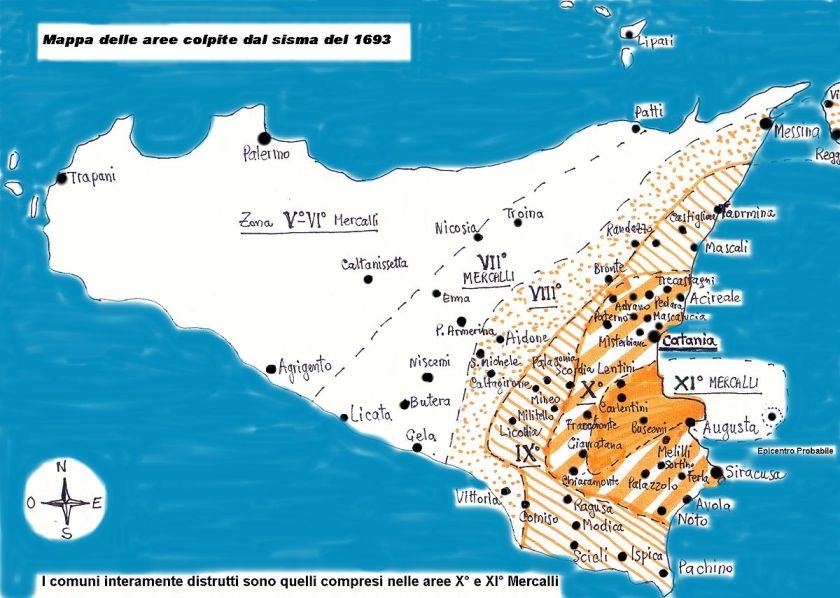
The first foretaste of what was about to happen began at 21:00 local time, January 9, 1693. The earthquake, centered on the east Sicilian coast and felt as far away as the south of Italy and the island nation of Malta, had an estimated magnitude of 6.2 on the Richter scale with a perceived intensity on the Mercali Intensity Scale of VIII – XI: Destructive to Very Disastrous.

Mercali describes a Category XI earthquake: “Few, if any, (masonry) structures remain standing. Bridges damaged or destroyed. Broad fissures in ground. Underground pipe lines completely out of service. Earth slumps and land slips in soft ground. Rails bent greatly”.

This thing was only stretching and yawning.  Just getting out of bed.
The main shock of January 11 lasted four minutes with an estimated magnitude of 7.4 and a very large area reaching X on the Mercali scale and XI, in the province of Syracuse.

1200px-sicilia_sisma_1693

The soil beneath our feet, ordinarily so substantial and unmoving, behaves like a liquid at times like these in a process called soil liquefaction. Low density, sandy soils compress in response to applied loads while dense soils expand in volume or dilate. Saturated soils are like unto quicksand, as underground liquids are driven up to form miniature volcanoes called “sand boils, water spouting up from the ground in geysers, rising 30-feet and more.

Reflect on that for a moment, if you will. The soil. Behaving like a liquid.

The catastrophic eruption of 1669 was well within living memory and reports describe minor eruptions on this day as well.  As if even a small volcanic eruption could be called “minor”.

Several large fractures opened in the earth, one 1,600-feet long and nearly seven-feet wide.

Meanwhile the ocean withdrew from the coast as the Ionian Sea gathered itself, to strike. The initial withdrawal left the harbor dry at Augusta, damaging several Galleys owned by the Knights of Malta.   The tsunami when it came was eight meters in height (26-feet), inundating an area nearly a mile inland from the coastline.

The final death toll of as many as 60,000 is uncertain, unsurprising in light of the fact that whole regions, were blotted out. 63% of the entire population was wiped out in Catania, 51% in Ragusa. Syracuse, Noto, Augusta, Modica – all lost between one-out-of-five, and one-in-three.

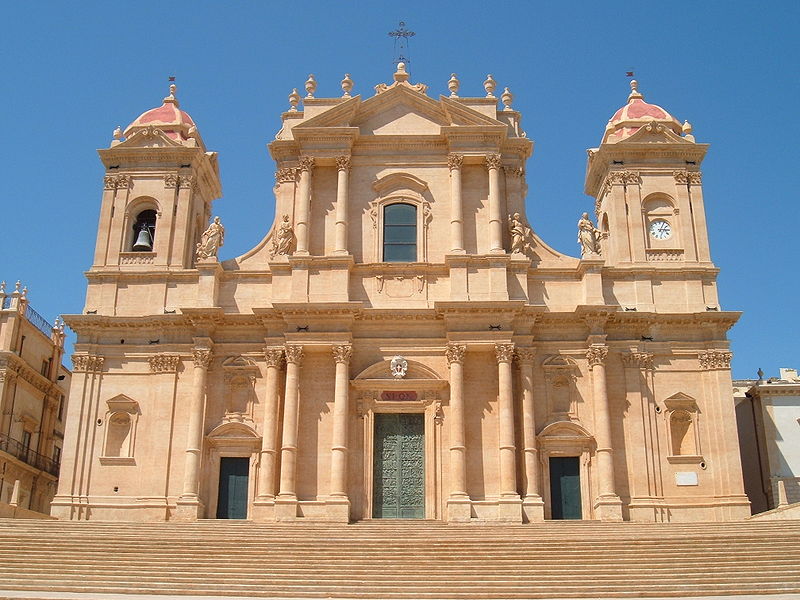
Reconstruction in the wake of the catastrophe was so extensive, as to spawn a new and unique form of art and architecture, known as Sicilian Baroque.

la_cattedrale_di_noto_restaurata
The Cathedral of Noto is one of the many buildings constructed in Sicilian Baroque style after the earthquake of 1693

Today, the colossal Mount Etna remains one of the most active volcanoes, on earth.  Sensors placed along the land and seaward flanks of the volcano reveal the alarming discovery that the volcano itself, is moving.  Mount Etna is sliding at a rate of an inch per year and sometimes more.  One eight-day period in 2008 showed a movement of two inches, raising concerns that Mount Etna may one day collapse into itself.
On May 18, 1980 Mount St. Helens erupted after a 5.1 magnitude earthquake, resulting in 57 deaths and inflation-adjusted property damage, of $3.3 Billion.  The US Geological Survey called the resulting collapse of the north face of the volcano “the largest debris avalanche on earth, in recorded history”.  Should such an event strike the Stratovolcano that is Mount Etna, the result would be felt from the Spanish coast to the shores of Israel, from North Africa to the French Riviera.

Given geologic time scales, such an event could happen tomorrow, next year, or ten thousand years from now.  No one knows.  We are so puny when compared with the Wrath of God, or of Nature, as you please.

castello_di_noto
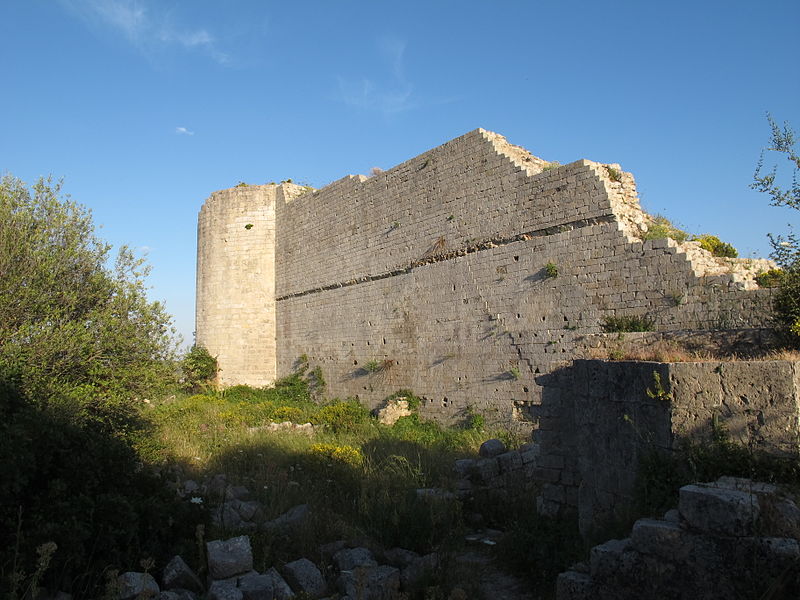
Ruins of the Norman castle in Noto Antica

Featured image, top of page:  New life before the shattered ruins of the old city of Not (Noto Antica), destroyed on January 11, 1693.  The new city of Noto was built, eleven kilometers away

January 10, 1927 Poisoned Hooch

Not to be defied, federal officials poisoned industrial alcohol until the very last day, running up the tab to no fewer than 10,000 dead Americans. The government didn’t even pretend not to know, what was going on.


A French proverb comes down to us from 1742, attributed to one François de Charette: “On ne fait pas d’omelette sans casser des oeufs”. You can’t make an omelette without breaking eggs.

Irish playwright George Bernard Shaw was a big fan of socialism in his day and an enthusiastic supporter of the gulags, of Josef Stalin.“[The] unfortunate Commissar” he wrote, must shoot his own workers “so that he might the more impressively ask the rest of the staff whether they yet grasped the fact that orders are meant to be executed.”. 

Yikes

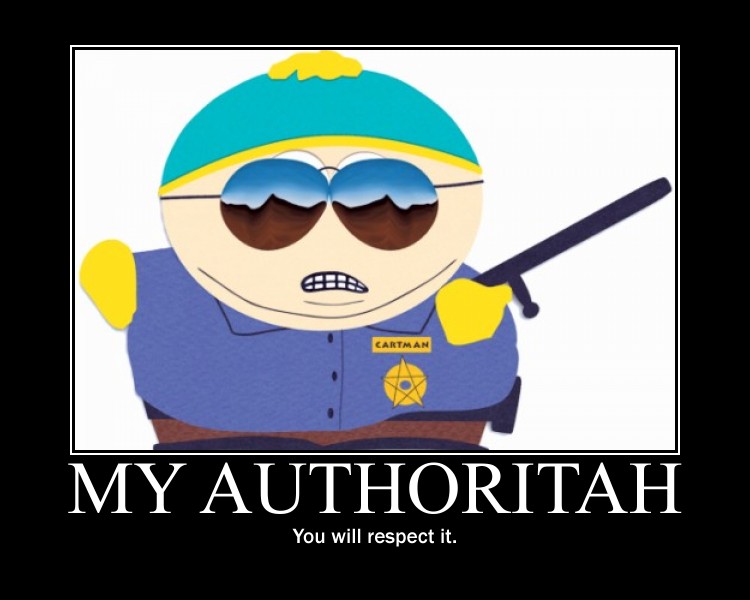
Connoisseurs of the animated series South Park will remember the Prime Directive of Mr. Garrison’s favorite third grader, Eric Cartman.  “You will respect my authoritah

All well and good for a cartoon.  Few would have guessed the real-world Federal Government would poison its own citizens. To enforce its own authoritah.

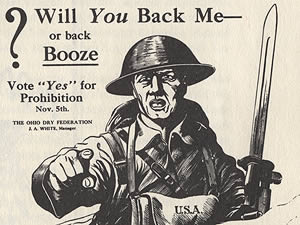
The Eighteenth Amendment establishing national prohibition of intoxicating liquors was passed out of Congress on December 17, 1917 and sent to the states, for ratification. The  “Volstead” act, so named for Chairman of the House Judiciary Committee Andrew Volstead, was enacted to carry out the will of congress.

At last ratified in January 1919, “Prohibition” went into effect at midnight, January 16, 1920. For thirteen years it was illegal to import, export, transport or sell intoxicating liquor, wine or beer in the United States.Prohibition-midnight-e1568752688531-1024x511 (1).jpg“Industrial alcohol” such as solvents, polishes and fuels were “denatured” and rendered distasteful by the addition of dyes and chemicals.  The problem was, it wasn’t long before bootleggers figured out how to “renature” the stuff.
The Treasury Department, in charge of enforcement at that time, estimated that over 60 million gallons of industrial alcohol were stolen during Prohibition.

war-propaganda

Not to be defied, the federal government upped the ante.  The Parasite Leviathan, was not to be defied.

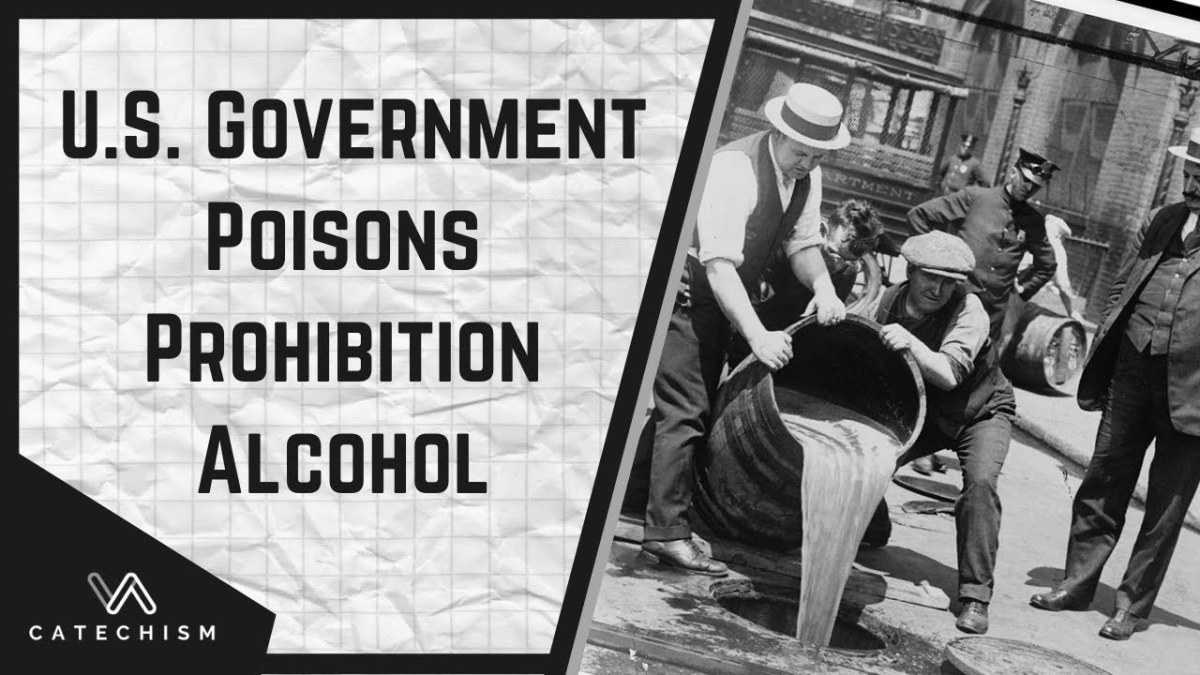
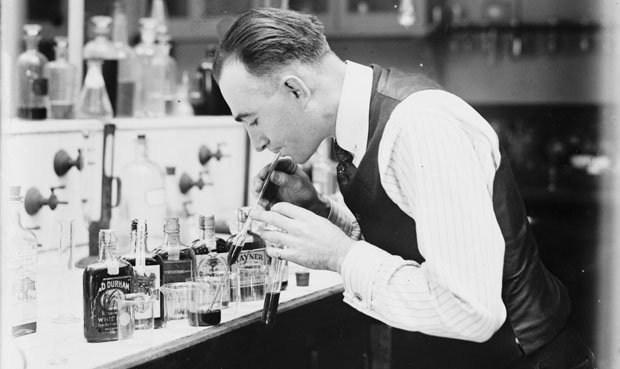
By the end of 1926, denaturing processes were reformulated with the introduction of known poisons such as kerosene, gasoline, iodine, zinc, nicotine, formaldehyde, chloroform, camphor, quinine and acetone.

Treasury officials went so far as to impose a requirement of no less than 10% by volume of methanol, a virulent toxin used in anti-freeze.

You will respect my authoritah.

You can renature this stuff ’til the cows come home.  It will kill you.

Sixty people wound up at New York’s Bellevue Hospital on Christmas eve 1926, desperately ill from contaminated alcohol.  Eight of them died.  Within two days, the death toll stood at thirty-one.  The number soared to 400 by New Year’s Day , with no end in sight.

copper-still
A copper still and bucket, like those used in the creation and renaturing of alcohol at home. H’T allthatsinteresting.com, and Chicago History Museum/Getty Images

Many who didn’t die, probably wished they had. Holiday revelers experienced hallucinations, uncontrollable vomiting, even blindness.

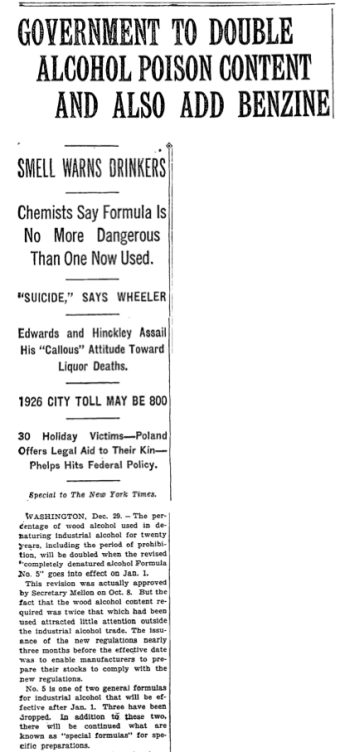
TIME Magazine reported a doubling in toxicity levels in the January 10, 1927 issue, compared with the old method:  “The new formula included “4 parts methanol (wood alcohol), 2.25 parts pyridine bases, 0.5 parts benzene to 100 parts ethyl alcohol”. TIME noted, “Three ordinary drinks of this may cause blindness. (In case you didn’t guess, “blind drink” isn’t just a figure of speech).”

To paraphrase Wikipedia, Pyridine is a highly flammable chemical structurally related to benzene, with the unpleasant smell of dead fish.

New York medical examiner Charles Norris was quick to understand the problem and organized a press conference to warn of the danger. “The government knows it is not stopping drinking by putting poison in alcohol.  Yet it continues its poisoning processes, heedless of the fact that people determined to drink are daily absorbing that poison. Knowing this to be true, the United States government must be charged with the moral responsibility for the deaths that poisoned liquor causes, although it cannot be held legally responsible.”

Norris pointed out that the poorest people of the city, were most likely to be victims: “Those who cannot afford expensive protection and deal in low-grade stuff”.

The towering sanctimony of the other side, is hard to believe.  Teetotalers argued the dead had “brought it on themselves”.  Long-time leader of the anti-saloon league Wayne Wheeler proclaimed “The Government is under no obligation to furnish the people with alcohol that is drinkable when the Constitution prohibits it. The person who drinks this industrial alcohol is a deliberate suicide.”

You will respect my Authoritah.

prohibition_2

In its thirteen years of existence, Prohibition was an unmitigated disaster.  Portable stills went on sale within a week of enactment and organized smuggling was quick to follow. California grape growers increased acreage by over 700% over the first five years, selling dry blocks of grapes as “bricks of Rhine” or “blocks of Port”. The mayor of New York City himself sent instructions to his constituents, on how to make wine.

Smuggling operations became widespread as cars were souped up to outrun “the law”. This lead in time to competitive car racing, beginning on the streets and back roads and later moving to dedicated race tracks. It’s why we have NASCAR, today.

alcohol_poison_passed

Organized crime muscled up to become vastly more powerful, due to the influx of enormous sums of cash. The corruption of public officials was a national scandal.

Gaining convictions for breaking a law everyone hated became increasingly difficult. The first 4,000 prohibition-related arrests resulted in only six convictions and not a single jail sentence.

It’s hard to compare alcohol consumption rates before and during prohibition but, if death by cirrhosis of the liver is any indication, alcohol consumption never went down by more than 10 to 20 per cent.

In the end, even John D. Rockefeller, Jr., a lifelong teetotaler who contributed $350,000 to the Anti-Saloon League, had to announce support for repeal.

On December 5, 1933, the state of Utah triggered the magic 2/3rds requirement to ratify the Twenty-first Amendment, repealing the Eighteenth and voiding the Volstead Act, returning control over alcohol policy to the states.

Not to be defied, federal officials poisoned industrial alcohol until the very last day, running up the tab to no fewer than 10,000 dead Americans.   The government didn’t even pretend not to know, what was going on.

You will respect my authoritah!

Assistant Secretary of the Treasury Seymour Lowman had the last word among those who would tell you, “I’m from the government.   I’m here to help”.  If deliberately poisoned alcohol resulted in a more sober nation Lowman opined, then “a good job will have been done”.

December 31, 1695 Fleeced

Tax revolts are nothing new. Neither are the many and sometimes novel ways that politicians have concocted to fleece those of us who pay their bills.


Somewhere in the English midlands during the reign of Edward the Confessor, there lay the Kingdom of Mercia. It was 1054 or thereabouts and Leofric, Earl of Mercia, had a problem. Leofric was the kind of ruler who never saw a tax he didn’t like, his latest the “Heregeld”, a tax to pay for the King’s bodyguard. Leofric’s wife was Godgyfu in the Olde English, meaning “Gift of God”.  Today we call her “Godiva”. Take pity on the people of Coventry, she said, they are suffering under all this oppressive taxation.

lady-godiva-statue

A guy can only take so much, even if he is an Earl. Tired of his wife’s entreaties, Leofric agreed to repeal the tax on one condition; that she ride a horse through the streets of town, dressed only in her birthday suit and her long hair. Lady Godiva took him at his word.  She issued a proclamation that all townspeople stay indoors and shut their windows, and took her famous naked ride, through town.

The story probably isn’t true, any more than the one about Tom, the guy who drilled a hole in his door so he could watch and lost his sight at what he saw.  But a thousand years later, we still use the term “Peeping Tom”.

Tax revolts are nothing new.  Neither are the many and sometimes novel ways that politicians have concocted to fleece those of us who pay their bills.

bricked-up-window

On December 31, 1695, King William III decreed a 2 shilling tax on each house in the land. Not wanting to miss an opportunity to “stick-it-to-the-rich”, there was an extra tax on every window over ten, a tax that would last for another 156 years.

It must have been a money maker, because the governments of France, Spain and Scotland followed suit with similar taxes. To this day, you can see homes where owners have bricked up windows, preferring darkness to the payment of yet another tax.

Czar Peter I returned from a trip to Europe in 1698, hot to “modernize” Russia. All those European guys were clean shaven, so Peter instituted a tax on beards. No, really. When you’d paid your beard tax of 100 Rubles, (peasants and clergy were exempt), you had to carry a “beard token”. Two phrases were inscribed on the coin: “the beard tax has been taken” and “the beard is a superfluous burden”. Failure to shave or pay the tax might lead to your beard being forcibly cut off your face. Some had theirs pulled out by the roots by Peter himself, all 6-foot 8-inches of him.

In Holland, they used to tax the frontage of a home, the wider your house the more you paid. If you’ve ever been to Amsterdam, narrow houses rise several stories, with hooks over windows almost as wide as the building itself.

singel-7
Singel #7

Those are used to haul furniture up from the outside, since the stairways are too narrow. The narrowest home in Amsterdam can be found at Singel #7, the house barely wider than its own front door.

You can find the same thing in the poorer quarters of New Orleans, where the “shotgun single”, a home so narrow you can fire a shotgun in the front door and pellets will go out the back, and the “Camelback” (second story out back) are the architectural results of tax policy.

shotgunsingle-camelback
Shotgun Single, Camelback

England has a “Telly Tax” paid in the form of a television license. There’s good news though; you only have to pay half if you’re legally blind. This is in addition to the council tax, income tax, fuel tax, road tax, value added tax, pasty tax, national insurance, business rates, stamp duty, and about a thousand other taxes. But hey, the health care is free.

 In Canada, makers of children’s breakfast cereal are tax exempt if their cereal contains a free toy. The exemption is limited to toys not containing “beer, liquor, or wine.” Good to know.

Sweden has had a “name ordnance” in effect since 1901, requiring parents to obtain blessings from the government for what they name their children.

In 1991, Elisabeth Hallin and Lasse Diding gave birth to a baby boy. The couple failed to register a name by the age of five and received a fine of 5,000 Kronor, equivalent to $1,206, US. The pair petitioned the court in 1996 to call the kid Brfxxccxxmnpcccclllmmnprxvclmnckssqlbb11116 (pronounced “Albin) and failed to gain permission. The couple then tried to change the boy’s name to “A” (also pronounced Albin). The court rejected that one too, and upheld the fine.

Tennessee has a “Crack Tax” you’re supposed to pay on illegal drugs (don’t ask), and Massachusetts will charge you a “meals tax” on five donuts, but not 6. The state of Illinois taxes candy at a higher rate than food. Any item containing flour or requiring refrigeration is taxed at the lower rate, because it’s not candy. So yogurt covered raisins are candy, but yogurt covered pretzels are food. Baby Ruth bars are candy, but Twix bars are food. Get it? Neither do I.

The Roman Emperor Vespasian, who ruled from 69 to 79AD, levied a tax on public toilets.

vespasiani

When his son, the future Emperor Titus wrinkled his nose, Vespasian held a coin under the boy’s nose. “Pecunia non olet”, he said.  “Money does not stink”.  2,000 years later, his name is still attached to public urinals. In France, they’re called vespasiennes, in Italy vespasiani.  If you need to piss in Romania, you could go to the vespasiene.  History fails to record the inevitable push-back on Vespasian’s toilet tax, but I’m sure that ancient Romans had to look where they walked.

Environmentalists in Venice, Italy have been pushing a tax on tourism, claiming that the city’s facing “an irreversible environmental catastrophe as the subsequent increase in water transport has caused the level of the lagoon bed to drop over time”. Deputy mayor Sandro Simionato said that “This tax is a new and important opportunity for the city,” explaining that it will “help finance tourism”, among other things. So, the problem borne of too much tourism is going to be fixed by a tax to help finance tourism. I think. Or maybe it’s just another money grab.

As of December 2015, state and territory tax rates on cigarettes ranged from 17¢ per pack in Missouri to $4.35 in New York, on top of federal, local, county, municipal and local Boy Scout council taxes (kidding).  Philip Morris reports that taxes run 56.6% on average, per pack. Not surprisingly, tax rates make a vast difference in where and how people buy their cigarettes.  There is a tiny Indian reservation on Long Island, measuring a few miles square and home to a few hundred people. Tax rates are close to zero there, on a pack of butts.  Until recent changes in the tax law, they were selling 100 million cartons per year.

If all those taxes are supposed to encourage people to quit smoking, I wonder what income taxes are supposed to do?

antarctica-icebound-ship-1

Back in 2013, EU politicians were discussing a way of taxing livestock flatulence, as a means of curbing “Global Warming”. At that time there was an Australian ice breaker, making its way to Antarctica to free the Chinese ice breaker, that got stuck in the ice trying to free the Russian ship full of environmentalists.  They were there to view the effects of “Global Warming”, before they got stuck in the ice.

Honest, I wouldn’t make this stuff up.

December 30, 1863 Bermuda and the Confederacy

“As a consequence of the naval blockade, Bermuda — along with the Bahamas and Cuba — became a centre of Confederate commerce. A steady stream of fast-running ships from the South clandestinely skirted the Union blockade, passing through St. George’s carrying cotton from Charleston, South Carolina and Wilmington, North Carolina for English manufacturers; they made the return journeys freighted with European armaments. Bermuda was both a transhipment point where cotton was directly exchanged for British weapons warehoused here and a refuelling depot for Confederate blockade runners making transatlantic runs.” – Hat tip BerNews.com


South Carolina seceded from the Union in December 1860, the first of 11 states to do so. War broke out in April, and the Confederacy desperately needed ships for its fledgling Navy. The CSA needed manufactured goods as well, goods no longer available from the industrialized North. The answer, in both cases, was Great Britain. While remaining officially neutral, England soon became primary ship builders and trade partners for the Confederacy.

For the British military, Bermuda had already demonstrated its value. Bermuda based privateers captured 298 American ships during the war of 1812. The place served as a base for amphibious operations as well, such as the 1815 sack of Washington, DC. British Commander Sir Alexander Milne said “If Bermuda were in the hands of any other nation, the base of our operations would be removed to the two extremes, Halifax and Jamaica, and the loss of this island as a Naval Establishment would be a National misfortune”.

slide_18President Abraham Lincoln issued a proclamation soon after taking office, threatening to blockade southern coastlines. It wasn’t long before the “Anaconda Plan” went into effect, a naval blockade extending 3,500 miles along the Atlantic coastline and Gulf of Mexico, up into the lower Mississippi River.

Running the blockade was no small or occasional enterprise. The number of attempts to run the Federal stranglehold have been estimated at 2,500 to 2,800, of which about 2/3rds succeeded. Over the course of the war, the Union Navy captured over 1,100 blockade runners. Another 355 vessels were destroyed or run aground.

runnerbritanniawilm

Cotton would ship out of Mobile, Charleston, Wilmington and other ports while weapons and other manufactured goods would come back in. Sometimes, these goods would make the whole trans-Atlantic voyage.  Often, they would stop at neutral ports in Cuba or the Bahamas.

North Carolina and Virginia had long-established trade relations with Bermuda, 600 nautical miles to the east.

The most successful blockade runners were the fast, paddle wheeled steamers, though surprisingly little is known of the ships themselves. They were usually built in secrecy, and operated at night. One notable exception was the “Nola”, a 236-foot paddle steamer which ran aground on December 30, 1863, en route from London to North Carolina. Nola ran aground, attempting to escape threatening weather. She was wrecked near Western Blue Cut on Bermuda’s reefs, and remains a popular dive destination, to this day.

shipwreck-in-bermuda
The blockade runner “Nola” was known at various times as Montana, Gloria, and Paramount.

President Lincoln appointed Massachusetts native Charles Maxwell Allen Consul to Bermuda in 1861, where he remained until his death, in 1888. There were times when it was a great job, I’m sure, but not in the early days. “There are a great many Southern people here”, Allen wrote in 1862, “14 came in the steamer ‘Bermuda’. They & their friends are down on me & have threatened to whip me”. People were getting rich running the blockade.  Allen estimated that one blockade runner alone, which sank after three voyages, generated a profit of more than £173,000.

“The British colonial government monitored both sides to try to maintain strict neutrality, but only the latent threat of the powerful Royal Navy fleet based at Bermuda kept the belligerents from open warfare within British boundaries”. – Hat tip BerNews.com

Bermuda-National-Trust-Museum

Today, the capital of Bermuda is Hamilton, moved across the island in 1815 from the old port of St. George, leaving the former capital in a kind of time warp, where you can walk down streets that look like they did 150 years ago. Portraits of Robert E. Lee and Confederate battle flags can still be found on the walls of the old port, beside paintings showing the harbor filled with blockade runners, lying quietly at anchor.

Once the office of Confederate Commercial Agent John Tory Bourne and Confederate Shipping Agent Major Norman Walker, today the Bermuda National Trust Museum tells the story of the island’s history, including Bermuda’s role in the American Civil War. The museum’s guide book explains: “The opportunities for Bermudians to profit from blockade running were boundless. Ships needed coal and provisions. Crews required lodging, food and entertainment between runs. Cargoes had to be unloaded, stored and reloaded, while crews and cargoes had to be ferried to ships lying at anchor. Bermudian pilots guided the ships through the reefs; those with skills as mates, carpenters, firemen and ordinary seamen signed on as crew. The Civil War proved to be the road to riches.

[http://www.history.navy.mil/photos/sh-us-cs/csa-sh/csash-ag/advance.htm DEPARTMENT OF THE NAVY — NAVAL HISTORICAL CENTER WASHINGTON NAVY YARD WASHINGTON DC] Sepia wash drawing by R.G. Skerrett, 1899. Courtesy of the U.S. Navy Art Collection, Washington, D.C. U.S. Naval Historical Center Photograph.

Sheryl and I traveled to Bermuda a while back, and visited the old port at St. George. At some point we learned about the maritime history of the island. Making a living at sea in the 19th century was a dangerous business, so much so that one in ten married women living in Bermuda, were widows.

It occurred to me. All those Confederate officers and enlisted men were spending a lot of time in Bermuda.  The possibility that followed soon morphed into probability and then a certainty. At this point I can only wonder how many English citizens there are, residents of Bermuda and loyal subjects of the Queen, who can trace paternity back to the Confederate States of America.

Bonnie Blue
‘The ‘Bonnie Blue’ flies over bonnie St George’s’ H/T Royal Gazette