January 28, 1986 Space Truck

STS-1, the first mission of the “Space Shuttle” program launched aboard “Columbia” from the Kennedy Space Center on Merritt Island, Florida. It was April 12, 1981, the 20th anniversary of the first human spaceflight aboard the Russian capsule Vostok 1.
The idea of a reusable Space Transportation System (STS) came around as early as the 1960s, as a way to cut down on the cost of space travel. The final design was a reusable, winged “spaceplane” with a disposable external tank and reusable solid fuel rocket boosters. The ‘Space Truck’ program was approved in 1972, the prime contract awarded to North American Aviation (later Rockwell International), with the first orbiter completed in 1976.

Early Approach and Landing Tests were conducted with the first prototype dubbed “Enterprise”, in 1977. A total of 16 tests, all atmospheric, were conducted from February to October, the lessons learned applied to the first space-worthy vehicle in NASA’s orbital fleet.

o-columbia-shuttle-disaster-facebookSTS-1, the first mission of the “Space Shuttle” program launched aboard “Columbia” from the Kennedy Space Center on Merritt Island, Florida.  It was April 12, 1981, the 20th anniversary of the first human spaceflight aboard the Russian capsule Vostok 1.
It was the first, and (to-date) only manned maiden test flight of a new system in the American space program.

This first flight of Columbia would be commanded by Gemini and Apollo veteran John Young and piloted, by Robert Crippen. It was the first of 135 missions in the Space Shuttle program, the first of only two to take off with external hydrogen fuel tanks painted white.  From STS-3 on, the external tank was left unpainted, to save weight.

All told, Columbia flew 28 missions with 160 crew members traveling 125,204,911 miles in 4,808 orbits around the planet.

Initially, there were four fully functional orbiters in the STS program: Columbia joined after the first five missions by “Challenger”, then “Discovery”, and finally “Atlantis”.  A fifth orbiter, “Endeavor”, was built in 1991 to replace Challenger, which broke apart 73 seconds after lift-off on January 28, 1986, killing all seven of its crew.

Rescue and recovery operations were delayed for fifteen minutes, as debris rained from the sky.

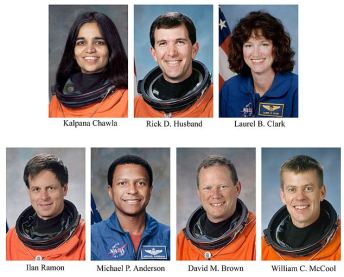
FILE NASA PORTRAIT OF COLUMBIA MISSION CREW

STS-107 launched from the Kennedy Space Center aboard the Space Shuttle Columbia on January 16, 2003.

Eighty seconds after launch, a piece of insulating foam broke away from the external fuel tank striking Columbia’s left wing, leaving a small hole in the carbon composite tiles along the leading edge.

Three previous Space Shuttle missions had experienced similar damage and, while some engineers thought this could be more serious, none was able to pinpoint the precise location or extent of the damage.  NASA managers believed that, even in the event of major damage, little could be done about it.

These carbon tiles are all that stands between the orbiter and the searing heat of re-entry.

tiledamage
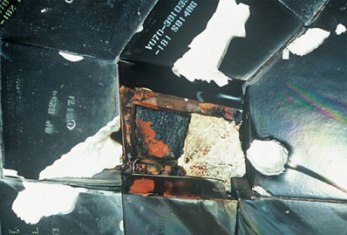
December 2, 1988 ‘Atlantis’ mission narrowly missed repeting the Columbia disaster, four days later. “More than 700 heat shield tiles were damaged. One tile on the shuttle’s belly near the nose was completely missing and the underlying metal – a thick mounting plate that helped anchor an antenna – was partially melted. In a slightly different location, the missing tile could have resulted in a catastrophic burn through”. H/T Spaceflightnow.com

For Columbia, 300 days, 17 hours, forty minutes and 22 seconds of space travel came to an end on the morning of February 1, 2003.  Over the California coast and traveling twenty-three times the speed of sound, external temperatures rose to 3,000° Fahrenheit and more, when super-heated gases entered the wing’s interior.

231,000 feet below, mission control detected four unconnected sensors shut down on the left wing, with no explanation.   The first debris struck the ground near Lubbock, Texas, at 8:58am.  The last communication from the crew came about a minute later.

Columbia disintegrated in the skies over East Texas at 9:00am Eastern Standard Time.

Debris and human remains were found in 2,000 locations from the state of Louisiana, to Arkansas. The only survivors were a can full of worms, brought into space for study.

petr-ginz-drawing-l
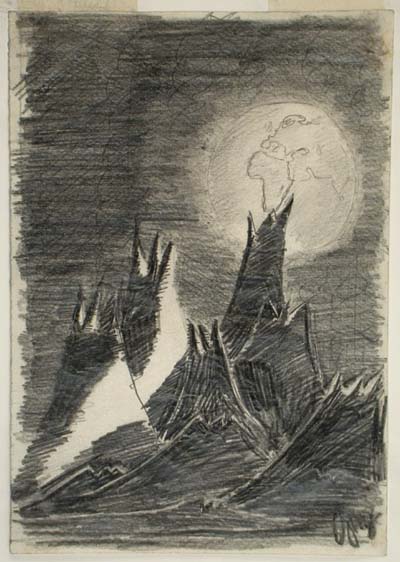
“Mon Landscape” by Petr Ginz

Payload Specialist Colonel Ilan Ramon, born Ilan Wolferman, was an Israeli fighter pilot and the first Israeli astronaut to join the NASA space program.

Ramon is the son and grandson of Auschwitz survivors and family member to several others, who didn’t live to tell the tale. 

In their memory, Colonel Ramon reached out to the Yad Vashem Remembrance Center, for a holocaust relic to bring with him into space.

Petr Ginz lived for a time in the Theresienstadt ghetto, where he drew this picture.  A piece of teenage imagination:  the Earth as it may appear, from the moon.

Petr Ginz would be murdered in the Nazi death camp at Auschwitz though his drawing, survived.  He was 14 years old.  Colonel Ramon was given a copy. A young boy’s drawing of a safer place.  This would accompany the astronaut, into space.

Today, the assorted debris from the Columbia disaster numbers some 84,000 pieces, stored in the Vehicle Assembly Building at the Kennedy Space Center.  To the best of my knowledge, this drawing by a boy who never made it out of Auschwitz, is not among them.

Afterward:

Andrew “Drew” Feustel is a car guy, with fond memories of restoring a ’67 Ford Mustang in the family garage in North suburban Detroit.

When he’s not fixing cars he’s an astronaut, and veteran of two space missions.  For a time he was a colleague of Colonel Ramon.  The pair had several close friends, in common.

9492403507_6a7f9f63ee_k-690x450
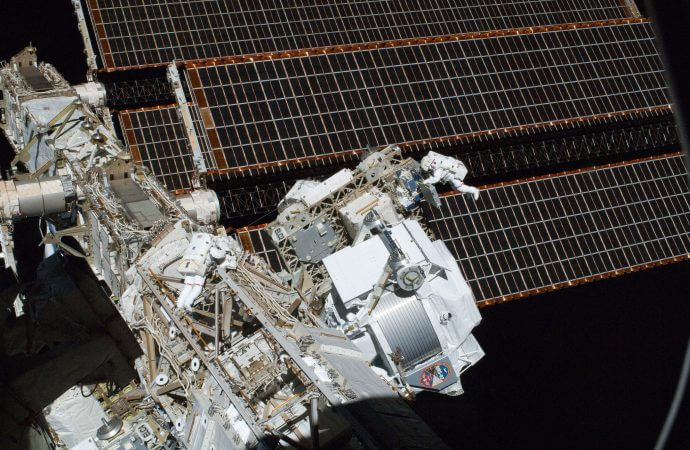
The ‘car guy’ in space thing seems to have worked. NASA reports “The spacewalkers overcame frozen bolts, stripped screws and stuck handrails, four new or rejuvenated scientific instruments, new batteries, a new gyroscope and a new computer were installed. | NASA photo

In March 2018, Feustel left for his third spaceflight, this one a six-month mission aboard the International Space Station.  Before he left, Rona Ramon, widow of the Israeli Astronaut, gave him another copy of Petr Ginz’ drawing.

The circle was closed.  This fruit of a doomed boy’s imagination once again broke the bonds of space. This time, it also home.

January 27, 1945 POW

Some thirty to forty managed to escape the killing zone, only to be hunted down and murdered, one by one. Eleven managed to escape the slaughter, and lived to tell the tale. 139 were burned, clubbed or shot to death.

Today, the city of Cabanatuan calls itself the “Tricycle Capital of the Philippines”, with 30,000 motorized “auto rickshaws”.  79 years ago, Cabanatuan became home to one of the worst POW camps of World War 2.

15918-cabanatuan-city-locator-map

1942 was a dreadful year for the allied war effort in the Pacific.  The Battle of Bataan alone resulted in 72,000 prisoners being taken by the Japanese, marched off to POW camps designed for ten to twenty-five thousand.

pows-cabanatuan

20,000 died from sickness, hunger or murder at the hands of Japanese guards on the “death march” from Bataan into captivity at Cabanatuan prison and others.

Cabanatuan held 8,000 prisoners at its peak though that number dropped considerably as the able-bodied were shipped out to work in Japanese slave labor camps.

Cabanatuan-prisoncamp-report_555

Two rice rations a day, fewer than 800 calories, were supplemented by the occasional animal or insect caught and killed inside camp walls or by the rare food items smuggled in by civilian visitors.

2,400 died in the first eight months at Cabanatuan, animated skeletons brought to “hospital wards”, nothing more than 2’x6′ patches of floor, where prisoners waited to die.

One Master Sergeant Gaston saw one of these wards in July 1942 and described the horror: “The men in the ward were practically nothing but skin and bones and they had open ulcers on their hips, on their knees and on their shoulders…maggots were eating on the open wounds. There were blow flies…by the millions…men were unable to get off the floor to go to the latrine and their bowels moved as they lay there”.

The war was going badly for the Japanese by October 1944, as Imperial Japanese High Command ordered able bodied POWs removed to Japan.  1,600 were taken from Cabanatuan leaving 500 sick, weak and disabled prisoners.  The guards abandoned camp shortly afterward, though Japanese soldiers continued to pass through.  POWs were able to steal food from abandoned Japanese quarters; some even captured two water buffalo called “Carabao”, which were killed and eaten.  Many feared a trick and didn’t dare leave the camp.  Most were too sick and weak to leave in any case, though the extra rations would help them through what was to come.

Palawan_Massacre_POW_Burial_Site_1945

On December 14, some fifty to sixty soldiers of the Japanese 14th Area Army in Palawan doused 150 prisoners with gasoline and set them on fire, machine gunning or clubbing any who tried to escape the flames.   Some thirty to forty managed to escape the killing zone, only to be hunted down and murdered, one by one.  Eleven managed to escape the slaughter, and lived to tell the tale.  139 were burned, clubbed or shot to death.

The atrocity at Palawan sparked a series of raids at Santo Tomas Internment Camp, Bilibid Prison, Los Baños and others.  The first such behind-enemy-lines rescue, took place at Cabanatuan.

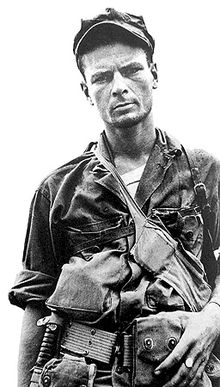
Lieutenant Colonel Henry Mucci of the US Army’s elite 6th Ranger Battalion selected Captain Robert Prince to plan the rescue. “We couldn’t rehearse this”, Prince said. “Anything of this nature, you’d ordinarily want to practice it over and over for weeks in advance. Get more information, build models, and discuss all of the contingencies. Work out all of the kinks. We didn’t have time for any of that. It was now, or not”.

220px-Robert_Prince

On the evening of January 27, 1945, a 14-man advance team formed from the 6th Ranger Battalion and a special reconnaissance group called the “Alamo Scouts”, separated into two groups and began the 30-mile march behind enemy lines to liberate Cabanatuan.

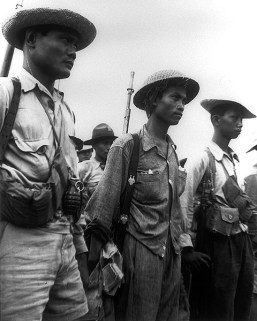
The main force of 121 Rangers moved out the following day, meeting up with 200 Filipino guerrillas serving as guides and helping with the rescue.

Other guerrillas assisted along the way, muzzling dogs and corralling chickens so that Japanese occupiers would hear nothing of their approach. 

Japanese soldiers once again occupied the camp, with 1,000 more camped across the Cabo River outside the prison.  As many as 7,000 more were deployed, just a few miles away.

On the night of January 30, a P-61 Black Widow piloted by Captain Kenneth Schrieber and 1st Lt. Bonnie Rucks staged a ruse.  For 45 minutes, the pair conducted a series of aerial acrobatics, cutting and restarting engines with loud backfires while seeming to struggle to maintain altitude. Thousands of Japanese soldiers watched the show as Rangers crawled on their bellies, into position.

Pajota's_Guerrillas
Filipino Guerilla fighters of Captain Juan Pajota

Guard towers and pillboxes were wiped out in the first fifteen seconds of the assault.  Filipino guerrillas blew the bridge and ambushed the large force across the river while one, trained only hours before to use a bazooka, took out four Japanese tanks.

In the camp, all was pandemonium as some prisoners came out and others hid, suspecting some trick to bring them out in the open.  They were so emaciated, Rangers carried them out two at a time.

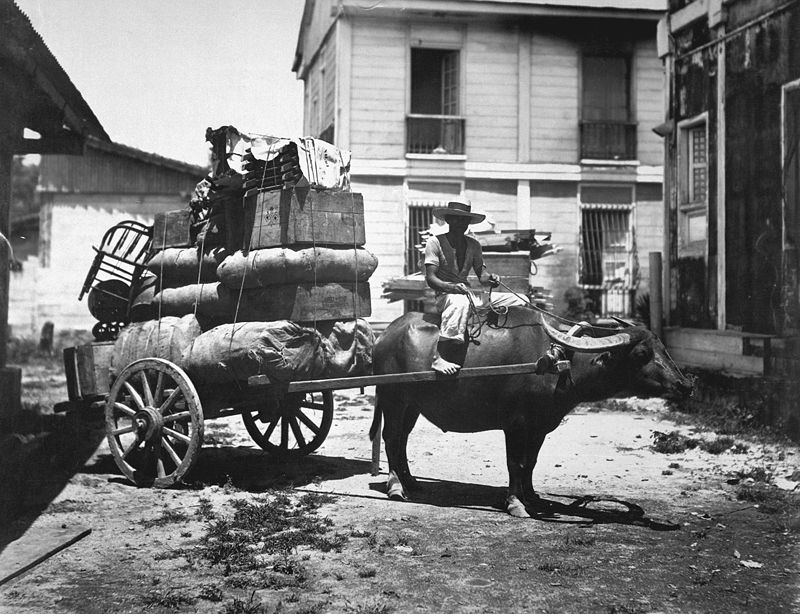
The raid was over in 35 minutes, POWs brought to pre-arranged meet-up places with dozens of carabao carts.   The long trek to freedom had only begun. Defiant, one POW said “I made the Death March from Bataan, so I can certainly make this one!”  Over three days, up to 106 carts joined the procession, their plodding 2 MPH progress covered by strafing American aircraft.

Two American Rangers were killed in the raid. Another 4 Americans and 21 Filipinos were wounded, compared with 500-1,000 Japanese killed and four tanks put out of action.  One prisoner died in the arms of a Ranger, before leaving the gate.  Another succumbed to illness on the long trip back. 

800px-Carabao_Cart
Carabao cart, similar to the ones used after the raid on Cabanatuan

Edwin Rose was a civilian, a purser on a ship plying the Singapore – Hong Kong run, when the war broke out.  He was caught in Manila and spent 929 days in captivity.  One of the longest-held POWs of the war in the Pacific. Rose awoke the night of the raid, and “heard all the shooting”.  He “knew the Americans had arrived” but rolled over and went back to sleep, thinking they were there to stay. On awakening the following morning, Rose found he was alone with “Cabanatuan all my own.”

POWs_celebrate

He dressed and shaved, put on his best clothes and walked out of camp.  Passing guerrillas found him and passed him on to a tank destroyer. 

Give the man points for style.  Edwin Rose strolled into 6th army headquarters a few days later, with a cane tucked under his arm.

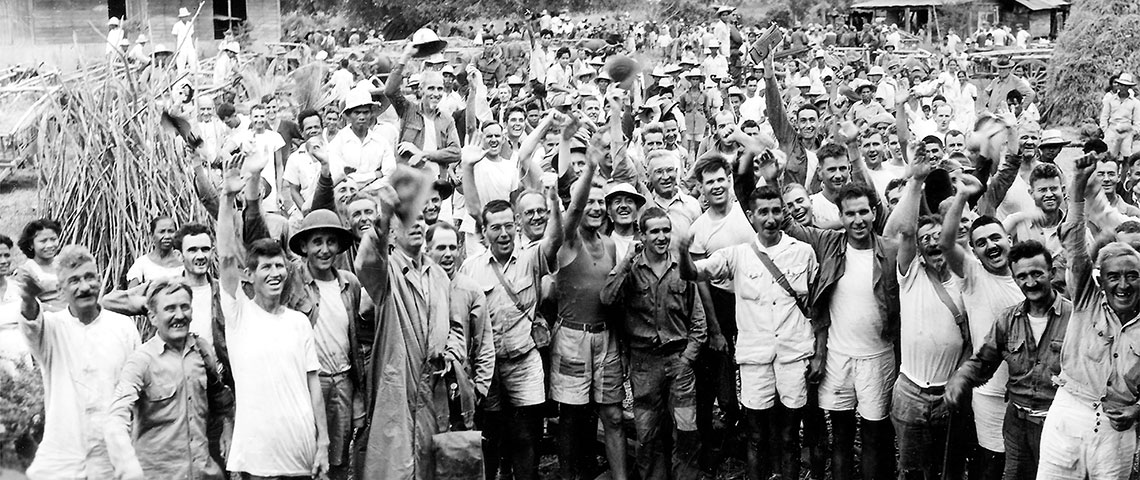
The Cabanatuan raid of January 30, 1945 liberated 464 American soldiers along with 22 British and 3 Dutch soldiers, 28 American civilians, 2 Norwegians and one civilian each of British, Canadian and Filipino nationalities.

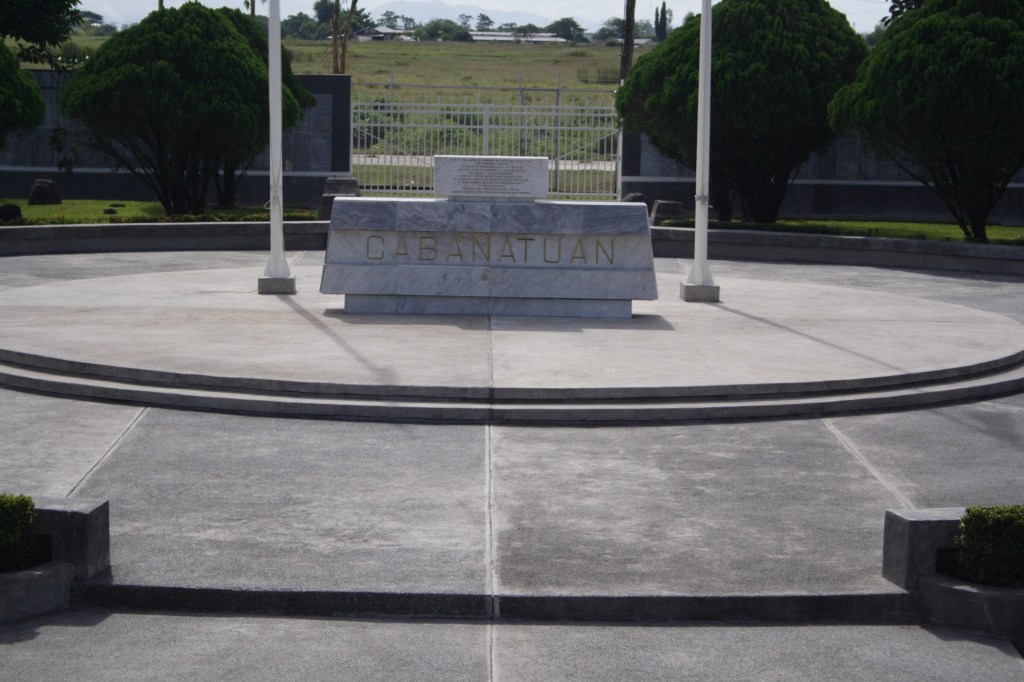
In 1982, the Cabanatuan American Memorial was erected on the grounds of the former POW camp and dedicated by survivors of the Bataan Death march and the prisoner-of-war camp, at Cabanatuan. A large mural depicts Filipino and American soldiers helping each other, in combat. A marble altar bears the names of 2,656 Americans with this dedication on the back of the Cabanatuan sign:

SITE OF THE JAPANESE PRISONER OF WAR CAMP 1942 TO 1945
THIS MEMORIAL HONORS
THE AMERICAN SERVICEMEN AND THE CIVILIANS
WHO DIED HERE AND GRATEFULLY ACKNOWLEDGES
THE EQUALLY HEROIC SACRIFICES
MADE BY FILIPINO SERVICEMEN AND CIVILIANS
IN A MUTUAL QUEST FOR HONOR, FREEDOM AND PEACE
IT ALSO REMINDS MANKIND OF MAN’S INHUMANITY
TO HIS FELLOWMAN

ERECTED AND DEDICATED 12 APRIL 1982 BY
AMERICAN AND FILIPINO COMRADES, FAMILIES AND FRIENDS.

It is the only place in the province of Nueva Ecija where the Filipino flag stands side-by-side, with the Stars and Stripes.

January 26, 897 The Cadaver Synod

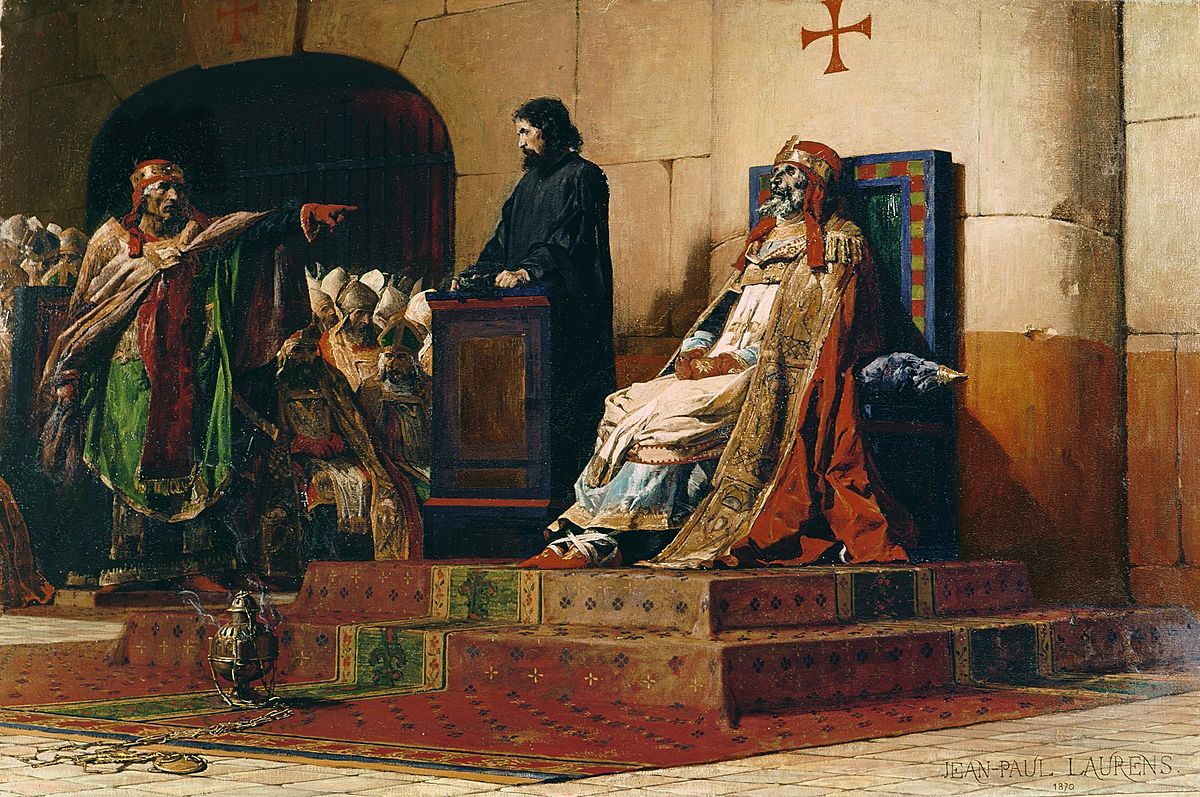
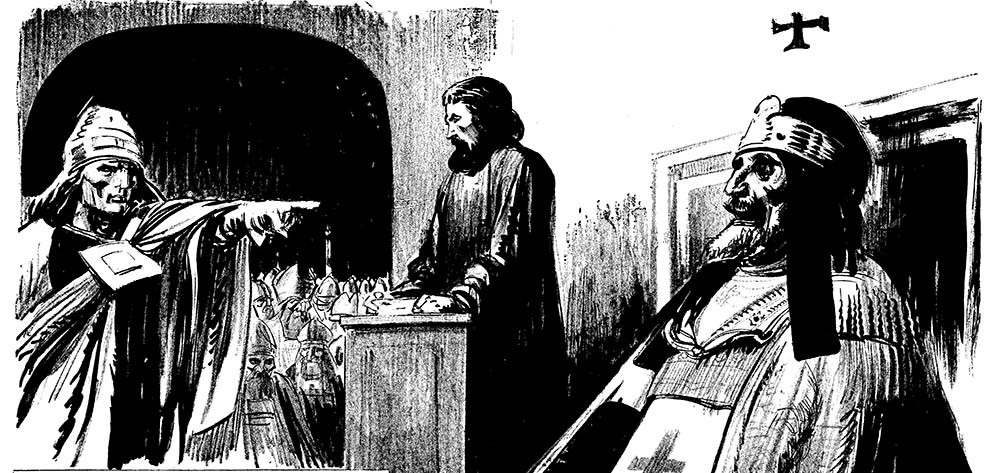
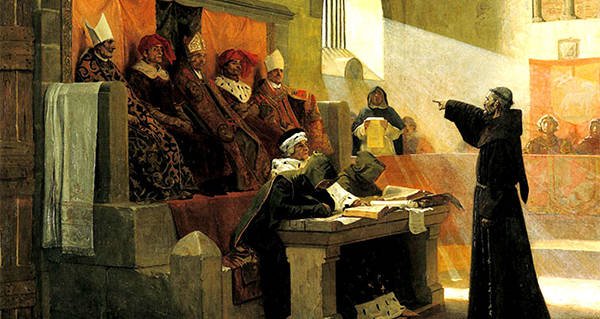
56-score and four years ago today it was January 26, 897. A live Pope put his dead predecessor…his predecessor’s deceased predecessor really…on trial. Seriously. They dug up the corpse and dressed it in papal vestments, put it on a throne and tried the guy in a kangaroo court spectacle, worthy of a San Francisco politician.

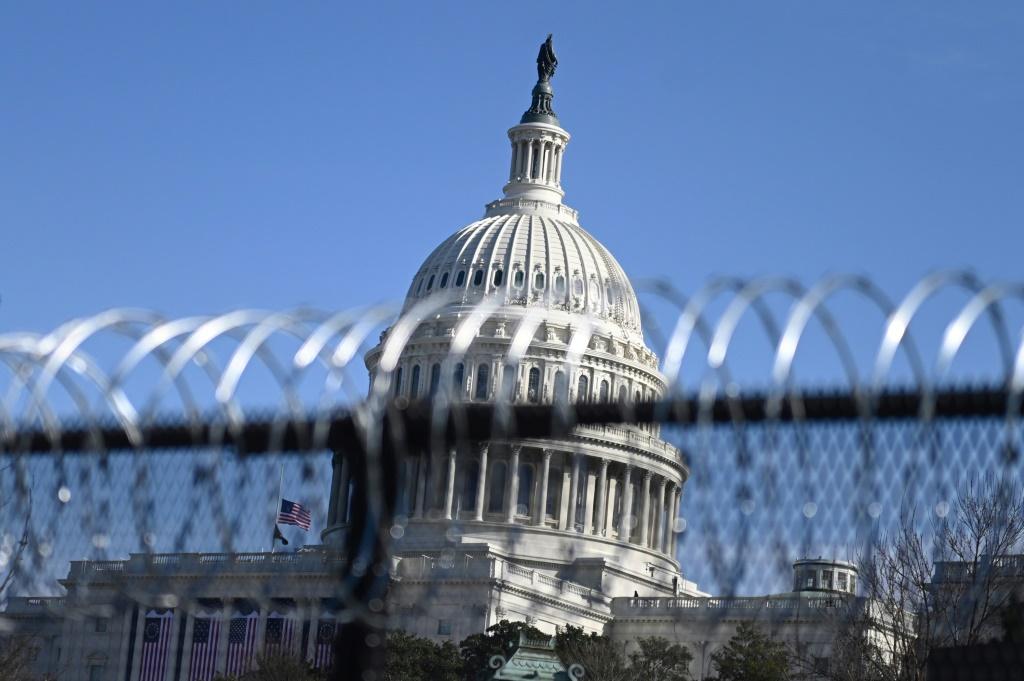
Sometime down the road, future historians will remember this month for things that none of us ever thought we’d see. Concertina wire surrounds our nation’s capitol. Soldiers fill the streets of Washington as we are left to wonder.

Did somebody put Idi Amin in charge?

With so many needs to be met by the people we put in office, we get the bizarre spectacle of an “impeachment” and removal of a private citizen, who already left. The whole procedure is so outlandish the constitutionally mandated presiding officer, declines to show up. You would think these people have nothing better to do.

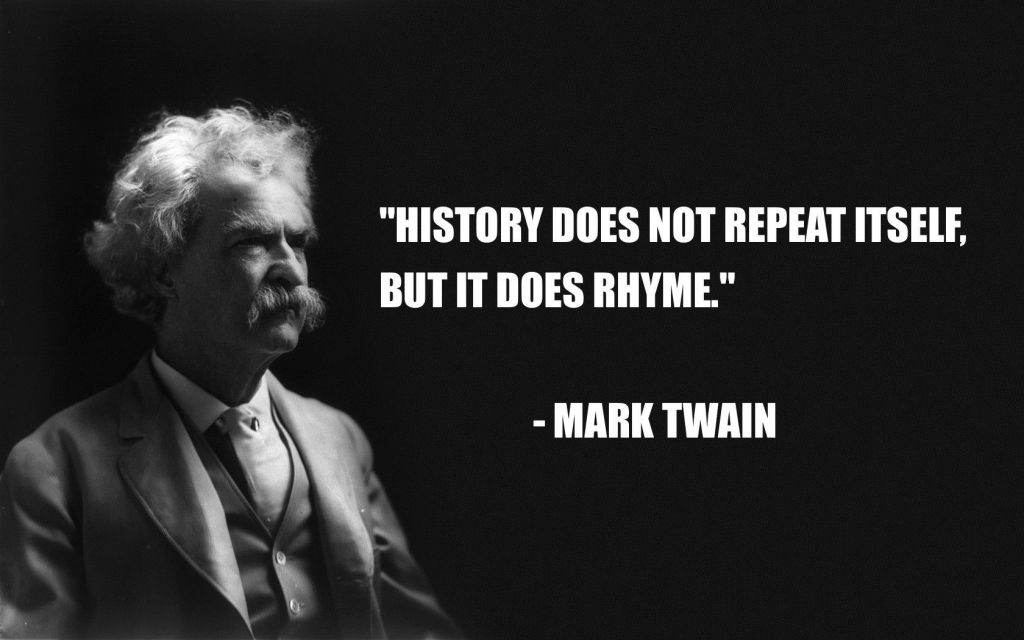
Someone once said “History does not repeat itself, but it does rhyme”. The quote is often attributed to Mark Twain. Whoever it was, knew what they were talking about.

56-score and four years ago today it was January 26, 897. A live Pope put his dead predecessor…the dead guy who came before his predecessor really…on trial. Seriously. They dug up the corpse and dressed it in papal vestments, put it on a throne and tried the guy in a kangaroo court spectacle, worthy of a San Francisco politician.

According to Catholic church doctrine, the Pontifex maximus sits at the head of the church from the time of Peter, to the present day. Today, the Cardinals meet in secret conclave to elect the bishop of Rome, but it wasn’t always that way. Before the Gregorian reforms of the 11th century the Papacy was often as political, as any public office.

The Popes of the early middle ages were heavily involved in secular affairs. They were chosen by predecessors, popular acclaim, family connection or simony (the purchase of ecclesiastical office). It was inevitable that some would be…umm…less than pious men.

Relations between the Holy See and the Holy Roman Empire were particularly incestuous. First appearing on the scene in 754 after Pope Stephen II anointed Pepin III “The Short” “Patricius Romanorum” (Patrician of the Romans), emperors of the Holy Roman Empire were known to select Popes and Popes, emperors.

The French Enlightenment philosopher Voltaire once quipped: “This agglomeration which was called and still calls itself the Holy Roman Empire was neither Holy, nor Roman, nor an Empire”.

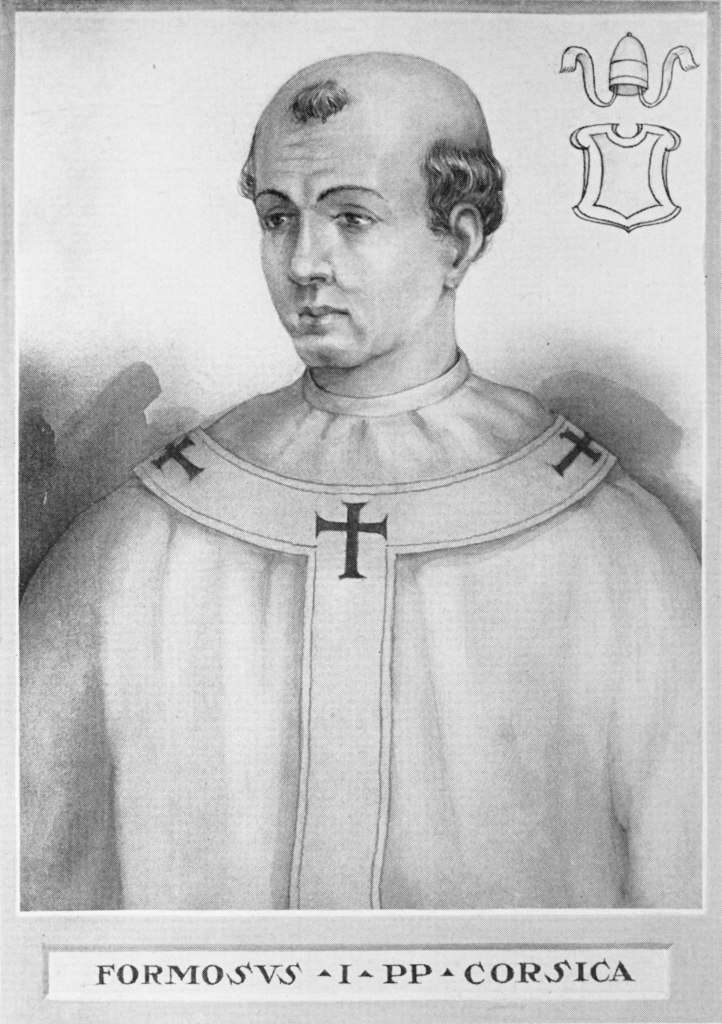
Formosus became Cardinal of Porto in 864 and representative of the Pope in Bulgaria, two years later. Many considered the man to be a candidate for the papacy, as early as 872.

That was the year, political issues caused Formosus to beat a hasty retreat from Rome.

Anyone ascending the heights of such a system was bound to have powerful allies. And powerful adversaries. The Cardinal’s enemies, pounced. Pope John VIII ordered Formosus defrocked and excommunicated.

Excommunication might seem a real career killer in his line of work but the sanction was lifted, in 878. Formosus could never return to Rome or resume his priestly functions, but that too was restored, five years later. In 891, Formosus was unanimously elected Pontiff to succeed Pope Stephen V.

Formosus served in a time of great political upheaval. There were problems with Saracens. Power struggles within the eastern church, in Constantinople. The Frankish kingdoms were in a state of upheaval and, worst of all, Formosus supported the German king Arnulf for succession to Holy Roman Emperor, over emperor Guido III of the powerful clan of Spoleto.

Pope Formosus died of natural causes on April 4, 896. He was succeeded by Boniface VI, who lived for 15 days. Some say Boniface died of gout, others that he was poisoned by supporters of his successor, Steven VI.

Even by Medieval standards, Pope Stephen VI must have been some piece of work. In January 897, Stephen had Formosus dug out of the ground, dressed in papal vestments and put on trial.

Ripley’s Believe it or Not

With the corpse propped up on a throne, the outcome was never in doubt. A church deacon attempted to speak for the defendant while Stephen himself shrieked at the corpse, rehashing the old charges of John VIII.

Unsurprisingly, the dead man was convicted. Stripped of his robes, Formosus was clad in the garb of a layman. His papacy was annulled, ordinations cancelled and the three “blessing fingers” of his right hand, hacked off.

The body was buried in a pauper’s grave but even now the revenge of Stephen VI, was unsated. The Pope ordered Formosus dug up yet again and thrown into the Tiber River.

The episode led to widespread outrage, possibly at the behest of Stephen’s enemies. The Pope was incarcerated in the Summer of 897 and strangled, while still in prison.

The cadaver synod ushered in 100 years of corruption of the Holy See known by some as the “Saeculum obscurum” – the Dark Age/Century, and by others, the “Pornocracy”.

Fast forward 39-score and one and it’s January 26, 1661. Four days from now, January 30, the corpse of Oliver Cromwell, one-time “Lord Protector of the Commonwealth of England, Scotland and Ireland” would be dug up and “executed”, by decapitation. The body was hung up in chains while his head was mounted on a pike, outside Westminster hall. That thing stayed there, for 24 years. Sold and sold again, Cromwell’s head would at last go to its final rest some 299 years later. In 1960.

History rhymes, indeed.

January 25, 1890 Nellie Bly

“Could I pass a week in the insane ward at Blackwell’s Island? I said I could and I would. And I did”. – Nellie Bly

Born May 5, 1864, Elizabeth Jane Cochran was one of fifteen children born to Michael Cochran, and two wives. Michael died in 1870 leaving a modest legacy. It didn’t amount to much, split fifteen ways.

As a teenager in western Pennsylvania, Elizabeth adopted an “e” believing that “Cochrane” sounded more sophisticated. She enrolled at the Indiana Normal School in 1879 (now Indiana University of Pennsylvania) but dropped out after one semester, for lack of funds. In 1880 her mother moved the family, to Pittsburgh.

According to an article in the Pittsburg Dispatch entitled “What girls are for” the answer appears to be, not very much. Making babies and keeping house. Elizabeth didn’t appreciate that and wrote to the paper, to say so. She signed her letter, “Lonely Orphan Girl”.

If writing well is the sign of an organized thought process, the mind of Elizabeth Cochrane was in good working order. Impressed with the anonymous letter, Editor George Madden ran an advertisement asking that the writer, identify herself.

That she did. Madden offered the opportunity to write a piece for publication, under the same pseudonym. Cochrane called that first piece “The Girl Puzzle”, describing how divorce effected women and arguing for reform of marital laws.

Madden was even more impressed and hired Elizabeth, full-time. In those days, women who wrote for newspapers generally did so, under a pseudonym. The Editor suggested “Nelly Bly” after the subject of a popular minstrel song, from 1850. Cochrane liked “Nelly” but her editor spelled it with an ‘ie’.

Nellie Bly would go on to be one of the most famous journalists of the age.

She first came to widespread notice with a series of investigative articles, focused on poor working conditions and the plight of female factory workers. Factory owners complained. Bly was reassigned to a role more typical of female reporters: Gardening. Society. Fashion.

She didn’t want any of it. Still only 21, she wanted “to do something no girl has done before.” She traveled to Mexico and became a foreign correspondent, writing about the Mexican people and criticizing the dictatorship, of President Porfirio Diaz.

Nellie Bly, in Mexico

Stung by what she had written, Mexican authorities threatened to throw her in jail. Bly was forced to flee. Back in Pittsburg, it wasn’t long before she’d had enough of theater and arts reporting. She resigned her job in 1887 and moved to New York.

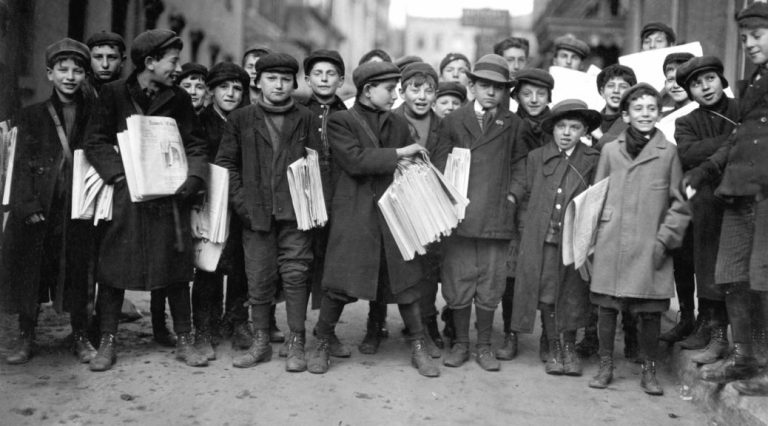
This was the age of lurid headlines, of sensational if not always accurate stories and homeless street waifs called “Newsies“, hawking newspapers: “Extra Extra, read all about it!” Within the next five years, San Francisco publisher William Randolph Hearst would buy crosstown rival New York Journal sparking a newspaper war and a new style of news we now call “Yellow Journalism“.

Penniless after four months without income, Cochrane walked into the office of New York World publisher, Joseph Pulitzer. Pulitzer had purchased the company four years earlier promising to root out corruption, expose fraud and ferret out public abuse, at all levels.

Bly was hired to cover theater and the arts but the pair soon concocted an undercover assignment. Nellie Bly would feign insanity, with the aim of being committed to the notorious women’s insane asylum on Blackwell’s Island.

It was a dangerous ruse but it worked. The “pretty crazy girl” fooled the New York press and mental health “experts” alike, culminating in Bly’s incarceration at Blackwell’s Island. She was released at the behest of the New York World, ten days later.

Bly’s exposé was a sensation. First in a series of stories and then in a book entitled Ten Days in a Madhouse, Nellie Bly told tales of torture, of ice cold baths in used and filthy water, rancid food and the rats, vermin and brutality suffered by women she was convinced were every bit as sane, as herself.

Public outrage prompted a grand jury investigation culminating in an $800,000 increase in public funding to the Department of Public Charities and Corrections.

Bly’s caper sparked a new form of “stunt journalism”, a new breed of female reporters with secret identities like “Florence Noble” and “Dorothy Dare” tackling subjects like disaster victims, the plight of factory workers and other subjects previously considered “unfit for ladies”.

Every major newspaper in the nation wanted a “stunt girl” on the staff.

In 1872, novelist Jules Verne published the fictional tale of the gambler Phileas Fogg and the trip he went on, to win a bet. The story was called Around the World in 80 Days. In 1888, Nellie Bly pitched the same trip to her editor. For real.

With two days’ notice, Nellie Bly boarded the Hamburg America Line steamer Augusta Victoria in November 1889 to begin her 25,000-mile adventure. She took an overcoat, the dress she was wearing, a few changes of underwear and a travel bag with a few essentials. A bag with £200 in English bank notes, some gold and American currency hung around her neck.

Unknown to Nellie at this time, Cosmopolitan magazine was sponsoring reporter Elizabeth Bisland to take the same trip, in the opposite direction.

She departed the same day.

New underwater cables enabled Bly to send short progress reports though longer dispatches had to travel by mail. From her first stop in England she traveled to France where she met Jules Verne himself and on to Brindisi, the Suez Canal, Ceylon and the Far East. She visited a leper colony in China. In Singapore, she bought a monkey.

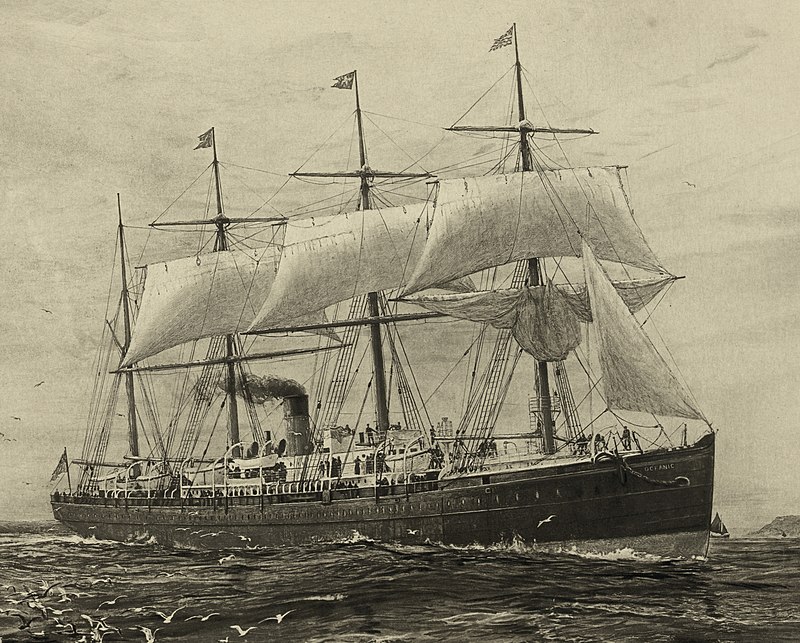
The New York World sponsored a “Nellie Bly Guessing Match”. Who could predict to the second, the journalist’s return. The grand prize was an all-expense paid trip to Europe. Spending money was tossed in, later on. A rough Pacific passage on board the Steamer RMS Oceanic put the trip two days behind schedule but Pulitzer’s newspaper made that up, hiring a private train from San Francisco.

RMS Oceanic

Nellie Bly arrived in New York on January 25, 1890 at 3:51pm, besting Phileas Fogg’s time, by eight days. Over at Cosmo, Bisland was still crossing the Atlantic, with 4½ days to go.

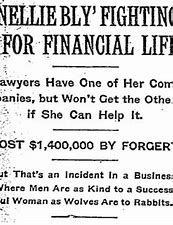
At 31, Nellie Bly married 73-year old metal container manufacturer Robert Seaman in 1895, and left journalism. Seaman died in 1904 and, for a time, Elizabeth was one of the leading female industrialists, in the country.

She ran the company as “a model of social welfare, replete with health benefits and recreational facilities“, according to biographer, Brooke Kroeger.

But Bly was hopeless at understanding the financial aspects of her business and ultimately lost everything. Unscrupulous employees bilked the firm of hundreds of thousands of dollars, troubles compounded by a protracted and costly bankruptcy litigation“.

Back in journalism, Bly traveled to Europe to cover the Great War. She was the first woman and one of few foreigners to visit the war zone between Austria, and Serbia.

In 1913, Nelly Bly covered the first suffragist parade in Washington. She predicted women would have the vote, by 1920.

The 19th Amendment giving (white) women the vote was certified on August 26, 1920, by US Secretary of State Bainbridge Colby.

In practice, voting restrictions against non-white men now extended to non-white women. The crusade to protect the voting rights of ALL American citizens would last, another 40 years.

January 24, 1935 It’s Beer Can Appreciation Day

Today as we gather to celebrate National Beer Can Appreciation Day, January 24, 2021, let us pause in solemn reverence to contemplate the meaning, of such a day as this. Sláinte.

The early brews of Egypt and Mesopotamia were transported in clay vessels called “amphorae”.

Wine was better suited to the sensibilities of the Roman palate leaving beer, to the barbarians. Even so, letters from cavalry commanders of the Roman Britain period, c. 97-103 AD, include requests for more “cerevisia“ for the legions.

Wooden barrels replaced the clay of antiquity in the early centuries AD made by skilled artisans, called “coopers”.

Glass came into use in the early 1700s, the same thick, black glass used for wine and hard liquor. Twist-offs were a thing of the distant future in those days and bottles were sealed, with corks or caps.

The screw cap came into being in 1870 thanks to English inventor Henry Barrett, but there were problems. Glass was heavy to transport over long distances, and easily damaged. Inspecting for cracks and chips and cleaning for re-use was both time consuming, and expensive. There had to be a better way.

Breweries toyed with the idea of canning beer since the early 1900s, but not without challenges. A can must survive pasteurization while containing pressures up to 80psi and still deliver a product, that was fresh and tasty. The metallic afterbite of early attempts was enough to repel even the most devoted of beer drinkers.

Prohibition put an end to such efforts, but not for long. Pabst and Anheuser-Busch both bet on an end to Prohibition by the late 1920s and asked the American Can Company, to help figure it out.

The answer was a polymer coating called Vinylite, a material familiar to anyone who’s ever handled a vinyl record. Early tests by Pabst proved favorable but major breweries were reluctant to commit, without a real-world test.

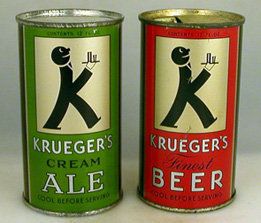
Like most smaller breweries, the Gottfried Krueger Brewing Company of Newark New Jersey was badly hurt, by Prohibition. When American Can offered not only to install a canning line but to pay for a test, it was an easy decision.

In June 1934, two cans each were delivered to 1,000 homes in Richmond Virginia. 91 percent gave the beer can, a “thumbs up”. 85% said it tasted more like draft, than bottled beer

On this day in 1935, Krueger went on sale all over the city. The beer can was born.

These weren’t the paper-thin cans we think of today. They were thick, heavy flat tops requiring a ‘church key’ to open, the can itself weighing in an at a ¼-pound apiece.

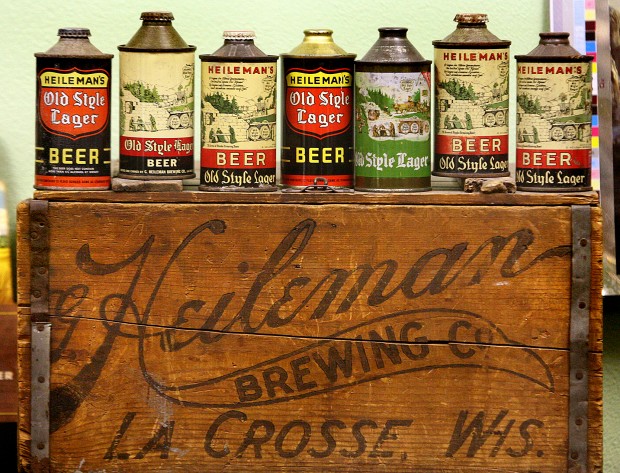
Krueger got their canning line paid for, but other brewers were still tooled up for bottles. New production lines were expensive. The answer came in the form of a “cone top”. With no need to upgrade equipment, the style appealed to smaller brewers. J. Heileman was the first to roll out a cone top in 1935 followed by Schlitz, the first national brewer to do so. The cone style remained popular until 1960 when the big nationals drove many of the regional guys, out of business. The cone top faded from use.

A beer can revolution came about in 1963 in the form of a pull tab or “pop top”, easy opening can. The Pittsburg Brewing Company was the first to use the pull tab on its flagship Iron City brand. Schlitz was the first of the nationals. By 1965, 75% of all beverage cans produced came with pop tops

These things were pure, unmitigated evil. Pop tops by the millions began to appear on beaches, lakes and parks, each one a self-contained, locked and loaded anti-personnel weapon lying in wait for the next bare foot. Pets and wild animals alike limped away with mangled feet or died after ingesting the things. There’s barely a child or teenager alive in the 1960’s, who doesn’t have a horror story about stepping on a pop top.

I blew out my flip flop
Stepped on a pop top
Cut my heel, had to cruise on back home”.
Jimmy Buffet

The answer came in 1975 in the form of “Stay Tabs”. First introduced by the Falls City Brewing Company of Louisville, Kentucky, stay tabs have changed almost not at all since that time and remain the state-of-the-art for nearly all carbonated beverages sold, to this day.

So it is we celebrate “National Beer Can Appreciation Day” this January 24, 2021. May it be a day filled with good health and hearty celebration. Sláinte.

For every wound, a balm.
For every sorrow, cheer. 
For every storm, a calm.
For every thirst, a beer. – Irish toast, author unknown

January 23, 1960 Into the Abyss

On this day in 1960, submarine commander Don Walsh and Jacques Piccard mounted that hallway, climbed into the sphere and closed the hatch. The dive to the bottom of the world began at 0823.

For most of us, the oceans are experienced as a day at the beach, a boat ride, or a moment spent on one end of a fishing line.

There is one global ocean divided into five major basins: the Pacific, Atlantic, Indian, Southern, and Arctic. Covering 70 percent and more of the planet, the oceans contain 97% of all the water, on earth.

Yet when it comes to exploration we are strangers, to 80 percent of it.

For most dive organizations, the recommended maximum for novice divers is 20 meters (65 feet). A weird form of intoxication called nitrogen narcosis sets in around 30 meters (98 feet). Divers have been known to remove their own mouthpieces and offer them to fish, with tragic if not predictable results. Dives beyond 130 feet enter the world of “technical” diving involving specialized training, sophisticated gas mixtures and extended decompression times.

Oxygen literally becomes toxic around 190 feet.

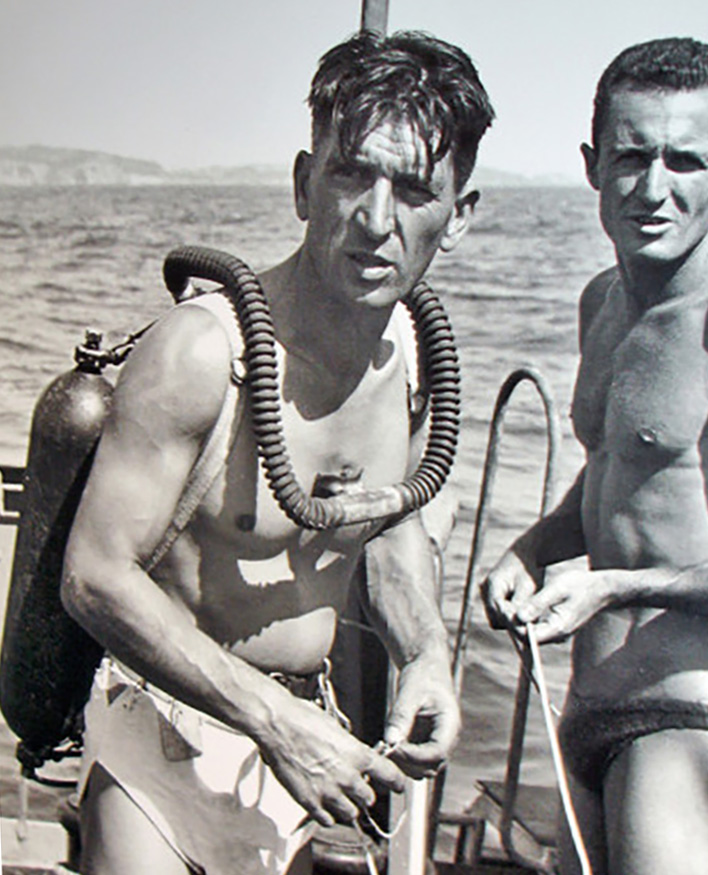
On September 17, 1947, French Navy diver Maurice Fargues attempted a new depth record, off the coast of Toulon. Descending down a weighted line, Fargues signed his name on slates placed at ten meter intervals. At the three minute mark, the line showed no sign of movement. The diver was pulled up. Petty Officer Fargues, a diver so accomplished he had literally saved the life of Jacques Cousteau only a year earlier, was the first diver to die using an aqualung. He had scrawled his last signature at 390 feet.

The man had barely scratched the surface.

Maurice Fargues prepares for his final dive

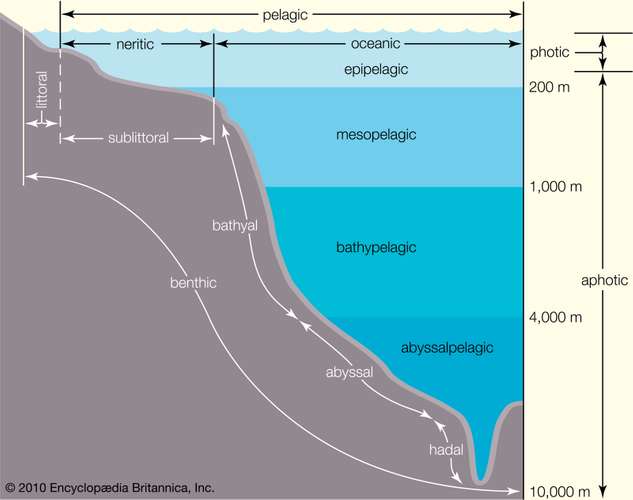
For oceanographers, all that water is divided into slices. The top or epiplagic Zone descends from 50 to 656 feet, depending on clarity of the water. Here, phytoplankton convert sunlight to energy forming the first step in a food chain, supporting 90 percent of all life in the oceans. 95 percent of all photosynthesis in the oceans occur in the epiplagic zone.

The mesopelagic or “twilight zone” receives a scant 1% of all sunlight. Temperatures descend as salinity increases while the weight of all that water above, presses down. Beyond that, lies the abyss.

Far below that the earth’s mantle is quite elastic, broken into seven or eight major pieces and several minor bits called Tectonic Plates. Over millions of years, these plates move apart along constructive boundaries, where oceanic plates form mid-oceanic ridges. The longest mountain range in the world runs roughly down the center, of the Atlantic ocean.

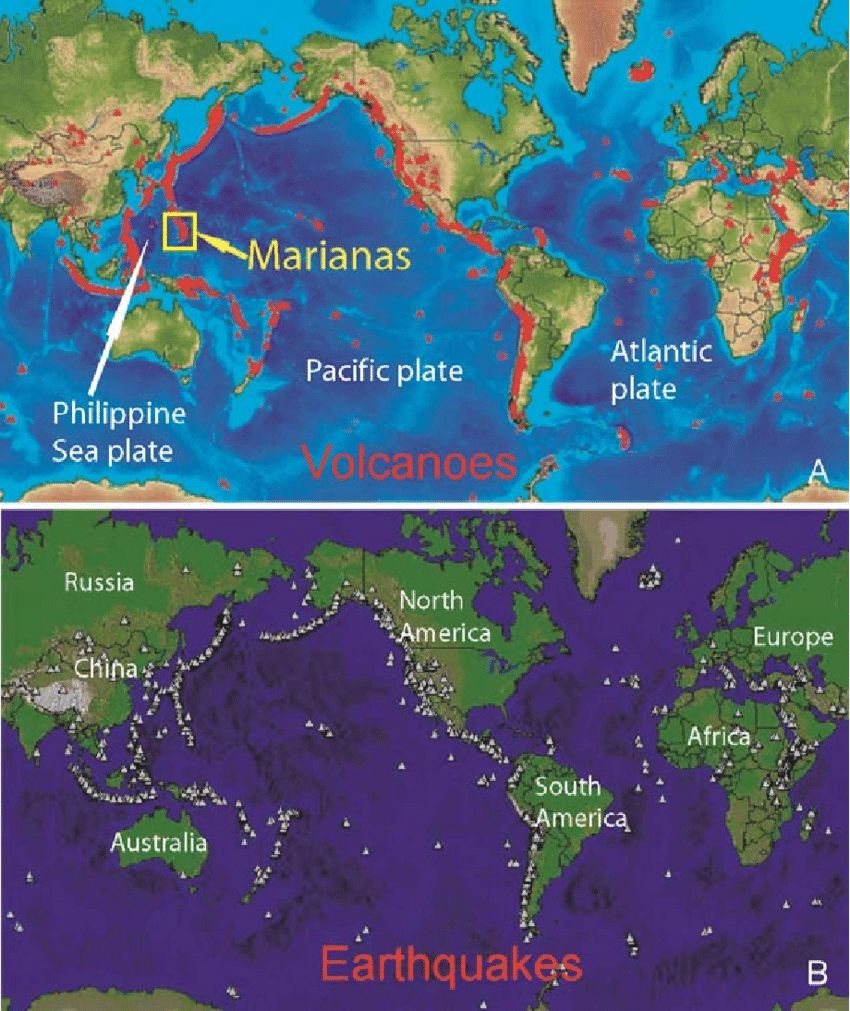
The Atlantic basin features deep trenches as well, sites of tectonic fracture and divergence. Far deeper though are the Pacific subduction zones where forces equal and opposite to those of the mid-Atlantic, collide. One plate moves under another and down into the mantle forming deep ocean ridges, the deepest of which is the Mariana Trench, near Guam. The average depth is 36,037, ± 82 feet, dropping off to a maximum depth of 35,856 feet in a small valley at the south end of the trench, called Challenger Deep.

If you could somehow pull up Mt. Everest by the roots and sink it in Challenger Deep, (this is the largest mountain on the planet we’re talking about), you’d still have swim 1.2 miles down, to get to the summit.

The air around us is liquid with a ‘weight’ or barometric pressure at sea level, of 14.696 pounds per square inch. It’s pressing down on you right now but you don’t feel it, because your internal fluid pressures push back. A column of salt water exerts the same pressure at 10 meters, or 33 feet.

Fun fact: The bite force of the American Grizzly Bear is 1,200 psi. The Nile Crocodile, 5,000. The pressure in Challenger Deep is 1,150 atmospheres. Over 16,000 pounds per square inch.

The problems with reaching such a depth are enormous. The “crush depth” of a WW2 era German submarine is 660-900 feet. The modern American Sea Wolf class of nuclear submarine collapses, at 2,400.

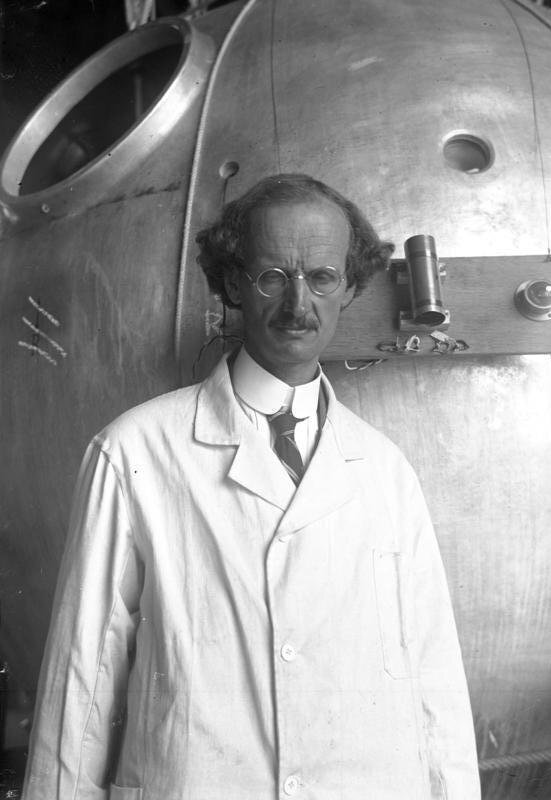
In the early 1930s, Swiss physicist, inventor and explorer Auguste Piccard experimented with high altitude balloons to explore the upper atmosphere.

The result was a spherical, pressurized aluminum gondola which could ascend to great altitude, without use of a pressure suit.

Within a few years the man’s interests had shifted, to deep water exploration.

Knowing that air and water are both fluids, Piccard modified his high altitude cockpit into a steel gondola, for deep sea exploration.

By 1937 he’d built his first bathyscaphe.

“A huge yellow balloon soared skyward, a few weeks ago, from Augsberg, Germany. Instead of a basket, it trailed an air-thin black-and-silver aluminum ball. Within [the contraption] Prof. Auguste Piccard, physicist, and Charles Kipfer aimed to explore the air 50,000 feet up. Seventeen hours later, after being given up for dead, they returned safely from an estimated height of more than 52,000 feet, almost ten miles, shattering every aircraft altitude record.” – Popular Science, August, 1931

Piccard’s work was interrupted by WW2 but resumed, in 1945. He built a large steel tank and filled it with low-density non-compressible fluid, to maintain buoyancy. Gasoline, it turned out, worked nicely. Underneath was a capsule designed to accommodate one person at sea-level pressure while outside, PSI mounted into the thousands of atmospheres.

The craft, with modifications from the French Navy, achieved depths of 13,701 feet. In 1952, Piccard was invited to Trieste Italy to begin work on an improved bathyscaphe. In 1953, Auguste and and his son Jacques brought the Trieste to 10,335 feet.

Auguste Piccard at one time or another held the records for altitude, and for depth

Designed to be free of tethers, Trieste was fitted with a pair of 2HP electric motors, capable of propelling the craft at a speeds of 1.2mph and changing direction. After several years in the Mediterranean, the US Navy acquired Trieste in 1958. Project Nekton was proposed the same year, code name for a gondola upgrade and three test dives culminating in a descent to the greatest depths of the world’s oceans. The Challenger Deep.

Trieste received a larger gasoline float and bigger tubs with more iron ballast. With help from the Krupp Iron Works of Germany, she was fitted with a stronger sphere with a thickness five inches and weighing in at 14 tons.

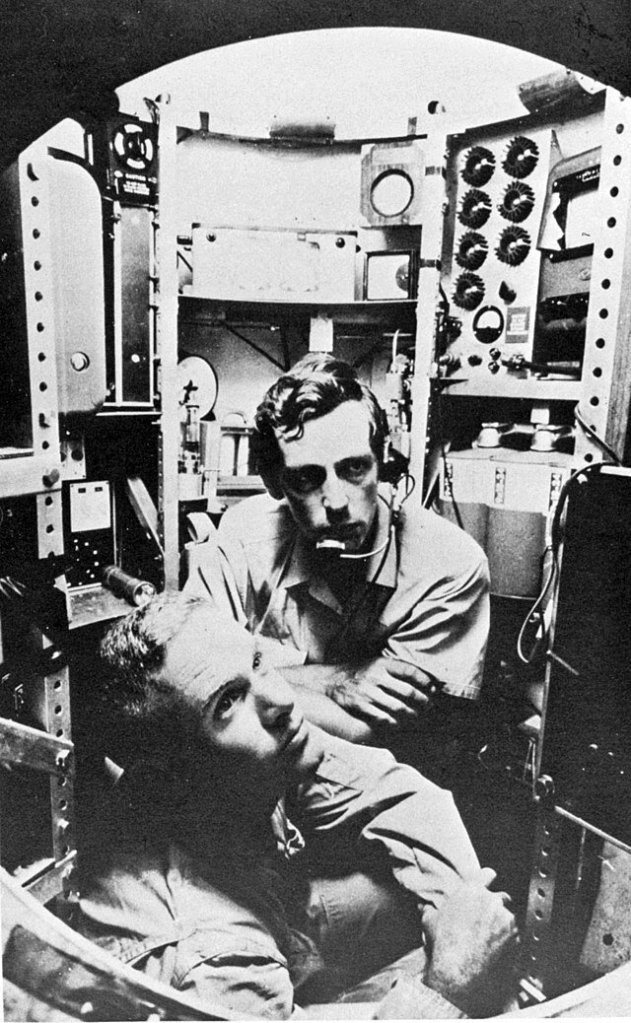
Piccard and Walsh aboard Trieste, January 23, 1960

The cockpit was accessible, only by an upper hallway which was then filled with gasoline. The only way to exit was to pump the gas out and blow out the rest, with compressed air. On this day in 1960, submarine commander Don Walsh and Jacques Piccard mounted that hallway, climbed into the sphere and closed the hatch. The dive began at 0823.

The bathyscaphe Trieste, on the surface

Trieste stopped her descent several times, each time a new thermocline brought with it a colder layer of water and neutral buoyancy, for the submersible. Walsh and Piccard discussed the problem and elected to gamble, ejecting some of that buoyant gasoline. By 650 feet, thermocline problems had ended.

By 1,500 feet, the darkness was complete. The pair changed their clothes, wet with spray from a stormy beginning. With a cockpit temperature of 40° Fahrenheit, they would need dry clothes.

Looking out the plexiglass window, depths between 2,200 and 20,000 feet seemed “extraordinarily empty”. By 14,000 feet the pair was now in uncharted territory. No one had ever been this deep. At 26,000 feet, descent was slowed to two feet per second. At 30,000 feet, one.

At 1256 Walsh and Piccard the bottom could be seen, on the viewfinder. 300 feet to go. Trieste touched down in a cloud of silt, ten minutes later. Not knowing if the phone would work at this depth, Walsh called the surface. “This is Trieste on the bottom, Challenger Deep. Six three zero zero fathoms. Over.” The response came back weak, but clear. “Everything O.K. Six three zero zero fathoms?” Walsh responded “This is Charley” (seaman-speak, for ‘OK”). We will surface at 1700 hours”. 37,800 feet.

The feat was not unlike the first flight into space. No human had ever reached such depths and never would, again. Unmanned deep sea submersibles have since visited the Challenger Deep, but this was the last manned voyage, to the bottom of the world.

Computerized rendering shows Trieste at the bottom, January 23, 1960 H/T National Geographic

Afterward: “After the 1960 expedition the Trieste was taken by the US Navy and used off the coast of San Diego, California for research purposes. In April 1963 it was taken to New London Connecticut to assist in finding the lost submarine USS Thresher. In August 1963 it found the Threshers remains 1,400 fathoms (2,560 meters) below the surface. Soon after this mission was completed the Trieste was retired and some of its components were used in building the new Trieste II. Trieste is now on display at the National Museum of the United States Navy at the Washington Navy Yard”. – H/T Forgotten History

January 22, 1957 The Mad Bomber

The American power grid operates 55,000 electrical substations, nationwide. 30 of them are critical to US infrastructure. Should terrorists or other mishap take out nine of them, the result would be nationwide blackout. For 18 months.

Seven years ago, a report by the Federal Energy Regulatory Commission (FERC) described the possibility of terrorist attacks, against the American power grid. Excerpts leaked to the Wall Street Journal described some 55,000 electrical generating substations, nationwide. 30 of them are critical to US infrastructure. Should terrorists or other mishap take out nine of them, the result would be nationwide blackout. For 18 months.

With the exception of nuclear facilities, American power plants are neither hardened nor guarded against external attack, a fact borne out by a previously unreleased 2012 report, from the Department of Homeland Security.

The crippling affects of such a shutdown can only be imagined and I sincerely hope, someone in a position of authority is doing just that.

And yet, America’s first terror campaign aimed at the power grid came not from outside but from the industry, itself.

Ninety years ago, George Metesky lived with his two unmarried sisters in Waterbury, Connecticut. Every day this Lithuanian immigrant would drive to New York where he worked as a wiper, at the Consolidated Edison (ConEd) plant at Hell Gate. A wiper is the entry level employee at an electrical power plant, responsible for keeping equipment clean and in good working order.

In 1931, Metesky was knocked down by a boiler backfire and a rush of hot gases. Choking fumes had damaged his lungs he claimed, and he went out on sick leave. Benefits ran out after 26 weeks and Metesky was terminated. Applications for worker compensation were denied, because it had been too long.

Appeals were filed, each denied in a process that stretched out, until 1936. Metesky developed pneumonia and later tuberculosis, all the while nursing an incandescent hatred for ConEd, company attorneys and three former coworkers he believed had perjured themselves, during proceedings.

On November 16, 1940, a brass pipe packed with gunpowder was left in a wooden toolbox, on a window at the mid-town Manhattan ConEd plant. The bomb was found before it exploded, along with a note: CON EDISON CROOKS – THIS IS FOR YOU. F.P.

Police inquired about disgruntled employees or former customers of ConEd but the inquiry, led nowhere.

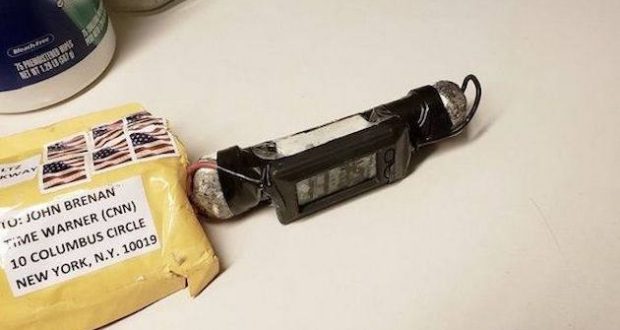
Modern pipe bomb mailed to former CIA director, John Brennan

Nearly a year came and went before another bomb was discovered at the ConEd headquarters at 4 Irving Place. This one was also found, before it exploded. There would be more bombs and others, weren’t so lucky.

Metesky, a former marine who served in the years following WW1, had worked as an electrical specialist and helped to wire the new Consulate, in Hong Kong.

Evidently, the man still still harbored patriotic feelings. Shortly after the outbreak of WW2, a note arrived at the New York Police Department: I WILL MAKE NO MORE BOMB UNITS FOR THE DURATION OF THE WAR – MY PATRIOTIC FEELINGS HAVE MADE ME DECIDE THIS – LATER I WILL BRING THE CON EDISON TO JUSTICE – THEY WILL PAY FOR THEIR DASTARDLY DEEDS . . .F.P.

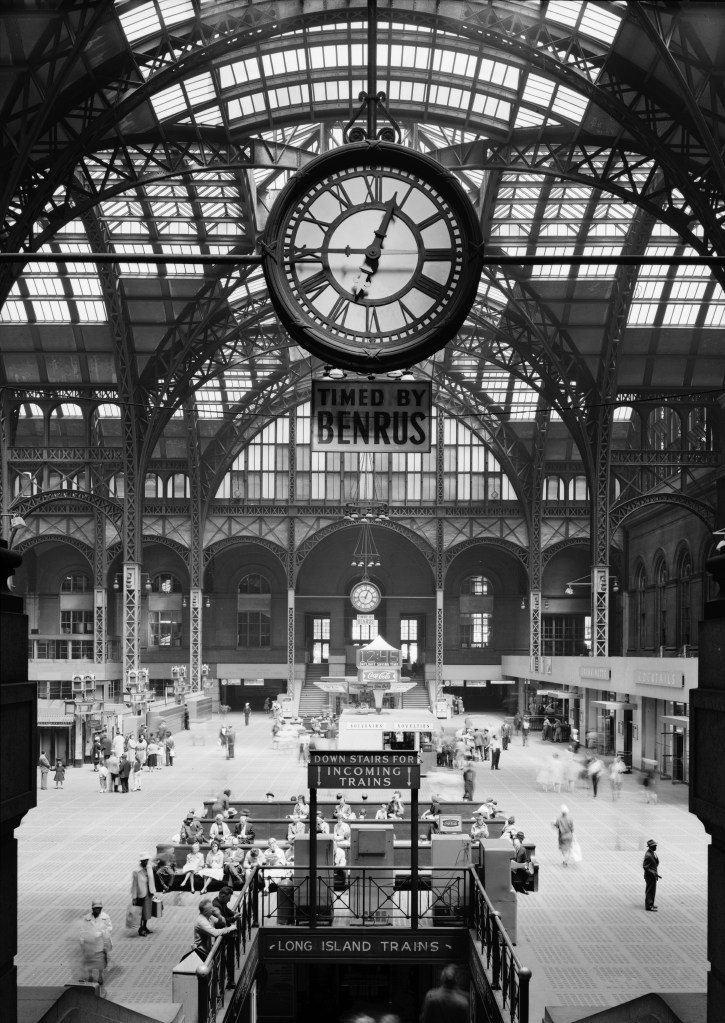
True to his word, the bombing started once again, in 1951. Phone booths. Storage lockers. Public batrooms all over the city: Grand Central Terminal, Penn Station, Radio City Music Hall, the New York Public Library, the Port Authority Bus Terminal, the RCA Building and the New York City Subway. Theater seats were slit open and bombs inserted, inside the upholstery. Metesky planted no fewer that 33 bombs of which 22, exploded. 15 people were injured.

Penn Station

With bombs no longer targeting ConEd itself, the letters continued: BOMBS WILL CONTINUE UNTIL THE CONSOLIDATED EDISON COMPANY IS BROUGHT TO JUSTICE FOR THEIR DASTARDLY ACTS AGAINST ME. I HAVE EXHAUSTED ALL OTHER MEANS. I INTEND WITH BOMBS TO CAUSE OTHERS TO CRY OUT FOR JUSTICE FOR ME.

Always in the same immaculately formed, capitalized block letters.

The NYPD formed a special task force to find the bomber, the New York Bomb Squad. The first of its kind. A reward of $26,000 was offered for information leading to arrest and conviction.

Phony bombs, fake leads and false bomb scares materialized by the hundreds making it near impossible to determine what information was real, and what was fake. A bomb went off on December 2, 1956 at the paramount movie Theater injuring six, one seriously. The next day police commissioner Stephen Kennedy announced “the greatest manhunt in the history of the police department”.

The largest city in the nation lived in terror.

HAVE YOU NOTICED THE BOMBS IN YOUR CITY – IF YOU ARE WORRIED, I AM SORRY – AND ALSO IF ANYONE IS INJURED. BUT IT CANNOT BE HELPED – FOR JUSTICE WILL BE SERVED. I AM NOT WELL, AND FOR THIS I WILL MAKE THE CON EDISON SORRY – YES, THEY WILL REGRET THEIR DASTARDLY DEEDS – I WILL BRING THEM BEFORE THE BAR OF JUSTICE – PUBLIC OPINION WILL CONDEMN THEM – FOR BEWARE, I WILL PLACE MORE UNITS UNDER THEATER SEATS IN THE NEAR FUTURE.

The notes were always signed, “F.P.”

In 1840, the writer Edgar Allen Poe introduced the super sleuth character C. Auguste Dupin in his novel, Murders in the Rue Morgue. Possessed of preternatural intelligence, Dupin seemed literally able to get into the mind, of the criminal subject. The character reappeared in The Mystery of Marie Rogêt and The Purloined Letter, laying the groundwork for Arthur Conan Doyle’s Sherlock Holmes character and a whole genre, of detective fiction.

Desperate, out of ideas, Captain John Cronin went to the office of a friend, psychiatrist and Assistant Commissioner at the New York Department of Mental Hygiene Dr. James Brussel. Brussel had worked with military intelligence during the war in Korea and now worked with the criminally insane. Inspired by Poe’s character Dupin and informed by real world experience, Brussel had a theory he called “reverse psychology”.

At first reluctant to test his theories in the real world, (people could DIE if he was wrong), Dr. Brussel at last consented to look into the case. Looking into patterns, letters and anything else he could glean about the mad bomber, Dr. Brussel came back in two hours with a surprisingly detailed profile.

Dr. Brussel believed the bomber to be a neat, proper man and exemplary employee. The suspect was punctual, methodical and sober. Reclusive, anti-social and never married, the suspect probably lived with an older female relative. When arrested he would likely be wearing a double-breasted suit. Last, Brussel believed the suspect to be an immigrant of eastern European ancestry and deduced that he lived in Connecticut, based on the state’s large Slavic population.

At first wanting to keep the profile confidential, police were persuaded by Dr. Brussel who insisted, the bomber couldn’t restrain himself from responding. Especially if the profile got anything wrong. The profile needed to be public.

On Christmas day 1956, every newspaper in New York published Dr. Brussel’s profile. New York Journal publisher Seymour Berkson took it further and appealed directly, to the bomber. Berkson promised a fair trial if the bomber would turn himself in. The tactic worked. The bomber responded. He would not turn himself in but he agreed to a “truce”, until march 1. Working with police and corresponding directly with the bomber, Berkson carefully crafted his language so as to draw out information while not provoking, the suspect. It worked.
The bomber revealed his hatred for ConEd. That he’d been injured in a workplace accident, and left permanently disabled. The man even specified the date of the accident. September 5, 1931.
Inexplicably, ConEd itself had been less than cooperative. First explaining that records were destroyed for employees terminated before 1940 the company hid for two years, behind “legal issues”. Now it was as if company executives, woke up.

ConEd clerk Alice Kelly pored through old paperwork until she found the words, in red: Injustice. Disability. Words regularly appearing in the notes of the mad bomber. Someone had written those words in red, on the file of George Metesky. Reading over the file Kelly found many words and phrases, echoed in the bomber’s letters.

On January 22, 1957, police appeared at the Waterbury home of George Metesky. He opened the door not in a double breasted suit but in his pajamas and a bathrobe: buttoned up, clean and neat, almost fussy. Just as the profile had predicted. The man lived with two older sisters.

On questioning, police were astonished at how much Metesky fit Brussel’s profile. They asked him what “F.P.” stood for. Fair play. Metesky readily admitted his guilt and led police to his garage. To his bomb-making materials.

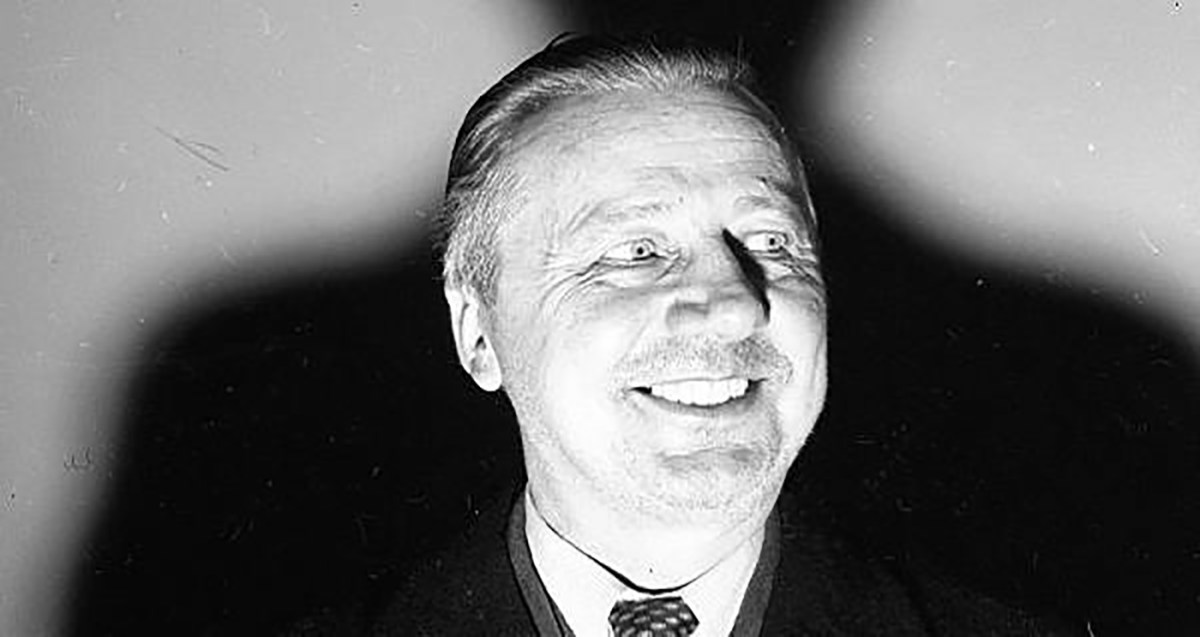
A smiling George Metesky, the “Mad Bomber,” in 1957 in Waterbury, Connecticut.

The grand jury deliberated over 47 counts as Metesky himself was evaluated, for competence. He was diagnosed as paranoid schizophrenic, later judged incompetent to stand trial and remanded to the custody of the Matteawan Asylum for the Criminally Insane.

The Mad bomber was declared harmless in 1973 and, having served 2/3rds of his sentence, was released to live out the rest of his life, in Connecticut. He died in 1994, at the age of 90.

Dr. Brussel became a much-sought after speaker and went on to write a book. Today the man’s work is considered seminal to modern techniques of criminal profiling. Brussel went to visit Metesky once in Matteawan and found the man calm, smiling and condescending. He explained that he never did want to kill anyone. Only to cause injury.

January 21, 1865 More than a Uniform

Those left behind perform a quiet kind service to the rest of us, a service shared by the whole family without so much as outside recognition.

When Civil War broke out in April 1861, President Abraham Lincoln put out a call for 75,000 90-day troops, to put down the rebellion. Kentucky refused. Governor Beriah Magoffin responded that Kentucky would send no soldiers “for the wicked purpose of subduing her sister southern states.” In a letter written that September, President Lincoln described the importance of his home state to the war effort. “I think to lose Kentucky is nearly the same as to lose the whole game…Kentucky gone, we cannot hold Missouri, nor, as I think, Maryland. These all against us and the job on our hands is too large for us…..” The place was equally important on the Confederate side. Had Kentucky seceded, rebel troops would be positioned to strike at will toward Ohio, Indiana or Illinois.

That October, commander of Union forces in Kentucky William Tecumseh Sherman told Secretary of War Simon Cameron he needed 60,000 men to defend the territory, and 200,000 to go on the offensive. Outraged, Cameron called Sherman’s request “insane” and removed the general, from command. One Ohio newspaper opined that Sherman had lost his mind.

Humiliated, Sherman wrote to his brother, “I do think I should have committed suicide were it not for my children...”

General Ulysses Grant saw not insanity in general Sherman, but cold competence. In 1862, Grant reassigned Sherman to Paducah, Kentucky.

Later in the war, Sherman defended Grant about a (possibly unfair) accusation of being drunk on duty. “General Grant is a great general”. Sherman began. “He stood by me when I was crazy, and I stood by him when he was drunk; and now, sir, we stand by each other always.”

The story may be found in any number of books. Books about war, about soldiers, but what of the man, inside the uniform. The man called to leave his family, to do a job. And what of the family left behind and the bonds of affection forced to stretch across a nation, or an ocean. That book with so much to say about combat, has less to say about the man behind the soldier, that man’s place in the family unit and even less about the loved ones, left behind.

I’ve seen the story played out by my mother, two sisters-in-law and a daughter. The soldier, usually a “he”, leaves home in service to his country. Those left behind do their best to carry on without the help of a partner, all the while keeping their worst fears locked away in a dark closet of imagination. Those left behind perform a quiet kind of service to the rest of us, a service shared by the whole family without so much as outside recognition.

The long siege of Vicksburg was over in 1863 following the Union victory of July 4. The city of Vicksburg wouldn’t celebrate another Independence Day, for 80 years.

Making camp on the Big Black River near Bovina Mississippi, Sherman made headquarters in the home of Reverend James Fox. Thinking it would be a good time to reunite with his family, Sherman sent for his wife, Ellen and the couple’s four children: Minnie [12], Lizzie [11], Willy [9] and Tom [7].

Sherman himself had become fatherless at 9 and adopted by one Thomas Ewing of Lancaster, Ohio.

“I have a healthy camp,” Sherman wrote to Ewing, father of Sherman’s former step-sister and now-wife Eleanor “Ellen” Ewing Sherman. “I have no fear of yellow or other fevers.”

What an adventure it was for the children, especially Willy. Living in tents and hanging around with Union soldiers.

The 13th Infantry made him an honorary sergeant, teaching the boy the manual of arms and including him in guard details, drills and parades. The boy would accompany his father on inspection tours of the Army. What a lark. The experience of a lifetime.

Sherman’s confidence about yellow fever was based on that which was known, in 1863. Thirty years later, science would understand the illness to be mosquito-borne and not spread by human contact.

The family boarded the steamboat Atlantic that September, to begin the trek back home to Ohio. Willy didn’t look well. The boy was uncharacteristically quiet, his cheeks flushed. Surgeon E. O. F. Roler was summoned to examine him and came back with a dreadful diagnosis. Yellow fever.

The prognosis was grim. Fewer than 1,000 soldiers died in battle during the 8-month war Spanish American war in Cuba, in 1898. More than 5,000 died of disease, most of those from yellow fever.

Willy’s condition worsened. Arriving in Memphis, the boy was taken to the Hotel Gayoso, that October. Fading in and out of consciousness, he was given last rites on October 3. Willy told the priest he was willing to die if it was God’s will, but he didn’t want to leave his parents. With tears streaming down the cheeks of his mother and father, Willy reached and out, and touched their faces. And then he was gone.

Shattered, Ellen and her remaining children boarded a steamer to Ohio, three days later. The General went back to Mississippi. He had a war to fight.

On October 6, Sherman wrote to Ellen, from Gayoso: “I have got up early this morning to steal a short period in which to write you, but I can hardly trust myself. Sleeping, waking, every-where I see poor little Willy. … I will always deplore my want of judgement in taking my family to so fatal a climate at so critical a period of the year….To it must be traced the loss of that child on whose future I had based all the ambition I ever had.

This from a man who had written only two year earlier, “I do think I should have committed suicide were it not for my children”.

Ellen, a devout and practicing Catholic, fell back on her faith. General Sherman fell into depression, despair, and self-reproach.

So great was the General’s grief that he never forgave himself, for bringing his family to that place.

A year before his death in 1891, Sherman left detailed instructions about his last rest in that St. Louis cemetery, “alongside my faithful wife and idolized soldier boy.”

The grief, the self-reproach, it all but crushed him. Sherman wrote to Admiral David Porter:  “I lost recently my little boy by sickness incurred during his visit to my camp on Big Black. He was my pride and hope of life, and his loss has taken from me the great incentive to excel, and now I must work on purely and exclusively for love of country and professional pride.”

Some historians blame the savagery of Sherman’s attack on Meridian Mississippi, the cruelty of his assault on Atlanta and the “March to the Sea” on a form of madness, brought on by the loss of his precious boy.

In the Summer of 1864, three Union armies of the newly appointed division of the Mississippi under William Tecumseh Sherman were advancing, on Atlanta. Meanwhile back home in Lancaster, Ellen was about to give birth to another child. A baby boy, named Charley.

Let the couple’s letters tell the story and imagine if you will your own troubles, set against the backdrop of civil war.

Big Shanty, GA June 12, 1864: Dearest Ellen, I have received Phil’s dispatch announcing the birth to us, of another son. I’m glad you’re over the terrible labor, and hope it’s the last you will have to endure. Of course, I’m pleased to know the sex of the child, as he must succeed to the place left vacant, by Willy. Though I fear we will never be able to lavish on anyone, the love we bore for him. I am ever yours, W.T. Sherman

Lancaster Ohio, July 7, 1864: Dearest Cump, For the first time since I went to bed the night of the 10th of June I am able to sit up, and hold my pen.  I’d been sick all that day. About 1 o’clock I sent for the doctor.  At 20 minutes past two the baby was born with a cry, loud enough to disturb the neighborhood.  Like Tommy he was born with a caul over his face which the doctor had to remove, before his cry came forth.  I must thank God I am spared to my children, and not murmur at the trials he sends me.  As ever, Ellen

Headquarters, Military division of Mississippi, In the field near Chattahoochee, July 9, 1864:  Dearest Ellen, it is now two months since I left Chattanooga, and I think during all this time I have but one letter from you.  I fear you have been more ill than I supposed.  The enemy and the Chattahoochee lie between us, and intense heat prevails, but I think I shall succeed.  At all events you know, I never turn back.  Give my love to your father and all the young folks.  Yours ever, WT Sherman

Lancaster Ohio July 16, 1864: Dearest Cump, I have been ill indeed, in great danger of death, and left weak.  Charley thrives, grows and fattens, and is very strong and healthy.  The children dote on him, particularly Tommy and Lizzie.  Tommy asked me how long babies wore long dresses and when I told him six or eight months he begged me to put pantaloons on Charlie then.  He walks with him in his arms and watches him and plays with him and sings 20 times a day.  He is so glad the baby is not a girl.  I  have not told you how very strongly he resembles you in form, face and shape of head.  The likeness is  striking and I am delighted to see it.  All are well, and send love to dear Papa. Ever your affectionate, Ellen

Lancaster Ohio September 17, 1864: Saturday morning:  Dearest Cump, the baby has a very bad cold, settled on his lungs.  May Willy’s pure spirit be your guide to his happy home in heaven is the hourly prayer of your truly affectionate, Ellen

Cincinnati Ohio September 22, 1864: it seems as if I were never to have another letter from you, dearest Cump

Cincinnati Ohio September 25, 1864: Sunday evening:  Dearest Cump, the baby has a very bad cough and I feel so uneasy.

Lancaster Ohio, November 8, 1864: Dearest Cump, Dear Willy’s picture has just been brought, and now stands framed in my room. We need this to keep him fresh in the minds and the hearts of all the children for all must love and know and talk of their holy brother, until by God‘s grace we join him in his heavenly home. The baby has such a severe cold, which has taken such a firm hold on his lungs that I greatly fear, he will never get over it, and that it will end in consumption. Ever your truly affectionate, Ellen.

Obituary, Charles Celestine Sherman, New York Times, December 25, Christmas Day, 1864: Died at South Bend Indiana on Sunday, December 4, 1864, of pneumonia. Charles Celestine, infant son of Major General WT and Ellen E. Sherman, aged 5 months and 23 days

South Bend Indiana, December  29, 1864: Dearest Cump, long before this, you have seen in the papers the notice, of the dear baby’s death.  God grant that his prayers and Willy’s may ensure my perseverance and obtain for you the gift of faith.  Ellen E. Sherman

Military Division Mississippi in the field, January 5, 1865: Dearest Ellen I have written several times to you and the children. yesterday I got your letter of December 23 and realized the deep pain and anguish through which you have passed, and the pain and sickness of the little baby I never saw.  All spoke of him as so bright and fair that I had hoped he would be spared to us, to fill the great void in our hearts left by Willy. But it is otherwise decreed, and we must submit.  I have seen death in such quantity and in such forms that it no longer startles me.  But with you, it is different.  Yours, WT Sherman 

Two weeks after that last letter from Ellen, General Sherman was in Savannah, preparing to march north into South Carolina. It began to rain on January 17, the heaviest rainfall in 20 years. January 21 came and went with no respite. Not until the end of the month did the rain cease to fall. The misery of that camp in Savannah and of General Sherman’s mental state, can only be guessed at.

The coming assault on the seat of secession would be worse than Sherman’s march to the sea.

Margie Bearss, wife of Vicksburg Military Park historian Edwin Bearss is herself an accomplished historian, a fellow of the National Military Collectors and Historians association, author of Sherman’s Forgotten Campaign in Meridien Mississippi and known for her work in support of the Grand Gulf Military Park in Mississippi, and the USS Cairo, now in the Vicksburg military Park. Bearss once mused, “Did perhaps the death of Willy start a chain reaction of fires and desolation in Mississippi that the winds of more than a century have not entirely hidden? Did Sherman hold Mississippi ‘that sickly region’ responsible for his death? Who knows. Yet, we do know that between the end of the Vicksburg Campaign and the beginning of the Meridian Expedition, only a few months’ time, his concept of warfare changed and he began his own version of the ‘total war’ for which he became well-known.

January 20, 1940 The real Thing Goes to War

On January 20, 1940, Winston Churchill urged neutral nations to oppose the Nazi war machine, warning that “Each one hopes that if he feeds the crocodile enough, the crocodile will eat him last.” Meanwhile in Germany, Coca Cola was the undisputed king of the domestic soft drink market.

In 1865, Confederate Cavalry officer John Stith Pemberton was wounded by a saber slash. Like many, Pemberton became addicted to the morphine given him to help ease the pain. Unlike most, Doctor Pemberton possessed the wherewithal to do something about it.

In civil life, Pemberton was a chemist.  After the war, the former cavalry officer experimented with non-opiate pain killers, landing on a combination of the coca leaf and kola nut.  By 1886 he was bottling his concoction and selling it for 5¢ a bottle out of an Atlanta pharmacy.  Ten years later, Coca-Cola was available in every American state and territory.

Cocaine_CocaCola2

Europeans had long believed that natural mineral waters held medicinal qualities, and favored such beverages over often-polluted common drinking water.  

In 1919, France welcomed the Coca Cola company with the first bottling plants in Paris and Bordeaux. The company aggressively expanded into the European market over the next decade with bottling plants in Spain, Belgium and the Netherlands. By the time of the “Anschluss”, Hitler’s annexation of Austria in 1938, Coca-Cola had been in Germany for ten years.

Around the time that Hitler and the Nazi party were coming to power in 1933, German-born Max Keith (pronounced “Kite”) took over Coca-Cola’s German subsidiary, Coca-Cola Deutschland, GmbH.  Mark Pendergrast, author of For God, Country, and Coca-Cola, writes that Keith “valued his allegiance to the drink and to the company more than his allegiance to his own country”.  He had no qualms about doing business with every aspect of German society, including Nazi party members.

Ein Getrank

Bizarre though it may sound to the modern ear, a number of famous Americans and companies were involved with the European fascist regimes of the 1930s, including William Randolph Hearst, Joseph Kennedy (JFK’s father), Charles Lindbergh, John Rockefeller, Andrew Mellon (banker, head of Alcoa and Secretary of the Treasury), DuPont, General Motors, Standard Oil (now Exxon), Ford, ITT, Allen Dulles (later head of the CIA), Prescott Bush, National City Bank, General Electric and many Hollywood celebrities.

In Atlanta, Coca-Cola President Robert Woodruff was no exception.  Woodruff himself attended the 1936 Berlin Olympics, alongside banners depicting the company logo, with the slogan  “Ein Volk, ein Reich, ein Getrank – A People, an Empire, a Drink”.

Coca-Cola-Advertisements-in-Nazi-Germany-in-the-1930s-8

Woodruff used a 10th anniversary party for Coca-Cola GmbH to organize a mass Nazi salute in honor of Hitler’s 50th birthday, declaring that it was “to commemorate our deepest admiration for our Fuhrer.”

On January 20, 1940, Winston Churchill urged neutral nations to oppose the Nazi war machine, warning that “Each one hopes that if he feeds the crocodile enough, the crocodile will eat him last.”  Meanwhile in Germany, Coca Cola was the undisputed king of the domestic soft drink market.

Memorial-Day-2010-From-Time-Mag-1942-OUT-12

That all changed a year later with the Japanese attack on Pearl Harbor, and the German declaration of war on the United States.

American entry into World War 2 meant that American companies ceased business with axis powers, while the German government threatened to seize “enemy owned” businesses.  Max Keith was cut off from all communications with Coca-Cola headquarters in Atlanta, and in danger of the Nazi party nationalizing his beloved company.  As shipments of Coca-Cola’s mythical “7X’ syrup, dried up, Keith had to come up with a substitute for the domestic soft drink market.  Mach Schnell.

Soldiers Gulp Down Coca Cola
Coca-Cola worked with the U.S. government to ensure troops, including these men in Italy, had access to Coke throughout WW2. Bettmann/Getty Images

With wartime rationing already in effect, Keith and his chemists worked with what was available.  Leftovers from other food industries; apple fibers, fruit peelings, beet sugar  and whey, the liquid left over when milk was curdled and strained off to make cheese.

The result was “Fantasievoll”, “Fantastiche” according to Keith. Imaginative. Fantastic.  So it is that the soft drink “Fanta”, was borne of the wartime necessities of Nazi Germany.

Coca-Cola GmbH had concocted a sweet, slightly cheesy tasting soft drink, and the German market responded. Sales rose steadily throughout the war, particularly as alternatives became increasingly scarce. People didn’t just drink the stuff, either. With sweeteners of all kinds strictly rationed, Fanta made its way into baked goods, soups and a variety of foodstuffs. By 1943, Fanta sales reached almost three million cases.

Tristan Donovan, author of the book Fizz: How Soda Shook Up the World, writes “It was Fanta or nothing”. Pendergrast writes that there’s little doubt that Keith did business with Nazis, but he was more company guy than ideologue. “You could not do business inside of Nazi Germany unless you collaborated with them,” wrote Pendergrast. “There’s no question he was a Nazi collaborator. [But] he was not a member of the Nazi party. His allegiance was to Coca-Cola, not to Hitler.”

When American troops liberated Germany in the summer of 1945, legend has it they found Keith in a half-bombed out factory, still bottling the stuff.

Fun fact: Hitler and his henchmen didn’t call themselves “Nazis”, in fact the term was frowned upon. They were the “NSDAP”, the Nazionale Socialistiche Deutsche Arbaits Partai, (National Socialist German Workers Party), the original abbreviation forwhich, was “Nasos”. The word “Nazi” derives from a Bavarian term meaning “simple minded” and was first used as a term of derision by journalist Konrad Heiden. The term was adopted by Anti-NSDAP’ers and Allied troops after war broke out, and the name stuck.

Despite being on the losing side, Keith was hailed as a hero back in Atlanta. The man who kept the company alive, in Germany. Vice President of Sales Harrison Jones called Keith a “great man”.  He was given control of Coca-Cola, in all of Europe.

coca-cola_ad_third_reich_1935

In April 1955, Coca-Cola reintroduced Fanta as an orange drink. Starting in Italy, the product made its way to the United States, in 1958. The name stuck, and why not. The company already owned the copyright.

In 2012, Fanta saw the strongest sales growth of the top 10 brands, the third Coke branded product to surpass 2 billion in case sales. Today, more than 100 flavors of Fanta are sold around the world. Customers from Latin America to Africa, Europe, Brazil and China can all say,  “Es ist die Reale Sache”.  It’s the Real Thing.

January 19, 1810 Cold Friday

“Tales of the killer weather event made their way into town histories, journals and court records long after it happened on January 19.. They told of the many people who froze to death while traveling along the highways. The wind blew down houses, barns and vast numbers of timber trees. Ships wrecked, cattle froze in their barns and old people died of hypothermia inside their homes. It was so cold pens wouldn’t write though they were right next to the fireplace”. – H/T New England Historical Society

I suspect it’s happened to all of us, particularly in the colder latitudes. You dress for the weather, (or think you do), later to find you got it wrong. Off you go to the office, to the store, and before you know it, it’s soaking wet. Or freezing cold. We’ve all been there, but what of an age before you had that nice warm car, to jump into?

In January 1810, several New England journalists recorded a temperature that dropped 100 degrees in 24 hours, from 67° Fahrenheit on Thursday the 18th, to -33° on Friday.

According to NASA, the average winter temperature at the North Pole, is -40°.

That was only the half of it. The weather forecasters of the day didn’t record wind chill but the howling gale that brought that cold with it, was a killer.

Henry David Thoreau’s mother remembered dishes frozen, as soon as they were washed. Reverend William Bentley wrote that people died, without going outside.

On the mild afternoon of January 18, 50-year-old Revolutionary War veteran Joseph Brooks of Woburn Massachusetts and his 45-year old cousin Benjamin, went into the forest to cut wood. The two were found frozen to death on Saturday.

HistoricIpswich.org writes of “people who froze to death while traveling along the highways. Houses, barns and vast numbers of timber trees were blown down or broken to pieces. Ships were wrecked, cattle froze in their barns and old people died of hypothermia in their homes. It was so cold pens wouldn’t write though they were right next to the fireplace“.

In Sanbornton New Hampshire, the wind tore the home of Jeremiah Ellsworth, to pieces. Ellsworth struggled into the maelstrom to the home of David Brown, seeking help. The howling wind literally tore the clothes off the backs of Ellsworth’s older children as Mrs. Ellsworth struggled to carry the baby, into the basement. Ellsworth made it to the neighbor’s house but, with his feet frozen, the man was unable to go on. Brown hooked up a horse and sleigh and drove back to the Ellsworth home. That’s when things went Seriously wrong. The sleigh was blown over not once, but twice. The second time it was torn apart, its contents, scattered. David Brown labored to carry the Ellsworth children the rest of the way. Mrs. Ellsworth was reduced to crawling. By the time she arrived at the Brown home she was unrecognizable. None of the three children survived.

On a happier note, Rebecca Ramsdell was a schoolgirl, in Henniker New Hampshire. James Bartlett was the teacher in those days, and made it a habit to award little medals, to children with exceptional attendance. Rebecca braved the cold that morning and walked a mile, to school. Bartlett gave her a medal, and she never forgot it. You can find a picture of Ms. Ramsdell at the Henniker Historical Society. She’s 100+ in that photo and she still had Mr. Bartlett’s medal.

H/T Henniker Historical Society

Locals spoke of the Cold Friday of 1810, for generations. Twenty years later, a New Hampshire court proceeding required a date. The answer wasn’t hard to remember. It had happened on Cold Friday.