

In 1913, there were about 15,000 men working in the copper mines of Michigan’s Upper Peninsula (UP). The Western Federation of Miners (WFM) had been actively organizing the area since 1908, by 1913 they claimed 9,000 members.
At this time, the Calumet and Hecla Mining Company (“C&H”) was the largest copper mining company in the UP. In July, union members demanded that C&H recognize the WFM as their collective bargaining agent. The company refused to recognize the union, and a strike was called on July 23, 1913.
Five months later, the two sides were still at an impasse. Striking miners and their 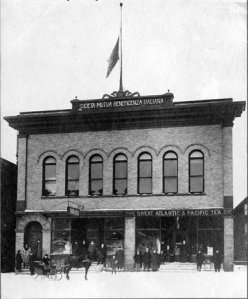 families gathered on Christmas Eve at the “Societa Mutua Beneficenza Italiana”, the Italian Hall in Calumet, Michigan, for a Christmas party sponsored by the Ladies Auxiliary of the WFM.
The party was held in the second floor of the hall, accessible only by a steep stairway, a poorly marked fire escape, and a few ladders propped up against the back of the building. There were over four hundred people in the room when someone yelled “Fire!” There was no fire, but panicked people rushed for the door. 59 children were crushed or trampled to death in the stampede, along with 14 adults.
In the wake of the catastrophe at Italian Hall, President of the Western Federation of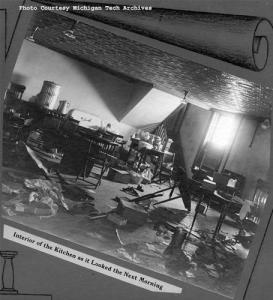 Miners Charles Moyer publicly accused members of the pro management “Citizens Alliance” of responsibility for the disaster. He was subsequently assaulted by members of the Alliance, who shot and kidnapped him, placing him on a train with instructions to leave Michigan and never return. Moyer would later receive medical attention in Chicago, holding a press conference where he displayed his gunshot wound before returning to Michigan and resuming his work with the WFM.
A coroner’s inquest failed to determine who shouted “Fire!” and why, though 8 people testified in a 1914 Congressional investigation, that the man who first raised the cry of “fire” was wearing a Citizens’ Alliance button on his coat, indicating that he was an ally of mine owners.
The first unionized strike in Michigan’s UP had been called in pursuit of shorter work days, higher wages, union recognition, and to maintain family mining groups. Though unsuccessful, ending after nine months with the union being effectively driven out of the Keweenaw Peninsula, it would be a turning point in the history Michigan’s copper country.
Woody Guthrie wrote and performed a song in 1941, called the “1913 Massacre”. (www.youtube.com/watch?v=oz7oguguIZE) In it, Guthrie repeated the claim that the doors were held shut from the outside by management hired thugs. Others have blamed inward opening front doors, which became stuck shut in the crush of bodies, though photographs seem to suggest two sets of doors which open outward.
In 1856, a false cry of “fire” created a stampede at the Royal Surrey Gardens Music Hall of London, killing seven. Similar disasters followed in Harlem in 1884, and the Shiloh Baptist Church disaster of 1902, when more than 100 people died when “fight” was misunderstood as “fire” in a crowded church.
Today, (falsely) “Shouting fire in a crowded theater” is a commonly understood limitation on the  1st amendment right to free speech. It’s a paraphrasing of Justice Oliver Wendell Holmes, Jr.’s opinion in the 1919 SCOTUS decision, Schenck v. United States, a case which turned, in part, on the Italian Hall disaster of seven years earlier.
Italian Hall was demolished in October 1984, leaving only the archway to the front steps, behind which a state historic marker describes the events that took place there on December 24, 1913. Responsibility for the stampede and the 73 deaths resulting from it, has never been determined.


 Poor mountain weather forced an overnight stop. They resumed flight on Friday the 13th, making their way through a mountain pass that afternoon. The pilot notified air controllers that he was over Curicó, Chile, but it was a fatal error. With zero visibility, he was forced to rely on dead reckoning, but strong headwinds had slowed them significantly. Cleared to descend 55 miles east of where he thought he was, the plane clipped two peaks at 13,800′, first losing a wing, then the vertical stabilizer, and finally the other wing. The battered fuselage crashed down on an unnamed peak, later called “Glaciar de las Lágrimas”, “Glacier of Tears”.
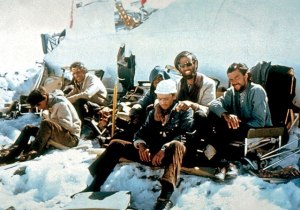 Stranded and alone in the high Andes, meager supplies soon gave out. A few chocolate bars, assorted snacks and several bottles of wine. It was gone within days, as the survivors scoured the wreckage for crumbs. They ate leather from suitcases, tore apart seats hoping to find straw, finding nothing but inedible foam. Nothing grew at this altitude. There were no animals. There was nothing in that desolate place but metal, glass, ice and rock, and the frozen bodies of the dead.
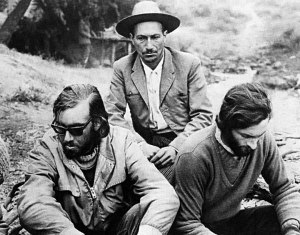 The Juan Valdez of the coffee commercials is an “arriero”, a person who transports goods using pack animals. Parrado and Canessa had hiked for almost two weeks when they were building a fire by a river, and they spotted such a man on the other side. Sergio Catalán probably didn’t believe his eyes at first, but he shouted across the river. “Tomorrow”.
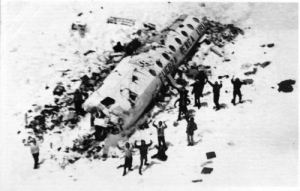 site heard the news on their transistor on December 22, that they were saved. The first helicopters arrived that afternoon, flying out with the weakest of the survivors. Altitude sickness, dehydration, frostbite, broken bones, scurvy and malnutrition. They were one decrepit bunch, but they were alive. The second expedition arrived on the morning of December 23, removing the last survivors around daybreak.


 For two days, a desperate defense of the nearby villages of Noville and Foy held back the 2nd Panzerdivision, as 11,000 men and 800 officers of the 101st joined a combined force of 11,000 converging on Bastogne. By the 21st, Bastogne’s field hospital was overrun, they were surrounded by forces outnumbering them 2½ to one. Poorly supplied for the cold winter conditions with air supply made all but impossible by weather conditions, the citizens of Bastogne gave their blankets to the American soldiers, along with white linens which they used for camouflage.
 later, ending the German encirclement.
 entire siege tending to the wounded, along with Dr. Jack Prior. Once, she even ran through enemy fire to collect the wounded from the field. On Christmas eve, she was blown off her feet and through a wall. She got up and went back to it, despite the direct hit that killed 30 American wounded, along with the only other nurse at the Rue Neufchatel aid station, Renée Lemaire.
  Bastogne. Chiwy married after the war, and rarely talked about her experience in Bastogne. It took King a full 18 months to coax the story out of her. The result was the 2015 Emmy award winning historical documentary, “Searching for Augusta, The Forgotten Angel of Bastogne”.

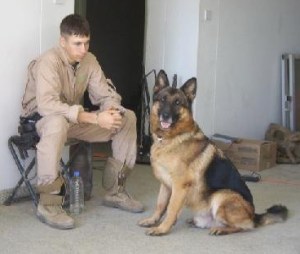 States Marine Corps in 2006. The dog’s second deployment began in November, when he was paired with Marine Corporal Dustin J. Lee, stationed in the military police department at Marine Corps Logistics Base (MCLB), “Albany”.
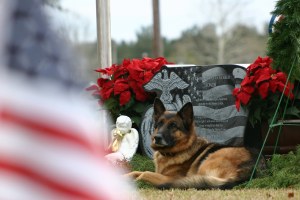 The most dreadful moment in the life of any parent, is when they receive word of the death of a child. It wasn’t long after Jerome and Rachel Lee were so notified, that they began efforts to adopt Lex. Dustin was gone, but they wanted to make his partner a permanent part of their family.
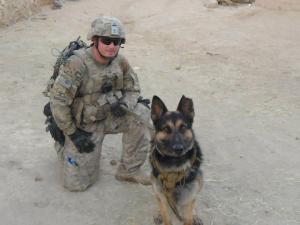 In telling this story, I wish in some small way to honor my son in law Nate and daughter Carolyn, who together experienced Nate’s deployment as a Tactical Explosives Detection Dog handler with the US Army 3rd Infantry Division in Soltan Kheyl, Wardak Province, Afghanistan. Months after departing “The Ghan” in 2013, the couple was reunited with Nate’s “Battle Buddy”, MWD Zino, who is now retired and lives with them in Savannah. “Here & Now”, broadcast out of ‘Boston’s NPR News Station’ WBUR, did a great story on the reunion. You can hear the radio broadcast
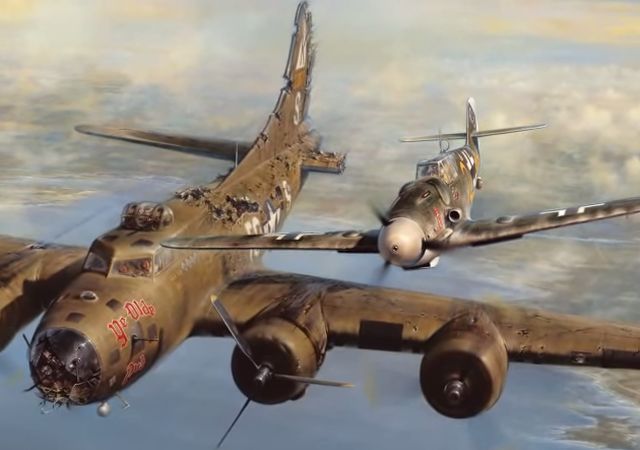
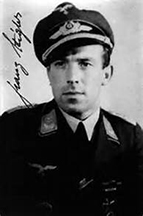 At the age of 26, Franz Stigler was an Ace. The Luftwaffe pilot of a Messerschmitt Bf-109 fighter, some of his kills had been revenge, payback for the death of his brother August earlier in the war. But this man was no Nazi. He was a German Patriot with 22 confirmed kills. On December 20, 1943, he needed one more for a Knight’s Cross. He tossed his cigarette aside and climbed into his fighter as the crippled American B17 bomber lumbered overhead. This was going to be an easy kill.
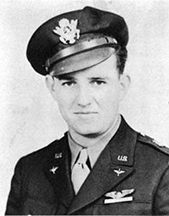 named “Ye Olde Pub”. The earlier attack on the munitions factory in Bremen had been a success, but the pilot and crew paid a heavy price for it. Their aircraft had been savaged by no fewer than 15 German fighters. Great parts of the air frame were torn away, one wing severely damaged and part of the tail torn away. The aircraft’s Plexiglas nose was shattered and the #2 engine seized. Six of the ten-man crew were wounded and the tail gunner dead, his blood frozen in icicles over silent machine guns. Brown himself had been knocked out at one point, coming around just in time to avert a fatal dive.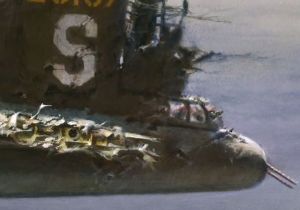
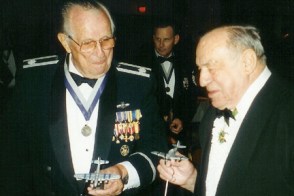 took out an ad in a fighter pilots’ newsletter. It said that he was searching for the man ‘who saved my life on Dec. 20, 1943.’ Stigler saw the ad, and the two met for the first time in 1987. “It was like meeting a family member”, Brown said at their first meeting, “like a brother you haven’t seen for 40 years”.
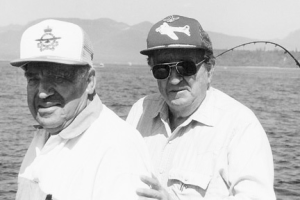 The two became close friends and occasional fishing buddies until their passing in 2008, six months apart. Stigler was age 92 and Brown 87. Their story is told in a book called “A Higher Call”, if you want to know more about it. In their obituaries, both were mentioned as the other man’s “special brother”.

 He left with a copy of “The Lowell Offering”, a literary magazine written by those same mill girls, which he later described as “four hundred good solid pages, which I have read from beginning to end.”

 No longer a maritime power, Hannibal set out in the spring of 218BC, crossing into hostile Gaul (France) and arriving at the Rhône River in September with 38,000 infantry, 8,000 cavalry, and 37 war elephants. His crossing of the Alps that winter is one of the great feats of military history, costing him almost half of his force before entering Italy in December.



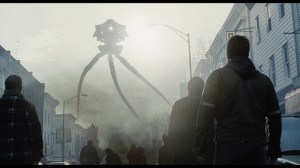 The British author H. G. Wells wrote The War of the Worlds in 1897, telling the story of an alien invasion of earth by Martians fleeing from the desiccation of their planet. The story was adapted to a radio drama broadcast on Halloween, 1938, so realistic that many listeners sued the network for “mental anguish” and “personal injury”.
 California at Berkeley is running a “distributed computing effort” to identify extraterrestrial life, called SETI@home. With an original objective of 50,000-100,000 home computers, SETI@home currently operates on over 5.2 million computers. With the introduction of the Berkeley Open Infrastructure for Network Computing, or “BOINC” (I didn’t make that up), SETI@home users can even compete with one another, to see who can process the maximum number of “work units”.
 The website explains their mission: “SETI@home is a scientific experiment that uses Internet-connected computers in the Search for Extraterrestrial Intelligence (SETI). You can participate by running a free program that downloads and analyzes radio telescope data”.

 the “Regulars” sent to enforce the will of the Crown. Two years later, Sons of Liberty looted and burned the HMS Gaspee in Narragansett Bay, RI.
 That night, somewhere between 30 and 130 Sons of Liberty, some dressed as Mohawk Indians, boarded the three ships in Boston Harbor. There they threw 342 chests of tea, 90,000 pounds in all, into Boston Harbor. £9,000 worth of tea was destroyed, worth about $1.5 million in today’s dollars.
 Boston by British troops. Minutemen clashed with “Lobster backs” a few months later, on April 19, 1775. No one alive today knows who fired the first shot at Lexington Green. History would record it as “The shot heard ’round the world”.



You must be logged in to post a comment.