August 18, 1587 Lost Colony of Roanoke

What happened to the lost colonists of Roanoke, remains a mystery. They may have died of disease or starvation, or they may have been killed by hostile natives.


The 16th century was drawing to a close when Queen Elizabeth set out to establish a permanent English settlement in the New World. The charter went to Walter Raleigh, who sent explorers Philip Amadas and Arthur Barlowe to scout out locations for a settlement.

The pair landed on Roanoke Island on July 4, 1584, establishing friendly relations with local natives, the Secotans and Croatans. They returned a year later with glowing reports of what we now call the Outer Banks of North Carolina. Two Native Croatans, Manteo and Wanchese, accompanied the pair back to England. All of London was abuzz with the wonders of the New World.

Sir Walter Raleigh (?)
Explorer Sir Walter Raleigh

Queen Elizabeth was so pleased she knighted Raleigh.  The new land was called “Virginia” in honor of the Virgin Queen.

Raleigh sent a party of 100 soldiers, miners and scientists to Roanoke Island, under the leadership of Captain Ralph Lane. The attempt was doomed from the start. They arrived too late in the season for planting, and Lane alienated the neighboring tribe when misunderstanding led to the murder of their chief, Wingina. By 1586 the new arrivals had had enough, and left the island.

Ironically, their supply ship arrived about a week later. Finding the island deserted, the vessel left 15 men behind to “hold the fort” before they too, departed.

The now knighted “Sir” Walter Raleigh was not to be deterred. He recruited 90 men, 17 women and 9 children for a more permanent “Cittie of Raleigh”, appointing John White governor. Among the colonists were White’s pregnant daughter, Eleanor, her husband Ananias Dare, and the Croatans Wanchese and Manteo.

Wanchese, Manteo
Wanchese, Manteo

The caravan stopped at Roanoke Island in July, 1587, to check on the 15 men left behind a year earlier.  Raleigh believed that the Chesapeake afforded better opportunities for his new settlement, but his Portuguese pilot Simon Fernandes had other ideas.

Fernandes was a Privateer, impatient to resume his hunt for Spanish shipping.  He ordered the colonists ashore on Roanoke Island. It could not have lifted the spirits of the small group to learn that the 15 left by the earlier expedition, had disappeared.

Eleanor Dare gave birth to a daughter on August 18, 1587, and called her Virginia.  She was the first English child born to the new world.

Fernandez departed for England ten days later, taking along an anxious John White, who wanted to return to England for supplies. It was the last time Governor White would see his family.

croatoan(2)White found himself trapped in England by the invasion of the Spanish Armada, and the Anglo-Spanish war.  It would be three years before he could return to Roanoke. He arrived on August 18, 1590, three years to the day from the birth of his granddaughter. White found the place deserted, save for the word “CROATOAN”, carved into a fence post.  The letters “CRO” appeared on a nearby tree.


croatoan(1)

White had hopes of finding his family at Croatoan, the home of Chief Manteo’s people to the south, on modern day Hatteras Island.

A hurricane came up before he could explore further, his ships so damaged that he had return to England. Despite several attempts he never raised the resources to return.

What happened to the lost colonists of Roanoke, remains a mystery. They may have died of disease or starvation, or they may have been killed by hostile natives.

Perhaps they went to live with Chief Manteo’s people, after all. One of the wilder legends has Virginia Dare, now a young woman, transformed into a snow white doe by the evil medicine man Chico, but that must be a story for another day.  The fate of the first English child born on American soil may never be known.

white-deer

Seventeen years later another group of colonists would apply the lessons learned in Roanoke, founding their own colony a few miles up the coast at a place called Jamestown.

One personal anecdote involves a conversation I had with a woman in High Point, North Carolina, a few years back. She described herself as having Croatan ancestry, her family going back many generations on the outer banks. She described her Great Grandmother, a full blooded Croatan. The woman looked like it, too, except for those crystal blue eyes. She used to smile at the idea of the lost colony of Roanoke. “They’re not lost”, she would say. “They are us”.

August 15, 1942 Too Young the Hero

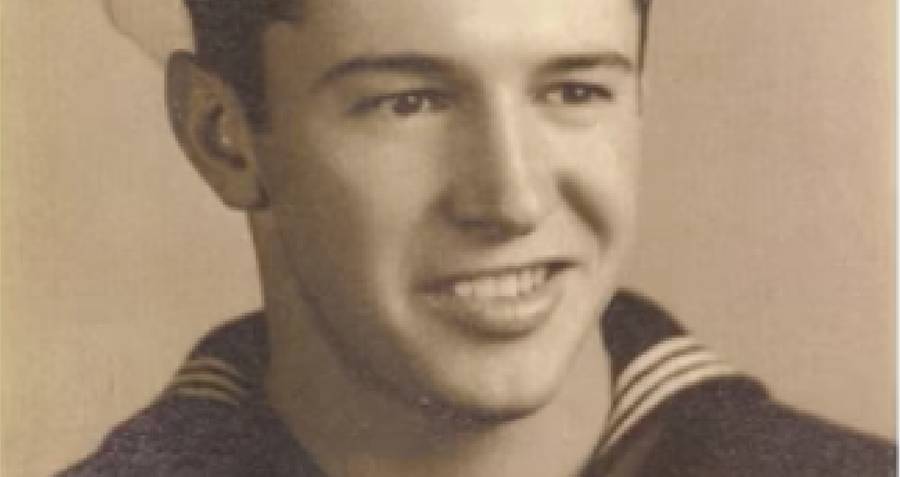
At the age of twelve, Calvin Leon Graham became the youngest man to serve in US military forces, in World War 2

Calvin Leon Graham was a child of the Great Depression, a poor East Texas farm kid born April 3, 1930, the youngest of seven.

By the time Japanese military planners were outlining the surprise attack on the American anchorage at Pearl Harbor, the boy’s mother was widowed and remarried. The man was by all accounts mean and abusive of his step-children. By sixth grade, Calvin had moved out along with an older brother, living in a cheap rooming house and supporting himself selling newspapers and delivering telegrams on weekends and after school.

The boys’ mother continued to visit, sometimes only to sign their report cards at the end of a semester.

CalvinLGraham

Being around newspapers allowed the boy to keep up on events overseas, “I didn’t like Hitler to start with“, he once told a reporter. By age eleven, some of Graham’s cousins had been killed in the war. The boy wanted to fight back.

He began to shave, believing that his facial hair would come in faster and thicker that way (it didn’t). He practiced, “talking deep”.

In those days, you could join up at 16 with your parents’ consent” he later said, “but they preferred 17“. Graham forged his mother’s signature and stole a notary stamp, telling his mother he was going to see some relatives for a while.

On this day in 1942, Calvin Leon Graham showed up at a Houston recruiting office, dressed in his older brother’s clothes. All five-foot-two inches of him, and 125 pounds. He was twelve years old.

Graham was less concerned with the recruiting officer spotting that forged signature, than he was with the dentist. With good reason. This was a man with a finely tuned BS detector. “When the dentist kept saying I was 12, I said I was 17“. At last, the boy played his trump card, informing the dentist that the last two boys were fourteen and fifteen, and he had already let them through. “Finally,” Graham recalled, “he said he didn’t have time to mess with me and he let me go“.

During the World War 2 era, it wasn’t unusual for boys to lie about their age in order to enlist. Ray Jackson joined the United States Marine Corps at 16, and founded a group for underage military veterans in 1991, “to assure all underage veterans that there will be no retribution from the government because of their fraudulent enlistment“. Smithsonian.com reports the organization lists over 1,200 active members.  Twenty-six of them are women.

The boy was sent to boot camp in San Diego and on to Pearl Harbor six weeks later, and assigned to the newly christened battleship USS South Dakota.

When South Dakota steamed out of Philadelphia and cleared the Panama Canal, “No ship more eager to fight ever entered the Pacific.” Under the command of Captain Thomas Leigh Gatch, the battleship was brimming with “green boys” –  cocky, inexperienced new recruits, full of fight and eager for payback against the Japanese empire.

August 15, 1942 Baby Vet

During the October battle for the Santa Cruz islands, South Dakota was credited with downing 26 Japanese aircraft, while taking a direct hit to the #1 gun turret.

Standing on the bridge, Captain Gatch watched as that 500-pounder came in, striking the main gun turret.  The impact threw the skipper off his feet and severed his jugular vein, permanently injuring ligaments in the man’s arms. Quick-thinking quartermasters saved the unconscious captain’s life. Sailors later asked him, why he hadn’t ducked. “I consider it beneath the dignity of a captain of an American battleship“, he said, “to flop for a Japanese bomb“.

Before the action was over, the South Dakota’s guns had fired 890 rounds of 5-inch, 4,000 rounds of 40mm, 3,000 rounds of 1.1-inch and 52,000 rounds of 20mm ammunition. One of those gunners was twelve-year-old Calvin Graham.

980x (1)
The USS South Dakota engages a Japanese torpedo bomber during the Battle of Santa Cruz October 26, 1942. Photo: US Navy

Over the November 14 night battle for Guadalcanal, USS South Dakota came under attack from three Japanese warships, receiving no fewer than forty-seven hits. With her radio communications out and radar demolished, the battleship lost track of the complicated tactical situation. Calvin Graham was manning his 40mm gun when shrapnel tore through his mouth and jaw, tearing out his front teeth. Another hit burned the boy severely and threw him off his feet, and down three stories of superstructure.

Despite his injuries, Graham did what he could to take care of his fellow sailors:

“I took belts off the dead and made tourniquets for the living and gave them cigarettes and encouraged them all night. It was a long night. It aged me… I didn’t do any complaining because half the ship was dead”.

USS South Dakota was so beat up during the confused night action, that the Japanese believed her to be sunk.  Eventually, she would limp back for repairs. Not wanting the enemy to know too much, she was stripped of her insignia.

USS South Dakota would complete her WW2 service as “Battleship X”, but that must be a story for another day.

800px-_Battleship_X__-_NARA_-_513922

Graham received a Bronze Star and a Purple Heart for his actions, but these distinctions were short-lived. His mother learned what the boy had been up to and informed the Navy of his real age. Graham was thrown in the brig for lying about his age and held for nearly three months, released only when his sister threatened to go to the media. He was stripped of his medals and dishonorably discharged from the military. At thirteen, Calvin Graham was a “Baby Vet”, no longer fitting in at school and rejected by the nation he had served.

If only our politicians could expect such stern justice.

Graham soon chose the life of an adult, marrying and fathering a child at the age of fourteen, and working as a welder.  He was divorced by seventeen and enlisted in the Marine Corps. A fall from a pier broke his back three years later, ending his military career for good and leaving him selling magazine subscriptions for a living.

517537543_c_o-300x267

For the rest of his life, Calvin Graham fought for a clean service record, and for restoration of medical benefits. President Jimmy Carter personally approved an honorable discharge in 1978. All Graham’s medals were reinstated, save for his Purple Heart. He was awarded $337 in back pay but denied medical benefits, save for the disability status conferred by the loss of his teeth, back in WW2.

Graham came to public notice in 1988 with the made-for-TV movie Too Young the Hero starring Rick Schroder, prompting government review of his case.  Graham earned $50,000 for rights to his story but half went to two agents and another 20% to the writer of a book, which was never published.  Graham and his wife received only $15,000 out of which an ever insensate government, took its share.

Calvin Graham, Medals
Calvin Leon Graham, Military Awards
1st Row: Bronze Star Medal with Combat “V”
2nd Row: Purple Heart Medal, Navy Unit Commendation with service star, American Campaign Medal
3rd Row: Asiatic-Pacific Campaign Medal with two service stars, World War II Victory Medal, National Defense Service Medal

President Ronald Reagan signed legislation granting Graham full disability benefits and increasing back pay to $4,917, and allowing $18,000 for medical expenses incurred during his military service. Lamentably, many old medical bills were permanently lost. Some of his doctors had died. Graham received only $2,100 reimbursement for past medical expenses.

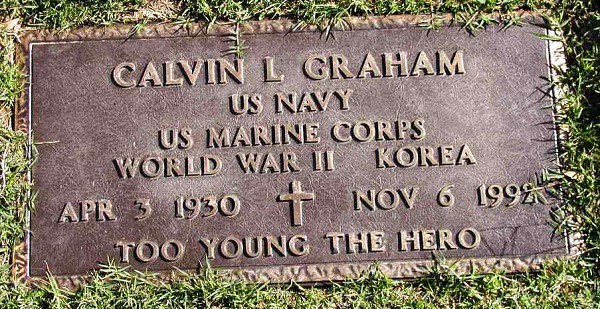
Calvin Leon Graham died at his home in Fort Worth Texas in 1992, a victim of heart failure.  He was buried at Laurel Land Memorial Park in Fort Worth, Texas.  Graham’s Purple Heart was reinstated two years later and awarded to his widow by Secretary of the Navy John Dalton. Fifty-two years after the actions resulting in its award.

Calvin-Leon-Graham-grave

August 13, 3114BC The End of the World

National Geographic explains that 12/21/12 brings to a close not the end of time, but the end of the 12th Bak’tun, an almost 400-year period in the Mayan Long Count calendar. The world doesn’t end according to this explanation, it just “rolls over” to the year zero and starts over. Like the old cars used to do, when the odometer reached 100,000 miles.

Les Prophéties was published in 1555, a collection of 942 poetic quatrains predicting events in the future. The author was Michel de Nostredame, the French astrologer, physician and seer of the future best remembered by the Latinized form of his name, Nostradamus.

The seer once prophesied the end of the world in typically cryptic form. Or at least the following is attributed to Nostradamus:

“From the calm morning, the end will come
When of the dancing horse
The number of circles will be 9.”

But, what does that even mean?

That’s where the fun starts.

An emperor of the Ming dynasty of 1368 – 1644 China once referred to the Korean peninsula as, the ‘Land of the Morning Calm’. By late 2012 one particular YouTube video was closing in on a billion views. Nine zeros. A video featuring the Korean rapper Park Jae-sang better known as Psy and his peculiar “horsey” style of dance.

That’s right. The world ended in Gangnam Style. Don’t yell at me folks. I don’t make this stuff up.

Gangnam Style’s official video hit a billion views on December 21, 2012. The Korean rapper has since become the “King of YouTube” with over 4 billion views but that world coming to an end part? Not so much.

Psy’s video was one of the sillier bits of pop culture from that year but it wasn’t the only time the world came to an end, in 2012. It wasn’t even the only time…that day.

The world also came to an end on 12/21/12, according to the Mayan calendar. Remember that? It was another piece of pop culture silliness, the end of the world part, but not the calendar. The calendar itself is a very sophisticated mathematical construct.

According to linguist, anthropologist and Mayanist scholar Floyd Glenn Lounsbury and his “Lounsbury Correlation”, the Mayan Calendar dates some 5,136 years back to August 13, 3114 BC.  It’s a little tough to nail down a particular day when you’re looking that far back but this one will do, as well as any.

The ancient Mayans were the first to recognize the concept of zero, and worked extensively in a base 20 number system. They were skilled mathematicians and it shows, in their calendar. 

Long count glyphs

The Mayans used three separate calendars, each period represented by its own glyph.

The Long Count was mainly used for historical purposes, able to specify any date within a 2,880,000 day cycle, about 7,885 solar years.

The Haab was a civil calendar consisting of 18 months of 20 days, and one 5-day Uayeb, a nameless period rounding out the 365-day year.

The Tzolkin was the “divine” calendar, used mainly for ceremonial and religious purposes.  Consisting of 20 periods of 13 days, the Tzolkin goes through a complete cycle every 260 days. The significance of this cycle is uncertain, though it may be connected with the 263-day orbit of Venus. There is no year in the Haab or Tzolkin calendars, though a Haab and Tzolkin date may be combined to specify one particular day within a 52-year cycle.

As for the end of the world part, National Geographic explains that 12/21/12 brings to a close not the end of time, but the end of the 12th Bak’tun, an almost 400-year period in the Mayan Long Count calendar.  The world doesn’t end, according to this explanation, it “rolls over” to the year zero and starts over. Just like the old cars used to do, when the odometer reached 100,000 miles.

It doesn’t really roll over to “zero”, either.  The base 20 numerical system means that 12/22/12 begins the next 400 year (actually 394.3 years) period to begin the 13th Bak’tun.  It will reset to zero at the end of the 20th Bak’tun, about 3,000 years from now.  Let me know how that turns out, would you?

MayanCalendar-300x300

The Mayan calendar system became extinct in most areas after the Spanish conquests of the 16th century, though it continues in use in many modern communities in highland Guatemala and in Veracruz, Oaxaca and Chiapas, Mexico.

The table of Long Count units below illustrates the Mayan units of measurement.  A day is a K’in, there are 20 K’ins in a Winal, and so on. 

December 21,2012 then, the day it all came to an end according to the Mayan calendar, was Long Count Date 13.0.0.0.0, 13 baktun, 0 katun, 0 tun, 0 uinal,
0 k’in, Tzolk’in Date: 4 Ajaw, Haab Date: 3 K’ank’in, Lord of the Night: G9. 

Table of Long Count units

Get it?  Neither do I.

August 12, 1865 The Shoulders of Giants

During the third century AD, the Greek physician Galen of Pergamon first described the “miasma” theory of illness, holding that infectious diseases such as cholera, chlamydia and the Black Death were caused by noxious clouds of “bad air”.  The theory is discredited today, but such ideas die hard.

In the 12th century, French philosopher Bernard of Chartres described the concept of “discovering truth by building on previous discoveries”. The idea is familiar to the reader of English as articulated by the mathematician and astronomer Isaac Newton, who observed that “If I have seen further it is by standing on the shoulders of Giants.”

gooddoc
Dr. Ignaz Semmelweis

Nowhere is there more truth to the old adage, than in the world of medicine. In 1841, the child who survived to celebrate a fifth birthday could look forward to a life of some 55 years. Today, a healthy five-year-old may expect to live fully half again that of his ancestor.

Still, there are times when the giants who brought us here are unknown to us, as if they had never been. One such is Dr. Ignaz Semmelweis, one of the earliest pioneers in the field of anti-septic medicine.

Semmelweis  studied law at the University of Vienna in the fall of 1837, but switched to medicine the following year. He received his MD in 1844 and, failing to gain a clinical appointment in internal medicine, decided to specialize in obstetrics.

During the third century AD, the Greek physician Galen of Pergamon first described the “miasma” theory of illness, holding that infectious diseases such as cholera, chlamydia and the Black Death were caused by noxious clouds of “bad air”.  The theory is discredited today, but such ideas die hard.

miasma-theory

The germ theory of disease was first proposed by Girolamo Fracastoro in 1546 and expanded by Marcus von Plenciz in 1762. Single-cell bacteria were known to exist in human dental plaque as early as 1683, yet their functions were imperfectly understood.

Today the idea that microorganisms such as fungi, viruses and other pathogens cause infectious disease is common knowledge, but such ideas were held in disdain among scientists and doctors, well into the 19th century.

InfectiousDisease16_9In the mid-19th century, birthing centers were set up all over Europe, for the care of poor and underprivileged mothers and their illegitimate infants. Care was provided free of charge, in exchange for which young mothers agreed to become training subjects for doctors and midwives.
In 1846, Semmelweis was appointed assistant to Professor Johann Klein in the First Obstetrical Clinic of the Vienna General Hospital, a position similar to the “chief resident,” of today.

300px-AAKH-1784

At the time, Vienna General Hospital ran two such clinics, the 1st a “teaching hospital” for undergraduate medical students, the 2nd for student midwives.
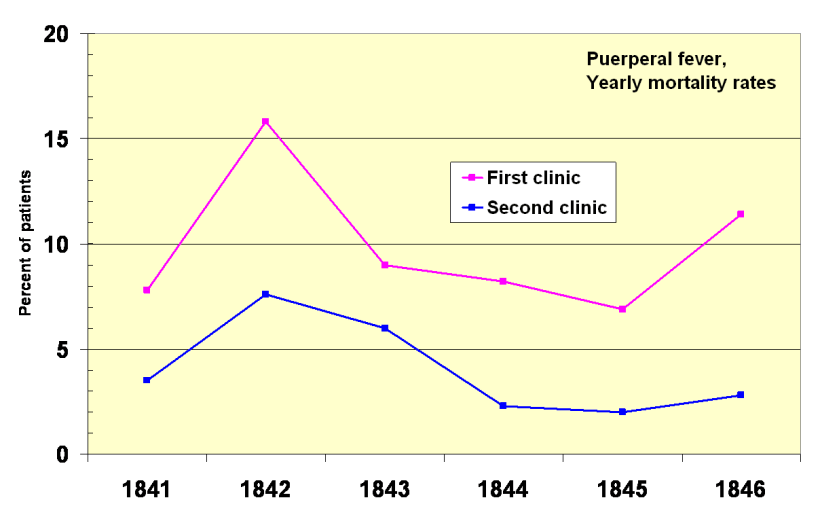
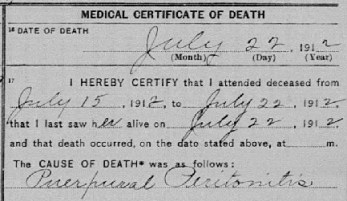
Semmelweis quickly noticed that one in ten women and sometimes one in five, were dying in the First Clinic of postpartum infection known as “childbed fever”, compared with less than 4% at the Second Clinic.

The difference was well known even outside of the hospital. Expectant mothers were admitted on alternate days into the First or Second Clinic. Desperate women begged on their knees not to be admitted into the First, some preferring even to give birth in the streets, over childbirth in that place. The disparity between the two clinics “made me so miserable”, Semmelweis said, “that life seemed worthless”. He had to know the reason why.

Puerperal Peritonitis 1912 MA

Childbed or “puerperal” fever was rare among these “street births”, and far more prevalent in the First Clinic, than the Second. Semmelweis carefully eliminated every difference between the two, even including religious practices. In the end, the only difference was the people who worked there.

The breakthrough came in 1847, following the death of Semmelweis’ friend and colleague, Dr. Jakob Kolletschka. Kolletschka was accidentally cut by a student’s scalpel, during a post-mortem examination. The doctor’s own autopsy showed a pathology very similar to those women, dying of childbed fever. Medical students were going from post-mortem examinations of the dead to obstetrical examinations of the living, without washing their hands.

Midwife students had no such contact with the dead. This was it. Some unknown “cadaverous material” had to be responsible for the difference.

Ignaz Philipp Semmelweis

Semmelweis instituted a mandatory handwashing policy, using a chlorinated lime solution between autopsies and live patient examinations.

Mortality rates in the First Clinic dropped by 90%, to rates comparable with the Second. In April 1847, First Clinic mortality rates were 18.3% – nearly one in five. Hand washing was instituted in mid-May, and June rates dropped to 2.2%.  July was 1.2%. For two months, the rate was zero.

The European medical establishment celebrated the doctor’s findings, and Semmelweis was feted as a giant of modern medicine.  No, just kidding.  He wasn’t.

The imbecility of the response to Semmelweis’ findings is hard to get your head around, and the doctor didn’t help himself.  The medical establishment took offense to the idea that they themselves were the cause of the mortality problem, and that the answer lay in simple cleanliness.

Semmelweis himself was anything but tactful, publicly berating those who disagreed with his hypothesis and gaining powerful enemies.   For many, the doctor’s ideas were extreme and offensive, ignored or rejected and even ridiculed.  Are we not Gentlemen!?  Semmelweis was fired from his hospital position and harassed by the Vienna medical establishment, finally forced to move to Budapest.

Yearly_mortality_rates_1841-1846_two_clinics

Dr. Semmelweis was outraged by the indifference of the medical community, and began to write open and increasingly angry letters to prominent European obstetricians.  He went so far as to denounce such people as “irresponsible murderers”, leading contemporaries and even his wife, to doubt his mental stability.

Dr. Ignaz Philipp Semmelweis was committed to an insane asylum on July 31, 1865, twenty-three years before Dr. Louis Pasteur opened the institute for the study of microbiology.

On August 12, 1865, British surgeon and scientist Dr. Joseph Lister performed the first anti-septic surgery, in medical history.  Dr. Semmelweis died the following day at the age of 47, the victim of a blood infection sustained following a severe beating by asylum guards.

August 9, 1945 Destroyer of Worlds

Shigeaki Mori was 8 when he became Hibakusha, or “explosion affected person”. As a man, Mori-san came to believe the families of Allied POWs killed in Hiroshima possessed a connection through the nuclear blasts, to their Japanese counterparts. Mori’s “Secret History of the American Soldiers Killed by the Atomic Bombs”, tells the story of those soldiers, one of whom was John A. Long, Jr. of Lawrence County, Pennsylvania.

Now I am become death, the destroyer of worlds“.

Trinity_Test_Fireball_16ms
Trinity Test Fireball

The line comes from the Bhagavad Gita, the Hindu epic Mohandas Gandhi described as his “spiritual dictionary”. On July 16, 1945, these were the words of J. Robert Oppenheimer, director of the Manhattan Project, on witnessing the world’s first successful nuclear test.

The project began with a letter from physicists Leo Szilard and Albert Einstein to President Franklin Roosevelt, warning that Nazi Germany may have been working to develop a secret “Super Weapon”.  The “Trinity” test culminated in the explosion of the “Gadget” in the Jornada del Muerto desert, equal to the explosive force of 20,000 tons of TNT.

Trinity_site_plaque

The Manhattan Project, the program to develop the Atomic Bomb, was so secret that even Vice President Harry Truman was unaware of its existence.

President Roosevelt passed away on April 14, Harry Truman immediately sworn in, as the new President. Ten days later he was fully briefed on the Manhattan project, writing in his diary that night that the US was perfecting an explosive “great enough to destroy the whole world”.

Nazi Germany surrendered on May 7, but the war in the Pacific theater, ground on. By August, Truman faced the most difficult decision ever faced by an American President. To deploy an atomic bomb.

The morality of President Truman’s decision has been argued ever since. In the end, it was decided that to drop the bomb would end the war faster with less loss of life on both sides, compared with the invasion of the Japanese home islands.

So it was that the second nuclear detonation in history took place on August 6 over the city of Hiroshima, Japan. “Little Boy” as the bomb was called, was delivered by the B29 Superfortress “Enola Gay”, named for the mother of United States Army Air Forces pilot Lieutenant Colonel Paul Tibbets. 70,000 Japanese citizens were vaporized in an instant.  Another 100,000 later died from injuries and the delayed effects of radiation.

FatMan
Fat Man

Even then the Japanese Government refused to surrender. ‘Fat Man’, a plutonium bomb carried by the B29 “Bockscar” was dropped on Nagasaki, on August 9.

Three cities originally considered for this second strike included Kokura, Kyoto and Niigata. Kyoto was withdrawn from consideration due to its religious significance. Niigata was taken out of consideration due to the distance involved.

Kokura was the primary target on this day in 1945, but local weather reduced visibility.  Bockscar crisscrossed the city for the next 50 minutes, but the bombardier was unable to see well enough to make the drop.  Japanese anti-aircraft fire became more intense with every run, while Second Lieutenant Jacob Beser reported activity on Japanese fighter direction radio bands.

In the end, 393rd Bombardment Squadron Commander Major Charles Sweeney bypassed the city and chose the secondary target, the major shipbuilding center and military port city of Nagasaki.

The 10,000-pound, 10-foot 8-inch weapon was released at 28,900-feet.  43 seconds later at an altitude of 1,650-feet, a circle of 64 detonators simultaneously exploded, compacting a plutonium ball and combining separate hearts of beryllium and polonium thus ejecting hordes of neutrons into the supercritical mass. Nuclei within countless fuel atoms were thus split in a cascading effect known as induced nuclear fission, exploding outward with the force of 20,000 tons of TNT.

In the early 1960s, the Nagasaki Prefectural Office put the death count resulting from this day, at 87,000.  70% of the city’s industrial zone was destroyed.

Japan surrendered unconditionally on the 14th of August, ending the most destructive war in history.

Nazi Germany was in fact working on a nuclear weapon, though the program never made it past the experimental stage. That one critical failure put the Third Reich behind in the arms race. How different would the world be today had Little Boy and Fat Man had swastikas, painted on their sides.

August 6, 2011 A Sports Story

In delivering tribute to his father Ed, Steve Sabol explained a philosophy applicable in business, as in life. “Tell me a fact,” he said, “and I’ll learn. Tell me a truth, and I’ll believe. But tell me a story and it will live in my heart, forever”. – Steve Sabol

Edwin Milton “Ed” Sabol came home from world war 2 and took a job selling topcoats. He was good at it and provided a decent living for his family, but his heart wasn’t in it.  What he liked more than anything, was to watch his son Steve play high school football.

Sabol would take a motion picture camera, a wedding gift, and film the games. He discovered he had a knack for it, and founded a small film production company called Blair Motion Pictures, named after his daughter, Blair.

Sabol successfully bid for the rights to film the 1962 NFL championship game between the Green Bay Packers and the New York Giants. The game was played in cold so severe that camera operators suffered frostbite, and a wind so strong that it blew the ball off the tee three times before opening kickoff.  Despite all of it, Sabol’s work on the game was impressive.

nflfilm

Commissioner Pete Rozelle proposed the NFL buy Sabol out the league’s 14 owners disagreed. Instead, each franchise gave him $20,000 in seed money to shoot all NFL games and produce a highlight film for each team.

NFL Films production style is unmistakable: the “tight to the spiral” shot of the ball leaving the quarterback’s hand, the on-the-field close-ups and slow motion shots, all of it “mic’d up” in a way you could hear every hit, every sound, as if you were personally on the field.

With the orchestral score and the stentorian tones of John Facenda’s narration, “the voice of God”: “They call it pro football. They play it under the autumn moon, in the heat of a Texas afternoon.”  NFL Films became “the greatest in-house P.R. machine in pro sports history” according to Salon.com television critic Matt Zoller Seitz. “An outfit that could make even a tedious stalemate seem as momentous as the battle for the Alamo.”

Sabols, 2004 Sports Emmys
Steve and Ed Sabol at the 2004 Sports Emmys

NFL Films won 112 Sports Emmys. While the company’s $50 million earnings are small relative to the $18 billion in revenue the NFL earns from television alone, the real value of NFL Films is how it promotes the sport. Many credit NFL Films as a key reason that the National Football League has become the most watched professional sports league in the United States.

Fun Fact: While team owners and the teams themselves pay taxes on income the NFL does not. With revenues of $12.2 Billion in 2020 (according to statista.com) the NFL has been a tax exempt non-profit, since 1942.

Ed Sabol was inducted into the Professional Football Hall of Fame on August 6, 2011. Steve was suffering inoperable brain cancer at that time, a condition destined to take his life the following year.   In a tribute to his father, Steve explained a philosophy applicable in business, as in life:

“Tell me a fact”, he said, “and I’ll learn. Tell me a truth, and I’ll believe. But tell me a story and it will live in my heart, forever”.

Sabol_Notes_Quotes

August 5, 1942 Born a Teacher

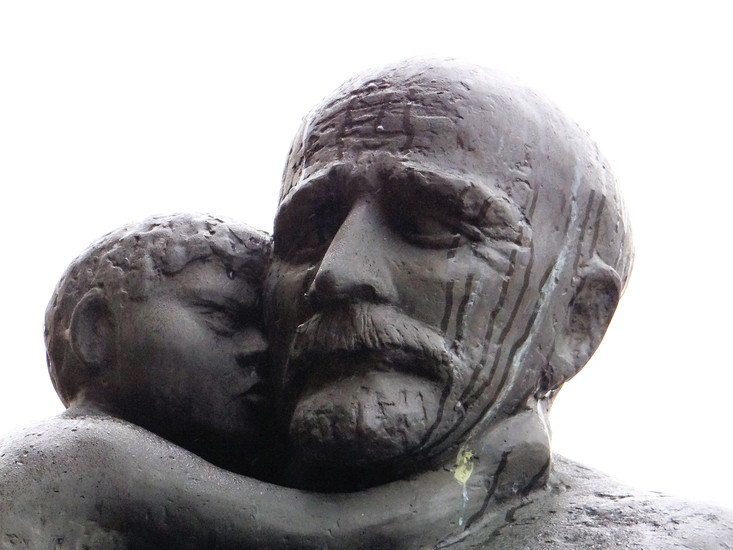
What can you say about a man offered freedom, who chose instead to die with the children left under his care.

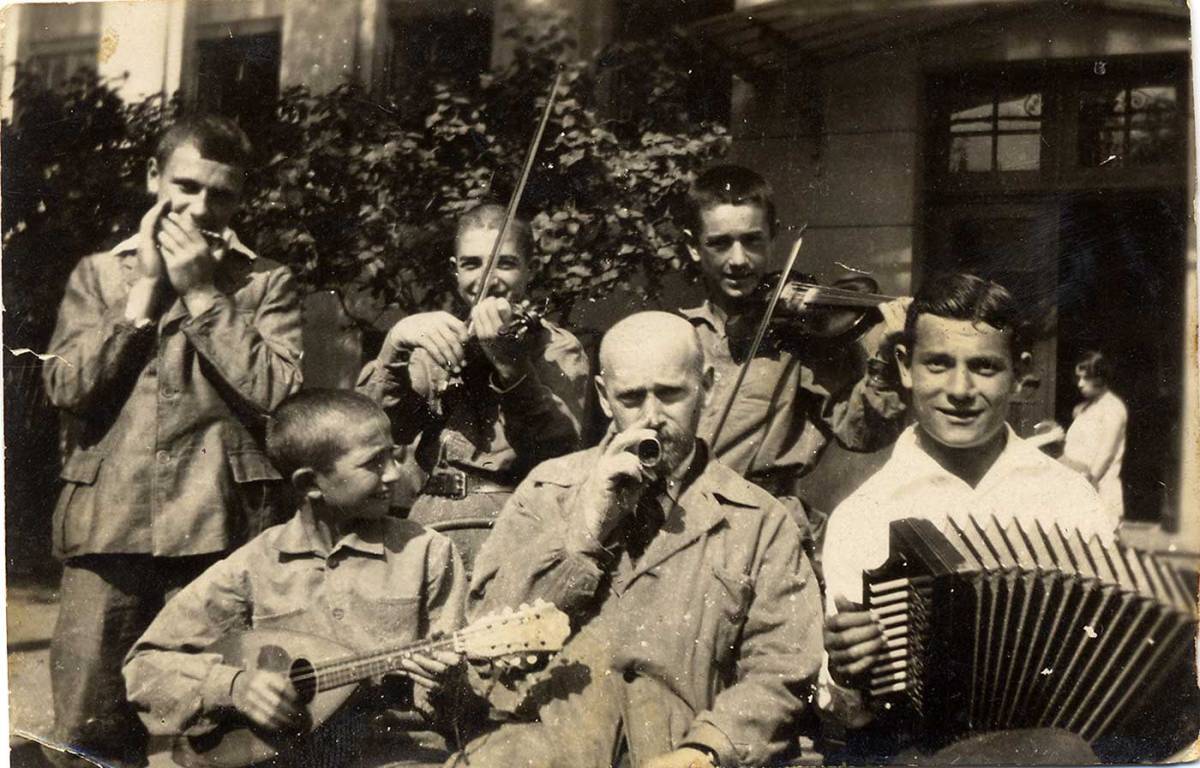
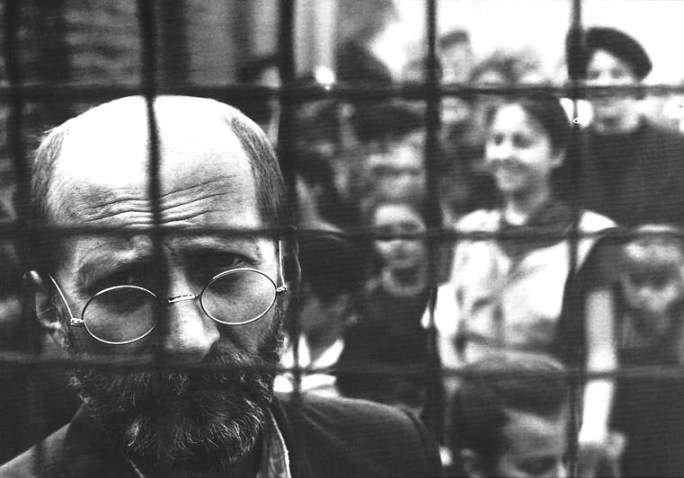
Janusz Korczak was a children’s author and pediatrician, a teacher and lifelong learner. A student of pedagogy, Korczak was particularly interested in the art and science of education, and how children learn.

Korczak10lat0001

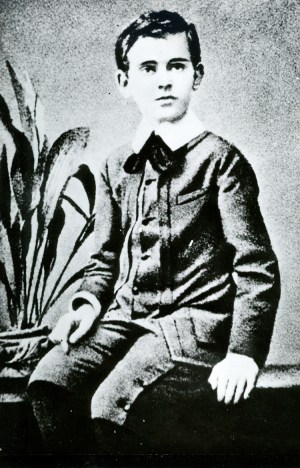
Born Henryk Goldszmit into the Warsaw family of Józef Goldszmit, in 1878 or ’79 (sources vary), Korczak was the pen name by which the physician wrote his children’s books.

Henryk was an exceptional student, of above-average intelligence. His father fell ill when the boy was only eleven or twelve and was admitted into a mental hospital where he died, six years later. As the family’s situation worsened, the boy would tutor other students, to help with household finances.

Goldszmit was a Polish Jew, though not particularly religious, who never believed in forcing religion on children.

He wrote his first book in 1896, a satirical tome on child-rearing, called Węzeł gordyjski (The Gordian Knot). He adopted the pen name Janusz Korczak two years later, writing for the Ignacy Jan Paderewski Literary Contest.

220px-Janusz_Korczak

Korczak wrote for several Polish language newspapers while studying medicine at the University of Warsaw, becoming a pediatrician in 1904. Always the writer, Korczak received literary recognition in 1905 with his book Child of the Drawing Room (Dziecko salonu), while serving as medical officer during the Russo-Japanese war.

He went to Berlin to study in 1907-’08 and worked at the Orphan’s Society in 1909, where he met Stefania “Stefa” Wilczyńska, an educator who would become his associate and close collaborator.

In the years before the Great War, Korczak ran an orphanage of his own design hiring Wilczyńska, as his assistant. There he formed a kind of quasi-Republic for Jewish orphans, complete with its own small parliament, court, and newspaper. The man was a born educator.

1307809-Janusz-Korczak-Quote-I-am-well-versed-in-reading-the-pages-of-war

In early modern European Royalty, 15th – 18th century, a “whipping boy” was the friend and constant companion to the boy prince or King, whose job it was to get his ass kicked, for the prince’s transgressions. The Lord was not the be struck by a social inferior. It was believed that, to watch his buddy get whipped for his own misdeeds would have the same instructional effect, as the beating itself.

The extent of the custom is open to debate and it may be a myth altogether, but one thing is certain.  Poland has been described as the “whipping boy of Europe”, for good reason.

JK2

The Polish nation, the sixth largest in all Europe, was sectioned and partitioned for over a century, by Austrian, Prussian, and Russian imperial powers. Korczak volunteered for military service in 1914, serving as military doctor during WW1 and the series of Polish border wars between 1919-’21.

The “Second Polish Republic” emerging from all this in 1922 was roughly two-thirds Polish, the rest a kaleidoscope of ethnic, linguistic and religious minorities.  Relations were anything but harmonious between ethnic Russians, Germans, Lipka Tatars and others, and most especially Poland’s Jewish minority, the largest in pre-WW2 Europe.

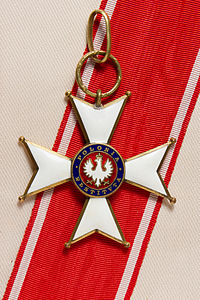
Polonia_Restituta_-_Commander's_Cross_pre-1939_w_rib
Silver Cross of the Polonia Restituta

Janusz Korczak returned to his life’s work in 1921 of providing for the children of this Jewish community, all the while writing no fewer than thirteen children’s books along with another seven on pedagogy, and other subjects.

In the inter-war years, Korczak put together a children’s newspaper, the Mały Przegląd (Little Review), as a weekly supplement to the daily Polish-Jewish newspaper, Nasz Przegląd (Our Review).

Korczak had his own radio program promoting the rights of children, to whom he was known as Pan Doktor (“Mr. Doctor”) or Stary Doktor (“Old Doctor”).

The Polish government awarded “Old Doctor” the Polonia Restituta in 1933, a state order bestowed on individuals for outstanding achievements in the fields of education, science and other civic accomplishments.

Yearly visits to Mandatory Palestine, the geopolitical entity partitioned from the Ottoman Empire in 1923 and future Jewish state of Israel, led to anti-Semitic crosscurrents in the Polish press, and gradual estrangement from non-Jewish orphanages.

165210

The second Republic’s brief period of independence came to an end in September 1939, with the Nazi invasion of Poland.  Korczak volunteered once again but was refused, due to his age.

Tales of Polish courage in the face of the Wehrmacht are magnificent bordering on reckless, replete with images of horse cavalry riding out to meet German tanks. Poland never had a chance against the Nazi war machine, particularly when the Soviet Union piled on, two weeks later.

As an independent nation-state the Sovereign Republic of Poland was dead, though Polish air crews went on to make the largest contribution to the Battle of Britain, among the United Kingdom’s thirteen non-British defenders and allies.  Polish Resistance made significant contributions to the Allied war effort, throughout WW2.

janusz-korczak

By the following year, Warsaw had become the largest Jewish ghetto in Nazi-occupied Europe.  The Jews of Poland were herded into the city, barely existing on meager rations while awaiting the death squads of the SS.  Old Doctor and his orphans were forced into the Ghetto, in 1939.

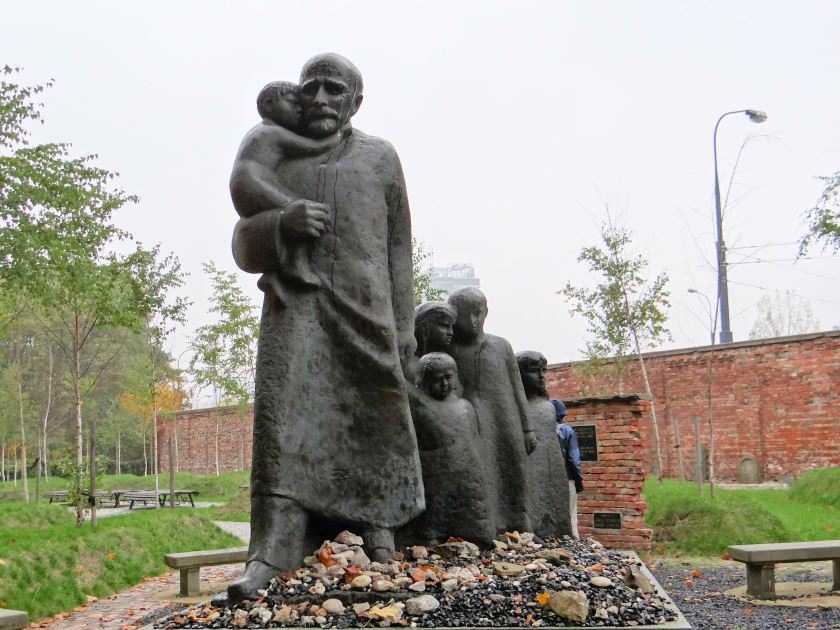
Korczak had around 200 under his care on this day in 1942, when soldiers of the Gross-Aktion (Great Action) Warsaw, came to “resettle” them, to the east.

ŚmierćMiasta
The Pianist, by Władysław Szpilman

The extermination camp at Treblinka, was waiting.

Polish-Jewish composer and musician Władysław Szpilman, one of precious few survivors of the Jewish ghetto, describes the scene in his 1946 memoir, The Pianist:

“He told the orphans they were going out into the country, so they ought to be cheerful. At last they would be able to exchange the horrible suffocating city walls for meadows of flowers, streams where they could bathe, woods full of berries and mushrooms. He told them to wear their best clothes, and so they came out into the yard, two by two, nicely dressed and in a happy mood. The little column was led by an SS man…”

Eyewitness Joshua Perle states that:  Janusz Korczak was marching, his head bent forward, holding the hand of a child… A few nurses were followed by two hundred children, dressed in clean and meticulously cared for clothes, as they were being carried to the altar.

251012_Janusz_Korczak_monument_at_Jewish_Cemetery_in_Warsaw_-_03

At the Umschlagplatz, the rail-side assembly area on the way to Treblinka, an SS officer recognized Korczak and called him aside.  The children’s author was offered sanctuary on the “Aryan side” but he refused, saying that he would stay with his children.  Stary Doktor was offered deportation to the Theresienstadt concentration camp instead. Again, he refused.

The man who declined freedom to die with the orphans in his care was last seen boarding the train to Treblinka on August 5. All 200 were murdered the following day.

800px-פולין_001
Janusz Korczak memorial stone, Treblinka

“Dr. Janusz Korczak’s children’s home is empty now. A few days ago we all stood at the window and watched the Germans surround the houses. Rows of children, holding each other by their little hands, began to walk out of the doorway. There were tiny tots of two or three years among them, while the oldest ones were perhaps thirteen. Each child carried the little bundle in his hand”.

Mary Berg, The Diary

August 4, 1697 Drinking the Stars

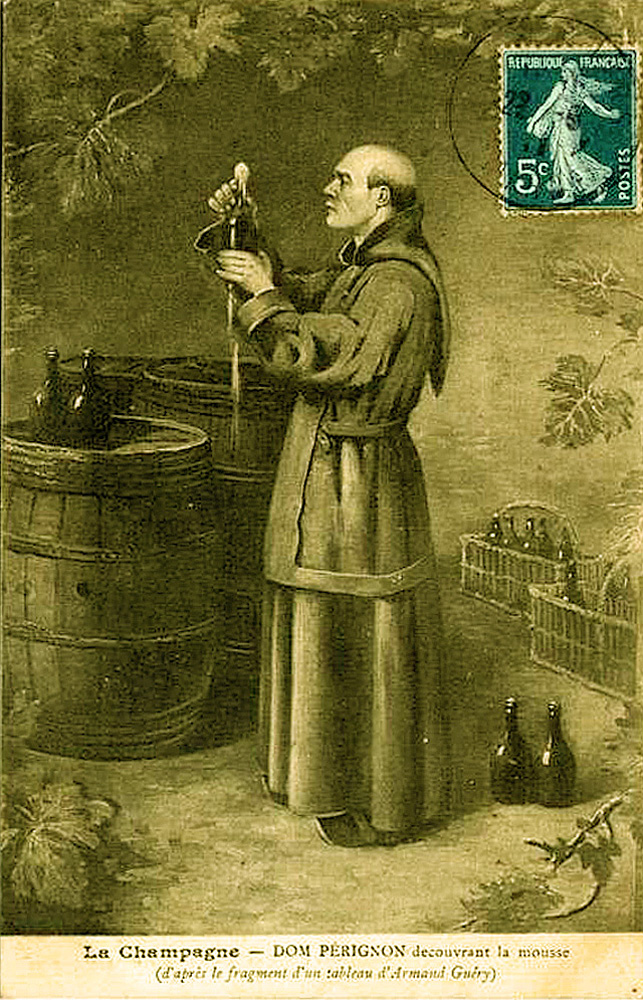
According to legend it was August 4, 1697 when Brother (Dom) Pérignon called out “Come quickly, I am drinking the stars!”.

Wines were near-universally red in medieval and renaissance Europe and almost always, still.  The in-bottle refermentation that gives “sparkling” wine its ‘fizz’ was a problem for winemakers.  Fermentable sugars were frequently left over when weather began to cool in the fall, particularly with the white grape varietals.  Refermentation would set in with the warm spring weather, converting bottles into literal time bombs.  Corks would pop out and wine would spoil.  Sometimes the whole batch would explode, one pressurized bottle going off in sympathetic detonation with the next.

preventing-refermentation-fig1

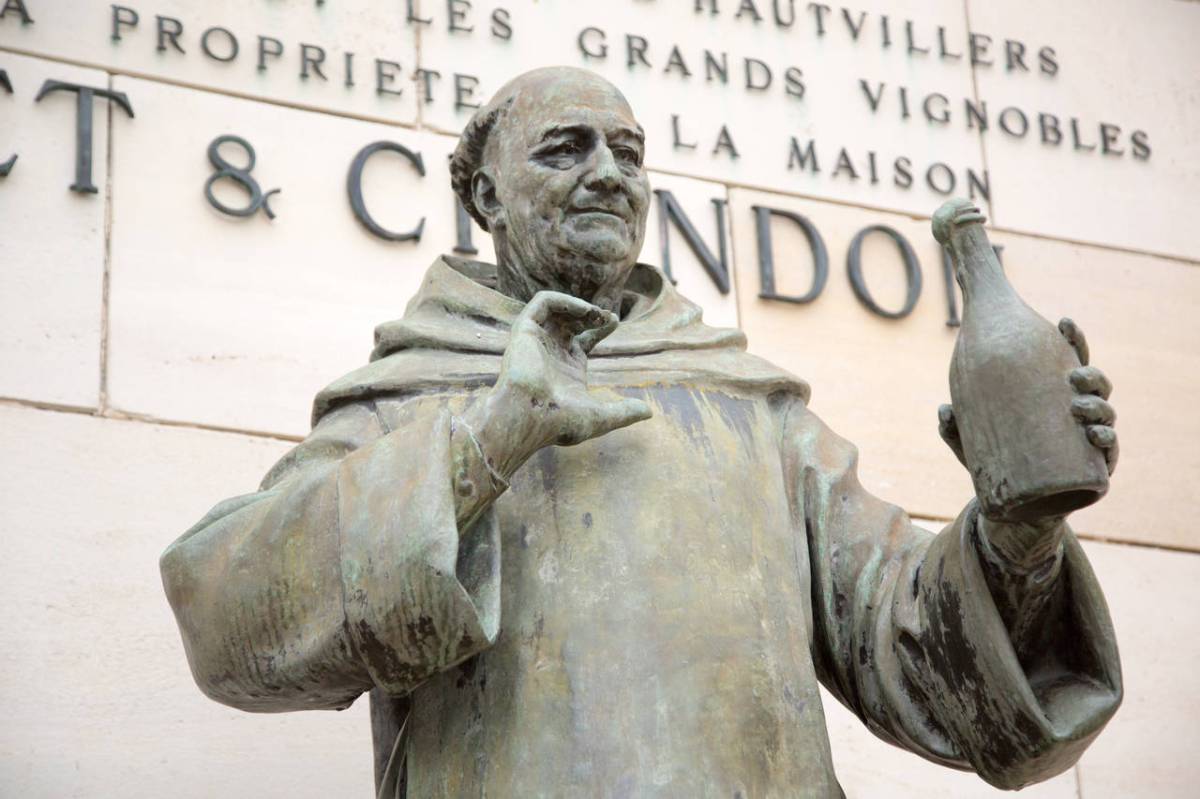
Pierre Perignon entered the Benedictine Order when he was 19, doing his novitiate at the abbey of Saint-Vannes near Verdun, later and transferring to the abbey of Hautvillers, in 1668.

According to legend it was August 4, 1697 when Brother (Dom) Pérignon called out “Come quickly, I am drinking the stars!”.

The story seems to be an 1821 embellishment by one Dom Groussard, in an attempt to increase the reputation of the abbey.  The English scientist and physician Christopher Merret seems to have been the first to add sugars, beginning the refermentation process which resulted in the first carbonated wine.

Dom_Pérignon_découvrant_la_prise_de_mousse

Yet Dom Pérignon most certainly perfected the double fermentation process, and made important contributions to the quality of the abbey’s fine wines.  He was an early advocate of natural process, farming methods we would call “organic”, today.  He strictly avoided the addition of foreign substances and insisted that all blending take place at the grape stage. Pérignon insisted on “blind” tasting, not wanting to know what vineyard a grape came from prior to selection.

Dom_Pérignon

Pérignon didn’t like white grapes because of their tendency to enter refermentation. He preferred the Pinot Noir, and would aggressively prune vines so that they grew no higher than three feet and produced a smaller crop. The harvest was always in the cool, damp early morning hours, and he took every precaution to avoid bruising or breaking his grapes. Over-ripe and overly large fruit was always thrown out. Pérignon did not allow grapes to be trodden, preferring instead the use of multiple presses.

Dom Perignon

Dom Pérignon served as the “cellarer” of the Hautvillers abbey until his death in 1715, in a time when the abbey flourished and doubled the size of its vineyards.  In a sign of honor and respect, Dom Pierre Pérignon was buried in a section of the abbey cemetery, historically reserved only for abbots.

Moët et Chandon, which began as Moët et Cie, purchased the vineyards of the Abbey of Hautvillers in 1792. To this day, Moët’s most prestigious cuvée bears the name of a certain Benedictine monk from Sainte-Menehould in the ancient Province of Champagne. Dom Pérignon.

August 3, 1914 Apocalypse

This time there would be no “Phoney War”, no “Sitzkreig”, as some wags were wont to call the early days of WWII.   Few could imagine a cataclysm to rock a century and beyond, a war in which many single day’s fighting would produce casualties equal to that of every war of the preceding 100 years, combined.  Fewer still understood on this date, one-hundred eight years ago, today.  The four horsemen of the Apocalypse, had arrived.

In 1869, Germany had yet to come into its own as an independent nation. Forty-five years later she was one of the Great Powers, of Europe.

Great Powers, 1914

Alarmed by the aggressive growth of her historic adversary, the French government had by that time increased compulsory military service from two years to three, in an effort to offset the German’s military of a much larger population.

Joseph Caillaux was a left wing politician, once Prime Minister of France and, by 1913, a cabinet minister under the more conservative administration of French President Raymond Poincare.

Never too discreet with his personal conduct, Caillaux paraded through public life with a succession of women, who were not Mrs Caillaux. One of them was Henriette Raynouard.  By 1911, Madame Raynouard had become the second Mrs Caillaux.

A relative pacifist, many on the French right considered Caillaux to be too “soft” on Germany. One of them was Gaston Calmette, editor of the leading right-wing newspaper Le Figaro, who regularly excoriated the politician.

On March 16, 1914, Madame Caillaux took a taxi to the offices of Le Figaro. She waited for a full hour to see the paper’s editor, before walking into his office and shooting him at his desk. Four out of six rounds hit their mark.  Gaston Calmette was dead before the night was through.

Cailloux Affair

It was the crime of the century.  This one had everything: Left vs. Right, the fall of the powerful, and all the salacious details anyone could ever ask for. It was the OJ trial, version 1.0, and the French public was transfixed.

The British public was similarly distracted, by the latest in a series of Irish Home Rule crises.

The Austro-Hungarian Empire, a sprawling amalgamation of 17 nations, 20 Parliamentary groups and 27 political parties, desperately needed to bring the Balkan peninsula into line following the June 28 assassination of the heir apparent to the dual monarchy. That individual Serbians were complicit in the assassination is beyond doubt but so many government records of the era have disappeared that, it’s impossible to determine official Serbian complicity. Nevertheless, Serbia had to be brought to heel.

Balkan Troubles

Having given Austria his personal assurance of support in the event of war with Serbia, even if Russia entered in support of her Slavic ally, Kaiser Wilhelm of Germany left on a summer cruise in the Norwegian fjords. The Kaiser’s being out of touch for those critical days that July has been called the most expensive maritime disaster, in naval history.

The Austro-Hungarian Empire delivered a deliberately unacceptable ultimatum to Serbia on the 23rd, little more that a bald pretext for war.  Czar Nicholas wired Vienna as late as the 27th proposing an international conference concerning Serbia, but to no avail. Austria responded that same day.  It was too late for such a proposal.

The Austro-Hungarian Empire declared war on Serbia the following day, the day on which Madame Caillaux was acquitted of the murder of Gaston Calmette, on the grounds of being a “crime of passion”.

As expected, Russia mobilized in support of Serbia.  For Germany’s part, nothing was to be feared more than a two-front war with the “Russian Steamroller” to the east, and the French Republic to the west.  Germany invaded neutral Belgium in pursuit of the one-two punch strategy by which she sought first to defeat France, before turning to face the far larger Russian adversary.

russ-mob

On August 3, 1914, British Foreign Secretary Sir Edward Grey announced before Parliament his government’s intention to defend Belgian neutrality, a treaty obligation German diplomats had dismissed as a “scrap of paper”.

Pre-planned timetables took over – France alone would have 3,781,000 military men under orders before the middle of August, arriving at the western front on 7,000 trains arriving as often as every eight minutes.

Declaration

This time there would be no “Phoney War”, no “Sitzkreig”, as some wags were wont to call the early days of WWII.   Few could imagine a cataclysm to rock a century and beyond, a war in which many single day’s fighting would produce casualties equal to that of every war of the preceding 100 years, combined.  Fewer still understood on this date, one-hundred eight years ago, today.  The four horsemen of the Apocalypse, had arrived.

Sir Edward Grey

August 2, 216BC An Uneven Fight

The Battle of Cannae is studied by historians and military tacticians to this day. A Roman army, estimated at 86,000 Roman and allied troops, was drawn in and enveloped by Hannibal’s far smaller force. Squeezed into a pocket so tightly they could barely raise their weapons, the Legions were attacked from all sides.

There were two great powers in the Mediterranean region of 264BC:  the Romans on the Italian peninsula and Carthage, a North African maritime power settled by Phoenician travelers some 800 years earlier, in modern day Tunisia.

A dispute in Sicily that year led to war between the two powers, ending in Roman victory in 241BC and a vanquished Carthage being stripped of her Navy.

Hamilcar Barca was a great general of this, the first “Punic” war, the name deriving from the Latin word for Phoenician. Barca made his then 12-year-old son Hannibal swear undying hatred for the Romans.

Hannibal crossing the Alps 4

At the age of 20, Hannibal Barca set out on what would become the second Punic war.  It was late Spring, 218BC, when Hannibal left the Iberian outpost of “New Carthage”, now the Spanish city of Cartagena. Crossing into hostile Gaul (France) at the head of 38,000 infantry, 8,000 cavalry and 37 war elephants, Hannibal arrived at the Rhône River in September.

Hannibal’s crossing of the Alps that winter is one of the great feats of military history, costing almost half his force before entering Italy that December.

Hannibal crossing the Alps

What followed was a series of crushing defeats for Rome. First at the Battle of Trebia, then Lake Trasimene, Hannibal’s army laid waste to the Italian peninsula.

There was almost no family in all of Rome that didn’t lose one or more members in the swath of destruction brought down by Hannibal and his Carthaginian army.

At this point, Rome took the extreme step of appointing one man, absolute dictator of the Roman Republic.  His name was Quintus Fabius Maximus Verrucosus.  Rather than joining the Carthaginians in pitched battle, Fabius sought to wear them down in a series of “hit & run” and “scorched earth” tactics.

Fabius was right.  His tactics were a military success and bought the Republic time in which to rebuild its military, but they were a political flop.  The Roman psyche would accept nothing short of pitched battle.  In six months, Fabius “Cunctator” (“the Delayer”) was replaced by the co-consuls Gaius Terentius Varro, and Lucius Aemilius Paullus.

cannae_battle_formation

In the co-consul system, Varro would be supreme commander of the army on one day, and Paullus the next.  Knowing full well how this system worked and wanting to draw the more aggressive Varro into pitched battle, Hannibal sprung his trap on a day when Varro was in command.

The Battle of Cannae, fought this day in 216 BC, is studied by historians and military tacticians to this day. A Roman army, estimated at 86,000 Roman and allied troops, was drawn in and enveloped by Hannibal’s far smaller force. Squeezed into a pocket so tightly they could barely raise their weapons, the Legions were attacked from all sides.

Unable to function as a disciplined unit, as many as 75,000 Romans were hacked to death, equivalent to the seating capacity of the New York Mets’ Citi Field and Harvard Stadium, combined.

Another 10,000, were captured.  Among the dead was a current Consul, the most powerful elected official in the Roman Republic as well as both consuls, from the previous year.

80 senators, nearly a third of the entire Roman Senate, were wiped out in single day.

There was now no military force left between Hannibal and Rome itself.  Most powers would have admitted defeat, and sued for peace.  Not Rome.  Unable to defeat the Carthaginians in open battle, Rome returned to Fabian tactics, harassing the foe and wearing them down in an endless series of scorched earth and guerrilla tactics.

For 16 years, Hannibal remained undefeated on Italian soil while his political adversaries at home, never once sent him reinforcement. He was finally recalled to Carthage to defend his homeland against Roman attacks in North Africa and Spain.  Hannibal was defeated by his own tactics at the Battle of Zama, the second Punic War ending in 201BC.

Hannibal_Louvre
Hannibal, Louvre Museum.

Carthage was a thoroughly defeated power as Hannibal grew into his old age, but some in Rome wouldn’t let it go. Misbehaving Italian children were threatened that Hannibal would come and get them if they weren’t good.  Roman politician Marcus Porcius Cato, “Cato the Elder”, ended his every speech, “Carthago delenda est”, “Carthage must be destroyed“.

The third Punic War saw the Romans attack Carthage itself. After three years of siege, the city fell in 146BC. Thousands were slaughtered, as many as 70,000 sold into slavery. Though the salting of fields is probably a later embellishment to the story, the city was sacked, then burned to the ground. Utterly destroyed.

Hannibal himself had grown elderly by 181-183BC, fleeing from one town to the next to escape his Roman pursuers.  Unwilling to be paraded through Rome in a cage, Hannibal committed suicide by poison sometime that same year. In a letter found after his death, Hannibal had written “Let us relieve the great anxiety of the Romans, who have found it too weighty a task, to wait for the death of a hated old man”.