At South Georgia Island, Ernest Shackleton asked how the war had ended. The response hit like a hammer. “The war isn’t over. Millions are dead. Europe is mad. The world is mad”.
In an alternate history, the June 1914 assassination of the heir-apparent to the Habsburg Empire could have led to nothing more than a regional squabble. A policing action in the Balkans. As it was, mutual distrust and entangling alliances drew the Great Powers of Europe into the vortex. On August 3, the “War to End Wars” exploded across the European continent.
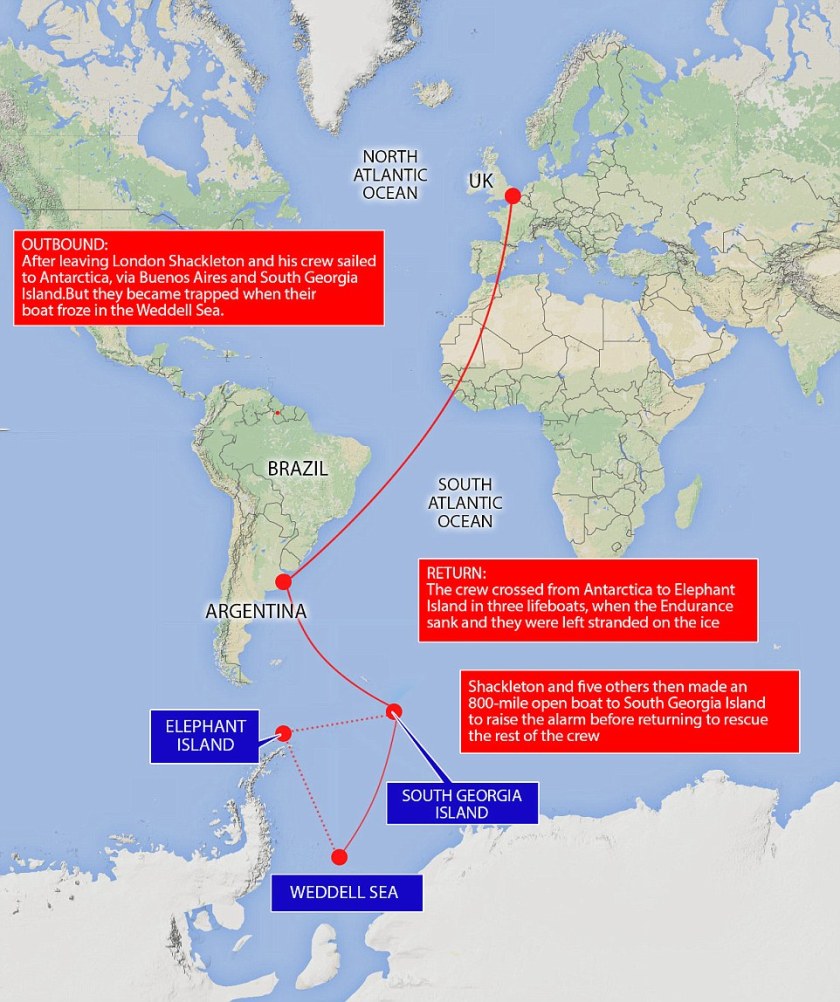
The period has been called the “Heroic Age of Antarctic Exploration”. As the diplomatic wrangling, mobilizations and counter-mobilizations of the “period preparatory to war” unfolded, Sir Ernest Shackleton made final arrangements for his third expedition into the Antarctic. Despite the outbreak of war, first Lord of the Admiralty Sir Winston Churchill ordered Shackleton to Proceed. The “Endurance” expedition departed British waters on August 8.
The German invasion of France ground to a halt that September. The first entrenchments were being dug as Shackleton himself remained in England, departing on September 27 to meet up with the Endurance expedition in Buenos Aires.
With the unofficial “Christmas Truce” of 1914 short weeks away from the trenches of Flanders, Shackleton’s expedition left Grytviken whaling station on South Georgia Island. It was December 5.
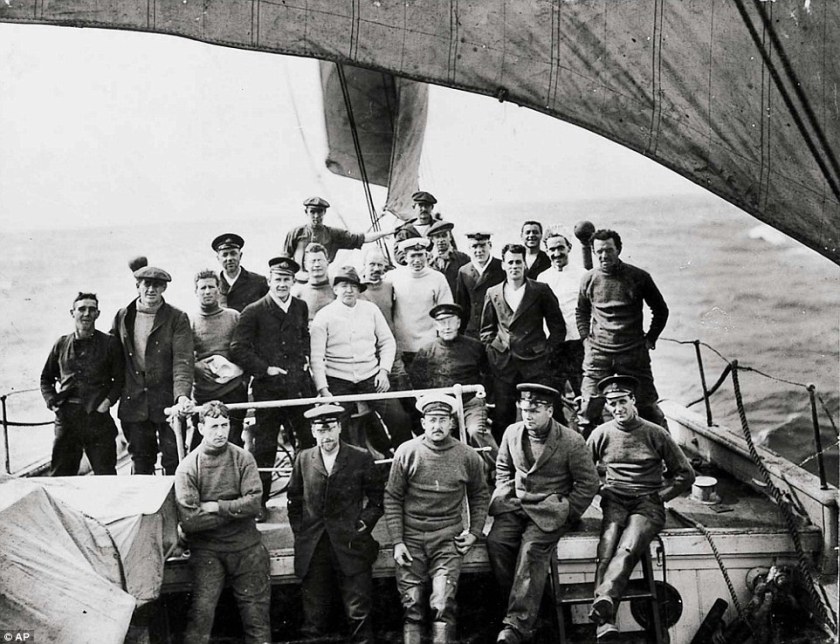
The Endurance expedition intended to be the first to cross the Antarctic continent. The way things turned out, the crew wouldn’t touch land, for another 497 days.
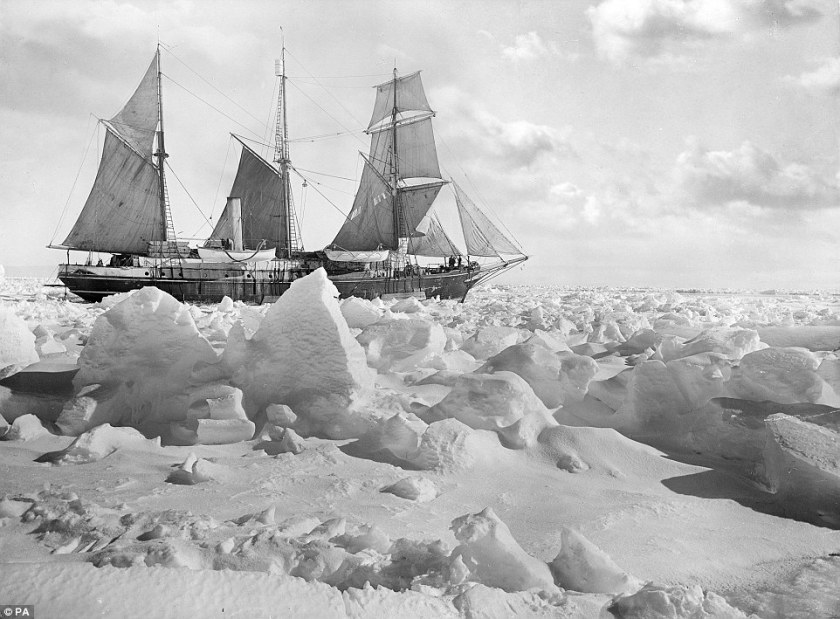
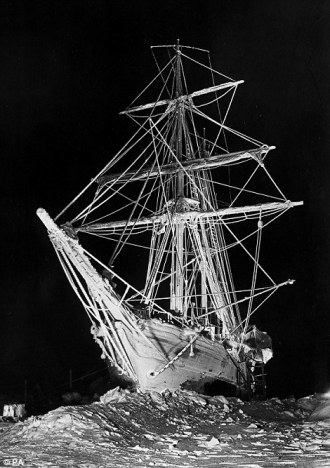
The disaster of the Great War became “Total War” with the zeppelin raids of January, as Endurance met with disaster of its own. The ship was frozen fast, within sight of the Antarctic continent. There was no hope of escape.
HMS Lusitania departed New York City on May 1, 1915, not knowing that she only had six days to live. The sun that vanished that night over the Shackleton expedition, would not reappear for another four months.
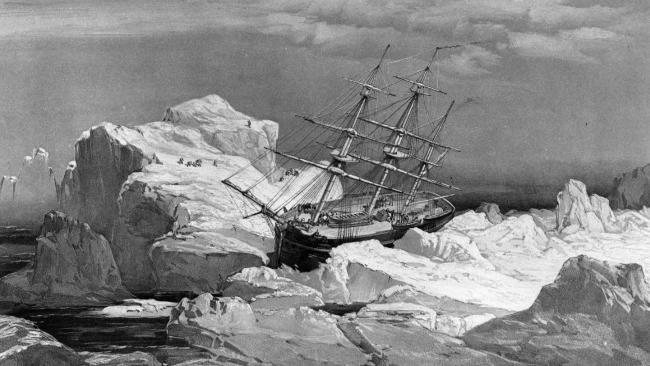
As the nine-month battle unfolded across the Gallipoli Peninsula, Shackleton’s men abandoned ship’s routine and converted to winter station. On September 1, the massive pressure of the pack ice caused Endurance to “literally [jump] into the air and [settle] on its beam,” as losses to the Czar’s army in Galicia and Poland lead to a mass exodus of Russian troops and civilians from Poland. The “Great Retreat” gave way to the sort of discontent which would one day end the Czarist regime, as Shackleton gave the order to abandon ship. On November 21, the wreck of the Endurance slipped below the surface.
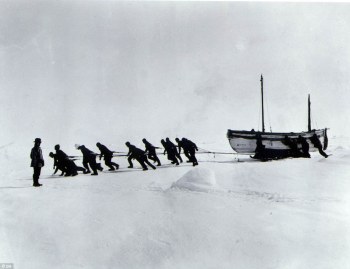
That December, Allies began preparations for a summer offensive along the upper reaches of the River Somme. The Shackleton party camped on pack ice, adrift in open ocean, as Erich von Falkenhayn began the Verdun offensive with which he would “bleed France white”. The ice broke up that April, forcing Shackleton and his party into three small lifeboats. Seven brutal days would come and go in those open boats, before the party reached land at the desolate shores of Elephant Island.
The whaling stations at South Georgia Island, some 800 miles distant, were the only hope for survival. Shackleton and a party of five set out on April 24 aboard the 22½’ lifeboat, James Caird, as the five-month siege at Kut-al-Amara in Mesopotamia ended with the surrender of 13,000 British and Indian soldiers, to the Turks.
The party arrived on the west coast of South Georgia Island in near-hurricane force winds, the cliffs of South Georgia Island coming into view on May 10. As Captain Frank Worsely, Second officer Tom Crean and expedition leader Ernest Shackleton picked their way across glacier-clad mountain peaks thousands of feet high, Austrian troops attacked Italian mountain positions in the Trentino.
The trio arrived at the Stromness whaling station on May 20. They must have been a sight, with thick ice encrusting their long, filthy beards, and saltwater-soaked sealskin clothing rotting from their bodies. The first people they came across were children, who ran in fright at the sight of them.
The last of the Shackleton expedition would be rescued on August 22, ending the 20-months long ordeal.
At South Georgia Island, Ernest Shackleton asked how the war had ended. The response hit like a hammer. “The war isn’t over. Millions are dead. Europe is mad. The world is mad“.
If you enjoyed this “Today in History”, please feel free to re-blog, “like” & share on social media, so that others may find and enjoy the same. Please click the “follow” button on the right, to receive email updates on new articles. Thank you for your interest, in the history we all share.
A Military Working Dog (MWD) is anything but a “disposable” asset. It is a highly trained, specialized soldier who complements and adds to the abilities of his human partner, as that two legged soldier complements those of the dog.
There are times when two highly trained individuals are able to function at a level higher than the sum of their parts. Professional athletes like NFL linemen and NHL forwards are two examples. Another is often the partnership formed between law enforcement officers.
On the battlefield, few assets are more powerful than a well equipped and highly trained soldier. Unless we’re pairing that soldier with a Military Working Dog.
A Military Working Dog (MWD) is anything but a “disposable” asset. It is a highly trained, specialized soldier who complements and adds to the abilities of his human partner, as that two legged soldier complements those of the dog.
“Nemo”, born in October 1962, entered the United States Air Force as a sentry dog in 1964, at the age of 1½ years. After an 8-week training course at Lackland AFB Sentry Dog Training School in San Antonio, Texas, the 85-pound German Shepard was assigned to Airman Leonard Bryant Jr., and sent to Fairchild Air Base in Washington for duty with Strategic Air Command.
The pair was transferred to the Republic of South Vietnam with a group of other dog teams, and assigned to the 377th Security Police Squadron, stationed at Tan Son Nhut Air Base. Six months later, Bryant rotated back to the States, and Nemo was paired with 22-year-old Airman 2nd Class Robert Thorneburg.
Early on the morning of December 4, 60 Vietcong guerrillas emerged from the jungle, setting off a near-simultaneous alarm from several sentry dogs on perimeter patrol.
Three dogs, Rebel, Cubby and Toby, were killed with their handlers in a hail of bullets. Several other handlers were wounded, including one who was able to maintain contact with the enemy, notifying Central Security Control of their location and direction of travel.
Thanks to the early warning, a machine gun team was ready and waiting when 13 infiltrators approached the main aircraft parking ramp. None of them lived to tell the story. Security forces quickly deployed around the perimeter, driving some infiltrators off and others into hiding. Daylight patrols reported that all VC infiltrators were gone, either killed or captured, but they had made a big mistake. They should have brought the dogs with them.
That night, Thorneburg and Nemo were out on patrol near an old Vietnamese graveyard, about ¼ mile from the air base’ runways. Nemo alerted on something. Before Thorneburg could radio for backup, that something started shooting. Thorneburg released the dog and charged in shooting, killing one Vietcong before being shot in the shoulder. Nemo was badly wounded, shot in the face, the bullet entering below his eye and exiting his mouth. Ignoring the injury, Nemo attacked the four enemy soldiers hiding in the brush, giving his partner time to call for reinforcements.
Four additional Vietcong were discovered hiding underground, as quick reaction teams scoured the area. They found Nemo and Thornburg, both seriously wounded, together on the ground. Both would survive, though Thorneburg was shot a second time, while returning to base.
I’m sure that individual dog handlers were as good to their dogs as they knew how to be, during the Vietnam era. That’s a guess, but having an MWD handler in the family, I think it’s a good one. The Department of Defense bureaucracy was another matter.
Roughly 4,000 dogs served in Vietnam, leading patrols through the dense jungle terrain. Overall, these animals are credited with saving close to 10,000 lives.
When Marine Corps handler Steve Reichenbach arrived in country in 1966, he was paired with a cream colored Great Dane-German Shepherd mix. “Major”, whose previous handler had been killed only weeks before, was an excellent match for Reichenbach, both being “mellow, relaxed, even-keeled types” who bonded, almost immediately.
Marine dog handler Steve Reichenbach with his dog, Major, on a patrol north of Danang in late 1966. PHOTOGRAPH COURTESY OF STEPHEN K. REICHENBACH, with a tip of the hat to National Geographic
At 90 pounds, Major’s size alone seemed to intimidate the enemy, often leading VC to trip off ambushes, too early.
A land mine exploded on the Marine’s last day in country, killing four and wounding six. Though badly wounded, Reichenbach would survive the war. Major was unhurt, but he wasn’t so lucky. The last the pair saw of one another, was in the medevac chopper. Major still had Reichenbach’s blood on his fur, when he was paired with his next handler. The marine never saw his “battle buddy” after that, but later heard the dog had succumbed to some tropical disease.
The vast majority of MWDs who served in Vietnam, were left behind as “surplus equipment”. Left to succumb to tropical disease, to be euthanized by the South Vietnamese Army, or worse. Nemo was one of the few lucky ones. He came home.
MWD Nemo was officially recognized for having saved the life of his handler, and preventing further destruction of life and property. He was given the best of veterinary care and, on June 23, 1967, USAF Headquarters directed that he be returned to the United States. The first sentry dog officially retired from active service.
The C124 Globemaster touched down at Kelly Air Force Base, Texas, on July 22, 1967. Nemo lived out the seven years remaining to him in a permanent retirement kennel at the DoD Dog Center at Lackland Air Force Base.
If you enjoyed this “Today in History”, please feel free to re-blog, “like” & share on social media, so that others may find and enjoy the same. Please click the “follow” button on the right, to receive email updates on new articles. Thank you for your interest, in the history we all share.
ICYMI – Today, potatoes are the 5th largest crop on the planet, following rice, wheat, maize and sugar cane. Almost 5,000 varieties are preserved in the International Potato Center in Peru.
The expedition which would end in the Lost Colony of Roanoke began in 1585, financed by Sir Walter Raleigh and led by Sir Ralph Lane. On board was the Oxford trained mathematician and astronomer Sir Thomas Herriot, the man who would introduce the potato to England on this day, the following year.
The Inca of Peru seem to have been the first to cultivate potatoes, around 8,000BC.
Wild potatoes contain toxins to defend themselves against fungi and bacteria, toxins unaffected by the heat of cooking. In the Andes, mountain people learned to imitate the wild guanaco and vicuña, licking clay before eating the poisonous plants. In this manner, toxins pass harmlessly through the digestive system. Mountain people dunk wild potatoes in “gravy” made of clay and water, accompanied with coarse salt. Eventually, growers developed less toxic tubers, though the poisonous varieties are still favored for their frost resistance. Clay dust is sold in Peruvian and Bolivian markets, to this day.
Spanish Conquistadors who arrived in Peru in 1532 eventually brought potatoes home to Spain. The first written mention of the potato comes from a delivery receipt dated November 28, 1567, between the Grand Canaries and Antwerp.
Among its other virtues, the potato provides more caloric energy per acre of cultivation than either maize or grain and, being below ground, is likely to survive calamities that would flatten other crops. Taters quickly became staple foods in northern and eastern Europe, while in other areas remaining the food of peasants and livestock.
Louis XVI placing a potato blossom in his buttonhole, 1737
French army pharmacist Antoine-Augustin Parmentier was captured by Prussians during the seven years war, learning to appreciate the gustatorial delights of the potato while in captivity.
Primarily used as hog feed in his native France, Parmentier was determined to bring respectability to the lowly tuber. It must have been a tough sell, as many believed that potatoes caused leprosy. The Paris Faculty of Medicine declared them edible in 1772, thanks largely to Parmentier’s efforts. He would host dinners featuring multiple potato dishes, inviting such luminaries as Benjamin Franklin and Antoine Lavoisier. Franklin was enormously popular among the French nobility. Before long Louis XVI was wearing a purple potato flower in his lapel. Marie Antoinette wore them in her hair.
Sir Walter Raleigh first introduced potatoes to Ireland in 1589. By mid-19th century, the crop occupied one third of arable land in Ireland. This was due entirely to landless laborers, renting tiny plots from landowners interested only in raising cattle or producing grain for market. An acre of potatoes and the milk of a single cow was enough to sustain a family. Even poor families could grow enough surplus to feed a pig, which could then be sold for cash.
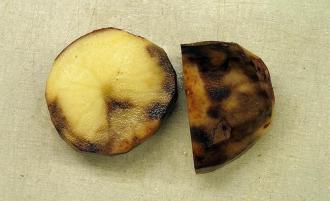
Calamity struck Ireland in 1845, in the form of a blight so horrific that US military authorities once considered stockpiling the stuff as a biological weapon. Seemingly overnight, Ireland’s staple food crop was reduced to a black, stinking ooze.
There followed the seven years’ “an Gorta Mór”, “the Great Hunger”, killing over a million Irish and reducing the population by 20-25% through death and emigration. Throughout the Irish potato famine, the country continued to produce and export thirty to fifty shiploads per day of food produce, more than enough to feed the population.
Today, many see the effects of the absentee landlord system and the penal codes as a form of genocide. At the time, already strained relations with England were broken, giving rise to Irish republicanism and leading to Irish independence in the following century.
Until Nazis tore it down, there was a statue of Sir Francis Drake in Offenburg, Germany, giving him credit for introducing the potato. His right hand rested on the hilt of his sword, his left gripping a potato plant. The inscription read “Sir Francis Drake, disseminator of the potato in Europe in the Year of Our Lord 1586. Millions of people who cultivate the earth bless his immortal memory”.
Today, potatoes are the 5th largest crop on the planet, following rice, wheat, maize and sugar cane. Almost 5,000 varieties are preserved in the International Potato Center in Peru.
In the Star Wars movie “The Empire Strikes Back”, there’s a chase sequence through an “asteroid” field in which some of the asteroids are, in fact, potatoes.
Scientists have created genetically modified potatoes to ward off pests. The “New Leaf”, approved in 1995, incorporated a bacterial gene rendering it resistant to the Colorado potato beetle, an “international superpest” so voracious that some credit the creature for creating the modern pesticide industry. Other varieties were genetically modified to resist phytophthora infestans, the cause the Irish potato famine.
Seeming to prefer insecticides and anti-fungal sprays, “food activists” decry such varieties as “Frankenfoods”. Each time, the improved variety has been hounded out of business.
In 2014, Idaho-based J.R. Simplot Co. introduced the “innate” potato. Rather than “transgenic” gene splicing, the introduction of genome sequences from unrelated species, the innate variety uses a “silencing” technique on the tuber’s own genes, to resist the bruising and browning that results in 400 million pounds of waste and a cost to consumers of $90 million.
In October 2016, NBC news reported that “The U.S. Department of Agriculture has approved commercial planting of two types of potatoes that are genetically engineered to resist the pathogen that caused the Irish potato famine. The potatoes next must clear a voluntary review process through the Food and Drug Administration as well as get the OK from the U.S. Environmental Protection Agency“.
The Innate potato produces less acrylamide, a known carcinogen produced by normal potatoes in the high heat of fryers.
This might actually be the first genetically modified variety to succeed in the marketplace, but McDonald’s, possibly the largest potato user on the planet, has already announced that “McDonald’s USA does not source GMO potatoes, nor do we have current plans to change our sourcing practices.”
You can never underestimate the power of hysterical people, in large groups.
If you enjoyed this “Today in History”, please feel free to re-blog, “like” & share on social media, so that others may find and enjoy the same. Please click the “follow” button on the right, to receive email updates on new articles. Thank you for your interest, in the history we all share.
ICYMI – I can’t think of anything more fitting than that it was children, our future and posterity, who retrieved the sacred soil of Flanders and installed it at that garden. It is now for that posterity to keep our history alive, and to never let it fade, into some sepia-toned and forgotten past.
November 11, nineteen short days ago, marked the 99-year anniversary of the end of World War One.
Before they had numbers, this was “The Great War”. The “War to end all Wars”.
There is barely a piece of 20th or 21st century history, which cannot be traced back to it.
International Communism was borne of the Great War, without which there would have been no cold war, no Korean War, no war in Vietnam. The killing fields of Cambodia would have remained mere rice fields. The spiritual descendants of Chiang Kai-shek’s brand of capitalism would be running all of China, instead of only Taiwan.
The current boundaries of the Middle East arose from the Great War. While the region’s tribal alliances and religious strife is nothing new, those conditions would have taken a very different form, had it not been for those boundaries.
World War II, a conflagration which left more dead, wounded or missing than any conflict in world history (WWI is only #5), was little more than the Great War, part II. A Marshall of France, on looking at the Versailles Treaty formally ending WWI, said “This isn’t peace. This is a cease-fire that will last for 20 years”. He was off, by something like 36 days.
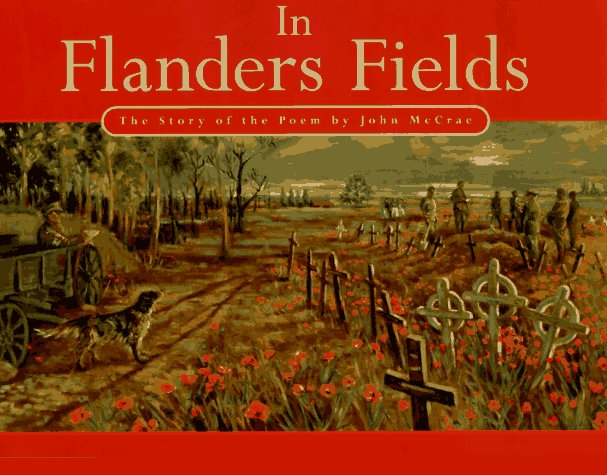
I’ve long believed that we can’t be participating citizens of a self-governing Republic, we can’t know where we want our country to go, if we don’t understand where it’s been. It’s one of the principle reasons for examining history. It’s why I think something wonderful happened four years ago, and I don’t think many of us heard about it.
In the summer of 2013, over 1,000 British and Belgian schoolchildren visited 70 battlefields of the Great War. Ypres. Passchendaele. Verdun. The Somme. All over Northern France and Belgium, the region known as “Flanders”. There these children collected samples of the sacred soil of those fields of conflict.
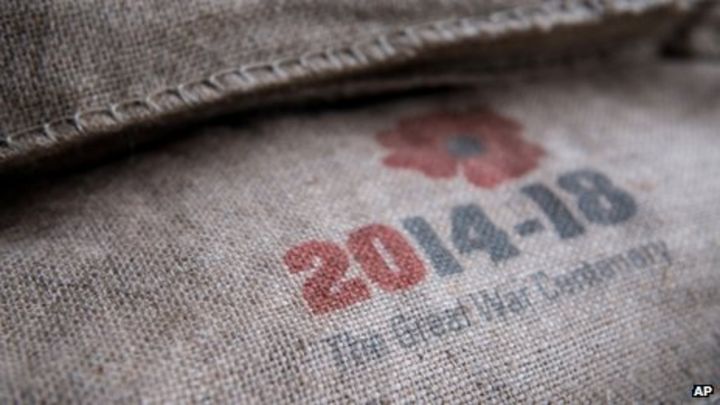
The soil from those battlefields was placed in seventy WWI-style burlap sandbags, each stenciled with a red poppy, where it came from, and the dates. Those sandbags were transported to London, and installed with great care at Wellington Barracks, the central London home of the Grenadier Guards, Coldstream Guards and Scots Guards.
There the soil of the Great War will nourish and support a garden. Ready for the following year, a solemn remembrance of the centenary of that war.
That day, December 1, 2013, was for the Flanders Fields Memorial Garden, the first full day of forever.
I can’t think of anything more fitting than that it was children, our future and posterity, who retrieved the sacred soil of Flanders and installed it at that garden. It is now for that posterity to keep our history alive, and never to let it fade, into some sepia-toned and forgotten past.
If you enjoyed this “Today in History”, please feel free to re-blog, “like” & share on social media, so that others may find and enjoy the same. Please click the “follow” button on the right, to receive email updates on new articles.
Thank you for your interest, in the history we all share.
ICYMI – Under the command of Colonel Christian de Castries, French forces built seven fortified positions to defend the base, each allegedly named after one of his mistresses. 10,800 French troops were committed, with another 16,000 in reserve.
If you speak of France, most of us think of the five-sided country between Spain and Germany. That would be partly correct, but “la Métropole” or “Metropolitan France” today accounts for only 82.2% of the landmass and 95.9% of the population, of la République Française. The overseas departments and territories which make up “la France d’outre-mer”, “Overseas France”, account for the rest.
That overseas percentage would have been higher in the mid-20th century, with many former colonial territories added in, among them Laos, Cambodia and Vietnam.
Japanese occupation of southeast Asia caused the Europeans to leave French Indochina during WWII. Within a year of re-occupation, the French faced virulent opposition from the Nationalist-Communist Viet Minh, led by Ho Chi Minh and Vo Nguyen Giap. Theirs was a low level, rural insurgency at first, later becoming a full-scale modern war when Chinese Communists entered the fray in 1949.
What historians call the First Indochina War, many contemporaries called “la sale guerre”, or “dirty war”. The government forbade the use of metropolitan recruits, fearing that that would make the war more unpopular than it already was. Instead, French professional soldiers and units of the French Foreign Legion were augmented with colonial troops, including Moroccan, Algerian, Tunisian, Laotian, Cambodian, and Vietnamese ethnic minorities.
The war went poorly for the French. By 1952 they were looking for a way out. Premier René Mayer appointed Henri Navarre to take command of French Union Forces in May of that year, with a single order. Navarre was to create military conditions which would lead to an “honorable political solution”.
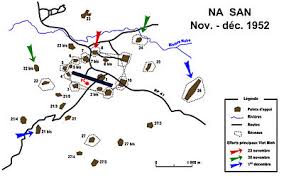
In November and December of the previous year, the French army had air lifted soldiers into a fortified position at Na San, adjacent to a key Viet Minh supply line to Laos. Superior French fire power, armor and air resources had driven Vo Nguyen Giap’s forces back with heavy losses, in what French planners called the “hérisson” or “hedgehog” strategy.
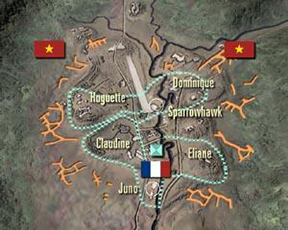
In June, Major General René Cogny proposed a “mooring point” at Dien Bien Phu, creating a lightly defended point from which to launch raids. Navarre wanted to replicate the Na San strategy, and ordered that Dien Bien Phu be taken and converted into a heavily fortified base.
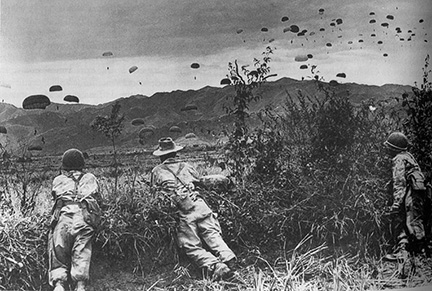
“Operation Castor” began on the 20th of November, with three parachute infantry battalions dropping into Dien Bien Phu. The operation was completed with minimal French casualties on November 30, as they continued to land supplies, troops, and engineering equipment into the isolated base.
Under the command of Colonel Christian de Castries, French forces built seven fortified positions to defend the base, each allegedly named after one of his mistresses. 10,800 French troops were committed, with another 16,000 in reserve.
Vo felt that he had made a serious mistake at Na San, rushing his troops in piecemeal against French defenses. This time, he carefully prepared his positions, moving 50,000 men into position around the valley, meticulously stockpiling ammunition and placing his anti-aircraft and heavy artillery, with which he was well supplied.
The French staff made their battle plan, based on the assumption that it was impossible for the Viet Minh to place enough artillery on the surrounding high ground, due to the rugged terrain. The communists didn’t possess enough artillery to do serious damage anyway, or so they thought.
French officers quickly learned how mistaken they had been. The first sporadic artillery fire began on January 31, around the time that patrols discovered the enemy’s presence in every direction. Heavy artillery virtually ringed the valley in which they found themselves, and air support was quickly nullified by the enemy’s well placed anti-aircraft fire.
The Viet Minh assault began in earnest on March 13, when several outposts came under furious artillery barrage. Air support became next to impossible, and counter-battery fire was next to useless against Giap’s fortifications.
Lieutenant Colonel Charles Piroth commanded the French artillery at Dien Bien Phu. He was a professional soldier and no lightweight, having had his arm amputated in 1946 with no anesthesia. When it became clear how wrong his assumptions had been, Piroth circled the camp making apologies to his officers, returned to his tent, and killed himself with a hand grenade.
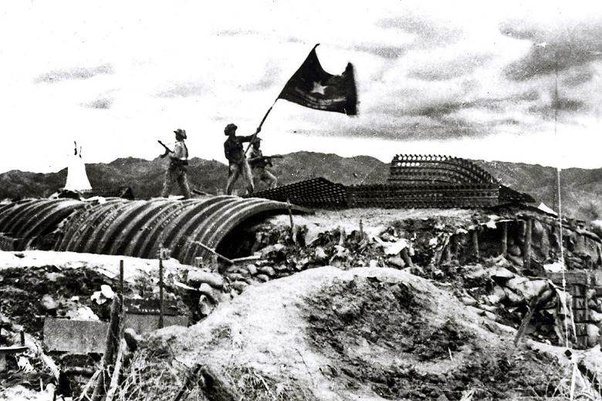
Last moments of the Battle of Dien Bien Phu, 1954, as depicted by North Vietnamese artist Huy Toan
“Beatrice” was the first fire base to fall, then “Gabrielle” and “Anne-Marie”. Viet Minh controlled 90% of the airfield by the 22nd of April, making even parachute drops next to impossible. On May 7, Vo ordered an all-out assault of 25,000 troops against the 3,000 remaining in garrison. By nightfall, it was over. The last words from the last radio man were “The enemy has overrun us. We are blowing up everything. Vive la France!”
Military historian Martin Windrow wrote that Dien Bien Phu was “the first time that a non-European colonial independence movement had evolved through all the stages from guerrilla bands to a conventionally organized and equipped army able to defeat a modern Western occupier in pitched battle”.
The Geneva conference opened the following day, resulting in a Vietnam partitioned into two parts. In the north was the “Democratic Republic of Vietnam” administered by the communists, and the State of Vietnam in the south, under Emperor Bao Dai and Prime Minister Ngo Dinh Diem. The North was supported by both the People’s Republic of China and the Soviet Union, and continued to terrorize patriots in the north and south alike.
US support for the south increased as the French withdrew theirs. By the late 50s, the US was sending technical and financial aid in expectation of social and land reform. By 1960, the National Front for the Liberation of South Vietnam (NLF, or “Viet Cong”) had taken to murdering Diem-supported village leaders. President John F. Kennedy responded in 1961, sending 1,364 American advisers into South Vietnam.
The next war in Indochina, had begun.
If you enjoyed this “Today in History”, please feel free to re-blog, “like” & share on social media, so that others may find and enjoy the same. Please click the “follow” button on the right, to receive email updates on new articles.
Thank you for your interest, in the history we all share.
In 1944 and ’45 with the country at war, Army and Navy both entered that final game of the season,with perfect records. Army finished both of those seasons, undefeated.
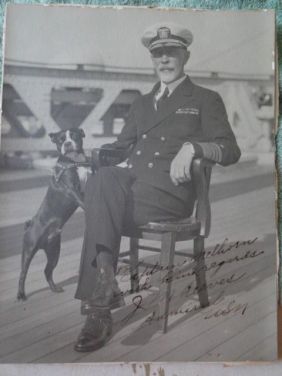
Admiral Joseph Mason “Bull” Reeves
Sometime during the 1893 football season, a navy doctor told Midshipman Joseph Reeves that another kick to the head could result in “instant insanity”, even death.
Reeves commissioned an Annapolis-area shoemaker to build him a leather covering, thus making himself the father of the modern football helmet. Years later, this man of the battleship era became an ardent supporter of naval air power. Today, Admiral “Bull” Reeves is widely known as the “Father of Carrier Aviation”.
The naval academy’s football program is one of the oldest in the country, dating back to 1879.
The Army got into the game in November 1890, when Navy challenged Army cadets in what was then a relatively new sport.
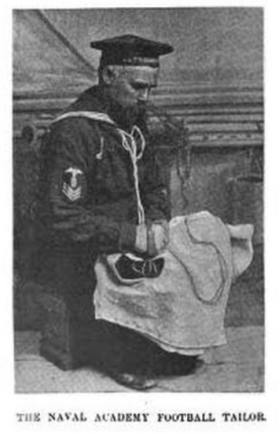
The naval academy introduced a canvas jersey in 1879, believed to be the first college football uniform, in history. Photo by Caspar W. Whitney – Whitney, Caspar W. (May 21, 1892). “The Athletic Development at West Point and Annapolis”. Harper’s Weekly XXXVI (1848): 496., Public Domain, https://commons.wikimedia.org/w/index.php?curid=51990735
That first Army-Navy game was played on November 29, when the Midshipmen humiliated the Army cadets at West Point, 24-0.
The Black Knights had their revenge the following year, defeating Navy at Annapolis, 32-16.
The two teams met some 30 times between 1890 and 1930, when the game became an annual event.
More than inter-service “bragging rights” are at stake. Only 17 schools can boast Heisman Trophy winners. Army and Navy, combine for five.
West Point and Annapolis fielded some of the best teams in college football, during the first half of the 20th century. In 1944 and ’45 with the country at war, Army and Navy both entered that final game of the season,with perfect records. Army finished both seasons, undefeated.
Today, size and weight restrictions combine with a five-year military service commitment, while dreams of NFL careers draw some of the best football talent in college ball away from the service academies. Since 1963, only four seasons have seen both teams enter the Army-Navy game with winning records. Yet, the game remains a college football institution, receiving radio coverage every year since the late ’20s, and broadcast on national television, since 1945.
The first instant replay in American football history, made its debut during the 1963 Army–Navy game.
Arguably, the Army-Navy game may be the purest such event, in all of college sports. These are the kids who play for the love of the game, knowing that their next years are unlikely to lead to careers in sports, business, or academia. These young men have given the next few years of their lives, to the United Sates military.
Roger Staubach
Five-year post-graduation military service commitments preclude the NFL career aspirations of most Army-Navy game veterans, but not all. Notable exceptions include Dallas Cowboys Quarterback Roger Staubach (Navy, 1965), New York Giants Wide Receiver and Return Specialist Phil McConkey (Navy, 1979), and (then) LA Raiders Running back Napoleon McCallum (Navy, 1985).
President Dwight Eisenhower earned the distinction of being the only future President in history to play the Army-Navy game in 1912, alongside future General of the Army, Chairman of the Joint Chiefs of Staff and teammate, Omar Bradley.
Most games are played in a neutral city, almost always on the east coast. Most often in Philadelphia. The Army-Navy game has appeared west of the Mississippi only twice, first for the national dedication of Chicago’s Soldier Field, in 1926. The second was in 1983, when the Department of Defense earned Wisconsin Democratic Senator William Proxmire’s not-so-coveted “Golden Fleece” award, for spending $100,000 to transport cadets, midshipmen and mascots, to play in Pasadena, California’s Rose Bowl.
Oh, for the days when the government pretended to look out for our money.
With capacities of only 38,000 and 34,000 respectively, Army’s Michie Stadium and Navy’s Navy–Marine Corps Memorial Stadium are far too small, to hold the assembled crowd. Out of 117 games, only six have been played on either campus. Two of those (1942-’43), were due to WWII travel restrictions.
In 1963, the Army-Navy game was canceled in observation of a 30-day period of mourning, following the assassination of president John Fitzgerald Kennedy. Knowing her now-deceased husband to be a big fan, First Lady Jacqueline Kennedy requested that the game go on, and so it was, quarterback Roger Staubach leading his #2 nationally ranked team in a 34-14 Navy romp.
For most seniors, the “First Classmen” of either academy, the Army-Navy game carries special meaning. Some may go on to play in a bowl game, but for most, this is the last regular season football game, each will ever play. In times of war, they and others like themselves will be among the first to go, in defense of the country. Some will not return home, alive.
The game is particularly emotional for this reason. Despite intense rivalry, it would be hard to find a duel in all of sports, where the two sides hold the other in higher respect and esteem.
The game is steeped in tradition. As their opposites cheer them on, each side takes the field in a spectacle of precision drill, unmatched in any venue outside of the military. After the game, both teams assemble to sing the almae matres (‘On Brave Old Army Team’ and ‘Anchors Aweigh’) of each institution, to the assembled students and fans.
Navy marches on the field, 1950
The first such serenade is always performed for those of the losing academy, hence the coveted position of “singing second”, signifying the victor of this, the oldest sports rivalry in service academy history.
Respect and tradition is all well and good, but such rivalries do not come without a share of debauchery. During junior year, selected “Middies” and Cadets attend courses with the opposite military academy. On game day, each is restored in a “prisoner exchange”, returning from their semester in “enemy territory”.
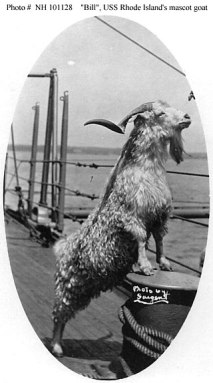
“Bill the goat”, mascot of BB-17 USS Rhode Island, circa 1913
Goats have a long history with all things maritime, having gone to sea since the age of sail and eating all manner of garbage and other undesirable food, in exchange for which, usually “she”, provided companionship, milk and butter. Sir Joseph Bank’s nanny goat was the first creature two-legged or four, to circumnavigate the planet, twice.
Navy had multiple mascots during the early years, including a gorilla, two cats, a bulldog, and a carrier pigeon. Legend has it that a beloved goat once died aboard a Navy cruise, and two ensigns cavorted about wearing the skin during half-time, before making their way to the taxidermist.
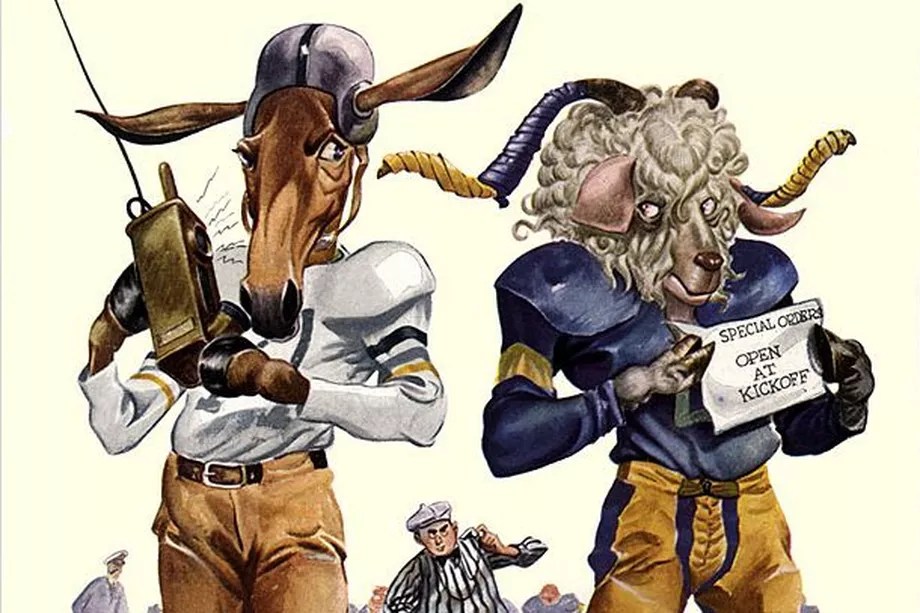
Navy won that game, and a live goat named “El Cid” (The Chief) appeared at the fourth Army-Navy game, in 1893. Navy won that game too, its third victory of those first four games. Small wonder that Billy goats have been the Navy mascot, since 1904.
The 2016 matchup was attended by “Bill” the Goat #XXXVI and his backup, Bill #XXXVII.
Small wonder too, why Army cadets will go to any length, to kidnap that goat. The first such kidnapping of the modern era, took place in 1953.
On November 5, 1995, US Military Academy cadets staged a pre-dawn raid at the Naval Academy Dairy Farm in Gambrills, Maryland, kidnapping Bill the Goat #s XXVI, XXVII and XXIX. The Pentagon was notified, and the goats were returned under a joint Army/Navy policy, stipulating that the “kidnapping of cadets, midshipmen or mascots will not be tolerated”.
Cadets pulled off the caper in 2002, disguised in Grateful Dead T-shirts. “Operation Good Shepherd” launched in 2007, to kidnap Bill #XXXII, XXXIII, and XXXIV. The whole thing was posted, on You Tube.
It’s been said that only the Army, would mount a military operation to kidnap a goat, and only the Navy would involve the Pentagon, to get him back.
The Philadelphia Quartermaster Depot decided in 1899, that Army needed a mascot in response to the Navy’s goat. Mules have a long history with the United Sates Army, going back to George Washington, the “Father of the American Mule“. The question was self-answering. Little is known of the “official” Army mules prior to 1936, when former pack mule “Mr. Jackson” (named for Thomas Jonathan “Stonewall” Jackson), arrived from Front Royal, Virginia.
Mr. Jackson served twelve years, the first of seventeen “official” Army mules. Only one, “Buckshot”, was a female. Currently, the “Mule Corps” consists of “Ranger III”, the son of a Percheron mare standing at 16.2 hands (66″) high, his only slightly shorter half-brother “Stryker”, and “Paladin”, a half-thoroughbred, standing a full two hands shorter than either of his counterparts
Always the last regular-season game in Division I-A football, the next four Army-Navy games are scheduled in Philadelphia. The game site will then move to Metlife Stadium in East Rutherford New Jersey, to mark the twenty-year anniversary of the Islamist terror attacks on the World Trade Center. The 2022 game moves back to Philadelphia, marking the 91st time Army and Navy have played there.
To date, Navy leads Army in the series 60-50-7, with Army’s Black Knights ending Navy’s 14-game winning streak in 2016. The 2017 edition is scheduled for Saturday, December 9, at Philadelphia’s Lincoln Financial Field.
This son and grandson of Army veterans going back to the Revolution and beyond, is compelled to say, ‘Beat Navy’.
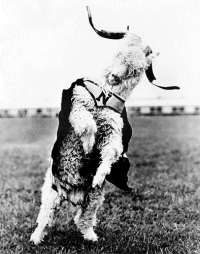
Meeting of the Mascots, 1939
If you enjoyed this “Today in History”, please feel free to re-blog, “like” & share on social media, so that others may find and enjoy the same. Please click the “follow” button on the right, to receive email updates on new articles.
Thank you for your interest, in the history we all share.
ICYMI – “Barney” Welansky, the current owner, liked to brag about his ties with the Mob and with Boston Mayor Maurice Tobin. Welansky was in Mass General Hospital that night, recovering from a heart attack. He would soon have a lot of company.
If you go behind the Hotel Radisson in Boston, over by the parking garage, you’ll find 17 Piedmont Street, in the Bay Village neighborhood. The address is a parking lot now. 75 years ago, it contained the most popular nightclub in Boston.
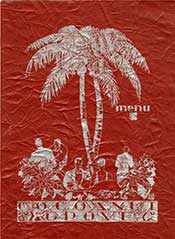
Cocoanut Grove Menu
Rumors of criminal connections followed the Cocoanut Grove for years. The former owner, gangster and bootlegger Charles “King” Solomon, had been gunned down ten years earlier in the men’s room of Roxbury’s Cotton Club. “Barney” Welansky, the current owner, liked to brag about his ties with the Mob and with Boston Mayor Maurice Tobin. Welansky was in Mass General Hospital that night, recovering from a heart attack. He would soon have a lot of company.
During prohibition, the club had been a speakeasy . Originally a garage and warehouse, Cocoanut Grove was converted into a 1½ story complex of dining rooms, bars, and lounges, offering patrons dining and dancing in a “tropical paradise” of artificial palm trees, satin bunting and paper palm fronds, complete with a roof which could be rolled back when weather permitted, for dancing under the stars.
Welansky was a tough boss, maniacally determined not to be cheated out of a tab or a cover charge. He locked exit doors, concealed others with draperies, and even bricked up one emergency exit. Nobody was going to leave Cocoanut Grove without paying up.
Boston College had just ended an undefeated season, losing their slot in the Sugar Bowl in a stunning upset to Holy Cross, 55–12.
Over a thousand football fans, military service members, and Thanksgiving weekend revelers crowded into the nightclub that night. The rated capacity was 460.
Downstairs in the Melody Lounge, Goody Goodelle played piano on a revolving stage, surrounded by paper palms. Someone, perhaps a soldier on leave with his sweetheart, had removed a light bulb to have a little privacy. 16-year old bus boy Stanley Tomaszewski climbed up to replace the bulb, lighting a match so he could see what he was doing.
The decorations ignited immediately, fire racing so fast along the satin canopy, that wooden strips suspending it from the ceiling remained unscathed.
Waiters attempted to douse the fire with water, but it spread far too quickly. Lounge patrons were overcome so rapidly by toxic smoke, that some were later found dead in their seats, drinks still in their hands.
Flames raced up the stairway to the main level, burning the hair of people trying to escape. The orchestra was just beginning its evening show as a fireball leapt across the dance floor, spreading quickly through the Caricature Bar, and down a hallway to the Broadway Lounge. Inside of five minutes, flames had spread into the main hall and the entire nightclub was ablaze.
Today, fire codes require revolving doors to be flanked by doors on either side, but that wasn’t the case in 1942. Desperate to escape, patrons packed the single revolving door, their bodies jamming it so tightly that firefighters later had to dismantle the entire frame.
The bodies of club guests piled up at locked exits, as other doors, opening inward, became useless in the crush of bodies. Firefighters later testified that 300 could have been saved, if only those doors had opened to the outside.
Ambulances, taxis, newspaper delivery trucks and private cars descended on Boston City Hospital’s emergency room, the injured, dead and dying arriving at a rate of one every eleven seconds. Dr. Stanley Levenson, just a year out of Harvard Medical School and down that night with food poisoning, got the call. “I was still in bed on Saturday night, when I got a call from Dr. Charles Lund, chief of surgery, and he told me that no matter how I felt, I had to get to ER immediately, something terrible had happened”.
The most striking story of survival that night, was that of 21-year old Coast Guardsman Clifford Johnson, who returned to the nightclub no fewer than four times in search of his date, Estelle Balkan. He didn’t know that she had safely escaped, and each time Johnson returned with another unconscious smoke victim in his arms. Johnson himself was on fire his last time out, when he collapsed onto the sidewalk, still ablaze.
Clifford Johnson
Three other burn victims were taken to Mass General that night, with burns over 30% of their bodies. Johnson alone survived the ordeal, despite third degree burns over 50% of his body. Much of that, was burned to the bone. Johnson would suffer almost two years of excruciating medical procedures, including no fewer than 30,000 skin grafts in the first year alone.
I earn my living in the Commercial Furniture business. I can tell you from experience that Cocoanut Grove effects Boston fire code regulations, to this day. 492 died in the conflagration, the deadliest nightclub fire in American history.
Barney Welansky was tried and convicted on 19 counts of manslaughter, and sentenced to 12-15 years. Maurice Tobin, by then Governor, released him after four, his body ravaged with cancer. Welansky died 9 weeks later. Stanley Tomaszewski was exonerated. It wasn’t he who had placed all those flammable decorations, but the bus boy was treated like a Jonah, for the rest of his life.
Clifford Johnson would be 21 months in the hospital, after which he married his nurse and returned to his home state of Missouri, the first of his era to survive such severe burns. Ironically, Johnson would be killed in a car wreck in 1956, pinned beneath an overturned Jeep, and burned to death.
If you enjoyed this “Today in History”, please feel free to re-blog, “like” & share on social media, so that others may find and enjoy the same. Please click the “follow” button on the right, to receive email updates on new articles.
Thank you for your interest, in the history we all share.
While many considered the Vichy government to be a puppet state, the officers and men of the French fleet had no love for their German occupiers. This was a French fleet and would remain so if they could help it, even if they had to sink it to the bottom of the ocean.
The Battle of France began on May 10, 1940, with the German invasion of France and the Low Countries of Belgium, Luxembourg and the Netherlands. By the end of May, German Panzers had hurled the shattered remnants of the allied armies into the sea, at a place called Dunkirk.
The speed and ferocity of the German Blitzkrieg left the French people in shock in the wake of their June surrender. All those years their government had told them, that the strength of the French army combined with the Maginot line, was more than enough to counter German aggression.
France had fallen in six weeks.
Germany installed a Nazi-approved French government in the south of France, headed by WW1 hero Henri Pétain. Though mostly toothless, the self-described “French state” in Vichy was left relatively free to run its own affairs, compared with the Nazi occupied regions to the west and north.
That changed in November 1942, with the joint British/American invasion of Morocco, Tunisia and Algeria. At the time, the north African provinces were nominally under the control of the Vichy regime. Hitler gave orders for the immediate occupation of all of France.
With the armistice of June 1940, much of the French naval fleet was confined to the Mediterranean port of Toulon. Confined but not disarmed, and the French fleet possessed some of the most advanced naval technologies of the age, enough to shift the balance of military power in the Mediterranean.
While many considered the Vichy government to be a puppet state, the officers and men of the French fleet had no love for their German occupiers. This was a French fleet and would remain so if they could help it, even if they had to sink it to the bottom of the ocean.
In November 1942, the Nazi government came to take control of that fleet. The motorized 7th Panzer column of German tanks, armored cars and armored personnel carriers descended on Toulon with an SS motorcycle battalion, taking over port defenses to either side of the harbor. German officers entered fleet headquarters and arrested French officers, but not before word of what was happening was relayed to French Admiral Jean de Laborde, aboard the flagship Strasbourg.
The order went out across the base at Toulon. Prepare to scuttle the fleet, and resist the advance of German troops, by any means necessary.
The German column approached the main gate to the harbor facility in the small hours of November 27, demanding access. ‘Of course,’ smiled the French guard. ‘Do you have your access paperwork?’
Under orders to take the harbor without bloodshed, the Nazi commander was dismayed. Was he being denied access by this, his defeated adversary? Minutes seemed like hours in the tense wrangling which followed. Germans gesticulated and argued with French guards, who stalled and prevaricated at the closed gate.
The Germans produced documentation, only to be thanked, asked to wait, and left standing at the gate.
Meanwhile, thousands of French seamen worked in grim silence throughout the early morning hours, preparing to scuttle their own fleet. Valves and watertight doors were opened, incendiary and demolition charges were prepared and placed.
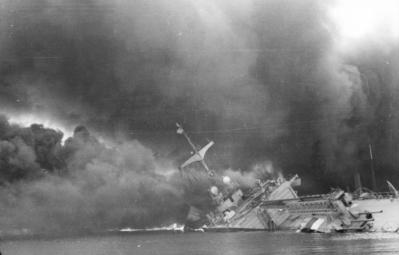
Finally, the Panzer column could be stalled no more. German tanks rumbled through the main gate at 5:25am, even as the order to scuttle passed throughout the fleet. Dull explosions sounded across the harbor, as fighting broke out between the German column, and French sailors pouring out of their ships in the early dawn light. Lead German tanks broke for the Strasbourg, even now pouring greasy, black smoke from its superstructure, as she settled to the bottom.
The Germans could only look on, helpless, as a dying fleet escaped their grasp. In the end, 3 battleships, 7 cruisers, 15 destroyers, 13 torpedo boats, 6 sloops, 12 submarines, 9 patrol boats, 19 auxiliary ships, 28 tugs, 4 cranes and a school ship, were destroyed. 39 smaller vessels of negligible military value fell into German hands along with twelve fleet vessels, all of them damaged.
The fires would burn, for weeks. The harbor at Toulon would remain fouled and polluted, for years.
The French Navy lost 12 men killed and 26 wounded on that day, 75 years ago, today. The loss to the Nazi war effort, is incalculable. How many lives could have been lost can never be known, had Nazi Germany come into possession of all that naval power. But for the bravery of a vanquished, but still unbeaten, foe.
If you enjoyed this “Today in History”, please feel free to re-blog, “like” & share on social media, so that others may find and enjoy the same. Please click the “follow” button on the right, to receive email updates on new articles.
Thank you for your interest, in the history we all share.
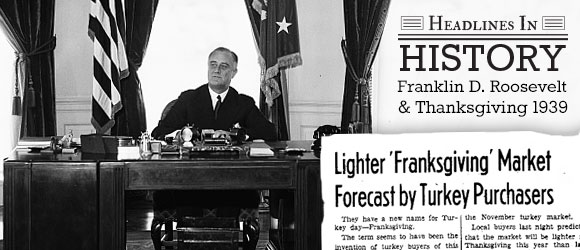
The next two years, thirty-two states and the District of Columbia celebrated what came to be called “Franksgiving” on the third Thursday of the month, while the remainder observed a more traditional “Republican Thanksgiving”, on the last. FDR quipped “Two years ago, or three years ago, I discovered I was particularly fond of turkey! So we started two Thanksgivings. I don’t know how many we ought to have next year. I’m open to suggestion.”
In 1863, President Abraham Lincoln declared a general day of Thanksgiving to be observed on the last Thursday of November. The date seemed to work out OK and the tradition stuck, until 1939.
Roughly two in seven Novembers contain five Thursdays, and that year was one.
In those days, it was considered poor form for retailers to put up Christmas displays or run Christmas sales, before Thanksgiving. Lew Hahn, General Manager of the Retail Dry Goods Association, was afraid that extra week was going to cut into Christmas sales.
Ten years into the Great Depression with unemployment standing at 17.2%, the Federal government was afraid of the same thing. Never afraid to tinker with precedent, President Franklin Roosevelt decided to deviate from the customary last Thursday, and declared the fourth Thursday, November 23, to be a national day of prayer and thanksgiving.
Opposition to the plan was quick in forming. Alf Landon, Roosevelt’s Republican challenger in the earlier election, complained of Roosevelt’s impulsiveness, and the confusion resulting from it. “more time should have been taken working it out” Landon complained, “instead of springing it upon an unprepared country with the omnipotence of a Hitler.”
In Plymouth Massachusetts, home of the first Thanksgiving, Chairman of the Board of Selectmen James Frasier, “heartily disapproved”. The headline from the New York Times, trumpeted “Roosevelt to Move Thanksgiving: Retailers for It, Plymouth Is Not.”
The short-notice change in holiday schedule disrupted the holiday plans of millions of Americans, to say nothing of traditional high school and college Thanksgiving day football rivalries, across the nation.
Unsurprisingly, support for Roosevelt’s plan split across ideological lines. A late 1939 Gallup poll reported Democrats favoring the change 52% to 48%, with Republicans opposing it 79% to 21%.
Such proclamations represent little more than the “’moral authority” of the Presidency, and states are free to do as they pleased. Twenty-three states and the District of Columbia observed Thanksgiving day on the non-traditional date, and twenty-two kept Thanksgiving on the 27th. Colorado, Mississippi and Texas, did both.
The next two years, thirty-two states and the District of Columbia celebrated what came to be called “Franksgiving” on the third Thursday of the month, while the remainder observed a more traditional “Republican Thanksgiving”, on the last. FDR quipped “Two years ago, or three years ago, I discovered I was particularly fond of turkey! So we started two Thanksgivings. I don’t know how many we ought to have next year. I’m open to suggestion.”
In 1941, a Commerce Department survey demonstrated little difference in Christmas sales between those states observing Franksgiving, and those observing the more traditional date. A joint resolution of Congress declared the fourth Thursday beginning the following year to be a national day of Thanksgiving, President Roosevelt signing the measure into law November 26.
Interestingly, the phrase “Thanksgiving Day” had been used only once in the 20th century prior to the 1941 resolution, that in President Calvin Coolidge’s first of six such proclamations.
Most state legislatures followed suit with the Federal fourth-Thursday approach, but not all. In 1945, the next year with five Thursdays in November, Arkansas, Florida, Georgia, Idaho, Nebraska, Tennessee, Texas, and Virginia reverted to the last Thursday. Texas would hold out the longest, celebrating its fifth-Thursday Thanksgiving for the last time in 1956.
To this day, the years 1939, ’40 and ’41 remain the only outliers, outside the fourth-Thursday tradition.
Popular comedians of the day got a lot of laughs out of it, including Burns & Allen and Jack Benny.
One 1940 Warner Brothers cartoon shows two Thanksgivings, one “for Democrats” and one a week later “for Republicans.”
The Three Stooges short film “No Census, No Feeling” of the same year, has Moe questioning Curly, why he put the fourth of July in October. Larry: Where is everybody? Curly: Maybe it’s the Fourth of July. Moe: The Fourth of July in October? Curly: You never can tell… Look what they did to Thanksgiving!
Joe Toye, the “Easy Company” character in the 2001 HBO miniseries “A Band of Brothers”, may have had the last word on Franksgiving. Explaining his plan to get the war over quickly, the paratrooper quips “Hitler gets one of these [knives] right across the windpipe, Roosevelt changes Thanksgiving to Joe Toye Day, [and] pays me ten grand a year for the rest of my f*****g life.”
Sounds like a plan.
If you enjoyed this “Today in History”, please feel free to re-blog, “like” & share on social media, so that others may find and enjoy the same. Please click the “follow” button on the right, to receive email updates on new articles.
Thank you for your interest, in the history we all share.
ICYMI – A former President and son of a Founding Father, John Quincy Adams, argued the case, in a trial beginning on George Washington’s birthday, 1841.
By 1839, the international slave trade was illegal in most countries, though the “peculiar institution” itself, was not. In April of that year, five or six hundred Africans were illegally purchased by a Portuguese slave trader, and shipped to Havana aboard the brig Tecora.
Fifty-three members of the Mende tribe, of the modern-day country of Sierra Leone, were sold to Joseph Ruiz and Pedro Montez, who planned to use them on their Cuban sugar plantation. The Mendians were given Spanish names and designated “black ladinos,” fraudulently documenting them to have always lived as slaves, in Cuba. In June, Ruiz and Montez placed the Africans on board the schooner la Amistad, (“Friendship”), and set sail down the Cuban coast to Puerto del Principe.
On the fourth night at sea, Joseph Cinqué, also known as Sengbe Pieh, led a number of captives in breaking free of their chains and seizing control of the ship. They killed two of their captors, losing two of their own in the struggle, while two others escaped in a boat. The cabin boy, who really was a black ladino, was spared and used as translator.
The Mendians forced the two remaining crew to return them to Africa, which they pretended to do by day. But they were betrayed, the two slavers would steer the ship north by night, when the position of the sun couldn’t be seen. Amistad was apprehended off Long Island by a U.S. Coastal Survey brig and taken to New London, Connecticut, where the Africans were put in prison. Connecticut was still a slave state at that time.
The Spanish Ambassador demanded that Ruiz’ and Montez’ “property” be returned and the matter settled under Spanish law. President Martin van Buren agreed, but the matter had already fallen under the jurisdiction of the courts.
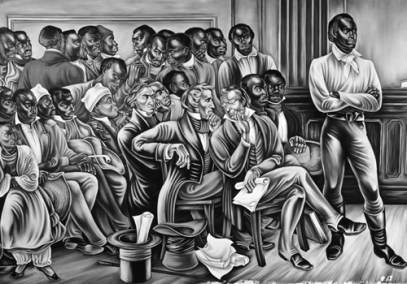
The district court trial which followed in Hartford determined that the Mendians’ papers were forged, and they should be returned to Africa. The cabin boy was ruled to be a slave and ordered returned to the Cubans, however he fled to New York with the help of abolitionists. He would live out the rest of his life as a free man.
Fearing the loss of pro-slavery political support, President van Buren ordered government lawyers to appeal the case up to the United States Supreme Court. The government case depended on the anti-piracy provision of a treaty then in effect between Spain and the United States,
A print of Joseph Cinqué appeared in The New York Sun newspaper, August 31, 1839
A former President and son of a Founding Father, John Quincy Adams, argued the case, in a trial beginning on George Washington’s birthday, 1841.
In United States v. Schooner Amistad, SCOTUS upheld the decision of the lower court 8-1, ruling that the Africans had been detained illegally, ordering them returned to their home. John Tyler, a pro slavery Whig, was President by this time. Tyler refused to provide a ship or fund the repatriation, so abolitionists and missionaries did so, returning 35 surviving Mendians to Africa on November 25, 1841.
In arguing the case, President Adams took the position that no man, woman, or child in the United States could ever be sure of the “blessing of freedom”, if the President could hand over free men on the demand of a foreign government.
152 years later, Bill Clinton, Eric Holder and Janet Reno kidnapped six-year-old Elian Gonzalez at gunpoint, sending him back to Cuba over the body of the mother who died bringing him to freedom.
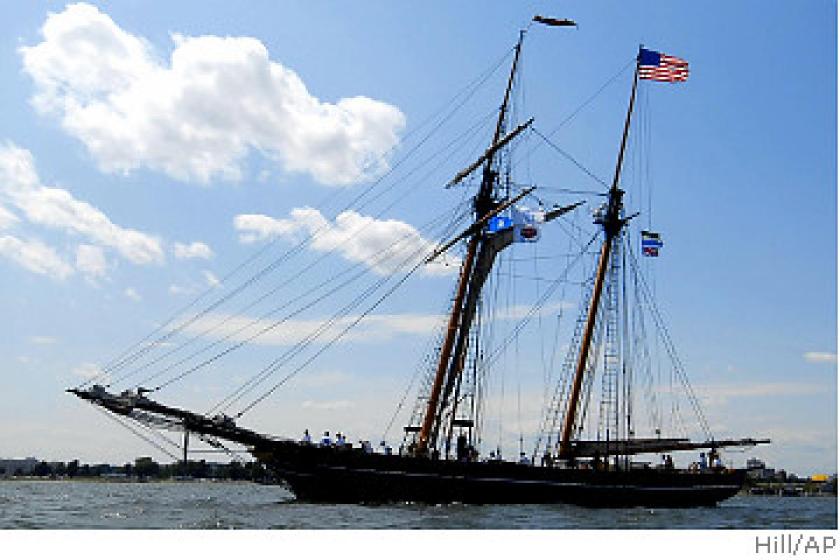
In 2007, a near-replica of the Amistad left its home port in Connecticut, on a 16-month, 14,000-mile voyage to Nova Scotia, Britain and Africa.



 The trio arrived at the Stromness whaling station on May 20. They must have been a sight, with thick ice encrusting their long, filthy beards, and saltwater-soaked sealskin clothing rotting from their bodies. The first people they came across were children, who ran in fright at the sight of them.


 Four additional Vietcong were discovered hiding underground, as quick reaction teams scoured the area. They found Nemo and Thornburg, both seriously wounded, together on the ground. Both would survive, though Thorneburg was shot a second time, while returning to base.
 The vast majority of MWDs who served in Vietnam, were left behind as “surplus equipment”. Left to succumb to tropical disease, to be euthanized by the South Vietnamese Army, or worse. Nemo was one of the few lucky ones. He came home.

 Wild potatoes contain toxins to defend themselves against fungi and bacteria, toxins unaffected by the heat of cooking. In the Andes, mountain people learned to imitate the wild guanaco and vicuña, licking clay before eating the poisonous plants. In this manner, toxins pass harmlessly through the digestive system. Mountain people dunk wild potatoes in “gravy” made of clay and water, accompanied with coarse salt. Eventually, growers developed less toxic tubers, though the poisonous varieties are still favored for their frost resistance. Clay dust is sold in Peruvian and Bolivian markets, to this day.
 Calamity struck Ireland in 1845, in the form of a blight so horrific that US military authorities once considered stockpiling the stuff as a biological weapon. Seemingly overnight, Ireland’s staple food crop was reduced to a black, stinking ooze.
 The Innate potato produces less acrylamide, a known carcinogen produced by normal potatoes in the high heat of fryers.



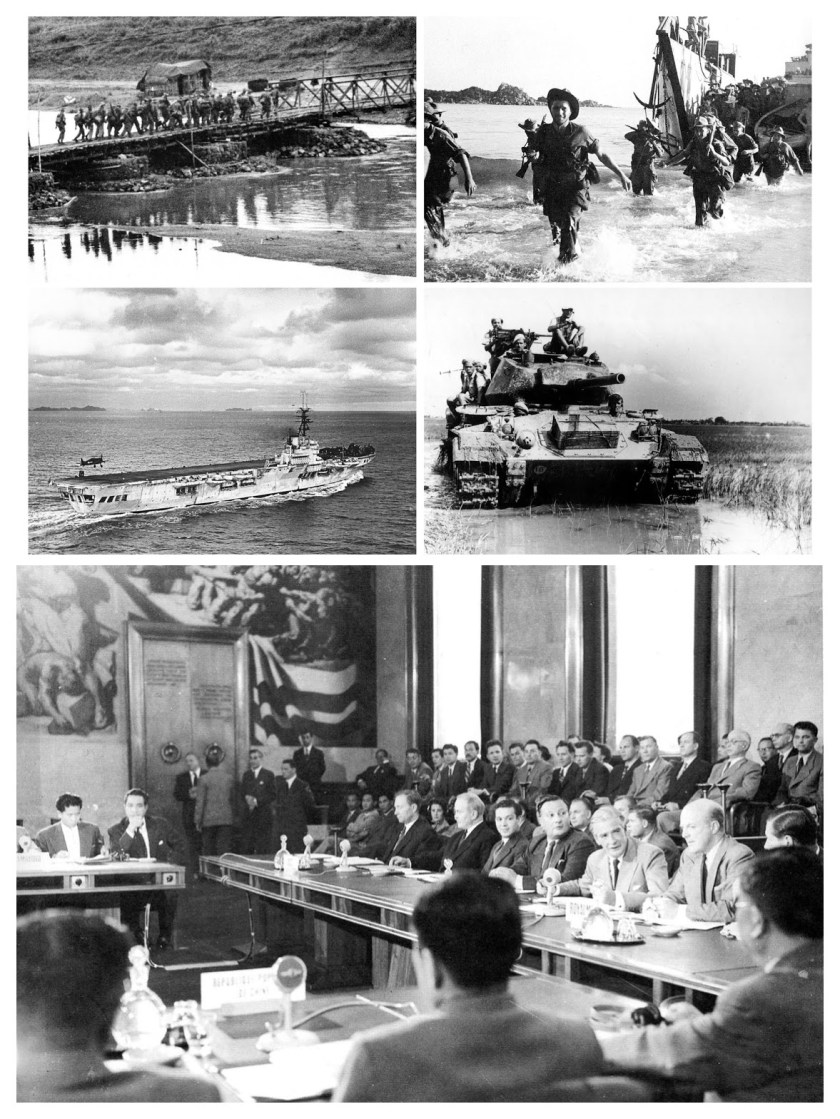 What historians call the First Indochina War, many contemporaries called “la sale guerre”, or “dirty war”. The government forbade the use of metropolitan recruits, fearing that that would make the war more unpopular than it already was. Instead, French professional soldiers and units of the French Foreign Legion were augmented with colonial troops, including Moroccan, Algerian, Tunisian, Laotian, Cambodian, and Vietnamese ethnic minorities.
 The war went poorly for the French. By 1952 they were looking for a way out. Premier René Mayer appointed Henri Navarre to take command of French Union Forces in May of that year, with a single order. Navarre was to create military conditions which would lead to an “honorable political solution”.
 In June, Major General René Cogny proposed a “mooring point” at Dien Bien Phu, creating a lightly defended point from which to launch raids. Navarre wanted to replicate the Na San strategy, and ordered that Dien Bien Phu be taken and converted into a heavily fortified base.
 The French staff made their battle plan, based on the assumption that it was impossible for the Viet Minh to place enough artillery on the surrounding high ground, due to the rugged terrain. The communists didn’t possess enough artillery to do serious damage anyway, or so they thought.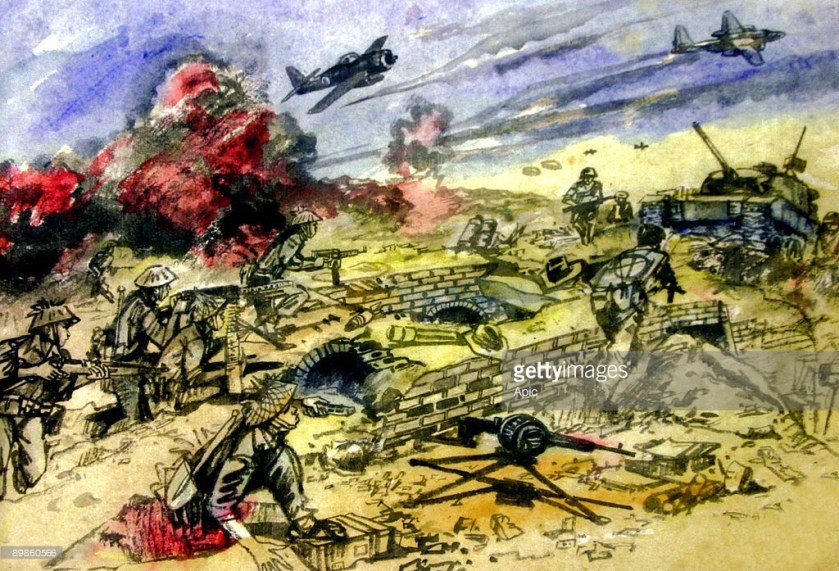

 Oh, for the days when the government pretended to look out for our money.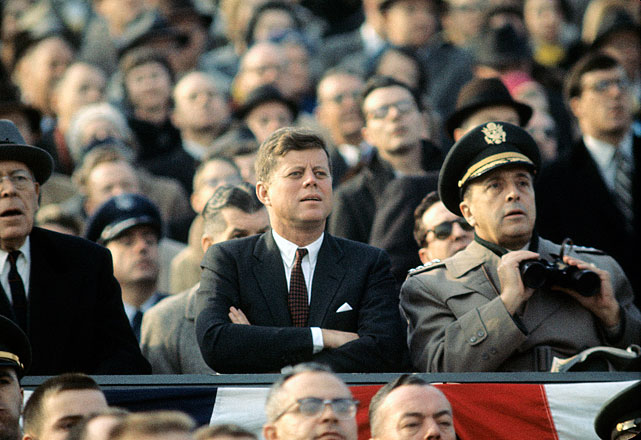
 The game is particularly emotional for this reason. Despite intense rivalry, it would be hard to find a duel in all of sports, where the two sides hold the other in higher respect and esteem.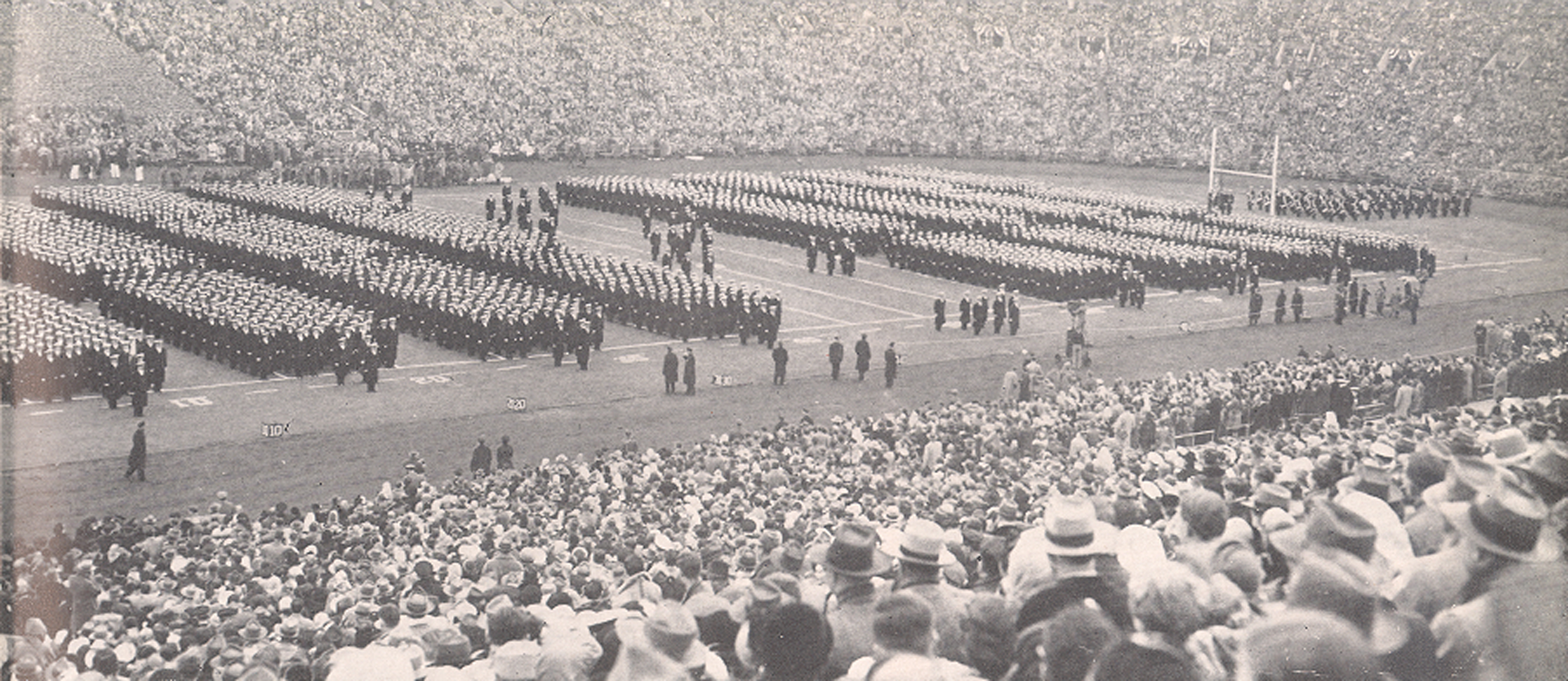
 The Philadelphia Quartermaster Depot decided in 1899, that Army needed a mascot in response to the Navy’s goat. Mules have a long history with the United Sates Army, going back to George Washington, the “
 Always the last regular-season game in Division I-A football, the next four Army-Navy games are scheduled in Philadelphia. The game site will then move to Metlife Stadium in East Rutherford New Jersey, to mark the twenty-year anniversary of the Islamist terror attacks on the World Trade Center. The 2022 game moves back to Philadelphia, marking the 91st time Army and Navy have played there.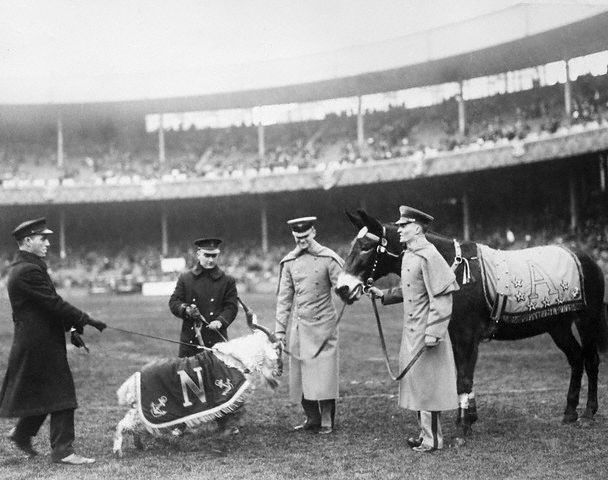


 Welansky was a tough boss, maniacally determined not to be cheated out of a tab or a cover charge. He locked exit doors, concealed others with draperies, and even bricked up one emergency exit. Nobody was going to leave Cocoanut Grove without paying up.
 The decorations ignited immediately, fire racing so fast along the satin canopy, that wooden strips suspending it from the ceiling remained unscathed.
 Today, fire codes require revolving doors to be flanked by doors on either side, but that wasn’t the case in 1942. Desperate to escape, patrons packed the single revolving door, their bodies jamming it so tightly that firefighters later had to dismantle the entire frame.
 The most striking story of survival that night, was that of 21-year old Coast Guardsman Clifford Johnson, who returned to the nightclub no fewer than four times in search of his date, Estelle Balkan. He didn’t know that she had safely escaped, and each time Johnson returned with another unconscious smoke victim in his arms. Johnson himself was on fire his last time out, when he collapsed onto the sidewalk, still ablaze.
 Barney Welansky was tried and convicted on 19 counts of manslaughter, and sentenced to 12-15 years. Maurice Tobin, by then Governor, released him after four, his body ravaged with cancer. Welansky died 9 weeks later. Stanley Tomaszewski was exonerated. It wasn’t he who had placed all those flammable decorations, but the bus boy was treated like a Jonah, for the rest of his life.

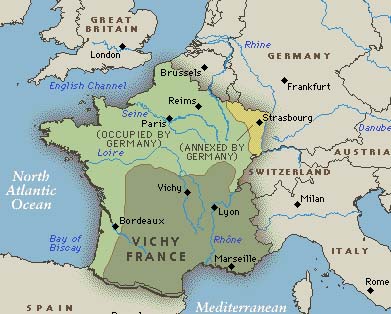 Germany installed a Nazi-approved French government in the south of France, headed by WW1 hero Henri Pétain. Though mostly toothless, the self-described “French state” in Vichy was left relatively free to run its own affairs, compared with the Nazi occupied regions to the west and north.
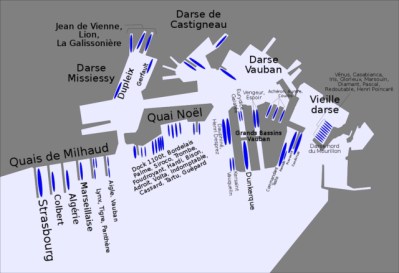 With the armistice of June 1940, much of the French naval fleet was confined to the Mediterranean port of Toulon. Confined but not disarmed, and the French fleet possessed some of the most advanced naval technologies of the age, enough to shift the balance of military power in the Mediterranean.
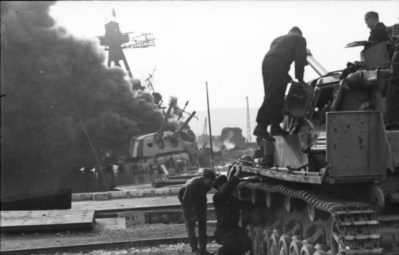 In November 1942, the Nazi government came to take control of that fleet. The motorized 7th Panzer column of German tanks, armored cars and armored personnel carriers descended on Toulon with an SS motorcycle battalion, taking over port defenses to either side of the harbor. German officers entered fleet headquarters and arrested French officers, but not before word of what was happening was relayed to French Admiral Jean de Laborde, aboard the flagship Strasbourg.
 Under orders to take the harbor without bloodshed, the Nazi commander was dismayed. Was he being denied access by this, his defeated adversary? Minutes seemed like hours in the tense wrangling which followed. Germans gesticulated and argued with French guards, who stalled and prevaricated at the closed gate.
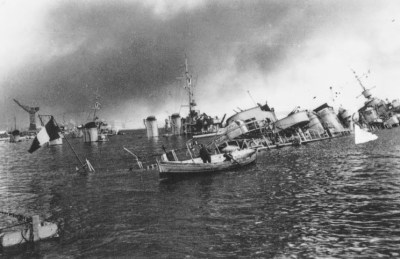 Finally, the Panzer column could be stalled no more. German tanks rumbled through the main gate at 5:25am, even as the order to scuttle passed throughout the fleet. Dull explosions sounded across the harbor, as fighting broke out between the German column, and French sailors pouring out of their ships in the early dawn light. Lead German tanks broke for the Strasbourg, even now pouring greasy, black smoke from its superstructure, as she settled to the bottom.

 Ten years into the Great Depression with unemployment standing at 17.2%, the Federal government was afraid of the same thing. Never afraid to tinker with precedent, President Franklin Roosevelt decided to deviate from the customary last Thursday, and declared the fourth Thursday, November 23, to be a national day of prayer and thanksgiving.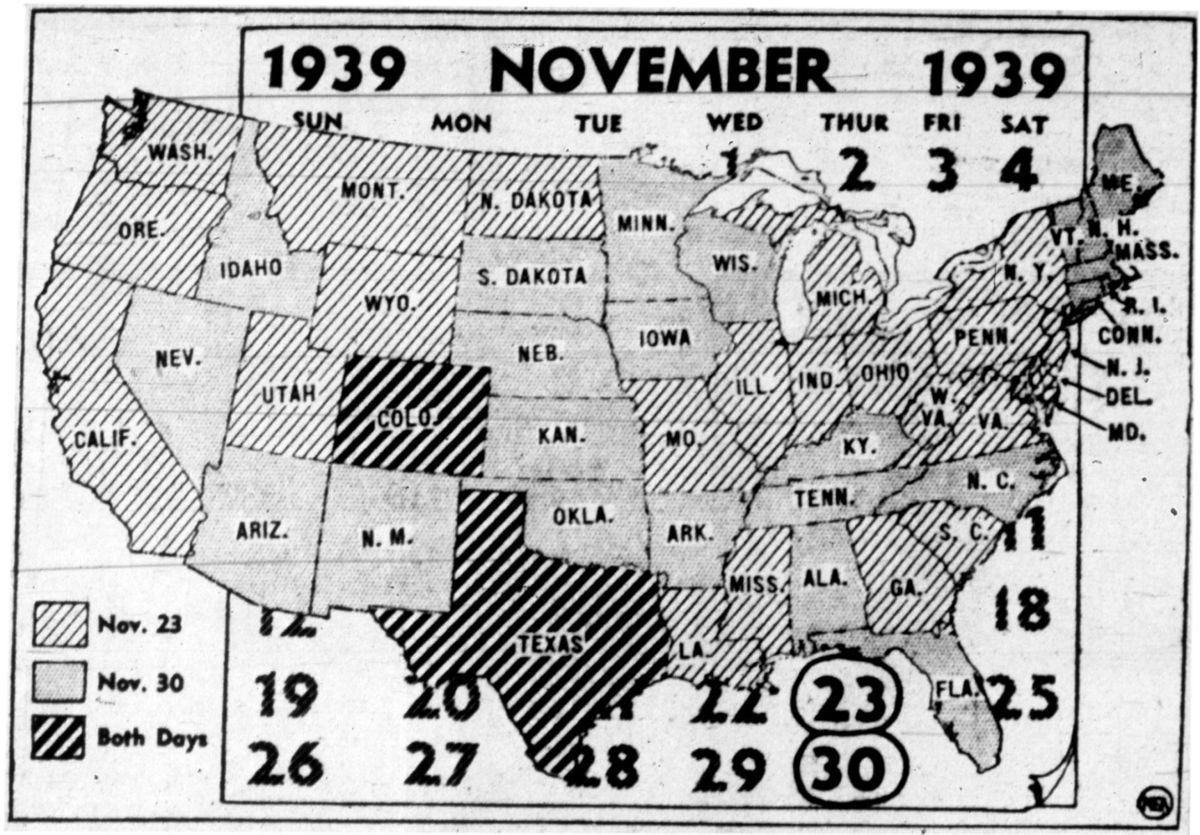
 Popular comedians of the day got a lot of laughs out of it, including Burns & Allen and Jack Benny.

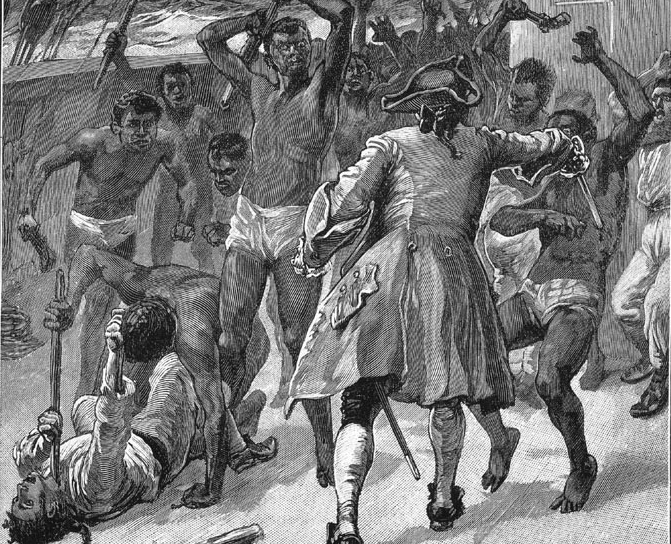
 The district court trial which followed in Hartford determined that the Mendians’ papers were forged, and they should be returned to Africa. The cabin boy was ruled to be a slave and ordered returned to the Cubans, however he fled to New York with the help of abolitionists. He would live out the rest of his life as a free man.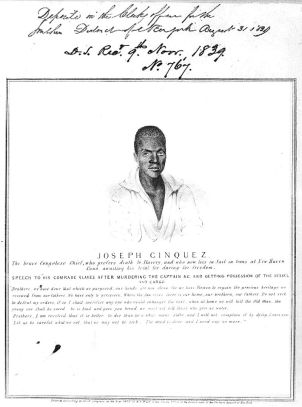


You must be logged in to post a comment.