April 5, 1761, That Other Ride, You Never Heard About

Listen my children and you shall hear
Of the midnight ride of…Sybil Ludington

“Listen my children and you shall hear,
Of the midnight ride of” …Sybil Ludington.

Wait…What?

Paul Revere’s famous “midnight ride” began on the night of April 18, 1775.  Revere was one of two riders, soon joined by a third, fanning out from Boston to warn of an oncoming column of “regulars”, come to destroy the stockpile of gunpowder, ammunition, and cannon in Concord.
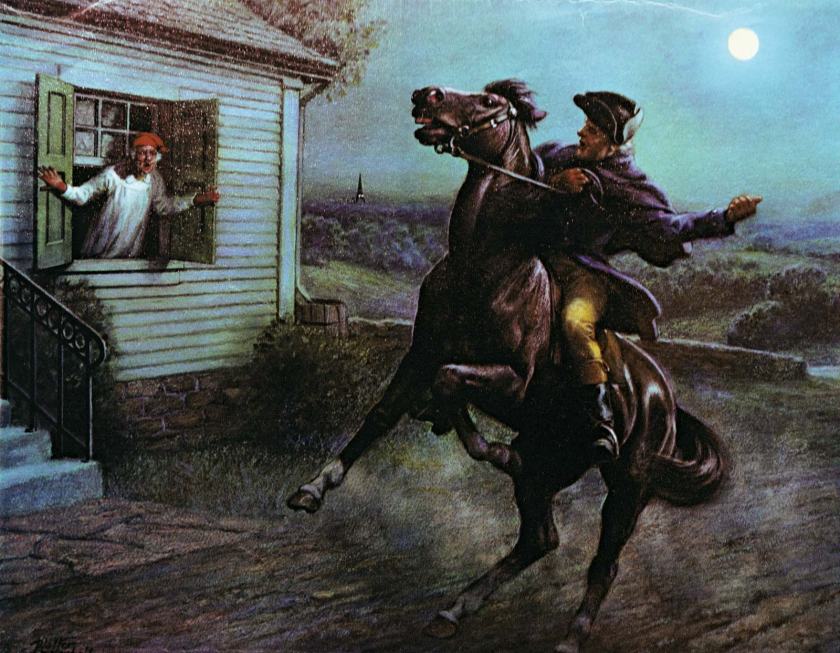
paul-revereRevere himself covered barely 12 miles before being captured, his horse confiscated to replace the tired mount of a British sergeant.  Revere would finish his “ride” on foot, arriving at sunrise on the 19th to witness the last moments of the battle on Lexington Green.

Two years later, Patriot forces maintained a similar supply depot, in the southwest Connecticut town of Danbury.

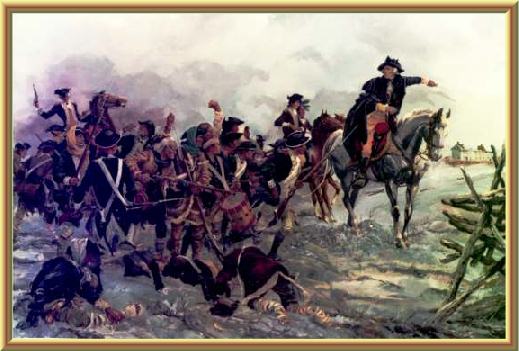
William Tryon was the Royal Governor of New York, and long-standing advocate for attacks on civilian targets.  In 1777, Tryon was major-general of the provincial army.  On April 25th, the General set sail for the Connecticut coast of Long Island Sound with a force of 1,800, intending to destroy Danbury.
Battle3

Patriot Colonel Joseph Cooke’s small Danbury garrison was caught and quickly overpowered on the 26th, trying to remove food supplies, uniforms, and equipment.  Facing little if any opposition, Tryon’s forces went on a bender, burning homes, farms and storehouses.  Thousands of barrels of pork, beef, and flour were destroyed, along with 5,000 pairs of shoes, 2,000 bushels of grain, and 1,600 tents.

Colonel Henry Ludington was a farmer and father of 12, with a long military career.  A long-standing and loyal subject of the British crown, Ludington switched sides in 1773, joining the rebel cause and rising to command the 7th Regiment of the Dutchess County Militia, in New York’s Hudson Valley.

908d9d26ffc8bb0c9e8a59b25da92429--american-revolutionary-war-paul-revere

In April 1777, Ludington’s militia was disbanded for planting season, and spread across the countryside.  An exhausted rider arrived at the Ludington farm on a blown horse, on the evening of the 26th, asking for help.  15 miles away, British regulars and a force of loyalists were burning Danbury to the ground.

The Dutchess County Militia had to be called up.  The Colonel had one night to prepare for battle, and this rider was done.  The job would have to go to Colonel Ludington’s first-born, his daughter, Sybil.

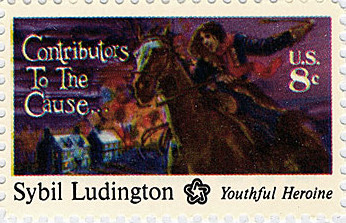
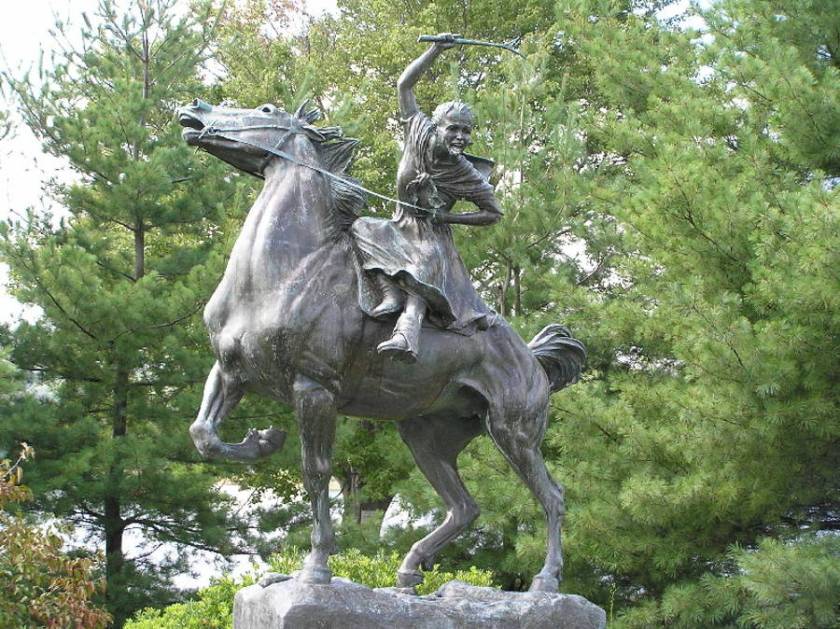
Born April 5, 1761, Sybil Ludington was barely sixteen at the time of her ride.  From Poughkeepsie to what is now Putnam County and back, the “Female Paul Revere” rode across the lower Hudson River Valley, covering 40 miles in the pitch dark of night, alerting her father’s militia to the danger and urging them to come out and fight.  She’d use a stick to knock on doors, even using it once, to fight off a highway bandit.

By the time Sybil returned the next morning, cold, rain-soaked, and exhausted, most of 400 militia were ready to march.

Arnold’s forces arrived too late to save Danbury, but inflicted a nasty surprise on the British rearguard as the column approached nearby Ridgefield.  Never outnumbered by less than three-to-one, Connecticut militia was able to slow the British advance until Ludington’s New York Militia arrived on the following day.  The last phase of the action saw the same type of swarming harassment, as seen on the British retreat from Concord to Boston, early in the war.35 miles to the east of Danbury, General Benedict Arnold was gathering a force of 500 regular and irregular Connecticut militia, with Generals David Wooster and Gold Selleck Silliman.

Though the British operation was a tactical success, the mauling inflicted by these colonials ensured that this was the last hostile British landing on the Connecticut coast.

The British raid on Danbury destroyed at least 19 houses and 22 stores and barns.  Town officials submitted £16,000 in claims to Congress, for which town selectmen received £500 reimbursement.  Further claims were made to the General Assembly of Connecticut in 1787, for which Danbury was awarded land.  In Ohio.

Keeler_tavern_ridgefield_cannonball_2006

At the time, Benedict Arnold planned to travel to Philadelphia, to protest the promotion of officers junior to himself, to Major General.  Arnold, who’d had two horses shot out from under him at Ridgefield, was promoted to Major General in recognition for his role in the battle.  Along with that promotion came a horse, “properly caparisoned as a token of … approbation of his gallant conduct … in the late enterprize to Danbury.”  For now, the pride which would one day be his undoing, was assuaged.The Keeler Tavern in Ridgefield is now a museum.  The British cannonball fired into the side of the building, remains there to this day.

Henry Ludington would become Aide-de-Camp to General George Washington, and grandfather to Harrison Ludington, mayor of Milwaukee and 12th Governor of Wisconsin.

Gold Silliman was kidnapped with his son by a first marriage by Tory neighbors, and held for Nearly seven months at a New York farmhouse.  Having no hostage of equal rank with whom to exchange for the General, Patriot forces went out and kidnapped one of their own, in the person of Chief Justice Judge Thomas Jones, of Long Island.
Sybil_Ludington_stamp

Mary Silliman was left to run the farm, including caring for her own midwife, who was brutally raped by English forces for denying them the use of her home.  The 1993 made-for-TV movie “Mary Silliman’s War” tells the story of non-combatants, pregnant mothers and farm wives during the Revolution, as well as Mary’s own negotiations for her husband’s release from his Loyalist captors.

IMG_6632General David Wooster was mortally wounded at the Battle of Ridgefield, moments after shouting “Come on my boys! Never mind such random shots!”  Today, an archway marks the entrance to Wooster Square, in the East Rock Neighborhood of New Haven. 

Sybil Ludington received the thanks of family and friends and even that of George Washington.  She then stepped off the pages of history.

Paul Revere’s famous ride would have likewise faded into obscurity, but for the poetry of Henry Wadsworth Longfellow.  Eighty-six years, later.

Page break

“Listen my children and you shall hear
Of the midnight ride of Paul Revere,
On the eighteenth of April, in Seventy-five;
Hardly a man is now alive
Who remembers that famous day and year. He said to his friend, “If the British march
By land or sea from the town to-night,
Hang a lantern aloft in the belfry arch
Of the North Church tower as a signal light,–
One if by land, and two if by sea;
And I on the opposite shore will be,
Ready to ride and spread the alarm
Through every Middlesex village and farm,
For the country folk to be up and to arm. ”Then he said “Good-night!” and with muffled oar
Silently rowed to the Charlestown shore,
Just as the moon rose over the bay,
Where swinging wide at her moorings lay
The Somerset, British man-of-war;
A phantom ship, with each mast and spar
Across the moon like a prison bar,
And a huge black hulk, that was magnified
By its own reflection in the tide. Meanwhile, his friend through alley and street
Wanders and watches, with eager ears,
Till in the silence around him he hears
The muster of men at the barrack door,
The sound of arms, and the tramp of feet,
And the measured tread of the grenadiers,
Marching down to their boats on the shore. Then he climbed the tower of the Old North Church,
By the wooden stairs, with stealthy tread,
To the belfry chamber overhead,
And startled the pigeons from their perch
On the sombre rafters, that round him made
Masses and moving shapes of shade,–
By the trembling ladder, steep and tall,
To the highest window in the wall,
Where he paused to listen and look down
A moment on the roofs of the town
And the moonlight flowing over all. Beneath, in the churchyard, lay the dead,
In their night encampment on the hill,
Wrapped in silence so deep and still
That he could hear, like a sentinel’s tread,
The watchful night-wind, as it went
Creeping along from tent to tent,
And seeming to whisper, “All is well!”
A moment only he feels the spell
Of the place and the hour, and the secret dread
Of the lonely belfry and the dead;
For suddenly all his thoughts are bent
On a shadowy something far away,
Where the river widens to meet the bay,–
A line of black that bends and floats
On the rising tide like a bridge of boats. Meanwhile, impatient to mount and ride,
Booted and spurred, with a heavy stride
On the opposite shore walked Paul Revere.
Now he patted his horse’s side,
Now he gazed at the landscape far and near,
Then, impetuous, stamped the earth,
And turned and tightened his saddle girth;
But mostly he watched with eager search
The belfry tower of the Old North Church,
As it rose above the graves on the hill,
Lonely and spectral and sombre and still.
And lo! as he looks, on the belfry’s height
A glimmer, and then a gleam of light!
He springs to the saddle, the bridle he turns,
But lingers and gazes, till full on his sight
A second lamp in the belfry burns.A hurry of hoofs in a village street,
A shape in the moonlight, a bulk in the dark,
And beneath, from the pebbles, in passing, a spark
Struck out by a steed flying fearless and fleet;
That was all! And yet, through the gloom and the light,
The fate of a nation was riding that night;
And the spark struck out by that steed, in his flight,
Kindled the land into flame with its heat.
He has left the village and mounted the steep,
And beneath him, tranquil and broad and deep,
Is the Mystic, meeting the ocean tides;
And under the alders that skirt its edge,
Now soft on the sand, now loud on the ledge,
Is heard the tramp of his steed as he rides. It was twelve by the village clock
When he crossed the bridge into Medford town.
He heard the crowing of the cock,
And the barking of the farmer’s dog,
And felt the damp of the river fog,
That rises after the sun goes down. It was one by the village clock,
When he galloped into Lexington.
He saw the gilded weathercock
Swim in the moonlight as he passed,
And the meeting-house windows, black and bare,
Gaze at him with a spectral glare,
As if they already stood aghast
At the bloody work they would look upon. It was two by the village clock,
When he came to the bridge in Concord town.
He heard the bleating of the flock,
And the twitter of birds among the trees,
And felt the breath of the morning breeze
Blowing over the meadow brown.
And one was safe and asleep in his bed
Who at the bridge would be first to fall,
Who that day would be lying dead,
Pierced by a British musket ball. You know the rest. In the books you have read
How the British Regulars fired and fled,—
How the farmers gave them ball for ball,
From behind each fence and farmyard wall,
Chasing the redcoats down the lane,
Then crossing the fields to emerge again
Under the trees at the turn of the road,
And only pausing to fire and load. So through the night rode Paul Revere;
And so through the night went his cry of alarm
To every Middlesex village and farm,—
A cry of defiance, and not of fear,
A voice in the darkness, a knock at the door,
And a word that shall echo for evermore!
For, borne on the night-wind of the Past,
Through all our history, to the last,
In the hour of darkness and peril and need,
The people will waken and listen to hear
The hurrying hoof-beats of that steed,
And the midnight message of Paul Revere”.
ludington-statue.jpg

Founding Mother
Fatherless at age three and orphaned at twelve, Mary Ball learned a sense of independence, at an early age. She was wed at age 22 in a “semi-arranged” marriage by her guardian, George Eskridge. Mary’s first and only husband was Augustine “Gus” Washington, father to six children, borne of the union. Gus died when the eldest was only eleven and Mary thirty-five, leaving Mary to raise Eskridge’ namesake and four surviving siblings, alone. Today, little is written about Martha Ball Washington, a woman whose personal strength of character taught her son to lead, by example. Eleven-year-old George would grow to become a General in the cause of Liberty and first President of the United States, a man who himself died childless whom we remember today as “Father of the Country”, George Washington

March 31, 2005 Arlington Ladies

The job of the Arlington Ladies is to honor, not to grieve, but it doesn’t always work out that way.  Linda Willey of the Air Force Ladies describes the difficulty of burying Pentagon friends after 9/11, while pieces of debris yet littered the cemetery.

The first military burial at Arlington National Cemetery was that of Private William Henry Christman, 67th Pennsylvania Infantry, interred on May 13, 1864. Two more joined Christman that day, the trickle soon turning into a flood. By the end of the war between the states, that number was 17,000 and rising.

In modern times, an average week will see 80 to 100 burials in the 612 acres of Arlington.

1200px-SMA_Dunway_Burial_at_Arlington_National_Cemetery_2008In 2005, a news release from the Department of Defense reported “Private First Class Michael A. Arciola, 20, of Elmsford, New York, died February 15, 2005, in Al Ramadi, Iraq, from injuries sustained from enemy small arms fire. Arciola was assigned to the 1st Battalion, 503d Infantry Regiment, 2nd Infantry Division, Camp Casey, Korea”.
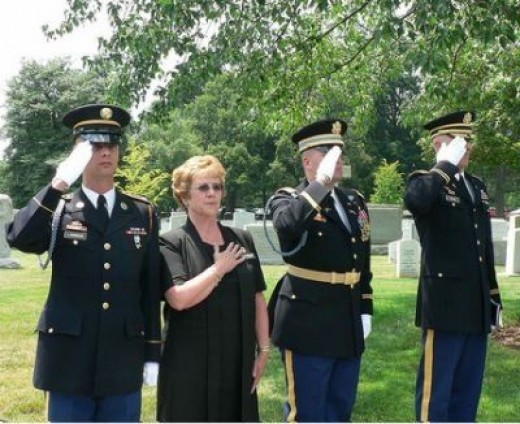
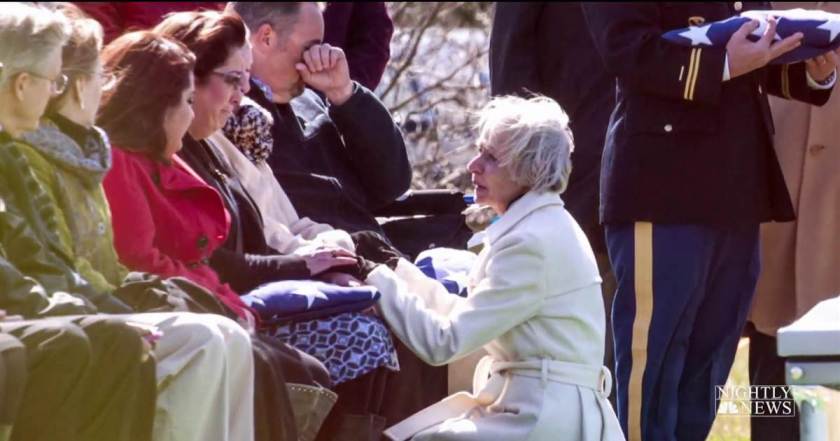
Private Arciola joined a quarter-million buried in our nation’s most hallowed ground on March 31. Two hundred or more mourners attended his funeral, a tribute befitting the tragedy of the loss of one so young.

9917514_f520

Sixteen others were buried in Arlington that Friday, most considerably older. Some brought only a dozen or so mourners. Others had no friends or family members whatsoever on-hand, to say goodbye.

Save for a volunteer, from the Arlington Ladies.

In 1948, Air Force Chief of Staff General Hoyt Vandenberg and the general’s wife Gladys made a practice of attending military funeral services at Arlington National Cemetery.

nn_lho_arlington_ladies_180102_1920x1080.nbcnews-fp-1200-630Sometimes, a military chaplain was the only one present at these services. Both Vandenbergs felt that a member of the Air Force family should be present at these funerals.  Gladys began to invite other officer’s wives. Over time, a group of women from the Officer’s Wives Club were formed for the purpose.
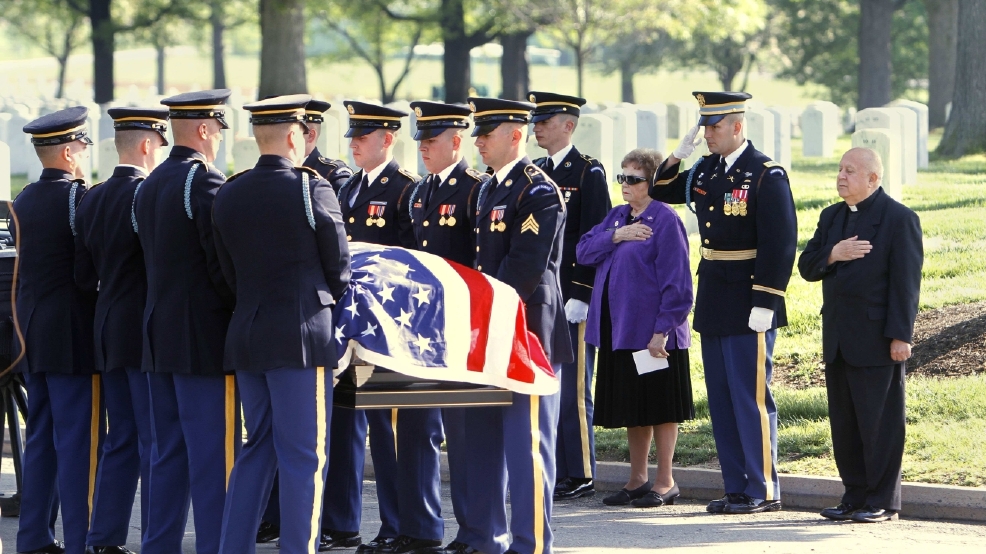
In 1973, General Creighton Abrams’ wife Julia did the same for the Army forming a group calling themselves “Arlington Ladies”. Groups of Navy and Coast guard wives followed suit, in 1985 and 2006.

Traditionally, the Marine Corps Commandant sends an official representative of the Corps to all Marine funerals.  The Marine Corps Arlington Ladies were formed in 2016.

Arlington Ladies’ Chairman Margaret Mensch explained “We’ve been accused of being professional mourners, but that isn’t true. I fight that perception all the time. What we’re doing is paying homage to Soldiers who have given their lives for our country.”

arlington_lady_joayn_bahr_at_funeral_es_053011The casual visitor cannot help but being struck with the solemnity of such an occasion. Air Force Ladies’ Chairman Sue Ellen Lansell spoke of one service where the only other guest was “one elderly gentlemen who stood at the curb and would not come to the grave site. He was from the Soldier’s Home in Washington, D. C. One soldier walked up to invite him closer, but he said no, he was not family”.

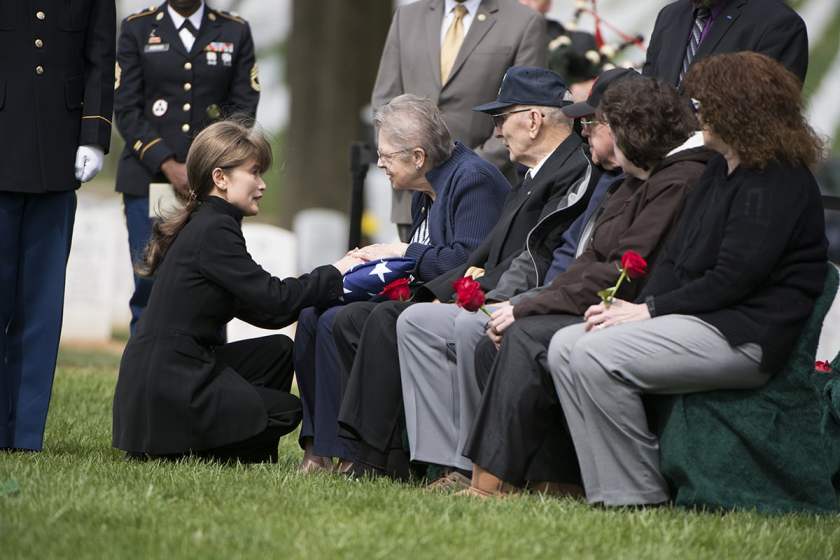
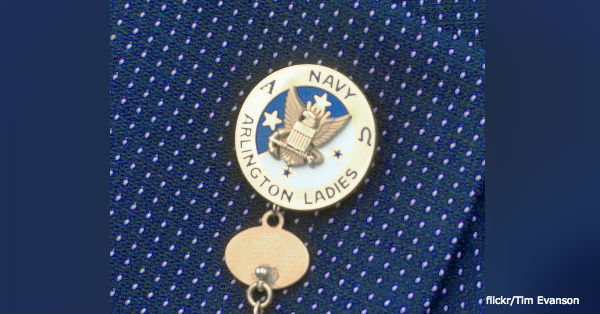
The organization was traditionally formed of current or former military wives. Today their number includes daughters and even one “Arlington Gentleman”. 46 years ago they came alone, or in pairs. Today, 145 or so volunteers from four military branches are a recognized part of all funeral ceremonies at Arlington National Cemetery, their motto: “No Soldier will ever be buried alone.”

arlington-ladies2

The volunteer arrives with a military escort from the Navy or the United States Army 3rd Infantry Regiment, the “Old Guard”. The horse-drawn caisson arrives from the old post chapel, carrying the flag draped casket. Joining the procession, she will quietly walk to the burial site, her arm inside that of her escort. A few words are spoken over the deceased, followed by the three-volley salute. Off in the distance, a solitary bugler sounds Taps.

The folded flag is presented to the grieving widow, or next of kin. Only then will she break her silence, stepping forward with a word of condolence and two cards: one from the service branch Chief of Staff and his wife and a second, from herself.

Arlington-Ladies-2 (1)

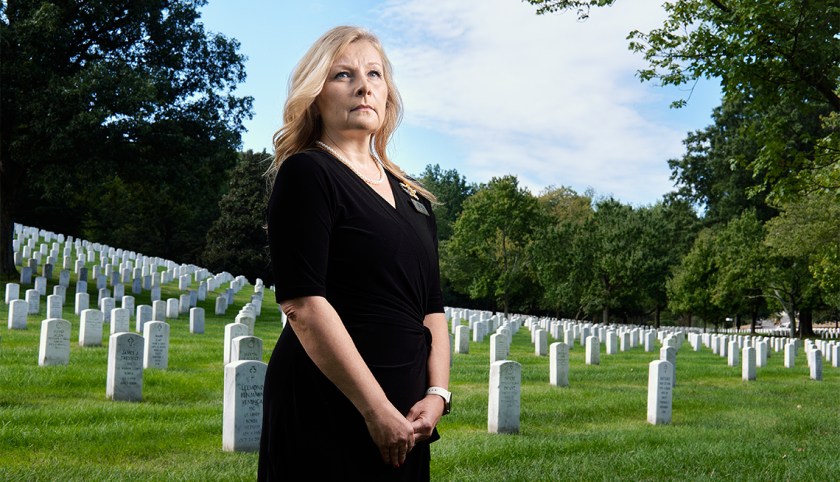
Joyce Johnson buried her husband Lieutenant Colonel Dennis Johnson in 2001, a victim of the Islamist terrorist attack on the Pentagon. Johnson remembers the Arlington Ladies’ volunteer as “a touchingly, human presence in a sea of starched uniforms and salutes”. Three years later, Joyce Johnson paid it forward, and became one herself.

Any given funeral may be that of a young military service member killed in service to the nation, or a veteran of Korea or WWII, who spent his last days in the old soldier’s home. It could be a four-star General or a Private. It matters not a whit.

“We’re not professional mourners. We’re here because we’re representing the Air Force family and because, one day, our families are going to be sitting there in that chair”. – Sandra Griffin, Air Force volunteer, Arlington Ladies

Individual volunteers attend about five funerals a day, sometimes as many as eight. As with the Tomb of the Unknown sentinels who hold their vigil heedless of weather, funeral services pay no mind, to weather conditions. The funeral will proceed on the date and time scheduled irrespective of rain, snow or heat. Regardless of weather, an Arlington Lady Will be in attendance.

The job of the Arlington Ladies is to honor, not to grieve, but it doesn’t always work out that way.  Linda Willey of the Air Force Ladies describes the difficulty of burying Pentagon friends after 9/11, while pieces of debris yet littered the cemetery. Paula McKinley of the Navy Ladies still chokes up, over the hug of a ten-year old girl who had just lost both parents. Margaret Mensch speaks of the heartbreak of burying one of her own young escorts after he was killed in Afghanistan, in 2009.

Barbara Benson was herself a soldier, an Army flight nurse during WWII. She is the longest serving Arlington Lady. “I always try to add something personal”, Benson said, “especially for a much older woman. I always ask how long they were married. They like to tell you they were married 50 or 60 years…I don’t know how to say it really, I guess because I identify with Soldiers. That was my life for 31 years, so it just seems like the natural thing to do.”

1000w_q95 (2)

Elinore Riedel was chairman of the Air Force Ladies during the War in Vietnam, when none of the other military branches had women representatives. “Most of the funerals were for young men,” she said. “I saw little boys running little airplanes over their father’s coffins. It is a gripping thing, and it makes you realize the awful sacrifices people made. Not only those who died, but those left behind.”

Mrs. Reidel is a minister’s daughter, who grew up watching her father serve those in need. “It doesn’t matter whether you know a person or not”, she said, “whether you will ever see them again. It calls upon the best in all of us to respond to someone in deep despair. I call it grace…I honestly feel we all need more grace in our lives.”

1140-sandra-griffin-ladies-of-arlington.imgcache.rev1477409052107 (1)
23-year veteran of the United States Air Force Sandra Griffin, now serves as an Arlington Lady.

I dedicate this “Today in History” to the man for whom I am namesake. The man who gave me the love for history you see, on these pages. United States Army Lieutenant Colonel (retired) Richard B. “Rick” Long, Sr., 2/25/37 – 3/31/18.

Rest In Peace, Dad. You left us too soon.

December 30, 1610 The Blood Countess

She’s the most prolific female serial killer of all time. The Guinness Book of World Records, says she is.

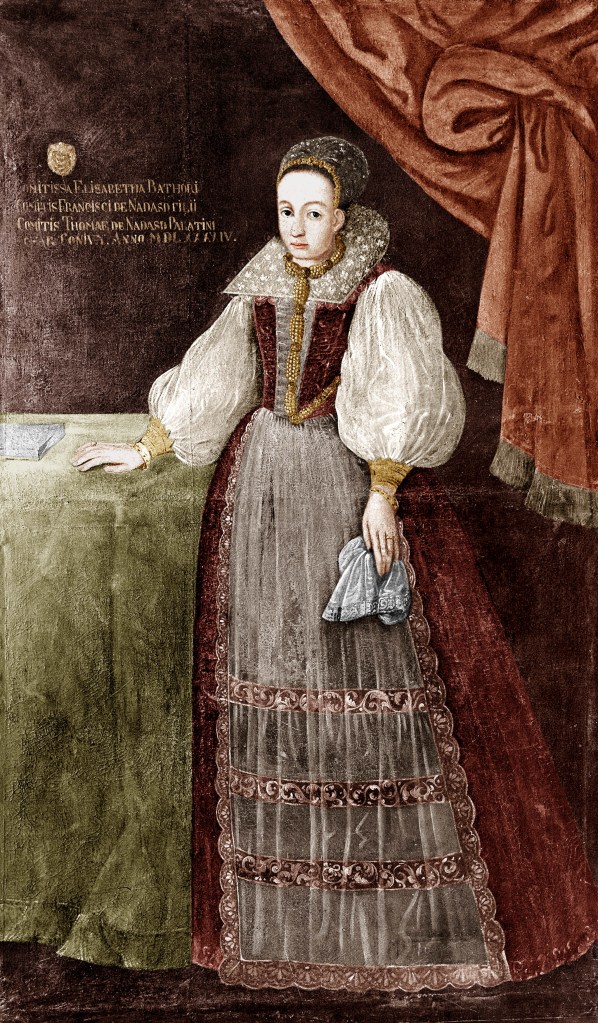
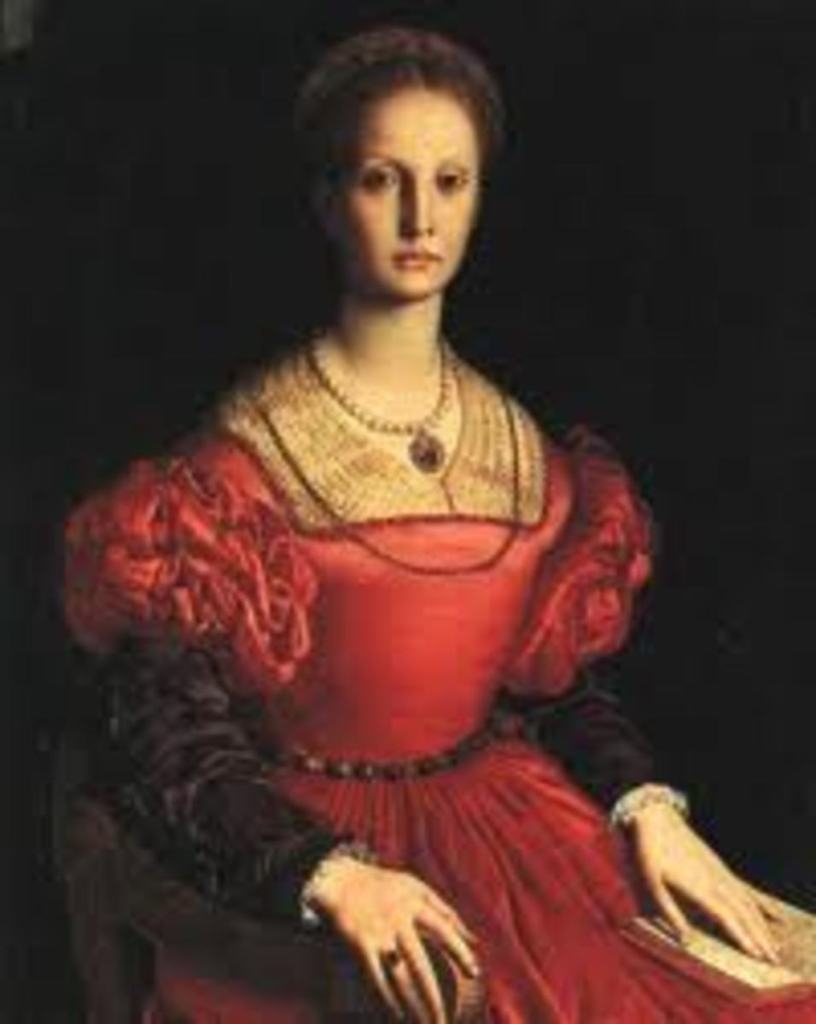
The “Blood Countess” Erzsébet (Elizabeth) Báthory is the most prolific female serial killer in history. The Guinness book of World Records says she is, bathing in the blood of as many as 650 virgins to keep her skin looking young.

Erzsébet (Elizabeth) Báthory

Servants were convicted of killing 80 while Erzsébet herself was neither tried nor convicted, due to her rank. She was walled up in prison and left to die, the most prolific female murderer, in history. A woman whose bestiality has elevated from mere mortal to semi-supernatural, vampiric ghoul.

So…was she?

According to one story a servant girl once noted a few hairs out of place on the countess’ head. The noblewoman struck the girl so hard that great gouts of blood sprayed across her ladyship’s face. Báthory noticed how the blood seemed to rejuvenate the skin. Thus began the murder of 650 maidens to bathe, in their blood.

Other versions describe the blood landing on the skin of her hand and still others a belief on the countess’ part that only the blood of noble women, would have such rejuvenating effects.

A problem arises, with the absence of contemporary accounts. The tale of the blood bath first came out over a hundred years, after her death. Secondly, we all know how quickly the stuff clots and congeals, once leaving the body. Aside from the repulsiveness of the act does such a goopy coagulated mess seem suitable, for a bath?

Elizabeth lived from August 7, 1560 to August 21, 1614, a member of the powerful Báthory clan of Transylvania, an area which now includes parts of Hungary, Romania and the Slovak Republic. Her uncle was the King of Poland, her nephew, a voivode (prince) of Transylvania.

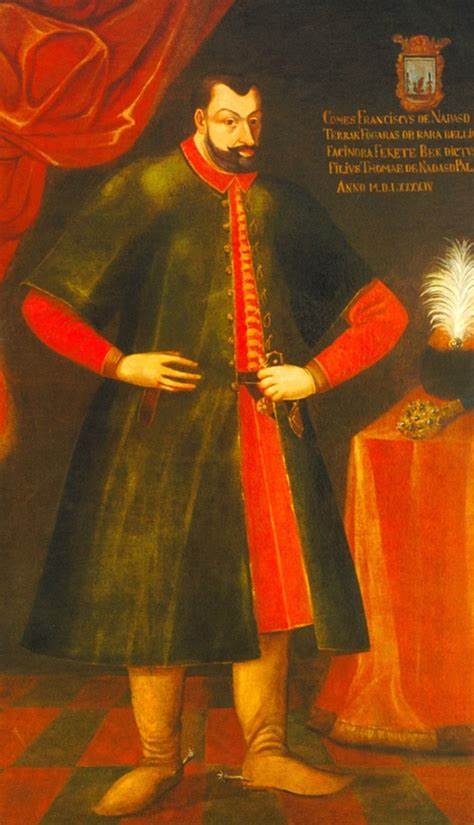
The future Hungarian war hero Ferenc Nádasdy was betrothed to Báthory when he was fourteen and she, ten rears old. The couple wed when he was nineteen and she fifteen and, as the Báthory clan outranked the Nádasdy she kept her name and he added it, to his own.

Theirs was a time and place closer to the fall of Constantinople than World War 1 is, to our own. It was an age of ever aggressive expansion of the Ottoman Empire. A time and place not so greatly removed from that of Vlad (The Impaler) Țepeș, a man of such freakishly extreme cruelty as to spawn the legend, of Count Dracula.

The Ottoman-Hungarian wars were never ending at this time and Ferenc spent more time fighting abroad than at home. He soon earned the sobriquet “Black Knight”, likely for excessive cruelty extended, to Ottoman prisoners.

Back at home Elizabeth managed the family estates including no fewer than seventeen villages and living at the Nádasdy castles at Sárvár, Hungary and Čachtice in what is now, the Slovak Republic.

Due to Ferenc’s frequent absence the marriage would fail to produce a child, for the first ten years. In time there would be five, two daughters dying in infancy with two more daughters and a son, growing to adulthood.

According to some stories, Elizabeth would write to her husband asking for the gruesome details of the torture, inflicted on prisoners. She was seen for a time as a benevolent ruler but that began to change, in 1602.

The stories make for difficult reading, tales of servant girls smeared with honey and left to be devoured by insects. Tales of stark naked girls made to stand in pails of water until they froze to death and mutilations carried out with scissors, knives and hot pokers and even Elizabeth’s own, teeth.

The higher ranking members of the servants’ corps would fan out across those seventeen villages to recruit a never ending supply of young girls, to the castle. None of it bothered the authorities all that much as even treatments so gruesome as these were alright, so long as they were carried out among the lower classes.

In 1604 the Black Knight died while in battle allegedly, of some unknown disease. Despite the rumors Elizabeth’s henchmen fed an ever increasing stream of young girls to the castle, increasingly, girls of the lesser nobility.

Now if the murder of a peasant girl is alright, killing a member of a Family of Rank™, is not. Questions asked about disappearances were met with implausible yarns about murder-suicides and sudden illness always conveniently followed, by the rapid disposal of the corpse.

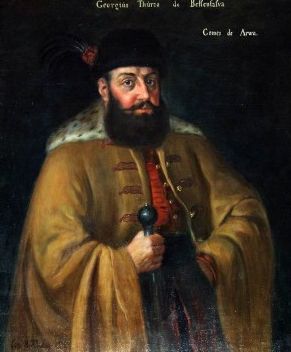
Count György Thurzó was the Lord Palatine of Hungary, the personal representative of the monarch and as such, responsible for investigation. On December 29, 1610 according to some stories he surprised the blood soaked countess in the very act of tormenting, one of her victims. The following day, December 30, she was arrested.

Whether there were 36 victims or 50 or 650 all depended, on whom you ask. Judicial proceedings decided on the number, eighty. Accused of being accomplices servants Dorothy Szentes, Helena Jo and John Ujvary were all sentenced to death for helping Báthory to lure and murder her victims. The women had their fingers pulled off with hot pincers before being burned alive. John was beheaded and then, burned.

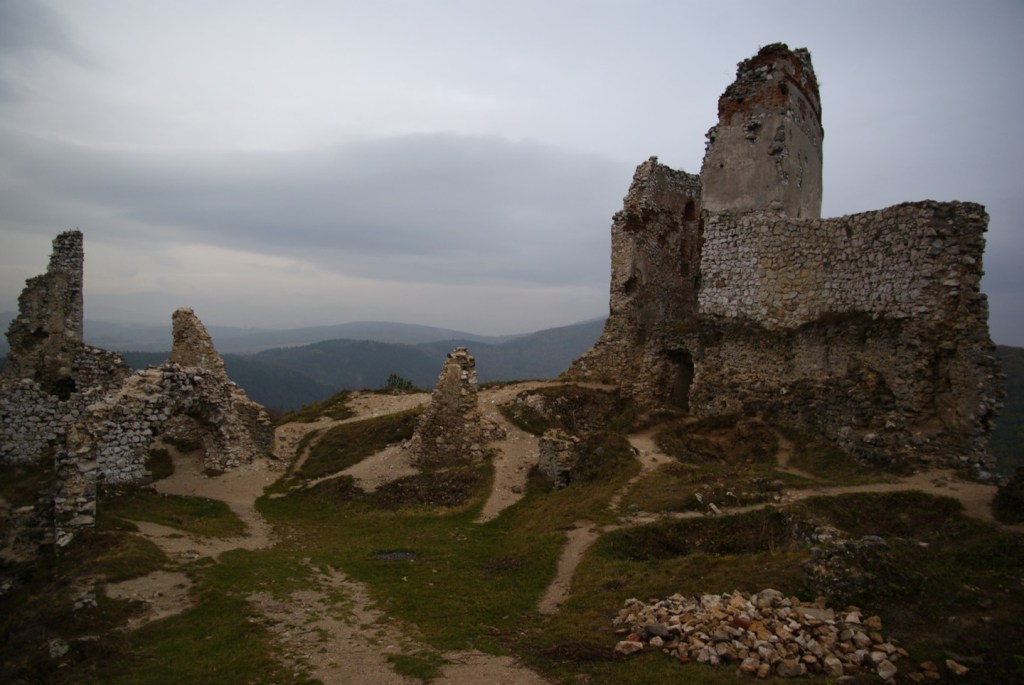
Ever obsessed with rank, the authorities didn’t try Báthory herself but instead walled her up in a small space in the Castle Čachtice, with only openings, for food and water. There she lingered for another four years until the morning of August 14, 1614 when she was found dead, on the floor.

Today, Castle Čachtice is just a ruin

Was Elizabeth Báthory guilty of the crimes laid against her? There is too much consistency among too many stories, to absolve her of her misdeeds. Not entirely. There were too many tales telling the same story for the woman to be entirely innocent but two things can be true at the same time, right?

Báthory was at odds with some powerful people. Her support of her cousin Prince Gábor Báthory of Transylvania put her in conflict with the mighty Habsburg Empire who just happened to owe the woman, money. A LOT of money and, happily, Báthory’s exile made it all, go away. It is reasponsible to view with jaundiced eye any story, told under torture. Furthermore, 250 of the 289 eyewitness accounts used against her contained nothing more than hearsay with no real information, whatsoever. Many witnesses owed Count Thurzó personally and he had exclusive authority, over the proceedings. Lastly, the testament of the widow Báthory left her estates, to her children. The Báthory-Nádasdy offspring were banished from Hungary following her incarceration. Some would return in 1640 but by that time the family name had lost, its former nobility.

More than a tale of cops and robbers this one seems more like two scorpions in a jar and only one coming out, alive. A story about bad guys vs other bad guys not unlike certain current events, of today. Unless of course you’re one who believes that Jeffrey Epstein, really did kill himself.

November 4, 1781 Divas

Händel himself was no slouch when it came to being the Temperamental Artist. He was lucky even to be alive following a furious argument in 1704 when a button was all that stood in the way of the skewering blade of fellow composer, Johann Mattheson.

George III King of Great Britain and Ireland ascended to the throne in 1760 declaring that, “Born and educated in this country, I glory in the name of Britain”. It was his reassurance that, unlike his father and grandfather before him, George III would rule, as an English King.

Kings George I and II were in fact Hanoverian and as such, did not speak English. At least not, fluently. Queen Victoria, that most quintessentially British of monarchs was in fact of German ancestry and spoke German, as a first language. George I, Elector of Brunswick-Lüneburg ascended to the throne of Great Britain and Ireland in August 1714, the first of the British Kings, from the House of Hanover.

The German composer George Frideric Händel was well known by this time, in German and Italian opera. He became Kapellmeister to the German prince in 1710, “Master of the Chapel Choir”. Chorale works Händel composed around this time for Queen Anne and the young and wealthy “Apollo of the Arts” Richard Boyle made it almost natural, that Händel would settle in England.

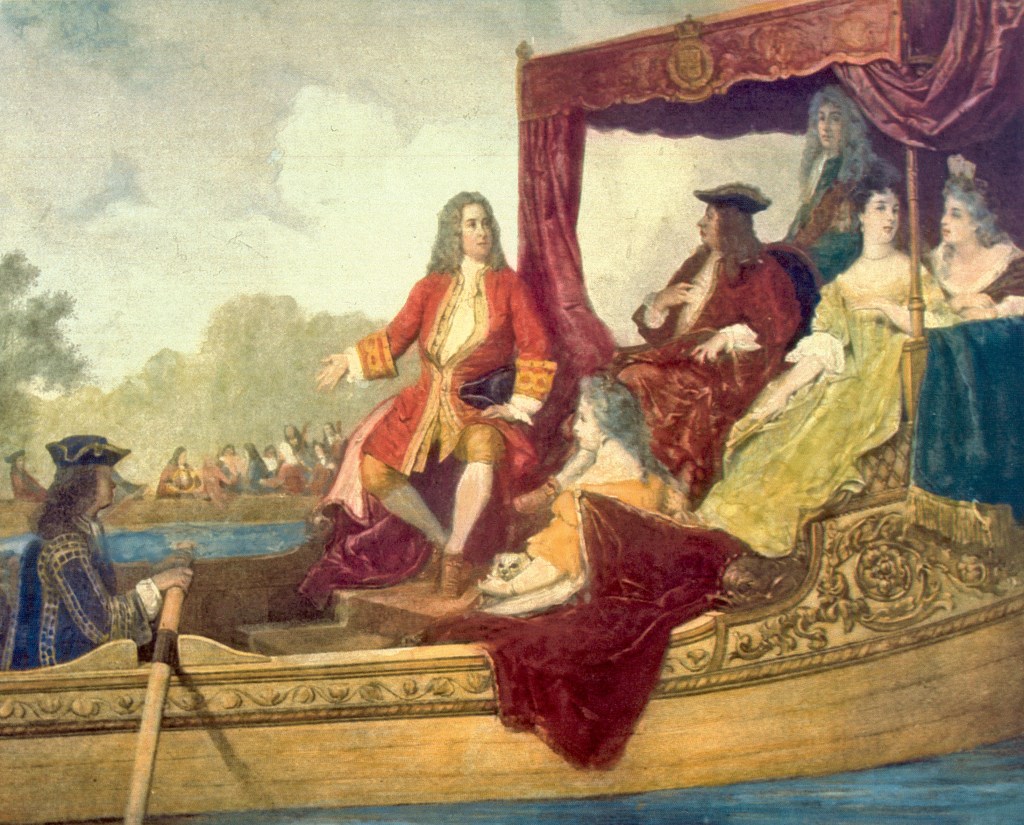
George I enjoys the River Thames with George Frideric Händel, in 1717

In Italian opera, a prima donna is the leading female singer in the company, the “first lady” opposite the male lead or primo uomo. Usually (but not always) a soprano, prima donne could be demanding of their colleagues with grand and sometime insufferable personae both on- and off-stage. Opera enthusiasts would divide into opposing “clubs” supporting or opposing one singer, over the other. The 19th century rivalry between fans of Maria Callas and Renata Tebaldi is an infamous example despite a personal friendship, between the two singers. When prima donne detest one another pandemonium, is sure to follow.

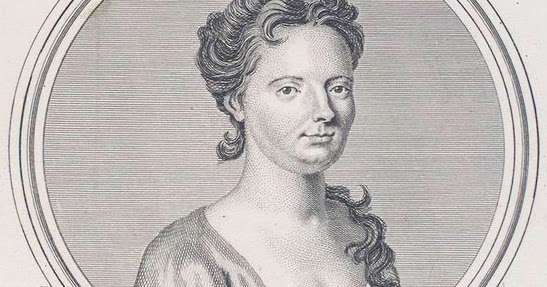
Händel’s work was popular in Georgian era society, so much so he was given free reign to hire his own performers. One such was Francesca Cuzzoni, a fiery soprano with the reputation as being among the greatest, of 18th century divas. Unkindly described by one opera historian as “doughy” and plain, a “short, squat” performer she nevertheless sang, with the voice of the angels. Widely regarded as one of the finest Sopranos in all Europe Händel hired Cuzzoni, in 1722.

Händel himself was no slouch when it came to being the Temperamental Artist. He was lucky even to be alive following a furious argument in 1704 when a button was all that stood in the way of the skewering blade of fellow composer, Johann Mattheson.

On rehearsal for her London debut, Cuzzoni became furious over one aria claiming the role was written, for someone else. She refused even to perform when Händel, a great bear of a man physically picked the woman off the ground by her waist, and threatened to throw her out a window.

Problem solved.

Francesca Cuzzoni, by James Caldwall

Francesca Cuzzoni went on to become a smashing success, for four years the undisputed Queen, of the London opera. In 1726, Händel sought to capitalize on this success and reached out to his Italian agents, for a second Star. So it was the mezo-soprano Faustina Bordoni was hired, for the following season.

Younger and considerably more attractive than the older Cuzzoni the pair had been rivals, back in Italy. Notwithstanding, Händel and other composers wrote a series of operas featuring a two-female lead taking great care to give the two, equal prominence.

You know where this is going, right?

Faustina Bordoni pastel, in 1724

Baroque opera loved nothing more than a love triangle and the two were often cast, as rivals for the affections of one man. The degree to which the two divas’ professional rivalry bled into their personal lives is a matter of some discussion but the behavior of their fans, is not.

The “clash” between the two soon became public knowledge. Opera-going aristocrats began to take up sides enthusiastically egged on, by the press. Society ladies would dress in the respective fashion of their particular heroine and hiss and catcall, at the appearance of the other.

Things got out of hand during a performance of Bononcini’s Astianatte. Fights broke out among the audience when Cuzzoni turned and unleashed a torrent of Italian invective, at her rival. The pair hurled insults at one another. You know the words. These two, knew ALL of them them. Verbal combat soon became physical the performance, be damned. The scene beggars the imagination. A wild west bar fight in stalls and stage alike as two divas tore at each other’s costumes, and pulled each other’s hair.

In the end, the two were physically dragged from the stage their performance, abandoned.

Theater management canceled Cuzzoni’s contract. King George would have none of that and threatened to withdraw their allowance, and that was the end of that. The two divas kept an uneasy truce for the following season, but something had to give.

In the end, Faustina Bordoni was offered a guinea more for the 1728 season. One schilling, one pence. Predictably, Francesca Cuzzoni threw a tantrum and immediately resigned, and returned to Italy.

Faustina Bordoni lived on to a happy and prosperous old age and died on November 4, 1781. No so Francesca Cuzzoni who faded into poverty and obscurity eking out a living it is said, making and selling, buttons.

Back in 1728, theater management dearly wished the whole sorry mess would just go away. No such luck. John Gay’s Beggar’s Opera was a smash hit that season, “the most popular play of the eighteenth century” satirizing Italian opera with its perpetually feuding heroines Polly Peachum, and Lucy Lockit.

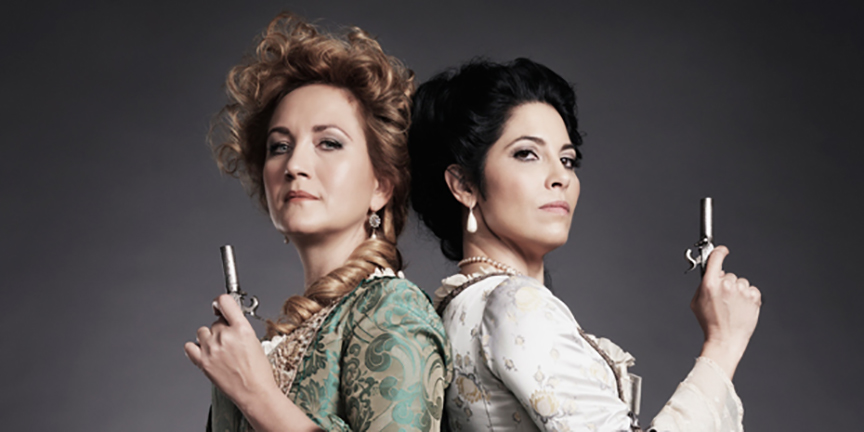
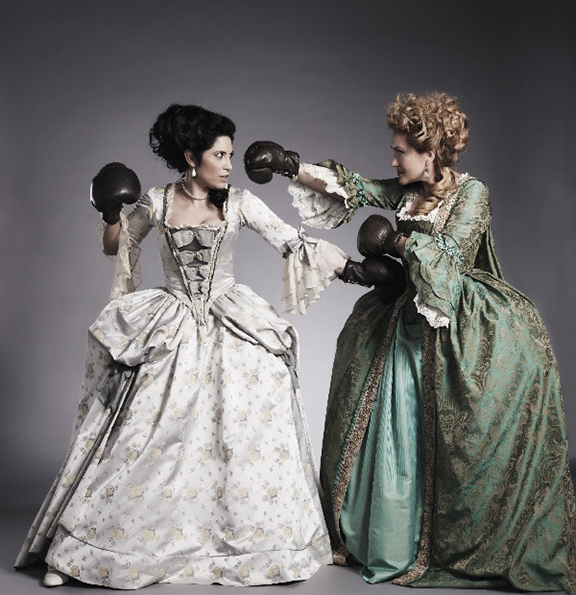
Hat tip “Rival Queens” featuring Simone Kermes, and Vivica Genaux

October 23, 1943 The Last Great Act of Defiance

You may take my freedom, she might have said. You may take my life but you will not take away, my free will.

Before the age of the internet, sight gags were copied and re-copied and passed around from hand to hand, much the same as we text each other amusing memes, today. One stands out after all these years, as worth remembering. A “Last Great Act of Defiance”, in the face of certain destruction.

I considered whether such an image trivialized the death of a human being, because that’s what this story is about. But no, silly as it is this cartoon works just fine, as a symbol. A symbol of a small woman, naked, defenseless and yet defiant, in the face of the Nazi death camp. A ballerina barely 100 pounds soaking wet by the look of her photographs and yet, a woman who, in her last moments of life managed to take one of the Nazi sons of bitches, with her.

Franceska Mann

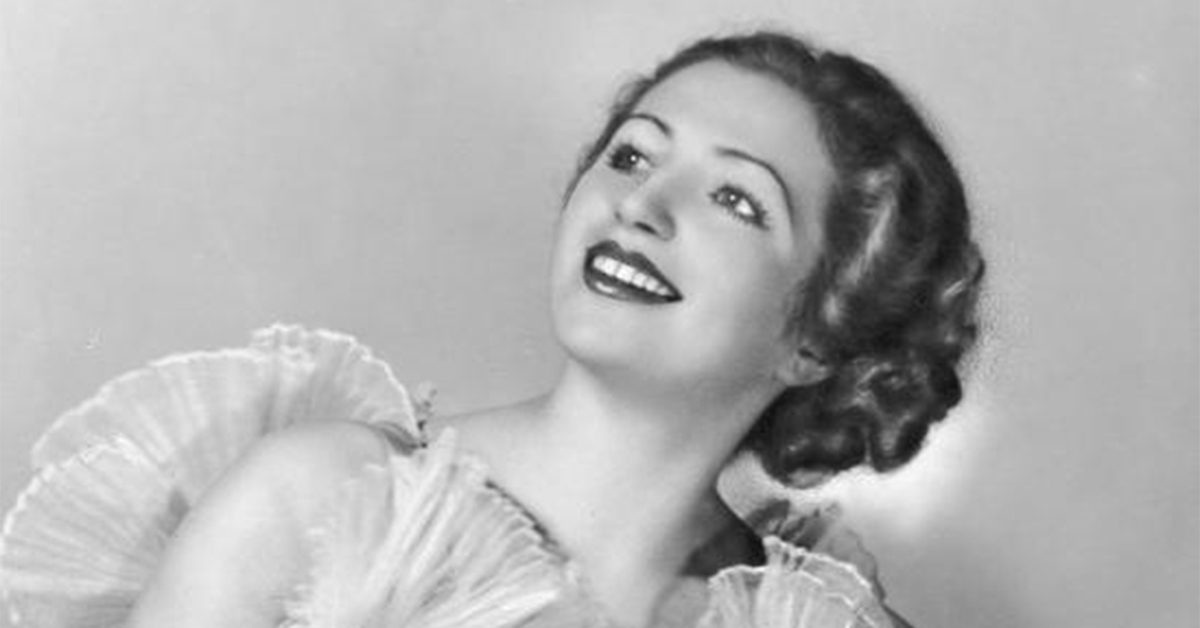
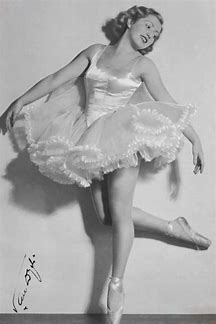
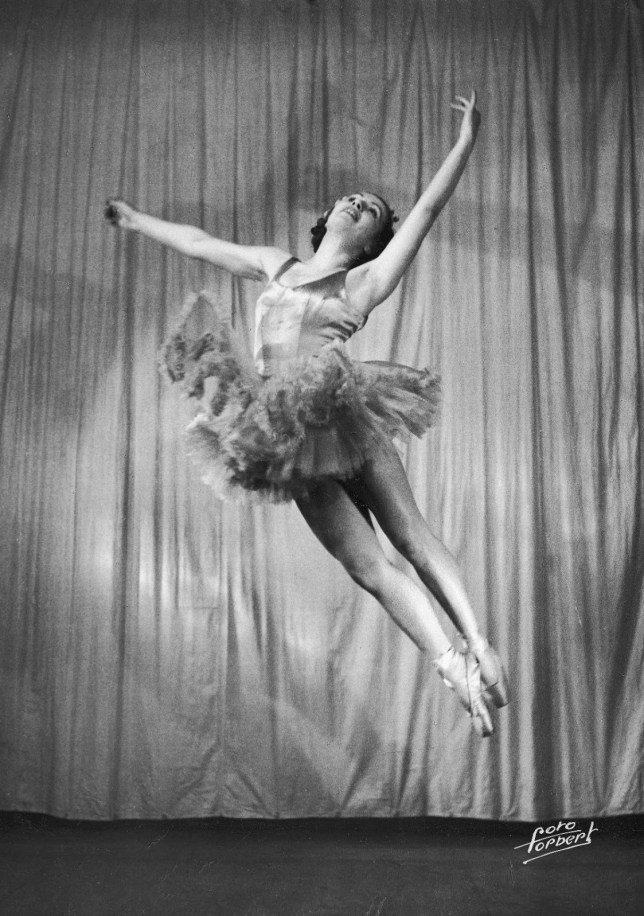
They say if you do what you love, you’ll never work a day in your life. Franceska Mann was born to dance. Any mother or father of such a child would smile at the thought of what she must have been like, growing up. By the time Franceska had come of age she had mastered classical and several forms of popular dance.

Mann studied dance at Irena Prusicka’s School of Gymnastics and Artistic Dance, one of three major studios, in pre-war Warsaw. She competed in 1939 in an international dance competition in Brussels placing fourth, out of 125 ballerinas. She was the pride of Poland considered by many to be the most beautiful and most talented, of her generation.

When the Nazi war machine invaded Poland in 1939, she was performing at the Melody Nightclub in Warsaw

For a time, Franceska’s physical features allowed her passage on the “Aryan” side of the city while up to 460,000 fellow Jews and not a few Romani people were rounded up in the “Residential District”, the infamous Warsaw Ghetto.

The Warsaw Ghetto and others like it were little more than waiting rooms, for the death camps. Even before ultimate deportation conditions, were grisly. The daily food ration for Jews in the ghetto was a scant 184 calories compared with 699 for Polish gentiles and 2,613, for Germans. Disease and starvation quickly set in to begin a process the waiting “showers”, were built to complete.

The human being is a funny critter. We’re capable of believing anything, we want to believe. For two years under these conditions, residents clung to the desperate hope that the “resettlement” promised by Nazi authorities, meant something better. By the end of 1942 it was clear nearly to all that the transports out of this place, meant only death.

Irena Sendler

Books have been written about the ghetto uprising and the desperate attempts of Irena Sendler and others, to save these people. Using her work as nurse for cover this “Angel of the Ghetto” would smuggle children out of that place with the help of a small dog trained to bark, at Nazi soldiers.

Irena would be ratted out and savagely tortured by the Gestapo but never did give up the names of countless children written on slips of paper and buried for safekeeping, in her garden.

Weapons’ and ammunition were smuggled through the sewers of Warsaw throughout much, of 1942. Nazi soldiers entered the ghetto on January 18, 1943 bent on yet another roundup. Some 600 were summarily shot and 5,000 removed from their homes when all hell broke loose from Jewish underground members, and resistance fighters.

Armed only with handguns and Molotov cocktails, resistance fighters kept the Nazis at bay for nearly four months but the end, was never in doubt. 2,000 Waffen-SS soldiers began the final assault on April 19 systematically burning or blowing up ghetto buildings, block by block. Some 56,065 people were murdered on the spot or rounded up, for extermination. Major resistance came to an end on April 28. The May 16 demolition of the Great Synagogue of Warsaw little more, than symbolic.

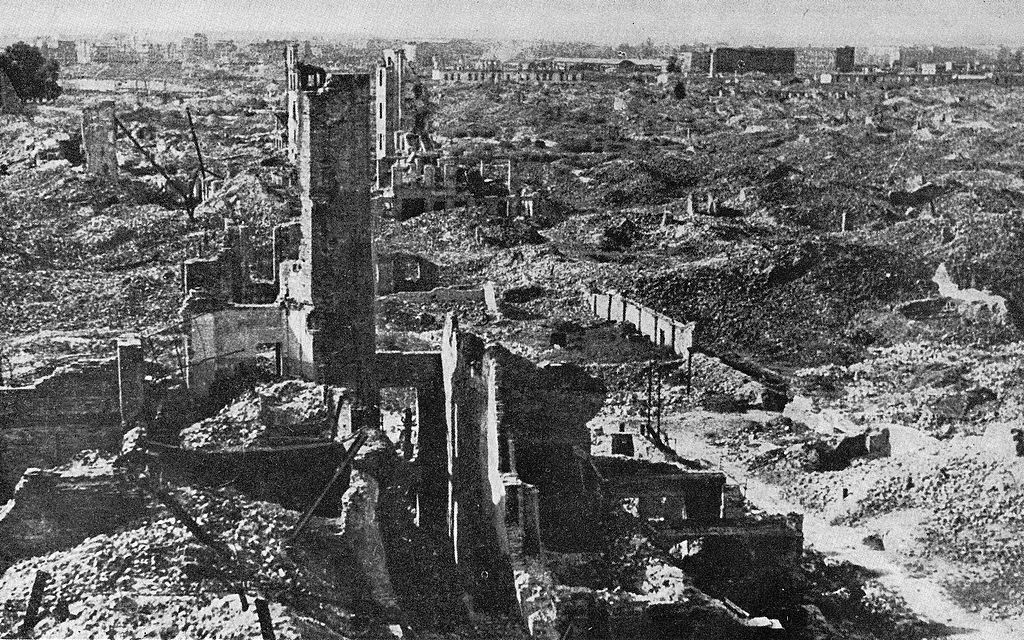
The “Jewish Residential District” of Warsaw, after the uprising.

Today, the Nożyk Synagogue is the only pre-war Jewish house of worship left standing, in the Polish capital. The building was used as a horse stable for the German Wehrmacht, during the war.

At this point, the Nazi government turned its attention to rooting out those left in hiding, outside the ghetto. Since 1941, Jewish and Polish diplomats worked with certain South American nations to send documents into the Warsaw ghetto. Such documents it was believed, may help Jews and others “prove” to be nationals of neutral nations and thus eligible, for safe transfer.

Passports both real and forged flooded into the region often, through the Hotel Polski. Many if not all such documents were intercepted by the Gestapo. With the help of Jewish collaborators, thousands left in hiding were lured to the Hotel Polski in hopes, of escape. Nations from Paraguay, Honduras and El Salvador to Peru and Chile beckoned, or so it was imagined. Genuine passports of Jews no longer alive sold on the black market for the equivalent, of up to a million 2021 dollars.

As many as 3,500 came out of hiding and moved to the Hotel Polski. The Polish Underground warned Jews it was probably a trap but we all believe what we want to believe, don’t we? Franceska Mann most likely received her own passport, in this manner.

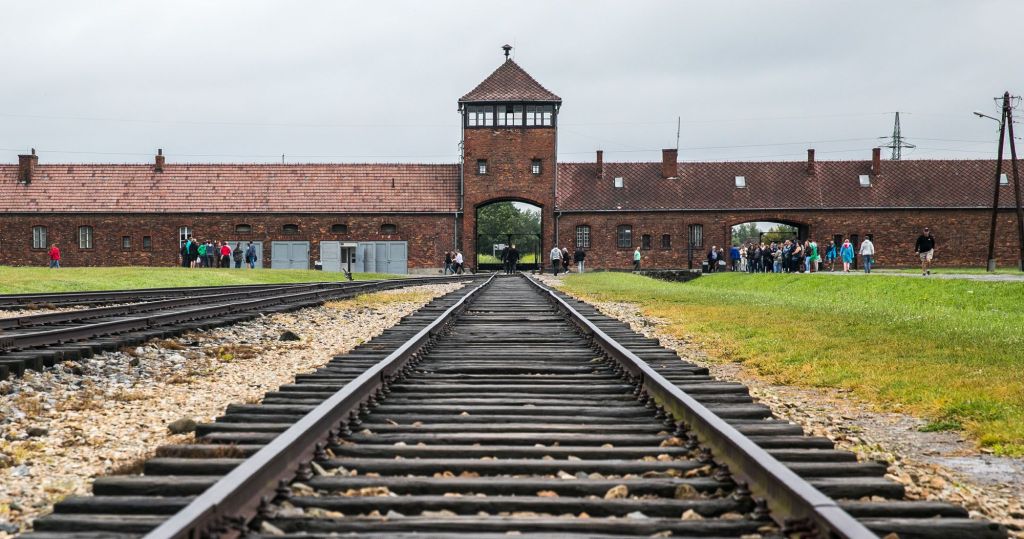
Some 1,700 were rounded up at this place arriving on the trains to Auschwitz-Birkenau, on October 23. You can find a dozen or more versions of what happened next since it all comes out, of the death camp rumor mill. What is certain is that women were separated from men and made to disrobe for “delousing”. It was all prior to final deportation to Switzerland, they were told.

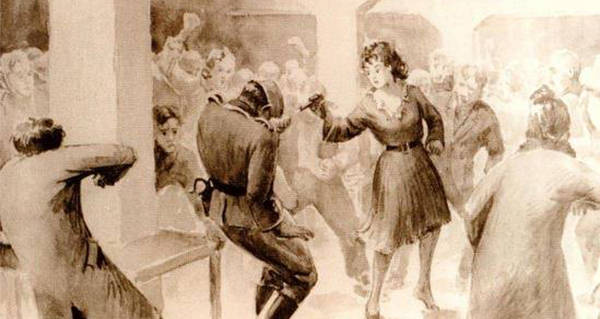
Fit, young and attractive as she was Franceska Mann drew the attention of two of her guards, Josef Schillinger and Wilhelm Emmerich. Using her considerable gifts she drew them in close and, with the speed of an athlete knocked Schillinger in the face with her shoe, drew the man’s gun and shot him twice in the belly. Emmerich was shot once, in the leg. Pandemonium broke out near the showers as hundreds of women in all states of dress and undress, turned on their tormenters. One SS man had his nose bitten off. Another was scalped by the desperate, angry mob.

This fanciful artist’s rendition is anything but accurate but, we get the picture.

Reinforcements arrived within moments. The gas was turned on killing those trapped, inside the chamber. Women in the changing area were machine gunned while those few caught outside were summarily, murdered.

On this day in 1943 it was all over, in minutes. Josef Schillinger died a painful death from those two gunshots. Emmerich recovered from his wounds.

Dark rumors may be found on the internet as to whether Mann herself was a Nazi collaborator. Witnesses who were there tell a different story, their stories recorded in transcripts, of the Nuremberg trials. The tales told by foreign professors born decades after the fact may be accepted or dismissed as you wish but one thing is left to contemplate. How would the chattering classes have behaved had they themselves lived in such a time, and such a place.

The Nazi extermination machine ground on for nearly two more years but one thing was certain. One terrified, desperate ballerina disarmed and about to die had rendered the beasts short, one of their own number.

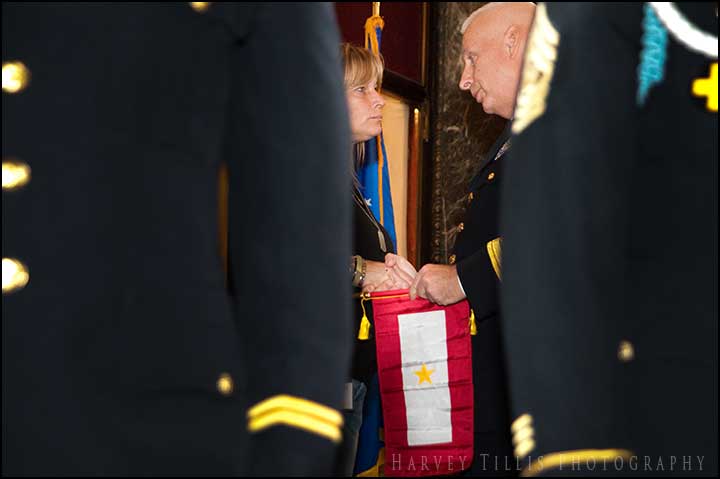
September 26, 2021 Gold Star Mother

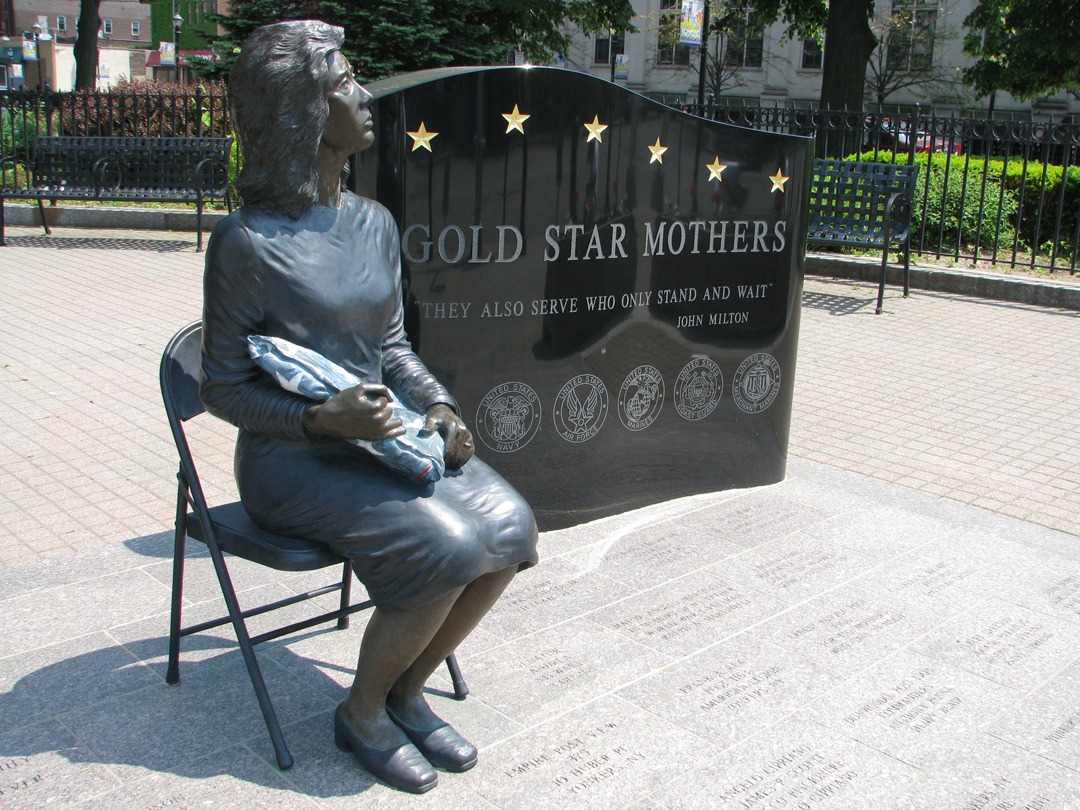
Today, Title 36 § 111 of the United States Code provides that the last Sunday in September be observed as Gold Star Mother’s Day, in honor of those women who have made the ultimate sacrifice. April 5 is set aside, as Gold Star Spouse’s Day. 

Suppose you were to stop 100 randomly selected individuals on the street, and ask them:  

Of all the conflicts in American military history, which single battle accounts for the greatest loss of life“.  

I suppose you’d get a few Gettysburgs in there, and maybe an Antietam or two.  The Battle of the Bulge would come up, for sure, and there’s bound to be a Tarawa or an Iwo Jima. Maybe a Normandy. 

I wonder how many would answer, Meuse-Argonne.

80th-Div-No3

The United States arrived late to the “War End all Wars”, entering the conflict in April 1917 when President Woodrow Wilson asked permission of the Congress, for a declaration of war against Imperial Germany.  American troop levels “over there” remained small throughout 1917, as the formerly neutral nation of  fifty million ramped up to a war footing.

US_Marines_during_the_Meuse-Argonne_Campaign
US Marines during Meuse-Argonne offensive of 1918

The trickle turned to a flood in 1918, as French ports were expanded to handle their numbers.  The American Merchant Marine was insufficient to handle the influx, and received help from French and British vessels.  By August, every one of what was then forty-eight states had sent armed forces, amounting to nearly 1½ million American troops in France.

After four years of unrelenting war, French and British manpower was staggered and the two economies, nearing collapse.  Tens of thousands of German troops were freed up and moving to the western front, following the chaos of the Russian Revolution.  The American Expeditionary Force was arriving none too soon.

Gun crew , 1918
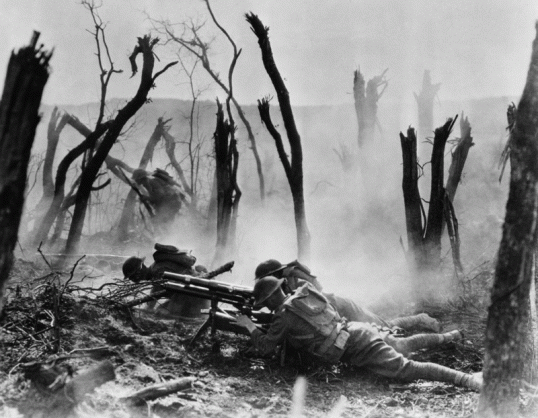
“Gun crew from Regimental Headquarters Company, 23rd Infantry, firing 37mm gun during an advance against German entrenched positions. , 1918”, H/T Wikipedia

Following successful allied offensives at Amiens and Albert, Allied Supreme Commander Ferdinand Foch ordered General John J. “Black Jack” Pershing to take overall command of the offensive, with the objective of cutting off the German 2nd Army. Some 400,000 troops were moved into the Verdun sector of northeastern France.  This was to be the largest operation of the AEF, of World War I. With a half-hour to go before midnight September 25, 2,700 guns opened up in a six hour bombardment, against German positions in the Argonne Forest, along the Meuse River.

Montfaucon American Monument, World War I, France
Butte de Montfaucon, today

Some 10,000 German troops were killed or incapacitated by mustard and phosgene gas attacks, and another 30,000 plus, taken prisoner.  The Allied offensive advanced six miles into enemy territory, but bogged down in the wild woodlands and stony mountainsides of the Argonne Forest.

dc582ea834d6854175ae8bb8b2a316b1
Meuse-Argonne American cemetery near Romagne, in France

The Allied drive broke down on German strong points like the hilltop monastery at Montfaucon and others, and fortified positions of the German “defense in depth”.

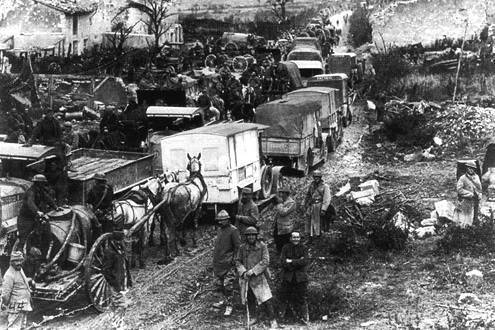
Pershing called off the Meuse-Argonne offensive on September 30, as supplies and reinforcements backed up in what can only be termed the Mother of All Traffic Jams.

MeuseArgonneTraffic

Fighting was renewed four days later resulting in some of the most famous episodes of WW1, including the “Lost Battalion” of Major Charles White Whittlesey, and the single-handed capture of 132 prisoners, by Corporal (and later Sergeant) Alvin York.

20150618_wp_meuseargonne_ABMC_0146
Meuse-Argonne American Cemetery, outside of Romagne, France

The Meuse-Argonne offensive lasted forty-seven days, resulting in 26,277 American women gaining that most exclusive and unwanted of distinctions. That of becoming a Gold Star Mother.  More than any other battle, in American military history.  95,786 mothers would see their boys come home, mangled.

gold-star-mothers-monument-at-the-putnam-county-veteran-memorial-park-james-connor
Gold Star Mother’s Monument At The Putnam County (NY) Veteran Memorial Park, photograph by James Connor

George Vaughn Seibold was born in the nation’s capital, Washington DC,  At 23, Seibold volunteered when the US entered the war, in 1917. He requested a flying assignment and, as the US had no aerial force in the war at that time he was sent to Canada to be trained, on British aircraft.

George Vaughn Seibold

He was assigned to the 148th Aero Squadron of the British Royal Flying Corps and sent off for combat, in France. George sent a regular stream of letters back home to his family. George’s mother grace Darling Siebold would do community service visiting wounded servicemen, in hospital.

And then one day, the letters stopped.

The Siebold family inquired but, as aviators were under British control US authorities, could be of little assistance. Grace continued to visit the maimed from the war “over there” but now in the vain hope that George might somehow appear, among them.

It wasn’t meant to be.

On October 11, 1918, George’s wife in Chicago, Catharine (Benson) Siebold received a box, marked “Effects of deceased Officer 1st Lt. George Vaughn Seibold”. The family later learned that George was killed in action over Baupaume, France, August 26, 1918. His body was never recovered.

Grace believed that grief turned inward was corrosive, and self destructive. She continued to visit the wounded but now she founded a group of other mothers, who had lost sons in military service. The group not only gave comfort to these women but an opportunity to reach out, and help the wounded. They named the organization after the gold star families hung in their windows, in honor of their dead.

On May 28, 1918, President Woodrow Wilson approved a suggestion from the Women’s Committee of the Council of National Defenses, that American women were asked to wear black bands on the left arm, with a gilt star for every family member who had given his life for the nation.

Today, Title 36 § 111 of the United States Code provides that the last Sunday in September be observed as Gold Star Mother’s Day, in honor of those women who have made the ultimate sacrifice. April 5 is set aside, as Gold Star Spouse’s Day. 

In recent years both President Barack Obama and Donald Trump have signed proclamations, setting this day aside as Gold Star Mother’s and Family’s Day.

GoldStar1

At first a distinction reserved only for those mothers who had lost sons and daughters in WW1, (272 U.S. Army nurses died of disease in the great War) that now includes a long list of conflicts, fought over the last 100 years.  At this time the United States Army website reports  “The Army is dedicated to providing ongoing support to over 78,000 surviving Family members of fallen Soldiers”.

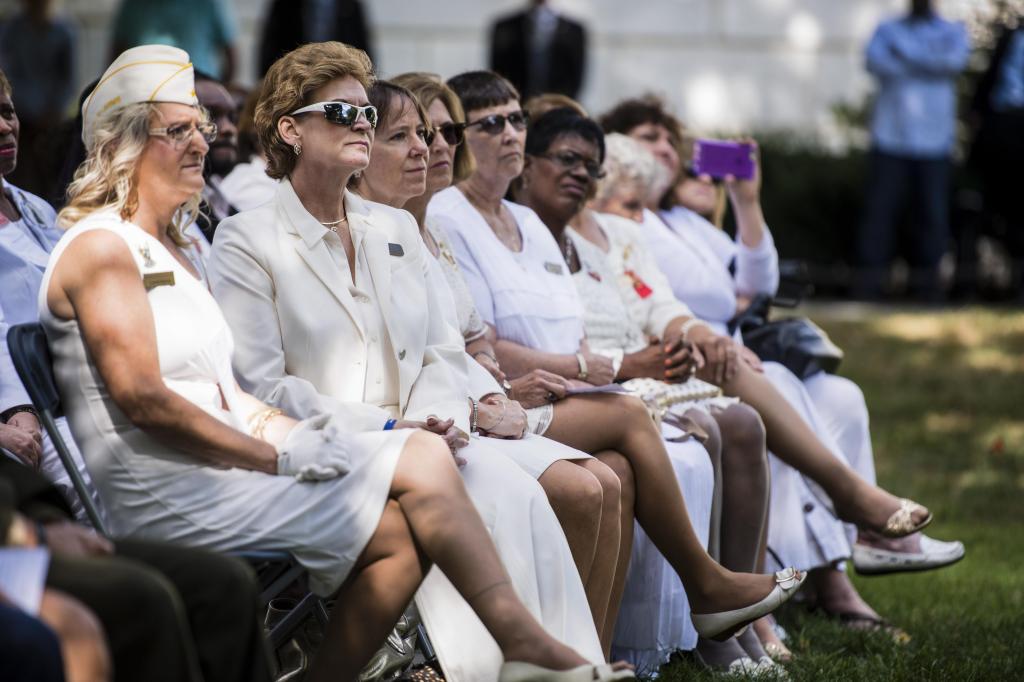
Gold Star Mother’s commemoration, Arlington National Cemetery, 2015

Seventy-eight thousand, out of a nation of nearly 330 million.  They are so few, who pick up this heaviest of tabs on behalf of the rest of us.

August 26, 1918 The Computer Wore a Skirt

“So the astronaut who became a hero, looked to this black woman in the still-segregated South at the time as one of the key parts of making sure his mission would be a success.”

In plasma physics, the Heliosphere is a vast cavity formed by the Sun, a “bubble” continuously “inflated” by plasma originating from that body known as “solar wind’ and separating our own solar system, from the vastness of interstellar space. The outermost reach of the Heliosphere comprises three major sections called the Termination Shock, the Heliosheath, and the Heliopause, so called because solar winds and interstellar winds meet to form, a zone of equilibrium.

Image converted using ifftoany

Only five man-made objects have traversed the heliosphere to penetrate interstellar space: Pioneer 10 and 11 launched in 1972-73, Voyager 1 and 2 launched in 1977 and New Horizons which left earth’s atmosphere, in 2006. Of those five only three remain active and continue to transmit data back to our little blue planet.

Voyager 2 Spacecraft

Spectacular images may be found on-line if you’re inclined to look them up. Images such as this jaw dropping shot of the ‘Blue Planet” Neptune taken two days before point of closest contact in August, 1989.

This picture of Neptune was taken by Voyager 2 less than five days before the probe’s closest approach of the planet on Aug. 25, 1989. The picture shows the “Great Dark Spot” – a storm in Neptune’s atmosphere – and the bright, light-blue smudge of clouds that accompanies the storm. Credit: NASA/JPL-Caltech

Or these images of the rings of Neptune taken on this day thirty two years ago before Voyager 2 left the last of the “gas giants”, behind.

Voyager 2 took these two images of the rings of Neptune on Aug. 26, 1989, just after the probe’s closest approach to the planet. Neptune’s two main rings are clearly visible; two fainter rings are visible with the help of long exposure times and backlighting from the Sun.
Credit: NASA/JPL-Caltech

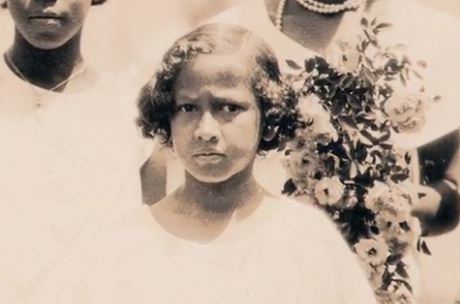
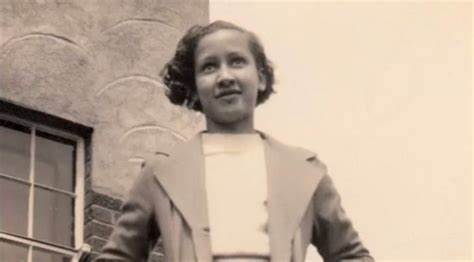
Few among us are equipped to understand the complexity of such flight. Precious few. One such was a little girl, an American of African ancestry born this day in 1918 in White Silver Springs, West Virginia. The youngest of four born to Joyletta and Joshua Coleman, Creola Katherine showed unusual mathematical skills from an early age.

For black children, Greenbrier County West Virginia didn’t offer education past the eighth grade, in the 1920s. The Colemans arranged for their kids to attend high school two hours up the road in Institute, on the campus of West Virginia State College. Katherine took every math class offered by the school and graduated summa cum laude with degrees in mathematics and French, in 1937.

There were teaching jobs along the way at all-black schools and a marriage to Katherine’s first husband, James Goble. The couple would have three children together before James died of a brain tumor. Three years later she married James A. “Jim” Johnson.

With all that going on at home, Katherine found time to become one of only three black students to attend graduate school at West Virginia University and the only female, selected to integrate the school after the Supreme Court ruing Missouri ex rel. Gaines v. Canada.

Careers in research mathematics were few and far between for black women in 1952, but talent and hard work wins out where ignorance, fears to tread.

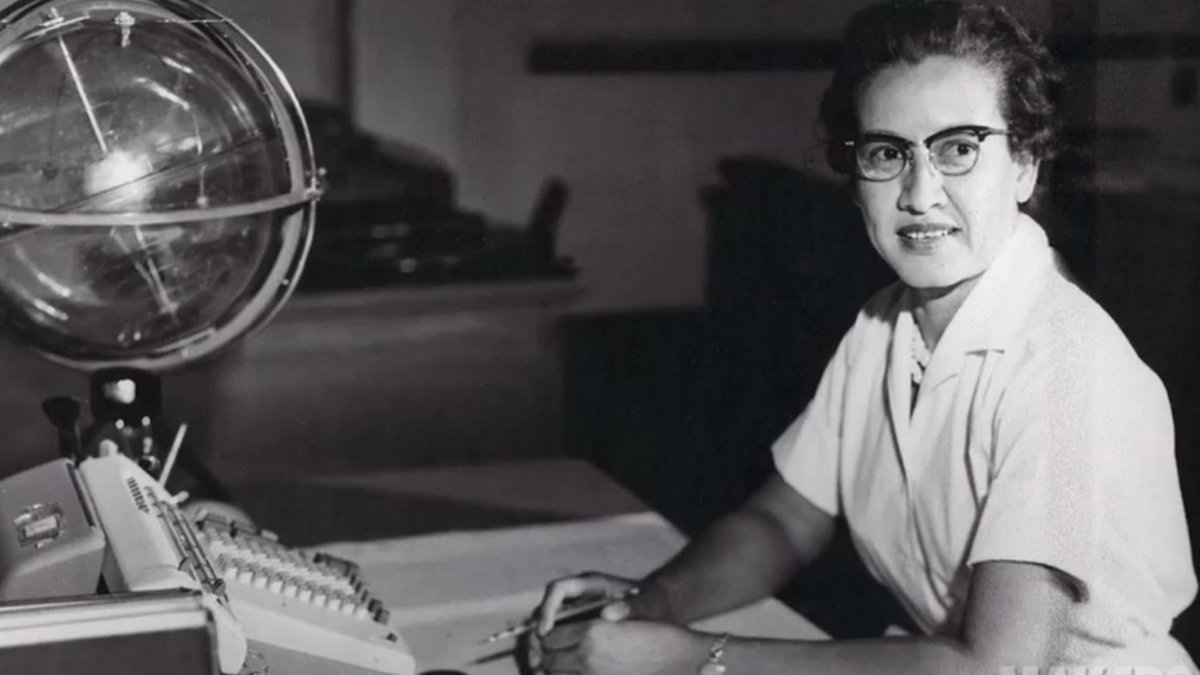
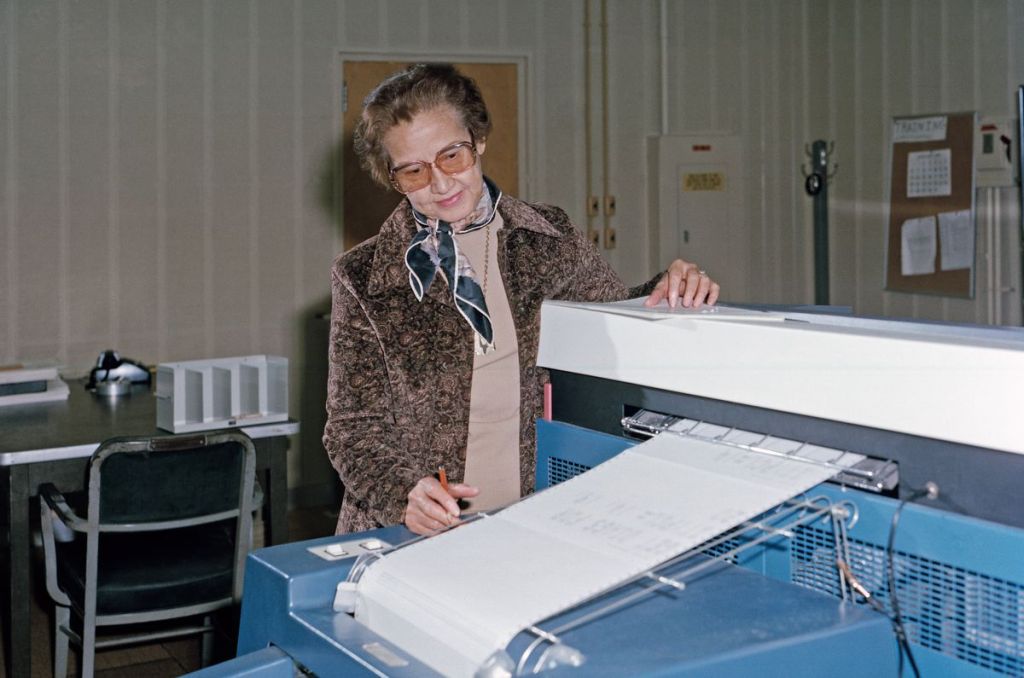
So it was Katherine Johnson joined the National Advisory Committee for Aeronautics (NACA), in 1952. Johnson worked in a pool of women who would read the data from aircraft black boxes and carry out a number of mathematical tasks. She referred to her co-workers as “computers who wore skirts”.

Flight research was a man’s world in those days but one day, Katherine and a colleague were asked to fill in, temporarily. Respect is not given it is earned, and Katherine’s knowledge of analytic geometry made quick work of that. Male bosses and colleagues alike were impressed with her skills. When her “temporary” assignment was over it no longer seemed all that important to send her, back to the pool.

Katherine would later explain that barriers of race and sex continued, but she could hold her own. Meetings were taken where decisions were made, where no women had been before. She’d simply tell them that she did the work and this was where she belonged, and that was the end of that.

Johnson worked as a human computer through most of the 1950s, calculating in-flight problems such as gust alleviation, in aircraft. Racial segregation was still in effect in those days according to state law and federal workplace segregation rules introduced under President Woodrow Wilson some forty years, earlier. The door where she worked was labeled “colored computers” but Johnson said she “didn’t feel the segregation at NASA, because everybody there was doing research. You had a mission and you worked on it, and it was important to you to do your job … and play bridge at lunch. I didn’t feel any segregation. I knew it was there, but I didn’t feel it.”

“We needed to be assertive as women in those days – assertive and aggressive – and the degree to which we had to be that way depended on where you were. I had to be. In the early days of NASA women were not allowed to put their names on the reports – no woman in my division had had her name on a report. I was working with Ted Skopinski and he wanted to leave and go to Houston … but Henry Pearson, our supervisor – he was not a fan of women – kept pushing him to finish the report we were working on. Finally, Ted told him, “Katherine should finish the report, she’s done most of the work anyway.” So Ted left Pearson with no choice; I finished the report and my name went on it, and that was the first time a woman in our division had her name on something”.

Katherine Johnson

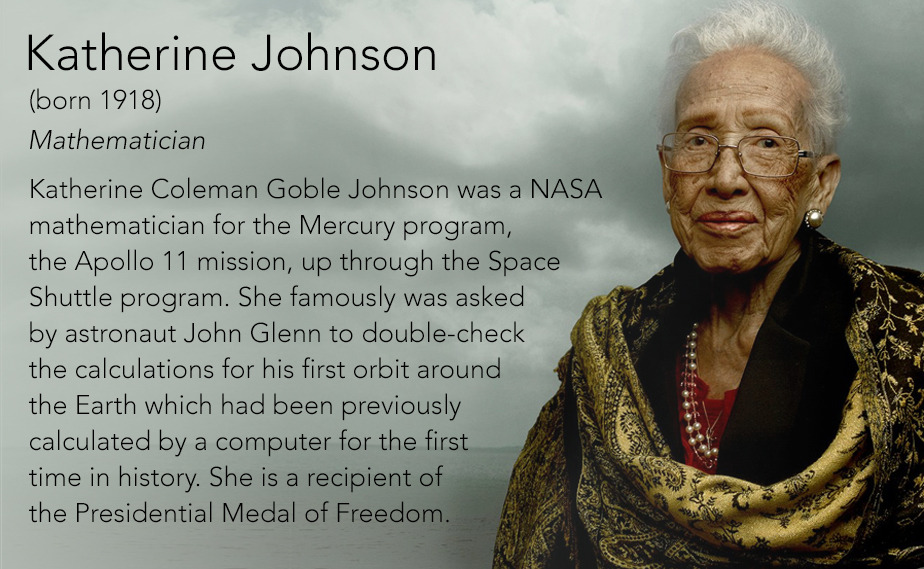
Katherine worked as an aerospace technologist from 1958 until retirement. She calculated the trajectory for Alan Shepard’s May 1961 flight to become the first American, in space. She worked out the launch window for his 1961 Mercury mission and plotted navigational charts for backup in case of electronic failure. NASA was using electronic computers by the time of John Glenn’s first orbit around the earth but Glenn refused to fly until Katherine Johnson personally verified the computer’s calculations. Author Margot Lee Shetterly commented, “So the astronaut who became a hero, looked to this black woman in the still-segregated South at the time as one of the key parts of making sure his mission would be a success.”

Katherine Johnson retired in 1986 and lived to see six grandchildren and 11 “Greats”. Everyone should live to see their own great grandchild. Not surprisingly, Johnson encouraged hers to pursue careers in science and technology.

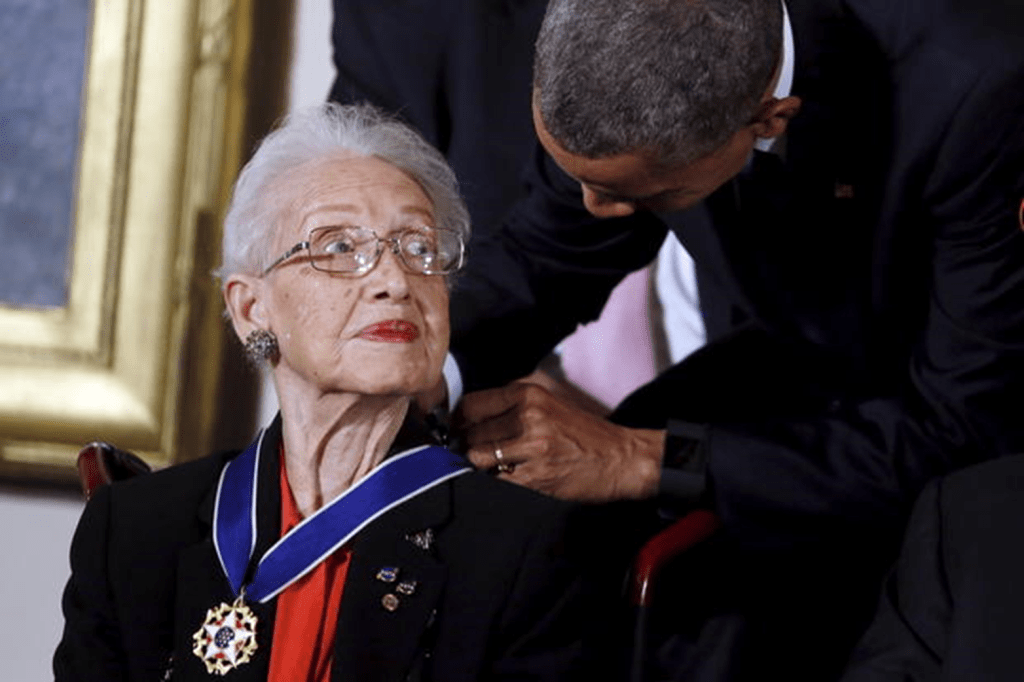
President Barack Obama personally awarded Johnson the medal of Freedom in 2015 for work from the Mercury program, to the Space Shuttle. NASA noted her “historical role as one of the first African-American women to work as a NASA scientist.”

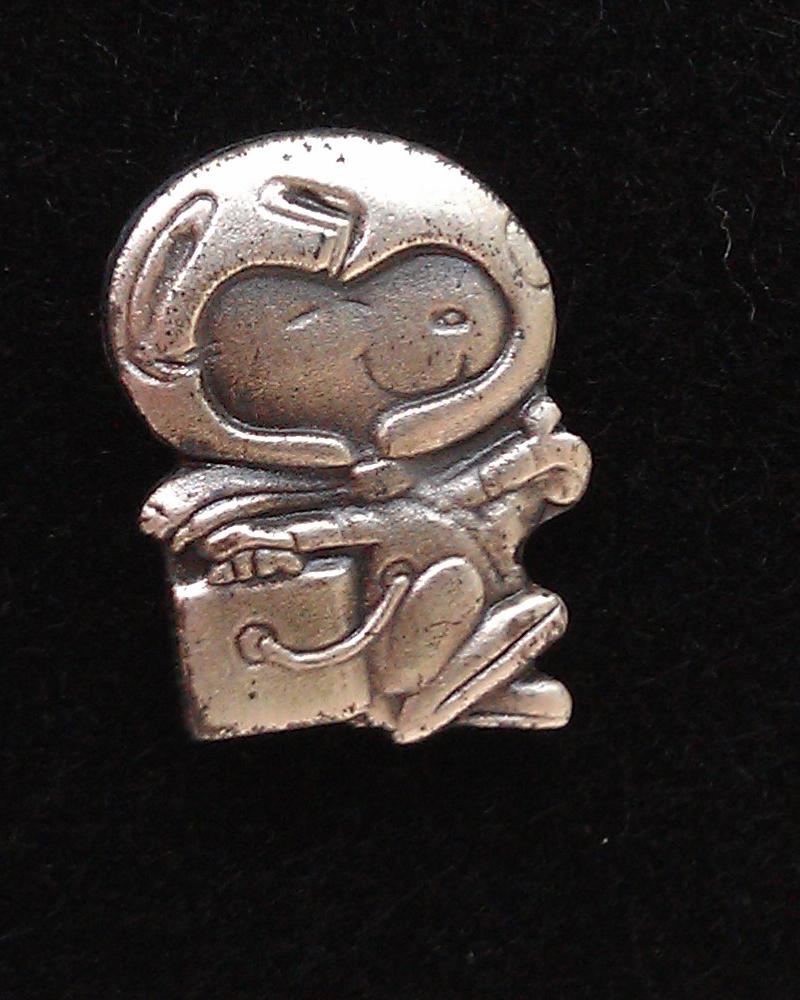
A delightful side dish for this story is the Silver Snoopy award NASA gives for outstanding achievement, “For professionalism, dedication and outstanding support that greatly enhanced space flight safety and mission success.”

Following the Mercury and Gemini projects, NASA was searching for a way to focus employees and contractors alike on their own personal contribution to mission success. They wanted it to be fun and interesting, like the Smokey the Bear character, of the United States Forest service. Al Chop of the Manned Spacecraft Center came up with the idea.

Peanuts creator Charles Shulz, a combat veteran of WW2 and avid supporter of the space program, loved the idea. Shulz drew the character to be cast in a silver pin and worn into space, by a member of the Astronaut corps. It is this astronaut who personally awards his or her Snoopy to the deserving recipient.

The award is literally once in a lifetime. Of all NASA personnel and that of many contractors fewer than one percent have ever receive the coveted Silver Snoopy.

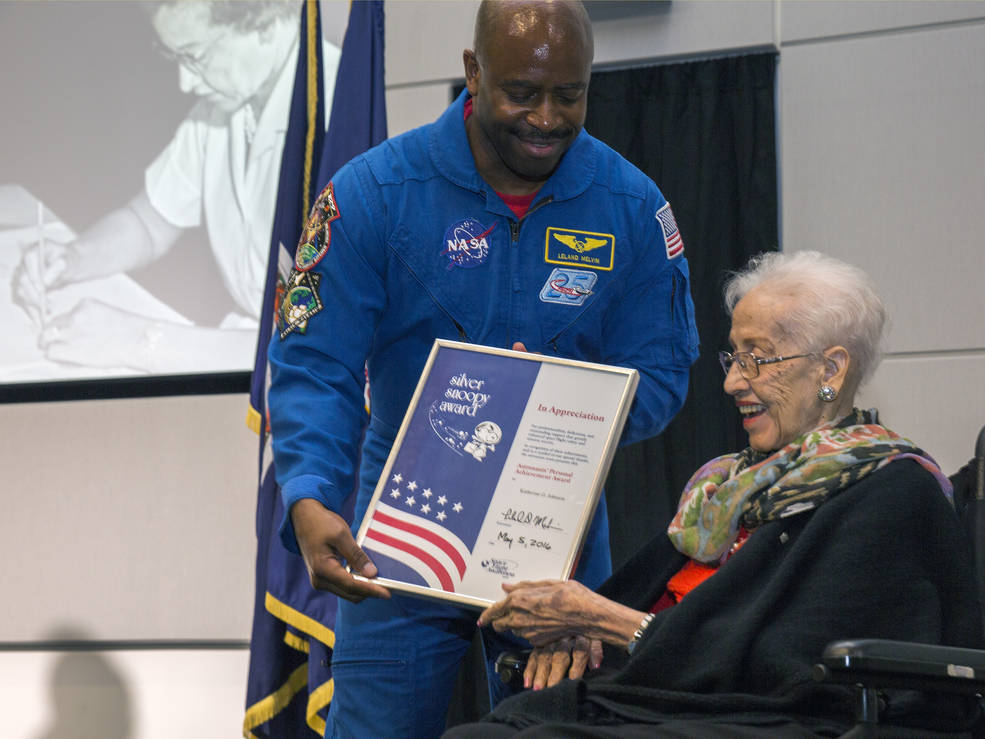
Astronaut and former NASA associate administrator for education Leland Melvin personally awarded Johnson her own Silver Snoopy at the naming ceremony in 2016, for the Katherine G. Johnson Computational Research Facility at NASA’s Langley Research Center in Hampton, Virginia.

Astronaut and former NASA associate administrator for education Leland Melvin presents Katherine Johnson with a Silver Snoopy award. / Credit: NASA, David C. Bowman

August 16, 1936 Testing Betty

Imagine turning this story, into a movie. Cast it with any actress you like and then, throw it all out. No one would believe such an outlandish story.

Mr. Price took his seat on the L train and waited for the ride home after school. He was a biology teacher in the Riverdale Illinois school system but, for now, he was just glad to be inside. Where it was warm. The train rumbled to life as he wiped the fog away from the glass.

The train was beginning to move now when he spotted one of his students. Betty Robinson. “Smiling Betty”. Such a good natured kid.
Betty had a good 200 yards to go plus a set of stairs, but she was going for it. Running as fast as her legs could carry her, it was too far. She’ll never make this train but there will always be another.

Minutes later a biology textbook plopped into the seat beside him. He looked up in amazement to see Betty Robinson. Smiling. She wasn’t even winded.

Betty knew she was fast, but she never knew how fast. She’d never been been tested but this biology teacher, just happened to be the assistant track coach.

The last bell rang the following day and there stood Mr. Price with a stopwatch. A chalk line was drawn across the tiled floor. Fifty yards up the hallway, Betty Robinson assumed an awkward crouch at her own line, and then came the whistle. Betty was all pumping legs and flailing arms. Her form was ridiculous, but, yeah. She was fast. She crossed the finish line 6.2 seconds after the whistle. 1/10th of a second faster than the women’s indoor world record, for that time.

He asked her if she’d run in an amateur race, just a few weeks out. Betty never knew there were women’s races, but, yes. He didn’t bother to tell her. Helen Filkey would be running too. The woman who held the record.

Coach Price and a senior from the boy’s team taught the sophomore everything they could over the next few weeks. How to bring those arms in. How to anticipate the whistle and how races were won or lost in those first few seconds. Then came race day at Soldier Field. “Smiling Betty” crouched at the blocks, only feet away from the fastest woman in the world. Betty came in second. She was only sixteen.

She joined the Illinois women’s Track & Field club and there she encountered…something new. Today we take women’s athletics for granted, but the 1920s, were a different story. Women were expected to do certain things. Athletics, was not one of them. Even the Olympics, were a man’s world. For the first time Betty met other women, pushing the limits of athletic performance.

The 1928 Summer games in Amsterdam were the first Olympics, to host women’s track and field. Betty came in second in the qualifying round but her times more than qualified her, to go.

There she was, 16 years old and taking the train to New York, to catch the ship to Europe. Training on deck, Betty developed a schoolgirl crush on Johnny Weissmuller, the Olympic swimmer and future star of the Tarzan films. She thought he was the finest specimen of manhood, she had ever seen.

American athletes saw so many disappointments at the 1928 Olympics, but not Betty Robinson. She walked away with gold in the women’s 100 meter sprint, with a new world record, of 12 seconds flat. From a standing start. And silver in the 800 meter relay, didn’t hurt.

Every Olympics has the “it” girl. Simone Biles. Nancy Kerrigan. Nadia Comăneci. Elizabeth Robinson was all that and more in 1928. The first female 100-meter gold medalist in history and, in 1928, a “new kind of girl”.
Betty was a celebrity. There were gifts of diamonds and pearls, Douglas MacArthur gave her a gold bracelet. The International Olympic Committee allowed such things, back then.

Betty returned to Riverdale. She had her first boyfriend. She enrolled in Northwestern but never let up on her training. The 1932 Olympics in Los Angeles were getting closer, every day.

Betty’s cousin Will had a biplane in those days. The two loved to go up in that thing, especially on those hot summer days. She even had a leather helmet, with goggles. Just like Amelia Earhart.

Then came the crash. The man who removed her broken body brought her to Oak Lawn infirmary, because he knew the coroner.

Betty’s arm was broken, her legs destroyed. Her once smiling face badly cut up. The coma lasted, for weeks. She woke up with pins in her legs, now shorter than they used to be. They weren’t even the same length. “I’m sorry” the doctors said, “you may never walk again”.

Betty’s favorite brother-in-law Jim served in the Great War, in France. The gas had taken his health back in 1918. Twenty years later it would take his life, but Jim always had time, for Betty. He would carry the fastest woman in the world in his arms, sometimes waiting for traffic to cross the street and sit on the park bench.

On bad days Betty couldn’t straighten her legs. On good days he would help her stand up. First with an arm held tightly around her shoulder and then a hand, on the small of her back. One day she needed no help at all.

The 1932 Olympics came and went. Betty Robinson watched another woman win the 100 meter sprint.

Stop if you will and run this as a movie, in your mind. Cast the actress of your choice in the role and imagine her coming back from that plane crash, to win Gold in 1936. Now toss it all out because it’s such an outlandish idea, but that’s what happened.

From standing to taking a step and then two, and then walking, and then beginning to jog her broken body began to learn what her old one, already knew. She could never bend down again so she set her sights on the only event, where she didn’t have to. The relay.

The 1936 Olympic games opened in Munich, under the watchful gaze of Reichsführer Adolf Hitler. The growing threat of Nazi Germany hung like dark and threatening clouds, over Europe.

The 1936 Olympics. Where the American track & field athlete Jesse Owens won four gold medals, smashing the Nazi myth of the “Aryan Superman”. Where Wehrmacht Hauptmann (Captain) Wolfgang Fürstner designed and built the Olympic village only to be replaced, two weeks before the games. The Nuremberg laws against racial “impurity” had judged Fürstner to be, half Jewish.

Then came the day of the women’s 400 meter relay. Hitler had to be watching as was Owens, himself. Robinson took the baton at a dead run, neck and neck with a German woman chosen, to leave her in the dust. Betty ran her broken body for all it was worth. 100 meters later she was only behind, by a few steps.

This video is glorious even if it is, in German.

The last American runner took the hand-off. She was closing on the German when her opponent, dropped the baton. It was over. Betty Robinson had been tested and judged, satisfactory. The American team had won Olympic gold.

The XI Olympiad closed on August 16, 1936. Three days later Wolfgang Fürstner, the German patriot whose nation no longer had need of his services ended his life, with a pistol.

Today, Jamaican sprinter Usain Bolt holds the 100 meter record with a time, of 9.58 seconds. Florence Griffith-Joyner is the fastest woman with a time, of 10.49. With all the advantages of the day, the personalized training & nutrition and scientifically designed running gear that’s a scant 1.51 seconds faster than Betty Robinson and her old shoes, and the flapping, loose-fitting clothing required to preserve the feminine modesty, of 1928.

June 17, 1631 A Love Story

Paralyzed with grief and wracked by uncontrollable fits of weeping, Emperor Shah Jahan went into secluded mourning. He emerged a year later with back bent and beard turned white. Then began a 22-year period of design and construction for a mausoleum and funerary garden: a tribute worthy, of his Queen of the World.

The Mughal state was an early modern Empire ruling first over northern India and later, much of South Asia. Founded by military conquest in 1526, the Mughal Emperors ruled for 200 years marking much of the period, before the rise of the British Raj.

Prince Khurram was born on January 5, 1592, the son of Rajput princess Jagat Gosaini and the fourth Mughal Emperor, Jahangir.

Literally born to the throne, the infant prince was taken from his mother at the age of six days by the baby’s grandfather Akbar, the third Mughal Emperor who ordered the baby be raised by his first wife and chief consort, the childless Ruqaiya Sultan Begum.

Khurram was given the education befitting a Mughal prince and enjoyed a close relationship with his surrogate mother.

According to the later memoirs of his father Jahangir, the barren Empress loved his son Khurram, “a thousand times more than if he had been her own [son]”.

Arjumand Banu was the daughter of a wealthy Persian noble and niece to Nur Jahan, the 12th wife of Emperor Jahangir believed by many to be the real power behind the throne. Arjumand and Khurram were betrothed in early 1607 when she was 14 and he, a year older.

In an age of politically arranged marriages, theirs was a love match though the marriage would wait, another five years. Five years was an unusually long engagement for the time but court astrologers had deemed the date propitious, and so it was.

Meanwhile, Khurram ascended to the throne and adopted the regnal name, Shah Jahan. Shah Jahan married the Persian Princess Kandahari Begum with whom he had a daughter, but this was a political marriage. So it was with his other eight wives.

Political relationships with women who themselves enjoyed the status of royal wives but it was his second, Arjumand Banu, with whom the Emperor was inseparable. He called her “Mumtaz Mahal”, Persian for “the chosen one of the Palace”. At the royal court and on military campaign she was his constant companion and advisor. She was his ‘Malika-i-Jahan’ the “Queen of the World”, with whom he fathered 14 children in nineteen years.

It was on campaign on the Deccan Plateau where Mumtaz Mahal went into labor with the couple’s 14th child. The delivery was a terrible trial for the Empress Consort, a 30-hour ordeal resulting in uncontrolled postpartum hemorrhage.

Shah Jahan’s Queen of the World died on June 17, 1631.

Mumtaz Mahal was buried in a walled pleasure garden called the Zainabad. Paralyzed with grief and wracked by uncontrollable fits of weeping the Emperor went into secluded mourning. He emerged a year later with back bent and beard turned white. Then began a twenty-two year period of design and construction for a mausoleum and funerary garden, suitable for the Queen of the World.

That child who would never know her mother grew to be the Princess Jahanara who, at the age of seventeen, began to distribute gemstones to the poor. A plea for divine intervention on behalf of the woman who had died, giving her birth. Meanwhile, a grand edifice to the undying love of an Emperor rose along the southern banks of the river Amuna.

English poet Sir Edwin Arnold described the place as “Not a piece of architecture, as other buildings are, but the proud passion of an emperor’s love wrought in living stones.”

20,000 artisans were employed on the project at a cost equivalent to 70 billion modern rupees, equal to $956 million, today. The ivory marble mausoleum was the centerpiece of a 42 acre complex including a great reflecting pool, a mosque and guest house, all set within a formal garden and surrounded on three sides by crenellated walls.

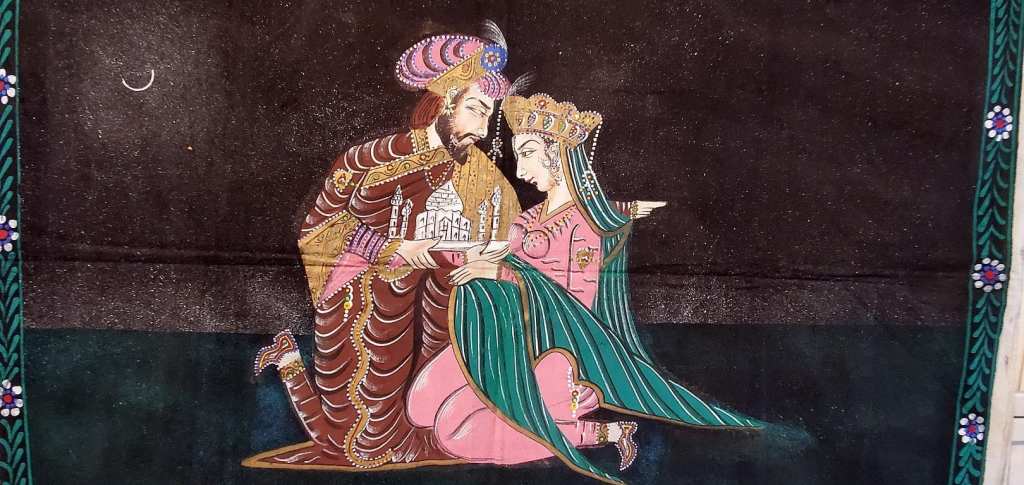
Years later, Shah Jahan would rejoin the love of his life in her final resting place. A treasure of Islamic art and architecture in India, one of the seven “Modern Wonders of the World” we know, as the Taj Mahal.

May 24, 1883 First Across

For 11 years she studied higher mathematics, catenary curves, materials strength and the intricacies of cable construction, all while acting as the pivot point on the largest bridge construction project on the planet and nursemaid, to a desperately sick husband.

Focused as he was on surveying, the engineer should have paid more attention to his surroundings. The year was 1869. Civil engineer John Roebling had begun the site work two years ago, almost to the day. Now just a few more compass readings, across the East River. Soon, work would begin on the longest steel suspension span in the world. A bridge connecting the New York boroughs of Brooklyn and Manhattan.

Roebling was working on the pier with his 32-year old son Washington, also a civil engineer. As the ferry came alongside, the elder Roebling’s toes were caught and crushed so badly, as to require amputation.

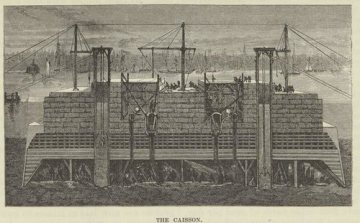
brooklyn-bridge-caisson-granger“Lockjaw” is such a sterile term, it doesn’t begin to describe the condition known as Tetanus. In the early stages, the anaerobic bacterium Clostridium Tetani produces tetanospasmin, a neurotoxin producing mild spasms in the jaw muscles. As the disease progresses, sudden and involuntary contractions affect skeletal muscle groups, becoming so powerful that bones are literally fractured as the muscles tear themselves apart. These were the last days of John Roebling, the bridge engineer who would not live to see his most famous work.
The German-born civil engineer was the first casualty of the project.  He would not be the last.

Brooklyn Bridge Caisson Construction

Washington took over the project, beginning construction on January 3, 1870.

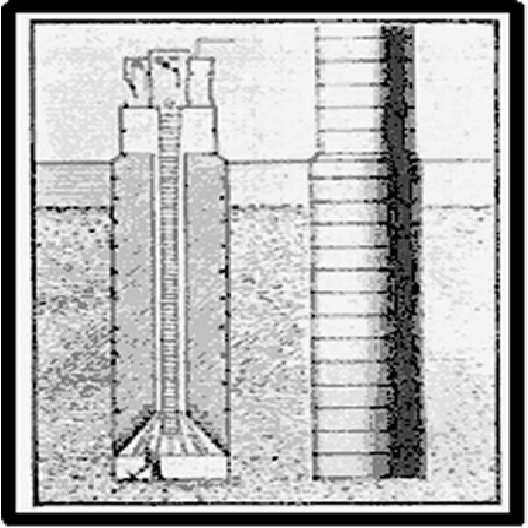
Enormous yellow pine boxes called “caissons” were built on the Brooklyn and New York sides of the river, descending at the rate of 6-inches per week in search of bedrock. Like giant diving bells, the New York side ended up at 78- feet below mean high tide, the Brooklyn side 44-feet. Pressurized air was pumped into these caissons, keeping water and mud at bay as workers excavated the bottom.

In 1872, these “sandhogs” began to experience a strange illness that came to be called “caisson disease”.

Civil War era submarine designer Julius Hermann Kroehl may have recognized what was happening, but Kroehl was five years in his grave by this time, victim of the same “fever”.

Today we call it “the bends”. Pop the top off a soda bottle and you’ll see the principle at work. Without sufficient decompression time, dissolved gasses come out of solution and the blood turns to foam. Bubbles form in or migrate to any part of the body, resulting in symptoms ranging from joint pain and skin rashes, to paralysis and death.  The younger Roebling was badly injured as a result of the bends in 1872, leaving him partially paralyzed and bedridden, incapable of supervising construction on-site.

brooklyn-anchorage

Roebling moved to an apartment in Brooklyn Heights and conducted the entire project looking out the window, designing and redesigning details while his wife, Emily Warren Roebling, became the critical connection between her husband and the job site.

To aid in the work, Emily Roebling took a crash course in bridge engineering. For 11 years she studied higher mathematics, catenary curves, materials strength and the intricacies of cable construction, all while acting as the pivot point on the largest bridge construction project on the planet and nursemaid, to a desperately sick husband.

Emily-Warren-Roebling-e1389630968571
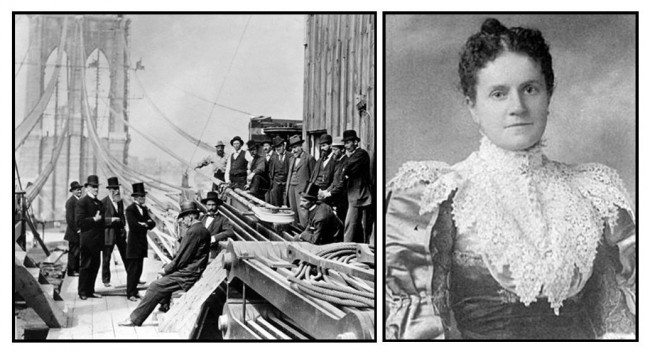
Emily Warren Roebling, the “first woman field engineer”.

Historian David McCullough wrote in his book, The Great Bridge: The Epic Story of the Building of the Brooklyn Bridge: “By and by it was common gossip that hers was the great mind behind the great work and that this, the most monumental engineering triumph of the age, was actually the doing of a woman, which as a general proposition was taken in some quarters to be both preposterous and calamitous. In truth, she had by then a thorough grasp of the engineering involved”.

Unlikely as it sounds, fires broke out at the bottom of the river on several occasions, started by workmen’s candles, fed by the oakum used for caulking and turbocharged by all that pressurized air. On at least one occasion, the caisson was filled with millions of gallons of water, before the fire went out for good.

Brooklyn bridge builders

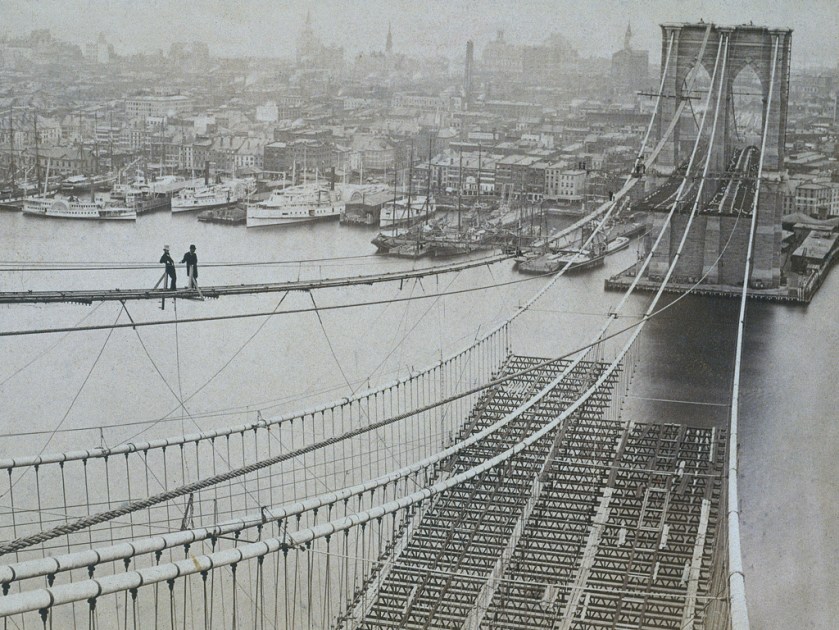
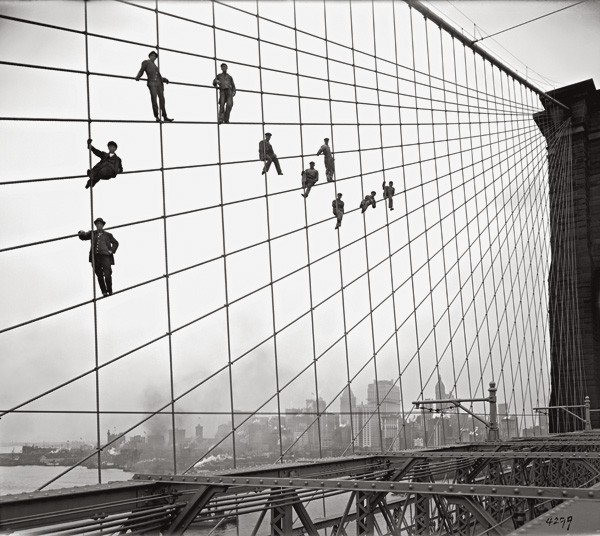
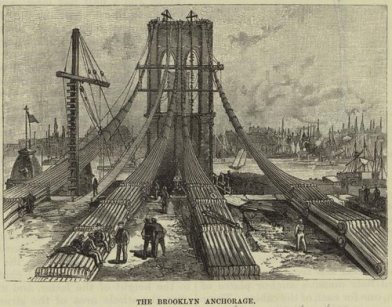
A footbridge connected the two sides in 1877, and soon the wires began to be strung. Wooden “buggies” carried men back and forth along wires suspended hundreds of feet above the water, as individual wires were woven into the four great cables that support the bridge. The work was exacting, with each wire bound together to precise specifications. Rumors about corruption and sleaze surrounded the project when J. Lloyd Haigh, the wire contractor, was discovered to be supplying inferior material. It was way too late to do anything about it, and 150 extra wires were bundled into each cable to compensate. The tactic worked.  Haigh’s shoddy wire remains there, to this day.

At the time it was built, the span across the East river linking Brooklyn with Manhattan was the longest suspension bridge in the world.

Construction was completed in 1883, the bridge opening for use on May 24. Emily Roebling was the first to cross, in a carriage, carrying a rooster as the sign, of victory. New York politician Abram Stevens Hewitt honored her, at that day’s dedication. Today a bronze plaque bears name of the first female field engineer.

“…an everlasting monument to the sacrificing devotion of a woman and of her capacity for that higher education from which she has been too long disbarred.’

New York politician Abram Stevens Hewitt

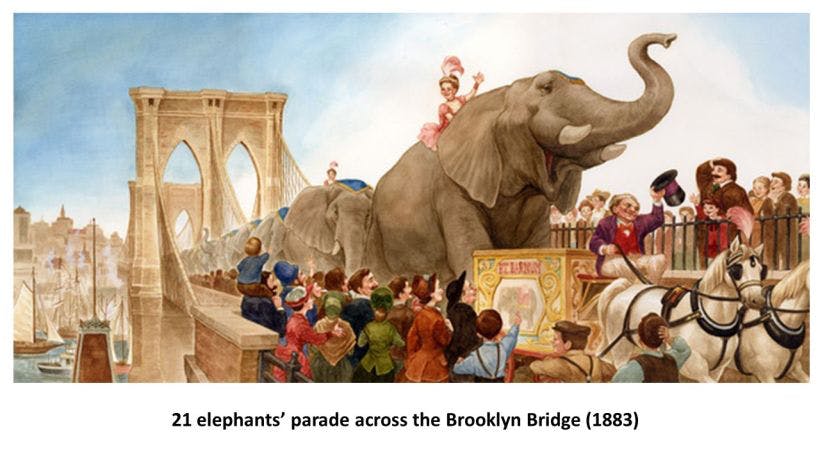
Six days later, a rumor started that the bridge was about to collapse.  At least 12 people were killed in the resulting stampede. A year later, a publicity stunt by P. T. Barnum helped to put people’s minds at ease when Jumbo, the circus’ prize elephant, led a parade of 20 other elephants across the bridge.

For a long time the span was called the “New York and Brooklyn Bridge” or the “East River Bridge”, officially becoming the “Brooklyn Bridge” only in 1915. At least 27 were killed in its construction. Three from the bends, several from cable stringing accidents and others crushed under granite blocks or killed in high falls.

Even today, popular culture abounds with stories of suckers “buying” the Brooklyn Bridge. It was the longest bridge in the world for its time, and would remain so until 1903. Roebling had designed his project to be six times the strength required for the job. Even with those defective cables, the bridge is four times as strong as it needs to be. Many of the Brooklyn Bridge’s contemporary structures have long since gone.  Johann Augustus Roebling’s bridge carries 145,000 cars, every day.

Brooklyn Bridge