December 25, 1942 Dreaming of a White Christmas

White Christmas hit Number 1 on the Hit Parade that November, and never looked back. By Christmas day 1942 the song had barely made it halfway through a ten-week run, at the top spot.

Israel was the youngest of eight children borne of the Baline Family in western Siberia and emigrated to the United States, in 1893. In grammar school “Izzy” delivered telegrams and sold newspapers, to help with family finances. Israel’s father Moses died when the boy was only 13 and he took work as a “ Busker”, to support himself.

Everyone who will read this has bought a record I suspect, but the sale of music came long before the age of the phonograph. Buskers or “song pluggers” would perform songs in vaudeville theaters, railroad stations and even street corners in hopes of selling sheet music, of the latest songs.
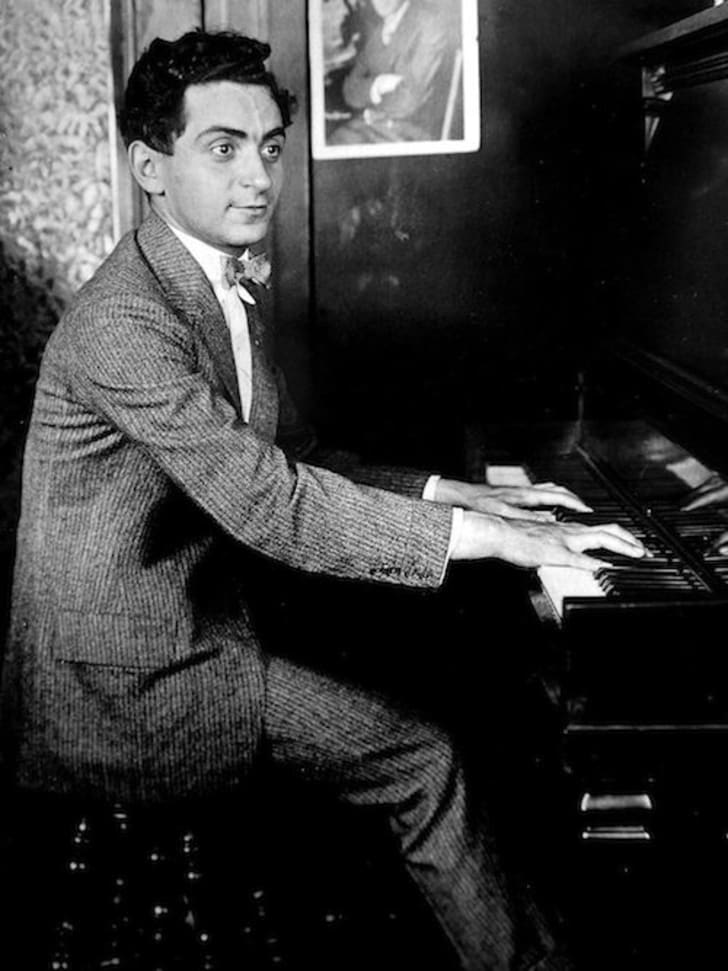
Even at a young age Israel Baline had a pleasing voice and a natural ear, for music. By 16 he was a singing waiter at the Pelham Cafe in New York’s Chinatown. It was there he taught himself to play the piano and to compose music, with the help of a friend. The boy’s first published work led to a name change when Marie from Sunny Italy came back from the publisher, with a typo. I. Baline was now I. Berlin.

At least that’s the story. Others will tell you Irving Berlin changed his name to sound less ethnic. Be that as it may, the author of American standards like “Puttin’ on the Ritz” and “There’s No Business Like Show Business”, had come of age.

In 1911, Berlin’s “Alexander’s Ragtime Band” sold a million copies and inspired a dance craze still remembered, to this day.

Irving Berlin wrote “God Bless America” during World War 1 but only used it, in 1938. A love song to an adopted country from a kid escaped from the anti-Jewish Russian pogroms of the age the song went on to earn $9.6 million. Every dime of it was donated to the Boy Scouts of America, and Campfire Girls.

Christmas was an unhappy time for Irving Berlin. A devoted husband of 62 years Irving and Ellin (Mackay) lost their only son (also Irving) on Christmas day in 1928, to Sudden Infant death Syndrome. Every year at Christmas was an occasion to visit their baby’s grave.

Berlin wrote the best selling record of all time in 1941 but it didn’t start out, the way you might think. In 1940, the composer signed to score a musical for paramount Pictures, about a retired vaudeville performer who opened an inn. The hook was that this particular inn was only open, on holidays. “Holiday Inn” would guide the viewer through a years’ worth of holidays, in music.

As for White Christmas that started out, as a spoof. A satire sung under a palm tree by music industry sophisticates enjoying drinks, around a Beverly hills swimming pool:

The sun is shining, the grass is green
The orange and palm trees sway
There’s never been such a day
In Beverly Hills, L. A.
But it’s December the 24th
And I am longing to be up north….
I’m dreaming of a white Christmas…
(Chorus continues)

Bing Crosby was already famous in 1941. Berlin agreed to include White Christmas in the film, provided that Crosby perform the tune. Crosby himself was on board, from day 1. On hearing the song he told Berlin “You don’t have to worry about this one, Irving.”

And then the world changed. A mighty sucker punch came out of the east on December 7, 1941, a sneak attack by the air and naval forces of imperial Japan on the American Pacific naval anchorage, at Pearl Harbor.
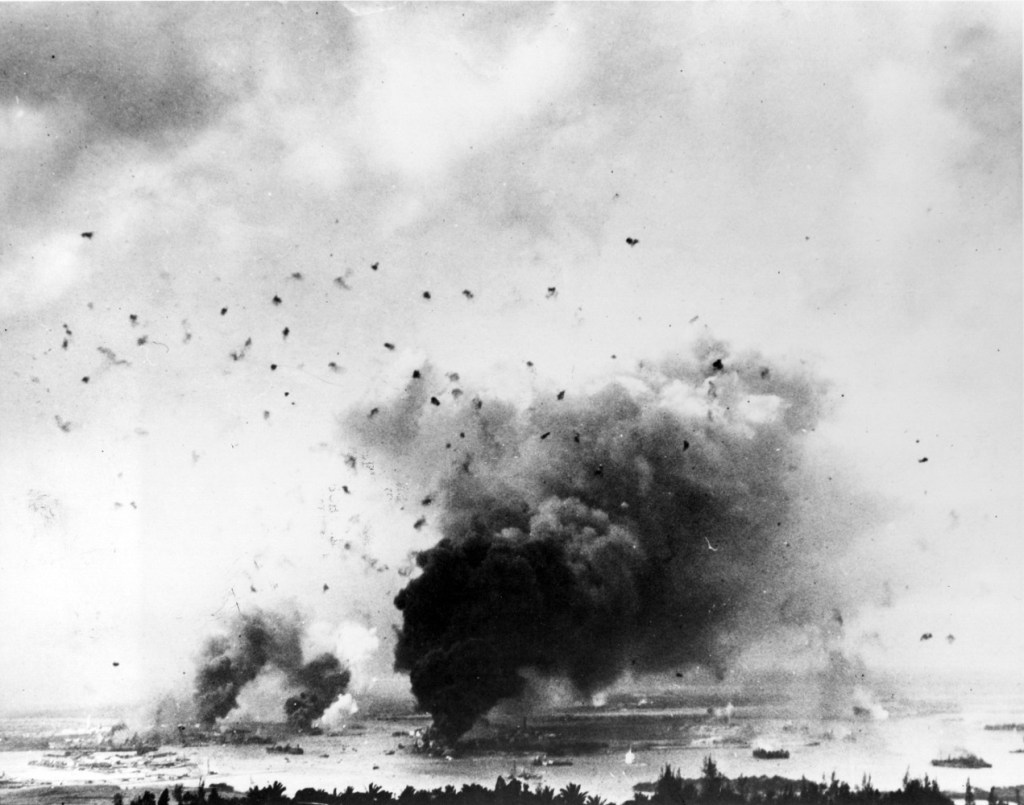
President Franklin Roosevelt asked for and received a congressional declaration of war on Japan, on December 8. Nazi Germany piled on and declared war on the United States, three days later. The US had entered World War 2.

A generation of men signed up for the draft including Bing Crosby. He would prove too old but this was a loyal American. Crosby would use his gifts at every opportunity and perform for the troops.

Seventeen days after the attack on Pearl Harbor was Christmas eve, 1941. Bulkhead markings would later reveal that even then, the last survivors on board the USS Oklahoma down there at the bottom of Pearl Harbor were making their last marks on the wall of that black, upside down place in the vain hope of a rescue, that would never come.

Bing Crosby performed the track live that Christmas eve and over the following January, the shortwave broadcast of the Kraft Music Hall reaching troops then fighting for their lives on Corregidor and the Philippines. The set list always started out with a tune, destined to become the official anthem of the US Army: “AS The Caissons Go Rolling Along.”.

President Roosevelt asked Hollywood to step up, and do its part. Crosby and others formed the Hollywood Victory Caravan in support of the war effort, Carey Grant, Desi Arnaz, Olivia de Havilland and others raising over $700,000 in support of the Army and Navy Relief Society.
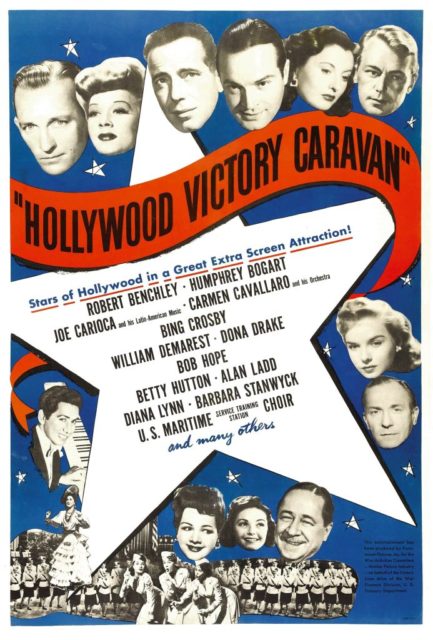
When Holiday Inn was released in 1942 Berlin expected Be Careful It’s My Heart to be a hit, a song tied in the film, to Valentine’s day. But a funny thing happened. White Christmas was received by the people who heard it not as satire but a heartfelt reminder of Christmases past and a promise, of Christmas yet to come. Soldiers abroad and their families dreamed alike of a white Christmas, “just like the ones I used to know“.

That first verse quietly went away, never to return.
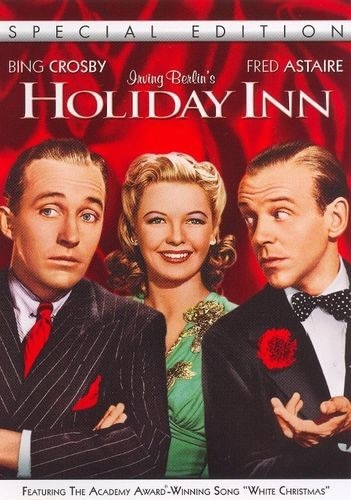
Fun Fact: Despite Berlin’s songwriting success he didn’t write music and only played the piano in F Sharp. He bought special transposing keyboards so his songs didn’t all sound the same and paid music secretaries to notate and transcribe, his music.

Crosby himself had mixed feelings about performing White Christmas. “I hesitated about doing it” he once told an interviewer, ” because invariably it caused such a nostalgic yearning among the men, that it made them sad. Heaven knows, I didn’t come that far to make them sad. For this reason, several times I tried to cut it out of the show, but these guys just hollered for it.”

White Christmas hit Number 1 on the Hit Parade that November, and never looked back. By Christmas day 1942 the song had barely made it halfway through a ten-week run, at the top spot.

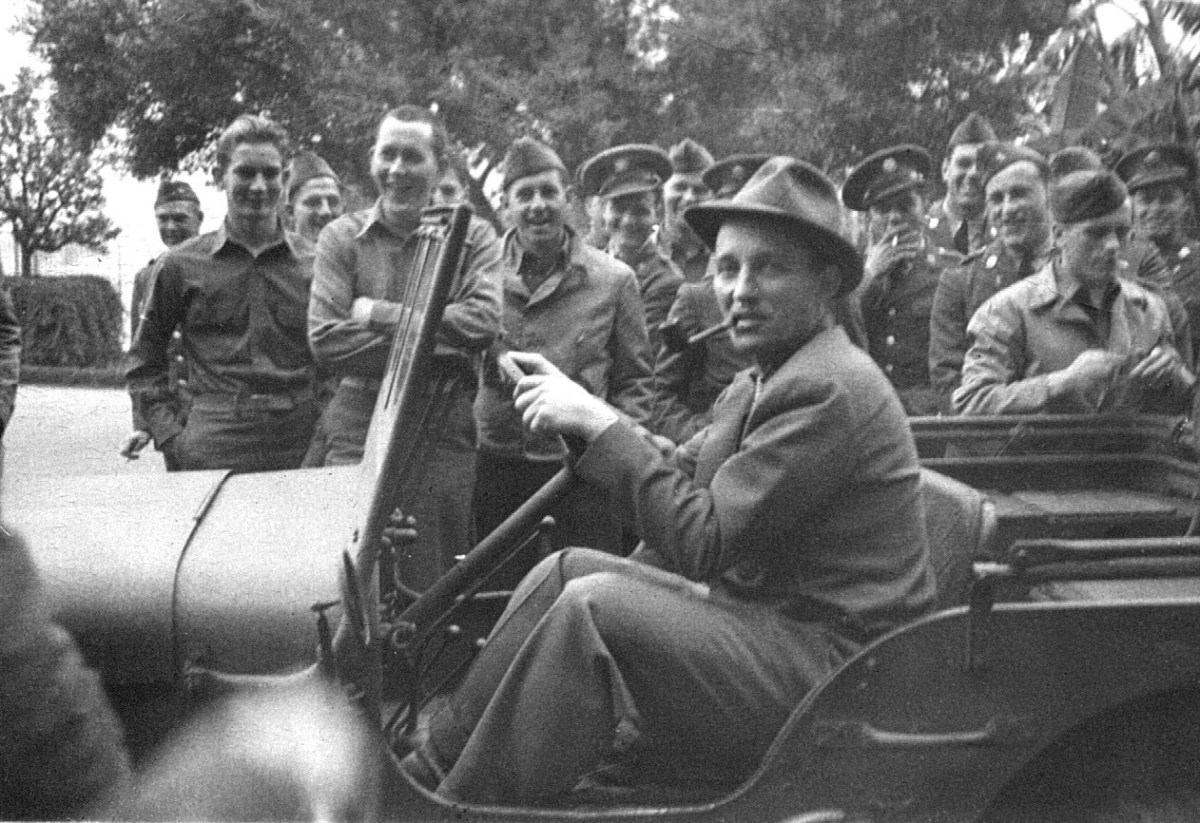
Bing Crosby appeared in over 70 radio shows over the course of the war including 30 Command Performance spots, 13 on Mail Call, 5 appearances on Song Sheet, 19 on GI Journal and at least twice on Jubilee, all in addition to his regular Kraft Music Hall show transcribed on discs and personal appearances before troops on the front lines. A survey among soldiers after the war revealed that Bing Crosby had accomplished more in support of troop morale than Franklin Roosevelt, Dwight Eisenhower or even, Bob Hope.
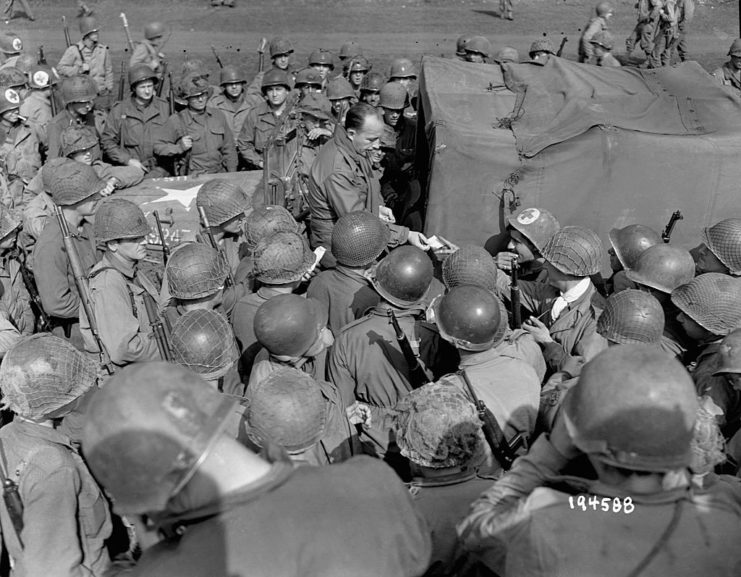
Bing Crosby signing autographs in France, in 1944

It’s a new perspective to look at one of the seminal events of the 20th century, through the eyes of the artist. Imagine for a moment you are Bing Crosby himself, performing for the troops in Belgium and France and Luxembourg in December, 1944. What must it have been like a month later to realize that 75,000 of those men were now casualties in the last great feat of German arms of World War 2, the Battle of the Bulge.
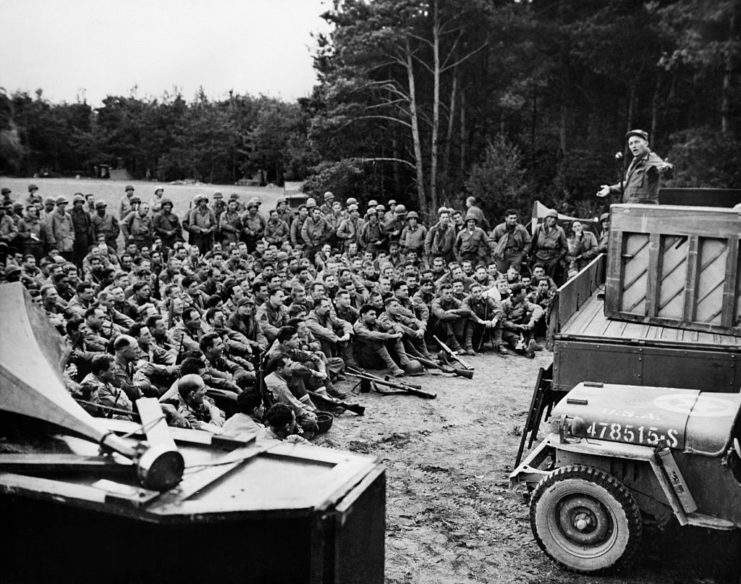
Bing Crosby performing for the troops in 1944

Today, the Guinness Book of World Records names Bing Crosby’s “White Christmas” not only the best-selling Christmas single in the United States, but also the best-selling single of all time with estimated sales of over 50 million copies, worldwide.

I hope you enjoyed this story and wish a you Merry Christmas and a safe, healthy and prosperous new year.. May this be the first of many more.

Rick Long, the “Cape Cod Curmudgeon”.

December 8, 1941 The Game that Never Was

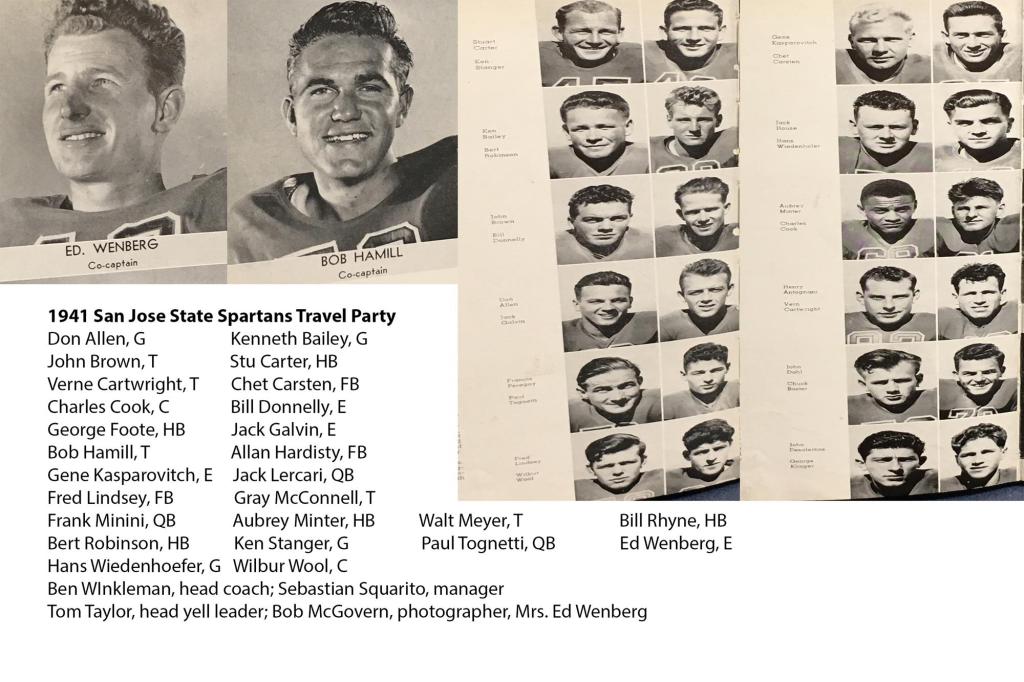
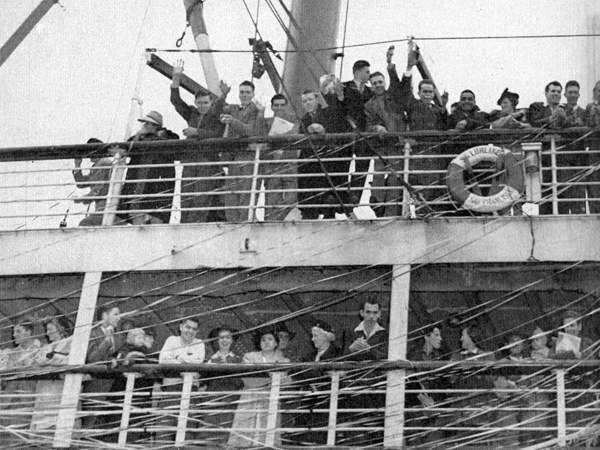
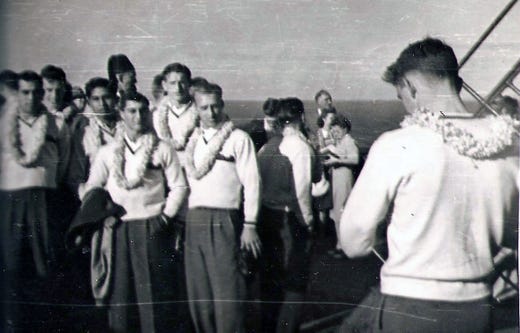
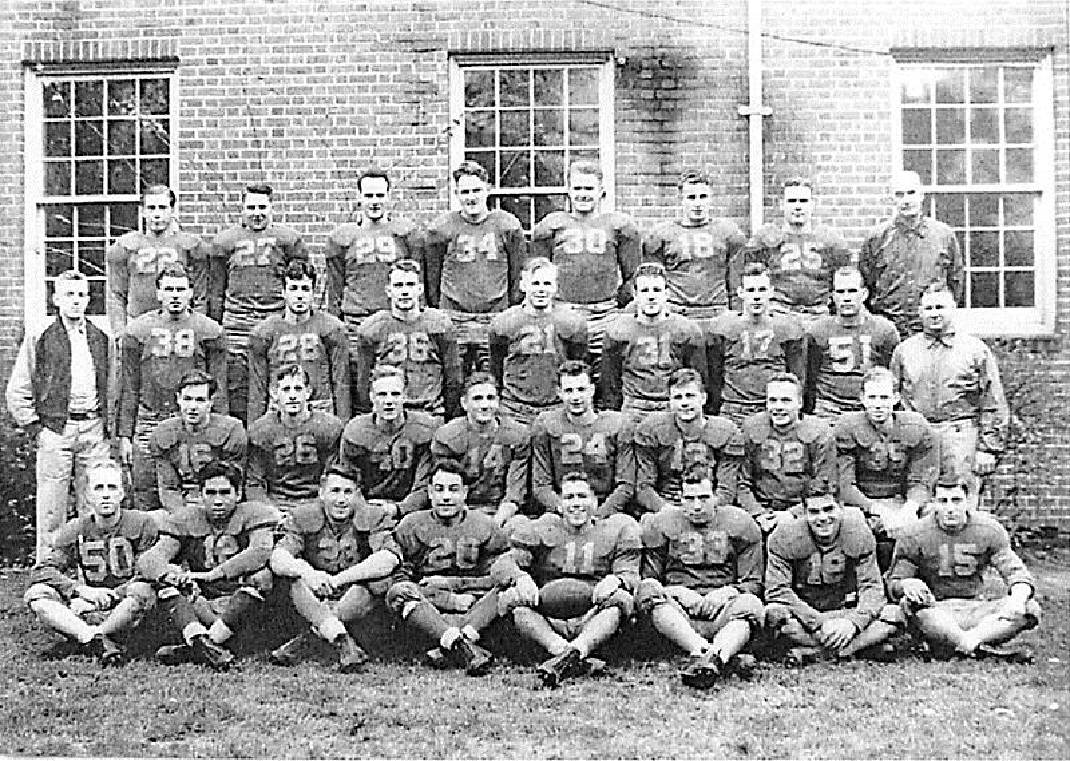
The two teams departed November 27 aboard the SS Lurline along with an entourage of fans, dignitaries and coaching staff. An outing like that was once in a lifetime. An unforgettable trip and so it was, only not for the reason any of them expected.

In December 1941, the San Jose Spartans and the Willamette Bearcats of Oregon, went on the road. They were college kids, enjoying a few days in paradise and a chance to play, the game they loved. What could be better than that?

The two teams departed November 27 aboard the SS Lurline along with an entourage of fans, dignitaries and coaching staff. The Rainbow Warriors of Hawaii defeated Willamette 20-6 on Saturday, December 6. The Warriors were scheduled to play San Jose State on December 13, followed by a Spartans- Bearcats matchup, on December 16.

An outing like that was once in a lifetime. An unforgettable trip and so it was, only not for the reason any of them expected.

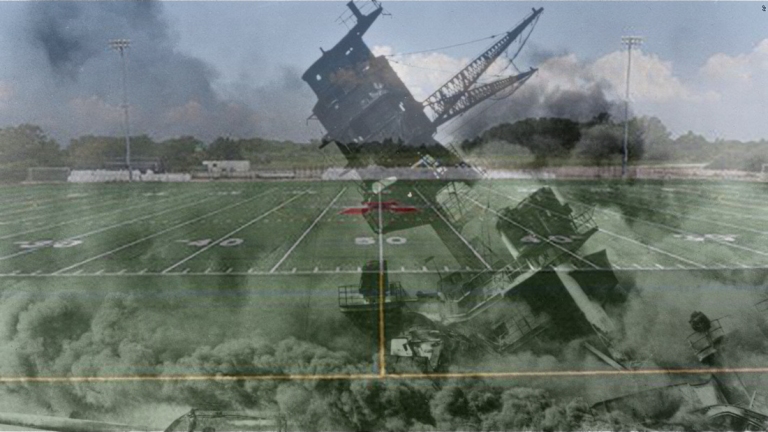
On December 7, 1941 a great sucker punch came out of the southeast. 353 Imperial Japanese warplanes attacked Hickam Air Field and the US Pacific Naval anchorage at Pearl Harbor, lying at peace in the early morning sunshine of a quiet Sunday morning. The sneak attack carried out 80 years ago yesterday destroyed more American lives than any foreign enemy attack on American soil, until the Islamist terrorist attack of September 11, 2001.

The President of the United States addressed a joint session of Congress on December 8, requesting a declaration of war against the Empire of Japan.

Back on the mainland, the families of players now stranded in Hawaii, received no word. There were no communications. None could know with certainty, that brothers and sons were alive or dead. Hawaii was locked down, under Martial Law.

Meanwhile, the visiting teams were mobilized to perform wartime duties. San Jose state players were sent to work with Federal authorities and Honolulu police to round up Japanese, Italian and German citizens, and to enforce wartime blackout orders. Willamette players were assigned World War 1-vintage Springfield rifles and tin hats, and ordered to string barbed wire on the beaches.

If you’ve heard of Punahou High School it probably involves the school’s most famous alumnus, the former US President Barack Obama. 80 years ago today all hell, was about to break loose at Punahou high.

United States Army Corps of Engineers troops began to appear at the Punahou gates at 1:00am, on December 8. By 5:00am, Dole Hall Cafeteria Manager Nina “Peggy” Brown was ordered to prepare breakfast, for 750 men. For the next ten days Willamette players stood 24-hour guard, around the school.

Many players had never so much as handled a gun. Now in the darkness every shadow carried the menace, of an enemy soldier. Wild gunfire would break out at the sound of a stealthy invader which turned out to be nothing, but a falling coconut. Shirley McKay Hadley was a Willamette student in 1941 accompanied by her father, then serving as state Senator. She joked it all, many years later, “They were lucky they didn’t shoot each other.”

Female members of the entourage were assigned nursing duties. Spartan Guard Ken Stranger delivered a baby, on December 7.

On December 19, players received two-hours notice. It was time to go. The civilian liner SS President Coolidge had been commandeered to transport gravely wounded service members. This would be the kids’ ride home complete with Naval escort, a defense against Japanese submarine attack.

Seven San Jose players stayed behind and joined the Honolulu police force , for which each was paid $166 a month. Willamette coach Roy “Spec” Keene refused to let any of his players stay behind as none had been able to speak with their parents, first.

Nearly every member of both squads went on to fight for the nation. Willamette Guard Kenneth Bailey was killed over Bari Italy in 1943 and awarded the Purple Heart, posthumously.

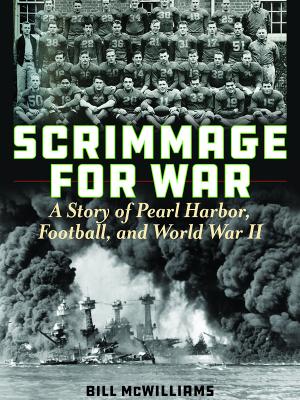
Bill McWilliams served 27 years in the United States Air Force, as a fighter bomber pilot. He’s written a book about 12 of these guys who went on to fight the conflict, of the “Greatest Generation”.
The book came out in 2019 and it’s still in print, if you’re interested. It looks like one hell of a story.

Andy Rogers played for the Willamette squad and went on to serve for the duration of the war, with the 3rd division of the United States Marine Corps. Mr. Rogers is 98 today and lives in Napa Valley, California. The only living member of either traveling squad who would have played that day, in the game that never was.

December 7, 1941 USS Oklahoma

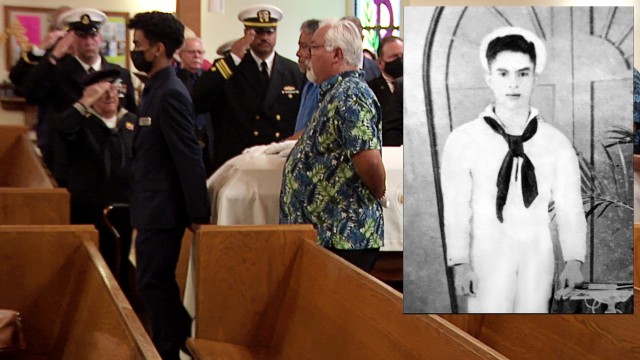
14 Marines and 415 sailors aboard Oklahoma lost their lives immediately, or in the days and weeks to come. Bulkhead markings would later reveal that, at least some of the doomed would live for another seventeen days in the black, upside-down hell. The last mark was drawn by the last survivor, on Christmas Eve.


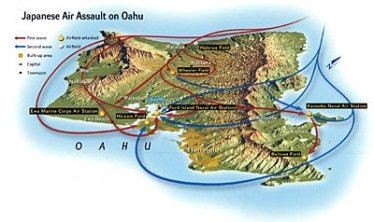
It was literally “out of the blue” when the first wave of enemy aircraft arrived at 7:48 am local time, December 7, 1941. 353 Imperial Japanese warplanes approached in two waves out of the southeast, fighters, bombers, and torpedo aircraft.  Across Hickam Field and over the still waters of Pearl Harbor. Tied in place and immobile, the eight vessels moored at “Battleship Row” were easy targets.

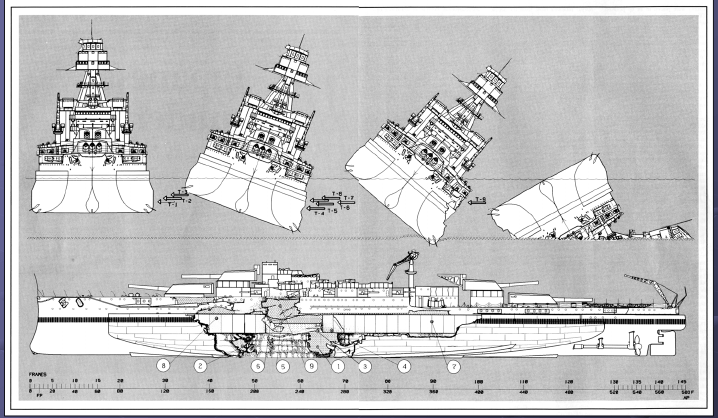
In the center of the Japanese flight path, sailors and Marines aboard the USS Oklahoma fought back furiously, as holes as wide as 40-feet were torn into her side. Eight torpedoes smashed into her port side, each striking higher on the hull as the great Battleship began to roll.

She never had a chance.

_oahu

Bilge plates had been removed for a scheduled inspection the following day, making counter-flooding to prevent capsize, impossible. The ninth torpedo slammed home even as Oklahoma rolled over, and died. Hundreds scrambled out across the rolling hull, jumped overboard into the oil covered, flaming waters of the harbor, or crawled out over mooring lines in the attempt to reach USS Maryland, tied in the next berth.

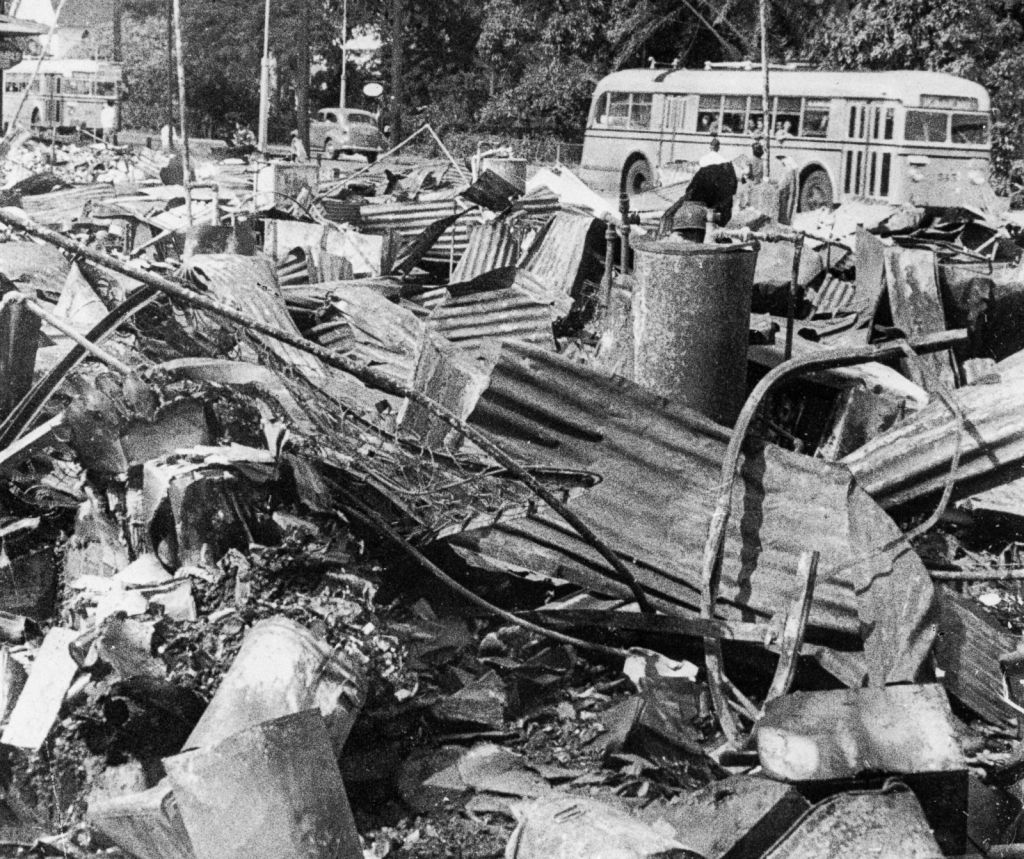
The damage was catastrophic. Once the pride of the Pacific fleet, all eight battleships were damaged. Four of them sunk. Nine cruisers, destroyers and other craft were damaged, another two sunk. 347 aircraft were damaged, most caught while still on the ground. 159 of those, were destroyed. 2,403 were dead or destined to die from the attack, another 1,178 wounded.

Nine Japanese torpedoes struck USS Oklahoma’s port side, in the first ten minutes.

HT John F DeVirgilio for this graphic
The last moments of USS Oklahoma.  H/T John F DeVirgilio for this graphic

Frantic around the clock rescue efforts began almost immediately, to get at 461 sailors and Marines trapped within the hull of the Oklahoma. Tapping could be heard as holes were drilled to get at those trapped inside. Thirty-two were delivered from certain death.

14 Marines and 415 sailors aboard Oklahoma lost their lives immediately, or in the days and weeks to come. Bulkhead markings would later reveal that, at least some of the doomed would live for another seventeen days in the black, upside-down hell. The last mark was drawn by the last survivor, on Christmas Eve.

Of sixteen ships lost or damaged, thirteen were destined to be repaired, and returned to service. USS Arizona remains on the bottom to this day, a monument to the event and to the 1,102-honored dead who remain entombed within her hull. USS Utah defied salvage efforts. She too is a registered War Grave, 64 honored dead remaining within her hull, lying at the bottom not far from the Arizona.

Of necessity, such repairs were prioritized. For the time being, USS Oklahoma was beyond help. She, and her dead, would have to wait.

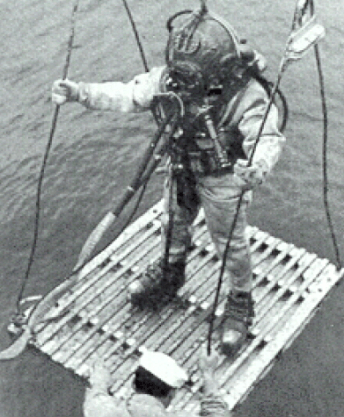
Oklahoma Diver

Recovery of the USS Oklahoma was the most complex salvage operation ever attempted, beginning in March, 1943.  With the weight of her hull driving Oklahoma’s superstructure into bottom, salvage divers descended daily to separate the tower, while creating hardpoints from which to attach righting cables.

The work was hellishly dangerous down there in the mud and the oil at the bottom of Pearl Harbor.  Several divers lost their lives and yet, another day would come and each would descend yet again, into that black water.

21 giant A-frames were fixed to the hull of USS Oklahoma, 3-inch cables connecting compound pulleys to 21 electric motors, each capable of pulling 429 tons.

Two pull configurations were used over 74 days, first attached to these massive A-frames, then direct connections once the hull had achieved 70°. In May 1943, her decks once again saw the light of day, for the first time in over two years.

rightng-strategy
USS Oklahoma, righting strategy

Fully righted, the ship was still ten-feet below water. Massive temporary wood and concrete structures called “cofferdams” closed cavernous holes left by torpedoes, so the hull could be pumped out and re-floated. A problem even larger than those torpedo holes were the gaps between hull plates, caused by the initial capsize and righting operations. Divers stuffed kapok into gaps as water was pumped out.

Individual divers spent 2-3 years on the Oklahoma salvage job. Underwater arc welding and hydraulic jet techniques were developed during this period, which remain in use to this day. 1,848 dives were performed for a total of 10,279 man hours under pressure.

9781591147244

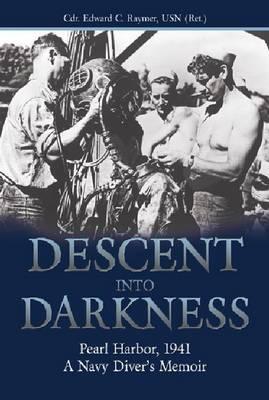
CDR Edward Charles Raymer, US Navy Retired, was one of those divers. Raymer tells the story of those men in Descent into Darkness: Pearl Harbor, 1941 – A Navy Diver’s Memoir, if you’re interested in further reading.  Most of those men are gone now, including Raymer himself.  They have earned the right to be remembered.

Ken Hartle died in January 2017 in an Escondido, California Alzheimer’s and dementia center. He was 103, possibly the oldest of those divers. Before the age of SCUBA, Hartle and his fellow divers worked in heavy canvas suits and brass helmets weighing together, over 200 pounds. He regularly risked death, towing away unexploded bombs and torpedoes. He suffered the bends and nearly lost his life one day, when an anchor chain exploded into flying shards of metal. The part he’d never talk about even after all those years, was the hardest part. ‘Bringing up our boys’.

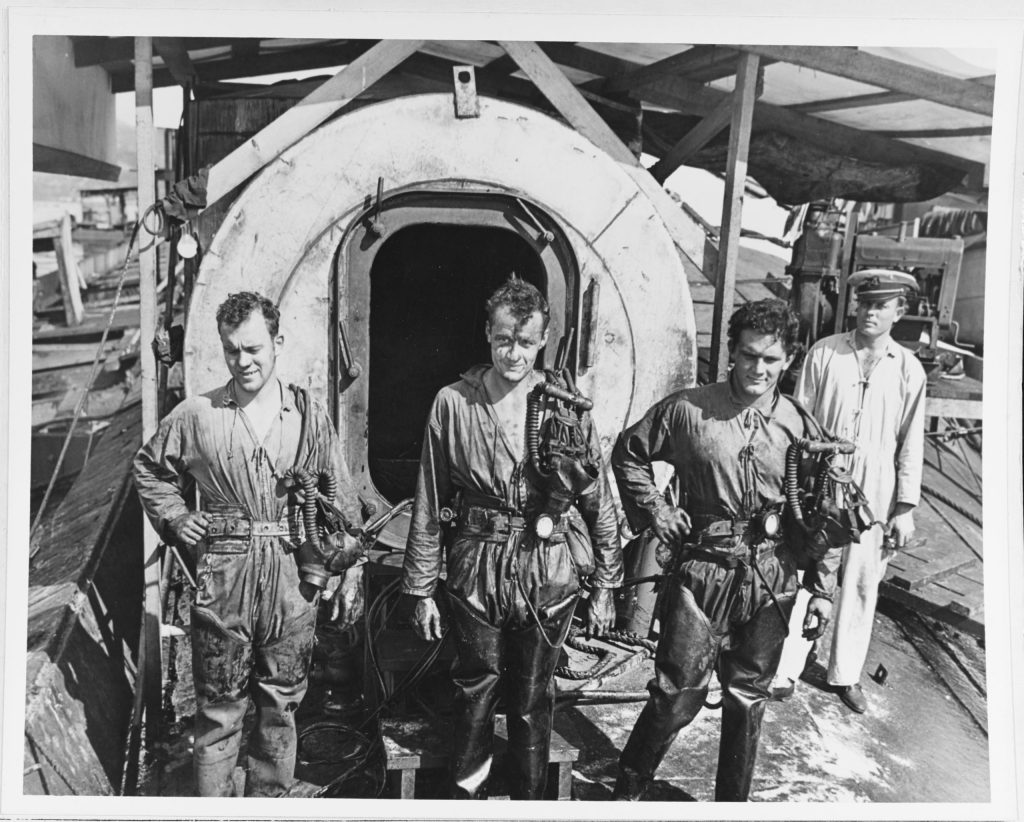
Salvage workers entered the pressurized hull through airlocks wearing masks and protective suits. Bodies were in advanced stages of decomposition by this time and the oil and chemical-soaked interior was toxic to life. Most victims would never be identified.

Divers standing in front of a decompression chamber, while they were working to salvage ships sunk in the 7 December 1941 Japanese air raid on Pearl Harbor. Note warrant officer standing at right. Official U.S. Navy Photograph, from the collections of the Naval History and Heritage Command.

Twenty 10,000 gallon per minute pumps operated for 11 hours straight, re-floating the battleship on November 3, 1943.

Oklahoma entered dry dock the following month, a total loss to the American war effort. She was stripped of guns and superstructure, sold for scrap on December 5, 1946 to the Moore Drydock Company of Oakland, California.

The battered hulk left Pearl Harbor for the last time in May 1947, destined for the indignity of a scrapyard in San Francisco bay. She would never make it.

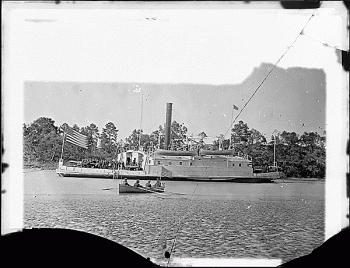
Taken under tow by the ocean-going tugs Hercules and Monarch, the three vessels entered a storm, 540 miles east of Hawaii. On May 17, disaster struck. Piercing the darkness, Hercules’ spotlight revealed the former battleship to be listing, heavily. Naval base at Pearl Harbor instructed them to turn around, when these two giant tugs suddenly found themselves slowing, to a stop. Despite her massive engines, Hercules began to move backward. She was being dragged astern with no warning, hurtling past Monarch, herself swamped at the stern and being dragged backward at 17 mph.

the-tug-boat-hercules-william-havle
Ocean-going tug Hercules, photograph by William Havle

Fortunately for both tugs, skippers Kelly Sprague of Hercules and George Anderson of Monarch had both loosened the cable drums connecting 1,400-foot tow lines, to Oklahoma. Monarch’s line played out and detached. Hercules’ line didn’t do so until the last possible moment. With tow line straight down and sinking fast, Hercules’ cable drum exploded in a shower of sparks directly over Oklahoma’s final resting place, the 409-ton tug bobbing to the surface like the float on a child’s fishing line.

Postcard image of USS Oklahoma (BB-37) from the service of AMM2c Durrell Wade“. H/T nationalww2museum.org

“Okie” was stabbed in the back, attacked and mortally wounded even before she knew she was at war.  The causes leading to her final descent, remain uncertain.  Most will tell you, her plates couldn’t hold.  The beating of six years earlier, was just too much.   Those who served on her decks, might tell you differently. Maybe she just preferred, to die at sea.

Afterward

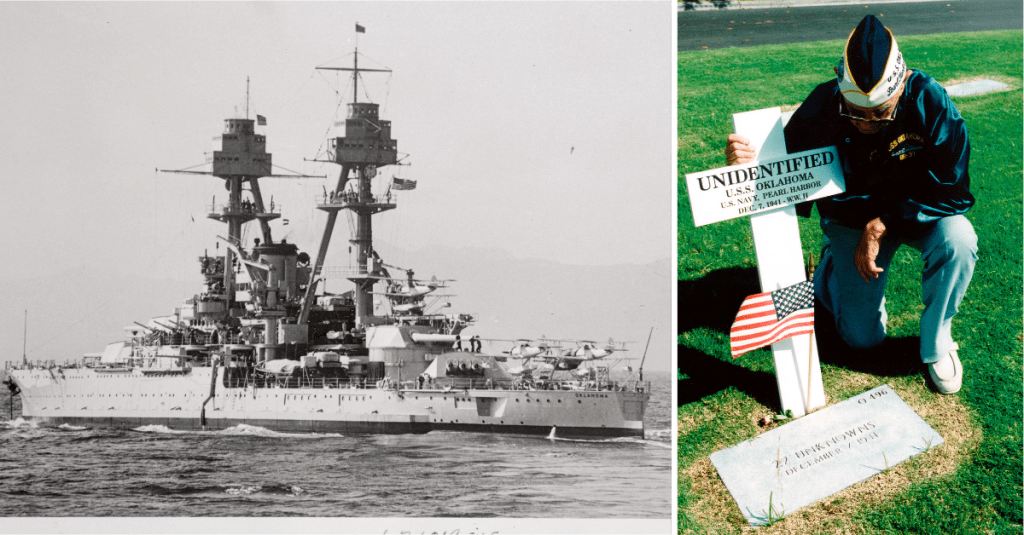
Jesus Garcia of Guam died at age 21 on December 7, 1941, a sailor serving aboard the USS Oklahoma. William Eugene Blanchard of Tignall Georgia, was 24.

In 1947, “Okie’s” honored dead were disinterred. Dental records and dog tags were used to identify thirty-five. The other 391 including Blanchard and Garcia were reburied in 61 caskets, in Hawaii’s National Military Cemetery of the Pacific. Their names were known, only to God.

Nearly sixty years later, scientific advances in DNA analysis made further identifications, possible. Veteran Ray Emory was serving aboard the USS Honolulu on that day in 1941 and persuaded the D.o.D., to make the attempt.

Exhumations began in 2015. Mitochondrial DNA was enough for many identifications, but not all. Mitochondrial DNA comes from the maternal side. Shared ancestral lines means that sometimes, that’s not enough. One DNA sequence matched 25 victims.

Further DNA was collected from paternal lines, combining with the mitochondrial to identify many of Oklahoma’s dead. William Blanchard was laid to rest with full military honors on June 7, 2021 in Elizabeth City, North Carolina.

As I write this it is December 7, 2021. 80 years after the fact some ninety percent of those who gave their lives on board USS Oklahoma once again, have their names.

Jesus Garcia went to his final rest in San Diego on October 6, 2021. Gilbert Nadeau, 95, was the only WW2 veteran able to attend.

November 9, 2013 A Vintage like No Other

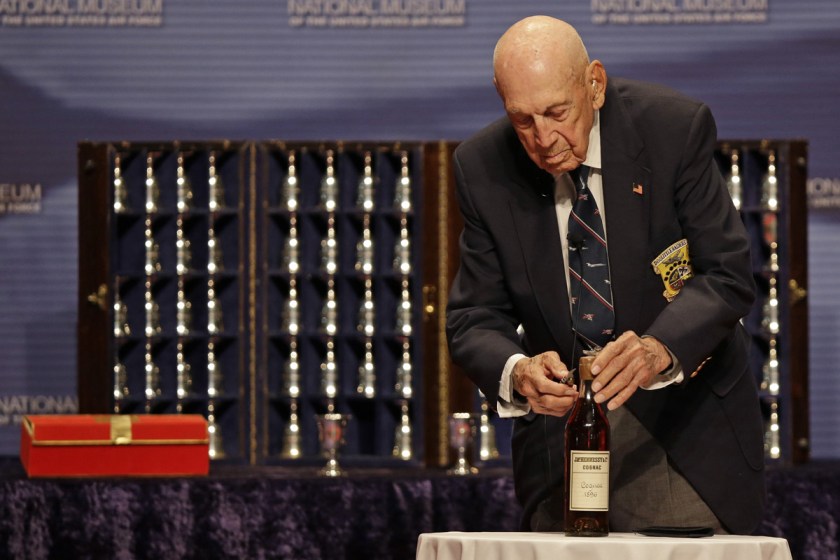
On November 9, 2013, a company of heroes cracked open and enjoyed a 117-year-old bottle of rare and vintage cognac. If there can be a more magnificent act of tribute, I cannot at this moment think of what it might be.

On November 9, 2013, there occurred a gathering of four.  A tribute to fallen heroes. These four were themselves heroes, and worthy of tribute.  This was to be their last such gathering.

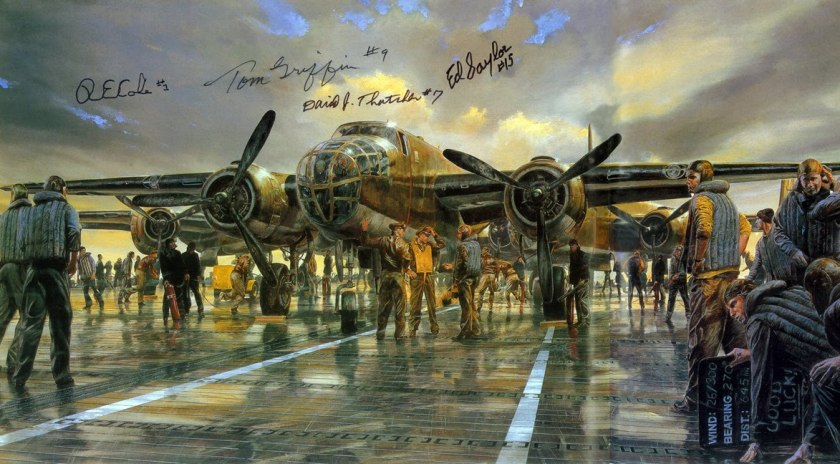
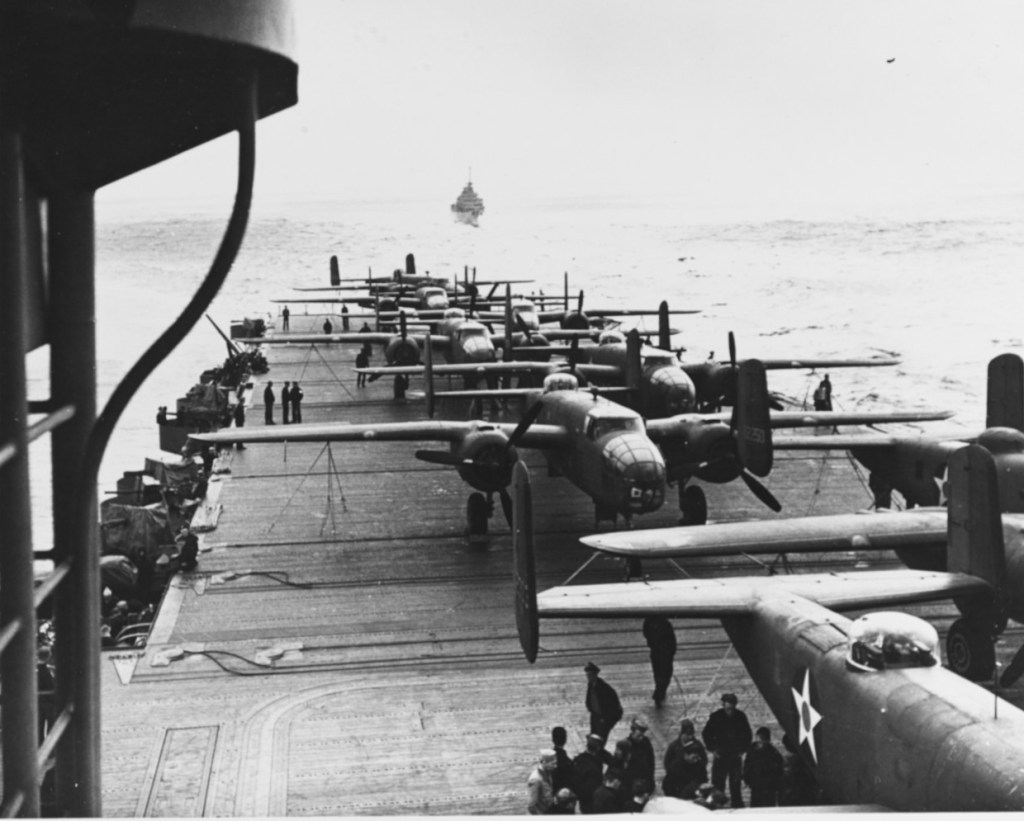
This story begins on April 18, 1942, when a flight of sixteen Mitchell B25 medium bombers launched from the deck of the carrier, USS Hornet. It was a retaliatory raid on Imperial Japan, planned and led by Lieutenant Colonel James “Jimmy” Doolittle of the United States Army Air Force. The raid was payback for the sneak attack on Pearl Harbor, four months earlier. A demonstration that the Japanese home islands, were not immune from destruction.

Launching such massive aircraft from the decks of a carrier had never been attempted. There were no means of bringing them back.  With extra gas tanks installed and machine guns removed to save the weight, this was to be a one-way mission, into territory occupied by a savage adversary.

Doolittle Signatures

Fearing that mission security was breached, the bomb run was forced to launch 200 miles before the intended departure spot.  At this range the bombers themselves might not even make it. Fighter escort, impossible.

Japanese Premier Hideki Tojo was inspecting military bases, at the time of the raid. One B-25 came so close he could see the pilot, though the American bomber never fired a shot.

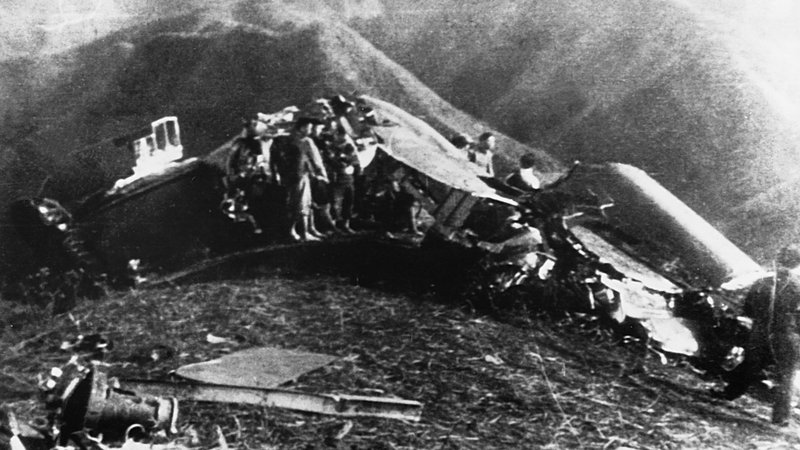
After dropping their bombs, fifteen continued west, toward Japanese occupied China.  Unbeknownst at the time, carburetors bench-marked and calibrated for low level flight had been replaced in flight #8, which now had no chance of making it to the mainland.  Twelve crash landed in the coastal provinces.  Three more, ditched at sea.  Pilot Captain Edward York pointed flight 8 toward Vladivostok, where he hoped to refuel.  The pilot and crew were instead taken into captivity and held, for thirteen months.

aftermath.jpg__800x450_q85_crop_upscale

Crew 3 Engineer-Gunner Corporal Leland Dale Faktor died in the fall after bailing out. Staff Sergeant Bombardier William Dieter and Sergeant Engineer-Gunner Donald Fitzmaurice bailed out of aircraft #6 off the China coast, and drowned.

The heroism of the indigenous people at this point, is a little-known part of this story.  The massive sweep across the eastern coastal provinces, the Zhejiang-Jiangxi campaign, cost the lives of 250,000 Chinese.  A quarter-million murdered by Japanese soldiers, in the hunt for Doolittle’s raiders.  How many were in a position to betray the American flyers and refused, will never be known.

Amazingly, only eight were captured, out of seventy-seven survivors.

First Lieutenant Pilot “Bill” Farrow and Sergeant Engineer-Gunner Harold Spatz, both of Crew 16, and First Lieutenant Pilot Dean Edward Hallmark of Crew 6 were caught by the Japanese and executed by firing squad on October 15, 1942.  Crew 6 Co-Pilot First Lieutenant Robert John Meder died in a Japanese prison camp, on December 11, 1943.  Most of the 80 who began the mission, survived the war.

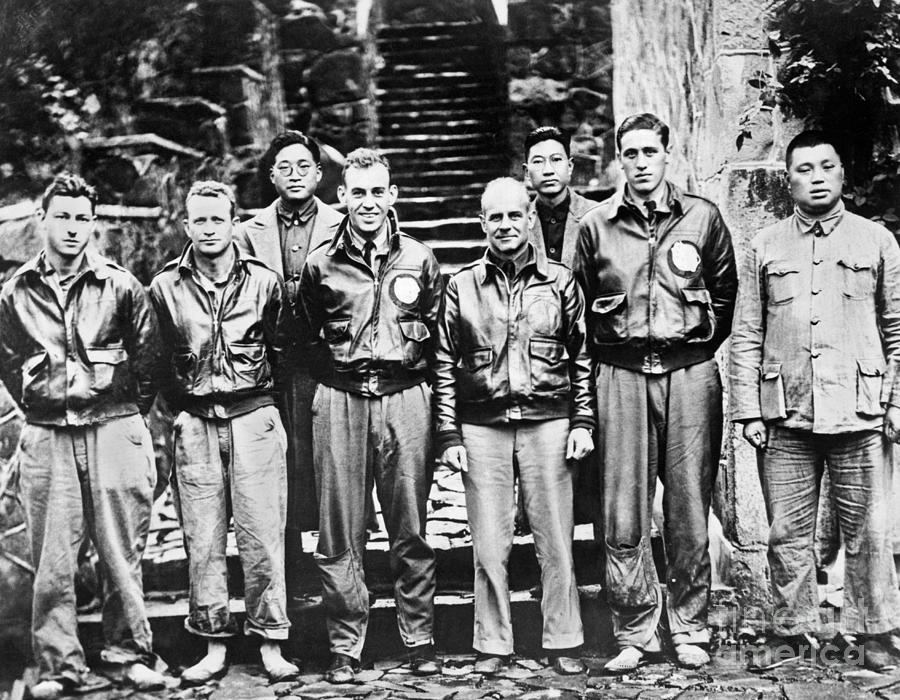
Jimmy Doolittle and his crew in China, after the raid

Thirteen targets were attacked, including an oil tank farm, a steel mill, and an aircraft carrier then under construction.. Fifty were killed and another 400 injured, but the mission had a decisive psychological effect.  Japan withdrew its powerful aircraft carrier force to protect the home islands. Admiral Isoroku Yamamoto attacked Midway, thinking that to have been the jump-off point for the raid. Described by military historian John Keegan as “the most stunning and decisive blow in the history of naval warfare”, the battle of Midway would be a major strategic defeat for Imperial Japan.

s_w07_20418042
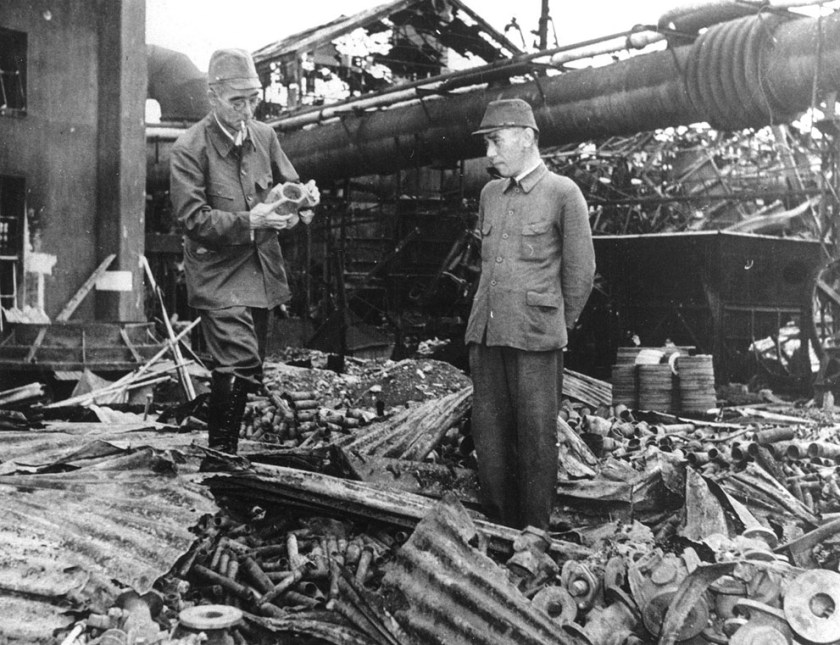
Ryozo Asano, left, spokesman for a group of diversified Japanese family enterprises called the Zaibatsu, inspects the wreckage of his Tokyo steel plant

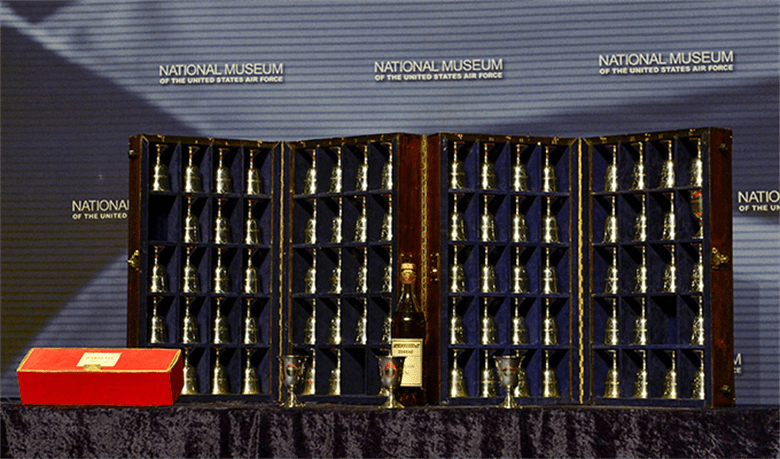
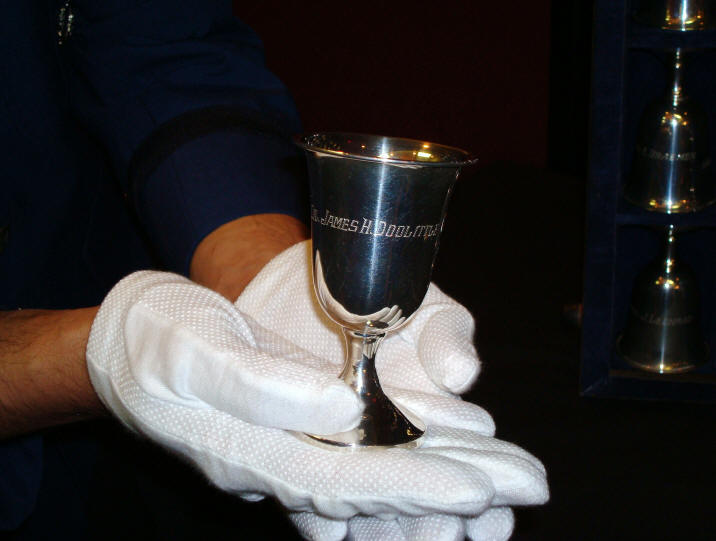
Every year since the late 1940s, the surviving Doolittle raiders have held a reunion.  In 1959, the city of Tucson presented them with 80 silver goblets, each engraved with a name. They are on display at the National Museum of the Air Force, in Dayton Ohio.

With those goblets is a fine bottle of vintage Cognac.  Hennessy VS 1896, the year Jimmy Doolittle was born. For many years there a bargain between the survivors that, one day, the last two would open that bottle, and toast their comrades.

DSC00017

They changed that bargain in 2013.   Just a little. Jimmy Doolittle himself passed away in 1993. Twenty years later, 76 goblets were turned over, each signifying a man who had passed on.  Now, there were only four.

  1. Lieutenant Colonel Richard E. Cole* of Dayton Ohio was co-pilot of crew No. 1.  Remained in China after the Tokyo Raid until June 1943, and served in the China-Burma-India Theater from October, 1943 until June, 1944. Relieved from active duty in January, 1947 but returned to active duty in August 1947.
  2. Lieutenant Colonel Robert L. Hite* of Odell Texas was co-pilot of crew No. 16. Captured by the Japanese and held prisoner for forty months, he watched his weight drop to eighty pounds.
  3. Lieutenant Colonel Edward J. Saylor* of Brusett Montana was engineer-gunner of crew No. 15.   Served throughout the duration of WW2 until March 1945, both Stateside, and overseas.  Accepted a commission in October 1947 and served as Aircraft Maintenance Officer at bases in Iowa, Washington, Labrador and England.
  4. Staff Sergeant David J. Thatcher* of Bridger Montana was engineer-gunner of crew No. 7.  Served in England and Africa after the Tokyo raid until June 1944, and discharged in July 1945.
*H/T, http://www.doolittleraider.com

These four agreed to gather, one last time.  It would be these four men who would finally open that bottle.

doolittle2

Robert Hite, 93, was too frail to travel in 2013.  Wally Hite stood in for his father.

On November 9, 2013, that 117 year-old bottle of rare, vintage cognac was cracked open, and enjoyed among a company of heroes.  If there is a more magnificent act of tribute, I cannot at this moment think of what it might be.

On April 18, 2015, Richard Cole and David Thatcher fulfilled their original bargain, as the last surviving members of the Doolittle raid.  Staff Sergeant Thatcher passed away on June 23, 2016, at the age of 94.  Today, not one of those eighty goblets remains upright.  Lieutenant Colonel Richard Cole passed from this life on April 9, 2019, at the age of 103.  There is no living man today who has so earned the right to open that rare and vintage cognac.

November 1, 1945 X-Day

For years, everyone believed that semi-submersible craft in Fall River must have been a kamikaze vessel, from World War 2. The story that funny little boat had to tell was very different. The tale of a history, that never was.

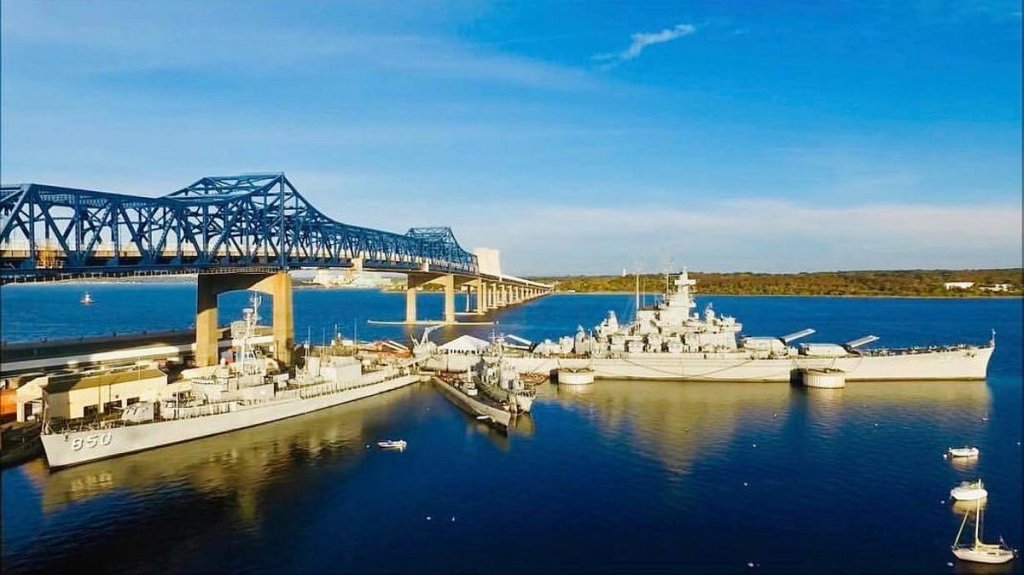
If you’re ever in southeastern Massachusetts, be sure to visit Battleship Cove in Fall River, the largest collection of World War 2 naval craft, in the world. The Battleship Cove museum sports some sixty exhibits, preserving the naval heritage of these iconic vessels and the veterans who served them.

To inspect battle damage visible to this day on the decks of USS Massachusetts is to realize United States armed forces once exchanged shots in anger with our French ally, at a place called Casablanca. The attack sub USS Lionfish once performed “lifeguard duty”, the rescue of downed fliers, off the coast of Japan. Her captain was Lieutenant Commander Edward D. Spruance, son of Admiral Raymond Spruance who commanded US naval forces during one of the most significant naval battles of the Pacific, the battle of the Philippine Sea.

To walk aboard USS Massachusetts or USS Lionfish, is to experience a side of WW2, fast disappearing from living memory.

Battleship Cove

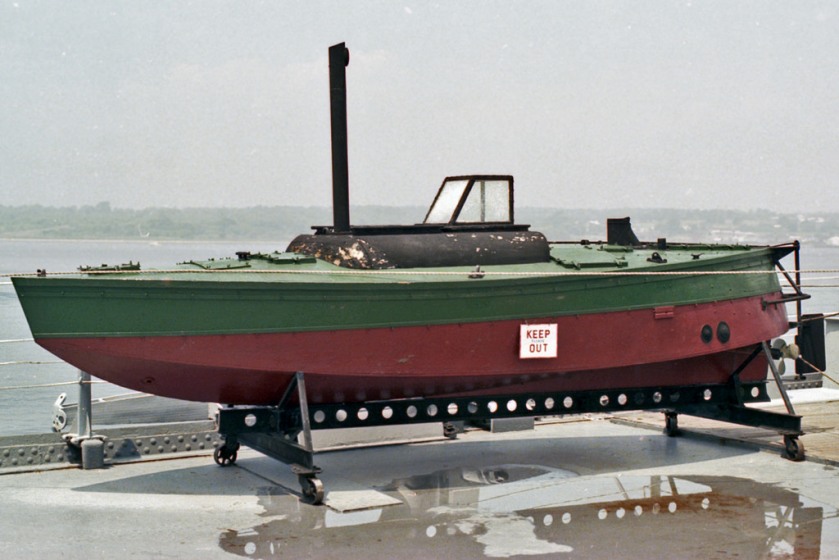
Walk among the wooden-hulled PT boats of the Pacific war, and there you will find a strange little craft. One of three planned for and only two, ever built. Closed at the top and semi-submersible, a Japanese kamikaze boat perhaps, designed for suicide missions against allied warships. Museum management believed just that and mislabeled the display, for years.

The other it turns out is on display at Central Intelligence headquarters, at Langley, Virginia. Years later a retired CIA employee visiting Battleship cove spotted the error. CIA files declassified in 2011 added detail to a very different story, from that of Japanese suicide vessels.  To the tale of a history, that never was.

On August 2, 1939, Hungarian physicist Leó Szilárd delivered a letter which would change history, to President Franklin Delano Roosevelt. Written in consultation with fellow Hungarian physicists Edward Teller and Eugene Wigner and signed by Albert Einstein, the letter warned that Nazi Germany was working to develop atomic weapons, and urged the American government to develop a nuclear program of its own.  Immediately, if not sooner.

The Einstein–Szilárd letter spawned the super-secret Manhattan project, culminating in the atomic bombs “Little Boy” and “Fat Man”, and ending the war in the Pacific in August, 1945.

At the time, precious few were aware of even the possibility of such a weapon.  Fewer still, the existence of a program dedicated to building one.  Vice President Harry Truman, second only to the Commander in Chief himself, was entirely ignorant of the Manhattan project and only read in following the death of the President in April, 1945.

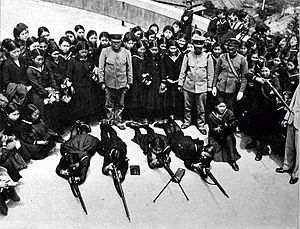
Female students with the Kokumin Giyū Sentōtai, the Volunteer Fighting Corps, prepare for the Allied projected invasion

The battle for the Japanese home islands was expected to be a fight like no other. Casualties of a million or more were expected, and for good reason. Japanese soldiers fought with such fanaticism, that hundreds continued to resist, years after the war was ended. The last holdout wouldn’t lay down his arms until 1974. 29 years, 3 months, and 16 days after the war had ended.

Such frenzied resistance would not be isolated to Japanese military forces, either. Japanese government propaganda warned of “American devils raping and devouring Japanese women and children.” American GIs looked on in horror in 1944, as hundreds if not thousands of Japanese soldiers and civilians hurled themselves to their death, at Laderan Banadero and “Banzai Cliff” on the northern Mariana island of Saipan. One correspondent wrote with admiration of such mass suicides, praising “the finest act of the Shōwa period”… “the pride of Japanese women.”

This is what their government, had taught these people to believe.

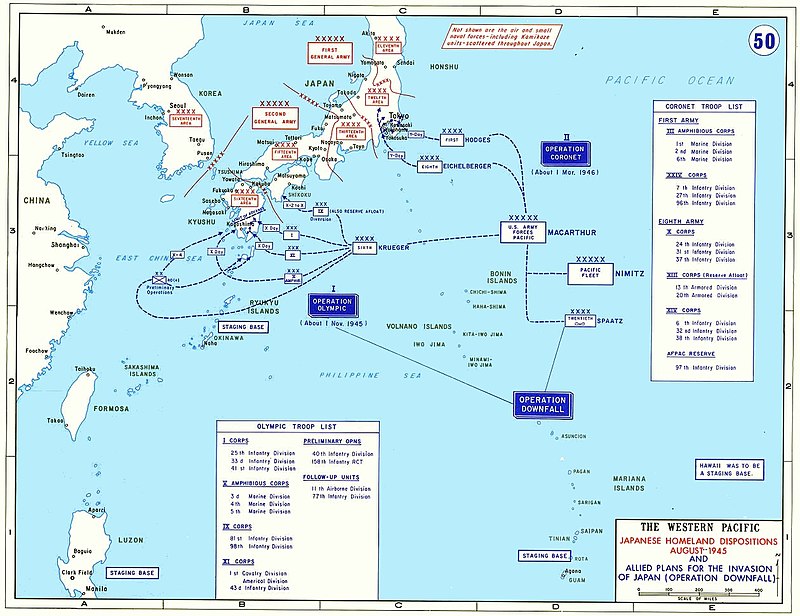
Plans for the final defeat of the Imperial Japanese Empire all but wrote themselves, phase one launched from the south against the main island of Kyūshū, and using the recently captured island of Okinawa, as staging area.  Phase two was the planned invasion of the Kantō Plain toward Tokyo, on the island of Honshu.

Adobe ImageReady
Operation Downfall

The story of the D-Day invasion begins with deception, a massive head fake intended to draw German defenders away from intended landing zones. “Operation Downfall” offered no such opportunities, for deceit. Geography dictated the method of attack, and everybody knew it. Virtually everything left of Japanese military might would be assembled for the all-out defense of Kyūshū, against what would be the largest amphibious invasion, in history.

This was to be a full frontal assault with no subterfuge and nowhere, to hide.

American military planners ordered half a million Purple Hearts, in preparation for the final invasion of the Japanese home islands. To this day, military forces have yet to use them all. As of 2003 some 120,000 Purple Heart medals still remained, in inventory.

The whole thing would begin on “X-Day”.  November 1, 1945.

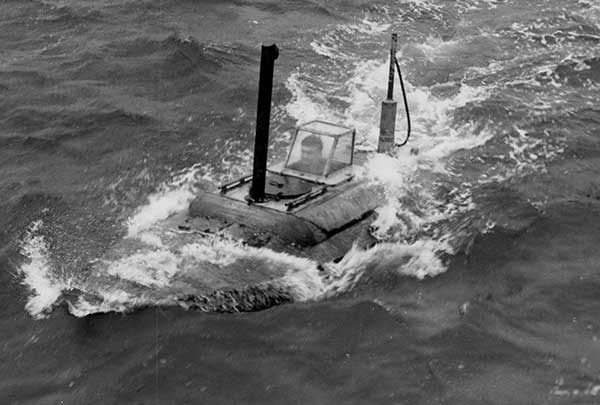
Which brings us back to that funny-looking boat, in Fall River. The Office of Strategic Services (OSS), predecessor to the modern CIA, built two of these semi-submersibles. The vessel was called “Gimik”, part of a top-secret operation code named “NAPKO”.

GIMIK, underway

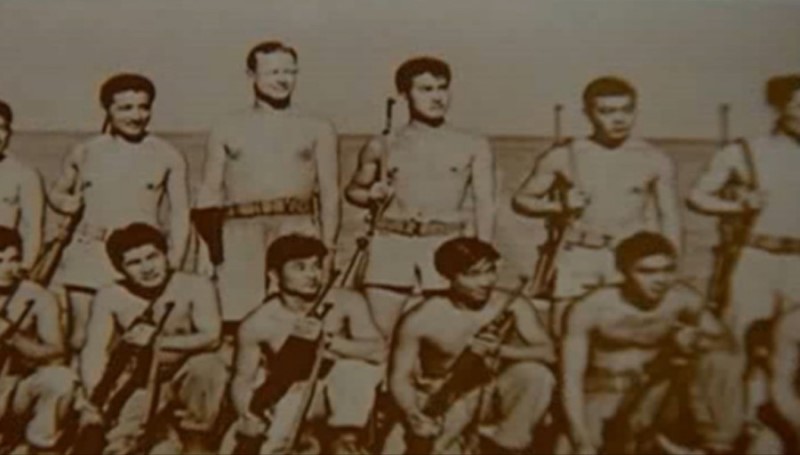
Ten teams were envisioned varying from five to a single individual. 55 Korean-Americans and Korean prisoners freed from Japanese prison labor camps were trained to infiltrate Japanese occupied Korea and possibly Japan itself, to collect intelligence and carry out sabotage against military targets in advance of Operation Downfall. None were aware even of the existence of the other teams lest any, were to fall into Japanese hands.

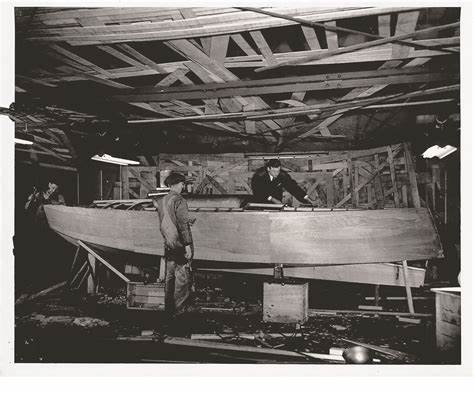
The GIMIK craft were built by John Trumpy and sons yacht yard of Annapolis Maryland, builders of the presidential yacht, Sequoia

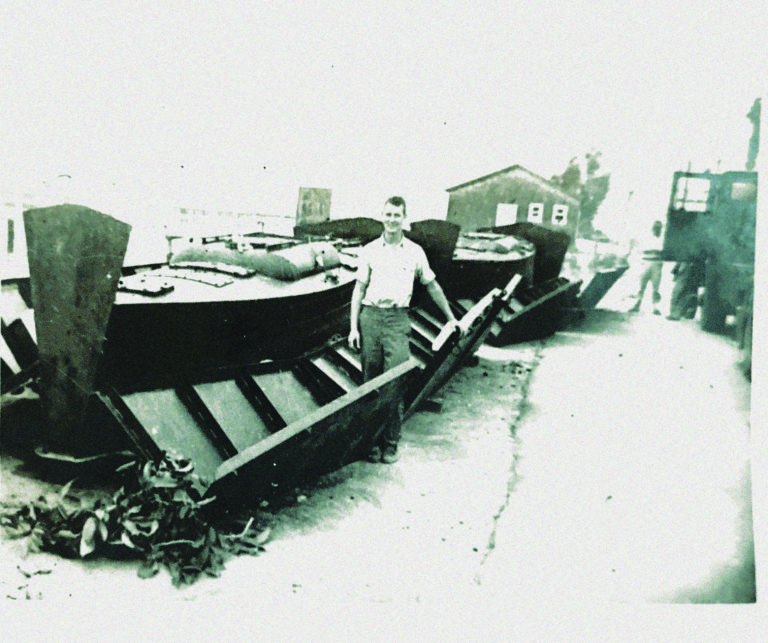
Operated by a single OSS officer with two Korean operatives and up to 1,000-pounds of equipment secured inside, the GIMIK craft would be their means of insertion. 19-feet long and built of plywood to avoid radar and sonar detection, the snorkel was wrapped in steel wool to confound discovery. The craft were to be delivered on theater via submarine in large metal boxes called “coffins’. After insertion, the vessels would go fully submerged and anchor to the bottom where they were equipped to operate, for up to four weeks.

Operated by a single OSS officer with two Korean operatives and up to 1,000-pounds of equipment secured inside, the GIMIK craft would be their means of insertion. 19-feet long and built of plywood to avoid radar and sonar detection, the snorkel was wrapped in steel wool to confound discovery. The craft were to be delivered on theater via submarine in large metal boxes called “coffins’. After insertion, the vessels would go fully submerged and anchor to the bottom where they were equipped to operate, for up to four weeks.

The NAPKO operation was conceived and run by OSS Colonel Carl Eifler, who hope to have as many as seven teams, operational. Tactical focus would then be placed on those best positioned, for ultimate success. As it turned out only two teams were ever ready, for the operational stage.

“Code-named ‘Kinec’ and ‘Charo.’ Both were very similar in concept, differing primarily in intended points of penetration and operating areas. Kinec envisioned landing five agents at Chemulpo Bay, about 20 miles outside Seoul on the country’s west coast; Charo was focused on Pyongyang following penetration via Wonsan and utilized three, rather than five, Korean agents. Typical of NAPKO missions, the teams were to carry minimal equipment and supplies: 100,000 yen, a radio, appropriate clothing for passing as locals, and a Japanese-manufactured shovel for burying the team’s equipment after landing.”

Hat tip former Special Forces NCO Steve Balestrieri, writing for SOFREP.com

The mission was extremely dangerous for obvious reasons.  Training was carried out during the summer of 1945 on Catalina Island, off the California coast.  The two boats, nicknamed “Gizmos”, were tested at night against the US Naval base in Los Angeles. Even this part was dangerous, since no one was told about the trials. Should such a vessel be detected entering the American installation, it would be treated as an enemy vessel, and destroyed.

In the end, the Gizmo teams never left American waters.  Several such tests were carried out without detection, leading to a scheduled departure date of August 26, 1945.  It was never meant to be.

A parallel and equally secret plan to end the war literally burst on the scene on August 6, 1945.  The war would be over, in another nine days.

October 26, 1918 Code Talkers

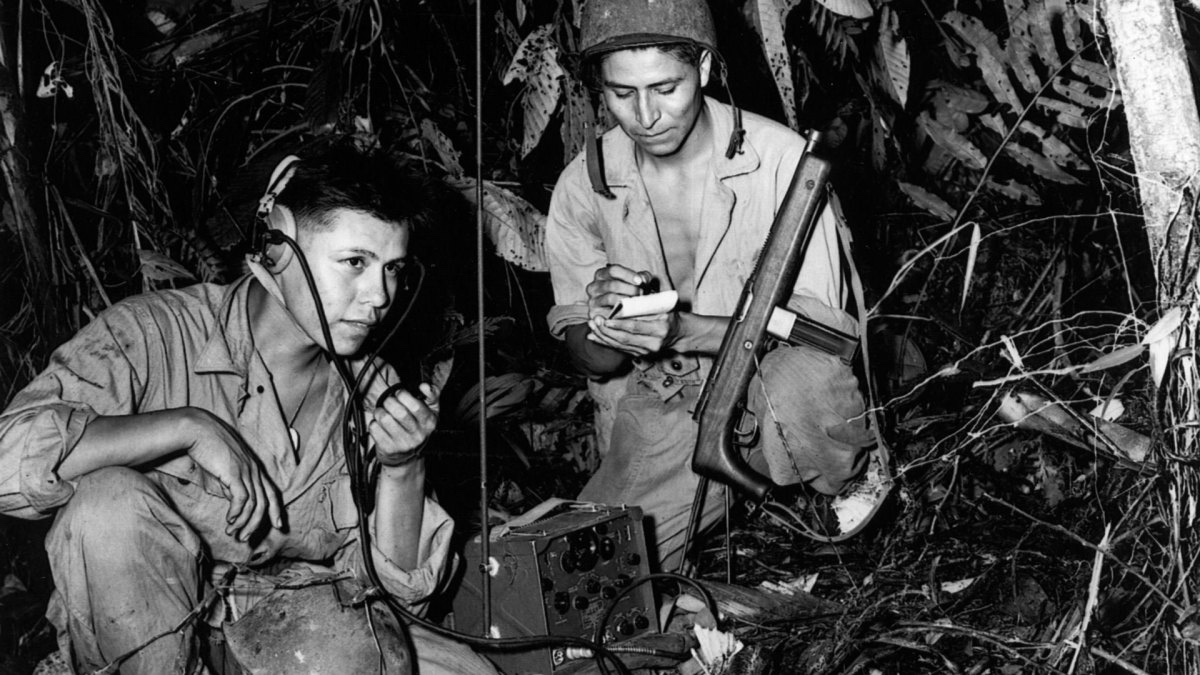
The history of the Navajo code talkers of World War 2 is well known but by no means, unique.  Indigenous Americans of other nations served as code talkers during WW2 including Assiniboine, Lakota and Meskwaki soldiers serving in the Pacific, North African, and European theaters of the war.

During the twentieth century, the United States and others specially recruited bilingual speakers of obscure languages, applying those skills in secret communications based on those languages.  Among these, the story of the Navajo “Code Talkers” are probably best known.   Theirs was a language with no alphabet or symbols, a language with such complex syntax and tonal qualities as to be unintelligible to the non-speaker. The military code based on such a language proved unbreakable in WWII. Japanese code breakers never got close.

The United States Marine Corps recruited some 400-500 Navajo speakers who served in all six Marine divisions in the Pacific theater.  Guadalcanal, Tarawa, Peleliu, Iwo Jima:  Navajo code talkers took part in every assault conducted by the United States Marine Corps from 1942, to ‘45.

160907143620-navajo-code-talkers-3-exlarge-169.jpgThe history of the Navajo code talkers of WWII is well known but by no means, unique.  Indigenous Americans of other nations served as code talkers during WW2 including Assiniboine, Lakota and Meskwaki soldiers who did service in the Pacific, North African, and European theaters of the war.

Fourteen Comanche soldiers took part in the Normandy landings.  As with the Navajo, these soldiers substituted phrases when their own language lacked a proper term.  Thus, “tank” became “turtle”.  “Bombers” became “pregnant airplanes”.  Adolf Hitler was “Crazy White Man”.
The information is contradictory, but Basque may also have been used, in areas where no native speakers were believed to be present.  Native Cree speakers served with Canadian Armed Services, though oaths of secrecy have all but blotted their contributions, from the pages of history.

The first documented use of military codes based on native American languages took place during the Second Battle of the Somme in September 1918, employing on the language skills of a number of Cherokee troops.

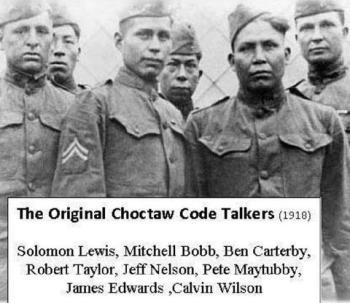
The government of Choctaw nation will tell you otherwise, contending that Theirs was the first native language, used in this way.  Late in 1917, Colonel Alfred Wainwright Bloor was serving in France with the 142nd Infantry Regiment. They were a Texas outfit, constituted in May of that year and including a number of Oklahoma Choctaws.

The Allies had already learned the hard way that their German adversaries spoke excellent English, and had already intercepted and broken several English-based codes. Colonel Bloor heard two of his Choctaw soldiers talking to each other, and realized he didn’t have the foggiest notion of what they were saying. If he didn’t understand their conversation, the Germans wouldn’t have a clue.

ChoctawCoders
Choctaw soldiers in training in World War I for coded radio and telephone transmissions

The first test under combat conditions took place on October 26, 1918, as two companies of the 2nd Battalion performed a “delicate” withdrawal from Chufilly to Chardeny, in the Champagne sector. One captured German officer later confirmed the Choctaw code to have been a complete success. We were “completely confused by the Indian language”, he said, “and gained no benefit whatsoever” from wiretaps.

Choctaw soldiers were embedded within multiple companies of infantry. Messages were transmitted via telephone, radio and by runner, many of whom were themselves native Americans.

As in the next war, Choctaw would improvise when their language lacked the proper word or phrase. When describing artillery, they used the words for “big gun”. Machine guns were “little gun shoot fast”.
Choctaw code talkers

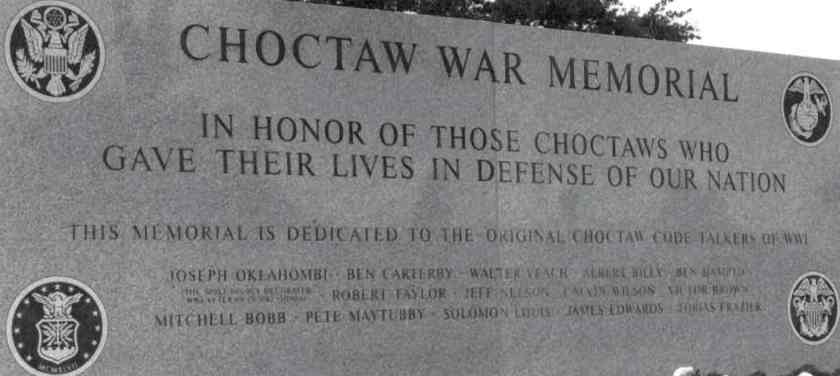
The Choctaw themselves didn’t use the term “Code Talker”, that phrase wouldn’t come about, until WWII. At least one member of the group, Tobias W. Frazier, simply described what they did as, “talking on the radio”.  Of the 19 who served in WWI, 18 were native Choctaw from southeast Oklahoma. The last was a native Chickasaw. The youngest was Benjamin Franklin Colbert, Jr., the son of Benjamin Colbert Sr., one of Teddy Roosevelt’s “Rough Riders” of the Spanish American War. Born September 15, 1900 in the Durant Indian Territory, he was all of sixteen, the day he enlisted.

Another was Choctaw Joseph Oklahombi, whose name translates as “man killer” in the Choctaw language. Six days before Sergeant York’s famous capture of 132 Germans in the Argonne Forest, Joseph Oklahombi charged a strongly held German position, single-handed. Let Private Oklahombi‘s Croix de Guerre citation, personally awarded him by Marshall Petain, tell his story:

“Under a violent barrage, [Pvt. Oklahombi] dashed to the attack of an enemy position, covering about 210 yards through barbed-wire entanglements. He rushed on machine-gun nests, capturing 171 prisoners. He stormed a strongly held position containing more than 50 machine guns, and a number of trench mortars. Turned the captured guns on the enemy, and held the position for four days, in spite of a constant barrage of large projectiles and of gas shells. Crossed no man’s land many times to get information concerning the enemy, and to assist his wounded comrades”.

Unconfirmed eyewitness accounts report that 250 Germans occupied the position, and that Oklahombi killed 79 of them before their comrades decided it was wiser to surrender. Some guys are just not to be trifled with.

choctawwarmemorial

September 19, 1862 Old Douglas, the Confederate Camel

The horse lobby did a lot to kill the camel project. The animal’s unpleasant personality traits didn’t help.

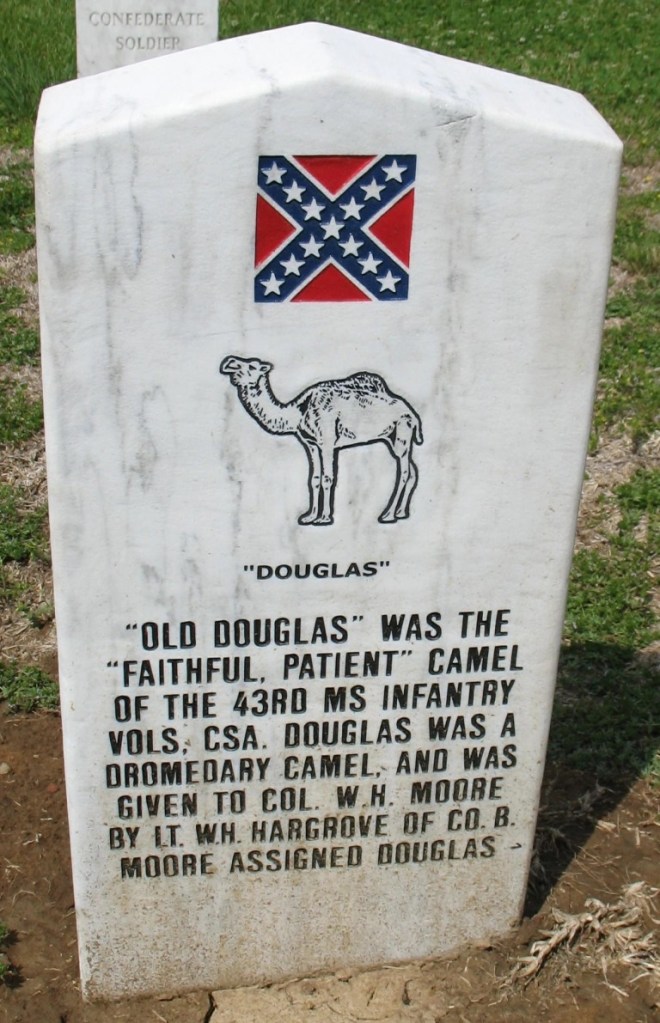
The Cedar Hill Cemetery, established by the United Daughters of the Confederacy, contains the final resting place of some 5,000 Confederate Soldiers who died in the 1863 Siege of Vicksburg, Mississippi. Each one stands in memory of a soldier killed in the line of duty.

Even the one with the camel on it.

The story begins with Jefferson Davis, in the 1840s. We remember him today as the President of the Confederate States of America. Then, he was a United States Senator from Mississippi, with a pet project of introducing camels into the United States.

Re-introducing them might be more like it.  Today, the distribution of these animals is almost the inverse of their area of origin.  According to the fossil record, the earliest camelids first appeared on the North American continent, these even-toed ungulates ancestor to the Alpaca, Llama, Guanaco and Vicuña of today.

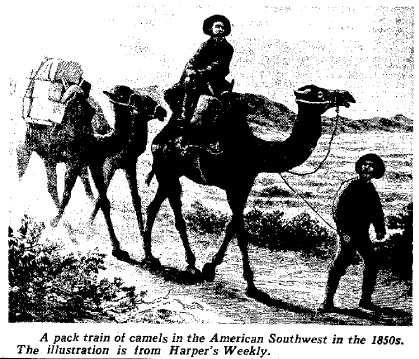
Camel_from_Harpers_Weekly

Jefferson Davis’ experiment was to be the first large-scale re-introduction of these animals on the North American continent, in geologic history.

Davis envisioned the day when every southern planter would have a stable full of camels. In the kind of pork barrel tit-for-tat spending deal beloved of Congressmen to this day, the senator bslid $30,000 into a highway appropriations bill, to get the support of a fellow senator from Illinois.

Camel Corps

The measure failed, but in the 1850s, then-Secretary of War Davis persuaded President Franklin Pierce that camels were the military super weapons of the future. Able to carry greater loads over longer distances than any other pack animal, Davis saw camels as the high tech weapon of the age. Horses and mules were dying by the hundreds in the hot, dry conditions of Southwestern Cavalry outposts when the government purchased 75 camels from Algeria, Tunisia and Egypt. Several camel handlers came along in the bargain, one of them a Syrian named Haji Ali, who successfully implemented a camel breeding program. Haji Ali was a character and became quite the celebrity in the West Texas outpost. The soldiers called the man “Hi Jolly”.

When the Civil War broke out, Camp Verde, Texas had about 60 camels. The King of Siam, (now Thailand), saw the military advantage to the Confederacy and wrote to President Abraham Lincoln. “Here”, he wrote, “we use elephants”. The King went on to propose bringing elephants into the Northwest, to help the Union war effort. This “animal arms race” appears to have gotten no further than that one letter to the President, but the imagination does run wild, doesn’t it. The idea of War Elephants, at Gettysburg….

Hi Jolly Cemetery

The horse lobby did a lot to kill the camel project. The animal’s unpleasant personality traits didn’t help. A camel will not passively accept a riding crop or a whip. They are vengeful, and can spit stinking wads of phlegm with great accuracy over considerable distances. If they’re close enough, they will rake the skin off your face with their front teeth. Camels have even been known to trample people to death.

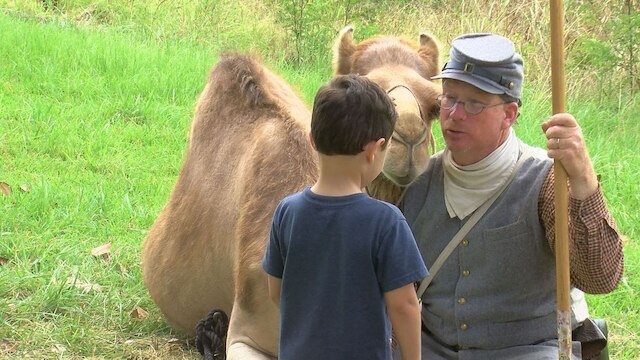
Douglas, the Confederate Camel, 1
Douglas, the Confederate Camel

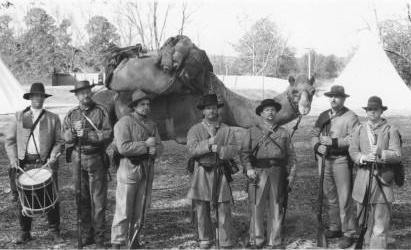
Cut loose, one of those Texas camels somehow made its way to Mississippi, where he was taken into service with the 43rd Infantry Regiment, who named him “Douglas”.

Douglas wouldn’t permit himself to be tethered, but he always stuck around so he was allowed to graze on his own. Southern soldiers became accustomed to the sight of “Old Douglas”. The 43rd Mississippi became known as the “Camel Regiment,” but the horses never did get used to their new companion. On this day in 1862, Major General Sterling Price was preparing to face two Union armies at Iuka, when the sight of Old Douglas spooked the regimental horses. One horse’s panic turned into a stampede, injuring several and possibly killing one or two.

The 43rd Infantry was ordered to Vicksburg during General Ulysses S. Grant’s siege of the city, when Douglas was shot and killed by a Union sharpshooter. Enraged by the murder of their prized camel, the 5th Missouri’s commander Lieutenant Colonel Robert S. Bevier enlisted six of his best snipers, who stalked the killer until one of them had his revenge. Bevier later said of Douglas’ killer, “I refused to hear his name, and was rejoiced to learn that he had been severely wounded.”

Camel-sunset-flags-300x225

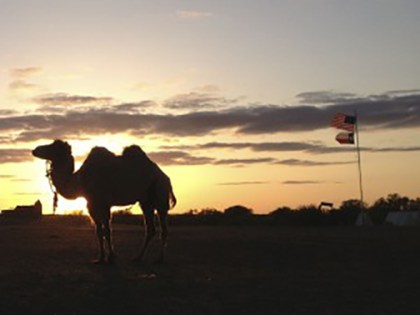
So it is that there is a camel at the Cedar Hill Cemetery in Vicksburg, Mississippi.  He is not forgotten. Douglas and other camels of the era are remembered by the Texas Camel Corps, a cross between a zoo and a living history exhibit.

The organizations website begins with: “Texas Camel Corps was established to educate the public about the historic use of camels in America in the 19th century”. I might just have to check those guys out.

Tip of the hat to www.texascamelcorps.com for the sunset image, above.

September 18, 1931 An Incident at Mukden

The “Mukden incident” was entirely staged, a “false flag” operation and bald pretext to war, carried out by Japanese military personnel and identical in purpose to that carried out against Poland by Nazi aggressors some eight years later, nearly to the day.

As Japan emerged from the medieval period into the early modern age, the future Nippon Empire transformed from a period characterized by warring states, to the relative stability of the Tokugawa Shōgunate.  Here, a feudal military government ruled from the Edo castle in the Chiyoda district of modern-day Tokyo, over some 250 provincial domains called han.  The military and governing structure of the time was based on a rigid and inflexible caste system, placing the feudal lords or daimyō at the top, followed by a warrior-caste of samurai, and a lower caste of merchants and artisans.  At the bottom of it all stood some 80% of the population, the peasant farmer forbidden to engage in non-agricultural activities, and expected to provide the income that made the whole system work.

Into this world stepped the “gunboat diplomats” of President Millard Filmore in the person of Commodore Matthew Calbraith Perry, determined to open the ports of Japan to trade with the west.  By force, if necessary.

Gunboat-commodore-perry
Gunboat Diplomacy, Commodore Perry

The system led to a series of peasant uprisings in the 18th and 19th centuries, and extreme dislocation within the warrior caste. In time, these internal Japanese issues and the growing pressure of western encroachment led to the end of the Tokugawa period and the restoration of the Meiji Emperor, in 1868.

Many concluded as did feudal Lord (daimyō) Shimazu Nariakira, that “if we take the initiative, we can dominate; if we do not, we will be dominated”.  In the following decades, Japanese delegations and students traveled around the world to learn and assimilate Western arts, sciences and technologies. As the 19th century gave way to the 20th, Japan was transform from a feudal society into a modern industrial state.

The Korean peninsula remained backward and “uncivilized” during this period, little more than a tributary state to China, and easy prey for foreign domination.  A strong and independent Korea would have represented little threat to Japanese security but, as it was, Korea was a “a dagger pointed at the heart of Japan” in the words of German military adviser to the Meiji government, Major Jacob Meckel.

1-92-140-02

The first Sino-Japanese war of July 1894 – April 1895, was primarily fought over control of the Korean peninsula.  The outcome was never in doubt, with the Japanese army and navy by this time patterned after those of the strongest military forces of the day.

The Japanese 1st Army Corps was fully in possession of the Korean peninsula by October, and of the greater part of Manchuria, in the following weeks.  The sight of the mutilated remains of Japanese soldiers in the port city of Lüshunkou (Port Arthur) drove their comrades to a frenzy of shooting and slashing.  When it was over, numbers estimated from 1,000 to 20,000 were murdered in the Port Arthur Massacre.  It was a sign of things to come.

Japanese_Beheading_1894
An illustration of Japanese soldiers beheading 38 Chinese POWs as a warning to others by Utagawa Kokunimasa.

Russian desire for a warm-water port to the east brought the two into conflict in 1904 – ’05, the Russo Japanese War a virtual dress rehearsal for the “Great War” ten years later, complete with trench lines and fruitless infantry charges into interlocking fields of machine gun fire.

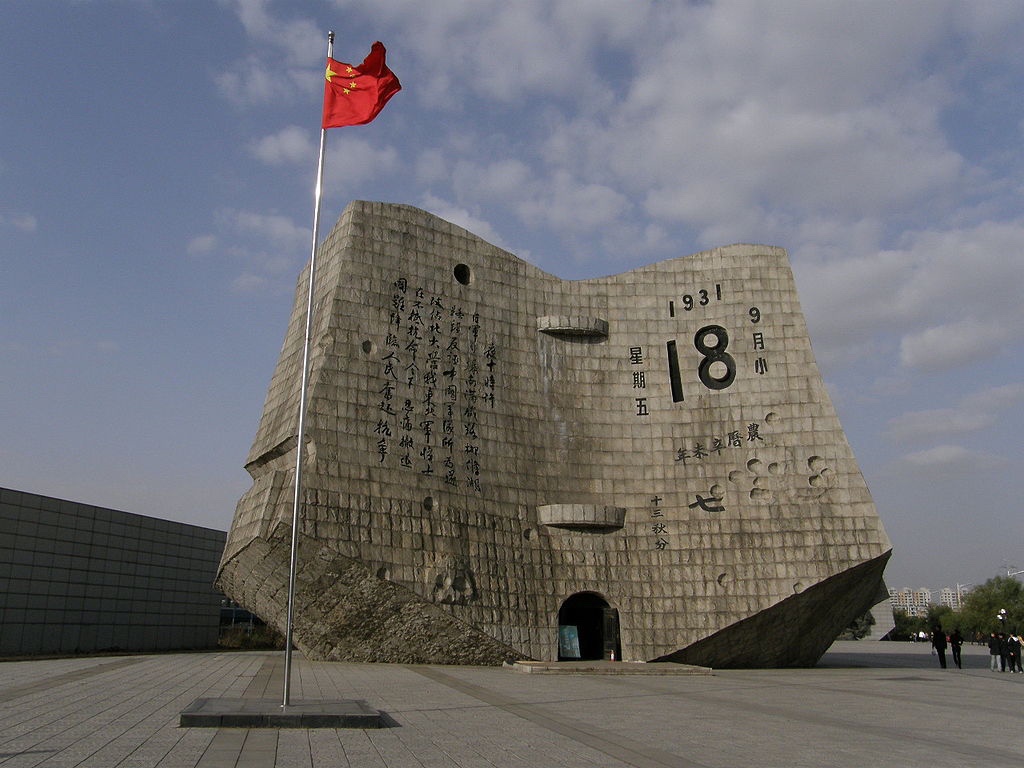
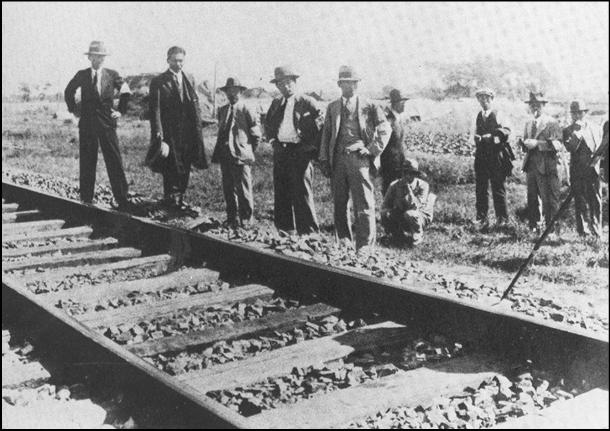
Subsequent treaties left Japanese forces in nominal control of Manchurian railroads when, on September 18, 1931, a minuscule dynamite charge was detonated by Japanese Lt. Kawamoto Suemori, near a railroad owned by Japan’s South Manchuria Railway near Mukden, in modern Shenyang, China. The explosion was so weak that it barely disturbed the tracks. A train passed harmlessly over the site just minutes later, yet, the script was already written.

Mukden (1)

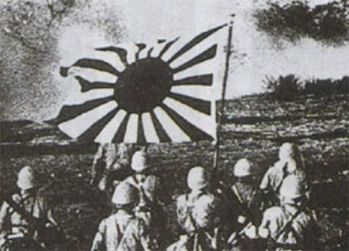
The Imperial Japanese Army accused Chinese dissidents of the incident, launching a full scale invasion and installing the puppet emperor Puyi as Emporer Kangde of the occupied state of “Manchukuo”, one of the most brutal and genocidal occupations of the 20th century.

The “Mukden incident” was entirely staged, a “false flag” operation and bald pretext to war, carried out by Japanese military personnel and identical in purpose to that carried out against Poland by Nazi aggressors some eight years later, nearly to the day.

e59373baad2df0c6393fa778500d1575

As Western historians tell the tale of WW2, the deadliest conflict in history began in September 1939, with the Nazi invasion of Poland. The United States joined the conflagration two years later, following the sneak attack on the American Naval anchorage at Pearl Harbor, by naval air forces of the Empire of Japan.

Eastern historians are more likely to point to a day eight years earlier, when this and subsequent invasions and the famine and civil wars which ensued, killed more people than the modern populations of Canada and Australia, combined.

September 16, 1906 One of a Kind

From the Catania (Sicily) to the Salerno landings of 1943, Mad Jack could be seen stepping onto the beach, trademark broadsword at his belt, bagpipes under an arm and an English longbow and arrows, around his neck.

On this day in 1906 a child was born .  John Malcolm Thorpe Fleming Churchill, the first son and grandson of British civil servants in the Ceylon Civil Service.  The family lived in Hong Kong at the time, returning to England in 1917.  “Jack” graduated from the Royal Military College at Sandhurst, serving with the Manchester Regiment in Burma where he rode the length and breadth of the nation, on a motorcycle.

It was around this time Churchill learned to play bagpipes, a bit of an eccentricity for an Englishman of his era. Mad Jack was nothing if not eccentric.

He taught himself to shoot a bow and arrow, and became quite good at it. Good enough to represent his nation in the 1939 world archery championship in Oslo scoring #26, in the men’s recurve. A remarkable feat considering his weapon of choice, was the longbow.

Churchill left the military ten years later and worked as a newspaper editor for a time in Nairobi Kenya, along with the occasional stint as male model and even appeared in two motion pictures, The Thief of Bagdad and A Yank At Oxford. From there he may have faded into obscurity unlike his fellow Englishman of no relation, with the same last name. Except, then came World War II and that transformation into the truly one-of-a-kind, “Mad Jack”.

Churchill resumed his military commission and rejoined the Manchester Regiment later that year, when Germany invaded Poland. Part of the British Expeditionary force to France in 1940, Churchill signaled an ambush on a German unit, by taking out the Feldwebel (staff sergeant) with a broadhead arrow. No one could have been more surprised than that German NCO who surely died wondering, “How the hell did I get an arrow in my chest?”

That one unfortunate German is, to my knowledge, the only combatant in all WWII to be felled by an English longbow.

Not long after, allied military forces were hurled from the beaches of Europe. The only way back in, was via those same beaches. We’ve all seen the D-Day style waterborne assault: invading forces pouring out of Higgins Boats and charging up the beaches. Amphibious landings were carried out from the earliest days of WWII, from Norway to North Africa, from the Indian Ocean to Italy. In all those landings, there’s likely no other soldier who stepped off a Higgins Boat, with a bow and arrows.

On December 27, 1941, #3 Commando raided the German garrison at Vågsøy, Norway. As the ramp dropped on the first landing craft, out jumped Mad Jack Churchill playing “March of the Cameron Men” on the bagpipes, before throwing a grenade and charging into battle.  Mad Jack made several such landings, usually while playing his bagpipes, a Scottish broadsword at his belt.

Jack-Churchill-Speaks-During-a-Landing-Exercise
“Mad Jack” Churchill, speaking at a landing exercise

Churchill was attached to that sword, a basket hilted “Claybeg”, a slightly smaller version of the Scottish Claymore. He said “Any officer who goes into action without his sword is improperly dressed.” From the Catania (Sicily) to the Salerno landings of 1943, Mad Jack could be seen stepping onto the beach, trademark broadsword at his belt, bagpipes under an arm and an English longbow and arrows, around his neck.

Churchill lost his sword in confused, hand to hand fighting around the town of Piegoletti, for which he received the Distinguished Service Order. Almost single-handed but for a corporal named Ruffell, Churchill captured 42 Germans including a mortar squad. “I always bring my prisoners back with their weapons”, he explained. “It weighs them down. I just took their rifle bolts out and put them in a sack, which one of the prisoners carried. [They] also carried the mortar and all the bombs they could carry and also pulled a farm cart with five wounded in it….I maintain that, as long as you tell a German loudly and clearly what to do, if you are senior to him he will cry ‘Jawohl’ and get on with it enthusiastically and efficiently whatever the … situation. That’s why they make such marvelous soldiers…” It looked, he said, like “an image from the Napoleonic Wars.

Churchill later trudged back to town, to collect his sword. He encountered an American squad along the way, who seemed to have lost themselves and were headed toward German lines. When the NCO refused to turn around, Churchill informed him he was going to be on his way, and he “wouldn’t come back for a bloody third time”.

07_Hugh-4-bows-1
Archery historian Hugh Soar, pictured with four of “Mad Jack’s” English longbows

Mad Jack’s luck ran out in 1944 on the German-held, Yugoslavian island of Brac. He was leading a Commando raid at the time, in coordination with the partisans of Josip Broz Tito. Only Churchill and six others managed to reach the top of hill 622, when a mortar shell killed or wounded everyone but Churchill himself. He was knocked unconscious by a grenade and captured.

He’d been playing “Will Ye No Come Back Again?” on his pipes.

Hitler’s infamous ‘Commando Order” had long since taken effect, and Churchill and his surviving men escaped immediate execution at the hands of the Gestapo, thanks to the decency of one Wehrmacht Captain Thuener. “You are a soldier“, he said, “as I am. I refuse to allow these civilian butchers to deal with you. I shall say nothing of having received this order.” Churchill was able to pay Thuener back for his kindness after the war, keeping the man out of the merciless hands of the Red Army.

Churchill was flown to Berlin and interrogated on suspicion that he might be related to the more famous Churchill, before being sent off to Sachsenhausen concentration camp in Oranienburg, Germany. There, Mad Jack and Royal Air Force officer Bertram James escaped that September, slipping under the wire and crawling through an abandoned drain and walking all the way to the Baltic coast. They almost made it, too, but the pair was captured near the coastal city of Rostock, just a few miles from the coast.

Mad Jack was sent off to Burma, following the defeat of Nazi Germany. He was disappointed by the swift end to the war brought about by the American bombings at Hiroshima and Nagasaki. “If it wasn’t for those damn Yanks” he’d say, “we could have kept the war going another 10 years!”

As a Seaforth Highlander, Mad Jack was posted to the British Mandate in Palestine, in 1948. He was one of the first to the scene of the ambush and massacre of the Haddassah medical convoy that April, banging on a bus and offering evacuation in an armored personnel carrier. His offer was refused in the mistaken belief that Hadassah was mounting an organized rescue.

churchill2

No such rescue ever arrived. Churchill and a team of 12 British Light Infantry were left to shoot it out with some 250 Arab insurgents, armed with everything from blunderbusses and old flintlocks, to Sten and Bren guns. Seventy-eight Jewish doctors, nurses, students, patients, faculty members and Haganah fighters were killed along with one British soldier. Dozens were burned beyond recognition and buried in mass graves. Churchill later coordinated the evacuation of some 700 Jewish patients and medical personnel from the Hadassah hospital at Hebrew University, in Jerusalem.

Churchill served as an instructor at the land-air warfare school in Australia, where he became passionately devoted to surfing. Returning to England upon his retirement, he became the first to surf the 5-foot tidal surge up the River Severn, on a board of his own design.

Tidal Bore
Surfing the Tidal Bore, up the Severn River

Once and always the eccentric, Mad Jack Churchill loved sailing radio-controlled model warships on the Thames. Little seemed to bring him more joy than the horror on the face of fellow train passengers, when he opened the window and hurled his briefcase into the darkness.

Not one of them suspected he was throwing the thing into his own back yard. It saved him the trouble of carrying it home from the station.

He scribbled a couplet once on a postcard, and mailed it to a friend.  The face of the card bore the regimental colors.

On the back, Mad Jack Churchill had written these words.

“No Prince or Lord has tomb so proud / As he whose flag becomes his shroud.”

He may have been talking about himself.

August 31, 1959 Sergeant Reckless

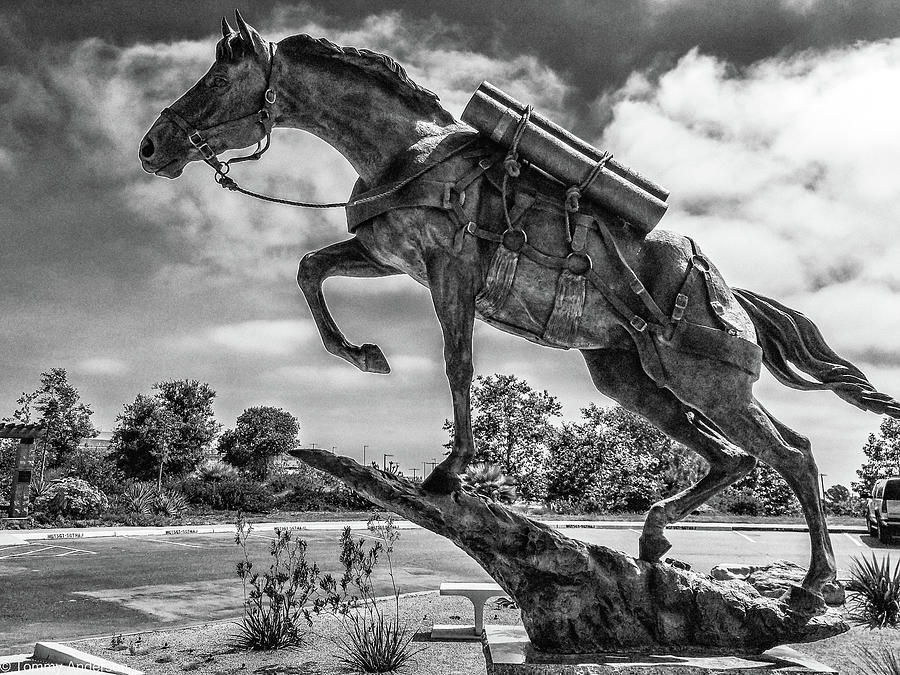
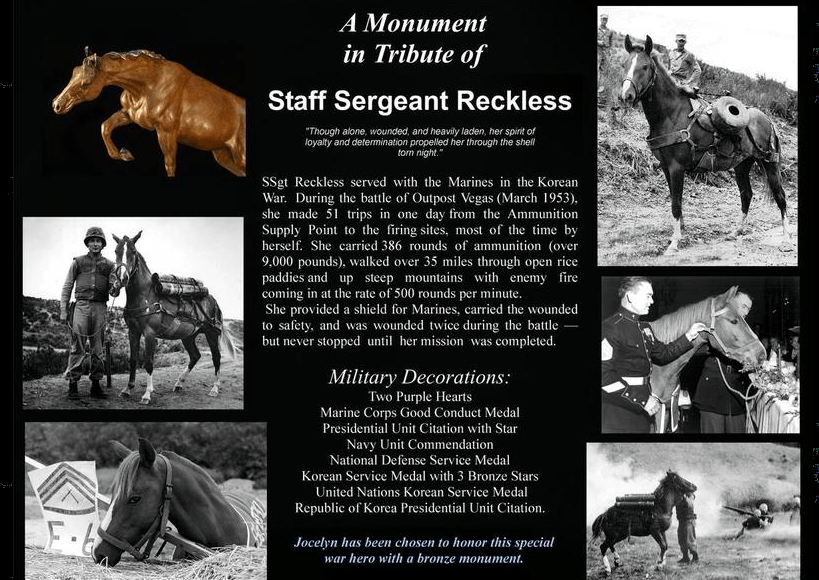
Reckless was the first horse in Marine Corps history to participate in an amphibious landing. She was wounded twice, and later awarded two Purple Hearts and a Marine Corps Good Conduct Medal. Her name appears on Presidential Unit citations both from the United States and the Republic of Korea.

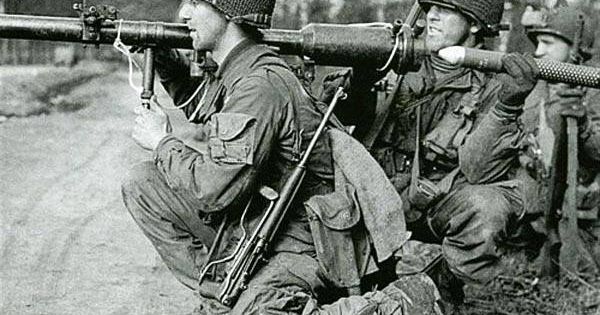
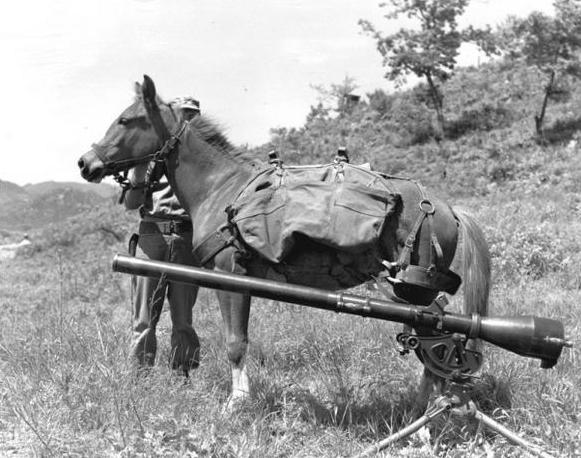
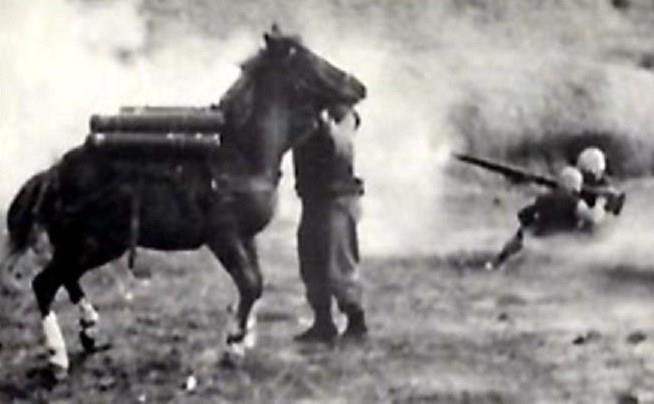
A Recoilless Rifle is a type of lightweight tube artillery. Think of a portable cannon. Kind of a bazooka, really, only the Recoilless fires modified shells rather than rockets. The back blast of the shell compensates for the mule’s kick which would otherwise be expected from such a weapon, making the rifle “recoilless”.

While it reduces projectile range, reduced gas pressures permit a thinner-walled barrel, resulting in a weapon light enough to be served by a 2 to 3-man crew and shoulder fired by a single infantryman.

5d719499852b439ca042d1937e3727e8

The “RCLR” weapon system has provided the punch of artillery to mobile troop formations since the early days of WWII including Airborne, Special Forces and Mountain units.

The problem arises when combat operations consume ammunition faster than the supply chain can replace it. Mountainous terrain makes the situation worse. Over the last 20 years in the more mountainous regions of Afghanistan, there were times when the best solution for the problem, is horsepower.

sgt-reckless

Ah Chim-hai was a chestnut mare of mixed Mongolian and Thoroughbred lineage, a race horse at the track in Seoul, South Korea. Her name translated as “Flame of the Morning”.

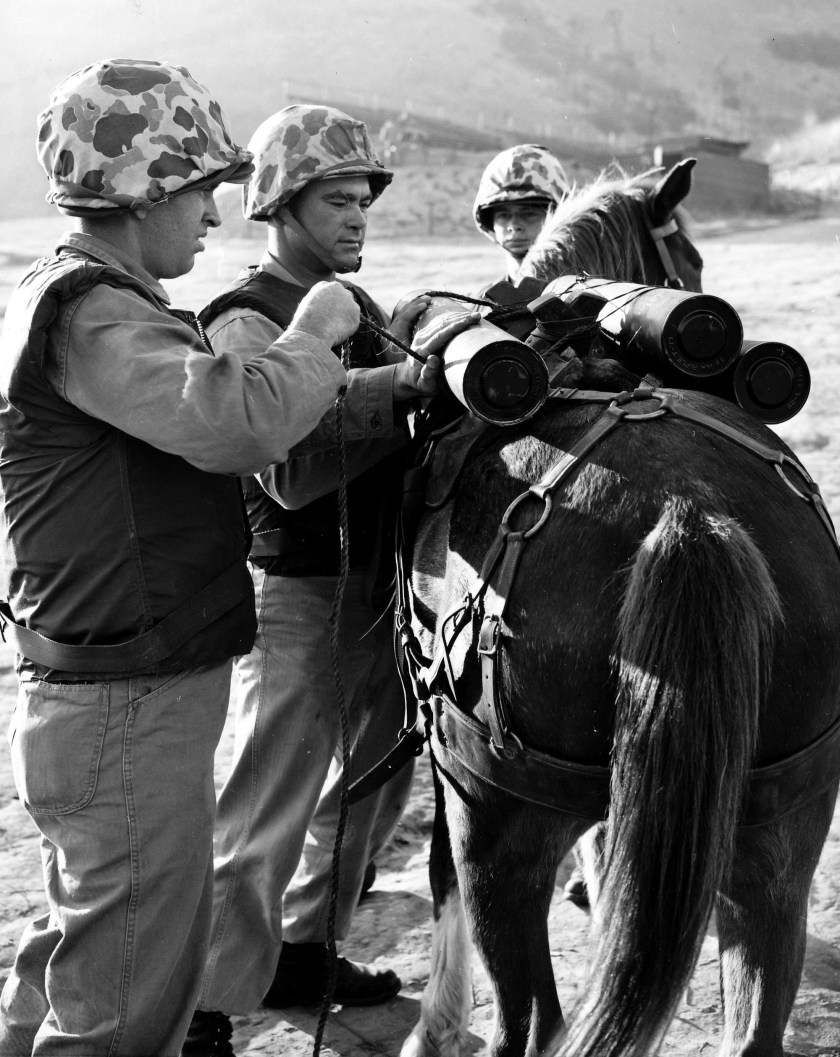
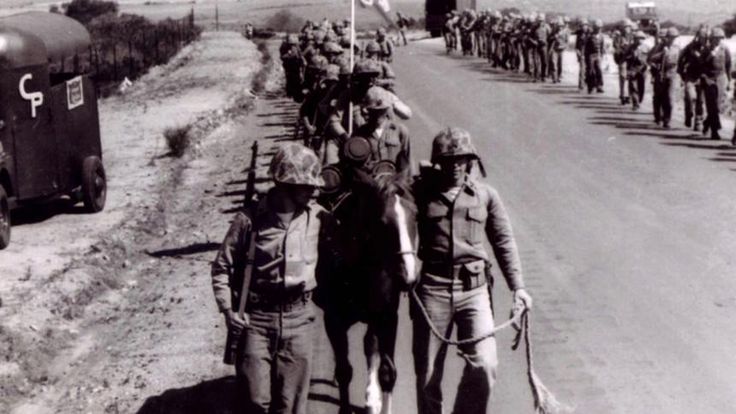
Lieutenant Eric Pedersen of the recoilless rifle platoon, anti-tank company of the 5th Marine Regiment, needed a pack animal to carry the weapon’s 24-pound shells up Korean mountain passes. In October 1952, Pederson received permission from regimental commander Colonel Eustace P. Smoak, to buy a horse for his platoon.

Lt. Pederson and stable boy Kim Huk-moon agreed on a price of $250, and Pederson paid with his own money. Kim cried on watching his “Flame” leave the stable, but the sale had a higher purpose.  The boy’s sister had stepped on a land mine, and badly needed a prosthetic leg.

sgt-reckless_PHOTO_D

The Marines called the new recruit “Reckless” – a nod to the weapon system she was meant to serve, and to the fighting spirit of the 5th Marines.

Pederson wrote to his wife in California to send a pack saddle, while Gunnery Sergeant Joseph Latham and Private First Class Monroe Coleman provided for her care and training.

p44-4

Navy Hospitalman First Class George “Doc” Mitchell provided most of Reckless’ medical care, Latham taught her battlefield skills: how to step over communication wires, when to lie down under fire, how to avoid becoming entangled in barbed wire. She learned to run for cover at the cry “Incoming!”

The platoon built her a bunker and fenced off a pasture, but soon Reckless was allowed to roam freely throughout the camp. She’d enter tents at will, sometimes spending the night if it was cold.

sgt-reckless_PHOTO_D

She’d eat anything: bacon, mashed potatoes, shredded wheat. She loved scrambled eggs and just about anything else a Marine wasn’t watching closely enough. Reckless even ate her own horse blanket once, and she loved a to have a beer. Mitchell had to warn his fellow Marines against giving her more than two Cokes a day, which she’d drink out of a helmet. One time, Reckless ate $30 worth of winning poker chips.

General Randolph McCall Pate, a veteran of Guadalcanal, Iwo Jima and Korea, served as the 21st Commandant of the Marine Corps from 1956 – ’59.  Pate wrote: “I was surprised at her beauty and intelligence, and believe it or not, her esprit de corps. Like any other Marine, she was enjoying a bottle of beer with her comrades. She was constantly the center of attraction and was fully aware of her importance. If she failed to receive the attention she felt her due, she would deliberately walk into a group of Marines and, in effect, enter the conversation. It was obvious the Marines loved her.”  Reckless was a Marine.

eae75db58fc3a2ec2c20c4273d5b9435

Reckless “went straight up” the first time she heard an RCLR go off, despite being loaded down with six shells. All four feet left the ground and she came down trembling with fear, but Coleman was able to soothe her. The second time she snorted. By the fourth she didn’t do much as bother to look up, happily munching on a discarded helmet liner.

Recoilless rifle tactics call for fire teams to expend four or five rounds, and then relocate before the enemy can shoot back. Reckless usually learned the route after one or two trips, often traveling alone to deliver supplies on the way up, and evacuate wounded on the way down.

379_4846200240062_674245243_n

In February 1953, Captain Dick Kurth and his Fox Company were fighting for a hill called “Detroit”. Reckless made 24 trips by herself, carrying a total 3,500-pounds of ammunition over 20 miles. She made 51 solo trips that March, during the battle for Outpost Vegas. Reckless carried 9,000lbs of ammunition in a single day, over 35 miles of open rice paddies and steep hills. At times, artillery exploded around her at the rate of 500 rounds per minute. That night, she was too exhausted to do anything but hang her head while they rubbed her down.

Reckless was the first horse in Marine Corps history to participate in an amphibious landing. She was wounded twice, and later awarded two Purple Hearts and a Marine Corps Good Conduct Medal. Her name appears on Presidential Unit citations both from the United States and the Republic of Korea.

1000w_q75

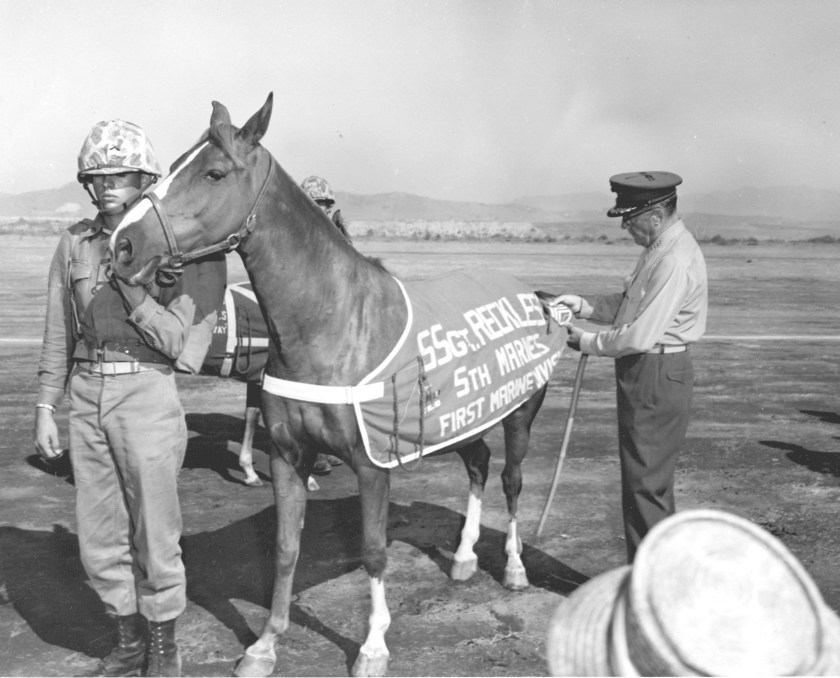
On August 31, 1959, Reckless was promoted to Staff Sergeant in a ceremony at Camp Pendleton. 1,900 of her 5th Marine comrades attended, as did two of her sons, “Fearless” and “Dauntless”. A third, “Chesty”, was unavailable to attend.

General Pate wrote: “In my career I have seen many animals that have been adopted by Marines, but never in all my experience have I seen one which won the hearts of so many as did. . .Reckless.”

HP_SeptOct13_SergeantReckless_MarkTenally

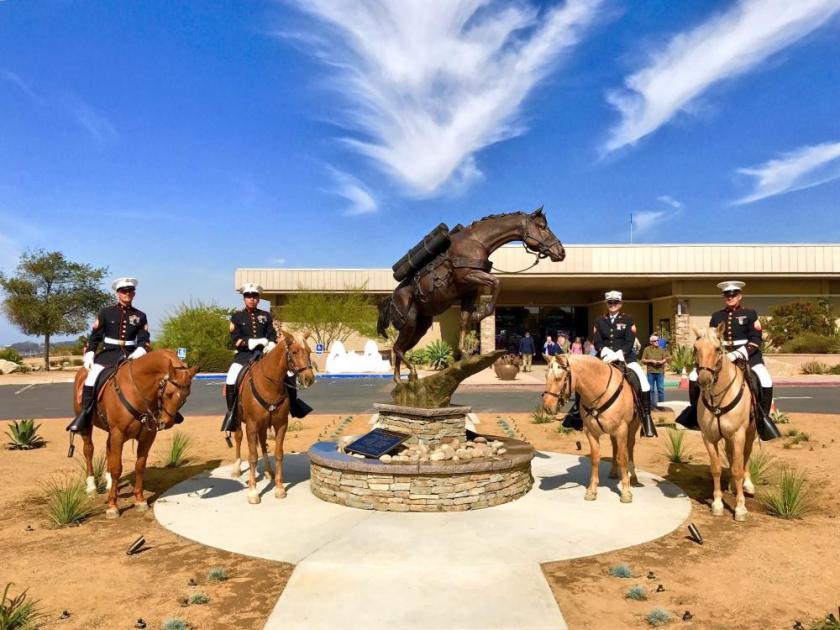
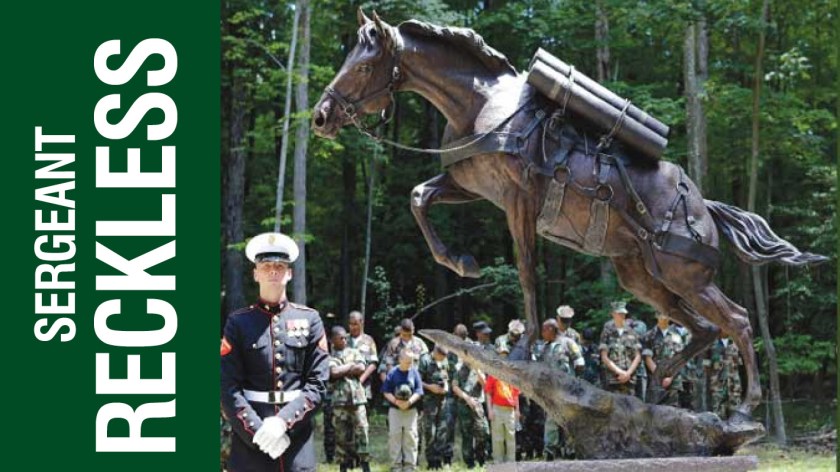
Life Magazine published a collector’s edition in 1997, listing 100 heroes from American history. Alongside the names of George Washington and Thomas Jefferson, Sally Ride and Abraham Lincoln, was that of a small Mongolian horse. Sergeant Reckless.

Screen-Shot-2014-09-11-at-10.42.17-AM