Chips attacked the four Italians manning the machine gun, single-handedly forcing their surrender to American troops. The dog sustained a scalp wound and powder burns in the process, indicating that they had tried to shoot him during the brawl. In the end the score was Chips 4, Italians Zero.
The United States Armed Forces had an extensive K-9 program during World War II, when private citizens were asked to donate their dogs to the war effort. One such dog was “Chips”, a German Shepherd/Collie/Husky mix who ended up being the most decorated K-9 of WWII.
Chips belonged to Edward Wren of Pleasantville, NY, who “enlisted” his dog in 1942. He was trained at the War Dog Training Center, Front Royal, Virginia, and served in the 3rd Infantry Division with his handler, Private John Rowell. Chips and his handler took part in North Africa, Italy, France and Germany. He served as a sentry dog for the Roosevelt-Churchill conference in 1943, and the team was part of the Sicily landings later that year.
The Allied invasion of Sicily was a large scale amphibious and airborne operation, beginning this day in 1943 and lasting through the 17th of August. Six weeks of land combat followed, in an operation code named “Operation Husky”.
During the landing phase, private Rowell and Chips were pinned down by an Italian machine gun team. The dog broke free from his handler, running across the beach and jumping into the pillbox. Chips attacked the four Italians manning the machine gun, single-handedly forcing their surrender to American troops. The dog sustained a scalp wound and powder burns in the process, demonstrating that they had tried to shoot him during the brawl. In the end, the score was Chips 4, Italians Zero. He helped to capture ten more later that same day.
Chips was awarded the Distinguished Service Cross, Silver Star, and Purple Heart, but the awards were later revoked. At that time the army didn’t permit commendations to be given to animals. His unit awarded him a Theater Ribbon with an Arrowhead for the assault landing anyway, along with eight Battle stars. One for each of his campaigns.
Chips was discharged in December, 1945, and returned home to live out his days with the Wren family in Pleasantville. Disney made a TV movie based on his life in 1990. They called it “Chips, the War Dog”.
By unanimous consent of the veterans, Sallie’s likeness looks out from the base of the statue, looking out for the spirits of “her boys” for all eternity.
From contemporary descriptions and the only photograph that’s known to exist of her, Sallie was a Staffordshire Bull Terrier, brindle in color. She was four weeks old in 1861, given as a gift to 1st Lieutenant William Terry of the 11th Pennsylvania Volunteer Infantry, who made her the regimental mascot. The men of the regiment were enormously fond of Sallie, as she tagged along on long marches and kept them company in their camps. She learned the drum roll announcing reveille, and loved to help wake sleeping soldiers in the morning.
If you’ve ever had a dog in your life, you know how that goes.
Sallie’s first battle came at Cedar Mountain, in 1862. No one thought of sending her to the rear before things got hot, so she took up her position with the colors, barking ferociously at the adversary. There she remained throughout the entire engagement, as she did at Antietam, Fredericksburg, Chancellorsville, and Spotsylvania. They said she only hated three things: Rebels, Democrats, and Women.
Sallie marched with “her” soldiers in a review in the spring of 1863. Abraham Lincoln was reviewing the army, when he spotted the dog from the center of the reviewing stand, and raised his famous top hat in salute.
At Gettysburg, Sallie was separated from her unit in the chaos of the first day’s fighting. They found her five days later, on July 6, parched with thirst and weakened by hunger. She was standing guard over her dead and dying comrades from July 1.
It’s been said that only a dog is capable of that kind of loyalty, yet virtue in one is capable of inspiring virtue in another. So it was in February, 1865. Sallie was struck in the head by a bullet at Hatcher’s Run. She was killed instantly, when several men of the 11th PA laid down their arms and buried her right then and there, even though they were still under fire from the Confederate side.
There is a story. I don’t know if it’s true, but it’s nice to think that it might be. Soldiers were moving out after the battle, when they heard whining from a hollowed out tree. There they found several of Sallie’s puppies. They’d had no idea she was pregnant, or how puppies came to be in that hollowed out tree, but they gave them to local civilians so that Sallie’s bloodline could live on.
Surviving veterans of the regiment returned to Gettysburg in 1890, to dedicate a memorial to those members of the 11th Pennsylvania who lost their lives on that field of battle. The monument shows an upright Union soldier, rifle at the ready.
By unanimous consent of the veterans themselves, Sallie’s likeness looks out from the base of the statue, looking after the spirits of “her boys”, for all eternity.
There are only two dogs so honored on the battlefield at Gettysburg, the other is part of the Irish Brigade monument. Of the two, Sallie is the only one to have actually participated in the battle.
For all his vaunted brilliance, Muenter seems to have been nuttier than a squirrel turd. His intention as explained to police, was to take Morgan’s wife and children hostage, until the financier cut off loans to Europe. He told police of his intention to assassinate J.P. Morgan, as well. How these two objectives squared with one another, remains unexplained.
The train left Boston in April, 1906. On board were the infant, the toddler, the nanny, and the children’s father, a German language instructor from Harvard University. The two little girls’ mother was onboard as well. She, and her casket, were going home to Chicago, to be buried in her home town. Leone (Krembs) Muenter had passed from some sort of stomach ailment, ten days after giving birth.
The story may have ended there, but for Dr. Herbert McIntyre. The circumstances of death didn’t seem right, and Dr. McIntyre ordered an autopsy. On April 27, Cambridge police issued a warrant for the arrest of Professor Erich Muenter, in the murder of his wife, by arsenic poisoning.
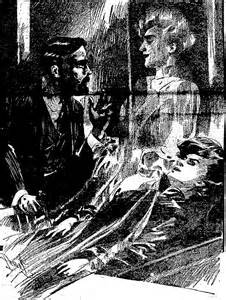
Apparently, this “man of science” wanted to test his theory that you could see the soul passing, at the moment of death. Now, Erich Muenter vanished.
Nine years later, the United States’ entry into WW1 was still two years in the future.
US policy at this time allowed arms sales to any and all belligerents in the European war. With British dominance of north Atlantic shipping routes, for all intents and purposes this meant France and Great Britain.
German language professor Frank Holt was teaching at Cornell University in 1915. A naturalized citizen and committed German nationalist, Holt had ties with the secret German spy intelligence unit Abteilung IIIb, which was conducting a campaign of sabotage against US ships carrying munitions ‘over there’.
Frank Holt might have described himself as a ‘peace activist’, obsessed with the idea that arms themselves were extending the war. If arms exports were brought to a halt, Holt believed, the war would come to an end.
On July 2, Holt gave up arguing the point, and took a train to Washington DC. In his hands he carried a bomb, three sticks of dynamite attached to a timing mechanism, ingeniously designed to go off when the acid ate through its cork stopper. In those days, you were apparently free to stroll about the United States Capitol, with a bomb in your hands. At least when Congress was in recess.
Finding the Senate chamber locked, Holt placed his package under a telephone switchboard in the Senate reception room, with the timer set to go off around midnight.
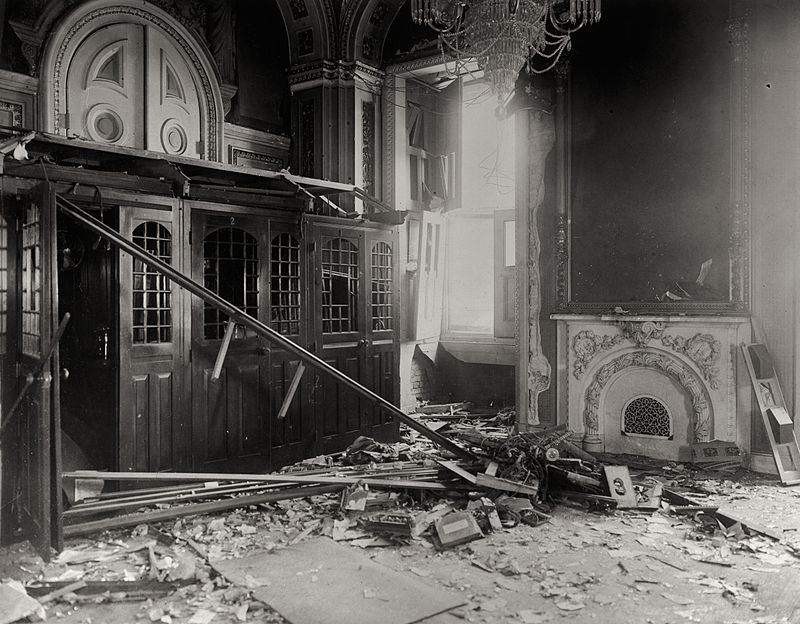
The explosion was enormous, tearing the room to pieces and blowing a night watchman out of his chair on the other side of the building. Writing to the Washington Star newspaper under the pseudonym R. Pearce, Holt explained his intentions to “make enough noise to be heard above the voices that clamor for war. This explosion is an exclamation point in my appeal for peace.”
Aftermath of the Senate bombing, July 2, 1915
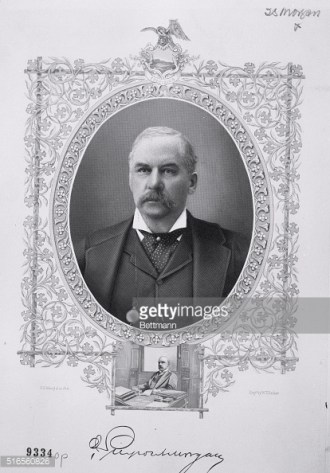
The following day, a tiny little box on the front page of the New York Times, attributed the explosion to ‘gasses’. As the paper was hitting news stands, Frank Holt was headed for Long Island, to the Glen Cove estate of “the Great Pierpont”, J. P. Morgan. Armed with two revolvers, a suitcase full of dynamite and a few anti-war newspaper clippings, Holt bulled his way through the butler who opened the door, and into the Morgan residence.
John Pierpont Morgan
Pandemonium broke out in the home, as Holt turned his weapons on the four Morgan children. Mrs. Morgan tried to block the path to her husband, but the millionaire financier lunged, tackling the much smaller man to the ground. Holt fired twice into Morgan’s thigh and groin, as the pair went down together. Pierpont twisted the gun from his grasp as Mrs. Morgan and a gaggle of household servants struggled for the other. All the while, the butler pounded the would-be assassin’s head with a lump of coal, as Holt shouted “Kill me! Kill me now! I don’t want to live any more. I have been in a perfect hell for the last six months on account of the European war!”
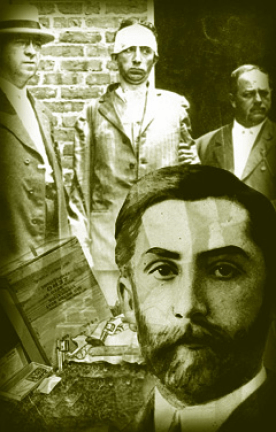
A copy of the R. Pearce letter quickly tied Holt to the Capitol bombing, as former colleagues identified the long-since vanished, accused killer of Leone Muenter. Frank Holt and Erich Muenter were the same man.
A colleague once described Muenter as “a brilliant man, a tireless worker, and a profound student. Night after night he would sit reading, studying and writing while his wife lay asleep in a room nearby.” The Harvard Crimson newspaper described him as ‘harmless on the surface…affect[ing] a scholarly stoop and a Van Dyke, and wore dingy, patched suits”. Fluent in seven languages, he was the pale, bearded model of the junior faculty intellectual, complete with elbow patches.
For all his vaunted brilliance, Muenter seems to have been nuttier than a squirrel turd. His intention as explained to police, was to take Morgan’s wife and children hostage, until the financier cut off loans to Europe. He told police of his intention to assassinate J.P. Morgan, as well. How these two objectives squared with one another, remains unexplained.
That Sunday morning, July 4, the J.P. Morgan shooting seems to have been front page on every newspaper in the world. On July 5, Erich Muenter took the brass ferrule from a pencil eraser, and slit his wrist. That suicide attempt was unsuccessful. The following day, Muenter scaled the bars in his prison and jumped, leaving his brains on the concrete floor, twenty feet below.
The day after his death, Police tracked down a trunk Muenter had left in a New York city storage facility. In it were 134 sticks of dynamite, blasting caps, fuse coils, batteries, nitric acid, windproof matches, mercury fulminate and smokeless explosive powder. Three tin can bombs had been recently completed, and were ready to go. Inspector of Combustibles Owen Egan declared it to be “the greatest equipment for bomb making ever brought to New York”.
That same day, the 2nd Mrs. Muenter received a letter from her dead husband. It said that an arms shipment headed for England would go to the bottom, that very day. Warned by wireless, the crew of SS Minnehaha frantically searched for the bomb, without success. Muenter’s bomb went off and touched off a fire, but it was far away from Minnehaha’s cargo of high explosives, and did little damage to the ship itself.
The Harland & Wolff liner SS Minnehaha was torpedoed and sunk off the Irish coast with the loss of 43, on September 7, 1917.
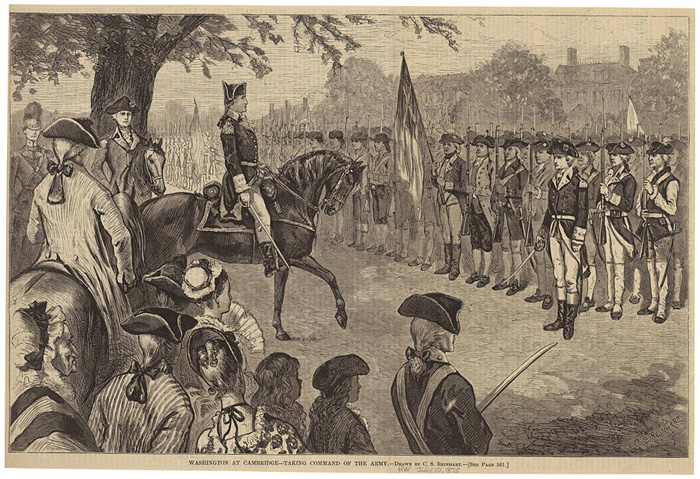
General Washington rode out in front of the troops gathered at Cambridge Common on July 3, 1775. Washington drew his sword under the branches of an ancient elm, by that act formally taking command of the Continental Army.
The American Revolution began with the battles of Lexington and Concord on the 19th of April, 1775. Thousands of armed colonial militia followed the British columns as they withdrew, and there they remained, hemming the British occupiers up in the city of Boston.
Within days, more than 20,000 armed men from all over New England had gathered from Cambridge to Roxbury. Tories’ vacant homes, empty Churches, even the brick buildings of Harvard College served as barracks, officers’ quarters, and hospitals. Soldiers camped in tents and other makeshift shelters, while Harvard canceled classes on May 1. Classes would not resume at the Cambridge campus until June of the following year.
The Continental Congress created the Army on June 14, 1775, appointing George Washington to lead it. General Washington rode out in front of the troops gathered at Cambridge Common on July 3, 1775. Washington drew his sword under the branches of an ancient elm, by that act formally taking command of the Continental Army.
Interestingly, 150 years of de facto independence from Great Britain seems to have suited the American colonist. If inheritance records are any indication, the average American enjoyed a better standard of living, than the average Brit. Average heights of the time bear that out.
The average American colonist had a full three inches on his British counterpart. At a time when the average male stood 5’8′, Washington towered over the crowd at 6’2″. George Washington was a hard man to miss.
For Washington to draw his sword against King George III, was itself an act of magnificent courage. According to British law of the time, one of four definitions of High Treason was “If a man do levy war against our lord the King in his realm”. By drawing that sword against the crown, Washington was clearly committing High Treason. He surely understood that such a prominent person as himself would be dealt with harshly, if caught.
At that time, the centuries-old penalty for High Treason was as savage as it was gruesome. Even now the language of the death sentence is difficult to read. You may consider that to be my warning if you don’t care to read what follows.
The full sentence as read to the condemned was: “That you be drawn on a hurdle (a sledge) to the place of execution where you shall be hanged by the neck and being alive cut down, your privy members shall be cut off and your bowels taken out and burned before you, your head severed from your body and your body divided into four quarters to be disposed of at the King’s pleasure”.
These were the terms of employment under which George Washington accepted his assignment. He even declined to accept payment, beyond reimbursement for his personal expenses.
The 56 signers of the Declaration of Independence would show the same brand of courage, by signing that document a year later. It must have been a supreme in-your-face moment when John Hancock put his pen to that parchment, which ended: “And for the support of this Declaration, with a firm Reliance on the Protection of divine Providence, we mutually pledge to each other our Lives, our Fortunes, and our sacred Honor”.
At the signing, Ben Franklin famously said “We must all hang together, or assuredly we shall all hang separately”. This was no empty philosophical statement they were signing. Should circumstances turn against them, the founding fathers well understood. Each was signing his death warrant.
One hundred and fifty-four years ago today, the Union and the Confederacy met in the south central Pennsylvania town of Gettysburg.
After two years of civil war, Robert E. Lee wanted to take the war to his adversary. Lee intended to do enough damage to create overwhelming political pressure in the North, to end the war and let the South go its own way. Lee had his best cartographers draw up maps of the Pennsylvania countryside, all the way to Philadelphia. And then he took his Army of Northern Virginia into Pennsylvania.
One hundred and fifty-four years ago today, the Union and the Confederacy met in the south central Pennsylvania town of Gettysburg.
Joseph “Fighting Joe” Hooker, to whom Lee contemptuously referred as “Mr. F.J. Hooker”, wanted to attack Richmond, but Lincoln ordered him to intercept Lee’s army to protect Washington DC. Hooker was replaced on the 28th by Major General George Gordon Meade, “that damn old goggle eyed snapping turtle” to his men, in a move that so surprised him that he thought he was being arrested over army politics, when the messenger came into his tent.
The “North” came up from the south that day, the “South” came down from the north. No one wanted the fight to be in Gettysburg, it was more like an accidental collision. What started out as a skirmish turned into a general engagement as fighting cascaded through the town. Confederate forces held the town at the end of the day, with the two armies’ taking parallel positions along a three-mile-long “fishhook” from Cemetery Hill and Culp’s Hill to the north, toward two prominences known as Big and Little Round Top to the south.
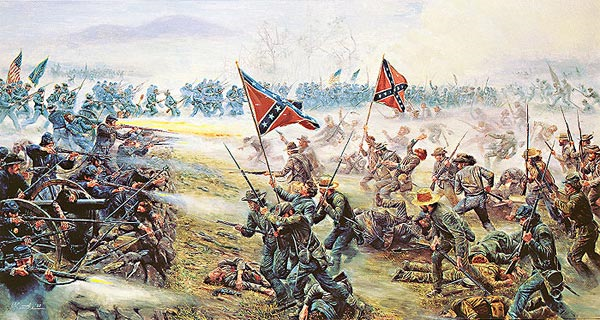
Fighting would continue and prove inconclusive at Culp’s Hill on day two, as the two armies stretched their position toward the Round Tops. Dan Sickles, the Tammany Hall politician best known for murdering the nephew of Francis Scott Key (he would be the first in American legal history to plead temporary insanity), had been ordered to move his corps into position on cemetery ridge, anchored at Little Round Top. Instead he took his corps a mile forward, into a Peach Orchard where they were torn apart in the Confederate assault. Some of the most savage fighting of the Civil War took place that day, at places like Devil’s Den, the Wheat Field, and bloody run. Sickles himself lost a leg to a cannonball. There was a foot race to the top of Little Round Top, leading to as many as 15 attacks and counterattacks for control of a small prominence at the Union’s extreme left. At the end of the day, the positions of the Armies had not changed.
On day 3, the last day, Lee came up the middle. 13,000 Confederate soldiers came across 1¼ miles of open field, to attack the Union Center at a position between a small copse of trees and a corner in stone fence called the angle. Cannon fire from their left, right and center tore them apart as they pressed on. A battered remnant actually penetrated Union lines: the “high water mark” of the Confederacy. It’s anyone’s guess what would have happened, had 4,000 Confederate cavalry smashed into the Union rear at that point, as Lee seems to have intended. But a 23-year-old general named George Armstrong Custer had waded into them with his 450 Union cavalry, routing the much larger force and very possibly changing history.
Lee withdrew in the rain of the 4th, ending the largest battle of the civil war. Lincoln was convinced that the time had come to destroy the Army of Northern Virginia, but Meade and his battered army did not follow. Lee and his army slipped back across the line and returned to Confederate territory. The most lethal war in American history would continue for two more years.
Years earlier, then-Secretary of War Jefferson Davis had brought some 75 camelsinto West Texas, to try them out as pack animals. Davis’ camel experiment had been a flop, but the King of Siam, (now Thailand), didn’t know that. Seeing the military advantage to the Confederacy, the King wrote to President Abraham Lincoln, proposing to send elephants to help the Union war effort. This “animal arms race” appears to have gotten no further than the King’s letter to Lincoln but, the imagination runs wild, at the idea of War Elephants, at Gettysburg.
A correspondent to the New York Times wrote in 1918 “When I landed in France I didn’t think so much of the Salvation Army; after two weeks with the Americans at the front I take my hat off… [W]hen the memoirs of this war come to be written the doughnuts and apple pies of the Salvation Army are going to take their place in history”.
The United States entered the ‘War to end all Wars’ in April, 1917. The first 14,000 Americans arrived ‘over there’ in June, the American Expeditionary Forces (AEF) formed on July 5. American troops fought the military forces of Imperial Germany alongside their British and French allies, others joining Italian forces in the struggle against the Austro-Hungarian Empire.
For a variety of reasons, WW1 was a war of movement in the East. Not so on the Western front. As early as October 1914, combatants were forced to burrow into the ground like animals, sheltering from what Ernst Jünger called the ‘Storm of Steel’.
Conditions in the trenches and dugouts defy description. You must have smelled the trenches long before you could see them. The collective funk of a million men and more, out in the open. Little but verminous scars in the earth teaming with rats and lice and swarming with flies, time and again the shells churned up and pulverized the soil, the water and the shattered remnants of once-great forests, along with the bodies of the slain.
You couldn’t call the stuff these people lived in mud – it was more like a thick slime, a clinging, sucking ooze capable of claiming grown men, even horses and mules.
Captain Alexander Stewart wrote “Most of the night was spent digging men out of the mud. The only way was to put duck boards on each side of him and work at one leg: poking and pulling until the suction was relieved. Then a strong pull by three or four men would get one leg out, and work would begin on the other…He who had a corpse to stand or sit on, was lucky”.
On first seeing the horror of Paschendaele, Sir Launcelot Kiggell broke down in tears. “Good God”, he said. “Did we really send men to fight in that?”
Often unseen in times of such calamity, are the humanitarian workers. Those who tend to the physical and spiritual requirements, the countless small comforts, of those in need.
Within days of the American declaration of war, Evangeline Booth, National Commander of the Salvation Army, responded, saying “The Salvationist stands ready, trained in all necessary qualifications in every phase of humanitarian work, and the last man will stand by the President for execution of his orders”.
These people are so much more than that donation truck, and the bell ringers we see behind those red kettles, in December.
Lieutenant Colonel William S. Barker of the Salvation Army left New York with Adjutant Bertram Rodda on June 30, 1917, to survey the situation. It wasn’t long before his not-so surprising request came back in a cable from France. Send ‘Lassies’.
A small group of carefully selected female officers was sent to France on August 22. That first party comprised six men, three women and a married couple. Within fifteen months their number had expanded by a factor of 400.
In December 1917, a plea for a million dollars went out to support the humanitarian work of the Salvation Army, the YMCA, YWCA, War Camp Community Service, National Catholic War Council, Jewish Welfare Board, the American Library Association and others. This “United War Work Campaign” raised $170 million in private donations, equivalent to $27.6 billion, today.
‘Hutments’ were formed all over the front, many right out at the front lines. Religious services of all denominations were held in these facilities. Concert performances were given, clothing mended and words of kindness were offered in response to all manner of personal problems. There were canteen services. On one occasion, the Loyal Order of Moose conducted an initiation at one of them. Pies and cakes were baked in crude ovens and lemonade was served to hot and thirsty troops. Of all these corporal works of mercy, the ones best remembered by the ‘doughboys’ themselves, were the doughnuts.
Helen Purviance, sent to France in 1917 with the American 1st Division, seems to have been first with the idea. An ensign with the Salvation Army, Purviance and fellow ensign Margaret Sheldon first formed the dough by hand, later using a wine bottle in lieu of a rolling pin. Having no doughnut cutter at the time, dough was shaped and twisted into crullers, and fried seven at a time on a pot-bellied wood stove.
The work was grueling. The women worked well into the night that first day, serving all of 150 hand-made doughnuts. “I was literally on my knees,” Purviance recalled, but it was easier than bending down all day, on that tiny wood stove. It didn’t seem to matter. The men stood in line for hours, patiently waiting in the mud and the rain. Their own little piece of warm, home-cooked heaven, in a world full of misery.
Before long, the women got better at it. Soon they were turning out 2,500 to 9,000 doughnuts a day. An elderly French blacksmith made Purviance a doughnut cutter, out of a condensed milk can and a camphor-ice tube, attached to a wooden block.
It wasn’t long before the aroma of hot doughnuts could be found, wafting all over the dugouts and trenches of the western front. Volunteers with the Salvation Army and others made apple pies and all manner of other goodies, but the name that stuck, was “Doughnut Lassies”.
A correspondent to the New York Times wrote in 1918 “When I landed in France I didn’t think so much of the Salvation Army; after two weeks with the Americans at the front I take my hat off… [W]hen the memoirs of this war come to be written the doughnuts and apple pies of the Salvation Army are going to take their place in history”.
Years earlier, German Chancellor Otto von Bismarck had said the next European war would be started by “Some damn fool thing in the Balkans”. Bismarck got his damn fool thing on June 28, 1914, when future Emperor Franz Ferdinand came to Sarajevo, the capital of the Balkan province of Bosnia-Herzegovina.
In 1914, Austria-Hungary was a kaleidoscope of fifteen distinct ethnic groups speaking at least that many languages. Ostensibly a constitutional union between the Empire of Austria and the Kingdom of Hungary, the dual monarchy was in fact divided, sometimes sharply, along no fewer than six religious lines.
Since the 1889 suicide of his cousin Crown Prince Rudolf, the only son of Emperor Franz Josef, Franz Ferdinand, was the Heir Presumptive to the Austro-Hungarian throne.
Sophie Maria Josephine Albina Chotek von Chotkow und Wognin was a minor noble in the Kingdom of Bohemia, a small figure in a constellation of 19th century European royalty. It’s uncertain when Sophie and Franz first met and fell in love, but their relationship caused a royal scandal. The future Queen of the Habsburg Dynasty was expected to hold suitable rank. Only a Princess of one of Europe’s dynastic families would do, certainly no Bohemian Countess.
Ferdinand wrangled with the Royal Court in Vienna for a year before the couple was permitted to marry, but only under hard and humiliating conditions. Theirs was a “morganatic” marriage. A marriage of unequals.
Three days before the wedding, June 28, 1900, Franz was forced to sign and publicly declare Sophie to be his morganatic wife, never to bear the titles of Empress, Queen or Archduchess. Any children produced by the marriage would neither inherit nor be granted dynastic rights or privileges of any kind. The Imperial family didn’t even show up at the wedding.
In a world where rank was everything, Sophie was never permitted to appear beside her husband in public. She was humiliated at every court function, relegated to last place and made to stand in line behind every Archduchess, Princess and Countess from Vienna to Budapest.
June 28 was significant for another reason. The invading army of Ottoman Sultan Murad I was wiped out on this date in the 1389 Battle of Kosovo, (June 15, ‘old style’), the “Field of Blackbirds”. It was a Pyrrhic victory, as the Balkan defenders were virtually wiped out as well. The Ottomans being far more numerous, the Balkan states soon became vassals of the Ottoman Turks.
The Encyclopedia Britannica describes “Balkanization” as “fragmentation of ethnic groups”. The Balkans form a geographic and political region, including 13 southeastern European nations from Slovenia to Greece. Located at the crossroads of east and west, the region has been subjugated and re-subjugated since the 6th century BC conquests of Persian King Darius the Great. The Balkan wars of 1912-1913 wrested some (but not all) of the area back from Ottoman control, as a newly enlarged Serbia pushed for greater independence and alliance among south Slavic peoples.
Years earlier, German Chancellor Otto von Bismarck had said the next European war would be started by “Some damn fool thing in the Balkans”. Bismarck got his damn fool thing on June 28, 1914, when future Emperor Franz Ferdinand came to Sarajevo, the capital of the Balkan province of Bosnia-Herzegovina.
Morganatic marriage was unknown in Hungarian law and custom. This trip was a rare opportunity for the couple to openly travel together. A “place in the sun” for Ferdinand’s wife, Sophie.
Ironically, Franz Ferdinand favored a more federalized model for the Empire, with greater autonomy for all its provinces. That wasn’t enough for the radical Serbian nationalists of the “Black Hand”, who inserted seven assassins along the route which the Archduke was scheduled to travel.
They were a carpenter, a printer, a teacher and four students. The oldest was 27. All suffered from tuberculosis, all armed with revolvers, crude bombs, or both, and a cyanide capsule with which to commit suicide if captured.
The six car motorcade drove by the first assassin, Muhamed Mehmedbašić, a little after 10am. He froze, allowing the cars to pass unmolested.
Riding along the Appel Quay, the motorcade passed the second assassin, Nedeljko Čabrinović, who threw his bomb at the open car. The driver sped away as the bomb went off under the wheel of the fourth car, wounding two occupants and a dozen spectators. Meanwhile, Čabrinović popped his cyanide pill and jumped into the Miljacka River, expecting to die. The cyanide just made him retch and the river was but a few inches deep, so the would-be assassin was soon in police custody.
The motorcade sped on to a planned reception at City Hall, passing three more assassins, Vasco Cubrilovic, Danilo Ilic and Cvijetko Popovic, none of whom did anything. There followed a sort of dark comedy, when Ferdinand jumped out of the car, incandescent with rage. Addressing Fehim Effendi Curcic, the mayor of Sarajevo, Ferdinand shouted “One comes here to visit and is received with bombs. Mr. Mayor, what do you say? It’s outrageous!” Unaware of what had happened, Mayor Curcic began to read his prepared remarks: “Our hearts are filled with happiness…”
Ferdinand later insisted on visiting the wounded at hospital, though he begged Sophie to stay behind. She wouldn’t have it. The Military Governor of the province, Oskar Potiorek, assured them of safe passage. Sophie would remain by her husband’s side.
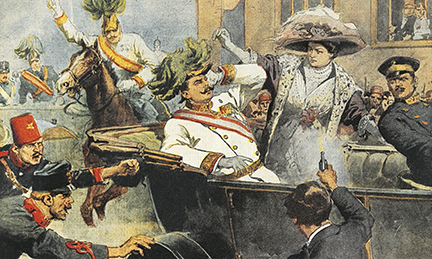
Soon they were off, speeding by the sixth assassin, Trifko Grabez, before he could react. Taking a wrong turn onto Franz Josef Strasse, the chauffeur realized his error and came to a stop before turning around. They were 8’ from the seventh and last assassin, Gavrilo Princip. Princip was in point blank range in two steps, firing once into Sophie’s side and once into the neck of the Archduke.
Archduke Franz Ferdinand’s jugular had been severed by the bullet. “For heaven’s sake, what’s happened to you?” she cried, before slipping to the floor of the car. “Sophie dear, Sophie dear, don’t die. Stay alive for our children.” Asked if he was alright, Franz Ferdinand was already fading away. “Es ist nichts; Es ist nichts…” (It is nothing; it is nothing…). By 11:30, both were dead.
The mad act of a tubercular 19-year led to a series of diplomatic missteps and military mobilizations and counter-mobilizations called the “July Crisis of 1914″, culminating in the “War to End all Wars” that August. There is virtually no part of 20th century history, that would ever be the same.
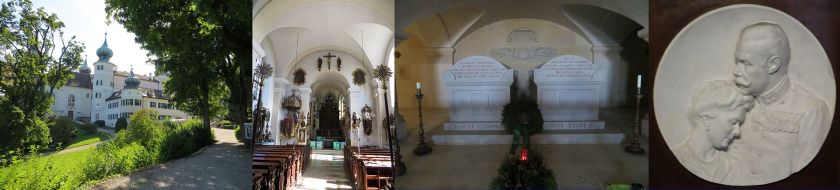
Knowing that he and his beloved wife could never be buried together in the Imperial Crypt, Ferdinand got the last word. In 1910, the Archduke set up a family crypt below the choir at the Artstetten Castle, in lower Austria. Neither had any idea that they’d need it, four years later. Now, Sophie and Ferdinand are at rest. At equal heights. Photo credit (2012) Marshmallowbunnywabbit at English Wikipedia, CC BY-SA 3.0, https://commons.wikimedia.org/w/index.php?curid=29775082
Alabama’s mission was to wage economic war on the Union, attacking commercial shipping from the Pacific to the Indian Ocean, from Newfoundland to Brazil.
Maryland native Raphael Semmes was a career Naval officer, having served in the United States Navy from 1826 to 1860. There was an extended leave of absence following the Mexican-American war, in which he settled in Alabama and practiced law. Semmes was offered a Confederate naval appointment in 1861, following the secession of his adopted home state. He resigned his commission, the following day.
Following a fruitless assignment to purchase arms from the North, Semmes was ordered to New Orleans, to convert the steamer Habana into the commerce raider CSS Sumter. Semmes breached the Union blockade in June of 1861, outrunning the sloop of war USS Brooklyn. So began the most successful commerce raider, in naval history.
Captain Raphael Semmes standing by his ship’s 110-pounder rifled cannon. His XO 1st Lieutenant John McIntosh Kell, stands by the ship’s wheel.
His was a war on the economic might of the Union. Sumter would eliminate 18 Union merchant vessels from the Caribbean to the Atlantic, constantly eluding the Union warships sent to destroy her. In six short months, CSS Sumter was laid up in neutral Gibralter, her boilers too spent to go on.
On May 13, 1861, Queen Victoria issued a “Proclamation of Neutrality” in the American Civil War, prohibiting the sale of ships of war. Vessels were permitted neither to alter or improve their equipment while in British waters, but were permitted to enter.
Hull #290 was launched from the John Laird & Sons shipyard in Birkenhead, Cheshire, England as the screw sloop HMS Enrica on May 15, 1862. Enrica left Liverpool that July on a “trial run”, a party of ladies and customs officials on board to allay suspicions that the trip was anything but ‘neutral”.
The ruse was a success. Passengers were transferred to a tug only a short distance from Liverpool and returned to port, while the ship itself continued on to the Terceira Island in the Azores. There she met her new captain. Raphael Semmes.
Three days, 8 cannon and 350 tons of coal later, Enrica was transformed into the 220’, 1,500 ton sloop of war and Confederate States of America commerce raider, CSS Alabama.
CSS Alabama, artist unknown
Alabama’s mission was to wage economic war on the Union, attacking commercial shipping from the Pacific to the Indian Ocean, from Newfoundland to Brazil. In her two years as commerce raider, Alabama destroyed the Union warship USS Hatteras off the coast of Galveston, Texas, and claimed 65 prizes valued at nearly $123 million in today’s dollars.
Alabama was badly in need of a refit when she put into Cherbourg, France, on the 11th of June. The Mohican-class Union sloop of war USS Kearsarge was then on patrol near Gibraltar, making it to Cherbourg by the 14th.
Seeing that he was blockaded, Semmes challenged Kearsarge Captain John Winslow to a ship-to-ship duel. “My intention is to fight the Kearsarge as soon as I can make the necessary arrangements. I hope these will not detain me more than until to-morrow or the morrow morning at farthest. I beg she will not depart until I am ready to go out. I have the honor to be your obedient servant, R. Semmes, Captain”.
That suited Winslow just fine. Kearsarge took up station in international waters, and waited.
USS Kearsarge
Alabama steamed out of Cherbourg on the morning of June 19, 1864, escorted by the French ironclad Couronne, which remained nearby to ensure that combat remained in international waters. Kearsarge steamed further out to sea as the Confederate vessel approached. There would be no returning to port, until the issue was decided.
Captain Winslow put his ship around and headed for the enemy at 10:50am. Alabama fired first from the distance of a mile, firing furiously as the range decreased.
Heavy, overlapping rows of chain armor allowed Kearsarge to be more deliberate, and she chose her shots, carefully.
Kearsarge Stern Post
The engagement followed a circular course at a range of a half mile; the ships steaming in opposite directions and firing at will.
Alabama’s forward 7-inch Blakely pivot rifle scored an early success, lodging a 56lb shell in Kearsarge’s exposed sternpost. With its rudder thus bound, Kearsarge’s mobility was sharply limited. It could have been far worse for Captain Winslow, however, had that shell not failed to explode.
One of Kearsarge’s 11″ Dahlgren smooth bore pivot cannon found its mark, tearing Alabama’s hull open at the waterline and exploding her steam boiler. Alabama turned and tried to run back to port, but Kearsarge headed her off. Within an hour of the first shot, the most successful commerce raider in history was reduced to a sinking wreck.
“Sinking of the CSS Alabama” by Xanthus Smith (1922)
Wounded in the battle, Semmes hurled his sword overboard, denying the Union captain that symbol of surrender. He ordered the striking of his ship’s Stainless Banner and a hand-held white flag of surrender, as Alabama went down by the stern.
For those Confederate sailors rescued by Kearsarge, the Civil War was over. They would spend the rest of the war as prisoners. Raphael Semmes escaped with 41 others, being plucked from the water and taken to neutral ports by the British steam yacht Deerhound, and the private sail yacht Hornet.
Semmes would recover from his wounds, returning to the war ravaged South via Cuba in February, 1865. That April, he would supervise the destruction of all Confederate warships in the vicinity, following the fall of Richmond. Semmes’ former command fought on as “the Naval brigade”, Semmes himself appointed Brigadier General, though the appointment would never be confirmed. The Confederate Senate had ceased to exist.
Elements of the Naval Brigade fought with Lee’s rear guard at the Battle of Sailor’s Creek, before their surrender at Appomattox, only days later. Semmes himself was surrendered with General Joseph E. Johnston’s army near Durham Station, North Carolina.
Semmes returned to Mobile after the war, where he resumed his legal career. There were those who wanted to try the man for piracy, but it never happened. Raphael Semmes died an untimely death in 1877, as the result of eating some bad shrimp.
His 1869 Memoirs of Service Afloat During The War Between the States has been described as one of the “most cogent but bitter defenses ever written”, about the “lost cause”, of the South.
It was common practice of the age to “spike” enemy cannon, driving a nail into the touchhole to disable the weapon. But for a handful of nails, the outcome of the battle might have been different. Possibly, even the history of the world.
The Napoleonic Wars began in 1799, pitting Emperor Napoleon Bonaparte and his Grand Armée against a succession of international coalitions. The first five such coalitions formed to oppose him would go down to defeat.
The empire of Czar Alexander I had long traded with Napoleon’s British adversary. Napoleon invaded Russia in 1812 intending to cut off that trade, but he made the same mistake that Adolf Hitler would make, 130 years later. He failed to account for Russia’s greatest military asset. General Winter.
For months Napoleon’s army pressed ever deeper into Russian territory, as Cossack cavalry burned out villages and fields to deny food or shelter to the advancing French army. Napoleon entered Moscow itself in September, with the Russian winter right around the corner. He expected capitulation. Instead, he got more scorched earth.
Finally there was no choice for the Grand Armée, but to turn about and go home. Starving and exhausted with no winter clothing, stragglers were frozen in place or picked off by villagers or pursuing Cossacks. From Moscow to the frontiers you could follow their retreat, by the bodies they left in the snow. 685,000 had crossed the Neman River on June 24. By mid-December there were fewer than 70,000 known survivors.
The War of the 6th Coalition ended in 1814 with Bonaparte’s defeat and exile to the Mediterranean island of Elba, and the restoration to the throne of the Bourbon King, Louis VXIII. That would last 111 days, until Napoleon reappeared at the head of another army.
The Congress of Vienna declared Napoleon an outlaw on March 13, 1815. Austria, Prussia, Russia and the UK bound themselves to put 150,000 men apiece into the field to end his rule.
Napoleon struck first, taking 124,000 men of l’Armee du Nord on a pre-emptive strike against the Allies in Belgium. Intending to attack Coalition armies before they combined, he struck and defeated the Prussian forces of Gebhard von Blücher near the town of Ligny.
Napoleon then turned his attention to the coalition forces under the Lord Arthur Wellesley, Duke of Wellington, who fell back to a carefully selected position on a long east-west ridge at Mont St Jean, a few miles south of the village of Waterloo.
It rained all day and night that Saturday. Napoleon waited for the ground to dry on the morning of June 18, launching his first attack before noon while Wellington’s Prussian allies were still five hours away. The 80 guns of Napoleon’s grande batterie opened fire at 11:50, while Wellington’s reserves sheltered out of sight on the reverse slope of the Mont St. Jean ridge.
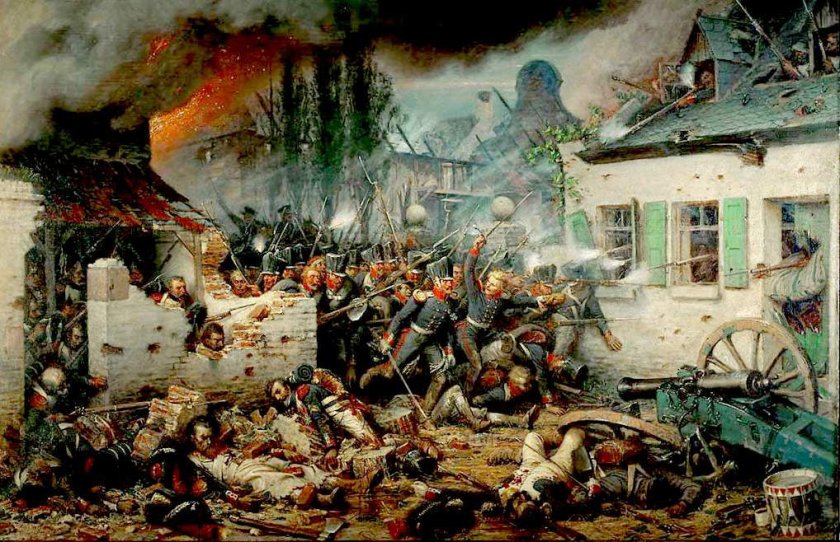
Fighting was furious around Wellington’s forward bastions, the walled stone buildings of the Château Hougomont on Wellington’s right, and La Haie Sainte on his left. Eight times, French infantry swarmed over the orchards and outbuildings of the stone farmhouses, only to be beat back.
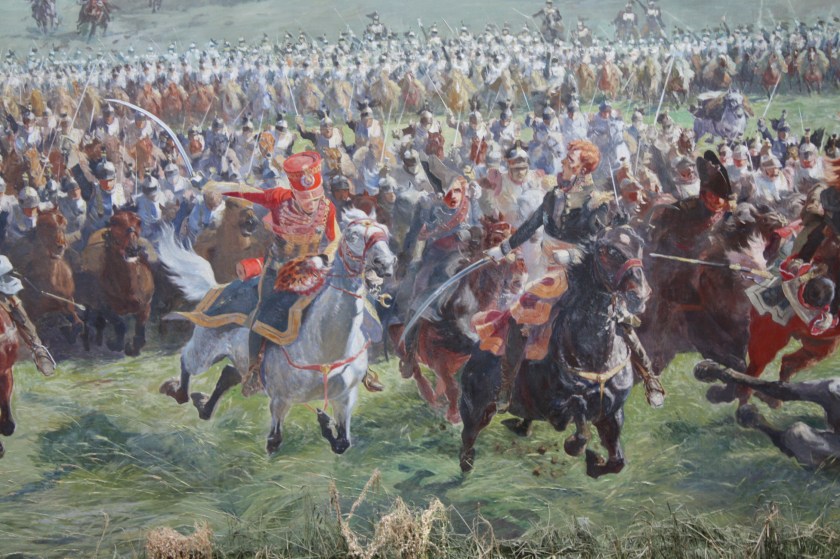
Most of the French reserves were committed by 4:00pm, when Marshall Ney ordered the massed cavalry assault. 9,000 horsemen in 67 squadrons charged up the hill as Wellington’s artillery responded with canister and shot, turning their cannon into giant shotguns tearing holes in the French ranks.
It was common practice of the age to “spike” enemy cannon, driving a nail into the touchhole to disable the weapon. But for a handful of nails, the outcome of the battle might have been different. Possibly, even the history of the world. Eleven times French cavalry gained the hill and surrounded those guns. Eleven times the gunners retreated into defensive infantry squares, bristling with bayonets. Eleven times French cavalry withdrew only to form up, and do it all over again.
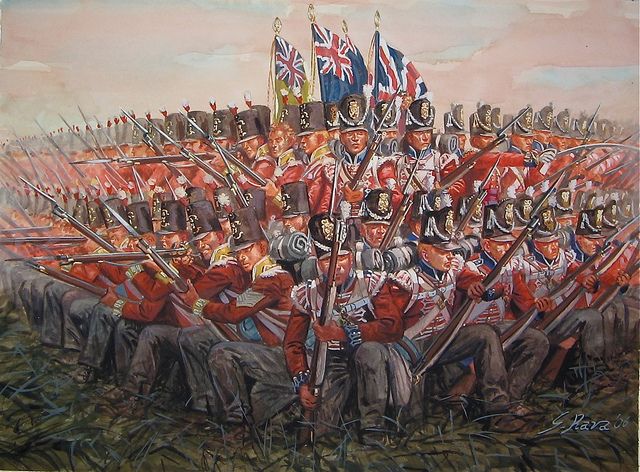
Newly arrived Prussians were pouring in from the right at 7:30 when Napoleon committed his 3,000-man Imperial Guard. These were Napoleon’s elite soldiers, almost seven feet tall in their high bearskin hats. Never before defeated in battle, they came up the hill intending to roll up Wellington’s center, away from their Prussian allies. 1,500 British Foot Guards were lying down to shelter from French artillery. As the French lines neared the top of the ridge, the English stood up, appearing to rise from the ground and firing point blank into the French line.
The furious counter assault which followed caused the Imperial Guard to waver and then fall back. Retreat broke into a route, someone shouting “La Garde recule. Sauve qui peut!” (“The Guard retreats. Save yourself if you can!”), as the Allied army rushed forward and threw themselves on the retreating French.
There is a story, possibly apocryphal, concerning Henry Paget, 2nd Earl of Uxbridge. One of the last cannonballs fired that day hit Uxbridge just above the knee, all but severing the leg. Lord Uxbridge was close to Wellington at the time, exclaiming “By God, sir, I’ve lost my leg!”. Wellington replied “By God, sir, so you have!” There’s another version in which Wellington says “By God, sir, you’ve lost your leg!”. Looking down, Uxbridge replied “By God, sir, so I have!”
According to Wellington, the battle was “the nearest-run thing you ever saw in your life.” The French defeat was complete. Bonaparte was once again captured and exiled, this time to a speck in the North Atlantic called Saint Helena. He died there in 1821.
Estimates of the total killed and wounded in the Napoleonic wars range from 3.5 to 6 million, at a time when the entire world population was about 980 million. Until Waterloo, Napoleon Bonaparte participated in, and won, more battles than Julius Caesar, Hannibal, Frederick the Great, and Alexander the Great. Combined.
“On you depend the fortunes of America. You are to decide the important question, on which rest the happiness and liberty of millions yet unborn. Act worthy of yourselves.” – Dr. Joseph Warren
Charlestown, Massachusetts occupies a hilly peninsula to the north of Boston, at the point where the Mystic River meets the Charles. Like Boston itself, much of what is now Charlestown was once Boston Harbor. In 1775 the town was a virtual island, joined to the mainland only by a thin “neck” of land.
Thousands of Patriot Militia poured into the area following the April battles of Lexington and Concord, hemming in the British who controlled Boston and its surrounding waterways.
Reinforced and provisioned from the sea over which the Crown held undisputed control, British forces under General Sir Thomas Gage could theoretically remained in Boston, indefinitely.
The elevation of Breed’s and Bunker’s Hill across the river, changed that calculation. Should colonial forces obtain artillery of their own, they would be able to rain down hell on British forces bottled up in Boston. It was just this scenario that led Henry Knox into a New England winter later that year, to retrieve the guns of Fort Ticonderoga.
The Massachusetts Provincial Congress received word on the 13th that the British planned to break out of Boston within the week, taking the high ground of Dorchester Heights to the south and Charlestown to the north. Major General Israel Putnam was directed to set up defenses on Bunker Hill, on the northwest end of the Charlestown peninsula.
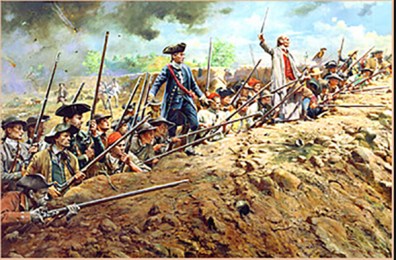
Colonel William Prescott led about 1,200 men onto the peninsula on the night of the 16th. Some work was performed on the hill which gives the battle its name, but it was farmer Ephraim Breed’s land to the southeast, which offered the more defensible hill from which to defend the peninsula.
Shovels could be heard throughout the night. The sun rose on June 17 to reveal a 130′ defensive breastwork across Breed’s hill. Major General William Howe was astonished. “The rebels,” he said, “have done more work in one night than my whole army would have done in one month.”
The warship HMS Lively opened fire on the redoubt shortly after 4am, with little effect on the earthworks. 128 guns joined in as the morning bore on, including incendiary shot which set fire to the town. Militia continued to reinforce the high ground throughout the morning hours, as Regulars commanded by General Howe and Brigadier General Robert Pigot crossed the Charles River and assembled for the assault.
First Assault
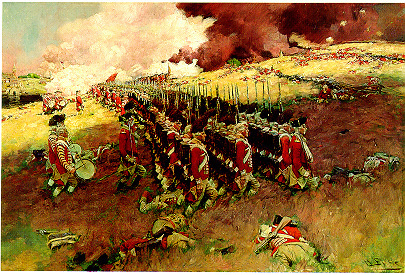
The British line advanced up Breed’s Hill twice that afternoon, Patriot fire decimating their number and driving survivors back down the hill to reform and try again. Militia supplies of powder and shot began to give out as the British advanced up the hill for the third assault.
“Don’t fire until you see the whites of their eyes”. The quote is attributed to Prescott, but the order seems to have originated with General Putnam and passed along by Prescott, Seth Pomeroy, John Stark, and others, in a desperate attempt to conserve ammunition.
Finally, there was nothing left with which to oppose the British bayonets. The Militia was forced to retreat.
Second Assault
Most of the colonists’ casualties occurred at this time, including Boston physician and President of Massachusetts’ Provincial Congress, Dr. Joseph Warren. Dr. Warren had been appointed Major General on June 14, but the commission had not arrived as of yet. On this day, he fought as a private soldier. He had been but the commission had not yet taken effect.
Two months before the battle, Dr. Warren had spoken to his men. “On you depend the fortunes of America”, he said. “You are to decide the important question, on which rest the happiness and liberty of millions yet unborn. Act worthy of yourselves.”
Act worthy of yourselves. That they did.
Final Attack
The Battle of Bunker Hill ended in victory for the British, in that they held the ground when the fighting was over. It was a Pyrrhic victory. Howe lost 226 killed and 828 wounded, over a third of their number and more than twice those of the Militia.
One Eighth of all the British officers killed in the Revolution, died on Ephraim Breed’s Hill. General Henry Clinton wrote afterward, of the battle: “A few more such victories” he said, “would have shortly put an end to British dominion in America”.


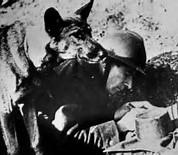 During the landing phase, private Rowell and Chips were pinned down by an Italian machine gun team. The dog broke free from his handler, running across the beach and jumping into the pillbox. Chips attacked the four Italians manning the machine gun, single-handedly forcing their surrender to American troops. The dog sustained a scalp wound and powder burns in the process, demonstrating that they had tried to shoot him during the brawl. In the end, the score was Chips 4, Italians Zero. He helped to capture ten more later that same day.
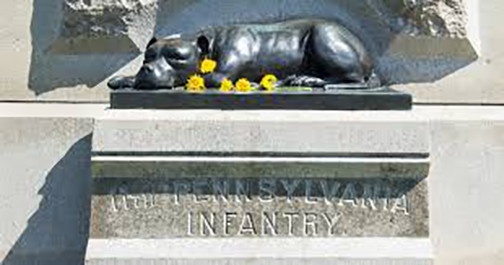
 Sallie’s first battle came at Cedar Mountain, in 1862. No one thought of sending her to the rear before things got hot, so she took up her position with the colors, barking ferociously at the adversary. There she remained throughout the entire engagement, as she did at Antietam, Fredericksburg, Chancellorsville, and Spotsylvania. They said she only hated three things: Rebels, Democrats, and Women.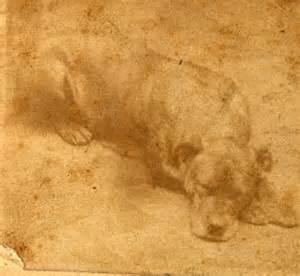

 “Sallie was a lady,
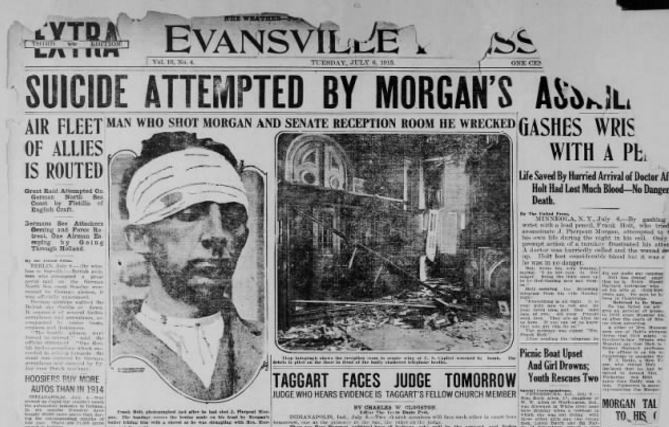
 That Sunday morning, July 4, the J.P. Morgan shooting seems to have been front page on every newspaper in the world. On July 5, Erich Muenter took the brass ferrule from a pencil eraser, and slit his wrist. That suicide attempt was unsuccessful. The following day, Muenter scaled the bars in his prison and jumped, leaving his brains on the concrete floor, twenty feet below.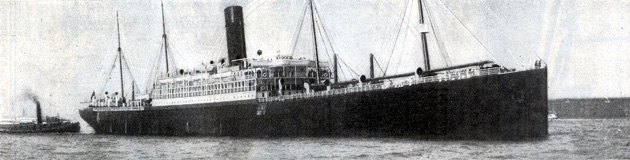





 Often unseen in times of such calamity, are the humanitarian workers. Those who tend to the physical and spiritual requirements, the countless small comforts, of those in need.




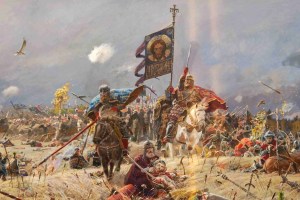 June 28 was significant for another reason. The invading army of Ottoman Sultan Murad I was wiped out on this date in the 1389 Battle of Kosovo, (June 15, ‘old style’), the “Field of Blackbirds”. It was a Pyrrhic victory, as the Balkan defenders were virtually wiped out as well. The Ottomans being far more numerous, the Balkan states soon became vassals of the Ottoman Turks.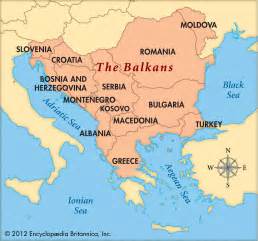
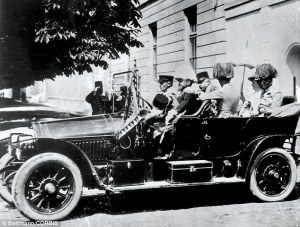 The six car motorcade drove by the first assassin, Muhamed Mehmedbašić, a little after 10am. He froze, allowing the cars to pass unmolested.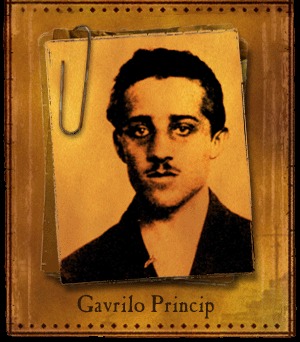


 Semmes would recover from his wounds, returning to the war ravaged South via Cuba in February, 1865. That April, he would supervise the destruction of all Confederate warships in the vicinity, following the fall of Richmond. Semmes’ former command fought on as “the Naval brigade”, Semmes himself appointed Brigadier General, though the appointment would never be confirmed. The Confederate Senate had ceased to exist.

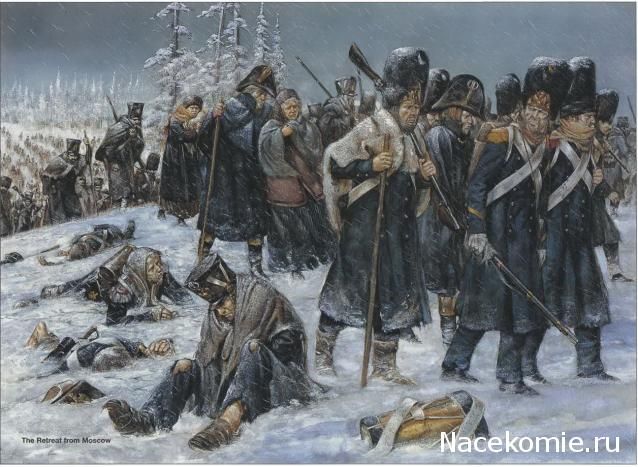 Finally there was no choice for the Grand Armée, but to turn about and go home. Starving and exhausted with no winter clothing, stragglers were frozen in place or picked off by villagers or pursuing Cossacks. From Moscow to the frontiers you could follow their retreat, by the bodies they left in the snow. 685,000 had crossed the Neman River on June 24. By mid-December there were fewer than 70,000 known survivors.
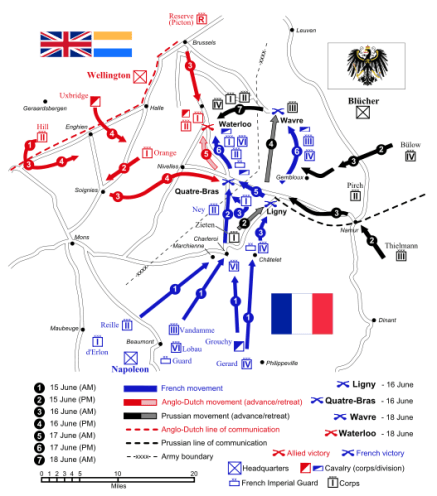 The Congress of Vienna declared Napoleon an outlaw on March 13, 1815. Austria, Prussia, Russia and the UK bound themselves to put 150,000 men apiece into the field to end his rule.





 Historical Easter Eggs - Today in History
You must be logged in to post a comment.