A news correspondent from Reuters reported that the Sultan had “fled at the first shot with all the leading Arabs, who left their slaves and followers to carry on the fighting”.
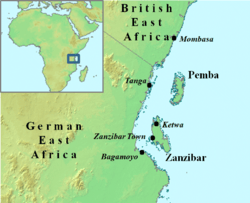
The late 19th century was period of friendly but competing relations between Imperial Germany and Great Britain in Colonial East Africa, as each vied for control of territory and trade rights.
In 1886 Sultan Khalifah granted rights to the land of Kenya to Britain, and that of Tanganyika, modern day Tanzaniya, to Germany. The Heligoland-Zanzibar Treaty between Britain and Germany officially demarcated each nation’s sphere of influence in East Africa, in the process ceding Germany’s rights in the island nation of Zanzibar to the United Kingdom.
The agreement effectively ended the slave trade in much of East Africa, upsetting many among the Arab ruling classes who profited handsomely by this lucrative trade.
The shortest war in history began with the unexpected death and probable assassination of Sultan Hamad of Zanzibar, who died suddenly on August 25, 1896. Many suspected his 29-year-old nephew Khalid bin Bargash of the assassination, as he took up residence in his uncle’s palace complex.
British authorities demanded that Khalid order his forces to stand down and leave the palace. Instead, the new Sultan called up his palace guard and barricaded himself inside.
Several English warships arrived on the 26th, as a cable was sent to Lord Salisbury that afternoon, requesting authorization to use force if necessary. The reply came back from Her Majesty’s government: “You are authorized to adopt whatever measures you may consider necessary, and will be supported in your action by Her Majesty’s Government.”
That was followed by one of history’s great examples of government butt-covering, adding: “Do not, however, attempt to take any action which you are not certain of being able to accomplish successfully”.
At 8:30 on the morning of August 27th, a message came from Khalid saying “We have no intention of hauling down our flag and we do not believe you would open fire on us”. Diplomatic Consul Basil Cave replied “We do not want to open fire, but unless you do as you are told we shall certainly do so”.
No further messages being forthcoming, General Lloyd Mathews ordered his ships to commence bombarding the palace complex at 9:00am, East Africa Time. Her Majesty’s ships Raccoon, Thrush and Sparrow opened fire at 9:02, Thrush’s first shot disabling an Arab 12-pounder cannon. 500 shells, 4,100 machine gun rounds and 1,000 rifle rounds were fired at the palace complex. By 9:40, the weapons of the 3,000 palace defenders, servants and slaves, had gone silent. The palace and attached harem were burning, the Sultan’s flag cut down. The order was given to cease fire.
A news correspondent from Reuters reported that the Sultan had “fled at the first shot with all the leading Arabs, who left their slaves and followers to carry on the fighting”.
The episode went into history as the Anglo-Zanzibar War. The whole thing lasted 38 minutes. Less time than it took me to write this story.
“Do not send to me so long as my son lives; let the boy win his spurs; let the day be his.”
From the time of Charlemagne, the social and political structure of Middle Ages European society rested on a set of reciprocal obligations between a warrior nobility, supporting and in turn being supported by, a hierarchy of vassals and fiefs.
The system was called Feudalism, a system in which the King granted portions of land called “fiefs” to Lords and Barons in exchange for loyalty, and to Knights (vassals) in exchange for military service.
Knights were a professional warrior class, dependent upon the nobility for lodging, food, armor, weapons, horses and money.
The whole edifice was borne up by peasants, serfs who farmed the land and provided the vassal or lord with material wealth, in the form of food and other products.
The 18th century historian and political economist Jean Charles Léonard de Sismondi wrote “We must not confound chivalry with the feudal system. The feudal system may be called the real life of the period of which we are treating, possessing its advantages and inconveniences, its virtues and its vices. Chivalry, on the contrary, is the ideal world, such as it existed in the imaginations of the Romance writers. Its essential character is devotion to woman and to honour”.
The Battle of Crécy is memorable for several reasons. Crude cannon had been used in siege operations during the Muslim conquest of Spain, (al Andalus), but this was the first time they were used in open battle. Perhaps more important, though less evident at the time, was that Crécy spelled the end of feudalism.
Crécy Battlefield
The Battle of Crécy was the first major combat of the hundred years’ war, a series of conflicts fought over a 116-year period for control of the French throne. King Edward III invaded the Normandy region of France on July 12, 1346. Estimates vary concerning the size of his army, but not of its composition. This was not an army of mounted knights, though there were a few of those. This was a yeoman army of spearmen and foot archers, ravaging the French countryside as they went, and pursued by a far larger army of French knights and mercenary allies.
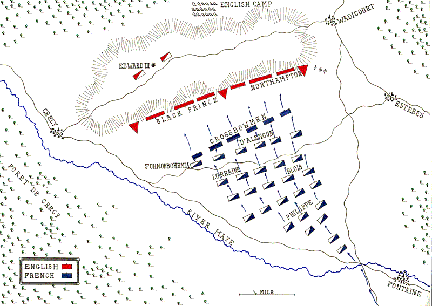
A fortunate tidal crossing of the Somme River gave the English a day’s lead, allowing Edward’s forces time to rest and prepare for battle as they stopped to wait for the far larger French army near the village of Crécy.
Edward’s forces took a strong defensive position overlooking flat agricultural land, natural obstacles to either side effectively nullifying the French numerical advantage. The French army under King Philip VI was wet and exhausted when they arrived on the 26th, nevertheless launching themselves directly at the English, almost immediately upon their arrival.
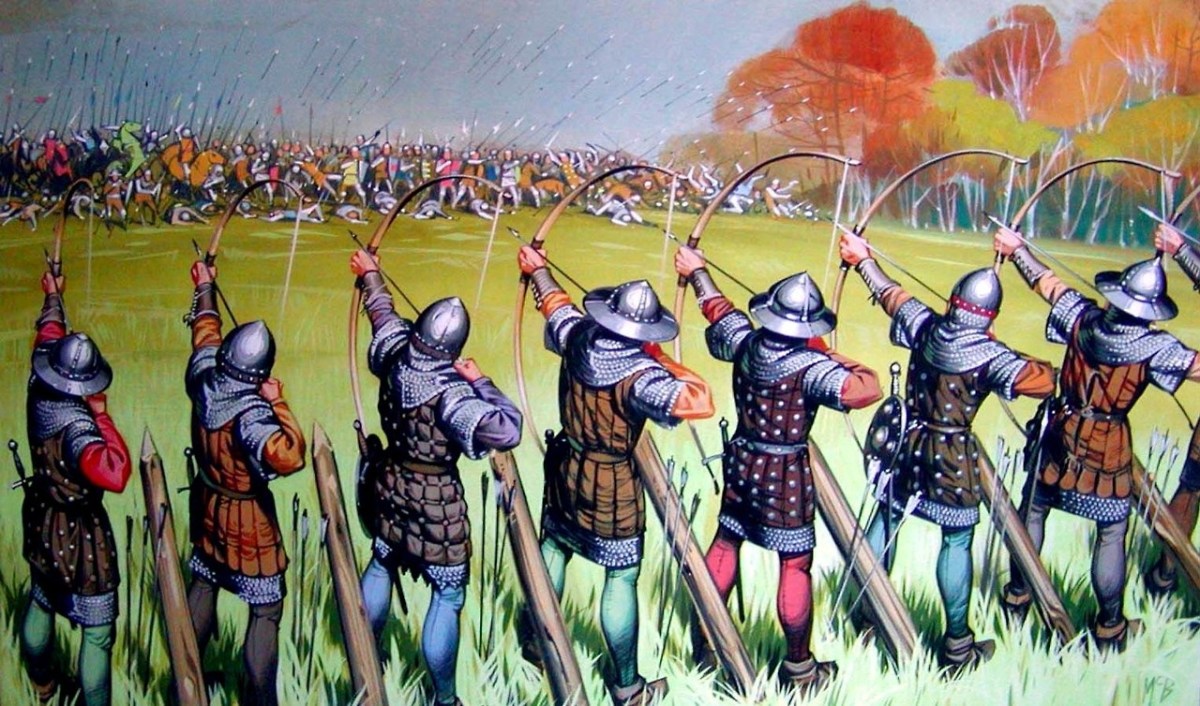
Genoese crossbowmen opened the battle on the French side, but wet strings hampered the weapon’s effectiveness. English archers had unstrung their longbows during the previous night’s rain, and now showered thousands of arrows down on the heads of their adversaries. The French first line broke and ran, only to be accused of cowardice and hacked to pieces by the knights to their rear.
French mounted knights now entered the fray, but orderly lines soon dissolved into confusion. The muddy field combined with English obstacles and that constant barrage of arrows unhorsed French knights and confused their lines.
Riderless horses and unmounted knights alike were run down by successive waves of horsemen, each impatient to win his share of the “glory”. Those who made it to the English side faced a tough, disciplined line of spearmen and foot soldiers who held their position. Heavily armored knights, once unhorsed, were easy prey to the quick and merciless knives of the English.
A messenger sought out the English King in the midst of the battle, beseeching aid for the King’s son, the 16-year-old Prince of Wales. Edward replied “Do not send to me so long as my son lives; let the boy win his spurs; let the day be his.”
Philip’s ally, the blind King John of Bohemia, heard that the battle was going badly for the French. He ordered his companions to tie his horse’s bridle to theirs, and lead him into the fight. It was the last time he was seen alive.
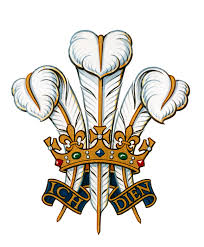
The Prince of Wales did earn his spurs that day. He adopted old King John’s crest and motto, the triple ostrich plume with the words “Ich Dien”. I serve. The heraldic badge is worn by his successors, to this day.
When it was over, the feudal age lay dead in the mud and the blood of Crécy, alongside the mythical age of chivalry. The English side suffered one/tenth the number of casualties. 2,200 Heraldic coats were taken as trophies.
In the words of A Short History of the English People, by John Richard Green, “The churl had struck down the noble; the bondsman proved more than a match in sheer hard fighting, for the knight”. After Crécy, the world’s land battles would be fought not by armored knights fighting toe-to-toe with battle-axe and lance, but by common foot soldiers, with the bow and with the gun.
In 1914, Imperial Germany took a straight line through neutral Belgium into France, believing that Great Britain would never honor a “scrap of paper” signed back in 1839.
In 1830, what is now Belgium was part of the United Kingdom of the Netherlands, a fusion of territories brought about in the wake of the Napoleonic Wars, formerly belonging to the Dutch Republic, Austrian Netherlands, and Prince-Bishopric of Liège. It was a Constitutional Monarchy, ruled by the first King of the Netherlands, King William I.
The “Southern Provinces” of King William’s polity were almost all Catholic, and mostly French speaking, in contradistinction to the Dutch speaking, mostly Protestant north. Many southern liberals of the time thought King William a despot and tyrant, and high levels of industrial unemployment made for widespread unrest among the working classes.
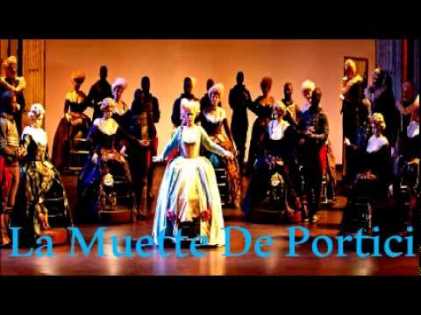
La Muette de Portici (The Mute Girl of Portici) is an opera in five acts by Daniel Auber. Generally recognized as the earliest of the French Grand Opera, it was first performed at the Paris Opéra on February 29 1828. During an August 25, 1830 performance, a riot broke out during one particularly patriotic duet, Amour sacré de la patrie, (Sacred love of Fatherland). Soon it was spilling out onto the street, a full-scale riot spreading across Brussels and igniting other riots as shops were looted, factories occupied and machinery destroyed.
King William committed troops to the southern provinces in an effort to restore order, while radicals asserted control of rioting factions and began talk of secession. Dutch military units experienced massive desertion of recruits from the southern provinces, and had to pull out.
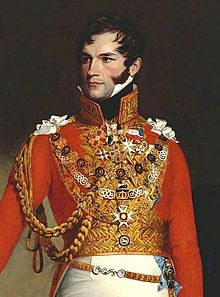
The States-General in Brussels voted in favor of secession and declared independence, assembling a National Congress while King William appealed to the Great Powers for help. The resulting 1830 London Conference of major European powers came to recognize Belgian independence, and Leopold I was installed as “King of the Belgians”.
King William made one more attempt to reconquer Belgium militarily, in 1831. France intervened with troops of its own and the “Ten Days’ Campaign” ended in failure. The European powers signed the “Treaty of London” in 1839, recognizing and guaranteeing Belgium’s independence and neutrality.
The German Composer Wilhelm Richard Wagner remarked on the events decades later, saying that “[S]eldom has an artistic product stood in closer connection with a world-event”.
In August 1914, Imperial Germany’s plan in the event of war could be likened to one guy against two in a bar fight, (Germany vs France & Russia). The plan was to take out the nearer one first (France), before turning to face the second. Imperial Germany took a straight line through neutral Belgium into France, believing that Great Britain would never honor that “scrap of paper” signed back in 1839.
In this German calculations were grievously mistaken. A regional squabble had begun that June, with an assassination in the Balkans. That miscalculation would plunge the world into two world wars.
The only bright spot for the American side that day, came when Commodore Joshua Barney lead 520 seamen in a downhill charge, against a vastly superior British force. Barney took a bullet to the thigh and was captured by the British, who paroled him on the spot. Rear Admiral Sir George Cockburn was impressed with the American sailor’s show of courage, saying “They have given us the only fighting we have had.”
In the early years of the nineteenth century, Napoleon Bonaparte and his Grande Armée kept his Britannic Majesty’s armed forces pretty well occupied. In the former American colonies, the first two years of the War of 1812 were little more than a series of skirmishes.
The Corsican’s defeat at Waterloo and subsequent exile to Elba freed up some of the most elite, battle hardened troops in the world.
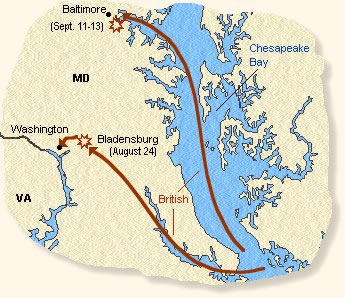
On the morning of August 24, 1814, 4,370 of them were moving up the Chesapeake, toward Baltimore.
They were met by an inexperienced and poorly equipped militia force of some 6,000 American forces at Bladensburg, Maryland, whose comprehensive defeat and humiliating rout went into the history books as the “Bladensburg Races”. President James Madison and most of the federal government were present at the battle, and nearly captured. American militia members fled through the streets of Washington, while every politician from President Madison down to Freshman Members of Congress skedaddled across the countrysides of Maryland and Virginia.
The only bright spot for the American side that day, occurred when Commodore Joshua Barney lead 520 seamen in a downhill charge against vastly superior British forces. Barney took a bullet to the thigh and was captured by the British. Rear Admiral Sir George Cockburn was so impressed with the American sailor’s show of courage that he paroled the man on the spot, saying “They have given us the only fighting we have had.”
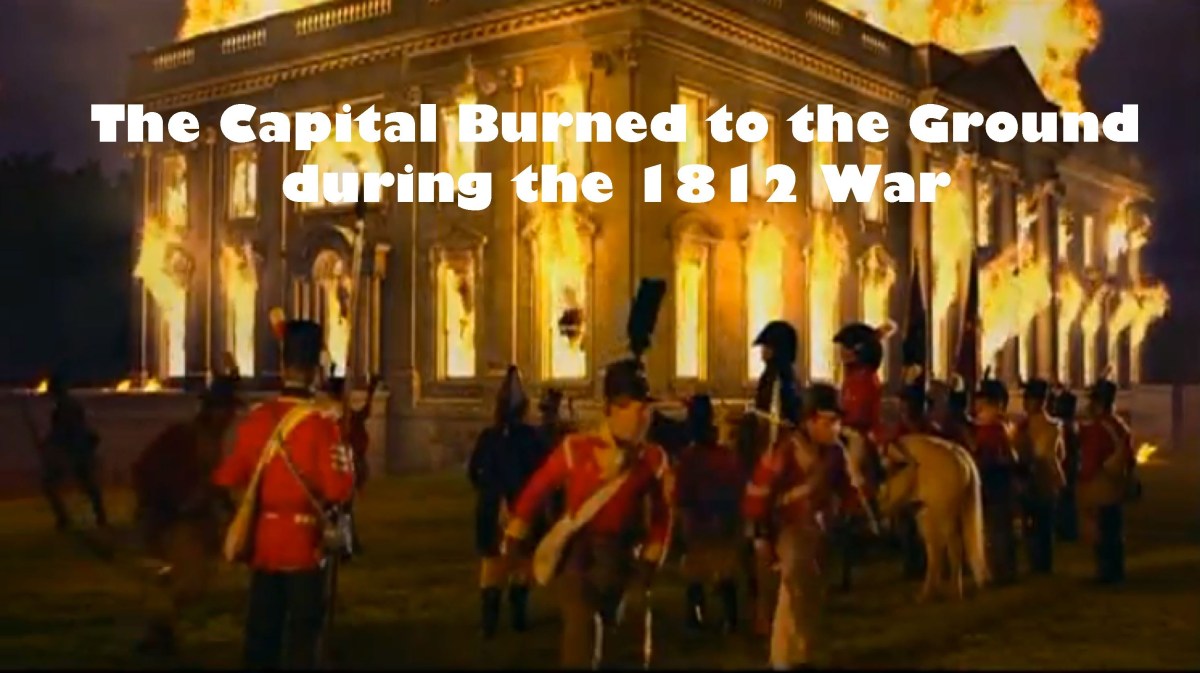
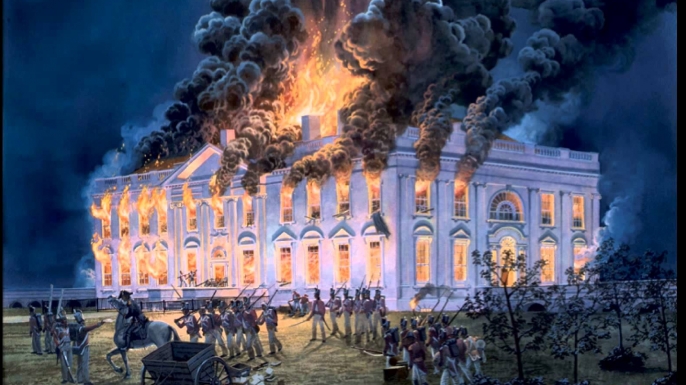
The British sent an advance guard of soldiers to Capitol Hill under flag of truce, intending to discuss terms of surrender. The column was attacked by the occupants of a single house at the corner of Maryland & Constitution Ave., the only resistance the redcoats would see in the city. The house was burned, and the British raised the Union Jack over Washington DC. Then they commenced to burn every government building they could find.
The Senate and House of Representatives buildings were the first to burn, along with the Library of Congress and Supreme Court, which at that time were located inside. The Treasury building was next, though British hopes were disappointed to find there was no money inside.
First Lady Dolley Madison barely had time to gather up some precious objects, ordering White House staff to remove the portrait of George Washington before the “President’s House”, as the White House was then called, was overrun. The table was set for President Madison and a party of 40 at the time, the wine still cooling on a sideboard when the British set the White House of it’s day, on fire. All night they added fuel to the flames, just to keep it going.
Portraits of King George III and his wife Queen Charlotte Sophia were discovered in one public building, and taken down before that building too, was burned. The two portraits made their way halfway across the Atlantic to Bermuda, where they hang in the Parliament building, to this day.
The Washington Navy Yard was torched the following day, along with departments of State, War and Navy. Admiral Cockburn entered the building of the National Intelligencer newspaper intending to burn that down, too, but several women persuaded him not to. Instead, Cockburn ordered his troops to tear the building down brick by brick. He ordered all the “C” typeset destroyed, too, “so that the rascals can have no further means of abusing my name.”
The largest loss of life in the whole episode occurred on the afternoon of the 25th, when General Ross sent two hundred men to secure a fort on Greenleaf’s Point. The fort had already been destroyed by American forces, but 150 barrels of gunpowder remained. The powder ignited while the British were trying to drop it into a well, killing at least a dozen and injuring many others.
A heavy thunderstorm came up that same day, putting out many of the fires and spawning a small tornado that damaged British ships causing them to withdraw. Thomas Jefferson later sold his personal library of more than 6,000 volumes to the government, restocking the Library of Congress with his own personal collection.
The episode has been called “The greatest disgrace ever dealt to American arms”…”The most humiliating episode in American history.” It was the only time before or since, that an enemy force has occupied our nation’s capital.
A German infantryman wrote to his family, “Animals flee this burning hell of a city. The hardest stones do not last for long. Only men endure”.
WWII could have ended differently, had two of the most homicidal dictators in history become allies. It actually started out that way, when the Soviet Union and Nazi Germany signed the Molotov-Ribbentrop non-aggression pact, in August, 1939. That would end two years later with “Operation Barbarossa”, the German surprise invasion of the Soviet Union, beginning on June 22, 1941.
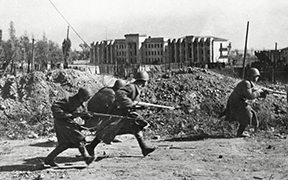
We’re accustomed to thinking of World War II in terms of the European and the Pacific “Theaters”, but the most horrific casualties of the most destructive war in history, took place on the “Ostfront”, (Eastern Front). 95% of all German Army casualties between 1941 and 1944, and 65% of all Allied military casualties from the entire war, took place on the Eastern Front. The bloodiest battle of the Eastern Front, probably the bloodiest battle in all of history, began this day in 1942, in the city of Stalingrad.
Photo by Nara Archives / Rex Features (2093505a) October 1942, Stalingrad – Soviet Guardsmen Fighting In The Streets Of The Stalingrad Outskirts
Soviet propagandists called it a “harvest victory”, when most of the cattle, grain and rail cars were shipped out of the city in advance of the German assault.
Most of Stalingrad’s civilian residents remained however, leaving the city short of food, even before the commencement of German attacks. Making things worse, the Luftwaffe bombed Volga River shipping, sinking 32 ships and crippling another 9 in the narrow waterway, cutting off this vital link in the city’s supply chain.
Wilfred von Richtofen, cousin of the famous “Red Baron” of WWI, opened up with his heavy bombers on August 23rd, dropping over 1,000 tons of high explosive on Stalingrad.
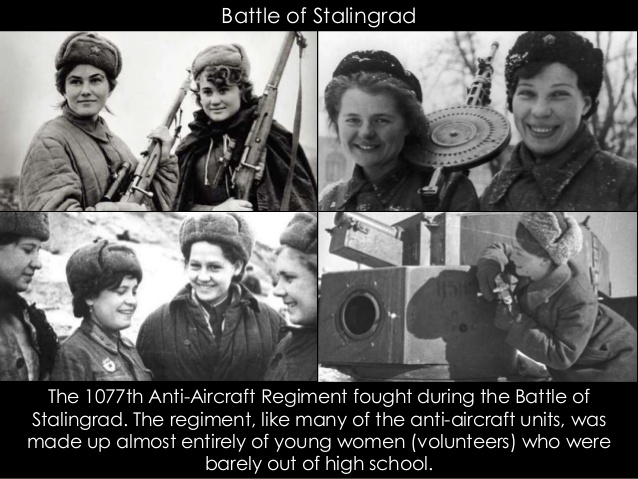
The Soviets suffered from extreme manpower shortages in the beginning. The burden of the early defense of the city fell to the 1077th Anti-Aircraft Regiment, a primarily female unit of young volunteers who had no training and the wrong weapons to engage ground targets. These women were all alone at this point with no support from other units, but they traded shot for shot with the German 16th Panzer Division until all 37 AA guns had been wiped out or overrun. When it was over, 16th Panzer soldiers were shocked to learn they’d been fighting women.
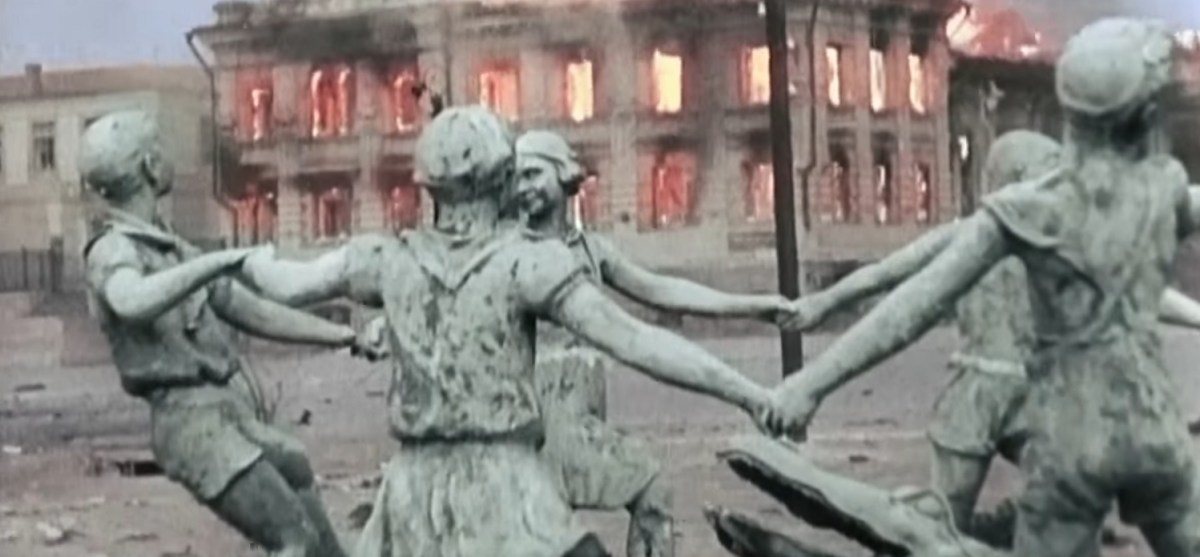
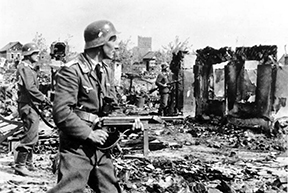
Stalingrad was quickly reduced to rubble, with the German 6th Army controlling 90% of the city. Still, Lt. Gen. Vasily Ivanovich Chuikov’s army held on. With backs to the Volga, they fought for the very sewers of the city, men and women alike reduced to a primitive level of existence. The Germans called it “Rattenkrieg”. “War of the Rats”. A German infantryman wrote to his family, “Animals flee this burning hell of a city. The hardest stones do not last for long. Only men endure”.
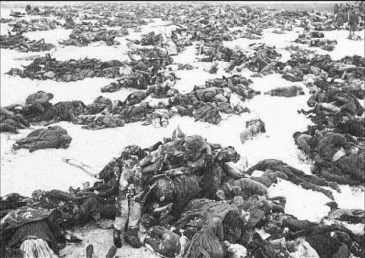
As many as 80,000 Red Army soldiers lay dead by the middle of October, 1942. Counting German losses and civilian deaths, the battle cost a quarter of a million lives up to this point, and the fighting still had months to go.
Ice floes in the Volga river further cut off the defender’s supplies, reducing them to cannibalism as a massive Soviet counter-attack was building on the German’s exposed left flank.
By November, General Georgy Zhukov had assembled over a million fresh troops, 1,500 tanks, 2,500 heavy guns, and three Air Armies for the assault on Stalingrad. The rumble of artillery, the “Great Soviet God of War” could be heard across the steppe as the Soviet counter-attack commenced in a blinding snowstorm on November 19th, 1942. It was now the Germans who were trapped.
German General Friedrich von Paulus asked Hitler’s permission to withdraw before they became surrounded. The response was that he should fight “to the last soldier and the last bullet.”
German forward movement on the Eastern Front came to an end in February, 1943, when 91,000 freezing, wounded, sick and starving Germans were surrendered to the Red Army.
Even then, as many as 11,000 Germans refused to lay down their arms and continued to fight from the cellars and the sewers of Stalingrad, holding on until early March.
Disease, death marches, cold, overwork, mistreatment, and malnutrition would all take their toll on the prisoners. Of the nearly 110,000 who went into captivity after the Battle of Stalingrad, fewer than 6,000 lived to return to Germany, after the war.
French President Charles de Gaulle came to New York City in 1960, surprising media and dignitaries alike when all he wanted to do was to visit with a black elevator operator at the Rockefeller Center.
Eugene James Bullard was born October 9, 1894 in Columbus Georgia, the seventh of 10 children born to William Octave Bullard and an indigenous Creek named Josephine “Yokalee” Thomas. Bullard’s father had come from Martinique, where his people could trace their lineage back to the Haitian Revolution.
Eugene wanted to leave behind the racial discrimination of his day. The near-lynching of his father became the catalyst in 1902, when the boy was eight. He ran away from home, spending the next four years doing odd jobs to survive The elder Bullard had always told him “in France a man is accepted as a man regardless of the color of his skin”. In 1906, the boy stowed away on a German ship to Aberdeen.
Bullard worked a number of odd jobs to support himself. By age 16 he was becoming well known as a boxer, and moved to Paris at the first opportunity.
WWI broke out in August of 1914. By the end of the year the French nation had suffered over a half million casualties.
Bullard enlisted in the French Foreign Legion, an American serving as one of 54 different nationalities serving in the Moroccan Division, Third Marching Regiment.
The Regiment was sent to the Somme front in 1915, where 300,000 Frenchmen were lost by the end of November. One unit of 500 men began the disastrous Champagne offensive of September. At the end of the battle, 31 responded to the first evening’s roll call.
What remained of Bullard’s unit was disbanded to form the 170th Infantry, and sent to Verdun. He thought he had arrived in hell, saying, “I thought I had seen fighting in other battles but no one has ever seen anything like Verdun – not ever before or ever since.”
Erich von Falkenhayn had designed his battle plan for Verdun to “bleed France white”, calling Verdun Operation Gericht. Operation Execution Place. Over 250,000 died in the 10 months long battle, more than 100,000 were missing and 300,000 gassed or wounded.
Bullard had been wounded four times before. On March 5th 1916, he received the wounds that took him out of the ground war. He was 8 months in hospital when the opportunity arose to join the French Flying Corps. A white American buddy bet him $2,000 that he couldn’t get into aviation and become a pilot, and he took the challenge. Bullard earned his wings on May 5, 1917, and received his $2,000 soon thereafter.
Bullard was assigned to the 93d Spad Squadron on August 17, 1917, flying Spad V11s and Nieuports with a mascot, a pet Rhesus Monkey he called “Jimmy”. He said, “I was treated with respect and friendship – even by those from America. Then I knew at last that there are good and bad white men just as there are good and bad black men.”
The first black combat pilot and the only one to serve in the Great War, Bullard painted a bleeding red heart pierced by a knife on the side of his Spad biplane. Below the heart were the words “Tout le Sang qui coule est rouge!” The phrase roughly translates as “All Blood Runs Red”.
Bullard is credited with two kills while flying for the 93rd, though one of the Germans crashed behind enemy lines so it remained unconfirmed. He tried to join the American squadron when the US entered the war, but the whites only policy of the time prevented him from doing so.
Bullard married in 1923. The marriage ended in divorce, with Bullard gaining custody of their two surviving daughters (a son had died of pneumonia in infancy). He became a drummer at the jazz club, “Le Grand Duc”, later buying his own club and calling it “L’Escadrille”. Bullard made several famous friends during this time, including Josephine Baker, Louis Armstrong, Langston Hughes and the French flying ace Charles Nungesser.
He volunteered with the 51st Infantry when WWII broke out, becoming wounded and escaping to the United States in 1940.
Bullard spent his last days in obscurity. His daughters had married by the 1950s, and he lived alone in a New York apartment, decorated with pictures of his famous friends and a framed case containing his fifteen French war medals. He worked as an elevator operator at the Rockefeller Center, where nobody knew anything about his service.
The French government requested his presence in 1954, when he and two white Frenchmen were accorded the honor of relighting the Eternal Flame at the Tomb of the Unknown French Soldier at l’Arc de Triomphe.
France honored Bullard once again in 1959, naming him a Knight of the Légion d’honneur in a lavish ceremony in New York City. Dave Garraway interviewed him on the Today Show, but he remained alone and unknown in his native country.
French President Charles de Gaulle came to New York City in 1960, surprising media and dignitaries alike when all he wanted to do was to visit the black elevator operator who worked at the Rockefeller Center.
Eugene James “Jacques” Bullard died on October 12, 1961. He was buried with the tri-color of France draping his coffin, laid to rest with full honors by the Federation of French War Officers at Flushing Cemetery in New York.
The first black fighter pilot, the “Black Swallow of Death”, was honored by the country he had loved and served during two world wars. On August 23, 1994, 77 years after Bullard’s American flight physical, the USAF posthumously awarded Eugene Bullard a commission as a Lieutenant.
Kennedy and Willy remained aboard as BQ-8 completed its first remote controlled turn at 2,000′, near the North Sea coast. They removed the safety pin arming the explosive, Kennedy sending the code “Spade Flush”, to signal the task was complete. They were his last words.
The Normandy landings were two months in the past in August 1944, with yet another 9 months of hard fighting to go before the defeat of Nazi Germany.
Allied strategic bombing was having little effect on German submarine pens and rocket launch sites. Operations “Aphrodite” and “Anvil” were supposed to help. The idea was to load old Boeing B-17 Flying Fortresses and B-24 Liberator bombers with tons of explosives, fly it via radio control, and crash it directly onto a target.
The drone was to fly at 2,000′ with the controlling aircraft directing the flying bomb onto its target from 20,000′. The converted bombers required a minimum of two crew to take off and operate. The plan was to have them bail out over the English Channel, a waiting boat picking up the two pilots while control of the drone passed to the operating aircraft.
On August 12, 1944, Lt. Joseph Patrick “Joe” Kennedy, Jr. and Lieutenant Wilford John Willy stepped into a converted B-24 Liberator, designated BQ-8. It was the seventh Aphrodite mission, and Willy had “pulled rank” on Kennedy’s usual co-pilot, Ensign James Simpson, in order to be on the mission.
Two Lockheed Ventura mother planes with radio control sets took off from RAF Fersfield at 6:00pm, followed by the BQ-8 aircraft, loaded with 21,170 lbs of Torpex, a British high explosive 50% more powerful than TNT. Two P-38 Lightning fighters followed, as mission escort. A sixth aircraft followed the formation, a de Havilland Mosquito, come to film the operation. In an unlikely historical coincidence, the Mosquito was piloted by Colonel Elliott Roosevelt, USAAF, son of President Franklin Delano Roosevelt.
The target was the Fortress of Mimoyecques and its V-3 cannons, in the north of France.
Kennedy and Willy remained aboard as BQ-8 completed its first remote controlled turn at 2,000′, near the North Sea coast. They removed the safety pin arming the explosive, Kennedy sending the code “Spade Flush”, to signal the task was complete. They were his last words. The aircraft exploded two minutes later, a shower of wreckage coming to earth near the village of Blythburgh in Suffolk, England. A series of small fires were started and 59 buildings were damaged, but there were no casualties on the ground. The bodies of Kennedy and Willy were never recovered.
There would be fourteen such missions in total. Only one caused damage to the intended target, and that may have been accidental. In the end, the program killed more American airmen than it did Nazis. More damage was done to the British countryside, than to German interests.
When Joseph Kennedy Jr. was born, his grandfather John F. Fitzgerald, then Mayor of Boston, said, “This child is the future President of the nation”. He had been a delegate to the Democrat’s National Convention in 1940, and planned to run for Massachusetts’ 11th congressional district in 1946.
Kennedy could have gone home, he had already completed the 25-mission requirement, to do so. Clearly, Joseph Kennedy Jr. had the resume, and he had the pedigree. He showed every indication of following the path which would later lead his brother to the Presidency. Joe Senior had already begun to lay the campaign groundwork when his son was killed.
‘What if’ histories are always tricky, but in this particular alternate universe, it seems safe to say. A future President of the United States was killed over the Blyth Estuary. 73 years ago, today.
Throughout the period, the “secret sauce” of Ottoman power was an army of elite infantry called “Janissaries”. Janissaries were Christian slaves, usually taken as spoils of war, or sold into slavery as children. They came from all over the Ottoman Empire, though the sons of Greek, Bosnian, Serbian and Bulgarian Christians were preferred. Turkic and Jewish boys were never forced to comply with the Janissary system.
The Anatolian Peninsula is the westernmost point of Asia, forming the northern coastline of the eastern Mediterranean. Today we call it Turkey. In the 13th century it was home to a collection of small emirates and Ghazi (Warrior for Islam) principalities, called ‘Beyliks’.
The Turkish tribes united under Osman Bey in 1299 grew to become one of the most powerful forces in history. A 600-year empire called the Ottomans.
The Ottoman victory at Kosovo in 1389 marked the end of Serbian power in the Balkans. Christian Europe launched a Crusade six years later, in an effort to relieve the Byzantine capitol of Constantinople, by then virtually all that remained of the eastern Roman Empire. This, the last of the major Crusades, was crushed at Nicopolis, in modern day Bulgaria. After the battle, a handful of nobles were held for ransom, those judged to be younger than 20 were sold into slavery. The rest, as many as 3,000 knights, were bound together in groups of three, and systematically beheaded. Never again would Greater Europe be altogether free of Islamic influence.
Siege Cannon of Sultan Mehmet II
By the 15th century, Ottoman controlled lands surrounded the Byzantine capitol of Constantinople. The forces of 21-year-old Sultan Mehmed II laid siege to the city in 1453, its ultimate defeat and sack punctuating the end of the Eastern Roman Empire and the birth of the “New City” – Istanbul.
Throughout this period, the “secret sauce” of Ottoman power was an army of elite infantry called “Janissaries”. Janissaries were Christian slaves, usually taken as spoils of war, or sold into slavery as children. They came from all over the Ottoman Empire, though the sons of Greek, Bosnian, Serbian and Bulgarian Christians were preferred. Turkic and Jewish boys were never forced into compliance with the Janissary system.
Janissary recruitment in the Balkans
Janissaries weren’t free, nor were they common slaves. They were subject to severe discipline, but paid salaries and retirement pensions, forming a distinct social class in Ottoman society. As boys, usually 10 to 12, they were taken from their parents and given to Turkish families to learn the language and customs. They were then enrolled in Janissary training, indoctrinated into Islam, and kept under 24-hour supervision.
Janissaries were prohibited from growing beards and taking up a skill other than war, and were forbidden to marry.
They were an elite slave army, in many ways resembling a modern army. Janissaries were the first to wear unique uniforms, first to be paid regular salaries for their service, the first to march in cadence, to music. They lived in barracks and made extensive use of firearms, campaigning with their own medical teams of Muslim and Jewish surgeons operating mobile hospitals behind the lines.
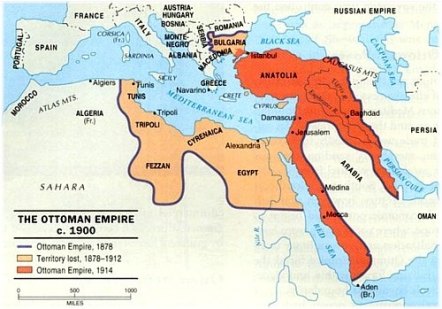
The Ottoman Empire reached the height of its power during the 16th and 17th centuries, under the reign of Suleiman the Magnificent. One of the most powerful states in the world and ruling over 39 million subjects, the Ottoman Empire controlled a territory spanning three continents: over two million square miles.
Serbia went to war with the Sultan for its independence in 1804, followed closely by Greece. Sultan Selim III attempted to modernize the army, but his reforms were opposed by the religious leadership and by the Janissary corps. Selim’s reforms would cost him his throne and ultimately his life, but internal order was restored in 1826, when Mahmud II put the Janissary Corps down in a bloody “reform”.
The Ottoman Empire then entered a period of decline, from which it would never emerge. Still one of the five continental Great Powers by the turn of the 20th century, the Ottoman Empire was “the Sick Man of Europe”, with its many minority populations pushing for independence.
Loyalty-obsessed to the point of paranoia, Sultan Abdul Hamid II told a reporter in 1890 that he would give his Armenian Christian minority a “box on the ear”. Hundreds of thousands of Armenians were murdered in the pogroms of 1894-96.
The Armenian genocide began in earnest with the arrest of Armenian intellectuals, a decapitation strike intended to deprive Armenians within the Ottoman Empire of any semblance of leadership and begun on “Red Sunday”, April 24. Detainees began to be deported within the Ottoman Empire by the end of May, their number reaching 2,345. Most, were eventually murdered.
Able bodied males were exterminated outright, or worked to death as conscripted labor. Women, children, the elderly, and infirm were driven on death marches to the farthest reaches of the Syrian desert. Goaded like livestock by military “escorts”, they were deprived of food and water, subjected at all times to robbery, rape, and outright murder. By the early 20s, as many as 1.5 million of the Ottoman Empire’s 2 million Armenian Christians, were dead.
The Armenian spyurk, an Aramaic cognate deriving from the Hebrew Galut, or “Diaspora”, goes back some 1,700 years. Today, the number of ethnic Armenians around the world tracing lineage back to this modern-day diaspora, numbers in the several millions.
Since 1919, Armenians around the world have marked April 24 as Armenian Genocide Remembrance Day.
To this day, it remains illegal in Turkey, to speak of the Armenian genocide. The New York Times wouldn’t use the term, until 2004.
This April, President Donald Trump received a furious response from Turkish President Recep Tayyip Erdoğan, for this seemingly-benign statement: “Beginning in 1915, one and a half million Armenians were deported, massacred, or marched to their deaths in the final years of the Ottoman Empire. I join the Armenian community in America and around the world in mourning the loss of innocent lives and the suffering endured by so many”.
The Ottoman Empire aligned itself with the losing side during WWI, its ultimate disintegration beginning on August 10, 1920, when representatives of Sultan Mehmed VI signed the Treaty of Sèvres. Future conflicts and treaties would shape and refine the borders, but the “Middle East” as we know it, was borne of the dissolution of the Ottoman Empire.
Mustafa Kemal and his “Young Turks” demanded complete independence, the Treaty of Lausanne creating the Republic of Turkey on October 29, 1923. Kemal became the country’s first president, granted the honorific “Atatürk” (“Father of the Turks”), in 1934. Multi-party democracy was established in 1946. Ever since, the Turkish military and judiciary have viewed themselves as defenders of the Kemalist ideals of a secular Turkish state.
Today, the former seat of the Ottoman Empire is 95% Muslim. The philosophical descendants of Atatürk vie with those of Erdoğan, the modern, constitutionally secular state, versus the fundamentalist theocracy.
Last year, elements of the Turkish military staged the 6th coup since 1960, in opposition to the increasingly Islamist policies of President Erdoğan, a man who once likened democracy to a bus: It gets you to your destination…then you get off. One man, one vote, one time. The coup was put down with a death toll of 265. 3,000 soldiers were arrested, and some 2,700 judges, fired.
As a NATO member, Turkey is privy to some of the US’ most closely held military secrets. Some 50 thermonuclear weapons are housed at Incirlik Air Base, 68 miles from the Syrian border, currently the hottest combat zone, on the planet. The strategic thinking behind such basing decisions are difficult to understand, at best. No aircraft currently based in Turkey, is capable of carrying even one of these weapons.
One might wish the history unfolding before our eyes, was more of a political issue, here in the States.
The 10,000lb, 10’8″ weapon was released at 28,900′. Seconds later, a perfect circle of 64 detonators exploded inside the heart of the bomb, compacting the plutonium core into a supercritical mass and exploding with the force of 20,000 tons of high explosive.
“Now I am become death, the destroyer of worlds“.
Trinity Test Fireball
The line comes from the Bhagavad Gita, the Hindu epic which Mohandas Gandhi described as his “spiritual dictionary”. On July 16, 1945, these words were spoken by J. Robert Oppenheimer, director of the Manhattan Project, as he witnessed “Trinity”, the world’s first nuclear detonation.
The project had begun with a letter from prominent physicists Leo Szilard and Albert Einstein to President Franklin Roosevelt, warning that Nazi Germany may have been working to develop a secret “Super Weapon”. The project ended with the explosion of the “Gadget” in the Jornada del Muerto desert, equaling the explosive force of 20 kilotons of TNT.
The Manhattan Project, the program to develop the Atomic Bomb, was so secret that even Vice President Harry Truman was unaware of its existence.
President Roosevelt passed away on April 14, and Harry Truman was immediately sworn in as President. He was fully briefed on the Manhattan project 10 days later, writing in his diary that night that the US was perfecting an explosive “great enough to destroy the whole world”.
Nazi Germany surrendered on May 7, but the war in the Pacific theater, ground on. By August, Truman faced the most difficult decision ever faced by an American President. Whether to drop an atomic bomb on Imperial Japan.
The morality of President Truman’s decision has been argued ever since. In the end, it was decided that to drop the bomb would end the war faster, with less loss of life on both sides, compared with the invasion of the Japanese home islands.
So it was that the second nuclear detonation in history took place on August 6 over the city of Hiroshima, Japan. “Little Boy”, as the bomb was called, was delivered by the B29 Superfortress “Enola Gay”, named after the mother of United States Army Air Forces pilot Lieutenant Colonel Paul Tibbets. 70,000 Japanese citizens were vaporized in an instant. Another 100,000 later died from injuries and the delayed effects of radiation.
Fat Man
Even then the Japanese Government refused to surrender. ‘Fat Man’, a plutonium bomb carried by the B29 “Bockscar”, was dropped on Nagasaki, on August 9.
The three cities originally considered for this second strike included Kokura, Kyoto and Niigata. Kyoto was withdrawn from consideration due to its religious significance. Niigata was taken out of consideration due to the distance involved.
Kokura was the primary target on this day, but local weather reduced visibility. Bockscar criss-crossed the city for the next 50 minutes, but the bombardier was unable to see well enough to make the drop. Japanese anti-aircraft fire became more intense with every run, and Second Lieutenant Jacob Beser reported activity on the Japanese fighter direction radio bands.
In the end, 393rd Bombardment Squadron Commander Major Charles Sweeney bypassed the city and chose the secondary target, the major shipbuilding center and military port city of Nagasaki.
The 10,000lb, 10’8″ weapon was released at 28,900′. 43 seconds later at an altitude of 1,650′, a perfect circle of 64 detonators exploded inside the heart of the bomb, compacting the plutonium core into a supercritical mass which exploded with the force of 20,000 tons of high explosive.
In the early 1960s, the Nagasaki Prefectural Office put the death count resulting from this day, at 87,000. 70% of the city’s industrial zone was destroyed.
Japan surrendered unconditionally on the 14th of August, ending the most destructive war in history.
Nazi Germany was, in fact, working on a nuclear weapon, and had begun before the allies. They chose to pursue nuclear fusion, colliding atomic particles together to form a new type of nuclear material, instead of fission, the splitting of the atom which resulted in the atomic bomb.
That one critical decision, probably taken in some laboratory or conference room, put Nazi Germany behind in the nuclear arms race. How different would the world be today, had Little Boy and Fat Man had swastikas painted on their sides.
The Mel Gibson film “Braveheart” has it mostly right as they depict Wallace’s betrayal by Scottish Nobles. Wallace had evaded capture until August 5, 1305, when a Scottish knight loyal to Edward, John de Menteith, turned him over to English soldiers at Robroyston, near Glasgow.
Following the death of King Alexander in 1286, there were several weak claimants to the Scottish throne. Thousands of nobles met in the great feudal court held at the castle Berwick upon Tweed, for the purpose of selecting their new King. In the end, the nobles selected John Balliol.
John was a weak king, known as “Toom Tabard”. Empty Coat. Factions quickly coalesced around rival claimants. Scotland was descending into civil war when nobles called on English King Edward I “Longshanks”, to arbitrate.
Edward could have entered this story as a benevolent and wise ruler, or he could have been a tyrant. He chose the latter course, passing into history as “The Hammer of the Scots”. Edward summoned King John to stand before the English Court as a common plaintiff. Thousands of Scottish nobles were arrested as John was forced to abdicate.
It’s uncertain where William Wallace came from, but later events indicate that he had military training. Specifically, he was an archer. He must have been an imposing physical specimen, as the first class long bow of the era had a draw weight of 170lbs.
Rebellion arose across Scotland as Wallace assassinated William de Heselrig, the English High Sheriff of Lanark, in May 1297. He became involved with raids happening all over Scotland, joining forces with Andrew Moray on September 11, 1297 to defeat a vastly superior English army at Stirling Bridge.
After the battle, Moray and Wallace assumed the title of “Guardians of the Kingdom of Scotland”, though Moray would soon die of injuries suffered at Stirling Bridge. They were sworn to restore the reign of King John Balliol, and Wallace was knighted as he led a large scale raid into northern England in November of 1297.
Edward ordered a second invasion of Scotland in April, 1298. Wallace was defeated at the battle Falkirk later that year. He managed to escape capture, resigning as Guardian of Scotland and traveling to the French court of King Philip IV to plead the case for assistance in the Scottish struggle for independence.
The Mel Gibson film “Braveheart” has it mostly right as it depicts Wallace’s betrayal by Scottish Nobles. Wallace had evaded capture until August 5, 1305, when a Scottish knight loyal to Edward, John de Menteith, turned him over to English soldiers at Robroyston, near Glasgow.
Wallace was transported to London and tried for treason and “atrocities against civilians in war.” He was crowned with a garland of oak, suggesting that he was “king of outlaws”. Responding to the treason charge, Wallace said “I could not be a traitor to Edward, for I was never his subject.” Wallace was found guilty on August 23, stripped naked, and dragged through the city by a horse to the Elms at Smithfield.
This is where the Braveheart film gets it wrong. I’m not going to dwell on the brutality which passes for medieval “justice”. Suffice it to say that the film’s portrayal of Wallace’s execution could have been a Disney production, compared with what was dealt him. When it was over, Wallace’s head sat atop a pike on London Bridge, dipped in tar, next to the heads of the brothers John and Simon Fraser.
Scotland never did gain independence from England, though the subject has never entirely been put to rest. Last June, the Scottish electorate voted to remain in the European Union, even should the rest of the UK vote to “Brexit”. William Wallace was looking down on the proceedings with great interest. I’m sure.


 British authorities demanded that Khalid order his forces to stand down and leave the palace. Instead, the new Sultan called up his palace guard and barricaded himself inside.


 A fortunate tidal crossing of the Somme River gave the English a day’s lead, allowing Edward’s forces time to rest and prepare for battle as they stopped to wait for the far larger French army near the village of Crécy.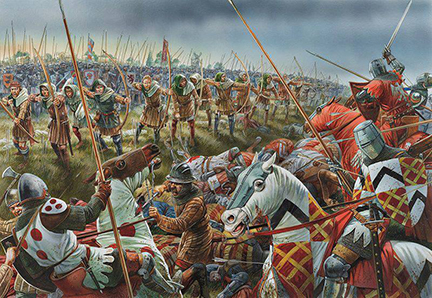



 The Corsican’s defeat at Waterloo and subsequent exile to Elba freed up some of the most elite, battle hardened troops in the world.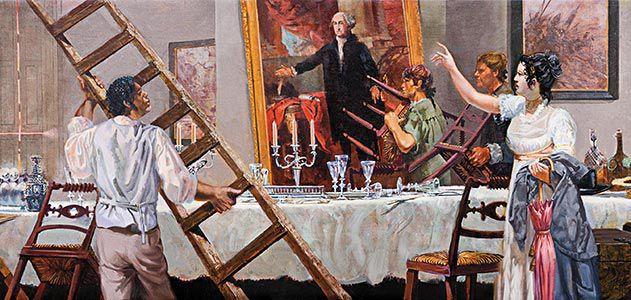
 General Ross sent two hundred men to secure a fort on Greenleaf’s Point. The fort had already been destroyed by American forces, but 150 barrels of gunpowder remained. The powder ignited while the British were trying to drop it into a well, killing at least a dozen and injuring many others.


 Bullard was assigned to the 93d Spad Squadron on August 17, 1917, flying Spad V11s and Nieuports with a mascot, a pet Rhesus Monkey he called “Jimmy”. He said, “I was treated with respect and friendship – even by those from America. Then I knew at last that there are good and bad white men just as there are good and bad black men.”


 Kennedy and Willy remained aboard as BQ-8 completed its first remote controlled turn at 2,000′, near the North Sea coast. They removed the safety pin arming the explosive, Kennedy sending the code “Spade Flush”, to signal the task was complete. They were his last words. The aircraft exploded two minutes later, a shower of wreckage coming to earth near the village of Blythburgh in Suffolk, England. A series of small fires were started and 59 buildings were damaged, but there were no casualties on the ground. The bodies of Kennedy and Willy were never recovered.
 When Joseph Kennedy Jr. was born, his grandfather John F. Fitzgerald, then Mayor of Boston, said, “This child is the future President of the nation”. He had been a delegate to the Democrat’s National Convention in 1940, and planned to run for Massachusetts’ 11th congressional district in 1946.


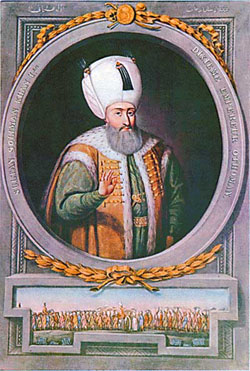 The Ottoman Empire reached the height of its power during the 16th and 17th centuries, under the reign of Suleiman the Magnificent. One of the most powerful states in the world and ruling over 39 million subjects, the Ottoman Empire controlled a territory spanning three continents: over two million square miles.


 The Mel Gibson film “Braveheart” has it mostly right as it depicts Wallace’s betrayal by Scottish Nobles. Wallace had evaded capture until August 5, 1305, when a Scottish knight loyal to Edward, John de Menteith, turned him over to English soldiers at Robroyston, near Glasgow.
 Historical Easter Eggs - Today in History
You must be logged in to post a comment.