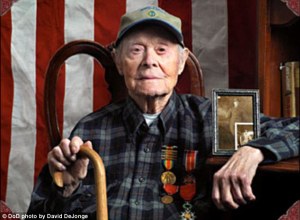
February 20, 1945 Falling on Grenades: the Indestructible Jack Lucas

On one training jump, both parachutes failed.  Somehow, Lucas fell 3,500-feet and sustained only minor injuries. According to his team leader, “Jack was the last one out of the plane and the first one on the ground”.

In the days and weeks following the Japanese attack on Pearl Harbor, enlistment and recruiting offices across the nation were flooded with volunteers. Birmingham Alabama saw 600 men in the first few hours, alone. In Boston, lines snaked out the door as men waited for hours, to volunteer.

But for his age, Jack Lucas would have been right there with them.

6faf2f23e4e21cd5a8d6c926af674a60

At 5’8″ and a muscular 180-pounds, Jacklyn Harrell “Jack” Lucas was big for his age. On August 8, 1942, Lucas forged his mother’s signature on parental consent papers and claimed to be seventeen, enlisting in the United States Marine Corps. He was fourteen years old.

A year later, a letter to a girlfriend from V Amphibious Corps at Pearl Harbor, revealed his true age of fifteen. Military censors had Lucas removed from his combat unit and nearly sent him home, but Jack was vehement.  He was assigned to driving a truck, but this was a problem.  Being in the “rear with the gear” was not his idea of military service.  Lucas got into so many fights he was court-martialed, sentenced to five months of breaking rocks, given nothing but bread & water.
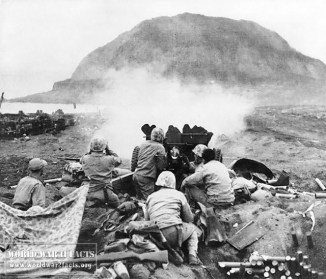
Iwo-Jima-Caves
Iwo Jima

Lucas was released from the brig in January 1945, when he deserted his post, stowing away on the transport USS Deuel to get closer to the action.  He turned himself in on February 8, volunteering to fight.  Jack turned seventeen on February fourteen.  Six days later, he got his wish.

February 20 was day two of the five-week battle for Iwo Jima, some of the bloodiest fighting of the Pacific war, in WW2.   Advancing toward a Japanese airstrip under heavy fire, Lucas and three Marines took shelter in a trench, only to realize there were eleven Japanese soldiers, barely feet away. He managed to shoot two when his rifle jammed, looking down as that first grenade, came over the parapet.

Without a moment’s thought, Lucas dove over his fellow Marine and onto the grenade, as another fell by his side.  Let his Medal of Honor citation, pick up the story:

381“Quick to act when the lives of the small group were endangered by two grenades which landed directly in front of them, Private First Class Lucas unhesitatingly hurled himself over his comrades upon one grenade and pulled the other one under him, absorbing the whole blasting force of the explosions in his own body in order to shield his companions from the concussion and murderous flying fragments”.

Only when a second company moved through the area, did someone realize he was still alive.

Six days later, Jack Lucas’ deserter classification was removed from his record.  In time, all seventeen of his military convictions were overturned.  He’d endure twenty-one surgeries and even then, no fewer than two hundred pieces of metal remained in his body, some the size of .22-caliber bullets.

Jack Lucas was ruled unfit for duty and discharged on September 18, 1945.  He was awarded the Medal of Honor by President Harry S Truman, on October 5, at seventeen the youngest recipient of the nation’s highest award for military valor, since the Civil War.

The man had more than earned the name “indestructible”, but wait.  There’s more.

Lucas earned a business degree and returned to military service at age thirty-one, this time with the 82nd Airborne, of the United States Army.  On one training jump, both parachutes failed.  Somehow, Lucas fell 3,500-feet and sustained only minor injuries. According to his team leader, “Jack was the last one out of the plane and the first one on the ground“.

Two weeks later, he was back to jumping out of perfectly good aircraft.

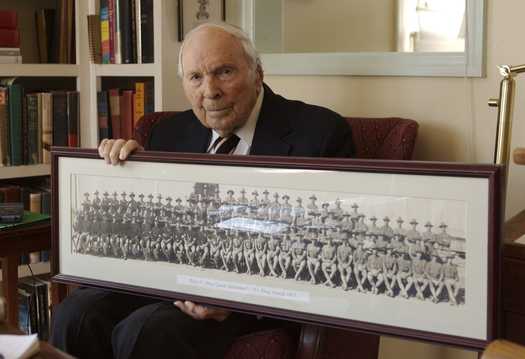
Jacklyn Lucas, older

Lucas was married several times in civil life, including to one woman, who attempted to have him killed.  He later wrote his autobiography with help from writer D.K. Drum, appropriately entitled, “Indestructible”.


The USS Iwo Jima (LHD-7) is a Wasp-class amphibious assault vessel, commissioned in 2001. When her keel was laid, Jack Lucas placed his Medal of Honor citation inside her hull, where it remains, to this day.

On August 3, 2006, sixteen living Marine Corps Medal of Honor recipients including Jack Lucas were presented the Medal of Honor flag by Commandant of the Marine Corps General Michael Hagee, in front of over a thousand family, friends, and fellow Marines. Lucas commented, “To have these young men here in our presence — it just rejuvenates this old heart of mine. I love the Corps even more knowing that my country is defended by such fine young people.”

Jacklyn Lucas

The Indestructible Jacklyn Lucas died of Leukemia on June 5, 2008.  He was eighty years old.  On September 18, 2016, Secretary of the Navy Ray Mabus announced plans to build a new Arleigh Burke-class destroyer. DDG-125 is expected to be commissioned in 2023, to be named in his honor, the USS Jack H. Lucas.

800px-USS_Jack_H._Lucas
Artist’s depiction, USS Jack H Lucas
If you enjoyed this “Today in History”, please feel free to re-blog, “like” & share on social media, so that others may find and enjoy it as well. Please click the “follow” button on the right, to receive email updates on new articles.  Thank you for your interest, in the history we all share.


February 18, 1817 The Awful Tragedy, of Friends at War

Three years came and went before the old friends once again faced each other, this time across the field of battle.   Gettysburg.

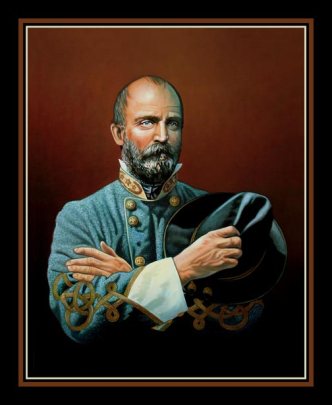
Armistead is a prominent name in Virginia.  The family goes back to colonial days.  Five Armistead brothers fought in the war of 1812. Major George Armistead commanded Fort McHenry during the Battle of Baltimore, the inspiration for Francis Scott Key’s Star Spangled Banner.

Major Armistead became an uncle this day in 1817, to Lewis Addison Armistead, the first of eight children born to General Walker Keith and Elizabeth Stanley Armistead.

“Lothario” or “Lo” to his friends, Armistead followed the family footsteps, attending the Military Academy at West Point.  He never graduated.  Some say he had to resign after breaking a plate over the head of fellow cadet and future Confederate General, Jubal Early.  Others say it was due to academic difficulties, particularly French class.

armistead_image.0
Lewis Addison Armistead

Be that as it may, Armistead’s influential father gained him a 2nd Lieutenant’s commission awarded in 1839, about the time his former classmates, received theirs.

Armistead’s field combat experience reads like a time-line of the age:  cited three times for heroism in the Mexican-American War, wounded at the Battle of Chapultepec, going on to serve in the Mohave War and the Battle of the Colorado River.

Stellar though his military career was, the man’s personal life was a series of disasters.  Armistead survived two wives and two daughters, only to lose the family farm in a fire.  All while fighting a severe case of Erysipelas, a painful and debilitating Streptococcal skin infection known in the Middle Ages as “St. Anthony’s Fire”.

The act of conjugating the “Be” verb changed after the Civil War.  Before, it was the United States “are”.  Afterward, it became the United States “is”, and not for no reason.  This was a time when Patriotic Americans felt every bit the attachment to states, as to the nation itself.

Though often plagued with doubt, fellow Americans took sides on the eve of the Civil War.  Even brothers.   Like fellow Virginian Robert E. Lee, Armistead wanted no part of secession, but followed his state when the break became inevitable.

Winfield Scott Hancock.gif
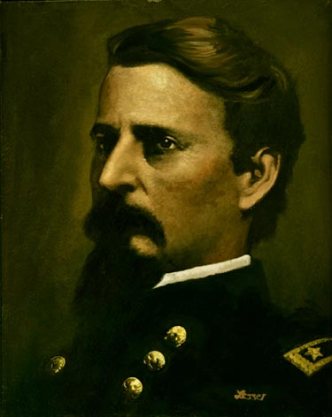
Winfield Scott Hancock

Pennsylvania native Winfield Scott Hancock went the other direction, staying with the Union.  Years later, “Hancock the Superb” would be the Democratic candidate for President of the United States, narrowly losing to Republican James A. Garfield.

At a time of rampant political corruption, Hancock was noted for personal integrity.  Though himself a Republican, President Rutherford B. Hayes spoke in terms of admiration:

“[I]f…we are to think first and chiefly of his manhood, his integrity, his purity, his singleness of purpose, and his unselfish devotion to duty, we can truthfully say of Hancock that he was through and through pure gold.”

Neither Armistead nor Hancock were politicians, nor the sort of hotheads responsible for starting the war.  These were professional soldiers, serving together and developing a close personal friendship, as early as 1844.  On final parting on the eve of Civil War, Armistead made Hancock the gift of a new Major’s uniform.

Three years came and went before the old friends once again faced each other, this time across the field of battle.   Gettysburg.

Robert E. Lee intended to break the Federal will to fight at Gettysburg, before moving on to threaten the Union capital, in Washington DC.  ‘Marse Robert” attacked his adversary’s right on that first day, looking for a soft spot in the line. On day two, he went after the left.  On the afternoon of July 3, 1863, Lee came straight up the middle.

640px-Pickett's_Charge_defence
A Union perspective, from Cemetery ridge

Armistead and Hancock looked out across the same field as gray and butternut soldiers formed up along seminary ridge.  The action began with the largest bombardment in the history of the western hemisphere, the mighty crash of 170 guns spread over a two-mile front.  The attack lasted for an hour, most shells flying harmlessly over the Union line and exploding, in the rear.  One shell disturbed the lunchtime mess of that “damn old goggle-eyed snapping turtle” George Gordon Meade, cutting one orderly in half and sending much of the senior staff, diving for cover.

DSC_0430.jpg

The eighty guns of the Union line responded at first, before going silent, one by one.  In the smoke and confusion, it was easy to believe they were put out of action, but no.  These would be held, until the final assault.

The action has gone into history as “Pickett’s Charge”, though that’s a misnomer.  Major General George Pickett commanded only one of  three Divisions taking part in the assault, under Corps Commander Lieutenant General James Longstreet.

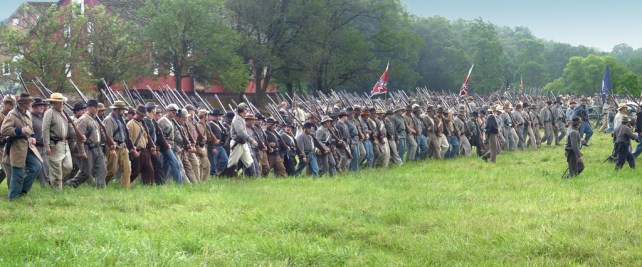
The pace was almost leisurely as Pickett’s, Trimble’s and Pettigrew’s gray and butternut soldiers stepped out of the forest, and over the stone wall.  Twelve to fifteen thousand men crossing abreast, bayonets glinting in the sun, banners rippling in the breeze.  One Yankee soldier described the scene as “an ocean of men sweeping upon us.”

longstreets-assault

You can’t escape the sense of history, if you’ve ever crossed that field. Stepping off Seminary Ridge with nearly a mile to go, you are awe struck by the mental image of thousands of blue clad soldiers, awaiting your advance.  First come the shells, exploding and tearing jagged holes, where men used to be.  Halfway across and just coming into small arms range, you can’t help a sense of relief as you step across a low spot and your objective, the “copse of trees”, drops out of sight.  If you can’t see them they can’t shoot at you.  Then you look to your right and realize that cannon would be firing down the length of your lines from Little Round Top, as would those on Cemetery Hill, to your left.

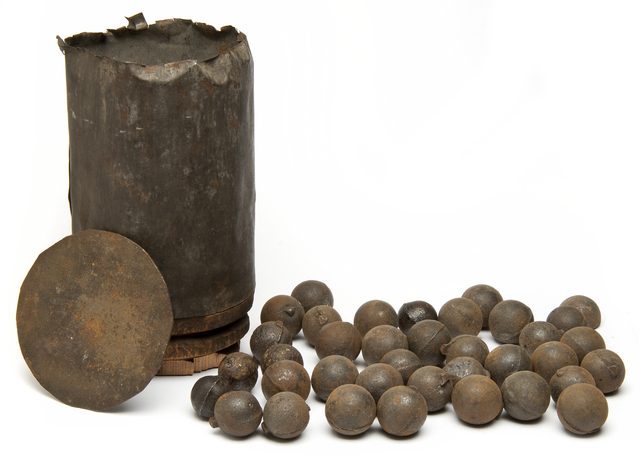
Rising out of the draw you are now in full sight of Union infantry.  You hear the tearing fabric sound of rifle fire, exploding across the stone wall ahead.  Cannon have converted to canister by now, thousands of projectiles transforming federal artillery into giant shotguns.  You quicken your pace as your lines are torn apart from the front and sides. Fences hold in some spots along the Emmitsburg Road.  Hundreds of your comrades are bunched up in the attempt to climb over, mowed down where they stand.

6543.3.1-12
Canister shot, Gettysburg

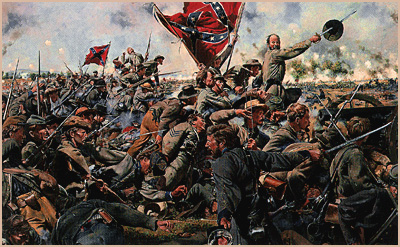
Finally you are over, closing at a dead run.  Seeing his colors cut down, Armistead put his hat atop his sword, holding it high and bellowing above the roar of the guns “Come on, boys, give them the cold steel! Who will follow me!”

Picketts-Charge

Eight months before, Federal troops were cut down like grass in that frozen December, attacking the Rebel-held stone wall at Fredericksburg.  So numerous were the multitudes of dying and maimed as to inspire the Angel of Marye’s Heights, one of the great acts of mercy, in the history of war.

Now on this hot July day, came the payback.  All along the Union line, the chant arose to a roar, resounding above the din of battle:  “Fredericksburg! Fredericksburg! Fredericksburg!”

Alonzo_Cushing
Alonzo Cushing

The savagery of that desperate struggle, can only be imagined.  With a shell fragment entering his shoulder and exiting his back and holding his own intestines with a free hand, Brevet Major Alonzo Cushing directed battery fire into the face of the oncoming adversary, until the bullet entered his mouth and exited the back of his skull.

150 years later, the 22-year-old received the Medal of Honor, posthumously awarded by President Barack Obama.

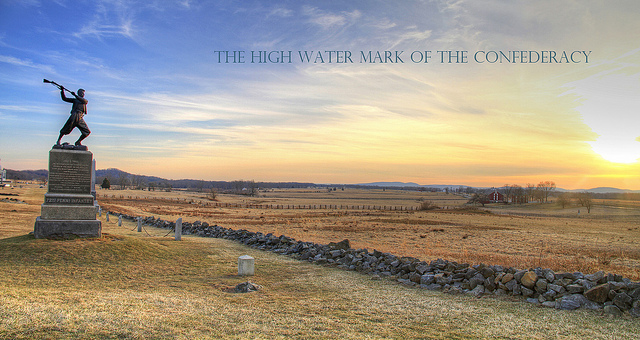
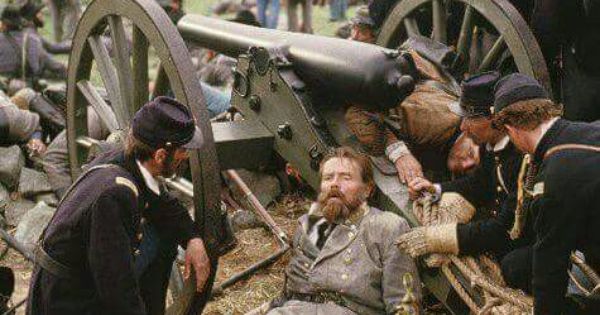
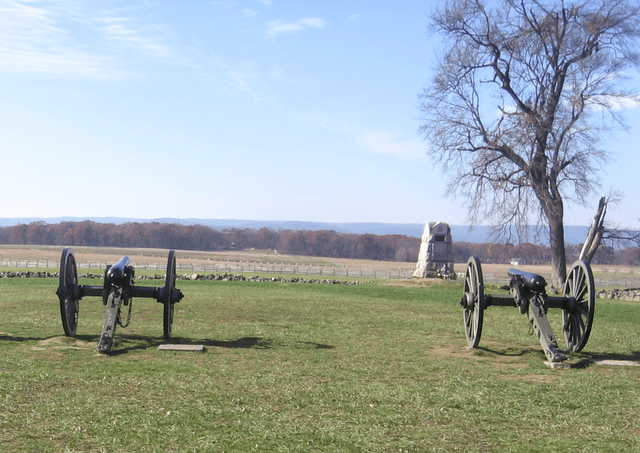
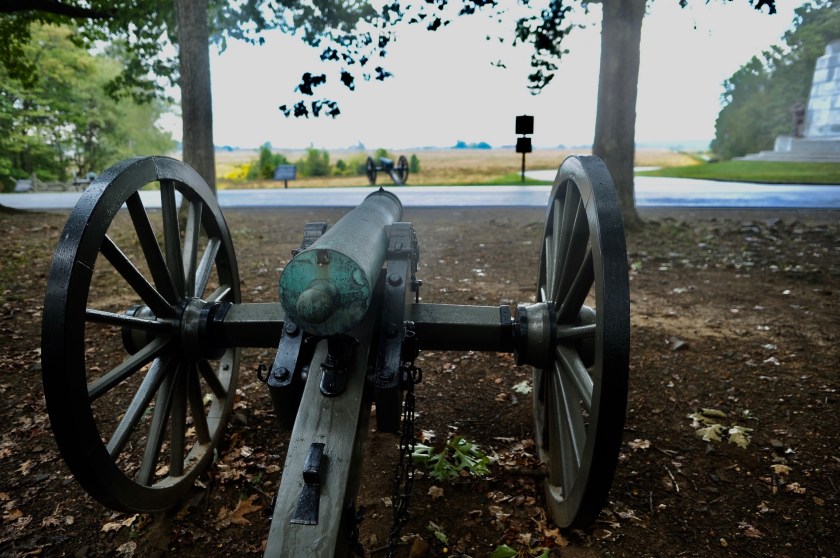
The “High Water Mark of the Confederacy” marks the point between the corner of a stone wall and that copse of trees, the farthest the shattered remnants of Longstreet’s assault would ever get.  Lewis Armistead made it over that wall before being shot down, falling beside the wheels of a Union cannon.

One day, the nation would reunite.  The two old friends, never did.  As Armistead sat bleeding in the grass, he was approached by Major Henry Bingham, of Hancock’s staff.  Hancock was himself wounded by this time, the bullet striking his saddle pommel and entering his thigh, along with shards of wood and a bent saddle nail.

8507324952_e123a4eeb2_z

Armistead was grieved at hearing the news.  Bingham received the General’s personal effects, with instructions they be brought to his old friend. To Almira (“Allie”) Hancock, the General’s wife, Armistead gave a wrapped bible and his personal prayer book, bearing the inscription ”Trust In God And Fear Nothing”.

There are those who debate the meaning of Lewis Armistead’s last message, though the words seem clear enough: “Tell General Hancock for me that I have done him and you all an injury which I shall regret the longest day I live.”

ef0189df7a86e869ce2ee2304ab9fc1d
From the film, Gettysburg’

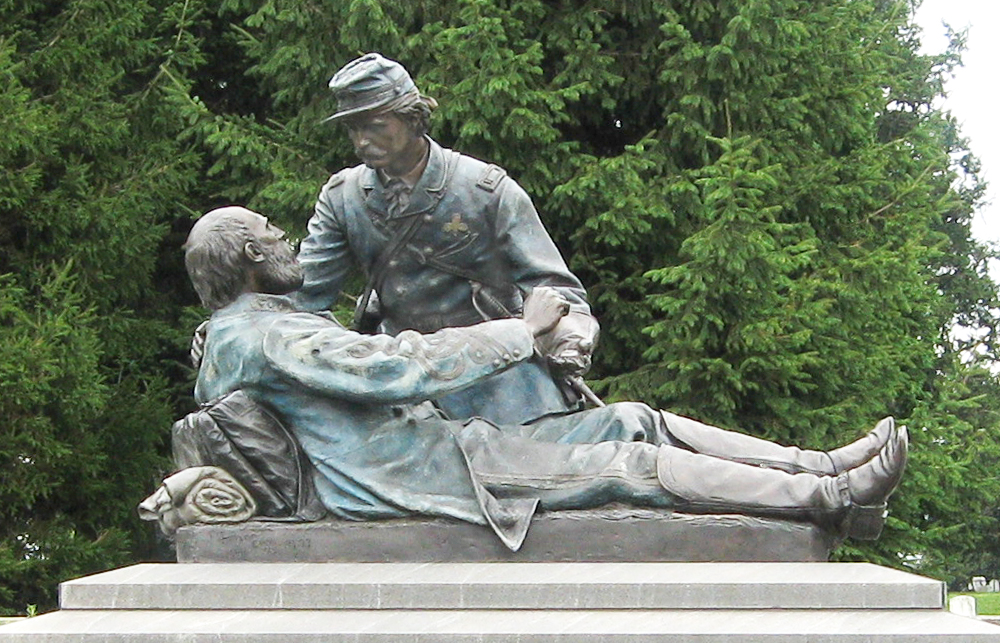
Feature image, top of page:  “The Friend to Friend Masonic Memorial is on the south side of Gettysburg in the National Cemetery Annex off Taneytown Road at the intersection with Steinwehr Avenue. (39.8210° N, 77.23177° W)” H/T Gettysburg.stonesentinels.com

If you enjoyed this “Today in History”, please feel free to re-blog, “like” & share on social media, so that others may find and enjoy it as well. Please click the “follow” button on the right, to receive email updates on new articles.  Thank you for your interest, in the history we all share.
February 17, 1895 Yellow Journalism

Circulation wars were white hot in those days, competing papers using anything possible to get an edge. Real-life street urchins hawked lurid headlines, heavy on scandal-mongering and light on verifiable fact. Whatever it took, to increase circulation.

YellowKidMickey Dugan was “born” on February 17, 1895, a wise-cracking street urchin from the wrong side of the tracks.  “Generous to a fault” with a “sunny disposition” Mickey was the kind of street kid you’d find in New York’s turn-of-the-century slums, maybe hawking newspapers. “Extra, Extra, read all about it!”

With his head shaved as if recently ridden of lice, Mickey was one of thousands of homeless urchins roaming the back lots and tenements of the city, not so much an individual as an archetype. Mickey Dugan was a cartoon character, the child of artist and “Buster Brown” creator, Richard Outcault.

Outcault’s “Hogan’s Alley” strip, one of the first regular Sunday newspaper cartoons in the country, became colorized by May of 1895. For the first time Mickey Dugan’s oversize, hand-me-down nightshirt was depicted in yellow.  Readers soon forgot his name.  He was simply “the Yellow kid”.

000789.1LOutcault worked for Joseph Pulitzer in those days, owner of the New York World Newspaper. Arch rival William Randolph Hearst hired the cartoonist away to work for Pulitzer’s cross-town competitor Journal American, but the pair soon learned that there was no copyright protection on the Yellow Kid. Soon the character was simultaneously appearing in both competing newspaper strips, where he would remain for over a year.

Circulation wars were white hot in those days, competing papers using anything possible to get an edge.  Real-life street urchins hawked lurid headlines, heavy on scandal-mongering and light on verifiable fact. Whatever it took, to increase circulation.

The Yellow Kid ceased to be of interest by 1898, but he lived on in a way, in the style of newspaper reporting which came to be known as “yellow journalism”.

PulitzerHearstWarYellowKids.jpg

After two wars for independence from Spain, the Caribbean island of Cuba found its economy increasingly intertwined with that of the United States. From the Spanish perspective, Cuba was more of a province than a colony, they were not about to relinquish a foot of territory. When the Cuban Rebellion of 1895 broke out, don Valeriano Weyler’s brutal repressions killed hundreds of thousands in Cuban concentration camps.

In America, some saw parallels between the “Cuba Libre” movement, in their own revolution of a hundred-odd years earlier. Fearing the economic repercussions of a drawn out conflict, shipping and other business interests put pressure on President McKinley to intervene. Meanwhile, the yellow papers kept the issue front page, whipping up popular fury with tales of the noble Cuban revolutionary and the barbaric Spaniard. There were even tales of American women being publicly strip searched by Spanish authorities.

USS_Maine01
USS Maine

The armored cruiser USS Maine left Key West headed for Cuba in January 1898, to protect US interests and to emphasize the need for a quick resolution to the conflict. Anchored in Havana Harbor on February 15, a massive explosion of unknown origin rocked the Maine, sinking the cruiser within minutes and killing 266 of the 355 Americans on board.

The McKinley administration urged calm. Conditions in Cuba were bad enough, but front page headlines like “Spanish Murderers” and “Remember the Maine” accompanied sensationalized accounts of Spanish brutality. War became all but inevitable when US Navy findings were released that March, stating that an external explosion had doomed the Maine.

MaineThe Spanish-American War began the following month, directly resulting in the Philippine-American war.

There is a story, that illustrator Frederic Remington said there was no war brewing in Cuba. Hearst is supposed to have replied. “You furnish the pictures and I’ll furnish the war.” The story may be apocryphal. The media can’t tell us what to think, but they can certainly control what we think ABOUT. Hearst and Pulitzer had clamored for two years for war with Spain, and they were happy to take credit when it came. Besides, it was good for circulation. A week after the Spanish-American War began in April, Hearst’s American Journal ran the headline “How do you like the Journal’s war?” Front page, above the fold.

spanish-american
War Propaganda

It’s been said that you should never pick a fight with a guy who buys ink by the barrel. I disagree. I have broken that dictum myself and recommend the practice to anyone so inclined. For all the Wizard of Oz antics of the print and electronic media, there remains only the one man behind the curtain. President Reagan once said of the Soviet Union, “doveryai no proveryai” (trust, but verify). He might have said the same of an information industry whose business model it is, to rent an audience to a sponsor.

In 1976, a team of American naval investigators concluded that the Maine explosion was likely caused by a fire which ignited its ammunition stocks, not by Spanish mine or act of sabotage.

Small consolation it was to 3,289 Americans and an estimated 90,000 Spaniards, killed in “the Journal’s war”. Nor to the loved ones, they left behind.

If you enjoyed this “Today in History”, please feel free to re-blog, “like” & share on social media, so that others may find and enjoy it as well. Please click the “follow” button on the right, to receive email updates on new articles.  Thank you for your interest, in the history we all share.
February 16, 1973 Cherry

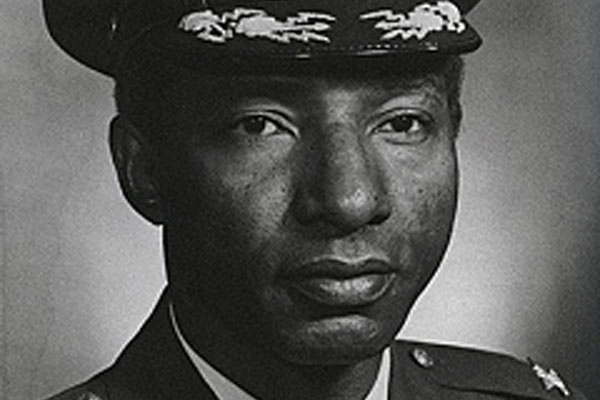
“I spent 702 days in solitary confinement…At one time I was either tortured or in punishment for 93 straight days.” Fred Vann Cherry, Sr.

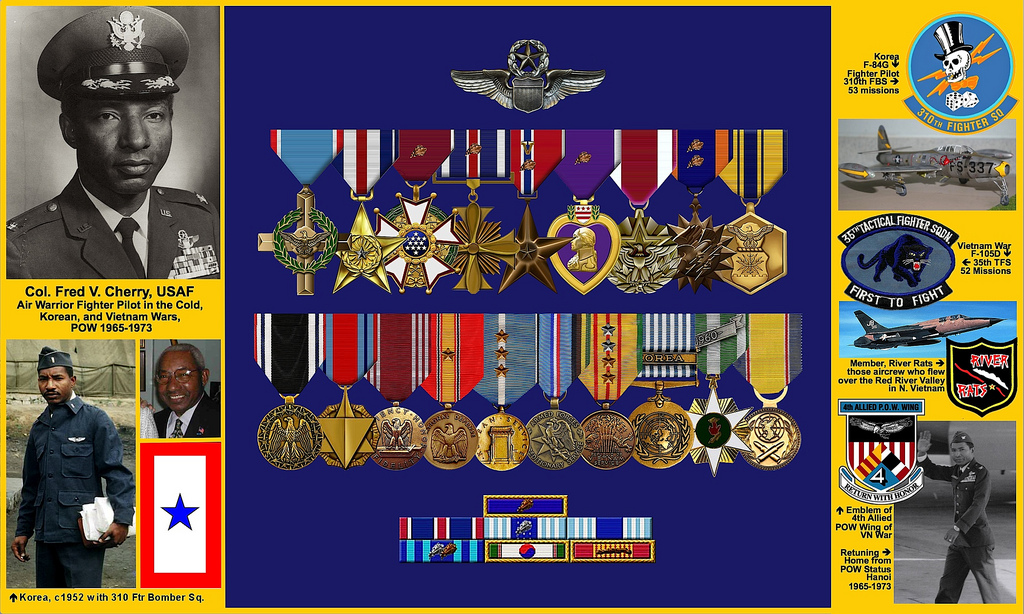
Fred Vann Cherry was born March 24, 1928, the child of poor Virginia dirt farmers.  Cherry had all the disadvantages of a black child growing up in the Jim Crow-era, but he stuck to his studies.  As a boy, Cherry attended racially segregated public schools in Suffolk Virginia, later attending the historically all-black Virginia Union University, and the United States Air Force Aviation Cadet Training Program.

An Air Force fighter pilot, Cherry flew 52 combat missions over North Korea, before going on to serve during the Cold War period, and the American war in Vietnam.

fred-cherry-600
Fred Vann Cherry, Sr.

On October 22, 1965, then-Major Cherry’s F-105 Thunderchief fighter-bomber was hit by anti-aircraft fire, fifteen miles north of Hanoi.  “The plane exploded and I ejected at about 400 feet at over 600 miles an hourIn the process of ejection, I broke my left ankle, my left wrist, and crushed my left shoulder. I was captured immediately upon landing by Vietnamese militia and civilians.”

Any fool can judge a man by the color of his skin.  Most fools, do.  Fred Cherry’s North Vietnamese captors were no exception.  The first American of African ancestry to fall into the hands of these people, Cherry was told things could go easier.  If only he spoke out about racial discrimination, in the United States.

Porter Halyburton
Porter Halyburton

When that failed to produce the propaganda victory they wanted, jailers assigned Cherry a cellmate, the self-described “southern white boy”, Naval aviator Porter Halyburton.

I guess they thought if they had a Southern white boy taking care of a black man, it would be the worst place for both of us,” Halyburton told the Washington Post. “It turned out to be the best thing that ever happened to me.”

Halyburton looked after his injured cellmate, changing the dressings on his infected wounds, feeding him, bathing him and watching over him. “He said I saved his life, and he saved my life. . . . Taking care of my friend gave my life some meaning that it had not had before.

For eight months, the two men lived in a series of putrid, stinking cells, 10-by-10-foot compartments with nothing to sleep on but filthy straw mats, or the floor.

I was so inspired by Fred’s toughness,” Halyburton said. “He had grown up in the racial South [and] undergone a lot of discrimination and hardship. But he was such an ardent patriot. He loved this country. It inspired me, and it inspired a lot of others.”

The two cellmates were separated in 1966, in what Halyburton remembers as “one of the saddest days of my life.”   Cherry recalled “I spent 702 days in solitary confinementAt one time I was either tortured or in punishment for 93 straight days.”

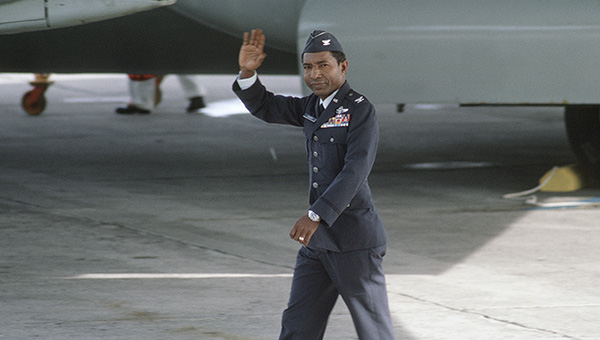
Fred Cherry February 16, 1973
Fred Cherry speaks to the press on February 16, 1973, following 2,671 days in captivity

The pair didn’t see each other again until 1973, when the two met at the military hospital at Clark Air Base in the Philippines following release from captivity.

Colonel Cherry and Commander Halyburton gave a number of joint talks at military institutions and colleges, and toured in 2004 to promote a book about their story, “Two Souls Indivisible: The Friendship That Saved Two POWs in Vietnam,” by James S. Hirsch.

Fred Cherry died on this day in 2016 at the age of 87, forty-three years to the day, from the news conference photographed above.  The Washington Post remembered in his obituary, what Colonel Cherry wrote in a 1999 collection of POW stories:

 “I was always taught to love and respect others and forgive those who mistreat, scorn or persecute me. . . . [This] allowed me overcome the damages of discrimination, Jim Crow, and the social and economic barriers associated with growing up a poor dirt farmer. . . . My standard for making decisions is based on doing what is right.”

It’s an inspiring message.  One worth remembering.

HOMECOMING
Former POW and U.S. Air Force Colonel Fred Vann Cherry waves to the public and press there to greet the plane load of former POWs flown in from Clark Air Base. Colonel Cherry was released by the North Vietnamese in Hanoi February 12, 1973.
If you enjoyed this “Today in History”, please feel free to re-blog, “like” & share on social media, so that others may find and enjoy it as well. Please click the “follow” button on the right, to receive email updates on new articles.  Thank you for your interest, in the history we all share.
February 14, 1945 Firestorm

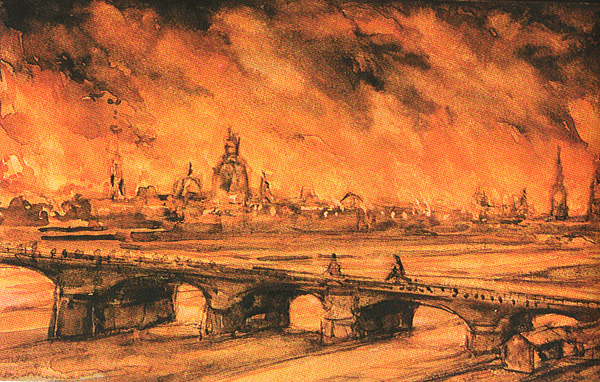
Tens of thousands of fires enveloped the city, growing into a great, howling firestorm.  A shrieking, all-but living demon beast from the blackest pits of hell, devouring all in its path. 

The most destructive war in history entered its final, apocalyptic phase in January 1945, with another four months of hard fighting yet remaining before Allied forces could declare victory in Europe. In the west, the “Battle of the Bulge” was ended, the last great effort of German armed forces spent and driven back beyond original lines. In the east, the once mighty German military contracted in on itself, in the face of a massive Soviet advance.

Dozens of German divisions hurried east to meet the threat. Allied intelligence believed the war could be over in April, if the major cities to the east were destroyed. Dresden. Leipzig. Chemnitz. Letting these places stand to serve as bases for retreating German forces, could drag the war out until November.

destroyed-german-equipment-znoymo-czechoslovakia-1945-may
German military equipment lies broken in Czechoslovakia, 1945

Sir Charles Portal, British Chief of the Air Staff, put the problem succinctly: “We should use available effort in one big attack on Berlin and attacks on Dresden, Leipzig, and Chemnitz, or any other cities where a severe blitz will not only cause confusion in the evacuation from the East, but will also hamper the movement of troops from the West.”

With its baroque and rococo city center, the capital city of Dresden was long described as the “Jewel Box” of the Free State of Saxony, family seat to the Polish monarchs and royal residence to the Electors and Kings of Saxony. Dresden was the seventh-largest city in Germany in 1945, home to 127 medium-to-large sized factories supplying the German war machine, and the largest built-up area in the “thousand-year Reich”, yet to be bombed.

Dresden_montage
Long described as “Florence on the Elbe” Dresden was considered one of the world’s most beautiful cities, a treasure of art and architecture.

For Victor Klemperer, the 13th of February, 1945, was the most terrifying and depressing experience, of a lifetime. Once home to well over 6,000 Jews, Dresden now contained but forty-one. Klemperer’s marriage to an “Aryan” wife had thus far protected him from the “final solution”, despite the yellow Juden star, he was forced to wear on his coat. It was now Victor’s task to hand out official letters, ordering those who remained to report for “deportation”. There wasn’t one among them, who didn’t understand what that meant.

Three hundred miles away, bad weather hampered operations for the United States Army Air Force (USAAF).  The first wave in the fire bombing of Dresden, would be a Royal Air Force (RAF) operation.

dresden-bombing (2)

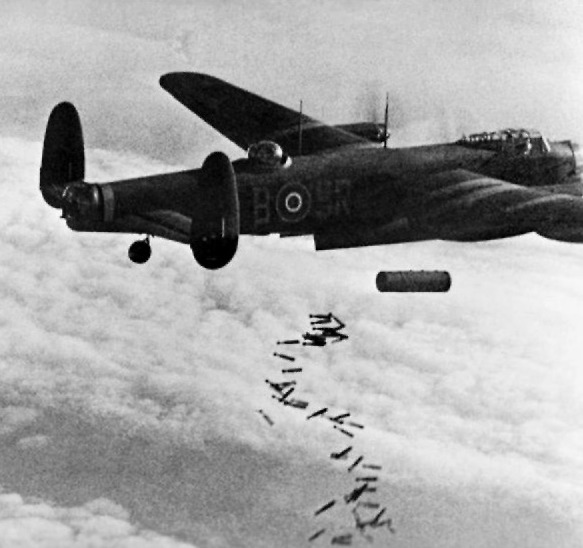
The first group of Lancaster bombers arrived in the skies over Dresden two hours before midnight, February 13. These were the pathfinders, their job to find the place and drop magnesium parachute flares, to light up the target. Then came the marker planes, Mosquito bombers whose job it was to drop 1,000-pound target indicators, their red glare providing something to aim at. Then came the first wave, 254 Lancaster bombers dropping 500 tons of high explosive ranging from 500-pounders to massive, 4,000-pound “blockbusters”. Next came 200,000 incendiary or “fire bombs”.

This thing was just getting started.

dresden

The second wave came in the small hours of February 14, just as rescue operations, were getting underway.  By now thousands of fires were burning, with smoke rising 15,000 feet into the air.  You could see it from the air, for five hundred miles.

That’s when another 529 Lancasters, dropped another 1,800 tons of bombs.

Lancaster_I_NG128_Dropping_Blockbuster_-_Duisburg_-_Oct_14,_1944
Lancaster bomber

The USAAF arrived over the target on the afternoon of February 14, the 317 B-17 “Flying Fortresses” of the “Mighty 8th” delivering another 771 tons, of bombs.

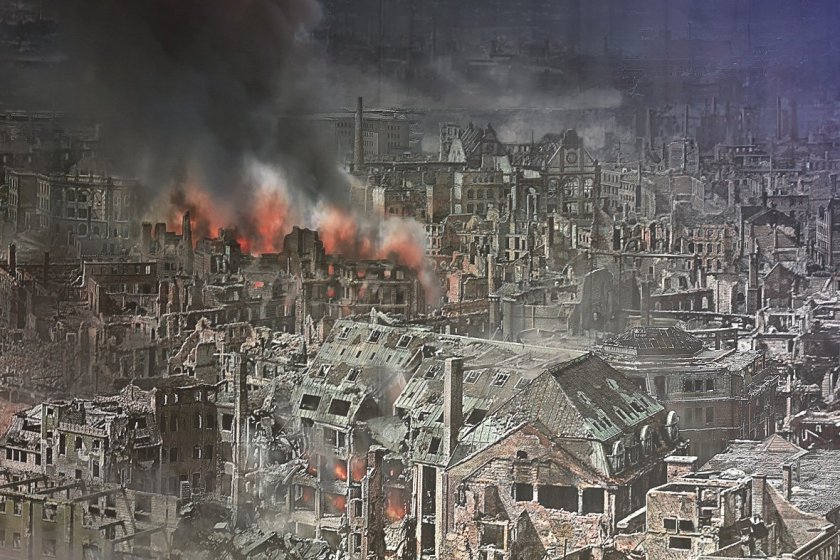
Tens of thousands of fires enveloped the city, growing into a great, howling firestorm.  A shrieking, all-but living demon beast from the blackest pits of hell, devouring all in its path.  A firestorm of this size develops its own weather, fire tornadoes reaching into the sky as pyrocumulonimbus clouds hurl lightning bolts back to earth, starting new fires.  Gale force winds scream into the vortex from all points of the compass, powerful enough to hurl grown adults opening doors in an effort to flee, off their feet and back into the flames.

Lothar Metzger was ten at the time.  He brings us one of the few eyewitness accounts of the fire bombing of Dresden, as seen from the ground:

“It is not possible to describe! Explosion after explosion. It was beyond belief, worse than the blackest nightmare. So many people were horribly burnt and injured. It became more and more difficult to breathe. It was dark and all of us tried to leave this cellar with inconceivable panic. Dead and dying people were trampled upon, luggage was left or snatched up out of our hands by rescuers. The basket with our twins covered with wet cloths was snatched up out of my mother’s hands and we were pushed upstairs by the people behind us. We saw the burning street, the falling ruins and the terrible firestorm. My mother covered us with wet blankets and coats she found in a water tub.

We saw terrible things: cremated adults shrunk to the size of small children, pieces of arms and legs, dead people, whole families burnt to death, burning people ran to and fro, burnt coaches filled with civilian refugees, dead rescuers and soldiers, many were calling and looking for their children and families, and fire everywhere, everywhere fire, and all the time the hot wind of the firestorm threw people back into the burning houses they were trying to escape from.

I cannot forget these terrible details. I can never forget them”.

dresden-bombing (3)

For Victor Klemperer, the fire bombing of Dresden was a last minute reprieve. He would survive the attack, and live to see the end of the war.

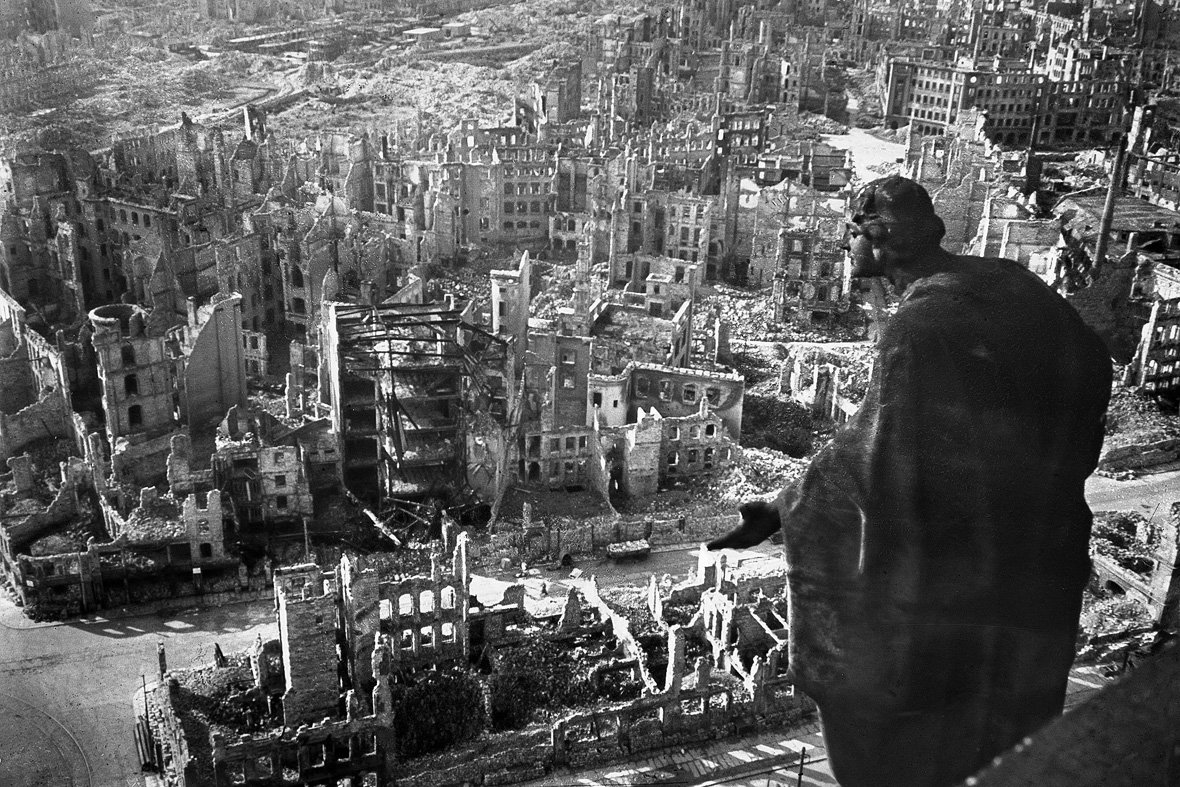
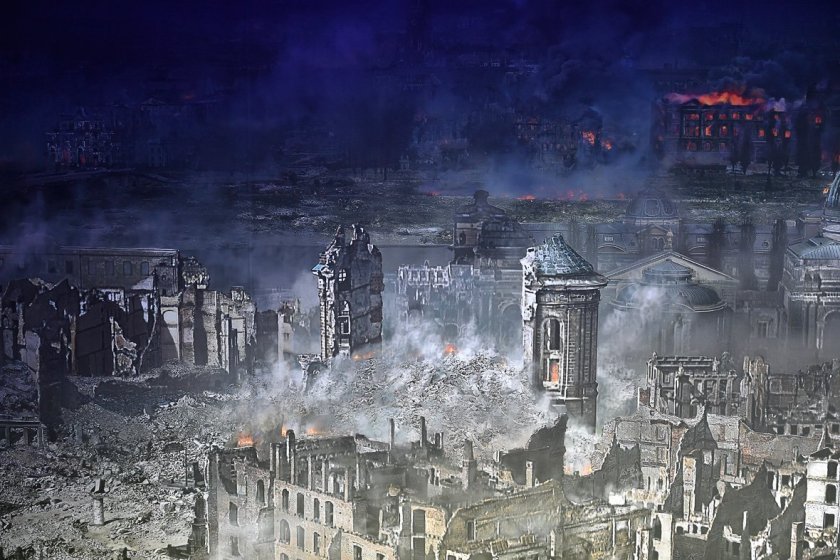
Official death tolls from the burned out city are estimated at 18,500 to 25,000. The real number will never be known.  Refugees and military forces in the tens of thousands were streaming through the area at this point in the war.  Estimates range as high as 200,000.  The number if true, is more than death tolls resulting from the atomic bombings of Hiroshima and Nagasaki, combined.

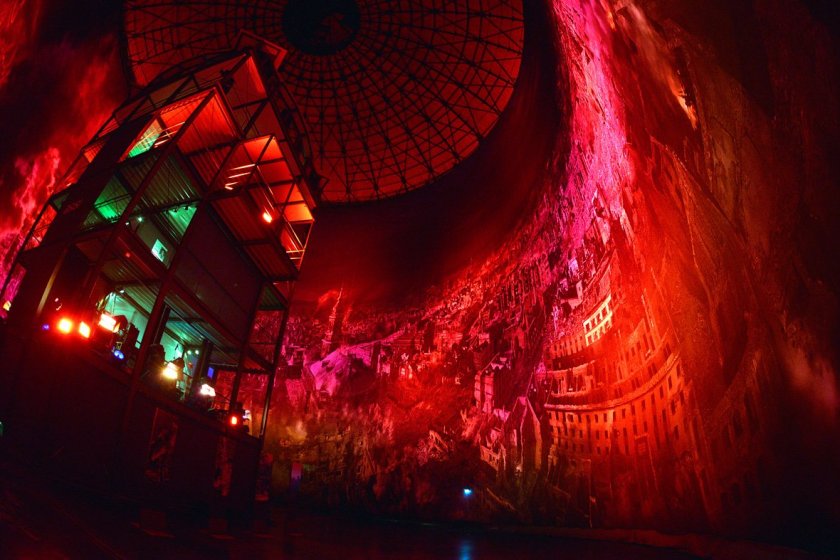
360-degree-panorama-display-depicting-city-dresden-aftermath-allied-firebombing
360° panoramic view of Dresden, following allied firebombing.  H/T International Business Times
If you enjoyed this “Today in History”, please feel free to re-blog, “like” & share on social media, so that others may find and enjoy it as well. Please click the “follow” button on the right, to receive email updates on new articles.  Thank you for your interest, in the history we all share.
February 11, 1462 Son of the Dragon

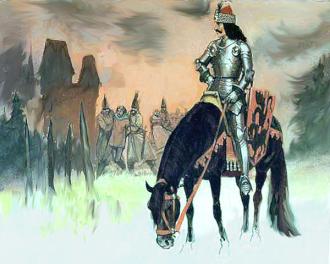
When a group of visiting Ottoman envoys declined to remove their turbans in Vlad’s court, the Prince ordered the turbans nailed to their heads.

Count Dracula, favorite of Halloween costume shoppers from time out of mind, has been around since the 1897 publication of Bram Stoker’s novel, of the same name.  Stoker’s working titles for the manuscript included “The Un-dead”, and “Count Wampyr”. He nearly kept one of them too, until stumbling into the real-life story of Vlad Țepeș (TSE·pesh), a Wallachian Prince and front-line warrior, against the Jihad of his day.

bram-stoker-draculaIn modern Romanian, “Dracul” means “The Devil”. In the old language, it meant “the Dragon”, the word “Dracula” (Drăculea) translating as “Son of the Dragon”.

Stoker wrote in his notes, “in Wallachian language means DEVIL“. In a time and place remembered for brutality, Vlad “the Impaler” Țepeș stands out for extraordinary cruelty. There are tales that Țepeș disemboweled his own mistress. That he collected the noses of vanquished adversaries. Some 24,000 of them. That he dined among forests of victims, spitted on poles. That he even impaled the donkeys they rode in on.

In 1436, Vlad II Dracul became Voivode (prince) of Wallachia, a region in modern-day Romania situated between the Lower Danube river and the Carpathian Mountains. The sobriquet “Dracul” came from membership in the “Order of the Dragon” (literally “Society of the Dragonists“), a monarchical chivalric order founded by Holy Roman Emperor Sigismund in 1408, dedicated to stopping the Ottoman advance into Europe.

order-of-the-dragonA crossroads between East and West, the region was scene to frequent bloodshed, as Ottoman forces pushed westward into Europe and Christian forces pushed back..
A weakened political position left Vlad II no choice but to pay homage to Ottoman Sultan Murad II, in the form of an annual Jizya (tax on non-Muslims) and a contribution of 500 Wallachian boys to serve as Janissaries, the elite slave army at the center of Ottoman power.

Vlad was taken hostage by the Sultan in 1442 along with his two younger sons, Vlad III and Radu. The terms of the boys’ captivity were relatively mild by the standards of the time and the boys became skilled horsemen and warriors.  While Radu went over to the Turkish side, Vlad hated captivity and developed an incandescent hate for his captors. It would last him all of his days.

Following the fall of Constantinople in 1453, Sultan Mehmed II set his sights on the invasion of all Europe.

Vlad III gained the Wallachian throne three years later and immediately stopped all tribute to Sultan Mehmed II, by now risen to 10,000 ducats a year and 1,000 boys. When a group of visiting Ottoman envoys declined to remove their turbans in Vlad’s court, the Prince ordered the turbans nailed to their heads.

Vlad, Ottoman EnvoysVlad now consolidated power as his reputation for savagery, grew. According to stories circulated after his death, hundreds of disloyal Boyars (nobles) and their allies met their end, impaled on spikes.

The conqueror of Constantinople now amassed power of his own, setting his sights on campaigns against Anatolia, the Greek Empire of Trebizond and the White Sheep Turkomans of Uzun Hasan. Throughout this period, Romanian control of the Danube remained a thorn in his side.

Pope Pius II declared a new Crusade against the Ottoman in 1460, but Vlad Țepeș was the only European leader to show any enthusiasm. The Hungarian General and Ţepeş’ only ally Mihály Szilágyi was captured by the Turks, his men were tortured to death and Szilágyi himself sawed in half.

vlad-tepes--i101077Țepeș invaded the Ottoman Empire the following year. In a letter to Hungarian king Matthias Corvinus dated February 11, 1462, Țepeș wrote: “I have killed peasants men and women, old and young, who lived at Oblucitza and Novoselo, where the Danube flows into the sea, up to Rahova, which is located near Chilia, from the lower Danube up to such places as Samovit and Ghighen. We killed 23,884 Turks without counting those whom we burned in homes or the Turks whose heads were cut by our soldiers…Thus, your highness, you must know that I have broken the peace with him (Sultan Mehmet II)”.

The Sultan invaded Wallachia at the head of a massive army, only to find a “forest of the impaled”. The Byzantine Greek historian Laonikos Chalkokondyles writes: “The sultan’s army entered into the area of the impalements, which was seventeen long and seven stades wide“.

To give a sense of scale to such a horror, a “stade” derives from the Greek “stadeon” – the dimensions of an ancient sports arena.

Vlad DraculaOutnumbered five-to-one, Ţepeş carried out a scorched earth policy, poisoning the waters, diverting small rivers to create marshes and digging traps covered with timber and leaves. He would send sick people among the Turks, suffering lethal diseases such as leprosy, tuberculosis and bubonic plague.

From his years in captivity, Ţepeş understood Ottoman language and customs as well as the Turks themselves. Absolutely fearless, he would disguise himself as a Turk and freely walk about their encampments.

On June 17, 1462, the Son of the Dragon launched a night attack on the Ottoman camp near the capital city of Târgoviște, in an effort to assassinate Mehmed himself. Knowing that the Sultan forbade his men from leaving their tents at night, a force of some 7,000 to 10,000 horsemen fell on Mehmed’s camp three hours after sunset. The skirmish lasted all night until 4 the next morning, killing untold numbers of Turks, their horses and camels. Ţepeş himself aimed for the Sultan’s tent, but mistook it for that of two grand viziers, Ishak Pasha and Mahmud Pasha.

800px-AtaculdeNoapte
The Battle With Torches by Romanian painter Theodor Aman, depicting the The Night Attack of Târgovişte,

Mehmed II “The Conqueror” survived the Night Attack at Târgovişte. In the end, the Romanian principalities had little with which to oppose the overwhelming force of the Ottoman Empire. Vlad III Țepeș would twice be deposed only to regain the throne but never able to defeat his vastly more powerful adversary.

In the end, the Romanian principalities had little with which to oppose the overwhelming force of the Ottoman Empire. Vlad III Țepeș would be twice deposed only to regain power. Unable to defeat his more powerful adversary, Vlad was exiled for several years in Hungary, spending much of that time in prison.

Heaven help the unsuspecting rodent who fell into his hands, in that wretched cell.

Vlad

If you enjoyed this “Today in History”, please feel free to re-blog, “like” & share on social media, so that others may find and enjoy it as well. Please click the “follow” button on the right, to receive email updates on new articles.  Thank you for your interest, in the history we all share.
February 8, 1943 The Gift of Valor

The Swedish-American poet Carl Sandburg once wrote “Valor is a gift.  Those having it never know for sure whether they have it until the test comes.” 

e4fe77529e36fb9999c1c4e195929129For six hundred years, the Balkan states of Southeastern and Central Europe were conquered and unwilling subjects of foreign powers. First the Ottoman, and then the Austro-Hungarian Empires.

By the dawn of the 20th century, the dream of a single state for ethnic Serbs, Croats and Slovenes had been around for some two hundred years.

The spark that started WW1 and literally changed the world was struck by the “Black Hand”, a secret society dedicated to Serbian liberation, no matter what.

The dream of sovereignty took form and shape in the wake of WW1, the six constituent republics of the Socialist Republic (SR) of Bosnia and Herzegovina, SR Croatia, SR Macedonia, SR Montenegro, SR Serbia, and SR Slovenia merging to form the “Kingdom of Serbs, Croats and Slovenes”.  A creation of the treaty ending the Great War, the place was referred to as the “Versailles State“, for the first ten years. The name was officially changed to Yugoslavia in 1929, literally translating as the “Land of all South Slavic peoples“.

tumblr_mzl45prz011stxu8xo2_500Lepa Svetozara Radić was born into this world on December 19, 1925.

From her earliest student days, Lepa Radić was known for dedication and hard work, a smart and serious girl, dedicated and reading well above grade level.

Radić developed strong left-of-center political views, taking influence from uncle Vladeta Radić, a strong proponent of the labor movement.

By that age when young teenage girls are thinking of other things, Radić had joined the League of Communist Youth of Yugoslavia (SKOJ). By the time she turned fifteen in 1941, she was a member of the Yugoslavian Communist Party.

As World War 2 enveloped the continent, a group of disaffected Yugoslav Army Air Force officers plotted to overthrow the government in Belgrade. The Cvetković government signed the Vienna protocol on March 25, 1941, signalling its intention to join the Tri-Partite pact of Nazi Germany, Fascist Italy and Imperial Japan. The bloodless coup d’état of two days later overthrew the Prince Regency of Paul Karađorđević, installing the pro-western, seventeen-year-old King Peter II, with encouragement and support from the British Special Operations Executive (SOE).

Adolf Hitler was apoplectic, taking personal offense at the coup d’état.  Der Fuhrer had no interest in waiting to see if the new government would declare loyalty.  Hitler summoned his military advisers the same day, determined “to destroy Yugoslavia militarily and as a state” and to do so “with pitiless harshness.

The Nazi invasion of Yugoslavia was overwhelming, simultaneously launched from bases in Germany, Hungary, Romania and Bulgaria.  The Yugoslav state never had a chance.  It was all over, in eleven days.

gettyimages-92424114-612x612

The invasion was over in April, but not the Resistance.

With the German stranglehold in tight control of the towns and roadways, a Serbian resistance was quick to form in the wild mountains of the war torn nation.  Two of them really:  the Chetniks, dedicated to support of the Royal government in exile and the ferociously pro-Communist Partisans, under the leadership of Josip Broz “Tito.”

For the Radić family, there was no question of loyalty.  Lepa’s father Svetor and uncles Voja and Vladeta joined the Partisans in July, leading to the arrest of the entire family by the Ustashe, the fascist Nazi-puppet government of Yugoslavia.

lepa_radic_i_nemci__1502623485_44934-e1502623544936-780x300Resistance fighters freed the Radić family in weeks. That December, Lepa and her sister Dara officially joined the Partisans.

Though only fifteen, Lepa Radić was as fierce in her opposition to the Nazis, as any Partisan. She volunteered for the front lines, joining the 7th Partisan company of the 2nd Krajiski Detachment, transporting wounded and defenseless from the battlefield. Did I mention, she was fifteen years old.

1190617_lepa-radic_ls-sLepa was found out in February 1943, coordinating the rescue of 150 women and children attempting to flee the Nazis. She fired everything she had at attacking SS forces, but never had a chance. Lepa Radić was captured and sentenced to death by hanging, tortured for three days to extract information on Yugoslavian Resistance.

She gave up the cube root of zero.

She was brought to a hastily constructed gallows on February 8, 1943, and hanged in full view of the public.

Lepa_Radić_hangedMoments before her execution with the rope around her neck, Radić was offered a pardon. All she had to do, was give up the names of her Partisan comrades.

“I am not a traitor of my people”, she said. “Those whom you are asking about will reveal themselves when they have succeeded in wiping out all you evildoers, to the last man.”

Those were her last words.

The Swedish-American poet Carl Sandburg once wrote “Valor is a gift.  Those having it never know for sure whether they have it until the test comes.”

Were I ever to be half so egregiously tested, I hope I would prove myself half the man, as that seventeen-year-old girl.

If you enjoyed this “Today in History”, please feel free to re-blog, “like” & share on social media, so that others may find and enjoy it as well. Please click the “follow” button on the right, to receive email updates on new articles.  Thank you for your interest, in the history we all share.
February 6, 2007 Animals at War

Neither knowing nor caring why they were there, the animals of the Great War suffered at prodigious rates. 

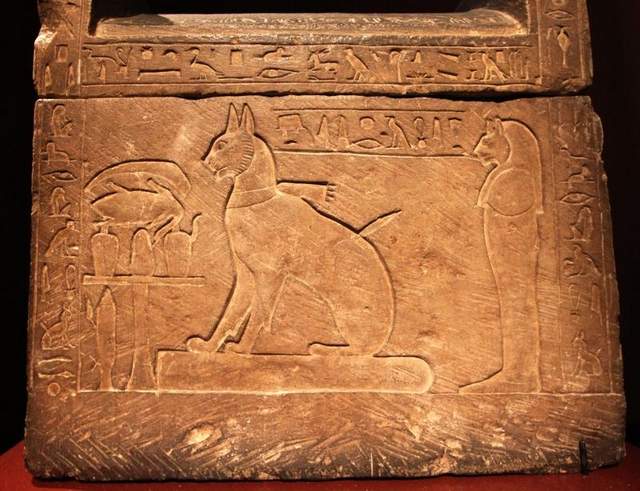
Mitochondrial DNA analysis of Felis silvestris catus suggests two great waves of expansion, first with the dawn of agriculture, when grain stores attracted vermin. Genetic analysis of the common house cat suggests they all descend from one of five feline ancestors: the Sardinian, European, Central Asian, Subsaharan African or the Chinese desert cat.

ta-mit

The second “cat-spansion” occurred later, as man took to water. From trade routes to diplomatic missions and military raids, men on ships needed food, and that meant rodents. The “ship’s cat” was a feature of life at sea from that day to this, first helping to control damage to food stores, ropes and woodwork and, in modern times, electrical wiring.

Fun fact:  Who knew the Vikings had cats!  Norskskogkatt_Evita_3

One Viking site in North Germany from ca 700-1000AD, contains one cat with Egyptian mitochondrial DNA.  Once driven nearly to extinction, the Norwegian Forest cat (Norwegian: Norsk skogkatt) descends from Viking-era ship’s cats, brought to Norway from Great Britain sometime around 1000AD.

Not without reason, were cats seen as good luck.  The power of cats to land upright is due to extraordinarily sensitive inner ears, capable of detecting even minor changes in barometric pressure.  Sailors paid careful attention to the ship’s cat, often the harbinger of foul weather ahead.

Left to right:  1. Ship’s cat, HMS Queen Elizabeth, Gallipoli Peninsula, 1915. 2. Togo, ships cat aboard the HMS Dreadnought, 3. Ship’s cats “inspect” the breech of a 4-inch gun aboard an unidentified US ship.

When the “Great War” arrived in 1914, animals of all kinds were dragged along.  Cats performed the same functions in vermin infested trenches, as those at sea.

1. Gunner with the regimental cat in a trench in Cambrin, France, February 6th, 1918.  2. Officers of the U.S. 2nd Army Corps with a cat discovered in the ruins of Le Cateau-Cambrésis 3. Trench cat, Gallipoli Peninsula, 1915

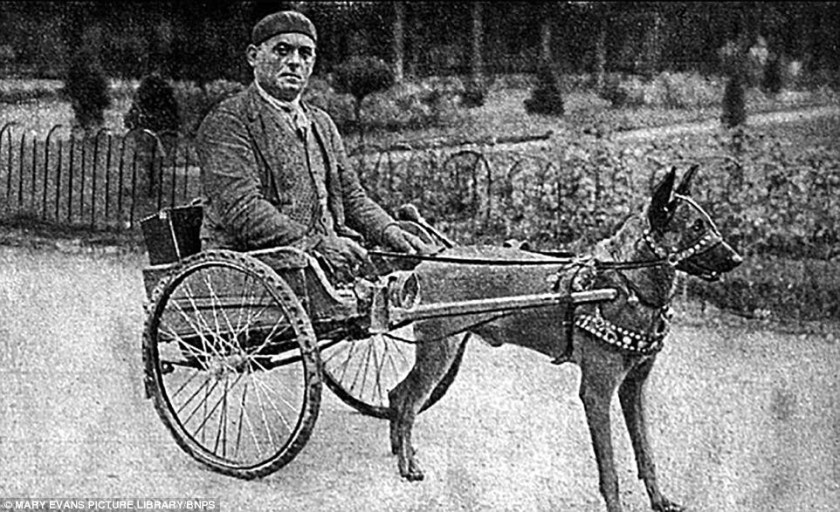
Tens of thousands of dogs performed a variety of roles, from ratters to sentries, scouts and runners. “Mercy” dogs were trained to seek out wounded on the battlefield, carrying medical supplies with which the stricken could treat themselves.

3F0CB7F500000578-4359902-image-a-15_1491812396284
“A dog pulling the wheelchair of a wounded French soldier in the remarkable series of images featured in new book Images of War, Animals in the Great War” H/T Daily Mail

The French trained specialized “chiens sanitaire” to seek out the dead and wounded, and bring back bits of uniform.  Often, dogs provided the comfort of another living soul, so the gravely wounded should not die alone.

3F0CB81C00000578-4359902-image-a-31_1491812576844
“Messenger dogs pictured running the gauntlet of rifle fire during their training during the First World War” H/T Daily Mail

With the hell of no mans land all but impassable for human runners, dogs stepped up, as messengers. “First Division Rags” ran through a cataract of falling bombs and chemical weapons. Gassed and partially blinded with shrapnel injuries to a paw, eye and ear, Rags still got his message where it needed to be.

rags-the-dog
“First Division Rags”

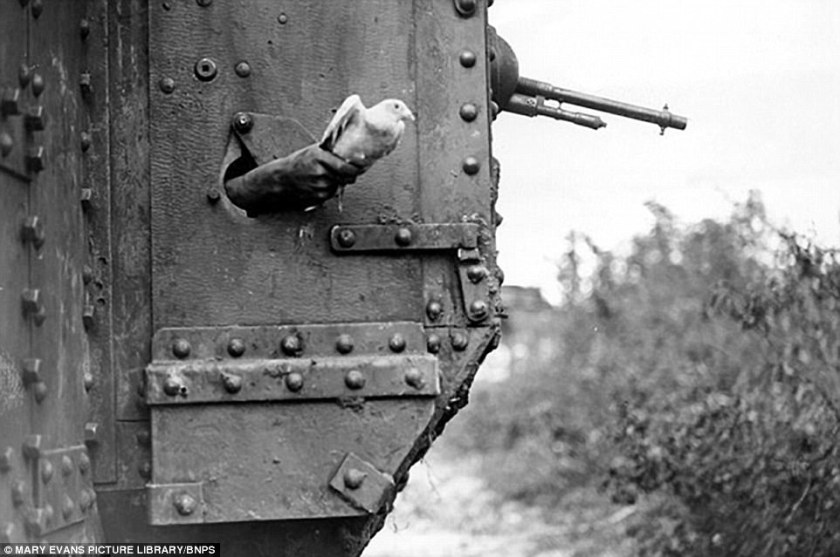
Other times, birds were the most effective means of communication. Carrier pigeons by the tens of thousands flew messages of life and death importance, for Allied and Central Powers, alike.

3F0CB81400000578-4359902-image-a-25_1491812524663
“A carrier pigeon held tight before release from the belly of a tank in 1918. Birds were often used to pass messages between troops” H/T Daily Mail
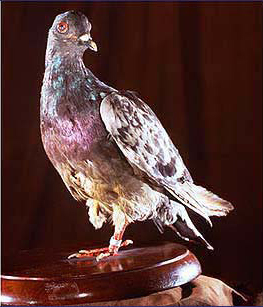
Cher Ami
Cher Ami

During the Meuse-Argonne offensive of 1918, Cher Ami saved 200 men of the “Lost Battalion”, arriving in her coop with a bullet through the breast, one eye shot out and a leg all but torn off, hanging by a single tendon.

Even the lowly garden slug pitched in.  Extraordinarily sensitive to mustard gas, “slug brigades” provided the first gas warnings, allowing precious moments in which to “suit up”.

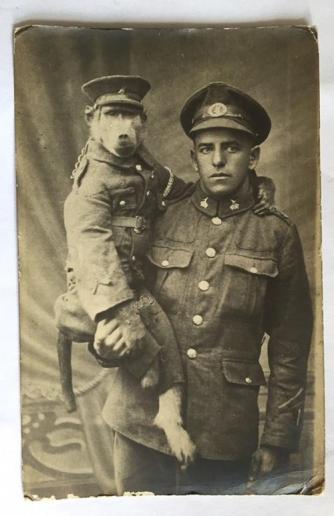
The keen senses of animals were often the only warning of impending attack.

Albert Marr, JackiePrivate Albert Marr’s Chacma baboon Jackie would give early warning of enemy movement or impending attack with a series of sharp barks, or by pulling on Marr’s tunic.

One of many wrenching images of the Great war took place in April, 1918.  The South African Brigade withdrew under heavy shelling through the West Flanders region of Belgium. Jackie was frantically building a stone wall around himself, when jagged splinters wounded his arm and all but tore off the animal’s leg.  Jackie refused to be carried off by stretcher-bearers, hobbling about on his shattered limb, trying to finish his wall

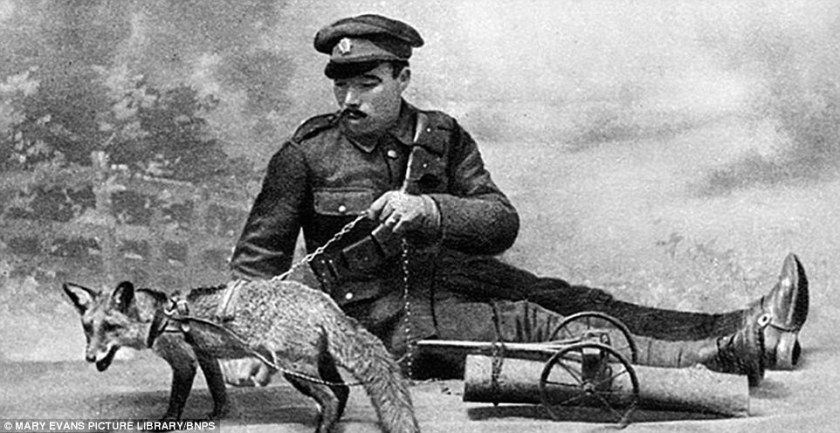
Constituted on June 13 1917, British Aero Squadron #32 kept a red fox, as unit mascot.

3F0CB7E800000578-4359902-image-a-11_1491812343121.jpg
H/T Daily Mail

The famous Lafayette Escadrille kept a pair of lion cubs, called Whiskey and Soda.

Escadrille 124_Whiskey Soda_zpsaljbdve0

German soldiers in Hamburg, enlisted the labor of circus elephants in 1915.

3F0CB7E400000578-4359902-image-a-8_1491812296139
H/T Daily Mail

The light cruiser Dresden was scuttled and sinking fast in 1914, leaving the only creature on board to swim for it.  An hour later an Ensign aboard HMS Glasgow spotted a head, struggling in the waves.  Two sailors dove in and saved him.  They named him “Tirpitz”, after the German Admiral.  Tirpitz the pig served out the rest of the war not in a frying pan, but as ship’s mascot aboard the HMS Glasgow.

3F0CB7DC00000578-4359902-image-a-4_1491812234452
“Tirpitz” the pig

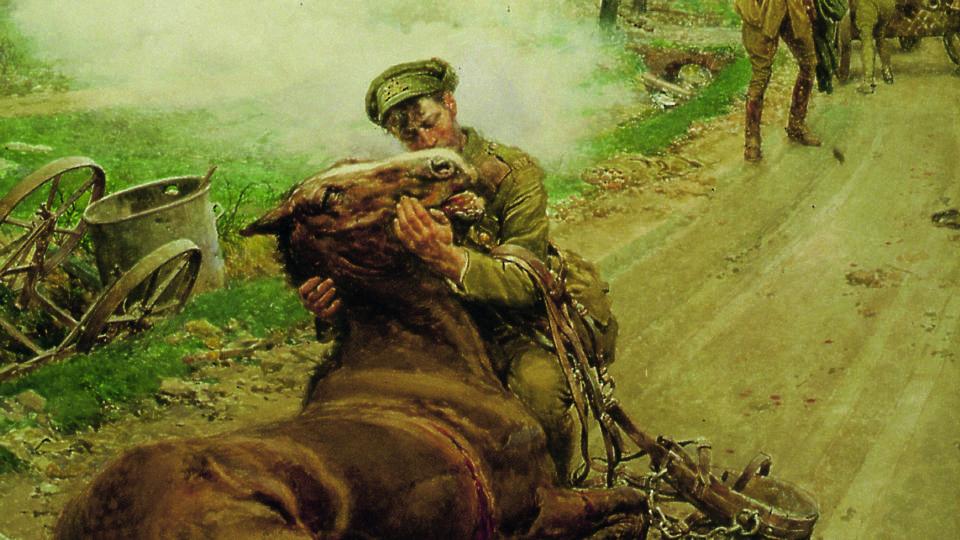
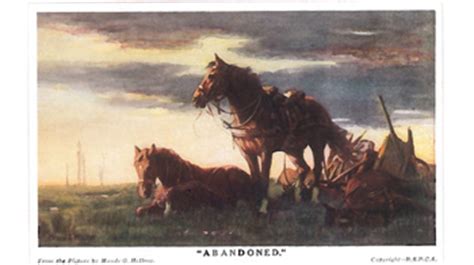
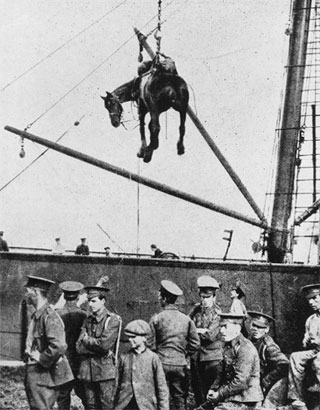
No beast who served in the Great war was as plentiful nor as ill used as the beast of burden, none so much as the horse.   Horses were called up by the millions, along with 80,000 donkeys and mules, 50,000 camels and 11,000 oxen. The United States alone shipped a thousand horses between 1914 and 1917, every day.

thIA31MUJ1Horsepower was indispensable throughout the war from cavalry and mounted infantry to reconnaissance and messenger service, as well as pulling artillery, ambulances, and supply wagons.  With the value of horses to the war effort and difficulty in their replacement,  the loss of a horse was a greater tactical problem in some areas, than the loss of a man.

horses-ww1-bFew ever returned.  An estimated three  quarters died of wretched working conditions.  Exhaustion.  The frozen, sucking mud of the western front.  The mud-borne and respiratory diseases.  The gas, artillery and small arms fire.  An estimated eight million horses were killed on all sides, enough to line up in Boston and make it all the way to London four times, if such a thing were possible.

The United Kingdom entered the war with only eighty motorized vehicles, conscripting a million horses and mules, over the course of the war.  Only one in sixteen, lived to come home.

War5 (1)

Neither knowing nor caring why they were there, the animals of the Great War suffered at prodigious rates.  Humane organizations stepped up, the British Royal Society for the Prevention of Cruelty to Animals (RSPCA) processing some 2.5 million animals through veterinary hospitals.  1,850,000 were horses and mules.  85% were treated and returned to the front.

Downsize_Help Save the Horse to Save the Soldier

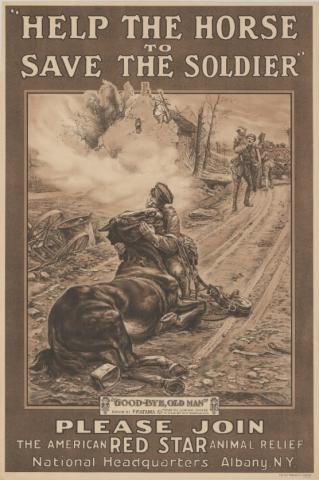
The American Red Star Animal Relief Program sent medical supplies, bandages, and ambulances to the front lines in 1916, to care for horses injured at a rate of 68,000 per month.

The century before the Great War was a Golden age, mushrooming populations enjoying the greatest rise in living standards, in human history. The economy at home would be dashed to rags and atoms by the Great War. Trade and capital as a proportion of the global economy would not recover to 1913 levels, until 1993.

Unseen amidst the economic devastation of the home front, was the desperate plight of animals.  Turn-of-the-century social reformer Maria Elizabeth “Mia” Dickin founded the People’s Dispensary for Sick Animals in 1917, working to lighten the dreadful state of animal health in Whitechapel, London.  To this day, the PDSA is one of the largest veterinary charities in the United Kingdom, carrying out over a million free veterinary consultations, every year.

Dickin_Medal

Dickin Medal

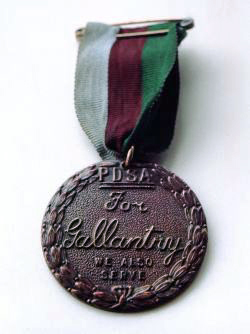
The “Dickin Medal” was instituted on December 2, 1943, honoring the work performed by animals, in WW2.  The “animal’s Victoria Cross”, the highest British military honor equivalent to the American Medal of honor, is awarded in recognition of “conspicuous gallantry or devotion to duty while serving or associated with any branch of the Armed Forces or Civil Defence Units.”

The Dickin Medal has been awarded 71 times, recipients including 34 dogs, 32 pigeons, 4 horses and a cat. An honorary Dickin was awarded in 2014, in honor of all animals serving in the Great War.

Two Dickins were awarded on this day in 2007. the first to Royal Army Veterinary Corps explosives detection dog “Sadie”, a Labrador Retriever whose bomb detection skills saved the lives of untold soldiers and civilians in Kabul, in 2005. The second went to “Lucky”, a German Shepherd and RAF anti-terrorist tracker serving during the Malaya Emergency of 1949 – ’52. Part of a four-dog team including “Bobbie”, “Jasper” and “Lassie”, Lucky alone would survive the “unrelenting heat [of] an almost impregnable jungle“.

Handler Beval Austin Stapleton was on-hand to receive Lucky’s award. “Every minute of every day in the jungle” he said, “we trusted our lives to those four dogs, and they never let us down. Lucky was the only one of the team to survive our time in the Malayan jungle and I’m so proud of the old dog today. I owe my life to him.

1024px-A_cat_on_HMAS_Encounter

Ship’s cat, Her Majesty’s Australian Ship (HMAS) Encounter, World War I


February 1, 1901 The End of Memory

The people he sought were over 101, one was 113. It could not have been easy, beginning with the phone call to next of kin. There is no delicate way to ask the question, “Is he still with us?” Most times, the answer was “no”.

last-of-the-doughboysThe Forgotten World War

In 2003, author Richard Rubin set out to interview the last surviving veterans of the Great War, the “War to End All Wars”.  World War One.

The people he sought were over 101, one was 113. It could not have been easy, beginning with the phone call to next of kin. There is no delicate way to ask the question, “Is he still with us?” Most times, the answer was “no”.

Sometimes, it was “yes”, and Rubin would ask for an interview. The memories his subjects sought to bring back were 80 years old and more.  Some spoke haltingly, and with difficulty.  Others were fountains of information, as clear and lucid as if the memories of which they spoke, were only  yesterday.

Rubin writes “Quite a few of them told me that they were telling me things that they hadn’t talked about in 50, 60, 70 years. I asked a few of them why not, and the surprising response often was that nobody had asked.”

anthony-pierro-at-107
Anthony Pierro at 107

Anthony Pierro of Swampscott, Massachusetts, served in Battery E of the 320th Field Artillery and fought in several of the major battles of 1918, including Oise-Aisne, St. Mihiel, and Meuse-Argonne.

Pierro recalled his time in Bordeaux, as the best time of the war. “The girls used to say, ‘upstairs, two dollars.’” Pierro’s nephew Rick interrupted the interview. “But you didn’t go upstairs.”  Although possibly unexpected, Uncle Anthony’s response was a classic.  “I didn’t have the two dollars”.

Reuben Law of Carson City, Nevada remembered a troop convoy broken up by a German U-Boat, while his own transport was swept up in the murderous Flu pandemic of 1918.

hildegarde-schan
Hildegarde Schan

They’re not all men, either. 107-year-old Hildegarde Schan of Plymouth, Massachusetts speaks of caring for the wounded.

Howard Ramsey started a new burial ground in France, we now know as theMeuse-Argonne American Cemetery.

“So I remember one night”, Ramsey said, “It was cold, and we had no blankets, or nothing like that. We had to sleep, we slept in the cemetery, because we could sleep between the two graves, and keep the wind off of us, see?”

Arthur Fiala of Kewaunee, Wisconsin remembered traveling across France in a boxcar marked “40-8″, (40 men or eight horses).

fialacombo
Arthur Fiala

There was J. Laurence Moffitt of Orleans, Massachusetts. Today, we see the “Yankee Division” on highway signs. At 106, this man was the last surviving member of his outfit, with a memory so clear that he could recall every number from every fighting unit of the 26th Division.

briantcombo
George Briant

George Briant was caught in an open field with his battery, as German planes dropped bombs from the sky.  Briant thinks he was hit by every one of them, too.  After several months in the hospital, he begged to go back to the front.  On the last night of the war, November 10, 1918, Briant came upon the bodies of several men who had just been shelled.

“Such fine, handsome, healthy young men”, he said, “to be killed on the last night of the war.  I cried for their parents. I mean it’s a terrible, terrible thing to lose anyone you love in a war, but imagine knowing precisely when that war ends, and then knowing that your loved one died just hours before that moment.

Rubin interviewed dozens of these men, and a handful of women. Their stories are linked HERE if you care to watch.  I highly recommend it.  Their words are more powerful than anything I can offer.

The Last Doughboy

Frank Woodruff Buckles, born Wood Buckles, is one of them. Born this day in 1901, Buckles enlisted with the First Fort Riley Casualty Detachment, trained for trench casualty retrieval and ambulance operations.  He was sixteen.

buckles2-obit-jumbo
Frank Woodruff Buckles, S/N 15577

The unit set sail from Hoboken New jersey in December 1917 aboard HMS Carpathia, a vessel made famous by the Titanic rescue, five years earlier.

Woodruff never saw combat but he saw lots of Germans, with a Prisoner-of War escort company.  Returning home in January 1920 aboard USS Pocahontas, Buckles was paid $143.90, including a $60 bonus.

Buckles was a civilian in 1940, working for the White Star Lines and WR Grace shipping companies. His work took him to the Philippines, where he remained after the outbreak of WWII. He was helping to resupply U.S. troops when captured by Japanese forces in January 1942, imprisoned for thirty-nine months as a civilian prisoner in the Santo Tomas and Los Baños prison camps.  He was rescued by the 11th Airborne Division on February 23, 1945, on the day he was to be executed.

buckles_and_bush
“I found out afterwards when I read up on my history that some of the things that I did were quite important”.

Buckles married Audrey Mayo of Pleasanton, California in 1946, and returned from whence he had come.  Back to the land, back to the Gap View Farm near Charles Town, West Virginia in January 1954, to farm the land his ancestors worked, back in 1732.

Audrey Mayo Buckles lived to ninety-eight and passed away on June 7, 1999.  Frank continued to work the farm until 106, and still drove his tractor.  For the last four years of his life he lived with his daughter Susannah near Charles Town, West Virginia.

Once asked his secret to a long life, Buckles responded, “When you start to die, don’t”.

On December 3, 2009, Frank Buckles became the oldest person ever to testify before the United States Congress, where he campaigned for a memorial to honor the 4.7 million Americans who served in the War to End All Wars.

“We still do not have a national memorial in Washington, D.C. to honor the Americans who sacrificed with their lives during World War I. On this eve of Veterans Day, I call upon the American people and the world to help me in asking our elected officials to pass the law for a memorial to World War I in our nation’s capital. These are difficult times, and we are not asking for anything elaborate. What is fitting and right is a memorial that can take its place among those commemorating the other great conflicts of the past century. On this 92nd anniversary of the armistice, it is time to move forward with honor, gratitude, and resolve”.

frankbuckles2

The United States came late to the Great War, not fully trained, equipped and mobilized until well into the last year.  Even so, fully 204,000 Americans were wounded in those last few months.  116,516 never came home from a war in which, for all intents and purposes, the US fought a bare five months.

Frank Woodruff Buckles passed away on February 27, 2011 at the age of 110, and went to his rest in Arlington National Cemetery.  The last of the Doughboys, the only remaining American veteran of WWI, the last living memory of the war to end all wars, was gone.

Concurrent resolutions were proposed in the US House of Representatives and Senate for Buckles to lie in state, in the Capitol rotunda. For reasons still unclear, the plan was blocked by Speaker John Boehner and Senate Majority Leader Harry Reid.  Neither Boehner nor Reid would elaborate, proposing instead a ceremony in the Amphitheater at Arlington National Cemetery.  The President of the United States attended his funeral.

Reporter Paul Duggan of The Washington Post described the occasion:

“The hallowed ritual at grave No. 34-581 was not a farewell to one man alone. A reverent crowd of the powerful and the ordinary—President Obama and Vice President Biden, laborers and store clerks, heads bowed—came to salute Buckles’s deceased generation, the vanished millions of soldiers and sailors he came to symbolize in the end”.

abc_nwo_frank_buckles_110228_wg

Afterward

Sixteen million Americans joined with allies the world over to defeat the Axis Powers of WW2.  They were the children of Frank Buckles’ generation, sent to complete what their parents had begun.  Seventy years later, 939,332 remained alive.  They’ve been called the “Greatest Generation”.  Today, we lose them at a rate of 362, per day.

If Department of Veterans Affairs actuarial projections are any indication, the Frank Buckles of his generation, the last living veteran of WW2, can be expected to pass from among us in 2044.

That such an event should pass from living memory, is a loss beyond measure.

https___blogs-images.forbes.com_niallmccarthy_files_2018_05_20180528_veterans

Feature image, top of page:  Frank Buckles, age 107
the-last-doughboy
If you enjoyed this “Today in History”, please feel free to re-blog, “like” & share on social media, so that others may find and enjoy it as well. Please click the “follow” button on the right, to receive email updates on new articles.  Thank you for your interest, in the history we all share.
January 31, 1918 Battle of May Island

By 6:30pm, the fleet had formed a line some thirty miles long proceeding north at 20 knots, equivalent to 23MPH over the ground. It was full dark at this latitude with the Haar or “sea fog”, closing in.  The fleet was effectively deaf and blind, and traveling fast. The table was set, for disaster.

ww1navybritish-shipbuildingmapbritishisles2Operation E.C.1 was a planned exercise for the British Grand Fleet, scheduled for February 1, 1918 out of the naval anchorage at Scapa Flow in the North Sea Orkney Islands.
Forty vessels of the British Royal Navy departed Rosyth in the Scottish fjord at the Firth of Forth on January 31, bound for Scapa flow. They were the 5th Battle squadron with destroyer escort, the 2nd Battlecruiser squadron and their destroyers, two cruisers and two flotillas of K-class submarines, each led by a light cruiser.

By 6:30pm, the fleet had formed a line some thirty miles long proceeding north at 20 knots, equivalent to 23MPH over the ground. It was full dark at this latitude with the Haar or “sea fog”, closing in.  The fleet was effectively deaf and blind, and traveling fast.

While only an exercise, strict radio silence was observed, lest there be any Germans in the vicinity. Each vessel displayed a faint blue stern light, travelling 400-yards ahead of the next-in-line. Black-out shields restricted the lights’ visibility to one compass point left or right of the boats’ center line.   The table was set for disaster.

Though large for WW1-vintage submarines at over 300-feet, K-class subs were low to the water and slow, compared with the much larger surface vessels.  Compounding the problem, the unfortunately nicknamed”Kalamity Klass” was powered by steam, meaning that stacks had to be folded and closed, before the thing was ready to dive.  Only eighteen K-class submarines were ever built, one of which caused damage to a German U-boat, in a ramming attack.

Seems the K-class was more dangerous to its own people, than anyone else.

A half-hour into the cruise, the flagship HMS Courageous passed a tiny speck on the map called May Island and picked up speed. A pair of lights appeared in the darkness as the 13th Submarine Flotilla passed, possibly a pair of mine sweeping trawlers. The flotilla turned hard to port to avoid collision when the helm of the third-in-line K-14 jammed, and veered out of line. Both K-14 and the boat behind her, K-12 turned on their navigation lights as K-22, the next submarine in line, lost sight of the flotilla and collided with K-14, severing the bow and killing two men. Two stricken submarines now struggled to pull themselves apart while an entire fleet sped through the darkness, unaware of what was about to happen.

The destroyer HMS Ithuriel received a coded signal and turned to lend aid, doubling back and followed by the remainder of the 13th submarine flotilla and thus putting themselves on collision course with the outgoing 12th flotilla.

Unaware of the mess lying in her path, 12th flotilla escort HMS Fearless was traveling way too fast to change the outcome. Fearless went “hard astern” on sighting K-17 but too late, her bow knifing through the smaller vessel, sinking the sub within minutes with the loss of 47 men. Meanwhile, outgoing submarine K-4 heard the siren and came to a stop but not the trailing K-3 which hit her sister sub broadside, nearly cutting the vessel in half.

K-4 sank in minutes, with the loss of 55 crew.

battlemayisland_fearless1
HMS Fearless

The number of near misses that night, can never be known. 104 men were dead before it was over, with the total loss of two K-class submarines. Four more sustained severe damage, along with the Scout Cruiser HMS Fearless.

A hastily arranged Board of inquiry began on February five and sat for five days, resulting in several courts martial for negligence.  Those would be adjudicated, “unproved”.

The whole disaster and subsequent inquiry was kept quiet to avoid embarrassment, and deprive the German side of the propaganda bonanza. Full details were released only in 1994, long after the participants in this story, had passed away.

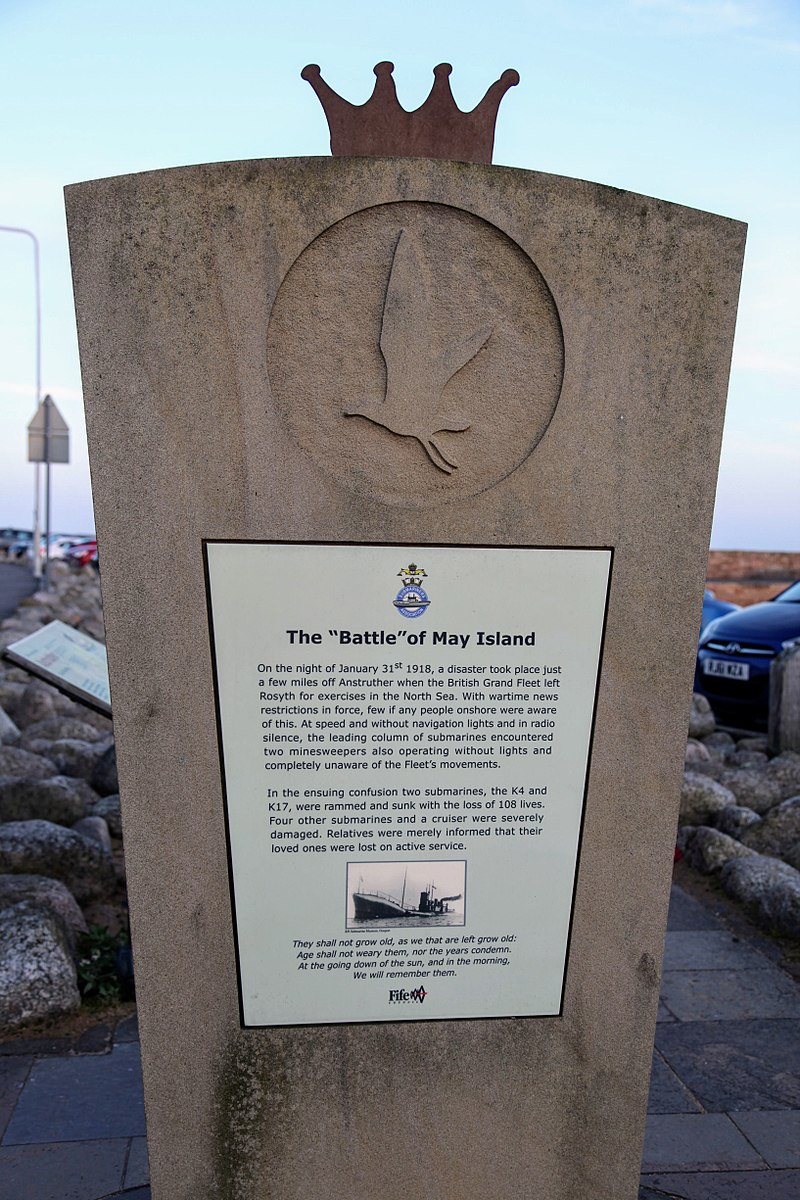
On January 31, 2002, a memorial cairn was erected in memory of the slain.  As it had been eighty four years earlier, there wasn’t a German to be found.  The “Battle of May Island” was no battle at all.  Only the black forlorn humor, of men at war.

800px-may_island_memorial_anstruther


If you enjoyed this “Today in History”, please feel free to re-blog, “like” & share on social media, so that others may find and enjoy it as well. Please click the “follow” button on the right, to receive email updates on new articles.  Thank you for your interest, in the history we all share.