March 19, 1916  Pancho Villa Expedition

During three months of active operations inside Mexico, American forces killed or captured 292 Villistas, but Pancho Villa evaded capture.  Pershing publicly proclaimed the operation a success, but privately complained that Wilson imposed too many restrictions, making it impossible to fulfill the mission.

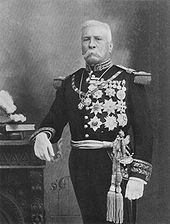
170px-Porfirio_Diaz_in_uniform
Porfirio Diaz

In thirty-five years as President of Mexico, the administration of José de la Cruz Porfirio Díaz Mori had yet to figure out the question of Presidential succession.  At first popular following his seizure of power in the coup of 1876, the Porfirian regime soon began to stagnate.  Diaz’ policies benefitted ‘el jefe’ cronies and supporters, the wealthy estate-owning “haciendados”, while leaving rural agricultural “campesinos” unable to make a living.

Following the turn of the century, the aging President expressed support for a return to democracy and an intention to step down from office.

An unlikely opponent stepped forward in the person of UC-Berkeley educated lawyer and wealthy hacienda owner, Francisco Madero.  Madero wanted a return to democratic elections, but Diaz would have none of it.

madero
Francisco Madero

Perhaps the octogenarian President expected that his country would beg him to stay, or maybe he changed his mind, but anyone stepping into Diaz’ path, did so at his own risk.  Madero fled to the United States, but later returned and faced arrest.  Meanwhile, the 80-year old Porfirio Diaz won re-election to an eighth term by a margin that would make Saddam Hussein blush.  Voters were outraged by what was clearly a massively corrupt election.

Madero escaped prison and produced the Plan de San Luis Potosí to nullify the elections and overthrow Díaz by force.  The table was set for the Mexican Revolution.

Armed conflict ousted Diaz from office the following year, when a free and fair election put Francisco Madero into office.  Opposition was quick to form, from both sides of the political spectrum.  Conservatives and land owners saw Madero as too weak, his policies too liberal, while former revolutionary fighters and the economically dispossessed, saw him as too conservative.  In February 1913, both Madero and his vice president Pino Suárez were run out of office, and murdered by order of military officer, Victoriano Huerta.
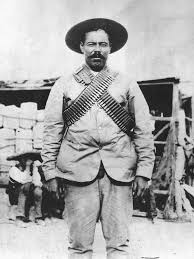
images (33)
Pancho Villa

Francisco “Pancho” Villa was a Mexican constitutionalist and a Madero supporter.  As commander of the División del Norte (Division of the North), Villa fought on behalf of Primer Jefe (“First Chief”) of the Constitutionalist army Venustiano Carranza, but later turned on his erstwhile leader.

American newspaperman and commentator Ambrose Bierce, author of The Devil’s Dictionary and my favorite curmudgeon, joined Pancho Villa’s army in December 1913, as an observer.  And then he vanished.  Most likely, Bierce faced a firing squad in Chihuahua, but his story remains unknown.

Trouble began between Villistas and the American government when the US declared its support for Villa’s former ally, providing rail transport from Texas to Arizona for 5,000 Carrancista forces.

The Division del Norte was badly defeated by forces loyal to Carranza in July 1915, and again in November.  Villa’s army ceased to exist as a military fighting force, reduced to local skirmishes and cross-border raids while foraging the countryside.

A three-way fight broke out on November 26, when Villa’s forces attacked the border town of Nogales, Sonora, and fired across the border at American troops in Nogales, Arizona.  On January 11, sixteen American employees of the American Smelting and Refining Company were taken from a train near Santa Isabel Chihuahua, stripped naked, and executed.

310px-ColumbusIn early March, a force of some 1,500 Villistas were camped along the border three miles south of Columbus New Mexico, when Villa sent spies into Camp Columbus (later renamed Camp Furlong).  Informed that Camp Columbus’ fighting strength numbered only thirty or so, a force of some 600 crossed the border around midnight on March 8.

Villa divided his force into two columns, launching a two-pronged assault in the early morning darkness of March 9.  Townspeople were asleep at first, awakening to the sounds of burning buildings, and shouts of “Viva Villa! Viva Mexico!”

What began as a pre-dawn raid soon erupted into full-scale battle, as residents poured from homes with hunting rifles and shotguns.  The Camp Columbus garrison was taken by surprise but recovered quickly, as barefoot soldiers scrambled into position. Four Hotchkiss M1909 machine guns fired 5,000 rounds apiece before the shooting died down, joined by another 30 troopers with M1903 Springfield rifles.

Pancho Villa proclaimed the raid a success, having captured over 300 rifles and shotguns, 80 horses, and 30 mules.  Strategically, the raid was a disaster.  The Mexicans had lost 90 to 170 dead they could barely afford, out of a raiding force of 484 men. Official American reports indicate 8, 10 or 11 soldiers killed, plus another 7 or 8 civilians, depending on which report you believe.
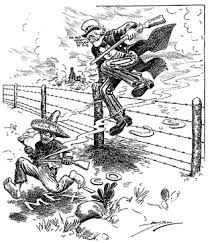
download (20)The United States government wasted no time in responding. That same day, the President who would win re-election in eight months on the slogan “He kept us out of war” appointed Newton Diehl Baker, Jr. to fill the previously vacant position of Secretary of War. The following day, Woodrow Wilson ordered General John Pershing to capture Pancho Villa, dead or alive.

7,000 American troops crossed into Mexico on March 13.  It was the first American military expedition to employ mechanized vehicles, including trucks and automobiles to carry supplies and personnel, and Curtiss Jenny aircraft used for reconnaissance.

On March 5, 1913, President William Howard Taft ordered the formation of the 1st Aero squadron, nine aircraft divided into two companies.  ‘Aviation’ at that time was not what is, today.  Aircraft were highly experimental, many built by the pilots themselves.  Crashes were commonplace, and flight lessons all but unheard of.  Frequently, general guidelines were given on the ground, and pilots were left to their own devices.  One of the early pilots, Captain Benjamin D. Foulois, sent away and received written instruction from Orville Wright, by mail!
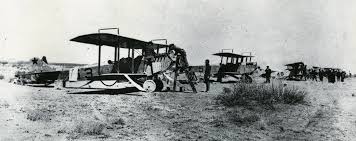
download (21)The 1st Aero Squadron arrived in New Mexico on March 15, with 8 aircraft, 11 pilots and 82 enlisted men.  The first reconnaissance sortie was flown the following day, the first time that American aircraft were used in actual military operations.

Five aircraft departed on the evening of March 19, with orders to report ‘without delay’ to Pershing’s headquarters in Casas Grandes, Mexico.  One made it that night, another two straggled in the next morning. One returned to Columbus and 2 others went missing. The problems, it turned out, were insurmountable.  90 HP engines were unable to bring them across 10,000 – 12,000’ mountain peaks, nor could they handle the turbulent winds of mountain passes. Dust storms wrought havoc with engines and, making things worse, the unrelenting heat of the Sonoran Desert de-laminated wooden propellers.
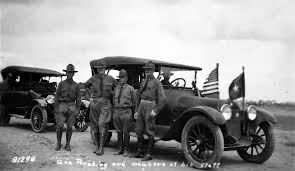
download (22)On May 14, a young 2nd Lieutenant in charge of a force of fifteen and three Dodge touring cars got into a running gunfight, while foraging for corn, in Chihuahua.  It was the first motorized action in American military history.  Three Villistas were killed and strapped to the hoods of the cars and driven back to General Pershing’s headquarters.  General Pershing nicknamed that 2nd Lt. “The Bandito”.  History remembers his name as George S. Patton.

During three months of active operations inside Mexico, American forces killed or captured 292 Villistas, but Pancho Villa evaded capture.  Pershing publicly proclaimed the operation a success, but privately complained that Wilson imposed too many restrictions, making it impossible to fulfill the mission.  “Having dashed into Mexico with the intention of eating the Mexicans raw”, Pershing complained, “we turned back at the first repulse and are now sneaking home under cover, like a whipped cur with its tail between its legs.”

WAR & CONFLICT BOOKERA:  MEXICAN PUNITIVE EXPEDITION
Pancho Villa Expedition, “Around the Campfire”

American forces were withdrawn by January 1917, as the European war loomed over American politics.   German Foreign Secretary Arthur Zimmermann observed political opposition to American operations inside of Mexico, and concluded that a military alliance was possible between the two countries.

The ‘Zimmermann note‘ proposing such an alliance between Germany and Mexico and promising the “restoration of its former territories of Texas, New Mexico and Arizona“, may be seen as the ‘last straw’ that brought the United States into WW1.
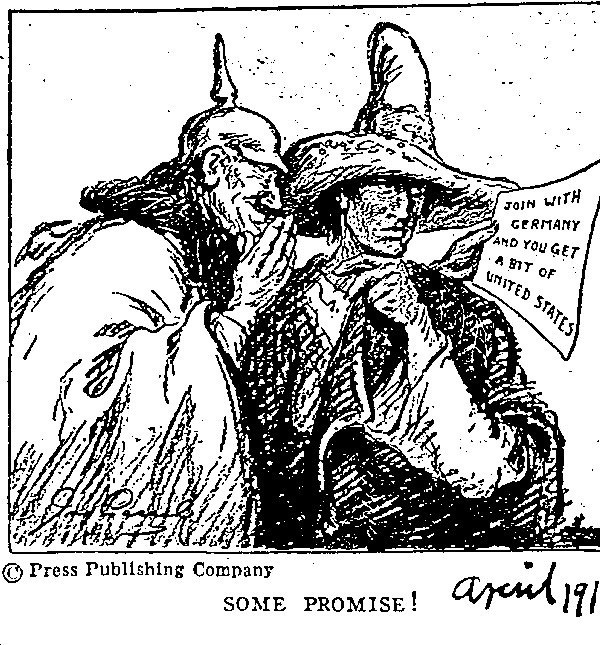
Zimmerman note

March 18, 37 AD Little Boots

Around the year AD 14 or 15, the youngest son of the Roman war hero Germanicus found himself growing up around the Legions. As a boy of just two or three, little Gaius Caesar accompanied his father on campaigns in the north of Germania. Centurions were amused to see the boy dressed in miniature soldier’s uniform, including the boots, the “Caligae”, and the segmented Roman body armor – the “Lorica Segmentata”.

Around the year AD 14 or 15, the youngest son of the Roman war hero Germanicus found himself growing up around the Legions. As a boy of just two or three, little Gaius Caesar accompanied his father on campaigns in the north of Germania. Centurions were amused to see the boy dressed in miniature soldier’s uniform, including the boots, the “Caligae“, and the segmented Roman body armor – the “Lorica Segmentata”.

Soldiers of the Legions called him “Little Boots”, after the tiny soldier’s boots the boy liked to wear in camp.  In Latin, “Caligula“.  He’s said to have hated the name, but it stuck.

72d62caef09ffc834ff051ad9d82898c

The Roman historian Suetonius writes that Germanicus was poisoned on the orders of Emperor Tiberius, who viewed the general as a political rival. Caligula’s mother Agrippina was denied permission to remarry, for the same reason. Agrippina was later exiled, as were her sons Drusus and Nero, while Caligula was remanded to the island of Capri and the personal custody of Tiberius, himself.

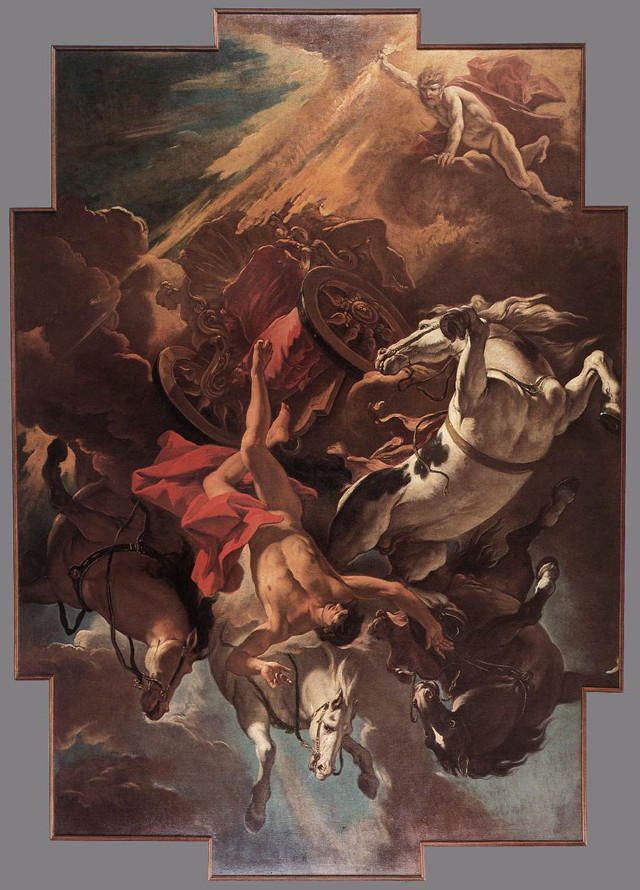
One observer spoke well of Caligula during this period, saying “Never was there a better servant or a worse master.” Suetonius believed the boy to be vicious and cruel, a natural actor who suppressed his hatred for the man responsible for the death of his family.  The historian writes that, when Tiberius brought Caligula to Capri, it was to “… prove the ruin of himself and of all men, and that he was rearing a viper for the Roman people and a Phaethon for the world.”

ricci-phaeton
The Fall of Phaeton, by Sebastiano Ricci

Phaethon, according to Greek mythology, was the child of the sun God Helios. As a boy, Phaethon was permitted to drive the sun chariot for a day, but couldn’t control the horses. With the earth in danger of being burned by the runaway sun, the God Zeus was forced to strike the chariot with a thunderbolt, killing the boy in the process.

Suetonius appears not to have been a fan.

When Tiberius died on March 16 AD 37, many believed his passing to have been hastened by a pillow, in the hands of the Praetorian Guard Commander Naevius Sutorius Macro.  Tiberius’ estate and titles were left to Caligula and Tiberius’ own grandson, Tiberius Gemellus.

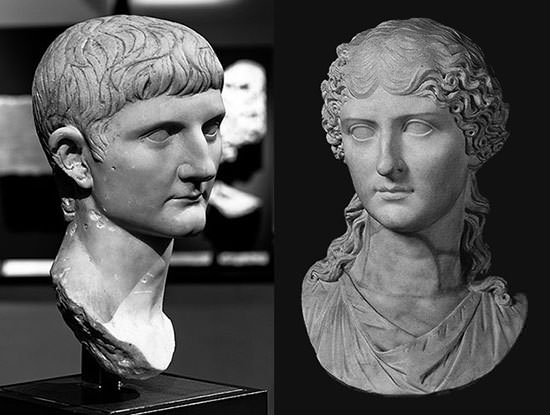
Bust-of-Caligulas-Parents-Germanicus-left-and-Agrippina-the-Elder
Busts of Caligulas Parents, Germanicus (left) and Agrippina the Elder

On this day in the year 37, the Roman Senate annulled the will of the Emperor Tiberius, proclaiming 24-year-old Caligula, Emperor. After years of purges and treason trials, Caligula’s ascension to the throne was a welcome breath of fresh air.  The son of the war hero Germanicus was in charge.  What could go wrong.  All of Rome erupted in paroxysms of joy, proclaiming Caligula to be the first emperor Ever, admired by “all the world, from the rising to the setting sun”.

160,000 animals were sacrificed in three months of public jubilation.  The Jewish philosopher Philo of Alexandria described the first seven months as “completely blissful”.

Calig2en
Map of the Roman Empire and neighboring states during the reign of Gaius Caligula (37-41 AD).

Caligula’s first two years were relatively peaceful and prosperous.  The Emperor provided lavish gladiatorial games for the entertainment of the people, and abolished the sales tax.  He granted bonuses to the military and destroyed Tiberius’ papers, declaring the treason trials of his hated predecessor a thing of the past.  Too late for his own family, Caligula recalled those who had been sent into exile.  The bones of  his mother and brothers, were deposited in the tomb of Augustus.

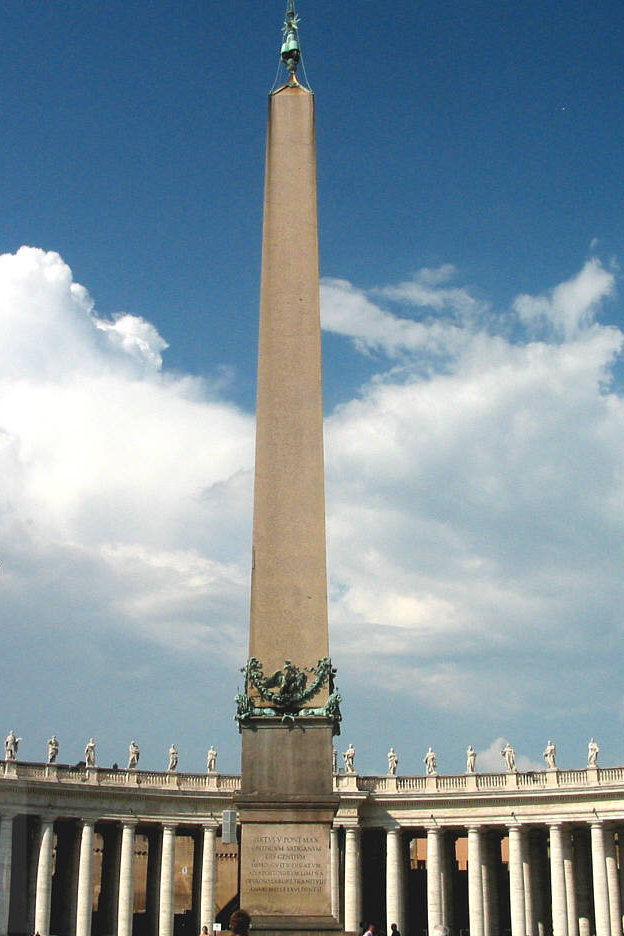
The obelisk at St. Peter’s Square in Vatican City, originally erected in Alexandria in BC 30-28, was transported to Rome and erected in the year AD 40, where it stands to this day.  The “Piazza San Pietro Obelisk” is the only such monument to have survived from Roman times.

Vatican_Piazza_San_Pietro_Obelisk
Piazza San Pietro Obelisk

In AD39, Caligula suffered a severe and prolonged illness, in which he hovered between life and death for over a month. It may or may not have had anything to do with his subsequent behavior, but the man who emerged from that illness was widely believed to be insane.

The Emperor performed a spectacular stunt by ordering a temporary floating bridge to be built, using ships as pontoons, stretching for over two miles from the resort of Baiae (pronounced BAY-eye) to the neighboring port of Puteoli. Though Caligula could not swim, he rode his favorite horse, Incitatus, across the bridge, wearing the breastplate of Alexander the Great.  Tiberius’ soothsayer Thrasyllus of Mendes predicted that Caligula had “no more chance of becoming emperor than of riding a horse across the Bay of Baiae”.  Little Boots, had proven otherwise.

bsao060305303l

In case you’re wondering, Incitatus was the same horse whom Caligula appointed as priest, and planned to make a Consul of Rome, the top elected official of the Roman government.

In time, what seemed like mere eccentricities became terrifying and erratic. Caligula regularly made senators run alongside his chariot.  He’d order executions on a whim – common man or foreign dignitary – it didn’t matter.  At the Roman games, he once had an entire crowd section thrown into the arena, to be eaten alive by wild animals.  He said he was bored.

Caligula began to appear in public, dressed as various Gods and demigods:  Hercules, Mercury, Venus and Apollo.  He wished to be worshipped as “Neos Helios” – the New Sun.  He’d refer to himself as a God when meeting with politicians. He built temples for the worship of himself, where the heads of statues were replaced by his own likeness.

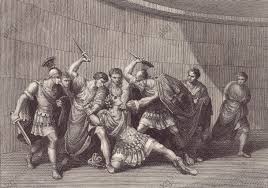
images (32)
Death of Caligula at the hands of his own Praetorian Guard

Later stories of wanton hedonism, cruelty, and sexual depravity may be exaggerated, but none seem to be without a grain of truth.  Roman politics often associated poor government policy, with insanity and sexual perversity.

Little Boots was murdered by his own Praetorian Guard in AD 41, like his predecessor Julius Caesar, stabbed thirty times in a conspiracy led by a man named Cassius. Stricken with grief and outraged by the murder, Caligula’s Germanic guard turned the scene into a bloodbath in a raging assault against conspirators, Senators and innocent bystanders, alike.

Most historians dismiss the floating bridge story as a myth.  No archaeological evidence has ever surfaced, to prove the story true.  Caligula’s two “pleasure barges”, extracted from the bottom of Lake Nemi, are a different story.

Floating-Palaces-of-Emperor-Caligula
The Pleasure Barges of Caligula (inset, Bronze Medusa)

Locals had long known of the presence of a wreck at around 60-ft. deep in the extinct volcano-turned Lake, some twenty-five miles from Rome.  Occasionally, fishermen and treasure hunters would use grappling hooks, to bring up souvenirs.

The Fascist Dictator Benito Mussolini had heard of the legend, and ordered the lake drained.  One wreck turned out to be two in 1927 when, for the first time in 2,000 years, the “pleasure barges” of Emperor Caligula saw the light of day.

Italians viewing antique Emperor Caligula's Nemi ships, 1932 (5)
Benito Mussolini attends the inauguration “Il Museo delle Navi Romane” – the Museum of Nemi.

Dubbed Prima nave (the 1st ship) and Seconda nave, the former measured 230-ft., the latter 240.  The lavish furnishings included hot and cold running water, cedar planking with jewel encrusted prows, vessels of gold and silver and bathrooms of alabaster and bronze.  There were hand-operated bilge pumps and a platform rotating on ball bearings:  perhaps to rotate a great statue, or maybe it was a deck crane, for loading supplies.  There were glass mosaics in the floors and marble décor, stone statuary and gilded copper roofs.  One wreck bore a lead pipe, bearing the inscription “Property of Gaius Caesar Augustus Germanicus”.

800px-Testate_di_bagli_in_bronzo_da_nemi,_epoca_di_caligola,_37-41_dc.
Brass rings recovered in 1895, were fitted to the ends of cantilevered beams that supported each rowing position on the seconda nave. H/T Wikimedia for this image, https://commons.wikimedia.org/w/index.php?curid=9949784

On the night of May 31, 1944, US army shells hit the museum, causing little apparent damage but forcing a German artillery unit, to move.  Two hours later, smoke was seen coming from the windows.  The concrete shell of the Nemi Museum was spared by the fire.  The two priceless archaeological artifacts housed inside, were destroyed.  Official reports blamed German sabotage.  German newspaper editorials blamed Allied bombing.

During the retreat through Italy, German soldiers burned some 80,000 books and manuscripts of the Royal Society of Naples, out of spite. It’s easy to believe they torched the two Nemi Ships, as well.  Like Emperor Caligula himself 2,000 years before, the Italian dictator Mussolini died by violence, at the hands of his own countrymen.

Nemi_Ship_Hull_1930
“The remains of the hull of one of Caligula’s two “pleasure barges” recovered from Lake Nemi. Workers in the foreground give an indication of scale”. H/T, Wikipedia for this image
If you enjoyed this “Today in History”, please feel free to re-blog, “like” & share on social media, so that others may find and enjoy it as well. Please click the “follow” button on the right, to receive email updates on new articles.  Thank you for your interest, in the history we all share.


March 17, 1621 First Encounter

Squanto would mediate between the settlers and the native tribes, teaching the Pilgrims to plant corn: several kernels in a mound, buried with a fish head to enrich the soil.  When planted together in a circle, the “three sisters” would support and thrive together, the corn stalks providing poles for the beans, and the squash leaves providing ground cover & holding in moisture, while keeping weeds at bay.

images (29)In 1620, the 60-ton Pinnace Speedwell departed Delfshaven, meeting with Mayflower at Southampton, Hampshire. The two vessels set out on August 15, but soon had to turn back as Speedwell was taking on water. Speedwell was abandoned after a second failed attempt, Mayflower setting out alone on September 16, 1620, with an estimated 142 passengers and crew.

66 days at sea brought the “Old Comers” up on the outer reaches of Cape Cod on November 11, near the present-day site of Provincetown Harbor.   There, the group stayed long enough to draw up the first written framework of government established in the New World, a “civil body politic” called the Mayflower Compact.

pilgrims_bwAs anyone familiar with the area will understand, a month in that place and time convinced them of its unsuitability.  By mid-December the Mayflower had crossed Cape Cod Bay and fetched up at Plimoth Harbor.

Words fail to describe the terrible conditions of that first winter.  Over half of these “Pilgrims” died during those first few months, eighty-two in all, of malnutrition, disease, exposure and starvation.  It was nearly as awful as the “starving time” of the Jamestown colony of ten years earlier, in which all but 60 of 214 colonists perished.

220px-Massasoit,_KC_MO_-_detail
Massasoit,

The morning of March 16, 1621 dawned fair and clear, warm for the season.  The settlers had long heard tales of their new neighbors, and even spotted a few back in November, at the modern-day “First Encounter Beach”, in Eastham.  There were wild stories of “cannibals” and “savages”, but none had yet been observed, at anything but a distance.  This morning, the newcomers realized that it was they who were being observed.

They were hurriedly arranging defenses when one of the “savages” approached the group, naked as the day he was born but for a leather fringe about his waist, holding a bow and two arrows.  Tall and straight with flowing black hair, the man walked straight up and introduced himself, to the astonishment of the group, in English.  He said his name was Samoset.

The following account appears in Mourt’s Relation (1622) written primarily by Edward Winslow and William Bradford:

ROP-Coastal-History-1-1024x748
Samoset, “1st Friend” of the Pilgrims

Friday the 16th was a fair warm day….We were finishing our work, when a strange looking man, a man which caused us to be surprised becaused he seemed unafraid …. walked into the village. We stopped him. … He spoke to us in English, and was friendly. He said he had learned some English among the Englishmen that came to fish at Monhegan Island, and he gave us their names. He was a man who spoke freely and openly. We questioned him about many things. He was the first Indian we met. He said he was from Morattiggon (modern day Maine) and been 8 months in these parts…He asked for a drink and we gave him strong water and biscuit, and butter, and cheese, and pudding, and a piece of mallard (duck), all which he liked well. He said he had also eaten this food before with the English that had come before where he was from.

He told us the place where we now live was known as Patuxet by the Indians. Four years ago all the Indians who lived there died of a sickness and none were left, so they cannot hurt us, or to say the land where we now live belongs to them. All the afternoon we spent talking with him; we thought he would leave that night, but he did not leave. Then we thought to carry him on shipboard, and he intended to leave, but the wind was high and the water not deep enough so he could not return back that day. We lodged him that night at Stephen Hopkins house, and watched him.

800px-Tribal_Territories_Southern_New_England
Southern New England tribal range, circa 1600

Samoset was a Sagamore (minor Chief) of the Abenaki tribe of modern-day Maine, visiting at that time with Ousamequin, the Pokanoket Sachem (leader) of the Wôpanâak (Wampanoag) and Massassoit (Great Sachem) of the Wampanoag Confederacy of southeastern Massachusetts and Rhode Island.

cornhillplaque
This plaque is all that remains of the Pilgrim’s 1620 raid on the Nauset’s corn stash, in modern-day Truro, MA

Samoset warned the newcomers to beware the Nauset, later called “Cape Cod Indians”, a tribal unit of some one-hundred individuals sharing the Massachusett (Natick) language and occupying modern-day Cape Cod and surrounding islands. Small wonder.  Long before the large-scale colonization of the New World, European seafarers had kidnapped some twenty Nausets, and sold them into slavery, leaving in their wake diseases with which the native immune system was ill-equipped to deal.  It was a Nauset corn cache the Pilgrims themselves had plundered back in November, a stash laid up to take their people through the long, barren winter.

Samoset departed the following day, March 17, but returned on the 22nd with Tisquantum, (Squanto), one of the few surviving Pawtuxet.  A man who spoke better English than Samoset himself, Squanto would mediate between the settlers and the native tribes, including Massasoit.  Squanto taught the Pilgrims to plant corn: several kernels in a mound, buried with a fish head to enrich the soil.  When planted together in a circle, the “three sisters” would support one another and thrive together, the corn stalks acting as poles for the beans, and squash leaves providing ground cover & holding in moisture, while keeping weeds at bay.

squanto-9491327-1-402
The Pawtuxet Squanto taught the Pilgrims what and where to plant, where to fish and how to hunt beaver

The newcomers reciprocated, teaching the natives about their own crops, with the aid of European farming tools.

“Days of Thanksgiving” took place in the New World as early September 8, 1565, when a group of Spaniards lead by explorer Pedro Menéndez de Avilé invited members of the Timucua tribe to a day of Thanksgiving in Saint Augustine, Florida.  Yet, the harvest feast of 1621, shared between the Pilgrims and the Pokanokets, is generally considered to be the basis for our own Thanksgiving holiday.

In the following months, the debt of corn was repaid to the Nauset people, who returned the favor by restoring a small boy to the colony, who’d been found lost and wandering in the woods.  The Nauset would become Christianized in the following years, turning out to be the European’s greatest allies.

Fairfield-WPA-Mural-Tomilson-High-School-FMHC_2014_Pano_Pequot_-800x272-1Years later, colonists would go to war against the Wampanoag people and ‘King Philip’, the English name for Metacomet, the son of Massasoit.  The Nauset would act as warriors and scouts against the Wampanoag people in King Philip’s War, a conflict which killed some 5,000 New England inhabitants, three quarters of whom were indigenous people.

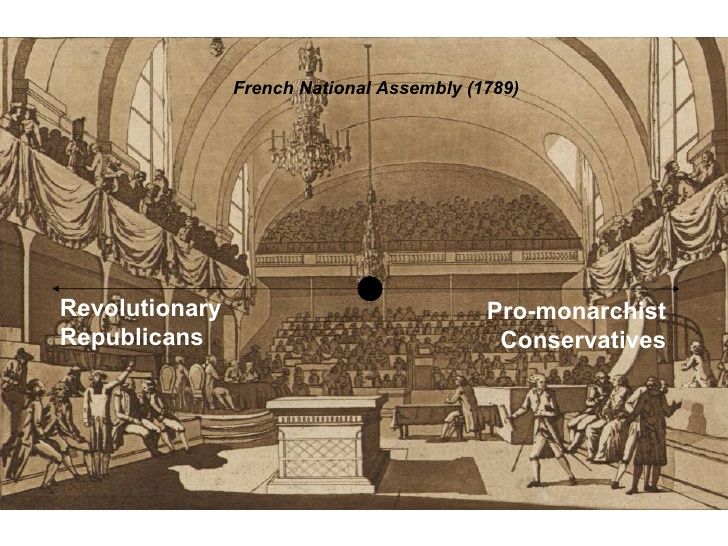
In terms of the percentage killed of the overall population, King Philip’s War was over twice as costly as the American Civil War, and seven times that of the American Revolution.  But that must be a story for another day.

Feature image, top of page:  First Encounter Beach, Eastham Massachusetts

If you enjoyed this “Today in History”, please feel free to re-blog, “like” & share on social media, so that others may find and enjoy it as well. Please click the “follow” button on the right, to receive email updates on new articles.  Thank you for your interest, in the history we all share.

March 16, 1914 A Crime of Passion

Think of the OJ trial, only in this case, the killer was a former First Lady. This one had everything: Left vs. Right, the fall of the powerful, and all the salacious detail anyone could ask for.  French public and media alike were riveted by the Caillaux affair, disinterested and unheeding of the European crisis barreling down on them, like the four horsemen of the apocalypse.

We hear a lot in election years, about “Left” and “Right”.  “Liberal” and “Conservative”.

The terms have been with us a long time, originating in the early days of the French Revolution. In those days, National Assembly members supportive of the Monarchy sat on the President’s right.  Those favoring the Revolution, on the left. The right side of the seating arrangement began to thin out and disappeared altogether during the “Reign of Terror”, but re-formed with the restoration of the Monarchy, in 1814-1815. U5dtXeDhuSgqBYsRegyPZecZPy5MGQf_1680x8400By that time it wasn’t just the “Party of Order” on the right and the “Party of Movement” on the left. Now, the terms began to describe nuances in political philosophy, as well.

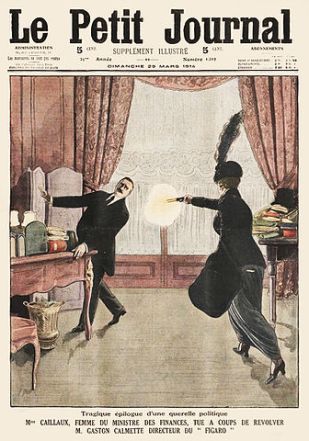
200 years later, philosophical differences between the Left and Right of the period, would be recognizable to political observers today.

joseph-caillaux
Joseph Cailloux

Joseph Cailloux (rhymes with “bayou”) was a left-wing politician, appointed Prime Minister of France in 1911. The man was indiscreet in his love life, even for a French politician. Back in 1907, Cailloux had paraded about with a succession of mistresses, finally carrying on with one Henriette Raynouard, while both were married to other people. By 1911, both were divorced.  That October, Henriette Raynouard became the second Mrs. Cailloux.

The political right considered Cailloux to be far too accommodating with Germany, with whom many felt war to be all but inevitable. While serving under the administration of President Raymond Poincare in 1913, Cailloux became a vocal opponent of a bill to increase the length of mandatory military service from two years to three, intended to offset the French population disadvantage conferred by France’s 40 million, compared with 70 million Germans.

220px-Caillix_5332813205_482fc13b62_o
Madame Cailloux

Gaston Calmette, editor of the leading conservative newspaper Le Figaro, threatened to publicize love letters between the former Prime Minister and his second wife, written while both were still married for the first time.

Henriette Cailloux was not amused.

On March 16, 1914, Madame Cailloux took a taxi to the offices of Le Figaro. After being shown into Calmette’s office, the pair spoke briefly, before Henriette withdrew the Browning .32 automatic.  Cailloux fired six rounds at the editor. Two missed, but four were more than enough to do the job. Gaston Calmette was dead within six hours.

German Chancellor Otto von Bismarck once said the next great European war would begin with “some damn fool thing in the Balkans”.  No one realized it at the time, but Bismarck got his damn fool thing on June 28, when a Serbian Nationalist assassinated the heir apparent to the Austro-Hungarian throne, the Archduke Franz Ferdinand.

Henriette_Caillaux (1)The July Crisis of 1914 was a series of diplomatic maneuverings, culminating in the ultimatum from Austria-Hungary to the Kingdom of Serbia. Vienna, with tacit support from Berlin, made plans to punish Serbia for her role in the assassination, while Russia mobilized armies in support of her Slavic ally.
There is a common but mistaken notion that Imperial Germany “started” World War I, but it isn’t so.  Kaiser Wilhelm was a famous “saber rattler”, but actually going to war with the other major European powers, was another matter.

It was Germany’s weaker ally Austria-Hungary which, having received vague assurances of German support, pursued a policy of unreasoning belligerence against  Serbia.

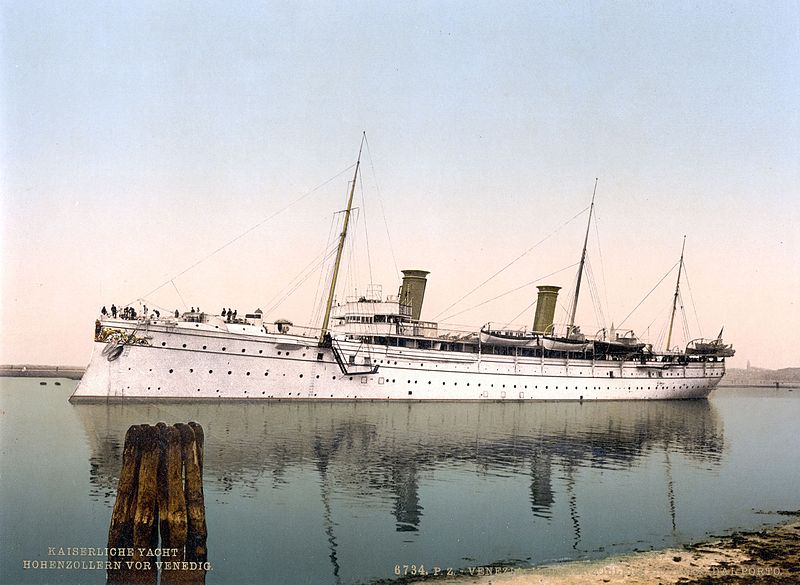
German Foreign Minister Gottlieb von Jagow was away on honeymoon, during key periods of the July crisis.  The Kaiser himself was out of touch, cruising the Norwegian fjords.  That cruise has been called the most expensive maritime disaster, in history.

On being informed of the decision to mobilize, the Kaiser told his General Staff “Gentlemen, you will regret this.”

Hohenzollern,_leaving_the_harbor,_Venice,_Italy-LCCN2001701060
SMY Hohenzollern II, which Emperor Wilhelm II used on annual extended Nordlandfahrt cruises to Norway. All told, he spent four years living on board.

Meanwhile, England and France looked the other way.  In Great Britain, officialdom was focused on yet another home rule crisis concerning Ireland, while all of France was distracted by the “Trial of the Century”.

Madame Caillaux’s trial for the murder of Gaston Calmette began on July 20.  Think of the OJ trial, only in this case, the killer was a former First Lady. This one had everything: Left vs. Right, the fall of the powerful, and all the salacious detail anyone could ask for.  French public and media alike were riveted by the Caillaux affair, disinterested and unheeding of the European crisis barreling down on them, like the four horsemen of the apocalypse.

The trial ended in acquittal on July 28, the jury ruling the murder to have been a “crime passionnel”.  A crime of passion. That same day, Austria-Hungary declared war on Serbia.

542375879In the days that followed, the Czar would begin the mobilization of men and machines which would place Imperial Russia on a war footing. Kaiser Wilhelm’s Germany invaded Belgium, in pursuit of the one-two punch strategy by which it sought first to defeat France, before turning to face the “Russian Steamroller”. England declared war in support of a 75-year-old commitment to protect Belgian neutrality, a treaty obligation German diplomats had dismissed as a “scrap of paper”.
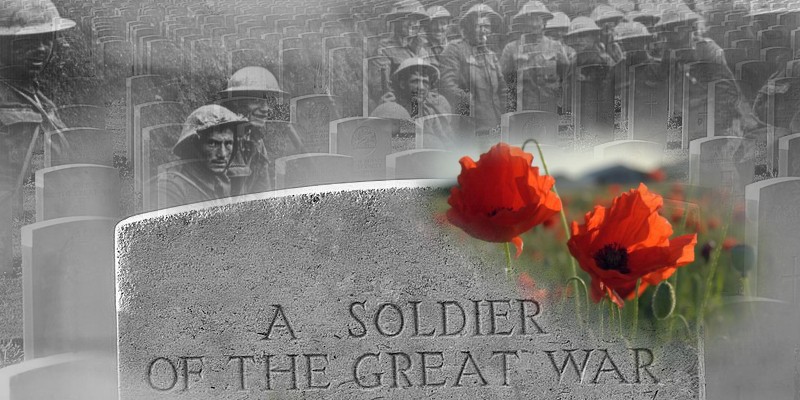
An event which could have resulted in little more that a policing action in the Balkans, was about to explode into the “War to End All Wars”.  Edward Grey, 1st Viscount Grey of Fallodon said “The lamps are going out all over Europe: we shall not see them lit again in our life-time.” Eleven million military service members and seven million civilians who were alive in July 1914, would not live to see the other side.

A-Soldier-of-the-Great-War-800-x-400_2-800x400

If you enjoyed this “Today in History”, please feel free to re-blog, “like” & share on social media, so that others may find and enjoy it as well. Please click the “follow” button on the right, to receive email updates on new articles.  Thank you for your interest, in the history we all share.

March 11, 1958 Carolina Nuked

To anyone under the age of 40, the Cold War must seem a strange and incomprehensible period.  Many of us who lived through it, feel the same way. 

If you’re ever in South Carolina, stop and enjoy the historical delights of the Pee Dee region.  About a half-hour from Pedro’s “South of the Border”, there you will find the “All-American City” of Florence, according to the National Civic League of 1965.  With a population of about 38,000, Florence describes itself as a regional center for business, medicine, culture and finance.

Oh, and the Federal Government dropped a nuke on the place.  Sixty years ago, today.

W1siZiIsInVwbG9hZHMvcGxhY2VfaW1hZ2VzLzc4MzMwMTBiZDdlYzMzZTJhYl9TT0I1LmpwZyJdLFsicCIsInRodW1iIiwieDM5MD4iXSxbInAiLCJjb252ZXJ0IiwiLXF1YWxpdHkgODEgLWF1dG8tb3JpZW50Il1d

To anyone under the age of 40, the Cold War must seem a strange and incomprehensible period.  Many of us who lived through it, feel the same way.  The Air Force Boeing Stratojet bomber left Hunter Air Force Base in Savannah, on a routine flight to Africa via the United Kingdom.  Just in case nuclear war was to break out with the Soviet Union, the B47 carried a 10’8″, 10,900lb, Mark 4, atomic bomb.

maxresdefault (5)

The Atlantic Coastline Railroad conductor, WWII veteran & former paratrooper Walter Gregg Sr. was in the workshop near his home in the Mars Bluff neighborhood of Florence, South Carolina while his wife, Ethel Mae “Effie” Gregg, was inside, sewing.  The Gregg sisters Helen and Frances, ages 6 and 9, were playing in the woods with their nine-year-old cousin Ella Davies, as the B47 Stratojet bomber lumbered overhead.

b47-7a

At 15,000 ft., a warning light came on in the cockpit, and the pilot accidentally pulled the emergency release pin.  Bomb bay doors alone are woefully inadequate to hold a five-ton bomb.  The thing broke free and began its 15,000-ft. descent, straight into the Gregg’s back yard.

The Mark 4 atom bomb employs an IFI (in-flight insertion) safety, whereby composite uranium and plutonium fissile pits are inserted into the bomb core, thus arming the weapon. When deployed, a 6,000-lb. conventional explosion super-compresses the fissile core, beginning a nuclear chain reaction. In the first millisecond, (one millionth of a second), plasma expands to a size of several meters, as temperatures rise into the tens of millions of degrees, Celsius. Thermal electromagnetic “Black-body” radiation in the X-Ray spectrum is absorbed into the surrounding air, producing a fireball.  The kinetic energy imparted by the reaction produces an initial explosive force of about 12,000 kilometers, per second.

This particular nuke was unarmed, but three tons of conventional explosive can wreak a lot of havoc.   The weapon scored a direct hit on a playhouse built for the Gregg children, the explosion leaving a crater 70-ft. wide and 35-ft. deep and destroying the Gregg residence and several out buildings.  Seven buildings within a five-mile radius, were damaged.  Both Greggs, all three of the girls and son Walter Jr. were injured, though fortunately, none fatally.

220px-Goldsboro_Mk_39_Bomb_1-close-up
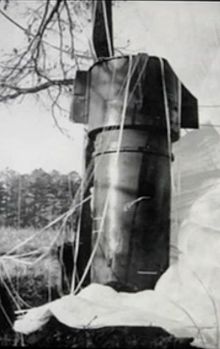
One Mk 39 nuclear weapon fronm the Goldsboro incident remained largely intact, with parachute still attached. The second plunged into a muddy field at about 700mph, and disintegrated.

Three years later, a B-52 Stratofortress carrying two Mark 39 thermonuclear bombs broke up in the air over Goldsboro, North Carolina. Five crew members ejected from the aircraft at 9,000-ft. and landed safely, another ejected but did not survive the landing. Two others died in the crash. In this incident, both weapons were fully nuclear-enabled. One single switch out of four, is all that prevented the detonation of at least one of them.

Walter Gregg described the Mars Bluff incident in 2001, in director Peter Kuran’s documentary “Nuclear 911”. “It just came like a bolt of lightning”, he said. “Boom! And it was all over. The concussion …caved the roof in.”  Left with little but the clothes on their backs, the family sued the Federal Government.  They were awarded $54,000 by the United States Air force, equivalent to about $448,000 today.

Over the years, members of the flight crew stopped by to apologize for the episode.

Incidents involving the loss or accidental detonation of nuclear weapons are called “Broken Arrows“. There have been 32 such mishaps, since 1950. As of this date, six such weapons have been lost, and never recovered.


If you enjoyed this “Today in History”, please feel free to re-blog, “like” & share on social media, so that others may find and enjoy it as well. Please click the “follow” button on the right, to receive email updates on new articles.  Thank you for your interest, in the history we all share.


March 10, 1876  The Speed of Sound

For all of Mark Twain’s abilities, he wasn’t much of an investor.  The man turned down a ground-floor opportunity to invest in the telephone, in favor of a typesetting machine which actually made setting type more complicated, than the age-old printer’s method of setting type, by hand.

As the son of a speech pathologist and husband to a deaf wife, Alexander Melville Bell was always interested in sound. Since the profoundly deaf can’t hear their own pronunciation, Bell developed a system he called Visible Speech in 1864, to help the deaf learn and improve elocution.

220px-VisibleSpeech-illustrationsÉdouard Séguin, the Paris-born physician and educator best known for his work with the developmentally disabled and a major inspiration to Italian educator Maria Montessori, called the elder Bell’s work “…a greater invention than the telephone by his son, Alexander Graham Bell”.

As a boy, the younger Bell developed a method of carefully modulating his speech and speaking into his mother’s forehead, a method which allowed her to “hear” him, fairly clearly.  The boy followed in his father’s footsteps, mastering his elder’s work to the point of improving on it and teaching the system at the Boston School for Deaf Mutes (which operates today as the Horace Mann School for the Deaf), the American Asylum for Deaf-mutes in Hartford, Connecticut, and the Clarke School for the Deaf in Northampton, Massachusetts.

539001It was Alexander Graham Bell who first broke through to Helen Keller, a year before Anne Sullivan.  The two developed a life-long relationship closely resembling that of father and daughter.  Bell made it possible for Keller to attend Radcliffe and graduate in 1904, the first deaf/blind person, ever to do so.

Keller used a braille typewriter to write her first autobiography in 1903, dedicating The Story of My Life, to her life-long friend, benefactor and mentor:  “To Alexander Graham Bell, who has taught the deaf to speak and enabled the listening ear to hear speech from the Atlantic to the Rockies.”

aa_keller_radcliffe_1_e
CREDIT: “[Alexander Graham Bell with Helen Keller and Annie Sullivan at the meeting of the American Association to Promote the Teaching of Speech to the Deaf, July 1894, in Chautauqua, N.Y.]” [1894, printed later]. Prints and Photographs Division of the Library of Congress.
A natural inventor, it was Bell’s 1875 work on electrical telegraphy, which led to the telephone.  Bell heard a “twang” on the line while working , leading him to investigate the possibility of using electrical wires, to transmit sound.

Rival Elisha Gray was working on a similar concept, and filed a caveat (statement of concept) on February 14, 1876, mere hours after Bell applied for patent.

Bell’s device first produced intelligible speech on March 10, that same year.  His diary entry describes the event: “I then shouted into M [the mouthpiece] the following sentence: “Mr. Watson, come here – I want to see you.” To my delight he came and declared that he had heard and understood what I said.  I asked him to repeat the words. He answered, “You said ‘Mr. Watson – come here – I want to see you.'” We then changed places and I listened at S [the speaker] while Mr. Watson read a few passages from a book into the mouthpiece M. It was certainly the case that articulate sounds proceeded from S. The effect was loud but indistinct and muffled”.

Alexander-Graham-Bell-3

Many of Bell’s innovations came about, much earlier than you might expect.  One of his first inventions after the telephone was the “photophone,” a device enabling sound to be transmitted on a beam of light. Bell and his assistant, Charles Sumner Tainter, developed the photophone using a sensitive selenium crystal and a mirror which would vibrate in response to sound. In 1881, the pair successfully sent a photophone message from one building to another, a distance of over 200 yards.

Several innovations would later build on this accomplishment to produce the modern laser.

0bcb9e63f5In September 1881, Alexander Graham Bell hurriedly invented the first metal detector, as President James Garfield lay dying from an assassin’s bullet. The device was unsuccessful in saving the President, but credited with saving many lives during the Boer War and WW1.

That was the year in which Bell’s infant son Edward died of respiratory problems, leading the bereaved father to design a metal vacuum jacket which would facilitate breathing. This apparatus was a forerunner of the iron lung used in the ’40s and ’50s to aid polio victims.  As many as 39 people still used an iron lung to breathe, as late as 2004.

The telephone was a commercial success, but that wasn’t a foregone conclusion. Looking for investors for his new enterprise, Bell approached Samuel Clemens in 1877, as a potential investor.  Better known as Mark Twain, the author declined the opportunity, believing the market to be confined to bridge-to-engine room communications, onboard maritime vessels.

download (19)
Mark Twain

One of the towering figures of American literature, Samuel Clemens achieved considerable financial success during his lifetime but, for all his abilities, didn’t have much of an eye for opportunity.  Mark Twain turned down a ground-floor invitation to invest in the telephone, choosing instead to buy into a typesetting machine which complicated the setting of type, compared with the age-old printer’s method of setting type, by hand.

Alexander Graham Bell’s creation would change the world but, to the end of his days, his work with the deaf gave him greatest satisfaction.

Bell would sell his invention, to finance his work on devices to aid the hearing-impaired.  He didn’t keep a phone on his desk, considering the thing to be an interruption and a nuisance.

Later in life, Alexander Graham Bell described his work with the deaf, as “more pleasing to me than even recognition of my work with the telephone.”

Alexander-Graham-Bell-1

If you enjoyed this “Today in History”, please feel free to re-blog, “like” & share on social media, so that others may find and enjoy it as well. Please click the “follow” button on the right, to receive email updates on new articles.  Thank you for your interest, in the history we all share.

March 9, 1910 Brown Dog

In the five years I’ve been writing “Today in History”, I’ve written about 450 of these stories.  A father isn’t supposed to have favorites among his “children”, but I have to confess.  I do.  This is not one of those.  This one, I detest.

In the five years I’ve been writing “Today in History”, I’ve written about 450 of these stories.  A father isn’t supposed to have favorites among his “children”, but I have to confess.  I do.  This is not one of those.  This one, I detest.

The Oxford on-line Dictionary defines vivisection as: “noun – the practice of performing operations on live animals for the purpose of experimentation or scientific research”.

During the reign of Queen Victoria, British monarch from June 20, 1837 to January 22, 1901, a powerful opposition arose in Great Britain to the dissection of live animals. Labeled as “vivisection” by opponents of the practice, experiments were often performed in front of audiences of medical students, with or without anesthesia.

Ernest_Starling
Ernest Starling

The Cruelty to Animals Act of 1876 stipulated that subject animals must be anesthetized, unless anesthesia would interfere with the point of the experiment. The measure further required that each animal could only be used once, though multiple procedures were permitted so long as each was part of the same experiment.

In the end, the subject animal had to be killed when the study was over.

In 1902, about the time when Russian physiologist Ivan Petrovich Pavlov was doing his conditioning experiments om dogs, Ernest Starling performed his first “experiment” on a small brown terrier.  Whether a stray or someone’s pet, is unclear.  A further “demonstration” was performed on the same animal by William Bayliss on February 2, 1903, at the end of which the dog was killed with a knife to the heart.

William_Bayliss_1918b
William Bayliss

I don’t care to linger on the details of what was done to this dog.  It was difficult enough, to read about it.  Suffice it to say that Bayliss and Starling’s classes were infiltrated by two Swedish anti-vivisection activists, Lizzy Lind and Leisa Katherine Schartau.

The two women had attended 50 such classes at University College, keeping a diary throughout and later publishing observations in “The Shambles of Science: Extracts from the Diary of Two Students of Physiology”. In it, the pair disputed that the brown dog had been anesthetized, reporting that “The dog struggled forcibly during the whole experiment and seemed to suffer extremely during the stimulation. No anesthetic had been administered in my presence, and the lecturer said nothing about any attempts to anesthetize the animal having previously been made”.

Stephen_Coleridge,_Vanity_Fair,_July_1910_(cropped)
Stephen Coleridge,, Vanity Fair,, July 1910

Stephen Coleridge, secretary of the National Anti-Vivisection Society heard the two women’s story, and spoke angrily on behalf of the terrier.  “If this is not torture”, the barrister asked, “let Mr. Bayliss and his friends … tell us in Heaven’s name what torture is“.

There was little doubt that either professor if not both, would sue for libel.  Bayliss did and the jury retired for 25 minutes, returning with a unanimous verdict.  Bayliss was awarded £2,000 with £3,000 in court costs, equivalent to about £250,000 today, the verdict read to the applause of physicians in the public gallery.

On September 15, 1906, the World League against Vivisection unveiled a statue in Battersea’s Latchmere Recreation Ground, bearing the inscription “In Memory of the Brown Terrier Dog Done to Death in the Laboratories of University College in February 1903 after having endured Vivisection extending over more than Two Months and having been handed over from one Vivisector to Another Till Death came to his Release. Also in Memory of the 232 dogs Vivisected at the same place during the year 1902. Men and Women of England how long shall these Things be?”

Irish playwright George Bernard Shaw and Anglo-Irish suffragist Charlotte Despard spoke at the event, but medical students were outraged.

Brown_Dog_statue,_Battersea,_London(2)London’s teaching hospitals at first explored quiet means of taking down what they regarded as an insult to the profession.  By November, medical students were crossing the Thames with sledge hammers and crow bars, intending to take matters into their own hands.

Riots ensued, the worst nights occurring in London on December 10, 1907, when 1,000 medical students tried to pull the statue down, battling over the memorial with suffragettes, trade unionists and over 400 police officers.

More riots and brawls broke out in the weeks that followed.  Before long, the authorities were looking for a quiet way to make the statue go away.  Four workmen and 120 police officers quietly removed the Brown Dog Memorial over the night of March 9-10, 1910, hiding it in a bicycle shed. 3,000 anti-vivisectionists gathered in Trafalgar Square to demand its return, but to no avail.  The statue never reappeared, later to be broken up and melted down.

dsc04730Seventy-five years would come and go, before a new Brown Dog memorial was commissioned by the National Anti-Vivisection Society and the British Union for the Abolition of Vivisection.

For all the fuss, it hardly made a difference. There were something like 300 experiments on live animals, in the year 1875.  By the time of the brown terrier’s live dissection, the number was 19,084.  In 2005 the figure had increased to 2.81 million, and that’s just the vertebrates. 7,306 of those, were dogs.

Image – top ofpage.  Original brown dog statue, from 1906

March 8, 1863  The Gray Ghost

Late on the night of March 8, 1863, a light rain was falling when Mosby’s Rangers formed up for a raid on Fairfax Virginia, known at that time as Fairfax Courthouse. 

Like fellow Virginian Robert E. Lee, the Howardsville lawyer John Singleton Mosby opposed the destruction of the Union but, when secession came, he stayed with his state.  Small and frail as a boy, Mosby was often the target of much larger bullies.  Years later in his memoirs, he’d write that he never won a fight.  It seems that John Singleton Mosby never backed down from one, either.

Mosby participated in the 1st Battle of Manassas (1st Bull Run) as a member of the Virginia Volunteers Mounted Rifles, later joining James Ewell Brown “J.E.B.” Stuart as a Cavalry Scout.  A gifted horseman and natural tactician, information gathered by Mosby aided Stuart in his humiliating ride around McLellan’s Army of the Potomac in June, 1862.

tumblr_mxvjev4IY21t8ultdo1_1280

The following year, Stuart authorized Mosby to form and take command of the 43rd Battalion of Virginia Cavalry, a regiment-sized unit operating out of north central Virginia.  These “Partisan Rangers”, 1,900 of whom served between January 1863 and April ’65, were under the command of Stuart and Lee and subject to their authority, but were not a traditional army unit.  Mosby’s Rangers shared in the spoils of war but had no camp duties, and lived scattered among civilian populations.

Known for lightning raids of the Virginia countryside, Mosby’s 43rd Cavalry would be called together to strike specific targets, dispersing afterward and making themselves next to impossible to run aground.  So successful were they that, to this day, parts of Virginia’s Piedmont region are known as “Mosby’s Confederacy”.

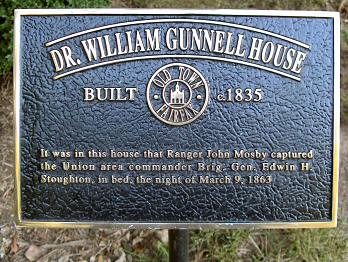
Late on the night of March 8, 1863, a light rain was falling when Mosby’s Rangers formed up for a raid on Fairfax Virginia, known at the time as Fairfax Courthouse.  Deep in the midst of several thousand Federal soldiers and only fifteen miles from the White House, Union Brigadier General Edwin H. Stoughton was sleeping in his headquarters.  Some sources indicate that he was “sleeping it off”.  The “Gray Ghost” entered the Union General’s quarters in the small hours of March 9, his rangers quickly overpowering a handful of sleepy guards.

mar8map

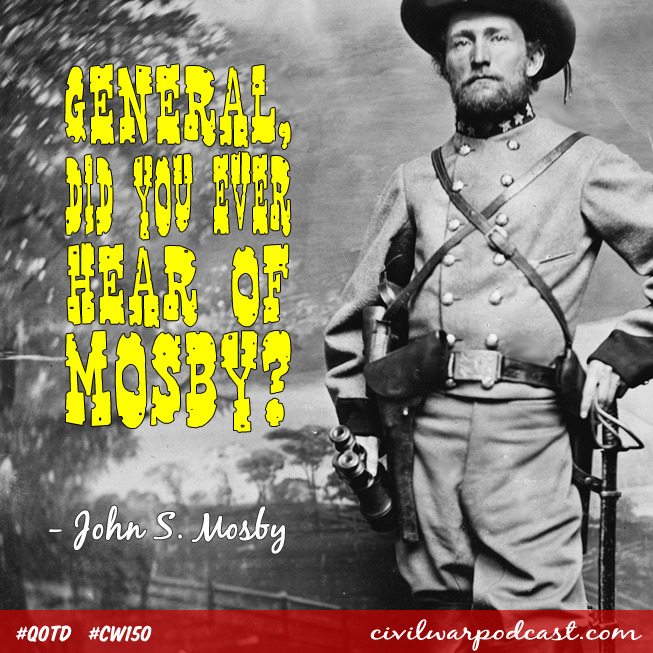
Entering the bed chamber as others went to the stables and gathered horses, Mosby lifted the General’s nightshirt and slapped his bare backside with a sword. General Stoughton sputtered awake, demanding “What is the meaning of this!?” “General, did you ever hear of Mosby“, came the question.

Mosby himself later recalled, “There was no time for ceremony, so I drew up the bedclothes, pulled up the general’s shirt, and gave him a spank on his bare back, and told him to get up”.  Stoughton replied, “Yes, have you caught him?” “I AM Mosby,” said the Gray Ghost, “and I have caught You. Stuart’s cavalry has possession of the Courthouse; be quick and dress.

mosby73

As prisoners came to the realization that they’d been captured by such a puny force, many melted into the woods, and escaped.  In the end, Mosby and his 29 rangers had captured a Union General, two Captains, 30 enlisted men and 58 horses, without firing a shot.  On hearing the story the next day, President Lincoln lamented:  “I can make another Brigadier in 5 minutes, but I can’t replace those horses”.

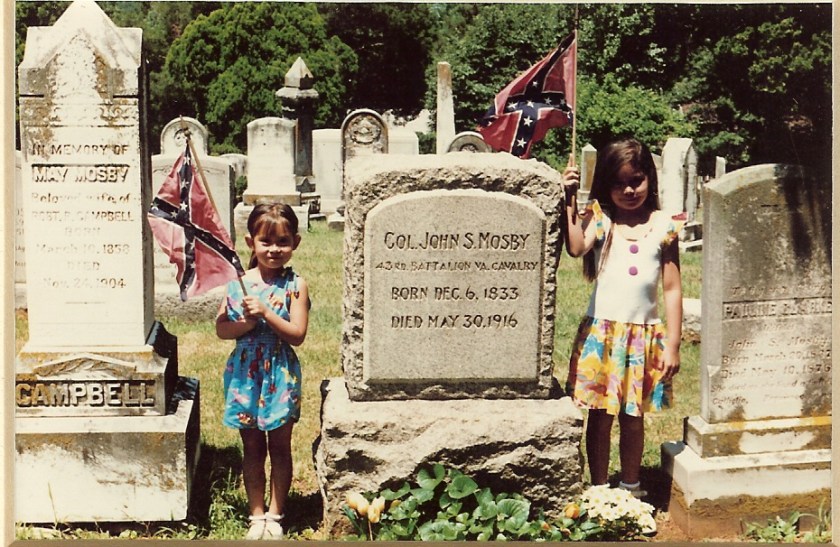
Mosby_Monument

If you enjoyed this “Today in History”, please feel free to re-blog, “like” & share on social media, so that others may find and enjoy it as well. Please click the “follow” button on the right, to receive email updates on new articles.  Thank you for your interest, in the history we all share.

March 7, AD321 The Unconquered Sun

On March 7, AD321, Constantine I “The Great” decreed Dies Solis – Day of the Sun or “Sun-day”:  “On the venerable day of the Sun let the magistrates and people residing in cities rest, and let all workshops be closed”.

Kitara
The cithara or kithara (Greek: κιθάρα, kithāra, Latin: cithara) was an ancient Greek musical instrument in the lyra family of instruments

For two thousand years, a popular story has told the tale of Emperor Nero, playing the fiddle while Rome burned. Far be it for me to leap to the defense of a man who ordered the murder of his own wife and mother, except in the name of historical accuracy. The viol class of musical instruments, to which the fiddle belongs, didn’t come along until the 11th century. If Nero played anything it was probably a Cithara, a heavy wooden instrument with four to seven strings.

At least five versions come down to us about the Great Fire of 64AD, and the Emperor’s role in it. The Roman historian Tacitus tells us that Nero sang about the fall of Troy while the city burned, but admits there were no witnesses.

Cassius Dio and Suetonius ask us to believe, in their turn, that Nero a) secretly sent guys out to burn the city, b) openly did so and watched from the tower of Maecenas while singing and playing the lyre, c) the fire was started by an obscure religious sect called “Christians”, d) Nero sent his guys out after all, but sang and played his lyre from a private stage and e) the fire started by accident while Nero was thirty-five miles away at Antium, and the emperor rushed back to help the now-homeless people of Rome.

images (26)Be that as it may, three things are certain. First, The fire burned for six days, utterly destroying three of the 14 districts of Rome, and severely damaging seven others.  Next, Nero used the excuse of the fire to go after the Christians, having many of them arrested and executed. Last, the Domus Aurea (“Golden Palace”) and surrounding “Pleasure Gardens” which the emperor built on the ruins, would be the death of Emperor Nero.
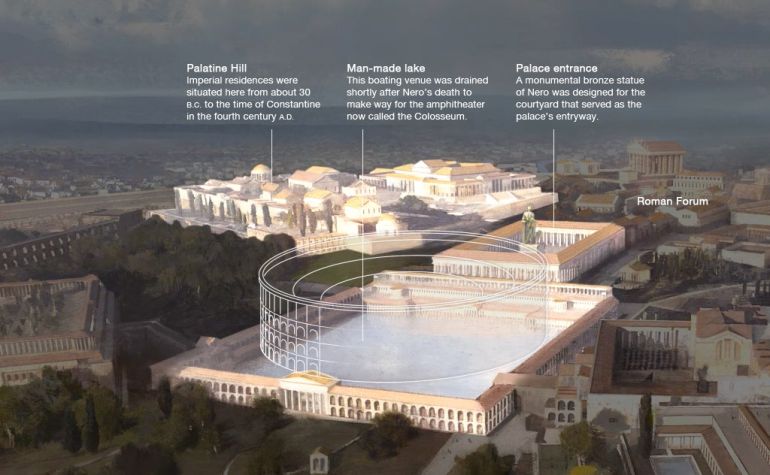
Between AD65 and 68, Emperor Nero built a vast palace complex over an area of more than 200 acres, linking existing buildings on the Palatine Hill with the Gardens of Maecenas and other imperial properties on the Esquiline hills, and adding a grand colonnaded approach and vestibule surrounding an artificial lake.

Reconstruction_3D_Domus_Aurea_Nero_Golden_House_5
Reconstruction of the Domus Aurea, of Nero

One of the Great Wonders of antiquity, Nero’s “Golden house” was ruinously expensive, 300 rooms of dazzling white marble with pools in the floors and fountains splashing in corridors. There were jewel-encrusted walls and ivory clad columns.  An enormous vaulted ceiling lay underneath the dome of the main dining room, with an ingenious mechanism cranked by slaves, making the ceiling revolve like the heavens, as  rose petals dropped and perfume was sprayed on assembled diners.

Suetonius described the complex as “ruinously prodigal”. Nero himself would say nothing further on the palace’ dedication, save to say that he “had at last begun to live like a human being”.

450px-El_Coloso_de_Nerón
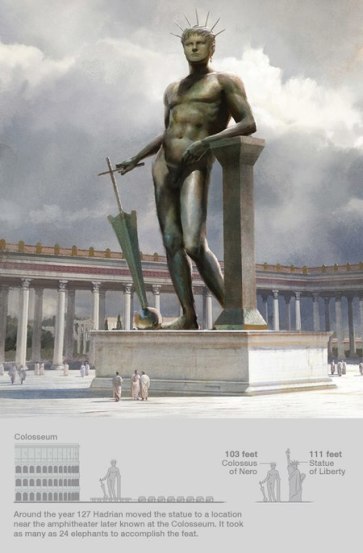
Artist’s rendering of the Colossus of Nero holds a rudder on the globe, symbolizing his dominion over land and sea.

At the center of it all, Nero built his Colossus Neronis, a giant gilded bronze statue – of himself.  Sources place the thing at 98′ to 121′ tall, roughly equal to the statue of liberty, from her feet to her crown.

With all of Italy “thoroughly exhausted by contributions of money” and “the provinces ruined”, the Emperor himself was roundly hated.  In June AD68, Nero learned that he’d been tried in absentia, and condemned to death as an enemy of the Roman people. Preparing himself for suicide, Nero muttered “Qualis artifex pereo” (“What an artist dies in me”).

Nero’s profligacy was a severe embarrassment to his successors.  Within a decade, the palace and its complex was stripped of its marble, jewels, and ivory embellishments.

Within forty years, most of the grounds were filled with earth and built over, replaced by the Baths of Titus, and the Temple of Venus and Rome. Vespasian drained the lake and built the Flavian Amphitheatre, but Nero’s Colossus, lived on.

In 69, Emperor Vespasian added a sun-ray crown and renamed the thing Colossus Solis, a dedication to the Roman sun god Sol Invictus (“Unconquered Sun”), patron of the legions and official Sun God of the later Roman Empire.

Around 128, Emperor Hadrian moved the statue from the Domus Aurea to just outside of the Colosseum, with a little help from the architect Decrianus, and 24 elephants. Emperor Commodus removed the head and replaced it with a likeness of his own, but the head was restored after Commodus’ death, and so it remained.

800px-RomeConstantine'sArch03

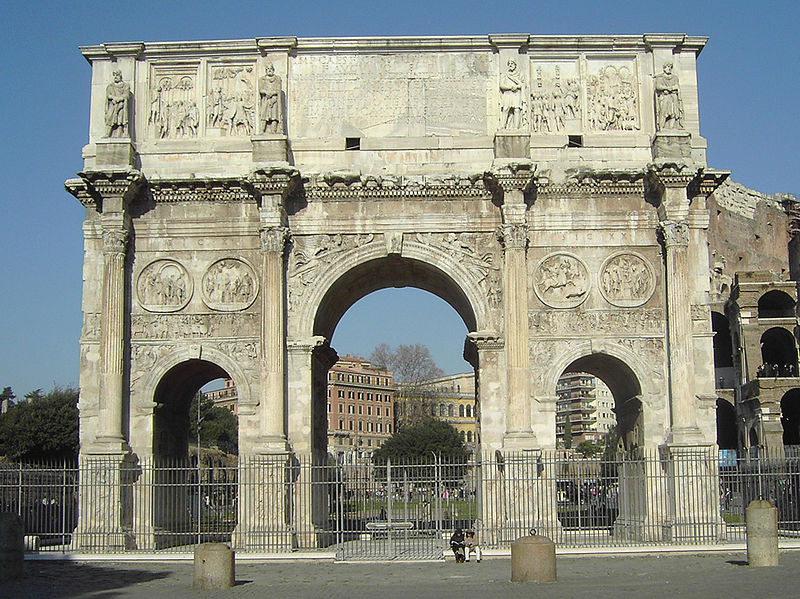
The Arch of Constantine, the last and largest of the Triumphal Arches of Rome and dedicated in AD315, was carefully positioned to align with Sol Invictus, so that the Colossus formed the dominant backdrop when approaching the Colosseum via the main arch.

Six years later, March 7, AD321, Constantine I “The Great” decreed Dies Solis – Day of the Sun or “Sun-day” – as the Roman day of rest (Codex Justinianus 3.12.2):  “On the venerable day of the Sun let the magistrates and people residing in cities rest, and let all workshops be closed. In the country however persons engaged in agriculture may freely and lawfully continue their pursuits because it often happens that another day is not suitable for grain-sowing or vine planting; lest by neglecting the proper moment for such operations the bounty of heaven should be lost”.\

2000 years later Constantine’s day of rest remains, but the colossus of the Unconquered Sun is gone. The last known reference in antiquity dates back to the Calendar of 354, the earliest illuminated manuscript containing full page illustrations.

220px-The_Venerable_Bede_translates_John_1902
Saint Bede of northumbria

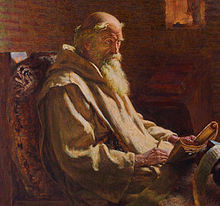
It may have been destroyed during the Sack of Rome in 410, or perhaps it toppled in one of a series of 5th century earthquakes, its metal scavenged. There is evidence that Sol Invictus outlived the western Roman Empire and survived into the early middle ages. Bede the Venerable, an English monk from the monastery of St. Peter in Northumbria, wrote sometime circa 672–735: “As long as the Colossus stands, Rome will stand, when the Colossus falls, Rome will also fall, when Rome falls, so falls the world“.

Today, nothing remains of the Colossus of Nero, save for the foundations of its pedestal at the second location, near the ruins of the Colosseum.

6197120816_242b162d66_b

March 6, 1857 Dred Scott

Dred Scott had lost at virtually every turn, only to win his freedom at the hands of the family which had once held him enslaved.

Dred Scott, his full name may have been “Etheldred”, was born into slavery in Southampton County, Virginia, sometime in the late 1790s.  In 1818, Scott belonged to Peter Blow, who moved his family and six slaves to Alabama, to attempt a life of farming. The farm near Huntsville was unsuccessful and the Blow family gave up the effort, moving to St. Louis Missouri in 1830, to run a boarding house. Around this time, Dred Scott was sold to Dr. John Emerson, a surgeon serving in the United States Army.

Dred_&_Harriet_Scott_Quarters
Dred & Harriet Scott’s restored quarters, at Ft. Snelling

As an army officer, Dr. Emerson moved about frequently, bringing Scott with him. In 1837, Emerson moved to Fort Snelling in the free territory of Wisconsin, now Minnesota. There, Scott met and married Harriet Robinson, a slave belonging to fellow army doctor and Justice of the Peace, Lawrence Taliaferro. Taliaferro, who presided over the ceremony, transferred Harriet to Emerson, who continued to regard the couple as his slaves. Emerson moved away later that year, leaving the Scotts behind to be leased by other officers.

The following year, Dr. Emerson married Eliza Irene Sanford, and sent for the Scotts to rejoin him in Fort Jesup, in Louisiana. Harriett gave birth to a daughter while on a steamboat on the Mississippi, between the free state of Illinois and the Iowa district of the Wisconsin Territory.

images (25)Dr. Emerson died in 1842, leaving his estate to his wife Eliza, who continued to lease the Scotts out as hired slaves.
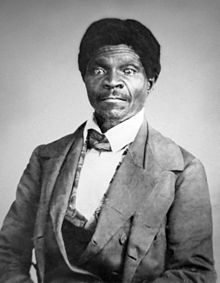
Four years later, Scott attempted to buy his freedom for the sum of $300, equivalent to about $8,000 today. Mrs. Emerson declined the offer and Scott took legal recourse. By this time, Dred and Harriett Scott had two daughters, who were approaching an age where their value would be greatly increased, should they be sold as slaves. Wanting to keep his family together, Scott sued.

Ironically, Dred Scott’s suit in state court, Scott v. Emerson, was financially backed by three now-adult Blow children, who had since become abolitionists. The legal position stood on solid ground, based on the doctrine “Once free, always free”. The Scott family had resided in free states and territories for two years, and their eldest daughter was born on the Mississippi River, between a free state and a free territory.

The verdict went against Scott but the judge ordered a retrial, which was held in January, 1850. This time, the jury ruled in favor of Dred Scott’s freedom. Emerson appealed and the Missouri supreme court struck down the lower court ruling, along with 28 years of Missouri precedent.

By 1853, Eliza Emerson had remarried and moved to Massachusetts, transferring ownership of the Scott family to her brother, John Sanford. Scott sued in federal district court, on the legal basis that the federal courts held “diversity jurisdiction”, since Sanford lived in one state (New York), and Scott in another (Missouri). Dred Scott lost once again and appealed to the United States Supreme Court, a clerical misspelling erroneously recording the case as Dred Scott v. Sandford.

On March 6, 1857, Chief Justice Roger B. Taney delivered the 7-2 majority opinion, enunciating one of the stupidest decisions, in the history of American jurisprudence:
“[Americans of African ancestry] had for more than a century before been regarded as beings of an inferior order, and altogether unfit to associate with the white race, either in social or political relations; and so far inferior, that they had no rights which the white man was bound to respect; and that the negro might justly and lawfully be reduced to slavery for his benefit. He was bought and sold, and treated as an ordinary article of merchandise and traffic, whenever a profit could be made by it”.

download (18)
Frederick Douglass

The highest court in the land had ruled that slaves were private property and not citizens, with no right to legal recourse. Furthermore, the United States Congress had erred in attempting to regulate slavery in the territories, and had no right to revoke the property rights of a slave owner, based on his place of residence.

The response to the SCOTUS opinion was immediate, and vehement. Rather than settle the issue of slavery, the decision inflamed public opinion, dividing an already fractured country, further. Frederick Douglass assailed Chief Justice Taney’s opinion, noting that:

“We are now told, in tones of lofty exultation, that the day is lost all lost and that we might as well give up the struggle. The highest authority has spoken. The voice of the Supreme Court has gone out over the troubled waves of the National Conscience, saying peace, be still . . . The Supreme Court of the United States is not the only power in this world. It is very great, but the Supreme Court of the Almighty is greater”.

220px-Dred_Scott_photograph_(circa_1857)
Dred Scott, photograph circa 1857

The Supreme Court had spoken, but the Dred Scott story was far from over.  Eliza Irene Emerson’s new husband was Calvin C. Chaffee, a member of the United States Congress, and an abolitionist.

Following the Dred Scott decision, the Chaffees deeded the Scott family over to Henry Taylor Blow, now a member of the United States House of Representatives from Missouri’s 2nd Congressional district, who manumitted the family on May 26. Dred Scott had lost at virtually every turn, only to win his freedom at the hands of the family which had once held him enslaved.

For Harriett and the two Scott daughters, it was the best of all possible outcomes.  For Scott himself, freedom was short-lived.  Dred Scott died of tuberculosis, the following year.

Nationally, the Dred Scott decision had the effect of hardening enmities already nearing white-hot, increasing animosities within and between pro- and anti-slavery factions in North and South, alike. Politically, the Democratic party was broken into factions and severely weakened,  while the fledgling Republican party was strengthened, as the nation was inexorably drawn to Civil War.

Slaves Issues Plague the Democratic Party

The issue of Black citizenship was settled in 1868, via Section 1 of the 14th Amendment, which states: “All persons born or naturalized in the United States, and subject to the jurisdiction thereof, are citizens of the United States and of the State wherein they reside …”

Dred Scott is buried in the Calvary Cemetery in St. Louis, Missouri. The marker next to his headstone reads: “In Memory Of A Simple Man Who Wanted To Be Free.”

112973396-H

If you enjoyed this “Today in History”, please feel free to re-blog, “like” & share on social media, so that others may find and enjoy it as well. Please click the “follow” button on the right, to receive email updates on new articles.  Thank you for your interest, in the history we all share.