April 27, 1865 Sultana

Sultana was the worst maritime disaster in United States history, though its memory was mostly swept away in the tide of events that April.  The United States Customs Service records an official count of 1,800 killed, though the true number will never be known.  Titanic went down in the North Atlantic 47 years later, taking 1,512 with her.

In April 1865, the Civil War was all but ended.  General Robert E. Lee surrendered to General Ulysses S. Grant on the 9th.  President Abraham Lincoln was assassinated five days later, and John Wilkes Booth run to ground and killed on the 26th.  Thousands of former POWs were being released from Confederate camps in Alabama and Georgia, and held in regional parole camps.

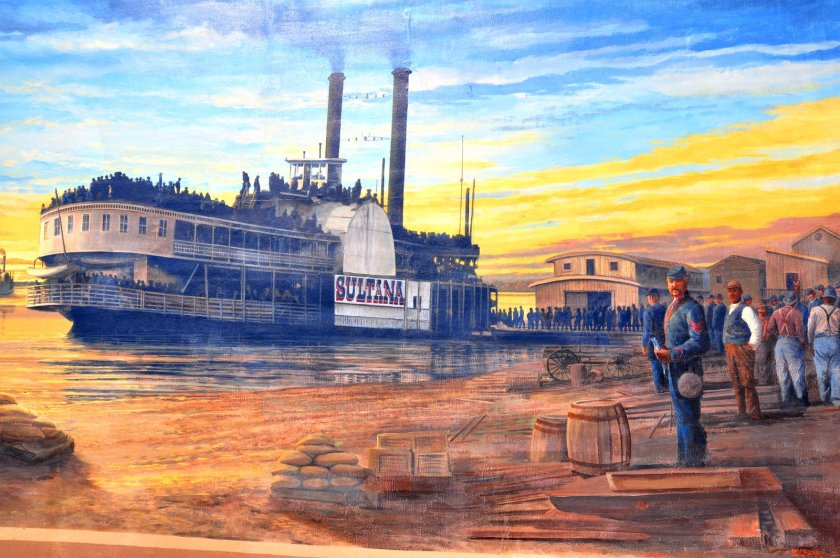
The sidewheel steamboat Sultana left New Orleans with about 100 passengers and a few head of livestock, pulling into Vicksburg Mississippi on the 21st to repair a damaged boiler and to pick up a promised load of passengers.

The mechanic wanted to cut a bulging seam out of the boiler and install a new plate, easily three day’s work.  Captain J. Cass Mason declined, for fear of losing his passengers.  He wanted the seam hammered back into place and covered with a patch, and he wanted it done in a day.
download (88)

The passengers Mason was so afraid of losing were former prisoners of the Confederacy, and Confederate parolees, returning to their homes in Kentucky and Tennessee.

The Federal government was paying $5 each to anyone bringing enlisted guys home, and $10 apiece for officers.  Lieutenant Colonel Reuben Hatch, chief quartermaster at Vicksburg and one of the sleazier characters in this story, had approached Captain Mason with a deal.  Hatch would guarantee a minimum of 1,400 passengers, and they’d both walk away with a pocketful of cash.

As it was, there were other riverboats in the vicinity.  Mason didn’t have time to worry about boiler repairs.

The decks creaked and sagged, as beams were installed to shore up the load.  Sultana backed away from the dock on April 24, with 2,427 passengers.  More than six times her legal limit of 376.
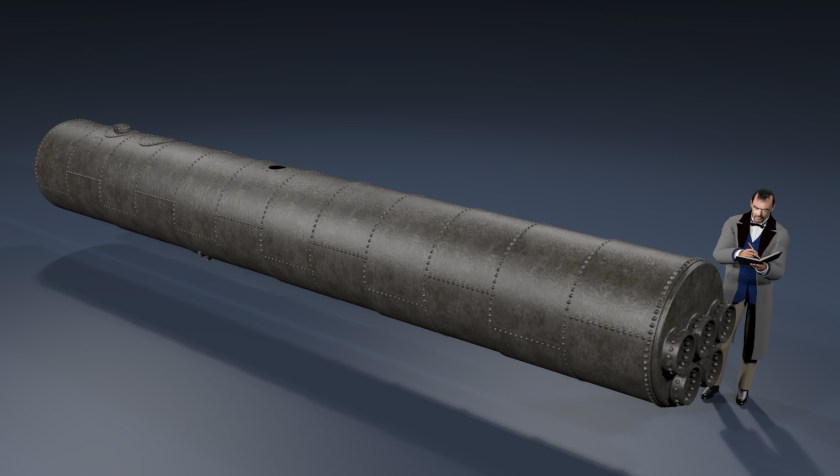
BoilerBlue
This animation gives a sense of the size, of Sultana’s boilers

Sultana spent two days traveling upstream, fighting one of the heaviest spring floods in the history of the Mississippi River.  She arrived at Memphis on the evening of the 26th, unloading 120 tons of sugar from her holds.  Already massively top heavy, the riverboat now lurched from side to side with every turn.
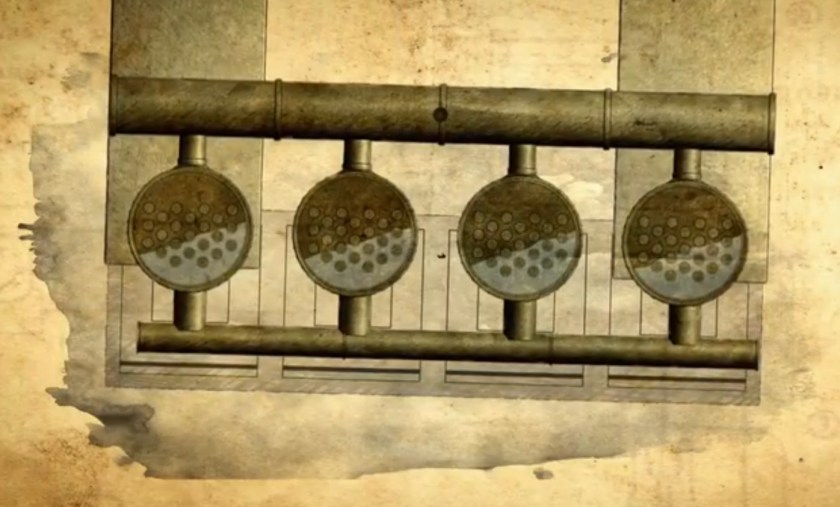
Sultana (1)
SS Sultana was equipped with four such boilers, mounted from side-to-side.  Massively top heavy, water would run from left to right as she lurched from side to side, water then flashing to steam and creating enormous surges in pressure

The crew must have exceeded allowable steam pressure, pushing all that load against the current.  Pressure varied wildly inside Sultana’s four giant boilers, as water sloshed from one to the next with every turn, boiling water flashing to superheated steam and back to water.

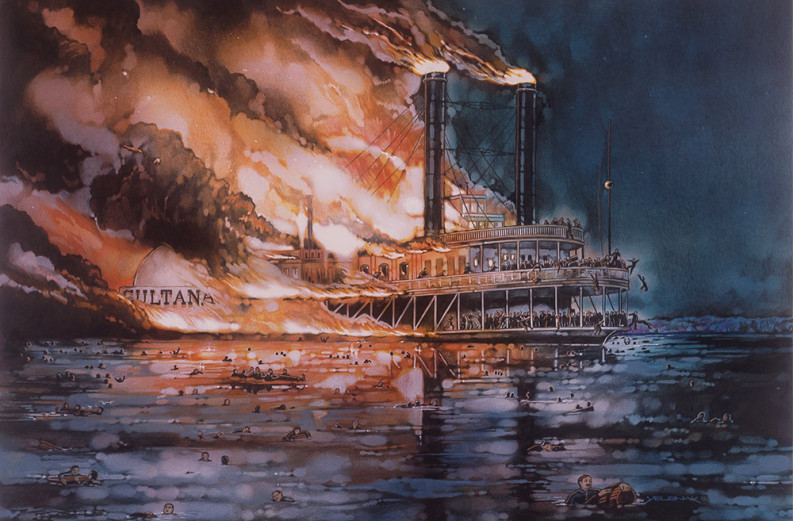
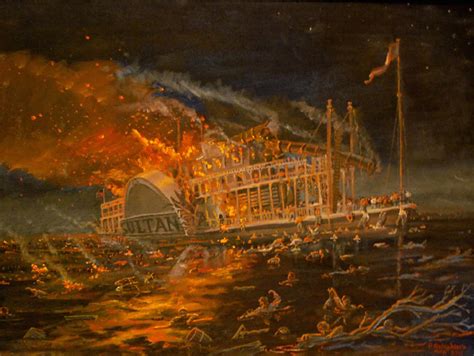
The temporary boiler patch exploded at 2:00am on April 27, detonating two more boilers a split second later.  The force of the explosion hurled hundreds into the icy black water.  The top decks soon gave way, as hundreds tumbled into the gaping maw of the fire boxes below.
download (90)

Within moments, the entire riverboat was ablaze.  Those who weren’t incinerated outright now had to take their chances in the swift moving waters of the river.  Already weakened by terms in captivity, they died by the hundreds of drowning or hypothermia.

The drifting and burnt out hulk of the Sultana sank to the bottom, seven hours later.  The steamers Silver Spray, Jenny Lind, and Pocohontas joined the rescue effort, along with the navy tinclad Essex and the sidewheel gunboat USS Tyler.  700 were plucked from the water and taken to Memphis hospitals, of whom 200 later died of burns or exposure.  Bodies would continue to wash ashore, for months.

Sultana was the worst maritime disaster in United States history, though its memory was mostly swept away in the tide of events that April.  The United States Customs Service records an official count of 1,800 killed, though the true number will never be known.  Titanic went down in the North Atlantic 47 years later, taking 1,512 with her.
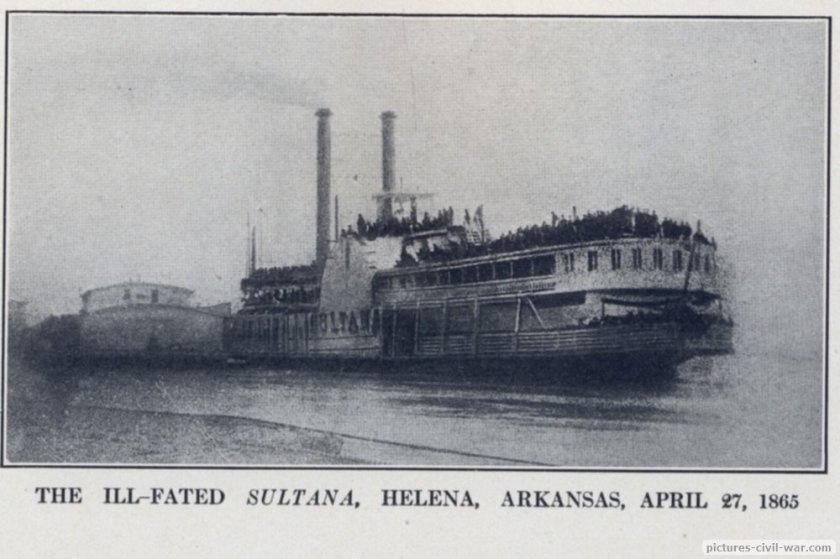
download (91)

Despite the enormity of the disaster, no one was ever held accountable.  One Union officer, Captain Frederick Speed, was found guilty of grossly overcrowding the riverboat.  It was he who sent 2,100 prisoners from their parole camp into Vicksburg, but his conviction was later overturned.  It seems that higher ranking officials may have tried to make him into a scapegoat, since he never so much as laid eyes on Sultana herself.

Captain Williams, the officer who actually put all those people onboard, was a West Point graduate and regular army officer.  The army didn’t seem to want to go after one of its own.  Captain Mason and all of his officers were killed in the disaster.  Reuben Hatch, the guy who concocted the whole scheme in the first place, resigned shortly after the disaster, thereby putting himself outside the reach of a military tribunal.
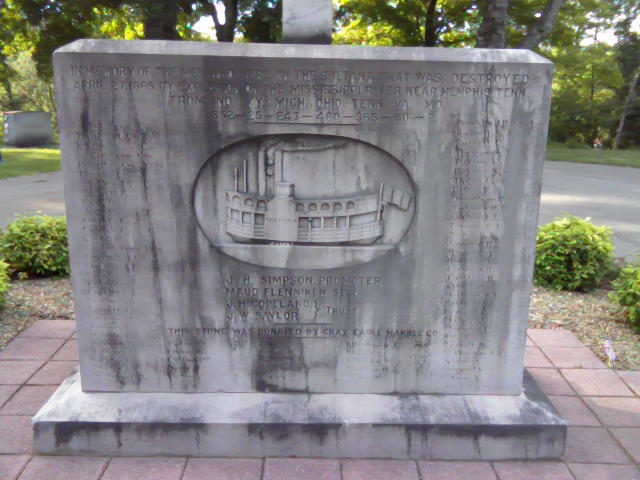
Sultana Memorial at the Mount Olive Baptist Church Cemetery in Knoxville, Tennessee in 2010
Sultana Memorial at the Mount Olive Baptist Church Cemetery in Knoxville, Tennessee, 2010

The last survivor of the Sultana disaster, Private Charles M. Eldridge of the 3rd (Confederate) Tennessee Cavalry, died at his home at the age of 96 on September 8, 1941. Three months before the Imperial Japanese attack on Pearl Harbor.

If you enjoyed this “Today in History”, please feel free to re-blog, “like” & share on social media, so that others may find and enjoy it as well. Please click the “follow” button on the right, to receive email updates on new articles.  Thank you for your interest, in the history we all share.

April 26, 1777  The Female Paul Revere

The Dutchess County Militia had to be called up.  The Colonel himself had only a single night to prepare for battle, and this rider was exhausted.  The job would have to go to Colonel Ludington’s first-born.  His daughter, Sybil.

Listen my children and you shall hear,
Of the midnight ride of…Sybil Ludington.

Paul Revere’s famous “midnight ride” began on the night of April 18, 1775.  Revere was one of two riders, soon joined by a third, fanning out from Boston to warn of an oncoming column of “regulars”, come to destroy the stockpile of gunpowder, ammunition, and cannon in Concord.

Revere himself covered barely 12 miles before being captured, his horse confiscated to replace the tired mount of a British sergeant.  Revere would finish his “ride” on foot, arriving at sunrise on the 19th to witness the last moments of the battle on Lexington Green.

download (55)Two years later, Patriot forces maintained a similar supply depot, in the southwest Connecticut town of Danbury.

William Tryon was the Royal Governor of New York, a long-standing advocate for attacks on civilian targets.  In 1777, Tryon was also a Major-General of the provincial army.  On April 25th, Tryon set sail for the Connecticut coast of Long Island Sound with a force of 1,800, intending to destroy Danbury.

Patriot Colonel Joseph Cooke’s small Danbury garrison was caught and quickly overpowered on the 26th, trying to remove food supplies, uniforms, and equipment.  Facing little if any opposition, Tryon’s forces went on a bender, burning homes, farms and storehouses.  Thousands of barrels of pork, beef and flour were destroyed, along with 5,000 pairs of shoes, 2,000 bushels of grain, and 1,600 tents.

Colonel Henry Ludington was a farmer and father of 12, with a long military career.  A long-standing and loyal subject of the British crown, Ludington switched sides in 1773, joining the rebel cause and rising to command the 7th Regiment of the Dutchess County Militia, in New York’s Hudson Valley.

In April 1777, Ludington’s militia was disbanded for planting season, returned to homes across the countryside.  Soaked to the skin and exhausted, a rider arrived at the Ludington farm on the night of the 26th, on an equally soaked and exhausted horse.  With a driving rain cascading in sheets off an empty saddle, the rider explained the purpose of his visit.  15 miles away, British regulars and a loyalist force were burning Danbury to the ground.

The Dutchess County Militia had to be called up.  The Colonel himself had only a single night to prepare for battle, and this rider was done for.  The job would have to go to the Colonel’s first-born.  That meant Ludington’s daughter Sybil, and she was barely sixteen.

download (59)

From Poughkeepsie to what is now Putnam County and back, the “Female Paul Revere” rode across the lower Hudson River Valley, covering 40 miles in the pitch darkness of night, alerting her father’s militia to the danger and urging them to come out and fight.  She’d use a stick to knock on doors, even using it once to beat back a highway bandit.

By the time that Sybil returned the next morning, cold, rain-soaked, and exhausted, most of 400 militia members were prepared to march.

35 miles east of Danbury, General Benedict Arnold was gathering a force of 500 regular and irregular Connecticut militia, along with Generals David Wooster and Gold Selleck Silliman.

download (57)

Arnold’s forces arrived too late to save Danbury, but inflicted a nasty surprise on the British rearguard as the column approached nearby Ridgefield.  Never outnumbered by less than three-to-one, Connecticut militia was able to slow the British advance until Ludington’s New York Militia arrived on the following day.  The last phase of the action saw the same type of swarming harassment, as seen on the British retreat from Concord to Boston, earlier in the war.

Though the British operation was a tactical success, the mauling suffered at the hands of colonials ensured that this was the last hostile British landing on the Connecticut coast.

The British raid on Danbury destroyed at least 19 houses and 22 stores and barns.  Town officials submitted £16,000 in claims to Congress, for which town selectmen received £500 reimbursement.  Further claims were made to the General Assembly of Connecticut in 1787, for which Danbury was awarded land.  In Ohio.

The old Keeler Tavern in Ridgefield is now a museum.  The British cannonball fired into the side of the building, remains there to this day.

download (56)

At the time, Benedict Arnold planned to travel to Philadelphia, to protest the promotion of officers junior to himself, to Major General.  Arnold, who’d had two horses shot out from under him at Ridgefield, was promoted to Major General in recognition of his role in the battle.  Along with that promotion came a horse, “properly caparisoned as a token of … approbation of his gallant conduct … in the late enterprize to Danbury.”

The pride which would one day be Arnold’s undoing, was assuaged.  For a time.

Henry Ludington became Aide-de-Camp to General George Washington, and grandfather to Harrison Ludington, future mayor of Milwaukee and the 12th Governor of Wisconsin.

Gold Silliman was kidnapped with his son by a first marriage by Tory neighbors, and held for nearly seven months at a New York farmhouse.  Having no hostage of equal rank with whom to exchange for the General, Patriot forces went out and kidnapped one of their own, in the person of Chief Justice Judge Thomas Jones, of Long Island.

download (60)Mary Silliman was left to run the farm, and negotiate for the release of her husband.  The 1993 made-for-TV movie “Mary Silliman’s War” tells a story of non-combatants, pregnant mothers and farm wives, during the Revolution.

General David Wooster was mortally wounded at the Battle of Ridgefield, moments after shouting “Come on my boys! Never mind such random shots!”  Today, an archway marks the entrance to Wooster Square, in the East Rock Neighborhood of New Haven.

Sybil Ludington received the thanks of family and friends, even George Washington himself, and then stepped off the pages of history.

Paul Revere’s famous ride would likewise have faded into obscurity, but for the poetry of Henry Wadsworth Longfellow.  86 years later.

monument-1

If you enjoyed this “Today in History”, please feel free to re-blog, “like” & share on social media, so that others may find and enjoy it as well. Please click the “follow” button on the right, to receive email updates on new articles.  Thank you for your interest, in the history we all share.

April 25, 1898 Newsies

As late as 1900, fully 18% of the American workforce was under the age of sixteen.

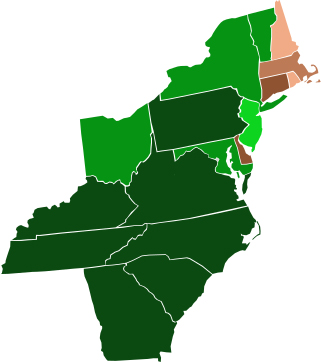
United_States_presidential_election_results,_1796-1820
US presidential election results from 1796 to 1820 gives a good idea of partisan press circulation, where Green shaded states usually voted for the Democratic-Republican Party, while brown shaded states supported the Federalist Party

During the early colonial period, American newspapers were “wretched little” sheets in the words of America’s “1st newsboy”, Benjamin Franklin.  Scarcely more than sidelines to keep presses occupied.

Newspapers were distributed by mail in the early years, thanks to generous subsidies from the Postal Act of 1792. In 1800, the United States could boast somewhere between 150 – 200 newspapers.  Thirty-five years later, some 1,200 were competing for readership.

350px-Great-Moon-Hoax-1835-New-York-Sun-lithograph-298px
Lithograph from the “Great Moon Hoax” of 1835

Today we hear a lot about “fake news”, but that’s nothing new.  In 1835, the New York Sun published a six-part series, about civilization on the moon.   The “Great Moon Hoax”, ostensibly reprinted from the Edinburgh Courant, was falsely attributed to the work of Sir John Herschel, one of the best known astronomers of his time.

Whatever it took, to sell newspapers.

Two years earlier, Sun publisher Benjamin Day ran a Help-Wanted advertisement, looking for adults to help expand circulation. “To the unemployed — A number of steady men can find employment by vending this paper. A liberal discount is allowed to those who buy and sell again“. To Day’s surprise, his ad didn’t produce adult applicants as expected.  Instead, the notice attracted children.

Today, kids make up a minimal part of the American workforce, but that wasn’t always so. Child labor played an integral part in the agricultural and handicraft economy, working on family farms or hiring out to other farmers.  Boys customarily apprenticed to the trades, at 10 – 14. As late as 1900, fully 18% of the American workforce was under the age of sixteen.

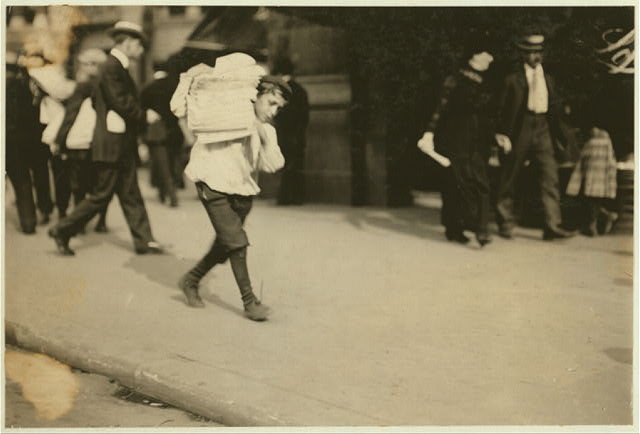
download (82)
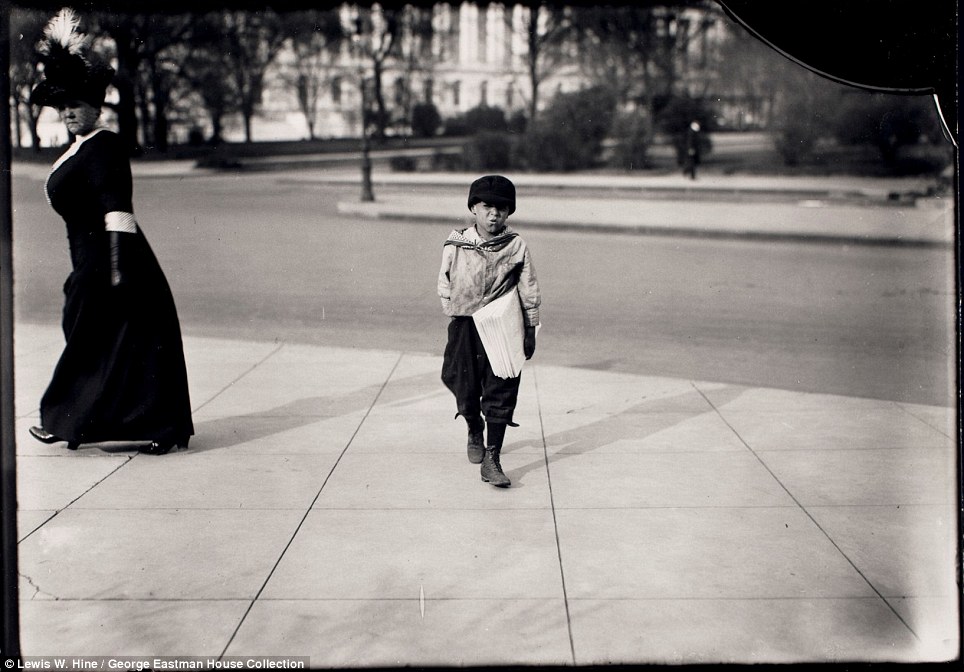
Brooklyn newsboy, ca. 1910 Photo by Lewis Hine (Library of Congress)

Benjamin Day’s first newspaper “hawker” was Bernard Flaherty, a ten-year-old Irish immigrant. The kid was good at it too, crying out lurid headlines, to passers-by: “Double Distilled Villainy!” “Cursed Effects of Drunkenness!” “Awful Occurrence!” “Infamous Affair!” “Extra! Extra! Read all about it!”

download (92)

Hordes of street urchins swarmed the tenements and alleyways of American cities. During the 1870s, homeless children were estimated at 20,000 – 30,000 in New York alone, as much as 12% of school-age children in the city.

For thousands, newspapers were all that stood in the way of an empty belly.

800px-Riischildren
Homeless children sleeping in Mulberry Street district of New York, circa 1890

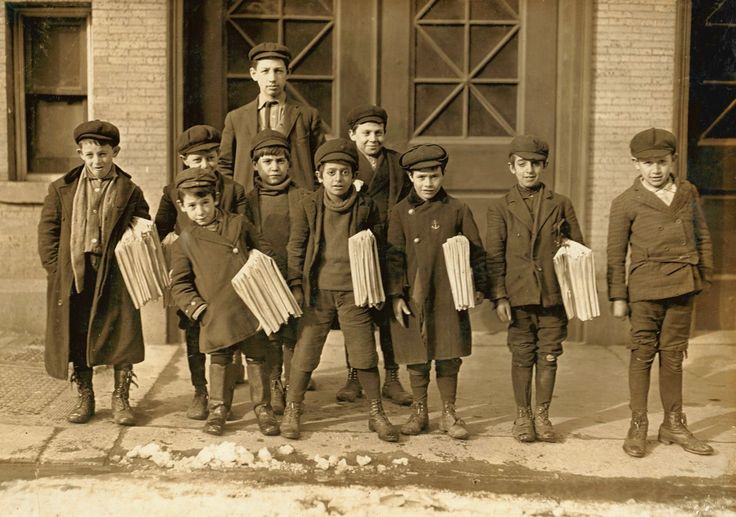
Adults had no interest in the minuscule income, and left the newsboys (and girls) to their own devices.  “Newsies” bought papers at discounted prices and peddled them on the street.    Others worked saloons and houses of prostitution.  They weren’t allowed to return any left unsold, and worked well into the night to sell every paper.

article-2467498-18D8276800000578-777_964x699

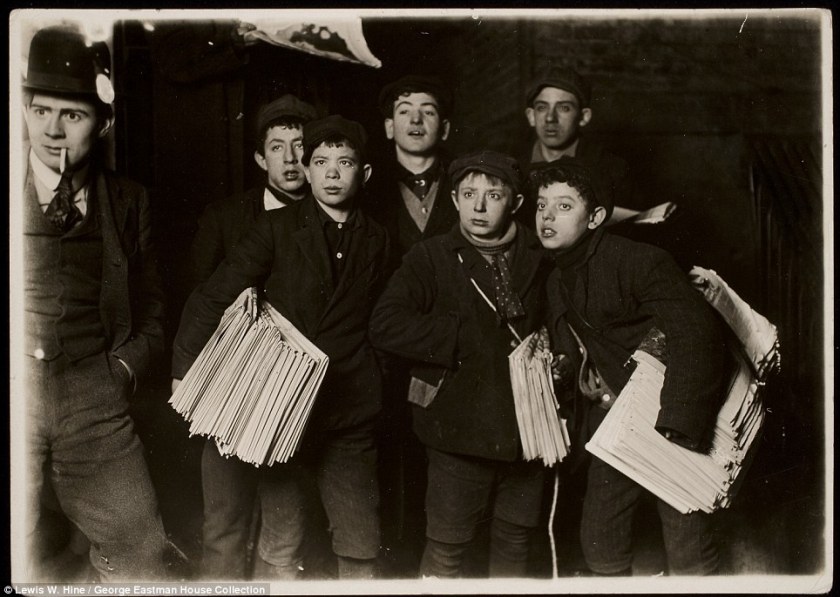
For that, newsies earned about 30¢ a day.  Enough for a bite to eat, to afford enough papers to do it again the following day, and maybe a 5¢ bed in the newsboy’s home.

article-2467498-18D8273A00000578-282_964x688

Competition was ferocious among hundreds of papers, and business practices were lamentable.  In 1886, the Brooklyn Times tried a new idea. The city was expanding rapidly, swallowing up previously independent townships along the Long Island shore. The Times charged Western District newsboys a penny a paper, while Eastern District kids paid 1 1/5¢.

The plan was expected to “push sales vigorously in new directions.” It took about a hot minute for newsies to get wise, and hundreds of them descended on the Times’ offices with sticks and rocks. On March 29, several police officers and a driver’s bullwhip were needed to get the wagons out of the South 8th Street distribution offices. One of the trucks was overturned, later that day.

article-2467498-18D8272400000578-972_964x686

That time, the newsboy strike lasted a couple of days, enforced by roving gangs of street kids and “backed by a number of roughs”. In the end, the Times agreed to lower its price to a penny apiece, in all districts. Other such strikes would not be ended so quickly, or so easily.

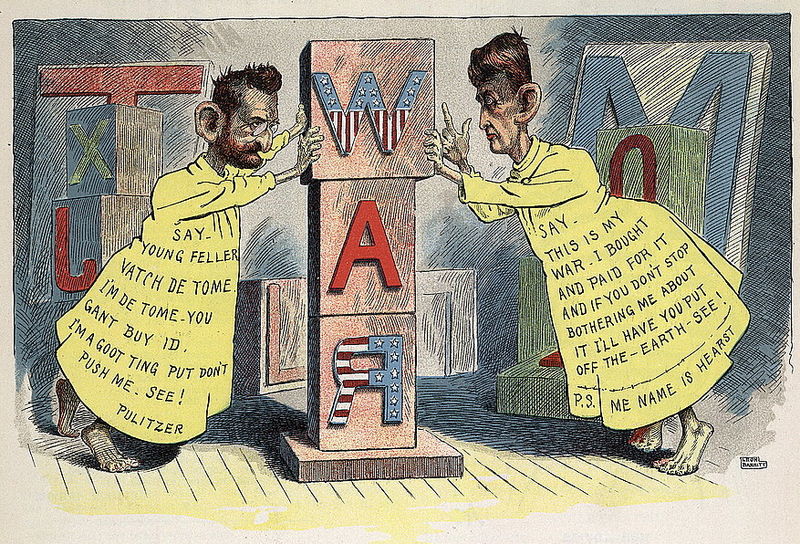
In those days, the Caribbean island of Cuba was ruled from Spain. After decades spent in the struggle for independence, many saw parallels between the “Cuba Libre” movement, and America’s own Revolution of the previous century.  In 1897-’98, few wanted war with Spain over Cuban interests more than Assistant Naval Secretary Theodore Roosevelt, and New York publishers Joseph Pulitzer & William Randolph Hearst.

800px-PulitzerHearstWarYellowKids

This was the height of the Yellow Journalism period, and newspapers clamored for war. Hearst illustrator Frederic Remington was sent to Cuba, to document “atrocities”.  On finding none, Remington wired: “There will be no war. I wish to return”.  Hearst wired back: “Please remain. You furnish the pictures, and I’ll furnish the war.” President McKinley urged calm, but agreed to send the armored cruiser USS Maine, to protect US “interests”.

The explosion that sank the Maine on February 15 killing 268 Americans was almost certainly accidental, but that wouldn’t be known for decades. Events quickly spun out of control and, on April 21, 1898, the US blockaded the Caribbean island. Spain gave notice two days later, that it would declare war if US forces invaded its territory. Congress declared on April 25 that a state of war had existed between Spain and the United States, since the 21st.

article-2467498-18D8275900000578-427_964x657

Several days later, newsboys were shouting the headline:  “How do you like the Journal’s war?”

The Spanish-American War was over in 3 months, 3 weeks and 2 days, but circulation was great while it lasted. Publishers cashed in, raising the cost of newsboy bundles from 50¢ to 60¢ – the increase temporarily offset by higher sales. Publishers reverted to 50¢ per 100 after the war, with the notable exceptions of Joseph Pulitzer’s New York World, and William Randolph Hearst’s New York Journal.

February_23rd_1908_Boys_Selling_Newspapers_on_Brooklyn_Bridge
Brooklyn newsboys, 1908

Newsies struck the two in 1899, refusing to sell their papers. 5,000 newsboys blocked the Brooklyn Bridge, bringing traffic to a standstill. Competing papers such as the New York Tribune couldn’t get enough of the likes of strike “President” Dave Simmons, the boy “prize-fighter”, Barney “Peanuts”, “Crutch” Morris, and others.  The charismatic, one-eyed strike leader “Kid Blink”, was a favorite: “Friens and feller workers. This is a time which tries de hearts of men. Dis is de time when we’se got to stick together like glue…. We know wot we wants and we’ll git it even if we is blind”.

Neither Hearst nor Pulitzer ever dropped their price, but they did agree to take back unsold papers.

800px-Child_Labor_in_United_States_1910_working_night_shift
Some worked well after midnight, to sell every paper

Long before modern notions of child welfare, street kids had precious few to look out for them, beyond themselves.  “Dutch” Johnson, Brooklyn’s “Racetrack Newsie”, caught cold, in 1905.  The illness soon turned more serious, and he was found unconscious on a pile of catalogs.  Brought to Bellevue Hospital by the East River,  the 16-year-old was informed that it was pneumonia.  This was before the age of antibiotics.  There was no chance.

“It goes”, Dutch said, in a voice barely audible.  “Only I ain’t got no money and I’d like to be put away decent”.

tumblr_ne0yqmwDCl1u0ndouo1_500 (1)
H/T http://newsieshistory.tumblr.com for this image

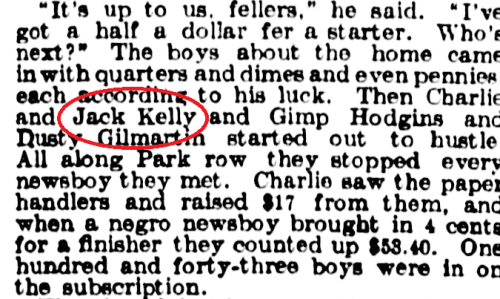
Bookmaker “Con” Shannon offered to take up a collection for the burial.  He could have easily produced hundreds from bookies and gamblers.   Dutch’s diminutive successor “Boston”, spoke up.  “Naw”, he said “we’re on de job and nobody else”.  So it was that “Gimpy”, “Dusty”, and the other urchins of Sheepshead Bay pitched in with their pennies, their nickels and their dimes.  $53.40 bought the plot in Linden Hill Cemetery, with its small stone marker.  Not a plain black wagon and a nameless grave in some Potter’s Field.


If you enjoyed this “Today in History”, please feel free to re-blog, “like” & share on social media, so that others may find and enjoy it as well. Please click the “follow” button on the right, to receive email updates on new articles.  Thank you for your interest, in the history we all share.

April 23, 1982 Conch Republic

The United States still had a border in those days, which the Federal government attempted to enforce.

Except for the Naval Air Station at Boca Chica and Coast Guard installations in Key West, Marathon and Islamorada, most of the economic activity in the Florida Keys, comes from tourism. It’s no wonder that, when the federal government shuts down the only road into the Keys, the locals are going to get cranky.

In April 1982, the Mariel boatlift was a mere two years in the past, and very much in the public memory.

download (74)The United States still had a border in those days, which the Federal government attempted to enforce.

On April 18, Border Patrol set up a roadblock in front of Skeeter’s Last Chance Saloon in Florida City, shutting down US Route 1, the only road in and out of the Florida Keys.  Originally intended to intercept illegals entering the country, the roadblock soon morphed into a hunt for illegal drugs, as well.

Cars waited for hours, in lines stretching 19 miles. Predictably, the attitude of Federal officials was one of towering indifference. Not so local business owners. Robert Kerstein wrote in his Key West on the Edge — Inventing the Conch Republic, “No one in Key West doubted that drugs were trafficked widely in the Keys by road and by boat. But tourism’s boosters had little tolerance for interruptions to their business.”

Dennis Wardlow, then-Mayor of Key West, contacted the chief of police, the Monroe County sheriff, his State Representative and then-Governor Bob Graham, demanding the roadblock’s removal. With none of the above having any knowledge of the barrier and lacking the authority to pull it down, Wardlow contacted INS directly. When the Border Patrol told him it was “none of his business,” the Mayor’s response could best be summed up in the words of Bugs Bunny: “Of course you know, this means war!

Conch Republic PassportsSuffering a blizzard of hotel cancellations, this “attack on Key West’s sovereignty” could not stand. On April 22, Mayor Wardlow, local attorney & pilot David Horan and Old Town Trolley Tours operator Ed Swift flew to Miami seeking legal remedy. When District Court Judge C. Clyde Atkins failed to issue an injunction, the Key West delegation took to the courthouse steps.

“What are you going to do, Mr. Mayor”, asked the assembled media. Swift leaned over and whispered into the Mayor’s ear, “Tell them we are going to go home and secede!” “We are going to go home and secede!”, said Wardlow, and that’s what they did.

Conch Republic Secession

Over the next 24 hours, secessionist co-conspirators worked feverishly to form a new government, filling cabinet positions such as “Secretary of Underwater Affairs” and “Minister of Nutrition”.

logo-navy2On April 23, with federal agents on scene to monitor the proceedings, a crowd gathered before the old customs building. Mayor Wardlow and a gaggle of allies mounted the back of a flatbed truck, to read the proclamation of secession. “We serve notice on the government in Washington”, he started, “to remove the roadblock or get ready to put up a permanent border to a new foreign land. We as a people, may have suffered in the past, but we have no intention of suffering in the future at the hands of fools and bureaucrats“.

With that, Mayor Wardlow declared “war” on the United States.  The “Great Battle of the Conch Republic” broke out in the harbor, when the Schooner Western Union commanded by Captain John Kraus, attacked the Coast Guard Cutter Diligence with water balloons, Conch fritters and toilet paper.  Diligence fought back with water hoses, as the new “Prime Minister” broke a stale loaf of Cuban bread over the head of a man dressed in a Navy uniform.

download (73)
Naval History was forever changed on this day, as the “Great Battle of the Conch Republic” raged across the waters of Key West

Pandemonium broke out as others launched stale bread and conch fritters at federal agents, Navy sailors and Coast Guard personnel. One minute after declaring his “verbal shot” at the Federal government, Mayor Wardlow surrendered to a nearby Naval officer, demanding a billion dollars in “foreign aid” in compensation for “the long federal siege.”

Apparently, that’s what it takes to get the attention of a Federal government bureaucrat. The roadblock lifted.  The restaurants, stores and hotels of the Keys soon filled with tourists and, once again, there was happiness upon the land.  Key West never got its “foreign aid”, but “secesh” leaders never received so much as a letter, saying they couldn’t leave the Union, either.

ConchRepublicSpecialForcesSo it is that the micro-nation of Key West celebrates its independence, every April 23. The “Conch Republic’ issues its own passports, selling T-shirts and bumper stickers with the slogan “We seceded where others failed”.

And if the Federal government ever comes back to mess with the sovereign nation of Key West, it had better be prepared to deal with the Conch Republic’s very own “Special Forces”, the motto for which is “Sanctus Merda”.  “Holy Shit”.

Tip of the hat to

“Conch Republic Military Forces, The Official Site of the Conch Republic Military”

Linked Here

for the “Conch Battle Hymn of the Republic”.  Lyrics by First Sea Lord, Admiral Finbar Gittelman, October 14, 2012 © Finbar Gittelman

Mine eyes have seen the glory of the sunshine and the sea
Right here upon our islands, where we love to live so free 
But in April 1982, the peace was not to be 
And we went rolling on

CHORUS
Glory glory Conch Republic 
From Key to shining Key

They were setting up a check point, tween the mainland and the Keys 
They had put a US Border, where it shouldn’t ‘oughta’ be 
So that’s when we seceded, and declared our sovereignty 
And the fun had just begun

(CHORUS)

We went forth into the harbor and a cutter we did spy 
And we sailed up along side her and we took her by surprise 
We hoisted up our battle flag, so proudly and so high 
And we went sailing on

(CHORUS)

The water and Conch fritters and the Cuban bread did fly 
Our bombers, they were raining toilet paper from the sky 
Our cannons they did thunder to proclaim our victory 
And we fought bravely on

(CHORUS)

We have faced the silly forces of misguided zealotry 
We have stood up to their foolishness for all the world to see 
And we’ve showed the other nations what America can be From
Key to shining Key

(CHORUS)


If you enjoyed this “Today in History”, please feel free to re-blog, “like” & share on social media, so that others may find and enjoy it as well. Please click the “follow” button on the right, to receive email updates on new articles.  Thank you for your interest, in the history we all share.

April 22, 1918 Our Gallant and Worthy Foe

The Red Baron was buried by his enemies, with honors, on April 22, 1918.  British Third Squadron officers served as pallbearers.  Other ranks from the squadron acted as a guard of honor. Allied squadrons stationed nearby presented memorial wreaths, one of which was inscribed with these words:
“To Our Gallant and Worthy Foe”.

Early in the “Great War”, Manfred Freiherr von Richtofen was a cavalry scout, serving with the 1st Regiment of Uhlans Kaiser Alexander III in the Verdun sector. Cavalry quickly became obsolete, as the war of movement ended and armies dug in to avoid what Private Ernst Jünger later called the “Storm of Steel”.

Leutnant Richtofen served as a messenger over the winter of 1914-15, but there was no glory in crawling through the mud of shell holes and trenches. He applied to the fledgling Air Corps, writing to his superiors that “I have not gone to war in order to collect cheese and eggs, but for another purpose.”

Red Baron, mascotFollowing four months of training, Richtofen began his flying career as an observer, taking photographs of Russian troop positions on the eastern front.

After transferring to Belgium and becoming bombardier, Manfred’s first air-to-air kill occurred in late 1915, while acting as observer and rear gunner on a two-seat reconnaissance plane. The French pusher bi-plane went down over unfriendly territory and couldn’t be confirmed, so the victory was never counted. Neither was his second kill, when Richtofen shot down a French Nieuport fighter from an Albatross C.III bomber. This one too went down over enemy territory, and couldn’t be confirmed.

Richtofen achieved his first official victory on September 17, 1916, after being transferred to a fighter squadron. Manfred ordered a silver cup to mark the occasion, engraved with the date and make of the aircraft he had shot down, a British F.E. 2B. Many more silver cups would be added to the collection, before he was through.

Manfred got his 5th kill to become an ace on October 16, 1916, and the coveted “Blue Max” medal for his 16th, the following January. He shot down 22 enemy planes that April alone, four of those in a single day. Richtofen was Germany’s leading living ace, fast becoming the most famous pilot of his day.  German propagandists spread the rumor that the Allies were going to award the Victoria Cross to the man who shot him down.

Red BaronEver aware of his own celebrity, von Richtofen took to painting the wings of his aircraft a brilliant shade of red, after the colors of his old Uhlan regiment. It was only later that he had the whole thing painted. Friend and foe alike knew him as “the Red Knight”, “the Red Devil”, or “’Le Petit Rouge’” and finally, the name that stuck:  “the Red Baron”.

Like Ted Williams, who was said to be able to count the stitches on a fastball, Manfred von Richtofen was blessed with exceptional eyesight. Gifted with lightning reflexes, Richtofen became the top ace of WW1. In an age when  even a few air combat victories were exceptional, Richtofen accumulated sixty engraved silver cups before the metal became unavailable in war ravaged Germany. Even then he was far from done.

Despite the popular link between Richthofen and his Fokker Dr.I, he only scored his last 19 kills while flying his famous red triplane. Three-quarters of his victories were won in different makes of the Albatross (below, left), and the Halberstadt D.II (right).

By way of comparison, the highest scoring Allied ace of the Great War was Frenchman René Fonck, with 75 confirmed victories. The highest scoring fighter pilot from the British Empire was Canadian Billy Bishop, who was officially credited with 72. The Red Baron had 80.

Richthofen sustained a serious head wound on July 6 1917, causing severe disorientation and temporary partial blindness. He returned to duty after October 23, but many believed his injury caused lasting damage, and lead to his eventual death.

Red Baron, last flight

Richthofen chased the rookie Canadian pilot Wilfred “Wop” May behind the lines on April 21, 1918, when he found himself under attack. With a squadron of Sopwith Camels firing from above and anti-aircraft gunners on the ground, the Red Baron was shot once through the chest with a .303 round, managing to land in the beet field where he died, several minutes later. He was still wearing his pajamas, under his flight suit.

Red Baron Crash SiteThe RAF credited Canadian Pilot Captain Roy Brown with shooting Richthofen down, but the angle of the wound suggests that the bullet was fired from the ground. A 2003 PBS documentary demonstrated that Sergeant Cedric Popkin was the person most likely to have killed him, while a 2002 Discovery Channel documentary suggests that it was Gunner W. J. “Snowy” Evans, a Lewis machine gunner with the 53rd Battery, 14th Field Artillery Brigade, Royal Australian Artillery. Just who killed the Red Baron, may never be known with absolute certainty.

Manfred von Richtofen was buried by his enemies, with honors, on April 22, 1918.  British Third Squadron officers served as pallbearers, other ranks from the squadron acted as a guard of honor. Allied squadrons stationed nearby presented memorial wreaths, one of which was inscribed with these words: “To Our Gallant and Worthy Foe”.


If you enjoyed this “Today in History”, please feel free to re-blog, “like” & share on social media, so that others may find and enjoy it as well. Please click the “follow” button on the right, to receive email updates on new articles.  Thank you for your interest, in the history we all share.

April 21, BC753 The Founding of Rome

Romulus and Remus founded a town on the site of their salvation, the traditional date being April 21, 753BC. Romulus later murdered his brother after some petty quarrel, making himself sole ruler of the settlement. He modestly called the place “Rome”, after himself.

According to legend, Romulus and Remus were the sons of Rhea Silvia, the daughter of King Numitor of Alba Longa, a mythical city located in the Alban Hills southeast of what would become Rome.  Numitor was deposed by his younger brother Amulius, who forced Rhea to become a vestal virgin so that she would not give birth to rival claimants to his title. However, Rhea was already pregnant by the war god Mars, and destined to give birth to Romulus and Remus.

Romulus and Remus, by Rubens

Learning of the birth, Amulius ordered the infants drowned in the Tiber river but, the pair survived, washing ashore at the foot of the Palatine hill where the two were suckled by a she-wolf.

download (84)Later discovered by Faustulus, the boys were reared by the shepherd and his wife. Much later, the twins became leaders of a band of young shepherd warriors. On learning their true identity, the twins attacked Alba Longa, killed King Amulius, and restored their grandfather to the throne.

Romulus and Remus founded a town on the site of their salvation, the traditional date being April 21, 753BC. Romulus later murdered his brother after some petty quarrel, making himself sole ruler of the settlement. He modestly called it “Rome”, after himself.

No new town would last long without women, so Romulus invited the neighboring Sabines to a festival, where he kidnapped their women. A war ensued, but the Sabine women persuaded the Sabine men away from seizing the place. They drew up a peace treaty, merging the two communities under the joint rule of Romulus and the Sabine king, Titus Tatius.

download (83)

The Romulus and Remus mythology developed in the 4th century BC, the exact date of the founding set by the Roman scholar Marcus Terentius Varro, in the first century BC.

There would be six more kings of Rome, the last three believed to be Etruscan. The Roman Republic was formed around 509 BC, and ended around the time of the murder of Julius Caesar in 44BC.

The Roman Imperial period which emerged would later split in two, ending in the final dissolution of the Western Roman Empire on September 4, 476, when Romulus Augustus, the last Emperor of the Western Empire, was deposed by the Germanic chieftain, Odoacer.

Rome

The Eastern Empire, originally known as Byzantium, would last for another thousand years. The end came on May 29, 1453, when the capital city of Constantinople fell to the Ottoman Turks, who came to call the city “Istanbul”.

CONSTANTINOPLE_4
Constantinople
If you enjoyed this “Today in History”, please feel free to re-blog, “like” & share on social media, so that others may find and enjoy it as well. Please click the “follow” button on the right, to receive email updates on new articles.  Thank you for your interest, in the history we all share.

April 20, 1916 In Memorial

Altogether, there are 28 major and 142 minor Memorials and monuments at Arlington National Cemetery, to say nothing of the 250,000 plus military grave sites stretching across the landscape. Each of them is dedicated to a person, place or event which has earned the right to be remembered.

The Oxford English Dictionary defines Monument as “A statue, building, or other structure erected to commemorate a notable person or event”.

Arlington National Cemetery itself is such a monument:  Memorial Drive extending across the Potomac and connecting Arlington House, the former home of a Confederate general, with the Lincoln Memorial at the opposite end, symbolizing the immutable bond between North and South.

Arlington National Cemetary (5).jpg

Approach Arlington at night, and the eternal flame marking the grave of JFK can be seen on the hillside, like some faraway beacon of light.

A list of memorials at Arlington reads like a history of the nation itself. The Argonne Cross commemorates the honored dead of the “War to end all Wars” in 1917-1918, some 2,100 of whom were re-interred in Section 18, after the war. The Battle of the Bulge memorial reads, “To World War II American Soldiers who fought in the Battle of the Bulge – The greatest Land Battle in the history of the United States Army”. The Beirut Barracks Memorial honors 241 American service members killed in the October 23, 1983 bombing of the Marine barracks in Lebanon.

memorial.jpg

On Chaplain Hill stands a row of four memorials, bearing the names of Chaplains who laid down their lives in four wars. The Cenotaph, (“an empty tomb or a monument erected in honour of a person or group of people whose remains are elsewhere”), bears this inscription: “Greater Love Hath No Man Than This, That A Man Lay Down His Life For His Friends.” Written there are the names of the only two chaplains ever awarded the Medal of Honor: Major Charles Joseph Watters (January 17, 1927 – November 19, 1967), killed in Vietnam while rendering aid to fallen comrades, and Captain Emil Joseph Kapaun (April 20, 1916 – May 23, 1951), the “Shepherd in Combat Boots” who remains to this day in some unmarked North Korean grave site.

download (80)

I have barely scratched the Cs. Altogether, there are 28 major and 142 minor Memorials and monuments at Arlington National Cemetery, to say nothing of the 250,000 plus military grave sites stretching across the landscape. Each of them is dedicated to a person, place or event which has earned the right to be remembered.

arlington-national-cemetery

It has long seemed to this writer that, irrespective of one’s political persuasion, an informed and presumably voting citizen of a Free Republic cannot cast an informed vote, cannot know where he wants his country to go, without an understanding of where it has been.

download (81).jpg

If you haven’t had the opportunity to visit Arlington National Cemetery recently, I highly recommend the trip. Leave yourself plenty of time to take it all in. It would be hard to find more heritage, tradition and history, in any other single place.

Feature image, top of page:  Air Force Memorial at Arlington National Cemetery.  H/T to AF.MIL, the official website of the United States Air force

If you enjoyed this “Today in History”, please feel free to re-blog, “like” & share on social media, so that others may find and enjoy it as well. Please click the “follow” button on the right, to receive email updates on new articles.  Thank you for your interest, in the history we all share.

April 19, 1775  Shot Heard ‘Round the World

Taking positions across the village green to block the soldiers’ line of march, 80 “minutemen” turned and faced 700 of the most powerful military, on the planet.

Old-North-Church-458x600
Old North Church, Boston

The column of British soldiers moved out from Boston late on the 18th, their mission to confiscate the American arsenal at Concord and to capture the Patriot leaders Sam Adams and John Hancock, known to be hiding in Lexington.

Boston Patriot leaders had been preparing for such an event.  Sexton Robert John Newman and Captain John Pulling carried two lanterns to the steeple of the Old North church, signaling that the Regulars were crossing the Charles River to Cambridge. Dr. Joseph Warren ordered Paul Revere and Samuel Dawes to ride out and warn surrounding villages and towns, the two soon joined by a third rider, Samuel Prescott. It was Prescott alone who would make it as far as Concord, though hundreds of riders would fan out across the countryside, before the night was through.

The column entered Lexington at sunrise on April 19, bayonets gleaming in the early morning light.  Armed with a sorry assortment of weapons, colonial militia was waiting, pouring out of Buckman Tavern and fanning out across the town square.   Some weapons were hand made by village gunsmiths and blacksmiths, some decades old, but all were in good working order.   Taking positions across the village green to block the soldiers’ line of march, 80 “minutemen” turned and faced 700 of the most powerful military, on the planet.

Stand Your Ground

Words were exchanged and no one knows who fired the first shot.  When it was over, eight Lexington men lay dead or dying, another ten wounded. One British soldier was wounded.

Vastly outnumbered, the militia soon gave way, as word spread and militia gathered from Concord to Cambridge.   The King’s Regulars never did find the weapons for which they had come, nor did they find Adams or Hancock.  There had been too much warning for that.

download (69)

Regulars would clash with colonial subjects two more times that day, first at Concord Bridge and then in a running fight at a point in the road called “The Bloody Angle”.  Finally, hearing that militia was coming from as far away as Worcester, the column turned to the east and began their return march to Boston.

Photo59922
“Soldiers were often buried where they fell on the battlefield. This gravestone, located just in front of the marker, indicates that British soldiers were buried near this spot on April 19, 1775”.H/T HMdb.org, & their HISTORICAL MARKER DATABASE

Some British soldiers marched 35 miles over those two days, the final retreat coming under increasing attack from militia members firing from behind stone walls, buildings and trees.

One taking up such a firing position was Samuel Whittemore of Menotomy Village, now Arlington Massachusetts. At 80, Whittemore was the oldest known combatant of the Revolution.

Whittemore took a position by the road, armed with his ancient musket, two dueling pistols and the old cutlass captured years earlier from a French officer whom he explained had “died suddenly”.

Waiting until the last possible moment, Whittemore rose and fired his musket at the oncoming Redcoats:  one shot, one kill. Several charged him from only feet away as he drew his pistols.  Two more shots, one dead and one mortally wounded. He had barely drawn his sword when the Regulars were on him, a .69 caliber ball fired almost point blank tearing part of his face off, as the butt of a rifle smashed down on his head. Whittemore tried to fend off the bayonet strokes with his sword but he didn’t have a chance.  He was run through thirteen times, before he lay still.  One for each colony.

samuel_whittemore

The people who came out of their homes to clean up the mess afterward found Whittemore, up on one knee, trying to reload his old musket.

Doctor Nathaniel Tufts treated the old man’s wounds as best he could, but there was nothing he could do. Sam Whittemore was taken home to die in the company of loved ones, which he did.  Eighteen years later, at the age of ninety-eight.


If you enjoyed this “Today in History”, please feel free to re-blog, “like” & share on social media, so that others may find and enjoy it as well. Please click the “follow” button on the right, to receive email updates on new articles.  Thank you for your interest, in the history we all share.

April 16, 1866 Pleasant Paths

“Let no neglect, no ravages of time, testify to the present or to the coming generations that we have forgotten as a people the cost of a free and undivided republic.”

On April 16, 1866, the American Civil War was barely a year in the past.  An unknown widow brought her children to the Hiller Cemetery, near Carbondale, Illinois.  She and the children placed flowers on an unmarked grave, as several veterans watched from the steps of the nearby Crab Orchard Christian Church.

The group was struck by her simple gesture.  When the family left, the men gathered up wild flowers and so decorated the graves of their fallen comrades, as she and the kids had done. Word of the gesture soon spread, and it was agreed that a more formal act of Memorial should be carried out. A community wide event took place at Carbondale’s Woodlawn Cemetery on April 29, 1866.

212 veterans took part in that first ceremony, among them Major General John A. Logan, invited to give the keynote address.

decoration-day

Two years later, General Logan was Commander-in-Chief of the Grand Army of the Republic, in Washington DC. In March of that year, General Logan’s wife Mary visited several battlefields of the late war, in Virginia. While there, Mary Logan noticed a number of small flags, wilting flowers and other decorations, marking Confederate graves at the Blandford Cemetery, near Petersburg.

On her return, Mary expressed the opinion that the North should so decorate the graves of its fallen. Perhaps reminded of that earlier occasion near Carbondale, General Logan issued General Order No. 11, setting aside a date in May as an annual date “for the purpose of strewing flowers, or otherwise decorating the graves of Comrades who died in the defense of their country.”

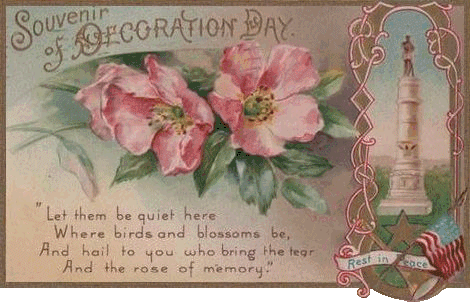
Some two dozen communities claim the honor of having held that first Memorial Day, though it wouldn’t be called that until much later. For now, it was “Decoration Day”. The first large-scale observance was held that year at Arlington National Cemetery, across the Potomac River from Washington, D.C.

download (53)

The veranda of the Arlington mansion, once the home of General Robert E. Lee, was draped in mourning. A number of officials attended the event, including General Ulysses S. Grant and his wife, Julia. There were speeches and hymns, and then children from the Soldiers’ and Sailors’ Orphan Home joined with members of the GAR, in laying flowers on the graves of Union and Confederate alike.

General Logan’s order instructed all posts to decorate the graves of the fallen “with the choicest flowers of springtime”. “We should guard their graves with sacred vigilance“, he wrote, “Let pleasant paths invite the coming and going of reverent visitors and fond mourners. Let no neglect, no ravages of time, testify to the present or to the coming generations that we have forgotten as a people the cost of a free and undivided republic.”

So may it always be.

download (52)

If you enjoyed this “Today in History”, please feel free to re-blog, “like” & share on social media, so that others may find and enjoy it as well. Please click the “follow” button on the right, to receive email updates on new articles.  Thank you for your interest, in the history we all share.

April 13, 1917 A Sealed Train

Not far from food riots of his own and loathe to unleash such a bacterium against his own homeland, a “Sealed Train” carrying Vladimir Ilyich Lenin and 31 dissidents departed from exile in Switzerland on April 9, complements of the Kaiser.  

The “War to End all Wars” entered its third year in 1917, seeming as though it would go on forever. Neither side seemed able to gain strategic advantage on the front. The great battles of 1916 seemed only yesterday, in which any single day’s fighting produced more casualties than every European war of the preceding 100 years, combined. At home, the social fabric of the combatant nations was unraveling.

download (54)
Vladimir Ilyich Ulyanov

By 1916 it was generally understood in Germany, that the war effort was “shackled to a corpse”, referring to Germany’s Austro-Hungarian ally. Italy, the third member of the “Triple Alliance”, was little better. On the Triple Entente side, the French countryside was literally torn to pieces, the English economy close to collapse. The Russian Empire, the largest nation on the planet, was on the edge of the precipice.

With the American declaration of war in April 1917, both sides understood that the balance was about to shift. For Kaiser Wilhelm’s Germany, it was time to throw a knockout punch, before the US arrived in force.

Imperial Russia had seen the first of what would be two revolutions back in February, when food riots led to the overthrow and exile of the Imperial family.  Full scale civil war broke out in 1918, resulting in the Bolshevik murder of the Czar and Czarina, together with their children, servants and dogs.

00leninV5
Lenin makes his way to the sealed train which would take him out of exile. April 13, 1917.

In the midst of this chaos, the Kaiser calculated that all he had to do was “kick the door in”, the Russian Republic would collapse, and they would be out of the war. He was right.

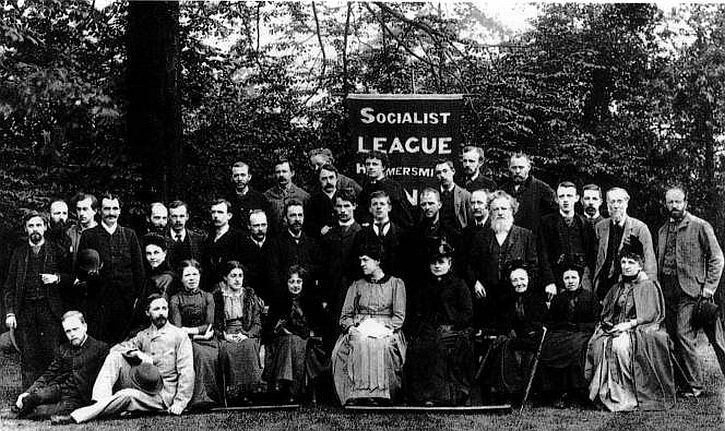
Following the overthrow of the Romanov dynasty, the more moderate Menshevik “Whites” vowed to continue the war effort. The split which had begun with the failed revolution of 1905 was more pronounced by this time with the more radical Bolsheviks (“Reds”) taking the more extreme road. While Reds and Whites both wanted to bring socialism to the Russian people, the Mensheviks argued for predominantly legal methods and trade union activism, while Bolsheviks favored armed violence.

In a small town in the northeast of Sweden, there is a train station.  A bronze plaque on a blue tile wall, proclaims: “Here Lenin passed through Haparanda on April 15, 1917, on his way from exile in Switzerland to Petrograd in Russia”.

11Rubenstein-facebookJumbo

Lenin was in exile at this time, and Imperial Germany was at war with Russia.  British historian Edward Crankshaw writes, the German government saw “in this obscure fanatic one more bacillus to let loose in tottering and exhausted Russia to spread infection”.

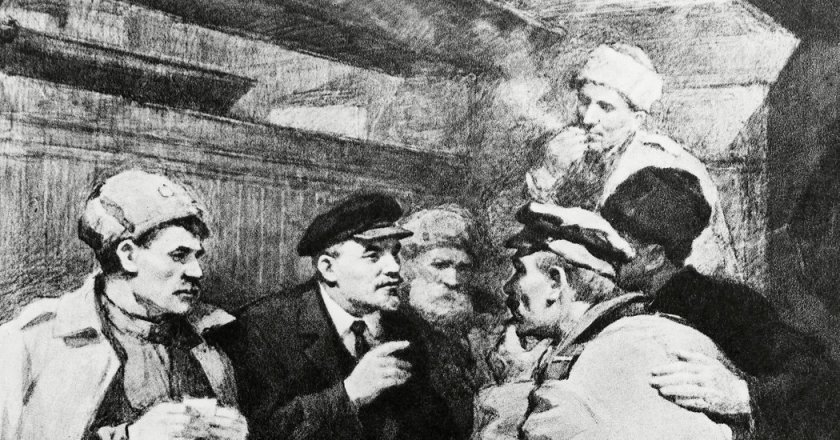
Not far from food riots of his own and loathe to unleash such a bacterium against his own homeland, a “Sealed Train” carrying Vladimir Ilyich Lenin and 31 dissidents departed from exile in Switzerland on April 9, complements of the Kaiser.  Leaving Zurich Station amid the jeers and the insults of 100 or so assembled Russians shouting “Spies!” “Traitors!” “Pigs!” “Provocateurs!”  Lenin turned to a friend.  “Either we’ll be swinging from the gallows in three months, or we shall be in power.”

Sealed Train

North through Germany and across the Baltic Sea, the group traveled the length of Sweden, crossing at the border village of Haparanda into Russian-Occupied Finland.  The group arrived at Finlandsky Vokzal (Finland Station) in Petrograd on the evening of April 16, 1917. Like the handful of termites that brought down the mighty oak, that small faction inserted into the picture that April, would help to radicalize the population, and consolidate power on the Bolshevik’s side.

By October, Russia would experience its second revolution in a year.  The Kaiser’s Germany could breathe easier. The “Russian Steamroller”, was out of the war. Chief of the General Staff Paul von Hindenburg and his deputy Erich Ludendorff could move their divisions westward, in time to face the arrival of the AEF.

mar2017_g99_leninsodyssey

Since the end of the Soviet era, Russian historians have come to believe that Vladimir Ilyich (Ulyanov) Lenin personally ordered the murder of the czar and his family, and that the Lenin era was every bit as bloody, as that of his successor Josef Stalin.

Lenin called for “Mass Terror” during the civil war of 1918, resulting in executions in the tens of thousands.  Historian Alexander Margolis had the last word on the subject, if not the understatement of the century:  “If they had arrested Lenin at the Finland Station, it would have saved everyone a lot of trouble”.

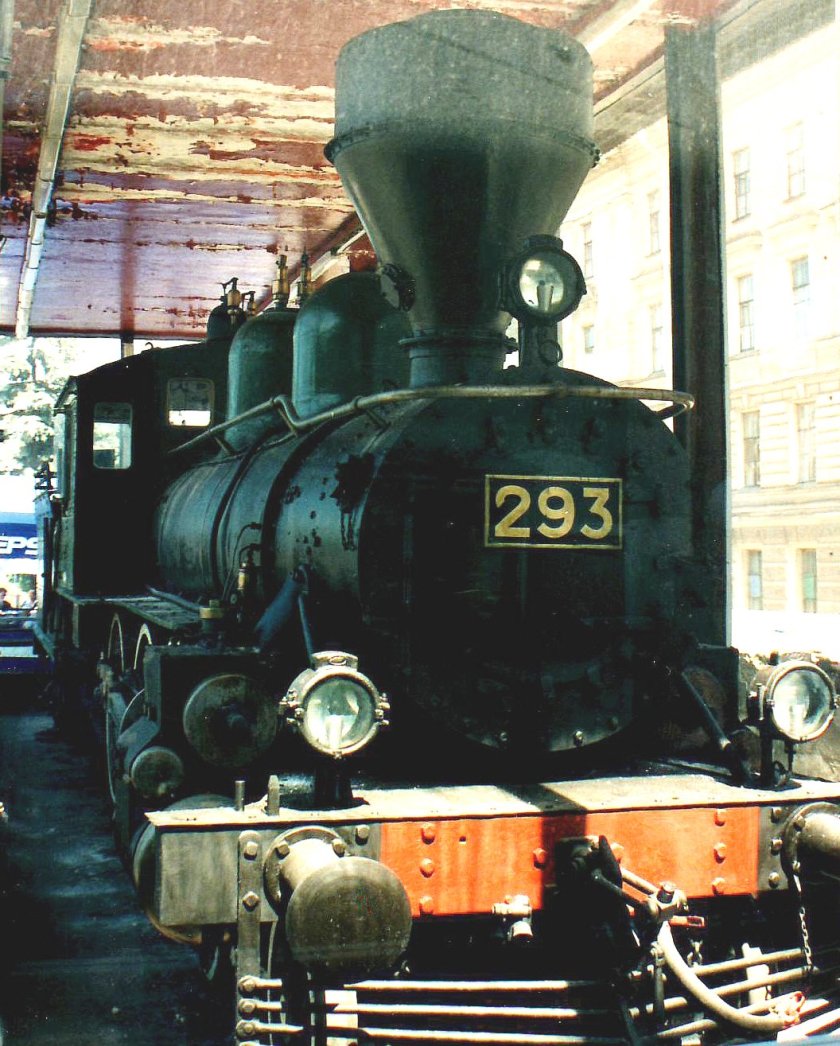
Sealed Train Locomotive
The locomotive which carried the ideological infection of Communism. from exile in Switzerland, to the Imperial Russian heartland
If you enjoyed this “Today in History”, please feel free to re-blog, “like” & share on social media, so that others may find and enjoy it as well. Please click the “follow” button on the right, to receive email updates on new articles.  Thank you for your interest, in the history we all share.