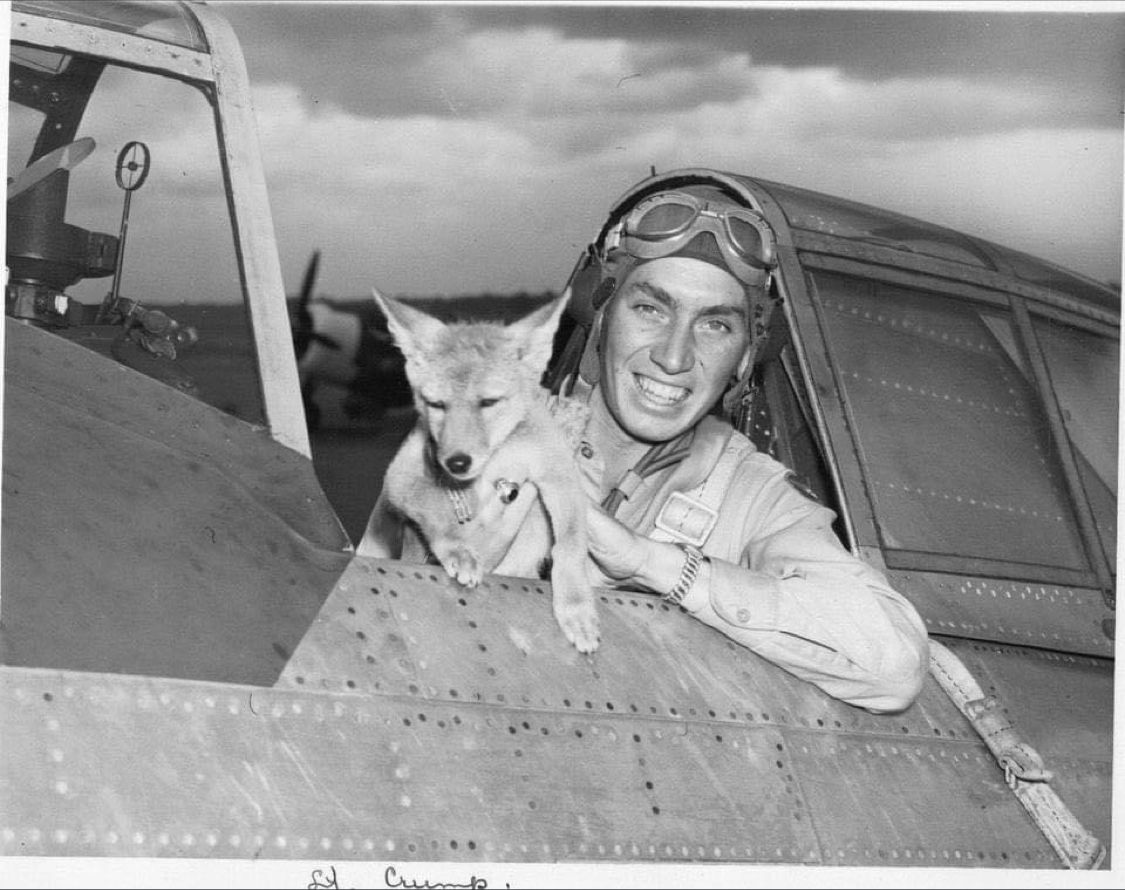
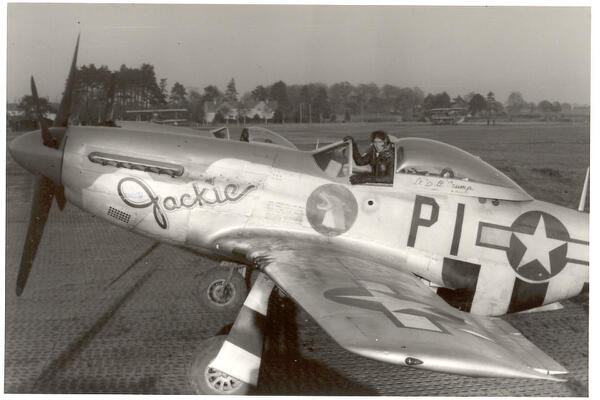
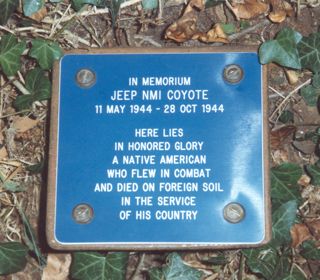
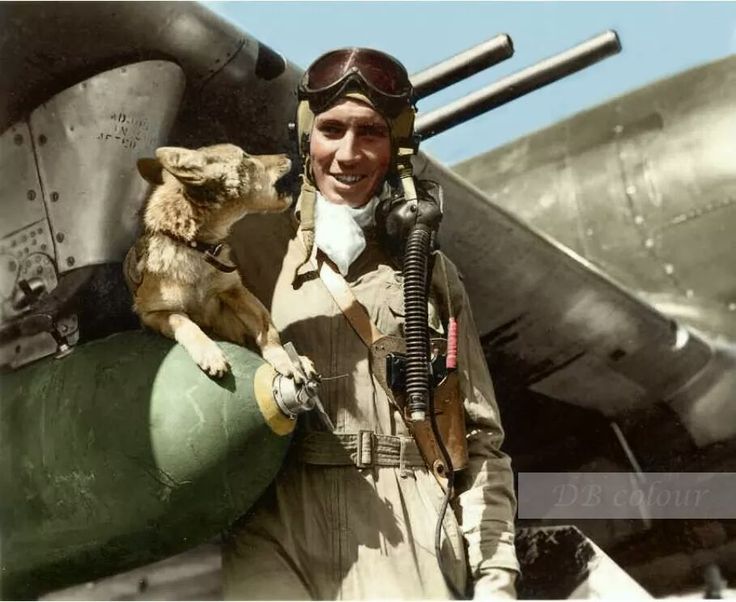
Before they had numbers, the “war to end wars” had Jackie the Baboon and Whiskey & Soda, the lion cub mascots of the Lafayette flying corps. World War II and Wild Bill Crump had Jeep, the only coyote and four-legged co-pilot to serve in the air war to retake Europe, from the Nazi occupier.
John William “Wild Bill” Crump was destined for the air. Born in 1924 in the Pacific Northwest village of Opportunity Washington, the boy’s first experience with the air came on a flight with his Dad, at the age of 5.
Attending nearby Edmonds High School and graduating in 1943, it is myedmondnews.com from which I have learned much of this story.
Hat tip Crump family, via myedmondsnews
The world was at war in 1944, and badly in need of pilots. Wild Bill Crump arrived at Harding Field, Nebraska at the age of 20 to complete pilot training.
While earning his wings, Crump found the most unlikely of co-pilots. Abandoned and alone, it was a two week old puppy. A young coyote, in need of a home.
“Eugene the Jeep” came to public attention eight years earlier, in the Popeye cartoon strip by E.C. Sugar (rhymes with cigar).
Eugene was a dog sort of character, with the magical power to go…anywhere.
In the early phase of World War II, military contractors labored to develop an off-road vehicle, capable of going anywhere, or close to it. Like Popeye’s sidekick Eugene, the General Purpose GP (“Jeep”) was just the thing. Eventually, the name stuck.
Of course, Crump named his new sidekick, “Jeep”.
Next came Baton Rouge and training on the iconic P-47, the high altitude fighter-bomber and foremost ground attack aircraft of the American war effort, in WW2.
The P-47 cockpit was built for only one pilot, but regulations said nothing about a coyote.
So it was that, here in Baton Rouge, the pair learned to work together. When orders came for England, there was little question of what was next. The luxury liner RMS Queen Elizabeth converted to a troop ship would hardly notice the small coyote, smuggled on-board.
Actual footage from Wild Bill’s P51 Squadron
Next came RAF Martlesham Heath Airfield in Ipswich, England and the 360th fighter squadron, 359th fighter group.
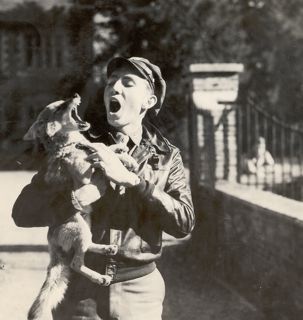
Jeep became the unit mascot with his own “dog tags” and vaccination records. He’d often entertain the airmen taking part in howling contests.
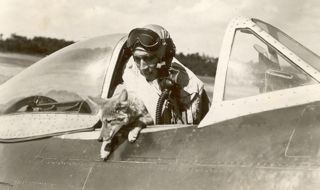
Curled up in the cockpit Jeep accompanied Crump on no fewer than five combat missions. One time, a series of sharp barks warned the pilot of incoming flak.
Crump logged 311 combat hours on 77 missions aboard the P51 Mustang “Jackie,” named after his high school sweetheart. Painted on the fuselage next to her name was the image of a coyote.
Wild Bill Crump survived the war. Sadly, his co-pilot, did not. On October 28, 1944, a group of children brought Jeep to school, to show the animal off. Tied to a tree in the rain he slipped his leash and was run over by a military vehicle, attempting to return to his base.
Jeep was buried with full military honors in a grave outside Playford Hall in Ipswich, England.
Before they had numbers, the “war to end wars” had Jackie the Baboon and Whiskey & Soda, the lion cub mascots of the Lafayette flying corps. World War II and Wild Bill Crump had Jeep, the only coyote and four-legged co-pilot to serve in the air war to retake Europe, from the Nazi occupier.
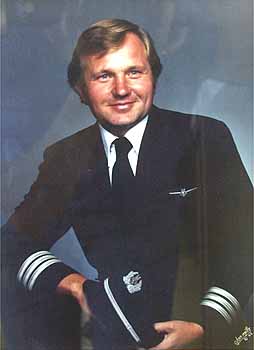
Twelve days a month John Ogonowski would put on his captain’s uniform, leaving the farm to fly jumbo jets out of Logan Airport. And when he was done he would always return, to the land he loved.
As the 19th century closed and made way for the next, a great wave of immigrants came into the United States, some 20 million Europeans or more making the long journey to become Americans.
Among this multitude came the Ogonowski family, emigrating from Poland to make a new home in Massachusetts’ Merrimack Valley, along the New Hampshire line.
Yankee farmers assisted these earliest members of the family, teaching the new arrivals about growing conditions in the harsh New England climate. Four generations later the Ogonowski family still tilled the soil on a 150-acre plot called the “White Gate Farm” in Dracut, Massachusetts.
Graduating from UMass Lowell in 1972 with a degree in nuclear engineering, John Ogonowski joined the United States Air Force. During the war in Vietnam, the farmer-turned-pilot would ferry equipment from Charleston, South Carolina to Southeast Asia, sometimes returning with the bodies of the fallen aboard his C-141 transport aircraft.
Ogonowski left the Air Force with the rank of Captain, becoming a commercial pilot and joining American Airlines in 1978. There he met Margaret, a flight attendant, “Peggy” to her friends and family. The two would later marry, and raise three daughters.
Twelve days a month Ogonowski would leave the farm in his Captain’s uniform to fly jumbo jets out of Logan Airport, but he always returned to the land he loved.
Family farming is not what it used to be, as suburban development and subdivisions creep into what used to be open spaces. “When you plant a building on a field” he would say, “it’s the last crop that will ever grow there”.
Ogonowski helped create the Dracut Land Trust in 1998, working to conserve the town’s agricultural heritage. He worked to bring more people into farming as well. The bumper sticker on his truck read “There is no farming without farmers”.
That was the year the farm Service Agency in Westford came looking for open agricultural land, for Southeast Asian immigrants from Lowell.
It was a natural fit. Ogonowski felt a connection to these people, based on his time in Vietnam. He would help them, here putting up a shed, there getting a greenhouse in order or putting up irrigation. He would help these immigrants, just as those Yankee farmers of long ago had helped his immigrant ancestors.
Cambodian farmers learned to grow their native vegetables in an unfamiliar climate. They would lease small plots growing water spinach, lemon grass, pigweed, Asian basil, and Asian squash. There was taro and Laotian mint, coconut amaranth, pickling spices, pea tendrils and more. It was the food they grew up with. They would sell their produce into nearby immigrant communities and to the high-end restaurants of Boston.
The program was a success. Ogonowski told The Boston Globe in 1999, “These guys are putting more care and attention into their one acre than most Yankee farmers put into their entire 100 acres.”
So it was that, with the fall harvest of 2001, Cambodian immigrants found themselves among the pumpkins and the hay of a New England farm, putting on a lunch spread for visiting agricultural officials from Washington, DC. It was September 11.
By now you know that John Ogonowski was flying that day, Senior Captain on American Airlines flight 11.
He was one of the first to die, murdered in his cockpit by Islamist terrorist Mohammed Atta and his accomplices.
It’s a new perspective on a now-familiar story, to think of the shock and the grief of those refugees from the killing fields of Pol Pot, on hearing the news that their friend and mentor had been hijacked and flown into the World Trade Center.
The White Gate Farm was closed for a week, but the Ogonowski family was determined that John’s dream would not die. Peg said it best: “This is what he was all about. He flew airplanes, he loved flying, and that provided all the money, but this is what he lived for. He was a very lucky man, he had both a vocation and an avocation and he loved them both.”
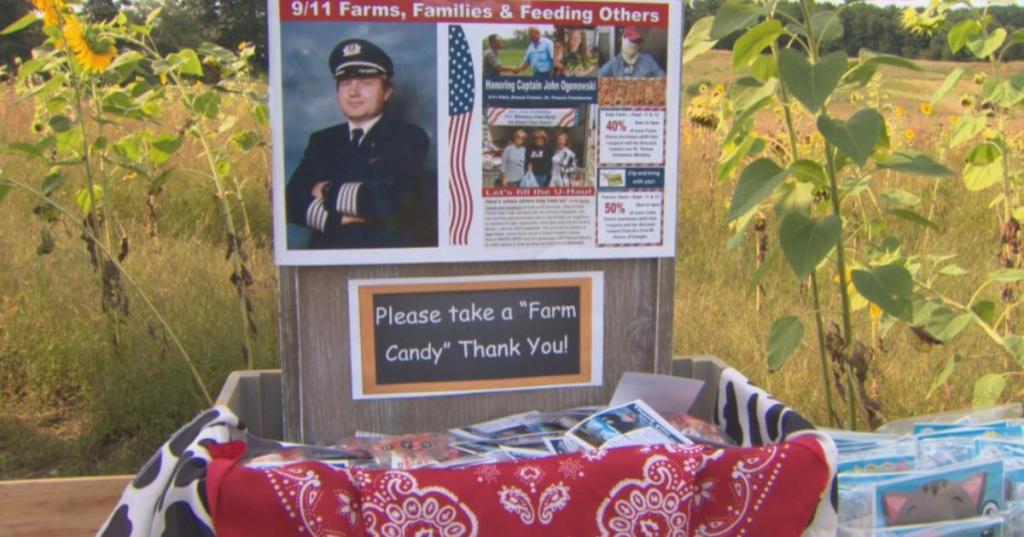
John Ogonowski was working with the Land Trust at the time he was killed, to raise $760,000 to purchase a 34 acre farm in Dracut, previously slated to be developed into a golf course with housing. Federal funds were raised with help from two members of Congress. The “Captain John Ogonowski Memorial Preservation Farmland” project was dedicated in 2003, a living memorial to Captain John Ogonowski. Patriot…pilot…farmer.
Afterward:
Today, the White Gate Farm produces hay and is run today by John’s brother, Jim Ogonowski, who also runs the Ogonowski Farm located at 713 Broadway Road, in Dracut. The family farm has been in continuous operation since 1904. “Fall is the season for Ogonowski Farm” writes DracutMA.gov, “specializing in pumpkins, cornstalks, mums, hay bales and other autumnal attractions”.
They are open September 1-October 31. Ogonowski Farm may be reached at 978-455-2528, by email at ogonowskifarm@comcast.net, or visit https://www.ogonowskifarm.com”. Hat Tip Dracutma.gov
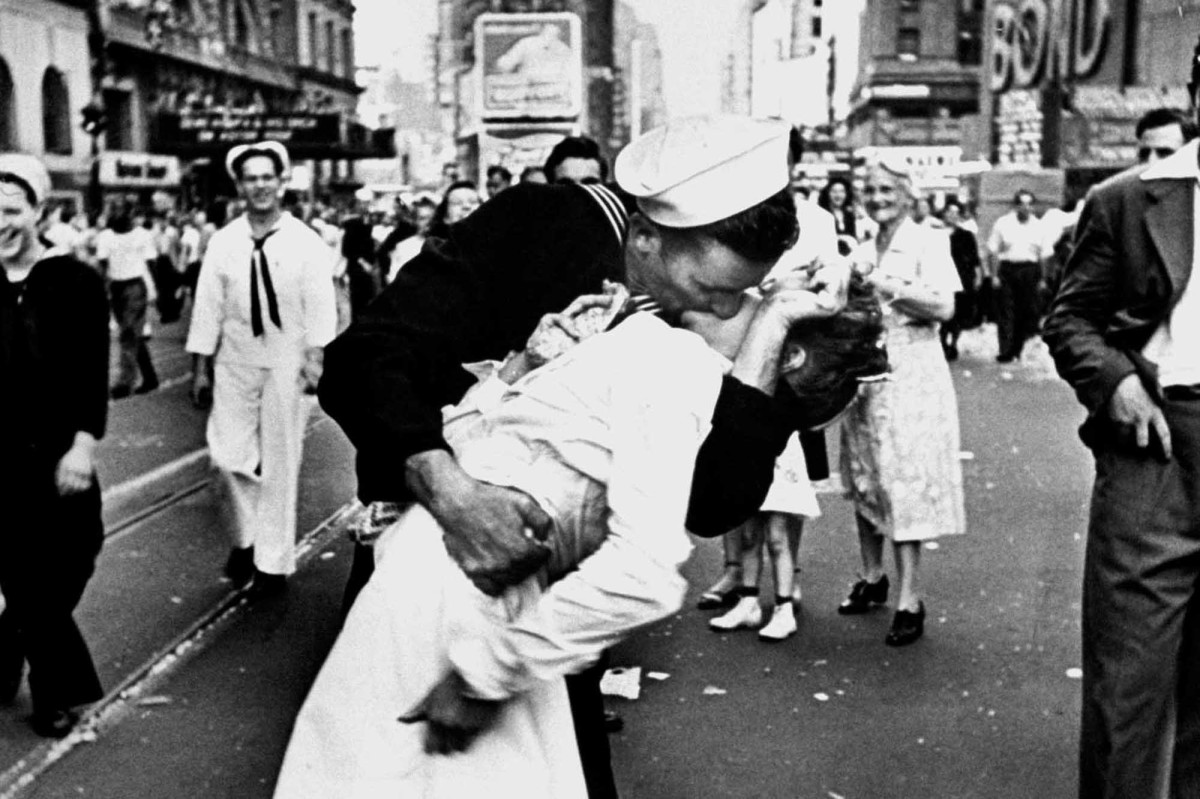
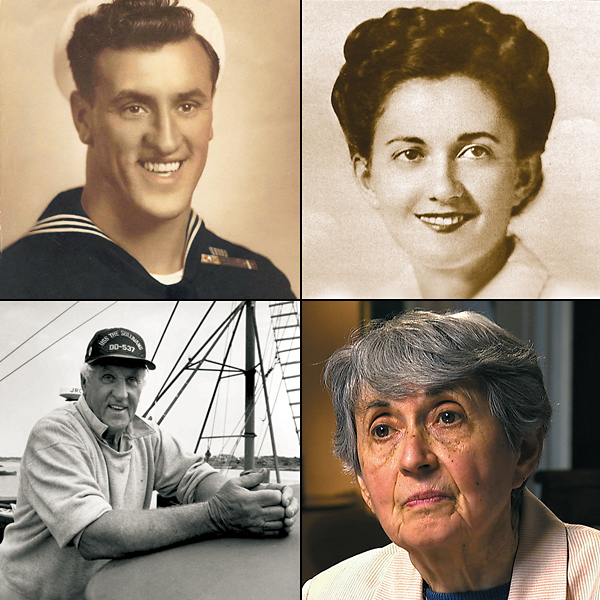
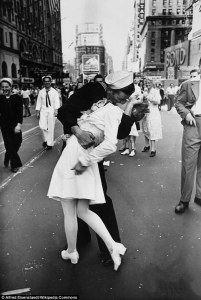
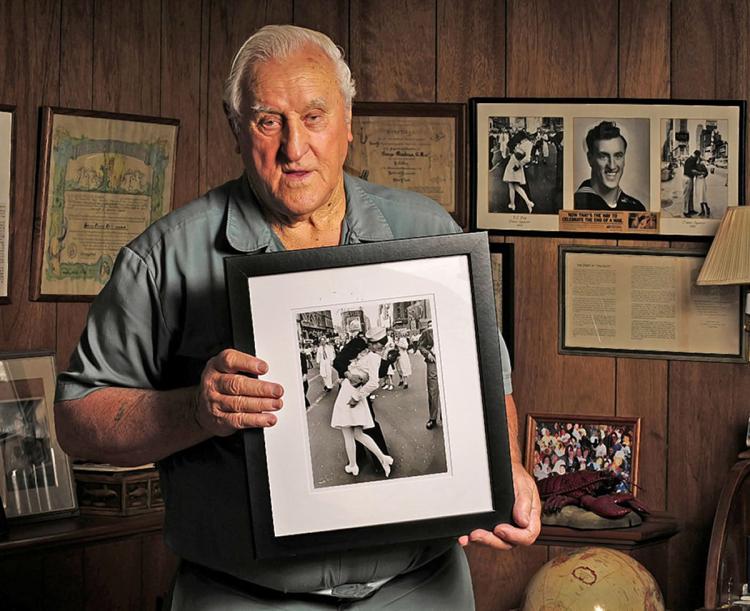
The message running across the Times Building read, “VJ, VJ, VJ, VJ”. George Mendonsa grabbed a random stranger in nurse’s uniform and kissed her. The moment was gone in two seconds, but Alfred Eisenstaedt’s camera was in the right place, at the right time.
The most destructive war in history ended on August 14, 1945, with the unconditional surrender of the Empire of Japan.
Even as morning dawned on the east coast, President Harry Truman had yet to receive the formal surrender. Rumors were flying throughout the small hours, while the White House official announcement was still hours away.
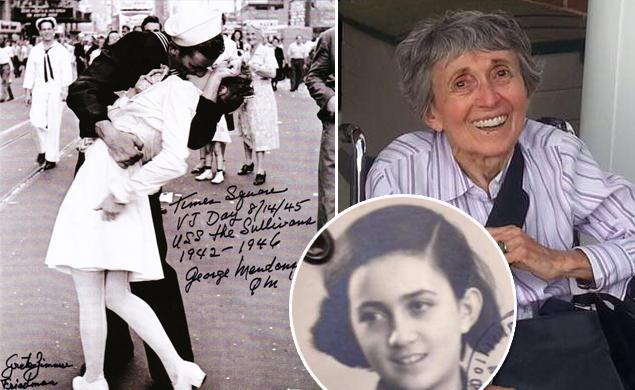
Born and raised in Austria, Greta Zimmer was 16 in 1939. Seeing the war bearing down on them, Greta’s parents sent her and her two sisters to America, not knowing if they would ever see them again. Six years later she was a dental assistant, working at the Manhattan office of Dr. J. L. Berke.
Greta’s lunch break came just after 1:00 that day. Patients had been coming into the office all morning with rumors that the war was over. She set out for Times Square, knowing that the lit and moving type on the Times news zipper would give her the latest news.George Mendonsa, Greta Zimmer-Friedman
Petty Officer 1st Class George Mendonsa was on his last day of shore leave, spending the day with his new girlfriend, Rita Petry. They had heard the rumors too, but right now they were enjoying their last day together. The war could wait until tomorrow.
The couple went to a movie at Radio City Music Hall, but the film was interrupted by a theater employee who turned on the lights, announcing that the war was over. Leaving the theater, the couple joined the tide of humanity moving toward Times Square. The pair stopped at the Childs Restaurant on 7th Ave & 49th, where bartenders were pouring anything they could get hands on into waiting glasses. Revelers were scooping them up as fast as the glasses were filled.
Mendonsa’s alcohol-powered walk/run from the restaurant left Rita trailing behind, but neither one seemed to mind. Times Square was going wild.
The sailor from the USS Sullivans had seen bloodshed. He’d been there on May 11, as kamikaze planes smashed into the USS Bunker Hill. Explosions and fires killed 346 sailors that day. 43 of their bodies would never be found. Mendonsa had helped to pull the survivors, some of them hideously burned, out of the water. He had watched while Navy nurses tended to the injured and the dying.
When the sailor spotted Greta Zimmer, the dental assistant was dressed the same way. To him, she must have seemed like one of those white-clad angels of mercy from those earlier months.
Reporters from the AP, NY Times, NY Daily News and others descended on Times Square to record the spontaneous celebration.
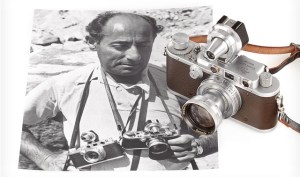
As a German Jew in the 1930s, Alfred Eisenstaedt had photographed the coming storm. He had photographed Benito Mussolini’s first meeting with Adolf Hitler in Venice in 1934. Now he and his Leica Illa rangefinder camera worked for Life Magazine, heading to Times Square in search of “The Picture”.
The lit message running around the Times Building read, “VJ, VJ, VJ, VJ” as George Mendonsa grabbed a stranger and kissed her. Two seconds later the moment was gone, but Eisenstaedt and his camera had been in the right place at the right time.
In time, the image of the sailor kissing the nurse became as famous as Joe Rosenthal’s photo of the flag raising at Iwo Jima.
The German made camera which took the iconic image recently went to auction at the Westlicht auction house in Vienna, where it was expected to sell for $30,000. The winning bid was almost $150,000.
After the war, Greta Zimmer learned that both of her parents had died in the camps. She later married and made her home in Frederick, Maryland. Greta Zimmer Friedman never returned to Austria, and passed away in 2017, at the age of 92.
George Mendonsa and Rita Petry later married. George never saw the famous photograph until 1980. At first he wasn’t sure he was looking at his own image.
In 1918, the couple celebrated their 68th wedding anniversary. Rita says she wasn’t angry to see her husband kiss another woman like that. She can be seen herself in the famous photo, grinning in the background.
In 2018, the couple celebrated their 68th wedding anniversary. Rita says she wasn’t angry to see her husband kiss another woman. She can been seen grinning in the background, she points out. She will admit, though, ‘In all these years, George has never kissed me like that.’
Few could imagine a war in which many single days’ fighting produced more casualties than every war of the last century, combined.
In 1869, Germany had yet to come into its own as a sovereign nation. Forty-five years later, she was one of the Great Powers of all Europe.
Alarmed by the aggressive growth of her historic adversary, the French government increased compulsory military service from two years to three, to offset the advantage conferred by a German population of some 70 million, contrasted with a French population of 40 million.
Joseph Caillaux was a left wing politician, once Prime Minister of France and, by 1913, a cabinet minister under the more conservative administration of President Raymond Poincare.
Never too discreet with his personal conduct, Caillaux paraded through public life with a succession of women, who were not Mrs Caillaux. One of them was Henriette Raynouard.
In 1911, Madame Raynouard became the second Mrs Caillaux.
A relative pacifist, many on the French right considered Caillaux too “soft” on Germany. One of them was Gaston Calmette, editor of the leading right-wing newspaper Le Figaro, who regularly excoriated the politician.
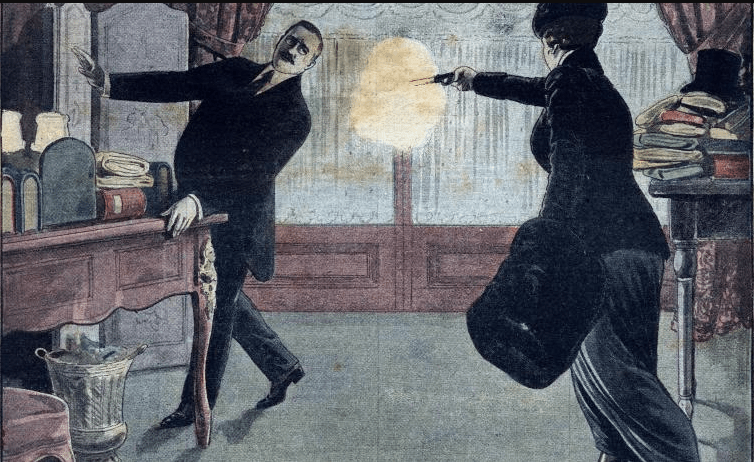
On March 16, 1914, Madame Caillaux took a taxi to the offices of Le Figaro. She waited for a full hour to see the newspaper’s editor before walking into his office and shooting him at his desk. Four out of six rounds hit the mark. Gaston Calmette was dead before the night was over.
It was the crime of the century. This one had everything: left vs. right, the fall of the powerful and all the salacious details anyone could ask for. It was the OJ trial, version 1.0, and the French public was transfixed.
The British public was similarly distracted by the latest in a series of Irish Home Rule crises.
The Austro-Hungarian Empire, a sprawling amalgamation of 17 nations, 20 Parliamentary groups and 27 political parties, desperately needed to bring the Balkan peninsula into line, following the June 28 assassination of the heir apparent to the dual monarchy.
That individual Serbians were complicit in the assassination is beyond doubt, but so many government records of the era have since disappeared it’s impossible to determine official Serbian complicity.
Be that as it may, Serbia had to be brought to heel.
Having given Austria his personal assurance of support in the event of war with Serbia, even if Russia entered in support of her Slavic ally, Kaiser Wilhelm of Germany left on a summer cruise in the Norwegian fjords.
The Kaiser’s being out of touch for those critical days in July has been called the most expensive maritime disaster in naval history.
The Austro-Hungarian Empire produced a deliberately unacceptable ultimatum delivered to Serbia on the 23rd. It was little more than a bald pretext for war. Czar Nicholas wired Vienna as late as July 27, proposing an international conference concerning Serbia. To no avail. Austria responded that same day. It was too late for such a proposal.
The Austro-Hungarian Empire declared war on Serbia on July 28. Madame Caillaux was acquitted on the same day, on the grounds that hers was a “crime of passion”.
Russia mobilized in support of Serbia. Imperial Germany feared little more than a two-front war with the “Russian Steamroller” to the east and the French Republic to the west.
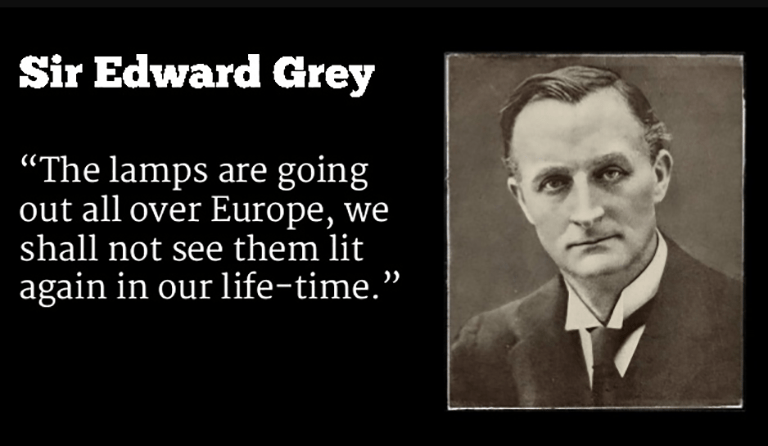
On August 3, British Foreign Secretary Sir Edward Grey announced before Parliament, his government’s intention to defend Belgian neutrality, in accordance with the Treaty of London, signed decades earlier.
German diplomats dismissed the 1839 commitment as a “scrap of paper”.
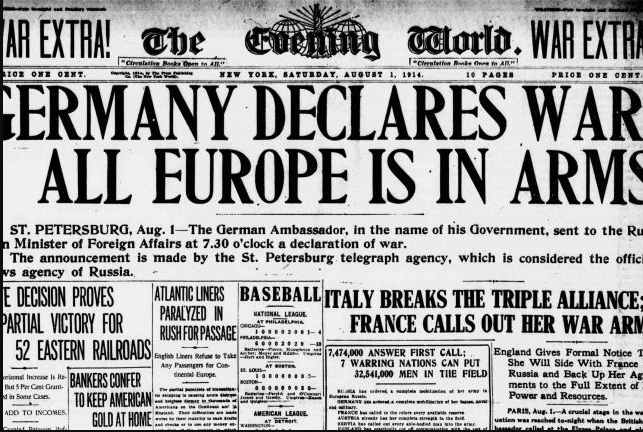
Germany invaded neutral Belgium on August 4 in pursuit of the one-two punch strategy by which she sought first to defeat France before turning to face the larger and presumably slower Russian adversary.
True to her commitments, the United Kingdom declared war on Germany the same day.
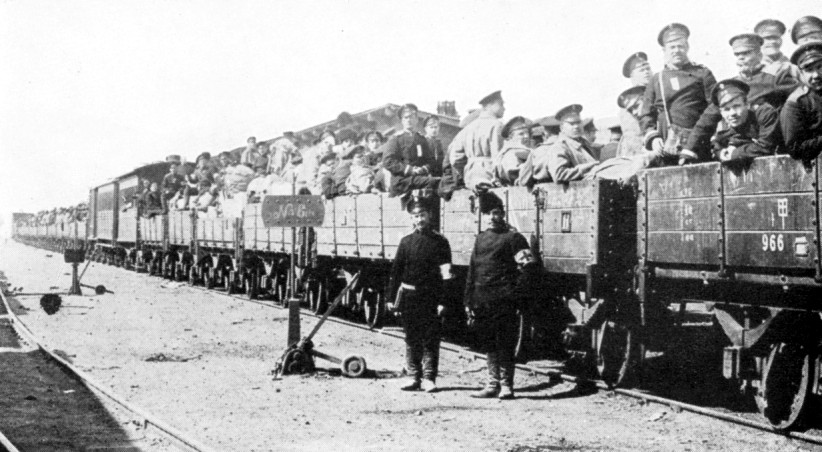
Meticulously prepared timetables took over where the diplomatic bungling of the “July crisis” left off. France alone had some 3,781,000 military men under orders before the middle of August, arriving at the western front on trains arriving as often as every eight minutes.
This time there would be no “Phoney War”, no “Sitzkreig”, as wags were wont to call the early days of WWII.
Few could imagine a cataclysm to rock a century and beyond, a war in which many single day’s fighting produced casualties equal to that of every war of the preceding 100 years, combined.
Fewer still understood on this date, one-hundred and nine years ago, today. The four horsemen of the Apocalypse, had come.
If you enjoyed this “Today in History”, please feel free to re-blog, “like” & share on social media so others may find and enjoy it as well. Please click the “follow” button to receive email updates on new articles. Thank you for your interest in the history we all share.
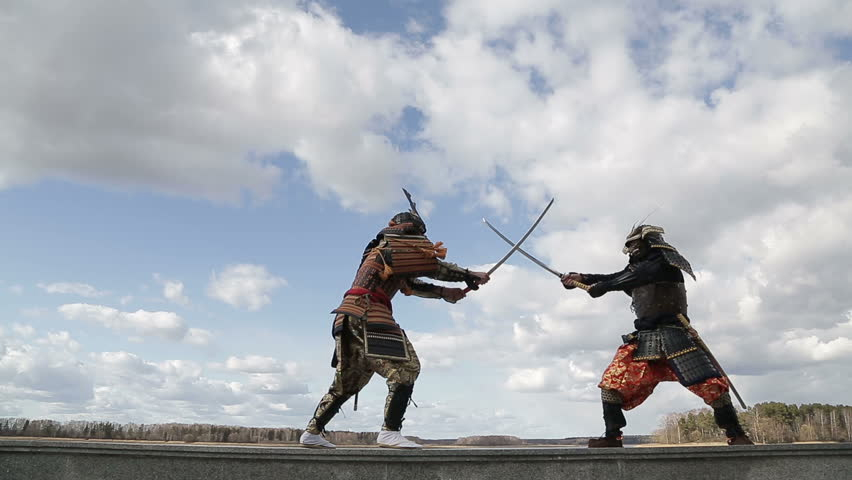
code of Bushidō or “Way of the Warrior” prized fearlessness in battle. Athletic and martial skill was emphasized and personal honor, inviolate. Filial loyalty ranked high on this code of conduct, and yet not so high as the supreme obligation: that of the samurai to his lord. Even at the expense of his own parents. Or his own life.
As Japan emerged from the medieval period into the early modern age, the future Nippon Empire transformed from a period of warring states and social upheaval. This “Sengoku period” came to an end on October 21, 1600 at the Battle of Sekigahara, pitting a coalition of clans led by one Ishida Mitsunari against forces loyal to the first of “Three Great Unifiers” of Japan, called Tokugawa Ieyasu.
Defection of several of these clans led to victory for the Tokugawa faction, paving to the way to a feudal military government or Shōgunate. Ruled from the Edo castle in the Chiyoda district of modern-day Tokyo, Tokugawa ruled as Shōgun over some 250 provincial domains called han.
The role of the emperor, the supreme monarch dating back to the mythical Jimmu in the year 660BC, was largely ceremonial at this time.
The military and governing structure of the Tokugawa or Edo period rested on a rigid and inflexible class system placing feudal lords or daimyō at the top, followed by a warrior-caste of samurai and a lower caste of merchants and artisans. At the bottom of it all stood some 80% of the population, the peasant farmer forbidden to engage in non-agricultural work and expected to provide the income to make the whole system work.
The samurai caste adopted a Confucian ethic at this time, developing a code of honor and conduct known as Bushidō, loosely analogous to the chivalric practices of European knights of an earlier era.
This code of Bushidō or “Way of the Warrior” prized fearlessness in battle. Athletic and martial skill was emphasized and personal honor, inviolate. Filial loyalty ranked high on this code of conduct, and yet not so high as the supreme obligation: that of the samurai to his lord. Even at the expense of his own parents. Or his own life.
This system paved the way for an incident, destined to become one of the great legends in Japanese history. The small han of Akō at this time was the domain of a young daimyō called Asano Naganori. In 1701, Asano was called upon to assist in ceremonial duties surrounding a visit from emissaries of the 113th monarch according to traditional order of succession, Emperor Higashiyama.
The emperor’s representative in the matter was one Kira Yoshinaka. Accounts vary as to what happened next. Kira was officious, arrogant and insistent on a bribe. Asano was young and inexperienced with the “ways “gift giving” traditions of the royal court. Be that as it may the next part, is not in dispute. Asano took offence at the official’s actions and drew his sword.
Kira survived the attack but Asano’s actions were a grave breach of protocol. The Lord of Akō was ordered to perform seppuku, on the spot. It was December 14, 1701.
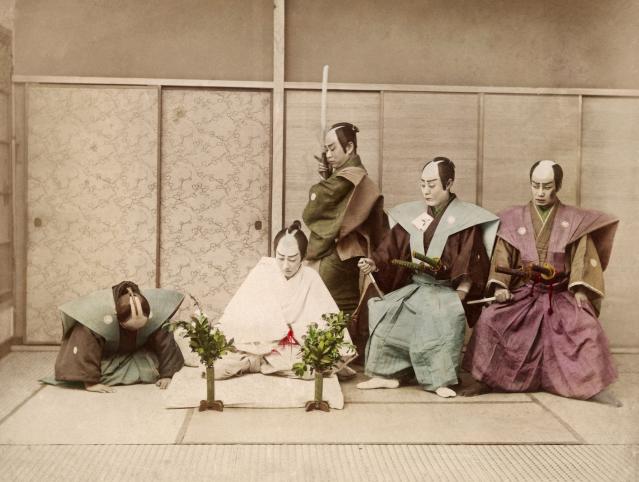
Seppuku, often called hara-kiri in the west, is a grisly form of suicide by self disembowelment originated by Japan’s ancient samurai warrior caste. The event is often accompanied by ceremony including the drinking of sake, and the condemned composing a death poem. The practitioner will then plunge a short bladed sword deep into his abdomen, cutting sideways and then upward, to be sure the process is fatal. Some will complete the nightmarishly painful process only to die, slowly. Others will employ a kaishakunin or “second, whose job it is to hack off the head of the sufferer, after his honor was restored through that first cut.
A staged version of the Japanese ritual suicide known as Seppuku or Hara-Kiri, circa 1885. The warrior in white plunges a knife into his belly, while his second stands behind him, ready to perform the decapitation. (Photo by Sean Sexton/Getty Images)
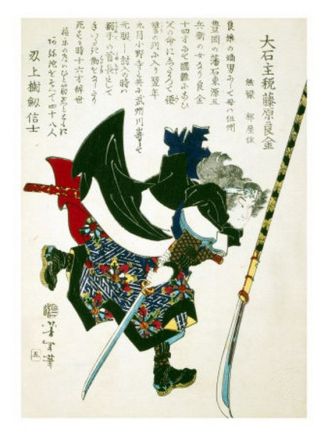
Asano’s 300 Samurai retainers were now Rōnin. Samurai without a master. 47 of their number vowed to avenge the death of the daimyō led by one Ōishi Kuranosuke, even though they knew it would cost them their lives.
The 47 Rōnin broke up and went their own way. Many became monks and tradesmen. Ōishi himself carried out the life of an inebriate and frequenter of geisha houses. He even went so far as to divorce a loyal wife of twenty years and send her away, so she would not be associated with the plot.
For nearly two years the 47, carried out the ruse. While drunk and insensate one Satsuma man went so far as to kick Ōishi in the face and spit on him, for the disgrace he had brought on the samurai caste. It was a grave breach of protocol which, under ordinary circumstances, would have cost the man his life. Little did anyone suspect, least of all Kira’s spies. It was all a massive head fake.
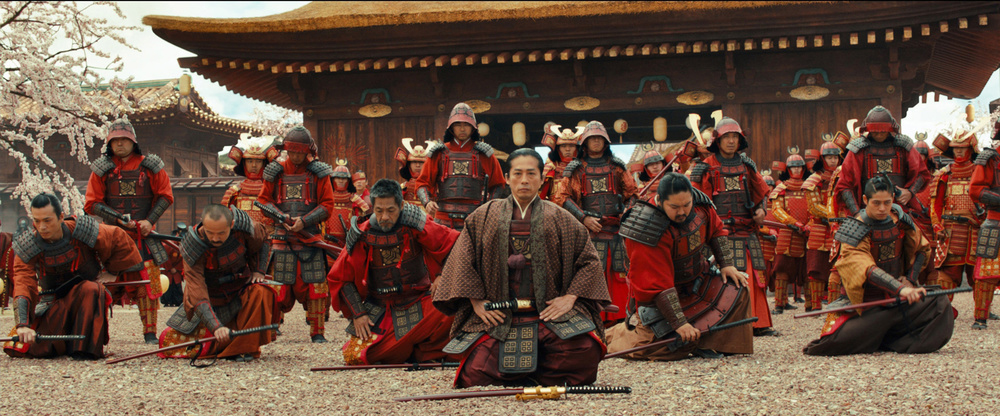
Scene from the eponymously named film
The chance for vengeance came in late January, 1703. Kira and the Shōgun’s officials had at last taken the bait and relaxed their defenses.
By this time there were 46 as the oldest, now in his eighties, dropped out of the plot. Forcing their way into Kira’s residence the official’s loyal samurai fought bravely, but were soon overwhelmed. Kira himself was found cowering in an outhouse and summarily decapitated.
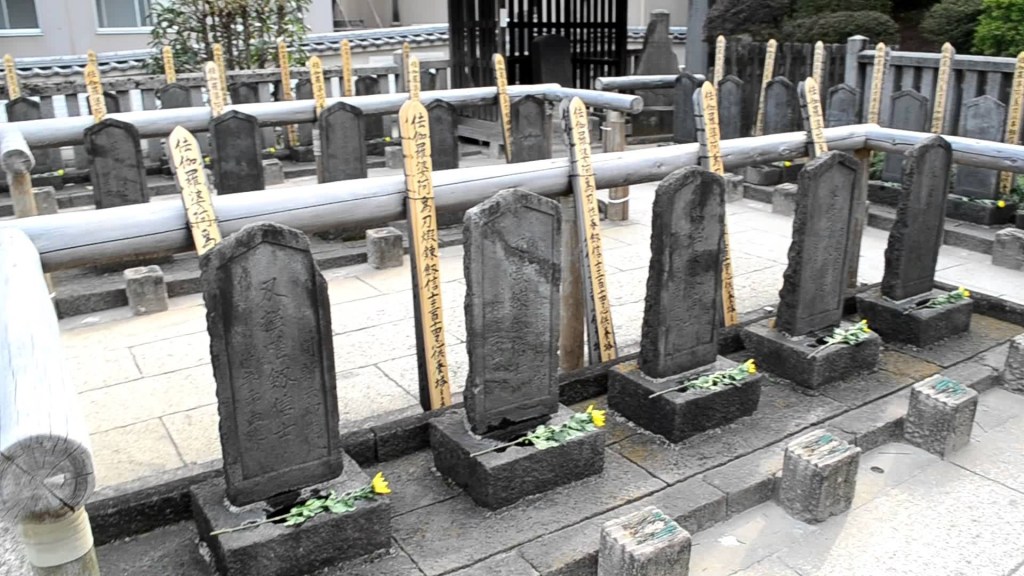
The entire cohort now walked the ten or so miles past an astonished populace, to the Sengaku-ji Temple. The head was washed in a well and laid on Asano’s grave. And then they turned themselves in.
The authorities were in a quandary. These men had followed the warrior’s code and avenged the death of their master. They had also defied the will of the Shōgun. Letters of support began to arrive from an admiring public and so, it was decided. The 47 Rōnin would be spared the death by execution meted out to criminals. Shōgun Tokugawa Tsunayoshi, a man so horrified by cruelty to animals he once proclaimed it a capital offence to kill a dog, ordered the Rōnin to commit seppuku.
On March 20, 1703, 46 carried out the sentence and bared their bellies, to the blade. All were buried in death with their master in life, at the Sengaku-ji Temple. Terasaka Kichiemon alone was pardoned by the Shōgun, on account of his age. He was 15.
Sometime later the Satsuma man who had mocked and spat on a drunk visited Ōishi Kuranosuke’s grave and apologized, that he had ever doubted the heart of a samurai. And then he bared his belly to the blade and committed seppuku, right then and there. He too went to his rest Sengaku-ji shrine, along with the the 47 Rōnin.
Terasaka lived to the ripe old of 87 and then he too went his final rest, alongside his comrades.
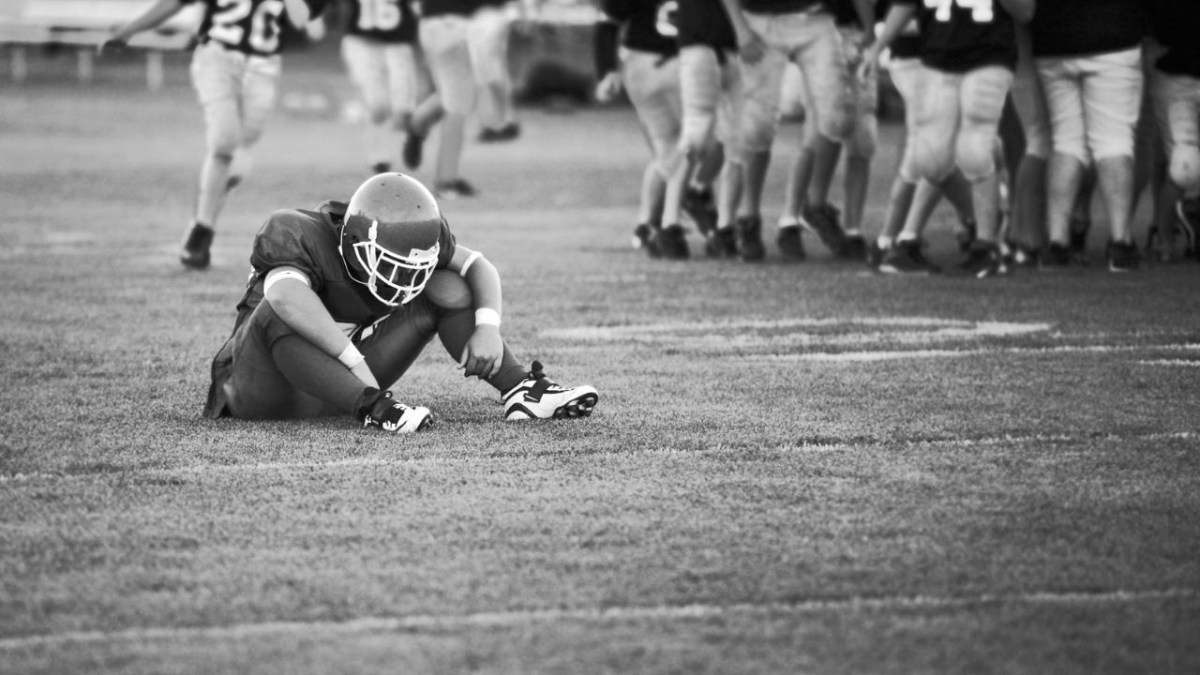
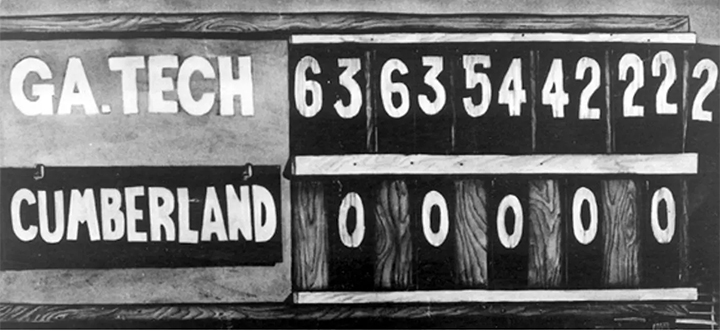
The most lopsided college football game ever was in 1916, when Georgia Tech rushed for 1,650 yards and didn’t allow a single first down by Cumberland College. Final score, 222-0.
During one 1965 regular season game, the Major League St. Louis Cardinals played a single 40-minute inning scoring seven unearned runs in a 12-2 victory over the Milwaukee Braves. Wags coined the term “Blowout”.
Over the years, plenty of other sporting events have qualified for that term:
• Russia’s 1976 Olympic victory over Japan in men’s basketball, 129-63. • The St. Francis College Fighting Saints ’96 baseball season run record of 71-1. • Secretariat’s 1973 Belmont Stakes victory, of 31 lengths.
The most lopsided college football game ever occurred in 1916, when Georgia Tech rushed for 1,650 yards and didn’t allow a single first down by Cumberland College. Final score, 222-0.
In 1927, Kansas City’s Haven High School football team beat Sylvia High 256-0. In a record-setting season of blowouts, the 1901 Michigan Wolverines team defeated every opponent they faced that season by a combined score, of 550-0.
In 1940, Chicago Bears’ coach George Halas showed his players newspaper clippings, in which the Washington Redskins’ owner called Bears players “crybabies and quitters” after losing 7-3 during regular season. Chicago went on to beat Washington 73-0 in post-season, in a game so lopsided it had to be finished with practice balls. Chicago had deposited all the game balls in the stands by that time, kicking extra points.
In 1987, the National League Chicago Colts defeated Louisville, 36-7. The modern Major League Baseball record for margin of victory was set in 2007, when the Texas Rangers defeated the Baltimore Orioles, 30-3. Those 30 runs remain a modern-era record for runs scored in a nine-inning MLB game by one team.
On this day in 1956, the Minnesota Lakers scored one of the most lopsided round ball victories ever over the St. Louis Hawks, 133-75. That blowout was second only to the 1991 Cleveland Cavaliers victory over the Miami Heat, 148-80.
In 2009, Dallas’ Christian Covenant High School girls basketball skunked Dallas Academy, 100-0. The victory was widely condemned: Dallas Academy, a school for students with learning disabilities, had a team of eight out of an entire student body population of 20 girls, and yet Covenant continued a full-court press with three-point shots well after taking a halftime lead of 59-0. Covenant’s administration called for a forfeit of its win, calling the performance “shameful and an embarrassment.” The coach declined to apologize, and was fired.
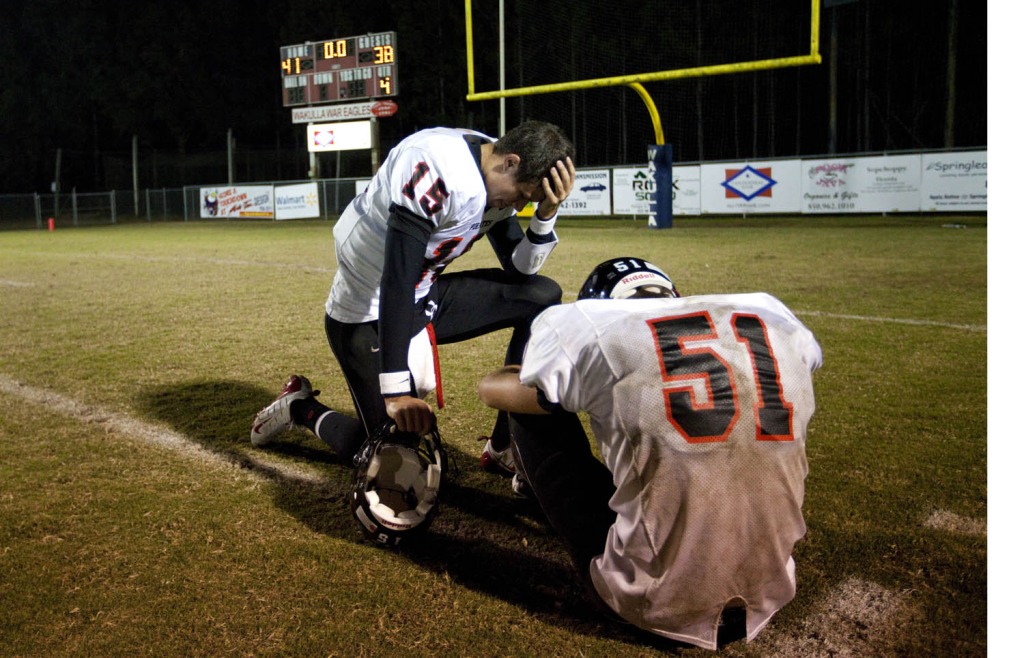
CRAWFORDVILLE, FLA. 12/9/11-PASCOFB120911HACKLEY05-Pasco quarterback Jacob Guy and Nick Wilson kneel dejected on the field after loosing to Wakulla 41-38 in triple overtime Friday in Crawfordville, Fla.
COLIN HACKLEY PHOTO
Three players have won PGA Tour matches by 16 strokes: J.D. Edgar at the 1919 Canadian Open; Joe Kirkwood, Sr., at the 1924 Corpus Christi Open; and Bobby Locke at the 1948 Chicago Victory National Championship. Tiger Woods has the largest margin of victory in the modern era, with a 15-stroke win at the 2000 U.S. Open.
For nearly thirty years, one skier’s wipeout in Oberstock Germany, introduced ABC’s “Wide World of Sports”
The Detroit Red Wings beat the New York Rangers 15-0 in 1944, but some of the worst sports disasters ever, have been in international hockey. The 2007 Slovakia women’s team defeated Bulgaria 82-0 in a 2010 Winter Olympics qualifying tournament. At the 1998 Asia-Oceania Junior Championships, South Korea eclipsed Thailand 92-0. South Korean forward Donghwan Song alone scored 31 goals.
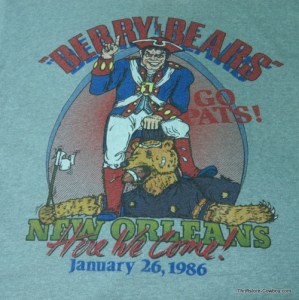
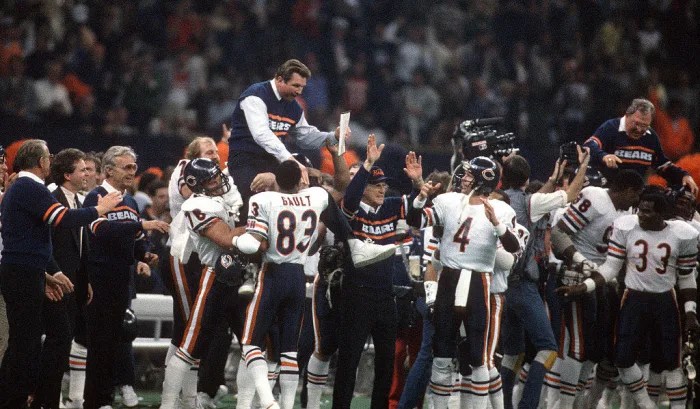
For those of us who rooted for the New England Patriots during the losing years, the 1986 Super Bowl XX was the worst moment…evah. Everyone was wearing their “Berry the Bears” shirts. Life was good when New England took the earliest lead in Super Bowl history with a field goal, at 1:19.
After that, the room got quiet. Real quiet. Chicago held the Patriots to -19 yards. In the first half. Game MVP went to a defensive end with the spectacularly appropriate name of Richard Dent. “Da Bears” set or tied Super Bowl records that day for sacks (7), and fewest rushing yards allowed (also 7). Final score, 46-10.
The day of ignominy lived on for another fourteen years, until the Denver Broncos took us out of our misery with a 55-10 drubbing at the hands of the San Francisco 49ers, in Superbowl XXIV.
What the German foreign secretary hoped Americans would see as mere contingency, US public opinion saw as an unforgivable affront to American neutrality.
In an alternate history, the June 1914 assassination of the heir-apparent to the Habsburg Empire may have led to nothing more than a regional squabble. A policing action in the Balkans.
July 1914 was a time of diplomatic bungling and escalating states of military readiness remembered today, as the July crisis. As it was, mutual distrust and entangling alliances drew the Great Powers of Europe into the vortex. On August 3, the “War to End Wars” exploded across the European continent.
The united States came late to the Great War remaining neutral, until April 1917. On May 10, 1915, President Woodrow Wilson gave what came to be known as his “Too Proud to Fight Speech”:
“The example of America must be the example not merely of peace because it will not fight, but of peace because peace is the healing and elevating influence of the world and strife is not. There is such a thing as a man being so right it does not need to convince others by force that it is right”.
Woodrow Wilson
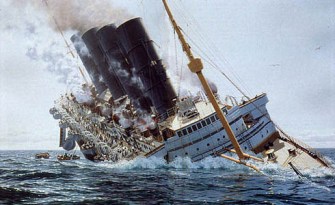
While he failed to mention it directly, HMS Lusitania was torpedoed only three days before with the loss of 1,198 lives, 128 of them, were Americans. 94 of the dead were children.
No one doubted that the attack on the civilian liner was foremost on the President’s mind. In February, Imperial Germany had declared a naval blockade against Great Britain, warning that “On and after February 18th every enemy merchant vessel found in this region will be destroyed, without its always being possible to warn the crews or passengers of the dangers threatening“. “Neutral ships” the announcement continued, “will also incur danger in the war region“.
The reaction to the Lusitania sinking was immediate and vehement, portraying the attack as the act of barbarians and huns and demanding a German return to “prize rules”, requiring submarines to surface and search merchantmen while placing crews and passengers in “a place of safety”.
Imperial Germany protested that Lusitania was fair game, as she was illegally transporting munitions intended to kill German boys on European battlefields. Furthermore the embassy pointed out, ads had been taken out in the New York Times and other newspapers, specifically warning that the liner was subject to attack.
Nevertheless, the German policy of unrestricted submarine warfare was suspended for a time, for fear of bringing the US into the war against Germany.
President Wilson was elected back in 1912, talking about the sort of agrarian utopia favored by Thomas Jefferson. In 1916, the election was about war and peace. Wilson won re-election on the slogan “He kept us out of war”. It had not been easy. In Europe, WWI was in its second year while, to the US’ south, Mexico was going through a full-blown revolution. Public opinion had shifted in favor of England and France by this time. The German resumption of unrestricted submarine warfare therefore, threatened to tip the balance.
With Great Britain holding naval superiority on the surface, Germany had to do something to starve the British war effort. In early 1917, chief of the Admiralty Staff Admiral Henning von Holtzendorff argued successfully for the resumption of unrestricted submarine warfare. The change in policy took effect on February 1.
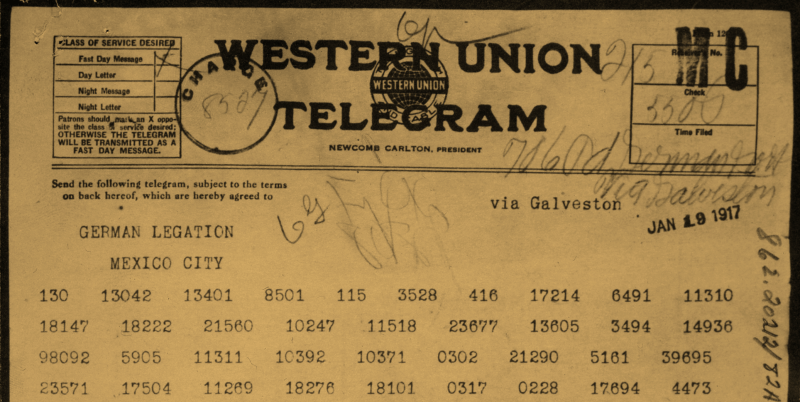
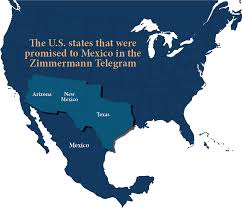
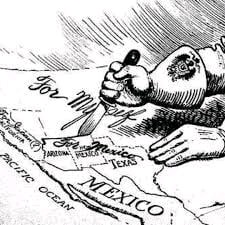
Anticipating the results of such a move, German Foreign Secretary Arthur Zimmermann dispatched a telegram to German ambassador to Mexico Heinrich von Eckardt on January 19, authorizing the ambassador to propose a military alliance with Mexico, in the event of American entry into the war.
“We intend to begin on the first of February unrestricted submarine warfare. We shall endeavor in spite of this to keep the United States of America neutral. In the event of this not succeeding, we make Mexico a proposal of alliance on the following basis: make war together, make peace together, generous financial support and an understanding on our part that Mexico is to reconquer the lost territory in Texas, New Mexico, and Arizona”.
Arthur Zimmermann
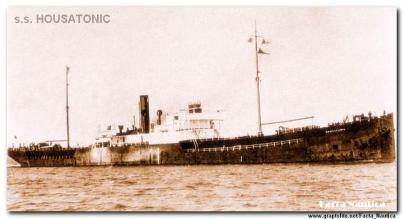
The American cargo vessel SS Housatonic was stopped off the southwest coast of England that February, and boarded by German submarine U-53. Captain Thomas Ensor was interviewed by Kapitänleutnant Hans Rose, who explained he was sorry, but Housatonic was “carrying food supplies to the enemy of my country”. She would have to be destroyed.
The American Captain and crew were allowed to launch lifeboats and abandon ship, while German sailors raided the American’s soap supplies. Apparently, WWI-vintage German subs were short on soap.
Housatonic was sunk with a single torpedo, the U-Boat towing the now-stranded Americans toward the English coast. Sighting the trawler Salvator, Rose fired his deck guns to be sure they’d been spotted, and then slipped away. It was February 3, 1917.
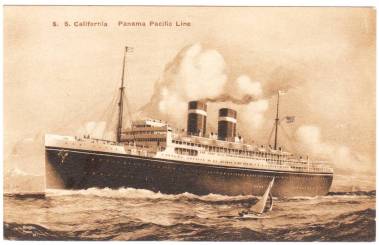
President Wilson retaliated, breaking off diplomatic relations with Germany the following day. Three days later, a German U-boat fired two torpedoes at the SS California, off the Irish coast. One missed, but the second tore into the port side of the 470-foot, 9,000-ton steamer. California sank in nine minutes, killing 43 of her 205 passengers and crew.
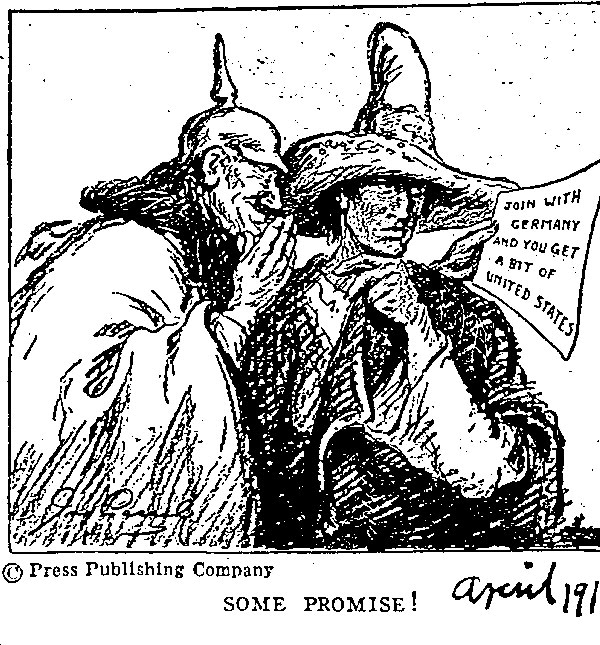
In Mexico, a military commission convened by President Venustiano Carranza quickly concluded that the German proposal was unviable, but the damage was done. British code breakers intercepted the Zimmermann telegram and divulged its contents to the American government, on February 24.
On March 1, the contents of Zimmermann’s note were published in the American press. Even then, there was considerable antipathy toward the British side, particularly among Americans of German and Irish ethnicity. “Who says this thing is genuine, anyway”, they might have said. “Maybe it’s a British forgery”.
The media itself cast a skeptical eye until Zimmermann himself put an end to such speculation, telling an American journalist two days later, “I cannot deny it. It is true.”
What the German foreign secretary hoped Americans would see as mere contingency, US public opinion saw as an unforgivable affront to American neutrality.
Given the confluence of events the Ambassador’s note, was the last straw. Wilson’s War Cabinet voted unanimously for a declaration of war on March 20. The President delivered his war address before a joint session of Congress, two weeks later. The United States Congress declared war on Imperial Germany, on April 6.
Afterward
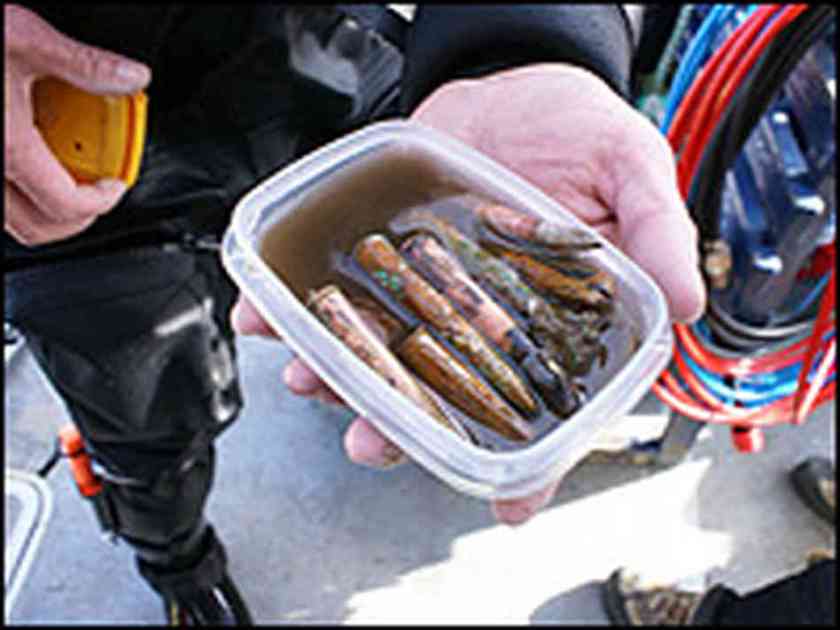
At the time, Germany claimed the Lusitania carried contraband munitions. The story seemed to be supported by survivors’ reports of secondary explosions, within the stricken liner’s hall. In 2008, the UK Daily Mail reported that dive teams had reached the wreck, lying at a depth of 300 feet. Divers reported finding tons of US manufactured Remington .303 ammunition, about 4 million rounds, stored in unrefrigerated cargo holds in cases marked “cheese,” “butter” and “oysters”.
When the break came, each went his own way according to the dictates, of his conscience. Three years came and went before the old friends faced each other once again, this time across the field of battle, at a place called Gettysburg.
Armistead is a prominent name in Virginia. The family goes back to colonial days. Five Armistead brothers fought in the war of 1812. Major George Armistead commanded Fort McHenry during the Battle of Baltimore, the inspiration for Francis Scott Key’s Star Spangled Banner.
The Major became an uncle this day in 1817, to Lewis Addison Armistead, the first of eight children born to General Walker Keith and Elizabeth Stanley Armistead.
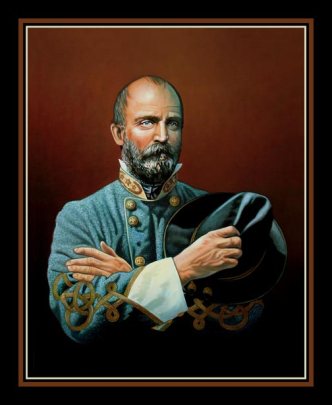
“Lothario” or “Lo” to his friends, Armistead followed the family footsteps, attending the Military Academy at West Point. He never graduated. Some say he had to resign after breaking a plate over the head of fellow cadet and future Confederate General, Jubal Early. Others say the problem was due to academic difficulties, particularly French class.
Lewis Addison Armistead
Be that as it may, Armistead’s influential father gained him a 2nd Lieutenant’s commission awarded in 1839, about the time his former classmates, received theirs.
Armistead’s field combat experience reads like a time-line of the age: cited three times for heroism in the Mexican-American War, wounded at the Battle of Chapultepec and going on to serve in the Mohave War and the Battle of the Colorado River.
Stellar military career though it was, the man’s personal life amounted to a series of unmitigated disasters. Armistead survived two wives and two daughters, only to lose the family farm in a fire. All while fighting a severe case of Erysipelas, a painful and debilitating Streptococcal skin infection known to the Middle Ages as “St. Anthony’s Fire”.
The act of conjugating the “Be” verb changed after the Civil War. Before, it was the United States “are”. Afterward, that became the United States “is”, and not for no reason. This was a time when Patriotic Americans felt every bit the attachment to states, as to the nation itself.
Though often plagued with doubt, fellow Americans took sides on the eve of the Civil War. Even brothers. In common with fellow Virginian Robert E. Lee, Armistead wanted no part of secession, but followed his state when the break became inevitable.
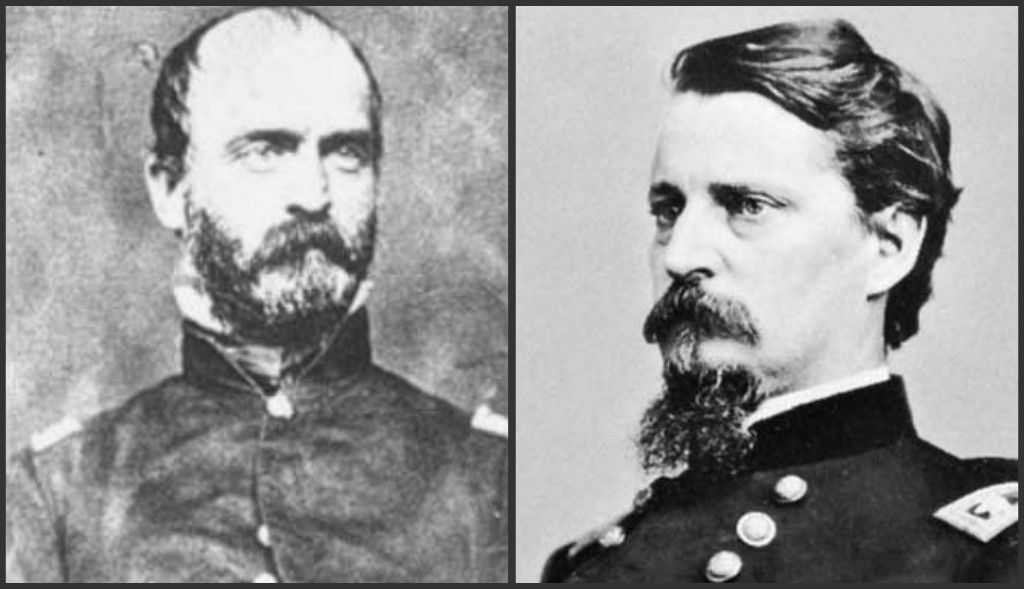
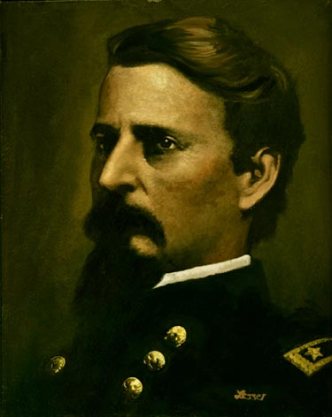
Winfield Scott Hancock
Pennsylvania native Winfield Scott Hancock went the other direction, staying with the Union. Years later, “Hancock the Superb” would be the Democratic candidate for President of the United States, narrowly losing to Republican James A. Garfield.
At a time of rampant political corruption, Hancock was known for personal integrity. Even though himself a Republican, President Rutherford B. Hayes spoke of the man in admiring terms:
“[I]f…we are to think first and chiefly of his manhood, his integrity, his purity, his singleness of purpose, and his unselfish devotion to duty, we can truthfully say of Hancock that he was through and through pure gold.”
Neither Armistead nor Hancock were politicians. Nor was either man the sort of hothead, who starting the war in the first place. These were soldiers and patriots who served together and developed a close personal friendship, as early as 1844.
When the break came, each went his own way according to the dictates, of his conscience. On the eve of Civil War, Armistead gave Hancock the gift of a new Major’s uniform.
Three years came and went before the old friends faced each other once again, this time across the field of battle, at a place called Gettysburg.
Robert E. Lee intended to break the Federal will to fight at Gettysburg, before moving on to threaten the Union capital in Washington DC. “Marse Robert” attacked his adversary’s right on that first day, looking for a soft spot in the line. On day two, he went after the left. On the afternoon of July 3, 1863, Lee came straight up the middle.
A Union perspective, from Cemetery ridge
Armistead and Hancock looked out across the same field as gray and butternut soldiers formed up along seminary ridge. The action began with the largest bombardment in the history of the western hemisphere, the mighty crash of 170 guns spread over a two-mile front. The attack lasted for an hour, most shells flying harmlessly over the Union line and exploding, in the rear. One shell disturbed the lunchtime mess of that “damn old goggle-eyed snapping turtle” George Gordon Meade, cutting one orderly in half and sending much of the senior staff, diving for cover.
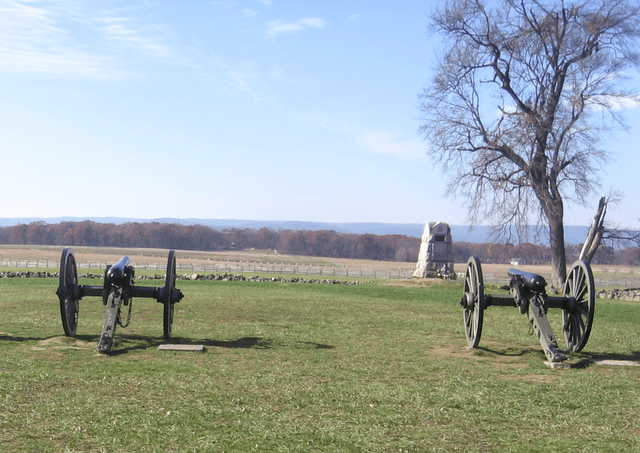
The crest known as Seminary Ridge formed the jump-off point for Longstreet’s assault, of the third day.
The eighty guns of the Union line responded but then went silent, one by one. In the smoke and confusion, it was easy to believe the guns were put out of action, but no. These would be held, until the final assault.
The action has gone into history as “Pickett’s Charge”, though it’s a misnomer. Major General George Pickett commanded only one of three Divisions taking part in the assault, under Corps Commander Lieutenant General James Longstreet.
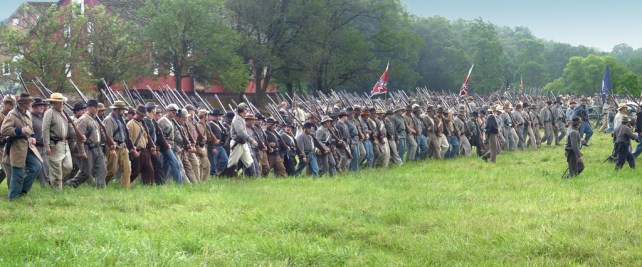
The pace was almost leisurely as Pickett’s, Trimble’s and Pettigrew’s gray and butternut soldiers stepped out of the forest, and over the stone wall. Twelve to fifteen thousand men crossing abreast, bayonets glinting in the sun, banners rippling in the breeze. One Yankee soldier described the scene as “an ocean of men sweeping upon us.”
If you’ve ever crossed that field, you can’t escape the sense of history. Stepping off Seminary Ridge with nearly a mile to go, you are awe struck by the mental image of thousands of blue clad soldiers, awaiting your advance. First come the shells, exploding and tearing jagged holes, where men used to be. Halfway across and just coming into small arms range, you can’t help a sense of relief as you step across a low spot and your objective, the “copse of trees”, drops out of sight. If you can’t see them they can’t shoot at you, right? Then you look to your right and realize that cannon would be firing down the length of your lines from Little Round Top, as would those on Cemetery Hill, to your left.
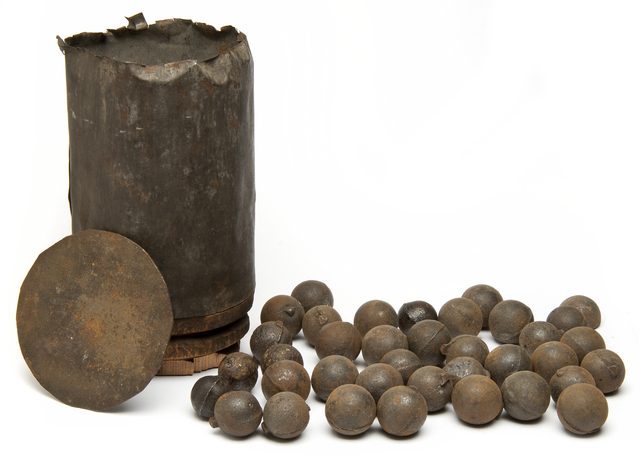
Rising out of the draw you are now in full sight of Union infantry. You can almost hear the tearing fabric sound of rifle fire, exploding across the stone wall ahead. Field guns have converted to canister by now, thousands of projectiles transforming federal artillery into giant shotguns. You quicken your pace as your lines are torn apart from the front, right and left. Fences hold in some spots along the Emmitsburg Road. Hundreds of your comrades are bunched up in the attempt to climb over, and mowed down where they stand.
Canister shot, Gettysburg
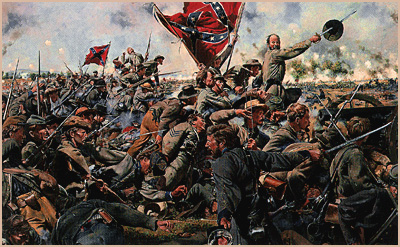
Finally you are over, and closing at a dead run. Seeing his colors cut down, Armistead put his hat atop his sword, holding it high and bellowing above the roar of the guns “Come on, boys, give them the cold steel! Who will follow me!”
Eight months before, Federal troops were cut down like grass on that frozen December, attacking the Rebel-held stone wall at Fredericksburg. So numerous were the multitudes of dying and maimed as to inspire the Angel of Marye’s Heights, one of the great acts of mercy, in the history of war.
Now on this hot July day, came the payback. All along the Union line, the chant arose to a roar, resounding above the din of battle: “Fredericksburg! Fredericksburg! Fredericksburg!”
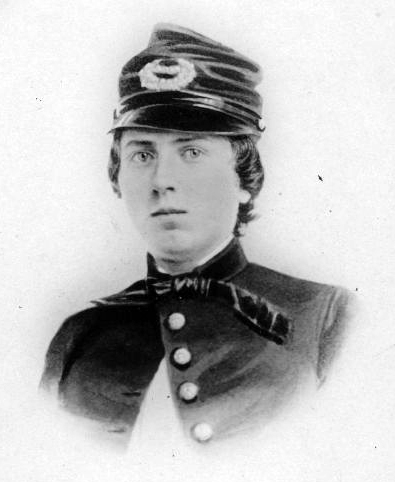
Alonzo Cushing
The savagery of that desperate struggle, can only be imagined. With a shell fragment entering his shoulder and exiting his back and holding his own intestines with a free hand, Brevet Major Alonzo Cushing directed battery fire into the face of the oncoming adversary, until the bullet entered his mouth and exited the back of his skull.
150 years later, the 22-year-old received the Medal of Honor, posthumously awarded by President Barack Obama.
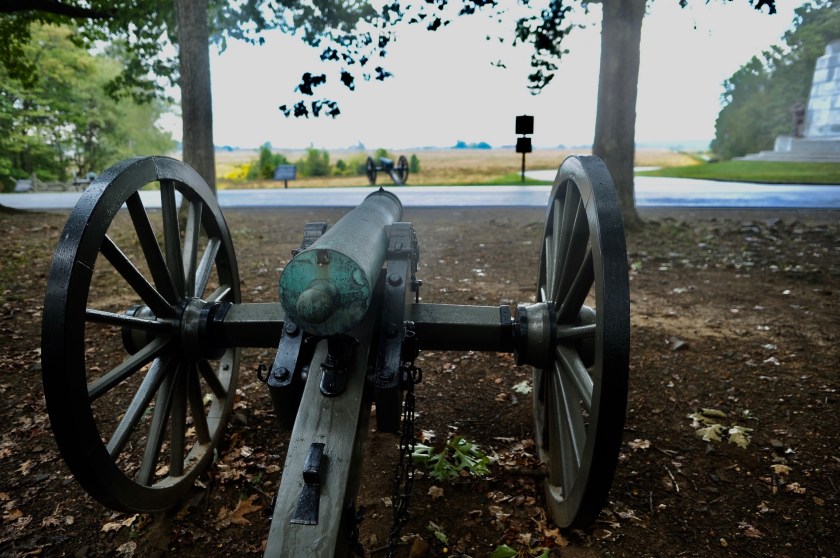
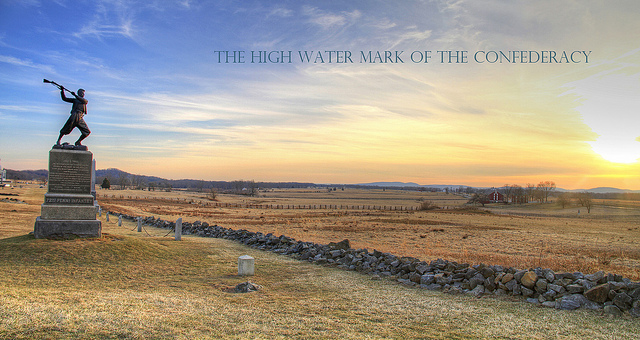
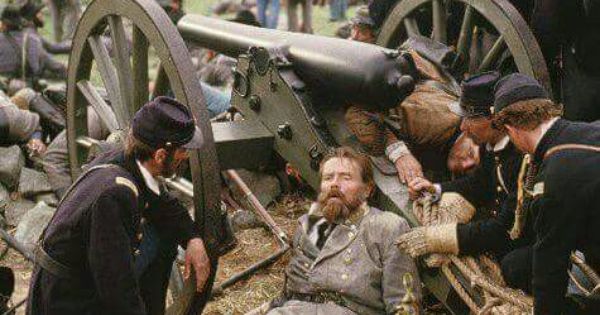
The “High Water Mark of the Confederacy” marks the point between the corner of a stone wall and that copse of trees, the farthest the shattered remnants of Longstreet’s assault would ever get. Lewis Armistead made it over that wall before being shot down, falling beside the wheels of a Union cannon.
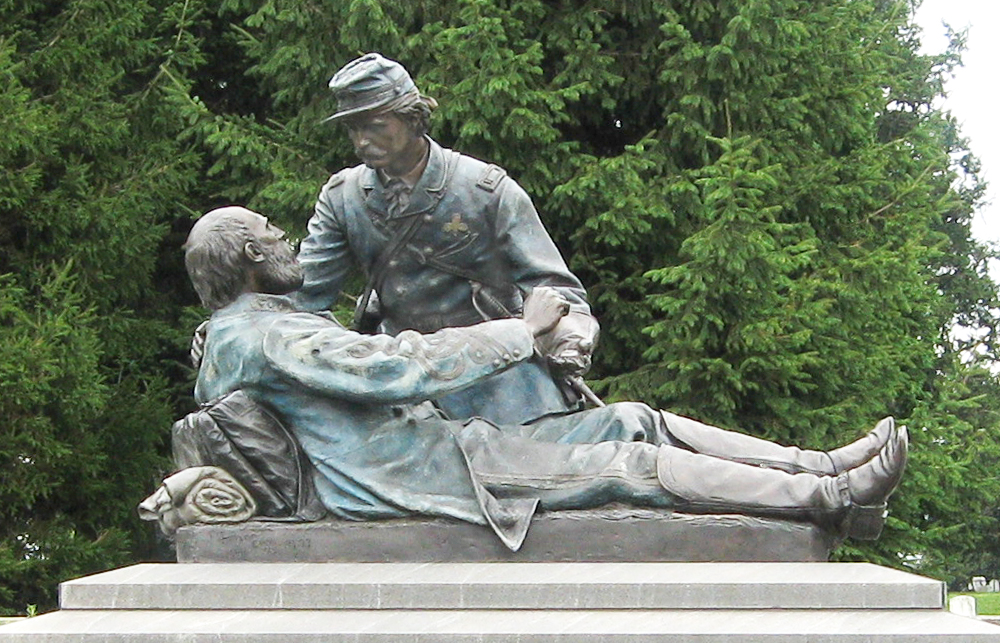
One day, the nation would reunite. The two old friends, never did. As Armistead sat bleeding in the grass, he was approached by Major Henry Bingham, of Hancock’s staff. Hancock was himself wounded by this time, the bullet striking his saddle pommel and entering his thigh, along with shards of wood and a bent saddle nail.
Armistead was grieved at hearing the news. Bingham received the General’s personal effects, with instructions they be brought to his old friend. To Almira (“Allie”) Hancock, the General’s wife, Armistead gave a wrapped bible and his personal prayer book, bearing the inscription ”Trust In God And Fear Nothing”.
From the film, Gettysburg’
There are those who debate the meaning of Lewis Armistead’s last message, though the words seem clear enough: “Tell General Hancock for me that I have done him and you all an injury which I shall regret the longest day I live.”
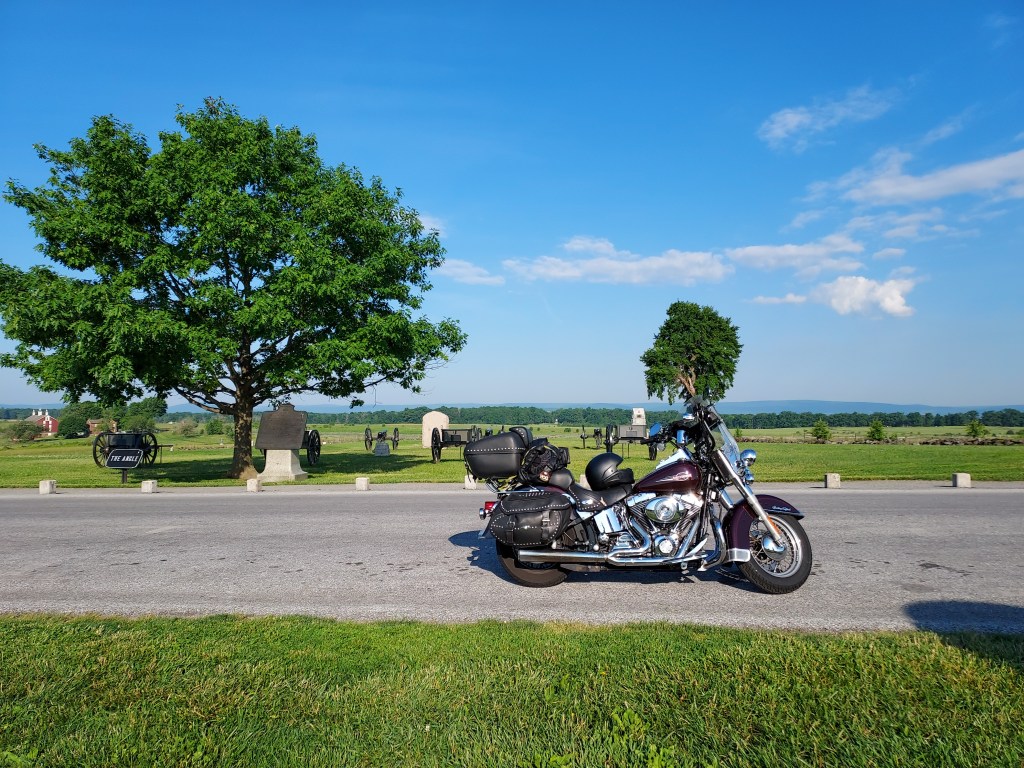
Last year my brother rode up from Alabama and I, down from Massachusetts. We met and paid respects at Dad’s grave in the Sandhills Veterans’ cemetery outside Fayetteville NC and then we were off, to the Blue ridge mountains. Eight days in the saddle, 13 states and 2,800 miles. After saying goodbye in Virginia you know where I had to go next…right?
If you’ve never been. I recommend the trip. The High Water Mark of the Confederacy is always worth the ride.
The High Water mark of the Long brothers’ epic ride, of 2022
No fewer than 97 languages from Amharic (yimarish for women and yimarih for men) to Māori (manaakitia koe) to Yiddish (tsu gezunt) and even Esperanto (Sanon) offer similar blessings, for those who sneeze.
Emerging as we are following two years of worldwide pandemic, the modern mind can scarcely imagine the world experienced by out medieval ancestors, afflicted with the Bubonic Plague. Yersinia Pestis.
Peaking between 1346 and 1353, the “Black Death” was the most deadly pandemic in human history, killing an estimated 75 to 200 million at a time when worldwide population stood less than a half-million.
European populations took 200 years to recover.
Even so, this was far from the first. Modern research points to the existence of Y. Pestis in ancient Swedish tombs, indicating a possible role in the “Neolithic Decline” in which European populations collapsed, some 5-6 thousand years ago.
The Plague of Justinian (541–542 CE, with recurrences until 750) was the first worldwide pandemic brought about by Y. Pestis. Populations from China to Roman Britain were decimated with particular emphasis, on the Sassanian and Byzantine empires. While numbers are uncertain, Procopius wrote of 10,000 dying every day in Constantinople, alone.
In 590, Pope Pelagius II succumbed to the “Black Death” leading to the election of Gregory I, one of the last popes to retain his baptismal name.
Fun Fact: In the early centuries of the Roman church, popes retained baptismal names. In 533, Mercurius was elected head of the worldwide Catholic Church. Deeming it inappropriate that the Bishop of Rome carry the name of a pagan Roman god, Mercurius adopted the papal name John II in honor of his predecessor, venerated as a martyr. Since 1555, all Popes have adopted a Pontificial name as well as an Italian name, in honor of Vatican citizenship.
Today we remember Gregory also for the Gregorian chant, but not for the eponymous calendar. That would come to us from a later Gregory.
Around the time of Gregory I, it was believed (with some justification) that sneezing spread the plague. Many believed in addition, that the soul briefly departed the body during a sneeze, rendering the…err…sneezer, temporarily vulnerable to demonic possession.
So it was on this day, February 16, 600, Pope Gregory I issued a papal bull. A decree, requiring all Christians to invoke the blessings of God, when in the presence of anyone who sneezed.
“The phrase, God bless you, became a sort of protection or verbal talisman to protect the sneezer. We see similar practices in other cultures. For example, the Spanish “Salud” (health), German “Gesundheit” (health), Gaelic “Dia dhuit” (God be with you), and Bengali “Jeebo” (stay alive) are all responses to sneezing”.
H/T compellingtruth.org
ROME, ITALY: This picture taken 26 January 2005 shows Pope John Paul II sneezing during his weekly general audience at the Vatican. Vatican officials 02 February 2005 said they had delayed an early morning health update on the 84-year-old Pope John Paul II, who was admitted to hospital suffering from breathing problems after falling ill with the flu. According to initial reports, the pope spend a “fairly good night” in hospital and was to undergo tests on Wednesday. AFP PHOTO/ PATRICK HERTZOG (Photo credit should read PATRICK HERTZOG/AFP via Getty Images)
While the origins are murky, it seems ol’ Gregory didn’t invent the idea. He just…ordered it. So it is by the year 750, “God Bless You” became the near-universal response to a sneeze and remains so, to this day.
No fewer than 97 languages from Amharic (yimarish for women and yimarih for men) to Māori (manaakitia koe) to Yiddish (tsu gezunt) and even Esperanto (Sanon) offer similar blessings, for those who sneeze.
Today, a sneeze is understood to be the body’s way of ejecting an irritant. But, did you know? An estimated 18% to 35% of the population sneezes, when subjected to sudden, bright light. Gesundheit.
If you could somehow pull up Mt. Everest by the roots and sink the thing in Challenger Deep, (this is the largest mountain on the planet we’re talking about), you would still have swim down 1.2 miles, to get to the summit.
Most of us experience the ocean as a day at the beach, a boat ride, or a moment spent on one end of a fishing line.
The global ocean divided into five major basins: the Pacific, Atlantic, Indian, Southern, and Arctic. Covering 70 percent and more of the planet and taken together, the oceans contain 97% of all the water on planet earth.
And yet the exploration of all that water has never added up to more than 20 percent.
For most dive organizations, the recommended maximum for novice divers is 20 meters (65 feet). A weird form of intoxication sets in called nitrogen narcosis, around 30 meters (98 feet). Divers have been known to remove their own mouthpiece and offer it to fish, with tragic if not predictable results. Dives beyond 130 feet enter the world of “technical” diving involving specialized training, sophisticated gas mixtures and extended decompression timetables. The oxygen we rely on for life literally becomes toxic, around 190 feet.
On September 17, 1947, French Navy diver Maurice Fargues attempted a new depth record, off the coast of Toulon. Descending down a weighted line, Fargues signed his name on slates placed at ten meter intervals. At the three minute mark, the line showed no sign of movement. The diver was ordered pulled up. Maurice Fargues, a diver so accomplished he had literally saved the life of Jacques Cousteau only a year earlier, was the first diver to die using an aqualung. His final signature on the last tablet, at 390 feet.
The man had barely scratched the surface.
Maurice Fargues prepares for what would prove to be, his final dive
For oceanographers, all that water is divided into slices. The top or epiplagic Zone descends from 50 to 656 feet, depending on clarity of the water. Here, phytoplankton convert sunlight to energy forming the first step in a food chain, supporting some 90 percent of all life in the oceans. 95 percent of all photosynthesis in the oceans occur in the epiplagic or photic zone.
The mesopelagic or “twilight zone” receives a scant 1% of all sunlight. Temperatures descend as salinity increases while the weight of all that water above, increases. Beyond that, lies the abyss.
Far below that the earth’s mantle is quite elastic, broken into seven or eight major pieces and several minor bits called Tectonic Plates. Over millions of years these plates move apart along constructive boundaries, where oceanic plates form mid-oceanic ridges. The longest mountain range in the world as an example, runs roughly down the center of the Atlantic ocean.
The Atlantic basin features deep trenches as well, sites of tectonic fracture and divergence. Far deeper than those are the Pacific subduction zones where forces equal and opposite to those forming the mid-Atlantic ridge, collide. One plate moves under another and down into the mantle forming deep oceanic ridges, the deepest of which is the Mariana Trench, near Guam. The average depth is 36,037, ± 82 feet, dropping off to a maximum depth of 35,856 feet to a small valley at the south end of the trench, called Challenger Deep.
If you could somehow pull up Mt. Everest by the roots and sink the thing in Challenger Deep, (this is the largest mountain on the planet we’re talking about), you would still have swim down 1.2 miles, to get to the summit.
The air around us is a liquid with a ‘weight’ or barometric pressure at sea level, of 14.696 pounds per square inch. It’s pressing down on you right now but you don’t feel it, because your internal fluid pressures, push back. A column of salt water exerts the same pressure at 10 meters, or 33 feet.
To consider the crushing weight of all that water, consider this. The bite force of an American Grizzly is 1,200 psi. The Nile Crocodile, 5,000. The pressure in Challenger Deep is equal to 1,150 atmospheres. Over 16,000 pounds per square inch.
The problems with reaching such a depth are enormous. WW2 era German submarines collapsed between 660 and 900 feet, with the loss of all hands. The modern American Sea Wolf class of nuclear submarine is said to have a crush depth, of 2,400 feet.
In the early 1930s, Swiss physicist, inventor and explorer Auguste Piccard experimented with high altitude balloons to explore the upper atmosphere.
The result was a spherical, pressurized aluminum gondola capable of ascending to great heights, without the use of a pressure suit.
Within a few years the man’s interests had shifted, to deep water exploration.
Knowing that air and water are both fluid environments, Piccard modified his high altitude cockpit into a steel gondola, for deep sea exploration. By 1937 he’d built his first bathyscaphe.
“A huge yellow balloon soared skyward, a few weeks ago, from Augsberg, Germany. Instead of a basket, it trailed an air-thin black-and-silver aluminum ball. Within [the contraption] Prof. Auguste Piccard, physicist, and Charles Kipfer aimed to explore the air 50,000 feet up. Seventeen hours later, after being given up for dead, they returned safely from an estimated height of more than 52,000 feet, almost ten miles, shattering every aircraft altitude record.” – Popular Science, August, 1931
Piccard’s work was interrupted by World War 2 but resumed, in 1945. He built a large steel tank and filled it with low-density non-compressible fluid, to maintain buoyancy. Gasoline, it turned out, would do nicely. Underneath was the capsule designed to accommodate one person at sea-level pressure while outside, PSI mounted into the thousands of atmospheres.
Auguste Piccard
The craft, with modifications from the French Navy, achieved depths of 13,701 feet. In 1952, Piccard was invited to Trieste Italy, to begin work on an improved bathyscaphe. In 1953, Auguste and and his son Jacques brought the Trieste to 10,335 feet.
Designed to be free of tethers, Trieste was fitted with two electric motors of 2 HP each, capable of propelling the craft at a speed of 1.2mph over a few miles, and changing direction. After several years in the Mediterranean, the US Navy acquired Trieste in 1958. Project Nekton was proposed the same year, code name for a gondola upgrade involving three test dives and culminating in a descent to the greatest depth of the world’s oceans. The Challenger Deep.
Trieste received a larger gasoline float and bigger tubs with more iron ballast. With help from the Krupp Iron Works of Germany, she was fitted with a stronger sphere with five inches of solid steel and weighing in at 5 tons.
Piccard and Walsh aboard Trieste, January 23, 1960
The cockpit was accessible, only by an upper hallway which was then filled with gasoline. The only way to exit was to pump out the gas and blow out the rest, with compressed air. On this day in 1960, US submarine commander Lieutenant Don Walsh joined Jacques Piccard in that hallway, climbing into the sphere and closing the hatch. The dive began at 0823.
The bathyscaphe Trieste, on the surface
Trieste stopped her descent several times, each one a new thermocline bringing with it a colder layer of water and neutral buoyancy, for the submersible. Walsh and Piccard discussed the problem and elected to gamble, ejecting some of that buoyant gasoline. By 650 feet those problems had come to an end.
By 1,500 feet, the darkness was complete. The pair decided to change their clothes, wet with spray from a stormy beginning. With a cockpit temperature of 40° Fahrenheit, it was a welcome change.
Looking out the plexiglass window, the depths between 2,200 feet and 20,000 seemed extraordinarily empty. At 14,000 feet the pair was now in uncharted territory. No one had ever been this deep. At 26,000 feet, descent was slowed to two feet per second. At 30,000 feet, one.
At 1256 Walsh and Piccard could see the bottom, on the viewfinder. 300 feet to go. Not knowing if the phone would work at this depth, Walsh picked up. “This is Trieste on the bottom, Challenger Deep. Six three zero zero fathoms. Over.” The response came back weak, but clear. “Everything O.K. Six three zero zero fathoms?” Walsh responded “This is Charley” (seaman-speak, for ‘OK’. “We will surface at 1700 hours”.
The feat was akin to the first flight into space. No human had ever reached such depths. Since then only five later expeditions have reached that remote and desolate spot. While unmanned submersibles have since visited Challenger Deep, Piccard and Walsh’ descent of January 23, 1960 was the first and last manned voyage, to the bottom of the world.
Computerized rendering shows Trieste at the bottom, January 23, 1960 H/T National Geographic
“After the 1960 expedition the Trieste was taken by the US Navy and used off the coast of San Diego, California for research purposes. In April 1963 it was taken to New London Connecticut to assist in finding the lost submarine USS Thresher. In August 1963 it found the Threshers remains 1,400 fathoms (2,560 meters) below the surface. Soon after this mission was completed the Trieste was retired and some of its components were used in building the new Trieste II. Trieste is now on display at the National Museum of the United States Navy at the Washington Navy Yard”.
You must be logged in to post a comment.