December 10, 1917 A Gift of Gratitude

So it is that, every year, the people of Nova Scotia send the official Christmas tree to the city of Boston. A gift of gratitude, between two peoples.

A few days short ago, a Christmas tree was erected on Boston Commons. Symbolizing as it does the friendship between the people of two nations, this is no ordinary tree. This tree stands in solemn remembrance of catastrophe, and the bonds between two peoples.

As “The Great War” dragged to the end of the third year in Europe, Halifax harbor in Nova Scotia was the bustling scene of supply, munition, and troop ships destined for “over there”.  With a population of 50,000 at the time, Halifax was the busiest port in Atlantic Canada.
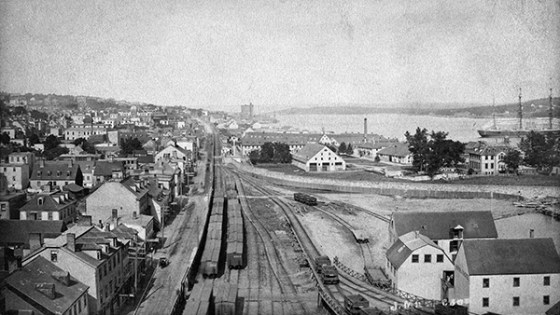
Nova Scotia, ca 1900

The Norwegian vessel Imo left her mooring in Halifax harbor on December 6, 1917, destined for New York City.   The French ship Mont Blanc was entering the harbor at this time, intending to join the convoy which would form her North Atlantic escort.

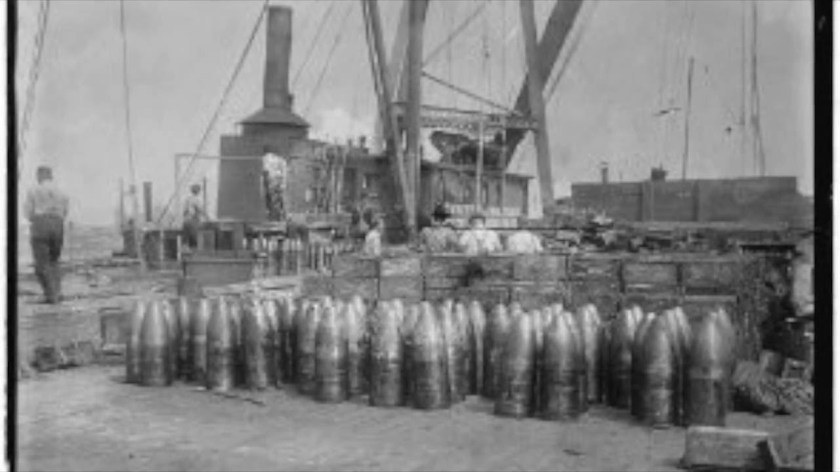
In her holds, Mont Blanc carried 200 tons of Trinitrotoluene (TNT), and 2,300 tons of TNP – Trinitrophenol or “Picric Acid”, a substance used as a high explosive.  In addition, the freighter carried 35 tons of high octane gasoline and 20,000 lbs of gun cotton.
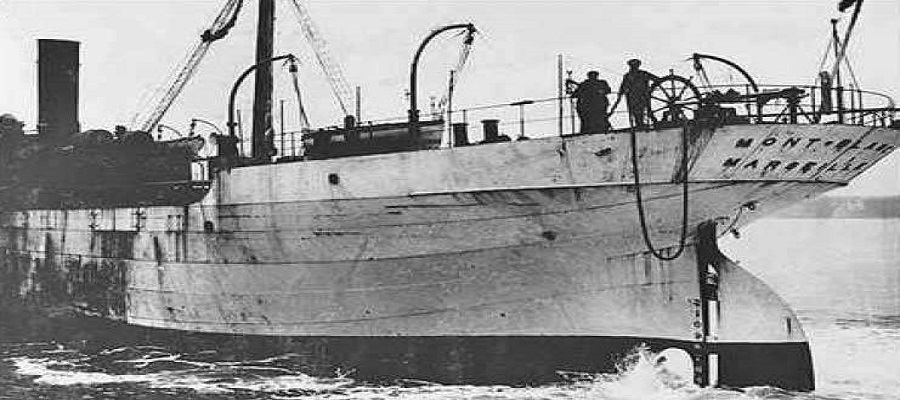
Not wanting to draw the attention of pro-German saboteurs, the freighter flew no flags warning of her dangerous cargo.  Mont Blanc was a floating bomb.

Somehow, signals became crossed as the two ships passed, colliding in the narrows at the harbor entrance and igniting TNP onboard Mont Blanc.  French sailors abandoned ship as fast as they could, warning everyone who would listen of what was about to happen.
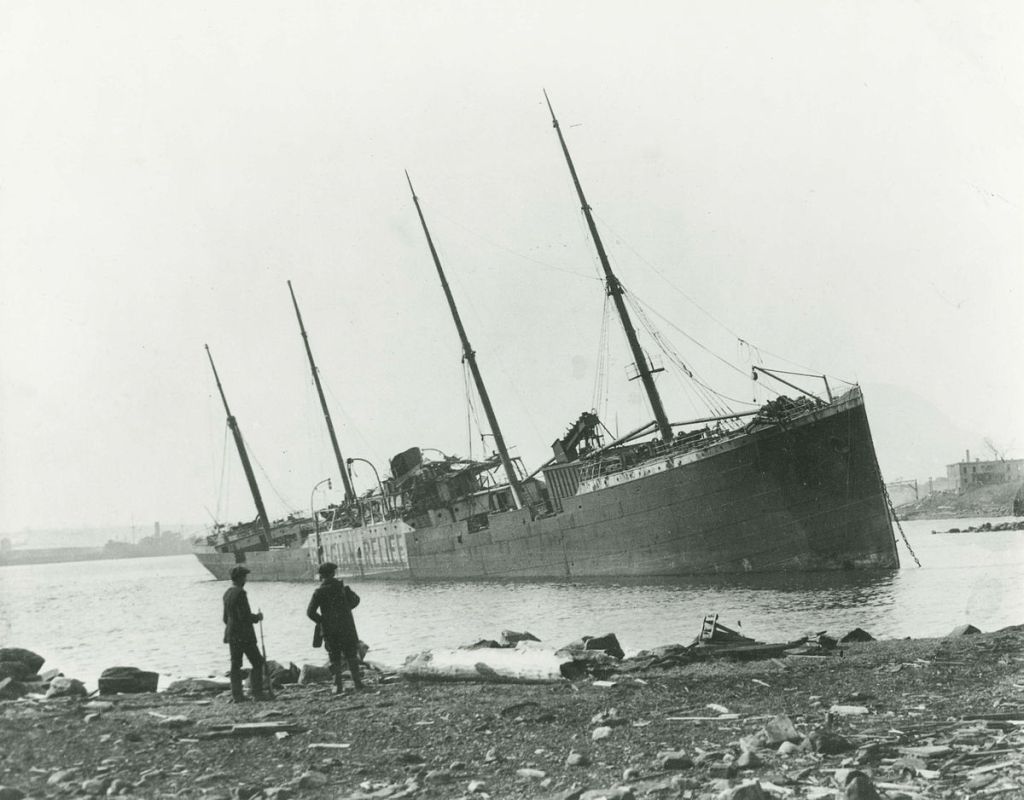
SS Imo

As might be expected, the pyrotechnic spectacle put on by the flaming ship was too much to resist, and crowds gathered around the harbor.  The high-pitched scream emitted by picric acid under combustion is a principal feature of fireworks displays, to this day.  You can only imagine the scene as the burning freighter brushed the harbor pier setting that ablaze as well, before running herself aground.

That’s when Mont Blanc exploded.
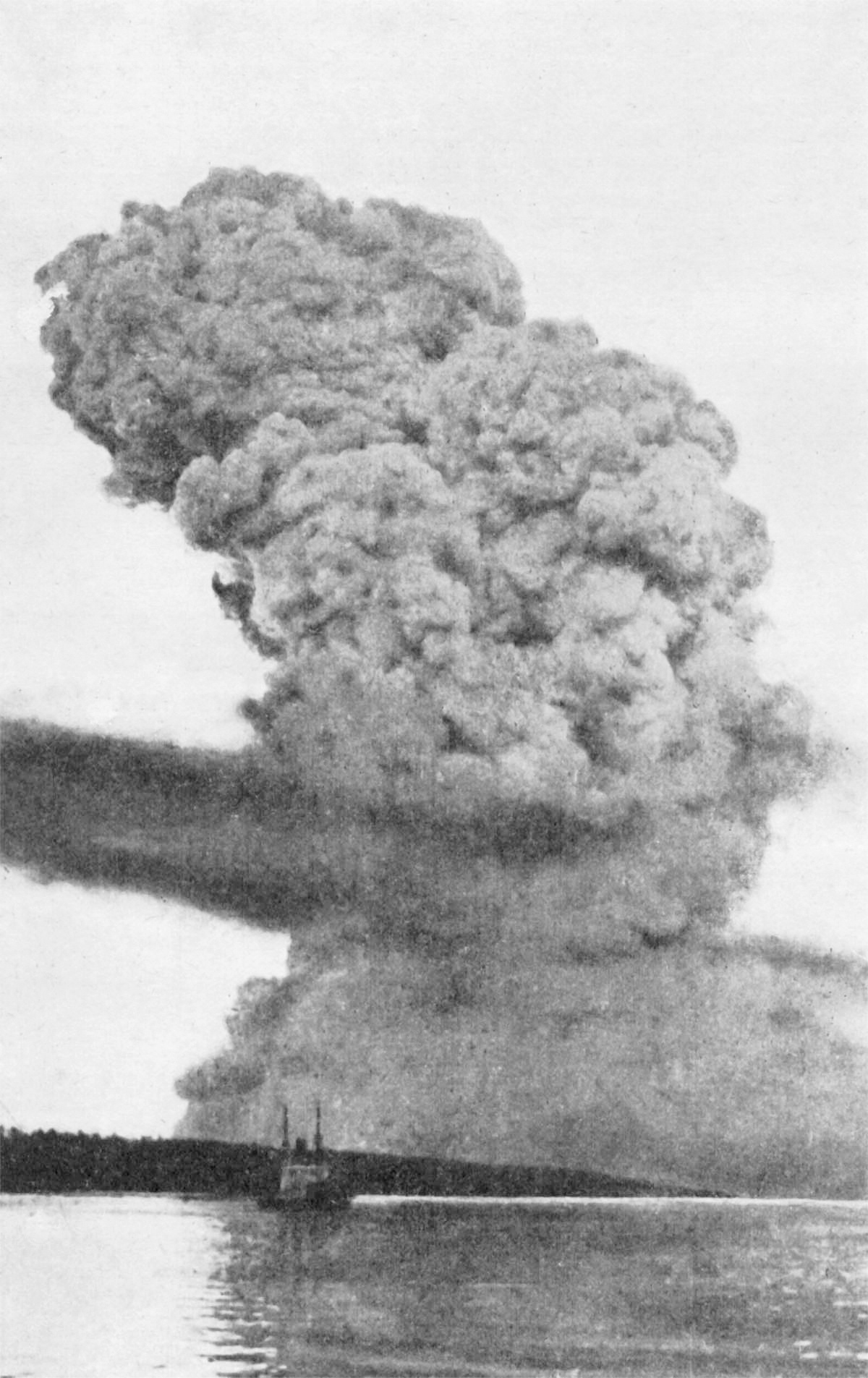
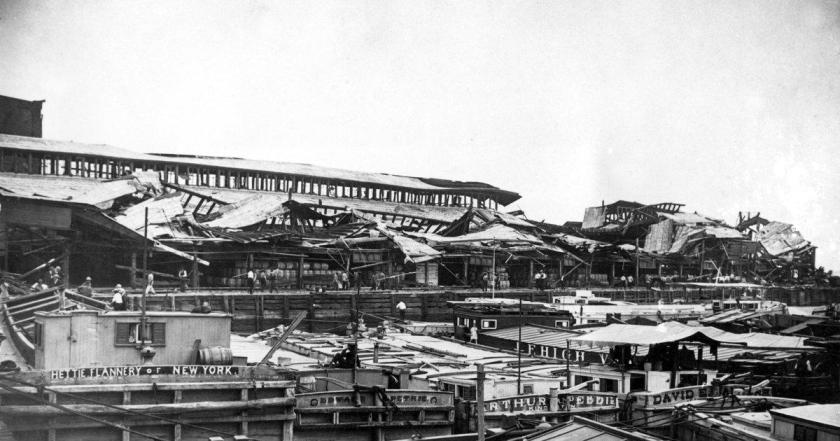
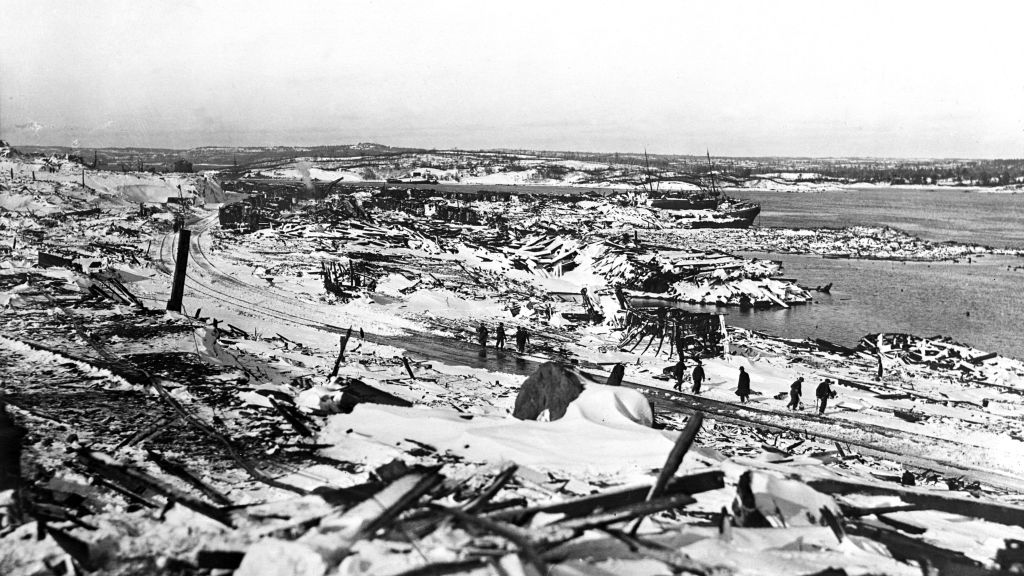
Halifax explosion, 2

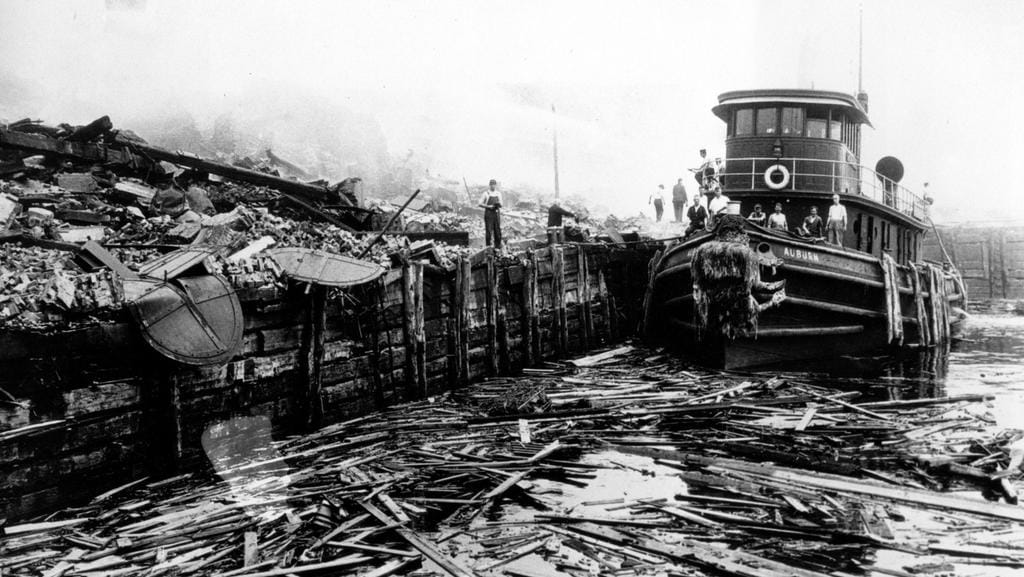
The detonation and resulting fires killed over 1,800 and wounded another 9,000, flattening the north end of Halifax and shattering windows as far as 50 miles away.

The ferocity of the blast literally tore Mont Blanc’s cannon from its mount and bent the barrel.
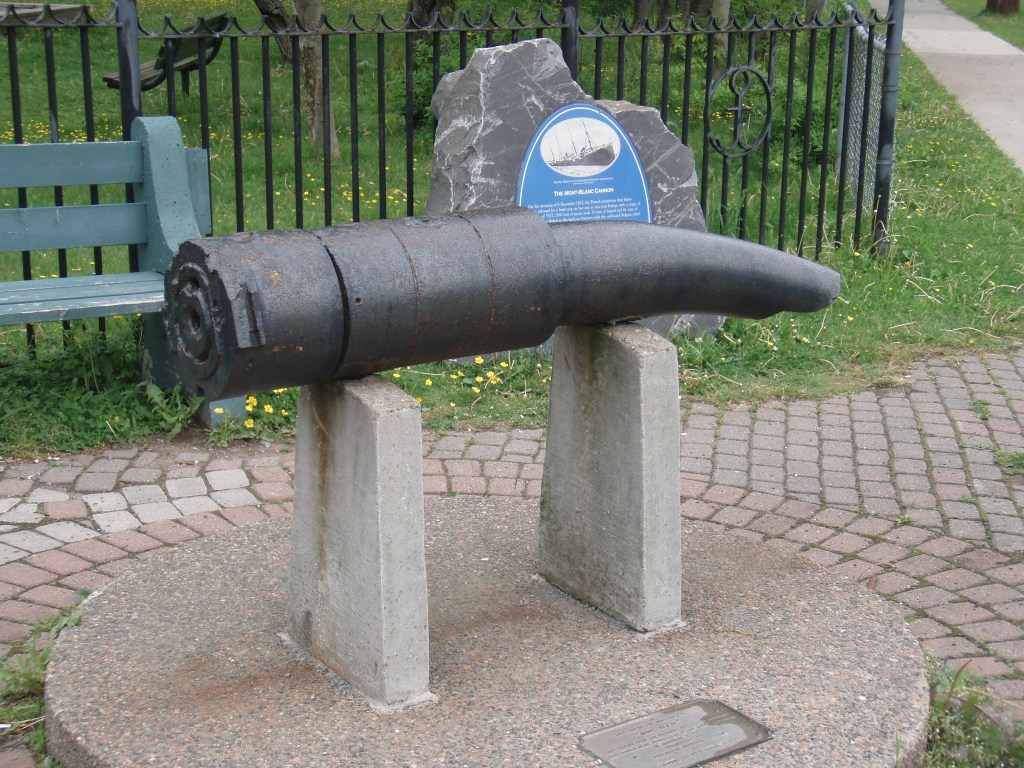
Mont Blanc’s Cannon

It was one of the largest man made, non-nuclear explosions in history. Mont Blanc’s anchor landed two miles away, one of her gun barrels, three.  Later analysis estimated the output at 2.9 kilotons, an explosive force greater than some tactical nuclear weapons.
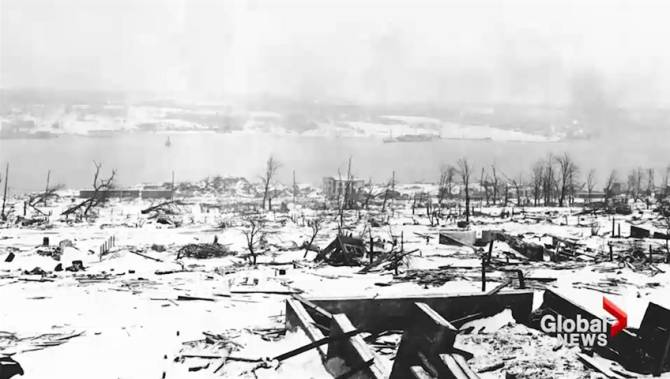
Halifax explosion, 3

The first ray of light on the morning of December 7 revealed an apocalyptic scene of devastation, some 1,600 homes destroyed in the blast as a blizzard descended over Nova Scotia.

Boston Mayor James Michael Curley wrote to the US Representative in Halifax “The city of Boston has stood first in every movement of similar character since 1822, and will not be found wanting in this instance. I am, awaiting Your Honor’s kind instruction.”
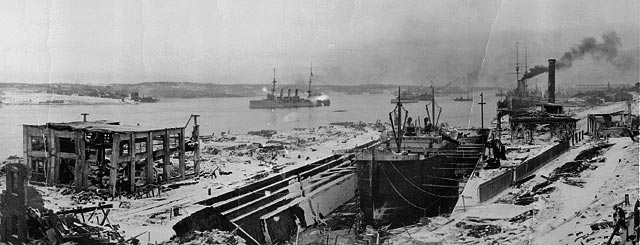
Halifax explosion, 1

The man was as good as his word.  Mayor Curley and Massachusetts’ Governor Samuel McCall composed a Halifax relief Committee to raise funds and organize aid.  McCall reported that the effort raised $100,000 in its first hour, alone.

President Woodrow Wilson authorized a $30,000 carload of Army blankets sent to Halifax, a sum equivalent to some $665,000 today.
Within 12 hours of the explosion, the Boston Globe reported on the first train leaving North Station with “30 of Boston’s leading physicians and surgeons, 70 nurses, a completely equipped 500-bed base hospital unit and a vast amount of hospital supplies”.

Delayed by deep snow drifts, the train arrived on the morning of December 8, the first non-Canadian relief train to arrive on the scene.
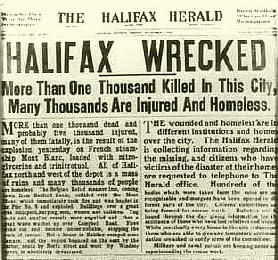
Halifax Herald

There was strong sentiment at the time, that German sabotage lay behind the disaster.  A front-page headline on the December 10 Halifax Herald Newspaper proclaimed “Practically All the Germans in Halifax Are to Be Arrested”.

$750,000 in relief aid would arrive from Massachusetts alone, equivalent to more than $15 million today.  Canadian Prime Minister Robert Borden would write to Governor McCall on December 9, “On behalf of the Government of Canada, I desire to convey to Your Excellency our very sincere and warm thanks for your sympathy and aid in the appalling calamity which has befallen Halifax”.

The following year, Nova Scotia sent the city of Boston a gift of gratitude.  An enormous Christmas tree.

In 1971, the Lunenburg County Christmas Tree Producers Association sent another tree to Boston, to promote Christmas tree exports and to once again acknowledge the support of the people and government of Boston after the 1917 disaster. The Nova Scotia government later took over the annual gift of the Christmas tree, to promote trade and tourism.

So it is that, every year, the people of Nova Scotia send the official Christmas tree to the city of Boston.  A gift of gratitude, between two peoples. More recently, the principle tree is joined by two smaller trees, donated to Rosie’s Place and the Pine Street Inn, two Boston homeless shelters.

This is no Charlie Brown shrub we’re talking about. The 1998 tree required 3,200 man-hours to decorate:  17,000 lights connected by 4½ miles of wire, and decorated with 8,000 bulbs.

In 2013, the tree was accompanied by a group of runners, in recognition of the Boston Marathon bombing earlier that year.

A monument was unveiled on Boston Commons on November 30, 2017, commemorating the 100th anniversary of the Halifax explosion.  The official 2017 Christmas tree lit up for the first time, that night.

2020 tree

This year’s tree stands 48-feet tall tall, marking 100 years since the Halifax explosion. It takes two men a day and a half to prepare for cutting, a crane holding the tree upright while the chainsaw does its work.  It’s a major media event, as the tree is paraded through Halifax on a 53’ flatbed, before boarding the ferry across the Bay of Fundy to begin its 750-mile journey south.

The trip was a little different this year as the border remains closed, due to COVID restrictions. The 2020 tree arrived by ship in Portland Maine to continue the journey south, by road.

For a small Canadian province, the annual gift is no small commitment.  In 2015 Nova Scotia spent $242,000 on the program, including transportation cutting & lighting ceremonies, and the promotions that went with it.

The 2020 tree lighting ceremony on December 3 was, like so many things in this year of years, virtual. There were televised remarks from Mayor Marty Walsh and Karen Casey, Deputy Premier of Nova Scotia, accompanied by Santa Claus and a squadron of Royal Canadian Mounted Police. The switch was thrown and and a live audience of…nobody…enjoyed the ceremonial lighting of the tree.

Thank you, Xi Jinping. You have brought so much warmth into our lives.

BOSTON, MA – DECEMBER 5: Fireworks explode around the Christmas tree on Boston Common at the conclusion of the festivities at the 78th annual tree lighting at the Boston Common on Dec. 5, 2019. (Photo by Jim Davis/The Boston Globe via Getty Images)

In 2016, Premier Stephen McNeil explained the program and why it was worth the expense:  “(It) gives us a chance to showcase our beautiful part of the world to a global community”.   Premier McNeil may have had the last word the following year, on the centennial anniversary of the Halifax catastrophe. “We had massive deaths and injuries”, he said. “It would have been far worse if the people of Boston hadn’t come and supported us.”

December 9, 1854 Into the Valley of Death

Raglan must have looked on in horror as the scene unfolded below. Instead of turning right and climbing the Causeway slopes, nearly 700 horsemen first walked, then trotted and finally charged, straight down the valley. Into the Russian guns. Into one of the Great disasters, of military history.


The Crimean war was in its second year in 1854, pitting an alliance including Great Britain, France, and the Ottoman Empire against the Russian armies of Czar Nicholas I.

The Battle of Balaclava opened shortly after 5:00am on October 25, 1854, when a squadron of Russian Cossack Cavalry advanced under cover of darkness. The Cossacks were followed by a host of Uhlans, their Polish light cavalry allies, against several dug-in positions occupied by Ottoman Turks. The Turks fought stubbornly, sustaining 25% casualties before finally being forced to withdraw.

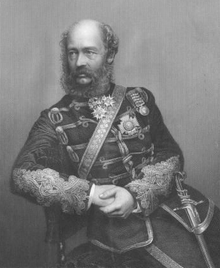
George_Bingham,_3rd_Earl_of_Lucan

For a time, the Russian advance was held only by the red coated 93rd Highland Regiment, a desperate defense remembered as the “Thin Red Line”.

Finally, the Russians were driven back by the British Heavy Brigade, led by George Bingham (left), 3rd Earl of Lucan, a man otherwise known to history for the brutality inflicted on tenants in Mayo, during the Irish potato famine.

The light cavalry of the age consisted of lightly armed and armored troops mounted on small, fast horses, usually wielding cutlass or spear. They’re a raiding force, good at reconnaissance, screening, and skirmishing. The “Heavies”, on the other hand, are mounted on huge, powerful chargers, both rider and horse heavily armored. They are the shock force of the army.

Cardigan

Lucan’s subordinate was James Brudenell, 7th Earl of Cardigan (right), in command of the Light Brigade.

There could not have been two worse field commanders.

Though possessed of physical courage, both men were prideful, mean spirited and petty. What’s worse, they were brothers-in-law, and each man detested the other, thoroughly.

raglan

Field Marshal Fitzroy James Henry Somerset, 1st Baron Raglan (left), was in overall command of the allied armies. Raglan occupied a high spot where he could see the battle unfolding before him, but didn’t seem to realize that his subordinates below couldn’t see what he could see. Spotting a small Russian detachment trying to get away with captured cannon, Raglan issued an order to Lucan, in overall command of his Cavalry. “Lord Raglan wishes the Cavalry to advance rapidly to the front, follow the enemy, and try to prevent the enemy carrying away the guns.” As Staff Officer Louis Nolan left to deliver the message, Raglan shouted “Tell Lord Lucan the cavalry is to attack immediately“.

The Light Brigade was well suited to such a task, but the men below had no idea what Raglan meant by such a poorly worded order. The only guns they could see were dug in Russian artillery a mile away, at the other end of the valley. When Nolan brought the order, Lucan demanded to know what guns. With a contemptuous sweep of his arm, Nolan pointed down the valley.   “There, sir, are your guns“.

The order that came down from Lucan to Cardigan called for a suicide mission, even for heavy cavalry. The “Lights” were being ordered to ride a mile down an open valley, with enemy cannon and riflemen lining both sides, into the muzzles of dug in, well sighted, heavy artillery.

Nose to nose and glaring, neither man blinked in the contest of wills. In the end, Cardigan did as ordered. 674 horsemen of the Light Brigade mounted up, drew their swords, and rode into the valley of death.

Louis Nolan should have gone back to Raglan but rode out instead, in front of the Light Brigade. He was almost certainly trying to redirect the charge and could have saved the day, but it wasn’t meant to be. Louis Nolan, the only man in position to change history that day, was the first man killed in the raid.

Private James Wightman of the 17th Lancers, describes Nolan’s last moments.  “I saw the shell explode of which a fragment struck him. From his raised sword-hand dropped the sword. The arm remained upraised and rigid, but all the other limbs so curled in on the contorted trunk as by a spasm, that we wondered how for the moment the huddled form kept the saddle. The weird shriek and the awful face haunt me now to this day, the first horror of that ride of horrors“.

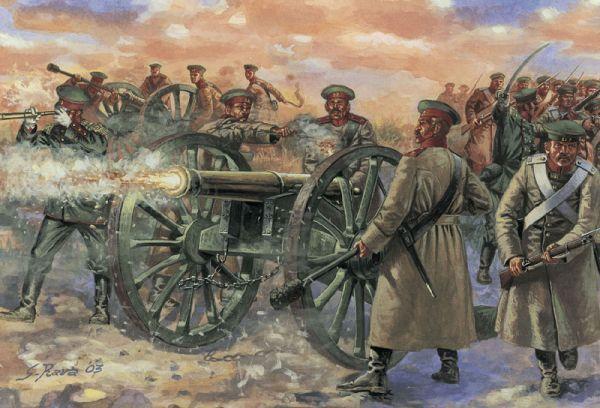
Crimean-War-Russian-Artillery-Battery
Russian Artillery Battery of the Crimean War

Raglan must have looked on in horror at the scene unfolding below. Instead of turning right and climbing the Causeway slopes, nearly 700 horsemen first walked, then trotted and finally charged, straight down the valley. Into the Russian guns. Into one of the Great disasters, of military history.

Captain Thomas Hutton of the 4th Light Dragoons said “A child might have seen the trap that was laid for us. Every private dragoon did“.

Charge, Russian Perspective
Charge of the Light Brigade, from the Russian perspective.

It took the Lights a full seven minutes to reach the Russian guns. Cannon fire tore great gaps out of their lines the whole time, first from the sides and then from the front. Shattered remnants of the Light Brigade actually managed to overrun the Russian guns, but had no means of holding them. Survivors milled about for a time, and then back they came, blown and bleeding horses carrying mangled men back through another gauntlet of fire.

Captain Nolan’s horse carried his dead, broken body all the way down, and all the way back.

Louis Nolan
Death of Captain Nolan or The Charger of Captain Nolan … by Thomas Jones Barker (1855)

When it was over 110 men were dead, 130 wounded and 58 missing or captured. 335 horses were dead or so grievously wounded as to be euthanized, upon their return. 40% losses in an action that had lasted 20 minutes.

Cardigan and Lucan each pointed the finger of blame at the other, for the rest of their lives. Both laid blame for the disaster on Nolan, who wasn’t there to defend himself.

The Battle of Balaclava is mostly forgotten today, but for a stanza in the Alfred Lord Tennyson poem: The Charge of the Light Brigade:

“…Theirs not to make reply,
Theirs not to reason why,
Theirs but to do and die…”

first published on December 9, 1854.

“…Cannon to right of them,
Cannon to left of them,
Cannon in front of them
Volleyed and thundered
Stormed at with shot and shell,
Boldly they rode and well,
Into the jaws of Death,
Into the mouth of hell,
Rode the six hundred…”

Aftermath-of-the-Charge-of-the-Light-Brigade
Aftermath

The Crimean War itself may be remembered as a waste of blood and treasure, for all it accomplished. But for the efforts of one woman, who all but invented the modern profession of nursing. The soldiers knew her as “The Lady with the Lamp” for her late night rounds of compassion, caring for the wounded.

History remembers this “Ministering Angel”, as Florence Nightingale.

December 7, 1941 A Game that Never Was

What started that day as an away game, ended, in World War 2

In the age of COVID-19, we’ve all become accustomed to sudden and unexpected changes of plans. The world of College football is no exception.

Millions of college football fans eagerly await the playoffs, just around the corner. Now it appears, some games may not happen. Wisconsin and Minnesota have played every year, for 113 years. For the first time since 1907, the game’s been canceled. If Ohio State misses one more game, the team won’t be eligible to play in the Championships. The Mountain West and C-USA conferences have seen the most cancellations and/or postponements in all of college football, with three apiece.

It must be particularly frustrating for the San Jose State crowd, locked down after the best start, since 1955.

And yet, there’s more than one way to skin the proverbial cat. The San Jose Spartans flew 2,400 miles west to defeat the Rainbow Warriors of Hawaii, 35-24.

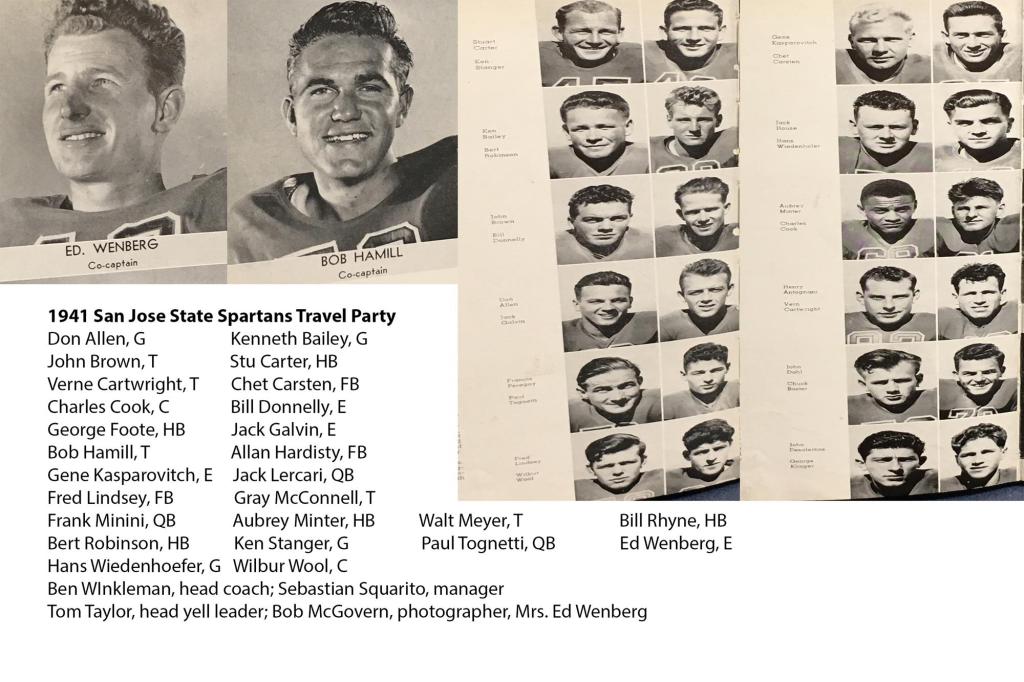
In December 1941, the Spartans were scheduled to play three games in the Aloha state. San Jose and the Willamette Bearcats, of Oregon. They were college kids. On the road to enjoy a few days in paradise and to play the game they all loved. What could be better than that?

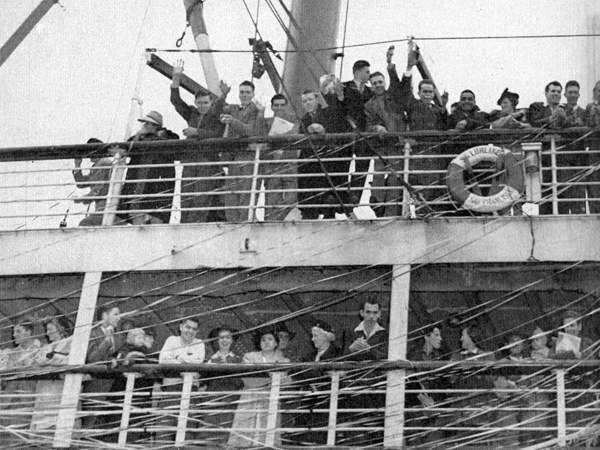
The two teams departed November 27 aboard the SS Lurline, along with an entourage of fans, dignitaries and coaching staff. Hawaii defeated Willamette 20-6 on Saturday, December 6. The Warriors were scheduled to play San Jose State on December 13. Then the Spartans were to play the Bearcats December 16 before sailing home, on the 19th.

An outing like that was once in a lifetime. Unforgettable. The trip would be that and more, but not for the reason anyone expected.

A great sucker punch came out of the southeast on December 7, 1941. 353 Imperial Japanese warplanes attacked Hickam Air Field and the US Pacific Naval anchorage at Pearl Harbor, lying at peace in the early morning sunshine of a Sunday morning. The sneak attack carried out 79 years ago today destroyed more American lives than any foreign enemy attack on American soil, until the 2001 Islamist terrorist attack, of September 11, 2001.

The President of the United States would address a joint session of Congress the following day requesting a declaration of war, against the Empire of Japan.

Back on the mainland, the families of players stranded in Hawaii, received no word. There were no communications. None could know with certainty, that brothers and sons were alive and well. Hawaii was locked down, under Martial Law.

Meanwhile, the visiting teams were mobilized to perform wartime duties. San Jose state players began working with Federal authorities and the Honolulu police department to round up Japanese, Italian and German citizens, and to enforce wartime blackout orders.

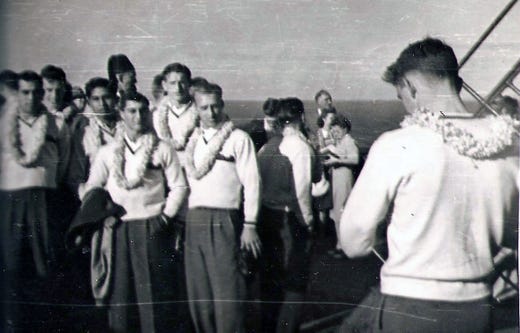
Willamette players were assigned WW1-vintage Springfield rifles and tin hats, and ordered to string barbed wire, on the beaches. Two days later, the Punahou school was taken over by Army engineers. For the next ten days Willamette players stood 24-hour guard, around the school.

If you think you’ve heard the name Punahou it probably involves the school’s most famous alum, future President Barack Obama.

Shirley McKay Hadley, a Willamette student accompanying her father, then serving as state Senator, joked many years later, “They were lucky they didn’t shoot each other.”

Female members of the entourage, were assigned nursing duties.

Spartan Guard Ken Stranger delivered a baby, on December 7.

On December 19, players received two-hours notice. It was time to go. The civilian liner SS President Coolidge had been commandeered to transport gravely wounded service members. This would be the kids’ ride home complete with Naval escort, to protect against Japanese submarine attack.

Seven San Jose players stayed behind and joined the Honolulu police force , for which each was paid $166 a month. Willamette coach Roy “Spec” Keene refused to let any of his players stay behind. None had been able to speak with their parents, first.

Nearly every member of both squads went on to fight for the nation. Willamette Guard Kenneth Bailey was killed over Bari Italy in 1943 and awarded the Purple Heart, posthumously.

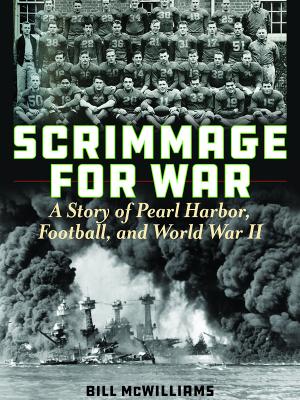
Bill McWilliams served 27 years in the United States Air Force, as a fighter bomber pilot. He’s written a book about 12 of these guys, who went on to fight the conflict, of the “Greatest Generation”.

The book came out in 2019 and it’s still in print, if you’re interested.

It looks like one hell of a story.

Andy Rogers played for the Willamette squad that day and went on to serve for the duration of the war, with the 3rd division of the United States Marine Corps. Mr. Rogers is 98 today and lives in Napa Valley, California. The only living member of either traveling squad who would have played that day, in the game that never was.

December 5, 1941 Henry Breault

It is a searing act of imagination, merely to contemplate those 17 days. Trapped and disoriented inside that black, upside down hell, waiting and desperately hoping for a rescue that would come, too late. A searing act, merely of the imagination. What would it be to enter such a place, as an act of free will.

December 5, 1941 was a Friday. The conflict destined to be known as World War 2 was still, “over there”. The United States was neutral, and at peace. The aircraft carrier USS Lexington and five heavy cruisers leave the US Pacific naval anchorage at Pearl Harbor, unaware that only yesterday, Emperor Hirohito approved the attack to be carried out, in two days.

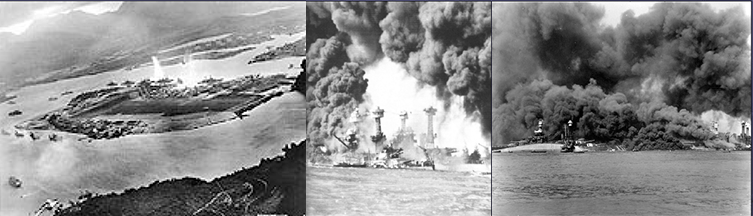
It was literally “out of the blue”, when the first wave of enemy aircraft arrived at 7:48 local time, December 7, 1941. 353 Imperial Japanese warplanes approached in two waves out of the southeast, fighters, bombers, and torpedo planes, across Hickam Air Field and over the waters of Pearl Harbor. Tied in place and immobile, the eight vessels moored at “Battleship Row” were easy targets.

In the center of the Japanese flight path, sailors and Marines aboard the USS Oklahoma fought back furiously. She didn’t have a chance. Holes as wide as 40-feet were torn into the hull in the first ten minutes. Eight torpedoes crashed into her port side, each striking higher up as the Battleship slowly rolled over.

Bilge inspection plates had been removed for a scheduled inspection that Monday, making counter-flooding to prevent capsize, impossible. Oklahoma rolled over and died as the ninth torpedo slammed home. Hundreds scrambled out across the rolling hull, jumping overboard into the oil covered, flaming waters of the harbor, or crawling out on mooring lines in the attempt to reach USS Maryland in the next berth.

Nine Japanese torpedoes struck Oklahoma’s port side, in the first ten minutes.

The damage was catastrophic. Once the pride of the Pacific fleet, all eight battleships were damaged, four sunk. Nine cruisers, destroyers and other ships were damaged and another two sunk. 347 aircraft were damaged, most while still on the ground. 159 of those were destroyed altogether. 2,403 were dead or destined to die from the attack, another 1,178 wounded.

Frantic around the clock rescue efforts began almost immediately, to get at 461 sailors and Marines trapped within the hull of the Oklahoma. Tapping could be heard as holes were drilled to get to those trapped inside. 32 of them were delivered from certain death. 14 Marines and 415 sailors lost their lives on board Oklahoma, either immediately, or in the days and weeks to come. Bulkhead markings would later reveal that, at least some of the doomed would live for another seventeen days in the black, upside-down hulk of that ship. The last such mark was drawn by the last survivor on Christmas Eve.

It is a searing act of imagination, merely to contemplate those 17 days. Trapped and disoriented inside that black, upside down hell, waiting and desperately hoping for a rescue that would come, too late.

A searing act, merely of the imagination. What would it be to enter such a place, as an act of free will.

Let’s rewind. To 1914.

Early attempts had failed, to build a sea-level canal across the 50-mile isthmus of Panama. It was decided instead, the canal would be comprised of a system of locks. The giant crane barges Ajax and Hercules were ordered in 1913, to handle the locks and other large parts, in building the canal. The two cranes arrived in Cristóbal, Colón, Panama on December 7, 1914.

Ajax crane barge at work in the canal zone, 1914

Much of the world was at war at this time while the United States, remained neutral. Henry Breault was born to be a sailor and at sixteen, enlisted in the British Royal Navy. For four years, the Connecticut-born Vermonter served under the White Ensign. When his four-year tour ended in 1921, he joined the US Navy.

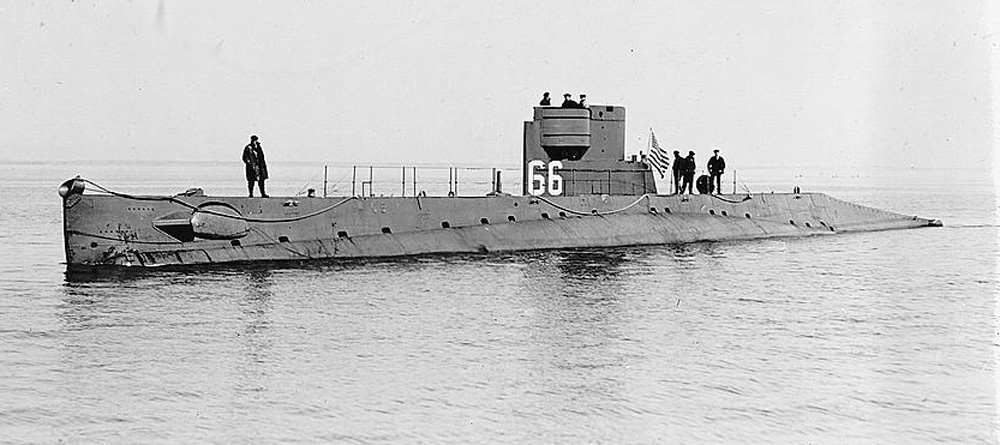
In 1923, now-torpedoman First Class Henry Breault was assigned to the O-Class submarine USS O-5 (SS-66). On October 28, O-5 under the command of Lieutenant Harrison Avery was leading a column of submarines across Limon Bay, toward the canal entrance.

The steamship SS Abangarez, owned by the United Fruit Company, was underway and headed for dock 6, at Cristobal. There were navigational errors and miscommunications and, at about 0630, Abangarez collided with the submarine, tearing a ten-foot opening on her starboard side.

USS O-5

The main ballast tank was breached. O-5 was doomed. As the submarine rolled sharply to port and then to starboard, Avery gave the order to abandon ship. Breault was a few short steps to safety when he realized. Chief Electrician’s Mate Lawrence T. Brown was still below, sleeping. As the bow was going under, Breault shut the deck hatch over his head, and went below.

Brown was awake by this time, but unaware of the order to abandon ship. The pair headed aft toward the control hatch, but it was too late. With the dying sub rapidly filling with water, Breault and Brown made their way to the torpedo room, and dogged the main hatch. Seconds later the battery shorted, and exploded. The two men were trapped under 42-feet of water with no food, no water and only a single flashlight, to pierce the stale air of that tiny, pitch black compartment. It was all over, in about a minute.

Salvage efforts were underway almost immediately, from nearby submarine base, Coco Solo. By 10:00, divers were on the bottom, examining the wreck. Divers hammered on the hull starting aft and working forward, in a search for survivors. On reaching the torpedo room they were answered, by hammer blows from the inside. Somebody’s still alive in that thing.

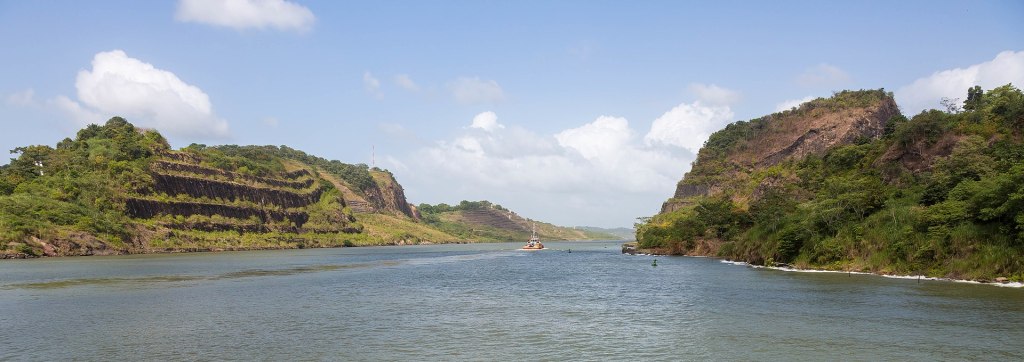
There were no means of rescue in those days, save for physically lifting the submarine with pontoons, or crane. There were no pontoons within 2,000 miles but the giant crane barges Ajax and Hercules were in the canal zone, working to clear a landslide from Gaillard Cut. (Now known as the Culebra cut).

“The Culebra Cut. An artificial valley along the Pacific Ocean to Gatun Lake (ahead) and eventually the Caribbean Sea.. Water level here is 85 feet above sea level…Contractor’s Hill is on the left and Gold Hill is on the right.” H/T Wikipedia

A simple excavation now became a frantic effort to clear enough debris for Ajax, to squeeze itself through the cut.

Divers worked around the clock to dig a tunnel under the sub, through which to snake a cable. Sheppard J. Shreaves, supervisor of the Panama Canal’s salvage crew and himself a qualified diver, explained: “The O-5 lay upright in several feet of soft, oozing mud, and I began water jetting a trench under the bow. Sluicing through the ooze was easy; too easy, for it could cave in and bury me. … Swirling black mud engulfed me, I worked solely by feel and instinct. I had to be careful that I didn’t dredge too much from under the bow for fear the O-5 would crush down on me.”

Ajax arrived around midnight and by early morning the tunnel had been dug, the cables run and attached to Ajax’ hook. Cables strained as the lift began and then…disaster. The cable snapped.

Inside, the headaches were terrific from the pressure and the stale air but all around them, they could hear it. The scraping sounds that meant, rescue was on the way.

Sheppard Shreaves and his team of exhausted divers were now in their suits for nearly 24 hours, working to snake a second set of cables under the bow. Again the strain, as Ajax brought up the slack. Again…disaster. The second set of cables, snapped.

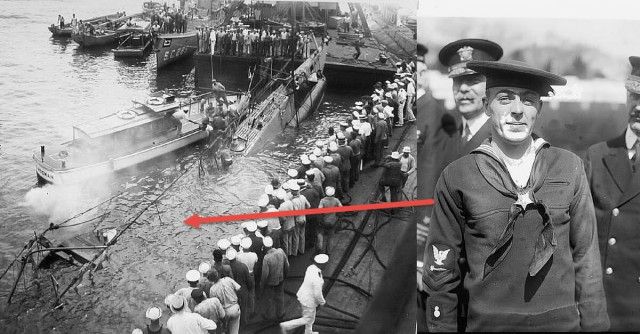
Midnight was approaching on the 29th when the third attempt began, this time with buoyancy added, by blowing air into the flooded engine room. O-5 broke the surface just after midnight. For the first time in 31 hours, two men were able to take in a breath of fresh air. The pair were rushed to the base at Coco Solo for medical examination, and to decompress.

Henry Breault presented the Medal of Honor by President Calvin Coolidge.

Henry Breault received the Medal of honor for what he did that day. Sheppard Shreaves received the Congressional Life Saving Medal, personally presented by Henry Breault and Lawrence Brown along with a gold engraved watch, a gift from the grateful submariners, of Coco Solo.

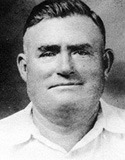
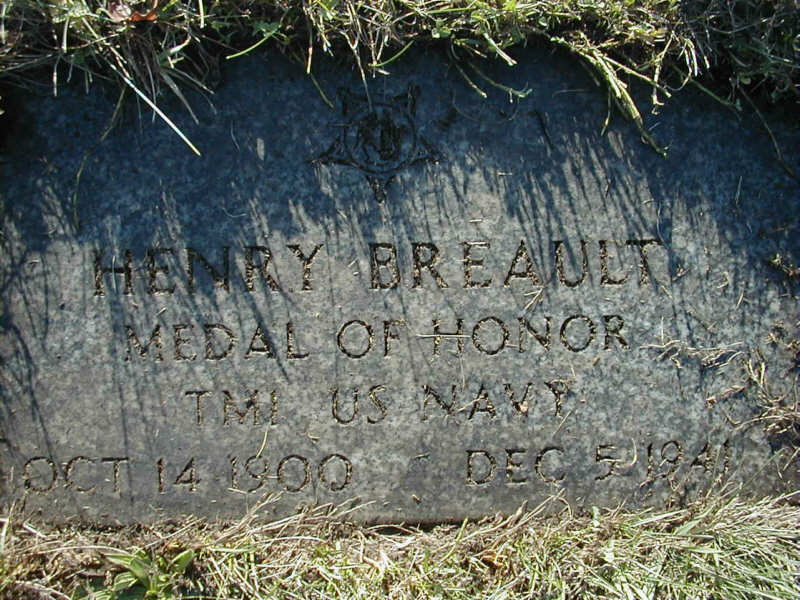
Henry Breault served 20 years with the US Navy and later became ill, with a heart condition. He passed away on this day in 1941 at the age of 41, and went to his rest in St. Mary’s cemetery, in Putnam Connecticut. To this day the man remains the only enlisted submariner in history, to receive the Medal of Honor.

December 4, 1875 A Blizzard of Bacon

A hundred years ago, Ambrose Bierce described politics as “A strife of interests masquerading as a contest of principles. The conduct of public affairs for private advantage“.


Before the first Europeans arrived in the “new world”, descendants of the Nanticoke inhabited a region from Delaware north through New Jersey and southern New York, and eastern Pennsylvania. The Europeans called them “Delaware”.  These indigenous Americans called themselves “Lenni-Lenape” literally translating as “Men of Men”, but is translated to mean “Original People.” (Hat tip, http://www.nanticoke-lenape.info).

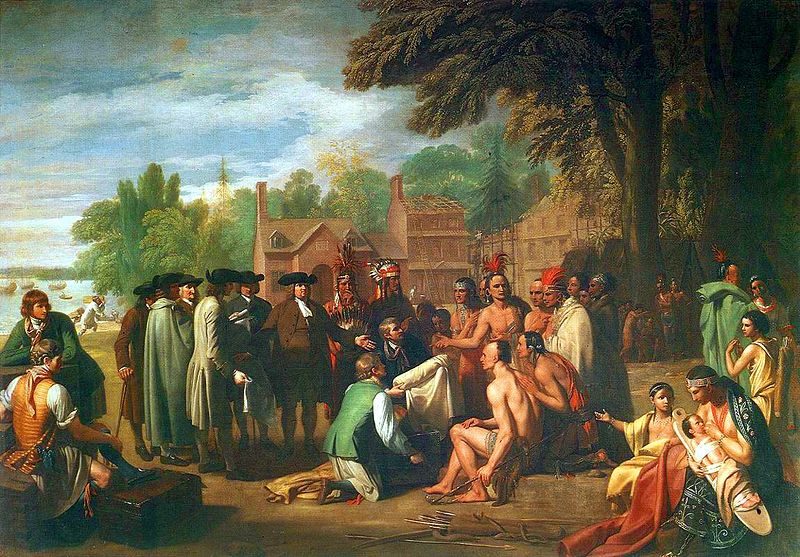
In the early 1680s, Chief Tammamend (“The Affable”) of the Lenni-Lenape nation took part in a meeting with English colonists. He is supposed to have said that his people and the newcomers would “live in peace as long as the waters run in the rivers and creeks and as long as the stars and moon endure.”

Treaty_of_Penn_with_Indians_by_Benjamin_West
Treaty of Penn with Indians, by Benjamin West

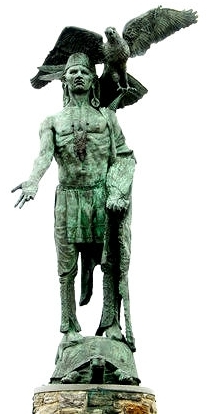
“Tammany” to the settlers, Chief Tammamend became a living symbol of peace and friendship, between the two peoples. He died in 1701, but his legend lived on. Tammany societies would spring up over the next hundred years, from Georgia to Rhode Island.

8-22-Tamanend

Tammany Societies adopted native terms with leaders calling themselves Grand Sachems and meeting in halls called “Wigwams”. The most famous of these, was New York.

By the turn of the 19th century, what had begun as social a club had morphed into a political machine. Tammany helped Aaron Burr counter Alexander Hamilton’s Society of the Cincinnati when Burr went on to win New York’s two electoral votes in 1800.

Without help from “Tammany Hall”, historians believe John Adams would have been re-elected.

After Andrew Jackson’s victory in 1828, the Tammany machine all but owned government in New York: city and state, alike.

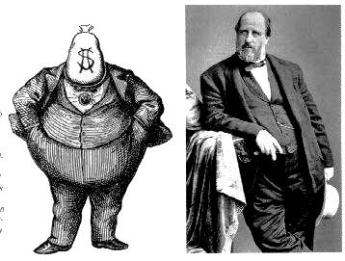
Boss_Tweed

The 19th century was a time of massive immigration, providing an ever-expanding base of political and financial support for urban politicians. Political machines helped new arrivals with jobs, housing and citizenship, a veritable model “constituent service”. Under the surface dwelled a dark underbelly of graft and corruption.

In those days, volunteer fire companies were closely associated with street gangs, with strong ethnic ties. Rivalries were so potent that buildings were known to burn, as opposing fire companies brawled on the streets below.

William Magear Tweed dropped out of school at 11 to learn his father’s chair-making trade and later apprenticed, to a saddler. A brief stint as member of volunteer fire co. Engine 12, brought the man to the attention of democrat party leaders. Apparently there was something appealing about a man, willing to wade into his adversaries with an axe.

While still in his early twenties, Tweed joined forces with the “forty thieves”, a group of aldermen known as some of the most corrupt politicians, in the city’s history.

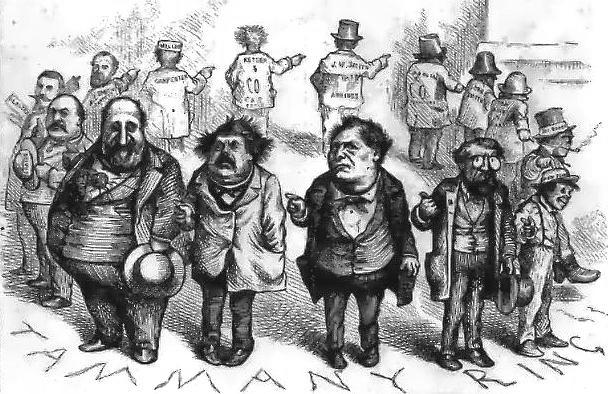
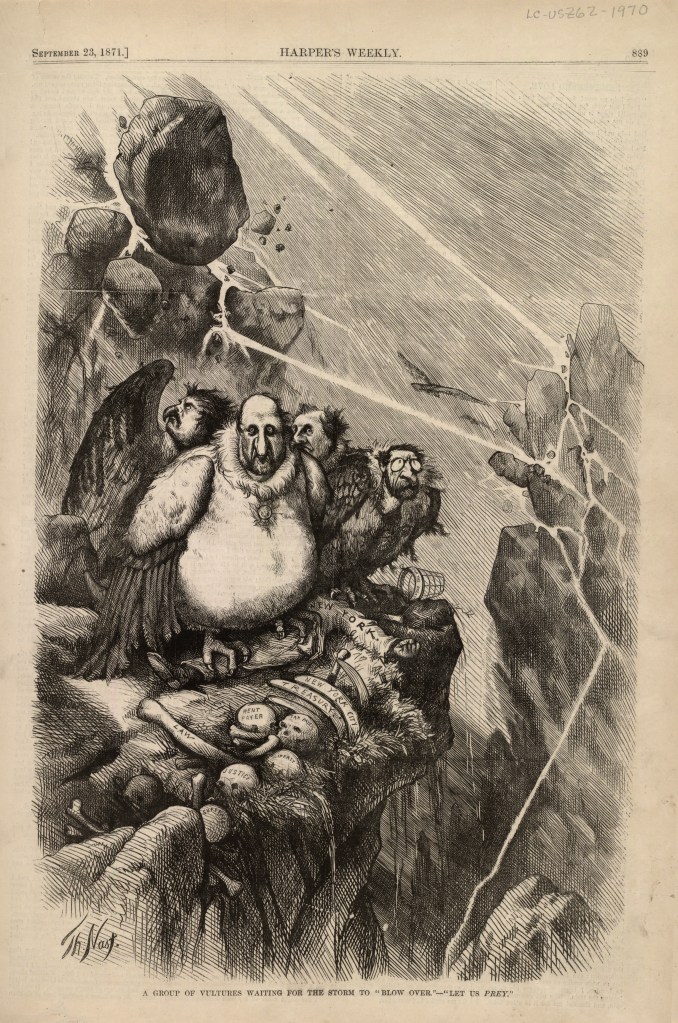
Harper’s Weekly editorial cartoonist Thomas Nast was a vehement opponent of the Tammany Hall machine, here in an 1871 cartoon entitled, :Let us prey”.

By the 1860s, now “Boss” Tweed had established a new standard in public corruption. Biographer Kenneth Ackerman wrote: “The Tweed ring at its height was an engineering marvel, strong and solid, strategically deployed to control key power points: the courts, the legislature, the treasury and the ballot box. Its frauds had a grandeur of scale and an elegance of structure: money-laundering, profit sharing and organization“.

Contractors were instructed to multiply invoices. Checks were cashed through a go-between, settling with the contractor and dividing the rest between Boss Tweed and his cronies. The system inflated the cost of the New York County Courthouse to nearly $13 million at a time the Alaska purchase, went for $7.2 million. That’s about $125 million, today.

One carpenter billed $360,751 for a month’s work. One month. A plasterer got $133,187 for two days. Tweed orchestrated $65,000 in bribes to aldermen alone, to secure the bond issue for the Brooklyn Bridge.

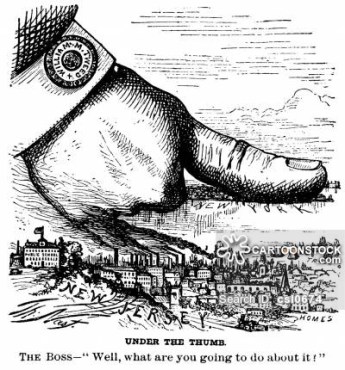
New York Corruption - New York Under Tweed's Thumb

Some among the self-styled “Uppertens”, the top 10,000 amid New York’s socioeconomic strata, fell in with the self-dealing and corruption of the Tammany Hall machine. Others counted on an endless supply of cheap immigrant labor.

The system worked while Tweed’s Machine kept “his people” in line until the “Orange Riots” of 1870-71 broke out between Irish Catholics and Protestants, killing 70.

Tweed’s downfall began in 1871 when city auditor James Watson was killed in a sleigh accident. Ring members frantically attempted to destroy Watson’s records but it was too little, too late. The New York Times, back when it was a newspaper, had a feast. Boss Tweed was arrested on October 27, 1871, and tried on charges of public corruption.

There were mistrials and retrials and, in the end, Boss Tweed was sentenced to 12 years. He escaped on December 4, 1875 and fled to Spain where he worked for a time, as a common seaman. Unfortunately for him he was recognized from one of Nast’s cartoons and returned home on the USS Franklin, to finish his sentence.

Now a broken man, Tweed agreed to testify before a board of aldermen. Having done so, Democrat governor Samuel J. Tilden reneged on the deal and sent the man back to prison. Former State Senator, former Member of the United States Congress, one of the largest property owners in New York city, William Magear Tweed contracted pneumonia and died in prison on April 12, 1878. Mayor Smith Ely refused to permit the flag, to be lowered to half-staff.

An 1877 aldermen’s committee estimated that Boss Tweed’s graft cost New York taxpayers between $25 and $45 million. New York Times estimated $200 million, equivalent to an astonishing $2.8 Billion, today.

Boss Tweed was gone. The reeking sewer of corruption of which he was part, moved on. By the end of the 19th century, ward Boss Richard Croker ran a system of graft and corruption the likes of which Boss Tweed could have only dreamed.

Nast-Tammany_crop
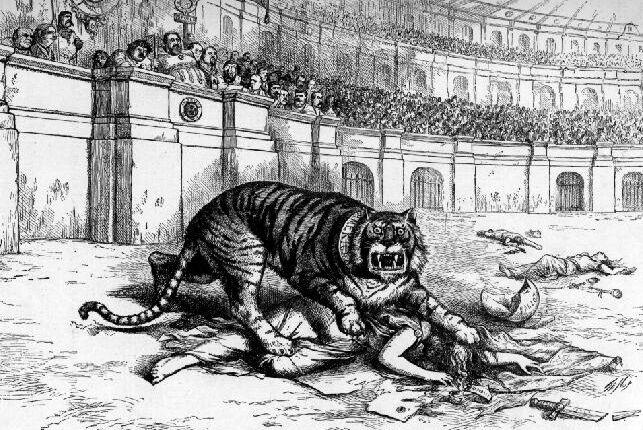
Cartoonist Thomas Nast denounced the Tammany machine as a ferocious tiger, devouring democracy.

In the end, three things killed the Tammany Hall system. Early Irish arrivals had been primary beneficiaries and major supporters of Tammany’s patronage system, but there are only so many favors to go around. Continued immigration diluted Tammany’s base, and later arriving Irish, Italian and eastern European immigrants found themselves frozen out.

Next is the spoils system, itself. To this day, too many think it’s government’s job to “Bring home the Bacon”, not seeming to realize that they themselves, are the hogs. The Roosevelt administrations’ efforts to fix the Great Depression resulted in a blizzard of bacon from an increasingly Nationalized federal government, separating the local machines from local bases of support.

y9AfutFuWoQMH-GAzYj6wjl72eJkfbmt4t8yenImKBVvK0kTmF0xjctABnaLJIm9

Last came “reformers” such as New York governor and future President of the United States Franklin Delano Roosevelt, who occasionally built enough steam to hurt the Tammany machine.

Manhattan District Attorney Thomas E. Dewey, he of the famous “Dewey Wins!” photograph, managed to put several Tammany Hall leaders in jail, along with such unsavory supporters as “Lucky Luciano”.

Republican Fiorello La Guardia served three terms as New York mayor between 1934-’45, the first anti-Tammany mayor, ever re-elected. A brief resurgence of Tammany power in the 1950s met with Democratic party resistance led by the likes of Eleanor Roosevelt, and party politician Herbert Lehrman. By the mid-1960s, the Tammany Hall system was dead.

Tammany Hall was a local manifestation of a disease afflicting the entire country. Boston, Chicago, Cleveland, Kansas City, Philadelphia, St. Louis and others:  all suffered their own local outbreak.

Tammany_Hall_Union_Square
Tammany Hall, Union_Square

The Ward Boss lives on in places like Chicago but, like the Jeffersons, the corruption has “moved on up”. Today, rent seekers and foreign powers pay tens of millions in “speaking fees” and other “pay-for-play” schemes. Sound familiar?

Like a certain vice President bragging on camera, about withholding a Billion dollars in foreign aid. Unless an ally fires the prosecutor looking into the “business dealings” of a 47-year mediocrity, and his son. I bet that sounds familiar, too.

A hundred years ago, Editor-in-Chief of the New York Evening Post E.L. Godkin wrote, “A villain of more brains would have had a modest dwelling, and guzzled in private. His successors here will not imitate him in this. But that he will have successors, there is no doubt”. Ambrose Bierce (my favorite curmudgeon) described politics as “A strife of interests masquerading as a contest of principles. The conduct of public affairs for private advantage“.  Boss Tweed could tell you.   It’s as true today as it was in his time.

Featured image, top of page: Nast cartoon, “Who stole the people’s money?…twas him”.

December 3, 1586 A Food Fit for Peasants, and Livestock

Among other virtues, the potato provides more caloric energy per acre of cultivation than either maize or grain and, being below ground, is likely to survive calamities that would flatten other crops. Taters quickly became staple foods in northern and eastern Europe, while in other areas remaining the food of peasants and livestock.

In time of plenty, it is an act of conscious will to imagine the process of starvation. Not the hunger of the mind nor even the body but that sustained state of deprivation which brings with it, the slow and agonizing end of life.

The first phase. The body turns inward converting glycogen stored in the liver, into fuel. Glucose. The process lasts only a few hours and then comes the breakdown of fats, and proteins.

The second phase can last for weeks as the liver metabolizes fatty acids into ketone bodies, used for energy. Proteins not essential for survival, are consumed.

These first two phases take place, even during moderate periods of dieting and fasting. The third phase begins only after prolonged periods of starvation. The body’s fat reserves are now depleted. Muscle tissue is consumed, for fuel. Cell function degenerates as the sufferer becomes withdrawn, listless, increasingly vulnerable to disease and infection. Some experience distended liver and massive edema seen particularly in children…the swollen belly, the cruel and superficial illusion that such youngsters are in fact, well fed. Few die directly from starvation but rather collapse of organ function or cardiac arrhythmia brought about by severe imbalance. Or opportunistic infection, afflicting a body no longer able to defend itself.

The process is over in as little as three weeks or as long as seventy days.

“Marasmus, a form of protein-energy malnutrition occurring chiefly among very young children in developing countries, particularly under famine conditions, in which a mother’s milk supply is greatly reduced. Marasmus results from the inadequate intake of both protein and calories; persons with a similar type of protein-energy malnutrition, kwashiorkor, do not obtain enough protein but still consume a moderate number of calories”. H/T Britannica

Massive hunger events are as old as recorded history, when our early ancestors first abandoned hunter-gatherer lifestyles to build agricultural settlements. Scientists believe the 100-year drought beginning in 2200BC may well have collapsed the old order from Egypt to the Akkadian Empire in Mesopotamia to the Indus Valley and the Indian sub-continent. Evidence of an intense and sustained period of aridity may be found from Andean glacier ice to Italian cave flowstone to the Kilimanjaro ice sheet.

The final collapse of the Roman Empire in Italy brought about by the sack of Rome in 476, led to a sustained period of plague and famine. The population of Rome itself fell by some 90 percent.

The next 800 years saw no fewer than 40 worldwide starvation events. The Great Famine of 1315-’17 killed 7.5 million in Europe alone, at a time when worldwide population is estimated, at 450 million.

Enter, the lowly spud.

The Inca of Peru appear to have been the first to cultivate potatoes, around 8,000BC.

Wild potatoes contain toxins to defend themselves against fungi and bacteria, toxins unaffected by the heat of cooking.  In the Andes, mountain people learned to imitate the wild guanaco and vicuña, licking clay before eating the poisonous plants. In this manner, toxins pass harmlessly through the digestive tract. Mountain people dunk wild potatoes in “gravy” made of clay and water, accompanied with coarse salt. Eventually, growers developed less toxic tubers, though the poisonous varieties are still favored for their frost resistance.  Clay dust is sold in Peruvian and Bolivian markets, to this day.

Spanish Conquistadors arriving in Peru in 1532 eventually brought potatoes home to Spain.  The first written mention of the tuber comes from a delivery receipt dated November 28, 1567, between the Grand Canaries and Antwerp.

The English expedition destined to end in the Lost Colony of Roanoke began in 1585, financed by Sir Walter Raleigh and led by Sir Ralph Lane. On board was the Oxford trained mathematician and astronomer Sir Thomas Herriot who returned to the British Isles this day in 1586, with Columbian potatoes.

Among other virtues, the potato provides more caloric energy per acre of cultivation than either maize or grain and, being below ground, is likely to survive calamities that would flatten other crops.  Taters quickly became staple foods in northern and eastern Europe, while in other areas remaining the food of peasants and livestock.

French army pharmacist Antoine-Augustin Parmentier was captured by Prussians during the seven years war, learning in captivity to appreciate the gustatorial delights of the potato.  Primarily used as hog feed in his native country, Parmentier was determined to bring respectability to the lowly tuber.  It must have been a tough sell. Many believed that potatoes caused leprosy. 

The Paris Faculty of Medicine declared potatoes edible in 1772, thanks largely to Parmentier’s efforts.  He would host dinners featuring multiple potato dishes, inviting such luminaries as Benjamin Franklin and Antoine Lavoisier.  Franklin was enormously popular among the French nobility.  Before long King Louis XVI himself, was wearing the purple potato flower in his lapel.  Marie Antoinette wore them in her hair.

Sir Walter Raleigh introduced potatoes to Ireland in 1589.  The crop occupied one third of arable land in Ireland within two generations, due to landless laborers renting tiny plots from landowners interested only in raising cattle or producing grain for market. An acre of potatoes and the milk of a single cow was enough to sustain a family.  Even poor families could grow enough surplus to feed a pig which could then be sold, for cash.

Calamity struck in 1845 in the form of a blight so horrific, that US military authorities once considered stockpiling the stuff as a biological weapon.  Seemingly overnight, Ireland’s staple food crop, tragically based on but a single strain, collapsed into a black, stinking ooze.  The seven years’ “an Gorta Mór”, “the Great Hunger”, killed over a million Irish and reduced the population by 20-25% through death and emigration. 

Today, many see the effects of the absentee landlord system and the penal codes as a form of genocide.  At the time, already strained relations with England were broken, giving rise to Irish republicanism and leading to Irish independence in the following century.

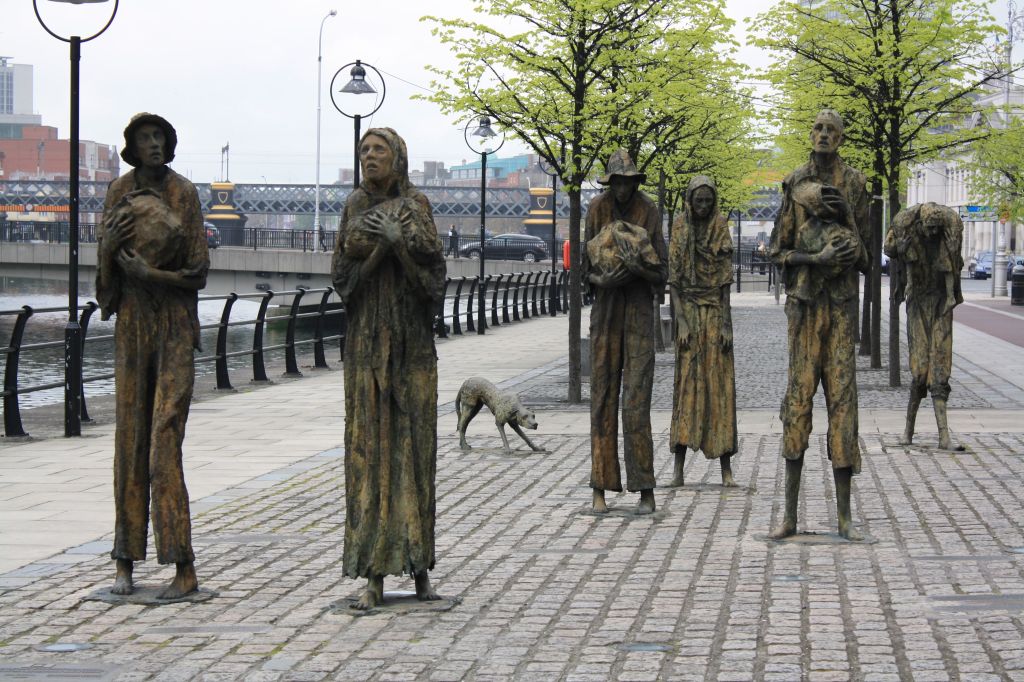
Dublin Memorial remembers the Irish potato famine of 1845

Until Nazis tore the thing down, there was a statue of Sir Francis Drake in Offenburg, Germany, giving him credit for introducing the potato. The explorer’s right hand rested on the hilt of his sword, his left gripping a potato plant. The inscription read “Sir Francis Drake, disseminator of the potato in Europe in the Year of Our Lord 1586. Millions of people who cultivate the earth bless his immortal memory”.

Not until the “Green Revolution” of Norman Borlaug, could cereal grains even compete. Today, potatoes are the 5th largest crop on the planet following rice, wheat, maize and sugar cane.  Almost 5,000 varieties are preserved in the International Potato Center, in Peru.

Scientists have created genetically modified potatoes to ward off pests.  The “New Leaf”, approved in 1995, incorporated a bacterial gene rendering the plant resistant to the Colorado potato beetle, an “international superpest” so voracious that some give the critter credit for creating the modern pesticide industry. 

Other varieties were genetically modified to resist phytophthora infestans, the cause of the Irish potato famine.  Seeming to prefer insecticides and anti-fungal sprays, “food activists” decry such varieties as “Frankenfoods”.  Each time, the improved variety has been hounded out of business.

In 2014, the J.R. Simplot Company received approval for their “Innate” potato.  Rather than “transgenic” gene splicing, the introduction of genome sequences from unrelated species, the innate variety uses a “silencing” technique on the tuber’s own genes, to resist the bruising and browning that results in 400 million pounds of waste and a cost to consumers of $90 million.

The Innate potato produces less acrylamide, a known carcinogen produced by normal potatoes in the high heat of fryers.  Approved for human consumption in 2015, the Innate might actually be the first genetically modified variety to succeed in the marketplace. McDonald’s, possibly the largest potato user on the planet, announced that “McDonald’s USA does not source GMO potatoes, nor do we have current plans to change our sourcing practices.”

In October 2018, the “Non-GMO Project” classified the J.R. Simplot product as “High-Risk”. You can never underestimate the power of hysterical people in large groups.

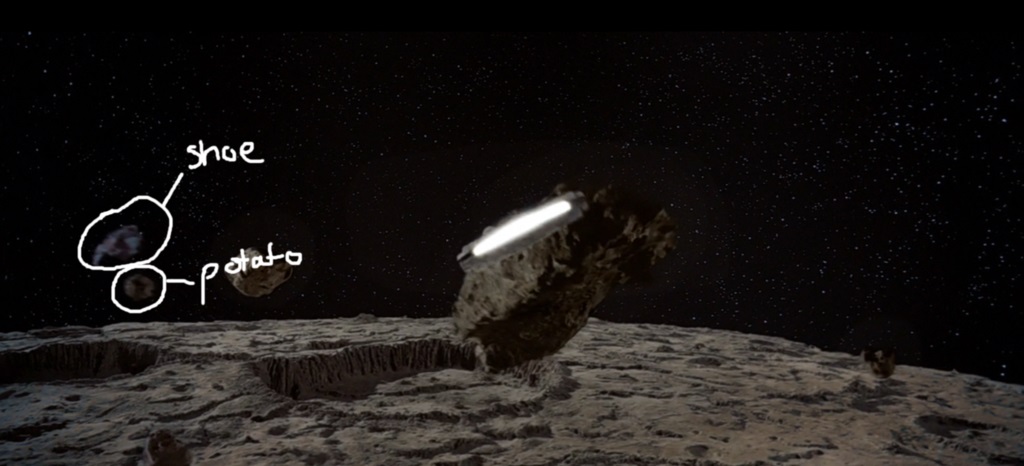
Fun fact: Some of the “asteroids” filmed in Star Wars Episode V The Empire Strikes Back were, in fact, potatoes.

November 28, 1952 The Great Tootsie Roll Drop

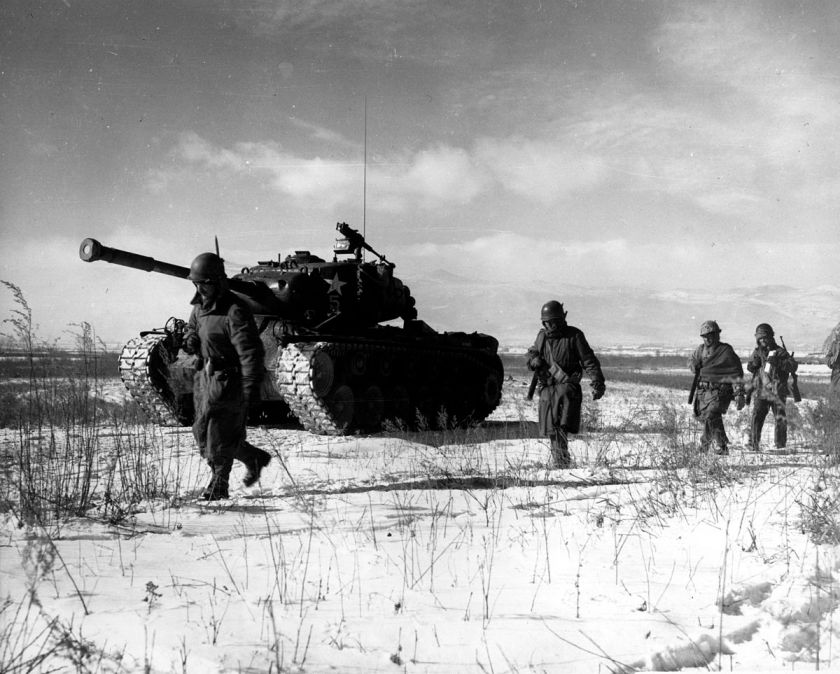
Everything had a code name to throw off Chinese anti-aircraft units. Marines sent out a frantic call for 60-mm mortar ammunition, code named “Tootsie Rolls”. Somebody didn’t read up on his code book. Fighting for their lives in the frozen wastes of Chosin, that’s what they got. Chocolate candy. By the ton.

On June 25, 1950, ten divisions of the North Korean People’s Army (KPA) launched a surprise invasion of their neighbor to the south. The 38,000-man army of the Republic of Korea (ROK) didn’t have a chance against 89,000 men sweeping down in six columns from the north. Within hours, the shattered remnants of the Republic of Korea Army and its government were retreating south toward their capital of Seoul.

The UN security council voted to send troops to the Korean peninsula.

73421-004-B86321B0

Poorly prepared and under-strength for what they were about to face, units of the 24th Division United States Army were hastily sent from bases in Japan. It was not until August when General Douglas MacArthur’s forces in theater, designated United Nations Command (UNC), was able to slow and finally stop North Korean forces around the vital southern port city of Pusan.

American forces and ROKA defenders were in danger of being hurled into the sea.  Most of the KPA was committed to doing just that, as plans were hastily drawn up for an amphibious landing on Inch’ŏn, the port outlet for the South Korean capital of Seoul.

With a narrow, labyrinthine channel and a tidal variation of nearly 30-feet, Inch’ŏn was a terrible choice for a major amphibious landing, with no more than a six-hour window permitting use of the beaches.

The Inch’ŏn landing was one of the great operations in military history, recapturing the capital and all but destroying North Korean military operations in the South.  Meanwhile, a storm was building north of the border, in the form of a quarter-million front-line Chinese troops, assembling in Manchuria.

1200px-Chosin

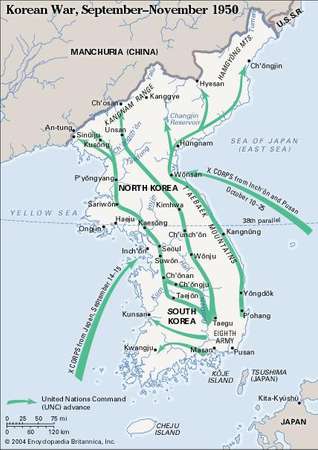
The war seemed all but over in October as UNC forces streamed into the north, the US 8th Army to the west of the impassable Taebaek mountains, the ROK I Corps and US X Corps to the east, reinforced by the US 1st Marine landing at Wonsan.  North and South would be reunited by the end of the year, and everyone would be home by Christmas. 

Except, that’s not how things worked out.

By the end of November, 30,000 UN troops were spread along a 400-mile line near the Chosin Reservoir, all but overrun and fighting for their lives against 150,000 Chinese forces of the “People’s Volunteer Army (PVA).

Korea_5
Hat Tip, National Museum of the Marine Corps, Korean War Gallery

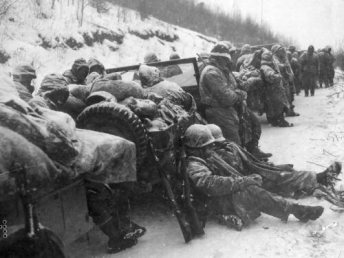
Weather conditions were savage at the “Frozen Chosin”, a Siberian cold front dropping day-time highs to -5° Fahrenheit, with lows exceeding -25°.  Vehicles and radios failed to start in the cold. Medical supplies froze.  Morphine syrettes had to be thawed in the medic’s mouth, prior to use.  Frozen blood plasma was useless.  Just to cut off clothing to deal with a wound, risked frostbite.  Perhaps worst of all, gun lubricants turned to gel and springs froze.  There must be no more demoralizing sound in combat than the impotent click of a firing pin, too weak to work.

Clifford Meyer remembers: “During November 1950 the First Marine Division with elements of two Regimental combat teams of the U.S. Army, a Detachment of British Commandos and some South Korean Policemen — about 15,000 men — faced the Chinese Communist Army’s ten Divisions totaling 120,000 men. At a mountain reservoir called Chang Jin (we called it “Chosin”) temperatures ranged from minus five degrees below zero in the day to minus twenty-five degrees below zero at night. The ground froze so hard that bulldozers could not dig emplacements for our Artillery. The cold impeded our weapons from firing automatically, slowing down the recoil of our artillery and automatic weapons. The cold numbed our minds, froze our fingers and toes and froze our rations. [We were] seventy-eight miles from the sea, surrounded, supplies cut, facing an enemy whose sole objective was the annihilation of the First Marine Division as a warning to other United Nations troops, and written off as lost by the high command“.

The PVA launched multiple attacks and ambushes over the night of November 27. The “Chosin Few” were all but surrounded by the morning of the twenty-eighth, locked in a fight for their lives.

Over two weeks of bitter combat, fifteen thousand soldiers and Marines fought their way over seventy-eight miles of gravel road, back to the sea. One war correspondent asked 1st Marine General Oliver Prince Smith if they were retreating. “Retreat? Hell”, Smith said, “we are attacking in another direction”.

battle-of-chosin-reservoir

Survival depended on air drops from US Navy Task Force 77 running 230 forays per day providing close-air support, food, medicine & combat supplies, and US Air Force Far East Combat Cargo Command in Japan, airdropping 250-tons of supplies.  Every day.

Everything had a code name to throw off Chinese anti-aircraft units. Marines sent out a frantic call for 60-mm mortar ammunition, code named “Tootsie Rolls”. Somebody didn’t read up on his code book. Fighting for their lives in the frozen wastes of Chosin, that’s what they got. Chocolate candy. By the ton.

What at first seemed a screw-up of biblical proportions, soon proved a blessing in disguise.  With no way to build a fire and frozen rations unusable, those Tootsie rolls were all that stood between survival and starvation. 15,000 soldiers and Marines suffered 12,000 casualties before it was over: 3,000 dead, 6,000 wounded and thousands of frostbite cases.

2134504558

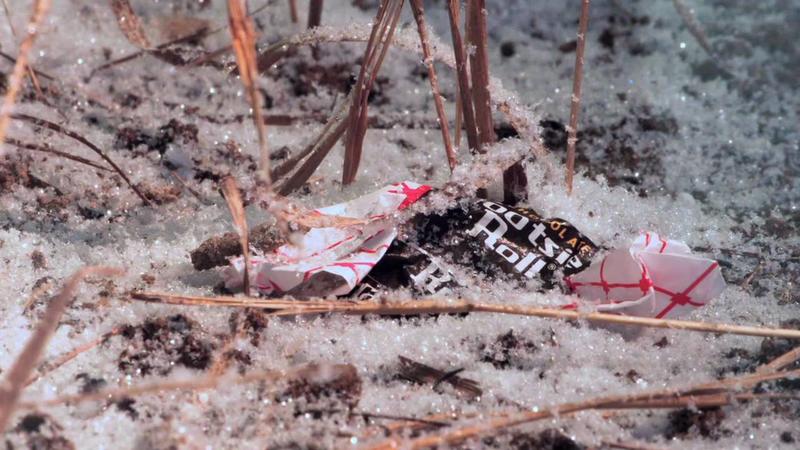
Untold thousands of Tootsie roll wrappers littered the seventy-eight miles back to the sea.  Most credit their survival to the energy provided by the chocolate candy.  It turns out that frozen tootsie rolls make a swell putty too, useful for patching up fractured hoses and vehicles.

The Korean War Gallery at the National Marine Corps Museum in Quantico features a lone Marine, 30-mm machine gun at the ready, marching out of the frozen wastes of the Chosin reservoir.  There’s a paper candy wrapper in the snow at his feet.  Though age has diminished their numbers, the “Chosin Few” still get together, for the occasional reunion.  Tootsie Roll Industries has always sent the candy and continues to do so, to this day.

November 27, 1942. Vanquished, but Unbeaten

While many considered the Vichy government to be a puppet state, the officers and men of the French fleet had no love for their German occupiers.  This was a French fleet and would remain so if they could help it. Even if they had to destroy it, by their own hands.

The Battle of France began on May 10, 1940, with the German invasion of France and the Low Countries of Belgium, Luxembourg and the Netherlands. By the end of May, German Panzers had hurled the shattered remnants of the allied armies into the sea, at a place called Dunkirk.

The speed and ferocity of the German Blitzkrieg left the French people in shock in the wake of their June surrender.  All those years their government had told them, that the strength of the French army combined with the Maginot line, was more than enough to counter German aggression.

France had fallen in six weeks.

Vichy-France

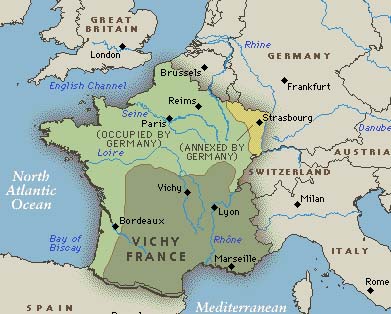
Germany installed a Nazi-approved French government in the south of the country, headed by WW1 hero Henri Pétain. Though mostly toothless, the self-described “French state” in Vichy was left relatively free to run its own affairs, compared with the Nazi occupied regions to the west and north.

That changed in November 1942, with the joint British/American invasion of Morocco, Tunisia and Algeria. At the time, the north African provinces were nominally under the control of the Vichy regime. Hitler gave orders for the immediate occupation of all of France.

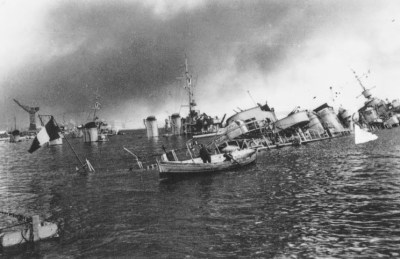
Scuttled, 2

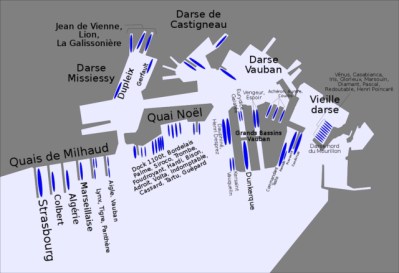
With the armistice of June 1940, much of the French naval fleet was confined to the Mediterranean port of Toulon. Confined but not disarmed, and the French fleet possessed some of the most advanced naval technologies of the age, enough to shift the balance of military power in the Mediterranean.

While many considered the Vichy government to be a puppet state, the officers and men of the French fleet had no love for their German occupiers. This was a French fleet and would remain so if they could help it. Even if they had to destroy it, by their own hands.

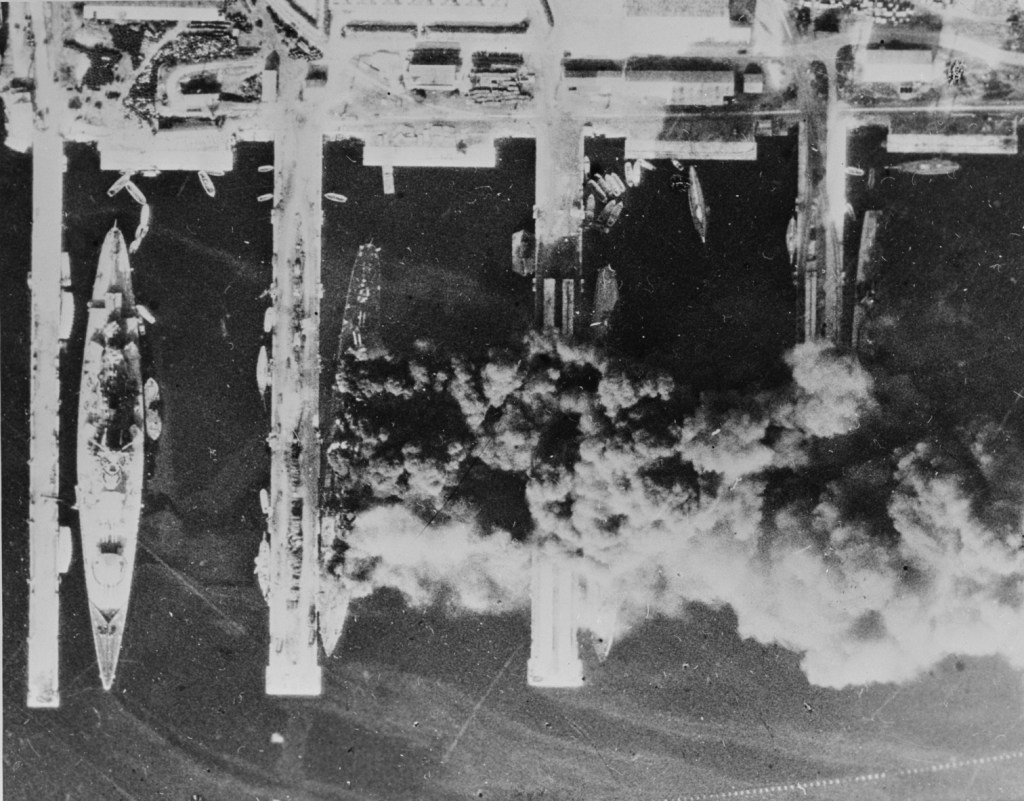
Scuttled, 1

In November 1942, the Nazi government came to take control of that fleet. The motorized 7th Panzer column of German tanks, armored cars and armored personnel carriers descended on Toulon with an SS motorcycle battalion, taking over port defenses to either side of the harbor. German officers entered fleet headquarters and arrested French officers, but not before word of what was happening reached French Admiral Jean de Laborde, aboard the flagship Strasbourg.

The order went out across the base at Toulon. Prepare to scuttle the fleet, and resist the advance of German troops. By any means necessary.

The German column approached the main gate to the harbor facility in the small hours of November 27, demanding access.  ‘Of course,’ smiled the French guard. ‘Do you have your access paperwork?’

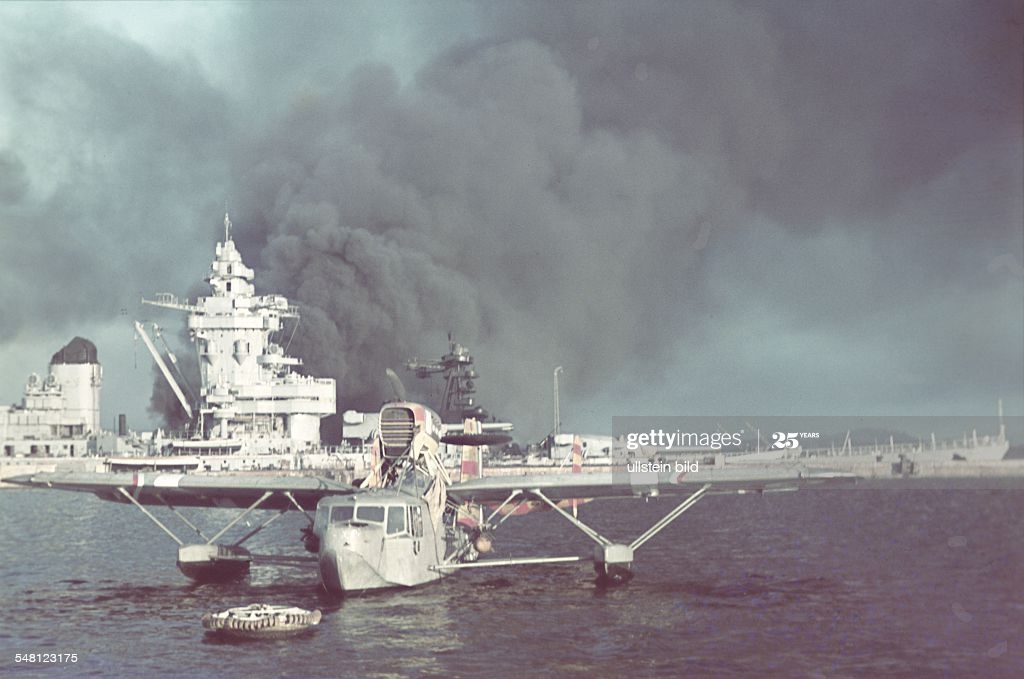
Toulon, französisches Kriegsschiff

Under orders to take the harbor without bloodshed, the Nazi commander was dismayed. Was he being denied access by this, his defeated adversary?  Minutes seemed like hours in the tense wrangling which followed.  Germans gesticulated and argued with French guards, who stalled and prevaricated at the closed gate.

The Germans produced documentation, only to be thanked, asked to wait, and left standing at the gate.

Meanwhile, thousands of French seamen worked in grim silence throughout the early morning hours, preparing to scuttle their own fleet.  Valves and watertight doors were opened, incendiary and demolition charges were prepared and placed.

27_toulon

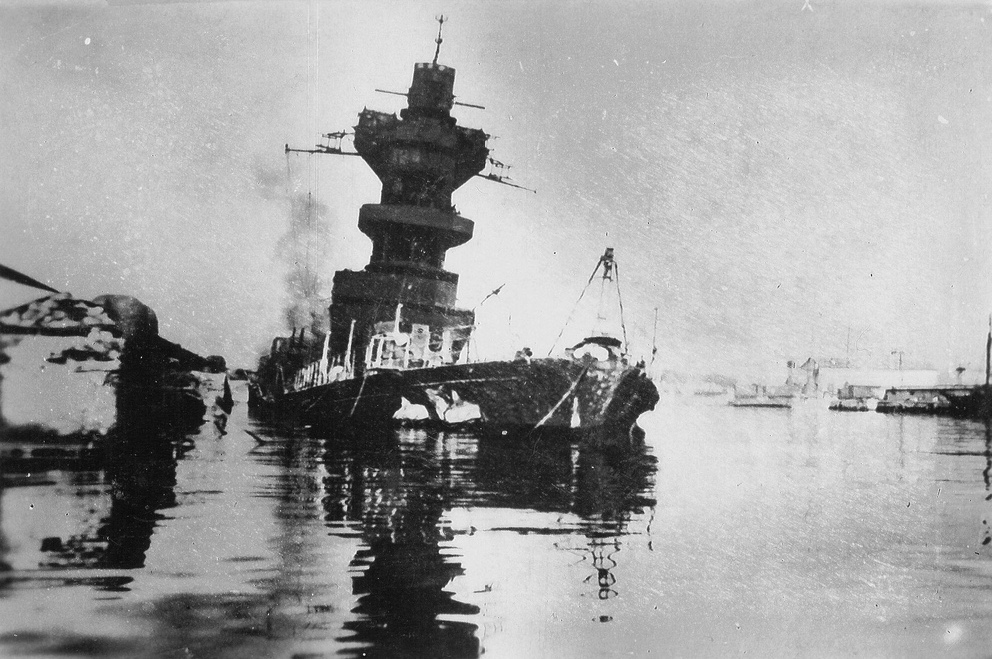
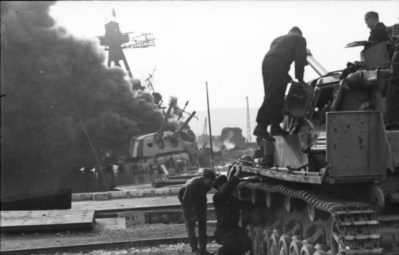
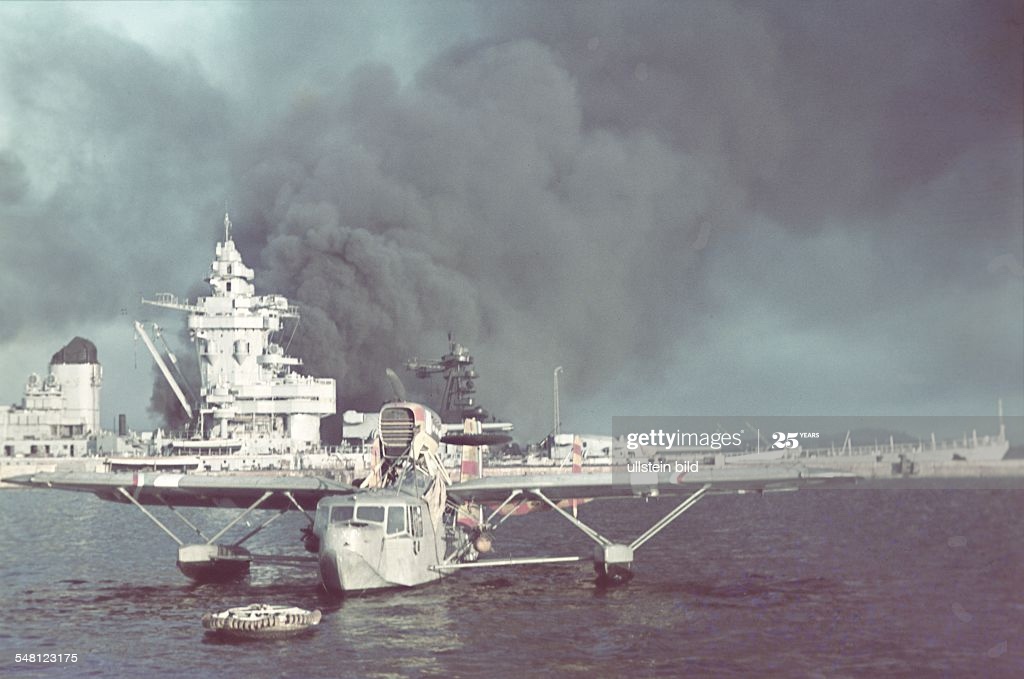
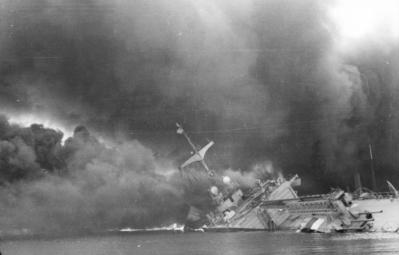
Finally, the Panzer column could be stalled no more. German tanks rumbled through the main gate at 5:25am, even as the order to scuttle passed throughout the fleet. Dull explosions sounded across the harbor, as fighting broke out between the German column, and French sailors pouring out of their ships in the early dawn light. Lead German tanks broke for the Strasbourg, even now pouring greasy, black smoke from her superstructure, as she settled to the bottom.

The Germans could only look on, helpless, as a dying fleet escaped their grasp. In the end, 3 battleships, 7 cruisers, 15 destroyers, 13 torpedo boats, 6 sloops, 12 submarines, 9 patrol boats, 19 auxiliary ships, 28 tugs, 4 cranes and a school ship, were destroyed. 39 smaller vessels of negligible military value fell into German hands along with twelve fleet vessels, all of them damaged.

The fires would burn, for weeks. The harbor at Toulon would remain fouled and polluted, for years.

The French Navy lost 12 men killed and 26 wounded that day. 78 years ago, today. The loss to the Nazi war effort, is incalculable. How many lives may have been lost, had Nazi Germany come into possession of all that naval power. But for the obstinate bravery of a vanquished, but still unbeaten foe.

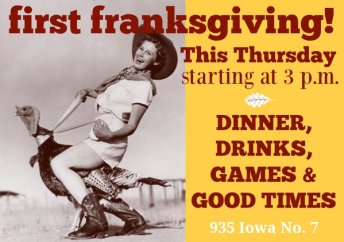
November 26, 1941, Franksgiving

Popular comedians of the day got a laugh out of the Franksgiving ruckus including Burns & Allen, and Jack Benny. One 1940 Warner Brothers cartoon shows two Thanksgivings, one “for Democrats” and one a week later “for Republicans.”

The first Autumn feast of Thanksgiving dates well before the European settlement of North America.

OldCrowafriendly

Historian Michael Gannon writes that the “real first Thanksgiving” in America took place in 1565, when Pedro Menéndez de Avilés landed in modern-day Florida, and “had the Indians fed and then dined himself.”

Likely, it was salt-pork stew with garbanzo beans. Yum.

According to the Library of Congress, the English colony of Popham in present-day Maine held a “harvest feast and prayer meeting” with the Abenaki people in 1607, twenty-four years before that “first Thanksgiving” at Plymouth.

George Washington proclaimed the first Presidential National day of Thanksgiving on November 26, 1783, “to recommend to the People of the United States a day of public thanksgiving and prayer to be observed by acknowledging with grateful hearts the many signal favors of Almighty God especially by affording them an opportunity peaceably to establish a form of government for their safety and happiness“.

So much for the “separation of Church and state”.

President Abraham Lincoln followed suit in 1863, declaring a general day of Thanksgiving to be observed on the last Thursday of November.  The date seemed to work out OK and the tradition stuck, until 1939.

Roughly two in every seven Novembers, contain an extra Thursday.  November 1939, was one of them.

franksgiving2

In those days, it was considered poor form for retailers to put up Christmas displays or run Christmas sales, before Thanksgiving.  Lew Hahn, General Manager of the Retail Dry Goods Association, was afraid that extra week was going to cut into Christmas sales.

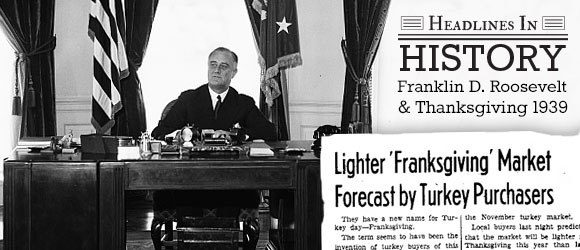
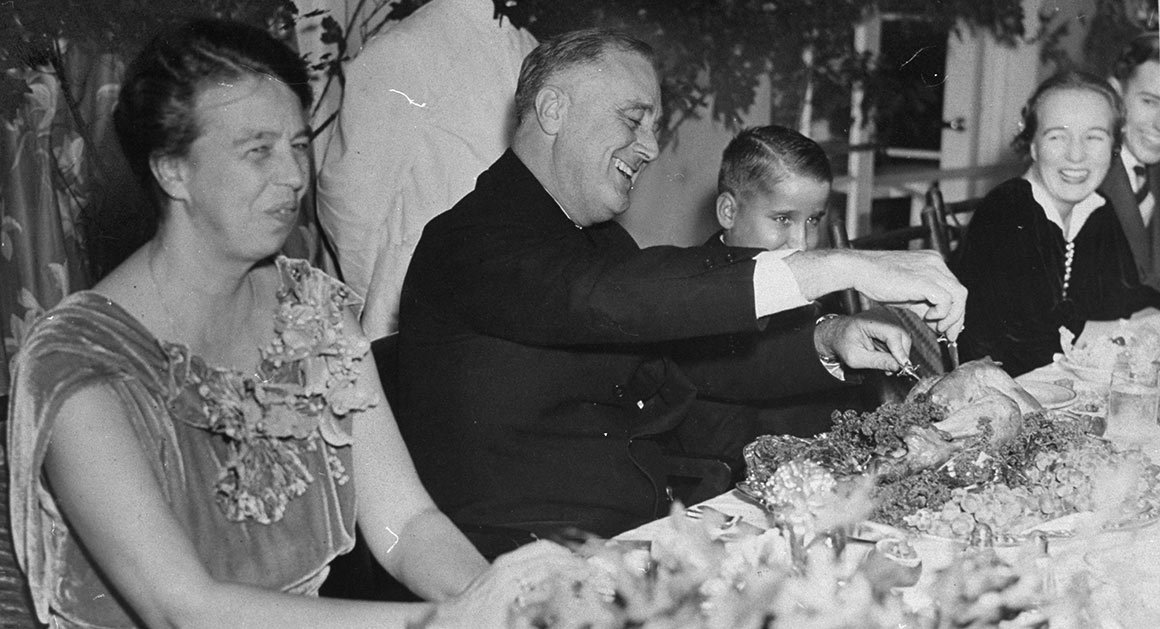
Ten years into the Great Depression with no end in sight, the Federal government was afraid of the same thing. By late August, President Franklin Delano Roosevelt decided to deviate from the customary last Thursday and declared the fourth Thursday, November 23, to be a national day of prayer and thanksgiving.

Opposition to the plan was quick to form.  Alf Landon, Roosevelt’s Republican challenger in the earlier election, complained of Roosevelt’s impulsiveness and resulting confusion.  “More time should have been taken working it out” Landon said, “instead of springing it upon an unprepared country with the omnipotence of a Hitler.”

252_84_738_450

In Plymouth Massachusetts, self-described home of the “first Thanksgiving”, Chairman of the Board of Selectmen James Frasier, “heartily disapproved”.

The short-notice change in schedule disrupted vacation plans for millions of Americans. Traditional Thanksgiving day football rivalries between school teams across the nation, were turned upside down.

Unsurprisingly, support for Roosevelt’s plan broke along ideological lines.  A late 1939 Gallup poll reported Democrats favoring the move by a 52% to 48% majority, with Republicans opposing the move, 79% to 21%.

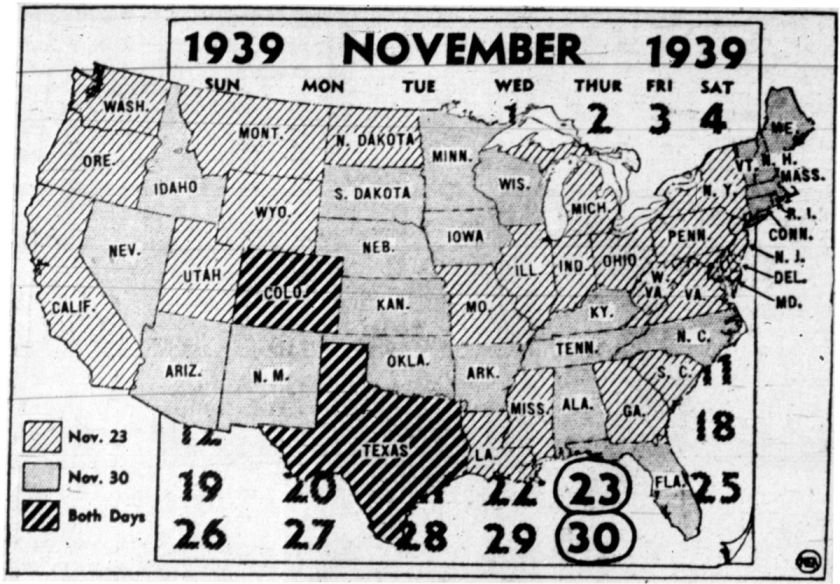
Such proclamations represent little more than the “’moral authority” of the Presidency. States are free to do as they please.  Twenty-three states and the District of Columbia observed Thanksgiving day on the non-traditional date, and twenty-two kept Thanksgiving on the 30th.  Colorado, Mississippi and Texas, did both.

The next two years, thirty-two states and the District of Columbia celebrated what came to be called “Franksgiving” on the third Thursday of the month, while the remainder observed a more traditional “Republican Thanksgiving” on the last.

Franksgiving calendar

In 1941, a Commerce Department survey demonstrated little difference in Christmas sales between those states observing Franksgiving, and those observing the more traditional date. A joint resolution of Congress declared the fourth Thursday beginning the following year to be a national day of Thanksgiving. President Roosevelt signed the measure into law on November 26.

Interestingly, the phrase “Thanksgiving Day” appeared only once in the 20th century prior to the 1941 resolution, that in President Calvin Coolidge’s first of six such proclamations.

Most state legislatures followed suit with the Federal fourth-Thursday approach, but not all.  In 1945, the next year with five November Thursdays, Arkansas, Florida, Georgia, Idaho, Nebraska, Tennessee, Texas, and Virginia reverted to the last Thursday.  Texas held out the longest, celebrating its fifth-Thursday Thanksgiving for the last time in 1956.

To this day, the years 1939, ’40 and ’41 remain the only outliers, outside the fourth-Thursday tradition.

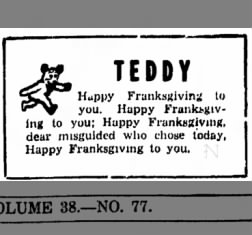
Popular comedians of the day got a laugh out of the Franksgiving ruckus including Burns & Allen, and Jack Benny.  One 1940 Warner Brothers cartoon shows two Thanksgivings, one “for Democrats” and one a week later “for Republicans.”

The Three Stooges short film of the same year has Moe questioning Curly, why he put the fourth of July in October.  “You never can tell”, he replies.  “Look what they did to Thanksgiving!”

Joe Toye, the “Easy Company” character in the 2001 HBO miniseries “A Band of Brothers”, may have had the last word on Franksgiving.  Explaining his plan to get the war over quickly, the paratrooper quips “Hitler gets one of these [knives] right across the windpipe, Roosevelt changes Thanksgiving to Joe Toye Day, [and] pays me ten grand a year for the rest of my f*****g life.

Sounds like a plan.

November 22, 1923 Black Tom

The first and most overt reaction from the Kaiser came in the form of unrestrained submarine warfare, when even vessels flying the flags of neutral nations, were attacked. Less apparent at the time, was the covert campaign of sabotage carried out by German agents on US soil.


In the early months of the Great War, Britain’s Royal Navy swept the seas of the Kaiser’s ships and blockaded ports in Germany. The United States was neutral at the time, when over a hundred German vessels sought refuge in American harbors.

maxresdefault

The blockade made it impossible for the Central Powers of Germany and Austria-Hungary to import war materiel from overseas while Great Britain, France, and Russia continued to buy products from US farms and factories. American businessmen were happy to sell to any foreign customer who had the cash but for all intents and purposes, such trade was limited to the allies.

To the Central Powers, this trade had the sole purpose of killing their boys on the battlefields of Europe.

The first and most overt reaction from the Kaiser came in the form of unrestrained submarine warfare, when even vessels flying the flags of neutral nations, were attacked. Less apparent at the time, was the covert campaign of sabotage carried out by German agents on US soil.

Black_Tom_4

“Black Tom” was originally an island in New York Harbor, next to Liberty Island. So called after a former resident, by WWI, landfill had expanded the island to become part of Jersey City. The area contained a mile-long pier with warehouses and rail lines and served as a major hub in the trade of war materiel to the allies.

On July 30, 1916, the Black Tom terminal contained over two million pounds of ammunition in freight cars, and a hundred thousand pounds of TNT on a nearby Barge.

Around 2:00 that morning, guards discovered a series of small fires. Some of them tried to put them out while others fled, fearing an explosion. The first and loudest blast took place at 2:08am, a massive detonation estimated at 5.5 on the Richter scale.  People from Maryland to Connecticut were awakened in what many believed was an earthquake. The walls of Jersey City’s City Hall were cracked as shrapnel flew through the air. Windows broke as far as 25 miles away while fragments embedded themselves in the clock tower at the Jersey Journal building in Journal Square, over a mile away. The clock stopped at 2:12 am.

Black_Tom_3

Stained Glass windows were shattered at St. Patrick’s Church and Ellis Island was evacuated to Manhattan.  Damage done to the Statue of Liberty alone was valued at over $2 million in today’s dollars. To this day, the ladder to Liberty’s torch, remains off limits to visitors.

Known fatalities in the explosion included a Jersey City police officer, a Lehigh Valley Railroad Chief of Police, one ten-week-old infant and a barge captain.

Black Tom 2

The explosion at Black Tom was the most spectacular but by no means the only such attack. The archives at cia.gov reports: “[B]etween 1915 and spring 1917, 43 American factories suffered explosions or fires of mysterious origin, in addition to the bombs set on some four dozen ships carrying war supplies to the Allies”.

black-tom-island-explosion

Among those responsible for the Black Tom explosion was Naval Lieutenant Lothar Witzke, arrested on February 1, 1918, in Nogales, AZ. Witzke was convicted by court martial and sentenced to death. President Woodrow Wilson later commuted his sentence, to life.

By 1923, most nations were releasing POWs from the “Great War”, including spies. A prison report from Leavenworth shows Witzke heroically risking his own life in prison, entering a boiler room after an explosion and almost surely averting disaster. It may be on that basis that he was finally released.  Imperial German Navy Lieutenant Lothar Witzke was pardoned by President Calvin Coolidge on November 22, 1923 and deported to Berlin, where a grateful nation awarded him the Iron Cross, 1st and 2nd Class.