June 21, 1633  Flipping History the Bird

The Inquisition forced Galileo to “abjure, curse and detest” his Copernican heliocentric views, returning him to his villa in 1634 to spend the rest of his life under house arrest.

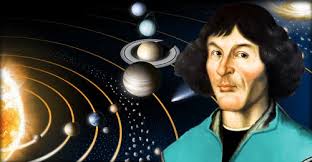
Planet Earth exists at the center of the solar system, the sun and other celestial bodies revolving around it.    That was the “geocentric” model of the solar system, the common understanding during the Renaissance.  In the 15th century, Polish mathematician and astronomer Nicolaus Copernicus proposed a radically new model.  Copernicus described a “heliocentric” model of the universe, placing the sun at the center, with the earth and other bodies revolving around the sun.
Copernicus
Nicolaus Copernicus

Copernicus resisted the publication of his ideas until the end of his life, fearing that they would offend the religious Interests of the time.  Legend has it that he was presented with an advance copy of his “De revolutionibus orbium coelestium” (On the Revolutions of the Heavenly Spheres) as he awakened on his death bed from a stroke induced coma.  He took one look at his book, closed his eyes, and never opened them again.

The Italian physicist, mathematician, and astronomer Galileo Galilei, came along about a hundred years later.  Galileo has been called the “father of modern observational astronomy”, the “father of modern physics”, and “the Father of Modern Science”.  His improvements to the telescope and resulting astronomical observations supported Copernicus’ heliocentric view.  They also brought him to the attention of the Roman Inquisition.
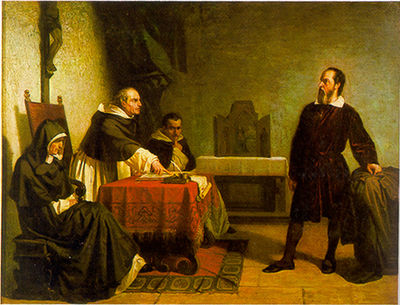
Galileo_facing_the_Roman_Inquisition
Galileo faces the Roman Inquisition

Biblical references such as, “the Lord set the earth on its foundations; it can never be moved.” (Psalm 104:5) and “And the sun rises and sets and returns to its place.” (Ecclesiastes 1:5) became the basis for religious objections to the heliocentric view.  Galileo was brought before  inquisitor Vincenzo Maculani for trial in 1633.   The astronomer backpedaled before the inquisition, testifying in his fourth deposition of June 21, 1633, that “I do not hold this opinion of Copernicus, and I have not held it after being ordered by injunction to abandon it.  For the rest, here I am in your hands; do as you please”.

The Inquisition forced Galileo to “abjure, curse, & detest” his Copernican heliocentric views, returning him to his villa in 1634 to spend the rest of his life under house arrest. Galileo died on January 8, 1642, wishing to be buried in the main body of the Basilica of Santa Croce, next to the tombs of his father and ancestors.  His final wishes were denied at the time, though they would be honored 95 years later.  Galileo Galilei was re-interred in the basilica, in 1737.

Often, atmospheric conditions in these burial vaults lead to a natural mummification of the corpse. Sometimes they look almost lifelike. When it came to the saints, believers took this to be proof of the incorruptibility of these individuals, and small body parts were taken as holy relics.
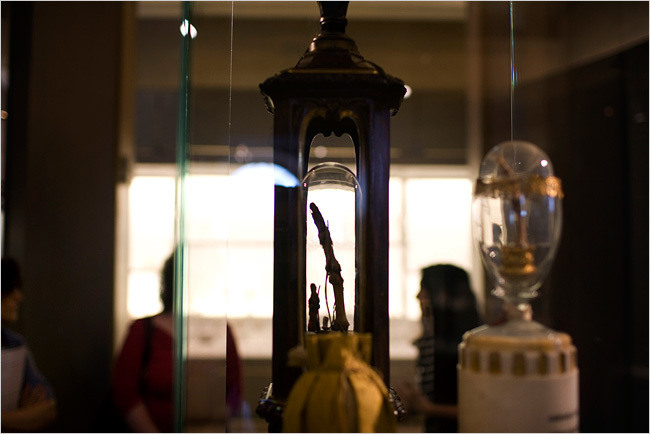
Galileo's finger
Galileo’s finger

The custom was quite old when Galileo was reinterred in 1737. Galileo is not now and never was a Saint of the Catholic church, though it’s possible the condition of his body made him appear thus “incorruptible”.  Anton Francesco Gori removed the thumb, index and middle fingers on March 12, 1737, an act which would have been very much in keeping with the customs of the times. The digits with which Galileo wrote down his theories of the cosmos.  The digits with which he adjusted his telescope.

Be that as it may, the middle finger from Galileo’s right hand is on exhibit at the Museo Galileo in Florence, Italy, to this day.  The only human fragment in a museum otherwise devoted to scientific instruments.

There is symbolism there, if only I could put my finger on it.

June 8, 793 The Viking Age

The Viking age lasted for almost 500 years, beginning in the late 8th century and ending only with the advent of the “Little Ice Age” in 1250.  In the end, the Vikings left their mark from Newfoundland, to Baghdad.

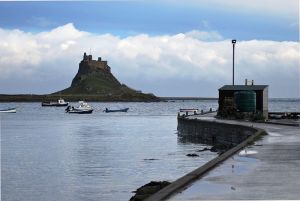
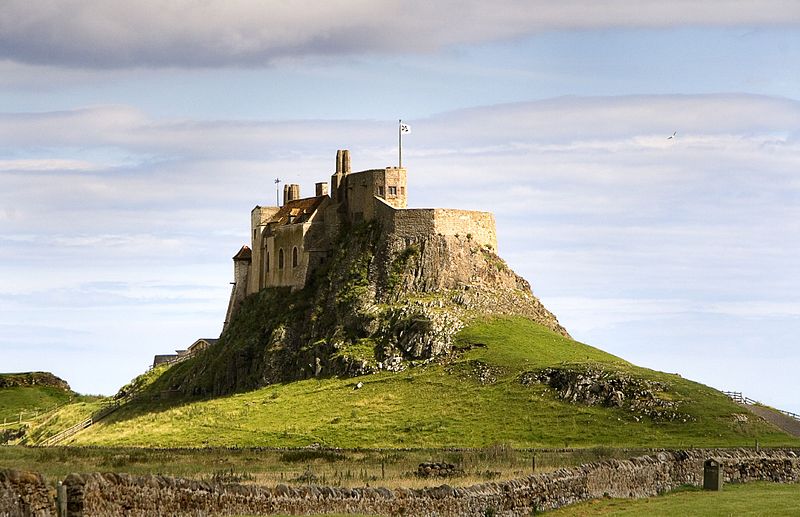
Lindisfarne Castle as seen from Harbour

Two miles off the Northeast coast of Great Britain is the island of Lindisfarne, just south of the Scottish border.  Once, there was a monastery there.

The island’s monastic cathedral was founded a 150 years earlier by the Irish monk, Aidan of Lindisfarne. Known as the Apostle of Northumbria and spreading the gospel to Anglo-Saxon nobility and slaves alike, the monk was later canonized to become Saint Aidan.

Lindisfarne island had gifts of silver and gold, given to the monastery in hopes that such gifts would find peace for the immortal soul of the giver. There were golden crucifixes and coiled shepherd’s staves, silver plates for Mass, and ivory chests containing the relics of saints.  Shimmering tapestries hung from the walls.  The writing room contained some of the most beautiful illuminated manuscripts ever made.

Lindisfarne Castle Holy Island
Lindisfarne

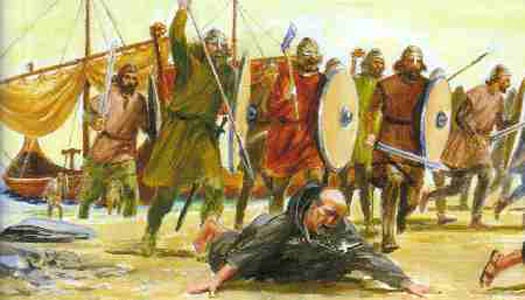
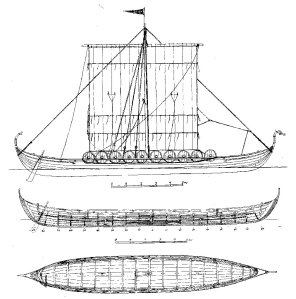
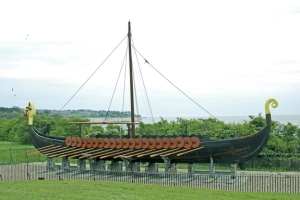
1,224 years ago today, you could have looked to sea.  You would have seen a strange sight that morning.  Long ships with high prow and stern were lowering square sail as oarsmen rowed these ships directly onto the beach.

Viking Long ShipAny question you had as to their purpose would have been immediately answered, as these strangers sprinted up the beach and chased down everyone in sight.  These they murdered with axe or spear, or dragged them down to the ocean and drowned them. Most of the island’s inhabitants were dead when it was over, or taken off to the ships to be sold into slavery.  All of those precious objects were bagged, and tossed into the boats.
The raid on Lindisfarne abbey gave rise to what would become a traditional prayer:  A furore Normannorum libera nos, Domine, “From the fury of the Northmen deliver us, Lord”.  The Viking Age had arrived.

These Viking invasions were repeated for over a century, until England was eventually bled of its wealth, and the Vikings began to take the land, as well.viking-ship

It wasn’t just England either. The King of Francia was tormented by Viking raids in what would one day become western France. King Charles “the Simple”, so-called due to his plain, straightforward ways, offered choice lands along the western coast to these men of the north, if they would leave him alone.  In 911 the Viking chieftan Rollo accepted Charles’ offer, and so created the kingdom of Normandy.  They called him “Rollo the Walker”, so-called because he was so huge that no horse to carry him, but that’s a story for another day.  (Like, August)

A period of Global Warming (yes, they had it then too), during the 10th and 11th centuries created ideal conditions for the Norse raiders, with a prevailing westerly wind direction in the spring reversing direction in the fall to become west to east.

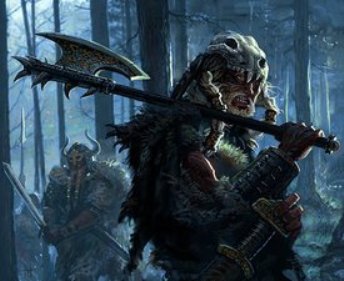
Viking Axe ManViking travel was not all done with murderous intent; they are well known for colonizing westward as they farmed Iceland and possibly North America.
Many of their eastward excursions were more about trade than plunder.  Middle Eastern sources mention Vikings as mercenary soldiers and caravan guards.

Viking warriors called “Varangian Guard” hired on as elite mercenary bodyguard/warriors with the eastern Roman Empire.  Farther east, the “Rus” tribe lent their name to what would later be called Russia and Belarus.

The 10th-century Arab traveler Ibn Fadlan described the Rus as “perfect physical specimens”, writing at the same time that “They are the filthiest of all Allah’s creatures”.   Tattooed from neck to fingernails, the men were never without an axe, a sword and a long knife. The Viking woman “wears on either breast a box of iron, silver, copper, or gold; the value of the box indicates the wealth of the husband. Each box has a ring from which depends a knife”.

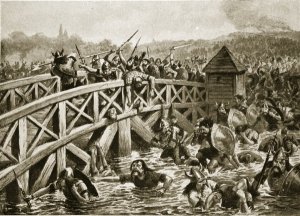
Stamford Bridge
Battle of Stamford Bridge

The classical Viking age ended gradually, and for a number of reasons. Christianity took hold, as the first archbishopric was founded in Scandinavia in 1103.

Political considerations were becoming national in scope in the newly formed countries of Sweden, Norway and Denmark.

King Cnut “The Great”, the last King of the North Sea Empire of Denmark, Norway and England, together also described as the Anglo-Scandinavian Empire, died in 1035, to be replaced in England by Edward the Confessor.  Edward’s successor Harold would fend off the Viking challenge of Harald Hardrada in September 1066 at a place called Stamford Bridge, only to be toppled in the Norman invasion, two weeks later.

The Viking age lasted for almost 500 years, beginning in the late 8th century and ending only with the advent of the “Little Ice Age” in 1250.  In the end, the Vikings left their mark from Newfoundland, to Baghdad.

April 28, 1192 Assassins

The Grand Master of the Assassins dispatched his killers to Karakorum in the early 1250s, to murder the grandson of Genghis Khan, the Great Khan of the “Golden Horde”, Möngke. Bad idea.

For the Islamic world, the 11th century was a time of political instability. The Fatimid Caliphate, established in 909 and by this time headquartered in Cairo, was in sharp decline by 1090.  The Fatimids were destined to disappear within the next 100 years, eclipsed by the Abbasid Caliphate of An-Nasir Salah ad-Din Yusuf ibn Ayyub, better known to anyone familiar with the story of Richard Lionheart, as Saladin.

To the east lay the Great Seljuk Empire, the Turko-Persian, Sunni Muslim state established in 1037 and stretching from the former Sassanid domains of modern-day Iran and Iraq, to the Hindu Kush.  An “appanage” or “family federation” state, the Seljuk empire was itself in flux after a series of succession contests, destined to disappear altogether in 1194.

assassin-fortification-at-alamut-northern-iranInto the gap stepped the “Old Man of the Mountain”, Hassan-i Sabbah, and his fanatically loyal, secret sect of “Nizari Ismaili” followers, the Assassins.
The name derives from the Arabic “Hashashin”, meaning “those faithful to the foundation”.  Marco Polo reported a story that the old man of the mountain got such fervent loyalty from his young followers, by drugging and leading them to a “paradise” of earthly delights, to which only he could return them.  The story is probably apocryphal, there is little evidence that hashish was ever used by the Assassins’ sect.  Sabbah’s followers believed him to be divine, personally selected by Allah.  The man didn’t need to drug his “Fida’i” (self-sacrificing agents), he was infallible.  His every whim would be obeyed, as the literal Word of God.

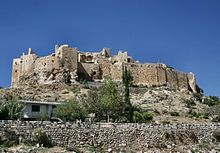
assassin-fortification-at-masyaf-in-northern-syria
Assassin stronghold at Masyaf, in Northern Syria

The mountain fortification of Alamut in northern Persia was probably impervious todefeat by military means, but not to the two-years long campaign of stealth and pretend friendship practiced by Sabbah and his followers.  In 1090, Alamut fell in a virtually bloodless takeover, becoming the headquarters of the Nizari Ismaili state.

Why Sabbah would have founded such an order is unclear, if not in pursuit of his own personal and political goals.  By the time of the first Crusade, 1095-1099, he found himself pitted against rival Muslims and invading Christian forces, alike.

Sabbah would order the elimination of rivals, usually up close, with the dagger.  From religious figures to politicians and generals, assassinations were preferably performed in broad daylight, in as public a manner as possible.  It was important that everyone absorb the intended message.

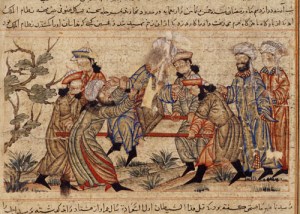
assassination_of_the_seljuk_vizier_nizam_al-mulk
Assassination of the Seljuk Vizier Nizam al-Mulk

Though the “Fida’in” occupied the lowest rank of the order, great care was devoted to their education and training.  Possessed of all the physical prowess of youth, the individual Assassin was also intelligent and well-read, highly trained in combat tactics, the art of disguise and the skills of the expert horseman.  All the necessary traits, for anyone who would penetrate enemy territory, insinuate himself into their ranks, and murder the victim who had learned to trust him.

Sometimes, a credible threat of assassination was as effective as an actual killing.  When the new Seljuk Sultan Ahmad Sanjar rebuffed Hashashin diplomatic overtures in 1097, he awoke one morning to find a dagger stuck into the ground, next to his bed.  A messenger arrived sometime later from the old man of the mountain.  “Did I not wish the sultan well” he said, “that the dagger which was struck in the hard ground would have been planted on your soft breast?”  The technique worked nicely.  For the rest of his days, Sanjar was happy to allow the Hashashin to collect tolls from travelers in his realm.  The Sultan even provided them with a pension, collected from the inhabitants of the lands they occupied.

Saladin himself awoke one morning, to find a note resting on his breast, along with a poisoned cake.  The message was clear.  Sultan of all Egypt and Syria though he was, Saladin made an alliance with the rebel sect.  There would be no more such attempts on his life.conrad-of-montferrat

Conrad of Montferrat was elected King of Jerusalem in 1192, though he would never be crowned.  Stabbed at least twice by a pair of Hashashin on April 28, on the way home, the Kurdish historian and biographer wrote “[T]he Frankish marquis, the ruler of Tyre, and the greatest devil of all the Franks, Conrad of Montferrat — God damn him! — was killed.”

In the 200+ years of its existence, the Assassins occupied scores of mountain redoubts, though Alamut would remain its principle quarters.

It’s impossible to know how many of the hundreds of political assassinations of this period, were attributable to the followers of Hassan-i Sabbah.  Without a doubt, their fearsome reputation ascribed more political murder to the sect, than they were actually responsible for.

The Fida’in of Hassan-i Sabbah were some of the most feared killers of the middle ages.   Scary as they were, there came a time when the Order of the Assassins tangled with someone far scarier than themselves.

The Grand Master of the Assassins dispatched his killers to Karakorum in the early 1250s, to murder the grandson of Genghis Khan, the Great Khan of the “Golden Horde”, Möngke.  Bad idea.

Hulagu Khan
Hulagu Khan

The Nestorian Christian ally of the Mongol Empire Kitbuqa Noyan, was ordered to destroy several Hashashin fortresses in 1253.  Möngke’s brother Hulagu rode out at the head of the largest Mongol army ever seen in 1255, with no fewer than 1,000 Chinese engineer squads.  Their orders were to treat those who submitted with kindness, and to utterly destroy those who opposed them.

That they did. Rukn al-Dīn Khurshāh, fifth and final Imam who ruled at Alamut, submitted after four days of preliminary bombardment.  Mongol forces under the command of Hulagu Khan entered and destroyed the Hashshashin stronghold at Alamut Castle on December 15, 1256.

Hulagu went on to subjugate the 5+ million Lurs people of western and southwestern Iran, the Abbasid Caliphate in Baghdad, the Ayyubid state of Damascus, and the Bahri Mamluke Sultanate of Egypt.  Mongol and Muslim accounts alike, agree that the Caliph of Baghdad was rolled up in a Persian rug, whereupon the horsemen of Hulagu rode over him, because Mongols believed that the earth was offended if touched by royal blood.

Some people are not to be trifled with

March 30, 1282 War of Sicilian Vespers

It was Easter Monday, March 30, 1282. The Church of the Holy Spirit outside Palermo was just letting out after evening vespers (prayers), when a French soldier thought he’d “inspect” a Sicilian woman for weapons.

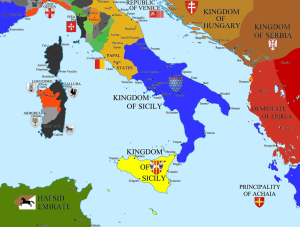
Since the early 12th century, the southern Italian peninsula and the island of Sicily had been united as the Kingdom of Sicily. Until the invasion of the French King Charles I of Anjou, who ousted Sicilian King Manfred in 1266.

The Anjou King’s rule in Sicily was vicious and repressive, with the French King himself absent for long periods. Charles’ Sicilian subjects could not have hated him more.

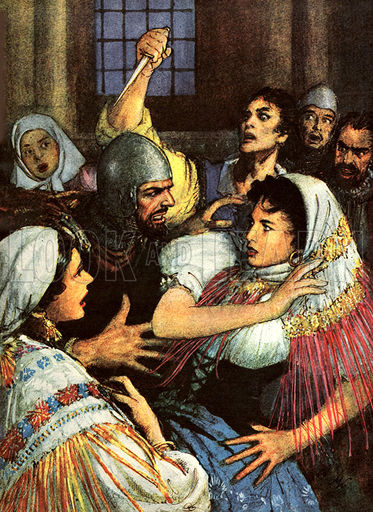
The Wonderful Story of France: Massacre of the Sicilian VespersIt was Easter Monday, March 30, 1282. The Church of the Holy Spirit outside Palermo was just letting out after evening vespers (prayers), when a French soldier thought he’d “inspect” a Sicilian woman for weapons.

Accounts vary as to what happened, but there’s a good chance he was just looking for a feel, and that’s what he got. The lady’s modesty thusly offended, someone in the crowd avenged her honor, knifing the French guard.

At first merely agitated, this first taste of blood drove the mob to a frenzy. Spreading across the Capital and into the countryside, Sicilians killed every Frenchman they could get their hands on.

Revolutionaries devised a linguistic test, to see who was authentically Sicilian. Native French speakers can’t pronounce the word “ciciri”, even to save themselves. And that’s the way it worked out.  God help you if you couldn’t say that word. Over four thousand Frenchmen would die over the next six weeks.

Meanwhile in Spain, Peter III King of Aragon, Peter I King of Valencia, and Peter II Count of Barcelona (these three are all the same guy), had a claim to the Sicilian throne through his wife, Constance.

The Italian physician John of Procida had been a loyal subject of Manfred’s, fleeing to Aragon after the Anjou invasion. John proceeded directly to Sicily where he spent several weeks stirring up Sicilian resentment against the French King. Sicily then appealed to the Spanish King to intervene, while John sailed for Constantinople to procure the help of Michael VIII Palaeologus.war_of_the_vespers

History records what followed as the War of Sicilian Vespers. The Angevins were supported by the Papacy and his Italian supporters (Guelphs), while the Aragonese received help from Sicily itself, the Byzantine Emperor, and the Ghibellines, Italian supporters of the Holy Roman Emperor.

Several players changed sides over the course of the next twenty years. In the end, the son of the Spanish King took the Sicilian crown in 1302, becoming King Frederick II, beginning near 400 years of Spanish rule over the island.

And so it was that a French soldier molested an Italian woman, and lost the kingdom of Sicily, to Spain.

March 1, 1420 Protestant Reformation

Hans Luder sent his son Martin to a series of Latin schools beginning in 1497, where the boy learned the so-called “trivium”:  grammar, rhetoric, and logic.  He entered the University of Erfurt in 1501 at age 19, receiving his master’s degree in 1505.  The elder Luder (“Luther”) intended that his son become a lawyer. Years later, the younger Luther described his Latin school education as time spent in purgatory, and his University as a “beerhouse” and a “whorehouse”.  I guess Martin Luther wasn’t cut out for academics.
He entered Law School in 1505 and dropped out almost immediately.  His father was furious, over what he saw as a wasted education.  Martin entered an Augustinian cloister that July, saying “This day you see me, and then, not ever again.”
16th century Church doctrine taught that the Saints built up a surplus of good works over a lifetime, sort of a moral bank account.  Like “carbon credits” today, positive acts of faith and charity could expiate sin.  Monetary contributions to the church could, it was believed, “buy” the benefits of the saint’s good works, for the sinner.
As Luther studied the bible, he came to believe that the church had lost sight of the central truths of Christianity.  The Grace of God wasn’t traded as a medium of exchange, he believed, but rather through faith in Jesus Christ, as the Messiah.  “This one and firm rock”, he wrote, “which we call the doctrine of justification, is the chief article of the whole Christian doctrine, which comprehends the understanding of all godliness”.
Papal “commissioner for indulgences” Johann Tetzel came to Wittenberg in 1516, selling expiation to raise money to rebuild St. Peter’s Basilica, in Rome.  A saying attributed to the Dominican friar, went “As soon as the coin in the coffer rings, the soul from purgatory springs.”
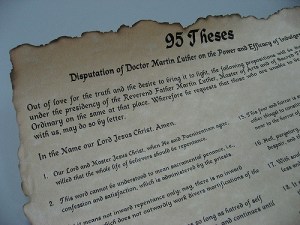
martin-lutherMartin Luther wrote to Archbishop Albrecht on October 31, 1517, objecting to this sale of indulgences.  He enclosed a copy of his “Disputation of Martin Luther on the Power and Efficacy of Indulgences”, a document which came to be known as his “95 Theses”.  A popular story has him nailing the document to the door of the Wittenberg Palace Church, but it likely never happened.  Luther appears to have had no intention of confronting the Church.  This was intended to be an academic work, 95 topics offered for scholarly disputation, but Martin Luther’s ideas would rock the Christian world.
What seems to the modern mind as mere doctrinal differences, were life and death matters in the late middle and early modern ages.  Archbishop Albrecht forwarded Luther’s note to Pope Leo X, who responded slowly and “with great care as is proper”.
Three theologians drafted heresy cases against Luther.  In 1520, the papal bull (edict) “Exsurge Domine” commanded Luther to recant under pain of excommunication.
cages-of-st-lambert
Luther stood on dangerous ground.  In 1415, Jan Hus was burned at the stake for such heresy.  On this day in 1420, Pope Martinus I called for a crusade against the followers of the Czech priest, the “Hussieten”.  Henry VIII’s famous break with the church over his divorce from Catherine of Aragon, was still years in the future in 1521, the year Henry was named “Fidei Defensor” (“Defender of the Faith”), a title awarded him by no less than Pope Leo X. Nine years later, French theologian Jean Calvin would be forced to flee a deadly outbreak of violence against Protestant Christians.  Jan Matthias, Bernhard Rothmann and Bernhard Knipperdolling would be tortured to death with white-hot pliers in the Münster marketplace in 1535, their corpses placed in cages and hanged from the steeple of St. Lambert’s Church.  Their bones were later removed, but those three cages remain there, to this day.
The bull had the effect of hardening Luther’s positions.  He publicly burned it on December 10.  Twenty-four days later, Luther was excommunicated.  A general assembly of the secular authorities of the Holy Roman Empire summoned Luther to appear before them in April, in the upper-Rhine city of Worms.  The “Edict of Worms” of May 25, 1521, declared Luther an outlaw, stating “We want him to be apprehended and punished as a notorious heretic”.  Anyone killing Luther was permitted to do so without legal consequence.
95-thesesLuther went into hiding at Wartburg Castle.  In 1516, Erasmus had expressed the wish that the holy text should be available in every language, “so that even Scots and Irishmen might read it”.  It was there that Luther translated the New Testament from Greek into German, laying the foundation for other vernacular translations and, for the first time, making the bible accessible to the common man.
Radical sects took Luther’s teaching far beyond his intent, and Luther found himself in the odd position of defending the faith against more radical reformers.  The Zwickau Prophets rejected holy scripture in favor of direct revelations from the holy spirit.  The Anabaptists took the “equality of man” in radical egalitarian directions, many sounding more like the principles Karl Marx would write about, in 1848.
Martin Luther’s reformations plunged Europe into a series of wars.  The Peasant’s War of 1524-25 alone killed more Europeans than any conflict prior to the 1789 French Revolution.  The established church would respond with counter-reformation, but the idea that Christian faith was more than the exclusive province of a special, segregated order of men, was here to stay.
On October 31, 1999, 482 years to the day from Martin Luther’s letter to Archbishop Albrecht, leaders of the Roman Catholic and Lutheran Churches signed the “Joint Declaration on the Doctrine of Justification”, ending the half-century old doctrinal dispute, once and for all.

February 21, 1431 Joan of Arc

History has repeatedly demonstrated the truth of Taylor Owen’s comment on the subject of leadership: “An army of donkeys led by a lion is better than an army of lions led by a donkey.” So it was in the days after Jeanne’s arrival at Orléans

The Hundred Years’ War began as a succession dispute over the French throne, with an alliance of Burgundians and English on one side, against a coalition of Royalists led by the Armagnacs on the other.

Europe was not far removed from the latest outbreak of the Black Death at this time, as the scorched earth tactics employed by the English army laid waste to the countryside and devastated the French economy.

Charles, Dauphin and heir apparent to the French throne was up against a wall, when a teenage peasant girl approached him in 1429.

joan_of_arcFor the 14-year-old boy-king, even listening to her was an act of desperation, borne of years of humiliating defeats at the hands of the English army. Yet this illiterate peasant girl had made some uncanny predictions concerning battlefield successes.  Now she claimed to have had visions from God and the Saints, commanding her to help him gain the throne. Her name was Jeanne d’Arc.

The siege of Orléans was six months old at this time, when the Dauphin decided it couldn’t hurt to let her take part. She dressed herself in borrowed armor and set out, arriving on the 29th of April, 1429.

History has repeatedly demonstrated the truth of Taylor Owen’s comment on the subject of leadership: “An army of donkeys led by a lion is better than an army of lions led by a donkey.” So it was in the days after Jeanne’s arrival at Orléans.

Though repeatedly excluded from war councils, Jeanne managed to insert herself anyway, putting the French back on the offensive and handing them one victory after another.

Nine days after her arrival, Orléans turned into an unexpected victory for the French, despite Jeanne’s being shot through the neck and left shoulder by an English longbow, while holding a ladder at the siege of Tourelles.  The Dauphin granted her co-command of the army with Duke John II of Alençon. The French army enjoyed a string of successes, recovering Jargeau on June 12, Meung-sur-Loire on the 15th, and Beaugency two days later, leading to a humiliating English defeat at the battle at Patay on the 18th.

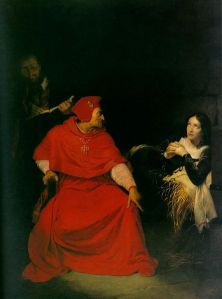
Several more Armagnac victories followed.  On July 17, 1429, Charles was consecrated King Charles VII of France, fifth King of the House of Valois, with Jeanne at his side.  Despite her loyalty, Charles’ support began to waver.  Court favorite Georges de La Trémoille had convinced the king that she was becoming too powerful.  An archer pulled Jeanne from her horse during the siege of joan_of_arc_interrogationCompiègne in May, 1430, and her allies failed to come to her aid.  Left outside the town’s gates when they closed, she was captured and taken to the castle of Bouvreuil.

Some 70 charges were made against her by the pro-English Bishop of Beauvais, Pierre Cauchon, including witchcraft, heresy, and dressing like a man.

Representatives of the judge were dispatched  to Jeanne’s home village of Domremy, to ascertain the prisoner’s virginity, character, habits and associations.  Nicolas Bailly, the man responsible for collecting testimony, reported that he “had found nothing concerning Joan that he would not have liked to find about his own sister”. This Bishop Cauchon must have been some piece of work.  The report so angered the man, that he called Bailly “a traitor and a bad man” and refused to pay him for his work.

Jean Le Maistre, whose presence as Vice-Inquisitor for Rouen was required by canon law, objected to the proceedings and refused to appear, until the English threatened his life.

Interrogation of the prisoner began on February 21, 1431. The outcome was never in doubt. Transcripts were falsified and witnesses intimidated.  Even then, trial records reveal this illiterate peasant girl to be brighter than all her inquisitors, combined.

One example from her third interrogation, was the Question: “Do you know whether or not you are in God’s grace?”. The question was a trap.  Church doctrine stated that no one could be certain of being in God’s grace, yet a “no” answer would have been held against her.  “If I am not”, she said, “may God put me there; and if I am, may God so keep me. I should be the saddest creature in the world if I knew I were not in His grace.”

After fifteen such interrogations her inquisitors still had nothing on her, save for the wearing of soldier’s garb, and her visions. Yet, the outcome of her “trial” was already determined.  She was found guilty of heresy, and sentenced to be burned at the stake.  On May 24, Jeanne was taken to a scaffold.  Threatened that she would be immediately burned alive if she didn’t disavow her visions and abjure the wearing of soldier’s clothing, Jeanne agreed to sign such an abjuration, but recanted four days later.

jean-darc-executionThe death sentence was carried out on May 30, 1431, in the old marketplace at Rouen. She was 19.  After she died, the coals were raked back to expose her charred body.  No one would be able to claim she’d escaped alive. Her body was then burned twice more, so no one could collect the relics.  Her ashes were then cast into a river.

Guillaume Manchon, one of the court scribes, later recalled: “And she was then dressed in male clothing, and was complaining that she could not give it up, fearing lest in the night her guards would inflict some act of [sexual] outrage upon her; and she had complained once or twice to the Bishop of Beauvais, the Vice-Inquisitor, and Master Nicholas Loiseleur that one of the aforesaid guards had tried to rape her.”

Her executioner, Geoffroy Therage, later said that he “Greatly feared to be damned”.

An inquisitorial court authorized by Pope Calixtus III re-examined the evidence, 25 years later. The court exonerated her of all charges, pronouncing her innocent on July 7, 1456, and later declaring her a martyr.

A National Heroine to the French, Joan of Arc was canonized a saint of the Roman Catholic Church, in 1920.  It was small consolation for this child who had been set up for a fall by her enemies, and abandoned to be incinerated alive, by her friends.

January 22, 2000 A Hole in the Head

To prove the point, to his own satisfaction if to no one else, Hughes drilled a hole in his own skull on January 6, 1965, using a Black & Decker electric drill

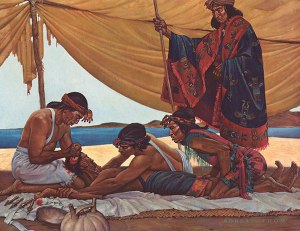
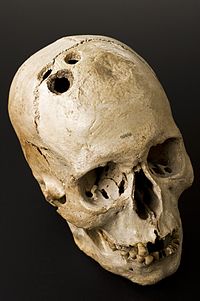
It’s called “Trepanation”, possibly the oldest surgical procedure for which we have archaeological evidence. Trepanation involves drilling or scraping a hole into the human ancient-peruvian-trepanationhead, and seems to have begun sometime in the Neolithic, or “New Stone Age” period. One archaeological dig in France uncovered 120 skulls, 40 of which showed signs of trepanning. Another such skull was recovered from a 5th millennium BC dig in Azerbaijan.  A number of 2nd millennium BC specimens have been unearthed in pre-Colombian Mesoamerica; the area now occupied by the central Mexican highlands through Belize, Guatemala, El Salvador, Honduras, Nicaragua, and northern Costa Rica.

bronze_age_skull_from_jericho_palestine
Bronze age skull

Hippocrates, the Father of Western Medicine, described the procedure in detail in his treatise “On Injuries of the Head,” written sometime around 400BC. The Roman physician Galen of Pergamon expanded on the procedure some 500 years later. Archaeologists discovered 12½%, of all the skulls in pre-Christian era Magyar (Hungarian) graveyards, to have been trepanned.

The procedure has obvious applications in the treatment of head trauma, though it has been used to treat everything from seizures to migraines to mental disorders. During medieval times, the procedure was used to liberate demons from the heads of the possessed and to cure an assortment of ailments from meningitis to epilepsy.

trepan-posterTrepanation took on airs of pseudo-science, many would say “quackery”, when the Dutch librarian Hugo Bart Huges (Hughes) published “The Mechanism of Brainbloodvolume (‘BBV’)” in 1964. In it, Hughes contends that our brains drained of blood and cerebrospinal fluid when mankind began to walk upright, and that trepanation allows the blood to better flow in and out of the brain, causing a permanent “high”.

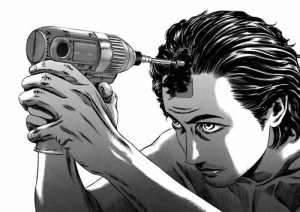
To prove the point, to his own satisfaction if to no one else, Hughes drilled a hole in his own skull on January 6, 1965, using a Black & Decker electric drill. He must have thought it proved the point, because he expanded on his theory with “Trepanation: A Cure for Psychosis”, as well as an autobiography, “The Book with the Hole”, published in 1972.

Peter Halvorson, a Hughes follower and director of the International Trepanation Advocacy Group (ITAG), would disagree with that quackery comment. Halvorson trepanned himself with an electric drill in 1972. Today, he explains on his ITAG website (www.trepan.com) that “The hypothesis here at ITAG has been that making an opening in the skull favorably alters movement of blood through the brain and improves brain functions which are more important than ever before in history to adapt to an ever more rapidly changing world”.with-a-drill

On January 22, 2000, Peter Halvorson and Williams Lyons helped drill a hole in a woman’s head for producers of the ABC News program “20/20.” This was in Beryl, Utah, and the television program which ensued, airing on February 10, resulted in criminal charges and arrest warrants for the two men. At the time, the Iron County DA was also considering charges against ABC News reporter Chris Cuomo for aiding in the crime. There is precedent in Utah for such a charge against a reporter. In 1999, KTVX reporter Mary Sawyers (allegedly) provoked a group of Carbon County High School students into using tobacco products for a story on youths and tobacco. Sawyers later stood trial for contributing to the delinquency of a minor in Utah’s 7th District Court of Appeals.

St. Louis neurologist Dr. William Landau wasn’t impressed with Hughes’ brainbloodvolume theory, explaining that “There is no scientific basis for this at all. It’s quackery.” Dr. Robert B. Daroff, Professor of Neurology at Case Western Reserve University School of Medicine, was a little more to the point. “Horseshit,” he said. “Absolute, unequivocal bullshit”.

December 15, 1256 Stronghold of the Assassins

Possessed of all the physical prowess of youth, the individual assassin was also intelligent and well-read, highly trained in combat tactics, the art of disguise and the skills of the expert horseman

For the Islamic world, the 11th century was a time of political instability. The Fatimid Caliphate, established in 909 and by this time headquartered in Cairo, was in sharp decline by 1090.  The Fatimids were destined to disappear within the next 100 years, eclipsed by the Abbasid Caliphate of An-Nasir Salah ad-Din Yusuf ibn Ayyub, better known to anyone familiar with the story of Richard the Lionheart, as Saladin.

To the east lay the Great Seljuk Empire, the Turko-Persian, Sunni Muslim state established in 1037 and stretching from the former Sassanid domains of modern-day Iran and Iraq, to the Hindu Kush.  An “appanage” or “family federation” state, the Seljuk empire was itself in flux after a series of succession contests, and destined to disappear in 1194.

Into the gap stepped the “Old Man of the Mountain”, Hassan-i Sabbah, and his fanatically loyal, secret sect of “Nizari Ismaili” followers, the Assassins.
The name derives from the Arabic “Hashashin”, meaning “those faithful to the foundation”.  Marco Polo reported a story that the old man of the mountain got such fervent loyalty from his young followers, by drugging and leading them to a “paradise” of earthly delights, to which only he could return them.  The story is probably apocryphal, there is little evidence that hashish was ever used by the Assassins’ sect.  Sabbah’s followers believed him to be divine, personally selected by Allah.  The man didn’t need to drug his “Fida’i” (self-sacrificing agents), he was infallible.  His every whim would be obeyed, as the literal Word of God.

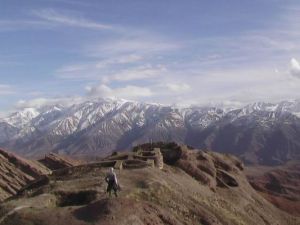
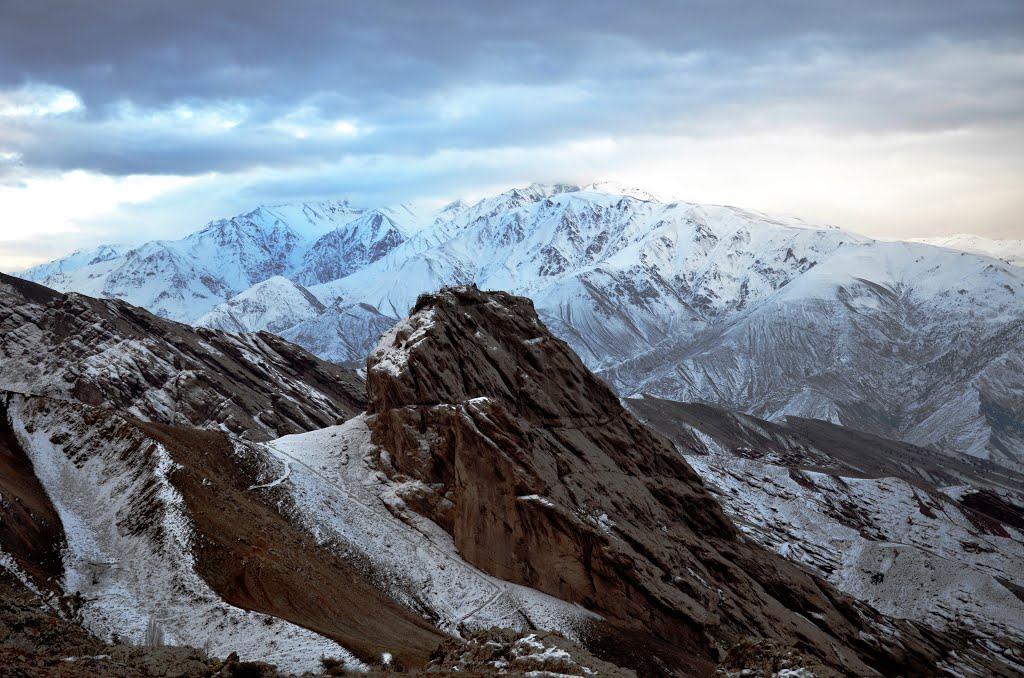
assassin-fortification-at-alamut-northern-iran
Alamut Fortress, Nortwest Iran

The mountain fortification of Alamut in northern Persia was probably impervious to defeat by military means, but not to the two-years long campaign of stealth and pretend friendship practiced by Sabbah and his followers.  In 1090, Alamut fell in a virtually bloodless takeover, becoming the headquarters of the Nizari Ismaili state.


Why Sabbah would have founded such an order is unclear, if not in pursuit of his own personal and political goals.  By the time of the first Crusade, 1095-1099, he found himself pitted against rival Muslims and invading Christian forces, alike.

Sabbah would order the elimination of rivals, usually up close, with the dagger.  From

assassination_of_the_seljuk_vizier_nizam_al-mulk
Assassination of the Seljuk Vizier Nizam al-Mulk

religious figures to politicians and great generals, assassinations were preferably performed in broad daylight, in as public a manner as possible.  It was important that everyone absorb the intended message.


Though the “Fida’in” occupied the lowest rank of the order, great care was devoted to their education and training.  Possessed of all the physical prowess of youth, the individual assassin was also intelligent and well-read, highly trained in combat tactics, the art of disguise and the skills of the expert horseman.  All the necessary traits, for anyone who would penetrate enemy territory, insinuate himself into their ranks, and murder the victim who had learned to trust him.

Sometimes, a credible threat of assassination was as effective as an actual killing.  When the new Seljuk Sultan Ahmad Sanjar rebuffed Hashashin diplomatic overtures in 1097, he awoke one morning to find a dagger stuck into the ground, next to his bed.  A messenger arrived sometime later from the old man of the mountain.  “Did I not wish the sultan well” he said, “that the dagger which was struck in the hard ground would have been planted on your soft breast?”  The technique worked nicely.  For the rest of his days, Sanjar was happy to allow the Hashashin to collect tolls from travelers.  The Sultan even provided them with a pension, collected from the inhabitants of the lands they occupied.

Saladin himself awoke one morning, to find a note resting on his breast, along with a poisoned cake.  The message was clear.  Sultan of all Egypt and Syria though he was, Saladin made an alliance with the rebel sect.  There were no more attempts on his life.

assassin-fortification-at-masyaf-in-northern-syria
Assassin stronghold at Masyaf, in Northern Syria

In the 200+ years of its existence, the Assassins occupied scores of mountain redoubts, though Alamut would remain its principle quarters.

It’s impossible to know how many of the hundreds of political assassinations of this period, were attributable to the followers of Hassan-i Sabbah.  Without a doubt, their fearsome reputation ascribed more political murder to the sect, than they were actually responsible for.

The Fida’in of Hassan-i Sabbah were some of the most feared killers of the middle ages.   Scary as they were, there came a time when the order of the Assassins tangled with someone far scarier than themselves.

The Grand Master dispatched his killers to Karakorum in the early 1250s, to murder the grandson of Genghis Khan, the Great Khan of the “Golden Horde”, Möngke.  It was a bad idea.

The Nestorian Christian ally of the Mongol Empire Kitbuqa Noyan, was ordered to destroy several Hashashin fortresses in 1253.  Möngke’s brother Hulagu rode out at the head of the largest Mongol army ever seen in 1255, with no fewer than 1,000 Chinese engineer squads.  Their orders were to treat those who submitted with kindness, and to utterly destroy those who did not.

That he did. Rukn al-Dīn Khurshāh, fifth and final Imam who ruled at Alamut, submitted after four days of preliminary bombardment.  Mongol forces under the command of Hulagu Khan entered and destroyed the Hashshashin stronghold at Alamut Castle on December 15, 1256.

Hulagu went on to subjugate the 5+ million Lurs people of western and southwestern Iran, the Abbasid Caliphate in Baghdad, the Ayyubid state of Damascus, and the Bahri Mamluke Sultanate of Egypt.  Mongol and Muslim accounts alike, agree that the Caliph of Baghdad was rolled up in a Persian rug, and the horsemen of Hulagu rode over him, because Mongols believed that the earth was offended if touched by royal blood.

Some people are not to be trifled with.

December 6, 1240 Golden Horde

Imagine an army of circus riders, equipped with composite bows and a minimum of 60 arrows apiece, each capable of hitting a bird in flight

The Eurasian Steppe is a vast region of grasslands and savannas, extending thousands of miles east from the mouth of the Danube, almost to the Pacific Ocean. There’s no clearly defined southern boundary, as the land becomes increasingly dry as you move south. To the north are the impenetrable forests of Russia and Siberia.
The 12th century steppe was a land of inter-tribal rivalry, immersed in a poverty so profound that many of its inhabitants went about clad in the skins of field mice. Ongoing acts of warfare and revenge were carried out between a kaleidoscope of ever changing tribal confederations, compounded and egged on by interference from foreign powers such as the Chinese dynasties to the south.
Into this land was born the son of the Mongol chieftain Yesügei, born with a blood clot grasped in his fist. It was a sign, they said, that he was destined to become a great leader. By 1197 the boy would unite the nomadic tribes of northeast Asia into the largest contiguous empire in history, extending from Korea in the east, through Baghdad and Syria all the way into eastern Europe. His name was Temujin. He is known to history as the Great Leader of the Mongol Empire, Genghis Khan.
natgeo-cover-afghan-girl  The Steppes have long been a genetic crossroad, the physical features of its inhabitants as diverse as any in the world. The word “Rus”, from which we get Russia, was the name given to Viking invaders from earlier centuries. History does not record what Genghis himself looked like, though he’s often depicted with Asian features. There is evidence suggesting he had red hair and green eyes. Think of that beautiful young Afghan girl, the one with those killer eyes on that National Geographic cover, a few years back.
The Mongols called themselves “Tata”, while others called them after the people of Tartarus, the Hell of Roman mythology. They were the “Tatars” to the people they terrorized: “Demons from Hell”.
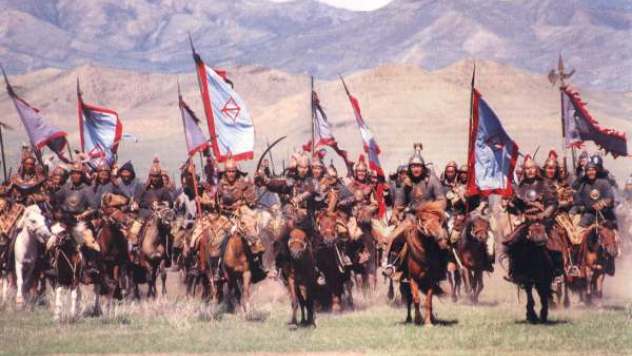
The two most prominent weapons in the Mongol arsenal can be found in the words “Horse Archer”. Imagine an army of circus riders, equipped with composite bows and a minimum of 60 arrows apiece, each capable of hitting a bird in flight. They have no fewer than 3-4 small, fast horses apiece, and are able to transfer mounts in mid-gallop in order to keep their horses fresh. In this way, riders could cover 100 miles and more in a day. Stirrups allowed them to fire in any direction, including backward. The bow, a laminated composite of wood, horn and sinew, combined the compression of the interior horn lamina with stretching animal sinews glued to the exterior. The weapon was capable of aimed shots at five times the length of a football field. Ballistic shots into large groups were common as far as 2½ times that distance. The average draw of an English longbow is 70-80 lbs. The Mongol composite bow ranged from 100 to 160 lbs.
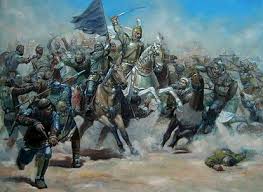
After the death of Genghis’ eldest son Jochi, who pre-deceased his father, the Great Khan installed his grandson Batu as Chief of state (Khan) of the Kipchak Khanate to the north. In 1235, the Great Khan Ögedei, who had succeeded his father on Genghis’ death in 1229, ordered his nephew Batu and an army of 130,000 circus riders to conquer Europe, beginning with the Rus.
13th century Russia was more a collection of principalities than it was a single nation. One by one they fell to the army of Batu, known as the “Golden Horde”. Ryazan, Kolomna and Moscow. Vladimir, Rostov, Uglich, Yaroslavl, and a dozen others. Some of the names are familiar today, others were extinguished for all time. All fell to the Golden Horde.     Smolensk alone escaped, having agreed to submit and pay tribute. The city of Kitezh, as the story goes, submerged itself into a lake along with its inhabitants, at the approach of the Horde. It was this day, December 6, 1240, when Mongols under Batu Khan occupied & destroyed Kiev after several days’ struggle.
The violence of the age was so vast and horrific that it’s hard to get your head around. WWII, the deadliest conflict in human history, was a time of industrialized mass slaughter from the battlefields to the death camps. WWII ended the lives of roughly 3% of the inhabitants of earth, 40 to 72 million souls dead in a few short years. By comparison, the Mongol conquests killed 30 million over 162 years, mostly one by one by edged or pointed weapons. When it was over, 17% of the entire world’s population, had vanished.
By the end of 1241, Mongol armies had crushed opposing forces from the Plains of mongolsHungary, to parts of Austria, to Eastern Persia.   Plans were being laid for the invasion of Germany, Austria and Italy in December, 1241, when news arrived informing them of the death of the Great Khan. Ögedei and Batu wanted to continue, but the Law of Yassa required that all Princes of the Blood return to Karakorum and the Kurultai, the meeting of Mongol Chieftains.
The Celtic warrior Calgacus once said of the Roman conquests that “They make a desert, and they call it peace”. It was likewise for the Mongol Empire; a time of peace for those who would submit and pay tribute. A time when “A maiden bearing a nugget of gold on her head could wander safely throughout the realm.” This “Pax Mongolica” lasted through the reign of the Great Khan and his several successors, making way for the travels of Marco Polo. The 4,000 mile long “Spice Roads”, the overland trade routes between Europe and China, flourished throughout the 14th and 15th centuries, entirely under Mongol control. The “Black Death” of the 14th century would begin to change that. 100 years later, the fall of Byzantium and marauding bands of   Muslim brigands were making the east-west overland trade routes increasingly dangerous. In 1492, the Spanish Crown hired an Italian explorer to find a water route to the east.
The Mongols would never regain the lost high ground of December 1241, as they fell to squabbling over bloodlines. Berke, grandson of Ghenghis and brother of Batu, converted to Islam, creating a permanent division among the descendants of the Great Khan. Timur-i-leng, “Timur the Lame”, or “Tamerlane”, professed to be a good Muslim, but had no qualms about destroying the capitals of Islamic learning of his day. Damascus, Khiva, Baghdad and more, have never entirely recovered. Best known for the pyramids of skulls left behind, as many as 19 million fell to Tamerlane’s murderous regime.
The Golden Horde ruled over parts of Russia until the time of Ivan IV “Grozny” (The Terrible) in the 1550s.
The Mongol hordes never went away, not entirely. Modern DNA testing reveals that up to 8% of certain populations across the Asian subcontinent, about .5% of the world’s population, descends directly from that baby holding the blood clot, Genghis Khan.