April 4, 1943 The Davao Dozen

The death rate for western prisoners in Japanese prisoner of war camps was seven times that of allied prisoners in Nazi Germany or Fascist Italy.


With increasing tensions between the Unites States and the empire of Japan, the “China Marines” of the Fourth Marine Regiment, “The Oldest and the Proudest”, departed Shanghai for the Philippines on November 27-28, 1941.  The first elements arrived at Subic Bay on November 30.

A week later and 5,000 miles to the east, the radio crackled to life in the early – morning hours of December 7.  “Air raid on Pearl Harbor. This is no drill!”

Military forces of Imperial Japan appeared unstoppable in the early months of WWII, attacking first Thailand, then the British possessions of Malaya, Singapore and Hong Kong, as well as US military bases in Hawaii, Wake Island, Guam and the Philippines.

On January 7, Japanese forces attacked the Bataan peninsula. The Fourth Marines, under Army command, were ordered to help strengthen defenses on the “Gibraltar of the East”, the heavily fortified island of Corregidor.

The prize was nothing less than the finest natural harbor in the Asian Pacific, Manila Bay, the Bataan Peninsula forming the lee shore and Corregidor and nearby Caballo Islands standing at the mouth, dividing the entrance into two channels.  Before the Japanese invasion was to succeed, Bataan and Corregidor must be destroyed.

bataan-philippines-map.jpg__1000x665_q85_crop_subsampling-2_upscaleThe United States was grossly unprepared to fight a World War in 1942.  The latest iteration of “War Plan Orange” (WPO-3) called for delaying tactics in the event of war with Japan, buying time to gather US Naval assets to sail for the Philippines.  The problem was, there was no fleet to gather.   The flower of American pacific power in the pacific, lay at the bottom of Pearl Harbor.  Allied war planners turned their attention to defeating Adolf Hitler.

General Douglas MacArthur abandoned Corregidor on March 12, departing the “Alamo of the Pacific” with the words, “I shall return”.  Some 90,000 American and Filipino troops were left behind without food, supplies or support with which to fight off the onslaught of the Japanese 14th Army, under the command of Lieutenant General Masaharu Homma.

Battered by wounds and starvation, decimated by all manner of tropical disease and parasite, the 75,000 “Battling Bastards of Bataan” fought on until they could fight no more.  Some 75,000 American and Filipino fighters were surrendered with the Bataan peninsula on April 9, only to begin a 65-mile, five-day slog into captivity through the unbearable heat and humidity, of the Philippine jungle.5cacc25d77584e5d0f090484The Japanese were sadistic. Guards would beat marchers and bayonet those too weak to walk.  Tormented by a thirst few among us can even imagine, men were made to stand for hours under a relentless sun, standing by a stream from which none were permitted to drink.  The man who broke ranks and dove for the water was clubbed or bayoneted to death, on the spot.  Japanese tanks would swerve out of their way to run over anyone who had fallen and was too slow in getting up. Some were burned alive, others buried alive. Already crippled from tropical disease and starving from the long siege of Luzon, wanton killing and savage abuse took the lives of some 500 – 650 Americans and between 5,000 – 18,000 Filipinos.  
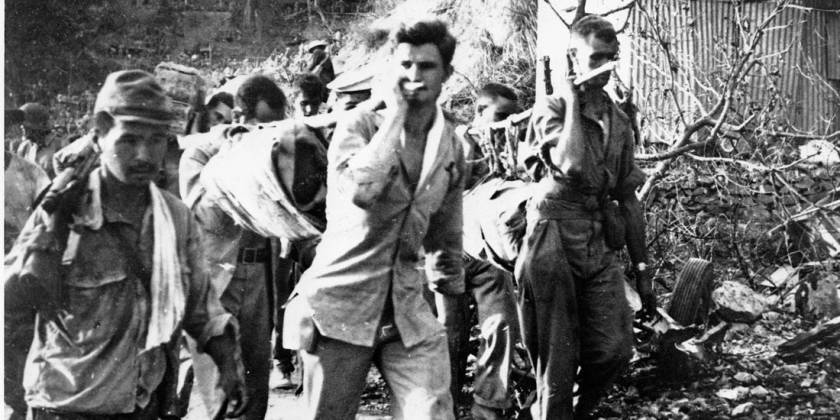
For those who survived the “Bataan Death March”, this was only the beginning of their ordeal.

Bataan MemorialUnited States Marine Corps 1st Lieutenant Austin Shofner came ashore back in November, with the 4th Marines.  Shofner and his fellow leathernecks engaged the Japanese as early as December 12 and received their first taste of aerial bombardment, on December 29.  Promoted to Captain and placed in command of Headquarters Company, Shofner received two Silver Stars by April 15 in near-constant defense against aerial attack.

For three months, defenders on Corregidor were required to resist near constant aerial, naval and artillery bombardment.  All that on two scant water rations and a meager food allotment of only 30 ounces per day.

I don’t know about you, but I’ve eaten Steaks bigger than 30 ounces.

Beset as they were, seven private maritime vessels attempted to run the Japanese gauntlet, loaded with food and supplies.   The MV Princessa commanded by 3rd Lieutenant Zosimo Cruz (USAFFE), was the only ship to arrive in Corregidor.

Japanese artillery bombardment intensified, following the fall of Bataan.  Cavalry horses killed in the onslaught were dragged into tunnels and caves, and consumed.  Japanese aircraft dropped 1,701 bombs in the tiny island during 614 sorties, armed with some 365-tons of high explosive.  On May 4 alone, an estimated 16,000 shells hit the little island.

malinta tunnel
Malinta Tunnel

The final assault beginning May 5 met with savage resistance, but the outcome was never in doubt.  General Jonathan Wainwright was in overall command of the defenders on Corregidor. Some 11,000 men comprised of United States Marines, Army and Navy and an assemblage of Filipino fighters.  The “Malinta Tunnel” alone contained over a thousand, so sick or wounded as to be helpless.  Fewer than half had even received training in ground combat techniques.

All were starved, sick, utterly exhausted.  The 4th Marines was shattered, no longer an effective fighting force.  With the May 6 landing of Japanese tanks, General Wainwright elected the preservation of life over continued slaughter in the defense of a hopeless position.  Maine Colonel Samuel Howard ordered the regimental and national colors burned to prevent their capture, as Wainwright sent a radio message to President Roosevelt:

“There is a limit of human endurance, and that point has long been passed.”

Isolated pockets of marines fought on for four hours until at last, all was still.  Two officers were sent forward with a white flag, to carry the General’s message of surrender.  It was 1:30pm, May 6, 1941.image (12)Nearly 150,000 Allied soldiers were taken captive by the Japanese Empire during World War 2. Clad in unspeakably filthy rags they were fed a mere 600 calories per day of fouled rice, supplemented only by the occasional insect or bird or rodent unlucky enough to fall into desperate hands.  Diseases like malaria were all but universal as gross malnutrition led to loss of vision and unrelenting nerve pain.  Dysentery, a hideously infectious disease of the large intestine reduced grown men to animated skeletons.  Mere scratches resulted in grotesque tropical ulcers up to a foot in length exposing living bone and rotting flesh to swarms of ravenous insects.
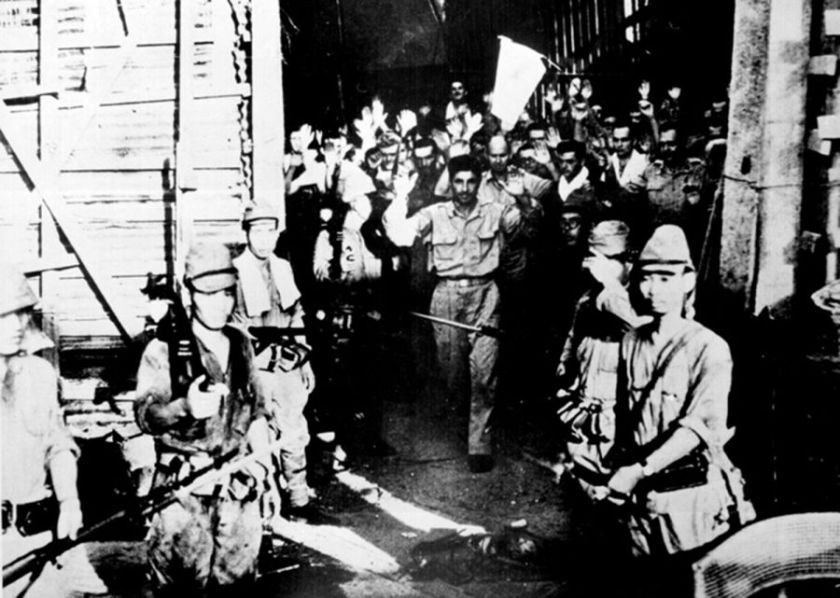
The death rate for western prisoners was 27.1% across 130 Japanese prison encampments.  Seven times the death toll for allied prisoners in Nazi Germany, or Fascist Italy.Japbehead3sGiven such cruel conditions it’s a wonder anyone escaped at all but it did happen.  One time.
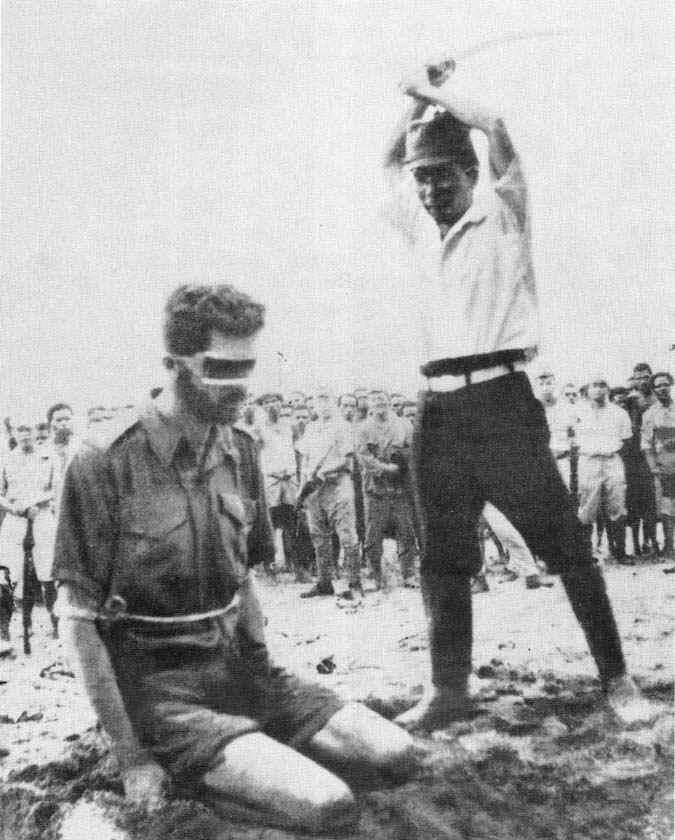
Austin Schofner and his group were moved from camp to camp.  Bilibid.  Cabanatuan.  Davao.  Throughout early 1943, Schofner and others would steal away from work details to squirrel away small caches of food and tools, in the jungle.  Nine fellow Marines and two Filipino soldiers were in on the scheme. On April 4, the 12 men quietly slipped away from work parties.

Over the long hours of April 5-6, the group crept through the jungle, dodging enemy patrols and managing to avoid detection, arriving on the 7th at a remote Filipino Guerrilla outpost.  Guided by wild mountain tribesmen of the Ata Manobo, the Marines rejoined the 110th Division, 10th Military District, at this time conducting guerrilla operations against the Japanese occupiers.

Emaciated, sick and weak, these men had reached the end of an ordeal a year and a half in the making.  It would be understandable if they were to seek out the relative safety of a submarine bound to Australia, but no.   Those physically able to do so joined the guerrillas in fighting the Japanese.

Davao escapees from left to right, Maj. Stephen Mellnik, Lt. Cmdr. “Chick” Parsons, Lt. Cmdr. Melvyn McCoy, Capt. William Edwin Dyess, and Capt. Charley Smith pose for a photo before commencing their trek to rendezvous with the USS Trout. Image from nationalww2museum.org

Austin Shofner and his Marines were evacuated that November, aboard the submarine USS Narwhal.  For the first time, Japanese atrocities came to light.  The Death March, the torture, mistreatment and summary execution of Allied POWs.  The public was outraged, leading to a change in Allied war strategy.  No longer would the war in the Pacific take a back seat to the effort to destroy the Nazi war machine.

image001

Now-Colonel Shofner volunteered to return to the Pacific where his experience helped with the rescue of 500 prisoners of the infamous POW camp at Cabanatuan on January 30, 1945.

An American military tribunal conducted after the war held Lieutenant General Homma Masaharu, commander of the Japanese invasion forces in the Philippines, guilty of war crimes. He was executed by firing squad on April 3, 1946.

The Davao Dozen conducted the only successful escape from a Japanese Prison camp in all World War 2. They deserve that we remember their names.

The only successful escape from a Japanese Prisoner of war camp in all World War 2, The “Davao Dozen” include Here are the names of the Americans in the Davao Dozen:

Second Lieutenant Leo Boelens
First Lieutenant Michiel Dobervich
Captain William Edwin Dyess
Second Lieutenant Samuel Grashio
First Lieutenant Jack Hawkins
Lieutenant Commander Melvyn McCoy
Sergeant Paul Marshall
Major Stephen Mellnik
Captain Austin Shofner
Sergeant Robert Spielman
Benigno de la Crus
Victorio Jumarong
s-l1000

March 30, 1945 An Act of Defiance

“First they came for the socialists, and I did not speak out—because I was not a socialist. Then they came for the trade unionists, and I did not speak out— because I was not a trade unionist. Then they came for the Jews, and I did not speak out—because I was not a Jew. Then they came for me—and there was no one left to speak for me”. – Martin Niemöller

We shall go on to the end. We shall fight in France, we shall fight on the seas and oceans, we shall fight with growing confidence and growing strength in the air, we shall defend our island, whatever the cost may be. We shall fight on the beaches, we shall fight on the landing grounds, we shall fight in the fields and in the streets, we shall fight in the hills; we shall never surrender, and if, which I do not for a moment believe, this island or a large part of it were subjugated and starving, then our Empire beyond the seas, armed and guarded by the British Fleet, would carry on the struggle, until, in God’s good time, the New World, with all its power and might, steps forth to the rescue and the liberation of the old”.

Winston Churchill
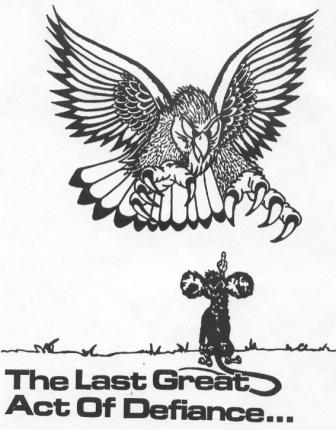
last_great_act_of_defiance1

Before the age of the internet,  office jokes and bits of folk wisdom were passed around and copied, and copied again.  “The Last great of Defiance“ was one of those. 

The image speaks for itself.  I had one on the wall, for years. This is one of those stories.

The last great effort of German arms burst out of the frozen Ardennes forest on December 16, 1944, aiming for the vital port at Antwerp.

Unternehmen Wacht am Rhein“, (“Operation Watch on the Rhine”) was a tactical surprise for the Wehrmacht, as allied forces were driven back through the densely forested regions of France, Belgium and Luxembourg. Wartime news maps showed a great inward “bulge” in the lines, and the name stuck. The Battle of the Bulge was the largest and bloodiest battle fought by American forces in World War 2, fought out in some of the harshest winter conditions in recorded history and involving some 610,000 GIs.

malmed1

Prisoners were swept up by the thousands, to face an uncertain future.  In Malmedy, Belgium, seventy-five captured Americans were marched into an open field and machine gunned by members of the 1st SS Panzer Division (Leibstandarte Adolf Hitler), a part of 6th Panzer Army.

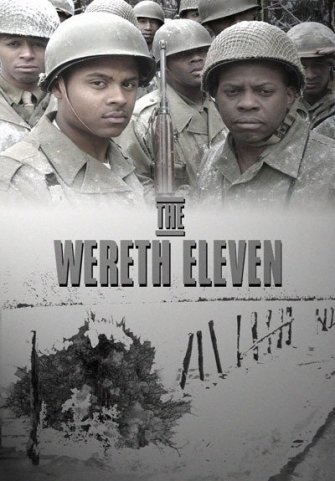
On December 16, the all-black 333rd Field Artillery Battalion of the racially segregated US Army put up an heroic defense outside the town of Wereth, Belgium. Using 155mm guns to delay the German advance they were desperately outnumbered. The 333rd was overrun the following day, groups of men scattering to escape as best they could. Eleven soldiers made their way to the home of Mathias Langer, the Mayor of Wereth.

the-wereth-eleven-578359l
Movie poster for the 2011 film, “The Wereth Eleven”

To shelter allied troops under German occupation was to risk summary execution. Despite the obvious risk to their own lives, Matthias and his wife Maria took these men in and attempted to hide them, in their home. When German troops arrived, the eleven surrendered rather than risk the lives of their benefactors.

Eleven men were marched out of sight and murdered by German troops. Every one of them. Lost in the confusion of the Bulge, the bodies of the Wereth 11 lay hidden under the snow, until the Spring melt. For the next fifty years their story was lost, to history.

Nazi atrocities were not limited to Allied troops.  By some accounts, more civilians were killed during the Battle of the Bulge than anytime over the last four years.  When the fighting was over, more than 115 bodies were found in the small villages of Ster and Parfondruy, alone.

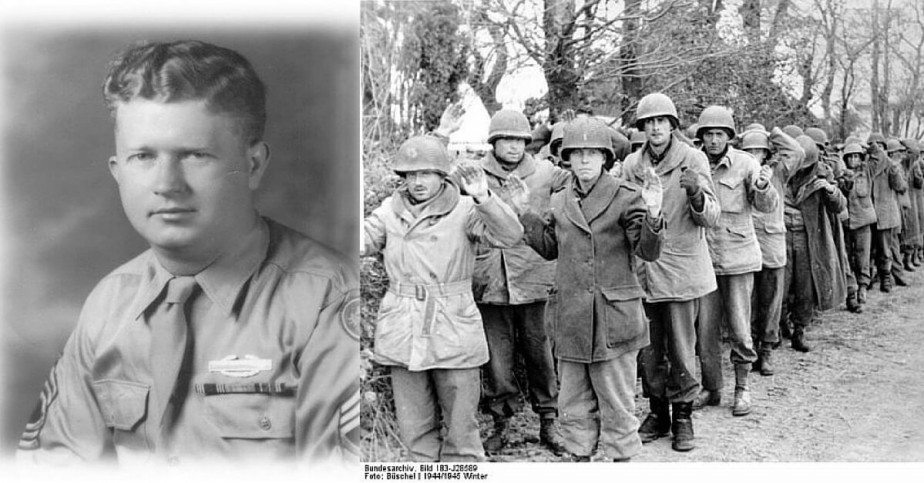
For Master Sargent Roderick “Roddie” Edmonds, the war ended on December 19, swept up with hundreds of American troops and taken prisoner.  These were the lucky ones, enduring those first white-hot moments of capture to be sent alive to a German prisoner-of-war camp.  Edmonds was later transferred to another camp near Ziegenhain, Germany.  At the age of 24, Master Sergeant Roddie Edmonds was now the senior non-commissioned officer at Stalag IX-A, responsible for 1,275 American POWs.

Home_Slider_Image-1024x666

Unsurprisingly, the Wehrmacht maintained harsh anti-Jewish policies and kept Jewish POWs in strict segregation.  In the East, Russian Jews unfortunate enough to become POWs were immediately swept up, and sent to extermination camps.  In the west, the future was more uncertain for Jewish POWs.  Many of them were worked to death in slave labor camps.

On January 27, the first day at Stalag IX-A, commandant Siegmann ordered Edmonds: All American Jews were to identify themselves at the following day’s assembly.  The word went out to all five barracks:  “We’re not doing that.  We’re all turning out“.

The following morning, 1,275 POWs presented themselves.  Every. Single. Man.

Siegmann was perplexed.  “They can’t all be Jews!”  As senior NCO, Edmonds spoke for the group.  “We’re all Jews here“.  The Nazi commandant was apoplectic, pressing a Luger into Edmonds’ forehead.  This is your last chance.

Imagine yourself in this situation and ponder, what would you do?

Edmonds gave his name, rank and serial number. :  ‘If you are going to shoot’, he said, ‘ you are going to have to shoot all of us because we know who you are and you’ll be tried for war crimes when we win this war.’”  Siegmann was incandescent, white with rage, but the moment passed.  He was defeated.

The 1,275 American POWs held at Stalag IX-A were liberated on March 30, 1945, including some 200 Jews.

Years later the Army called once again and Roddie Edmonds was recruited, this time for the war in Korea.  He never said a word not even to his family, of what happened at Stalag IX-A.

Chris Edmonds is the Pastor at Piney Grove Baptist Church in Maryville, Tennessee, and the son of Roddie Edmonds. Following his father’s death in 1985, Chris’ mother gave him his father’s  war diary, where he found a brief mention of this story.  Chris scoured the news for more information. This was around the time Richard Nixon was looking for his post-Presidential home.  As it happened, Nixon bought his posh, upper-east side home from one Lester Tanner, a prominent New York Lawyer who mentioned in passing, he owed his life to Roddie Edmonds.

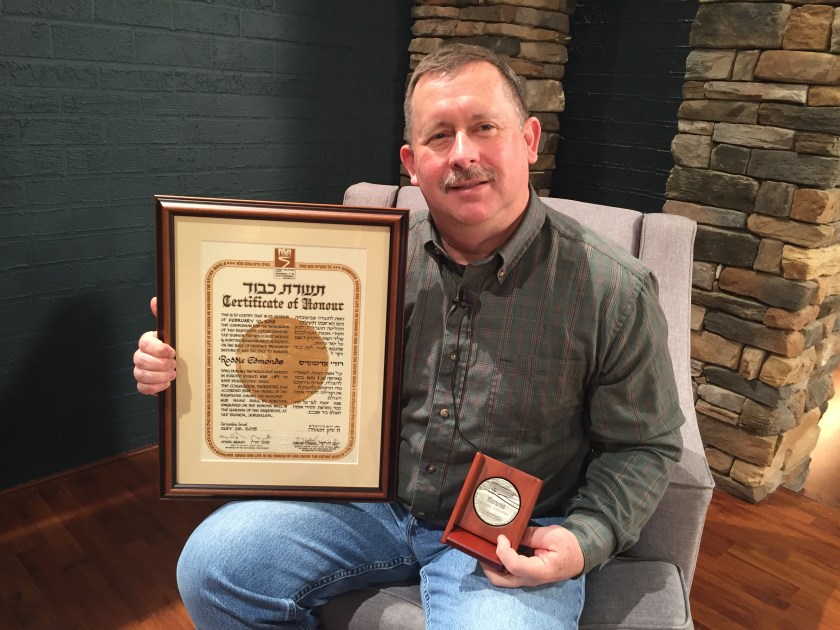
So it is, this story came to light.  In 2015, Edmonds was honored as “Righteous among the Nations”, the first American soldier to be so honored.  It’s the highest honor bestowed by the state of Israel, on non-Jews who risked their lives to save Jews from the Nazi death machine.  President Barack Obama recognized Edmonds’ heroism in a 2016 speech before the Israeli embassy.  In 2017 Tennessee Senator Marsha Blackburn led a bipartisan effort to bestow the Congressional Gold Medal. 
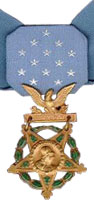
Time.com wrote in August 2023, “He was praised at the ceremony by President Barack Obama for actions “above and beyond the call of duty,” although he has been denied the Medal of Honor by the Army because it claims that his actions were not undertaken in combat, a strange position given an enemy officer literally pointed a gun at Edmonds’ head”.

As I write this final passage, Pastor Edmonds and the Jewish veterans saved by M/Sgt Edmonds continue to push for the Knoxville, Tennessee native to receive the Medal of Honor. Pastor Edmonds says he always looked up to his father. The man had always been his hero.  “I just didn’t know he had a cape in his closet“.

Chris Edmonds_1455424082776_247114_ver1.0.JPG

Pastor Chris Edmonds

August 5, 1942 Born a Teacher

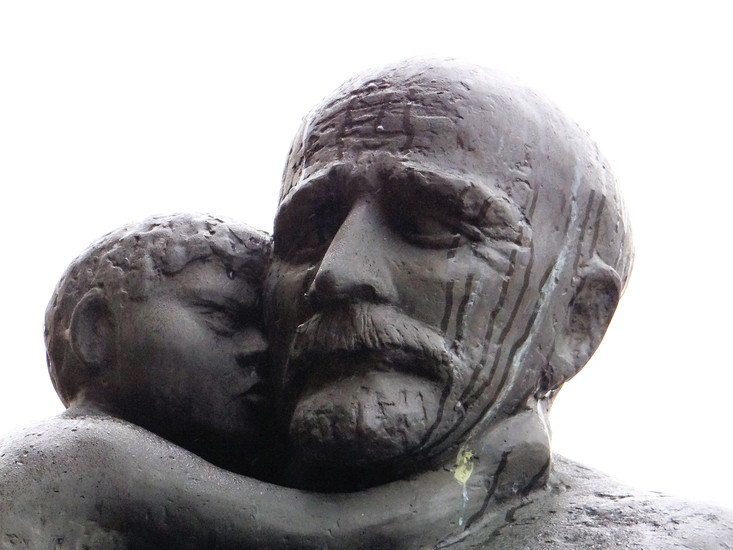
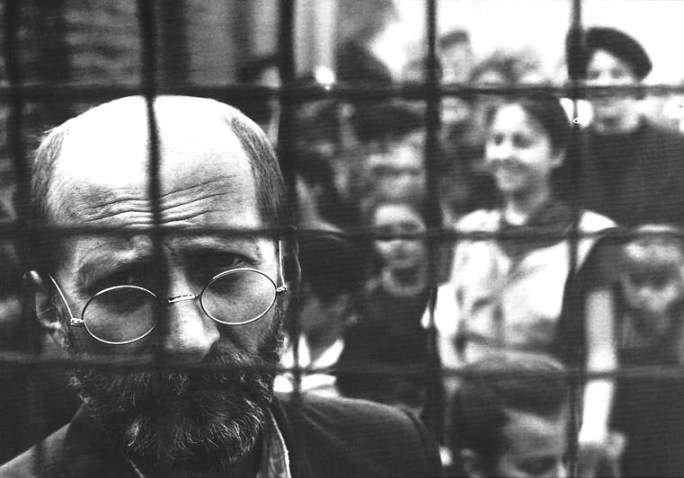
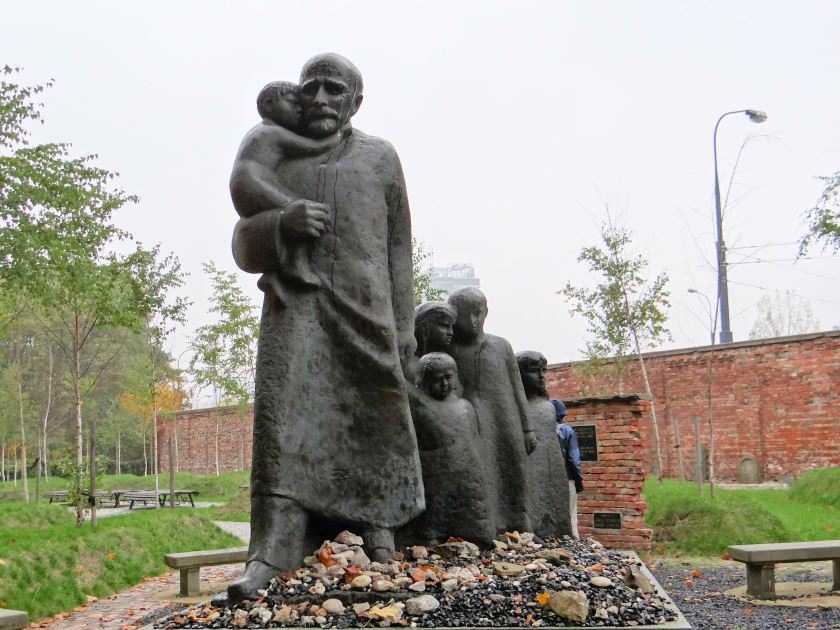
What can you say about a man offered freedom, who chose instead to die with the children left under his care.

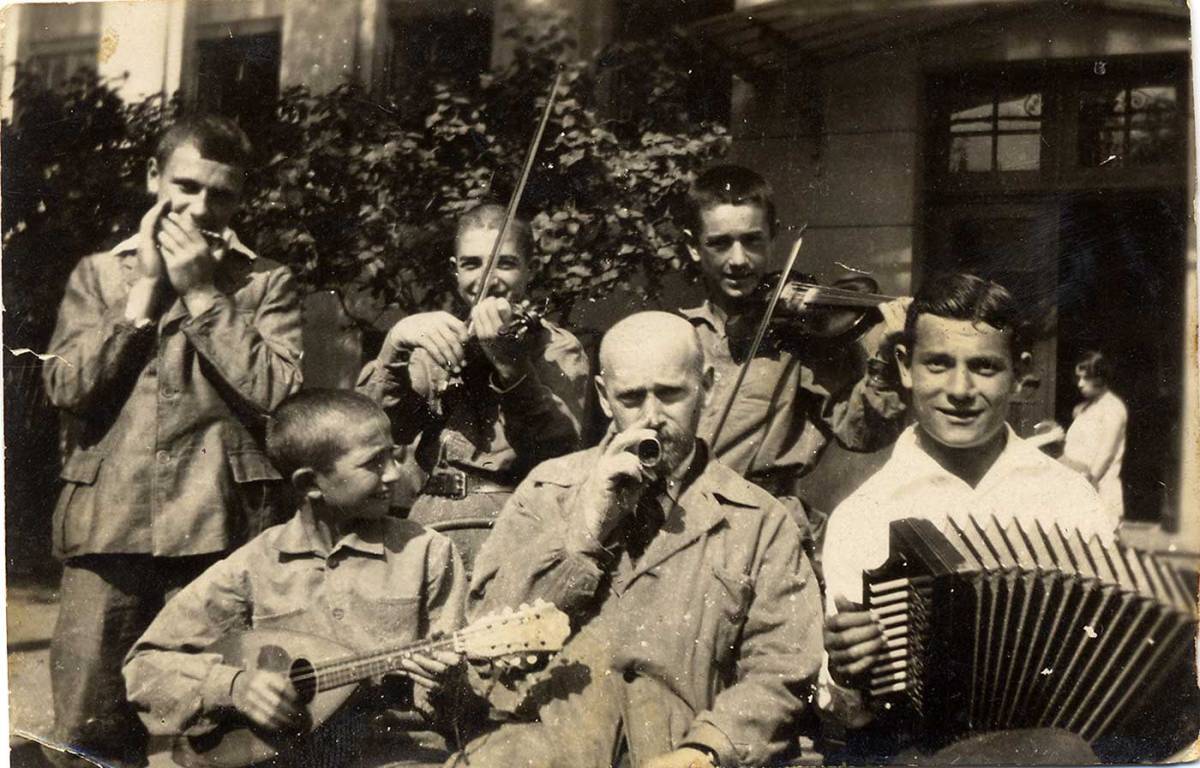
Janusz Korczak was a children’s author and pediatrician, a teacher and lifelong learner. A student of pedagogy, Korczak was particularly interested in the art and science of education, and how children learn.

Korczak10lat0001

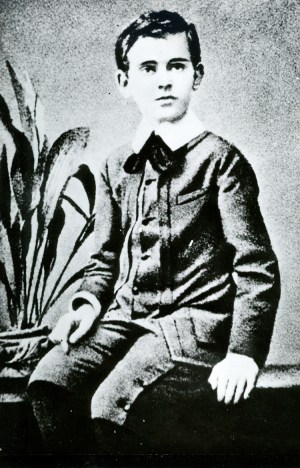
Born Henryk Goldszmit into the Warsaw family of Józef Goldszmit, in 1878 or ’79 (sources vary), Korczak was the pen name by which the physician wrote his children’s books.

Henryk was an exceptional student, of above-average intelligence. His father fell ill when the boy was only eleven or twelve and was admitted into a mental hospital where he died, six years later. As the family’s situation worsened, the boy would tutor other students, to help with household finances.

Goldszmit was a Polish Jew, though not particularly religious, who never believed in forcing religion on children.
He wrote his first book in 1896, a satirical tome on child-rearing, called Węzeł gordyjski (The Gordian Knot). He adopted the pen name Janusz Korczak two years later, writing for the Ignacy Jan Paderewski Literary Contest.

220px-Janusz_Korczak

Korczak wrote for several Polish language newspapers while studying medicine at the University of Warsaw, becoming a pediatrician in 1904. Always the writer, Korczak received literary recognition in 1905 with his book Child of the Drawing Room (Dziecko salonu), while serving as medical officer during the Russo-Japanese war.

He went to Berlin to study in 1907-’08 and worked at the Orphan’s Society in 1909, where he met Stefania “Stefa” Wilczyńska, an educator who would become his associate and close collaborator.

In the years before the Great War, Korczak ran an orphanage of his own design hiring Wilczyńska, as his assistant. There he formed a kind of quasi-Republic for Jewish orphans, complete with its own small parliament, court, and newspaper. The man was a born educator.

1307809-Janusz-Korczak-Quote-I-am-well-versed-in-reading-the-pages-of-war

In early modern European Royalty, 15th – 18th century, a “whipping boy” was the friend and constant companion to the boy prince or King, whose job it was to get his ass kicked, for the prince’s transgressions. The Lord was not the be struck by a social inferior. It was believed that, to watch his buddy get whipped for his own misdeeds would have the same instructional effect, as the beating itself.

The extent of the custom is open to debate and it may be a myth altogether, but one thing is certain.  Poland has been described as the “whipping boy of Europe”, for good reason.

JK2

The Polish nation, the sixth largest in all Europe, was sectioned and partitioned for over a century, by Austrian, Prussian, and Russian imperial powers. Korczak volunteered for military service in 1914, serving as military doctor during WW1 and the series of Polish border wars between 1919-’21.

The “Second Polish Republic” emerging from all this in 1922 was roughly two-thirds Polish, the rest a kaleidoscope of ethnic, linguistic and religious minorities.  Relations were anything but harmonious between ethnic Russians, Germans, Lipka Tatars and others, and most especially Poland’s Jewish minority, the largest in pre-WW2 Europe.

Polonia_Restituta_-_Commander's_Cross_pre-1939_w_rib
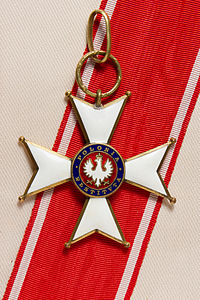
Silver Cross of the Polonia Restituta

Janusz Korczak returned to his life’s work in 1921 of providing for the children of this Jewish community, all the while writing no fewer than thirteen children’s books along with another seven on pedagogy, and other subjects.

In the inter-war years, Korczak put together a children’s newspaper, the Mały Przegląd (Little Review), as a weekly supplement to the daily Polish-Jewish newspaper, Nasz Przegląd (Our Review).

Korczak had his own radio program promoting the rights of children, to whom he was known as Pan Doktor (“Mr. Doctor”) or Stary Doktor (“Old Doctor”).

The Polish government awarded “Old Doctor” the Polonia Restituta in 1933, a state order bestowed on individuals for outstanding achievements in the fields of education, science and other civic accomplishments.

Yearly visits to Mandatory Palestine, the geopolitical entity partitioned from the Ottoman Empire in 1923 and future Jewish state of Israel, led to anti-Semitic crosscurrents in the Polish press, and gradual estrangement from non-Jewish orphanages.

165210

The second Republic’s brief period of independence came to an end in September 1939, with the Nazi invasion of Poland.  Korczak volunteered once again but was refused, due to his age.

Tales of Polish courage in the face of the Wehrmacht are magnificent bordering on reckless, replete with images of horse cavalry riding out to meet German tanks. Poland never had a chance against the Nazi war machine, particularly when the Soviet Union piled on, two weeks later.

As an independent nation-state the Sovereign Republic of Poland was dead, though Polish air crews went on to make the largest contribution to the Battle of Britain, among the United Kingdom’s thirteen non-British defenders and allies.  Polish Resistance made significant contributions to the Allied war effort, throughout WW2.

janusz-korczak

By the following year, Warsaw had become the largest Jewish ghetto in Nazi-occupied Europe.  The Jews of Poland were herded into the city, barely existing on meager rations while awaiting the death squads of the SS.  Old Doctor and his orphans were forced into the Ghetto, in 1939.

Korczak had around 200 under his care on this day in 1942, when soldiers of the Gross-Aktion (Great Action) Warsaw, came to “resettle” them, to the east.

ŚmierćMiasta
The Pianist, by Władysław Szpilman

The extermination camp at Treblinka, was waiting.

Polish-Jewish composer and musician Władysław Szpilman, one of precious few survivors of the Jewish ghetto, describes the scene in his 1946 memoir, The Pianist:

“He told the orphans they were going out into the country, so they ought to be cheerful. At last they would be able to exchange the horrible suffocating city walls for meadows of flowers, streams where they could bathe, woods full of berries and mushrooms. He told them to wear their best clothes, and so they came out into the yard, two by two, nicely dressed and in a happy mood. The little column was led by an SS man…”

Eyewitness Joshua Perle states that:  Janusz Korczak was marching, his head bent forward, holding the hand of a child… A few nurses were followed by two hundred children, dressed in clean and meticulously cared for clothes, as they were being carried to the altar.

251012_Janusz_Korczak_monument_at_Jewish_Cemetery_in_Warsaw_-_03

At the Umschlagplatz, the rail-side assembly area on the way to Treblinka, an SS officer recognized Korczak and called him aside.  The children’s author was offered sanctuary on the “Aryan side” but he refused, saying that he would stay with his children.  Stary Doktor was offered deportation to the Theresienstadt concentration camp instead. Again, he refused.

The man who declined freedom to die with the orphans in his care was last seen boarding the train to Treblinka on August 5. All 200 were murdered the following day.

800px-פולין_001
Janusz Korczak memorial stone, Treblinka

“Dr. Janusz Korczak’s children’s home is empty now. A few days ago we all stood at the window and watched the Germans surround the houses. Rows of children, holding each other by their little hands, began to walk out of the doorway. There were tiny tots of two or three years among them, while the oldest ones were perhaps thirteen. Each child carried the little bundle in his hand”.

Mary Berg, The Diary

July 18, 1969 When Hell was in Session

“After a period of time, pain becomes an all‑encompassing entity, a fiery, blinding devil that courses into every part of the brain until you would literally do anything to escape it. After three cycles, the rig became too much. It had driven me to the point where I would have happily committed suicide to escape it. I would have run my own mother down with a truck if the price was freedom from pain, but I could do nothing. I felt my heart pumping mightily to force the blood through my strangled limbs and hoped that it would give out.

I prayed to die”.

POW, Commander Jeremiah Denton

A lot can happen in eight years. Like when your preschooler comes home one day, and he’s ready for high school. Eight years after that your little bundle of joy is a college graduate and headed for medical school. It’ll take another eight years or so to become a doctor, depending on the specialty.

As a POW, Jeremiah Denton endured eight years in a brutally harsh captivity punctuated by daily abuse and frequent torture sessions, and went on to become a United states Senator.

His story deserves to be told.

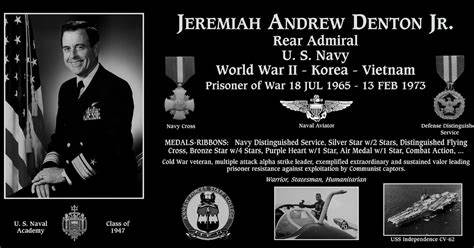
Jeremiah Denton had already compiled an impressive resume when he slid into the cockpit of the A-6A Intruder attack aircraft on July 18, 1965.

Entering the United States Naval Academy in 1943, Denton joined an “accelerated class” to graduate in June 1946, along with future President of the United Sates, Jimmy Carter. Then came Armed Forces Staff College, a Master of Arts in International Affairs from George Washington University and the Naval War College, where Denton’s thesis revolutionized naval tactics earning top honors, including the prestigious President’s Award, in 1964.

Get an education or you’ll get stuck…how was that again…Mister Kerry?

Then it was July 18, 1965. For Jeremiah Denton, that was the day when everything changed.

While serving as a naval aviator, Commander Denton was leading a 28-aircraft bombing mission over North Vietnam, along with Bombardier/Navigator LTJG Bill Tschudy. The pair was forced to bail out when one of their own Mark 82 bombs exploded prematurely, sending the A-6A Intruder spinning out of control.

The two were quickly captured and brought to a colonial prison the French used to call, La Maison Centrale. The Vietnamese called this place Hỏa Lò, the name translating as “fiery furnace”. Some Americans called it the Hell Hole but for most, mocking their captors was a technique that helped them survive. They called this place, the “Hanoi Hilton”.

“They beat you with fists and fan belts. They warmed you up and threatened you with death. Then they really got serious and gave you something called the rope trick.”

Jeremiah Denton

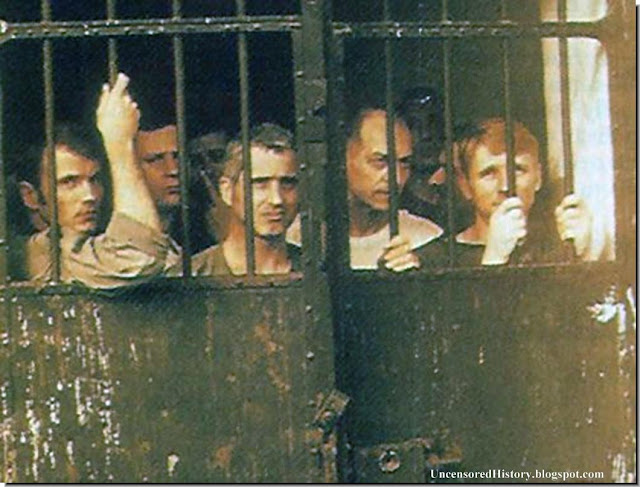
Over nearly eight years of captivity, Denton, Tschudy and others endured daily abuse up to and including outright torture. Torments unimaginable but for the most sadistic among us. Shackles on the floor meant for far smaller men caused Americans’ hands to turn black. Lice and cockroaches joined with rats and all manner of vermin to prey on men shackled to the floor, forced to live in their own excrement as they slowly, starved.

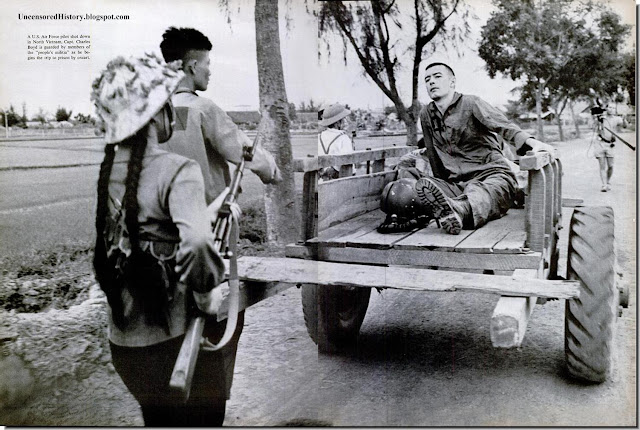
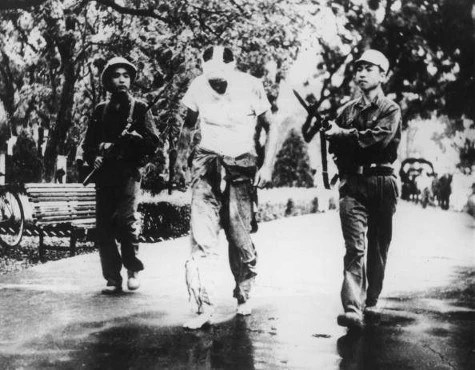
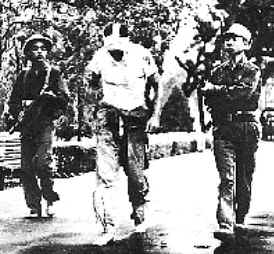
American POW is escorted by North Vietnamese militia

Denton endured eight years of these stinking, fetid cells including periods of solitary confinement, locked day and night in a sweltering box and shackled to the floor of an iron box, measuring 3-feet by nine..

Over 700 Americans were held captive by enemy forces over roughly ten years during the war in Vietnam. 114 did not survive. One of them went on to run unsuccessfully, for President. He can tell you better than I can, what it was like.

And then there were the torture sessions. Let Denton tell his own story about an episode with one guard, he and his fellow POWs called Mickey Mouse.

“Having beaten them in my last two torture sessions in 1966, I thought I could do it again. In an effort to deter the punishment, I wrote Mickey Mouse a note reminding him of my previous success, and said that if they were determined to torture me, they would have to torture me to death. That was a mistake. It was a pledge I couldn’t keep.

The next stage was rear cuffs and leg irons. A guard dragged me around the rough cement floor until the leg cuffs began tearing into my ankles. He jerked me left and right, lifted me by the rear handcuffs – the same mess all over again for hours. Then I was left on the floor for a day.

Mickey Mouse gave me one more chance to write the letter, and again I refused.

In the months since my last torture, the Vietnamese had developed a rig that was unknown to me, and it was the perfect answer to my ability to take pain until passing out. As soon as Mickey Mouse left the room, a guard slammed open the door, and held out a rope and a four-and-a-half-foot pole, pointed at one end.

Two more guards came into the room, and the three of them began tying my wrists and lower forearms together in front of me. They forced my elbows apart and forced my knees between them, and pushed the pole through the hole created by my elbows and knees. Then they tipped me back on my spine and propped my feet on an overturned stool so that my feet were raised about a foot off the ground.

In essence, I was in the fetal position, my thighs pressed against my chest so tightly that I could hardly breathe. My body was tipped at such an angle that most of my weight was on the tip of my spine. The pole was the key to the rig. If the rig was properly tied, I would pass out eventually and fall on my side; the end of the pole would hit the floor and slide out of the rig, easing the pressure on my arms and restoring circulation. The pain that came with the blood circulation would bring me back to consciousness; thus the prisoner couldn’t beat the rig by passing out.

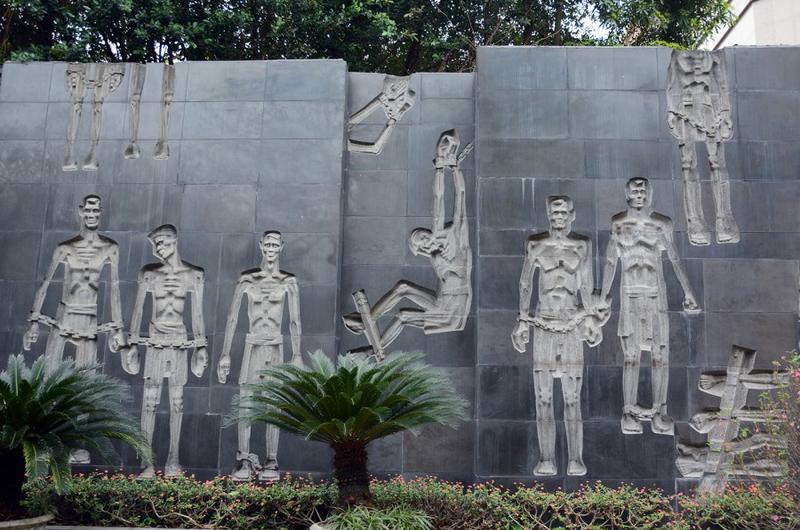
“A stone mural memorializes inmates who were tortured and killed at the former Hoa Lo prison, otherwise known as the Hanoi Hilton, which held Vietnamese revolutionaries and later American prisoners of war”. Hat tip KIM GAMEL/STARS AND STRIPES

“As a POW in the Hanoi Hilton, I could recall nothing from military survival training that explained the use of a meat hook suspended from the ceiling. It would hang above you in the torture room like a sadistic tease — you couldn’t drag your gaze from it. During a routine torture session with the hook, the Vietnamese tied a prisoner’s hands and feet, then bound his hands to his ankles — sometimes behind the back, sometimes in front. The ropes were tightened to the point that you couldn’t breathe. Then, bowed or bent in half, the prisoner was hoisted up onto the hook to hang by ropes. Guards would return at intervals to tighten them until all feeling was gone, and the prisoner’s limbs turned purple and swelled to twice their normal size. This would go on for hours, sometimes even days on end.”

ex-POW, Sam Johnson

Over time, camaraderie became the key to survival. POWs learned to communicate. During his first four months in solitary confinement, Lt. Cmdr. Bob Shumaker noticed one particular inmate, regularly dumping his slop bucket. In a note scribbled out on a scrap of toilet paper and slipped under the door, Shumaker wrote, “Welcome to the Hanoi Hilton. If you get note, scratch balls as you are coming back.” The soldier did as asked and even wrote his own note, identifying himself as Air Force Captain Ron Storz.

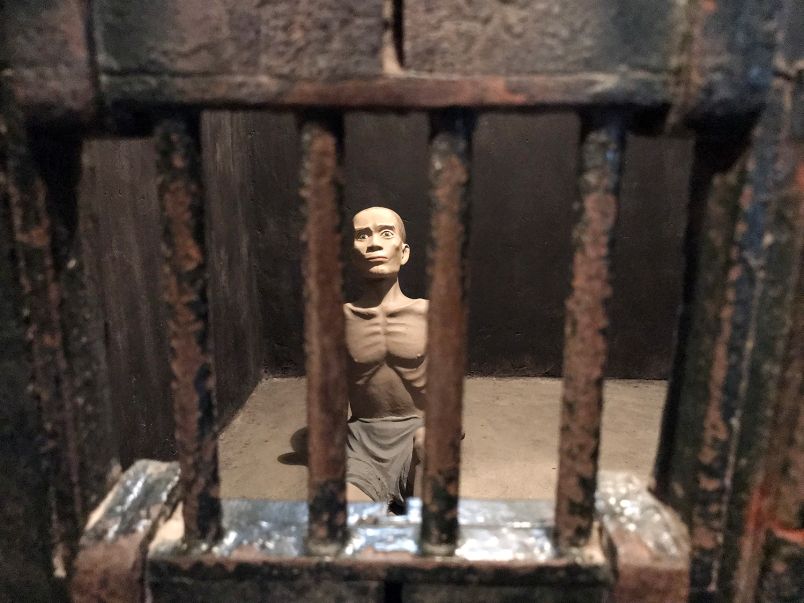
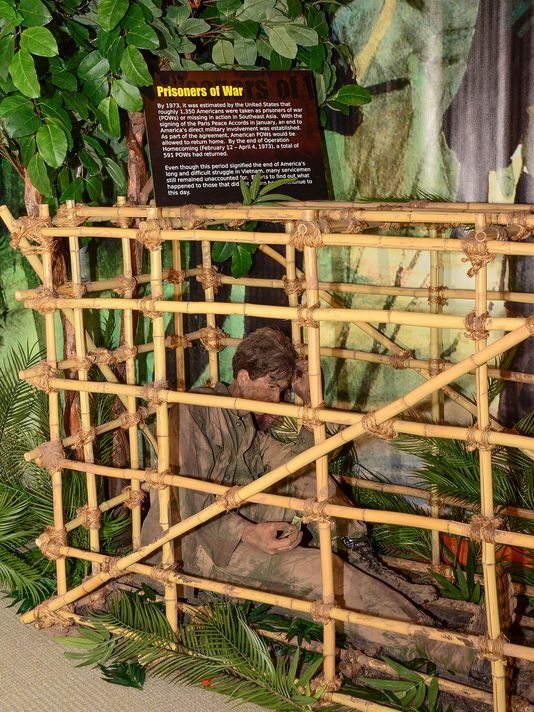
“A diorama shows an inmate in solitary confinement at the former Hoa Lo prison, otherwise known as the Hanoi Hilton, which held Vietnamese revolutionaries and later American prisoners of war”. Hat tip KIM GAMEL/STARS AND STRIPES

POWs developed a tap code to warn about particularly sadistic guards, what to expect during interrogations and a hundred other things. They even tapped out jokes. A kick on the wall meant laughter. Air Force pilot Ron Bliss once said the Hanoi Hilton “sounded like a den of runaway woodpeckers.”

In this place each other, was all they had. “I guess they thought if they had a Southern white boy taking care of a black man” Porter Halyburton once told the Washington Post, “it would be the worst place for both of us,” Fred Vann Cherry turned out to be tougher than either man realized, at the time. “It turned out to be the best thing that ever happened to me, said Halyburton”.

Halyburton looked after his injured cellmate, changing the dressings on his infected wounds, feeding him, bathing him and watching over him. “He said I saved his life, and he saved my life. . . . Taking care of my friend gave my life some meaning that it had not had before.

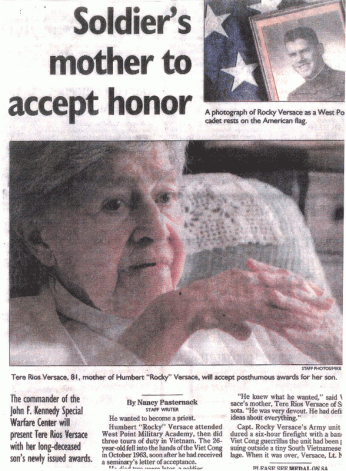
Humbert Roque “Rocky” Versace was a US Army Ranger who planned to become a priest of the Roman Catholic faith , who planned to come back to Vietnam to help the many orphans who had touched his heart. It was a bright and shining future, never meant to be.

Despite terrible injuries and incessant beatings Rocky would crawl away and escape, only to be beaten, yet again. So fluent was he in the tongue of his captors he would berate them and their communist ideology in their own language, humiliating his captors in front of villagers.

Rocky Versace was captured, but never defeated.

Even from solitary confinement Rocky would belt out words of inspiration to his fellow prisoners, sung to the tune of popular songs. Finally his guards had had enough. Rocky Versace was murdered in cold blood and later earned the Medal of Honor, for his defiance.

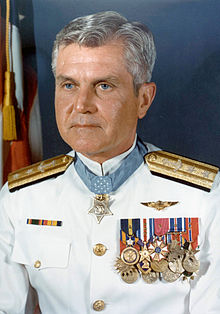
Vice Admiral James Stockdale

In July 1966, Denton and 50 fellow POWs were bound and paraded through the streets of Saigon, beaten and kicked by North Vietnamese civilians, along the way.

And yet some acts of defiance, astonishing even to contemplate. Summoned to appear to appear in a propaganda film to attest to his “good treatment”, Vice Admiral James Stockdale battered his own face with a stool and cut his hands and wrists, rather than appear in such a production. The man was a leader and an inspiration to his fellow captives, for which he too was awarded the Medal of honor.

“We had a war to fight and were committed to fighting it from lonely concrete boxes. Our very fiber and sinew were the only weapons at our disposal. Each man’s values from his own private sources provided the strength enabling him to maintain his sense of purpose and dedication. They placed unity above self. Self-indulgence was a luxury that could not be afforded.”

Vice Admiral James Stockdale

Jeremiah Denton was summoned to produce such a video. Feigning trouble with the bright lights, he blinked out the word T-O-R-T-U-R-E in Morse code.

The stunt earned him no end of abuse when his communist captors figured out what he had done but by that time, it was too late. Somehow the tape made it out. It was the first confirmation of long-standing rumors that American POWs were in fact, being tortured.

Civilian pilot Ernest Cary Brace was the longest serving POW, at 7 years, 10 months and 7 days. Brace’s wife Patricia assumed he was dead and remarried, a fact he learned at the processing station, following his release.

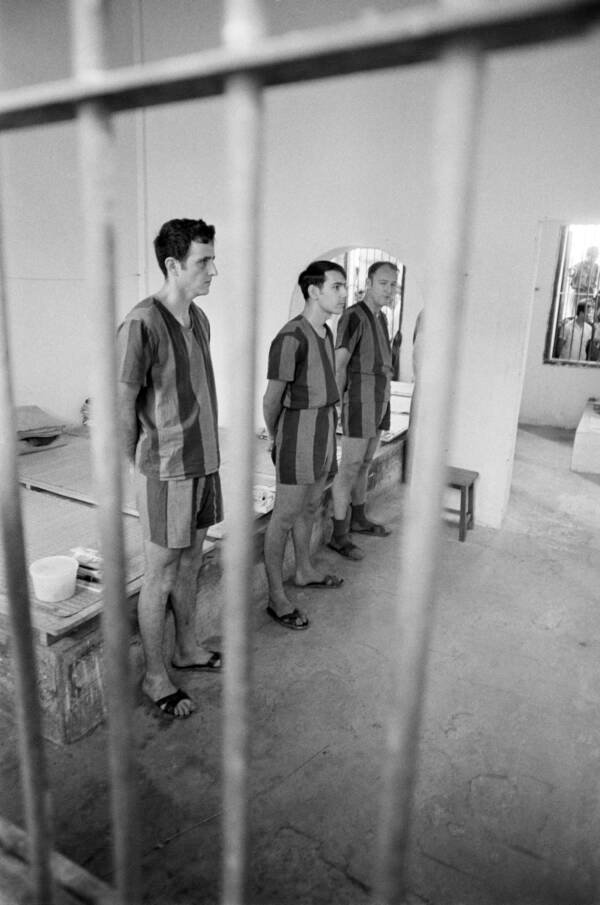
With the war winding to a close, Tschudy and Denton were released on February 12, 1973. The release was part of “Operation Homecoming”, the return of some 591 POWs following the Paris Peace Accords.

POWs in their cell awaiting release, March 29, 1973

How you or I would endure even a day of such a place is a question, without an answer. Many of them are gone now, those years of abuse surely robbing many of their later years. And yet endure they did.

Jeremiah Denton wrote a book about his experiences called When Hell was in Session, if you want to learn more. James Stockdale, John McCain, Denton and others went on to further service, to the nation. There are those who will tell you some of our POWs, Never came home. All of them, every one, have earned the right to be remembered.

May 6, 1951 Father Wears Combat Boots

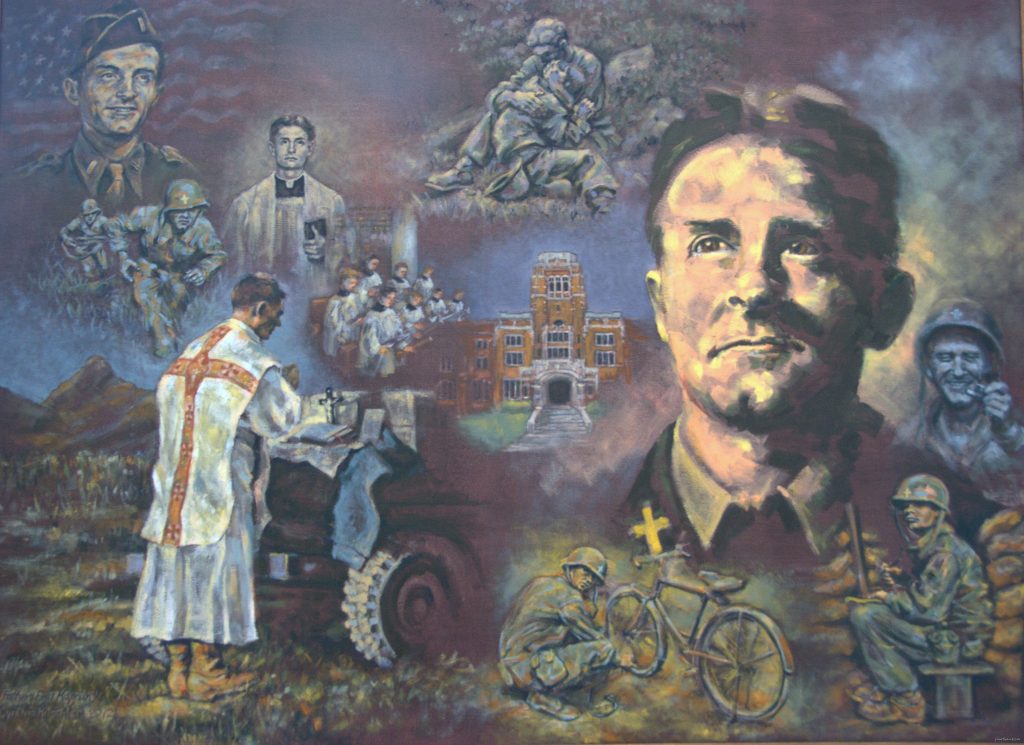
Father Kapaun once lost his Mass kit to enemy fire. He earned a Bronze Star by running through intense enemy fire to rescue a wounded soldier. This was no rear-echelon ministry.

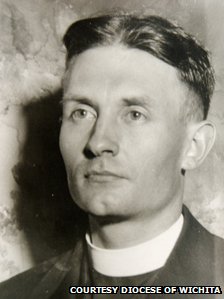
Emil Joseph Kapaun was the son of Czech immigrants, a farm kid who grew up in 1920s Kansas. Graduating from Pilsen High, class of 1930, he spent much of the 30s in theological seminary, becoming an ordained priest of the Roman Catholic faith on June 9, 1940.

download (64)

Kapaun served as military chaplain toward the end of WWII, before leaving the army in 1946 and rejoining, in 1948.

Father Kapaun was ordered to Korea a month after the North invaded the South, joining the 8th Cavalry Regiment of the 1st Cavalry Division, out of Fort Bliss.

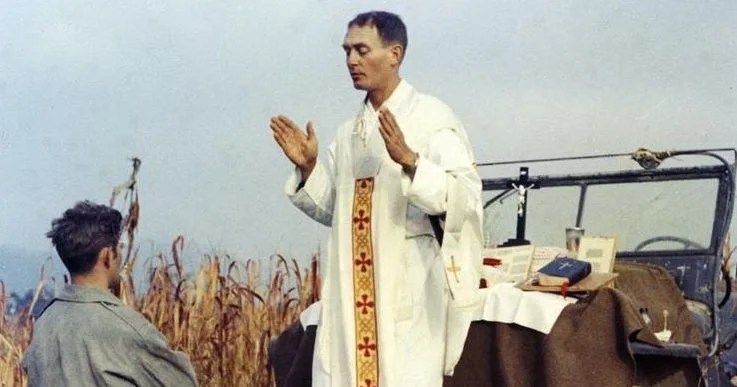
Kapaun’s unit entered combat at the Pusan perimeter, moving steadily northward through the summer and fall of 1950. He would minister to the dead and dying performing baptisms, hearing first confessions, offering Holy Communion and celebrating Mass from an improvised altar set up on the hood of a jeep.

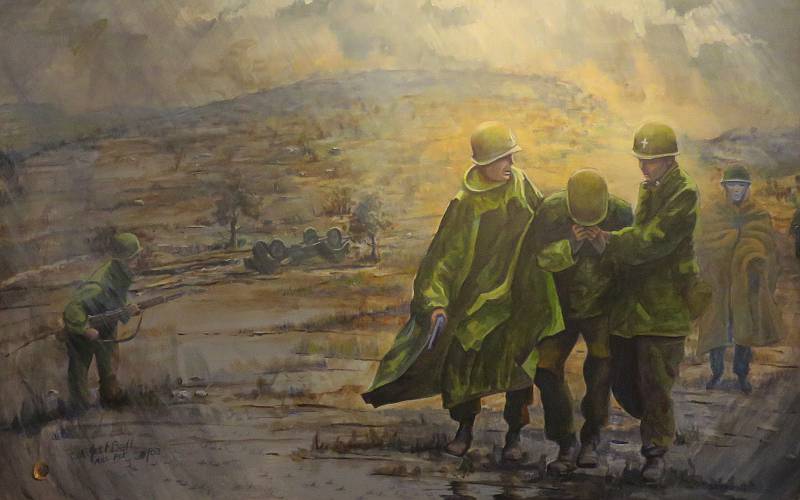
Father Kapaun once lost his Mass kit to enemy fire. He earned a Bronze Star in September that year, when he ran through intense enemy fire to rescue a wounded soldier. This was no rear-echelon ministry.

A single regiment was attacked by the 39th Chinese Corps on November 1, and completely overrun the following day. For the 8th Cav., the battle of Unsan was one of the most devastating defeats of the Korean War. Father Kapaun was ordered to evade, an order he defied. He was performing last rites for a dying soldier, when he was seized by Chinese communist forces.

Prisoners were force marched 87 miles to a Communist POW camp near Pyoktong, in North Korea. Conditions in the camp were gruesome. 1st Lt. Michael Dowe was among the prisoners, it’s through him that we know much of what happened there. Dowe later described Father Kapaun trading his watch for a blanket, only to cut it up to fashion socks for the feet of fellow prisoners.

download (63)

Father Kapaun would risk his life, sneaking into the fields around the prison compound to look for something to eat. He would always bring it back to the communal pot.

Chinese Communist guards would taunt him during daily indoctrination sessions, “Where is your god now?” Before and after these sessions he would move through the camp, ministering to Catholic and non-Catholic alike. Kapaun would slip in behind every work detail, cleaning latrines while other prisoners argued over who’d get the job. He’d wash the filthy laundry of those made weak and incontinent with dysentery.

Screen shot 2012-04-30 at 6.50.19 AM

Starving, suffering from a blood clot in his leg and a severe eye infection, Father Kapaun led Easter services in April, 1951. A short time later, he was incapacitated. Chinese guards carried him off to a “hospital” – a fetid, stinking part of the camp known to prisoners as the “Death House”, from which few ever returned. “If I don’t come back”, he said, “tell my Bishop that I died a happy death.”

In the end, Father Kapaun was too weak to lift the plate holding the meager ration the guards had left for him. United States Army records report that Fr. Kapaun died of pneumonia on May 6, 1951.

His fellow prisoners will tell you that he died on the 23rd, of malnutrition and starvation. He was only 35.

Scores of men credit their survival to Chaplain Kapaun. In 2013, President Barack Obama presented Kapaun’s family with the Medal of Honor, posthumously, for his heroism at Unsan. The New York Times reported that April, “The chaplain “calmly walked through withering enemy fire” and hand-to-hand combat to provide medical aid, comforting words or the last rites of the Roman Catholic Church to the wounded, the citation said. When he saw a Chinese soldier about to execute a wounded comrade, Sgt. First Class Herbert A. Miller, he rushed to push the gun away. Mr. Miller, now 88, was at the White House for the ceremony with other veterans, former prisoners of war and members of the Kapaun family”.

Cmoh_army

Pope John Paul II named Father Kapaun a “Servant of God” in 1993, the first step toward Roman Catholic Sainthood. On November 9, 2015, the Catholic Diocese of Wichita submitted a 1,066 page report on the life of Chaplain Kapaun, to the Roman Curia at the Vatican. A team of six historians reviewed the case for beatification and delivered a unanimous decision on June 21, 2016, approving the petition.

In January 2022  it was announced, that the Vatican is considering a declaration of martyrdom for the Catholic faith. If granted it’s an important step on Father Emil Kapaun’s continuing road, to canonization.

March 30, 1945 A Great Act of Defiance

“First they came for the socialists, and I did not speak out—because I was not a socialist. Then they came for the trade unionists, and I did not speak out— because I was not a trade unionist. Then they came for the Jews, and I did not speak out—because I was not a Jew. Then they came for me—and there was no one left to speak for me”. – Martin Niemöller

We shall go on to the end. We shall fight in France, we shall fight on the seas and oceans, we shall fight with growing confidence and growing strength in the air, we shall defend our island, whatever the cost may be. We shall fight on the beaches, we shall fight on the landing grounds, we shall fight in the fields and in the streets, we shall fight in the hills; we shall never surrender, and if, which I do not for a moment believe, this island or a large part of it were subjugated and starving, then our Empire beyond the seas, armed and guarded by the British Fleet, would carry on the struggle, until, in God’s good time, the New World, with all its power and might, steps forth to the rescue and the liberation of the old”.

Winston Churchill
last_great_act_of_defiance1

Before the age of the internet,  office jokes and bits of folk wisdom were passed around and copied, and copied again.  “The Last great of Defiance“ was one of those and shall live for all time, as my personal favorite. 

The image speaks for itself.  I had one on the wall, for years. This is one of those stories.

The last great effort of German arms burst out of the frozen Ardennes forest on December 16, 1944, aiming for the vital port at Antwerp.

Unternehmen Wacht am Rhein“, (“Operation Watch on the Rhine”) was a tactical surprise for the Wehrmacht, as allied forces were driven back through the densely forested regions of France, Belgium and Luxembourg. Wartime news maps showed a great inward “bulge” in the lines, and the name stuck. The Battle of the Bulge was the largest and bloodiest battle fought by American forces in World War 2, fought in the harshest winter conditions in recorded history and involving some 610,000 GIs.

malmed1

Prisoners were swept up by the thousands, to face an uncertain future.  In Malmedy, Belgium, seventy-five captured Americans were marched into an open field and machine gunned by members of the 1st SS Panzer Division (Leibstandarte Adolf Hitler), a part of 6th Panzer Army.

On December 16, the all-black 333rd Field Artillery Battalion of the racially segregated US Army put up an heroic defense outside the town of Wereth, Belgium. Using 155mm guns to delay the German advance they were desperately outnumbered. The 333rd was overrun the following day, groups of men scattering to escape as best they could. Eleven soldiers made their way to the home of Mathias Langer, the Mayor of Wereth.

To shelter allied troops under German occupation was to risk summary execution. Despite the obvious risk to their own lives, Matthias and his wife Maria took these men in and attempted to hide them, in their home. When German troops arrived, the eleven surrendered rather than risk the lives of their benefactors.

the-wereth-eleven-578359l
Movie poster for the 2011 film, “The Wereth Eleven”

The prisoners were marched out of sight and murdered by German troops. Every one of them. Lost in the confusion of the Bulge, the bodies of the Wereth 11 lay hidden under the snow, until the Spring melt. For the next fifty years their story was lost, to history.

Nazi atrocities were not limited to Allied troops.  By some accounts, more civilians were killed during the Battle of the Bulge than anytime. in the last four years.  When the fighting was over, more than 115 bodies were found in the towns of Ster and Parfondruy, alone.

For Master Sargent Roderick “Roddie” Edmonds, the war ended on December 19, swept up with hundreds of American troops and taken prisoner.  These were the lucky ones, escaping those first white-hot moments of capture to be sent to a German prisoner-of-war camp.  Edmonds was later transferred to another camp near Ziegenhain, Germany.  At 24, M/Sgt Roddie Edmonds was now the senior non-commissioned officer at Stalag IX-A, responsible for 1,275 American POWs.

The Wehrmacht had harsh anti-Jewish policies and kept Jewish POWs in strict segregation.  In the East, Russian Jews who became POWs were sent directly to extermination camps.  In the west the future was more uncertain, for Jewish POWs.  Many of them were worked to death, in slave labor camps.

Home_Slider_Image-1024x666

On January 27, the first day at Stalag IX-A, commandant Siegmann ordered Edmonds: All American Jews were to identify themselves at the following day’s assembly.  The word went out to all five barracks:  “We’re not doing that.  We’re all turning out“.

The following morning, 1,275 POWs presented themselves.  Every. Single. Man.

Siegmann was perplexed.  “They can’t all be Jews!”  As senior NCO, Edmonds spoke for the group.  “We’re all Jews here“.  The Nazi commandant was apoplectic, pressing a Luger into Edmonds’ forehead.  This is your last chance.

Imagine yourself in this situation and ponder, what would you do?

Edmonds gave his name, rank and serial number. :  ‘If you are going to shoot’, he said, ‘ you are going to have to shoot all of us because we know who you are and you’ll be tried for war crimes when we win this war.’”  Siegmann was incandescent, white with rage, but the moment had passed.  He was beaten.

The 1,275 American POWs held at Stalag IX-A were liberated on March 30, 1945, their number including some 200 Jews.

Years later the Army called once again and Roddie Edmonds was recruited, for the war in Korea.  He never told his family a word about what happened, at Stalag IX-A.

Chris Edmonds is the Pastor at Piney Grove Baptist Church in Maryville, Tennessee. Following his father’s death in 1985, Chris’ mother gave him his father’s  war diary, where he found a brief mention of this story.  Chris scoured the news for more information, around the time Richard Nixon was looking for his post-Presidential home.  As it happened, Nixon bought his posh, upper-east side home from Lester Tanner, a prominent New York Lawyer who mentioned in passing, he owed his life to Roddie Edmonds.

So it is, this story came to light.  In 2015, Edmonds was honored as “Righteous among the Nations”, the first American soldier, so honored.  It’s the highest honor bestowed by the state of Israel, on non-Jews who risked their lives to save Jews from the Nazi death machine.  President Barack Obama recognized Edmonds’ heroism in a 2016 speech before the Israeli embassy.  In 2017 Tennessee Senator Marsha Blackburn led a bipartisan effort to bestow the Congressional Gold Medal. 

Pastor Edmonds and the Jewish veterans saved by M/Sgt Edmonds continue to push for the Knoxville, Tennessee native to receive the Medal of Honor. Pastor Edmonds says he always looked up to his father, the man had always been, his hero.  “I just didn’t know he had a cape in his closet“.

Chris Edmonds_1455424082776_247114_ver1.0.JPG

Pastor Chris Edmonds

March 24, 1944 The Great Escape

“Colonel Von Luger, it is the sworn duty of all officers to try to escape. If they cannot escape, then it is their sworn duty to cause the enemy to use an inordinate number of troops to guard them, and their sworn duty to harass the enemy to the best of their ability”. Group Captain Ramsey (played by James Donald), senior British officer at the prisoner of war camp in the 1963 film The Great Escape, addressing the German commandant.

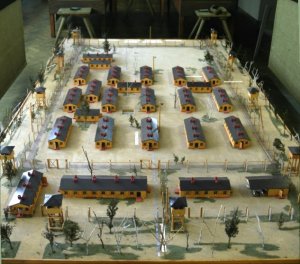
Stalag Luft III in the province of Lower Silesia was a German POW camp, built to house captured Allied airmen.  The first “Kriegsgefangene” (POWs), arrived on March 21, 1942. The facility would grow to include 10,949 “kriegies”, comprising some 2,500 Royal Air force officers, 7,500 US Army Air officers, and about 900 from other Allied air forces.

Barracks were built on pilings to discourage tunneling, creating 24” of open space beneath the buildings. Seismic listening devices were placed around the camp’s perimeter. In the German mind, the place was the next best thing, to airtight.

Model_Stalag_Luft_III
Model of the set used to film the movie The Great Escape

Kriegies didn’t see it that way, three of whom concocted a gymnastic vaulting horse out of wood from Red Cross packages.

A Trojan horse was more like it. Every day, the horse would be lugged out to the perimeter. Above ground, prisoners’ gymnastic exercises masked the sound, while underground, kriegies dug with bowls into the sand, using the horse itself to hide diggers, excavated soil and tools alike. Iron rods were used to poke air holes to the surface.  There was no shoring of the tunnel, except at the entrance.

Every evening for three months, plywood was placed back over the hole, and covered with the gray-brown dust of the prison yard.

On October 19, 1943, the three British officers made their escape.  Lieutenant Michael Codner and Flight Lieutenant Eric Williams reached the port of Stettin in the West Pomeranian capital of Poland, where they stowed away on a Danish ship. Flight Lieutenant Oliver Philpot boarded a train to Danzig, and stowed away on a ship bound for neutral Sweden. Eventually, all three made it back to England.

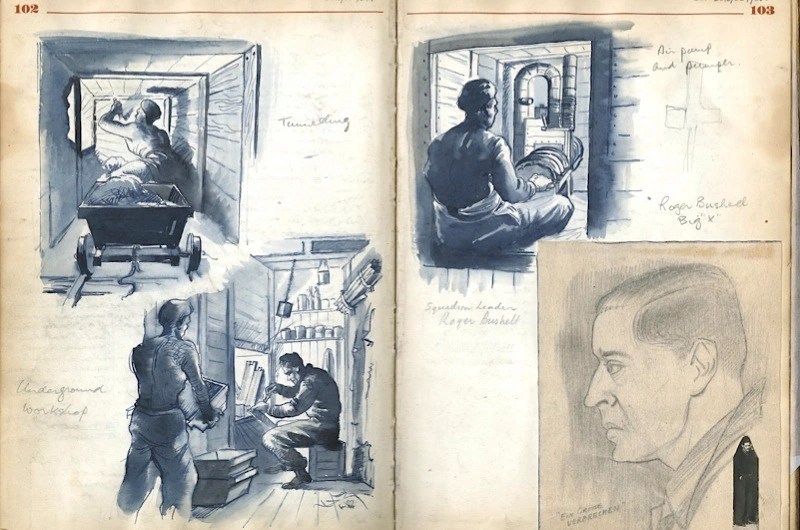
RAF Squadron Leader Roger Bushell was shot down and forced to crash land on his first engagement in May 1940, but not before taking two Messerschmitt Bf 110 fighters with him. Taken to the Dulag Luft near Frankfurt, Bushell formed an escape committee along with Fleet Air Arm pilot Jimmy Buckley, and Wing Commander Harry Day.

Harry

For POWs of officer rank, escape was the first duty.  Bushell escaped twice and almost made it, but each time his luck deserted him. By October, Roger Bushell found himself in the north compound of Stalag Luft III, where British officers were held.

By the following spring, Bushell had concocted the most audacious escape plot in WWII history. “Everyone here in this room is living on borrowed time”, he said. “By rights we should all be dead! The only reason that God allowed us this extra ration of life is so we can make life hell for the Hun… In North Compound we are concentrating our efforts on completing and escaping through one master tunnel. No private-enterprise tunnels allowed. Three bloody deep, bloody long tunnels will be dug – Tom, Dick and Harry. One will succeed!”

The effort was unprecedented. Previous escape attempts had never involved more than twenty. Bushell, soon to be known by the code name “Big X” was proposing to get out with 200.

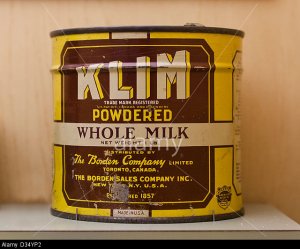
Vintage KLIM Powdered Whole Milk tin can - circa 1940

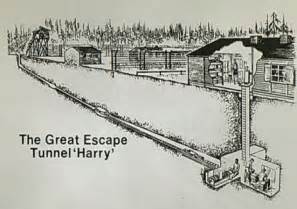
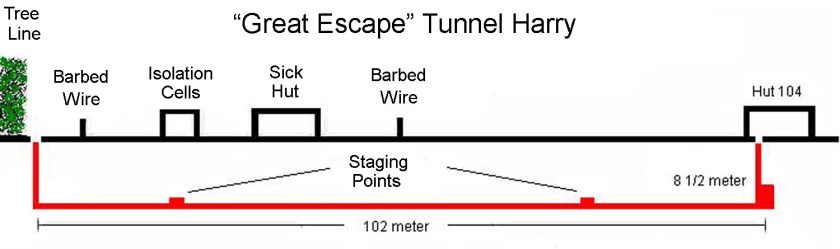
Civilian clothes had to be fashioned for every man.  Identification and travel documents forged. “Tom” began in a darkened hallway corner. “Harry’s entrance was hidden under a stove, “Dick”‘s entrance was concealed in a drainage sump.

The Red Cross distributed high calorie, dehydrated whole-milk powder called “Klim” (“Spell it backwards”) throughout German POW camps. Klim tins were fashioned into tools, candle holders and vent stacks.  Fat was skimmed off soups and molded into candles, using threads from old clothing for wicks.

Six hundred prisoners were involved in the construction.  200 with sacks sewn under greatcoats made 25,000 trips into the prison yard, disposing of soil as Tom, Dick and Harry were excavated.  30′ down and only 2 ft. square, the three tunnels extended outward for a football field and more.

These “penguins” were running out of places to put all that soil, around the time the camp was expanded to include “Dick’s” originally planned exit point.  From that time forward, “Dick” was refilled from the other two.  “Tom” was discovered in September 1943, the 98th tunnel in the camp to be found out.

The escape was planned for the good weather of summer, but a Gestapo visit changed the timetable.  “Harry” was ready by March.   The “Great Escape” was scheduled for the next moonless night.  73 years ago – March 24,  1944.

Tunnel_Harry

Contrary to the Hollywood movie, no Americans were involved in the escape.  At that point none were left in camp.

The escape was doomed, almost from the start.  First the door was frozen shut, then a partial collapse had to be repaired.  The exit came up short of the tree line, further slowing the escape.  It was over when guards spotted #77 coming out of the ground.

German authorities were apoplectic on learning the scope of the project.  90 complete bunk beds had disappeared, along with 635 mattresses.  52 twenty-man tables were missing, as were 4,000 bed boards and an endless list of other objects. For the rest of the war, each bed was issued with only nine boards, and those were counted, regularly.

Gestapo members executed German workers who had not reported the disappearance of electrical wire.

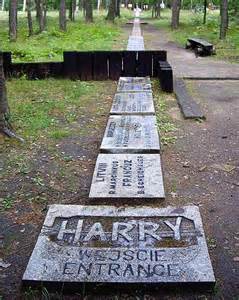
Harry Entrance

In the end, only three of the 76 made it to freedom:  two Norwegian and one Dutch pilot.  Hitler personally ordered the execution of the other 73, 50 of which were carried out.  

General Arthur Nebe is believed to have personally selected the 50 for execution.  He was later involved with the July 20 plot to assassinate Adolf Hitler, and executed on March 21, 1945.  Roger “Big X” Bushell and his partner Bernard Scheidhauer were caught while waiting for a train at the Saarbrücken railway station.  They were murdered by members of the Gestapo on March 29, who were themselves tried and executed for war crimes, after the war.

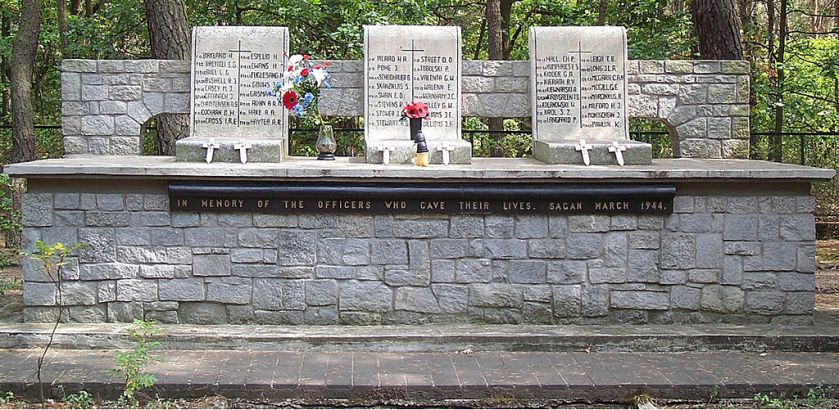
New camp Kommandant Oberst Franz Braune was horrified that so many escapees had been shot. Braune allowed those kriegies who remained to build a memorial, to which he personally contributed. Stalag Luft III is gone today, but that stone memorial to “The Fifty”, still stands.

The50Memorial

Dick Churchill was an HP.52 bomber pilot and RAF Squadron Leader.  One of the 76 who escaped, Churchill was recaptured three days later, hiding in a hay loft.  In a 2014 interview, he said he was fairly certain he’d been passed over for execution, because his captors thought he might be related to Prime Minister Winston Churchill.  Today, Dick Churchill, age 97, is the only man among those 76, still left alive.

October 23, 1943 The Last Great Act of Defiance

You may take my freedom, she might have said. You may take my life but you will not take away, my free will.

Before the age of the internet, sight gags were copied and re-copied and passed around from hand to hand, much the same as we text each other amusing memes, today. One stands out after all these years, as worth remembering. A “Last Great Act of Defiance”, in the face of certain destruction.

I considered whether such an image trivialized the death of a human being, because that’s what this story is about. But no, silly as it is this cartoon works just fine, as a symbol. A symbol of a small woman, naked, defenseless and yet defiant, in the face of the Nazi death camp. A ballerina barely 100 pounds soaking wet by the look of her photographs and yet, a woman who, in her last moments of life managed to take one of the Nazi sons of bitches, with her.

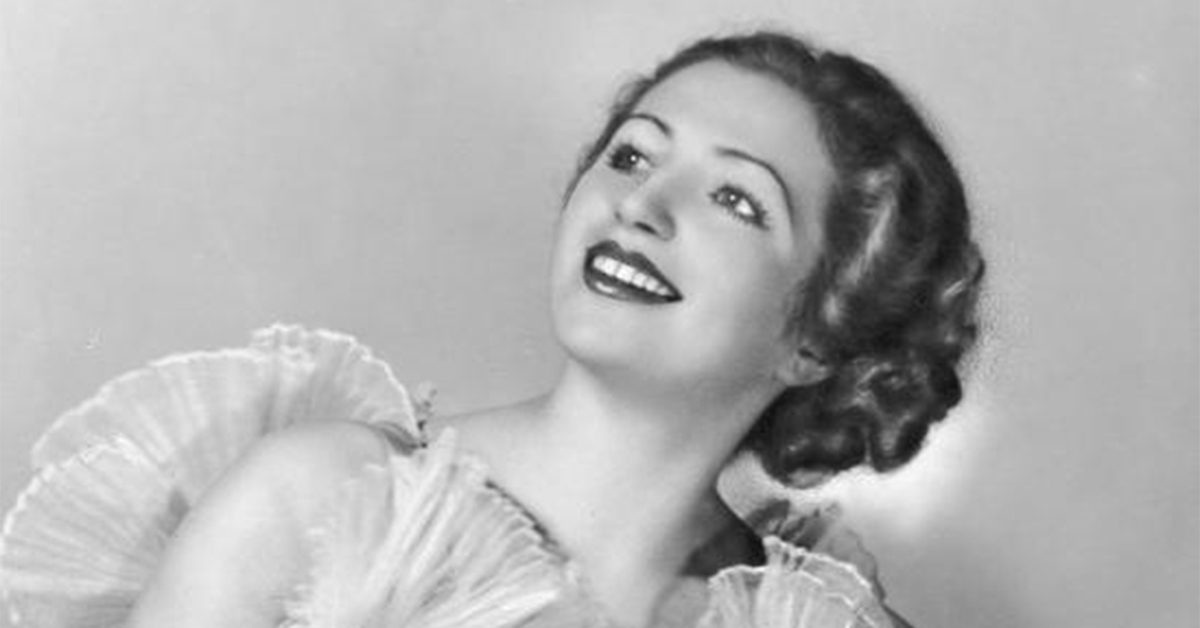
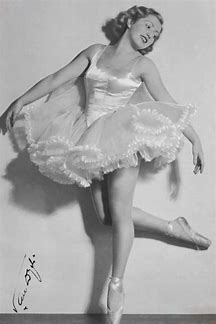
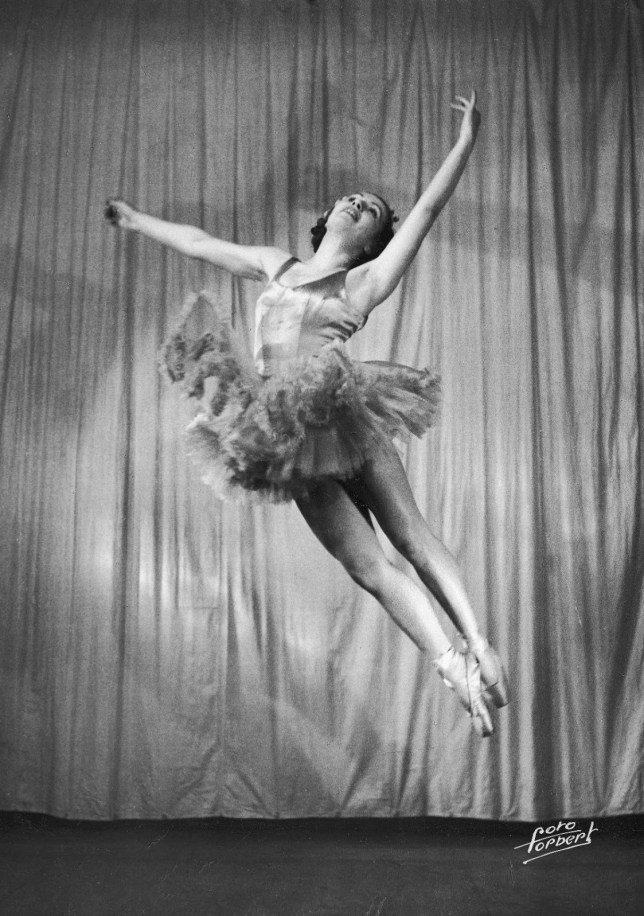
Franceska Mann

They say if you do what you love, you’ll never work a day in your life. Franceska Mann was born to dance. Any mother or father of such a child would smile at the thought of what she must have been like, growing up. By the time Franceska had come of age she had mastered classical and several forms of popular dance.

Mann studied dance at Irena Prusicka’s School of Gymnastics and Artistic Dance, one of three major studios, in pre-war Warsaw. She competed in 1939 in an international dance competition in Brussels placing fourth, out of 125 ballerinas. She was the pride of Poland considered by many to be the most beautiful and most talented, of her generation.

When the Nazi war machine invaded Poland in 1939, she was performing at the Melody Nightclub in Warsaw

For a time, Franceska’s physical features allowed her passage on the “Aryan” side of the city while up to 460,000 fellow Jews and not a few Romani people were rounded up in the “Residential District”, the infamous Warsaw Ghetto.

The Warsaw Ghetto and others like it were little more than waiting rooms, for the death camps. Even before ultimate deportation conditions, were grisly. The daily food ration for Jews in the ghetto was a scant 184 calories compared with 699 for Polish gentiles and 2,613, for Germans. Disease and starvation quickly set in to begin a process the waiting “showers”, were built to complete.

The human being is a funny critter. We’re capable of believing anything, we want to believe. For two years under these conditions, residents clung to the desperate hope that the “resettlement” promised by Nazi authorities, meant something better. By the end of 1942 it was clear nearly to all that the transports out of this place, meant only death.

Irena Sendler

Books have been written about the ghetto uprising and the desperate attempts of Irena Sendler and others, to save these people. Using her work as nurse for cover this “Angel of the Ghetto” would smuggle children out of that place with the help of a small dog trained to bark, at Nazi soldiers.

Irena would be ratted out and savagely tortured by the Gestapo but never did give up the names of countless children written on slips of paper and buried for safekeeping, in her garden.

Weapons’ and ammunition were smuggled through the sewers of Warsaw throughout much, of 1942. Nazi soldiers entered the ghetto on January 18, 1943 bent on yet another roundup. Some 600 were summarily shot and 5,000 removed from their homes when all hell broke loose from Jewish underground members, and resistance fighters.

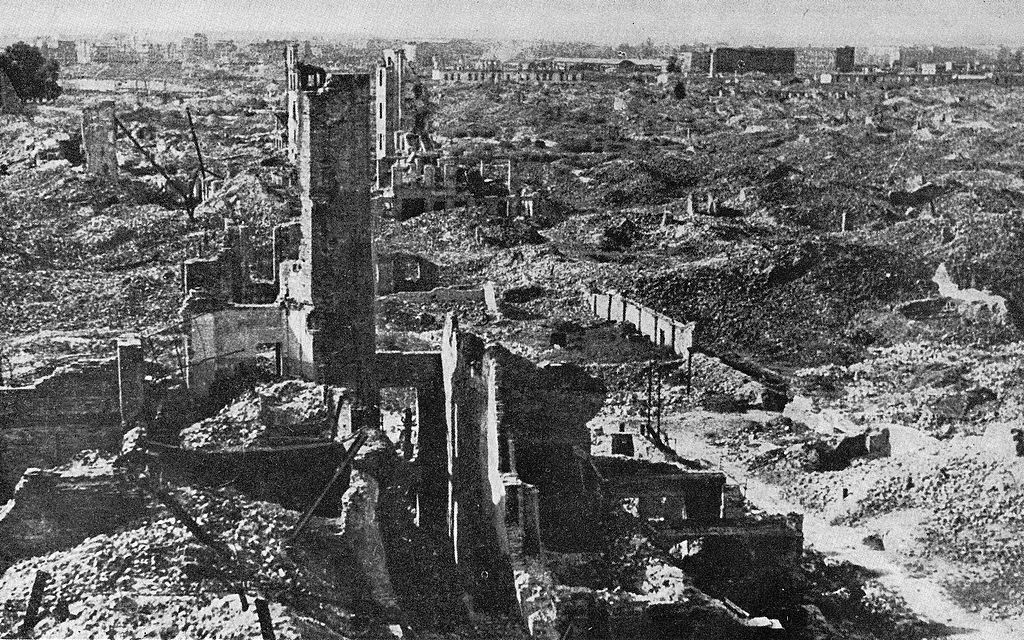
Armed only with handguns and Molotov cocktails, resistance fighters kept the Nazis at bay for nearly four months but the end, was never in doubt. 2,000 Waffen-SS soldiers began the final assault on April 19 systematically burning or blowing up ghetto buildings, block by block. Some 56,065 people were murdered on the spot or rounded up, for extermination. Major resistance came to an end on April 28. The May 16 demolition of the Great Synagogue of Warsaw little more, than symbolic.

The “Jewish Residential District” of Warsaw, after the uprising.

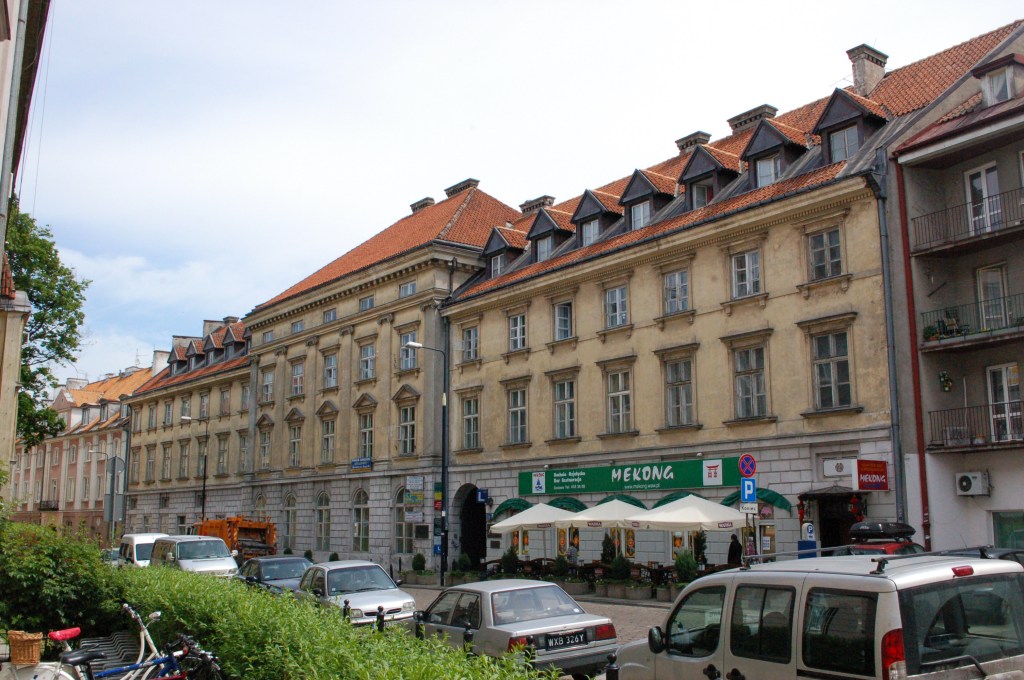
Today, the Nożyk Synagogue is the only pre-war Jewish house of worship left standing, in the Polish capital. The building was used as a horse stable for the German Wehrmacht, during the war.

At this point, the Nazi government turned its attention to rooting out those left in hiding, outside the ghetto. Since 1941, Jewish and Polish diplomats worked with certain South American nations to send documents into the Warsaw ghetto. Such documents it was believed, may help Jews and others “prove” to be nationals of neutral nations and thus eligible, for safe transfer.

Passports both real and forged flooded into the region often, through the Hotel Polski. Many if not all such documents were intercepted by the Gestapo. With the help of Jewish collaborators, thousands left in hiding were lured to the Hotel Polski in hopes, of escape. Nations from Paraguay, Honduras and El Salvador to Peru and Chile beckoned, or so it was imagined. Genuine passports of Jews no longer alive sold on the black market for the equivalent, of up to a million 2021 dollars.

As many as 3,500 came out of hiding and moved to the Hotel Polski. The Polish Underground warned Jews it was probably a trap but we all believe what we want to believe, don’t we? Franceska Mann most likely received her own passport, in this manner.

Some 1,700 were rounded up at this place arriving on the trains to Auschwitz-Birkenau, on October 23. You can find a dozen or more versions of what happened next since it all comes out, of the death camp rumor mill. What is certain is that women were separated from men and made to disrobe for “delousing”. It was all prior to final deportation to Switzerland, they were told.

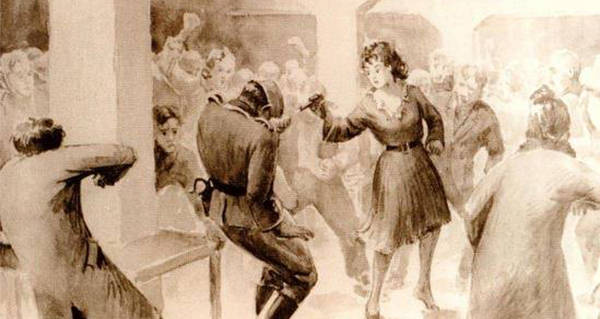
Fit, young and attractive as she was Franceska Mann drew the attention of two of her guards, Josef Schillinger and Wilhelm Emmerich. Using her considerable gifts she drew them in close and, with the speed of an athlete knocked Schillinger in the face with her shoe, drew the man’s gun and shot him twice in the belly. Emmerich was shot once, in the leg. Pandemonium broke out near the showers as hundreds of women in all states of dress and undress, turned on their tormenters. One SS man had his nose bitten off. Another was scalped by the desperate, angry mob.

This fanciful artist’s rendition is anything but accurate but, we get the picture.

Reinforcements arrived within moments. The gas was turned on killing those trapped, inside the chamber. Women in the changing area were machine gunned while those few caught outside were summarily, murdered.

On this day in 1943 it was all over, in minutes. Josef Schillinger died a painful death from those two gunshots. Emmerich recovered from his wounds.

Dark rumors may be found on the internet as to whether Mann herself was a Nazi collaborator. Witnesses who were there tell a different story, their stories recorded in transcripts, of the Nuremberg trials. The tales told by foreign professors born decades after the fact may be accepted or dismissed as you wish but one thing is left to contemplate. How would the chattering classes have behaved had they themselves lived in such a time, and such a place.

The Nazi extermination machine ground on for nearly two more years but one thing was certain. One terrified, desperate ballerina disarmed and about to die had rendered the beasts short, one of their own number.

September 26, 1965 Rocky

At the end of his tour this special forces warrior intended to become a Priest of the Roman Catholic faith, and return to Vietnam to help the nation’s orphaned children.  He’d already received his acceptance letter. It wasn’t meant to be.

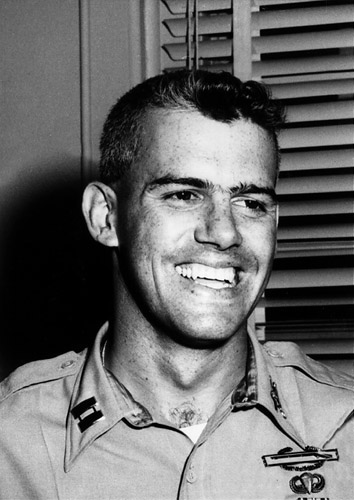
Humbert Roque Versace was born in Honolulu on July 2, 1937, the first son of Colonel Humbert Joseph Versace.  Writer Marie Teresa “Tere” Rios was his mother, author of The Fifteenth Pelican.  If you don’t recall the book, perhaps you remember the 1960s TV series, based on the story.  It was called The Flying Nun.

Versaces
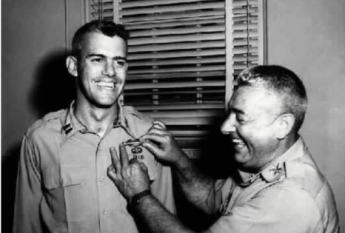
“Captain Humbert Roque “Rocky” Versace receives his 90-day combat infantry badge from his father, Colonel Humbert Joseph Versace”. H/T http://www.arlingtoncemetery.net, for this image

Like his father before him, Humbert, (“Rocky”), joined the armed services out of high school, graduating from the United States Military Academy at West Point, in 1959.

Rocky earned his Ranger tab and Parachutist badge the same year, later serving as tank commander with the 1st Armored Cavalry regiment in South Korea, then with the 3d US Infantry.  The “Old Guard”.

Versace attended the Military Assistance Institute, the Intelligence course at Fort Holabird Maryland, and the USACS Vietnamese language Course at the Presidio of Monterey, beginning his first tour of duty in Vietnam on May 12, 1962.

versacekids070302

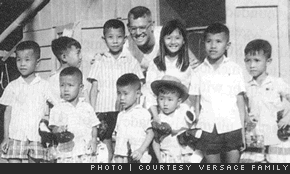
In his spare time, this Green Beret, Army Ranger and Special Forces warrior would volunteer to work in the countless orphanages of South Vietnam.

By the end of October 1963, Rocky had fewer than two weeks to the end of his second tour.  He had served a year and one-half in the Republic of Vietnam.  Now he planned to go to seminary school.

Rocky intended to become a Priest of the Roman Catholic faith, and return to Vietnam to help the nation’s orphaned children.  He’d already received his acceptance letter.

It wasn’t meant to be.

On October 29, Rocky was assisting a Civilian Irregular Defense force of South Vietnamese troops, to remove a Viet Cong command post in the Mekong Delta, when the unit was ambushed by an overwhelming force of  VC .

This was a daring mission in a dangerous place.  It was unusual for anyone to come forward for such a hazardous assignment, particularly one with his “short-timer’s stick”, but Rocky had volunteered.

versace_pow
POW Rocky Vesace

Under siege and all but overwhelmed, himself suffering multiple bullet and shrapnel wounds, Versace put down suppressing fire, permitting his unit to withdraw from the kill zone.

Another force of some 200 South Vietnamese arrived too late to effect the outcome.  Communist radio frequency jamming had knocked out both main and backup radio channels.

Their position overrun, Captain Versace, Lieutenant Nick Rowe and Sergeant Dan Pitzer were captured and taken to a North Vietnamese prison, deep in the jungle.

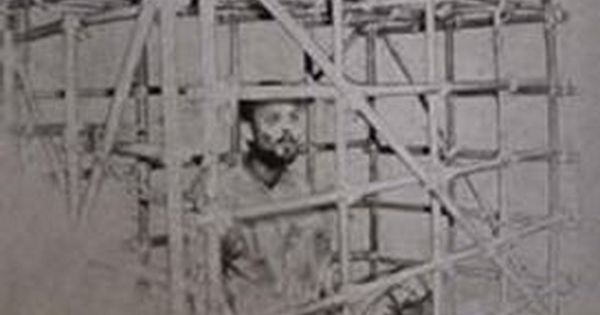
For much of the next two years, 2’x3’x6’ bamboo “Tiger” cages would be their home.  On nights when the netting was taken away, the mosquitoes were so thick on their shackled feet, that it looked like they were wearing socks.

Tiger cage
H/T United States Army Heritage and Education Center (USAHEC) at Carlisle Barracks, photographer John Messeder, for this image.

Years later, President George W. Bush would tell a story, about how Steve Versace described his brother.   “If he thought he was right”,  Steve said, “he was a pain in the neck.  If he knew he was right, he was absolutely atrocious.”

There in the East Wing of the White House, the line was met with great laughter.  In 1964, Vietnamese interrogators were learning what Steve Versace could have told them.  These people were not going to break his brother.

MOH_Versace

Rocky attempted to escape four times, despite leg wounds which left him no option but to crawl on his belly.   Each such attempt earned him savage beatings, after which he’d only try harder.

Fluent in French and Vietnamese as well as English, Rocky could quote chapter and verse from the Geneva Convention and never quit doing so.  He would insult and ridicule his captors in three languages, even as they beat him senseless.

Incessant brutalization and repeated confinement in “isolation boxes” earned his tormentors nothing but an invitation to “Go to Hell”, in three languages.

Communist indoctrination sessions had to be brought to a halt in French and Vietnamese, because none of his interrogators could effectively argue with this guy.  They certainly didn’t want villagers to hear the man blow up their communist propaganda in their own language.

Finally, Captain Versace was separated from the rest of the prison population, and placed in an isolation box.  He responded by singing, the lyrics of popular songs replaced by messages of inspiration to his fellow POWs.  He was last heard belting out “God Bless America” at the top of his lungs.

Versace, playing ball

Rocky was murdered by his captors, his “execution” announced on North Vietnamese “Liberation Radio” on September 26, 1965.  He was twenty-eight.

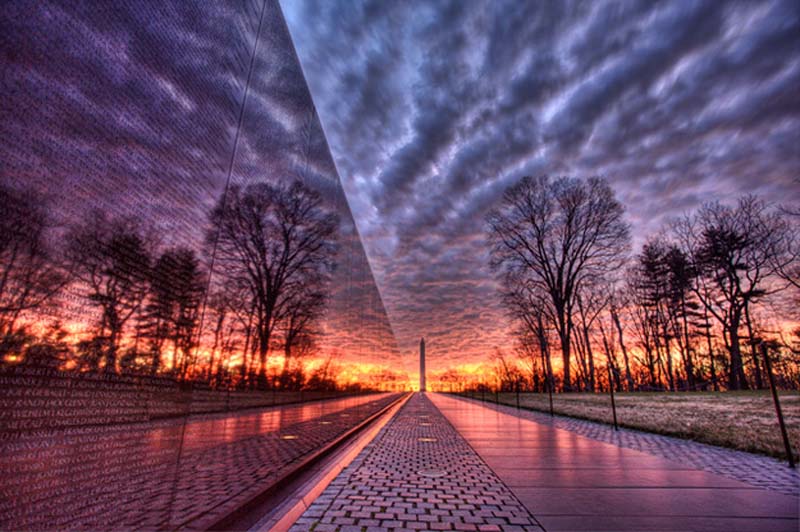
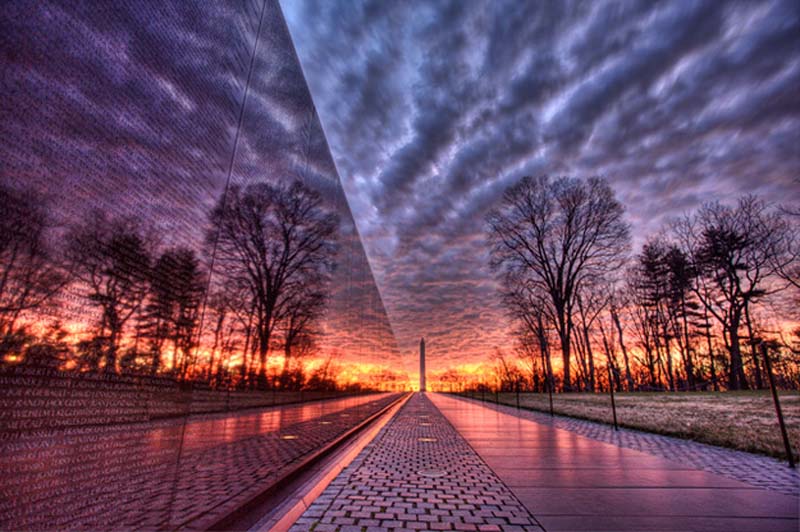
Versace’ remains were never recovered.  His name is inscribed on panel 1E, line 33 of the Vietnam Veterans Memorial.  The headstone bearing his name in memorial section MG-108 of Arlington National Cemetery, stands over an empty grave.

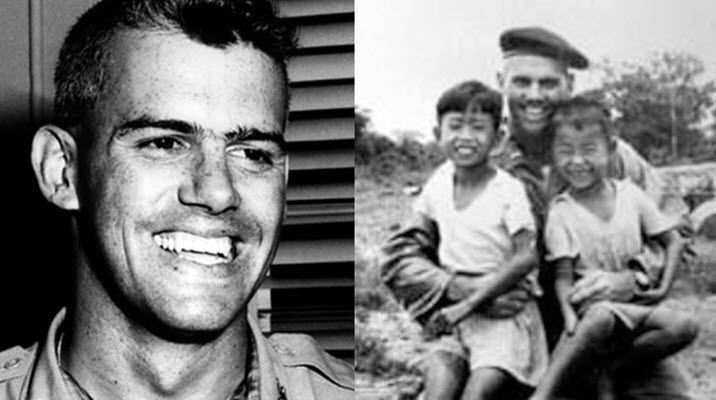
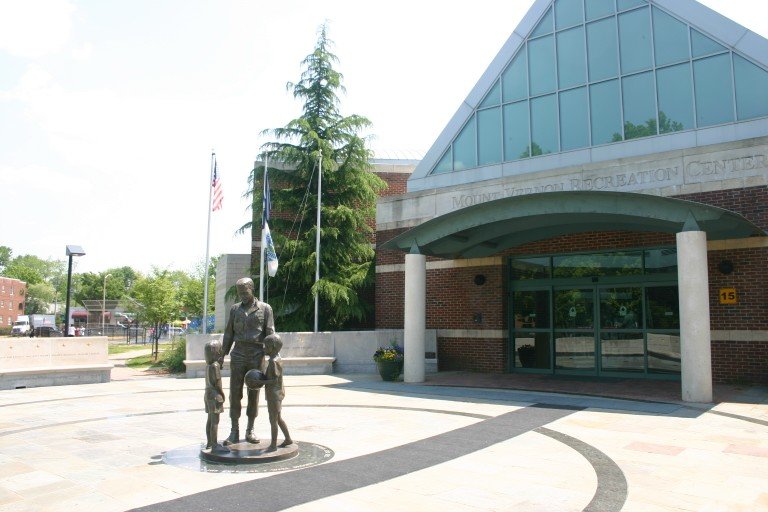
If you’re ever in Alexandria, Virginia, pay a visit to the Mount Vernon Recreation Center. There in the central plaza, a sculpture by artist Antonio Tobias Mendez, depicts a Special Forces warrior.  With hands on their shoulders, he is coaching two Vietnamese kids, how to play ball.

This American hero of Italian and Puerto Rican heritage was nominated for the medal of honor in 1969, an effort which culminated in a posthumous Silver Star.

vietnam-memorial

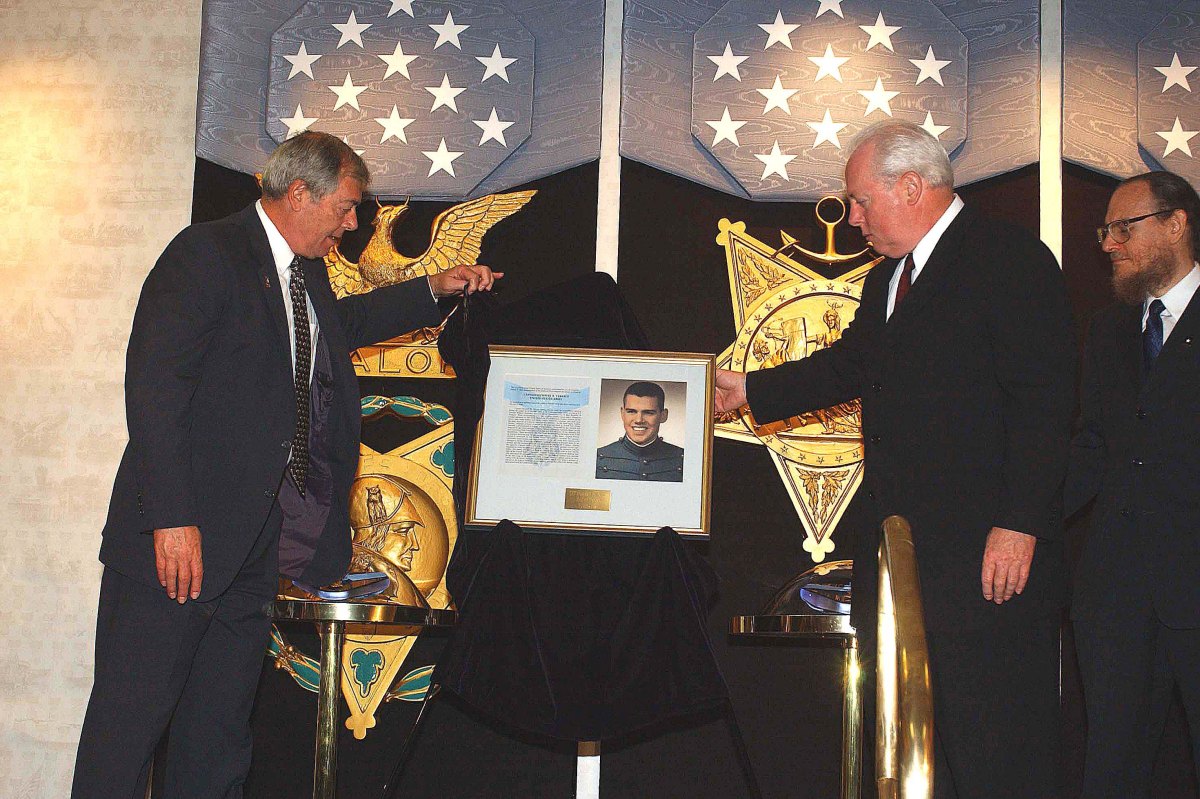
In a July 8, 2002 ceremony in the East Room of the White House, President George W. Bush awarded Captain Humbert Roque Versace the Medal of Honor.  The first time the nation’s highest honor was bestowed on a POW, for courage in the face of captivity.

Let Rocky’s Medal of Honor citation, tell his story.

Cmoh_army

Humbert Roque Versace Rank and organization: Captain, U.S. Army, Intelligence Advisor, Special OperationsPlace:  Republic of VietnamEntered service at:  Norfolk, VirginiaBorn:  Honolulu, HawaiiCitation:For conspicuous gallantry and intrepidity at the risk of his life above and beyond the call of duty while a prisoner of war during the period of October 29, 1963 to September 26, 1965 in the Republic of Vietnam. While accompanying a Civilian Irregular Defense Group patrol engaged in combat operations in Thoi Binh District, An Xuyen Province, Republic of Vietnam on October 29, 1963, Captain Versace and the CIDG assault force were caught in an ambush from intense mortarautomatic weapons, and small arms fire from elements of a reinforced enemy Main Force battalion. As the battle raged, Captain Versace fought valiantly and encouraged his CIDG patrol to return fire against overwhelming enemy forces. He provided covering fire from an exposed position to enable friendly forces to withdraw from the killing zone when it was apparent that their position would be overrun, and was severely wounded in the knee and back from automatic weapons fire and shrapnel. He stubbornly resisted capture with the last full measure of his strength and ammunition. Taken prisoner by the Viet Cong, he demonstrated exceptional leadership and resolute adherence to the tenets of the Code of Conduct from the time he entered into a prisoner of war status. Captain Versace assumed command of his fellow American prisoners, and despite being kept locked in irons in an isolation box, raised their morale by singing messages to popular songs of the day, and leaving inspiring messages at the latrine. Within three weeks of captivity, and despite the severity of his untreated wounds, he attempted the first of four escape attempts by dragging himself on his hands and knees out of the camp through dense swamp and forbidding vegetation to freedom. Crawling at a very slow pace due to his weakened condition, the guards quickly discovered him outside the camp and recaptured him. Captain Versace scorned the enemy’s exhaustive interrogation and indoctrination efforts, and inspired his fellow prisoners to resist to the best of their ability. When he used his Vietnamese language skills to protest improper treatment of the American prisoners by the guards, he was put into leg irons and gagged to keep his protestations out of earshot of the other American prisoners in the camp. The last time that any of his fellow prisoners heard from him, Captain Versace was singing God Bless America at the top of his voice from his isolation box. Unable to break his indomitable will, his faith in God, and his trust in the United States of America and his fellow prisoners, Captain Versace was executed by the Viet Cong on September 26, 1965. Captain Versaces extraordinary heroism, self-sacrifice, and personal bravery involving conspicuous risk of life above and beyond the call of duty were in keeping with the highest traditions of the United States Army, and reflect great credit to himself and the U.S. Armed Forces.

versace_humbert

July 8, 2002 Rocky

Rocky planned to become a Priest of the Roman Catholic faith, and return to the country to help the orphaned children of Vietnam. His was a bright and shining future. One never meant to be.

Humbert Roque Versace was born in Honolulu on July 2, 1937, the oldest of five sons born to Colonel Humbert Joseph Versace.  Writer Marie Teresa “Tere” Rios was his mother, author of the Fifteenth Pelican.  If you don’t recall the book, perhaps you remember the 1960s TV series, based on the story.  It was called The Flying Nun.

Like his father before him, Humbert, (“Rocky” to his friends), joined the armed services out of high school, graduating from the United States Military Academy at West Point, in 1959.

Rocky earned his Ranger tab and parachutist badge the same year, later serving as tank commander with the 1st Cavalry in South Korea, then with the 3rd US Infantry – the “Old Guard”.

Rocky attended the Military Assistance Institute, the Intelligence course at Fort Holabird Maryland, and the USACS Vietnamese language Course at the Presidio of Monterey, beginning his first tour of duty in Vietnam on May 12, 1962.

versace1

He did his tour, and voluntarily signed up for another six months.  By the end of October 1963, Rocky had fewer than two weeks to the end of his service.  He had served a year and one-half in the Republic of Vietnam.  Now he planned to go to seminary school.  He had already received his acceptance letter, from the Maryknoll order.

Rocky planned to become a Priest of the Roman Catholic faith, and return to the country to help the orphaned children of Vietnam.

His was a bright and shining future. One never meant to be.

Rocky was assisting a Civilian Irregular Defense (CIDG) force of South Vietnamese troops remove a Viet Cong (VC) command post in the Mekong Delta. It was unusual that anyone would volunteer for such a mission, particularly one with his “short-timer’s stick”. This was a daring mission in a very dangerous place.

Screen-Shot-2016-09-28-at-7.20.27-PM-466x315
In happier times, Colonel Humbert Joseph Versace pins insignia on the uniform of his son, Captain Humbert Roque “Rocky” Versace

On October 29, an overwhelming force of Viet Cong ambushed and overran Rocky’s unit.  Under siege and suffering multiple bullet and shrapnel wounds, Versace put down suppressing fire, permitting his unit to withdraw from the kill zone.

Another force of some 200 South Vietnamese arrived, too late to alter the outcome.  Communist radio frequency jamming had knocked out both main and backup radio channels.

Their position overrun, Captain Versace, Lieutenant Nick Rowe and Sergeant Dan Pitzer were captured and taken to a North Vietnamese prison, deep in the jungle.

This image has an empty alt attribute; its file name is 7d4cb22a67972aeb9cbbc48b25414a38.jpg

For most of the following two years, a 2’x3’x6’ bamboo cage would be their home.  On nights when their netting was taken away, the mosquitoes were so thick on their shackled feet, it looked like they were wearing socks.

Years later, President George W. Bush would tell a story, about how Steve Versace described his brother.   “If he thought he was right”,  Steve said to audience laughter, “he was a pain in the neck.  If he knew he was right, he was absolutely atrocious.

btkf-penthouse1-475

In 1964, Vietnamese interrogators were learning what Steve Versace could have told them, if only they’d asked.  His brother could not be broken.  Rocky attempted to escape four times, despite leg wounds which left him no option but to crawl on his belly.   Each such attempt earned him savage beatings, but that only made him try harder.

Fluent in French, Vietnamese and English, Rocky could quote chapter and verse from the Geneva Conventions and never quit doing so.  He would insult and ridicule his captors in three languages, even as they beat him to within an inch of his life.

d2876bed385752258d0ad3af863709e1

Incessant torture and repeated isolation in solitary confinement did nothing to shut him up.  Communist indoctrination sessions had to be brought to a halt in French and Vietnamese, because none of his interrogators could effectively argue with this guy.  They certainly didn’t want villagers to hear him blow up their Communist propaganda in their own language.

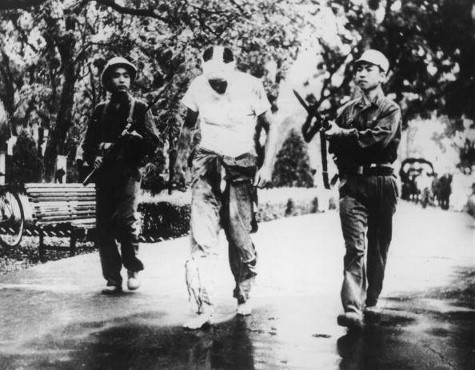
For five months in 1964, reports came back through intelligence circles, of one particular prisoner. Paraded in chains before local villagers, with hair turned snow white and face swollen and yellowed with jaundice. With hands tied behind his back and a rope around his neck, even then this man still spoke in three languages, of God, and Freedom, and American democracy.

pg1ver

The affect was unacceptable to his Communist tormentors. To the people of these villages, this man made sense.

In the end, Versace was isolated from the rest of the prison population, as a dangerous influence.  He responded by singing at the top of his lungs, the lyrics of popular songs of the day replaced by messages of inspiration to his fellow POWs.  Rocky was last heard belting out “God Bless America”, at the top of his lungs.

Humbert Roque Versace was murdered by his North Vietnamese captors, his “execution” announced on North Vietnamese “Liberation Radio” on September 26, 1965.  He was twenty-eight years old.

Rocky’s remains were never recovered.  The headstone bearing his name in the Memorial section MG-108 at Arlington National Cemetery, stands over an empty grave.  The memory of his name is inscribed on the Courts of the Missing in the Honolulu Memorial at the National Memorial Cemetery of the Pacific in Honolulu, and on Panel 1E, line 33, of the Vietnam Veterans Memorial.

vietnam-memorial

This American hero of Italian and Puerto Rican heritage was nominated for the medal of honor in 1969, an effort culminating in a posthumous Silver Star.  In 2002, the Defense Authorization Act approved by the United States Congress and signed into law by President George W. Bush, awarded Versace the Medal of Honor.

In a July 8, 2002 ceremony in the East Room of the White House, the President of the United States awarded the Medal of Honor to United States Army Captain Humbert Roque “Rocky” Versace.  Dr. Stephen Versace stood in to receive the award, on behalf of his brother.  Never before had the nation’s highest honor for military valor been bestowed on a POW, for courage in the face of captivity.

Rockys Statue_Plaza1
This statue of Medal of Honor recipient and Ranger Hall of Fame inductee Captain “Rocky” Versace stands in a plaza bearing his name in Alexandria, Virginia. With him are the likenesses of two Vietnamese children, along with sixty-seven gold stars, each representing one of the 67 soldiers, sailors and airmen from Alexandria who were KIA or MIA, in the war in Vietnam.