Henry was astounded to see the volume of personal mail, particularly around the Christmas season. But there was a problem. Failure to reply to a handwritten letter was considered impolite, but this was more than he could handle.
With Christmas fast approaching, families all over are decorating trees, hanging lights and wrapping gifts. Short days from now children will scan the skies for a glimpse of Santa and his sleigh full of toys.
Americans alone are expected to mail some 1.6 Billion Christmas cards this year, but cards weren’t always so popular. There was a time in fact, when there were none at all. So let’s grab a hot chocolate & go back for a little fun history. To 1843 and the guy responsible, for the first Christmas card.
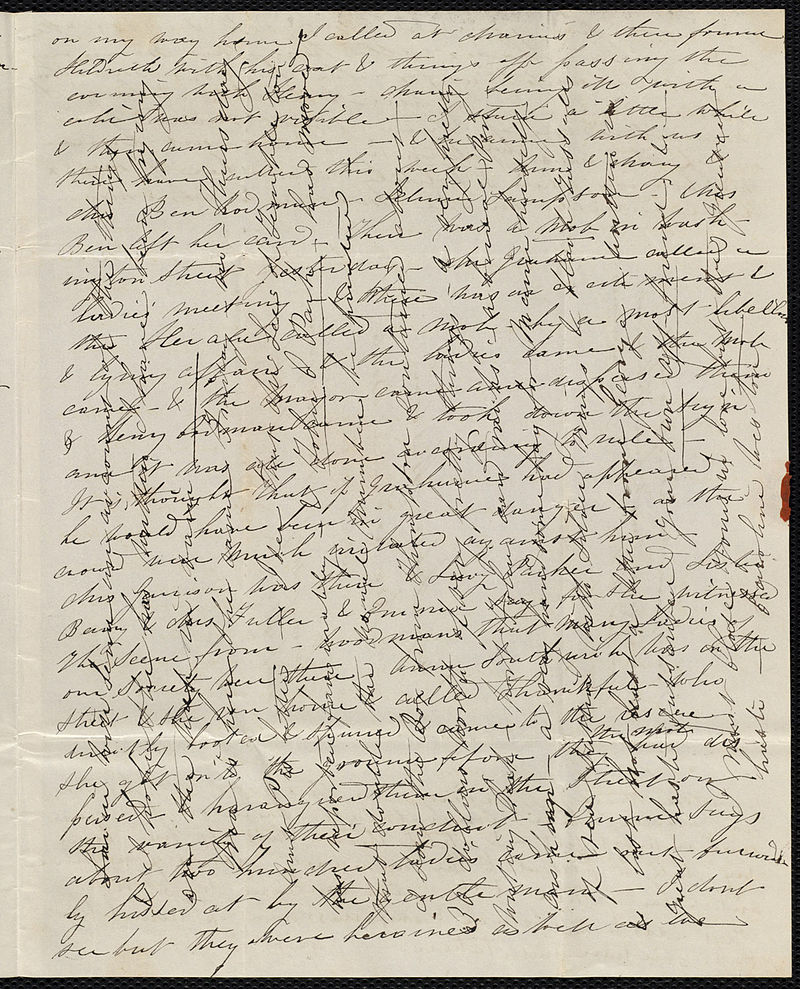
In 1812 England, mailing a letter was complicated. One sheet of paper mailed from London to Edinburgh cost 1 shilling, 1 penny. Two pages were twice that and so on. Simple you say and fair enough, but that was pricey. Adding to the complication, postage changed based on distance traveled. Not only that but the cost might be paid by the sender, or the recipient. People would write two sets of letters on one sheet to save money, two or more “crossed letters” written perpendicularly, to save money. Something had to change.
Crossed letter from Caroline Weston to Deborah Weston; Friday, March 3, 1837
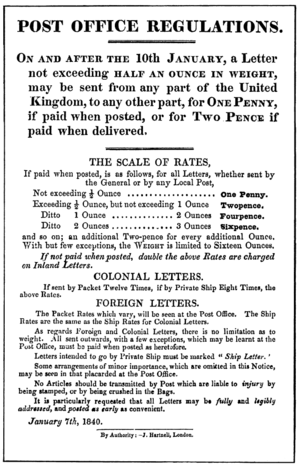
Discussions of a uniform postage based on weight began as early as 1837. Sir Rowland Hill argued in favor of a one penny rate, asserting that vastly higher mail volume resulting would more than offset offset any reduction in revenues.
With the ultimate goal of a single penny’s postage per half-ounce letter, the first change occurred on December 5, 1839. Postage could be paid by sender or recipient without penalty, at a standardized rate of four pennies. Letters were hand stamped (usually) in black if paid by the sender, or red if paid by the recipient. The age of the four penny post, had come.
The new system proved overwhelmingly popular. The penny post came to be on January 10, 1840.
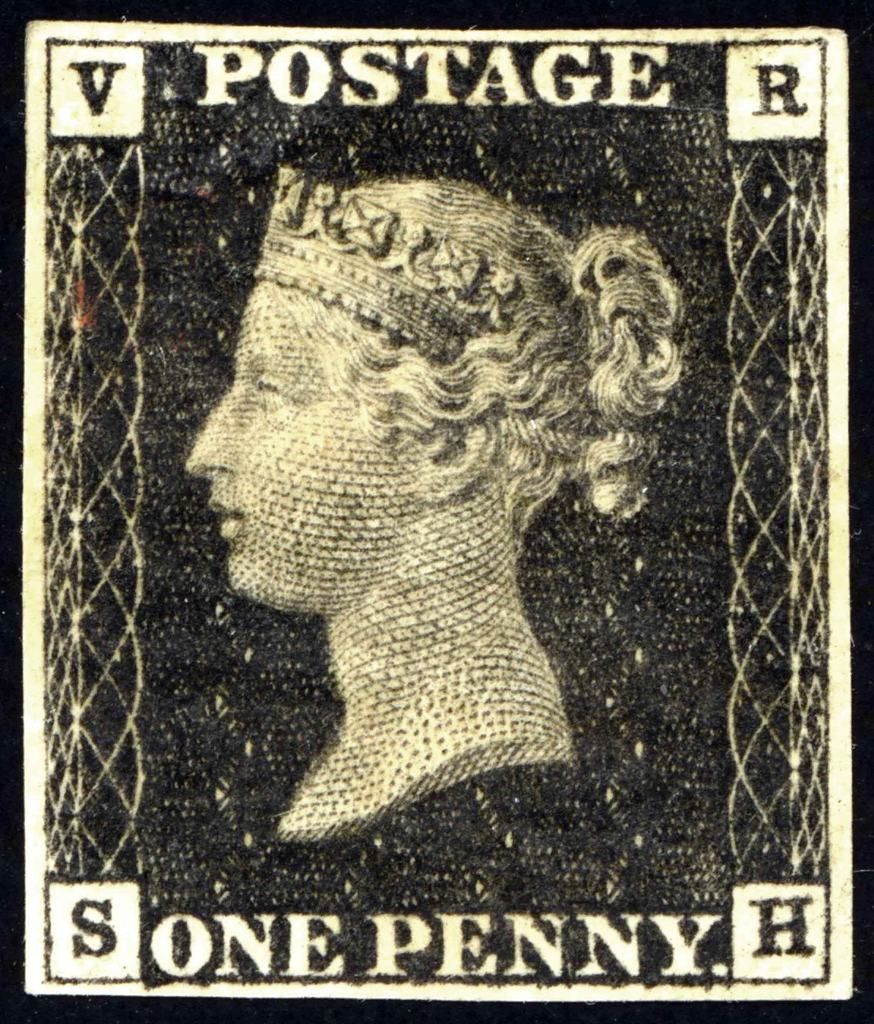
The first adhesive postage stamp in history came to be on May 1. The envy of philatelists from that day to this day, the “Penny Black” featured the profile of Queen Victoria and cost 240 pence per sheet of 240, a shilling per row and – you guessed it – a penny apiece.
Fun fact: the image used was one of Queen Victoria, at age 15. The stamp remained in use throughout the Victorian age, Britain’s longest reigning monarch save only, for Queen Elizabeth II.
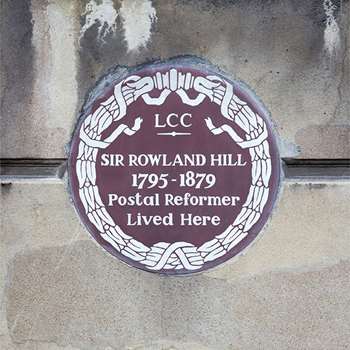
Rowland hill had argued that, if mailing a letter was cheaper, then more people would do it. He was right. So it is the one-time home of Sir Rowland Hill, K.C.B bears a Blue plaque, in recognition.
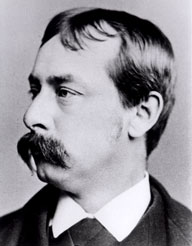
Sir Henry Cole now comes into this story, as the man who founded the Victoria and Albert Museum in London, and a man instrumental in assisting Rowland Hill’s efforts to reform the British postal system.
Sir Henry was astounded to see the volume of personal mail, particularly around the Christmas season. But there was a problem. Failure to reply to a handwritten letter was considered impolite, but this was more than he could handle.
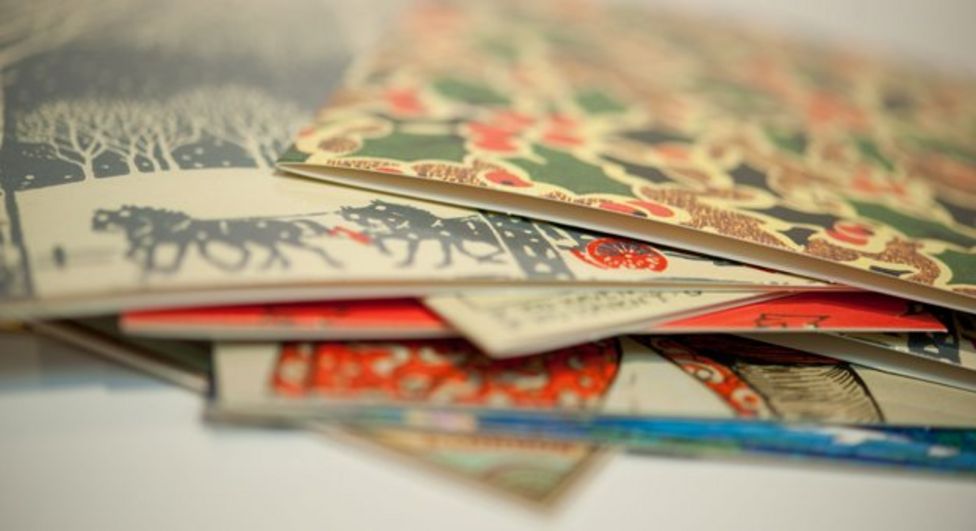
Cole had an idea. An easily reproduced Christmas message, one that could be easily personalized. He asked artist friend John Callcott Horsley to come up with an idea.
Horsley came back with a triptych (a three panel illustration). The center panel depicted three generations of the Cole family in Christmas celebration. The side two showed charitable acts on behalf of the poor, one dispensing food and the other, clothing. The banner beneath it all read “Merry Christmas and a Happy New Year to you”.
Today, news aggregator Globalnewswire.com forecasts global greeting card sales to reach $13.4 Billion US with the Christmas segment accounting for a third. All of it started on this day in 1843 when Henry Cole, founder of London’s V&A Museum, commissioned printing of the 1st Christmas card.
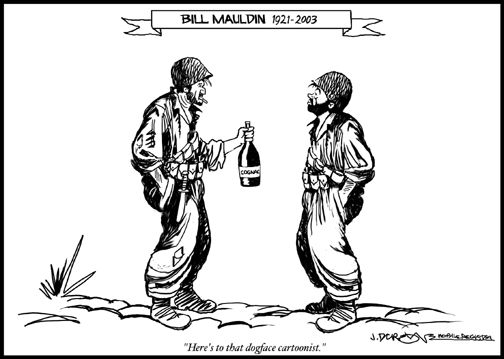
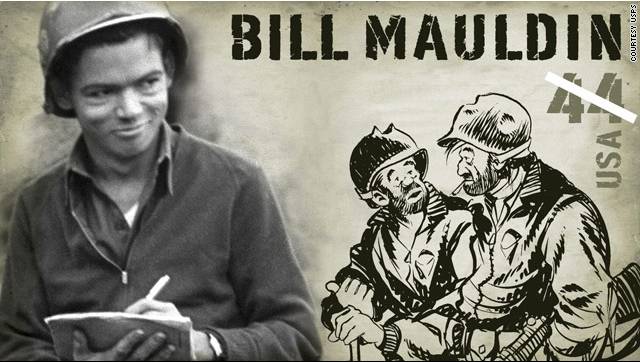
Mauldin told the story of the common soldier, usually at the rate of six per week. His medium was the cartoon.
Born on October 29, 1921 in New Mexico and brought up in Arizona, William Henry “Bill” Mauldin was part of what Tom Brokaw once called, the “Greatest Generation”.
When the United States entetef World War 2, He enlisted in the 45th Infantry Division. Mauldin was a talented artist, trained at the Chicago Academy of Fine Arts. So it was he volunteered to work for the unit’s newspaper, as a cartoonist.
As a sergeant of the 45th Division’s press corps and later for Stars & Stripes, Mauldin took part in the invasion of Sicily and later Italian campaign. He was given his own jeep and allowed to go wherever he pleased, which was usually out in front.
Mauldin told the story of the common soldier, usually at the rate of six per week. His medium was the cartoon.
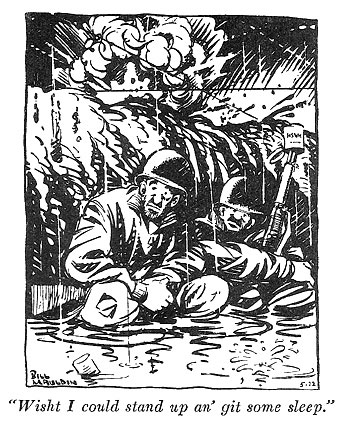
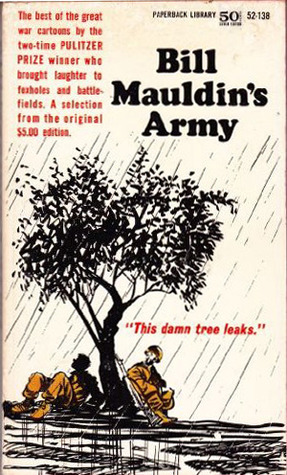
Mauldin developed two infantry characters and called them “Willie and Joe” and told the story, through their eyes. He became extremely popular within the enlisted ranks, as much of his humor poked fun at the “spit & polish” of the officer corps. He even lampooned General George Patton one time, for insisting that his men be clean shaven all the time. Even in combat.
Patton summoned the cartoonist to his to “throw his ass in jail” for “spreading dissent”. Commander in Chief Dwight Eisenhower himself set Old Blood and Guts straight telling Patton, to leave the man alone. According to the Supreme Allied Commander, Mauldin’s cartoons gave the soldiers an outlet for their frustrations. He was good for morale.
Mauldin later told an interviewer, “I always admired Patton. Oh, sure, the stupid bastard was crazy. He was insane. He thought he was living in the Dark Ages. Soldiers were peasants to him. I didn’t like that attitude, but I certainly respected his theories and the techniques he used to get his men out of their foxholes”.
His was no rear echelon assignment. Mauldin’s fellow soldier-cartoonist, Gregor Duncan, was killed in Anzio in May 1944. Mauldin himself was wounded in a German mortar attack near Monte Cassino. By the end of the war he had received the Army’s Legion of Merit for his drawings.
Mauldin tried to revive Willy & Joe after the war, but found they didn’t assimilate well into civilian life.
“Peanuts” cartoonist Charles M. Schulz was himself a veteran of World War II. Schulz paid tribute to Rosie the Riveter and Ernie Pyle in his strip but more than any other, he paid tribute to Willy & Joe. Snoopy visited with Willie & Joe no fewer than 17 times over the years. Always on Veterans Day.
Bill Mauldin passed away on January 22, 2003, killed by a bathtub scalding exacerbated by complications of Alzheimer’s disease.
Bill Mauldin drew Willie & Joe for last time in 1998, for inclusion in Schulz’ Veteran’s Day Peanuts strip. Schulz had long described Mauldin as his hero.
He signed that final strip Schulz, as always, to which he added “and my Hero“. Bill Mauldin’s signature, appears underneath.
National Geographic explains that 12/21/12 brings to a close not the end of time, but the end of the 12th Bak’tun, an almost 400-year period in the Mayan Long Count calendar. The world doesn’t end according to this explanation, it just “rolls over” to the year zero and starts over. Like the old cars used to do, when the odometer reached 100,000 miles.
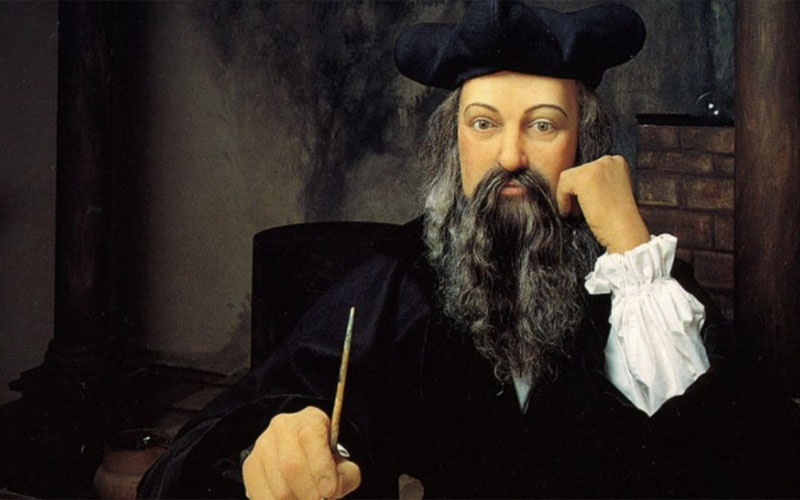
Les Prophéties was published in 1555, a collection of 942 poetic quatrains predicting events in the future. The author was Michel de Nostredame, the French astrologer, physician and seer of the future best remembered by the Latinized form of his name, Nostradamus.
The seer once prophesied the end of the world in typically cryptic form. Or at least the following is attributed to Nostradamus:
“From the calm morning, the end will come When of the dancing horse The number of circles will be 9.”
But, what does that even mean?
That’s where the fun starts.
An emperor of the Ming dynasty of 1368 – 1644 China once referred to the Korean peninsula as, the ‘Land of the Morning Calm’. By late 2012 one particular YouTube video was closing in on a billion views. Nine zeros. A video featuring the Korean rapper Park Jae-sang better known as Psy and his peculiar “horsey” style of dance.
That’s right. The world ended in Gangnam Style. Don’t yell at me folks. I don’t make this stuff up.
Gangnam Style’s official video hit a billion views on December 21, 2012. The Korean rapper has since become the “King of YouTube” with over 4 billion views but that world coming to an end part? Not so much.
Psy’s video was one of the sillier bits of pop culture from that year but it wasn’t the only time the world came to an end, in 2012. It wasn’t even the only time…that day.
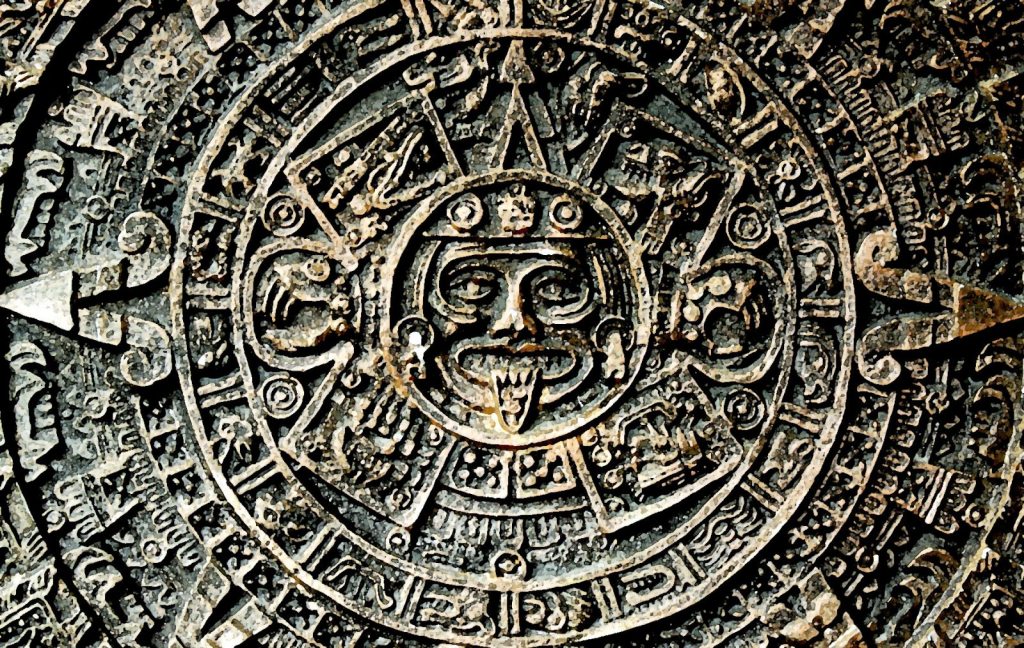
The world also came to an end on 12/21/12, according to the Mayan calendar. Remember that? It was another piece of pop culture silliness, the end of the world part, but not the calendar. The calendar itself is a very sophisticated mathematical construct.
According to linguist, anthropologist and Mayanist scholar Floyd Glenn Lounsbury and his “Lounsbury Correlation”, the Mayan Calendar dates some 5,136 years back to August 13, 3114 BC. It’s a little tough to nail down a particular day when you’re looking that far back but this one will do, as well as any.
The ancient Mayans were the first to recognize the concept of zero, and worked extensively in a base 20 number system. They were skilled mathematicians and it shows, in their calendar.
The Mayans used three separate calendars, each period represented by its own glyph.
The Long Count was mainly used for historical purposes, able to specify any date within a 2,880,000 day cycle, about 7,885 solar years.
The Haab was a civil calendar consisting of 18 months of 20 days, and one 5-day Uayeb, a nameless period rounding out the 365-day year.
The Tzolkin was the “divine” calendar, used mainly for ceremonial and religious purposes. Consisting of 20 periods of 13 days, the Tzolkin goes through a complete cycle every 260 days. The significance of this cycle is uncertain, though it may be connected with the 263-day orbit of Venus. There is no year in the Haab or Tzolkin calendars, though a Haab and Tzolkin date may be combined to specify one particular day within a 52-year cycle.
As for the end of the world part, National Geographic explains that 12/21/12 brings to a close not the end of time, but the end of the 12th Bak’tun, an almost 400-year period in the Mayan Long Count calendar. The world doesn’t end, according to this explanation, it “rolls over” to the year zero and starts over. Just like the old cars used to do, when the odometer reached 100,000 miles.
It doesn’t really roll over to “zero”, either. The base 20 numerical system means that 12/22/12 begins the next 400 year (actually 394.3 years) period to begin the 13th Bak’tun. It will reset to zero at the end of the 20th Bak’tun, about 3,000 years from now. Let me know how that turns out, would you?
The Mayan calendar system became extinct in most areas after the Spanish conquests of the 16th century, though it continues in use in many modern communities in highland Guatemala and in Veracruz, Oaxaca and Chiapas, Mexico.
The table of Long Count units below illustrates the Mayan units of measurement. A day is a K’in, there are 20 K’ins in a Winal, and so on.
December 21,2012 then, the day it all came to an end according to the Mayan calendar, was Long Count Date 13.0.0.0.0, 13 baktun, 0 katun, 0 tun, 0 uinal, 0 k’in, Tzolk’in Date: 4 Ajaw, Haab Date: 3 K’ank’in, Lord of the Night: G9.
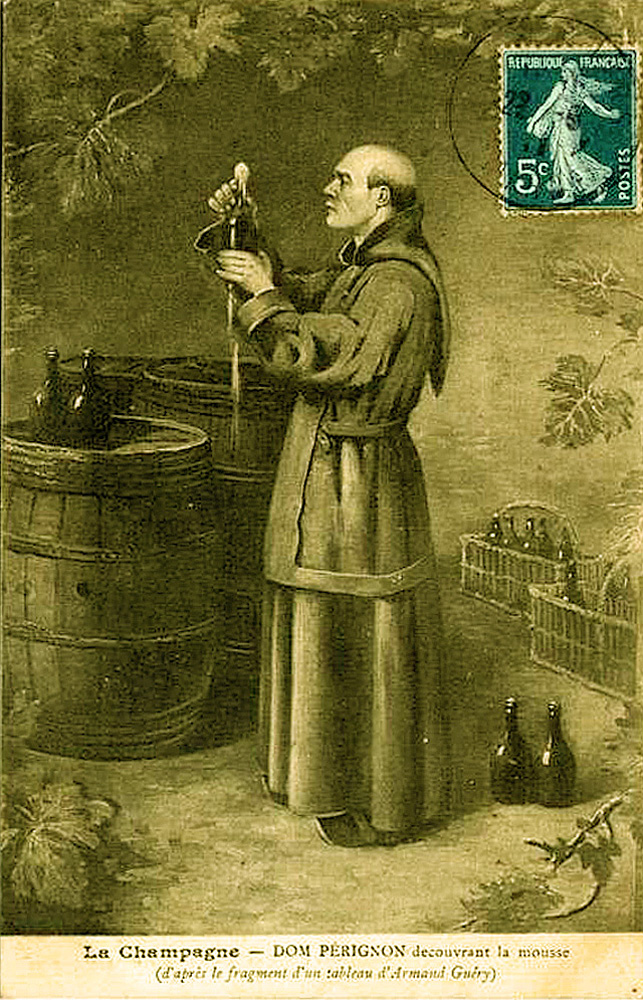
According to legend it was August 4, 1697 when Brother (Dom) Pérignon called out “Come quickly, I am drinking the stars!”.
Wines were near-universally red in medieval and renaissance Europe and almost always, still. The in-bottle refermentation that gives “sparkling” wine its ‘fizz’ was a problem for winemakers. Fermentable sugars were frequently left over when weather began to cool in the fall, particularly with the white grape varietals. Refermentation would set in with the warm spring weather, converting bottles into literal time bombs. Corks would pop out and wine would spoil. Sometimes the whole batch would explode, one pressurized bottle going off in sympathetic detonation with the next.
Pierre Perignon entered the Benedictine Order when he was 19, doing his novitiate at the abbey of Saint-Vannes near Verdun, later and transferring to the abbey of Hautvillers, in 1668.
According to legend it was August 4, 1697 when Brother (Dom) Pérignon called out “Come quickly, I am drinking the stars!”.
The story seems to be an 1821 embellishment by one Dom Groussard, in an attempt to increase the reputation of the abbey. The English scientist and physician Christopher Merret seems to have been the first to add sugars, beginning the refermentation process which resulted in the first carbonated wine.
Yet Dom Pérignon most certainly perfected the double fermentation process, and made important contributions to the quality of the abbey’s fine wines. He was an early advocate of natural process, farming methods we would call “organic”, today. He strictly avoided the addition of foreign substances and insisted that all blending take place at the grape stage. Pérignon insisted on “blind” tasting, not wanting to know what vineyard a grape came from prior to selection.
Pérignon didn’t like white grapes because of their tendency to enter refermentation. He preferred the Pinot Noir, and would aggressively prune vines so that they grew no higher than three feet and produced a smaller crop. The harvest was always in the cool, damp early morning hours, and he took every precaution to avoid bruising or breaking his grapes. Over-ripe and overly large fruit was always thrown out. Pérignon did not allow grapes to be trodden, preferring instead the use of multiple presses.
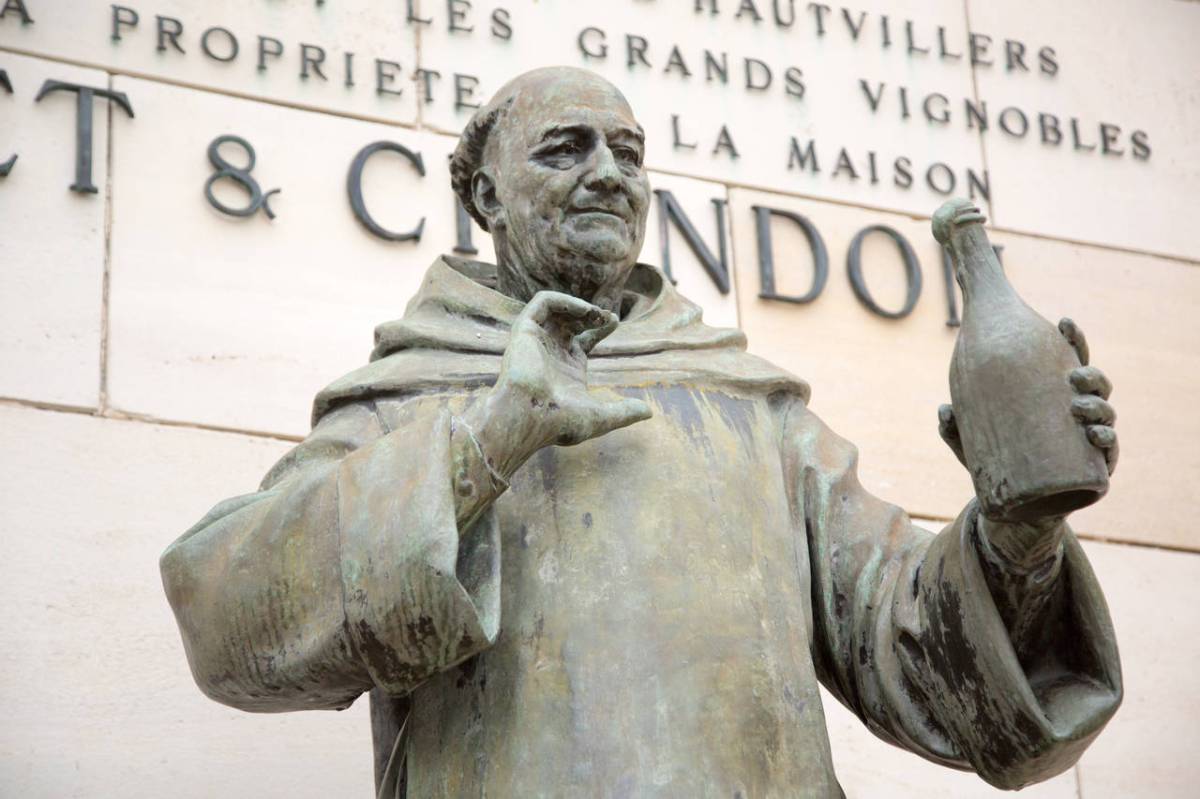
Dom Pérignon served as the “cellarer” of the Hautvillers abbey until his death in 1715, in a time when the abbey flourished and doubled the size of its vineyards. In a sign of honor and respect, Dom Pierre Pérignon was buried in a section of the abbey cemetery, historically reserved only for abbots.
Moët et Chandon, which began as Moët et Cie, purchased the vineyards of the Abbey of Hautvillers in 1792. To this day, Moët’s most prestigious cuvée bears the name of a certain Benedictine monk from Sainte-Menehould in the ancient Province of Champagne. Dom Pérignon.
The first night came in history occurred on September 2 1880 when teams from the RH White and Jordan Marsh department stores played to a 16-all tie. Organized baseball would be slow to accept the arc light.
In 18th century London, going out at night was a bad idea. Not without a lantern in one hand and a club in the other.
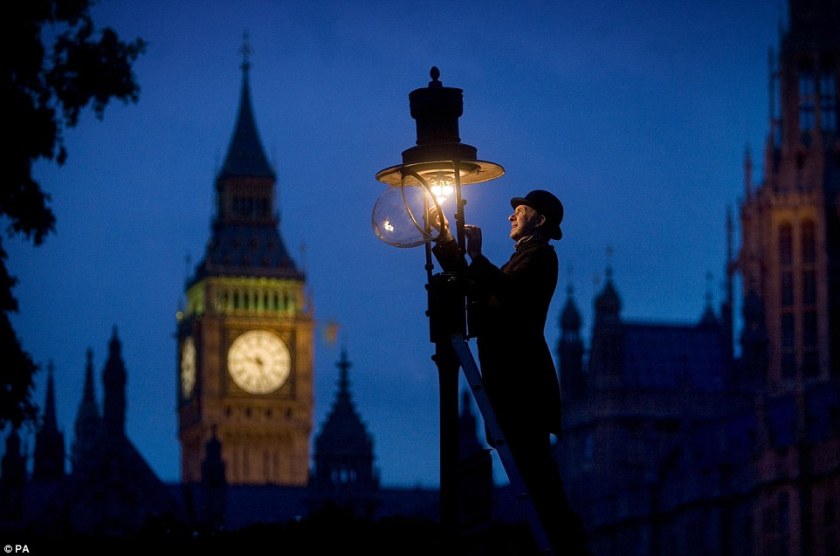
The city introduced its first gas-lit street in 1807 on the Central London Pall Mall, between St. James’s Street & Trafalgar Square. Before long, hundreds of “Lamp Lighters” could be seen with their ladders, gas lights bathing the city in a soft, green glow.
The Westminster Review newspaper opined that gas lamps had done more to eliminate immorality and criminality on the streets, than any number of church sermons.
The United States followed nine years later when the city of Baltimore lit up, in 1816.
Thomas Edison patented the first carbon-thread incandescent lamp in 1879. The first baseball game played “under the lights” took place the following year near Nantasket Beach, in the ‘south shore’ town of Hull, Massachusetts.
It was September 2, 1880 when two teams sponsored by the RH White & Co. and Jordan Marsh department stores of Boston, played a full nine innings to a 16-all tie. The era of the night game had arrived. The lamp lighters of London are still around to this very day albeit, fewer in number.
Except, no, it didn’t work out that way. The lamp lighter part is true enough. Today, five gas engineers keep the Victorian era alive, winding and checking the mechanisms, polishing the glass and replacing the mantles of some 2,000 gas lamps.
Modern-day “Lamp Lighter” H/T UK Guardian
Across the pond though, organized baseball took another fifty years to give the arc light another try.
Evidence exists of other 19th-century night games, but these were little more than novelties. Holyoke Massachusetts inventor George F. Cahill, creator of the pitching machine, devised a portable lighting system in 1909. With the blessing of Garry Herrmann, President of the Cincinnati Reds, Cahill staged an exhibition game on the night of June 19, between the Elk Lodges of Cincinnati and Newport, Kentucky.
The crowd of 3,000 had little trouble following the ball and Cahill was an enthusiastic salesman for his invention, but the man was doomed to frustration and disappointment. Night-time exhibition games were regularly met with great enthusiasm, yet organized baseball was slow in catching on.
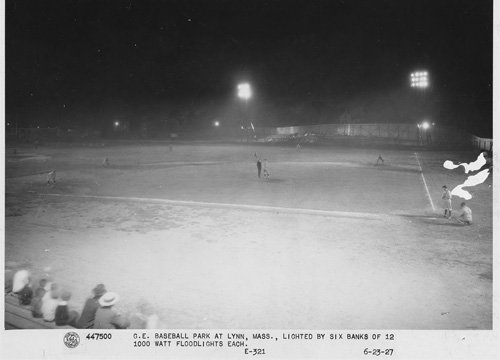
The Class B New England league played a night exhibition game on June 24, 1927 before a crowd of 5,000, sponsored by the General Electric Employees’ Athletic Association. The Washington Senators were in town at that time to play the Boston Red Sox. Delegations from both clubs were on-hand to watch Lynn defeat Salem in a seven-inning game, 7-2.
Washington manager Bucky Harris and Boston manager Bill Carrigan, were impressed. Senator’s star outfielder Goose Goslin expressed a desire to play a night game. Claude Johnson, President of the New England League, predicted that all leagues would have night baseball within five years, including the majors.
As the Great Depression descended across the land, minor league clubs folded by the bushel basket. Small town owners were desperate to innovate. The first-ever night game in professional baseball was played on May 2, 1930, when Des Moines, Iowa hosted Wichita for a Western League game.
The game drew 12,000 spectators at a time when Des Moines was averaging just 600 per game. Soon, minor league owners were finding night games a key to staying in business.
Even then, the Poobahs of Major League Baseball were slow to catch on. Five years later, the Cincinnati Reds defeated the Philadelphia Phillies in the first-ever big league game played under the lights.
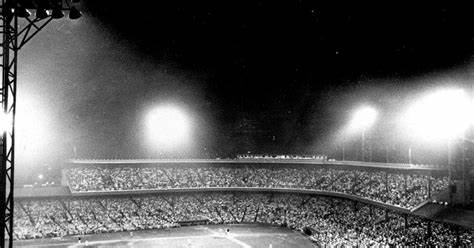
A crowd of 25,000 spectators waited on this day in 1935, as President Roosevelt symbolically turned on the lights from Washington DC. The Reds played a night game that year against every National League opponent and, despite a losing record of 68-85, enjoyed an increase of 117% in paid attendance.
The first night game in Major League Baseball was played on this day in 1935, when the Cincinnati Reds defeated the Philadelphia Phillies, 2-1
Throughout the 1930s and ’40s, teams upgraded facilities to include lights and, before long, most of Major League Baseball had night games on the schedule. Wrigley Field, home of the Chicago Cubs and the second-oldest MLB stadium after Fenway Park, was the last to begin hosting night games. To this day, the Cubbies remain the only major league team to host the majority of its games, during the day.
The first officially recorded night game at Wrigley field ended in a 6-4 win over the New York Mets on August 8, 1988.
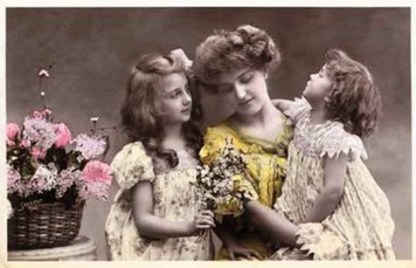
To my Mom and all the beautiful mothers out there, Happy Mother’s Day. This is your day. May it be the first, of many more.
The earliest discernible Mother’s day comes to us from 1200-700BC, descending from the Phrygian rituals of modern day Turkey and Armenia. “Cybele” was the great Phrygian goddess of nature, mother of the Gods, of humanity, and of all the beasts of the natural world, her cult spreading throughout Eastern Greece with colonists from Asia Minor.
Much of ancient Greece looked to the Minoan Goddess Rhea, daughter of the Earth Goddess Gaia and the Sky God Uranus, mother of the Gods of Olympus. Over time the two became closely associated with the Roman Magna Mater, each developing her own following and worshipped through the period of the Roman Empire.
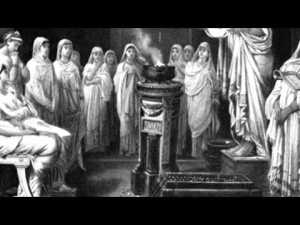
In ancient Rome, women partook of a festival strictly forbidden to Roman men. So unyielding was this line of demarcation that only women were permitted even to know the name of the deity. For everyone else she was simply the “Good Goddess”. The Bona Dea.
Fun Fact: All Rome was aghast when Publius Clodius Pulcher dressed like a woman and sneaked into the Bona Dea, bent on seducing the wife of Julius Caesar. How that was supposed to work remains unclear but ol’ Pulcher was found out, and hurled from the premises. Unjust though it was Caesar divorced Pompeia nevertheless, saying that “Caesar’s wife must be beyond reproach”.
In the sixteenth century, it became popular for Protestants and Catholics alike to return to their “mother church” whether that be the church in which they were baptized, the local parish church, or the nearest cathedral. Anyone who did so was said to have gone “a-mothering”. Domestic servants were given the day off and this “Mothering Sunday”, the 4th Sunday in Lent, was often the only time when whole families could get together. Children would gather wild flowers along the way to give to their mothers or to leave, in the church. Over time the day became more secular, but the tradition of gift giving, continued.
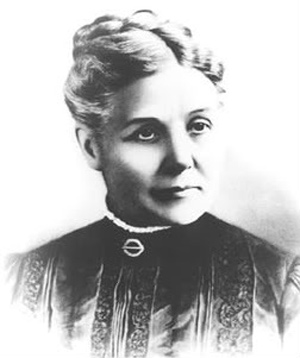
Ann Maria Reeves Jarvis
Ann Maria Reeves Jarvis was a social activist in mid-19th century western Virginia. Pregnant with her sixth child in 1858, she and other women formed “Mothers’ Day Work Clubs”, to combat the health and sanitary conditions leading at that time to catastrophic levels, of infant mortality. Jarvis herself gave birth between eleven and thirteen times in one seventeen year period. Only four of those children lived to adulthood.
Jarvis had no patience for the sectional differences that brought the nation to Civil War, or led her own locality to secede and form the state, of West Virginia. She rejected a measure to divide the Methodist church into northern and southern branches. She was willing help Union and Confederate soldier alike, if she could. It was she alone who offered a prayer when others refused for Thornsbury Bailey Brown, the first Union soldier killed in the vicinity.
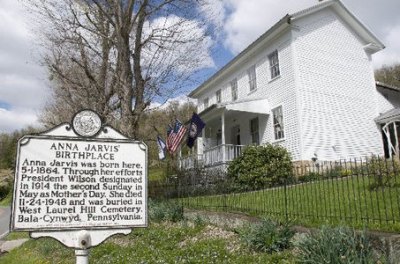
Anna Jarvis
Following Jarvis’ death in 1905, her daughter Anna conceived of Mother’s Day as a way to honor her legacy and to pay respect for the sacrifices all mothers make, on behalf of their children.
Obtaining financial backing from Philadelphia department store owner John Wanamaker, Anna Jarvis organized the first official Mother’s Day celebration at a Methodist church in Grafton, West Virginia. That same day, thousands attended the first Mother’s Day event at Wanamaker’s store in Philadelphia.
Anna Jarvis resolved that Mother’s Day be added to the national calendar and a massive letter writing campaign ensued. On May 9, 1914, President Woodrow Wilson signed a measure declaring the second Sunday of May, Mother’s Day.
Anna Jarvis believed Mother’s Day to be a time of personal celebration, a time when families would gather to love and honor their mother.
In the early days she had worked with the floral industry to help raise the profile of Mother’s Day. By 1920 she had come to resent what she saw as over-commercialization, of the day. Greeting cards seemed a pale substitute for the hand written personal notes she envisioned. Jarvis protested a Philadelphia candy maker’s convention in 1923 deriding confectioners, florists and even charities as “profiteers”. Carnations had become symbolic of Mother’s Day by this time and Jarvis resented that they were being sold at fundraisers. She even protested at a meeting of the American War Mothers in 1925 where women were selling carnations, and got herself arrested for disturbing the peace.
Soon she was launching an endless series of lawsuits against those she felt had used the “Mother’s Day” name in vain.
During the last years of her life, Anna Jarvis lobbied the government to take her creation off of the calendar, gathering signatures door-to-door to get the holiday rescinded. The effort was obviously unsuccessful. The mother of mother’s day died childless in a sanitarium in 1948, her personal fortune squandered on legal fees.
Today some variation of Mother’s Day is observed from the Arab world to the United Kingdom. In the United States, Mother’s Day is one of the most commercially successful days of the year for flower and greeting card sales, and the biggest day of the year for long-distance phone calls. Church attendance is the third highest of the year behind only Christmas, and Easter. Many churchgoers celebrate the day with carnations: colored if the mother is still living and white, if she has passed on.
To my Mom and all the beautiful mothers out there, Happy Mother’s Day. This is your day. May it be the first, of many more.
Driving that train,
high on cocaine.
Casey Jones you better,
watch your speed.
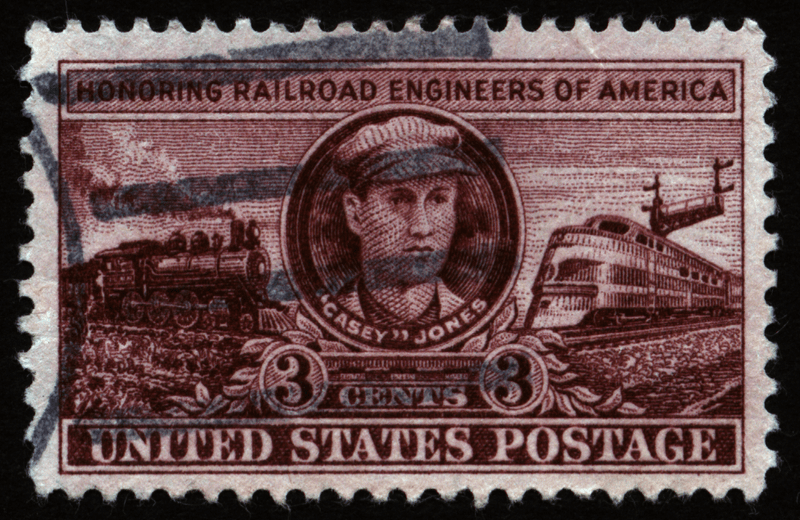
It’s a nice rhyme but the cocaine part is a lie, told and retold across generations, of popular culture. For most of us it’s all we will ever know of a hero, called Casey Jones.
Acts of heroism have a way of popping up in the most unexpected places. Ordinary people rising to the occasion, in the most extraordinary of circumstances.
Temar Boggs and Chris Garcia were two teenage boys who chased down a kidnapper – on their bicycles no less – to free a little girl. Eight-months pregnant mother-to-be Lauren Prezioso dove into an Australian undertow to save two boys, being swept out to sea. Six-year-old Bridger Walker threw himself in the path of a vicious dog to take the mauling directed at his little sister, only seconds earlier.
This is one of those stories.
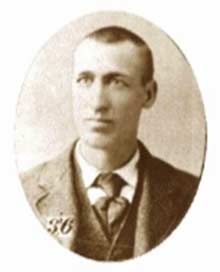
Jonathon Luther Jones lived near Cayce Kentucky as a boy, and the nickname stuck. For reasons which remain unclear he preferred to spell it, “Casey”.
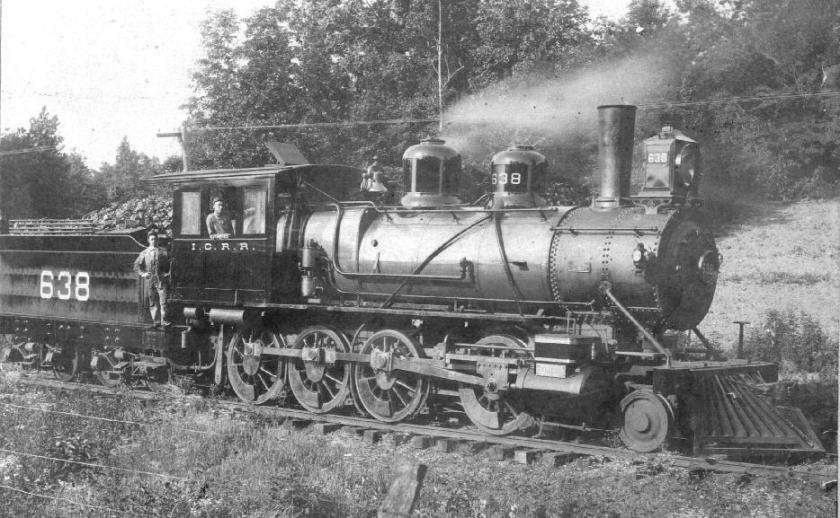
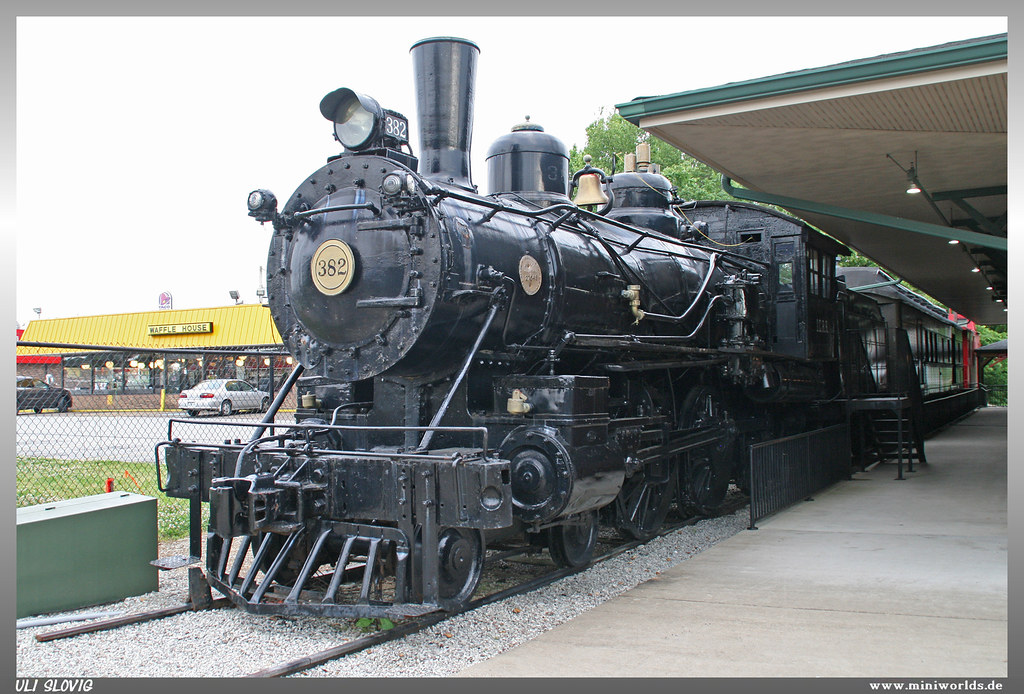
Casey Jones was a train man, working on the I.C.R.R. The Illinois Central Railroad.
An example of the man’s character comes to us from 1895, when Jones was thirty-two. Outside Michigan City Mississippi, a group of children darted across the tracks, fewer than sixty yards from a speeding train. Most made it across except one little girl, who froze in terror before the oncoming locomotive.
With fellow engineer Bob Stevenson hauling back on the emergency brakes and buying precious extra seconds, Jones ran across the running boards and inched his way down the pilot, better known as the “cow catcher”.
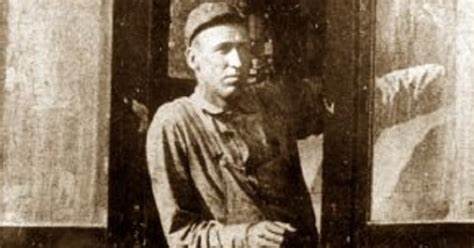
Jonathon Luther “Casey” Jones
He was no trick rider. No circus acrobat. Casey Jones worked on the railroad and yet, bracing himself with his legs, Jones reached out and scooped up the terrified little girl, at the last possible fraction of a second.
On this occasion, the man had every hope and expectation of remaining alive. Five years later Casey Jones’ last act of heroism came in the face of certain, and violent death.
Casey Jones went to work for the Mobile & Ohio Railroad where he performed well, receiving first a promotion to brakeman, and then to fireman. He met Mary Joanna (“Janie”) Brady around this time, whose father owned the boarding house, where Jones lived. The pair fell in love and married on November 11, 1886, buying a house in Jackson Alabama where the couple raised their three children. By all accounts the man was sober and devoted to his work, a dedicated family man.
Several crews from the Illinois Central Railroad (IC) were down with yellow fever in the summer of 1887. Fireman Jones went to work for the IC the following year, firing a freight run between Jackson, Tennessee, and Water Valley, Mississippi.
Casey Jones had a knack for these complex and powerful machines. He was good at what he did and an aggressive risk taker. Ambitious for advancement, Jones was issued nine citations for rules infractions over the course of his career, resulting in 145 days’ suspension. He was well liked by fellow railroaders but widely regarded, as just this side of reckless.
Jones achieved his lifelong goal of becoming an engineer in 1891. He was well known, for being on time. Jones insisted he’d never “fall down” and get behind schedule. People learned to set their watches by his train whistle, knowing he would always “get her there on the advertised” (time).
Jones moved his family to Memphis in 1900, transferring to the “cannonball run” between Chicago and New Orleans. The run was a four train passenger relay, advertising the fastest travel times in the history of the American railroad. Experienced engineers were worried about the ambitious schedule and some even quit. Jones saw the new itinerary as an opportunity for advancement.
On this day in 1900, Engine #382 departed Memphis at 12:05am, ninety-five minutes behind schedule due to the late arrival of the first leg, of the relay. The Memphis to Canton, Mississippi run was 190 miles long and normally took 4 hours, 50 minutes at an average speed of 39 MPH. 95 minutes was a lot of time to make up but #382 was a fast engine and traveling “light” that night, with only six cars.
Fireman Simeon “Sim” T. Webb
Fireman Simeon Taylor “Sim” Webb was one of the best. He would have to be. This would be a record breaking run.
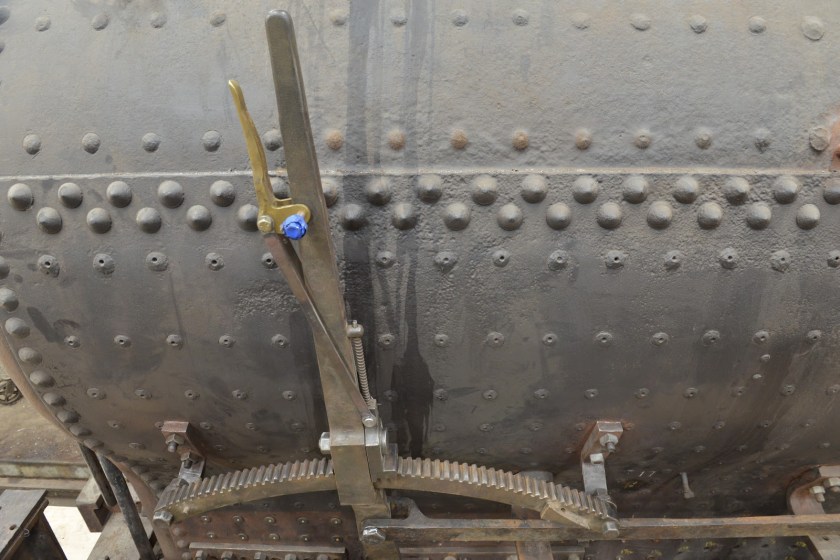
Jones hit the Johnson bar, throttling #382 up to 80 MPH despite sharp turns and visibility reduced, by fog. There were two stops for water and a brief halt on a side track, to let another engine through. Despite all that, #382 made up most of those 95 minutes by the 155-mile mark. On leaving the side track in Goodman, Mississippi, Jones was only five minutes behind the advertised arrival, of 4:05am.
Jones was well acquainted with those last 25 miles into Vaughn Mississippi. There were few turns and the engineer throttled his engine up to breakneck speed. He was thrilled with his time, saying “Sim, the old girl’s got her dancing slippers on tonight!”
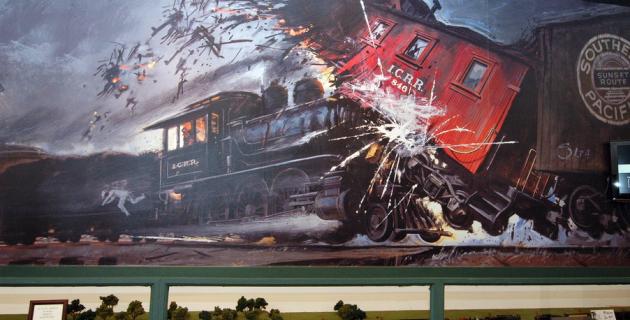
Unknown to both men there was a problem, up ahead. Three trains were in the station at Vaughn with a combined length of ten cars longer, than the main siding. Rail yard workers performed a “saw by” maneuver, backing #83 onto the main line and switching overlapping cars onto the “house track”. Then there was that problem with an air hose. Four cars remained stranded on the main line.
#382 sped through the final curve at 75MPH, only two minutes behind schedule. Clinging to the side board, Sim Webb was the first to see the red lights, of the caboose. “Oh my Lord”, he yelled, “there’s something on the main line!”
Jones didn’t have a prayer of stopping in time. He was moving too fast. He reversed throttle and slammed the air brakes into emergency stop, screaming “Jump Sim, jump!” Sim Webb jumped clear with only 300 feet to go as the piercing shriek of the engine’s whistle, split the air.
Jones could have jumped. Having ordered Webb to do so demonstrated, the man understood the situation. Casey Jones stayed on the train as “Ole 382” plowed through the red wooden caboose and three freight cars, before leaving the track.
By the moment of impact, Jones frantic efforts had slowed the engine down to 35 miles per hour. Untold numbers of passengers were saved from serious injury, or death. As the pieces came to a stop Jones himself, was the only fatality. His watch was stopped at 3:52am, only two minutes behind schedule.
Adam Hauser of the New Orleans Times-Democrat was a passenger in a sleeper car, at the time of the wreck: “The passengers did not suffer” he said, “and there was no panic. I was jarred a little in my bunk, but when fairly awake the train was stopped and everything was still. Engineer Jones did a wonderful as well as a heroic piece of work, at the cost of his life”.
Legend has it that, when Jones’ body was removed his dead hands still clutched the whistle cord, and the brake.
Since that day Casey Jones has achieved mythological status, alongside the likes of Pecos Bill and Paul Bunyan. “The Ballad of Casey Jones” was recorded by Mississippi John Hurt, Johnny Cash and the Grateful Dead, among others.
Jones’ son Charles was 12 at the time of his father’s death at age 37. Jones’ daughter Helen, was 10. The youngest, John Lloyd (“Casey Junior”) was 4. Janie received two life insurance payments totaling $3,000 as Casey was “Double Heading” at that time, as a member of two unions. Casey Jones widow would receive no other compensation. The Railroad Retirement Fund wouldn’t come about, for another 37 years.
Mary Joanna “Janie” Brady Jones lived another 58 years and never had so much as a thought, of remarrying. The idea that the hero she married was intoxicated at the time of the accident was a thorn in her side, for the rest of her life. What’s more there were allegations that she herself, was an unfaithful wife. According to one version of the song she told her heartbroken children to stop crying. They had “another papa on the Salt Lake Line.”
One particularly snotty article in Time Magazine informed the reader the “Widow Jones” … “looks well and buxom,” in a piece that couldn’t so much as get Jones’ engine number right. To their credit, Time Magazine itself criticized their tone, in 2015. 57 years after Janie died, at the age of 92.
Janie Jones lived another 58 years. She wore black every day, for the rest of her life.
A Trivial Matter
In 1907, brakeman Jesus Garcia stuck to the controls to drive a flaming train away from the small mining town of Nacozari, in the Mexican state of Sonora. The train was carrying dynamite, and blew up, Killing Garcia. His quick actions had saved the town where Jesus Garcia is remembered as a hero, to this day.
The night before Roosevelt’s law went into effect was April 6, 1933. Beer lovers lined up at the doors of their favorite watering holes waiting for their first legal beer in thirteen years.
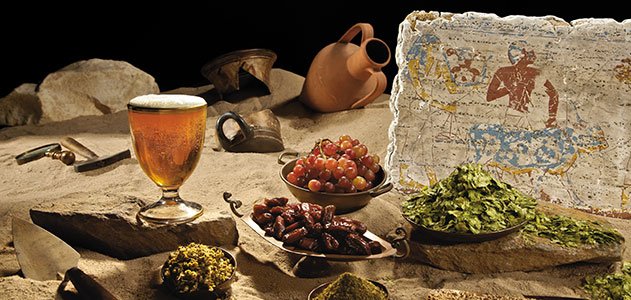
Given the right combination of sugars, nearly any cereal will undergo simple fermentation, due to the presence of wild yeasts in the air. In all likelihood our cave-dwelling ancestors experienced their first beer, as the result of this process.
In the 18,000-year old Wadi Kubbaniya in upper Egypt, starch dusted stones and the remains of doum-palm and chamomile indicate “it’s very likely they were making beer there” according to University of Pennsylvania archaeologist, Dr. Patrick McGovern.
Chemical analysis of pottery shards date the earliest barley beer to 3400BC in the Zagros Mountains of Iran.
Tacitus maligned the bitter brew of the Germanic barbarians. Wine seemed better suited to the sensibilities of the Roman palate, even so, letters from Roman cavalry commanders of the Roman Britain period, c. 97-103 AD, include requests for more “cerevisia“, for the legionaries.
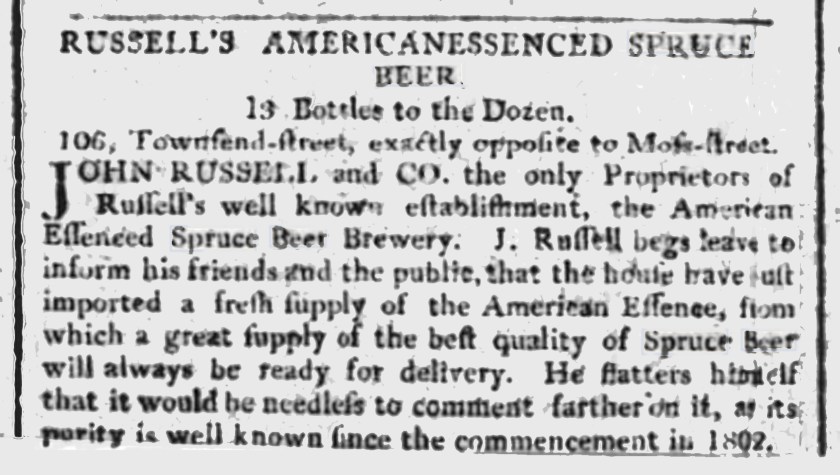
In North and South America, native peoples brewed fermented beverages from local ingredients including agave sap, the first spring tips of the spruce tree, and maize.
Pilgrimsleft the Netherlands city of Leiden in 1620, hoping not for the frozen, rocky soil of New England, but for rich farmland and a congenial climate in the New World. Lookouts spotted the wind-swept shores of Cape Cod on November 9, 1620 and may have kept going, had there been enough beer. A Mayflower passenger wrote in his diary: “We could not now take time for further search… our victuals being much spent, especially our beer…”
Prior to the invention of the drum roaster in 1817, malt was typically dried over wood, charcoal or straw fires leaving a smoky quality which would seem foreign to the modern beer drinker. William Harrison wrote in his “Description of England” in 1577, “For the wood-dried malt, when it is brewed, beside that the drink is higher of colour, it doth hurt and annoy the head of him that is not used thereto, because of the smoke“.
Smoky flavor didn’t trouble the true aficionado of the age. When the Meux Brewery casks let go in 1814 spilling nearly 400,000 gallons onto the street, hundreds of Brits hurried to scoop the stuff up in pots and pans. Some got down on all fours and lapped it up off of the street, doggy-style.
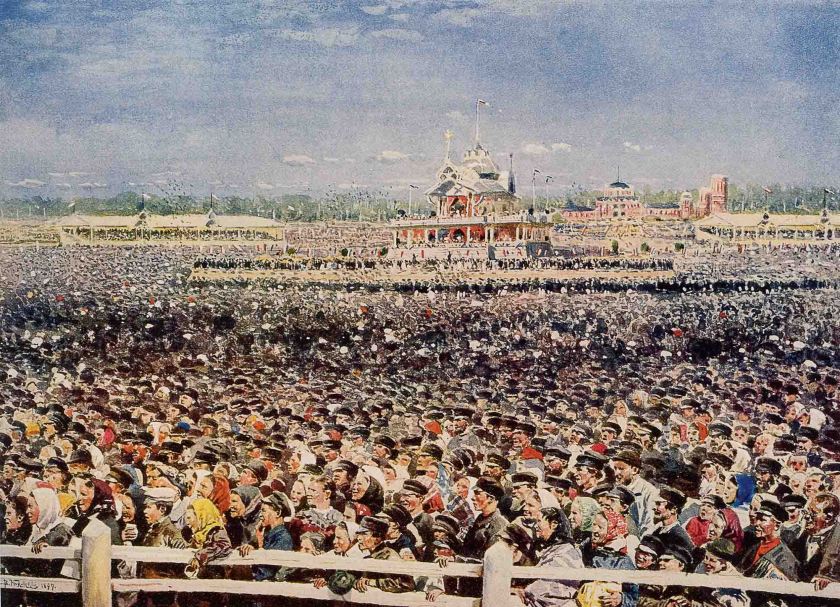
1,389 were trampled to death and another 1,300 injured in a stampede for the suds when someone thought the beer had run out at the coronation of Czar Nicholas II, in 1896.
The 18th amendment, better known as “prohibition”, went into effect at midnight, January 16, 1920. For thirteen years it was illegal to import, export, transport or sell liquor, wine or beer in the United States.
Portable stills went on sale within a week, and organized smuggling was quick to follow. California grape growers increased acreage by over 700% over the next five years, selling dry blocks of grapes as “bricks of rhine” or “blocks of port”. The mayor of New York City sent instructions to his constituents, on how to make wine.
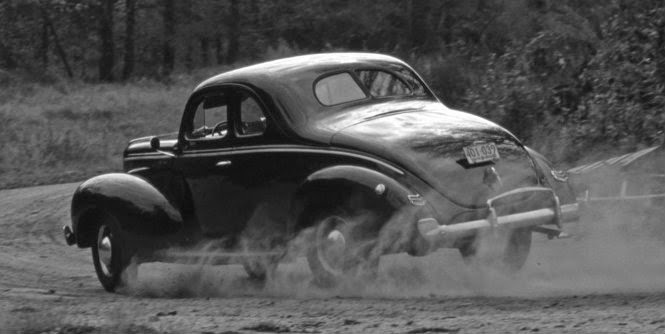
Smuggling operations became widespread as cars were souped up to outrun “the law”. This would lead to competitive car racing, beginning first on the streets and back roads and later moving to dedicated race tracks. It’s why we have NASCAR, today.
Organized crime became vastly more powerful due to the influx of enormous sums of cash. The corruption of public officials was a national scandal.
Gaining convictions became increasingly difficult for breaking a law that everyone hated. There were over 7,000 prohibition related arrests in New York alone between 1921 and 1923. Only 27 resulted in convictions.
The federal government went so far as to deliberately poison denatured alcohol to discourage its “renaturing” resulting in no fewer than 10,000 dead. Even so, the writing was on the wall. Not even poisonous hooch was going to keep the determined reveler, from enjoying a drink.
At last even John D. Rockefeller, Jr., the lifelong teetotaler who contributed $350,000 to the Anti-Saloon League, had to announce support for repeal.
It’s difficult to compare rates of alcohol consumption before and during prohibition. If death by cirrhosis of the liver is any indication, alcohol consumption never decreased by more than 10 to 20 per cent.
President Franklin Delano Roosevelt signed the Cullen–Harrison Act into law on March 22, 1933 with the quip, “I think this would be a good time for a beer.” The law went effect on April 7. For the first time in 13 years Americans could once again buy, sell and legally enjoy a beer containing up to 3.2% alcohol.
A team of draft horses hauled a wagon up Pennsylvania Avenue, delivering a case of beer to the White House. It was the first public appearance of the now-famous, Budweiser Clydesdales.
“Dry” leaders tried to prohibit consumption of alcohol on military bases in 1941, but authorities claimed it was good for morale. Brewers were required to allocate 15% of total annual production to be used by the armed forces. So essential were beer manufacturers to the war effort that teamsters were ordered to end a labor strike against Minneapolis breweries. Near the end of WWII, the army made plans to operate recaptured French breweries, to ensure adequate supplies for the troops.
18 states continued prohibition at the state level after national repeal, the last state finally dropping it in 1966. Almost 2/3rds of all states adopted some form of local option, enabling residents of political subdivisions to vote for or against local prohibition. Some counties remain dry to this day. Ironically, Lynchburg County, Tennessee, home to the Jack Daniel distillery, is one such dry county.
The night before Roosevelt’s law went into effect was April 6, 1933. Beer lovers lined up at the doors of their favorite watering holes waiting for their first legal beer in thirteen years. A million and a half barrels of the stuff were consumed the following day, a date remembered to this day as “National Beer Day”.
So it is we remember, from that day to this. April 6. “New Beer’s Eve”.
Sláinte.
For every wound, a balm. For every sorrow, cheer. For every storm, a calm. For every thirst, a beer.
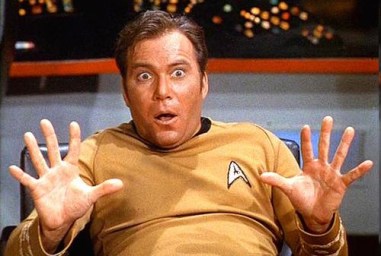
Kirk was killed in 2329 on the Enterprise (B), after the ship was eaten by a Nexus energy ribbon on its maiden voyage. Only he didn’t die, because Jean-Luc Picard found him alive in the timeless Nexus, negotiating hotel deals for Priceline.com. Or something like that.
On March 22, 2228, a boy will be born to George and Winona Kirk. He would go on to become the youngest captain in Starfleet history but, before he could boldly go where no man has gone before, he had to have a name.
The real-world former World War 2 fighter pilot and veteran of 89 combat missions Gene Roddenberry had 16 suggestions for a name, among these “Hannibal”, “Timber”, “Flagg”, and “Raintree”. The television screenwriter and producer decided on James T. Kirk, based on a journal entry from the 18th century British explorer, Captain James Cook, who wrote “ambition leads me … farther than any other man has been before me“.
Kirk was killed in 2329 on the Enterprise (B), after the ship was eaten by a Nexus energy ribbon on its maiden voyage. Only he didn’t die, because Jean-Luc Picard found him alive in the timeless Nexus, negotiating hotel deals for Priceline.com. Or something like that.

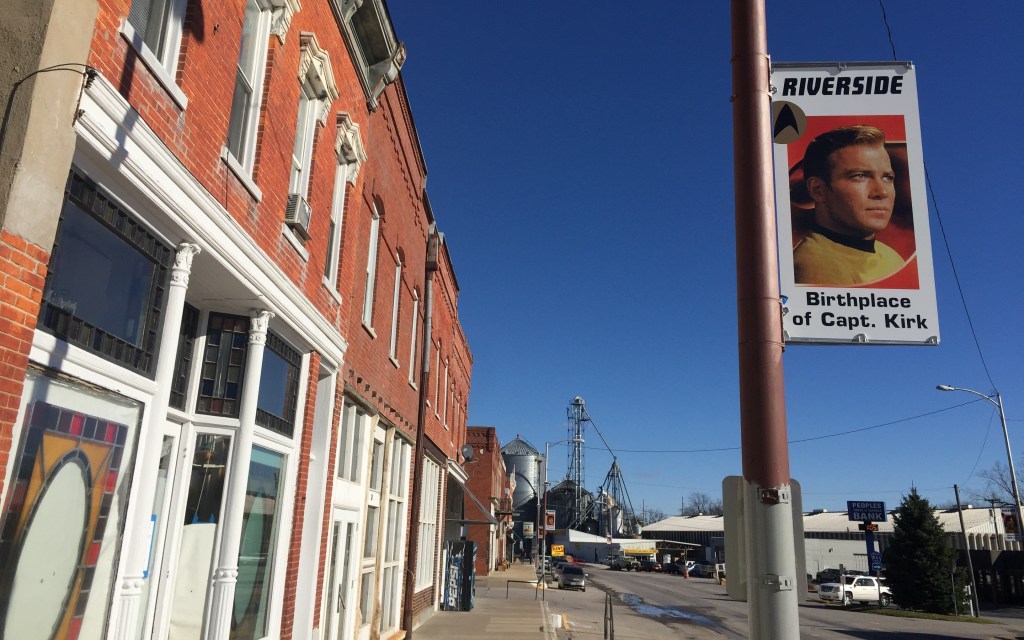
In his 1968 book “Making of Star Trek“, Roddenberry writes that James Kirk was born in a small town in Iowa. Full time “Trekkie” and part time Riverside, Iowa Councilman Steve Miller thought “Why not Riverside”. In 1985, Miller moved that Riverside declare itself the Future Birthplace of James T. Kirk. The motion passed, unanimously. Miller poked a stick in the ground behind the barber shop, (good thing he owned the property), declaring that this was the place. An engraved monument was erected, and so it was.
Riverside Iowa, population 963, became the “Future Birthplace of Captain James T. Kirk. A bench was later added , along with a Shuttlecraft-shaped donation box.
Riverside’s official slogan was changed from “Where the best begins” to “Where the Trek begins,” the annual “River Fest” summer festival, became “Trek Fest”.
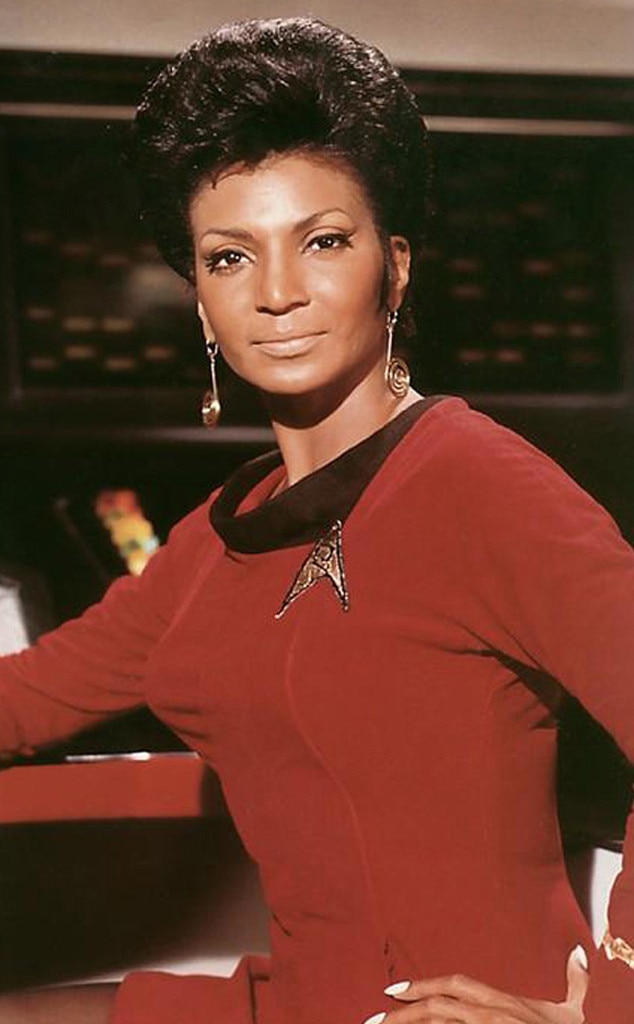
Fun fact: Turning on the television today it’s hard to remember how ground-breaking it was that a black, female character would play such a prominent role on a prime-time series as the actress Nichelle Nichols playing Communications Officer Nyota Uhura. The real life Nichols preferred the stage to TV and submitted her resignation, to pursue a career on Broadway. Gene Roddenberry asked her to take the weekend to reconsider, which she did. That weekend, Nichols attended a banquet put on by the NAACP where she was informed, a ‘fan’ wanted to meet her. Let her tell the story from here:
I thought it was a Trekkie, and so I said, ‘Sure.’ I looked across the room and whoever the fan was had to wait because there was Dr. Martin Luther King walking towards me with this big grin on his face. He reached out to me and said, ‘Yes, Ms. Nichols, I am your greatest fan.’ He said that Star Trek was the only show that he, and his wife Coretta, would allow their three little children to stay up and watch. [She told King about her plans to leave the series because she wanted to take a role that was tied to Broadway.] I never got to tell him why, because he said, ‘you cannot, you cannot…for the first time on television, we will be seen as we should be seen every day, as intelligent, quality, beautiful, people who can sing dance, and can go to space, who are professors, lawyers. If you leave, that door can be closed because your role is not a black role, and is not a female role, he can fill it with anybody even an alien”.
The conversation with Reverend King, was life-changing. Nichols returned to the series. When it was over she volunteered with NASA, working to promote the space agency and helping to recruit female and minority recruits between 1977, and 2015. The program recruited Dr. Sally Ride and United States Air Force Colonel Guion Bluford, respectively the first female and the first American astronaut of African ancestry. The program also recruited Dr. Judith Resnik and Dr. Ronald McNair, both of whom flew successful Space Shuttle missions before their deaths in the Space Shuttle Challenger disaster of January 28, 1986.
Star Trek fans, ever-jealous protectors of series trivia, sometimes wonder why the March 22, 2228 date on the Riverside monument differs from the March 22, 2233 date usually cited as Kirk’s future birthday. The 2233 date didn’t come around until eight years after the monument, with the publication The Star Trek Chronology: The History of the Future. 2228 or 2233 you may take your pick, but both agree on March 22, which just happens to be the real-life William Shatner’s, birthday.
In case you ever wondered what the “T” stands for – its “Tiberius”.
The Space Foundation of Colorado Springs bills itself as “the world’s premier organization to inspire, educate, connect, and advocate on behalf of the global space community“.
In 2010, survey conducted by the organization found that James Tiberius Kirk tied for #6 as the “most inspirational space hero of all time“, along with Russian Cosmonaut Yuri Gagarin. You can’t make this stuff up. Tied for 6th place, with the first human in space. A guy who went there, and then came back. A guy who…you know…actually…exists.
The camera captured the shock and surprise on the victim’s face, similar I’m sure to that which crossed the faces of four musicians watching it all , on TV. The shooter was the same man they had worked for just a few months earlier, at that burned out dive bar, called the Skyline lounge.
Jacob Leon Rubenstein was a troubled child, growing up on the west side of Chicago. Marked a juvenile delinquent from his earliest adolescence, Rubenstein was arrested for truancy at age 11, eventually skipping enough school to spend time at the Institute of Juvenile Research.
Many who knew Jacob Rubenstein called him “Sparky”, a nickname shared with Peanuts creator, Charles M Shulz. Any similarity between the two ended there. Some say the sobriquet came from an uncanny resemblance to “Sparkplug”, the old nag with the patchwork blanket, from the Snuffy Smith cartoon strip. Be that as it may Rubenstein hated the nickname and was quick to fight anyone who called him that. It may have been that quick temper, that made the hated name stick.
Rubinstein spent the early 40s at racetracks in Chicago and California, until being drafted into the Army Air Forces, in 1943. Honorably discharged in 1946, he returned to Chicago, before moving to Dallas the following year.
Rubenstein managed a series of seedy Dallas nightclubs and strip joints, featuring ladies like “Candy Barr” and “Chris Colt and her ’45’s”. Somewhere along the line this towering figure from the early 1960s Dallas hospitality scene shortened his name, to “Ruby”.
Ruby dabbled in all manner of underworld activities such as gambling, narcotics and prostitution. There were even rumored associations with Mafia boss Santo Trafficante. The lower crust of the Dallas police force knew Ruby was always good for free booze, prostitutes, and other favors. This was one unsavory guy.
A typical blackjack
Today, you may know Rick Danko, Levon Helm, Garth Hudson and Robbie Robertson as musicians touring with Bob Dylan in 1965 who later morphed into “The Band”, and performed such rock & roll standards as “The Night they Drove Old Dixie Down”, “Up on Cripple Creek” and “The Weight”.
In early days, the joints these guys played were so rough they performed with blackjacks, hidden in special pockets sewn into their coats.
In 1963, they played a week in a Fort Worth nightclub. It was a huge venue but no one was there that first night save for two couples, a couple of drunk waiters and a one-armed go-go dancer. The band wasn’t through their first set before a fight broke out, and someone was tear-gassed. The band played on, coughing and choking with teargas wafting across the stage, faces wet with tears.
Part of the roof had either blown off this joint, or burned off, depending on which version you accept. Jack, the owner, tore off the rest of it and kept the insurance money calling this fine establishment , the “Skyline Lounge”.
Even without the roof Jack saw no need to pay for security. He told the musicians “Boys, this building ain’t exactly secure enough for you to leave your musical equipment unattended.” Band members were told they’d best stay overnight, with guns, lest anyone come over the wall. Problem solved.
Months later, the country was stunned at the first Presidential assassination in over a half-century. I was 5½ at the time and I remember it, to this day. An hour after the shooting, former marine and defector to the Soviet Union Lee Harvey Oswald killed Dallas police officer J.D. Tippit, who had stopped him for questioning. Thirty minutes later, Oswald was arrested in a movie theater.
By Sunday, November 24, Oswald was formally charged with the murders of President John F. Kennedy and Dallas police officer J. D. Tippit. He was taken to the basement of Dallas police headquarters where an armored car awaited, to transport the prisoner to a more secure county jail. It was never meant to be.
The scene was crowded with press and police. If you were alive that day you probably remember, half the country watched it on live TV. A lone man came out of the crowd and fired a single bullet from his .38 revolver into the belly of Lee Harvey Oswald.
The camera captured the shock and surprise on Oswald’s face, similar I’m sure to that which crossed the faces of four musicians watching it all, on TV. The shooter was the same man they had worked for just a few months earlier, at that burned out dive bar, called the Skyline lounge. Jack Ruby.
Oswald was transported unconscious to Parkland Memorial Hospital, the same hospital where John F. Kennedy had died, only two days earlier. He was dead in two hours.
Jack Ruby was sentenced to death in the murder of Lee Harvey Oswald, on March 14, 1964. The Texas Court of Criminal Appeals overturned the conviction in October 1966, on the grounds that the trial should have taken place in a different county from where his high profile crime had taken place.
Ruby died of lung cancer the following January, while awaiting retrial. The Warren Commission found no evidence linking Jack Ruby’s murder of Lee Harvey Oswald, to any broader conspiracy to assassinate the President.
In 1973 the Jack Ruby inspired a thoroughly forgettable band to take the same name unless that happens to be, your “thing”. Whatever became of Jacob Leon “Sparky” Rubenstein’s fine Dallas establishment will be left left to the more scandalous bits, of our imagination.
You must be logged in to post a comment.