June 27, 1985 Get your Kicks

It was the age of the automobile, and all manner of roadside attractions sprang up to serve the burgeoning tourist business. There were teepee-shaped motels, frozen custard stands, Indian curio shops, and reptile farms.

us_camel_corp_1In 1857, President James Buchanan appointed Lieutenant Edward Beale to survey and build a 1,000-mile wagon road from Fort Defiance, New Mexico to the Arizona/California border. The survey continued an experiment first suggested by Secretary of War and future President of the Confederate States of America Jefferson Davis, in the use of camels as draft animals.
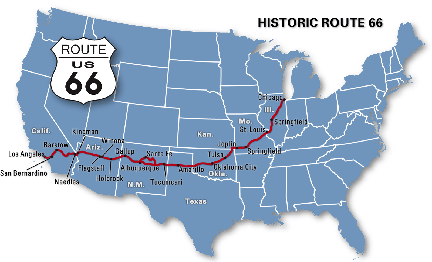
The camel part turned out to be a flop, but the road building was not.  Beale’s wagon trail went on to become the western end of “America’s Main Street”.  Route 66.route-66-map

The “Mother Road” became an official part of the national highway system in 1927. It was yet to be paved, when the US Highway 66 Association held a “Bunion Derby” in 1928.  It was a footrace from Los Angeles to Madison Square Garden, a distance of 3,423½ miles. Naturally, the LA to Chicago leg ran along Route 66.

Andy Hartley Payne, an Oklahoma Cherokee runner won the race in 573 hours, 4 minutes and 34 seconds. 11th place finisher Harry Abrams ran the race in the opposite direction the following year, becoming the only person to twice run across the continental United States.

route-66

In 1914, a Model T sold for $490.  As the 20s drew to a close, the number of registered drivers had tripled to 23 million.

The 1932 Summer Olympics in Los Angeles and the westward migration of the “Dust Bowl” era increased the number of “Mom & Pop” service stations, restaurants, and motor courts, springing up to serve the needs of passing motorists.

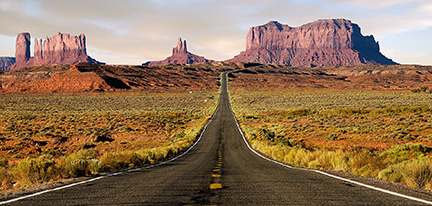
The road was fully paved by 1938, passing through the Painted Desert on the way by the Grand Canyon and Meteor Crater in Arizona. The golden age of the automobile had dawned.  All manner of roadside attractions popped up to serve the burgeoning tourist business, there were teepee-shaped motels, frozen custard stands, Indian curio shops, and reptile farms.

Meramec Caverns outside of St. Louis put their advertising on barns, calling themselves “Jesse James hideout”. The Big Texan sold a 72-ounce steak dinner, making it free to anyone who could eat the whole thing in an hour.

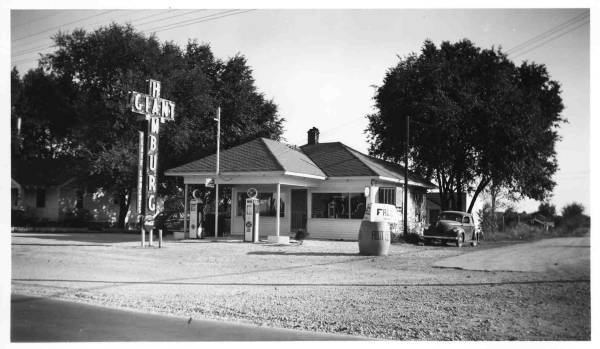
The fast-food industry was born on Route 66, when Sheldon “Red” Chaney built Red’s Giant Hamburg in Springfield, Missouri.  Believed to be the first drive-through restaurant in the country, the name was supposed to be “Red’s Giant Hamburger“.  Chaney had to cut the two bottom letters off his sign, when the city refused to raise the telephone wires.

Giant Hamburg

Patrick McDonald opened “The Airdrome” restaurant on Route 66 in 1937, near the Airport in Monrovia, California. Hot dogs were some of the first items he ever sold. Ten cent hamburgers were added later, along with all-you-can-drink orange juice for five cents. Three years later, McDonald’s two sons Maurice and Richard (“Mac” and “Dick”) moved the entire building 40 miles east, to San Bernardino, calling the place “McDonald’s Bar-B-Que”.

General Eisenhower came out of WWII with an appreciation for the German highway system, the Autobahn, and signed the Interstate Highway Act as President in 1956. It was the beginning of the end for Route 66. New highway construction began to bypass town centers, and once-thriving Mom & Pops began to die off.

route-66 carsBy the mid-50s, Missouri upgraded its sections of US 66 to four lanes, by-passing town centers and the businesses that went with them.

Illinois widened US 66 from Chicago to the Mississippi River. By 1957, virtually the entire Missouri-Kansas-Oklahoma stretch was replaced by 4 lane toll roads. You could see the old 66 as you drove parallel to it, but travelers rarely stopped.

avon-courtThe last parts of Route 66 were decertified by state highway and transportation officials on this day in 1985.  In some cities, the old road is now the “Business Loop”.  It’s been carefully preserved in many areas, and abandoned in others.

Today, most of the old attractions are gone.  You couldn’t drive the old Route 66 from Chicago to LA if you wanted to, but you could get close.  You only need to plan ahead.

June 3, 1909 History of the Potato Chip

According to the Snack Food Association’s 2012 state of the industry report, Americans spent $9 billion on potato chips in 2010, more than the gross domestic product of the bottom 57 countries, on earth.

George-CrumAs the story goes, it was 1853, at an upscale resort in Saratoga Springs New York. A wealthy and somewhat unpleasant customer sent his fried potatoes back to the kitchen, complaining that they were too soggy, and they didn’t have enough salt.   George Crum, back in the kitchen, doesn’t seem to have been a very nice guy, himself.  Crum thought he’d fix this guy, so he sliced some potatoes wafer-thin, fried them up and doused the hell out of them, with salt. Sending them out to the table and fully expecting the customer to choke on them, Crum was astonished to learn that the guy loved them. He ordered more, and George Crum decided to add “Saratoga Chips” to the menu. The potato chip was born.

Herman Lay was a brilliant marketer, even from a young age.  Born on this day in 1909, Lay opened a Pepsi Cola stand on his front lawn at the age of 11.  When the city ballpark across the street was charging ten cents for a Pepsi, Lay charged a nickel.Saratoga chips

Lay was a lumberjack, a jewelry salesman, and a peanut salesman, before he went to work for the Atlanta based Barrett Potato Chip Company. He traveled the Southeast during the Great Depression in his Model A Ford, selling chips to grocery stores, gas stations and soda shops. When the company’s owner died, Lay raised $60,000 and bought the company’s plants in Atlanta and Memphis.

By this time, potato farmers had developed a low moisture “chipping potato”, because other types tended to shrink too much in processing. Other inventions like the mechanical potato peeler, the continuous fryer and sealed bags helped “chippers” of the 30s and 40s ship their products farther than ever before.

Herman LayLay began buying up small regional competitors at the same time that another company specializing in corn chips was doing the same. “Frito”, the Spanish word for “fried”, merged with Lay in 1961 to become – you got it – Frito-Lay. By 1965, the year Frito-Lay merged with Pepsi-Cola to become PepsiCo, Lay’s was the #1 potato chip brand in every state in America.

Procter & Gamble figured out how to put a potato chip in a can, using dehydrated potato flakes and calling them “Pringles”. Potato chip manufacturers lobbied Congress to prevent the new snacks from being called “potato chips” and Federal officials offered Pringles a compromise, allowing them to call them “chips made from dried potatoes.” Procter & Gamble said no thanks, instead calling their product potato crisps. Ironically, P&G would later sue to have Pringles declared NOT to be a potato chip, to avoid millions in British Commonwealth taxes levied on products “made from the potato, or from potato flour.”

The biggest threat that Frito-Lay would ever experience came from the Beer giant Anheuser-Busch, when they introduced their “Eagle” line of salty snacks in the 1970s. It made perfect sense at the time, a marketing and distribution giant expanding into such a complementary product category, what could go wrong? Frito-Lay profits dropped by 16% by 1991, and PepsiCo laid off 1,800 employees, but Eagle Snacks never turned a profit in 16 years.  Anheuser-Busch put the company up for sale in 1995.

According to Forbes, Americans spent $5.64 billion on potato chips in 2016, more than the GDP of any of the 42 smallest countries, on earth.

Potato Chip Sales Chart 2016

Tom Peters wrote about Frito-Lay in his 1982 book “In Search of Excellence”. They’ll spend $150 to make a $30 delivery if that’s what they need to do, because their customer is counting on them, and they pride themselves on a 99.5% on-time delivery record. It might not make economic sense as a standalone transaction, but the company has a 60% share of the potato chip market, a massive 72.4% in the tortilla and tostada chips segment, and the highest profit margins in the industry. All that in “undifferentiated commodity” categories, in which their closest competitor has 7%.

Frito-Lay practices over-the-top customer service, in contradistinction to what so many companies put us through these days, in our everyday lives. There is a business lesson there, for those who would learn it.

May 18, 1965 Final Frontier

In his 1968 book “Making of Star Trek”, Gene Roddenberry says that James Kirk was born in a small town in Iowa. Full time Trekkie and part time Riverside Councilman Steve Miller thought “Why not Riverside”.

A boy was born on March 22, 2233 in Riverside, Iowa, destined to become the youngest captain in Star Fleet history. Before he could boldly go where no man has gone before, he had to have a name.

The WWII fighter pilot and veteran of 89 combat missions Gene Roddenberry made 16 name suggestions on this date in 1965, among them Hannibal, Timber, Flagg, and Raintree.

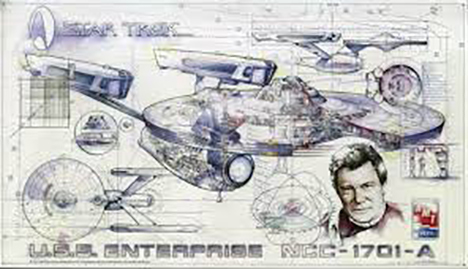
Star_Trek_William_ShatnerRoddenberry decided on James T. Kirk, based on a journal entry of the 18th century British explorer, Captain James Cook: “ambition leads me … farther than any other man has been before me”.

Kirk was killed in 2329 on the Enterprise (B), after the ship was eaten by a Nexus energy ribbon on its maiden voyage. Only he didn’t die, because Jean-Luc Picard found him alive in the timeless Nexus, negotiating hotel deals for Priceline.com. Or something like that.

In his 1968 book “Making of Star Trek”, Gene Roddenberry says that James Kirk was born in a small town in Iowa. Full time Trekkie and part time Riverside Councilman Steve Miller thought “Why not Riverside”. In 1985 Miller moved that Riverside declare itself the Future Birthplace of James T. Kirk.  The motion passed unanimously. The town’s slogan was changed from “Where the best begins” to “Where the Trek begins,” and the annual summer festival changed from “River Fest” to “Trek Fest”.

Star_Trek_William_Shatner_Future_Burial_Place.jpeg

The Riverside connection became Holy Writ, when the 2009 film Star Trek identified the place as Kirk’s home town. There is a granite monument in Riverside, population 963, declaring itself to be the “Future Birthplace of Captain James T. Kirk.

In case you were ever curious about what the “T” stands for…its Tiberius.


May 11, 1969  And Now for something Completely Different

The British comedy troupe that formed this day in 1969 was amused at the idea of a haughty Lord Montgomery, patterned after Field Marshal Bernard Law Montgomery, 1st Viscount Montgomery of Alamein, KG, GCB, DSO, PC, DL, etc.  “Python” seemed just slippery enough to make the whole thing work.

Graham Chapman was trained and educated to be a physician, but that career trajectory was never meant to be.  John Cleese was writing for TV personality David Frost and actor/comedian Marty Feldman at the time, when he recruited Chapman as a writing partner and “sounding board”.  BBC offered the pair a show of their own in 1969, when Cleese reached out to former How To Irritate People writing partner Michael Palin, to join the team.  Palin invited his own writing partner Terry Jones and colleague Eric Idle over from rival ITV, who in turn wanted American-born Terry Gilliam for his animations.

The British comedy troupe that formed this day in 1969 was amused at the idea of a haughty Lord Montgomery, patterned after Field Marshal Bernard Law Montgomery, 1st Viscount Montgomery of Alamein, KG, GCB, DSO, PC, DL, etc.  “Python” seemed just slippery enough to make the whole thing work.

The Pythons considered several names for their new program, including “Owl Stretching Time”, “The Toad Elevating Moment”, “Vaseline Review” and “A Horse, a Spoon and a Bucket”. “Flying Circus” had come up as well.  The name stuck when BBC revealed that they had already printed flyers, and weren’t about to go back to the printer.

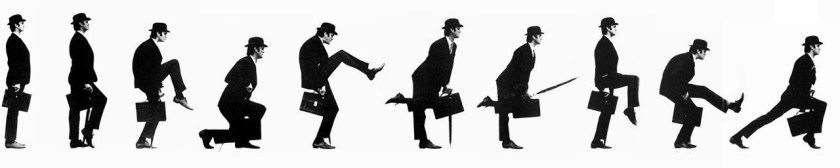
Silly-Walk-monty-python-13514283-1280-800

The show was a collaborative process, beginning with the first broadcast on October 5, 1969. With no writers of their own, the six would divide into groups and write their own material.  Whether any given sketch would make it into the program, was always a democratic process.

Different Python factions were responsible for different elements of the team’s humor. The work of the Oxford educated Terry Jones and Michael Palin was more visual, and a little more off the wall. The Spanish Inquisition arriving in a suburban apartment is a prime example, while the Cambridge educated John Cleese and Graham Chapman were more confrontational – “This is abuse. I came here for an argument”. Cleese said “anything that got utterly involved with words and disappeared up any personal orifice was Eric’s”, like the Man who Spoke in Anagrams.  Terry Gilliam was the guy behind the animation.Spanish Inquisition

The Flying Circus broke new ground with techniques like the “cold open”. With no titles, credits, or opening theme, Michael Palin would crawl across the tundra a la Robinson Crusoe, looking into the camera and saying “It’s“…  And off they went. The cold open sometimes lasted until the middle of the show. Occasionally, the Pythons fooled viewers by rolling closing credits halfway through, usually continuing the gag by fading to the BBC logo while Cleese parodied the tones of a BBC announcer. On one occasion the closing credits ran directly after the opening titles.

I personally learned to never leave a Python film during closing credits, finding my reward for sticking around at the end of the Life of Brian was to learn who wiped the moose’s noses. (As I recall, it was John J. Llama).

The “Iron Lady”, Prime Minister Margaret Thatcher herself, seems to have been a fan, doing a more than passable version of the Dead Parrot sketch at a Conservative Party Conference in 1990.


The Pythons shared a dislike for “capping” bits with punchlines, and experimented with ending sketches by cutting abruptly to another scene, or breaking the rules altogether by addressing the camera directly. Two examples were the knight in armor, played by Terry Gilliam, who would wander onto the set and whack people over the head with a rubber chicken.  Or Chapman’s “Colonel” character, who would walk into sketches and order them stopped because things were becoming “far too silly.”

Gilliam’s animations were a favorite technique, when a 16 ton weight would drop from the sky, or else it was Cupid’s foot – yes, that’s Cupid’s foot – cut from a reproduction of the Renaissance masterpiece “Venus, Cupid, Folly, and Time” by Il Bronzino.Cupids Foot

John Cleese left the Flying Circus at the end of the third season. He had considered doing so at the end of the second, feeling that he had little original material to offer the show. He found Chapman difficult to work with, who was at this time a full tilt alcoholic.  Cleese could be difficult himself. Eric Idle once said of John Cleese. “He’s so funny because he never wanted to be liked. That gives him a certain fascinating, arrogant freedom”.

Monty Python - The Black Knight RisesThe group reunited in 1974 to do the Holy Grail, which was filmed on location in Scotland, on a budget of £229,000. The money was raised in part by investments from musical figures like Pink Floyd, Jethro Tull and Led Zeppelin backer Tony Stratton-Smith. Investors in the film wanted to cut the famous Black Knight scene, (“None shall pass”), but were eventually persuaded to keep it in the film. Good thing, the scene became second only to the Holy Hand Grenade of Antioch and the Killer Rabbit. “What’s he going to do, nibble my bum?”

Graham Chapman is best remembered as King Arthur in the Holy Grail, and Brian Cohen in the Life of Brian.  He died of spinal and throat cancer on the 20th anniversary of their first broadcast.  John Cleese delivered a uniquely Pythonesque eulogy, which sounded a lot like the Dead Parrot sketch.  “”Graham Chapman, co-author of the Parrot sketch, is no more,” he began. “He has ceased to be, bereft of life, he rests in peace, he has kicked the bucket, hopped the twig, bit the dust, snuffed it, breathed his last, and gone to meet the Great Head of Light Entertainment in the sky…”

I don’t believe he’d have had it any other way.  Silly bunt.

May 9, 1914 The History of Mother’s Day

Following her mother’s death in 1905, Anna Jarvis conceived of Mother’s Day as a way to honor her legacy, and to pay respect for the sacrifices that all mothers make on behalf of their children.

The earliest discernible Mother’s day comes from 1200-700BC, descending from the Phrygian rituals of modern day Turkey and Armenia. “Cybele” was the great Phrygian goddess of nature, mother of the Gods, of humanity, and of all the beasts of the natural world, her cult spreading throughout Eastern Greece with colonists from Asia Minor.Women in Rome

Much of ancient Greece looked to the Minoan Goddess Rhea, daughter of the Earth Goddess Gaia and the Sky God Uranus, mother of the Gods of Olympus. Over time the two became closely associated with the Roman Magna Mater, each developing her own cult following and worshipped through the period of the Roman Empire.

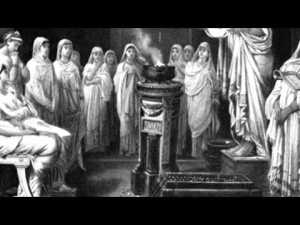
In ancient Rome, women partook of a festival, strictly forbidden to Roman men. So strict was this line of demarcation that only women were permitted even to know the name of the deity.  For everyone else she was simply the “Good Goddess”. The Bona Dea.

In the sixteenth century, it became popular for Protestants and Catholics alike to return to their “mother church” whether that be the church in which they were baptized, the local parish church, or the nearest cathedral. Anyone who did so was said to have gone “a-mothering”. Domestic servants were given the day off and this “Mothering Sunday”, the 4th Sunday in Lent, was often the only time when whole families could get together. Children would gather wild flowers along the way, to give to their own mothers or to leave in the church. Over time the day became more secular, but the tradition of gift giving continued.

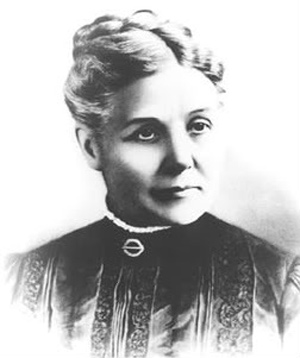
Ann Maria Reeves Jarvis

Ann Maria Reeves Jarvis was a social activist in mid-19th century western Virginia.  Pregnant with her sixth child in 1858, she and other women formed “Mothers’ Day Work Clubs”, to combat the health and sanitary conditions which were leading at that time to catastrophic levels of infant mortality.  Jarvis herself gave birth between eleven and thirteen times in a seventeen year period.  Only four would live to adulthood.

Jarvis had no patience for the sectional differences that led the nation to Civil War, or which led her own locality to secede and form the state of West Virginia in order to rejoin the Union.  Jarvis refused to support a measure to divide the Methodist church into northern and southern branches.  She would help Union and Confederate soldier alike if she could.  It was she alone who offered a prayer when others refused, for Thornsbury Bailey Brown, the first Union soldier killed in the vicinity.

Anna Jarvis
Anna Jarvis

Following Jarvis’ death in 1905, her daughter Anna conceived of Mother’s Day as a way to honor her legacy and to pay respect for the sacrifices that all mothers make on behalf of their children.

Obtaining financial backing from Philadelphia department store owner John Wanamaker, Anna Jarvis organized the first official Mother’s Day celebration at a Methodist church in Grafton, West Virginia. That same day, thousands attended the first Mother’s Day event at Wanamaker’s store in Philadelphia.

Anna Jarvis resolved that Mother’s Day be added to the national calendar, and a massive letter writing campaign ensued. On May 9, 1914, President Woodrow Wilson signed a measure declaring the second Sunday of May, to be Mother’s Day.

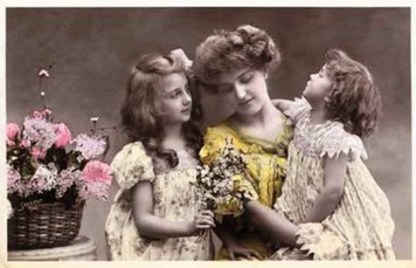
Mothers-Day-1919Anna Jarvis believed Mother’s Day to be a time of personal celebration, a time when families would gather to love and honor their mother.
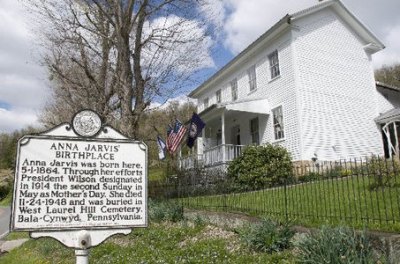
In the early days she had worked with the floral industry to help raise the profile of Mother’s Day. By 1920 she had come to resent what she saw as the commercialization of the day.  Greeting cards seemed a pale substitute for the hand written personal notes she envisioned. Jarvis protested a Philadelphia candy maker’s convention in 1923, deriding confectioners, florists and even charities as “profiteers”. Carnations had by this time become symbolic of Mother’s Day, and Jarvis resented that they were being sold at fundraisers.  She protested at a meeting of the American War Mothers in 1925 where women were selling carnations, and got herself arrested for disturbing the peace.Anna-House1

Soon she was launching an endless series of lawsuits against those she felt had used the “Mother’s Day” name in vain.

During the last years of her life, Anna Jarvis lobbied the government to take her creation off of the calendar, gathering signatures door-to-door to get the holiday rescinded. The effort was obviously unsuccessful.  The mother of mother’s day died childless in a sanitarium in 1948, her personal fortune squandered on legal fees.

Today, some variation of Mother’s Day is observed from the Arab world to the United Kingdom. In the United States, Mother’s Day is one of the most commercially successful days of the year for flower and greeting card sales, and the biggest day of the year for long-distance telephone calls. Church attendance is the third highest of the year, behind only Christmas and Easter. Many churchgoers celebrate the day with carnations:  colored if the mother is still living and white if she has passed on.

Happy Mother’s Day.


May 8, 1877 Westminster Dog Show

1,200 dogs arrived for that first show, in an event so popular that the originally planned three days morphed into four.

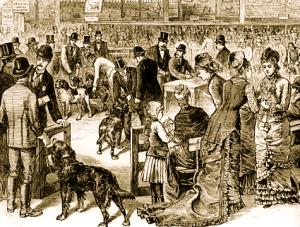
westminsterdogshowThe world’s most famous dog show was first held on May 8, 1877, and called the “First Annual NY Bench Show.” The venue was Gilmore’s Garden at the corner of Madison Avenue and 26th Street, a hall which would later be known as Madison Square Garden.  Interestingly, another popular Gilmore Garden event of the era was boxing.  Competitive boxing was illegal in New York in those days, so events were billed as “exhibitions” or “illustrated lectures.” I love that last one.
It was originally a show for hunting dogs, mostly Setters and Pointers with a few Terriers.  A group of hunters used to meet at the Westminster Hotel at Irving Place & 16th Street, in Manhattan.  The Westminster Kennel Club was formed by this group when they first decided to hold a dog show.  When you think of the 2nd amendment purgatory that is Warren Wilhelm (Bill) DiBlasio’s New York, it’s amusing to think that original prizes included pearl handled revolvers.

new-westminster-breeds1,200 dogs arrived for that first show, in an event so popular that the originally planned three days morphed into four.  The Westminster Kennel Club donated all proceeds from the fourth day to the ASPCA, for the creation of a home for stray and disabled dogs.  The organization remains supportive of animal charities, to this day.
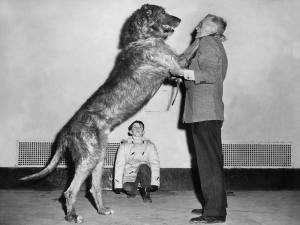
The Westminster dog show is the longest continuously held sporting event in the United States, with the sole exception of the Kentucky Derby, which began only two years earlier.

Not even two World Wars could stop Westminster.  A tugboat strike cut two days down toWolfhound one in 1946.  Even so, “Best in Show” was awarded fifteen minutes earlier than it had been, the year before. I wonder how many puppies were named “Tug” that year.  The Westminster dog show was first televised in 1948, three years before the first nationally televised college football game.
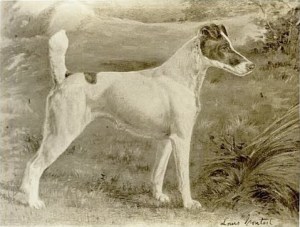
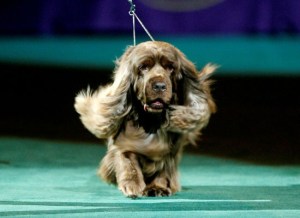
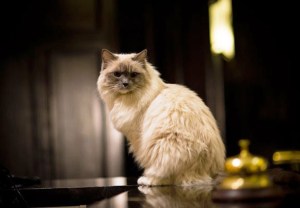
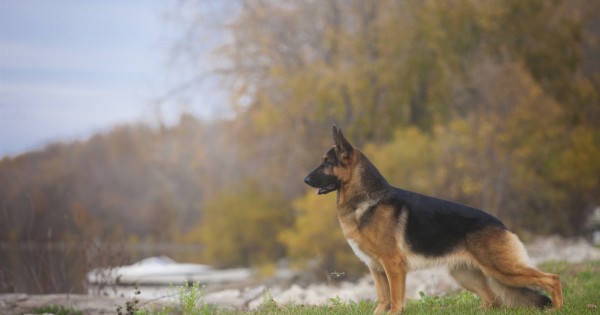
When the American Kennel Club was founded in 1884, Westminster was the first club to be admitted.  Breed parent clubs such as the German Shepherd Dog Club of America develop breed standards, extensive written descriptions of what the perfect specimen looks like for any given breed.  Some of the traits which distinguished the original working dogs of 1877 are still apparent, while other elements are seemingly arbitrary, such as tail carriage, eye shape and color.

Dogs are judged first against others of their own breed, and then the best of each goes forward into one of seven groups:  Sporting, Hound, Working, Terrier, Toy, Non-Sporting, and Herding.  In the final round, the winners from each of these seven groups compete for “Best in Show”, of which there can be only one.

Mixed breeds have been permitted since 2014, to compete in an agility event.

Warren_remedy
Ch. Warren Remedy

A Smooth Fox Terrier named Ch.(Championship) Warren Remedy won the top award in 1907, 1908 and 1909, the only dog to ever win three Best in Shows at Westminster.  Seven dogs have twice taken the top award, and five owners have won Best in Show with more than one dog.  A Sussex Spaniel named Stump became the oldest winner in dog show history in 2009, at the age of 10.  Judge Sari Tietjen said she had no idea the winning dog was a senior citizen.  “He showed his heart out,” she said. “I didn’t know who he was or how old … I just couldn’t say no to him”.

Stump
Stump

Today, the Westminster dog show runs two days and nights in February.  Entry is limited to 2,800 dogs and fills up on the first day of registration.  Breed judging takes place during the day at Piers 92 and 94. Group and Best in Show competition takes place in the evening at Madison Square Garden. Since 1992, Westminster has invited the top five dogs from each breed to pre-enter, based on dog show performances of the preceding year.

Madison Square Garden generally sells out for the event, the WKC issuing up to 700 press credentials for media attending from no fewer than 20 countries.  Each year the Westminster website www.westminsterkennelclub.org receives 20 million page views from 170 countries.

Algonquin-CatSince the late 60s, the Westminster Best in Show winner has celebrated at Sardi’s, a popular mid-town eatery in the theater district and birthplace of the Tony award.  And then the Nanny State descended, pronouncing that 2012 would be their last.  There shalt be no dogs dining any restaurants, not while Mayor Bloomberg is around.
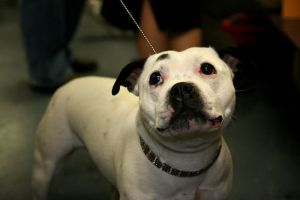
The Algonquin, the historic hotel at the corners of 59th St. W. & 44th, took in a stray cat sometime back in the 1930s.  A succession of felines have had the run of the place ever since. The males have all been “Hamlet”, and the females called “Matilda”.Staffordshire_Bull_Terrier_Westminster_Dog_Show

Mayor Yourslurpeeistoobig Bloomberg’s Board of Health descended on the Algonquin in 2011, requiring that the cat be kept on a leash.  There ensued a tempest in a cat box, until a compromise was reached later that year. An electronic pet fence would be installed, confining the cat to non-food areas of the hotel.

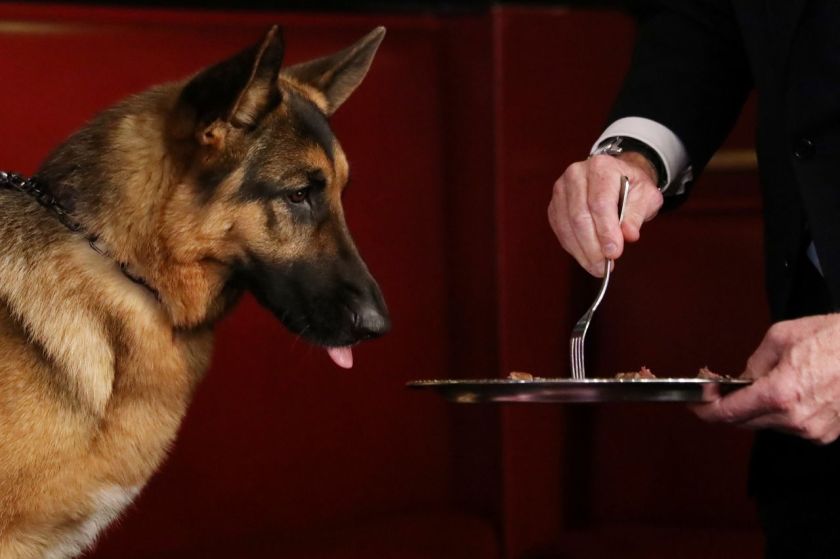
Not wanting another such drama, Nanny Bloomberg pulled his health commissioner, Dr. Thomas Farley, aside.  By the end of the week, the health department had found a loophole to defuse the standoff:  Dr. Farley would issue a waiver.  Since then, the winner at Westminster is free to enjoy the traditional celebratory luncheon of diced chicken and rice off a silver platter.  Provided that it’s eaten in the back room.

SardisDinner


May 3, 1915 The Red Poppy

No free citizen of a self-governing Republic, should ever forget where we come from. Or the prices paid by our forebears, to get us here.

John McCrae was a physician and amateur poet from Guelph, Ontario. Following the outbreak of WWI, McCrae enlisted in the Canadian Expeditionary Force at the age of 41. He had the option of joining the medical corps based on his training and his age, but volunteered instead to join a fighting unit as gunner and medical officer. McCrae had previously served in the Boer War, this would be his second tour of duty in the Canadian military.

Red PoppyMcCrae fought in one of the most horrendous battles of WWI, the second battle of Ypres, in the Flanders region of Belgium. Imperial Germany launched one of the first chemical attacks in history, attacking the Canadian position with chlorine gas on April 22, 1915. The Canadian line was broken but quickly reformed, in near-constant fighting that lasted for over two weeks.

Dr. McCrae later wrote to his mother, describing the nightmare. “For seventeen days and seventeen nights”, he wrote, “none of us have had our clothes off, nor our boots even, except occasionally. In all that time while I was awake, gunfire and rifle fire never ceased for sixty seconds … and behind it all was the constant background of the sights of the dead, the wounded, the maimed, and a terrible anxiety lest the line should give way”.flanders field poppies 4

On May 3, Dr. McCrae presided over the funeral of his friend and fellow soldier Alexis Helmer, who had died in the battle. He performed the burial service himself, when he noted how quickly the red poppies grew on the graves of the fallen. He composed this poem the next day, while sitting in the back of an ambulance.

McRae Copy

flanders-fields-painting

Moina Michael was browsing through the Ladies Home Journal when she came across McCrae’s poem. It was Saturday morning, November 9, 1918, two days before the armistice. She was so moved that she made a personal pledge to “keep the faith”, vowing always to wear a red poppy as a sign of remembrance of the dead. She scribbled down a response on the back of a used envelope, calling her poem “We Shall Keep the Faith“.

Michael CopyThe vivid red flower blooming on the battlefields of Belgium, France and Gallipoli came to symbolize the staggering loss of life in that war. Since then, the red poppy has become an internationally recognized symbol of remembrance of the lives lost in all wars. I keep a red poppy pinned to my briefcase and another on the visor of my car.  A reminder that no free citizen of a self-governing Republic, should ever forget where we come from. Or the prices paid by our forebears, to get us here.

Poppies, 1

May 2, 1939 Lucky Man

The Yankees were in Detroit on May 2 when Gehrig told manager Joe McCarthy “I’m benching myself, Joe”. It’s “for the good of the team”. The Iron Horse’s streak of 2,130 consecutive games, had come to an end.

The Lane Tech high school baseball team was at home on June 26, 1920.  10,000 spectators had assembled to watch the game at Cubs Park, now Wrigley Field.  New York’s Commerce High was ahead 8–6 in the top of the 9th, when a left handed batter hit a grand slam out of the park.  No 17 year-old had ever hit a baseball out of a major league park before, and I don’t believe it’s happened, since. It was the first time the country heard the name Lou Gehrig.

GehrigCUGehrig was pitching for Columbia University against Williams College on April 18, 1923, the day that Babe Ruth hit the first home run out of the brand new Yankee Stadium. Though Columbia would lose the game, Gehrig struck out seventeen batters to set a team record.

The loss didn’t matter to Paul Krichell, the Yankee scout who’d been following Gehrig. Krichell didn’t care about the arm either, as much as he did that powerful left-handed bat. He had seen Gehrig hit some of the longest home runs ever seen on several eastern campuses, including a 450′ home run at Columbia’s South Field that cleared the stands and landed at 116th Street and Broadway.

NY Giants manager John McGraw persuaded a young Gehrig to play pro ball under a false name, Henry Lewis, despite the fact that it could jeopardize his collegiate sports eligibility. Gehrig played only a dozen games for the Hartford Senators before being found out, and suspended for a time from college ball. This period, and a couple of brief stints in the minor leagues in the ’23 and ’24 seasons, were the only times Gehrig didn’t play for a New York team.

Gehrig started as a pinch hitter with the NY Yankees on June 15, 1923. He came into his own in the ‘26 season.  In 1927 he batted fourth on “Murderers’ Row”, the first six hitters in the Yankee’s batting order: Earle Combs, Mark Koenig, Babe Ruth, Lou Gehrig, Bob Meusel and Tony Lazzeri.

He had one of the greatest seasons of any batter in history that year, hitting .373, with 218 hits: 52 doubles, 18 triples, 47 home runs, a then-record 175 RBIs, and a .765 slugging percentage. Gehrig’s bat helped the 1927 Yankees to a 110–44 record, the American League pennant, and a four game World Series sweep of the Pittsburgh Pirates.

He was the “Iron Horse”, playing in more consecutive games than any player in history. It was an “unbreakable” record, standing for 56 years, until surpassed in 1995 by Cal Ripken, Jr. Gehrig hit his 23rd and last major league grand slam in August 1938, a record that would stand until fellow Yankee Alex Rodriquez tied it in 2012.

Lou Gehrig collapsed in 1939 spring training, going into an abrupt decline early in the season. The Yankees were in Detroit on May 2 when Gehrig told manager Joe McCarthy “I’m benching myself, Joe”. It’s “for the good of the team”.  McCarthy put Babe Dahlgren in at first and the Yankees won 22-2, but that was it.  The Iron Horse’s streak of 2,130 consecutive games, had come to an end.

Sports reporter James Kahn wrote: “I think there is something wrong with him. Physically wrong, I mean. I don’t know what it is, but I am satisfied that it goes far beyond his ball-playing”.

Gehrig left the team in June, arriving at the Mayo Clinic on the 13th. The diagnosis of Amyotrophic Lateral Sclerosis (ALS) was confirmed six days later, on June 19.  It was his 36th birthday. It was a cruel prognosis: rapidly increasing paralysis, difficulty in swallowing and speaking, and a life expectancy of fewer than three years.Ruth and Gehrig

Gehrig briefly rejoined the Yankees in Washington, D.C. He was greeted by a group of Boy Scouts at Union Station, happily waving and wishing him luck. Gehrig waved back, but he leaned forward to a reporter. “They’re wishing me luck”, he said, “and I’m dying.”

LouGehrigDay, 1939Gehrig appeared at Yankee Stadium on “Lou Gehrig Appreciation Day”, July 4, 1939.  He was awarded trophies and other tokens of affection by the New York sports media, fellow players and groundskeepers.  He would place each one on the ground, already too weak to hold them.   Addressing his fans, Gehrig described himself as “The Luckiest Man on the Face of the Earth”.

Henry Louis Gehrig died on June 2, 1941, at the age 37.

I drove by Yankee Stadium back in 2013, the week after the Boston Marathon bombing.  The sign out front said “United we Stand”.  With it was a giant Red Sox logo.  That night, thousands of Yankees fans interrupted a game with the Arizona Diamondbacks, to belt out Neil Diamond’s “Sweet Caroline,” a staple of Red Sox home games since 1997.

I thought about Lou Gehrig.  I’ve always been a Boston guy myself, I think I’m required by Massachusetts state law to hate the Yankees.   But seriously.  What a Class Act.

April 24, 1959 The Day the Music Died

A boy named Don McLean heard about the plane crash while doing his morning paper route. One day, the future singer/songwriter would pen the words “February made me shiver, with every paper I’d deliver”.

Jiles Richardson was a Texas DJ in 1958, the year he found recording success of his own with a song called “Chantilly Lace”.

Richie Valenzuela was only 16 when Del-Fi Records producer Bob Keane discovered the singer in California. “Donna”, a song he had written for his high school sweetheart Donna Ludwig, was on the way to #2 on the Billboard Hot 100, right alongside the 45’s “B” side, an old Mexican standard turned Rock & Roll tune called “La Bamba”. By 1958 he was one of the hottest young recording artists of his time.All three

Charles Hardin Holley, “Buddy” to his friends and family, learned guitar, four-string banjo and lap steel guitar from his older brothers, Travis and Larry. The boy took to music at an early age, winning his first talent contest at the age of five. A music critic would one day describe the Lubbock Texas native as “the single most influential creative force in early rock and roll.” Contemporary and later musicians claiming inspiration from his work include the Beatles, the Rolling Stones, Bob Dylan, and Elvis Costello.

58 years ago, his name changed as the result of a misspelling in a recording contract, Holly was headliner of the “The Winter Dance Party Tour”. Richardson, performing as the “Big Bopper” and Valenzuela, professionally known as Ritchie Valens, were on the tour, along with Dion and the Belmonts, Holly’s friend from Lubbock and fellow musician Waylon Jennings, and a young Owasso, Oklahoma Rockabilly musician and former “Crickets” band member, an enrolled member of the Cherokee Nation named Tommy Allsup.WinterDanceParty

The musical tour included 24 cities in 3 weeks, a grueling schedule under the best of circumstances, but theirs were anything but the best. The tour bus had no heat, and a three-week winter bus tour of the upper Midwest is no place to be without heat. It was so cold that Holly’s drummer, Carl Bunch, suffered frostbite in his feet and left the tour in Clear Lake, Iowa.

Holly was sick of it, and decided to charter a plane for himself and some of his guys. At least that would give him time to do laundry before the next performance.

Dwyer Flying Service got the charter with a 1947 Beechcraft Bonanza, at $36 per person. There’s a popular story that the four-seater aircraft was called “American Pie”, but the story is a myth. The single engine airplane bore only the tail number: N3794N.

Richardson was running a fever at the time, so Waylon Jennings gave up his seat so the Big Bopper could ride in comfort. Allsup and Valens flipped a coin for the last seat, the coin landing heads up. Ritchie Valens had won the coin toss.

dancepartymapOn learning that Jennings wasn’t going to fly, Holly said “Well, I hope your old bus freezes up.” Jennings replied “Well, I hope your plane crashes.” It was just a good ribbing between friends, but the comment would haunt Jennings for the rest of his life.


N3794N left the ground in a snowstorm, shortly after 1:00am on February 3. The pilot, Roger Peterson, may have been inexperienced with the instrumentation, or he may have become disoriented in near whiteout conditions. One wing hit the ground in a cornfield outside of Clear Lake, and the aircraft corkscrewed into the ground, throwing the three musicians clear of the plane. There was no fire, just a small aircraft being swallowed up in a snow covered cornfield.  The bodies would lie in the field until late that afternoon.American Pie Plane crash

The show would go on. Needing to fill in at the next stop in Moorhead, Minnesota, they found a 15 year old talent across the state line in Fargo, and so began the musical career of Bobby Vee.

A boy named Don McLean heard about the plane crash while doing his morning paper route. One day, the future singer/songwriter would pen the words “February made me shiver, with every paper I’d deliver”.tommys-heads-saloon

Allsup returned to Odessa, resuming his musical career and opening a club in Dallas. in 1979. He called it “Tommy’s Heads Up Saloon”, after the coin toss that saved his life.

Distraught, Buddy Holly’s widow miscarried their only child shortly after the wreck.  His last song, “It Doesn’t Matter Anymore”, reached #1 on the UK charts on April 24, 1959, the first posthumous release ever to do so.  In the US the song charted at 13 on the Billboard Hot 100, it would be his last top 20 hit in the country. Inscribed on Ritchie Valens’ gravestone are the words, “Come On, Let’s Go.”  The last surviving member of Buddy Holly’s 1959 touring band “The Crickets” passed away earlier this year, on January 11.  Tommy Allsup was 85.


April 23, 1982, Conch Republic

The Mayor’s response could best be summed up in the words of Bugs Bunny: “Of course you know, this means war!”

Except for the Naval Air Station at Boca Chica and Coast Guard installations in Key West, Marathon and Islamorada, most if not all economic activity in the Florida Keys comes from tourism. It’s no wonder then, that when the federal government shuts down the only road into town, the locals are going to get cranky.

On April 18, 1982, the Mariel boatlift was a mere two years in the past, and very much in the public memory. The United States still had a border in those days, or at least a federal government that tried to enforce it. Border Patrol set up a roadblock in front of Skeeter’s Last Chance Saloon in Florida City, blocking Rt.1, the only road into the Keys. Originally intended to intercept illegals entering the country, the roadblock soon morphed into a hunt for illegal drugs, as well.Conch Republic Flag

Cars waited for hours, in lines that stretched for 19 miles. Predictably, the attitude of federal officials was one of towering indifference, but not so local business owners. Robert Kerstein wrote in his Key West on the Edge — Inventing the Conch Republic, “No one in Key West doubted that drugs were trafficked widely in the Keys by road and by boat. But tourism’s boosters had little tolerance for interruptions to their business.”

Dennis Wardlow, then-mayor of Key West, contacted the chief of police, the Monroe County sheriff, and his State Rep, as well as Governor Bob Graham, demanding the roadblock’s removal. With none of the above having any knowledge of the barrier and lacking the authority to pull it down, Wardlow contacted INS directly. When the Border Patrol told him it was “none of his business,” the Mayor’s response could best be summed up in the words of Bugs Bunny: “Of course you know, this means war!”Key West Review Feb 2014 011

Suffering a blizzard of hotel cancellations, this “attack on Key West’s sovereignty” could not stand. On April 22, Mayor Wardlow, local attorney & pilot David Horan and Old Town Trolley Tours operator Ed Swift flew to Miami seeking legal relief. When District Court Judge C. Clyde Atkins failed to issue an injunction, the Key West delegation took to the courthouse steps.

“What are you going to do, Mr. Mayor”, asked the assembled media. Swift leaned over and whispered into the Mayor’s ear, “Tell them we are going to go home and secede” “We are going to go home and secede!”, said Wardlow, and that’s what they did.

Over the next 24 hours, a group of secessionist co-conspirators worked feverishly to form the new government, filling cabinet positions such as “Secretary of Underwater Affairs” and “Minister of Nutrition”.

Old Customs Building, Key West

On April 23, with federal agents on scene to monitor the proceedings, a crowd gathered before the old customs building. Mayor Wardlow and a gaggle of allies mounted the back of a flatbed truck to read the proclamation of secession. “We serve notice on the government in Washington”, it read, “to remove the roadblock or get ready to put up a permanent border to a new foreign land. We as a people, may have suffered in the past, but we have no intention of suffering in the future at the hands of fools and bureaucrats”.

Battle of the Conch Republic
“Great Battle of the Conch Republic”

With that, Mayor Wardlow declared “war” on the United States.  The “Great Battle of the Conch Republic” broke out in the harbor, when the Schooner Western Union commanded by Captain John Kraus, attacked the Coast Guard Cutter Diligence with water balloons, Conch fritters and toilet paper.  Diligence fought back with water hoses, as the new “Prime Minister” broke a loaf of stale Cuban bread over the head of a man dressed in a Navy uniform. Others launched stale bread and conch fritters at federal agents, Navy sailors and Coast Guard personnel in attendance.

Conch Republic PassportsOne minute after declaring his “verbal shot” at the feds, Wardlow “surrendered” to a nearby naval officer, demanding a billion dollars in “foreign aid” in compensation for “the long federal siege.”

Apparently, that’s what it takes to get the attention of a federal bureaucrat. The roadblock lifted, and soon the restaurants, stores and hotels of the Keys were once again filled with smiling tourists. Key West never got their “foreign aid”, but they never received so much as a letter saying they couldn’t secede, either.

So it is that Key West celebrates its independence this day, April 23. The “Conch Republic’ issues its own passports, and sells t-shirts and bumper stickers with the slogan “We seceded where others failed”. And if the federal government ever comes back to mess with the micro-nation, they’d better be prepared to deal with the Conch Republic’s very own “Special Forces”, whose motto is “Sanctus Merda”.  “Holy Shit”.


Tip of the hat to

“Conch Republic Military Forces

The Official Site of the Conch Republic Military”

Linked Here

for the “Conch Battle Hymn of the Republic”

words by First Sea Lord, Admiral Finbar Gittelman • October 14, 2012 © Finbar Gittelman

Mine eyes have seen the glory of the sunshine and the sea
Right here upon our islands, where we love to live so free
But in April 1982, the peace was not to be
And we went rolling on

CHORUS
Glory glory Conch Republic
From Key to shining Key

They were setting up a check point, tween the mainland and the Keys
They had put a US Border, where it shouldn’t ‘oughta’ be
So that’s when we seceded, and declared our sovereignty
And the fun had just begun

(CHORUS)

We went forth into the harbor and a cutter we did spy
And we sailed up along side her and we took her by surprise
We hoisted up our battle flag, so proudly and so high
And we went sailing on

(CHORUS)

The water and Conch fritters and the Cuban bread did fly
Our bombers, they were raining toilet paper from the sky
Our cannons they did thunder to proclaim our victory
And we fought bravely on

(CHORUS)

We have faced the silly forces of misguided zealotry
We have stood up to their foolishness for all the world to see
And we’ve showed the other nations what America can be From
Key to shining Key

(CHORUS)