ICYMI – “In profound appreciation of the Boll Weevil and what it has done as the herald of prosperity this monument was erected by the citizens of Enterprise, Coffee County, Alabama.”
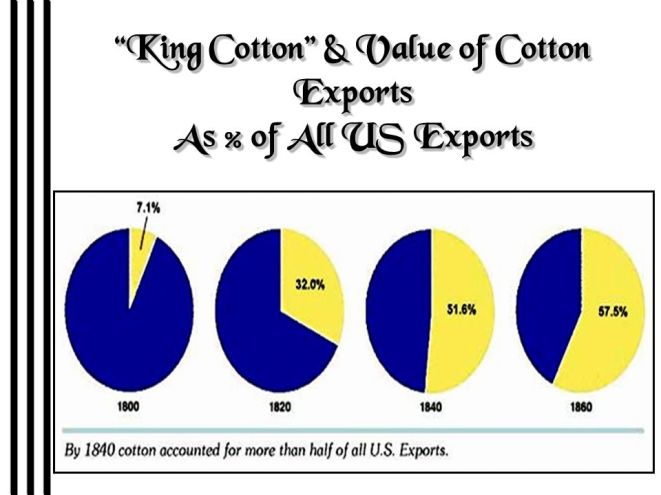
Few machines have changed the course of history, like Eli Whitney’s cotton gin.
The long, hot summers of the southeastern United States have always been ideal for growing cotton, but there was a time when the stuff was extremely expensive to produce. Cotton comes out wet from the boll, the protective capsule requiring about ten man hours just to remove the seeds to produce a pound of cotton.
By comparison, a cotton gin can process about a thousand pounds a day, at comparatively little expense.
In 1792, the year that Whitney invented his machine, the southeastern United States exported 138,000 pounds a year to Europe and to the northern states. Two years later, that number had risen to 1,600,000 pounds. By the time of the Civil War, Britain alone was importing ¾ of the 800 million pounds it used each year, from the American south.
Enterprise, Alabama got its start when John Henry Carmichael first settled there in 1881. Within a few years the Alabama Midland Railway came to Enterprise. By the turn of the century the place was a major cotton growing hub.
Anthonomus grandis, the Boll Weevil, is a small beetle, about the size of the nail on your little finger. Indigenous to Mexico, the beetle crossed the Rio Grande near Brownsville, sometime around 1892. The insect spread rapidly, producing eight to ten generations in a single growing season and preying mainly on the young cotton boll.
The insect is capable of destroying entire cotton crops, which it did in 1915, the year the insect reached Enterprise and most of Coffee County. Facing economic ruin, local farmers were forced to diversify their crops, just to recoup some of the losses caused by that one wretched beetle.
Within two years, Enterprise became one of the leading peanut producers in the country. Not only had farmers been able to stave of disaster, but they were already becoming prosperous as a result of the thriving new crop base.
Town fathers decided to build a monument, their “herald of prosperity”, to the boll weevil. The bug that had almost ruined them.
Designed in Italy at a cost of $1,800, the monument depicts a female figure in a flowing gown, arms stretched high over her head, and holding in her hands a trophy.

The monument was dedicated on December 11, 1919 at the intersection of College and Main Street, in the heart of Enterprise’ business district.
You can’t have a Boll Weevil monument without a Boll Weevil. Thirty years later, Luther Baker added a big bug on top of the trophy. At the base of the monument appears this inscription: “In profound appreciation of the Boll Weevil and what it has done as the herald of prosperity this monument was erected by the citizens of Enterprise, Coffee County, Alabama.”
The original has been vandalized so many times that it was moved it to a protected facility, and a replica put in its place. So it is that you can drive down the Main Street of Enterprise Alabama today, in the footsteps of my own brother Dave, and there you will find a statue of…a bug.
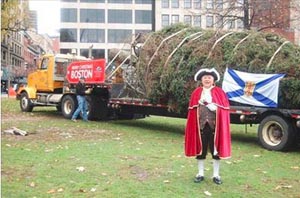
On November 30, a monument was unveiled on Boston Commons, commemorating the 100th anniversary of the Halifax explosion. The official 2017 Christmas tree lit up for the first time, that night.
A few days short ago, a Christmas tree was erected on Boston Commons. Symbolizing as it does the friendship between the people of two nations, this is no ordinary tree. This tree stands in solemn remembrance of catastrophe, 100 years ago, today.
As “The Great War” dragged to the end of its third year in Europe, Halifax harbor in Nova Scotia was the bustling scene of supply, munition, and troop ships destined for “over there”. With a population of 50,000 at the time, Halifax was the busiest port in Atlantic Canada.
The Norwegian vessel Imo left its mooring in Halifax harbor on December 6, 1917, destined for New York City. The French ship Mont Blanc was entering the harbor at this time, intending to join the convoy which would form her North Atlantic escort.
In her holds, Mont Blanc carried 200 tons of Trinitrotoluene (TNT), and 2,300 tons of TNP – Trinitrophenol or “Picric Acid”, a substance used as a high explosive. In addition, the freighter carried 35 tons of high octane gasoline and 20,000 lbs of gun cotton.
Not wanting to draw the attention of pro-German saboteurs, the freighter flew no flags warning of her dangerous cargo. Mont Blanc was a floating bomb.
Somehow, signals became crossed as the two ships passed, colliding in the narrows at the harbor entrance and igniting TNP onboard Mont Blanc. French sailors abandoned ship as fast as they could, warning everyone who would listen of what was about to happen.
As might be expected, the pyrotechnic spectacle put on by the flaming ship was too much to resist, and crowds gathered around the harbor. The high-pitched scream emitted by picric acid under combustion is a principal feature of fireworks displays, to this day. You can only imagine the scene as the burning freighter brushed the harbor pier setting that ablaze as well, before running itself aground.
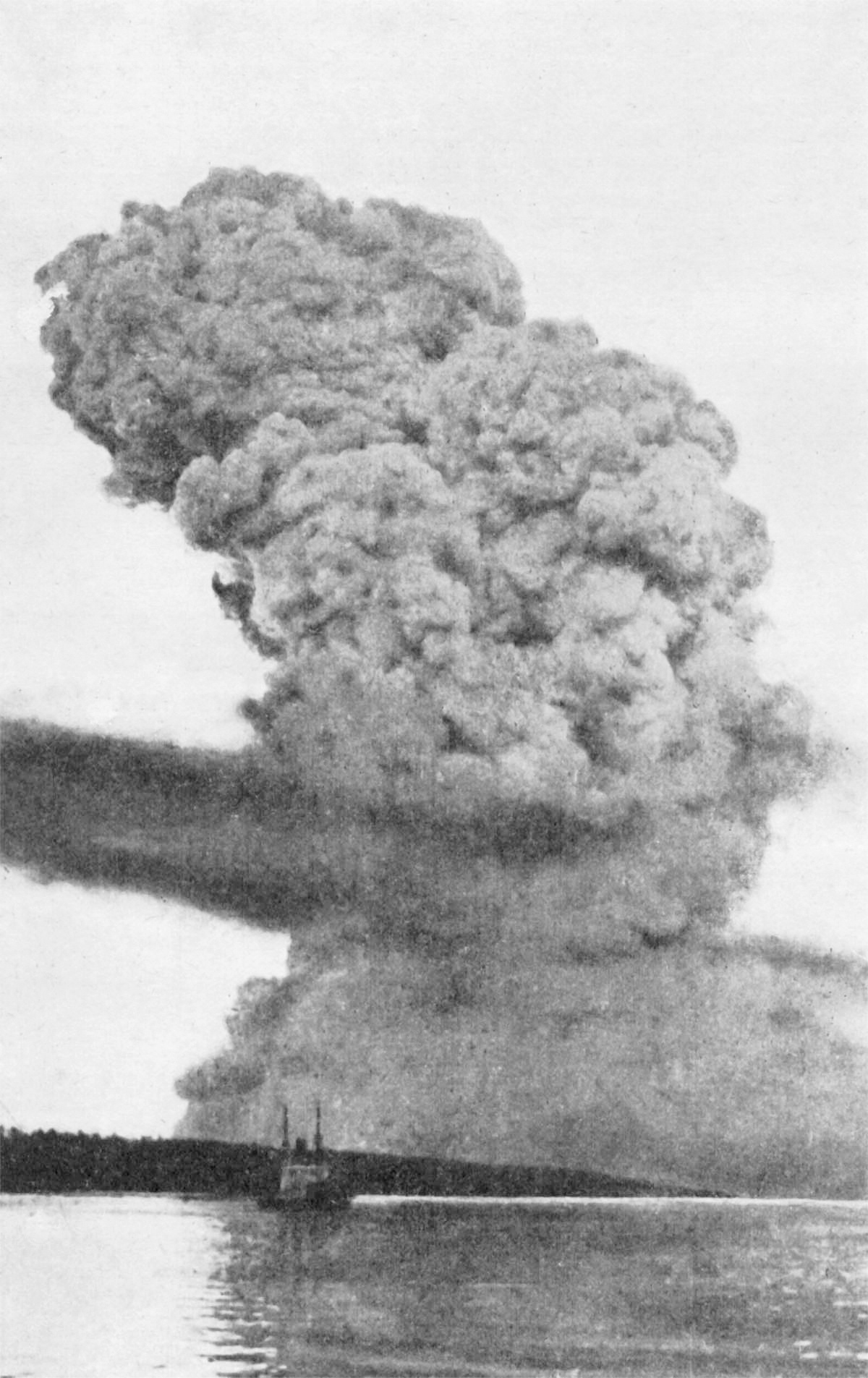
That was when Mont Blanc exploded.
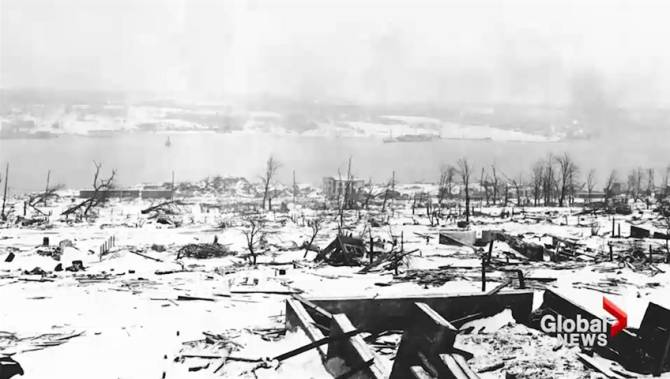
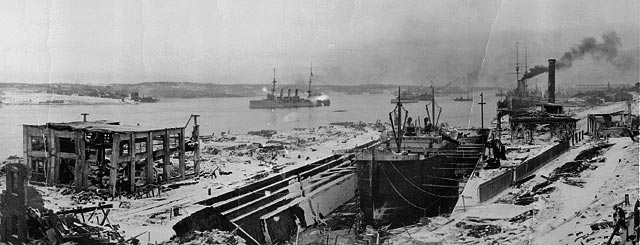
The detonation and resulting fires killed over 1,800 and wounded another 9,000, flattening the north end of Halifax and shattering windows as far as 50 miles away.
It was one of the largest man made, non-nuclear explosions in history. Mont Blanc’s anchor landed two miles away, one of her gun barrels, three. Later analysis estimated the output at 2.9 kilotons, an explosive force greater than some tactical nuclear weapons.
The first ray of light the morning of December 7 revealed some 1,600 homes destroyed in the blast, as a blizzard descended across Nova Scotia.
Boston Mayor James Michael Curley wrote to the US Representative in Halifax “The city of Boston has stood first in every movement of similar character since 1822, and will not be found wanting in this instance. I am, awaiting Your Honor’s kind instruction.”
The man was as good as his word. Mayor Curley and Massachusetts Governor Samuel McCall composed a Halifax relief Committee to raise funds and organize aid. McCall reported that the effort raised $100,000 in its first hour, alone. President Woodrow Wilson authorized a $30,000 carload of Army blankets sent to Halifax.
Within 12 hours of the explosion, the Boston Globe reported on the first train leaving North Station, with “30 of Boston’s leading physicians and surgeons, 70 nurses, a completely equipped 500-bed base hospital unit and a vast amount of hospital supplies”.
Delayed by deep snow drifts, the train arrived on the morning of December 8, the first non-Canadian relief train on the scene.
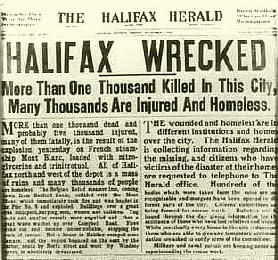
There was strong sentiment at the time, that German sabotage lay behind the disaster. A front-page headline on the December 10 Halifax Herald Newspaper proclaimed “Practically All the Germans in Halifax Are to Be Arrested”.


$750,000 in relief aid would arrive from Massachusetts alone, equivalent to more than $15 million today. Canadian Prime Minister Robert Borden would write to Governor McCall on December 9, “On behalf of the Government of Canada, I desire to convey to Your Excellency our very sincere and warm thanks for your sympathy and aid in the appalling calamity which has befallen Halifax”.
The following year, Nova Scotia sent the city of Boston a gift of gratitude. A very large Christmas tree.
In 1971, the Lunenburg County Christmas Tree Producers Association sent another tree to Boston, to promote Christmas tree exports, and to once again acknowledge the support of the people and government of Boston after the 1917 disaster. The Nova Scotia government later took over the annual gift of the Christmas tree, to promote trade and tourism.
So it is that, every year, the people of Nova Scotia send the official Christmas tree to the people of Boston. More recently, the principle tree is joined by two smaller trees, donated to Rosie’s Place and the Pine Street Inn, two Boston homeless shelters.
This is no Charlie Brown shrub we’re talking about. The 1998 tree required 3,200 man-hours to decorate: 17,000 lights connected by 4½ miles of wire, and decorated with 8,000 bulbs.


In 2013, the tree was accompanied by a group of runners, in recognition of the Boston Marathon bombing earlier that year.
This year’s tree stands 53′ tall, marking 100 years since the Halifax exlosion. It takes two men a day and a half to prepare for cutting, a crane holding the tree upright while the chainsaw does its work. It’s a major media event, as the tree is paraded through Halifax on a 53’ flatbed, before boarding the ferry across the Bay of Fundy to begin its 750-mile journey south.
For a small Canadian province, it’s been no small commitment. In 2015 Nova Scotia spent $242,000 on the program, including transportation cutting & lighting ceremonies, and the promotions that went with it.
On November 30, a monument was unveiled on Boston Commons, commemorating the 100th anniversary of the Halifax explosion. The official 2017 Christmas tree lit up for the first time, that night.
Last year, Premier Stephen McNeil explained the program and why it was worth the expense: “(It) gives us a chance to showcase our beautiful part of the world to a global community”. Premier McNeil may have had the last word this year, at the tree lighting ceremony. “We had massive deaths and injuries,” McNeil said of the 1917 catastrophe. “It would have been far worse if the people of Boston hadn’t come and supported us.”
If you enjoyed this “Today in History”, please feel free to re-blog, “like” & share on social media, so that others may find and enjoy the same. Please click the “follow” button on the right, to receive email updates on new articles. Thank you for your interest, in the history we all share.
ICYMI – Today, potatoes are the 5th largest crop on the planet, following rice, wheat, maize and sugar cane. Almost 5,000 varieties are preserved in the International Potato Center in Peru.
The expedition which would end in the Lost Colony of Roanoke began in 1585, financed by Sir Walter Raleigh and led by Sir Ralph Lane. On board was the Oxford trained mathematician and astronomer Sir Thomas Herriot, the man who would introduce the potato to England on this day, the following year.
The Inca of Peru seem to have been the first to cultivate potatoes, around 8,000BC.
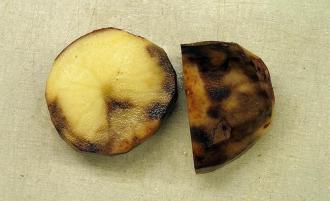
Wild potatoes contain toxins to defend themselves against fungi and bacteria, toxins unaffected by the heat of cooking. In the Andes, mountain people learned to imitate the wild guanaco and vicuña, licking clay before eating the poisonous plants. In this manner, toxins pass harmlessly through the digestive system. Mountain people dunk wild potatoes in “gravy” made of clay and water, accompanied with coarse salt. Eventually, growers developed less toxic tubers, though the poisonous varieties are still favored for their frost resistance. Clay dust is sold in Peruvian and Bolivian markets, to this day.
Spanish Conquistadors who arrived in Peru in 1532 eventually brought potatoes home to Spain. The first written mention of the potato comes from a delivery receipt dated November 28, 1567, between the Grand Canaries and Antwerp.
Among its other virtues, the potato provides more caloric energy per acre of cultivation than either maize or grain and, being below ground, is likely to survive calamities that would flatten other crops. Taters quickly became staple foods in northern and eastern Europe, while in other areas remaining the food of peasants and livestock.
Louis XVI placing a potato blossom in his buttonhole, 1737
French army pharmacist Antoine-Augustin Parmentier was captured by Prussians during the seven years war, learning to appreciate the gustatorial delights of the potato while in captivity.
Primarily used as hog feed in his native France, Parmentier was determined to bring respectability to the lowly tuber. It must have been a tough sell, as many believed that potatoes caused leprosy. The Paris Faculty of Medicine declared them edible in 1772, thanks largely to Parmentier’s efforts. He would host dinners featuring multiple potato dishes, inviting such luminaries as Benjamin Franklin and Antoine Lavoisier. Franklin was enormously popular among the French nobility. Before long Louis XVI was wearing a purple potato flower in his lapel. Marie Antoinette wore them in her hair.
Sir Walter Raleigh first introduced potatoes to Ireland in 1589. By mid-19th century, the crop occupied one third of arable land in Ireland. This was due entirely to landless laborers, renting tiny plots from landowners interested only in raising cattle or producing grain for market. An acre of potatoes and the milk of a single cow was enough to sustain a family. Even poor families could grow enough surplus to feed a pig, which could then be sold for cash.
Calamity struck Ireland in 1845, in the form of a blight so horrific that US military authorities once considered stockpiling the stuff as a biological weapon. Seemingly overnight, Ireland’s staple food crop was reduced to a black, stinking ooze.

There followed the seven years’ “an Gorta Mór”, “the Great Hunger”, killing over a million Irish and reducing the population by 20-25% through death and emigration. Throughout the Irish potato famine, the country continued to produce and export thirty to fifty shiploads per day of food produce, more than enough to feed the population.
Today, many see the effects of the absentee landlord system and the penal codes as a form of genocide. At the time, already strained relations with England were broken, giving rise to Irish republicanism and leading to Irish independence in the following century.
Until Nazis tore it down, there was a statue of Sir Francis Drake in Offenburg, Germany, giving him credit for introducing the potato. His right hand rested on the hilt of his sword, his left gripping a potato plant. The inscription read “Sir Francis Drake, disseminator of the potato in Europe in the Year of Our Lord 1586. Millions of people who cultivate the earth bless his immortal memory”.
Today, potatoes are the 5th largest crop on the planet, following rice, wheat, maize and sugar cane. Almost 5,000 varieties are preserved in the International Potato Center in Peru.
In the Star Wars movie “The Empire Strikes Back”, there’s a chase sequence through an “asteroid” field in which some of the asteroids are, in fact, potatoes.
Scientists have created genetically modified potatoes to ward off pests. The “New Leaf”, approved in 1995, incorporated a bacterial gene rendering it resistant to the Colorado potato beetle, an “international superpest” so voracious that some credit the creature for creating the modern pesticide industry. Other varieties were genetically modified to resist phytophthora infestans, the cause the Irish potato famine.
Seeming to prefer insecticides and anti-fungal sprays, “food activists” decry such varieties as “Frankenfoods”. Each time, the improved variety has been hounded out of business.
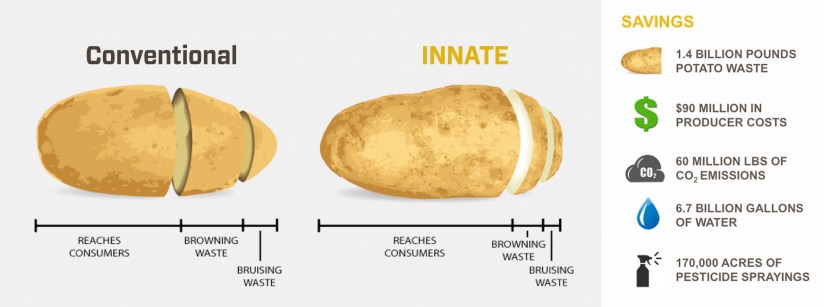
In 2014, Idaho-based J.R. Simplot Co. introduced the “innate” potato. Rather than “transgenic” gene splicing, the introduction of genome sequences from unrelated species, the innate variety uses a “silencing” technique on the tuber’s own genes, to resist the bruising and browning that results in 400 million pounds of waste and a cost to consumers of $90 million.
In October 2016, NBC news reported that “The U.S. Department of Agriculture has approved commercial planting of two types of potatoes that are genetically engineered to resist the pathogen that caused the Irish potato famine. The potatoes next must clear a voluntary review process through the Food and Drug Administration as well as get the OK from the U.S. Environmental Protection Agency“.
The Innate potato produces less acrylamide, a known carcinogen produced by normal potatoes in the high heat of fryers.
This might actually be the first genetically modified variety to succeed in the marketplace, but McDonald’s, possibly the largest potato user on the planet, has already announced that “McDonald’s USA does not source GMO potatoes, nor do we have current plans to change our sourcing practices.”
You can never underestimate the power of hysterical people, in large groups.
If you enjoyed this “Today in History”, please feel free to re-blog, “like” & share on social media, so that others may find and enjoy the same. Please click the “follow” button on the right, to receive email updates on new articles. Thank you for your interest, in the history we all share.
In 1944 and ’45 with the country at war, Army and Navy both entered that final game of the season,with perfect records. Army finished both of those seasons, undefeated.
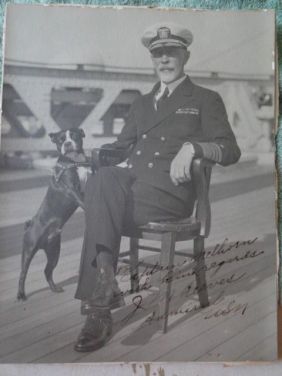
Admiral Joseph Mason “Bull” Reeves
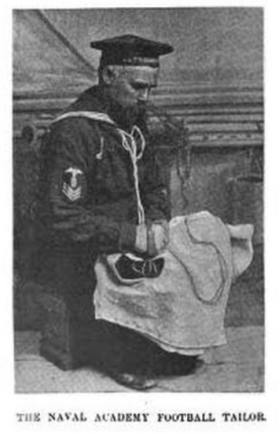
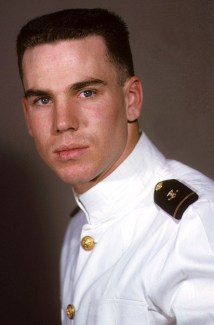
Sometime during the 1893 football season, a navy doctor told Midshipman Joseph Reeves that another kick to the head could result in “instant insanity”, even death.
Reeves commissioned an Annapolis-area shoemaker to build him a leather covering, thus making himself the father of the modern football helmet. Years later, this man of the battleship era became an ardent supporter of naval air power. Today, Admiral “Bull” Reeves is widely known as the “Father of Carrier Aviation”.
The naval academy’s football program is one of the oldest in the country, dating back to 1879.
The Army got into the game in November 1890, when Navy challenged Army cadets in what was then a relatively new sport.
The naval academy introduced a canvas jersey in 1879, believed to be the first college football uniform, in history. Photo by Caspar W. Whitney – Whitney, Caspar W. (May 21, 1892). “The Athletic Development at West Point and Annapolis”. Harper’s Weekly XXXVI (1848): 496., Public Domain, https://commons.wikimedia.org/w/index.php?curid=51990735
That first Army-Navy game was played on November 29, when the Midshipmen humiliated the Army cadets at West Point, 24-0.
The Black Knights had their revenge the following year, defeating Navy at Annapolis, 32-16.
The two teams met some 30 times between 1890 and 1930, when the game became an annual event.
More than inter-service “bragging rights” are at stake. Only 17 schools can boast Heisman Trophy winners. Army and Navy, combine for five.
West Point and Annapolis fielded some of the best teams in college football, during the first half of the 20th century. In 1944 and ’45 with the country at war, Army and Navy both entered that final game of the season,with perfect records. Army finished both seasons, undefeated.
Today, size and weight restrictions combine with a five-year military service commitment, while dreams of NFL careers draw some of the best football talent in college ball away from the service academies. Since 1963, only four seasons have seen both teams enter the Army-Navy game with winning records. Yet, the game remains a college football institution, receiving radio coverage every year since the late ’20s, and broadcast on national television, since 1945.
The first instant replay in American football history, made its debut during the 1963 Army–Navy game.
Arguably, the Army-Navy game may be the purest such event, in all of college sports. These are the kids who play for the love of the game, knowing that their next years are unlikely to lead to careers in sports, business, or academia. These young men have given the next few years of their lives, to the United Sates military.
Roger Staubach
Five-year post-graduation military service commitments preclude the NFL career aspirations of most Army-Navy game veterans, but not all. Notable exceptions include Dallas Cowboys Quarterback Roger Staubach (Navy, 1965), New York Giants Wide Receiver and Return Specialist Phil McConkey (Navy, 1979), and (then) LA Raiders Running back Napoleon McCallum (Navy, 1985).
President Dwight Eisenhower earned the distinction of being the only future President in history to play the Army-Navy game in 1912, alongside future General of the Army, Chairman of the Joint Chiefs of Staff and teammate, Omar Bradley.
Most games are played in a neutral city, almost always on the east coast. Most often in Philadelphia. The Army-Navy game has appeared west of the Mississippi only twice, first for the national dedication of Chicago’s Soldier Field, in 1926. The second was in 1983, when the Department of Defense earned Wisconsin Democratic Senator William Proxmire’s not-so-coveted “Golden Fleece” award, for spending $100,000 to transport cadets, midshipmen and mascots, to play in Pasadena, California’s Rose Bowl.
Oh, for the days when the government pretended to look out for our money.

With capacities of only 38,000 and 34,000 respectively, Army’s Michie Stadium and Navy’s Navy–Marine Corps Memorial Stadium are far too small, to hold the assembled crowd. Out of 117 games, only six have been played on either campus. Two of those (1942-’43), were due to WWII travel restrictions.
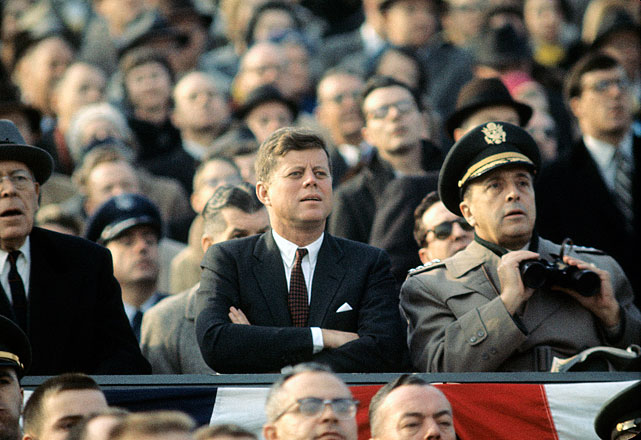
In 1963, the Army-Navy game was canceled in observation of a 30-day period of mourning, following the assassination of president John Fitzgerald Kennedy. Knowing her now-deceased husband to be a big fan, First Lady Jacqueline Kennedy requested that the game go on, and so it was, quarterback Roger Staubach leading his #2 nationally ranked team in a 34-14 Navy romp.
For most seniors, the “First Classmen” of either academy, the Army-Navy game carries special meaning. Some may go on to play in a bowl game, but for most, this is the last regular season football game, each will ever play. In times of war, they and others like themselves will be among the first to go, in defense of the country. Some will not return home, alive.
The game is particularly emotional for this reason. Despite intense rivalry, it would be hard to find a duel in all of sports, where the two sides hold the other in higher respect and esteem.
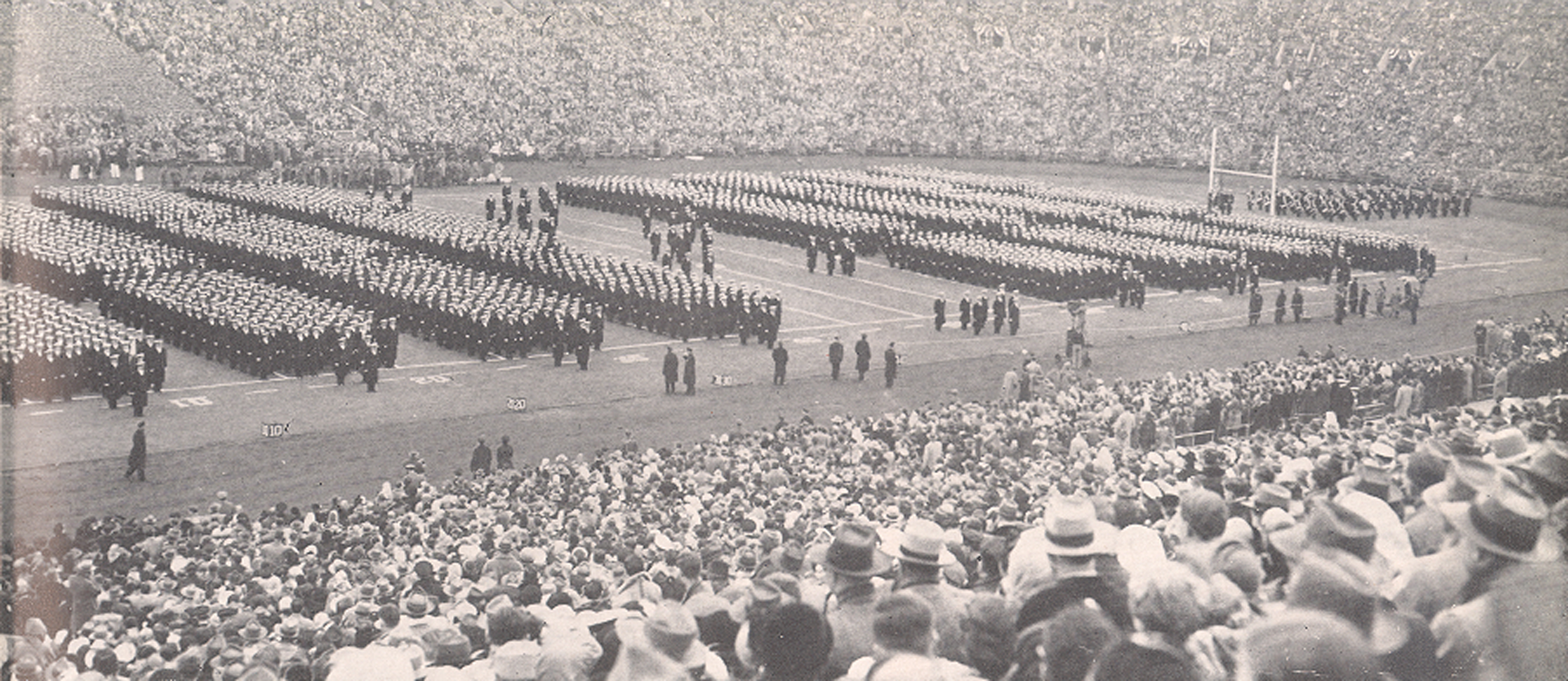
The game is steeped in tradition. As their opposites cheer them on, each side takes the field in a spectacle of precision drill, unmatched in any venue outside of the military. After the game, both teams assemble to sing the almae matres (‘On Brave Old Army Team’ and ‘Anchors Aweigh’) of each institution, to the assembled students and fans.
Navy marches on the field, 1950
The first such serenade is always performed for those of the losing academy, hence the coveted position of “singing second”, signifying the victor of this, the oldest sports rivalry in service academy history.
Respect and tradition is all well and good, but such rivalries do not come without a share of debauchery. During junior year, selected “Middies” and Cadets attend courses with the opposite military academy. On game day, each is restored in a “prisoner exchange”, returning from their semester in “enemy territory”.
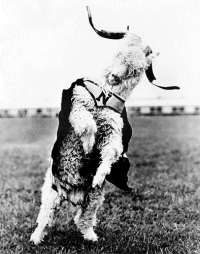
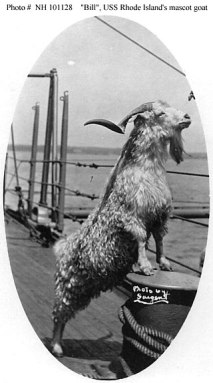
“Bill the goat”, mascot of BB-17 USS Rhode Island, circa 1913
Goats have a long history with all things maritime, having gone to sea since the age of sail and eating all manner of garbage and other undesirable food, in exchange for which, usually “she”, provided companionship, milk and butter. Sir Joseph Bank’s nanny goat was the first creature two-legged or four, to circumnavigate the planet, twice.
Navy had multiple mascots during the early years, including a gorilla, two cats, a bulldog, and a carrier pigeon. Legend has it that a beloved goat once died aboard a Navy cruise, and two ensigns cavorted about wearing the skin during half-time, before making their way to the taxidermist.
Navy won that game, and a live goat named “El Cid” (The Chief) appeared at the fourth Army-Navy game, in 1893. Navy won that game too, its third victory of those first four games. Small wonder that Billy goats have been the Navy mascot, since 1904.
The 2016 matchup was attended by “Bill” the Goat #XXXVI and his backup, Bill #XXXVII.
Small wonder too, why Army cadets will go to any length, to kidnap that goat. The first such kidnapping of the modern era, took place in 1953.
On November 5, 1995, US Military Academy cadets staged a pre-dawn raid at the Naval Academy Dairy Farm in Gambrills, Maryland, kidnapping Bill the Goat #s XXVI, XXVII and XXIX. The Pentagon was notified, and the goats were returned under a joint Army/Navy policy, stipulating that the “kidnapping of cadets, midshipmen or mascots will not be tolerated”.
Cadets pulled off the caper in 2002, disguised in Grateful Dead T-shirts. “Operation Good Shepherd” launched in 2007, to kidnap Bill #XXXII, XXXIII, and XXXIV. The whole thing was posted, on You Tube.
It’s been said that only the Army, would mount a military operation to kidnap a goat, and only the Navy would involve the Pentagon, to get him back.
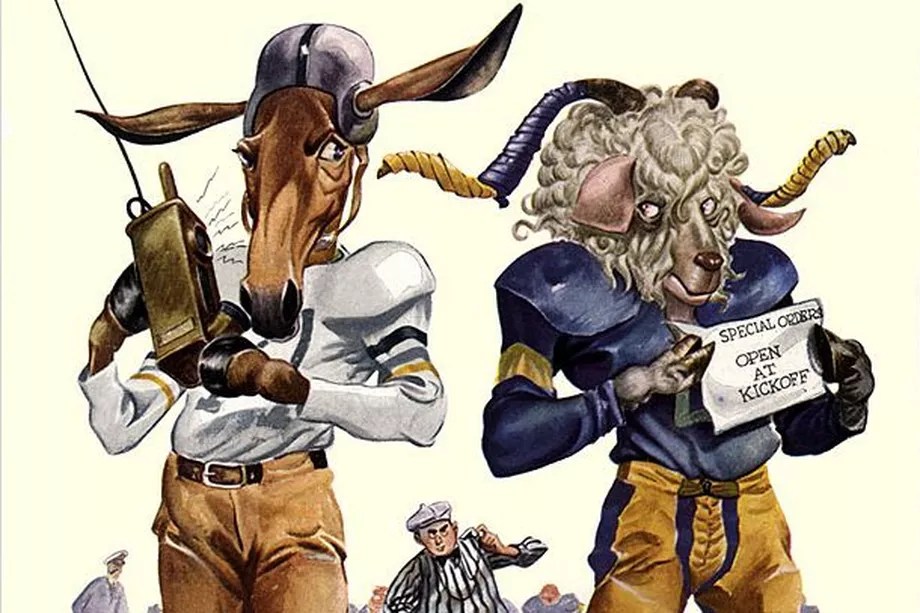
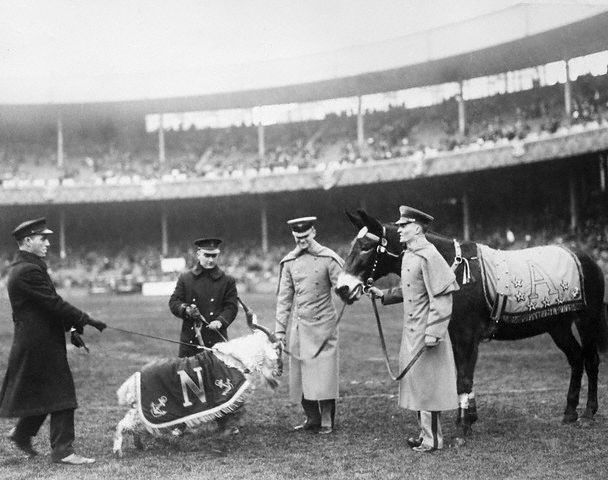
The Philadelphia Quartermaster Depot decided in 1899, that Army needed a mascot in response to the Navy’s goat. Mules have a long history with the United Sates Army, going back to George Washington, the “Father of the American Mule“. The question was self-answering. Little is known of the “official” Army mules prior to 1936, when former pack mule “Mr. Jackson” (named for Thomas Jonathan “Stonewall” Jackson), arrived from Front Royal, Virginia.
Mr. Jackson served twelve years, the first of seventeen “official” Army mules. Only one, “Buckshot”, was a female. Currently, the “Mule Corps” consists of “Ranger III”, the son of a Percheron mare standing at 16.2 hands (66″) high, his only slightly shorter half-brother “Stryker”, and “Paladin”, a half-thoroughbred, standing a full two hands shorter than either of his counterparts
Always the last regular-season game in Division I-A football, the next four Army-Navy games are scheduled in Philadelphia. The game site will then move to Metlife Stadium in East Rutherford New Jersey, to mark the twenty-year anniversary of the Islamist terror attacks on the World Trade Center. The 2022 game moves back to Philadelphia, marking the 91st time Army and Navy have played there.
To date, Navy leads Army in the series 60-50-7, with Army’s Black Knights ending Navy’s 14-game winning streak in 2016. The 2017 edition is scheduled for Saturday, December 9, at Philadelphia’s Lincoln Financial Field.
This son and grandson of Army veterans going back to the Revolution and beyond, is compelled to say, ‘Beat Navy’.
Meeting of the Mascots, 1939
If you enjoyed this “Today in History”, please feel free to re-blog, “like” & share on social media, so that others may find and enjoy the same. Please click the “follow” button on the right, to receive email updates on new articles.
Thank you for your interest, in the history we all share.
The next two years, thirty-two states and the District of Columbia celebrated what came to be called “Franksgiving” on the third Thursday of the month, while the remainder observed a more traditional “Republican Thanksgiving”, on the last. FDR quipped “Two years ago, or three years ago, I discovered I was particularly fond of turkey! So we started two Thanksgivings. I don’t know how many we ought to have next year. I’m open to suggestion.”
In 1863, President Abraham Lincoln declared a general day of Thanksgiving to be observed on the last Thursday of November. The date seemed to work out OK and the tradition stuck, until 1939.
Roughly two in seven Novembers contain five Thursdays, and that year was one.
In those days, it was considered poor form for retailers to put up Christmas displays or run Christmas sales, before Thanksgiving. Lew Hahn, General Manager of the Retail Dry Goods Association, was afraid that extra week was going to cut into Christmas sales.
Ten years into the Great Depression with unemployment standing at 17.2%, the Federal government was afraid of the same thing. Never afraid to tinker with precedent, President Franklin Roosevelt decided to deviate from the customary last Thursday, and declared the fourth Thursday, November 23, to be a national day of prayer and thanksgiving.
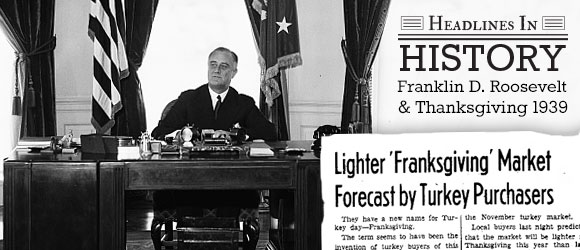
Opposition to the plan was quick in forming. Alf Landon, Roosevelt’s Republican challenger in the earlier election, complained of Roosevelt’s impulsiveness, and the confusion resulting from it. “more time should have been taken working it out” Landon complained, “instead of springing it upon an unprepared country with the omnipotence of a Hitler.”
In Plymouth Massachusetts, home of the first Thanksgiving, Chairman of the Board of Selectmen James Frasier, “heartily disapproved”. The headline from the New York Times, trumpeted “Roosevelt to Move Thanksgiving: Retailers for It, Plymouth Is Not.”
The short-notice change in holiday schedule disrupted the holiday plans of millions of Americans, to say nothing of traditional high school and college Thanksgiving day football rivalries, across the nation.
Unsurprisingly, support for Roosevelt’s plan split across ideological lines. A late 1939 Gallup poll reported Democrats favoring the change 52% to 48%, with Republicans opposing it 79% to 21%.
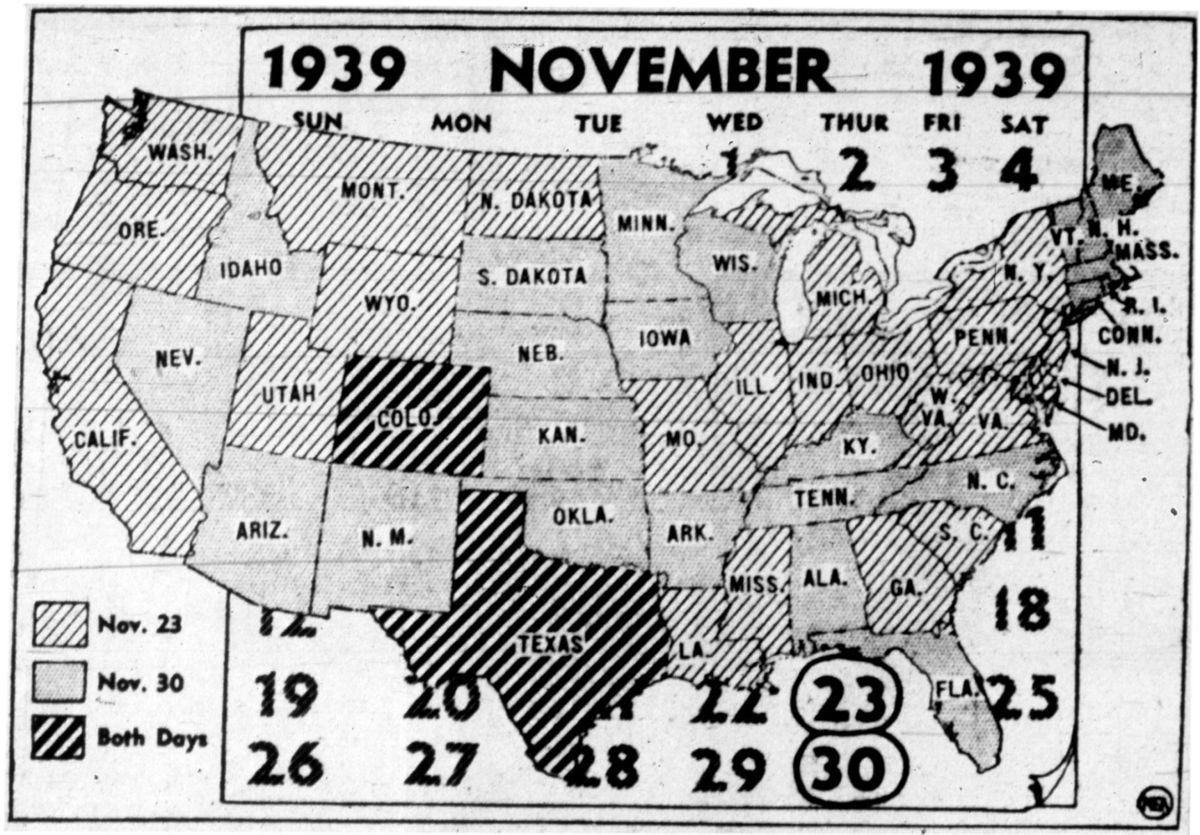
Such proclamations represent little more than the “’moral authority” of the Presidency, and states are free to do as they pleased. Twenty-three states and the District of Columbia observed Thanksgiving day on the non-traditional date, and twenty-two kept Thanksgiving on the 27th. Colorado, Mississippi and Texas, did both.
The next two years, thirty-two states and the District of Columbia celebrated what came to be called “Franksgiving” on the third Thursday of the month, while the remainder observed a more traditional “Republican Thanksgiving”, on the last. FDR quipped “Two years ago, or three years ago, I discovered I was particularly fond of turkey! So we started two Thanksgivings. I don’t know how many we ought to have next year. I’m open to suggestion.”
In 1941, a Commerce Department survey demonstrated little difference in Christmas sales between those states observing Franksgiving, and those observing the more traditional date. A joint resolution of Congress declared the fourth Thursday beginning the following year to be a national day of Thanksgiving, President Roosevelt signing the measure into law November 26.
Interestingly, the phrase “Thanksgiving Day” had been used only once in the 20th century prior to the 1941 resolution, that in President Calvin Coolidge’s first of six such proclamations.
Most state legislatures followed suit with the Federal fourth-Thursday approach, but not all. In 1945, the next year with five Thursdays in November, Arkansas, Florida, Georgia, Idaho, Nebraska, Tennessee, Texas, and Virginia reverted to the last Thursday. Texas would hold out the longest, celebrating its fifth-Thursday Thanksgiving for the last time in 1956.
To this day, the years 1939, ’40 and ’41 remain the only outliers, outside the fourth-Thursday tradition.
Popular comedians of the day got a lot of laughs out of it, including Burns & Allen and Jack Benny.
One 1940 Warner Brothers cartoon shows two Thanksgivings, one “for Democrats” and one a week later “for Republicans.”
The Three Stooges short film “No Census, No Feeling” of the same year, has Moe questioning Curly, why he put the fourth of July in October. Larry: Where is everybody? Curly: Maybe it’s the Fourth of July. Moe: The Fourth of July in October? Curly: You never can tell… Look what they did to Thanksgiving!
Joe Toye, the “Easy Company” character in the 2001 HBO miniseries “A Band of Brothers”, may have had the last word on Franksgiving. Explaining his plan to get the war over quickly, the paratrooper quips “Hitler gets one of these [knives] right across the windpipe, Roosevelt changes Thanksgiving to Joe Toye Day, [and] pays me ten grand a year for the rest of my f*****g life.”
Sounds like a plan.
If you enjoyed this “Today in History”, please feel free to re-blog, “like” & share on social media, so that others may find and enjoy the same. Please click the “follow” button on the right, to receive email updates on new articles.
Thank you for your interest, in the history we all share.
When Truman, Stalin, and Churchill met at Potsdam, a VIP latrine was built for their exclusive use. Stalin was the first in, emerging from the outhouse and asking his aide, in Russian, “Who is Kilroy?”
The Fore River Shipyard began operations in 1883 in Braintree, Massachusetts, moving to its current location on the Weymouth Fore River on Quincy Point, in 1901. In 1913, the yard was purchased by Bethlehem Steel, and operated under the Bethlehem Shipbuilding Corporation.
Most ships at Fore River were built for the United States Navy, including early submarines built for Electric Boat, the Battleship USS Massachusetts, and the Navy’s first carrier, the USS Lexington. In the years before WW2, non-US Navy customers included the United States Merchant Marine, the Argentine Navy, the Royal Navy of Great Britain, and the Imperial Japanese Navy.
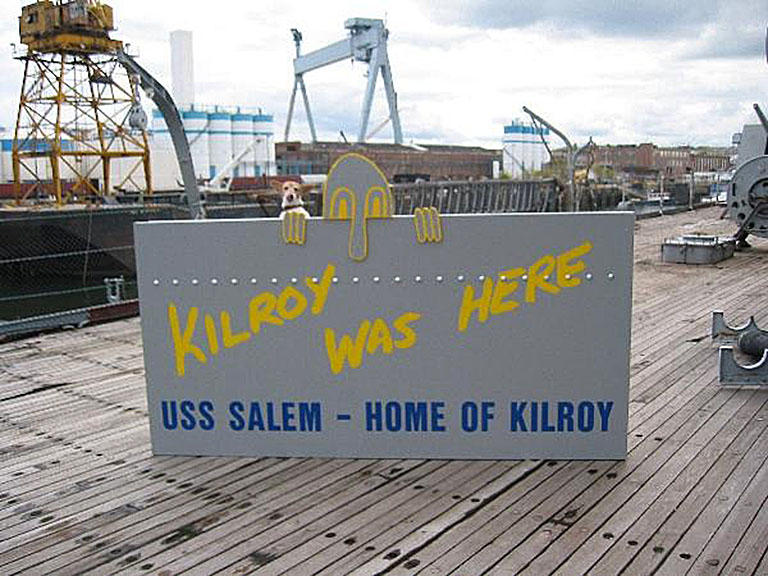
USS Salem CA-139 museum ship, Fore River Shipyard, Quincy
The Navy Act of 1938 mandated a 20% increase in American Naval strength. Much of that increase came through Fore River. The Shipyard employed 17,000 the day that Imperial Japan invaded the American Pacific anchorage at Pearl Harbor. That number increased to 32,000 by 1943, with a payroll equivalent to $9.69 Billion, in today’s dollars.
Necessity became the mother of invention, and the needs of war led to prodigious increases in speed. No sooner was USS Massachusetts launched, than the keel of USS Vincennes began to be laid. By the end of the war, Fore River had completed ninety-two vessels of eleven different classes.
Builders at the yard were paid by the number of rivets installed. Riveters would mark the end of their shift with a chalk mark, but dishonest co-workers could erase their marks, marking a new spot a few places back on the same seam.
Shipyard inspector James Kilroy ended the practice, writing “Kilroy was Here”, next to each chalk mark.
With hulls leaving the yard so fast there was no time to paint the interiors, Kilroy’s name achieved mythic proportions. The man literally seemed to be everywhere, his name written in every cramped and sealed space in the United States Navy.
For the troops inside of those ships, Kilroy always seemed to have “been there”, first.
Kilroy was Here became a kind of protective talisman, and soldiers began to write it on newly captured areas and landings. He was the “Super GI”, showing up for every combat, training and occupation operation of the WW2 and Korean war era. The scribbled cartoon face was there before you arrived, and he was still there when you left.
Germans thought Kilroy was some kind of “super spook”, able to go anywhere he liked, with ease.
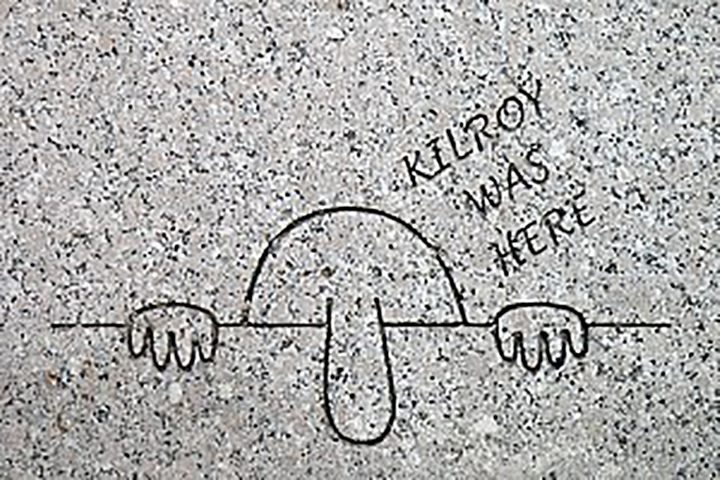
The challenge became, who could put the Kilroy graffiti in the most difficult and surprising place. I’ve never been there, but I’ve heard that Kilroy occupies the top of Mt. Everest. His likeness is scribbled in the dust of the moon. There’s one on the Statue of Liberty, and another on the underside of the Arc of Triumph, in Paris. There are two of them engraved in the granite of the WW2 Memorial, in Washington, DC.

Under Water Demolition teams, the guys who later became US Navy SEALs, swam ashore on Japanese-held Pacific islands, preparing the way for amphibious landings. More than once, UDT divers found that Kilroy had already been there, the silly cartoon nose scribbled on makeshift signs, and even enemy pillboxes.
When Truman, Stalin, and Churchill met at Potsdam, a VIP latrine was built for their exclusive use. Stalin was the first in, emerging from the outhouse and asking his aide, in Russian, “Who is Kilroy?”
A Brit will tell you that “Mr. Chad” came first, cartoonist George Chatterton’s response to war rationing. “Wot, no tea”?
The cartoon appeared in every theater of the war, but few knew the mythical Kilroy’s true identity.
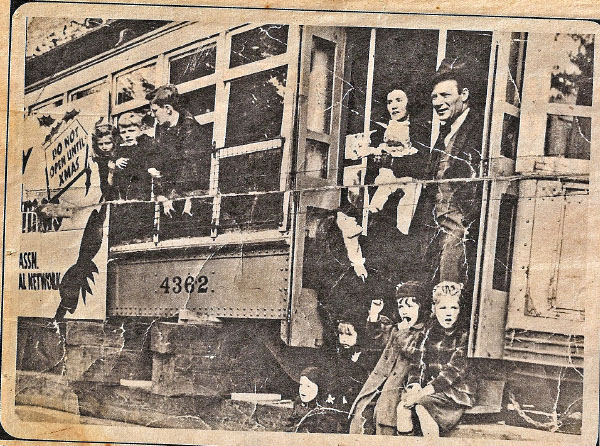
In 1946, the Transit Company of America held a contest, asking the “real” Kilroy to come forward. Close to forty guys showed up to claim the prize, a real trolley car. Doubtless they all felt they had legitimate claims, but James Kilroy brought a few riveters and some shipyard officials along, to prove his authenticity. That was it.
That Christmas the Kilroy kids, all nine of them, got the coolest playhouse in all of Boston.
James Kilroy went on to serve as Boston City Council member and member of the Massachusetts house of Representatives before passing away on this day, November 24, 1962.
Boston American, December 23, 1946 Image thanks to Kilroy grandson, Brian Fitzgerald
Feature image: Kilroy, engraved on the granite of the WWII Memorial, Washington DC.
Cleopatra bathed in the milk of donkeys, as did the 12th century Queen Isabeau of France, who followed it up by rubbing her skin with crocodile glands and the brains of boars. Mary, Queen of Scots, bathed in wine. Strange beauty rituals weren’t limited to women, either. Novelist George Sands used to soak himself in cow’s milk (3 quarts) and honey (3 pounds).
Popular ideas of what is beautiful have changed with time and place, but strange beauty secrets are as old as history itself.
In ancient Greece, blond hair was perceived as beautiful, probably because it was unusual. Women would lighten their hair using a mixture of ashes, olive oil & water, and sometimes arsenic.
Cleopatra bathed in the milk of donkeys, as did the 12th century Queen Isabeau of France, who followed it up by rubbing her skin with crocodile glands and the brains of boars.
During the Heian period in Japan, 794 to 1185AD, a woman’s beauty was judged by the length of her hair. The ideal was considered to be about two feet below her waist.
“Blood Countess Erzsébet Báthory
The Hungarian “Blood Countess” Erzsébet Báthory, who lived from August 7, 1560 – August 21, 1614, may have been the most prolific female serial killer in history, bathing in the blood of as many as 650 virgins, to keep herself looking young. Her four cohorts were convicted of killing 80, while Erzsébet herself was neither tried nor convicted due to her rank. She was simply thrown in jail on her arrest in December, 1610, and left there to die, four years later.
On a considerably less macabre note, Mary, Queen of Scots, bathed in wine. Strange beauty rituals weren’t limited to women, either. Novelist George Sands used to soak himself in cow’s milk (3 quarts) and honey (3 pounds).
Queen Elizabeth, I
Elizabeth I, daughter of Anne Boleyn and Henry VIII, was crowned this day, November 17, 1588. As queen, Elizabeth followed a path taken by women for thousands of years, sporting the high forehead and daubing her face with a powder makeup called ceruse. High lead content made the practice deadly enough, but they would top it off with a rouge containing mercury, leading to an untold number of birth defects and miscarriages. It’s all but certain that the combination of lead and mercury led to her complete loss of hair. Little wonder that she was the “Virgin Queen”.
The quest for the perfect, porcelain complexion would last well into the 19th century, for which some women ate clay. Marie Antoinette and other ladies of the French Court obsessed over flawless, alabaster skin, until the end of the 18th century. They would fake it with thick layers of white powder, made from white lead, or talcum powder, or pulverized bone, whatever they could get hold of. Combined with wax, whale blubber, or vegetable oil, it had a nice, greasy consistency that stayed where they put it.
This was a time of big hair, when hair was piled high on top of the head, powdered, and augmented with the hair of servants and pets. The do was often adorned with fabric, ribbons or fruit, sometimes holding props like birdcages complete with stuffed birds, and even miniature frigates, under sail.
It wasn’t just women’s hair, either. Fashionable European men of the 18th century wore wigs made of both animal and human hair, a practice which spread across the pond into North America. The wealthy wore longer wigs, often powdered and curled, while those who couldn’t afford them wore shorter versions, often styled into a braided ponytail.
George Edward Pickett, he of the famous charge at Gettysburg, was acclaimed for his oiled and perfumed locks. Same with the “Boy General”, the youngest Civil War General in the Union Army: George Armstrong Custer, who would anoint his hair with cinnamon oil.
George Pickett
Well into the 20th century, women chose between slicking their hair down with a greasy brilliantine, or spraying it with shellac dissolved in an admixture of water and alcohol.
Weird beauty tips are easy to find on-line, and I have to believe that each has its adherents. Some say that Preparation H under the eyes reduces puffiness (I hear it works), hot pepper sauce applied to the roots of your hair will help it grow, (the jury’s out on this one). Some believe that urine works as an astringent to clear up acne, (it doesn’t), and rubbing your face with a potato dries up oily skin (that one’s false as well).
Today, we look on past practices as bizarre, but maybe we shouldn’t. If those people from the past were to peer into their own future, they’d see spray tanning, teeth bleaching, and Brazilian bikini wax. They’d see people injecting the neurotoxic output of Clostridium Botulinum into their faces, and sticking metal objects through all manner of body parts.
You have to wonder what our own future will bring. Not even Nostradamus foretold tattooed grandmothers.
No one knew what to do with an 8-ton dead whale, washed up on the beach, but there happened to be an ex-military guy around who had explosives training. He tried to tell them that 20 sticks of dynamite would do it, if they were placed correctly. No one seemed to want his advice. Someone had decided to use a half-ton of the stuff, and that’s what they were going to do. It was a bad idea.
It was November 12, 1970, when a 45 foot, 8 ton, dead sperm whale washed up on the beaches near Florence, Oregon. State beaches came under the jurisdiction of the Department of Transportation at that time, and they came down to have a look.
Officials discussed the matter with the Navy (it wasn’t every day that they had to remove 16,000 lbs of rotting whale meat) and someone came up with a bright idea. They would remove the carcass the same way they’d remove a huge boulder. They’d blow it up.
They figured the gulls and the crabs would take care of things if they got the pieces small enough. The trick was to use enough dynamite.
No one could know it at the time, but the incident had already reached its high water mark. From there, it would all be downhill.
By sheer coincidence, there happened to be an ex-military guy around, Walter Umenhofer, who had explosives training. He tried to tell them that 20 sticks of dynamite would do it, if they were placed correctly, but no one seemed to want his advice.
Someone had decided to use a half a ton of the stuff, and that’s what they were going to do.
That might have been the worst idea, since Rudolph Hess flew that plane to Scotland.
Crowds lined the beach the day of the explosion, and TV cameras were rolling. No one had ever seen a whale explode.
The detonation tore through the whale, like a bullet passes through a pane of glass. Thousands of chunks of dead whale, large and small, soared through the air, landing on nearby buildings, houses and streets.
Umenhofer was among the crowd that day, and had a great slab of blubber come down from the sky and destroy his brand new Olds 88. He had just bought the car from a dealer who was running a “Whale of a Sale” deal. You can’t make this stuff up.
It turns out that exploding whales aren’t even that unusual. Iceland, Australia and South African authorities routinely blow up whale carcasses to avoid hazards to navigation, though they are usually towed out to sea, first.
There have even been spontaneously exploding whales, when gasses built to a point of ripeness that can no longer be contained. It happened on Salt Spring Island, British Columbia, where the locals reported that blubber “hung in the trees for weeks”.
A whale washed ashore in Denmark sometime in 1991, when someone decided that a careful poke here and a prod there would release the highly pressurized gasses of decomposition. That one didn’t exactly work out as planned, either.
Exploding whale, 1991
Another spontaneous whale explosion occurred on January 26, 2004, in Tainan City, Taiwan. That time, they had managed to get the thing onto a truck, and were hauling it through town went off. It must have been a memorable experience for passing pedestrians, traffic and nearby shop keepers.
Forty-seven years ago today, the folks from Florence learned an important lesson about what to do with dead whales. Nine years later, 41 dead sperm whales washed ashore on nearby beaches. This time, they were burned and buried where they lay.
On this day in 1959, Jacques Plante decided that he’d had enough. It was three minutes into a game with the New York Rangers, when he took a puck to the nose on a shot fired by Andy Bathgate. The puck broke his nose, opening a wound which required seven stitches to close. When Plante returned to the ice, he was wearing a fiberglass mask.
In the Netherlands, ice hockey began sometime in the 16th century. North Americans have played the sport since 1855. For all that time, flying hockey pucks have collided with the faces of goalies. The results could not have been pretty.
The name of Montreal Canadien goal tender Jacques Plante is engraved five times on Lord Stanley’s cup, once for each of their five consecutive championships between 1956 and ‘60. For a lifelong Bruins fan, that isn’t easy to say.
Original caption: 11/1/1959-New York, NY- His face and shirt bloodied, Montreal Canadiens goalie Jacques Plante puts on a special plastic mask after being treated for a facial cut received in the opening period of the Rangers-Canadiens hockey game. Plante suffered a severe gash on the left side of his face when he was struck by a shot off the stick of Andy Bathgate of the New York Rangers. After donning the mask, which he had designed himself, Plante returned to the game. November 1, 1959 New York, New York, USA
Plante literally wrote the book on NHL goal tending. He was the first to take the position outside of the crease, making himself the third defenseman. He was the first to take the puck behind the net, and the first to bring anything like stick handling to the position. Before Plante, a Goalie’s job was pretty much to deflect the puck and let the defenders take it from there.
On this day in 1959, Jacques Plante decided that he’d had enough. It was three minutes into a game with the New York Rangers, when he took a puck to the nose on a shot fired by Andy Bathgate. The puck broke his nose, opening a wound which required seven stitches to close. When Plante returned to the ice, he was wearing a fiberglass mask.
Coach Toe Blake was furious. He had allowed the mask during practice, but this was regulation. Nobody wore a mask. Coaches believed they cut the goaltender’s field of vision, and, besides. These were supposed to be the “fearless” guys, who jumped in front of the puck.
Easy for him to say. It wasn’t his face. Plante was adamant, and Blake wasn’t about to bench the best goalie in the NHL. There would be one more game when Plante played without the mask, the only game the Canadiens lost in that series, and that was the end of it. For Jacques Plante, the mask had now become standard equipment.
NHL Goalie Terry Sawchuk
In 1966, Life Magazine published an image of Toronto Maple Leafs goalie Terry Sawchuk, “a face only a hockey puck could love“. “Re-created here, by a professional make-up artist and a doctor” read the accompanying article, “are some of the more than 400 stitches he had earned during 16 years in the National Hockey League. Terry Sawchuk’s face was bashed over and over, but not all at one time. His wounds healed. The scars weren’t easily seen – except for a few of them. The re-creation of his injuries was done to help show the extent of his injuries over a span of years”.
Gerry Cheevers
During a 1968-’69 season playoff game against the Boston Bruins, a puck fired by Phil Esposito hit Plante in the forehead, knocking him out, cold. He later said that the mask saved his life. He’s probably right.
Gerry Cheevers, who played for the 1970-’72 Bruins, famously had his mask marked up with stitches. That started when a puck hit him in the face during practice. When Bruins coach Harry Sinden followed Cheevers to the dressing room, he found him enjoying a beer and smoking a cigarette. Sinden sent Cheevers back out on the ice, and John Forestall, the team trainer, painted stitches on his mask. Every time Cheevers was hit after that, he would have new stitches painted on. The mask became one of the most recognizable symbols of the era, and now hangs on the wall of his grandson’s bedroom.
Montreal Maroon’s goaltender Clint Benedict, 1930
Jacques Plante wasn’t the first NHL goaltender to wear a face mask. Montreal Maroons’ Clint Benedict wore a crude leather mask in 1929, to protect a broken nose.
It was Plante who introduced the face mask as everyday equipment, now a mandatory fixture for all goaltenders.
I’m not sure if NHL goalies are any prettier these days, but I do believe they have a lot more teeth.
In the end, we are left with the tale of a warlord. A prince. A sadist. An impaler. A psychotic madman who, 400 years after his death, would inspire the name of Count Dracula.
In modern Romanian, “Dracul” means “The Devil”. In the old language, it meant “the Dragon”, the word “Dracula” (Drăculea) translating as “Son of the Dragon”. Count Dracula, favorite of Halloween costume shoppers from time immemorial, has been with us since the 1897 publication of Bram Stoker’s novel, of the same name.
Stoker’s working titles for the manuscript were “The Un-dead”, and “Count Wampyr”. He nearly kept one of them too, until reading about Vlad Țepeș (TSE·pesh), a Wallachian Prince and 15th century warrior, who fought on the front lines of the Jihad of his day.
Stoker wrote in his notes, “in Wallachian language means DEVIL“. In a time and place remembered for its brutality, Vlad Țepeș stands out as extraordinarily cruel. There are stories that Țepeș disemboweled his own pregnant mistress. That he collected the noses of vanquished adversaries, some 24,000 of them. That he dined among forests of victims, impaled on spikes. That he even impaled the donkeys they rode in on.
Founded in 1330, the Principality of Wallachia is a region in modern-day Romania, situated between the Lower Danube river and the Carpathian Mountains. A crossroads between East and West, the region was scene to frequent bloodshed, as Ottomanforces pushed westward into Europe, and Christian forces pushed back.
In 1436, Vlad II became voivode, (prince), of Wallachia. The sobriquet “Dracul” came from membership in the “Order of the Dragon” (literally “Society of the Dragonists”), a monarchical chivalric order founded by Holy Roman Emperor Sigismund in 1408, dedicated to stopping the Ottoman advance into Europe.
Shifting loyalties put the Wallachian prince in a weakened position, forcing him to pay homage to Ottoman Sultan Murad II, including participation in the Ottoman invasion of the nearby Romanian principality of Transylvania.
Transylvanian voivode John Hunyadi persuaded Vlad to fight with him against the Ottomans. Vlad was summoned to a diplomatic meeting in 1442 with Sultan Murad II, and brought his two younger sons, Vlad III and Radu, along. The meeting was a trap. Vlad was thrown in prison but later released in exchange for a pledge to pay annual tribute, and the promise of 500 Wallachian boys to serve as janissaries in the Ottoman army. Vlad III, age 12, and his younger brother were left behind as hostages, to ensure the loyalty of their father.
The timeline is unclear, but Vlad Dracul appears to have been convinced that his sons were “butchered for the sake of Christian peace”, sometime around 1444. Byzantine historian Michael Critobulus writes that Vlad and Radu fled to the Ottoman Empire in 1447 following the murder of their father and older brother Mircea, suggesting that the two were released, most likely following Vlad’s pledge of homage to the Sultan.
The terms of the boys’ captivity were relatively mild by the standards of the time, and Vlad became a skilled horseman and warrior. Radu went over to the Turkish side, but Vlad hated captivity, developing a deep enmity for his captors that would last all his life.
Vlad III Țepeș
With the death of his father and older brother, Vlad III became a potential claimant for the throne in Wallachia. Vlad won back his father’s seat in 1448 with Ottoman support, only to be deposed after only two months. Sometime later, he switched sides in the Ottoman-Hungarian conflict.
Following the fall of Constantinople in 1453, the Ottoman Empire stood ready to invade all of Europe.
Vlad III regained the Wallachian throne in 1456 with military support from King Ladislaus V of Hungary. The new prince made it his first order of business to cut ties with the Ottoman Empire, terminating the annual tribute which had formerly ensured peace between Wallachia and the Caliphate.
A group of visiting Ottoman envoys declined to remove their turbans in Vlad’s court, citing religious custom. The prince commended them for their religious devotion and ordered the turbans nailed to their skulls, assuring them that now, they would never be removed.
According to stories circulated after his death, Vlad III needed to consolidate power, against his fractious nobles (boyars). Hundreds of them were invited to a banquet, only to be stabbed, their still twitching bodies then impaled on spikes.
Ethnic Germans had long since emigrated to these parts, forming a distinct merchant class in Wallachian society. These Saxon merchants were allied with the boyars. It was not long before they too, found themselves impaled on spikes.
Vlad invaded the Ottoman Empire in 1461, by his own count killing “23,884 Turks and Bulgarians”.
Sultan Mehmet II, conqueror of Constantinople, invaded Wallachia at the head of an army 150,000 strong in 1462, only to find the roads lined with a “forest of the impaled”, and the capital city of Târgoviște, deserted.
The Byzantine Greek historian Laonikos Chalkokondyles writes: “The sultan’s army entered into the area of the impalements, which was seventeen stades long and seven stades wide. There were large stakes there on which, as it was said, about twenty thousand men, women, and children had been spitted, quite a sight for the Turks and the sultan himself. The sultan was seized with amazement and said that it was not possible to deprive of his country a man who had done such great deeds, who had such a diabolical understanding of how to govern his realm and its people. And he said that a man who had done such things was worth much. The rest of the Turks were dumbfounded when they saw the multitude of men on the stakes. There were infants too affixed to their mothers on the stakes, and birds had made their nests in their entrails”.
To give a sense of scale to this horror, a “stade” derives from the Greek “stadeon” – the dimensions of an ancient sports arena.
In the end, the Romanian principalities had little with which to oppose the overwhelming force of the Ottoman Empire. Vlad III Țepeș would be twice deposed only to regain power. Unable to defeat his more powerful adversary, Vlad was exiled for several years in Hungary, spending much of that time in prison. Heaven help the poor rodent who fell into his hands, in that wretched cell.
Bran Castle
Vlad successfully stole back the throne following the death of his brother Radu at the head of an Ottoman column in 1475, but this last reign would be brief. The prince of Wallachia was marching to yet another battle with the Ottomans in 1477, when he and his small vanguard of soldiers were ambushed, and Vlad was killed.
Today, the mountaintop Castle in Bran, Romania is celebrated as the “home” of Count Dracula. Ironically, neither Bram Stoker nor Vlad Țepeș ever set foot in the place. There is some debate as to the veracity of these tales, and whether they were significantly embellished. Johannes Gutenberg invented the modern movable type printing press in 1439 when Vlad III was about 8, so his contemporaries had ample opportunity to tell their stories. Many were written by his detractors, of which a guy like Vlad “the Impaler”, had many. Yet the details of these stories are virtually identical, suggesting they contain significantly more than a grain of truth.
Statues of Vlad Țepeș dot the Romanian countryside, though his burial place is unknown. In the end, we are left only with the tale of a warlord. A prince. A sadist. An impaler. A psychotic madman who, 400 years after his death, would inspire the name of Count Dracula.
Territories held by Wallachian prince Mircea the Elder, father of Vlad II “Dracul”, c. 1390
You must be logged in to post a comment.