
February 8, 1960 Rin Tin Tin

There’s a Hollywood legend that may or may not be true, that Rin Tin Tin received the most votes for Best Actor at the 1st Academy Awards in 1929

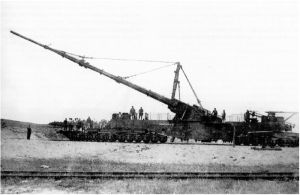
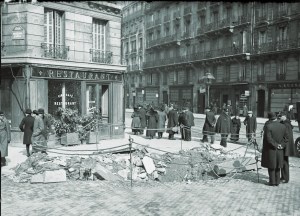
paris-gunAt 256 tons with a barrel of 111′ 7″, the “Paris Gun” hurled 38″ shells into the city from a range of 75 miles. If you were in Paris in 1918, you may never have heard of the German “super gun”. You’d have been well acquainted with the damage it caused. You never knew you were under attack until the explosion. The lucky ones were those who lived to see the 4’ deep, 10’-12’ wide crater.paris-gun-crater
Parisian children made little good luck charms, as “protection” from the Paris gun. They were tiny pairs of handmade dolls, joined together by scraps of yarn. They were said to provide protection for their owners, but only under certain circumstances. You couldn’t make or buy your own, they had to be presented to you. They also had to remain attached, or else the little dolls would lose their protective powers.
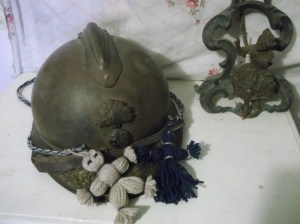
nenetteetrintintinThese little yarn dolls had names. They were Nénette and Rintintin.

Army Air Service Corporal Lee Duncan was in Paris at this time, with the 135th Aero Squadron. He was aware of the custom, possibly having been given such a talisman himself. In the wake of the Battle of Saint-Mihiel, Corporal Duncan was sent forward to the small village of Flirey, to check out it’s suitability for an airfield. The place was heavily damaged by shellfire, and Duncan came upon the shattered remains of a dog pound. Once, this kennel had provided Alsatians (German Shepherd Dogs) to the Imperial German Army. Now, the only dogs left alive were a starving mother and five nursing puppies, so young that their eyes were still closed.135th_aero_squadron_group
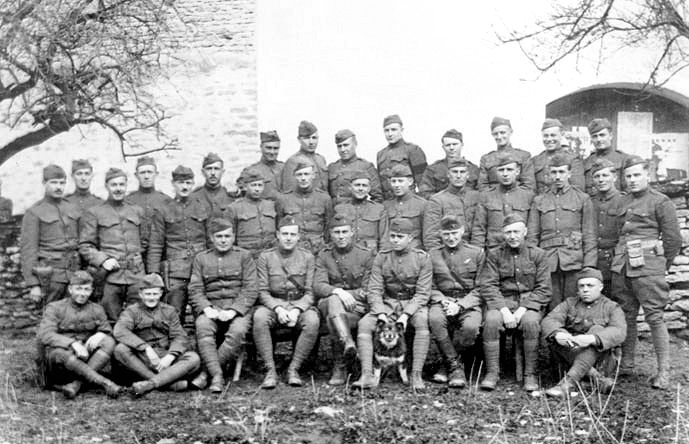
Corporal Duncan cared for them, selling several once the puppies were weaned. He sold the mother to an officer and three puppies to fellow soldiers, keeping two for himself. Like those little yarn dolls that French children gave to American soldiers, Duncan felt these two puppies were his good luck charms. He called them Nanette and Rin Tin Tin.
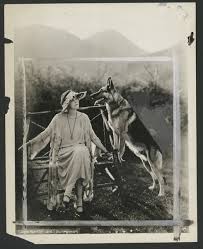
jane-murfin-with-strongheart
Playwright Jane Murfin with Strongheart

Returning home after the war, Duncan placed the dogs with a police dog breeder and trainer in Long Island. Nanette contracted pneumonia and died, the breeder giving Duncan a female puppy, “Nanette II”, to replace her.

Etzel von Oeringen was born on October 1, 1917 in Germany, coming to America after the Great War and becoming a movie star in the ‘20s. Better known as “Strongheart”, Etzel was a German Shepherd Dog, whose appearance in silent films enormously increased the popularity of the breed.

A friend of silent film actor Eugene Pallete, Duncan became convinced that Rin Tin Tin could become the next canine film star. He later wrote, “I was so excited over the motion-picture idea that I found myself thinking of it night and day.”
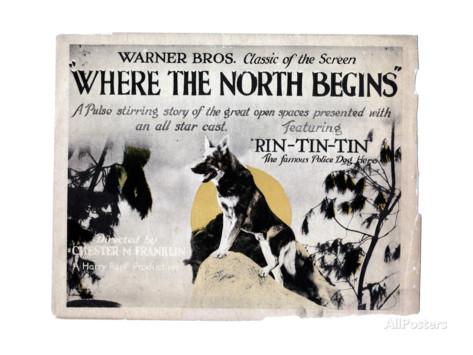
where-the-north-begins-rin-tin-tin-1923Walking the dog on “Poverty Row”, 1920s slang for B movie studios, did the trick. Rin Tin Tin got his first film break in 1922, replacing a camera shy wolf in “The Man from Hell’s River”. His first starring role in the 1923 “Where the North begins”, is credited with saving Warner Brothers Studios from bankruptcy.

Between-the-scenes silent film “intertitles” were easily changed from one language to another, and Rin Tin Tin films enjoyed international distribution. In 1927, Berlin movie audiences voted him Most Popular Actor.

There’s a Hollywood legend that may or may not be true, that Rin Tin Tin received the most votes for Best Actor at the 1st Academy Awards in 1929. Wishing to appear oh-so serious and wanting a human actor, the Academy threw out the ballots. German actor Emil Jannings got Best Actor on the 2nd ballot.

rin-tin-tin-signed-photoRin Tin Tin appeared in 27 feature length silent films, 4 “talkies”, and countless commercials and short films. Regular programming was interrupted to announce his passing on August 10, 1932, at the age of 13. An hour-long program about his life was broadcast the following day.

Suffering from the Great Depression like so many others, Duncan couldn’t afford a fancy funeral. By this time he couldn’t afford the house he lived in. Duncan sold the house and returned the body of his beloved German Shepherd to the country of his birth, where Rin Tin Tin was buried in the Cimetière des Chiens et Autres Animaux Domestiques, in the Parisian suburb of Asnières-sur-Seine.

Duncan continued breeding the line, careful to preserve the physical qualities and intelligence of the original, avoiding the less desirable traits that crept into other GSD rin-tin-tinbloodlines. Rin Tin Tin and Nanette II produced at least 48 puppies. Duncan may have been obsessive about it, at least according to Mrs. Duncan. When she filed for divorce, she named Rin Tin Tin as co-respondent.

Rin Tin Tin was awarded his own star on the Hollywood Walk of Fame on February 8, 1960. Lee Duncan passed away later that same year.  At some point, Duncan had written a poem, a tribute to the companion animal who was no more.  If you’ve ever loved a dog, I need not explain his final stanza.

“…A real unselfish love like yours, old pal,
Is something I shall never know again;
And I must always be a better man,
Because you loved me greatly, Rin Tin Tin”.


February 5, 1637 The Day the Bubble Burst

Economic forces had combined with irrationality to bid up prices to the point of collapse. This was neither the first nor the last time

gillette-stadiumOn March 24, 2000, the New England Patriots broke ground on their new stadium home in Foxborough, Massachusetts. The internet company CMGI won naming rights, agreeing to pay $114 million over 15 years for the privilege. The 2002 season opened on September 9 in the Patriots’ new home, tickets bearing the name, CMGI Stadium.

Except by that time, the “Dot-Com” bubble had burst. CMGI had ceased to exist.  The stadium itself would open, bearing the name of a razor and shaving cream manufacturer.

Economic forces had combined with irrationality to bid up prices to the point of collapse, but this was neither the first nor the first time.  We saw it in the housing bubble of the 2000s, and the “Bull Market” of the Roaring 20s.viceroy-tulip

The oddest of these speculative bubbles may be the “Tulpenwoede” (tulip madness) gripping Holland in the 17th century.

The first tulip bulbs came from the Ottoman Empire to Vienna in 1554, introduced to Europe by Ogier de Busbecq, ambassador of the Holy Roman Emperor Ferdinand I to the Sultan of Turkey. The tulip was different from anything in Europe, the intense, saturated colors soon turning the flower into a status symbol.

By the 17th century Holland had embarked on a Golden Age. The East Indies trade Keukenhof Gardens Desktop Backgroundproduced single voyage profits of 400% and more, as merchants built grand estates surrounded by flower gardens. The hyacinth enjoyed early popularity, but the plant at the center of it all was the spectacular, magnificent, tulip.

For much of this period, tulip bulbs were primarily of interest to the wealthy. The craze began to catch on with the middle and poorer classes by the mid-1630s.  Soon, increased demand began to drive prices to irrational levels.

The market soared in late 1636, as prices bid up for bulbs planted to bloom the following spring. People mortgaged their homes and businesses, hoping to buy bulbs for resale at higher prices. At one point, “one single root of the rare species called the Viceroy”, sold for “two lasts of wheat, four lasts of rye, four fat oxen, eight fat swine, twelve fat sheep, two hogsheads of wine, four tuns (barrels) of beer, two tuns of butter, One thousands lbs. of cheese, one complete bed, a suit of clothes, and a silver drinking-cup”. In early 1637, single “Viceroy” bulbs bid between 3,000 and 4,200 guilders, at a time when skilled craftsman earned about 300 guilders a year. At one point, 5 hectares (12 acres) of land were offered for a single Semper Augustus bulb.

“Couleren” bulbs were most commonly traded, single hued flowers of yellow, red or white, followed by the multi-colored “Rosen” and “Violettin”. Rarest and most sought after weretulip_price_index the vivid streaks of yellow or white on the red, brown or purple backgrounds of the “Bizarden” (Bizarres).  Ironically, these were the most sickly specimens, victims of a “Tulip breaking virus” which “broke” petals into two or more hues.

Confidence evaporated in 1637 and the market collapsed. The last recorded market data were reported on February 5, as 98 sales were recorded at wildly varying prices. Those who had taken possession of bulbs found their worth to be a fraction of the prices paid. Others were locked into futures contracts, obliged to pay ruinous sums for comparatively worthless flower bulbs.

Afterward

Today, the Federal National Mortgage Association (FNMA), and Federal Home Loan Mortgage Corporation (FHLMC), are Congressionally authorized hybrids or “GSEs” (government-sponsored enterprises), charged with “providing liquidity and stability to the U.S. housing and mortgage markets”. Better known as “Fannie Mae” and “Freddie Mac”, both entities are privately owned by shareholders and backed by taxpayers.

The US Department of Housing and Urban Development (HUD) was charged with regulating Fannie and Freddie in 1992. Before that, these organizations were required to buy only “prime” mortgages, notes which institutional investors would buy on the open market. Such standards made it too difficult for lower income, higher risk buyers to become homeowners, or so it was believed. Regulators imposed “affordable housing” liar_loansguidelines that year, imposing a 30% quota and raising it to 50% by the end of the Clinton era. By 2007 under President Bush, 55% of all mortgages purchased by the mortgage giants were “sub-prime”.

Banks and brokers were happy to sing along, issuing “NINJA” loans (No Income No Job no Assets) to anyone who asked. “Low-doc” and “no-doc” mortgages called “liar loans” sprouted up everywhere, but gone were the days when your home town bank held your mortgage.  No mortgage originator would ever be left holding the bag, should these loans turn bad.  They sold them to Fannie and Freddie.

Fannie, Freddie and others “bundled” high risk mortgages into increasingly exotic financial instruments called “mortgage backed securities”, selling them off to investors and backing transactions with “credit default swaps” (CDS), a two-party agreement impossible to distinguish between an insurance contract and a bet.

The danger signs were there for those who would see, but Barney Frank said it best inhome-made-of-dollar-on-grass 2003: “I want to roll the dice a little bit more in this situation toward subsidized housing.”

Property values doubled and doubled again. You were always going to make money in real estate. Family members sold to one another over and over at ever increasing prices, with none ever moving out of the house.  Aggregate CDS values reached $62 Trillion in 2008, equivalent to a stack of dollar bills, reaching from Earth to the moon. 18 times.

Then, the bubble burst.  Imagine waking one morning to find your entire pension or mutual fund account, was invested in that stuff.

housing-bubbleThat was the year when gas first hit $4/gallon.  Those living closest to the financial cliff began to fall off, and foreclosures went through the roof.  Highest risk mortgage holders were the first to default, people with $20,000 incomes and multiple investment properties. We all remember 2009.  I myself lost a job of 15 years when my employer went under, briefly making my family part of the “zero percent”.  Some will tell you that we haven’t emerged from the “Great Recession”, to this day.

The old subprime “MyCommunityMortgage” program is dead and buried, but not the geniuses who gave it life. Sub-prime has become a dirty word, so, until recently, regulators pushed “alt” mortgage guidelines. Once, your “income” had to be your own, whether or not you could document it. Now, you could claim other people’s income: your aunt, parents, even a roommate. They won’t be on the note, they have no responsibility to repay.  They don’t even have to live there. As long as you can augment your income enough to qualify.  What could go wrong with that?

Speaking of the Patriots, I hear there’s a game today.  I’ll have to check it out. At this point, I’d rather think about football.

Go Patriots.

February 4, 1936 Undark

Newspapers waxed rhapsodic about cities of the future, streets aglow in the light of radium lamps as smiling restaurant patrons enjoyed luminescent cocktails

In 1922, a bank teller named Grace Fryer began to feel soreness in her jaw. She was 23 at the time and too young to have her teeth falling out, yet that’s what was happening. Her doctor was able to identify the problem, but he couldn’t explain it. Grace Fryer’s jawbones were so honeycombed with holes, they looked like moth eaten fabric.

On December 21, 1898, Marie and Pierre Curie discovered the 88th element of the Periodic Table. This new and radioactive element was Radium, one of the ‘alkaline earth metals’. Curie’s work would make her the first female recipient of a Nobel Prize in 1906, and the only person of either sex to ever win two Nobels, in 1911.

There have been strange fads over the years, from goldfish swallowing to pole sitting, but none stranger than the radium craze of 1904. Newspapers waxed rhapsodic about cities of the future, streets aglow in the light of radium lamps as smiling restaurant patrons enjoyed luminescent cocktails. Serious doctors had early successes killing cancer cells, while quacks and charlatans sold radium creams, drinks and suppositories to cure everything from acne to warts.undark_ad_large

An unseen benefit of the craze, at least for a time, was that demand for radium was vastly greater than actual production. Prices skyrocketed to $84,500 per gram by 1915, equivalent to $1.9 million today. Authorities warned consumers to be on the lookout for fake radium, while the business in fake radium products soared.

When WWI began, it didn’t take long to recognize the advantages of glow in the dark instruments. A number of companies stepped up to fill the need, perhaps none larger than US Radium and their glow-in-the-dark paint, “Undark”.

Hundreds of women worked in their factories, hand painting the stuff on watches, gun sights and other instruments. Radioactivity levels were so small as to be harmless to users of these objects, but not so to the people who made them.

gracefryer
Grace Fryer

The harmful effects of radiation were relatively well understood by 1917, though the information was kept from factory workers. Camel hair brushes tended to splay out with use, supervisors encouraged the women to sharpen their brushes using their lips and tongues. The stuff was odorless and tasteless, some couldn’t resist the fun of painting nails and even teeth with the luminous paint. The only side effects of all that radium, they were told, would be rosy cheeks.

The active ingredient in Undark was a million times more active than Uranium, and company owners and scientists knew it. Company labs were equipped with lead screens, masks and tongs, while literally everything on the factory floor, glowed.

In 1925, doctors began to suspect that Grace Fryer’s condition mayradium-girls be related to her previous employment in US Radium’s Orange, New Jersey factory. By that time she was seriously ill, yet Columbia University “Specialist” Frederick Flynn and a “Colleague” pronounced her to be in “fine health”. It was only later that the two were revealed to be company executives.

These US Radium guys must have been genuine, mustache twirling, villains. In the early 20s, company officials hired physiologist and Harvard Professor Cecil Drinker to report on working conditions. Drinker’s report detailed catastrophically dangerous working conditions, with virtually every factory employee suffering blood or bone conditions.

The report filed with the New Jersey Department of Labor omitted all of it, describing conditions in glowing terms (pun not intended), claiming that “every girl is in perfect condition”.

Reports of illness among other women came flooding in. In a tactic that may sound familiar today, US Radium took to assassinating the character of these women, claiming that their symptoms resulted from syphilis.

phossyjawAttorney Raymond Berry filed suit on Fryer’s behalf in 1927, the lawsuit joined by four other dial painters seeking $250,000 apiece in damages. Soon, the newspapers were calling them “radium girls”. The health of all five plaintiffs was deteriorating rapidly, while one stratagem after another was used to delay proceedings. By their first courtroom appearance in January 1928, none could raise their arm to take the oath. Grace Fryer was altogether toothless by this time, unable to walk, requiring a back brace even to sit up.
Another dial painter, Amelia Maggia, had had to have her jaw removed in the last months of her life. Her cause of death was ruled as syphilis, but her dentist wasn’t buying it. Dr. Joseph Knef placed the jaw on a piece of dental film, the resulting image showing “absurd” levels of radiation.

The radium girls were far too sick to attend the next hearing in April, when the judge ordered a continuation to September, an accommodation to several company witnesses “summering” in Europe.

Walter Lippmann of the New York World called it a “damnable travesty of justice”. “There is no possible excuse for such a delay”, Lippmann wrote. “The women are dying. If ever a case called for prompt adjudication, it is the case of five crippled women who are fighting for a few miserable dollars to ease their last days on earth. This is a heartless proceeding. It is unmanly, unjust and cruel. This is a case which calls not for fine-spun litigation but for simple, quick, direct justice.”waterbury-mother

Delay was a deliberate and sleazy tactic, and it worked. Plaintiffs accepted a settlement of $10,000 apiece, plus legal fees and a $600 annual annuity. The deal was mediated by Judge William Clarke, himself a US Radium stockholder. None of them lived long enough to cash more than one or two annuity checks.

Marie Curie herself was dead by 1934, poisoned by radiation. With a half-life of 1,600 years, her lab notebooks remain too hot to handle, to this day.

Radium was synthesized for the first time two years later, on February 4, 1936.  Presumably, factory workers using the stuff were no longer encouraged to sharpen their brushes, by licking them.

February 2, 1887 Groundhog Day

The male couldn’t care less about the weather; he comes out of his burrow in February in search of a mate. If uninterrupted, he will fulfill his groundhog mission of love and return to earth

Here on sunny Cape Cod, there is a joke about the four seasons.  We have “Almost Winter”, “Winter”, “Still Winter” and “Bridge Construction”.  And I thought I moved here for the balmy 70° weather, where a gentle breeze sways the coconut palms.jelly-donuts

Midway between Winter Solstice and Spring Equinox and well before the first crocus of spring has blinked and stretched and peered out across the frozen, windswept tundra, there is a moment of insanity which helps those of us living in northern climes get through to that brief, blessed moment of warmth when the mosquitoes once again have their way with us.

The ancient Romans observed their mid-season festival on February 5, the pagan Irish on February 1. For Christians, it was February 2, Candlemas day, a Christian holiday celebrating the ritual purification of Mary. For reasons which are not entirely clear, early Christians believed that there would be six more weeks of winter if the sun came out on Candlemas Day.

Clergy would bless and distribute candles needed for winter, their length representing how long and cold the winter would be. Germans expanded on the idea by selecting an animal, a hedgehog, as a means of predicting weather. Once a suitable number of Germans had come to America, they switched over to a more local rodent: Marmota Monax. The common Groundhog.

Groundhogs hibernate for the winter, an ability which some people I know would like to possess. During that time, their heart rate drops from 80 beats per minute to 5, and they live off their stored body fat.  Another ability some of us would appreciate, very much.Groundhog Fans Gather In Punxsutawney For Winter Prediction

The male couldn’t care less about the weather; he comes out of his burrow in February in search of a mate. If uninterrupted, he will fulfill his groundhog mission of love and return to earth, not coming out for good until sometime in March.

But then there is the amorous woodchuck’s worst nightmare in a top hat, a fiendish apparition known as the groundhog hunter.

In 1887, there was a group of groundhog hunters in Punxsutawney, Pennsylvania, imaginatively calling themselves the Punxsutawney Groundhog Club. One of them, a newspaper editor, declared on February 2, 1887, that their groundhog “Phil” was the only True weather forecasting rodent.

There are those who would dispute the Gobbler’s Knobdammit-jim crowd and their claims to Punxsutawney Phil’s weather forecasting prowess. Alabama has “Birmingham Bill”, and Canada has Shubenacadie Sam. New York can’t seem to decide between Staten Island Chuck and New York City’s very own official groundhog, “Pothole Pete”.


It appears that there is no word for groundhog in Arabic.  Accounts of this day in the Arab press translate the word as جرذ الأرض., or, “Ground Rat”.  Pretty exciting to learn that.  Thanks al Jazeera.

If anyone was to bend down and ask Mr. Ground Rat his considered opinion on the matter, he would probably cast a pox on all our houses. It’s been a long winter. Mr. Ground Rat’s all dressed up for a date.  He has other things on his mind.

January 25, 1925 The Great Race of Mercy

Dr. Welch expected a high mortality rate among the 3,000 or so white inhabitants, but the 7,000 area natives had no immunity whatsoever. Mortality rates among these populations could be expected to approach 100%

diphtheria
Corynebacterium diphtheriae

Diphtheria is highly contagious, with early symptoms resembling a cold or flu. Fever, sore throat, and chills lead to bluish skin coloration, painful swallowing, and difficulty breathing. Later symptoms include cardiac arrhythmia with cranial and peripheral nerve palsies, as proteins form a leathery, white “pseudo membrane” on the throat and nasal tissues.

Today the disease is all but eradicated in the United States, but diphtheria was once a major killer of children.

Spain experienced an outbreak of the disease in 1613. To this day the year is remembered as “El Año de los Garotillos”.  The Year of Strangulations.

A severe outbreak swept through New England in 1735. In one New Hampshire town, one of every three children under the age of 10 died of the disease.  In some cases entire families were wiped out. Noah Webster described the outbreak, saying “It was literally the plague among children. Many families lost three of four children—many lost all”.

Dr. Curtis Welch practiced medicine in Nome, Alaska, in 1925. Several children became illdiphtheria_vaccination_poster with what he first diagnosed as tonsillitis. More came down with sore throats, early sufferers beginning to die as Welch observed the white pseudo membrane of diphtheria. He had ordered fresh antitoxin the year before, but the shipment hadn’t arrived by the time the ports froze over. By January, all the serum in Nome was expired.

There were 10,000 living in Nome at the time, 2° south of the Arctic Circle. Welch expected a high mortality rate among the 3,000 or so white inhabitants, but the 7,000 area natives: Central Yupik, Inupiaq, St. Lawrence Island Yupik and American Indians with lineage tied to tribes in the Lower 48, had no immunity whatsoever. Mortality among these populations could be expected to approach 100%.

Five children had died by January 25, while Dr. Welch suspected more in the remote native camps. A telegram went out and an Anchorage hospital came up with 300,204 units of serum.  It was enough for 30 patients. A million units were needed, but this was enough to stave off an epidemic until the larger shipment arrived in February.

serum-runThe 300,000 units shipped as far as they could by rail, arriving at Nenana, 674 miles from Nome. Three vintage biplanes were available, but all were in pieces, and none would start in the sub-arctic cold. The antitoxin would have to go the rest of the way by dog sled.
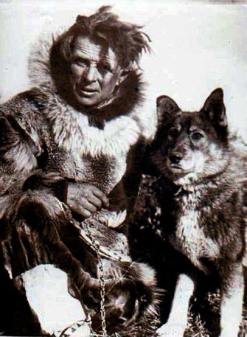
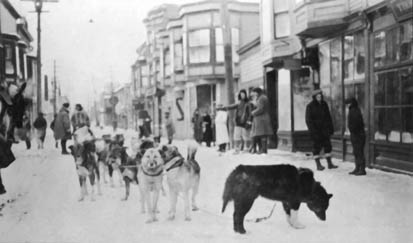

It was 9:00pm and −50°F on January 27, when “Wild Bill” Shannon and his nine dog team received the 20lb cylinder of serum. The temperature was −62°F when Shannon reached Minto at 3:00am, hypothermic, with parts of his face blackened by frostbite.

Leonhard Seppala and his dog team took their turn, departing into gale force winds and

sepp-and-togo
Seppala & Togo

zero visibility, with a wind chill of −85°F. Most sled dogs are retired by age twelve, especially team leaders, but it was twelve year old “Togo” who was trusted with the lead. Up the 5,000′ “Little McKinley” and across the unstable ice of Norton Sound, visibility was so poor that Seppala couldn’t see the “wheel dog” – the dog nearest his sled. Much of the time, navigation in that frozen wilderness was entirely up to his lead dog.

With Seppala’s 8 year old daughter and only child Sigrid at risk for the disease, stakes could not have been higher. Seppala and Togo ran 170 miles to receive the serum, returning another 91 miles to make the next handoff on February 1. Together the pair covered twice as much ground as any other team, over the most dangerous terrain of the “serum run”.

balto-of-nome
Balto & Team, in Nome

Gunnar Kaasen and his team took the handoff, hitting the trail at 10:00 at night. At one point, hurricane force winds upended the sled, pitching musher and serum alike into the snow. Already frostbitten, Kaasen searched in the dark with bare hands, until he found the cylinder. Covering the last 53 miles overnight, the team reached Front Street, Nome, at 5:30am on February 2. The serum was thawed and ready by noon.

20 mushers and 150+ dogs had covered 674 miles in 5 days, 7½ hours, a distance that normally took the mail relay 2-3 weeks.  Not a single serum ampule was broken.

With 28 confirmed cases and enough serum for 30, the serum run had held the death toll at 5, 6 or 7, depending on which version you accept. Doctor Welch suspected as many as 100 or more deaths in the native camps, but the real number will never be known. An untold number of dogs died before completing the run, several mushers were severely frostbitten.

Gunnar Kaasen and his lead dog “Balto” were hailed as heroes of the serum run, the dogbalto-statue becoming the most popular canine celebrity in the country after Rin Tin Tin. It was a source of considerable bitterness for Leonhard Seppala, who felt that Kaasen’s 53 mile run was nothing compared with his own 261, Kaasen’s lead dog little more than a “freight dog”.

A statue of Balto was erected in New York’s Central Park in 1925 where it stands to this day, though he is depicted wearing Togo’s “colors” (awards). Togo lived another four years, though he was never again able to run. He spent his last years in Poland Spring, Maine, and passed away on December 5 at the ripe old age of 16.togo

Seppala was in his old age in 1960, when he recalled “I never had a better dog than Togo. His stamina, loyalty and intelligence could not be improved upon. Togo was the best dog that ever traveled the Alaska trail.” Today, Togo is stuffed and mounted, standing watch in the Iditarod museum headquarters in Wasilla, Alaska.

January 23, 1795 Cavalry 1, Navy 0

The history of human conflict is hardly a subject for mirth, yet there are times when the irony has risen to the level of the sublime

War and warfare has never been the source of a great deal of humor.  The history of human conflict is hardly a subject for mirth, yet there are times when the irony has risen from the ridiculous to the sublime.

In 585BC, the battle between the Medes and the Lydians was stopped in its tracks, on account of a solar eclipse.  In the 3rd Mithradatic War of 76-63BC, a meteor was enough to do the trick.

In the middle ages, a handful of French soldiers once saw fit to mouth off to an Italian woman on her way home from church, and France ended up losing Sicily, to Spain.

At least one WWI battle was called, on account of an amphibious landing force being attacked, by bees.

120,000 Chinese troops poured into North Korea between November 27 and December 13 1950, overwhelming 20,000 American and United Nations forces at the Chosin Reservoir.  Desperately low on ammunition, one Marine Corps mortar division called in re-supply, by parachute.  The battle of the “Frozen Chosin” might have ended differently, had some supply clerk understood that the code-name for mortar shells was “Tootsie Rolls”, and not sent candy into the combat zone.  At least those guys had something to eat, as they broke through their encirclement and retreated south.

zuiderzeeIn all the annals of warfare, there may be nothing more ironic, than the time a naval force was defeated by men mounted on horseback.
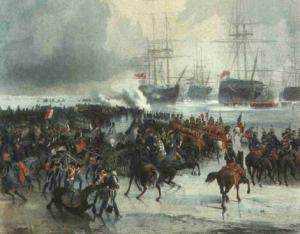
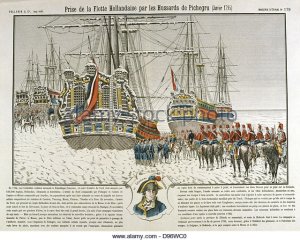
In early 1793, Austria, Prussia, Spain, Great Britain and the Dutch Republic formed the first of seven coalitions, that would oppose the French Republic over the next 23 years.  France declared war on its neighbor to the north.  By the end of the following year, many of Holland’s provinces as well as those of the Austrian Netherlands, had been overrun.

The winter of 1794-95 was particularly severe.  A number of Dutch ships sought shelter near the North Sea village of den Helder, becoming icebound near the mouth of a shallow bay called the Zuiderzee.capture

General Johan Willem de Winter, a former Dutch naval officer, had been in service to the French since 1787.  On the night of January 23, de Winter arrived at the head of a regiment of French light cavalry.  The following morning, a number of these “hussars” rode out over the ice, to the Dutch ship-of-the-line “Admiraal Piet Heyn”, demanding its surrender.   The surgeon aboard another ship, the “Snelheid”, later wrote “On Saturday morning, my servant informed me that a French hussar stood near our ship. I looked out my porthole, and indeed, there stood an hussar.”

This was a significant part of the Dutch fleet, 15 ships, 11 of which were manned and seaworthy, and it was now in the hands of French horsemen.

capture-of-the-dutch-fleet-frozen-in-at-den-helder-by-the-french-hussarsAt least one source will tell you that this event never occurred, or at least it’s an embellished version, as retold by the hussars themselves.   I guess you can take your pick.  A number of 19th century authors have portrayed the episode as unvarnished history, as have a number of paintings and sketches.

In February 1846, French Lieutenant-General Baron Lahure published a letter in the newspaper “Echo de la Frontière”, describing the event.  “I departed immediately with a company of tirailleurs in wagons and a squadron of light cavalry; before dawn I had taken position in the dunes. When the ships saw us, they prepared their defences. I sent some tirailleurs ahead, and followed with the rest of my forces. The fleet was taken. The sailors received us ‘de bonne grace’ on board… This is the true story of the capture of the Dutch fleet, devised and executed by a 23 year old Chef de Bataillion”.

Archibald Gordon Macdonell included the episode in his 1934 “Napoleon and his Marshals”.  It’s one of those stories that I Want to be true, even if it isn’t.  “(when) the ragged men” Macdonell  wrote, “thundered on their horses across the ice to capture with naked swords the battlefleet of Holland”.  The only time in recorded history, when a naval fleet was captured, by a cavalry charge.

January 22, 2000 A Hole in the Head

To prove the point, to his own satisfaction if to no one else, Hughes drilled a hole in his own skull on January 6, 1965, using a Black & Decker electric drill

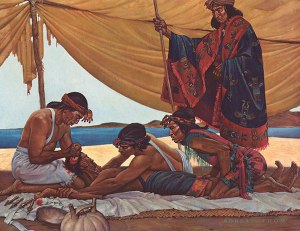
It’s called “Trepanation”, possibly the oldest surgical procedure for which we have archaeological evidence. Trepanation involves drilling or scraping a hole into the human ancient-peruvian-trepanationhead, and seems to have begun sometime in the Neolithic, or “New Stone Age” period. One archaeological dig in France uncovered 120 skulls, 40 of which showed signs of trepanning. Another such skull was recovered from a 5th millennium BC dig in Azerbaijan.  A number of 2nd millennium BC specimens have been unearthed in pre-Colombian Mesoamerica; the area now occupied by the central Mexican highlands through Belize, Guatemala, El Salvador, Honduras, Nicaragua, and northern Costa Rica.
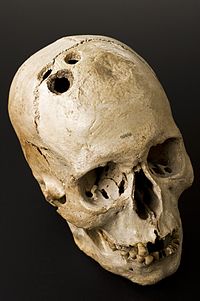
bronze_age_skull_from_jericho_palestine
Bronze age skull

Hippocrates, the Father of Western Medicine, described the procedure in detail in his treatise “On Injuries of the Head,” written sometime around 400BC. The Roman physician Galen of Pergamon expanded on the procedure some 500 years later. Archaeologists discovered 12½%, of all the skulls in pre-Christian era Magyar (Hungarian) graveyards, to have been trepanned.

The procedure has obvious applications in the treatment of head trauma, though it has been used to treat everything from seizures to migraines to mental disorders. During medieval times, the procedure was used to liberate demons from the heads of the possessed and to cure an assortment of ailments from meningitis to epilepsy.

trepan-posterTrepanation took on airs of pseudo-science, many would say “quackery”, when the Dutch librarian Hugo Bart Huges (Hughes) published “The Mechanism of Brainbloodvolume (‘BBV’)” in 1964. In it, Hughes contends that our brains drained of blood and cerebrospinal fluid when mankind began to walk upright, and that trepanation allows the blood to better flow in and out of the brain, causing a permanent “high”.

To prove the point, to his own satisfaction if to no one else, Hughes drilled a hole in his own skull on January 6, 1965, using a Black & Decker electric drill. He must have thought it proved the point, because he expanded on his theory with “Trepanation: A Cure for Psychosis”, as well as an autobiography, “The Book with the Hole”, published in 1972.

Peter Halvorson, a Hughes follower and director of the International Trepanation Advocacy Group (ITAG), would disagree with that quackery comment. Halvorson trepanned himself with an electric drill in 1972. Today, he explains on his ITAG website (www.trepan.com) that “The hypothesis here at ITAG has been that making an opening in the skull favorably alters movement of blood through the brain and improves brain functions which are more important than ever before in history to adapt to an ever more rapidly changing world”.with-a-drill

On January 22, 2000, Peter Halvorson and Williams Lyons helped drill a hole in a woman’s head for producers of the ABC News program “20/20.” This was in Beryl, Utah, and the television program which ensued, airing on February 10, resulted in criminal charges and arrest warrants for the two men. At the time, the Iron County DA was also considering charges against ABC News reporter Chris Cuomo for aiding in the crime. There is precedent in Utah for such a charge against a reporter. In 1999, KTVX reporter Mary Sawyers (allegedly) provoked a group of Carbon County High School students into using tobacco products for a story on youths and tobacco. Sawyers later stood trial for contributing to the delinquency of a minor in Utah’s 7th District Court of Appeals.

St. Louis neurologist Dr. William Landau wasn’t impressed with Hughes’ brainbloodvolume theory, explaining that “There is no scientific basis for this at all. It’s quackery.” Dr. Robert B. Daroff, Professor of Neurology at Case Western Reserve University School of Medicine, was a little more to the point. “Horseshit,” he said. “Absolute, unequivocal bullshit”.

January 20,  1788  I Have a Dream, Savannah edition

The “Anne” sailed from England in November 1732.  On board were 114 colonists including General James Oglethorpe, intending to found the Colony of Georgia. The group headed james-oglethorpe-with-yamacraw-chief-tomochichi-mary-appears-between-themsouth after a brief stay in Charleston, South Carolina.  Landing at Yamacraw bluff, they were greeted by Chief Tomochichi of the Yamacraws, along with two Indian traders, John and Mary Musgrove.

The Province of Georgia and its Colonial Capital of Savannah were founded on that date, February 12, 1733.  The friendship that developed between Oglethorpe and Tomochichi kept the fledgling colony out of the Indian conflicts which marked the founding of most of the colonies.

Oglethorpe was a bit of a Utopian, founding his capital around four wards, each containing eight blocks situated around its own central square.  It was a place of religious freedom, 40 Sephardic Jews from Spain and Portugal arrived in July, the largest such group to-date to enter any of the colonies.  It was a place of religious freedom for all but Catholics, that is.  It was feared that Catholics would be sympathetic with Spanish authorities in control of Florida at that time, so they were prohibited.

There were four such prohibitions, the others being that there would be no spirituous liquors (that wouldn’t last long), no lawyers (do I need to explain?), and no slaves.

The experiment came to an end in 1754, when Georgia became a Royal Colony.

The low marshes of Savannah’s coastline are ideally suited as wild rice fields.  Rice hadsunset-palms originally come from its native Southeast Asia to West Africa, where the same strains were grown by European colonists.  The rice industry failed in Africa, but the combination of English agricultural technology and African labor made the crop a mainstay of the early colonial economy.

In 1773, a slave named George Leile became the first black man to become a licensed Baptist preacher in Georgia.  Leile’s master, himself a Baptist deacon, freed him before the Revolution, and Leile preached to slaves on plantations along the Savannah River, from Georgia north into South Carolina.

Hundreds of blacks fled to occupied Savannah after the Revolution broke out, seeking safety behind British lines.  Scores of them were transported to Nova Scotia or other colonies, and some to London.  Leile and his family sailed with the British for freedom in Jamaica.

Andrew Bryan was the only one of the first three black Baptist preachers to stay, making his home in Savannah along with his wife, Hannah.

first_african_baptist_church_savannahOn January 20, 1788, Bryan brought official recognition to the First African Baptist Church and its 67 members, five years before the first “white” Baptist Church in Savannah.  In 1802, Bryan founded the “Second Colored Baptist Church”, renamed the “Second African Baptist Church” in 1823.

General William Tecumseh Sherman read the Emancipation Proclamation to the citizens of Savannah from the steps of this church, promising “40 acres and a mule” to newly freed slaves.

The original church on Greene Square burned down in 1925.  The church was completely rebuilt, and still contains its original pulpit, prayer benches and choir chairs.

In 1961, a guest preacher delivered a sermon at the Second African Baptist Church whichmlkjr-i-have-a-dream-speech-jpg he called “I have a Dream”.  Two years later, the same speaker would deliver his speech from the steps of the Lincoln memorial in Washington.

Reverend Martin Luther King, Jr’s 88th birthday came and went last Sunday, a date now remembered with its own national holiday.  This August, the country will mark the 54th anniversary of his speech on the Mall, as today, we mark the last day in office of America’s first black President.  While “Black Lives Matter” and a sorry collection of racial arsonists attempt to divide Americans against one another for their own political advantage, we’d do well to remember other words of Reverend King, spoken at a time when it took genuine courage to be a “civil rights” leader.   “In a real sense we must all live together as brothers, or we will all perish together as fools”.

January 18, 1943 The Greatest Thing since Sliced Bread

Ohio farmer Roscoe Filburne was ordered to destroy the surplus and pay a fine, even though his “surplus” was being consumed on the farm by the Filburne family and their chickens

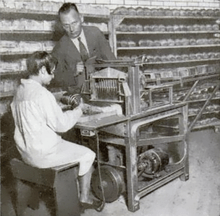
The first automatic bread slicer was invented by Otto Frederick Rohwedder of Davenport, Iowa, in 1912. The idea was not at all popular among bakers, who feared that pre-sliced bread would go stale faster, leading to spoiled inventory and dissatisfied customers.
st-_louis_electrical_bread_slicer_1930The project almost ended in a fire in 1917, when the prototype was destroyed along with the blueprints. Rohwedder soldiered on, by 1927 he had scraped up enough financing to rebuild his bread slicer.

Frank Bench, a personal friend of the inventor, was the first to install the machine. The first pre-sliced loaf was sold in July of the following year. Customers loved the convenience and Bench’s bread sales shot through the roof.sliced-bread-wonder

Sliced bread became a national hit when the Continental Baking Company, then owner of the “Wonder Bread” brand, began using a modified version of Rowhedder’s machine in 1930. Sliced bread was here to stay. Sort of.

The United States had been in WWII for two years in 1943, when Claude Wickard, head of the War Foods Administration as well as Secretary of Agriculture, had the hare brained idea of banning sliced bread.

Mr. Wickard was no stranger to hare brained ideas; it is he who lends his name to the landmark Supreme Court case Wickard v. Filburne. Speaking of hare brained ideas. The Agricultural Adjustment Act of 1938 limited the area that farmers could devote to wheat production, in an effort to stabilize the price of wheat on the national market. An Ohio farmer named Roscoe Filburne was producing more than his allotment. The federal government ordered him to destroy the surplus and pay a fine, even though his “surplus” was being consumed on the farm by the Filburne family and their chickens.

constitutionArticle 1, Section 8 of the Constitution includes the “Commerce Clause”, permitting the Congress “To regulate Commerce with foreign Nations, and among the several States, and with the Indian Tribes”. That’s it. The Federal District Court sided with the farmer, but the Federal government appealed to the US Supreme Court, arguing that, by withholding his surplus from the interstate wheat market, Filburne was effecting that market, and therefore fell under federal government jurisdiction under the commerce clause.

The United States Supreme Court, apparently afraid of President Roosevelt and his aggressive and illegal “court packing” scheme, ruled against the farmer. Ever since, what you don’t do can be argued in a court of law to affect interstate commerce, putting what you didn’t do under the jurisdiction of the federal government. Get it? Neither do I, but I digress.

Back to Mr. Wickard, who enacted his ban against sliced bread and put it into effect on January 18, 1943. The push-back, as you might guess, was immediate and vehement. One woman wrote to the New York Times: “I should like to let you know how important sliced bread is to the morale and saneness of a household. My husband and four children are all in a rush during and after breakfast. Without ready-sliced bread I must do the slicing for toast—two pieces for each one—that’s ten. For their lunches I must cut by hand at least twenty slices, for two sandwiches apiece. Afterward I make my own toast. Twenty-two slices of bread to be cut in a hurry!”

The stated reasons for the ban never did make sense. At various times, Wickard claimed that it was to conserve wax paper, wheat and steel, but one reason was goofier than the one before. According to the War Production Board, most bakeries had plenty of wax paper supplies on hand, even if they didn’t buy any. Furthermore, the federal sliced-breadgovernment had a billion bushels of wheat stockpiled at the time, about two years’ supply, and the amount of steel saved by not making bread slicers has got to be marginal, at best.

The ban was rescinded on March 8, 1943, and pre-sliced bread was once again available to the federal government and its subjects. There’s no telling who first used the expression “the greatest thing since sliced bread”, but a reasonable guess may be made as to why.

January 17, 1994 Death of a Troop Ship

SS America had the largest total of any Navy troop ship in service during WWII, and included USO entertainers, Red Cross workers, and prisoners of war

The Federal Government passed the Merchant Marine act of 1936, “to further the development and maintenance of an adequate and well-balanced American merchant marine”.

The act served multiple purposes.  Among them was the modernizing what was at that time a largely WWI vintage merchant marine fleet, and serving as the basis for a naval auxiliary that could be activated in time of war or national emergency.ss_america_under_construction

Two years later, the first keel laid under the Merchant Marine act was the SS America, built by the United States Line and operated as a passenger liner until America entered WWII in 1941.

Naval interiors of the age tended to be stodgy and overwrought. SS America has the almost unique distinction of having its interiors designed entirely by women, as naval architect William Francis Gibbs turned to the all-female team of Miriam Smyth, Ann Urquhart & Dorothy Marckwald. “It is not without reason”, according to team leader “Dot” Marckwald, “the majority of the passengers are women, and no man could ever know as much about their comfort problems and taste reactions as another woman.”ss-america-lounge-from-balcony

SS America was christened by Eleanor Roosevelt and launched on August 31, 1939, the day before Adolf Hitler invaded Poland.

She would serve as a passenger liner for the two years remaining for US neutrality, with American flags painted on both sides of her hull.  At night she’d sail while fully illuminated.

Where there are government subsidies, there are strings. For SS America, those strings ss-america-flaggedwere pulled on May 28, 1941, while the liner was at Saint Thomas in the US Virgin Islands. The ship had been called into service by the United States Navy, and ordered to return to Newport News.

Re-christened the USS West Point, she served as a transport for the remainder of the war, carrying in excess of 350,000 troops and other passengers by 1946. Hers was the largest total of any Navy troop ship in service during WWII, and included USO entertainers, Red Cross workers, and prisoners of war. As America, she had even carried two Nazi spies as part of her crew, until their discharge on America’s return to Virginia. The two spies, Franz Joseph Stigler and Erwin Wilheim Siegler, were members of the Duquesne spy ring, reporting allied movements in the Panama Canal Zone until they and 31 of their cohorts were found out late in 1941.

ss-united-states-ss-americaDuring her service to the United States Navy, West Point was awarded the American Defense Service Medal, American Campaign Medal, European-African-Middle Eastern Campaign Medal, Asiatic-Pacific Campaign Medal, and World War II Victory Medal.

Returned to civilian service in 1946 and re-christened America, the ship remained a favorite for cruise ship vacationers through most of the fifties. By 1964, the competition from larger, faster ships and the airlines had put the best years behind the aging liner. Sold and then sold again, she had come full circle by 1978, when new owners tried to capitalize on the old ship’s mystique. She was in terrible condition and her refit nowhere near complete when America set sail on her first cruise on June 30, 1978. There was rusted metal, oil soaked rags and backed up sewage. There were filthy mattresses and soiled linens, and so many complaints that the ship turned back after barely clearing the Statue of Liberty.

Impounded for non-payment of debts and receiving an inspection score of 6 out of a possible 100 points by the Public Health Service, the US District Court ordered America to be sold at auction.

One new owner after another bought the hulk during the eighties, only to default. First it was going to be a prison ship, and then sold and renamed Alferdoss, which means “paradise” in Arabic. She was anything but at this point. The next buyer intended to scrap her, only to become the latest in a long line of financial defaults.

Sold yet again in 1993 and renamed the American Star, the new owners planned to convert her to a five-star hotel ship off Phuket, Thailand. A planned 100 day tow began on New Year’s Eve of 1993, but the lines broke. On January 17, 1994, the former SS America was wreck-ss-americaadrift in foul seas, running aground in the Canary Islands the following day.

Discussions of salvage operations were soon squashed, as the ship broke in two in the pounding surf.

The National WWII Museum in New Orleans reports on its website that the men and women who fought and won the great conflict are now passing at a rate of 550 per day.  The Frank Buckles of their era, the last living American veteran of WWI, is expected to pass some time in the 2030s.  How many, I wonder, might think back and remember passage on the most successful troop transport of their day.

By the spring of 2013, the only time you could tell there’s a wreck on the beach, was at low tide.