August 29, 1854 The Resolute Desk

The British government presented a large partner’s desk to President Rutherford B. Hayes in 1880, a token of gratitude for the return of HMS Resolute, 24 years earlier. Excepting a brief period following the assassination of President John F. Kennedy, the desk has been in the oval office or a private study in the White House, from that day to this.

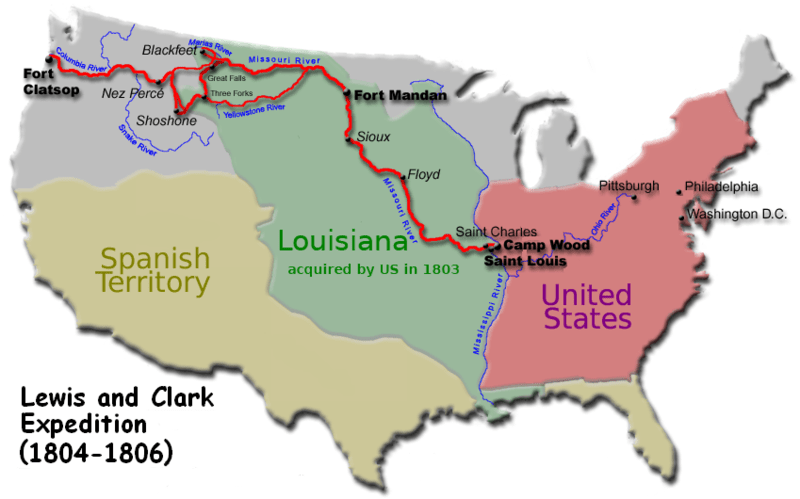
Since the time of Columbus, European explorers searched for a navigable shortcut by open water, from Europe to Asia.   The “Corps of Discovery“, better known as the Lewis and Clark expedition, departed the Indiana Territory in 1804 with, among other purposes, and intention of finding a water route to the Pacific.

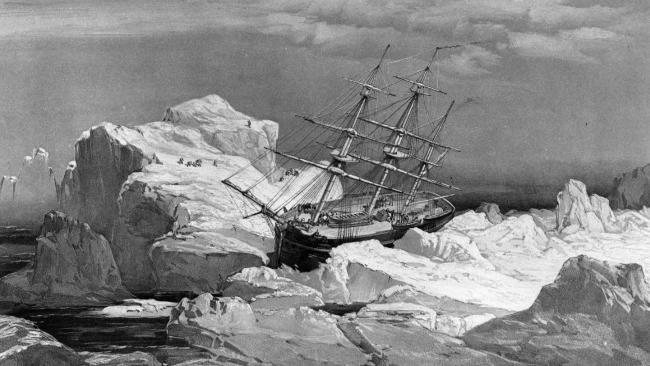
Forty years later, Captain sir John Franklin departed England aboard two ships, HMS Erebus and HMS Terror, to discover the mythical Northwest Passage.

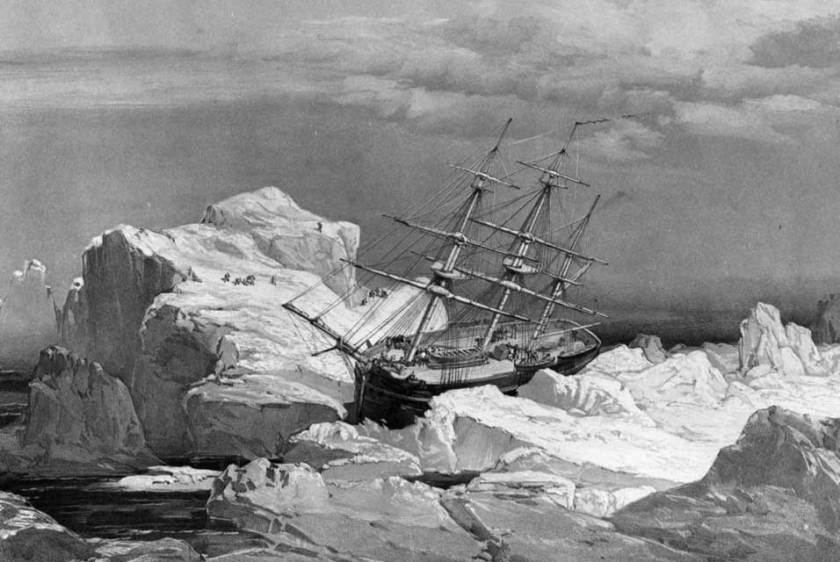
The two ships became icebound in Victoria Strait near King William Island, in the Canadian Arctic.
Ship

Prodded by Lady Jane Franklin, the hunt for her husband’s expedition would continue for years, at one time involving as any as eleven British and two American ships.  Clues were found including notes and isolated graves, telling the story of a long and fruitless effort to stay alive in a hostile climate.  The wreck of HMS Erebus would not be discovered until 2014, her sister ship, two years later.

In 1848, the British Admiralty possessed few ships suitable for arctic service. Two civilian steamships were purchased and converted to exploration vessels: HMS Pioneer and HMS Intrepid, along with four seagoing sailing vessels, Resolute, Assistance, Enterprise and Investigator.

e9b3482e7a0e242654668c20479b9fb4HMS Resolute was a Barque rigged merchant ship, purchased in 1850 as the Ptarmigan, and refitted for Arctic exploration. Re-named Resolute, the vessel became part of a five ship squadron leaving England in April 1852, sailing into the Canadian arctic in search of the doomed Franklin expedition.

Neither Franklin nor any of his 128 officers and men would ever return alive.  HMS Resolute found and rescued the long suffering crew of the HMS Investigator, hopelessly encased in ice where, three years earlier, she too had been searching for the lost expedition.
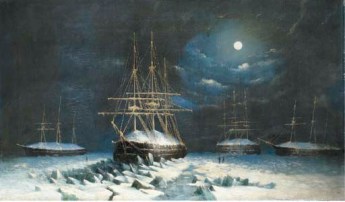
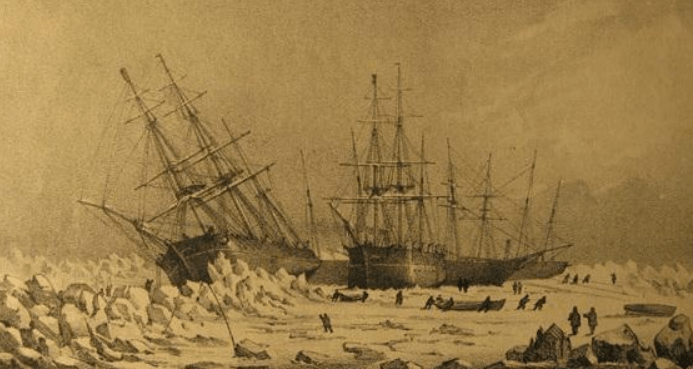
resoluteice2Three of the HMS Resolute expedition’s ships themselves became trapped in floe ice in August 1853, including Resolute, herself. There was no choice but to abandon ship, striking out across the ice pack in search of their supply ships. Most of them made it, despite egregious hardship, straggling into Beechey Island in the Canadian Arctic Archipelago, between May and August of the following year.

The expedition’s survivors left Beechey Island on August 29, 1854, never to return.
Meanwhile Resolute, alone and abandoned among the ice floes, continued to drift eastward at a rate of 1½ nautical miles per day.

The American whale ship George Henry discovered the drifting Resolute on September 10, 1855, 1,200 miles from her last known position. Captain James Buddington split his crew, half of them now manning the abandoned ship. Fourteen of them sailed Resolute back to their base in Groton CT, arriving on Christmas eve.
download (2)

The so-called ‘Pig and Potato War” of 1859 was resolved between the British and American governments with the loss of no more than a single hog, yet a number of border disputes made the late 1850s a difficult time, for American-British relations. Senator James Mason of Virginia presented a bill in Congress to fix up the Resolute, giving her back to her Majesty Queen Victoria’s government as a token of friendship between the two nations.

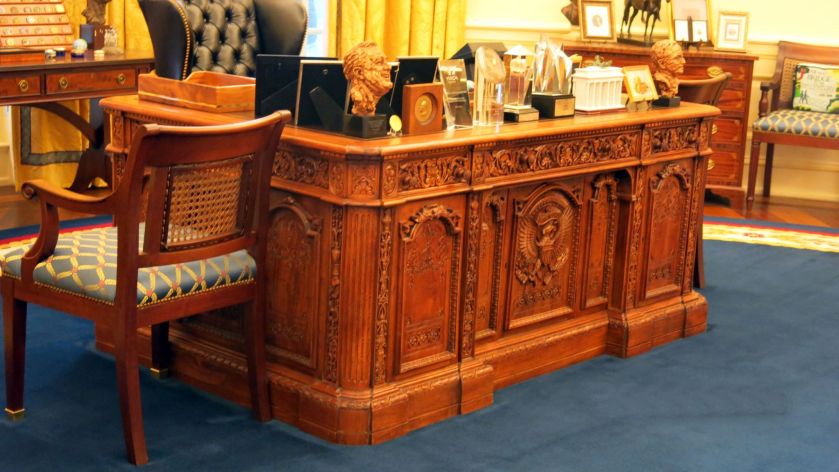
$40,000 were spent on the refit, and Resolute sailed for England later that year. Commander Henry J. Hartstene presented her to Queen Victoria on December 13. HMS Resolute served in the British navy until being retired and broken up in 1879. The British government ordered two desks to be fashioned from English oak of the ship’s timbers, the work being done by the skilled cabinet makers of the Chatham dockyards. The British government presented a large partner’s desk to President Rutherford B. Hayes in 1880. A token of gratitude for HMS Resolute’s return, 24 years earlier.
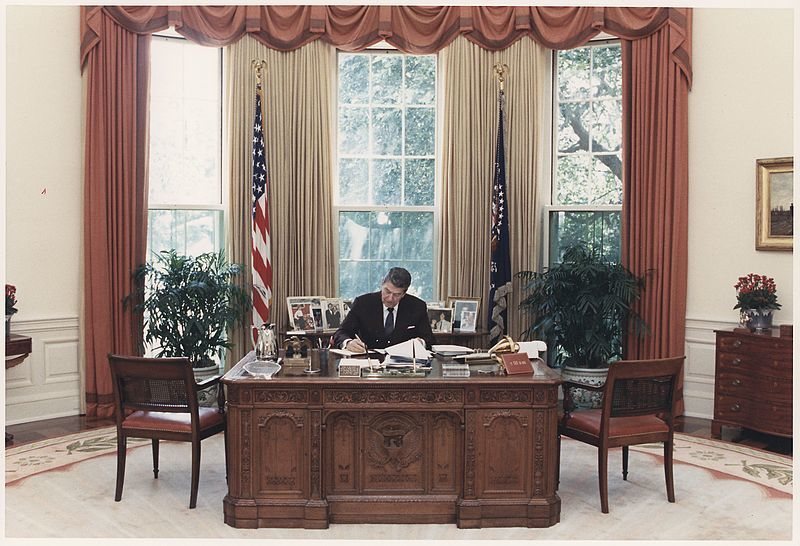
Resolute, ReaganThe desk, known as the Resolute Desk, has been used by nearly every American President since, whether in a private study or the oval office.

FDR had a panel installed in the opening, since he was self conscious about his leg braces. It was Jackie Kennedy who brought the desk into the Oval Office. There are pictures of JFK working at the desk, while his young son JFK, Jr., played under it.
Presidents Johnson, Nixon and Ford were the only ones not to use the Resolute desk, as LBJ allowed it to leave the White House, after the Kennedy assassination.

The Resolute Desk spent several years in the Kennedy Library and later the Smithsonian Institute, the only time the desk has been out of the White House.

Jimmy Carter returned the desk to the Oval Office, where it has remained through the Presidencies of Ronald Reagan, George H.W. Bush, Bill Clinton, George W. Bush, Barack Obama and, thus far, Donald J. Trump.
cl-resolute-desk-replica

If you enjoyed this “Today in History”, please feel free to re-blog, “like” & share on social media, so that others may find and enjoy it as well. Please click the “follow” button on the right, to receive email updates on new articles.  Thank you for your interest, in the history we all share.

August 10, 2010 An Awful Place

A chirpy little forecast on weather2travel.com advises the Antarctic traveler to “Check How Hot & Sunny It Is Before You Book Your Next Holiday in 2019,” reporting max daytime temperatures for March, of -51°C.

Roald Amundsen always wanted to go to sea. The fourth son of a family of Norwegian shipowners and captains, Amundsen’s mother wanted no such thing for her boy, and made him vow that he’d go to school to become a doctor. Amundsen was 21 when his mother died.  He kept his promise until that day.  After that, there would be no more school.

Roald Amundsen
Roald Amundsen

Amundsen wanted to become an explorer, taking inspiration from the doomed Franklin Arctic Expedition of 1848, and Fridtjof Nansen’s crossing of Greenland in 1888.

The period would come to be called the “Heroic Age” of polar exploration. Amundsen was drawn to the story, as much as he helped in its creation. He was part of the Antarctic expedition of 1897-99 aboard the RV Belgica, the first to winter in Antarctica. He led the first expedition to successfully navigate Canada’s Northwest Passage between the Atlantic and Pacific Oceans, in 1903–06.

Amundsen’s attempt to reach the South Pole set out on September 8, 1911. Using skis and dog sleds, Amundsen and his men created supply depots at 80°, 81° and 82° south latitude, precious stockpiles of food and equipment at 69-mile intervals on the way to the Pole. The effort proved to be premature and had to be abandoned due to extreme cold. A second attempt departed on October 19 with four sledges and 52 dogs, along the previously unknown Axel Heiberg Glacier.  The team of five men and 16 dogs arrived at 90° 0′ S on December 14, 1911, the first team in history to reach the South Pole.

article-2087811-0F801CD200000578-208_472x739
Robert Falcon Scott

English explorer Robert Falcon Scott attempted the South Pole in 1901–04, and was doing so once again at the time of the Amundsen expedition. Though he’d had to turn back, the earlier expedition had established the southernmost record for that time, at 88° 23′ S. Ninety-seven miles short of the pole.

Unlike Amundsen who adopted the lighter fur-skins of the Inuit, the Scott expedition wore heavy wool clothing, depending on motorized and horse-drawn transport, and man-hauling sledges for the final drive across the polar plateau. Dog teams were expected to meet them only on the way out, on March 1.

Weak ponies, poorly acclimated to the wretched conditions slowed the depot-laying part of the Scott expedition, four horses dying of cold or having to be shot because they slowed the team.

Expedition member Lawrence “Titus” Oates warned Scott against the decision to locate “One-Ton Depot” 35-miles short of its planned location at 80°.  His words would prove prophetic.  “Sir, I’m afraid you’ll come to regret not taking my advice.”

Unlike his previous attempt, Scott made it this time, only to find that Amundsen’s Norwegian expedition had beat him by a mere five weeks. The anguish in Scott’s diary entry for January 17, 1912, is palpable: “The worst has happened…All the day dreams must go…Great God! This is an awful place”.

Wilson
“Scott captures Dr Edward Wilson sketching on Beardmore Glacier during his final expedition to the Antarctic in 1912”. H/T Guardian.com

Roald Amundsen returned safely and publicly announced his attainment of the South Pole on March 7, 1912.

Defeated, the five-man Scott party began the 800-mile, frozen slog back from the Pole on January 19.  Team member Edgar “Taff” Evans’ condition began to deteriorate as early as the 23rd. A bad fall on Beardmore Glacier on February 4 left him “dull and incapable”. Another fall on the 17th left Evans dead at the foot of the glacier.

Dog teams failed to materialize at the appointed time.  Within days, Oates himself was severely frostbitten, concerned that his incapacity was a threat and a burden to the team. The man left his tent for the last time and limped into the blizzard on March 17, saying “I am just going outside and may be some time”.  He never returned.

331221e7257641dd320331d5341f2627--robert-falcon-scott-captain-scottNoble though it was, Lawrence Oates’ suicide came to naught.  The last three made their final camp on March 19, with 400 miles to go.   A howling blizzard descended on the tents the following day and lasted for days, as Scott, Henry “Birdie” Bowers and Dr. Edward Wilson wrote good-bye letters to mothers, wives, and others.  In his final starved, frostbitten hours, Robert Falcon Scott wrote to his diary “It seems a pity, but I do not think I can write more.” In his final entry, Scott worried about the financial burden on his family, and those of the doomed expedition: “Last entry.  For God’s sake look after our people”.
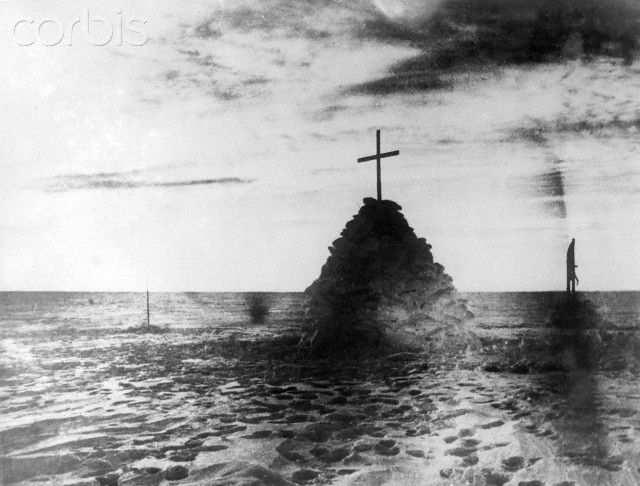
The specific meteorological conditions of those final days, went unrecorded.  A chirpy little forecast on http://www.weather2travel.com advises the Antarctic traveler to “Check How Hot & Sunny It Is Before You Book Your Next Holiday in 2019,” reporting maximum daytime temperatures for March, of -51°C.

The frozen corpses of Scott and his comrades were found some eight months later, that last diary entry dated March 29, 1912.  A high cairn of snow was erected over it all, that final camp becoming the three men’s tomb. Ship’s carpenters built a wooden cross, inscribing on it the names of those lost: Scott, Edward Wilson, Henry Bowers, Lawrence Oates and Edgar Evans. A line from Alfred Lord Tennyson’s poem, Ulysses, appears on the cross: “To strive, to seek, to find, and not to yield”.

6303323d3bf163bd7706d70a5f6fc7bfThe last three survivors died eleven miles from their next supply depot.

Apsley Cherry-Garrard, part of the expedition to find the doomed Scott party, survived similar conditions by some kind of miracle and wrote in The Worst Journey in the World, that his teeth chattered so violently, that some of them broke.

Satellites measured the coldest temperature in recorded history on August 10, 2010 at −93.2 °C (−135.8 °F), in East Antarctica.  The Amundsen-Scott weather station at the South Pole reports the average daily temperature for March, at -50.3°C (-58.54°F).

800px-Antarctic_expedition_map_(Amundsen_-_Scott)-en.svg
Routes taken to the South Pole by Amundsen (Red) and Scott (Green)

On hearing of the fate of his erstwhile rival, Roald Engelbregt Gravning Amundsen is quoted as saying “I would gladly forgo any honour or money if thereby I could have saved Scott his terrible death”.

A century of ice and snow have covered the bodies, the camp and the cross alike. Pressed ever downward by the weight of the snow and ice and creeping seaward with the glacier, the corpses are encased seventy-five-feet down in the Ross Ice Shelf and inching their way outward, expected to reach the Ross Sea sometime around 2276.  Perhaps to break off and float away, at the heart of some unknown future iceberg.

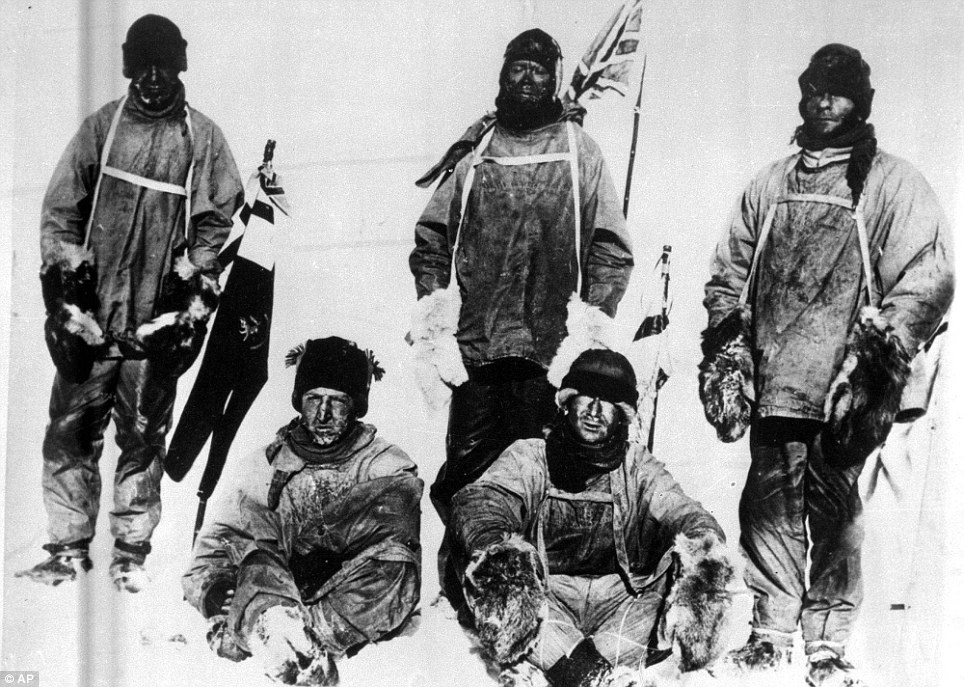
Feature image, top of page “Final call: From left-righy, Dr E. A. Wilson, Lt. H. R, Bowers, Captain Robert Falcon Scott, Petty Officer Taff Evans and Capt. L. E.G. Oates pose for a photo not long before they died on their way back from their trek“.  H/T Guardian.com

If you enjoyed this “Today in History”, please feel free to re-blog, “like” & share on social media, so that others may find and enjoy it as well. Please click the “follow” button on the right, to receive email updates on new articles.  Thank you for your interest, in the history we all share.


August 7, 1573, El Draque

Twenty tons of silver and gold were captured by the raid, far too much to carry.  With Spanish forces hot on their heels, Drake and his party buried part of the trove in the jungle and another part on the beach, probably feeding into later tales of pirate’s buried treasure.

When the casual student of history can hark back to a time when “Britannia ruled the waves”, it’s hard to remember that the world’s great naval powers were once Spain and Portugal.

In the late 15th century, the two determined to slice the world into “spheres of influence”, in order to minimize conflict.   The Treaty of Tordesillas signed in 1494 between the Pope and the respective monarchs, bequeathed most of the Americas, to Spain.

Martin Luther nailed his 95 theses to the door of Wittenburg Church fewer than twenty years later, triggering the Protestant reformation.  The non-Catholic powers of next-century Europe were not about to recognize Papal authority, nor abide by his treaties.

1280px-Spain_and_Portugal
Treaty of Tordesillas, 1494, dividing the world into Portuguese and Spanish spheres of influence

Spanish authorities were deeply suspicious of foreign encroachment onto their territory, and murdered several hundred French Huguenot inhabitants of Fort Caroline near the future Jacksonville Florida, in 1565.  At the time, the French had already surrendered.

In 1562-’63 and again in 1564-’65, the English adventurer John Hawkins engaged in trading expeditions with Spanish colonies in the New World, with tacit approval from the British crown. Such trade was technically illegal according to the 1494 treaty, but local authorities were happy to trade for slaves.  Hawkins received glowing testimonials from local magistrates and governors, often in exchange for bribes, and took orders from his Spanish clients for a third such journey.

Spanish authorities were alarmed at this challenge to their monopoly.  The sneak attack of September 23, 1568 at the port of San Juan de Ulúa was a humiliating defeat for the English, resulting in the loss of five British ships and the death of hundreds of British seamen.  One-hundred or more survivors were stranded on the beach and later tortured, burned at the stake, or sentenced to penal servitude for life on Spanish galleys, following the arrival of the Inquisition in 1571.

35456164531_25b62a268f_b
The Battle of San Juan de Ulúa

Hawkins’ relative and protégé Francis Drake was forced to swim for it, and flee for his life at the helm of the Judith, one of only two ships and a mere 70 or 80 crew, to survive. Three more turned up a year later, in Nova Scotia.

Being forced like that to abandon his relative and sponsor to fend for himself was a searing humiliation, leaving Drake with a deep and abiding hatred for all things Catholic.  Most especially, Spain.

Drake launched his first major undertaking in 1572, attacking Spanish operations on the Isthmus of Panama, where Peruvian silver and gold were moved overland to the coastal Caribbean town of of Nombre de Dios, where galleons awaited to remove the treasure to Spain. Drake and a crew including French privateers attacked a Spanish mule train in March 1573 with the help of local Maroons, African slaves escaped from the Spanish.

Twenty tons of silver and gold were captured by the raid, too much to carry.  With Spanish forces hot on their heels, Drake and his party buried part of the trove in the jungle and another part on the beach, probably feeding into later tales of pirate’s buried treasure.

The triumphant expedition returned to Plymouth this day in 1573, heroes in England and reviled in Spain. Gonzalo González del Castillo described “El Draque”, in a letter to King Philip II, “The people of quality dislike him for having risen so high from such a lowely family; the rest say he is the main cause of wars“.

At one point during that raid of 1572-’73, Drake had climbed a tree to scout the vicinity, becoming the first English man to see the Pacific ocean. He remarked that one day, he wanted an Englishman to sail those waters. He himself gained that chance in 1577, when Elizabeth I sent Drake on an expedition against Spanish holdings along the Pacific coast of the Americas.

Historians disagree to this day, whether this was a voyage of exploration, piracy or merely an effort to poke the Spanish King in the eye.  When it was over, Drake was the first Englishman to circumnavigate the globe.

This was the third such voyage. The Portuguese explorer Ferdinand Magellan was first, setting out 58 years earlier with 5 ships and 200 men.  Magellan himself didn’t make it.  He was killed on a Philippine beach in 1521.  Eighteen of his men straggled back on two ships, in 1522.

Death of Magellan
Death of Ferdinand Magellan, 1521

Ordered by King Charles I to colonize the Spice Islands for Spain, explorer García Jofre de Loaísa would be the second, leaving in 1525 with 450 men aboard seven ships.  None of his vessels ever made it back, nor did the explorer.  25 men returned to Spain in 1536, under Portuguese guard.

The Pelican left Plymouth, England on November 15, 1577 with four other ships and 164 men. The weather was so rancid they soon had to turn back, seeking shelter in Falmouth, Cornwall, and finally returning to Plymouth, where the whole thing started.  The small flotilla set out once again on December 13 after making repairs and soon joined by a sixth ship, the Mary.

Drake crossed the Atlantic and made it to Patagonia, when it seems one of his people got on his last nerve. Thomas Doughty had been given command of the captured Portuguese ship Santa Maria, renamed the Mary, when he caught Drake’s brother Thomas stealing from the vessel’s cargo. One thing led to another and Doughty himself was accused as “a conjurer and a seditious person”. Doughty was brought before a shipboard trial on charges of treason and witchcraft, establishing a principle which lasts to this day, that a ship’s captain was absolute ruler, regardless of the rank or social class of the passengers.

Golden Hind Replica
Golden Hinde, replica

Thomas Doughty lost his head, near the spot where Magellan had put his own mutineers to death, a half century earlier.  Drake renamed his flagship the “Golden Hind” (Female deer), probably to smooth over the Doughty episode with the expedition’s sponsors.

From the 16th century on, the Spanish Main was a rich source of treasure. The three sided box enclosing the Caribbean from Florida through Mexico and along the northern coast of South America was a ripe territory for pirates and buccaneers, though that became less so as you traveled south along the South American coast, and unheard of at this time in the Pacific.

Spanish_MainReduced to three ships by August 1578, Drake made the straits of Magellan, emerging alone into the Pacific that September.

El Draque captured a Spanish ship laden with 25,000 pesos of gold near Lima, when he heard about a galleon sailing west toward Manila.  The aptly named “Cacafuego”,  (“Fireshitter”) would be the richest prize of the voyage, with a golden crucifix, jewels, 13 chests full of “royals of plate” (silver coins), 80 pounds of gold and 26 tons of silver.

After a fine dinner with the Cacafuego’s officers and passengers, Drake offloaded his captives, each with a gift appropriate to his rank, and a letter of safe conduct.

cacafuego
Cacafuego, under full sail (left), under attack by Francis Drake

The expedition landed on the California coast in June 1579, claiming the land for the English Crown and calling it Nova Albion “New Britain”. The precise location was carefully guarded to keep it secret from the Spanish.  First-hand records from the voyage were destroyed in a Whitehall Palace fire in 1698.  Today Drakes Bay, about 30 miles from San Francisco, is anyone’s best guess.

4478294064_fde04ee131_z
Drake’s Bay

The Golden Hind sailed into Plymouth, England with Drake and 59 remaining crew on September 26, 1580. The half share owed to the queen surpassed the crown’s entire income for the year.  Awarded a knighthood the following year, Sir Francis Drake was the first Englishman to circumnavigate the globe.

Dysentery brought the seafaring career of El Draque to an end in January 1596, off the coast of Panama. Dressed in his armor and buried at sea near Portobelo, Divers have searched for his coffin, to this day.

If you enjoyed this “Today in History”, please feel free to re-blog, “like” & share on social media, so that others may find and enjoy it as well. Please click the “follow” button on the right, to receive email updates on new articles.  Thank you for your interest, in the history we all share.

June 7, 1942 The Alcan Highway

The project received a new sense of urgency on June 7, when a Japanese force of 1,140 took control of Attu Island, murdering Charles Jones, a ham radio operator and weather reporter from Ohio, and taking his wife Etta prisoner, along with 45 Aleuts. 

Discussions concerning a road to Alaska began as early as 1865, when Western Union contemplated plans to install a telegraph wire from the United States to Siberia. The concept picked up steam with the proliferation of automobiles in the 1920s, but the idea was a hard sell for Canadian authorities. Such a road would necessarily pass through their territory, and the Canadian government believed the project would have little impact, benefiting no more than a few thousand people in the Yukon.

In the days following the surprise attack on Pearl Harbor, Guam and Wake Island fell to Imperial Japanese forces , making it clear that parts of the Pacific coast were vulnerable.

Priorities were changing for both the United States, and Canada.

The Alaska Territory was particularly exposed. Situated only 750 miles from the nearest Japanese base, the Aleutian Island chain had but 12 medium bombers, 20 pursuit planes, and fewer than 22,000 troops in the entire territory, an area four times the size of Texas.

Surviving-AK-blog-1

Colonel Simon Bolivar Buckner Jr., son of the Confederate commander who famously received Ulysses S. Grant’s “Unconditional Surrender” ultimatum at Fort Donelson (“I propose to move immediately, upon your works”), was in charge of the Alaska Defense Command.  Buckner made his made point, succinctly. “If the Japanese come here, I can’t defend Alaska. I don’t have the resources.”

The Army approved construction of the Alaska Highway in February 1942, the project receiving the blessings of Congress and President Roosevelt within the week. Canada agreed to allow the project, provided that the United States pay the full cost, and the roadway and other facilities be turned over to Canadian authorities at the end of the war.

Construction began in March as trains moved hundreds of pieces of construction equipment to Dawson Creek, the last stop on the Northern Alberta Railway. At the other end, 10,670 American troops arrived in Alaska that spring, to begin what their officers called “the biggest and hardest job since the Panama Canal.”

4517139905_887f3c484a_b
Dawson Creek, 1942

In-between lay over 1,500 miles of unmapped, hostile, wilderness.

The project received a new sense of urgency on June 7, when a Japanese force of 1,140 took control of Attu Island, murdering Charles Jones, a ham radio operator and weather reporter from Ohio, and taking his wife Etta prisoner, along with 45 Aleuts.  Adding to the urgency was the fact that the Alaskan winter permits no more than an eight-month construction window.  That period was already well underway.

Construction began at both ends and the middle at once, with nothing but the most rudimentary engineering sketches. A route through the Rocky Mountains had yet to be identified.

06162017_HighwayRadios of the age didn’t work across the Rockies, and the mail was erratic.  The only passenger service available was run by the Yukon Southern airline, a run which locals called the “Yukon Seldom”.  For construction battalions at Dawson Creek, Delta Junction and Whitehorse, it was faster to talk to each other through military officials in Washington, DC.

Moving men to assigned locations was one thing.  Transporting 11,000 pieces of heavy equipment, to say nothing of supplies needed by man and machine, was quite another.

alcan-hwyTent pegs were useless in the permafrost, while the body heat of sleeping soldiers meant waking up in mud. Partially thawed lakes meant that supply planes could use neither pontoon nor ski, as Black flies swarmed the troops by day.  Hungry bears raided camps at night, looking for food.

Engines had to run around the clock, as it was impossible to restart them in the cold. Engineers waded up to their chests building pontoons across freezing lakes, battling mosquitoes in the mud and the moss laden arctic bog. Ground which had been frozen for thousands of years was scraped bare and exposed to sunlight, creating a deadly layer of muddy quicksand in which bulldozers sank in what seemed like stable roadbed.

Alaska Highway Black Soldiers

That October, Refines Sims Jr. of Philadelphia, with the all-black 97th Engineers, was driving a bulldozer 20 miles east of the Alaska-Yukon line when the trees in front of him toppled to the ground. Sims slammed his machine into reverse as a second bulldozer came into view, driven by Kennedy, Texas Private Alfred Jalufka. North had met south, and the two men jumped off their machines, grinning. Their triumphant handshake was photographed by a fellow soldier and published in newspapers across the country, becoming an unintended first step toward desegregating the US military.

24SOLD-popup

A gathering at Soldier’s Summit on November 21, 1942 celebrated “completion” of the route, though the “highway” remained impassable for most vehicles, until 1943.

Alaska-Hwy-historyNPR ran an interview about this story back in the eighties, in which an Inupiaq elder was recounting his memories. He had grown up in a world as it existed for hundreds of years, without so much as an idea of internal combustion. He spoke of the day that he first heard the sound of an engine, and went out to see a giant bulldozer making its way over the permafrost. The bulldozer was being driven by a black operator, probably one of the 97th Engineers Battalion soldiers.  The old man’s comment, as best I can remember it, was a classic. “It turned out”, he said, “that the first white person I ever saw, was a black man”.

REBRANDSD2997_THC_MDRN_3703_HVG_000_2997_60_20160202_00_HD

If you enjoyed this “Today in History”, please feel free to re-blog, “like” & share on social media, so that others may find and enjoy it as well. Please click the “follow” button on the right, to receive email updates on new articles.  Thank you for your interest, in the history we all share.

A Love of History

If you are so inclined, there’s nothing like a visit to the place where history happened, to make the story come alive.

“Today in History” will be suspended for a time, following the passing of the man for whom I am namesake: Lieutenant Colonel (retired), Richard B. “Rick” Long, Sr.

I have a few new articles tee’d up to post automatically. If you’re interested, please sign up on the right, to receive email notifications when they come out.

Thank you for your interest.

Rick Long, Jr.

Long Family "Blue/Gray Ramble", Gettysburg, 2012
The Patriarch explains the story of John Burns, the civilian old timer who came out to help fight back the invasion of his town. He fought with the Union forces on the second day and then, having been “nicked” three times by three bullets, he quietly went back to his farm to await the end of the battle. Long Family “Blue/Gray Ramble”, Gettysburg,
76818_709826510429_895191284_n
Walking with the Rebel side of the family. Long Family “Blue/Gray Ramble”, 32nd North Carolina, Culp’s Hill
29598118_10100599595014189_3563648717366943004_n
Long Family “Blue/Gray Ramble, Petersburg Campaign
29572295_10100599591885459_2784692964927955618_n
Long Family “Blue/Gray Ramble, Spotsylvania


Featured image, top:  Rick Long, Sr., remembering the 17th PA Cavalry Regiment at Gettysburg, with which our ancestor served as Blacksmith.

Photography by my son and Rick Sr.’s grandson Daniel Christopher Long, an apple who didn’t fall far from the tree.

January 9, 1493 Mermaid

Columbus seems not to have been impressed, describing these mermaids as “not half as beautiful as they are painted.”

“Pax Romana”, or “Roman Peace”, refers to a period between the 1st and 2nd century AD, when the force of Roman arms subdued most everyone standing against them.  The conquered peoples described the period differently.  Sometime in 83 or 84AD, Calgacus of the Caledonian Confederacy in Northern Scotland, said “They make a desert and call it peace”.

catalan-atlas-depicting-marco-polo-traveling-to-the-east-during-the-pax-mongolica (1)

The conquests of Genghis Khan and his successors accomplished much the same during the 13th and 14th century.  The “Pax Mongolica” effectively connected Europe with Asia, making it safe to travel the “Silk Road” from Britain in the west to China in the east.  Great caravans carrying Chinese silks and spices came to the west via transcontinental trade routes.  It was said of the era that “a maiden bearing a nugget of gold on her head could wander safely throughout the realm.”

Never mind the pyramids of skulls, over there.

The “Black Death” and the political fragmentation of the Mongol Empire brought that period to an end.  Muslim domination of Middle Eastern trade routes made overland travel to China and India increasingly difficult in the 15th century.  After Constantinople fell to the Ottoman Turks in 1453, such travel became next to impossible.   Europe began to look for a water route to the East.

flat-earth

It’s popular to believe that 15th century Europeans thought the world was flat, but that’s a myth.  Otherwise, the cats would have pushed everything over the edge, by now.

The fact that the world is round had been understood for over a thousand years, though 15th century mapmakers often got places and distances wrong.  In 1474, Paolo dal Pozzo Toscanelli detailed a scheme for sailing westward to China, India and the Spice Islands.  He believed that Japan, which he called “Cipangu”, was larger than it is, and farther to the east of “Cathay” (China).  Toscanelli vastly overestimated the size of the Eurasian landmass, and the Americas were left out altogether.

This is the map that Christopher Columbus took with him in 1492.

mermaidColumbus had taken his idea of a westward trade route to the Portuguese King, to Genoa and to Venice, before he came to Ferdinand and Isabella in 1486.  At that time the Spanish monarchs had a Reconquista to tend to, but they were ready in 1492.  The Nina, Pinta and the Santa Maria sailed that August.

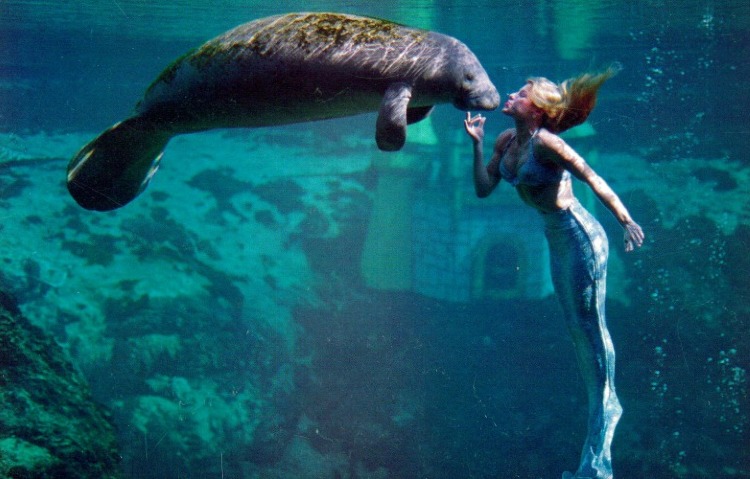
By January 9, 1493, the expedition had been at sea for six months.  Sailing off the coast of Hispaniola, what we now call the Dominican Republic, Columbus spotted three “mermaids”.

They were Manatee, part of the order “Sirenia”.  “Sirens” are the beautiful sisters, half birdlike creatures who live by the sea, according to ancient Greek mythology.  These girls, according to myth, sang a song so beautiful that sailors were hypnotized, crashing their ships into rocks in their efforts to reach them.

ManateeColumbus seems not to have been impressed, describing these mermaids as “not half as beautiful as they are painted.”
Small wonder.  These marine herbivores measure 10’ to 13′ from nose to tail, and weigh in at 800-1,200 lbs.

Not everyone was quite so dismissive.  A hundred years later, the English explorer John Smith reported seeing a mermaid, almost certainly a Manatee. It was “by no means unattractive”, he said, but I’m not so sure.  I think it’s possible that Mr. Smith needed to get out a little more.


If you enjoyed this “Today in History”, please feel free to re-blog, “like” & share on social media, so that others may find and enjoy it too. Please click the “follow” button on the right, to receive email updates on new articles.  Thank you for your interest, in the history we all share.

December 5, 1914 Shackleton Expedition

At South Georgia Island, Ernest Shackleton asked how the war had ended. The response hit like a hammer. “The war isn’t over.  Millions are dead.  Europe is mad.  The world is mad”.

In an alternate history, the June 1914 assassination of the heir-apparent to the Habsburg Empire could have led to nothing more than a regional squabble. A policing action in the Balkans. As it was, mutual distrust and entangling alliances drew the Great Powers of Europe into the vortex. On August 3, the “War to End Wars” exploded across the European continent.

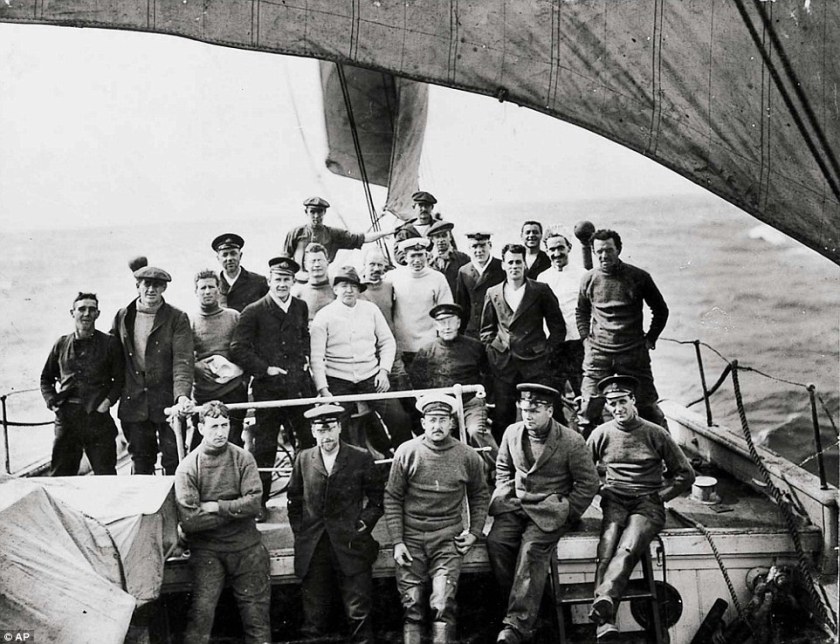
The period has been called the “Heroic Age of Antarctic Exploration”.  As the diplomatic wrangling, mobilizations and counter-mobilizations of the “period preparatory to war” unfolded, Sir Ernest Shackleton made final arrangements for his third expedition into the Antarctic.  Despite the outbreak of war, first Lord of the Admiralty Sir Winston Churchill ordered Shackleton to Proceed. The “Endurance” expedition departed British waters on August 8.

Shackleton 5

The German invasion of France ground to a halt that September. The first entrenchments were being dug as Shackleton himself remained in England, departing on September 27 to meet up with the Endurance expedition in Buenos Aires.

With the unofficial “Christmas Truce” of 1914 short weeks away from the trenches of Flanders, Shackleton’s expedition left Grytviken whaling station on South Georgia Island.  It was December 5.Shackleton 12

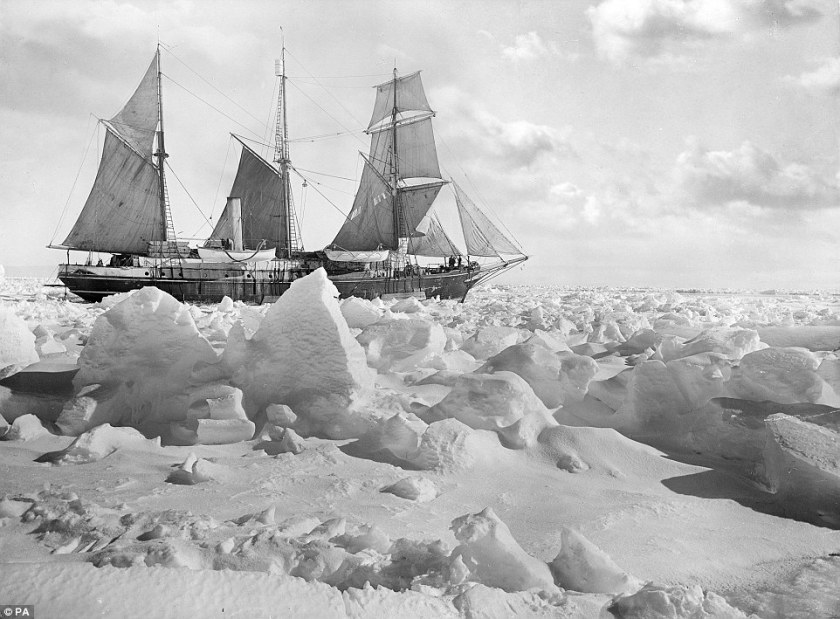
The Endurance expedition intended to be the first to cross the Antarctic continent.  The way things turned out, the crew wouldn’t touch land, for another 497 days.

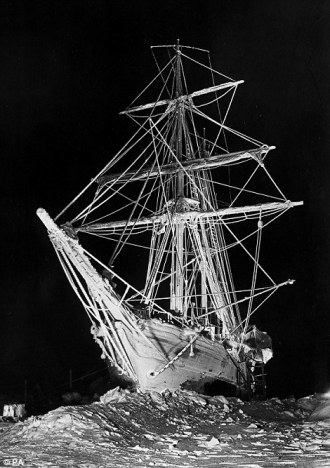
The disaster of the Great War became “Total War” with the zeppelin raids of January, as Endurance met with disaster of its own. The ship was frozen fast, within sight of the Antarctic continent. There was no hope of escape.Shackleton 7

HMS Lusitania departed New York City on May 1, 1915, not knowing that she only had six days to live. The sun that vanished that night over the Shackleton expedition, would not reappear for another four months.

As the nine-month battle unfolded across the Gallipoli Peninsula, Shackleton’s men abandoned ship’s routine and converted to winter station. On September 1, the massive pressure of the pack ice caused Endurance to “literally [jump] into the air and [settle] on its beam,” as losses to the Czar’s army in Galicia and Poland lead to a mass exodus of Russian troops and civilians from Poland. The “Great Retreat” gave way to the sort of discontent which would one day end the Czarist regime, as Shackleton gave the order to abandon ship. On November 21, the wreck of the Endurance slipped below the surface.

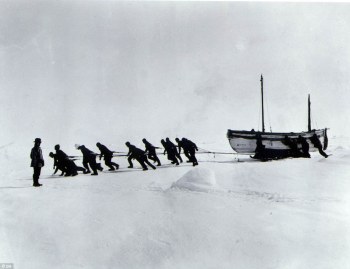
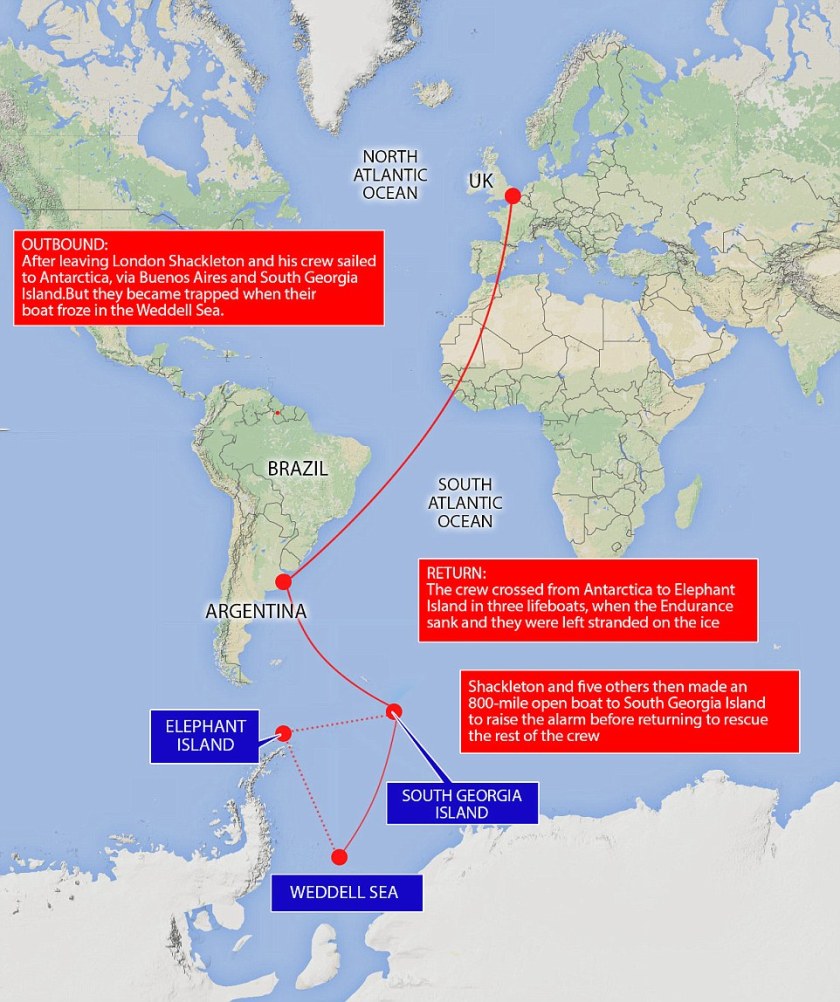
That December, Allies began preparations for a summer offensive along the upper reaches of the River Somme. The Shackleton party camped on pack ice, adrift in open ocean, as Erich von Falkenhayn began the Verdun offensive with which he would “bleed France white”.  The ice broke up that April, forcing Shackleton and his party into three small lifeboats. Seven brutal days would come and go in those open boats, before the party reached land at the desolate shores of Elephant Island.Shackleton 10

The whaling stations at South Georgia Island, some 800 miles distant, were the only hope for survival. Shackleton and a party of five set out on April 24 aboard the 22½’ lifeboat, James Caird, as the five-month siege at Kut-al-Amara in Mesopotamia ended with the surrender of 13,000 British and Indian soldiers, to the Turks.

The party arrived on the west coast of South Georgia Island in near-hurricane force winds, the cliffs of South Georgia Island coming into view on May 10. As Captain Frank Worsely, Second officer Tom Crean and expedition leader Ernest Shackleton picked their way across glacier-clad mountain peaks thousands of feet high, Austrian troops attacked Italian mountain positions in the Trentino.

Shackleton 9The trio arrived at the Stromness whaling station on May 20.  They must have been a sight, with thick ice encrusting their long, filthy beards, and saltwater-soaked sealskin clothing rotting from their bodies. The first people they came across were children, who ran in fright at the sight of them.

The last of the Shackleton expedition would be rescued on August 22, ending the 20-months long ordeal.

At South Georgia Island, Ernest Shackleton asked how the war had ended. The response hit like a hammer. The war isn’t over.  Millions are dead.  Europe is mad.  The world is mad“.


If you enjoyed this “Today in History”, please feel free to re-blog, “like” & share on social media, so that others may find and enjoy the same. Please click the “follow” button on the right, to receive email updates on new articles.  Thank you for your interest, in the history we all share.

September 23, 1806 Lewis and Clark

More than once Lewis and Clark found themselves negotiating for their lives with hostile Indians, as Discovery Corps member Francois Labiche translated English to French, fur trapper Toussant Charbonneau French to Hidatsa, and his wife Sacagawea speaking to the other side in Shoshone.

Minister to France and future President Thomas Jefferson began to express interest in an expedition to the Pacific Northwest, as early as the 1780s.

As President, Jefferson asked Congress to fund an expedition to the Pacific, two years into his first term. He understood that the fledgling United States would have a better claim to the Pacific Northwest if the team gathered data on plants and animals, but Jefferson’s primary interest in the mission, was trade.

Today we take coast-to-coast travel for granted, it seems odd to think how strange and unknown were the more remote parts of our own country.   Though extraordinarily well read and one of the brightest men of his generation, (Jefferson once cut out 901 bible verses from which he assembled his own “Jefferson Bible”, translating the volume into Greek, Latin, French and back to English, “just for fun”), President Jefferson legitimately believed that herds of Wooly Mammoth roamed the western reaches of the nation. Carte_Lewis-Clark_Expedition-en

Jefferson wanted to find an all-water route to the Pacific for the conduct of business. The President commissioned the Corps of Discovery expedition in 1803, naming Army Captain Meriwether Lewis expedition leader.

The two men had known one another since Lewis was a boy, having long since developed a relationship of mentor and protégé.  At this time Lewis was working as personal secretary to the President.  Tough, intellectually gifted and resourceful, Lewis received a crash course in the natural sciences from the President himself, before being sent off to Philadelphia to brush up on medicine, botany and celestial navigation.

Lewis selected William Clark as his second in command, due to the man’s exceptional skills as a frontiersman. It would prove to be an excellent choice.

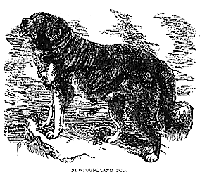
Lewis_and_clark, SeamanMost of 1803 was spent in planning and preparation, Lewis and Clark joining forces near Louisville that October. After wintering in the Indiana territory base camp in modern day Illinois, the 33-man expedition departed on May 14, 1804, accompanied by “Seaman”, a “Dogg of the Newfoundland breed”.
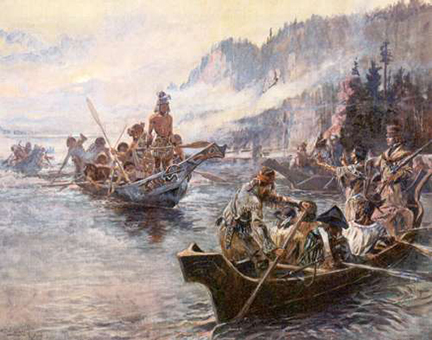
Lewis and Clark set out to explore the Louisiana Territory, as it became an official part of the United States. Borders were still hazy at the time, and Spanish authorities suspected that the expedition would encroach on their territory in the southwest. They had good reason to think so, Thomas Jefferson believed the same.

Corps of Discovery members couldn’t know that General James Wilkinson, one of the most duplicitous, avaricious, and corrupt individuals of the age, was reporting their every move to his paymaster, the Spanish King Charles IV.

Over the course of the expedition, the tiny group was hunted by no fewer than four Spanish expeditions with as many as 600 soldiers, mercenaries and Comanche guides, each intending to make the Corps of Discovery vanish without a trace.

Lewis_and_clark-expeditionDiscovery established friendly relations with at least 24 indigenous tribes, without whose help they may have become lost or starved in the wilderness.  Most were more than impressed with Lewis’ state-of-the-art pneumatic rifle, which could silently fire up to 20 rounds after being pumped full of compressed air.

Not all Indian tribes were friendly, there were several run-ins with a group the Americans called “Teton-wan Sioux”. The Sioux were no joke. On one occasion, a group of four who had separated from the main expedition fled 100 miles in a single day from these people, before they felt it was safe to stop.

Lewis and Clark’s memoirs describe similar encounters with a large and especially ferocious species of bear, the Grizzly, an animal which more than once had expedition members climbing trees with a notable sense of urgency.

It was at the winter camp of 1804-5 that they met a French fur trapper named Toussaint Charbonneau and his young wife (or slave – she might have been a little of both), Sacagawea. They seemed to have thought Charbonneau a shady character, but they liked the young Indian girl, and her linguistic skills would prove useful. Sacagawea spoke Shoshone and Hidatsa while Charbonneau spoke Hidatsa and French. More than once Lewis and Clark found themselves negotiating for their lives with hostile Indians, as Discovery Corps member Francois Labiche translated English to French, Charbonneau French to Hidatsa, and Sacagawea speaking to the other side in Shoshone.

It was at this camp that Sacagawea gave birth to a son, whom she and Charbonneau named Jean Baptiste. The family stayed with the expedition, proving to be incredibly valuable to the group. They met many Indian bands along the way, whom Sacagawea’s presence quickly put at ease. War bands never traveled with women, especially not with one carrying an infant. One such band was a group of Shoshone led by Chief Cameahwait, who turned out to be none other than Sacagawea’s own brother. It must have been quite a reunion, they hadn’t seen one another since her kidnap by the Hidatsa, back in 1800.

Lewis_and_clark, first glimpseThe Corps of Discovery reached the Pacific Ocean in November 1805, and set out their second winter camp in modern-day Oregon.

They returned through a cut in the Rocky Mountains which Sacagawea remembered from her childhood, the modern day Bozeman Pass, arriving at the Hidatsa-Mandan villages on August 14, 1806.   For Sacagawea, Charbonneau and Jean Baptiste, this was the end of the trip.

Lewis and Clark arrived in St. Louis on September 23, 1806, the Corps of Discovery having met their objectives. They had reached the western coast and returned, though they did not find a continuous water route to the Pacific. The expedition created maps along the way, establishing legal claim to the land, while describing 178 previously unknown plants and 122 unknown animals, and establishing diplomatic and trade relations with at least two dozen indigenous nations.

Despite being heavily armed, most members were required to defend themselves only once, that in a running gun battle with a band of Blackfeet, on the way home.

The expedition suffered only one fatality when Sergeant Charles Floyd succumbed to what appears to have been appendicitis.  Though not seriously wounded, a humiliated Lewis had to spend several weeks face-down in a canoe, when one of the enlisted guys mistook his rump for that of an elk, and shot it.

Meriwether Lewis died from gunshot wounds to the chest and head on October 11, 1809.  Historians differ as to whether it was murder or suicide, though most believe his death to have been the latter.  It would not have been his first such attempt.

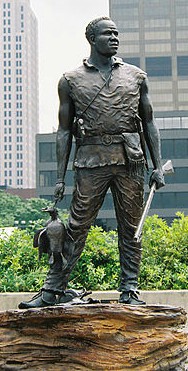
York_Statue
York

Sacagawea gave birth to a daughter named Lizette on December 22, 1812, and died a few months later at the age of 25. Eight months later, William Clark legally adopted her two children. Clark is recorded as having brought the boy up and educating him in St. Louis, before sending him to Europe with a German prince at the age of 18. I was unable to determine with any certainty, whether Lizette survived infancy.

Among the two-dozen plus officers and enlisted men on Discovery was William Clark’s African slave “York”, who accompanied the expedition from beginning to end.  Though not an official member of the Corps of Discovery, York’s hunting skills made him a valuable member of the expedition.  Indigenous tribes were fascinated by the first black man any of them had ever seen.  The Arikara people of North Dakota believed him to hold spiritual powers, calling the tall man “Big Medicine”.

Though a slave, York seems to have earned a degree of respect from expedition members.  At least two geographic features were named after the man.   Both York and Sacagawea had a vote on the placement of the 1805-’06 winter camp, prompting historian Stephen E. Ambrose to speculate that this may have been the first time in American history, that a black man and a woman were given the vote.

Accounts differ as to what became of him.  Some say Clark freed the man, others say that York was unwilling to return to a life of slavery, following 2½ years of liberty.  A black man who claimed to have been he was discovered ten or twelve years later, a tribal elder living with his four wives among the Crow, in north-central Wyoming.

Thomas Berger, author of the fictional Dances with Wolves, writes about a particularly dark skinned strain among the Indians, which many believe to have descended from York.

What became of Seaman the dog is unknown. Having accompanied the Lewis & Clark expedition from the very beginning, the last journal reference to him was written in July, two months before the journey’s end.

May 23 1928  Crash of the Airship Italia

The airship’s control cabin hit the jagged ice seconds later, smashing open and spilling ten crew members and a Fox Terrier onto the ice.

The semi-rigid airship Italia departed from Milan on April 15, 1928, headed for the Arctic.  Italia carried 20 personnel, a payload of 17,000 pounds of fuel and supplies, and the expedition mascot, a Fox Terrier named Titina.

Stolp, Landung des Nordpol-Luftschiffes "Italia"

Her mission was to explore the ice cap surrounding the North Pole, operating out of an expedition base in Ny-Ålesund, one of four permanent settlements on Spitsbergen Island in the Kingdom of Norway.

italia mapThe first of five planned sorties began on May 11, before turning back only eight hours later in near blizzard conditions.  The second trip took place in near perfect weather conditions and unlimited visibility, the craft covering 4,000 km (2,500 miles) and setting the stage for the third and final trip departing on May 23.

Strong tailwinds aided the passage as Italia traveled north along the Greenland coast, arriving at the north pole only 19 hours after departing Spitzbergen. Though wind conditions prevented them from dropping scientists onto the ice sheet, survival packs and the inflatable raft they brought along for the purpose would turn out to be providential.

Trouble started almost immediately, as the tailwinds that brought them to the pole were now strong headwinds as they headed south to King’s Bay. Fuel consumption was doubled as the airship struggled to make headway.  After 24 hours, they were only halfway back.

A cascade of events took place on the morning of the 25th, causing Italia to be tail-heavy and falling at a rate of two feet per second. Captain Umberto Nobile ordered Chief technician Natale Cecion to dump ballast chain, but the steep deck angle made the task difficult. The airship’s control cabin hit the jagged ice seconds later, smashing open and spilling ten crew members and a Fox Terrier onto the ice.

Now relieved of the weight of the gondola, the envelope of the ship began to rise again with a gaping tear where the control cabin used to be.

What followed was a remarkable display of calm under pressure. As the airship’s italia-crashenvelope floated away, Chief Engineer Ettore Arduino started to throw everything he could get his hands on down to the men on the ice. These were the supplies intended for the descent to the pole, but they were now the only thing that stood between life and death. Arduino himself and the rest of the crew drifted away with the now helpless airship.
Nine survivors and one fatality were left stranded on the ice.  They immediately began to go through their supplies. They found a radio and fashioned a mast from the debris, and set up a tent after coloring it red using the dye contained in several flares.

The tale of the Italia rescue is a story in itself, as would-be rescuers themselves became stranded or disappeared into the arctic circle, never to be seen again.

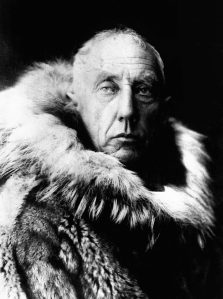
The famous polar explorer Raould Amundsen, the man who first reached the pole in 1926, disappeared on June 18 while flying on a rescue mission with Norwegian pilot Leif Dietrichson, French pilot René Guilbaud, and a three-man French crew.

Roald Amundsen
Raould Amundsen

Rescue expeditions were launched from Denmark, Finland, France, Italy, Norway, Soviet Russia, Sweden, and the United States. Bureaucratic intransigence, equipment failure and a lack of coordination would hamper rescue efforts.  It would be more than 49 days before the last of the crash survivors and stranded would-be rescuers would be found. The fate of the journalist, the three mechanics and the scientist who drifted away on the Airship Italia, is unknown.

April 14, 1958 Laika

The day before the launch sequence, Vladimir Yazdovsky took her home to play with his kids. “I wanted to do something nice for her,” he explained. “She had so little time left to live.”

At the dawn of the space age, no one knew whether the human body could survive conditions of rocket launch and space flight. The US Space program experimented with a variety of primate species between 1948 and 1961, including rhesus monkeys, crab-eating macaques, squirrel monkeys, pig-tailed macaques, and chimpanzees.

Baker
“Miss Baker”

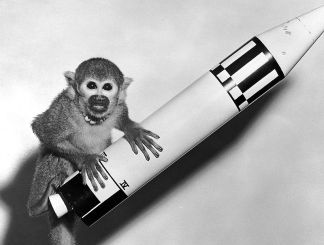
On May 28, 1959, a squirrel monkey named “Miss Baker” became the first of the US space program, to survive the stresses of spaceflight and related medical procedures.  A rhesus monkey called “Miss Able” survived the mission as well, but died four days later as the result of a reaction to anesthesia.

Soviet engineers experimented with dogs on a number of orbital and sub-orbital flights, to determine the feasibility of human space flight.  The Soviet Union launched missions with positions for at least 57 dogs in the fifties and early sixties, though the actual number is smaller.  Some flew more than once.

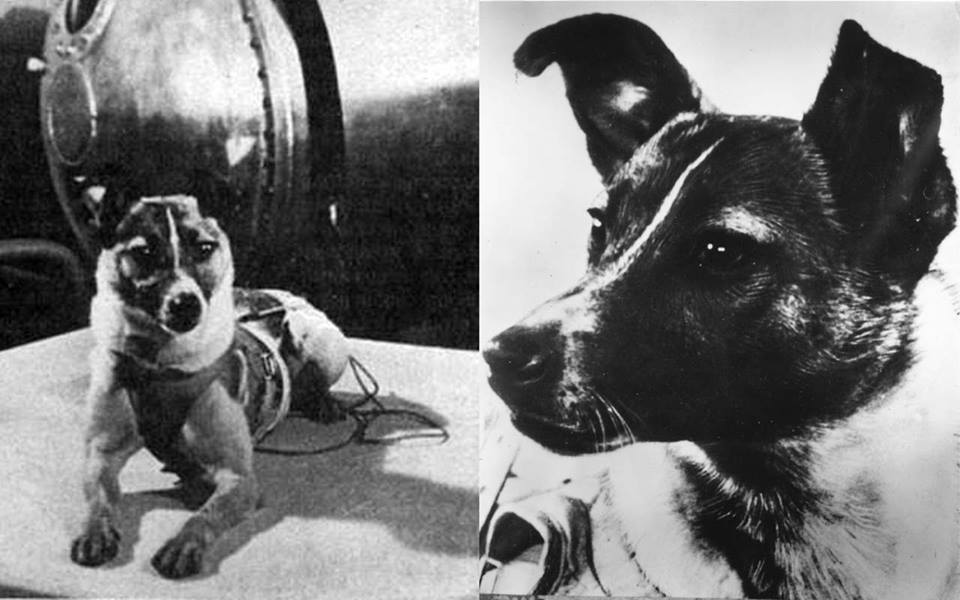
Laika
Laika

Most survived.  As with the early US program, those who did not often died as the result of equipment malfunction.  The first animal to be sent into orbit, was a different story.

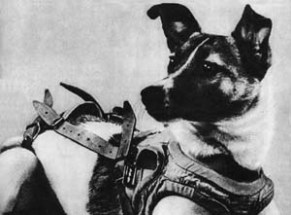
Three dogs were plucked from the streets of Moscow and trained for the purpose.  “Laika” was an 11lb mutt, possibly a terrier-husky cross.  In Russian, the word means “Barker”.  Laika was chosen due to her small size and calm disposition.  One scientist wrote, “Laika was quiet and charming.”

First, were the long periods of close confinement, meant to replicate the tiny cabin of Sputnik 2. Then came the centrifuge, the highly nutritional but thoroughly unappetizing gel she was meant to eat in space, and then the probes and electrodes that monitored her vital signs.

sputnik-2-launched-a-month-later-and-carried-the-first-living-animal-a-dog-named-laika-into-space
Sputnik 2, Pre-Launch Propaganda

The day before the launch sequence, Vladimir Yazdovsky took her home to play with his kids.  “I wanted to do something nice for her,” he explained. “She had so little time left to live.”

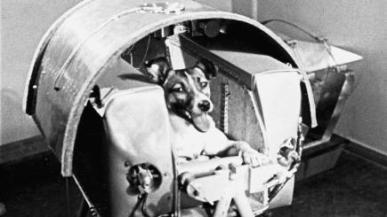
Laika was placed inside the capsule for three days, tightly harnessed in a way that onlyLaika and capsule allowed her to stand, sit and lie down.  Finally, it was November 3, 1957.  Launch day.  One of the technicians “kissed her nose and wished her bon voyage, knowing that she would not survive the flight”.

Sensors showed her heart rate to be 103 beats/minute at time of launch, spiking to 240 during acceleration. She ate some of her food in the early stages, but remained stressed and agitated. The thermal control system malfunctioned shortly into the flight, the temperature inside the capsule rising to 104°, Fahrenheit.  Five to seven hours into the flight, there were no further signs of life.

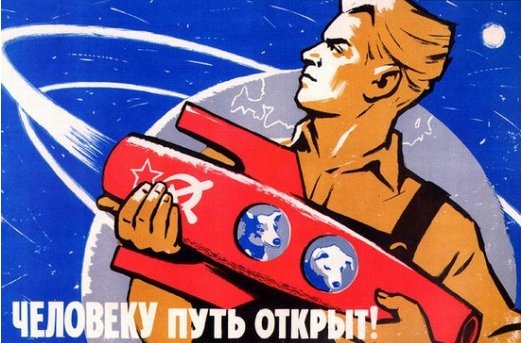
There were official hints about Laika parachuting safely to earth, and then tales of a painless and humane, euthanasia.  Soviet propaganda portrayed “the first traveler in the cosmos”,  heroic images printed on posters, stamps and matchbook covers.   Soviet authorities concealed Laika’s true cause of death and how long it took her to die.  That information would not be divulged , until 2002.

Mach2Sputnik2In the beginning, the US News media focused on the politics of the launch.  It was all about the “Space Race”, and the Soviet Union running up the score. First had been the unoccupied Sputnik 1, now Sputnik 2 had put the first living creature into space.  The more smartass specimens among the American media, called the launch “Muttnik”.

Sputnik 2 became controversial, as animal lovers began to question the ethics of sending a dog to certain death in space. In the UK, the Royal Society for the Prevention of Cruelty to Animals received protests before Radio Moscow was finished with their launch broadcast.  The National Canine Defense League called on dog owners to observe a minute’s silence.

Protesters gathered with their dogs in front of the UN building, to express their outrage.  In the Soviet Union, political dissent was squelched, as always. Of all Soviet bloc nations, it was probably Poland who went farthest out on that limb, when the scientific periodical Kto, Kiedy, Dlaczego (“Who, When, Why”), reported Laika’s death as “regrettable”.  “Undoubtedly a great loss for science”.Atomic_Robo_Last_Stop_Sputnik_Poster2

Sputnik 2 and its passenger left the vacuum of space on April 14, 1958, burning up in the outer atmosphere.

It was not until 1998 and the collapse of the Soviet tower of lies, that Oleg Gazenko, one of the scientists who had trained the dog, was free to speak his mind. “Work with animals is a source of suffering to all of us”, he said, “We treat them like babies who cannot speak. The more time passes, the more I’m sorry about it.  We shouldn’t have done it…We did not learn enough from this mission to justify the death of the dog”.

Afterward

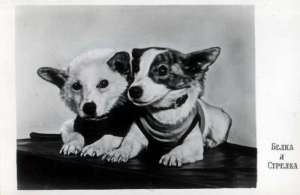
belka-strelka-2As a dog lover, I feel the need to add a more upbeat postscript, to this thoroughly depressing story.
“Belka” and “Strelka” spent a day in space aboard Sputnik 5 on August 19, 1960, and returned safely to Earth.  The first Earth-born creatures to go into orbit and return alive.

Strelka later gave birth to six puppies, fathered by “Pushok”, a dog who’d participated in

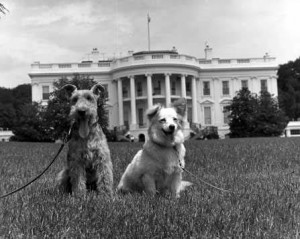
Charlie, Pushinka
Charlie, (l) and Pushinka, (r)

ground-based space experiments, but never flew.  Nikita Khrushchev gave “Pushinka”, one of the puppies, to President John F. Kennedy in 1961.

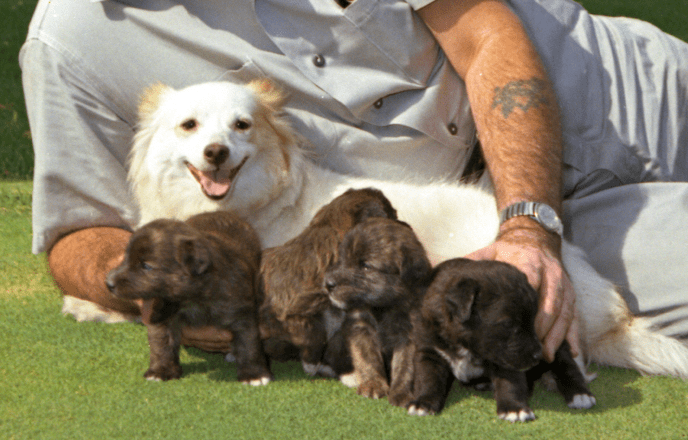
Pushinka and a Kennedy dog named “Charlie” conducted their own Cold War rapprochement, resulting in four puppies.  Pups that JFK jokingly referred to as “pupniks”.  Pushinka’s descendants are still living, to this day.

kennedy-dog-pushinka-puppies
Pushinka and her “pupniks”, enjoying a moment on the White House lawn