February 5, 62AD End of the World

There were other signs of what was to come. Tremors. Springs dried up. Fish died and floated on the river Sarno, victims of increased acidification of the water.


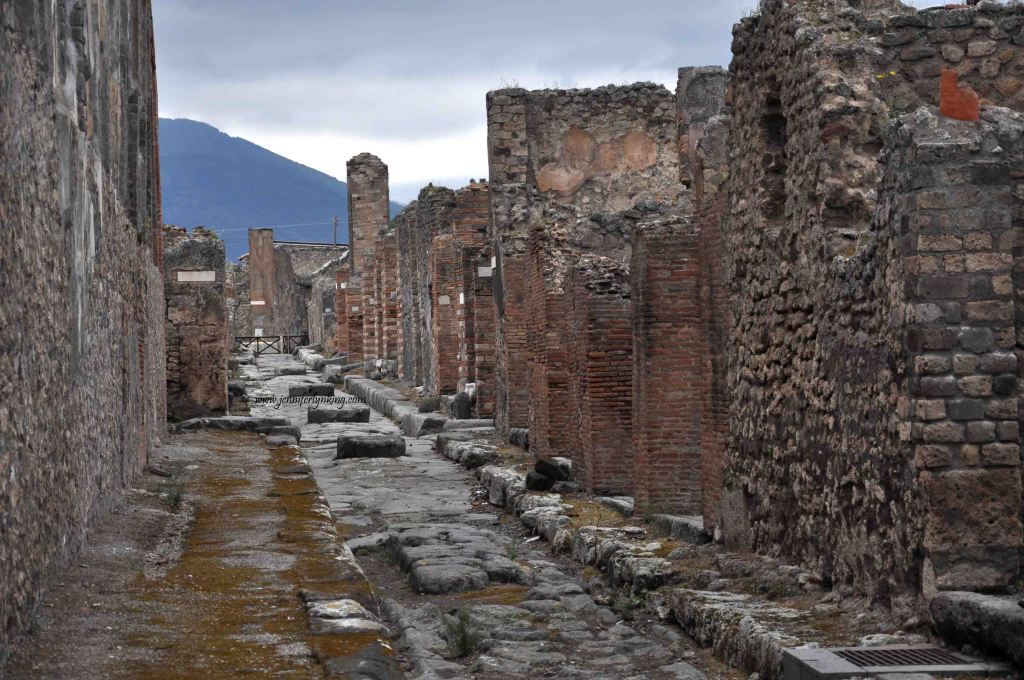
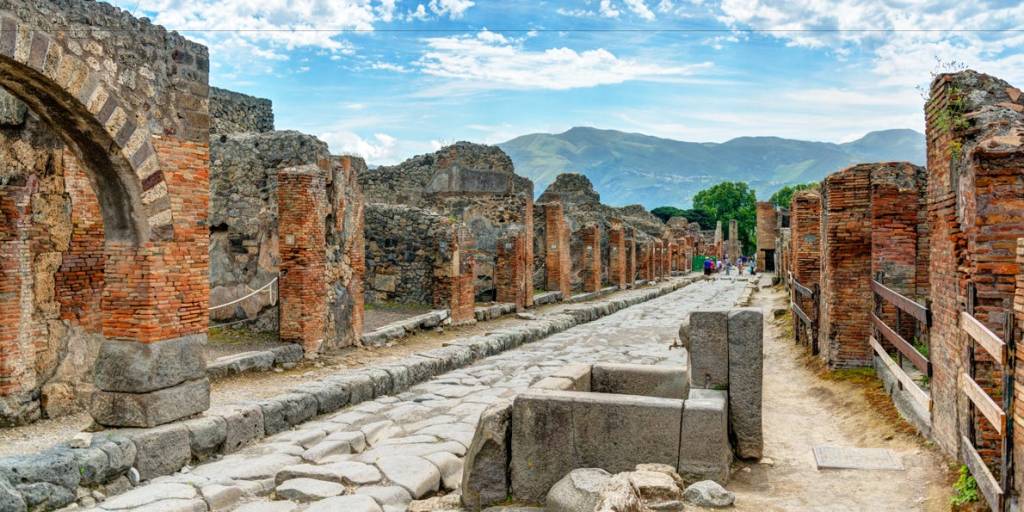
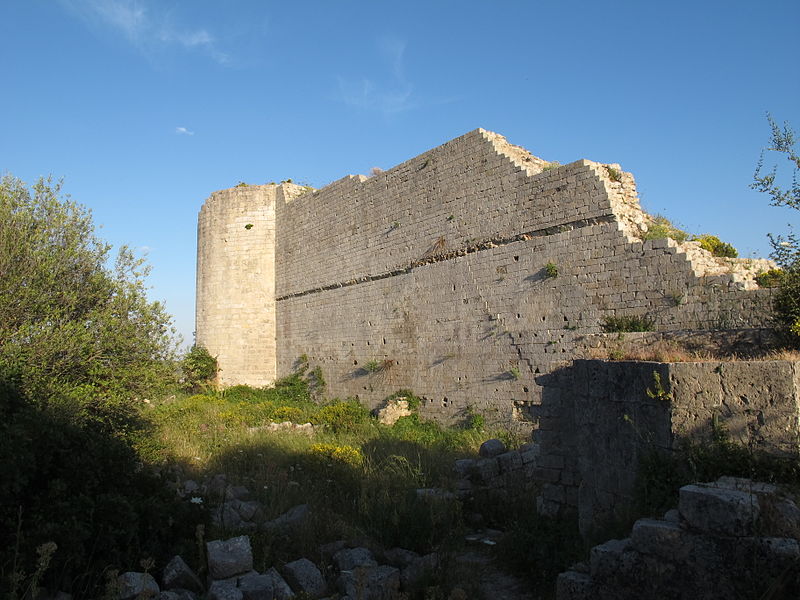
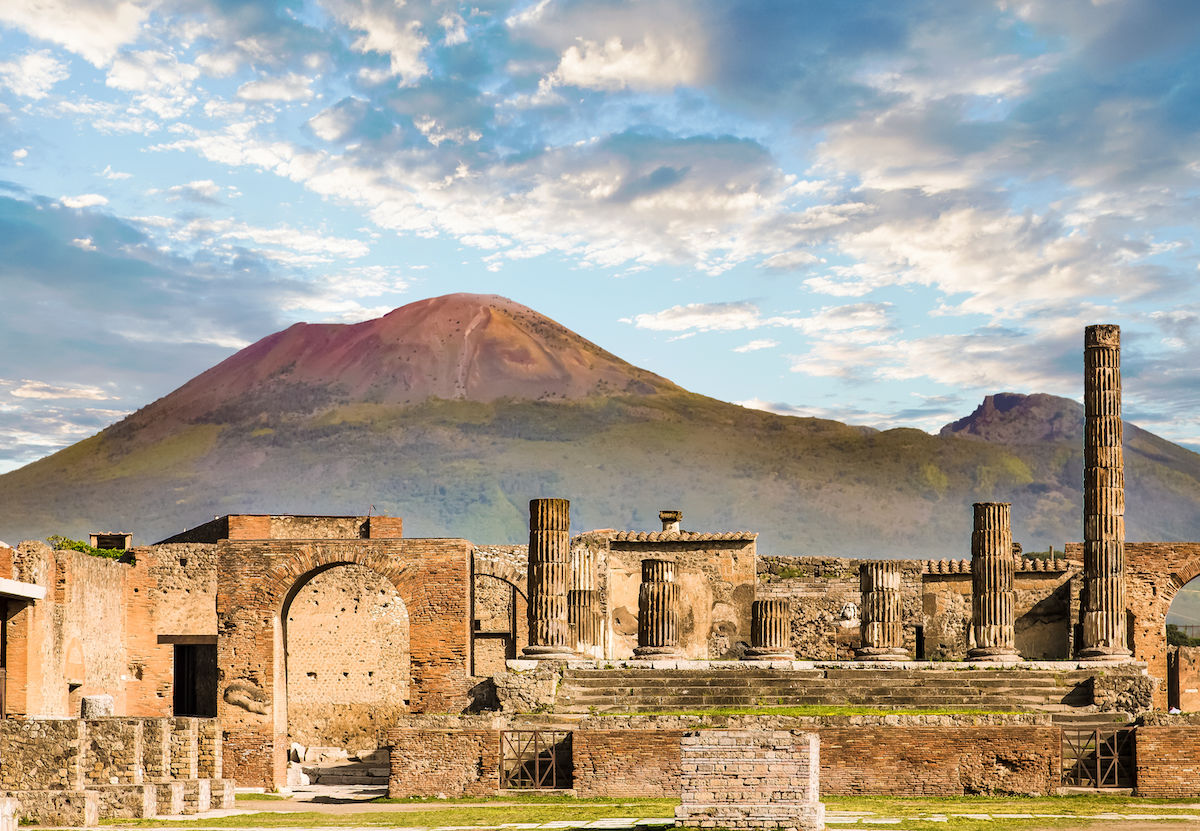
On February 5 in the year AD 62, an earthquake estimated at 7.5 on the Richter scale shook the Bay of Naples, spawning a tsunami and leveling much of the coastal Italian towns of Pompeii, Herculaneum and surrounding communities.

pompeii-2

Massive though the damage had been, the region around Mt. Vesuvius and the Bay of Naples had long been a favorite vacation destination for the upper crust of Roman society. Crowds of tourists and slaves bustled in and out of the city’s bath houses, artisans’ shops, taverns and brothels, adding their number to some ten to twenty thousand townspeople.

There were other signs of what was to come. Tremors. Springs dried up. Fish died and floated on the river Sarno, victims of increased acidification of the water.

And yet, these are only “signs”, in hindsight. Pompeiians of 62AD didn’t even have a word for Volcano. That would come much later with the eruption of Mt. Etna. The word is derived from “Vulcan”. The Roman God of fire.

So it was reconstruction began and continued, for the next seventeen years.  Until that day the world, came to an end.
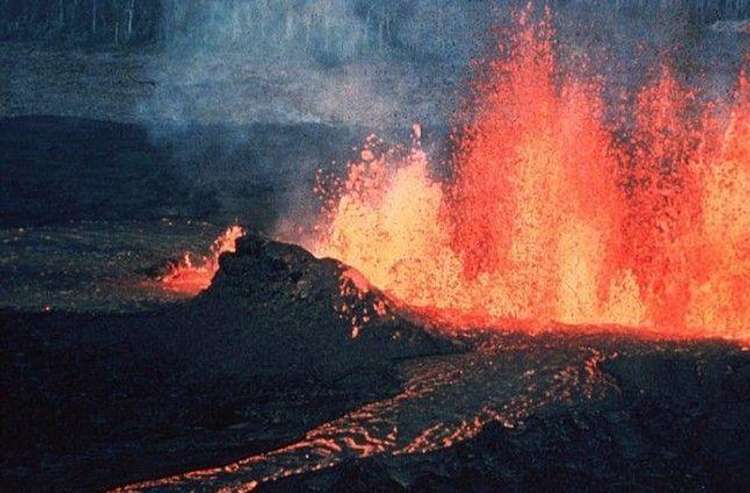
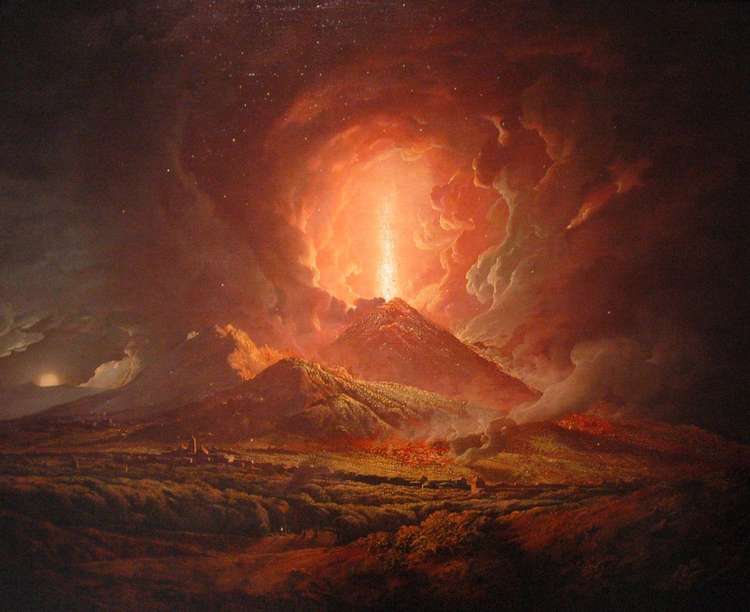
Long dormant and thought to be extinct, nearby Mount Vesuvius had been quiet for hundreds of years.  Historians have long believed Vesuvius erupted on August 24, 79AD but recently discovered graffiti referring to the calends of November more likely put the date, at October 17. 

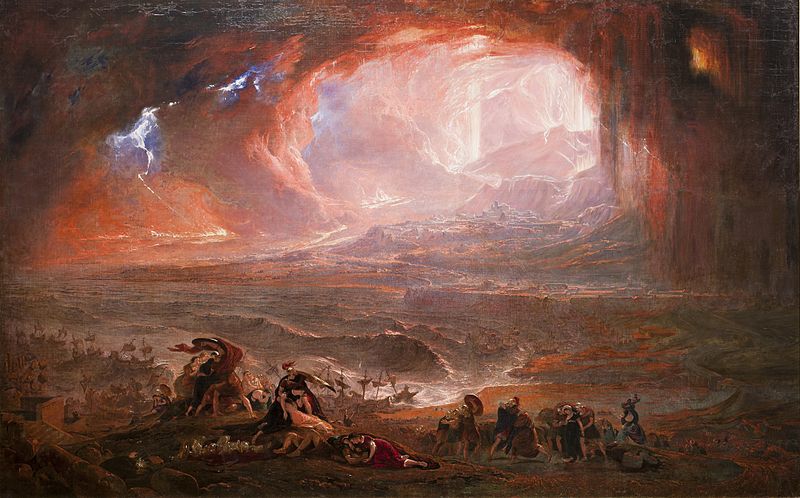
The day dawned as any other, the first plumes of white smoke appearing, sometime around breakfast. By that afternoon the 4,203-foot stratovolcano was belching fire, propelling a scorching plume of ash, pumice and super-heated volcanic gases so high as to be seen for hundreds of miles.

The Melbourne Museum has created a stunning, eight-minute animation, of the event.

For the next eighteen hours the air was thick with hot, poisonous gases, as volcanic ash rained down with pumice stones the size of baseballs.  No one who stayed behind stood a chance, nor did countless animals, both wild and domestic.

Citizens tried to save themselves using tunics, as makeshift masks. Then came the pyroclastic surge, that ground-hugging pressure wave seen in test films of nuclear explosions.  Gasses and pulverized stone dust raced outward at 400 miles-per-hour in the “base surge” phase carrying gases super-heated to 1000° Fahrenheit. The bodily fluids of anyone left alive at this time burst instantly, into steam.
Pompeii 2
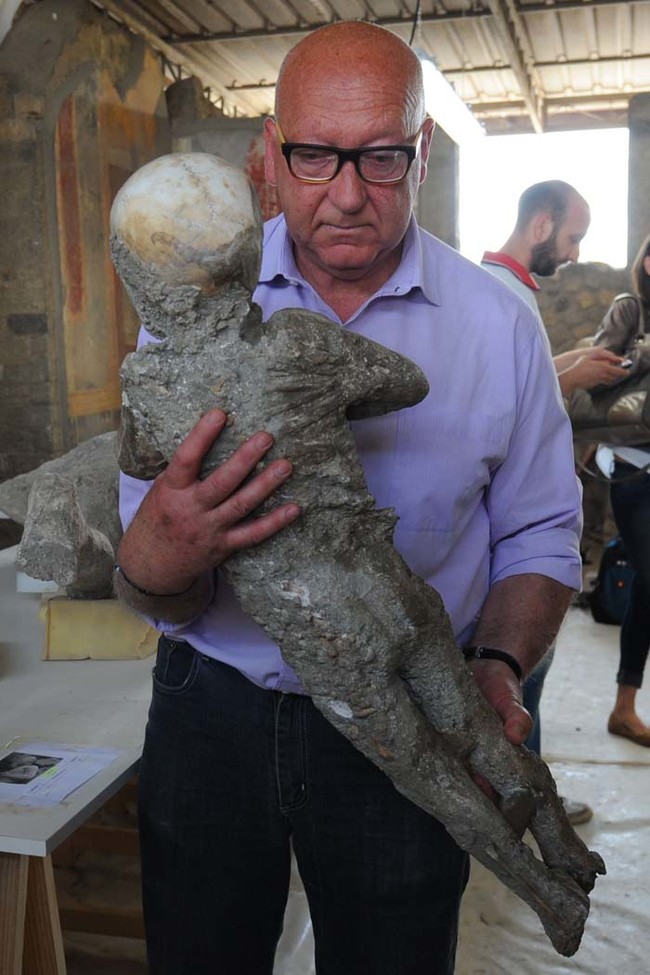
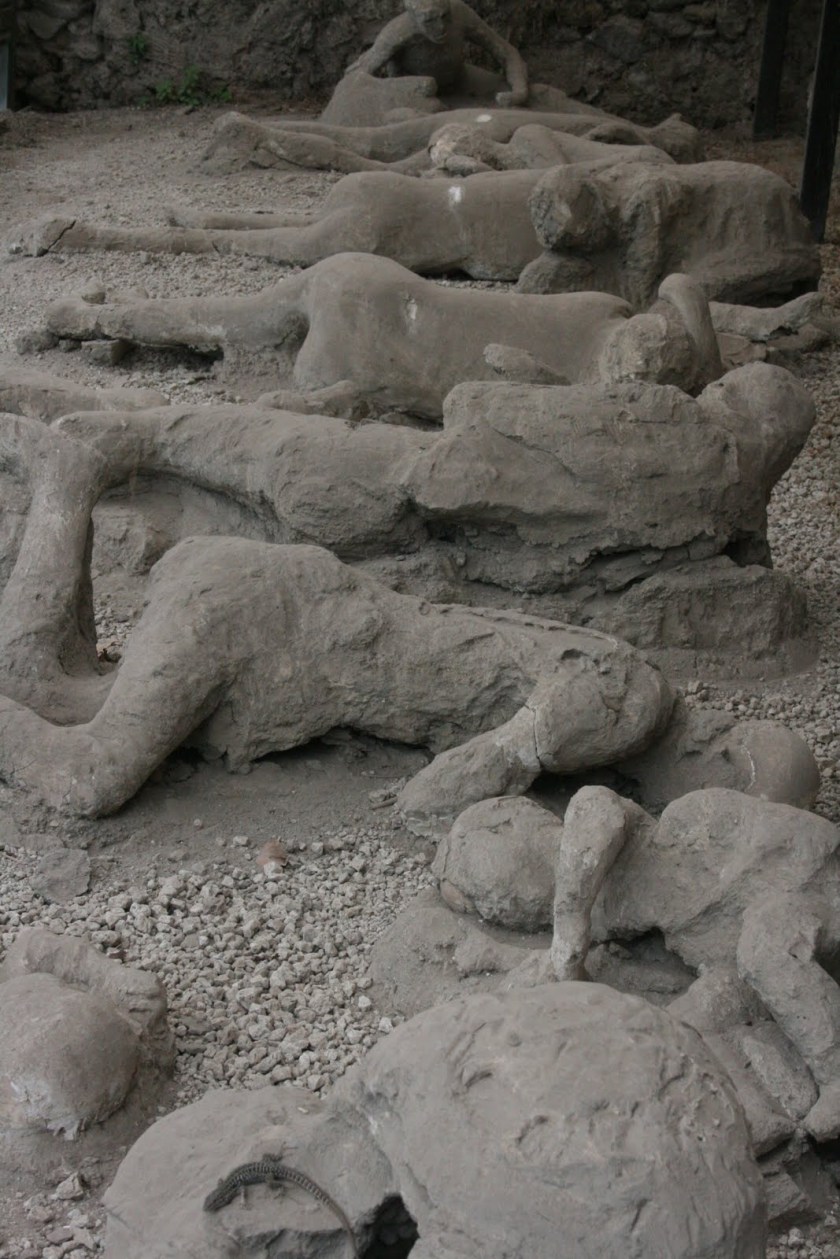
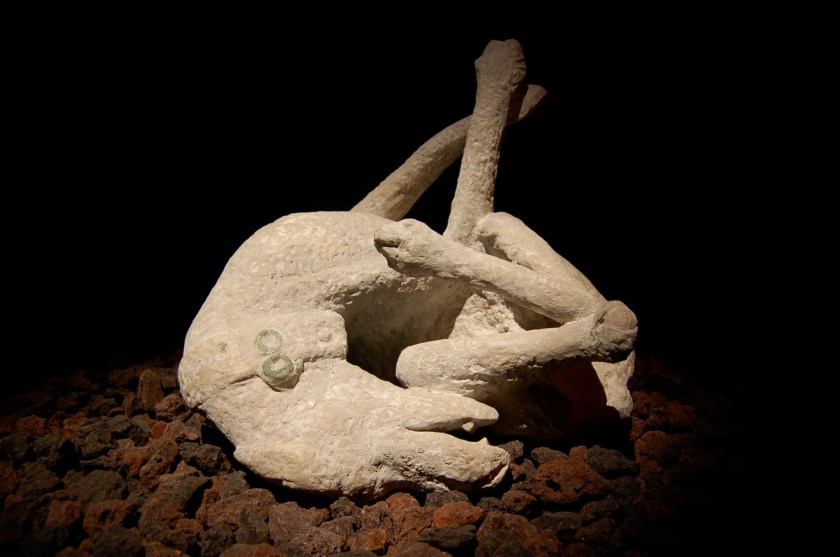
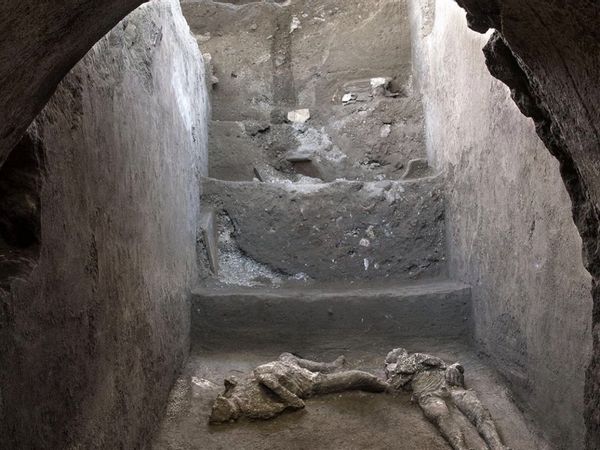
The victims of Mt. Vesuvius’ wrath left their imprints in the ash and rock which would be their tomb.  2,000 years later, remarkably life-like plaster casts, depict the final moments of these unfortunate men, women and children.

The suffocating, poisonous clouds of vapor and rock dust pouring into the city, soon  put and end to all that remained.  Imagine putting your head in a bag of cement, with someone pounding the sides.  Walls collapsed and roofs caved in, burying the dead under fourteen feet or more of ash, rock and dust. Neither Herculaneum, Pompeii nor their surrounding communities would see the light of day, for nearly two thousand years.
dsc_0128

Today we remember the Roman author, naturalist and military commander Gaius Plinius “Pliny’ Secundus for his work Naturalis Historia (Natural History). We see his work in the editorial model of the modern encyclopedia.

With the cities of Pompeii and Herculaneum already destroyed, Pliny raced to the port of Stabiae some 4½km to the southwest, to rescue a friend and his family. The sixth and largest pyroclastic surge trapped Pliny’s ship in port, killing the author and everyone in the vicinity. That we have an eyewitness to the event is thanks to two letters written by Gaius Plinius Caecilius Secundus (Pliny the Younger), Pliny’s nephew and a man he had helped to raise, from boyhood.
800px-Destruction_of_Pompeii_and_Herculaneum
Destruction of Pompeii and Herculaneum

Property owners and thieves returned over time to retrieve such valuables as statues. The words “house dug” can still be found, scrawled on the walls.  And then the place was forgotten, for fifteen hundred years.

15

An underground channel was dug in 1562 to redirect waters from the river Samo, when workers ran into city walls.  The architect Domenico Fontana was called in and further excavation revealed any number of paintings and frescoes, but there was a problem.

This stuff was downright pornographic.

According to the Annus Mirabilis written by English poet Philip Larkin, sex wasn’t even until 1963, in the British Isles.

“…So life was never better than
In nineteen sixty-three
(Though just too late for me) –
Between the end of the Chatterley ban
And the Beatles’ first LP…”
800px-Pompeii_-_Casa_dei_Casti_Amanti_-_Banquet
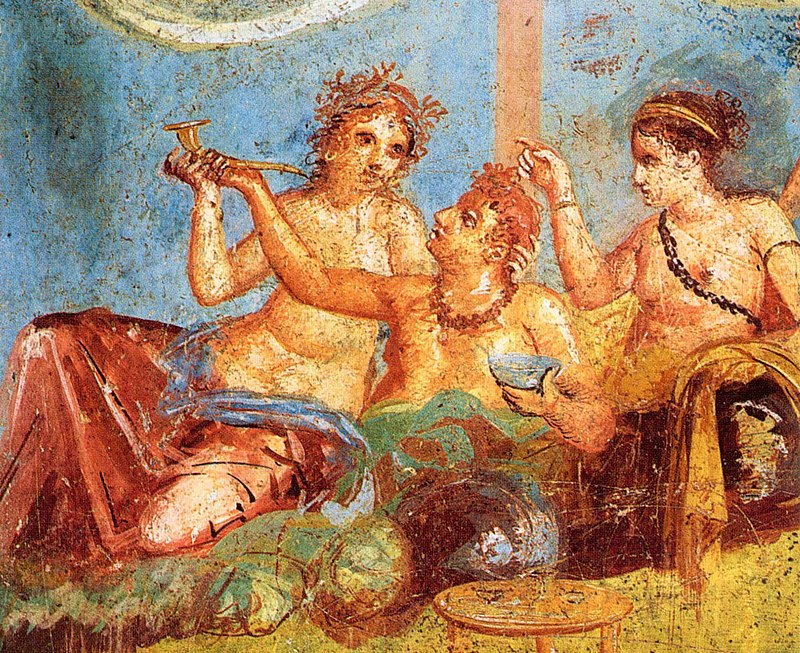
Pompeian artwork ranges from the merely hedonistic, to the pornographic

The ancients seem to have been rather more uninhibited.   In fact, life in some quarters was nothing if not hedonistic.  Pompeii itself has been described by some, as the “red-light district” of antiquity.  I’m not sure about that, but the erotic art of Pompeii and Herculaneum were WAY too much for counter reformation-era sensibilities. 

The place was quietly covered up and forgotten. For another two hundred years.

Pompeii was first excavated in earnest in 1748 but it took another hundred years for archaeologists’ findings to be organized, cataloged and brought to museums.  In 1863, archaeologist Giuseppe Fiorelli realized that occasional voids in the ash layer were in fact the long since decomposed bodies of the doomed victims, of Vesuvius.

A technique was developed of injecting plaster.  Today we can see them in excruciating detail, exactly where they fell.  Men, women and children, the dogs, even the fresh-baked bread, left out on the counter to cool.
Roman_fresco_Villa_dei_Misteri_Pompeii_006

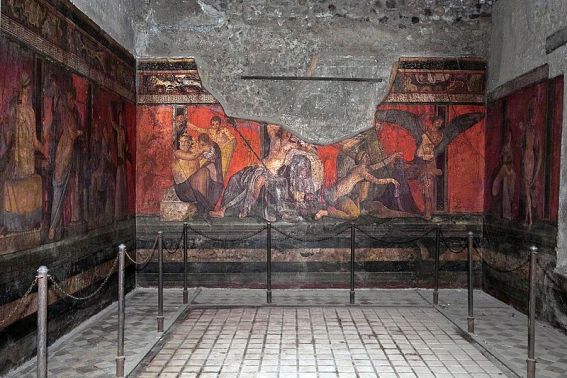
Today you can tour the lost city of Pompeii, from the baths to the forum, to the Lupanar Grande, where the prostitutes of Pompeii once “entertained” clients.  Ongoing excavation is all but a race with time, between uncovering what remains, and preserving what is.  Walls surrounding the “House of the Moralist” collapsed in 2010, so-called because its wealthy wine merchant owners posted rules of behavior, for guests to follow: “Do not have lustful expressions and flirtatious eyes for another man’s wife“.
Fun fact: A majority of Ancient Pompeiians had near-perfect teeth due to naturally occurring fluorine and a diet rich in fruits and vegetables.

There were other signs of what was to come. Tremors. Springs dried up. Fish died and floated on the river Sarno, victims of increased acidification of the water. Heavy rains were blamed for the collapse of the Schola Armatorium in 2010, the House of the Gladiators.  Fierce recriminations have followed and doubt has been cast on local authorities’ abilities, to properly preserve what has become a UNESCO World Heritage site.

Be that as it may, 2,000-year-old buildings do not come along every day.  There is no replacement for antiquity.

January 30, 1889 If Only

“What if” counterfactuals can be slippery. We can’t know how a story will end only by starting it out… “if only”. But still…

“What if” counterfactuals can be slippery. We can’t know how a story will end only by starting it out… “if only”. But still. How might the 20th century have played out, for example, had it not been for that day in Sarajevo, in 1914.

Perhaps the tinderbox already building by 1914 would have been lit, on some other day. But what if? Maybe two World Wars never happened, after all. Adolf Hitler remained a mediocre artist living in a flop house, in Vienna. All China became a free market, and not just Taiwan. What if the cold war, communism and everything that stemmed from that malevolent ideology was nothing more than the unpublished, nightmare imaginings of some crazy novelist?

In the wake of World War 2, a bipolar structure emerged in the world political order and remained so, for 40 years.

America was a minor player in pre-WW1 affairs, a period about which Germany’s “Iron Chancellor” Otto von Bismarck once explained: “All politics reduces itself to this formula: try to be one of three, as long as the world is governed by the unstable equilibrium of five great powers.”

After the downfall of French Emperor Napoleon I, 1814-’15, the Great Powers of Austria, Britain, France, Russia and Prussia met in Vienna to settle old issues and rebalance national boundaries in order to bring long-term peace, to Europe.

Austria declined over the next half-century leading to the Austro-Hungarian Compromise of 1867, an accord between the Empire of Austria and the Kingdom of Hungary. Ostensibly a constitutional union, the Austro-Hungarian Empire was a kaleidoscope of fifteen distinct ethnic groups speaking at least as many languages and divided, along no fewer than six religious lines.

After the 1889 suicide of Crown Prince Rudolf, the only son of Franz Josef, the emperor’s younger brother Karl Ludwig became heir to the Austro-Hungarian throne. Ludwig’s death in 1896 left his eldest son, Franz Ferdinand, the new heir presumptive.

Otto von Bismarck once said the next European war would begin with “some damn fool thing in the Balkans”. Bismarck got his damn fool thing in Sarajevo on June 28, 1914. We all know the story. The diplomatic visit of an heir presumptive. The open car. The wrong turn. The assassin.

There followed a series of diplomatic missteps, military mobilizations and counter-mobilizations called the “July Crisis of 1914″. By August there was no turning back. The “War to End all Wars” would shatter a generation, lay waste to a continent and erect the foundation, for the rest of the 20th century.

So, what about Rudolf and that “suicide”, in 1889. He was supposed to succeed Ludwig, not Ferdinand. What if the Emperor’s only son, had lived?

Political alliances came and went among the dynastic families of Europe, with treaties often sealed by arranged marriages.  On May 10, 1881, Crown Prince Rudolf married Princess Stéphanie, daughter of King Leopold, of Belgium.

Crown Prince Rudolf and his wife, Princess Stéphanie of Belgium, daughter of King Leopold II

A child was born in 1883, Archduchess Elisabeth, but the union soon soured. Rudolf began to drink and pursue women, not his wife. He wanted to write to Pope Leo XIII to annul the marriage. The formidable Franz Josef, would have none of that.

Three years later, Rudolf bought a hunting lodge in the Austrian village of Mayerling. In 1888, the 30-year old crown Prince met and began an affair with 17-year-old Marie Freiin (Baroness) von Vetsera.

Marie Freiin von Vetsera preferred to go by the more fashionable Anglophile version of her name, Mary

On January 30, 1889, the bodies of the Crown Prince and the Baroness were discovered in the Mayerling hunting lodge, victims of an apparent suicide pact.

Mayerling

Emperor Franz Josef went on to reign until 1916, one of the longest-serving monarchs of the 19th century.

Now without male heir, succession to the imperial throne passed first to the emperor’s younger brother Ludwig and later to Franz Ferdinand, best remembered for his assassination, in 1914.

Empress Elizabeth of Bavaria, Rudolf’s mother, went into deep mourning.

She wore the colors of her grief, pearl gray and black, every day until her assassination at the hands of 25-year-old Italian anarchist Luigi Lucheni, in 1898.

132 years later we can only ponder. It may be the ultimate counterfactual. What if Crown Prince Rudolf had lived to succeed Franz Josef. Politically, the son was far more liberal, than his father. Rudolf would surely have held more conciliatory views toward the forces, tearing at the empire. The same could be said of Franz Ferdinand, so who knows. Perhaps a rock in a stream once moved, alters not the flow of events yet to come.

But maybe that fork in the road met on June 28, 1914, would have led to a road less traveled and perhaps, the history of the last century, never happened.

Afterward,

By special dispensation, the Vatican declared Rudolf to be in a state of “mental imbalance” as suicide would have precluded church burial. The Emperor ordered Mayerling transformed into a penitential convent and endowed a chantry ensuring that prayers would rise up daily, for the eternal rest of his only son.

Vetsera’s body was smuggled out in the dark of night and quietly buried in the village cemetery at Heiligenkreuz, her funeral so secret even her mother was forbidden to attend.

Stories of poison gave way to reports of murder-suicide. Rumors have surrounded the Mayerling incident, for 100 years. Such stories went unchallenged until 1946 when occupying Red Army troops dislodged the stone covering the crypt and opened Vetsera’s coffin, looking for jewels. Repairing the damage some nine years later the fathers of the monastery observed the small skull and noticed, the absence of bullet holes. Physician Gerd Holler examined the remains in 1959 and concurred. No bullet hole.

But Maria von Vetsera was shot by the Crown Prince who later took his own life. That was the story, right?

Stories came to life of defensive wounds. Of evidence the pair had been murdered, after all.

Obsessed with the tale, Linz furniture store owner Helmut Flatzelsteiner disturbed the remains yet again, in 1991. Rumors went wild but in the end, results were inconclusive. Flatzelsteiner paid the abbey €2,000, in restitution.

In 2015 a letter was found in a safe deposit box, in an Austrian bank. A suicide note from a young girl, to her mother

“Dear Mother
Please forgive me for what I’ve done
I could not resist love
In accordance with Him, I want to be buried next to Him in the Cemetery of Alland
I am happier in death than life”.

January 29, 1944 Worse than Separation

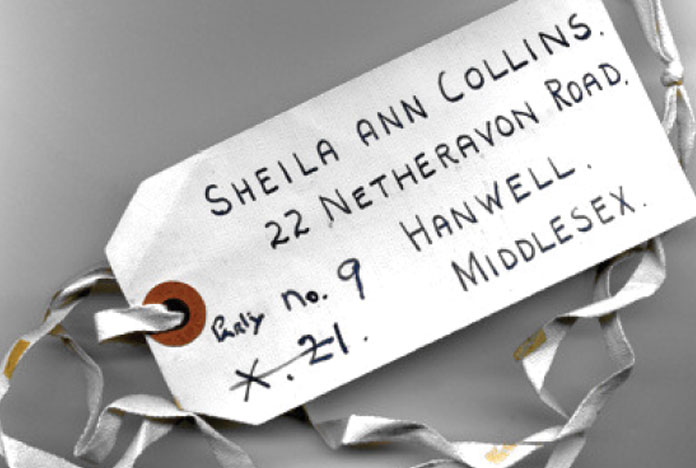
We marched to Waterloo Station behind our head teacher carrying a banner with our school’s name on it. We all thought it was a holiday, but the only thing we couldn’t work out was why the women and girls were crying


Desperate to avoid war with Nazi Germany, Italy, France and Great Britain convened in Munich in September, 1938 to resolve German claims on western Czechoslovakia. The “Sudetenland”.

Representatives of the Czech and Slovak peoples, were not invited.

431768

For the people of the modern Czech Republic, the Munich agreement was a grotesque betrayal. “O nás bez nás!” “About us, without us!”

On September 30, British Prime Minister Neville Chamberlain returned to London declaring “Peace in Our Time”.  The piece of paper Chamberlain held in his hand annexed the Sudetenland to Nazi Germany and bore the signatures of Adolf Hitler, Benito Mussolini and Édouard Daladier, as well as his own.

Winston Churchill was in the minority in 1938, in a continent haunted by the horrors of the “war to end all wars”. To Churchill, the Munich agreement was an act of cowardly appeasement.  Feeding the crocodile in hopes he will eat you last. For much of Great Britain, the sense of relief was palpable.

In the summer of 1938, the horrors of the Great War were a mere twenty years in the past.  Hitler had swallowed up Austria, only six months earlier.   British authorities divided the home islands into “risk zones” identified as “Evacuation,” “Neutral,” and “Reception.” 

In some of the most gut wrenching decisions of the age, these people were planning “Operation Pied Piper”. The evacuation of millions of their own children, should war come to the home islands.

94330

When Nazi Germany invaded Poland the following September, London mayor Herbert Morrison was at 10 Downing Street, meeting with Chamberlain’s aide, Sir Horace Wilson.  Morrison believed the time had come for Operation Pied Piper. 

Only a year to the day from the Prime Minister’s “Peace in our Time” declaration, Wilson demurred.  “But we’re not at war yet, and we wouldn’t want to do anything to upset delicate negotiations, would we?”

Morrison was done with the Prime Minister’s dilatory response to Hitler’s aggression, practically snarling in his thick, East London accent “Look, ’Orace, go in there and tell Neville this from me: If I don’t get the order to evacuate the children from London this morning, I’m going to give it myself – and tell the papers why I’m doing it. ’Ow will ’is nibs like that?”

Thirty minutes later, Morrison had the document. The evacuation, had begun.

large_000000

Next weekend, the Superbowl champion Kansas City Chiefs will face off with the G.O.A.T (Greatest of all Time) 43-year-old Tom Brady, of the Tampa Bay Buccaneers. The venue, Raymond James Stadium, holds a crowd of 65,618, expandable to 75,000.

In 1938, 45 times that number were mobilized in the first four days of the evacuation, primarily children, relocated from cities and towns across Great Britain to the relative safety of the countryside.

Operation_Pied_Piper-Poster

BBC History reported that, “within a week, a quarter of the population of Britain would have a new address”.

Zeppelin raids had killed 1,500 civilians in London alone during the ‘Great War’.  Since then, governments had gotten so much better at killing each other’s citizens. 

As early as 1922, Prime Minister Arthur Balfour had spoken of ‘unremitting bombardment of a kind that no other city has ever had to endure.’  As many as 4,000,000 civilian casualties were expected in London alone.

BBC History describes the man in charge of the evacuation, Sir John Anderson, as a “cold, inhuman character with little understanding of the emotional upheaval that might be created by evacuation”.

Children were labeled ‘like luggage’, and sent off with gas masks, toothbrushes and fresh socks & underwear. None of them knew to where, or for how long. What must That have sounded like.

thumbnail_ww2evacuees

The evacuation of all that humanity ran relatively smoothly, considering.  James Roffey, founder of the Evacuees Reunion Association, recalls ‘We marched to Waterloo Station behind our head teacher carrying a banner with our school’s name on it. We all thought it was a holiday, but the only thing we couldn’t work out was why the women and girls were crying.’

Arrivals at the billeting areas, were another matter.  Many kids were shipped off to the wrong places, and rations were insufficient.  Geoffrey Barfoot, billeting officer in the seaside town of Weston-super-Mare, said ‘The trains were coming in thick and fast. It was soon obvious that we just didn’t have the bed space.’

Kids were lined up against walls and on stages, potential hosts invited to “take their pick”.

For many, the terrors and confusion of those first few days grew and flowered into love and friendships, to last a lifetime.  Some entered a hell on earth of physical or sexual abuse, or worse.

For the first time, “city kids” and country folks were finding out how the “other half” lived. Results were sometimes amusing.  One boy wrinkled his nose on seeing carrots pulled out of muddy fields, saying “Ours come in tins”.  Richard Singleton recalled the first time he asked his Welsh ‘foster mother’ for directions to the toilet.  “She took me into a shed and pointed to the ground. Surprised, I asked her for some paper to wipe our bums.  She walked away and came back with a bunch of leaves.”

John Abbot, evacuated from Bristol, had his rations stolen by his host family. He was horsewhipped for speaking out while they enjoyed his food and he was given nothing more than mashed potatoes. Terri McNeil was locked in a birdcage and left with a piece of bread and a bowl of water.

an-evac-killed-by-bus-near-blackpool

In the 2003 BBC Radio documentary “Evacuation: The True Story,” clinical psychologist Steve Davis described the worst cases as, “little more than a pedophile’s charter.”

Eighty-odd years later, the words “I’ll take that one” are seared into the memories of more than a few.

Hundreds of evacuees were killed because of relocation, while en route or during stays at “safe havens”.  Two boys were killed on a Cornish beach, mined to defend against German amphibious assault.

No one had thought to put up a sign.

Irene Wells, age 8, was standing in a church doorway when she was crushed by an army truck.  One MP from the house of Commons said “There have been cases of evacuees dying in the evacuation areas. Fancy that type of news coming to the father of children who have been evacuated”.

When German air raids failed to materialize, many parents decided to bring the kids home.  By January 1940, almost half of evacuees were returned.

980x

Authorities produced posters urging parents to leave the kids where they were, and a good thing, too. The Blitz against London itself began on September 7. The city experienced the most devastating attack to-date on December 29, in a blanket fire-bombing that killed almost 3,600 civilians.

Sometimes, refugees from relatively safe locations were shipped into high-risk target areas. Hundreds of refugees from Gibraltar were sent into London, in the early days of the Blitz. None of them could have been happy to leave London Station, to see hundreds of locals pushing past them, hurrying to get out.

This story doesn’t only involve the British home islands, either.  American Companies like Hoover and Eastman Kodak took thousands of children in, from employees of British subsidiaries.  Thousands of English women and children were evacuated to Australia, following the Japanese attack on Singapore.

62d70d4914a701b66b42480e66c82105

By October 1940, the “Battle of Britain” had devolved into a mutually devastating battle of attrition, in which neither side was capable of striking the death blow. Hitler cast his gaze eastward the following June with a surprise attack on his “ally”, Josef Stalin.

“Operation Steinbock”, the Luftwaffe’s last large-scale strategic bombing campaign of the war against southern England, was carried out three years later.  285 German bombers attacked London on this day in 1944, in what the Brits called the “Baby Blitz”.

You’ve got to be some tough cookie to call 245 bombers, a Baby Blitz.

WWII_London_Blitz_East_London-Children

Later in the war, the subsonic “Doodle Bug” or V1 “flying bomb” was replaced by the terrifying supersonic V2.  1,000 or more of these, the world’s first rocket, were unleashed against southern England, primarily London, killing or wounding 115,000. With a terminal velocity of 2,386mph, you never saw or heard this thing coming until the weapon had done its work.

15092_0

In the end, many family ‘reunions’ were as emotionally bruising as the original breakup.   Years had come and gone and new relationships had formed.  The war had turned biological family members into virtual strangers.

Richard Singleton remembers the day his mother came, to take him home to Liverpool.  “I had been happily living with ‘Aunty Liz and Uncle Moses’ for four years,” he recalled. “I told Mam that I didn’t want to go home. I was so upset because I was leaving and might never again see aunty and uncle and everything that I loved on the farm.”

Douglas Wood tells a similar story.  “During my evacuation I had only seen my mother twice and my father once,” he recalls. “On the day that they visited me together, they had walked past me in the street as they did not recognise me. I no longer had a Birmingham accent and this was the subject of much ridicule. I had lost all affinity with my family so there was no love or affection.”

The Austrian-British psychoanalyst Anna Freud, daughter of Sigmund, commissioned an examination of the psychological effects of the separation. After a 12-month study, Freud concluded that “separation from their parents is a worse shock for children than a bombing.”

January 28, 1986 Space Truck

STS-1, the first mission of the “Space Shuttle” program launched aboard “Columbia” from the Kennedy Space Center on Merritt Island, Florida. It was April 12, 1981, the 20th anniversary of the first human spaceflight aboard the Russian capsule Vostok 1.
The idea of a reusable Space Transportation System (STS) came around as early as the 1960s, as a way to cut down on the cost of space travel. The final design was a reusable, winged “spaceplane” with a disposable external tank and reusable solid fuel rocket boosters. The ‘Space Truck’ program was approved in 1972, the prime contract awarded to North American Aviation (later Rockwell International), with the first orbiter completed in 1976.

Early Approach and Landing Tests were conducted with the first prototype dubbed “Enterprise”, in 1977. A total of 16 tests, all atmospheric, were conducted from February to October, the lessons learned applied to the first space-worthy vehicle in NASA’s orbital fleet.

o-columbia-shuttle-disaster-facebookSTS-1, the first mission of the “Space Shuttle” program launched aboard “Columbia” from the Kennedy Space Center on Merritt Island, Florida.  It was April 12, 1981, the 20th anniversary of the first human spaceflight aboard the Russian capsule Vostok 1.
It was the first, and (to-date) only manned maiden test flight of a new system in the American space program.
This first flight of Columbia would be commanded by Gemini and Apollo veteran John Young and piloted, by Robert Crippen. It was the first of 135 missions in the Space Shuttle program, the first of only two to take off with external hydrogen fuel tanks painted white.  From STS-3 on, the external tank was left unpainted, to save weight.

All told, Columbia flew 28 missions with 160 crew members traveling 125,204,911 miles in 4,808 orbits around the planet.

Initially, there were four fully functional orbiters in the STS program: Columbia joined after the first five missions by “Challenger”, then “Discovery”, and finally “Atlantis”.  A fifth orbiter, “Endeavor”, was built in 1991 to replace Challenger, which broke apart 73 seconds after lift-off on January 28, 1986, killing all seven of its crew.

Rescue and recovery operations were delayed for fifteen minutes, as debris rained from the sky.

FILE NASA PORTRAIT OF COLUMBIA MISSION CREW

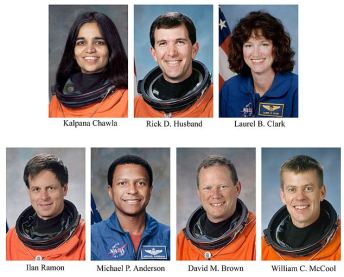
STS-107 launched from the Kennedy Space Center aboard the Space Shuttle Columbia on January 16, 2003.

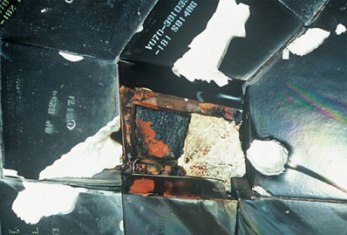
Eighty seconds after launch, a piece of insulating foam broke away from the external fuel tank striking Columbia’s left wing, leaving a small hole in the carbon composite tiles along the leading edge.

Three previous Space Shuttle missions had experienced similar damage and, while some engineers thought this could be more serious, none was able to pinpoint the precise location or extent of the damage.  NASA managers believed that, even in the event of major damage, little could be done about it.

These carbon tiles are all that stands between the orbiter and the searing heat of re-entry.

tiledamage
December 2, 1988 ‘Atlantis’ mission narrowly missed repeting the Columbia disaster, four days later. “More than 700 heat shield tiles were damaged. One tile on the shuttle’s belly near the nose was completely missing and the underlying metal – a thick mounting plate that helped anchor an antenna – was partially melted. In a slightly different location, the missing tile could have resulted in a catastrophic burn through”. H/T Spaceflightnow.com

For Columbia, 300 days, 17 hours, forty minutes and 22 seconds of space travel came to an end on the morning of February 1, 2003.  Over the California coast and traveling twenty-three times the speed of sound, external temperatures rose to 3,000° Fahrenheit and more, when super-heated gases entered the wing’s interior.

231,000 feet below, mission control detected four unconnected sensors shut down on the left wing, with no explanation.   The first debris struck the ground near Lubbock, Texas, at 8:58am.  The last communication from the crew came about a minute later.

Columbia disintegrated in the skies over East Texas at 9:00am Eastern Standard Time.

Debris and human remains were found in 2,000 locations from the state of Louisiana, to Arkansas. The only survivors were a can full of worms, brought into space for study.

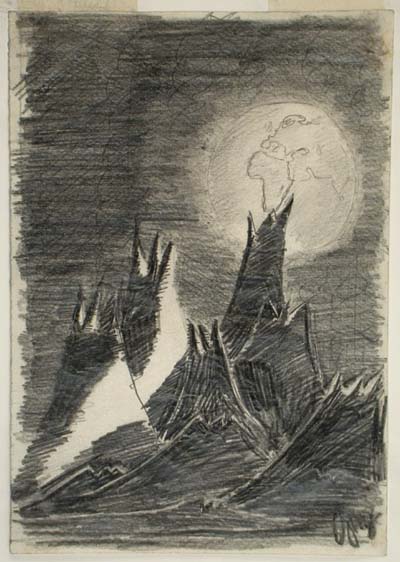
petr-ginz-drawing-l
“Mon Landscape” by Petr Ginz

Payload Specialist Colonel Ilan Ramon, born Ilan Wolferman, was an Israeli fighter pilot and the first Israeli astronaut to join the NASA space program.

Ramon is the son and grandson of Auschwitz survivors and family member to several others, who didn’t live to tell the tale. 

In their memory, Colonel Ramon reached out to the Yad Vashem Remembrance Center, for a holocaust relic to bring with him into space.

Petr Ginz lived for a time in the Theresienstadt ghetto, where he drew this picture.  A piece of teenage imagination:  the Earth as it may appear, from the moon.

Petr Ginz would be murdered in the Nazi death camp at Auschwitz though his drawing, survived.  He was 14 years old.  Colonel Ramon was given a copy. A young boy’s drawing of a safer place.  This would accompany the astronaut, into space.

Today, the assorted debris from the Columbia disaster numbers some 84,000 pieces, stored in the Vehicle Assembly Building at the Kennedy Space Center.  To the best of my knowledge, this drawing by a boy who never made it out of Auschwitz, is not among them.

Afterward:

Andrew “Drew” Feustel is a car guy, with fond memories of restoring a ’67 Ford Mustang in the family garage in North suburban Detroit.

When he’s not fixing cars he’s an astronaut, and veteran of two space missions.  For a time he was a colleague of Colonel Ramon.  The pair had several close friends, in common.

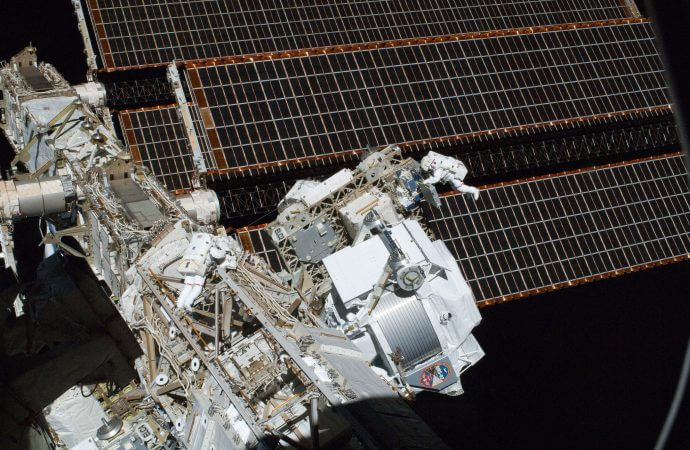
9492403507_6a7f9f63ee_k-690x450
The ‘car guy’ in space thing seems to have worked. NASA reports “The spacewalkers overcame frozen bolts, stripped screws and stuck handrails, four new or rejuvenated scientific instruments, new batteries, a new gyroscope and a new computer were installed. | NASA photo

In March 2018, Feustel left for his third spaceflight, this one a six-month mission aboard the International Space Station.  Before he left, Rona Ramon, widow of the Israeli Astronaut, gave him another copy of Petr Ginz’ drawing.

The circle was closed.  This fruit of a doomed boy’s imagination once again broke the bonds of space. This time, it also home.

January 19, 1810 Cold Friday

“Tales of the killer weather event made their way into town histories, journals and court records long after it happened on January 19.. They told of the many people who froze to death while traveling along the highways. The wind blew down houses, barns and vast numbers of timber trees. Ships wrecked, cattle froze in their barns and old people died of hypothermia inside their homes. It was so cold pens wouldn’t write though they were right next to the fireplace”. – H/T New England Historical Society

I suspect it’s happened to all of us, particularly in the colder latitudes. You dress for the weather, (or think you do), later to find you got it wrong. Off you go to the office, to the store, and before you know it, it’s soaking wet. Or freezing cold. We’ve all been there, but what of an age before you had that nice warm car, to jump into?

In January 1810, several New England journalists recorded a temperature that dropped 100 degrees in 24 hours, from 67° Fahrenheit on Thursday the 18th, to -33° on Friday.

According to NASA, the average winter temperature at the North Pole, is -40°.

That was only the half of it. The weather forecasters of the day didn’t record wind chill but the howling gale that brought that cold with it, was a killer.

Henry David Thoreau’s mother remembered dishes frozen, as soon as they were washed. Reverend William Bentley wrote that people died, without going outside.

On the mild afternoon of January 18, 50-year-old Revolutionary War veteran Joseph Brooks of Woburn Massachusetts and his 45-year old cousin Benjamin, went into the forest to cut wood. The two were found frozen to death on Saturday.

HistoricIpswich.org writes of “people who froze to death while traveling along the highways. Houses, barns and vast numbers of timber trees were blown down or broken to pieces. Ships were wrecked, cattle froze in their barns and old people died of hypothermia in their homes. It was so cold pens wouldn’t write though they were right next to the fireplace“.

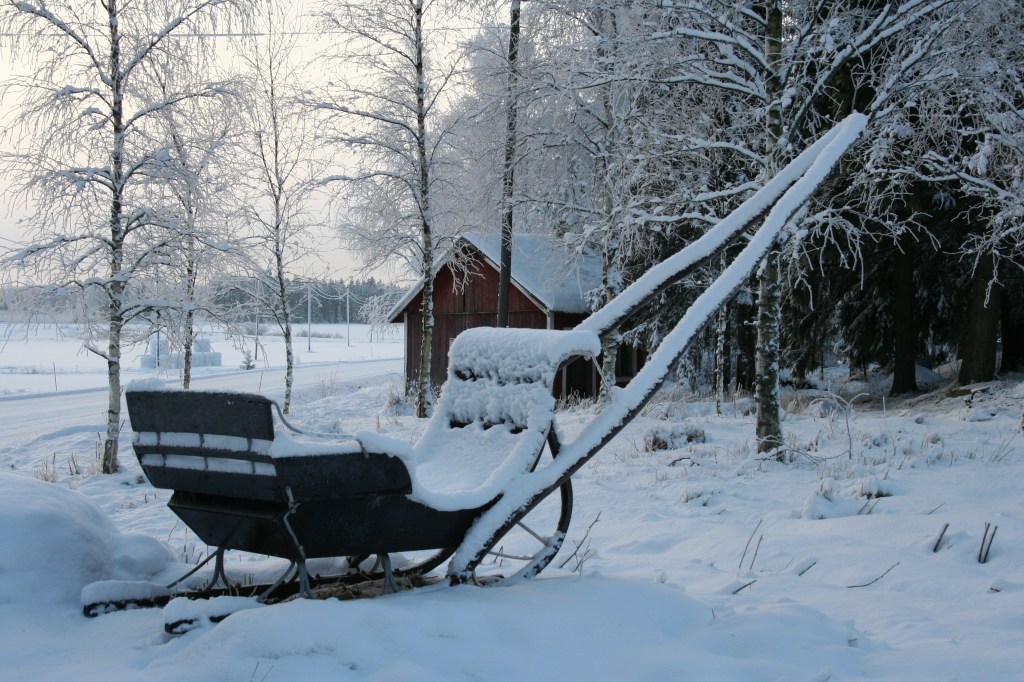
In Sanbornton New Hampshire, the wind tore the home of Jeremiah Ellsworth, to pieces. Ellsworth struggled into the maelstrom to the home of David Brown, seeking help. The howling wind literally tore the clothes off the backs of Ellsworth’s older children as Mrs. Ellsworth struggled to carry the baby, into the basement. Ellsworth made it to the neighbor’s house but, with his feet frozen, the man was unable to go on. Brown hooked up a horse and sleigh and drove back to the Ellsworth home. That’s when things went Seriously wrong. The sleigh was blown over not once, but twice. The second time it was torn apart, its contents, scattered. David Brown labored to carry the Ellsworth children the rest of the way. Mrs. Ellsworth was reduced to crawling. By the time she arrived at the Brown home she was unrecognizable. None of the three children survived.

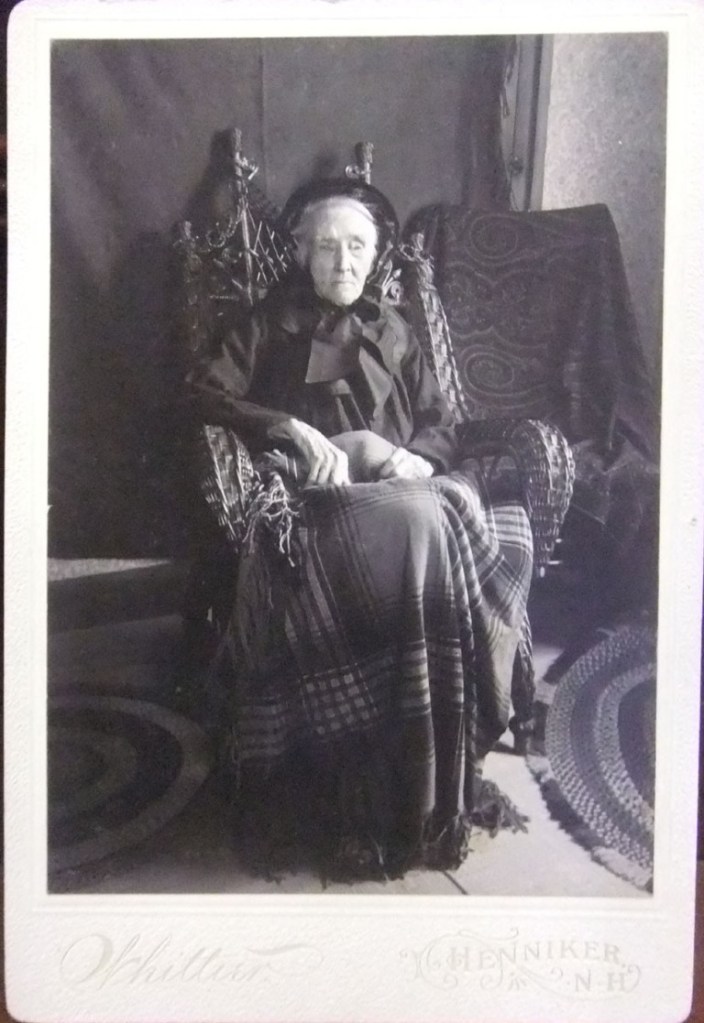
On a happier note, Rebecca Ramsdell was a schoolgirl, in Henniker New Hampshire. James Bartlett was the teacher in those days, and made it a habit to award little medals, to children with exceptional attendance. Rebecca braved the cold that morning and walked a mile, to school. Bartlett gave her a medal, and she never forgot it. You can find a picture of Ms. Ramsdell at the Henniker Historical Society. She’s 100+ in that photo and she still had Mr. Bartlett’s medal.

H/T Henniker Historical Society

Locals spoke of the Cold Friday of 1810, for generations. Twenty years later, a New Hampshire court proceeding required a date. The answer wasn’t hard to remember. It had happened on Cold Friday.

January 14, 1969 Fire at Sea

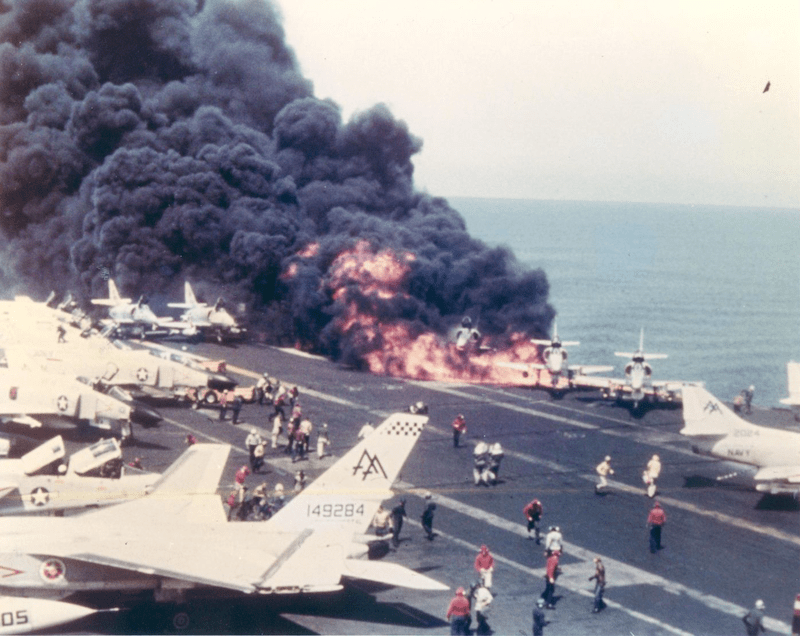
For every multi-ton flying fuel tank hurtling from bow-mounted catapults bristling with armaments, a controlled crash landing of that same aircraft, takes place in the stern. Combine all that chaos with a heaping helping of Murphy’s law and the table is set, for disaster.

From the WW1-era launch of the first modern aircraft carrier to the present day, the carrier sailor has literally lived and worked, surrounded by the means of his own destruction.

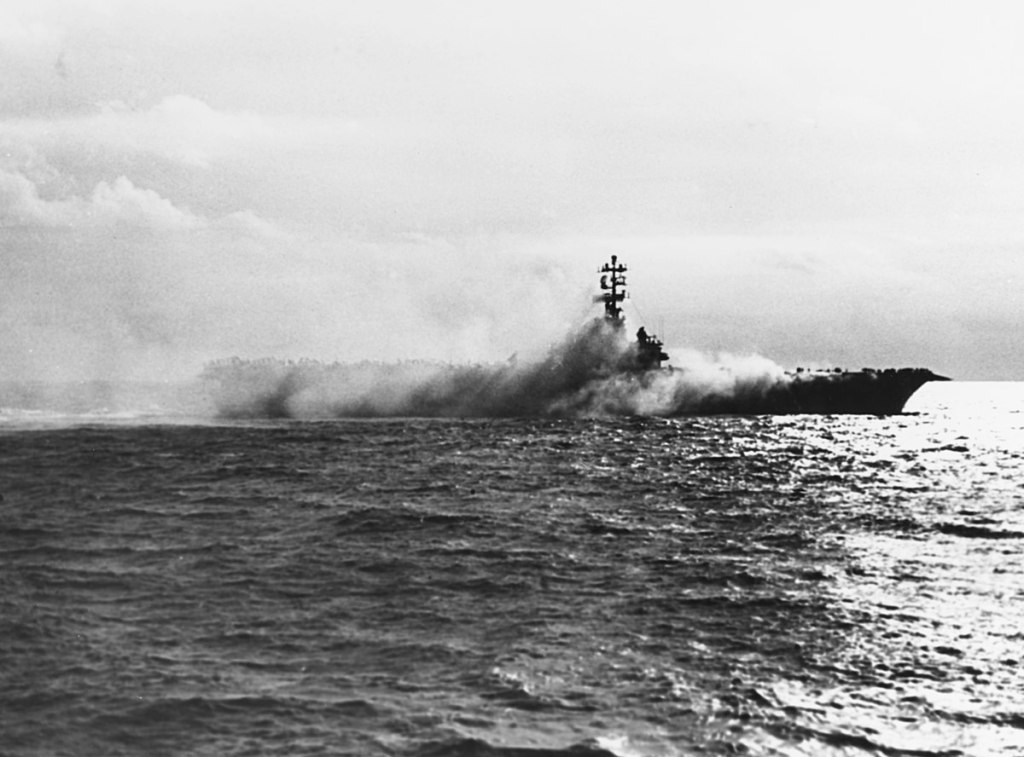
In March 1953, a Corsair fighter off the coast of Korea landed on the decks of USS Oriskany, with a bomb still attached. The thing fell off and exploded, piercing the wingtip tanks of several F9F-5 Panthers, spilling flaming fuel across the decks. That time, fire crews were able to put out the fire, before the flames reached ordnance lockers. Loss of life was limited to two sailors killed and another fifteen, wounded. A decade later, the “Mighty O” wouldn’t get off, so lightly.

USS Oriskany

Oriskany began her second tour off the Vietnam coast in July, 1966. The carrier’s five fighter squadrons launched nearly 8,000 sorties in the first four months, a pace taxing to man and machine, alike.

On October 26, apprentice seamen George James, 18, and James Sider, 17, were ordered to stow 117 parachute flares. Untrained and unsupervised, Sider snagged a lanyard , and accidentally set one off. Panicked, blinded by the brilliant light of white phosphorus, Sider tossed the flare into the storage locker.

The bin already contained some 650 flares and 2¾-inch air-launched rockets, each carrying a 6-pound warhead. Temperatures inside the locker soared to 4,500° Fahrenheit and the main hatch exploded as steel bulkheads began to sag and buckle.

Water is worse than useless against a magnesium fire. Anyone who’s seen the Hindenburg tape understands why. Water breaks down to oxygen and hydrogen at temperatures over 3,000°, literally transforming into fuel, for the inferno.

Magnesium fires burn as hot as 5,600°, Fahrenheit. As a point of reference, volcanic lava ranges from 1,470° to 2,190°.

As helicopters burned and ammunition cooked off, the courage of individual firemen is scarcely to be believed. Literally surrounded by bombs staged for loading, firemen trained water hoses to cool these monsters even as their paint blistered, and fuze inlets began to smoke.

Oriskany fire, October 1966

Had the bombs gone off, the probable result would be the death of the carrier itself.

Down below, murderous heat and noxious fumes killed men where they stood. Lt. Cmdr. Marvin Reynolds wrapped a wet blanket around himself and fumbled in the darkness, for the wrench to open his porthole. “If you let this wrench slip and lose it in the smoke” he thought, “you’ve bought the farm.” Reynolds managed to open his porthole, holding his head out the small opening until a sailor passed him a breathing mask, and fire hose.

In the end, firemen could do little but hose the edge of the fire, while the inferno burned itself out. 44 men were killed and another 156, injured. So much water was pumped onboard that scuba teams were required, to rescue men trapped on lower decks.

8 months later, USS Forrestal met a similar fate. This one is personal as a close family member, was involved.

In 1967, the carrier bombing campaign against North Vietnam reached an intensity unrivaled, in US Naval history.

USS Forrestal, departing San Francisco bay.

Combat operations were literally outpacing ordnance resupply, which soon included AN-M65A1 “Fat Boy” bombs, left over from the war in Korea.  Handlers feared these old bombs might spontaneously explode from the shock of a catapult takeoff.

Before the cruise, damage control firefighting teams were shown training films of Navy ordnance tests, demonstrating how a 1000-lb bomb could be directly exposed to a jet fuel fire for a full 10 minutes. Tests were conducted using the new Mark 83 bomb featuring a thicker, heat resistant wall compared with older munitions and “H6” explosive, designed to burn off at high temperatures, like a huge sparkler.

The problem was, the old ordnance was thinner-skinned than the modern bombs, and armed with 10+ year-old “Composition B” explosive.  Already more sensitive to heat and shock than the newer ordnance, composition B becomes more volatile as the explosive ages.  The stuff becomes more powerful too, as much as 50%, by weight.

On the morning of July 29, preparations were underway for the second strike of the day.  Twenty-seven aircraft were on deck, fully loaded with fuel, ammunition, bombs and “Zuni” unguided rockets. 

An electrical malfunction fired a rocket across the flight deck, severing the arm of one crew member and piercing the 400-gallon fuel tank of an A-4E Skyhawk. The rocket’s safety mechanism prevented the weapon from exploding, but the A-4’s torn fuel tank was spewing flaming jet fuel onto the deck. Other tanks soon overheated and exploded, adding to the conflagration.

800px-USS_Forrestal_A-4_Skyhawk_burning.png

During WW2, virtually all carrier sailors were trained to fight fires. That all changed by the Vietnam era in favor of small, highly trained teams of fire fighters. Damage Control came into action immediately, as Team #8 Chief Gerald Farrier spotted a Fat Boy bomb turning cherry red, in the flames.  Without protective clothing, Farrier held a fire extinguisher on the 1000-pound bomb, hoping to keep it cool enough to prevent cooking off as his team brought the conflagration under control.

Firefighters were confident that their ten-minute window would hold, but composition B proved as unstable as the ordnance people had feared.  Farrier “simply disappeared” in the first of a dozen or more explosions, in the first few minutes.  By the third such explosion, Damage Control Team #8 had all but ceased to exist.

There were nine major explosions on deck during the first five minutes.

The port quarter of the Forrestal ceased to exist in the violence of the blasts. Office furniture was thrown to the floor, five decks below.  Huge holes were torn through the flight deck while 40,000 gallons of flaming jet fuel, poured through ventilation ducts and into living quarters below.

USS_Forrestal_fire_1_1967

Future United States Senator John McCain managed to scramble out of his cockpit and down the fuel probe.  Seconds later, Lieutenant Commander Fred White wasn’t so lucky.

With the life of the carrier itself at stake, tales of incredible courage, were commonplace. Medical officers worked for hours in the most dangerous conditions imaginable. Explosive ordnance demolition officer LT(JG) Robert Cates “noticed that there was a 500-pound bomb and a 750-pound bomb in the middle of the flight deck… that were still smoking. They hadn’t detonated or anything; they were just setting there smoking. So I went up and defused them and had them jettisoned.” Sailors volunteered to be lowered through the flight decks into flaming and smoked-filled compartments, to defuse live bombs.

The fire burned until 4:00 the next morning. 21 of the 73 aircraft on board were destroyed and another 40, damaged. 134 crewmen died in the conflagration. Another 161 received non-fatal injuries. It was the worst loss of life on a US Navy vessel, since World War 2.

They say bad luck comes in threes. On this day in 1969, the nuclear carrier USS Enterprise finished the list.

Since the age of the Wright brothers, aircraft designers have often left out the excess weight of starters and batteries. Early piston engines were startd by hand and, in the jet age, gas turbines often use auxiliary starters powered by gas or other combustible material.

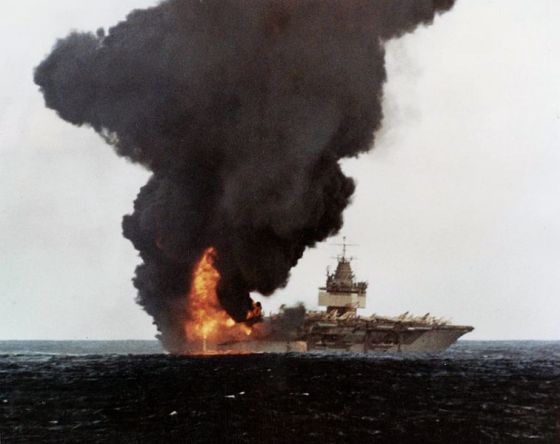
On the morning of January 14, 1969, USS Enterprise was training 70-miles off Hawaii, preparing for her 4th tour of Vietnam. Her flight deck was crowded with F-4 Phantoms and A-7 Corsair II bombers, each loaded with Zuni rocket pods and 500-pound Mk-82 bombs. At 8:18am, an MD-3A “Huffer” aircraft engine starter was parked near the wing of an F4 Phantom, its exhaust a mere 24-inches from a rocket pod.

The 15-pound warhead on a Zuni rocket, goes off at 358° Fahrenheit. A Huffer exhaust burns between 362° and 590°. For a minute and 18 seconds, no fewer than four crew members were aware of the problem. None took steps to fix it and each, paid the ultimate price.

In the flash of an eye the exploding rocket ruptured several nearby fuel tanks as fuel vaporized and immediately, burst into flames. That’s when all hell, broke loose. The nearest 15 aircraft carried a combined fuel load of 15,000 gallons with a combined armament of 30 500-pound bombs and 40 Zuni rockets. 18 massive explosions went off in close succession, tearing great holes in 2½-inch deck armor.

Men and machines were tossed by each explosion, “like dust”. Three bombs went off at once opening a 22-foot hole in the deck, damaging a nearby tanker and spilling burning fuel, six floors below.

Knocked unconscious in the initial blast, Petty Officer 3rd Class Frank Neumayer of Fighter Squadron VF-96 awoke to find his goggles melting and his clothing, on fire. “The roar of the fire was just horrendous,” he later said. “It just blotted out any other sound. The stench… was horrible.” He managed to crawl to the catwalk below just as 2 500-pound bombs went off, not 30-feet from his previous position. Neumayer lost his left leg in the blast and twice received last rites, but survived.

The Destroyers USS Bainbridge and Rodgers came alongside, to lend their hoses. Helicopters arrived within two hours from Pearl Harbor, to medevac the wounded. Within three hours the last flames, were out.

The USS Enterprise fire resulted in the death of 34 men and another 341 non-fatal injuries. The fire resulted in a redesign of the Huffer starter and repair costs equivalent to $912 million, today. No formal inquiry was ever held, to determine fault. Everyone plausibly to blame for the catastrophe, had been among the first to die.

January 11, 1693 Feeling Puny?

Such an event could happen tomorrow, next year or ten thousand years from now. No one knows. We are so puny when compared with the Wrath of God, or of Nature, as you please.

In his 1897 short story The Open Boat, Stephen Crane writes of the puniness of humanity, when bared and exposed to the wrath of God, or of Nature, as you please. “If I am going to be drowned — if I am going to be drowned — if I am going to be drowned, why, in the name of the seven mad gods, who rule the sea, was I allowed to come thus far and contemplate sand and trees? 

Deep in the ground beneath your feet, a rocky shell comprising an outer Crust and an inner Mantle forms a hard and rigid outer shell, closing off and containing the solid inner core of our planet. Between these hard inner and outer layers exists a solid core of material which remains viscous over geologic time, measuring approximately 1,802 miles thick and comprising some 84 percent of the volume, of planet Earth.

The air around us is a liquid, exerting a ‘weight’ or barometric pressure at sea level, of 14.696 pounds per square inch. Scientists estimate that pressures within this outer core generate temperatures of 1,832° Fahrenheit near the boundary with the crust, to 6,692° Fahrenheit approaching the core boundary.

As a point of reference, the surface of the sun is about 10,340°, Fahrenheit.

That rocky shell closing us off from all that is actually quite elastic, broken into seven or eight major pieces, (depending on how you define them), and several minor bits called Tectonic Plates.

Over millions of years, these plates move apart along constructive boundaries, where oceanic plates form mid-oceanic ridges. Roughly equal and opposite to these are the Subduction Zones, where one plate moves under another and down into the mantle.

The planet is literally “eating’ itself.

Sicily, the largest island in the Mediterranean and one of twenty regions of Italy, lies on the convergent boundary of two such pieces of the planet’s outer shell, where the African plate is subducting beneath the Eurasian plate.  Over time, the forces built up along these subduction zones, are nothing short of Titanic.

Sicily is also home to the terrifying Mount Etna, one of the most active volcanoes in the world. On this day in 1693, those Seven Mad Gods got together and unleashed on the puniness of humanity, the wrath of the ages.

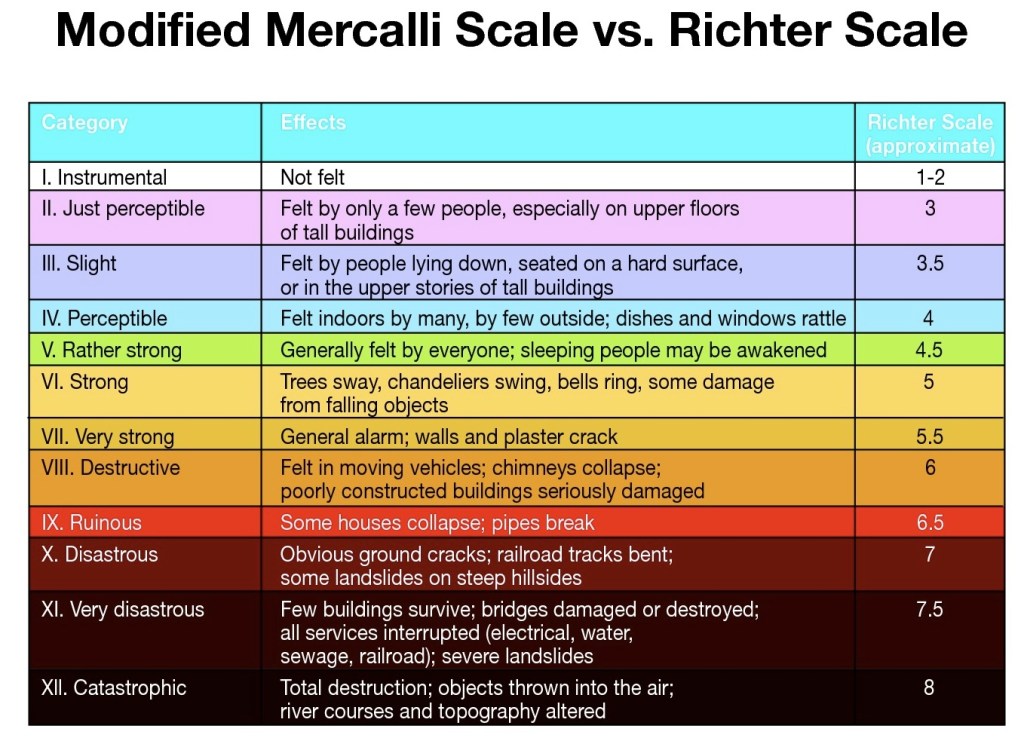
The first foretaste of what was about to happen began at 21:00 local time, January 9, 1693. The earthquake, centered on the east Sicilian coast and felt as far away as the south of Italy and the island nation of Malta, had an estimated magnitude of 6.2 on the Richter scale with a perceived intensity on the Mercali Intensity Scale of VIII – XI: Destructive to Very Disastrous.

Mercali describes a Category XI earthquake: “Few, if any, (masonry) structures remain standing. Bridges damaged or destroyed. Broad fissures in ground. Underground pipe lines completely out of service. Earth slumps and land slips in soft ground. Rails bent greatly”.

This thing was only stretching and yawning.  Just getting out of bed.

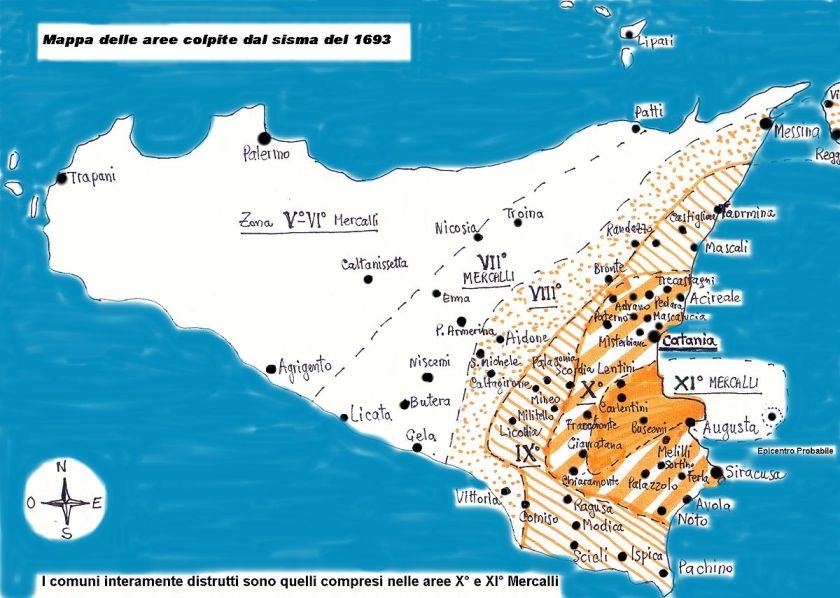
The main shock of January 11 lasted four minutes with an estimated magnitude of 7.4 and a very large area reaching X on the Mercali scale and XI, in the province of Syracuse.

1200px-sicilia_sisma_1693

The soil beneath our feet, ordinarily so substantial and unmoving, behaves like a liquid at times like these in a process called soil liquefaction. Low density, sandy soils compress in response to applied loads while dense soils expand in volume or dilate. Saturated soils are like unto quicksand, as underground liquids are driven up to form miniature volcanoes called “sand boils, water spouting up from the ground in geysers, rising 30-feet and more.

Reflect on that for a moment, if you will. The soil. Behaving like a liquid.

The catastrophic eruption of 1669 was well within living memory and reports describe minor eruptions on this day as well.  As if even a small volcanic eruption could be called “minor”.

Several large fractures opened in the earth, one 1,600-feet long and nearly seven-feet wide.

Meanwhile the ocean withdrew from the coast as the Ionian Sea gathered itself, to strike. The initial withdrawal left the harbor dry at Augusta, damaging several Galleys owned by the Knights of Malta.   The tsunami when it came was eight meters in height (26-feet), inundating an area nearly a mile inland from the coastline.

The final death toll of as many as 60,000 is uncertain, unsurprising in light of the fact that whole regions, were blotted out. 63% of the entire population was wiped out in Catania, 51% in Ragusa. Syracuse, Noto, Augusta, Modica – all lost between one-out-of-five, and one-in-three.

Reconstruction in the wake of the catastrophe was so extensive, as to spawn a new and unique form of art and architecture, known as Sicilian Baroque.

la_cattedrale_di_noto_restaurata
The Cathedral of Noto is one of the many buildings constructed in Sicilian Baroque style after the earthquake of 1693

Today, the colossal Mount Etna remains one of the most active volcanoes, on earth.  Sensors placed along the land and seaward flanks of the volcano reveal the alarming discovery that the volcano itself, is moving.  Mount Etna is sliding at a rate of an inch per year and sometimes more.  One eight-day period in 2008 showed a movement of two inches, raising concerns that Mount Etna may one day collapse into itself.

On May 18, 1980 Mount St. Helens erupted after a 5.1 magnitude earthquake, resulting in 57 deaths and inflation-adjusted property damage, of $3.3 Billion.  The US Geological Survey called the resulting collapse of the north face of the volcano “the largest debris avalanche on earth, in recorded history”.  Should such an event strike the Stratovolcano that is Mount Etna, the result would be felt from the Spanish coast to the shores of Israel, from North Africa to the French Riviera.

Given geologic time scales, such an event could happen tomorrow, next year, or ten thousand years from now.  No one knows.  We are so puny when compared with the Wrath of God, or of Nature, as you please.

castello_di_noto
Ruins of the Norman castle in Noto Antica

Featured image, top of page:  New life before the shattered ruins of the old city of Not (Noto Antica), destroyed on January 11, 1693.  The new city of Noto was built, eleven kilometers away

December 21, 2012 The Mayan Apocalypse

We are privileged to live in an age of great learning and wisdom. The internet brings us the sum total of human knowledge, with but a few keystrokes. Social media has right-sized the planet to a single community where we all discuss the Code of Hammurabi, the collected works of Shakespeare and the vicissitudes of interplanetary physics.

Naah. Just kidding. We live in as nonsensical an age as any other. One of the sillier bits of pop culture foolishness of the recent past, may be when the world came to an end. Eight years ago today. December 21, 2012.

It was the Mayan Apocalypse. A day of giant solar flares, when the planets aligned to cause massive tidal catastrophe and Earth collided with the imaginary planet Nibiru. Over in China, Lu Zhenghai even built himself an Ark. Sort of.

If only I’d been smart enough back then, to sell survival kits.

slide_266048_1809233_free
Lu Zhenghai’s ark, 2012. H/T Huffpo

End-of-the-world scenarios are nothing new. In 1806, the “Prophet Hen of Leeds” was laying eggs, inscribed with the message “Christ is coming”. It was the end of times. The Judgement Day cometh.

The story, as told in the book “Extraordinary Popular Delusions and the Madness of Crowds” written by Scottish author Charles Mackay in 1841, tells the story of a “panic[ked] terror”, when a “great number of visitors” traveled from far and near, to peer at the chicken Nostradamus.

befunky_21639

Turns out that Mary Bateman, the bird’s owner and a serial fraudster, was writing these messages with some kind of “corrosive ink”, maybe an acid, and reinserting them into the poor chicken. The “Yorkshire Witch” met her end on a gibbet, hanged for the poisoned pudding she gave that couple to relieve their chest pain, but I digress.

If you were around in 1986, you may remember the great excitement surrounding the return of Halley’s Comet. The celestial body comes around but once every 76 years and, the time before that, it was the end of the world. In 1910, the New York Times reported the discovery of the deadly poison cyanogen, in the comet’s tail. French astronomer Camille Flammarion predicted the gas would “would impregnate the atmosphere and possibly snuff out all life on the planet.”

fin du monde
French postcard, 1910

Hucksters sold comet pills. Doomsayers claimed that massive tides would cause the Pacific to empty, into the Atlantic. Finally, the end of days arrived. May 20, 1910. And then it went. There was no end of the world though, tragically, 16-year-old Amy Hopkins fell to her death from a rooftop, while awaiting the appearance, of the comet.

The world has seen no fewer than 207 End-of-the-World predictions over the last 2,000 years, if Wikipedia is to be believed. Polls conducted in 2012 across twenty nations revealed percentages from 6% in France to 22% in the United States and Turkey, believing the world would come to an end, in their lifetimes.

MayanCalendar-300x300

5,000 years ago, the Mayan civilization of modern-day Mexico and Central America developed a sophisticated calendar, working with a base numerical system of 20.

It was three calendars, really. The “Long Count” was mainly used for historical purposes, able to specify any date within a 2,880,000 day cycle. The Haab was a civil calendar, consisting of 18 months of 20 days, and an “Uayeb” of five days. The Tzolkin was the “divine” calendar, used mainly for ceremonial and religious purposes. Consisting of 20 periods of 13 days, the Tzolkin goes through a complete cycle every 260 days. The significance of this cycle is unknown, though it may be connected with the 263-day orbit of Venus. There is no year in the Haab or Tzolkin calendars, though the two can be combined to specify a particular day within a 52-year cycle.

MayanCalendar

Get it? No, neither do I. Suffice it to say that the world of the Mayan Gods lasted 5,125 years and 133 days, a period of time known as 13 b’ak’tun.

The last Long Count began in August 3114 BC.  Counting forward, scholars decided on December 21, 2012, as the end of the cycle.

Calamity. An estimated 2 percent of the American public believed the end of the world, was nigh. Online searches went up for one-way flights to Turkey and the South of France, both rumored to be safe havens from the apocalypse.

They should have asked a Mayan, who may have been amused by all these crazy Gringos. The world wasn’t coming to an end. The calendar just rolls over and begins again at “Zero”, like those old odometers that only went up to 100,000 miles.

What a party that could have been. The “New Year” to end all New Years. Only comes around once every 5,125 years, & 133 days.

Happy 14 b’ak’tun.

If you enjoyed this “Today in History”, please feel free to re-blog, “like” & share on social media, so that others may find and enjoy it as well. Please click the “follow” button on the right, to receive email updates on new articles. Thank you for your interest, in the history we all share.

December 12, 1985 Silent Witness

Perhaps those on board were thinking about Christmas. Enjoying time with friends and loved ones, after a long deployment. There is no way to know. 256 passengers and crew had only seconds to live.

On November 9, 1977, Egyptian President Anwar Sadat of Egypt announced that he would travel to Israel, to speak before the Knesset. The announcement was startling. Egypt and Israel had been in a state of war, since 1948.

On September 17, 1978, President Sadat met with Israeli Prime Minister Menachem Begin at the White House, to sign a pair of agreements. These were the Camp David accords, negotiated in secret over 12 days at the Presidential country retreat, in Maryland. A year later, the two signed the Egypt–Israel Peace Treaty, mediated by US President Jimmy Carter.

Prime Minister Begin and President Sadat would jointly receive the Nobel Prize for their groundbreaking efforts to achieve peace, between the two nations.

President Sadat was assassinated for his role in the negotiations, by members of the Egyptian Islamic Jihad.

According to the terms of the 1979 treaty, a Multinational Force and Observers (MFO) peacekeeping force was deployed to the vicinity of the Sinai peninsula where it remains, to this day.

The McDonnell Douglas DC-8 departed Cairo, Egypt at 20:35 Greenwich Mean Time on Wednesday, December 11, 1985. This was Arrow Air Flight 1285, an international charter flight returning with 248 military personnel, following a six-month deployment with the MFO.

The flight was the first of three legs, scheduled for refueling stops in Cologne and Gander International Airport, then on to a final destination at Fort Campbell, Kentucky, home of the “Screaming Eagles” of the United States Army 101st Airborne Division.

Passengers departed the aircraft while refueling in Newfoundland, as the flight engineer conducted his external inspection. Then came the new air crew of eight, after which passengers re-boarded the aircraft. Arrow Air Flight 1285 achieved flight velocity at 10:15 on December 12, 167 KIAS (“Knots-Indicated Air Speed”) and accelerating.

Perhaps those on board were thinking about Christmas. Enjoying time with friends and loved ones, after a long deployment. There is no way to know. 256 passengers and crew had only seconds to live.

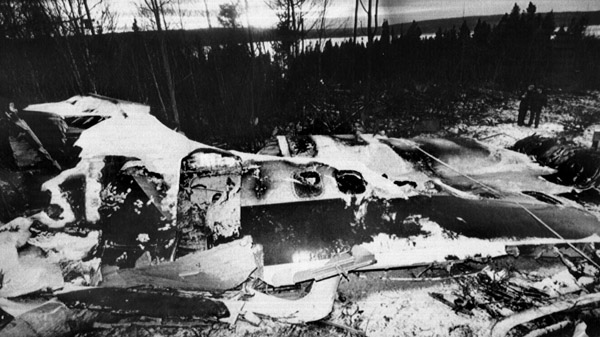
Airspeed reached 172 KIAS and then began to drop, the aircraft crossing the Trans-Canada Highway some 900-feet from the runway and beginning to descend. Witnesses on the highway below reported seeing a bright light, emanating from inside of the aircraft. Seconds later, flight 1285 crashed some 3,500-feet from departure, breaking apart and striking an unoccupied building near Gander lake, before bursting into flames.

Of 248 servicemen, all but twelve were members of 101st Airborne Division (Air Assault), mostly from the 3d Battalion, 502nd Infantry.  Eleven others were from other Force Command units.  One was an agent with the Criminal Investigations Command (CID).  It was the deadliest air accident to occur on Canadian soil and the United States Army’s single deadliest air crash, in peacetime.  There were no survivors.

Hours later, an anonymous caller phoned a French news agency in Beirut, claiming responsibility on behalf of Islamic Jihad, a wing of Ḥizbu ‘llāh, a Shi’a Islamist political party and militant group based in Lebanon.

Canadian and Pentagon government authorities dismissed the claim.

The nine-member Canadian Aviation Safety Board (CASB) investigated the crash and issued a report, over the signature of five members:

“The Canadian Aviation Safety Board was unable to determine the exact sequence of events which led to this accident. The Board believes, however, that the weight of evidence supports the conclusion that, shortly after lift-off, the aircraft experienced an increase in drag and reduction in lift which resulted in a stall at low altitude from which recovery was not possible. The most probable cause of the stall was determined to be ice contamination on the leading edge and upper surface of the wing. Other possible factors such as a loss of thrust from the number four engine and inappropriate take-off reference speeds may have compounded the effects of the contamination”.

A five-to-four decision.

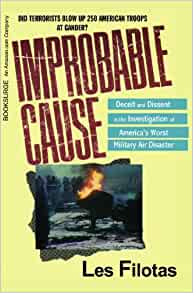
The CASB minority reported that the accident could have been caused by an onboard explosion of unknown origin prior to impact. Autopsies revealed that some soldiers had inhaled smoke before death, a finding hardly consistent with ice on the wings. Minority member Les Filotas testified before a US Congressional committee, that it was impossible for a thin layer of ice to bring down the aircraft.

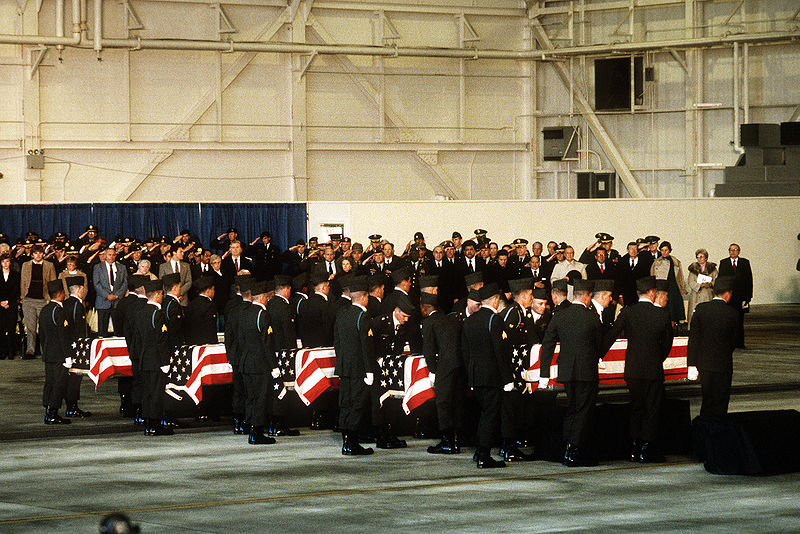
Memorial_service_for_Arrow_Air_Flight_1285
Memorial service at Dover AFB, December 6, 1985

There were changes in de-icing procedures, but little confidence in the CASB’s official report.  The Canadian government disbanded the board five years later, replacing it with an independent, multi-modal investigative agency – the Transportation Safety Board of Canada.

The cause of the crash of Arrow Air flight 1285 remains officially, uncertain. Filotas went on to write a book if you’re interested in learning more.

“…Les Filotas, one of the minority who disputed the ice theory, gives a fully-documented insider’s account of the infamous investigation – and of the collapse of a long historical struggle to rid the investigation of aviation accidents of bureaucratic and political entanglements.” – book review, Amazon.com

A memorial was erected at the crash site overlooking Gander Lake, a “Silent Witness”, designed by Kentucky artist, Steve Shields.  That’s it, at the top of this page.

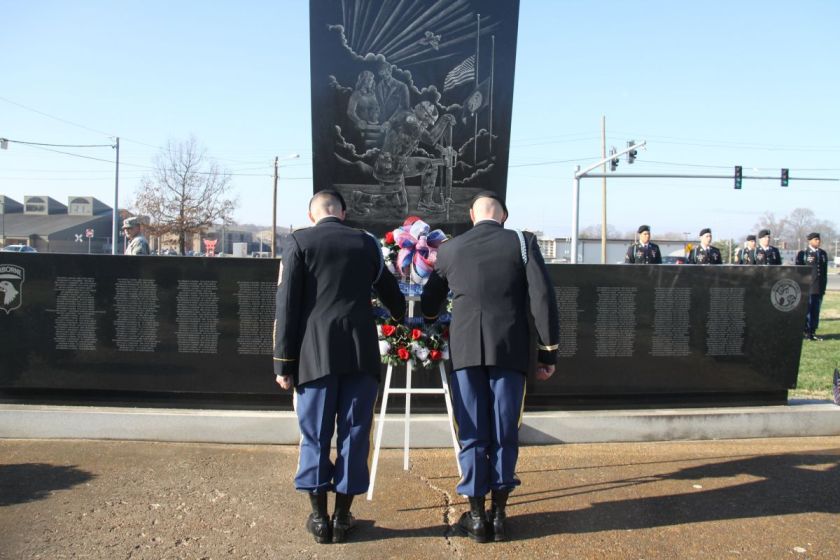
A stone memorial was erected at Fort Campbell, the Gander Memorial bearing the names of the 248, slain.  The scar in the earth is easily seen from the ground as well as from satellite and remains, to this day.

Gander-Memorial-5

Feature image, top of page:  “Silent Witness” by Kentucky artist Steve Shields. Arrow Air Flight 1285 memorial at Gander Lake, with a DC-8 taking off in the background. H/T wikipedia

Afterward

Canadian teenager Janice Johnson wanted to find a way to honor the fallen from flight 1285. “I wanted these Families to know that we as Canadians cared.

Johnson (now Nikkel) came up with $20 earned from babysitting, and a letter to the Toronto Star.  Nikkel’s letter sparked an international campaign, resulting in 256 Canadian sugar maple trees in 1986, a living memorial to the fallen soldiers and crew, of flight 1285.

“Janice Johnston Nikkel attended the first Gander memorial dedication when she was only 15 and returned for the new dedication at Fort Campbell on Thursday, Dec. 12, 2019”. Hat tip, the Leaf Chronicle

What most any Canadian could have told you. Kentucky had to learn the hard way. 20-f00t spacing isn’t enough room, for a grove of sugar maples.

Thirty-two years later, the Gander Memorial grove became crowded and overgrown, most of the trees, no longer viable. The old memorial closed in 2018, to be replaced a year later. Eight of the original trees were transplanted to a better, more visible site and a fresh batch of Canadian sugar maples, added in.

Local woodworkers transformed those original trees into pens, bowls and vases, to be presented to family members of Task Force 3-502nd at dedication ceremonies for the new memorial grove on December 12, 2019.

The old grove is empty now but across the street, 40-foot intervals ensure that 256 Canadian Maples live on in silent witness. A living memorial to the most deadly air disaster on Canadian soil. The largest single-incident loss of life in the storied history, of the 10st Airborne.

December 10, 1917 A Gift of Gratitude

So it is that, every year, the people of Nova Scotia send the official Christmas tree to the city of Boston. A gift of gratitude, between two peoples.

A few days short ago, a Christmas tree was erected on Boston Commons. Symbolizing as it does the friendship between the people of two nations, this is no ordinary tree. This tree stands in solemn remembrance of catastrophe, and the bonds between two peoples.

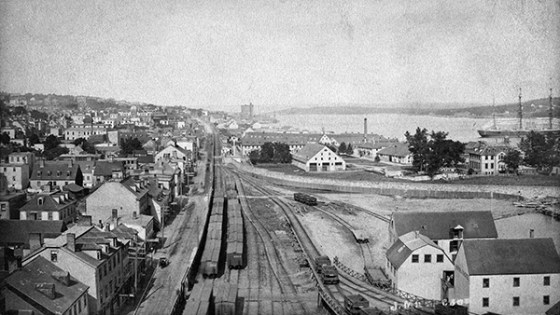
As “The Great War” dragged to the end of the third year in Europe, Halifax harbor in Nova Scotia was the bustling scene of supply, munition, and troop ships destined for “over there”.  With a population of 50,000 at the time, Halifax was the busiest port in Atlantic Canada.

Nova Scotia, ca 1900

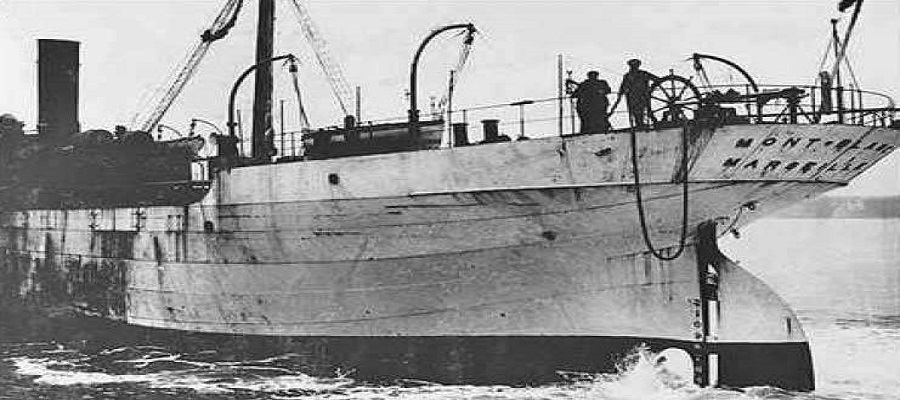
The Norwegian vessel Imo left her mooring in Halifax harbor on December 6, 1917, destined for New York City.   The French ship Mont Blanc was entering the harbor at this time, intending to join the convoy which would form her North Atlantic escort.

In her holds, Mont Blanc carried 200 tons of Trinitrotoluene (TNT), and 2,300 tons of TNP – Trinitrophenol or “Picric Acid”, a substance used as a high explosive.  In addition, the freighter carried 35 tons of high octane gasoline and 20,000 lbs of gun cotton.

Not wanting to draw the attention of pro-German saboteurs, the freighter flew no flags warning of her dangerous cargo.  Mont Blanc was a floating bomb.

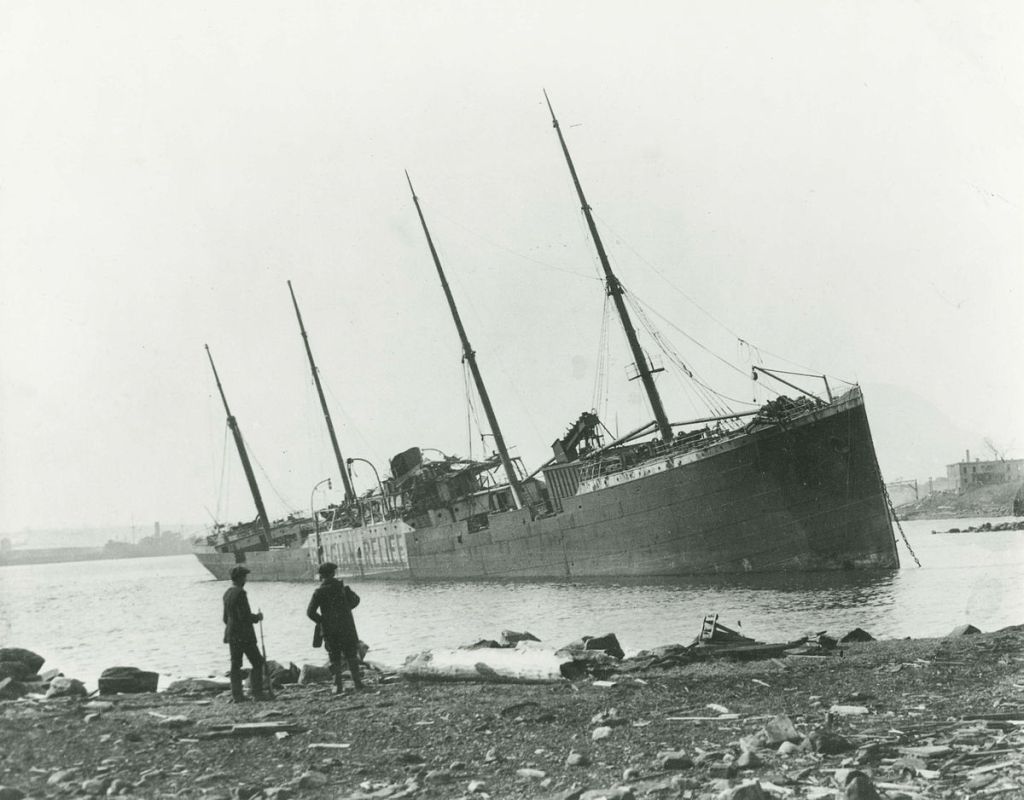
Somehow, signals became crossed as the two ships passed, colliding in the narrows at the harbor entrance and igniting TNP onboard Mont Blanc.  French sailors abandoned ship as fast as they could, warning everyone who would listen of what was about to happen.

SS Imo

As might be expected, the pyrotechnic spectacle put on by the flaming ship was too much to resist, and crowds gathered around the harbor.  The high-pitched scream emitted by picric acid under combustion is a principal feature of fireworks displays, to this day.  You can only imagine the scene as the burning freighter brushed the harbor pier setting that ablaze as well, before running herself aground.

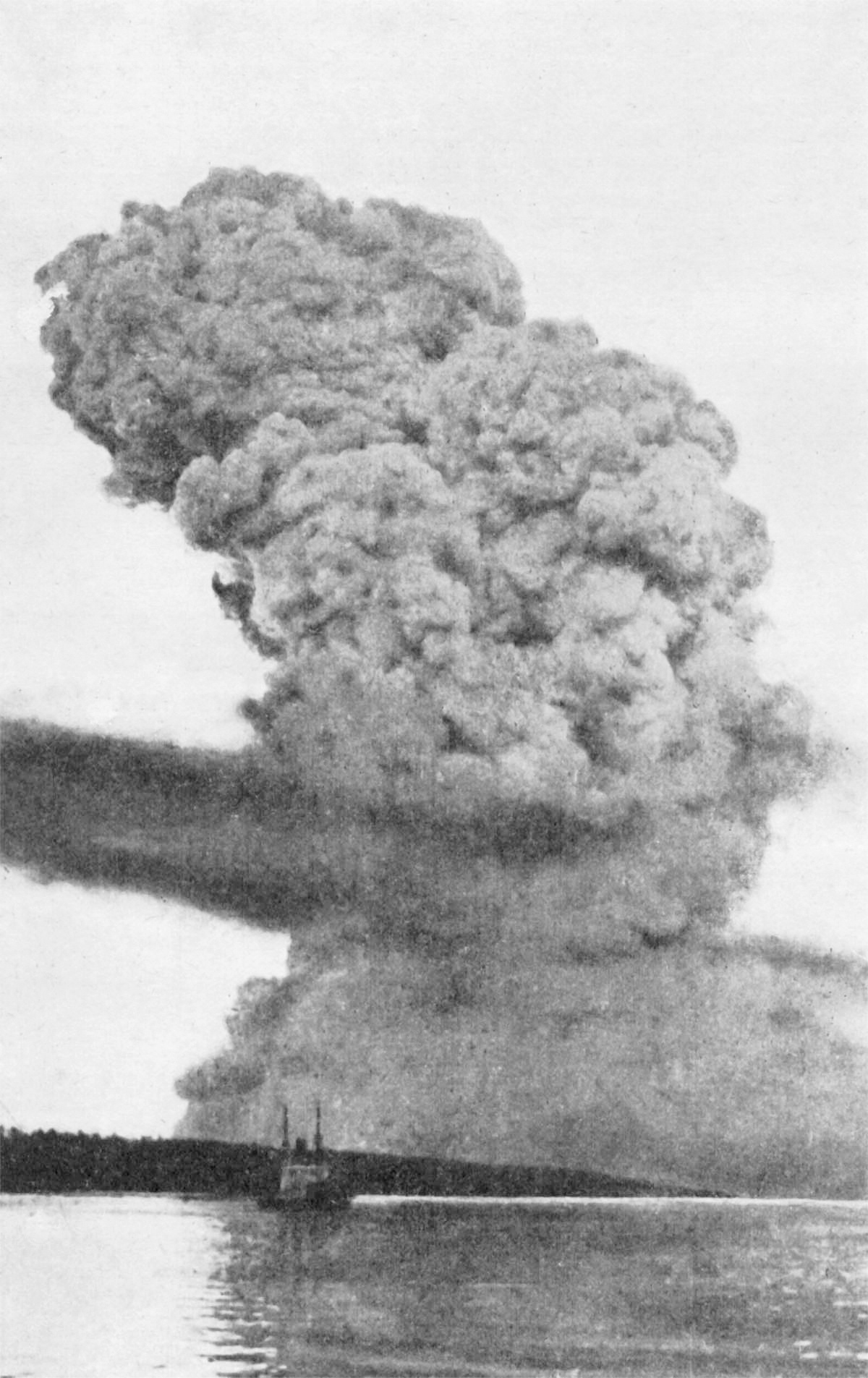
That’s when Mont Blanc exploded.

Halifax explosion, 2

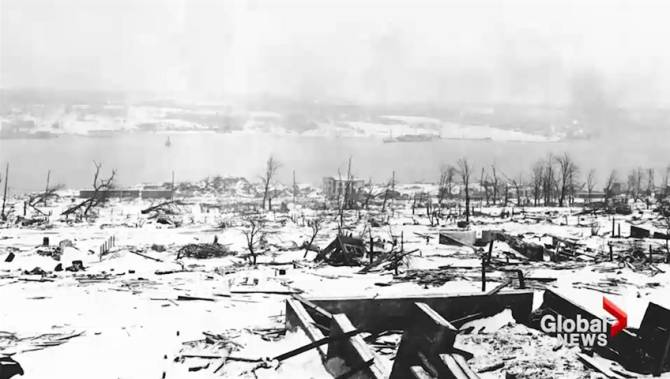
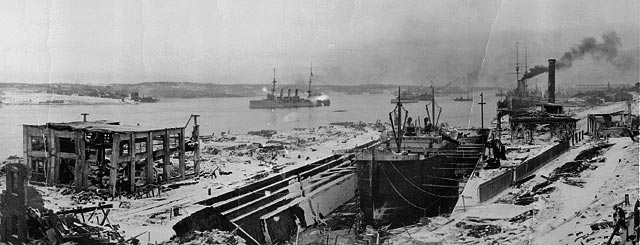
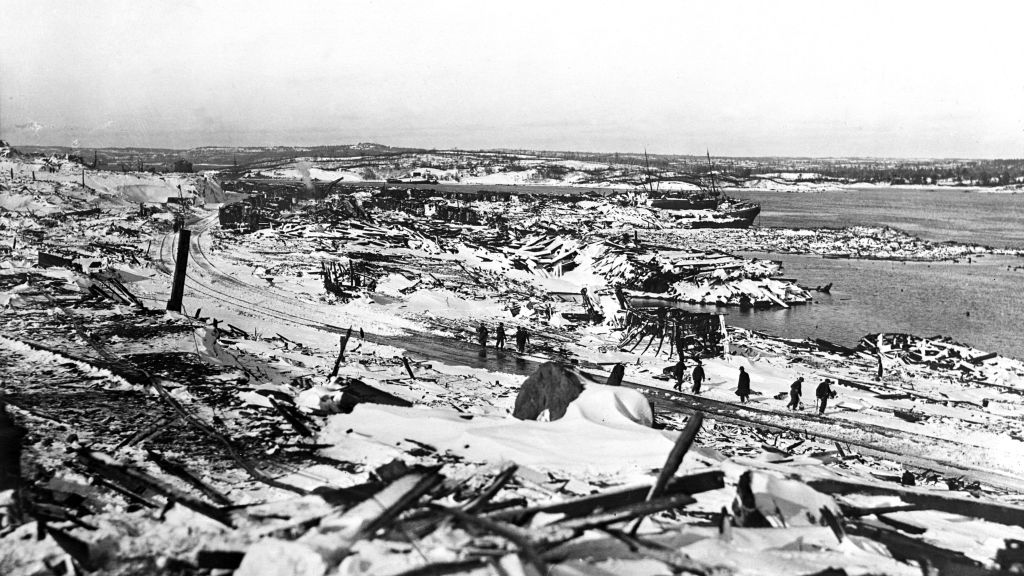
The detonation and resulting fires killed over 1,800 and wounded another 9,000, flattening the north end of Halifax and shattering windows as far as 50 miles away.

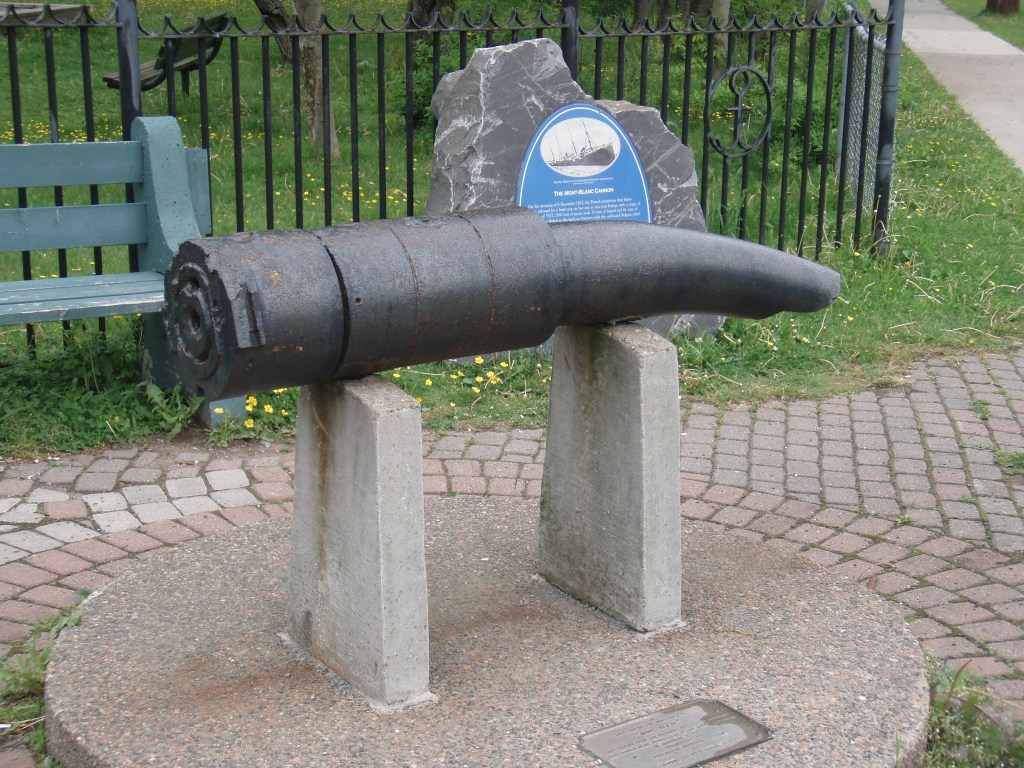
The ferocity of the blast literally tore Mont Blanc’s cannon from its mount and bent the barrel.

Mont Blanc’s Cannon

It was one of the largest man made, non-nuclear explosions in history. Mont Blanc’s anchor landed two miles away, one of her gun barrels, three.  Later analysis estimated the output at 2.9 kilotons, an explosive force greater than some tactical nuclear weapons.

Halifax explosion, 3

The first ray of light on the morning of December 7 revealed an apocalyptic scene of devastation, some 1,600 homes destroyed in the blast as a blizzard descended over Nova Scotia.

Boston Mayor James Michael Curley wrote to the US Representative in Halifax “The city of Boston has stood first in every movement of similar character since 1822, and will not be found wanting in this instance. I am, awaiting Your Honor’s kind instruction.”

Halifax explosion, 1

The man was as good as his word.  Mayor Curley and Massachusetts’ Governor Samuel McCall composed a Halifax relief Committee to raise funds and organize aid.  McCall reported that the effort raised $100,000 in its first hour, alone.

President Woodrow Wilson authorized a $30,000 carload of Army blankets sent to Halifax, a sum equivalent to some $665,000 today.

Within 12 hours of the explosion, the Boston Globe reported on the first train leaving North Station with “30 of Boston’s leading physicians and surgeons, 70 nurses, a completely equipped 500-bed base hospital unit and a vast amount of hospital supplies”.

Delayed by deep snow drifts, the train arrived on the morning of December 8, the first non-Canadian relief train to arrive on the scene.

Halifax Herald

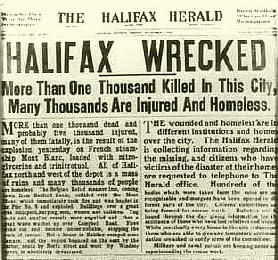
There was strong sentiment at the time, that German sabotage lay behind the disaster.  A front-page headline on the December 10 Halifax Herald Newspaper proclaimed “Practically All the Germans in Halifax Are to Be Arrested”.

$750,000 in relief aid would arrive from Massachusetts alone, equivalent to more than $15 million today.  Canadian Prime Minister Robert Borden would write to Governor McCall on December 9, “On behalf of the Government of Canada, I desire to convey to Your Excellency our very sincere and warm thanks for your sympathy and aid in the appalling calamity which has befallen Halifax”.

The following year, Nova Scotia sent the city of Boston a gift of gratitude.  An enormous Christmas tree.

In 1971, the Lunenburg County Christmas Tree Producers Association sent another tree to Boston, to promote Christmas tree exports and to once again acknowledge the support of the people and government of Boston after the 1917 disaster. The Nova Scotia government later took over the annual gift of the Christmas tree, to promote trade and tourism.

So it is that, every year, the people of Nova Scotia send the official Christmas tree to the city of Boston.  A gift of gratitude, between two peoples. More recently, the principle tree is joined by two smaller trees, donated to Rosie’s Place and the Pine Street Inn, two Boston homeless shelters.

This is no Charlie Brown shrub we’re talking about. The 1998 tree required 3,200 man-hours to decorate:  17,000 lights connected by 4½ miles of wire, and decorated with 8,000 bulbs.

In 2013, the tree was accompanied by a group of runners, in recognition of the Boston Marathon bombing earlier that year.

A monument was unveiled on Boston Commons on November 30, 2017, commemorating the 100th anniversary of the Halifax explosion.  The official 2017 Christmas tree lit up for the first time, that night.

2020 tree

This year’s tree stands 48-feet tall tall, marking 100 years since the Halifax explosion. It takes two men a day and a half to prepare for cutting, a crane holding the tree upright while the chainsaw does its work.  It’s a major media event, as the tree is paraded through Halifax on a 53’ flatbed, before boarding the ferry across the Bay of Fundy to begin its 750-mile journey south.

The trip was a little different this year as the border remains closed, due to COVID restrictions. The 2020 tree arrived by ship in Portland Maine to continue the journey south, by road.

For a small Canadian province, the annual gift is no small commitment.  In 2015 Nova Scotia spent $242,000 on the program, including transportation cutting & lighting ceremonies, and the promotions that went with it.

The 2020 tree lighting ceremony on December 3 was, like so many things in this year of years, virtual. There were televised remarks from Mayor Marty Walsh and Karen Casey, Deputy Premier of Nova Scotia, accompanied by Santa Claus and a squadron of Royal Canadian Mounted Police. The switch was thrown and and a live audience of…nobody…enjoyed the ceremonial lighting of the tree.

Thank you, Xi Jinping. You have brought so much warmth into our lives.

BOSTON, MA – DECEMBER 5: Fireworks explode around the Christmas tree on Boston Common at the conclusion of the festivities at the 78th annual tree lighting at the Boston Common on Dec. 5, 2019. (Photo by Jim Davis/The Boston Globe via Getty Images)

In 2016, Premier Stephen McNeil explained the program and why it was worth the expense:  “(It) gives us a chance to showcase our beautiful part of the world to a global community”.   Premier McNeil may have had the last word the following year, on the centennial anniversary of the Halifax catastrophe. “We had massive deaths and injuries”, he said. “It would have been far worse if the people of Boston hadn’t come and supported us.”