December 27, 1865 Confederados

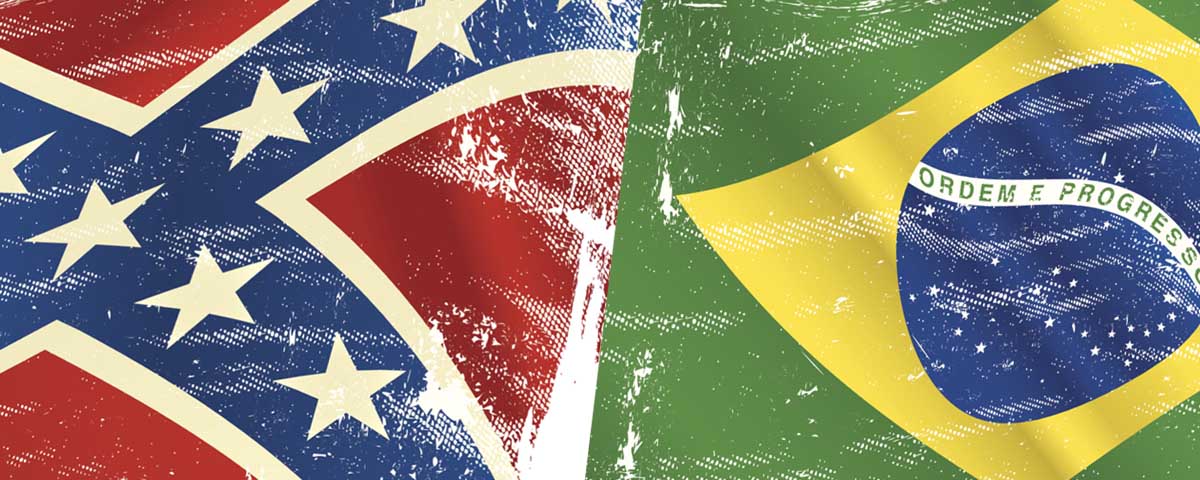
The numbers are hazy, but port records indicate that somewhere between ten and twenty thousand former Confederates moved to Brazil in the twenty years following the Civil War. A great uncle of former First Lady Rosalynn Carter, was one.

Most of us grew up learning that 600,000+ Americans were killed in the Civil War.  618,222 to be precise, more than the combined totals of every conflict in which the United States has been involved, from the Revolution to the War on Terror.  Recently, sophisticated data analysis techniques have been applied to newly digitized 19th century census figures, indicating that even that figure may be understated.

The actual number may lie somewhere between 650,000 and 850,000.
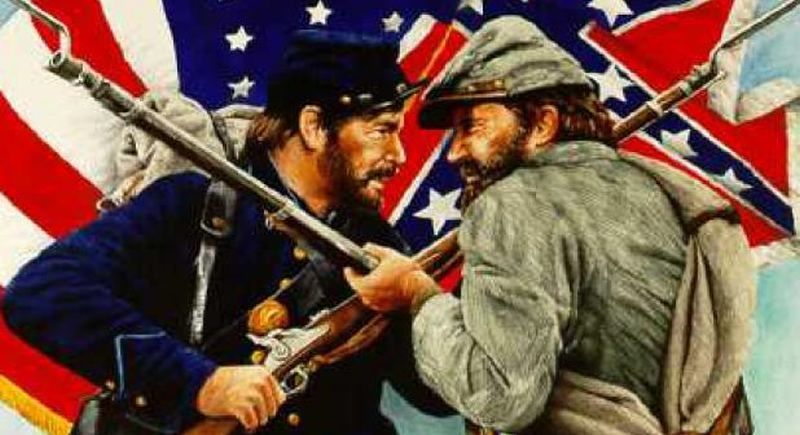
VIR_362561_27117_cuanto_sabes_sobre_los_estados_confederados_de_america

The cataclysm of the Civil War would leave in its wake animosities which would take generations to heal.  “Reconstruction” would be 12 years in the making, but some never did reconcile themselves to the war’s outcome. Vicksburg, Mississippi, which fell after a long siege on July 4, 1863, would not celebrate another Independence Day for 70 years.

In 1865, Emperor Dom Pedro II of Brazil wanted to encourage domestic cultivation of cotton.  Men like Jefferson Davis and Robert E. Lee advised southerners against emigration, but the Brazilian Emperor offered transportation subsidies, cheap land and tax breaks to those who would move.
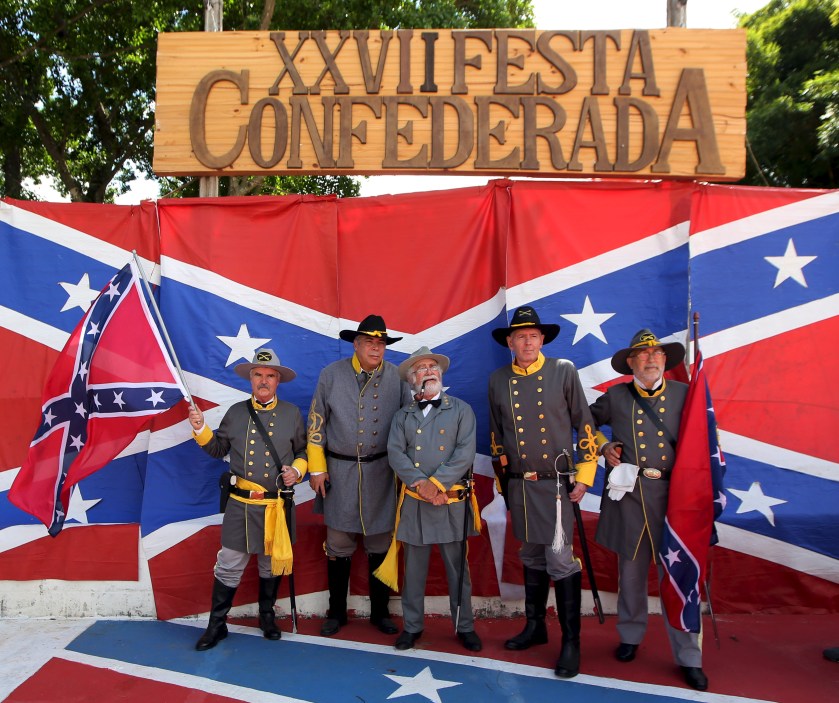
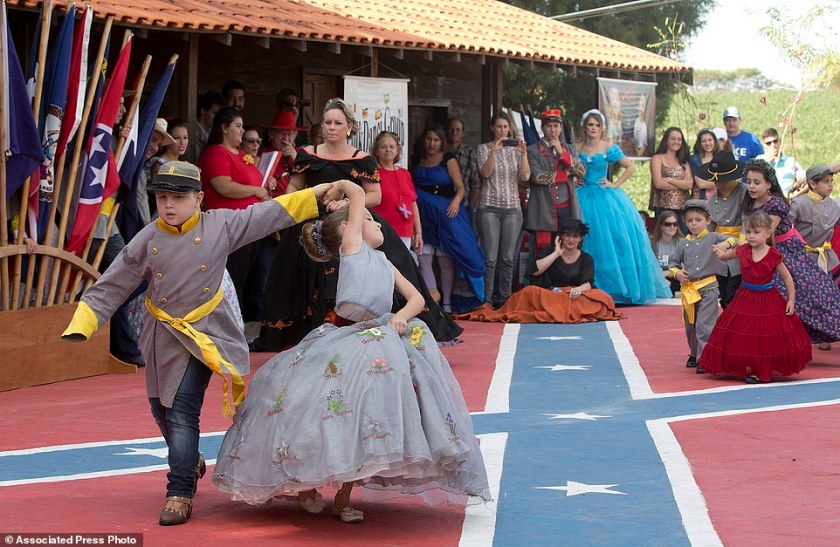
Descendants of American Southerners wearing Confederate-era uniforms pose for a photograph during a party to celebrate the 150th anniversary of the end of the American Civil War in Santa Barbara D'Oeste, Brazil
Descendants of American Southerners wearing Confederate-era uniforms pose for a photograph during a party to celebrate the 150th anniversary of the end of the American Civil War in Santa Barbara D’Oeste, Brazil,

Colonel William Hutchinson Norris, veteran of the Mexican American War and former member of the Alabama House of Representatives and later State Senator, was the first to make the move.  Together with his son Robert and 30 families of the former Confederacy, Norris arrived in Rio de Janeiro on December 27, 1865, aboard the ship “South America”.

The numbers are hazy, but port records indicate that somewhere between ten and twenty thousand former Confederates moved to Brazil in the twenty years following the Civil War.  A great uncle of former First Lady Rosalynn Carter, was one.
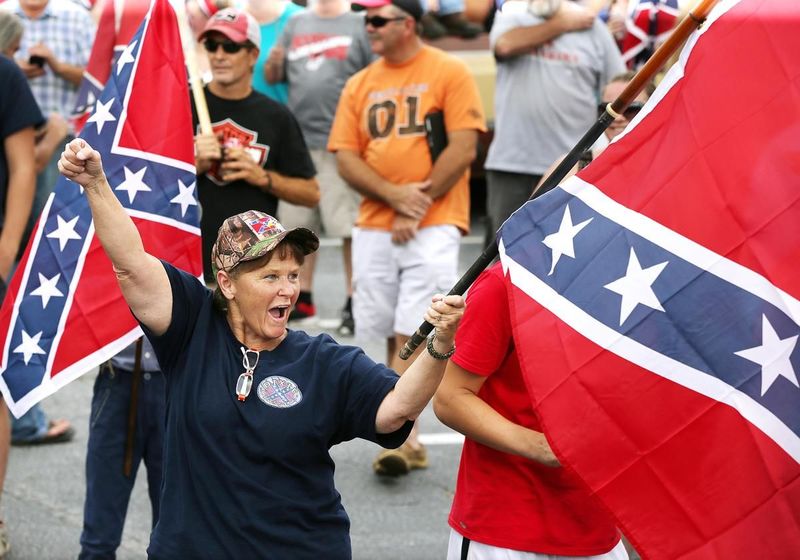
Confederate flag rally at Stone Mountain Park

Some of these “Confederados” settled in the urban areas of São Paulo, most made their homes in the northern Amazon region around present-day Santa Bárbara d’Oeste and a place the locals called “Vila dos Americanos”, and the inhabitants called “Americana”.  Some would return to the newly re-united states.  Most would never return, and their ancestors, Portuguese speaking Brazilians all, remain there to this day.

Confederados earned a reputation for honesty and hard work, and Dom Pedro’s program was judged a success by immigrant and government alike.  The settlers brought modern cultivation techniques and new food crops, all of which were quickly adopted by native Brazilian farmers.

Small wonder.  Mark Twain once wrote “The true Southern watermelon is a boon apart, and not to be mentioned with common things. It is chief of this world’s luxuries, king by the grace of God over all the fruits of the earth. When one has tasted it, he knows what the angels eat. It was not a Southern watermelon that Eve took; we know it because she repented”.

That first generation kept to itself for the most part, building themselves Baptist churches and town squares, while traditional southern dishes like barbecue, buttermilk biscuits, vinegar pie and southern fried chicken did their own sort of culinary diplomacy with native populations.

Slavery remained legal in Brazil until 1888, but this nation of 51% African or mixed-race ancestry (according to the 2010 census), seems more interested in understanding and celebrating their past, than tearing their culture apart over it.

Today, descendants of those original Confederados preserve their cultural heritage through the Associação Descendência Americana (American Descendants Association), with an annual festival called the Festa Confederada.  There you’ll find hoop skirts and uniforms in gray and butternut, along with the food, the music and the dances of the antebellum South.

There you will find the Confederate battle flag, as well.  It seems that Brazilians have thus far resisted that peculiar urge which afflicts Isis and the American Left, to destroy the symbols of their own history.
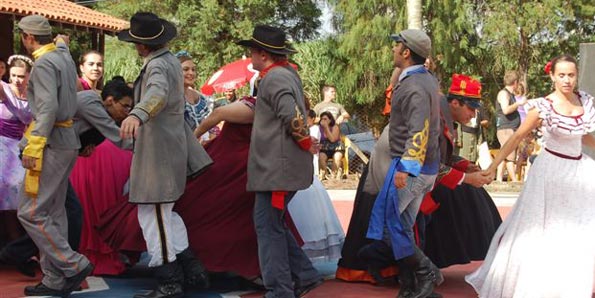
descendentes-confederados-guerra-civil-eua

In 2016, the New York Times reported on the May celebration of the Festa Confederada, of Santa Bárbara d’Oeste:

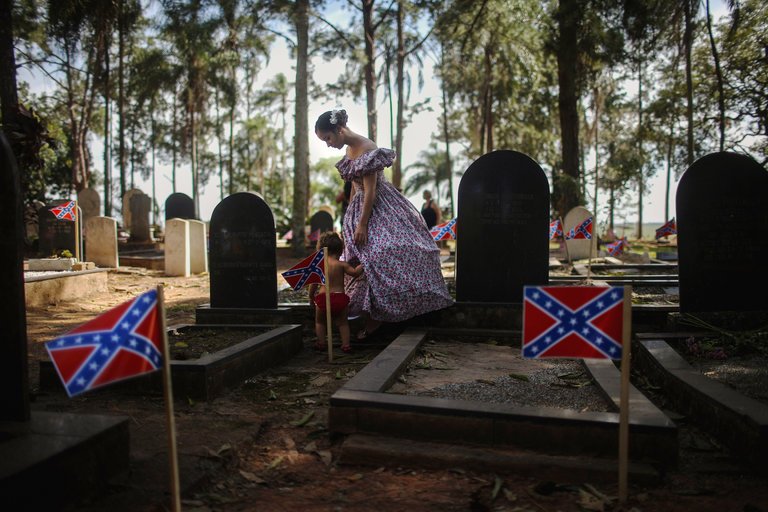
‘“This is a joyful event,” said Carlos Copriva, 52, a security guard who described his ancestry as a mix of Hungarian and Italian. He was wearing a Confederate kepi cap that he had bought online as he and his wife, Raquel Copriva, who is Afro-Brazilian, strolled through the bougainvillea-shaded cemetery.  Smiling at her husband, Ms. Copriva, 43, who works as a maid, gazed at the graves around them. “We know there was slavery in both the United States and Brazil, but look at us now, white and black, together in this place,” she said while pointing to the tombstones. “Maybe we’re the future and they’re the past.”’
Brazil Confederates

09BRAZIL-master768-v3 (1)
“A woman in a traditional hoop skirt walked past graves adorned with Confederate battle flags in Santa Bárbara d’Oeste, Brazil. An annual celebration of the area’s many Confederate settlers was held in the cemetery last month”. Hat tip to Mario Tama/Getty Images, New York times, for this image

December 21, 1861 Medal of Honor

Medals of Honor are not awarded casually, reserved only for the bravest of the brave, and for well-documented acts of valor. Permit me to share a few examples, each from his own moment in history.

As Revolution-era General, George Washington once wrote that the “road to glory in a patriot army and a free country is…open to all”.   European armies of the time bestowed honors, only on high-ranking officers who had achieved victory in battle. There was no such honor for the common soldier.

There was precedent for such an award in the Colonial military, but only under limited circumstances.  Congressional medals were awarded to Washington himself on March 25, 1776, following the British evacuation of Boston, to General Horatio Gates in November 1777, in recognition of his victory over British General John Burgoyne at Saratoga, and to Major-General “Light-Horse Harry” Lee, father of Civil War-era Confederate general Robert E. Lee, in recognition of his 1779 attack on the British position at Paulus Hook, New Jersey.

purpleheartA “Fidelity Medallion” was awarded to three militia men in 1780, for the capture of John André, the British officer and spy whose capture uncovered the treachery of General Benedict Arnold.
The future 1st President’s general orders of August 7, 1782 established a “Badge of Military Merit” to recognize those members of the Continental Army who performed “any singular meritorious action”.

In time, Washington’s Badge of Military Merit morphed into what we now know as the Purple Heart, but the precedent had been set.  This was the first such honor available to any U.S. military service member, who had distinguished himself by act of valor.

Congress created the “Meritorious Service Citation Certificate” around the time of the Mexican-American war, a recognition of “any private soldier who had distinguished himself by gallantry performed in the presence of the enemy”.  The award would come in and out of use in the decades that followed, later becoming the Distinguished Service Medal, an award available to United States and foreign military service personnel and, in limited circumstances, civilians.

In the early days of the Civil War, General-in-chief of the army Winfield Scott was against such an award.  Secretary of the Navy Gideon Welles adopted the idea on behalf of the Navy, following Scott’s retirement in October 1861.  President Abraham Lincoln signed “Public Resolution #82” on December 21, 1861, creating a Navy medal of honor.

DoV1-018_-_Mitchel_RaidAn Army version of the medal was created the following July, first awarded to six Union soldiers for hijacking the Confederate locomotive, “The General”.  Leader of the raid James Andrews was caught and hanged as a Union spy.  He alone was judged ineligible for the medal of honor, as he was a civilian.
Medals of Honor are not awarded casually, reserved only for the bravest of the brave, and for well-documented acts of valor. Permit me to share a few examples, each from his own moment in history.

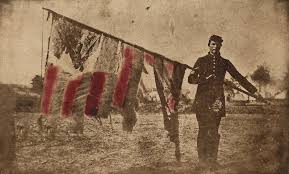
downloadFew soldiers on the Civil War battlefield had a quicker route to death’s door, than the color bearer.  National and regimental flags were all-important sources of inspiration and communication.
Reverend W. Jamison Thomson of Hartford, CT described the importance of the battle flag: “It represents the cause, is the rallying point, while it is aloft proclaims that victory is still intended, is the center of all eyes, is the means of communication between soldiers, officers, and nation,” he said, “and after the engagement, and after many of them, is their marked memento so long as its identity can be preserved.”

Pvt. Joseph E. Brandle served as regimental color bearer, with the 17th Michigan Infantry.  Private Brandle earned the MOH for his actions of November 16, 1863, near Lenoire, Tennessee…”…[H]aving been twice wounded and the sight of one eye destroyed, [he] still held to the colors until ordered to the rear by his regimental commander.”

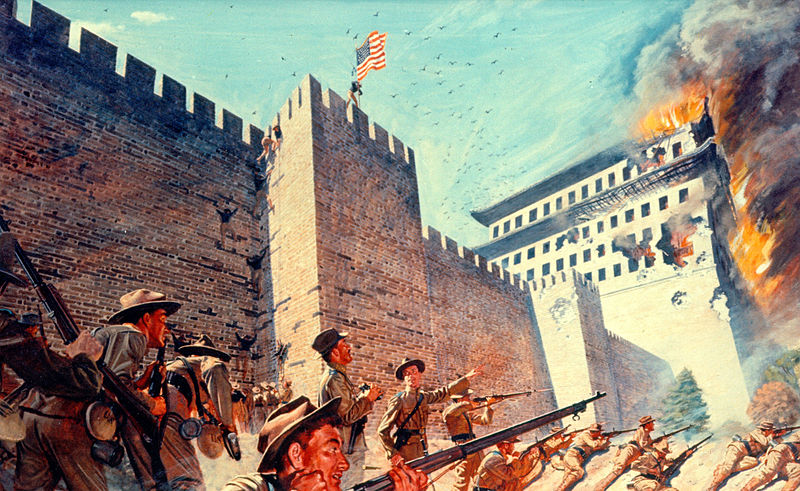
During the Boxer Rebellion of 1900, Chaplain’s assistant and regimental musician Calvin Pearl Titus of Vinton, Iowa, volunteered to scale the 30-ft walls of Peking, raising the American flag over the outer walls of the city.  President Theodore Roosevelt awarded Titus the medal of Honor, for “Gallant and daring conduct in the presence of his colonel and other officers…”  He was “the last color bearer”.

800px-Siege_of_Peking,_Boxer_Rebellion

york
Sergeant York

On October 8, 1918, Tennessee native Cpl. Alvin Cullum York of the 82nd Division lead a group of seventeen against a numerically superior German force, dug in at Chatel-Chehery, France.

Let his citation tell the story: “…After his platoon had suffered heavy casualties and three other non-commissioned officers had become casualties, Cpl. York assumed command. Fearlessly leading seven men, he charged with great daring toward a machine gun nest, which was pouring deadly and incessant fire upon his platoon. In this heroic feat the machine gun nest was taken, together with four officers and 128 men and several guns.”

Audie_Murphy
Audie Murphy

Kingston Texas 2nd Lieutenant Audie Murphy found himself senior officer of a company of 18, whittled down from 235 by disease, wounds and casualties.  On January 26, 1945, Murphy’s small force found itself under assault by six German tanks and a large infantry force.

A man the Marine Corps had once turned down for being too small, Murphy climbed aboard a burning tank destroyer.  Out in the open and exposed to German fire from three sides, the 19-year old single-handedly fought off the entire assault, killing or wounding fifty and causing the German tanks to withdraw.

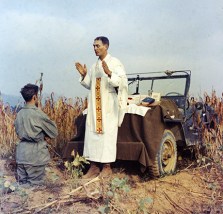
The Medal at LastFather Emil Kapaun selflessly sacrificed himself on behalf of his fellow prisoners in 1951, in the frozen hell of a North Korean prison camp.  President Barack Obama awarded Kapaun’s family the Medal of Honor during a ceremony in the east wing of the White House, on April 11, 2013.

Chaplain Kapaun’s body lies in an unmarked mass grave, somewhere in Pyoktong county.

2827
Sammy Lee Davis

PFC Sammy Lee Davis distinguished himself during the small hours of November 18, 1967, when the 4th Artillery of 9th Infantry Division came under heavy attack west of Cai Lay, Republic of Vietnam.

Repeatedly knocked to the ground by enemy mortar fire and suffering multiple injuries, the Cannoneer from Dayton, Ohio fought back first with a heavily damaged, burning howitzer, and then with recoilless rifle and machine gun.

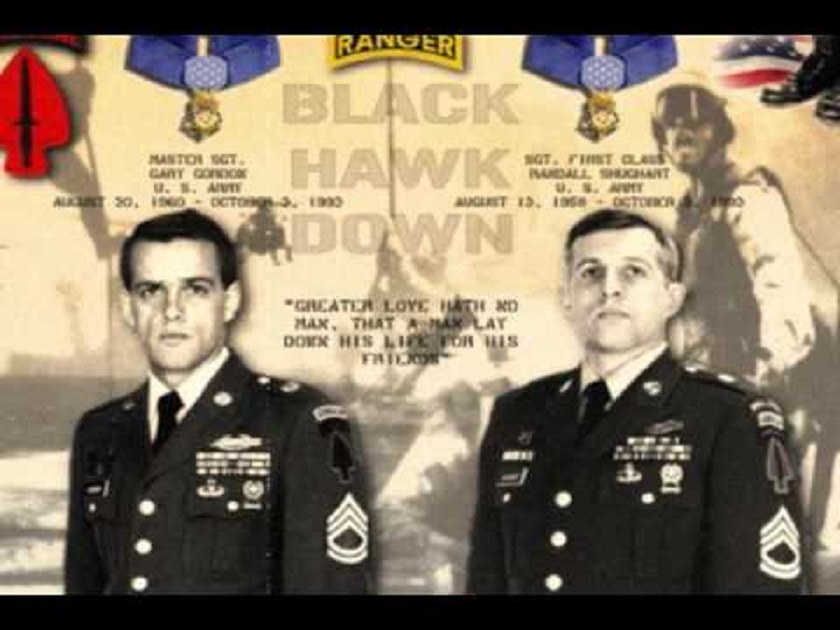
Two Medals of honor were awarded posthumously, to Delta Force snipers Gary Gordon and Randy Shugart, for their hopeless defense of the crash site of a downed UH-60 Blackhawk helicopter, against hundreds of fighters loyal to the Somali warlord Mohamed Farrah Aidid.

gary-gordon-and-randy-shughart-delta-force

0422C5
Corporal Jason Lee Dunham

Corporal Jason Lee Dunham of Scio New York deliberately threw himself on an Iraqi grenade on April 14, 2004, saving the lives of fellow Marines at the sacrifice of his own life.  He was twenty-two.

monti_image
Sergeant Jared Monti

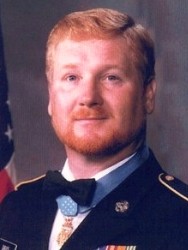
Sergeant 1st class Jared Monti of Abington Massachusetts was killed in the mountains of Nuristan Province in Afghanistan, while attempting to rescue a wounded soldier from a hail of small arms and rocket-propelled grenade fire.

Monti was the sixth person from the wars in Iraq and Afghanistan, to be awarded the Medal of Honor.  The Lee Brice song “I Drive your Truck“, voted Song of the Year at the 49th annual Academy of Country Music Awards, is his story.

The nation’s highest medal for military valor has been awarded 3,517 times since its inception in 1861, to 3,498 distinct recipients.  621 were awarded posthumously.  Possibly without exception, these are people who will tell you that they are not heroes.  They were doing a job and those left behind, are the real heroes.

If that is not the very definition of true heroism, it should be.

December 14, 1862  Angel of Marye’s Heights

No one will ever know how many lives were saved by his courage, and his kindness, this day in 1862. 

One of the bloodiest battles of the Civil War began on December 11, 1862, when nearly 200,000 combatants collided in the town of Fredericksburg, Virginia.

rappa5The Union crossing of the Rappahannock was intended to be a surprise, depending on pontoons coming down from Washington to meet up with General Ambrose Burnside’s Union army in Falmouth, across the river from Fredericksburg.
The army of the Potomac arrived on November 19, with no sign of pontoons.  When they finally arrived, heavy snows slowed military operations for an additional week.  Lt. General James Longstreet and Lt. General Thomas Jonathan “Stonewall” Jackson had more than enough time to prepare defenses.

Burnside’s crossing began on the morning of December 11, as engineer battalions constructed bridges in the face of determined Confederate fire. Several groups of soldiers had to row across the river, the battle then moving through the streets and buildings of Fredericksburg as Union and Confederate troops fought the first urban combat of the Civil War.

On the morning of the 13th, Robert E. Lee’s Confederate forces occupied a seven-mile-long curving line, with the five divisions of Longstreet’s Corps on the left along Marye’s Heights, west of town.  Fighting began on both ends of the Confederate position, more or less simultaneously.  George Meade had some early successes against Stonewall Jackson’s dug-in positions on the right, but requested reinforcements never arrived.  By the end of the day, the old farmer’s expression “slaughter pen”, had taken on a whole new meaning.

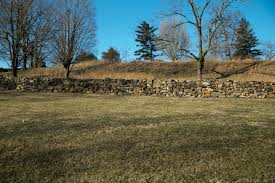
Marye's HeightsIn contrast to the swampy approaches on the Confederate right, 5,000 soldiers under James Longstreet looked out from behind the stone wall on Marye’s Heights to an open plain, crossed from left to right by a mill run, 5′ deep, 15′ wide and filled with 3′ of freezing water.
Confederate artillery commander Edward Porter Alexander looked out on that field, and said “a chicken could not live on that field when we open on it”.  Alexander was right.  For six hours, the Union army threw one attack after another against the rebels behind the wall.  Fourteen assaults, in all.  As the sun went down on the evening of December 13, the ground below Marye’s Heights was carpeted with the mangled, dead and dying bodies of Union soldiers.

The Army of the Potomac suffered over 13,000 casualties, about two-thirds of them in front of that wall.  Lee’s army, by comparison, suffered around 4,500 losses.  Watching the great Confederate victory unfold from his hilltop command post, Robert E. Lee said “It is well that war is so terrible, or we should grow too fond of it.”

sergeant_richard_kirkland1
Sergeant Richard Kirkland

Union ambulance corps had all they could do to remove their wounded from the plains, but dared not enter within the Confederate’s range of fire in front of that wall.  All through the night of the 13-14th, the moans of mangled and dying Union soldiers could be heard along the heights.

I don’t doubt that some Confederate soldiers reveled in all that carnage, but I’m sure that the moans and cries of agony were difficult for most of them to hear.  There wasn’t a man among them who didn’t understand that, but for the grace of God, that could be himself.

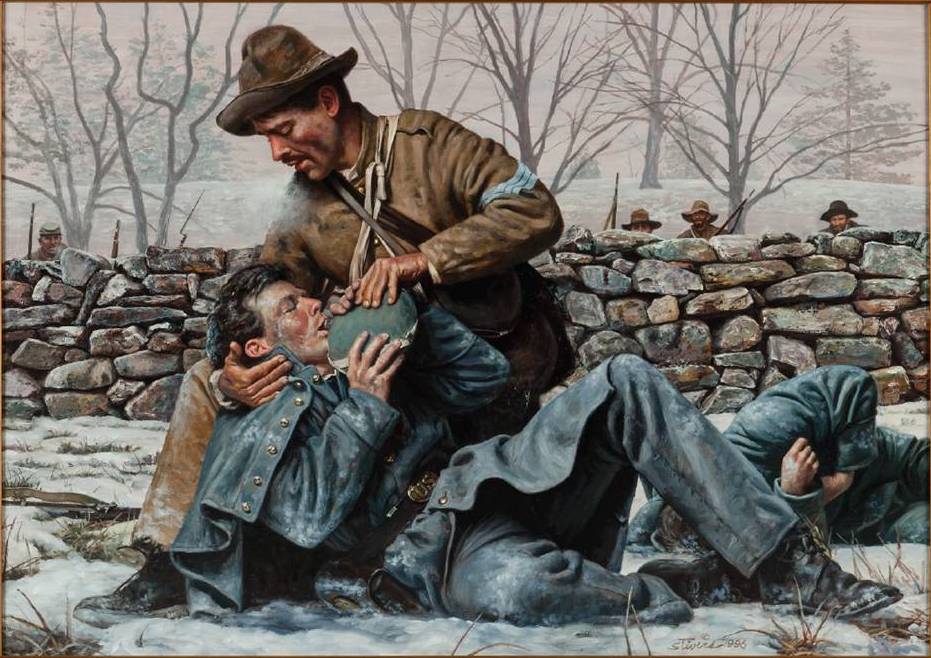
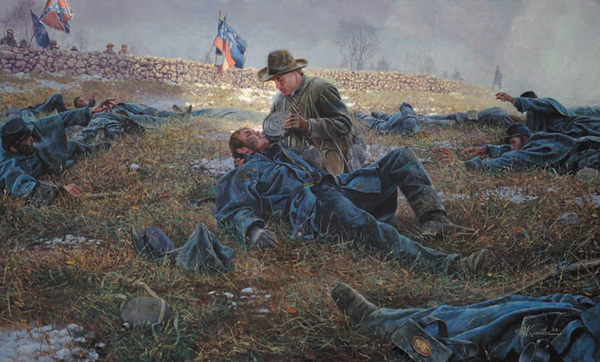
For Sergeant Richard Kirkland, Company G, 2nd South Carolina Infantry, it wasn’t good enough to sit and listen.  He could no longer stand to hear “those poor people crying for water”.  Kirkland left his position and made his way to General Joseph Kershaw’s headquarters, asking permission to help.

On the morning of December 14, 1862, Richard Kirkland took as many canteens as he could carry, and stepped into the no man’s land between two watching armies.  No one fired, nor even moved.  Sgt. Kirkland worked his way alone from one wounded man to the next, straightening out a shattered leg here, there spreading out an overcoat, always with a quiet word of encouragement and a drink of water.

Angel of Marye's Heights

Kirkland was out there for no less than 1½ hours.  Alone in no man’s land, he never left until he had helped every fallen soldier, Federal and Confederate, on that part of the battlefield.

General Kershaw later gave this account:  “Unharmed he reached the nearest sufferer. He knelt beside him, tenderly raised the drooping head, rested it gently upon his own noble breast, and poured the precious life-giving fluid down the fever scorched throat. This done, he laid him tenderly down, placed his knapsack under his head, straightened out his broken limb, spread his overcoat over him, replaced his empty canteen with a full one, and turned to another sufferer.”

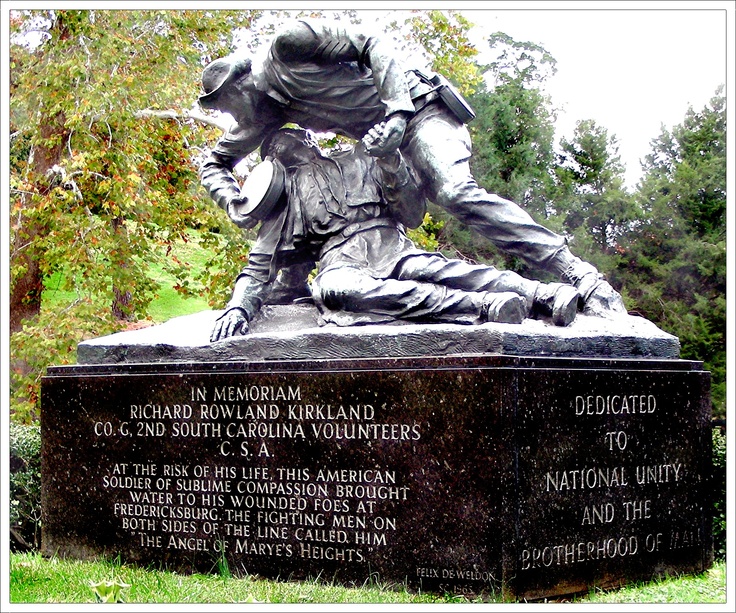
Richard Kirkland would not survive the war.  He met his end while leading an infantry charge the following September, at a place called Chickamauga. No one will ever know how many lives were saved by his courage, and his kindness, this day in 1862.

Richard Rowland Kirkland will forever remain, the Angel of Marye’s Heights.

55227d724bc71729117c7386ca437c4c

November 18, 1863 Gettysburg Address

The Chicago Times described Lincoln’s remarks as “silly, flat and dish-watery utterances”, but it all came out in the end.  Lincoln’s address went into history as one of the finest pieces of English language prose since Henry V’s St. Crispin’s Day speech, at Agincourt.  The names of the haters at the Chicago Times, are all but forgotten.

154 years ago today, Abraham Lincoln boarded a train in Washington.  He’d been asked to make “a few dedicatory remarks” on the following day, dedicating the new National Cemetery at Gettysburg where, even now, workmen labored to re-inter the dead from the carnage of July.

Lincoln was the President of a country torn by Civil War, a war so terrible that, before it was over, would kill more Americans than all the wars from the Declaration of Independence to the Global War on Terror, combined.

Lincoln had been feeling poorly the day of the train ride, telling his secretary, John Hay, that he was feeling weak.  He would feel worse over the course of that day, and Hay noted that Lincoln’s face was ‘a ghastly color’ the day of the address.  No one knew it at the time, but Lincoln was in the early stages of smallpox.

gtsburgaddress2
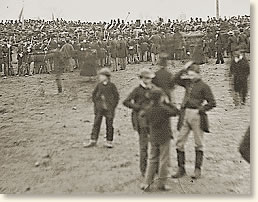
“A rare photo of the ceremonies. A group of boys stand at the fringe of a crowd. In the distance, several men wearing sashes can be seen standing on the speakers’ platform. Analysis of an enlargement of this photo reveals the image of Lincoln sitting to the left of these men”. Tip of the hat to http://www.eyewitnesstohistory.com, for this image

His was not the keynote address.  That would be a 13,607 word, two-hour oration delivered by Boston politician Edward Everett.

After Everett’s speech, photographers thought they had all the time in the world to prepare and set their glass plates.  They did not, and no photograph exists of Lincoln delivering the Gettysburg address.

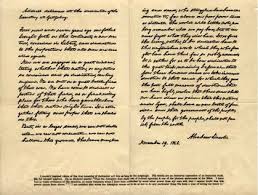
The 16th President of the United States stepped to the rostrum and delivered 271 words, in ten sentences.  In just over two minutes, Lincoln captured an entire vision of where the country was at that moment in time, where it had been, and where it was going.

Lincoln himself thought his speech a flop, but Everett later wrote to him, saying “I wish that I could flatter myself that I had come as near to the central idea of the occasion in two hours as you did in two minutes.”

There were haters then, as now, as always prepared to fire their little spitballs.  The Chicago Times described Lincoln’s remarks as “silly, flat and dish-watery utterances”, but it all came out in the end.  Lincoln’s address went into history as one of the finest pieces of English language prose since Henry V’s St. Crispin’s Day speech, at Agincourt.  The names of the haters at the Chicago Times, are all but forgotten.

Oddly, we do not know the precise form in which the President delivered his address.  Lincoln wrote his own speeches, lining out words and writing into margins as he developed his thought process.  That working copy is lost.

objectathand_dec08_631
“The only known image of Abraham Lincoln at Gettysburg was uncovered in 1952 at the National Archives. It was taken by photographer Mathew Brady. (Library of Congress)” H/T Smithsonian.com, for this image

There are five known copies of the Gettysburg address, written in Lincoln’s own hand, each varying slightly in wording and punctuation.  He wrote two after the address, giving them to his two personal secretaries, John Hay and John Nicolay.  He sent one to Edward Everett early in 1864, and another to George Bancroft, the former Secretary of the Navy turned historian.  Lincoln wrote a fifth copy, known as the Bliss copy, for Colonel Alexander Bliss, in February, upon learning that the Bancroft version was unsuitable for publication, due to its having been written on both sides of the same page.

images (11)Lincoln signed, dated and titled the Bliss copy.  This is the version inscribed on the South wall of the Lincoln Memorial.
One of my stranger childhood notions, was the idea that sounds never went away, they just diminished as they spread outward, like ripples on a pond.  If that was true (thought my nine-year-old self), could we not somehow capture and listen to the Gettysburg address, as it was actually delivered?

It’s a funny thing how some ideas, even the goofy ones, never completely die away.

For the terminal history geek, the full text of all five copies may be discovered at www.abrahamlincolnonline.org

November 6, 1860 A Peculiar Institution

From the earliest years of the “new world”, every economy from Canada to Argentina was, to varying degrees, involved with slavery.  Spanish and Portuguese settlers brought the first African slaves to the new world in 1501, establishing the new world’s first international slave port in Santo Domingo, modern capital city of the Dominican Republic.

From the earliest years of the “new world”, every economy from Canada to Argentina was, to varying degrees, involved with slavery.  Spanish and Portuguese settlers brought the first African slaves to the new world in 1501, establishing the new world’s first international slave port in Santo Domingo, modern capital city of the Dominican Republic.

Hundreds of thousands of African slaves entered the Americas through the sister ports of Veracruz, Mexico, and Portobelo, Panama, “products” of the “Asiento” system, wherein the contractor (asientista) was awarded a monopoly in the slave trade to Spanish colonies, in exchange for royalties paid to the crown.

The first such contractor was a Genoese company who agreed to supply 1,000 slaves over an 8-year period, beginning in 1517.  A German company entered into such a contract eight years later, with a pledge of 4,000.

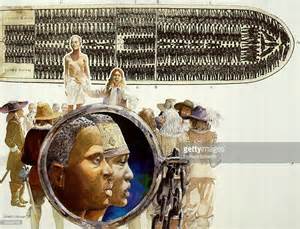
Richard Schlecht
Painting by Richard Schlecht, National Geographic

By 1590, as many as 1.1 million Africans had come through the port of Cartagena, Colombia, sorted and surnamed under the “casta de nación” classification system.  To this day, black residents of the Colombian interior bear names like Kulango & Fanti, indicating their origins on the Ivory Coast or Ghana:  Musorongo, Loango & Congo, (Congo Region), or Matamba, Anchico & Ambuila (Angola).

In the American colonies, 17th century racial attitudes appear to have been more fluid than they would later become.  The first black Africans, 19 of them, came to the Virginia Colony in 1619 not as slaves, but as indentured servants. Their passage, involuntary as it was,  was paid for by a term of indenture, a sort of ‘temporary slavery’, usually lasting seven years.

John Punch ran away from his term of indenture in 1640, along with two Europeans. The trio was captured in Maryland and sentenced to extended terms of indenture. Alone among the three, Punch was punished with indenture for life, effectively making him the first ‘slave’ in the American colonies.

Born in Angola in 1600, Anthony Johnson was one of that original 19, captured by an enemy tribe and sold to an Arab slave trader.  Johnson was sold to a Virginia planter at the age of 21, paying off the cost of his passage with a seven-year term of indenture.  As a free man, Johnson himself became a successful planter, going on to “own” indentured servants of his own.

One of them, John Casor, sued for his freedom in 1655, claiming to have completed his indenture of “seaven or Eight years”, plus seven more.  The court ruled that Casor himself was considered “property” and not his contract, making him the first person arbitrarily ruled a slave for life.

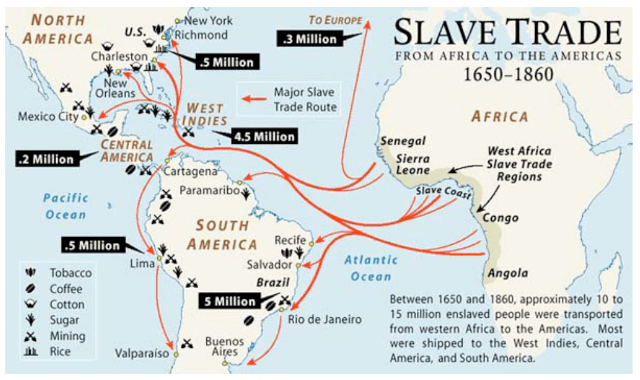
Map-of-Slave-Trade

The unthinking view of history holds American slavery to have been a strictly southern-states phenomenon, but it isn’t so.  As late as the eve of the Civil War, “northern” slavery was more widespread than you might expect. The 1860 census reported 236 slaves in New Jersey, 90,368 in Maryland, 2,290 in Delaware, and 3,680 in Washington, DC. There were slaves as far north as New Hampshire as late as 1840. New York wouldn’t legally emancipate its last slave until the following year.

Massachusetts became the first American colony to legalize slavery in 1641, with the passage of the ironically named “Massachusetts Body of Liberties”.  Slavery was legal at one time or another, in all 13 original colonies and even before, when slavery of and by native Americans, was commonplace.

In 1637, the Pequot tribe of southeastern Connecticut was all but wiped out in a bloody war with an alliance of English colonists from the Massachusetts Bay, Plymouth and Saybrook colonies, and their native American allies of the Narragansett, Mohegan, Niantic and Montauk tribes. Surviving Pequots were forced to become slaves in English households, or shipped to Bermuda or the West Indies, and exchanged for Africans.

Indigenous and African slave populations in northern climates were small compared with the more agricultural economies of the south, which were themselves a drop in a bucket compared with the slave economies of central and south America.

An essay from the New York Public Library (nypl.org) gives a sense of scale to the transatlantic slave trade. “As a whole, the transatlantic slave trade displaced an estimated 12.5 million people, with about 10,650,000 surviving the Atlantic crossing. Thus, even though a substantial number of Africans actually reached the United States, they were only a small proportion, about 3.6 percent, of the total number of Africans who were brought to the Americas. More Africans went to Barbados (435,000), while almost three times as many went to Jamaica (1,020,000). The number of Africans arriving in North America was considerably less than those who were taken to Brazil (4,810,000)“.

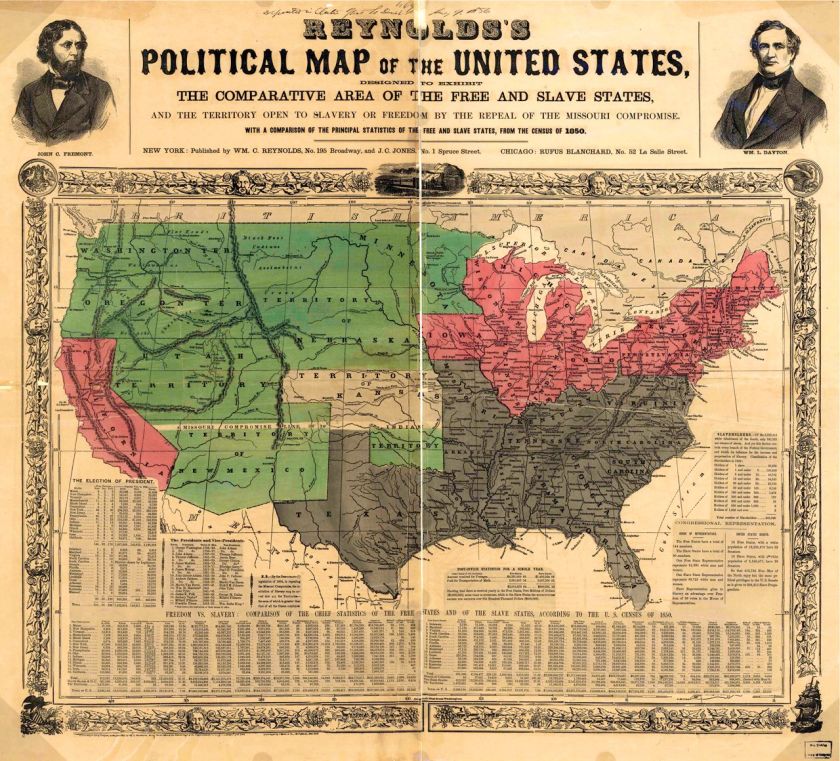
The Louisiana Purchase of 1803 opened vast new territories. The fight for which would be free and which would permit slavery, would go on for years.

The philosophical underpinnings of southern secession was borne of the Hartford Convention of December 1814 – January 1815.  There, delegates from Massachusetts, Connecticut and Rhode Island, along with “unofficial” delegates from New Hampshire and Vermont, met to discuss New England’s secession over the War of 1812. The convention reported that New England had a “duty” to assert its authority over unconstitutional infringements on its sovereignty, putting forth a legal position very similar to the later nullification position taken by South Carolina.

reynolds-political-map

Protective tariffs were instituted in the wake of the War of 1812, intending to help domestic manufacturers compete with foreign imported goods. Instead, they tended to help northern manufacturing economies, while increasing the cost of manufactured goods to the southern states, and making it more difficult to export cotton.

By this time, cotton was becoming the chief cash crop in most southern economies, and tariffs hit South Carolina particularly hard. Throughout the colonial and early national periods, the Palmetto state climate sustained a strong agricultural economy. South Carolina’s fortunes were hit hard with the panic of 1819, and slow to recover as the gulf states increasingly entered the cotton markets.

The Tariffs of 1828 – ’32 lead to a nullification crisis in South Carolina, where the state told the federal government to pound sand, and mobilized military assets to defend itself against federal enforcement measures sure to follow.

That time the crisis was averted, but a pattern had been established for events to come.

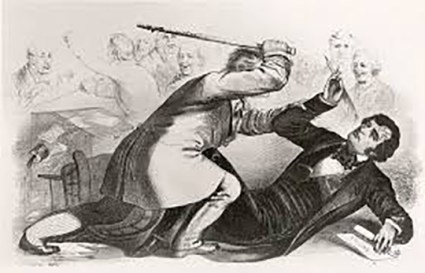
CaningSectional differences grew and sharpened in the years that followed. A member of Congress from Kentucky killed a fellow congressman from Maine.  A Congressman from South Carolina all but beat a Massachusetts Senator to death with a cane, on the floor of the Senate. A fist fight involving at least 30 Congressman broke out on the floor of the US House of Representatives.

Southern states talked about secession as early as 1850. Senator Stephen A Douglas proposed the Kansas-Nebraska Bill, in theory allowing a territory to determine its own free or slave status. This effort to “democratize” the issue led to the brutality of the “Bleeding Kansas” period, where pro-slavery Missouri “Border Ruffians” and anti-slavery Kansas “Jayhawkers” crossed one another’s borders, primarily to murder each others civilians and burn out one another’s towns.

Abraham Lincoln delivered his “House Divided” speech on June 16, 1858, in which he said “A house divided against itself cannot stand”.  A year later, John Brown was holed up at Harper’s Ferry, trying to start a slave insurrection.

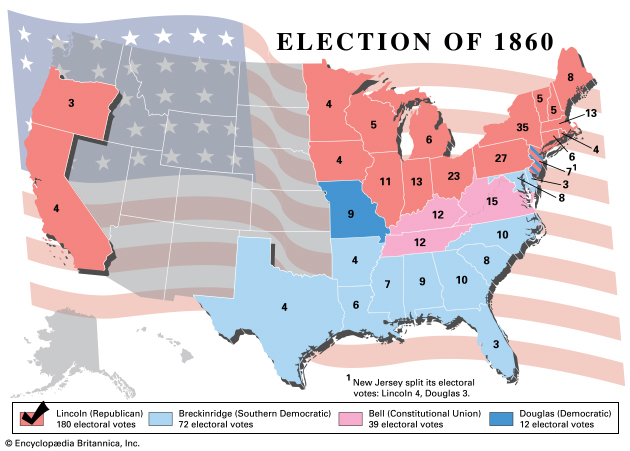
After 57 ballots, the Democrat’s convention of 1859 adjourned without selecting a candidate for the Presidential election. Northern Democrats nominated Stephen A Douglas, while southern Democrats nominated John Breckenridge.

Republican Abraham Lincoln was elected 16th President of the United States on November 6, 1860, on a platform confusingly specifying “That all men are created equal”, an “abhorrence of all schemes of disunion”, and “The maintenance inviolate of the rights of the states, and especially the right of each state to order and control its own domestic institutions according to its own judgment exclusively”.

One year later, to the day, former United States Senator and Secretary of War Jefferson Davis was elected to a six-year term as the first President of the Confederate States of America.


October 28, 1945  The Last Rebel

South Carolina seceded in December 1860, and the world waited to see who’d follow.  New York City became the next to call for secession on January 6, when Mayor Fernando Wood addressed the city’s governing body. 

By the early 1830s, cotton exceeded the value of all other American exports, combined. As secession loomed over the nation, a Chicago Daily Times editorial warned that if the South left “in one single blow, our foreign commerce must be reduced to less than one half of what it is now”.

South Carolina seceded in December 1860, and the world waited to see who’d follow.  New York City became the next to call for secession on January 6, when Mayor Fernando Wood addressed the city’s governing body.  “When Disunion has become a fixed and certain fact”, he said, “why may not New York disrupt the bands which bind her to a venal and corrupt master…and destroyed the Confederacy of which she was the proud Empire City?”

townline4In New York city and “upstate” alike, economic ties with the south ran deep.  40¢ of every dollar paid for southern cotton stayed in New York, in the form of insurance, shipping, warehouse fees and profits.

30 minutes’ east of Buffalo, the village of Lancaster contemplated staying with the Union.  500 miles from the nearest Confederate state, George Huber remembered the time.  “When war was declared, Lancaster seethed with the news, and many were the nights we stayed up as late as 12 o’clock to talk things out.  I was twelve years old at the time, but I remember the stern faces of the elders and the storm of passionate and angry discussion. Soon the town split into two factions, it was a very tense situation…Often the excitement ran so high that if a man in either group had made the slightest sign, neighbors would have been at each other’s throats and fists would have taken the place of words.”

town line courthouse“Town Line”, a hamlet on the village’s eastern boundary, put it to a vote.  In the fall of 1861, residents gathered in the old schoolhouse-turned blacksmith’s shop.  By a margin of 85 to 40, Town Line, New York voted to secede from the Union.

At first there was angry talk of arresting “Copperheads” for sedition, but “seceders” soon became quiet, as casualty reports came back from the front.  Most became afraid to meet in public, amidst angry talk of lynching.  A half-dozen or so more ardent secessionists went south to fight for the Confederacy.  Others quietly moved north, to Canada.   Outside of Lancaster, no one seemed to notice.  Taxes continued to be paid. No federal force ever arrived to enforce the loyalty of the small village.

Town Line MarkerA rumor went around in 1864, that a large Confederate army was building in Canada, poised to invade from the north.

Town Line became a dangerous place for the few southern sympathizers left.  Most of those remaining moved to Canada and, once again, Lancaster became the quiet little village in upstate New York, that nobody ever heard of.

Impatient to get on with it, Dade County “symbolically” seceded both from Georgia and from the Union, back in 1860.  Officially, Dade County seceded with Georgia in 1861, and rejoined with the rest of the state in 1870.  The deal was sealed on July 4, 1945, when a telegram from President Harry S. Truman was read at a celebration marking Dade County’s “rejoining” the Union.

The “Confederate Gibraltar”, Vicksburg Mississippi, fell on July 4, 1863.  The city wouldn’t celebrate another Independence Day, for 80 years.

By October 1945, there was legally only one remaining part of the Confederate States of America. The hamlet of Town Line, New York.

greensboro-daily-news-newspaper-0125-1946-town-line-rejoins-unionEven Georgians couldn’t help themselves from commenting. 97-year-old Confederate General T.W. Dowling said: “We been rather pleased with the results since we rejoined the Union. Town Line ought to give the United States another try“. Judge A.L. Townsend of Trenton Georgia commented “Town Line ought to give the United States a good second chance“.

A courier express note arrived on October 7, 1945.  “There are few controversies that are not susceptible to a peace time resolution” read the note, “if examined in an atmosphere of tranquility and calm rather than strife and turmoil. I would suggest the possibility of roast veal as a vehicle of peace.  Why don’t you run down the fattest calf in Erie County, barbecue it and serve it with fixins in the old blacksmith shop where the ruckus started? Who can tell? The dissidents might decide to resume citizenship.”  The note was signed “Very Sincerely Yours, Harry Truman”.

last-of-the-rebels-1Fireman’s Hall became the site of the barbecue, “The old blacksmith shop where the ruckus started” being too small for the assembled crowd.  On October 28, 1945, residents adopted a resolution suspending its 1861 ordinance of secession, by a vote of 90-23. The Stars and Bars of the Lost Cause was lowered for the last time, outside the old blacksmith shop.
Alabama member of the United States House of Representatives, John Jackson Sparkman, may have had the last word on the sunject.  “As one reconstructed rebel to another, let me say that I find much comfort in the fact that you good people so far up in Yankee land have held out during the years. However, I suppose we grow soft as we grow older.”

October 19, 1864, St. Albans Raid

The $1 million the Confederate government sunk into their Canadian office, probably did them more harm than good.  Those resources could have been put to better use.

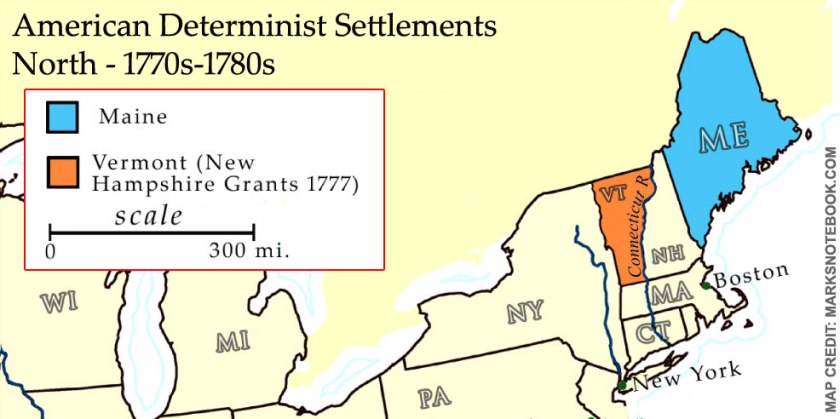
In the late 18th century, lands granted by the governor of New Hampshire led the colonial province into conflict with the neighboring province of New York.  Conflict escalated over jurisdiction and appeals were made to the King, as the New York Supreme Court invalidated these “New Hampshire grants”.  Infuriated residents including Ethan Allen and his “Green Mountain Boys” rose up in anger.  Two natives of Westminster Vermont, then part of the New Hampshire land grants, were killed on March 13, 1775, by British Colonial officials.  Today, the event is remembered as the “Westminster Massacre”.

American_Determinist_Settlements_North_1770
The New Hampshire Grants region petitioned Congress for entry into the American union as a state independent of New York in 1776″ – H/T, https://en.wikipedia.org/wiki/New_Hampshire_Grants

The battles at Lexington and Concord broke out a month later, ushering in a Revolution and eclipsing events to the north.  New York consented to admitting the “Republic of Vermont” into the union in 1790, ceding all claims on the New Hampshire land grants in exchange for a payment of $30,000.  Vermont was admitted as the 14th state on March 4, 1791, the first state so admitted following the adoption of the federal Constitution.

Organized in 1785, St. Albans forms the county seat of Franklin County, Vermont.  15 miles from the Canadian border and situated on the eastern shore of Lake Champlain, it’s not the kind of place you’d expect, for a Civil War story.

screen shot 2014-05-22 at 5.14.39 pm
St. Albans Vermont, 1864

The Confederate States of America maintained government operations in Canada, from the earliest days of the Civil War.  Toronto was a logical relay point for communications with Great Britain, from whom the Confederate government sought unsuccessfully to gain support.

Secondly, Canada provided a safe haven for prisoners of war, escaped from Union camps.

Former member of Congress and prominent Ohio “Peace Democrat” Clement Vallandigham fled the United States to Canada in 1863, proposing to detach the states of Illinois, Indiana and Ohio from the Union, in exchange for sufficient numbers of Confederate troops to enforce the separation.  Vallandigham’s five-state “Northwestern Confederacy” would include Kentucky and Missouri, breaking the Union into three pieces.  Surely that would compel Washington to sue for peace.

ThomasHinesin1884fromHeadleyIn April 1864, President Jefferson Davis dispatched former Secretary of the Interior Jacob Thompson, ex-Alabama Senator Clement Clay, and veteran Confederate spy Captain Thomas Henry Hines to Toronto, with the mission of raising hell in the North.
This was no small undertaking. A sizeable minority of Peace Democrats calling themselves “Copperheads” were already in vehement opposition to the war.  So much so that General Ambrose Burnside declared in his General Order No. 38, that “The habit of declaring sympathy for the enemy will not be allowed in this” (Ohio) “department. Persons committing such offenses will be at once arrested with a view of being tried. . .or sent beyond our lines into the lines of their friends. It must be understood that treason, expressed or implied, will not be tolerated in this department“.

Hines and fellow Confederates worked closely with Copperhead organizations such as the Knights of the Golden Circle, the Order of the American Knights, and the Sons of Liberty, to foment uprisings in the upper Midwest.

In the late Spring and early Summer of 1864, residents of Maine may have noted an influx of “artists”, sketching the coastline.  No fewer than fifty in number, these nature lovers were in fact Confederate topographers, sent to map the Maine coastline.

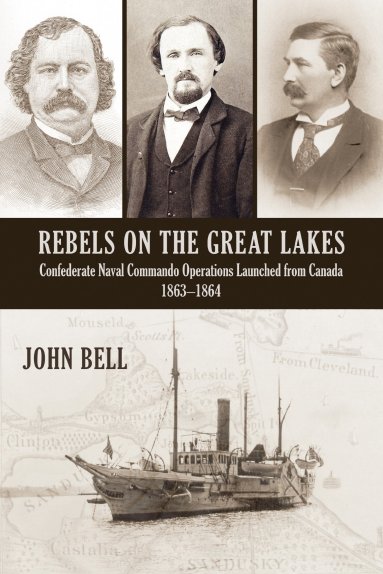
Rebels on the great LakesThe Confederate invasion of Maine never materialized, thanks in large measure to counter-espionage efforts by Union agents.
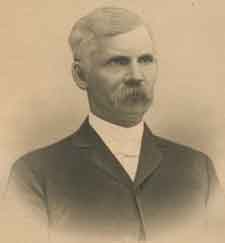
J.Q. Howard, the U.S. Consul in St. John, New Brunswick, informed Governor Samuel Cony in July, of a Confederate party preparing to land on the Maine coast.

The invasion failed to materialize, but three men declaring themselves to be Confederates were captured on Main Street in Calais, preparing to rob a bank.

Disenchanted Rebel Francis Jones confessed to taking part in the Maine plot, revealing information leading to the capture of several Confederate weapons caches in the North, along with operatives in Maine, Massachusetts, New York, Pennsylvania, Maryland, Illinois, Kentucky, Tennessee and Ohio.

Captain Hines planned an early June uprising in the Northwest, timed to coincide with a raid planned by General John Hunt Morgan.  Another uprising was planned for August 29, timed with the 1864 Democratic Convention in Chicago.   It seems the conspirators’ actions didn’t quite live up to the heat of their rhetoric, and both operations fizzled.  A lot of these guys were more talk than action, yet Captain Hines continued to send enthusiastic predictions of success, back to his handlers in Richmond.

The Toronto operation tried political methods as well, supporting Democrat James Robinson’s campaign for governor of Illinois.  If elected they believed, Robinson would turn over the state’s militia and arsenal to the Sons of Liberty.  They would never know.  Robinson lost the election.

Bennett_H._Young_cropped
Bennett Henderson Young

All this cost money, and lots of it.  In October 1864, the Toronto operation came to St. Albans, to make a withdrawal.

Today, St. Albans is a quiet town of 6,918.  In 1864 the town was quite wealthy, home to manufacturing and repair facilities for railroad locomotives.  Located on a busy rail line, St. Albans was also home to four banks.

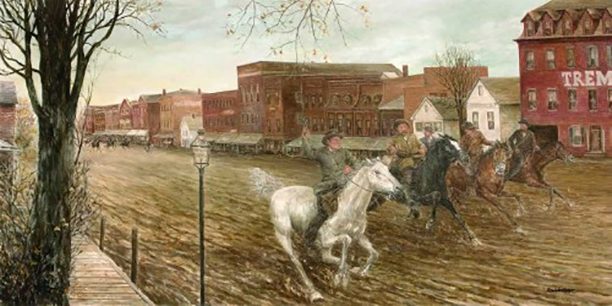
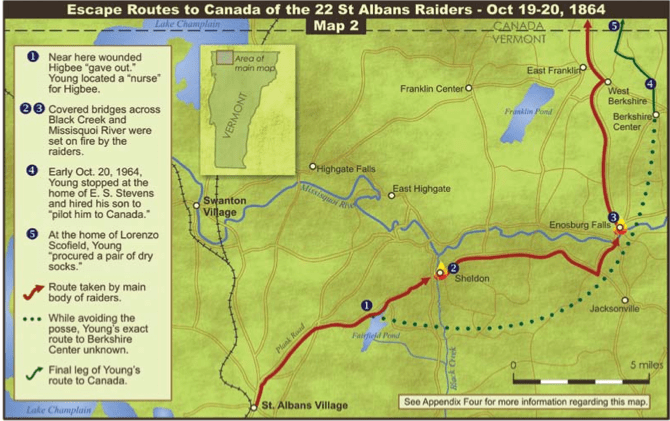
Nicholasville, Kentucky native Bennett Henderson Young was a member of the Confederate 8th Kentucky Cavalry, captured during Morgan’s 1863 raid into Ohio.  By January, Young had escaped captivity and fled to Canada. On October 10, Bennett crossed the Canadian border with two others, taking a room at the Tremont House, in St. Albans.  The trio said they had come for a “sporting vacation”.

In the following days, small groups filtered into St. Albans, quietly taking rooms across the town.  There were 21 of them, former POWs and cavalrymen all, hand selected by Young for their daring and resourcefulness.

featured-image-4

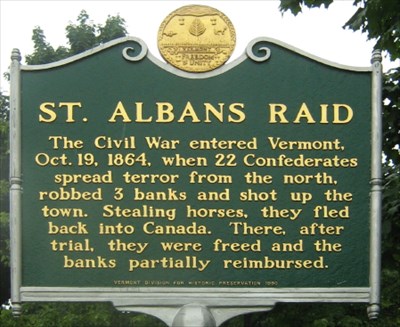
On October 19 the group split up.  Announcing themselves to be Confederate soldiers, groups of them simultaneously robbed three of St. Albans’ four banks, while eight or nine held the townspeople at gunpoint, on the village green.  One resident was killed before it was over and another wounded. Young ordered his troops to burn the town, but the bottles of “Greek Fire” they carried for the purpose, failed to ignite.  Only one barn was burned down and the group got away with a total of $208,000, and all the horses they could find. It was the northernmost Confederate action of the Civil War.

StAlbansRaid, memoriaizedThe group was arrested on returning to Canada and held in Montreal.  The Lincoln administration sought extradition, but the Canadian court decided otherwise, ruling that the raiders were under military orders at the time, and neutral Canada could not extradite them to America.  The $88,000 found with the raiders, was returned to Vermont.
The $1 million the Confederate government sunk into their Canadian office, probably did them more harm than good.  Those resources could have been put to better use, but we have the advantage of hindsight.  Neither Captain Hines nor Jefferson Davis could know how their story would turn out.  In the end, they both fell victim to that greatest of human weaknesses, of believing what they wanted to believe.

st_albans_raiders_1

August 21, 1863 Lawrence Massacre

Quantrill’s band went through the town, systematically shooting most of the male population. The shooting, the looting and the burning went on for four hours.  Between 160 and 190 of the men and boys of Lawrence, ages 14 to 90, were murdered.  Most of them had had no means of defending themselves.

Lawrence, 1863
Lawrence, Kansas, 1863

300 to 400 riders converged outside the city of Lawrence, Kansas in the early morning hours of August 21, 1863.

They were a loose collection of independent bushwacker groups, pro-slavery and nominally Confederate, though they were part of no command and control structure.

This was a civilian group operating outside of the Confederate chain of command, more of a gang of criminal outlaws than a military operation.  There was Cole Younger and Frank James, Jesse’s older brother. There was William T. “Bloody Bill” Anderson, whose men were known for tying the scalps of slain Unionists to the saddles and bridles of their horses. Leading the group was a 27 year old former schoolteacher from Ohio:  William Clarke Quantrill.Lawrence Kansas

Lawrence, Kansas was mostly asleep as several columns of riders descended on the town. It was 5:00am and pitch dark, as most of the city of 3,000 awoke to the sound of pounding hooves.

Doors were smashed in amid the sounds of gunshots and screams. Quantrill’s band went through the town, systematically shooting most of the male population. The shooting, the looting and the burning went on for four hours.  Between 160 and 190 of the men and boys of Lawrence, ages 14 to 90, were murdered.  Most of them had had no means of defending themselves.

Quantrill's Raid Stone (N.H. Street)
Quantrill’s Raid Memorial Stone on New Hampshire Street

Intending to deprive Confederate sympathizers from their base of support, General Thomas Ewing authorized General Order No. 11 four days later, ordering that most of four counties along the Kansas-Missouri border be depopulated. Tens of thousands of civilians were forced out of their homes as Union troops came through, burning buildings, torching fields and shooting livestock.

The area was so thoroughly devastated that it would forever be known as the “Burnt District”.

Burnt_district_monumentQuantrill fled to Texas after the raid on Lawrence, and was later killed in a Union ambush near Taylorsville, Kentucky. His band broke up into several smaller groups, with some joining the Confederate army.

Others such as Frank and Jesse James and the Younger brothers, went on to apply the hit and run tactics they had learned from Quantrill’s band to a career of bank and train robberies.

Quantrill himself said that the raid was retribution for the 1861 “Jayhawker” raid of Colonel Charles “Doc” Jennison and Senator James H. Lane, that left 9 dead in Osceola, Missouri and acres of so-called “Jennison Monuments”, the two story brick chimneys that were all that remained of the burned out homes of Union and Confederate sympathizers alike.

Others blamed the raid on the collapse of a makeshift jail in Kansas City that killed several female relatives of the raiders. It seems more likely that it was just one more in a series of homicidal raids carried out by both sides:  such raids usually resulting in the death of innocents.

Newspaper articles appeared in Canada in August 1907 that Quantrill was still alive, living on Vancouver Island under the name of John Sharp. It was probably an unfortunate fib on Mr. Sharp’s part.  Two men traveled to Canada for the express purpose of beating Mr. Sharp to death, which they did as soon as they could locate him. The crime has never been solved.

July 15, 1864 Great Shohola Train Wreck

When the main switch was opened, only four miles of track stood between two speeding, 30-ton steam locomotives.

The wood burning steam locomotive #171 left Jersey City, New Jersey on July 15, 1864, pulling 17 passenger and freight cars. On board were 833 Confederate Prisoners of War and 128 Union guards, heading from Point Lookout prison in Maryland, to the Union prison camp in Elmira, New York.

Engine #171 was an “extra” that day, running behind a scheduled train numbered West #23. West #23 displayed warning flags, giving the second train right of way, but #171 was running late.  First delayed while guards located missing prisoners, then there was that interminable wait for the drawbridge. By the time #171 reached Port Jervis, Pennsylvania, the train was four hours behind schedule.

shohola station
Shohola station

Telegraph operator Douglas “Duff” Kent was on duty at the Lackawaxen Junction station, near Shohola, Pennsylvania. Kent had seen West #23 pass through that morning with the “extra” flags.  His job was to hold eastbound traffic at Lackawaxen until the second train passed. Kent may have been drunk that day, but nobody’s certain. He disappeared the following day, never to be seen again.

Erie Engine #237 arrived at Lackawaxen at 2:30 pm pulling 50 coal cars, loaded for Jersey City.  Kent gave the all clear at 2:45.  The main switch was opened, and Erie #237 joined the single track heading east out of Shohola.

Only four miles of track stood between two speeding, 30-ton steam locomotives.

King and Fullers Cut
King and Fuller’s Cut, Shohola, Pennsylvania

The trains met head-on at “King and Fuller’s Cut”, a pass blasted out of solid rock and named after its prime engineering contractors.  This section of track followed a blind curve with only 50’ visibility.  Engineer Samuel Hoitt was at the throttle of #237.  Hoitt would survive, having just enough time to jump before the moment of impact.  One man in the lead car on #171 was thrown clear.  He too would live.  There would be no other survivors among the 37 men on that car.

Historian Joseph C. Boyd described what followed on the 100th anniversary of the wreck: “[T]he wooden coaches telescoped into one another, some splitting open and strewing their human contents onto the berm, where flying glass, splintered wood, and jagged metal killed or injured them as they rolled. Other occupants were hurled through windows or pitched to the track as the car floors buckled and opened. The two ruptured engine tenders towered over the wreckage, their massive floor timbers snapped like matchsticks. Driving rods were bent like wire. Wheels and axles lay broken. The troop train’s forward boxcar had been compacted and within the remaining mass were the remains of 37 men”. Witnesses saw “headless trunks, mangled between the telescoped cars” and “bodies impaled on iron rods and splintered beams.”

shohola4
“Jupiter 1864 train engine, typical of the type of engine used during the Civil War Era”. Tip of the hat to http://www.civilwaralbum.com/misc11/shohola1.htm, for this image.

Pinned by cordwood against the split boiler plate and slowly scalded to death, engineer William Ingram lived long enough to speak with would-be rescuers. Frank Evans, one of the guards, remembered: “With his last breath he warned away all who went near to try and aid him, declaring that there was danger of the boiler exploding and killing them.”

Evans describes the scene. “I hurried forward. On a curve in a deep cut we had met a heavily-laden coal train, traveling nearly as fast as we were. The trains had come together with that deadly crash. The two locomotives were raised high in air, face to face against each other, like giants grappling. The tender of our locomotive stood erect on one end. The engineer and fireman, poor fellows, were buried beneath the wood it carried. Perched on the reared-up end of the tender, high above the wreck, was one of our guards, sitting with his gun clutched in his hands, dead!. The front car of our train was jammed into a space of less than six feet. The two cars behind it were almost as badly wrecked. Several cars in the rear of those were also heaped together…Taken all in all, that wreck was a scene of horror such as few, even in the thick of battle, are ever doomed to be a witness of.”

Estimates of Confederate dead are surprisingly inexact.  Most sources indicate 51 killed on the spot or dying within the first 24 hours. Other sources put their number as high as 60 to 72.  17 Union guards were killed on the spot, or died within a day of the wreck.  5 prisoners appear to have escaped in the confusion.

Captured at Spotsylvania early in 1864, 52nd North Carolina Infantry soldier James Tyner was in the Elmira camp at this time.  Tyner’s brother William was one of the prisoners on board #171. William was badly injured in the wreck, surviving only long enough to avoid the 76′ trench in which the Confederate dead were buried. He died in Elmira three days later, never regaining consciousness.

I’ve always wondered if the brothers saw each other that one last time.  James Tyner was my twice-great Grandfather, one of four brothers who had gone to war in 1861.

We’ll never know.  James Tyner died in captivity on March 13, 1865, 27 days before Lee’s surrender at Appomattox. Of the four brothers, Nicholas alone survived the war, laying down his arms when the man they called “Marse Robert” surrendered to General Ulysses S. Grant.

Family Plot
Note the shape of the stones themselves. Union tombstones from the Civil War era have rounded tops. Those marking Confederate graves are pointed at the top. It has been said that the pointed top was adopted to prevent “Yankees” from sitting on Confederate headstones.  This photo taken in the family cemetery, in the “Sand Hills” of North Carolina.  

Afterward

Two Confederate soldiers, the brothers John and Michael Johnson, died overnight and were buried in the Congregational church yard across the Delaware river, in Barryville, New York.  The remaining POWs killed immediately or shortly thereafter were buried in a common grave that night, alongside the track.  Individual graves were dug for the 17 Union dead, and they too were laid alongside the track.

As the years went by, signs of all those graves were erased.  Hundreds of trains carried thousands of passengers up and down the Erie Railroad, ignorant of the burial ground through which they passed.

The “pumpkin flood” of 1903 scoured the rail line uncovering many of the dead, carrying away at least some of their mortal remains, along with thousands of that year’s pumpkin crop.

On June 11, 1911, the forgotten dead of Shohola we’re disinterred, and reburied in mass graves in the Woodlawn National Cemetery, in Elmira, New York.


Two brass plaques bear the names of the dead, mounted to opposite sides of a common stone marker.  The names of the Union dead face north.  Those of the Confederate face south.

The only instance from of the Civil War era, in which Union and Confederate share a common grave.

July 6, 1863 Sallie

By unanimous consent of the veterans, Sallie’s likeness looks out from the base of the statue, looking out for the spirits of “her boys” for all eternity. 

From contemporary descriptions and the only photograph that’s known to exist of her, Sallie was a Staffordshire Bull Terrier, brindle in color. She was four weeks old in 1861, given as a gift to 1st Lieutenant William Terry of the 11th Pennsylvania Volunteer Infantry, who made her the regimental mascot.   The men of the regiment were enormously fond of Sallie, as she tagged along on long marches and kept them company in their camps. She learned the drum roll announcing reveille, and loved to help wake sleeping soldiers in the morning.

If you’ve ever had a dog in your life, you know how that goes.

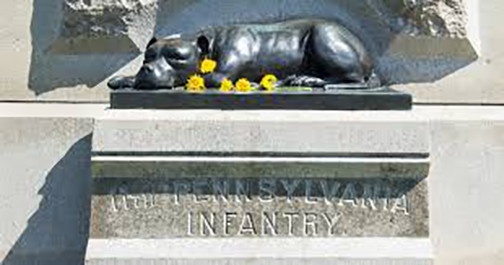
11th PASallie’s first battle came at Cedar Mountain, in 1862.  No one thought of sending her to the rear before things got hot, so she took up her position with the colors, barking ferociously at the adversary.   There she remained throughout the entire engagement, as she did at Antietam, Fredericksburg, Chancellorsville, and Spotsylvania.  They said she only hated three things:  Rebels, Democrats, and Women.
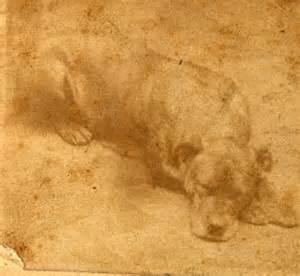
Sallie marched with “her” soldiers in a review in the spring of 1863.  Abraham Lincoln was reviewing the army, when he spotted the dog from the center of the reviewing stand, and raised his famous top hat in salute.

At Gettysburg, Sallie was separated from her unit in the chaos of the first day’s fighting.  They found her five days later, on July 6, parched with thirst and weakened by hunger.  She was standing guard over her dead and dying comrades from July 1.

It’s been said that only a dog is capable of that kind of loyalty, yet virtue in one is capable of inspiring virtue in another.  So it was in February, 1865.  Sallie was struck in the head by a bullet at Hatcher’s Run.  She was killed instantly, when several men of the 11th PA laid down their arms and buried her right then and there, even though they were still under fire from the Confederate side.Sallie

There is a story.  I don’t know if it’s true, but it’s nice to think that it might be.   Soldiers were moving out after the battle, when they heard whining from a hollowed out tree. There they found several of Sallie’s puppies. They’d had no idea she was pregnant, or how puppies came to be in that hollowed out tree, but they gave them to local civilians so that Sallie’s bloodline could live on.

Surviving veterans of the regiment returned to Gettysburg in 1890, to dedicate a memorial to those members of the 11th Pennsylvania who lost their lives on that field of battle.  The monument shows an upright Union soldier, rifle at the ready.Sallie's Eyes

By unanimous consent of the veterans themselves, Sallie’s likeness looks out from the base of the statue, looking after the spirits of “her boys”, for all eternity.

There are only two dogs so honored on the battlefield at Gettysburg, the other is part of the Irish Brigade monument.  Of the two, Sallie is the only one to have actually participated in the battle.

Irish brigade memorial, Gettysburg“Sallie was a lady,

she was a soldier too.

She marched beside the colors,

our own red white and blue.

It was in the days of our civil war,

that she lived her life so true”.