January 29, 1944 Operation Pied Piper

This weekend, Superbowl LIV will be played at the Hard Rock Stadium in Miami Gardens Florida, in front of an expected crowd of 65,326. In 1938, forty-five times that number were mobilized in the first four days alone, primarily children, relocated from cities and towns across Great Britain to the relative safety of the countryside.

431768 (1)
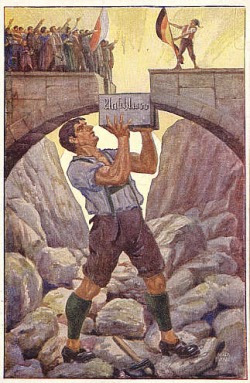
Nazi propaganda depicting German “Anschluss” with Austria

Intent on avoiding war with Nazi Germany, Italy, France and Great Britain convened in Munich in September 1938, to resolve German claims on western Czechoslovakia.  The “Sudetenland”.  Representatives of the Czech and Slovak peoples, were not invited.

For the people of the modern Czech Republic, the Munich agreement was a betrayal. “O nás bez nás!” “About us, without us!”

On September 30, British Prime Minister Neville Chamberlain returned to London declaring “Peace in Our Time”.  The piece of paper Chamberlain held in his hand bore the signatures of Adolf Hitler, Benito Mussolini and Édouard Daladier as well as his own, annexing enormous swaths of the Sudetenland, to Nazi Germany.

To Winston Churchill, the Munich agreement was an act of appeasement.  Feeding the proverbial crocodile (Hitler), in hopes that he will eat you last.

For much of Great Britain, the sense of relief was palpable.  In the summer of 1938, the horrors of the Great War were a mere twenty years in the past.  Hitler  swallowed up Austria only six months earlier as British planners divided the home islands into “risk zones”:   “Evacuation,” “Neutral,” and “Reception.”

In some of the most gut wrenching decisions of the age, these people were planning  the evacuation of millions of their own children, in the event of war.  “Operation Pied Piper”

94330When Nazi Germany invaded Poland the following September, London Mayor Herbert Morrison was at 10 Downing Street, meeting with Chamberlain’s aide, Sir Horace Wilson.  Morrison believed that the time had come for Operation Pied Piper.  Only a year to the day from the Prime Minister’s “Peace in our Time” declaration, Wilson protested.  “But we’re not at war yet, and we wouldn’t want to do anything to upset delicate negotiations, would we?

Morrison was done with the Prime Minister’s dilatory response to Hitler’s aggression, practically snarling in his thick, East London accent “Look, ’Orace, go in there and tell Neville this from me: If I don’t get the order to evacuate the children from London this morning, I’m going to give it myself – and tell the papers why I’m doing it. ’Ow will ’is nibs like that?

Thirty minutes later, Morrison had the document. The evacuation, had begun.
large_000000 (1)

This weekend, Superbowl LIV will be played at the Hard Rock Stadium in Miami Gardens Florida, in front of an expected crowd of 65,326. In 1938, forty-five times that number were mobilized in the first four days alone, primarily children, relocated from cities and towns across Great Britain to the relative safety of the countryside.

BBC History reported that, “within a week, a quarter of the population of Britain would have a new address”.  Imagine for a moment, what that looked like.  What that sounded like.

operation_pied_piper-poster (1)This was no mindless panic.  Zeppelin raids had killed 1,500 civilians in London alone during the ‘Great War’.  Since then, governments had become infinitely better at killing each other’s citizens.

As early as 1922, Prime Minister Lord Arthur Balfour had spoken of ‘unremitting bombardment of a kind that no other city has ever had to endure.’  As many as four million civilian casualties were predicted, in London alone.

BBC History describes the man in charge of the evacuation, Sir John Anderson, as a “cold, inhuman character with little understanding of the emotional upheaval that might be created by evacuation”.

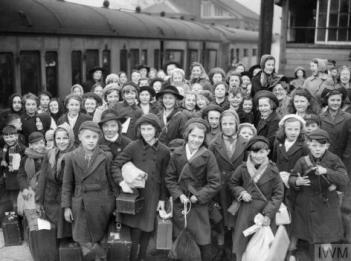
Children were labeled ‘like luggage’, and sent off with gas masks, toothbrushes and fresh socks & underwear. None of them had the slightest idea of where, or for how long.

thumbnail_ww2evacueesAll things considered, the evacuation of all that humanity ran relatively smoothly.  James Roffey, founder of the Evacuees Reunion Association, recalls ‘We marched to Waterloo Station behind our head teacher carrying a banner with our school’s name on it. We all thought it was a holiday, but the only thing we couldn’t work out was why the women and girls were crying.’

Arrivals at the billeting areas, were another matter.  Many kids were shipped off to the wrong places, and rations were insufficient.  Geoffrey Barfoot, billeting officer in the seaside town of Weston-super-Mare, said ‘The trains were coming in thick and fast. It was soon obvious that we just didn’t have the bed space.’

Kids were lined up against walls and on stages, and potential hosts were invited to “take their pick”.

For many, the terrors and confusion of those first few days grew into love and friendships, which lasted a lifetime.  Others entered a hell of physical and/or sexual abuse, or worse.

\


For the first time, “city kids” and country folks were finding out how the “other half” lived, with sometimes amusing results.  One boy wrinkled his nose on seeing carrots pulled out of muddy fields, saying “Ours come in tins”.  Richard Singleton recalled the first time he asked his Welsh ‘foster mother’ for directions to the toilet.  “She took me into a shed and pointed to the ground. Surprised, I asked her for some paper to wipe our bums.  She walked away and came back with a bunch of leaves.

John Abbot, evacuated from Bristol, had his rations stolen by his host family. He was horsewhipped for speaking out while they enjoyed his food while he himself was given nothing more than mashed potatoes. Terri McNeil was locked in a birdcage and left with a piece of bread and a bowl of water.

an-evac-killed-by-bus-near-blackpoolIn the 2003 BBC Radio documentary “Evacuation: The True Story,” clinical psychologist Steve Davis described the worst cases, as “little more than a pedophile’s charter.”

Eighty-odd years later, the words “I’ll take that one”, are seared into the memories of more than a few.

Hundreds of evacuees were killed because of relocation, while en route or during stays at “safe havens”.  Two boys were killed on a Cornish beach, mined to defend against German amphibious assault.

Apparently, no one had thought to put up a sign.

Irene Wells, age 8, was standing in a church doorway when she was crushed by an army truck.  One MP from the house of Commons said “There have been cases of evacuees dying in the evacuation areas. Fancy that type of news coming to the father of children who have been evacuated”.

When German air raids failed to materialize, many parents decided to bring the kids back home.  By January 1940, almost half of evacuees had returned.

980x (4)Authorities produced posters urging parents to leave the kids where they were and a good thing, too. The Blitz against London itself began on September 7. The city experienced the most devastating attack to-date on December 29, in a blanket fire-bombing that killed almost 3,600 civilians.

Sometimes, refugees from relatively safe locations were shipped into high-risk target areas. Hundreds of refugees from Gibraltar were sent into London, in the early days of the Blitz. None of them could have been happy to leave London Station, to see hundreds of locals pushing past them, hurrying to get out.

This story doesn’t only involve the British home islands, either.  American Companies like Hoover and Eastman Kodak took thousands of children in, from employees of British subsidiaries.  Thousands of English women and children were evacuated to Australia, following the Japanese attack on Singapore.

By October 1940, the “Battle of Britain” had devolved into a mutually devastating battle of attrition in which neither side was capable of striking the death blow. Hitler cast his gaze eastward the following June, with a surprise attack on his “ally”, Josef Stalin.

battle-of-britain-cleaning-up“Operation Steinbock”, the Luftwaffe’s last large-scale strategic bombing campaign of the war against southern England, was carried out three years later.  On this day in 1944, 285 German bombers attacked London in what the Brits called, a “Baby Blitz”.

You’d have to be some tough cookie to call 245 bombers, a Baby Blitz.WWII_London_Blitz_East_London-ChildrenLate in the war, the subsonic “Doodle Bug” or V1 “flying bomb” was replaced by the terrifying supersonic V2.  1,000 or more of these, the world’s first rocket, were unleashed against southern England, primarily London, killing or wounding 115,000. With a terminal velocity of 2,386mph, you never saw or heard this thing coming, until the weapon had done its work.

15092_0 (1)In the end, many family ‘reunions’ were as emotionally bruising as the original breakup.   Years had come and gone and new relationships had formed.  The war had turned biological family members, into all but strangers.

Richard Singleton remembers the day his mother came, to take him home to Liverpool.  “I had been happily living with ‘Aunty Liz and Uncle Moses’ for four years,” he recalled. “I told Mam that I didn’t want to go home. I was so upset because I was leaving and might never again see aunty and uncle and everything that I loved on the farm.”

Douglas Wood tells a similar story.  “During my evacuation I had only seen my mother twice and my father once.  On the day that they visited me together, they had walked past me in the street as they did not recognize me. I no longer had a Birmingham accent and this was the subject of much ridicule. I had lost all affinity with my family so there was no love or affection.”

The Austrian-British psychoanalyst Anna Freud, daughter of Sigmund Freud, commissioned an examination of the psychological effects of the separation. After a 12-month study, Freud concluded that “separation from their parents is a worse shock for children than a bombing.”

January 25, 1949 The Candy Bomber

By November, what had begun as a trickle had turned to a confectionery avalanche.  College student Mary Connors of Chicopee Massachusetts stepped up and offered to take charge of the flood.  By now, this was a national project. Volunteers were assembled in their hundreds to collect candy and tie them to little cloth parachutes.

World War II ended on May 8, 1945 in Europe, leaving the three major allied powers (United States, United Kingdom and the Soviet Union) in place, in and around the former Nazi capital of Berlin.  Representatives of the 3 met at Potsdam, capital of the German federal state of Brandenburg between July-August, hammering out a series of agreements known as the Potsdam agreement.

Built on earlier accords reached through conferences at Tehran, Casablanca and Yalta, the agreement addressed issues of German demilitarization, reparations, de-nazification and the prosecution of war criminals.

The Potsdam agreement called for the division of defeated Germany into four zones of occupation, roughly coinciding with then-current locations of the allied armies. The former capital city of Berlin was itself partitioned into four zones of occupation. A virtual island located 100 miles inside of Soviet-controlled eastern Germany.

berlin-1948During the war, ideological fault lines were suppressed in the drive to destroy the Nazi war machine.  Such differences were quick to reassert themselves in the wake of German defeat.  In Soviet-occupied east Germany, factories and equipment were disassembled and transported to the Soviet Union, along with technicians, managers and skilled personnel.
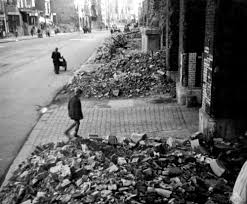
The former Nazi capital quickly became the focal point of diametrically opposite governing philosophies.  Leaders on both sides believed that Europe itself, was at stake. Soviet Foreign Minister Vyacheslav Molotov put it succinctly, “What happens to Berlin, happens to Germany; what happens to Germany, happens to Europe.”

images (58)West Berlin, a city utterly destroyed by war, was home to some 2.3 million at that time, roughly three times the city of Boston.
Differences grew and sharpened between the former allies, coming to a crisis in 1948. On June 26, Soviets blocked access by road, rail and water, to western occupation zones.

This was no idle threat.  Of all the malignant governing ideologies of history, Josef Stalin’s Soviet Union has to be counted among the worst.  These people had no qualms about using genocide by starvation as a political tool.  They had proven as much during the Holodomor of 1932 – ’33, during which this evil empire had murdered millions of its own citizens, by deliberate starvation.  To Josef Stalin, two million dead civilians was nothing more than a means to an end.

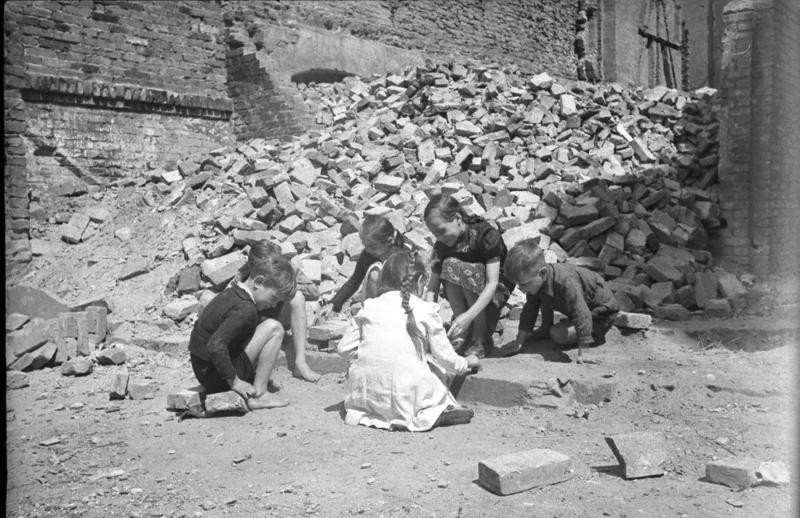
At the time, West Berlin had only 36 days’ worth of food, and 45 days’ supply of coal.Bundesarchiv_Bild_183-19000-1661_Berlin_Kinder_spielen_in_Ruinen-e1445197409271With that many lives at stake, allied authorities calculated a daily ration of only 1,990 calories would require 646 tons of flour and wheat, 125 tons of cereal, 64 tons of fat, 109 tons of meat and fish, 180 tons of dehydrated potatoes, 180 tons of sugar, 11 tons of coffee, 19 tons of powdered milk, 5 tons of whole milk for the children, 3 tons of fresh yeast for baking, 144 tons of dehydrated vegetables, 38 tons of salt and 10 tons of cheese.

With electricity shut off by Soviet authorities, heat and power for such a population would require 3,475 tons of coal, diesel and gasoline.

All of this and more was going to be needed.  Every.  Single. Day.

BA_Aircrews_LgWhat followed is known to history, as the Berlin Airlift.  At the height of the operation, a cargo aircraft landed every thirty seconds, in West Berlin. Altogether, the USAAF delivered 1,783,573 tons and the RAF 541,937 on a total of 278,228 sorties.  The Royal Australian Air Force delivered 7,968 tons of freight in over 2,000 flights.

Added together, the Berlin Airlift covered nearly the distance from Earth to the Sun, at a cost of 39 British and 31 American lives.

800px-BerlinerBlockadeLuftwegeUS Army Air Force Colonel Gail “Hal” Halvorsen was one of those pilots, flying C-47s and C-54 aircraft deep inside of Soviet controlled territory.  On his days off, Halvorsen liked to go sightseeing, often bringing a small movie camera.
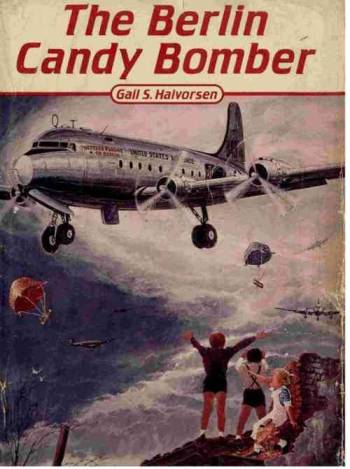
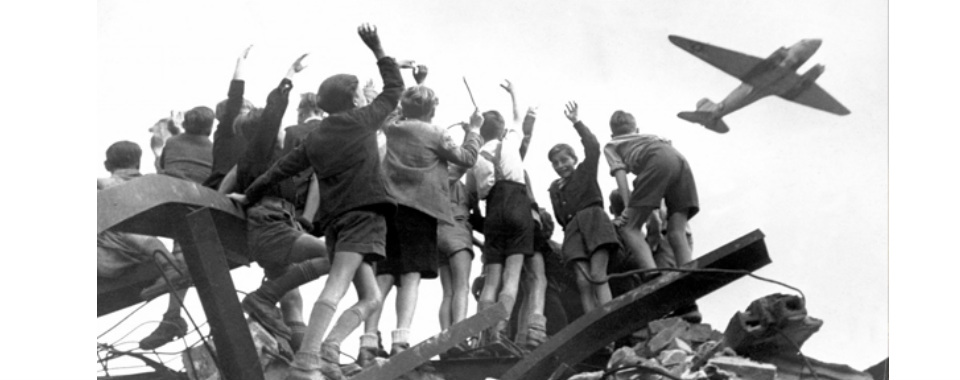
One day in July, Hal was filming take-offs and landings at the Templehof strip when he spotted some thirty children, on the other side of a barbed wire fence.  He went over to speak with them, and felt impressed.  It was normal for children to ask GIs  “Any gum, chum?” or “Any bon-bon?”  Not these kids.  Dirty, half starved and possessed of nothing whatsoever, these kids had spirit.  Halvorsen remembers:

“I met about thirty children at the barbed wire fence that protected Tempelhof’s huge area. They were excited and told me that ‘when the weather gets so bad that you can’t land, don’t worry about us. We can get by on a little food, but if we lose our freedom, we may never get it back.'”

Reaching in his pocket, Halvorsen found two sticks of gum.  Wrigley’s Doublemint gum. Breaking them each into four pieces he gave them to the nearest children, only to watch them break the gum into smaller pieces, to share with their friends.  Those who got none received tiny slivers of the wrappers themselves, small faces shining with joy at just a whiff of mint from the wrapper.

Halvorsen told the kids he’d be back tomorrow, on one of those planes.  He’d have enough for them all, he said.  You’ll know it’s my plane because I’ll wiggle my wings.

That night, Halvorsen, his co-pilot and engineer, pooled their candy rations.  Even small boxes can’t simply be tossed out of a moving aircraft, and so, the three rigged handkerchiefs.  Tiny little “parachutes”, for tiny little packages.

Halvorsen made such drops three times over the next three weeks and noticed each time, the group of children waiting by the wire, grew larger.

tumblr_mc0esdHpaP1rezpz7o1_500Newspapers got wind of what was going on.  Halvorsen thought he’d be in trouble, but no. Lieutenant General William Henry Tunner liked the idea. A lot. “Operation Little Vittles” became official, on September 22.
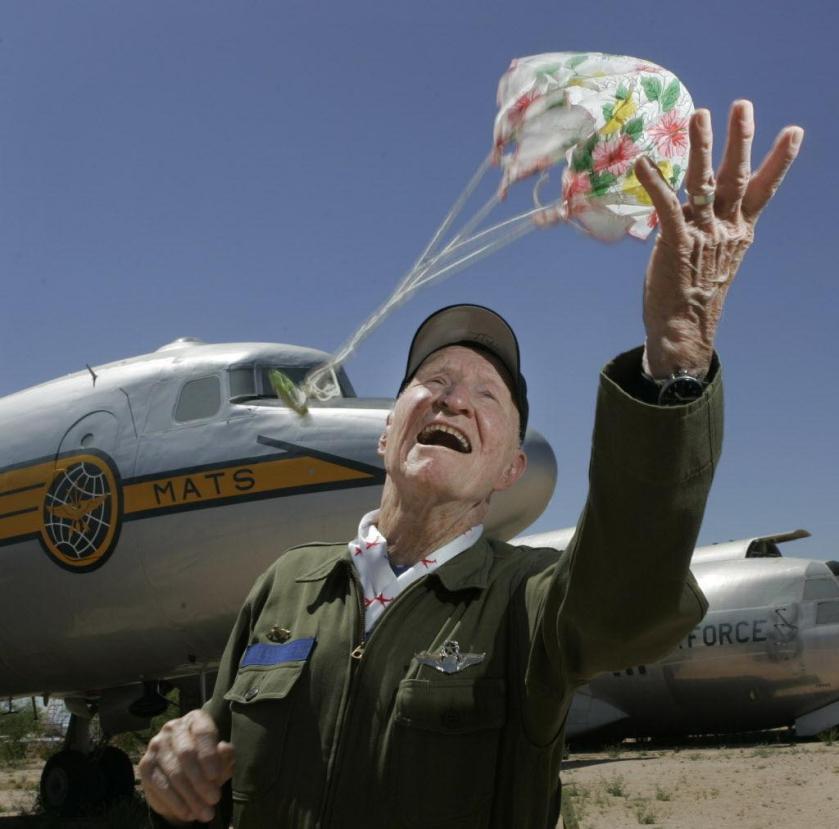
What had begun between Halvorsen and his friends spread to the whole squadron. Word quickly crossed the ocean and children all over the United States gave up their own, for kids who had less.  Soon, candy manufacturers themselves joined in.

By November, what had begun as a trickle had turned to a confectionery avalanche.  College student Mary Connors of Chicopee Massachusetts stepped up and offered to take charge of the flood.  By now, this was a national project. Volunteers were assembled in their hundreds to collect candy and tie them to little cloth parachutes.

“Christmas from Heaven: The Candy Bomber Story” with the Mormon Tabernacle Choir and Orchestra, Narrated by Tom Brokaw

Before long, pilots were dropping little packages, all over Berlin. They were the Rosinenbombers. Raisin Bombers. Halvorsen himself came to be known by many names, to the children of Berlin. “Uncle Wiggly Wings”. “The Chocolate Uncle”. “The Gum Drop Kid”. “The Chocolate Flier”.

Colonel Halvorsen’s work even earned him two letters, proposals of marriage, but he turned them both down.  He was carrying on a romance by letter at this time, with Miss Alta Jolley.  The couple would go on to marry in April of 1949, a marriage which would last, for fifty years. Alta Jolley Halvorsen passed away on this day in 1999 leaving her husband, 5 adult children and 24 grandchildren.

On this day in 1949, the Berlin Airlift had barely cleared the mid-point.  The largest humanitarian airlift in aviation history would last until the blockade was lifted on May 12, 1949, and then some.  Operation Little Vittles continued throughout the period, dropping an estimated 23 tons of candy from a quarter-million tiny little parachutes.

Over the years, many of those now-grown children have sought Halvorsen out, to say thank you and to tell stories.  Tales of hope, and fun, of fond anticipation.  All in a time and place when such things were very hard to find.

557b6348427ef.imageYou never know, he said. “The small things you do turn into great things.”

January 12, 1968 An Air Combat First

Twenty-eight ton, four-engine bombers were never meant for diving attacks and multiple-G banking turns.

To the extent that most of us think about aerial combat, at least the non-pilots among us, I think we envision some variation of the dog fights between Snoopy and the Red Baron. Two aircraft, bobbing and weaving through the sky.  Like bantamweight boxers, each attempting to strike the winning blow.

The Snoopy story is fun but in the real world, Manfred von Richthofen was killed by a single bullet from the ground, while pursuing a Canadian pilot behind Allied lines.  The Red Baron landed his red Fokker tri-plane in a beet field and died mere moments later. He was buried with full military honors.  By his enemies.

Manfred-von-Richthofen-The-Red-Baron
Manfred von Richtofen

Possibly the strangest dogfight of WWII took place on August 17, 1943, between two German long-range “Condor” maritime patrol bombers, and an American B-24D Liberator bomber modified to hunt submarines, in the skies over the Atlantic Ocean.

Twenty-eight ton, four-engine bombers were never meant for diving attacks and multiple-G banking turns, but these three entered a full-on dogfight.

02b_am2015_milcoll_xviii_maxwell_5_live-ct.jpgStripped of armor to increase range and carrying a full load of depth charges, the American anti-submarine bomber with its 10-man crew dove out of the clouds at 1,000 feet, throttles open and machine guns ablaze. The first Condor never came out of that diving turn, while machine gun fire from the second tore into the American bomber, shredding hydraulic systems and setting the right wing ablaze.

Rear-gunners returned fire as crew members frantically jettisoned depth charges.  With engines #3 and 4 dead, Liberator pilot Hugh Maxwell Jr. kicked in full right rudder, throwing the massive aircraft into a skid and crash landing in the water, the aircraft breaking into three pieces.02d_am2015_b24_flak_live.jpgMaxwell had dubbed his B-24 “The Ark”, explaining that “it had a lot of strange animals aboard, and I hoped it would bring us through the deluge”. It must have worked.  Seven out of ten crew members lived to be plucked from the water. The second Condor made it back to Bordeaux, where it crashed and burned on landing.

Surviving Liberator crew members were rescued by the British destroyer Highlander, along with three Germans from that first Condor. It was all the Highlander crew could do to keep the soaking wet combatants from resuming the fight, on the decks of the destroyer.

The “Brass” got into the action in November 1942, when general Eisenhower and a high ranking entourage left London destined for Gibraltar in a fleet of 6 converted B-17 Flying Fortress bombers. Five made the crossing without incident but one turned back due to mechanical problems.  Sure enough, the lone American bomber was lumbering overhead the following day when set upon by a flight of four German long-range fighters.c01d0637794c357f99670b25d4224b7f.jpgWith crew reduced to a minimum it was one-star General Jimmy Doolittle (yeah, That Jimmy Doolittle), who took the stick from a wounded pilot.  A Colonel, a Major and two senior civilian officials pitched in while one-star general Lyman Lemnitzer manned a machine gun, holding the fighters at bay.

The German squadron peeled off, probably low on fuel.  The B-17 made it with what must have been the most senior combat team, in aviation history.

The final air-to-air combat of WW2 took place on April 12 1945, between unarmed spotter aircraft. Two Americans were flying low near Berlin when the pair spotted a German Fieseler Storch spotter aircraft, even lower. Having the better air position the Americans opened fire with service pistols. As the Storch attempted to escape, the aircraft brushed a wing on the ground, and it was over.

Duel-in-the-Sun.jpg
Last air-to-air combat of WW2

On the first night of the Gulf War in 1991, a single Iraqi Mirage fighter intercepted an American EF-111, an unarmed F-111 bomber modified for radar-jamming patrol. Flying at 200′ and equipped with sophisticated terrain-following radar, the bomber was able to climb up and over hilltops while the French-made Mirage fighter had no such systems.

The last anyone saw of that Iraqi fighter, was when he plowed into that hillside.

33d47fd2fa54f4be18ca783dc2054998.jpg
Low Level, terrain-following radar

Later in the same conflict, an Iraqi Hughes 500 helicopter was taken out by bombs dropped from an American Air Force F-15E bomber. At least one Iraqi PC-7 Turboprop pilot got so spooked he bailed out of a perfectly good aircraft, before a single shot was fired in his direction.

The strangest dogfight in history took place on January 12, 1968, when four Soviet-made Antonov AN-2 Colt biplanes took off from a base in North Vietnam headed west toward Laos.

Only 125 nautical miles from Hanoi, Phou Pha Thi mountain was long used as a staging base for CIA directed Hmong guerrilla fighters and Thai security forces. Lima Site 85 was the American radar facility, perched atop the 5,800-foot massif.

th1.jpg
Lima site 85, atop 5,800 Phou Pha Thi Mountain

CIA-operated “Air America” captain Ted Moore was flying a UH-1D Huey helicopter at the time, carrying a load of ammunition to Phou Pha Thi. Moore arrived to see two North Vietnamese biplanes, dropping 122mm mortar shells through holes in the floor and strafing the mountaintop with 57mm rockets. “It looked like WWI,” he later recalled. Moore gave chase, positioning his helicopter above one biplane, as flight mechanic Glenn Woods fired an AK-47 from above.

Moore and Woods dropped back to the second biplane, as the first crashed into a ridge west of the North Vietnamese border. Moments later, the second crashed into a mountainside, as the other two slipped back into North Vietnamese air space. The entire contact was over in less than 20 minutes.

Theirs was a secret war, waged in the mists of the Annamite Mountains. Two months later, North Vietnamese commandos attacked and destroyed Site 85, inflicting the largest loss of US Air Force personnel of the war in Vietnam.

1000607120-The-Waiting-War_02
Ann Holland holds a 2017 calendar — “Secret Ops of the CIA” — that represents the place where her husband’s unit was overrun in 1968 during the Vietnam War. Mel Holland was on a mountaintop radar station that guided B-52 bombers toward targets in North Vietnam. (Amanda Cowan/The Columbian)

On July 27, 2007, Air America veterans Marius Burke and Boyd Mesecher presented the CIA with “An Air Combat First”, an oil on canvas painting by Keith Woodcock, depicting the shoot-down. The event was attended by members of the Air America Board, pilot Ted Moore, wife of flight mechanic Glenn Woods Sawang Reed, CIA paramilitary veteran Bill Lair; and the painting’s donors. Presumably, the painting hangs at CIA Headquarters in Langley, Virginia. A testament to the only time in the history of the Vietnam war, that an enemy fixed-wing aircraft was shot down, by a helicopter.

7415429298_aabd85f3c9_b.jpg
An Air combat First.  H/T artist Keith Woodcock

January 11, 1935 Amelia

“The woman who can create her own job is the woman who will win fame and fortune”. – Amelia Earhart

Amelia Earhart was born July 24, 1897 in Atchison, Kansas, the first surviving child of Samuel “Edwin” and Amelia “Amy” Otis Earhart. Amy didn’t believe in raising “nice little girls”, she allowed “Meeley” and her younger sister “Pidge” to live an outdoor, rough and tumble “tomboy” kind of childhood.

AmeliachildEd seems to have had life-long problems with alcohol, often resulting in an inability to provide for his family. Amelia must have been a disciplined student despite it all, as she graduated with her high school class, on time, notwithstanding having attended six different schools.

Earhart was certainly independent, saying later in life “The woman who can create her own job is the woman who will win fame and fortune”.

Amelia and her sister saw their first airplane in 1908, at the Iowa State Fair in Des Moines. It was a rickety old biplane in which Edwin was trying to interest them in a ride.   Earhart later described that biplane as “a thing of rusty wire and wood and not at all interesting.”  At the time, the girls preferred the merry-go-round.

earhart-98-e1544117412522.jpgMeeley and Pidge worked as nurse’s aids in Toronto, in 1919.  There she met several wounded aviators and developed a strong admiration for these people.  Amelia would spend much of her free time watching the Royal Flying Corps practice at a nearby airfield.

Around that time, Earhart and a friend were visiting an air show in Toronto, when one of the pilots thought it would be funny to dive at the two women. “I am sure he said to himself, ‘Watch me make them scamper,’” she said, but Earhart held her ground.  “I did not understand it at the time, but I believe that little red airplane said something to me as it swished by.”

A ten-minute ride at a Long Beach California air show in 1920 changed her life.  From that time on, Amelia Earhart knew she wanted to fly.

Earhart worked at a variety of jobs from photographer to truck driver, earning money to take flying lessons from pioneer female aviator Anita “Neta” Snook.

She bought a second-hand Kinner Airster in 1921, a bright yellow biplane she called “The Canary”, flying it to 14,000’ the following year, a world altitude record for female pilots.

Neta_amelia_kinner_airster_s
Neta Snook, Amelia Earhart, 1921

Short funds grounded her for a time, by 1927 she was flying out of the Dennison Airport in Quincy, Massachusetts.  Earhart invested in the airport and worked as a salesman for Kinner airplanes in the Boston area while writing about flying in the local newspaper.

Charles Lindbergh’s New York to Paris Flight on May 20-21 of that year was the first solo, non-stop transatlantic crossing by airplane. Aviatrix Amy Phipps Guest wanted to be the first woman to make the flight, but later decided it was too dangerous. Instead she would sponsor the trip, provided that “another girl with the right image” was found.

“Lady Lindy”, Earhart became that first woman on May 21, 1932, five years to the day after Lindbergh.

Amelia_Earhart_standing_under_nose_of_her_Lockheed_Model_10-E_Electra,_small

On this day in 1935, Amelia Earhart became the first person of either sex to fly solo from Hawaii to California.

Two years later, Earhart and copilot/navigator Frederick J. Noonan attempted to fly around the world. The US Coast Guard cutter Itasca picked up radio messages that the aircraft was lost and low on fuel on July 2, 1937, and then it vanished.

The $4 million search and rescue effort covered 150,000 square miles and lasted for sixteen days, but to no avail.

amelialostphotosFollowing the end of the official search, Earhart’s husband and promoter George Palmer Putnam financed private searches of the Phoenix Islands, Christmas (Kiritimati) Island, Fanning (Tabuaeran) Island, the Gilbert and the Marshall Islands, but no trace of the aircraft or its occupants was ever found.

Earhart was declared dead in absentia on January 5, 1939 at the age of 41, Noonan on June 20, 1938.  He was 44.

For years, the prevailing theory was that Earhart’s Lockheed Model 10 Electra ran out of gas and plunged into the ocean.

Earhart-electra_10
“Amelia Earhart’s Lockheed Electra 10E. During its modification, the aircraft had most of the cabin windows blanked out and had specially fitted fuselage fuel tanks. The round RDF loop antenna can be seen above the cockpit. This image was taken at Luke Field on March 20, 1937; the plane would crash later that morning”.

The International Group for Historic Aircraft Recovery (TIGHAR) has been exploring a 1½ mile long, uninhabited tropical atoll once called Gardner Island, now Nikumaroro, in the southwestern Pacific Republic of Kiribati. After eleven visits to the atoll, TIGHAR sonar images revealed a straight, unbroken anomaly under the sand, remarkably consistent with the fuselage of a Lockheed Electra.

The traces of a long-dead campfire were discovered in 1940, along with animal bones, a box from a sextant, and thirteen human bones.  A doctor judged them to have belonged to a male and American authorities were never notified.

Those bones were subsequently lost, but computerized re-evaluation of their measurements suggest that the skeleton was probably that of a white female of European ethnicity, standing roughly the same 5’8″ as Amelia Earhart.

A specially trained team of four border collies was brought to Nikumaroro to search for bones in June 2017.  Thus far, the answer to one of the great mysteries of the 20th century, remains elusive.

Nikumaroro is no tropical island paradise.  There is no fresh water and daytime temperatures exceed 100°F in July. The island’s only inhabitants are Birgus latro, commonly known as the coconut crab, The largest land-dwelling arthropod in the world, specimens weigh up to 9-pounds and measure over 3′ from leg tip to leg tip.

Gifted with a keen sense of smell, the adult coconut crab feeds on fruits, nuts, seeds, and the pith of fallen trees but will eat carrion or just about anything else if given the opportunity.  Virtually any food source left unattended will be investigated and carried away, giving rise to the alternative name “Robber crab.”

It’s anyone’s guess how those two aviators spent the last hours of their lives, or who it was who lit that fire or left those bones. Looking at the size of the island’s only inhabitants, it’s not difficult to imagine why there were only 13.

December 20, 1943 Special Brothers

“You follow the rules of war for you – not for your enemy”, his commander had said. “You fight by rules to keep your humanity”.

Franz Stigler
Franz Stigler

At the age of 26, Franz Stigler was an Ace. The Luftwaffe pilot of a Messerschmitt Bf-109 fighter, some of his kills had been revenge, payback for the death of his brother August, earlier in the war.

Stigler was no Nazi.  This was a German Patriot with 22 confirmed kills, doing what the nation required him to do.

On December 20, 1943, Stigler needed one more kill for a Knight’s Cross. He tossed his cigarette aside and climbed into his fighter as the crippled American B17 bomber struggled overhead. This was going to be an easy kill.

charles-brown.jpg
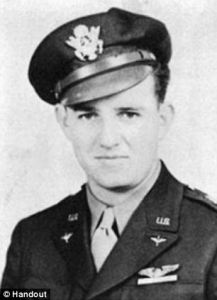
Charles Brown

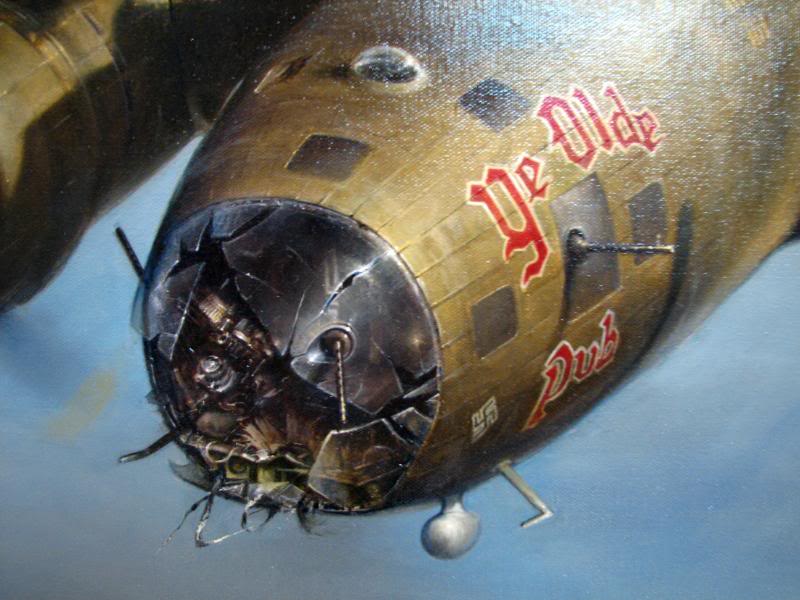
21-year-old Charles Brown held the throttle of that B17, an aircraft named “Ye Olde Pub”. The earlier attack on the munitions factory in Bremen had been a success, but the pilot and crew had paid a dreadful price.

Brown’s bomber was set upon by no fewer than 15 German fighters. Great parts of the air frame were torn away, one wing severely damaged and part of the tail ripped off. The aircraft’s Plexiglas nose was shattered and the #2 engine seized. Six of the ten-man crew were wounded and the tail gunner dead, his blood frozen in icicles over silent machine guns. Brown himself had been knocked out at one point, coming around just in time to avert a fatal dive.yeoldepub.jpgThe battered aircraft was completely alone and struggling to maintain altitude.  The American pilot was well inside German air space when he looked to his left and saw his worst nightmare. Three feet from his wing tip was the sleek gray shape of a German fighter, the pilot so close that the two men were looking into each other’s eyes.  Brown’s co-pilot, Spencer “Pinky” Luke said “My God, this is a nightmare.” “He’s going to destroy us,” was Brown’s reply. This had been his first mission. He was sure it was about to be his last.

Long ago before his first mission, Stigler’s commanding officer Lt. Gustav Roedel, had explained the warrior’s code of conduct:  “Honor is everything here. If I ever see or hear of you shooting at a man in a parachute, I will shoot you down myself”.

The German ace must have remembered those words as he watched the wounded, terrified American airmen inside that B17, some still helping one another with their injuries. “You follow the rules of war for you – not for your enemy”, Roedel had said. “You fight by rules to keep your humanity”.big-hole.jpgThe German had to do something.  Nazi leadership would surely shoot him for treason if he was seen this close without completing the kill. One of the American crew was making his way to a gun turret as the German made his decision. Stigler saluted his adversary, motioned with his hand for the stricken B17 to continue, and peeled away.
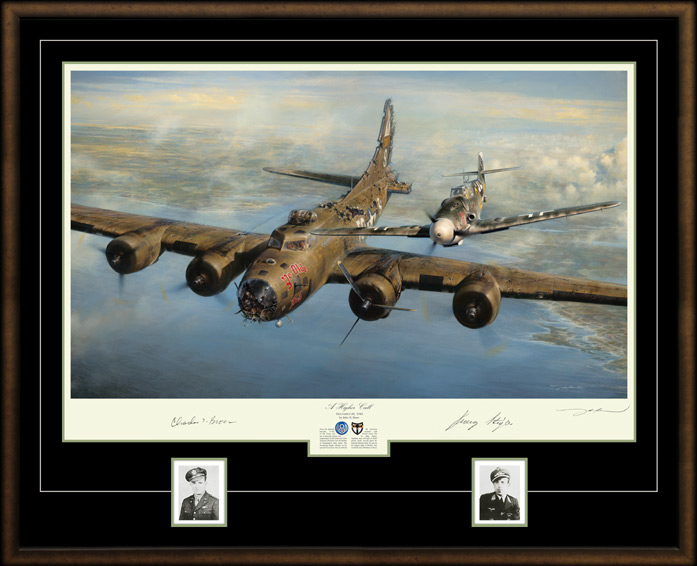
Ye Olde Pub lumbered on, pierced and holed through and through, across 250 frozen miles of the North Sea.  At last, she made it to Norfolk.

Bf-109-pilot-Franz-StiglerOver 40 years later, the German pilot was living in Vancouver, Canada.  Brown took out an ad in a fighter pilots’ newsletter, explaining that he was searching for the man ‘who saved my life on December 20, 1943.’  Stigler saw the ad, and the two met for the first time in 1987. “It was like meeting a family member”, Brown said of that first meeting. “Like a brother you haven’t seen for 40 years”.
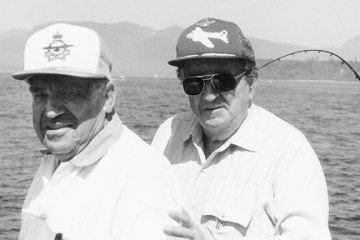
Ye-Old-pub-9The two former enemies passed the last two decades of their lives as close friends and occasional fishing buddies.

The two old warriors passed away in 2008, only six months apart. Franz Stigler was 92, Charles Brown 87.

A book called “A Higher Call”, tells the story in greater detail, if you’re interested in reading more about this signal act of kindness, between once mortal enemies.

In the two obituaries, both men were mentioned each as the other’s, “Special Brother”.


October 13, 1926 We’ll Come Back for you

A Naval story for this October 13, the day we celebrate as the birthday, of the United States Navy.

A boy was born this day in Hattiesburg Mississippi, the son of poor tenant farmers.  Jesse LeRoy Brown had all the disadvantages of a poor black child growing up under depression-era segregation, but Julia and John Brown kept their son on the “straight & narrow”, insisting he stuck with his studies.

Thomas Jerome Hudner, Jr. was born in 1924, son of the Irish American owner of a chain of grocery stores from Fall River Massachusetts, who went on to attend the prestigious Phillips Andover Academy, in 1939.

Jesse Brown and Thomas Hudner could not have come from more different backgrounds.  The lives of the two came together with the United States Navy, the two men becoming pilots and serving together during the conflict in Korea.

image (9)
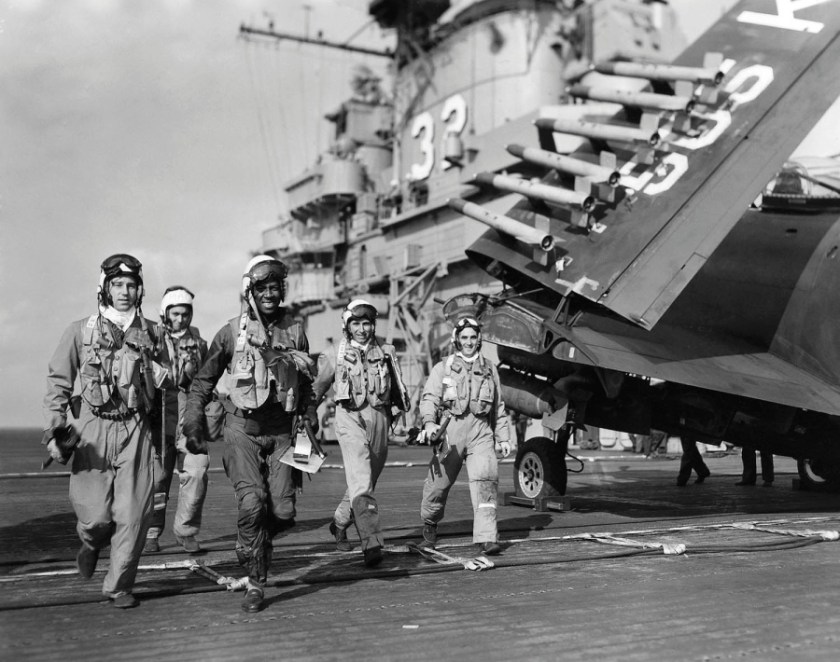
“Ensign Jesse L. Brown, the first African-American Navy aviator, walks across the flight deck of the USS Leyte in November 1950, about a month before he was shot down and died in North Korea.” – H/T Stars & Stripes

On June 25, 1950, ten divisions of the North Korean People’s Army launched a surprise invasion of their neighbor to the south. The 38,000 man army of the Republic of Korea didn’t have a chance against 89,000 men sweeping down in six columns from the north. Within hours, the shattered remnants of the army of the ROK and its government, were retreating south toward the capital of Seoul.

The United Nations security council voted to send troops to the Korean peninsula. In November, the People’s Republic of China entered the conflict in support of their Communist neighbor.

By December, nearly 100,000 troops of the People’s Volunteer Army had all but overrun the 15,000 men of the US X Corps, who found themselves surrounded in the frozen wasteland of the Chosin Reservoir. Dozens of close air support missions were being flown every day to keep the Chinese army at bay. On December 4, Jesse Brown and Thomas Hudner were flying one of those missions.

The two were part of a 6-plane formation of F4U Corsairs, each pilot flying “wing man” for the other. Brown’s aircraft was hit by small arms fire from the ground, leaving him no alternative but a crash landing on a snow covered mountain. Flying overhead, Hudner could see his wing man below, severely injured and struggling to get out of the burning aircraft, his leg trapped in the crumpled cockpit.

airplanepictures_2272_51351289Hudner acted on instinct, deliberately crash landing his own aircraft and, now injured, running across the snow to the aid of his friend and wing man.  Hudner scooped snow onto the fire with his bare hands in the bitter 15° cold, burning himself in the progress while Brown faded in and out of consciousness.  Soon, a Marine Corps helicopter pilot landed, to help out.  The two tore into the stricken aircraft with an axe for 45 minutes, but could not free the trapped pilot.
The Marine and the Navy Pilot were considering Jesse’s plea that they amputate his trapped leg with the axe, when the pilot faded away for the last time. Jesse Leroy Brown’s final words were “Tell Daisy I love her”.

They had to leave. “Night was coming on” Hudner would later explain, “and the helicopter was not equipped to fly in the dark. We’ll come back for you”, he said.

Jesse Brown could no longer hear him.

image (10)
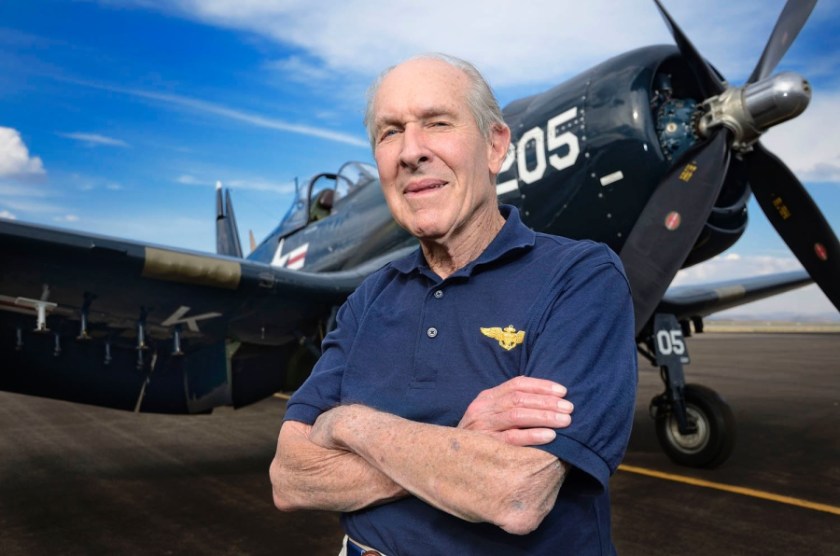
Korean War veteran and Medal of Honor recipient Thomas Hudner stands in front of a vintage Corsair in this undated photo. H/T Stars & Stripes, COURTESY OF JOSE RAMOS

Hudner pleaded with authorities to go back to the crash site, but they were unwilling to risk further loss of life. They would napalm the crash site so that the Chinese couldn’t get to the aircraft or the body, though pilots reported that it looked like the Brown’s body had already been disturbed.

Captain Hudner expected a court-martial for intentionally downing his aircraft.  USS Leyte commander Captain Thomas Upton Sisson told him, “Personally, I’ve never heard of a more wonderful act than what you pulled out there.”

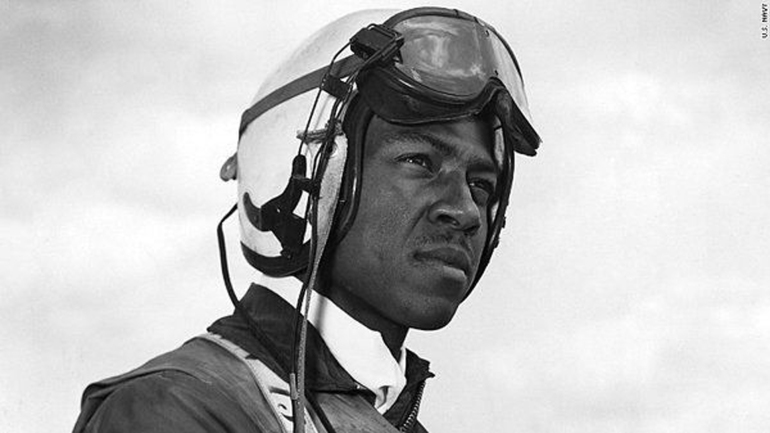
Jesse LeRoy Brown was the first Naval Aviator of African ancestry, earning his wings only months after President truman, integrated the military. He was first to die in the Korean War, recipient of the Distinguished Flying Cross and Purple Heart, both awarded, posthumously. Thomas Hudner was awarded the Medal of Honor for his actions on that frozen mountainside. One of eleven to be so honored following the battle of the Chosin Reservoir, Hudner was the only Naval aviator awarded the Medal of Honor, during the entire conflict in Korea.

Thomas Hudner visited the North Korean capital of Pyongyang in July 2013, where he received permission to return to the site. He was 88 at the time, but weather hampered the effort. North Korean authorities told him to return when the weather was more cooperative.

In May 2012, Secretary of the Navy Ray Mabus announced an Arleigh Burke-class guided missile destroyer to be named USS Thomas Hudner. Four years later, 91-year-old Thomas Hudner wrote to the Secretary, on behalf of his wingman:

“It pains me to ask for any favor, but there is one last cause to which I must attend”.

Hudner requested that a ship be named after his wingman.

XJSWIDFYANETPJCBHARCCKD7DE

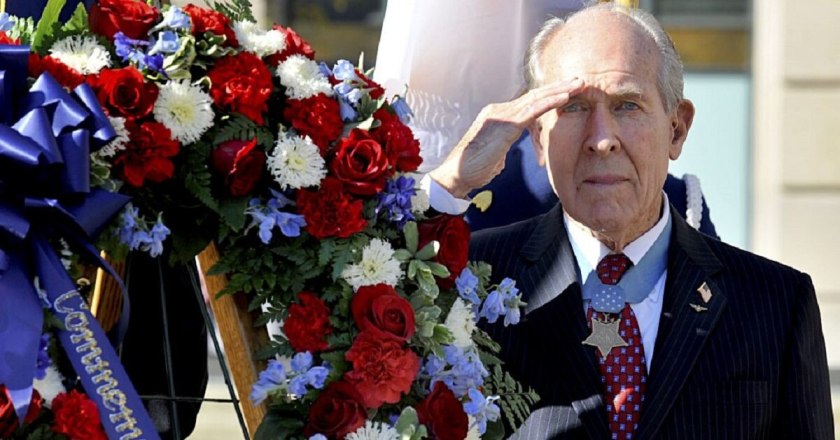
Retired Navy Capt. Thomas Hudner salutes while “Taps” is played during the Centennial of Naval Aviation wreath-laying ceremony at the Navy Memorial in Washington D.C., in 2011. H/T Military Times

Captain Hudner lived out the last years of his life with his wife Georgea, at the couple’s home in Concord Massachusetts.  He passed away on November 13, 2017 at the age of 93.

A year later nearly to the day, December 1, 2018, the USS Thomas Hudner (DDG-116) was commissioned in Boston Harbor, members of both families, in attendance.

Jessica Knight Henry, Brown’s granddaughter and namesake, summed up the meaning of this day.  “Jesse and Tom’s stories have been intertwined since that fateful day”.

Jesse LeRoy Brown’s remains were never recovered.

jesse-leroy-brown-2

October 8, 1942, Once!

MacArthur was horrified at the sight of that beat up aircraft and refused to fly on such a “broken down crate”.

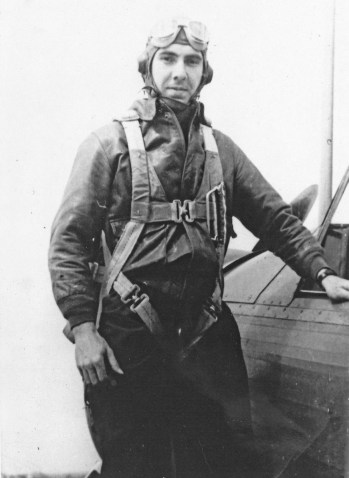
Harl-Pease-croppedThe Municipal Airport in Portsmouth New Hampshire opened in the 1930s, expanding in 1951 to become a Strategic Air Command (SAC) base. The name was changed to Pease Air Force Base in 1957, in honor of Harl Pease, Jr., recipient of the Medal of Honor and Distinguished Flying Cross for heroism that led to his death in World War II.
The Japanese war machine seemed unstoppable in the early months of the war. In 1942, that machine was advancing on the Philippines.

Harl PeaseUnited States Army Air Corps Captain Harl Pease, Jr. was ordered to lead three battered B-17 Flying Fortresses to Del Monte field in Mindanao, to evacuate General Douglas MacArthur, his family and staff, to Australia. One of the aircraft was forced to abort early, while the other developed engine trouble and crashed. Pease alone was able to land his Fortress, despite inoperative wheel brakes and used ration tins covering bullet holes.

MacArthur was horrified at the sight of that beat up aircraft and refused to fly on such a “broken down crate”. The General would wait two more days before making his famous exit, saying, “I shall return”.

Harl Pease wasn’t supposed to go on the “maximum effort” mission against Rabaul, since his aircraft was down for repairs. But he was determined.  Pease and a few volunteers grabbed an old trainer aircraft on August 7, too beat up for combat service. Its engines needed overhaul, some armament had been dismounted, and the electric fuel-transfer pump had been scavenged for parts. Pease had a fuel tank installed in the bomb bay and a hand pump was rigged to transfer fuel. In fewer than three hours, he and his crew were on their way.

Captain Pease’ Medal of Honor citation tells what happened next:

Cmoh_army (1)“When 1 engine of the bombardment airplane of which he was pilot failed during a bombing mission over New Guinea, Capt. Pease was forced to return to a base in Australia. Knowing that all available airplanes of his group were to participate the next day in an attack on an enemy-held airdrome near Rabaul, New Britain, although he was not scheduled to take part in this mission, Capt. Pease selected the most serviceable airplane at this base and prepared it for combat, knowing that it had been found and declared unserviceable for combat missions. With the members of his combat crew, who volunteered to accompany him, he rejoined his squadron at Port Moresby, New Guinea, at 1 a.m. on 7 August, after having flown almost continuously since early the preceding morning. With only 3 hours’ rest, he took off with his squadron for the attack. Throughout the long flight to Rabaul, New Britain, he managed by skillful flying of his unserviceable airplane to maintain his position in the group. When the formation was intercepted by about 30 enemy fighter airplanes before reaching the target, Capt. Pease, on the wing which bore the brunt of the hostile attack, by gallant action and the accurate shooting by his crew, succeeded in destroying several Zeros before dropping his bombs on the hostile base as planned, this in spite of continuous enemy attacks. The fight with the enemy pursuit lasted 25 minutes until the group dived into cloud cover. After leaving the target, Capt. Pease’s aircraft fell behind the balance of the group due to unknown difficulties as a result of the combat, and was unable to reach this cover before the enemy pursuit succeeded in igniting 1 of his bomb bay tanks. He was seen to drop the flaming tank. It is believed that Capt. Pease’s airplane and crew were subsequently shot down in flames, as they did not return to their base. In voluntarily performing this mission Capt. Pease contributed materially to the success of the group, and displayed high devotion to duty, valor, and complete contempt for personal danger. His undaunted bravery has been a great inspiration to the officers and men of his unit”.

Pease was presumed lost until the capture of one Father George Lepping, who found Captain Pease and one of his airmen, languishing in a Japanese POW camp. Captain Pease was well respected by the other POWs, and even among some of his Japanese guards. “You, you ah, Captain Boeing?“, they would say. Pease would stand up straight and say, “Me, me Captain Boeing.”

Japanese officers were a different story.  They would beat the prisoners savagely on any provocation, or none at all.

harl-pease2
Army Air Corps Capt. Harl Pease Jr. Photo courtesy of the Congressional Medal of Honor Society

On October 8, 1942, Captain Harl Pease, Jr. was taken into the jungle along with three other Americans and two Australian prisoners. They were given picks and shovels and forced to dig their own graves.  And then each was beheaded, by sword. Captain -Pease was 26.

Many years later, an elderly Japanese veteran passed away.  His family found his war diary. The old man had been a soldier once, one of the guards ordered along, on the day of Pease’ murder.

The diary tells of a respect this man held for “Captain Boeing”. Beaten nearly senseless, his arms tied so tightly that his elbows touched behind his back, Captain Pease was driven to his knees in the last moments of his life. Knowing he was about to die, Harl Pease uttered the most searing insult possible against an expert swordsman and self-styled “samurai”.  Particularly one with such a helpless victim. It was the single word, in Japanese. “Once!“.

B17E-8_1024x1024

July 20, 1969   Sick of Space

On this day in 1969, two grown men descended to the face of the lunar body in a vehicle so shockingly delicate, as to be incapable of supporting its own weight outside the zero gravity of space.  It was the technological triumph of the 20th century.  A feat accomplished with less computing horsepower, than an old iPhone.

It’s hard to turn on the TV this week, without hearing about Apollo 11.  Fifty years ago, those famous words spoken by the first human being, to set foot on the moon.  “That’s one small step for (a) man, one giant leap for mankind“.

The moon landing of July 20, 1969 was the culmination of tens of millions of man-hours, a twelve-years long space race with the Soviet Union, five dead astronauts and the young President who had dared them to do it, himself shot through the head some six years earlier.

On this day in 1969, two grown men descended to the face of the lunar body in a vehicle so shockingly delicate, as to be incapable of supporting its own weight outside the zero gravity of space.  It was the technological triumph of the 20th century.  A feat accomplished with less computing horsepower, than an old iPhone.

Ten years earlier,  NASA needed to know what happened to the human body in space.  The Soviet space program was halted for nearly a year, so sick was the #2 (human) “traveler in the cosmos”.  Astronauts would be subjected to weightlessness, G-forces beyond imagination and constant rotation.  A world where up is down and down is up and the delicate sensors of the middle ear cry out, Enough!

seasick-sailor

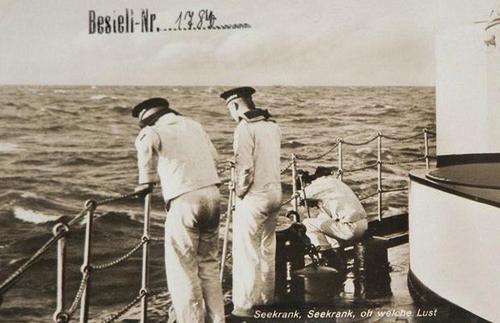
The vertigo and the nausea of motion sickness has played its part, from the earliest days of human history.  The ancient Greek physician Hippocrates wrote about it.  The Roman philosopher Seneca writes of the misery of a long voyage in which ‘he could bring nothing more up’.  The lyric poet Horace writes of seasickness as a great social leveler, in which wealth is no protection and the rich man suffers just as much as the poor man.  The sea-going military exploits of Julius Caesar are replete with tales of vomiting legionaries and seasick horses.

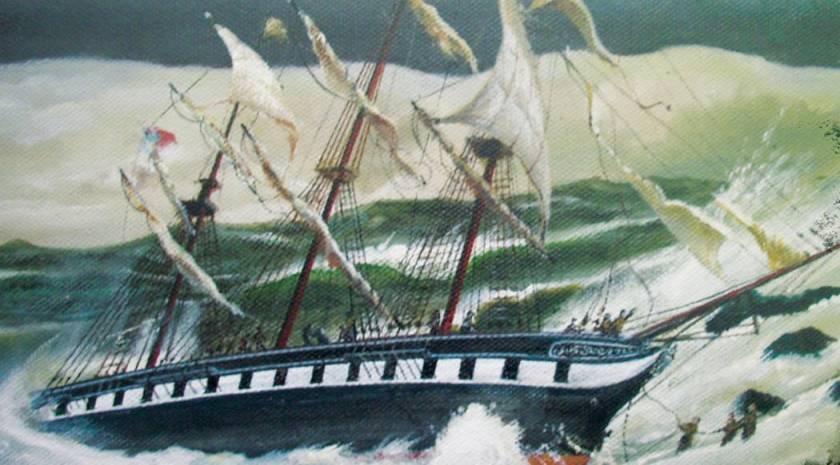
To the Great good fortune of the Protestant England of 1588, the terrifying Armada sent by Spanish King Phillip II to overthrow Queen Elizabeth I was commanded by the Duke of Medina Sidonia, an Army general with little to no experience at sea. Sidonia suffered such severe seasickness that this, combined with a stroke of exceptionally bad luck, destroyed the Spanish Armada and paved the way to the next three hundred years in which “Britannia Ruled the Waves”.

going-for-gold

Were you to catch the early space travelers in a candid moment, many are the tales of less-than-heroic moments, spent wiping the product of space sickness from the interiors of craft from the Gemini program to the Space Shuttle.

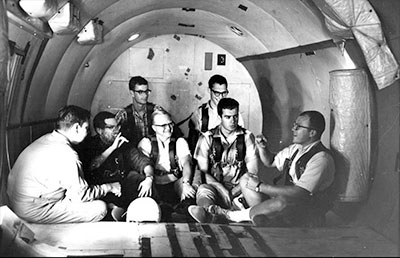
From the beginning, scientists needed to understand the mechanisms of space sickness.  So it was that, in the mid-twentieth century, NASA happened upon a group of space pioneers, you’ve likely never heard of.  What better group with which to study motion sickness, than those literally immune to it.  The profoundly hearing impaired made deaf by spinal meningitis and without a functioning vestibular system, that delicate inner ear structure which gives us sense of balance.

sick-in-space

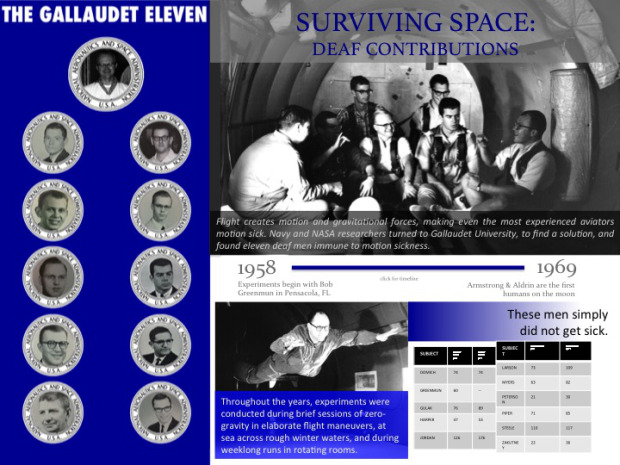
Gallaudet University was founded in 1864 as a grammar school for the deaf and blind and remains to this day, the world’s premier institution for the higher education of the deaf and hearing impaired.  In 1961, researchers with the US Naval School of Aviation Medicine paid a visit.  Hundreds of faculty and students were tested and a handful selected, for further tests.  There were parabolic flights.  Some were suspended for days, in swinging cages.

One group was deliberately taken into a severe storm off the coast of Nova Scotia, an outing former students remember as a lark, a thoroughly enjoyable adventure.  Researchers didn’t enjoy the trip quite so much, passing the voyage in a state of green and gut-wrenching decrepitude.

gallaudet_eleven02

Gallaudet Eleven

Eleven Gallaudet students were selected as early as 1958, to spin for nearly two weeks in a room-sized centrifuge.  Though it was hard work, participants viewed the study as an adventure.  One remembers his experience as a way to serve his country, since he’d never be allowed to join the military.

Today, their names are all but forgotten.  Barron Gulak.  Harry Larson.  David Myers and others.  The forgotten pioneers of those early days of the American space program, without whom the first astronauts may well have viewed the moon landing, from the bottom of a barf bag.

slide1-11


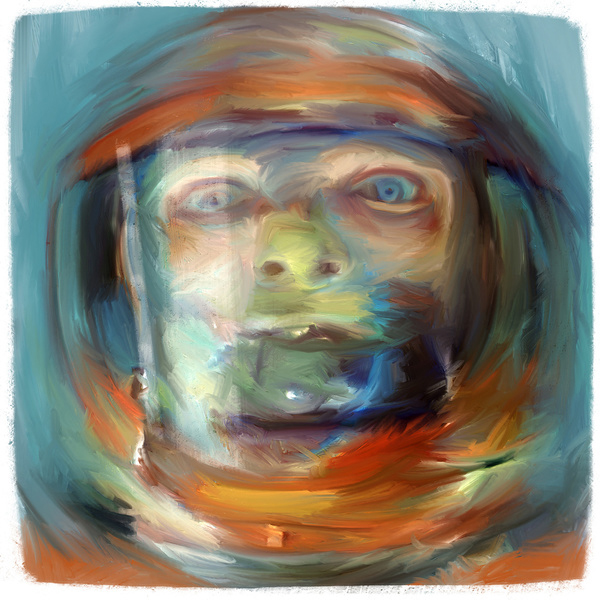
Featured image, top of page: “Space Sickness”. Hat tip graphic designer Douglas Noe (aka “Robotrake”), and society6.com

April 27, 1941 The Guinea Pig Club

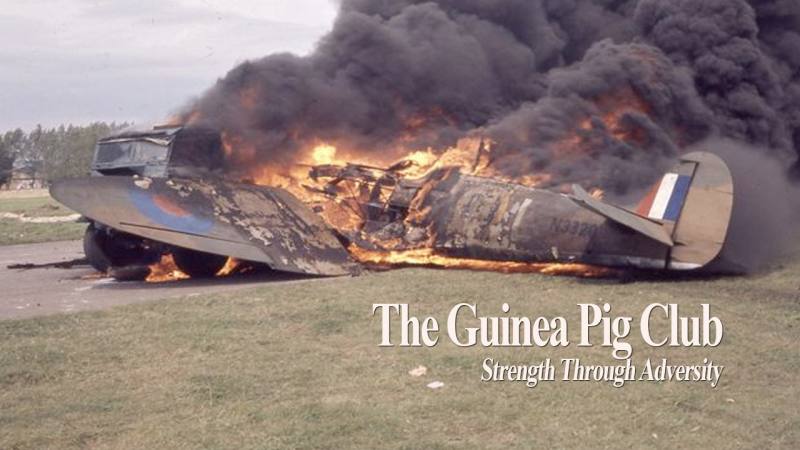
The mind recoils in horror at the human body enveloped in flame, but that’s just the beginning.  Both Hurricane and Spitfire fighters place fuel tanks, directly in front of the pilot. The wind speed of an F5 tornado is 201MPH+. The nozzle speed from a common pressure washer, 243. The maximum speed of these two fighter aircraft are 340 and 363 respectively, the explosive force of escaping gasses, geometric multiples of those numbers. The burns resulting from exploding aviation fuel were called “Hurricane Burns”.  The wreckage wrought on the human form, beggars the imagination.

The attraction of taking flight in time of war is unmistakable.  For a lad of nineteen, twenty, twenty one, he is a latter-day knight at the prime of his life, mounting his steed of steel to do battle with evil.  Life seems indestructible and without end at that age, except, reality is shockingly different.  Of a group of 100 RAF airmen in the early phase of World War Two, a mere twenty escaped being killed, captured or incinerated alive.

Guinea-Pig-Club

Flying Officer Desmond “Des” O’Connell was just nineteen when he joined the British Royal Air Force, in 1938.

O’Connell was assigned to RAF Limavady in the north of Ireland in the early months of World War Two, around the time the Capital Battleship Bismarck cleared the Kiel Canal and emerged into the Baltic Sea. On this day in 1941, Desmond O’Connell and six other flyers were assigned to find and take out the German warship.

The twin engine Whitworth Mark V ‘Whitley’ medium bomber never had a chance, overloaded as it was with extra crew, tanks full of fuel and bombs. The aircraft struggled to gain altitude and clipped the mountains outside of Limavady before striking the ground, and breaking apart.

Desmond O’Connell miraculously survived as did the rest of the crew, but his ordeal had just begun.  Soaked with fuel and suffering a skull fracture, he was crawling on his hands and knees when the fire caught up.   He remembers peering through the flames at his hands, as pieces came off of his gloves.  But those weren’t gloves.  The flesh was burning from his hands.

Archibald Hector McIndoe took to medicine at an early age, earning the first New Zealand fellowship to the prestigious Mayo Clinic in Rochester Minnesota, at only 24. Dr. McIndoe moved to London in 1930 and, unable to find work, joined in private practice with his great uncle, fellow Kiwi Sir Harold Gillies. Gillies was a pioneer in the field of plastic surgery by this time, made famous through his work in the Great War as “The Man who Fixed Faces“.

Dr. McIndoe was a talented surgeon:  confident, precise, and quick on his feet.  Under Harold Gillies’ direction, Archibald McIndoe became a leading figure in the field of plastic surgery.

With the outbreak of WW2, Dr. McIndoe took a position at Queen Victoria Hospital in East Grinstead, Sussex, where he headed up a center for plastic and maxillofacial surgery. A trickle of patients from the “Phoney War” period soon turned to a flood, during the Battle of Britain.

_89710604_p03vc186

The mind recoils in horror at the human body enveloped in flame, but that’s just the beginning.  Both Hurricane and Spitfire fighters place fuel tanks, directly in front of the pilot. The wind speed of an F5 tornado is 201MPH+. The nozzle speed from a common pressure washer, 243. The maximum speed of these two fighter aircraft are 340 and 363 respectively, the explosive force of escaping gasses, geometric multiples of those numbers. The burns resulting from exploding aviation fuel were called “Hurricane Burns”.  The wreckage wrought on the human form, beggars the imagination.

Dr. McIndoe treated no fewer than 649 of these men, not only Brits but Canadians, Australians and New Zealanders.  There were Americans and French, Czechs and Poles.  Each man required dozens and sometimes hundreds of surgeries over agonizing years.  Sausage-like constructions of living flesh called “tubed pedicles” were “waltzed” up from remote donor sites on patient’s own bodies, to replace body parts consumed by the war.

Tube-pedicles

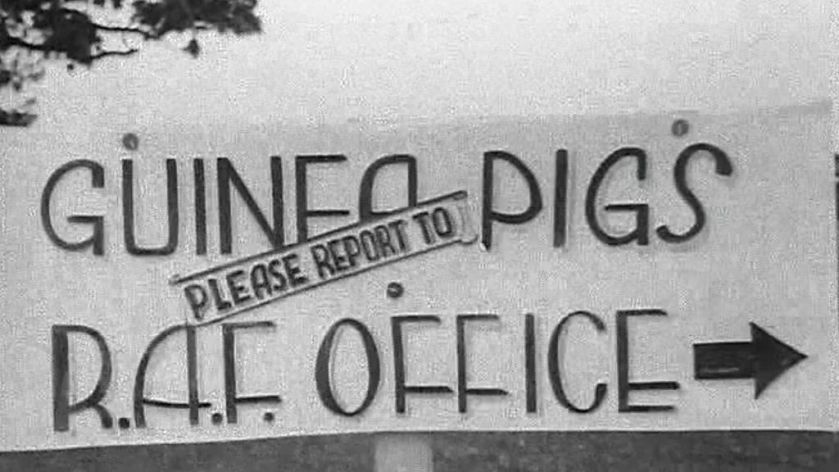
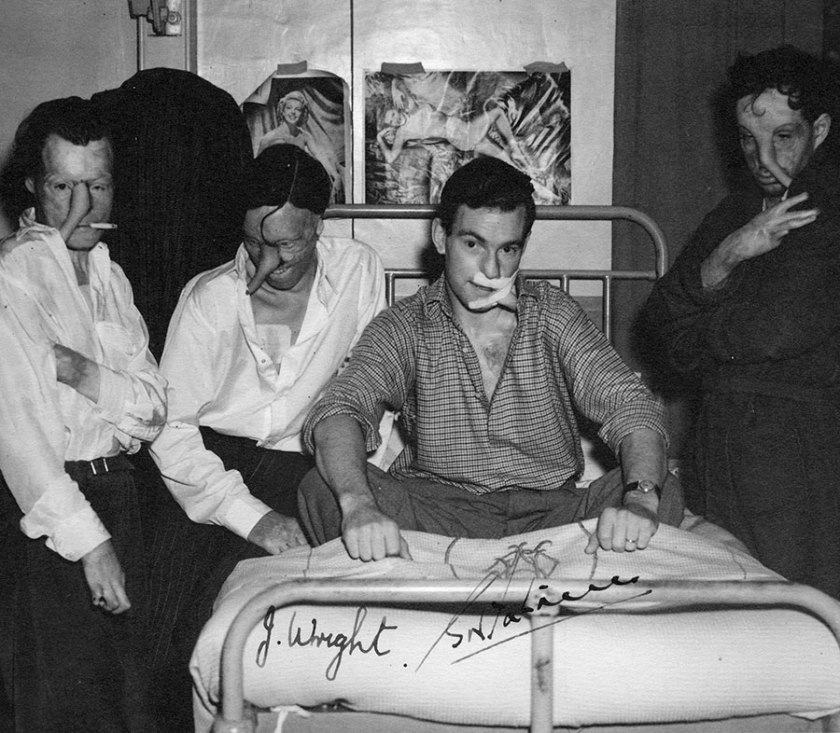
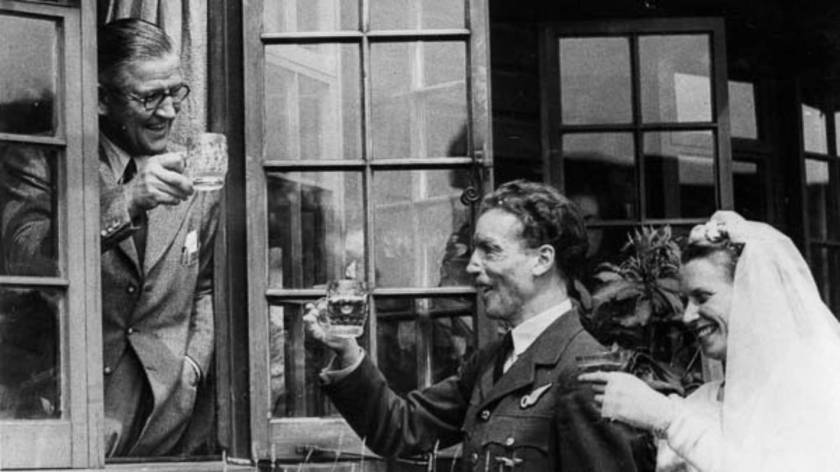
To be rendered hideous and unsightly in service to one’s nation, a subject of horrified stares, is more than most can bear.  McIndoe understood as much and his treatment methods threw convention, out the window.  Inmates were treated not as patients or objects of pity, but as men.  They wore not the ‘jammies or those degrading hospital johnnys with their asses hanging out but their own clothing, and even uniforms.  They had parties and socialized.  Those who were able went “out on the town”.  They were the “Guinea Pig Club”, they socialized, threw parties.  More than a few relationships were formed with nurses, many ended in marriage.

“Others met women from East Grinstead, a place the ‘guinea pigs’ referred to as ‘the town that never stared’”. H/T nzhistory.govt.nz

1459399460459

Dr. McIndoe was knighted in 1947 and passed away at only fifty nine, but his work lives on in the African Medical and Research Foundation (AMREF), and the British Association of Plastic Surgeons (BAPS) for which he once served, as president.  The Blond McIndoe Research Foundation opened at the Queen Victoria Hospital in 1961, and continues to conduct research into new methods of wound management, to this day.

Guinea-Pig-Club-1

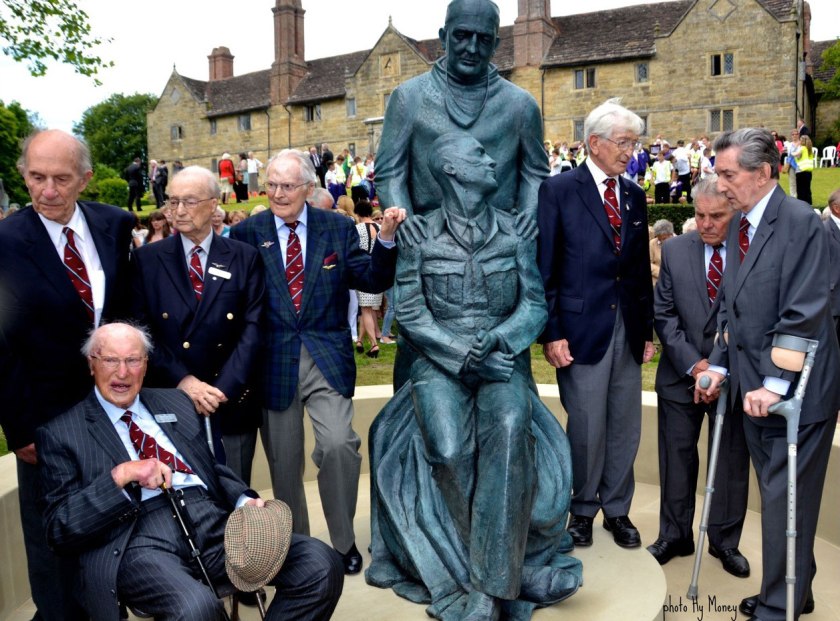
The Guinea Pig Club turned seventy-five years old in 2016.  Most of those early RAF members are gone now, but the organization lives on.  Today, new members come from places like the Falkland islands.  And Iraq.  And Afghanistan.


Feature image, top of page:  A scene from the 2012 play “The Guinea Pig Club”, depicts the agonies of WW2-era RAF airmen, treated for severe burns


A Trivial Matter
“Until the spring of 1944, the priority for manpower in the UK was not the navy, RAF, army, or even the merchant navy, but the Ministry of Aircraft Production. In the war, Britain alone built 132,500 aircraft, a staggering achievement – especially when considering that Fighter Command in the battle of Britain never had more than 750 fighters”. H/T HistoryExtra.com

April 17, 1945 Kamikaze

What must it be like to be at sea, frantically defending yourself against a human bomb, hurtling toward you at 500 miles per hour.

By the end of 1944, a series of naval defeats had left the Imperial Japanese critically short of military aviators, and the experienced aircraft mechanics and ground crew necessary to keep them aloft.

On October 14, the Atlanta class light cruiser USS Reno was hit by a Japanese aircraft in what many believed to be a deliberate crash.  The following day, Rear Admiral Masafumi Arima personally lead an attack by 100 Yokosuka D4Y “Judy” dive bombers against a carrier task force.  Arima was killed and part of one bomber hit the USS Franklin, the Essex-class carrier known as “Big Ben”.

72nd_Shinbu_1945_Kamikaze
17-year-old Corporal Yukio Araki (holding the puppy) died the following day in a suicide attack near Okinawa. H/T Wikipedia

Japanese propagandists were quick to seize on Arima’s example.  Whether this was a deliberate “kamikaze” attack remains uncertain.  The tactic was anything but the following week, during the battle of Leyte Gulf.  Japanese aviators were deliberately flying their aircraft, into allied warships.

By the end of the war, this “divine wind” would destroy the lives of 3,862 kamikaze pilots, and over 7,000 American naval personnel.

American Marines invaded Iwo Jima in February 1945, the first allied landing on Japanese territory. It was a savage contest against a dug-in adversary, a 36-day battle costing the lives of 6,381 Americans and nearly 20,000 Japanese.

The table was set for the bloodiest battle of the Pacific war.

On April 1, Easter Sunday, 185,000 troops of the US Army and Marine Corps were pitted in the 85-day battle for Okinawa, against 130,000 defenders of the Japanese 32nd Army and civilian conscripts.  Both sides understood, the war would be won or lost in this place.

While Kamikaze attacks were near-commonplace following the October battle for Leyte Gulf, these one-way suicide missions became a major part of defense for the first time in the battle for Okinawa.  Some 1,500 Kamikaze aircraft participated in the battle for Okinawa, resulting in US 5th Fleet losses of 4,900 men killed or drowned, and another 4,800 wounded.  36 ships were sunk and another 368 damaged.  763 aircraft, were lost.

kamikaze-taking-off
Kamikaze, taking off

What must it be like to be at sea, frantically defending yourself against a flying bomb, hurtling toward you at 500 miles per hour.

On April 16, 1945, the Sumner-class destroyer USS Laffey was assigned to radar picket duty, thirty miles north of Okinawa. At 8:25 a.m., the radar operator reported a solid cluster of blips at 17,000 yards, too numerous to count and approaching fast.  165 kamikazes and 150 other enemy aircraft were coming in, from the north

The Aichi D3A “Val” dive bomber appeared near the destroyer at 8:30. This was a reconnaissance mission and, fired upon, the Val jettisoned her bombs, and departed. Four more D3As were soon to follow, tearing out of the sky in a steep dive toward USS Laffey. 20mm AA fire destroyed two while the other two crashed into the sea. Within seconds, a Yokosuka D4Y “Judy” dive bomber made a strafing run from the port beam while another approached on a bomb run, from the starboard side. These were also destroyed but, close enough to wound three gunners, with shrapnel. The flames had barely been brought under control when another Val crashed into the ship’s 40mm gun mounts, killing three sailors while another struck a glancing blow, spewing aviation fuel from a damaged engine.

kamikaze - USS Laffey

Immediately after, another D3A came in strafing from the stern, impacting a 5″ gun mount and disintegrating in a great column of fire as its bomb detonated a powder magazine. Another Val came in within seconds, crashing into the burning gun mount while yet another scored a direct hit, jamming Laffey’s rudder to port and killing several men. Within minutes, another Val and yet another Judy, had hit the port side.

It was all in the first fifteen minutes.

Soon, four FM2 Wildcats followed by twelve Vought F4U Corsair fighters from the escort carrier Shamrock Bay waded into the Kamikazes attacking Laffey, destroying several before being forced to return, low on fuel and out of ammunition.

DD-724_Laffey

By the time it was over, some fifty Kamikazes were involved with the action. USS Laffey suffered six Kamikaze crashes, four direct bomb hits and strafing fire that killed 32 and wounded another 71. Lieutenant Frank Manson, assistant communications officer, asked Commander Frederick Becton if he thought they should abandon ship. Becton snapped “No! I’ll never abandon ship as long as a single gun will fire.” He didn’t hear the comment, from a nearby lookout: “And if I can find one man to fire it.”

For USS Laffey, the war was over.  She was taken under tow the following day, April 17, and anchored near Okinawa.  She would not emerge from dry dock, until September.

Damaged-ship-Into-Seattle

Today, the WW2 destroyer is a museum ship, anchored at Patriots Point in Mount Pleasant, South Carolina.  A bronze plaque inside the ship is inscribed with the Presidential Unit Citation, received for that day off the coast of Okinawa:

For extraordinary heroism in action as a Picket Ship on Radar Picket Station Number One during an attack by approximately thirty enemy Japanese planes, thirty miles northwest of the northern tip of Okinawa, April 16, 1945. Fighting her guns valiantly against waves of hostile suicide planes plunging toward her from all directions, the U.S.S. LAFFEY sent up relentless barrages of antiaircraft fire during an extremely heavy and concentrated air attack. Repeatedly finding her targets, she shot down eight enemy planes clear of the ship and damaged six more before they crashed on board. Struck by two bombs, crash-dived by suicide planes and frequently strafed, she withstood the devastating blows unflinchingly and, despite severe damage and heavy casualties, continued to fight effectively until the last plane had been driven off. The courage, superb seamanship and indomitable determination of her officers and men enabled the LAFFEY to defeat the enemy against almost insurmountable odds, and her brilliant performance in this action, reflects the highest credit upon herself and the United States Naval Service.

For the President,
James Forrestal
Secretary of the Navy

s-l1600 (2)

The Battle for Okinawa
“The Battle of Okinawa was an intense 82-day campaign involving more than 287,000 US and 130,000 Japanese troops. It was considered the bloodiest battle of the Pacific Theater, and more than 90,000 men died from both sides, along with almost 100,000 civilian casualties. During this conflict, Kamikazes inflicted the greatest damage ever sustained by the US Navy in a single battle, killing almost 5,000 men. All told, Kamikazes sank 34 ships and damaged hundreds of others during the entire war”. H/T Listverse.com