August 16, 1945  The Last Emperor

Mao’s “Cultural Revolution” of the late 1960s is estimated to have killed 40 to 70 million Chinese.  You’re really playing in the Big Leagues, when they can’t estimate your death toll to anything closer than the nearest 30 million.

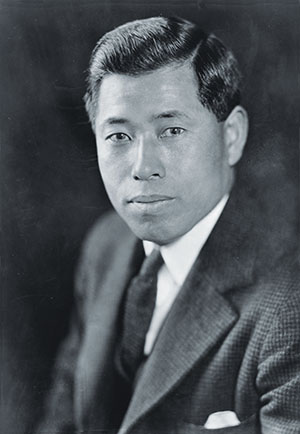
At the age of 2 years and 10 months, Puyi was taken from his parents and installed on the Qing Dynasty throne, in the Chinese Imperial Palace in Beijing.  The year was 1908.

It must have been bewildering for this toddler who was terrified by the sound of the ceremonial drums. Grown men would kowtow and avert their eyes in his presence.  His wet nurse, Wen-Chao Wang, was the only familiar face in the Royal Court.  She was the only one who could console him.  She alone was allowed to accompany him to the Forbidden City.

Puyi’s abdication of the throne four years later marked the end of 1,000 years of dynastic rule in China, earning him the sobriquet “The Last Emperor” of China.

mukden
Japanese experts gathered to inspect the scene of the ‘railway sabotage’ on the railway line.

Today, the Tsingtao beer available in Chinese restaurants the world over, is one of the last cultural vestiges of European colonization of China. In the latter half of the 19th century, China became increasingly subjugated through colonization by British, French and German powers.

American President Millard Filmore dispatched Commodore Matthew Perry to Japan in 1852, forcing an opening of that nation’s economy to trade with the West, and commencing a half-century’s period of rapid industrialization in resource-poor Japan. The smaller nation grew in both economic and military power, while China suffered the humiliations of the first and second opium wars, and forced colonization by European interests.

Japan piled on in the First Sino-Japanese War of 1894-95, culminating in the massacre of much of Lüshun City (formerly “Port Arthur”), cession of Chinese territories, and the recognition of an independent Korea.

China declared war on Imperial Germany in August 1917, intending to send combat units to the western front, but never getting around to doing so. The move entitled them to a seat at the Paris Peace Conference, but all that got them was a secret list of 21 demands issued by the Japanese Empire.  Japan emerged from this period with greater influence over the Chinese economy, and increased Japanese control over the resource-rich regions of Northern China and Manchuria.

On September 18, 1931, a small quantity of dynamite was detonated by Japanese Lt. Kawamoto Suemori, near a railroad owned by Japan’s South Manchuria Railway near Mukden, in modern Shenyang.  It was a ruse, a bald pretext for the Japanese invasion of Manchuria in Northern China, and everyone knew it.Mukden_1931_japan_shenyang

The explosion was so weak that it failed to destroy the line and a train passed minutes later, but the script was already written.  The Imperial Japanese Army accused Chinese dissidents of the “Mukden Incident”, launching a full scale invasion.

Japan installed Puyi as Emporer Kangde of the puppet state of “Manchukuo”, all the while suppressing the native Han Chinese in one of the most brutal and genocidal occupations of the 20th century.

Puyi was kept on a short leash by his Japanese handlers, his life mainly consisting of signing laws prepared by Japan, reciting prayers, consulting oracles, and making formal visits throughout his state.

The Second world war was drawing to a close when the Soviet Union declared war on Japan, beginning its invasion of occupied China two days after the atomic bomb was dropped on Hiroshima, the day before Nagasaki.  Puyi was captured at an airfield on this day in 1945, and held in a Soviet gulag in Siberia until Mao Tse-Tung’s Communist party came to power in 1949.

JapaneseBeijing
Japanese occupation of Beijing, 1937 – 1945

Puyi spent ten years in the Fushun War Criminals Management Centre in Liaoning province until he was declared “reformed”, moving to Peking in 1959 and taking up residence as an ordinary citizen.Puyi-Manchukuo

Mao’s “Cultural Revolution” of the late 1960s is estimated to have killed 40 to 70 million Chinese.  You’re really playing in the Big Leagues, when they can’t estimate your death toll any closer than the nearest 30 million.

The Last Emperor was an easy target of the “Red Guards”.  He probably wouldn’t have survived the tender ministrations of the communist government, but he died quietly due to complications of Kidney Cancer on October 17, 1967.

The ashes of the last Emperor, a man who had  found himself at the head of over a half-billion people at a time when the world population was only 2 billion, were placed at the Babaoshan Cemetery, the former burial ground of imperial concubines and court eunuchs.

April 18, 1943 Terrible Resolve

Painfully aware of the overwhelming productive capacity of the American economy, Yamamoto sought to neuter the US High Seas fleet in the Pacific, while simultaneously striking at the oil and rubber rich resources of Southeast Asia

Captian Isoroku YamamotoIsoroku Takano was born in Niigata, the son of a middle-ranked samurai of the Nagaoka Domain. His first name “Isoroku”, translating as “56”, refers to his father’s age at the birth of his son. At this time, it was common practice that samurai families without sons would “adopt” suitable young men, in order to carry on the family name, rank, and the income that came with it. The young man so adopted would carry the family name.  So it was that Isoroku Takano became Isoroku Yamamoto in 1916, at the age of 32.
After graduating from the Imperial Japanese Naval Academy, Yamamoto went on to serve in the Russo-Japanese war of 1904, later returning to the Navy Staff College and emerging as Lieutenant Commander in 1916. He attended Harvard University from 1919-1921, learning fluent English. A later tour of duty in the US enabled him to travel extensively, and to study American customs and business practices.

Like most of the Japanese Navy establishment, Yamamoto promoted a strong Naval policy, at odds with the far more aggressive Army establishment. For those officers, particularly those of the Kwantung army, the Navy existed only to ferry invasion forces about the globe.

Yamamoto opposed the invasion of Manchuria in 1931 and the 1937 land war with

uss_panay
Panay

China. As Deputy Navy Minister, it was Yamamoto who apologized to Ambassador Joseph Grew, following the “accidental” bombing of the USS Panay in 1937. Even when he was the target of assassination threats by pro-war militarists, Yamamoto still opposed the attack on Pearl Harbor, which he believed would “awaken a sleeping giant and fill him with a terrible resolve”.

Yamamoto received a steady stream of hate mail and death threats in 1938, as a growing number of army and navy officers spoke publicly against him. Irritated with Yamamoto’s immovable opposition to the tripartite pact with Nazi Germany and Fascist Italy, army hardliners dispatched military police to “guard” him. In one of the last acts of his short-lived administration, Navy Minister Mitsumasa Yonai reassigned Yamamoto to sea as Commander-in-Chief of the Combined Fleet, making it harder for assassins to get at him.

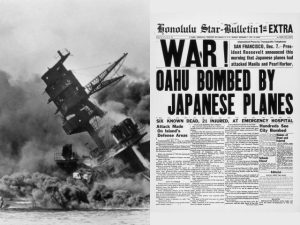
USS-Arizona-Sinking-Pearl-Harbor-Newspaper-December-7-1941-AP-Getty-640x480Many believed that Yamamoto’s career was finished when his old adversary Hideki Tōjō ascended to the Prime Ministership in 1941. Yet there was none better to run the combined fleet. When the pro-war faction took control of the Japanese government, he bowed to the will of his superiors. It was Isoroku Yamamoto who was tasked with planning the attack on Pearl Harbor.
Nothing worked against the Japanese war effort as much as time and resources. Painfully aware of the overwhelming productive capacity of the American economy, Yamamoto sought to emasculate the US High Seas fleet in the Pacific, while simultaneously striking at the oil and rubber rich resources of Southeast Asia. To accomplish this first objective, he planned to attack the anchorage at Pearl Harbor, followed by an offensive naval victory which would bring the Americans to the bargaining table. It’s not clear if he believed all that, or merely hoped that it might work out.

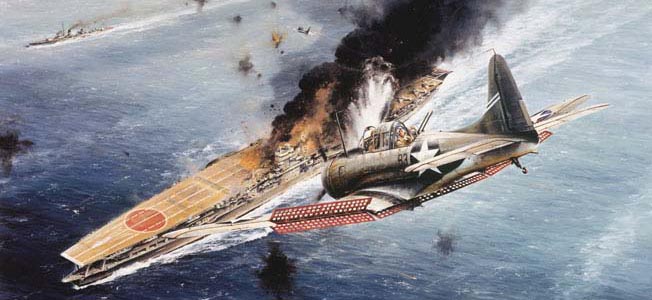
Yamamoto got his decisive naval engagement six months after Pearl Harbor, near Midway Island. Intended to be the second surprise that finished the carriers which had escaped destruction on December 7, American code breakers turned the tables. This time it was Japanese commanders who would be surprised.

Battle-Of-Midway-Turns-Tide-Of-Pacific-War-2American carrier based Torpedo bombers were slaughtered in their attack, with 36 out of 42 shot down.  Yet Japanese defenses had been caught off-guard, their carriers busy rearming and refueling planes when American dive-bombers arrived.
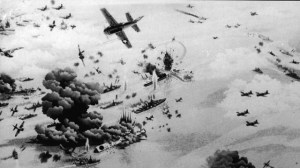
midway-copyMidway was a disaster for the Imperial Japanese navy. The carriers Akagi, Kaga, Soryu and Hiryu, the entire strength of the task force, went to the bottom. The Japanese also lost the heavy cruiser Mikuma, along with 344 aircraft and 5,000 sailors. Much has been made of the loss of Japanese aircrews at Midway, but two-thirds of them survived. The greater long term disaster, may have been the loss of all those trained aircraft mechanics and ground crew who went down with their carriers.
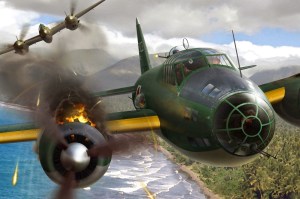
The Guadalcanal campaign, fought between August 1942 and February ’43, was the first major allied offensive of the Pacific war and, like Midway, a decisive victory for the allies.

Needing to boost morale after the string of defeats, Yamamoto planned an inspection 2013-Yamamoto-10.1tour throughout the South Pacific. US naval intelligence intercepted and decoded his schedule.  The order for “Operation Vengeance” went down the chain of command from President Roosevelt to Secretary of the Navy Frank Knox to Naval Operations Admiral Ernest King to Admiral Chester Nimitz at Pearl Harbor. Sixteen Lockheed P-38 Lightnings, the only fighters capable of the ranges involved, were dispatched from Guadalcanal on April 17 with the order: “Get Yamamoto”.

Yamamoto’s two Mitsubishi G4M bombers with six Mitsubishi A6M Zeroes in escort were Yamamoto Wreckintercepted over Rabaul on April 18, 1943. Knowing only that his target was “an important high value officer”, 1st Lieutenant Rex Barber opened up on the first Japanese transport until smoke billowed from its left engine. Yamamoto’s body was found in the wreckage the following day with a .50 caliber bullet wound in his shoulder, another in his head. He was dead before he hit the ground.

Isoroku Yamamoto had the unenviable task of planning the attack on Pearl Harbor, but he was an unwilling participant in his own history. “In the first six to twelve months of a war with the United States and Great Britain”, he had said, “I will run wild and win victory upon victory. But then, if the war continues after that, I have no expectation of success”.Yamamoto

March 29, 1973 Vietnam

This is no benign ideology we’re talking about, current estimates of citizens murdered by their own government in the Soviet Union alone, range from 8 to 61 million during the Stalinist period.

French Indo-China, the area now known as Laos, Cambodia and Vietnam, was governed as a French Colonial territory since the late 19th century. The region came to be occupied by the Imperial Japanese after the fall of France, at the onset of WWII.  There arose a nationalist-communist army during this period, dedicated to throwing out the Japanese occupier.  It called itself the “League for the Independence of Vietnam”, or “Viet Minh”.

France re-occupied the region following the Japanese defeat in WWII, but soon faced the same opposition from the  army of Ho Chi Minh and Vo Nguyen Giap. What began as a low level, rural insurgency, later became a full-scale modern war when Communist China entered the fray in 1949.

The disastrous defeat of French forces at Dien Bien Phu in 1953 led to French withdrawal dien_bien_phu-resupplyfrom Vietnam, the Geneva Convention partitioning the country into the communist “Democratic Republic of Vietnam” in the north, and the State of Vietnam in the south, led by Emperor Bao Dai and Prime Minister Ngo Dinh Diem.
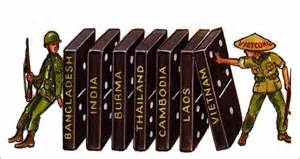
Communist forces of the north continued to terrorize Vietnamese patriots in the north and south, with aid and support from communist China and the Soviet Union.

The student of history understands that nothing happens in a vacuum.  US foreign policy is no exception. International Communism had attempted to assert itself since the Paris Commune rebellion of 1871, and found its first major success with the collapse of czarist Russia in 1917.

Domino effectUS policy makers feared a “domino” effect, and with good cause. The 15 core nations of the Soviet bloc were soon followed by Eastern Europe, as Poland, Bulgaria, Romania, Hungary and Czechoslovakia fell into the Soviet sphere of influence. Germany was partitioned into Communist and free enterprise spheres after WWII, followed by China, North Korea and so on across Southeast Asia.
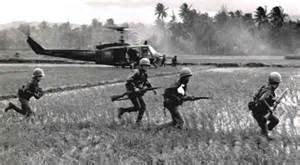
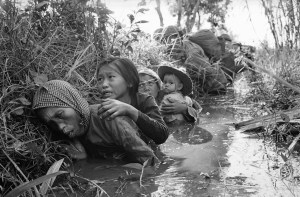
This is no benign ideology we’re talking about, current estimates of citizens murdered by their own government in the Soviet Union alone, range from 8 to 61 million during the Stalinist period.Paddy

Agree or disagree with policy makers of the time, that’s your business, but they followed a logical thought process. US aid and support for South Vietnam increased as a way to “stem the tide” of international communism, at the same time that French support was pulling back. By the late 50s, the US was sending technical and financial aid in expectation of social and land reform. By 1960, the “National Front for the Liberation of South Vietnam” (“NLF”, or “Viet Cong”) had taken to murdering Diem supported village leaders. JFK responded by sending 1,364 American advisers into South Vietnam in 1961.

Vietnam War CiviliansThe war in Vietnam pitted as many as 1.8 million allied forces from South Vietnam, the United States, Thailand, Australia, the Philippines, Spain, South Korea and New Zealand, against about a half million from North Vietnam, China, the Soviet Union and North Korea. Begun on November 1, 1955, the conflict lasted 19 years, 5 months and a day. On March 29, 1973, two months after signing the Paris Peace accords, the last US combat troops left South Vietnam as Hanoi freed the remaining POWs held in North Vietnam.
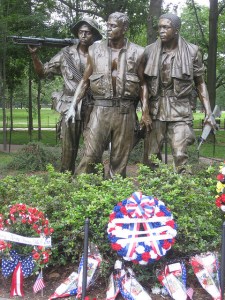
Even then it wasn’t over. Communist forces violated cease-fire agreements before they were signed. Some 7,000 US civilian Department of Defense employees stayed behind to aid South Vietnam in conducting an ongoing and ultimately futile war against communist North Vietnam.Three_soldiers

The last, humiliating scenes of the war played themselves out on the roof of the US Embassy in Saigon on April 29 and 30, 1975, as those who could boarded helicopters, while communist forces closed around the South Vietnamese capital.

In the end, US public opinion would not sustain what too many saw as an endless war.  We continue to feel the political repercussions, to this day. I was ten at the time of the Tet Offensive in 1968. I remember feeling horrified at the way some of my fellow Americans conducted themselves. I came to feel at that time as I do to this day, that anyone who has a problem with our country’s war policy, needs to take it up with a politician.  Not a member of the military,

.The “Killing Fields” of Cambodia followed between 1975-‘79, when the “Khmer Rouge”, self-described as “The one authentic people capable of building true communism”, murdered or caused the deaths of an estimated 1.4 to 2.2 million of their own people, out of a population of 7 million. All to build their perfect, agrarian, “Worker’s Paradise”.

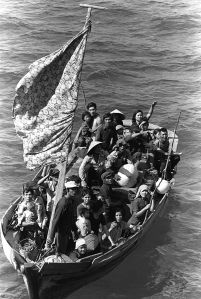
Imagine feeling so desperate, so fearful of the alien ideology invading your country, that you convert all your worldly possessions and those of your family to a single diamond, bite down on that stone until it embedded in your shattered teeth, and fled with your family to open ocean in a small boat.  All in the faint and desperate hope, of getting out of that place.  That is but one story among the more than three million “boat people”.  Three million from a combined population of 56 million, fleeing the Communist onslaught in hopes of temporary asylum in other countries in Southeast Asia or China.Vietnamese_boat_people

They were the Sino-Vietnamese Hoa, and Cambodians fleeing the Khmer Rouge.  Ethnic Laotians, Iu Mien, Hmong and other highland peoples of Laos.  The 30 or so Degar (Montagnard) tribes in the Central Highlands, so many of whom had been our steadfast allies in the late war.  Over 2.5 million of them were resettled, more than half to the United States.  The other half went mostly to Canada, Europe and South Pacific nations.   A half-million were repatriated, voluntarily or involuntarily.  Hundreds of thousands vanished in their attempt to flee.

The humanitarian disaster that was the Indochina refugee crisis was particularly acute between 1979-’80, but reverberations continued into the 21st century.  The last boat people were repatriated from Malaysia in 2005.  Thailand deported 4,000 Hmong refugees in 2009.

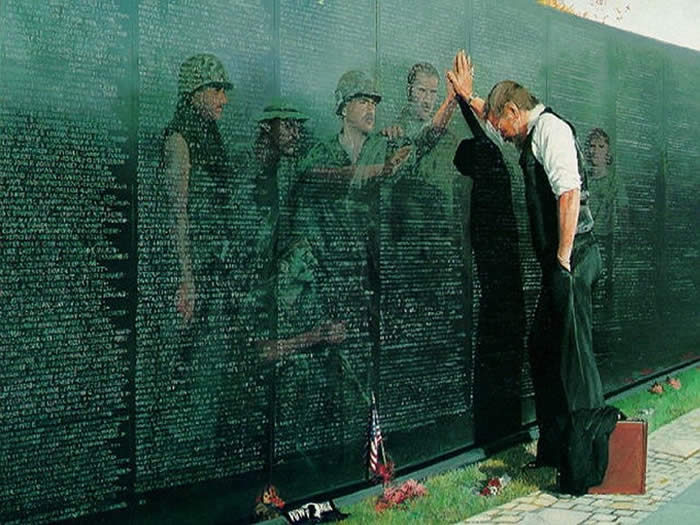
There were 57,939 names inscribed on the Vietnam Memorial Wall, the day it opened in 1982. Over the years, the names of military personnel who succumbed to wounds sustained in the war, were added to the wall. As of Memorial Day 2015, there are 58,307.

Things they carried

March 27, 1912 Cherry Trees of the Potomac

While the future President Taft labored in the Philippines, Helen Herron Taft took up residence in Japan, where she came to appreciate the beauty of the native cherry trees.

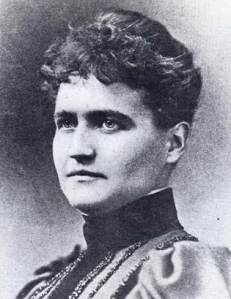
Eliza_Ruhamah_Scidmore
Eliza Ruhamah Scidmore

Eliza Scidmore was an American journalist, world traveler, author and socialite.  The first female board member of the National Geographic Society, her brother was a career diplomat, who served 38 years in the Asian Pacific. Frequent visits led to a passionate interest in all things Japanese, most especially the ‘Sakura’, the Japanese blossoming cherry tree, which she called “the most beautiful thing in the world”.

In January 1900, Federal judge William Howard Taft was summoned to Washington, to meet with the President. He hoped it was to discuss a Supreme Court appointment, but it wasn’t meant to be. One day judge Taft would get his wish, becoming the only man in United States history to serve both as President, and as Chief Justice of the Supreme Court. For now, the American war in the Philippines was ongoing. Taft would head up the commission to organize civilian self-government in the island nation.

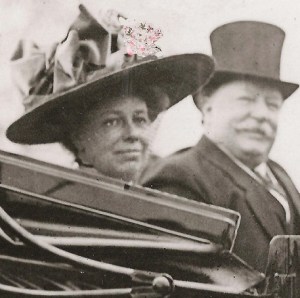
Helen & William Taft
1st Lady & President Taft

While the future President Taft labored in the Philippines, Helen Herron Taft took up residence in Japan, where she came to appreciate the beauty of the native cherry trees.

Years later the Japanese Consul in New York learned of the First Lady’s interest in the Sakura, and suggested the city of Tokyo make a gift of Cherry trees, to the government of the United States.

For Eliza Scidmore, it was a dream 34 years in the making.  It was she who raised the money to make it happen.

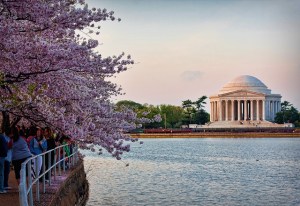
On March 27, 1912, the Viscountess Chinda, wife of the Japanese ambassador to the United States joined First Lady Helen Taft, in planting two Japanese Yoshina cherry trees on the bank of the Potomac River, near the Jefferson memorial. The two were planted in a formal ceremony, the first of 3,020 trees.Jefferson cherry trees

It was the second such effort. 2,000 trees had arrived from Japan two years earlier, in January 1910, but they had fallen prey to disease along their journey. A private Japanese citizen donated the funds to transport a new batch of trees. The 3,020 were taken from the bank of the Arakawa River in the Adachi Ward suburb of Tokyo, to be planted along the Potomac River Basin, East Potomac Park, and the White House grounds.

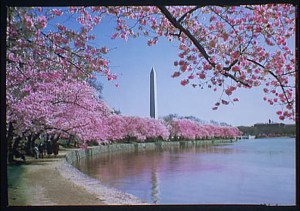
The blossoming trees were overwhelmingly popular with visitors to the Washington Mall. Inpotomac_blossoms 1934 city commissioners sponsored a three-day celebration of the late March blossoming cherry trees, which grew into the annual Cherry Blossom Festival.
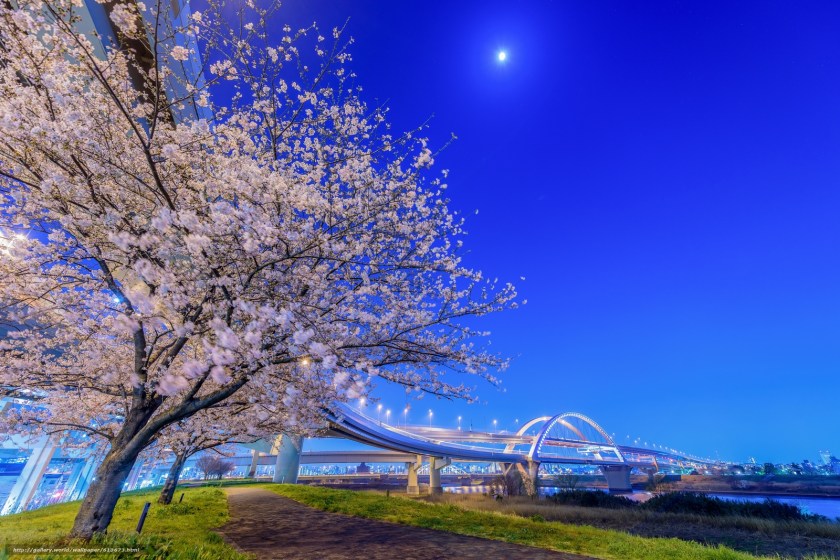
During WWII, aerial bombardment laid waste to Tokyo and its surrounding suburbs. After the war, cuttings from the cherry trees of Washington were sent back to Japan, to restore the Tokyo collection.

It’s not clear to me, if the trees along the Arakawa River today are entirely from the Potomac collection, or some combination of American and native stock.  After the conflagration that was the war in the Pacific, I’m not sure it matters. It may even be the whole point.

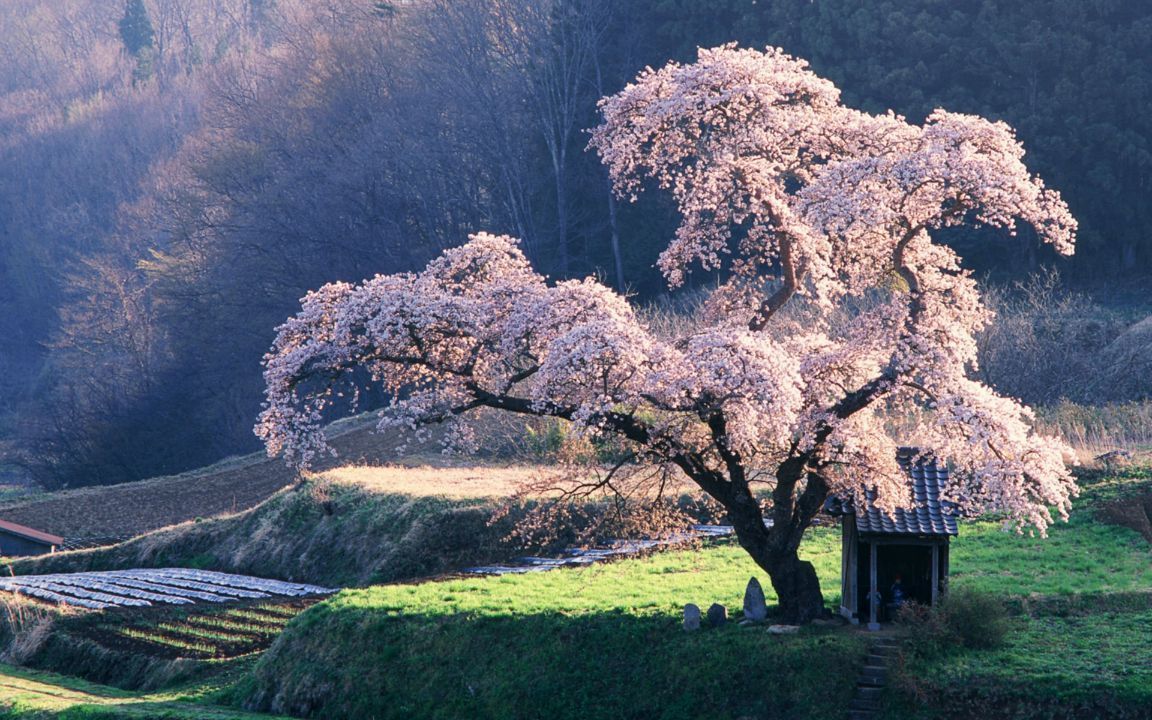
Cherry Trees along the Arakawa

Cherry Trees along the Arakawa

January 27, 1945  The Great Raid

Today, Cabanatuan calls itself the “Tricycle Capital of the Philippines”, with about 30,000 motorized “auto rickshaws”. 72 years ago, it was home to one of the worst POW camps of WWII

Today, Cabanatuan calls itself the “Tricycle Capital of the Philippines”, with about 30,000 motorized “auto rickshaws”.  72 years ago, it was home to one of the worst POW camps of WWII.

bataan1942 was a bad year for the allied war in the Pacific.  The Battle of Bataan alone resulted in 72,000 prisoners being taken by the Japanese, marched off to POW camps designed for 10,000 to 25,000.
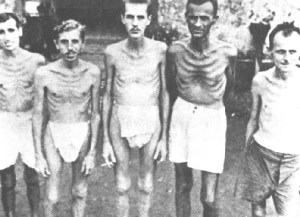
20,000 of them died from sickness or hunger, or were murdered by Japanese guards on the 60 mile “death march” from Bataan, into captivity at Cabanatuan prison and others.

Cabanatuan held 8,000 prisoners at its peak, though the number dropped considerably as the able-bodied were shipped out to work in Japanese slave labor camps.

Two rice rations per day, fewer than 800 calories, were supplemented by the occasional animal or insect caught and killed inside camp walls, or by the rare food items smuggled in by civilian visitors.  2,400 died in the first eight months at Cabanatuan, animated skeletons brought to “hospital wards”, which were nothing more than 2’x6′ patches of floor where prisoners waited to die.  A Master Sergeant Gaston saw one of these wards in July 1942, saying: “The men in the ward were practically nothing but skin and bones and they had open ulcers on their hips, on their knees and on their shoulders…maggots were eating on the open wounds. There were blow flies…by the millions…men were unable to get off the floor to go to the latrine and their bowels moved as they lay there”.

pows-cabanatuan
Cabanatuan Prisoners

The war was going badly for the Japanese by October 1944, as Imperial Japanese High Command ordered able bodied POWs removed to Japan.  1,600 were taken from Cabanatuan, leaving 500 weak and disabled prisoners.  The guards abandoned camp shortly after, though Japanese soldiers continued to pass through.  POWs were able to steal food from abandoned Japanese quarters; some even captured two water buffalo called “Carabao”, which were killed and eaten.  Many feared a trick and never dared to leave the camp.  Most were too sick and weak to leave in any case, though the extra rations would help them through what was to come.

On December 14, units of the Japanese Fourteenth Area Army in Palawan doused 150 prisoners with gasoline and burned them alive, machine gunning any who tried to escape the flames.   The atrocity sparked a series of raids at Santo Tomas Internment Camp, Bilibid Prison, Los Baños and others.  The first such behind-enemy-lines rescue, was Cabanatuan.

alamoscoutsraidoncabanatuan
Alamo Scouts, After Raid

On the evening of January 27, 1945, 14 individuals separated into two teams, beginning the 30 mile march behind enemy lines to liberate Cabanatuan. They were an advance team, formed from the 6th Ranger Battalion and a special reconnaissance group called the Alamo Scouts. The main force of 121 Rangers moved out the following day, meeting up with 200 Filipino guerrillas, who served as guides and helped in the rescue.

Other guerrillas assisted along the way, muzzling dogs and corralling chickens so that Japanese occupiers would hear nothing of their approach.  Japanese soldiers once again occupied the camp, with 1,000 more camped across the Cabo River outside the prison and as many as 7,000 deployed just a few miles away.

p61-black-widow
Northrup P-61 Black Widow

On the night of the 30th, a P-61 Black Widow piloted by Captain Kenneth Schrieber and 1st Lt. Bonnie Rucks staged a ruse.  For 45 minutes, the pair conducted a series of aerial acrobatics, cutting and restarting engines with loud backfires while seeming to struggle to maintain altitude. Thousands of Japanese soldiers watched the show, as Rangers belly crawled into positions around the camp.

Guard towers and pillboxes were wiped out in the first fifteen seconds of the assault.  Filipino guerrillas blew the bridge and ambushed the large force across the river while one, trained to use a bazooka only hours earlier, took out four Japanese tanks.

In the camp, all was pandemonium as some prisoners came out and others hid, suspecting some trick to bring them out into the open.  They were so emaciated that Rangers carried them out two at a time.cabanatuan-prison-camp

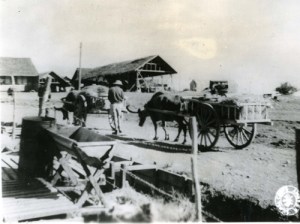
The raid was over in 35 minutes, POWs brought to pre-arranged meet-up places with dozens of carabao carts.   A long trek yet remained, one POW said “I made the Death March from Bataan, so I can certainly make this one!”  Over three days, up to 106 carts joined the procession, their plodding 2 MPH progress covered by strafing American aircraft.

Two American Rangers and two prisoners were killed, another 4 Americans and 21 Filipinos wounded, compared with 500-1,000 Japanese killed and four tanks put out of action.  464 American military personnel were liberated, along with 22 British and 3 Dutch soldiers, 28 American civilians, 2 Norwegians and one civilian each of British, Canadian and Filipino nationalities.

cabanatuan-rescued
Rescued POWs from Cabanatuan

One POW was left behind, a British soldier named Edwin Rose.  Rose heard the firing and thought the Americans were there to stay, so he went back to sleep.  When he woke the next morning and realized he had “Cabanatuan all my own”, he shaved, put on his best clothes, and walked out of camp.  Passing guerrillas found him and passed him to a tank destroyer.  Give the man points for style.  A few days later, Rose strolled into 6th army headquarters, a cane tucked under his arm.

The Cabanatuan raid of January 30, 1945 liberated over 500 allied prisoners, from virtually every state in the Union. Begging pardon for any mistakes in rank and/or spelling, the following represents those from my home state of Massachusetts:

  • Lieutenant Commander Robert Strong, Jr., Arlington
  • Captain John Dugan, Milton
  • 2nd Lieutenant John Temple, Pittsfield
  • Sergeant Richard Neault, Adams
  • Sergeant Stanislaus Malor, Salem
  • Private, 1st Class Joseph Thibeault, Lawrence
  • Private Edward Searkey, Lynn
  • USN C/QM Martin Seliga, Fitchburg
  • USN 1/C PO J.E.A. Morin,Danvers
  • USN AC MM Carl Silverman, Wareham

I hope I didn’t leave anyone out.  These guys have earned the right to be remembered.

January 21, 1968 Blue House Raid

On January 17, 1968, Unit 124 infiltrated the 2½ mile demilitarized zone (DMZ), cutting the wire and entering South Korea. Their mission was to assassinate ROK President Park Chung-hee in his home, the South Korean Executive Mansion known as “Blue House”

By 1967, the Republic of Korea (ROK) had some 44,829 South Korean forces in Vietnam. An overwhelming force of NVA and Vietcong had the misfortune of surrounding a platoon of “Blue Dragon” Marines on February 15 of that year, near the village of Trà Bình. Poor visibility precluded air support, and the fighting that followed was close and personal. When it was over, 243 NVA lay dead. Korean Marines lost fewer than a dozen men.

Any combat veteran of the war in Southeast Asia will tell you, in Vietnam they faced a tough and disciplined soldier. POW interrogations of captured NVA revealed one bluedragonpatchLieutenant Trung to be particularly hard core, a tough guy in a world of tough guys. A US Marine Corps Lieutenant of Korean ancestry, dressed in the uniform of the Blue Dragon Marines, and paid a visit to Lt. Trung’s cell. Not a word or gesture passed between the two, the mere presence of a Blue Dragon was enough to get this guy talking. Korean fighters are no joke.

For two years, an elite, all-officer force of 31 North Korean commandos were trained in infiltration and exfiltration techniques, weaponry, navigation, concealment and hand-to-hand combat, with particular emphasis on knife fighting. They were “Unit 124”, highly trained and fanatically loyal soldiers, tough as rawhide and each prepared to die for the supreme leader of the Democratic People’s Republic of Korea, (DPRK), Kim Il-Sung.

On January 17, 1968, Unit 124 infiltrated the 2½ mile demilitarized zone (DMZ), cutting the wire and entering South Korea. Their mission was to assassinate ROK President Park Chung-hee in his home, the South Korean Executive Mansion known as “Blue House”.

It’s hard to think of anything goofier, and at the same time more lethal, than the hare-korea1brained political calculations of DPRK leadership. Somehow it made sense to these guys, that to assassinate the South Korean President and hurl his head out of the official residence, would start a popular uprising leading to the re-unification of the Korean peninsula under DPRK government.

On the 19th, four brothers of the Woo family were out gathering firewood, when they stumbled upon Unit 124. A fierce debate ensued among the commandos, as to what to do with these guys. Training dictated that they be immediately killed, yet somehow that didn’t seem right. Wasn’t communist ideology supposed to be a “people’s movement”?  Besides, it would have taken too long to bury their bodies in the frozen ground.

The decision was made to convert them on the spot. Talk about goofy. After a suitably long harangue on the wonders of communism, the Woo brothers wisely proclaimed themselves converts. Whereupon they were released, and went directly to the authorities.

Unit 124 broke camp, for the next two days averaging 10kph over mountainous terrain, despite carrying an average 70lbs apiece in equipment.

Commandos made it to within 100 meters of Blue House on January 21, when they were challenged at a road block. The firefight broke out without warning, dissolving into a running gunfight and manhunt lasting until the 29th. When it was over, 26 Southkim-shin-jo Korean military and police personnel were killed along with two dozen civilians, and 66 wounded. Four Americans were killed in efforts to prevent Unit 124 members from re-crossing the DMZ.

29 commandos were killed or committed suicide. One escaped, back into North Korea. Only one, Kim Shin-jo, was captured alive.

History has a way of swallowing some events whole. The Battle of Khe Sanh started in Vietnam the same day as the raid.  Two days later a US Navy technical research ship, the USS Pueblo, was captured by North Korean forces. The Tet Offensive broke out all across South Vietnam on January 31st.  Soon the Blue House raid was all but forgotten.

Kim Shin-Jo was interrogated for a year, to learn how the raid had been carried out. Meanwhile, ROK authorities “recruited” their own commando assassination squad, as a bit of payback. The 31 members of “Unit 684” were recruited from South Korean death row unit-684and other hardened prisoners, possibly due to the suicidal nature of their mission. The “training” they were subjected to on Silmido Island, off the coast of Inchon, was beyond brutal. Seven of them would not survive it.

The raid was never carried out. North-South relations were thawing by August of 1971, as the Silmido Island recruits staged an insurrection. How it started is unclear, but 20 inmate/recruits were dead before it was over, along with a number of their overseers. The four surviving Unit 684 recruits were tried for their role in the uprising by a military tribunal, and executed in 1972.

In May of 2010, Seoul courts ordered the government to pay $231 million to the families of 21 members of Unit 684.

Kim Shin-jo’s parents were murdered by North Korean authorities and his relatives “purged”, after he became a citizen of the ROK in 1970. Now a married father of two, Kim renounced his communist ideology, since becoming a pastor of the Seoul “Sungrak” (“Holy Joy”) Baptist Church.

I’m indebted for this story to a man who was a family friend, almost before my parents decided to start a family. I have known this man longer than I can remember, and flatter myself to regard him as a personal friend. He was one of the interrogators, during both the Trung and the Kim episodes related above. Thank you, Victor, for your story, and for your service.

January 19, 1977 Tokyo Rose

Either all convicts are guilty as charged, or someone, at some time, has been wrongly convicted

There’s an old cliché that, if you speak with those who are convicted of a crime, all of them say they are innocent. It’s an untrue statement on its face, but there are only two possible conclusions in the alternative. Either all convicts are guilty as charged, or someone, at some time, has been wrongly convicted.

To agree with the former is to accept the premise that what government does is 100% right, 100% of the time.

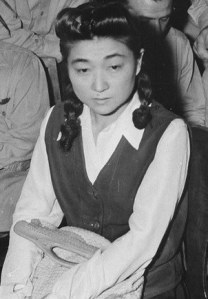
Iva Ikuko Toguri was born in Los Angeles on July 4, 1916, the daughter of Japanese immigrants. She attended schools in Calexico and San Diego, returning to Los Angeles where she enrolled at UCLA, graduating in January, 1940 with a degree in zoology.
iva-toguri

In July of the following year, Iva sailed to Japan without an American passport. She variously described the purpose of the trip as the study of medicine, and going to see a sick aunt. In September, Toguri appeared before the US Vice Consul in Japan to obtain a passport, explaining that she wished to return to permanent residence in the United States. Because she had left without a passport, her application was forwarded to the State Department for consideration. It was still on someone’s desk when Imperial Japan attacked Pearl Harbor, fewer than three months later.

Iva later withdrew the application, saying that she’d remain in Japan voluntarily for the duration of the war. She enrolled in a Japanese language and culture school to improve her language skills, taking a typist job for the Domei News Agency. In August 1943, she began a second job as a typist for Radio Tokyo.

In November of that year, Toguri was asked to become a broadcaster for Radio Tokyo on theiva-toguri-at-the-mic “Zero Hour” program, part of a Japanese psychological warfare campaign designed to lower the morale of US Armed Forces. The name “Tokyo Rose” was in common use by this time, applied to as many as 12 different women broadcasting Japanese propaganda in English. Toguri DJ’d a program with American music punctuated by Japanese slanted news articles for 1¼ hours, six days a week, starting at 6:00pm Tokyo time. Altogether, her on-air speaking time averaged 15-20 minutes for most broadcasts.

Toguri called herself “Orphan Annie,” earning 150 yen per month (about $7.00 US). She wasn’t a professional radio personality, but many of those who later recalled hearing her enjoyed the program, especially the music.

Shortly before the war ended, Toguri married Felipe Aquino, a Portuguese citizen of Japanese-Portuguese ancestry. The marriage was registered with the Portuguese Consulate, though she didn’t renounce her US citizenship, continuing her Zero Hour broadcast until after the war was over.

iva_toguri_mug_shotAfter the war, a number of reporters were looking for the mythical “Tokyo Rose”, and two of them found Iva Aquino. They were Henry Brundidge and Clark Lee, and they offered her a significant sum for her story. The money never materialized, but she signed a contract giving the two rights to her story, and identifying herself as Tokyo Rose.
FBI.gov states on its “Famous Cases” website that, “As far as its propaganda value, Army analysis suggested that the program had no negative effect on troop morale and that it might even have raised it a bit. The Army’s sole concern about the broadcasts was that “Annie” appeared to have good intelligence on U.S. ship and troop movements”.

US Army authorities arrested her in September, while FBI and the Army Counterintelligence investigated her case. By the following October, authorities decided that the evidence did not merit prosecution, and she was released.

Matters may have ended there, except for the public outcry that accompanied Aquino’s return to the US. Several groups, along with the noted broadcaster Walter Winchell, were outraged that the woman they knew as “Tokyo Rose” wanted to return to this country, instead demanding her arrest on treason charges.

Department of Justice sent attorneys to Japan to interview witnesses, one of whom was the reporter, Henry Brundidge. Once again quoting FBI.gov, “Problematically, Brundidge enticed a former contact of his to perjure himself in the matter”.tokyo-rose-conviction

The trial began on July 5, 1949, lasting just short of three months. The jury found Aquino guilty on one of fifteen treason charges, ruling that “[O]n a day during October, 1944, the exact date being to the Grand Jurors unknown, said defendant, at Tokyo, Japan, in a broadcasting studio of the Broadcasting Corporation of Japan, did speak into a microphone concerning the loss of ships.”

Aquino was sentenced to ten years and fined $10,000 for the crime of treason, only the seventh person in US history to be so convicted. She was released from the Federal tokyo-rose-pardonReformatory for Women at Alderson, West Virginia in 1956, having served six years and two months of her sentence.

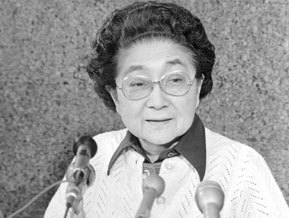
President Gerald Ford pardoned her on January 19, 1977, 21 years almost to the day after her release from prison. Iva Toguri Aquino passed away in 2006, at the age of 90. Neither perjury nor suborning charges were ever brought against Brundidge or his witness.

January 12, 1968 The Strangest Dogfight

Theirs was a secret war, waged in the mists of the Annamite Mountains. Two months later, North Vietnamese commandos attacked and destroyed Site 85, inflicting the largest loss of US Air Force personnel of the war in Vietnam

To the extent that most of us think about aerial combat, at least the non-pilots among us, I think we envision some variation of the dog fights between Snoopy and the Red Baron. Two aircraft, bobbing and weaving through the sky, each attempting to get the other in his sights.

red-baron
Manfred von Richtofen

In the real world, Manfred von Richthofen, the most prolific ace of WWI with 80 confirmed kills, was killed by a single bullet fired from the ground, while pursuing Canadian pilot Wilfred May behind Allied lines. The Red Baron landed his red Fokker tri-plane in a beet field and died moments later, and was buried with full military honors, by his enemies.

Possibly the strangest dogfight of WWII took place on August 17, 1943, between two German long-range “Condor” maritime patrol bombers, and an American B-24D Liberator bomber in the skies over the Atlantic Ocean.

Twenty-eight ton, four-engine bombers were never meant for diving attacks and multiple-G banking turns. It must have looked like a motocross race between cement mixers.

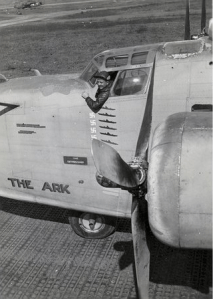
Stripped of armor to increase range and carrying a full load of depth charges, the American anti-submarine bomber with its 10-man crew dove out of the clouds at 1,000 feet, throttles open and machine guns firing. The first Condor never came out of that diving turn, while machine gun fire from the second tore into the American bomber. Rear-gunners returned fire, as Liberator pilot Hugh Maxwell Jr. crash landed in the water, his aircraft breaking into three pieces.the-ark

Maxwell had named his B-24 “The Ark”, explaining that “it had a lot of strange animals aboard, and I hoped it would bring us through the deluge”. It must have worked, seven out of ten crew members lived to be plucked from the water. The second Condor made it back to Bordeaux, where it crashed and burned on landing.

Surviving Liberator crew members were rescued by the British destroyer Highlander, along with three Germans from that first Condor. It was all the Highlander crew could do, to keep the soaking wet combatants apart on the decks of the destroyer.

On the first night of the Gulf War in 1991, an Iraqi Mirage fighter intercepted an American EF-111, an unarmed F-111 bomber modified for radar-jamming patrol. Flying at 200′ and equipped with sophisticated terrain-following radar, the bomber was able to climb up and over hilltops, while the French-made Mirage fighter had no such systems. The last that was seen of that Iraqi fighter, was when he plowed his aircraft into that same hillside.

f-15eLater in the same conflict, an Iraqi Hughes 500 helicopter was taken out by bombs dropped from an American Air Force F-15E bomber. At least one Iraqi PC-7 Turboprop pilot got spooked, bailing out of a perfectly good aircraft before a shot was fired in his direction.

The strangest dogfight in history took place on January 12, 1968, when four Soviet-made Antonov AN-2 Colt biplanes took off from their base in North Vietnam, headed west toward Laos.

Only 125 nautical miles from Hanoi, Phou Pha Thi mountain had long been used as a staging base for CIA directed Hmong guerilla fighters and Thai security forces. Lima Site 85 was the American radar facility, perched atop the 5,800′ mountain.

CIA-operated “Air America” captain Ted Moore was flying a UH-1D Huey helicopter at the

phou_pha_thi
Lima site 85, atop 5,800 Phou Pha Thi Mountain

time, carrying a load of ammunition to Phou Pha Thi. Moore arrived to see two North Vietnamese biplanes, dropping 122mm mortar shells through holes in the floor and strafing the mountaintop with 57mm rockets. “It looked like WWI,” he later recalled. Moore gave chase, positioning his helicopter above one biplane, as flight mechanic Glenn Woods fired an AK-47 rifle down from above.

Moore and Woods dropped back to the second biplane, as the first crashed into a ridge west of the North Vietnamese border. Moments later, the second crashed into a mountainside, as the other two slipped back into North Vietnamese air space. The entire chase had taken about 20 minutes.

Theirs was a secret war, waged in the mists of the Annamite Mountains. Two months later, North Vietnamese commandos attacked and destroyed Site 85, inflicting the largest loss of US Air Force personnel of the war in Vietnam.

On July 27, 2007, Air America veterans Marius Burke and Boyd Mesecher presented the CIA with “An Air Combat First”, an oil on canvas painting by Keith Woodcock, depicting the shoot-down. The event was attended by members of the Air America Board, pilot Ted Moore, wife of flight mechanic Glenn Woods Sawang Reed, CIA paramilitary veteran Bill Lair; and the painting’s donors. Presumably, the painting hangs at CIA Headquarters in Langley, Virginia. A testament to the only time in the history of the Vietnam war, that an enemy fixed-wing aircraft was shot down, by a helicopter.

January 6, 1929 A Saint from the Gutter

Mother Teresa was once asked about the overwhelming nature of her work. ‘Never worry about numbers, she said. “Help one person at a time and always start with the person nearest you”

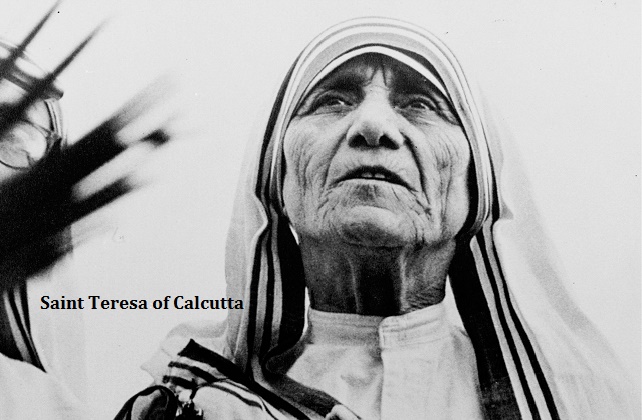
In the language of Albania, “Gonxhe” means “Rosebud”.   Anjezë Gonxhe Bojaxhiu was born August 26, 1910, in the capital of Macedonia; now Uskup.  Then it was Skopje, part of the Ottoman Empire. Her mother raised the girl in the Roman Catholic faith after her father died in 1919.  By age 12, she was committed to a religious life.  “Agnes” was always fascinated with the lives of missionaries, joining the Sisters of Loreto at the age of 18 to become one.  Though she would live to 87, she would never again see her mother or her sister.

mother-teresa-at-18The Sisters taught English to school children in India, a language which Agnes learned in the Loreto Abbey in Rathfarnham, Ireland.
She arrived in India on January 6, 1929, beginning her novitiate in Darjeeling, near the Himalayas. There she learned to speak Bengali, teaching at St. Teresa’s School, near her convent. She took her first religious vows as a nun in 1931, choosing the name Thérèse de Lisieux, after the patron saint of missionaries. Another nun in the convent had already chosen the name, so Agnes adopted the Spanish spelling, becoming Sister Teresa on May 24.

She would take her solemn vows six years later, while teaching at the Loreto School in Entally, eastern Calcutta, a position she held until 1944.

Today, about 10% of the world’s Muslims live in India, making up close to 15% of the population. It was much higher in 1944, as much as 2/3rds in some regions. The idea of the Muslim population breaking off of India and forming an independent Pakistan had come up as early as 1930, and become a major force with the breakup of British rule over the Indian subcontinent, the “British Raj”, at the end of WWII.

Tensions spilled over in the province of Bengal in August of 1946, as violence between Muslim, Hindu and Sikh mobs left thousands dead. Violence was particularly bad in Calcutta, where the massive riots of August 16-19 left over 4,000 dead and more than 100,000 homeless.

India was partitioned the following year, and Pakistan declared an independent nation in August. For now, the violence of 1946, following on the heels of the Bengal famine of 1943, left Calcutta in a state of despair.

Sister Teresa was looking out from the train that carried her from Darjeeling to Calcutta on September 10, when she heard the call. “I was to leave the convent and help the poor while living among them. It was an order. To fail would have been to break the faith”. No one knew it at the time, but “Sister Teresa” had become “Mother Teresa”.

She would spend a few months at Holy Family Hospital receiving medical training, calcutta-1
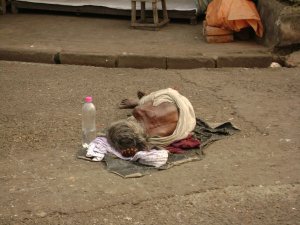
venturing into the slums of Calcutta to begin her missionary work in 1948. A small group of women joined in her ministry to the “poorest among the poor”, as she wrote in her diary of begging for food and supplies. The hardships were severe, as was the near-constant temptation to return to the ease and comfort of the convent.

Teresa received permission from the Vatican on October 7, 1950, to start the diocesan congregation that would become the Missionaries of Charity.  With only 13 members in Calcutta, their mission was caring for “the hungry, the naked, the homeless, the crippled, the blind, the lepers, all those people who feel unwanted, unloved, uncared for throughout society, people that have become a burden to the society and are shunned by everyone.”

kalighatAwarded the Nobel Peace Prize in 1979, she refused the traditional honor banquet, requesting instead that the $192K cost of the banquet be given to help the poor of India.

With the help of Indian officials, Teresa opened the Kalighat Home for the Dying in an abandoned temple, where dying Muslims were read from the Quran, Hindus received water from the Ganges, and Catholics were read the Last Rites. “A beautiful death,” she said, “is for people who lived like animals to die like angels—loved and wanted”.

Mother Teresa was once asked about the overwhelming nature of her work. ‘Never worry about numbers, she said. “Help one person at a time and always start with the person nearest you”.

By the time of her death on September 5, 1997, Mother Teresa’s Missionaries of Charity had over 4,000 sisters, and an associated brotherhood of 300 members. They operated 610 missions in 123 countries, including hospices and homes for victims of HIV/AIDS, leprosy and tuberculosis. There were soup kitchens, children’s and family counseling programs, personal helpers, orphanages, and schools.

Mother Teresa was canonized on September 4, 2016 in Vatican City, becoming Saint Teresa of Calcutta, the ceremony at St. Peter’s Square attended by over 1,500 homeless people.  Even saints have critics, even a tower of rectitude like Mother Teresa.  In her case, it was usually the warm and well fed likes of Christopher Hitchens, the “New Left Review” and the German magazine Stern.

Anjezë Gonxhe Bojaxhiu once said “Spread love everywhere you go.  Let no one ever come to you without leaving happier”.  Let that be the answer to her critics.mother-teresa-1


December 28, 1955 Juche

The nuclear relationship between the Islamic Republic of Iran is now guided by the steady hands of the “Death to America” mullahs, and the man who banished Christmas and ordered North Korea to worship his grandmother

We tend to look at WWII in a kind of historical box, with a beginning and an end.  In reality, we feel the effects of WWII to this day.  Just as the modern boundaries (and many of the problems) of the Middle East were shaped by WWI, the division of the Korean Peninsula was born of WWII.

Korea’s brief period of sovereignty ended in 1910, when the country was annexed by Imperial Japan. After Japan’s surrender in 1945, Korea was divided into two occupied zones; the north held by the Soviet Union and the south by the United States.

The Cairo Declaration of 1943 called for a unified Korea, but cold war tensions hardened the separation. By 1948, the two Koreas had separate governments, each with its own diametrically opposite governing philosophy.

Kim Il-sung came to power in North Korea in 1946, nationalizing key industries and collectivizing land and other means of production. South Korea declared statehood in May 1948, under the vehemently anti-communist military strongman, Syngman Rhee.

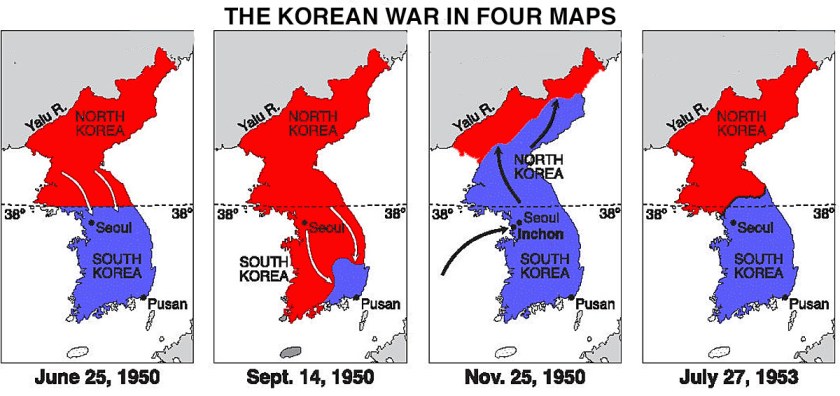
Both governments sought control of the Korean peninsula, but the 1948-49 withdrawal of Soviet and most American forces left the south holding the weaker hand. Escalating border conflicts along the 38th parallel led to war when the North, with assurances of support from the Soviet Union and Communist China, invaded South Korea in June 1950.

koreanwar-fourmaps1200Sixteen countries sent troops to South Korea’s aid, about 90% of them Americans.  The Soviets sent material aid to the North, while Communist China sent troops. The Korean War lasted three years, causing the death or disappearance of over 2,000,000, combining military and civilian.

The Korean War ended in July 1953, though the two sides technically remain at war to this day, staring each other down over millions of land mines in a fortified demilitarized zone spanning the width of the country.

The night-time satellite image of the two Koreas, tells the story of what happened next.kim_il-sung  South Korea went through a series of military dictatorships from the ‘60s to the ‘80s, since developing into a successful Republic.  In the North, Kim Il-sung built a communist hellhole, a cult of personality established under a North Korean ideology known as “Juche”, (JOO-chay).

The term translates as “independent stand” or “spirit of self-reliance”, its first known reference in a speech given by Kim Il-sung on December 28, 1955.  Theoretically based on independent thought, economic self-sufficiency and self-reliance in defense, “independence” applies to the collective, not to the individual, from whom absolute loyalty to the revolutionary party leader is required.  In practice, this principle puts one man at the center and above it all.  According to recent amendments to the North Korean constitution, that man will always be a well-fed member of the Kim family.

Son of the founder of the Juche Ideal, Kim Jung-il, was a well-known film buff. In a movepulgasari that would make Caligula blush, he had South Korean film maker Shin Sang-ok kidnapped along with his actress ex-wife, Choi Eun-hee. After four years spent starving in a North Korean gulag, the couple accepted Kim’s “suggestion” that they re-marry and go to work for him, producing the less-than-box-office-smash “Pulgasari”, a kind of North Korean Godzilla film.

The couple escaped, unlike dozens of South Korean and Japanese unfortunates “recruited” with the help of a chloroform soaked rag.

ryugyong-hotelNorth Korea broke ground on what foreign media called “the worst building in the world” in 1987, just in time for the Seoul Olympics the following year. With 105 stories and eight revolving floors, the Ryugyong would have been the tallest hotel in the world, if it ever opened.  Construction shut down in 1992, partly because Soviet funding dried up, and partly because construction was so bad that it’s unsafe to stand within 10 blocks of the thing.  In 2008, Orascom Telecom of Egypt agreed to spend $180 million to put glass on the outside, in exchange for a $400 million contract to build the nation’s first 3G cellular network.  Whether there will ever be more than one customer, is unclear.   Perhaps 2017 will be the year that the Ryugyong becomes more than the world’s largest telecommunications antenna, but so far the place remains “too popular to take reservations”.
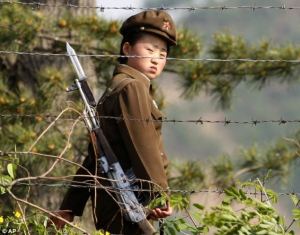
north-korean-prison-concentration-camp-life-04Anywhere from 1 to 3 million North Koreans starved to death during the ‘90s, while it’s estimated that one in every hundred North Korean citizens are incarcerated in a system of gulags, torture chambers and concentration camps.

As of 2010, the North Korean Military had 7,679,000 active, reserve, and paramilitary personnel, in a nation of 25,000,000. Over 30% of the nation’s population, and absorbing almost 21% of GDP. Today, that military is under the personal control of a 32 year old who had his own uncle Jang Song-thaek executed, presumably by anti-aircraft machine gun fire, before being incinerated by flame thrower. The same method used to kill two of Mr. Jang’s associates, a week earlier. The New York Times reports that the execution was for a coup plot, but others say he didn’t clap his hands long enough and with the right amount of enthusiasm, over some pronouncement of the “Dear Leader”, Kim Jung-un. The same Dear Leader who controls the nuclear arsenal.kim-jong-un

The Islamic Republic of Iran (IRI) and the “Hermit Kingdom” of North Korea have had more or less “normal” relations, since the 1979 Iranian Revolution.  The relationship isn’t all moonbeams and lollipops, the DPRK sought relations with Baghdad throughout the Iran-Iraq War.  The IRI maintains relations with South Korea as well, but a cordial hatred for the United States has always kept the two united.

Authorities warned the nation of yet another impending famine in March 2016, the state-run newspaper Rodong Sinmun editorializing that “We may have to go on an arduous march, during which we will have to chew the roots of plants once again.”

The Obama administration recently concluded a nuclear “deal” with Iran, secretly sealed with pallet loads of taxpayer cash.  CIA Director John Brennan conceded in September that his agency is “monitoring” whether North Korea is providing Iran with clandestine nuclear assistance.  It doesn’t seem a stretch, there have been arms sales and “peaceful nuclear cooperation” between the two since the 1980s. The nuclear relationship between the two is now guided by the steady hands of the “Death to America” mullahs, and the man who banished Christmas and ordered North Korea to worship his grandmother.   I cannot imagine what could go wrong.