The letters between Adams and Jefferson together constitute one of the most comprehensive historical and philosophical assessments ever written about the American founding.
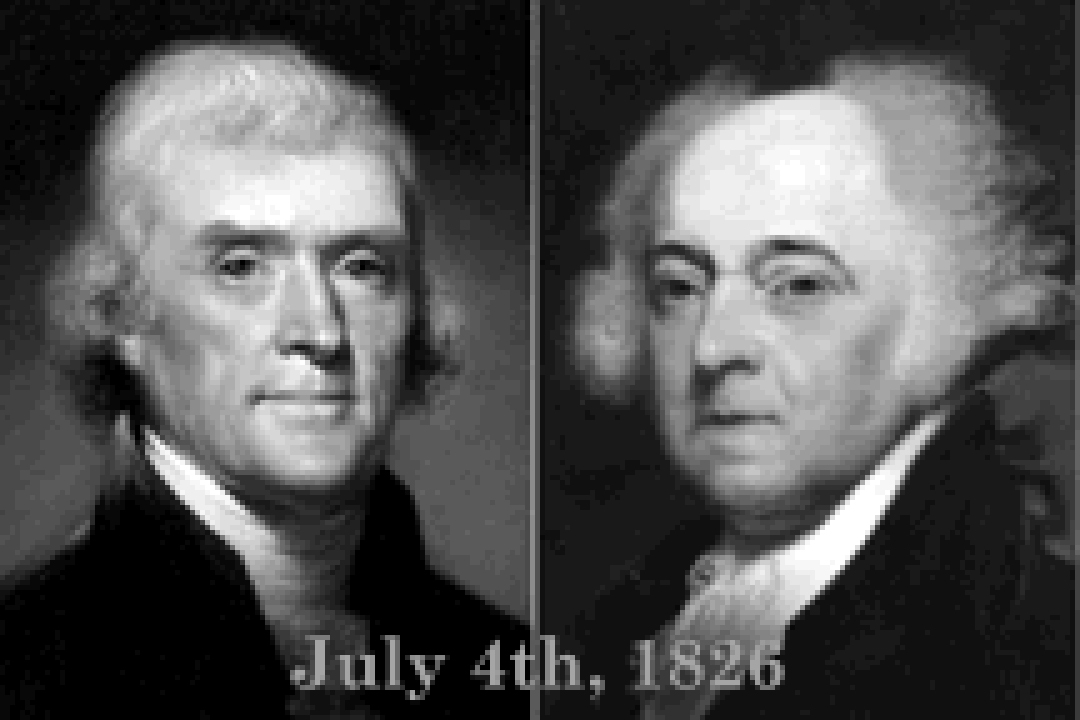
Thomas Jefferson met John Adams at the 1775 Continental Congress in Philadelphia, the two forming a close personal friendship which would last for most of their lives. They were two of the committee of five assigned to write the Declaration of Independence, and worked closely together throughout the era of our founding.
The friendship between the two men came to an end during the Presidential election of 1800. Mudslinging on both sides rose to levels never before seen in a national election, an election in which both sides firmly believed the election of the other, would destroy the young nation.
Jefferson defeated one term incumbent Adams and went on to serve two terms as President.
On Jefferson’s retirement in 1809, one of the signers of the Declaration of Independence, Dr. Benjamin Rush, took it upon himself to patch up the broken friendship between the two founding fathers. Dr. Rush worked on his personal diplomatic mission for two years. In 1811, he finally succeeded.
There followed a series of letters between Adams and Jefferson, which together constitute one of the most comprehensive historical and philosophical assessments ever written about the American founding.
Their correspondence touched on a variety of topics, from the birth of this self-governing Republic, to then-current political issues, to matters of philosophy and religion and issues of aging. Both men understood that they were writing not only to one another, but to generations yet unborn.
Each went to great lengths to explain the philosophical underpinnings of his views. Adams the Federalist, the firm believer in strong, centralized government. Jefferson was the Democratic-Republican, advocating for smaller federal government and more autonomy for the states.
In 1826, Jefferson and Adams were the last of the founding fathers. In an ending no fiction writer would even dare to contemplate, both men died on this day in 1826, fifty years to the day from the birth of the Republic they had helped to create.
Adams was 90. His final words as he lay on his deathbed were “Thomas Jefferson still survives”. Adams had no way of knowing that Jefferson had died five hours earlier, at Monticello. He was 82.
Daniel Webster spoke of the pair a month later, at Faneuil Hall, in Boston. “No two men now live” he said”, (or) any two men have ever lived, in one age, who (have) given a more lasting direction to the current of human thought. No age will come, in which the American Revolution will appear less than it is, one of the greatest events in human history. No age will come, in which it will cease to be seen and felt, on either continent, that a mighty step, a great advance, not only in American affairs, but in human affairs, was made on the 4th of July, 1776″.
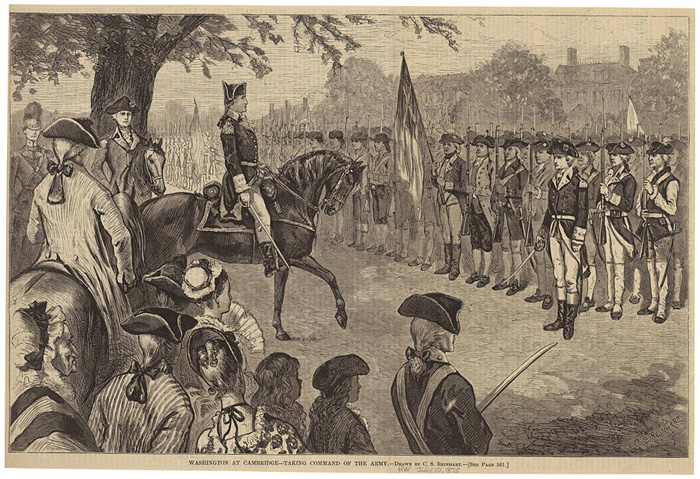
General Washington rode out in front of the troops gathered at Cambridge Common on July 3, 1775. Washington drew his sword under the branches of an ancient elm, by that act formally taking command of the Continental Army.
The American Revolution began with the battles of Lexington and Concord on the 19th of April, 1775. Thousands of armed colonial militia followed the British columns as they withdrew, and there they remained, hemming the British occupiers up in the city of Boston.
Within days, more than 20,000 armed men from all over New England had gathered from Cambridge to Roxbury. Tories’ vacant homes, empty Churches, even the brick buildings of Harvard College served as barracks, officers’ quarters, and hospitals. Soldiers camped in tents and other makeshift shelters, while Harvard canceled classes on May 1. Classes would not resume at the Cambridge campus until June of the following year.
The Continental Congress created the Army on June 14, 1775, appointing George Washington to lead it. General Washington rode out in front of the troops gathered at Cambridge Common on July 3, 1775. Washington drew his sword under the branches of an ancient elm, by that act formally taking command of the Continental Army.
Interestingly, 150 years of de facto independence from Great Britain seems to have suited the American colonist. If inheritance records are any indication, the average American enjoyed a better standard of living, than the average Brit. Average heights of the time bear that out.
The average American colonist had a full three inches on his British counterpart. At a time when the average male stood 5’8′, Washington towered over the crowd at 6’2″. George Washington was a hard man to miss.
For Washington to draw his sword against King George III, was itself an act of magnificent courage. According to British law of the time, one of four definitions of High Treason was “If a man do levy war against our lord the King in his realm”. By drawing that sword against the crown, Washington was clearly committing High Treason. He surely understood that such a prominent person as himself would be dealt with harshly, if caught.
At that time, the centuries-old penalty for High Treason was as savage as it was gruesome. Even now the language of the death sentence is difficult to read. You may consider that to be my warning if you don’t care to read what follows.
The full sentence as read to the condemned was: “That you be drawn on a hurdle (a sledge) to the place of execution where you shall be hanged by the neck and being alive cut down, your privy members shall be cut off and your bowels taken out and burned before you, your head severed from your body and your body divided into four quarters to be disposed of at the King’s pleasure”.
These were the terms of employment under which George Washington accepted his assignment. He even declined to accept payment, beyond reimbursement for his personal expenses.
The 56 signers of the Declaration of Independence would show the same brand of courage, by signing that document a year later. It must have been a supreme in-your-face moment when John Hancock put his pen to that parchment, which ended: “And for the support of this Declaration, with a firm Reliance on the Protection of divine Providence, we mutually pledge to each other our Lives, our Fortunes, and our sacred Honor”.
At the signing, Ben Franklin famously said “We must all hang together, or assuredly we shall all hang separately”. This was no empty philosophical statement they were signing. Should circumstances turn against them, the founding fathers well understood. Each was signing his death warrant.
Resolved, that these United Colonies are, and of right ought to be, free and independent States, that they are absolved from all allegiance to the British Crown, and that all political connection between them and the State of Great Britain is, and ought to be, totally dissolved.
Richard Henry Lee’s resolution was taken almost verbatim from instructions from the Virginia Convention and its President, Edmund Pendleton. As presented to the second Continental Congress on June 7, 1776, Lee’s resolution read:
“Resolved, that these United Colonies are, and of right ought to be, free and independent States, that they are absolved from all allegiance to the British Crown, and that all political connection between them and the State of Great Britain is, and ought to be, totally dissolved. That it is expedient forthwith to take the most effectual measures for forming foreign Alliances. That a plan of confederation be prepared and transmitted to the respective Colonies for their consideration and approbation”.
Several colonies were not yet ready to declare independence at that time.
Representatives agreed to delay the vote until July 1, appointing a “Committee of Five” to draft a declaration of independence from Great Britain. Members of the committee included John Adams of Massachusetts, Benjamin Franklin of Pennsylvania, Roger Sherman of Connecticut, Robert Livingston of New York and Thomas Jefferson of Virginia. The committee selected Jefferson to write the document, the draft presented to Congress for review on June 28.
Debate resumed on July 1, 1776, with most of the delegates favoring Lee’s resolution.
The final vote was taken on July 2, when delegates from 12 of the 13 colonies voted in favor. Delegates from New York abstained, having had no clear instructions from their constituents.
The Pennsylvania Evening Post reported on July 2nd that “This day the Continental Congress declared the United Colonies Free and Independent States”.
The Pennsylvania Gazette followed suit on the third with “Yesterday, the CONTINENTAL CONGRESS declared the UNITED COLONIES FREE and INDEPENDENT STATES”.
John Adams thought that July 2 would go down as the country’s Independence Day.
This day has been mostly forgotten in favor of July 4, when the final edits of Jefferson’s Declaration were adopted, the final document engrossed (handwritten onto parchment), and sent off to the printer.
The 56 signers were never together at the same time. Many of the signatures we see on the Declaration of Independence, would not be affixed to the document until August 2, possibly even later.
“On you depend the fortunes of America. You are to decide the important question, on which rest the happiness and liberty of millions yet unborn. Act worthy of yourselves.” – Dr. Joseph Warren
Charlestown, Massachusetts occupies a hilly peninsula to the north of Boston, at the point where the Mystic River meets the Charles. Like Boston itself, much of what is now Charlestown was once Boston Harbor. In 1775 the town was a virtual island, joined to the mainland only by a thin “neck” of land.
Thousands of Patriot Militia poured into the area following the April battles of Lexington and Concord, hemming in the British who controlled Boston and its surrounding waterways.
Reinforced and provisioned from the sea over which the Crown held undisputed control, British forces under General Sir Thomas Gage could theoretically remained in Boston, indefinitely.
The elevation of Breed’s and Bunker’s Hill across the river, changed that calculation. Should colonial forces obtain artillery of their own, they would be able to rain down hell on British forces bottled up in Boston. It was just this scenario that led Henry Knox into a New England winter later that year, to retrieve the guns of Fort Ticonderoga.
The Massachusetts Provincial Congress received word on the 13th that the British planned to break out of Boston within the week, taking the high ground of Dorchester Heights to the south and Charlestown to the north. Major General Israel Putnam was directed to set up defenses on Bunker Hill, on the northwest end of the Charlestown peninsula.
Colonel William Prescott led about 1,200 men onto the peninsula on the night of the 16th. Some work was performed on the hill which gives the battle its name, but it was farmer Ephraim Breed’s land to the southeast, which offered the more defensible hill from which to defend the peninsula.
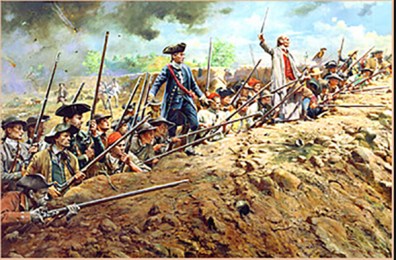
Shovels could be heard throughout the night. The sun rose on June 17 to reveal a 130′ defensive breastwork across Breed’s hill. Major General William Howe was astonished. “The rebels,” he said, “have done more work in one night than my whole army would have done in one month.”
The warship HMS Lively opened fire on the redoubt shortly after 4am, with little effect on the earthworks. 128 guns joined in as the morning bore on, including incendiary shot which set fire to the town. Militia continued to reinforce the high ground throughout the morning hours, as Regulars commanded by General Howe and Brigadier General Robert Pigot crossed the Charles River and assembled for the assault.
First Assault
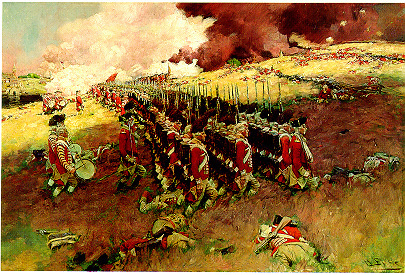
The British line advanced up Breed’s Hill twice that afternoon, Patriot fire decimating their number and driving survivors back down the hill to reform and try again. Militia supplies of powder and shot began to give out as the British advanced up the hill for the third assault.
“Don’t fire until you see the whites of their eyes”. The quote is attributed to Prescott, but the order seems to have originated with General Putnam and passed along by Prescott, Seth Pomeroy, John Stark, and others, in a desperate attempt to conserve ammunition.
Finally, there was nothing left with which to oppose the British bayonets. The Militia was forced to retreat.
Second Assault
Most of the colonists’ casualties occurred at this time, including Boston physician and President of Massachusetts’ Provincial Congress, Dr. Joseph Warren. Dr. Warren had been appointed Major General on June 14, but the commission had not arrived as of yet. On this day, he fought as a private soldier. He had been but the commission had not yet taken effect.
Two months before the battle, Dr. Warren had spoken to his men. “On you depend the fortunes of America”, he said. “You are to decide the important question, on which rest the happiness and liberty of millions yet unborn. Act worthy of yourselves.”
Act worthy of yourselves. That they did.
Final Attack
The Battle of Bunker Hill ended in victory for the British, in that they held the ground when the fighting was over. It was a Pyrrhic victory. Howe lost 226 killed and 828 wounded, over a third of their number and more than twice those of the Militia.
One Eighth of all the British officers killed in the Revolution, died on Ephraim Breed’s Hill. General Henry Clinton wrote afterward, of the battle: “A few more such victories” he said, “would have shortly put an end to British dominion in America”.
The Continental Congress established the ‘American Continental Army’ on June 14, 1775, authorizing 10 companies of ‘expert riflemen,’ to serve as light infantry in the siege of Boston.
On May 10, 1775, twelve colonies convened the second Continental Congress in Philadelphia, Pennsylvania. One colony was absent at the time, Georgia would come later, arriving on July 20 following their own Provincial Congress.
The Revolution had begun in April that year, with the battles of Lexington and Concord. A primary focus of the Second Continental Congress was to manage the war effort.
The fledgling United States had no Army at this time, relying instead on ad hoc militia units organized by the colonies themselves. At this time there were approximately 22,000 such troops surrounding British forces occupying Boston, with another 5,000 or so in New York.
The Continental Congress established the ‘American Continental Army’ on June 14, 1775, authorizing 10 companies of ‘expert riflemen,’ to serve as light infantry in the siege of Boston. The next day the Congress unanimously selected George Washington to be General and Commander in Chief of all continental forces.
Most of the Continental Army was disbanded after the Treaty of Paris ended the war in 1783. The 1st and 2nd Regiments remained to become the basis of the Legion of the United States in 1792, under General Anthony Wayne. These two became the foundation of the United States Army, in 1796.
The formation of other branches of the Armed Forces was quick to follow. The first organized merchant marine action had taken place two days earlier on June 12, 1775, when a group of Machias Maine citizens boarded and captured the schooner British warship HMS Margaretta.
The Navy was formed later that year, in October 1775, the Marine Corps in November. 18th century revenue cutter and rescue operations led to the formation of the United States Coast Guard in January 1915. The Air Force spun off of the Army Air Corps in September 1947.
Speaking on Armed Services Day in 1953, President Dwight David Eisenhower said: “It is fitting and proper that we devote one day each year to paying special tribute to those whose constancy and courage constitute one of the bulwarks guarding the freedom of this nation and the peace of the free world.”
On the other days of the year, you might say that you can thank a teacher if you can read this essay. Today, you can thank a soldier that you can read it in English. Happy birthday, United States Army.
The two men bonded almost immediately, forming a relationship that closely resembled that of father and son. The fatherless young French officer, and the father of his country who went to his grave, childless.
There are a handful of men who were indispensable to the American Revolution, men without whom the war effort would have been doomed to fail.
One, of course is George Washington, who became commander in chief before he had an army. Before he even had a country. Knowing full well that the penalty for high treason against the British Crown was death, Washington took command of an army with enough powder for an average 9 rounds per man, in a contest against the most powerful military of its time.
Another indispensable man has to be Benjamin Franklin, whose diplomatic skills and unassuming charm all but single-handedly turned France into an indispensable ally.
A third would arguably be Marie-Joseph Paul Yves Roch Gilbert du Motier, better known as the Marquis de Lafayette.
Lafayette was all of nineteen when he landed on North Island South Carolina on June 13, 1777.
The French King had forbidden his coming to America, fearing his capture by British agents. Lafayette wanted none of it. His own father, also the Marquis de Lafayette, was killed fighting the British when the boy was only two. The man was determined to take part in this contest, even if he had to defy his King to do so. Lafayette disguised himself on departure, and purchased the entire ship’s cargo, rather than landing in Barbados and thus exposing himself to capture.
Franklin had written to Washington asking him to take on Lafayette, in hopes that it would secure an increase in French aid to the American war effort. The two men bonded almost immediately, forming a relationship that closely resembled that of father and son. The fatherless young French officer, and the father of his country who went to his grave, childless.
Marie Adrienne Francoise, wife of Lafayette
Lafayette wrote home to his wife Marie Adrienne in 1778, from Valley Forge. “In the place he occupies, he is surrounded by flatterers and secret enemies. He finds in me a trustworthy friend in whom he can confide and who will always tell him the truth. Not a day goes by without his talking to me at length or writing long letters to me. And he is willing to consult me on most interesting points.”
Lafayette served without pay, spending the equivalent of $200,000 of his own money for the salaries and uniforms of staff, aides and junior officers. He participated in several Revolutionary War battles, being shot in the leg at Brandywine, going on to serve at Barren Hill, Monmouth Courthouse, Rhode Island, and the final siege at Yorktown. All the while, Lafayette periodically returned to France to work with Franklin in securing thousands of additional troops and several warships to aid in the war effort.
Adrienne gave birth to their first child on one such visit, a boy they named Georges Washington Lafayette.
It was a small force under Lafayette that took a position on Malvern Hill in 1781, hemming in much larger British forces under Lord Cornwallis at the Yorktown peninsula.
Lafayette’s sabre as general of the Garde nationale. On display at the Musée de l’Armée, Paris.
The trap was sprung that September with the arrival of the main French and American armies under Marshal Jean-Baptiste Donatien de Vimeur, comte de Rochambeau & General George Washington, and the French fleet’s arrival in the Chesapeake under Lieutenant Général des Armées Navales François-Joseph Paul, comte de Grasse.
Cornwallis surrendered on October 19, 1781, after which Lafayette returned to France.
The Marquis played an important role in his own country’s revolution, becoming a Commander of the French National Guard. When the Bastille was stormed by an angry mob in 1789, Lafayette was handed the key.
Lafayette sent the key to the Bastille to George Washington, as a “token of victory by Liberty over Despotism”. Today that key hangs in the main hallway at Washington’s mansion at Mount Vernon.
There came a time when the French Revolution morphed into the Reign of Terror, and began to eat its young. The Marquis de Lafayette was captured by Austria in 1792 and imprisoned under verminous conditions, while his wife was taken into custody by the French Republic.
Secretary of State Thomas Jefferson found a loophole that allowed Lafayette to be paid, with interest, for his services in the late Revolution. An act was rushed through Congress and signed by President Washington, the resulting funds allowing both Lafayettes some of the few privileges permitted them, during their five years’ captivity.
Georges Washington Lafayette was smuggled to America out of France in 1795, while his father was held prisoner. Adrienne was released after four, and persuaded Emperor Francis to permit her and her two daughters to join her husband in prison. After a brutal year in solitary confinement, Lafeyette’s cell door opened on October 15, 1795. He must have been astonished to see his wife and daughters walk in. The four would spend his last year in captivity, together.
Adrienne died on Christmas day, 1807. She had slipped into delirium the night before, her final words spoken to her husband: “Je suis toute à vous“. I am all yours.
Lafayette remained staunchly opposed to both the Napoleonic regime and the restoration of the Bourbon dynasty, feeling that both had come to power by undemocratic means.
1824 portrait by Scheffer, hangs in the U.S. House of Representatives
In 1824, President James Monroe and Congress invited Lafayette to visit the United States, for the nation’s upcoming 50th birthday. Crowds of cheering citizens greeted the French Marquis and his son Georges Washington on their return to Boston, Philadelphia and New York.
Harlow Giles Unger wrote in his 2003 book Lafayette, “It was a mystical experience they would relate to their heirs through generations to come. Lafayette had materialized from a distant age, the last leader and hero at the nation’s defining moment. They knew they and the world would never see his kind again.”
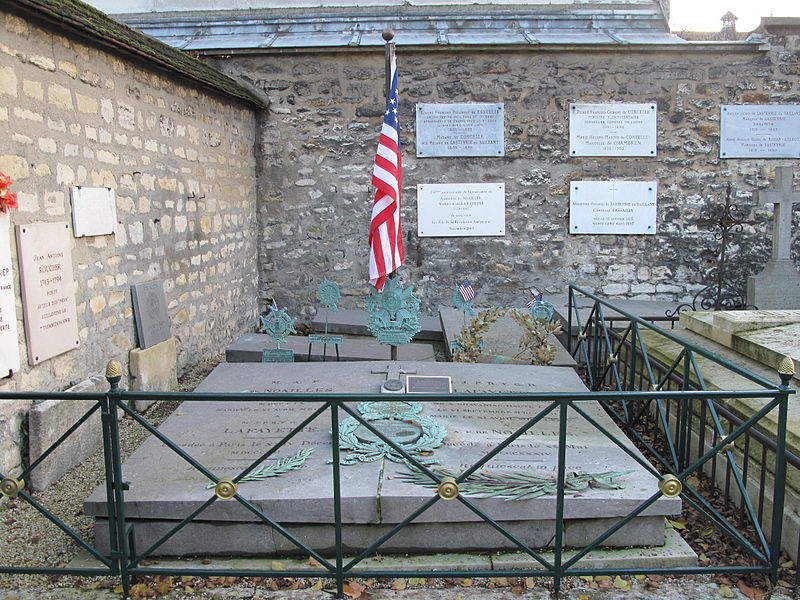
Marie-Joseph Paul Yves Roch Gilbert du Motier died in Paris on May 20, 1834, and was buried next to his wife at the Picpus Cemetery. He was seventy-six. President Andrew Jackson ordered that he be accorded the same funeral honors which President John Adams had bestowed on George Washington himself, in 1799. John Quincy Adams delivered a three-hour eulogy in Congress, saying “The name of Lafayette shall stand enrolled upon the annals of our race high on the list of the pure and disinterested benefactors of mankind.”
Lafayette Burial Place, Picpus Cemetery, Paris
In obedience to his one of his last wishes, several feet of earth were dug up from Bunker Hill, and shipped to France. The man had always wanted to be buried under American soil.
Taking positions across the village green to block the soldiers’ line of march, 80 “minutemen” turned and faced 700 of the most powerful military, on the planet.
The column of British soldiers moved out from Boston late on the 18th, their mission to confiscate the American arsenal at Concord and to capture the Patriot leaders Sam Adams and John Hancock, known to be hiding in Lexington.
Boston Patriots had been preparing for such an event. Sexton Robert John Newman and Captain John Pulling carried two lanterns to the steeple of the Old North church, signaling that the Regulars were crossing the Charles River to Cambridge. Dr. Joseph Warren ordered Paul Revere and Samuel Dawes to ride out and warn surrounding villages and towns, the two soon joined by a third rider, Samuel Prescott. It was Prescott alone who would make it as far as Concord, though hundreds of riders would fan out across the countryside before the night was through.
The column entered Lexington at sunrise on April 19, bayonets gleaming in the early morning light. Armed with a sorry assortment of weapons, colonial militia poured out of Buckman Tavern, and fanned out across the town square. Some weapons were hand made by village gunsmiths and blacksmiths, some decades old, but all were in good working order. Taking positions across the village green to block the soldiers’ line of march, 80 “minutemen” turned and faced 700 of the most powerful military, on the planet.
Words were exchanged and no one knows who fired the first shot. When it was over, eight Lexington men lay dead or dying, another ten wounded. One British soldier was wounded.
Vastly outnumbered, the militia soon gave way, as word spread and militia gathered from Concord to Cambridge. The King’s Regulars never did find the weapons for which they had come, nor did they find Adams or Hancock. There had been too much warning for that.
Regulars would clash with colonial subjects two more times that day, first at Concord Bridge and then in a running fight at a point in the road called “The Bloody Angle”. Finally, hearing that militia was coming from as far away as Worcester, the column turned to the east and began their return march to Boston.
Some British soldiers marched 35 miles over those two days, their final retreat coming under increasing attack from militia members firing from behind stone walls, buildings and trees. One taking up such a firing position was Samuel Whittemore of Menotomy Village, now Arlington Massachusetts. At 80 he was the oldest known combatant of the Revolution.
Whittemore took his position by the road, armed with his ancient musket, two dueling pistols and the old French cutlass captured years earlier from a French officer whom he explained had “died suddenly”.
Waiting until the last possible moment, Whittemore rose and fired his musket at the oncoming Redcoats, one shot, one kill. Several charged him from only feet away as he drew his pistols. Two more shots, one dead and one mortally wounded. He had barely drawn his sword when they were on him, a .69 caliber ball fired almost point blank tearing part of his face off, as the butt of a rifle smashed into his head. Whittemore tried to fend off the bayonet strokes with his sword but he didn’t have a chance. He was run through thirteen times before he lay still, one for each colony.
The people who came out of their homes to clean up the mess afterward found Whittemore, up on one knee and trying to reload his old musket.
Doctor Nathaniel Tufts treated the old man’s wounds as best he could, but felt that there was nothing anyone could do. Sam Whittemore was taken home to die in the company of his loved ones, which he did. Eighteen years later, at the age of ninety-eight.
The Dutchess County Militia had to be called up. The Colonel had one night to prepare for battle, and this rider was done. The job would have to go to Colonel Ludington’s first-born. His daughter, Sybil.
“Listen my children and you shall hear, Of the midnight ride of”…Sybil Ludington.
Wait…What?
Paul Revere’s famous “midnight ride” began on the night of April 18, 1775. Revere was one of two riders, soon joined by a third, fanning out from Boston to warn of an oncoming column of “regulars”, come to destroy the stockpile of gunpowder, ammunition, and cannon in Concord.
Revere himself covered barely 12 miles before being captured, his horse confiscated to replace the tired mount of a British sergeant. Revere would finish his “ride” on foot, arriving at sunrise on the 19th to witness the last moments of the battle on Lexington Green.
Two years later, Patriot forces maintained a similar supply depot, in the southwest Connecticut town of Danbury.
William Tryon was the Royal Governor of New York, and long-standing advocate for attacks on civilian targets. In 1777, he was also a major-general of the provincial army. On April 25th, Tryon set sail for the Connecticut coast of Long Island Sound with a force of 1,800, intending to destroy Danbury.
Patriot Colonel Joseph Cooke’s small Danbury garrison was caught and quickly overpowered on the 26th, trying to remove food supplies, uniforms, and equipment. Facing little if any opposition, Tryon’s forces went on a bender, burning homes, farms and storehouses. Thousands of barrels of pork, beef, and flour were destroyed, along with 5,000 pairs of shoes, 2,000 bushels of grain, and 1,600 tents.
Colonel Henry Ludington was a farmer and father of 12, with a long military career. A long-standing and loyal subject of the British crown, Ludington switched sides in 1773, joining the rebel cause and rising to command the 7th Regiment of the Dutchess County Militia, in New York’s Hudson Valley.
In April 1777, Ludington’s militia was disbanded for planting season, and spread across the countryside. An exhausted rider arrived at the Ludington farm on a blown horse, on the evening of the 26th, asking for help. 15 miles away, British regulars and a force of loyalists were burning Danbury to the ground.
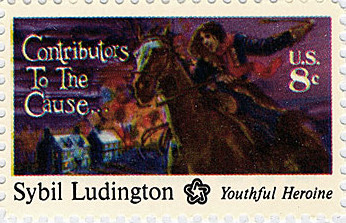
The Dutchess County Militia had to be called up. The Colonel had one night to prepare for battle, and this rider was done. The job would have to go to Colonel Ludington’s first-born, his daughter, Sybil.
Born April 5, 1761, Sybil Ludington was barely sixteen at the time of her ride. From Poughkeepsie to what is now Putnam County and back, the “Female Paul Revere” rode across the lower Hudson River Valley, covering 40 miles in the pitch dark of night, alerting her father’s militia to the danger and urging them to come out and fight. She’d use a stick to knock on doors, even using it once, to fight off a highway bandit.
By the time Sybil returned the next morning, cold, rain-soaked, and exhausted, most of 400 militia were ready to march.
Battle of Ridgefield, from Wikipedia A: British movement to the coast B: American movements to pursue and harass the British C: Arnold’s position attempting to block the British return to the beach D: British return to New York
35 miles to the east of Danbury, General Benedict Arnold was gathering a force of 500 regular and irregular Connecticut militia, with Generals David Wooster and Gold Selleck Silliman.
Arnold’s forces arrived too late to save Danbury, but inflicted a nasty surprise on the British rearguard as the column approached nearby Ridgefield. Never outnumbered by less than three-to-one, Connecticut militia was able to slow the British advance until Ludington’s New York Militia arrived on the following day. The last phase of the action saw the same type of swarming harassment, as seen on the British retreat from Concord to Boston, early in the war.
Though the British operation was a tactical success, the mauling inflicted by these colonials ensured that this was the last hostile British landing on the Connecticut coast.
The British raid on Danbury destroyed at least 19 houses and 22 stores and barns. Town officials submitted £16,000 in claims to Congress, for which town selectmen received £500 reimbursement. Further claims were made to the General Assembly of Connecticut in 1787, for which Danbury was awarded land. In Ohio.
Keeler Tavern
The Keeler Tavern in Ridgefield is now a museum. The British cannonball fired into the side of the building, remains there to this day.
At the time, Benedict Arnold planned to travel to Philadelphia, to protest the promotion of officers junior to himself, to Major General. Arnold, who’d had two horses shot out from under him at Ridgefield, was promoted to Major General in recognition for his role in the battle. Along with that promotion came a horse, “properly caparisoned as a token of … approbation of his gallant conduct … in the late enterprize to Danbury.” For now, the pride which would one day be his undoing, was assuaged.
Henry Ludington would become Aide-de-Camp to General George Washington, and grandfather to Harrison Ludington, mayor of Milwaukee and 12th Governor of Wisconsin.
Gold Silliman was kidnapped with his son by a first marriage by Tory neighbors, and held for Nearly seven months at a New York farmhouse. Having no hostage of equal rank with whom to exchange for the General, Patriot forces went out and kidnapped one of their own, in the person of Chief Justice Judge Thomas Jones, of Long Island.
Archway at Wooster Square
Mary Silliman was left to run the farm, including caring for her own midwife, who was brutally raped by English forces for denying them the use of her home. The 1993 made-for-TV movie “Mary Silliman’s War” tells the story of non-combatants, pregnant mothers and farm wives during the Revolution, as well as Mary’s own negotiations for her husband’s release from his Loyalist captors.
General David Wooster was mortally wounded at the Battle of Ridgefield, moments after shouting “Come on my boys! Never mind such random shots!” Today, an archway marks the entrance to Wooster Square, in the East Rock Neighborhood of New Haven.
Sybil Ludington received the thanks of family and friends, even George Washington, and then stepped off the pages of history.
Paul Revere’s famous ride would likewise have faded into obscurity, but for the poetry of Henry Wadsworth Longfellow. 86 years later.
On December 3, James Franklin ran an ad. “If any Person . . . will give a true Account of Mrs. Silence Dogood, whether Dead or alive, Married or unmarried, in Town or Country, . . . they shall have Thanks for their Pains.”
The fifteenth child of Josiah and Abiah Franklin was born in a little house on Milk Street, across from the Old South Church, in Boston.
The family moved to a larger house at Union & Hanover Street, when little Ben was six. As the tenth son, Benjamin Franklin was destined to be “tithed” to the church, but Josiah changed his mind after the boy’s first year in Boston Latin School. In light of the small salary, it was too expensive to educate a minister of the church.
He was sent to George Brownell’s English school for writing and arithmetic where he stayed until age ten, when he went to work in his father’s shop making tallow candles and boiling soap. After 1714, “Dr.” Benjamin Franklin’s education came exclusively from the books he picked up along the way.
By twelve the boy was “Hankering to go to sea”, and his father was concerned about his running away. Knowing of the boy’s love of books, the elder Franklin apprenticed his son to the print shop of James Franklin, one of his older sons, where he went to work setting type for books. And reading them. He would often “borrow” a book at night, returning it “early in the Morning lest it should be miss’d or wanted.”
By 1720, James Franklin began to publish The New England Courant, only the second newspaper to appear in the American colony.
Franklin often published essays and articles written by his friends, a group described as “The Hell-Fire Club”. Benjamin desperately wanted to be one of them, but James seemed to feel that sixteen-year-old little brothers should be seen, and not heard..
Sometime in March 1722, a letter appeared beneath the print shop door. “Sir, It may not be improper in the first Place to inform your Readers, that I intend once a Fortnight to present them, by the Help of this Paper, with a short Epistle, which I presume will add somewhat to their Entertainment”. The letter went on in some detail to describe the life of its author, Mrs. Silence Dogood.
That first letter was published on April 2. True to her word, Silence Dogood wrote again in two weeks. And then again, and again. Once every two weeks, for 28 weeks. Her letters were delightful, cleverly mocking the manners of Boston “Society”, and freely giving advice, particularly on the way that women should be treated. Nothing was sacred. One letter suggested that the only thing students learned at Harvard College, was conceit.
James Franklin and his literary friends loved the letters, and published every one. All of Boston was charmed with Silence Dogood’s subtle mockery of the city’s Old School Puritan elite. Proposals of marriage came into the print shop, when the widow Dogood coyly suggested that she would welcome suitors.
James was jailed at one point, for printing “scandalous libel” about Massachusetts Governor Joseph Dudley. The younger Franklin ran the shop in his absence, when Mrs. Dogood came to his defense. Quoting Cato, she proclaimed: “Without freedom of thought there can be no such thing as wisdom and no such thing as public liberty without freedom of speech.”
And then the letters stopped, much to the dismay of the Courant and its readership. One wrote to the editor, saying the paper had “lost a very valuable Correspondent, and the Public been depriv’d of many profitable Amusements.”
On December 3, James Franklin ran an ad. “If any Person . . . will give a true Account of Mrs. Silence Dogood, whether Dead or alive, Married or unmarried, in Town or Country, . . . they shall have Thanks for their Pains.” It was only then that his sixteen-year-old brother fessed up. Benjamin Franklin was the author of the Silence Dogood letters.
All of Boston was amused by the hoax, but not James. He was furious with his little brother, who soon broke the terms of his apprenticeship and fled to Pennsylvania.
And so it was that a future Founding Father of the Republic, the inventor, scientist, writer and philosopher, the statesmen who appears on our $100 bill, came to Philadelphia. Within a few years Franklin had set up his own print shop, publishing the Philadelphia Gazette as well as his own book bindery, in addition to buying and selling books.
Benjamin Franklin’s efforts are in no small part a reason why literacy standards were higher in Colonial America, than among the landed gentry of 18th century England. Higher even, I believe, than today.
Franklin’s diplomacy to the Court of Versailles was every bit as important to the success of the Revolution, as the Generalship of the Father of the Republic, George Washington. Signatory to both the Declaration of Independence and the Constitution, it is arguably Ben Franklin who broke the impasse of the Convention of 1787, paving the way for ratification of the United States Constitution.
By then too old and frail to deliver his own speech, Franklin had someone else read his words to the deadlocked convention.
“On the whole, sir, I can not help expressing a wish that every member of the convention who may still have objections to it, would, with me, on this occasion, doubt a little of his own infallibility, and, to make manifest our unanimity, put his name to this instrument”.
As I witness the aftermath of this election year 2016, easily the most divisive of my two-score and eighteen years, I can’t deny the wish that I and my countrymen, too, might doubt a little of our own infallibility.
The officer ignored the insult, but Private Hugh White, on guard outside the State House on King Street, said the boy should be more respectful and struck him with his musket. Soon an angry crowd began to gather.
France and Great Britain have been allies throughout most of modern history, both in times of war and peace. This wasn’t always the case. From the Norman Invasion of 1066 to the Napoleonic Wars of 1802-1815, England and France have been in a state of war at least forty times. Throughout most of that history, the two sides would clash until one or the other ran out of money, then yet another treaty would be trotted out and signed.
New taxes would be levied to bolster the King’s treasury, and the cycle would begin all over. The change in this cycle which began in the late 17th century can be summed up in a single word: Debt.
In the time of Henry VIII, British military outlays as a percentage of central government expenses averaged 29.4%. By 1694 the Nine Years’ War had left the English Government’s finances in tatters. £1.2 million were borrowed by the national treasury at a rate of 8% from the newly formed Bank of England. The age of national deficit financing, had arrived.
In one of the earliest known debt issues in history, Prime Minister Henry Pelham converted the entire national debt into consolidated annuities known as “consols”, in 1752. Consols paid interest like regular bonds, with no requirement that the government ever repay the face value. 18th century British debt soared as high as 74.6%, and never dropped below 55%.
The Seven Years’ War alone, fought on a global scale from 1756 to 1763, saw British debt double to the unprecedented sum of £150 million, straining the national economy.
American colonists experienced the conflict in the form of the French and Indian War, for which the Crown laid out £70,000,000. The British government saw its American colonies as beneficiary of their expense, while the tax burden on their colonists remained comparatively light.
For the colonists, the never ending succession of English wars accustomed them to running their own affairs. The “Townshend Revenue Acts” of 1767 sought to force American colonies to pick up the tab for their own administration, a perfectly reasonable idea in the British mind. The colonists had other ideas. They didn’t object to the amount of taxation as much as whether the British had the right to tax them at all. They were deeply suspicious of the motives behind these new taxes, and were not about to be subjugated by a distant monarch.
The political atmosphere was brittle in 1768, as troops were sent to Boston to enforce the will of the King. Rioters ransacked the home of a newly appointed stamp commissioner, who resigned the post following day. No stamp commissioner was actually tarred and feathered, a barbarity which had been around since the days of Richard III “Lionheart”, though several such incidents occurred at New England seaports. More than a few loyalists were ridden out of town on the backs of mules.
The Massachusetts House of Representatives sent a petition to King George III asking for the repeal of the Townshend Act. A Circular Letter sent to the other colonial assemblies, called for a boycott of merchants importing those goods affected by the act. Lord Hillsborough responded with a letter of his own, instructing colonial governors in America to dissolve those assemblies which responded to the Massachusetts body.
The fifty gun HMS Romney arrived in May. Customs officials seized John Hancock’s “Liberty” the following month, on allegations the sloop had been involved in smuggling. Already agitated over Romney’s captain’s impressment of local sailors, Bostonians began to riot. By October, the first of four regular British army regiments had arrived in Boston.
On February 22, 1770, 11 year old Christopher Seider joined a mob outside the shop of loyalist Theophilus Lillie. Customs official Ebenezer Richardson attempted to disperse the crowd. Soon the mob was outside his North End home. Rocks were thrown and windows broken. One hit Richardson’s wife. Ebenezer Richardson fired into the crowd, striking Christopher Seider. By nightfall, he was dead. 2,000 locals attended the boy’s funeral, the first victim of the American Revolution.
On March 5, wigmaker’s apprentice Edward Garrick taunted British Captain-Lieutenant John Goldfinch, claiming he had not paid a bill owed to his master. The officer had paid the bill and ignored the insult, but Private Hugh White, on guard outside the State House on King Street, said the boy should be more respectful, striking him with his musket. Garrick’s companion Bartholomew Broaders argued with White, as an angry crowd began to gather.
The shouting mob soon had White backed up to the State House steps, as Officer of the Watch Captain Thomas Preston dispatched a non-commissioned officer and six privates of the 29th Regiment of Foot, bayonets fixed, to back up Private White. The crowd began to throw stones and snowballs. Private Hugh Montgomery was knocked to the ground, and came up shooting. Then they all fired, killing three outright, and wounding six more. Two more lay dying.
Future President John Adams and Josiah Quincy defended the troopers in the following trial, in what would be the first time a judge used the phrase “reasonable doubt.” Two were convicted, but escaped hanging by invoking a medieval legal remnant called “benefit of clergy”. They would be branded on the thumb with “M” for murder. The others were acquitted, leaving both sides complaining of unfair treatment. The only conservative revolution in history, was fewer than six years in the future.
There is a circle of stones in front of the Old State House on what is now State Street, marking the site of the Boston Massacre. British taxpayers continue to this day, to pay interest on the debt left to them, by the decisions of their ancestors.





 Representatives agreed to delay the vote until July 1, appointing a “Committee of Five” to draft a declaration of independence from Great Britain. Members of the committee included John Adams of Massachusetts, Benjamin Franklin of Pennsylvania, Roger Sherman of Connecticut, Robert Livingston of New York and Thomas Jefferson of Virginia. The committee selected Jefferson to write the document, the draft presented to Congress for review on June 28.




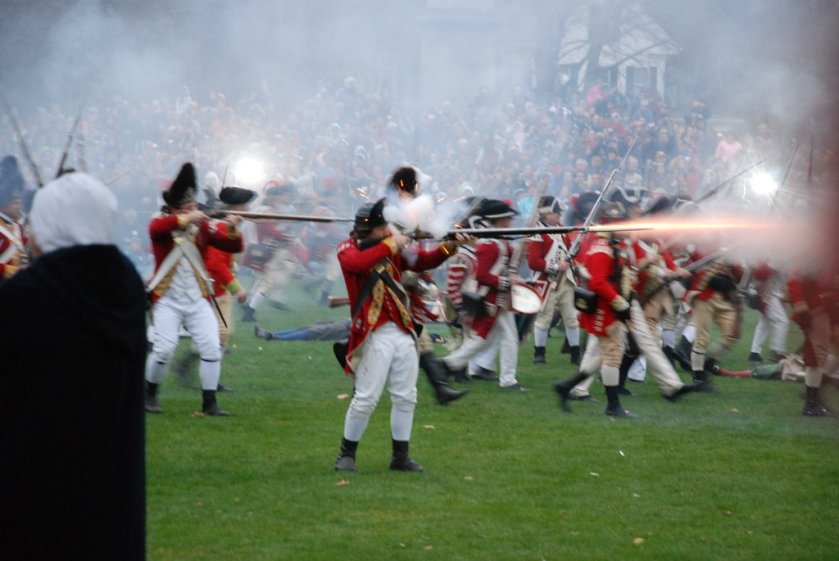
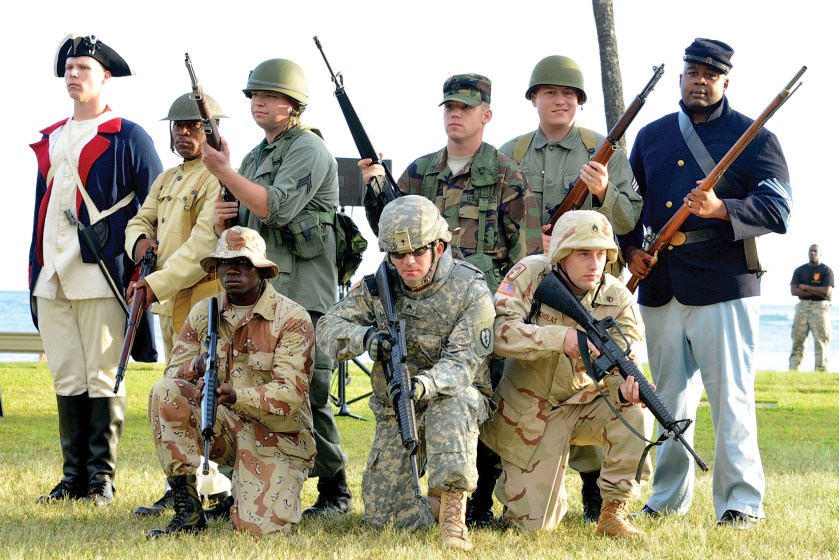
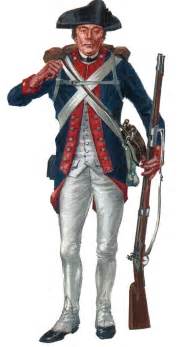 The Continental Congress established the ‘American Continental Army’ on June 14, 1775, authorizing 10 companies of ‘expert riflemen,’ to serve as light infantry in the siege of Boston. The next day the Congress unanimously selected George Washington to be General and Commander in Chief of all continental forces.


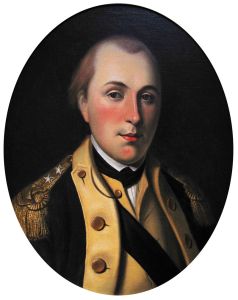 A third would arguably be Marie-Joseph Paul Yves Roch Gilbert du Motier, better known as the Marquis de Lafayette.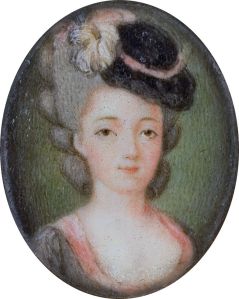

 Secretary of State Thomas Jefferson found a loophole that allowed Lafayette to be paid, with interest, for his services in the late Revolution. An act was rushed through Congress and signed by President Washington, the resulting funds allowing both Lafayettes some of the few privileges permitted them, during their five years’ captivity.


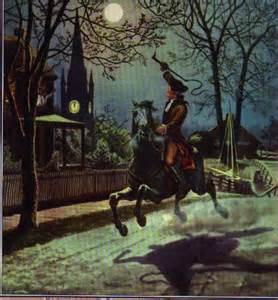 Boston Patriots had been preparing for such an event. Sexton Robert John Newman and Captain John Pulling carried two lanterns to the steeple of the Old North church, signaling that the Regulars were crossing the Charles River to Cambridge. Dr. Joseph Warren ordered Paul Revere and Samuel Dawes to ride out and warn surrounding villages and towns, the two soon joined by a third rider, Samuel Prescott. It was Prescott alone who would make it as far as Concord, though hundreds of riders would fan out across the countryside before the night was through.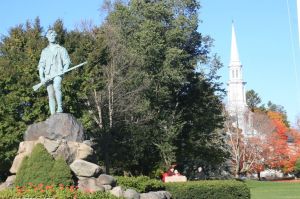
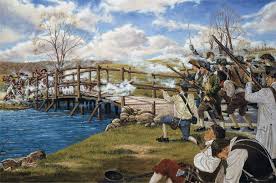 Some British soldiers marched 35 miles over those two days, their final retreat coming under increasing attack from militia members firing from behind stone walls, buildings and trees. One taking up such a firing position was Samuel Whittemore of Menotomy Village, now Arlington Massachusetts. At 80 he was the oldest known combatant of the Revolution.


 Patriot Colonel Joseph Cooke’s small Danbury garrison was caught and quickly overpowered on the 26th, trying to remove food supplies, uniforms, and equipment. Facing little if any opposition, Tryon’s forces went on a bender, burning homes, farms and storehouses. Thousands of barrels of pork, beef, and flour were destroyed, along with 5,000 pairs of shoes, 2,000 bushels of grain, and 1,600 tents.




 The fifteenth child of Josiah and Abiah Franklin was born in a little house on Milk Street, across from the Old South Church, in Boston.
 James Franklin and his literary friends loved the letters, and published every one. All of Boston was charmed with Silence Dogood’s subtle mockery of the city’s Old School Puritan elite. Proposals of marriage came into the print shop, when the widow Dogood coyly suggested that she would welcome suitors.
 All of Boston was amused by the hoax, but not James. He was furious with his little brother, who soon broke the terms of his apprenticeship and fled to Pennsylvania.
 Franklin’s diplomacy to the Court of Versailles was every bit as important to the success of the Revolution, as the Generalship of the Father of the Republic, George Washington. Signatory to both the Declaration of Independence and the Constitution, it is arguably Ben Franklin who broke the impasse of the Convention of 1787, paving the way for ratification of the United States Constitution.

 In one of the earliest known debt issues in history, Prime Minister Henry Pelham converted the entire national debt into consolidated annuities known as “consols”, in 1752. Consols paid interest like regular bonds, with no requirement that the government ever repay the face value. 18th century British debt soared as high as 74.6%, and never dropped below 55%.
 On March 5, wigmaker’s apprentice Edward Garrick taunted British Captain-Lieutenant John Goldfinch, claiming he had not paid a bill owed to his master. The officer had paid the bill and ignored the insult, but Private Hugh White, on guard outside the State House on King Street, said the boy should be more respectful, striking him with his musket. Garrick’s companion Bartholomew Broaders argued with White, as an angry crowd began to gather.
 Historical Easter Eggs - Today in History
You must be logged in to post a comment.