The Continental Congress established the ‘American Continental Army’ on June 14, 1775, authorizing 10 companies of ‘expert riflemen,’ to serve as light infantry in the siege of Boston.
On May 10, 1775, twelve colonies convened the second Continental Congress in Philadelphia, Pennsylvania. One colony was absent at the time, Georgia would come later, arriving on July 20 following their own Provincial Congress.
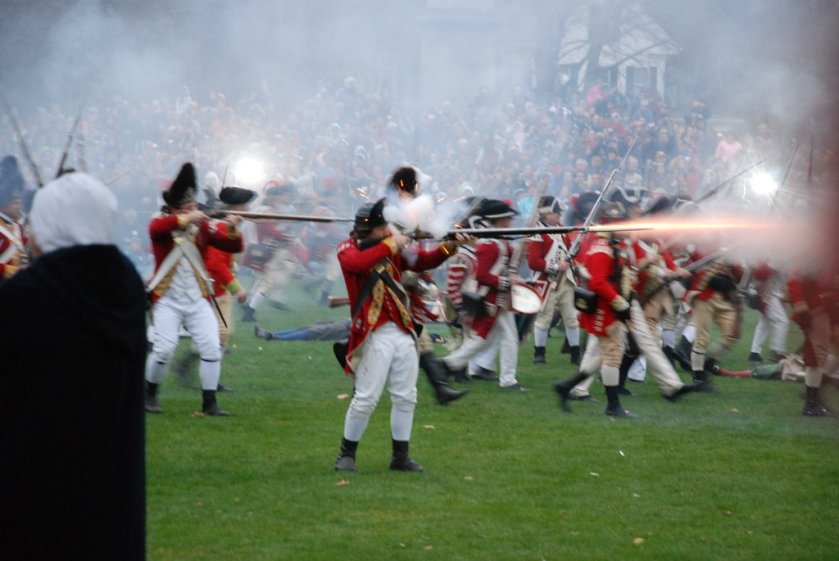
The Revolution had begun in April that year, with the battles of Lexington and Concord. A primary focus of the Second Continental Congress was to manage the war effort.
The fledgling United States had no Army at this time, relying instead on ad hoc militia units organized by the colonies themselves. At this time there were approximately 22,000 such troops surrounding British forces occupying Boston, with another 5,000 or so in New York.
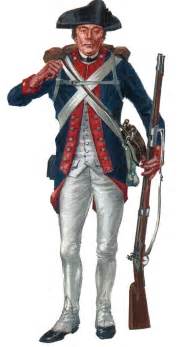
The Continental Congress established the ‘American Continental Army’ on June 14, 1775, authorizing 10 companies of ‘expert riflemen,’ to serve as light infantry in the siege of Boston. The next day the Congress unanimously selected George Washington to be General and Commander in Chief of all continental forces.
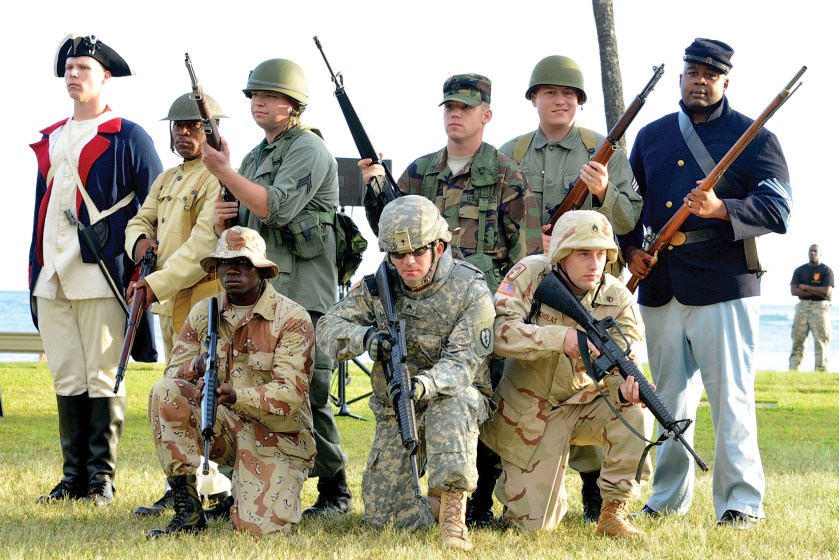
Most of the Continental Army was disbanded after the Treaty of Paris ended the war in 1783. The 1st and 2nd Regiments remained to become the basis of the Legion of the United States in 1792, under General Anthony Wayne. These two became the foundation of the United States Army, in 1796.
The formation of other branches of the Armed Forces was quick to follow. The first organized merchant marine action had taken place two days earlier on June 12, 1775, when a group of Machias Maine citizens boarded and captured the schooner British warship HMS Margaretta.
The Navy was formed later that year, in October 1775, the Marine Corps in November. 18th century revenue cutter and rescue operations led to the formation of the United States Coast Guard in January 1915. The Air Force spun off of the Army Air Corps in September 1947.
Speaking on Armed Services Day in 1953, President Dwight David Eisenhower said: “It is fitting and proper that we devote one day each year to paying special tribute to those whose constancy and courage constitute one of the bulwarks guarding the freedom of this nation and the peace of the free world.”
On the other days of the year, you might say that you can thank a teacher if you can read this essay. Today, you can thank a soldier that you can read it in English. Happy birthday, United States Army.
The two men bonded almost immediately, forming a relationship that closely resembled that of father and son. The fatherless young French officer, and the father of his country who went to his grave, childless.
There are a handful of men who were indispensable to the American Revolution, men without whom the war effort would have been doomed to fail.
One, of course is George Washington, who became commander in chief before he had an army. Before he even had a country. Knowing full well that the penalty for high treason against the British Crown was death, Washington took command of an army with enough powder for an average 9 rounds per man, in a contest against the most powerful military of its time.
Another indispensable man has to be Benjamin Franklin, whose diplomatic skills and unassuming charm all but single-handedly turned France into an indispensable ally.
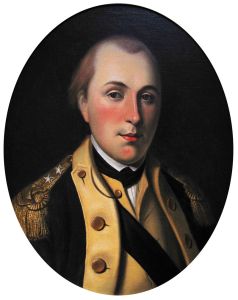
A third would arguably be Marie-Joseph Paul Yves Roch Gilbert du Motier, better known as the Marquis de Lafayette.
Lafayette was all of nineteen when he landed on North Island South Carolina on June 13, 1777.
The French King had forbidden his coming to America, fearing his capture by British agents. Lafayette wanted none of it. His own father, also the Marquis de Lafayette, was killed fighting the British when the boy was only two. The man was determined to take part in this contest, even if he had to defy his King to do so. Lafayette disguised himself on departure, and purchased the entire ship’s cargo, rather than landing in Barbados and thus exposing himself to capture.
Franklin had written to Washington asking him to take on Lafayette, in hopes that it would secure an increase in French aid to the American war effort. The two men bonded almost immediately, forming a relationship that closely resembled that of father and son. The fatherless young French officer, and the father of his country who went to his grave, childless.
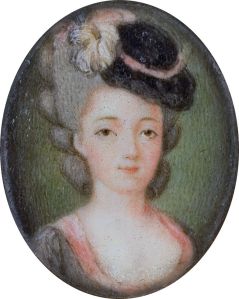
Marie Adrienne Francoise, wife of Lafayette
Lafayette wrote home to his wife Marie Adrienne in 1778, from Valley Forge. “In the place he occupies, he is surrounded by flatterers and secret enemies. He finds in me a trustworthy friend in whom he can confide and who will always tell him the truth. Not a day goes by without his talking to me at length or writing long letters to me. And he is willing to consult me on most interesting points.”
Lafayette served without pay, spending the equivalent of $200,000 of his own money for the salaries and uniforms of staff, aides and junior officers. He participated in several Revolutionary War battles, being shot in the leg at Brandywine, going on to serve at Barren Hill, Monmouth Courthouse, Rhode Island, and the final siege at Yorktown. All the while, Lafayette periodically returned to France to work with Franklin in securing thousands of additional troops and several warships to aid in the war effort.
Adrienne gave birth to their first child on one such visit, a boy they named Georges Washington Lafayette.
It was a small force under Lafayette that took a position on Malvern Hill in 1781, hemming in much larger British forces under Lord Cornwallis at the Yorktown peninsula.
Lafayette’s sabre as general of the Garde nationale. On display at the Musée de l’Armée, Paris.
The trap was sprung that September with the arrival of the main French and American armies under Marshal Jean-Baptiste Donatien de Vimeur, comte de Rochambeau & General George Washington, and the French fleet’s arrival in the Chesapeake under Lieutenant Général des Armées Navales François-Joseph Paul, comte de Grasse.
Cornwallis surrendered on October 19, 1781, after which Lafayette returned to France.
The Marquis played an important role in his own country’s revolution, becoming a Commander of the French National Guard. When the Bastille was stormed by an angry mob in 1789, Lafayette was handed the key.
Lafayette sent the key to the Bastille to George Washington, as a “token of victory by Liberty over Despotism”. Today that key hangs in the main hallway at Washington’s mansion at Mount Vernon.
There came a time when the French Revolution morphed into the Reign of Terror, and began to eat its young. The Marquis de Lafayette was captured by Austria in 1792 and imprisoned under verminous conditions, while his wife was taken into custody by the French Republic.
Secretary of State Thomas Jefferson found a loophole that allowed Lafayette to be paid, with interest, for his services in the late Revolution. An act was rushed through Congress and signed by President Washington, the resulting funds allowing both Lafayettes some of the few privileges permitted them, during their five years’ captivity.
Georges Washington Lafayette was smuggled to America out of France in 1795, while his father was held prisoner. Adrienne was released after four, and persuaded Emperor Francis to permit her and her two daughters to join her husband in prison. After a brutal year in solitary confinement, Lafeyette’s cell door opened on October 15, 1795. He must have been astonished to see his wife and daughters walk in. The four would spend his last year in captivity, together.
Adrienne died on Christmas day, 1807. She had slipped into delirium the night before, her final words spoken to her husband: “Je suis toute à vous“. I am all yours.
Lafayette remained staunchly opposed to both the Napoleonic regime and the restoration of the Bourbon dynasty, feeling that both had come to power by undemocratic means.
1824 portrait by Scheffer, hangs in the U.S. House of Representatives
In 1824, President James Monroe and Congress invited Lafayette to visit the United States, for the nation’s upcoming 50th birthday. Crowds of cheering citizens greeted the French Marquis and his son Georges Washington on their return to Boston, Philadelphia and New York.
Harlow Giles Unger wrote in his 2003 book Lafayette, “It was a mystical experience they would relate to their heirs through generations to come. Lafayette had materialized from a distant age, the last leader and hero at the nation’s defining moment. They knew they and the world would never see his kind again.”
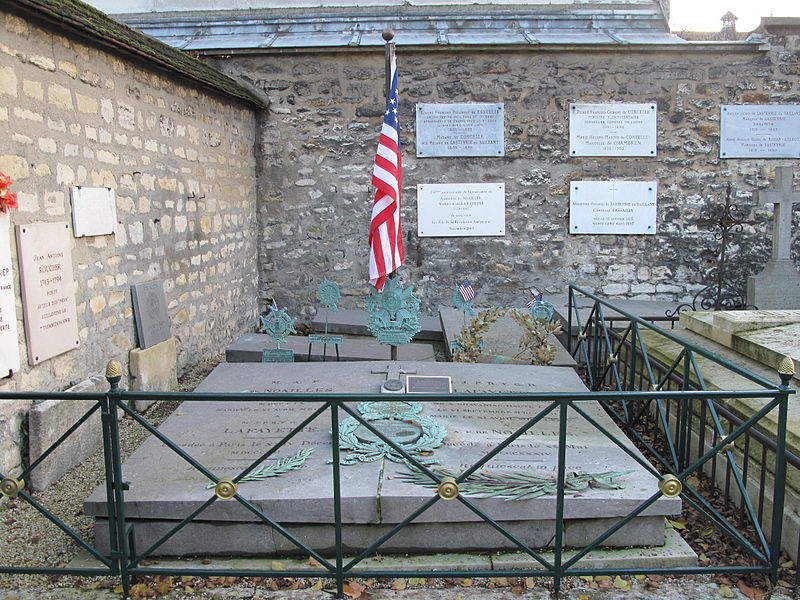
Marie-Joseph Paul Yves Roch Gilbert du Motier died in Paris on May 20, 1834, and was buried next to his wife at the Picpus Cemetery. He was seventy-six. President Andrew Jackson ordered that he be accorded the same funeral honors which President John Adams had bestowed on George Washington himself, in 1799. John Quincy Adams delivered a three-hour eulogy in Congress, saying “The name of Lafayette shall stand enrolled upon the annals of our race high on the list of the pure and disinterested benefactors of mankind.”
Lafayette Burial Place, Picpus Cemetery, Paris
In obedience to his one of his last wishes, several feet of earth were dug up from Bunker Hill, and shipped to France. The man had always wanted to be buried under American soil.
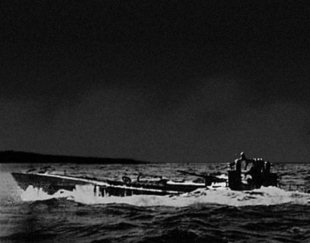
The German submarine U-202 came to the surface in the small hours of June 12 at Amagansett, NY, near Montauk Point. The inflatable that came out of its hatch was rowed to shore at what is today Atlantic Avenue beach, Long Island.
Much has been written about the eight central characters in this story. These individuals have been described in contemporary and subsequent sources alike, as Saboteurs, Nazis and Spies. Certainly to call them such, fed into the political expectations of the day. Yet their country had chosen them for this mission based on unique qualifications, separate and apart from whatever devotion they felt for the fatherland, or to the Nazi party. It may be that these guys deserve every evil name that’s been heaped upon them. Or maybe they were just eight guys who got caught up between two nations at war. It’s an interesting story. You decide.
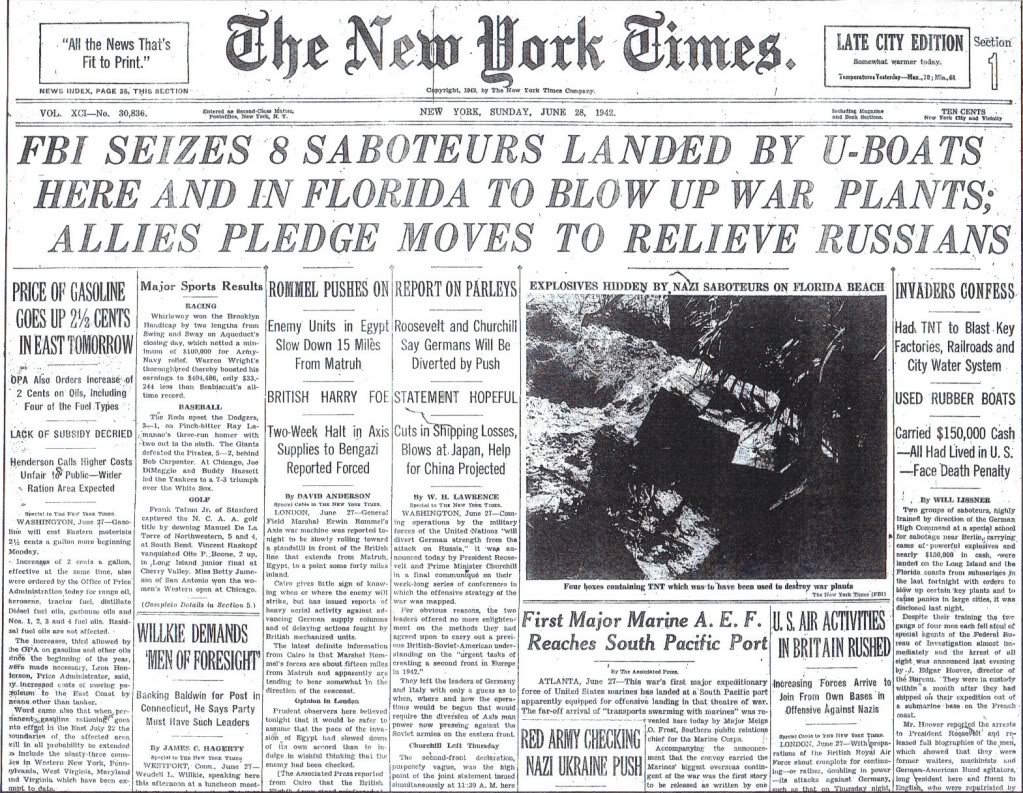
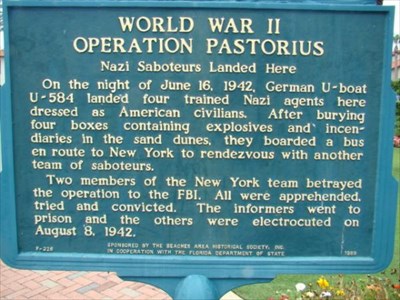
The German submarine U-202 came to the surface in the small hours of June 12 at Amagansett, New York, near Montauk Point. The inflatable that came out of its hatch was rowed to shore at what is today Atlantic Avenue beach, Long Island. Four figures stepped onto the beach wearing German military uniforms. If they’d been captured at that point, they wanted to be treated as enemy combatants, rather than spies.
Their mission was to sabotage American economic targets and damage defense production. Their targets included hydroelectric plants, train bridges, and factories. They had almost $175,000 in cash, some good liquor, and enough explosives to last them through a two year campaign.
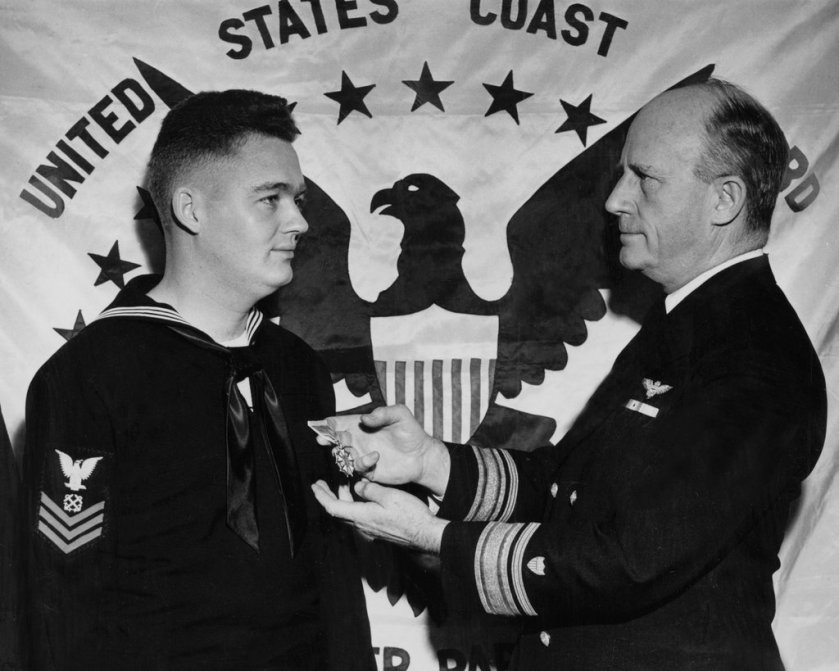
German plans began to unravel as they buried their uniforms and explosives in the sand. 21-year old Coast Guardsman John Cullen was a “sand pounder”. Armed only with a flashlight and a flare gun, Cullen had the unglamorous duty of patrolling the beaches, looking for suspicious activity.
It was “so foggy that I couldn’t see my shoes”, Cullen said, when a solitary figure came out of the dunes. He was George John Davis, he said, a fisherman run ashore. Something seemed wrong and Cullen’s suspicions were heightened, when another figure came out of the darkness. He was shouting something in German, when “Davis” spun around, yelling, “You damn fool! Go back to the others!”
With standing orders to kill anyone who confronted them during the landing, Davis hissed, “Do you have a mother? A father? Well, I wouldn’t want to have to kill you.”
It was Cullen’s lucky day. “Davis'” real name was George John Dasch. He was no Nazi. He’d been a waiter and dishwasher before the war, who’d come to the attention of the German High Command because he’d lived for a time in America. “Forget about this, take this money, and go have a good time” he said, handing over a wad of bills. $260 richer, Cullen sprinted two miles to the Coast guard station.
Seaman John Cullen, left, received the Legion of Merit from Rear Adm. Stanley V. Parker for his service in WW2
Four days later, U-584 deposited a second team of four at Ponte Vedra Beach, Florida, south of Jacksonville. As with the first, this second group had lived and worked in the United States, and were fluent in English. Two of the eight were US citizens.
George Dasch had a secret. He had no intention of carrying out his mission. He summoned Ernst Peter Burger to an upper-level hotel room. Gesturing toward an open window, Dasch said “You and I are going to have a talk, and if we disagree, only one of us will walk out that door—the other will fly out this window.”
Burger turned out to be a naturalized citizen, who’d spent 17 months in a concentration camp. He hated the Nazis as much as Dasch, and the pair decided to defect.
Dasch tested the waters. Convinced the FBI was infiltrated with Nazi agents, he telephoned the New York field office. Put on hold with the call transferred several times, Dasch was horrified to have the agent who finally listened to him, quietly hang up the phone. Had he reached a German mole? Had the call been traced?
Dasch could not have known, he’d been transferred to the ‘nut desk’. The FBI thought he was a clown.
Finally, Dasch went to the FBI office in Washington DC, where he was treated like a nut job. Until he dumped $84,000 on Assistant Director D.M. Ladd’s desk, equivalent to about a million, today. Dasch was interrogated for hours, and happily gave up everything he knew. Targets, German war production, he spilled it all, even a handkerchief with the names of local contacts, written in invisible ink. He couldn’t have been a very good spy, though. He forgot how to reveal the names.
All eight were in custody within two weeks.
J. Edgar Hoover announced the German plot on June 27, but his version had little resemblance to that of Dasch and Burger. As with the brief he had given President Roosevelt, Hoover praised the magnificent work of FBI detectives, and the Sherlock Holmes-like powers of deduction which led Assistant Director Ladd to the $84,000. Dasch and Burger’s role in the investigation was conveniently left out, as was the fact that the money had basically bounced Ladd off the head.
Neither Dasch nor Burger expected to be thrown in a cell, but agents assured them it was a formality. Meanwhile, a credulous and adoring media speculated on how Hoover’s FBI had done it all. Did America have spies inside the Gestapo? German High Command? Were they seriously that good?
Attorneys for the defense wanted a civilian trial, but President Roosevelt wrote to Attorney General Francis Biddle: “Surely they are as guilty as it is possible to be and it seems to me that the death penalty is almost obligatory”. The case went all the way to the Supreme Court, where the decision “Ex parte Quirin” became precedent for the way unlawful combatants are tried, to this day. All eight would appear before a military tribunal.
It’s unclear whether any of the eight were the menace they were made out to be. German High Command had selected all eight based on a past connection with the United States, ordering them to attack what they may have regarded as their adopted country. Several were arrested in gambling establishments or houses of prostitution. One had resumed a relationship with an old girlfriend, and the pair was planning to marry. Not exactly the behavior patterns of “Nazi saboteurs”.
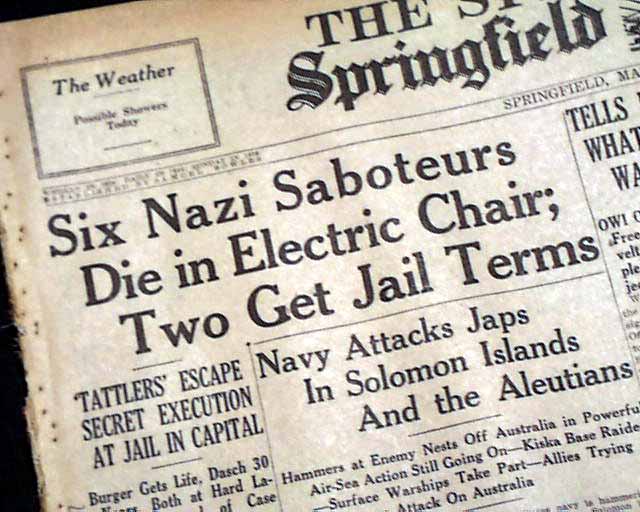
The trial was held before a closed-door military tribunal in the Department of Justice building in Washington, the first such trial since the Civil War. All eight defendants were found guilty and sentenced to death. It was only on reading trial transcripts, that Roosevelt learned the rest of the story. The President commuted Burger’s sentence to life and Dasch’s to 30 years, based on their cooperation with the prosecution. The other six were executed by electric chair on August 8, in alphabetical order.
After the war, Burger and Dasch’s trial transcripts were released to the public, over the strenuous objections of J. Edgar Hoover. In 1948, President Harry S. Truman bowed to political pressure, granting them executive clemency and deporting both to the American zone of occupied Germany. The pair found themselves men without a country, hated as spies in America, and traitors in Germany.
The reader may decide, whether Hoover and Roosevelt operated from base and venal political motives, or whether the pair was playing 4-D chess. Be that as it may, Hitler rebuked Admiral Canaris, and seems to have bought into Hoover’s version of FBI invincibility. There would be no further missions of this type, save for one in November 1944, when two spies were landed on the coast of Maine to gather information on the Manhattan project.
George Dasch campaigned for the rest of his life, to be allowed to return to what he described as his adopted country. Ernst Burger died in Germany in 1975, Dasch in 1992. The pardon Hoover promised both men a half-century earlier, never materialized
Ancient animosity were on display that day, and words were exchanged between the groups. A fight broke out and it turned into a brawl. Very quickly, the brawl became a full-scale riot.
180 years ago today, fire engine #20, “The Extinguisher” crossed paths with an Irish Catholic funeral procession, returning from a blaze in Roxbury, Massachusetts.
The fire company was entirely comprised of “Yankees”: protestants of old English stock. Ancient animosity were on display that day, and words were exchanged between the groups. A fight broke out and it turned into a brawl. Very quickly, the brawl became a full-scale riot.
There were fifteen hundred combatants at the height the melee. Houses were broken into, furniture smashed and thrown into the street. Mattresses were slashed, their contents thrown to the winds. Bricks, stones and anything else that could be picked up and thrown was used as a weapon, or hurled by one side at the other. It’s a wonder that more weren’t killed, there were scores of injured.
The fighting went on for hours, until Mayor Samuel Atkins Eliot called out the military to restore order.
Several participants were tried in the days that followed, and police courts sentenced several to periods of hard labor at the House of Correction. Police and military forces were stationed at Faneuil Hall, armories and churches around the city to prevent a recurrence, as local homeowners and shopkeepers petitioned the City of Boston for reimbursement of their losses.
There were a number of further confrontations, the latest on the 18th as crowds “hissed and hooted” at fire companies returning from a South Boston blaze. A number of combatants tried to re-ignite the brawl in the days that followed, none of them successfully.
The Baltimore Sun reported on June 12 that “four of the Irishmen were killed; a great number were badly injured and probably mortally”. The article went on to report that “It commenced with a funeral, and closed in sending its victims to a dishonored grave. Hereafter, let Boston hang her head in silence, and avoid the condemning verdict of the world. Let her in future prate no more about her devotion to morality, religion, and law; and last of all, let her not open her mouth, or the jaws of her press, to reproach the city of Baltimore”.
I know not what sort of inter-city rivalry existed between Baltimore and Boston at that time. In light of the “Black Lives Matter” riots of a couple years ago and the performance of that city’s Mayor and District Attorney, perhaps the editors of the Baltimore Sun need not have been quite so smug.
A “New England oyster bar & Atlantic Coast cookery” opened in November 2014, in Boston’s financial district, calling itself “Broad Street Riot”. Too bad they closed a year later, I would have liked to try them. There’s never a bad time for a belly full of cold water oysters.
The customs schooner H.M.S. Gaspée sailed into Narragansett Bay, Rhode Island in early 1772, to aid with customs enforcement and collections. She was chasing the packet boat Hannah through shallow water on the 9th of June, when she ran aground in shallow water, near the town of Warwick at what is now Gaspée Point.
The Seven Years’ War (1756-1763) was in many ways a world war, experienced in the American colonies as the French and Indian War. The cost to the British crown was staggering, and Parliament wanted their colonies in America to pay for their share of it. The war had been fought for their benefit, after all, had it not?
Several measures were taken in the 1760’s to collect these revenues. In one 12-month period, Parliament passed the Stamp Act, the Quartering Act, and the Declaratory Act, and deputized the Royal Navy’s Sea Officers to help enforce customs laws in colonial ports.
American colonists hated these measures. They had been left to run their own affairs for decades. Many of them bristled at the heavy handed measures being taken by revenue and customs agents. Rhode Islanders attacked HMS St. John in 1764. In 1769 they burned the customs ship H.M.S. Liberty in Newport harbor. In a few short months, the “Boston Massacre” would unfold only a few miles to the north.
The customs schooner H.M.S. Gaspée sailed into Narragansett Bay, Rhode Island in early 1772, to aid with customs enforcement and collections. She was chasing the packet boat Hannah through shallow water on the 9th of June, when she ran aground in shallow water, near the town of Warwick at what is now Gaspée Point.
A number of local Sons of Liberty met that afternoon at Sabin Tavern, opposite Fenner’s Wharf, from which the daily packet ship sailed to Newport Harbor. There they formed a plan to burn the Gaspée, and spent their evening hours casting bullets in the tavern.
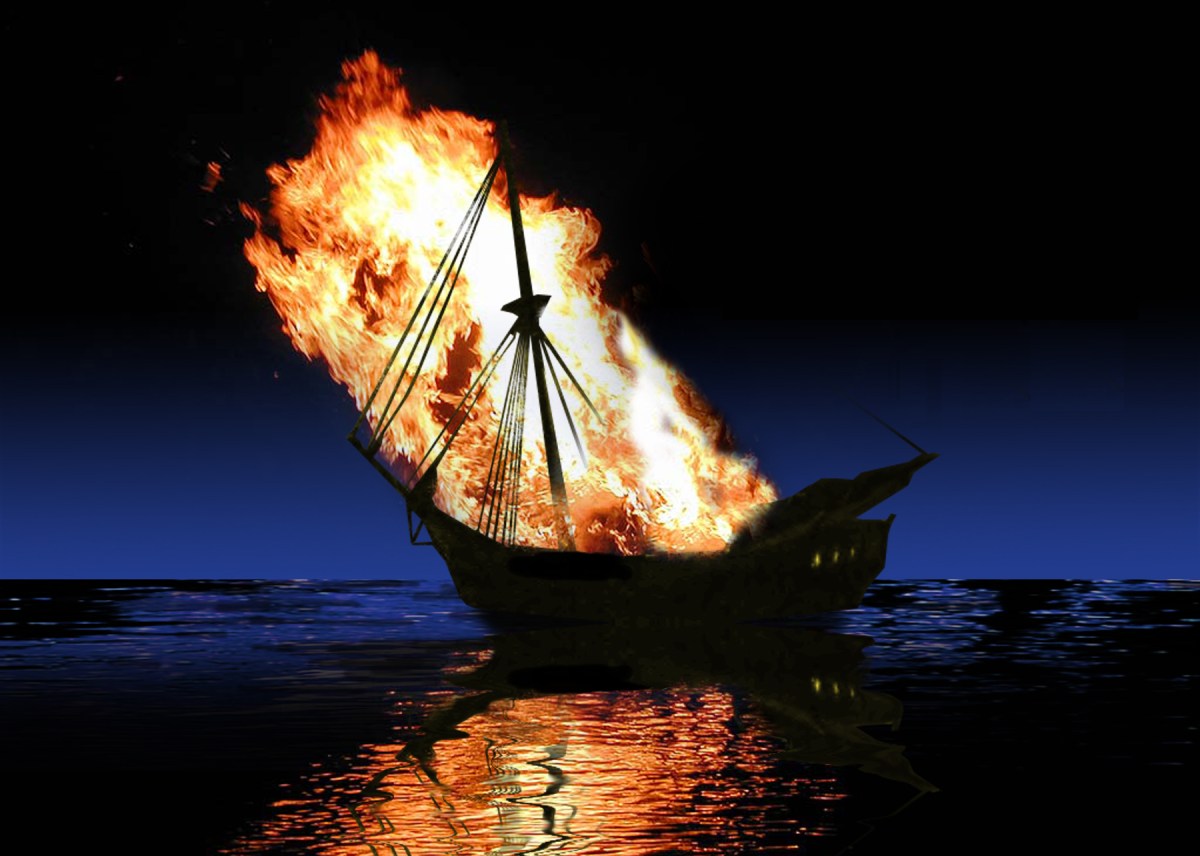
They rowed out to the ship at dawn the next morning. There was a brief scuffle when they boarded, in which Lieutenant William Dudingston was shot and wounded. The vessel was then looted, and burned to the waterline.
Earlier attacks on British shipping had been dealt with lightly, but the Crown was not going to ignore the destruction of one of its military vessels on station. Treason charges were prepared, planning to try the perpetrators in England, but the crown was never able to make the case. Unsurprisingly, it seems that nobody saw anything.
A few days later, a visiting minister in Boston, John Allen, used the Gaspée incident in a 2nd Baptist Church sermon. His sermon was printed seven times in four colonial cities, one of the most widely read pamphlets in Colonial British America.
The King’s “Tea Act” would lead to the Boston Tea Party the following year. The blizzard of regulations that came down in 1774, the “Intolerable Acts”, would pave the way to the Battles of Lexington & Concord and the Battle of Bunker Hill later in 1775.
The fuse to Revolution had been lit. It was not going to be put out, easily.
They were a state within a state. To this day, the Fenian Brotherhood remains the only organization to have publicly armed and drilled, on this scale, in United States history.
The Fenian Brotherhood was founded in the US in 1858, based on the idea that Ireland should be free of English rule to become an independent, self-governing Republic. The Brotherhood traced its lineage back to 1758. By 1866, much if not most of the membership were battle hardened veterans of the Civil War, ended only a year earlier.
Fenians invaded Canada no fewer than five times between 1866 and 1871. The idea was to bring pressure on Britain to withdraw from Ireland, so these attacks were directed toward British army forts, customs posts and other targets in Canada.
Irish Canadian Catholics were divided by the raids, with many feeling torn between loyalty to their new home and sympathy for the Fenians’ objectives. Canadian-Irish Protestants and French Catholics were generally loyal to the crown, and many took up arms against the raiders.
700 Fenians headed north to Campobello Island, New Brunswick in April 1866, intending to seize the island. The war party became discouraged and dispersed after a show of force by the British Navy at Passamaquoddy Bay, but they would be back.
Next, a group of 1,000 to 1,300 Fenians sabotaged the US Navy side-wheeler gunboat USS Michigan, and slipped across the Canadian border at the Niagara River on June 1. A Fenian ambush west of Ft. Erie led to the Battle of Ridgeway, in which 13 Canadian Militia were killed. 94 were wounded or incapacitated by disease.
Further fighting took place the following day, in which the Canadian Militia’s inexperience led to battlefield confusion. A number were taken prisoner. Realizing that they couldn’t hold their position, the Fenians released their prisoners and withdrew to Buffalo on the 3rd, but again they would be back.
This seems to have been the high water mark of the Fenian uprising. President Andrew Johnson began to crack down, dispatching Generals Ulysses Grant and George Meade to Buffalo to assess the situation. Their orders on the 7th of June were to arrest anyone who even looked like a Fenian.
The Fenian “army of liberation” may have had little effect on Irish Independence, but it served to fire up Canadian Nationalism. Canada was more properly called “British North America” in those days. It seems that the Fenian raids tipped many of the more reluctant votes toward the security of nationhood, particularly in the Maritime provinces. Historians will tell you that Ridgeway is “the battle that made Canada.” The Canadian Confederation was formed in 1867, uniting Nova Scotia, New Brunswick, Ontario and Quebec into one Dominion of Canada.
There would be several more Fenians raids in the years that followed, from Pigeon Hill and Mississquoi County in modern day Quebec, to the 1870 Pembina raid in the Dakota territory.
US authorities ultimately arrested the men and confiscated their arms, but many felt that the government had turned a blind eye to the invasions, seeing them as payback for British assistance to the Confederacy during the late Civil War.
The Fenian Brotherhood was a nation within a nation, organized for the purpose of winning Irish independence by force. A member of the British House of Commons rightly called them “a new Irish nation on the other side of the Atlantic, recast in the mould of Democracy, watching for an opportunity to strike a blow at the heart of the British Empire.”
In modern times, scores of self-styled ‘Militia’ have adopted the use of military style drill in this country, from the far-left Los Macheteros and Black Panthers, to Posse Comitatus and the far-right militia units of the nineties. Yet, I believe it is accurate to say, the Fenian Brotherhood remains the only organization in United States history, to have publicly armed and drilled on this scale.
“We are the Fenian Brotherhood, skilled in the arts of war,
And we’re going to fight for Ireland, the land we adore,
Many battles we have won, along with the boys in blue,
And we’ll go and capture Canada, for we’ve nothing else to do”.
Pontiac’s Rebellion ended in a draw in 1765, but the often genocidal actions on both sides seem to have led both sides to conclude that segregation and not interaction should characterize relations between Indians and whites.
The Seven Years War, experienced in the American Colonies as the French and Indian War, ended in 1763 with France ceding vast swaths of the territory of “New France” to the British.
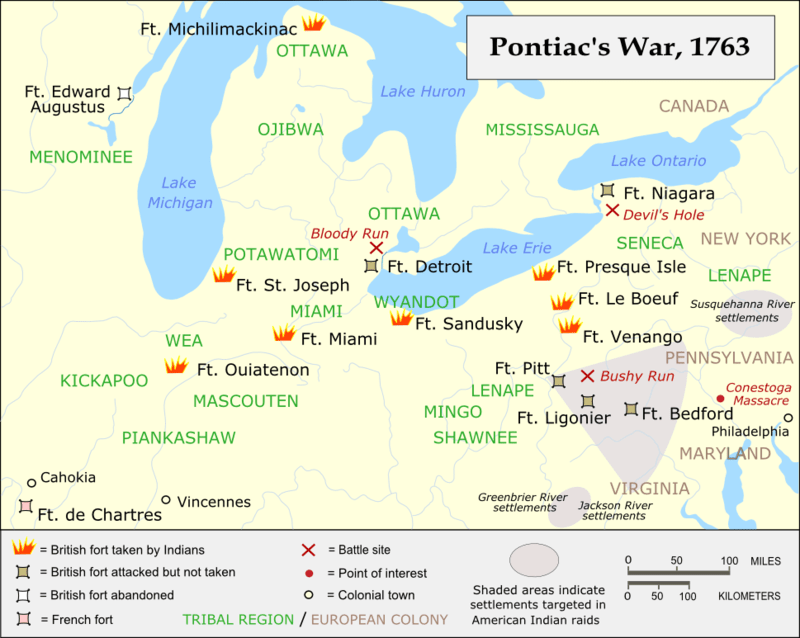
The fourteen Native American tribes involved in Pontiac’s Rebellion lived in a loosely defined region of New France known as the pays d’en haut (“the upper country”), which was claimed by France until the Paris peace treaty of 1763.
Unlike the French, who had cultivated friendships with their Indian allies, the British under Lord Jeffrey Amherst tended to treat indigenous populations with contempt. The first grumblings among the tribes could be heard as early as 1760. The full scale uprising known as “Pontiac’s Rebellion” broke out in May of 1763.
Indian nations of the time divided more along ethnic and linguistic rather than political lines, so there was no monolithic policy among the tribes. Not even within members of the same tribes. Some of the fighting of this time resulted in the murder of women and children. There was torture. There was even an instance of ritual cannibalism. At least one British fort was taken with profuse apologies by the Indians, who explained that it was the other nations making them do it.
The brutality was anything but one sided. The British “Gift” of smallpox infected blankets from Ft. Pitt was hardly the first instance of biological warfare in history, but it may be one of the nastier ones.
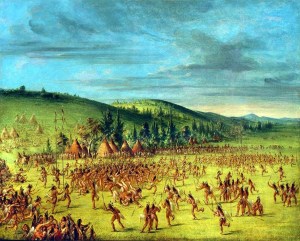
The siege of Fort Detroit which began on May 7 was ultimately unsuccessful, but the series of attacks on small forts beginning on May 16 would all result in Indian victories. The fifth and largest of these forts, Fort Michilimackinac in present Mackinaw City, Michigan, was the largest fort taken by surprise. Local Ojibwas staged a game of baaga’adowe on June 2, an early form of lacrosse, with the visiting Sauks in front of the fort.
Native American stickball had many variations, but the object was to hit a stake or other object with a “ball”. The ball was a stone wrapped in leather, handled with one or sometimes two sticks. There could be up to several hundred contestants to a team, and the defenders could employ any means they could think of to get at the ball, including hacking, slashing or any form of physical assault they liked. Lacerations and broken bones were commonplace, and it wasn’t unheard of that stickball players died on the field. The defending team could likewise employ any method they liked to keep the opposing team off of the ball carrier, and they played the game on a field that could range from 500 yards to several miles.
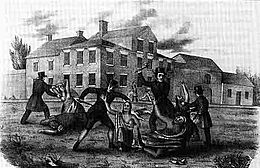
The soldiers at Fort Michilimackinac enjoyed the game, as they had on previous occasions. When the ball was hit through the open gate of the fort, both teams rushed in as Indian women handed them weapons previously smuggled into the fort. Fifteen of the 35 man garrison were killed in the ensuing struggle, five others were tortured to death.
Three more forts were taken in a second wave of attacks, when survivors took to the shelter of Fort Pitt, in Western Pennsylvania. The siege which followed was unsuccessful, but a mob of vigilantes from Paxton village – “The Paxton Boys” – slaughtered a number of innocent American Indians, many of them Christians who had nothing to do with the fighting. Many of these peaceful Indians fled east to Philadelphia for protection, when several hundred Paxton residents marched on Philadelphia in January of 1764.
The presence of British troops and Philadelphia militia prevented them from doing any more violence, when Benjamin Franklin, who had helped organize the local militia, met with their leaders and negotiated an end to the crisis. Mr. Franklin may have had the last word on the collectivist nonsense we suffer from today, when he asked “If an Indian injures me, does it follow that I may revenge that injury on all Indians?”
Pontiac’s Rebellion ended in a draw in 1765, but the often genocidal actions on both sides seem to have led both sides to conclude that segregation and not interaction should characterize relations between Indians and whites.
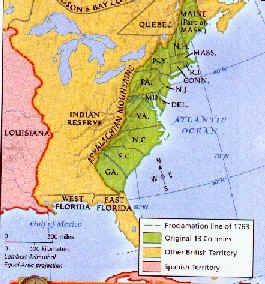
The British Royal Proclamation of October 7, 1763, drew a line between the British colonies and Indian lands, creating a vast Indian Reserve stretching from the Appalachians to the Mississippi River and from Florida to Newfoundland. For the Indian Nations, this was the first time that a multi-tribal effort had been launched against British expansion, the first time such an effort had not ended in defeat.
The British government had hoped through their proclamation to avoid more conflicts like Pontiac’s Rebellion, but the decree had the effect of alienating colonists against the Crown. For American colonists, many now found themselves on the road to Revolution. The Indian Nations, as they existed at that time, were on the road to ruin.
Traveling at 40 miles per hour, the 60′ wall of water and debris hit Johnstown 57 minutes after the dam broke. Some residents had managed to scramble to high ground, but most were caught by surprise
Johnstown Pennsylvania was founded in 1800, along the banks of the Stony Creek and the Little Conemaugh, where the two waterways combine to form the Conemaugh River. Miles downstream from the drainage basin formed by the Allegheny plateau, the town is hemmed in on both sides by the high, steep hills of the Conemaugh Valley and the Allegheny Mountains. A plaque at the scenic overlook on Rt. 56, four miles outside of Johnstown, describes this gorge as the deepest river gap east of the Rockies.
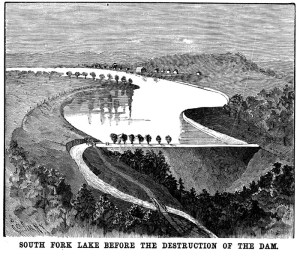
The South Fork Dam was built 14 miles upstream by the Commonwealth of Pennsylvania, forming Lake Conemaugh and providing a feeder for the state’s network of canals. Welsh and German immigrants came to the area as the completion of the Main Line Canal led to the construction of the Pennsylvania Railroad and the Cambria Iron Works. The area flourished as multiple villages and factories were built along the banks of the Conemaugh, crowding the river basin forming the narrow floor of the valley.
The Commonwealth sold the dam and the lake to private interests when rail began to supersede the canal as the primary mode of transport. The property changed hands a couple times more: one owner removing the three iron pipes that formed a spillway and selling them for scrap, the next lowering the dam to build a road and installing a fish grate. These were the wealthy industrialists who turned the mountain lake into an exclusive private retreat for themselves and their families, calling it the South Fork Fishing and Hunting Club.
Johnstown Flood National Memorial
The rain that began to fall on the 29th was unprecedented, at times falling at the rate of 6 to 10 inches per hour. Elias Unger, then president of the South Fork Fishing and Hunting Club, awoke on the morning of the 31st to see the water just about to overtop the dam. He and several others worked throughout the morning to unclog the fish screen at the spillway. By 1:30 that afternoon they were forced to take to the high ground and wait.
The dam was 72 feet high, 931 feet long, holding back an estimated 4.8 billion gallons of water. The average flow of water over Niagara Falls is 64,750 cubic feet per second. When the South Fork Dam let go it released 642,726,934 cubic feet of water down the valley. The lake was emptied in 45 minutes.
The Village of South Fork was first to be hit, and then the town of Mineral Point, about a mile below the viaduct. When the flood receded, there was nothing left of the town but bare rock.
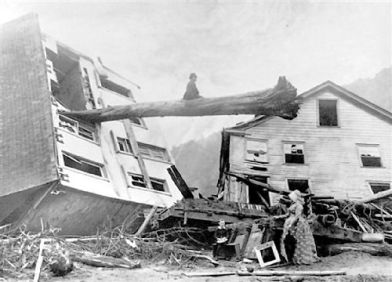
By the time the flood reached East Conemaugh, it had picked up so much debris that one survivor said it looked like a “huge hill, rolling over and over”. People living and dead cascaded down the valley with trees and homes and animals and debris of every kind. Next the flood hit the Cambria Iron Works and the Gautier Wire Works in Woodvale, sweeping train cars, boilers and miles of barbed wire up in the deluge.
Locomotive engineer John Hess got ahead of the approaching flood for a time, as he tied down the train whistle and raced backward down the line trying to warn as many as possible. His warning saved many people before the flood caught up with him and tossed his locomotive aside. Hess would survive the flood, though many of the passengers stranded in rail cars, did not.
Traveling at 40 miles per hour, the 60′ wall of water and debris hit Johnstown 57 minutes after the dam broke. Some residents had managed to scramble to high ground, but most were caught by surprise by the flood waters.
An enormous stone railroad bridge at the edge of Johnstown caught and held tons of barbed wire entangled debris on its upstream side. Perversely, the debris caught fire and the fire became an inferno that burned for three days, killing 80 people. After the flood waters receded, the field of debris at the bridge covered 30 acres and reached 70 feet high.
When it was over, 2,209 were dead. 99 entire families had ceased to exist, including 396 children. 124 women and 198 men were widowed, 98 children orphaned. 777 people, over 1/3rd of the dead, were never identified. Their remains are buried in the “Plot of the Unknown” in Grandview Cemetery in Westmont.
Property damage exceeded $17 million, over $425 million in today’s dollars.
17,000 veterans and their families, 43,000 all told, gathered in and around Washington: men, women and children living in tents or in make-shift shelters built out of old lumber, packing boxes and scrap tin scavenged from nearby junkyards.
In 1924, Congress passed the “World War Adjusted Compensation Act”, awarding cash bonuses to veterans of the “Great War”, in which the United States had been involved from 1917 to 1918.
3,662,374 military service certificates were issued to qualifying veterans, bearing a face value equal to $1 per day of domestic service and $1.25 a day for overseas service, plus interest. Total face value of these certificates was $3.638 billion, equivalent to $43.7 billion in today’s dollars and coming to full maturity in 1945.
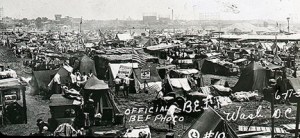
The Great Depression was two years old in 1932, and thousands of veterans had been out of work since the beginning. Certificate holders could borrow up to 50% of the face value of their service certificates, but direct funds remained unavailable for another 13 years.
WWI veterans began to arrive in Washington on May 29 to press their case for immediate cash redemption, setting up encampments between the Capitol and the Lincoln Memorial and around Washington DC. Former Army sergeant Walter W. Waters led the group, which called itself the “Bonus Expeditionary Force” after the American Expeditionary Force of WWI. The Media called them the “Bonus Army”.
This had happened before. Hundreds of Pennsylvania veterans of the Revolution had marched on Washington in 1783, after the Continental Army had been disbanded without pay.
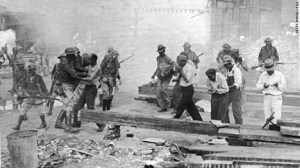
The Congress fled to Princeton New Jersey on that occasion, and the Army was called up to expel these war veterans from the Capital. Washington, DC was later excluded from the restrictions of the Posse Comitatus Act, making it the only part of the United States where the military can be used for domestic police activity.
17,000 veterans and their families, 43,000 all told, gathered in and around Washington: men, women and children living in tents or in make-shift shelters built out of old lumber, packing boxes and scrap tin scavenged from nearby junkyards.
The House passed the bill which then went to the Senate for a vote on June 17, a day one newspaper described as “the tensest day in the capital since the war.” 10,000 marchers crowding the Capitol grounds responded with stunned silence when they got the news. The Senate had voted it down, 62 to 18. “Sing America and go back to your billets”, said Waters, and so they did. Marchers would hold a silent vigil in front of the Capitol, a “death march”, until July 17. The day that Congress adjourned.
Marchers were in their camps on July 28 when Attorney General William Mitchell ordered them evicted. Two policemen became trapped on the second floor of a building when they drew their revolvers and shot two veterans, William Hushka and Eric Carlson, both of whom died of their injuries.
President Hoover ordered the Army under General Douglas MacArthur to evict the Bonus Army from Washington. 500 Cavalry formed up on Pennsylvania Avenue at 4:45pm, supported by 500 Infantry, 800 police and six battle tanks under the command of then-Major George S. Patton. Civil Service employees came out to watch as bonus marchers cheered, thinking that the Army had gathered in their support. And then the Cavalry was ordered to charge. The infantry followed with tear gas and fixed bayonets, entering the camps and evicting men, women and children alike.
Bonus marchers fled to their largest encampment across the Anacostia River, when President Hoover ordered the assault stopped. Feeling that the Bonus March was an attempt to overthrow the government, General MacArthur ignored the President and ordered a new attack, the army routing 10,000 and leaving their camps in flames. 1,017 were injured and 135 arrested. The wife of one veteran miscarried. 12 week old Bernard Myers died after being caught in the gas attack. A government investigation later claimed he died of inflammation of the small intestine, but a hospital employee said the tear gas “didn’t do it any good.”
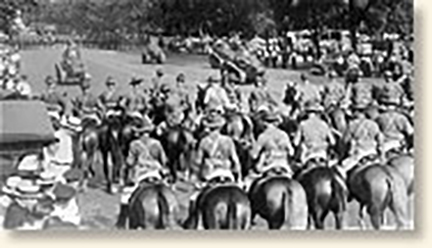
Then-Major Dwight D. Eisenhower was one of MacArthur’s aides at the time. Eisenhower believed that it was wrong for the Army’s highest ranking officer to lead an action against fellow war veterans. “I told that dumb son-of-a-bitch not to go down there”, he said.
The bonus march debacle doomed any chance that Hoover had of being re-elected. Franklin D. Roosevelt opposed the veterans’ bonus demands during the election, but he was able to negotiate a solution when veterans organized a second demonstration in 1933. Roosevelt’s wife Eleanor was instrumental in these negotiations, leading one veteran to comment: “Hoover sent the army, Roosevelt sent his wife”.
“Staff Sergeant Monti then realized that one of his soldiers was lying wounded on the open ground between the advancing enemy and the patrol’s position. With complete disregard for his own safety, Staff Sergeant Monti twice attempted to move from behind the cover of the rocks into the face of relentless enemy fire to rescue his fallen comrade”. – Excerpt from Medal of Honor citation, the full text of which appears at the end of this story.
If you’ve ever raised a child, you are well acquainted with the triumphs and the terrors of giving those little tykes the sword with which they will conquer their world.
We all have those special dates that we mark on the calendar. The birthdays, the anniversaries. There are other dates which very few among us are required to remember. Dates which not one of us want to.
Most of us go about our business, knowing but at the same time forgetting, that we are a nation at war. Among us are families which must mark such a date every year. The date when that child passed from among us.
On June 21, 2006, Sergeant Jared Monti’s 16-man patrol was ambushed by a far larger force of insurgents, on a high ridge in Afghanistan. Pfc. Brian J. Bradbury, 22, was mortally wounded early in the fight, and lay in open ground close to the enemy position.
Two times, Sergeant Monti exposed himself to overwhelming fire from three sides, in the attempt to rescue his fallen comrade. A rocket propelled grenade ended the third such attempt.
Army Sergeant First Class Jared C. Monti was awarded the Medal of Honor for the action which took his life. The first Massachusetts soldier to be so honored, since the war in Vietnam.
In 2012, singer songwriter Lee Brice released “I drive your truck”, a song that went to country music song of the year in 2014. The “I” in the title, though he didn’t know it at the time, is Paul Monti, a former science teacher at Stoughton High school, who lives in Raynham, Massachusetts.
It’s Jared’s truck.
Several years ago, Paul was denied permission to place a flag on his son’s grave, at the National Cemetery in Bourne, here on Cape Cod. The authorities don’t like to be left cleaning things up.
Paul took it up the chain of command until he received permission. He could put the flag in, as long as he agreed to take it out a week later.
And that’s what he did. On every grave in the Bourne National Cemetery.
Today, ‘Operation Flags for Vets‘ is a semi-annual event, recurring on Memorial Day and again on Veteran’s day. Later this morning, upwards of a thousand volunteers or more will join with the Monti family to place flags on every one of over 70,000 graves in the Massachusetts National Cemetery. A week later, they’ll be taken out.
It’s refreshing to be in the company of so many Patriots.
The Medal of Honor citation, as read by the President of the United States.
“For conspicuous gallantry and intrepidity at the risk of his life above and beyond the call of duty:
Staff Sergeant Jared C. Monti distinguished himself by acts of gallantry and intrepidity above and beyond the call of duty while serving as a team leader with Headquarters and Headquarters troop, 3rd Squadron, 71st Cavalry Regiment, 3rd Brigade Combat Team, 10th Mountain Division, in connection with combat operations against an enemy in Nuristan Province, Afghanistan, on June 21st, 2006. While Staff Sergeant Monti was leading a mission aimed at gathering intelligence and directing fire against the enemy, his 16-man patrol was attacked by as many as 50 enemy fighters. On the verge of being overrun, Staff Sergeant Monti quickly directed his men to set up a defensive position behind a rock formation. He then called for indirect fire support, accurately targeting the rounds upon the enemy who had closed to within 50 meters of his position. While still directing fire, Staff Sergeant Monti personally engaged the enemy with his rifle and a grenade, successfully disrupting an attempt to flank his patrol. Staff Sergeant Monti then realized that one of his soldiers was lying wounding on the open ground between the advancing enemy and the patrol’s position. With complete disregard for his own safety, Staff Sergeant Monti twice attempted to move from behind the cover of the rocks into the face of relentless enemy fire to rescue his fallen comrade. Determined not to leave his soldier, Staff Sergeant Monti made a third attempt to cross open terrain through intense enemy fire. On this final attempt, he was mortally wounded, sacrificing his own life in an effort to save his fellow soldier. Staff Sergeant Monti’s selfless acts of heroism inspired his patrol to fight off the larger enemy force. Staff Sergeant Monti’s immeasurable courage and uncommon valor are in keeping with the highest traditions of military service and reflect great credit upon himself, Headquarters and Headquarters Troop, 3rd Squadron, 71st Calvary Regiment, 3rd Brigade Combat Team, 10th Mountain Division, and the United States Army”.
You must be logged in to post a comment.