October 30, 1938 War of the Worlds

Traffic was jammed in both directions in the little town of Grover’s Mill, NJ, as locals tried to get out, and curiosity seekers came to see what Martians looked like.

34.6 million miles distant, the Red Planet is our nearest neighbor in the solar system. It was the God of Death to the Babylonians of 3000BC, lending its name to the war gods of Greek and Roman antiquity alike.

In the 19th century, amateur astronomer Percival Lowell was convinced that he saw canals on Mars, evidence of some great civilization. In 1898, H.G. Wells published a book about a Martian invasion of earth, beginning with a landing in England. On this day in 1938, the Mercury Theater of the Air brought that story to life.

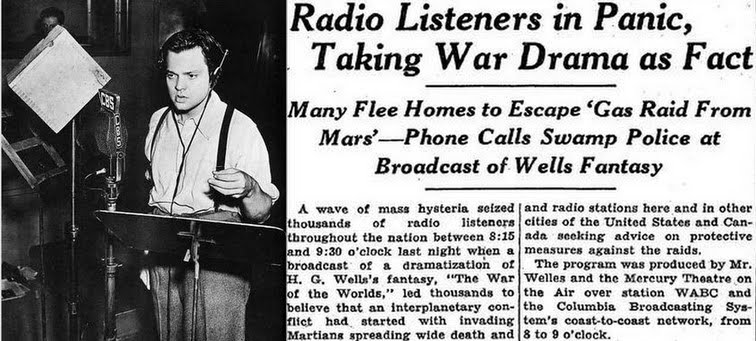
1920s-radioThe radio drama began with a statement that what followed was fictional.  The warning was repeated at the 40 and 55-minute mark, and again at the end of the broadcast. It began with a weather report, and then went to a dance band remote, featuring “Ramon Raquello and his orchestra”. The music was periodically interrupted by live “news” flashes, beginning with strange explosions on Mars. Producer Orson Welles made his first radio appearance as the “famous” (but non-existent) Princeton Professor Dr. Richard Pierson, who dismissed speculation about life on Mars.
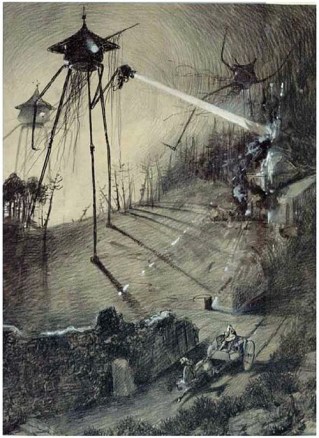
A short time later, another “news flash” reported that there had been a fiery crash in Grovers Mill, NJ. What was originally thought to be a meteorite was revealed to be a rocket machine as a tentacled, pulsating Martian unscrewed the hatch and incinerated the crowd with a death ray.

mars1The dramatic technique was brilliant. Welles had his cast listen to the Hindenburg tape, explaining that was the “feel” that he wanted in his broadcast. Fictional on-the-spot reporter Carl Phillips describes the death ray in the same rising crescendo, only to be cut off in mid-sentence as it’s turned on him.

The 60-minute play unfolds with Martians wiping out a militia unit sent against them, and finally attacking New York City with poison gas.

Despite repeated notices that the broadcast was fictional, it’s been estimated that as many as 1.2 million thought the news was real. According to Grovers Mill folklore, a local named William Dock shot a water tower, mistaking it for a Martian in the moonlight. Traffic was jammed in both directions in the little town, as locals tried to get out, and curiosity seekers came to see what a Martian looked like.

images (5) The New York Times reported on Oct. 31, “In Newark, in a single block at Heddon Terrace and Hawthorne Avenue, more than 20 families rushed out of their houses with wet handkerchiefs and towels over their faces to flee from what they believed was to be a gas raid. Some began moving household furniture”.

The USA Today newspaper, reporting on the 75th anniversary of the broadcast, reported “The broadcast … disrupted households, interrupted religious services, created traffic jams and clogged communications systems,”

Then as today, supposed “victims” of the broadcast and their lawyers lined up to get paid for “mental anguish” and “personal injury”. All suits were dismissed, except for a claim for a pair of black men’s shoes, size 9B, by a Massachusetts man who had spent his shoe money to escape the Martians. Welles thought the man should be paid.

In the end, the War of the Worlds was what the broadcast described itself to be. A Halloween concoction. The equivalent of dressing up in a sheet, jumping out of a bush and saying, ‘Boo!’.

October 27, 1871 The Original Lone Star Republic

The taking stood on questionable legal grounds, but it was complete on December 10, when the legislature voted to accept annexation and dissolve the Republic. Twenty-Six years later to the day, the Republic of Texas adopted the “Burnet” or “Bonnie Blue” Flag, all but indistinguishable from that of the original Lone Star Republic.

Bonnie Blue Flag hatThis is a story of Independence, of Revolution. Of overthrowing a Spanish-speaking government, and creating an Independent Republic in the American South. Its banner was a single, five-pointed white star on a blue field.  It was the original Lone Star Republic. The Republic of West Florida.

Wait. What?

Spanish colonization of the Americas began when the Crown of Castille, Ferdinand and Isabella, sent an Italian explorer this way in 1492.

Motivated by the promotion of trade and of the Catholic faith throughout indigenous populations, the Spanish Empire expanded across South and Central America and much of North America, including the Caribbean, Florida, and a strip running through modern day Mexico to the Pacific Southwest.

imageThe French first came to America in 1524, colonizing vast expanses from Quebec to Green Bay in the north, Baton Rouge to Biloxi in the south. They sought wealth, territory and a route to the Pacific Ocean. What they got was endless conflict.

Following the French and Indian War in 1762, Louis XV signed the secret Treaty of Fountainebleu with King Carlos III, ceding “la Louisiane” to Spain.

The Treaty of Paris was signed the following year, ending the Seven Years War in Europe. There lies the crux of the problem. French colonists poured into Louisiana, wanting no part of British rule. They wouldn’t learn until 1764 that the place was under Spanish rule.

Rebellion was immediate and ongoing. Colonists expelled their first Spanish governor Alejandro O’Reilly (I love that name) in the Rebellion of 1768, and had to be put down by force.

The American colonies were soon convulsed in Revolution, after which both East and West Florida reverted to Spanish control. European Colonial Powers would have their turn ten years later, with the French Revolution and the rise of the Napoleonic Empire. Spain would cede much of the Louisiana Territory back to France during this period, but not all of it.

spnflaPresident Jefferson bought 828,000 square miles from the French in 1803, doubling the size of the United States, but the exact borders were unclear.

Spain claimed title to what they called “West Florida, a territory bounded by the Perdido River in the east, the modern border of Florida and Alabama, south of the 31st parallel, and running west to the Mississippi River.

What followed may have been the shortest Revolution in history. Revolutionary War veteran Philemon Thomas led fifty “Americanos” through the early morning darkness of September 23, 1810. They passed through the open gate of Fort San Carlos in Baton Rouge, while another 25 men on horseback rode through a hole in the fort’s wall. Soldados fired their muskets, and Thomas’ men responded with a single volley, killing or wounding five Spaniards.

Bonnie Blue FlagThat was about it. Surviving soldados fled, as the flag of the new Republic was unfurled over the fort: a dark blue field with a single white star. The whole thing had taken about a minute.

Americanos had revolted back in 1804 without success. This time they would make it stick. Sort of.

The constitution of the Republic of West Florida was patterned on that of the United States, with government divided into three branches, Executive, Legislative and Judiciary.

The first and only Governor was Fulwar Skipwith, whose inaugural address seemed to make room for Union with the United States. “[T] he blood which flows in our veins”, he said, “like the tributary streams which form and sustain the father of rivers, encircling our delightful country, will return if not impeded, to the heart of our parent country”.

Skipwith’s overtures seemed to have been met with a yawn by the Madison administration, soon the new Republic was launching a raid, unsuccessfully, against the Spanish garrison at Mobile.

The Republic was becoming quite accustomed to its newfound independence, a state of affairs which President James Madison had no intention of recognizing.

President Madison proclaimed the territory annexed on October 27, 1810, and made part of the Territory of Orleans. William Claiborne, military governor of the Orleans Territory, was sent to take possession.

FloridaParishes
Florida Parishes of East Louisiana

Governor Skipwith proclaimed himself ready to “die in defense of the Lone Star flag,” though his stance softened considerably when military forces entered the capital of St. Francisville on December 6, and Baton Rouge four days later.

Florida itself, along with the eastern expanses of West Florida, reverted to United States control with the Onís-Adams Treaty of 1819.

To this day, eight parishes in East Louisiana (“Counties” to the rest of us), are called the “Florida Parishes”.

The taking stood on questionable legal grounds, but it was complete on December 10, when the legislature voted to accept annexation and dissolve the Republic. Twenty-Six years later to the day, the Republic of Texas adopted the “Burnet” or “Bonnie Blue” Flag, all but indistinguishable from that of the original Lone Star Republic.

Bonnie Blue, Stars and Stripes

October 26, 1918  Choctaw Code Talkers

The history of the Navajo code talkers of WWII is relatively well known.  Less well known is the history of code talking in WWI, based on the language of the Choctaw.
The government of the Choctaw Nation will tell you that they were the first native code talkers who ever served in the United States military.

Navajo Code Talkers were part of all six Marine divisions in the Pacific theater of WWII.  Guadalcanal, Tarawa, Peleliu, Iwo Jima:  Code Talkers took part in every assault the Marines conducted from 1942 to ‘45.

Theirs was a language with no alphabet or symbols, a language with such complex syntax and tonal qualities as to be unintelligible to the non-speaker.  The military code based on such a language proved unbreakable in WWII.  Japanese code breakers never got close.

The history of the Navajo Code Talkers of WWII is relatively well known.  A number of books have been written about the subject.  Less well known is the history of code talking in WWI, based on the language of the Choctaw.

The government of the Choctaw Nation will tell you that they were the first native code talkers who ever served in the United States military.

Choctaw code talkersLate in 1917, Colonel A. W. Bloor was serving in France with the 142nd Infantry Regiment.  They were a Texas outfit, constituted in May of that year and including a number of Oklahoma Choctaws.
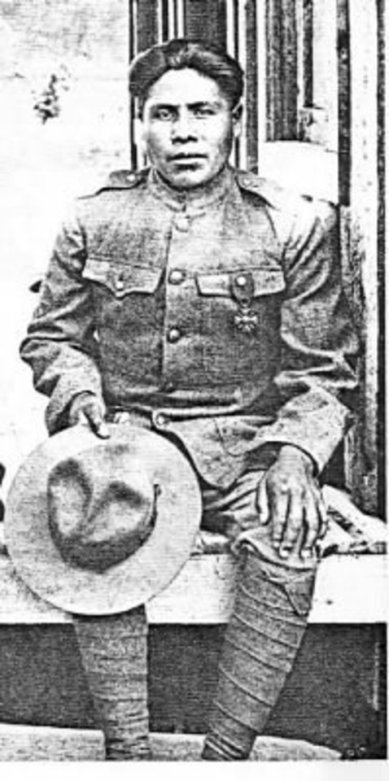
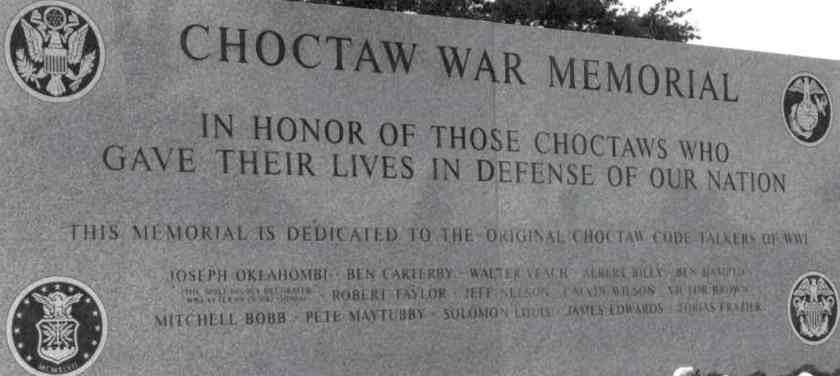
The Allies had already learned the hard way, that many of their German adversaries spoke excellent English.  They had already intercepted and broken several English based codes.  Bloor heard two of his Choctaw soldiers talking to each other, and realized he didn’t have the foggiest notion of what they were saying.  If he didn’t understand their conversation, the Germans wouldn’t have a clue.

The first test under combat conditions took place on October 26, 1918, as two companies of the 2nd Battalion performed a “delicate” withdrawal from Chufilly to Chardeny, in the Champagne sector.  A captured German officer later confirmed the Choctaw code to have been a complete success.  We were “completely confused by the Indian language”, he said, “and gained no benefit whatsoever” from wiretaps.

Choctaw soldiers were placed in multiple companies of infantry.  Messages were transmitted via telephone, radio and by runner, many of whom were themselves Native Americans.

The Choctaw would improvise when their language lacked the proper word or phrase.  When describing artillery, they used the words for “big gun”.  Machine guns were “little gun shoot fast”.

The Choctaw themselves didn’t use the term “Code Talker”, that wouldn’t come along until WWII.  At least one member of the group, Tobias W. Frazier, described what they did as, “talking on the radio”.  Of the 19 who served in WWI, 18 were native Choctaw from southeast Oklahoma.  The last was a native Chickasaw.  The youngest was Benjamin Franklin Colbert, Jr., the son of Benjamin Colbert Sr., one of Teddy Roosevelt’s “Rough Riders” of the Spanish American War.  Born September 15, 1900 in the Durant Indian Territory, he was 16 on the day he enlisted.

Joseph Oklahombi
Joseph Oklahombi

Another was Choctaw Joseph Oklahombi, whose name means “man killer” in the Choctaw language.    Six days before Sergeant York’s famous capture of 132 in the Argonne Forest, Joseph Oklahombi charged a strongly held German position, single-handed.  Oklahombi’s Croix de Guerre citation, personally awarded by French Marshall Philippe Pétain, tells the story:  “Under a violent barrage, [Pvt. Oklahombi] dashed to the attack of an enemy position, covering about 210 yards through barbed-wire entanglements. He rushed on machine-gun nests, capturing 171 prisoners. He stormed a strongly held position containing more than 50 machine guns, and a number of trench mortars. Turned the captured guns on the enemy, and held the position for four days, in spite of a constant barrage of large projectiles and of gas shells. Crossed no man’s land many times to get information concerning the enemy, and to assist his wounded comrades“.

Unconfirmed eyewitness accounts report that 250 Germans occupied the position, and that Oklahombi killed 79 before their comrades decided it was wiser to surrender.  Some guys are not to be trifled with.

choctawwarmemorial

October 24, 1929 Crash

A convincing case may be made that it was the Reduction of government spending in the years following WWII, that put wealth back in the pockets of the people who created it in the first place, finally ending the Depression.

Warren Harding entered office on March 4, 1920, in the midst of the sharp recession following WWI.

Harding’s Treasury Secretary, Andrew Mellon, believed that money was driven underground or overseas as income tax rates increased. Mellon held the heretical belief for that time, that lower tax rates led to greater levels of economic activity and that, as people had more of their own money to work with, the higher activity level resulting would increase tax revenues.

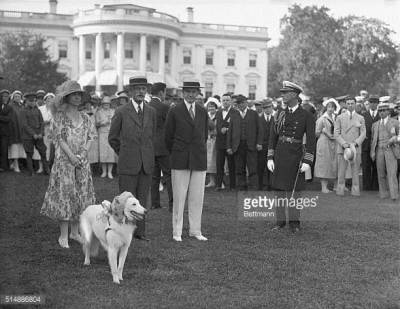
white house lawn
President and Mrs Calvin Coolidge with Andrew Mellon and others on the White House lawn

Based on Mellon’s advice, Harding cut taxes, starting in 1922. The top marginal rate was reduced annually in four stages from 73% in 1921 to 25% in 1925. Taxes were cut for lower incomes starting in 1923.

Vice President Calvin Coolidge became President in August 1923, following Harding’s untimely death. Coolidge would follow Harding’s economic policies of low taxation and high growth, the result would become the “Roaring 20s”.

Revenues to the treasury increased substantially, resulting in a 36% reduction of the national debt.  President Kennedy tried the same tactic with the same result in the 1960s.

Opponents called it “Voodoo Economics” when President Reagan used the same tactic in the 1980s, but the results were the same.  Same thing when President Bush the younger did it in the 2000s.

Economists and historians debate, because that’s what they do, but the results speak for themselves.

Unemployment and inflation both declined throughout the 1920s, while wages, profits and productivity increased.  The decline in what Carter-era economists called the “Misery Index”, was the sharpest in history.

The twenties became a time of wealth and excess, and speculation in the stock market increased exponentially. New investors poured into the market in the belief that, like the housing market of the 2000s, prices could never go down. It was a nine year run when the Dow Jones Industrial Average increased tenfold, peaking at 381.17 on September 3, 1929.

Rising share prices encouraged more people to invest, even if they didn’t have the money to do so. Brokers were routinely lending investors up to two thirds of the face value of stocks. Over $8.5 billion hung out on such loans, more than the amount of currency circulating in the entire country, at that time.

As with 2007-08, there were early tremors that showed the bubble was about to burst. Then as now, such signals were seen only in hindsight, as the rising crescendo that was 1929, continued.

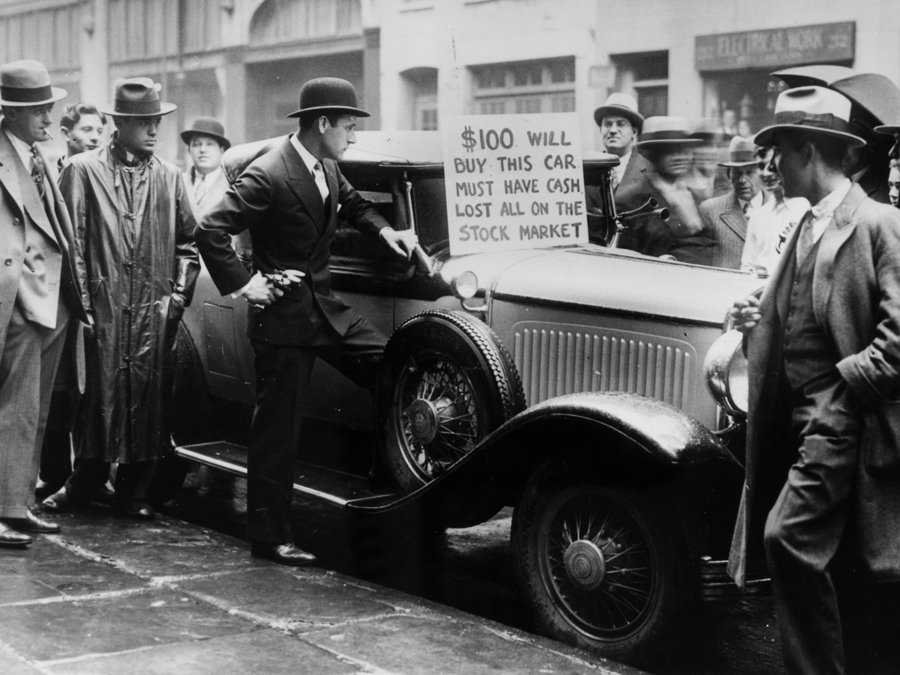
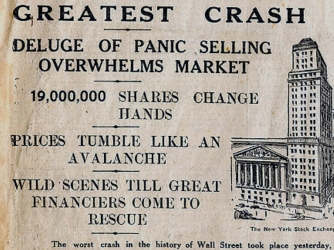
stock-market-crash-of-1929-newspaper-ABThere was a brief contraction in March, but the first of the “Crash” began on “Black Thursday”, October 24, 1929. The market lost 11% at the opening bell, amidst heavy trading.   To quell the frenzy, Wall Street financial firms Morgan Bank, Chase National and National City Bank of New York stepped up and bought large blocks of US Steel and other “blue chip” stocks, at prices well above where they were trading.

The tactic had the effect of stopping the slide, much as it did during the Panic of 1907. This time however, the relief would be short lived. “Black Tuesday”, October 29, saw the Dow Jones contract by 12% on a volume record which would stand unbroken for forty years. The president of the Chase National Bank said at the time “We are reaping the natural fruit of the orgy of speculation in which millions of people have indulged. It was inevitable, because of the tremendous increase in the number of stockholders in recent years, that the number of sellers would be greater than ever when the boom ended and selling took the place of buying“.

Fears of the Smoot-Hawley tariff act fueled a further contraction in the following weeks.  Apparently, for good reason. When President Hoover signed the protectionist measure into law in 1930, American imports and exports shriveled by more than half.

Historians debate whether the stock market crash led to the Great Depression, or if the two events coincided. Only 16% of US households were actually invested in the stock market at the time, but the psychological effect was profound.

Easy credit and unbounded confidence had led to a speculative bubble which had finally burst.

DJIAEconomists still argue about the interventionist policies, which followed. The guy who needed to support his family was grateful to be put to work on a WPA project, but the government doesn’t produce wealth.  Every dollar spent had first to be extracted from the wealth producing, or “private”, part of the economy.  You can’t fill a swimming pool, by draining one end of it into the other.

The stock market and unemployment rates staggered throughout the 1930s.  It was WWII that finally put people back to work.

Yet that was merely activity, from an economic point of view. War production wasn’t growth, it was more like giving sugar to the kids, and watching them run around the house. A convincing case may be made that it was the Reduction of government spending in the years following WWII, that put wealth back in the pockets of the people who created it in the first place, finally ending the Depression.

An indicator of that wealth, the Dow Jones Industrial Average, wouldn’t retake the high ground of 1929, until 1954.

October 23, 1983 Heritage

A list of memorials at Arlington reads like a history of the nation itself. The Argonne Cross commemorates the honored dead of the “War to end all Wars” in 1917-1918, some 2,100 of whom were re-interred in Section 18 after the war. The Battle of the Bulge memorial reads, “To World War II American Soldiers who fought in the Battle of the Bulge – The greatest Land Battle in the history of the United States Army”. The Beirut Memorial honors 241 American service members killed in the October 23, 1983 bombing of the Marine barracks in Lebanon, twenty-one of whom went to their final rest, at Arlington National Cemetery.

The Oxford English Dictionary defines Monument as “A statue, building, or other structure erected to commemorate a notable person or event”.

Arlington National Cemetery is itself such a monument; Memorial Avenue extending across the Potomac, connecting Arlington House, the former home of a Confederate general, with the Lincoln Memorial at the opposite end, symbolizing the immutable bond between North and South.

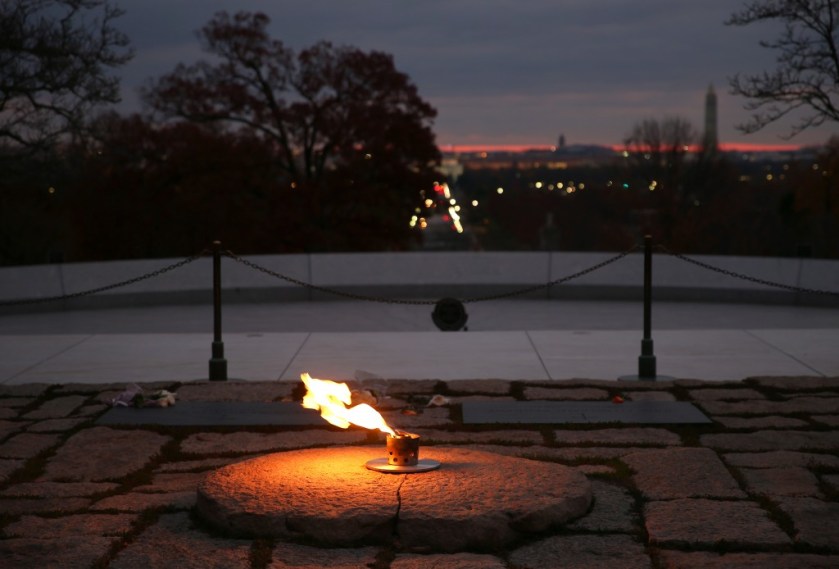
Approach Arlington at night, and the eternal flame marking the grave of JFK can be seen on the hillside, like some faraway beacon of light.

Eternal Flame

A list of memorials at Arlington reads like a history of the nation itself. The Argonne Cross commemorates the honored dead of the “War to end all Wars” in 1917-1918, some 2,100 of whom were re-interred in Section 18 after the war. The Battle of the Bulge memorial reads, “To World War II American Soldiers who fought in the Battle of the Bulge- The greatest Land Battle in the history of the United States Army”.

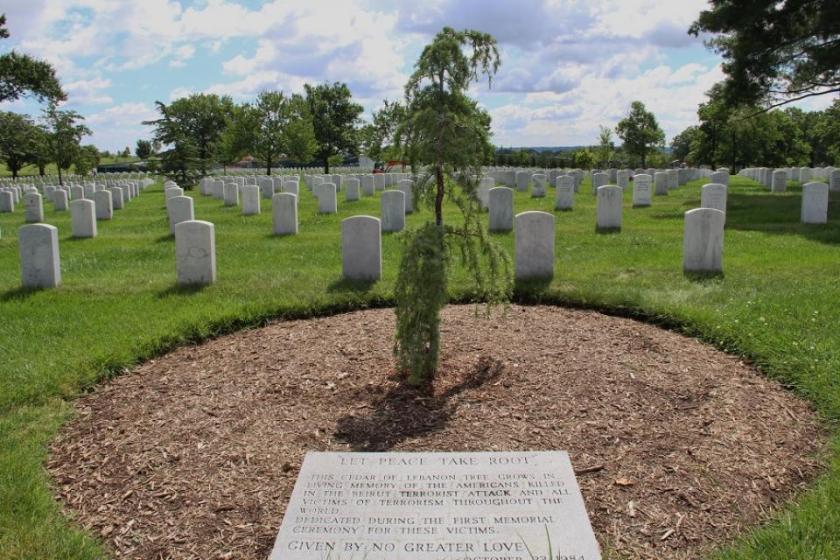
The Beirut Memorial honors 241 American service members killed in the October 23, 1983 bombing of the Marine barracks in Lebanon, twenty-one of whom went to their final rest, at Arlington National Cemetery.  The inscription reads:

“Let Peace Take Root”

This Cedar of Lebanon tree grows in living memory of the Americans killed in the Beirut terrorist attack and all victims of terrorism throughout the world.
Dedicated during the first memorial ceremony for these victims.

Given by: No Greater Love
October 23, 1984
A time of remembrance

Beirut memorial
“This Cedar of Lebanon tree grows in living memory of the Americans killed in the Beirut terrorist attack and all victims of terrorism throughout the world. Dedicated during the first memorial ceremony for these victims”.

On Chaplain Hill stands a row of four memorials, bearing the names of four Chaplains who laid down their lives in four wars. The Cenotaph, (“an empty tomb or a monument erected in honour of a person or group of people whose remains lie elsewhere”), bears this inscription: “Greater Love Hath No Man Than This, That A Man Lay Down His Life For His Friends.” Written there are the names of the only two chaplains ever awarded the Medal of Honor: Major Charles Joseph Watters, killed in Vietnam, while rendering aid to fallen comrades, and Captain Emil Joseph Kapaun, the “Shepherd in Combat Boots” who remains to this day in some unmarked North Korean grave site.

Emil Kapaun

I have barely scratched the Cs. Altogether, there are 28 major and 142 minor Memorials and monuments at Arlington National Cemetery, to say nothing of the 400,000+ military grave sites, stretching across the landscape. Each of them across the 624 acres of Arlington, equivalent to 472 football fields, is dedicated to a person, place or event which has earned the right to be remembered.

It has long seemed to this writer that, irrespective of political persuasion, an informed citizen of a free Republic can’t cast an informed vote, can’t know where he wants his country to go, without an understanding of where it’s been. If you haven’t had the opportunity to visit Arlington National Cemetery recently, I highly recommend the trip. Leave yourself plenty of time to take it all in. It would be hard to find more heritage, tradition and history, in any other single place.


Feature Image Credit, Navin Sarma Photography. “Snow and wind mix in with purple city glow at sunset at the Air Force Memorial”

October 22, 1962  Cuban Missile Crisis

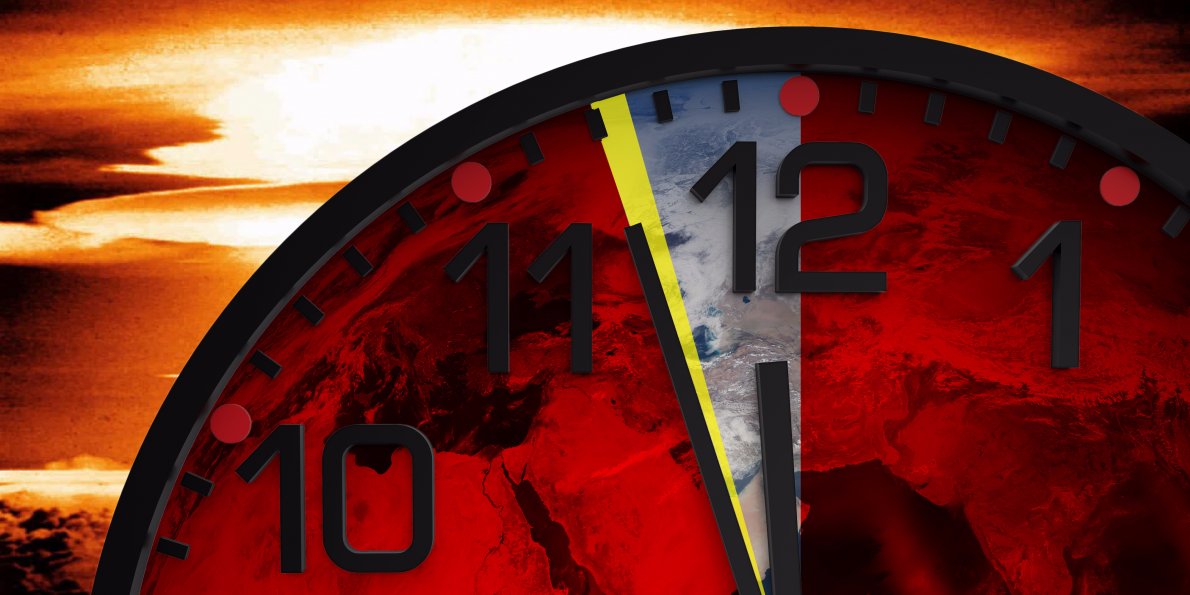
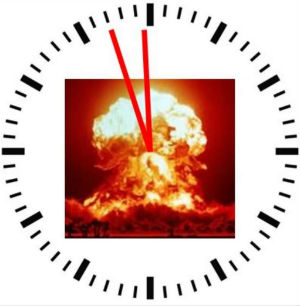
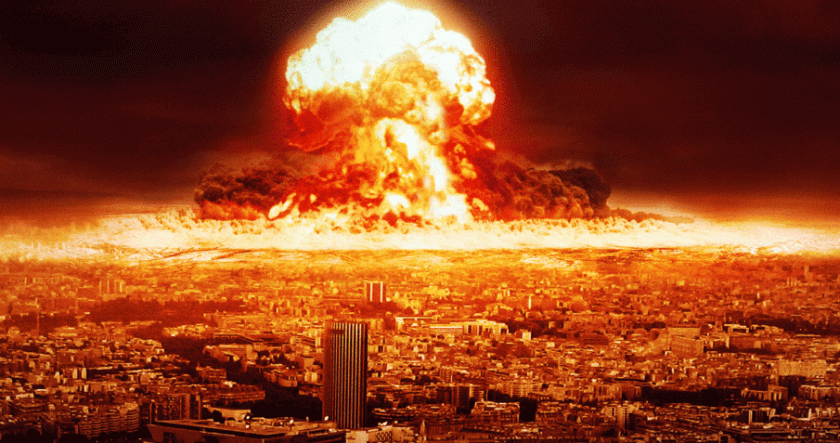
The Cuban Missile Crisis was never reflected on the doomsday clock.   The deadlock had broken before circumstances could be fully determined and the clock reset.  The events of October 1962 brought us closer to the brink than any time in history, before or since.  Seconds to go, to nuclear extinction.

doomsday clock, 1In 1947, members of the Science and Security Board of the Bulletin of Atomic Scientists envisioned a “Doomsday Clock”, a symbolic clock face, to dramatize the threat of global nuclear catastrophe.  Initially set at seven minutes to midnight, the “time” has varied from seventeen minutes ’til with the 1995 collapse of the Soviet Union, to two minutes before midnight with “Operation Ivy”, the first American thermonuclear detonation, in 1952.
The Cuban Missile Crisis was never reflected on the doomsday clock.   The deadlock broke before circumstances could be fully determined and the clock reset.  Yet the events of October 1962 brought us closer to the brink than any time in history, before or since.  Seconds to go, to worldwide nuclear extermination.

All that needs to be known about Cuban Dictator Fulgencio Batista, is that he fled office with $300,000,000 US, on December 31, 1958.  The triumphant rebel columns streaming out of the Sierra Maestra Mountains, were quick to establish themselves in power.  By February 1959, Fidel Castro had installed himself as Prime Minister.

Castro dismissed the need for elections, proclaiming his government to be a “direct democracy”.  The Cuban people could assemble demonstrations and express their democratic will to him personally, he said.  Who needs elections?

“Trials” were carried out across the country, some in sports arenas, in front of thousands of spectators.  Hundreds of Batista supporters were executed or imprisoned as Castro’s “Revolutionary Socialist State” purged itself of the former regime.  When Castro didn’t like the outcome, he’d personally order a retrial.

Earl Smith, former American Ambassador to Cuba, described the Ambassadorship as “the second most important man,” in Cuba.  Now, the Castro administration distanced itself from the US, adopting an increasingly leftist posture and seizing US controlled oil installations, banks and sugar refineries.  By October 1960 the government had “nationalized” 166 such businesses, including Coca Cola and Sears, Roebuck.

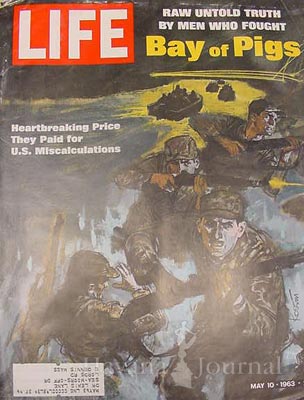
bay-of-pigsSince the Presidency of James Monroe, US foreign policy has opposed outside intervention in the American hemisphere.  The government was not about to permit a communist state, 90 miles from its shore.
A secret operation to overthrow the Cuban government was conceived and initiated by the Eisenhower administration, and put into motion in April 1961.  1,400 CIA backed Cuban exiles landed on Cuba’s “Playa Girón“ (Bay of Pigs), intending to overthrow the communist government.

The effort was doomed to failure.  The New York Times had been reporting on the “secret invasion”, for a month.

Following the Bay of Pigs fiasco, the Kennedy administration sought other means of removing communists from power.  “Operation Mongoose” sought to embarrass and discredit Castro personally, with tactics ranging from print & radio propaganda, to hallucinogenic chemical-laced cigars.  Someone even had the hare-brained idea of lining Castro’s shoes with thallium salts, to make his beard fall out.

The Communist government consolidated power, taking control of trade unions, jailing opponents, suppressing civil liberties, and sharply limiting freedom of speech and of the press. Secretary of State Christian Herter described Castro’s single-party political system as “following faithfully the Bolshevik pattern”.

Soviet Premier Nikita Khrushchev concluded from the Bay of Pigs fiasco, that the American President was impotent and indecisive.  One Soviet adviser described Kennedy as “too young, intellectual, not prepared well for decision making in crisis situations… too intelligent and too weak.”

Cuban and the Soviet officials reached a secret arms agreement in July, 1962.   By late summer, American intelligence discovered Soviet Ilyushin Il-28 jet bombers in Cuba.

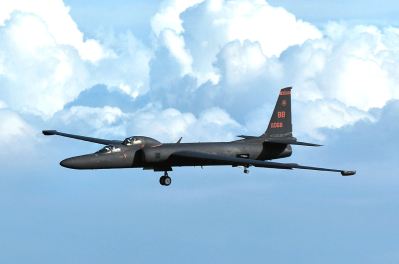
Worse yet, construction had begun on several missile sites.  On October 14, ultra-high-altitude Lockheed U–2R reconnaissance aircraft photographs revealed the presence of medium and intermediate range ballistic nuclear missile sites under construction in Cuba.

1st_Reconnaissance_Squadron_Lockheed_U-2R_80-1068
A redesigned version of the U-2, the U-2R, was used from the late 1960s through the 1990s

President Kennedy warned of the “gravest consequences” resulting from the introduction of Soviet offensive weapons in Cuba, while Foreign Minister Andrei Gromyko insisted that Soviet aid was purely defensive. U-2 photographs gave lie to Gromyko’s protestations.  Images taken on the 17th revealed the presence of 16-32 missiles.

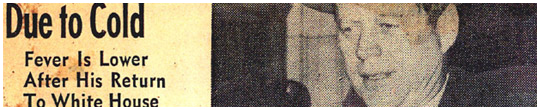
The administration went to great lengths to portray “business as usual”, while behind the scenes, policy makers wrangled over options from quarantine to tactical air strike to outright military invasion.  President Kennedy himself suddenly departed a political event in Chicago, his aids concocting a “cold” diagnosis to explain his sudden absence.

Cuban Missile Crisis, coldIn a televised speech on October 22, Kennedy publicly revealed the presence of Soviet missiles in Cuba, and called for their removal.  A naval quarantine would close off the island, Kennedy said, until Soviet leaders agreed dismantle missile sites, and to make certain that no additional missiles were shipped to Cuba.
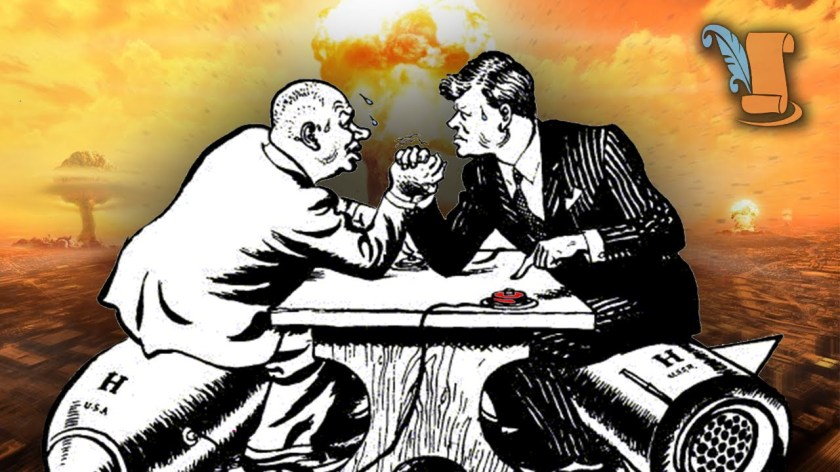
From the Soviet perspective, Cuba was a small ally behind enemy lines, the same situation the Americans experienced, in West Berlin.  Besides, the Americans had missiles in Italy and Turkey.

Kruschev had gambled and lost, that he could “[I]nstall nuclear warheads in Cuba without letting the United States find out they were there until it was too late to do anything about them”.

The President warned “It shall be the policy of this nation to regard any nuclear missile launched from Cuba against any nation in the Western Hemisphere as an attack by the Soviet Union on the United States, requiring a full retaliatory response upon the Soviet Union.”  There was no mistaking American intent.

Kruschev replied, “I hope that the United States Government will display wisdom and renounce the actions pursued by you, which may lead to catastrophic consequences for world peace…”

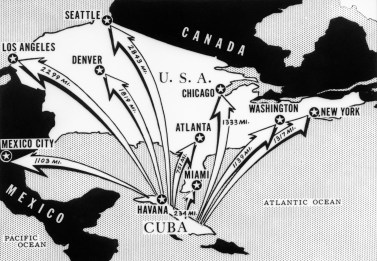
Distances of Major Cites from Cuba
1962 — This newspaper map from the time of the Cuban Missile Crisis shows the distances from Cuba of various cities on the North American Continent. — Image by © Bettmann/CORBIS

Soviet nuclear submarines moved in response to the quarantine, as Cuban waters became the scene of a tense, naval standoff.

Kruschev responded on the 24th, describing the US blockade as an act of aggression.  Castro urged the Soviet leader to initiate a nuclear first strike, should the Americans invade his island. The Joint Chiefs of Staff announced a “Defense Readiness Condition” status of DEFCON 3.  The United States Air Force was now ready to mobilize in 15 minutes.

U-2 photographs of the 25th & 26th showed accelerated construction on the island, with several silos approaching operational readiness.  US air forces were placed at DEFCON 2.  War involving Strategic Air Command, was now “imminent”.

Cuban Missile Crisis, contest

On day twelve of the standoff, October 27, an American U-2 was shot out of the sky by a Soviet supplied surface-to-air missile.  The pilot, Major Rudolph Anderson Jr, was posthumously awarded the first Air Force Cross in history, as well as the Air Force Distinguished Service Medal, the Purple Heart, and the Cheney Award.

Anderson’s was the only combat death of the Cuban Missile Crisis, but he wasn’t alone.  Three reconnaissance-variant Stratojets crashed between September 27 and November 11, killing 11 airmen.  Seven more died on October 23, when their C-135B Stratolifter stalled and crashed delivering ammunition to the Naval Base on Guantanamo Bay.

The most dangerous phase of the Cuban Missile Crisis ended on October 28, when Radio Moscow announced that Cuban missiles would be removed in exchange for an American pledge not to invade.  In a secret “side deal”, the Kennedy administration also agreed to remove American “Jupiter” missiles, from Turkey.

Cuban Missile Crisis, mushroom cloud

The most dangerous thirteen days in world history, had passed.  The American quarantine would continue until November 20, when the Soviets agreed to remove their bombers.  The Americans removed Turkish missiles, the following April.

Throughout this period, a blizzard of communications both direct and indirect, were exchanged between Washington and Moscow.  With little to go on but mutual distrust, Kennedy, Kruschev and their aids sought to understand the true intent of their adversary.

If there is no intention,” wrote Kruschev, “to doom the world to the catastrophe of thermonuclear war, then let us not only relax the forces pulling on the ends of the rope, let us take measures to untie that knot. We are ready for this.”

The American and Soviet governments established the Washington-Moscow Direct Communications Link in 1963, from a mutual desire that we never again, get that close to the brink.  Contrary to popular culture, this “hotline” has no “red phone”, and never did.  The Moscow–Washington hotline was at first a dedicated teletype, replaced by direct-link fax machine in 1986. Since 2008, the Pentagon maintains a secure computer link with the Russian Federation, and messages are exchanged by email.


October 21, 1797 Old Ironsides

Freshly restored and re-fitted, Old Ironsides took her first sail in three years only yesterday.  220 years since her own launch, and to honor the 242nd birthday, of the United States Navy.

When the United States won its independence from Britain in 1783, the young nation soon learned that freedom was not without disadvantages. One being that America had lost its protector at sea.

British and French vessels harassed American merchant shipping, often kidnapping American sailors and forcing them to serve in their own navies.

barbary-warBarbary pirates were a problem for Mediterranean shipping, and throughout parts of the Atlantic. Predominantly North African Muslims with the occasional outcast European, the Barbary pirates operated with the blessing of the Ottoman Empire, the Barbary Coast states of Algiers, Tunis & Tripoli, and the independent Sultanate of Morocco. The Barbary Corsairs had long since stripped the shorelines of Spain and Italy in search of loot and Christian slaves.
Many villages wouldn’t be re-inhabited until the 19th century.  Between the 16th and the 18th centuries, thousands of ships were captured and held for ransom.  Somewhere between 800,000 and 1.25 million Europeans disappeared into the Arab slave markets of North Africa and the Middle East.

Barbary pirates began to harass American shipping as early as 1785.  They captured 11 American vessels in 1793 alone, holding the ships and crew for ransom.

Congress passed the Naval Act of 1794, appropriating funds to build a fleet of 6 three-masted, heavy frigates for the United States Navy. The act included a clause halting construction, in the event of a peace treaty with Algiers.   No such treaty was ever concluded.

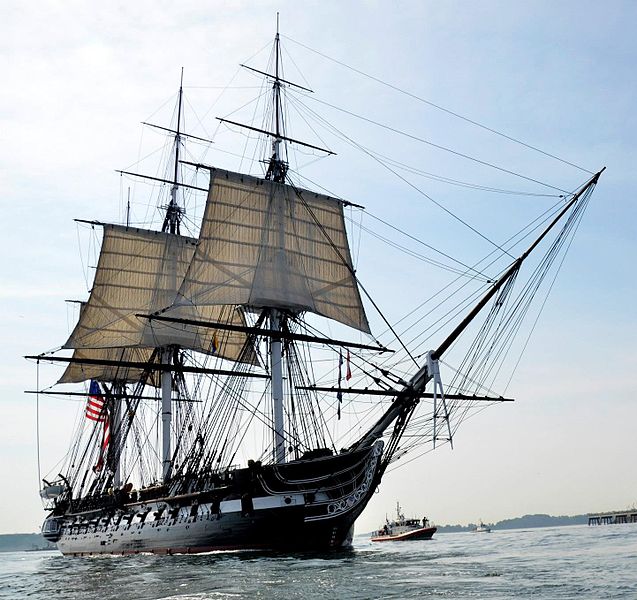
Launched this day in 1797 and named by George Washington himself, USS Constitution was one of these six. Her hull was made of the wood from 2,000 Georgia live oak trees, and built in the Edmund Hartt shipyard of Boston, Massachusetts.

USS_Constitution_underwayConstitution’s first duties involved the “quasi-war” with France, but this was not the France which helped us win our independence. France had been swallowed up in a revolution of its own by this time.  Leftists calling themselves “Jacobins” had long since sent their Bourbon King and his Queen Consort to the guillotine. Marie-Joseph Paul Yves Roch Gilbert du Motier, Marquis de Lafayette and Hero of the American Revolution, languished in an Austrian prison.

The French Monarchy would one day be restored, but not before a Corsican Corporal rose to the rank of Emperor to meet his Waterloo, fighting (and winning) more battles than Julius Caesar, Frederick the Great, Alexander the Great, and Hannibal, combined.  But I digress.

The Barbary pirates were paid “tribute” during this time to keep them quiet, but that ended in 1800.  Yusuf Karamanli, Pasha of Tripoli, demanded $225,000 from the incoming Jefferson administration. Jefferson refused, and Constitution joined in the Barbary Wars in 1803, a conflict memorialized in a line from the Marine Corps Hymn “From the Halls of Montezuma to the Shores of Tripoli.”

USS_Constitution_underway, turningTwo months after the War of 1812 broke out in June, Constitution faced off with the 38 gun HMS Guerriere, about 400 miles off the coast of Halifax. Watching Guerriere’s shots bounce off Constitution’s 21” thick oak hull, an American sailor exclaimed “Huzzah! her sides are made of iron!” Guerriere was reduced to an unsalvageable hulk in twenty minutes, and the nickname “Old Ironsides” was born.
The month before, Constitution had put to sea intending to join a five ship squadron off the coast of New Jersey. Spotting five sails and thinking that they had found their squadron on July 17, Constitution was disabused of that notion when lookouts reported the next morning that they were 5 British warships, and they were giving chase.

That soon to be famous “iron” hull would have been useless in a five to one fight. A common naval tactic of the day was to close to short range and fire at the masts and rigging of opposing vessels, disabling the ship’s “power plant”. A disabled vessel could then be boarded and a bloody fight would ensue with cutlass and pistol. Those 5 British captains would have considered Constitution to be a great prize; the ship faced a race for survival and the stakes were life and death.

Conditions were near dead calm and all six vessels were wetting sail, trying to get the most out of light winds. In a process called “kedging“, Constitution’s boats were rowed out ahead of the ship, dropping small “kedge anchors”. Sailors would then haul the great ship up the anchor chain, hand over hand, repeating the process over and over. The British ships soon imitated the tactic.  What followed was a slow motion race lasting 57 hours in the July heat.

h52488

Constitution’s crew dumped everything they could find overboard to lessen the weight, including 2,300 gallons of drinking water. Cannon fire was exchanged several times, though the shots fell short of their mark. Constitution pulled far enough ahead of the British ships that they abandoned the pursuit on July 19.

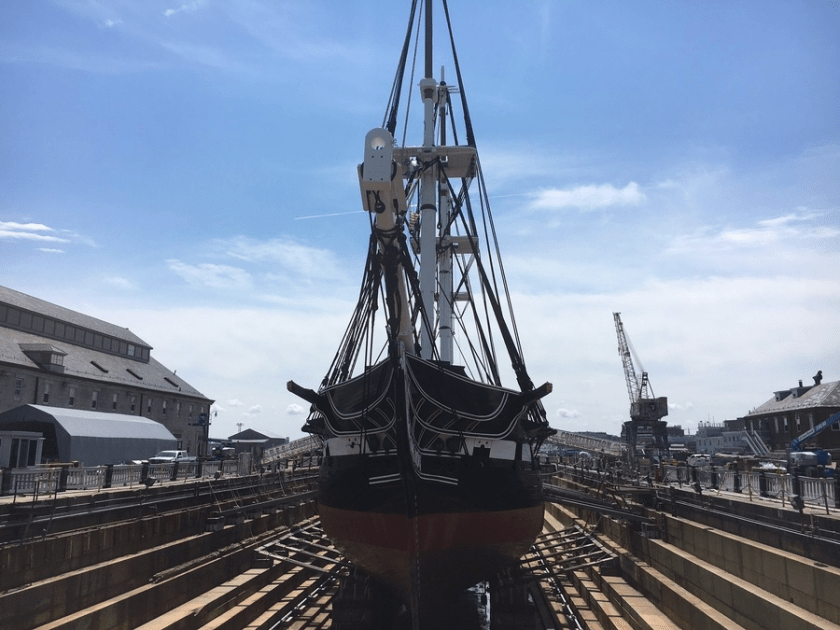
Old Ironsides, Drydock
Old Ironsides, in Drydock

USS Constitution is still in service today, the world’s oldest commissioned naval vessel still afloat. She went into dry dock for major overhaul in October 2014 and re-floated on July 23 this year.  Freshly restored and re-fitted, Old Ironsides took her first sail in three years only yesterday.  220 years since her own launch, and honoring the 242nd birthday, of the United States Navy.


October 14, 1912 Can’t Stop a Bull Moose

The 9000+-member audience was stunned when Roosevelt announced “I don’t know whether you fully understand that I have just been shot—but it takes more than that to kill a Bull Moose!”

The first “Progressive” era began as a local movement in the 1890s, largely in response to the corruption of the political machines, and the monopolistic corporate excesses of the “gilded age”.  By the 1920s, Progressivism had come to dominate state and national politics, bringing with it the national income tax, direct election of Senators, and Prohibition, with the 16th, 17th and 18th amendments, respectively.

progressiveGreat believers in the perfectibility of the public sphere, Progressives eschewed old methods as wasteful and inefficient, leaning instead toward the advice of academics and “experts”, looking for that “one best way” to get things done.

Progressive politicians covered both sides of the political aisle, with leaders such as Wisconsin Senator Robert M. La Follette Sr. and Chief Justice Charles Evans Hughes on the Republican side, and Woodrow Wilson, and the attorney, politician and orator William Jennings Bryan (he of the famous “Monkey Trial”), on the side of the Democrats.

When Theodore Roosevelt first appeared on the political scene at age 23, there was little to hint at the Progressive he would later become.  “TR” was sworn into office in 1901, following the assassination of President William McKinley.   At 42 he was the youngest man to ever take the oath of office, and possibly the most energetic.

As President, Roosevelt pushed executive power to new heights, attacking “Captains of Industry” with a two-pronged strategy of anti-trust legislation, and regulatory control.  TR was the “Conservation President”, creating the United States Forest Service (USFS) and establishing no fewer than 150 national forests, 51 federal bird reserves, 4 national game preserves, 5 national parks, and 18 national monuments.  All told, Roosevelt protected approximately 230 million acres of public land.

william-howard-taft-nationalRoosevelt retired from politics after two terms to go on African safari, backing William Howard Taft for the Republican nomination.

Taft easily defeated Democratic candidate William Jennings Bryan in the 1908 election, but his presidency proved to be a disappointment to the Progressive wing of the party.

The more conservative Taft didn’t take the expansive view of his predecessor.  By 1910, Roosevelt had returned to a public speaking tour against his own hand-picked successor.

The federal government needed to assume a larger role in the lives of every-day Americans, argued Roosevelt, who, despite repeated assurances that he was done with politics, challenged Taft for the 1912 Republican nomination.  When asked if he was up to another campaign season, Roosevelt replied he was ready and felt as “fit as a bull moose”.

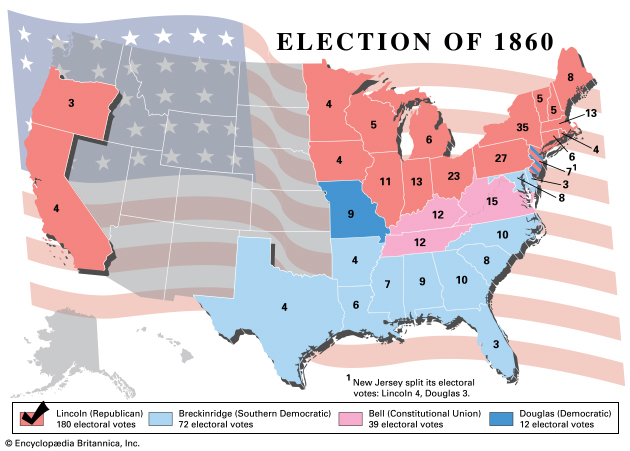
The final split came with the June Republican party convention in Chicago, when the party rejected Roosevelt’s “New Nationalism” platform, nominating Taft as its standard bearer for re-election.  Roosevelt and his reform-minded supporters broke with the party, forming the “Progressive”, or “Bull Moose” party, as the Democratic convention selected former Princeton University President and New Jersey Governor Woodrow Wilson, to be its candidate.  This was going to be a three-way race.

1912-election
1912 Election

John Flammang Schrank emigrated to America in 1885, at the age of 9.  His parents died a short time after, leaving him to work for an uncle, a tavern keeper in the Kleindeutschland, (“Little Germany”) section of New York.  Schrank’s aunt and uncle left him a sizeable inheritance on their passing, in hopes that he would live a quiet and peaceful life.  Schrank was heartbroken at losing this, his second set of parents.  When his first and only girlfriend Emily Ziegler died in the General Slocum disaster of 1904, John Schrank became unhinged.

He drifted up and down the east coast for several years.  In September 1912, he became obsessed with Theodore Roosevelt.  For three weeks, John Schrank followed the Roosevelt campaign, stalking the candidate across eight states.  On the afternoon of October 14, Roosevelt was in Milwaukee, dining with local dignitaries at the Hotel Gilpatrick, before a planned speech at the Milwaukee Auditorium.  As the former President was getting into his vehicle, he turned to wave to well-wishers. Schrank was four or five feet away when he fired his .38 caliber revolver, hitting the former President in the chest.

jjustice14n-5-copy
John Flammang Schrank smiles as he’s taken into custoy for the attempted assassination of Theodore Roosevelt

The bullet pierced the fifty folded pages of Roosevelt’s speech and a metal spectacle case, before lodging in his chest.  The former President coughed once into his hand, to see if there was blood.  Seeing none, TR concluded that his lungs were fine, and decided to give the speech.  The 9000+-member audience was stunned when the candidate announced “I don’t know whether you fully understand that I have just been shot—but it takes more than that to kill a Bull Moose!” Roosevelt spoke for 80 minutes, before going to a Milwaukee hospital for treatment.

justice14n-3-copy
Roosevelt x-ray

Theodore Roosevelt lived the rest of his life with that bullet in his chest.  Six more years. As for John Schrank, he claimed in a letter found on his person, that the ghost of William McKinley had instructed him to avenge his death with the assassination of his former Vice President.  He would live out the rest of his days at the Central State Mental Hospital for the criminally insane, in Waupun, Wisconsin.

Schrank letter

Woodrow Wilson easily defeated his opponents to become the 28th President of the United States, garnering 435 electoral votes to his opponents’ combined total, of 96.

justice14n-10-copy
Fifty pages long and folded in half, Elbert Martin holds the speech that saved TR’s life

October 12, 1859 American Emperor

Though he was penniless, the “Official Norton Seal of Approval” was good for business. Some restaurants even put out brass plaques, declaring their “Appointment to his Imperial Majesty, Emperor Norton I of the United States”.

Joshua Abraham Norton was born around 1818, in England.  He lived most of his early life in South Africa, immigrating to the United States in 1849 following an inheritance of $40,000 from his father – equivalent to $1½ million, today.

As a San Francisco businessman, Norton sextupled his fortune to $250,000, then blew it all on a bad Peruvian rice deal.  A lawsuit followed, which the now-formerly wealthy businessman, lost.  Somewhere along the line, Joshua Norton appears to have lost his mind.

Emperor_Joshua_A._Norton_IFor a time, Norton disappeared from the public eye.  In September 1859, he proclaimed himself Emperor of the United States, his Royal Ascension announced to the public in a letter to the editor of the San Francisco Bulletin.   “At the peremptory request and desire of a large majority of the citizens”, it read, “I, Joshua Norton…declare and proclaim myself Emperor of these United States.” The letter went on to command representatives from all the states to convene in San Francisco, “to make such alterations in the existing laws of the Union as may ameliorate the evils under which the country is laboring.”

The edict was signed  NORTON I, Emperor of the United States”

To many of his “subjects”, “Emperor Norton” was a harmless eccentric.  A kook.  Many were pleased to go along with the gag.

On October 12, Emperor Norton abolished the United States Congress, declaring “fraud and corruption prevent a fair and proper expression of the public voice…in consequence of which, we do hereby abolish Congress.”

When Congress failed to disperse, Norton issued a second edict, ordering General Winfield Scott to Washington to rout the rascals. “WHEREAS, a body of men calling themselves the National Congress are now in session in Washington City, in violation of our Imperial edict of the 12th of October last, declaring the said Congress abolished;  WHEREAS, it is necessary for the repose of our Empire that the said decree should be strictly complied with;  NOW, THEREFORE, we do hereby Order and Direct Major-General Scott, the Command-in-Chief of our Armies, immediately upon receipt of this, our Decree, to proceed with a suitable force and clear the Halls of Congress”.

ProclamationBuildThat December, Norton fired Virginia Governor Henry Wise for hanging abolitionist John Brown, appointing then-vice President John C. Breckinridge in his stead.

As America teetered on the brink of Civil War in 1861, Norton abolished the Union altogether and established an absolute monarchy, with himself at the helm.  France invaded Mexico later that year, when Norton added “Protector of Mexico” to his titles.

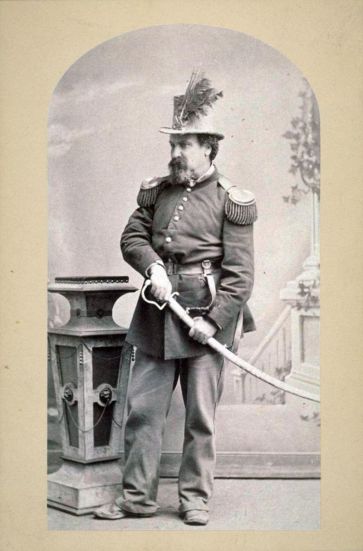
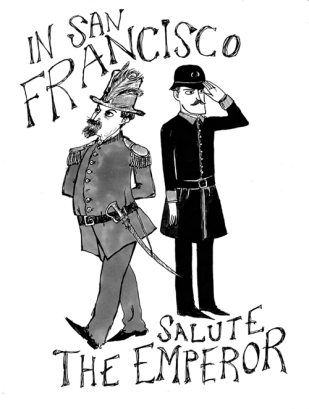
images (4)Norton wore an elaborate blue uniform with gold epaulettes, carrying a cane or saber and topped off with beaver hat with peacock feather.  By day he “inspected” the streets and public works of San Francisco, by night he would dine in the city’s finest establishments.  No play or musical performance would dare open in the city, without reserved balcony seats for Emperor Norton.
Mark Twain, who lived for a time in Emperor Norton’s San Francisco, patterned the King in Huckleberry Finn, on Joshua Norton.  Among his many proposals, Norton envisioned flying machines, the League of Nations, and the construction of the San Francisco Bay Bridge.

Though he was penniless, the “Official Norton Seal of Approval” was good for business. Some restaurants even put out brass plaques, declaring their “Appointment to his Imperial Majesty, Emperor Norton I of the United States”.

Norton was often accompanied by two stray dogs.  “Bummer” and “Lazarus” became quite the celebrities themselves, and usually dined for free along with the Emperor.

nortonsmIn 1867, police officer Armand Barbier arrested Norton, attempting to have him involuntarily committed to an insane asylum.  The public backlash was so vehement that Police Chief Patrick Crowley ordered Norton’s release and issued a public apology.  The episode ended well, when Emperor Norton magnanimously pardoned the police department.  After that, San Francisco cops saluted Emperor Norton whenever meeting him in the street.

The 1870 census records one Joshua Norton, age 50, occupation, Emperor, along with a note, declaring him to be insane.

Admiring supporters gave aid in the guise of “paying taxes”.  A local printer even printed “Imperial bonds”, emblazoned with Norton’s likeness and official seal.  To this day, Norton’s Notes are highly prized collector’s items.

Norton10dThe San Francisco Board of Supervisors once bought him a new uniform, when the old one got too shabby.  Norton responded with a very nice thank you note, issuing each of them a “Patent of Nobility in Perpetuity”.

On the evening of January 8, 1880, Norton collapsed on a sidewalk and died before help could arrive.  The San Francisco Chronicle published his obituary on the front page, under the headline “Le Roi est Mort” (“The King is Dead”). “On the reeking pavement”, began another obituary, “in the darkness of a moon-less night under the dripping rain…, Norton I, by the grace of God, Emperor of the United States and Protector of Mexico, departed this life.”

Emperor Norton’s funeral was attended by 10,000 loyal “subjects”.  His reign had lasted for twenty-one years.

quote-whoever-after-due-and-proper-warning-shall-be-heard-to-utter-the-abominable-word-frisco-emperor-norton-96-45-18

October 11, 1776 Valcour Island

One day, Benedict Arnold would enter history as a traitor to his country. For now, he had bought his young nation, another year in which to fight.

In the early days of the American Revolution, the 2nd Continental Congress looked north, to the Province of Quebec. The region was lightly defended at the time, and Congress was alarmed at its potential as a British base from which to attack and divide the colonies.

The Continental army’s expedition to Quebec ended in disaster on December 31, as General Benedict Arnold was severely injured with a bullet wound to his left leg.  Major General Richard Montgomery was killed and Colonel Daniel Morgan was captured, along with about 400 fellow patriots.

liberty
Profile of the schooner “Liberty”

Quebec was massively reinforced in the Spring of 1776, with the arrival of 10,000 British and Hessian soldiers. By June, the remnants of the Continental army had been driven south to Fort Ticonderoga and Fort Crown Point.

Congress was right about the British intent to split the colonies.  General Sir Guy Carleton, provincial governor of Quebec, set about doing so almost immediately.

Retreating colonials took with them or destroyed almost every boat along the way, capturing and arming four vessels in 1775:  the Liberty, Enterprise, Royal Savage, and Revenge.  Determined to take back the crucial waterway, the British set about disassembling warships along the St. Lawrence, moving them overland to Fort Saint-Jean on the uppermost navigable waters leading to Lake Champlain, the 125-mile long lake dividing upstate New York from Vermont.

There they spent the summer and early fall of 1776, literally building a fleet of warships along the upper reaches of the lake.  120 miles to their south, colonials were doing the same.

sawmill_ft_anne
Sawmill at Fort Anne

The Americans had a small fleet of shallow draft bateaux used for lake transport, but needed something larger and heavier to sustain naval combat.

In 1759, British Army Captain Philip Skene founded a settlement on the New York side of Lake Champlain, built around saw mills, grist mills, and an iron foundry.

Today, the former village of Skenesborough is known as “Whitehall”, considered by many to be the birthplace of the United States Navy.  In 1776, Major General Horatio Gates put the American ship building operation into motion on the banks of Skenesborough Harbor.

Hermanus Schuyler oversaw the effort, while military engineer Jeduthan Baldwin was in charge of outfitting. Gates asked General Benedict Arnold, an experienced ship’s captain, to spearhead the effort, explaining “I am intirely uninform’d as to Marine Affairs”.

200 carpenters and shipwrights were recruited to the wilderness of upstate New York. So inhospitable was this duty that workmen were paid more than anyone else in the Navy, with the sole exception of Commodore Esek Hopkins. Meanwhile, foraging parties scoured the countryside looking for guns, knowing that there was going to be a fight on Lake Champlain.

It is not widely known, that the American Revolution was fought in the midst of a smallpox pandemic. General George Washington was an early proponent of vaccination, an untold benefit to the American war effort.  Nevertheless, a fever broke out among the shipbuilders of Skenesborough, that almost brought their work to a halt.

Valcour 3
Lake Champlain:  Garden island (right), Valcour Island (left)

It was a hastily built and in some cases incomplete fleet that slipped into the water in the summer and autumn of 1776.  In just over two months, the American shipbuilding effort produced eight 54′ gondolas (gunboats), and four 72′  galleys.  Upon completion, each hull was rowed to Fort Ticonderoga, where it was fitted with masts, rigging, guns, and supplies. By October 1776, the American fleet numbered 16 vessels, determined to stop the British fleet heading south.

As the two sides closed in the early days of October, General Arnold knew he was at a disadvantage.  The element of surprise was going to be critical.  Arnold chose a small strait to the west of Valcour Island, where he was hidden from the main part of the lake. There he drew his small fleet into a crescent formation, and waited.

Carleton’s fleet, commanded by Captain Thomas Pringle, entered the northern end of Lake Champlain on October 9.

Valcour 2Sailing south on the 11th under favorable winds, some of the British ships had already passed the American position behind Valcour island, before realizing they were there. Some of the British warships were able to turn and give battle, but the largest ones were unable to turn into the wind.

Fighting continued for several hours until dark, and both sides did some damage.  On the American side, Royal Savage ran aground and burned. The gondola Philadelphia was sunk. On the British side, one gunboat blew up. The two sides lost about 60 men, each.  In the end, the larger ships and the more experienced seamanship of the English, made it an uneven fight.

ValcourIslandMap1776Detail

Only a third of the British fleet was engaged that day, but the battle went badly for the Patriot side. That night, the battered remnants of the American fleet slipped through a gap in the lines, limping down the lake on muffled oars. British commanders were surprised to find them gone the next morning, and gave chase.

One vessel after another was overtaken and destroyed on the 12th, or else, too damaged to go on, was abandoned.  The cutter Lee was run aground by its crew, who then escaped through the woods.  Four of sixteen American vessels escaped north to Ticonderoga, only to be captured or destroyed by British forces, the following year.

Valcour 1On the third day, the last four gunboats and Benedict Arnold’s flagship Congress were run aground in Ferris Bay on the Vermont side, following a 2½-hour running gun battle.  Today, the small harbor is called Arnold’s Bay.

200 escaped to shore, the last of whom was Benedict Arnold himself, personally torching his own flagship before leaving it for the last time, flag still flying.

The British would retain control of Lake Champlain, through the end of the war.

The American fleet never had a chance and everyone knew it.  Yet it had been able to inflict enough damage at a point late enough in the year, that Carlton’s fleet was left with no choice but to return north for the winter. One day, Benedict Arnold would enter history as a traitor to his country.  For now, the General had bought his young nation, another year in which to fight.

postcard
A 1905 postcard displays the remains of Benedict Arnold’s flagship, the “Congress”.