Fifteen years before Angus “Mac” MacGyver hit your television screen, mission control teams, spacecraft manufacturers and the crew itself worked around the clock to “MacGyver” life support, navigational and propulsion systems. For four days and nights, the three-man crew lived aboard the cramped, freezing Aquarius, a landing module intended to support a crew of 2 for only a day and one-half.
The seventh manned mission in the Apollo space program was scheduled to be the third moon landing, launching at 13:13 Central Standard Time from the Kennedy Space Center in Florida.
Jack Swigert was the backup pilot for the Command Module (CM), officially joining the Apollo 13 mission only 48 hours earlier, when prime crew member Ken Mattingly was grounded, following exposure to German measles.
Jim Lovell was the most seasoned astronaut in the world at that time, a veteran of two Gemini missions and Apollo 8. By launch day, April 11, 1970, Lovell had racked up 572 space flight hours. For Fred Haise, backup crew member on Apollo 8 and 11, this would be his first spaceflight.
Apollo 13, original crew photo, Left to right: Commander, James A. Lovell Jr., CM pilot Ken Mattingly, LM pilot, Fred W. Haise Jr.
Two separate vessels were joined to form the Apollo spacecraft, separated by an airtight hatch. The crew lived in a Command/Service module called “Odyssey”. The Landing Module (LM) dubbed “Aquarius”, would perform the actual moon landing.
56 hours into the mission and 5½ hours from the Moon’s sphere of gravitational influence, Apollo crew members had just finished a live TV broadcast. Haise was powering the LM down while Lovell stowed the TV camera. Mission Control asked Swigert to activate stirring fans in the Service Module’s hydrogen and oxygen tank. Two minutes later, the astronauts heard a “loud bang”.
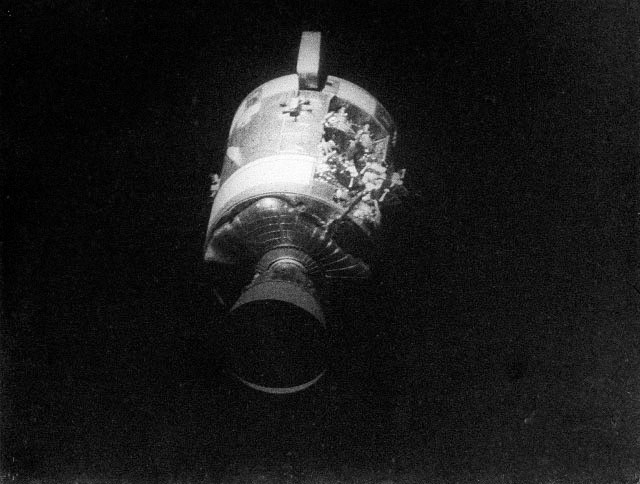
Manufacturing and testing of the vessel had both missed an exposed wire in an oxygen tank. Swigert had flipped the switch for a routine procedure, causing a spark to set the oxygen tank on fire. Alarm lights lit up all over Odyssey and in Mission Control. The entire spacecraft shuddered as one oxygen tank tore itself apart and damaged another. Power began to fluctuate. Attitude control thrusters fired, and communications temporarily went dark.
The crew could not have known at the time. The entire Sector 4 panel had just blown off.
The movie takes creative license with Commander James Lovell saying “Houston, we have a problem”. On board the real Apollo 13 it was Jack Swigert who spoke: “Houston, we’ve had a problem”.
205,000 miles into deep space with life support systems shutting down, the Lunar Module became the only means of survival. There was no telling if the explosion had damaged Odyssey’s heat shields. It didn’t matter. For now, the challenge was to remain alive. Haise and Lovell frantically worked to boot up Aquarius, while Swigert shut down systems aboard Odyssey. Power needed to be preserved for splashdown.
The situation had been suggested during an earlier training simulation, but considered unlikely. As it happened, the accident would have been fatal without access to the Lunar Module.
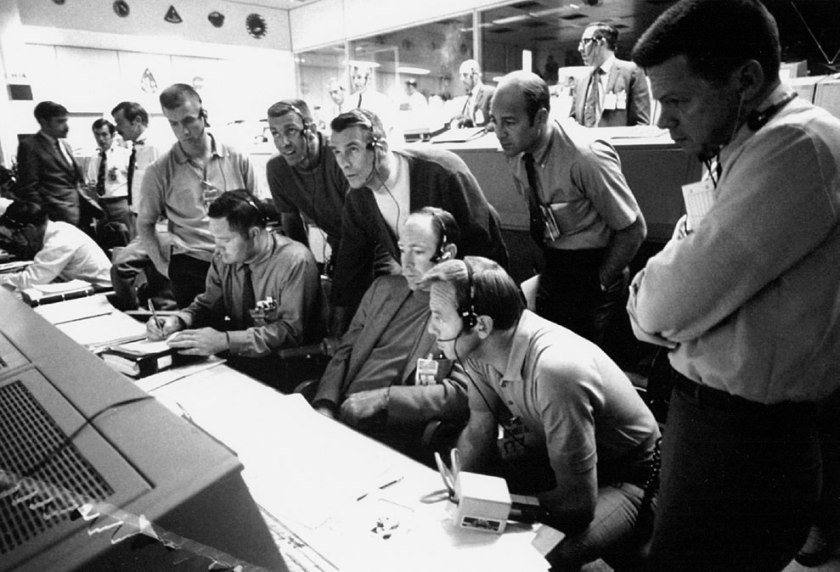
Fifteen years before Angus “Mac” MacGyver hit your television screen, mission control teams, spacecraft manufacturers and the crew itself worked around the clock to “MacGyver” life support, navigational and propulsion systems. For four days and nights, the three-man crew lived aboard the cramped, freezing Aquarius, a landing module intended to support a crew of 2 for only a day and one-half.
With heat plummeting to near freezing food inedible and an acute shortage of water, this tiny, claustrophobic “lifeboat” would have to do what it was never intended to do.
Atmospheric re-entry alone presented near-insurmountable challenges. The earth’s atmosphere is a dense fluid medium. If you reenter at too steep an angle, you may as well be jumping off a high bridge. As it is, the human frame can withstand deceleration forces no higher than 12 Gs, equivalent to 12 individuals identical to yourself, piled on top of you. Even at that, you’re only going to survive a few minutes, at best.
We all know what it is to skip a stone off the surface of a pond. If you hit the atmosphere at too shallow an angle, the result is identical to that stone. There is no coming down a second time. You get one bounce and then there is nothing but the black void of space.
Apollo XIII timeline
Most of the country and much of the world held its breath for seventy-eight hours, waiting for the latest update from newspaper and television news. With communications impossible, TV commentators used models and illustrations, to describe the unfolding drama. On board Odyssey, power was so low that voice-only transmissions became difficult. Visual communications with Mission Control were as impossible as the idea that the stranded astronauts could get out and walk home.
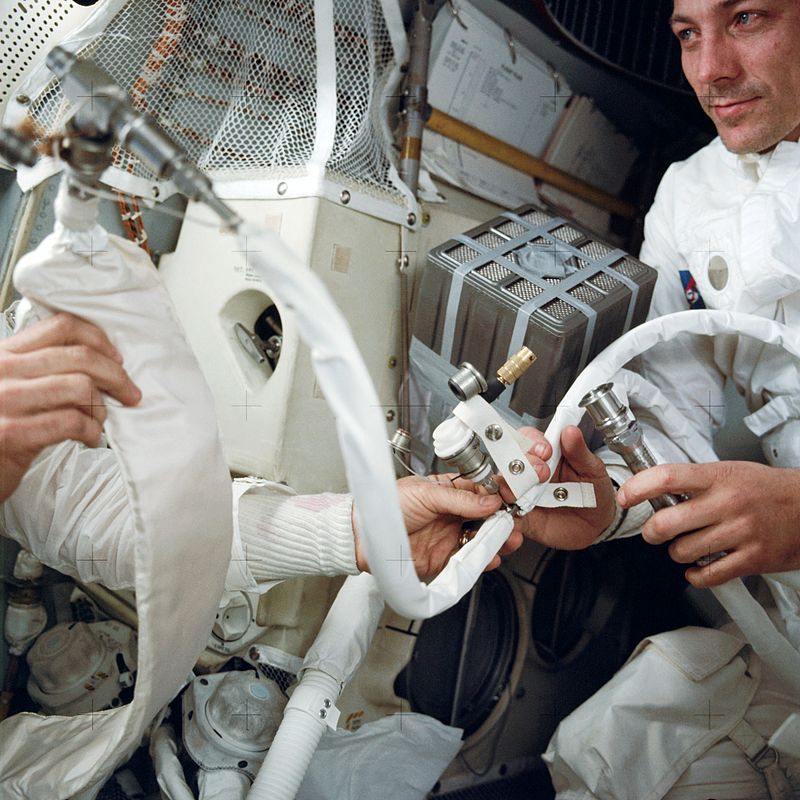
“Astronaut John L. Swigert, at right, with the “mailbox” rig improvised to adapt the command module’s square carbon dioxide scrubber cartridges to fit the lunar module, which took a round cartridge”. /T Wikipedia
As Odyssey neared earth, engineers and crew jury-rigged a means of jettisoning the spent Service Module, to create enough separation for safe re-entry.
One last problem to be solved, was the crew’s final transfer from Lunar Module back to Command Module, prior to re-entry. With the “reaction control system” dead, University of Toronto engineers had only slide rules and six hours in which to devise a way to “blow” the LM, by pressurizing the tunnel connecting it with the CM. Too much pressure might damage the hatch and seal. Too little wouldn’t provide enough separation between the two bodies. Either failure would result in one of those “shooting stars” you see at night, as the searing heat of re-entry incinerated the Command Module and everything in it.
Shooting star as seen by night, H/T contentbuket.com
By this time, the Command Module had been in “cold soak” for days. No one knew for certain, if the thing would come back to life.
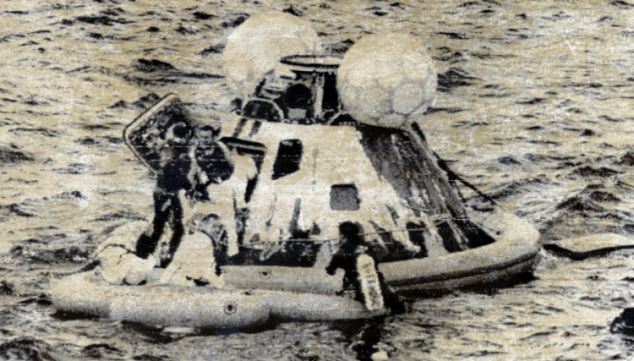
Crashing into the atmosphere at over 24,000mph, the capsule had 14 minutes in which to come to a full stop, splashing down in the waters of the Pacific Ocean. External temperatures on the Command Module reached 2,691° Fahrenheit, as the kinetic energy of re-entry converted to heat.
Apollo 13 landing
The Apollo 13 mission ended safely with splashdown southeast of American Samoa on April 17, 1970, at 18:07:41 local time. Exhausted and hungry, the entire crew had lost weight. Haise had developed a kidney infection. Total duration was 142 hours, 54 minutes and 41 seconds.
A Trivial Matter
“In 1992, Lovell…decided to write a book-length account of the incident titled Lost Moon. He and co-writer Jeff Kluger finished one chapter and a proposal, which was in turn sent to publishers and production houses. A bidding war was sparked, and Ron Howard’s Imagine Entertainment wound up winning film rights. The movie actually began shooting in 1994 before Lovell’s book was even released. (It was later re-titled Apollo 13.)” Hat Tip MentalFloss.com
In an age of informed consent and medical ethics review boards, it’s hard to imagine that human beings were once experimented upon, like lab mice.
In 380BC, Plato’s “Republic” described a societal group possessed of Reason and destined to govern the ideal society, comprised of a second class ruled by “Spirit”, and a third in the thrall of “Appetite”. This was the Greek philosopher’s “Guardian Class”, an elite and early prototype of a latter-day “Ubermensch”.
In the 19th century, Francis Galton studied the theories of his cousin Charles Darwin on the evolution of species, and applied these ideas to a system of selective breeding intended to bring “better” human beings into the world. He called this his theory of “Eugenics”.
Eugenics gained worldwide respectability in the early 20th century, when nations from Brazil to Japan adopted policies concerning involuntary sterilization of certain mental patients, the socially “undesirable” and various collections of misfits and outcasts.
“Better Babies” competitions sprang up at state fairs across the United States, where babies were measured, weighed, and “judged”. Like livestock. By the 1920s, such events had evolved into “Fitter Family” competitions.
The darker side of the Eugenics movement involved separating those deemed “inferior”, lest such persons be suffered to breed. By the height of the movement, some 30 states had passed legislation, legalizing involuntary sterilization of individuals considered “unfit” for reproduction. All told, some 60,000 American citizens were forcibly sterilized in state-sanctioned procedures.
The oldest public institution for the mentally disabled in the Western Hemisphere is the Massachusetts School for the Feeble-Minded, built in 1848.
Today, the place stands empty. At its height, the 196-acres and 72 buildings of this place were home to some 2,500 “feeble minded boys”, a model for the education of the mentally disabled. The institution’s third Superintendent Walter E. Fernald was a strong proponent of Eugenics. The place was renamed in his honor in 1925, the Walter E. Fernald State School later known as the Walter E. Fernald Developmental Center.
“Fernald” served a large population of the mentally disabled, along with a number of others who’d simply been abandoned by their parents. The Boston Globe has reported as many as half the population, tested in the normal IQ range.
In an age of informed consent and medical ethics review boards, it’s hard to imagine that the government once experimented on its citizens, like lab mice.
The 40-year Tuskegee syphilis experiment begun in 1932 is an infamous example of unethical clinical research, in which 600 impoverished Americans of African ancestry were “studied” for the effects of untreated syphilis. Beginning in 1955 and continuing for fifteen years, medical researchers from NYU and Yale University intentionally infected mentally disabled children of the Willowbrook State School in Staten Island New York with Hepatitis A, in order to study disease progression and potential treatments.
At Fernald, the Massachusetts Institute of Technology and the Quaker Oats Company came together in the study of radioactive oatmeal. No, Really!
Quaker Oats had been battling it out with Cream of Wheat since 1900, for a share of the lucrative hot cereal market. In the post WW2 period, Quaker alone rang up sales of $277 million. The Federal government’s dietary guidelines of 1943 elevated whole grains as an ideal source of nutrition, but there was a problem. Studies suggested that a naturally occurring cyclic acid called phytates contained in grains like oats, might inhibit the uptake of iron. Farina did not seem to have the same effect.
It was game, set and match to the Cream of Wheat people, and the stakes could not have been higher.
Enter, the “Science Club”. Conditions were brutal at the Fernald School. Boys were often deprived of meals or forced to do hard manual labor. There have been allegations of physical and sexual abuse, forced solitary confinement and threats of lobotomy.
74 boys joined the Science Club beginning in 1946, more for the goodies than any idea of Science. There were parties and trips to watch Red Sox games, Mickey Mouse watches and lots of hot breakfasts with Quaker Oatmeal, laced with radioactive tracers.
It was the dawn of the nuclear age. Some 210,000 civilians and GIs were subjected to nuclear radiation, without their knowledge or consent.
So it was that Quaker provided the oats, MIT received funding for the research, and the Fernald School supplied the…er…”Mice”. By this day in 1951, such experiments were only half-way through.
“In the three experiments, the boys at Fernald ate oats coated with radioactive iron tracers, milk with radioactive calcium tracers (radioactive atoms whose decay is measured to understand chemical reactions happening in the body), and were given injections of radioactive calcium. The first two experiments’ results were encouraging to Quaker: Oatmeal was no worse than farina when it came to inhibiting absorption of iron and calcium into the bloodstream. The third experiment showed that calcium entering the bloodstream goes straight to the bones, which would prove important in later studies of osteoporosis”. – Hat tip, Smithsonian.com
Secretary of Energy Hazel O’Leary declassified a number of Atomic Energy Commission documents in 1993, resulting in a lawsuit in ’95. In a hearing before the United States Senate, MIT’s David Litster claimed the experiment exposed the boys to no more than 170 – 330 millirems of radiation, about the same as 30 consecutive chest x-rays.
In January 1998, 30 former “students” settled with the Quaker Oats Company and MIT, for $1.37 Million. President Bill Clinton apologized on behalf of the Federal Government, and the AEC.
By 2001, the Fernald School was home to only 320 mentally disabled adults, aged 27 to 96 years. By the time it closed, the cost to the Massachusetts taxpayer was $1 million per year, per resident. The last patient was discharged on November 13, 2014, following a protracted legal battle which cost Massachusetts taxpayers another forty million dollars.
Today the place stands empty. A dark and crumbling monument, to the legacy of government “Health Care”.
A Trivial Matter
Ten experiments, some genius thought would be a good idea.
77 Americans of the Army and Navy Nurse Corps and a handful of civilians were captured with the fall of Corregidor, becoming the largest group of female POWs, of the war.
Military forces of the Japanese Empire appeared unstoppable in the months following the attack on Pearl Harbor, invading first Thailand, then the British possessions of Malaya, Singapore, and Hong Kong, as well as American military bases in Wake Island, Guam and the Philippines.
The United States was grotesquely unprepared to fight a World War in 1942, and dedicated itself to beating Adolf Hitler. General Douglas MacArthur abandoned the “Alamo of the Pacific” on March 11 saying “I shall return”, leaving 90,000 American and Filipino troops without food, supplies or support with which to fight off the Japanese offensive.
Some 75,000 American and Filipino troops surrendered on April 9, abandoning the Bataan peninsula to begin a 65-mile, five-day slog into captivity. Starving and sick with any number of tropical diseases, Japanese guards were sadistic in the 100-degree tropical sun. Marchers were beaten, decapitated or shot at random and bayoneted, if too weak to walk. Japanese tank drivers swerved out of the way to run over those who had fallen and were too slow in getting up. Some were burned alive.
Already crippled from tropical disease and starving from the long siege of Luzon, thousands perished in what came to be known as the Bataan Death March.
Margaret Utinsky
The American nurse Margaret Elizabeth (Doolin) Rowley came to the Philippines the late 1920s, a twenty-something widow and single mother to her young son, Charles. There she met and fell in love with John “Jack” Utinsky, a former Army Captain working as a civil engineer. The couple was married in 1934, and settled down to a life in Manila.
As the likelihood of war came to the far east, the US military ordered American wives out of the Philippines. Utinsky refused and took an apartment in Manila, while Jack went to work on the Bataan peninsula.
Margaret was forced aboard the last ship to leave as Japanese troops occupied Manila on January 2, 1942, but sneaked off the ship and returned to her apartment. Years later, Margaret Utinsky wrote in her book, “Miss U”:
“To go into an internment camp seemed like the sensible thing to do, but for the life of me I could not see what use I would be to myself or to anyone else cooped up there. … For from the moment the inconceivable thing happened and the Japanese arrived, there was just one thought in my mind—to find Jack.”
The weeks came and went while Margaret remained undiscovered. She ventured out in mid-March and sought help from the priests of Malate Convent, there using contacts to gain false identity papers as Rena Utinsky, a fictional nurse from the non-belligerent state of Lithuania.
On the eve of the American surrender, Lieutenant General Jonathan Wainwright ordered all military and civilian nurses off the Bataan peninsula, and onto the island of Corregidor.
77 Americans of the Army and Navy Nurse Corps and a handful of civilians were captured a month later with the fall of Corregidor, becoming the largest group of female POWs, of the war.
“Known as the “Angels of Bataan and Corregidor,” the group of army nurse continues to hold the distinction of not losing a single member during their three years in internment”. H/T FoxNews.com
The group was sent to Santo Tomas prison camp in July, joining a group of Navy nurses who had been there, for six months.
Conditions were horrendous in these camps, with disease, starvation and cartoonish levels of violence from sadistic guards. Up to and including summary execution. Army nurse Mary Bernice Brown-Menzie entered into captivity weighing 130-pounds in 1942. By the time of her liberation in February, 1945, she weighed 75.
Mary Bernice Brown
Brown wrote in her diary of one prisoner who was tied up for three days and nights in the burning sun before being shot in the back, and left to die. ““Whether he died instantly or wounded and bleeding lived on until he finally died, we will never know. But this cruel, heartless and brutal treatment filled us all with deep grief and sorrow.”
Carlos and Tina Makabali Jose talk about their mother, Adelaida Garcia Makabali, a nurse in Bataan and Corregidor. H/T BataanLegacy.org
Adelaida Garcia, H/T Fox News Channel
Margaret Utinsky used her false identity papers to secure a position with the Red Cross by this time, and went to Bataan looking for Jack. Dismayed by conditions among survivors of the Death march, Utinsky began to do little things for the thousands of prisoners of Camp O’Donnell. Money. Quinine. A little medicine.
Learning that Jack was dead, Utinsky became part of a small clandestine network, determined to do what they could for American POWs and Filipino resistance movements. Code named “Miss U”, she joined with 22-year-old Filipina hairdresser Naomi Flores (code name “looter”), American club owner Claire “High Pockets” Maybelle Snyder, a number of Filipino priests and a Spaniard named Ramon Amusategui.
WW2 propaganda poster
Suspected of aiding POWs, Utinsky was arrested and brought to Fort Santiago prison. There she was sexually assaulted and tortured, for thirty-two days. When confronted with that ship’s passenger log showing her real name, she claimed she had lied in order to secure work as a nurse. Imagine being beaten, and then beaten again, and again. For thirty two days. When that failed to gain a confession, her jailers decapitated five Filipino prisoners, in front of her cell. Another night, an American POW was tied to the bars of her cell and beaten so savagely that chunks of his flesh, wound up in her hair. Even beating the man to death in front of her was not enough, and she was thrown into a dungeon. For four days, without food or water.
“This New Testament was given to US Army nurse 2nd Lt. Edith Corns by Army Chaplain Perry O. Wilcox on 16 April 1942, while both were stationed on Corregidor. Shortly thereafter, the island was surrendered. Corns spent the remainder of the war in the Santo Tomas prison camp until it was liberated by an intrepid raid in February 1945 during the Battle of Manila. She was able to hold onto the New Testament for comfort throughout her imprisonment”. H/T National WW2 Museum, of New Orleans
She was finally released, provided she sign a statement attesting to her “good treatment”.
Utinsky was six weeks in hospital, recovering from the ordeal. Doctors wanted to amputate a leg infected with gangrene but she refused. The place was teeming with Japanese spies. She feared what she might give up, while under the influence of gas. In the end, the gangrene was cut out, without benefit of anesthesia.
Amusategui was found out and executed. Flores and Utinsky took refuge in the mountains, working with guerrilla groups for the remainder for the war. By the time it was over, Utinsky had lost 45 pounds, 35 percent of her body weight, and lost an inch in height. Her face was aged twenty-five years and her once auburn hair, turned white.
Back in the camps, POWs fashioned nurse’s uniforms made from khaki, under the leadership of Veteran Army Captain Maude Davison. Despite themselves suffering from disease and starvation, each was expected to finish her shifts, providing what care they could for the “The Battling Bastards of Bataan.”
Army Lieutenant Alice Zwicker of Maine tells of catching sparrows to eat during three years of captivity. You can read about her story in “The Life of a World War II Army Nurse in the War Zone and at Home”, by Walter MacDougall
It was the same for Navy nurses, led by Lieutenant Laura Cobb. In 1943, these women volunteered for transfer to Los Baños. The work gave them purpose. A reason to live.
Following the December 14, 1944 massacre at Palawan, United States Army Rangers and their Filipino allies staged a daring raid on Cabanatuan on January 27 and Camp O’Donnell, three days later. Santo Tomas was liberated on February 3, 1945 along with nearby Bilibid Prison and Los Baños on February 23.
Emaciated, tormented by tropical disease and without a day’s survival training between them, every one of the 66 Army nurses, eleven Navy nurses and one Nurse Anesthetist: Angels of Bataan and Corregidor lived to tell the tale and continued to perform their nurse’s duties, to the end.
On the inside, most would have told you the men they cared for were the heroes of this story. They never sought recognition. After the war, many of those men credited their survival to the Angels of Bataan and Corregidor. It was they who sought the recognition these women so richly deserved.
Today, none of the Angels of Bataan and Corregidor are believed to survive. Lieutenant Colonel Nancy Cantrell is an historian with the US Army Nurse’s Corps “They were a tough bunch,” Cantrell said in an interview with Soldier’s Magazine. “They had a mission. They were surviving for the boys … and each other. That does give you a bit of added strength.”
MAMA JULIE
Without order and work we will never survive.
This camp is guarded, you see, by Japanese
but we run it ourselves. And I was the one
(though many take credit) who labelled the quinine
Soda Bicarbonate so it wouldn’t be taken
and the one who said we’d care for the internees
imprisoned with us: Aussies, Brits, French —
other enemies of the Rising Sun, men, women,
children, all of them civilians. In khaki clothes
we’ve made by hand, we work our shifts.
No days off for heat waves or monsoon.
Only the bedridden are excused. These girls
are unprepared, call me Battle-Axe, but I know
how to whip them into shape. No whining.
No complaints We may be short on emetine
or anesthetic and have no reserves of insulin,
but what we do isn’t free choice. It’s a higher calling.
From ANGELS OF BATAAN, Susan Terris (Pudding House
Publications, 1999)
A Trivial Matter
Some 76,000 prisoners of war (66,000 Filipinos and 10,000 Americans) began the Bataan death march in April 1942. There are no precise numbers of those killed over those 65-miles. Estimates of the dead range from 2,500 Filipinos and 500 Americans, to 30 per cent of the entire force.
In the end, the German response to anticipated US action, brought about the very action it was trying to avoid.
In the early months of the “Great War”, the British Royal Navy imposed a surface blockade on the German high seas fleet. Even food was treated as a “contraband of war”, a measure widely regarded as an attempt to starve the German population. With good reason. One academic study performed ten years after the war, put the death toll by starvation at 424,000 in Germany alone. The German undersea fleet responded with a blockade of the British home islands, a devastating measure carried out against an island adversary dependent on massive levels of imports.
Sinking of the Linda Blanche out of Liverpoole, by Willy Stöwer
World War 2 was a time of few restrictions on submarine warfare. Belligerents attacked military and merchant vessels alike with prodigious loss of civilian life, but WW1 didn’t start out that way.
Wary of antagonizing neutral opinion, German Chancellor Theobald von Bethmann Hollweg argued against a “shoot without warning”policy but, strict adherence to maritime prize rules risked U-Boats and crews alike. By early 1915, Germany declared the waters surrounding the British home Isles a war zone, where even the vessels of neutral nations were at risk of being sunk.
“Q-Ship with gun. The hidden gun emerges as the cover and sides, masquerading as a deck structure, are dropped. From “Q” Boat Adventures: The Exploits of the Famous Mystery Ships by a “Q” Boat Commander, by Harold Auten, published by Herbert Jenkins Ltd” – Hat Tip HistoricEngland.org.uk
Desperate to find an effective countermeasure to the German “Unterseeboot”, Great Britain introduced heavily armed merchant ships with concealed weaponry in 1915, phony merchantmen designed to lure submarines into making surface attacks. Britain called these secret countermeasures “Q-ships”, after their home base in Queenstown, in Ireland. German sailors called them U-Boot-Fälle. “U-boat traps”.
Notices taken out in the New York Times and others, specifically warned the Lusitania was vulnerable to attack
The “unprovoked” sinking of noncombatant vessels, including the famous Lusitania in which 1,198 passengers lost their lives, became a primary justification for war. The German Empire, for her part, insisted that many of these vessels carried munitions intended to kill German boys on European battlefields.
Underwater, the submarines of WWI were slow and blind, on the surface, vulnerable to attack. In 1916, German policy vacillated between strict adherence to prize rules and unrestricted submarine warfare. The first put their people and vessels at extreme risk, the second threatened to bring neutrals like the United States and Brazil, into the war.
In 1916, President Woodrow Wilson won re-election with the slogan “He kept us out of war”, a conflict begun in Europe, two years earlier.
In a January 31, 1917 memorandum from German Ambassador Count Johann von Bernstorff to American Secretary of State Robert Lansing, the Ambassador stated that “sea traffic will be stopped with every available weapon and without further notice”, effective the following day. The German government was about to resume unrestricted submarine warfare.
Anticipating this resumption and expecting the decision to draw the United States into the war, German Foreign Secretary Arthur Zimmermann delivered a message to the German ambassador in Mexico, Heinrich von Eckardt. The telegram instructed Ambassador Eckardt that, if the United States seemed likely to enter the war, he was to approach the Mexican Government with a proposal for military alliance, promising “lost territory” in Texas, New Mexico, and Arizona in exchange for a Mexican declaration of war against the United States.
“We intend to begin on the first of February unrestricted submarine warfare. We shall endeavor in spite of this to keep the United States of America neutral. In the event of this not succeeding, we make Mexico a proposal of alliance on the following basis: make war together, make peace together, generous financial support and an understanding on our part that Mexico is to reconquer the lost territory in Texas, New Mexico, and Arizona. The settlement in detail is left to you. You will inform the President of the above most secretly as soon as the outbreak of war with the United States of America is certain, and add the suggestion that he should, on his own initiative, invite Japan to immediate adherence and at the same time mediate between Japan and ourselves. Please call the President’s attention to the fact that the ruthless employment of our submarines now offers the prospect of compelling England in a few months to make peace”. Signed, ZIMMERMANN
The “Zimmermann Telegram” was intercepted and decoded by British intelligence and revealed to the American government on February 24. The contents of the message outraged American public opinion and helped generate support for the United States’ declaration of war.
In the end, the German response to anticipated US action, brought about the very action it was trying to avoid.
President Woodrow Wilson delivered his war message to a joint session of Congress on April 2, stating that a declaration of war on Imperial Germany would make the world “Safe for Democracy”. Congress voted to support American entry into the war on April 6, 1917. The “Great War”, the “War to end all Wars”, had become a World War.
At the time, a secondary explosion within the hull of RMS Lusitania caused many to believe the liner had been struck by a second torpedo. In 1968, American businessman Gregg Bemis purchased the wreck of the Lusitania for $2,400, from the Liverpool & London War Risks Insurance Association. In 2007 the Irish government granted Bemis a five-year license to conduct limited excavations at the site.
Twelve miles off the Irish coast and 300-feet down, a dive was conducted on the wreck in 2008. Remote submersible operators discovered some 4,000,000 rounds of Remington .303 ammunition in the hold, proof of the German claim that Lusitania was, in fact, a legitimate target under international rules of war. The UK Daily Mail quoted Bemis: “There were literally tons and tons of stuff stored in unrefrigerated cargo holds that were dubiously marked cheese, butter and oysters’”.
American historian, author and journalist Wade Hampton Sides accompanied the expedition. “They are bullets that were expressly manufactured to kill Germans in World War I” he said, “bullets that British officials in Whitehall, and American officials in Washington, have long denied were aboard the Lusitania.‘”
Montana Republican Jeannette Pickering Rankin, a life-long pacifist and the first woman elected to the United States Congress, would be one of only fifty votes against entering WWI. Rankin would be elected to a second (non-contiguous) term in 1940, just in time to be the only vote against entering WWII, following the Japanese attack on the United States’ Pacific anchorage at Pearl Harbor.
A Trivial Matter
“Although their exact policy varied throughout the war the German U-boats racked up a total of 12,850,815 tons of shipping sunk. The highest total for a single year was 1917, when unlimited submarine warfare resumed and 6,235,878 tons was sunk”. H/T Historyhit.com
Sybil Ludington received the thanks of family and friends and even that of George Washington. She then stepped off the pages of history.
“Listen my children and you shall hear, Of the midnight ride of”…Sybil Ludington.
Wait…What?
Paul Revere’s famous “midnight ride” began on the night of April 18, 1775. Revere was one of two riders, soon joined by a third, fanning out from Boston to warn of an oncoming column of “regulars”, come to destroy the stockpile of gunpowder, ammunition, and cannon in Concord.
Revere himself covered barely 12 miles before being captured, his horse confiscated to replace the tired mount of a British sergeant. Revere would finish his “ride” on foot, arriving at sunrise on the 19th to witness the last moments of the battle on Lexington Green.
Two years later, Patriot forces maintained a similar supply depot, in the southwest Connecticut town of Danbury.
William Tryon was the Royal Governor of New York, and long-standing advocate for attacks on civilian targets. In 1777, Tryon was major-general of the provincial army. On April 25th, the General set sail for the Connecticut coast of Long Island Sound with a force of 1,800, intending to destroy Danbury.
Patriot Colonel Joseph Cooke’s small Danbury garrison was caught and quickly overpowered on the 26th, trying to remove food supplies, uniforms, and equipment. Facing little if any opposition, Tryon’s forces went on a bender, burning homes, farms and storehouses. Thousands of barrels of pork, beef, and flour were destroyed, along with 5,000 pairs of shoes, 2,000 bushels of grain, and 1,600 tents.
Colonel Henry Ludington was a farmer and father of 12, with a long military career. A long-standing and loyal subject of the British crown, Ludington switched sides in 1773, joining the rebel cause and rising to command the 7th Regiment of the Dutchess County Militia, in New York’s Hudson Valley.
In April 1777, Ludington’s militia was disbanded for planting season, and spread across the countryside. An exhausted rider arrived at the Ludington farm on a blown horse, on the evening of the 26th, asking for help. 15 miles away, British regulars and a force of loyalists were burning Danbury to the ground.
The Dutchess County Militia had to be called up. The Colonel had one night to prepare for battle, and this rider was done. The job would have to go to Colonel Ludington’s first-born, his daughter, Sybil.
Born April 5, 1761, Sybil Ludington was barely sixteen at the time of her ride. From Poughkeepsie to what is now Putnam County and back, the “Female Paul Revere” rode across the lower Hudson River Valley, covering 40 miles in the pitch dark of night, alerting her father’s militia to the danger and urging them to come out and fight. She’d use a stick to knock on doors, even using it once, to fight off a highway bandit.
By the time Sybil returned the next morning, cold, rain-soaked, and exhausted, most of 400 militia were ready to march.
Arnold’s forces arrived too late to save Danbury, but inflicted a nasty surprise on the British rearguard as the column approached nearby Ridgefield. Never outnumbered by less than three-to-one, Connecticut militia was able to slow the British advance until Ludington’s New York Militia arrived on the following day. The last phase of the action saw the same type of swarming harassment, as seen on the British retreat from Concord to Boston, early in the war.35 miles to the east of Danbury, General Benedict Arnold was gathering a force of 500 regular and irregular Connecticut militia, with Generals David Wooster and Gold Selleck Silliman.
Though the British operation was a tactical success, the mauling inflicted by these colonials ensured that this was the last hostile British landing on the Connecticut coast.
The British raid on Danbury destroyed at least 19 houses and 22 stores and barns. Town officials submitted £16,000 in claims to Congress, for which town selectmen received £500 reimbursement. Further claims were made to the General Assembly of Connecticut in 1787, for which Danbury was awarded land. In Ohio.
At the time, Benedict Arnold planned to travel to Philadelphia, to protest the promotion of officers junior to himself, to Major General. Arnold, who’d had two horses shot out from under him at Ridgefield, was promoted to Major General in recognition for his role in the battle. Along with that promotion came a horse, “properly caparisoned as a token of … approbation of his gallant conduct … in the late enterprize to Danbury.” For now, the pride which would one day be his undoing, was assuaged.The Keeler Tavern in Ridgefield is now a museum. The British cannonball fired into the side of the building, remains there to this day.
Henry Ludington would become Aide-de-Camp to General George Washington, and grandfather to Harrison Ludington, mayor of Milwaukee and 12th Governor of Wisconsin.
Gold Silliman was kidnapped with his son by a first marriage by Tory neighbors, and held for Nearly seven months at a New York farmhouse. Having no hostage of equal rank with whom to exchange for the General, Patriot forces went out and kidnapped one of their own, in the person of Chief Justice Judge Thomas Jones, of Long Island.
Mary Silliman was left to run the farm, including caring for her own midwife, who was brutally raped by English forces for denying them the use of her home. The 1993 made-for-TV movie “Mary Silliman’s War” tells the story of non-combatants, pregnant mothers and farm wives during the Revolution, as well as Mary’s own negotiations for her husband’s release from his Loyalist captors.
General David Wooster was mortally wounded at the Battle of Ridgefield, moments after shouting “Come on my boys! Never mind such random shots!” Today, an archway marks the entrance to Wooster Square, in the East Rock Neighborhood of New Haven.
Sybil Ludington received the thanks of family and friends and even that of George Washington. She then stepped off the pages of history.
Paul Revere’s famous ride would have likewise faded into obscurity, but for the poetry of Henry Wadsworth Longfellow. Eighty-six years, later.
“Listen my children and you shall hear
Of the midnight ride of Paul Revere,
On the eighteenth of April, in Seventy-five;
Hardly a man is now alive
Who remembers that famous day and year.He said to his friend, “If the British march
By land or sea from the town to-night,
Hang a lantern aloft in the belfry arch
Of the North Church tower as a signal light,–
One if by land, and two if by sea;
And I on the opposite shore will be,
Ready to ride and spread the alarm
Through every Middlesex village and farm,
For the country folk to be up and to arm.”Then he said “Good-night!” and with muffled oar
Silently rowed to the Charlestown shore,
Just as the moon rose over the bay,
Where swinging wide at her moorings lay
The Somerset, British man-of-war;
A phantom ship, with each mast and spar
Across the moon like a prison bar,
And a huge black hulk, that was magnified
By its own reflection in the tide.Meanwhile, his friend through alley and street
Wanders and watches, with eager ears,
Till in the silence around him he hears
The muster of men at the barrack door,
The sound of arms, and the tramp of feet,
And the measured tread of the grenadiers,
Marching down to their boats on the shore.Then he climbed the tower of the Old North Church,
By the wooden stairs, with stealthy tread,
To the belfry chamber overhead,
And startled the pigeons from their perch
On the sombre rafters, that round him made
Masses and moving shapes of shade,–
By the trembling ladder, steep and tall,
To the highest window in the wall,
Where he paused to listen and look down
A moment on the roofs of the town
And the moonlight flowing over all.Beneath, in the churchyard, lay the dead,
In their night encampment on the hill,
Wrapped in silence so deep and still
That he could hear, like a sentinel’s tread,
The watchful night-wind, as it went
Creeping along from tent to tent,
And seeming to whisper, “All is well!”
A moment only he feels the spell
Of the place and the hour, and the secret dread
Of the lonely belfry and the dead;
For suddenly all his thoughts are bent
On a shadowy something far away,
Where the river widens to meet the bay,–
A line of black that bends and floats
On the rising tide like a bridge of boats.Meanwhile, impatient to mount and ride,
Booted and spurred, with a heavy stride
On the opposite shore walked Paul Revere.
Now he patted his horse’s side,
Now he gazed at the landscape far and near,
Then, impetuous, stamped the earth,
And turned and tightened his saddle girth;
But mostly he watched with eager search
The belfry tower of the Old North Church,
As it rose above the graves on the hill,
Lonely and spectral and sombre and still.
And lo! as he looks, on the belfry’s height
A glimmer, and then a gleam of light!
He springs to the saddle, the bridle he turns,
But lingers and gazes, till full on his sight
A second lamp in the belfry burns.A hurry of hoofs in a village street,
A shape in the moonlight, a bulk in the dark,
And beneath, from the pebbles, in passing, a spark
Struck out by a steed flying fearless and fleet;
That was all! And yet, through the gloom and the light,
The fate of a nation was riding that night;
And the spark struck out by that steed, in his flight,
Kindled the land into flame with its heat.
He has left the village and mounted the steep,
And beneath him, tranquil and broad and deep,
Is the Mystic, meeting the ocean tides;
And under the alders that skirt its edge,
Now soft on the sand, now loud on the ledge,
Is heard the tramp of his steed as he rides.It was twelve by the village clock
When he crossed the bridge into Medford town.
He heard the crowing of the cock,
And the barking of the farmer’s dog,
And felt the damp of the river fog,
That rises after the sun goes down.It was one by the village clock,
When he galloped into Lexington.
He saw the gilded weathercock
Swim in the moonlight as he passed,
And the meeting-house windows, black and bare,
Gaze at him with a spectral glare,
As if they already stood aghast
At the bloody work they would look upon.It was two by the village clock,
When he came to the bridge in Concord town.
He heard the bleating of the flock,
And the twitter of birds among the trees,
And felt the breath of the morning breeze
Blowing over the meadow brown.
And one was safe and asleep in his bed
Who at the bridge would be first to fall,
Who that day would be lying dead,
Pierced by a British musket ball.You know the rest. In the books you have read
How the British Regulars fired and fled,—
How the farmers gave them ball for ball,
From behind each fence and farmyard wall,
Chasing the redcoats down the lane,
Then crossing the fields to emerge again
Under the trees at the turn of the road,
And only pausing to fire and load.So through the night rode Paul Revere;
And so through the night went his cry of alarm
To every Middlesex village and farm,—
A cry of defiance, and not of fear,
A voice in the darkness, a knock at the door,
And a word that shall echo for evermore!
For, borne on the night-wind of the Past,
Through all our history, to the last,
In the hour of darkness and peril and need,
The people will waken and listen to hear
The hurrying hoof-beats of that steed,
And the midnight message of Paul Revere”.
Founding Mother
Fatherless at age three and orphaned at twelve, Mary Ball learned a sense of independence, at an early age. Mary was wed at age 22 in a “semi-arranged” marriage by her guardian, George Eskridge. Mary’s first and only husband was Augustine “Gus” Washington, father of six borne of the union. Gus died when the eldest was only eleven and Mary thirty-five, leaving Mary to raise Eskridge’s namesake and four surviving siblings, alone. Today, little is written about Martha Ball Washington, a woman whose personal strength of character, taught her son to lead by example. Though himself childless, eleven-year-old George would grow to become a General in the cause of Liberty, first President of the United States and “Father of his Country’.
With the exception of a few sled dogs in Alaska, the US was the only country to take part in World War I, with virtually no service dogs in its military.
By the last year of the Great War, the French, British and Belgians had at least 20,000 dogs on the battlefield. Imperial Germany had 30,000.
General Headquarters of the American Expeditionary Force recommended the use of dogs as sentries, messengers and draft animals in the spring of 1918. However, with the exception of a few sled dogs in Alaska, the US was the only country to take part in World War I, with virtually no service dogs in its military.
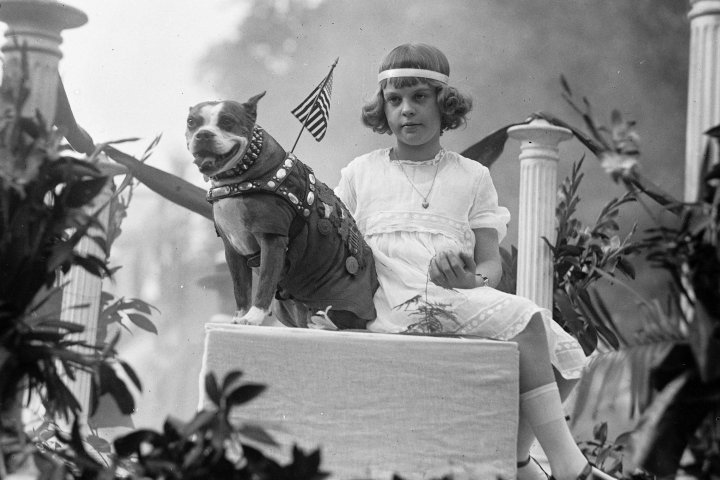
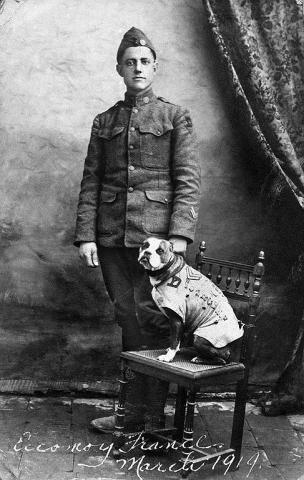
America’s first war dog, “Stubby”, got there by accident, and served 18 months ‘over there’, participating in seventeen battles on the Western Front.
He looked like a terrier of some kind, similar to a pit bull. Nobody knows anything more about him. He showed up as a stray at Yale Field in New Haven, Connecticut, while a group of soldiers were training. The dog hung around as the men drilled and one soldier, Corporal Robert Conroy, started taking care of him. Conroy hid Stubby on board the troop ship when the outfit shipped out in 1917.
Stubby saved his regiment from surprise \gas attacks, located and comforted the wounded, and even once caught a German spy by the seat of his pants. The Hun, who’d been prowling behind allied lines at the time, was mapping trenches for artillery bombardment. He was found spinning in circles with a large, muscular terrier affixed to his behind. The Bosch was easily disarmed, but it took a considerable amount of coaxing before Stubby could be persuaded to let go of that German’s rear end.
Stubby saw his first action at Chemin des Dames. Since the boom of artillery fire didn’t faze him, he learned to follow the men’s example of ducking when the big ones came close. It became a great game to see who could hit the dugout, first. After a few days, the guys were watching him for a signal. Stubby was always the first to hear incoming fire. We can only guess how many lives were spared by his early warning.
Following the Armistice, Stubby returned home as a nationally acclaimed hero, and was eventually received by presidents Harding and Coolidge. Even General John “Black Jack” Pershing, who commanded the AEF during the war, presented Stubby with a gold medal made by the Humane Society, declaring him to be a “hero of the highest caliber.”
Stubby toured the country by invitation and probably led more parades than any dog in American history. He was promoted to honorary Sergeant by the Legion, becoming the highest ranking dog to ever serve in the Army.
Old age caught up with the small warrior on April 4th, 1926, as he took ill and died in his master’s arms.
Sergeant Stubby and a few of his contemporaries were instrumental in inspiring the creation of the US K-9 Corps. Just in time for World War ll.
A Trivial Matter
On returning home following service during WW2, only 4 of 592 Marine Corps dogs failed to adapt to civil life.
Arriving at Nagoya #7 prison camp, Tonelli was handed a piece of paper. Scribbled on it was a 58. He was prisoner number 58, the same number he had once worn on his football Jersey. “From that point on,” he said, “I knew I was going to make it”.
The game was November 27, 1937. Late in the 4th quarter, Notre Dame was tied 6-6 with Southern California. The “Fighting Irish” needed a miracle. Notre Dame #58 Mario “Motts” Tonelli took the hand-off deep in Notre Dame territory and ran the ball 70 yards back before being tackled. Seconds later, the 5’11”, 195-pound fullback scored the game winning touchdown.
In some ways, Mario Tonelli himself was the miracle. Years earlier at the age of 6, he’d been burned over 80% of his body, when a trash compactor toppled over on him. Mario’s immigrant father Celi, a laborer from a northern Italian marble quarry, refused to believe the doctor who said his son would never walk again. Fixing four wheels to a door, the elder Tonelli taught his first American-born son to move about with his arms.
By 1935, Mario Tonelli was a football, basketball and track star at Chicago’s DePaul Academy.
After a year coaching at Providence College in 1939 and a year playing professional football for the Chicago Cardinals in 1940, Tonelli joined the Army in early 1941, assigned to the 200th Coast Artillery Regiment in Manila.
He’d hoped to fulfill his one years’ commitment and return to the Cardinals for the 1942 season, but it wasn’t meant to be. The radio crackled to life at 2:30am local time on December 7, 1941. “Air raid on Pearl Harbor. This is no drill!”
“A view of Pearl Harbor looking southwest from the hills towards the north. Taken during the Japanese raid, with anti-aircraft shell bursts overhead. Large column of smoke in lower center is from USS Arizona”. – H/T fstoppers.com
Military forces of Imperial Japan appeared unstoppable in the early months of World War Two, attacking first Thailand, then the British possessions of Malaya, Singapore, and Hong Kong as well as US military bases in Hawaii, Wake Island, Guam and the Philippines.
The United States was grotesquely unprepared to fight a World War in 1942, and dedicated itself to beating Adolf Hitler first. General Douglas MacArthur abandoned the “Alamo of the Pacific” on March 11 saying “I shall return”, leaving 90,000 American and Filipino troops without food, supplies or support with which to fight off the Japanese offensive.
On April 9, 75,000 surrendered the Bataan peninsula, beginning a 65 mile, five-day slog into captivity through the heat of the Philippine jungle. Japanese guards were sadistic. Some would beat the marchers at random, or bayonet those too weak to walk. Japanese tanks would swerve out of the way to run over anyone who had fallen and was too slow in getting up. Some were burned alive. Already crippled from tropical disease and starving from the long siege of Luzon, thousands perished in what came to be known as the Bataan Death March.
Exhausted, sunburned and aching with thirst, Tonelli still refused when a Japanese soldier demanded his Notre Dame class ring. As the guard reached for his sword, a nearby prisoner shouted “Give it to him. It’s not worth dying for”.
Minutes later, a Japanese officer appeared, speaking perfect English. “Did one of my men take something from you?” “Yes”, Tonelli replied. “My school ring”. “Here,” said the officer, pressing the ring into his hand. “Hide it somewhere. You may not get it back next time”. Tonelli was speechless. “I was educated in America”, the officer said. “At the University of Southern California. I know a little about the famous Notre Dame football team. In fact, I watched you beat USC in 1937. I know how much this ring means to you, so I wanted to get it back to you”.
Nearly 700 Americans and more than 10,000 Filipinos died on the Bataan death march. For the survivors, the ordeal was only beginning. For 2½ years Tonelli suffered starvation, disease and endless beatings in the squalid prison camps known as O’Donnell and Cabanatuan. He was later transferred to Davo Penal Colony (“Dapecol”), in Panabo City. Of an estimated 2,009 to enter Dapecol between October 1942- June 1944, only 805 survived the war.
Throughout the ordeal, Tonelli kept his ring. Buried in a soap dish. He’d take it out from time to time to remind himself. Life used to be better than this. It gave him something to hope for.
The hellish 60-day journey aboard the filthy, cramped merchant vessel began in late 1944, destined for slave labor camps in mainland Japan. Tonelli was barely 100 pounds on arrival, his body ravaged by malaria and intestinal parasites. He was barely half the man who once played fullback at Notre Dame Stadium, Soldier Field and Comiskey Park.
Arriving at Nagoya #7 prison camp, Tonelli was handed a piece of paper. Scribbled on it was a 58. He was prisoner number 58, the same number he had once worn on his football Jersey. “From that point on,” he said, “I knew I was going to make it”.
An American military tribunal conducted after the war held Lieutenant General Homma Masaharu, commander of the Japanese invasion forces in the Philippines, guilty of war crimes. He was executed by firing squad on April 3, 1946.
Mario Tonelli always hoped to meet the officer who’d returned his ring, but it wasn’t meant to be. He probably didn’t survive the war. Mario “Motts” Tonelli passed away in 2003, at the age of eighty-six. He still had that ring.
Afterward
In 1989, ROTC students at New Mexico State University held a memorial “Death March”. Since 1992, the Army installation at the White Sands Missile Range near Las Cruces has been host to the memorial. It’s two events, really, participants competing in “heavy” and “light” division wearing full uniform with rucksack or full running gear. Marchers in both divisions compete over a full marathon course of 26.2 miles of hilly desert terrain, or a shorter 14.2 mile course.
Two weeks ago, 8,631 registered participants gathered from fifty states and a dozen nations, to commemorate the Battle of Bataan and the death march, 77 years ago.
Five actual survivors were in attendance for the opening ceremony, wrapped in blankets to ward off the pre-dawn cold. They were Harold Bergbower, age 98. James Bollich, age 97. Valdemar DeHerrera, age 99. Paul Kerchum, age 99. Ben Skardon, age 101.
Mister Skardon actually marched in the March 17, 2019 event, covering three miles at the head of Skardon’s Brigade”.
The day began with a symbolic roll call. Most of the names were met with silence. Twelve more than the same event, last year.
“At 101 years old, Ben Skardon, center, is the oldest living Bataan Death March survivor to attend the memorial event at White Sands Missile Range. This year, he led “Ben’s Brigade” in an 3-mile march through the course on Sunday, March 17, 2019. (Photo: Kaitlin Englund/For the Sun-News)” H/T Ruidoso News
A Trivial Matter
Japanese guards made prisoners roast for hours the scorching Filipino sun, a torture known as “the sun treatment.” With little food and no water, Filipino civilians tried to throw food at the marchers. Most who did this were killed on the spot, by Japanese soldiers.
“Without freedom of thought there can be no such thing as wisdom and no such thing as public liberty without freedom of speech.” – Silence Dogood
The fifteenth child of Josiah and Abiah Franklin was born in a little house on Milk Street in Boston, across from the Old South Church.
The family moved to a larger house at Union & Hanover Street, when little Ben was six. As the tenth son, Benjamin Franklin was destined to be “tithed” to the church, but Josiah changed his mind after the boy’s first year in Boston Latin School. In light of the small salary, it was too expensive to educate a minister of the church.
The boy was sent to George Brownell’s English school for writing and arithmetic where he stayed until age ten, when he went to work in his father’s shop making tallow candles and boiling soap. After 1714, “Dr.” Benjamin Franklin’s education came exclusively from the books he picked up along the way.
By twelve the boy was “Hankering to go to sea”. His father was concerned about his running away. Knowing of the boy’s love of books, the elder Franklin apprenticed his son to the print shop of James Franklin, one of his elder sons, where he went to work setting type for books. And reading them. He would often “borrow” a book at night, returning it “early in the Morning lest it should be miss’d or wanted.”
By 1720, James Franklin began to publish The New England Courant, only the second newspaper to appear in the American colony.
Franklin often published essays and articles written by his friends, a group described as “The Hell-Fire Club”. Benjamin desperately wanted to be one of them, but James seemed to feel that sixteen-year-old little brothers should be seen, and not heard..
Sometime in March 1722, a letter appeared beneath the print shop door. “Sir, It may not be improper in the first Place to inform your Readers, that I intend once a Fortnight to present them, by the Help of this Paper, with a short Epistle, which I presume will add somewhat to their Entertainment”. The letter went on in some detail to describe the life of its author, Mrs. Silence Dogood.
That first letter was published on April 2. True to her word, Silence Dogood wrote again in two weeks. And then again, and again. Once every two weeks, for 28 weeks. Her letters were delightful, cleverly mocking the manners of Boston “Society”, and freely giving advice, particularly on the way that women should be treated. Nothing was sacred. One letter suggested that the only thing students learned at Harvard College, was conceit.
James Franklin and his literary friends loved the letters, and published every one. All of Boston was charmed with Silence Dogood’s subtle mockery of the city’s Old School Puritan elite. Proposals of marriage came into the print shop, when the widow Dogood coyly suggested that she would welcome suitors.
James was jailed at one point, for printing “scandalous libel” about Massachusetts Governor Joseph Dudley. The younger Franklin ran the shop in his absence, when Mrs. Dogood came to his defense. Quoting Cato, she proclaimed: “Without freedom of thought there can be no such thing as wisdom and no such thing as public liberty without freedom of speech.”
And then the letters stopped, much to the dismay of the Courant and its readership. One wrote to the editor, saying the paper had “lost a very valuable Correspondent, and the Public been depriv’d of many profitable Amusements.”
On December 3, James Franklin ran an ad. “If any Person . . . will give a true Account of Mrs. Silence Dogood, whether Dead or alive, Married or unmarried, in Town or Country, . . . they shall have Thanks for their Pains.” It was only then that his sixteen-year-old brother fessed up. Benjamin Franklin was the author of the Silence Dogood letters.
All of Boston was amused by the hoax, but not James. He was furious with his little brother, who soon broke the terms of his apprenticeship and fled to Pennsylvania.
So it was that a future Founding Father of the Republic, the inventor, scientist, writer and philosopher, the statesmen who appears on our $100 bill, came to Philadelphia. Within a few years Franklin had set up his own print shop, publishing the Philadelphia Gazette as well as his own book bindery, in addition to buying and selling books.
Benjamin Franklin’s efforts are in no small part a reason why literacy standards were higher in Colonial America, than among the landed gentry of 18th century England. Higher, I expect, than even today.
Franklin’s diplomacy to the Court of Versailles was every bit as important to the success of the Revolution, as the Generalship of the Father of the Republic, George Washington. Signatory to both the Declaration of Independence and the Constitution, it is arguably Ben Franklin who broke the impasse of the Convention of 1787, paving the way for ratification of the United States Constitution.
By then too old and frail to deliver his own speech, Franklin had someone else read his words to the deadlocked convention.
“On the whole, sir, I can not help expressing a wish that every member of the convention who may still have objections to it, would, with me, on this occasion, doubt a little of his own infallibility, and, to make manifest our unanimity, put his name to this instrument”.
As I witness the disintegration of civil society, over politics, I cannot deny the wish that my countrymen might, each in his turn, doubt a little of his own infallibility.
A Trivial Matter
Despite ending his formal education at age ten, Benjamin Franklin is considered to be one of the great polymaths along with the likes of Aristotle, Leonardo da Vinci and Albert Schweitzer. A prolific inventor, Franklin never patented a single one, believing such innovations should be shared, freely. A brief list of Franklin’s inventions include bifocal glasses, the lighting rod and the Franklin stove. The founding father’s personal favorite was a musical instrument which came to be played by the likes of Mozart and Beethoven: the Glass Armonica
The job of the Arlington Ladies is to honor, not to grieve, but it doesn’t always work out that way. Linda Willey of the Air Force Ladies describes the difficulty of burying Pentagon friends after 9/11, while pieces of debris yet littered the cemetery. Paula McKinley of the Navy Ladies still chokes up, over the hug of a ten-year old girl who had just lost both parents. Margaret Mensch speaks of the heartbreak of burying one of her own young escorts after he was killed in Afghanistan, in 2009.
The first military burial at Arlington National Cemetery was that of Private William Henry Christman, 67th Pennsylvania Infantry, interred on May 13, 1864. Two more joined Christman that day, the trickle soon turning into a flood. By the end of the war between the states, that number was 17,000 and rising.
In modern times, an average week will see 80 to 100 burials in the 612 acres of Arlington.
Fourteen years ago, a news release from the Department of Defense reported “Private First Class Michael A. Arciola, 20, of Elmsford, New York, died February 15, 2005, in Al Ramadi, Iraq, from injuries sustained from enemy small arms fire. Arciola was assigned to the 1st Battalion, 503d Infantry Regiment, 2nd Infantry Division, Camp Casey, Korea”.
Private Arciola joined a quarter-million buried in our nation’s most hallowed ground on March 31. Two hundred or more mourners attended his funeral, a tribute befitting the tragedy of the loss of one so young.
Sixteen others were buried that same Friday. Most were considerably older. Some brought only a dozen or so mourners. Others had no friends or family members whatsoever, on-hand to say goodbye.
Save for a volunteer, from the Arlington Ladies.
In 1948, Air Force Chief of Staff General Hoyt Vandenberg and the general’s wife Gladys, regularly attended funeral services at Arlington National cemetery.
Sometimes, a military chaplain was the only one present at these services. Both Vandenbergs felt that a member of the Air Force family should be present at these funerals. Gladys began to invite other officer’s wives. Over time, a group of women from the Officer’s Wives Club were formed for the purpose.
In 1973, General Creighton Abrams’ wife Julia did the same for the Army, forming a group calling themselves “Arlington Ladies”. Groups of Navy and Coast guard wives followed suit, in 1985 and 2006.
Traditionally, the Marine Corps Commandant sends an official representative of the Corps to all Marine funerals. The Marine Corps Arlington Ladies were formed in 2016.
Arlington Ladies’ Chairman Margaret Mensch explained “We’ve been accused of being professional mourners, but that isn’t true. I fight that perception all the time. What we’re doing is paying homage to Soldiers who have given their lives for our country.”
The casual visitor cannot help but being struck with the solemnity of such an occasion. Air Force Ladies’ Chairman Sue Ellen Lansell spoke of one service where the only other guest was “one elderly gentlemen who stood at the curb and would not come to the grave site. He was from the Soldier’s Home in Washington, D. C. One soldier walked up to invite him closer, but he said no, he was not family”.
The organization was traditionally formed of current or former military wives. Today their number includes daughters and even one “Arlington Gentleman”. 46 years ago they came alone, or in pairs. Today, 145 or so volunteers from four military branches are a recognized part of all funeral ceremonies at Arlington National Cemetery, their motto: “No Soldier will ever be buried alone.”
The volunteer arrives with a military escort from the Navy or the United States Army 3rd Infantry Regiment, the “Old Guard”. The horse-drawn caisson arrives from the old post chapel, carrying the flag draped casket. Joining the procession, she will quietly walk to the burial site, her arm inside that of her escort. A few words are spoken over the deceased, followed by the three-volley salute. Off in the distance, a solitary bugler sounds Taps.
The folded flag is presented to the grieving widow, or next of kin. Only then will she break her silence, stepping forward with a word of condolence and two cards: one from the service branch Chief of Staff and his wife and a second, from herself.
Joyce Johnson buried her husband Lieutenant Colonel Dennis Johnson in 2001, a victim of the Islamist terrorist attack on the Pentagon. Johnson remembers the Arlington Ladies’ volunteer as “a touchingly, human presence in a sea of starched uniforms and salutes”. Three years later, Joyce Johnson paid it forward, and became one herself.
Any given funeral may be that of a young military service member killed in service to the nation, or a veteran of Korea or WWII, who spent his last days in the old soldier’s home. It could be a four-star General or a Private. It matters not a whit.
“We’re not professional mourners. We’re here because we’re representing the Air Force family and because, one day, our families are going to be sitting there in that chair”. – Sandra Griffin, Air Force volunteer, Arlington Ladies
Individual volunteers attend about five funerals a day, sometimes as many as eight. As with the Tomb of the Unknown sentinels who hold their vigil heedless of weather, funeral services pay no mind, to weather conditions. The funeral will proceed on the date and time scheduled irrespective of rain, snow or heat. Regardless of weather, an Arlington Lady Will be in attendance.
The job of the Arlington Ladies is to honor, not to grieve, but it doesn’t always work out that way. Linda Willey of the Air Force Ladies describes the difficulty of burying Pentagon friends after 9/11, while pieces of debris yet littered the cemetery. Paula McKinley of the Navy Ladies still chokes up, over the hug of a ten-year old girl who had just lost both parents. Margaret Mensch speaks of the heartbreak of burying one of her own young escorts after he was killed in Afghanistan, in 2009.
Barbara Benson was herself a soldier, an Army flight nurse during WWII. She is the longest serving Arlington Lady. “I always try to add something personal”, Benson said, “especially for a much older woman. I always ask how long they were married. They like to tell you they were married 50 or 60 years…I don’t know how to say it really, I guess because I identify with Soldiers. That was my life for 31 years, so it just seems like the natural thing to do.”
Elinore Riedel was chairman of the Air Force Ladies during the War in Vietnam, when none of the other military branches had women representatives. “Most of the funerals were for young men,” she said. “I saw little boys running little airplanes over their father’s coffins. It is a gripping thing, and it makes you realize the awful sacrifices people made. Not only those who died, but those left behind.”
Mrs. Reidel is a minister’s daughter, who grew up watching her father serve those in need. “It doesn’t matter whether you know a person or not”, she said, “whether you will ever see them again. It calls upon the best in all of us to respond to someone in deep despair. I call it grace…I honestly feel we all need more grace in our lives.”
23-year veteran of the United States Air Force Sandra Griffin, now serves as an Arlington Lady.
This “Today in History” is dedicated to the man for whom I am namesake. United States Army Lieutenant Colonel (retired) Richard B. “Rick” Long, Sr., 2/25/37 – 3/31/18. Rest In Peace, Dad. You left us too soon.
“First they came for the socialists, and I did not speak out—because I was not a socialist. Then they came for the trade unionists, and I did not speak out— because I was not a trade unionist. Then they came for the Jews, and I did not speak out—because I was not a Jew. Then they came for me—and there was no one left to speak for me”. – Martin Niemöller
Before the age of the internet meme, office jokes and bits of folk wisdom were passed around and copied and copied again. There was one, “The Last great of Defiance“, which will live for all time as my favorite. The picture speaks for itself. I had one on the wall, for years.
This is one of those stories.
The last great effort of German arms burst out of the frozen Ardennes forest on December 16, 1944, aiming for the vital port at Antwerp.
“Unternehmen Wacht am Rhein“, (“Operation Watch on the Rhine”) was a tactical surprise for the Wehrmacht, as allied forces were driven back through the densely forested regions of France, Belgium and Luxembourg. Wartime news maps showed a great inward “bulge” in the lines, and the name stuck. The Battle of the Bulge was the largest and bloodiest battle fought by American forces in World War 2, fought in the harshest winter conditions in recorded history and involving some 610,000 GIs.
Prisoners were swept up by the thousands, and faced an uncertain future. In Malmedy, Belgium, seventy-five captured Americans were marched into an open field and machine gunned by members of the 1st SS Panzer Division (Leibstandarte Adolf Hitler), a part of 6th Panzer Army.
On December 16, the all-black 333rd Field Artillery Battalion of the racially segregated US Army put up an heroic defense outside the town of Wereth, Belgium, using their 155mm guns to delay the German advance. Desperately outnumbered, the 333rd was overrun the following day, groups of men scattering to escape as best they could. Eleven soldiers made their way to the home of Mathias Langer, the Mayor of Wereth.
To shelter allied troops under German occupation was to risk summary execution. Despite the obvious risk to their own lives, Matthias and his wife Maria took these men in and attempted to hide them, in their home. When German troops arrived, the eleven surrendered rather than risk the lives of their benefactors.
Movie poster for the 2011 film, “The Wereth Eleven”
The prisoners were marched out of sight and murdered, every one of them. The Wereth 11 were lost in the confusion of the Bulge, their bodies hidden under the snow until Spring melt. Their story was lost to history, for the next fifty years.
Nazi atrocities were not limited to Allied troops. By some accounts, more civilians were killed during the Battle of the Bulge than the last four years. When the fighting was over, more than 115 bodies were found in the towns of Ster and Parfondruy, alone.
For Master Sargent Roderick “Roddie” Edmonds, the war ended on December 19, swept up with hundreds of American troops and taken prisoner. These were the lucky ones, escaping those first white-hot moments of capture to be sent to a German prisoner-of-war camp. He was later transferred to another camp near Ziegenhain, Germany. At 24, M/Sgt Roddie Edmonds was the senior non-commissioned officer at Stalag IX-A, responsible for 1,275 American POWs.
The Wehrmacht had harsh anti-Jew policies and kept Jewish POWs in strict segregation. In the East, Russian Jewish POWs were sent directly to extermination camps. The future was more uncertain for Jewish POWs, in the west. Many were worked to death in slave labor camps.
On January 27, the first day at Stalag IX-A, commandant Siegmann ordered Edmonds: All American Jews were to identify themselves, at the following day’s assembly. The word went out to all five barracks: “We’re not doing that. We’re all turning out“.
The following morning, 1,275 POWs presented themselves. Every. Single. Man.
Siegmann was perplexed. “They can’t all be Jews!” As senior NCO, Edmonds spoke for the group. “We’re all Jews here“. The Nazi commandant was apoplectic, pressing a Luger into Edmonds’ forehead. This is your last chance.
Edmonds gave his name, rank and serial number, and then said: ‘If you are going to shoot, you are going to have to shoot all of us because we know who you are and you’ll be tried for war crimes when we win this war.'” Siegmann was incandescent, white with rage, but the moment had passed. He was beaten.
The 1,275 American POWs held at Stalag IX-A were liberated this day in 1945, including some 200 Jews.
Roddie Edmonds was again recruited for the war in Korea. He never told his family about any of it.
Chris Edmonds is the Pastor at Piney Grove Baptist Church in Maryville, Tennessee. Following his father’s death in 1985, Chris’ mother gave him his father’s war diary, where he found a brief mention of this story. Chris scoured the news for more information, around the time Richard Nixon was looking for his post-Presidential home. As it happened, Nixon bought his posh, upper-east side home from Lester Tanner, a prominent New York Lawyer who mentioned in passing, he owed his life to Roddie Edmonds.
So it was, this story came to light. In 2015, Edmonds was honored as “Righteous among the Nations”, the first American soldier, so honored. It’s the highest honor bestowed by the state of Israel, on non-Jews who risked their lives to save Jews from the Nazi death machine. President Barack Obama recognized Edmonds heroism in a 2016 speech before the Israeli embassy. The United States Congress bestowed the Congressional Gold Medal in 2017. As I write this, Pastor Edmonds and the Jewish veterans saved by M/Sgt Edmonds are pushing for the Knoxville, Tennessee native to receive the Medal of Honor.
Pastor Edmonds says he always looked up to his father, the man had always been, his hero. “I just didn’t know he had a cape in his closet“.


 The seventh manned mission in the Apollo space program was scheduled to be the third moon landing, launching at 13:13 Central Standard Time from the Kennedy Space Center in Florida.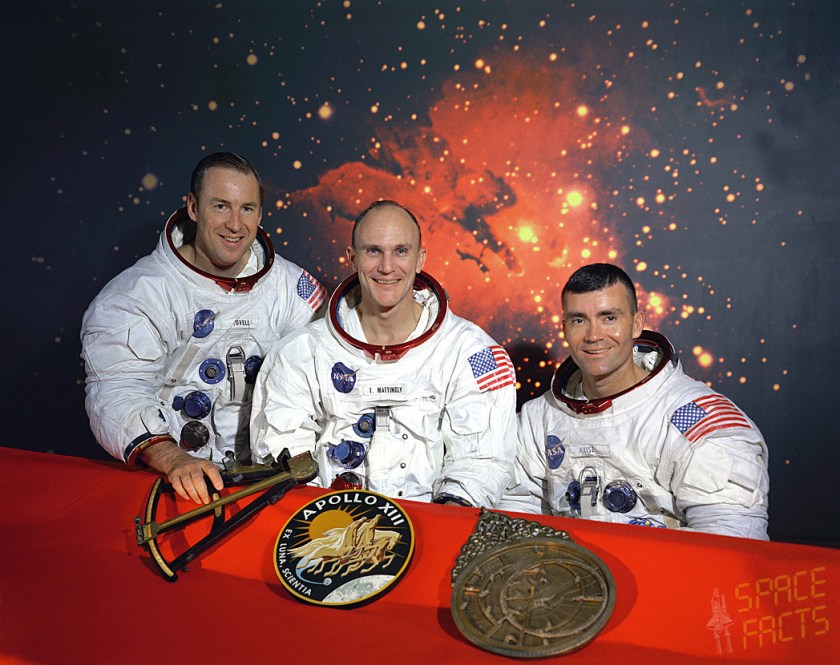

 Fifteen years before Angus “Mac” MacGyver hit your television screen, mission control teams, spacecraft manufacturers and the crew itself worked around the clock to “MacGyver” life support, navigational and propulsion systems. For four days and nights, the three-man crew lived aboard the cramped, freezing Aquarius, a landing module intended to support a crew of 2 for only a day and one-half.



 “To go into an internment camp seemed like the sensible thing to do, but for the life of me I could not see what use I would be to myself or to anyone else cooped up there. … For from the moment the inconceivable thing happened and the Japanese arrived, there was just one thought in my mind—to find Jack.”


 The “Zimmermann Telegram” was intercepted and decoded by British intelligence and revealed to the American government on February 24. The contents of the message outraged American public opinion and helped generate support for the United States’ declaration of war.


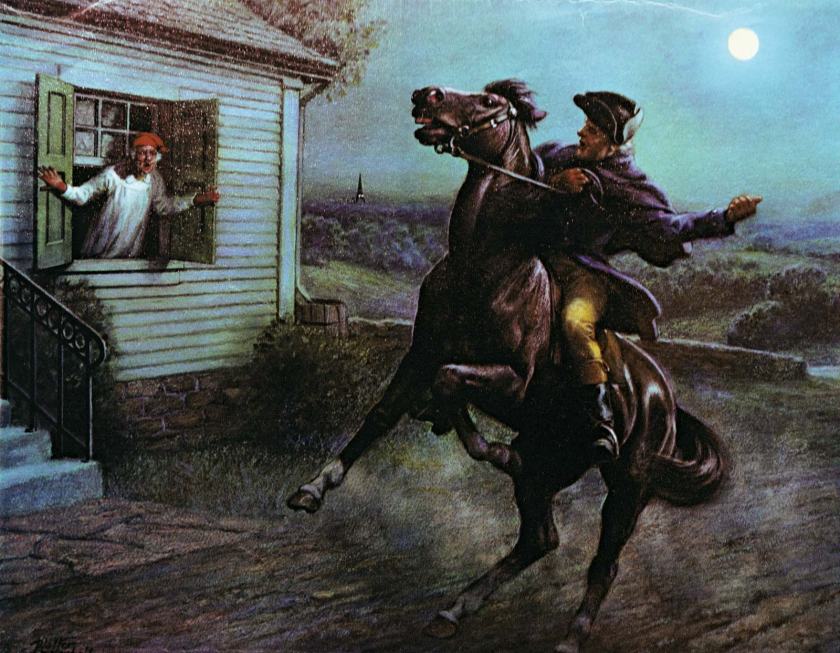 Revere himself covered barely 12 miles before being captured, his horse confiscated to replace the tired mount of a British sergeant. Revere would finish his “ride” on foot, arriving at sunrise on the 19th to witness the last moments of the battle on Lexington Green.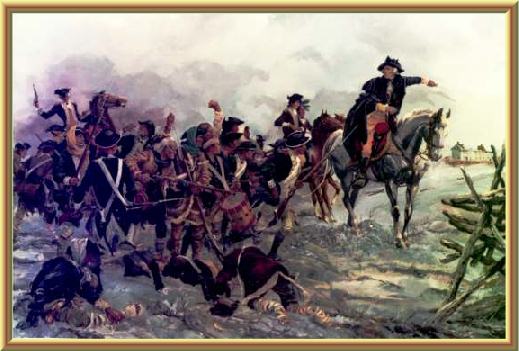
 In April 1777, Ludington’s militia was disbanded for planting season, and spread across the countryside. An exhausted rider arrived at the Ludington farm on a blown horse, on the evening of the 26th, asking for help. 15 miles away, British regulars and a force of loyalists were burning Danbury to the ground.
 At the time, Benedict Arnold planned to travel to Philadelphia, to protest the promotion of officers junior to himself, to Major General. Arnold, who’d had two horses shot out from under him at Ridgefield, was promoted to Major General in recognition for his role in the battle. Along with that promotion came a horse, “properly caparisoned as a token of … approbation of his gallant conduct … in the late enterprize to Danbury.” For now, the pride which would one day be his undoing, was assuaged.
 General David Wooster was mortally wounded at the Battle of Ridgefield, moments after shouting “Come on my boys! Never mind such random shots!” Today, an archway marks the entrance to Wooster Square, in the East Rock Neighborhood of New Haven.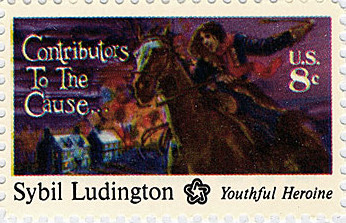


 By the last year of the Great War, the French, British and Belgians had at least 20,000 dogs on the battlefield. Imperial Germany had 30,000.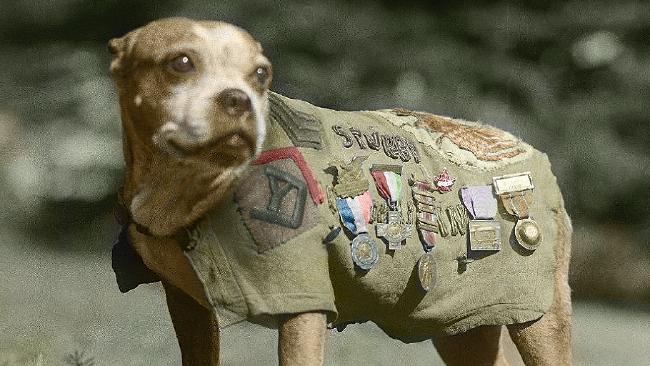
 Stubby saw his first action at Chemin des Dames. Since the boom of artillery fire didn’t faze him, he learned to follow the men’s example of ducking when the big ones came close. It became a great game to see who could hit the dugout, first. After a few days, the guys were watching him for a signal. Stubby was always the first to hear incoming fire. We can only guess how many lives were spared by his early warning.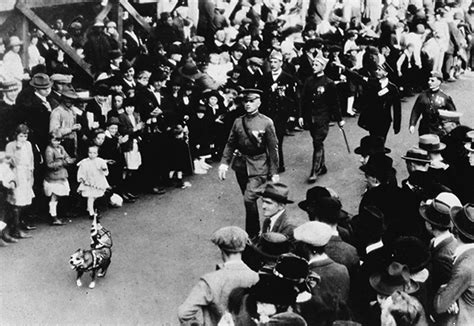

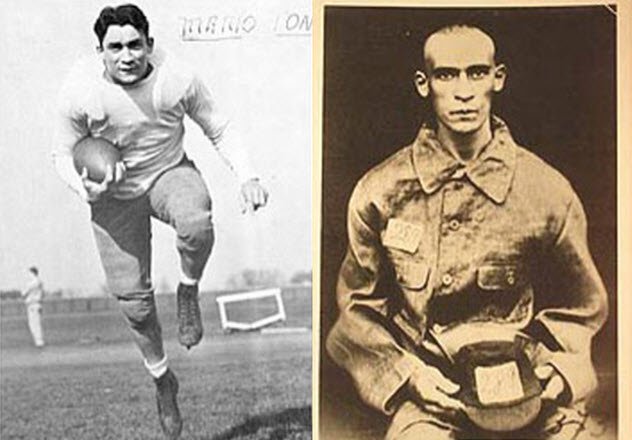
 In some ways, Mario Tonelli himself was the miracle. Years earlier at the age of 6, he’d been burned over 80% of his body, when a trash compactor toppled over on him. Mario’s immigrant father Celi, a laborer from a northern Italian marble quarry, refused to believe the doctor who said his son would never walk again. Fixing four wheels to a door, the elder Tonelli taught his first American-born son to move about with his arms.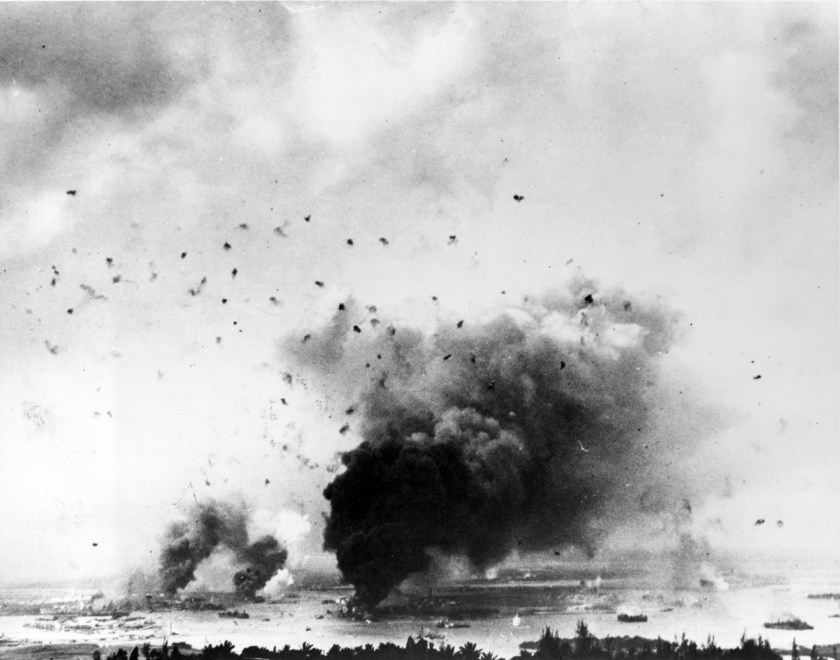
 On April 9, 75,000 surrendered the Bataan peninsula, beginning a 65 mile, five-day slog into captivity through the heat of the Philippine jungle. Japanese guards were sadistic. Some would beat the marchers at random, or bayonet those too weak to walk. Japanese tanks would swerve out of the way to run over anyone who had fallen and was too slow in getting up. Some were burned alive. Already crippled from tropical disease and starving from the long siege of Luzon, thousands perished in what came to be known as the Bataan Death March.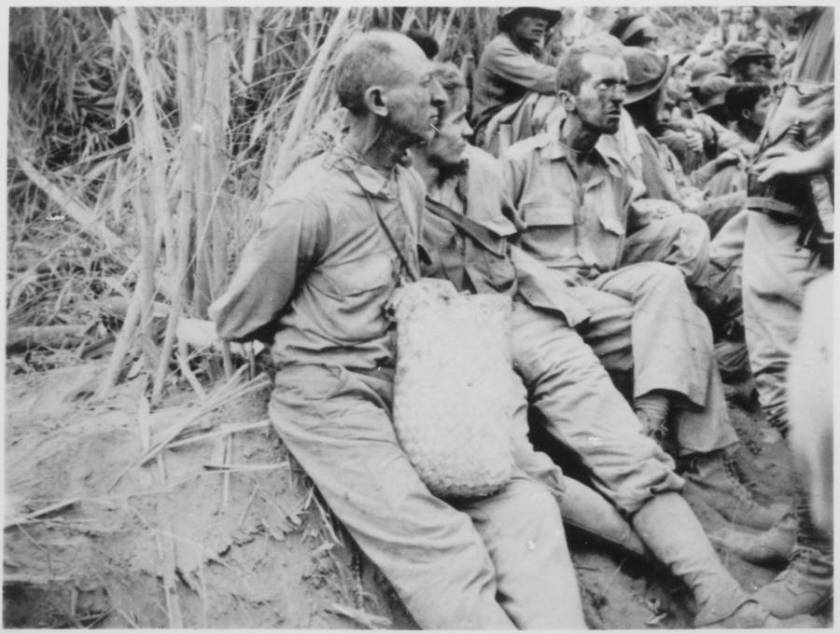
 An American military tribunal conducted after the war held Lieutenant General Homma Masaharu, commander of the Japanese invasion forces in the Philippines, guilty of war crimes. He was executed by firing squad on April 3, 1946.

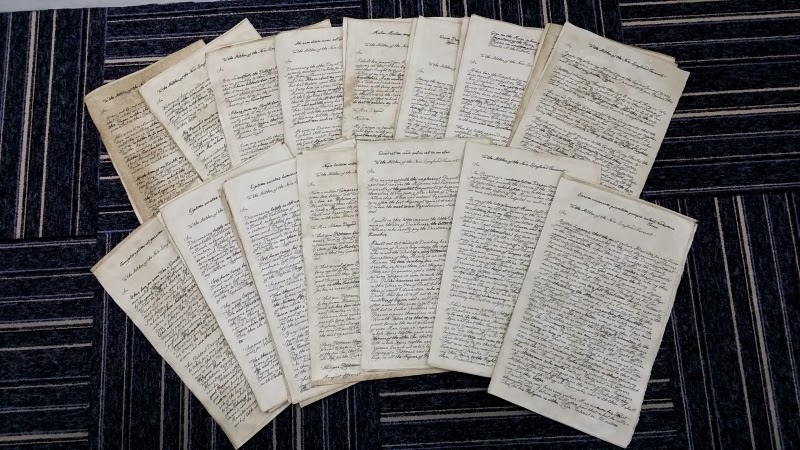
 By 1720, James Franklin began to publish The New England Courant, only the second newspaper to appear in the American colony.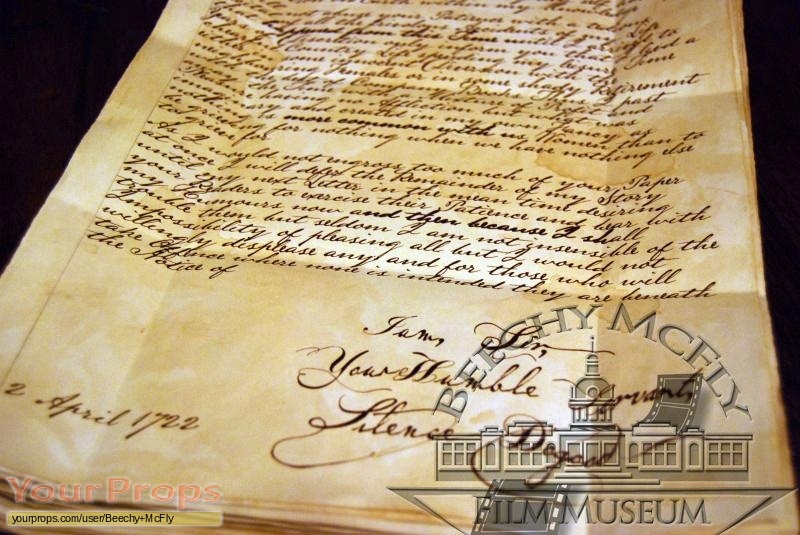
 James Franklin and his literary friends loved the letters, and published every one. All of Boston was charmed with Silence Dogood’s subtle mockery of the city’s Old School Puritan elite. Proposals of marriage came into the print shop, when the widow Dogood coyly suggested that she would welcome suitors.
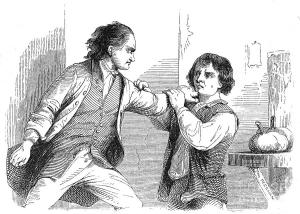 All of Boston was amused by the hoax, but not James. He was furious with his little brother, who soon broke the terms of his apprenticeship and fled to Pennsylvania.
 By then too old and frail to deliver his own speech, Franklin had someone else read his words to the deadlocked convention.

 Fourteen years ago, a news release from the Department of Defense reported “Private First Class Michael A. Arciola, 20, of Elmsford, New York, died February 15, 2005, in Al Ramadi, Iraq, from injuries sustained from enemy small arms fire. Arciola was assigned to the 1st Battalion, 503d Infantry Regiment, 2nd Infantry Division, Camp Casey, Korea”.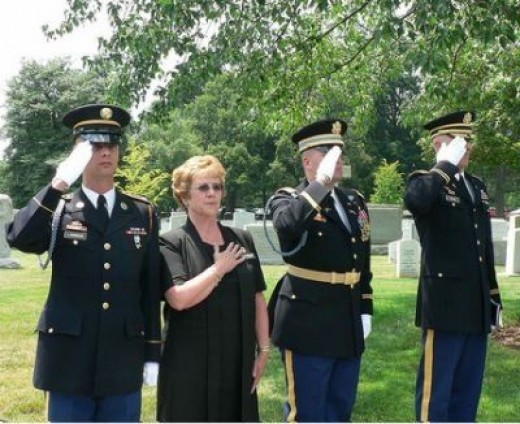
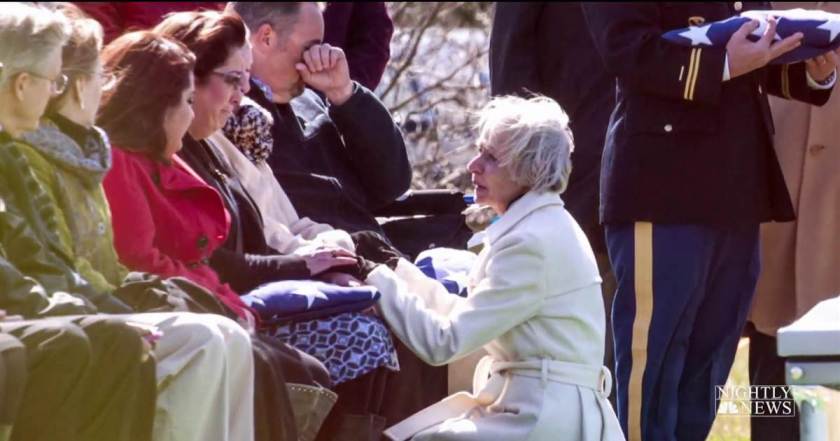 Sometimes, a military chaplain was the only one present at these services. Both Vandenbergs felt that a member of the Air Force family should be present at these funerals. Gladys began to invite other officer’s wives. Over time, a group of women from the Officer’s Wives Club were formed for the purpose.
 The casual visitor cannot help but being struck with the solemnity of such an occasion. Air Force Ladies’ Chairman Sue Ellen Lansell spoke of one service where the only other guest was “one elderly gentlemen who stood at the curb and would not come to the grave site. He was from the Soldier’s Home in Washington, D. C. One soldier walked up to invite him closer, but he said no, he was not family”.
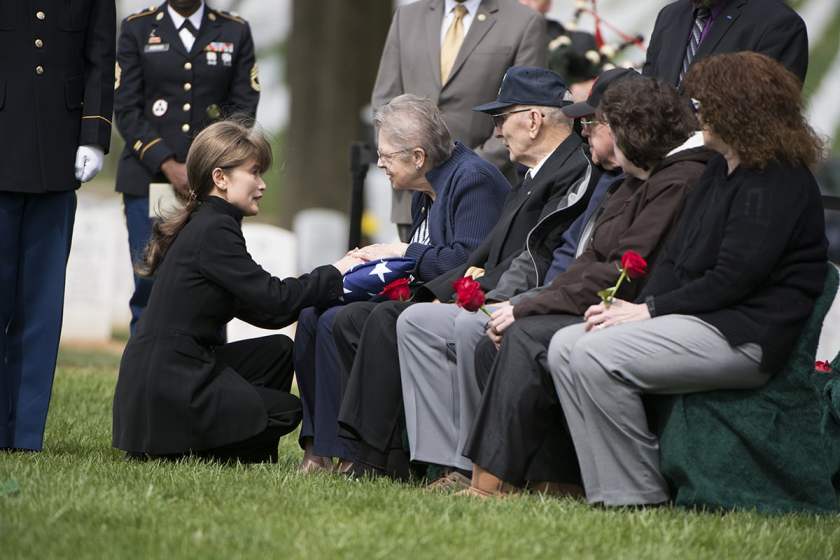

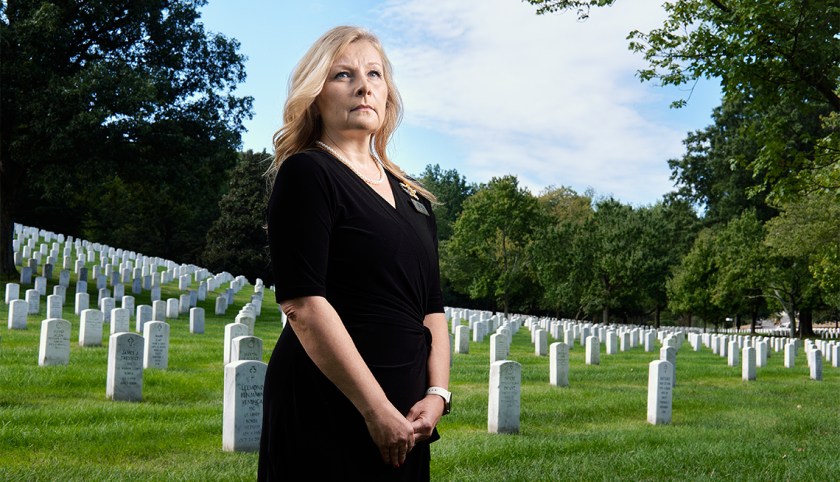


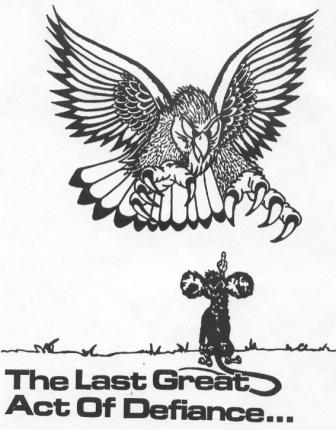 Before the age of the internet meme, office jokes and bits of folk wisdom were passed around and copied and copied again. There was one, “The Last great of Defiance“, which will live for all time as my favorite. The picture speaks for itself. I had one on the wall, for years.
 Prisoners were swept up by the thousands, and faced an uncertain future. In Malmedy, Belgium, seventy-five captured Americans were marched into an open field and machine gunned by members of the 1st SS Panzer Division (Leibstandarte Adolf Hitler), a part of 6th Panzer Army.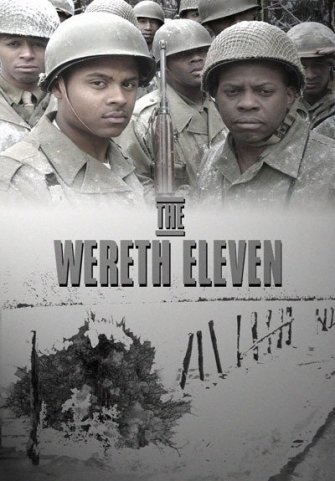

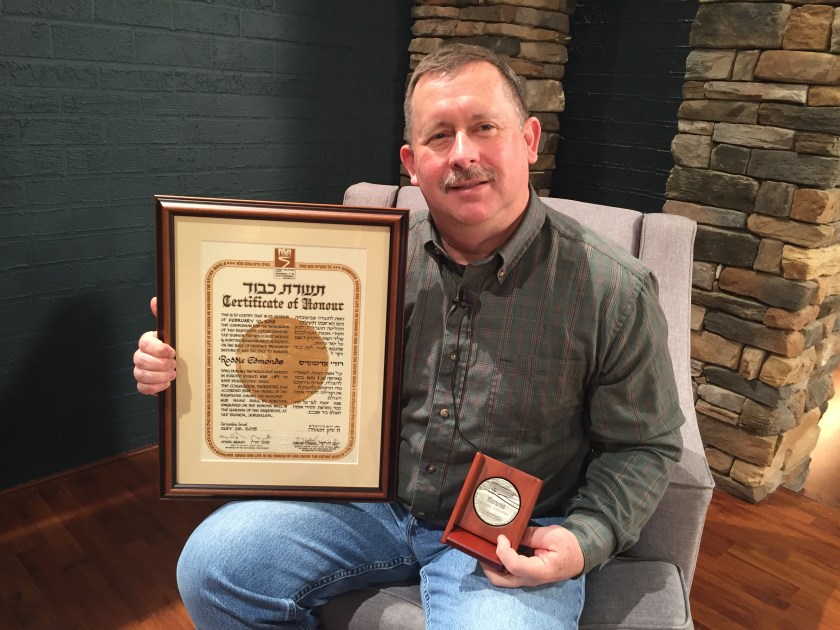

 Historical Easter Eggs - Today in History
You must be logged in to post a comment.