

Agree or disagree with US war policy, what we do in this country we do as a nation. It would seem absurd to us to see the President and the Congress raise separate armies to go to war with one another, but that’s just what happened in 17th century England.
Queen Elizabeth I passed away without issue in 1603, succeeded by her first cousin, twice
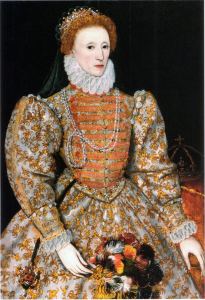
removed, King James VI of Scotland. For the first time, the Kingdoms of England and Scotland were united under single rule.
The English Parliament of the age didn’t have a permanent role in government, instead being a temporary advisory body, summoned and dismissed at the will of the King. Practically speaking, the King had no means to enforce his will on matters of taxation, without the consent of the “gentry”, the untitled land owning classes who were the primary means of national tax collection. This gave rise to an elected “House of Commons”, joining the House of Lords to form a Parliament.
James thought of Kings as “little Gods on Earth”, and had long gotten whatever he wanted from a supine Scottish Parliament. The English Parliament was another matter. James’ entire reign and that of his son Charles I was one long contest of wills with the English governing body.

Charles’ 1625 marriage to a Roman Catholic, French princess Henrietta Maria, did little to win him support in Protestant England. His interventionist policies in the 30 years’ war made things worse, ending with Parliament bringing impeachment proceedings against his minister, the Duke of Buckingham. Parliament drew up the “Petition of Right”, invoking the Magna Carta and severely limiting the King’s right of non-Parliamentary taxation, along with other restrictions on the Royal Prerogative. Charles looked to the House of Lords to check the power of the Commons, but both houses ratified the measure by the end of May.
The King dissolved this first Parliament in 1629, putting nine of its leaders in prison and unwittingly making them martyrs for their cause. The following 11 years are sometimes called “the personal rule” or the “eleven years’ tyranny”. Charles had severe money problems by 1640, forcing him to call another Parliament. The King wanted a more docile body this time, so he appointed many of his adversaries as Sheriffs, knowing that this would require them to stay within their counties, making them ineligible for election. To others he bestowed aristocratic titles, making them ineligible for the House of Commons. Of course, that only moved them to the House of Lords.
What the King saw as reasonable, the legislative body saw as opportunity to negotiate, and this “Short Parliament” was dissolved within a month. That was May 1640, and Charles once again called a Parliament in November. This was to be his “Long Parliament”, proving as uncooperative as any before it.

In January, Charles directed Parliament to surrender five members of the Commons and one Peer on grounds of high treason. On the following day, January 4, 1642, the King himself entered the House of Commons with an armed guard of 400, demanding that the offenders be handed over. The Speaker, William Lenthall, replied, “May it please your Majesty, I have neither eyes to see nor tongue to speak in this place but as the House is pleased to direct me, whose servant I am here.” He might as well have told the King “I work for these people. I don’t work for you”.
It was a grave breach of protocol, no King had ever entered the House of Commons. Making things worse, the botched arrest had cut the feet out from under Charles’ supporters. The two sides began to arm themselves that summer. Full-scale civil war broke out that October.

What’s been variously described as one or two separate civil wars ensued, in which 300,000, 6% of the country’s population or roughly twice the percentage lost in the American Civil War, lost their lives. A “Rump” House of Commons indicted the King on treason charges, in a trial which was never recognized by the upper house. Charles maintained that he was above the law, while the court argued that “the King of England was not a person, but an office whose every occupant was entrusted with a limited power to govern by and according to the laws of the land and not otherwise”. 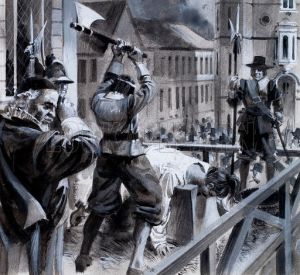
Charles I was found guilty of treason and sentenced to die by decapitation. Clothed in two shirts by his own request, lest any shiver of cold be misinterpreted as a sign of fear, the King of England put his head on the block on January 30, 1649. “A subject and a sovereign are clean different things,” he said. “I shall go from a corruptible to an incorruptible Crown, where no disturbance can be”. With that, he extended his hands to signal he was ready, and his head was parted with a stroke.
The Rump House of Commons disbanded the House of Lords and England was briefly governed as a Commonwealth, but Charles soon came to be seen as a Martyr King. Oliver Cromwell established a Protectorate with himself as Lord Protector. He was briefly succeeded by his son on his death in 1658, but the son was not the equal of his father. Parliament was reinstated and the monarchy restored to Charles’ eldest son, who became Charles II in 1660.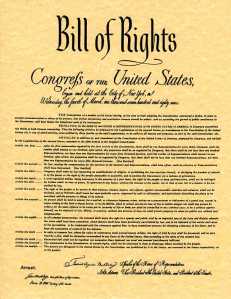
In the American colonies, Charles II renamed a slice of southern Virginia after his father “Carolus”, the Latin for Charles, and North and South Carolina were born. The Petition of Right would pop up 129 years later, reflected in the Third, Fifth, Sixth and Seventh amendments of the United States’ Constitution, part of what we now know as the Bill of Rights.


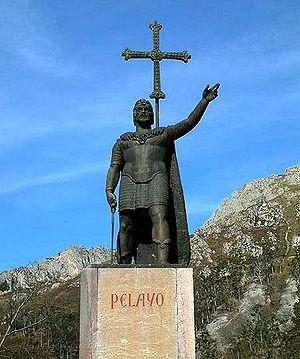 The first significant Christian victory and what might have been the beginning of “La Reconquista”, took place along that northern fringe. That sliver of Christianity was the Kingdom of Asturias. Their refusal to pay the Jizya, the Muslim tax on “unbelievers”, brought them into conflict with an Umayyad force in the summer of 722. A Christian military force under Pelagius, or “Pelayo”, the future first King of Asturias, met the invaders at “Covadonga”, meaning “Cavern of the Lady”. The Arabic name for the place is “Sakhrat Bilāy” “the Rock of the Affliction”, the two names telling a story about the outcome of the battle.
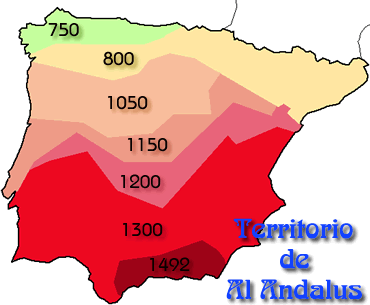 Iberian Kings. With help from the Knights Templar and Hospitaller, Alfonso VI captured Toledo in 1085, beginning a long period of gradual Muslim decline.

 When Caesar went to Egypt in 48BC, he was impressed with the way they handled their calendar. He hired the Alexandrian astronomer Sosigenes to help straighten things out. The astronomer calculated that a proper year was 365¼ days, which more accurately tracked the solar, and not the lunar year. “Do like the Egyptians”, he might have said, the new “Julian” calendar going into effect in 46BC. Caesar decreed that 67 days be added that year, moving the New Year’s start from March to January 1. The first new year of the new calendar was January 1, 45BC.

 The Artkraft Strauss sign company designed a 5′ wide, 700lb ball covered with incandescent bulbs. The ball was hoist up the flagpole by five men on December 31, 1907. Once it hit the roof of the building, the ball completed an electric circuit, lighting up a sign and touching off a fireworks display.
 continues. The ball used the last few years is 12′ wide, weighing 11,875lbs; a great sphere of 2,688 Waterford Crystal triangles, illuminated by 32,256 Philips Luxeon Rebel LED bulbs and producing more than 16 million colors. It used to be that the ball only came out for New Year. The last few years, you can see the thing, any time you like.
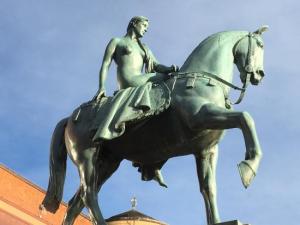 repeal the tax on one condition; that she ride a horse through the streets of town, dressed only in her birthday suit and her long hair. Lady Godiva took him at his word. She issued a proclamation that all townspeople stay indoors and shut their windows, and then she took her famous naked ride through town.
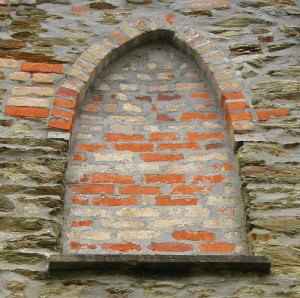 On December 31, 1695, King William III decreed a 2 shilling tax on each house in the land. Not wanting to miss an opportunity to “stick-it-to-the-rich”, there was an extra tax on every window over ten, a tax that would last for another 156 years.

 Back in 2013, EU politicians were discussing a way of taxing livestock flatulence, as a means of curbing “Global Warming”. At that time there was an Australian ice breaker, making its way to Antarctica to free the Chinese ice breaker, that got stuck in the ice trying to free the Russian ship full of environmentalists. They were there to view the effects of “Global Warming”, before they got stuck in the ice.




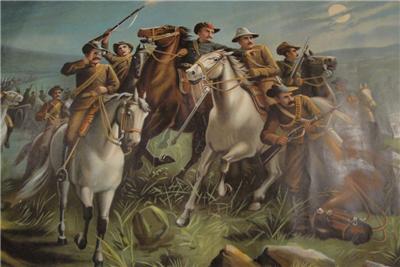
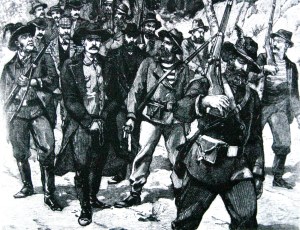 the raiders entered Pretoria on January 2, in chains. The Transvaal government received almost £1 million compensation from the British South Africa Company, turning their prisoners over to be tried by the British government. Jameson was convicted of leading the raid and sentenced to 15 months in prison. During the whole ordeal, he never revealed the degree to which British politicians supported the raid, or the way they betrayed him in the end.


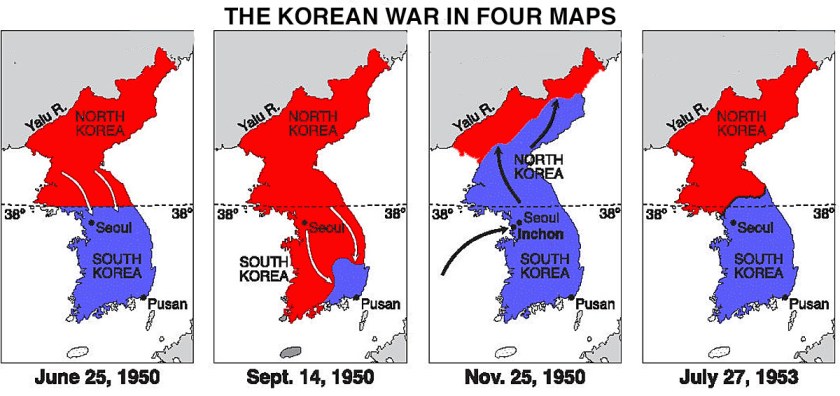 Sixteen countries sent troops to South Korea’s aid, about 90% of them Americans. The Soviets sent material aid to the North, while Communist China sent troops. The Korean War lasted three years, causing the death or disappearance of over 2,000,000, combining military and civilian.
 South Korea went through a series of military dictatorships from the ‘60s to the ‘80s, since developing into a successful Republic. In the North, Kim Il-sung built a communist hellhole, a cult of personality established under a North Korean ideology known as “Juche”, (JOO-chay).
 that would make Caligula blush, he had South Korean film maker Shin Sang-ok kidnapped along with his actress ex-wife, Choi Eun-hee. After four years spent starving in a North Korean gulag, the couple accepted Kim’s “suggestion” that they re-marry and go to work for him, producing the less-than-box-office-smash “Pulgasari”, a kind of North Korean Godzilla film.
 North Korea broke ground on what foreign media called “the worst building in the world” in 1987, just in time for the Seoul Olympics the following year. With 105 stories and eight revolving floors, the Ryugyong would have been the tallest hotel in the world, if it ever opened. Construction shut down in 1992, partly because Soviet funding dried up, and partly because construction was so bad that it’s unsafe to stand within 10 blocks of the thing. In 2008, Orascom Telecom of Egypt agreed to spend $180 million to put glass on the outside, in exchange for a $400 million contract to build the nation’s first 3G cellular network. Whether there will ever be more than one customer, is unclear. Perhaps 2017 will be the year that the Ryugyong becomes more than the world’s largest telecommunications antenna, but so far the place remains “too popular to take reservations”.
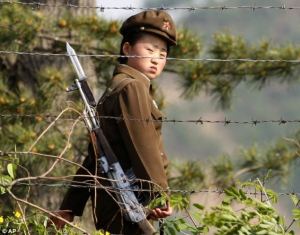 Anywhere from 1 to 3 million North Koreans starved to death during the ‘90s, while it’s estimated that one in every hundred North Korean citizens are incarcerated in a system of gulags, torture chambers and concentration camps.


 Ambrose Bierce was born in Horse Cave Creek, Ohio, to Marcus Aurelius and Laura Sherwood Bierce, the 10th of 13 children, all with names beginning with the letter “A”.
 number on speed dial. In Bierce’s day, he’d better carry a gun. Ambrose Bierce didn’t shy away from politics, he jumped right in, frequently using a mock dictionary definition to lampoon his targets. One example and my personal favorite, is “Politics: A strife of interests masquerading as a contest of principles. The conduct of public affairs for private advantage”.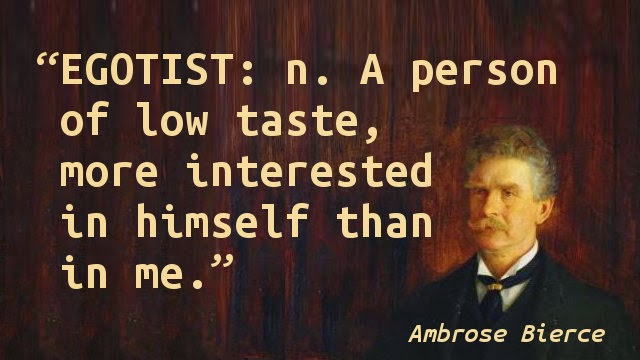
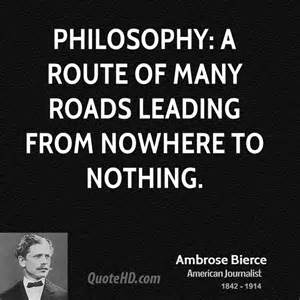 off limits. Politics was a favorite target of his columns, such as: “CONSERVATIVE, n: A statesman who is enamored of existing evils, as distinguished from the Liberal who wishes to replace them with others”, or “POLITICIAN, n. An eel in the fundamental mud upon which the superstructure of organized society is reared. When he wriggles he mistakes the agitation of his tail for the trembling of the edifice. As compared with the statesman, he suffers the disadvantage of being alive”.
 Gwinnett Bierce was executed by firing squad in the town cemetery. It’s as good an ending to this story as any, as one hundred and three years ago today is as good a day as any on which to end it. The fact is that in that 103 years, there’s never been a trace of what became of him, and probably never will be.


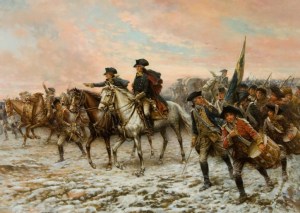 As the army began the famous crossing of the Delaware that Christmas night, the
 many of them lacked boots, the soaked and freezing rags wrapped around their feet not enough to keep them from leaving bloody footprints in the snow.
 The Patriot force arrived at Trenton at 8am December 26, completely surprising the Hessian garrison. There is a story about the Hessians being drunk or hungover after Christmas celebrations, but the story is almost certainly untrue. Unaware of Washington’s march on Trenton, 50 Americans had attacked a Hessian outpost earlier that morning. While Washington worried that his surprise was blown, Colonel Rall apparently believed that this was the attack he’d been warned about. He expected no further action that day.
 under Generals Cornwallis and Grant, proving on January 3rd at a place called Princeton, that they could defeat a regular British army in the field.

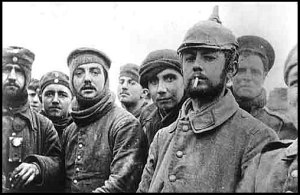 Captain Bruce Bairnsfather later wrote: “I wouldn’t have missed that unique and weird Christmas Day for anything. … I spotted a German officer, some sort of lieutenant I should think, and being a bit of a collector, I intimated to him that I had taken a fancy to some of his buttons. … I brought out my wire clippers and, with a few deft snips, removed a couple of his buttons and put them in my pocket. I then gave him two of mine in exchange. … The last I saw was one of my machine gunners, who was a bit of an amateur hairdresser in civil life, cutting the unnaturally long hair of a docile Boche, who was patiently kneeling on the ground whilst the automatic clippers crept up the back of his neck.”
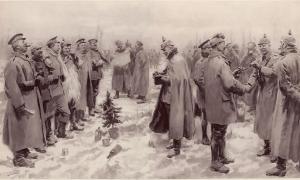 December 24-25, 1914, lasting in some sectors until New Year’s Day.


You must be logged in to post a comment.