May 13, 1916 Lafayette Escadrille

The Lafayette Escadrille is often confused with the much larger Lafayette Flying Corps, and the movie “Flyboys” adds to the confusion.

Sous-Lieutenant_Norman_Prince_summer1916
Norman Prince

Knowing that his father would not approve, Norman Prince of Beverly Massachusetts concealed his flight training.  Using the name George Manor,  Norman earned his wings in 1911 in the Quincy, Massachusetts neighborhood of Squantum.  A fluent French speaker with a family estate in Pau, France, Norman sailed in January 1915, to join the French war effort.

The earliest vestiges of the American Hospital of Paris and what would become the American Ambulance Field Service can be found five years earlier, in 1906. Long before the American entry in 1917, individual sympathies brought Americans into the war to fight for Britain and France. They traveled to Europe to fight in the war against the Axis Powers, joining the Foreign Legion, the Flying Corps or, like Ernest Hemingway, the Ambulance Service.

Lafayette_Escadrille_Pin
Squadron Insignia pin

After 1915, American pilots volunteered for multiple “Escadrille” – flight squadrons of the French Air Service, the Aéronautique Militaire.

The March 7, 1918 Harvard Alumni Bulletin, would give Norman Prince full credit for persuading the French government to form all-American flying squadrons, though he would not live to see the article.

Sergeant Norman Prince caught a landing wheel on a telegraph wire after a bombing run on October 12, 1916, sustaining massive injuries when his plane flipped over and crashed.  He was promoted to sous (2nd) lieutenant on his death bed and awarded the Legion of Honor.  He died three days later, at the age of 29.

LtCol_William_Thaw_with_lion_cub_mascots_of_Lafayette_Escradrille_c1916
Lt. Col. William Thaw II with_lion cub mascots Whiskey and Soda

William Thaw II of Pittsburgh was the first pilot to fly up New York’s East River under all four bridges, the first American engaged in aerial combat in the war.

Thaw pooled his money with three other pilots to purchase a male lion cub, the first of two such mascots kept by the Escadrille.  He bought the lion from a Brazilian dentist for 500 francs and bought a dog ticket, walking the lion onto the train on a leash.  Explanations that this was an “African dog” were less than persuasive, and the pair was thrown off the train.  “Whiskey” would have to ride to his new home in a cage, stuck in cargo.

Captain_Georges_Thenault_and_Fram_1917
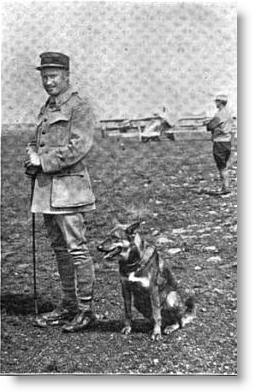
French Lieutenant Colonel Georges Thenault & Fram, 1917

French Lieutenant Colonel Georges Thenault owned a “splendid police dog” named Fram who was the best of friends with Whiskey, though he learned to keep to himself at dinner time.

A female lion, “Soda”, was purchased sometime later.  The lions were destined to spend their adult years in a Paris zoo, but both remembered from whence they had come.  Both animals recognized William Thaw on a later visit to the zoo, rolling onto their backs in expectation of a good belly rub.

Originally authorized on March 21, 1916 as the Escadrille Américaine (Escadrille N.124), American pilots wore French uniforms and flew French aircraft.  Nevertheless, Germany was dismayed at the existence of such a unit, and complained that the neutral United States appeared to be aligning with France.

Lafayette EscadrilleEscadrille N.124 changed its name in December 1916, adopting that of a French hero of the American Revolution.  Marie-Joseph Paul Yves Roch Gilbert du Motier, Marquis de Lafayette. Five French officers commanded a core group of 38 American volunteers, supported by all-French mechanics and ground crew.  Rounding out the Escadrille were the unit mascots, the African lions Whiskey and Soda.
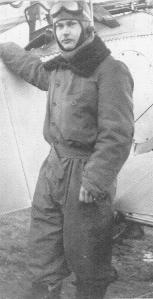
This early in aviation history, flying duty was hazardous to say the least.  Planes were flimsy and plagued with mechanical difficulties. Machine guns jammed and other parts failed when they were needed most.  There were countless wounds in addition to fatal injuries. At least one man actually asked to be sent back to the trenches, where he felt safer.

Kiffin Rockwell "In American Escadrille "movie" picture May 1916"
Kiffin Rockwell

The first major action of the Escadrille Américaine took place at the Battle of Verdun on May 13, 1916. Kiffin Rockwell of Newport Tennessee became the first American to shoot down an enemy aircraft on May 18, later losing his own life when he was shot down by the gunner in a German Albatross observation plane on September 23. French born American citizen Raoul Lufbery became the squadron’s first Ace with 5 confirmed kills, and went on to be the highest scoring flying ace in the unit with 17 confirmed victories. He was killed on May 19, 1918, when his Nieuport 28 flipped over while he attempted to clear a jam in his machine gun.

The unit sustained its first fatality on June 24, 1916, when Victor Chapman was attacked by German flying ace Leutnant Kurt Wintgens, north of Douaumont.  Chapman was carrying oranges at the time, intended for his buddy Clyde Balsley, who was in hospital recuperating from an earlier incident.

Edmond_Charles_Clinton_Genet_circa_1915-1917
Edmond Genet

Ossining, New York native Edmond Genet was a bit of a celebrity among American expats, as the second-great grandson of Edmond-Charles Genêt, of the Founding-era Citizen Genêt Affair.  Genet sailed for France at the end of January 1915, joining the French Foreign Legion, and finally the Lafayette Escadrille on January 22, 1917.

Genet had left while on leave from the US Navy, and was therefore classified as a deserter. The decision weighed heavily on him.  Edmond Genet was shot down and killed by anti-aircraft artillery on April 17, eleven days after the American declaration of war, officially making him the first American fatality in the War to end all Wars.  The war department sent his family a letter after his death, stating that his service was considered in all respects, honorable.

38 American pilots passed through the Lafayette Escadrille, “the Valiant 38”, eleven of whom were either killed in action or died later as the result of wounds received.  The unit flew for the French Air Service until the US’ entry into the war, when it passed into the 103rd Aero Squadron, American Expeditionary Force.

Raoul Lufbery
Raoul Lufbery

The Lafayette Escadrille is often confused with the much larger Lafayette Flying Corps, and the movie “Flyboys” adds to the confusion.  The Flying Corps was different from the Escadrille, the former coming about as the result of widespread interest in the exploits of the latter.  American volunteers were assigned individually or in groups of two or three to fly in various French Aviation units, but, prior to US entry into the war.  The Lafayette Escadrille was the only one to serve as a single organization.

All told, 267 American volunteers applied to serve in the Lafayette Flying Corps, credited with downing 199 German planes at the cost of 19 wounded, 15 captured, 11 dead of illness or accident, and 51 killed in action.

Escadrille_Lafayette_in_July_1917
Lafayette Escadrille, July 1917. Standing (left to right) Soubiron, Doolittle, Campbell, Persons, Bridgman, Dugan, MacMonagle, Lowell, Willis, Jones, Peterson and de Maison-Rouge. Seated (left to right) Hill, Masson with “Soda,” Thaw, Thénault, Lufbery with “Whiskey,” Johnson, Bigelow and Rockwell. Georges Thenault’s dog “Fram” sits in the foreground.

May 12, 2008 Angel of Warsaw

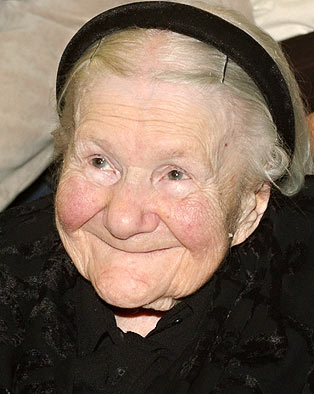
All told, Irena Sendler saved about 2,400 Jewish children and infants and about 100 teenagers, who went into the forests to join partisan bands fighting the Nazis. The far better known Oskar Schindler is credited with saving less than half that number.

Dr-Stanislaw-Krzyzanowski-Janina-Grzybowska
Dr. Stanisław & Janina Krzyżanowski

Dr. Stanislaw Krzyżanowski was a physician treating mostly the poorer Jewish families in the central Polish town of Otwock, 14 miles southeast of Warsaw.   He had once said to his only daughter Irena:  “If you see someone drowning, you must save them.” “But, what if I can’t swim?” she asked. “Nevertheless, you must try”.

Overwhelmed by the typhus epidemic of 1917, Dr. Krzyżanowski contracted the disease himself and died that February, but his example guided his daughter for the rest of her life.  Jewish community leaders showed their gratitude by offering to pay for Irena’s education, but her mother declined.

Irena (Krzyżanowski) Sendler was a nurse living outside Warsaw, when Nazi Germany invaded Poland in 1939.  The Nazis gathered up every Jew they could find in 1940, penning 400,000 or more up in the city. Soon, the Warsaw ghetto became the scene of suffering, disease and starvation. Knowing the Nazis feared nothing so much as Typhus, Sendler took advantage of their fears and obtained permission to begin work in the ghetto.

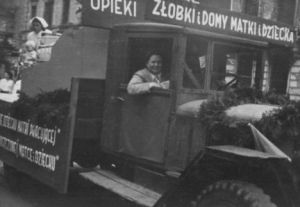
Sendler Truck
“Irena in a social welfare department truck in May 1948” H/T U.K. Daily Mail

She would travel there daily, and soon started to smuggle Jewish babies out in the bottom of a medical bag.  She’d place soiled bandages around and over sedated babies, to keep guards from looking too closely. She carried a burlap sack in the back of her truck. Sometimes she’d use that or even a coffin to smuggle larger children and even teenagers out of the ghetto, other times leading them out through cellars or sewers.

Sendler traveled with a small a dog she had trained to bark at Nazi soldiers letting her in and out of the gates. They wanted nothing to do with her small, yappy dog, and the barking would cover any sounds that the babies might make.

She would make as many as three runs a day, taking out as many as 6 children. Most of them were already orphans by this time, their parents murdered by the Nazi regime.  Many times, parents gave up their children in order to save them.

Irena coded the names of these children onto two slips of paper, including false and real names.  These she buried in glass jars under a tree in the yard of a friend. She obtained false papers for each of the kids, passing them along to nunneries, monasteries and to foster parents.

Sendler, youth
‘Angel of the Warsaw Ghetto”, Irena Sendler

Elzbieta Ficowska was smuggled out in a carpenter’s toolbox at the age of six months.  ‘When I was 17″, she said, “a friend said she’d heard I was Jewish. At that point, my Polish mum told me the truth, giving me a silver spoon engraved with my name and birth date, which my blood family had placed in the box with me.   Elzbieta later learned that her family wept on hearing she was to be baptized, but later signaled their understanding by sending a christening gown and tiny gold cross.  “I consider both my Polish mum and Irena to be a little pathological. It is a kind of insanity to overcome such fear. They were so alike, my mum and Irena – fantastic, strong women”.

Anna Mieszkowska, the author of Sendler’s Polish biography, tells a story.  ‘Irena told me not to put this story in the book. She was asked to save two children, a boy and a girl. The parents wanted them to go but the grandparents did not. Irena arrived at their address and found the whole family had committed suicide – grandparents, parents, children. She had nightmares about this for many years.’

Sendler was caught by the Gestapo in 1943, betrayed by a colleague under torture, and by a nosy landlady.  Nazi interrogators beat her savagely, but she never gave up any of those names.

Irena lasted 100 days in Pawiak prison, a place where average inmate survival was less than a month.  Finally she was returned to the Gestapo and stood against a wall for execution, too broken to care. An SS guard said “not you” and shoved her out into the street. He’d been bribed by her friends, and was himself later caught and executed. For now she was “officially” dead, which made it easier to escape detection for the remainder of the war.Sendlerowa, 1

After the war, Irena tried to reunite parents or surviving family members with the children she’d rescued. She was rarely successful.

All told, Irena Sendler saved about 2,400 Jewish children and infants and about 100 teenagers, who went into the forests to join partisan bands fighting the Nazis. The far better known Oskar Schindler is credited with saving less than half that number.

Today, Elzbieta Ficowska tries to keep her Jewish roots, but they seem foreign to her.  ‘When I enter a Catholic church, everything is mine. Sometimes I look in the mirror for traces of my real parents. I sent letters all around the world to try to find out about them.’  She has never seen so much as a photograph.

The Polish Government honored Irena Sendler with the Order of the White Eagle, its highest award. The Yad Vashem Remembrance Center in Jerusalem honored her as a “Righteous Gentile” in 1965. She received honorary citizenship in Israel in 1985, and the Polish and Israeli Governments nominated her for the Nobel Peace Prize in 2007.

SendlerowaThe Nobel Prize for Peace was awarded on October 12 in Oslo, Norway, to the Intergovernmental Panel on Climate Change (IPCC) and Albert Arnold Gore Jr. “for their efforts to build up and disseminate greater knowledge about man-made climate change, and to lay the foundations for the measures that are needed to counteract such change”.

Irena Sendler passed away on May 12, 2008 at the age of 98. This choice of 2007 Nobel prize recipients has been controversial, since Nobel by-laws prohibit posthumous award of the prize. Many felt that Sendler had more than earned it. Some have claimed that Nobel committee rules require qualifying work to have taken place within the two years immediately preceding nomination, but I think they’re making it up. I’ve read the Nobel statutes. You can do so yourself, HERE, if you’re so inclined   I find no such requirement.  Let me know if I missed it, the whole thing seems political, to me.

Irena Sendler always said that she wasn’t a hero, she only did what any normal person would do. I find in the story of this petite Polish nurse, some of the most magnificent courage of which our species is capable.  If that does not make her a hero, I don’t know what would.

May 11, 1969  And Now for something Completely Different

The British comedy troupe that formed this day in 1969 was amused at the idea of a haughty Lord Montgomery, patterned after Field Marshal Bernard Law Montgomery, 1st Viscount Montgomery of Alamein, KG, GCB, DSO, PC, DL, etc.  “Python” seemed just slippery enough to make the whole thing work.

Graham Chapman was trained and educated to be a physician, but that career trajectory was never meant to be.  John Cleese was writing for TV personality David Frost and actor/comedian Marty Feldman at the time, when he recruited Chapman as a writing partner and “sounding board”.  BBC offered the pair a show of their own in 1969, when Cleese reached out to former How To Irritate People writing partner Michael Palin, to join the team.  Palin invited his own writing partner Terry Jones and colleague Eric Idle over from rival ITV, who in turn wanted American-born Terry Gilliam for his animations.

The British comedy troupe that formed this day in 1969 was amused at the idea of a haughty Lord Montgomery, patterned after Field Marshal Bernard Law Montgomery, 1st Viscount Montgomery of Alamein, KG, GCB, DSO, PC, DL, etc.  “Python” seemed just slippery enough to make the whole thing work.

The Pythons considered several names for their new program, including “Owl Stretching Time”, “The Toad Elevating Moment”, “Vaseline Review” and “A Horse, a Spoon and a Bucket”. “Flying Circus” had come up as well.  The name stuck when BBC revealed that they had already printed flyers, and weren’t about to go back to the printer.

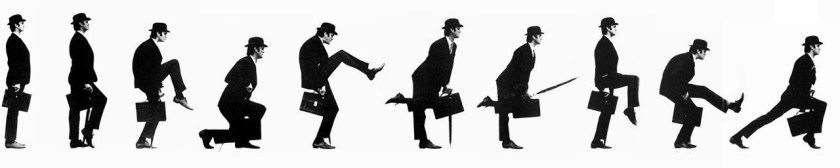
Silly-Walk-monty-python-13514283-1280-800

The show was a collaborative process, beginning with the first broadcast on October 5, 1969. With no writers of their own, the six would divide into groups and write their own material.  Whether any given sketch would make it into the program, was always a democratic process.

Different Python factions were responsible for different elements of the team’s humor. The work of the Oxford educated Terry Jones and Michael Palin was more visual, and a little more off the wall. The Spanish Inquisition arriving in a suburban apartment is a prime example, while the Cambridge educated John Cleese and Graham Chapman were more confrontational – “This is abuse. I came here for an argument”. Cleese said “anything that got utterly involved with words and disappeared up any personal orifice was Eric’s”, like the Man who Spoke in Anagrams.  Terry Gilliam was the guy behind the animation.Spanish Inquisition

The Flying Circus broke new ground with techniques like the “cold open”. With no titles, credits, or opening theme, Michael Palin would crawl across the tundra a la Robinson Crusoe, looking into the camera and saying “It’s“…  And off they went. The cold open sometimes lasted until the middle of the show. Occasionally, the Pythons fooled viewers by rolling closing credits halfway through, usually continuing the gag by fading to the BBC logo while Cleese parodied the tones of a BBC announcer. On one occasion the closing credits ran directly after the opening titles.

I personally learned to never leave a Python film during closing credits, finding my reward for sticking around at the end of the Life of Brian was to learn who wiped the moose’s noses. (As I recall, it was John J. Llama).

The “Iron Lady”, Prime Minister Margaret Thatcher herself, seems to have been a fan, doing a more than passable version of the Dead Parrot sketch at a Conservative Party Conference in 1990.


The Pythons shared a dislike for “capping” bits with punchlines, and experimented with ending sketches by cutting abruptly to another scene, or breaking the rules altogether by addressing the camera directly. Two examples were the knight in armor, played by Terry Gilliam, who would wander onto the set and whack people over the head with a rubber chicken.  Or Chapman’s “Colonel” character, who would walk into sketches and order them stopped because things were becoming “far too silly.”

Gilliam’s animations were a favorite technique, when a 16 ton weight would drop from the sky, or else it was Cupid’s foot – yes, that’s Cupid’s foot – cut from a reproduction of the Renaissance masterpiece “Venus, Cupid, Folly, and Time” by Il Bronzino.Cupids Foot

John Cleese left the Flying Circus at the end of the third season. He had considered doing so at the end of the second, feeling that he had little original material to offer the show. He found Chapman difficult to work with, who was at this time a full tilt alcoholic.  Cleese could be difficult himself. Eric Idle once said of John Cleese. “He’s so funny because he never wanted to be liked. That gives him a certain fascinating, arrogant freedom”.

Monty Python - The Black Knight RisesThe group reunited in 1974 to do the Holy Grail, which was filmed on location in Scotland, on a budget of £229,000. The money was raised in part by investments from musical figures like Pink Floyd, Jethro Tull and Led Zeppelin backer Tony Stratton-Smith. Investors in the film wanted to cut the famous Black Knight scene, (“None shall pass”), but were eventually persuaded to keep it in the film. Good thing, the scene became second only to the Holy Hand Grenade of Antioch and the Killer Rabbit. “What’s he going to do, nibble my bum?”

Graham Chapman is best remembered as King Arthur in the Holy Grail, and Brian Cohen in the Life of Brian.  He died of spinal and throat cancer on the 20th anniversary of their first broadcast.  John Cleese delivered a uniquely Pythonesque eulogy, which sounded a lot like the Dead Parrot sketch.  “”Graham Chapman, co-author of the Parrot sketch, is no more,” he began. “He has ceased to be, bereft of life, he rests in peace, he has kicked the bucket, hopped the twig, bit the dust, snuffed it, breathed his last, and gone to meet the Great Head of Light Entertainment in the sky…”

I don’t believe he’d have had it any other way.  Silly bunt.

May 10, 1941 Prisoner #7

The last of the other inmates had left by 1966, leaving #7 the prison’s only occupant. Warden Bird wrote a book in 1974, titled “The Loneliest Man in the World”, about his relationship with Hess during his 30 years’ confinement.

At the end of WWI, Rudolf Walter Richard Hess enrolled in the University of Munich.  He’d been wounded several times in the Great War, serving in the 7th Bavarian Field Artillery Regiment. As a student, Hess studied geopolitics under Karl Haushofer, an early proponent of “Lebensraum” (“living space”), the philosophy which later became a central plank in the Nazi Party political platform.

rudolf-hess-nazi rallyHess was an early and ardent proponent of Nazi ideology.  A True Believer. He was at Hitler’s side during the failed revolution of 1923, the “Beer Hall Putsch”. He served time with Hitler in prison, and helped him write his political opus “Mein Kampf” (My Struggle). Hess was appointed to Hitler’s cabinet when the National Socialist German Workers’ Party seized power in 1933, becoming Deputy Führer, #3 after Hermann Göring and Hitler himself. Hess signed many statutes into law, including the Nuremberg Laws of 1935, depriving the Jews of Germany of their rights and property.

Obsessed as he was with race theory, Hitler believed that, as fellow Anglo Saxons, the British people were meant to be natural allies to Germany.  If only they could get rid of Churchill, he believed, the two nations might be able to work things out. Churchill and Hitler deeply hated one another, but there were many in Great Britain, including much of the landowning aristocracy, London financiers and media moguls, who regarded the Soviet Union as the greater threat.rudolf-hess-plane

Rudolf Hess flew into Scotland on May 10, 1941, parachuting to earth as his Messerschmidt two-seat aircraft ran out of gas. It’s unclear whether the scheme was Hess’ own idea or if it had official sanction. It was a cockamamie scheme, in which he intended to arrange peace talks with Douglas Douglas-Hamilton, 14th Duke of Hamilton, believing him to be a prominent opponent of the British government. The Deputy Führer was immediately arrested, remaining in British custody until the end of the war, when he was returned to Germany for the 1946 Nuremberg Trials.

Hess mental state seems to have declined while under British custody and questions were raised about his sanity and fitness to stand trial.  Judges decided that he understood the charges against him and was capable of defending himself.  Hess did himself no good at trial, declaring his late Führer to be “the greatest son my Volk has brought forth in its thousand-year history”. He testified that he wouldn’t change a thing about having worked for the man, saying “I regret nothing.”Hess at Nuremberg

Nine months later, the court acquitted Hess of war crimes and crimes against humanity, apparently deciding that his earlier persecution of Jews to be insufficiently connected to their later annihilation.  Hess was convicted of conspiracy to wage aggressive war and of crimes against peace and sentenced to life in prison, transferred to Spandau Prison in West Berlin, and placed under the authority of the four major allied powers. Spandau had once housed as many as 600 prisoners.   There he was stripped of his name and given a number, #7, one of 8 former Nazi officials imprisoned there.  After July 18, 1947, those eight became the only inmates to occupy the facility.

Hess’ fellow convicts were gradually released from the prison, as their terms expired or on compassionate grounds. His main companion at this time was his jailer, warden Eugene K. Bird, with whom Hess became close friends. The last of the other inmates had left by 1966, leaving #7 the prison’s only occupant. Warden Bird wrote a book in 1974, titled “The Loneliest Man in the World”, about his relationship with Hess during his 30 years’ confinement.

Spandau
Changing the Guard at Spandau

Attempts by family members and prominent politicians to get him released were blocked by Soviet authorities, who believed him to be a principle architect of Barbarossa, the Nazi sneak attack on the Soviet Union in 1941. On August 17, 1987, #7 tied a lamp cord to a window latch and hanged himself with it. He was 93.

Spandau prison was demolished following the death of its final remaining prisoner, the rubble dumped into the North Sea to prevent the place from becoming a Neo-Nazi shrine,

May 9, 1914 The History of Mother’s Day

Following her mother’s death in 1905, Anna Jarvis conceived of Mother’s Day as a way to honor her legacy, and to pay respect for the sacrifices that all mothers make on behalf of their children.

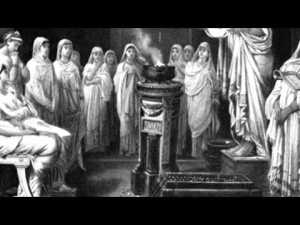
The earliest discernible Mother’s day comes from 1200-700BC, descending from the Phrygian rituals of modern day Turkey and Armenia. “Cybele” was the great Phrygian goddess of nature, mother of the Gods, of humanity, and of all the beasts of the natural world, her cult spreading throughout Eastern Greece with colonists from Asia Minor.Women in Rome

Much of ancient Greece looked to the Minoan Goddess Rhea, daughter of the Earth Goddess Gaia and the Sky God Uranus, mother of the Gods of Olympus. Over time the two became closely associated with the Roman Magna Mater, each developing her own cult following and worshipped through the period of the Roman Empire.

In ancient Rome, women partook of a festival, strictly forbidden to Roman men. So strict was this line of demarcation that only women were permitted even to know the name of the deity.  For everyone else she was simply the “Good Goddess”. The Bona Dea.

In the sixteenth century, it became popular for Protestants and Catholics alike to return to their “mother church” whether that be the church in which they were baptized, the local parish church, or the nearest cathedral. Anyone who did so was said to have gone “a-mothering”. Domestic servants were given the day off and this “Mothering Sunday”, the 4th Sunday in Lent, was often the only time when whole families could get together. Children would gather wild flowers along the way, to give to their own mothers or to leave in the church. Over time the day became more secular, but the tradition of gift giving continued.

Ann Maria Reeves Jarvis

Ann Maria Reeves Jarvis was a social activist in mid-19th century western Virginia.  Pregnant with her sixth child in 1858, she and other women formed “Mothers’ Day Work Clubs”, to combat the health and sanitary conditions which were leading at that time to catastrophic levels of infant mortality.  Jarvis herself gave birth between eleven and thirteen times in a seventeen year period.  Only four would live to adulthood.

Jarvis had no patience for the sectional differences that led the nation to Civil War, or which led her own locality to secede and form the state of West Virginia in order to rejoin the Union.  Jarvis refused to support a measure to divide the Methodist church into northern and southern branches.  She would help Union and Confederate soldier alike if she could.  It was she alone who offered a prayer when others refused, for Thornsbury Bailey Brown, the first Union soldier killed in the vicinity.

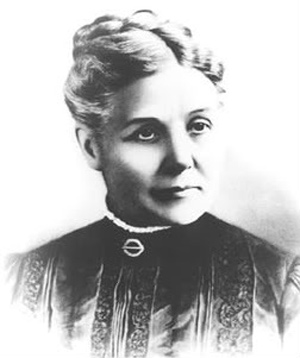
Anna Jarvis
Anna Jarvis

Following Jarvis’ death in 1905, her daughter Anna conceived of Mother’s Day as a way to honor her legacy and to pay respect for the sacrifices that all mothers make on behalf of their children.

Obtaining financial backing from Philadelphia department store owner John Wanamaker, Anna Jarvis organized the first official Mother’s Day celebration at a Methodist church in Grafton, West Virginia. That same day, thousands attended the first Mother’s Day event at Wanamaker’s store in Philadelphia.

Anna Jarvis resolved that Mother’s Day be added to the national calendar, and a massive letter writing campaign ensued. On May 9, 1914, President Woodrow Wilson signed a measure declaring the second Sunday of May, to be Mother’s Day.

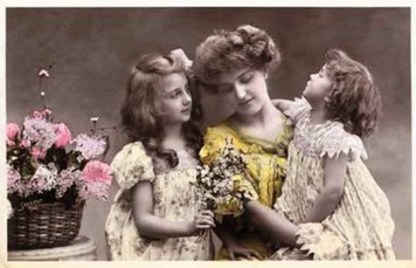
Mothers-Day-1919Anna Jarvis believed Mother’s Day to be a time of personal celebration, a time when families would gather to love and honor their mother.
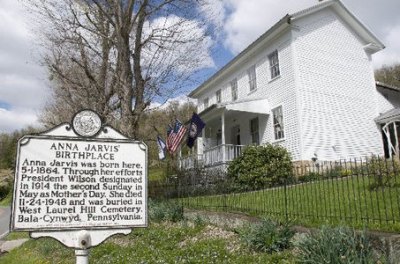
In the early days she had worked with the floral industry to help raise the profile of Mother’s Day. By 1920 she had come to resent what she saw as the commercialization of the day.  Greeting cards seemed a pale substitute for the hand written personal notes she envisioned. Jarvis protested a Philadelphia candy maker’s convention in 1923, deriding confectioners, florists and even charities as “profiteers”. Carnations had by this time become symbolic of Mother’s Day, and Jarvis resented that they were being sold at fundraisers.  She protested at a meeting of the American War Mothers in 1925 where women were selling carnations, and got herself arrested for disturbing the peace.Anna-House1

Soon she was launching an endless series of lawsuits against those she felt had used the “Mother’s Day” name in vain.

During the last years of her life, Anna Jarvis lobbied the government to take her creation off of the calendar, gathering signatures door-to-door to get the holiday rescinded. The effort was obviously unsuccessful.  The mother of mother’s day died childless in a sanitarium in 1948, her personal fortune squandered on legal fees.

Today, some variation of Mother’s Day is observed from the Arab world to the United Kingdom. In the United States, Mother’s Day is one of the most commercially successful days of the year for flower and greeting card sales, and the biggest day of the year for long-distance telephone calls. Church attendance is the third highest of the year, behind only Christmas and Easter. Many churchgoers celebrate the day with carnations:  colored if the mother is still living and white if she has passed on.

Happy Mother’s Day.


The week that was. April 30 – May 6

In case you missed it.

In case you missed it.


April 30, 1943 The Man Who Never Was – The idea was a head fake, disinformation planted into the hands of Nazi Germany…

May 1, 1863  Flags of the Confederacy – Learning from our history, rather than hiding from it.

May 2, 1939 Lucky Man – The life and baseball career of the “Iron Horse”.  Lou Gehrig.

May 3, 1915 The Red Poppy – The story of the international symbol of Remembrance.

May 4, 1945 The Strangest Battle of WWII – The day the Wehrmacht fought side by side with American soldiers, against Nazi SS.

May 5, 1945 Fire Balloon –  The only Americans killed by enemy action  on the American continent in WW2, were a pregnant Sunday school teacher and five children.

May 6, 1937 Hindenburg – There’s something that the film doesn’t show.

May 8, 1877 Westminster Dog Show

1,200 dogs arrived for that first show, in an event so popular that the originally planned three days morphed into four.

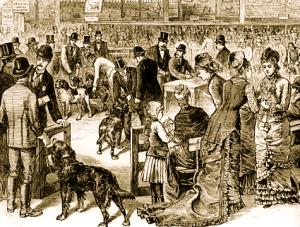
westminsterdogshowThe world’s most famous dog show was first held on May 8, 1877, and called the “First Annual NY Bench Show.” The venue was Gilmore’s Garden at the corner of Madison Avenue and 26th Street, a hall which would later be known as Madison Square Garden.  Interestingly, another popular Gilmore Garden event of the era was boxing.  Competitive boxing was illegal in New York in those days, so events were billed as “exhibitions” or “illustrated lectures.” I love that last one.

It was originally a show for hunting dogs, mostly Setters and Pointers with a few Terriers.  A group of hunters used to meet at the Westminster Hotel at Irving Place & 16th Street, in Manhattan.  The Westminster Kennel Club was formed by this group when they first decided to hold a dog show.  When you think of the 2nd amendment purgatory that is Warren Wilhelm (Bill) DiBlasio’s New York, it’s amusing to think that original prizes included pearl handled revolvers.

new-westminster-breeds1,200 dogs arrived for that first show, in an event so popular that the originally planned three days morphed into four.  The Westminster Kennel Club donated all proceeds from the fourth day to the ASPCA, for the creation of a home for stray and disabled dogs.  The organization remains supportive of animal charities, to this day.
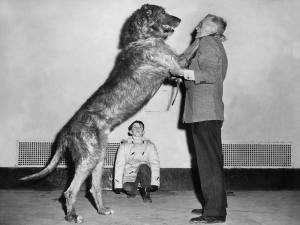
The Westminster dog show is the longest continuously held sporting event in the United States, with the sole exception of the Kentucky Derby, which began only two years earlier.

Not even two World Wars could stop Westminster.  A tugboat strike cut two days down toWolfhound one in 1946.  Even so, “Best in Show” was awarded fifteen minutes earlier than it had been, the year before. I wonder how many puppies were named “Tug” that year.  The Westminster dog show was first televised in 1948, three years before the first nationally televised college football game.
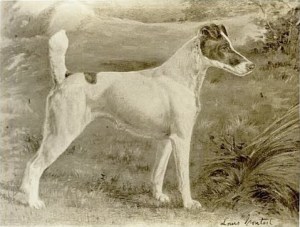

When the American Kennel Club was founded in 1884, Westminster was the first club to be admitted.  Breed parent clubs such as the German Shepherd Dog Club of America develop breed standards, extensive written descriptions of what the perfect specimen looks like for any given breed.  Some of the traits which distinguished the original working dogs of 1877 are still apparent, while other elements are seemingly arbitrary, such as tail carriage, eye shape and color.

Dogs are judged first against others of their own breed, and then the best of each goes forward into one of seven groups:  Sporting, Hound, Working, Terrier, Toy, Non-Sporting, and Herding.  In the final round, the winners from each of these seven groups compete for “Best in Show”, of which there can be only one.

Mixed breeds have been permitted since 2014, to compete in an agility event.

Warren_remedy
Ch. Warren Remedy

A Smooth Fox Terrier named Ch.(Championship) Warren Remedy won the top award in 1907, 1908 and 1909, the only dog to ever win three Best in Shows at Westminster.  Seven dogs have twice taken the top award, and five owners have won Best in Show with more than one dog.  A Sussex Spaniel named Stump became the oldest winner in dog show history in 2009, at the age of 10.  Judge Sari Tietjen said she had no idea the winning dog was a senior citizen.  “He showed his heart out,” she said. “I didn’t know who he was or how old … I just couldn’t say no to him”.

Stump
Stump

Today, the Westminster dog show runs two days and nights in February.  Entry is limited to 2,800 dogs and fills up on the first day of registration.  Breed judging takes place during the day at Piers 92 and 94. Group and Best in Show competition takes place in the evening at Madison Square Garden. Since 1992, Westminster has invited the top five dogs from each breed to pre-enter, based on dog show performances of the preceding year.

Madison Square Garden generally sells out for the event, the WKC issuing up to 700 press credentials for media attending from no fewer than 20 countries.  Each year the Westminster website www.westminsterkennelclub.org receives 20 million page views from 170 countries.

Algonquin-CatSince the late 60s, the Westminster Best in Show winner has celebrated at Sardi’s, a popular mid-town eatery in the theater district and birthplace of the Tony award.  And then the Nanny State descended, pronouncing that 2012 would be their last.  There shalt be no dogs dining any restaurants, not while Mayor Bloomberg is around.

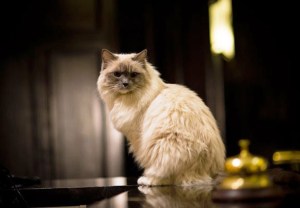
The Algonquin, the historic hotel at the corners of 59th St. W. & 44th, took in a stray cat sometime back in the 1930s.  A succession of felines have had the run of the place ever since. The males have all been “Hamlet”, and the females called “Matilda”.Staffordshire_Bull_Terrier_Westminster_Dog_Show

Mayor Yourslurpeeistoobig Bloomberg’s Board of Health descended on the Algonquin in 2011, requiring that the cat be kept on a leash.  There ensued a tempest in a cat box, until a compromise was reached later that year. An electronic pet fence would be installed, confining the cat to non-food areas of the hotel.

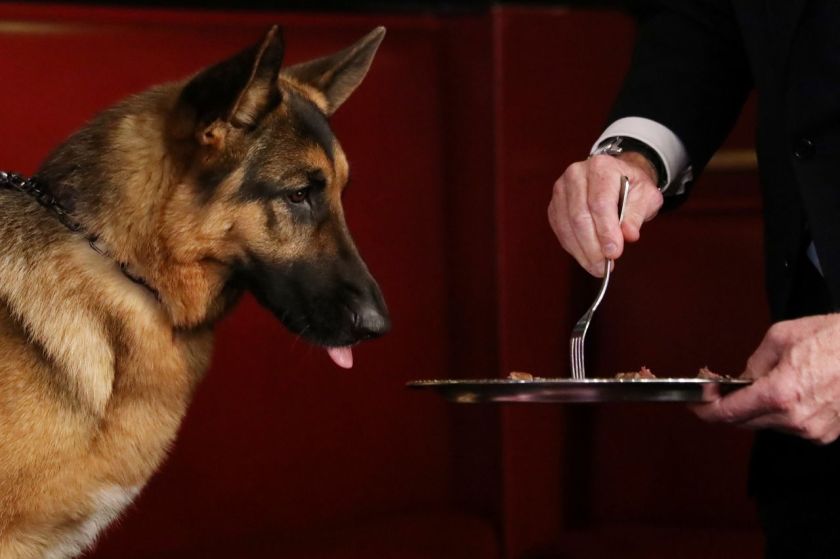
Not wanting another such drama, Nanny Bloomberg pulled his health commissioner, Dr. Thomas Farley, aside.  By the end of the week, the health department had found a loophole to defuse the standoff:  Dr. Farley would issue a waiver.  Since then, the winner at Westminster is free to enjoy the traditional celebratory luncheon of diced chicken and rice off a silver platter.  Provided that it’s eaten in the back room.

SardisDinner


May 7, 1945 Victory in Europe

The news was greeted with reserve in the United States, where the first thought was that there was still a lot of fighting to do in the Pacific

Reporters from AP, Life magazine, and others began sleeping on the floor of Eisenhower’s red brick schoolhouse headquarters on the 5th, for fear of stepping out and missing the surrender of Nazi Germany. Adolf Hitler had taken his own life on April 30, so it was General Alfred Jodl who came to Reims, France to sign the document, which included the phrase “All forces under German control to cease active operations at 2301 hours Central European time on 8 May 1945“. The signing of the instruments of surrender ending WWII in Europe took place on Monday, May 7, at 2:41am, local time.  The war in Europe, was over.

German surrender

The German government announced the end of hostilities to its people right away, but most of the Allied governments, remained silent.   Field Marshal Wilhelm Keitel would not repeat the signing in Soviet General Georgy Zhukov’s Berlin headquarters until nearly midnight of the following day. Soviet Premier Josef Stalin had his own ideas about how he wanted to handle the matter, and so the rest of the world, waited.

In England, the 7th dragged on with no public statement.  Large crowds gathered outside of Buckingham Palace shouting “We want the King”. Bell ringers throughout the British Isles remained on silent standby, waiting for the announcement.  The British Home Office issued a circular, instructing Britons how they could celebrate: “Bonfires will be allowed, but the government trusts that only material with no salvage value will be used.”  Still, the world waited.

Prime Minister Winston Churchill finally lost patience in the early evening, saying he wasn’t going to give Stalin the satisfaction of holding up what everyone already knew. The Ministry of Information made this short announcement at 7:40pm: “In accordance with arrangements between the three great powers, tomorrow, Tuesday, will be treated as Victory in Europe Day and will be regarded as a holiday”.VE Day

The news was greeted with reserve in the United States, where the first thought was that there was still a lot of fighting to do in the Pacific. President Harry Truman broadcast an address to the nation at 9:00am on May 8th, thanking President Roosevelt and wishing he’d been there to share the moment. Roosevelt had died on April 12, in Warm Springs, Georgia.

President Truman’s speech begins: “This is a solemn but a glorious hour. I only wish that Franklin D. Roosevelt had lived to witness this day. General Eisenhower informs me that the forces of Germany have surrendered to the United Nations. The flags of freedom fly over all Europe. For this victory, we join in offering our thanks to the Providence which has guided and sustained us through the dark days of adversity”.

TapsVE Day wasn’t the end of WWII, only the end of the war in Europe. Fighting in the Pacific would continue until the Japanese surrender on the 15 August 1945, the date celebrated as VJ Day.

Today we don’t hear much about the Eastern Front, though it was the largest military confrontation in history.  Fighting between Nazi Germany and the Soviet Union had long since taken on shades of a race war, Slav against Teuton, in a paroxysm of mutual extermination that is horrifying, even by the hellish standards of WWII. Nearly every extermination camp, death march, ghetto and pogrom which formed the Holocaust, occurred on the Eastern Front.

The loss of life was prodigious, through atrocity, massacre, disease, starvation and exposure. Civilians resorted to cannibalism, during the 900-day siege of Leningrad.  Entire landscapes were destroyed while populations fled, never to return.  Rape became a weapon of war.

An estimated 70 million people were killed all over the world, as the result of World War II.  Over 30 million of them, many of those civilians, died on the Eastern Front.  Pockets of fighting would continue through the surrender in Europe. Soviet forces lost over 600 in Silesia alone, on May 9. The day after their own signing.  Moscow celebrated VE Day on the 9th, with a radio broadcast from Josef Stalin himself: “The age-long struggle of the Slav nations…has ended in victory. Your courage has defeated the Nazis. The war is over.”

Ticker Tape Parade
7th May 1945: A wounded American serviceman during a ticker tape parade in New York following press reports of the unconditional surrender of Germany. (Photo by Fox Photos/Getty Images)

May 6, 1937 Hindenburg

The famous film shows ground crew running for their lives, and then turning and running back to the flames. It’s natural enough to have run, but there’s something the film doesn’t show.

Hindenburg left Frankfurt airfield on its last flight at 7:16pm, May 3, 1937, carrying 97 passengers and crew. Crossing over Cologne, Beachy Head and Newfoundland, the airship arrived over Boston at noon on the 6th.  By 3:00pm it was over the skyscrapers of Manhattan, arriving at the Naval Air Station in Lakehurst, NJ at 4:15.

Foul weather had caused a half-day’s delay, but the landing was eventually cleared.  The final S turn approach executed at 7:21pm. The ship was at the mooring mast, 180′ from the ground with forward landing ropes deployed, when flames first erupted near the top tail fin.

Eyewitness accounts differ as to the origin of the fire.  The leading theory is that, with the metal frameworkHindenburg grounded through the landing line, the ship’s fabric covering became charged in the electrically charged atmosphere, sending a spark to the air frame and igniting a hydrogen leak.  Seven million cubic feet of hydrogen ignited almost simultaneously.  It was over in less than 40 seconds.

The largest dirigible ever built, an airship the size of Titanic, burst into flames as the hull collapsed and plummeted to the ground.  Passengers and crew jumped for their lives and scrambled to safety, along with ground crews who had moments earlier been positioned to receive the ship.

The famous film shows ground crew running for their lives, and then turning and running back to the flames. It’s natural enough to have run, but there’s something the film doesn’t show.  That was Chief Petty Officer Frederick “Bull” Tobin, the airship veteran in charge of the landing party, bellowing at his sailors above the roar of the flames.  “Navy men, Stand fast!  We’ve got to get those people out of there!” Tobin had survived the crash of the USS Shenandoah on September 4, 1923.  He wasn’t about to abandon his post, even if it cost him his life. Tobin’s Navy men obeyed.  That’s what you see when they turn and run back to the flames.

The Hindenburg disaster is sometimes compared with that of the Titanic, but there’s a common misconception that the former disaster was the more deadly of the two. In fact, 64% of the passengers and crew aboard the airship survived the fiery crash, despite having only seconds to react.   In contrast, officers on board the Titanic had 2½ hours to evacuate, yet most of the lifeboats were launched from level decks with empty seats. Only 32% of Titanic passengers and crew survived the sinking.  It’s estimated that an additional 500 lives could have been saved, had there been a more orderly, competent, evacuation of the ship.

As it was, 35 passengers and crew lost their lives on this day in 1937, and one civilian ground crew.  Without doubt the number would have been higher, if not for the actions of Bull Tobin and is Navy men.

Hindenberg CrashWhere a person was inside the airship, had a lot to do with their chances of survival.  Mr and Mrs Hermann Doehner and their three children (Irene, 16, Walter, 10, and Werner, 8) were in the dining room, watching the landing.  Mr. Doehner left before the fire broke out.  Mrs. Doehner and the two boys were able to jump out, but Irene went looking for her father.  Both died in the crash.

For all the film of the Hindenburg disaster, there is no footage showing the moment of ignition. Investigators theorized a loose cable creating a spark or static charge from the electrically charged atmosphere.  Some believed the wreck to be the result of sabotage, but that theory is largely debunked.

Four score years after the disaster, the reigning hypothesis begins with the static electricity theory, the fire fed and magnified by the incendiary iron oxide/aluminum impregnated cellulose “dope” with which the highly flammable hydrogen envelope was painted.

The 35 year era of the dirigible was filled with accidents before Hindenburg, but none had dampened public enthusiasm for lighter-than-air travel. The British R-101 accident killed 48, the crash of the USS Akron 73. The LZ-4, LZ-5, Deutschland, Deutschland II, Italia, Schwaben, R-38, R-101, Shenandoah, Macon, and there were others.  All had crashed, disappeared into the darkness, or over the ocean.  Hindenburg alone was caught on film, the fiery crash recorded for all to see.  The age of the dirigible, had come to an end.

May 5, 1945 Fire Balloon

In a forest near Bly, Oregon, a monument bears these words, cast in bronze: The “only place on the American continent where death resulted from enemy action in World War II”

Following the 1883 eruption of the Krakatoa volcano, weather watchers described an eastbound, upper atmospheric air current described as the “equatorial smoke stream”.  In the 1920s, Japanese meteorologist Wasaburo Oishi tracked these upper level winds from a site near Mount Fuji, using pilot balloons. Oishi doomed his work to international obscurity when he published his findings in Esperanto. Inside Japan, there were those who took note, filing away this new-found knowledge of what we now call the “Jet Stream”.

Japanese balloon bomb diagramIn the latter half of WWII, Imperial Japanese military thinkers conceived the fūsen bakudan or “fire balloon”, a hydrogen filled balloon device designed to ride the jet stream, using sand ballast and a valve system to navigate the weapon system onto the North American continent.

With sandbags, explosives, and the device which made the thing work, the total payload was about a thousand pounds on liftoff.  The first such device was released on November 3, 1944, beginning the crossing to the west coast of North America.  9,300 such balloons were released with military payloads, between late 1944 and April, 1945.

Such a long-range attack would not be duplicated until the 1982 Falklands War, and was near unimaginable at the time.  In 1945, intercontinental weapons were more in the realm of science fiction.  As these devices began to appear, American authorities theorized that they originated with submarine-based beach assaults, German POW camps, even the internment camps into which the Roosevelt administration herded Japanese Americans.

Japanese_fire_balloon_shotdown_gun
Fighters shot down fewer than 20

These “washi” paper balloons flew at high altitude and surprisingly quickly, completing the Pacific crossing in three days. Balloons landed from Alaska to Northern Mexico, and as far east as Detroit.

A P-38 Lightning fighter shot one down near Santa Rosa, California, while Yerington, Nevada cowboys cut one up to make hay tarps. Pieces of balloon were found in the streets of Los Angeles. A prospector near Elko Nevada delivered one to local authorities, on the back of a donkey.

Among US units assigned to fight fire balloons was the 555th Parachute Infantry Battalion, which suffered one fatality and 22 injuries fighting fires.

One of the last balloons came down on March 10 near Hanford Washington, shorting out power lines supplying electricity for Manhattan Project nuclear reactor cooling pumps. The war in the Pacific could have ended very differently, had not backup safety devices restored power, almost immediately.

Colonel Sigmund Poole, head of the U.S. Geological Survey military geology unit, asked, “Where’d the damned sand come from?”  Microscopic analysis of sand ballast identified diatoms and other microscopic sea life.  This and the mineral content of the sand itself proved to be definitive.  This stuff could only have come from the home islands of Japan, more specifically, one or two beaches on the island of Honshu.Japanese Balloon Bomb

American authorities were alarmed.  Anti-personnel and incendiary bombs were relatively low grade threats.  Not so the biological weapons Japanese military authorities were known to be developing at the infamous Unit 731, in northern China.

284 of these weapons are known to have completed the Pacific crossing to the United States, Mexico and Canada.  Experts estimate as many as 1,000 may have made it.  Sightings were reported in seventeen US states. Pilots were ordered to shoot them down on sight, but many devices escaped detection, altogether.

In an effort to deny valuable intelligence to their Japanese adversary, US military and government authorities did everything they could to keep these “Fire Bombs” out of the media.  Even though such secrecy put Americans at risk.

Japanese Authorities reported that the bombs were hitting key targets, thousands were dead or injured, and American morale was low.

On the morning of May 5, 1945, Pastor Archie Mitchell and his wife Elsie took their Sunday school class of five on a picnic to a forest area near Bly, Oregon.  Elsie and the kids came upon a large balloon with a strange looking device attached to it, as Pastor Mitchell parked the car. There was no way they could have known, what they had found was a Japanese weapon of war.  The device exploded, killing all six, instantly.

Several such devices exploded, igniting wildfires in the forests of California, Oregon and Washington, but the site near Bly is the only one known to have resulted in American casualties.Japanese balloon bomb shrapnel tree

Today there is a small picnic area located in the Fremont-Winema National Forest, in Lake County, Oregon.  It’s maintained by the US Forest Service, memorialized as the Mitchell Recreation Area and listed on the National Register of Historic Places.  A small stone marker points the way to a shrapnel scarred tree.

A second monument bears these words, cast in bronze:  The “only place on the American continent where death resulted from enemy action during World War II”.  There are six names above those words, those of five children and their teacher, who was pregnant at the time.  Elsie Mitchell, age 26.  Edward Engen, age 13.  Jay Gifford, age 13.  Joan Patzke, age 13.  Dick Patzke, age 14.  Sherman Shoemaker, age 11.

Mitchell Monument