October 16, 1793 Let them eat Cake

At first the people liked their new Queen-to-be, but the Royal Court was another story. A shark tank of grasping ambition, this crowd had promoted several Saxon Princesses for the match and called the Dauphine “The Austrian Woman”. She would come to be called far worse.

Political alliances came and went throughout 18th century Europe, with treaties often sealed by arranged marriages. One such alliance took place in 1770. Francis I, Holy Roman Emperor and Queen Maria Theresa, the formidable Sovereign of Hungary and Bohemia, married their little girl to Louis-Auguste, the son of Louis XV, King of France. Her name was Maria Antonia. She was twelve years old.

The happy couple had yet to meet when the marriage was carried out by proxy, the bride remaining in Vienna with the groom near-800 miles away, in Paris. She was now the Dauphine, Marie Antoinette, pre-teen wife of the 14-year-old Dauphin, future King of France.
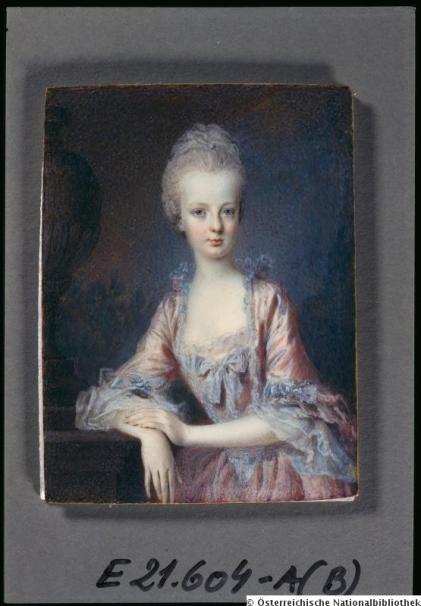
Marie_Antoinette_girl

There was a second, ceremonial wedding held in May, after which came the ritual bedding. This wasn’t the couple quietly retiring to their own private space.  Ohhhhh, no. This was the bizarre spectacle of courtiers crowding into the bedchambers, peering down at the frightened couple to be sure the marriage was consummated.

Unsurprisingly, it was not. In time, that failure would do damage to both their reputations.

At first the people liked their new Dauphine, but the Royal Court was another story. A shark tank of grasping ambition, this crowd had promoted several Saxon Princesses for the match and called the French Queen-to-be “The Austrian Woman”.  She would come to be called far worse.

The stories you read about 18th century Court intrigue make you wonder how anyone lived like that. Antoinette was naïve of the vicious circles into which she was cast. Relations were especially difficult with the King’s mistress, the Comtesse du Barry, and Antoinette was somehow expected to work them out. The King’s daughters on the other hand, didn’t care for du Barry or their unsavory relations, with their father. She literally couldn’t win. The sisters bellyached about feeling “betrayed” one time, when Antoinette commented to the King’s mistress: “There are a lot of people at Versailles today”.

Court intrigues were accompanied by reports to Antoinette’s mother in Vienna, the Empress responding with her own stream of criticism. The Dauphin was more interested in lock making and hunting she wrote, because Antoinette had failed to “inspire passion” in her husband. The Empress even went so far as to tell her daughter she was no longer pretty. She had lost her grace. Antoinette came to fear her own mother more than she loved her.

Marie_Antoinette_by_Joseph_Ducreux

Louis-Auguste was crowned Louis XVI, King of France, on June 11, 1775. Antoinette remained by his side though she was never crowned Queen, instead remaining Louis’ “Queen Consort”.

With her marriage as yet unconsummated, Antoinette’s position became precarious when her sister in law gave birth to a son and possible heir to the throne. Antoinette spent her time gambling and shopping, while wild rumors and printed pamphlets described supposedly bizarre sexual romps.

The French government was staggered by debt at this time, the result of endless foreign wars, but Antoinette received more than her share of the blame. As first lady to the French court, Antoinette was expected to be a fashion trendsetter. Her shopping was in keeping with the role but rumors wildly inflated her spending habits. Her lady-in-waiting protested that her habits were modest, visiting village workshops in a simple dress and straw hat. Nevertheless, the Queen Consort was rumored to have plastered the walls of Versailles with gold and diamonds.

The difficult winter of 1788-89 produced bread shortages and rising prices as the King withdrew from public life. The marriage had produced children by this time, but the legend of the licentious spendthrift and empty headed foreign queen had taken root as government debt overwhelmed the economy.

French politics boiled over in June 1789, leading to the storming of the Bastille on July 14. Much of the French nobility fled as the newly formed National Constituent Assembly conscripted men to serve in the Garde Nationale, while the French Constitution of 1791 weakened the King’s authority.

Bastille

Food shortages magnified the unrest. That October, the King and Queen were placed under house arrest in the Tuileries Palace. They attempted to flee the escalating violence the following June, but were caught and returned within days. Radical Jacobins exploited the escape attempt as a betrayal, and pushed to have the monarchy abolished altogether.

marie-antoniette-french-history

Unrest turned to barbarity as Antoinette’s friend and supporter, the Princesse de Lamballe, was taken by the Paris Commune for interrogation. She was murdered at La Force prison, her head fixed on a pike and marched through the city.

Louis XVI was charged with undermining the First Republic in December 1792, found guilty and executed by guillotine on January 21, 1793. He was 38 years old.

Marie-Antoinette was now prisoner #280, her health deteriorating in the following months. She suffered from tuberculosis by this time and suffered frequent bleeding, possibly as the result of uterine cancer.

Antoinette was taken from her cell on October 14 and subjected to a sham trial whose outcome was never in doubt. She was accused of molesting her own son, a charge so outrageous that even the market women who had stormed the palace demanding her entrails in 1789, spoke out in her support. “If I have not replied”, she said, “it is because nature itself refuses to respond to such a charge laid against a mother.”

marie-antoinette over the years

On October 16, 1793, Marie-Antoinette’s hair was cut off. She was paraded through Paris in an ox cart, taken to the Place de la Révolution, and decapitated. On mounting the scaffold, she accidentally stepped on the executioner’s foot.  The last words of the most hated woman in Paris, were “Pardon me sir, I meant not to do it”.

“Let them eat cake” is often attributed to Marie Antoinette, but there’s no evidence that she ever said it. The phrase appears in “Les Confessions”, the autobiography of Jean-Jacques Rousseau, attributed to a “Grande Princesse” whom the book declines to name. Considering the lifetime of cheap and mean-spirited gossip to which the woman was subjected, it’s easy to believe this was just more of the same.

October 15, 1582 Double Dating

Confusion reigned well into the 18th century. Legal contracts, civic calendars, and the payment of rents and taxes were all complicated by the two calendar system. Military campaigns were won or lost, due to confusion over dates.

From the 7th century BC, the Roman calendar attempted to follow the cycles of the moon. The method often fell out of phase with the change of seasons, requiring the random addition of days. The Pontifices, the Roman body charged with overseeing the calendar, made matters worse. Days were added to extend political terms, and to interfere with elections. Military campaigns were won or lost due to confusion over dates. By the time of Julius Caesar, things needed to change.

When Caesar went to Egypt in 48BC, he was impressed with the way the Egyptians handled the calendar. The Roman statesman hired the Alexandrian astronomer Sosigenes to help straighten things out. The astronomer calculated a proper year to be 365¼ days, more accurately tracking the solar and not the lunar year. “Do like the Egyptians”, he might have said. The new “Julian” calendar went into effect in 46BC. Caesar decreed that 67 days be added that year, moving the New Year’s start from March to January 1.

October 1582 missing days

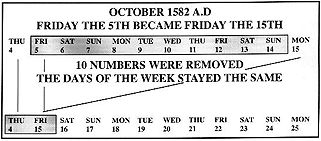
This “Julian” calendar miscalculated the solar year by 11 minutes every year, resulting in a built-in error of 1 day for every 128 years.   By the late 16th century, the seasonal equinoxes were ten days out of sync, causing a problem with the holiest days of the Roman church.

In 1579, Pope Gregory XIII commissioned the Jesuit mathematician and astronomer Christopher Clavius, to devise a new calendar to correct this “drift”.  The “Gregorian” calendar was adopted on this day in 1582, omitting ten days that October and changing the manner in which “leap” years were calculated.

The Catholic countries of Europe were quick to adopt the Gregorian calendar, Portugal, Spain, pontifical states, but England and her overseas colonies continued to use the Julian calendar. Confusion reigned well into the 18th century.  Legal contracts, civic calendars, and the payment of rents and taxes were all complicated by the two calendar system. Military campaigns were won or lost, due to confusion over dates. Sound familiar?

Between 1582 and 1752, many English and colonial records included both the “Old Style” and “New Style” year.  The system was known as “double dating” and resulted in date notations such as March 19, 1602/3.  Others merely changed dates. Keyword search on “George Washington’s birthday” for instance, and you’ll be informed that the father of our country was born on February 22, 1732.  The man was actually born on February 11, 1731 but, no matter.  Washington himself recognized the date of his birth to be February 22, 1732, following adoption of the Gregorian Calendar.

virginia-almanack-1752
Virginia almanack of 1752

Tragically, the exploding heads of historians and genealogists alike are lost, to history..

The “Calendar Act of 1750” set out a two-step process for adoption of the Gregorian calendar.  Since the Roman calendar began on March 25, the year 1751 was to have only 282 days so that January 1 could be synchronized with that date.  That left 11 days to deal with.

So it was decreed that Wednesday, September 2, 1782, would be followed by Thursday, September 14.

You can read about “calendar riots” around this time, though such stories may be little more than urban myth.

Philip Stanhope, 4th Earl of Chesterfield, was a prime sponsor of the calendar measure.  His use of the word “Mobs” was probably a description of the bill’s opponents in Parliament.   Even so, some believed their lives were being shortened by those 11 days, while others considered the new calendar to be a “Popish Plot”.  The subject was very real campaign issue between Tories and Whigs in the elections of 1754.

There’s a story of one William Willett, who lived in Endon. Willett bet that he could dance non-stop for 12 days and 12 nights, starting his jig about town the evening of September 2, 1752. He stopped the next morning, and went out to collect his bets.

I am unable to determine how many actually paid up.

Ever mindful of priorities, the British tax year was officially changed in 1753, so as not to “lose” those 11 days of tax revenue.  Revolution was still 23 years away in the American colonies, but the reaction “across the pond” could not have been one of unbridled joy.

The last nation to adopt the Gregorian calendar was Turkey, formally doing so in 1927.

ben franklin

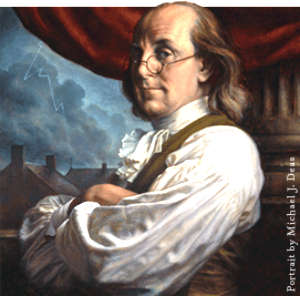
Back in the American colonies, Ben Franklin seems to have liked the idea of those “lost days”. “It is pleasant for an old man to be able to go to bed on September 2″ he wrote, “and not have to get up until September 14.”

Much to the chagrin of Mr. Clavius, the Gregorian calendar still gets out of whack with the solar cycle, by about 26 seconds every year.  Clever methods were devised to deal with the discrepancy and several hours have already been added, but we’ll be a full day ahead by the year 4909.

I wonder how Mr. Franklin would feel, to wake up and find that it’s still yesterday.

October 14, 1912 To Kill a Bull Moose

The 9000+-member audience was stunned when the candidate announced “I don’t know whether you fully understand that I have just been shot—but it takes more than that to kill a Bull Moose!” Roosevelt spoke for 80 minutes, before going to a Milwaukee hospital for treatment.

The first “Progressive” era began as a local movement in the 1890s, largely in response to the corruption of the political machines, and the monopolistic excesses of the “gilded age”.  By the 1920s, Progressivism had come to dominate state and national politics, bringing with it the national income tax, direct election of Senators, and Prohibition, with the 16th 17th and 18th amendments, respectively.

progressive

Great believers in the perfectibility of the public sphere, Progressives dismissed old methods as wasteful and inefficient, leaning instead toward the advice of academics and “experts”. A never ending quest for that “one best way” to get things done.

Progressive politicians covered both sides of the political aisle, with leaders such as Wisconsin Senator Robert M. LaFollette Sr. and Chief Justice Charles Evans Hughes on the Republican side, and Woodrow Wilson, and the attorney, politician and orator William Jennings Bryan (he of the famous “Monkey Trial”), on the side of the Democrats.

When Theodore Roosevelt first appeared on the political scene at age 23, there was little to hint at the Progressive he would later become.  “TR” was sworn into office in 1901, following the assassination of President William McKinley.   At 42 he was the youngest man to ever take the oath of office, and possibly the most energetic.

As President, Roosevelt pushed executive power to new heights, attacking “Captains of Industry” with a two-pronged strategy of anti-trust legislation, and regulatory control.  TR was the “Conservation President”, creating the United States Forest Service (USFS) and establishing no fewer than 150 national forests, 51 federal bird reserves, 4 national game preserves, 5 national parks, and 18 national monuments.  All told, Roosevelt protected approximately 230 million acres of public land.

william-howard-taft-national

Roosevelt retired from politics after two terms to go on African safari, backing William Howard Taft for the Republican nomination.

Taft easily defeated Democratic candidate William Jennings Bryan in the 1908 election, but his presidency proved to be a disappointment to the Progressive wing of the party.

The more conservative Taft didn’t take the expansive view of his predecessor.  By 1910, Roosevelt had returned to a public speaking tour against his own hand-picked successor.

The federal government needed to assume a larger role in the lives of every-day Americans, argued Roosevelt, who, despite repeated assurances that he was done with politics, challenged Taft for the 1912 Republican nomination.  When asked if he was up to another campaign season, Roosevelt replied he was ready and felt as “fit as a bull moose”.

The final split came with the June Republican party convention in Chicago, when the party rejected Roosevelt’s “New Nationalism” platform, nominating Taft as its standard bearer for re-election.  Roosevelt and his reform-minded supporters broke with the party, forming the “Progressive”, or “Bull Moose” party, as the Democratic convention selected former Princeton University President and New Jersey Governor Woodrow Wilson, to be its candidate.  This was going to be a three-way race.

1912-election
1912 Election

John Flammang Schrank emigrated to America in 1885, at the age of 9.  His parents died a short time after, leaving him to work for an uncle, a tavern keeper in the Kleindeutschland, (“Little Germany”) section of New York.  Schrank’s aunt and uncle left him a sizeable inheritance on their passing, in hopes that he would live a quiet and peaceful life.  Schrank was heartbroken at losing this, his second set of parents.  When his first and only girlfriend Emily Ziegler died in the General Slocum disaster of 1904, John Schrank became unhinged.

He drifted up and down the east coast for several years.  In September 1912, he became obsessed with Theodore Roosevelt.  For three weeks, John Schrank followed the Roosevelt campaign, stalking the candidate across eight states.  On the afternoon of October 14, Roosevelt was in Milwaukee, dining with local dignitaries at the Hotel Gilpatrick, before a planned speech at the Milwaukee Auditorium.  As the former President was getting into his vehicle, he turned to wave to well-wishers. Schrank was four or five feet away when he fired his .38 caliber revolver, hitting the former President in the chest.

jjustice14n-5-copy
John Flammang Schrank smiles as he’s taken into custoy for the attempted assassination of Theodore Roosevelt

The bullet pierced the fifty folded pages of Roosevelt’s speech and a metal spectacle case, before lodging in his chest.  The former President coughed once into his hand, to see if there was blood.  Seeing none, TR concluded that his lungs were fine, and decided to give the speech.  The 9000+-member audience was stunned when the candidate announced “I don’t know whether you fully understand that I have just been shot—but it takes more than that to kill a Bull Moose!” Roosevelt spoke for 80 minutes, before going to a Milwaukee hospital for treatment.

justice14n-3-copy
Roosevelt x-ray

Theodore Roosevelt lived the rest of his life with that bullet in his chest.  Six more years. As for John Schrank, he claimed in a letter found on his person, that the ghost of William McKinley had instructed him to avenge his death with the assassination of his former Vice President.  He would live out the rest of his days at the Central State Mental Hospital for the criminally insane, in Waupun, Wisconsin.

Schrank letter

Woodrow Wilson easily defeated his opponents to become the 28th President of the United States, garnering 435 electoral votes to his opponents’ combined total, of 96.

justice14n-10-copy
Fifty pages long and folded in half, Elbert Martin holds the speech that saved TR’s life

September 28, BC551 The Power of an Idea

Many of the man’s teachings are as fresh and meaningful today as when he himself trod the earth, 2½ thousand years ago.

A boy was born this day in the Zou state of eastern China, a region now known as the Shandong Province. 

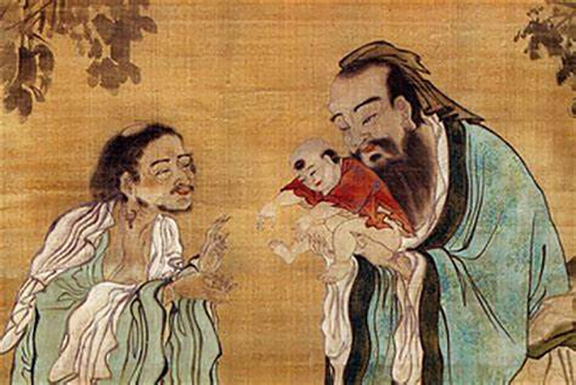
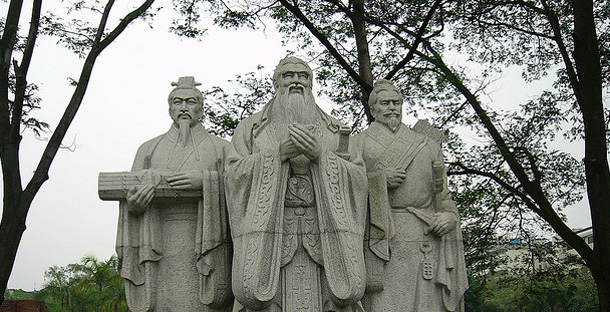
The year was BC551.  He was born into the class of Shi, one of four loose castes or “categories of people” comprising the social structure of ancient China and represented by “gentry scholars”.  Kǒng Fūzǐ (Master Kǒng) was educated in the “six arts”:  Traditional Rites, Music, Archery, Chariotry, Calligraphy and Arithmetic, the mastery of which was believed to represent a state of perfection known as junzi, or “respectable person”.

Kǒng’s father Kǒng He died when the boy was three. He was raised in poverty by his mother, Yan Zhengzai.  Even as a teenager, the boy showed a voracious appetite for learning, a trait which would serve him well, in later life.

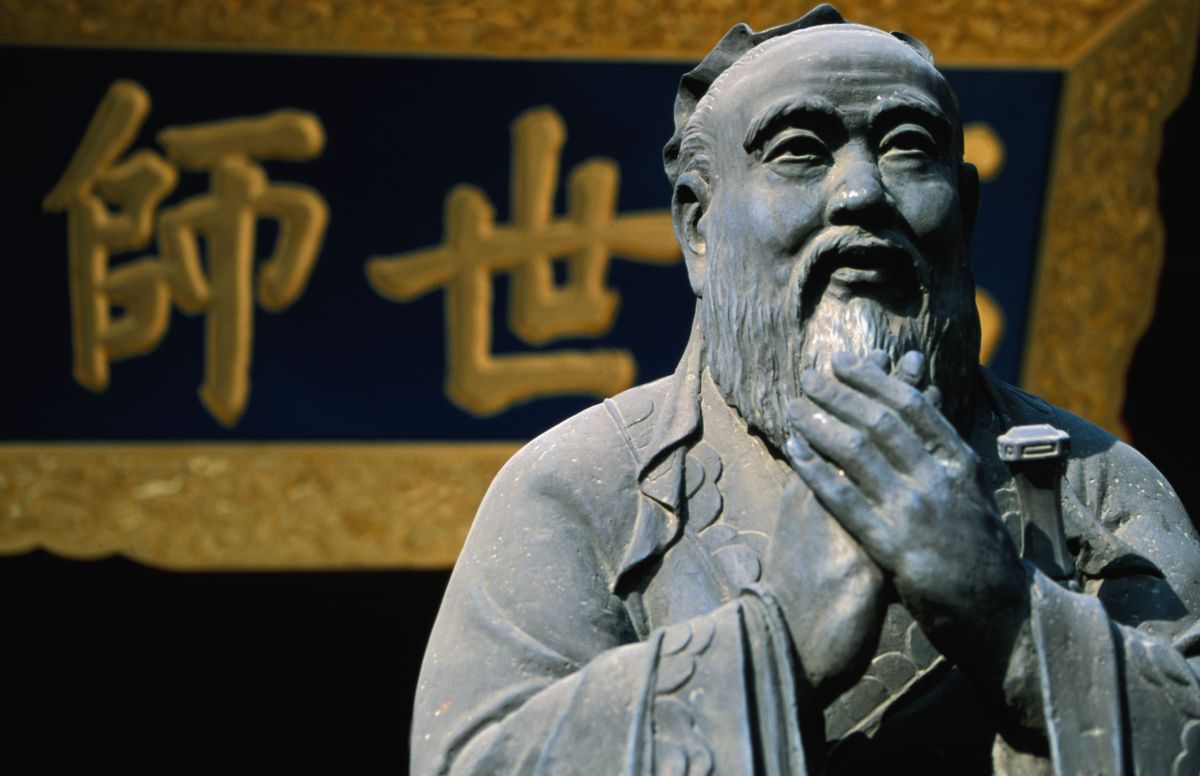
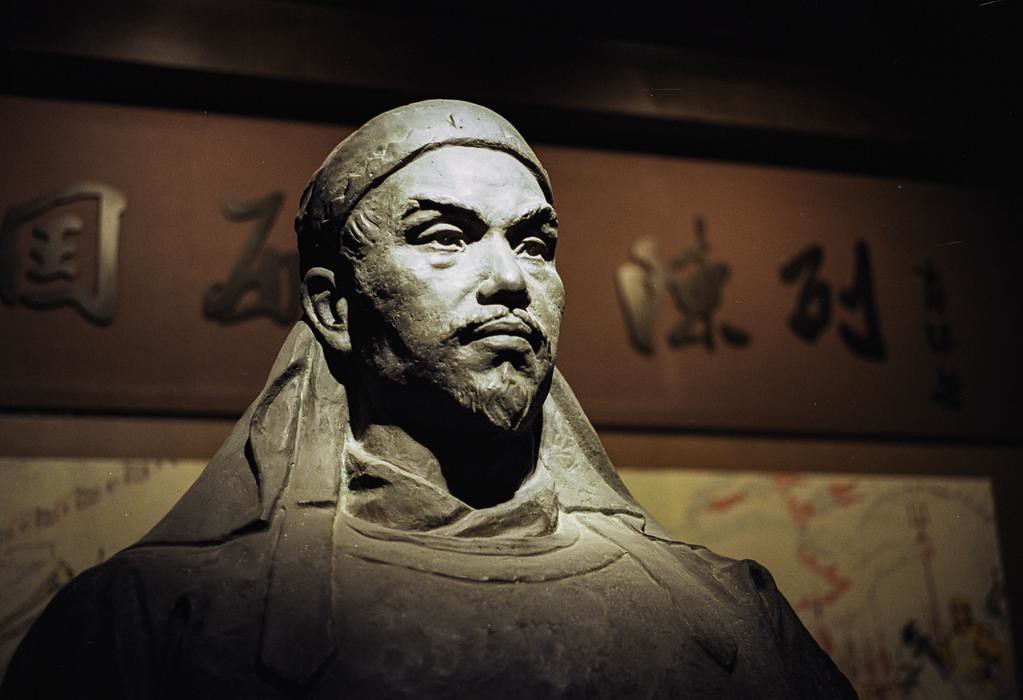
Kǒng Fūzǐ worked a number of government jobs through his twenties such as bookkeeper and caretaker for sheep and horses and finally, “Minister of Crime”. He is best remembered not for his political career however, but as the learned teacher, scholar and philosopher, his name transliterated by a 16th-century Jesuit missionary as…Confucius.

 Confucius’ teachings emphasized personal and governmental morality, uprightness in social relationships, respect for family and the veneration of ancestors.  2,500 years later, countless tidbits of conventional wisdom begin with the words “Confucius say“.

Many of the man’s teachings are as fresh and meaningful today as when he himself trod the earth, 2½ thousand years ago.

A disciple called Zi Gong once asked: “Is there any one word that could guide a person throughout life?” Centuries later, the master’s response would find voice in the great Jewish scholars Hillel and Philo of Alexandria, and in the writings of Plato, Aristotle, Isocrates, and Seneca. We in the West, know it as “The Golden Rule”. The Teacher replied: “How about ‘reciprocity’! Never impose on others what you would not choose for yourself.”

To some, Confucianism represents a continuation of an aboriginal Chinese religion, dating back some three thousand years.

Confucius himself claimed to have invented nothing, that he was only transmitting ancient ideas, but European admirers such as Voltaire saw in his teachings not the endless inheritance of “noble virtue” but a “meritocracy” of a sort which would have been familiar to the American founding fathers. A belief system in which the virtuous commoner who cultivates the teachings of the master was a superior being, better in every way to the shameless and wastrel sons of kings.

Such thinking took hold during the mid-Tang dynasty (AD618 – 907) in the form of “Imperial Examinations”, and lasted until the late Qing reforms of 1905. In theory, Confucian meritocracy took the form of written examinations, necessary to enter the civil service. In practice, the three-tiered examination produced a vast unemployable class among those holding the shengyuan or basic degree, while the highest or jinshi achieved degrees of difficulty to be feared as nothing short of savage.

Hong Xiuquan (born “Hong Huoxiu” on January 1, 1814) began studying for the exam, at age 5. By six the boy could recite from memory, the Four Books of Confucianism. Preliminary civil service examinations were easy for a boy who placed first and yet, the third level remained elusive. Years later, Hong Huoxiu took his first stab at the jinshi, an exam which fewer that 1%, ever passed. There was a second attempt at age 22 and a third in 1837 and each time…defeat. It was too much. His was a lifetime’s labor met with failure and the nervous and mental breakdown, was absolute. Hallucinations wracked his body and his mind for weeks and, when he emerged, he did so as the younger brother of Jesus Christ. According to him, quite literally.

Hong set about burning and destroying all the Confucian and Buddhist statues and books he could find, first in his home village and then others. The uprising of the “God Worshippers” would cascade and grow to straight-out civil war. Twenty to thirty million Chinese lay dead by the end of the “Taiping Rebellion”, by some counts as many as 70 million, a death toll only surpassed by World War II, some 100 years later.

Today, a likeness of the Master appears on a marble frieze, located on the courtroom’s south wall of the United States Supreme Court, along with the likes of Hammurabi, Octavian, Moses and Solomon.

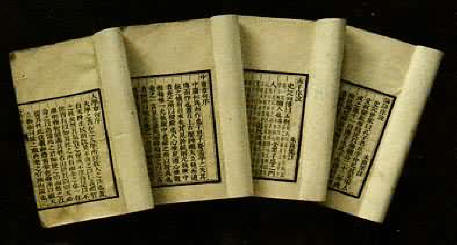
Fun Fact: The Analects of Confucius is a written record of the sayings of the philosopher and his contemporaries, compiled in the centuries following his death in BC479. 

In it, a follower called Yen Yüan asked the Master about perfect virtue. Confucius said, “To subdue one’s self and return to propriety, is perfect virtue. If a man can for one day subdue himself and return to propriety, all under heaven will ascribe perfect virtue to him”. 

“I beg to ask the steps of that process”, asked Yen Yüan, to which the Master replied, “Look not at what is contrary to propriety.  Listen not to what is contrary to propriety.  Speak not what is contrary to propriety.  Make no movement which is contrary to propriety”.

The Confucian maxim may have crossed from China to Japan with a Tendai-Buddhist legend, sometime around the 8th century. At the time, the story had nothing to do with monkeys.

In medieval Japanese, mi-zaru, kika-zaru, and iwa-zaru translate as “don’t see, don’t hear, and don’t speak”, -zaru being an archaic negative verb conjugation and pronounced similarly to “saru”, the word for monkey.

The visual play on words, then, depicts Mizaru, covering his eyes, Kikazaru, covering his ears, and Iwazaru, covering his mouth. Although it’s rare to see him anymore, there is a fourth monkey. Shizaru is generally depicted with his arms crossed or covering his privates, the name variously translated as “do no evil”, or “know no evil”.

The first known depiction of the “Three Mystic Apes” appears over the doors of the Tōshō-gū shrine in Nikkō, Japan, carved sometime in the 17th century.

Mohandas Karamchand Gandhi was a Hindu lawyer, member of the merchant caste from coastal Gujarat, in western India. Today he is known by the honorific “Mahatma”, from the Sanskrit “high-souled”, or “venerable”. He is recognized as the Father of modern India, who brought Independence to his country through non-violent protest. Gandhi owned almost no material possessions at the time of his assassination by a Hindu nationalist on January 30, 1948, preferring instead, a life of simplicity and poverty. Beside the clothes on his back, Gandhi owned a tin cup and a spoon, a pair of sandals, his spectacles, and a carved set of 3 monkeys, reminding him to hear no evil, see no evil and speak no evil.

September 1 (estimated), 911 Normandy

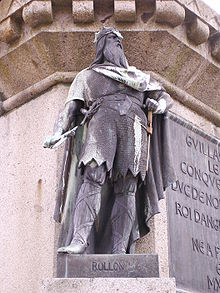
Rollo was called “The Walker”, because the man was so huge that no horse could carry him. He must have been some scary character with a two-handed battle axe.

The warlike men who sailed their longboats out of the north tormented the coastal UK and northwestern Europe, ever since their first appearance at Lindisfarne Monastery in 793.

In the year 911, these “Norsemen” or “Normans” attacked the city of Paris. By July, they were holding the nearby town of Chartres under siege. Normans had burned the place to the ground back in 858 and would probably have done so again, but for their defeat at the battle of Chartres on July 20.

Even in defeat, these people presented a formidable threat. The Frankish King approached them with a solution.

King Charles III, known as “Charles the Simple” after his plain, straightforward ways, proposed to give the Normans the region from the English Channel to the river Seine. It would be the Duchy of Normandy, some of the finest farmlands in northwest Europe, and it would be theirs in exchange for an oath of loyalty to Charles.

Rollo the Walker

The deal made sense for the King, because he had already bankrupted his treasury paying these people tribute. And what better way to deal with future Viking raids down the channel, than to make them the Vikings’ own problem?

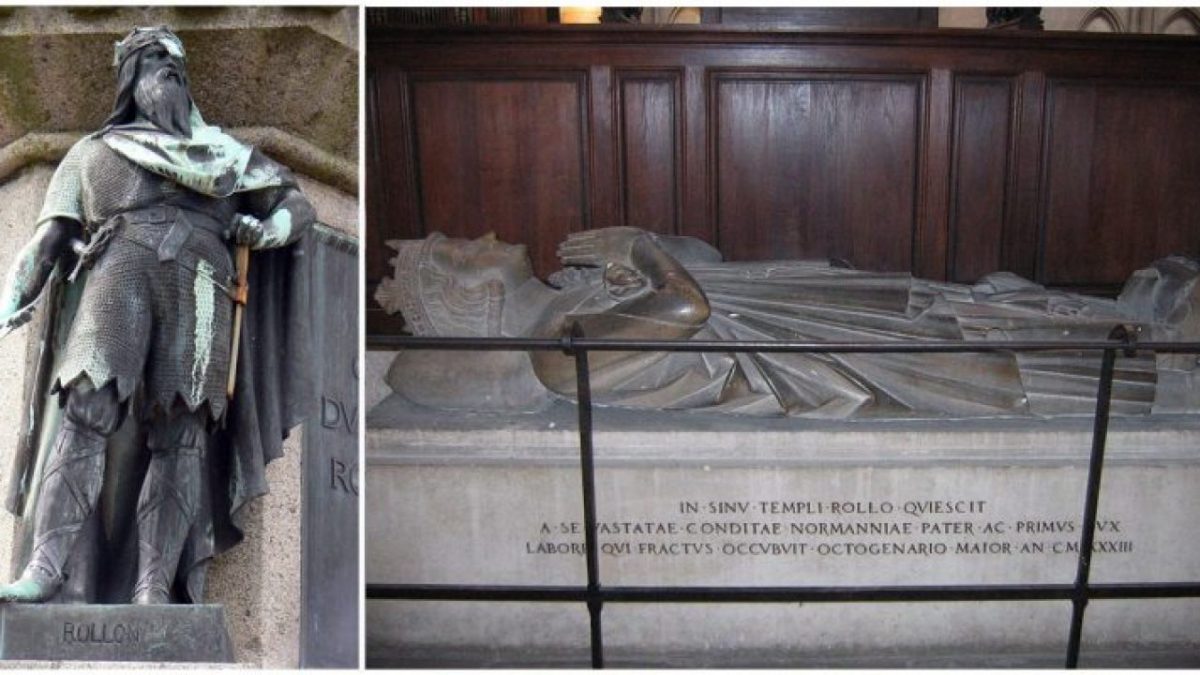
So it was the Treaty of Saint-Clair-sur-Epte was concluded on this day or thereabouts in 911, when the Viking Chieftain Rollo pledged feudal allegiance to the King of Western Francia. Rollo was called “The Walker”, because the man was so huge that no horse could carry him. He must have been some scary character with a two-handed battle axe.

Treaty of Saint-Clair-sur-Epte

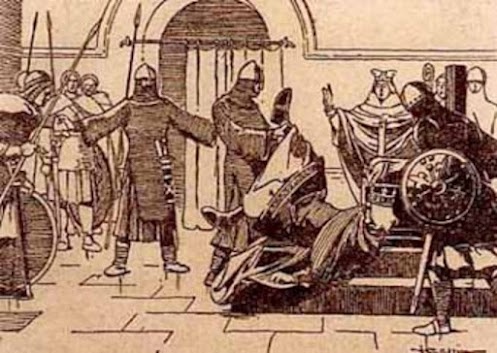
At some point in the proceedings, The Walker was expected to stoop down and kiss the king’s foot, in token of obeisance. Rollo recognized the symbolic importance of the gesture, but wasn’t about to submit to such degradation himself. The chieftain motioned to one of his lieutenants, a man almost as enormous as himself, to kiss the king’s foot. The man shrugged, reached down and lifted King Charles off the ground by his ankle. He kissed the foot, and tossed the King of the Franks aside.  Like a sack of potatoes

In that moment, the personal dignity of the King of France, ceased to exist. The Duchy of Normandy, was born.

August 6, 2011 Tell me a Story

In delivering his tribute to his father, Steve Sabol explained the company’s operating philosophy. “Tell me a fact”, he said, “and I’ll learn. Tell me a truth, and I’ll believe. But tell me a story, and it will live in my heart forever”.

Edwin Milton “Ed” Sabol returned from World War 2 and took a job selling topcoats. He was good at it and provided his family a decent standard of living, but his heart wasn’t in it.  What Sabol liked more than anything else, was to watch his son Steve play high school football.

Sabol would take a motion picture camera, a wedding gift, and film Steve’s games. He found that he had a knack for it, and founded a small film production company called Blair Motion Pictures, named after his daughter, Blair.

Sabol successfully bid for the rights to film the 1962 NFL championship game between the Green Bay Packers and New York Giants. The game was played in cold so severe that camera operators suffered frostbite, and a wind so strong  it blew the ball off the tee three times, before opening kickoff.  Despite all that, Sabol’s work on the game was impressive.

nflfilm

The league’s 14 owners rejected commissioner Pete Rozelle’s proposal to buy out the filmmaker, instead giving him $20,000 apiece in seed money to shoot all NFL games and produce a highlight reel for each club.

Thus was born the storybook production company, called NFL Films.  The production style was unmistakable: the “tight to the spiral” shot of the ball leaving the quarterback’s hand, the on-the-field close-ups and slow motion shots, all of it “mic’d up” in a way that let you hear every hit, every sound, as if you yourself were personally, on the field.

With the orchestral score and the stentorian tones of John Facenda’s narration, “the voice of God”: “They call it pro football. They play it under the autumn moon, in the heat of a Texas afternoon.”  NFL Films became “the greatest in-house P.R. machine in pro sports history” according to Salon.com television critic Matt Zoller Seitz. “An outfit that could make even a tedious stalemate seem as momentous as the battle for the Alamo.”

NFL Films won 112 Sports Emmys. While the company’s $50 million earnings are small compared with the $18 billion in revenue the NFL earns from television alone, the real value of NFL Films is how it promotes the sport. Many credit NFL Films as a key reason that the National Football League has become the most watched professional sports league in the United States.

Ed Sabol was inducted into the Professional Football Hall of Fame on this day in 2011. Steve was suffering inoperable brain cancer at the time, a condition which would take his life the following September.   In delivering his tribute to his father, Steve Sabol explained the company’s operating philosophy. “Tell me a fact”, he said, “and I’ll learn. Tell me a truth, and I’ll believe. But tell me a story, and it will live in my heart forever”.

July 29, 1967 Ghosts of the Forrestal

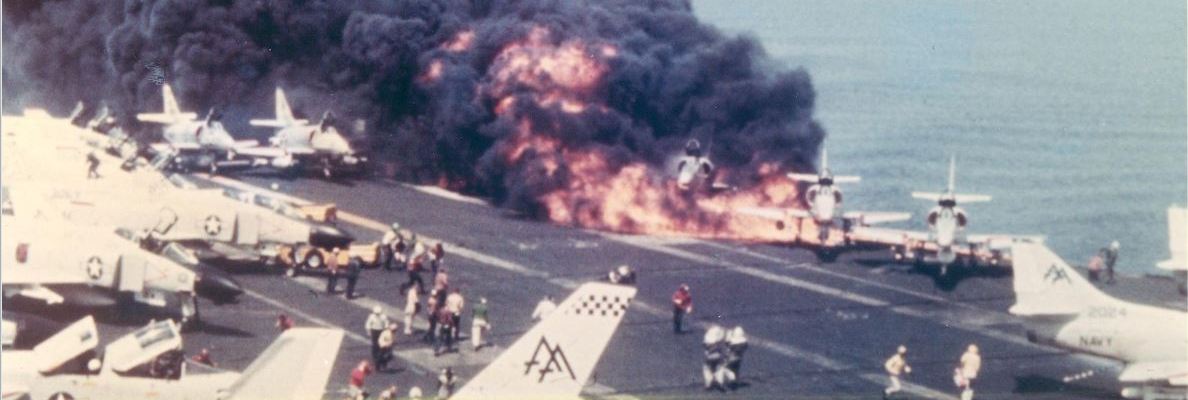
The port quarter of the Forrestal ceased to exist in the violence of the explosions, office furniture thrown to the floor as much as five decks below.  Huge holes were torn into the flight deck while a cataract of flaming jet fuel, some 40,000 US gallons of the stuff, poured through ventilation ducts and into living quarters below.

The Super Carrier USS Forrestal departed Norfolk in June 1967, with a crew of 552 officers and 4,988 enlisted men. Sailing around the horn of Africa, she stopped briefly at Leyte Pier in the Philippines, before sailing on to “Yankee Station” in the South China Sea, arriving on July 25.

Before the cruise, damage control firefighting teams were shown training films of Navy ordnance tests, demonstrating how a 1000-lb bomb could be directly exposed to a jet fuel fire for a full 10 minutes. Tests were conducted using the new Mark 83 bomb, featuring a thicker, heat resistant wall compared with older munitions, and “H6” explosive, designed to burn off at high temperatures, like an enormous sparkler.

Along with Mark 83s, ordnance resupply had included sixteen AN-M65A1 “Fat Boy” bombs, Korean war era surplus intended to be used on the second bombing runs of the 29th.  These were thinner skinned than the newer ordnance, armed with 10+ year-old “Composition B” explosive.  Already far more sensitive to heat and shock than the newer ordnance, composition B becomes more volatile as the explosive ages.  The stuff becomes more powerful as well, as much as 50%, by weight.

250px-Yankee_Station_Location_1These older bombs were way past their “sell-by” date, having spent the better part of the last ten years in the heat and humidity of Subic Bay depots.  Ordnance officers wanted nothing to do with the Fat Boys, with their rusting shells leaking paraffin, and rotted packaging.  Some had production date stamps as early as 1953.

Handlers feared the old bombs might spontaneously detonate from the shock of a catapult takeoff.

In 1967, the carrier bombing campaign was the longest and most intense such effort in US Naval history.   Over the preceding four days, Forrestal had already launched 150 sorties against targets in North Vietnam.  Combat operations were outpacing production, using Mark 35s faster than they could be replaced.

When Forrestal met the ammunition ship Diamond Head on the 28th, the choice was to take on the Fat Boys, or cancel the second wave of attacks scheduled for the following day.

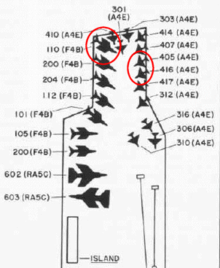
220px-CVA-59_fire_aft_deck_planIn addition to the bombs, ground attack aircraft were armed with 5″ “Zuni” unguided rockets, carried four at a time in under-wing rocket packs.   Known for electrical malfunctions and accidental firing, standard Naval procedure required electrical pigtails to be connected, at the catapult.

Ordnance officers found this slowed the launch rate and deviated from standard procedure, connecting pigtails while aircraft were still, “in the pack”.  The table was set, for disaster.

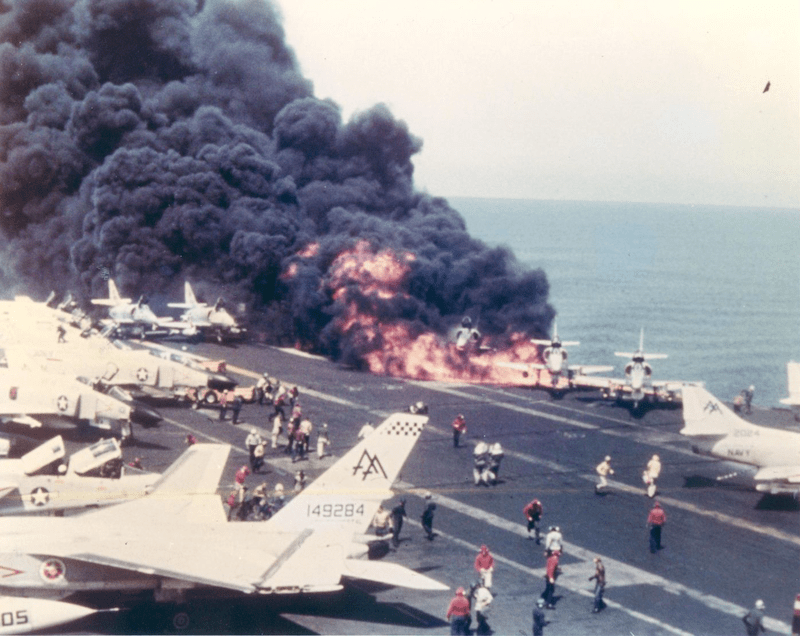
At 10:50-am local time, preparations were underway for the second strike of the day.  Twenty-seven aircraft were on deck, fully loaded with fuel, ammunition, bombs and rockets.  An electrical malfunction fired a Zuni rocket 100′ across the flight deck, severing the arm of one crew member and into the 400-gallon external fuel tank of an A-4E Skyhawk, awaiting launch.

The rocket’s safety mechanism prevented the weapon from exploding, but the A-4’s torn fuel tank was spewing flaming jet fuel onto the deck. Other tanks soon overheated and exploded, adding to the conflagration.

800px-USS_Forrestal_A-4_Skyhawk_burning.png

In WW2, virtually all American carrier crew were trained firefighters.  This changed over time and, by 1967, the United States Navy had adopted the Japanese method at Midway, relying instead on specialized and highly trained damage control and fire fighting teams.

Damage Control Team #8 came into action immediately, as Chief Gerald Farrier spotted one of the Fat Boy bombs turning cherry red in the flames.  Farrier  was working without benefit of protective clothing, there had been no time.  Farrier held his PKP fire extinguisher on the 1000-lb bomb, hoping to keep it cool enough to prevent its cooking off as his team brought the conflagration under control.

USS_Forrestal_fire_1_1967

Firefighters were confident that their ten-minute window would hold as they fought the flames, but the composition B explosives proved as unstable as the ordnance people had feared.  Farrier “simply disappeared” in the first of a dozen or more explosions, in the first few minutes of the fire.  By the third such explosion, Damage Control Team #8 had all but ceased to exist.

Future United States Senator John McCain managed to scramble out of his cockpit and down the fuel probe.  Lieutenant Commander Fred White made it out of his own aircraft a split-second later, but he was killed in that first explosion.

The port quarter of the Forrestal ceased to exist in the violence of the explosions, office furniture thrown to the floor as much as five decks below.  Huge holes were torn into the flight deck while a cataract of flaming jet fuel, some 40,000 US gallons of the stuff, poured through ventilation ducts and into living quarters below.

Ninety-one crew members were killed below decks, by explosion or fire.

800px-USS_Forrestal_explosion_29_July_1967

With trained firefighters now dead or incapacitated, sailors and marines fought heroically to bring the fire under control, though that sometimes made matters worse.  Without training or knowledge of fire fighting, hose teams sprayed seawater, some washing away retardant foam being used to smother the flames.

With the life of the carrier itself at stake, tales of incredible courage, were commonplace. Medical officers worked for hours in the most dangerous conditions imaginable. Explosive ordnance demolition officer LT(JG) Robert Cates “noticed that there was a 500-pound bomb and a 750-pound bomb in the middle of the flight deck… that were still smoking. They hadn’t detonated or anything; they were just setting there smoking. So I went up and defused them and had them jettisoned.” Sailors volunteered to be lowered through the flight decks into flaming and smoked-filled compartments, to defuse live bombs.

The destroyer USS George K. MacKenzie plucked men out of the water as the destroyer USS Rupertus maneuvered alongside for 90 minutes, directing on-board fire hoses at the burning flight and hangar decks.

800px-USS_Repertus_assists_USS_Forrestal

Throughout the afternoon, crew members rolled 250-pound and 500-pound bombs across the decks, and over the side.  The major fire on the flight deck was brought under control within four hours but fires burning below decks would not be declared out until 4:00am the following day.

Panel 24E of the Vietnam Memorial records the names of 134 crewmen who died in the conflagration. Another 161 were seriously injured.  26 aircraft were destroyed and another 40, damaged.  Damage to the Forrestal itself exceeded $72 million, equivalent to over $415 million today.

image (13)Gary Childs of Paxton Massachusetts, my uncle,  was among the hundreds of sailors and marines who fought to bring the fire under control.  Gary was below decks when the fire broke out, leaving moments before his quarters were engulfed in flames. Only by that slimmest of margins did any number of sailors aboard the USS Forrestal, escape being #135.

July 28, 1866 The President’s Sculptor

Every year, millions of visitors to the Rotunda of the Capitol stop to admire the work. Few possess so much as the foggiest notion that the artist, was an 18-year-old girl.

She was about 5-feet tall when her parents moved to Washington, a mere wraith of a girl of 14 summers, as yet unable to tip the scales at 90 pounds.    Her father Robert was a surveyor, come to the capital for a job in the cartography office.

Her brother Robert headed south to Arkansas, to join with Woodruff’s Battery in service to the Confederate Army.  The year was 1861.  The District of Columbia was the capital in name only, of a nation at war with itself.

The elder Robert took ill and times got tough for the Ream family.  Despite her diminutive stature, Lavinia Ellen, “Vinnie“ to friends and family, took a job to help with family finances.  She was working in the dead letter office at the post office, one of the first women ever hired by the federal government.

Missouri Congressman James Rollins introduced Vinnie to sculptor Clark Mills in 1863, the artist who produced that statue of President Andrew Jackson, the one we’ve heard so much about recently, there in Lafayette square.

Washington, DC - June 02, 2018: Andrew Jackson's statue in Lafay
Washington, DC – June 02, 2018: Andrew Jackson’s statue in Lafayette Square and the White House.

The artist was amused when the young girl remarked “I can do that myself” and handed her a pail of clay with an invitation to try.  He was delighted when she returned a month later, this time with a surprisingly good likeness of an Indian Chieftain.  It wasn’t long before she became Mills’ apprentice.

Stories spread concerning the remarkable abilities of this young artist.  Vinnie’s talents blossomed and she left the post office to pursue her art, full time.  Senators and Members of Congress were her subjects.  Her faithful likeness of the glowering visage of that fierce opponent of slavery Thaddeus Stevens, the Pennsylvania Republican Congressman who would one day lead the impeachment effort against President Andrew Johnson, earned her an important and powerful ally.

It must have been an exciting time for a young girl in Washington DC, the horse-drawn ambulances, the ever-present blue-clad soldiers and more than anything, the raw-boned figure of the President of the United States, his carriage invariably accompanied by a squadron of brightly caparisoned, mounted Army officers.  Vinnie was interested in the figure of Abraham Lincoln.  The desire to sculpt the man’s likeness blossomed to an obsession as the titanic weight of office and crushing grief following the death of Lincoln’s 12-year-old son Willy, seemingly etched themselves across the President’s face.

Raised as she was on the western prairies of Wisconsin, Kansas, and Missouri, Vinnie was unacquainted with the “way things were done” in the nation’s capital.   Petite, quick with a smile and not a little ambitious, she could often get to “yes” where others hadn’t so much as a chance.

So it was in 1864, Vinnie was granted permission which would have been denied, to an older artist.  She herself explained “Lincoln had been painted and modeled before, and when friends of mine first asked him to sit for me he dismissed them wearily until he was told that I was but an ambitious girl, poor and obscure. … Had I been the greatest sculptor in the world I am sure that I would have been refused.”

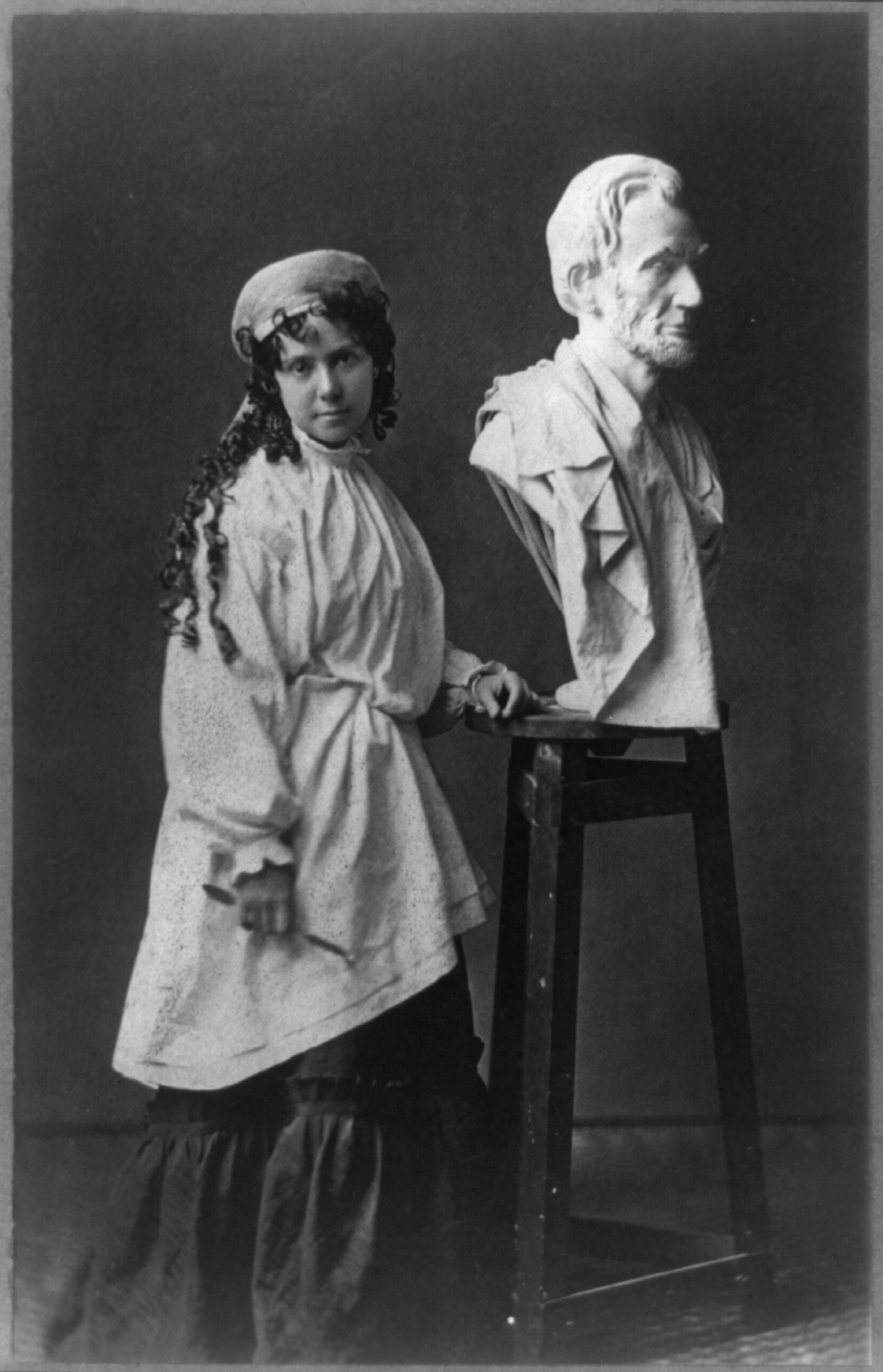
Every day for five months, Vinnie Ream had a private half-hour with the President of the United States, the two speaking but infrequently as she set her hands about the work.  She was performing the final touches on the bust you see below, the morning of April 14, 1865.  General Robert. E. Lee had surrendered to General Ulysses Grant only five days earlier.  The most catastrophic war in American history was winding to a close.  That night, the President planned a welcome break from the cares of office, at a place called Ford’s theater.

Vinnie_Ream_with_her_bust_of_Abraham_Lincoln

A nation was stunned following the Lincoln assassination.  Vinnie herself, prostrate at the death of her friend and hero.

There arose a movement in Congress, to honor the Great Man with a full-length statue, to be placed in the Rotunda of the Capitol.  A competition would be held, to determine the artist.  Washington was then as it is now, but Vinnie had learned a political lesson or two since those naive days of five years earlier.  The petition attesting to her talents and worthiness for the project was signed by Andrew Johnson, Ulysses Grant, 31 Senators and 110 members of the House of Representatives.

SAAM-1917.11.1_1Then as now, Washington was a “Swamp” and a cesspit for the venal and self-interested. Now grown to an attractive young woman, Vinnie Ream was not without critics.  Kansas Senator Edmund Gibson Ross boarded with the Ream family during Johnson’s impeachment trial and cast the one vote absolving the President of “High Crimes and Misdemeanors”.

Imagine how THAT must’ve sounded.

There were sleazy insinuations that she was a “lobbyist” or even a “Public Woman” (prostitute).

Newspaper columnist Mrs. Jane Grey Swisshelm sniffed about how Vinnie “carries the day” with members of Congress: “Miss .… Ream … is a young girl of about twenty who has been studying her art for a few months, never made a statue, has some plaster busts on exhibition, including her own, minus clothing to the waist, has a pretty face, long dark curls and plenty of them. … [She] sees members at their lodgings or in the reception room at the Capitol, urges her claims fluently and confidently, sits in the galleries in a conspicuous position and in her most bewitching dress, while those claims are being discussed on the floor, and nods and smiles as a member rises…

e05a173b8e8f1c1360a5e523c3ec3604One editor had the last word, however, printing Swisshelm’s column under the headline “A Homely Woman’s Opinion of a Pretty One.”

Ouch.

On this day in 1866, Vinnie Ream was awarded by vote of Congress, the commission to create a full-size statue of Abraham Lincoln. She was 18 years old, the first woman to receive a such a commission as an artist and the youngest of either sex, to create a statue for the United States government.

Even then, Vinnie was not without detractors.  Michigan Senator Jacob Merritt Howard remarked, “Having in view the youth and inexperience of Miss Ream, and I will go further, and say, having in view her sex, I shall expect a complete failure in the execution of this work.”

Miss Lavinia Ream survived an effort to have her removed from her own studio by a vindictive House of Representatives, to enjoy the last word.  Her depiction of the Great Emancipator sculpted from a flawless block of Carrara marble stands in the Rotunda of the Capitol where it is seen by millions of visitors, from that day to this.

Ream-Lincoln


July 26, 1945 Blood in the Water

The United States Navy lost more than 350 ships in combat operations during World War 2. Not one resulted in court martial but, on this occasion, someone was going to pay.

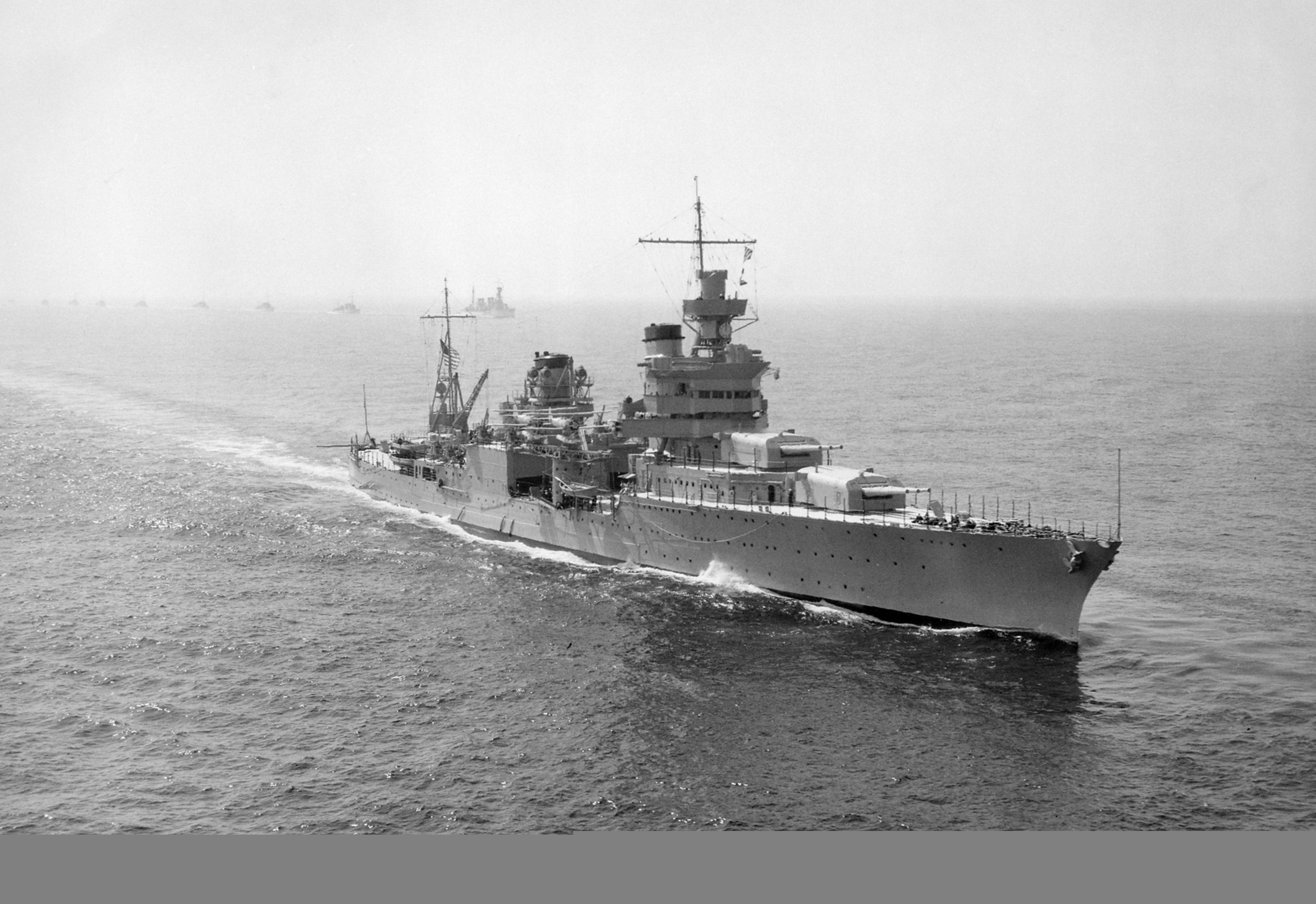
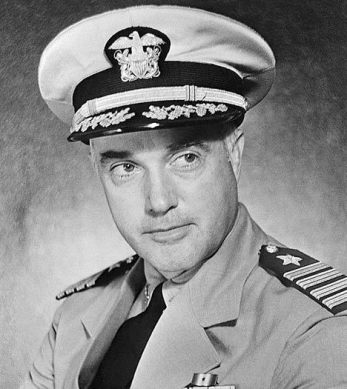
The Portland class heavy cruiser USS Indianapolis set out on a secret mission on July 16, 1945, under the command of Captain Charles Butler McVay III. She was delivering “Little Boy” to the Pacific island of Tinian, the atomic bomb which would later be dropped on Hiroshima.

Indianapolis made her delivery on July 26, arriving at Guam two days later and then heading for Leyte to take part in the planned invasion of Japan. She was expected to arrive on the 31st.

Indianapolis Sub
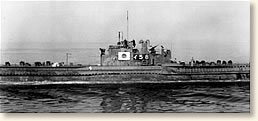
I-58

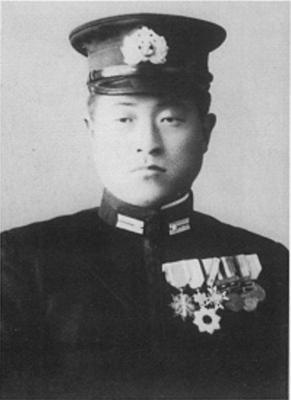
The Japanese submarine I-58, Captain Mochitsura Hashimoto commanding, fired a spread of six torpedoes at the cruiser, two striking Indianapolis’ starboard bow at fourteen minutes past midnight on Monday, July 30. The damage was massive. Within 12 minutes, the 584-foot, 9,950-ton vessel had rolled over, gone straight up by the stern, and sunk beneath the waves.

USS Indianapolis

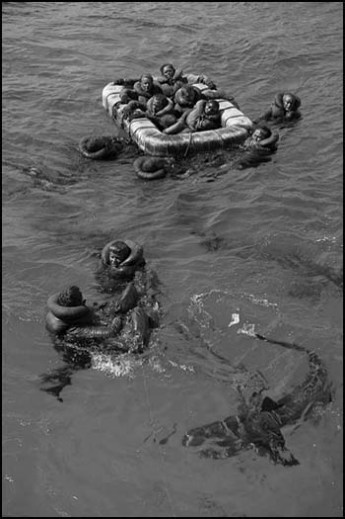
About 300 of Indianapolis’ 1,196-member crew were killed outright, leaving nearly 900 treading water. Many had no life jackets. There had been no time, and there were few life boats.

indianapolis_2
Caribbean Reef sharks circling the sailors in reenactment scene after USS Indianapolis had been sunk by Japanese submarine. As seen on OCEAN OF FEAR: WORST SHARK ATTACK EVER. H/T photographer: Tim Calver

The ordeal faced by the survivors, is beyond description. Alone and stranded in open ocean, these guys treaded water for four days, hoping and praying for the rescue that did not come.

Shark attacks began on the first day, and never let up. Kapok-filled life vests became waterlogged and sank after 48 hours, becoming worse than useless. Exhaustion, hypothermia, and severe sunburn, each took their toll as the hours turned to days.

Locked in the grip of some dreadful hallucination, men went insane and began to attack shipmates. Others found the thirst so unbearable they succumbed to temptation, drinking seawater and setting off the biological chain reaction which would kill them in only hours. Some simply swam away, following some spectral vision only he could see.

Through it all, random individuals would suddenly rise up screaming from the ocean only to disappear forever as the apex predator of these waters claimed another victim.

Navy Command had not the slightest idea of what happened to Indianapolis, nor why she didn’t show up on the 31st. It was a random patrol aircraft passing the area that Thursday afternoon, that finally discovered men floating in open ocean. The last Indianapolis survivor was plucked from the ocean Friday afternoon, well past half-dead after nearly five days in the water.

Of the 900 or so who survived the sinking of USS Indianapolis, only 316 remained alive at the end of the ordeal.

mochitsura-hashimoto
Mochitsura Hashimoto

The Navy bureaucracy had committed multiple errors, from denying McVay’s requested escort to informing him that his route was safe, even when the surface operations officer knew there were at least two Japanese submarines, operating in the area.

No captain in the history of the United States Navy was subjected to court-martial for losing a ship sunk by act of war. The United States Navy lost over 350 ships to combat operations during WW2. It didn’t matter. On this occasion, someone was going to pay.

A hastily convened court of inquiry was held in Guam on August 13, leading to McVay’s court-martial. There was evidence that the Navy itself had put the ship in harm’s way, but no matter. When prosecutors flew the I-58 commander in to testify, Hashimoto swore that zigzagging would have made no difference. The Japanese Commander himself became part of a later effort to exonerate McVay, but to no avail. Charles Butler McVay III was convicted of “hazarding his ship by failing to zigzag“, a long and honorable career, ruined.

450729-charles-mcvay
Charles Butler McVay, III

McVay had wide support among Indianapolis’ survivors, but opinion was by no means unanimous. Birthdays would come and go along with anniversaries and there was always some piece of hate mail, blaming him for the death of a loved one. One Christmas missive read “Merry Christmas! Our family’s holiday would be a lot merrier if you hadn’t killed my son”.

McVay began to doubt himself. By 1968 he must have felt the weight of Indianapolis’ dead, like a great weight of grief on his shoulders.

On November 6, 1968, Charles Butler McVay III sat down on the front porch if his Litchfield Connecticut home, took out his Navy revolver, and killed himself. He was cremated, his ashes scattered at sea.

It would take more than 20 years for the evidence which exonerated him, to be declassified.

Afterward:
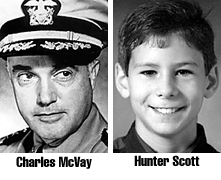
Hunter Alan Scott was eleven and living in Pensacola when he saw the movie “Jaws”, in 1996. The boy was fascinated by the movie’s brief mention of the Indianapolis’ shark attacks. The following year, Scott created his 8th grade “National History Day” project on the USS Indianapolis sinking. The lad interviewed nearly 150 survivors and reviewed some 800 documents and the more he read, the more he became convinced that Captain McVay was innocent of the charges for which he’d been convicted.

Scott’s National History Day project went all the way to the state finals, only to be rejected because he’d used the wrong type of notebook.

artb

Hunter Scott couldn’t let the matter end there. He began to attend Indianapolis survivors’ reunions, at their invitation, and helped to gain a commitment in 1997 from then-Representative Joe Scarborough. He would introduce a bill in Congress to exonerate McVay, the following year.

Senator Bob Smith of NH joined Scarborough in a joint resolution of Congress. Hunter Scott and several Indianapolis survivors were invited to testify before Senator John Warner and the Senate Armed Services committee on September 14, 1999.

Holding a dog tag in his hand, Hunter Alan Scott testified that “This is Captain McVay’s dog tag from when he was a cadet at the Naval Academy. As you can see, it has his thumbprint on the back. I carry this as a reminder of my mission in the memory of a man who ended his own life in 1968. I carry this dog tag to remind me that only in the United States can one person make a difference no matter what the age. I carry this dog tag to remind me of the privilege and responsibility that I have to carry forward the torch of honor passed to me by the men of the USS Indianapolis”.

The United States Congress passed a resolution in 2000, signed into law by President Bill Clinton on October 30, exonerating Charles Butler McVay III of the charges which had led to his court martial, humiliation and suicide.

170819163129-02-uss-indianapolis-crew-restricted-exlarge-169
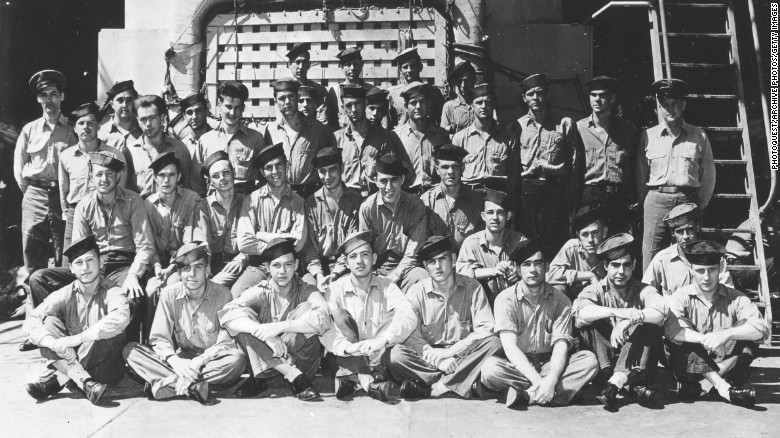
Some of Indianapolis’ crew, before her sinking.

The record cannot not be expunged. Congress has rules against so much as considering bills altering military records, and there is no means by which to reverse a court-martial. It’s never been done. Even so, Captain McVay had been exonerated, something the Indianapolis survivors had tried to accomplish without success. Until the intervention of a 12-year-old boy.

Who ever said one person can’t make a difference?

July 17, 1914 The Miracle Braves

The Braves didn’t even have a home field that year, in the unlikely event they made the playoffs.

OIP (2)Boston was a two-team town in 1914, when the American League Red Sox hired 6’2″, 200-pound left handed rookie George Herman “Babe” Ruth from the Baltimore Orioles.

The American League hadn’t yet adopted the designated hitter rule, that wouldn’t happen until 1973. The Red Sox started Ruth as pitcher, but it was his bat that made him one of the best. Unlike most power hitters, Babe Ruth maintained his high batting average, ending his career with a .342 lifetime average.

Four years later, Red Sox owner and theatrical producer Harry Frazee sold the “bambino” to the arch-rival New York Yankees, to finance production of a Broadway musical.

Thus began an 86-year season of misery for We who love the Red Sox™, an interminable World Series drought we call the “Curse of the Bambino”.  Little babies grew up and had babies of their own.  They had grandbabies and great grandbabies and even a few great-greats and still, the drought wore on.   To this day, Boston-area mothers invoke the Curse of the Bambino to scare wayward children into acting right.

But that must be a story for another day.1914nl

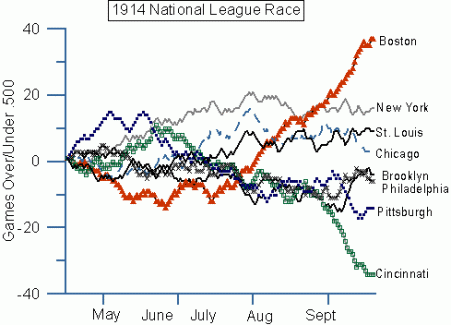
In 1914 the National League Boston Braves were in dead last place on July 4.  Bottom of the barrel with a record of 26 wins and 40 losses, 11½ games behind the first place Giants.

For eleven years in a row and this one was shaping up to be no exception, the view in 1914 was shaping up to be one from the cellar.

The Braves didn’t even have a home field in the unlikely event they made the playoffs that year.  The club had abandoned its 43-year home at South End Grounds, that August. In post-season, the Boston Braves were reduced to the humiliating reality of renting Fenway Park from their cross-town rival, Boston Red Sox.

One of the most remarkable turnarounds in sports history started on this day with a three game road trip to Redland Field, in Cincinnati.  The Braves won three consecutive games with 1-0, 6-2 and 3-2 victories over the Reds.

The Braves played 37 games through the end of regular season, winning all but two.

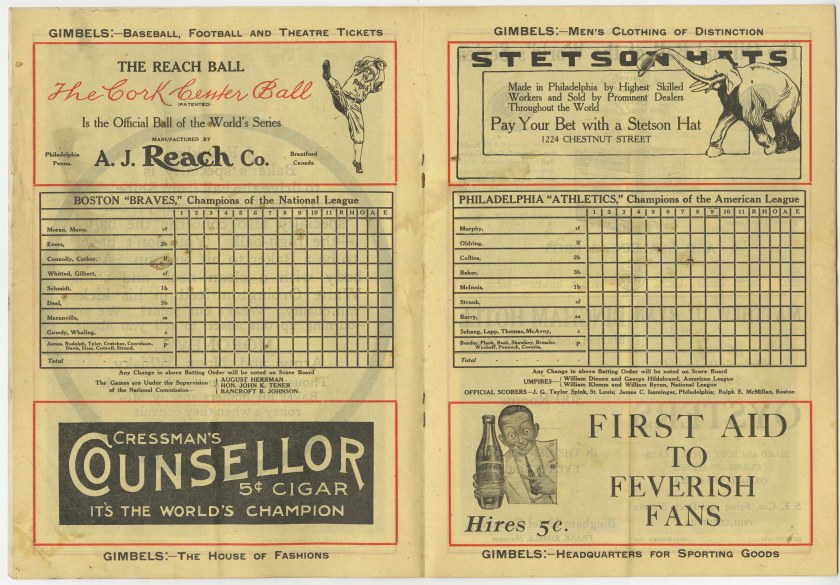
The World Series match-up against the Philadelphia Athletics was a David vs. Goliath story, the 1914 A’s recipients of four American League pennants over the last 5 years and finishing regular season 8½ games ahead of the second place, Boston Red Sox.

braves

Game one in Philadelphia was a Boston Romp, ending with a 7-1 victory. Game two was a cliff hanger, the score tied at zero going into the 9th inning. Infielder Charlie Deal found himself on second when A’s center fielder Amos Strunk lost the ball in the sun.  Deal scored the game’s only run on Les Mann’s two-out single to center field.

Game 3 in Boston was the real thriller. The score was tied at two at the end of regulation play, with the Athletics scoring two runs in the top of the 10th. Boston came back with two runs in the bottom of the inning, and won the game in the 12th when A’s second baseman Donnie Bush threw a wild ball past third, with outfielder and pinch runner Les Mann scoring the winning run from second.

It was two outs in the 5th inning when Braves shortstop Johnny Evers hit a two-run single to center field, putting Boston ahead 3-1 in game 4. The A’s never responded.

1920px-Fenway-park-1914-world-series
Fenway Park, game 3 of the 1914 World Series, October 12, 1914.

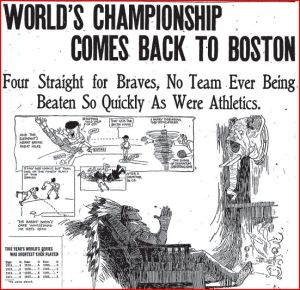
The “Miracle Braves” had emerged from dead-last to defeat the defending World Champion Philadelphia Athletics in the first four-game sweep in World Series history.

In 2011, a descendant of Johnny Evers consigned his ancestor’s 1914 World Series ring to auction, raising an intriguing question.

OIP (1)Today we take team-issued Championship rings for granted, but the practice isn’t believed to have begun until years later. Prior to that and dating well back in the previous century, World Series winners were rewarded with team-issued pins.

This was the second such ring known to exist, the first issued to shortstop Walter James Vincent “Rabbit” Maranville, also of the 1914 Boston Braves.  It may be that Evers and Maranville had the rings made for themselves, or maybe players were offered a choice of rewards. Perhaps rings were offered to all players but only at their own expense, causing most to pass on the opportunity.

Perhaps these two rings are merely the only two known to have survived.  Be that as it may, at least a few players had begun to associate rings with championships, long before their first official issue, in 1922.

A notorious cheapskate, A’s owner Connie Mack gave his star pitcher Chief Bender the week off before the series, with orders to personally scout the Braves roster.  Instead, the man took a vacation. When later asked to explain himself, Bender replied: “Why should I check out a bunch of bush league hitters?” The following season, Bender and fellow pitcher “Gettysburg” Eddie Plank jumped ship to join the rival Federal League. Mack unloaded most of his other “high-priced” talent. Within two seasons, the Philadelphia Athletics had amassed the worst losing record in modern baseball history.

Page break

In 1949, American poet and self-styled “incurable fan” Ogden Nash penned a poem for the January 1949 issue of SPORT Magazine.  It’s called

“Line-Up for Yesterday: An ABC of Baseball Immortals”. 

Hat tip, Wikipedia

Letter Player Verse
A Grover Cleveland Alexander A is for AlexThe great Alexander;

More Goose eggs he pitched

Than a popular gander.

B Roger Bresnahan B is for BresnahanBack of the plate;

The Cubs were his love,

and McGraw his hate.

C Ty Cobb C is for CobbWho grew spikes and not corn,

And made all the basemen

Wish they weren’t born.

D Jay “Dizzy” Dean D is for Dean,The grammatical Diz,

When they asked, Who’s the tops?

Said correctly, I is.

E Johnny Evers E is for Evers,His jaw in advance;

Never afraid

To Tinker with Chance.

F Frankie “Fordham” Frisch F is for FordhamAnd Frankie and Frisch;

I wish he were back

With the Giants, I wish.

G Lou Gehrig G is for Gehrig,The Pride of the Stadium;

His record pure gold,

His courage, pure radium.

H Rogers Hornsby H is for Hornsby;When pitching to Rog,

The pitcher would pitch,

Then the pitcher would dodge.

I Nash, the author I is for Me,Not a hard-hitting man,

But an outstanding all-time

Incurable fan.

J Walter Johnson J is for JohnsonThe Big Train in his prime

Was so fast he could throw

Three strikes at a time.

K Willie Keeler K is for Keeler,As fresh as green paint,

The fastest and mostest

To hit where they ain’t.

L Nap Lajoie L is for LajoieWhom Clevelanders love,

Napoleon himself,

With glue in his glove.

M Christy Mathewson M is for Matty,Who carried a charm

In the form of an extra

brain in his arm.

N Louis “Bobo” Newsom N is for Newsom,Bobo’s favorite kin.

You ask how he’s here,

He talked himself in.

O Mel Ott O is for OttOf the restless right foot.

When he leaned on the pellet,

The pellet stayed put.

P Eddie Plank P is for Plank,The arm of the A’s;

When he tangled with Matty

Games lasted for days.

Q Connie Mack Q is for Don QuixoteCornelius Mack;

Neither Yankees nor years

Can halt his attack.

R Babe Ruth R is for Ruth.To tell you the truth,

There’s just no more to be said,

Just R is for Ruth.

S Tris Speaker S is for Speaker,Swift center-field tender,

When the ball saw him coming,

It yelled, “I surrender.”

T Bill Terry T is for TerryThe Giant from Memphis

Whose .400 average

You can’t overemphis.

U Carl Hubbell U would be ‘Ubbellif Carl were a cockney;

We say Hubbell and Baseball

Like Football and Rockne.

V Charles “Dazzy” Vance V is for VanceThe Dodger’s very own Dazzy;

None of his rivals

Could throw as fast as he.

W Honus Wagner W is for Wagner,The bowlegged beauty;

Short was closed to all traffic

With Honus on duty.

X Jimmie Foxx X is the firstof two x’s in Foxx

Who was right behind Ruth

with his powerful soxx.

Y Cy Young Y is for YoungThe magnificent Cy;

People batted against him,

But I never knew why.

Z Zenith Z is for ZenithThe summit of fame.
These men are up there.

These men are the game.