January 11, 1935 Amelia

“The woman who can create her own job is the woman who will win fame and fortune”. – Amelia Earhart

Amelia Earhart was born July 24, 1897 in Atchison, Kansas, the first surviving child of Samuel “Edwin” and Amelia “Amy” Otis Earhart. Amy didn’t believe in raising “nice little girls”, she allowed “Meeley” and her younger sister “Pidge” to live an outdoor, rough and tumble “tomboy” kind of childhood.

AmeliachildEd seems to have had life-long problems with alcohol, often resulting in an inability to provide for his family. Amelia must have been a disciplined student despite it all, as she graduated with her high school class, on time, notwithstanding having attended six different schools.

Earhart was certainly independent, saying later in life “The woman who can create her own job is the woman who will win fame and fortune”.

Amelia and her sister saw their first airplane in 1908, at the Iowa State Fair in Des Moines. It was a rickety old biplane in which Edwin was trying to interest them in a ride.   Earhart later described that biplane as “a thing of rusty wire and wood and not at all interesting.”  At the time, the girls preferred the merry-go-round.

earhart-98-e1544117412522.jpgMeeley and Pidge worked as nurse’s aids in Toronto, in 1919.  There she met several wounded aviators and developed a strong admiration for these people.  Amelia would spend much of her free time watching the Royal Flying Corps practice at a nearby airfield.

Around that time, Earhart and a friend were visiting an air show in Toronto, when one of the pilots thought it would be funny to dive at the two women. “I am sure he said to himself, ‘Watch me make them scamper,’” she said, but Earhart held her ground.  “I did not understand it at the time, but I believe that little red airplane said something to me as it swished by.”

A ten-minute ride at a Long Beach California air show in 1920 changed her life.  From that time on, Amelia Earhart knew she wanted to fly.

Earhart worked at a variety of jobs from photographer to truck driver, earning money to take flying lessons from pioneer female aviator Anita “Neta” Snook.

She bought a second-hand Kinner Airster in 1921, a bright yellow biplane she called “The Canary”, flying it to 14,000’ the following year, a world altitude record for female pilots.

Neta_amelia_kinner_airster_s
Neta Snook, Amelia Earhart, 1921

Short funds grounded her for a time, by 1927 she was flying out of the Dennison Airport in Quincy, Massachusetts.  Earhart invested in the airport and worked as a salesman for Kinner airplanes in the Boston area while writing about flying in the local newspaper.

Charles Lindbergh’s New York to Paris Flight on May 20-21 of that year was the first solo, non-stop transatlantic crossing by airplane. Aviatrix Amy Phipps Guest wanted to be the first woman to make the flight, but later decided it was too dangerous. Instead she would sponsor the trip, provided that “another girl with the right image” was found.

“Lady Lindy”, Earhart became that first woman on May 21, 1932, five years to the day after Lindbergh.

Amelia_Earhart_standing_under_nose_of_her_Lockheed_Model_10-E_Electra,_small

On this day in 1935, Amelia Earhart became the first person of either sex to fly solo from Hawaii to California.

Two years later, Earhart and copilot/navigator Frederick J. Noonan attempted to fly around the world. The US Coast Guard cutter Itasca picked up radio messages that the aircraft was lost and low on fuel on July 2, 1937, and then it vanished.

The $4 million search and rescue effort covered 150,000 square miles and lasted for sixteen days, but to no avail.

amelialostphotosFollowing the end of the official search, Earhart’s husband and promoter George Palmer Putnam financed private searches of the Phoenix Islands, Christmas (Kiritimati) Island, Fanning (Tabuaeran) Island, the Gilbert and the Marshall Islands, but no trace of the aircraft or its occupants was ever found.

Earhart was declared dead in absentia on January 5, 1939 at the age of 41, Noonan on June 20, 1938.  He was 44.

For years, the prevailing theory was that Earhart’s Lockheed Model 10 Electra ran out of gas and plunged into the ocean.

Earhart-electra_10
“Amelia Earhart’s Lockheed Electra 10E. During its modification, the aircraft had most of the cabin windows blanked out and had specially fitted fuselage fuel tanks. The round RDF loop antenna can be seen above the cockpit. This image was taken at Luke Field on March 20, 1937; the plane would crash later that morning”.

The International Group for Historic Aircraft Recovery (TIGHAR) has been exploring a 1½ mile long, uninhabited tropical atoll once called Gardner Island, now Nikumaroro, in the southwestern Pacific Republic of Kiribati. After eleven visits to the atoll, TIGHAR sonar images revealed a straight, unbroken anomaly under the sand, remarkably consistent with the fuselage of a Lockheed Electra.

The traces of a long-dead campfire were discovered in 1940, along with animal bones, a box from a sextant, and thirteen human bones.  A doctor judged them to have belonged to a male and American authorities were never notified.

Those bones were subsequently lost, but computerized re-evaluation of their measurements suggest that the skeleton was probably that of a white female of European ethnicity, standing roughly the same 5’8″ as Amelia Earhart.

A specially trained team of four border collies was brought to Nikumaroro to search for bones in June 2017.  Thus far, the answer to one of the great mysteries of the 20th century, remains elusive.

Nikumaroro is no tropical island paradise.  There is no fresh water and daytime temperatures exceed 100°F in July. The island’s only inhabitants are Birgus latro, commonly known as the coconut crab, The largest land-dwelling arthropod in the world, specimens weigh up to 9-pounds and measure over 3′ from leg tip to leg tip.

Gifted with a keen sense of smell, the adult coconut crab feeds on fruits, nuts, seeds, and the pith of fallen trees but will eat carrion or just about anything else if given the opportunity.  Virtually any food source left unattended will be investigated and carried away, giving rise to the alternative name “Robber crab.”

It’s anyone’s guess how those two aviators spent the last hours of their lives, or who it was who lit that fire or left those bones. Looking at the size of the island’s only inhabitants, it’s not difficult to imagine why there were only 13.

January 10, 1927 You Will Respect my Authoritah!

“Oh no! Nothing’s worse than Cartman with Authoritah.” ~ Stan Marsh

A French proverb comes down to us from 1742, attributed to one François de Charette: “On ne fait pas d’omelette sans casser des oeufs”. You can’t make an omelette without breaking eggs.

Irish playwright George Bernard Shaw was a big fan of socialism in his day and an enthusiastic supporter of the gulags, of Josef Stalin.“[The] unfortunate Commissar” he wrote, must shoot his own workers “so that he might the more impressively ask the rest of the staff whether they yet grasped the fact that orders are meant to be executed.”. 

Yikes

Connoisseurs of the animated series South Park will remember the Prime Directive of Mr. Garrison’s favorite third grader, Eric Cartman.  “You will respect my authoritah“!

All well and good for a cartoon.  Few would have guessed the real-world Federal Government would poison its own citizens, to enforce its own authoritah.

The Eighteenth Amendment establishing national prohibition of intoxicating liquors was passed out of Congress on December 17, 1917 and sent to the states, for ratification. The  “Volstead” act, so named for Chairman of the House Judiciary Committee Andrew Volstead, was enacted to carry out the will of congress.

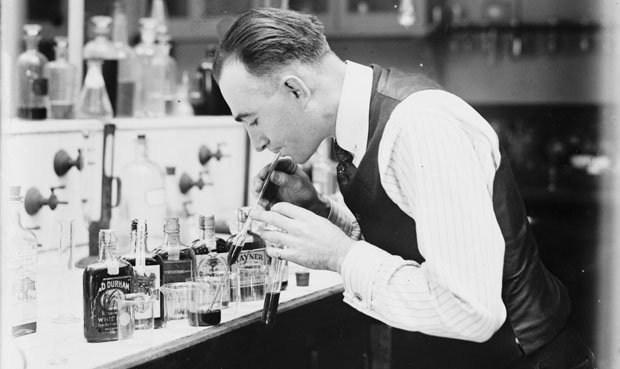
At last ratified in January 1919, “Prohibition” went into effect at midnight, January 16, 1920. For thirteen years it was illegal to import, export, transport or sell intoxicating liquor, wine or beer in the United States.Prohibition-midnight-e1568752688531-1024x511 (1).jpg“Industrial alcohol” such as solvents, polishes and fuels were “denatured” and rendered distasteful by the addition of dyes and chemicals.  The problem was, it wasn’t long before bootleggers figured out how to “renature” the stuff.
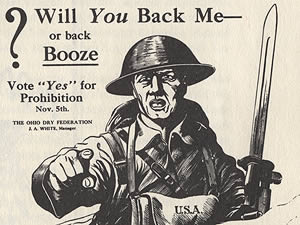
The Treasury Department, in charge of enforcement at that time, estimated that over 60 million gallons of industrial alcohol were stolen during Prohibition.

war-propaganda
War-propaganda

Not to be defied, the federal government upped the ante.  The Parasite Leviathan, would not be defied.

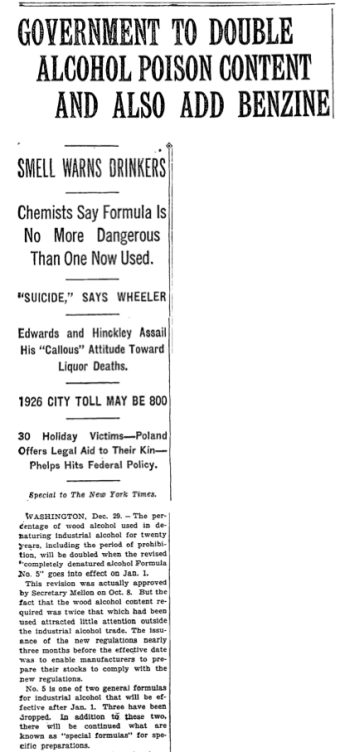
By the end of 1926, denaturing processes were reformulated with the introduction of known poisons such as kerosene, gasoline, iodine, zinc, nicotine, formaldehyde, chloroform, camphor, quinine and acetone.

Treasury officials went so far as to impose a requirement of no less than 10% by volume of methanol, a virulent toxin used in anti-freeze.

You will respect my authoritah.

You can renature this stuff ’til the cows come home.  It will kill you.

Sixty people wound up at New York’s Bellevue Hospital on Christmas eve 1926, desperately ill from contaminated alcohol.  Eight of them died.  Within two days, the death toll stood at thirty-one.  The number soared to 400 by New Year’s Day , with no end in sight.

copper-still
A copper still and bucket, like those used in the creation and renaturing of alcohol at home. H’T allthatsinteresting.com, and Chicago History Museum/Getty Images

Many who didn’t die, probably wished it. Holiday revelers experienced hallucinations, uncontrollable vomiting, even blindness.

TIME Magazine reported a doubling in toxicity levels in the January 10, 1927 issue, compared with the old method:  “The new formula included “4 parts methanol (wood alcohol), 2.25 parts pyridine bases, 0.5 parts benzene to 100 parts ethyl alcohol”. TIME noted, “Three ordinary drinks of this may cause blindness. (In case you didn’t guess, “blind drink” isn’t just a figure of speech).”

To paraphrase Wikipedia, Pyridine is a highly flammable chemical structurally related to benzene, with the unpleasant smell of dead fish.

New York medical examiner Charles Norris was quick to understand the problem and organized a press conference to warn of the danger. “The government knows it is not stopping drinking by putting poison in alcohol.  Yet it continues its poisoning processes, heedless of the fact that people determined to drink are daily absorbing that poison. Knowing this to be true, the United States government must be charged with the moral responsibility for the deaths that poisoned liquor causes, although it cannot be held legally responsible.”

Norris pointed out that the poorest people of the city, were most likely to be victims: “Those who cannot afford expensive protection and deal in low-grade stuff”.

The towering sanctimony of the other side, is hard to believe.  Teetotalers argued the dead had “brought it on themselves”.  Long-time leader of the anti-saloon league Wayne Wheeler proclaimed “The Government is under no obligation to furnish the people with alcohol that is drinkable when the Constitution prohibits it. The person who drinks this industrial alcohol is a deliberate suicide.”

You will respect my Authoritah.

prohibition_2

In its thirteen years of existence, Prohibition was an unmitigated disaster.  Portable stills went on sale within a week of enactment and organized smuggling was quick to follow. California grape growers increased acreage by over 700% over the first five years, selling dry blocks of grapes as “bricks of Rhine” or “blocks of Port”. The mayor of New York City himself sent instructions to his constituents, on how to make wine.

Smuggling operations became widespread as cars were souped up to outrun “the law”. This lead in time to competitive car racing, beginning on the streets and back roads and later moving to dedicated race tracks. It’s why we have NASCAR, today.

alcohol_poison_passed

Organized crime muscled up to become vastly more powerful, due to the influx of enormous sums of cash. The corruption of public officials was a national scandal.

Gaining convictions for breaking a law everyone hated became increasingly difficult. The first 4,000 prohibition-related arrests resulted in only six convictions and not a single jail sentence.

It’s hard to compare alcohol consumption rates before and during prohibition but, if death by cirrhosis of the liver is any indication, alcohol consumption never went down by more than 10 to 20 per cent.

In the end, even John D. Rockefeller, Jr., a lifelong teetotaler who contributed $350,000 to the Anti-Saloon League, had to announce support for repeal.

On December 5, 1933, the state of Utah triggered the magic 2/3rds requirement to ratify the Twenty-first Amendment, repealing the Eighteenth and voiding the Volstead Act, returning control over alcohol policy to the states.

Not to be defied, federal officials poisoned industrial alcohol until the very last day, resulting in the death of no fewer than 10,000 Americans.   They didn’t even pretend not to know, what was happening.

You will respect my authoritah!

Assistant Secretary of the Treasury Seymour Lowman had the last word among those who would tell you, “I’m from the government.   I’m here to help”.  If deliberately poisoned alcohol resulted in a more sober nation Lowman opined, then “a good job will have been done”.


January 3, 2000 There will Never be Another

A Charlie Brown Christmas has been a staple of the Christmas season since 1965, though Linus almost didn’t get to tell his famous story of the baby Jesus.

Charles_Schulz_HS_Yearbook.jpg
Charles Shulz, high school yearbook photo, class of 1940

Charles Monroe Schulz loved to draw.  He was good at at, too.  Already one of the brighter kids at Central High School in Saint Paul, Minnesota, Shulz skipped two half-grades graduating youngest member of his class, in 1940.  Already a shy boy, rapid academic advancement did little to help his social life.

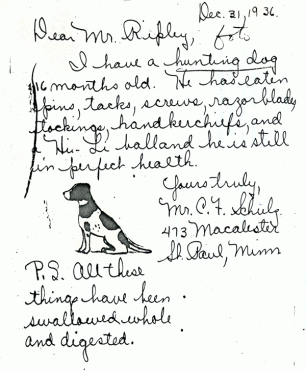
In those days, the family owned a hunting dog.  “Spike” had a number of cringe-worthy habits, including eating sharp objects. It didn’t seem to bother him much, and the boy sent a drawing to Ripley’s Believe It or Not!  The magazine ran it, complete with a description of ol’ Spike’s more unusual predilections.

The drawing was signed, “Sparky”.

Even with Schulz later celebrity, you could always weed out those who merely claimed to know the man, as opposed to those who did.  If Schutz-Letterthey called him “Charles”, or “Chuck”, that was a sure sign of the mere pretender.   Schulz’ uncle called him “Sparky” as a boy, after the horse Spark Plug in Billy DeBeck’s comic strip, Barney Google.  He always signed the strip “Schulz”, but friends and family knew him as Sparky, until the day he died.

Schulz was drafted into the Army in 1943, a Staff Sergeant with the 20th Armored Division in Europe and squad leader of a .50-caliber machine gun team.

He never got a chance to fire his weapon, though he did come face-to-face with a Wehrmacht soldier, once.  His blood must’ve turned cold in his veins when he realized he’d forgotten to load, but the man he faced was no Nazi fanatic.  This was a regular guy, who wanted to go home as much as Shulz himself.  The German surrendered, happily.  I hope he got home.

Schulz returned to Minneapolis after the war where he did some lettering for a Catholic comic magazine, Timeless Topix. He took a job in 1946 at Art Instruction, Inc., reviewing and grading lessons submitted by students, a job he held for several years while developing his talents as comic creator.

1392261715-0

Charlie Brown, that lovable little loser who was always close but never quite made it, first appeared in a series of single-panel jokes called “Li’l Folks“, along with a dog who looked something like Snoopy.  The comic was published in local papers from June 1947 to January ’50, and later syndicated.  That first strip was published in seven newspapers on October 2, 1950, but United Features thought the name was too close to two strips already in syndication:  Li’l Abner, and “Little Folks“.

So it was they called it “Peanuts” after the peanut gallery of Vaudeville days, the cheapest and rowdiest seats in the theater. Schulz didn’t like the name, saying it “made it sound too insignificant,” but the name stuck.

Schulz took pride in his service during the war.  At various times, Peanuts paid tribute to Rosie the Riveter and Ernie Pyle.  More than any other, he’d honor “Willy & Joe”, those two GIs from the imagination of war correspondent and cartoonist Bill Mauldin, a man to whom Schulz always referred as “My Hero”.  Over the years, Snoopy visited with Willie & Joe no fewer than 17 times. Always on Veterans Day.PeanutsA Charlie Brown Christmas has been a staple of the Christmas season since 1965, though Linus almost didn’t get to tell his famous story of the baby Jesus. ABC executives thought Linus’ recitation of the birth of Christ too overtly religious.  The “suits” wanted a laugh track as well, but Schulz refused. “If we don’t do it, who will?” In the end, the scene remained.  Perhaps the most memorable moment in cartoon history.  The laugh track version was produced, but never aired.Charlie Brown’s love interest in some of those TV specials, the “Little Red-Haired Girl”, was based on an accountant from that old job at Art Instruction, named Donna Mae Johnson.  The couple had an office romance for a time, but she turned him down when Shulz proposed.


Johnson wasn’t the only character based on a real person.  Linus and Shermy were patterned after Schulz’ close friends Linus Maurer and Sherman Plepler.  Peppermint Patty was inspired by a cousin on his mother’s side, Patricia Swanson.  Snoopy himself resembles that old family dog, though Spike was a Pointer, not a Beagle.

In 1967, American opinion polls showed a sharp drop in support for the war in Vietnam.  1968 was a wretched year in American politics, beginning with the Tet Offensive in January.   Media reporting turned the American military victory over the Vietnamese New Year, into a thing of despair.  President Johnson withdrew from the Presidential election, that March.  Martin Luther King, Jr. was assassinated that April leading to riots across the country.  Robert F. Kennedy was assassinated in June, after winning the critical California primary.  The Democratic National Convention that August was more of a riot, than a political convention.

Franklin_(Peanuts)
Franklin Armstrong

Race relations were particularly vile in 1968, when a Jewish Mom and Los Angeles schoolteacher wrote to the cartoonist, asking if he would add a black character.  Harriet Glickman never expected a response from the now-famous Charles M. Schulz, but respond he did.  He said he liked the idea but expressed concern the character might seem condescending, to black families.

With Schulz’ permission, Glickman asked friends of African ancestry, how to make such a character “more relatable”.

Franklin Armstrong made his first appearance on July 31, 1968.  What was remarkable for the time, was how unremarkable, he was.  Just another little boy, at first confused about the strange stuff going on in Charlie Brown’s neighborhood.  Particularly Linus’ obsession with the ‘Great Pumpkin’.  Franklin first met Charlie Brown on a beach.  He said his father was a soldier, off fighting in Vietnam.  “My dad’s a barber,” said Charlie Brown.  “He was in a war too, but I don’t know which one.”

One newspaper editor wrote saying he didn’t mind a “negro” character, but please don’t show them in school together.  Schulz didn’t bother to respond to that one.

Universal Studios Japan

Peanuts went on to become a pop culture phenomenon, with countless animated specials combining with merchandise sales to produce revenues in the Billions.  At it’s peak, Peanuts ran in 2,600 papers in 75 countries and 21 languages.  Schulz himself is estimated to have earned $30 to $40 million, a year.

I wonder if Donna Mae Johnson ever regretted turning down that marriage proposal.

Peanuts-Characters.jpg

In 1969, the command module for the Apollo 11 mission to the moon was named Charlie Brown.  The lunar module was called Snoopy.  President Ronald Reagan was a fan, who once wrote to Schulz that he identified with Charlie Brown.

Imitation of Charles Schulz cartoon, madOver fifty years, Schulz drew nearly 18,000 strips, taking vacation only once in 1997 to celebrate his 75th birthday.  In all those years, that five-week stretch was the only time the papers ever had Peanuts reruns.
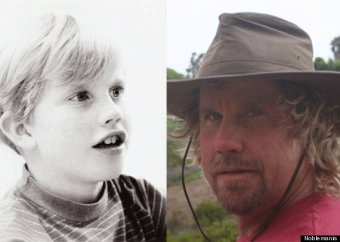
o-STEPHEN-SHEA-570
Stephen Shea, H/T Huffington Post

Fun fact: Former child actor Stephen Shea inherited the speaking role for Linus van Pelt when his older brother Chris’ voice changed, and went on to perform in eight animated specials. Chris went to summer camp with a boy who happened to be President of The Doors fan club. It turns out that Jim Morrison was a big Peanuts fan, and invited Chris and his father to be his special guests, at a Doors concert.

By the late 1990s, Schulz’ health was beginning to fail.  His once-firm hand, now had a tremor. He never really recovered from the stroke that hit him in November 1999 and announced his intention to retire, on December 14.  The last original Peanuts comic strip was published on January 3, 2000.

This son of a barber and a housewife, just like Charlie Brown himself, passed away just over a month later, a victim of colon cancer.

There will never be another.

470fb32d30dce0ef207d56ab998cf9c8--the-peanuts-peanuts-snoopy

If you enjoyed this “Today in History”, please feel free to re-blog, “like” & share on social media, so that others may find and enjoy it as well. Please click the “follow” button on the right, to receive email updates on new articles.  Thank you for your interest, in the history we all share.


Advertisements
Report this ad
Advertisements
Report this ad

January 2, 1819 Time Me, Gentlemen

Florence Nightingale explains in her Notes on Nursing, “there are many physical operations where ceteris paribus (all else being the same) the danger is in a direct ratio to the time the operation lasts; and ceteris paribus the operator’s success will be in direct ratio to his quickness”.

With the invention of gunpowder in the year 142, the Chinese of the Eastern Han Dynasty had a handy if somewhat noisy way, to scare off evil spirits.

The first millennium of the common era was a time of ever improved and more efficient ways for humans to slaughter one another, from the gunpowder slow match of 919 to the fire bombs and gunpowder propelled fire arrows of the Southern Tang, of 975.

The Wuwei Bronze Cannon of 1227 may be the first such weapon in all history.  By 1453, the terrifying bombard of the Ottoman Turks were capable of hurling stone balls up to 24.8-inches in diameter, more than enough to shatter the formerly impregnable Theodosian Walls of Constantinople.

Huge siege cannon used in the final assault
Ottoman siege cannon, 1453

For a thousand years, gunpowder weapons large and small businesses and a inflicted massive injury to the human frame, resulting in damage beyond even the skills of the modern surgeon.  Often the only answer was amputation, seemingly by the bushel basket.

sickles_lg
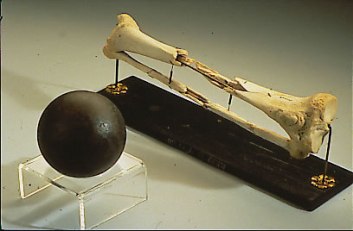
General Dan Sickles leg, destroyed by a 12-pound ball at Gettysburg, 1863

The carnage of the gunpowder era experienced something of a golden age in the 19th century.  Projectiles traveled at a bone-shatteringly slow pace compared with the high velocity weapons of today while innovations such as percussion caps, shrapnel shells and breech loading weapons geometrically increased the rate of fire.

It’s been said the most common objects removed from the bodies of front-line soldiers, were the shattered bones and teeth of the next man in line.

This was a time before anesthesia, when the speed of the surgeon’s knife spelled the difference in the pain experienced by the patient, to say nothing of the poor unfortunates’ chance of survival.  Florence Nightingale explains in her Notes on Nursing:  “there are many physical operations where ceteris paribus” (everything else being the same) “the danger is in a direct ratio to the time the operation lasts; and ceteris paribus the operator’s success will be in direct ratio to his quickness“.

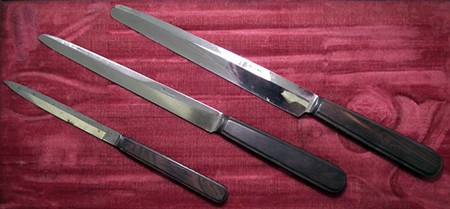
listons-knives-2-1
Robert Liston’s surgical instruments

First came the burly assistants, to hold down the writhing victim


.  In skilled hands the surgeon’s knife could cut all-round in a single stroke, through skin and muscle and sinew clear down to the bone before the saw completed the work of separation.  Screams of agony rent the air as veins, flesh and arteries were cauterized with red-hot irons, vitriol (sulfuric acid) or boiling hot tar.  Should the victim survive the experience the wound would then be sewn shut.  God help the poor soul if there was any infection left after all that.

During the Franco-Prussian War of 1870 –’71, one surgeon amputated 200 shattered limbs in one 24-hour period, a nearly unbelievable average of one every seven minutes.  Perfectly healthy fingers were occasionally severed in the gore and confusion.

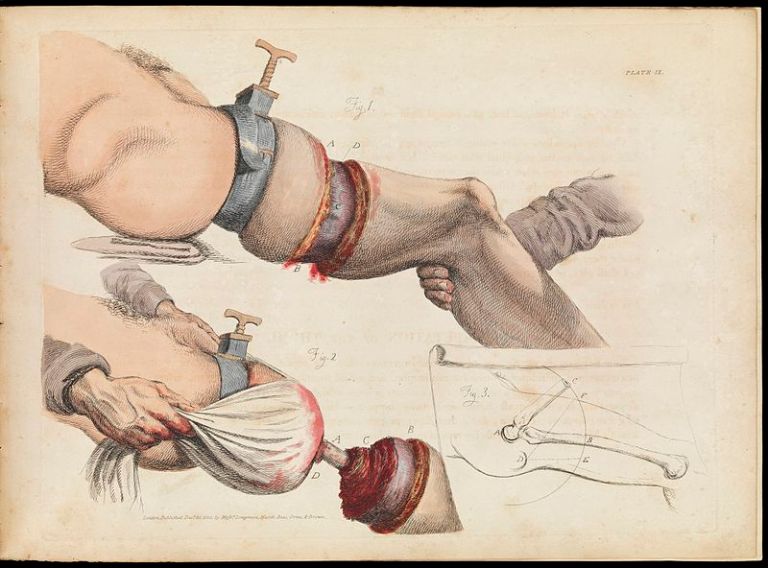
Plate_IX_illustration_of_leg_amputation_Sir_Charles_Bell_Wellcome_L0072192.jpg
A 19th-century surgical illustration detailing amputation at the thigh. Credit: Wellcome Library, London. H/T Military-History.org

This was the world of the “Fastest Knife on West End”, a Scottish-born physician who, on this day in 1819, had just embarked on the first year of a medical career which would last until his death, in 1847.

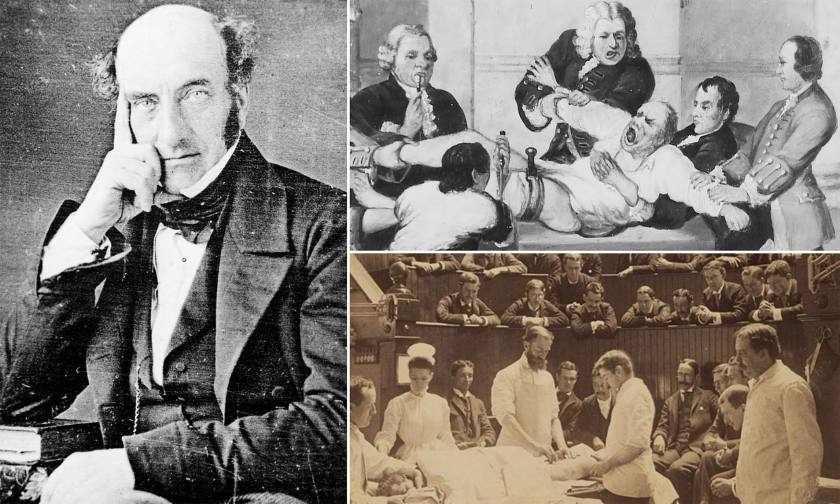
Robert Liston, always the showman, would stride into the operating theater and call out, “Time me Gentlemen.  Time me”.  English surgeon and author Richard Gordon, an expert on Robert Liston, describes what that looked like:

“He was six foot two, and operated in a bottle-green coat with wellington boots. He sprung across the blood-stained boards upon his swooning, sweating, strapped-down patient like a duelist, calling, ‘Time me gentlemen, time me!’ to students craning with pocket watches from the iron-railinged galleries. Everyone swore that the first flash of his knife was followed so swiftly by the rasp of saw on bone that sight and sound seemed simultaneous. To free both hands, he would clasp the bloody knife between his teeth”. 

16944174-0-image-a-45_1565084128752Liston once amputated a leg in 2½ minutes from incision to suture but accidentally severed the poor bastard’s testicles, in the process.

On another occasion, he amputated a leg in 2½ minutes while severing the fingers of one assistant and piercing the coat of an observer.  The spectator was so terrified at the blood and so certain that his own vital organs had been pierced, he died right then and there from heart failure.

Both patient and assistant later died from hospital gangrene, a common problem in the days before Joseph Lister.  To the best of my knowledge, Robert Liston remains the only surgeon in history to achieve 300% mortality, on a single procedure.

January 1, 45BC Happy New Year

Most of the non-Catholic world took 170 years to adopt the Gregorian calendar. Britain and its American colonies “lost” 11 days synchronizing with it in 1752. The last holdout, Greece, would formally adopt the Gregorian calendar in 1923. Since that time we’ve all gathered to celebrate New Year’s Day on the 1st of January.

From the 7th century BC, the Roman calendar attempted to follow the cycles of the moon. The method frequently fell out of phase with the change of seasons, requiring the random addition of days. The Pontifices, the Roman body charged with overseeing the calendar, made matters worse. They were known to add days to extend political terms, and to interfere with elections. Military campaigns were won or lost due to confusion over dates. By the time of Julius Caesar, things needed to change.

When Caesar went to Egypt in 48BC, he was impressed with the way the Egyptians handled their calendar. Caesar hired the Alexandrian astronomer Sosigenes to help straighten things out. The astronomer calculated that a proper year was 365¼ days, which more accurately tracked the solar, and not the lunar year. “Do like the Egyptians”, he might have said, the new “Julian” calendar going into effect in 46BC. Caesar decreed that 67 days be added that year, moving the New Year’s start from March to January 1. The first new year of the new calendar was January 1, 45BC.

Caesar synchronized his calendar with the sun by adding a day to every February, and changed the name of the seventh month from Quintilis to Julius, to honor himself. Rank hath its privileges.

Not to be outdone, Caesar’s successor changed the 8th month from Sextilis to Augustus. As we embark on the third millennium, we still have July and August.

Roman-calendar (1)

Sosigenes was close with his 365¼ day long year, but not quite there. The correct value of a solar year is 365.242199 days. By the year 1000, that 11 minute error had added seven days. To fix the problem, Pope Gregory XIII commissioned Jesuit astronomer Christopher Clavius to come up with yet another calendar. The Gregorian calendar was implemented in 1582, omitting ten days and adding a day on every fourth February.

Most of the non-Catholic world took 170 years to adopt the Gregorian calendar. Britain and its American colonies “lost” 11 days synchronizing with it in 1752. The last holdout, Greece, would formally adopt the Gregorian calendar in 1923. Since that time we’ve all gathered to celebrate New Year’s Day on the 1st of January.

The NY Times Newspaper moved into “Longacre Square” just after the turn of the 20th century. For years, New Years’ eve celebrations had been held at Trinity Church. Times owner Adolph Ochs held his first fireworks celebration on December 31, 1903, with almost 200,000 people attending the event. Four years later, Ochs wanted a bigger spectacle to draw attention to the newly renamed Times Square. He asked the newspaper’s chief electrician, Walter F. Painer for an idea. Painer suggested a time ball.

83_big.jpg

A time ball is a marine time signaling device, a large painted ball which is dropped at a predetermined rate, enabling mariners to synchronize shipboard marine chronometers for purposes of navigation. The first one was built in 1829 in Portsmouth, England, by Robert Wauchope, a Captain in the Royal Navy. Time balls were obsolete technology by the 20th century, but it fit the Times’ purposes.

The Artkraft Strauss sign company designed a 5′ wide, 700lb ball covered with incandescent bulbs. The ball was hoist up the flagpole by five men on December 31, 1907. Once it hit the roof of the building, the ball completed an electric circuit, lighting up a sign and touching off a fireworks display.

The newspaper no longer occupies the building at 1 Times Square, but the tradition continues. The ball used the last few years is 12′ wide, weighing 11,875lbs; a great sphere of 2,688 Waterford Crystal triangles, illuminated by 32,256 Philips Luxeon Rebel LED bulbs and producing more than 16 million colors. It used to be that the ball only came out for New Year. The last few years, you can see the thing, any time you like.

times-square-ball (1).jpg

In most English speaking countries, the traditional New Year’s celebration ends with the singing of “Auld Lang Syne”, a poem written by Robert Burns in 1788 and set to the tune of an old pentatonic Scots folk melody. The original verse, phonetically spelled as a Scots speaker would pronounce it, sounds something like this:

“Shid ald akwentans bee firgot, an nivir brocht ti mynd?
Shid ald akwentans bee firgot, an ald lang syn?
CHORUS
“Fir ald lang syn, ma jo, fir ald lang syn,
wil tak a cup o kyndnes yet, fir ald lang syn.
An sheerly yil bee yur pynt-staup! an sheerly al bee myn!
An will tak a cup o kyndnes yet, fir ald lang syn”.
“We twa hay rin aboot the braes, an pood the gowans fyn;
Bit weev wandert monae a weery fet, sin ald lang syn”.
CHORUS
“We twa hay pedilt in the burn, fray mornin sun til dyn;
But seas between us bred hay roard sin ald lang syn”.
CHORUS
“An thers a han, my trustee feer! an gees a han o thyn!
And we’ll tak a richt gude-willie-waucht, fir ald lang syn”

Happy New Year, from Mr & Mrs Cape Cod Curmudgeon, Rick & Sheryl.