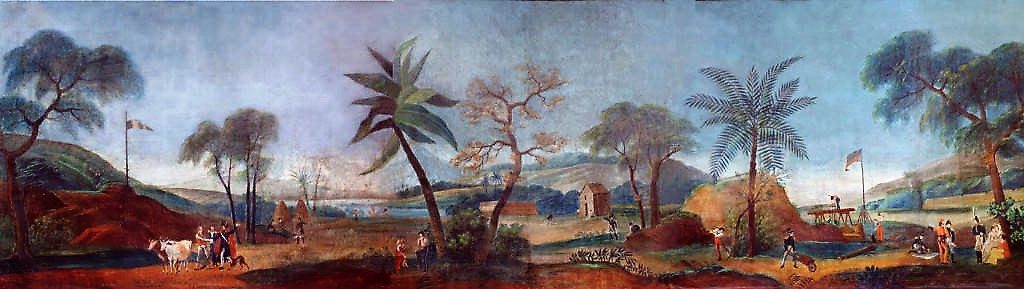
March 7, AD321 The Colossus of Nero

Suetonius described the complex as “ruinously prodigal”.  Nero himself would say nothing further on the palace’s dedication, save to say that he “had at last begun to live like a human being”.

tumblr_ml8frcaVTI1so9sc2o1_400
The cithara or kithara (Greek: κιθάρα, kithāra, Latin: cithara) was an ancient Greek musical instrument in the lyra family of instruments

A story comes down to us from two thousand years.  A tale of Emperor Nero, playing the fiddle while Rome burned.

Far be it for me to leap to the defense of a man who ordered the murder of his own wife and mother, except in the name of historical accuracy. The viol class of musical instruments to which the fiddle belongs, didn’t come along until the 11th century. If Nero played anything it was probably a Cithara, a heavy wooden instrument with four to seven strings.

No fewer than five versions come down to us about the Great Fire of 64AD, and the Emperor’s role in it. The Roman historian Tacitus tells us that Nero sang about the fall of Troy while the city burned, but admits to having no witnesses.

Cassius Dio and Suetonius ask us to believe, each in their turn, that Nero secretly sent guys out to burn the city, or, openly did so and watched from the tower of Maecenas while singing and playing the lyre, or, the fire was started by an obscure religious sect called “Christians”, or, Nero sent his guys out after all, but sang and played his lyre from a private stage or, the fire started by accident while Nero was away at Antium, rushing back 35 miles to help the now-homeless people of Rome.nero_fiddled_while_rome_burnedBe that as it may, three things are certain. First, The fire burned for six days, utterly destroying three of the 14 districts of Rome and severely damaging seven others.  Second, Nero used the excuse of the fire to go after Christians, having many of them arrested and executed. Third, the Domus Aurea (“Golden Palace”) and surrounding “Pleasure Gardens” emperor Nero built on the ruins, would be the death of him.

Over the next three years, Emperor Nero built a vast palace complex over an area of more than 200 acres, linking existing buildings on the Palatine Hill with the Gardens of Maecenas and other imperial properties on the Esquiline hills and adding a grand colonnaded approach and vestibule surrounding an artificial lake.

Reconstruction_3D_Domus_Aurea_Nero_Golden_House_5
Reconstruction of the Domus Aurea, of Nero

One of the Great Wonders of antiquity, Nero’s “Golden house” was ruinously expensive, 300 rooms of dazzling white marble with pools in the floors and fountains splashing in corridors. There were jewel-encrusted walls and ivory clad columns.  An enormous vaulted ceiling completing the dome of the main dining room.  Slaves cranked an ingenious mechanism causing the ceiling to revolve like the heavens, as rose petals fluttered to the floor and atomized perfume spritzed on the assembled diners.

Suetonius described the complex as “ruinously prodigal”.  Nero himself would say nothing further on the palace’s dedication, save to say that he “had at last begun to live like a human being”.

300px-El_Coloso_de_Nerón
Artist’s rendering of the Colossus of Nero holds a rudder on the globe, symbolizing his dominion over land and sea

At the center of it all was the Colossus Neronis, the Colossus of Nero, a giant gilded bronze statue…of himself.  Sources describe the thing as standing between 99′ and 121′ tall, roughly equivalent to the distance from the feet to the crown, of the Statue of Liberty.

With all of Italy “thoroughly exhausted by contributions of money” and “the provinces ruined”, the Emperor himself was universally hated.  In June 68, a runner arrived to inform the emperor.  He’d been tried in absentia and declared an enemy of the Roman people, sentenced to be returned to the Forum, and beaten to death.

Preparing himself for suicide, Nero paced up and down, muttering “Qualis artifex pereo”.  “What an artist dies in me”.   In the end, Nero was unable to take his own life.  He forced his private secretary Epaphroditos, to do the deed.

Ironically, Nero’s demise may have been unnecessary.  Notwithstanding the sentence of death, this was the end of Julio-Claudian dynasty.  The Senate was reluctant to put an end to a deified bloodline, even in the form of such a reviled individual.  Frantic negotiations were ongoing even as the emperor lay dying, to at least keep the man around, until he could produce an heir.

Nero’s days of being put out to stud, were never meant to be.  For his successors, the  profligate spending and outrageous lifestyle was a severe embarrassment.  Within a decade, the palace and surrounding complex was stripped of its marble, jewels, and ivory embellishments.domus_aurea_tour-tSa-1479X424Within forty years, most of the grounds were filled with earth and built over, replaced by the Baths of Titus and the Temple of Venus and Rome. Vespasian drained the lake and built the Flavian Amphitheatre.

And still, the Colossus of Nero lived on.

In 69, Emperor Vespasian added a sun-ray crown and renamed the thing Colossus Solis, a dedication to the Roman sun god Sol Invictus (“Unconquered Sun”), patron of the legions and official Sun God of the late Roman Empire.

Around 128, Emperor Hadrian moved the statue from the Domus Aurea to just outside of the Colosseum, with a little help from the architect Decrianus and 24 elephants. Emperor Commodus removed the head and replaced it with a likeness of his own, but the head was restored after the death of Commodus, and so it remained.800px-RomeConstantine'sArch03The Arch of Constantine, the last and largest of the Triumphal Arches of Rome and dedicated in AD315, was carefully positioned to align with Sol Invictus, so that the Colossus formed the dominant backdrop when approaching the Colosseum via the main arch.

Six years later, March 7, AD321, Constantine I “The Great” decreed Dies Solis – Day of the Sun or “Sun-day” – as the Roman day of rest (Codex Justinianus 3.12.2):

On the venerable day of the Sun let the magistrates and people residing in cities rest, and let all workshops be closed. In the country however persons engaged in agriculture may freely and lawfully continue their pursuits because it often happens that another day is not suitable for grain-sowing or vine planting; lest by neglecting the proper moment for such operations the bounty of heaven should be lost”.\

Constantine’s day of rest remains all these 2,000 years later but the colossus of the Unconquered Sun, is gone.  Where the thing went, nobody knows.  The last known reference in antiquity dates back to the Calendar of 354, the earliest illuminated manuscript containing full page illustrations.

Saint Bede of northumbria

Nero’s Colossus may have been destroyed during the Sack of Rome, in 410.  Perhaps it toppled in one of a series of 5th century earthquakes, the metal collected for scrap.

There is evidence that Sol Invictus outlived the western Roman Empire and survived into the early middle ages. Bede the Venerable, an English monk from the monastery of St. Peter in Northumbria, wrote sometime circa 672–735: “As long as the Colossus stands, Rome will stand, when the Colossus falls, Rome will also fall, when Rome falls, so falls the world“.

Nothing remains of the Colossus of Nero, save for the foundations of a pedestal at the second location, near the ruins of the Colosseum.

March 6, 1857 A Simple Man Who Wanted To Be Free

“We are now told, in tones of lofty exultation, that the day is lost all lost and that we might as well give up the struggle. The highest authority has spoken. The voice of the Supreme Court has gone out over the troubled waves of the National Conscience, saying peace, be still . . . The Supreme Court of the United States is not the only power in this world. It is very great, but the Supreme Court of the Almighty is greater”. – Frederick Douglass

Dred Scott.  His given name may have been “Etheldred”.  He was born into slavery in Southampton County, Virginia sometime in the late 1790s, home of Nat Turner’s rebelion, some 70 years before..  In 1818, Scott belonged to Peter Blow, who moved his family and six slaves to Alabama, to attempt a life of farming. The farm near Huntsville was unsuccessful and the Blow family gave up the effort, moving to St. Louis Missouri in 1830 to run a boarding house.

Blow died in 1832 and Dred Scott was sold to Dr. John Emerson, a surgeon serving in the United States Army.

dred__harriet_scott_quarters
Dred & Harriet Scott’s restored quarters, at Ft. Snelling

As an army officer, Dr. Emerson moved about frequently, bringing Scott with him. In 1837, Emerson moved to Fort Snelling in the free territory of Wisconsin, now Minnesota. There, Scott met and married Harriet Robinson, a slave belonging to fellow army doctor and Justice of the Peace, Lawrence Taliaferro.

Taliaferro, who presided over the ceremony, transferred Harriet to Emerson, who continued to regard the couple as his slaves. Emerson moved away later that year, leaving the Scotts behind to be leased by other officers.

The following year, Dr. Emerson married Eliza Irene Sanford, and sent for the Scotts to rejoin him in Fort Jesup, in Louisiana. Harriett gave birth to a daughter while on a steamboat on the Mississippi, between the free state of Illinois and the Iowa district of the Wisconsin Territory.

images (25)Dr. Emerson died in 1842, leaving his estate to his wife Eliza, who continued to lease the Scotts out as hired slaves.

Four years later, Scott attempted to buy his freedom for the sum of $300, equivalent to about $10,000 in 2020. Mrs. Emerson declined the offer and Scott took legal recourse. By this time, Dred and Harriett Scott had two daughters who were approaching an age where their value would be greatly increased, should they be sold as slaves. Wanting to keep his family together, Scott sued.

Ironically, Dred Scott’s suit in state court, Scott v. Emerson, was financially backed by three now-adult Blow children, who had since become abolitionists.

The legal position stood on solid ground, based on the doctrine “Once free, always free”. The Scott family had resided in free states and territories for two years and their eldest daughter was born on the Mississippi River, between a free state and a free territory.

The verdict went against Scott but the judge ordered a retrial, which was held in January, 1850. This time, the jury ruled in favor of Dred Scott’s freedom. Emerson appealed and the Missouri supreme court struck down the lower court ruling, along with 28 years of Missouri precedent.

By 1853, Eliza Emerson had remarried and moved to Massachusetts, transferring ownership of the Scott family to her brother, John Sanford. Scott sued in federal district court, on the legal theory that the federal courts held “diversity jurisdiction”, since Sanford lived in one state (New York), and Scott in another (Missouri). Dred Scott lost once again and appealed to the United States Supreme Court, a clerical misspelling erroneously recording the case as Dred Scott v. Sandford.

On March 6, 1857, Chief Justice Roger B. Taney delivered the 7-2 majority opinion, enunciating one of the stupidest decisions, in the history of American jurisprudence:
“[Americans of African ancestry] had for more than a century before been regarded as beings of an inferior order, and altogether unfit to associate with the white race, either in social or political relations; and so far inferior, that they had no rights which the white man was bound to respect; and that the negro might justly and lawfully be reduced to slavery for his benefit. He was bought and sold, and treated as an ordinary article of merchandise and traffic, whenever a profit could be made by it”.

download (18)
Frederick Douglass

The highest court in the land had ruled that slaves were private property and not citizens, with no right to legal recourse. Furthermore, the United States Congress had erred in attempting to regulate slavery in the territories and had no right to revoke the property rights of a slave owner, based on his place of residence.

Response to the SCOTUS decision was immediate, and vehement. Rather than settle the issue once and for all, the ruling inflamed public opinion, further dividing an already fractured nation. Frederick Douglass assailed Chief Justice Taney’s opinion, noting that:

“We are now told, in tones of lofty exultation, that the day is lost all lost and that we might as well give up the struggle. The highest authority has spoken. The voice of the Supreme Court has gone out over the troubled waves of the National Conscience, saying peace, be still . . . The Supreme Court of the United States is not the only power in this world. It is very great, but the Supreme Court of the Almighty is greater”.

220px-Dred_Scott_photograph_(circa_1857)
Dred Scott, photograph circa 1857

The Supreme Court had spoken, but Dred Scott’s story was far from over.  Eliza Irene Emerson’s new husband was Calvin C. Chaffee, an influential member of the United States Congress.  And an abolitionist.

Following the Dred Scott decision, the Chaffees deeded the Scott family over to Henry Taylor Blow, now a member of the United States House of Representatives from Missouri’s 2nd Congressional district, who manumitted the family on May 26.

Dred Scott had lost at virtually every turn, only to win his freedom at the hands of the family who once held him enslaved.

For Harriett and the two Scott daughters, it was the best of all possible outcomes.  For Scott himself, freedom was short-lived.  Dred Scott died of tuberculosis, the following year.

Slaves Issues Plague the Democratic Party

Nationally, the Dred Scott decision had the affect of hardening enmities already nearing white-hot, increasing animosities within and between pro- and anti-slavery factions in North and South, alike. Politically, the Democratic party was broken into factions and severely weakened while the fledgling Republican party was strengthened, as the nation was inexorably drawn to Civil War.

The issue of Black citizenship was settled in 1868, via Section 1 of the 14th Amendment, which states: “All persons born or naturalized in the United States, and subject to the jurisdiction thereof, are citizens of the United States and of the State wherein they reside …”

Dred Scott is buried in the Calvary Cemetery in St. Louis, Missouri. The marker next to his headstone reads: “In Memory Of A Simple Man Who Wanted To Be Free.”

dredscottmarker

March 5, 1770 Blood on the Snow

On this day in 1770, the insults of a cocky 13-year-old led to one of the seminal events, of the American Revolution.

In living memory, France and Great Britain have always been allies.  In war and peace from the Great War to World War 2 to the present day, but such was not always the case.  Between the Norman Invasion of 1066 and the Napoleonic Wars of 1802-1815, the two allies have found themselves in a state of war no fewer than forty times.

Throughout most of that history, the two sides would clash until one or the other ran out of money, when yet another treaty would be trotted out and signed.

New taxes would be levied to bolster the King’s treasury, and one or the other would be back for another round. The cycle began to change in the late 17th century for reasons which may be summed up with a single word.  Debt.

In the time of Henry VIII, British military outlays as a percentage of central government expenses averaged 29.4%. By 1694 the Nine Years’ War had left the English Government’s finances in tatters. £1.2 million were borrowed by the national treasury at a rate of 8 percent from the newly formed Bank of England.

The age of national deficit financing, had arrived.

In one of the earliest known debt issues in history, Prime Minister Henry Pelham converted the entire national debt into consolidated annuities known as “consols”, in 1752.  Consols paid interest like regular bonds, with no requirement that the government ever repay the face value.  18th century British debt soared as high as 74.6%, and never dropped below 55%.

The Seven Years’ War alone, fought on a global scale between 1756 to 1763, saw British debt double to the unprecedented sum of £150 million, straining the national economy.

American colonists experienced the conflict in the form of the French and Indian War, for which the Crown laid out £70,000,000.  The British government saw its American colonies as beneficiaries of their expense, while the tax burden on the colonists themselves remained comparatively light.  townsend

For American colonists, the never ending succession of English wars had accustomed them to running their own affairs.

The “Townshend Revenue Acts” of 1767 sought to force American colonies to pick up the tab for their own administration, a perfectly reasonable idea in the British mind. The colonists had other ideas.  Few objected to the amount of taxation as much as whether the British had the right to tax them at all. They were deeply suspicious of the motives behind these new taxes, and were not about to be subjugated by a distant monarch.

The political atmosphere was brittle in 1768, as troops were sent to Boston to enforce the will of the King. Rioters ransacked the home of a newly appointed stamp commissioner, who resigned the post following day. No stamp commissioner was actually tarred and feathered, a barbarity which had been around since the days of Richard III “Lionheart”, though several such incidents occurred at New England seaports.  More than a few loyalists were ridden out of town on the backs of mules.

The Massachusetts House of Representatives sent a petition to King George III asking for the repeal of the Townshend Act.  A Circular Letter sent to the other colonial assemblies, called for a boycott of merchants importing those goods affected by the act.  Lord Hillsborough responded with a letter of his own, instructing colonial governors in America to dissolve those assemblies which responded to the Massachusetts body.

tea-act-gettyimages-53071471The fifty gun HMS Romney arrived in May, 1769.  Customs officials seized John Hancock’s merchant sloop “Liberty” the following month, on allegations the vessel was involved in smuggling.  Already agitated over Romney’s impressment of local sailors, Bostonians began to riot. By October, the first of four regular British army regiments arrived in Boston.

On February 22, 1770, 11-year-old Christopher Seider joined a mob outside the shop of loyalist Theophilus Lillie.  Customs official Ebenezer Richardson attempted to disperse the crowd.  Soon the mob was outside his North End home.  Rocks were thrown and windows broken.  One hit Richardson’s wife.  Ebenezer Richardson fired into the crowd, striking Christopher Seider.  By nightfall, the boy was dead.  2,000 locals attended the funeral of this, the first victim of the American Revolution.

bostonmassacrebychampneyEdward Garrick was a wigmaker’s apprentice, who worked each day to grease and powder and curl the long hair of the soldier’s wigs.

Weeks earlier, the wigmaker had given British Captain-Lieutenant John Goldfinch, a shave.

A cocky 13-year old, Garrick spotted the officer and taunted the man, yelling “There goes the fellow that won’t pay my master!”

Goldfinch had paid the man the day before.  The officer wasn’t about to respond to an insult from some snotty kid but private Hugh White, on guard outside the State House on King Street, took the bait.  White said the boy should be more respectful and struck him on the head, with his musket.  Garrick’s buddy and fellow wigmaker’s apprentice Bartholomew Broaders began to argue with White, as a crowd gathered ’round to watch.

As the evening pressed on, church bells began to ring.  The crowd, now fifty and growing and led by the mixed-race former slave-turned sailor Crispus Attucks threw taunts and insults, spitting and daring Private White to fire his weapon.   The swelling mob turned from boisterous to angry as White took a more defensible position, against the State House steps.  Runners alerted Officer of the Watch Captain Thomas Preston to the situation, who dispatched a non-commissioned officer and six privates of the 29th Regiment of Foot, to back up Private White.

Bayonets fixed, the eight took a semi-circular defensive position with Preston himself, in the lead.  The crowd, now numbering in the hundreds, began to throw snowballs.  Then stones and other objects.  Private Hugh Montgomery was knocked to the ground and, infuriated, came up shooting.

2009_BostonMassacre_site_3658174192The two sides stopped for a few seconds to two minutes, depending on the witness.  Then they all fired.  A ragged, ill-disciplined volley.  There was no order, just the flash and roar of gunpowder on the cold late afternoon streets of a Winter’s day.  It was March 5.  When the smoke cleared, three were dead.  Two more lay mortally wounded and another six, seriously injured.

The mob moved away from the spot on King Street, now State Street, but continued to grow in the nearby streets.  Speaking from a balcony, acting Governor Thomas Hutchinson was able to restore some semblance of order, only by promising a full and fair inquiry.

Future President John Adams defended the troopers assisted by Josiah Quincy and Loyalist Robert Auchmuty.  Massachusetts Solicitor General Samuel Quincy and private attorney Robert Treat Paine handled the prosecution in two separate trials, one for Captain Preston, the other for the eight enlisted soldiers.

Two were convicted but escaped hanging, by invoking a medieval legal remnant called “benefit of clergy”. Each would be branded on the thumb in open court with “M” for murder.  The others were acquitted, leaving both sides complaining of unfair treatment.  It was the first time a judge used the phrase “reasonable doubt.”

6923394409_1e71688405_b
Boston Massacre–A Battle for Liberty. Murals of the Capitol, by Constantino Brumidi

The only conservative revolution in history, was fewer than six years in the future.

There is a circle of stones in front of the Old State House on what is now State Street, marking the site of the Boston Massacre.  British taxpayers continue to this day, to pay interest on the debt left to them, by the decisions of their ancestors.

bostonmassacre21

March 3, 1817 Land of the Vine and Olive

Thus begins one of the more romanticized chapters in Alabama folklore.  The noble heroes of the Napoleonic wars, carving a new world of French language and culture from the wild frontier.

In the Treaty of Paris in 1783,  the British Crown formally recognized American Independence, ceding vast territories east of the Mississippi, effectively doubling the size of the fledgling United States and paving the way for westward expansion. north_america_1670Those first ten years of independence was a time of increasing unrest for the American’s French ally, of the late revolution.  The famous Storming of the Bastille of July 1789 led to the Women’s March and the abolition of the French monarchy the following year.  King Louis XVI was beheaded by guillotine in January 1793 followed ten months later by the execution of the Queen Consort of France, Marie Antoinette.

The orgy of violence known as “The Reign of Terror” killed nearly twice as many Frenchmen over the next two years, as that of Americans killed during the entire seven years of the Revolution.

A certain Corsican corporal emerged from this mess, with designs on La Louisiane.  Napoleon envisioned a vast north American empire stretching from the gulf of Mexico to the modern state of Montana and east to the Great Lakes, all of it centered on a vast trade in Caribbean sugar.napoleon_bonaparte_promoIt wasn’t meant to be. The slave insurrection of Toussaint Louverture in the French colony of Saint-Domingue (modern-day Haiti) put a strain on French finances, to say nothing of the never-ending series of wars on the European landmass.  By 1803, Bonaparte needed to cash his chips and move away from the American table.

Robert R. Livingston, one of the committee of five who drafted the Declaration of Independence, was minister to the French Republic.  President Thomas Jefferson instructed Livingstone to open the way for commerce on the western frontier, authorizing the diplomat to pay up to $2 million for the city of New Orleans and lands on the east bank of the Mississippi river.

French Foreign Minister Talleyrand surprised the American diplomat, asking how much the Americans would pay for the Entire Louisiana territory.  The Louisiana Purchase of 1803 added 828,000 square miles of new territory at a cost of fifteen million dollars.louisiana-purchaseNapoleon Bonaparte, crowned Emperor the following year, would fight (and win) more battles than Julius Caesar, Hannibal, Alexander the Great and Frederick the Great, combined.

It was all for nothing.  The first fall of the Napoleonic dynasty brought about the restoration of the Bourbon monarchs in 1814, leading to the “100 days” and Napoleon’s final defeat in 1815, at a place called Waterloo.

Philadelphia and New Orleans both, would soon become sanctuaries for French refugees of the Napoleonic wars, and the Haitian Revolution.

download - 2020-03-04T061100.354 Jean-Simon Chaudron founded the Abeille Américaine in 1815 (The American Bee), Philadelphia’s leading French language newspaper.  Himself a refugee of Santo Domingo (Saint-Domingue), Chaudron catered to French merchants, emigres and former military figures of the Napoleonic era and the Haitian revolution.

The idea of a French agricultural colony in the old southwest (now the central southeastern states) first came about in 1816 and Chaudron used his newspaper to promote the project.

The Colonial Society came about that November (later renamed the Society for the Cultivation of the Vine and Olive), with General Charles Lefebvre-Desnouettes, at its head.

Congress soon took an interest in the project as did important politicians of the era including Thomas Jefferson, James Madison, and James Monroe.

The project made sense.  Many viewed these French refugees as fellow republicans, oppressed by a monarchy.  What better way to consolidate hold on western territories while at the same time building a domestic wine-making industry.  Furthermore, the work would prevent these people from forming yet another hotbed, of Napoleonic military insurrection.

m-5392In January 1817, the Society for the Vine and Olive selected a site near the Tombigbee and Black Warrior Rivers in west-central Alabama, on former Choctaw lands.  On March 3, 1817, Congress passed an act “disposing of a tract of land to embrace four townships, on favorable terms to the emigrants, to enable them successfully to introduce the cultivation of the vine and olive.”

The act granted 92,000 acres, specifying a 14-year grace period in which to dedicate a ‘reasonable’ portion of the land to cultivation at a deferred cost of $2.00 per acre.

Thus began one of the more romanticized chapters in Alabama folklore.  The noble heroes of the Napoleonic wars, carving a new world of French language and culture from the wild frontier.

The reality wasn’t quite so romantic.  Grape vines and olive saplings were ordered from Europe but many of the plants, died en route.  The grape varieties selected were a poor match for the hot and humid climate of the region, the olive trees, a dismal failure.  Congressional stipulations were relaxed over time and farmlands converted, to cotton.

m-5391General Charles Lallemand, who joined the French army in 1791, replaced Lefebvre-Desnouettes as President of the Colonial Society. A man better suited to the life of an adventurer than that of the plow, Lallemand was more interested in the wars of Latin American independence, than grapes and olives.  By the fall of 1817, Lallemand and 69 loyalists had concocted a plan to sell the land they hadn’t yet paid for, to raise funds for the invasion of Texas.

In the end, only 150 of 347 original grantees ever came to Alabama. Some died, many fled.  Most were unwilling to trade comfortable lives in Philadelphia and New Orleans, for the hardship of life on the frontier. By the planting season of 1818, there were only 69 settlers in the colony.

583b24b42a4c7_115727bLittle is left of the Vine and Olive Colony but the French Emperor lives on, in western Alabama.  Marengo County commemorates Napoleon’s June 14, 1800 victory over Austrian forces at the Battle of Marengo.  The county seat, also known as Marengo, was later renamed Linden.  Shortened from the Napoleonic victory over Bavarian forces led by Archduke John of Austria, at the 1800 battle of Hohenlinden.


Hat tip Rafe Blaufarb of Florida State University, for a great write-up of this subject. http://www.encyclopediaofalabama.org


March 2, 1864 A Civil War Story

“As we entered the place, a spectacle met our eyes that almost froze our blood with horror, and made our hearts fail within us. Before us were forms that had once been active and erect;—stalwart men, now nothing but mere walking skeletons, covered with filth and vermin. Many of our men, in the heat and intensity of their feeling, exclaimed with earnestness. ‘Can this be hell?’”.

In the early days of the Civil War, the government in Washington refused to recognize the Confederate states’ government, believing such recognition tantamount to legitimizing an illegal entity.  Accordingly, the Union refused formal agreement regarding the exchange of prisoners. Following the capture of over a thousand federal troops at the first battle of Bull Run (1st Manassas), a joint resolution in Congress called for President Lincoln to establish a prisoner exchange agreement.

In July 1862, Union Major General John Dix and Confederate Major General D. H. Hill met under flag of truce to draw up an exchange formula, regarding the return of prisoners. The “Dix-Hill Cartel” determined that Confederate and Union Army soldiers were exchanged at a prescribed rate:  captives of equivalent ranks were exchanged as equals.  Corporals and Sergeants were worth two privates.  Lieutenants were four and Colonels fifteen, all the way up to Commanding General, equivalent to sixty private soldiers.

Similar exchange rates were established for Naval personnel.ECWCTOPICPrisonerExchangeandParolePICParoledocumentsmall

President Lincoln’s emancipation proclamation of September 1862 not only freed those enslaved in Confederate territories, but also provided for the enlistment of black soldiers.  The government in Richmond responded that such would be regarded as runaway slaves and not soldiers.  Their white officers would be treated as criminals, for inciting servile insurrection.

The policy was made clear in July 1863, following the Union defeat at Fort Wagner, an action depicted in the 1989 film, Glory.  The Dix-Hill protocol was formally abandoned on July 30.  Neither side was ready for the tide of humanity, about to come.

The US Army began construction the following month on the Rock Island Prison, built on an Island between Davenport Iowa and Rock Island, Illinois. In time, Rock Island would become one of the most infamous POW camps of the north, housing some 12,000 Confederate prisoners, seventeen per cent of whom, died in captivity.illinois-1864-rock-island-bird-s-eye-view-114349732-5b6e3d7b4cedfd0025fd2c3d

On this day in 1864, the first prisoners had barely moved into the most notorious POW camp of the Civil War, the first Federal soldiers arriving on February 28.

This was Camp Sumter, better known as Andersonville.  Conditions in this place defy description. Sergeant Major Robert H. Kellogg of the 16th Regiment Connecticut Volunteers, entered this hell hole on May 2:

“As we entered the place, a spectacle met our eyes that almost froze our blood with horror, and made our hearts fail within us. Before us were forms that had once been active and erect;—stalwart men, now nothing but mere walking skeletons, covered with filth and vermin. Many of our men, in the heat and intensity of their feeling, exclaimed with earnestness. ‘Can this be hell?’”.

Over 45,000 Union troops would pass through the verminous open sewer known as Andersonville. Nearly 13,000 died there.

Andersonville1
Andersonville

Now all but forgotten, the ‘Eighty acres of Hell’ located in the Bronzeville neighborhood of Chicago was home to some forty thousand Confederate POWs between 1862 and 1865, seventeen per cent of whom, never left.  No southern soldier was equipped for the winters at Camp Douglas, nor the filth, or the disease.

Nearby Oak Woods Cemetery is home to the largest mass grave, in the western hemisphere.

f650dbc6-e197-4967-a27f-84606382b639
Camp Douglas of Chicago, known to many as “The Andersonville of the North’

Union and Confederate governments established 150 such camps between 1861 and 1865, makeshift installations of rickety wooden buildings and primitive sewage systems, often little more than tent cities.   Some 347,000 human beings languished in these places, victims of catastrophically poor hygiene, harsh summary justice, starvation, disease and swarming vermin.

The training depot designated camp Rathbun near Elmira New York became the most notorious camp in the north, in 1864.  12,213 Confederate prisoners were held there, often three men to a tent.  Nearly 25% of them died there, only slightly less, than Andersonville.   The death rate in “Hellmira” was double that of any other camp in the north.

Hellmira
Hellmira

Historians debate the degree to which such brutality resulted from deliberate mistreatment, or economic necessity.

The Union had more experience being a “country” at this time, with well established banking systems and means of commerce and transportation.  For the south, the war was an economic catastrophe.  The Union blockade starved southern ports of even the basic necessities, while farmers abandoned fields to take up arms. Most of the fighting of the Civil War took place on southern soil, destroying incalculable acres of rich farm lands.

The capital at Richmond saw bread riots as early as 1862.  Southern Armies subsisted on corn meal and peanuts.  The Confederate government responded by printing currency, about a billion dollars worth.  By 1864, a Confederate dollar was worth 5¢ in gold.  Southern inflation climbed past 6000 percent, by 1865.POW StoryCaptain Henry Wirz, commandant of the stockade at Camp Sumter, was tried and executed after the war, only one of two men to be hanged for war crimes.  Captain Wirz appeared at trial reclined on a couch, advanced gangrene preventing him from sitting up.  To some, the man was a scapegoat. A victim of circumstances beyond his control. To others he is a demon, personally responsible for the hell of Andersonville prison.

I make no pretense of answering such a question.  The subject is capable of inciting white-hot passion, from that day to this.

A personal note:

Six generations from his immigrant ancestor, James Tyner could trace his lineage through veterans of the Indian wars, the Revolution and the War of 1812.  One of those farmers who left the soil to fight for his country, Tyner died in captivity in “Hellmira”, about a month before General Robert E. Lee met General Ulysses Grant, at Appomattox.

Corporal Jacob Deppen of the 128th PA Infantry was captured and held prisoner for a time, before being paroled.  Deppen re-enlisted with the Army of the James.  He and the sole surviving member of the four Tyner brothers, Nicholas Tyner, would lay down their weapons at Appomattox.  Former enemies turned countrymen, if they could only figure out how to do it.

William Christian Long, the first to ‘anglicize’ his name from Wilhelm Lang, was Blacksmith to the 17th Pennsylvania Cavalry.  Long survived the war, his name may be found on the Pennsylvania monument, at Gettysburg.

Archibald Blue of Drowning Creek North Carolina wanted no part of what he saw as a “rich man’s war” and ordered his five sons away.  He was murdered for his politics in 1865.  The killer was never found.

Four men who played a part in the most destructive war, in American history.  Without any of these four, I wouldn’t be here to tell their story.

Rick Long

Family Plot
Family cemetery, Scotland County, North Carolina


March 1, 1420 Reformation

A popular story has Martin Luther nailing the document to the door of the Wittenberg Palace Church, but it may never have happened that way. Luther had no intention of confronting the Church at this time. This was an academic work, 95 topics offered for scholarly debate. 

Hans Luder sent his son Martin to a series of Latin schools beginning in 1497.  There the boy learned the so-called “trivium”: grammar, rhetoric, and logic. He entered the University of Erfurt in 1501 at the age of 19, receiving his master’s degree in 1505. The elder Luder (“Luther”) intended that his son become a lawyer. Years later, the younger Luther described his Latin school education as time spent in purgatory, his University a “beerhouse” and a “whorehouse”.

Martin Luther was not cut out for that world.

He entered Law School in 1505 and dropped out almost immediately. His father was furious over what he saw as a wasted education. Martin entered an Augustinian cloister that July, saying “This day you see me, and then, not ever again.”

download - 2020-03-01T075128.41316th century Church doctrine taught that the Saints built a surplus of good works over a lifetime, sort of a moral bank account.  Like “carbon credits” today, positive acts of faith and charity could expiate sin. Monetary contributions to the church could, so it was believed, “buy” the benefits of the saint’s good works, for the sinner.

As he studied the bible, Luther came to believe that the church had lost sight of the central truths of Christianity. The Grace of God wasn’t traded as a medium of exchange, he believed, but rather through faith in Jesus Christ, as the Messiah. “This one and firm rock”, he wrote, “which we call the doctrine of justification, is the chief article of the whole Christian doctrine, which comprehends the understanding of all godliness”.

Papal “commissioner for indulgences” Johann Tetzel came to Wittenberg in 1516, selling expiation to raise money to rebuild St. Peter’s Basilica, in Rome.  A saying attributed to the Dominican friar, went “As soon as the coin in the coffer rings, the soul from purgatory springs.”

Martin Luther wrote to Archbishop Albrecht on October 31, 1517, objecting to this sale of indulgences. He enclosed a copy of his “Disputation of Martin Luther on the Power and Efficacy of Indulgences”, a document which came to be known as his “95 Theses”.

cc-1509034747-1xk2ppowve-snap-imageA popular story has Martin Luther nailing the document to the door of the Wittenberg Palace Church, but it may never have happened that way. Luther had no intention of confronting the Church at this time. This was an academic work, 95 topics offered for scholarly debate.
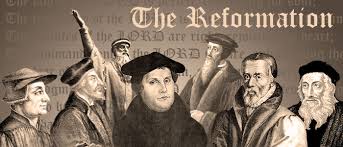
Be that as it may.  Luther’s ideas would rock the Christian world.

What seems to the modern mind as mere doctrinal differences, were life and death matters in the late middle and early modern ages. Archbishop Albrecht forwarded Luther’s note to Pope Leo X, who responded slowly and “with great care as is proper”.

Three theologians drafted heresy cases against Luther. In 1520, the papal bull (edict) “Exsurge Domine” commanded Luther to recant under pain of excommunication.

download - 2020-03-01T073858.558Luther stood on dangerous ground. Jan Hus had been burned at the stake for such heresy, back in 1415. On this day in 1420, Pope Martinus I called for a crusade against the followers of the Czech priest, the “Hussieten”.

The Italian reformer Girolamo Savonarola confessed under torture to any number of inventions and then recanted, and confessed again. Savonarola was ritually stripped of his Dominican garments and hanged in 1498, while fire was ignited from below to consume his body.  Henry VIII’s famous break with the church over his divorce from Catherine of Aragon was still years in the future in 1521, the year Henry was named “Fidei Defensor” (“Defender of the Faith”). Nine years later, French theologian Jean Calvin would be forced to flee a deadly outbreak of violence against Protestant Christians. Jan Matthias, Bernhard Rothmann and Bernhard Knipperdolling would be tortured to death with white-hot pliers in the Münster marketplace in 1535, their corpses placed in cages and hanged from the steeple of St. Lambert’s Church.

The bones of the three were later removed but those three cages remain there, to this day.lambert-cages-700x438The papal bull had the effect of hardening Luther’s positions. He publicly burned it, on December 10. Twenty-four days later, Luther was excommunicated. A general assembly of the secular authorities of the Holy Roman Empire summoned Luther to appear before them in April, in the upper-Rhine city of Worms. The “Edict of Worms” of May 25, 1521, declared Luther an outlaw, stating “We want him to be apprehended and punished as a notorious heretic”. Anyone killing Luther was permitted to do so without legal consequence.

Luther went into hiding at Wartburg Castle. In 1516, Erasmus had expressed the wish that the holy text should be available in every language, “so that even Scots and Irishmen might read it”. It was there that Luther translated the New Testament from Greek into German, laying the foundation for other vernacular translations and, for the first time, making the bible accessible to the common man.

Radical sects took Luther’s teaching far beyond his intent.  Luther found himself in the odd position of defending the faith against more radical reformers. The Zwickau Prophets rejected holy scripture in favor of direct revelations from the holy spirit. The Anabaptists took the “equality of man” in radical egalitarian directions, sounding more like the principles Karl Marx would write about, in 1848.

Martin Luther’s reformations plunged Europe into a series of wars. The Peasant’s War of 1524-25 alone killed more Europeans than any conflict prior to the 1789 French Revolution. The established church would respond with counter-reformation, but the idea that Christian faith was more than the exclusive province of a special, segregated order of men, was here to stay.

On October 31, 1999, 482 years to the day from Martin Luther’s letter to Archbishop Albrecht, leaders of the Roman Catholic and Lutheran Churches signed the “Joint Declaration on the Doctrine of Justification”, ending the half-millennium old doctrinal dispute, once and for all.

February 29, 1504 Leap Year

According to mathematicians, the method of losing three leap days out of every 400 ought to hold us for about 10,000 years. By that time we’ll have to add a day, somewhere.

Let me know how that works out, would you?

From its earliest inception, the Roman calendar tracked the cycles of the moon.  At least it tried to. The method fell out of phase with the change of seasons and days were randomly added or subtracted in order to compensate. Political campaigns and military conflicts were won or lost, based on the confusion. Things had to change.

In 46BC, Julius Caesar hired Alexandrian astronomer Sosigenes to help straighten things out. The astronomer calculated that a proper year was 365¼ days, more accurately tracking the solar and not the lunar year.  Ol’ Sosigenes was pretty close.  The actual time the earth takes to revolve around the sun is 365.242199 days.1024px-Museo_del_Teatro_Romano_de_Caesaraugusta.43The second month had 30 days back then, when Caesar renamed his birth month from Quintilis to “Julius”, in honor of himself.  Rank hath its privileges.  To this day, it’s why we have “July”.  Not to be outdone, Caesar’s successor Caesar Augustus changed Sextilis to Augustus and, you got it, today we have August. The only thing was, that Augustus had only 29 days to Julius’ 31, and we can’t have that.

You see this coming, right?

Augustus swiped two days from the month of the Roman festival of purification.  Februarius mensis wouldn’t even miss them.

Adding a day to every fourth February solved the calendar problem, sort of, but not quite. Pope Gregory XIII and his astronomers attempted to fine tune the situation in 1582. No year divisible by 100 would be a leap year, unless that year is also divisible by 400. Ergo, 1600 and 2000 were leap years, but 1700, 1800 and 1900, were not. According to mathematicians, this method of losing three leap days out of every 400 ought to hold us for about 10,000 years. By that time we’ll have to add a day, somewhere.

Let me know how that works out, would you?Leap Year1There is an old legend that St. Bridget complained to St. Patrick back in the 5th century, that women had to wait too long for beaus to “pop the question”. Other versions of the story date back before English Law recognized the Gregorian calendar, meaning that the extra day had no legal status.  Be that as it may, it is customary in many places for a woman to propose marriage on the 29th of February.  According to legend, one old Scottish law of 1288 would fine the man who turned down such a proposal.

In June 1503, Christopher Columbus was on his fourth voyage to the west when his two caravels became stranded, in Jamaica.  Relations with the natives were cordial at first but, after six months, the newcomers had worn out their welcome.  Desperately needing food and provisions, Columbus consulted the Ephemeris of the German astronomer Regiomontanus, where he learned that a lunar eclipse was expected on February 29.

Gathering the native chiefs that evening, Columbus explained that God was about to punish the indigenous people by painting the moon red. The eclipse occurred on schedule to the dismay of the natives, who were eager to promise anything to get the moon back.5a83a64e-9525-4d8c-acab-e92e6a35ba8d-columus_eclipse“With great howling and lamentation” wrote Columbus’ son Ferdinand, “they came running from every direction to the ships, laden with provisions, praying the Admiral to intercede by all means with God on their behalf; that he might not visit his wrath upon them”.

The explorer retired to his cabin, to “pray”.  Timing the eclipse with his hourglass, Columbus emerged after 48 minutes to announce.  All was forgiven.  God had pardoned the People.

188 years later, to the day.  February 29, 1692.  The first witchcraft warrants went out from a place called Salem Village, calling for the arrest of two social outcasts named Sarah Good and Sarah Osborne, and the West Indian slave woman, Tituba.

February 27, 1992 Young Tom

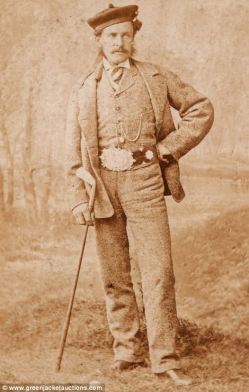
The youngest golfer ever to play in one of the majors (the Masters, US & British Opens and the PGA Championship), was the appropriately named “Young” Tom Morris, Jr., a Scot who played in the 1865 British Open at 14 years and four months.

On this day in 1992, 16-year-old Tiger Woods became the youngest PGA golfer in 35 years, going on to become the first $100 million man on the Professional Tour.

article-2537121-1A8B0ADF00000578-386_470x741
“Young Tom” Morris

The youngest in thirty-five years that is, but not the youngest ever.  Andy Zhang made the US Open in 2012 at the ripe old age of fourteen years, six months, but even he wasn’t the youngest.

The youngest golfer ever to play in one of the majors (the Masters, US & British Opens and the PGA Championship), was the appropriately named “Young” Tom Morris, Jr., a Scot who played in the 1865 British Open at 14 years and four months.

Morris withdrew from that year’s tournament, at about the time General Lee met General Grant at a place called Appomattox.  Young Tom went on to win the British Open three years later, winning the equivalent of $12 for the feat. Ironically, the victory came at the expense of his father “Old” Tom Morris, Greens Keeper and club pro at the famous ‘Old Course’ at St. Andrews.

Young Tom followed that first Open Championship in 1868 with three more:  in 1869, 1870 and 1872. His record stands to this day, the only player ever to win four consecutive Open Golf Championships.   (There was no championship in 1871).

The 18th Green of the Old Course at St. Andrews has changed little, since 1891.

Young Tom went on to win three more Open tournaments, the first of only two teenagers in history to win any of the majors.  In 1864, Young Tom attended a tournament with his father at the King James VI Golf Club.  With days to go before his 13th birthday, he was too young to compete in either the professional or amateur sections.  Local organizers set up a two-man tournament between himself and a local youth champion.  A large gallery followed the two young golf stars throughout their match.  Those who did so were rewarded by seeing young Tom win the match, with a score sufficient to have won the professional tournament.a-golf-match-involving-willie-park-old-tom-morris-and-young-tom-morris-g3b8fhThe Father/Son team tee’d off in match against the brothers Willie and Mungo Park on September 11, 1875. With two holes to go, Young Tom received a telegram with upsetting news. His wife Margaret had gone into a difficult labor. The Morrises finished those last two holes winning the match, and hurried home by ship across the Firth of Forth and up the coast. Too late. Tom Morris Jr. got home to find that his young wife and newborn baby, had both died in childbirth.

Weeks later, Young Tom played a marathon tournament in wretched weather, leaving him in a weakened state and bleeding from his lungs. He died at the “Home of Golf” and place of his birth, St. Andrews, a short twenty-four years before.  It was Christmas day.

In 2016, the historical drama “Tommy’s Honour” opened the 2016 Edinburgh International Film Festival, based on “Tommy’s Honor:  The Story of Old Tom Morris and Young Tom Morris, Golf’s Founding Father and Son” by Kevin Cook, one of five books voted 2007 “Book of the Year”, by Sports Illustrated.

Journalist and film critic Ross Miller wrote in The National newspaper of Scotland, calling the film “emotional, inspiring and deeply heartfelt.  You don’t have to be a golf fan” Miller wrote, ” to be taken in by this engrossing, quietly passionate film that not only brings something new to the sports biopic table but also serves as a poignant, often heartbreaking portrait of paternal love and pursuing your passion with everything you have.

February 4, 2012 Have a Nice Day

From Betty Boop to the hula hoop, popular culture is always primed and ready to dive into the latest fad.

140px-Silver_Star_medalEstablished by act of Congress on July 9, 1918, the Silver Star is the third-highest decoration is the system of military honors, awarded to members of US armed services for valor in combat against an enemy of the United States.  A search of public records reveals a long list of recipients of the Silver Star including the name “Ball, Harvey A. HQ, 45th Infantry Division, G.O. No. 281”.
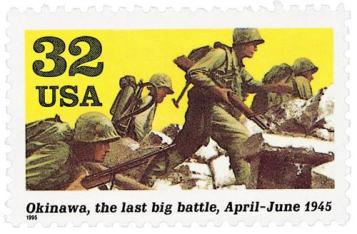


Harvey Ball earned the silver star medal “for Conspicuous Gallantry in Action” in 1945, during the battle for Okinawa. He went on to serve most of his life in the United States Army Reserve, retiring in 1979 with the rank of Colonel.

Harvey Ross Ball worked for a sign painter while attending Worcester South High School, and went on to study fine arts at the Worcester Art Museum School.2981c

After the war, Ball came home to Worcester and worked for a local advertising firm, later opening his own ad agency, Harvey Ball Advertising, in 1959.

In 1963, the State Mutual Life Assurance Company of Worcester (now Hanover Insurance) bought out the Guarantee Mutual Company of Ohio.  Employee morale tanked with the new acquisition.  Director of Promotions Joy Young was tasked with solving the problem.  Young hired Harvey Ball as a freelance artist to create a visual icon. A pin to be worn as part of the company’s ‘friendship campaign’.

Harvey_Ball
Harvey Ball, surrounded by his own creation

First came the silly grin. That part was easy but the pair soon realized, the button could be inverted.  Now we’ve got a “frowny” face and we can’t have that. Ball added eyes, the left drawn just a little smaller than the right, to “humanize” the image.

The work took ten minutes and the artist was paid $45, equivalent to $330 today.  Neither Ball nor State Mutual Felt the need to copyright the graphic.

From Betty Boop to the hula hoop, popular culture is always primed and ready to dive into the latest fad. State Mutual ordered 100 buttons.  It wasn’t long before manufacturers were taking orders for thousands at a time.

Philadelphia brothers Bernard and Murray Spain seized on the image seven years later and produced millions of coffee mugs, t-shirts, watches and bumper stickers, emblazoned with the happy face and the slogan “Have a happy day”.  It was later revised to the ever present, “Have a nice day”.

The image was everywhere, second only to the ubiquitous “Peace Sign”.

Frenchman Franklin Loufrani copyrighted the graphic in France in 1972, using the image in the “good news” section of the newspaper France Soir and developing a line of imprinted novelty items.  Loufrani’s son Nicolas took over the family business and launched the Smiley Company, in 1996.

Unsurprisingly, the younger Loufrani is skeptical of Harvey Ball’s claim to have created such a simple design, pointing to cave paintings found in France dated to 2500BC and a similar graphic used in radio ad campaigns, of the early 1960s.

Of course, that didn’t prevent the company from seeking US trademark rights to the image and kicking off a years-long legal battle with retail giant WalMart, which had been using the happy face in its “Rolling Back Prices” campaign.

The Smiley Company is one of the 100 largest licensing corporations in the world with revenues of $167 million in 2012, holding rights to the Smiley Face in over 100 countries. Notably, the United States is not one of them.

As for Harvey Ball, he didn’t seem to mind that he never copyrighted his Smiley Face.  The artist is gone now but Ball’s son Charles says his father never was a money driven kind of guy. “Hey”, he would say, “I can only eat one steak at a time. drive one car at a time”.

140226-space-galle_c65701ac3dd494b9ce91bd30c7bbb33b.fit-760w
The Galle Crater, on Mars

In the 2009 film “Watchmen” characters fly to Mars, landing in a crater that looks like a Smiley Face. The red planet really does have such a place.  It’s called the Galle crater.

In June of 2010, Wal-Mart and the Smiley Company settled their 10-year-old legal dispute in Chicago federal court. The terms of the settlement are confidential and the words of the judge as he lowered his gavel, are unknown to this scribe.

I so want to believe the man told all those lawyers, to “have a nice day”.

February 3, 1959 The Day the Music Died

There’s a popular story that the 1947 Beechcraft Bonanza was called “American Pie”, but the story is a myth. The single engine airplane bore only the tail number: N3794N.

Jiles Richardson was a Texas DJ in 1958, the year he found recording success of his own with a song called “Chantilly Lace”.

Richie Valenzuela was only 16 when Del-Fi Records producer Bob Keane discovered the singer in California. “Donna”, a song he had written for his high school sweetheart Donna Ludwig, was on the way to #2 on the Billboard Hot 100, right alongside the 45’s “B” side, an old Mexican standard turned Rock & Roll tune called “La Bamba”. By 1958, Valenzuela was one of the hottest young recording artists of his time.

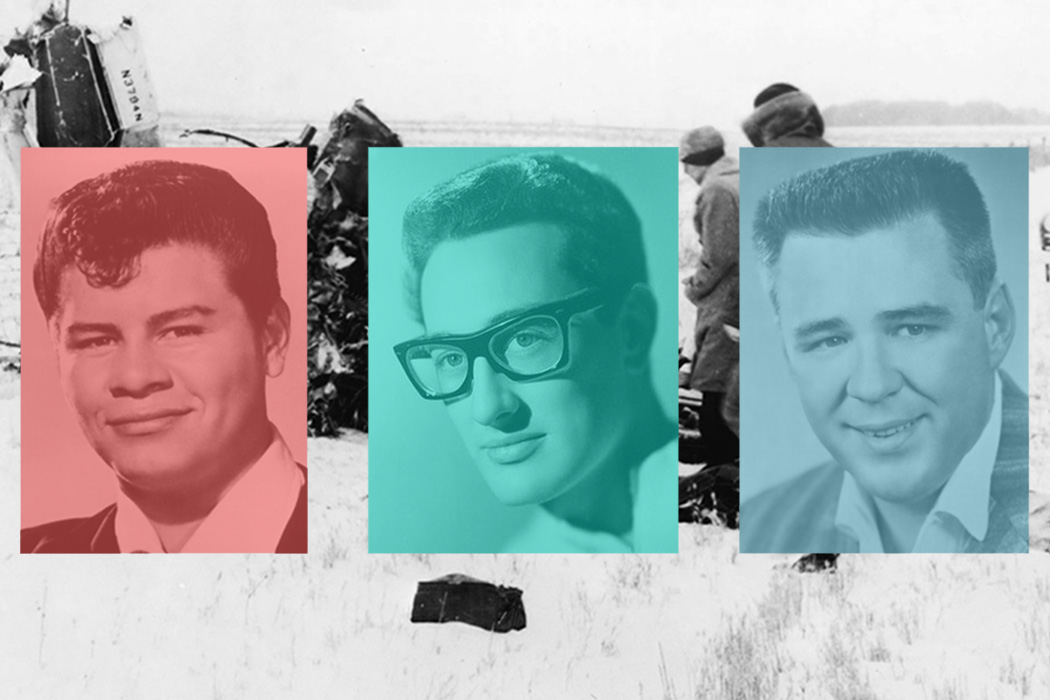
Charles Hardin Holley, “Buddy” to his friends and family, learned guitar, four-string banjo and lap steel guitar from his older brothers, Travis and Larry. The boy took to music at an early age, winning his first talent contest at age five.   One music critic would describe the Lubbock Texas native as “the single most influential creative force in early rock and roll.” Contemporary and later musicians claiming inspiration from Holley’s work include the Beatles, the Rolling Stones, Bob Dylan, and Elvis Costello.download (98)58 years ago, his name changed as the result of a misspelling in a recording contract, Buddy Holly was headliner of the “The Winter Dance Party Tour”. Richardson, performing as the “Big Bopper” and Valenzuela, professionally known as Ritchie Valens, were on the tour, along with Dion and the Belmonts, Holly’s friend from Lubbock and fellow musician Waylon Jennings, and a young Owasso, Oklahoma Rockabilly musician and former “Crickets” band member, an enrolled member of the Cherokee Nation named Tommy Allsup.

The musical tour included 24 cities in 3 weeks, a grueling schedule under the best of circumstances.  This were anything but the best of circumstances. The tour bus had no heat.  A three-week winter bus tour of the upper Midwest is no place to be without heat. It was so cold that Holly’s drummer, Carl Bunch, suffered frostbite in his feet and left the tour in Clear Lake, Iowa.download (96)Holly was sick of it, and decided to charter a plane for himself and some of his guys. At least that would give them time to do laundry before the next performance.

Dwyer Flying Service got the charter with a 1947 Beechcraft Bonanza, at $36 per person. There’s a popular story that the four-seater aircraft was called “American Pie”, but the story is a myth. The single engine airplane bore only the tail number: N3794N.

Richardson was running a fever at the time, so Waylon Jennings gave up his seat so the Big Bopper could ride in comfort. Allsup and Valens flipped a coin for the last seat, the coin landing heads up. Ritchie Valens had won the coin toss.

On learning that Jennings wasn’t going to fly, Holly said “Well, I hope your old bus freezes up.” Jennings replied “Well, I hope your plane crashes.” It was just a good ribbing between friends.  None could know that Jennings’ joke, would come true.  The comment haunted Waylon Jennings for the rest of his life.

HighFlight-TheMusicDied6N3794N left the ground in a snowstorm, shortly after 1:00am on February 3. The pilot, Roger Peterson, may have been inexperienced with the instrumentation.  He may have become disoriented in near-whiteout conditions. One wing hit the ground in a cornfield outside of Clear Lake and the aircraft corkscrewed into the ground, throwing the three musicians clear of the plane. There was no fire, barely a sound.  Just a small aircraft swallowed whole, by a snow covered cornfield.

The bodies would lie in that field until late in the afternoon.

The show would go on. Needing to fill in at the next stop in Moorhead, Minnesota, they found a 15 year old talent across the state line in Fargo, and so began the musical career of Bobby Vee.

download (97)A boy named Don McLean heard about the plane crash while doing his morning paper route. One day, the future singer/songwriter would pen the words “February made me shiver, with every paper I’d deliver”.

Allsup returned to Odessa, resuming his musical career and opening a club in Dallas, in 1979. He called the place, “Tommy’s Heads Up Saloon”.  A nod to the “lost” coin toss that had saved his life.

Distraught, Buddy Holly’s widow miscarried their only child, shortly after the wreck.  His last song reached #1 on the UK charts on April 24, 1959, the first posthumous release ever to do so.  In the US the song charted at 13 on the Billboard Hot 100.  It would be Buddy Holly’s last top 20 hit in the nation.

The name of the song, was “It Doesn’t Matter Anymore.”

Inscribed on Ritchie Valens’ gravestone are the words, “Come On, Let’s Go.”

The last surviving member of Buddy Holly’s 1959 tour band passed away at the age of  85.  Tommy Allsup was a big fan of Western Swing, and member of the Rockabilly Hall of Fame.  Tommy’s son Austin is himself a singer/songwriter, that’s him in the picture.  Austin received messages of condolence on the passing of his father, including one from Ritchie Valens’ sister. “I told her in my message back“, he said “now my dad and Ritchie can finally finish the tour they started 58 years ago.”

Tommy Allsup
Hat Tip Texashillcountry.com for this image, and for the anecdote told above


If you enjoyed this “Today in History”, please feel free to re-blog, “like” & share on social media, so that others may find and enjoy it as well. Please click the “follow” button on the right, to receive email updates on new articles.  Thank you for your interest, in the history we all share.