January 26, 1945 Underage, and Under Weight

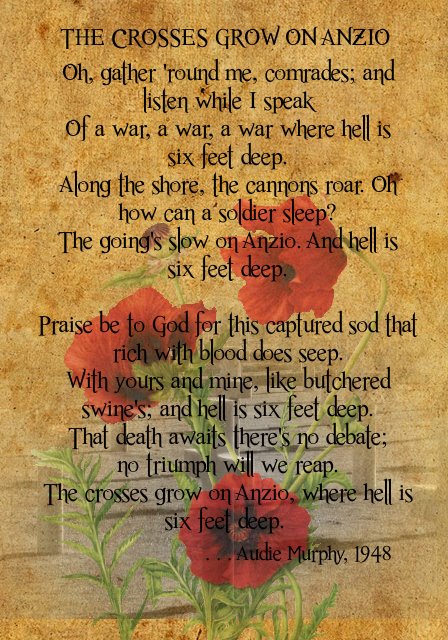
After the war, Audi Murphy was asked how he could have grabbed that machine gun, and taken on an entire company of German infantry.  “They were killing my friends”, he replied.

In the days following the Japanese sneak attack on Pearl Harbor, hundreds of thousands of Americans rushed to enlist in the United States’ armed services.  One of these was the son of a Hunt County Texas sharecropper family,  Audie Leon Murphy.

He went to the Marine Corps, Navy and the Army, and all turned him down, for being underweight and under age.  Murphy changed his diet to “fatten” up, and appeared at a Dallas recruiting station six months later, armed with a sworn affidavit from his sister, inflating his age by a year. It was 10 days past his 17th birthday when Audi Murphy, all 5’5½” and 112 lbs of him, enlisted in the United States Army.
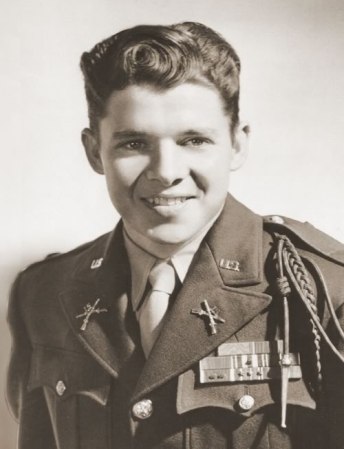
f50b348dd608662fdfc1b4b1203ddf06Murphy’s company commander thought he wasn’t big enough for infantry service, and attempted to transfer him to cook and bakers’ school. Murphy refused.  He wanted to be a combat soldier.

Joining the 3rd Infantry Division of George S. Patton’s 7th Army, Murphy participated in amphibious landings in Sicily in July, fighting in nearly every aspect of the Italian campaign.

From Palermo to Messina and on to Naples, Anzio and Rome, the Germans were driven out of the Italian peninsula in savage and near continuous fighting that killed a member of my own family.

By mid-December, the 3rd ID suffered 683 dead, 170 missing, and 2,412 wounded. Now Sergeant Murphy was there for most of it, excepting two periods when he was down with malaria.

Two months after the “Overlord” landings in Normandy, elements of the 7th Army landed in southern France in an operation called “Dragoon”. By mid-September, only three of Company B’s original roster remained, the rest either killed or removed due to wounds or illness. It was around this time when Audi Murphy received his first Purple Heart.  A mortar blast resulted in a heel wound that wasn’t very serious, but a far more dangerous hip wound followed from a sniper, that December.  Murphy repaid the sniper, with a bullet between the German’s eyes.

Reduction of Colmar Pocket - January 20, 1945-February 9, 1944He was still in the hospital when his unit moved into the Vosges Mountains, in Eastern France.

The “Colmar Pocket” was an 850 square mile area held by German troops: Murphy described it as “a huge and dangerous bridgehead thrusting west of the Rhine like an iron fist. Fed with men and materiel from across the river, it is a constant threat to our right flank; and potentially it is a perfect springboard from which the enemy could start a powerful counterattack.”

Rejoining his unit in January, now Lieutenant Murphy became Company Commander, being the only officer remaining in the Company. Disease, wounds and casualties had reduced company B’s fighting strength by this time from an original 235, to 18.

What remained of the unit was awaiting reinforcements on January 26, 1945, as a combined force of German infantry and armor assembled itself outside of town. “I see the Germans lining up for an attack”, said Murphy. “Six tanks rumble to the outskirts of Holtzwihr, split into groups of threes, and fan out toward either side of the clearing. Then wave after wave of white dots, barely discernible against the background of snow, start across the field. They are enemy infantrymen”.

Let Lt. Murphy’s Medal of Honor Citation describe what happened next:

Audie-murphy-tank-scene-world-war-II-2“Second Lieutenant Audie L. Murphy, 01692509, 15th Infantry, Army of the United States, on 26 January 1945, near Holtzwihr, France, commanded Company B, which was attacked by six tanks and waves of infantry. Lieutenant Murphy ordered his men to withdraw to a prepared position in a woods while he remained forward at his command post and continued to give fire directions to the artillery by telephone. Behind him to his right one of our tank destroyers received a direct hit and began to burn. Its crew withdrew to the woods. Lieutenant Murphy continued to direct artillery fire which killed large numbers of the advancing enemy infantry. With the enemy tanks abreast of his position, Lieutenant Murphy climbed on the burning tank destroyer which was in danger of blowing up any instant and employed its .50 caliber machine gun against the enemy. He was alone and exposed to the German fire from three sides, but his deadly fire killed dozens of Germans and caused their infantry attack to waver. The enemy tanks, losing infantry support, began to fall back. For an hour the Germans tried every available weapon to eliminate Lieutenant Murphy, but he continued to hold his position and wiped out a squad which was trying to creep up unnoticed on his right flank. Germans reached as close as 10 yards only to be mowed down by his fire. He received a leg wound but ignored it and continued the single-handed fight until his ammunition was exhausted. He then made his way to his company, refused medical attention, and organized the company in a counterattack which forced the Germans to withdraw. His directing of artillery fire wiped out many of the enemy; he personally killed or wounded about 50. Lieutenant Murphy’s indomitable courage and his refusal to give an inch of ground saved his company from possible encirclement and destruction and enabled it to hold the woods which had been the enemy’s objective”.

After the war, Audi Murphy was asked how he could have grabbed that machine gun, and taken on an entire company of German infantry.  “They were killing my friends”, he replied.
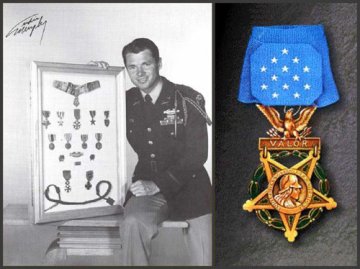
MurphyMOHThe man who had once been judged too small to fight was one of the most decorated American combat soldiers of WW2, having received every military combat award for valor the United States Army has to give, plus additional awards for heroism, from France and from Belgium.

Audi Murphy returned to civil life and a 21-year career in Hollywood, starring in 40 feature films and a television series.  The transition was difficult  There were frequent bouts of depression and insomnia, and an addiction to sedatives.  He turned to poetry and songwriting for a creative outlet, but images of German war orphans could bring him to tears of guilt.  He slept with a loaded gun under his pillow, and there were episodes which professional colleagues and family members, found alarming.

In Murphy’s Day it was called “Battle Fatigue”, or “Shell Shock”.  He was candid about his own difficulties, and called on government to give increased consideration to the emotional toll inflicted on those whom it sent into combat.

Audi Murphy was killed in a plane crash near Catawba, Virginia, and buried with full military honors, in Arlington National Cemetery.  He was 45.
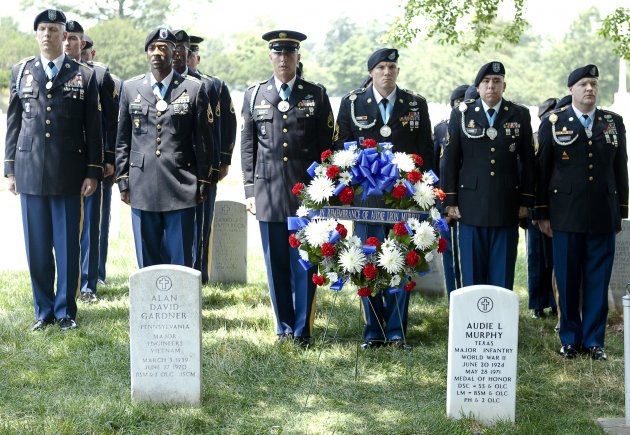
Audie Murphy Gravesite

Nine years later, the American Psychiatric Association recognized Post-Traumatic Stress Disorder (PTSD) in the 3rd edition of its Diagnostic and Statistical Manual of Mental Disorders.

Data from the National Vital Statistics System, a collaboration of the National Center for Health Statistics of the Department of Health and Human Services, reveals a suicide rate among veteran populations approximately twice that of comparable civilian populations.

I wonder about that term. “Disorder”.  The word makes it sound like there’s something wrong with these guys.

When a soldier experiences an event, so traumatic that the very memory of it causes pain, I don’t understand how that can be characterized as a “disorder”. To me it seems like the properly functioning conscience of a good man, recoiling in horror at what he’s seen in service to his country.
cc5083d1b7c62b153cd42c8f568de8f7

January 25, 1925 Serum Run

A 20-lb cylinder containing the antitoxin shipped as far as it could by rail, arriving at Nenana, 674 miles from Nome. Three vintage biplanes were available, but all were in pieces, and none would start in the sub-arctic cold. The antitoxin would have to go the rest of the way by dog sled.

In the 4th century BC, Hippocrates of Kos identified an upper respiratory infection, characterized by the formation of a leathery white “pseudomembrane” on the tonsils, pharynx, and/or nasal cavities of its victims.  Early symptoms resemble a cold or flu, in which fever, sore throat, and chills lead to bluish skin coloration, painful swallowing, and difficulty breathing.  Late symptoms include cardiac arrhythmia with cranial and peripheral nerve palsies.

German bacteriologist Friedrich August Johannes Loeffler first identified Corynebacterium diphtheriae in the 1880s, the causal agent of the disease Diphtheria.  Within ten years, researchers had developed an effective antitoxin.

diphtheria-virus

Today the disease is all but eradicated in the United States, but diphtheria was once a leading cause of death among children and adults over 40.

Diphtheria is highly contagious and spread by direct physical contact and by breathing aerosolized secretions of its victims.  Spain experienced an outbreak of the disease in 1613. To this day the year is remembered as “El Año de los Garotillos”.  The Year of Strangulations.

A severe outbreak swept through New England in 1735. In one New Hampshire town, one of every three children under the age of 10 died of the disease. In some cases entire families were wiped out. Noah Webster described the outbreak, saying “It was literally the plague among children. Many families lost three of four children—many lost all”.

download (7)Dr. Curtis Welch practiced medicine in Nome, Alaska, in 1925. Several children became ill with what he first diagnosed as tonsillitis. More came down with sore throats, early sufferers beginning to die as Welch observed the pseudomembrane of diphtheria. He had ordered fresh antitoxin the year before, but the shipment hadn’t arrived by the time the ports froze over. By January, all the serum in Nome was expired.
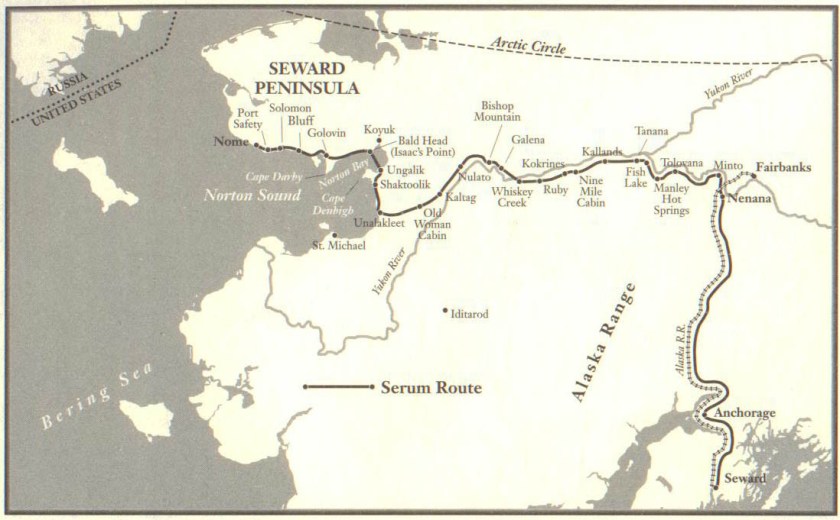

There were 10,000 living in Nome at the time, 2° south of the Arctic Circle. Welch expected a high mortality rate among the 3,000 or so white inhabitants, but the 7,000 area natives: Central Yupik, Inupiaq, St. Lawrence Island Yupik and American Indians with lineage tied to tribes in the lower 48, likely had no immunity whatsoever. Mortality among these populations could be expected to approach 100%.

Five children had already died by January 25, while Dr. Welch suspected more in the remote native camps. A plea for help went out by telegram and an Anchorage hospital came up with 300,204 units of serum. Enough for 30 patients. A million units would be required, but perhaps this would be enough to stave off epidemic, until a larger shipment arrived in February.

serum-run

A 20-lb cylinder containing the antitoxin and wrapped in protective fur shipped as far as it could by rail, arriving at Nenana, 674 miles from Nome. Three vintage biplanes were available, but all were in pieces, and none would start in the sub-arctic cold. The antitoxin would have to go the rest of the way, by dog sled.

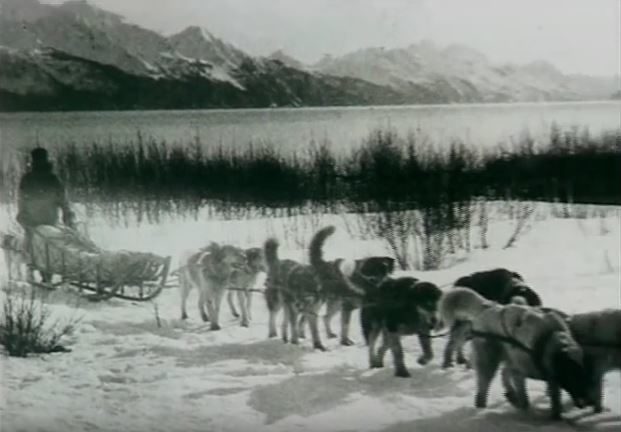
On January 27, a US Marshal pounded on the door of Willard J. “Wild Bill” Shannon, begging for his help with the relay to Nome.   It was after midnight and −50° Fahrenheit , when Shannon and his nine-dog team received the serum. The temperature had dropped to −62°F by the time the team reached Tolovana, 24 hours later. Shannon himself was hypothermic, with parts of his face turned black with frostbite.  Three of his dogs had died on the way, of frostbitten lungs.

97baa68e7dc7b530eea4c9a84b1081d2

Leonhard Seppala and his team took their turn, departing into gale force winds and zero visibility, with a wind chill of −85°F.  With Seppala’s 8-year old-daughter and only child Sigrid at risk for the disease, the stakes could not have been higher.

Up the 5,000′ “Little McKinley”, Seppala gambled on a shortcut across the unstable ice of Norton Sound.  The howling gale threatened to break up the ice, stranding the team at sea, while visibility was so poor that Seppala couldn’t see his “wheel dog” – the dog nearest his sled.  The 19-dog team struggled for traction on the glassy skin of the ocean water, returning to the coastline only hours before the ice broke up.

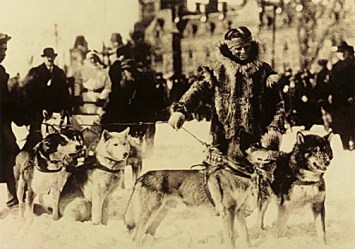
Much of the time, navigation in that frozen wilderness was entirely up to Seppala’s lead dog.  Most sled dogs are retired by age twelve, especially team leaders, but it was twelve-year-old “Togo”, who was trusted with the lead.

images (14)

Seppala and Togo ran 170 miles to receive the serum, returning another 91 miles to make the handoff on February 1. Together the pair covered twice as much ground as any other team, over the most dangerous terrain of the “serum run”.

Gunnar Kaasen and his team took the handoff, hitting the trail at 10:00 that night. A massive gust estimated at 80mph upended the sled, pitching musher and serum alike into the snow. Already frostbitten, Kaasen searched in the darkness with bare hands, until he found the cylinder. Covering the last 53 miles overnight, the team reached Front Street, Nome, at 5:30am on February 2. The serum was thawed and ready by noon.

seppala520 mushers and 150 dogs or more had covered 674 miles in 5 days, 7½ hours, a distance that normally took the mail relay 2-3 weeks. Not a single serum ampule was broken.
With 28 confirmed cases and enough antitoxin for 30, the serum run had held the death toll to no higher than seven.

Doctor Welch suspected as many as 100 or more deaths in the native camps, but the real number will never be known. An untold number of dogs died while completing the run.  Several mushers were severely frostbitten.

diphtheria_balto
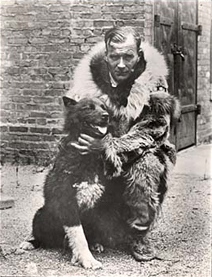
Gunnar Kaasen and Balto

Gunnar Kaasen and his lead dog “Balto” were hailed as heroes of the serum run, the dog becoming the most popular canine celebrity in the country, after Rin Tin Tin. There was a nine-month vaudeville tour, and Hollywood produced a 30-minute silent film, “Balto’s Race to Nome,” starring himself in the lead role.

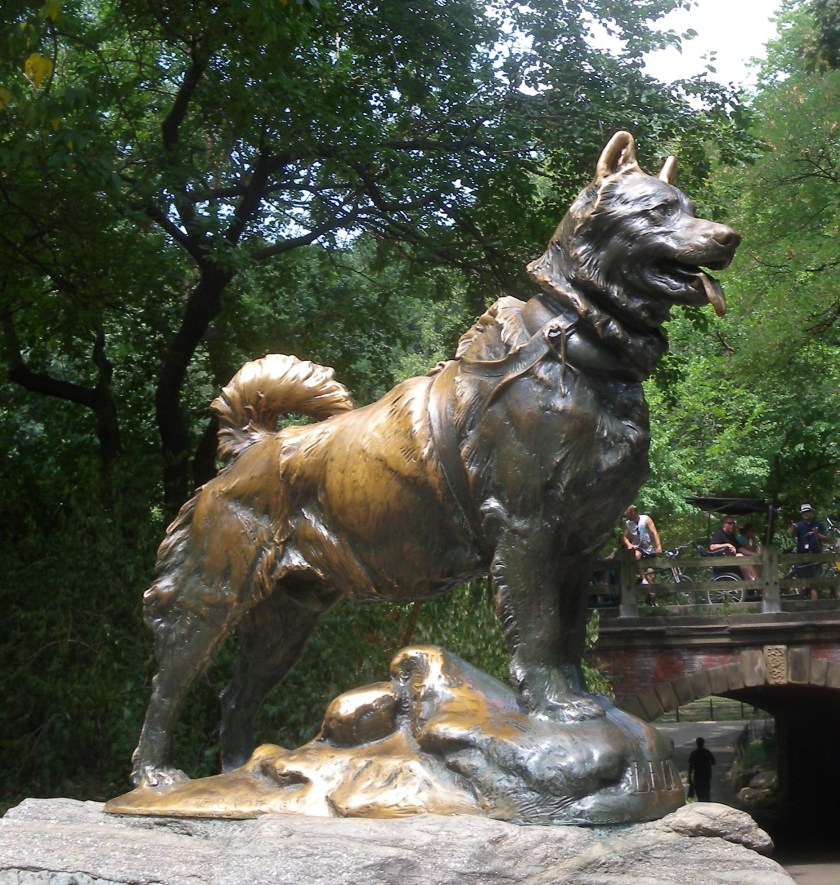
A bronze likeness was erected in New York’s Central Park in 1925, with Balto in attendance.  The statue stands there to this day, though Kaasen’s lead is depicted wearing Togo’s “colors” (awards).

Balto’s notoriety was a source of considerable bitterness for Leonhard Seppala, who felt that Kaasen’s 53-mile run was nothing compared with his own 261, Kaasen’s lead little more than a “freight dog”.  The statue was particularly galling.  “It was almost more than I could bear” he said, “when the ‘newspaper dog’ Balto received a statue for his ‘glorious achievements’”.

Balto, statue

Togo lived another four years though the serum run had rendered him lame, never again able to run. The real hero of the serum run spent the last years of his life in Poland Spring, Maine, and passed away at the ripe old age of 16.

Wild Bill Shannon disappeared in 1937, while prospecting for gold.  His bones were discovered four years later, perhaps a victim of exposure, or his final “close call”, with a grizzly bear.

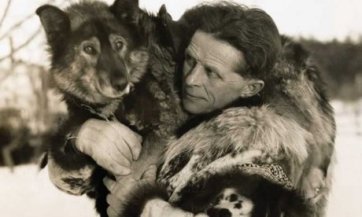
Togo and Seppala
Leonhard Seppala and Togo

Leonhard Seppala was in his old age in 1960, when he recalled his lead dog on the serum run.   “I never had a better dog than Togo. His stamina, loyalty and intelligence could not be improved upon. Togo was the best dog that ever traveled the Alaska trail.”

Today, the memory of the 1925 serum run lives on in the Iditarod Trail Sled Dog Race, held every March and run over much of the same terrain as the ‘Great Race of Mercy’.   Togo himself is stuffed and mounted,  standing watch at the Iditarod museum headquarters, in Wasilla.

January 24, 1776 A Noble Train of Artillery

It must have been a sight when that noble train of artillery entered Cambridge on this day in 1776. By March, Henry Knox’ cannon would be manhandled to the top of Dorchester Heights, resulting in the British evacuation of Boston and a peculiar Massachusetts institution which exists to this day, known as “Evacuation Day”: March 17.

The American Revolution began with the “Shot Heard Round the World” on the morning of April 19, 1775. Within days of the Battles at Lexington and Concord and the subsequent British withdrawal to Boston, over 20,000 men poured into Cambridge from all over New England. Abandoned Tory homes and the empty Christ Church became temporary barracks and field hospitals.  Even Harvard College shut down, its buildings becoming quarters for at least 1,600 Patriots.

127472-004-69EA7B31The Continental Congress appointed George Washington General of this “Army” on June 15, two days before the British assault on Farmer Breed’s hill. An action which took its name from that of a neighboring farmer, going into history as the Battle of Bunker Hill.
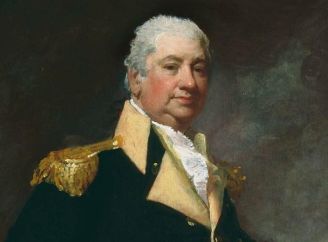
Shortly after his arrival in July, General Washington discovered that his army had enough gunpowder for nine rounds per man, and then they’d be done.

At the time, Boston was a virtual island, connected to the mainland by a narrow strip of land.  British forces were effectively penned up in Boston, by a force too weak to do anything about it.

henry-knox-large-57c4b9525f9b5855e5f5e9c7
Henry Knox

The stalemate dragged on for months, when a 25-year-old bookseller came to General Washington with a plan. His name was Henry Knox. His plan was a 300-mile, round trip slog into a New England winter, to retrieve the guns of Fort Ticonderoga.

Washington’s advisors derided the idea as hopeless, but the General approved. Henry Knox set out with a column of men on December 1.

Located on the New York banks of Lake Champlain, Fort Ticonderoga was captured by a small force led by Ethan Allen and Colonel Benedict Arnold, in May of that year. In it were brass and iron cannon, howitzers, and mortars, 59 pieces in all. Arriving on December 5, Knox and his men set about disassembling the artillery, making it ready for transport. A flotilla of flat bottom boats was scavenged from all over the countryside, the guns loaded and rowed the length of Lake George, arriving barely before the water began to freeze over.

colonel-knox-bringing-the-cannons-from-fort-ticonderoga (2)Local farmers were enlisted to help and by December 17, Knox was able to report to General Washington “I have had made forty two exceedingly strong sleds & have provided eighty yoke of oxen to drag them as far as Springfield where I shall get fresh cattle to carry them to camp. . . . I hope in 16 or 17 days to be able to present your Excellency a noble train of artillery.”
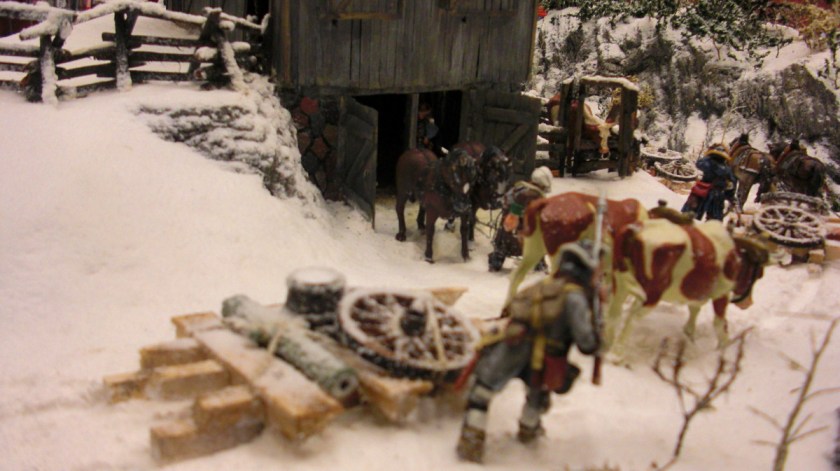
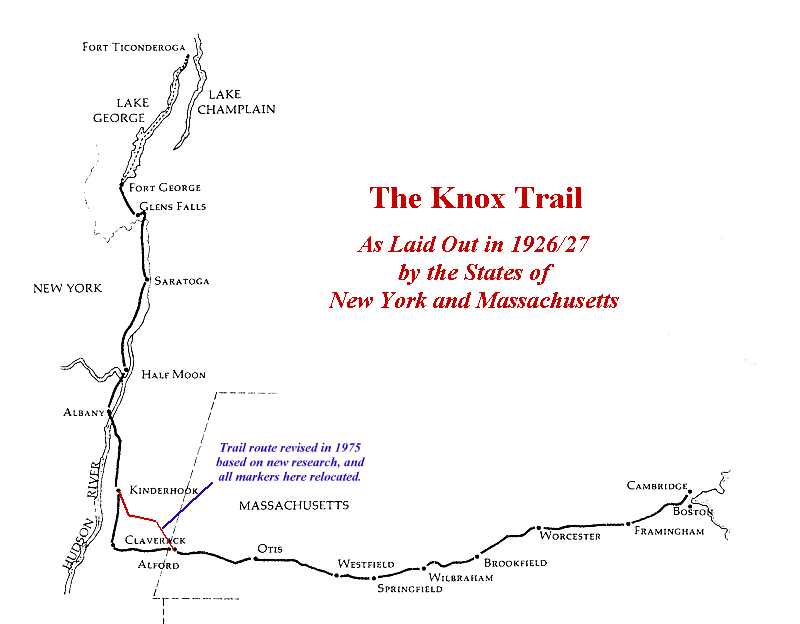
Bare ground prevented the sleds from moving until Christmas morning, when a heavy snow fell and the column set out for Albany. Two attempts to cross the Hudson River on January 5 each resulted in cannon being lost to the river, but finally Knox was able to write “Went on the ice about 8 o’clock in the morning & proceeded so carefully that before night we got over 23 sleds & were so lucky as to get the Cannon out of the River, owing to the assistance the good people of the City of Albany gave.”

CIMG5933

Continuing east, Knox and his men crossed into Massachusetts, over the Berkshires, and on to Springfield. With 80 fresh yoke of oxen, the 5,400lb sleds moved along much of what are modern-day Routes 9 and 20, passing through Brookfield, Spencer, Leicester, Worcester, Shrewsbury, Northborough, Marlborough, Southborough, Framingham, Wayland, Weston, Waltham, and Watertown.

knoxtrailmap

It must have been a sight when that noble train of artillery entered Cambridge on this day in 1776. By March, Henry Knox’ cannon would be manhandled to the top of Dorchester Heights, resulting in the British evacuation of Boston and a peculiar Massachusetts institution which exists to this day, known as “Evacuation Day”: March 17.

It is doubtful whether Washington possessed sufficient powder or shot for a sustained campaign, but British forces occupying Boston didn’t know that. The mere presence of those guns moved British General Howe to weigh anchor and sail for Nova Scotia, but that must be a story for another day.

January 23, 1828 A Victim to Maternal Love

In 1929, Washington journalist Margaret Husted wrote about her in the Washington Star. Descendants came forward and, piece by piece, the story of the first person buried at Arlington came to light.

The first military burial at Arlington National Cemetery was that of Private William Henry Christman, 67th Pennsylvania Infantry, interred on May 13, 1864. Two more joined him that day, the trickle soon turning into a flood. By the end of the war between the states, that number was 17,000 and rising.

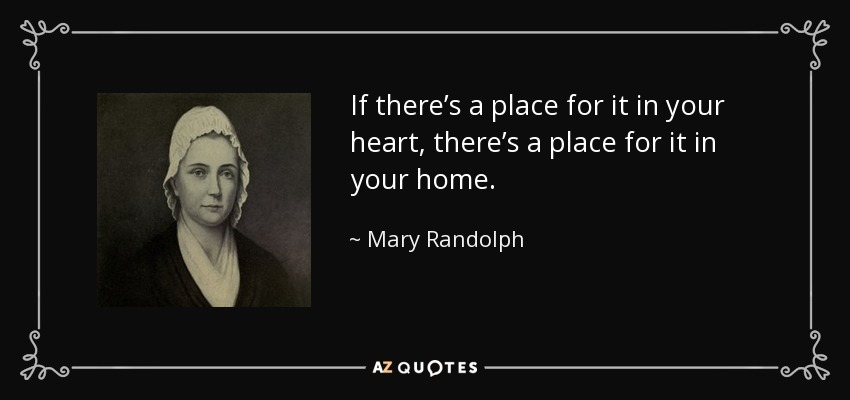
ARHO282_Mary-Randolph-PortrThe first military burial, but not the first.  When Private Christman went to his rest in our nation’s most hallowed ground, his grave joined that of Mary Randolph, buried some thirty-six years earlier.
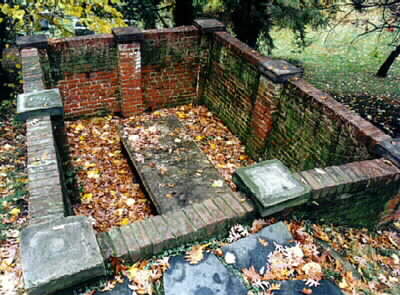
In 1929, cemetery workers were doing renovations on the Custis Mansion, at the top of the hill.  They couldn’t help being aware of a solitary grave, 100′ to the north, but knew little of its occupant.

Marked with the name Mary Randolph, the stone was inscribed with these words:

“In the memory of Mrs. Mary Randolph,

Her intrinsic worth needs no eulogium.

The deceased was born

The 9th of August, 1762

at Amphill near Richmond, Virginia

And died the 23rd of January 1828

In Washington City a victim to maternal love and duty.”

Little else was known about Mary Randolph.

In 1929, journalist Margaret Husted wrote about her in the Washington Star newspaper.  Descendants came forward and, piece by piece, the story of the first person buried at Arlington, came to light.

mrandolpMary Randolph, Pocahontas’ direct descendant and cousin to Thomas Jefferson,  was the cousin of George Washington Parke Custis, adopted step-grandson of George Washington, and the godmother of Custis’ daughter, Mary Anna Randolph Custis, wife of Robert E. Lee.

The last line of the inscription, “a victim to maternal love and duty” refers to her youngest surviving son, Midshipman Burwell Starke Randolph, who suffered a fall from a high mast in 1817, while serving in the Navy.  Both of his legs were broken and never healed properly.  When Mary passed away in 1828, Randolph remarked that his mother had sacrificed her own life in care of his.

american-housewife-randolphMary Randolph is best known as the author of America’s first regional cookbook, “The Virginia Housewife”. The Virginia Culinary Thymes writes that “It is interesting to note that all the cookery at that time was done in kitchens that had changed little over the centuries. In Virginia, the kitchen was typically a separate building for reasons of safety, summer heat and the smells from the kitchen. The heart of the kitchen was a large fireplace where meat was roasted and cauldrons of water and broth simmered most of the day. Swinging cranes and various devices made to control temperature and the cooking processes were used. The Dutch oven and the chafing dish were found in most kitchens. The brick oven used for baking was located next to the fireplace. A salamander was used to move baked products around in the oven and it could also be heated and held over food for browning“.

fdsdfsdfsdfs 116Mrs. Randolph was an early advocate of the now-common use of herbs, spices and wines in cooking. Her recipe for apple fritters calls for slices of apple marinated in a combination of brandy, white wine, sugar, cinnamon, and lemon rind.

She was well known as a Virginia cook and hostess, so much so that, during an 1800 slave insurrection near Richmond, the leader “General Gabriel” said that he would spare her life, if she would become his cook.

I believe that General Gabriel might have been onto something.

If you enjoyed this “Today in History”, please feel free to re-blog, “like” & share on social media, so that others may find and enjoy it too. Please click the “follow” button on the right, to receive email updates on new articles.  Thank you for your interest, in the history we all share.

January 22, 2000 Third Eye Open

According to Halvorson, “John Lennon once asked Huges to trepan him, but Bart told him he was a third-eyer, so he wouldn’t notice any difference.”

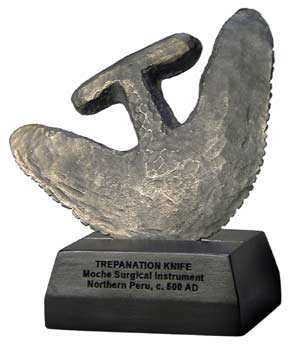
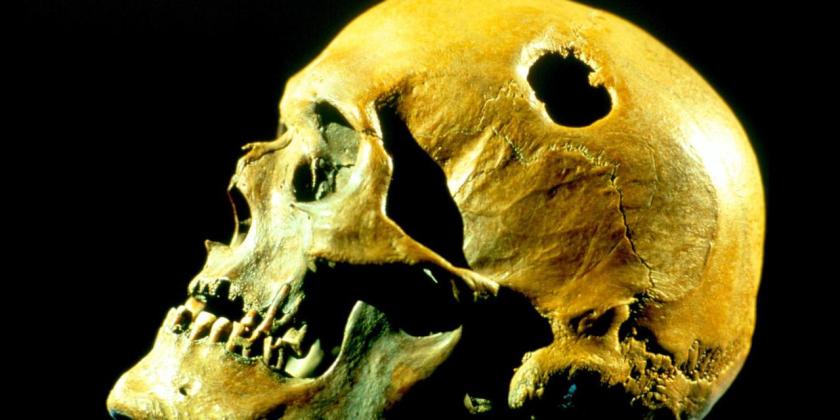
The procedure is called “trepanation”.  It may be the oldest surgical operation for which there is archaeological evidence.  Trepanation involves drilling or scraping a hole into the human head, and seems to have begun sometime in the Neolithic, or “New Stone Age” period.

One archaeological dig in France uncovered 120 skulls, 40 of which showed signs of trepanation. Another such skull was recovered from a 5th millennium BC dig in Azerbaijan. A number of 2nd millennium BC specimens have been unearthed in pre-Colombian Mesoamerica; the area now occupied by the central Mexican highlands through Belize, Guatemala, El Salvador, Honduras, Nicaragua, and northern Costa Rica.

p045xp4l

Hippocrates, the “Father of Western Medicine”, described the procedure in detail in his treatise “On Injuries of the Head,” written sometime around 400BC. The Roman physician Galen of Pergamon expanded on the procedure, some 500 years later.

Archaeologists discovered 1 in eight of all the skulls in pre-Christian era Magyar (Hungarian) graveyards, to have been trepanned.

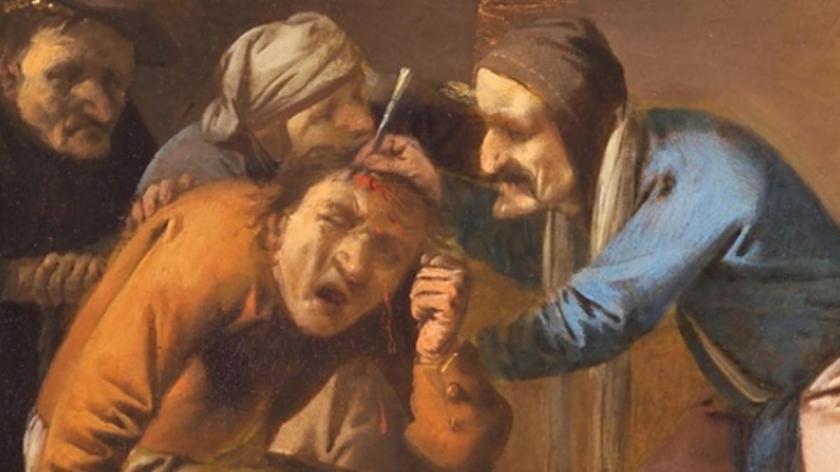
Trepanation has obvious applications in the treatment of head trauma, though the procedure has been used to treat everything from seizures to migraines to mental disorders. During medieval times, the procedure was used to liberate demons from the heads of the possessed and to cure ailments ranging from meningitis to epilepsy.

1433709755287939

Trepanation took on airs of pseudo-science, many would say “quackery”, when the Dutch librarian Hugo Bart Hughes published “The Mechanism of Brain Blood Volume” in 1964. In it, Hughes contends that our brains drain of blood and cerebrospinal fluid when we begin to walk upright, and continues to do so, the older we get.

According to Hughes, young children are far more creative than adults due to a “natural trepanation effect”, as the fontanel or cranial “soft spot” allows for greater “elasticity” and “pulsation” of the brain.

18dys7vqhsmikjpgTo prove the value of his ‘third eye’ theory, to his own satisfaction if to no one else, Hughes drilled a hole in his own skull in 1965, using a Black & Decker electric drill. He must have thought it proved the point, because he expanded on his theory with “Trepanation: A Cure for Psychosis”, followed by an autobiography, “The Book with the Hole”, published in 1972.
Peter Halvorson, a Hughes follower and director of the International Trepanation Advocacy Group (ITAG), was at first skeptical of the idea.  “It was a time of my life when I felt a certain dullness. I was very much a sealed-skull adult, and I was struggling with that. After the trepanation I felt a positive lift. There’s no doubt trepanation is an enhancement.”

Halvorson trepanned himself with an electric drill in 1972. Today, he explains on his ITAG website (www.trepan.com) that “The hypothesis here at ITAG has been that making an opening in the skull favorably alters movement of blood through the brain and improves brain functions which are more important than ever before in history to adapt to an ever more rapidly changing world”.

According to Halvorson, “John Lennon once asked Hughes to trepan him, but Bart told him he was a third-eyer, so he wouldn’t notice any difference.”

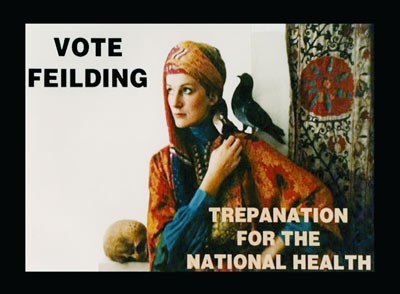
vote-fieldingAt age 27, Amanda Feilding brought an electric dentist’s drill to her London apartment, and drilled a hole in her skull. After four unsuccessful years trying to find a surgeon to do it for her, “I thought, ‘Well, I’m a sculptor, I may as well do it myself'”.

Feilding is so convinced of the benefits of the procedure that she turned it into a political platform, running for the Parliament from Chelsea, on the slogan, “Vote Feilding – Trepanation for the National Health.”  In two separate runs, she garnered a total of 188 votes.

In 2000, British-born Heather Perry was living in Beryl, Utah.  Hearing that John Lennon had wanted a hole in his head, Perry set her heart on having one of her own.  On January 22, 2000, Peter Halvorson and Williams Lyons helped drill a hole in her head for producers of the ABC News program “20/20.” Thirty million viewers tuned in to the spectacle, resulting in $500 fines on the pair for practicing medicine without a license, and three years’ probation.  The two men were also ordered to undergo psychiatric evaluation.

18lpu4r7gdundjpgAt the time, the Iron County DA also considered charges against ABC News reporter Chris Cuomo, for aiding in the crime.
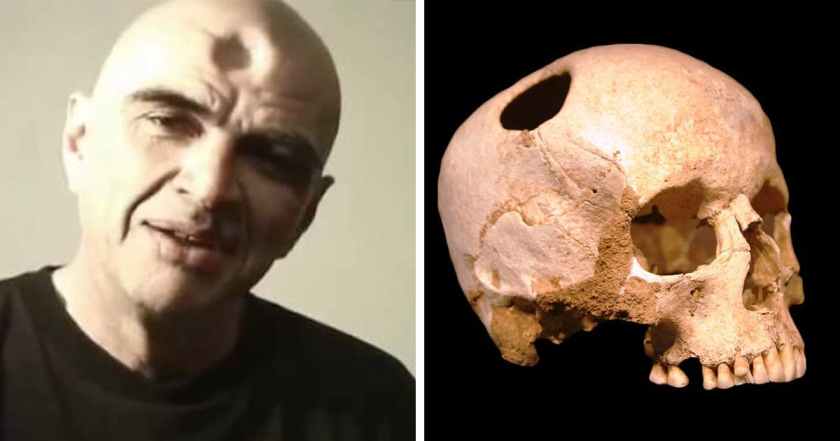
St. Louis neurologist Dr. William Landau wasn’t impressed with Hughes’ brain blood volume theory, explaining that “There is no scientific basis for this at all. It’s quackery.” Dr. Robert Daroff, Professor of Neurology at Case Western Reserve University School of Medicine, was a little more to the point. “Horseshit,” he said. “Absolute, unequivocal bullshit”.

144665

January 21, 1824 Stonewall

Today we remember Stonewall Jackson as a brilliant military tactician and Confederate commander, second only to Robert E. Lee.  Who knew that the man was also a civil rights leader.  Real history is so much more interesting than the political and pop culture varieties.

Cheers rang out in the streets of Washington DC, as General Irvin McDowell’s Army of the Potomac marched out to meet the Confederate Army of the Shenandoah, led by Brigadier General Pierre Gustave Toutant-Beauregard.  The first major battle of the Civil War was joined on July 21, in what Confederates called the Battle of 1st Manassas, and the Federals called 1st Bull Run.

First Manassas July 21, 1861 SquareOn that July morning, no one had any idea of the years-long bloodbath that lay ahead.  35,000 Federal troops, 90-day recruits all, had arrived to crush a trifling force of rebels.  Then on to Richmond, the Confederate capitol, and the end of the uprising.

The atmosphere was festive, like a football game.  The upper crust of Washington society had turned out in their carriages.  There was wine and picnic baskets, society ladies and their beaus, congressmen and their families, all arrived to watch the show.

Green and inexperienced as they were, the fighting was at times confused, and could have gone either way.  The tide of the battle turned at 4pm, with the capture of Artillery Captain James Ricketts’ guns. An hour later the Union position began to disintegrate.  Soon, a disorderly retreat turned into a rout, a blue-clad stampede back to Washington, on roads clogged with panicked civilians, attempting to flee in their carriages.

The battle could have ended differently, when Colonel William Tecumseh Sherman struck the right flank of the Confederate defenders near Henry House Hill, collapsing the Rebel line and sending it into disorderly retreat.  The Virginia Brigade of General Thomas Jonathan Jackson came up at this point, taking a defensive position on Henry House Hill.  Brigadier General Barnard Bee exhorted his troops to reform, shouting “There is Jackson standing like a stone wall. Rally behind the Virginians.”

35aknky
Confederate General and VMI Professor Thomas Jonathan Jackson wore a blue uniform, at the Battle of 1st Manassas.  Note the 1st (of three) Confederate national flags, the “Stars and Bars”.

Some will tell you that Bee’s comment was meant to be pejorative, as in “Look at Jackson standing there like a stone wall!”  We’ll never know. General Bee was shot in the abdomen and died the next day.  The legend of “Stonewall Jackson”, was here to stay.

Born in Clarksburg Virginia on January 21, 1824, the boy lost his father at age two and his mother, five years later.  Largely self-educated, the future Civil War General went to live with an uncle.  As a boy, Jackson made a deal with one of his uncle’s slaves, to teach the man to read.  It was illegal at this time, to teach blacks to read, but Jackson was as good as his word, receiving pine knots in exchange for lessons.

Jackson16
Stonewall Jackson pictured astride his favorite mount, “Little Sorrel”

Thomas Jonathan Jackson was a devoutly religious man, said to fear only God.  “My religious belief teaches me” he said, “to feel as safe in battle as in bed.”

Jackson was educated at the United States Military Academy at West Point New York, graduating in 1846 and serving in the Mexican-American war.  Returning to civil life in 1851, Jackson moved to Lexington Virginia, where he worked as a professor of natural and experimental philosophy (Physics), and instructor of artillery at the Virginia Military Institute.

Though himself an owner of African slaves from a family of slave owners, Thomas Jackson was well regarded among the free and enslaved blacks of Lexington.  This may sound paradoxical to the modern reader, but the players in this story were products of their time.  Not ours.

sjchurJackson believed that slavery existed because the Creator willed it.  His mission was to save their souls, by teaching them the Old Testament, the Ten Commandments, the Lord’s Prayer and the Apostle’s Creed.

So it was that Jackson and his wife established the Lexington Presbyterian Church Sunday School. There, contrary to state law. the pair taught African-American children to read and write, continuing to do so until Jackson went to war, in 1861.  The next time he would visit was to be buried there, in 1863.

Jackson’s military career reads like a timeline of his era.  The Great Train Raid of 1861.  Falling Waters. Bull Run (Manassas), 1st and 2nd. The Romney Expedition.  The Valley Campaign. The Seven Days’ Battles. The Northern Virginia Campaign. The Maryland Campaign, Harpers Ferry, Antietam and Fredericksburg.  And the last.  Chancellorsville.  The Virginia town where the story of Stonewall Jackson comes to an end.

Returning to camp on May 2, 1863, Jackson and his staff were mistaken in the rain and darkness for a Union cavalry force.   A nervous sentry from the 18th North Carolina shouted, “Halt, who goes there?”, and fired before things sorted out.  Frantic shouts from Jackson’s party trying to identify themselves were met by Major John Barry, who shouted, “It’s a damned Yankee trick! Fire!”  Several of Jackson’s men were killed on the spot, along with a number of horses.  Jackson himself was shot twice in the left arm, and once in the right hand.

Robert E. Lee wrote to the General, on learning of his injuries:  “Could I have directed events, I would have chosen for the good of the country to be disabled in your stead.”

There was no saving Jackson’s arm.  The limb was amputated by Dr. Hunter McGuire, the following day  Jackson was moved to the office building at the Chandler plantation in Guinea Station.  General Lee complained, “He has lost his left arm, but I have lost my right arm.”

dsc00823

By that time, Jackson was already developing a tightness in his chest, an early sign of pneumonia.

Before antibiotics, doctors could predict the hour of death, of pneumonia patients.  On May 10, eight days after being shot, Jackson was breathing his last.  “It is the Lord’s Day; my wish is fulfilled. I have always desired to die on Sunday.”

Dr. McGuire wrote the following account of Stonewall Jackson’s last words:  “A few moments before he died he cried out in his delirium, ‘Order A.P. Hill to prepare for action! Pass the infantry to the front rapidly! Tell Major Hawks —’ then stopped, leaving the sentence unfinished. Presently a smile of ineffable sweetness spread itself over his pale face, and he said quietly, and with an expression, as if of relief, ‘Let us cross over the river, and rest under the shade of the trees.’

CW-334 Last Tribute of Respect
“Last Tribute of Respect”, by Mort Künstler

In 1906, Reverend LL Downing raised money to install a memorial window in the 5th Avenue Presbyterian Church of Roanoke, dedicated to Stonewall Jackson.  And to Reverend Dowling’s own parents, who as slave children had been educated in Jackson’s Sunday school.  It may be the only “black” church in the country, with a stain-glass window dedicated to a Confederate General.

manassas085b

CBS Sunday Morning did an interesting segment on the church and its window, amidst the current hysteria involving Confederate monuments.  Their article and the video, are linked here.

Today we remember Stonewall Jackson as a brilliant military tactician and Confederate commander, second only to Robert E. Lee.  Who knew that the man was also a civil rights leader.  Real history is so much more interesting than the political and pop culture varieties.

Feature Image, top, by 20th century artist and illustrator, N. C. Wyeth

January 20, 1940  A People, an Empire, a Drink

Coca-Cola GmbH had concocted a sweet, slightly cheesy tasting soft drink, and the German market responded. Sales rose steadily throughout the war, particularly as alternatives became increasingly scarce. People didn’t just drink the stuff, either.

In 1865, Confederate Cavalry officer John Stith Pemberton was wounded by a saber slash. Like many wounded veterans, Pemberton became addicted to the morphine given him to help ease the pain. Unlike most, “Dr.” Pemberton possessed the wherewithal to do something about it.

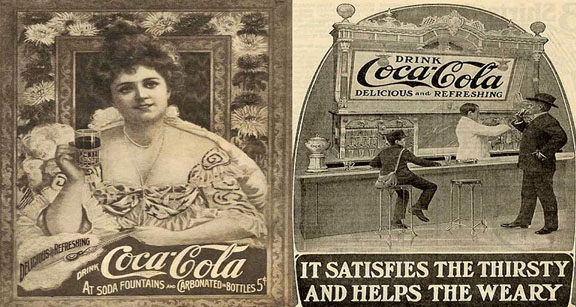
In civil life, Pemberton was a chemist.  After the war, the former cavalry officer experimented with non-opiate pain-killers, landing on a combination of the coca leaf and kola nut.  By 1886, he was bottling his concoction and selling it for 5¢ a bottle out of an Atlanta pharmacy.  Ten years later, Coca-Cola was available in every American state and territory.

Cocaine_CocaCola2

Europeans had long believed that natural mineral waters held medicinal qualities, and favored such beverages over often-polluted common drinking water.  In 1920, the company opened its first European bottling plant, in France. By the time of Hitler’s annexation of Austria, the “Anschluss” of 1938, Coca-Cola had been in Germany for ten years.

Around the time that Hitler and the Nazi party were coming to power in 1933, German-born Max Keith (pronounced “Kite”) took over Coca-Cola’s German subsidiary, Coca-Cola Deutschland, GmbH.  Mark Pendergrast, author of For God, Country, and Coca-Cola, writes that Keith “valued his allegiance to the drink and to the company more than his allegiance to his own country”.  He had no qualms about doing business with every aspect of German society, including Nazi party members.

Ein Getrank

Bizarre though it may sound to the modern ear, a number of famous Americans and companies were involved with the European fascist regimes of the 1930s, including William Randolph Hearst, Joseph Kennedy (JFK’s father), Charles Lindbergh, John Rockefeller, Andrew Mellon (banker, head of Alcoa, and Secretary of the Treasury), DuPont, General Motors, Standard Oil (now Exxon), Ford, ITT, Allen Dulles (later head of the CIA), Prescott Bush, National City Bank, General Electric, and many in Hollywood.

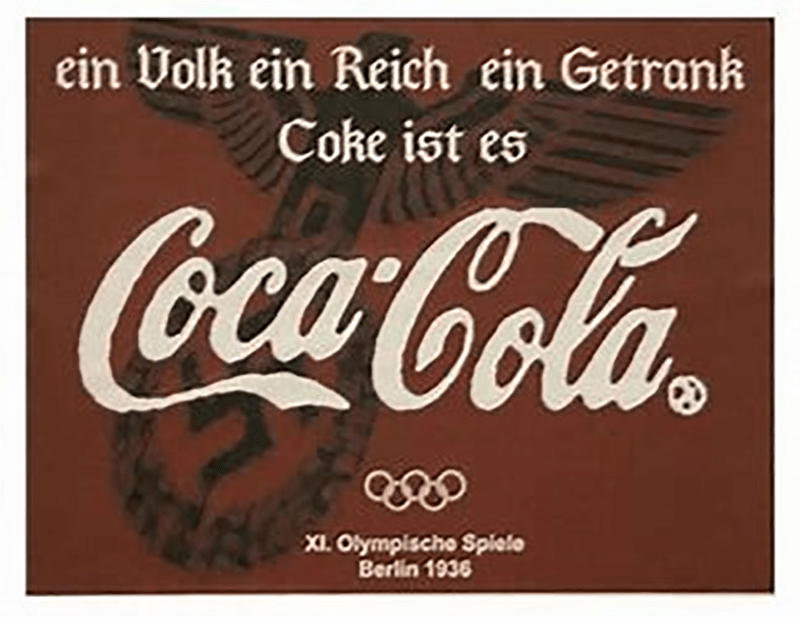
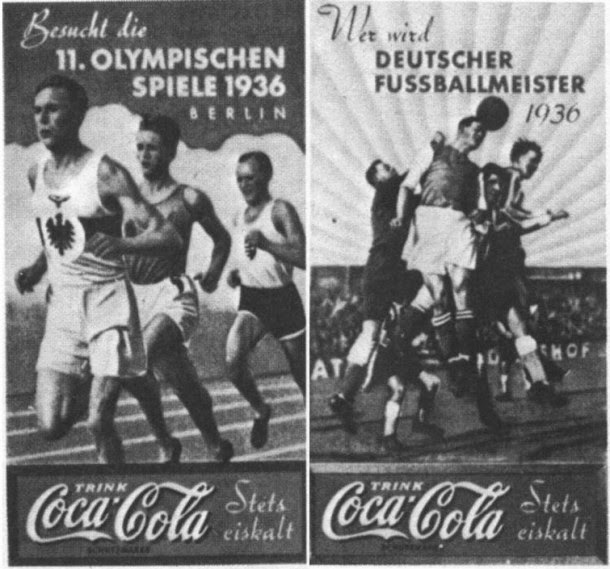
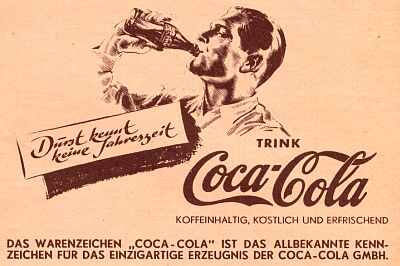
In Atlanta, Coca-Cola President Robert Woodruff was no exception.  Woodruff himself attended the 1936 Berlin Olympics, alongside banners depicting the company logo, with the slogan  “Ein Volk, ein Reich, ein Getrank – A People, an Empire, a Drink”.

Coca-Cola-Advertisements-in-Nazi-Germany-in-the-1930s-8

Woodruff used a 10th anniversary party for Coca-Cola GmbH to organize a mass Nazi salute in honor of Hitler’s 50th birthday, declaring that it was “to commemorate our deepest admiration for our Fuhrer.”

On January 20, 1940, Winston Churchill urged neutral nations to oppose the Nazi war machine, warning that, “Each one hopes that if he feeds the crocodile enough, the crocodile will eat him last.”  Meanwhile in Germany, Coca Cola was the undisputed king of the domestic soft drink market.

Memorial-Day-2010-From-Time-Mag-1942-OUT-12

That changed a year later, with the Japanese attack on Pearl Harbor, and the German declaration of war on the United States.

American entry into WW2 meant that American companies ceased business with axis powers, while the German government threatened to seize “enemy owned” businesses.  Max Keith was cut off from all communications with Coca-Cola headquarters in Atlanta, and in danger of the Nazi party nationalizing his beloved company.  As shipments of Coca-Cola’s mythical “7X’ syrup, dried up, Keith had to come up with a substitute for the domestic soft drink market.  Schnell.

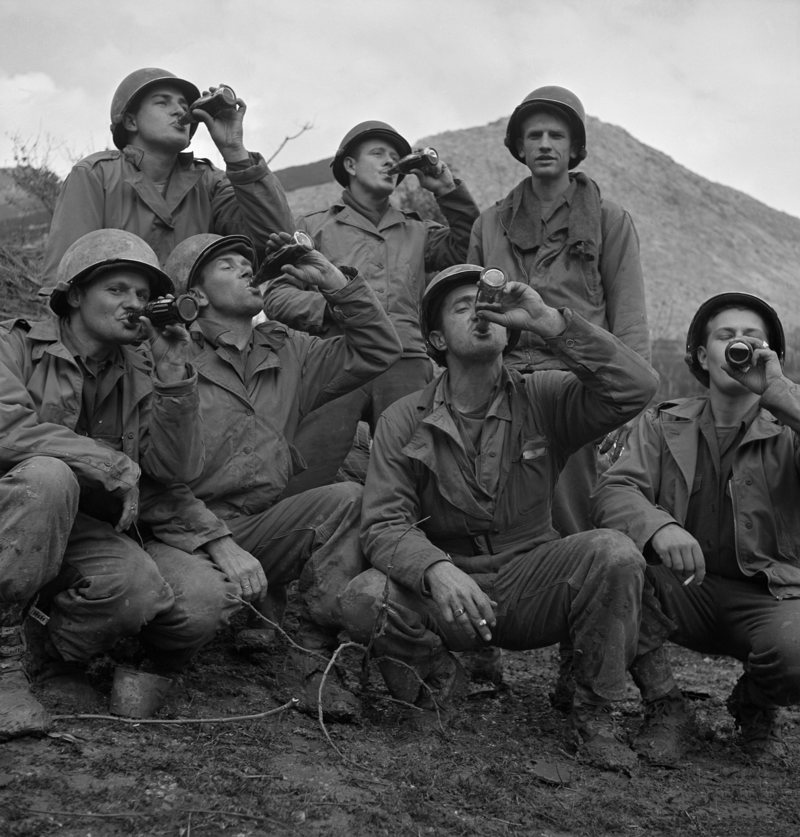
Soldiers Gulp Down Coca Cola
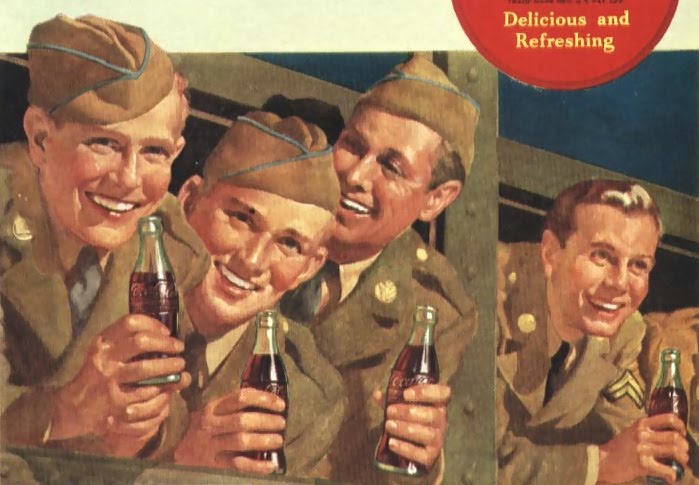
Coca-Cola worked with the U.S. government to ensure troops, including these men in Italy, had access to Coke throughout WW2. Bettmann/Getty Images

With wartime rationing already in effect, Keith and his chemists worked with what was available.  Leftovers from other food industries, apple fibers, fruit peelings, beet sugar  and whey, the liquid left over when milk was curdled and strained off to make cheese.

The result was “Fantasievoll”, “Fantastiche” (“Imaginative”, “Fantastic”).  So it is that the soft drink “Fanta”, was borne of the wartime necessities of Nazi Germany.

Coca-Cola GmbH had concocted a sweet, slightly cheesy tasting soft drink, and the German market responded. Sales rose steadily throughout the war, particularly as alternatives became increasingly scarce. People didn’t just drink the stuff, either. With sweeteners of all kinds strictly rationed, Fanta made its way into baked goods, soups and a variety of foodstuffs. By 1943, Fanta sales reached almost three million cases.

Fanta-3

Tristan Donovan, author of the book Fizz: How Soda Shook Up the World, writes “It was Fanta or nothing”. Pendergrast writes that there’s little doubt that Keith did business with Nazis, but he was more company guy than idealogue. “You could not do business inside of Nazi Germany unless you collaborated with them,” wrote Pendergrast. “There’s no question he was a Nazi collaborator. [But] he was not a member of the Nazi party. His allegiance was to Coca-Cola, not to Hitler.”

When American troops liberated Germany in the summer of 1945, legend has it that they found Keith in a half-bombed out factory, still bottling the stuff.

Fun fact: Hitler and his henchmen didn’t call themselves “Nazis”, in fact the term was frowned upon. They were the “NSDAP”, the Nazionale Socialistiche Deutsche Arbaits Partai, (National Socialist German Workers Party), the original abbreviation forwhich, was “Nasos”. The word “Nazi” derives from a Bavarian term meaning “simple minded” and was first used as a term of derision by journalist Konrad Heiden. The term was adopted by Anti-NSDAP’ers and Allied troops after war broke out, and the name stuck.

Despite being on the losing side, Keith was hailed as a hero back in Atlanta. The man who kept the company alive, in Germany. Vice President of Sales Harrison Jones called Keith a “great man”.  He was given control of Coca-Cola, in all of Europe.

coca-cola_ad_third_reich_1935

In April 1955, Coca-Cola reintroduced Fanta as an orange drink. Starting in Italy, the product made its way to the United States, in 1958. The name stuck, and why not. The company already owned the copyright.

In 2012, Fanta saw the strongest sales growth of the top 10 brands, the third Coke branded product to surpass 2 billion in case sales. Today, more than 100 flavors of Fanta are sold around the world, where customers from Latin America to Africa, to Europe, Brazil and China can say,  “Es ist die Reale Sache”.  It’s the Real Thing.


January 19, 1977 Tokyo Rose

FBI.gov states on its “Famous Cases” website that, “As far as its propaganda value, Army analysis suggested that the program had no negative effect on troop morale and that it might even have raised it a bit. The Army’s sole concern about the broadcasts was that “Annie” appeared to have good intelligence on U.S. ship and troop movements”.

There’s an old cliché that, if you speak with those who are convicted of a crime, all of them will say they are innocent.  It’s an untrue statement on its face, but only two possible conclusions are possible, in the alternative.  Either all convicts are guilty as charged, or someone, at some time, has been wrongly convicted.

To agree with the former is to accept the premise that what government does is 100% right, 100% of the time.

Tokyo-Rose-310x165Iva Ikuko Toguri was born in Los Angeles on July 4, 1916, the daughter of Japanese immigrants.  She attended schools in Calexico and San Diego, returning to Los Angeles where she enrolled at UCLA, graduating in January, 1940 with a degree in zoology.

In July of the following year, Iva sailed to Japan without an American passport.  She variously described the purpose of the trip as the study of medicine, and going to see a sick aunt.

In September, Toguri appeared before the US Vice Consul in Japan to obtain a passport, explaining that she wished to return to permanent residence in the United States.  Because she had left without a passport, her application was forwarded to the State Department for consideration.  It was still on someone’s desk when Imperial Japan attacked Pearl Harbor, fewer than three months later.

Iva later withdrew the application, saying that she’d remain in Japan voluntarily for the duration of the war.  She enrolled in a Japanese language and culture school to improve her language skills, taking a typist job for the Domei News Agency.  In August 1943, she began a second job as a typist for Radio Tokyo.

In November of that year, Toguri was asked to become a broadcaster for Radio Tokyo on the “Zero Hour” program, part of a Japanese psychological warfare campaign designed to lower the morale of US Armed Forces.  The name “Tokyo Rose” was in common use by this time, applied to as many as 12 different women broadcasting Japanese propaganda in English.

Toguri DJ’d a program with American music punctuated by Japanese slanted news articles for 1¼ hours, six days a week, starting at 6:00pm Tokyo time.  Altogether, her on-air speaking time averaged 15-20 minutes for most broadcasts.

tokyo-roseShe called herself “Orphan Annie,” earning 150 yen per month (about $7.00 US).  She wasn’t a professional radio personality, but many of those who recalled hearing her enjoyed the program, especially the music.

Shortly before the end of the war, Toguri married Felipe d’Aquino, a Portuguese citizen of Japanese-Portuguese ancestry. The marriage was registered with the Portuguese Consulate, though she didn’t renounce her US citizenship, continuing her Zero Hour broadcast until after the war was over.

After the war, a number of reporters were looking for the mythical “Tokyo Rose”.  Two of them found Iva d’Aquino.

Henry Brundidge, reporting for Cosmopolitan magazine and Clark Lee, reporter for the International News Service,  must have thought they found themselves a real “dragon lady”.  The pair hid d’Aquino and her husband away in the Imperial Hotel, offering $2,000 for exclusive rights to her story.

$2,000 was not an insignificant sum in 1945, equivalent to $23,000 today.  Toguri lied, “confessing” that she was the “one and only” Tokyo Rose.  The money never materialized, but she had signed a contract giving the two rights to her story, and identifying herself as Tokyo Rose.

FBI.gov states on its “Famous Cases” website that, “As far as its propaganda value, Army analysis suggested that the program had no negative effect on troop morale and that it might even have raised it a bit. The Army’s sole concern about the broadcasts was that “Annie” appeared to have good intelligence on U.S. ship and troop movements”.

RSJ42461_grande
Henry Brundidge, Clark Lee


US Army authorities arrested her in September, while the FBI and Army Counterintelligence investigated her case.  By the following October, authorities decided that the evidence did not merit prosecution, and she was released.

Department of Justice likewise determined that prosecution was not warranted and matters may have ended there, except for the public outcry that accompanied d’Aquino’s return to the US.  Several groups, along with the noted broadcaster Walter Winchell, were outraged that the woman they knew as “Tokyo Rose” wanted to return to this country, instead demanding her arrest on treason charges.

The US Attorney in San Francisco convened a grand jury, and d’Aquino was indicted in September, 1948.  Once again quoting fbi.gov, “Problematically, Brundidge enticed a former contact of his to perjure himself in the matter”.

Tokyo Rose Conviction

The trial began on July 5, 1949, lasting just short of three months.  The jury found d’Aquino guilty on one of fifteen treason charges, ruling that “[O]n a day during October, 1944, the exact date being to the Grand Jurors unknown, said defendant, at Tokyo, Japan, in a broadcasting studio of the Broadcasting Corporation of Japan, did speak into a microphone concerning the loss of ships.”

Tokyo Rose Pardond’Aquino was sentenced to ten years and fined $10,000 for the crime of treason, only the seventh person in US history to be so convicted.  She was released from the Federal Reformatory for Women at Alderson, West Virginia in 1956, having served six years and two months of her sentence.

President Gerald Ford pardoned her on January 19, 1977, 21 years almost to the day after her release from prison. Iva Toguri d’Aquino passed away in 2006, at the age of 90.  Neither perjury nor suborning charges were ever brought against Brundidge, or his witness.

January 18, 1943 Greatest Thing since Sliced Bread

The United States had been in World War II for two years in 1943, when Claude Wickard, head of the War Foods Administration as well as Secretary of Agriculture, had the hare brained idea of banning sliced bread.

The first automatic bread slicer was invented by Otto Frederick Rohwedder of Davenport, Iowa, in 1912. The idea was not at all popular among bakers, who feared that pre-sliced bread would go stale faster, leading to spoiled inventory and customer complaints.

A fire almost ended the project in 1917, when the prototype was destroyed along with the blueprints. Rohwedder soldiered on.  By 1927, he had scraped up enough financing to rebuild his bread slicer.

51f7f26521dd5.image

Frank Bench, a personal friend of the inventor, was the first to install the machine. The first pre-sliced loaf was sold in July of the following year. Customers loved the convenience and Bench’s bread sales shot through the roof.

Sliced bread became a national hit when the Continental Baking Company, then owner of the “Wonder Bread” brand, began using a modified version of Rowhedder’s machine in 1930. Sliced bread was here to stay. Sort of.

1101410721_400The United States had been in World War II for two years in 1943, when Claude Wickard, head of the War Foods Administration as well as Secretary of Agriculture, had the hare brained idea of banning sliced bread.

Mr. Wickard was no stranger to hare brained ideas; it is he who lends his name to the landmark Supreme Court case, Wickard v. Filburne.

Talk about hare brained ideas. The Agricultural Adjustment Act of 1938 limited the area that farmers could devote to wheat production, in an effort to stabilize the price of wheat on the national market.

An Ohio farmer named Roscoe Filburne was producing more than his allotment. The federal government ordered him to destroy the surplus and pay a fine, even though his “surplus” was being consumed on the farm by the Filburne family and their chickens.

download (6)Article 1, Section 8 of the Constitution includes the “Commerce Clause”, permitting the Congress “To regulate Commerce with foreign Nations, and among the several States, and with the Indian Tribes”.  That’s it and, not surprisingly, the Federal District Court sided with the farmer.

The Federal government appealed to the United States Supreme Court, arguing that, by withholding his surplus from the interstate wheat market, Filburne was effecting that market, thereby falling under federal government jurisdiction under the Commerce Clause.

USArooseveltF3The Supreme Court, apparently afraid of President Roosevelt and his aggressive and illegal “court packing” scheme, ruled against the farmer. Ever since, what you don’t do can be argued in a court of law to effect interstate conditions, putting what you didn’t do under the jurisdiction of the federal government.

Get it? Neither do I, but I digress.

Back to Mr. Wickard, who enacted his ban against sliced bread and put it into effect on January 18, 1943.

The push-back, as you might guess, was immediate and vehement. One woman wrote to the New York Times: “I should like to let you know how important sliced bread is to the morale and saneness of a household. My husband and four children are all in a rush during and after breakfast. Without ready-sliced bread I must do the slicing for toast—two pieces for each one—that’s ten. For their lunches I must cut by hand at least twenty slices, for two sandwiches apiece. Afterward I make my own toast. Twenty-two slices of bread to be cut in a hurry!

slicedbreadban-january18.1943The stated reasons for the ban never did make sense. At various times, Wickard claimed that it was to conserve wax paper, wheat and steel, but one reason was goofier than the one before.

According to the War Production Board, most bakeries had plenty of wax paper supplies on hand, even if they didn’t buy any. Furthermore, the federal government had a billion bushels of wheat stockpiled at the time, about two years’ supply, and the amount of steel saved by not making bread slicers has got to be marginal, at best.

The ban was rescinded on March 8, 1943.  Pre-sliced bread was once again available to the federal government and its grateful subjects. There’s no telling who first used the expression, “The greatest thing since sliced bread”.  A reasonable guess may be made, as to why.

153069796

January 17, 1994  Death of a Troop Ship

The National WWII Museum in New Orleans reports on its website that the men and women who fought and won the great conflict are now passing at a rate of 550 per day.  How many, I wonder, might think back and remember passage on the most successful troop transport of their day.

The Federal Government passed the Merchant Marine Act in 1936, “to further the development and maintenance of an adequate and well-balanced American merchant marine”.

Ss_america_under_constructionThe act served multiple purposes, among them the modernization of what was then a largely WWI vintage merchant marine fleet, serving as the basis for a naval auxiliary that could be activated in time of war or national emergency.

Two years later, the first keel laid under the Merchant Marine act was the SS America, built by the United States Line and operated as a passenger liner until the United States entered WWII in 1941.

Naval interiors of the age tended to be stodgy and overwrought.  SS America has the almost unique distinction of having its interiors designed entirely by women, as naval architect William Francis Gibbs turned to the all-female team of Miriam Smyth, Ann Urquhart & Dorothy Marckwald.   “It is not without reason”, according to team leader “Dot” Marckwald, “the majority of the passengers are women, and no man could ever know as much about their comfort problems and taste reactions as another woman”.

SS America was christened by Eleanor Roosevelt and launched on August 31, 1939.  The next day, Adolf Hitler invaded Poland.

America would serve as a passenger liner for the two years remaining to American neutrality.  American flags were painted on both sides of her hull, and at night she sailed while fully illuminated.

SS America, FlaggedWhere there are government subsidies, there are strings.  For SS America, those strings were pulled on May 28, 1941, while the ship was at port in Saint Thomas, in the US Virgin Islands.  The ship had been called into service by the United States Navy, and ordered to return to Newport News.

Re-christened the USS West Point, she served as a transport for the remainder of the war, carrying in excess of 350,000 troops and other passengers by 1946.  It was the largest total of any Navy troop ship in service during WWII, and included USO entertainers, Red Cross workers, and prisoners of war.  As SS America, she had even carried two Nazi spies as part of her crew, until their discharge on the vessel’s return to Virginia.  The two spies, Franz Joseph Stigler and Erwin Wilheim Siegler, were members of the Duquesne spy ring, reporting allied movements in the Panama Canal Zone until they and 31 of their cohorts were found out late in 1941.

During her service to the United States Navy, West Point was awarded the American Defense Service Medal, American Campaign Medal, European-African-Middle Eastern Campaign Medal, Asiatic-Pacific Campaign Medal, and World War II Victory Medal.

USS America-West Point

Returned to civilian service in 1946 and re-christened SS America, the ship remained a favorite for cruise ship vacationers through most of the fifties.  By 1964, the competition from larger, faster ships and the airlines had put the best years behind the aging liner.

Sold and then sold again, she had come full circle by 1978, when new owners tried to capitalize on the old ship’s mystique.  She was in terrible condition and her refit nowhere near complete when SS America set sail on her first cruise on June 30, 1978.  There was rusted metal, oil soaked rags and backed up sewage.  There were filthy mattresses and soiled linens, and so many complaints that the ship turned back after barely clearing the Statue of Liberty.

Impounded for non-payment of debts and receiving an inspection score of 6 out of a possible 100 points by the Public Health Service, the US District Court ordered SS America to be sold at auction.

SS America, Interiors

She was sold to a Syrian shipowner in 1984, who renamed her “Alferdoss”, to be converted into a hotel ship, off the coast of Libya.  The name means “paradise” in Arabic. At this point, she was anything but.  There was one offer to use Alferdoss as an offshore prison ship in Texas which the owner rejected, asking “What kind of a fate for a once-proud ship would that be?”

alferdoss8

The hulk of the SS America seemed destined for the scrap heap in 1992, when a surprising offer came in from the Chao Phraya Developement Transport Company of Thailand. This outfit valued the art deco style of the 1930s interior, so evocative of the Big band era.  Sold in 1993 and renamed the American Star, the new owners planned to convert her to a five-star hotel ship off Phuket, in Thailand.

A planned 100-day tow began on New Year’s Eve 1993, but the lines broke.  On January 17, 1994, the former SS America was adrift in foul seas, running aground in the Canary Islands the following day.   Discussions of salvage operations were soon quashed, as the ship broke in two in the pounding surf.

maxresdefault (2)

The National WWII Museum in New Orleans reports on its website that the men and women who fought and won the great conflict are now passing at a rate of 550 per day.  How many, I wonder, might think back and remember passage on the most successful troop transport of its day.

By the spring of 2013, the only time you could tell there was a wreck on the beach, was at low tide.