May 5, 1945 Church Picnic

284 Japanese balloon bombs are known to have completed the Pacific crossing to the United States, Mexico and Canada. Experts estimate as many as 1,000 may have made it.

Following the eruption of the Krakatoa volcano in 1883, weather watchers described an eastbound, upper atmospheric air current described as the “equatorial smoke stream”.

In the 1920s, Japanese meteorologist Wasaburo Oishi tracked these upper level winds from a site near Mount Fuji, using pilot balloons. Oishi doomed his work to international obscurity when he published his findings in Esperanto. Inside Japan, there were those who took note, filing away this new-found knowledge of what we now call the “Jet Stream”.

In the latter half of WWII, Imperial Japanese military planners conceived the fūsen bakudan or “fire balloon”, a hydrogen filled balloon device designed to ride the jet stream, using sand ballast and a valve system to navigate the weapon system onto the North American continent.

BalloonBomb-1bWith sandbags, explosives, and the device which made the thing work, the total payload was about a thousand pounds on liftoff. The first such device was released on November 3, 1944, beginning the crossing to the west coast of North America. 9,300 such balloons were released with military payloads, between late 1944 and April, 1945.

Such a long-range attack would not be duplicated until the 1982 Falklands War, and was near unimaginable at the time.

JB41In 1945, intercontinental weapons were more in the realm of science fiction. As these devices began to appear, American authorities theorized that they originated with submarine-based beach assaults, German POW camps, and even the internment camps into which the Roosevelt administration herded Japanese Americans.

These “washi” paper balloons flew at high altitude and surprisingly quickly, completing the Pacific crossing in three days. Balloons landed from Alaska to Northern Mexico, and as far east as Detroit. Fighter aircraft shot down fewer than 20.

image011-r

A P-38 Lightning fighter shot one down near Santa Rosa, California, while Yerington, Nevada cowboys cut one up to make hay tarps. Pieces of balloon were found in the streets of Los Angeles. A prospector near Elko Nevada delivered one to local authorities, on the back of a donkey.

Among US units assigned to fight fire balloons was the 555th Parachute Infantry Battalion, which suffered one fatality and 22 injuries fighting fires.

One of the last balloons came down on March 10 near Hanford Washington, shorting out power lines supplying electricity for Manhattan Project nuclear reactor cooling pumps. The war in the Pacific could have ended very differently, had not backup safety devices restored power, almost immediately.

Colonel Sigmund Poole, head of the U.S. Geological Survey military geology unit, asked, “Where’d the damned sand come from?” Microscopic analysis of sand ballast identified diatoms and other microscopic sea life. This and the mineral content of the sand itself proved to be definitive. This stuff could only have come from the home islands of Japan, more specifically, one or two beaches on the island of Honshu.

world-war-ii-balloonAmerican authorities were alarmed. Anti-personnel and incendiary bombs were relatively low grade threats. Not so the biological weapons Japanese military authorities were known to be developing at the infamous Unit 731, in northern China.

284 of these weapons are known to have completed the Pacific crossing to the United States, Mexico and Canada. Experts estimate as many as 1,000 may have made it.

Balloon Bomb Route

Sightings were reported in seventeen US states. Pilots were ordered to shoot them down on sight, but many devices escaped detection, altogether.

In an effort to deny valuable intelligence to their Japanese adversary, US military and government authorities did everything they could to keep these “Fire Bombs” out of the media. Even though such secrecy put Americans at risk.

Japanese Authorities reported that the bombs were hitting key targets, thousands were dead or injured, and American morale was low.

Terrorballoons3
Archie & Elsie mitchell

On the morning of May 5, 1945, Pastor Archie Mitchell and his wife Elsie took their Sunday school class of five on a picnic to a forest area near Bly, Oregon. Elsie and the kids came upon a large balloon with a strange looking device attached to it, as Pastor Mitchell parked the car. There was no way they could have known, what they had found was a Japanese weapon of war. The device exploded, killing all six, instantly.

Several such devices exploded, igniting wildfires in the forests of California, Oregon and Washington, but the site near Bly is the only one known to have resulted in American casualties.

6149872687_10db3f9597_b
Shrapnel Tree – Mitchell Monument, Bly, Oregon

Today there is a small picnic area located in the Fremont-Winema National Forest, in Lake County, Oregon. It’s maintained by the US Forest Service, memorialized as the Mitchell Recreation Area and listed on the National Register of Historic Places. A small stone marker points the way to a shrapnel scarred tree.

Mitchell_Monument;_August_12,_2013

A second memorial bears these words, cast in bronze: The “only place on the American continent where death resulted from enemy action during World War II”. There are six names above those words, those of five children and their teacher, who was pregnant at the time. Elsie Mitchell, age 26. Edward Engen, age 13. Jay Gifford, age 13. Joan Patzke, age 13. Dick Patzke, age 14. Sherman Shoemaker, age 11.


If you enjoyed this “Today in History”, please feel free to re-blog, “like” & share on social media, so that others may find and enjoy it as well. Please click the “follow” button on the right, to receive email updates on new articles.  Thank you for your interest, in the history we all share.

May 4, 1970 Kent State

For traditionally-oriented Americans, such language was alarming, to say the least.

The Cold War was at its peak in 1950, the war in Korea, just begun.   US policy makers were convinced that the conflict represented a Kremlin-backed expansion of international communism. The US began sending military advisers into French Indochina that year, in support of a colonial war which had been off and on since before the American Civil War.

download (79)France would leave the country following defeat by Viet Minh forces at Dien Bien Phu (May, 1954), while US involvement continued and escalated through the early ’60s.

US Troop levels tripled and then tripled again.  Combat units were deployed, beginning in 1965.

The American war in Vietnam began to lose public support by the late ’60s, ultimately driving an American President out of office.   In a March 31, 1968 address carried on live television,  President Lyndon Johnson stated “I shall not seek, and I will not accept, the nomination of my party for another term as your president.”

North Vietnam invaded the South that year on the Lunar New Year “Tet” holiday.  The “Tet Offensive” was a crushing military defeat for communist forces, but a public relations setback for the American side.  TV news and AP crews brought the events into living rooms, across America.

No TV news crews were on-hand in the ancient city of Huế, to record the communist murder of thousands of prisoners and civilians, including women, men, children, and infants.

download (78)Richard M. Nixon won overwhelming victory in the Presidential election of 1968, running on a platform including a “secret plan” to end the war in Vietnam.

US combat fatalities exceeded 3,600 in the first two months of the new administration, as Nixon secretly expanded the war effort, bombing neighboring Cambodia and sending US Marines into Laos.

US public opinion went ballistic in May 1969, as the New York Times revealed expanded military operations on the Indochinese peninsula.  The President was furious, and ordered government officials and journalists to be wiretapped, to track down the leak.

Opposition increased later that year, in response to the massacre of civilians at the village of My Lai, and the re-institution of involuntary military conscription by US Selective Service, later that year.  The First Draft Lottery was held on December 1, 1969.

Draft-age Americans didn’t want to be conscripted into a war they strongly opposed, and demonstrations erupted across the American countryside.  In Ohio, full-scale riots broke out at Kent State University, part of what Time Magazine called “a nation-wide student strike”.

Kent State University, a large, multi-campus public research university located in Northeastern Ohio, (the Kent Campus had 28,972 students in 2017), had long been a focal point for antiwar protests.  In the 1966 homecoming parade, protesters marched in military uniforms, wearing gas masks.

Kent_State_mapStudents for a Democratic Society (SDS) and other “New Left” organizations staged sit-ins in the fall of 1968. Demonstrations became violent six months later, resulting in 58 arrests. Four SDS leaders spent six months in prison.

In April 1970, “Youth International” (“Yippie”) Party leader Jerry Rubin spoke on campus, stating that “The first part of the Yippie program is to kill your parents. They are the first oppressors.” Two weeks later, SDS member Bill Anthrell distributed flyers to a campus event, in which the former student announced his intention to “napalm a dog”.

For traditionally-oriented Americans, such language was alarming, to say the least.

download (77)
“Yippie” leader, Jerry Rubin

Cambodia’s political neutrality and military weakness had long turned the eastern border regions of that country into “safe zones” for Vietnamese communist forces.

President Nixon announced a US incursion into Cambodia in late April 1970, at a time when the war seemed to be winding down.

Kent State University students held rallies on the following day, at which about 500 burned draft cards.  Some burned a copy of the United States Constitution. Another rally was planned for the fourth, but violence broke out that night. A toxic mix of approximately 120 students, bikers, and out-of-town troublemakers set fires, threw bottles at police, shouted obscenities and smashed Kent store fronts.  Mayor LeRoy Satrom declared a state of emergency and closed the bars, adding to the crowds in the streets.

Mayor Satrom requested that Governor Jim Rhodes call out the National Guard.  Satrom’s request was granted, as a large demonstration formed on the Kent State campus. The campus ROTC building was set on fire late on May 2, as over a thousand demonstrators surrounded the building and cheered as it burned.

Radical revolutionaries, agitators and other non-students had by this time infiltrated the crowd, though their numbers are uncertain.  Several Kent firemen and police officers were hit by rocks and other projectiles while attempting to put out the fire. Several fire engine companies were called in while protesters slashed hoses and hurled projectiles at fire fighters, police officers, National Guard soldiers, and Highway Patrol troopers.  The ROTC building burned to the ground.

An emotional Governor Rhodes pounded the table during a press conference, the following day.  “They’re worse than the brown shirts and the communist element and also the night riders and the vigilantes. They’re the worst type of people that we harbor in America. Now I want to say this. They are not going to take over [the] campus. I think that we’re up against the strongest, well-trained, militant, revolutionary group that has ever assembled in America. This is when we’re going to use every part of the law enforcement agency of Ohio to drive them out of Kent. We are going to eradicate the problem. We’re not going to treat the symptoms“.

University authorities attempted without success to stop the May 4 demonstration, planned three days earlier.  Shortly before noon, campus patrolman Harold Rice approached demonstrators in a National Guard Jeep, and read the order to disperse.  Over 2,000 protesters responded by hurling rocks, injuring one campus police officer and forcing the Jeep into retreat.

kent-state-shooting-10Tear gas failed to break up the crowd and several canisters were thrown back, with near-constant volleys of rocks, bottles and other projectiles.  77 National Guardsmen advanced in line-abreast, as screaming protesters closed behind them.  Guardsmen briefly assumed firing positions when cornered near a chain link fence, though no one fired.

At 12:24, the Guardsmen once again assumed firing position. Witnesses later testified that a sniper opened first, but the story was never proven nor debunked. 67 rounds were fired.  13 seconds later it was over, with four dead and nine wounded. Two of the dead, Allison Krause and Jeffrey Miller, had participated in the protest. The other two, Sandra Scheuer and William Schroeder, were walking to class at the time they died. Schroeder was a member of the Kent State ROTC battalion.

One National Guardsman was wounded severely enough to require medical treatment.

download (75)

Christine Ellen “Chrissie” Hynde, future lead singer of The Pretenders, was a KSU student at that time. She was there.  Let the words she wrote in her 2015 autobiography, finish this story:  “Then I heard the tatatatatatatatatat sound. I thought it was fireworks. An eerie sound fell over the common. The quiet felt like gravity pulling us to the ground. Then a young man’s voice: “They fucking killed somebody!” Everything slowed down and the silence got heavier… The guardsmen themselves looked stunned. We looked at them and they looked at us. They were just kids, 19 years old, like us. But in uniform. Like our boys in Vietnam”.

The arsonist(s) were never found.


If you enjoyed this “Today in History”, please feel free to re-blog, “like” & share on social media, so that others may find and enjoy it as well. Please click the “follow” button on the right, to receive email updates on new articles.  Thank you for your interest, in the history we all share.

May 3, 1915 The Poppy Red

No free citizen of a self-governing Republic, should ever forget where we come from. Or the prices paid by our forebears, to get us here.

johnmccrae-bio
Dr. John McCrae with Bonneau

John McCrae was a physician and amateur poet from Guelph, Ontario. Following the outbreak of WWI, he enlisted in the Canadian Expeditionary Force at the age of 41.

Dr. McCrae had the option of joining the medical corps based on his training and his age, but volunteered instead to join a fighting unit as gunner and medical officer. McCrae had previously served in the Boer War.  This would be his second tour of duty in the Canadian military.

McCrae fought in one of the most horrendous battles of the Great War, the second battle of Ypres, in the Flanders region of Belgium. Imperial Germany launched one of the first chemical attacks in history, attacking the Canadian position with chlorine gas on April 22, 1915. The Canadian line was broken but quickly reformed, in near-constant fighting that lasted for over two weeks.

alexis-helmer-250
Alexis Helmer

Dr. McCrae later wrote to his mother, describing the nightmare. “For seventeen days and seventeen nights”, he wrote, “none of us have had our clothes off, nor our boots even, except occasionally. In all that time while I was awake, gunfire and rifle fire never ceased for sixty seconds … and behind it all was the constant background of the sights of the dead, the wounded, the maimed, and a terrible anxiety lest the line should give way”.

On May 3, Dr. McCrae presided over the funeral of his friend and fellow soldier Alexis Helmer, who had died in the battle. He performed the burial service himself, when he noted how quickly the red poppies grew on the graves of the fallen. He composed this poem the next day, while sitting in the back of an ambulance.war-poppies

miona_michael_t
Moina Michael

Moina Michael was browsing through the Ladies Home Journal when she came across McCrae’s poem. It was Saturday morning, November 9, 1918. Two days before the armistice.

She was so moved that she made a personal pledge to “keep the faith”, vowing always to wear a red poppy as a sign of remembrance of the dead. She scribbled down a response on the back of a used envelope, calling her poem “We Shall Keep the Faith”.

poppy3

The vivid red flower blooming on the battlefields of Belgium, France and Gallipoli came to symbolize the staggering loss of life in the “Great War”. Since then, the red poppy has become an internationally recognized symbol of remembrance of the lives lost in all wars.

I keep a red poppy pinned to my laptop bag, and another on the visor of my car. Both serve as reminders that no free citizen of a self-governing Republic should ever forget where we come from. Or the prices paid by our forebears, to get us here.

sb10065790p-001-1

If you enjoyed this “Today in History”, please feel free to re-blog, “like” & share on social media, so that others may find and enjoy it as well. Please click the “follow” button on the right, to receive email updates on new articles.  Thank you for your interest, in the history we all share.


May 2, 1779 Mary Silliman’s War

Much is written about the history of warfare.  The strategy, the tactics, and the means of supply which make it all happen.  Far less has been written about a subject, equally important, if not more so.  The very real service to the nation, provided by the loved ones, most often the women, when the warriors leave their homes.

Sometime around 1980, Commandant of the United States Marine Corps General Robert H. Barrow captured the nature of the art of the warrior:  “Amateurs think about tactics”, he wrote, “but professionals think about logistics.”  Lieutenant General Tommy Franks, Commander of the 7th Corps during Operation Desert Storm, was more to the point:  “Forget logistics, you lose.”

Much is written about the history of warfare.  The strategy, the tactics, and the means of supply which make it all happen.  Far less has been written about a subject, equally important, if not more so.  The very real service to the nation, provided by the loved ones, most often the women, when the warriors leave their homes.

Mary Fish Noyes Silliman

In the early days of the American Revolution, Gold Selleck Silliman served as a Colonel in the Connecticut militia, later promoted to Brigadier General.  Silliman patrolled the southwestern border of Connecticut, where proximity to British-occupied New York was a constant source of danger.  Silliman fought with the New York campaign of 1776 and opposed the British landing in Danbury, the following year.

Mary (Fish) Noyes, the widow of John Noyes, was a strong, independent woman, of good pioneer stock.  She had to be.  In an age when women rarely involved themselves in the “business” side of the household, Mary’s first husband died intestate, leaving her executrix of the estate, and head of household.

Image21Gold Selleck Silliman, himself a widower, merged his household with that of Mary on May 24, 1775, in a marriage described as “rooted in lasting friendship, deep affection, and mutual respect”.  The two would have two children together, who survived into adulthood:   Gold Selleck (called Sellek) born in October 1777, and Benjamin, born in August 1779.

Understanding that the coming Revolution could take her second husband from her as well, Mary acquainted herself with Gold’s business affairs, as well as the workings of the farm.  Throughout this phase of the war, Mary Silliman ran the family farm, entertained militia officers, housed refugees of war violence, managed the labor of several slaves and that of her adult stepson, drew accounts and collected rent on her late first husband’s properties, all while her husband was away, leading the state militia.

Before the war, Gold Silliman served as Attorney for the Crown.  He returned to civil life in 1777 following the Battle of Ridgefield, becoming state’s attorney.

On May 2, 1779, nine Tories ostensibly under orders from General Henry Clinton, set out in a whale boat from Lloyd’s Neck on Long Island, rowing across Long Island sound and onto the Connecticut shore.  One of them, a carpenter, had worked on the Silliman home and knew it well.  Eight of them beat down the door in the dead of night, kidnapping Silliman and Billy,  Gold’s son by his first marriage.  Mary Silliman, six-months pregnant at the time, could do little but look on in horror.

Lloyd's Neck
Lloyd’s Neck, Long Island

The two captives were taken to Oyster Bay in New York and finally to Flatbush, and held hostage at a New York farmhouse.  Patriot forces having no hostage of equal rank with whom to exchange for the General, the two Sillimans languished in captivity for seven months.

Mary Silliman wrote letters to Connecticut Governor Jonathan Trumbull, to no avail.  At last, heavily pregnant, she set out for the headquarters of General George Washington himself.  An aide responded that…sorry…had Silliman been kidnapped while wearing the uniform, efforts could be made to intercede.  As it was, the captive was a civilian.  He was on his own.

Mary was left to run the farm, including caring for her own midwife, after the woman was brutally raped during a lighting raid in which English forces burned family buildings and crops, along with much of Ridgefield.  All the while, Mary herself wanted nothing more than the return of her husband, and to become “the living mother of a living child”.

download (70)
From the film:  Mary Silliman’s War

With all other options exhausted, Mary contracted the services of one David Hawley, a full-time Naval Captain and part-time privateer.  Hawley staged a daring raid of his own, rowing across the sound and kidnapping a man suitable for exchange with Gold Silliman, in the person of Chief Justice Thomas Jones, of Long Island.

British authorities balked at the exchange and the stalemate dragged on for months.  In the end, Mary Silliman got her wish, becoming the living mother of a living child that August.  Gold Selleck and Billy Silliman were exchanged the following May, for Judge Jones.

The 1993 made-for-TV movie “Mary Silliman’s War” tells a story of non-combatants in the American Revolution.  The pregnant mothers and farm wives, as well as Silliman’s own negotiations for her husband’s release, by his Loyalist captors.  The film is outstanding, the history straight-up and unadulterated with pop culture nonsense, as far as I can tell.  The film is available for download, I found it for nine bucks.  It was nine dollars, well spent.

Feature image, top of page:  Silliman house, ca. 1890

If you enjoyed this “Today in History”, please feel free to re-blog, “like” & share on social media, so that others may find and enjoy it as well. Please click the “follow” button on the right, to receive email updates on new articles.  Thank you for your interest, in the history we all share.

May 1, B.C.62 Ladies Night

Scandal broke out on this day in 62BC, when the aforementioned meathead, the politician Publius Clodius Pulcher, dressed as a woman and sneaked into the festival for the Bona Dea, bent on seducing Caesar’s wife, Pompeia.

images (50)
To this day, we know her only as Feminea Dea (“The Women’s Goddess”)

The etymology website etymonline.com defines “pulchritude” as (n.) – “beauty,” c. 1400, from Latin pulchritudo “beauty, excellence, attractiveness”.

The word has fallen out of everyday usage, and the website indicates origin unknown.  Possibly, the term comes down to us from an individual, who may have been the greatest maniac if not the dumbest man, in Roman antiquity.  Either that, or a man so bull-headedly determined to get what he wanted, that he deserves to be remembered as one of the great Meatheads, of history.

In ancient Rome, women partook of a festival, strictly forbidden to Roman men.  So stringent was this line of demarcation that only women were permitted even to know the name of the deity, to whom the festival was dedicated.  For everyone else she was simply the “Good Goddess”. The Bona Dea.

The first of two annual festivals of the Bona Dea was held during the winter, at the Aventine Temple. The second rite took place every May, hosted by the wife of the current Pontifex Maximus and attended by an elite group of Roman matrons, female attendants and vestal virgins.

images (51)
Publius Clodius Pulcher

Eighteen years before the end of the Republic, the Pontifex Maximus was Julius Caesar. Scandal broke out on this day in 62BC, when the aforementioned meathead, the politician Publius Clodius Pulcher, dressed as a woman and sneaked into the festival for the Bona Dea, bent on seducing Caesar’s wife, Pompeia.

I’m not even sure how that was supposed to work but, of all the women in Rome, this guy set his sights on the wife of Julius Caesar.

Apparently, ol’ Pulcher was insufficiently pulchritudinous. He was found out and thrown out.  Thus vitiated, the rites of the Bona Dea were rendered null and void, necessitating repetition by the Vestals.  Meanwhile, the desecration of such rites carried a sentence of death.  The legal wrangling went on for two years.

download (50)
Pompeia, Granddaughter of Sulla, 2nd Wife of Caesar

In the end, Clodius was acquitted, a fact which Cicero put down to fixed juries and back-room dealings.  Pulcher’s populist politics would one day transform Clodius into “One of the most innovative urban politicians in Western history”.  His transvestite dalliance with the Bona Dea provided arch-rival Cicero with verbal ammunition, for years.

The verdict of the ages was quite unfair to Pompeia.  Nothing more substantial than gossip and rumor ever implicated her in the Bona Dea scandal.

Her husband, one of the most ambitious politicians of the era, divorced her anyway, claiming that “Caesar’s wife must be above suspicion”.

If you enjoyed this “Today in History”, please feel free to re-blog, “like” & share on social media, so that others may find and enjoy it as well. Please click the “follow” button on the right, to receive email updates on new articles.  Thank you for your interest, in the history we all share.

April 30, 1943 Operation Mincemeat

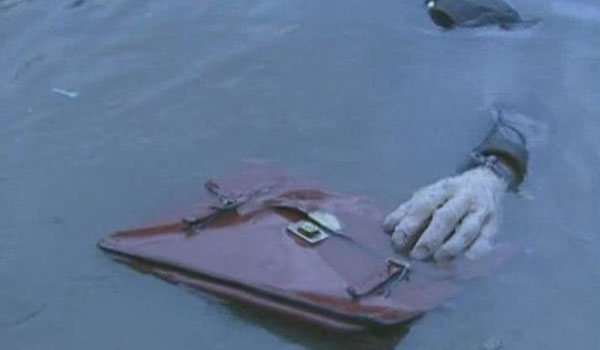
On April 30, 1943, Lieutenant Norman Jewell, commanding the submarine HMS Seraph (P219), read the 39th Psalm over the man who never was.  With briefcase containing “secret” documents padlocked to his wrist, the homeless man who in death would help defeat Nazi Germany, was gently pushed into the Atlantic, off the Spanish coast.

The idea was a head fake.  Disinformation intended to make the Nazi government believe that their adversaries intended to invade Sardinia and Greece in 1943, rather than the real targets of North Africa and Sicily.  British Military Intelligence called it “Operation Mincemeat”.

The London coroner obtained the body of 34-year-old Glyndwr Michael, on condition that his real identity never be revealed. The Welshman had died of rat poison, though it’s uncertain whether the death was accidental or suicide. This particular poison came in paste form, and was spread on bread crusts to attract rats.  The homeless man may have died, merely because he was hungry.

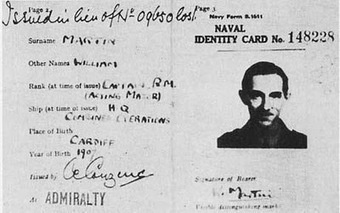
Naval identity cardBe that as it may, this cause of death is difficult to detect,  The condition of the corpse was close to that of someone who had died at sea, of hypothermia and drowning. The dead man’s parents were both deceased, there were no known relatives and the man died friendless. So it was that Glyndwr Michael became the “Man who Never Was”.
The next step was to create a “past” for the dead man. Michael became “(Acting) Major William “Bill” Martin, Royal Marines”, born 1907, in Cardiff, Wales, assigned to Headquarters, Combined Operations. As a Royal Marine, “Martin” could wear battle dress rather than a naval uniform. This was important, because Naval uniforms at the time were tailor-made by Gieves & Hawkes of Saville Row. Authorities could hardly ask Gieves’ tailors to measure a corpse, without raising eyebrows.

The rank of acting major made the fictional William Martin senior enough to be entrusted with sensitive documents, but not so prominent that anyone would expect to know him. The name “Martin” was chosen because there were several Martins of about that rank, already serving in the Royal Marines.

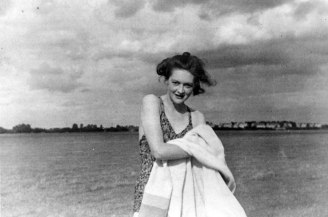
PamA “fiancée” was furnished for Major Martin, in the form of  MI5 clerk “Pam”. “Major Martin” carried her snapshot, along with two love letters, and a jeweler’s bill for a diamond engagement ring.
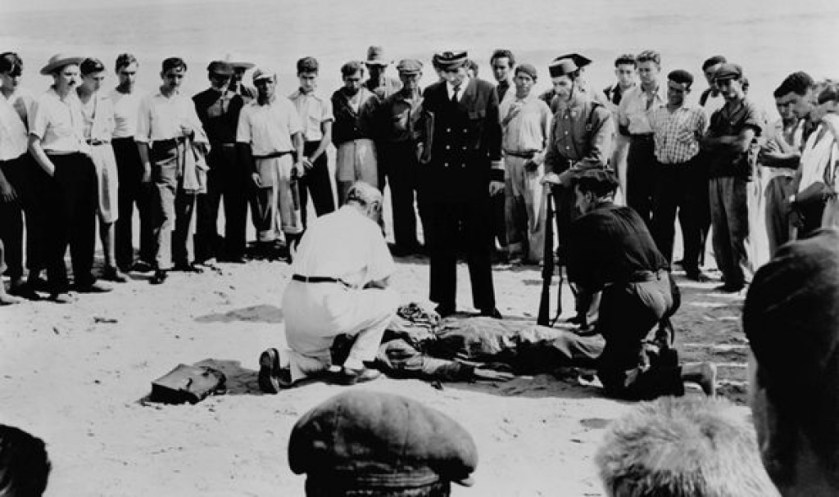
In keeping with his rank, Martin was given some good quality underwear, to increase his authenticity. Extremely difficult to obtain due to rationing, the underwear was purloined from the Master of the New College Oxford, who’d been run over and killed by a truck.

Made to look like the victim of a plane crash, the plan was to drop the body at sea, at a place where the tide would bring it ashore and into German Hands.

On April 30, 1943, Lieutenant Norman Jewell, commanding the submarine HMS Seraph (P219), read the 39th Psalm over the man who never was.  With briefcase containing “secret” documents padlocked to his wrist, the homeless man who in death would help defeat Nazi Germany, was gently pushed into the Atlantic, off the Spanish coast.

HMS Seraph

The hoax worked out, nicely. A Spanish fisherman recovered the body and a Nazi agent intercepted the papers, as intended. Mussolini insisted correctly that the allied attack would come through Sicily, but Hitler wasn’t buying it. He had swallowed the Mincemeat scam whole, insisting that the Sicilian attack was nothing but a diversion from the real objective.

Manwhoneverwas

When the Allies invaded Sicily on the 9th of July, the Germans were so convinced it was a feint that forces were kept out of action for a full two full weeks. After that, it was far too late to effect the outcome.

The non-existent Major William Martin was buried with full military honors in the Huelva cemetery of Nuestra Señora. The headstone reads:
“William Martin, born 29 March 1907, died 24 April 1943, beloved son of John Glyndwyr Martin and the late Antonia Martin of Cardiff, Wales, Dulce et Decorum est pro Patria Mori, R.I.P.”  “It is sweet and fitting to die for one’s country.”

In 1998, the British Government revealed Martin’s true identity, and “Glyndwr Michael; Served as Major William Martin, RM”, was added to the gravestone.

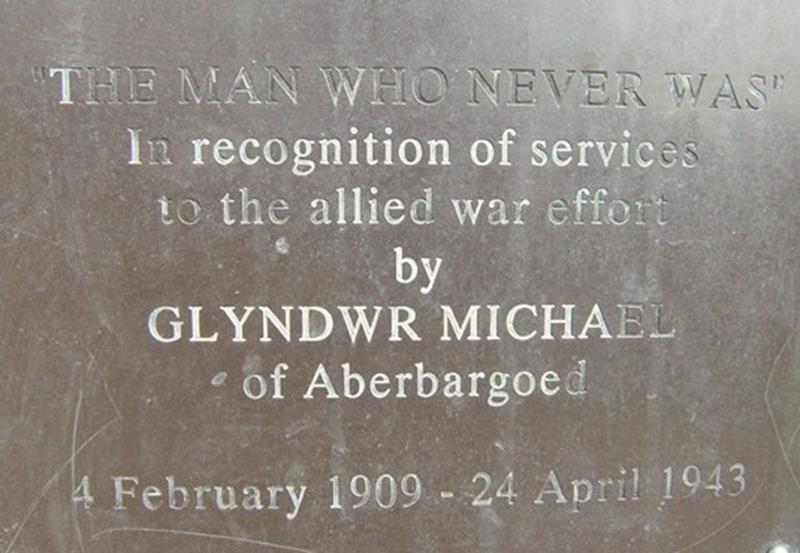
There is a war memorial in the small South Wales town of Aberbargoed, in memory of Glyndwr Michael. A plaque is inscribed with the Welsh phrase “Y Dyn Na Fu Erioed”. It means “The Man Who Never Was”.

Man who Never Was

April 29, 1915  The Wipers Times

My favorite among the classified ads has to be the “Flammenwerfer” (Flame Thrower). “Guaranteed absolutely harmless.”  “Instructive – Amusing”.

As chief of the Imperial German general staff from 1891-1905, German Field Marshal Alfred von Schlieffen devised the strategic roadmap by which Germany prosecuted the first world war. The “Schlieffen Plan” could be likened to a bar fight, where a fighter (Germany) had to take out one guy fast (France), before turning and facing his larger and somewhat slower buddy (Imperial Russia).

Schlieffen_Plan_fr.svg

Of infinite importance to Schlieffen’s plan was the westward sweep through France, rolling that nation’s ground forces into a ball on a timetable before his armies could turn east to face the “Russian Steamroller”. “When you march into France”, Schlieffen had said, “let the last man on the right brush the Channel with his sleeve.”

Ypres SalientField Marshall Helmuth von Moltke once said “No battle plan ever survives contact with the enemy”.  So it was in the tiny Belgian city where German plans met with ruin, on the road to Dunkirk. Native Dutch speakers called the place Leper.  Today we know it as Ypres (Ee-pres), since battle maps of the time were drawn up in French. To the Tommys of the British Expeditionary Force, the place was “Wipers”.

What had hitherto been a war of movement ground to a halt in the apocalyptic fighting around Ypres, in October-November, 1914. The scale of the casualties are hard to get your head around.  Over four years, several hundred thousand sons of Germany, Great Britain and France were killed in the battles for the Ypres Salient – a battlefield only 24 kilometers, square.  100 military burial grounds or more, contain their mortal remains.

YpresThe second Battle for Ypres began with a new and terrifying weapon on April 22, 1915. German troops placed 5,730 gas cylinders weighing 90 pounds apiece, along a four-mile front. Allied troops must have looked on in wonder, as that vast yellow-green carpet crept toward their lines.

Chlorine gas forms hypochlorous acid when combined with water, destroying the moist tissues of the lungs and eyes. Heavier than air, the stuff slithered along the ground and poured into trenches, forcing troops out into heavy German fire. 6,000 casualties were sustained in the gas attack alone, opening a four mile gap in the allied line. Thousands retched and coughed out their last breath, as others tossed their equipment and ran in terror.

After the war, German losses were estimated at 34,933 between April 21 and May 30.  BEF casualties numbered 59,275. The French recorded about 18,000 on April 22 alone, and another 3,973 by April 29. All told, 2nd Ypres cost allied forces 87,223 killed, wounded or missing.

The third Battle of Ypres would begin in July of 1917, lasting almost until the end of the war. 3rd Ypres would result in 570,000 losses on all sides, but in early 1916, that was all part of some unknown and terrible future.

It’s hard to imagine anything remotely humorous coming out of the horrors of this place, but such became possible in the early months of 1916.

Optimism advert

First established in 1881, the “Sherwood Foresters” were line infantry Regiments (Nottinghamshire and Derbyshire Regiments) of the British Army, at this time stationed at the front lines of the Ypres salient.  The unit came across a printing press.  Corporal George Turner, who’d been a printer in civil life, got the thing going. The Forresters began a trench magazine, a PDF of which may be downloaded HERE.  The first edition of the Wipers Times published on February 12, 1916.  The paper included poems and reflections, news, “adverts” and the blackest of humor.

Written for fellow soldiers, some of the in-jokes are so obscure that their meaning is lost to the modern reader. Others are clearly understandable, even 102 years later.

The_Wipers_Times,_issue_cover_March_1916_Wellcome_L0031562

Richly typeset advertisements for “Music Hall Extravaganzas” included “Tickling Fritz” by the P.B.I. (Poor Bloody Infantry) Film Co. of the United Kingdom and Canada, advising the enthusiast to “Book Early”. There were Real Estate ads for property in no-man’s land. “BUILD THAT HOUSE ON HILL 60. BRIGHT-BREEZY-&-INVIGORATING. COMMANDS AN EXCELLENT VIEW OF HISTORIC TOWN OF YPRES”. Another one read “FOR SALE, THE SALIENT ESTATE – COMPLETE IN EVERY DETAIL! UNDERGROUND RESIDENCES READY FOR HABITATION. Splendid Motoring Estate! Shooting Perfect !! Fishing Good!!!”

Old Masters

There were advertisements for barbed wire cutters with built-in umbrellas, for the most discerning of gentlemen.

There were news features, this one of a bungled trench raid: “”…They climbed into the trench and surprised the sentry, but unfortunately the revolver which was held to his head missed fire. Attempts were made to throttle him quietly, but he succeeded in raising the alarm, and had to be killed.” editor’s note, “This we consider real bad luck for the sentry after the previous heroic efforts to keep him alive””.

There were weather reports, laying odds on the forecast. “5 to 1 Mist, 11 to 2 East Wind or Frost, 8 to 1 Chlorine”. My favorite among the classifieds has got to be the “Flammenwerfer” (Flame Thrower). “Guaranteed absolutely harmless.”  “Instructive – Amusing”.

Miss Minnie WerferUnits of all sizes, from individual companies to army corps, lightened the load of the “War to end all Wars”, with some kind of unit journal.

Some officers were not amused by the underground paper, and thought its publication should be banned. Others believed that it kept some semblance of morale in the trenches. One pointed out that “humour is what distinguishes us from barbarism.”

The Wipers Times ran through the end of the war, with the exception of the “Operation Michael” period, the last gasp German Western Front offensive of 1918. The final edition, titled “The Better Times”, was published in December 1918, just short of two months after the armistice.   The banner headline on that final edition read “Xmas, Peace and Final Number.”

Better Times Headline

If you enjoyed this “Today in History”, please feel free to re-blog, “like” & share on social media, so that others may find and enjoy it as well. Please click the “follow” button on the right, to receive email updates on new articles.  Thank you for your interest, in the history we all share.

April 28, 1933 Sacred Cod

So important was the Cod to the regional economy, that a carved likeness of the fish hung in the Massachusetts State House, fifty years or more before the Revolution.

The American Revolution was barely 15 years in the rear-view mirror, when the new State House opened in the Beacon Hill neighborhood of Boston.  The building has expanded a couple of times since then, and remains the home of Massachusetts’ state government, to this day.

download (71)

On January 11, 1798, a procession of legislators and other dignitaries worked its way from the old statehouse at the intersection of Washington and State Streets to the new one on Beacon Hill, a symbolic transfer of the seat of government.  The procession carried with it, a bundle.  Measuring 4’11” and wrapped in an American flag, it was a life-size wooden carving.  Of a fish.

For the former Massachusetts colony, the Codfish had once been a key to survival.  Now, this “Sacred Cod” was destined for a new home in the legislative chamber of the House of Representatives.

download (72)Mark Kurlansky, author of “Cod: A Biography of the Fish That Changed the World”, laments the 1990s collapse of the Cod fishery, saying the species finds itself “at the wrong end of a 1,000-year fishing spree.”

Records exist from as early as AD985, of Eirik the Red, Leif Eirikson’s father, preserving Codfish by hanging them in the cold winter air.  Medieval Spaniards of the Basque region improved on the process, by the use of salt.  By A.D. 1,000, Basque traders were supplying a vast international market, in Codfish.

By 1550, Cod accounted for half the fish consumed in all Europe.  When the Puritans set sail for the new world it was to Cape Cod, to pursue the wealth of the New England fishery.

download (100)

Without Codfish, Plymouth Rock would likely have remained just another boulder. William Bradford, first signer of the Mayflower Compact in 1620 and 5-term governor of the Plymouth Colony (he called it “Plimoth”), reported that, but for the Cod fishery, there was talk of going to Manhattan or even Guiana:  “[T]he major part inclined to go to Plymouth, chiefly for the hope of present profit to be made by the fish that was found in that country“.

There are tales of sailors scooping Codfish out of the water, in baskets.  So important was the Cod to the regional economy, that a carved likeness of the creature hung in the old State House, fifty years or more before the Revolution.

01_11.1_1798-c1f3d5a8
Massachusetts’ old Statehouse

The old State House burned in 1747, leaving nothing but the brick exterior you see today, not far from Faneuil Hall.  It took a year to rebuild the place, including a brand new wooden Codfish.  This one lasted until the British occupation of Boston, disappearing sometime between April 1775 and March 1776.

The fish which accompanied that procession in 1798 was the third, and so far the last such carving to hang in the Massachusetts State House, where it’s remains to this day.  Sort of.

With the country plunged into the Great Depression, someone looked up in Massachusetts’ legislative chamber, and spied – to his dismay – nothing but bare wires.  The Commonwealth had suffered “The Great Cod-napping”, of 1933.

Newspapers went wild with speculation about what happened to The Sacred Cod.

Suspects were questioned and police chased down one lead after another, but they all turned out to be red herring (sorry, I couldn’t help myself).  State police dredged the Charles River, (Love that dirty water).  Lawmakers refused D’Bait (pardon), preferring instead to discuss what they would do with the Cod-napper(s), if and when the evildoers were apprehended.

Soon, an anonymous tip revealed the culprits to be college pranksters, three editors of the Harvard Lampoon newspaper pretending to be tourists.  It was a two-part plan, the trio entering the building with wire cutters and a flower box, as other Lampoon members created a diversion by kidnapping an editor from the arch-rival newspaper, the Harvard Crimson.  The caper worked, flawlessly.  Everyone was busy looking for the missing victim, as two snips from a wire cutter brought down the Sacred Cod.

04_26_1933-da89b1f1

Two days later, it was April 28.  A tip led University Police to a car with no license plate, cruising up the West Roxbury Parkway. After a 20-minute low speed chase, (I wonder if it was a white Bronco), the sedan pulled over.  Two men Carp’d the Diem (or something like that), and handed over the Sacred Cod, before driving away.

The Sacred Cod  resumed its rightful place, and once again, there was happiness upon the Land.  The Cod was stolen one more time in 1968, this time by UMASS students protesting some thing or other, but the fish never made it out of the State House.

Holy-Mackerel
The “Holy Mackerel” of the Massachusetts State Senate

Years later, future Speaker of the House Tip O’Neill faced the Cod in the direction of the majority party.  It will come as no surprise to anyone familiar with Bay State politics, that the thing has faced Left, from that day to this.  For Massachusetts’ minuscule Republican delegation, hope springs eternal that the Sacred Cod will one day, face Right.

Not to be outdone, the State Senate has its own fish, hanging in the legislative chambers.  There in the chandelier, above the round table where sits the Massachusetts upper house, is the copper likeness of the “Holy Mackerel”.  No kidding.  I wouldn’t fool around about a thing like that.

Legend has it that, when you see those highway signs saying X miles to Boston, they’re really giving you the distance to the Holy Mackerel.

A tip of my hat to my friend and Representative to the Great & General Court David T. Vieira, without whom I’d have remained entirely ignorant of this fishy tale.

FOT2DE
Beacon Hill, seat of Massachusetts state government, where the author addresses an empty chamber.  Maybe The Sacred Cod™ was listening.
If you enjoyed this “Today in History”, please feel free to re-blog, “like” & share on social media, so that others may find and enjoy it as well. Please click the “follow” button on the right, to receive email updates on new articles.  Thank you for your interest, in the history we all share.

April 27, 1865 Sultana

Sultana was the worst maritime disaster in United States history, though its memory was mostly swept away in the tide of events that April.  The United States Customs Service records an official count of 1,800 killed, though the true number will never be known.  Titanic went down in the North Atlantic 47 years later, taking 1,512 with her.

In April 1865, the Civil War was all but ended.  General Robert E. Lee surrendered to General Ulysses S. Grant on the 9th.  President Abraham Lincoln was assassinated five days later, and John Wilkes Booth run to ground and killed on the 26th.  Thousands of former POWs were being released from Confederate camps in Alabama and Georgia, and held in regional parole camps.

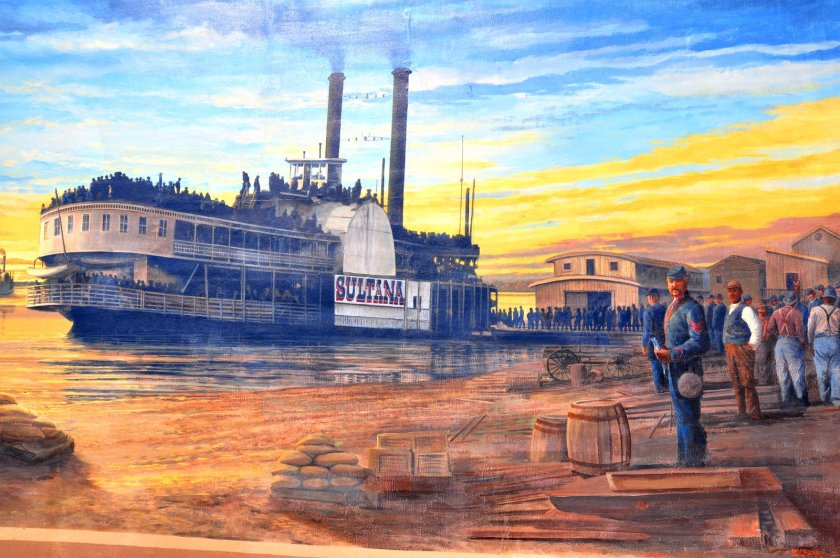
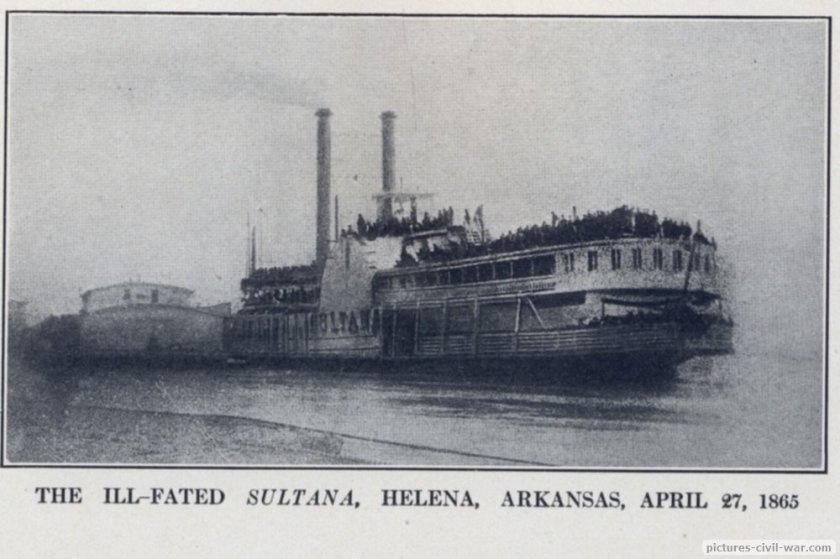
The sidewheel steamboat Sultana left New Orleans with about 100 passengers and a few head of livestock, pulling into Vicksburg Mississippi on the 21st to repair a damaged boiler and to pick up a promised load of passengers.

The mechanic wanted to cut a bulging seam out of the boiler and install a new plate, easily three day’s work.  Captain J. Cass Mason declined, for fear of losing his passengers.  He wanted the seam hammered back into place and covered with a patch, and he wanted it done in a day.

download (88)

The passengers Mason was so afraid of losing were former prisoners of the Confederacy, and Confederate parolees, returning to their homes in Kentucky and Tennessee.

The Federal government was paying $5 each to anyone bringing enlisted guys home, and $10 apiece for officers.  Lieutenant Colonel Reuben Hatch, chief quartermaster at Vicksburg and one of the sleazier characters in this story, had approached Captain Mason with a deal.  Hatch would guarantee a minimum of 1,400 passengers, and they’d both walk away with a pocketful of cash.

As it was, there were other riverboats in the vicinity.  Mason didn’t have time to worry about boiler repairs.

The decks creaked and sagged, as beams were installed to shore up the load.  Sultana backed away from the dock on April 24, with 2,427 passengers.  More than six times her legal limit of 376.

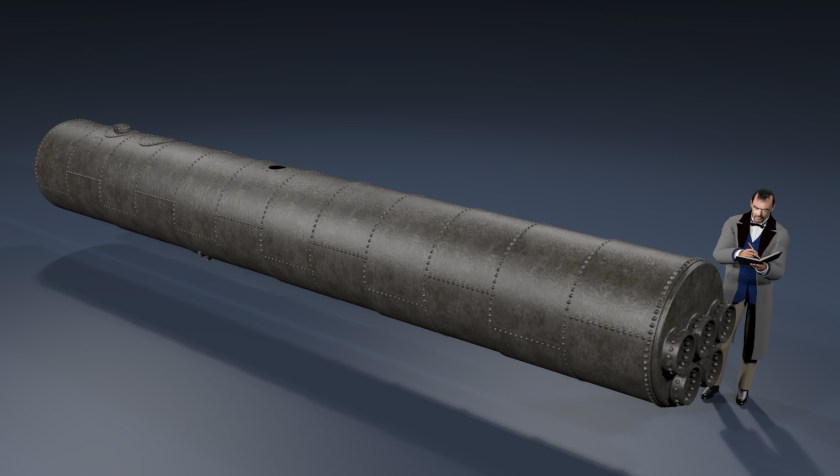
BoilerBlue
This animation gives a sense of the size, of Sultana’s boilers

Sultana spent two days traveling upstream, fighting one of the heaviest spring floods in the history of the Mississippi River.  She arrived at Memphis on the evening of the 26th, unloading 120 tons of sugar from her holds.  Already massively top heavy, the riverboat now lurched from side to side with every turn.

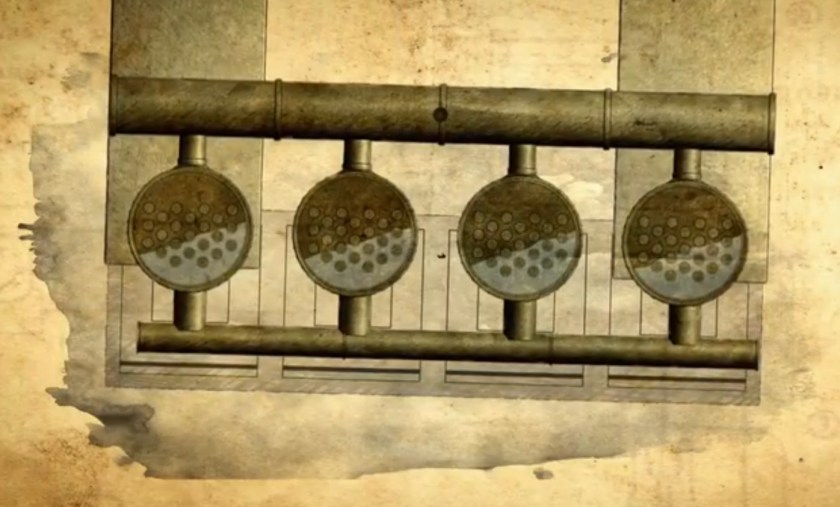
Sultana (1)
SS Sultana was equipped with four such boilers, mounted from side-to-side.  Massively top heavy, water would run from left to right as she lurched from side to side, water then flashing to steam and creating enormous surges in pressure

The crew must have exceeded allowable steam pressure, pushing all that load against the current.  Pressure varied wildly inside Sultana’s four giant boilers, as water sloshed from one to the next with every turn, boiling water flashing to superheated steam and back to water.

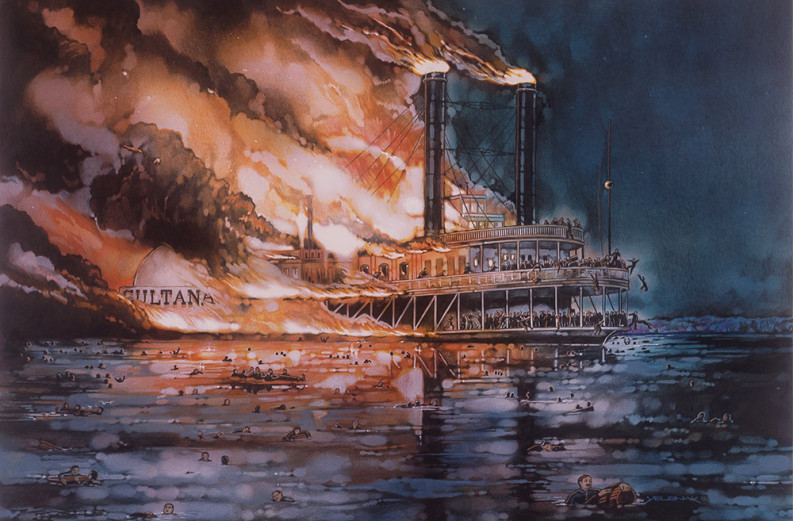
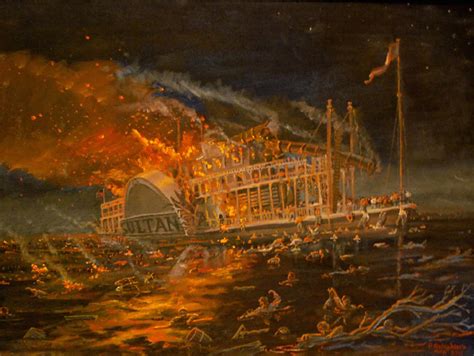
The temporary boiler patch exploded at 2:00am on April 27, detonating two more boilers a split second later.  The force of the explosion hurled hundreds into the icy black water.  The top decks soon gave way, as hundreds tumbled into the gaping maw of the fire boxes below.

download (90)

Within moments, the entire riverboat was ablaze.  Those who weren’t incinerated outright now had to take their chances in the swift moving waters of the river.  Already weakened by terms in captivity, they died by the hundreds of drowning or hypothermia.

The drifting and burnt out hulk of the Sultana sank to the bottom, seven hours later.  The steamers Silver Spray, Jenny Lind, and Pocohontas joined the rescue effort, along with the navy tinclad Essex and the sidewheel gunboat USS Tyler.  700 were plucked from the water and taken to Memphis hospitals, of whom 200 later died of burns or exposure.  Bodies would continue to wash ashore, for months.

Sultana was the worst maritime disaster in United States history, though its memory was mostly swept away in the tide of events that April.  The United States Customs Service records an official count of 1,800 killed, though the true number will never be known.  Titanic went down in the North Atlantic 47 years later, taking 1,512 with her.

download (91)

Despite the enormity of the disaster, no one was ever held accountable.  One Union officer, Captain Frederick Speed, was found guilty of grossly overcrowding the riverboat.  It was he who sent 2,100 prisoners from their parole camp into Vicksburg, but his conviction was later overturned.  It seems that higher ranking officials may have tried to make him into a scapegoat, since he never so much as laid eyes on Sultana herself.

Captain Williams, the officer who actually put all those people onboard, was a West Point graduate and regular army officer.  The army didn’t seem to want to go after one of its own.  Captain Mason and all of his officers were killed in the disaster.  Reuben Hatch, the guy who concocted the whole scheme in the first place, resigned shortly after the disaster, thereby putting himself outside the reach of a military tribunal.

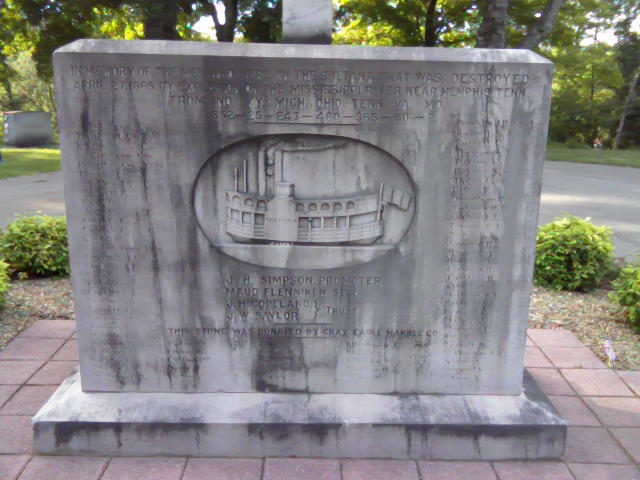
Sultana Memorial at the Mount Olive Baptist Church Cemetery in Knoxville, Tennessee in 2010
Sultana Memorial at the Mount Olive Baptist Church Cemetery in Knoxville, Tennessee, 2010

The last survivor of the Sultana disaster, Private Charles M. Eldridge of the 3rd (Confederate) Tennessee Cavalry, died at his home at the age of 96 on September 8, 1941. Three months before the Imperial Japanese attack on Pearl Harbor.

If you enjoyed this “Today in History”, please feel free to re-blog, “like” & share on social media, so that others may find and enjoy it as well. Please click the “follow” button on the right, to receive email updates on new articles.  Thank you for your interest, in the history we all share.

April 26, 1777  The Female Paul Revere

The Dutchess County Militia had to be called up.  The Colonel himself had only a single night to prepare for battle, and this rider was exhausted.  The job would have to go to Colonel Ludington’s first-born.  His daughter, Sybil.

Listen my children and you shall hear,
Of the midnight ride of…Sybil Ludington.

Paul Revere’s famous “midnight ride” began on the night of April 18, 1775.  Revere was one of two riders, soon joined by a third, fanning out from Boston to warn of an oncoming column of “regulars”, come to destroy the stockpile of gunpowder, ammunition, and cannon in Concord.

Revere himself covered barely 12 miles before being captured, his horse confiscated to replace the tired mount of a British sergeant.  Revere would finish his “ride” on foot, arriving at sunrise on the 19th to witness the last moments of the battle on Lexington Green.

download (55)Two years later, Patriot forces maintained a similar supply depot, in the southwest Connecticut town of Danbury.

William Tryon was the Royal Governor of New York, a long-standing advocate for attacks on civilian targets.  In 1777, Tryon was also a Major-General of the provincial army.  On April 25th, Tryon set sail for the Connecticut coast of Long Island Sound with a force of 1,800, intending to destroy Danbury.

Patriot Colonel Joseph Cooke’s small Danbury garrison was caught and quickly overpowered on the 26th, trying to remove food supplies, uniforms, and equipment.  Facing little if any opposition, Tryon’s forces went on a bender, burning homes, farms and storehouses.  Thousands of barrels of pork, beef and flour were destroyed, along with 5,000 pairs of shoes, 2,000 bushels of grain, and 1,600 tents.

Colonel Henry Ludington was a farmer and father of 12, with a long military career.  A long-standing and loyal subject of the British crown, Ludington switched sides in 1773, joining the rebel cause and rising to command the 7th Regiment of the Dutchess County Militia, in New York’s Hudson Valley.

In April 1777, Ludington’s militia was disbanded for planting season, returned to homes across the countryside.  Soaked to the skin and exhausted, a rider arrived at the Ludington farm on the night of the 26th, on an equally soaked and exhausted horse.  With a driving rain cascading in sheets off an empty saddle, the rider explained the purpose of his visit.  15 miles away, British regulars and a loyalist force were burning Danbury to the ground.

The Dutchess County Militia had to be called up.  The Colonel himself had only a single night to prepare for battle, and this rider was done for.  The job would have to go to the Colonel’s first-born.  That meant Ludington’s daughter Sybil, and she was barely sixteen.

download (59)

From Poughkeepsie to what is now Putnam County and back, the “Female Paul Revere” rode across the lower Hudson River Valley, covering 40 miles in the pitch darkness of night, alerting her father’s militia to the danger and urging them to come out and fight.  She’d use a stick to knock on doors, even using it once to beat back a highway bandit.

By the time that Sybil returned the next morning, cold, rain-soaked, and exhausted, most of 400 militia members were prepared to march.

35 miles east of Danbury, General Benedict Arnold was gathering a force of 500 regular and irregular Connecticut militia, along with Generals David Wooster and Gold Selleck Silliman.

download (57)

Arnold’s forces arrived too late to save Danbury, but inflicted a nasty surprise on the British rearguard as the column approached nearby Ridgefield.  Never outnumbered by less than three-to-one, Connecticut militia was able to slow the British advance until Ludington’s New York Militia arrived on the following day.  The last phase of the action saw the same type of swarming harassment, as seen on the British retreat from Concord to Boston, earlier in the war.

Though the British operation was a tactical success, the mauling suffered at the hands of colonials ensured that this was the last hostile British landing on the Connecticut coast.

The British raid on Danbury destroyed at least 19 houses and 22 stores and barns.  Town officials submitted £16,000 in claims to Congress, for which town selectmen received £500 reimbursement.  Further claims were made to the General Assembly of Connecticut in 1787, for which Danbury was awarded land.  In Ohio.

The old Keeler Tavern in Ridgefield is now a museum.  The British cannonball fired into the side of the building, remains there to this day.

download (56)

At the time, Benedict Arnold planned to travel to Philadelphia, to protest the promotion of officers junior to himself, to Major General.  Arnold, who’d had two horses shot out from under him at Ridgefield, was promoted to Major General in recognition of his role in the battle.  Along with that promotion came a horse, “properly caparisoned as a token of … approbation of his gallant conduct … in the late enterprize to Danbury.”

The pride which would one day be Arnold’s undoing, was assuaged.  For a time.

Henry Ludington became Aide-de-Camp to General George Washington, and grandfather to Harrison Ludington, future mayor of Milwaukee and the 12th Governor of Wisconsin.

Gold Silliman was kidnapped with his son by a first marriage by Tory neighbors, and held for nearly seven months at a New York farmhouse.  Having no hostage of equal rank with whom to exchange for the General, Patriot forces went out and kidnapped one of their own, in the person of Chief Justice Judge Thomas Jones, of Long Island.

download (60)Mary Silliman was left to run the farm, and negotiate for the release of her husband.  The 1993 made-for-TV movie “Mary Silliman’s War” tells a story of non-combatants, pregnant mothers and farm wives, during the Revolution.

General David Wooster was mortally wounded at the Battle of Ridgefield, moments after shouting “Come on my boys! Never mind such random shots!”  Today, an archway marks the entrance to Wooster Square, in the East Rock Neighborhood of New Haven.

Sybil Ludington received the thanks of family and friends, even George Washington himself, and then stepped off the pages of history.

Paul Revere’s famous ride would likewise have faded into obscurity, but for the poetry of Henry Wadsworth Longfellow.  86 years later.

monument-1

If you enjoyed this “Today in History”, please feel free to re-blog, “like” & share on social media, so that others may find and enjoy it as well. Please click the “follow” button on the right, to receive email updates on new articles.  Thank you for your interest, in the history we all share.