What would it be like to turn on CNN or Fox News, to learn that Barack Obama’s Secretary of the Treasury Jacob Lew was party to a duel, and that he was near death after being shot by the Vice President of the United States, Mike Pence.
What would it be like to turn on CNN or Fox News, to learn that Barack Obama’s Secretary of the Treasury Jacob Lew was party to a duel, and that he was near death after being shot by the Vice President of the United States, Mike Pence.
Weehawken, New Jersey
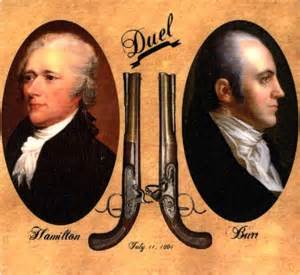
The year was 1804. President Thomas Jefferson’s Vice President, Aaron Burr, had a long standing personal problem with one of the Founding Fathers. Alexander Hamilton had been Secretary of the Treasury under George Washington: the first Secretary of the Treasury, the only signer of the US Constitution from the state of New York.
The animosity between the two began in 1791, when Burr defeated Hamilton’s father-in-law Philip Schuyler in a US Senate election. Hostilities escalated when the Electoral College deadlocked over the 1800 Presidential election, moving the selection of President and Vice President to the House of Representatives. Hamilton exerted his influence on behalf of Jefferson, who was elected on the 36th ballot, making Burr his VP.
Burr knew that Jefferson wouldn’t keep him on as VP for the 1804 election, and so he ran for Governor of New York. He blamed Hamilton for his defeat, and challenged the man to a duel over comments made during the election.
Dueling was illegal in both New York and New Jersey by this time, though enforcement was far more aggressive in New York. The pair rowed across the Hudson River from Manhattan to Weehawken, New Jersey in the early morning hours of July 11, 1804, dueling pistols tucked safely in a leather bag.
Both men’s “seconds” stood with their backs to the duelists, enabling both to later state under oath that they didn’t see either the weapons or the duel itself. “Plausible deniability” was preserved, but it’s hard to have a first-hand account when the only witnesses deliberately turned their backs. Accounts vary, but it seems that Hamilton fired first, apparently “throwing away his shot” as he had once advised his son Philip to do when the younger man was in this position.
This account is supported by a letter that Hamilton wrote the night before the duel, stating that he was “strongly opposed to the practice of dueling” for both religious and practical reasons. The letter went on, “I have resolved, if our interview is conducted in the usual manner, and it pleases God to give me the opportunity, to reserve and throw away my first fire, and I have thoughts even of reserving my second fire”.
Burr had no such reservations. He fired with intent to kill, the shot hitting Hamilton in the lower abdomen. The wound was clearly fatal, even to Hamilton himself, who said “This is a mortal wound, doctor”.
The man whose likeness appears on the $10 bill died the next day. Among his last words were “Pendleton knows,” (Judge Nathaniel Pendleton, his second), “that I did not intend to fire at him”.
Paper money crashed in the post-Revolutionary Articles of Confederation period, when you could buy a sheep for two silver dollars, or 150 paper “Continental” dollars. Creditors hid from debtors, not wanting to be repaid in worthless paper currency. For generations after our founding, a thing could be described as worthless, as “not worth a Continental”.
You’ve worked all your life. You’ve supported your family, paid your taxes, and paid your bills. You’ve even managed to put a few bucks aside, in hopes of a long and happy retirement. “Inflation” is such a bloodless term. What if you hadn’t touched that “nest egg”, and its purchasing power was suddenly diminished…by 10%…40%…70%.
Throughout Roman antiquity, coinage retained a high silver content as a matter of law. Precious metal made the coins themselves objects of value and, for 500 years, the Roman economy remained relatively stable. Republic morphed into Empire over the 1st century BC, leading to a conga line of Emperors minting mountains of coins in their own likenesses. Slaves were worked to death in Spanish silver mines, to satisfy an endless need for the metal. Birds fell from the sky over vast smelting fires, yet there was never enough silver. Silver content was inexorably reduced, until the currency itself became worthless. Roman currency collapsed in the 3rd century reign of Diocletian. An Empire and its citizens were left to barter as best they could, in a world where money no longer had any value.
German children playing with worthless currency, 1923.
In the waning days of the Civil War, the Confederate dollar wasn’t worth the paper it was printed on. Paper money crashed in the post-Revolutionary Articles of Confederation period as well, when you could buy a sheep for two silver dollars, or 150 paper “Continentals”. Creditors hid from debtors, not wanting to be repaid in worthless paper currency. Generations after our founding, the worthlessness of a thing could be described as “not worth a Continental”.
The assistance of French King Louis XVI was invaluable to Revolutionary era Americans, but French state income was only about 357 million livres at the time, with expenses of over half-billion. France descended into its own Revolution, as the government printed “assignat”, notes purportedly backed by 4 billion livres in property expropriated from the church. 912 million livres in circulation in 1791 rose to almost 46 billion in 1796, of a note whose purchasing power had diminished by 99%.
The money in their pockets was literally, not worth the paper it was printed on. One historian described the economic policy of the Jacobins, the leftist radicals behind the reign of terror, as: “[A]n utter exhaustion of the present at the expense of the future”.
In each of these historic cases, nothing defined and established the value a currency, except what a willing buyer and a willing seller agreed it was worth. There was no “there”, there. It all sounds depressingly familiar.
The Austro-Hungarian Empire was on the losing side of WW1, and broken up after the war. Lacking the governmental structures of established states, the newly independent nation of Hungary began to experience inflation. Before the war, a US Dollar would have bought you 5 Kronen. In 1924, it was 70,000.
Hungary replaced the Kronen with the Pengö in 1926, pegged to a rate of 12,500 to one.
Hungary became a battleground in the latter stages of WW2, between the military forces of Nazi Germany and the USSR. 90% of Hungarian industrial capacity was damaged, half of it destroyed altogether. Transportation became difficult, with most of the nation’s rail capacity damaged or destroyed. What remained was either carted off to Germany, or seized by the Soviets, as reparations.
The loss of all that productive capacity led to scarcity of goods, and prices began to rise. The government responded by printing money. Total currency in circulation in July 1945 stood at 25 billion Pengö. Money supply rose to 1.65 trillion by January, 65 quadrillion in April and 47 septillion in July. That’s a Trillion Trillion. Twenty-four zeroes.
Banks received low rate loans, so that money could be loaned to companies to rebuild. The government hired workers directly, giving out loans to others and in many cases, outright grants. The country was flooded with money, the stuff virtually grew on trees, but there was nothing to back it up.
Inflation took a straight line into the stratosphere. The item that cost you 379 Pengö in September 1945, cost 1,872,910 by March, 35,790,276 in April, and 862 billion in June. Inflation neared 150,000% per day, as the currency became all but worthless. Massive printing of money had accomplished the cube root of zero. The worst hyperinflation in history peaked on July 10, 1946, when that 379 Pengö item from September, cost you 1,000,000,000,000,000,000,000,000.
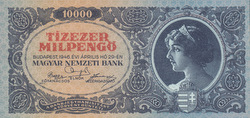
The government responded by changing the name, and the color, of the currency. The Pengö was replaced by the Milpengö (1,000,000 Pengö), which was replaced by the Bilpengö (1,000,000,000,000 Pengö), and finally by the (supposedly) inflation-indexed Adopengö. This spiral resulted in the largest denomination common currency note ever printed, the Milliard Bilpengö. A Billion Trillion Pengö.
The thing was worth twelve cents.
One more currency replacement and all that Keynesian largesse would finally stabilize the currency, but at what cost? Real wages were reduced by 80% and creditors wiped out. The fate of the nation was sealed when communists seized power in 1949. Hungarians could now share in that old Soviet joke: “They pretend to pay us, and we pretend to work”.
The ten worst hyperinflations in history occurred during the 20th century, including Zimbabwe in 2008, Yugoslavia 1994, Germany 1923, Greece 1944, Poland 1921, Mexico 1982, Brazil 1994, Argentina 1981, and Taiwan 1949. The common denominator in all ten were massive amounts of government debt, and a currency with no intrinsic worth.
A Billion Trillion Pengö. The largest denomination common currency note ever printed. It was worth about twelve cents.
In 2015, Boston University economist Laurence Kotlikoff testified before the Senate Budget Committee. “The first point I want to get across” he said, “is that our nation is broke. Our nation’s broke, and it’s not broke in 75 years or 50 years or 25 years or 10 years. It’s broke today”.
Kotlikoff went on to describe the “fiscal gap”, the difference between US’ projected revenue, and the obligations with which our government has saddled the taxpayer. “We have a $210 trillion fiscal gap at this point”, Kotlikoff testified. 11.6 times GDP, the total of all goods and services produced in the United States.
On top of that, the United States owes something close to twenty trillion dollars, in fiscal operating debt, and our currency is unmoored from anything of inherent value. We spend a lot of time, talking about politics. Perhaps we should be talking about math, instead.
Chips attacked the four Italians manning the machine gun, single-handedly forcing their surrender to American troops. The dog sustained a scalp wound and powder burns in the process, indicating that they had tried to shoot him during the brawl. In the end the score was Chips 4, Italians Zero.
The United States Armed Forces had an extensive K-9 program during World War II, when private citizens were asked to donate their dogs to the war effort. One such dog was “Chips”, a German Shepherd/Collie/Husky mix who ended up being the most decorated K-9 of WWII.
Chips belonged to Edward Wren of Pleasantville, NY, who “enlisted” his dog in 1942. He was trained at the War Dog Training Center, Front Royal, Virginia, and served in the 3rd Infantry Division with his handler, Private John Rowell. Chips and his handler took part in North Africa, Italy, France and Germany. He served as a sentry dog for the Roosevelt-Churchill conference in 1943, and the team was part of the Sicily landings later that year.
The Allied invasion of Sicily was a large scale amphibious and airborne operation, beginning this day in 1943 and lasting through the 17th of August. Six weeks of land combat followed, in an operation code named “Operation Husky”.
During the landing phase, private Rowell and Chips were pinned down by an Italian machine gun team. The dog broke free from his handler, running across the beach and jumping into the pillbox. Chips attacked the four Italians manning the machine gun, single-handedly forcing their surrender to American troops. The dog sustained a scalp wound and powder burns in the process, demonstrating that they had tried to shoot him during the brawl. In the end, the score was Chips 4, Italians Zero. He helped to capture ten more later that same day.
Chips was awarded the Distinguished Service Cross, Silver Star, and Purple Heart, but the awards were later revoked. At that time the army didn’t permit commendations to be given to animals. His unit awarded him a Theater Ribbon with an Arrowhead for the assault landing anyway, along with eight Battle stars. One for each of his campaigns.
Chips was discharged in December, 1945, and returned home to live out his days with the Wren family in Pleasantville. Disney made a TV movie based on his life in 1990. They called it “Chips, the War Dog”.
The Philadelphia Public Ledger reported the last clear note ever sounded by the Liberty Bell, on George Washington’s birthday, 1846 .
Philadelphia’s city bell originally hung from a tree near the Pennsylvania State House, now known as Independence Hall. The date is uncertain, but it probably dates back to the city’s founding in 1682. The bell would ring to alert citizens of civic events and proclamations, and to the occasional civic danger.
The “Liberty Bell” was ordered from the London bell foundry of Lester and Pack (today the Whitechapel Bell Foundry) in 1752, arriving in August of that year. Weighing in at 2,080 lbs, it has written upon it a passage from the Book of Leviticus, the third book of the Hebrew Bible; the third of five books of the Torah. “Proclaim LIBERTY throughout all the land unto all the inhabitants thereof”.
Mounted to a stand to test the sound, the first strike of the clapper cracked the bell’s rim. Authorities tried to return it, but the ship’s master couldn’t take it on board, so the bell was re-cast by two local founders, John Pass and John Stow. It was broken into pieces, melted down and re-cast, with the addition of 10% copper to make the metal less brittle.
The Bell’s First Note, by Jean Leon Gerome Ferris
Pass and Snow bragged that the bell’s lettering was clearer on this second casting than the original. The newly re-cast bell was ready in March 1753, when City officials scheduled a public celebration to test the sound. There was free food and drink all around, but the crowd gasped and started to laugh when the bell was struck. It didn’t break this time…it sounded like two coal scuttles being banged together.
Pass and Stow hastily took it away, again breaking the bell into pieces, and again melting it down to be recast.
The whole performance was repeated in June 1753. This time most thought the sound to be satisfactory, and the bell was hung in the steeple of the State House. One who did not like the sound was Isaac Norris, speaker of the Pennsylvania Provincial Assembly. He ordered a second bell in 1754, though he was unsuccessful in his efforts to return the original for credit to the Lester and Pack foundry.
The new bell was attached to the tower clock, while the old one was, by vote of the Assembly, devoted “to such Uses as this House may hereafter appoint.” One such use of the old bell occurred on July 8, 1776, to announce the public reading of the Declaration of Independence.
Bells are easily melted down for ammunition, so the bell was taken down and hidden before the British occupation of Philadelphia in 1777. The distinctive large crack began to develop some time in the early 19th century, about the time when abolitionist societies began calling it “The Liberty Bell”. Some say it cracked while ringing after the death of Chief Justice John Marshall in 1835.
The Liberty Bell is paraded through the streets of Philadelphia, 1908, in a recreation of its 1777 journey to Allentown
The Philadelphia Public Ledger reported the last clear note ever sounded by the Liberty Bell, in its February 26, 1846 edition:
“The old Independence Bell rang its last clear note on Monday last in honor of the birthday of Washington and now hangs in the great city steeple irreparably cracked and dumb. It had been cracked before but was set in order of that day by having the edges of the fracture filed so as not to vibrate against each other … It gave out clear notes and loud, and appeared to be in excellent condition until noon, when it received a sort of compound fracture in a zig-zag direction through one of its sides which put it completely out of tune and left it a mere wreck of what it was.”
“#23”, Benjamin Harrison
The bell would periodically travel to expositions and celebrations, but souvenir hunters would break off pieces from its rim, and additional cracking would develop after several of these trips. The bell’s travels were sharply curtailed after it came back from Chicago with a new crack in 1893, and discontinued altogether in 1915.
Former President Benjamin Harrison may have had the last word as the Liberty bell passed through Indianapolis in 1893. “This old bell was made in England”, he said, “but it had to be re-cast in America before it was attuned to proclaim the right of self-government and the equal rights of men.”
In the UK, the ruling class appeared to enjoy the chaos. A British political cartoon of the time depicted the United States, represented by a woman being groped by five Frenchmen while John Bull, the fictional personification of all England, laughs from a nearby hilltop.
Imagine that you’ve always considered yourself to be somewhere in the political center, maybe a little to the left. Now imagine that, in the space of two years, your country’s politics have shifted so radically that you find yourself on the “reactionary right”. So much so, that you are subject to execution by your government. And all that time, your politics haven’t changed.
Our strongest ally in the American Revolution lost its collective mind in 1792, when France descended into its own revolution. 17,000 Frenchmen were officially tried and executed during the 1793-94 “Reign of Terror”, including King Louis XVI himself and his queen, Marie Antoinette. Untold thousands died in prison or without benefit of trial. The monarchical powers of Europe were quick to intervene and for the 32nd time since the Norman invasion of 1066, England and France found themselves at war.
Execution of Marie Antoinette
Both sides in the European conflict seized neutral ships which were trading with their adversary. The “Treaty of Amity, Commerce, and Navigation” between Great Britain and its former colonies, better known as the “Jay Treaty”, all but destroyed relations with the French Republic. France retaliated by stepping up attacks on American merchant shipping, seizing 316 vessels in one 11-month period, alone.
France had been the colonies’ strongest ally during the American Revolution, now the Jay treaty infuriated the French, who believed the agreement violated earlier arrangements between the two nations. Making matters worse, America repudiated its war debt in 1794, arguing that it owed money to “L’ancien Régime”, not to the “First Republic” which had overthrown it and executed its King.
In 1796, France formally broke diplomatic relations with the United States, rejecting the credentials of President Washington’s Ambassador, Charles Cotesworth Pinckney.
The following year, President John Adams dispatched a delegation of two. They were future Chief Justice of the Supreme Court John Marshall, and future Massachusetts Governor Elbridge Gerry, the man who later became the 5th Vice President, lending his name to the term “Gerrymander”. Their instructions were to join with Pinckney in negotiating a treaty with France, with terms similar to those of the Jay treaty with Great Britain.
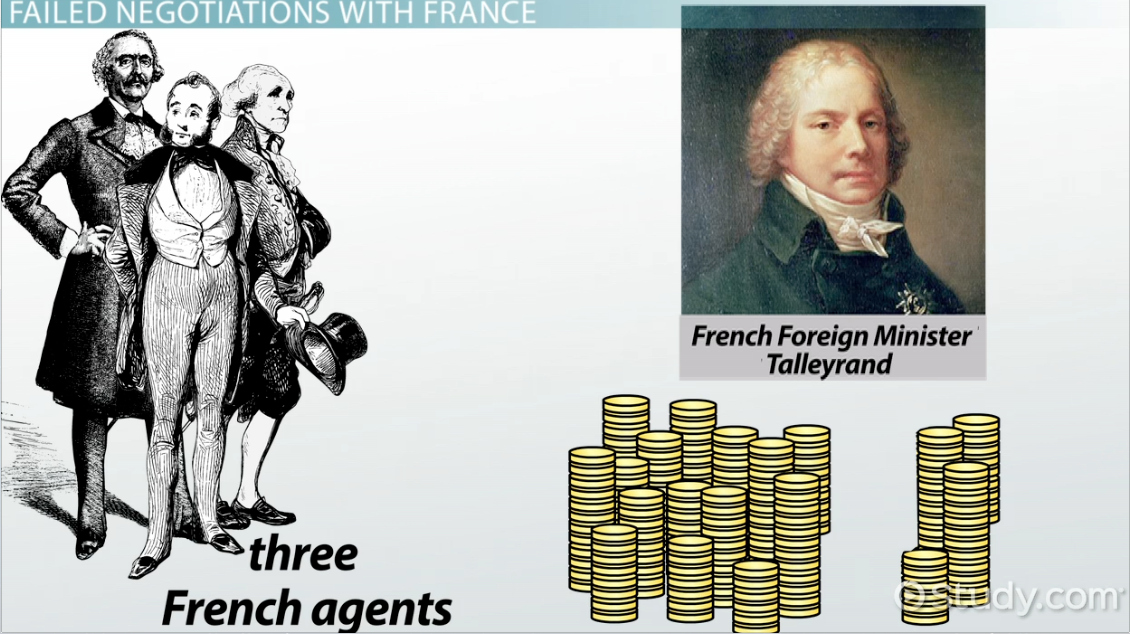
The American commission arrived in Paris in October 1797, requesting a meeting with the French Foreign Minister, Charles Maurice de Talleyrand. Talleyrand, unkindly disposed toward the Adams administration to begin with, demanded a bribe for himself and substantial ‘loan’ to the French Republic, before so much as meeting with the American delegation. The practice was not uncommon in European diplomacy of the time. The Americans were appalled.
Believing that the Adams administration sought war by exaggerating the French position, Jeffersonian allies in Congress joined with more warlike Federalists in demanding the release of the commissioner’s communications. It was these dispatches, released in redacted form, which gave the name “X-Y-Z Affair” to the diplomatic and military crisis to follow.
Nicholas Hubbard, an English banker, was identified in the transcripts, only as “W”. W introduced “X” (Baron Jean-Conrad Hottinguer) as a “man of honor”, who wished an informal meeting with Pinckney. Pinckney agreed and Hottinguer reiterated Talleyrand’s demands, specifying the payment of a large loan to the French government, and a £50,000 bribe to Talleyrand himself. Met with flat refusal by the American commission, X then introduced Pierre Bellamy (“Y”) to the Americans. Lucien Hauteval (“Z”), Talleyrand’s personal emissary, was then sent to negotiate with Elbridge Gerry. X, Y and Z, each in their turn, reiterated the Foreign Minister’s demand for a loan, and a bribe.
American politics were sharply divided over the European war. President Adams and his Federalists, always the believers in strong, central government, took the side of the Monarchists. Thomas Jefferson and his “Democratic-Republicans” found more in common with the ‘liberté, égalité and fraternité’ espoused by French revolutionaries.
In the UK, the ruling class appeared to enjoy the chaos. A British political cartoon of the time depicted the United States, represented by a woman being groped by five Frenchmen while John Bull, the fictional personification of all England, laughs from a nearby hilltop.
At this point, the United States had little means of defending itself. The government had disbanded the Navy along with the Marine Corps at the end of the Revolution, selling the last warship in 1785 and retaining only a handful of “revenue cutters” doing customs enforcement. The Naval Act of 1794 established a standing Navy for the first time in US history. In October 1797, Congress authorized the construction of six frigates. One of them, USS Constitution, saw its first combat in the Quasi-War with France, and remains in service to this day, the oldest commissioned ship in the United States Navy.
Adams’ commission left without entering formal negotiations, their failure leading to a political firestorm in the United States. Congress rescinded all existing treaties with France on July 7, 1798, authorizing American privateers to attack French shipping. The undeclared “Quasi-War” with France, had begun.
Four days later, President John Adams signed “An Act for Establishing and Organizing a Marine Corps,” permanently establishing the United States Marine Corps as an independent service branch, in order to defend the American merchant fleet.
For the United States, military involvement proved decisive. Before military intervention, the conflict with France resulted in 28 Americans killed, 42 wounded, and over 2,000 merchant ships captured. Following intervention, the US suffered 54 killed and 43 wounded, with only a single ship lost, and that one was later recaptured.
The undeclared naval war with our former ally was settled with the Treaty of Mortefontaine, also known as the Convention of 1800, and ratified the following year.
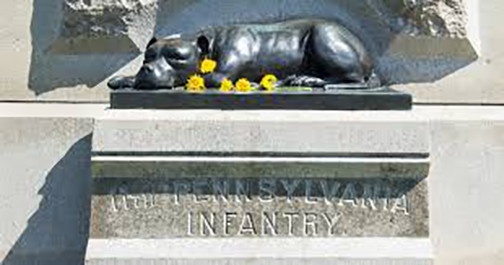
By unanimous consent of the veterans, Sallie’s likeness looks out from the base of the statue, looking out for the spirits of “her boys” for all eternity.
From contemporary descriptions and the only photograph that’s known to exist of her, Sallie was a Staffordshire Bull Terrier, brindle in color. She was four weeks old in 1861, given as a gift to 1st Lieutenant William Terry of the 11th Pennsylvania Volunteer Infantry, who made her the regimental mascot. The men of the regiment were enormously fond of Sallie, as she tagged along on long marches and kept them company in their camps. She learned the drum roll announcing reveille, and loved to help wake sleeping soldiers in the morning.
If you’ve ever had a dog in your life, you know how that goes.
Sallie’s first battle came at Cedar Mountain, in 1862. No one thought of sending her to the rear before things got hot, so she took up her position with the colors, barking ferociously at the adversary. There she remained throughout the entire engagement, as she did at Antietam, Fredericksburg, Chancellorsville, and Spotsylvania. They said she only hated three things: Rebels, Democrats, and Women.
Sallie marched with “her” soldiers in a review in the spring of 1863. Abraham Lincoln was reviewing the army, when he spotted the dog from the center of the reviewing stand, and raised his famous top hat in salute.
At Gettysburg, Sallie was separated from her unit in the chaos of the first day’s fighting. They found her five days later, on July 6, parched with thirst and weakened by hunger. She was standing guard over her dead and dying comrades from July 1.
It’s been said that only a dog is capable of that kind of loyalty, yet virtue in one is capable of inspiring virtue in another. So it was in February, 1865. Sallie was struck in the head by a bullet at Hatcher’s Run. She was killed instantly, when several men of the 11th PA laid down their arms and buried her right then and there, even though they were still under fire from the Confederate side.
There is a story. I don’t know if it’s true, but it’s nice to think that it might be. Soldiers were moving out after the battle, when they heard whining from a hollowed out tree. There they found several of Sallie’s puppies. They’d had no idea she was pregnant, or how puppies came to be in that hollowed out tree, but they gave them to local civilians so that Sallie’s bloodline could live on.
Surviving veterans of the regiment returned to Gettysburg in 1890, to dedicate a memorial to those members of the 11th Pennsylvania who lost their lives on that field of battle. The monument shows an upright Union soldier, rifle at the ready.
By unanimous consent of the veterans themselves, Sallie’s likeness looks out from the base of the statue, looking after the spirits of “her boys”, for all eternity.
There are only two dogs so honored on the battlefield at Gettysburg, the other is part of the Irish Brigade monument. Of the two, Sallie is the only one to have actually participated in the battle.
For all his vaunted brilliance, Muenter seems to have been nuttier than a squirrel turd. His intention as explained to police, was to take Morgan’s wife and children hostage, until the financier cut off loans to Europe. He told police of his intention to assassinate J.P. Morgan, as well. How these two objectives squared with one another, remains unexplained.
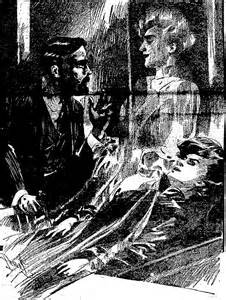
The train left Boston in April, 1906. On board were the infant, the toddler, the nanny, and the children’s father, a German language instructor from Harvard University. The two little girls’ mother was onboard as well. She, and her casket, were going home to Chicago, to be buried in her home town. Leone (Krembs) Muenter had passed from some sort of stomach ailment, ten days after giving birth.
The story may have ended there, but for Dr. Herbert McIntyre. The circumstances of death didn’t seem right, and Dr. McIntyre ordered an autopsy. On April 27, Cambridge police issued a warrant for the arrest of Professor Erich Muenter, in the murder of his wife, by arsenic poisoning.
Apparently, this “man of science” wanted to test his theory that you could see the soul passing, at the moment of death. Now, Erich Muenter vanished.
Nine years later, the United States’ entry into WW1 was still two years in the future.
US policy at this time allowed arms sales to any and all belligerents in the European war. With British dominance of north Atlantic shipping routes, for all intents and purposes this meant France and Great Britain.
German language professor Frank Holt was teaching at Cornell University in 1915. A naturalized citizen and committed German nationalist, Holt had ties with the secret German spy intelligence unit Abteilung IIIb, which was conducting a campaign of sabotage against US ships carrying munitions ‘over there’.
Frank Holt might have described himself as a ‘peace activist’, obsessed with the idea that arms themselves were extending the war. If arms exports were brought to a halt, Holt believed, the war would come to an end.
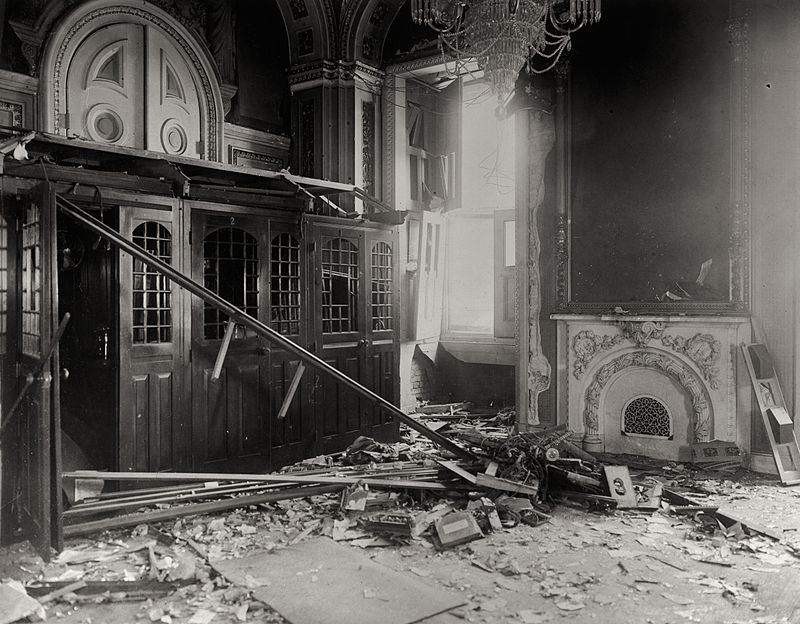
On July 2, Holt gave up arguing the point, and took a train to Washington DC. In his hands he carried a bomb, three sticks of dynamite attached to a timing mechanism, ingeniously designed to go off when the acid ate through its cork stopper. In those days, you were apparently free to stroll about the United States Capitol, with a bomb in your hands. At least when Congress was in recess.
Finding the Senate chamber locked, Holt placed his package under a telephone switchboard in the Senate reception room, with the timer set to go off around midnight.
The explosion was enormous, tearing the room to pieces and blowing a night watchman out of his chair on the other side of the building. Writing to the Washington Star newspaper under the pseudonym R. Pearce, Holt explained his intentions to “make enough noise to be heard above the voices that clamor for war. This explosion is an exclamation point in my appeal for peace.”
Aftermath of the Senate bombing, July 2, 1915
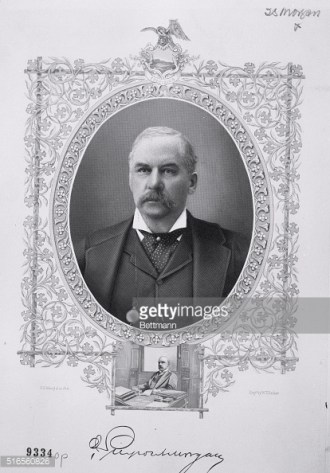
The following day, a tiny little box on the front page of the New York Times, attributed the explosion to ‘gasses’. As the paper was hitting news stands, Frank Holt was headed for Long Island, to the Glen Cove estate of “the Great Pierpont”, J. P. Morgan. Armed with two revolvers, a suitcase full of dynamite and a few anti-war newspaper clippings, Holt bulled his way through the butler who opened the door, and into the Morgan residence.
John Pierpont Morgan
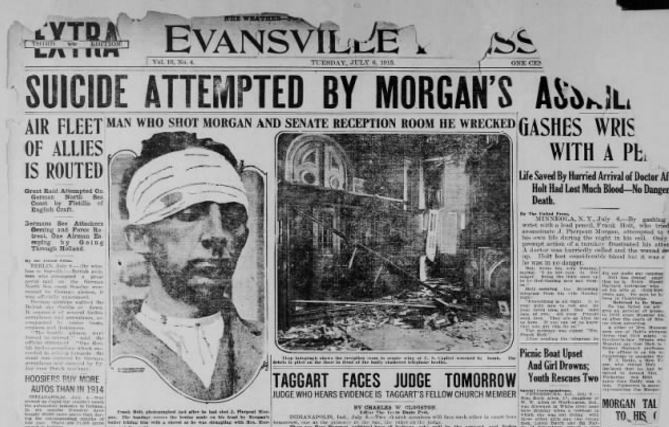
Pandemonium broke out in the home, as Holt turned his weapons on the four Morgan children. Mrs. Morgan tried to block the path to her husband, but the millionaire financier lunged, tackling the much smaller man to the ground. Holt fired twice into Morgan’s thigh and groin, as the pair went down together. Pierpont twisted the gun from his grasp as Mrs. Morgan and a gaggle of household servants struggled for the other. All the while, the butler pounded the would-be assassin’s head with a lump of coal, as Holt shouted “Kill me! Kill me now! I don’t want to live any more. I have been in a perfect hell for the last six months on account of the European war!”
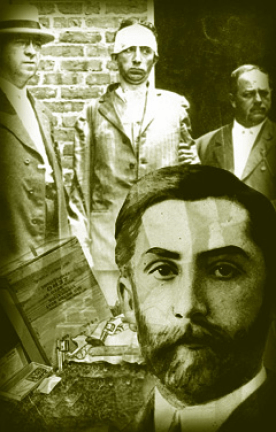
A copy of the R. Pearce letter quickly tied Holt to the Capitol bombing, as former colleagues identified the long-since vanished, accused killer of Leone Muenter. Frank Holt and Erich Muenter were the same man.
A colleague once described Muenter as “a brilliant man, a tireless worker, and a profound student. Night after night he would sit reading, studying and writing while his wife lay asleep in a room nearby.” The Harvard Crimson newspaper described him as ‘harmless on the surface…affect[ing] a scholarly stoop and a Van Dyke, and wore dingy, patched suits”. Fluent in seven languages, he was the pale, bearded model of the junior faculty intellectual, complete with elbow patches.
For all his vaunted brilliance, Muenter seems to have been nuttier than a squirrel turd. His intention as explained to police, was to take Morgan’s wife and children hostage, until the financier cut off loans to Europe. He told police of his intention to assassinate J.P. Morgan, as well. How these two objectives squared with one another, remains unexplained.
That Sunday morning, July 4, the J.P. Morgan shooting seems to have been front page on every newspaper in the world. On July 5, Erich Muenter took the brass ferrule from a pencil eraser, and slit his wrist. That suicide attempt was unsuccessful. The following day, Muenter scaled the bars in his prison and jumped, leaving his brains on the concrete floor, twenty feet below.
The day after his death, Police tracked down a trunk Muenter had left in a New York city storage facility. In it were 134 sticks of dynamite, blasting caps, fuse coils, batteries, nitric acid, windproof matches, mercury fulminate and smokeless explosive powder. Three tin can bombs had been recently completed, and were ready to go. Inspector of Combustibles Owen Egan declared it to be “the greatest equipment for bomb making ever brought to New York”.
That same day, the 2nd Mrs. Muenter received a letter from her dead husband. It said that an arms shipment headed for England would go to the bottom, that very day. Warned by wireless, the crew of SS Minnehaha frantically searched for the bomb, without success. Muenter’s bomb went off and touched off a fire, but it was far away from Minnehaha’s cargo of high explosives, and did little damage to the ship itself.
The Harland & Wolff liner SS Minnehaha was torpedoed and sunk off the Irish coast with the loss of 43, on September 7, 1917.
The letters between Adams and Jefferson together constitute one of the most comprehensive historical and philosophical assessments ever written about the American founding.
Thomas Jefferson met John Adams at the 1775 Continental Congress in Philadelphia, the two forming a close personal friendship which would last for most of their lives. They were two of the committee of five assigned to write the Declaration of Independence, and worked closely together throughout the era of our founding.
The friendship between the two men came to an end during the Presidential election of 1800. Mudslinging on both sides rose to levels never before seen in a national election, an election in which both sides firmly believed the election of the other, would destroy the young nation.
Jefferson defeated one term incumbent Adams and went on to serve two terms as President.
On Jefferson’s retirement in 1809, one of the signers of the Declaration of Independence, Dr. Benjamin Rush, took it upon himself to patch up the broken friendship between the two founding fathers. Dr. Rush worked on his personal diplomatic mission for two years. In 1811, he finally succeeded.
There followed a series of letters between Adams and Jefferson, which together constitute one of the most comprehensive historical and philosophical assessments ever written about the American founding.
Their correspondence touched on a variety of topics, from the birth of this self-governing Republic, to then-current political issues, to matters of philosophy and religion and issues of aging. Both men understood that they were writing not only to one another, but to generations yet unborn.
Each went to great lengths to explain the philosophical underpinnings of his views. Adams the Federalist, the firm believer in strong, centralized government. Jefferson was the Democratic-Republican, advocating for smaller federal government and more autonomy for the states.
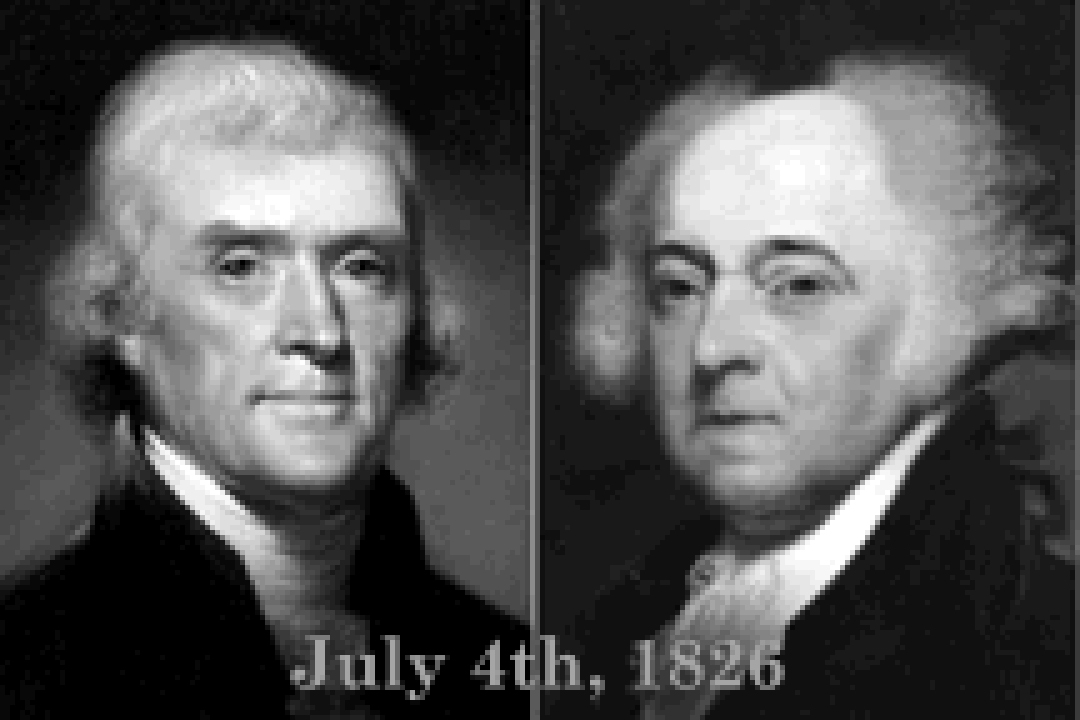
In 1826, Jefferson and Adams were the last of the founding fathers. In an ending no fiction writer would even dare to contemplate, both men died on this day in 1826, fifty years to the day from the birth of the Republic they had helped to create.
Adams was 90. His final words as he lay on his deathbed were “Thomas Jefferson still survives”. Adams had no way of knowing that Jefferson had died five hours earlier, at Monticello. He was 82.
Daniel Webster spoke of the pair a month later, at Faneuil Hall, in Boston. “No two men now live” he said”, (or) any two men have ever lived, in one age, who (have) given a more lasting direction to the current of human thought. No age will come, in which the American Revolution will appear less than it is, one of the greatest events in human history. No age will come, in which it will cease to be seen and felt, on either continent, that a mighty step, a great advance, not only in American affairs, but in human affairs, was made on the 4th of July, 1776″.
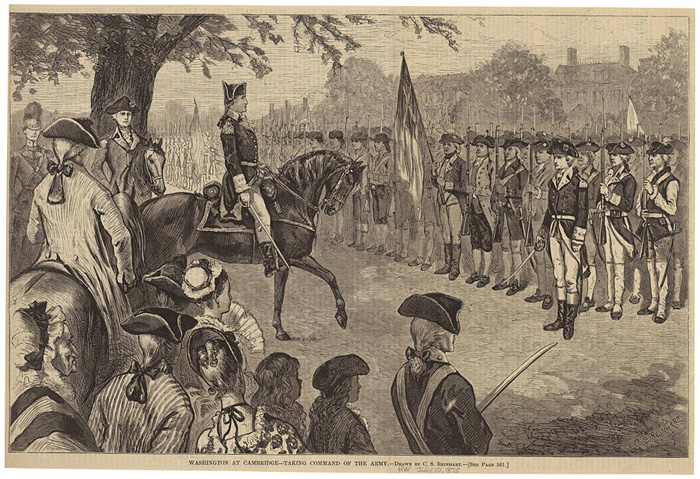
General Washington rode out in front of the troops gathered at Cambridge Common on July 3, 1775. Washington drew his sword under the branches of an ancient elm, by that act formally taking command of the Continental Army.
The American Revolution began with the battles of Lexington and Concord on the 19th of April, 1775. Thousands of armed colonial militia followed the British columns as they withdrew, and there they remained, hemming the British occupiers up in the city of Boston.
Within days, more than 20,000 armed men from all over New England had gathered from Cambridge to Roxbury. Tories’ vacant homes, empty Churches, even the brick buildings of Harvard College served as barracks, officers’ quarters, and hospitals. Soldiers camped in tents and other makeshift shelters, while Harvard canceled classes on May 1. Classes would not resume at the Cambridge campus until June of the following year.
The Continental Congress created the Army on June 14, 1775, appointing George Washington to lead it. General Washington rode out in front of the troops gathered at Cambridge Common on July 3, 1775. Washington drew his sword under the branches of an ancient elm, by that act formally taking command of the Continental Army.
Interestingly, 150 years of de facto independence from Great Britain seems to have suited the American colonist. If inheritance records are any indication, the average American enjoyed a better standard of living, than the average Brit. Average heights of the time bear that out.
The average American colonist had a full three inches on his British counterpart. At a time when the average male stood 5’8′, Washington towered over the crowd at 6’2″. George Washington was a hard man to miss.
For Washington to draw his sword against King George III, was itself an act of magnificent courage. According to British law of the time, one of four definitions of High Treason was “If a man do levy war against our lord the King in his realm”. By drawing that sword against the crown, Washington was clearly committing High Treason. He surely understood that such a prominent person as himself would be dealt with harshly, if caught.
At that time, the centuries-old penalty for High Treason was as savage as it was gruesome. Even now the language of the death sentence is difficult to read. You may consider that to be my warning if you don’t care to read what follows.
The full sentence as read to the condemned was: “That you be drawn on a hurdle (a sledge) to the place of execution where you shall be hanged by the neck and being alive cut down, your privy members shall be cut off and your bowels taken out and burned before you, your head severed from your body and your body divided into four quarters to be disposed of at the King’s pleasure”.
These were the terms of employment under which George Washington accepted his assignment. He even declined to accept payment, beyond reimbursement for his personal expenses.
The 56 signers of the Declaration of Independence would show the same brand of courage, by signing that document a year later. It must have been a supreme in-your-face moment when John Hancock put his pen to that parchment, which ended: “And for the support of this Declaration, with a firm Reliance on the Protection of divine Providence, we mutually pledge to each other our Lives, our Fortunes, and our sacred Honor”.
At the signing, Ben Franklin famously said “We must all hang together, or assuredly we shall all hang separately”. This was no empty philosophical statement they were signing. Should circumstances turn against them, the founding fathers well understood. Each was signing his death warrant.
Resolved, that these United Colonies are, and of right ought to be, free and independent States, that they are absolved from all allegiance to the British Crown, and that all political connection between them and the State of Great Britain is, and ought to be, totally dissolved.
Richard Henry Lee’s resolution was taken almost verbatim from instructions from the Virginia Convention and its President, Edmund Pendleton. As presented to the second Continental Congress on June 7, 1776, Lee’s resolution read:
“Resolved, that these United Colonies are, and of right ought to be, free and independent States, that they are absolved from all allegiance to the British Crown, and that all political connection between them and the State of Great Britain is, and ought to be, totally dissolved. That it is expedient forthwith to take the most effectual measures for forming foreign Alliances. That a plan of confederation be prepared and transmitted to the respective Colonies for their consideration and approbation”.
Several colonies were not yet ready to declare independence at that time.
Representatives agreed to delay the vote until July 1, appointing a “Committee of Five” to draft a declaration of independence from Great Britain. Members of the committee included John Adams of Massachusetts, Benjamin Franklin of Pennsylvania, Roger Sherman of Connecticut, Robert Livingston of New York and Thomas Jefferson of Virginia. The committee selected Jefferson to write the document, the draft presented to Congress for review on June 28.
Debate resumed on July 1, 1776, with most of the delegates favoring Lee’s resolution.
The final vote was taken on July 2, when delegates from 12 of the 13 colonies voted in favor. Delegates from New York abstained, having had no clear instructions from their constituents.
The Pennsylvania Evening Post reported on July 2nd that “This day the Continental Congress declared the United Colonies Free and Independent States”.
The Pennsylvania Gazette followed suit on the third with “Yesterday, the CONTINENTAL CONGRESS declared the UNITED COLONIES FREE and INDEPENDENT STATES”.
John Adams thought that July 2 would go down as the country’s Independence Day.
This day has been mostly forgotten in favor of July 4, when the final edits of Jefferson’s Declaration were adopted, the final document engrossed (handwritten onto parchment), and sent off to the printer.
The 56 signers were never together at the same time. Many of the signatures we see on the Declaration of Independence, would not be affixed to the document until August 2, possibly even later.




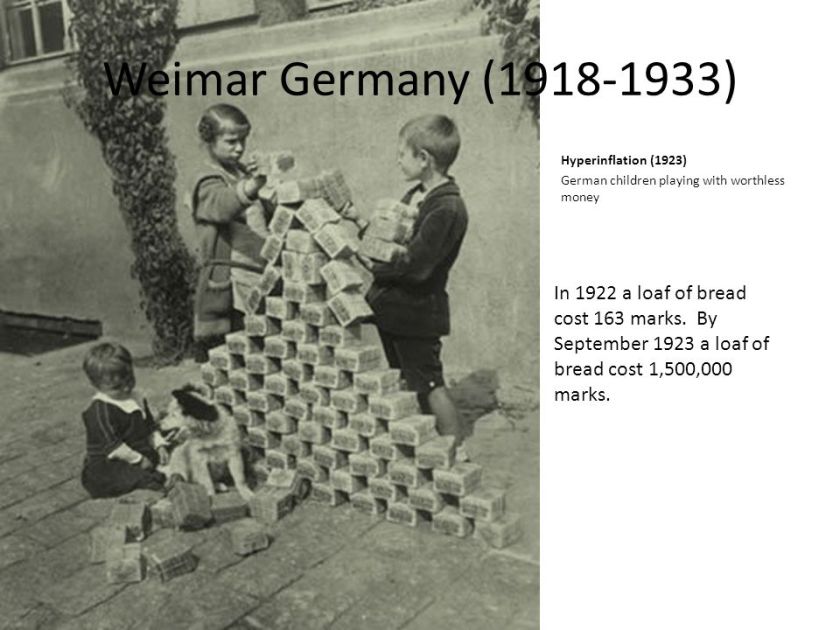
 Hungary replaced the Kronen with the Pengö in 1926, pegged to a rate of 12,500 to one.
 One more currency replacement and all that Keynesian largesse would finally stabilize the currency, but at what cost? Real wages were reduced by 80% and creditors wiped out. The fate of the nation was sealed when communists seized power in 1949. Hungarians could now share in that old Soviet joke: “They pretend to pay us, and we pretend to work”.


 During the landing phase, private Rowell and Chips were pinned down by an Italian machine gun team. The dog broke free from his handler, running across the beach and jumping into the pillbox. Chips attacked the four Italians manning the machine gun, single-handedly forcing their surrender to American troops. The dog sustained a scalp wound and powder burns in the process, demonstrating that they had tried to shoot him during the brawl. In the end, the score was Chips 4, Italians Zero. He helped to capture ten more later that same day.




 Sallie’s first battle came at Cedar Mountain, in 1862. No one thought of sending her to the rear before things got hot, so she took up her position with the colors, barking ferociously at the adversary. There she remained throughout the entire engagement, as she did at Antietam, Fredericksburg, Chancellorsville, and Spotsylvania. They said she only hated three things: Rebels, Democrats, and Women.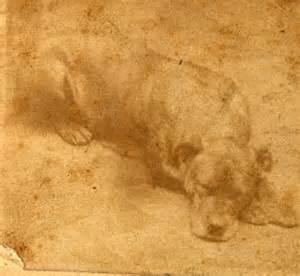

 “Sallie was a lady,
 That Sunday morning, July 4, the J.P. Morgan shooting seems to have been front page on every newspaper in the world. On July 5, Erich Muenter took the brass ferrule from a pencil eraser, and slit his wrist. That suicide attempt was unsuccessful. The following day, Muenter scaled the bars in his prison and jumped, leaving his brains on the concrete floor, twenty feet below.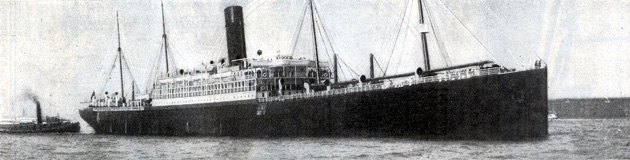





 Representatives agreed to delay the vote until July 1, appointing a “Committee of Five” to draft a declaration of independence from Great Britain. Members of the committee included John Adams of Massachusetts, Benjamin Franklin of Pennsylvania, Roger Sherman of Connecticut, Robert Livingston of New York and Thomas Jefferson of Virginia. The committee selected Jefferson to write the document, the draft presented to Congress for review on June 28.


 Historical Easter Eggs - Today in History
You must be logged in to post a comment.