The 10,000lb, 10’8″ weapon was released at 28,900′. Seconds later, a perfect circle of 64 detonators exploded inside the heart of the bomb, compacting the plutonium core into a supercritical mass and exploding with the force of 20,000 tons of high explosive.
“Now I am become death, the destroyer of worlds“.
Trinity Test Fireball
The line comes from the Bhagavad Gita, the Hindu epic which Mohandas Gandhi described as his “spiritual dictionary”. On July 16, 1945, these words were spoken by J. Robert Oppenheimer, director of the Manhattan Project, as he witnessed “Trinity”, the world’s first nuclear detonation.
The project had begun with a letter from prominent physicists Leo Szilard and Albert Einstein to President Franklin Roosevelt, warning that Nazi Germany may have been working to develop a secret “Super Weapon”. The project ended with the explosion of the “Gadget” in the Jornada del Muerto desert, equaling the explosive force of 20 kilotons of TNT.
The Manhattan Project, the program to develop the Atomic Bomb, was so secret that even Vice President Harry Truman was unaware of its existence.
President Roosevelt passed away on April 14, and Harry Truman was immediately sworn in as President. He was fully briefed on the Manhattan project 10 days later, writing in his diary that night that the US was perfecting an explosive “great enough to destroy the whole world”.
Nazi Germany surrendered on May 7, but the war in the Pacific theater, ground on. By August, Truman faced the most difficult decision ever faced by an American President. Whether to drop an atomic bomb on Imperial Japan.
The morality of President Truman’s decision has been argued ever since. In the end, it was decided that to drop the bomb would end the war faster, with less loss of life on both sides, compared with the invasion of the Japanese home islands.
So it was that the second nuclear detonation in history took place on August 6 over the city of Hiroshima, Japan. “Little Boy”, as the bomb was called, was delivered by the B29 Superfortress “Enola Gay”, named after the mother of United States Army Air Forces pilot Lieutenant Colonel Paul Tibbets. 70,000 Japanese citizens were vaporized in an instant. Another 100,000 later died from injuries and the delayed effects of radiation.
Fat Man
Even then the Japanese Government refused to surrender. ‘Fat Man’, a plutonium bomb carried by the B29 “Bockscar”, was dropped on Nagasaki, on August 9.
The three cities originally considered for this second strike included Kokura, Kyoto and Niigata. Kyoto was withdrawn from consideration due to its religious significance. Niigata was taken out of consideration due to the distance involved.
Kokura was the primary target on this day, but local weather reduced visibility. Bockscar criss-crossed the city for the next 50 minutes, but the bombardier was unable to see well enough to make the drop. Japanese anti-aircraft fire became more intense with every run, and Second Lieutenant Jacob Beser reported activity on the Japanese fighter direction radio bands.
In the end, 393rd Bombardment Squadron Commander Major Charles Sweeney bypassed the city and chose the secondary target, the major shipbuilding center and military port city of Nagasaki.
The 10,000lb, 10’8″ weapon was released at 28,900′. 43 seconds later at an altitude of 1,650′, a perfect circle of 64 detonators exploded inside the heart of the bomb, compacting the plutonium core into a supercritical mass which exploded with the force of 20,000 tons of high explosive.
In the early 1960s, the Nagasaki Prefectural Office put the death count resulting from this day, at 87,000. 70% of the city’s industrial zone was destroyed.
Japan surrendered unconditionally on the 14th of August, ending the most destructive war in history.
Nazi Germany was, in fact, working on a nuclear weapon, and had begun before the allies. They chose to pursue nuclear fusion, colliding atomic particles together to form a new type of nuclear material, instead of fission, the splitting of the atom which resulted in the atomic bomb.
That one critical decision, probably taken in some laboratory or conference room, put Nazi Germany behind in the nuclear arms race. How different would the world be today, had Little Boy and Fat Man had swastikas painted on their sides.
“This is Captain McVay’s dog tag from when he was a cadet at the Naval Academy. As you can see, it has his thumbprint on the back. I carry this as a reminder of my mission in the memory of a man who ended his own life in 1968. I carry this dog tag to remind me that only in the United States can one person make a difference no matter what the age. I carry this dog tag to remind me of the privilege and responsibility that I have to carry forward the torch of honor passed to me by the men of the USS Indianapolis”.
The heavy cruiser USS Indianapolis set out on its secret mission on July 16, 1945, under the command of Captain Charles Butler McVay, III. She was delivering “Little Boy” to the Pacific island of Tinian, the atomic bomb which would later be dropped on Hiroshima.
Indianapolis made her delivery on July 26, arriving at Guam two days later and then heading for Leyte to take part in the planned invasion of Japan. She was expected to arrive on the 31st.
Japanese submarine I-58, Captain Mochitsura Hashimoto commanding, fired a spread of six torpedoes at the cruiser, two striking Indianapolis’ starboard bow at fourteen minutes past midnight on Monday, July 30. The damage was massive. Within 12 minutes she had rolled over, gone straight up by the stern, and sunk beneath the waves.
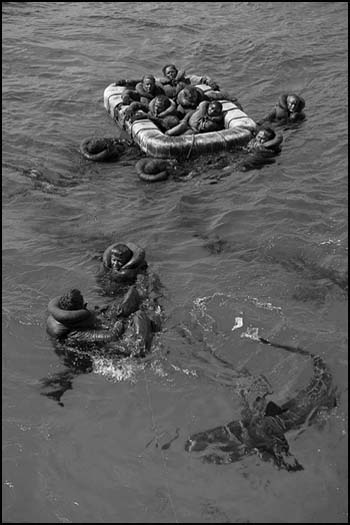
About 300 of Indianapolis’ 1,196-member crew were killed outright, leaving almost 900 treading water. Many had no life jackets and there were few life boats. There had been too little time.
For four days they treaded water, alone in open ocean, hoping for the rescue that did not come. Shark attacks began on the first day, and didn’t let up for the entire time they were in the water. Kapok life vests became waterlogged and sank after 48 hours, becoming worse than useless.
Exhaustion, hypothermia, and severe sunburn took their toll as the days went by. Some went insane and began to attack shipmates. Others found the thirst so unbearable that they drank seawater, setting off a biological chain reaction which killed them in a matter of hours.
Some simply swam away, following some hallucination that only they could see. Through it all, random individuals would suddenly rise up screaming from the ocean, and then disappear from sight, as the sharks claimed another victim.
Caribbean Reef sharks circling the sailors in reenactment scene after USS Indianapolis had been sunk by Japanese submarine. As seen on OCEAN OF FEAR: WORST SHARK ATTACK EVER.
At Naval Command, there was confusion about where Indianapolis was to report when it arrived. When the cruiser failed to arrive on the 31st, there was no report of the non-arrival. Perhaps worst, a message which could have clarified Indianapolis’ expected arrival on Monday came through garbled, and there was no request to repeat it.
As it was, only the barest of chances led to Indianapolis’ survivors being located at all. Lieutenant Wilbur Gwinn, pilot of a Ventura scout-bomber, had lost the weight from a navigational antenna wire. Belly-crawling through the fuselage to fix the thrashing antenna, Gwinn noticed an oil slick. Back in the cockpit, he dropped down to have a better look. Only then did he spot men floating in open ocean.
Lieutenant R. Adrian Marks and his PBY Catalina amphibious patrol aircraft were the first on the scene. Horrified to see sharks actually attacking the men below, Marks landed his flying boat at sea. The last Indianapolis survivor was plucked from the ocean Friday afternoon, half dead after almost five days in the water. Of the 900 or so who survived the sinking, only 317 remained alive at the end of the ordeal.
The Navy had committed multiple errors, from denying McVay’s requested escort to informing him that his route was safe, even when the surface operations officer knew at least two Japanese submarines operated within the area. No Matter. A capital ship had been lost and someone was going to pay. A hastily convened court of inquiry was held in Guam on August 13, leading to Captain McVay’s court-martial.
No less a figure than Fleet Admiral Chester Nimitz (CINCPAC) and Admiral Raymond Spruance, for whom the Indianapolis had served as 5th Fleet flagship, opposed the court-martial, believing McVay to be guilty of an error in judgement at worst, not gross negligence. Naval authorities in Washington saw things differently, particularly Navy Secretary James Forrestal and Chief of Naval Operations Admiral Ernest King.
Captain McVay’s orders were to “zigzag” at discretion, a naval maneuver most effective at avoiding torpedoes already in the water. No Navy directives in effect at that time or since have so much as recommended, let alone ordered, zigzagging at night or in poor visibility.
Prosecutors flew I-58 commander Hashimoto in to testify at the court-martial, but he swore that zigzagging would have made no difference. The Japanese Commander even became part of a later effort to exonerate McVay, but to no avail. Charles Butler McVay III was convicted of “hazarding his ship by failing to zigzag”, his career ruined.
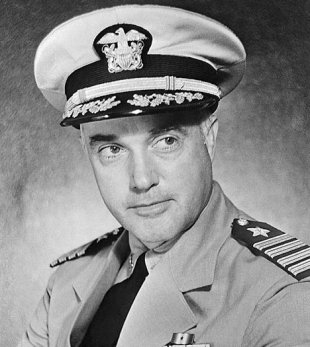
Captain Charles Butler McVay, III
McVay had wide support among Indianapolis’ survivors, but opinion was by no means unanimous. Many family members held him personally responsible for the death of loved ones. Birthdays, anniversaries and holidays would come and go. There was almost always hate mail from some family member. One Christmas missive read “Merry Christmas! Our family’s holiday would be a lot merrier if you hadn’t killed my son”.
As the years went by, McVay began to question himself. In time, he came to feel the weight of the Indianapolis’ dead, a soul crushing burden from which there was no escape. On November 6, 1968, Charles McVay took a seat on his front porch in Litchfield Connecticut, took out his Navy revolver, and killed himself. He was cremated, his ashes scattered at sea.
The ULTRA code-breaking system which revealed I-58’s presence on Indianapolis’ course, would not be declassified until the early 90s.
Afterward:
Hunter Alan Scott was 11 and living in Pensacola when he saw the movie “Jaws”, in 1996. He was fascinated by the movie’s brief mention of Indianapolis’ shark attacks. The next year, he created his 8th grade “National History Day” project on USS Indianapolis’ sinking.
The boy interviewed nearly 150 survivors and reviewed 800 documents. The more he read, the more he became convinced that Captain McVay was innocent of the charges for which he’d been convicted.
Scott’s National History Day project went up to the state finals, only to be rejected because he used the wrong type of notebook to organize the material.
He couldn’t let it end there. Scott began to attend Indianapolis survivors’ reunions, at their invitation, and helped to gain a commitment in 1997 from then-Representative Joe Scarborough that he would introduce a bill in Congress to exonerate McVay the following year.
Senator Bob Smith of New Hampshire joined Scarborough in a joint resolution of Congress. Hunter Scott and several Indianapolis survivors were invited to testify before Senator John Warner and the Senate Armed Services committee on September 14, 1999.
Holding a dog tag in his hand, Scott testified “This is Captain McVay’s dog tag from when he was a cadet at the Naval Academy. As you can see, it has his thumbprint on the back. I carry this as a reminder of my mission in the memory of a man who ended his own life in 1968. I carry this dog tag to remind me that only in the United States can one person make a difference no matter what the age. I carry this dog tag to remind me of the privilege and responsibility that I have to carry forward the torch of honor passed to me by the men of the USS Indianapolis”.
The United States Congress passed a resolution in 2000, signed into law by President Bill Clinton on October 30, exonerating Charles Butler McVay, III of the charges which had led to his court martial, humiliation and suicide.
The record cannot not be expunged – Congress has rules against even considering bills which alter military records. Yet Captain McVay had been exonerated, something that the Indianapolis survivors had tried for years to accomplish, without success. Until the intervention of a 12-year-old boy.
The last word on the whole episode belongs to Captain Hashimoto, who wrote the Senate Armed Services Committee in 1999 on behalf of Captain McVay. “Our peoples have forgiven each other for that terrible war and its consequences“, wrote the former submarine commander, now a Shinto Priest. “Perhaps it is time your peoples forgave Captain McVay for the humiliation of his unjust conviction“.
When Wernher von Braun showed Adolf Hitler the launch of the V2 on color film, Hitler jumped from his seat and shook Braun’s hand with excitement. “This is the decisive weapon of the war. Humanity will never be able to endure it,” Hitler exclaimed. “If I had this weapon in 1939 we would not be at war now.”
V! “Doodlebug”
In the early years of WWII, Nazi Germany fired 10,000 V1″Doodlebug” rockets at England, killing over 6,000 Londoners by 1943. The subsonic V1 was an effective terror weapon, but the “low and slow” trajectory and short range of the weapon lacked the strategic power to end the war in the Nazi’s favor.
The V2 was different. It was the dawn of the ballistic missile era, and Nazi Germany was first off the starting line.
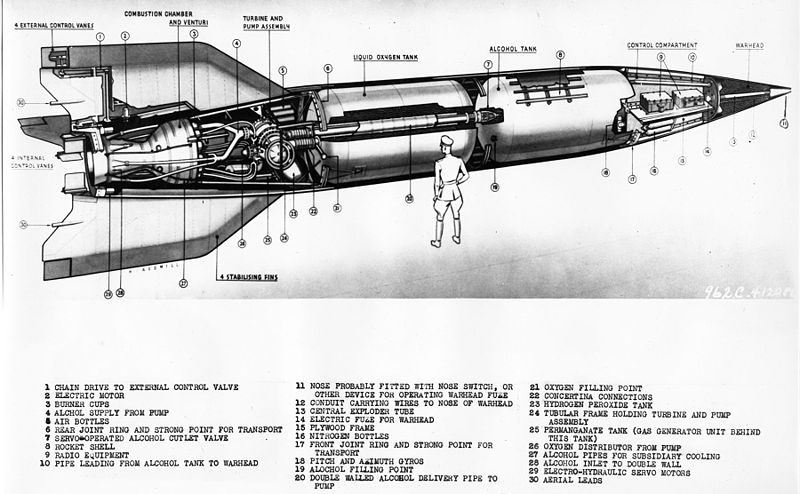
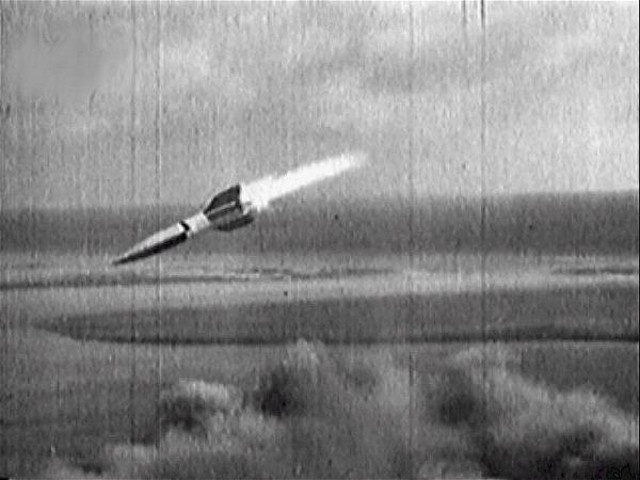
The Peenemünde Aggregat A4 V2 was an early predecessor of the Cruise Missile, delivering a 2,148-pound payload over a 236 mile range at 5 times the speed of sound. You could hear the V1 “Buzz Bomb” coming and seek shelter. Not so the V2. Victims of the V2 didn’t know they were under attack until the weapon had exploded.
When Wernher von Braun showed Adolf Hitler color film of the launch of a V2, Hitler jumped from his seat and shook Braun’s hand with excitement. “This is the decisive weapon of the war. Humanity will never be able to endure it,” Der Fuhrer exclaimed. “If I had this weapon in 1939 we would not be at war now!”
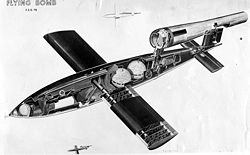
V2 Diagram
About that, Hitler may have been right. The Allies were anxious to get their hands on one. In early 1944, they had their chance. A V2 crashed onto a muddy bank of the River Bug, in Nazi occupied Poland. The Polish underground had been waiting for such a situation, and quickly descended on the rocket, covering it with brush. Desperate to retrieve the missile, the Germans conducted a week-long aerial and ground search, but failed find the weapon under its camouflage.
After the search came to an end, partisans returned to the site. This time they brought four Polish scientists who carefully disassembled the weapon, packing the pieces in barrels. The parts were then shipped to a barn in Holowczyce, just a few miles away.
The allied effort to retrieve the stolen missile, code named “Most III”, got underway on this day in 1944, when Royal New Zealand Air Force 1st Lieutenant Stanley George Culliford landed his Dakota C47 in the early morning darkness, at a secret air strip near Tarnow.
They loaded the rocket chassis and several technical experts on board, but it was too much weight. The overloaded C47 couldn’t move on the wet, muddy field. The port-side wheel was stuck fast in the mud. Everything had to be offloaded, Polish partisans working desperately to free the aircraft as dawn approached. They stuffed the wheel track with straw, and then laid boards in the trench. Nothing worked.
Co-pilot Kazimierz “Paddy” Szrajer thought the parking brake must be stuck, so they cut the hydraulic lines supplying the brake. That didn’t work, either. In the end, partisans were frantically digging trenches under the aircraft’s main wheel. There were two failed attempts to take off. Culliford was considering blowing up the plane and burning all the evidence, but agreed to one last attempt. The aircraft lumbered off the ground on the third try. The headlights of Nazi vehicles could be seen in the darkness as the last of the Polish partisans scattered into the night.
There would be 5 hours of unarmed, unescorted flight over Nazi territory, and an emergency landing with no brakes, before the V2 rocket components finally made it to England.
Today, few remember their names. We are left only to imagine a world in which Nazi Germany remained in sole possession, of the game changing weapons of World War Two.
Fighting between Nazi Germany and the Soviet Union had long since taken on shades of a race war, Slav against Teuton, in a paroxysm of mutual extermination that is horrifying, even by the hellish standards of WWII.
WWII has been rightly described as the deadliest conflict in human history. Yet to the extent that WWII history is taught at all, it is largely based on the Western and Pacific theaters of the war. The “Ostfront” is less well understood, at least in the West: the war as it was fought between the Soviet Union and Germany, on the Eastern theater of the war.
It may have been governments who started the war. It was the every-day “Fritz” and the “Ivan” down the street, who did the fighting and the dying.
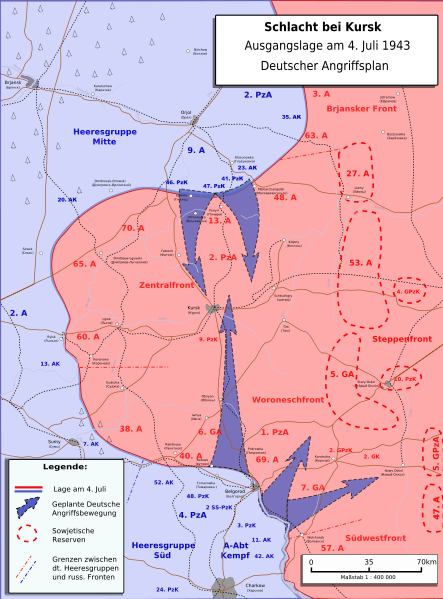
The greatest tank battle in history started this day on the Eastern Front. It began as a “Battle of a Bulge”, six months before the last German offensive began in the snow-covered forests of the Ardennes. The five-months long Battle for Stalingrad had ended with a decisive Soviet victory in February of that year, resulting in a “Bulge”, or salient in the Soviet lines, near the city of Kursk.
The Germans planned to shorten their battle lines by eliminating the Kursk salient, and commenced a series of strategic attacks in March, retaking Kharkov and Belgorod. Offensive operations ceased by the end of March due to the onset of the spring “rasputitsa” (mud season) and the exhaustion of both the Wehrmacht and the Red Army.
Field Marshal Erich von Manstein sent to Germany for massive reinforcements of Panther medium and Tiger heavy tanks, while Soviet forces prepared the “Defense in Depth” strategy which would prove decisive in July.
The Kursk salient was of little or no strategic value to the German war effort. Both Manstein and General Walter Model argued for a tactical defense. Even Heinz Guderian, arguably the father of modern armored tactics, argued against the offensive, but Hitler would not hear of it. Der Fuhrer was going to have his offensive.
“Operation Citadel” started with a series of two offensives beginning on July 5. The Soviet’s defensive preparations began to take their toll almost immediately.
Minefields, fortifications, pre-sighted artillery fire zones and anti-tank strong points extended over 190 miles into the Soviet perimeter. By July 13, the Red Army had regained the offensive. Accounts of the battle vary wildly, with most estimates around 6,000 tanks, 2,000,000 troops, and 4,000 aircraft being involved in the fight.
Estimated losses are difficult to learn, due to the obsessive secrecy of both Nazis and Communists. Sources indicate over a quarter of a million German casualties and four times that number on the Soviet side. 1,083 tanks & assault guns were lost to the German side, over 8 times that number for the Russians.
The battle is considered to be a decisive victory for the Soviet union, representing the final German initiative of the Eastern Front. Though Soviet losses were far higher than those of Germany, the vast resources of the Soviet Union were far better positioned to replace those losses than that of the 3rd Reich.
Fighting between Nazi Germany and the Soviet Union had long since taken on shades of a race war. Slav against Teuton, in a paroxysm of mutual extermination that is horrifying, even by the hellish standards of WWII. The war on the Ostfront, was yet to grind out another year.
Chips attacked the four Italians manning the machine gun, single-handedly forcing their surrender to American troops. The dog sustained a scalp wound and powder burns in the process, indicating that they had tried to shoot him during the brawl. In the end the score was Chips 4, Italians Zero.
The United States Armed Forces had an extensive K-9 program during World War II, when private citizens were asked to donate their dogs to the war effort. One such dog was “Chips”, a German Shepherd/Collie/Husky mix who ended up being the most decorated K-9 of WWII.
Chips belonged to Edward Wren of Pleasantville, NY, who “enlisted” his dog in 1942. He was trained at the War Dog Training Center, Front Royal, Virginia, and served in the 3rd Infantry Division with his handler, Private John Rowell. Chips and his handler took part in North Africa, Italy, France and Germany. He served as a sentry dog for the Roosevelt-Churchill conference in 1943, and the team was part of the Sicily landings later that year.
The Allied invasion of Sicily was a large scale amphibious and airborne operation, beginning this day in 1943 and lasting through the 17th of August. Six weeks of land combat followed, in an operation code named “Operation Husky”.
During the landing phase, private Rowell and Chips were pinned down by an Italian machine gun team. The dog broke free from his handler, running across the beach and jumping into the pillbox. Chips attacked the four Italians manning the machine gun, single-handedly forcing their surrender to American troops. The dog sustained a scalp wound and powder burns in the process, demonstrating that they had tried to shoot him during the brawl. In the end, the score was Chips 4, Italians Zero. He helped to capture ten more later that same day.
Chips was awarded the Distinguished Service Cross, Silver Star, and Purple Heart, but the awards were later revoked. At that time the army didn’t permit commendations to be given to animals. His unit awarded him a Theater Ribbon with an Arrowhead for the assault landing anyway, along with eight Battle stars. One for each of his campaigns.
Chips was discharged in December, 1945, and returned home to live out his days with the Wren family in Pleasantville. Disney made a TV movie based on his life in 1990. They called it “Chips, the War Dog”.
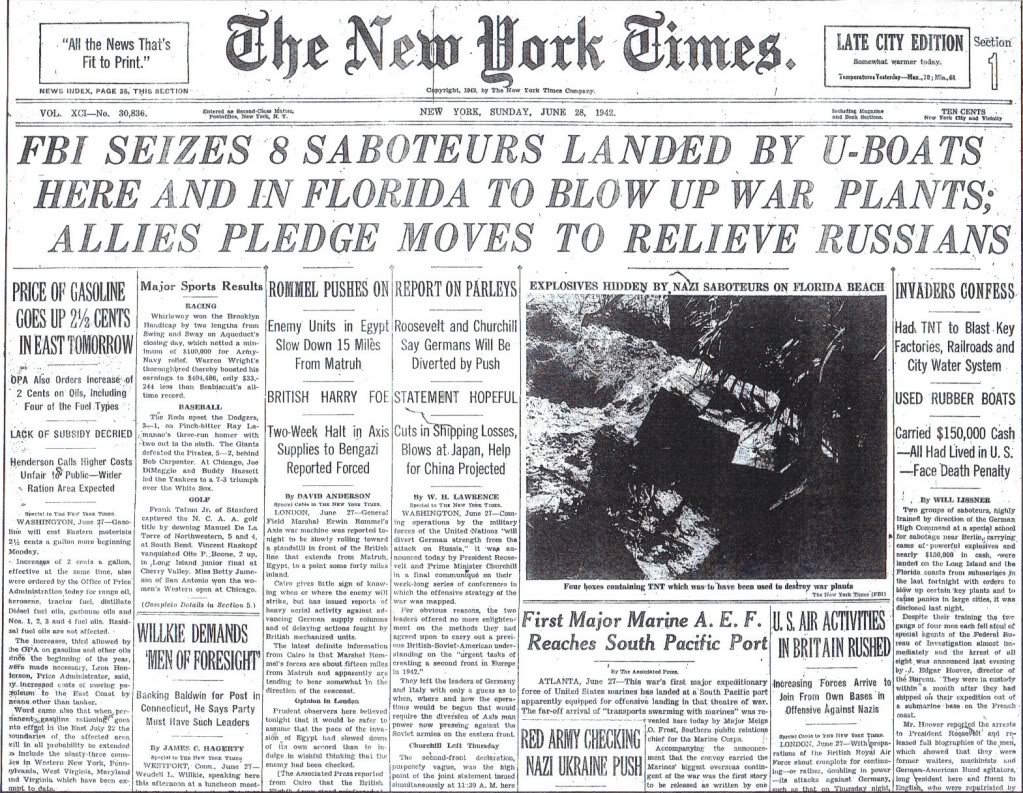
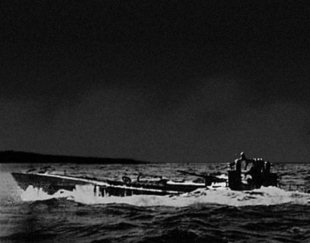
The German submarine U-202 came to the surface in the small hours of June 12 at Amagansett, NY, near Montauk Point. The inflatable that came out of its hatch was rowed to shore at what is today Atlantic Avenue beach, Long Island.
Much has been written about the eight central characters in this story. These individuals have been described in contemporary and subsequent sources alike, as Saboteurs, Nazis and Spies. Certainly to call them such, fed into the political expectations of the day. Yet their country had chosen them for this mission based on unique qualifications, separate and apart from whatever devotion they felt for the fatherland, or to the Nazi party. It may be that these guys deserve every evil name that’s been heaped upon them. Or maybe they were just eight guys who got caught up between two nations at war. It’s an interesting story. You decide.
The German submarine U-202 came to the surface in the small hours of June 12 at Amagansett, New York, near Montauk Point. The inflatable that came out of its hatch was rowed to shore at what is today Atlantic Avenue beach, Long Island. Four figures stepped onto the beach wearing German military uniforms. If they’d been captured at that point, they wanted to be treated as enemy combatants, rather than spies.
Their mission was to sabotage American economic targets and damage defense production. Their targets included hydroelectric plants, train bridges, and factories. They had almost $175,000 in cash, some good liquor, and enough explosives to last them through a two year campaign.
German plans began to unravel as they buried their uniforms and explosives in the sand. 21-year old Coast Guardsman John Cullen was a “sand pounder”. Armed only with a flashlight and a flare gun, Cullen had the unglamorous duty of patrolling the beaches, looking for suspicious activity.
It was “so foggy that I couldn’t see my shoes”, Cullen said, when a solitary figure came out of the dunes. He was George John Davis, he said, a fisherman run ashore. Something seemed wrong and Cullen’s suspicions were heightened, when another figure came out of the darkness. He was shouting something in German, when “Davis” spun around, yelling, “You damn fool! Go back to the others!”
With standing orders to kill anyone who confronted them during the landing, Davis hissed, “Do you have a mother? A father? Well, I wouldn’t want to have to kill you.”
It was Cullen’s lucky day. “Davis'” real name was George John Dasch. He was no Nazi. He’d been a waiter and dishwasher before the war, who’d come to the attention of the German High Command because he’d lived for a time in America. “Forget about this, take this money, and go have a good time” he said, handing over a wad of bills. $260 richer, Cullen sprinted two miles to the Coast guard station.
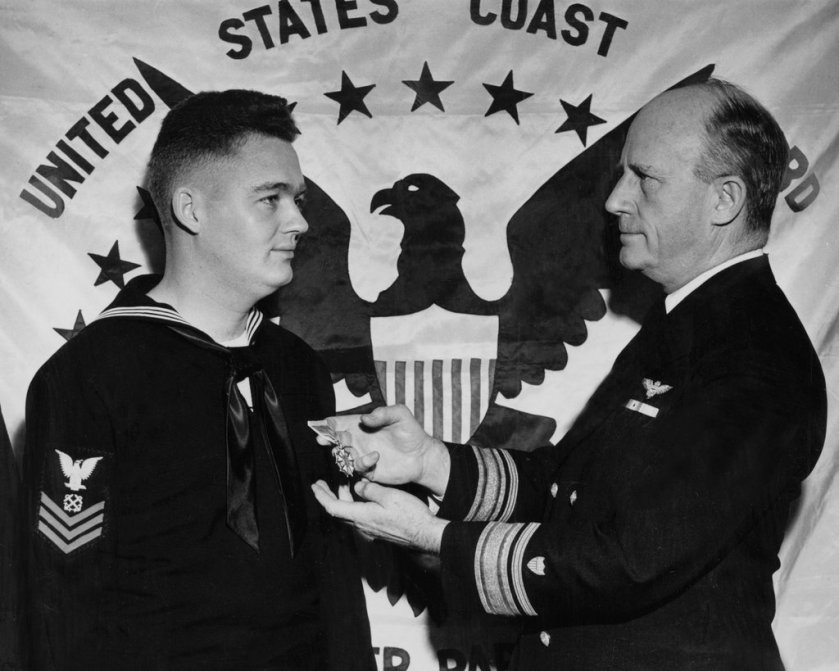
Seaman John Cullen, left, received the Legion of Merit from Rear Adm. Stanley V. Parker for his service in WW2
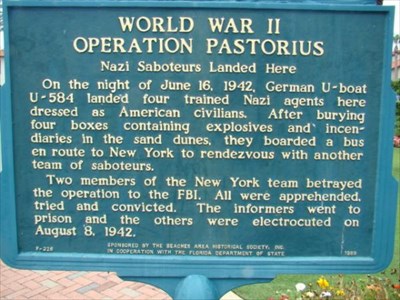
Four days later, U-584 deposited a second team of four at Ponte Vedra Beach, Florida, south of Jacksonville. As with the first, this second group had lived and worked in the United States, and were fluent in English. Two of the eight were US citizens.
George Dasch had a secret. He had no intention of carrying out his mission. He summoned Ernst Peter Burger to an upper-level hotel room. Gesturing toward an open window, Dasch said “You and I are going to have a talk, and if we disagree, only one of us will walk out that door—the other will fly out this window.”
Burger turned out to be a naturalized citizen, who’d spent 17 months in a concentration camp. He hated the Nazis as much as Dasch, and the pair decided to defect.
Dasch tested the waters. Convinced the FBI was infiltrated with Nazi agents, he telephoned the New York field office. Put on hold with the call transferred several times, Dasch was horrified to have the agent who finally listened to him, quietly hang up the phone. Had he reached a German mole? Had the call been traced?
Dasch could not have known, he’d been transferred to the ‘nut desk’. The FBI thought he was a clown.
Finally, Dasch went to the FBI office in Washington DC, where he was treated like a nut job. Until he dumped $84,000 on Assistant Director D.M. Ladd’s desk, equivalent to about a million, today. Dasch was interrogated for hours, and happily gave up everything he knew. Targets, German war production, he spilled it all, even a handkerchief with the names of local contacts, written in invisible ink. He couldn’t have been a very good spy, though. He forgot how to reveal the names.
All eight were in custody within two weeks.
J. Edgar Hoover announced the German plot on June 27, but his version had little resemblance to that of Dasch and Burger. As with the brief he had given President Roosevelt, Hoover praised the magnificent work of FBI detectives, and the Sherlock Holmes-like powers of deduction which led Assistant Director Ladd to the $84,000. Dasch and Burger’s role in the investigation was conveniently left out, as was the fact that the money had basically bounced Ladd off the head.
Neither Dasch nor Burger expected to be thrown in a cell, but agents assured them it was a formality. Meanwhile, a credulous and adoring media speculated on how Hoover’s FBI had done it all. Did America have spies inside the Gestapo? German High Command? Were they seriously that good?
Attorneys for the defense wanted a civilian trial, but President Roosevelt wrote to Attorney General Francis Biddle: “Surely they are as guilty as it is possible to be and it seems to me that the death penalty is almost obligatory”. The case went all the way to the Supreme Court, where the decision “Ex parte Quirin” became precedent for the way unlawful combatants are tried, to this day. All eight would appear before a military tribunal.
It’s unclear whether any of the eight were the menace they were made out to be. German High Command had selected all eight based on a past connection with the United States, ordering them to attack what they may have regarded as their adopted country. Several were arrested in gambling establishments or houses of prostitution. One had resumed a relationship with an old girlfriend, and the pair was planning to marry. Not exactly the behavior patterns of “Nazi saboteurs”.
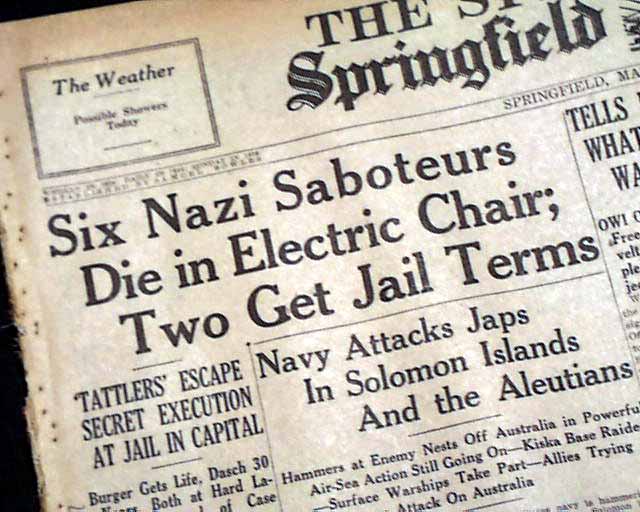
The trial was held before a closed-door military tribunal in the Department of Justice building in Washington, the first such trial since the Civil War. All eight defendants were found guilty and sentenced to death. It was only on reading trial transcripts, that Roosevelt learned the rest of the story. The President commuted Burger’s sentence to life and Dasch’s to 30 years, based on their cooperation with the prosecution. The other six were executed by electric chair on August 8, in alphabetical order.
After the war, Burger and Dasch’s trial transcripts were released to the public, over the strenuous objections of J. Edgar Hoover. In 1948, President Harry S. Truman bowed to political pressure, granting them executive clemency and deporting both to the American zone of occupied Germany. The pair found themselves men without a country, hated as spies in America, and traitors in Germany.
The reader may decide, whether Hoover and Roosevelt operated from base and venal political motives, or whether the pair was playing 4-D chess. Be that as it may, Hitler rebuked Admiral Canaris, and seems to have bought into Hoover’s version of FBI invincibility. There would be no further missions of this type, save for one in November 1944, when two spies were landed on the coast of Maine to gather information on the Manhattan project.
George Dasch campaigned for the rest of his life, to be allowed to return to what he described as his adopted country. Ernst Burger died in Germany in 1975, Dasch in 1992. The pardon Hoover promised both men a half-century earlier, never materialized
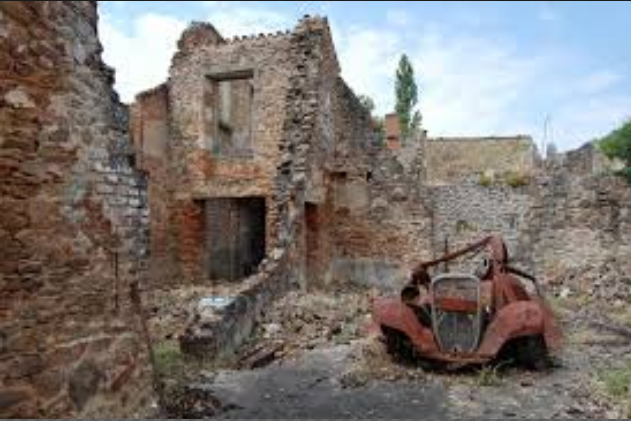
The women and children were locked in a village church while the German soldiers looted the town. The men were taken to a nearby barn, where the machine guns had already been set up.
It was D+4 in the invasion of Normandy, and the 2nd SS Panzer Division (“Das Reich”) had been ordered to stop the Allied advance. They were passing through the Limousin region in west central France, when SS-Sturmbannführer Adolf Diekmann received word that Waffen-SS officer Helmut Kämpfe was being held by French Resistance forces in the village of Oradour-sur-Vayres.
Diekmann’s battalion sealed off the nearby village of Oradour-sur-Glane, unaware that they had confused it with the other village. Everyone in the town was ordered to assemble in the village square to have their identity papers examined. The entire population of the village was there, plus another 6 unfortunates who were riding their bicycles in the wrong place, at the wrong time.
The women and children were locked in a village church while German soldiers looted the town. The men were taken to a nearby barn, where machine guns had already been set up.
The Germans aimed for the legs when they opened fire, intending to inflict as much pain as possible. Five escaped in the confusion before the SS lit the barn on fire. 190 men were burned alive.
Nazi soldiers then lit an incendiary device in the church, and gunned down 247 women and 205 children as they tried to get out.
642 inhabitants of Oradour-sur-Glane, age one week to 90 years, were murdered in a few hours, the village razed to the ground. After the war, French President Charles de Gaulle ordered that the village remain as is; a memorial to the cruelty of collective punishment, and the savagery committed by the Waffen-SS in countless places: the French towns of Tulle, Ascq, Maillé, Robert-Espagne, and Clermont-en-Argonne; the Polish villages Michniów, Wanaty and Krasowo-Częstki, Warsaw; the Soviet village of Kortelisy; the Lithuanian village of Pirčiupiai; the Czechoslovakian villages of Ležáky and Lidice; the Greek towns of Kalavryta and Distomo; the Dutch town of Putten; the Yugoslavian towns of Kragujevac and Kraljevo, and the village of Dražgoše, in what is now Slovenia; the Norwegian village of Telavåg; the Italian villages of Sant’Anna di Stazzema and Marzabotto. And on, and on, and on.
French President Jacques Chirac dedicated a memorial museum in 1999, the “Centre de la mémoire d’Oradour”. The village stands today as the Nazis left it, 73 years ago today. It may be the most forlorn place on earth.
The story was featured in the 1974 British television series “The World at War”, narrated by Sir Laurence Olivier. The first and final episodes of the program began with these words: “Down this road, on a summer day in 1944. . . The soldiers came. Nobody lives here now. They stayed only a few hours. When they had gone, the community which had lived for a thousand years. . . was dead. This is Oradour-sur-Glane, in France. The day the soldiers came, the people were gathered together. The men were taken to garages and barns, the women and children were led down this road . . . and they were driven. . . into this church. Here, they heard the firing as their men were shot. Then. . . they were killed too. A few weeks later, many of those who had done the killing were themselves dead, in battle. They never rebuilt Oradour. Its ruins are a memorial. Its martyrdom stands for thousands upon thousands of other martyrdoms in Poland, in Russia, in Burma, in China, in a World at War”.
The amphibious invasion which began this day on the beaches of Normandy, was the culmination of the largest single endeavor in human history.
The amphibious invasion which began this day on the beaches of Normandy, was the culmination of the largest single endeavor in human history.
3,200 reconnaissance missions were launched leading up to the invasion, to photograph vital locations. Other landing sites were considered, in fact Adolf Hitler expected the invasion to take place at Calais. Normandy was chosen because defenses were lighter, and because advancing troops would have fewer rivers and canals to cross.
“Exercise Tiger”, an earlier practice landing on the beaches of Slapton, killed more Americans than many full-scale battles.
Five landing zones were selected along a 50-mile stretch of beach. Americans would attack at two points code named Utah and Omaha, British troops at Gold and Sword, and Canadian troops at Juno.
On the eve of the invasion Eisenhower told his troops: “You are about to embark upon a great crusade, toward which we have striven these many months. The eyes of the world are upon you.” Conscious of his own role in the disastrous landings at Gallipoli of the earlier war, a nervous Winston Churchill said to his wife, Clementine, “Do you realize that by the time you wake up in the morning 20,000 men may have been killed?”
The invasion began in the early morning hours with 1,200 planes delivering gliders and parachute troops of the 82nd and 101st Airborne Infantry. Eight different navies made up the invasion fleet, the sun rising that morning on 6,939 vessels along the coast of France.
160,000 US, UK, Canadian and Free French troops landed on the first day. Later invasion phases included forces from Australia, Greece, New Zealand, Netherlands and Norway, combined with the free forces of Nazi occupied Poland, Belgium and Czechoslovakia.
There were the “Mulberries”, the great steel structures built to form temporary harbors for landing vehicles and equipment, and floated across the 25 miles of the English Channel. By July 4, over a million men, 148,000 vehicles, and 570,000 tons of supplies had passed over them to the beaches.
It was impossible to assemble the pieces of such a massive undertaking in secret, so an elaborate ruse called “Operation Fortitude” was launched to divert attention from the real objective. Fake field armies were assembled in Edinburgh, Scotland and the south coast of England, threatening attack on the coasts of Norway and the Pas de Calais. The real General George S. Patton was put in charge of the fake First US Army Group (FUSAG). The allied “Twenty Committee”, represented by its roman numerals “XX”, controlled a network of double agents, making the deception so complete that Hitler personally withheld critical reinforcements until long after they would have made a difference. It’s where we get the term “Double Cross”.
What had seemed like an inexorable Nazi tide had begun to slow with the reversal of the German armies in Soviet Russia and North Africa. The allies had gained their first European toehold with a successful landing in Italy nine months earlier. It had been 5 years since the beginning of World War II, 4 years almost to the day, since the National Socialist regime of Adolf Hitler had hurled the English and French armies from the beaches of Dunkirk. The Soviet Union had joined the side of the Allies 3 years earlier, and the United States 2½. The entire European subcontinent was either neutral or under Nazi domination. The Allies needed to break down the door to get back in.
Supreme Headquarters Allied Expeditionary Force (SHAEF) commander Dwight D Eisenhower had planned to launch the invasion on the 5th, but the weather was working against it. The invasion couldn’t be held for long, it had to be launched or turned back.
Allied troop convoys were at sea on the 4th, and the full moon which would bring high tides would soon be over. There was finally a break in the forecast, and the invasion began shortly after midnight.
Eisenhower had written two letters. Only one would be delivered to his superior in Washington, DC, Army Chief of Staff, General George C. Marshall. The first announced the success of the invasion, the second taking personal responsibility for its failure. “Our landings in the Cherbourg-Havre area have failed to gain a satisfactory foothold and I have withdrawn the troops. My decision to attack at this time and place was based upon the best information available. The troops, the air and the Navy did all that bravery and devotion to duty could do. If any blame or fault attaches to the attempt it is mine alone.” Eisenhower dated the letter July 5 instead of June 5, a small indication of the enormous pressure the man was under.
Eisenhower labeled this backup letter “In case the Nazis won.”
Over 9,000 Allied soldiers were killed or wounded on that first day. Almost a year of hard fighting remained before VE Day: Victory in Europe. On this day, General Eisenhower would be able to keep that second message, in his pocket.
9,387 Americans are buried at the American cemetery at Omaha Beach 3 Medal of Honor recipients, Brig. Gen. Theodore Roosevelt, Jr., his brother Quentin who was killed in WWI, Army Air Corps crews shot down over France as early as 1942 and two of the Niland brothers, on whom the film Saving Private Ryan is based.
All told, Irena Sendler saved about 2,400 Jewish children and infants and about 100 teenagers, who went into the forests to join partisan bands fighting the Nazis. The far better known Oskar Schindler is credited with saving less than half that number.
Dr. Stanisław & Janina Krzyżanowski
Dr. Stanislaw Krzyżanowski was a physician treating mostly the poorer Jewish families in the central Polish town of Otwock, 14 miles southeast of Warsaw. He had once said to his only daughter Irena: “If you see someone drowning, you must save them.” “But, what if I can’t swim?” she asked. “Nevertheless, you must try”.
Overwhelmed by the typhus epidemic of 1917, Dr. Krzyżanowski contracted the disease himself and died that February, but his example guided his daughter for the rest of her life. Jewish community leaders showed their gratitude by offering to pay for Irena’s education, but her mother declined.
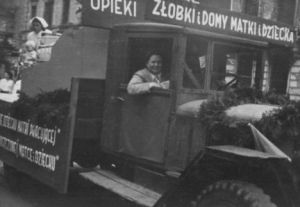
Irena (Krzyżanowski) Sendler was a nurse living outside Warsaw, when Nazi Germany invaded Poland in 1939. The Nazis gathered up every Jew they could find in 1940, penning 400,000 or more up in the city. Soon, the Warsaw ghetto became the scene of suffering, disease and starvation. Knowing the Nazis feared nothing so much as Typhus, Sendler took advantage of their fears and obtained permission to begin work in the ghetto.
“Irena in a social welfare department truck in May 1948” H/T U.K. Daily Mail
She would travel there daily, and soon started to smuggle Jewish babies out in the bottom of a medical bag. She’d place soiled bandages around and over sedated babies, to keep guards from looking too closely. She carried a burlap sack in the back of her truck. Sometimes she’d use that or even a coffin to smuggle larger children and even teenagers out of the ghetto, other times leading them out through cellars or sewers.
Sendler traveled with a small a dog she had trained to bark at Nazi soldiers letting her in and out of the gates. They wanted nothing to do with her small, yappy dog, and the barking would cover any sounds that the babies might make.
She would make as many as three runs a day, taking out as many as 6 children. Most of them were already orphans by this time, their parents murdered by the Nazi regime. Many times, parents gave up their children in order to save them.
Irena coded the names of these children onto two slips of paper, including false and real names. These she buried in glass jars under a tree in the yard of a friend. She obtained false papers for each of the kids, passing them along to nunneries, monasteries and to foster parents.
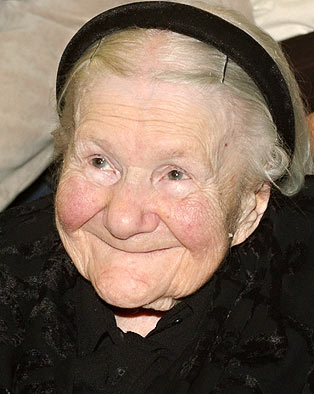
‘Angel of the Warsaw Ghetto”, Irena Sendler
Elzbieta Ficowska was smuggled out in a carpenter’s toolbox at the age of six months. ‘When I was 17″, she said, “a friend said she’d heard I was Jewish. At that point, my Polish mum told me the truth, giving me a silver spoon engraved with my name and birth date, which my blood family had placed in the box with me. Elzbieta later learned that her family wept on hearing she was to be baptized, but later signaled their understanding by sending a christening gown and tiny gold cross. “I consider both my Polish mum and Irena to be a little pathological. It is a kind of insanity to overcome such fear. They were so alike, my mum and Irena – fantastic, strong women”.
Anna Mieszkowska, the author of Sendler’s Polish biography, tells a story. ‘Irena told me not to put this story in the book. She was asked to save two children, a boy and a girl. The parents wanted them to go but the grandparents did not. Irena arrived at their address and found the whole family had committed suicide – grandparents, parents, children. She had nightmares about this for many years.’
Sendler was caught by the Gestapo in 1943, betrayed by a colleague under torture, and by a nosy landlady. Nazi interrogators beat her savagely, but she never gave up any of those names.
Irena lasted 100 days in Pawiak prison, a place where average inmate survival was less than a month. Finally she was returned to the Gestapo and stood against a wall for execution, too broken to care. An SS guard said “not you” and shoved her out into the street. He’d been bribed by her friends, and was himself later caught and executed. For now she was “officially” dead, which made it easier to escape detection for the remainder of the war.
After the war, Irena tried to reunite parents or surviving family members with the children she’d rescued. She was rarely successful.
All told, Irena Sendler saved about 2,400 Jewish children and infants and about 100 teenagers, who went into the forests to join partisan bands fighting the Nazis. The far better known Oskar Schindler is credited with saving less than half that number.
Today, Elzbieta Ficowska tries to keep her Jewish roots, but they seem foreign to her. ‘When I enter a Catholic church, everything is mine. Sometimes I look in the mirror for traces of my real parents. I sent letters all around the world to try to find out about them.’ She has never seen so much as a photograph.
The Polish Government honored Irena Sendler with the Order of the White Eagle, its highest award. The Yad Vashem Remembrance Center in Jerusalem honored her as a “Righteous Gentile” in 1965. She received honorary citizenship in Israel in 1985, and the Polish and Israeli Governments nominated her for the Nobel Peace Prize in 2007.
The Nobel Prize for Peace was awarded on October 12 in Oslo, Norway, to the Intergovernmental Panel on Climate Change (IPCC) and Albert Arnold Gore Jr. “for their efforts to build up and disseminate greater knowledge about man-made climate change, and to lay the foundations for the measures that are needed to counteract such change”.
Irena Sendler passed away on May 12, 2008 at the age of 98. This choice of 2007 Nobel prize recipients has been controversial, since Nobel by-laws prohibit posthumous award of the prize. Many felt that Sendler had more than earned it. Some have claimed that Nobel committee rules require qualifying work to have taken place within the two years immediately preceding nomination, but I think they’re making it up. I’ve read the Nobel statutes. You can do so yourself, HERE, if you’re so inclined I find no such requirement. Let me know if I missed it, the whole thing seems political, to me.
Irena Sendler always said that she wasn’t a hero, she only did what any normal person would do. I find in the story of this petite Polish nurse, some of the most magnificent courage of which our species is capable. If that does not make her a hero, I don’t know what would.


 Indianapolis made her delivery on July 26, arriving at Guam two days later and then heading for Leyte to take part in the planned invasion of Japan. She was expected to arrive on the 31st.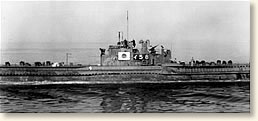



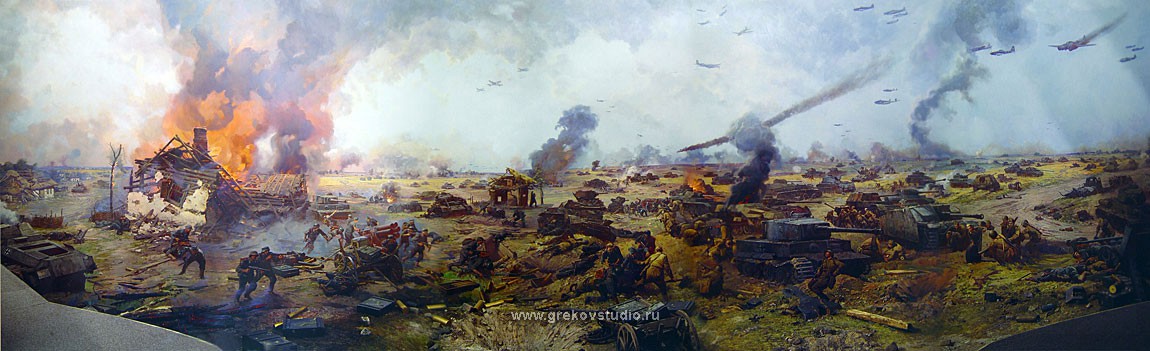
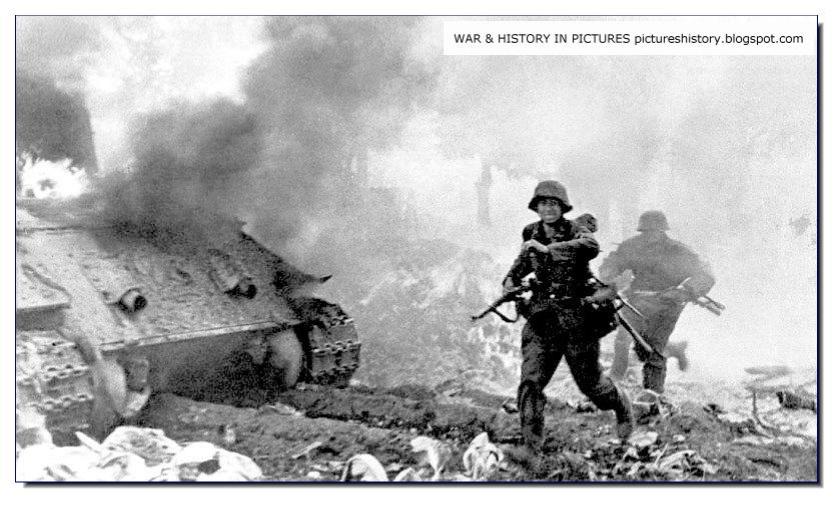
 The Kursk salient was of little or no strategic value to the German war effort. Both Manstein and General Walter Model argued for a tactical defense. Even Heinz Guderian, arguably the father of modern armored tactics, argued against the offensive, but Hitler would not hear of it. Der Fuhrer was going to have his offensive.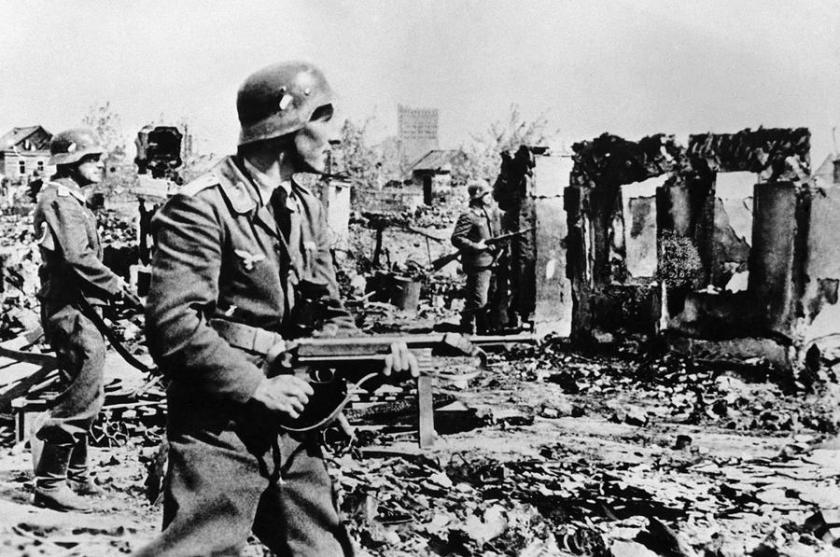


 During the landing phase, private Rowell and Chips were pinned down by an Italian machine gun team. The dog broke free from his handler, running across the beach and jumping into the pillbox. Chips attacked the four Italians manning the machine gun, single-handedly forcing their surrender to American troops. The dog sustained a scalp wound and powder burns in the process, demonstrating that they had tried to shoot him during the brawl. In the end, the score was Chips 4, Italians Zero. He helped to capture ten more later that same day.


 It was D+4 in the invasion of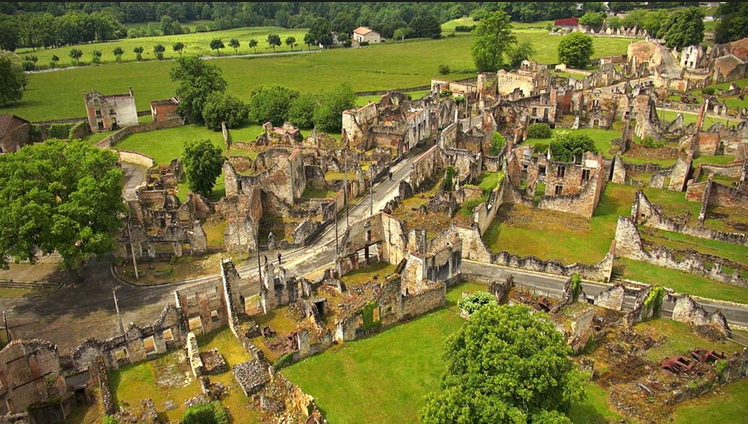


 It was impossible to assemble the pieces of such a massive undertaking in secret, so an elaborate ruse called “Operation Fortitude” was launched to divert attention from the real objective. Fake field armies were assembled in Edinburgh, Scotland and the south coast of England, threatening attack on the coasts of Norway and the Pas de Calais. The real General George S. Patton was put in charge of the fake First US Army Group (FUSAG). The allied “Twenty Committee”, represented by its roman numerals “XX”, controlled a network of double agents, making the deception so complete that Hitler personally withheld critical reinforcements until long after they would have made a difference. It’s where we get the term “Double Cross”.



 The Nobel Prize for Peace was awarded on October 12 in Oslo, Norway, to the Intergovernmental Panel on Climate Change (IPCC) and Albert Arnold Gore Jr. “for their efforts to build up and disseminate greater knowledge about man-made climate change, and to lay the foundations for the measures that are needed to counteract such change”.
 Historical Easter Eggs - Today in History
You must be logged in to post a comment.