

In 1915, Albert Marr lived with his family and his Chacma baboon, Jackie, on Cheshire Farm, on the outskirts of Pretoria, South Africa. The Great War had begun a year earlier, when Marr was sworn into the 3rd (Transvaal) Regiment of the 1st South African Infantry Brigade, in August of that year. He was now Private Albert Marr, #4927.
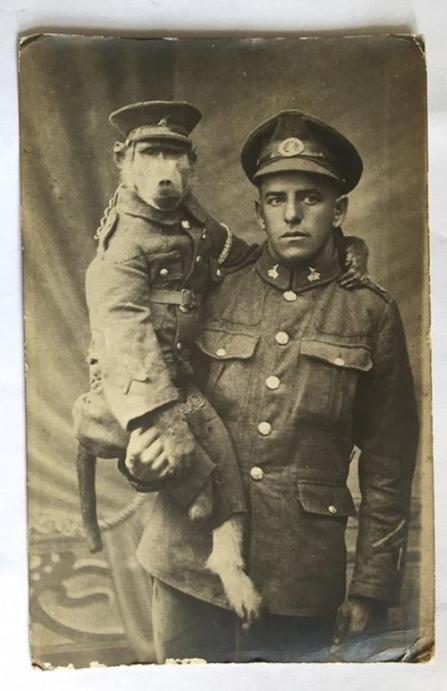 Private Marr asked for and received permission to bring Jackie along with him. It wasn’t long before the monkey became the official Regimental Mascot.
Jackie drew rations like any other soldier, eating at the mess table, using his knife and fork and washing it all down with his own drinking basin.
He drilled and marched with his company in a special uniform and cap, complete with buttons, regimental badges, and a hole for his tail.
Jackie entertained the men during quiet periods, lighting their pipes and cigarettes and saluting officers as they passed on their rounds. He learned to stand at ease when ordered, placing his feet apart and hands behind his back, regimental style.
These two inseparable buddies, Albert Marr and Jackie, first saw combat during the Senussi Campaign in North Africa. Albert took a bullet in the shoulder at the Battle of Agagia on February 26, 1916, while the monkey, beside himself with agitation, licked the wound and did everything he could to comfort the stricken man. It was this incident more than any other that marked Jackie’s transformation from pet and mascot, to a comrade to the men of the regiment.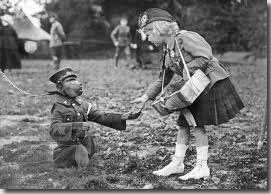
Jackie would accompany Albert at night when he was on guard duty. Marr soon learned to trust Jackie’s keen eyesight and acute hearing. The monkey was almost always first to know about enemy movements or impending attack. He would give early warning with a series of sharp barks, or by pulling on Marr’s tunic.
The pair went through the nightmare of Delville Wood together, early in the Somme campaign, when the First South African Infantry held their position despite 80% casualties. The pair experienced the nightmare of mud that was Passchendaele, and the desperate fighting at Kemmel Hill. The two were at Belleau Wood, a primarily American operation, where Marine Captain Lloyd Williams of the 2nd Battalion, 5th Marines, was informed that he was surrounded by Germans. “Retreat?” Williams retorted, “hell, we just got here.”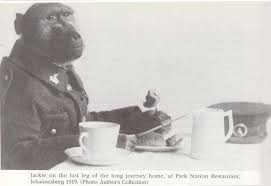
Throughout all of it, Albert Marr and Jackie had come through WWI mostly unscathed. That all changed in April, 1918.
The South African Brigade was being heavily shelled as it withdrew through the West Flanders region of Belgium. Jackie was frantically trying to build a wall of stones around himself, a shelter from flying shrapnel, while shells were bursting all around. A jagged piece of shrapnel wounded Jackie in the arm and another all but amputated the animal’s leg. He refused to be carried off by the stretcher-bearers, trying instead to finish his wall, hobbling around on what had once been his leg.
Lt. Colonel R. N. Woodsend of the Royal Medical Corps described the scene: “It was a pathetic sight; the little fellow, carried by his keeper, lay moaning in pain, the man crying his eyes out in sympathy, ‘You must do something for him, he saved my life in Egypt. He nursed me through dysentery’. The baboon was badly wounded, the left leg hanging with shreds of muscle, another jagged wound in the right arm. We decided to give the patient chloroform and dress his wounds…It was a simple matter to amputate the leg with scissors and I cleaned the wounds and dressed them as well as I could. He came around as quickly as he went under. The problem then was what to do with him. This was soon settled by his keeper: ‘He is on army strength’. So, duly labelled, number, name, ATS injection, nature of injuries, etc. he was taken to the road and sent by a passing ambulance to the Casualty Clearing Station”.
As the war drew to a close, Jackie was promoted to the rank of Corporal, and given a medal for bravery. Possibly the only monkey in history, ever to be so honored.
On his arm he wore a gold wound stripe, and three blue service chevrons, one for each of his three years’ front line service.
After the pair arrived home, Jackie became the center of attention at a parade officially welcoming the 1st South African Regiment home.
On July 31, 1920, Jackie received the Pretoria Citizen’s Service Medal, at the Peace Parade in Church Square, Pretoria.
Jackie died as the result of a fire, which destroyed the Marr family farmhouse in May 1921. Albert Marr passed away in 1973, at the age of 84. Marr had missed his battle buddy Jackie, for all the days in-between.


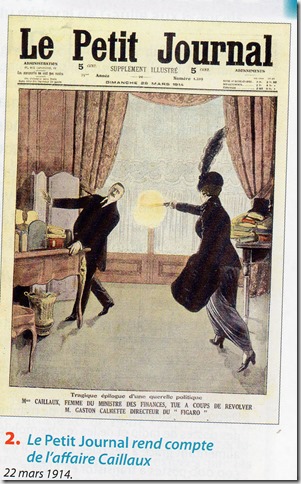 On March 16, 1914, the now-second Mrs Caillaux took a taxi to the offices of Le Figaro. She waited for a full hour to see the newspaper’s editor, before walking into his office and shooting him at his desk. Four out of six rounds hit their mark. Gaston Calmette would be dead before the night was through.




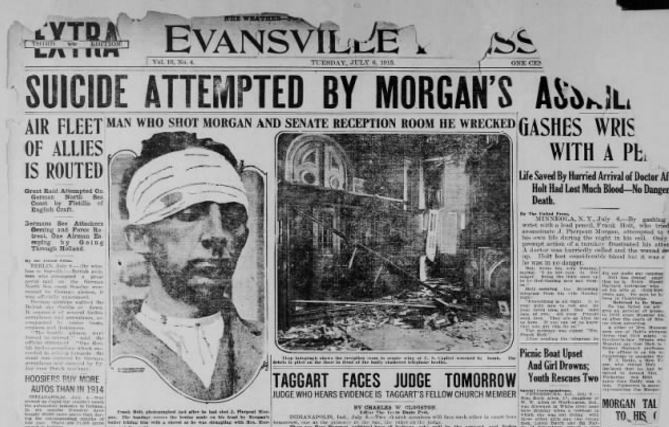
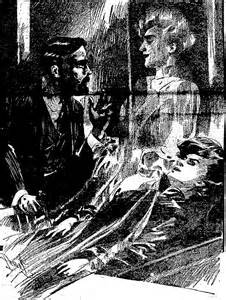
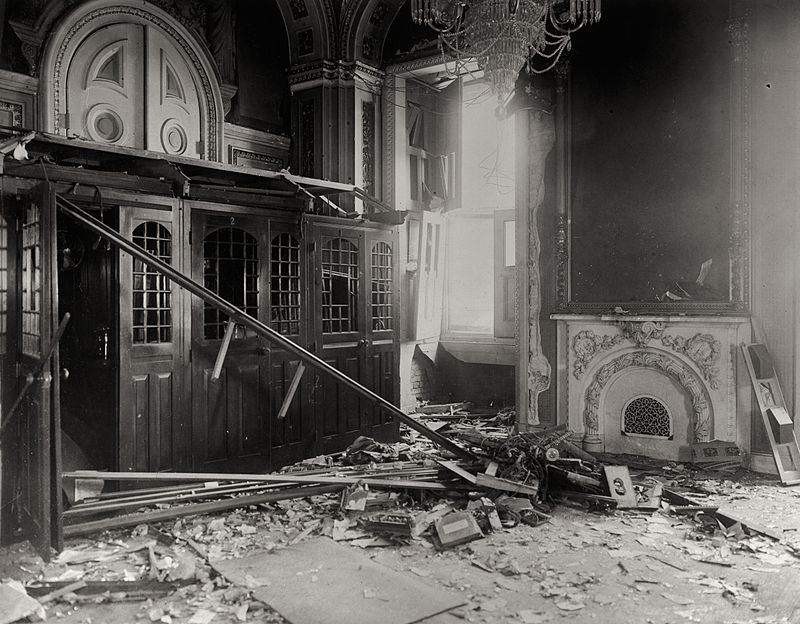
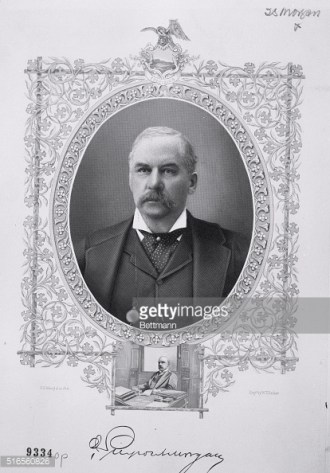
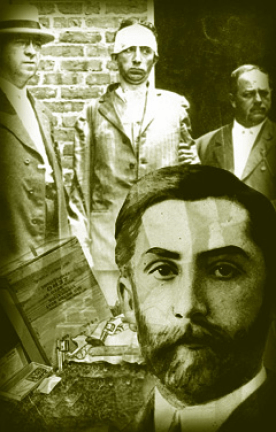 That Sunday morning, July 4, the J.P. Morgan shooting seems to have been front page on every newspaper in the world. On July 5, Erich Muenter took the brass ferrule from a pencil eraser, and slit his wrist. That suicide attempt was unsuccessful. The following day, Muenter scaled the bars in his prison and jumped, leaving his brains on the concrete floor, twenty feet below.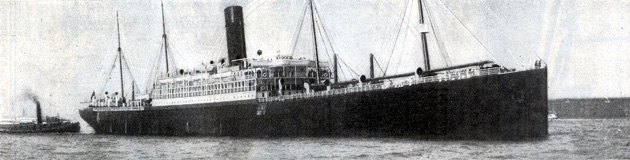


 Often unseen in times of such calamity, are the humanitarian workers. Those who tend to the physical and spiritual requirements, the countless small comforts, of those in need.


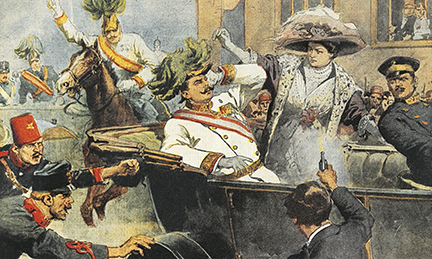


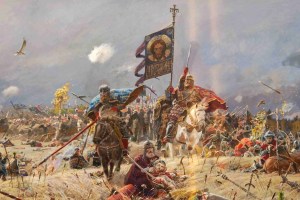 June 28 was significant for another reason. The invading army of Ottoman Sultan Murad I was wiped out on this date in the 1389 Battle of Kosovo, (June 15, ‘old style’), the “Field of Blackbirds”. It was a Pyrrhic victory, as the Balkan defenders were virtually wiped out as well. The Ottomans being far more numerous, the Balkan states soon became vassals of the Ottoman Turks.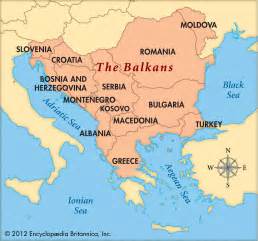
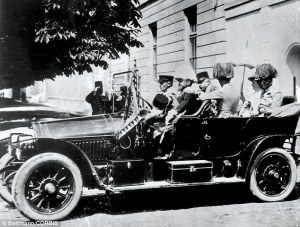 The six car motorcade drove by the first assassin, Muhamed Mehmedbašić, a little after 10am. He froze, allowing the cars to pass unmolested.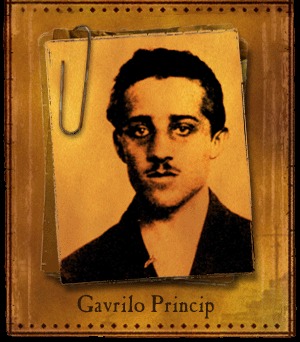


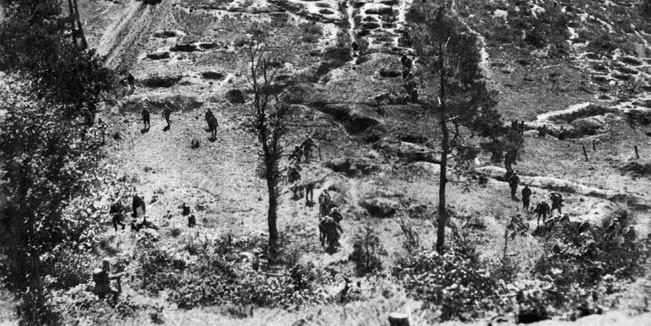
 The results of the Feuerwalze were devastating, if not predictable. Allied lines were smashed as German armies poured through, taking 19 kilometers in three days and reaching the Marne River, 50 miles from Paris. On May 31, a dogged defense by the US 3rd Infantry Division turned the German advance at Château-Thierry, and toward Belleau Wood.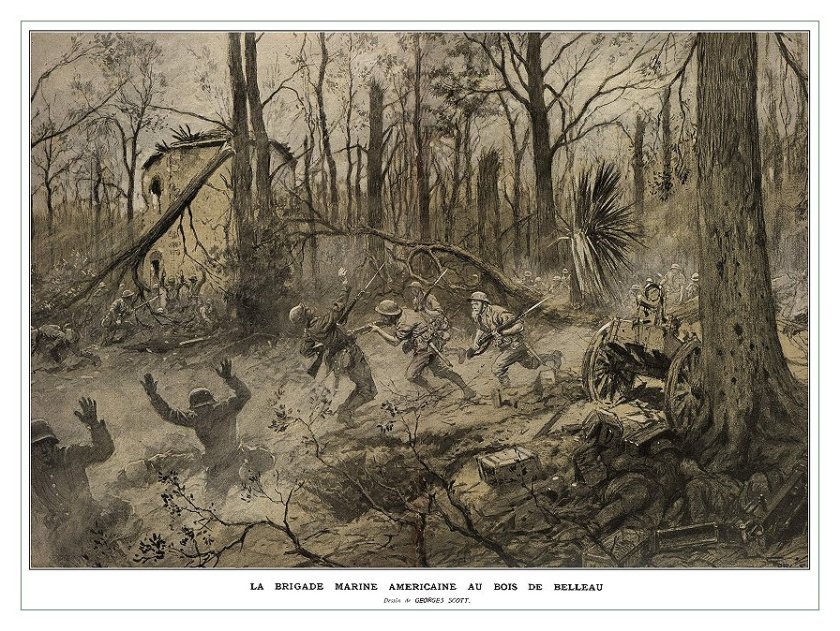


 3,662,374 military service certificates were issued to qualifying veterans, bearing a face value equal to $1 per day of domestic service and $1.25 a day for overseas service, plus interest. Total face value of these certificates was $3.638 billion, equivalent to $43.7 billion in today’s dollars and coming to full maturity in 1945.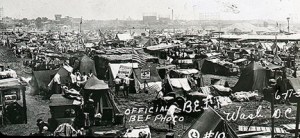
 This had happened before. Hundreds of Pennsylvania veterans of the Revolution had marched on Washington in 1783, after the Continental Army had been disbanded without pay.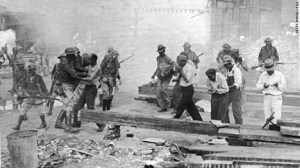
 Bonus marchers fled to their largest encampment across the Anacostia River, when President Hoover ordered the assault stopped. Feeling that the Bonus March was an attempt to overthrow the government, General MacArthur ignored the President and ordered a new attack, the army routing 10,000 and leaving their camps in flames. 1,017 were injured and 135 arrested. The wife of one veteran miscarried. 12 week old Bernard Myers died after being caught in the gas attack. A government investigation later claimed he died of inflammation of the small intestine, but a hospital employee said the tear gas “didn’t do it any good.”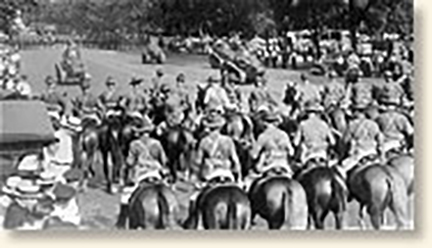


 McCrae fought in one of the most horrendous battles of WWI, the second battle of Ypres, in the Flanders region of Belgium. Imperial Germany launched one of the first chemical attacks in history, attacking the Canadian position with chlorine gas on April 22, 1915. The Canadian line was broken but quickly reformed, in near-constant fighting that lasted for over two weeks.


 The vivid red flower blooming on the battlefields of Belgium, France and Gallipoli came to symbolize the staggering loss of life in that war. Since then, the red poppy has become an internationally recognized symbol of remembrance of the lives lost in all wars. I keep a red poppy pinned to my briefcase and another on the visor of my car. A reminder that no free citizen of a self-governing Republic, should ever forget where we come from. Or the prices paid by our forebears, to get us here.

 Historical Easter Eggs - Today in History
You must be logged in to post a comment.