Columbus seems not to have been impressed, describing these mermaids as “not half as beautiful as they are painted.”
“Pax Romana”, or “Roman Peace”, refers to a period between the 1st and 2nd century AD, when the force of Roman arms subdued most everyone standing against them. The conquered peoples described the period differently. Sometime in 83 or 84AD, Calgacus of the Caledonian Confederacy in Northern Scotland, said “They make a desert and call it peace”.
The conquests of Genghis Khan and his successors accomplished much the same during the 13th and 14th century. The “Pax Mongolica” effectively connected Europe with Asia, making it safe to travel the “Silk Road” from Britain in the west to China in the east. Great caravans carrying Chinese silks and spices came to the west via transcontinental trade routes. It was said of the era that “a maiden bearing a nugget of gold on her head could wander safely throughout the realm.”
Never mind the pyramids of skulls, over there.
The “Black Death” and the political fragmentation of the Mongol Empire brought that period to an end. Muslim domination of Middle Eastern trade routes made overland travel to China and India increasingly difficult in the 15th century. After Constantinople fell to the Ottoman Turks in 1453, such travel became next to impossible. Europe began to look for a water route to the East.
It’s popular to believe that 15th century Europeans thought the world was flat, but that’s a myth. Otherwise, the cats would have pushed everything over the edge, by now.
The fact that the world is round had been understood for over a thousand years, though 15th century mapmakers often got places and distances wrong. In 1474, Paolo dal Pozzo Toscanelli detailed a scheme for sailing westward to China, India and the Spice Islands. He believed that Japan, which he called “Cipangu”, was larger than it is, and farther to the east of “Cathay” (China). Toscanelli vastly overestimated the size of the Eurasian landmass, and the Americas were left out altogether.
This is the map that Christopher Columbus took with him in 1492.
Columbus had taken his idea of a westward trade route to the Portuguese King, to Genoa and to Venice, before he came to Ferdinand and Isabella in 1486. At that time the Spanish monarchs had a Reconquistato tend to, but they were ready in 1492. The Nina, Pinta and the Santa Maria sailed that August.
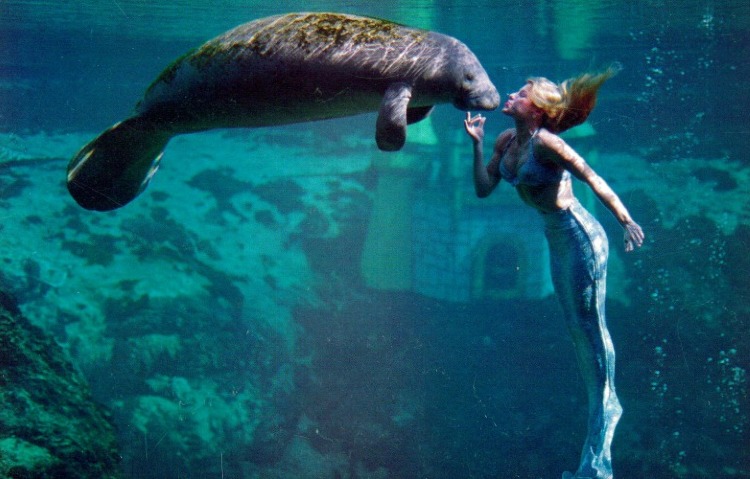
By January 9, 1493, the expedition had been at sea for six months. Sailing off the coast of Hispaniola, what we now call the Dominican Republic, Columbus spotted three “mermaids”.
They were Manatee, part of the order “Sirenia”. “Sirens” are the beautiful sisters, half birdlike creatures who live by the sea, according to ancient Greek mythology. These girls, according to myth, sang a song so beautiful that sailors were hypnotized, crashing their ships into rocks in their efforts to reach them.
Columbus seems not to have been impressed, describing these mermaids as “not half as beautiful as they are painted.”
Small wonder. These marine herbivores measure 10’ to 13′ from nose to tail, and weigh in at 800-1,200 lbs.
Not everyone was quite so dismissive. A hundred years later, the English explorer John Smith reported seeing a mermaid, almost certainly a Manatee. It was “by no means unattractive”, he said, but I’m not so sure. I think it’s possible that Mr. Smith needed to get out a little more.
If you enjoyed this “Today in History”, please feel free to re-blog, “like” & share on social media, so that others may find and enjoy it too. Please click the “follow” button on the right, to receive email updates on new articles. Thank you for your interest, in the history we all share.
So ended the only ground combat operation of WW2, on the soil of the Japanese homeland. And so it is, that an American submarine came to count a Medal of Honor and a Japanese locomotive, among its battle honors.
In the early phase of WW2, the traditional role of the American submarine service was to search, identify and report enemy activity to surface ships. Customary tactics emphasized stealth over offense, preferring to submerge and lie in wait over the surface attack.
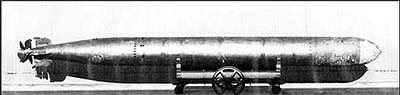
Small wonder. The Mark XIV torpedo, the primary anti-ship submarine-launched torpedo of WW2, was literally a scandal. Not only was torpedo production woefully inadequate to the needs of the war in the Pacific, but stingy pre-war budgets had precluded live-fire testing of the thing.
Among the Mark-XIV’s more pronounced deficiencies was a tendency to run about 10-ft. too deep, causing it to miss with depressing regularity. The magnetic exploder often caused premature firing of the warhead, and the contact exploder frequently failed altogether. There must be no worse sound to a submariner, than the metallic ‘clink’ of a dud torpedo bouncing off an enemy hull.
Worse still, these things tended to ‘run circular’, meaning that they’d return to strike the firing vessel.
USS Barb (SS-220) underway in May, 1945
On July 24, 1943, Lawrence “Dan” Daspit commanding USS Tinosa (SS-283) attacked the 19,000-ton whale factory ship Tonan Maru III. Tinosa fired fifteen torpedoes with two stopping dead in the water and the other thirteen striking their target. Not one of them exploded. Thinking that he had a bad production run, Daspit kept his last torpedo for later inspection. Nothing out of the ordinary, was found.
Commander Eugene “Lucky” Fluckey didn’t subscribe to the conventional wisdom. WW2 vintage submarines were designed for speed on the surface, and USS Barb (SS-220) was capable of 21 knots. Equivalent to 24mph on land. Under Commander Fluckey, Barb was for all intents and purposes, a fast-attack surface craft.
Sam Moses, writing for historynet’s “Hell and High Water,” writes, “In five war patrols between May 1944 and August 1945, the 1,500-ton Barb sank twenty-nine ships and destroyed numerous factories using shore bombardment and rockets launched from the foredeck”.
In January 1945, the Barb, USS Picuda (SS-382), and the USS Queenfish (SS-393) were ordered to the China Sea, blocking the Formosa Strait to Japanese shipping.
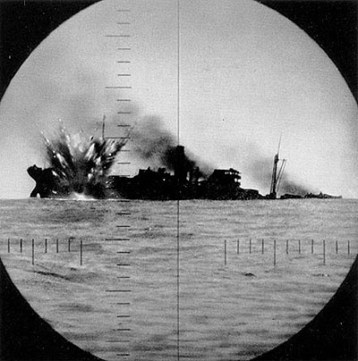
On the 8th, the small “wolf pack” encountered eight large Japanese merchant ships, escorted by four patrol boats. In a two-hour running night battle, Barb sank merchant cargo ships Anyo Maru and Tatsuyo Maru in explosions so violent that Barb was forced to go deep, even then suffering light damage to her decks. She also sank merchant tanker Sanyo Maru and damaged the army cargo ship Meiho Maru.
The merchant tanker Hiroshima Maru ran aground in the confusion. SS-220 returned the following day, to finish the job.
Two weeks later, USS Barb spotted a 30-ship convoy, anchored in three parallel lines in Namkwan Harbor, on the China coast. Slipping past the Japanese escort guarding the harbor entrance under cover of darkness, the American submarine crept to within 3,000 yards.
Fluckey gave the order and Barb fired her six bow torpedoes at the tightly packed convoy. Swinging around, she fired her four stern torpedoes, just as the first salvo slammed home. Four ships were mortally wounded and another three heavily damaged, as a Japanese frigate opened fire.
It took a full hour to extract herself from the uncharted, heavily mined and rock-obstructed shallows of Namkwan Harbor. Torpedoes meant for the American sub struck Chinese junks instead. A Japanese aircraft appeared overhead, just as Barb slipped out into deeper water. No wonder they called him “Lucky Fluckey”.
The episode earned Commander Fluckey the Medal of Honor in March, 1945.
On completion of her 11th patrol, USS Barb underwent overhaul and alterations, including the installation of 5″ rocket launchers, setting out on her 12th and final patrol in early June.
For the first time in the history of submarine warfare, rocket attacks were successfully employed against shore targets, including facilities in Shari, Hokkaido; Shikuka, Kashiho; and Shiritoru. Barb also attacked Kaihyo To with her regular armaments, destroying 60% of the town.
By mid July 1945, USS Barb had racked up one of the most successful records in the submarine service, sinking the third-highest gross tonnage of enemy shipping of the entire war, and the highest in Japanese shipping, according to the Japanese’ own records..
In poring over a coastal map of Karafuto, the Japanese end of Sakhalin island, the answer as to what to do next, soon came clear. The American sub was going to take out the supply line to enemy merchant shipping, and use a Japanese train, to do it.
Steel plates were bent and welded into crude tools, and a team of eight volunteers was selected. There was so much excitement among the crew over the idea, that even the Japanese POW on board wanted to go ashore, promising he wouldn’t try to escape.
On the night of July 22-23, Fluckey maneuvered the sub into shallow water within 950 feet of land, and put two rubber rafts ashore.
Working so close to a Japanese guard tower that they could almost hear the snoring of the sentry, the eight-man team dug into the space between two ties and buried the 55-pound scuttling charge. They then dug into the space between the next two ties, and placed the battery.
At one point the team had to dive for the bushes, as a night train came through.
At last the work was done and, for the first time that night, the group disobeyed a direct order. The other seven had been ordered to back off as Electricians Mate 3rd Class Billy Hatfield wired the switch and activated the bomb. That way only one man would die if things went wrong, but these guys weren’t going anywhere. Seven men looked on as Hatfield made the final connections, each wanting to see that this last step was done right.
Barb had worked her way to within 600′ of shore and the shore party was barely halfway back, when the second train came through. A thunderous explosion tore through the stillness, as night turned to day. Pieces of the locomotive were thrown 200 feet in the air as twelve freight cars, two passenger cars, and a mail car derailed and piled together.
There was no further need for stealth. With barely 6′ of water under her keel, Fluckey took up a megaphone, bellowing “Paddle like the devil!” Five minutes later the shore party was on board. As “The Galloping Ghost of the China Coast” slipped away, every crew member not absolutely necessary to the operation of the boat was on-deck, to witness the spectacle they had wrought.
So closes a little-known chapter of the war in the Pacific. The only ground combat of WW2, carried out on the Japanese home islands. So it is, that an American submarine came to count a Medal of Honor and a Japanese locomotive, among its battle honors.
Members of the USS Barb demolition squad pose with her battle flag at the conclusion of her 12th war patrol, Pearl Harbor, August 1945. Chief Gunners Mate Paul G. Saunders, USN, Electricians Mate 3rd Class Billy R. Hatfield, USNR, Signalman 2nd Class Francis N. Sevei, USNR, Ships Cook 1st Class Lawrence W. Newland, USN, Torpedomans Mate 3rd Class Edward W. Klingesmith, USNR, Motor Machinists Mate 2nd Class James E. Richard, USN, Motor Machinists Mate 1st Class John Markuson, USN; and Lieutenant William M. Walker, USNR.
In addition to Commander Fluckey’s Medal of Honor, the crew of USS Barb earned a Presidential Unit Citation, a Navy Unit Commendation, the Asiatic-Pacific Campaign Medal with eight battle stars, the World War II Victory Medal, and the National Defense Service Medal. Of all those awards, the one of which later-Rear Admiral Fluckey was most proud, was the one he didn’t get. In five successful combat patrols under Commander Eugene Fluckey, not one crew member of the USS Barb ever received so much as a purple heart.
If you enjoyed this “Today in History”, please feel free to re-blog, “like” & share on social media, so that others may find and enjoy it too. Please click the “follow” button on the right, to receive email updates on new articles. Thank you for your interest, in the history we all share.
Mother Teresa was once asked about the overwhelming nature of her work. ‘Never worry about numbers, she said. “Help one person at a time and always start with the person nearest you”.
In Albanian, “Gonxhe” means “Rosebud”. Anjezë Gonxhe Bojaxhiu was born August 26, 1910, in what is now Uskup, the capital of Macedonia, then Skopje, part of the Ottoman Empire. Her mother raised the girl in the Roman Catholic faith after her father died in 1919. By age 12, she was committed to a religious life. “Agnes” had always been fascinated with the lives of missionaries, joining the Sisters of Loreto at the age of 18 to become one. Though she would live to 87, Agnes would never again see her mother, or her sister.
The Sisters taught English to school children in India, a language she learned in the Loreto Abbey in Rathfarnham, Ireland.
She arrived in India on January 6, 1929, beginning her novitiate in Darjeeling, near the Himalayas. There she learned to speak Bengali, teaching at St. Teresa’s School, near her convent. Agnes took her first religious vows as a nun in 1931, choosing the name Thérèse de Lisieux, after the patron saint of missionaries. Another nun in the convent had already chosen the name, so Agnes adopted the Spanish spelling, becoming Sister Teresa on May 24.
Teresa would take her solemn vows six years later, while teaching at the Loreto School in Entally, eastern Calcutta, a position she would hold until 1944.
Today, about 10% of the world’s Muslims live in India, making up close to 15% of the population. The number was much higher in 1944, as much as 2/3rds in some regions. The idea of the Muslim population breaking off India and forming an independent Pakistan had come up as early as 1930, and become a major force with the breakup of British rule over the Indian subcontinent, the “British Raj”, at the end of WW2.
Tensions spilled over in the province of Bengal in August 1946, as violence between Muslim, Hindu and Sikh mobs left thousands dead. Violence was particularly bad in Calcutta, where the massive riots of August 16-19 left over 4,000 dead and more than 100,000 homeless.
India would be partitioned the following year, and Pakistan declared an independent nation in August. For now, the violence of 1946, following on the heels of the Bengal famine of 1943, left Calcutta in a state of despair.
Sister Teresa was looking out from the train carrying her from Darjeeling to Calcutta on September 10, when she heard the call. “I was to leave the convent and help the poor while living among them. It was an order. To fail would have been to break the faith.”
No one knew it at the time, but “Sister Teresa” had become “Mother Teresa”.
Mother Teresa spent a few months at Holy Family Hospital receiving medical training, venturing into the slums of Calcutta to begin her missionary work in 1948. A small group of women joined in her ministry to the “poorest among the poor”, as she wrote in her diary of begging for food and supplies. The hardships were severe, as was the near-constant temptation to return to the ease and comfort of the convent.
Teresa received permission from the Vatican on October 7, 1950, to start the diocesan congregation which would become the Missionaries of Charity. With only 13 members in Calcutta, their mission was caring for “the hungry, the naked, the homeless, the crippled, the blind, the lepers, all those people who feel unwanted, unloved, uncared for throughout society, people that have become a burden to the society and are shunned by everyone.”
Awarded the Nobel Peace Prize in 1979, Mother Teresa refused the traditional honor banquet, requesting instead that the $192K cost be given to help the poor of India.
With the help of Indian officials, Teresa opened the Kalighat Home for the Dying in an abandoned temple, where dying Muslims were read from the Quran, Hindus received water from the Ganges, and Catholics were read the Last Rites. “A beautiful death,” she said, “is for people who lived like animals to die like angels—loved and wanted”.
Mother Teresa was once asked about the overwhelming nature of her work. ‘Never worry about numbers, she said. “Help one person at a time and always start with the person nearest you”.
By the time of her death on September 5, 1997, Mother Teresa’s Missionaries of Charity had over 4,000 sisters, and an associated brotherhood of 300 members. They operated 610 missions in 123 countries, including hospices and homes for victims of HIV/AIDS, leprosy and tuberculosis. There were soup kitchens, children’s and family counseling programs, personal helpers, orphanages, and schools.
Mother Teresa was canonized on September 4, 2016 in Vatican City, becoming Saint Teresa of Calcutta. The ceremony at St. Peter’s Square was attended by over 1,500 homeless.
Even saints have critics, in her case usually the warm and well-fed likes of Christopher Hitchens, the “New Left Review” and the German magazine Stern. Anjezë Gonxhe Bojaxhiu once said “Spread love everywhere you go. Let no one ever come to you without leaving happier”. Let that be the woman’s answer to the critics.
The science is politicized. Vast sums of public largesse and political capital are lavished on the climate. We are told to expect global warming, and warned of a coming ice age. The skeptical taxpayer who has to pay for it all is forced to wade through competing narratives, in an exercise not unlike taking a sip from a fire hose.
Over the past two weeks, temperatures have dipped near 0° Fahrenheit, as far south as Alabama. The capital of Florida awoke only yesterday to snow in the palm trees, as frozen iguanas fell to the ground. Ice hangs from the Spanish mosses of Savannah, as something called a “bomb cyclone” worked its way toward the New England coast.
Yikes.
In July 1983, temperatures of -129° were recorded at the Soviet Vostok Station in Antarctica, the coldest temperature ever measured by ground instruments. NASA satellite data recorded a low temperature of -135.8°F in August, 2010.
Four years later, a Russian research ship full of environmental, scientific and activist types, the Akademik Shokalskiy, got stuck in Antarctic ice, as did the Chinese icebreaker Xue Long, which had come to their rescue.
Very few media outlets got around to reporting that they were there to study “global warming”.
The environmental activist types would object to my use of the term, preferring what they feel to be the more descriptive “climate change”. They’re right to prefer the term. We can all agree that climate is changing, five ice ages demonstrate that much, but it does beg the question. How, exactly, will we know we’ve reached climate optimum?
In England, accounts of the River Thames freezing over date back as early as 250AD. The river was open to wheeled traffic for 13 weeks in 923 and again in 1410. That time, the freeze lasted for 14 weeks. By the early 17th century, the Thames became a place of “Frost Fairs”.
The “Medieval Warm Period” lasting from 950 to 1250 was followed by the “Little Ice Age”, a 300-year period beginning in the 16th century. King Henry VIII rode a sleigh down the Thames from London to Greenwich in 1536. Elizabeth I was out on the ice shooting at archery targets, in 1564.
English writer John Evelyn describes the famous “Frost Fair” of the winter of 1683-’84: “Coaches plied from Westminster to the Temple, and from several other stairs too and fro, as in the streets; sleds, sliding with skeetes, a bull-baiting, horse and coach races, puppet plays and interludes, cooks, tipling and other lewd places, so that it seemed to be a bacchanalian triumph, or carnival on the water”.
The Great Frost of the winter of 1708-09 was held in the coldest winter Europe had seen in 500 years. William Derham, an English clergyman and natural philosopher best known for calculating a reasonably accurate estimate of the speed of sound, recorded a low of −12°C (10 °F) on the night of January 5, 1709. It was the lowest he’d measured since beginning readings in 1697, prompting the comment that “I believe the Frost was greater than any other within the Memory of Man”.
24,000 Parisians died of cold in the next two weeks. Animals froze in their stalls and crops planted the prior year, failed. The resulting famine killed an estimated 600,000 in France alone while, in Italy, the lagoons and canals of Venice, froze solid.
Breaks in cold weather inevitably marked the end of the frost fairs, sometimes all of a sudden. In January 1789, melting ice dragged a ship with it, while tied to a riverside tavern, in Rotherhite. Five people were killed when the building was pulled down on their heads.
The last Thames River frost fair took place in 1814, the year someone led an elephant across the ice, below Blackfriar’s Bridge. Structural changes in river embankments and the demolition of the medieval London Bridge have increased water flow in the Thames, making it possible that the river will never freeze again.
Today, many blame weather extremes on “anthropogenic” (human) causes, associating what used to be called global warming”, with CO2. Others contend the reverse: that historic increases in carbon do not precede but rather result from, climate extremes. A third group associates the sun with climate change (imagine that), linking an extended period of low solar activity called the “Maunder Minimum”, with the brutal cold of 1645-1715.
The science is politicized. Vast sums of public largesse and political capital are lavished on the climate. We are told to expect global warming, and warned of a coming ice age. The skeptical taxpayer who has to pay for it all is forced to wade through competing narratives, in an exercise not unlike taking a sip from a fire hose.
Meanwhile, the sun is going to do what the sun is going to do, which at the moment appears to be another quiet period in solar activity. Very quiet. Before it’s over, we may find ourselves wishing for a little Global Warming.
Feature image, top: The Battery, Charleston SC, January 2, 2018
In the American colonies, the Petition of Right would pop up 129 years later, reflected in the 3rd, 5th, 6th and 7th amendments of the United States’ Constitution. Four parts in ten, of what we now know as the Bill of Rights.
Agree or disagree with US government policy, what we do in this country we do as a nation. It would seem absurd to us to see the President and Congress raise separate armies to go to war with one another, yet that’s just what happened in 17th century England.
Queen Elizabeth I passed away without issue in 1603, succeeded by her first cousin twice removed, King James VI of Scotland. For the first time, the Kingdoms of England and Scotland were united under single rule.
Royalist attack on the Parliamentary train at the Battle of Edgehill, October 23, 1642
The English Parliament of the age didn’t have a permanent role in government, instead being a temporary advisory body, summoned and dismissed at the will of the King. Practically speaking, the King had no means to enforce his will on matters of taxation, without the consent of the “gentry”, the untitled land-owning classes who were the primary means of national tax collection. This gave rise to an elected “House of Commons”, joining the House of Lords to form a Parliament.
James thought of Kings as “little Gods on Earth”, and had long gotten whatever he wanted from a supine Scottish Parliament. The English Parliament was another matter. James’ entire reign and that of his son Charles I, was one long contest of wills with the English governing body.
Charles’ 1625 marriage to a Roman Catholic, the French princess Henrietta Maria, did little to win him support in Protestant England. His interventionist policies in the 30 years’ war made things worse, ending with Parliament bringing impeachment proceedings against his minister, the Duke of Buckingham.
Battle of Marston Moor, July 2, 1644
Parliament drew up the “Petition of Right”, invoking the Magna Carta and severely limiting the King’s right of non-Parliamentary taxation, along with other restrictions on the Royal Prerogative. Charles looked to the House of Lords to check the power of the Commons, but both houses ratified the measure by the end of May.
The King dissolved this first Parliament in 1629, putting nine of its leaders in prison and unwittingly making them martyrs for their cause. The following 11 years are sometimes called “the personal rule” or the “eleven years’ tyranny”. By 1640 Charles had severe money problems, forcing him to call another Parliament.
The King wanted a more docile body this time, so he appointed many of his adversaries as Sheriffs, knowing that this would require them to stay within their counties, making them ineligible for election. On others he bestowed aristocratic titles, making them ineligible for the House of Commons. Of course, that only moved them to the House of Lords.
Measures the King saw as reasonable, the legislative body saw as opportunity to negotiate, and this “Short Parliament” was dissolved within a month. That was May 1640, and Charles once again called a Parliament that November. This “Long Parliament”, proved as uncooperative as any before it.
A significant Parliamentary victory was won at the Battle of Cheriton, fought on March 29, 1644
In January, Charles directed the legislature to surrender five members of the Commons and one Peer on grounds of high treason. On the following day, January 4, 1642, the King himself entered the House of Commons with an armed guard of 400, demanding that the offenders be handed over. The Speaker, William Lenthall, replied, “May it please your Majesty, I have neither eyes to see nor tongue to speak in this place but as the House is pleased to direct me, whose servant I am here.”
Lenthall might as well have told the King “I work for these people. I don’t work for you”.
It was a grave breach of protocol. No King had ever entered the House of Commons. Making things worse, the botched arrest had cut the feet out from under Charles’ supporters. The two sides began to arm themselves that summer. Full-scale civil war broke out that October.
Civil war ensued between Royalist and Parliamentary forces, as Ireland and Scotland broke with England’s primacy among the Three Kingdoms.
The period 1639-’51 saw a series of intertwined conflicts within and between the three kingdoms, including the Bishops’ Wars of 1639 and ’40, the Scottish Civil War of 1644–’45; the Irish Rebellion of 1641, Confederate Ireland, 1642–’49 and the Cromwellian conquest of Ireland in 1649, collectively known as the Eleven Years War or Irish Confederate Wars and finally, the first, second and third English Civil Wars of 1642–’46, 1648–’49 and 1650–’51.
A “Rump” House of Commons indicted the King on treason charges, in a trial which was never recognized by the upper house. Charles maintained that he was above the law, while the court argued that “the King of England was not a person, but an office whose every occupant was entrusted with a limited power to govern by and according to the laws of the land and not otherwise”.
Charles I in Three Positions by van Dyck, 1635–36
Charles I was found guilty of treason and sentenced to die by decapitation. Clothed in two shirts by his own request lest any shiver of cold be misinterpreted as a sign of fear, he put his head on the block on January 30, 1649. “A subject and a sovereign are clean different things,” he said. “I shall go from a corruptible to an incorruptible Crown, where no disturbance can be”. With that, the King of England extended his hands to signal that he was ready, and his head was parted with a stroke.
Some 300,000 citizens of what is now known as the ‘United Kingdom’ lost their lives in the series of conflicts. Roughly 6% of the population, almost twice that lost in the American Civil War. Nationally, the burial rate increased by 29%, between 1643-’64.
The Protestant Reformation begun some 100 years earlier was itself ‘reformed during this period, as Charles’ stranglehold on church-state policy was replaced by more individualized religious experience. Ritual was set aside in favor of The Sermon, as individual congregations coalesced around charismatic speakers. Gone were the days of strong opposition and religious persecution, as previously ‘lunatic fringe’ sects from Muggletonians to Puritans and Quakers expanded across the British Isles and on to Great Britain’s overseas dominions.
The Rump House of Commons disbanded the House of Lords and England briefly became a Commonwealth. The Scottish Parliament proclaimed Charles eldest son King Charles II of Scotland a week after the execution of his father, but Royalist hopes were dashed two years later when Charles was deposed and exiled to France.
Oliver Cromwell at the Battle of Dunbar, painted by Andrew Carrick Gow, 1886
“1st Lord Protector of the Commonwealth of England, Scotland, and Ireland” Oliver Cromwell became virtual dictator for much of the 1650s. Succeeded by his son Richard upon his death on 1658, the son was not the equal to his father. When the Royalists returned to power, they had Cromwell’s corpse dug up, hung in chains, and beheaded. Parliament was reinstated, and the monarchy of the Three Kingdoms restored to Charles II, in 1660.
After that, all legal documents were dated as if Charles had succeeded his father, back in 1649.
In the American colonies, the Petition of Right would pop up 129 years later, reflected in the 3rd, 5th, 6th and 7th amendments of the United States’ Constitution. Four parts in ten, of what we now know as the Bill of Rights.
To aid in the work, Emily Roebling took a crash course in bridge engineering. For 11 years she studied higher mathematics, catenary curves, materials strength, and the intricacies of cable construction, all while acting as the pivot point on the largest bridge construction project in the world, and nursemaid to a desperately sick husband.
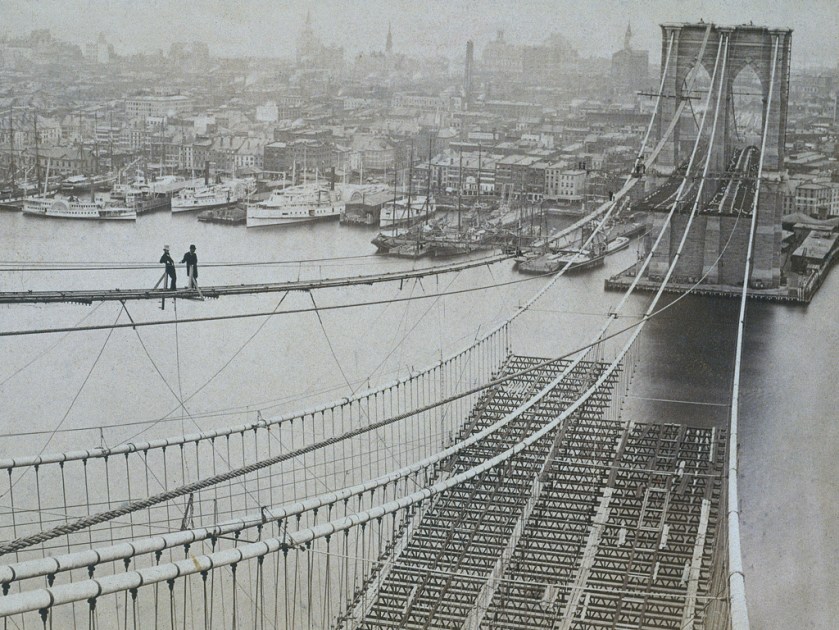
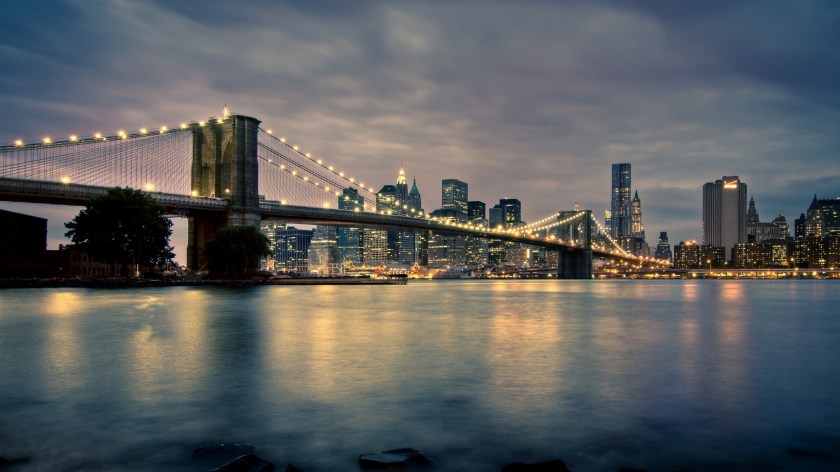
At the time it was built, the span across the East river linking Brooklyn with Manhattan was the longest suspension bridge in the world.
In 1869, civil engineer John Roebling had already invested two years in site work. With the ferry coming in, he should have paid more attention to his surroundings. Focused on what he was doing on the pier, the engineer’s toes were crushed as the boat docked, so badly that several had to be amputated.
“Lockjaw” is such a sterile term, it doesn’t begin to describe the condition known as Tetanus. In the early stages, the anaerobic bacterium Clostridium Tetani produces tetanospasmin, a neurotoxin producing mild spasms in the jaw muscles. As the disease progresses, sudden and involuntary contractions effect most skeletal muscle groups, becoming so powerful that bones are fractured and the muscles tear themselves apart. These were the last days of John Roebling, the bridge engineer who would not live to see his most famous work.
Roebling was the first casualty of the project. He would not be the last.
Roebling’s 32-year-old son Washington took over the project, beginning construction on January 3, 1870.
Enormous yellow pine boxes called “caissons” were built on the Brooklyn and New York sides of the river, descending at the rate of 6-in. per week in search of bedrock. Like giant diving bells, the New York side ended up at 78′ below mean high tide, the Brooklyn side 44′. Pressurized air was pumped into these boxes, keeping water and mud at bay, as workers excavated the bottom. In 1872, these “sandhogs” began to experience a strange illness that came to be called “caisson disease”.
Civil War era submarine designer Julius Hermann Kroehl may have recognized what was happening, but Kroehl was five years in his grave by this time, victim of the same “fever”. Today we call it “the bends”. Pop the top off a soda bottle and you’ll see the principle at work. Without sufficient decompression time, dissolved gasses come out of solution and the blood turns to foam. Bubbles form in or migrate to any part of the body, resulting in symptoms ranging from joint pain and skin rashes, to paralysis and death. The younger Roebling was badly injured as a result of the bends in 1872, leaving him partially paralyzed and bedridden, incapable of supervising construction on-site.
Roebling conducted the entire project looking out his apartment window, designing and redesigning details while his wife, Emily Warren Roebling, became the critical connection between her husband and the job site.
To aid in the work, Emily Roebling took a crash course in bridge engineering. For 11 years she studied higher mathematics, catenary curves, materials strength, and the intricacies of cable construction, all while acting as the pivot point on the largest bridge construction project in the world, and nursemaid to a desperately sick husband.
Emily Warren Roebling, the “first woman field engineer”.
Historian David McCullough wrote in his book, The Great Bridge: The Epic Story of the Building of the Brooklyn Bridge: “By and by it was common gossip that hers was the great mind behind the great work and that this, the most monumental engineering triumph of the age, was actually the doing of a woman, which as a general proposition was taken in some quarters to be both preposterous and calamitous. In truth, she had by then a thorough grasp of the engineering involved”.
Unlikely as it sounds, fires broke out at the bottom of the river on several occasions, started by workmen’s candles, fed by the oakum used for caulking, and turbocharged by all that pressurized air. On at least one occasion, the caisson had to be filled with millions of gallons of water, before the fire went out for good.
A footbridge connected the two sides in 1877, and soon the wires began to be strung. Wooden “buggies” carried men back and forth along wires suspended hundreds of feet above the water, as individual wires were woven into the four great cables that support the bridge. The work was exacting, with each wire bound together to precise specifications. Rumors about corruption and sleaze surrounded the project when J. Lloyd Haigh, the wire contractor, was discovered to be supplying inferior material. It was way too late to do anything about it, and 150 extra wires were bundled into each cable to compensate. The tactic worked. Haigh’s shoddy wire remains there, to this day.
Construction was completed in 1883, the bridge opening for use on May 24. The first person to cross was Emily Roebling. Six days later, a rumor started that the bridge was about to collapse. At least 12 people were killed in the resulting stampede. A year later, a publicity stunt by P. T. Barnum helped to put people’s minds at ease when Jumbo, the circus’ prize elephant, led a parade of 20 other elephants across the bridge.
For a long time the span was called the “New York and Brooklyn Bridge” or the “East River Bridge”, officially becoming the “Brooklyn Bridge” only in 1915. At least 27 were killed in its construction; 3 from the bends, several from cable stringing accidents and others crushed under granite blocks or killed in high falls.
Even today, popular culture abounds with stories of suckers “buying” the Brooklyn Bridge. It was the longest bridge in the world for its time, and would remain so until 1903. Roebling had designed his project to be six times the strength required for the job. Even with the defective cables installed, the bridge is four times as strong as it needs to be. Many of the Brooklyn Bridge’s contemporary structures have long since gone. Johann Augustus Röbling’s bridge carries 145,000 cars, every day.
In 1935, the third Reich reached out to the Amazon basin, in search of ‘lebensraum’. Living space. 3 SS officers bankrolled by the Nazi government, came with dozens of helpers to explore the region bordering French Guyana, with an eye toward colonizing the area for the ‘thousand-year’ Reich.
In 1978, the British-American science fiction thriller “The Boys from Brazil” told the story of a bizarre plot to clone Adolf Hitler, hatched by the “Angel of Death” Josef Mengele in his Brazilian jungle hideout.
In the film, Mengele met his fate at the jaws of a pack of vengeful Dobermans, under orders from one of his 94 ‘baby dictators’.
A story as squirrelly is this one could only come from the minds of Hollywood, but parts of it were closer to reality, than anyone knew at the time.
In the years following WW2, thousands of Nazi officers, senior party members and Nazi collaborators escaped across the Atlantic to find refuge in South America, especially Argentina, Chile and Brazil.
Though widely believed to be dead, Mengele himself was very much alive at the time of the film, living under an assumed identity in Bertioga, São Paulo. The Angel of Death would escape the noose he so richly deserved, succumbing to a stroke while swimming in 1979, and drowning.
Long before there were Nazis, before there was even a Germany, ethnically German people have been emigrating in search of a better life. In the United States, some 57 million people identify as being of full or part German ancestry, forming the largest single ethnic group, in the country. I am one of them.
Outside of Germany itself, The second largest German population in the world, resides in Brazil.
Mention Oktoberfest, and you’re speaking of an annual celebration of Germanic traditions, in Munich. The second-largest Oktoberfest is a two-way tie, between the one held in Waterloo, Canada, and the city of Blumenau, in Santa Catarina, Brazil.
Outside of Munich, Oktoberfest Blumenau in Brazil is one of the two largest celebrations of the original festival, in the world.
Outside of Europe, descendants of German immigrant ancestors have largely assimilated into their host societies, adopting local languages and adapting Germanic-sounding surnames to spellings and sounds more familiar to their adopted cultures.
Brazilians of German ancestry are in every sense Brazilian, except to the racially obsessed mind, of a Nazi.
In 1935, the third Reich reached out to the Amazon basin, in search of ‘lebensraum’. Living space. 3 SS officers bankrolled by the Nazi government, came with dozens of helpers to explore the region bordering French Guyana, with an eye toward colonizing the area for the ‘thousand-year’ Reich.
Talk about squirrelly ideas. The hardships of life in the Amazon jungle made this a strange choice of destination, but the idea made sense to these people. With over 1 million ethnic Germans already living in the country, the pieces were already in place. Or so they believed.
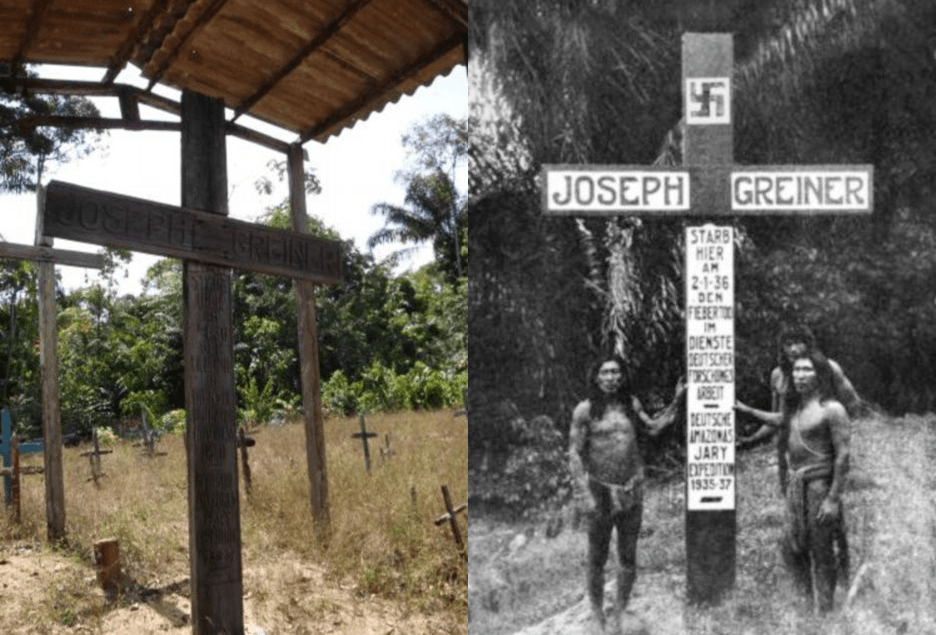
SS officer Joseph Greiner died of a ‘fever’ while on the expedition, most likely yellow fever or malaria. Expedition leader Schulz Kampfhenkel returned to the Fatherland with glowing reports of “The Guyana Projekt”. “The two largest scantly populated, but rich in resources, areas on earth” Kampfhenkel wrote to his boss, the failed chicken farmer turned Reichsführer-SS Heinrich Himmler, “are in Siberia and South America”.
As befitting a man who completely buys into Nazi ideas of racial superiority, the SS officer wrote “For the more advanced white race it offers outstanding possibilities for exploitation”, adding that the people who lived there “cannot be measured in civilised terms as we know them in Germany”.
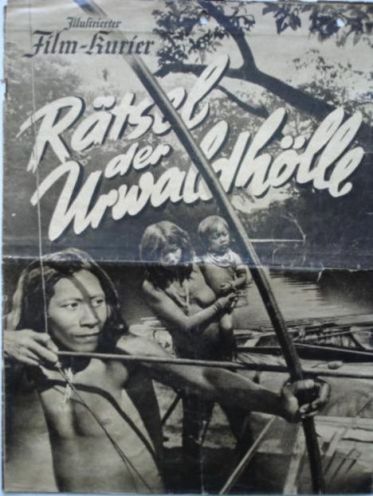
A propaganda film was made of Greiner’s work in the jungle, but Himmler showed ‘scant interest’ in such grandiose plans. “Given time”, the bloodless bureaucrat wrote to his jungle emissary, “the plan may be submitted again”.
So it is, that there is a Nazi graveyard by a tributary of the River Jary, in the Amazon jungle. There you will find a 9-ft. cross, bearing this inscription: “Joseph Greiner died here on 2.1.1936“.
“None of the state-of-the-art weather forecasts and wave models—the information upon which all ships, oil rigs, fisheries, and passenger boats rely—had predicted these behemoths. According to all of the theoretical models at the time under this particular set of weather conditions, waves of this size should not have existed”.
From the time of Aristotle, mankind has looked to the field of scientific inquiry to explain the world around us.
From Copernicus to Charles Darwin to Stephen J. Hawking, the greatest of scientific minds have struggled to explain not only “that” the universe works, but also the “how” and the “why”.
We live in a near-miraculous age, when science has conquered complexities from space travel to molecular biology, to medicine, climate and astral physics.
Except sometimes, science has not the foggiest notion of why things happen.
In 1826, French scientist and naval officer captain Jules Dumont d’Urville described waves as high as 108.3 feet tall, in the Indian Ocean. Despite having three colleagues as witnesses, d’Urville was publicly ridiculed by fellow scientists. “Everybody knew” at that time, that no wave could exceed 30 feet. Walls of water the size of 10 story buildings, simply didn’t exist.
Either that, or very few who’d ever seen such a thing, lived to tell about it.
For nearly 100 years, oceanographers, meteorologists, engineers and ship designers have used a standard linear model to predict wave height. This model suggests that there will hardly ever be a wave higher than 50 feet. One of 100 feet or larger is possible but unlikely, occurring maybe once in 10,000 years.
Serious study of the subject is younger than you might think. The first scientific article on “freak waves” was written in 1964, by professor Lawrence Draper. Far from ridiculing old sailors’ stories about monster waves, professor Draper posited not only that wave heights “can exceed by an appreciable amount the maximum values which have been accepted in responsible circles“, but also a terrifying phenomenon he called ‘freak wave holes’, the exact opposite of a rogue wave. God help anyone caught at the bottom of one of those things.
Once considered mythical but for the old sailor’s stories and the damage inflicted on ships themselves, the first scientific measurement of a rogue wave occurred in the North sea in 1984, when a 36′ wave was measured off the Gorm oil platform, in a relatively placid sea.
What really caught the attention of the science community was the “New Year’s wave” measured from the Draupner oil platform off the coast of Norway, on January 1, 1995. Laser instruments measured this thing at 84-ft. Oil platform damage above the water line, confirmed the measurement.
Not to be confused with a tidal wave which is caused by underwater earthquake or volcanic eruption, a rogue wave is a different kind of animal. Oceanographers define rogue waves as being two or more times the height of the mean top-third of waves, in any given sea state.
These literal freaks of nature are rare, unpredictable, appear and disappear without warning or trace, and are capable of sudden and catastrophic damage. Modern ships are designed to withstand a “breaking pressure” of 6 metric tons per square meter or 21psi. A 39-ft wave in the usual linear model produces just over a third of that. A rogue wave can generate breaking pressures of 140psi and more.
In 2000, the British oceanographic research vessel RRS Discovery measured individual waves up to 95.5-ft. Analysis of the data took years, noting that “none of the state-of-the-art weather forecasts and wave models—the information upon which all ships, oil rigs, fisheries, and passenger boats rely—had predicted these behemoths. According to all of the theoretical models at the time under this particular set of weather conditions, waves of this size should not have existed”.
In December 1900, Thomas Marshall, James Ducat, and Donald McArthur vanished from the Flannan Island lighthouse, in the Hebrides Islands of Scotland. No serious storm had been reported between the 12th and the 17th, and there was speculation about supernatural causes. Subsequent inspection revealed wave-damage, 200ft. above sea level.
In 1909, the 500-ft. cargo liner SS Waratah disappeared off Durban South Africa, with 211 passengers and crew.
The liner RMS Queen Mary was broadsided by a 92-ft. monster in 1942, nearly pushing the 1,019-ft vessel over on her side. The 81,961-ton liner listed all the way over to 52°, before slowly righting herself.
In 1966, heavy glass was smashed 80-ft. above the waterline of the Italian liner SS Michelangelo, killing three and tearing a hole in her superstructure.
In 1995, the 963-ft. RMS Queen Elizabeth 2 was forced to “surf” a 95-ft. behemoth to avoid being sunk. The ship’s master said this thing “came out of the darkness” and “looked like the White Cliffs of Dover.”
The 1975 sinking of the Edmund Fitzgerald is widely blamed on the 1-2-3 punch of a freak wave phenomenon peculiar to Lake Superior, known as the “three sisters”.
In 2007, NOAA compiled a catalog of over 50 historical incidents, most likely associated with rogue waves.
Serious scientific study of non-linear fluid dynamics began only 20-30 years ago. Researchers now believe that ‘super rogue waves’ of up to eight times the surrounding sea state, are possible.
“The Perfect Storm” movie based on the Sebastian Junger book of the same title depicts the last moments of the Gloucester fisherman Andrea Gail in September, 1991
European Space Agency satellite radar studies have proven that waves cresting at 65 to 98-ft. occur far more regularly than previously believed. Rogue waves occur several times a day, in all of the world’s oceans. One three-week period in 2004 identified over ten individual giants measuring 82-ft. and above, in the South Atlantic, alone.
MIT researchers Themis Sapsis and Will Cousins working with the Office of Naval Research, the Army Research Office and the American Bureau of Shipping have combined high resolution scanning technology with advanced algorithms, to digitize and map the sea state in real time, to predict the possible formation of rogue waves. The method only gives 2-3 minutes warning, but that is enough. Research is ongoing. Lighthouse keepers, mariners and oil platform operators the world over, anxiously await the results.
In 1907, Times owner Adolph Ochs wanted a bigger spectacle to draw attention to the newly renamed Times Square. He asked the newspaper’s chief electrician, Walter F. Painer for an idea. Painer suggested a time ball.
From the 7th century BC, the Roman calendar attempted to follow the cycles of the moon. The method frequently fell out of phase with the change of seasons, requiring the random addition of days. The Pontifices, the Roman body charged with overseeing the calendar, made matters worse. They were known to add days to extend political terms, and to interfere with elections. Military campaigns were won or lost due to confusion over dates. By the time of Julius Caesar, things needed to change.
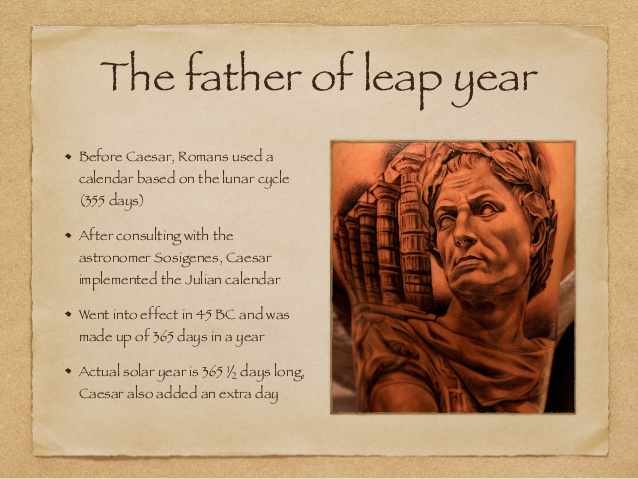
Caesar hired the Alexandrian astronomer Sosigenes to help straighten things out. The astronomer calculated that a proper year was 365¼ days, which more accurately tracked the solar, and not the lunar year. “Do like the Egyptians”, he might have said, the new “Julian” calendar went into effect in 46BC. Caesar decreed that 67 days be added that year, moving the New Year’s start from March to January 1. The first new year of the new calendar was January 1, 45BC.
Caesar synchronized his calendar with the sun by adding a day to every February, and changed the name of the seventh month from Quintilis to Julius, to honor himself. Rank hath its privileges.
Not to be outdone, Caesar’s successor changed the 8th month from Sextilis to Augustus. 2,062 years later, we still have July and August.
Sosigenes was close with his 365¼ day long year, but not quite there. The correct value of a solar year is 365.242199 days. By the year 1000, that 11-minute error had added seven days. To fix the problem, Pope Gregory XIII commissioned Jesuit astronomer Christopher Clavius to come up with yet another calendar. The Gregorian calendar was implemented in 1582, omitting ten days and adding a day on every fourth February.
Most of the non-Catholic world took 170 years to adopt the Gregorian calendar. Britain and its American colonies “lost” 11 days synchronizing with it in 1752. The last holdout, Greece, would formally adopt the Gregorian calendar in 1923. Since then, we’ve all gathered to celebrate New Year’s Day on the 1st of January.
For years, New Years’ eve celebrations were held at Trinity Church, where revelers would gather to “ring in the new”. The New York Times newspaper moved into “Longacre Square” just after the turn of the 20th century. Times owner Adolph Ochs held his first fireworks celebration on December 31, 1903, with almost 200,000 people attending the event. Four years later, Ochs wanted a bigger spectacle to draw attention to the newly renamed Times Square. He asked the newspaper’s chief electrician, Walter Painer, for an idea. Painer suggested a time ball.
Flamsteed house royal observatory time ball, Greenwich, England
A time ball is a marine time signaling device, a large painted ball which is dropped at a predetermined rate, enabling mariners to synchronize shipboard marine chronometers for purposes of navigation. The first one was built in 1829 in Portsmouth, England, by Robert Wauchope, a Captain in the Royal Navy.
Time balls were obsolete technology by the 20th century, but it fit the Times’ purposes, nicely. A young immigrant metalworker named Jacob Starr designed a 5′ wide, 700-lb iron and wooden ball, decorated with 100 25-watt incandescent bulbs. For most of the twentieth century the company he founded, sign maker Artkraft Strauss, was responsible for lowering the ball.
That first ball was hoist up a flagpole by five men on December 31, 1907. Once it hit the roof of the building, the ball completed an electric circuit, lighting up a sign and touching off a fireworks display.
The newspaper no longer occupies the building at 1 Times Square, but the tradition continues. One of seven versions of the Times Square ball has marked the coming of the new year ever since, with the exceptions of 1942 and ’43, due to the wartime need to dim out the lights.
The version used the last few years is 12′ wide, weighing in at 11,875lbs; a great sphere of 2,688 Waterford Crystal triangles, illuminated by 32,256 Philips LED bulbs and producing more than 16 million colors. It used to be that the ball only came out for New Year. The last few years, you can see the thing, any time you like.
In most English-speaking countries, the singing of “Auld Lang Syne”, is the traditional end to the New Year’s celebration. Written by the Scottish poet Robert Burns in 1788, the tune comes from an old pentatonic Scots folk melody. The original verse, phonetically spelled as a Scots-speaker would pronounce it, sounds like this:
“Shid ald akwentans bee firgot, an nivir brocht ti mynd?
Shid ald akwentans bee firgot, an ald lang syn?”
CHORUS
“Fir ald lang syn, ma jo, fir ald lang syn,
wil tak a cup o kyndnes yet, fir ald lang syn.
An sheerly yil bee yur pynt-staup! an sheerly al bee myn!
An will tak a cup o kyndnes yet, fir ald lang syn”.
CHORUS
“We twa hay rin aboot the braes, an pood the gowans fyn;
Bit weev wandert monae a weery fet, sin ald lang syn”.
CHORUS
“We twa hay pedilt in the burn, fray mornin sun til dyn;
But seas between us bred hay roard sin ald lang syn”.
CHORUS
“An thers a han, my trustee feer! an gees a han o thyn!
And we’ll tak a richt gude-willie-waucht, fir ald lang syn”.
The younger Kipling would not survive his father. He entered the First World War, and disappeared in the Battle of Loos, in 1915. His body was never found. The elder Kipling’s gift would live on, the words of fatherly advice to an only son, in a poem he called “If”.
It was the 9th of February, 1853, in Edinburgh, Scotland. Robert William Jameson went for a walk, while his wife and mother of his 11 children, a woman with the unlikely name of Christian Pringle, labored to deliver their 12th child. Jameson slipped on a grassy embankment and into a frigid canal, where he would have drowned if not for the kindly stranger who fished him out. The man said he was an American, named Leander Starr. Before the day was over, Starr was godfather to a newborn Scottish baby boy. Leander Starr Jameson.
Forty years later and half a world away, what would one day become South Africa was divided into four entities: the two British possessions of Cape Colony and Natal, and the two Boer (Dutch) Republics of the Orange Free State and the South African Republic, better known as Transvaal. Of the four states, Natal and the two Boer Republics were mainly agricultural, populated by subsistence farmers. The Cape Colony was by far the largest, dominating the other three economically, culturally, and socially.
There was considerable friction between Dutch and English settlers, stemming largely from differing attitudes toward slavery. British authorities passed legislation back in 1828, promising equal treatment for all under the law, regardless of race. Boer farmers argued that they needed forced labor to make their farms work, and that slaveholders were too little compensated upon emancipation.
Cetshwayo, King of the Zulus (d.1884), by Carl Rudolph Sohn
The situation was exacerbated in 1867, with the discovery of vast diamond deposits near modern day Kimberly, in Orange Free State territory. The Cape soon annexed the territory as its own, which I think is a fancy term for “stole”. The Boers found themselves between the proverbial rock and a hard place, pressed by the British from the south and west, and by the Zulu “Impi” (army) of King Cetshwayo kaMpande to the north. War broke out between the two sides in 1880-81, called the “First Anglo-Boer War” by one side; the “First Freedom War” by the other.
Gold was discovered near Johannesburg in 1886, massive amounts of it, drawing tens of thousands of “Uitlanders”: English, American and Australian foreigners, in search of employment and fortune.
Governor of the Cape Colony Cecil Rhodes wanted to incorporate the Transvaal and the Orange Free State into a single federation under British control, while the Transvaal government of Paul Kruger feared just that. Soon outnumbered by Uitlanders two to one, Transvaal limited the right to vote to those having many years’ residency, and imposing heavy taxes on gold mining profits.
By mid-1895, Rhodes had concocted a plan. In a scheme which could only be described as hare-brained, he would send an armed raid into Johannesburg, inciting an uprising of Uitlanders, with the aim of stepping in to take control. Back in London, the father of future Prime Minister Neville Chamberlain, British Colonial Secretary Joseph Chamberlain, thought that was a swell idea, and did everything he could to encourage it.
On December 29, 1895, 400 Matabeleland Mounted Police and 200 assorted volunteers crossed from Rhodesia into Transvaal, with Leander Starr Jameson at their head.
The raid was a humiliating failure. They cut a wire fence, thinking it was a telegraph wire. Transvaal authorities were tracking them from the moment they crossed the border. Meanwhile, Chamberlain got cold feet, saying that “if this succeeds it will ruin me. I’m going up to London to crush it”. Chamberlain ordered Sir Hercules Robinson, Governor-General of the Cape Colony, to repudiate the raid, threatening Rhodes and calling on British settlers in the Transvaal not to lend any aid to the raiders.
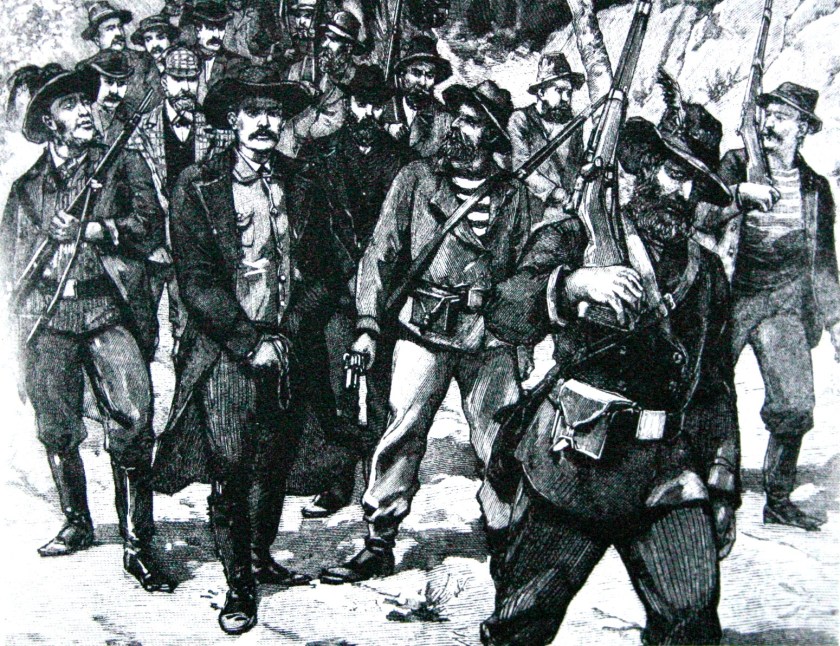
After several sharp encounters with dug in and well-prepared defenders, what remained of the raiders entered Pretoria on January 2, in chains. The Transvaal government received almost £1 million compensation from the British South Africa Company, turning their prisoners over to be tried by the British government. Jameson was convicted of leading the raid and sentenced to 15 months in prison.
During the whole ordeal, he never revealed the degree to which British politicians supported the raid, or the way they had betrayed him in the end.
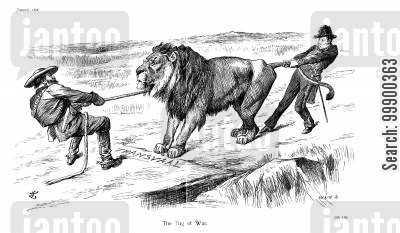
Boer cartoon: Chamberlain Tries to Avert the Jameson Raid
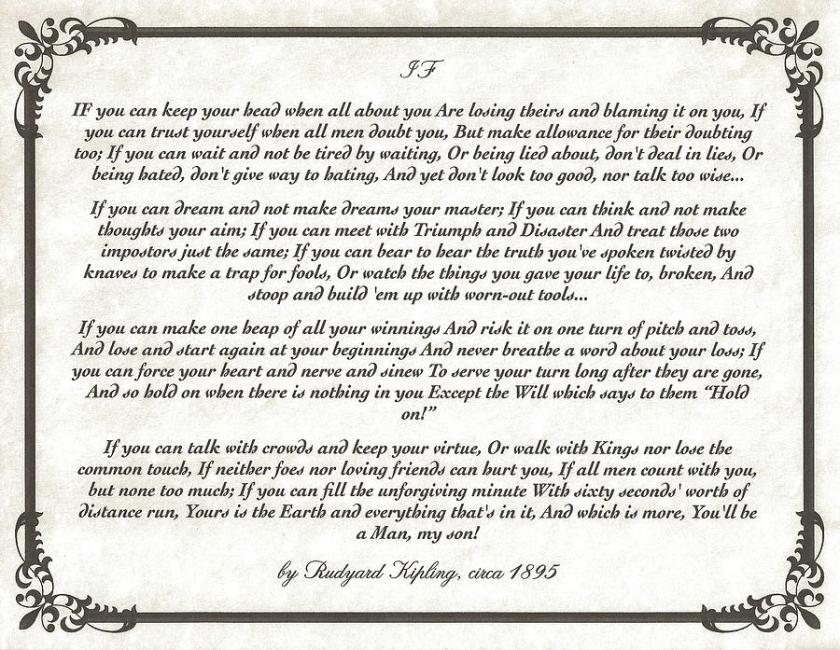
So impressed was the poet, Rudyard Kipling, with Jameson’s display of stoicism under adversity, that he wrote a poem about it in 1895, later giving it to his son, Lieutenant John Kipling.
The younger Kipling would not survive his father. He entered the First World War, and disappeared in the Battle of Loos, in 1915. His body was never found.
The elder Kipling’s gift would live on, the words of fatherly advice to an only son, in a poem he called “If”.



 Columbus had taken his idea of a westward trade route to the Portuguese King, to Genoa and to Venice, before he came to Ferdinand and Isabella in 1486. At that time the Spanish monarchs had a Reconquista to tend to, but they were ready in 1492. The Nina, Pinta and the Santa Maria sailed that August.
 Columbus seems not to have been impressed, describing these mermaids as “not half as beautiful as they are painted.”

 Among the Mark-XIV’s more pronounced deficiencies was a tendency to run about 10-ft. too deep, causing it to miss with depressing regularity. The magnetic exploder often caused premature firing of the warhead, and the contact exploder frequently failed altogether. There must be no worse sound to a submariner, than the metallic ‘clink’ of a dud torpedo bouncing off an enemy hull.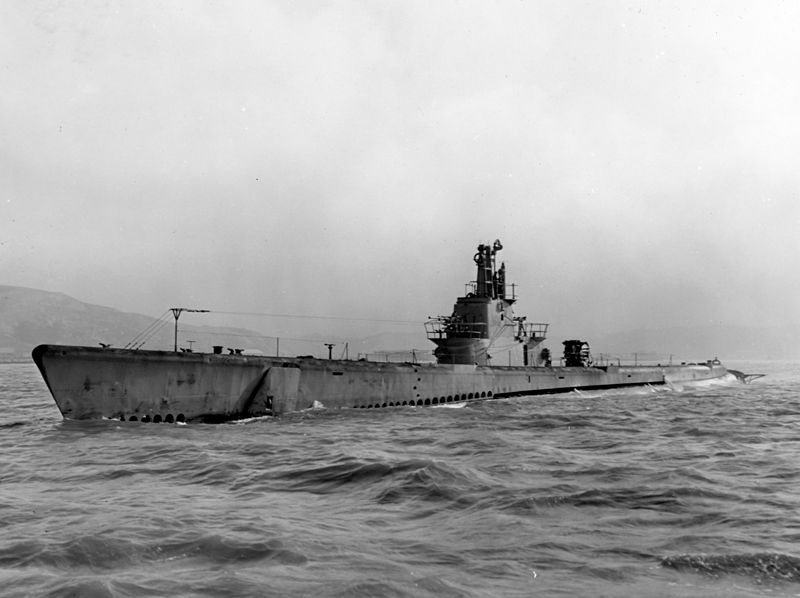
 Sam Moses, writing for historynet’s “Hell and High Water,” writes, “In five war patrols between May 1944 and August 1945, the 1,500-ton Barb sank twenty-nine ships and destroyed numerous factories using shore bombardment and rockets launched from the foredeck”.
 Two weeks later, USS Barb spotted a 30-ship convoy, anchored in three parallel lines in Namkwan Harbor, on the China coast. Slipping past the Japanese escort guarding the harbor entrance under cover of darkness, the American submarine crept to within 3,000 yards.
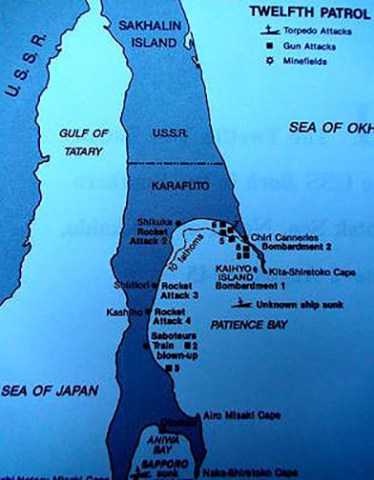 On completion of her 11th patrol, USS Barb underwent overhaul and alterations, including the installation of 5″ rocket launchers, setting out on her 12th and final patrol in early June.
 Working so close to a Japanese guard tower that they could almost hear the snoring of the sentry, the eight-man team dug into the space between two ties and buried the 55-pound scuttling charge. They then dug into the space between the next two ties, and placed the battery.


 Sister Teresa was looking out from the train carrying her from Darjeeling to Calcutta on September 10, when she heard the call. “I was to leave the convent and help the poor while living among them. It was an order. To fail would have been to break the faith.”





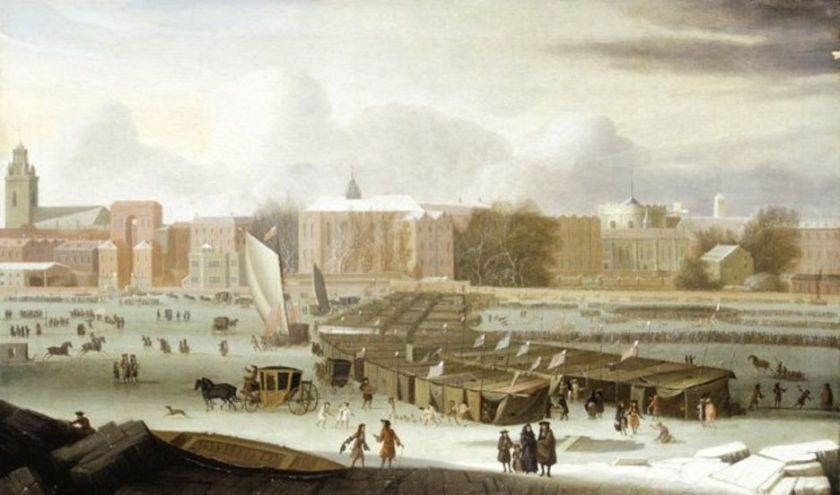
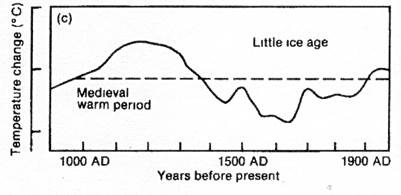 Breaks in cold weather inevitably marked the end of the frost fairs, sometimes all of a sudden. In January 1789, melting ice dragged a ship with it, while tied to a riverside tavern, in Rotherhite. Five people were killed when the building was pulled down on their heads.


 “Lockjaw” is such a sterile term, it doesn’t begin to describe the condition known as Tetanus. In the early stages, the anaerobic bacterium Clostridium Tetani produces tetanospasmin, a neurotoxin producing mild spasms in the jaw muscles. As the disease progresses, sudden and involuntary contractions effect most skeletal muscle groups, becoming so powerful that bones are fractured and the muscles tear themselves apart. These were the last days of John Roebling, the bridge engineer who would not live to see his most famous work.
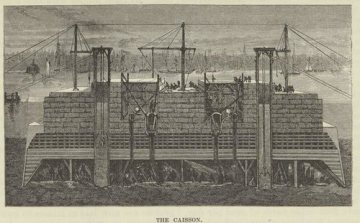 Roebling’s 32-year-old son Washington took over the project, beginning construction on January 3, 1870.
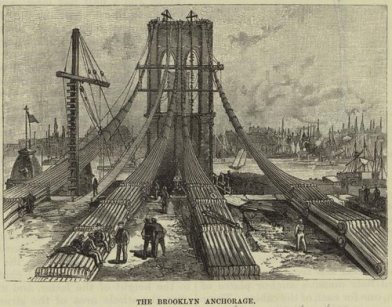 Roebling conducted the entire project looking out his apartment window, designing and redesigning details while his wife, Emily Warren Roebling, became the critical connection between her husband and the job site.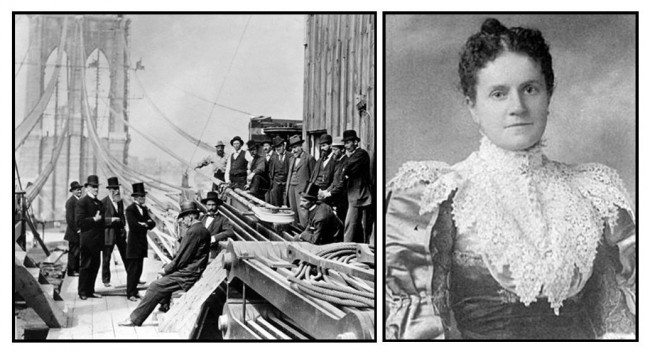




 As befitting a man who completely buys into Nazi ideas of racial superiority, the SS officer wrote “For the more advanced white race it offers outstanding possibilities for exploitation”, adding that the people who lived there “cannot be measured in civilised terms as we know them in Germany”.


 Once considered mythical but for the old sailor’s stories and the damage inflicted on ships themselves, the first scientific measurement of a rogue wave occurred in the North sea in 1984, when a 36′ wave was measured off the Gorm oil platform, in a relatively placid sea.

 In 1909, the 500-ft. cargo liner SS Waratah disappeared off Durban South Africa, with 211 passengers and crew.


 Sosigenes was close with his 365¼ day long year, but not quite there. The correct value of a solar year is 365.242199 days. By the year 1000, that 11-minute error had added seven days. To fix the problem, Pope Gregory XIII commissioned Jesuit astronomer Christopher Clavius to come up with yet another calendar. The Gregorian calendar was implemented in 1582, omitting ten days and adding a day on every fourth February.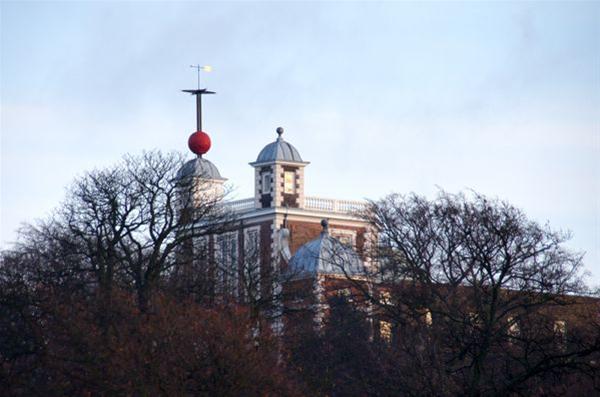
 That first ball was hoist up a flagpole by five men on December 31, 1907. Once it hit the roof of the building, the ball completed an electric circuit, lighting up a sign and touching off a fireworks display.


 Forty years later and half a world away, what would one day become South Africa was divided into four entities: the two British possessions of Cape Colony and Natal, and the two Boer (Dutch) Republics of the Orange Free State and the South African Republic, better known as Transvaal. Of the four states, Natal and the two Boer Republics were mainly agricultural, populated by subsistence farmers. The Cape Colony was by far the largest, dominating the other three economically, culturally, and socially.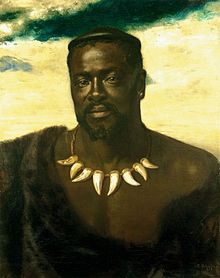

 Historical Easter Eggs - Today in History
You must be logged in to post a comment.