February 24, 1980 The Impossible Dream

The Soviet Union entered the Lake Placid games as heavy favorites, having built a 27-1-1 record since that 1960 upset, outscoring their opponents by a combined 175 to 44

In the world of sports, there may be nothing more boring than the “dream team” sent to represent the US in the 1992 Olympics.  NBA professionals all, these guys are paid in the tens of millions to play their game.  To the surprise of precisely no one, they swept their series with an average of 44 points, against opponents like Angola, Lithuania and Croatia.  Yawn.

We didn’t always send professional athletes to the Olympics.  There was a time when athletes’ amateur status was tightly controlled.  Jim Thorpe, possibly the finest all-round athlete in American history, was stripped of his 1912 gold medals in the decathlon and pentathlon, because he had once accepted small sums to play baseball during college summers.  It could not have given him much comfort that those medals were reinstated, in 1983.  By that time, the man had been dead for thirty years.

In 1980, the US hockey team defeated Finland on February 24 to win the gold medal, at the winter Olympics in Lake Placid.  It was almost anti-climactic.  The real drama played out two days earlier, when a collection of American amateurs defeated the mighty Soviet Union.

Canadians dominated Olympic ice hockey in the early days of the event, winning six out of seven gold medals between 1920 and 1952.  Team USA scored a surprise gold at Squaw Valley in 1960, after which the Soviet Union seemed unstoppable, winning gold in 1964, ’68, ’72 &’76.

My fellow children of the cold war will attest, a favorite complaint of the era was the semi-professional status of the former Soviet bloc athletes, particularly those from East Germany and the Soviet Union itself.  Between its first appearance in the 1952 Olympic games and its final appearance in 1988, the Soviet Union was at the top of the combined medal count with 1,204.  Even now they’re second only to that of the United States, a country that’s been participating over twice as long.

The Soviet Union entered the Lake Placid games as heavy favorites, having built a 27-1-1 record since that 1960 upset, outscoring their opponents by a combined 175 to 44.  The 1980 team had world class training facilities, having played together for years in a well-developed league.  Vladislav Tretiak was widely believed to be the best goaltender in the world at that time.  He, defenseman Viacheslav Fetisov and forward Valeri Kharlamov, would all go on to be enshrined in the International Hockey Hall of Fame.

In exhibition games that year, Soviet club teams went 5–3–1 against NHL teams.  A year earlier, the Soviet national team routed an NHL All-Star team 6–0 to win the Challenge Cup.

University of Minnesota coach Herb Brooks had assembled the youngest team in U.S. history to play in the Olympics, with an average age of only 21.  Left wing Buzz Schneider was the only veteran, returning from the 1976 Olympic squad.  Nine players had played under Coach Brooks.  Another four came from archrival Boston University, including goalie Jim Craig, and team captain Mike Eruzione.  For some players, the hostility of that college rivalry carried over to their Olympic teammates.

The Soviet team had demolished earlier opponents by a combined score of 50-11.  The US squad had squeaked out a series of upsets, 23-8. The day before, New York times sports reporter Dave Anderson wrote, “Unless the ice melts, or unless the United States team or another team performs a miracle, as did the American squad in 1960, the Russians are expected to easily win the Olympic gold medal for the sixth time in the last seven tournaments.”

Team USSR took an early lead of 2-1 in the first period.  Mark Johnson tied the score with one second left, leading Soviet coach Viktor Tikhonov to make the goofiest decision, ever.  He pulled the best goalie in the world, replacing him with backup goaltender Vladimir Myshkin.  The move shocked players on both teams.  Years later, Johnson and Fetisov were NHL teammates, and Johnson asked him about the decision.  “Coach Crazy”, was all he said.

Aleksandr Maltsev scored an unanswered goal on a power play, 2:18 into the second period.  At the end of the second, the Soviet Union led, 3-2.

Mark Johnson scored his second goal of the game at 8:39 in the third, in the last seconds of another power play.  For the American team, it was only the third shot on net, in the last 27 minutes. Vasili Pervukhin got in his goalie’s way with ten minutes to play, as Mike Eruzione fired one past Myshkin to put the Americans ahead, 4-3.

miracle-on-iceThe Soviets attacked ferociously, but Craig let nothing past.  Altogether the Soviet team made 39 shots on goal to the Americans’ 16, but the score held.

In the final moments of the game, the crowd began to count down the seconds.  ABC Sportscaster Al Michaels calling the game in a rising crescendo:  “11 seconds, you’ve got 10 seconds, the countdown going on right now! Morrow, up to Silk. Five seconds left in the game. Do you believe in miracles!? YES!!”

David had slain Goliath.  Rocky Balboa had defeated Captain Ivan Drago.  A bunch of college kids had just beaten the Soviet Union.  Coach Brooks sprinted back to the locker room, and cried.  Pandemonium reigned supreme, as  Jim Craig circled the ice, wrapped in a flag.  ABC sportscaster Jim McKay compared the victory to a Canadian college football team defeating the Superbowl champion Pittsburgh Steelers.  Afterward, players spontaneously broke into a chorus of “God Bless America” in the locker room.

sports_illustrated_miracle_on_ice_cover
The March 3, 1980 cover of Sports Illustrated needed no captions. Everyone knew what happened.

In the gold medal round on the 24th, the Americans were behind at the end of the 2nd period, 2-1.  The American team was in the locker room during the second intermission, when coach Brooks said “If you lose this game, you’ll take it to your f***ing graves”.  Team USA defeated Finland for the gold medal, 4-2.

IOC President Avery Brundage (1952-1972), was adamant about preserving the amateur status of the Olympics. Once he was gone, the floodgates began to open.  Years later, sportswriter Ron Rapoport said “The pros are there for a reason… The pro athletes are pre-sold to the public, which means increased viewership.”

Nineteen years later, Sports Illustrated called the Miracle on Ice “the top sports moment of the entire 20th century”.

The “Dream Team” of 1992 crossed a line that can never be retaken, but that can’t change the finest moments in sporting history.  For those of us who follow Boston sports, that means the 2004 World Series, the last 2:17 of Superbowl LI, and the Miracle on Ice, of 1980.

February 23, 1862 Floating Cathouse of the Cumberland

Certain that Nashville’s prostitutes were the source of the venereal plague, Union officials decided it was easier to get rid of them, than it was to keep their men from paying for sex

The Federal invasion of Tennessee began in early 1862, when Union forces under Ulysses S. Grant moved against Fort Henry on the Tennessee River and Fort Donelson on the Cumberland.  Both fortifications fell in February.  Another Federal army under Don Carlos Buell captured Nashville on the 25th.
Confederate presence in Tennessee essentially ceased to exist by June.  West Tennessee would remain in Union hands for the remainder of the war.
Robert E. Lee wrote to his wife on February 23, “The news from Tennessee and North Carolina is not cheering and disasters seem to be thickening around us”.
Union commanders declared martial law, posting garrisons in major towns including Chattanooga, Memphis, and Murfreesboro. Nashville in particular became a major military center, permanently occupied by thousands of Federal troops and support personnel.
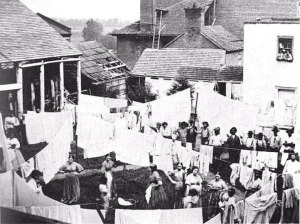
According to the 1860 Census, Nashville had 198 white prostitutes and 9 described as “mulatto”, plying their trade in the two block red-light district known as “Smoky Row”. By 1862, the number of these “public women” had grown to 1,500.  It was barely enough to go around.

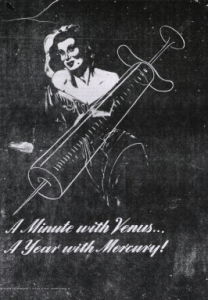
Major General William Rosecrans saw this sex trade as an issue and ordered Georgesyphilis_slogan Spalding, Provost Marshal of Nashville, to get rid of them. Though a Catholic, “Old Rosy’s” objection wasn’t based on moral grounds.  He was afraid of disease. 8.2% of all Union soldiers were afflicted with syphilis or gonorrhea in 1862, over half the battle casualty rate of 17.5%  Venereal disease was a major problem, and the only available treatments at the time involved mercury.  Without getting into details, that could take a man out for weeks.  Advanced cases were nothing short of grotesque.
tertiary-syphilis
Tertiary Syphilis Victim
Certain that Nashville’s prostitutes were the source of the plague, Union officials decided it was easier to get rid of them, than it was to keep their men from paying for sex.  Spalding had all the prostitutes in Nashville gathered up by July, (I wonder what that sounded like).    The Nashville Daily Press reported  “A variety of ruses were adopted to avoid being exiled; among them, the marriage of one of the most notorious of the cyprians to some scamp. The artful daughter of sin was still compelled to take a berth with her suffering companions, and she is on her way to banishment”.
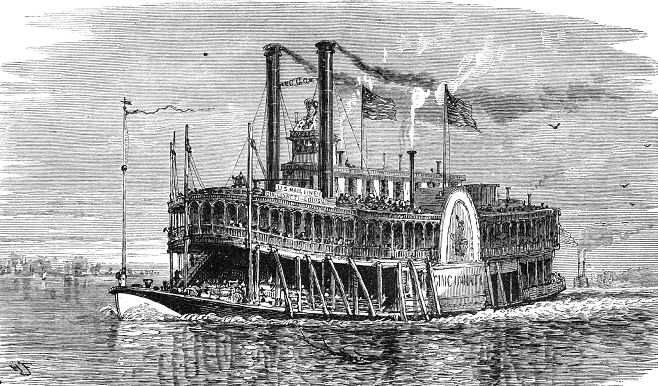
John Newcomb was the owner of a brand new steam powered riverboat, the “Idahoe”. (I swear I didn’t make that up). To Newcomb’s horror, Spalding ordered him to take 111 of Nashville’s most infamous hookers out of town, on Idahoe’s maiden voyage. Giving him three days’ rations, authorities didn’t care where he took them, so long as he got them out of Nashville.
It took a week for Idahoe to reach Louisville, by which time news of the unusual passenger list had already reached that city’s law enforcement. Newcomb was forbidden from docking there, and ordered to continue on to Cincinnati. Ohio didn’t want Nashville’s hookers any more than Louisville, so the steamboat was ordered to dock across the river in Kentucky.
Some of the women swam ashore but nobody was permitted to leave. Holcomb was desperate, finally returning to Louisville once more, only to be turned away again. Defeated, John Newcomb returned to Nashville 28 days later, with 98 of his original passengers and six children.
With Idahoe’s owner demanding to be compensated, a staffer inspected the vessel on August 8, finding the ship’s staterooms “badly damaged, the mattresses badly soiled,” and recommending that Newcomb be paid $1,000 in damages + $4,300 for food and for the “medicine peculiar to the diseased of women in this class”.
hospital_nashville
Civil War Nashville Hospital

In the end, it proved easier to manage the world’s oldest profession, than it was to eliminate it. A scheme was devised, by which each prostitute in Nashville would register and pay a $5 license fee, entitling her to ply her trade. A doctor would examine these women once a week, a service for which she would pay another 50¢. Women found to have venereal diseases were sent to a hospital, paid for in part by the weekly fees. The result of the program, according to one doctor, was a “marked improvement” in licensed prostitutes’ physical and mental health.

Altogether, the program cost about $6,000, on revenues of $5,900. Venereal disease was cut to one or two cases among the soldiers, compared to 3,000 or more without it. Today, the system practiced in Lyon County Nevada, closely resembles this system established in 1863.
As for John Newcomb, he waited almost two years for his money, finally writing directly to Secretary of War Edward Stanton before receiving any reimbursement. The Idahoe never again cruised in Southern rivers. “I told them it would forever ruin her reputation as a passenger boat”, he said. “It was done, so she is now & since known as the floating whore house.”

February 22, 2005 Little Pink House

For newly divorced paramedic Susette Kelo, the house overlooking the Fort Trumbull waterfront was the home of her dreams

In 1775, Connecticut Governor Jonathan Trumbull proposed a fortification at the port of New London, situated on the Thames River and overlooking Long Island Sound. The fort was completed two years later and named for Governor Trumbull. During the Revolution, Fort Trumbull was attacked and occupied by British forces, for a time commanded by the turncoat American General, Benedict Arnold.

By the early 20th century, the Fort Trumbull neighborhood consisted of 90 or so single and multi-family working class homes, situated on a peninsula along the fringes of a mostly industrialized city center.

In 1996, chemists working at Pfizer Corporation’s research facility in England were studying compound UK-92, 480 or “Sildenafil Citrate”, synthesized for the treatment of hypertension and heart disease resulting from a restriction in blood supply to heart tissues. Study subjects were expected to return unused medication at the end of the trial. Women showed no objection in doing so but a significant number of male subjects refused to give it back. It didn’t take long to figure out what was happening.  The chemical compound which would one day bear the name “Viagra”, was going to be put to a very different use.

little-pink-houseFor newly divorced paramedic Susette Kelo, the house overlooking the Fort Trumbull waterfront was the home of her dreams. Long abandoned and overgrown with vines, the little Victorian cottage needed a lot of work, but where else would she ever find a waterfront view at this asking price?  It was 1997, about the same time that Connecticut and New London politicians resurrected the long-dormant New London Development Corporation (NLDC), charging it with developing a plan to revitalize the New London waterfront.

Susette Kelo sanded her floors on hands and knees, as Pfizer Corporation was looking at a cataract of business based on their newest chemical compound. The company was recruited to become the principal tenant in a “World Class” multi-use waterfront campus, including high-income housing, hotels, shopping and restaurants, all centered around a 750,000 sq. ft. corporate research facility.  Connecticut College professor and NLDC President Dr. Claire Gaudiani liked to talk about her “hip” new development project.  Fort Trumbull residents were convinced that stood for “High Income People”. With an average income of $22,500, that didn’t include themselves.

Most property owners agreed to sell, though not exactly “voluntarily”.  There was considerable cap_nfs_keloharassment of the reluctant ones, including late-night phone calls, waste dumped on property, and tenants locked out of apartments during cold winter weather.

Seven homeowners holding fifteen properties refused to sell, at any price. Wilhelmina Dery was in her eighties. She was born in her house and she wanted to die there. The Cristofaro family had lost another New London home in the ’70s, taken by eminent domain during yet another “urban renewal” program. They didn’t want to lose this one, too.

Susette Kelo came home from work the day before Thanksgiving 2000, to find an eviction notice taped to her door.

Letters were written to editors and rallies held, as NLDC and state officials literally began to bulldoze homes. Holdout property owners were left trying to prevent property damage from flying demolition debris.

KELO BULLOCK

Facing a prolonged legal battle which none of the homeowners could afford, the group got a boost when the Libertarian law firm Institute for Justice took their case pro bono. There was cause for hope. Retired homeowner Vera Coking had faced a similar fight against Now-President Donald Trump in 1993, when the developer and Atlantic City New Jersey authorities attempted to get her house condemned to build a limo lot.

Eminent domain exists for a purpose, but the most extreme care should be taken in its use. Plaintiffs argued that this was not a “public use”, but rather a private corporation using the power of government to take their homes for economic development, a violation of both the takings clause of the 5th amendment and the due process clause of the 14th.

Vera Coking won her case against Trump, the casino later failing and closing its doors. New Londonkelo-decision District Court, with Susette Kelo lead plaintiff, “split the baby”, ruling that 11 out of 15 takings were illegal and unconstitutional. At that point it wasn’t good enough for the seven homeowners. They had been through too much.  All of them would stay, or they would all go.

Connecticut’s highest court reversed the decision, throwing out the baby AND the bathwater in a 3-4 decision. The United States Supreme Court agreed to hear the case, argued before the seven justices then in attendance on February 22, 2005.

SCOTUS ruled in favor of New London in a 5-4 decision, Justices Stevens, Kennedy, Souter, Ginsburg and Breyer concurring. Seeing the decision as a reverse Robin Hood scheme that would steal from the poor to give to the rich, Sandra Day O’Connor wrote “Any property may now be taken for the benefit of another private party, but the fallout from this decision will not be random. The beneficiaries are likely to be those citizens with disproportionate influence and power in the political process, including large corporations and development firms”.  Clarence Thomas took an originalist view, stating that the majority opinion had confused “Public Use” with “Public Purpose”. “Something has gone seriously awry with this Court’s interpretation of the Constitution”, Thomas wrote. “Though citizens are safe from the government in their homes, the homes themselves are not”.  Antonin Scalia concurred, seeing any tax advantage to the municipality as secondary to the taking itself.

kelo-2014In the end, most of the homes were destroyed or relocated. State and city governments spent $78 million and bulldozed 70 acres.  The 3,169 new jobs and the $1.2 million in new tax revenue anticipated from the waterfront project, never materialized.  Pfizer backed out of the project and moved away, taking 1,500 existing jobs with them.  Just about the time when existing tax breaks were set to expire, raising the company’s tax bill by 400%.
The now-closed redevelopment area became a dumping ground for debris left by Hurricane Irene in 2011.  Its only residents were feral cats.

In reaction to the Kelo v. City of New London decision, a group of New Hampshire residents proposed a hotel to be built on the site of Justice David Souter’s home in Weare, New Hampshire.  Calling it the “Lost Liberty Motel”, an on-line petition was created to quantify the public benefit of the taking, generating at least 1,418 signatories committing to stay there at least a week. Supporters claimed to be serious, but the measure was defeated three to one in a ballot referendum. The two candidates for Selectman backing the measure, were both defeated.

To this day, New Hampshire license plates bear the slogan “Live Free or Die”.  Those in Connecticut say “Constitution State”.  In neither case is it at all clear, why.

February 21, 1431 Joan of Arc

History has repeatedly demonstrated the truth of Taylor Owen’s comment on the subject of leadership: “An army of donkeys led by a lion is better than an army of lions led by a donkey.” So it was in the days after Jeanne’s arrival at Orléans

The Hundred Years’ War began as a succession dispute over the French throne, with an alliance of Burgundians and English on one side, against a coalition of Royalists led by the Armagnacs on the other.

Europe was not far removed from the latest outbreak of the Black Death at this time, as the scorched earth tactics employed by the English army laid waste to the countryside and devastated the French economy.

Charles, Dauphin and heir apparent to the French throne was up against a wall, when a teenage peasant girl approached him in 1429.

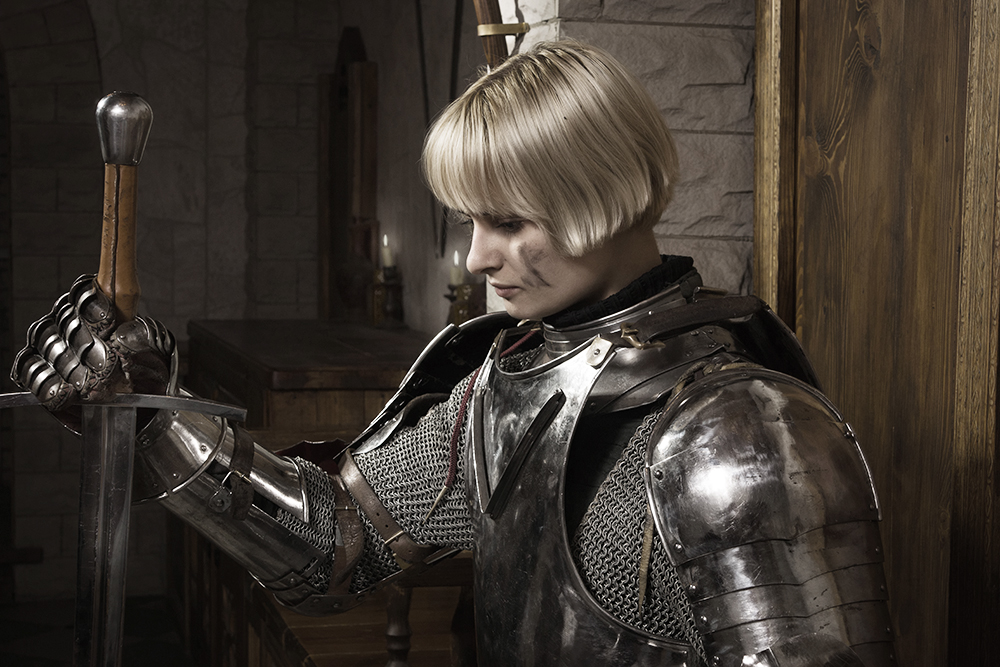
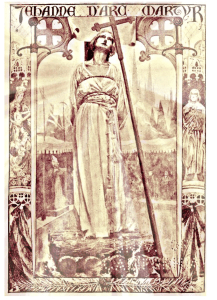
joan_of_arcFor the 14-year-old boy-king, even listening to her was an act of desperation, borne of years of humiliating defeats at the hands of the English army. Yet this illiterate peasant girl had made some uncanny predictions concerning battlefield successes.  Now she claimed to have had visions from God and the Saints, commanding her to help him gain the throne. Her name was Jeanne d’Arc.
The siege of Orléans was six months old at this time, when the Dauphin decided it couldn’t hurt to let her take part. She dressed herself in borrowed armor and set out, arriving on the 29th of April, 1429.

History has repeatedly demonstrated the truth of Taylor Owen’s comment on the subject of leadership: “An army of donkeys led by a lion is better than an army of lions led by a donkey.” So it was in the days after Jeanne’s arrival at Orléans.

Though repeatedly excluded from war councils, Jeanne managed to insert herself anyway, putting the French back on the offensive and handing them one victory after another.

Nine days after her arrival, Orléans turned into an unexpected victory for the French, despite Jeanne’s being shot through the neck and left shoulder by an English longbow, while holding a ladder at the siege of Tourelles.  The Dauphin granted her co-command of the army with Duke John II of Alençon. The French army enjoyed a string of successes, recovering Jargeau on June 12, Meung-sur-Loire on the 15th, and Beaugency two days later, leading to a humiliating English defeat at the battle at Patay on the 18th.

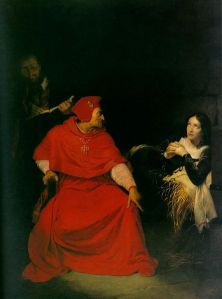
Several more Armagnac victories followed.  On July 17, 1429, Charles was consecrated King Charles VII of France, fifth King of the House of Valois, with Jeanne at his side.  Despite her loyalty, Charles’ support began to waver.  Court favorite Georges de La Trémoille had convinced the king that she was becoming too powerful.  An archer pulled Jeanne from her horse during the siege of joan_of_arc_interrogationCompiègne in May, 1430, and her allies failed to come to her aid.  Left outside the town’s gates when they closed, she was captured and taken to the castle of Bouvreuil.
Some 70 charges were made against her by the pro-English Bishop of Beauvais, Pierre Cauchon, including witchcraft, heresy, and dressing like a man.

Representatives of the judge were dispatched  to Jeanne’s home village of Domremy, to ascertain the prisoner’s virginity, character, habits and associations.  Nicolas Bailly, the man responsible for collecting testimony, reported that he “had found nothing concerning Joan that he would not have liked to find about his own sister”. This Bishop Cauchon must have been some piece of work.  The report so angered the man, that he called Bailly “a traitor and a bad man” and refused to pay him for his work.

Jean Le Maistre, whose presence as Vice-Inquisitor for Rouen was required by canon law, objected to the proceedings and refused to appear, until the English threatened his life.

Interrogation of the prisoner began on February 21, 1431. The outcome was never in doubt. Transcripts were falsified and witnesses intimidated.  Even then, trial records reveal this illiterate peasant girl to be brighter than all her inquisitors, combined.

One example from her third interrogation, was the Question: “Do you know whether or not you are in God’s grace?”. The question was a trap.  Church doctrine stated that no one could be certain of being in God’s grace, yet a “no” answer would have been held against her.  “If I am not”, she said, “may God put me there; and if I am, may God so keep me. I should be the saddest creature in the world if I knew I were not in His grace.”

After fifteen such interrogations her inquisitors still had nothing on her, save for the wearing of soldier’s garb, and her visions. Yet, the outcome of her “trial” was already determined.  She was found guilty of heresy, and sentenced to be burned at the stake.  On May 24, Jeanne was taken to a scaffold.  Threatened that she would be immediately burned alive if she didn’t disavow her visions and abjure the wearing of soldier’s clothing, Jeanne agreed to sign such an abjuration, but recanted four days later.

jean-darc-executionThe death sentence was carried out on May 30, 1431, in the old marketplace at Rouen. She was 19.  After she died, the coals were raked back to expose her charred body.  No one would be able to claim she’d escaped alive. Her body was then burned twice more, so no one could collect the relics.  Her ashes were then cast into a river.

Guillaume Manchon, one of the court scribes, later recalled: “And she was then dressed in male clothing, and was complaining that she could not give it up, fearing lest in the night her guards would inflict some act of [sexual] outrage upon her; and she had complained once or twice to the Bishop of Beauvais, the Vice-Inquisitor, and Master Nicholas Loiseleur that one of the aforesaid guards had tried to rape her.”

Her executioner, Geoffroy Therage, later said that he “Greatly feared to be damned”.

An inquisitorial court authorized by Pope Calixtus III re-examined the evidence, 25 years later. The court exonerated her of all charges, pronouncing her innocent on July 7, 1456, and later declaring her a martyr.

A National Heroine to the French, Joan of Arc was canonized a saint of the Roman Catholic Church, in 1920.  It was small consolation for this child who had been set up for a fall by her enemies, and abandoned to be incinerated alive, by her friends.

February 20, 1942 Ace

O’Hare’s Medal of Honor citation calls it “…one of the most daring, if not the most daring, single action in the history of combat aviation…”

We’ve all read the story of “Easy Eddie” O’Hare, the mob lawyer who had everything but a good name, who gave it all up to show his son that personal integrity was more important than all the riches of the underworld. Easy Eddie went on to testify against Al Capone and lost his life for it, Eddie’s son “Butch” going on to become a WWII flying Ace.

The story is true, kind of, but it lays the morality play on a little thick.

Edward Joseph O’Hare, “EJ” to friends and family, passed the Missouri bar exam in 1923easy-eddie and joined a law firm.  Operating dog tracks in Chicago, Boston and Miami, O’Hare made a considerable fortune working for Owen Smith, the high commissioner for the International Greyhound Racing Association, who patented the mechanical rabbit used in dog racing.  EJ and Selma Anna (Lauth) O’Hare had three children between 1914 and 1924, – Edward (“Butch”), Patricia, and Marilyn.
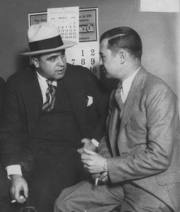
EJ developed an interest in flying in the 1920s, once even hitching a ride on Charles Lindbergh’s mail plane.  For a time he worked as pilot for Robertson Aircraft, occasionally giving his teenage son a turn at the controls.

One day EJ came home to find 13 year old Butch sprawled on the couch, munching on donuts and banana layer cake.  He enrolled the boy in the Western Military Academy in Alton, Illinois.  The kid was getting way too lazy.

easy_eddie_with_caponeEJ and Selma divorced in 1927.  He left St. Louis for good, moving to Chicago while Butch attended WMA.  It was there that the elder O’Hare met Al Capone, later earning his second fortune working as the gangster’s business manager and lawyer.

In 1930, O’Hare approached John Rogers, a reporter for the St. Louis Post-Dispatch, asking that he arrange a meeting with the Internal Revenue Service, which was then after Capone on grounds of tax evasion.  It may have been to restore his good name, or maybe he saw the writing on the wall.  Possibly both.  The two are not mutually exclusive.  Whatever the motivation, an Agent Wilson of the IRS later said “On the inside of the gang I had one of the best undercover men I have ever known: Eddie O’Hare.”

Al Capone was convicted of tax evasion in 1931 and sentenced to Alcatraz, becoming easyeddieohare02eligible for early release in 1939 due to syphilitic dementia. On November 8 of that year, EJ left his office at Sportsman’s Park racetrack in Cicero in his black ’39 Lincoln Zephyr. Two shotgun wielding gunmen pulled alongside, firing a volley of big game slugs and killing O’Hare, instantly. No arrest was ever made.
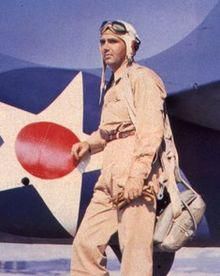
Butch had graduated from WMA and the Naval Academy at Annapolis by this time, receiving his duty assignment aboard the USS New Mexico.  Shortly after his father’s assassination, the younger O’Hare began flight training at Naval Air Station in Pensacola.
Assigned to the USS Saratoga’s Fighting Squadron, Butch O’Hare made his first carrier landing in 1940, describing it as “just about the most exciting thing a pilot can do in peacetime.”

butch-ohareIt was February 20, 1942, when Butch O’Hare became the first American flying Ace of WWII. The carrier Lexington was discovered by Japanese reconnaissance aircraft, 450 miles outside of Rabaul.  Six Grumman F4F Wildcat fighters and Lexington’s anti-aircraft guns were engaged with an incoming formation of nine Japanese bombers, when nine more bombers were reported incoming.
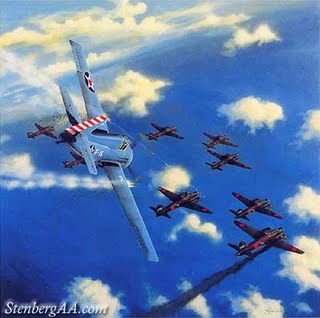
Six more Wildcats roared off the flight deck of the Lexington, one piloted by Butch O’Hare.  He and his wingman Marion William “Duff” Dufilho were the first to spot the V formation, diving to intercept them and leaving the other four fighters too far away to change the outcome.  Dufilho’s guns jammed and were unable to fire, leaving Butch O’Hare alone on the unprotected side of his flotilla.  One fighter against nine enemy bombers flying in tight V formation, mutually protecting one another with their rear-facing machine guns.

O’Hare’s Wildcat had four 50-caliber guns with 450 rounds apiece, enough to fire for abouthagel-butchohare 34 seconds.  What followed was so close to the Lexington, that pilots could hear the carrier’s AA guns.  Full throttle and diving from the high side, O’Hare fired short, accurate bursts, the outermost bomber’s right-hand engine literally jumping from its mount.  Ducking to the other side and smashing the port engine on another “Betty”, O’Hare’s Wildcat attacked one bomber after another, single handedly taking out five bombers with an average of only 60 rounds apiece.
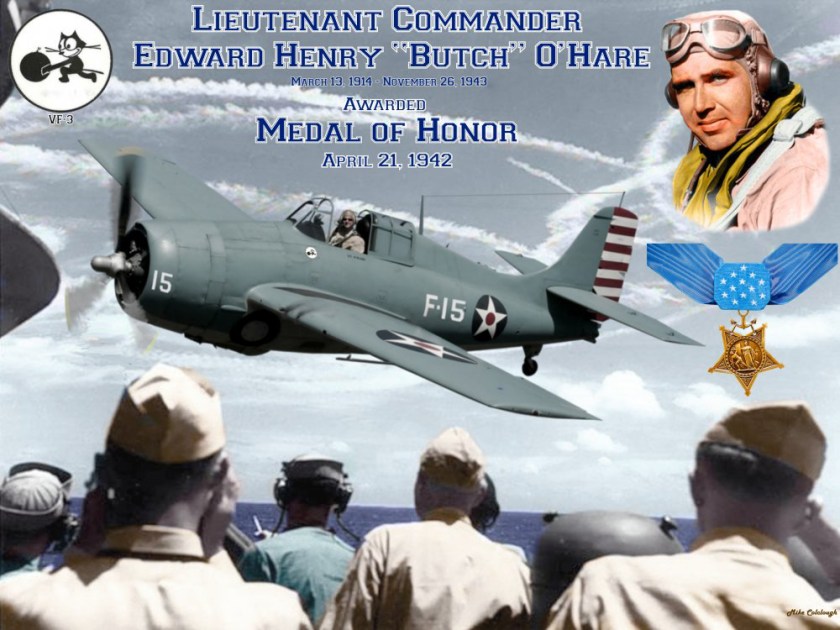
O’Hare’s Medal of Honor citation calls it “…one of the most daring, if not the most daring, single action in the history of combat aviation…”

Butch O’Hare disappeared in a confused night action on November 26, 1943.  Some say he was cut down by friendly fire, mistakenly shot down by TBF Avenger gunner Alvin B. Kernan.  Others say it was a lucky shot by a gunner aboard his old adversary, a Rikko (Betty) bomber.  A third theory is that his Hellcat caught a wingtip on a wave, and cartwheeled into the ocean.

The Orchard Depot Airport in Chicago was renamed O’Hare International Airport in tribute to the fallen Ace, on September 19, 1949.   Neither the body, nor the aircraft, were ever recovered.  butch-ohare

February 19, 1807 Founding Scoundrels

What would it be like to turn on CNN or Fox News, to learn that Former Secretary of the Treasury Jacob Lew had been party to a duel, and that he was near death after being shot by Vice President Mike Pence.

What would it be like to turn on CNN or Fox News, to learn that Former Secretary of the Treasury Jacob Lew had been party to a duel, and that he was near death after being shot by Vice President Mike Pence.

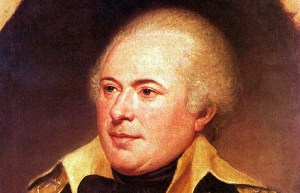
The year was 1804, and President Jefferson’s Vice President, Aaron Burr, had a long standing personal conflict with one of the Founding Fathers. Alexander Hamilton, the only signer of the Constitution from the state of New York, had been the first Secretary of the Treasury serving under President George Washington.

aaron-burr-alexander-hamilton
Aaron Burr(R), Alexander Hamilton (L)

The animosity between Hamilton and Burr probably began in 1791, when Burr defeated Hamilton’s father-in-law Philip Schuyler in a US Senate election. The conflict escalated during the 1800 Presidential election, one of the ugliest election seasons in our nation’s history.  Called the “Revolution of 1800”, the contest pitted Thomas Jefferson and his Democratic-Republicans, against former Vice President John Adams and his Federalist party.

Both sides were convinced as an article of faith, that the other side would destroy the young nation.  Federalists attacked Jefferson as an un-Christian deist, whose sympathies with the French Revolution would bring about a similar cataclysm in the young American Republic.  Democratic-Republicans criticized the alien and sedition acts, and the deficit spending the Adams administration used to support Federal policy.

“The father of modern political campaigning”, Burr enlisted the help of New York’s Tammany Hall in his pursuit of election, transforming what was then a social club into a political machine.

The election was a decisive victory for the Democratic-Republicans, not so much for the selection of President and Vice President.  At the time, electors cast two votes, the first and second vote-getters becoming President and Vice President.   The electoral vote tied at 73 between Thomas Jefferson and Aaron Burr, moving the selection to the House of Representatives.

Hamilton exerted his influence on behalf of Thomas Jefferson, who was elected on the 36th ballot, making Burr his VP.

Today we’re accustomed to the idea of “Judicial Review”, the idea that Supreme Court decisions are final and inviolate, but that wasn’t always the case.  The Landmark Supreme Court case Marbury v Madison established the principle in 1803, a usurpation of power so egregious to Democratic-Republicans that it led to the impeachment of Associate Justice Samuel Chase, a signer of the Declaration of Independence.  As VP, Aaron Burr presided over Chase’ impeachment.

Relations became toxic between Jefferson and his VP.  Burr knew that he wouldn’t be kept on for the 1804 re-election campaign, and so he ran for Governor of New York, losing the election by a decisive margin to a virtual unknown, Morgan Lewis.  It was a humiliating defeat, the largest in New York electoral politics up to that time.

weehawken-duelBurr blamed Hamilton for his defeat, challenging him to a duel over comments made during the election.  Dueling was illegal at this time but enforcement was comparatively lax in New Jersey.  The pair rowed across the Hudson River with their “seconds”, meeting at the waterfront town of Weehawken, New Jersey.  It was July 11, 1804.  Hamilton “threw away” his shot, firing into the air.  Aaron Burr shot to kill.
Murder charges were filed in both New York and New Jersey, but neither ever went to trial.

Aaron Burr went on to preside over Justice Chase’ impeachment trial, later that year.  It had to have been the high point of the Vice President’s political career, a career that otherwise ended the day he met Alexander Hamilton in Weehawken.

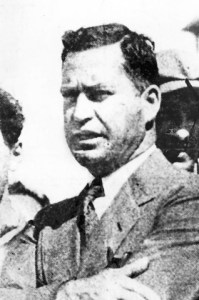
Burr headed for New Orleans, where he got mixed up with one General James Wilkinson, possibly the sleaziest character of the founding generation.  At that time, Wilkinson was a paid agent for Spanish King Charles IV. 100 years later Theodore Roosevelt would say of Wilkinson, “In all our history, there is no more despicable character.”

Wilkinson would take his payments in silver dollars, hidden in rum, sugar and coffee casks.  All those clinking coins almost undid him, when a messenger was caught and killed with 3,000 of them.  The messenger’s five murderers were themselves Spaniards, who testified at trial that the money belonged to the spy Wilkinson.  Payment for services rendered to their King.  Wilkinson’s luck held out, as the killers spoke no English.  Thomas Power, interpreter for the Magistrate, was another Spanish spy.  He translated:  ‘They just say they’re wicked murderers motivated by greed.’

wilkinson
General James Wilkinson

The nature of Burr’s discussions with Wilkinson is unknown, but in 1806, Burr led a group of armed colonists toward New Orleans, with the apparent intention of snatching the territory and turning it into an independent Republic.  It’s probably safe to assume that Aaron Burr saw himself at the head of such a Republic.

Seeing no future in it and wanting to save his own hide, General Wilkinson turned on his former ally, sending dispatches to Washington accusing the former Vice President of treason. Burr was tracked down in Alabama on February 19, 1807, arrested for treason and sent to Richmond, Virginia, for trial.

Burr was acquitted on September 1 of that year, on grounds that he had not committed an “overt act” as specified in the Constitution.  He was not guilty in the eyes of the law, but the court of public opinion would forever regard him as traitor.  Aaron Burr spent the next several years in Europe before returning to New York, and resuming his law practice.

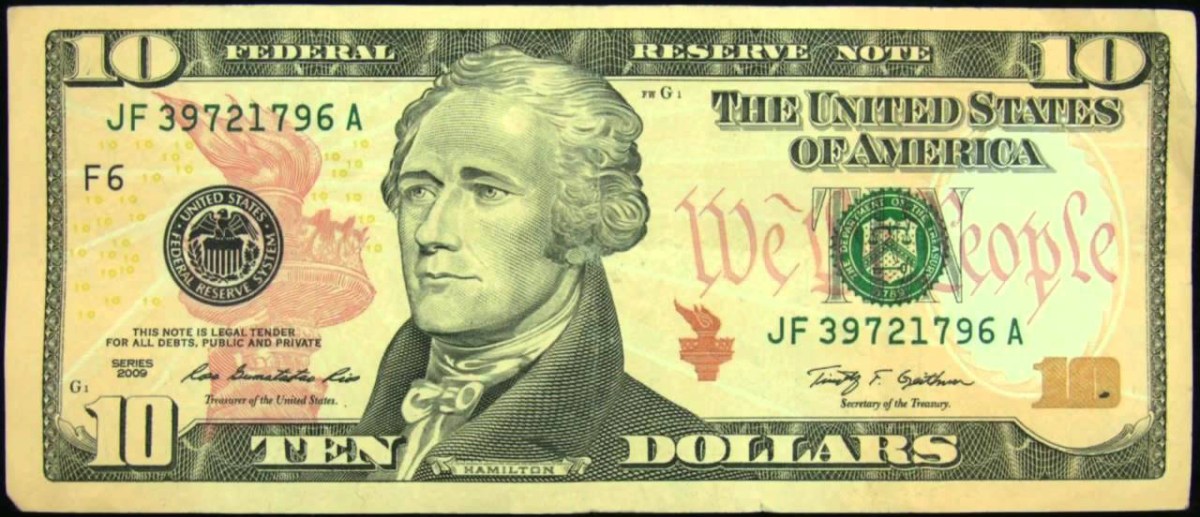
The Vice President who killed the man on our $10 bill, died in obscurity on September 14, 1836, at the age of 80.


February 18, 1817  Friends and Enemies

The two looked across that field as gray and butternut soldiers formed up along seminary ridge.  It’s unlikely they ever saw one another

Armistead is a prominent name in Virginia, the family going back to colonial days.  Five Armistead brothers fought in the war of 1812. Major George Armistead commanded Fort McHenry during the battle that inspired Francis Scott Key to write the Star Spangled Banner.  Major Armistead became an uncle on this day in 1817, to Lewis Addison Armistead, the first of eight children born to General Walker Keith Armistead and Elizabeth Stanley.


lewis-addison-armistead
Lewis Addison Armistead

“Lothario” or “Lo” to his friends, Armistead followed in the family footsteps, attending the US Military Academy at West Point.  He never graduated, some say he had to resign after breaking a plate over the head of fellow cadet and future Confederate General Jubal Early.  Others say it was due to academic difficulties, particularly French class.


Armistead’s influential father gained him a 2nd Lieutenant’s commission nevertheless, awarded in 1839, about the same time his former classmates received theirs.  Armistead’s field combat experience reads like a time-line of his age:  cited three times for heroism in the Mexican-American War, wounded at the Battle of Chapultepec, going on to serve in the Mohave War and the Battle of the Colorado River.

Stellar though his military career was, the man’s personal life was a mess.  Armistead survived two wives and two daughters, only to lose the family farm in a fire, all while fighting a severe case of Erysipelas, a painful skin condition known in the Middle Ages as “St. Anthony’s Fire”.

It’s been said that conjugating the “Be” verb changed after the Civil War.  Before, it was the United States “are”.  Afterward, it became the United States “is”.  Not for no reason.  This was a time when Patriotic Americans felt every bit the attachment to their states, as to the nation.

Fellow Americans took sides on the eve of the Civil War.  Even brothers.   Like his fellow Virginian Robert E. Lee, Armistead wanted no part of secession, but followed his state when it became inevitable.

winfield-scott-hancock
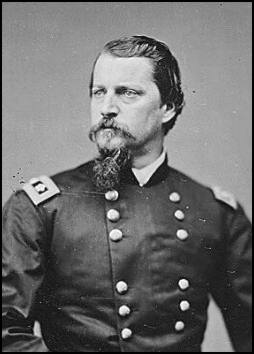
Winfield Scott Hancock

Pennsylvania native Winfield Scott Hancock went the other direction, staying with the Union.  Years later, Hancock would run for the Presidency, only narrowly losing to James A. Garfield.  Noted for personal integrity in a time of rampant political corruption, President Rutherford B. Hayes said of Hancock, “… [I]f, when we make up our estimate of a public man, conspicuous both as a soldier and in civil life, we are to think first and chiefly of his manhood, his integrity, his purity, his singleness of purpose, and his unselfish devotion to duty, we can truthfully say of Hancock that he was through and through pure gold.”

Armistead and Hancock served together on the frontiers, developing a close personal friendship as early as 1844.  On their final parting on the eve of war, Armistead made Hancock the gift of a new Major’s uniform.  To Hancock’s wife he gave his own prayer book, bearing the inscription ”Trust In God And Fear Nothing”.

Three years came and went before the old friends once again faced one another, this time across the field of battle.   Robert E. Lee tried to go after the Union right on that first day at Gettysburg, looking for a soft spot in the line. On day two, he went after the left.  On the afternoon of July 3, 1863, Lee went straight up the middle.

The two looked across that field as gray and butternut soldiers formed up along seminary ridge.  It’s unlikely they ever saw one another.  The action has gone into history as “Pickett’s Charge”, though the term is a misnomer.  Major General George Pickett commanded only one of  three units taking part in the assault, under Lieutenant General James Longstreet.

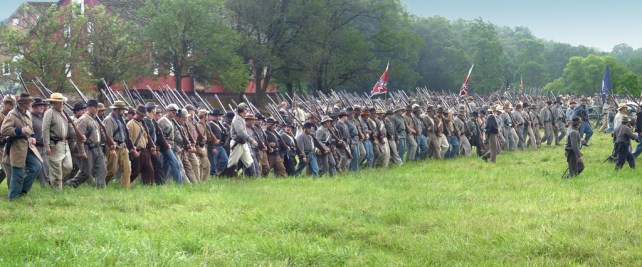
The pace was almost leisurely as Pickett’s, Trimble’s and Pettigrew’s Confederate soldiers stepped over the stone wall.  13,000 crossing abreast, bayonets glinting in the sun, pennants rippling in the breeze.

longstreets-assault

You cannot escape the sense of history if you’ve ever crossed that field. Stepping off Seminary Ridge with a mile to go, you are awe struck at the mental image of thousands of blue clad soldiers, awaiting your advance.  Halfway across and just coming into small arms range, you can’t picketts_chargehelp a sense of relief as you step across a low spot and your objective, the “copse of trees”, drops out of sight.  If you can’t see them they can’t shoot at you.  Then you look to your right and realize that cannon would be firing down the length of your lines from Little Round Top, as would those on Cemetery Hill to your left. Rising out of the draw you are now in full sight of Union infantry.  You quicken your pace as your lines are torn apart from the front and sides. Fences hold in some spots along the Emmitsburg Road.  Hundreds of your comrades are shot down in the attempt to climb over.

Finally you are over and it’s a dead run.  Seeing his colors cut down, Hancock puts his hat atop his sword, holding it high and bellowing above the roar of the guns “Come on, boys, give them the cold steel! Who will follow me!”

bloody-angleThe “High tide of the Confederacy” marks the point between the corner of a stone wall and that copse of trees, the farthest the shattered remnants of Longstreet’s assault would ever get.  Lewis Armistead made it over that wall before being shot down, falling beside the wheels of a Union cannon.

I always wondered what would have happened had J.E.B. Stuart’s cavalry come out of the woods to the Union rear, but that wasn’t meant to be.  The Confederate advance couldn’t hold, wilting in the face of overwhelming Federal firepower.

gettysburg-reunion
Gettysburg veterans on the 50th anniversary of the battle, July 1-3, 1913

Armistead lay bleeding as he asked a nearby soldier about Hancock.  General Hancock was himself wounded by this time, the bullet striking his saddle pommel and entering his thigh, along with shards of wood and a saddle nail.  When told his best friend was also wounded, Armistead said ”Not both of us on the same day!”.  Armistead spoke to Captain Henry Bingham, Hancock’s aide, saying “Tell General Hancock, from me, that I have done him and you all a grave injustice”.

One day, the country would reunite.  The two friends never did.  Lewis Armistead died of his wounds, two days later.

February 17, 1864 Hunley

Despite two disastrous test runs, there was no shortage of volunteers.  Once again, the Hunley was fished up from the bottom

In the 1850s, the economy of the southern United States was mostly agrarian.  When civil war broke out in 1861, the Confederacy depended to a greater degree on imported manufactured goods than the more industrialized states to the north.  For the Union, there was strategic advantage in cutting off this flow of manufactured goods, and so the “Anaconda Plan” was created, to choke off traffic to southern ports and harbors.
Few in the Confederacy understood the need to keep southern ports open as well as the planter, legislator, and southern Patriot Horace Lawson Hunley.
In 1861, Hunley joined forces with James McClintock and Baxter Watson to design and hunley-interiorbuild a secret Super Weapon for the Confederacy.  A submarine.  They completed construction on their first effort, the “Pioneer”, that same year in New Orleans.  The trio went on to build two more submarines in Mobile, Alabama, the “American Diver”, and their last and most successful creation, the “Fishboat”, later renamed HL Hunley.
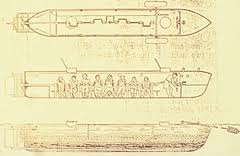
After a short sea trial in Mobile, the Hunley was put on a train and shipped up to Charleston, South Carolina, to help break the blockade.  Arriving on August 12, 1863, she was 40′ long by 4′ wide, displacing about 7½ tons.  She was designed for a crew of 8, with 7 operating a hand crank and the 8th steering the boat.
A test run on August 29 ended in disaster, when Skipper John A. Payne accidentally stepped on the lever controlling the diving planes with the hatches open.  Payne and two others escaped, but the other five crew members went to the bottom.
A second crew tested the submarine on October 15, this one including Horace Hunley himself.  The submarine conducted a mock attack but failed to surface afterward, this time drowning all 8 crew members.
Despite those two disastrous test runs, there was no shortage of volunteers.  Once again, the Hunley was fished up from the bottom.
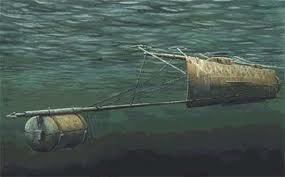
hunley-warheadThe original plan was to tow a floating mine called a “torpedo”, with a contact fuse.  They would dive beneath their victim and surface on the other side, pulling the torpedo into the side of the target.
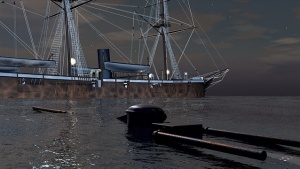
Tide and current conditions in Charleston proved to be very different from those in Mobile.  On several test runs, they found the torpedo floating out ahead of the sub.  That wouldn’t do, so they fashioned a spar and mounted it to the bow.  At the end of the spar was a 137lb waterproof cask of powder, attached to a harpoon-like device with which Hunley would ram its target.hunley-housatonic
Hunley made her first live attack run four miles outside of Charleston Harbor, on the night of February 17, 1864. Lieutenant George Dixon and a crew of seven attacked USS Housatonic, a 1,240 ton steam powered sloop of war, embedding the spar torpedo into Housatonic’s hull.  It must have been a sight to see.  The torpedo ignited a 4,000 lb store of black powder in the hull of the ship, exploding with a deafening roar and a towering column of flame that lit up the night.
hunley
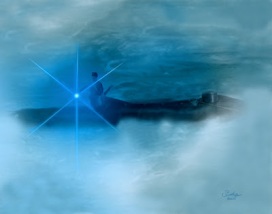
Housatonic was gone in three minutes, killing five sailors.  What happened next, is a mystery.  The first successful attack sub in history showed the signal for success, a blue lantern, to their comrades on shore.  And then it vanished.
Hunley would not be seen again for 131 years.
Author and adventurer Clive Cussler found the sub in 1995, buried in silt under 32′ of water.  A painstaking, five year effort was launched to bring Hunley to the surface, and on August 8, 2000, HL Hunley returned to the light of day.  The sub was moved to the Warren Lasch Conservation Center in thehunley-in-the-lab Charleston Navy Yard, and submerged in 55,000 gallons of chilled, fresh water, where scientists and historians worked on unlocking its secrets.
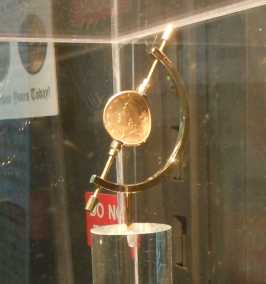
There was an old rumor that Lt. Dixon left a girlfriend in Mobile, Alabama, named Queenie Bennett.  She had given him a $20 gold piece, a good luck charm and token of her affection.  Dixon was shot in the hip at Shiloh, the story goes, a wound that should have killed him.  If the bullet hadn’t struck the gold piece in his pocket. dixon-gold-coin
No one knew if the story was true, until excavation started inside the sub.  Senior Archaeologist Maria Jacobsen found the coin, next to the remains of George E. Dixon.  “Some people may think this is a stroke of luck,” she said, “but perhaps it’s something else. They tell me that Lt. Dixon was a lady’s man, perhaps he winked at us yesterday to remind us that he still is”.
On the coin, clearly showing signs of having been struck by a bullet, are inscribed these words:

Shiloh
April 6, 1862
My life Preserver
G. E. D.


hunley-crew
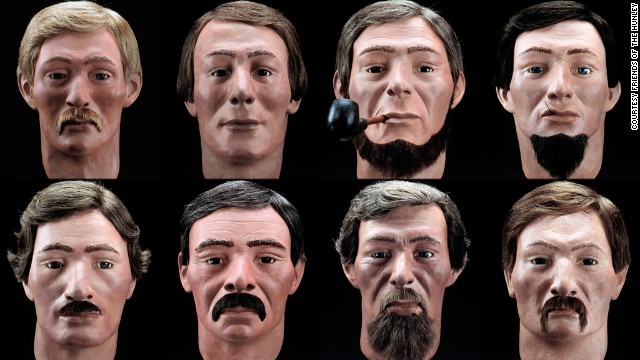
Facial reconstruction techniques reveal the faces of the HL Hunley commander Lt. George Dixon and crewmembers Arnold Becker, Lumkin (first name unknown), Joseph Ridgaway, Frank Collins, Miller (first name unknown), Cpl. J.F. Carlsen and James A Wicks.


February 16, 1804  The Shores of Tripoli

Even a former adversary couldn’t help but admire the feat.  Days later, British Vice Admiral Lord Horatio Nelson called it the “most bold and daring act of the age.”

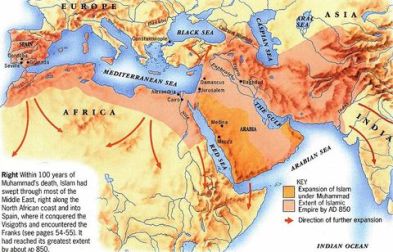
Historic accounts differ as to the early success of the Islamic conquests.  Contemporary Christian sources saw them as God’s punishment for the sins of fellow Christians.  Early Muslim sources describe them as evidence of divine favor, reflections of the religious zeal of the conquerors.  Be that is it may, Islamic expansion enveloped the Arabian Peninsula in the last ten years of the life of Muhammad (622-632), at the expense of the Roman Byzantines and the Sassanid Empire of the Persians.  Syria fell in 634, followed by Egypt, Mesopotamia and Persia.  By 750 the Umayyad Caliphs had subjugated much of the Balkan states, part of the Indian sub-continent, all of North Africa, most of Spain, and parts of Southern France and Sicily.  By the age of Columbus, the Mediterranean was a place where you traveled at your own risk.

Those of us of European ancestry owe our heritage, if not our existence, to the warriors who defeated the Jihadist time after time. There was Pelagius, who stopped a military force of the Umayyad Caliphate at Covadonga in 722, without which there would be no Reconquista, no Ferdinand and Isabella, and we wouldn’t know the name of Christopher Columbus.

The father of Charlemagne, Charles “The Hammer” Martel, blocked the Muslim advanceislamic-conquest into Western Europe at the Battle of Tours, in 732.

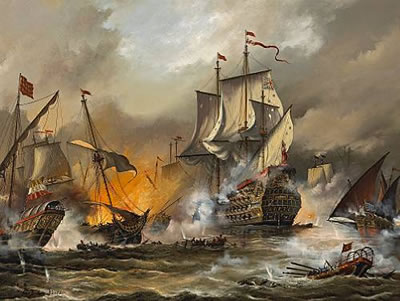
If Marcantonio Bragadin is remembered at all, it is for being betrayed, tortured and skinned alive by Lala Mustafa Pasha. Yet, it is Bragadin’s stubborn defense of the eastern Mediterranean outpost of Famagusta in 1571, which gave European principalities time to assemble naval forces in numbers sufficient to defend the European coast, near a place called Lepanto.

The 1683 Battle of Vienna, at the crossroads of eastern and western Europe, was a hard fought contest which could have gone either way, until the arrival of a Polish army under King Jan Sobieski. The Ottomans were defeated and turned back from the conquest of Eastern Europe on a date which grates the Jihadist memory to this day: September 11.

“Saracens” plundered everything that could be carried away: animals, provisions, fabrics, precious metals and money, especially men, women and children who could be sold for a good price at the slave markets.  Redemption of captives being among the corporal works of mercy, the “Mathurins” Order of the Holy Trinity was founded in 1198 for the purpose of paying the ransom of Christians held captive by non-Christians, as a consequence of crusading and pirating along the southern European coastline.

Even Ireland, with its northern latitude, wasn’t immune from these raids. Murat Reis attacked the village of Baltimore in County Cork in June 1631. With him were pirates from Algiers and armed troops of the Ottoman Empire, who captured all the villagers they could find and took them away to a life of slavery in North Africa. They lived out their lives chained to oars as galley slaves, or spent long years locked away in harems or inside the walls of the sultan’s palace. Only two of them ever saw Ireland again.barbary_coast

The fledgling United States found itself under attack by the “Barbary States” of North Africa almost immediately following the Revolution, and the subsequent lifting of France’s protection.  Spain, France and other European Powers advised the US to pay tribute.
Sidi Muhammad ibn Abdallah, Sultan of Morocco, added the United States of America to a list of countries for which his ports were open in December 1777, making Morocco the first country whose head of state publicly recognized the United States.  Abdallah saw the future for his country in foreign trade, and actively sought a treaty relationship with the US, well before war ended with Great Britain.  The treaty signed by Thomas Barclay and Sultan Muhammad III in 1786, and ratified by the Confederation Congress in July 1787, is still in effect today, the longest continuous treaty relationship in United States history.
Diplomacy had succeeded with Morocco, but not with Algiers, Tunis or Tripoli, each of which demanded $660,000 in tribute.

Algeria captured the schooners Maria and Dauphin in 1785, the captured crews held in conditions of slavery for over a decade. The sum negotiated for their release exceeded $1 million, more than 1/6th the entire budget of the United States.  Eleven American ships were captured in 1793 alone, their crews and stores held for ransom.

Yusuf Karamanli, Pasha of Tripoli, demanded $225,000 in tribute on President Jefferson’s inauguration, in 1801.  At this time, Federal revenues were barely over $10 million.  Jefferson refused, resulting in the first Barbary War, a conflict memorialized in a line from the Marine Corps Hymn “From the Halls of Montezuma to the Shores of Tripoli”.

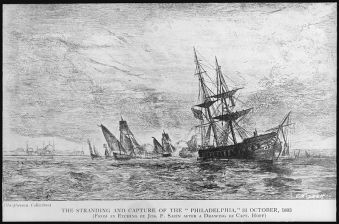
capture_philadelphia
The grounded USS Philadelphia is captured, October 31, 1803


Limited to small confrontations for the first two years, more sustained combat began in June 1803 when a small American force attacked Tripoli Harbor in modern Libya.

While giving chase and firing on a pirate vessel, USS Philadelphia ran aground on an uncharted reef, two miles outside of Tripoli.  Fearing the 1,240 ton, 36-gun frigate would be captured and added to the Tripolitan navy, Lieutenant Stephen Decatur led a daring expedition into Tripoli harbor to destroy the captured vessel.

burning_of_the_uss_philadelphia
Burning of the USS Philadelphia

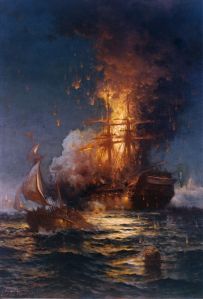
On the evening of February 16, 1804, Decatur entered Tripoli Harbor with a force of 74 Marines.  With them were five Sicilian volunteers, including pilot Salvador Catalano, who spoke fluent Arabic.  Disguised as Maltese sailors and careful not to draw fire from shore batteries, Decatur’s force boarded the frigate, killing or capturing most of its Tripolitan crew, before the remainder jumped overboard.  Decatur and his marines had hoped to sail Philadelphia out of harbor, but soon found she was in no condition to leave.  Setting combustibles about the deck, they set the frigate ablaze.  Ropes burned off, setting the Philadelphia adrift in the harbor.  Loaded cannon cooked off as the blaze spread, firing random balls into the town. It must have been a sight, when gunpowder stores ignited and the entire ship exploded.

By that time Decatur and his men had slipped away, without the loss of a single man.  Even a former adversary couldn’t help but admire the feat.  Days later, British Vice Admiral Lord Horatio Nelson called it the “most bold and daring act of the age.”

February 15, 2005 Arlington Lady

Their job is to honor, not to grieve, but it doesn’t always work out that way

The first military burial at Arlington National Cemetery was that of Private William Henry Christman, 67th Pennsylvania Infantry, interred on May 13, 1864. Two more joined him that day, the trickle soon turning into a flood. By the end of the war between the states, that number was 17,000 and rising.

In modern times, an average week will see 80 to 100 burials in the 612 acres of Arlington.

arlington

Twelve years ago, a news release from the Department of Defense reported that “Private First Class Michael A. Arciola, 20, of Elmsford, New York, died February 15, 2005, in Al Ramadi, Iraq, from injuries sustained from enemy small arms fire.  Arciola was assigned to the 1st Battalion, 503d Infantry Regiment, 2nd Infantry Division, Camp Casey, Korea”.

Private Arciola joined a quarter-million buried in our nation’s most hallowed ground on March 31. Two hundred or more mourners attended his funeral.  A tribute befitting the tragedy of the loss of one so young.

Sixteen others were buried there that same Friday, most of them considerably older.  Some of them brought only a dozen or so mourners.  For others, no friends or family members were on-hand to say goodbye.

bodavis-jr-funeral
Former Tuskegee Airman Benjamin O. Davis Jr. is laid to rest, Saturday, July 6, 2002

In 1948, Air Force Chief of Staff General Hoyt Vandenberg and his wife, Gladys, regularly attended funeral services at Arlington National cemetery.  Sometimes, a military chaplain was the only one present at these services.  Both felt that a member of the Air Force family should be present at these funerals, and Gladys began to invite other officer’s wives.  Over time, a group of women from the Officer’s Wives Club were formed for the purpose.  In 1973, General Creighton Abram’s wife Julia did the same for the Army, forming a group calling itself the “Arlington Ladies”.  Groups of Navy and Coast guard wives followed suit, in 1985 and 2006.  Traditionally, the Marine Corps Commandant sends an official representative of the Corps to all Marine funerals.  The Marine Corps Arlington Ladies were formed in 2016.

margaret-mensch
Margaret Mensch, April 22, 2010

Arlington Ladies’ Chairman Margaret Mensch said  “We’ve been accused of being professional mourners, but that isn’t true.  I fight that perception all the time. What we’re doing is paying homage to Soldiers who have given their lives for our country.”

Air Force Ladies’ Chairman Sue Ellen Lansell spoke of a service where the only other guest was “one elderly gentlemen who stood at the curb and would not come to the grave site.  He was from the Soldier’s Home in Washington, D. C. One soldier walked up to invite him closer, but he said no, he was not family”.

Traditionally, the organization was made up of current or former military wives.  Today their number includes daughters, and even one “Arlington Gentleman”.  Their motto, “No Soldier will ever be buried alone.”arlington-lady

44 years ago they came alone, or in pairs.  Today, the 145 or so volunteers from the four branches are a recognized part of funeral ceremonies, operating out of a joint office in the cemetery’s administration building.

The volunteer arrives with a military escort from the Navy or the United States Army 3rd Infantry Regiment, the “Old Guard”.  The horse-drawn caisson arrives from the old post chapel, carrying the flag draped casket.  Joining the procession, she will quietly walk to the burial site, her arm inside that of her escort.  A few words are spoken over the deceased, followed by the three-volley salute.  Somewhere, a solitary bugler sounds Taps.  The folded flag is presented to the grieving widow, or next of kin.  Only then will she break her silence, stepping forward with a word of condolence and two cards:  one from the service branch Chief of Staff and his wife, and a second from herself.

Joyce Johnson buried her husband Lt. Col. Dennis Johnson in 2001, a victim of the terrorist attack on the Pentagon.  She remembers the Arlington Ladies volunteer as “a touchingly, human presence in a sea of starched uniforms and salutes”.  Three years later, Joyce Johnson paid it forward, becoming one herself.

arlington-in-snowA funeral may be for a young military service member killed in the wars in Iraq or Afghanistan, or a veteran of Korea or WWII, who spent his last days in the old soldier’s home.  It could be a four-star General or a Private.  It doesn’t matter.

Individual volunteers attend about five funerals a day, sometimes as many as eight.  As with the Tomb of the Unknown sentinels who keep their guard heedless of weather, funeral services disregard weather conditions.  The funeral will proceed on the date and time scheduled regardless of rain, snow or heat.  An Arlington Lady Will be in attendance.

Their job is to honor, not to grieve, but it doesn’t always work out that way.  Linda Willey of the Air Force ladies describes the difficulty of burying Pentagon friends after 9/11, while pieces of debris still littered the cemetery.  Paula McKinley of the Navy Ladies still chokes up, over the hug of a ten-year old who had just lost both of her parents.  Margaret Mensch speaks of the heartbreak of burying one of her own young escorts, after he was killed in Afghanistan, in 2009.

Offering condolences
Army Arlington Lady Anne Lennox with letters of condolence for the widow of Brigadier General Henry G. Watson.

Barbara Benson was herself a soldier, an Army flight nurse during WWII.  She is the longest serving Arlington Lady.  “I always try to add something personal”, Benson said, “especially for a much older woman.  I always ask how long they were married.  They like to tell you they were married 50 or 60 years…I don’t know how to say it really, I guess because I identify with Soldiers. That was my life for 31 years, so it just seems like the natural thing to do.”

Elinore Riedel was chairman of the Air Force Ladies during the War in Vietnam, when none of the other military branches had women representatives. “Most of the funerals were for young men,” she said. “I saw little boys running little airplanes over their father’s coffins. It is a gripping thing, and it makes you realize the awful sacrifices people made. Not only those who died, but those left behind.”

Mrs. Reidel is a minister’s daughter, who grew up watching her father serve those in need.  “It doesn’t matter whether you know a person or not”, she said, “whether you will ever see them again.  It calls upon the best in all of us to respond to someone in deep despair. I call it grace…I honestly feel we all need more grace in our lives.”

081103-M-1529O-307