

In the world of virology, “Antigenic Drift” describes changes which happen slowly, the random mutation of virus DNA which takes place over months, or years. It’s why we get a new flu vaccine every year, even though there’s already some level of “herd immunity”.
“Antigenic Shift” occurs when two or more DNA strands combine, instantaneously forming a new virus sub-type. Like the dealer at some giant, cosmic poker table, this process may deal us a pair of twos. Occasionally, fate deals us aces & eights. The death hand.
When the “Great War” broke out in 1914, US Armed Forces were small compared with the mobilized forces of European powers. The Selective Service Act, enacted May 18, 1917, authorized the federal government to raise an army for the United States’ entry into WWI. Two months after the American declaration of war against Imperial Germany, a mere 14,000 American soldiers had arrived “over there”. Eleven months later, that number stood at well over a million.
General “Black Jack” Pershing insisted that his forces be well trained before deployment. New recruits poured into training camps by the tens of thousands, while somewhere, some microscopic, chance recombination of surface proteins created a new virus, novel to almost every immune system in the world.
 On the morning of March 11, 1918, most of the recruits at Fort Riley, Kansas, were turning out for breakfast. Private Albert Gitchell reported to the hospital, complaining of cold-like symptoms of sore throat, fever and headache. By noon, more than 100 more had reported sick with similar symptoms.
Ordinary flu strains prey most heavily on children, elderly, and those with compromised immune systems. Not this one. This flu would kick off a positive feedback loop between small proteins called cytokines, and white blood cells. This “cytokine storm” resulted in a death rate for 15-34 year olds 20 times higher in 1918, than in previous years. Perversely, it was their young and healthy immune systems that were most likely to kill them.
Physicians described the most viscous pneumonia they had ever seen, death often coming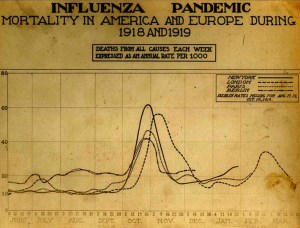 within hours of the first symptoms. There’s a story about four young, healthy women playing bridge well into the night. By morning, three were dead of influenza.
Over the next two years, this strain of flu infected one in every four people in the United States, killing an estimated 675,000 Americans. Eight million died in Spain alone, following an initial outbreak in May. Forever after, the pandemic would be known as the Spanish Flu.
In 1918, children skipped rope to a rhyme:
“I had a little bird,
Its name was Enza.
I opened the window,
and in-flu-enza”.
In the trenches, the flu cut down combatants on every side. “Operation Michael”, the final, no holds barred German offensive that would determine the outcome of the war, launched from the Hindenburg line in March. Crown Prince Rupprecht wrote in August that “poor provisions, heavy losses, and the deepening influenza have deeply depressed the spirits of men in the 3rd Infantry Division”.
Some sources indicate that as many as half of the Americans killed in WWI, died of the flu.
The parades and parties following the cease fire in November threw gasoline on the fire. The end of war was a complete disaster from a public health standpoint. Millions more contracted the flu and thousands more died. President Wilson himself fell ill, while participating in 1919 treaty negotiations in Versailles.
 Around the planet, the Spanish flu infected 500 million people. A third of the population of the entire world, at that time. Estimates run as high 50 to 100 million killed. For purposes of comparison, the “Black Death” of 1347-51 killed 20 million Europeans.
History has a way of swallowing some events whole, like they never happened. Today, the Spanish flu is all but overshadowed by the Great War, even though in the end, the flu pandemic of 1918-19 proved a far deadlier adversary, than the war itself.

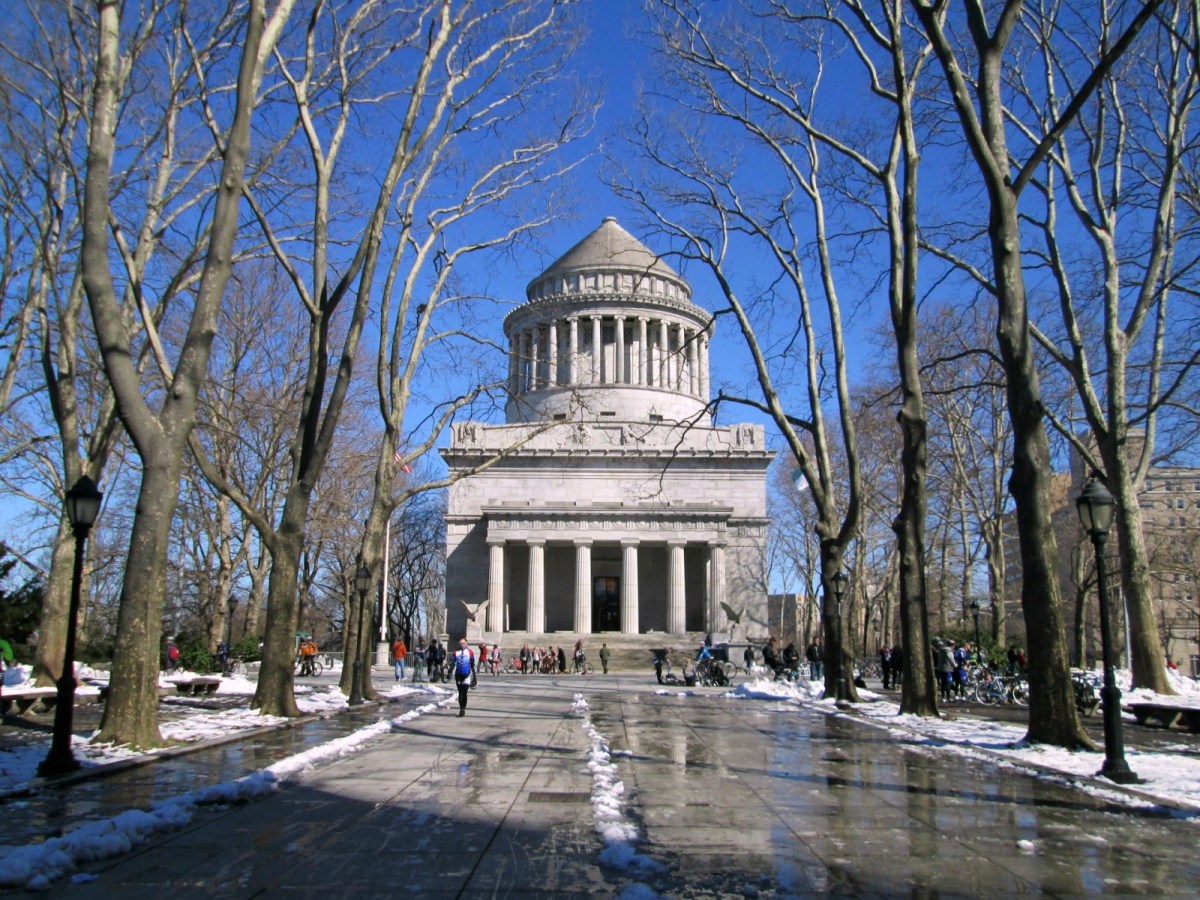
 The 1862 Civil War Battle of Fort Donelson secured the name, when then-Brigadier General Ulysses S. Grant received a request for terms from the fort’s commanding officer, Confederate Brigadier General Simon Bolivar Buckner. Grant’s reply was that “no terms except an unconditional and immediate surrender can be accepted. I propose to move immediately, upon your works.” The legend of “Unconditional Surrender” Grant, was born.
 later, going on to serve two terms after becoming, at that time, the youngest man ever so elected.
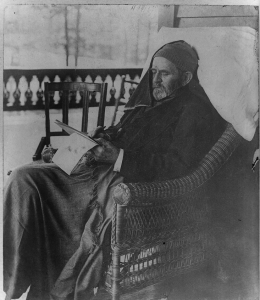 In June 1885, as the cancer spread through his body, the family moved to Mount MacGregor, New York, to make him more comfortable. Propped up on chairs and too weak to walk, Grant worked to finish the book as friends, admirers and even former Confederate adversaries, made their way to Mount MacGregor to pay their respects.

 The Alaska Territory was particularly vulnerable. The Aleutian Island chain was only 750 miles from the nearest Japanese base, and there were only 12 medium bombers, 20 pursuit planes, and fewer than 22,000 troops in the entire territory. An area four times the size of Texas.
 equipment to Dawson Creek, the last stop on the Northern Alberta Railway. At the other end, 10,670 American troops arrived in Alaska that spring, to begin what their officers called “the biggest and hardest job since the Panama Canal.”
 A route through the Rockies hadn’t even been identified yet.
 On October 25, Refines Sims Jr. of Philadelphia, with the all-black 97th Engineers was driving a bulldozer 20 miles east of the Alaska-Yukon line, when the trees in front of him toppled to the ground. He slammed his machine into reverse as a second bulldozer came into view, driven by Kennedy Texas Private Alfred Jalufka. North had met south, and the two men jumped off their machines, grinning. Their triumphant handshake was photographed by a fellow soldier and published in newspapers across the country, becoming an unintended first step toward desegregating the US military.


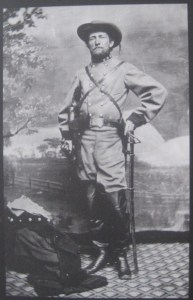 Mosby participated in the 1st Battle of Manassas (1st Bull Run) as a member of the Virginia Volunteers Mounted Rifles, later joining James Ewell Brown “Jeb” Stuart as a Cavalry Scout. A natural horseman and gifted tactician, information gathered by Mosby aided Stuart in his humiliating ride around McLellan’s Army of the Potomac in June, 1862.
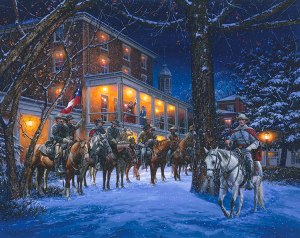 Courthouse, Virginia. Union Brigadier General Edwin H. Stoughton was sleeping in his headquarters there, some sources say he was “sleeping it off”. The Gray Ghost entered the Union General’s headquarters in the small hours of March 9, his rangers quickly overpowering a handful of sleepy guards.





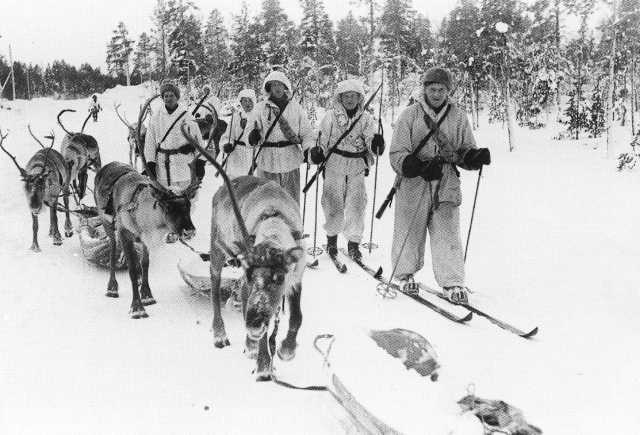
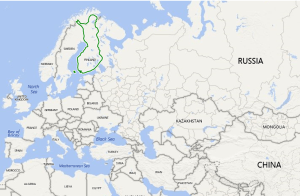 With Sweden to the west and Russia to the east, the region has been a zone of conflict since the early 12th century, finally gaining independence as the result of the first World War and collapse of the Russian Empire.
 The Battle of Kollaa took place in temperatures ranging from −4° to −40°, Fahrenheit. In February, the temperature averages only 18.5°. Dressed in white camouflage, Häyhä would surround himself with hard-packed snow, his mouth filled with snow so no one would see his breath.
 take several years to recover from his wound, but Häyhä went on to become a successful dog breeder and moose hunter, once hunting with Finnish President Urho Kekkonen.

 In one of the earliest known debt issues in history, Prime Minister Henry Pelham converted the entire national debt into consolidated annuities known as “consols”, in 1752. Consols paid interest like regular bonds, with no requirement that the government ever repay the face value. 18th century British debt soared as high as 74.6%, and never dropped below 55%.
 On March 5, wigmaker’s apprentice Edward Garrick taunted British Captain-Lieutenant John Goldfinch, claiming he had not paid a bill owed to his master. The officer had paid the bill and ignored the insult, but Private Hugh White, on guard outside the State House on King Street, said the boy should be more respectful, striking him with his musket. Garrick’s companion Bartholomew Broaders argued with White, as an angry crowd began to gather.

 Twelve of the original thirteen states ratified these “Articles of Confederation” by February, 1779. Maryland would hold out for another two years, over land claims west of the Ohio River. In 1781, seven months before Cornwallis’ surrender at Yorktown, the 2nd Continental Congress formally ratified the Articles of Confederation. The young nation’s first governing document.
 Philadelphia’s Pennsylvania State House. The building is now known as Independence Hall, the same place where the Declaration of Independence and the Articles of Confederation were drafted.
 The Constitution was signed by 38 of the 41 delegates on September 17, 1787. As dictated by Article VII, the document would not become binding until it was ratified by nine of the 13 states.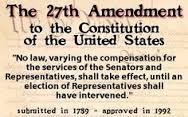


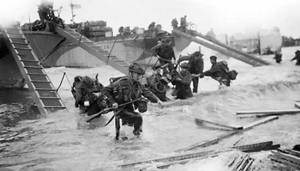
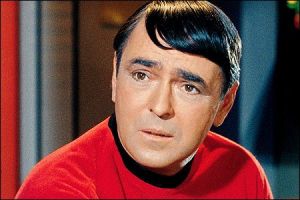
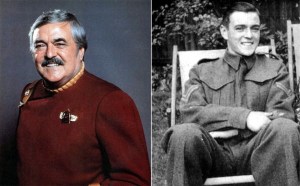 Doohan’s health declined in his later years. He developed Parkinson’s disease and diabetes, along with fibrosis of the lung, blamed on his exposure to noxious chemicals during WWII. He was experiencing symptoms of Alzheimer’s by 2004, though he was able to attend the ceremony held in his honor after receiving a star on the Hollywood Walk of Fame, that August.


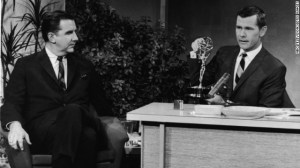
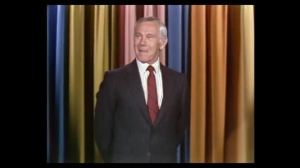
 The Tonight Show Starring Johnny Carson was a late-night fixture through seven US Presidents: John F. Kennedy, Lyndon Johnson, Richard Nixon, Gerald Ford, Jimmy Carter, Ronald Reagan, and George H.W. Bush. Almost every American over the age of 30 will remember “Heeeeeeeeeeere’s Johnny!”. The opening monologue, and the imaginary golf swing. “Carnac the Magnificent”, holding the envelope to his head, reciting the punchline to the joke sealed inside. “Saucepan… Who was Peter Pan’s wino brother?” When the joke bombed, there was the comedic curse. “May a bloated yak change the temperature of your jacuzzi!”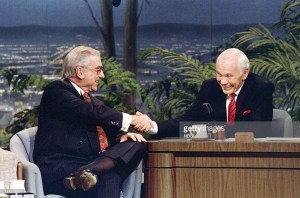


You must be logged in to post a comment.