October 27, 1962 Archipov

Anyone alive on or after this day in 1962, probably owes their life to one man. I wonder how many remember his name.

Come join me for a moment, in a thought experiment.  A theater of the mind.

Imagine. Two nuclear superpowers, diametrically opposed, armed to the teeth and each deeply distrustful of the other. We’re talking here, about October 1962. The Cuban Missile Crisis. Now imagine at the height of the standoff, a misunderstanding leads some fool to push the button. The nuclear first strike is met with counterattack and response in a series of ever-escalating retaliatory launches.

You’ve seen enough of human nature. Counterattacks are all but inevitable, right? Like some nightmare shootout at the OK corral, only this one is fought with kiloton-sized weapons. Cities the world over evaporate in fireballs. Survivors are left to deal with a shattered, toxic countryside and nuclear winter, without end.

Are we talking about an extinction event? Possibly. Terrible as it is, it’s not so hard to imagine, is it?

In 1947, members of the Science and Security Board of the Bulletin of Atomic Scientists envisioned a “Doomsday Clock”. A symbolic clock face, dramatizing the threat of global nuclear catastrophe.  Initially set at seven minutes to midnight, the “time” has varied from seventeen minutes to two.

The Cuban Missile Crisis of October 1962 didn’t make it onto the doomsday clock. Those 13 days went by far too quickly to be properly assessed. And yet, the events of 62 years ago brought us closer to extinction than at any time before or since.

On this day in 1962, an unsuspecting world stood seconds away from the abyss. The fact that we’re here to talk about it came down to one man, Vasili Arkhipov. Many among us have never heard his name. Chances are very good that we can thank him for our lives.

As WW2 gave way to the nuclear age, Cold War military planners adopted a policy of “Deterrence”. “Mutually Assured Destruction” (MAD). Soviet nuclear facilities proliferated across the “Eastern Bloc”, while US nuclear weapons dispersed across the NATO alliance. By 1961 some 500 US nuclear warheads were installed in Europe, from West Germany to Turkey, Italy to Great Britain.

Judging President Kennedy weak and ineffective, communist leaders made their move in 1962, signing a secret arms agreement in July. Medium-range ballistic missiles with a range of 2,000 miles were headed to the Caribbean basin.

By mid- October, US reconnaissance aircraft revealed Soviet ballistic nuclear missile sites under construction Cuba. 90 miles from American shores. President John F. Kennedy warned of the “gravest consequences”, ordering a blockade of the island nation. Relations turned to ice as Soviet military vessels joined the standoff.
Tensions dialed up to 11 on October 27, when USAF Major Rudolph Anderson’s U-2 reconnaissance aircraft was shot down over the village of Veguitas. His body still stapped into his ejection seat.

Wreckage of Major Rudolf Anderson Jr.’s U2 at the Museo del Aire, Havana, Cuba H/T theaviationgeekclub.com

The US Navy practiced a submarine attack protocol at that time, called “hunt to exhaustion”. Anatoly Andreev described what it was like to be on the receiving end:

“For the last four days, they didn’t even let us come up to the periscope depth … My head is bursting from the stuffy air. … Today three sailors fainted from overheating again … The regeneration of air works poorly, the carbon dioxide content [is] rising, and the electric power reserves are dropping. Those who are free from their shifts, are sitting immobile, staring at one spot. … Temperature in the sections is above 50 [122ºF].”

I’m not sure I could think straight under conditions like that.

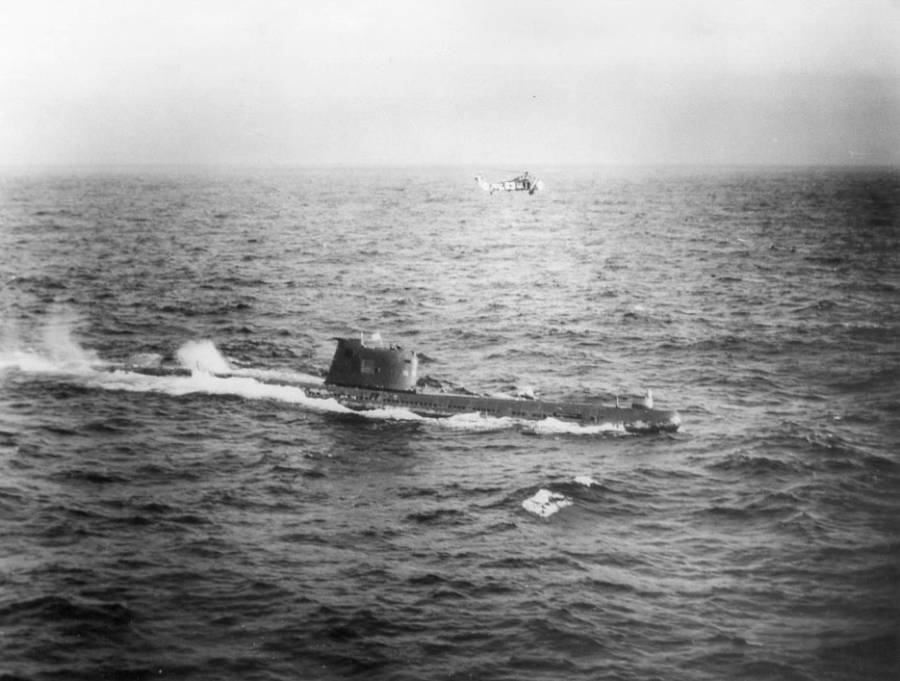
On the 27th, US Navy destroyers began to drop depth charges. This was not a lethal attack, intending only to bring the sub to the surface. Deep under the water, captain and crew had no way of knowing that. B-59 had not been in contact with Moscow for several days. Now depth charges were exploding to the left and right. Captain Valentin Savitsky made his decision. Convinced that war had begun, the time had come for the “special weapon”. “We’re gonna blast them now!,” he reportedly said. “We will die, but we will sink them all – we will not become the shame of the fleet.” Political officer Ivan Maslennikov concurred. Send it.

On most nuclear-armed Soviet submarines, two signatures were all that was needed. With Chief of (submarine fleet) Staff officer Vasili Archipov on board, the decision required approval by all three senior officers. To Archipov, this didn’t feel like a “real” attack. What if they’re only trying to get us to the surface?

Archipov said no.

Perhaps it was his role in averting disaster aboard the nuclear-powered submarine K-19, the year before. Maybe it was his calm, unflappable demeanor when Captain Savitsky had clearly “lost his temper”. Somehow, Archipov was able to keep his head together under unimaginable circumstances and convince the other two. B-59 came to the surface to learn that, no. World War III had not begun after all.

The submarine went quietly on its way. Kruschev announced the withdrawal of Soviet missiles the following day. The Cuban Missile Crisis was over.

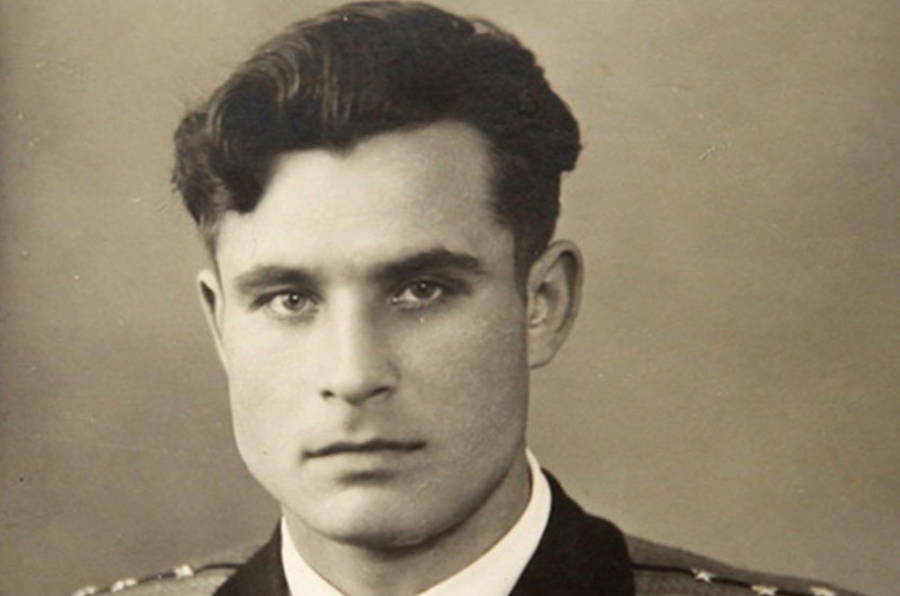
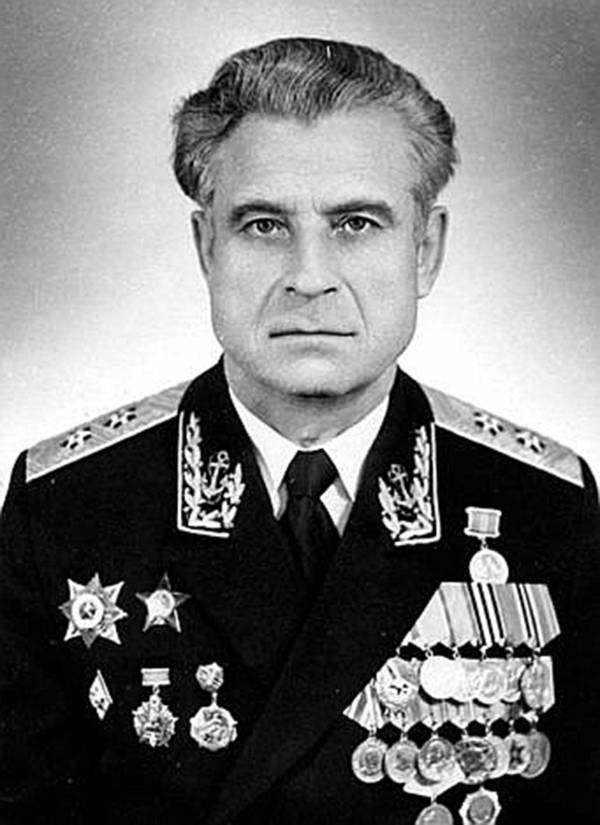
Vasily Aleksandrovich Arkhipov

These events wouldn’t come to light for another 40 years.

B-59 crewmembers were criticized on returning to the Soviet Union. One admiral told them “It would have been better if you’d gone down with your ship.”
Vasily Aleksandrovich Arkhipov retired from the submarine service in 1988 and died, ten years later. Cause of death was kidney cancer, likely the result of radiation exposure sustained during the K-19 incident, back in 1961.

Lieutenant Vadim Orlov was an intelligence officer back in 1962, onboard the B-59. In 2002, then Commander Orlov (retired) gave Archipov full credit for averting nuclear war. Former U.S. Defense Secretary Robert McNamara said in 2002 “We came very, very close, closer than we knew at the time.” Historian Arthur Schlesinger Jr. was an advisor to President Kennedy. “This was not only the most dangerous moment of the Cold War”, he said. “It was the most dangerous moment in human history.”

September 22, 1776 Nathan Hale

The Connecticut schoolteacher was young and untried when he placed is confidence in the wrong place. It would prove to be a fatal mistake.

The nine Hale brothers of Coventry, Connecticut supported the Patriot side from the earliest days of the American Revolution. Five of them participated in the battles at Lexington and Concord. Nathan was the youngest and destined to be the most famous of them all. He was still at home at this time, finishing out the term of a teaching contract in New London, Connecticut.

Nathan Hale’s unit participated in the siege of Boston. Hale himself joined General George Washington’s army in the spring of 1776, as the army moved to Long Island to block the British move on the strategically important port city of New York.

On June 29, General Howe appeared off Staten Island with a fleet of 45 ships. By the end of the week, he’d assembled an overwhelming fleet of 130.

There was an attempt at peaceful negotiation on July 13, when General Howe sent a letter to General Washington under flag of truce. The letter was addressed “George Washington, Esq.”, intentionally omitting Washington’s rank. Washington declined to receive the letter, responding that there was no one present by that address. Howe tried the letter again on the 16th, this time addressing “George Washington, Esq., etc., etc.”. Again, Howe’s letter was refused.

The following day, General Howe sent Captain Nisbet Balfour in person to ask if Washington would meet with Howe’s adjutant, Colonel James Patterson. Considerations of honor having thus been settled, a meeting was scheduled for July 20.

Patterson told Washington that General Howe had come with powers to grant pardons.  Washington refused, saying “Those who have committed no fault want no pardon”.

Patriot forces were comprehensively defeated at the Battle of Brooklyn, fought on August 27, 1776. With the Royal Navy in command on the water, Howe’s army dug in for a siege, confident that the adversary was trapped and waiting to be destroyed at their convenience.

On the night of August 29-30, Washington withdrew his army to the ferry landing and across the East River, to Manhattan.

With horse’s hooves and wagon wheels muffled, oarlocks stuffed with rags, the Patriot army withdrew even as a rearguard tended fires, convincing the redcoats in their trenches that the Americans were still there.

The surprise was comprehensive for the British side, on waking on the morning of the 30th.  The Patriot army had vanished.

The Battle of Long Island would almost certainly have ended in disaster for the Patriot cause but for that silent evacuation over the night of August 29-30, one of the great military feats of the American revolution.

Following evacuation, the Patriot army found itself isolated on Manhattan island, virtually surrounded.  Only the thoroughly disagreeable current conditions of the Throg’s Neck-Hell’s Gate segment of the East River prevented Admiral Sir Richard Howe (William’s brother) from enveloping Washington’s position, altogether.

Expecting a British assault in September, General Washington became increasingly desperate for information on British movements.

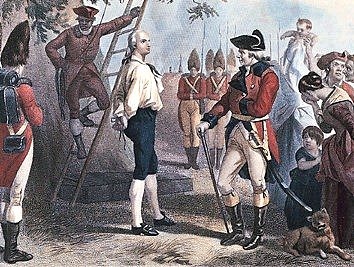
Nathan Hale Capture

Washington asked for volunteers for a dangerous mission, to go behind enemy lines as a spy.  Up stepped a volunteer.  His name was Nathan Hale.

Hale set out on his mission on September 10, disguised as a Dutch schoolmaster. He was successful for about a week but appears to have been something less than “street smart”.  The young and untrained Patriot turned spy, bestowed his trust where it did not belong.

Major Robert Rogers was an old British hand, a leader of Rangers during the earlier French and Indian War. Rogers must have suspected that this Connecticut schoolteacher was more than he pretended to be, intimating that he himself was a spy in the Patriot cause.

Hale took Rogers into his confidence, believing the two to be playing for the same side.  Consider Tiffany, a British loyalist and Barkhamsted Connecticut shopkeeper was himself a sergeant of the French and Indian War. Tiffany recorded what happened next in his journal:

The time being come, Captain Hale repaired to the place agreed on, where he met his pretended friend” (Rogers), “with three or four men of the same stamp, and after being refreshed, began [a]…conversation. But in the height of their conversation, a company of soldiers surrounded the house, and by orders from the commander, seized Captain Hale in an instant. But denying his name, and the business he came upon, he was ordered to New York. But before he was carried far, several persons knew him and called him by name; upon this he was hanged as a spy, some say, without being brought before a court martial.”

“Stay behind spy” Hercules Mulligan had better success, reporting on British goings-on from the 1776 capture of New York to their withdrawal seven years later.  But that must be a story for another day.

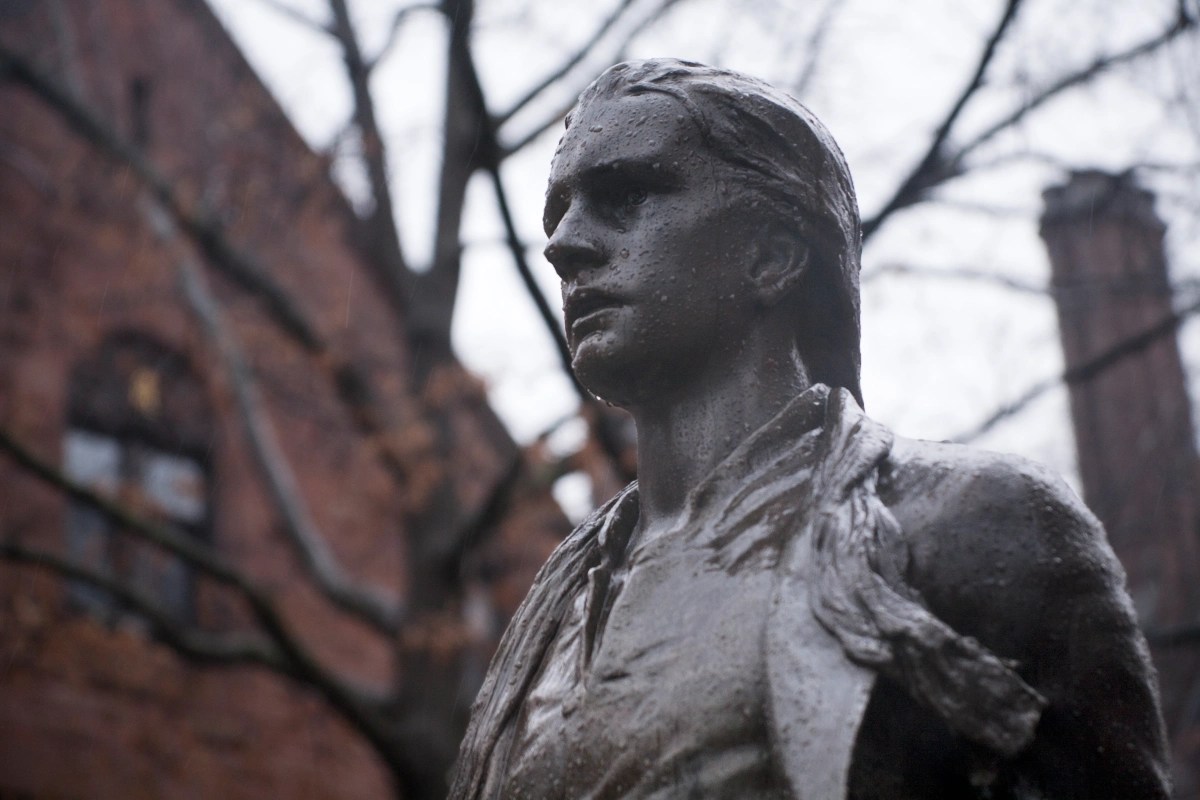
Nathan Hale was hanged on this day in 1776, described by CIA.gov as “The first American executed for spying for his country”.

There is no official account of Nathan Hale’s final words. However, an eyewitness statement from British Captain John Montresor exists. He was present at the hanging.

Montresor spoke with American Captain William Hull the following day under flag of truce.  The captain gave Hull the following account: “‘On the morning of his execution,’ said Montresor, ‘my station was near the fatal spot, and I requested the Provost Marshal to permit the prisoner to sit in my marquee, while he was making the necessary preparations. Captain Hale entered: he was calm, and bore himself with gentle dignity, in the consciousness of rectitude and high intentions. He asked for writing materials, which I furnished him: he wrote two letters, one to his mother and one to a brother officer.’ He was shortly after summoned to the gallows. But a few persons were around him, yet his characteristic dying words were remembered. He said, ‘I only regret, that I have but one life to lose for my country‘.

Nathan Hale was barely three months past his 21st birthday on the day he died.

September 21, 1780 André

He asked not that his life be spared, but only that he be executed by firing squad. A death considered worthy of a gentleman of the age and not hanging, an end reserved for thieves and scoundrels.

In an age before radio or television, John André was an interesting man to be around. A gifted storyteller with a great sense of humor he could draw, paint and cut silhouettes. He was an excellent writer, he could sing, and he could write verse.  John André was a British Major at the time of the American Revolution, who took part in his army’s occupations of Philadelphia and New York.

John André was a spy.

A favorite of colonial era loyalist society, Major André dated Peggy Shippen for a time, the daughter of a prominent Philadelphia loyalist. Shippen went on to marry Benedict Arnold in 1779, forming a link between the spy and an important general in the cause of American independence.

Hat tip artist Dale Watson for this image of Peggy Shippen

The relationship nearly changed the outcome of the American revolution.

Arnold was the Commandant of West Point at the time, the future location of one of our great military academies. A prominence overlooking the Hudson River, West Point was a fortified position offering decisive military advantage to the side holding the position. The British capture of West Point would have split the colonies in half.

The author (left) on a 2022 “history ramble” weekend with family members. It doesn’t take a military strategist to understand the importance of West Point’s commanding position over the Hudson River.

The Sloop of War HMS Vulture sailed up the Hudson River on September 20, 1780, Major André meeting with General Arnold on the river’s banks the following day. Dressed in civilian clothes, John André struck a bargain with the patriot general. Arnold would receive £20,000, over a million dollars today, in exchange for which he would give up West Point.

Tasked with returning the signed papers to British lines, Major André was stopped by three Patriot Militiamen two days later. They were John Paulding, David Williams and Isaac Van Wart. One of the three wore a Hessian overcoat, making André believe they might be loyalists. “Gentlemen”, he said, “I hope you belong to our party”. “What party”, came the reply, and André said “The lower (British) party”. “We do”, they said, to which André replied that he was a British officer and must not be detained. That was as far as he got.

You need not be a military strategist to recognize the importance of the commanding heights at West Point. The discovery of those papers brought Benedict Arnold’s treachery to light. Arnold immediately fled on hearing of André’s arrest, even as George Washington was headed to his place for a meeting over breakfast.

John André was tried and sentenced to death as a spy. He asked if he could write a letter to General Washington.  In it he asked not that his life be spared, but that he be executed by firing squad, a death more worthy of a gentleman than hanging, an execution at that time commonly reserved for criminals.

General Washington believed that Arnold’s crimes to be far more egregious than those of John André. Furthermore, he was impressed with the man’s courage.  Washington wrote to General Sir Henry Clinton asking for an exchange of prisoners.

Having received no reply, Washington wrote in his General Order of October 2 “That Major André General to the British Army ought to be considered as a spy from the Enemy and that agreeable to the law and usage of nations it is their opinion he ought to suffer death. The Commander in Chief directs the execution of the above sentence in the usual way this afternoon at five o’clock precisely.”

John André was executed by hanging in Tappan, New York. He was 31.

A vintage postcard illustration depicting the execution of Major John Andre, hung as a spy for aiding and abetting General Benedict Arnold during the American Revolutionary War in Trenton, New Jersey on 2nd October 1780, published in New York, circa 1903. Andre’s body was later disinterred from American soil and buried in Westminster Abbey, London. (Photo by Paul Popper/Popperfoto via Getty Images)

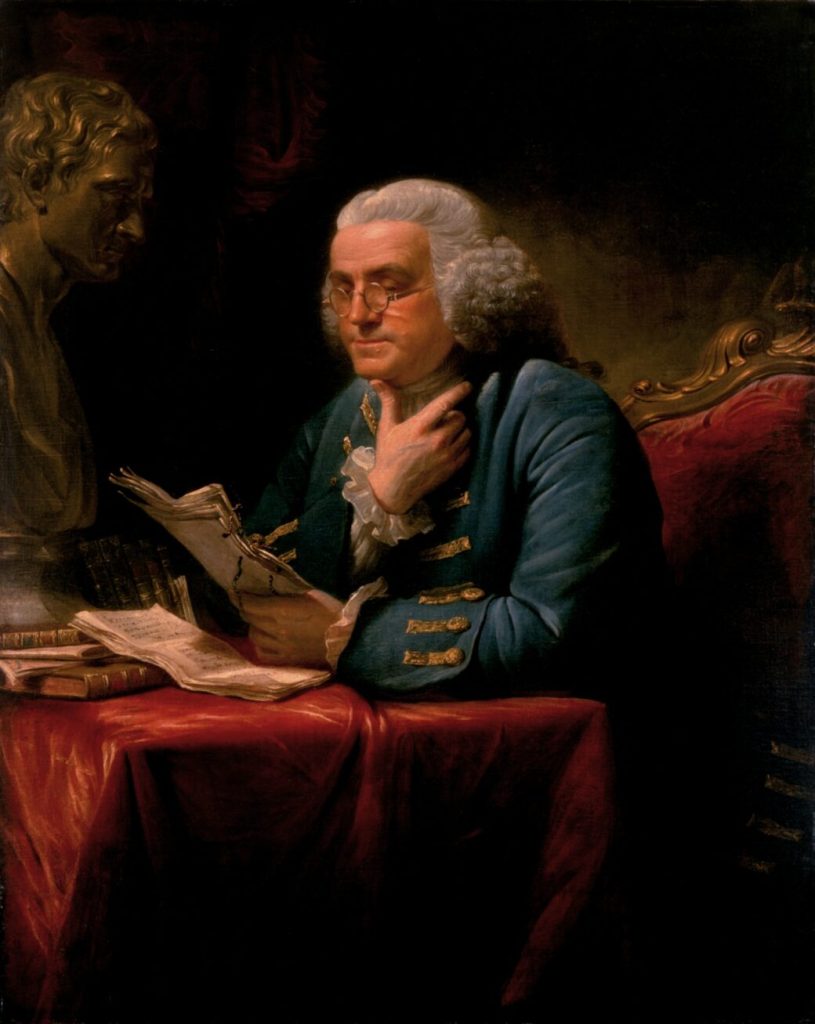
John André lived for a time in Benjamin Franklin’s house back in 1777-’78, during the British occupation of Philadelphia. As he was packing to leave, Geneva-born American patriot and portrait artist Pierre-Eugène Du Simitiere came to say goodbye. The officer was always known as a gentleman. Simitiere was shocked to find André stoop to looting the home of such a prominent patriot. For a man known for extravagant courtesy, this was way out of character. André was packing books, musical instruments and scientific apparatus, even an oil portrait of Franklin, offering not so much as a response to Simitiere’s protests.

Nearly two hundred years later, the descendants of Major-General Lord Charles Grey returned the painting to the United States, explaining that André had probably looted Franklin’s home under direct orders from the General himself. A Gentleman always, it would explain the man’s inability to defend his own actions.

Today that oil portrait of Benjamin Franklin hangs in the White House.

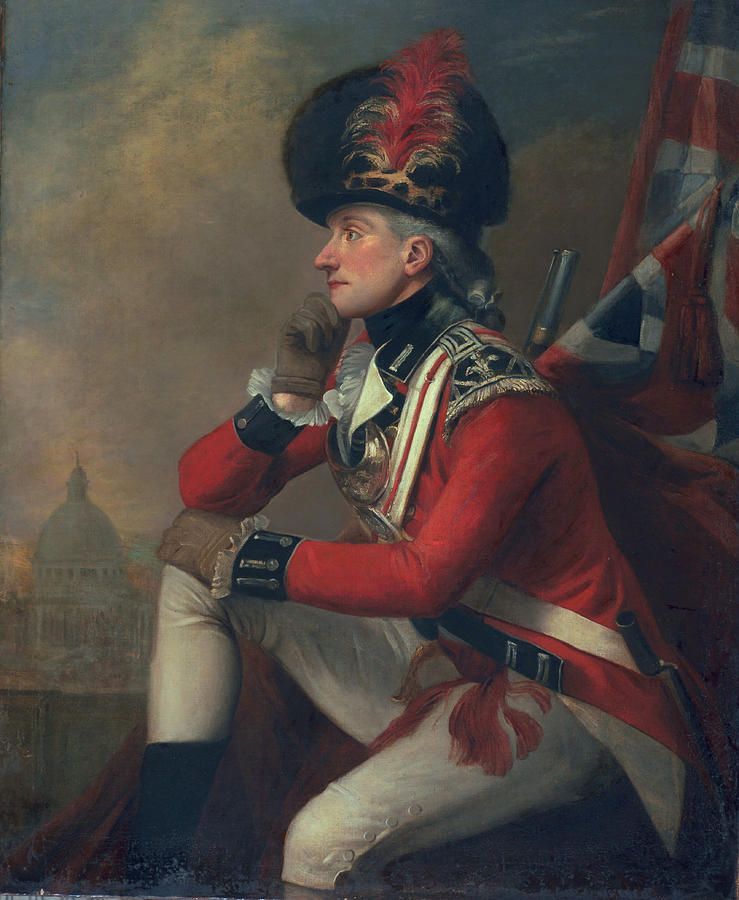
Benedict Arnold went on to lead British forces against his former comrades. As the story goes, Arnold once asked one of his officers what the Americans might do should he (Arnold) be captured. The officer replied: “They will cut off the leg which was wounded when you were fighting so gloriously for the cause of liberty, and bury it with the honors of war, and hang the rest of your body on a gibbet.”

The story refers to a grievous injury the turncoat general received at the Battle of Saratoga, heroically leading patriot infantry against a position remembered as Breymann redoubt. It was the second time a bullet had shattered the general’s leg in service to the Revolution. Arnold walked with a pronounced limp for the rest of his life.

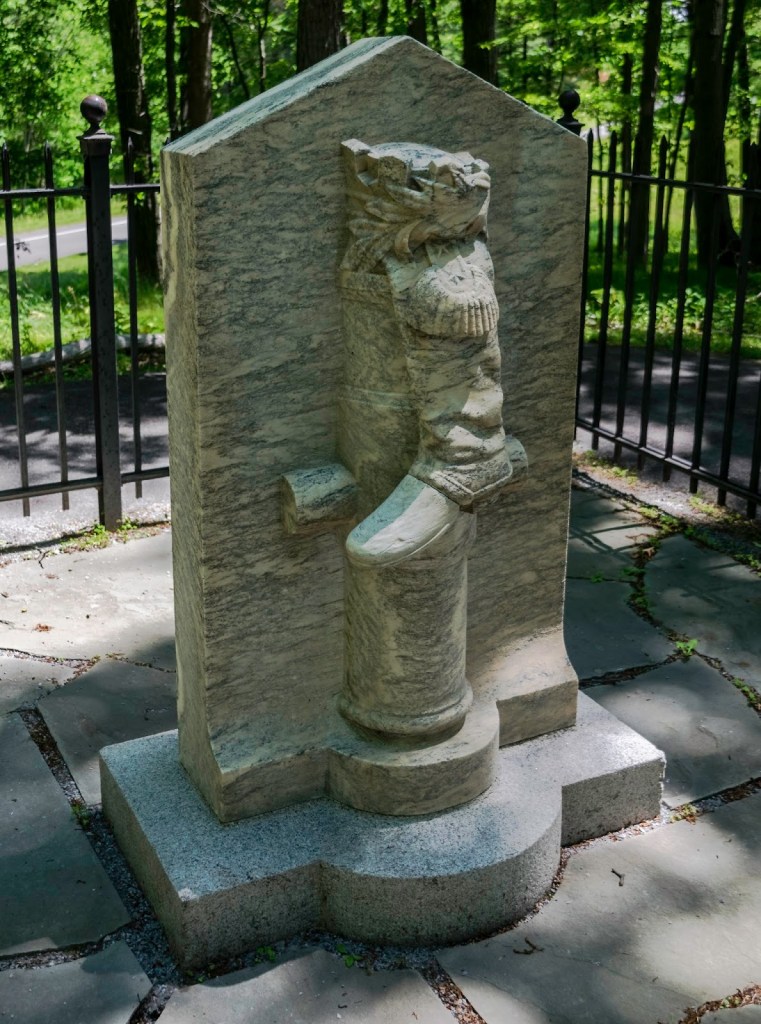
On the grounds near the battlefield at Saratoga there stands the statue of a cannon’s barrel, and a leg. An officer’s boot, really, dedicated to a Hero of the Revolution. The cannon’s barrel is pointed down as a sign of dishonor. The monument declines to give this hero a name.

It is one of the most forlorn places I have ever seen.

February 1, 1901 The Last Doughboy

The people the author sought were over 101. One was 113. The search could not have been easy, beginning with the phone call to next of kin. There is no delicate way to ask the question. “Is he still with us?” Most times, the answer was “no”.

In 2003, author Richard Rubin set out to interview the last surviving veterans of the Great War, the “War to End All Wars”.  World War One.

The people the author sought were all over 101. One was 113. It could not have been easy, beginning with the phone call to next of kin. There is no delicate way to ask the question. “Is he still with us?” Most times the answer was “no”.

Sometimes it was “yes”, and Rubin would ask for an interview. The memories his subjects sought to bring back were 80 years old and more.  Some spoke haltingly, and with difficulty.  Others were fountains of information, as clear and lucid as if the memories of which they spoke were made only  yesterday.

Rubin writes “Quite a few of them told me that they were telling me things that they hadn’t talked about in 50, 60, 70 years. I asked a few of them why not, and the surprising response often was that nobody had asked.”

Anthony Pierro of Swampscott, Massachusetts, served in Battery E of the 320th Field Artillery and fought in several of the major battles of 1918, including Oise-Aisne, St. Mihiel, and Meuse-Argonne.

Pierro recalled his time in Bordeaux as the best time of the war. “The girls used to say, ‘upstairs, two dollars.’” Pierro’s nephew Rick interrupted the interview. “But you didn’t go upstairs.”  Although possibly unexpected, Uncle Anthony’s response was a classic.  “I didn’t have the two dollars”.

Reuben Law of Carson City, Nevada remembered a troop convoy broken up by a German U-Boat while his own transport was swept up in the murderous Flu pandemic of 1918.

The people Rubin spoke with weren’t all men. 107-year-old Hildegarde Schan of Plymouth, Massachusetts spoke of caring for the wounded.

Howard Ramsey helped start an American burial ground in France, 150 miles north of Paris. Today, the 130½ acres of the Meuse-Argonne American Cemetery serves as the final resting place for the largest number of US military dead in Europe.

“So I remember one night”, Ramsey said, “It was cold, and we had no blankets, or nothing like that. We had to sleep, we slept in the cemetery, because we could sleep between the two graves, and keep the wind off of us, see?”

Arthur Fiala of Kewaunee, Wisconsin remembered traveling across France in a boxcar marked “40-8″. Room enough for 40 men, or eight horses.

Arthur Fiala

There was J. Laurence Moffitt of Orleans, Massachusetts. Today, we see the “Yankee Division” only on highway signs. At 106, this man was the last surviving member of his outfit, with a memory so clear he could recall every number from every fighting unit of the 26th Division.

George Briant was caught in an open field with his battery, as German planes dropped bombs from the sky.  Briant felt as if he was hit by every one of them, spending several months in the hospital. When it was through, he begged to go back to the front.  

On the last night of the war, November 10, 1918, Briant came upon the bodies of several men who had just been shelled.

“Such fine, handsome, healthy young men”, he said, “to be killed on the last night of the war.  I cried for their parents. I mean it’s a terrible, terrible thing to lose anyone you love in a war, but imagine knowing precisely when that war ends, and then knowing that your loved one died just hours before that moment.

Rubin interviewed dozens of men and a handful of women, a tiny and ever diminishing living repository for memory of the War to End All Wars. Their stories are told in their own words and linked HERE, if you care to learn more.  I highly recommend it.  The words of these women and men are far more powerful than anything I can offer.

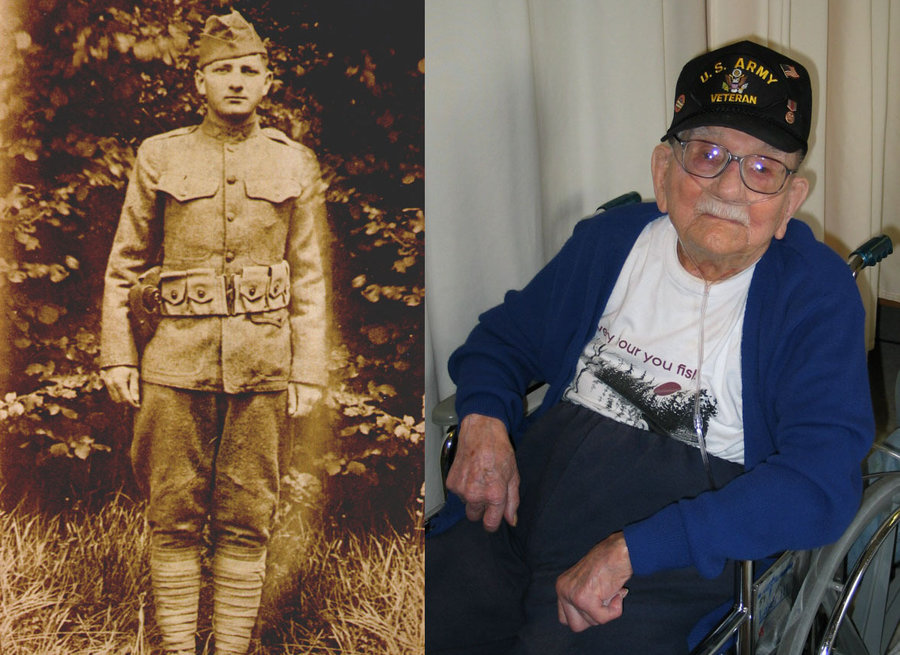
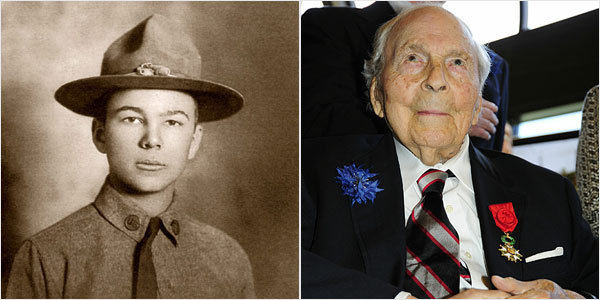
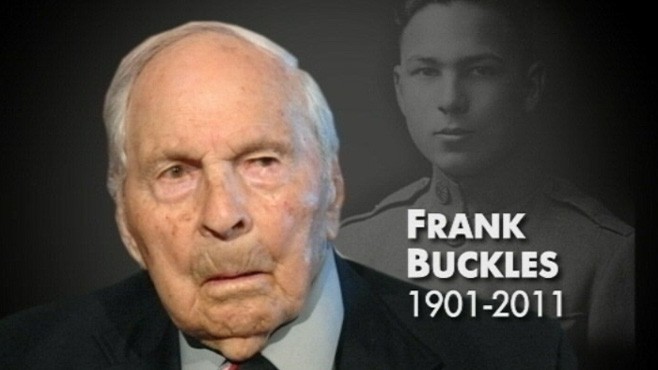
Frank Woodruff Buckles, born Wood Buckles, is one. Born on February 1, 1901, Buckles enlisted with the First Fort Riley Casualty Detachment at the age of sixteen, training for trench casualty retrieval and ambulance operations.

Frank Woodruff Buckles, S/N 15577

Buckles’ unit set sail from Hoboken New jersey in December 1917 aboard HMS Carpathia, a vessel made famous by the Titanic rescue, five years earlier.

Frank never saw combat but he did see a lot of Germans, with a Prisoner-of War escort company.  Returning home in January 1920 aboard USS Pocahontas, Buckles was paid $143.90, including a $60 bonus.

Buckles was a civilian in 1940, working for the White Star Lines and WR Grace shipping companies. His work took him to the Philippines, where he remained after the outbreak of WWII. He was helping to resupply U.S. troops when captured by Japanese forces in January 1942, imprisoned for thirty-nine months as a civilian prisoner in the Santo Tomas and Los Baños prison camps. 

He was rescued by the 11th Airborne Division on February 23, 1945. The day he was scheduled to be executed.

Buckles married Audrey Mayo of Pleasanton, California in 1946, and returned from whence he had come.  Back to the land, back to the Gap View Farm near Charles Town, West Virginia in January 1954, to farm the land his ancestors worked back in 1732.

Audrey Mayo Buckles lived to ninety-eight and passed away on June 7, 1999.  Frank continued to work the farm until 106, and still drove his tractor.  For the last four years of his life he lived with his daughter Susannah near Charles Town, West Virginia.

Once asked his secret to a long life, Buckles responded, “When you start to die, don’t”.

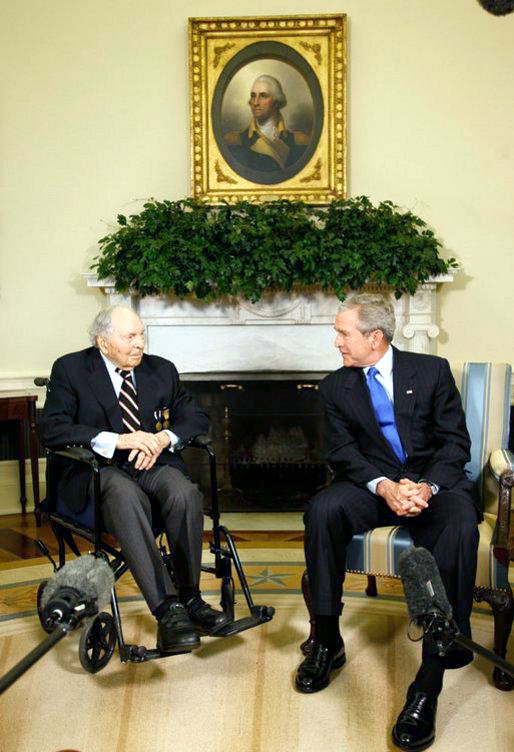
On December 3, 2009, Frank Buckles became the oldest person ever to testify before the United States Congress, where he campaigned for a memorial to honor the 4.7 million Americans who served in World War 1.

“We still do not have a national memorial in Washington, D.C. to honor the Americans who sacrificed with their lives during World War I. On this eve of Veterans Day, I call upon the American people and the world to help me in asking our elected officials to pass the law for a memorial to World War I in our nation’s capital. These are difficult times, and we are not asking for anything elaborate. What is fitting and right is a memorial that can take its place among those commemorating the other great conflicts of the past century. On this 92nd anniversary of the armistice, it is time to move forward with honor, gratitude, and resolve”.

The United States came late to the Great War, not fully trained, equipped or mobilized until well into the last year.  Even so, fully 204,000 Americans were wounded in those last few months.  116,516 never came home from a war in which, for all intents and purposes, the US fought for a bare five months.

Frank Woodruff Buckles passed away on February 27, 2011 at the age of 110, and went to his rest in Arlington National Cemetery.  The last of the Doughboys, the only remaining American veteran of WWI, the last living memory of the war to end all wars, was gone.

The United States House of Representatives and Senate proposed concurrent resolutions for Buckles to lie in state, in the Capitol rotunda. For reasons still unclear, the plan was blocked by Speaker John Boehner and Senate Majority Leader Harry Reid.  Neither Boehner nor Reid would elaborate, proposing instead a ceremony in the Amphitheater at Arlington National Cemetery.  The President of the United States personally attended the funeral.

Washington Post reporter Reporter Paul Duggan described the occasion:

“The hallowed ritual at grave No. 34-581 was not a farewell to one man alone. A reverent crowd of the powerful and the ordinary—President Obama and Vice President Biden, laborers and store clerks, heads bowed—came to salute Buckles’s deceased generation, the vanished millions of soldiers and sailors he came to symbolize in the end”.

Frank Woodruff Buckles, the last living American veteran of WW1 was survived by the British Women’s Royal Air Force (WRAF) servicewoman Florence Beatrice (Patterson) Green who died on February 4, 2012, at the age of 110.

Afterward

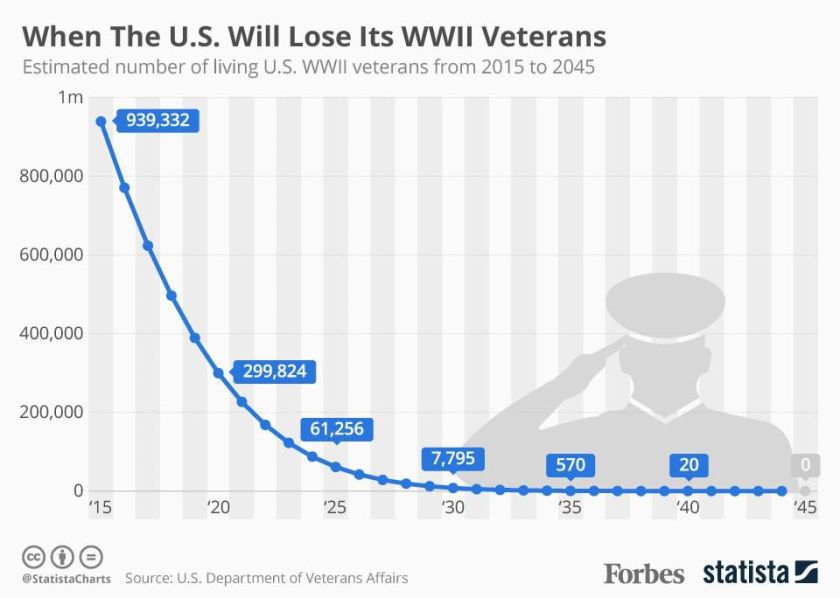
Sixteen million Americans joined with allies the world over to defeat the Axis Powers of World War 2.  They were the children of Frank Buckles’ and Florence Green’s generation, sent to complete what their parents had begun.  According to the Department of Veterans Affairs some 66,000 remained alive in 2024.

If actuarial projections are any indication, the Frank Buckles of his generation, the last living veteran of WW2, can be expected to pass from among us sometime around 2044.

That such an event should pass from living memory is a loss beyond measure.

December 2, 1859 John Brown

To some, the man was a hero.  To others he was a kook. The devil incarnate.


Following the war for independence, American politics split between those supporting a strong federal government and those favoring greater self-determination for the states. In the South, climate conditions led to dependence on agriculture, the rural economy of the southern states producing cotton, rice, sugar, indigo and tobacco. Colder states to the north tended to develop manufacturing economies, urban centers growing up in service to hubs of transportation and the production of manufactured goods.

During the first half of the 19th century, 90% of federal government revenue came from tariffs on foreign manufactured goods. Most of this revenue was collected in the South, with the region’s greater dependence on imported goods.  Much of federal spending was directed toward the North, toward the construction of roads, canals and other infrastructure.

The debate over economic issues and rights of self-determination, so-called ‘state’s rights’, grew and sharpened in 1828 with the threatened secession of South Carolina and the “nullification crisis” of 1832-33. South Carolina declared such tariffs unconstitutional and therefore null and void within the state. A Cartoon from the era says it all – Northern domestic manufacturers getting fat at the expense of impoverishing the South under protective tariffs.

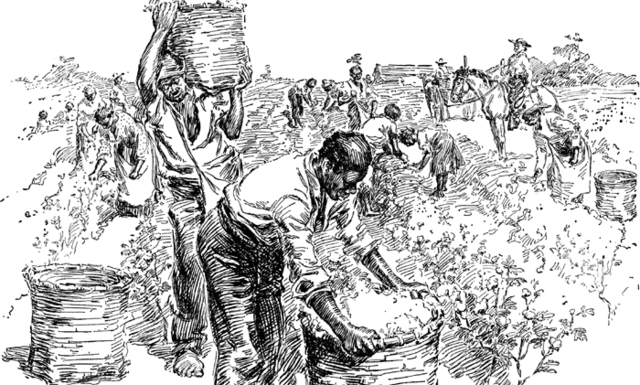
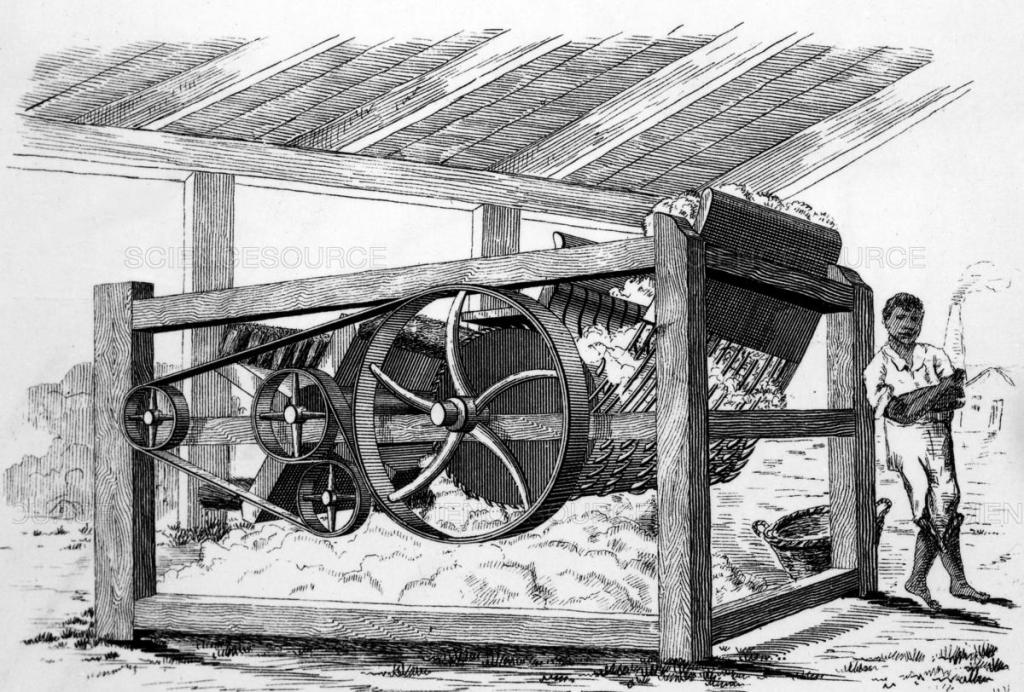
Chattel slavery came to the Americas well before the colonial era, from Canada to Mexico to Brazil and around the world. Moral objections to what was clearly a repugnant practice could be found throughout, but economic forces had as much to do with ending the practice as any other. The “peculiar institution” died out first in the colder regions of the US and may have done so in warmer climes as well, but for Eli Whitney’s invention of a cotton engine (‘gin’) in 1792.

Removing cotton seeds by hand requires ten man-hours to remove the seeds from a single pound of cotton. By comparison, a cotton gin can process about a thousand pounds a day at comparatively little expense.

The year of Whitney’s invention, the South exported 138,000 pounds a year to Europe and the northern colonies. Sixty years later, Britain alone was importing 600 million pounds a year of the stuff, from the American south. Cotton was King, and with good reason.  The crop is easily grown, is more easily transportable and can be stored indefinitely, compared with food crops.  The southern economy turned overwhelmingly to this one crop and with it, the need for cheap, plentiful labor.

By then the issue of slavery was so joined and intertwined with ideas of self-determination, as to be indistinguishable.

The Cotton Gin

The short-lived “Wilmot Proviso” of 1846 sought to ban slavery in new territories, after which the Compromise of 1850 attempted to strike a balance.  The Kansas Nebraska Act of 1854 created the territories of Kansas and Nebraska, basically repealing the Missouri Compromise and allowing settlers to determine their own way through popular sovereignty.

John_Brown
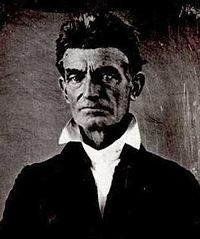
John Brown

This attempt to democratize the issue instead had the effect of drawing up battle lines.  Pro-slavery forces established a territorial capital in Lecompton, while “antis” set up an alternative government in Topeka.

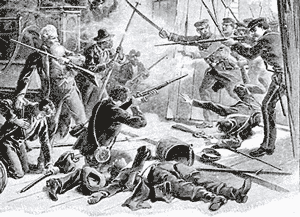
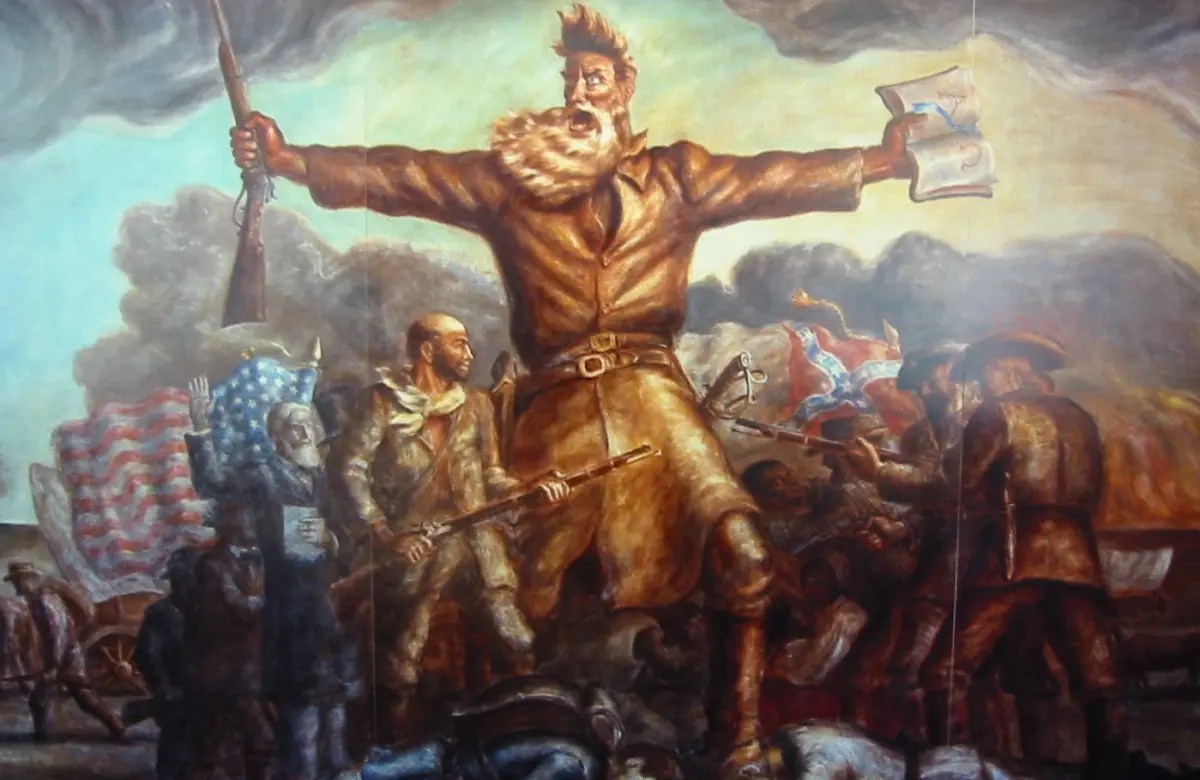
John Brown Sr. came to the Kansas Territory as a result of violence, sparked by the expansion of slavery into the Kansas-Nebraska territories between 1854 and 1861, a period known as “Bleeding Kansas”.  To some, the man was a hero.  To others he was a kook. The devil incarnate.  A radical abolitionist and unwavering opponent of the “peculiar institution” of slavery, John Brown believed that armed confrontation was the only way to bring it to an end.

BleedingKansasFight

In Washington DC, a United states Senator was beaten nearly to death on the floor of the Senate, by a member of the House of Representatives. The following day Brown and four of his sons: Frederick, Owen, Salmon, and Oliver, along with Thomas Weiner and James Townsley, set out on a “secret expedition”.

The group camped between two deep ravines off the road that night, remaining in hiding until sometime after dark on the 24th. Late that night, they stopped at the house of James P. Doyle, ordering him and his two adult sons, William and Drury, to go with them as prisoners. Doyle’s wife pleaded for the life of her 16 year old son John, whom the Brown party left behind. The other three, all former slave catchers, were led into the darkness.  Owen Brown and one of his brothers murdered the brothers with broadswords. John Brown, Sr. fired the coup de grace into James Doyle’s head to ensure that he was dead.

The group went on to the house of Allen Wilkinson, where he too was brought out into the darkness and murdered with broadswords. Sometime after midnight, the group forced their way into the cabin of James Harris. His two house guests were spared after interrogation, but Wilkinson was led to the banks of Pottawatomie Creek where he too was slaughtered.

There had been 8 killings to date in the Kansas Territory; Brown and his party had just murdered five in a single night. The massacre lit a powder keg of violence in the days that followed.  Twenty-nine people died on both sides in the next three months alone.

Harper's Ferry

Brown would go on to participate in the Battle of Black Jack and the Battle of Osawatomie in the Kansas Territory.  Brown lead a group to the armory in Harper’s Ferry Virginia in a hare brained scheme to capture the weapons contained there and trigger a slave revolt. The raid was ended by a US Army force under Colonel Robert E. Lee, and a young Army lieutenant named James Ewell Brown (JEB) Stuart.

Brown supporters blamed the 1856 massacre on everything from defending the honor of the Brown family women, to self defense, to a response to threats of violence from pro slavery forces. Free Stater and future Kansas Governor Charles Robinson may have had the last word when he said, “Had all men been killed in Kansas who indulged in such threats, there would have been none left to bury the dead.”

John Brown was hanged on December 2, 1859.

The 80-year-old nation forged inexorably onward, toward a Civil War that would kill more Americans than every conflict from the American Revolution to the War on Terror, combined.

November 30, 1939 Operation Polka

The effect was electric. Patriotic. Dance music as military counter-measure, played in two-quarter time.

Tensions between Russia and the Scandinavian nations are nothing new, dating back to the age of the Czars when modern-day Finland was a realm of the Swedish King.

As the result of the Russo-Swedish war of 1808-09, Sweden ceded the eastern third of its territory to the Russian Empire of Czar Alexander I, to be administered as the autonomous Duchy of Finland.

Encouraged by the collapse of the Czar and the birth of the communist state, Finland declared independence in 1917. For the first time in its history, Finland was now a sovereign state. 

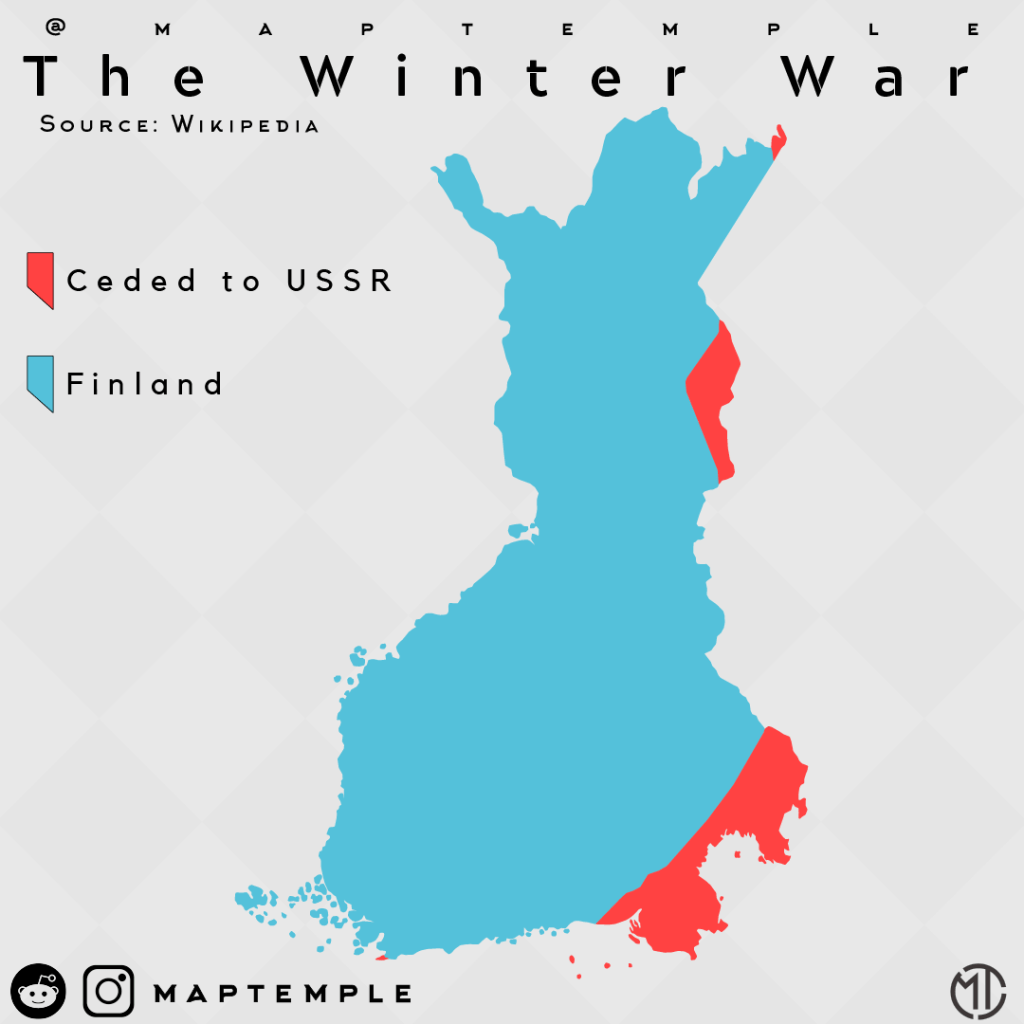
Soviet leader Josef Stalin was wary of Nazi aggression and needed to shore up defenses around the northern city of Leningrad. In 1939, Stalin demanded a 16-mile adjustment of the Russian-Finnish border along the Karelian Isthmus, plus several islands in the Gulf of Finland, on which to build a naval base.

The Soviet proposal ceded fully 8% of Finnish territory. Unsurprisingly, the Finns refused. Stalin saw his opportunity with the German invasion of Poland that September. The Soviet Union attacked on November 30, 1939.  The “Winter War” had begun.

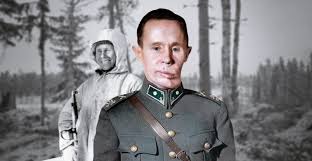
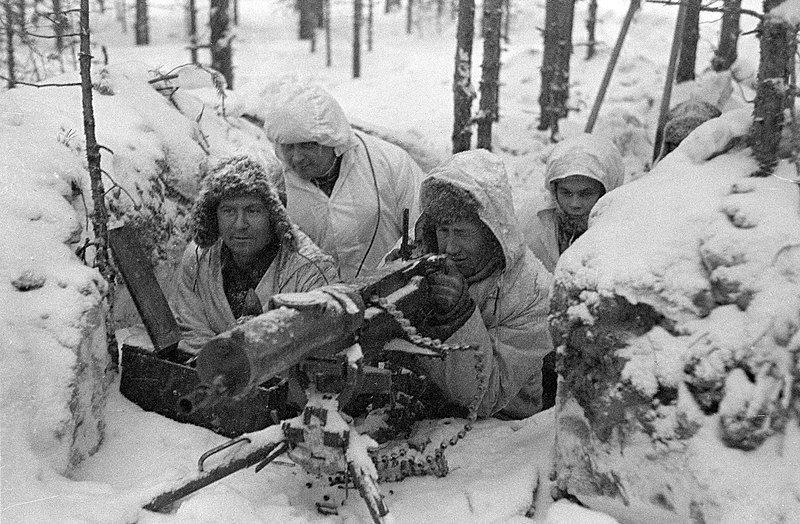
Finnish sniper Simo Häyhä The “White Death”, is credited with 505 confirmed kills in 100 days. That, in a part of the world with limited sunlight.

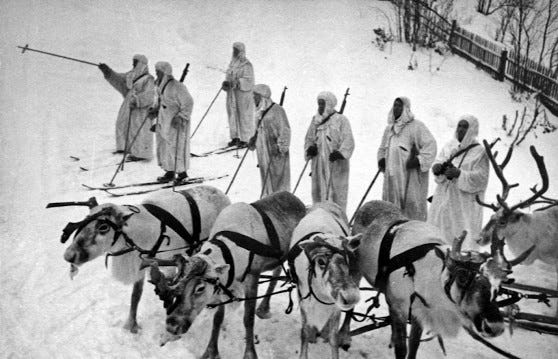
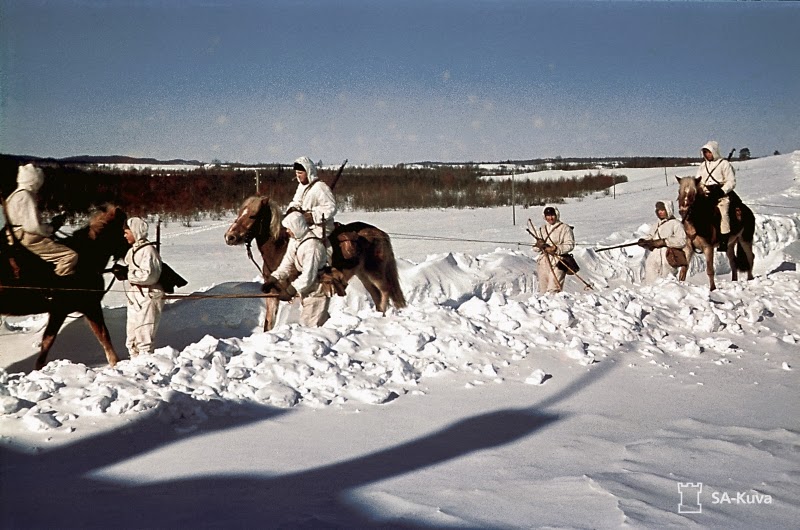
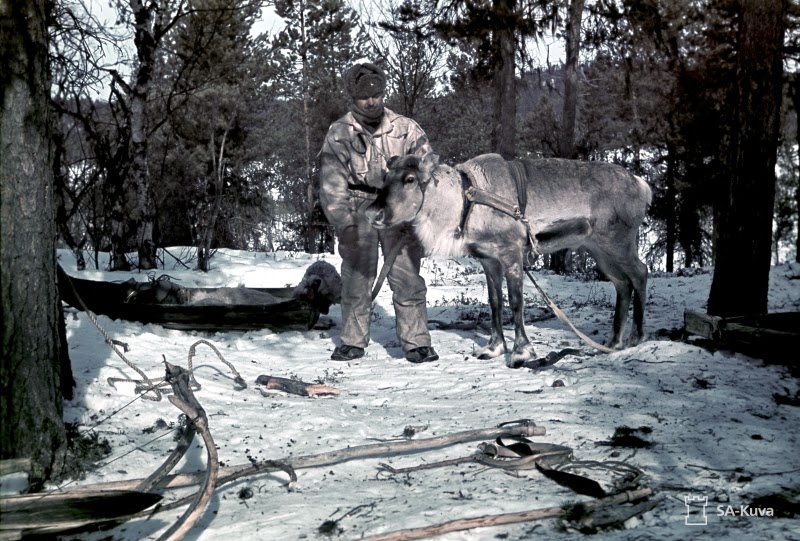
Massively outnumbered, outgunned, Finnish forces nevertheless inflicted horrendous casualties on the Soviet invaders. Clad in white camouflaged gear, the Finnish sniper Simo Häyhä alone ran up an impressive 505 confirmed kills in only 100 days, after which he was shot in the face.

According to most accounts, Häyhä is the deadliest sniper in history, for which he is remembered as ‘The White Death’.

Over the night of December 10-11, Soviet forces attacked Finnish supply lines near Tolvajärvi. Famished after 5 days’ marching in the sub-zero cold, soldiers stopped to devour sausage stew left by retreating Finns.

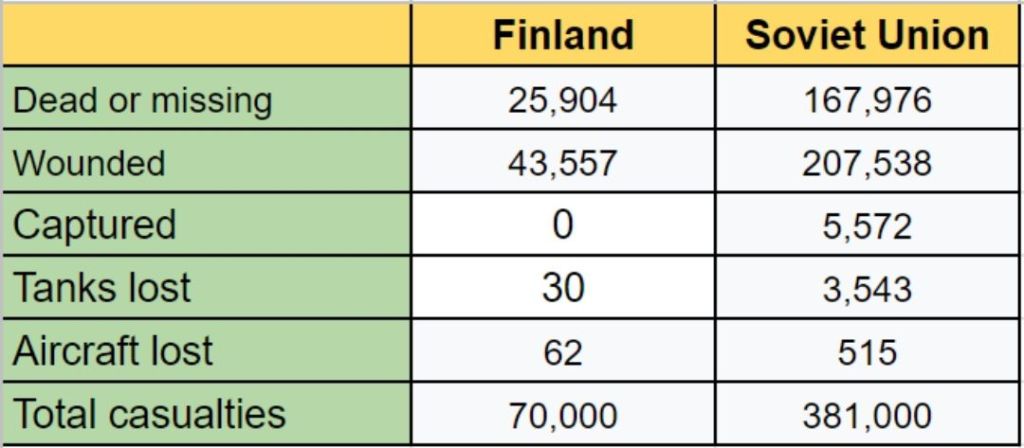
This gave Finnish Major Aaro Pajari time to muster forces for the counterattack, including dispersed cooks and medics.   The ensuing Battle of Varolampi Pond is also remembered as the “Sausage War”, one of few instances of bayonet combat from the Russo-Finnish war. 20 were killed on the Finnish side at a cost of five times that number for the Russians.

Despite such lopsided casualties, little Finland never had a chance.  The Winter War ceased in March 1940 with Finland losing vast swaths of territory.

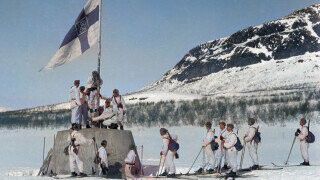
Winter War of November 1939 to January 1940.

The dismal Soviet performance persuaded the German Fuhrer that the time was right for “Operation Barbarossa.”  Hitler’s invasion of his Soviet “ally” began on June 22, 1941.

Three days later, Soviet air raids over Finnish cities prompted a  Finnish declaration of war.

The ‘Continuation War’ was every bit the David vs. Goliath contest of the earlier Winter War.  And equally savage.  Soviet casualties are estimated as high as a million plus to approximately one fourth of that for the Finns.

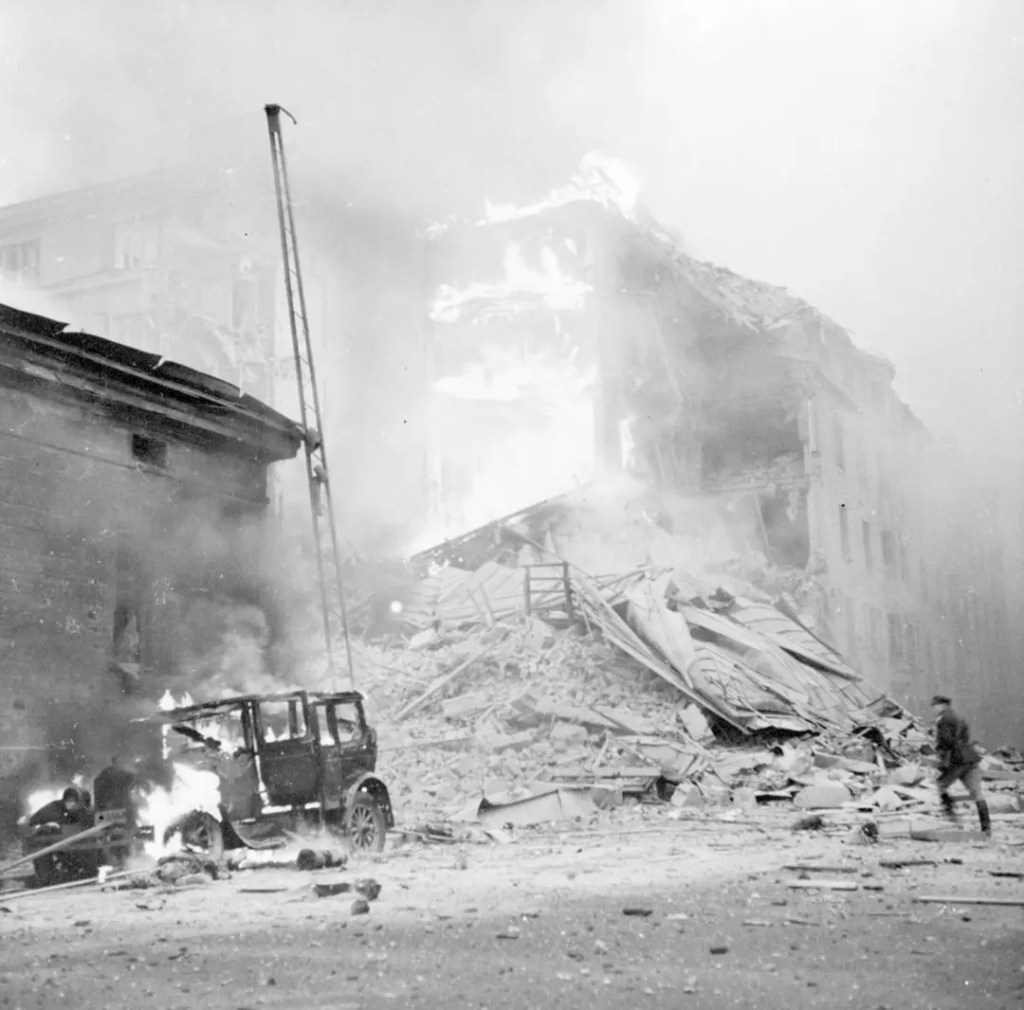
At one point, the Soviets were forced to evacuate the Karelian city of Viipuri, known today as Vyborg. On retaking the city, Finnish forces encountered hundreds of mines. Military personnel were being blown to bits by hundreds of these things, seemingly set to explode at random. 

Soviets bomb the Finnish capital of Helsinki

One such bomb was discovered intact under the Moonlight Bridge.  Some 600kg of explosives with an unusual timer.   Jouko Pohjanpalo examined the device, an electronics wiz kid known as the “father of Finnish radio”, Pohjanpalo discovered this was no timer at all. This was a radio receiver with three tuning forks, set to oscillate at frequencies unique to each mine.

The devices were detonated by sound, transmitted by radio.  One three-note chord was all that was needed… and… Boom.

A countermeasure was required. Musical notes played hard and fast, overriding those three tones.

Accordion music.

A truck was rigged to transmit a popular dance tune of the era, an REO 2L 4 210 Speedwagon, broadcasting the Säkkijärvi polka.

Russians switched to a second radio frequency and then a third. In the end, three broadcast vehicles crisscrossed the streets of Viipuri plus, additional 50-watt stationery transmitters.

Broadcast in three frequencies the polka played on in endless loop from September 9, 1941 until February 2, 1942. The effect was electric. Patriotic. Dance music as military counter-measure, played in two-quarter time. If you’re an American reading this, picture Lee Greenwood’s song.  I’m proud to be an American. On repeat. Hell yeah. You got the idea.

Protected by that sonic umbrella, bomb disposal techs raced to deactivate the devices. Some 1,200 bombs were discovered.  Over three months, only 20 exploded.  By then it didn’t matter.  The rest of the batteries were dead.

Fifty years later, the Finnish telecommunications company Nokia introduced the 2110, the first cell phone with selectable ringtones. Among the choices programmed into the phone – The Säkkijärvi Polka.

November 27, 1942 Unbeaten

The Germans could only look on helpless, as a dying fleet escaped their grasp.

The French battle fleet lay at anchor in late 1942, France itself under German occupation. Defeated but unbeaten, the French sailors of “La Royale” weren’t about to hand it all over to the Nazis. Even if they had to destroy it with their own hands.

The Battle of France began on May 10, 1940, with the German invasion of France and the low countries of Belgium, Luxembourg and the Netherlands. Barely three weeks later, the shattered remnants of the allied armies crowded the beaches and jetties of Dunkirk, awaiting evacuation.

The speed and ferocity of the German Blitzkrieg left the French people in shock.  All those years their government had told them. The strength of the French army combined with the Maginot line was more than enough to counter German aggression.

France had fallen in six weeks.

Vichy-France

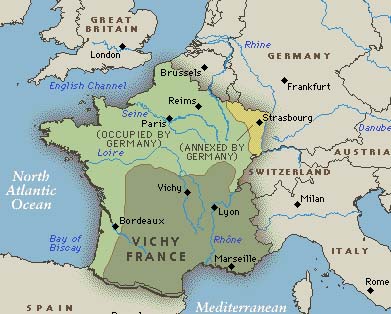
Germany installed a Nazi-approved French government in the south of the country, headed by WW1 hero Henri Pétain. Though mostly toothless, the self-described “French state” in Vichy was left relatively free to run its own affairs compared with the Nazi occupied regions to the west and north.

That all changed in November 1942, with the joint British/American invasion of North Africa. At the time, Morocco, Tunisia and Algeria were nominally under the control of the Vichy regime. Hitler gave orders for the immediate occupation of all France.

Scuttled, 2

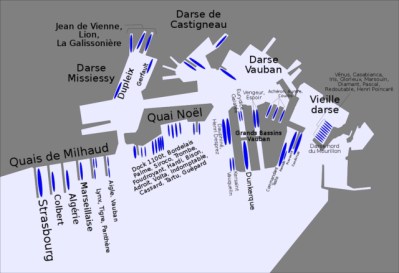
With the armistice of June 1940, much of the French naval fleet was confined to the Mediterranean port of Toulon. Confined but not disarmed, and the French fleet possessed some of the most advanced naval technologies of the age, enough to shift the balance of military power in the Mediterranean.

While many considered the Vichy government to be a puppet state, the officers and men of the French fleet had no love for their German occupiers. This was a French fleet and would remain so if they could help it. Even if they had to destroy it by their own hands.

Scuttled, 1

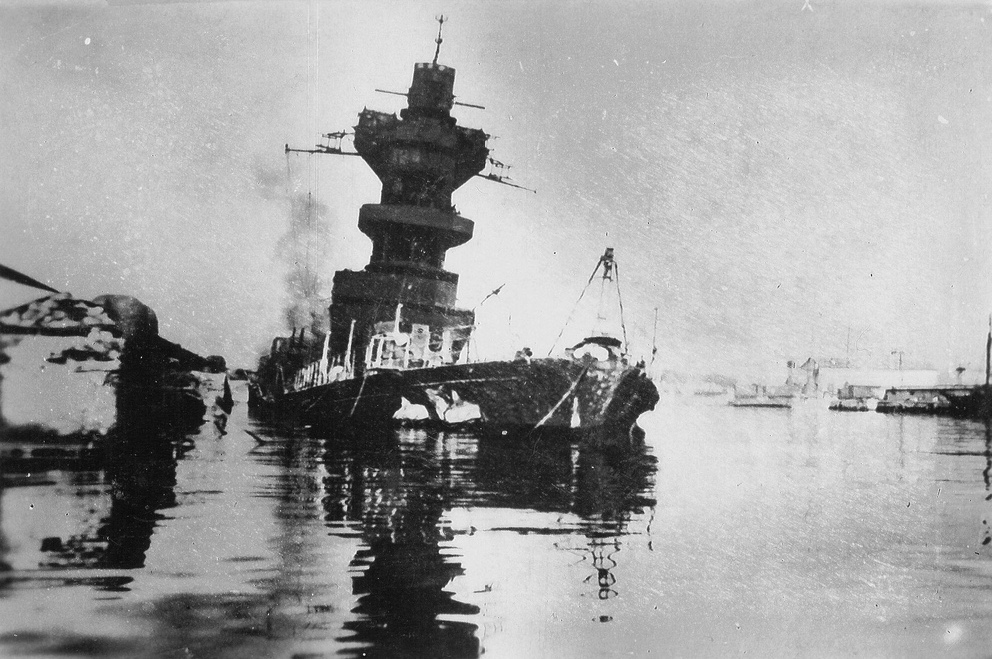
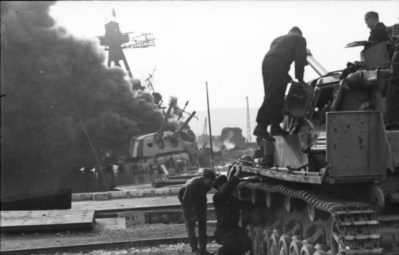
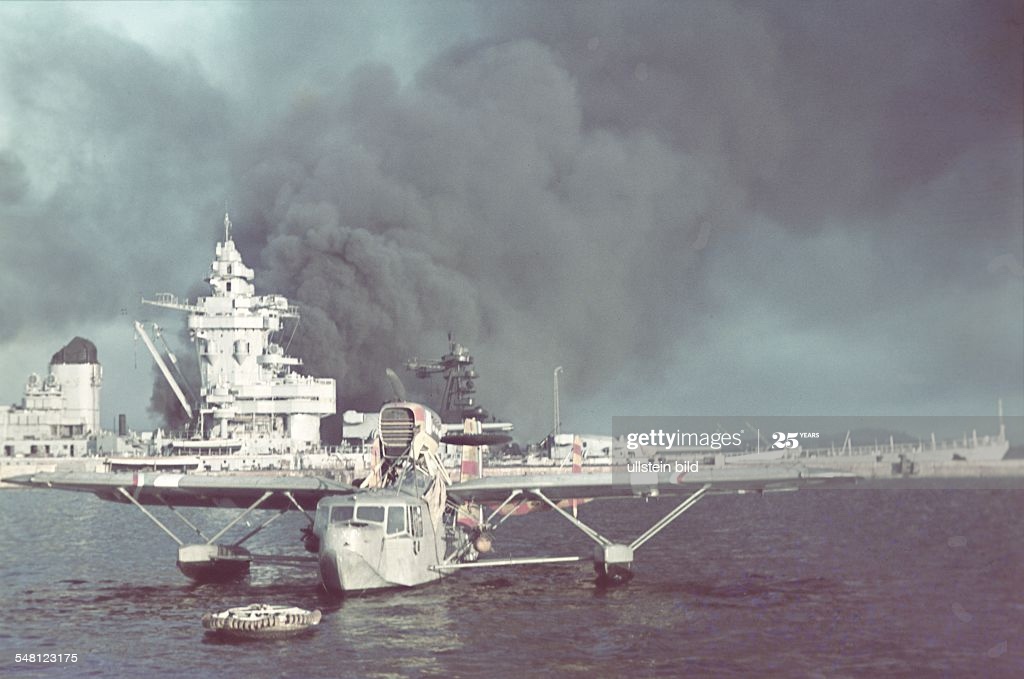
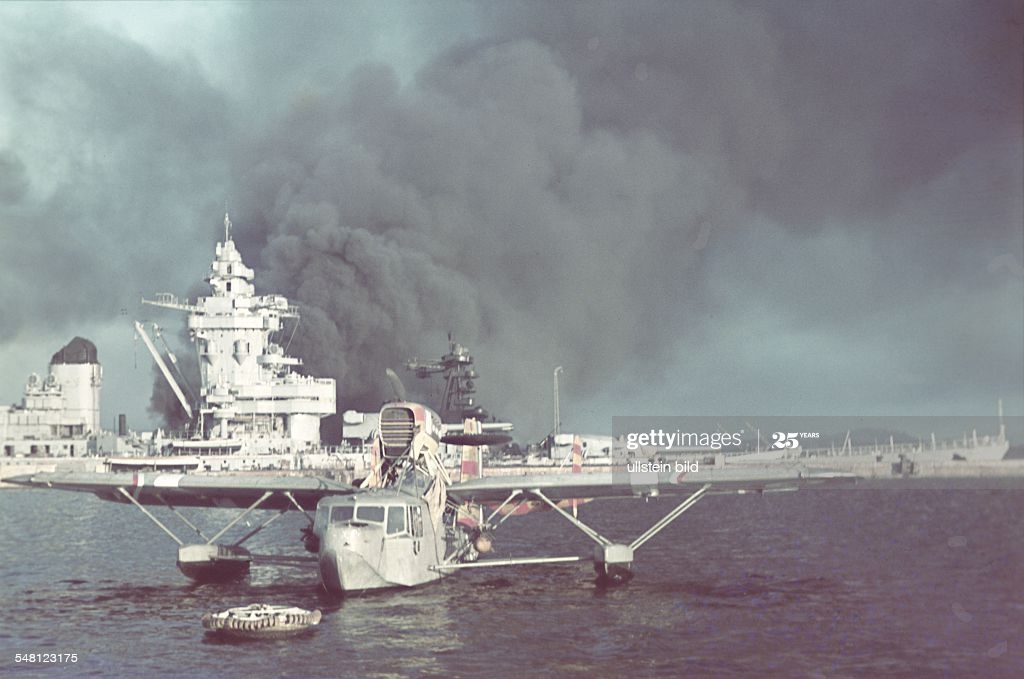
In November 1942, the Nazi government came to take control of that fleet. The motorized 7th Panzer column of German tanks, armored cars and armored personnel carriers descended on Toulon with an SS motorcycle battalion, taking over port defenses to either side of the harbor. German officers entered fleet headquarters and arrested French officers, but not before word of what was happening reached French Admiral Jean de Laborde, aboard the flagship Strasbourg.

The order went out across the base at Toulon. Prepare to scuttle the fleet and resist the advance of German troops. By any means necessary.

The German column approached the main gate to the harbor facility in the small hours of November 27, demanding access.  ‘Of course,’ smiled the French guard. ‘Do you have your access paperwork?’

Toulon, französisches Kriegsschiff

Under orders to take the harbor without bloodshed, the Nazi commander was dismayed. Was he being denied access by this, his defeated adversary?  Minutes seemed like hours in the tense wrangling that followed.  Germans gesticulated and argued with French guards who stalled and prevaricated at the closed gate.

The Germans produced documentation, only to be politely thanked, asked to wait, and left standing at the gate.

Meanwhile, thousands of French seamen worked in grim silence throughout the early morning hours, preparing to scuttle their own fleet.  Valves and watertight doors were opened, incendiary and demolition charges were prepared and placed.

27_toulon

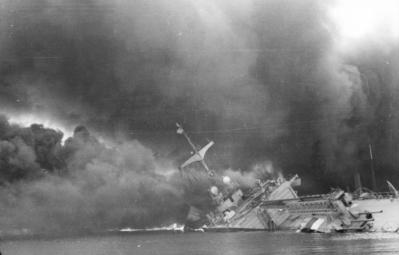
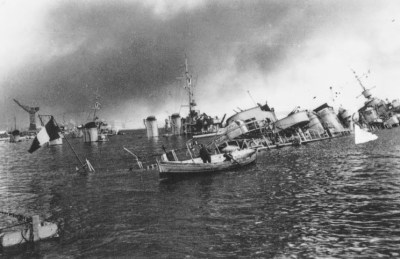
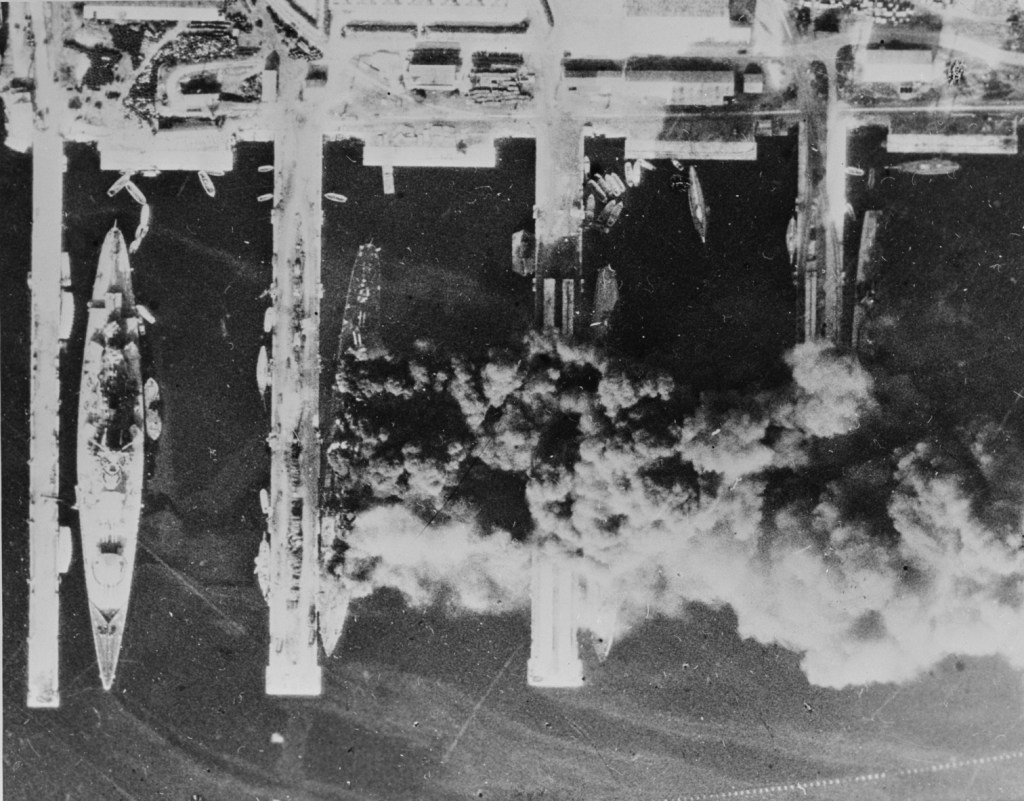
Finally, the Panzer column could be stalled no more. German tanks rumbled through the main gate at 5:25am, even as the order to scuttle passed throughout the fleet. Dull explosions sounded across the harbor. Fighting broke out by the early dawn light between the German column and French sailors pouring out of their ships. Lead German tanks broke for the Strasbourg, even now pouring greasy, black smoke from her superstructure as she settled to the bottom.

The Germans could only look on helpless, as a dying fleet escaped their grasp. In the end, 3 battleships, 7 cruisers, 15 destroyers, 13 torpedo boats, 6 sloops, 12 submarines, 9 patrol boats, 19 auxiliary ships, 28 tugs, 4 cranes and a school ship were destroyed. 39 smaller vessels of negligible military value fell into German hands along with twelve fleet vessels, all of them damaged.

The fires burned on for weeks. The harbor at Toulon remained fouled and polluted for years.

The French Navy lost 12 men killed and 26 wounded that day, 82 years ago, today. The loss to the Nazi war effort is incalculable. How many lives may have been lost had Nazi Germany come into possession of all that naval power. But for the obstinate bravery of a vanquished, but still unbeaten foe.

November 25, 1841 Amistad

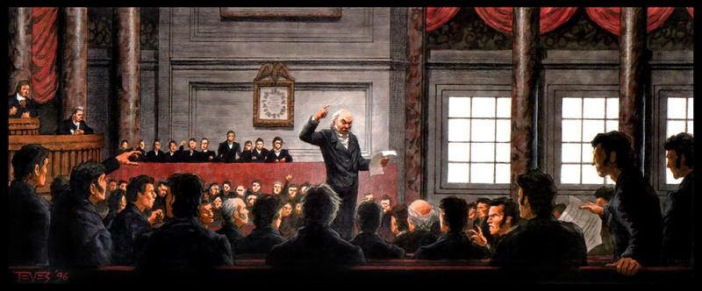
In arguing the case before the Supreme Court former President John Quincy Adams took the position that no man, woman, or child in the United States could ever be sure of the “blessing of freedom”, if the President could hand over free men on the demand of a foreign government.

The international slave trade was illegal in most countries by 1839 while the “peculiar institution” of slavery remained legal. In April of that year, a Portuguese slave trader illegally purchased some 500 Africans and shipped them to Havana aboard the slave ship Teçora.

Conditions were so horrific aboard Teçora that fully one-third of its “cargo”, presumably healthy individuals, died on the journey. Once in Cuba, sugar cane producers Joseph Ruiz and Pedro Montez purchased 49 members of the Mende people, 49 adults and four children, for use on the plantation.

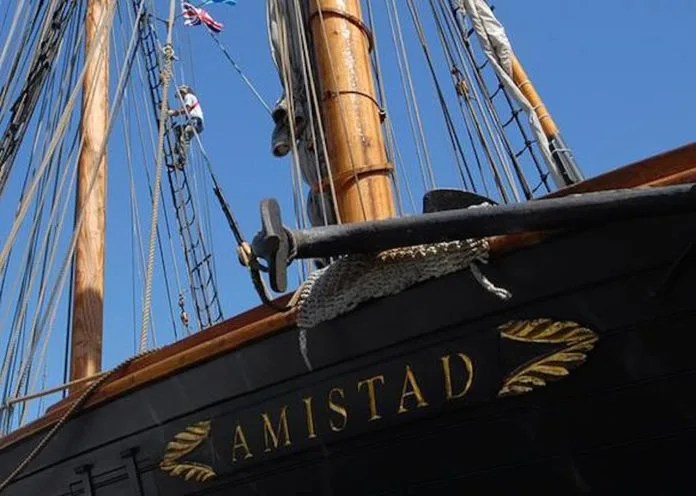
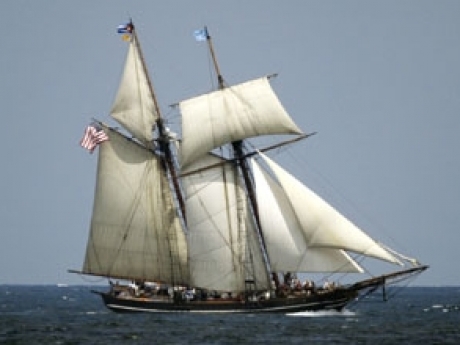
The Mendians were given Spanish names and designated “black ladinos,” fraudulently documenting the 53 to have always lived as slaves in Cuba. In June of 1841 Ruiz and Montez placed the Africans on board the schooner la Amistad, (“Friendship”), and set sail down the Cuban coast to Puerto del Principe.

jul-02-amistad
Replica of the slave ship, Amistad

Africans had been chained onboard Teçora but chains were judged unnecessary for the short coastal trip aboard Amistad.  On the second day at sea, two Mendians were whipped for an unauthorized trip to the water cask.  One of them asked where they were being taken.  The ship’s cook responded, they were to be killed and eaten.

The cook’s mocking response would cost him his life.

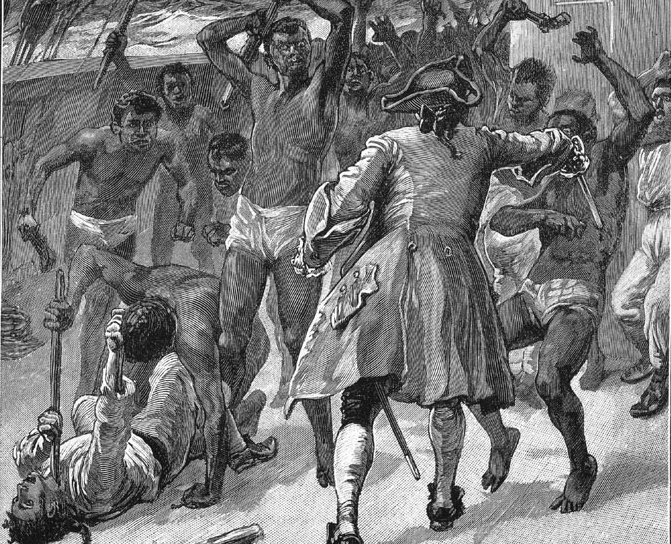
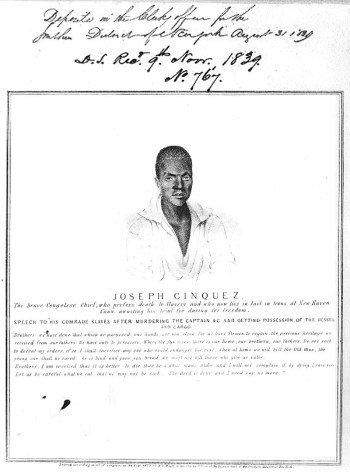
That night, captives armed with cane knives seized control of the ship. Their leader was Sengbe Pieh, also known as Joseph Cinqué. Africans killed the ship’s Captain and the cook losing two of their own in the struggle.  Montez was seriously injured while Ruiz and a cabin boy named Antonio, were captured and bound.  The rest of the crew escaped in a boat.

The mulatto cabin boy who really was a black ladino, would be used as translator.

Revolt-Aboard-Ship

Mendians forced the two to return them to their homeland, but the Africans were betrayed.  By day the two would steer east, toward the African coast.  By night when the position of the sun could not be determined, the pair would turn north.  Toward the United States.

After 60 days at sea, Amistad came aground off Montauk on Long Island Sound. Several Africans came ashore for water when Amistad was apprehended by the US Coastal Survey brig Washington, under the command of Thomas Gedney and Richard Meade.  Meanwhile on shore, Henry Green and Pelatiah Fordham (the two having nothing to do with the Washington) captured the Africans who had come ashore.

Joseph_Cinque
This print depicting Joseph Cinqué appeared in The New York Sun newspaper, August 31, 1839

Amistad was piloted to New London Connecticut, still a slave state at that time.  The Mendians were placed under the custody of United States marshals.

Both the slave trade and slavery itself were legal at this time according to Spanish law while the former was illegal in the United States.   The Spanish Ambassador demanded the return of Ruiz’ and Montez’ “property”, asserting the matter should be settled under Spanish law.  American President Martin van Buren agreed, but, by that time, the matter had fallen under court jurisdiction.

Gedney and Meade of the Washington sued under salvage laws for a portion of the Amistad’s cargo, as did Green and Fordham.  Ruiz and Montez sued separately.  The district court trial in Hartford determined the Mendians’ papers to be forged.  These were now former slaves  entitled to be returned to Africa.

Antonio was ruled to have been a slave all along and ordered returned to Cuba.  He fled to New York with the help of white abolitionists and lived out the rest of his days as a free man.

Fearing the loss of pro-slavery political support, President van Buren ordered government lawyers to appeal the case up to the United States Supreme Court.  The government’s case depended on the anti-piracy provision of a treaty then in effect between the United States, and Spain.

A former President, son of a Founding Father and eloquent opponent of ‘peculiar institution’ John Quincy Adams argued the case in a trial beginning on George Washington’s birthday, 1841.

img_3917.jpg

In United States v. Schooner Amistad, the Supreme Court upheld the decision of the lower court 8-1, ruling that the Africans had been detained illegally  and ordering them returned to their homeland.

Pro slavery Whig John Tyler was President by this time, refusing to provide a ship or to fund the repatriation.  Abolitionists and Christian missionaries stepped in, 34 surviving Mendians departing for Sierra Leone on November 25, 1841 aboard the ship, Gentleman.

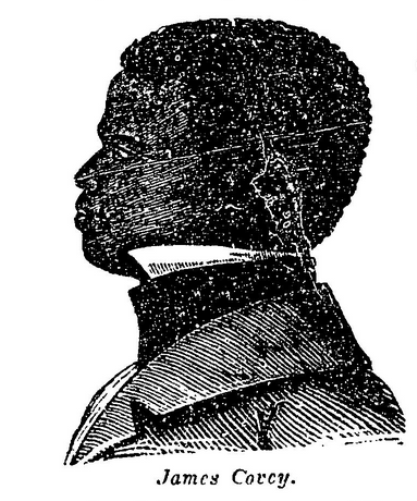
The Amistad story has been told in books and in movies and is familiar to many. One name perhaps not so familiar is that of James Benjamin Covey. James Covey was born Kaweli sometime around 1825, in what is now the the border region between of Sierra Leone, Guinea and Liberia. Kidnapped in 1833 and taken aboard the Segundo Socorro, Kaweli was an illegal slave when the vessel was seized by the Royal Navy.

Kaweli went to school for five years in Bathurst, Sierra Leone, where he took the name of James Benjamin Covey. Joining the Royal Navy, Covey participated in the capture of several illegal slave ships.

Hired on as live interpreter, James Covey was to play a crucial role in the Medians’ trial before the Supreme Court. He would also accompany the 34 on their return to the African continent.

James Covey, aka Kaweli, was going home.

‘They all have Mendi names and their names all mean something… They speak of rivers which I know. They sailed from Lomboko… two or three speak different language from the others, the Timone language… They all agree on where they sailed from. I have no doubt they are Africans.’ – James Benjamin Covey

Gentleman landed in Sierra Leone in January 1842, where some of the Africans helped establish a Christian mission.  Most including Joseph Cinque himself returned to homelands in the African interior. One survivor, a little girl when it all started by the name of Margru, returned to the United States where she studied at Ohio’s integrated Oberlin College, returning to Sierra Leone as the Christian missionary Sara Margru Kinson.

In arguing the case, President Adams took the position that no man, woman or child in the United States could ever be sure of the “blessing of freedom” if the President could hand over free men on the demand of a foreign government.

A century and a half later later President Bill Clinton, Deputy Attorney General Eric Holder and AG Janet Reno orchestrated the kidnap of six-year-old Elián González at gunpoint, returning him to Cuba over the body of the mother who had drowned bringing her boy to freedom.

November 12, 1943  The Unluckiest Ship in the American Navy

We’ve all experienced that “oh shit” moment. Words you wish you hadn’t said. The text or email you wish you could unsend. Take heart. You will never be that sailor who accidentally fired a live torpedo. At the president of the United States.

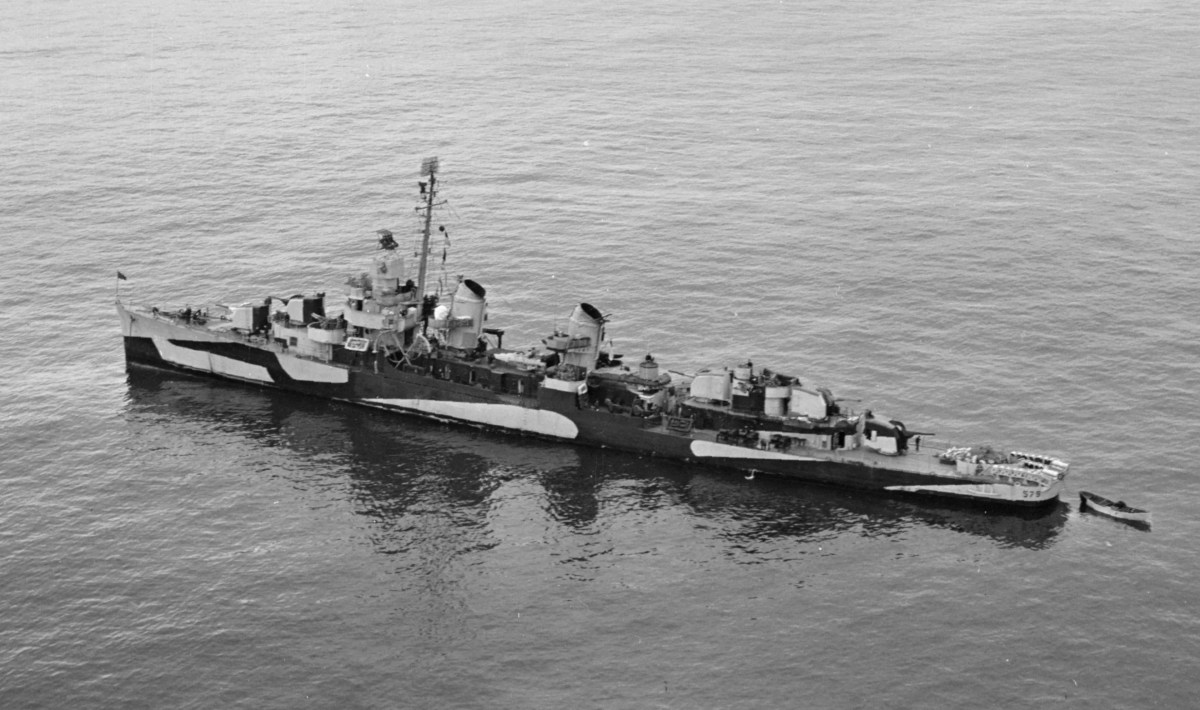
The Fletcher class destroyer DD-579 was built by the Consolidated Steel Corporation of Orange, Texas, the 11th such vessel built for service in World War 2. Commissioned on July 6, 1943 she was christened USS William D. Porter in honor of the Civil War admiral. To the sailors who served on her decks, she was “Willy Dee”.

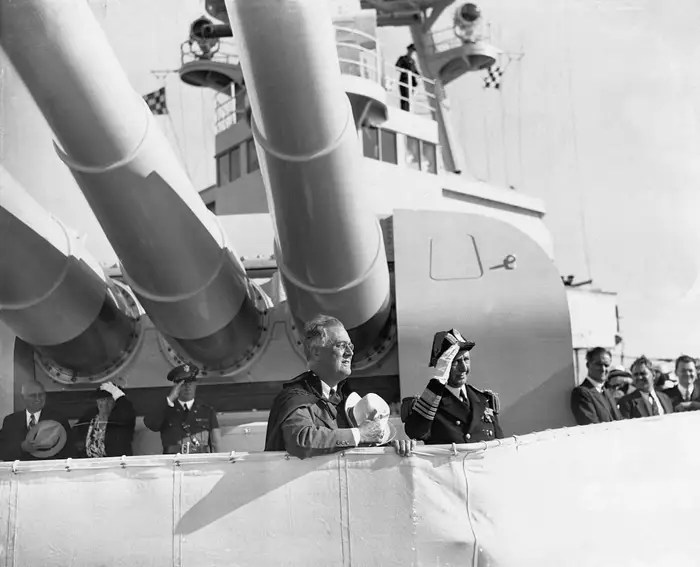
On November 12, 1943, the Porter departed Charleston for Norfolk to rendezvous with a fleet, departing Norfolk. On board the flagship USS Iowa was the President of the United States, Franklin Delano Roosevelt.

If sailors are a superstitious lot, perhaps it’s for good reason. Problems began even while leaving port. Willy Dee improperly raised an anchor, tearing off the railing and lifeboat mount from a neighboring vessel.

The following day an explosion caused the entire fleet to take evasive maneuvers from German submarines, lurking below. But no. There was no submarine. Willy Dee had accidentally dropped a live depth charge.

On the afternoon of November 14th, President Roosevelt requested a demonstration of Iowa’s anti-aircraft capabilities. Balloons were released for the purpose, most of which were shot down by the battleship’s gunners. Some that “got away” were shot down by other vessels, including USS William D. Porter.

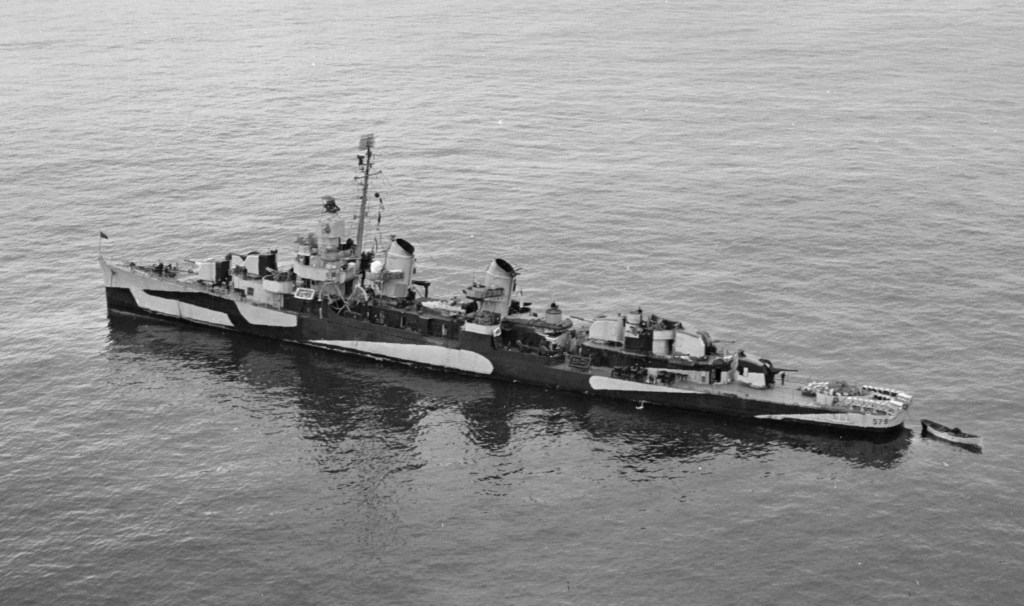
The U.S. Navy destroyer USS William D. Porter (DD-579) in Massacre Bay, Attu, Aleutian Islands, 9 June 1944. US Navy Photo

Now in an unprecedented third term with a fourth less than a year away, the most successful figure in the history of American party politics was heading to Cairo and Tehran for top level meetings with Allied leaders.

Escort ships then commenced a torpedo demonstration. That’s when it all went off the rails. The simulated release of a torpedo requires that a launch primer be disarmed. Porter “fired” one, then two…so far so good…but nobody’d disarmed #3.

Oops.

A fully armed torpedo was now in the water and closing fast on the president of the United States. Not only the chief executive but virtually every senior military staff member then conducting the war was on that boat, including Secretary of State Cordell Hull, Chief of Staff Admiral William D. Leahy, Chief of Staff of the Army General George C. Marshall, Chief of Naval Operations Ernest King, Commanding General of the U.S. Army Air Forces Henry “Hap” Arnold, Secretary of Commerce Harry Hopkins, and many other high ranking officials.

Gun shy about breaking radio silence after the depth charge incident, frantic messages were sent via signal light, resulting in the unlikely misunderstanding that Porter was backing up at full speed.

With the situation rapidly going from bad to worse Porter at last broke radio silence, communicating the situation as it was. President Roosevelt heard what was happening and asked his secret service detail to wheel his chair to the rail. He wanted to watch.

Iowa turned hard and the torpedo exploded harmlessly, some 3,000 feet astern of the battleship. The episode took less than 5 minutes.

Porter was ordered to Bermuda for investigation of the “assassination plot” against the president. In the end, torpedoman Lawton Dawson was court-martialed and sentenced to 14 years hard labor. President Roosevelt gave the man a full pardon, as no harm was done.

The William D. Porter served in the Pacific for much of 1944 without incident, but that no longer mattered. For the rest of her days left afloat, other vessels would hail the Willy Dee “Don’t shoot, we’re Republicans!”

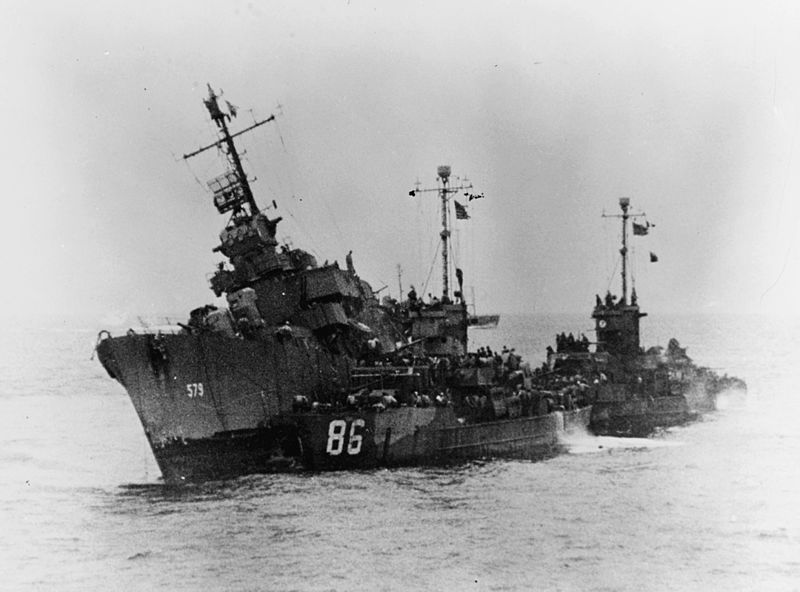
“Damaged William D. Porter listing heavily. Landing Craft Support ships LCS(L)(3)-86 and LCS(L)(3)-122 (behind) are assisting:. – H/T Wikipedia

Willy Dee met her final stroke of bad luck at the battle of Okinawa, managing to shoot down a kamikaze who exploded beneath her hull. Not a single sailor was lost, but this was the end for the Willy Dee. Three hours later she rolled and sank by the stern. The unluckiest ship in the American Navy, was gone.

October 27, 1962  The Man who Saved the World

The outside world would not learn for decades how close it had come to the abyss.

Cold War.  The English writer George Orwell coined the term in 1945, describing “two or three monstrous super-states, each possessed of a weapon by which millions of people can be wiped out in a few seconds.”

Two diametrically opposite governing philosophies, each capable of exterminating the other by the push of a button.

Never in the history of the Cold War was the world so close to nuclear annihilation than the Cuban Missile Crisis of October 1962. Speaking to staffer Arthur Shlesinger, President John F. Kennedy called those 13 days “the most dangerous moment in human history.”

On no single date was the world so close to the precipice as October 27.

This newspaper map from the time of the Cuban Missile Crisis shows the distances from Cuba of various cities on the North American Continent. — Image by © Bettmann/CORBIS

On October 14, ultra-high altitude Lockheed U–2R reconnaissance aircraft photographs revealed the presence of medium and intermediate range ballistic nuclear missile sites under construction in Cuba. Located only 90 miles from the US mainland, such a facility was capable of delivering a nuclear payload anywhere in the eastern United States.

President Kennedy warned of the “gravest consequences” resulting from the introduction of Soviet offensive weapons in Cuba, while Foreign Minister Andrei Gromyko insisted that Soviet aid was purely defensive. U-2 photographs gave lie to Gromyko’s protestations.  Images taken on October  17 revealed the presence of 16-32 missiles.

The President warned “It shall be the policy of this nation to regard any nuclear missile launched from Cuba against any nation in the Western Hemisphere as an attack by the Soviet Union on the United States, requiring a full retaliatory response upon the Soviet Union.”  There was no mistaking American intent.

Kruschev replied, “I hope that the United States Government will display wisdom and renounce the actions pursued by you, which may lead to catastrophic consequences for world peace…”

Soviet nuclear submarines moved in response to the quarantine as Cuban waters became the scene of a tense naval standoff.

U-2 photographs of the 25th & 26th showed accelerated construction on the island, with several silos approaching operational readiness.  US air forces were placed at DEFCON 2.  War involving Strategic Air Command, was now “imminent”.

Cuban Missile Crisis, contest

Cuban President Fidel Castro publicly urged a Soviet nuclear first strike.

On day twelve of the standoff, October 27, an American U-2 was shot out of the sky by a Soviet supplied surface-to-air missile, killing pilot Major Rudolph Anderson Jr.

Meanwhile on the ocean below, events were spinning out of control.

Soviet submarine B-59 was just outside the American blockade perimeter, with orders to monitor the situation. Vasili Arkhipov was 34 at the time, one of three officers in command of the nuclear armed sub.

Vasili Aleksandrovich Arkhipov

Diving deep to avoid detection, B59 was unable to communicate with Moscow when she came under attack from American surface vessels.

The depth charges being used were “non-lethal”, intended to force the submarine to the surface, but perception is reality, right? Isolated from the outside world with orders to launch a first strike in the event of war, B-59 found herself under attack.

Imagine yourself in this situation. B59 sailor Anatoly Andreev described the scene in his journal:

“For the last four days, they didn’t even let us come up to the periscope depth … My head is bursting from the stuffy air. … Today three sailors fainted from overheating again … The regeneration of air works poorly, the carbon dioxide content [is] rising, and the electric power reserves are dropping. Those who are free from their shifts, are sitting immobile, staring at one spot. … Temperature in the sections is above 50 [122ºF].”

This was the atmosphere onboard the submarine on October 27, as B59 shook with every depth charge. Captain Valentin Savitsky ordered the submarine’s nuclear weapon armed, a missile capable of striking deep into the American heartland. The missile was armed with a payload equal to the bomb dropped on Hiroshima.

“We’re gonna blast them now” Savitsky reportedly said, “We will die, but we will sink them all – we will not become the shame of the fleet.”

Cuban blockade, October 1962

Second captain Ivan Maslennikov agreed with Savitsky and approved the attack.

According to Soviet doctrine, such a decision needed to be unanimous among the three commanders. Such a strike was as sure as night follows day to provoke a counter attack, followed by retaliatory strikes. Deep under the Caribbean surface, Vasili Aleksandrovich Arkhipov was all that stood in the way of nuclear war.

How would you respond to such a situation?

Perhaps it was the K-19 incident from 2 years earlier. In July 1961, Arkhipov was executive officer of the nuclear submarine K-19, on patrol south of Greenland. Developing a severe leak in her cooling system, the submarine’s 7-man engineering section frantically labored to jury-rig a secondary cooling system, exposing themselves to hours of intense radiation. The effort was a success, but all seven men died inside of a month. 15 more died from the effects of radiation over the following two years. Every sailor onboard K-19 was destined to die of radiation poisoning including Arkhipov himself, but for now, the man carried the moral authority of a Hero of the Soviet state.

Be that as it may, Arkhipov persuaded the other two that the American attack was intended not to destroy them, but to bring them to the surface. B59 came to the surface restoring communications with the outside world. World War 3 had not begun, after all.

The Cuban Missile crisis effectively came to a close the following day, B59 going quietly on her way. The outside world would not learn for decades how close it had come to the abyss.

Vasili Arkhipov died in obscurity 1998. Four years later, Director of the U.S. National Security Archive Thomas S. Blanton described him as “the man who saved the world”.

When governments make war, it is the everyday men (and these days women), who pay the price. Vasili Arkhipov was a Russian patriot, doing his duty for his nation. In so doing, the man made for us a very different world from what could have been. Let it be said, then, that personal courage in the line of fire is worthy of our respect. No matter on which side such a man finds himself.