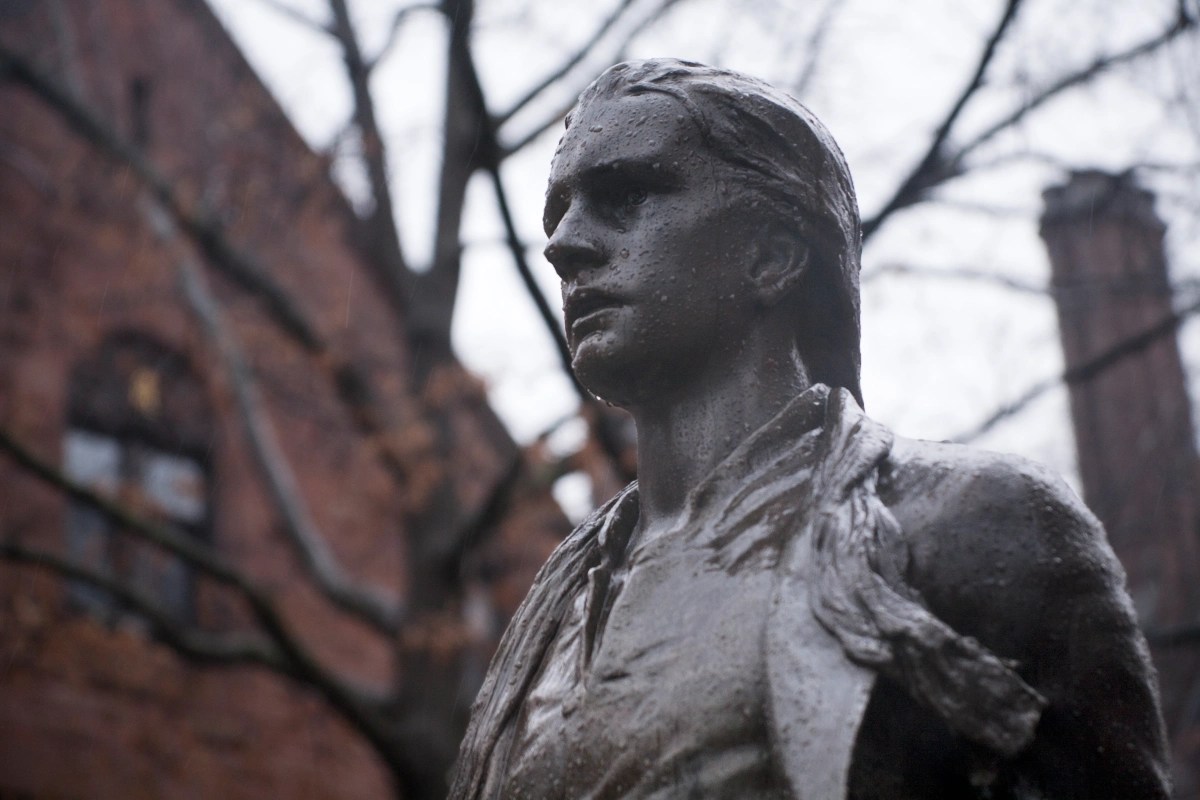
September 22, 1776 Nathan Hale

The Connecticut schoolteacher was young and untried when he placed is confidence in the wrong place. It would prove to be a fatal mistake.

The nine Hale brothers of Coventry, Connecticut supported the Patriot side from the earliest days of the American Revolution. Five of them participated in the battles at Lexington and Concord. Nathan was the youngest and destined to be the most famous of them all. He was still at home at this time, finishing out the term of a teaching contract in New London, Connecticut.

Nathan Hale’s unit participated in the siege of Boston. Hale himself joined General George Washington’s army in the spring of 1776, as the army moved to Long Island to block the British move on the strategically important port city of New York.

On June 29, General Howe appeared off Staten Island with a fleet of 45 ships. By the end of the week, he’d assembled an overwhelming fleet of 130.

There was an attempt at peaceful negotiation on July 13, when General Howe sent a letter to General Washington under flag of truce. The letter was addressed “George Washington, Esq.”, intentionally omitting Washington’s rank. Washington declined to receive the letter, responding that there was no one present by that address. Howe tried the letter again on the 16th, this time addressing “George Washington, Esq., etc., etc.”. Again, Howe’s letter was refused.

The following day, General Howe sent Captain Nisbet Balfour in person to ask if Washington would meet with Howe’s adjutant, Colonel James Patterson. Considerations of honor having thus been settled, a meeting was scheduled for July 20.

Patterson told Washington that General Howe had come with powers to grant pardons.  Washington refused, saying “Those who have committed no fault want no pardon”.

Patriot forces were comprehensively defeated at the Battle of Brooklyn, fought on August 27, 1776. With the Royal Navy in command on the water, Howe’s army dug in for a siege, confident that the adversary was trapped and waiting to be destroyed at their convenience.

On the night of August 29-30, Washington withdrew his army to the ferry landing and across the East River, to Manhattan.

With horse’s hooves and wagon wheels muffled, oarlocks stuffed with rags, the Patriot army withdrew even as a rearguard tended fires, convincing the redcoats in their trenches that the Americans were still there.

The surprise was comprehensive for the British side, on waking on the morning of the 30th.  The Patriot army had vanished.

The Battle of Long Island would almost certainly have ended in disaster for the Patriot cause but for that silent evacuation over the night of August 29-30, one of the great military feats of the American revolution.

Following evacuation, the Patriot army found itself isolated on Manhattan island, virtually surrounded.  Only the thoroughly disagreeable current conditions of the Throg’s Neck-Hell’s Gate segment of the East River prevented Admiral Sir Richard Howe (William’s brother) from enveloping Washington’s position, altogether.

Expecting a British assault in September, General Washington became increasingly desperate for information on British movements.

Nathan Hale Capture

Washington asked for volunteers for a dangerous mission, to go behind enemy lines as a spy.  Up stepped a volunteer.  His name was Nathan Hale.

Hale set out on his mission on September 10, disguised as a Dutch schoolmaster. He was successful for about a week but appears to have been something less than “street smart”.  The young and untrained Patriot turned spy, bestowed his trust where it did not belong.

Major Robert Rogers was an old British hand, a leader of Rangers during the earlier French and Indian War. Rogers must have suspected that this Connecticut schoolteacher was more than he pretended to be, intimating that he himself was a spy in the Patriot cause.

Hale took Rogers into his confidence, believing the two to be playing for the same side.  Consider Tiffany, a British loyalist and Barkhamsted Connecticut shopkeeper was himself a sergeant of the French and Indian War. Tiffany recorded what happened next in his journal:

The time being come, Captain Hale repaired to the place agreed on, where he met his pretended friend” (Rogers), “with three or four men of the same stamp, and after being refreshed, began [a]…conversation. But in the height of their conversation, a company of soldiers surrounded the house, and by orders from the commander, seized Captain Hale in an instant. But denying his name, and the business he came upon, he was ordered to New York. But before he was carried far, several persons knew him and called him by name; upon this he was hanged as a spy, some say, without being brought before a court martial.”

“Stay behind spy” Hercules Mulligan had better success, reporting on British goings-on from the 1776 capture of New York to their withdrawal seven years later.  But that must be a story for another day.

Nathan Hale was hanged on this day in 1776, described by CIA.gov as “The first American executed for spying for his country”.
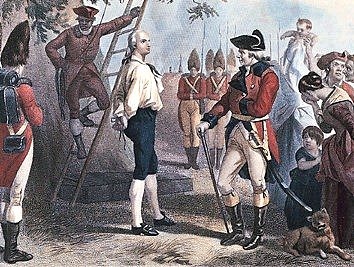
There is no official account of Nathan Hale’s final words. However, an eyewitness statement from British Captain John Montresor exists. He was present at the hanging.

Montresor spoke with American Captain William Hull the following day under flag of truce.  The captain gave Hull the following account: “‘On the morning of his execution,’ said Montresor, ‘my station was near the fatal spot, and I requested the Provost Marshal to permit the prisoner to sit in my marquee, while he was making the necessary preparations. Captain Hale entered: he was calm, and bore himself with gentle dignity, in the consciousness of rectitude and high intentions. He asked for writing materials, which I furnished him: he wrote two letters, one to his mother and one to a brother officer.’ He was shortly after summoned to the gallows. But a few persons were around him, yet his characteristic dying words were remembered. He said, ‘I only regret, that I have but one life to lose for my country‘.

Nathan Hale was barely three months past his 21st birthday on the day he died.

September 21, 1780 André

He asked not that his life be spared, but only that he be executed by firing squad. A death considered worthy of a gentleman of the age and not hanging, an end reserved for thieves and scoundrels.

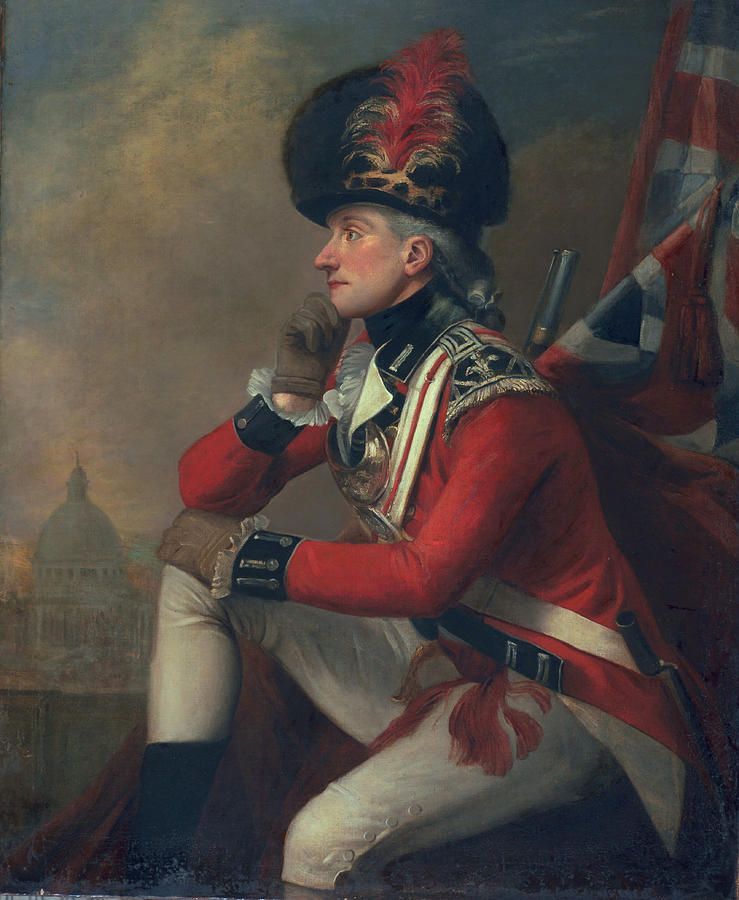
In an age before radio or television, John André was an interesting man to be around. A gifted storyteller with a great sense of humor he could draw, paint and cut silhouettes. He was an excellent writer, he could sing, and he could write verse.  John André was a British Major at the time of the American Revolution, who took part in his army’s occupations of Philadelphia and New York.

John André was a spy.

A favorite of colonial era loyalist society, Major André dated Peggy Shippen for a time, the daughter of a prominent Philadelphia loyalist. Shippen went on to marry Benedict Arnold in 1779, forming a link between the spy and an important general in the cause of American independence.

Hat tip artist Dale Watson for this image of Peggy Shippen

The relationship nearly changed the outcome of the American revolution.

Arnold was the Commandant of West Point at the time, the future location of one of our great military academies. A prominence overlooking the Hudson River, West Point was a fortified position offering decisive military advantage to the side holding the position. The British capture of West Point would have split the colonies in half.

The author (left) on a 2022 “history ramble” weekend with family members. It doesn’t take a military strategist to understand the importance of West Point’s commanding position over the Hudson River.

The Sloop of War HMS Vulture sailed up the Hudson River on September 20, 1780, Major André meeting with General Arnold on the river’s banks the following day. Dressed in civilian clothes, John André struck a bargain with the patriot general. Arnold would receive £20,000, over a million dollars today, in exchange for which he would give up West Point.

Tasked with returning the signed papers to British lines, Major André was stopped by three Patriot Militiamen two days later. They were John Paulding, David Williams and Isaac Van Wart. One of the three wore a Hessian overcoat, making André believe they might be loyalists. “Gentlemen”, he said, “I hope you belong to our party”. “What party”, came the reply, and André said “The lower (British) party”. “We do”, they said, to which André replied that he was a British officer and must not be detained. That was as far as he got.

You need not be a military strategist to recognize the importance of the commanding heights at West Point. The discovery of those papers brought Benedict Arnold’s treachery to light. Arnold immediately fled on hearing of André’s arrest, even as George Washington was headed to his place for a meeting over breakfast.

John André was tried and sentenced to death as a spy. He asked if he could write a letter to General Washington.  In it he asked not that his life be spared, but that he be executed by firing squad, a death more worthy of a gentleman than hanging, an execution at that time commonly reserved for criminals.

General Washington believed that Arnold’s crimes to be far more egregious than those of John André. Furthermore, he was impressed with the man’s courage.  Washington wrote to General Sir Henry Clinton asking for an exchange of prisoners.

Having received no reply, Washington wrote in his General Order of October 2 “That Major André General to the British Army ought to be considered as a spy from the Enemy and that agreeable to the law and usage of nations it is their opinion he ought to suffer death. The Commander in Chief directs the execution of the above sentence in the usual way this afternoon at five o’clock precisely.”

John André was executed by hanging in Tappan, New York. He was 31.

A vintage postcard illustration depicting the execution of Major John Andre, hung as a spy for aiding and abetting General Benedict Arnold during the American Revolutionary War in Trenton, New Jersey on 2nd October 1780, published in New York, circa 1903. Andre’s body was later disinterred from American soil and buried in Westminster Abbey, London. (Photo by Paul Popper/Popperfoto via Getty Images)

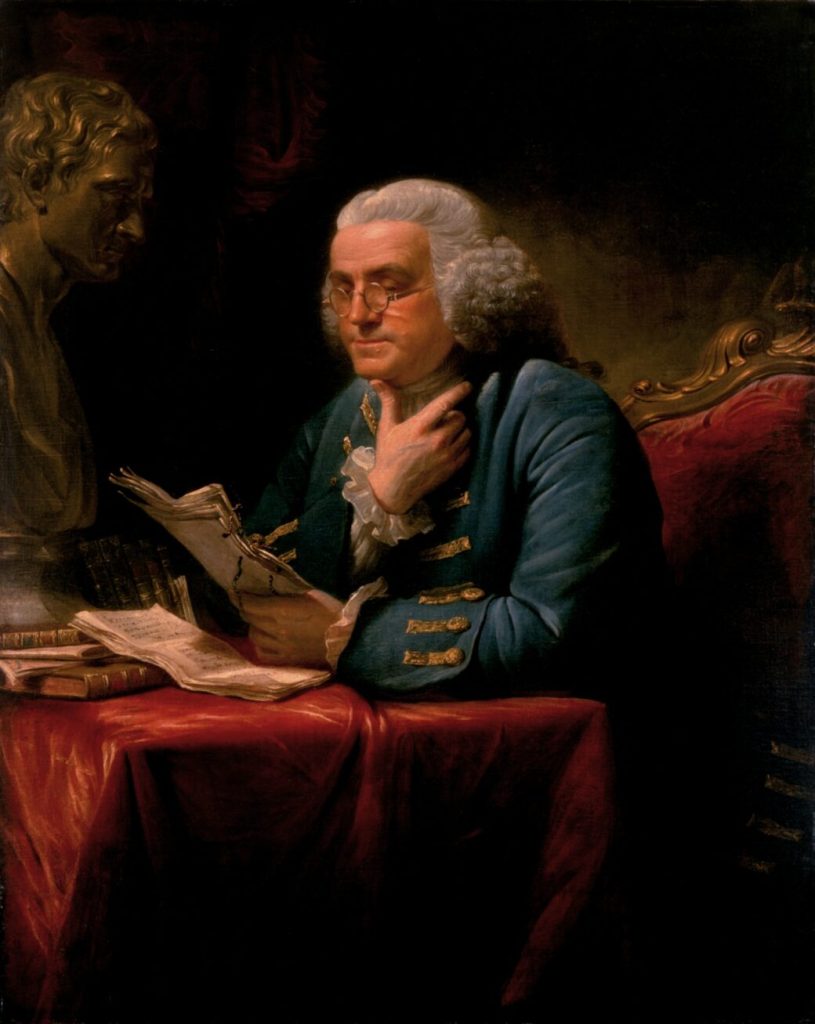
John André lived for a time in Benjamin Franklin’s house back in 1777-’78, during the British occupation of Philadelphia. As he was packing to leave, Geneva-born American patriot and portrait artist Pierre-Eugène Du Simitiere came to say goodbye. The officer was always known as a gentleman. Simitiere was shocked to find André stoop to looting the home of such a prominent patriot. For a man known for extravagant courtesy, this was way out of character. André was packing books, musical instruments and scientific apparatus, even an oil portrait of Franklin, offering not so much as a response to Simitiere’s protests.

Nearly two hundred years later, the descendants of Major-General Lord Charles Grey returned the painting to the United States, explaining that André had probably looted Franklin’s home under direct orders from the General himself. A Gentleman always, it would explain the man’s inability to defend his own actions.

Today that oil portrait of Benjamin Franklin hangs in the White House.

Benedict Arnold went on to lead British forces against his former comrades. As the story goes, Arnold once asked one of his officers what the Americans might do should he (Arnold) be captured. The officer replied: “They will cut off the leg which was wounded when you were fighting so gloriously for the cause of liberty, and bury it with the honors of war, and hang the rest of your body on a gibbet.”

The story refers to a grievous injury the turncoat general received at the Battle of Saratoga, heroically leading patriot infantry against a position remembered as Breymann redoubt. It was the second time a bullet had shattered the general’s leg in service to the Revolution. Arnold walked with a pronounced limp for the rest of his life.

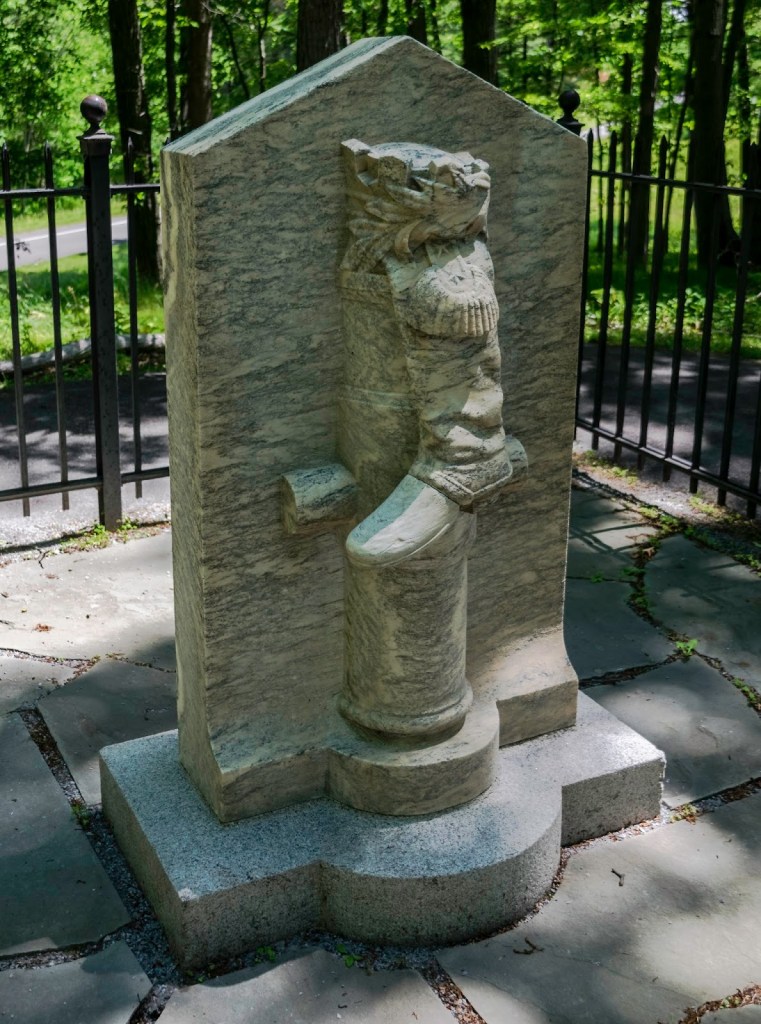
On the grounds near the battlefield at Saratoga there stands the statue of a cannon’s barrel, and a leg. An officer’s boot, really, dedicated to a Hero of the Revolution. The cannon’s barrel is pointed down as a sign of dishonor. The monument declines to give this hero a name.

It is one of the most forlorn places I have ever seen.

March 15, 1783 A Republic, nearly Stillborn

239 years ago today this Republic to which we owe so much, was about to die before it was born.  All but for one magnificent man with an actor’s sense of timing.  And a new pair of spectacles.

While no one knew it at that time, Lord Cornwallis’ October 1781 surrender at Yorktown effectively brought the great rebellion, to an end.  Eight years after the “shot heard round the world“, the American Revolution had now ground to a standoff.

King George III remained personally in favor of prosecuting the war even after the Patriot victory at Yorktown while opinion in Parliament, was split.  Across the water, some 26,000 British troops remained in occupation in Charleston, Savannah and New York and backed up, be a mighty fleet of warships.

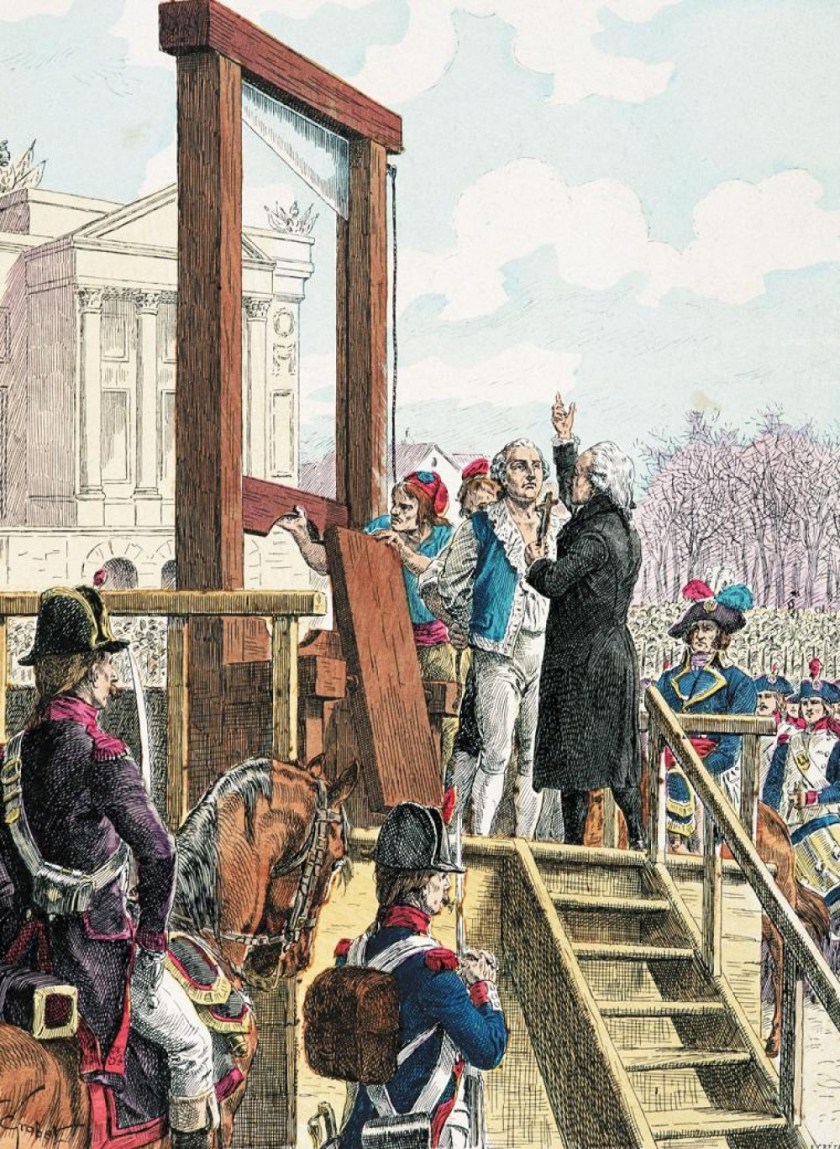
The Americans’ greatest ally departed in 1782, never to return.  With state finances already prostrate with debt, l’Ancien régime (French: “the old order”) would be overthrown by its own revolution inside the next ten years, the French King Louis XVI and Queen Consort Marie Antoinette executed, by guillotine.

the-execution-of-king-louis-e1269752616856

Negotiations carried on in Paris for nearly three years while, an hour’s drive north of New York by modern highway, the Continental Army waited at Newburgh.

France wasn’t the only nation ruined by this war.  The American Revolution debilitated the finances of all three principle belligerents, none more so than the new-born American Republic, itself.  In fact, the fledgling United States nearly died on this day in 1783, by the very hands which had given it birth.

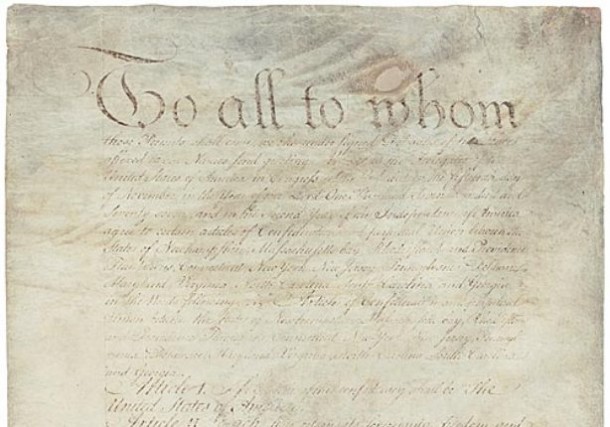
The Articles of Confederation, ratified by the states in March 1781, provided for a loose alliance of sovereign states. In theory, Congress possessed the authority to govern foreign affairs, conduct war and regulate currency.  In practice, these powers were limited to a national body with no authority to enforce its own will on the states.

ArticlesConfederation-610x427

In 1780, Congress promised Continental officers a lifetime pension, equal to half-pay upon discharge.  The government in Philadelphia attempted to amend the Articles, to allow a new import duty or “impost”.  States were divided against the measure.  Two years later, the cupboard was bare.  Forget the bonus, Continental soldiers weren’t being paid, at all.   

It wasn’t even possible to borrow.  That required evidence of an income stream.

The politician who alienates a battle hardened army in the field walks on dangerous ground.  Don’t pay for their services, that’s a good way to do it.  At the outset of war, these guys had left homes and fields and families. They had risked their lives on behalf of the dream of Liberty, to say nothing of the hardships endured by those left at home.  Many among their number had given all in service to that dream.

There was little to do but wait during those long winter months of 1782-’83.  Each man concerned with his own financial hardship every man worried his promised compensation, would never come.  The rumor mill worked overtime:  The Army would be disbanded.  Promised pensions would remain, unfunded.

4

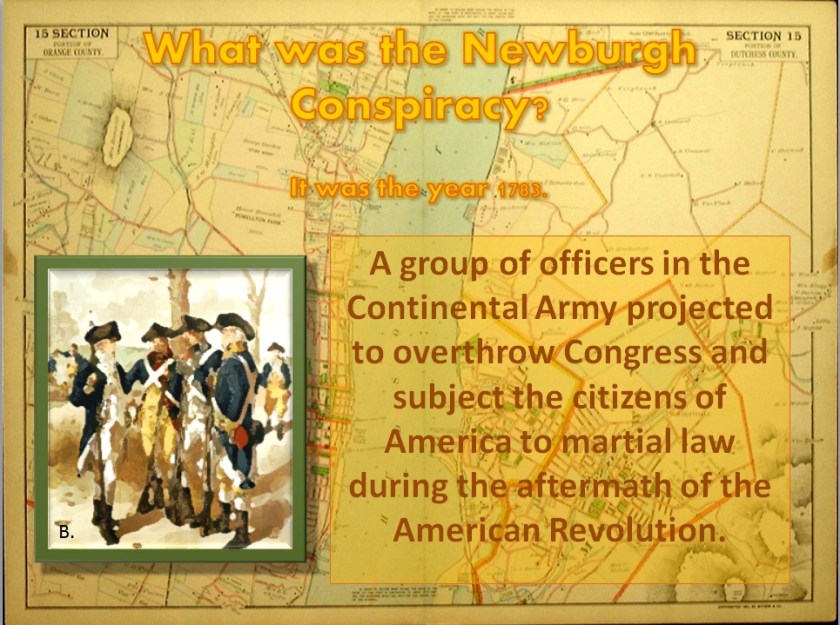
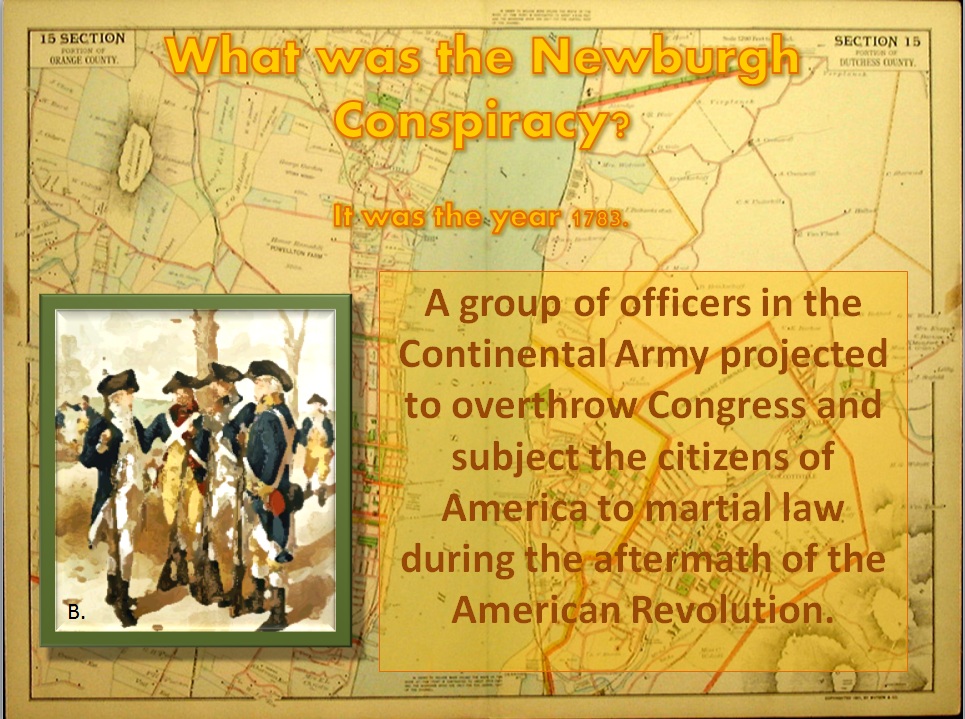
The vague unease of rumor turned to a fury of near certainty through the late winter months, as one overture after another met with defeat, in Congress.  On March 10, an unsigned letter believed to be written by Major John Armstrong, aide to General Horatio Gates, urged unspecified action against the Continental Congress.  Another called for a meeting on the morning of the 11th.  Events were inexorably building toward military insurrection.

General Washington reacted quickly, objecting in his general orders of March 11 to the “disorderly” and “irregular” nature of such a meeting.  Washington specified the morning of March 15 for an officer’s meeting and requested a report implying that he himself, would be absent.

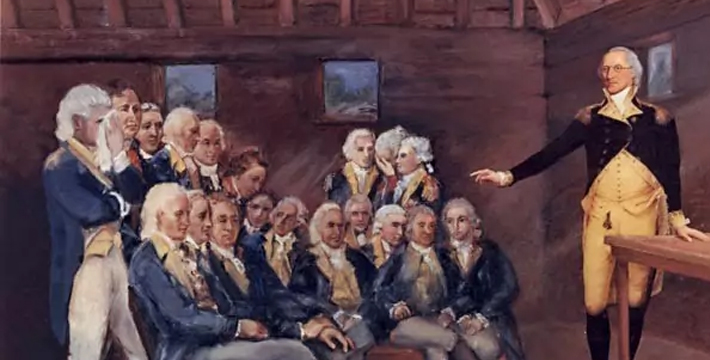
The mood was one of surprise and anger the morning of March 15, 1783, when the Commander-in-Chief himself walked into the room. Hard men had been pushed past the point of patience and were now determined, to take action.  Now this.

The General urged patience in a brief and impassioned speech remembered as the Newburgh address. Washington’s words may as well have fallen on deaf ears.  There was little of the usual deference in this room.

New_Windsor_Cantonment
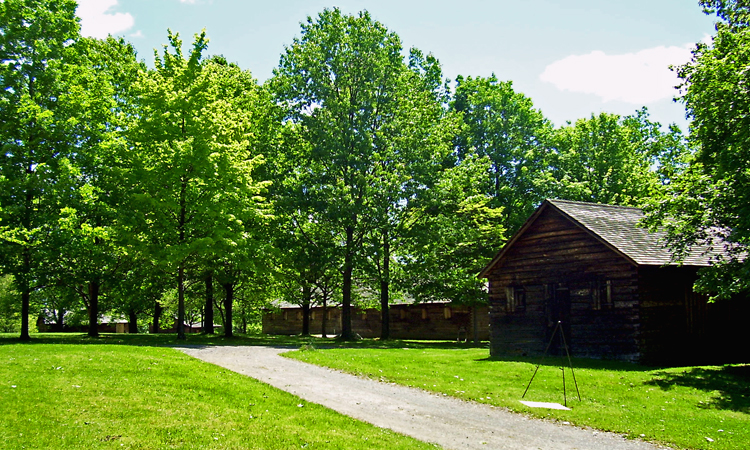
Reconstructed Temple at the New Windsor Cantonment State Historic Site, where the critical meeting took place on March 15, 1783

The future President of the United States then produced a letter from a member of Congress, to read to his officers. The content of the letter is unimportant. The man we remember as the father of the nation gazed at the letter in his hands, without speaking. Fumbling in his pocket, the general came up with a pair of reading glasses. This was something new.  Few in the room even knew the man required glasses.

Washington spoke:

Gentlemen, you will permit me to put on my spectacles, for I have not only grown gray but almost blind in the service of my country.

The words were as a physical blow on the men assembled in that room.  Obstinate and unheeding only moments earlier, the realization dawned on all at once.  This man had been at their head and by their sides.  General Washington had personally endured every bit of the hardship, as men now bent on mutiny.

There was hardly a dry eye in the place.  The moment was broken, never to return.  Bent on mutiny only moment before, the cream of the continental army now determined, to wait. 

On this day 239 years ago this Republic to which we owe so much, nearly died before it was born.  All but for one magnificent man with an actor’s sense of timing.  And a new pair of spectacles.

A Trivial Matter
At age 26, George Washington married Martha Dandridge Custis, a widow with two children: Jacky and Patsy. The Father of the Nation never had any children of his own. At 6 feet, 3½ inches and 200-pounds, George Washington towered above the Continental soldier who stood an average 5-feet 8-inches, in height.

March 15, 1783 A Pair of Spectacles

The politician who alienates a battle hardened army in the field walks on dangerous ground.  Don’t pay for their services, that’s a good way to do it.

The great rebellion effectively came to an end in October 1781 with Lord Cornwallis’ surrender at Yorktown, though no one knew it at that time.  Eight years after the “shot heard round the world“, the American Revolution had slowed to a standoff.

King George III remained personally in favor of prosecuting the war even after the Patriot victory at Yorktown, while opinion in Parliament, was split.  Across the water, some 26,000 British troops remained in occupation in Charleston, Savannah and New York, backed up be a mighty fleet.

the-execution-of-king-louis-e1269752616856

The Americans’ greatest ally departed in 1782, never to return.  With state finances already prostrate with debt, l’Ancien régime (French: “the old order”) would be overthrown by its own revolution inside the next ten years, the French King Louis XVI and Queen Consort Marie Antoinette executed, by guillotine.

Negotiations carried on for nearly three years in Paris while, an hour’s drive north by modern highway from the British occupation of New York, the Continental Army waited at Newburgh.

France wasn’t the only one, ruined by this war.  The American Revolution debilitated the finances of all three principle belligerents, none more so than the new-born American Republic, itself.  In fact, the fledgling United States nearly died on this day in 1783, by the very hands which had given them birth.

The Articles of Confederation, ratified by the states in March 1781, provided for a loose alliance of sovereign states. In theory, Congress possessed the authority to govern foreign affairs, conduct war and regulate currency.  In practice, these powers were limited to a national body with no authority to enforce its will on the states.

ArticlesConfederation-610x427

In 1780, Congress promised Continental officers a lifetime pension, equal to half-pay upon discharge.  The government in Philadelphia attempted to amend the Articles, to allow a new import duty or “impost”.  States were divided against the measure.  Two years later, the cupboard was bare.  Continental soldiers weren’t being paid at all.   

It wasn’t even possible to borrow.  That required evidence, of an income stream.

The politician who alienates a battle hardened army in the field walks on dangerous ground.  Don’t pay for their services, that’s a good way to do it.  At the outset of war, these guys left homes and fields and families, to risk their lives on behalf of the dream of Liberty.  Many among their number, had given all in service to that dream.

There was little to do during those long winter months of 1782-’83, but wait.  Each with his own financial hardship waiting at home, every man worried that his promised compensation, would not come.  The rumor mill worked overtime:  The Army would be disbanded.  The promised pensions would remain, unfunded.

4

The vague unease of rumor turned to a fury of near certainty through the late winter months, as one overture after another met with defeat, in Congress.  On March 10, an unsigned letter believed to have been written by Major John Armstrong, aide to General Horatio Gates, urged unspecified action against the Continental Congress.  Another called for a meeting on the morning of March 11.  Events were building toward armed insurrection.  A coup d’état.

General George Washington reacted quickly, objecting in his General Orders of March 11 to the “disorderly” and “irregular” nature of such a meeting.  Washington specified the morning of March 15 for an officer’s meeting and requested a report, implying that he himself, would not be present.

The mood was one of surprise and anger when the Commander-in-Chief himself walked into the room, hard men pushed past the point of patience, and now determined to take action.  The General urged patience in a brief and impassioned speech remembered as the Newburgh address.

Washington’s words may as well have fallen on deaf ears.  There was little of the usual deference, in this room.

New_Windsor_Cantonment
Reconstructed Temple at the New Windsor Cantonment State Historic Site, where the critical meeting took place on March 15, 1783

The future President of the United States then produced a letter from a member of Congress, to read to his officers. The content is unimportant. George Washington gazed on the letter in his hands without speaking and, fumbling in his pocket, came up with a pair of reading glasses. These were new.  Few men in the room even knew the man required glasses.

Washington spoke:

Gentlemen, you will permit me to put on my spectacles, for I have not only grown gray but almost blind in the service of my country.

The words were as a physical blow, on the men assembled in that room.  Obstinate and unheeding mere moments before, the realization dawned on all at once.  This man had been at their head and by their sides.  Washington had personally endured every bit of the hardship, as these men bent on mutiny.

washington1795-456

There was hardly a dry eye in the place.  The moment was broken for all time.  Bent on mutiny a mere moment before, the cream of the continental army now determined, to wait.  This Republic to which we owe so much may have died before it was born, two hundred thirty-six years ago on this day.  All but for one magnificent man with an actor’s sense of timing.  And a new pair of spectacles.


A Trivial Matter
At age twenty-six, George Washington married Martha Dandridge Custis, a widow with two children: Jacky and Patsy. The Father of the Nation never had any children of his own. At 6 feet, 3½ inches and 200-pounds, George Washington towered above his fellow Continental soldier, with an average height of 5-feet, 8-inches in height.


July 23, 1796 Royal Gift

Today, we think of George Washington as the father of the country.  Revolutionary era General. first President of the United States.  It may surprise some to learn, that he’d have described himself as a farmer.

Today, we think of George Washington as the father of the country.  Revolution-era General, first President of the United States.  It may surprise some to learn, that he’d have described himself as a farmer.

mount-vernon-shenk-5200-2
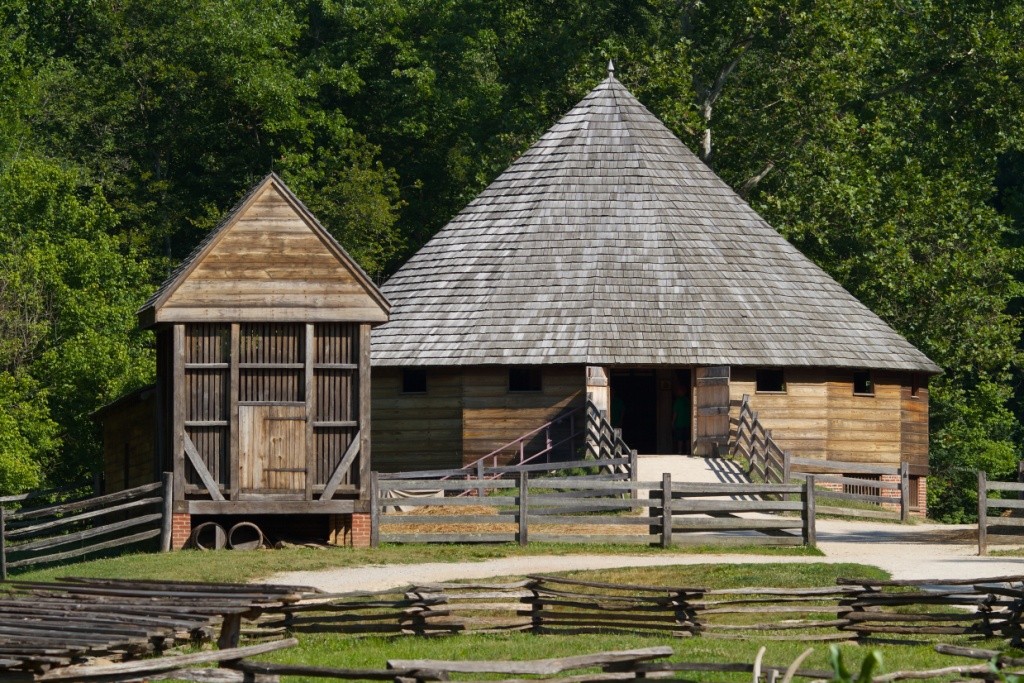
The Pioneer Farm and 16-Sided Barn at Mount Vernon

Washington’s early work in agriculture was driven by the need to make a living.  He would constantly study and experiment, always on the lookout for new and innovative methods and materials.  From his 16-sided treading barn at Dogue run to innovations in crop rotation, fertilization methods and animal husbandry, Washington’s innovations benefited not only the five farms of Mount Vernon, but much of American agriculture.

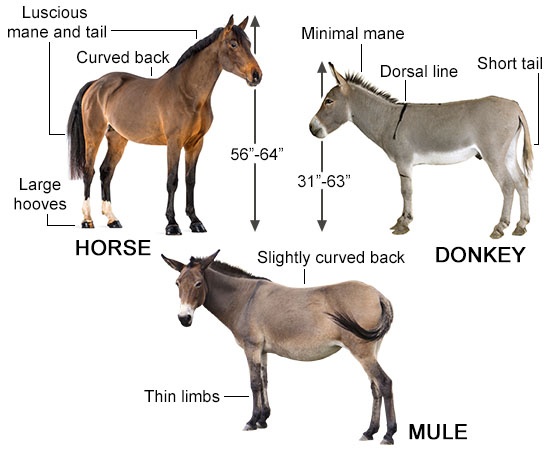
132 horses worked the Mount Vernon estate in 1785, when Washington became interested in mules.  A working mule has a productive life expectancy of 30 years, while a horse is generally played out in 20.  A mule is capable of more work with less feed than either horses or donkeys, and more intelligent than a horse.  A mule is capable of seeing its own back feet, making it less likely to “spook” at unseen hazards, and far more sure footed than a horse.

During the age of westward expansion, mules would stop along wagon trails, pointing their ears toward an approaching buffalo herd or Indian band, long before humans or other animals were aware of the threat.  This tendency to stop and assess leads to the perception that mules are stubborn, but the experienced mule handler understands.  There is a cognitive process at work in these animals.  It’s best to work with it.

Mules vs Donkeys vs HorsesMules are hybrid animals, the offspring of a male Equus Africanus Asinus, and a female Equus Caballus.  A jackass and a mare.  From the sire, the mule inherits intelligence, toughness and endurance, while the dam passes down her speed, conformation and agility.
Charles Darwin once wrote: “The mule always appears to me a most surprising animal. That a hybrid should possess more reason, memory, obstinacy, social affection, powers of muscular endurance, and length of life, than either of its parents, seems to indicate that art has here outdone nature.”

A “Hinny” results from crossing a female donkey and a male horse.  The result is a far less desirable animal, possessed of the lesser traits of both parent species.

Mules and hinnies have 63 chromosomes, resulting from the horse’s 64 and the donkey’s 62.  For this reason, there is no historical record of even a single fertile mule stallion.  Only a miniscule number of mule mares have bred successfully with purebred horses or donkeys.

Such an event is so rare that it was considered an ill omen in ancient days.  Herodotus describes such an event as an ill omen during Xerxes’ invasion of Greece in 480 BC, culminating in the Battle at Thermopylae.  “There happened also a portent of another kind while he (Xerxes the Great, 4th “King of Kings” of the Achaemenid dynasty of Persia), was still at Sardis, a mule brought forth young and gave birth to a mule”.Royal Gift

The English isles are for the most part blessed with flat farmlands, rarely having need of mules.  France and Spain possessed some of the finest breeding stock in the world in the Andalusian and Catalonian Jacks, though it was illegal to export them to the new world for fear of advantaging historic rivals.

Desiring a breeding Jack of his own, Washington reached out to Spanish King Charles III in 1780, through the Cuban merchant Don Juan de Miralles.  Miralles died unexpectedly and the transaction never took place, and Washington tried again in 1784. This time, American chargé d’affaires at the Spanish court William Carmichael reached out to the Spanish King, who was more than happy to provide two Spanish Jacks.  One died in transit, while the other arrived with its handler in Gloucester, Massachusetts, on October 7, 1785.  He was gray in color with a strong, stocky, build, standing just short of fifteen hands.

This original donkey stallion would come to be called “Royal Gift”.

John Fairfax, Washington’s overseer at Mount Vernon, was dispatched to Boston to meet Royal Gift and his handler, and escort them back to Virginia.  So solicitous was he of the animal’s health, that the donkey was provided with blankets, and never required to walk more than 15 miles in a day.  Royal Gift arrived at Mount Vernon on the evening of December 5.

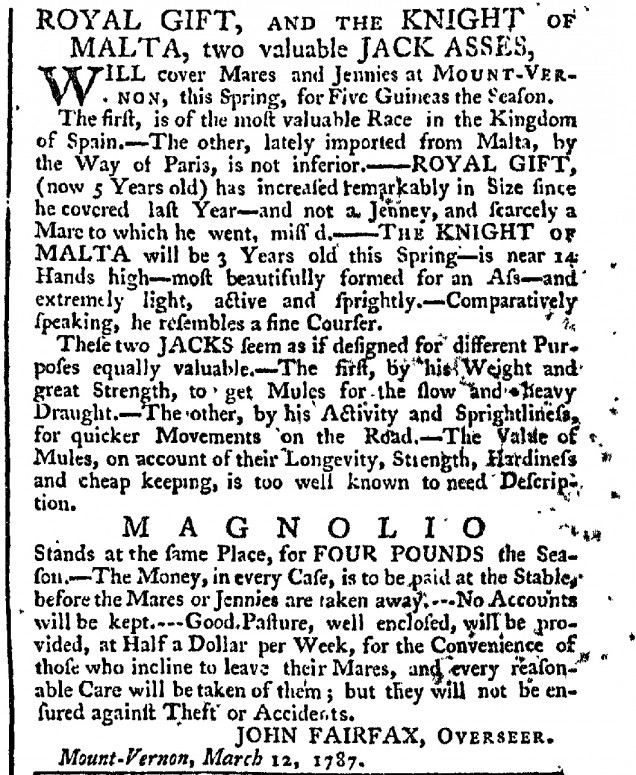
The Marquis de Lafayette sent Washington a black Maltese Jack called “Knight of Malta” the following year, probably illegally, along with several “Jennies”. An ad ran in the Maryland Journal in March 23, 1787, advertising Mount Vernon’s Jacks for stud at five Guineas for the season.

Royal Gift came up lame in 1793, after being driven far too hard by an ignorant handler.  He would live another three years, but his stud career was all but over.  On July 23, 1796, William Washington wrote to the President informing him of the passing of his prized Spanish Jackass.  Royal Gift had succumbed to “farcy”, a form of Cutaneous Glanders nearly always fatal in horses, donkeys and mules.

mule-infographic-2

By the time of George Washington’s death in 1799, there were 63 working mules at Mount Vernon, and an untold number working the farms of the young nation.  By 1808, there were 855,000 mules throughout the south, west of the Appalachian frontier, and at work in countless American farms.  Even today, many American donkeys and mules can trace their lineage back to Royal Gift.  And to George Washington.  The Father of the American Mule.

July 3, 1775, Washington’s Sword

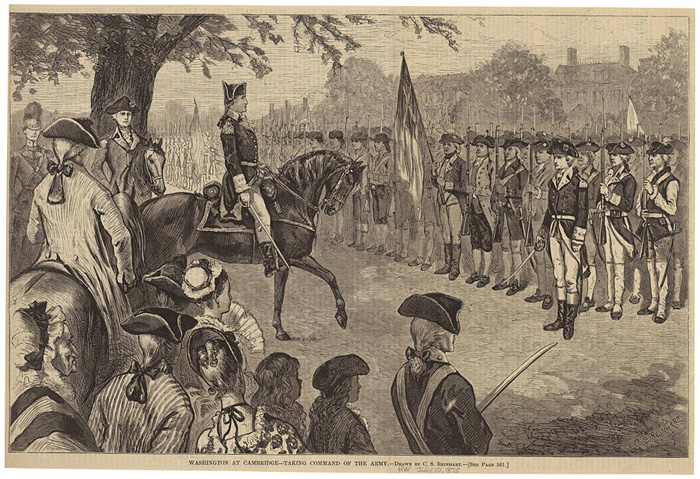
General Washington rode out in front of the troops gathered at Cambridge Common on July 3, 1775.  Washington drew his sword under the branches of an ancient elm, by that act formally taking command of the Continental Army.

The American Revolution began with the battles of Lexington and Concord on the 19th of April, 1775. Thousands of armed colonial militia followed the British columns as they withdrew, and there they remained, hemming the British occupiers up in the city of Boston.

Within days, more than 20,000 armed men from all over New England had gathered from Cambridge to Roxbury. Tories’ vacant homes, empty Churches, even the brick buildings of Harvard College served as barracks, officers’ quarters, and hospitals. Soldiers camped in tents and other makeshift shelters, while Harvard canceled classes on May 1. Classes would not resume at the Cambridge campus until June of the following year.

The Continental Congress created the Army on June 14, 1775, appointing George Washington to lead it. General Washington rode out in front of the troops gathered at Cambridge Common on July 3, 1775.  Washington drew his sword under the branches of an ancient elm, by that act formally taking command of the Continental Army.

Washington Elm marker

Interestingly, 150 years of de facto independence from Great Britain seems to have suited the American colonist.  If inheritance records are any indication, the average American enjoyed a better standard of living, than the average Brit.  Average heights of the time bear that out.

The average American colonist had a full three inches on his British counterpart. At a time when the average male stood 5’8′, Washington towered over the crowd at 6’2″.   George Washington was a hard man to miss.

For Washington to draw his sword against King George III, was itself an act of magnificent courage.  According to British law of the time, one of four definitions of High Treason was “If a man do levy war against our lord the King in his realm”.  By drawing that sword against the crown, Washington was clearly committing High Treason.  He surely understood that such a prominent person as himself would be dealt with harshly, if caught.

At that time, the centuries-old penalty for High Treason was as savage as it was gruesome. Even now the language of the death sentence is difficult to read.  You may consider that to be my warning if you don’t care to read what follows.

The full sentence as read to the condemned was: “That you be drawn on a hurdle (a sledge) to the place of execution where you shall be hanged by the neck and being alive cut down, your privy members shall be cut off and your bowels taken out and burned before you, your head severed from your body and your body divided into four quarters to be disposed of at the King’s pleasure”.

These were the terms of employment under which George Washington accepted his assignment.  He even declined to accept payment, beyond reimbursement for his personal expenses.

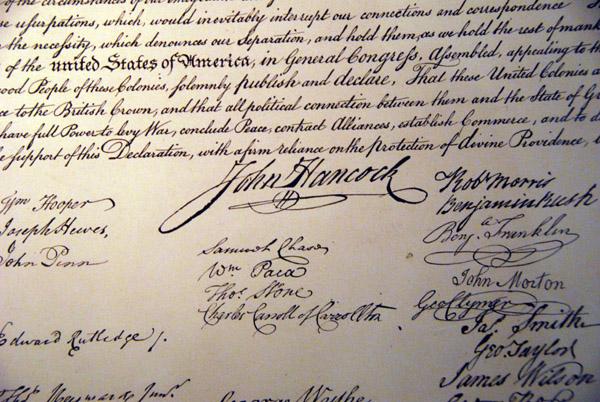
The 56 signers of the Declaration of Independence would show the same brand of courage, by signing that document a year later. It must have been a supreme in-your-face moment when John Hancock put his pen to that parchment, which ended: “And for the support of this Declaration, with a firm Reliance on the Protection of divine Providence, we mutually pledge to each other our Lives, our Fortunes, and our sacred Honor”.

Signers

At the signing, Ben Franklin famously said “We must all hang together, or assuredly we shall all hang separately”.  This was no empty philosophical statement they were signing.  Should circumstances turn against them, the founding fathers well understood. Each was signing his death warrant.