September 11, 2001  An American Story

Twelve days a month, John Ogonowski would leave the farm in his Captain’s uniform, flying jumbo jets out of Logan Airport. He’d always return to the land that he loved.


A great wave of immigrants came to the United States around the turn of the 20th century, 20 million Europeans or more making the long journey to become Americans.

Among them was the Ogonowski family, emigrating from Poland to make their home in Massachusetts’ Merrimack Valley, along the New Hampshire line.

The earliest members of the family received invaluable assistance from Yankee farmers, well acclimated to growing conditions in the harsh New England climate. Four generations later, the Ogonowski family still tilled the soil of their 150 acre “White Gate Farm” in Dracut, Massachusetts.

A smiling man in a pilot uniform with epaulettes, posing confidently in front of a neutral background.

Graduating from UMass Lowell in 1972 with a degree in nuclear engineering, John Ogonowski joined the United States Air Force.  During the war in Vietnam, the farmer-turned-pilot would ferry equipment from Charleston, South Carolina to Southeast Asia, sometimes returning with the bodies of the fallen aboard his C-141 transport aircraft.

Ogonowski left the Air Force with the rank of Captain, becoming a commercial pilot and joining American Airlines in 1978. There he met Margaret, a flight attendant, “Peggy” to her friends. The two would later marry and raise three daughters.

Twelve days a month, Ogonowski would leave the farm in his Captain’s uniform, flying jumbo jets out of Logan Airport.  He’d always return to the land he loved.

A smiling pilot posing with a young girl in an airplane cockpit, showcasing the control panel and instruments.

Family farming is not what it used to be, as suburban development and subdivisions creep into what used to be open spaces. “When you plant a building on a field” he would say, “it’s the last crop that will ever grow there”.

Ogonowski helped to create the Dracut Land Trust in 1998, working to conserve the town’s agricultural heritage. He worked to bring more people into farming.  The bumper sticker on his truck read “There is no farming without farmers”.
Ogonowski 1

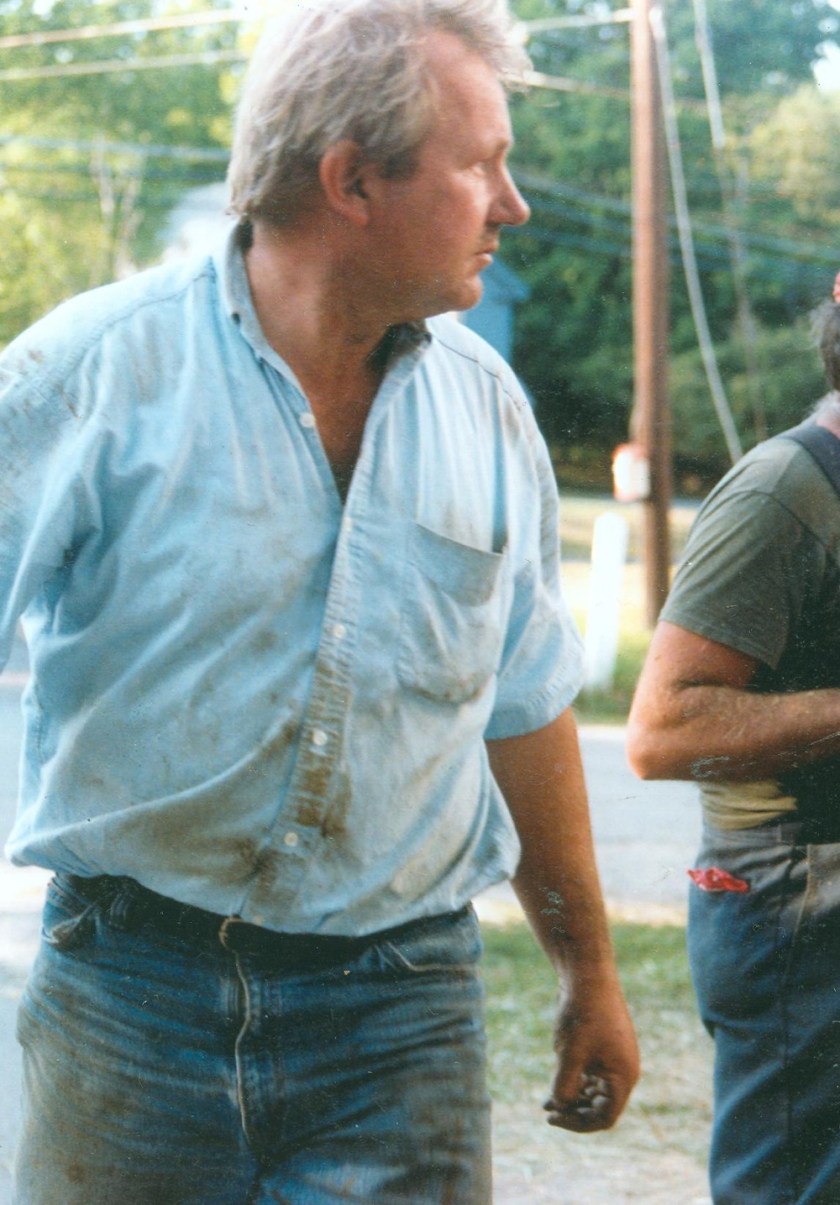
That was the year the farm Service Agency in Westford came looking for open agricultural land, for Southeast Asian immigrants from Lowell.

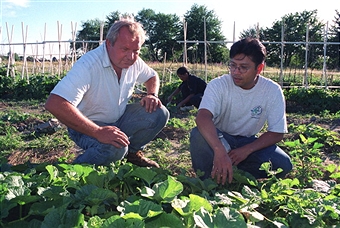
It was a natural fit. Ogonowski felt a connection to these people, based on his time in Vietnam. He would help them, here putting up a shed, there getting a greenhouse in order or putting up irrigation. He would help these immigrants, just as those Yankee farmers of long ago had helped his twice-great grandfather.
Ogonowski 3

Cambodian farmers learned to grow their native vegetables in an unfamiliar climate. They would lease small plots, growing water spinach, lemon grass, pigweed, Asian basil, and Asian squash. There was taro and Laotian mint, coconut amaranth, pickling spices, pea tendrils and more. It was the food they grew up with. They would sell it into nearby immigrant communities and to the restaurants of Boston.

The program was a success.  Ogonowski told The Boston Globe in 1999, “These guys are putting more care and attention into their one acre than most Yankee farmers put into their entire 100 acres.”
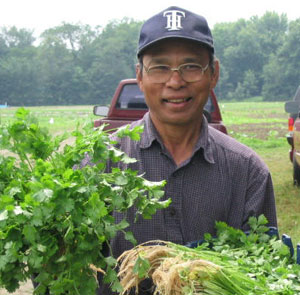
mrkimcilantro

So it was that, with the fall harvest of 2001, Cambodian immigrants found themselves among the pumpkins and the hay of a New England farm, putting on a special lunch spread for visiting agricultural officials from Washington, DC.  It was September 11.

By now you know that John Ogonowski was flying that day, Senior Captain on American Airlines flight 11. He was perhaps the first to die, murdered in his cockpit by Islamist terrorist Mohammed Atta and his accomplices.

It’s a new perspective on a now-familiar story, to think of the shock and grief of those refugees from the killing fields of Pol Pot, on hearing the news that their friend and mentor had been hijacked and flown into the World Trade Tower.

Ogonowski farm

The White Gate Farm closed for a week, but the Ogonowski family was determined that John’s dream would not die.  Peg said it best:  “This is what he was all about. He flew airplanes, he loved flying, and that provided all the money, but this is what he lived for. He was a very lucky man, he had both a vocation and an avocation and he loved them both.”

John Ogonowski had been working with the Land Trust to raise $760,000 to purchase a 34 acre farm in Dracut, previously slated to be developed into a golf course with housing.  Federal funds were raised with help from two members of Congress.  The “Captain John Ogonowski Memorial Preservation Farmland” project was dedicated in 2003, a living memorial to Captain John Ogonowski.  The pilot, the American Patriot, and the farmer.

A detailed chalk drawing of a smiling man in a military uniform, wearing a cap, with an American flag in the background.

Postscript

Twenty-five years have come and gone since September 11, 2001. Some ten percent of our voting age population have no recollection from the events of that day. 2,977 died on that day, excluding the killers. More than 9,400 have died since that time from cancer, respiratory decline and certified 9/11 diseases. An estimated 400,000 were exposed that day to 9/11 toxins, poisonous compounds in the tens of thousands, capable of triggering cancers of 20-years’ latency and more.

The final butcher’s bill will not be known for another ten to twenty years.

August 3, 1913 Wheatland Hop Riot

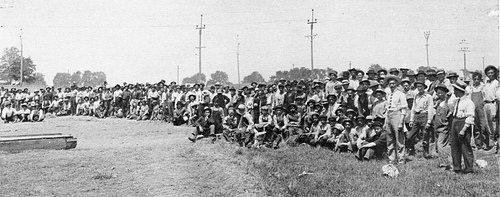
Ralph Durst, one of the largest agricultural employers in Yuba County, California, advertised widely for hops pickers for the 1913 harvest season. He got 1,000 more than he needed, which had the effect of depressing already low wages.

Organized labor was a growing force in 1913 and strikes were often violent. English cigar maker Samuel Gompers had started the American Federation of Labor (AFL) almost 30 years earlier, and Upton Sinclair’s exposé on the Chicago Stockyards, “The Jungle”, had been in print for 7 years. Yet seasonal farm workers were difficult to organize. They were an unskilled and unsettled group, largely transient and until now, mostly passed over by Union organizers.

Ralph Durst, one of the largest agricultural employers in Yuba County, California, advertised widely for hops pickers for the 1913 harvest season. He got 1,000 more than he needed, which had the effect of depressing already low wages.

Hop Pickers

Sanitary conditions quickly became deplorable.  There was one toilet per 100 workers, which quickly filled up in the July heat. Fresh drinking water was scarce.  A Durst cousin selling watered down, ersatz lemonade out of a wagon for a nickel a glass did little to improve things.

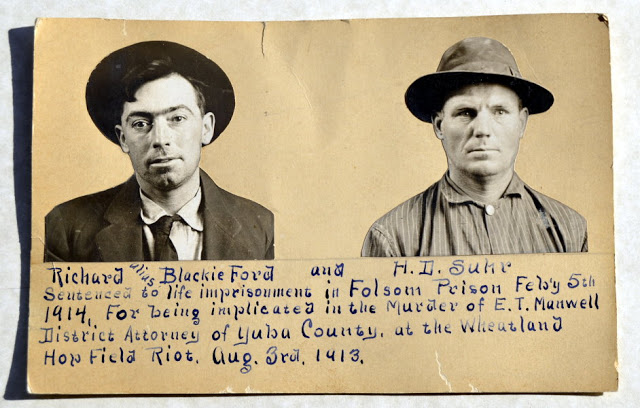
The International Workers of the World, (IWW), established in 1905, was a radical socialist labor organization.  100 of Durst’s hop pickers were members. Two of them, Richard “Blackie” Ford and Herman Suhr, managed to rally a majority to their cause with speeches, songs and slogans.

Wheatland Hop Riot104 years ago today, 1,700 seasonal hops pickers gathered in the field of the Durst Hop Farm. They demanded an increase from their $1.00/100 lbs of hops picked, and they wanted better working conditions. Durst agreed to some changes, but Ford and Suhr stuck to their full list of demands and called a strike.
A mass meeting was called on the afternoon of August 3, as a succession of speakers addressed the crowd in English, German, Greek, Italian, Arabic, and Spanish. Most were in favor of a strike.  Tensions were high when Durst arrived just after 5pm with Marysville Sheriff George Voss, a number of deputies, and Yuba County District Attorney Edward Manwell, who was also Durst’s personal attorney.

The group was surrounded as a deputy fired a warning blast into the air from a shotgun, but the warning had the opposite effect from what was intended. The crowd attacked District Attorney Manwell and Deputy Sheriff Lee Anderson and began beating them. Gunfire erupted in what soon became a full-fledged riot. Deputy Sheriff Eugene Reardon and District Attorney Manweel were both killed, along with two pickers. A third lost an arm to a shotgun blast.

There were over 100 arrests in the aftermath of the riot, the prisoners beaten and starved to extract information on strike leaders. A field worker named Alfred Nelson was hauled from one county to another and held in secret locations while being sweated, starved, and beaten.  He was repeatedly threatened with death, unless he confessed to participation in the killings. The pressure was so severe that Nels Nelson, the picker who lost his arm in the shotgun blast, hanged himself in his cell. Another prisoner tried to do the same, and a third suffered a mental breakdown and had to be committed to an asylum.WheatlandHopField-600

Blackie Ford and Herman Suhr were found guilty of second-degree murder in the following trial, and sentenced to life in the state penitentiary. Two other strike leaders, Walter Bagan and William Beck, were acquitted.

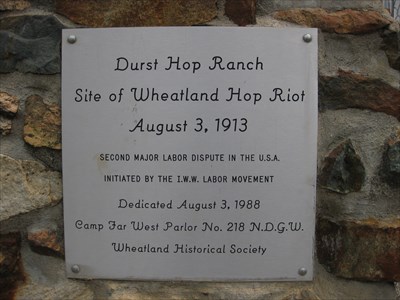
The Wheatland Hop Riot was one of the first major agricultural labor confrontations in American history, but it was far from the last. Today, the site is registered as California Historical Landmark #1003.

December 3, 1586, Spuds

Now the fifth largest food crop on the planet, there was a time when taters were thought fit for no one but peasants and livestock.

The expedition that would end in the Lost Colony of Roanoke began in 1585, financed by Sir Walter Raleigh and led by Sir Ralph Lane.  On board was the Oxford trained mathematician and astronomer Sir Thomas Herriot, the man who introduced potatoes to England on this day the following year.

The Inca of Peru seem to have been the first to cultivate potatoes, around 8,000BC.

Wild potatoes contain toxins to defend themselves against fungi and bacteria, toxins unaffected by the heat of cooking.  In the Andes, mountain people learned to imitate the wild guanaco and vicuña, licking clay before eating the poisonous plants. In this manner, toxins pass harmlessly through the digestive system. Mountain people dunk wild potatoes in “gravy” made of clay and water, accompanied with coarse salt. Eventually, growers developed less toxic tubers, though the poisonous varieties are still favored for their frost resistance.  Clay dust is sold in Peruvian and Bolivian markets, to this day.

Spanish Conquistadors who arrived in Peru in 1532 eventually brought potatoes home to Spain.  The first written mention of the potato comes from a delivery receipt dated November 28, 1567, between the Grand Canaries and Antwerp.

Among its other virtues, the potato provides more caloric energy per acre of cultivation than either maize or grain and, being below ground, is likely to survive calamities that would flatten other crops.  Taters quickly became staple foods in northern and eastern Europe, while in other areas remaining the food of peasants and livestock.

French army pharmacist Antoine-Augustin Parmentier was captured by Prussians during the seven years war, and learned to appreciate the gustatorial delights of the potato while in captivity.  Primarily used as hog feed in his native France, Parmentier was determined to bring respectability to the lowly tuber.  It must have been a tough sell, many believed that potatoes caused leprosy.  The Paris Faculty of Medicine declared them edible in 1772, thanks largely to Parmentier’s efforts.  He would host dinners featuring multiple potato dishes, inviting such luminaries as Benjamin Franklin and Antoine Lavoisier.  Franklin was enormously popular among the French nobility.  Before long Louis XVI was wearing a purple potato flower in his lapel.  Marie Antoinette wore them in her hair.

Sir Walter Raleigh first introduced potatoes to Ireland in 1589.  By 1845 the crop occupied one third of arable land in Ireland. This was due entirely to landless laborers, renting tiny plots from landowners interested only in raising cattle or producing grain for market. An acre of potatoes and the milk of a single cow was enough to sustain a family.  Even poor families could grow enough surplus to feed a pig, which could then be sold for cash.

Calamity struck in 1845, in the form of a blight so horrific that US military authorities once considered stockpiling the stuff as a biological weapon.  Seemingly overnight, Ireland’s staple food crop was reduced to a black, stinking ooze.  There followed the seven years’ “an Gorta Mór”, “the Great Hunger”, killing over a million Irish and reducing the population by 20-25% through death and emigration.  Throughout the Irish potato famine, the country continued to produce and export thirty to fifty shiploads per day of food produce, more than enough to feed the population.  Today, many see the effects of the absentee landlord system and the penal codes as a form of genocide.  At the time, already strained relations with England were broken, giving rise to Irish republicanism and leading to Irish independence in the following century.

Until Nazis tore it down, there was a statue of Sir Francis Drake in Offenburg, Germany, giving him credit for introducing the potato. His right hand rested on the hilt of his sword, his left gripping a potato plant. The inscription read “Sir Francis Drake, disseminator of the potato in Europe in the Year of Our Lord 1586. Millions of people who cultivate the earth bless his immortal memory”.

Today, potatoes are the 5th largest crop on the planet, following rice, wheat, maize and sugar cane.  Almost 5,000 varieties are preserved in the International Potato Center in Peru.

In the Star Wars movie “The Empire Strikes Back”, there’s a chase sequence through an “asteroid” field in which some of the asteroids are, in fact, potatoes.potato-asteroid

Scientists have created genetically modified potatoes to ward off pests.  The “New Leaf”, approved in 1995, incorporated a bacterial gene rendering it resistant to the Colorado potato beetle, an “international superpest” so voracious that some credit it for creating the modern pesticide industry.  Other varieties were genetically modified to resist phytophthora infestans, the cause the Irish potato famine.  Seeming to prefer insecticides and anti-fungal sprays, “food activists” decry such varieties as “Frankenfoods”.  Each time, the improved variety has been hounded out of business.
In 2014, the J.R. Simplot Company received approval for their “Innate” potato.  Rather than “transgenic” gene splicing, the introduction of genome sequences from unrelated species, the innate variety uses a “silencing” technique on the tuber’s own genes, to resist the bruising and browning that results in 400 million pounds of waste and a cost to consumers of $90 million.

The Innate potato produces less acrylamide, a known carcinogen produced by normal potatoes in the high heat of fryers.  This might actually be the first genetically modified variety to succeed in the marketplace, but McDonald’s, possibly the largest potato user on the planet, has already announced that “McDonald’s USA does not source GMO potatoes, nor do we have current plans to change our sourcing practices.”

You can never underestimate the power of hysterical people in large groups.