July 30, 1916 Black Tom

The explosion at Black Tom was the most spectacular, but by no means the only such attack. The archives at cia.gov reports that “[B]etween 1915 and spring 1917, 43 American factories suffered explosions or fires of mysterious origin, in addition to the bombs set on some four dozen ships carrying war supplies to the Allies”.

In the early months of World War I, Britain’s Royal Navy largely swept the seas of the Kaiser’s surface ships and blockaded ports in Germany. The United States was neutral at the time, and more than a hundred German ships sought refuge in American harbors.

The blockade made it impossible for the Central Powers of Germany and Austria-Hungary to import war materiel from overseas, while Great Britain, France, and Russia continued to buy products from US farms and factories. American businessmen were happy to sell to any foreign customer who had the cash, but for all intents and purposes, such trade was limited to the allies.
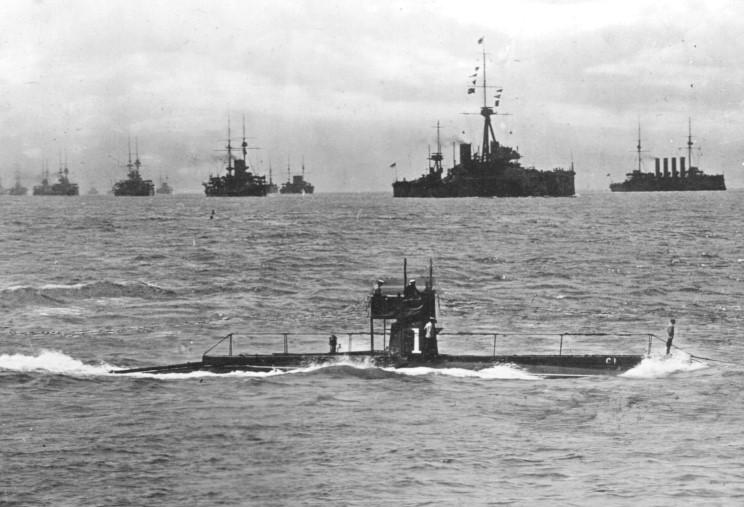
British-blockadeTo the Central Powers, such trade had the sole purpose of killing their boys on the battlefields of Europe.

The first and most overt reaction from the Kaiser came in the form of unrestrained submarine warfare, when even vessels flying the flags of neutral countries were attacked. Less apparent at the time, was the covert campaign of sabotage carried out by German agents on US soil.

“Black Tom” was originally an island in New York Harbor, next to Liberty Island. So called after a former resident, by WWI, landfill had expanded the island to become part of Jersey City. The area contained a mile-long pier with warehouses and rail lines operated by the Lehigh Valley Railroad, and served as a major hub in the trade of war materiel to the allies.
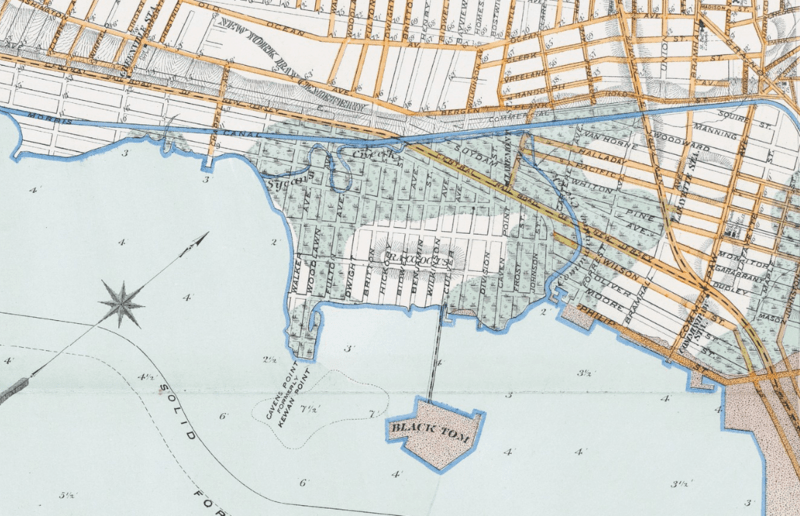
Sanitary_&_Topographical_Map_of_Hudson_County,_N.J
Black Tom Island, 1880

On July 30, 1916, the Black Tom terminal had over two million pounds of small arms and artillery ammunition in freight cars, and one hundred thousand pounds of TNT on a nearby Barge.

Guards discovered a series of small fires around 2:00am. Some tried to put them out while others fled, fearing an explosion. The first and loudest blast took place at 2:08am, a detonation so massive as to be estimated at 5.5 on the Richter scale. People were awakened from Maryland to Connecticut in what many thought was an earthquake. The Brooklyn Bridge shook and the walls of Jersey City’s municipal building were cracked as shrapnel flew through the air. Windows broke as far as 25 miles away, while fragments embedded themselves in the clock tower at the Jersey Journal building in Journal Square, over a mile away. The clock stopped at 2:12 am.
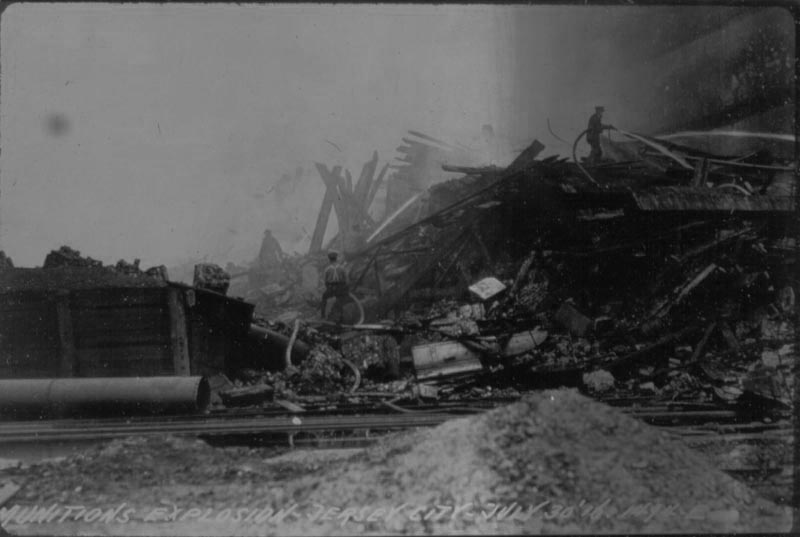
Black_Tom_explosion_-_firefighters_-_1916
Firefighters were unable to fight the fires until the bullets and shrapnel stopped flying. Photo: Wikimedia Commons

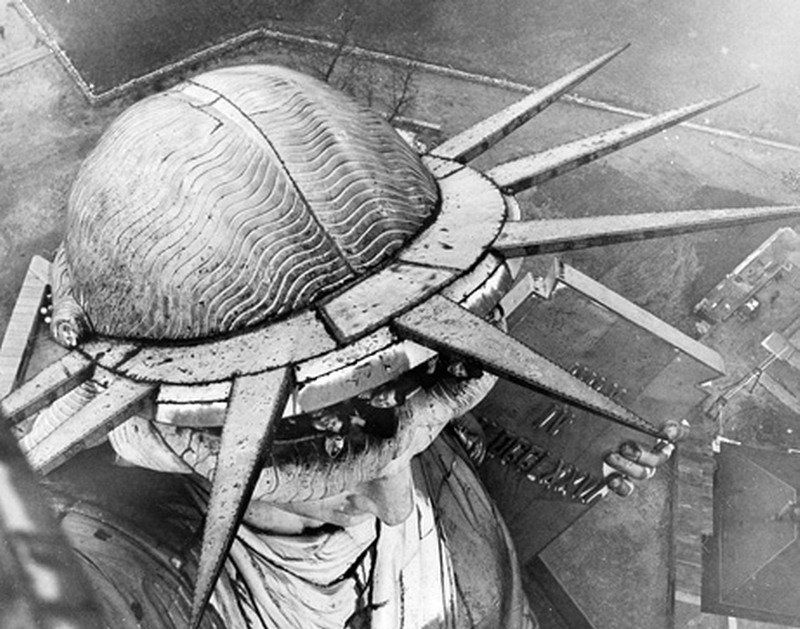
Stained Glass windows were shattered at St. Patrick’s Church, and Ellis Island was evacuated to Manhattan. Damage to the skirt and torch carried by the Statue of Liberty alone, came to over $2¼ million in 2017 dollars. To this day, the ladder to “Lady Liberty’s” torch, remains off limits to visitors.

The enormous vaulted ceiling of Ellis Island’s main hall, collapsed.  According to one Park officer, damage to the Ellis Island complex came to $500,000 “half the one million dollars it cost the government to build the facility.”
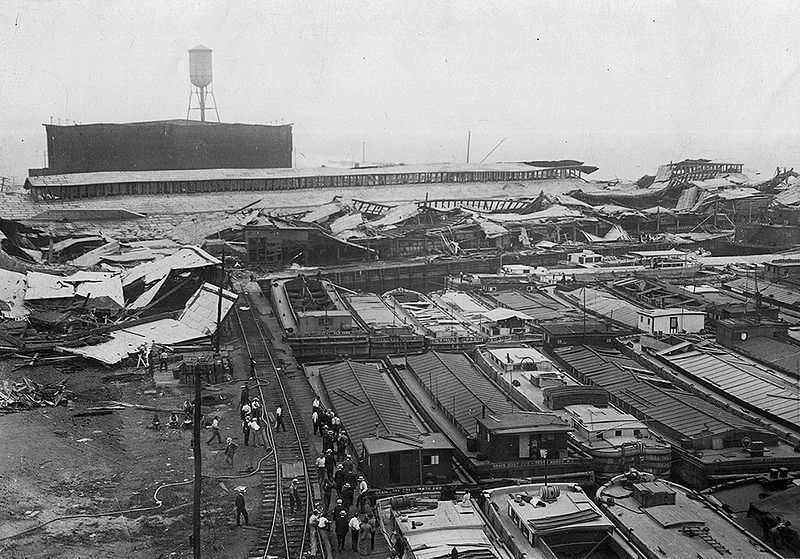
Wrecked_warehouses_and_scattered_debris_after_the_Black_Tom_Explosion,_1916Known fatalities in the explosion included a Jersey City police officer, a Lehigh Valley Railroad Chief of Police, a ten week old infant, and the barge captain.

The explosion at Black Tom was the most spectacular, but by no means the only such attack. The archives at cia.gov reports that “[B]etween 1915 and spring 1917, 43 American factories suffered explosions or fires of mysterious origin, in addition to the bombs set on some four dozen ships carrying war supplies to the Allies”.

Responsibility for the Black Tom explosion was never proven, conclusively. Early suspicions centered on accidental causes. Legal wranglings would climb the judicial ladder all the way to the United States Supreme Court, and continue well into the second World War. Anna Rushnak, an elderly Czechoslovak immigrant who ran a four-bits-a-night boarding house in Bayonne was thrown from her bed by the explosion, to find then-23-year-old Michael Kristoff sitting on the edge of his bed, mumbling “What I do? What I do?”
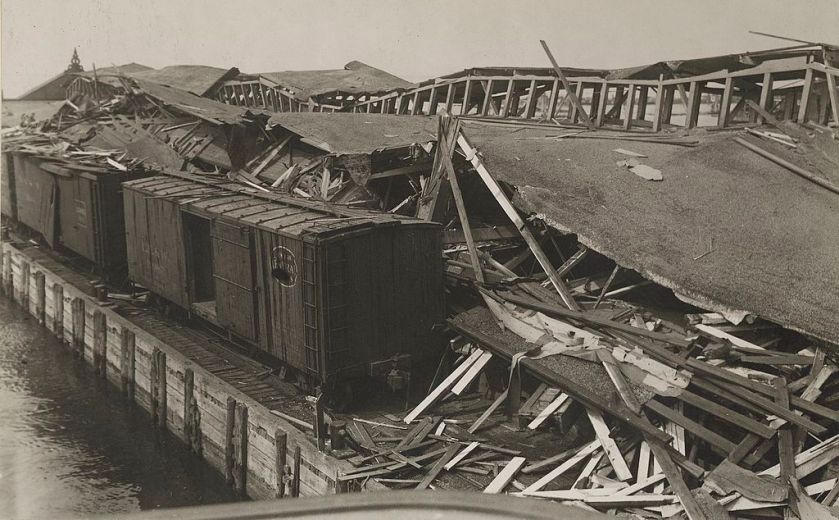
View_of_the_debris_of_the_Lehigh_Valley_pier_after_Black_Tom_explosion_(cropped)
Lehigh Valley Railroad pier, after the explosion

Kristoff, a Slovakian subject of the Austro-Hungarian Empire, (Germany’s principle ally in WW1), was arrested by Bayonne Police and interrogated, and judged to be “insane but harmless.”

In 1922, the Lehigh Valley Railroad was buried in lawsuits, and looking to fix blame on a German act of sabotage. Kristoff came into the judicial spotlight once again, and located in an Albany jail where he was serving time for theft. Kristoff admitted working for the Germans “for a few weeks” back in 1916, but was released before the claim could be investigated. Kristoff was finally traced to a pauper’s grave in 1928 and there ends his story, yet that ‘insane but harmless’ label may be open to question. Papers carried on the body exhumed from that potter’s field were indeed those of Michael Kristoff, but the dental records didn’t match.
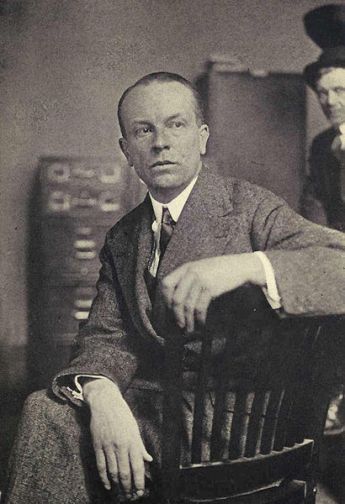
410px-Franz_von_Rintelen
“German Master Spy Franz Von Rintelen and his “pencil bomb” were responsible for acts of sabotage in the United States during World War I”. H/T Smithsonian

Meanwhile, suspicion fell on the German-born naturalized citizen Kurt Jahnke who ran sabotage operations for the German Admiralty out of bases in San Francisco and Mexico City, and his assistant, Imperial German Navy Lieutenant Lothar Witzke. Witzke was arrested on February 1, 1918 in Nogales, Arizona and convicted by court martial. He was sentenced to death, though the war was over before sentence could be carried out. President Wilson later commuted the sentence, to life.

By 1923, most countries were releasing POWs from the “Great War”, including spies. A report from Leavenworth prison shows Witzke heroically risking his life, entering a boiler room after an explosion and probably averting disaster. It may be on that basis that he was finally released. Lieutenant Lothar Witzke was pardoned by President Calvin Coolidge on November 22, 1923, and deported to Berlin, where a grateful nation awarded him the Iron Cross, 1st and 2nd Class.

The U.S.–German Peace Treaty of 1921 established the German-American Mixed Claims Commission, which declared in 1939 that Imperial Germany had, in fact been responsible and awarded a judgement of $50 million.  The Nazi government refused to pay and the matter was finally settled in 1953, with a judgement of $95 million (including interest) against the Federal Republic of Germany. The final payment was made in 1979.

The Black Tom explosion and related acts of pro-German espionage resulted in the Federal Espionage Act signed into law in June 1917, creating, among its other provisions, a “Bureau of Investigation” under the United States Department of Justice.  Now, nothing remains of the Black Tom terminal or the largest foreign terrorist attack on American soil until 9/11, save for a plaque, as seen in the photograph below.  That, and the FBI.

Feature image, top of page: Shrapnel damage can be seen in this image of the Statue of Liberty
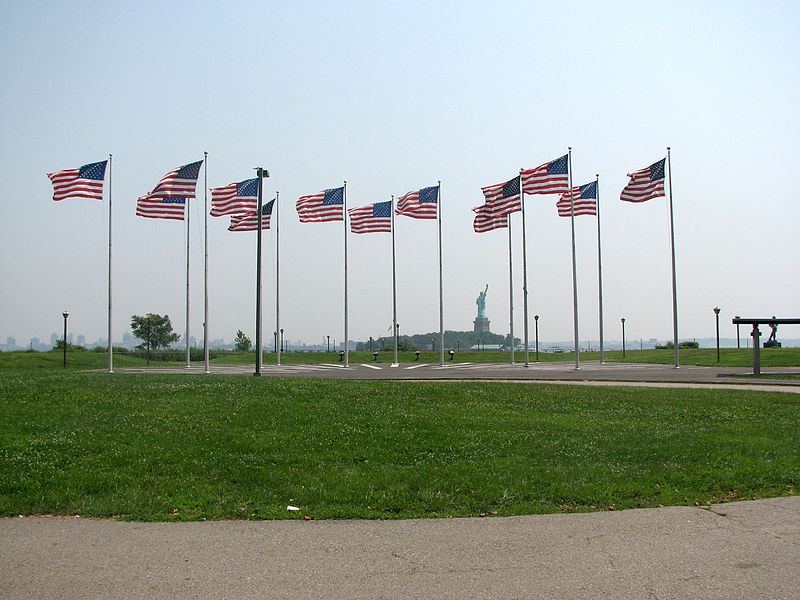
800px-StatueOfLibertyFromBlackTomIslandToday
View of the Statue of Liberty from the site of the Black Tom explosion
If you enjoyed this “Today in History”, please feel free to re-blog, “like” & share on social media, so that others may find and enjoy it as well. Please click the “follow” button on the right, to receive email updates on new articles.  Thank you for your interest, in the history we all share.


July 29, 1967 Inferno at Sea

Damage Control Chief Gerald Farrier “simply disappeared” in the first of a dozen or more explosions, in the first few minutes of the fire.  By the third such explosion, Damage Control Team #8 was wiped out.

The Super Carrier USS Forrestal departed Norfolk in June 1967, with a crew of 552 officers and 4,988 enlisted men. Sailing around the horn of Africa, she stopped briefly at Leyte Pier in the Philippines, before sailing on to “Yankee Station” in the South China Sea, arriving on July 25.

Before the cruise, damage control firefighting teams were shown training films of navy ordnance tests, demonstrating how a 1000-lb bomb could be directly exposed to a jet fuel fire for a full 10 minutes. Tests were conducted using the new Mark 83 bomb, featuring a thicker, heat resistant wall compared with older munitions, and “H6” explosive, designed to burn off at high temperatures, like an enormous sparkler.

Along with Mark 83s, ordnance resupply had included sixteen AN-M65A1 “Fat Boy” bombs, Korean war era surplus intended to be used on the second bombing runs of the 29th.  These were thinner skinned than the newer ordnance, armed with 10+ year-old “Composition B” explosive.  Already far more sensitive to heat and shock than the newer ordnance, composition B becomes more volatile as the explosive ages.  The stuff becomes more powerful as well, as much as 50%, by weight.

250px-Yankee_Station_Location_1These older bombs were way past their “sell-by” date, having spent the better part of the last ten years in the heat and humidity of Subic Bay depots.  Ordnance officers wanted nothing to do with the Fat Boys, with their rusting shells leaking paraffin, and rotted packaging.  Some had production date stamps as early as 1953.

Handlers feared the old bombs might spontaneously detonate from the shock of a catapult takeoff.

In 1967, the carrier bombing campaign was the longest and most intense such effort in US Naval history.   Over the preceding four days, Forrestal had already launched 150 sorties against targets in North Vietnam.  Combat operations were outpacing production, using Mark 35s faster than they could be replaced.

When Forrestal met the ammunition ship Diamond Head on the 28th, the choice was to take on the Fat Boys, or cancel the second wave of attacks scheduled for the following day.

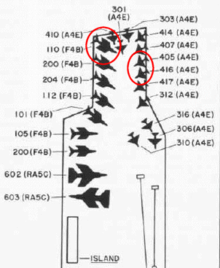
220px-CVA-59_fire_aft_deck_planIn addition to the bombs, ground attack aircraft were armed with 5″ “Zuni” unguided rockets, carried four at a time in under-wing rocket packs.   Known for electrical malfunctions and accidental firing, standard Naval procedure required electrical pigtails to be connected, at the catapult.

Ordnance officers found this slowed the launch rate and deviated from standard procedure, connecting pigtails while aircraft were still, “in the pack”. The table was set, for disaster.

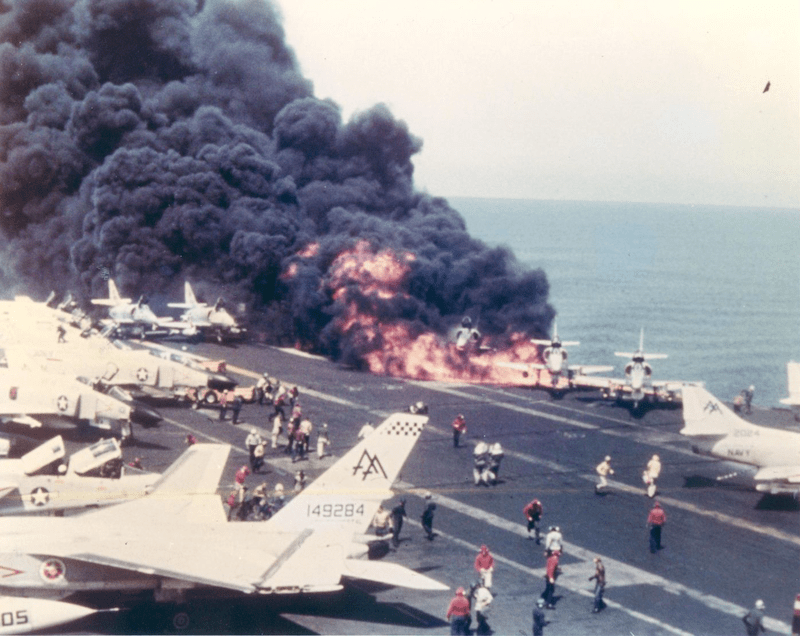
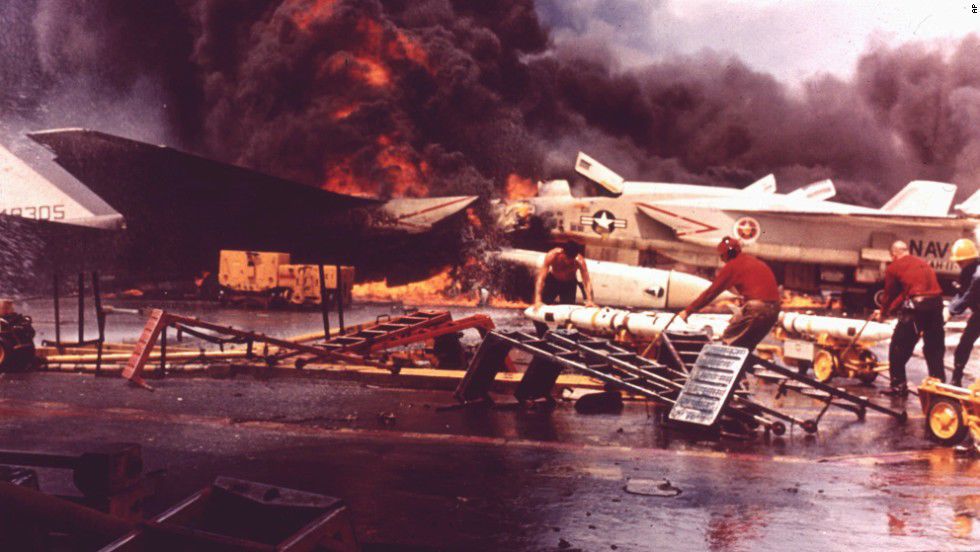
At 10:50-am local time, preparations were underway for the second strike of the day.  Twenty-seven aircraft were on deck, fully loaded with fuel, ammunition, bombs and rockets.  An electrical malfunction fired a Zuni rocket 100′ across the flight deck, severing the arm of one crewmember and into the 400-gallon external fuel tank of an A-4E Skyhawk, awaiting launch.

The rocket’s safety mechanism prevented the weapon from exploding, but the A-4’s torn fuel tank was spewing flaming jet fuel onto the deck. Other tanks soon overheated and exploded, adding to the conflagration.

800px-USS_Forrestal_A-4_Skyhawk_burning.png

In WW2, virtually all American carrier crew were trained firefighters.  This changed over time and, by 1967, the United States Navy had adopted the Japanese method at Midway, relying instead on specialized and highly trained damage control and fire fighting teams.

Damage Control Team #8 came into action immediately, as Chief Gerald Farrier spotted one of the Fat Boy bombs turning cherry red in the flames.  Farrier  was working without benefit of protective clothing, there had been no time.  Farrier held his PKP fire extinguisher on the 1000-lb bomb, hoping to keep it cool enough to prevent its cooking off as his team brought the conflagration under control.

USS_Forrestal_fire_1_1967

Firefighters were confident that their ten-minute window would hold as they fought the flames, but the composition B explosives proved as unstable as the ordnance people had feared.  Farrier “simply disappeared” in the first of a dozen or more explosions, in the first few minutes of the fire.  By the third such explosion, Damage Control Team #8 was wiped out.

Future United States Senator John McCain managed to scramble out of his cockpit and down the fuel probe.  Lieutenant Commander Fred White made it out of his own aircraft a split-second later, but he was killed in that first explosion.

The port quarter of the Forrestal ceased to exist in the violence of the explosions, office furniture thrown to the floor as much as five decks below.  Huge holes were torn into the flight deck while a cataract of flaming jet fuel, some 40,000 US gallons of the stuff, poured through ventilation ducts and into living quarters below.

Ninety-one crew members were killed below decks, by explosion or fire.

800px-USS_Forrestal_explosion_29_July_1967

With trained firefighters now dead or incapacitated, sailors and marines fought heroically to bring the fire under control, though they sometimes made matters worse.  Without training or knowledge of fire fighting, hose teams sprayed seawater, some washing away retardant foam being used to smother the flames.

With the life of the carrier itself at stake, tales of incredible courage, were commonplace. Medical officers worked for hours in the most dangerous conditions imaginable. Explosive ordnance demolition officer LT(JG) Robert Cates “noticed that there was a 500-pound bomb and a 750-pound bomb in the middle of the flight deck… that were still smoking. They hadn’t detonated or anything; they were just setting there smoking. So I went up and defused them and had them jettisoned.” Sailors volunteered to be lowered through the flight decks into flaming and smoked-filled compartments, to defuse live bombs.

The destroyer USS George K. MacKenzie plucked men out of the water as the destroyer USS Rupertus maneuvered alongside for 90 minutes, directing on-board fire hoses at the burning flight and hangar decks.

800px-USS_Repertus_assists_USS_Forrestal

Throughout the afternoon, crew members rolled 250-pound and 500-pound bombs across the decks, and over the side.  The major fire on the flight deck was brought under control within four hours, but fires burning below decks would not be declared out until 4:00am the following day.

Panel 24E of the Vietnam Memorial records the names of 134 crewmen who died in the conflagration. Another 161 were seriously injured.  26 aircraft were destroyed and another 40, damaged.  Damage to the Forrestal itself exceeded $72 million, equivalent to over $415 million today.

Gary Childs of Paxton Massachusetts, my uncle,  was among the hundreds of sailors and marines who fought to bring the fire under control.  Gary was below decks when the fire broke out, leaving moments before his quarters were engulfed in flames. Only by that slimmest of margins did Uncle Gary and an untold number of others escape being #135.

If you enjoyed this “Today in History”, please feel free to re-blog, “like” & share on social media, so that others may find and enjoy it as well. Please click the “follow” button on the right, to receive email updates on new articles.  Thank you for your interest, in the history we all share.
July 28, 1914 Four Horsemen of the Apocalypse

Few could imagine a war in which a single day’s fighting, could produce casualties equal to that of every war of the preceding 100 years, combined. 

In 1869, Germany had yet to come into its own as an independent nation. Forty-five years later, she was one of the Great Powers, of Europe.

Great Powers, 1914

Alarmed by the aggressive growth of her historic adversary, the French government had by that time increased compulsory military service from two years to three, in an effort to offset the advantage conferred by a German population of some 70 million, contrasted with a French population of 40 million.

Joseph Caillaux was a left wing politician, once Prime Minister of France and, by 1913, a cabinet minister under the more conservative administration of French President Raymond Poincare.

Never too discreet with his personal conduct, Caillaux paraded through public life with a succession of women, who were not Mrs Caillaux. One of them was Henriette Raynouard.  By 1911, Madame Raynouard had become the second Mrs Caillaux.

A relative pacifist, many on the French right considered Caillaux to be too “soft” on Germany. One of them was Gaston Calmette, editor of the leading right-wing newspaper Le Figaro, who regularly excoriated the politician.

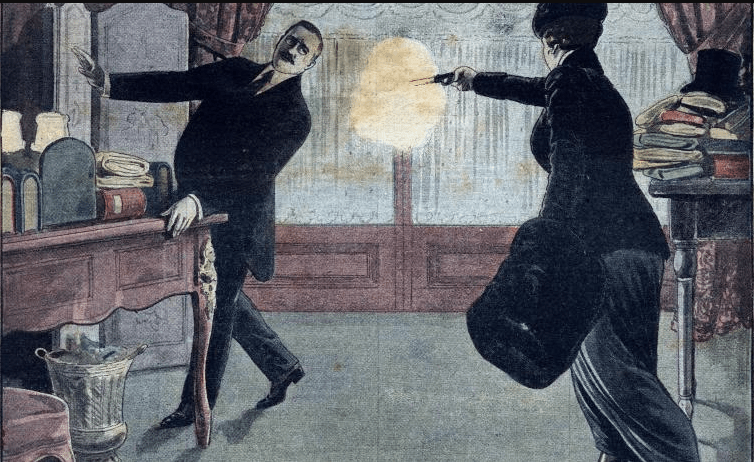
On March 16, 1914, Madame Caillaux took a taxi to the offices of Le Figaro. She waited for a full hour to see the paper’s editor, before walking into his office and shooting him at his desk. Four out of six rounds hit their mark.  Gaston Calmette was dead before the night was through.

Cailloux Affair

It was the crime of the century.  This one had everything: Left vs. Right, the fall of the powerful, and all the salacious details anyone could ever ask for. It was the OJ trial, version 1.0, and the French public was transfixed.

The British public was similarly distracted, by the latest in a series of Irish Home Rule crises.

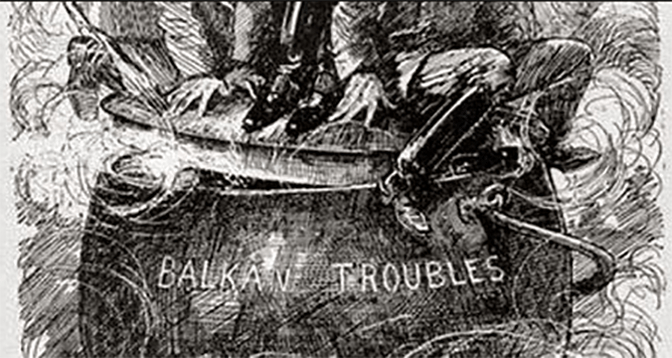
The Austro-Hungarian Empire, a sprawling amalgamation of 17 nations, 20 Parliamentary groups and 27 political parties, desperately needed to bring the Balkan peninsula into line, following the June 28 assassination of the heir apparent to the dual monarchy. That individual Serbians were complicit in the assassination is beyond doubt, but so many government records of the era have disappeared that, it’s impossible to determine official Serbian complicity. Nevertheless, Serbia had to be brought to heel.

Balkan Troubles

Having given Austria his personal assurance of support in the event of war with Serbia, even if Russia entered in support of her Slavic ally, Kaiser Wilhelm of Germany left on a summer cruise in the Norwegian fjords. The Kaiser’s being out of touch for those critical days in July has been called the most expensive maritime disaster in naval history.

The Austro-Hungarian Empire delivered a deliberately unacceptable ultimatum to Serbia on the 23rd, little more that a bald pretext for war.  Czar Nicholas wired Vienna as late as the 27th proposing an international conference concerning Serbia, but to no avail. Austria responded that same day.  It was too late for such a proposal.

The Austro-Hungarian Empire declared war on Serbia the following day, the day on which Madame Caillaux was acquitted of the murder of Gaston Calmette, on the grounds of being a “crime of passion”.

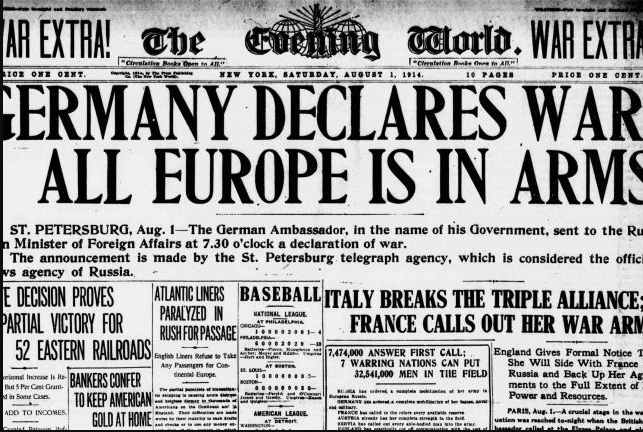
As expected, Russia mobilized in support of Serbia.  For her part, Imperial Germany feared little more than a two-front war, with the “Russian Steamroller” to the east, and the French Republic to the west.  Germany invaded neutral Belgium in pursuit of the one-two punch strategy by which she sought first to defeat France, before turning to face the far larger Russian adversary.

russ-mob

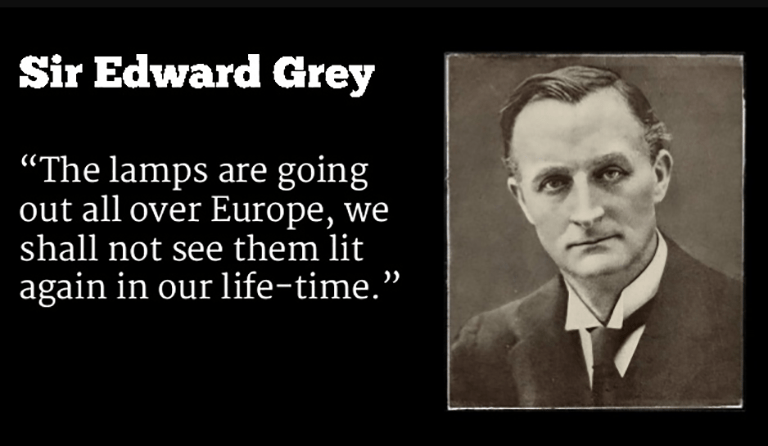
On August 3, British Foreign Secretary Sir Edward Grey announced before Parliament, his government’s intention to defend Belgian neutrality, a treaty obligation German diplomats had dismissed as a “scrap of paper”.

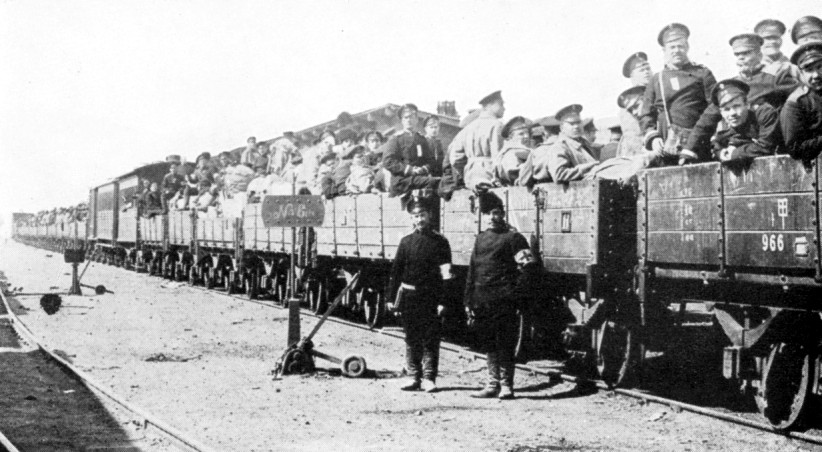
Pre-planned timetables took over – France alone would have 3,781,000 military men under orders before the middle of August, arriving at the western front on 7,000 trains arriving as often as every eight minutes.

Declaration

This time there would be no “Phoney War”, no “Sitzkreig”, as some wags were wont to call the early days of WWII.   Few could imagine a cataclysm to rock a century and beyond, a war in which a single day’s fighting could produce casualties equal to that of every war of the preceding 100 years, combined.  Fewer still understood on this date, one-hundred and four years ago, today.  The four horsemen of the Apocalypse, were only days away.

Sir Edward Grey

If you enjoyed this “Today in History”, please feel free to re-blog, “like” & share on social media, so that others may find and enjoy it as well. Please click the “follow” button on the right, to receive email updates on new articles.  Thank you for your interest, in the history we all share.

July 26 1945 USS Indianapolis

The United States Navy lost over 350 ships to combat operations during WW2.  Not one  resulted in court martial but, on this occasion, someone was going to pay. 

The Portland class heavy cruiser USS Indianapolis set out on its secret mission on July 16, 1945, under the command of Captain Charles Butler McVay III.  She was delivering “Little Boy” to the Pacific island of Tinian, the atomic bomb which would later be dropped on Hiroshima.

Indianapolis made her delivery on July 26, arriving at Guam two days later and then heading for Leyte to take part in the planned invasion of Japan. She was expected to arrive on the 31st.

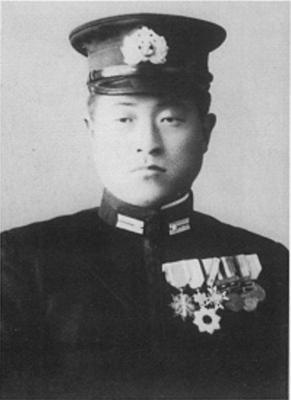
Indianapolis SubThe Japanese submarine I-58, Captain Mochitsura Hashimoto commanding, fired a spread of six torpedoes at the cruiser, two striking Indianapolis’ starboard bow at fourteen minutes past midnight on Monday, July 30. The damage was massive.  Within 12 minutes, the 584-ft, 9,950-ton vessel had rolled over, gone straight up by the stern, and sunk beneath the waves.
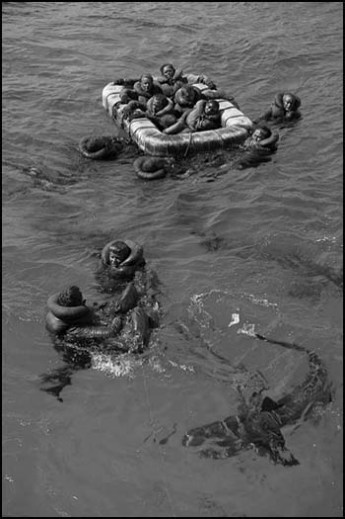
Approximately 300 of Indianapolis’ 1,196-member crew were killed outright, leaving nearly 900 treading water. Many had no life jackets.  There had been no time, and there were few life boats.

indianapolis_2
Caribbean Reef sharks circling the sailors in reenactment scene after USS Indianapolis had been sunk by Japanese submarine. As seen on OCEAN OF FEAR: WORST SHARK ATTACK EVER. H/T photographer: Tim Calver

The ordeal faced by the survivors, is beyond description.  Alone and stranded in open ocean, these guys treaded water for four days, hoping and praying for the rescue that did not come.

Shark attacks began on the first day, and never let up. Kapok-filled life vests became waterlogged and sank after 48 hours, becoming worse than useless. Exhaustion, hypothermia, and severe sunburn took their toll as the hours turned into days. Some men went insane and began to attack their shipmates, while others found the thirst so unbearable that they drank seawater, setting off a biological chain reaction which killed them within a few hours. Some simply swam away, following some spectral vision that only he could see. Through it all, random individuals would suddenly rise up screaming from the ocean, then to disappear forever, as the sharks claimed another victim.

Navy Command had not the slightest idea of what happened to Indianapolis, nor why she didn’t show up on the 31st.  A random patrol aircraft passing the area that Thursday afternoon, that finally discovered men floating in open ocean. The last Indianapolis survivor was plucked from the ocean Friday afternoon, well past half-dead after nearly five days in the water. Of the 900 or so who survived the sinking, only 316 remained alive at the end of the ordeal.

mochitsura-hashimoto
Mochitsura Hashimoto

The Navy had committed multiple errors, from denying McVay’s requested escort to informing him that his route was safe, even when the surface operations officer knew there were at least two Japanese submarines, operating in the area.

No captain in the history of the United States Navy was subjected to court-martial for losing a ship sunk by an act of war.  The United States Navy lost over 350 ships to combat operations during WW2.  It didn’t matter.  On this occasion, someone was going to pay.

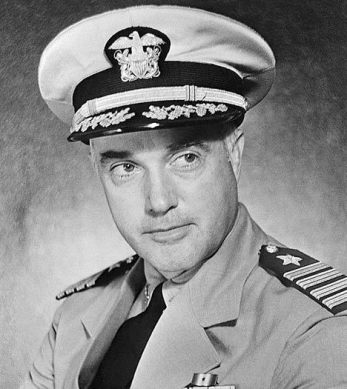
A hastily convened court of inquiry was held in Guam on August 13, leading to McVay’s court-martial. There was evidence that the Navy itself had put the ship in harm’s way.  When prosecutors flew the I-58 commander in to testify, Hashimoto swore that zigzagging would have made no difference. The Japanese Commander even became part of a later effort to exonerate McVay, but to no avail. Charles Butler McVay III was convicted of “hazarding his ship by failing to zigzag“, his career ruined.

450729-charles-mcvay
Charles Butler McVay, III

McVay had wide support among Indianapolis’ survivors, but opinion was by no means unanimous. Birthdays, anniversaries and holidays would come and go and there was always some piece of hate mail, blaming him for the death of a loved one. One Christmas missive read “Merry Christmas! Our family’s holiday would be a lot merrier if you hadn’t killed my son”.

McVay began to doubt himself.  By 1968 he must have felt the weight of Indianapolis’ dead, like a great stone upon his shoulders.

On November 6, 1968, Charles Butler McVay III sat down on his front porch in Litchfield Connecticut, took out his Navy revolver, and killed himself.  He was cremated, his ashes scattered at sea.

It would take more than 20 years, for the evidence which exonerated him to be declassified.

Afterward:
Hunter Alan Scott was eleven and living in Pensacola when he saw the movie “Jaws”, in 1996. He was fascinated by the movie’s brief mention of the Indianapolis’ shark attacks, the next year, he created his 8th grade “National History Day” project on the USS Indianapolis sinking. The boy interviewed nearly 150 survivors and reviewed 800 documents.  The more he read, the more he became convinced that Captain McVay was innocent of the charges for which he’d been convicted.

Scott’s National History Day project went up to the state finals, but it was rejected because he had used the wrong type of notebook to organize the material.

artbHe couldn’t let it end there. Scott began to attend Indianapolis survivors’ reunions, at their invitation, and helped to gain a commitment in 1997 from then-Representative Joe Scarborough that he would introduce a bill in Congress to exonerate McVay the following year.
Senator Bob Smith of NH joined Scarborough in a joint resolution.  Hunter Scott and several Indianapolis survivors were invited to testify before Senator John Warner and the Senate Armed Services committee on September 14, 1999.

Holding a dog tag in his hand, Scott testified “This is Captain McVay’s dog tag from when he was a cadet at the Naval Academy. As you can see, it has his thumbprint on the back. I carry this as a reminder of my mission in the memory of a man who ended his own life in 1968. I carry this dog tag to remind me that only in the United States can one person make a difference no matter what the age. I carry this dog tag to remind me of the privilege and responsibility that I have to carry forward the torch of honor passed to me by the men of the USS Indianapolis”.

The United States Congress passed a resolution in 2000, signed into law by President Bill Clinton on October 30, exonerating Charles Butler McVay III of the charges which had led to his court martial, humiliation and suicide.

170819163129-02-uss-indianapolis-crew-restricted-exlarge-169
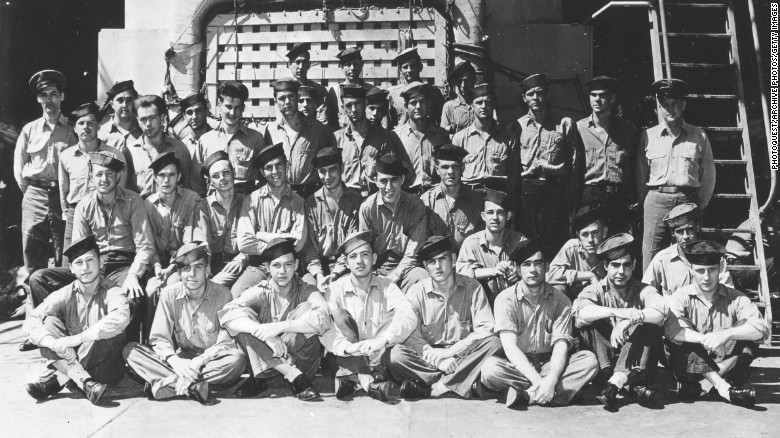
Some of Indianapolis’ crew, before her sinking.

The record cannot not be expunged.  Congress has rules against even considering bills altering military records, and there is no means by which to reverse a court-martial.  It’s never happened.  Yet Captain McVay had exonerated, something that the Indianapolis survivors had tried to accomplish without success.  Until the intervention of a 12-year-old boy.  Who said one person can’t make a difference?

Today, only 22 of  Indianapolis’ survivors remain alive.  The wreck of the “Indy” was discovered in August 2017, in 18,000-feet of water.  Leader of the civilian expedition which located the wreck, Microsoft co-founder Paul Allen, said”To be able to honor the brave men of the USS Indianapolis and their families through the discovery of a ship that played such a significant role in ending World War II is truly humbling”.

If you enjoyed this “Today in History”, please feel free to re-blog, “like” & share on social media, so that others may find and enjoy it as well. Please click the “follow” button on the right, to receive email updates on new articles.  Thank you for your interest, in the history we all share.


July 25, 1944 Most III

“This is the decisive weapon of the war. Humanity will never be able to endure it,” Hitler said, “If I had this weapon in 1939 we would not be at war now.”

In the early years of WWII, Nazi Germany fired 10,000 V1″Doodlebug” rockets at England, killing over 6,000 Londoners alone, by 1943. The subsonic V1 was an effective terror weapon but, bad as it was to be the target of one of these things, the “low and slow” trajectory and the weapon’s short range lacked the strategic punch needed by Nazi Germany to end the war in its favor.

The V2 was a different story.  This was the dawn of the ballistic missile era, and Nazi Germany was first off the starting line.

The Peenemünde Aggregat A4 V2 was an early predecessor of the Cruise Missile, delivering a 2,148 pound payload at 5 times the speed of sound over a 236-mile range. While you could hear the V1 coming and seek shelter, victims of the V2 didn’t know they were under attack, until the weapon had exploded.

When Wernher von Braun showed Adolf Hitler the launch of the V2 on color film, Hitler jumped from his seat and shook Braun’s hand with excitement. “This is the decisive weapon of the war. Humanity will never be able to endure it,” Hitler said, “If I had this weapon in 1939 we would not be at war now.”

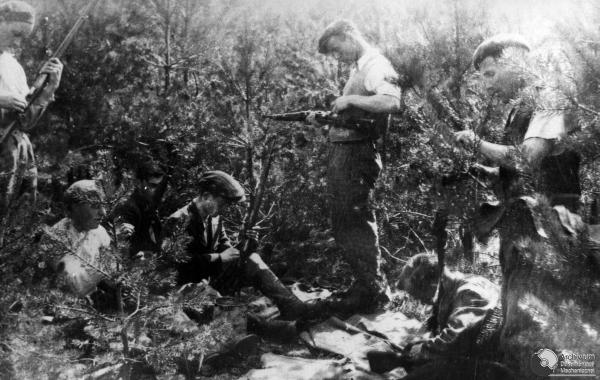
Allies were anxious to get their hands on the secret weapon and, in early 1944, they had their chance. A V2 had crashed into a muddy bank of the Bug River in Nazi-occupied Poland, without exploding. The Polish underground had been waiting for such an opportunity and quickly descended on the rocket, covering it with brush. Desperate to retrieve it, Germans conducted a week long aerial and ground search for the weapon, but failed find it under all that camouflage.

Polish Partisans preparing for battle_WW2
Polish Partisans preparing for battle, WW2

After what must have seemed an eternity, the search came to an end and partisans returned to the site. This time they brought four Polish scientists who carefully disassembled the weapon, packing the pieces in barrels. The parts were then shipped to a barn in Holowczyce, just a few miles away.

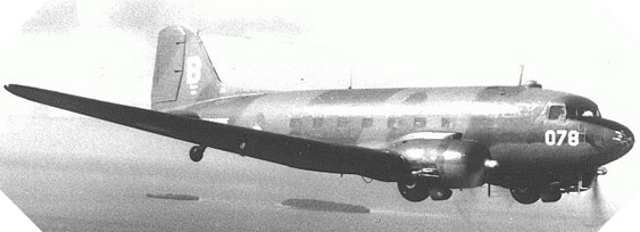
The allied effort to retrieve the stolen missile, code named “Most III”, got underway on this day in 1944, when Royal New Zealand Air Force 1st Lt Stanley George Culliford landed his Dakota C47 in the early morning darkness, at a secret air strip near Tarnow.

1920px-Home_Army_intelligence_on_V1_and_V2
Home Army intelligence on V1 & V2

The V2 chassis and several technical experts were loaded on board, but it was too much weight.  The overloaded C47 couldn’t move on the wet, muddy field – the port wheel stuck fast in the mud.  Everything had to be offloaded, Polish partisans working desperately to free the aircraft as dawn approached. They stuffed the wheel track with straw, and then laid boards in the trench.  Nothing worked.

Co-pilot Kazimierz “Paddy” Szrajer thought the parking brake must be stuck, so the hydraulic leads supplying the brake, were cut. That didn’t work, either. In the end, partisans were frantically digging trenches under the aircraft’s main wheel. Two attempts failed to get the aircraft off the ground, and Culliford was thinking about blowing up the plane and burning all the evidence.  There would be one last attempt.

The aircraft lumbered off the ground on the third try.  The last of the partisans scattered into the night, as the headlights of Nazi vehicles could be seen, approaching in the early morning darkness.

18lfbi20zpunyjpgThere would be 5 hours of unarmed, unescorted flight through Nazi-controlled air space and an emergency landing with no brakes, before those V2 rocket components finally made it to England.
Today, few remember the names of these heroes, struggling in the dark to defeat the forces of Nazi Tyranny.  We are left only to imagine a world, in which Nazi Germany remained in sole possession of the game changing super weapons, of WWII.

If you enjoyed this “Today in History”, please feel free to re-blog, “like” & share on social media, so that others may find and enjoy it as well. Please click the “follow” button on the right, to receive email updates on new articles.  Thank you for your interest, in the history we all share.

July 24, 1915 A Curbside Shipwreck

Ironically, the additional weight of lifeboats added in the wake of the Titanic disaster of 1912, almost certainly doomed the steamship and 848 of her passengers and crew, to disaster.

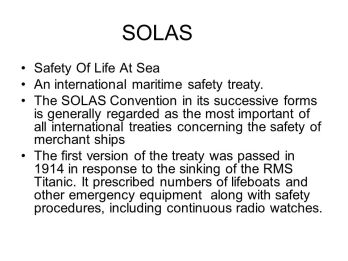
SOLAS+Safety+Of+Life+At+Sea+An+international+maritime+safety+treaty.Following the “unsinkable” Titanic disaster of 1912, thirteen countries including Great Britain and the United States gathered to discuss implementation of life-saving measures at sea, such as radio communications, safety of navigation and ice patrol.  Among other measures, the Safety of Life at Sea (SOLAS) treaty signed in January 1914 mandated that sufficient lifeboats be provided for every passenger and crew member on board, and that all on board be instructed on their use.
Anyone who’s been on a cruise vacation, knows what that sounds like.

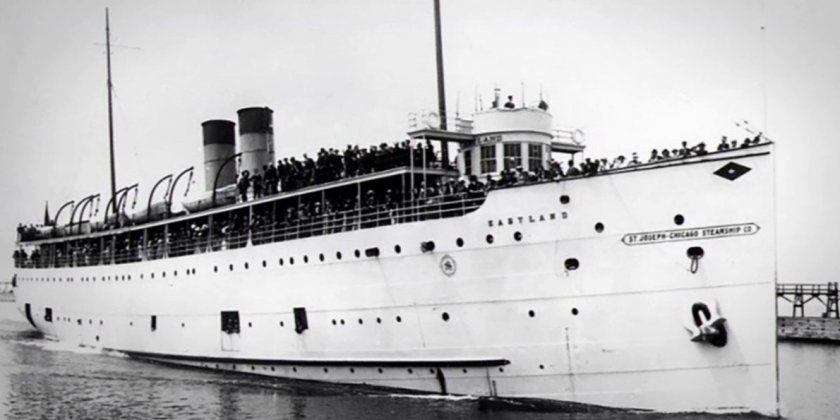
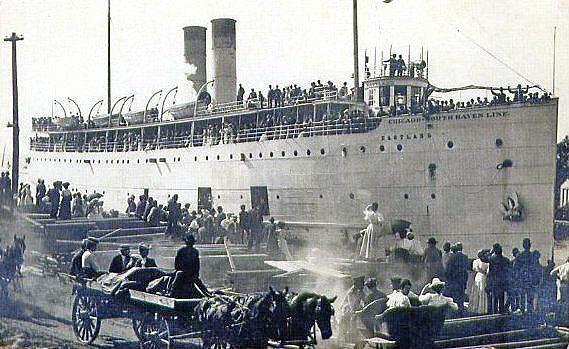
The SS Eastland was a passenger steamship based in Chicago, used for tours of the inland waterways and Great Lakes areas around the city.  Eastland’s design made her top heavy from the beginning, and subject to listing. Embarking passengers would crowd along the rail to wave goodbye, several times having to be herded across the decks to reduce the list. One time, Eastland even began to take on water at the main gangplank.

Special passenger restrictions specifically  imposed on Eastland helped the problem until 1914, when the weight of additional lifeboats brought stability problems to a new level.  Ironically, the additional weight of those lifeboats almost certainly doomed the steamship and 848 of her passengers and crew, to disaster.

found-footage-shows-the-1915-chicago-river-ship-disaster-that-killed-844-people

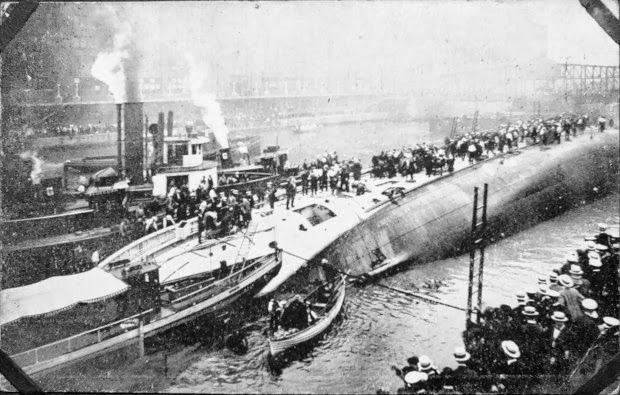
On July 24, 1915, Eastland and two other Great Lakes passenger steamers, the Theodore Roosevelt and Petoskey, were chartered to take Western Electric employees to a picnic in Michigan City, Indiana. Eastland was docked on the south bank of the Chicago River, between Clark and LaSalle, near the current site of the Merchandise Mart. Passengers began boarding around 6:30am.  By 7:10 the ship had reached full capacity of 2,572 passengers.

A number of passengers went below decks to get out of the chill, but hundreds stayed out on the upper decks, excited about the day ahead. The port side list away from the dock, set in early in the boarding process, when crew members began to pump water into the starboard ballast tanks, to stabilize the ship.  Something interesting must have happened on the river at 7:28, causing a number of passengers to rush to the port side rail.

SS_Eastland

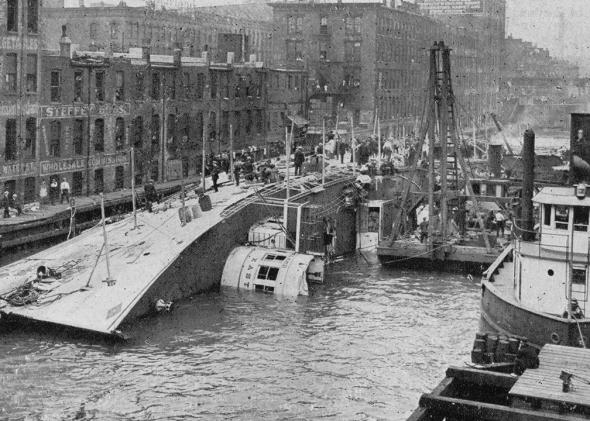
Novelist Jack Woodford witnessed what happened next, describing the scene in his autobiography: “And then movement caught my eye. I looked across the river. As I watched in disoriented stupefaction a steamer large as an ocean liner slowly turned over on its side as though it were a whale going to take a nap. I didn’t believe a huge steamer had done this before my eyes, lashed to a dock, in perfectly calm water, in excellent weather, with no explosion, no fire, nothing. I thought I had gone crazy”.  Hundreds were trapped below decks, others were crushed under heavy bookcases, pianos and tables.

tnc150210_eastland_1280.jpg.CROP.promo-mediumlarge

Another vessel, the Kenosha, pulled alongside almost immediately.  Several passengers were able to jump directly onto her decks, others were rescued at the wharf, only 20′ away.  Hundreds were beyond saving.

Temporary morgues were set up in area buildings for identifying the dead; including what is now the sound stage for The Oprah Winfrey Show, Harpo Studios, and the location of the Chicago Hard Rock Cafe.

location04
Easstland disaster location, today

Then-20-year-old George Halas was scheduled to be on the Eastland, but he was late and showed up after the capsize. 844 passengers and four crew members lost their lives in the disaster, but Eastland herself would have a second life. She was raised from the bottom, converted to a gun boat, and stationed at the Great Lakes Naval Reserve, re-christened USS Wilmette.

Wilmette saw no combat service in WWI, though she was given the task of sinking UC-97, a German U-Boat surrendered to the United States following WWI. Wilmette’s guns were manned by Gunner’s Mate J.O. Sabin, who had fired the first American shell in WWI, and Gunner’s Mate A.F. Anderson, the man who fired the first American torpedo of the war.

Wilmette would serve once again as a training ship in WWII, and sold for scrap on Halloween day, 1946.

If you enjoyed this “Today in History”, please feel free to re-blog, “like” & share on social media, so that others may find and enjoy it as well. Please click the “follow” button on the right, to receive email updates on new articles.  Thank you for your interest, in the history we all share.

July 23, 1828 A Virginia Housewife

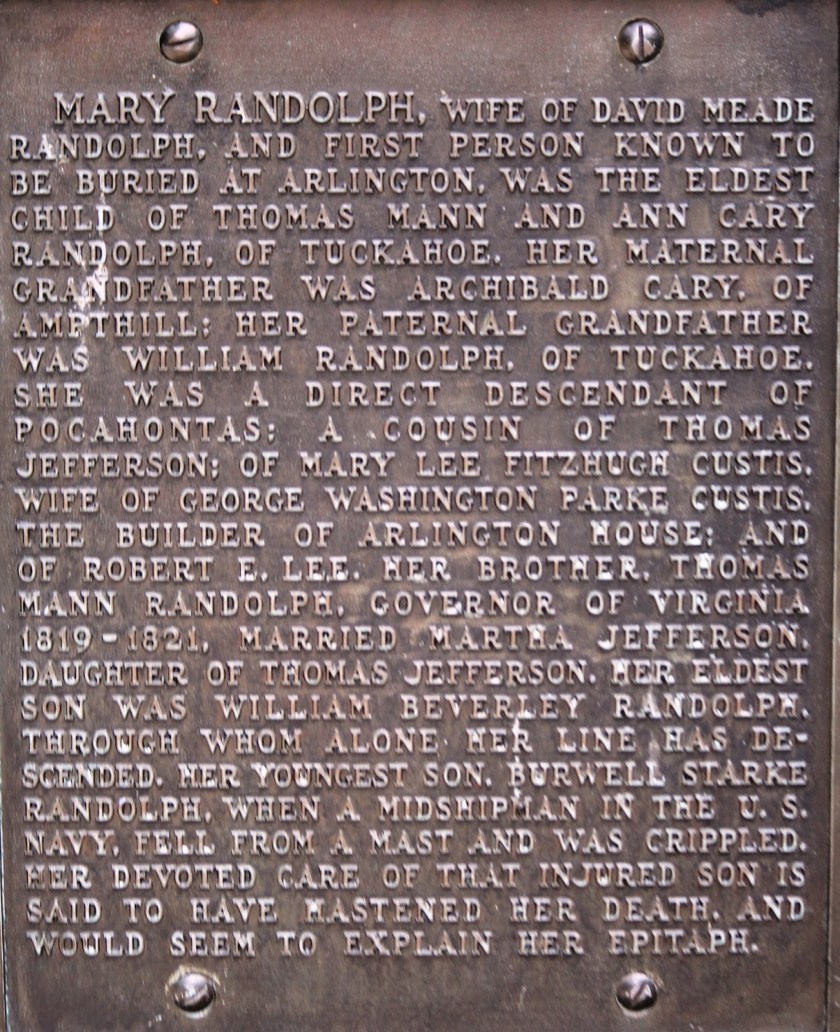
Mary Randolph, Pocahontas’ direct descendant and cousin to Thomas Jefferson, was the cousin of George Washington Parke Custis, adopted step-grandson of George Washington, and the godmother of Custis’ daughter, Mary Anna Randolph Custis, wife of Robert E. Lee.

The first military burial at Arlington National Cemetery was that of Private William Henry Christman, 67th Pennsylvania Infantry, interred on May 13, 1864. Two more joined him that day, the trickle soon turning into a flood. By the end of the war between the states, that number was 17,000 and rising.

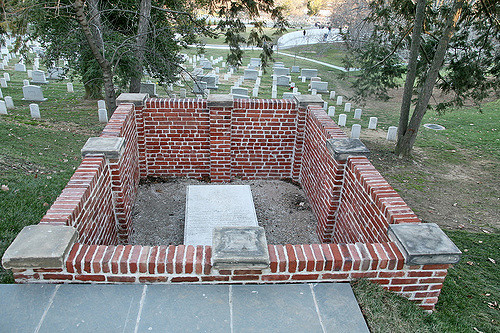
Private Christman’s was the first military burial, but not the first. When he went to his rest in our nation’s most hallowed ground, Private Christman’s grave joined that of Mary Randolph, buried some thirty-six years earlier.

3161106987_417040d020_z

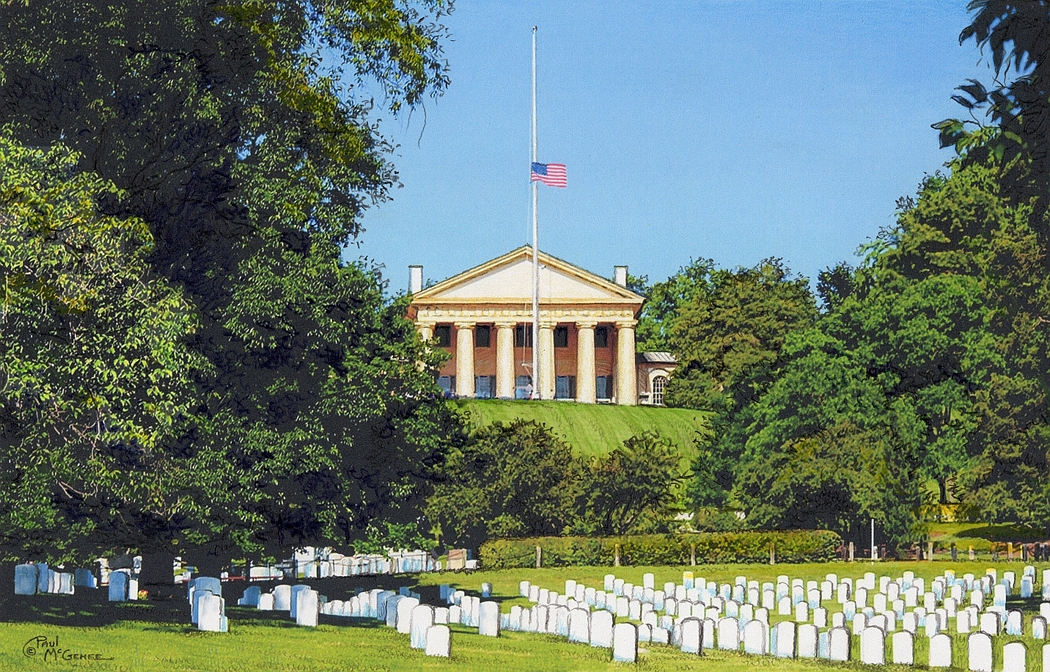
In 1929, cemetery workers were doing renovations on the Custis Mansion, at the top of the hill. They couldn’t help being aware of a solitary grave, 100′ to the north, but knew little of its occupant.

Marked with the name Mary Randolph, the stone was inscribed with these words:

“In the memory of Mrs. Mary Randolph,
Her intrinsic worth needs no eulogium.
The deceased was born
The 9th of August, 1762
at Amphill near Richmond, Virginia
And died the 23rd of January 1828
In Washington City a victim to maternal love and duty.”

Little else was known about Mary Randolph.

fdsdfsdfsdfs 116 (1)

In 1929, journalist Margaret Husted wrote about her in the Washington Star newspaper. Descendants came forward and, piece by piece, the story of the first person buried at Arlington, came to light.

Mary Randolph, Pocahontas’ direct descendant and cousin to Thomas Jefferson, was the cousin of George Washington Parke Custis, adopted step-grandson of George Washington, and the godmother of Custis’ daughter, Mary Anna Randolph Custis, wife of Robert E. Lee.

mary_isham_randolph_1660_-_2_largeThe last line of the inscription, “a victim to maternal love and duty” refers to her youngest surviving son, Midshipman Burwell Starke Randolph, who suffered a fall from a high mast in 1817, while serving in the Navy. Both of his legs were broken and never healed properly. When Mary passed away in 1828, Randolph remarked that his mother had sacrificed her own life in care of his.

Mary Randolph is best known as the author of America’s first regional cookbook, “The Virginia House-wife”.

The Virginia Culinary Thymes writes that “It is interesting to note that all the cookery at that time was done in kitchens that had changed little over the centuries. In Virginia, the kitchen was typically a separate building for reasons of safety, summer heat and the smells from the kitchen. The heart of the kitchen was a large fireplace where meat was roasted and cauldrons of water and broth simmered most of the day. Swinging cranes and various devices made to control temperature and the cooking processes were used. The Dutch oven and the chafing dish were found in most kitchens. The brick oven used for baking was located next to the fireplace. A salamander was used to move baked products around in the oven and it could also be heated and held over food for browning“.

51fUed9IGOLMrs. Randolph was an early advocate of the now-common use of herbs, spices and wines in cooking. Her recipe for apple fritters calls for slices of apple marinated in a combination of brandy, white wine, sugar, cinnamon, and lemon rind.
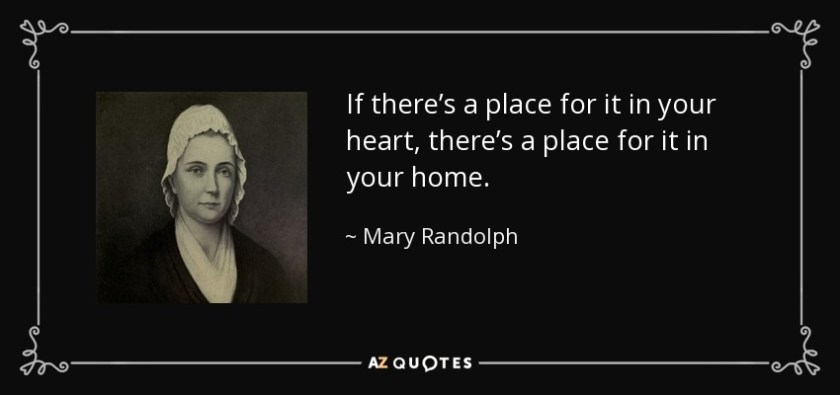
She was well known as a Virginia cook and hostess, so much so that, during an 1800 slave insurrection near Richmond, the leader “General Gabriel” said that he would spare her life, if she would become his cook.

I believe that General Gabriel may have been on to something.

Feature image, top of page:  Custis Mansion, Arlington National Cemetery, H/T Paul McGehee

quote-if-there-s-a-place-for-it-in-your-heart-there-s-a-place-for-it-in-your-home-mary-randolph-92-47-22

If you enjoyed this “Today in History”, please feel free to re-blog, “like” & share on social media, so that others may find and enjoy it as well. Please click the “follow” button on the right, to receive email updates on new articles.  Thank you for your interest, in the history we all share.

July 21, 1925 Trial of the Century

After eight days of trial, the jury took only nine minutes to deliberate, finding Scopes guilty on July 21.

The legal contest recorded as State of Tennessee v. John Thomas Scopes, better known as the “Scopes Monkey Trial”, began with the “Butler Act”, a measure passed by Tennessee State Representative John W. Butler, prohibiting teaching of the theory of evolution in Tennessee public schools, colleges and universities.

The American Civil Liberties Union (ACLU) immediately announced its intention to sue, offering to defend anyone accused of violating the act. Local businessman George Rappleyea arranged a meeting with the county superintendent of schools and local attorney Sue Kerr Hicks, a man who may have been the inspiration for Shel Silverstein’s “A Boy Named Sue,” which everyone remembers from the Johnny Cash song, of 1969.

scope

The three met at Robinson’s Drug Store, and agreed that their little town of Dayton could use the publicity. The trio summoned 24-year-old High School football coach and part time substitute teacher John Scopes, asking him to plead guilty to teaching the theory of evolution. Scopes replied that he could not recall if he had done so, but would be more than happy to be the defendant if anyone could prove that he had.

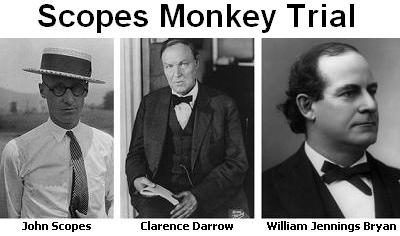
Scopes was charged on May 5, barely two months after the law’s enactment, with teaching evolution from “Civic Biology”, a textbook describing the theory of evolution, race and eugenics. The prosecution brought in William Jennings Bryan to try the case and the defense hired Clarence Darrow.  Two of the heaviest of jurisprudential heavy hitters of the day, were now lined up in the “Trial of the Century”.

scopesBryan complained that evolution taught children, that humans were no more than one among 35,000 mammals. He rejected the idea that humans were descended from apes. “Not even from American monkeys, but from old world monkeys”. The ACLU wanted to oppose the Butler Act on grounds that it violated the teacher’s individual rights and academic freedom, but it was Darrow who shaped the case, taking the position that the theistic and the evolutionary views were not mutually exclusive.
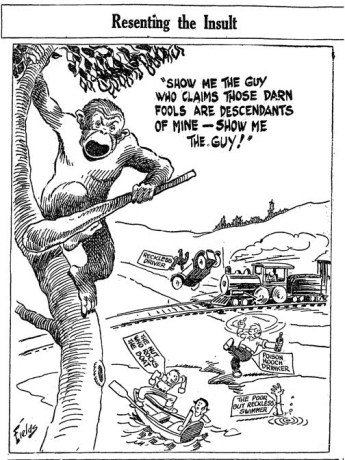
c9ca8cf7e75e87b7f4ed1995ec575353--s-bostonWhat had begun as a publicity stunt soon became an overwhelming media event. 200 newspaper reporters from all over the country arrived in Dayton, along with two come all the way from London. Twenty-two telegraphers sent out 165,000 words a day over thousands of miles of telegraph wires, hung specifically for the purpose.

Trained chimpanzees performed on the courthouse lawn. Chicago’s WGN radio personality Quin Ryan broadcast the nation’s first on-the-scene coverage of a criminal trial. A specially constructed airstrip was prepared, from which two movie cameramen had their newsreel footage flown out, daily.

H.L. Mencken, writing for the Baltimore Sun, mocked the prosecution and the jury as “unanimously hot for Genesis.” Mencken labeled the town’s inhabitants “yokels” and “morons”. Bryan was a “buffoon” and his speeches “theologic bilge”. It was Mencken who dubbed the proceedings, “Monkey Trial”. The defense, on the other hand, was “eloquent” and “magnificent”. Or so he claimed.

Not the least little bit of media bias, there.

5297700After eight days of trial, the jury took only nine minutes to deliberate, finding Scopes guilty on July 21. The gym teacher was ordered to pay a $100 fine, equivalent to something like $1,300, today. Scopes’ conviction was overturned by the Tennessee Supreme Court, on the basis that state law required fines over $50 to be decided by a jury, and not by the judge presiding.
American creationists believe to this day, that media reports turned public opinion against the religious view. Evolution vs Creation debates may be reasonably expected to continue, for the foreseaable future. Ultimately, neither seems supportable, by anything more than the faith of its adherents.

If you enjoyed this “Today in History”, please feel free to re-blog, “like” & share on social media, so that others may find and enjoy it as well. Please click the “follow” button on the right, to receive email updates on new articles.  Thank you for your interest, in the history we all share.

July 22, 1937 Stacking the Deck

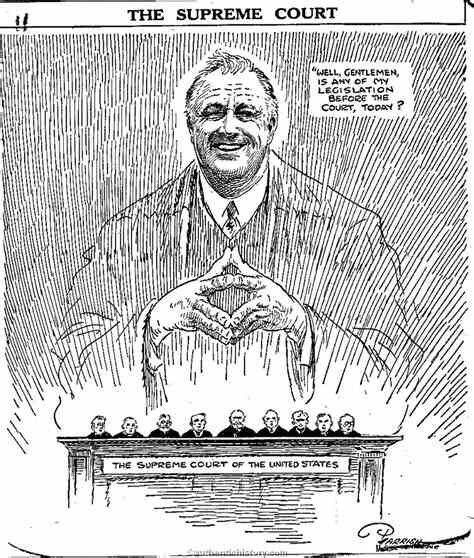
To Roosevelt, President Wilson’s age-70 provision was the answer to his problems, and the end to Supreme Court opposition to his policies.

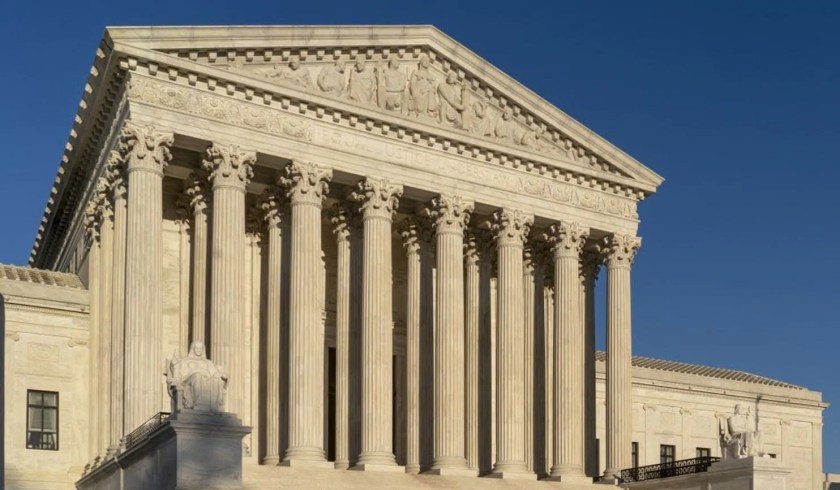
United States ConstitutionArticle III, Section 1 of the United States Constitution creates the highest court in the land.  The relevant clause states that “The judicial power of the United States, shall be vested in one Supreme Court, and in such inferior courts as the Congress may from time to time ordain and establish“.  Nowhere does the document specify the number of justices.
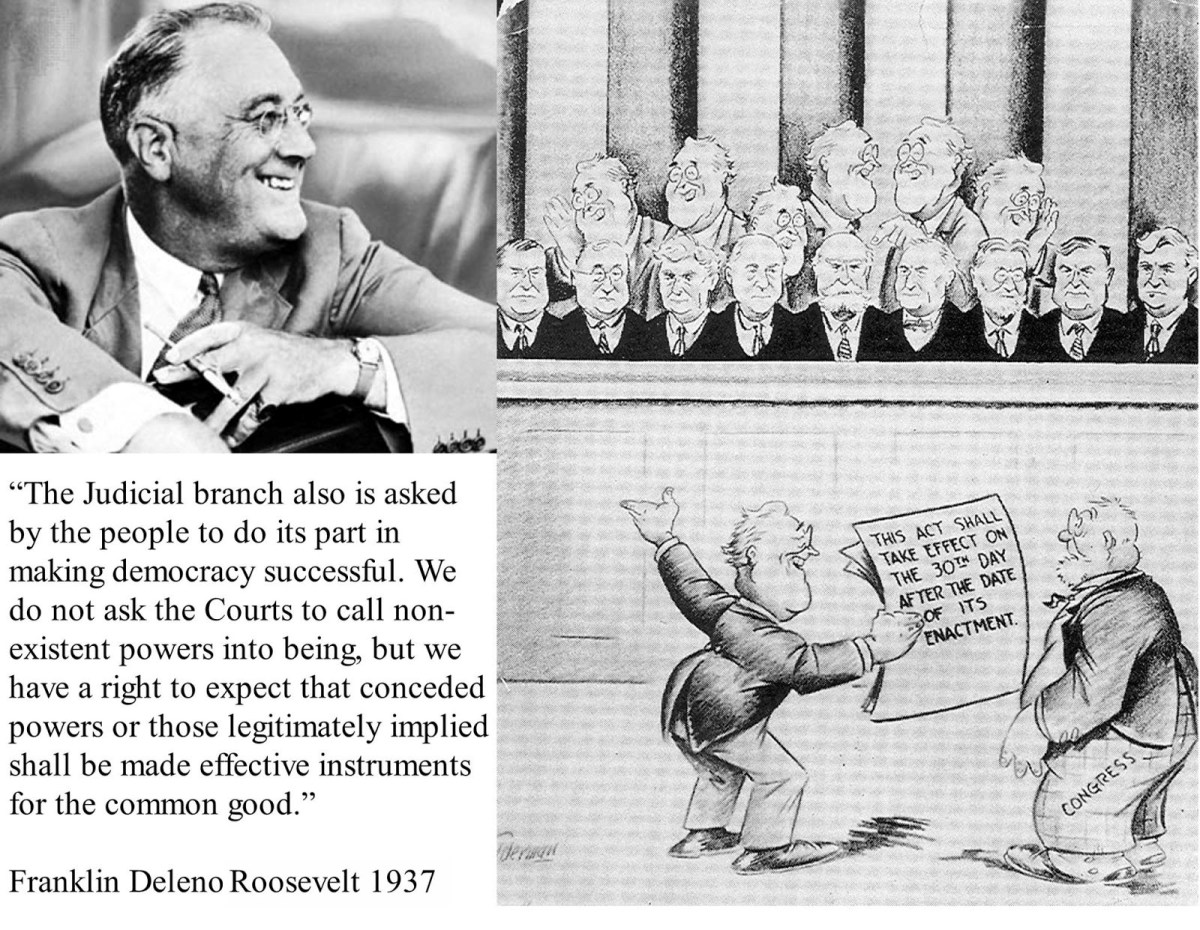
The United States was in the midst of the “Great Depression” in 1932, when President Franklin Delano Roosevelt came to office. Roosevelt had promised a “New Deal” for America, and immediately began a series of sweeping legislative reforms designed to counter the devastating effects of the Depression. Roosevelt’s initiatives faced many challenges in the courts, with the Supreme Court striking down several New Deal provisions as unconstitutional in his first term.

The Supreme Court was divided along ideological lines in 1937, as it is today. “Judicial Realist” or “Liberal” legal scholars and judges argued that the constitution was a “living document”, allowing for judicial flexibility and legislative experimentation. Justice Oliver Wendell Holmes, Jr. first referred to a “living constitution” in 1920 in speaking of  Missouri v. Holland, a case which overrode state concerns about abrogation of states’ rights arising under the Tenth Amendment.  The “case before us” Holmes wrote, “must be considered in the light of our whole experience and not merely in that of what was said a hundred years ago”.

3NIUJFURFI2WDD32OYOSNUMQJQ

“Judicial Formalists”, today we call them “Conservatives” or “Originalists”, seek to discover the original meaning or intent of the framers, of the Constitution. Formalist legal scholars and judges argue that the judiciary is not supposed to create, amend or repeal law; that is for the legislative branch. The role of the court is to interpret and uphold any given law, or strike it down in light of the original intent of the framers and the ratifiers.

In 1937, SCOTUS was divided along ideological lines, with three Liberals, four Conservatives, and two swing votes.

Woodrow Wilson’s Attorney General, James Clark McReynolds, made a proposal in 1914 that: “(When) any judge of a federal court below the Supreme Court fails to avail himself of the privilege of retiring now granted by law (at age 70), that the President be required, with the advice and consent of the Senate, to appoint another judge, who would preside over the affairs of the court and have precedence over the older one. This will insure at all times the presence of a judge sufficiently active to discharge promptly and adequately the duties of the court”.

To the President, this was the answer. The age 70 provision allowed Roosevelt to nominate 6 more handpicked justices, effectively ending Supreme Court opposition to his policies.

img_1085

Roosevelt’s “Judiciary Reorganization Bill of 1937” immediately came under sharp criticism from legislators, bar associations, and the public. Senate Judiciary Committee began hearings on the bill on March 10, 1937, reporting it “adversely” by a committee vote of 10 to 8. The full senate took up the matter on July 2, 1937, with the Roosevelt administration suffering a disastrous setback when Senate Majority Leader Joseph T. Robinson, a powerful supporter of the legislation, died of a heart attack.

1-new-deal-supreme-court-grangerThe full Senate voted on July 22, 1937, to send the bill back to the Senate Judiciary Committee, where provisions for additional justices were stripped from the bill. A modified version passed in August, but Roosevelt’s “Court Packing” scheme was dead.

In the end, the President would have the last word. Over the course of an unprecedented four terms, Roosevelt would eventually appoint eight out of the nine justices, serving on the Court.

If you enjoyed this “Today in History”, please feel free to re-blog, “like” & share on social media, so that others may find and enjoy it as well. Please click the “follow” button on the right, to receive email updates on new articles.  Thank you for your interest, in the history we all share.

July 20, 1969 The Man On The Moon

These guys were sending human beings 240,000 miles into space, to land on the moon and come back again, on computing “horsepower” equivalent to modern pocket calculators.

On May 25, 1961, President John F. Kennedy delivered a message before a joint session of Congress, articulating a goal of “landing a man on the moon and returning him safely to the earth” by the end of the decade.

Though he wouldn’t live to see it, Kennedy’s pledge would be realized forty-nine years ago on this day: July 20, 1969.

42194_space-shuttleToday, the accomplishments of the Apollo series of spacecraft seem foreordained, the massive complexities of the undertaking, forgotten.

In the modern era, the most powerful supercomputers on earth put the Hubble Space Telescope into orbit, with “vision” literally requiring correction. With “glasses”.

These guys were sending human beings 240,000 miles into space, to land on the moon and come back again, on computing “horsepower” equivalent to modern pocket calculators.

Any one of countless calculations could have misfired, slinging three astronauts into the black void of space, there to spend eternity, in a flying tomb.

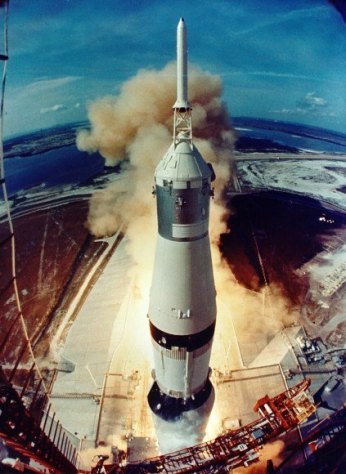
Apollo_11_insigniaThe 363′, 6,698,700-pound Saturn V launch vehicle lifted off from the John F. Kennedy Space Center on Merritt Island, Florida on July 16, carrying mission commander Neil Armstrong, Lunar module pilot Edwin “Buzz” Aldrin, and Command Module Michael Collins.

The Apollo spacecraft consisted of three components: a Command Module (CM) with a cabin for the three astronauts, a Service Module (SM) supporting the CM with propulsion, electrical power, oxygen, and water; and a Lunar Module (LM) for landing on the Moon. The vehicle was launched toward the moon by a Saturn V rocket, designed to break apart as each of a series of rocket stages were exhausted, and separated from the main craft.

The Command/Service Module passed behind the moon at 12:21 Eastern Standard Time on July 19, firing its service propulsion engine and inserting the craft into lunar orbit.

105338411-1531944151153nasamoonimage.530x298
The moon as seen from the International Space Station on July 9, 2018 H/T Alexander Gerst, NASA

Aldrin and Armstrong next moved into the LM, the only component to actually land on the lunar surface, with Collins remaining to orbit the moon in the CM.

Apollo_11_Lunar_Module_Eagle

The pair landed on a flat plain called the “Sea of Tranquility” on this day in 1969 at 4:18pm EST.  Half the world heard the words “Tranquility base, the eagle has landed”. Neil Armstrong stepped onto the lunar surface six hours later, with the words “That’s one small step for [a] man, one giant leap for mankind”.

charter-jet-gene-cernan-moonThese first two humans to set foot on the moon spent about 2½ hours on the surface. The pair collected nearly 50-lbs of material for transport back to earth, planting the American flag where it most likely remains, to this day.

Two days earlier, White House speechwriter William Safire had written an address, a speech to be delivered by President Richard Nixon, in case of failure. Twenty-five years earlier on the eve of the D-Day invasion, General Dwight D. Eisenhower penned a letter, taking personal responsibility for the mission’s failure. Like Eisenhower’s letter, President Nixon’s speech was never delivered.  The speech was entitled, “IN EVENT OF MOON DISASTER”

“Fate has ordained that the men who went to the moon to explore in peace will stay on the moon to rest in peace.
These brave men, Neil Armstrong and Edwin Aldrin, know that there is no hope for their recovery. But they also know that there is hope for mankind in their sacrifice.
These two men are laying down their lives in mankind’s most noble goal: the search for truth and understanding”…

The course of events envisioned by Richard Nixon’s speech writer, never came to be.  The upper part of the Lunar Module lifted off 21½ hours later, returning Armstrong and Aldrin to the Command Module.  Armstrong, Aldrin and Collins returned to earth and splashed down in the Pacific Ocean on July 24.  Three astronauts had made history.  The United States had had the last word in the space race, with the Soviet Union.

Apollo_17_The_Last_Moon_Shot_Edit1
The Apollo 17 Saturn V rocket was the last human flight to the moon
If you enjoyed this “Today in History”, please feel free to re-blog, “like” & share on social media, so that others may find and enjoy it as well. Please click the “follow” button on the right, to receive email updates on new articles.  Thank you for your interest, in the history we all share.