February 18, 1817 Frenemies

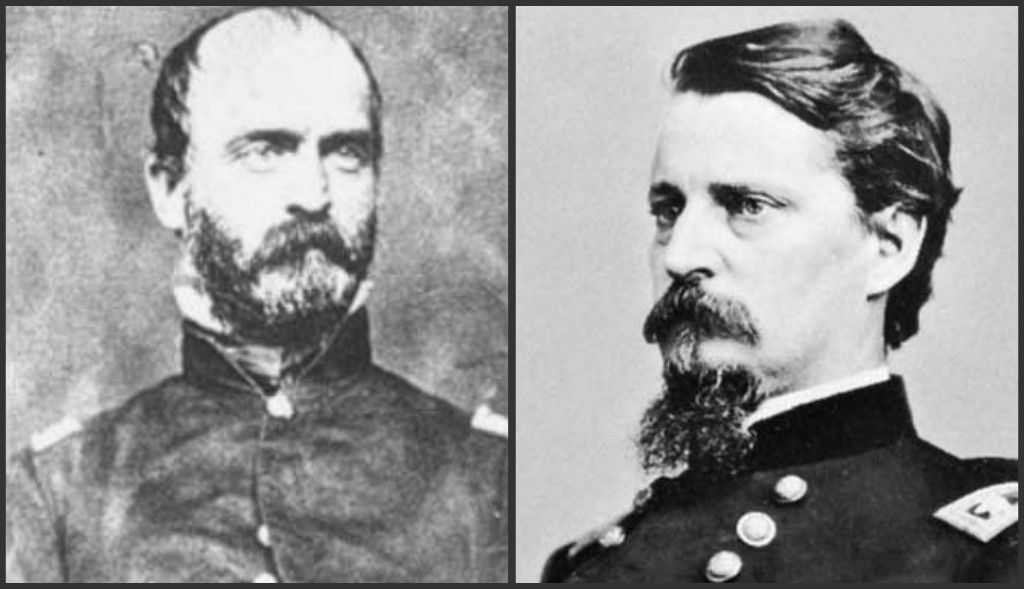
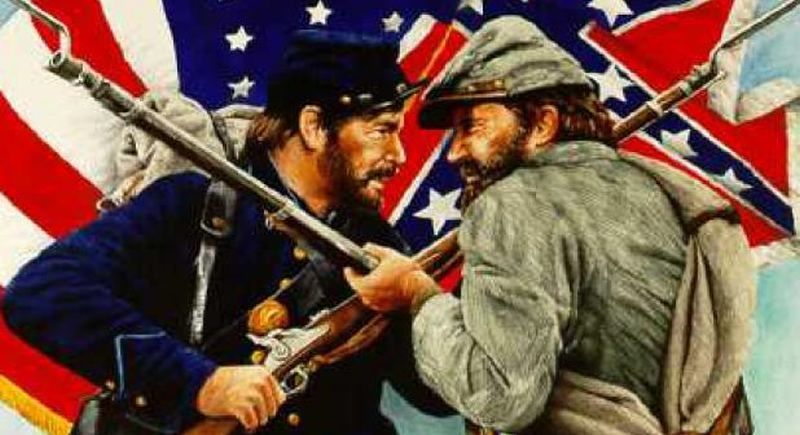
When the break came, each went his own way according to the dictates, of his conscience. Three years came and went before the old friends faced each other once again, this time across the field of battle, at a place called Gettysburg.

Armistead is a prominent name in Virginia.  The family goes back to colonial days.  Five Armistead brothers fought in the war of 1812. Major George Armistead commanded Fort McHenry during the Battle of Baltimore, the inspiration for Francis Scott Key’s Star Spangled Banner.

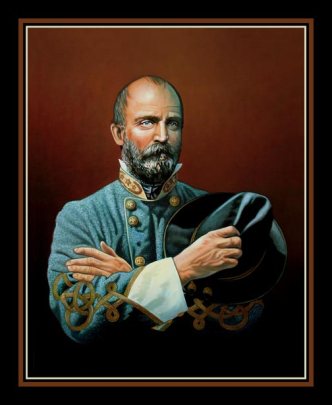
The Major became an uncle this day in 1817, to Lewis Addison Armistead, the first of eight children born to General Walker Keith and Elizabeth Stanley Armistead.

“Lothario” or “Lo” to his friends, Armistead followed the family footsteps, attending the Military Academy at West Point.  He never graduated.  Some say he had to resign after breaking a plate over the head of fellow cadet and future Confederate General, Jubal Early.  Others say the problem was due to academic difficulties, particularly French class.

armistead_image.0
Lewis Addison Armistead

Be that as it may, Armistead’s influential father gained him a 2nd Lieutenant’s commission awarded in 1839, about the time his former classmates, received theirs.

Armistead’s field combat experience reads like a time-line of the age:  cited three times for heroism in the Mexican-American War, wounded at the Battle of Chapultepec and going on to serve in the Mohave War and the Battle of the Colorado River.

Stellar military career though it was, the man’s personal life amounted to a series of unmitigated disasters.  Armistead survived two wives and two daughters, only to lose the family farm in a fire.  All while fighting a severe case of Erysipelas, a painful and debilitating Streptococcal skin infection known to the Middle Ages as “St. Anthony’s Fire”.

The act of conjugating the “Be” verb changed after the Civil War.  Before, it was the United States “are”.  Afterward, that became the United States “is”, and not for no reason.  This was a time when Patriotic Americans felt every bit the attachment to states, as to the nation itself.

Though often plagued with doubt, fellow Americans took sides on the eve of the Civil War.  Even brothers.   In common with fellow Virginian Robert E. Lee, Armistead wanted no part of secession, but followed his state when the break became inevitable.

Winfield Scott Hancock.gif
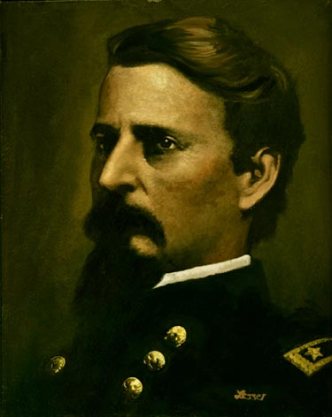
Winfield Scott Hancock

Pennsylvania native Winfield Scott Hancock went the other direction, staying with the Union.  Years later, “Hancock the Superb” would be the Democratic candidate for President of the United States, narrowly losing to Republican James A. Garfield.

At a time of rampant political corruption, Hancock was known for personal integrity.  Even though himself a Republican, President Rutherford B. Hayes spoke of the man in admiring terms:

“[I]f…we are to think first and chiefly of his manhood, his integrity, his purity, his singleness of purpose, and his unselfish devotion to duty, we can truthfully say of Hancock that he was through and through pure gold.”

Neither Armistead nor Hancock were politicians. Nor was either man the sort of hothead, who starting the war in the first place.  These were soldiers and patriots who served together and developed a close personal friendship, as early as 1844. 

When the break came, each went his own way according to the dictates, of his conscience. On the eve of Civil War, Armistead gave Hancock the gift of a new Major’s uniform.

Three years came and went before the old friends faced each other once again, this time across the field of battle, at a place called Gettysburg.

Robert E. Lee intended to break the Federal will to fight at Gettysburg, before moving on to threaten the Union capital in Washington DC.  “Marse Robert” attacked his adversary’s right on that first day, looking for a soft spot in the line. On day two, he went after the left.  On the afternoon of July 3, 1863, Lee came straight up the middle.

640px-Pickett's_Charge_defence
A Union perspective, from Cemetery ridge

Armistead and Hancock looked out across the same field as gray and butternut soldiers formed up along seminary ridge.  The action began with the largest bombardment in the history of the western hemisphere, the mighty crash of 170 guns spread over a two-mile front.  The attack lasted for an hour, most shells flying harmlessly over the Union line and exploding, in the rear.  One shell disturbed the lunchtime mess of that “damn old goggle-eyed snapping turtle” George Gordon Meade, cutting one orderly in half and sending much of the senior staff, diving for cover.

DSC_0430.jpg
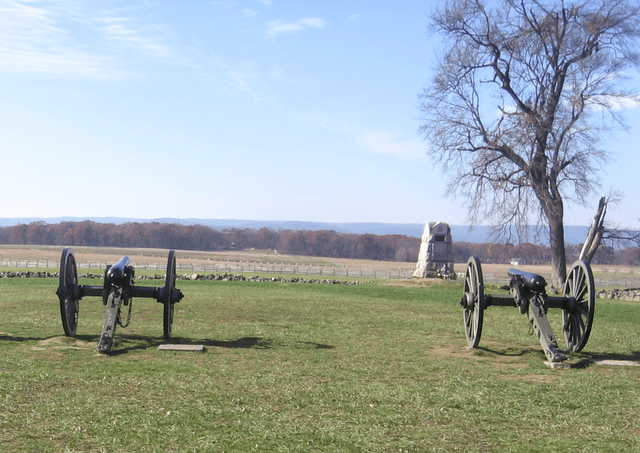
The crest known as Seminary Ridge formed the jump-off point for Longstreet’s assault, of the third day.

The eighty guns of the Union line responded but then went silent, one by one.  In the smoke and confusion, it was easy to believe the guns were put out of action, but no.  These would be held, until the final assault.

The action has gone into history as “Pickett’s Charge”, though it’s a misnomer.  Major General George Pickett commanded only one of three Divisions taking part in the assault, under Corps Commander Lieutenant General James Longstreet.

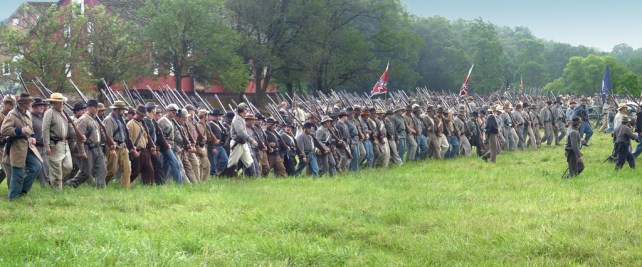
The pace was almost leisurely as Pickett’s, Trimble’s and Pettigrew’s gray and butternut soldiers stepped out of the forest, and over the stone wall.  Twelve to fifteen thousand men crossing abreast, bayonets glinting in the sun, banners rippling in the breeze.  One Yankee soldier described the scene as “an ocean of men sweeping upon us.”

longstreets-assault

If you’ve ever crossed that field, you can’t escape the sense of history. Stepping off Seminary Ridge with nearly a mile to go, you are awe struck by the mental image of thousands of blue clad soldiers, awaiting your advance.  First come the shells, exploding and tearing jagged holes, where men used to be.  Halfway across and just coming into small arms range, you can’t help a sense of relief as you step across a low spot and your objective, the “copse of trees”, drops out of sight.  If you can’t see them they can’t shoot at you, right?  Then you look to your right and realize that cannon would be firing down the length of your lines from Little Round Top, as would those on Cemetery Hill, to your left.

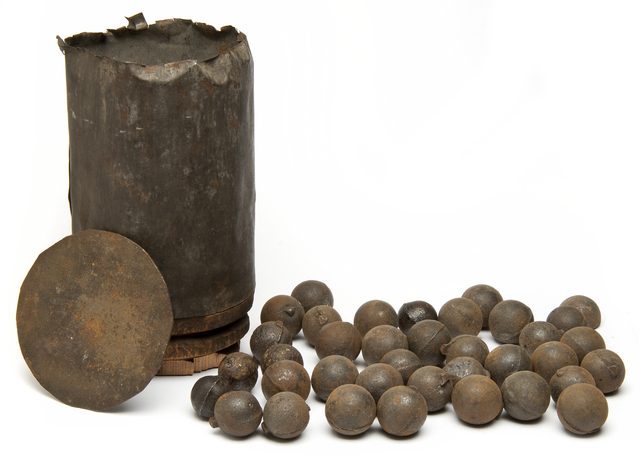
Rising out of the draw you are now in full sight of Union infantry.  You can almost hear the tearing fabric sound of rifle fire, exploding across the stone wall ahead.  Field guns have converted to canister by now, thousands of projectiles transforming federal artillery into giant shotguns.  You quicken your pace as your lines are torn apart from the front, right and left. Fences hold in some spots along the Emmitsburg Road.  Hundreds of your comrades are bunched up in the attempt to climb over, and mowed down where they stand.

6543.3.1-12
Canister shot, Gettysburg

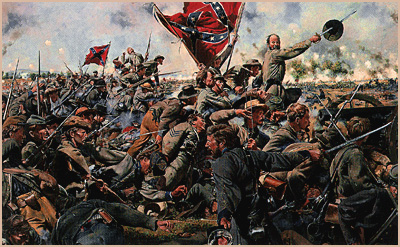
Finally you are over, and closing at a dead run.  Seeing his colors cut down, Armistead put his hat atop his sword, holding it high and bellowing above the roar of the guns “Come on, boys, give them the cold steel! Who will follow me!”

Picketts-Charge

Eight months before, Federal troops were cut down like grass on that frozen December, attacking the Rebel-held stone wall at Fredericksburg.  So numerous were the multitudes of dying and maimed as to inspire the Angel of Marye’s Heights, one of the great acts of mercy, in the history of war.

Now on this hot July day, came the payback.  All along the Union line, the chant arose to a roar, resounding above the din of battle:  “Fredericksburg! Fredericksburg! Fredericksburg!”

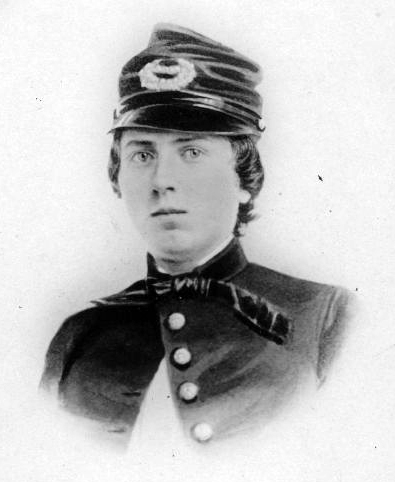
Alonzo Cushing

The savagery of that desperate struggle, can only be imagined.  With a shell fragment entering his shoulder and exiting his back and holding his own intestines with a free hand, Brevet Major Alonzo Cushing directed battery fire into the face of the oncoming adversary, until the bullet entered his mouth and exited the back of his skull.

150 years later, the 22-year-old received the Medal of Honor, posthumously awarded by President Barack Obama.

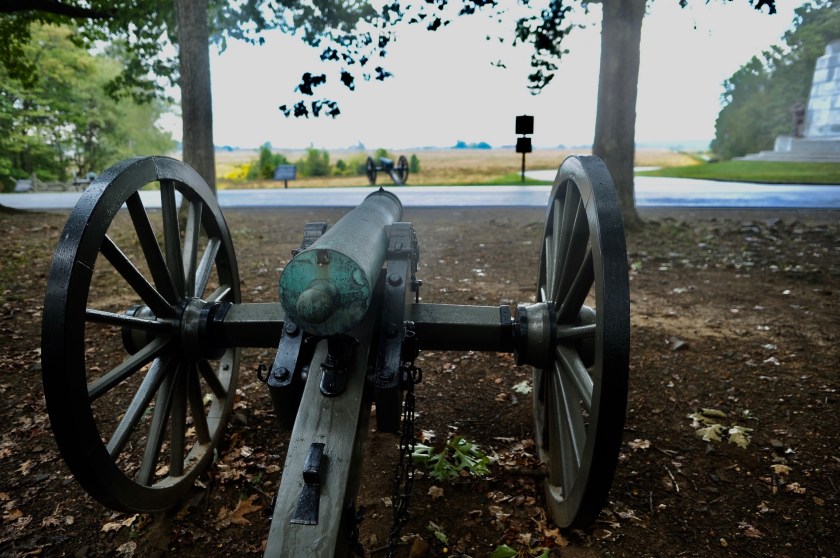
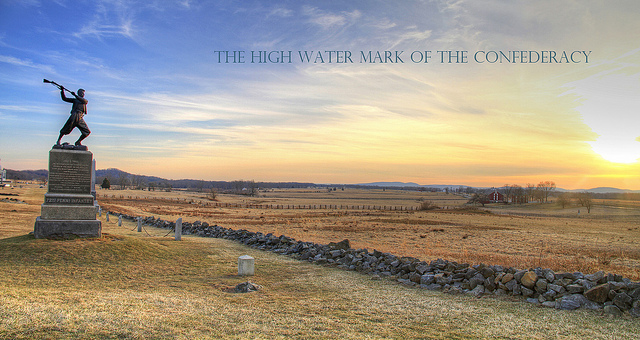
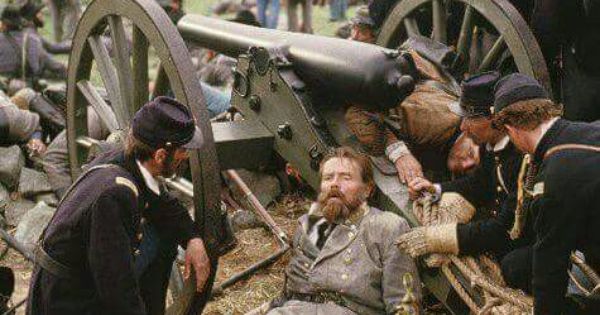
The “High Water Mark of the Confederacy” marks the point between the corner of a stone wall and that copse of trees, the farthest the shattered remnants of Longstreet’s assault would ever get.  Lewis Armistead made it over that wall before being shot down, falling beside the wheels of a Union cannon.

8507324952_e123a4eeb2_z

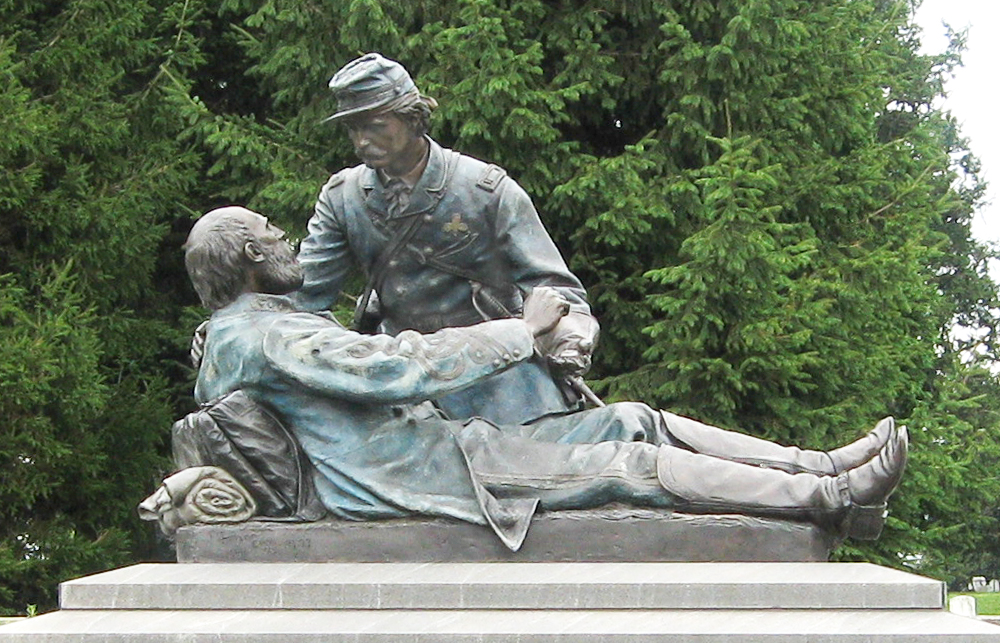
One day, the nation would reunite.  The two old friends, never did.  As Armistead sat bleeding in the grass, he was approached by Major Henry Bingham, of Hancock’s staff.  Hancock was himself wounded by this time, the bullet striking his saddle pommel and entering his thigh, along with shards of wood and a bent saddle nail.

Armistead was grieved at hearing the news.  Bingham received the General’s personal effects, with instructions they be brought to his old friend. To Almira (“Allie”) Hancock, the General’s wife, Armistead gave a wrapped bible and his personal prayer book, bearing the inscription ”Trust In God And Fear Nothing”.

ef0189df7a86e869ce2ee2304ab9fc1d
From the film, Gettysburg’

There are those who debate the meaning of Lewis Armistead’s last message, though the words seem clear enough: “Tell General Hancock for me that I have done him and you all an injury which I shall regret the longest day I live.”

February 18, 1817 The Awful Tragedy, of Friends at War

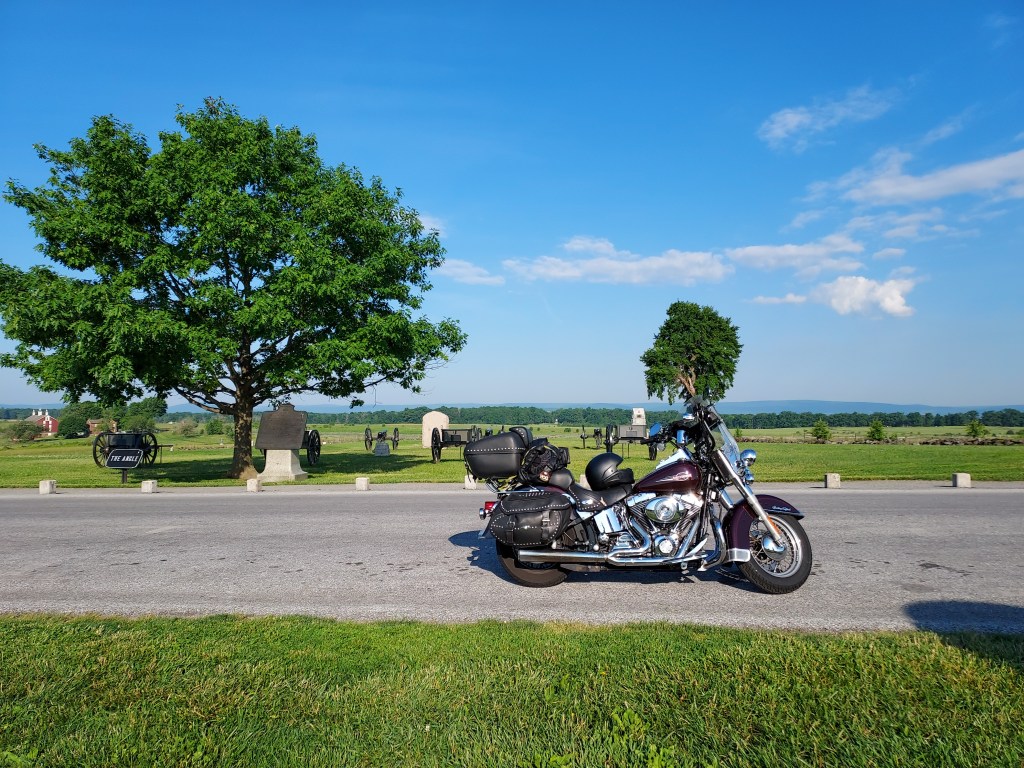
Last year my brother rode up from Alabama and I, down from Massachusetts. We met and paid respects at Dad’s grave in the Sandhills Veterans’ cemetery outside Fayetteville NC and then we were off, to the Blue ridge mountains. Eight days in the saddle, 13 states and 2,800 miles. After saying goodbye in Virginia you know where I had to go next…right?

If you’ve never been. I recommend the trip. The High Water Mark of the Confederacy is always worth the ride.

The High Water mark of the Long brothers’ epic ride, of 2022

February 17, 1864 Hunley

A lesser-known Civil War tale this one’s got it all. History, mystery, romance and science, all set in a time and place where it was kill or be killed.

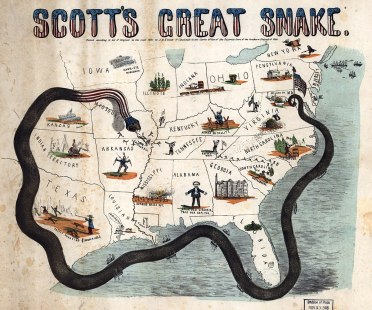
During the 1850s, the southern United States’ economy was mostly agrarian.  When civil war broke out in 1861, Confederate states depended to a greater degree on imported manufactured goods, compared with the more industrialized states to the north.  For the Union, there was strategic advantage in cutting off this flow of manufactured goods.  General Winfield Scott proposed the “Anaconda Plan”, a naval blockade aimed at choking off traffic to southern ports and harbors.

1200px-Scott-anaconda
Civil War-era cartoon depicts Winfield Scott’s “Great Snake”

Few in the Confederacy understood the need to keep southern ports open as well as the planter, legislator, and southern patriot, Horace Lawson Hunley.

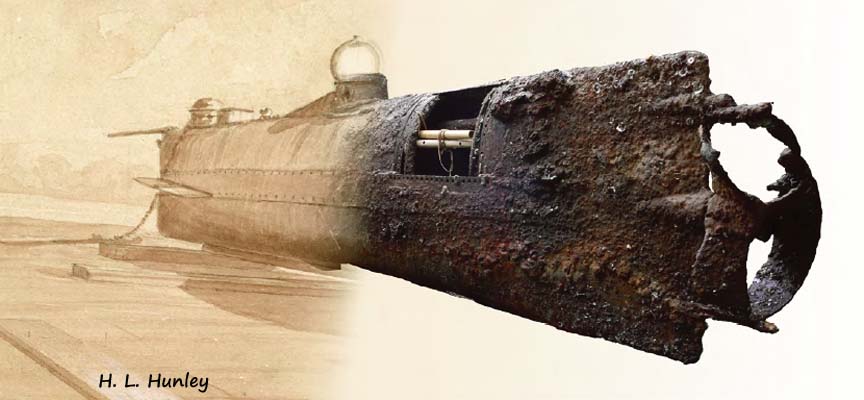
In 1861, Hunley joined forces with James McClintock and Baxter Watson to design and build a secret Confederate Super Weapon.  A submarine.  The trio completed construction on its first effort, the Pioneer, that same year in New Orleans.  The team went on to build two more submarines in Mobile, Alabama:  the American Diver, and the last and most successful creation, the “Fishboat“, later renamed HL Hunley.

Conrad_Wise_Chapman_-_Submarine_Torpedo_Boat_H.L._Hunley,_Dec._6,_1863
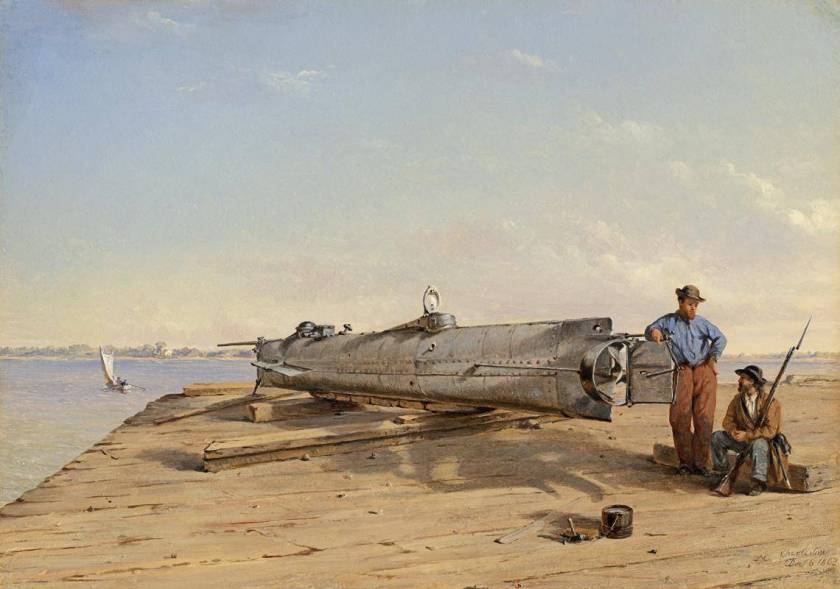
An oil painting by Conrad Wise Chapman, “Submarine Torpedo Boat H.L. Hunley, Dec. 6, 1863”

After a short sea trial in Mobile, the Hunley was put on a train and shipped to Charleston, South Carolina, to help break the blockade.  Arriving on August 12, 1863, she was 40′ long by 4′ wide, displacing about 7½ tons.  She was designed for a crew of 8, with 7 operating a hand crank and the 8th steering the boat.

A test run on August 29 ended in disaster, when Skipper John A. Payne accidentally stepped on the lever controlling the diving planes with hatches open.  Payne and two others escaped. The other five crew members went to the bottom.

confederates

A second crew tested the submarine on October 15, this one including Horace Hunley himself.  The submarine conducted a mock attack but failed to surface afterward, this time drowning all 8 crew members.

Despite two disastrous test runs, there was no shortage of volunteers.  Once again, the Hunley was fished up from the bottom.

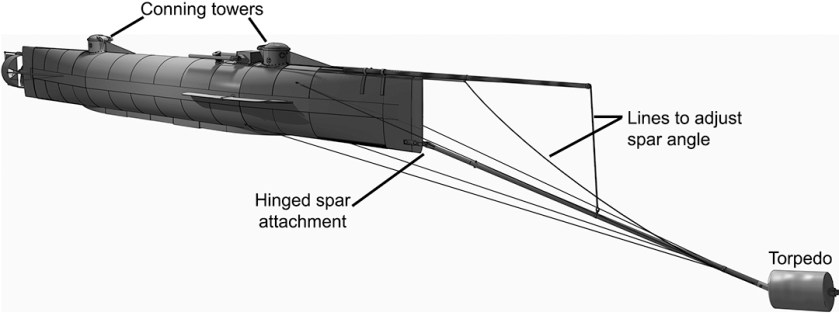
The original plan was to tow a floating mine called a “torpedo”, with a contact fuse.  Hunley would dive beneath her victim and surface on the other side, pulling the torpedo into the side of the target.

images (21)

Tide and current conditions in Charleston proved quite different from those in Mobile.  On several test runs, the torpedo floated out ahead of the sub.  That wouldn’t do, so a spar was fashioned and mounted to the bow.  At the end of the spar was a 137-pound waterproof cask of powder, attached to a harpoon-like device with which Hunley would ram its target.

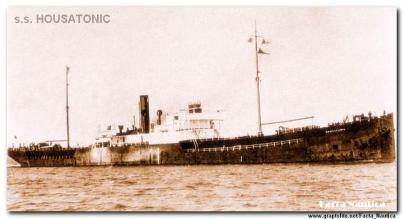
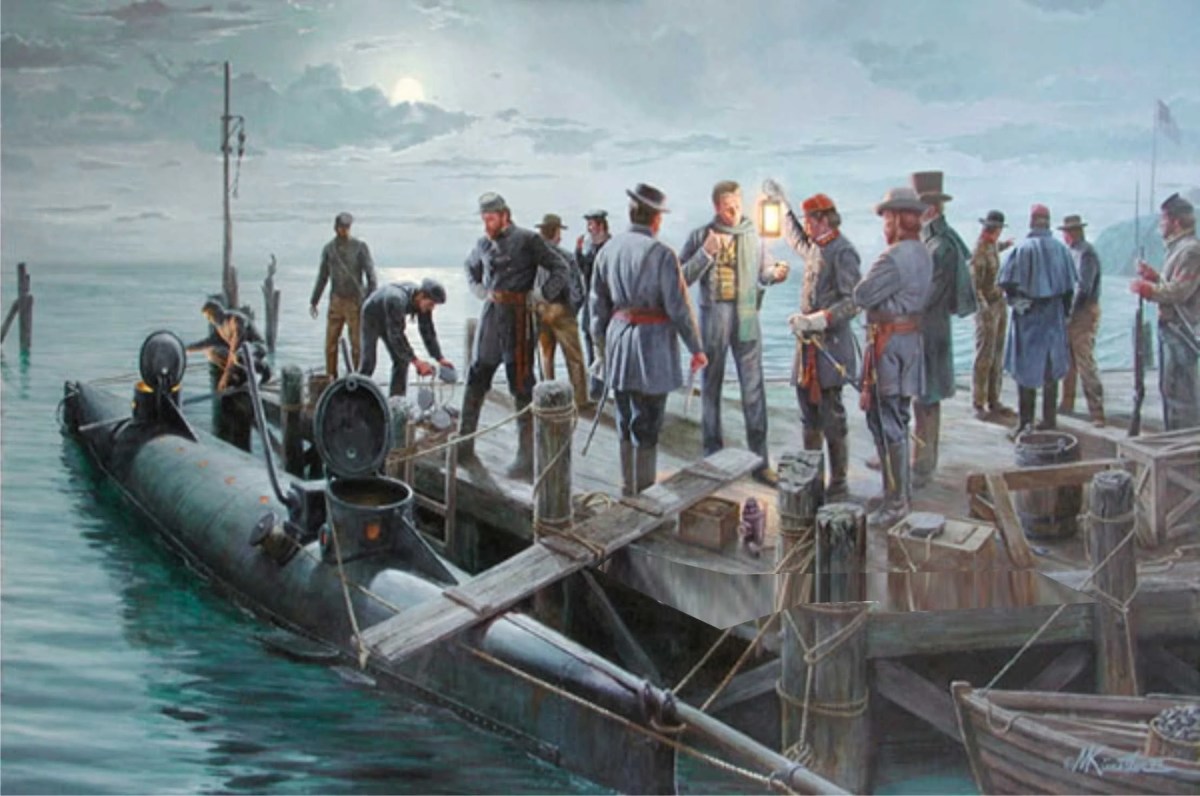
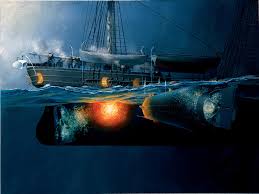
Four miles outside of Charleston Harbor, Hunley made her first live attack run on the night of February 17, 1864. Lieutenant George Dixon and a crew of seven attacked USS Housatonic, a 1,240-ton steam powered sloop of war, embedding the spar torpedo into Housatonic’s hull.  It must have been a sight to see.  The torpedo ignited a 4,000-pound store of black powder in the hull of the ship, exploding with a deafening roar and a towering column of flame that lit up the night.

Housatonic was gone in three minutes, killing five sailors.  What happened next, is a mystery. 

February 17, 1864  My life Preserver

The first submarine in history to attack and sink an enemy warship, vanished.  The Hunley crew would not see the light of day, for 136 years.

Author and adventurer Clive Cussler found HL Hunley in 1995, buried in silt under 32-feet of water.  A painstaking, five year effort was launched to bring Hunley to the surface and on August 8, 2000, Horace Hunley’s submarine returned to the light of day.  The sub was moved to the Warren Lasch Conservation Center in the Charleston Navy Yard and submerged in 55,000 gallons of chilled, fresh water, where scientists and historians worked to unlock her secrets.

And secrets there were, in plenty. Why did Hunley sink in the first place? Why were 8 men drowned at their stations and not crowded around exit portholes? And what led to an aerobic gradient forming inside the silted-in submarine, as evidenced by the remarkable state of remains at one end, and near-skeletal states at the other?

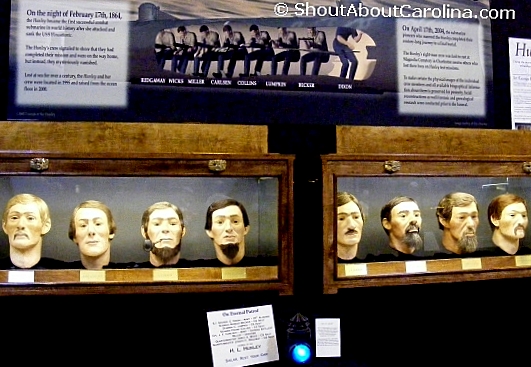
The forensic work alone which brought these faces back to the light of day, is worth the trip to Charleston.

hunley-submarine-crew-facial-reconstruction
Forensic facial reconstructions techniques bring back the faces of the last crew of HL Hunley

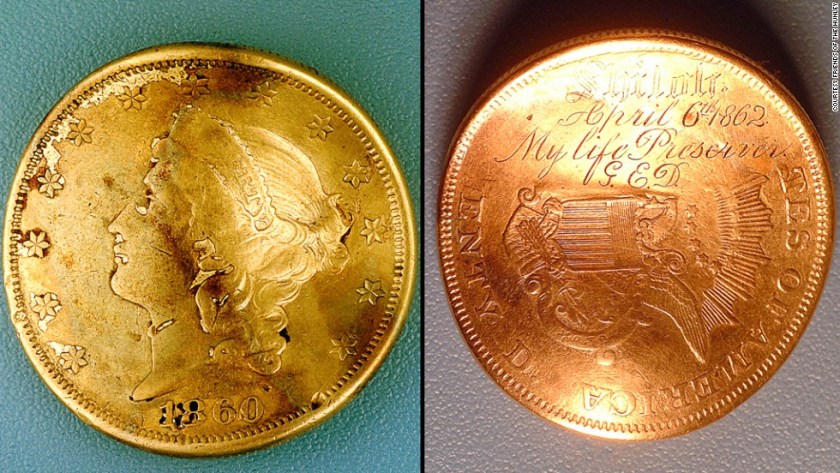
An old rumor was repeated over the years, that Lieutenant Dixon left a girlfriend behind in Mobile, Alabama. Her name was Queenie Bennett.  She had given Dixon a $20 gold piece as the story goes, a good luck charm and token of her affection.  In April 1862, Dixon was shot in the hip at Shiloh, a wound that should have killed him.  Had the bullet not struck the $20 gold piece in the man’s pocket.

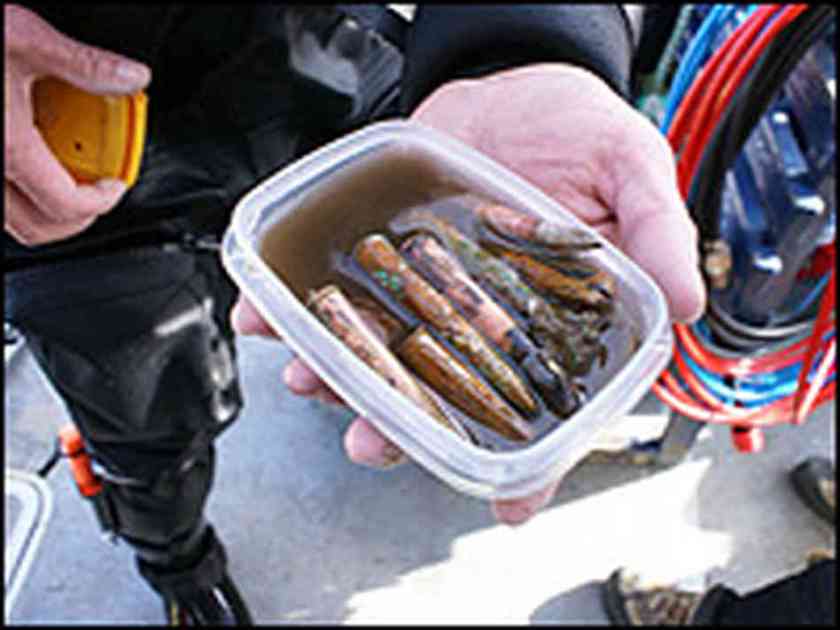
Until excavation began inside the sub, no one knew if that story was true.  Clad in wetsuit, senior Archaeologist Maria Jacobsen carefully worked to excavate the ancient machine of war. It was she who found the coin, next to the remains of George E. Dixon. 

140214143335-07-hl-hunley-coin-horizontal-large-gallery

“Some people may think this is a stroke of luck,” she said, “but perhaps it’s something else. They tell me that Lt. Dixon was a lady’s man, perhaps he winked at us yesterday to remind us that he still is”.

Senior Archaeologist Maria Jacobsen

On reverse side of the coin displaying clearly visible signs of having been struck by a bullet, are inscribed these words:

Shiloh
April 6, 1862
My life Preserver
G.E.D.

February 16, 600 Bless You

No fewer than 97 languages from Amharic (yimarish for women and yimarih for men) to Māori (manaakitia koe) to Yiddish (tsu gezunt) and even Esperanto (Sanon) offer similar blessings, for those who sneeze.

Emerging as we are following two years of worldwide pandemic, the modern mind can scarcely imagine the world experienced by out medieval ancestors, afflicted with the Bubonic Plague. Yersinia Pestis.

Peaking between 1346 and 1353, the “Black Death” was the most deadly pandemic in human history, killing an estimated 75 to 200 million at a time when worldwide population stood less than a half-million.

European populations took 200 years to recover.

Even so, this was far from the first. Modern research points to the existence of Y. Pestis in ancient Swedish tombs, indicating a possible role in the “Neolithic Decline” in which European populations collapsed, some 5-6 thousand years ago.

The Plague of Justinian (541–542 CE, with recurrences until 750) was the first worldwide pandemic brought about by Y. Pestis. Populations from China to Roman Britain were decimated with particular emphasis, on the Sassanian and Byzantine empires. While numbers are uncertain, Procopius wrote of 10,000 dying every day in Constantinople, alone.

In 590, Pope Pelagius II succumbed to the “Black Death” leading to the election of Gregory I, one of the last popes to retain his baptismal name.

Fun Fact: In the early centuries of the Roman church, popes retained baptismal names. In 533, Mercurius was elected head of the worldwide Catholic Church.  Deeming it inappropriate that the Bishop of Rome carry the name of a pagan Roman god, Mercurius adopted the papal name John II in honor of his predecessor, venerated as a martyr. Since 1555, all Popes have adopted a Pontificial name as well as an Italian name,  in honor of Vatican citizenship.

Today we remember Gregory also for the Gregorian chant, but not for the eponymous calendar. That would come to us from a later Gregory.

Around the time of Gregory I, it was believed (with some justification) that sneezing spread the plague. Many believed in addition, that the soul briefly departed the body during a sneeze, rendering the…err…sneezer, temporarily vulnerable to demonic possession.

So it was on this day, February 16, 600, Pope Gregory I issued a papal bull. A decree, requiring all Christians to invoke the blessings of God, when in the presence of anyone who sneezed.

“The phrase, God bless you, became a sort of protection or verbal talisman to protect the sneezer. We see similar practices in other cultures. For example, the Spanish “Salud” (health), German “Gesundheit” (health), Gaelic “Dia dhuit” (God be with you), and Bengali “Jeebo” (stay alive) are all responses to sneezing”.

H/T compellingtruth.org
ROME, ITALY: This picture taken 26 January 2005 shows Pope John Paul II sneezing during his weekly general audience at the Vatican. Vatican officials 02 February 2005 said they had delayed an early morning health update on the 84-year-old Pope John Paul II, who was admitted to hospital suffering from breathing problems after falling ill with the flu. According to initial reports, the pope spend a “fairly good night” in hospital and was to undergo tests on Wednesday. AFP PHOTO/ PATRICK HERTZOG (Photo credit should read PATRICK HERTZOG/AFP via Getty Images)

While the origins are murky, it seems ol’ Gregory didn’t invent the idea. He just…ordered it. So it is by the year 750, “God Bless You” became the near-universal response to a sneeze and remains so, to this day.

No fewer than 97 languages from Amharic (yimarish for women and yimarih for men) to Māori (manaakitia koe) to Yiddish (tsu gezunt) and even Esperanto (Sanon) offer similar blessings, for those who sneeze.

Today, a sneeze is understood to be the body’s way of ejecting an irritant. But, did you know? An estimated 18% to 35% of the population sneezes, when subjected to sudden, bright light. Gesundheit.

February 10, 1920 Lena Blackburne’s Baseball Rubbing Mud

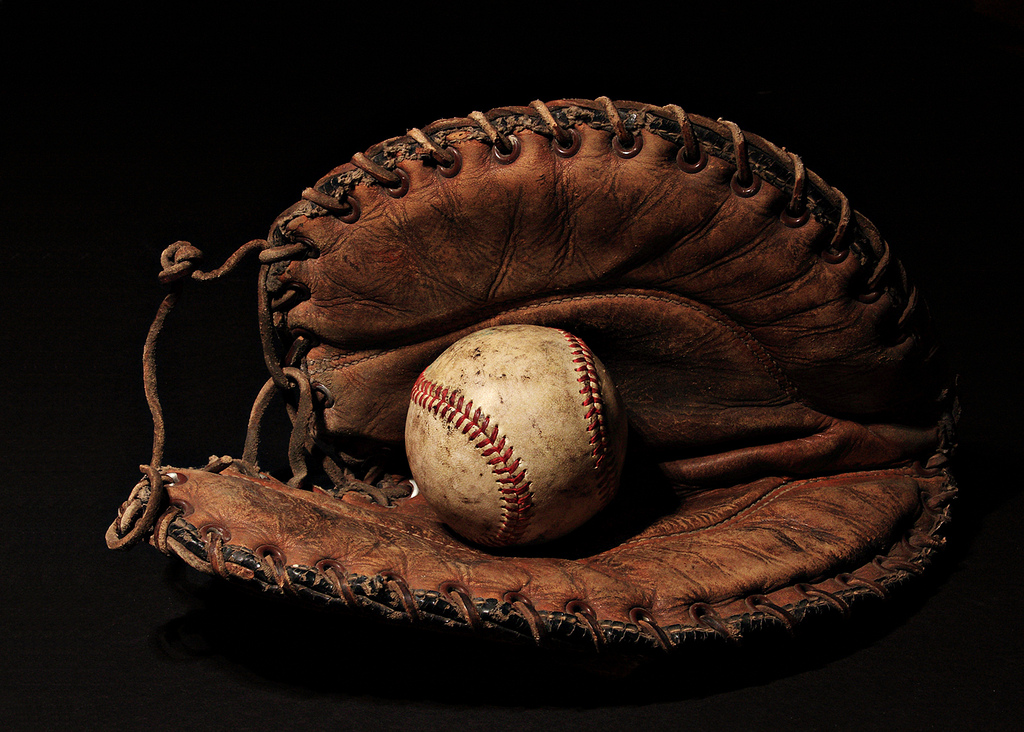
The age of one-ball-per-game died with Ray Chapman, and with it the era of the dead ball. The lively ball era, had begun. Batters loved it, but pitchers complained about having to handle all those shiny new balls.

Former Boston Braves pitcher Max Surkont once quipped, “Baseball was never meant to be taken seriously — if it were, we would play it with a javelin instead of a ball”. I’m not sure about javelins, but I do know how much we all love to see to see that ball, hit out of the park.

Yes, home runs ae fun, but that’s not always how the game was played. The “Hitless Wonders” of the Chicago White Sox won the 1906 World Series with a .230 club batting average. Manager Fielder Jones said “This should prove that leather is mightier than wood”.  Fielder Allison Jones. Yeah, that’s the man’s real name.  Is that the greatest baseball name ever, or what?

deadballparks

This was the “dead-ball” era, when an “inside baseball” style of play relied on stolen bases, hit-and-run plays and, more than anything else, speed.

That’s not to say there were no power hitters. In some ways, a triple may be more difficult than a home run, requiring a runner to cover three bases in the face of a defense still in possession of the ball. Pittsburgh Pirates outfielder Owen “Chief” Wilson set a record of 36 triples in 1912. “Wahoo” Sam Crawford hit a career record 309 triples during 18 years in Major League Baseball, playing for the Cincinnati Reds and Detroit tigers between 1899 and 1917. 100 years later, it’s unlikely that either record will ever be broken.

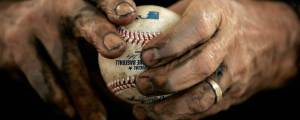
In his 1994 television miniseries “Baseball”, Ken Burns commented that “Part of every pitcher’s job was to dirty up a new ball the moment it was thrown onto the field… They smeared it with dirt, licorice, and tobacco juice; it was deliberately scuffed, sandpapered, scarred… and as it came over the plate, [the ball] was very hard to see.”

dead-ball

Spitballs lessened the natural friction with a pitcher’s fingers, reducing backspin and causing the ball to drop. Sandpapered, cut or scarred balls tended to “break” to the side of the scuff mark. Balls were rarely replaced in those days.  By the end of a game, the ball was scarred, misshapen and entirely unpredictable. 

On February 10, 1920, Major League Baseball outlawed “doctored” pitches, though it remained customary to play an entire game with the same ball.

The first ever game to be played “under the lights” was forty years in the past in 1920, but it would be another 15 before the practice became widespread.

submarine-pitcher

It was late afternoon on August 16 of that year, when the Cleveland Indians were playing the New York Yankees at the Polo Grounds. Cleveland shortstop Ray Chapman took the plate in the top of the 5th, facing “submarine” pitcher Carl Mays.  These are not to be confused with the windmill underhand pitches we see in softball.  Submarine pitchers throw side-arm to under-handed, their upper bodies so low that some of them scuff their hands on the ground, the ball rising as it approaches the strike zone.

Chapman never moved, he seems not to have seen it coming. The crack of the ball hitting his head was so loud that Mays thought he had hit the end of the bat, fielding the ball and throwing to first for the out. Wally Pipp, the first baseman better known for losing his starting position to Lou Gehrig because of a headache, immediately knew something was wrong. The batter made no effort to run, but slowly collapsed to the ground with blood streaming from his left ear.

ray_chapman_grave

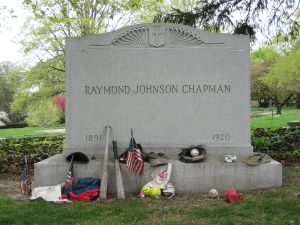
29-year-old Ray Chapman had said this was his last year playing ball.  He wanted to spend more time in the family business he had just married into. The man was right.  Raymond Johnson Chapman died 12 hours later, the only player in the history of Major League Baseball, to die from injuries sustained during a game.

new-balls

The age of one-ball-per-game died with Ray Chapman, and with it the era of the dead ball. The lively ball era, had begun. Batters loved it, but pitchers complained about having to handle all those shiny new balls.

MLB rule #3.01(c) states that “Before the game begins the umpire shall…Receive from the home club a supply of regulation baseballs, the number and make to be certified to the home club by the league president. The umpire shall inspect the baseballs and ensure they are regulation baseballs and that they are properly rubbed so that the gloss is removed. The umpire shall be the sole judge of the fitness of the balls to be used in the game”.

Umpires would “prep” the ball using a mixture of water and dirt from the field, but this resulted in too-soft covers, vulnerable to tampering. Something had to take the shine off the ball without softening the cover.

rubbing-mud

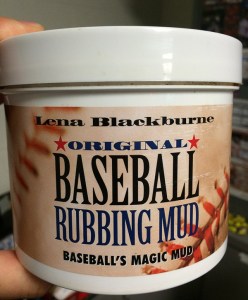
Philadelphia Athletics third base coach Lena Blackburne took up the challenge in 1938, scouring the riverbanks of New Jersey for just the right mud. Blackburne found his mud hole, describing the stuff as “resembling a cross between chocolate pudding and whipped cold cream”. By his death in the late fifties, Blackburne was selling his “Baseball Rubbing Mud” to every major league ball club in the country, and most minor league teams.

rubbing-mud-2

In a world where classified information is kept on personal email servers, there are still some secrets so pinky-swear-double-probation-secret that the truth may Never be known. Among them Facebook “Community Standards” algorithms, the formula for Coca Cola, and the Secret Swamp where Lena Blackburne’s Baseball Rubbing Mud comes from.

Nobody knows, but one thing is certain. The first pitchers will show up to the first spring training camp, a few short days short days from now. From 1938 to the present day, every baseball thrown from pre-season to the World Series, will be first de-glossed using Lena Blackburne’s famous, Baseball Rubbing Mud.

Play ball.

February 9, 1945 Battle of the Atlantic

Submarines operate in 3-dimensional space while their most effective weapon, does not.  The torpedo is a surface weapon, operating in two-dimensional space:  left, right and forward.  Firing at a submerged target requires that the torpedo be converted to neutral buoyancy, introducing near-insurmountable complexity into firing calculations.

submarine

In 1939, the impending Nazi invasion of Poland was an open secret.    On August 25th, the United Kingdom and Poland signed Polish-British Common Defense Pact, adding to the Franco-Polish Military Alliance, from the early 20s.  Should Poland be invaded by a foreign power, England and France were now committed to intervene.

atlantic-convoy

In August, the first fourteen “Unterseeboots” (U-boats) departed bases and fanned out across the North Atlantic. The German invasion of Poland began on September 1. 

Even then, Hitler believed that war with England and France could be avoided, the “Kriegsmarine” under strict orders to follow the “Prize Regulations” of 1936. 

England and France declared war on Nazi Germany on the 3rd. Hours later, U-30 Oberleutnant Fritz Julius Lemp fired a torpedo into the British liner SS Athenia.  Lemp had mistakenly believed her to be an armed merchant vessel and fair game under Prize Regulations, but the damage was done.  The longest and most complex naval battle in history, had begun.

As in WWI, both England and Germany were quick to implement blockades on one another.   And for good reason.  By the time that WWII was in full swing, England alone would require over a million tons a week of imported goods, in order to survive and to fight the war.

The “Battle of the Atlantic” lasted 5 years, 8 months and 5 days, ranging from the Irish Sea to the Gulf of Mexico, from the Caribbean to the Arctic Ocean.  Winston Churchill would opine as only Winston Churchill could, “The Battle of the Atlantic was the dominating factor all through the war. Never for one moment could we forget that everything happening elsewhere, on land, at sea or in the air depended ultimately on its outcome”.

usmm

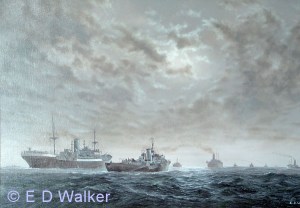
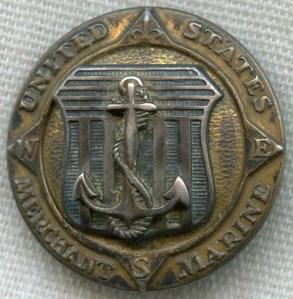
Thousands of vessels were involved in over a hundred convoy battles, with over 1,000 single ship encounters unfolding across a theater thousands of miles wide.  According to www.usmm.org, the United States Merchant Marine suffered the highest percentage of fatalities of any American service branch, at 1 in 26 compared to one in 38, 44, 114 and 421 respectively, for the Marine Corps, Army, Navy and Coast Guard.

New weapons and tactics would shift the balance in favor of one side and then the other.  In the end over 3,500 merchant ships and 175 warships would be sunk to the bottom, compared with the loss of 783 U-boats.

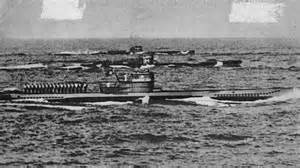
The most unusual confrontation of the war occurred on this day in 1945, in the form of a combat action between two submerged submarines. 

Submarines operate in 3-dimensional space while their most effective weapon, does not.  The torpedo is a surface weapon, operating in two-dimensional space:  left, right and forward.  Firing at a submerged target requires that the torpedo be converted to neutral buoyancy, introducing near-insurmountable complexity into firing calculations.

u-864
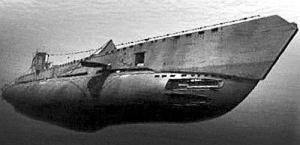
U-864

The war was going badly for the Axis Powers in 1945, the allies enjoying near-uncontested supremacy over the world’s shipping lanes.  At this time, any surface delivery between Nazi Germany and Imperial Japan was likely to be detected and stopped. 

The maiden voyage of the 287-foot, 1,799 ton German submarine U-864 departed on “Operation Caesar” on December 5, delivering Messerschmitt jet engine parts, V-2 missile guidance systems, and 65 tons of mercury to the Imperial Japanese war production industry.

u-864-location

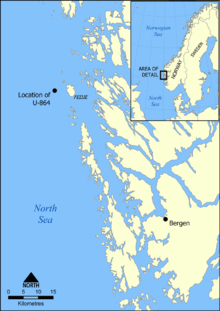
The mission was a failure, U-864 having to retreat to the submarine pens in Bergen, Norway, for repairs after running aground in the Kiel Canal.  The sub cleared the island of Fedje off the Norway coast undetected on February 6.  By this time, MI6 had broken the German Enigma code.  British Intelligence was well aware of Operation Caesar.

The British submarine Venturer, commanded by 25-year-old Lieutenant Jimmy Launders, was dispatched from the Shetland Islands to intercept and destroy U-864.

An early form of sonar called ASDIC would have been far more helpful in locating U-864, but at a price.  That familiar “ping” would have been heard by both sides, alerting the German commander that he was being hunted.  Launders opted instead for hydrophones, a passive listening device which could alert him to external noises.  Calculating his adversary’s direction, depth and speed was vastly more complicated without ASDIC, but the need for stealth won out.

Developing an engine noise he feared might give him away, U-864’s commander, Ralf-Reimar Wolfram decided to return to Bergen for repairs.  German submarines of the age were equipped with “snorkels”, heavy tubes capable of breaking the surface, enabling diesel engines and crews to breathe while running submerged.  Venturer was on batteries when the first sounds were detected, giving the British sub the stealth advantage but sharply limiting the time frame in which she could act.

u-864-wreck

A four dimensional firing solution accounting for time, distance, bearing and target depth was theoretically possible, but had rarely been attempted under combat conditions.  Plus, there were unknown factors which could only be approximated.

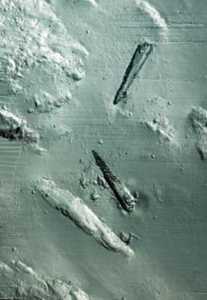
A fast attack sub, Venturer only carried four torpedo tubes, far fewer than her much larger adversary.  Launders calculated his firing solution, ordering all four tubes readied and firing in pairs with a 17½ second delay.  With four incoming at different depths, the German sub didn’t have time to react.  Wolfram was only just retrieving his snorkel and converting to electric when the #4 torpedo slammed home.  U-864 imploded and sank, instantly killing all 73 aboard.

Surface actions between all manner of vessels were common enough during World War 2. A fully submerged submarine to submarine kill occurred only one time during World War I, when the German U-27 torpedoed and sank the British sub HMS E3 on October 18, 1914, with the loss of all 28 aboard.  Such an action occurred only this one time during all of World War II, taking place on February 9, 1945.

January 23, 1960 Into the Abyss

If you could somehow pull up Mt. Everest by the roots and sink the thing in Challenger Deep, (this is the largest mountain on the planet we’re talking about), you would still have swim down 1.2 miles, to get to the summit.

Most of us experience the ocean as a day at the beach, a boat ride, or a moment spent on one end of a fishing line.

The global ocean divided into five major basins: the Pacific, Atlantic, Indian, Southern, and Arctic. Covering 70 percent and more of the planet and taken together, the oceans contain 97% of all the water on planet earth.

And yet the exploration of all that water has never added up to more than 20 percent.

For most dive organizations, the recommended maximum for novice divers is 20 meters (65 feet). A weird form of intoxication sets in called nitrogen narcosis, around 30 meters (98 feet). Divers have been known to remove their own mouthpiece and offer it to fish, with tragic if not predictable results. Dives beyond 130 feet enter the world of “technical” diving involving specialized training, sophisticated gas mixtures and extended decompression timetables. The oxygen we rely on for life literally becomes toxic, around 190 feet.

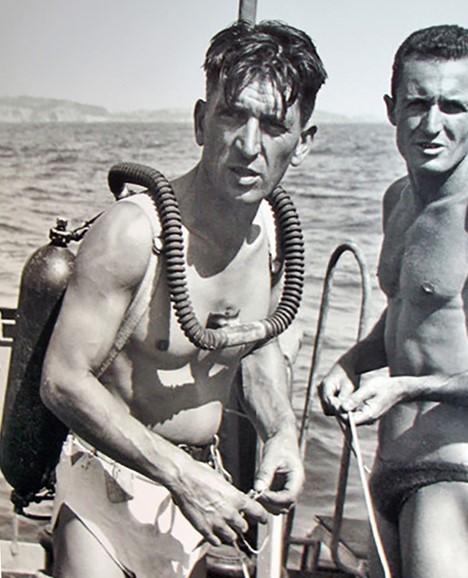
On September 17, 1947, French Navy diver Maurice Fargues attempted a new depth record, off the coast of Toulon. Descending down a weighted line, Fargues signed his name on slates placed at ten meter intervals. At the three minute mark, the line showed no sign of movement. The diver was ordered pulled up. Maurice Fargues, a diver so accomplished he had literally saved the life of Jacques Cousteau only a year earlier, was the first diver to die using an aqualung. His final signature on the last tablet, at 390 feet.

The man had barely scratched the surface.

Maurice Fargues prepares for what would prove to be, his final dive

For oceanographers, all that water is divided into slices. The top or epiplagic Zone descends from 50 to 656 feet, depending on clarity of the water. Here, phytoplankton convert sunlight to energy forming the first step in a food chain, supporting some 90 percent of all life in the oceans. 95 percent of all photosynthesis in the oceans occur in the epiplagic or photic zone.

The mesopelagic or “twilight zone” receives a scant 1% of all sunlight. Temperatures descend as salinity increases while the weight of all that water above, increases. Beyond that, lies the abyss.

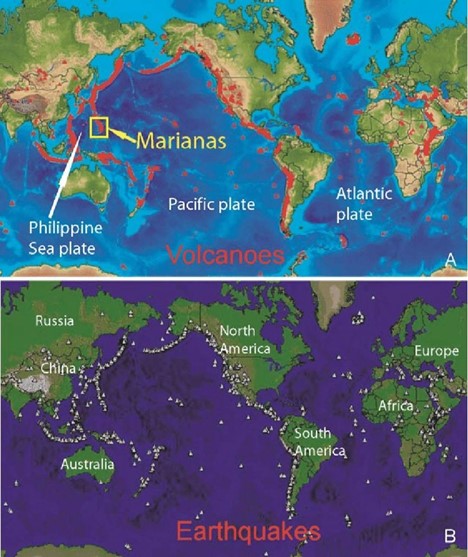
Far below that the earth’s mantle is quite elastic, broken into seven or eight major pieces and several minor bits called Tectonic Plates. Over millions of years these plates move apart along constructive boundaries, where oceanic plates form mid-oceanic ridges. The longest mountain range in the world as an example, runs roughly down the center of the Atlantic ocean.

The Atlantic basin features deep trenches as well, sites of tectonic fracture and divergence. Far deeper than those are the Pacific subduction zones where forces equal and opposite to those forming the mid-Atlantic ridge, collide. One plate moves under another and down into the mantle forming deep oceanic ridges, the deepest of which is the Mariana Trench, near Guam. The average depth is 36,037, ± 82 feet, dropping off to a maximum depth of 35,856 feet to a small valley at the south end of the trench, called Challenger Deep.

If you could somehow pull up Mt. Everest by the roots and sink the thing in Challenger Deep, (this is the largest mountain on the planet we’re talking about), you would still have swim down 1.2 miles, to get to the summit.

The air around us is a liquid with a ‘weight’ or barometric pressure at sea level, of 14.696 pounds per square inch. It’s pressing down on you right now but you don’t feel it, because your internal fluid pressures, push back. A column of salt water exerts the same pressure at 10 meters, or 33 feet.

To consider the crushing weight of all that water, consider this. The bite force of an American Grizzly is 1,200 psi. The Nile Crocodile, 5,000. The pressure in Challenger Deep is equal to 1,150 atmospheres. Over 16,000 pounds per square inch.

The problems with reaching such a depth are enormous. WW2 era German submarines collapsed between 660 and 900 feet, with the loss of all hands. The modern American Sea Wolf class of nuclear submarine is said to have a crush depth, of 2,400 feet.

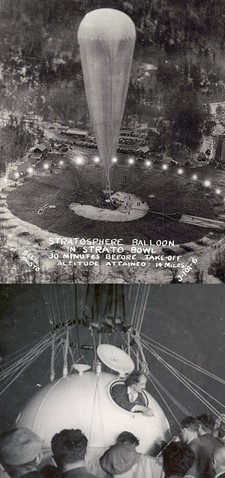
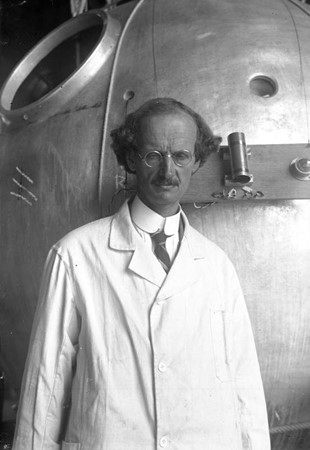
In the early 1930s, Swiss physicist, inventor and explorer Auguste Piccard experimented with high altitude balloons to explore the upper atmosphere.

The result was a spherical, pressurized aluminum gondola capable of ascending to great heights, without the use of a pressure suit.

Within a few years the man’s interests had shifted, to deep water exploration.

Knowing that air and water are both fluid environments, Piccard modified his high altitude cockpit into a steel gondola, for deep sea exploration. By 1937 he’d built his first bathyscaphe.

“A huge yellow balloon soared skyward, a few weeks ago, from Augsberg, Germany. Instead of a basket, it trailed an air-thin black-and-silver aluminum ball. Within [the contraption] Prof. Auguste Piccard, physicist, and Charles Kipfer aimed to explore the air 50,000 feet up. Seventeen hours later, after being given up for dead, they returned safely from an estimated height of more than 52,000 feet, almost ten miles, shattering every aircraft altitude record.” – Popular Science, August, 1931

Piccard’s work was interrupted by World War 2 but resumed, in 1945. He built a large steel tank and filled it with low-density non-compressible fluid, to maintain buoyancy. Gasoline, it turned out, would do nicely. Underneath was the capsule designed to accommodate one person at sea-level pressure while outside, PSI mounted into the thousands of atmospheres.

Auguste Piccard

The craft, with modifications from the French Navy, achieved depths of 13,701 feet. In 1952, Piccard was invited to Trieste Italy, to begin work on an improved bathyscaphe. In 1953, Auguste and and his son Jacques brought the Trieste to 10,335 feet.

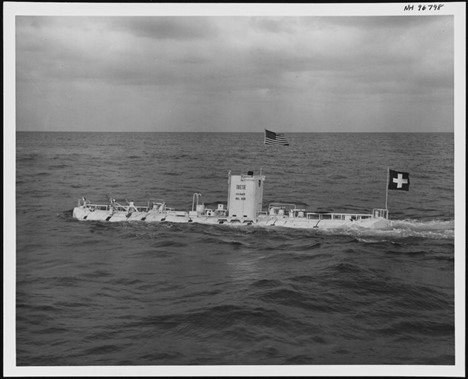
Designed to be free of tethers, Trieste was fitted with two electric motors of 2 HP each, capable of propelling the craft at a speed of 1.2mph over a few miles, and changing direction. After several years in the Mediterranean, the US Navy acquired Trieste in 1958. Project Nekton was proposed the same year, code name for a gondola upgrade involving three test dives and culminating in a descent to the greatest depth of the world’s oceans. The Challenger Deep.

Trieste received a larger gasoline float and bigger tubs with more iron ballast. With help from the Krupp Iron Works of Germany, she was fitted with a stronger sphere with five inches of solid steel and weighing in at 5 tons.

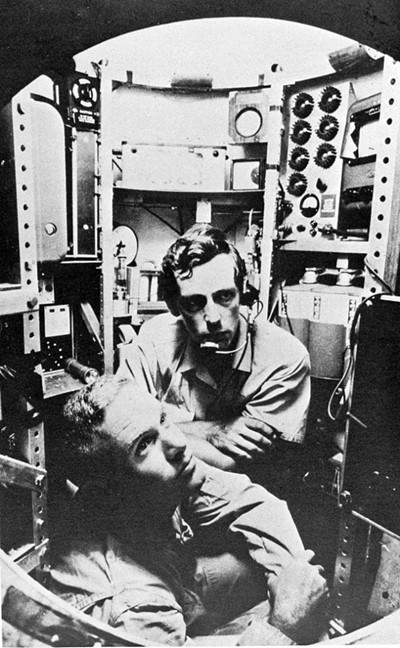
Piccard and Walsh aboard Trieste, January 23, 1960

The cockpit was accessible, only by an upper hallway which was then filled with gasoline. The only way to exit was to pump out the gas and blow out the rest, with compressed air. On this day in 1960, US submarine commander Lieutenant Don Walsh joined Jacques Piccard in that hallway, climbing into the sphere and closing the hatch. The dive began at 0823.

The bathyscaphe Trieste, on the surface

Trieste stopped her descent several times, each one a new thermocline bringing with it a colder layer of water and neutral buoyancy, for the submersible. Walsh and Piccard discussed the problem and elected to gamble, ejecting some of that buoyant gasoline. By 650 feet those problems had come to an end.

By 1,500 feet, the darkness was complete. The pair decided to change their clothes, wet with spray from a stormy beginning. With a cockpit temperature of 40° Fahrenheit, it was a welcome change.

Looking out the plexiglass window, the depths between 2,200 feet and 20,000 seemed extraordinarily empty. At 14,000 feet the pair was now in uncharted territory. No one had ever been this deep. At 26,000 feet, descent was slowed to two feet per second. At 30,000 feet, one.

At 1256 Walsh and Piccard could see the bottom, on the viewfinder. 300 feet to go. Not knowing if the phone would work at this depth, Walsh picked up. “This is Trieste on the bottom, Challenger Deep. Six three zero zero fathoms. Over.” The response came back weak, but clear. “Everything O.K. Six three zero zero fathoms?” Walsh responded “This is Charley” (seaman-speak, for ‘OK’. “We will surface at 1700 hours”.

The feat was akin to the first flight into space. No human had ever reached such depths. Since then only five later expeditions have reached that remote and desolate spot. While unmanned submersibles have since visited Challenger Deep, Piccard and Walsh’ descent of January 23, 1960 was the first and last manned voyage, to the bottom of the world.

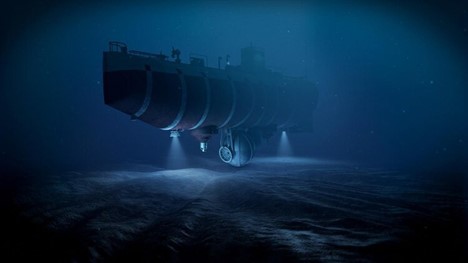
Computerized rendering shows Trieste at the bottom, January 23, 1960 H/T National Geographic

“After the 1960 expedition the Trieste was taken by the US Navy and used off the coast of San Diego, California for research purposes. In April 1963 it was taken to New London Connecticut to assist in finding the lost submarine USS Thresher. In August 1963 it found the Threshers remains 1,400 fathoms (2,560 meters) below the surface. Soon after this mission was completed the Trieste was retired and some of its components were used in building the new Trieste II. Trieste is now on display at the National Museum of the United States Navy at the Washington Navy Yard”. 

H/T Forgotten History

December 27, 1865 Confederados

The numbers are hazy, but port records indicate that somewhere between ten and twenty thousand former Confederates moved to Brazil during the twenty years following the Civil War.  A great uncle of former First Lady Rosalynn Carter, was one of them.

Most of us were taught that 600,000+ died during the American Civil War.  618,222 to be precise, more than the combined totals of every conflict in which the United States was ever involved, from the Revolution to the War on Terror.  Recently, sophisticated data analysis techniques have been applied to newly digitized 19th century census figures, indicating that the real figure may be considerably higher.

The actual number may lie somewhere between 650,000 and 850,000. dead.

VIR_362561_27117_cuanto_sabes_sobre_los_estados_confederados_de_america

The cataclysm of the Civil War would leave in its wake animosities which would take generations to heal.  “Reconstruction” would be 12 years in the making but some never did reconcile themselves to the war’s outcome. Vicksburg, Mississippi fell after a long siege on July 4, 1863. The city would not celebrate another Independence Day for 70 years.

In 1865, Emperor Dom Pedro II of Brazil wanted to encourage domestic cultivation of cotton.  Men like Jefferson Davis and Robert E. Lee advised southerners against emigration, but the Brazilian Emperor offered transportation subsidies, cheap land and tax breaks to those who would move.

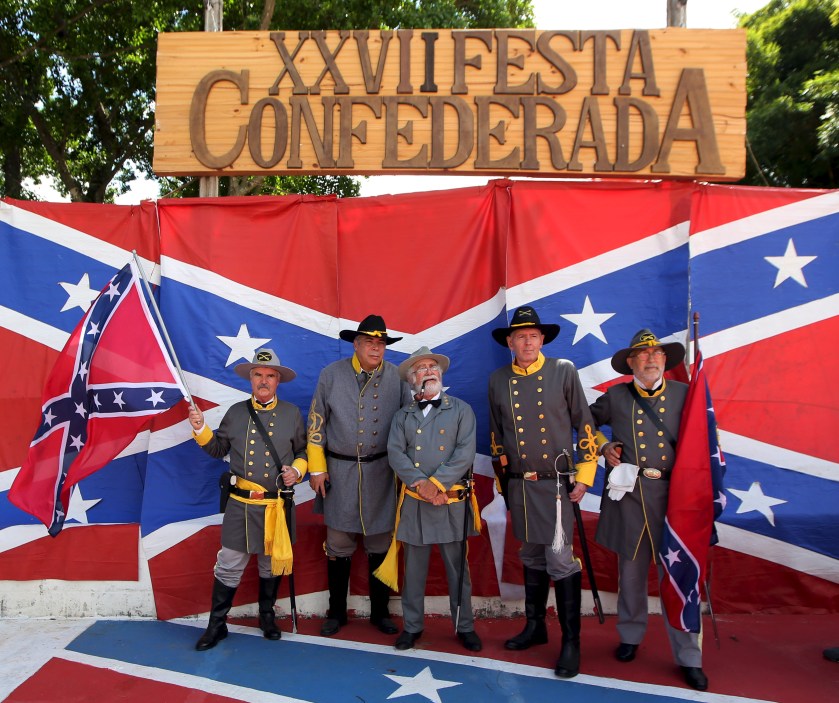
Descendants of American Southerners wearing Confederate-era uniforms pose for a photograph during a party to celebrate the 150th anniversary of the end of the American Civil War in Santa Barbara D'Oeste, Brazil
Descendants of American Southerners wearing Confederate-era uniforms pose for a photograph during a party to celebrate the 150th anniversary of the end of the American Civil War in Santa Barbara D’Oeste, Brazil,

Colonel William Hutchinson Norris, veteran of the Mexican American War and former member of the Alabama House of Representatives and later State Senator, was the first to make the move.  Together with his son Robert and 30 families of the former Confederacy, Norris arrived in Rio de Janeiro on December 27, 1865, aboard the ship “South America”.

The numbers are hazy, but port records indicate that somewhere between ten and twenty thousand former Confederates moved to Brazil during the twenty years following the Civil War.  A great uncle of former First Lady Rosalynn Carter, was one of them.

Confederate flag rally at Stone Mountain Park

Some of these “Confederados” settled in the urban areas of São Paulo. Most made their homes in the northern Amazon region around present-day Santa Bárbara d’Oeste and a place the locals called “Vila dos Americanos”, and the inhabitants called “Americana”.  Some would return to the newly re-united states.  Most would never return. Their descendants, Portuguese speaking Brazilians one and all, remain there to this day.

‘I don’t speak English and the only place I’ve been to in the U.S. is Disneyworld, but I feel the heritage,’ said 77-year-old Alcina Tanner Coltre, whose great-great-grandparents migrated from Mississippi along with their 15-year-old son. ‘My great-grandfather married a Brazilian woman, so he integrated into Brazilian culture pretty quickly, but it’s really important to me to come out every year to remember where we come from.’

UK Daily Mail
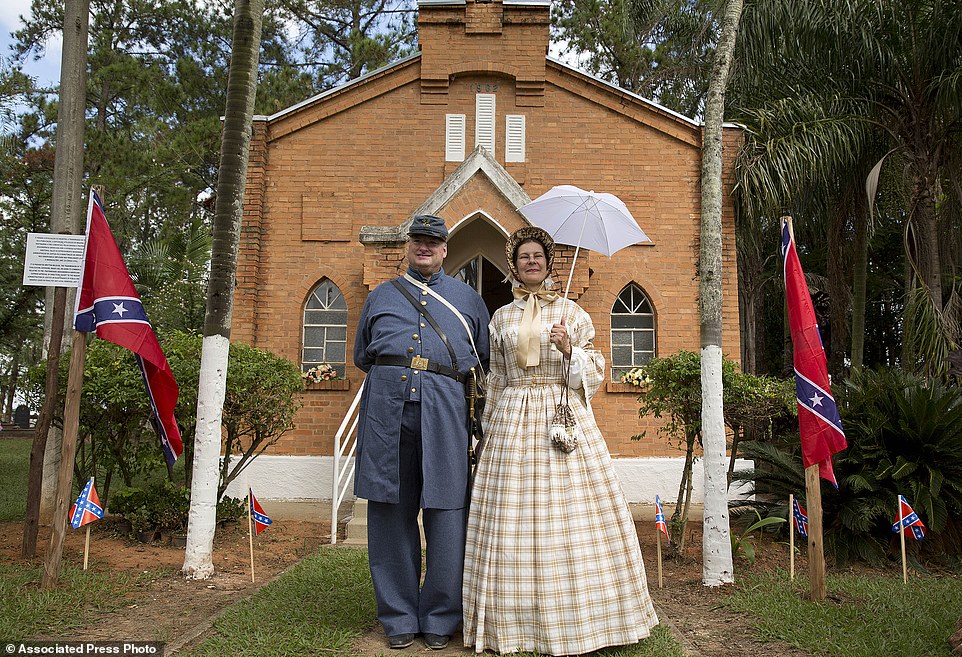
Descendants of American Southerners Philip Logan and his wife Eloiza Logan, pose for pictures during a party to celebrate the 150th anniversary of the end of the American Civil War in Santa Barbara d’Oeste, Brazil, Sunday, April 26, 2015. Thousands turn out every year, including many of those who trace their ancestry back to the dozens of families who, enticed by the Brazilian government’s offers of land grants, settled here from 1865 to around 1875, as well as country music enthusiasts, history buffs and locals with a hankering for buttermilk biscuits. (AP Photo/Andre Penner)

Confederados earned a reputation for honesty and hard work. Dom Pedro’s program was judged a success by immigrant and government alike.  The settlers brought modern cultivation techniques and new food crops, all of which were quickly adopted by native Brazilian farmers.

descendentes-confederados-guerra-civil-eua

Small wonder.  Mark Twain once wrote “The true Southern watermelon is a boon apart, and not to be mentioned with common things. It is chief of this world’s luxuries, king by the grace of God over all the fruits of the earth. When one has tasted it, he knows what the angels eat. It was not a Southern watermelon that Eve took; we know it because she repented”.

That first generation kept to itself for the most part, building themselves Baptist churches and town squares, while traditional southern dishes like barbecue, buttermilk biscuits, vinegar pie and southern fried chicken did their own sort of culinary diplomacy with native populations.

Slavery remained legal in Brazil until 1888, but this nation of 51% African or mixed-race ancestry (according to the 2010 census), seems more interested in understanding and celebrating their past, than tearing their culture apart because of it.

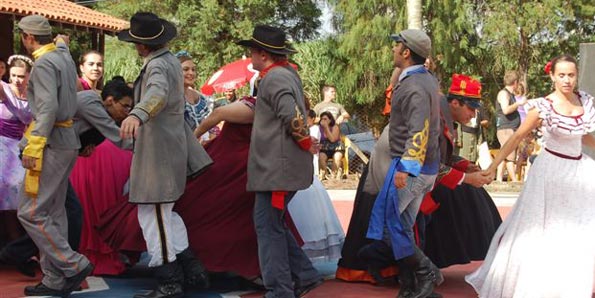
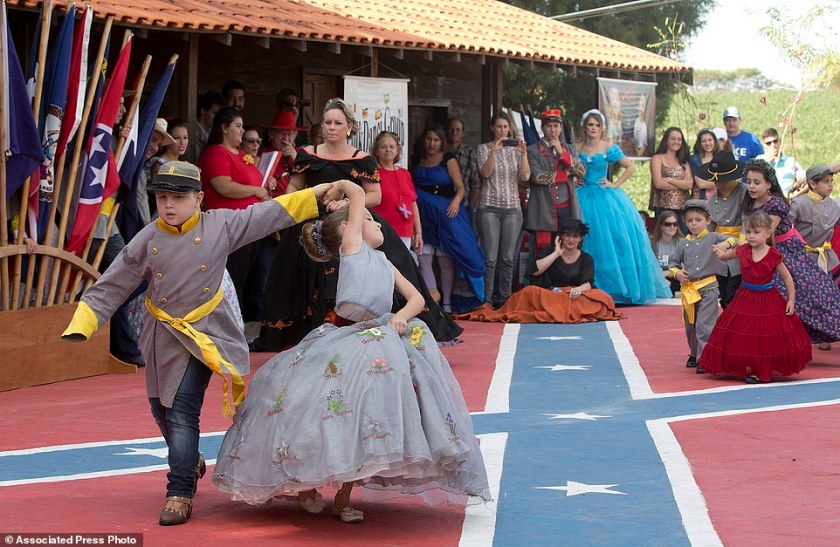
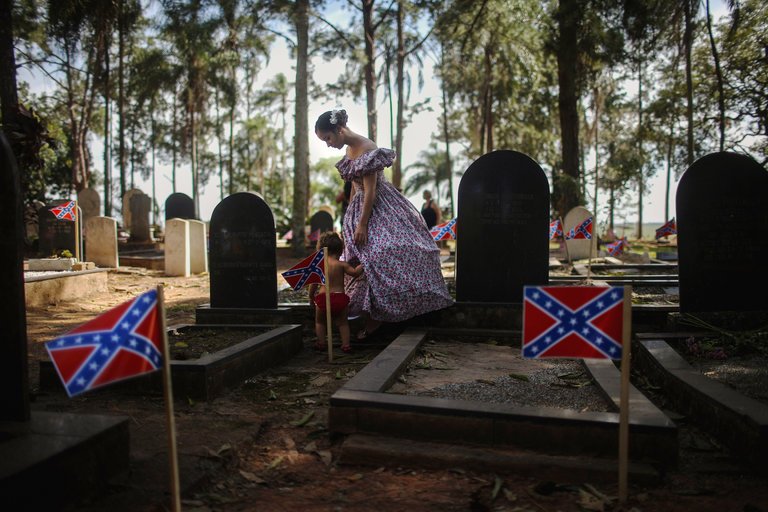
Today, descendants of those original Confederados preserve their cultural heritage through the Associação Descendência Americana (American Descendants Association), with an annual festival called the Festa Confederada.  There you’ll find hoop skirts and uniforms in gray and butternut, along with the food, the music and the dances of the antebellum South.

Brazil Confederates

There you will also find the Confederate battle flag.  It seems that Brazilians have thus far resisted that peculiar urge afflicting the American left, to hide from its own history.

‘“This is a joyful event,” said Carlos Copriva, 52, a security guard who described his ancestry as a mix of Hungarian and Italian. He was wearing a Confederate kepi cap that he had bought online as he and his wife, Raquel Copriva, who is Afro-Brazilian, strolled through the bougainvillea-shaded cemetery.  Smiling at her husband, Ms. Copriva, 43, who works as a maid, gazed at the graves around them. “We know there was slavery in both the United States and Brazil, but look at us now, white and black, together in this place,” she said while pointing to the tombstones. “Maybe we’re the future and they’re the past.”’

09BRAZIL-master768-v3 (1)
“A woman in a traditional hoop skirt walked past graves adorned with Confederate battle flags in Santa Bárbara d’Oeste, Brazil. An annual celebration of the area’s many Confederate settlers was held in the cemetery last month”. Hat tip to Mario Tama/Getty Images, New York times, for this image

December 25, 1897 Yes Virginia, There is a Santa Claus

“Only faith, fancy, poetry, love, romance can push aside that curtain and view and picture the supernal beauty and glory beyond. Is it all real? Ah, Virginia, in all this world there is nothing else real and abiding. No Santa Claus! Thank God he lives and he lives forever. A thousand years from now, Virginia, nay 10 times 10 thousand years from now, he will continue to make glad the heart of childhood”.

In the summer of 1897, 25th President of the United States William McKinley, had barely moved into the White House. The nation’s first subway opened in the city of Boston while, in Seattle, the Klondike gold rush was just getting underway. Thomas Edison received the patent for an early projector called a Kinetoscope. Mark Twain penned a rebuttal as only Mark Twain could to his own obituary in the pages of the New York Journal: “The report of my death was an exaggeration.”

Then one day there came the Dread Question asked by eight-year-olds the world over, and answered by fathers since the dawn of time: “Go ask your mother”.

Just kidding. Not that one – the Other dread question. The Santa Claus question.

History fails to record the conversation nor the exact time, or place. Possibly, that little girl went for a walk with her father, on the streets of Manhattan’s upper west side. Maybe it was over dinner or perhaps tucked into bed after a goodnight story and a kiss on the forehead.

“Papa, is there a Santa Claus? My little friends say he isn’t real”.

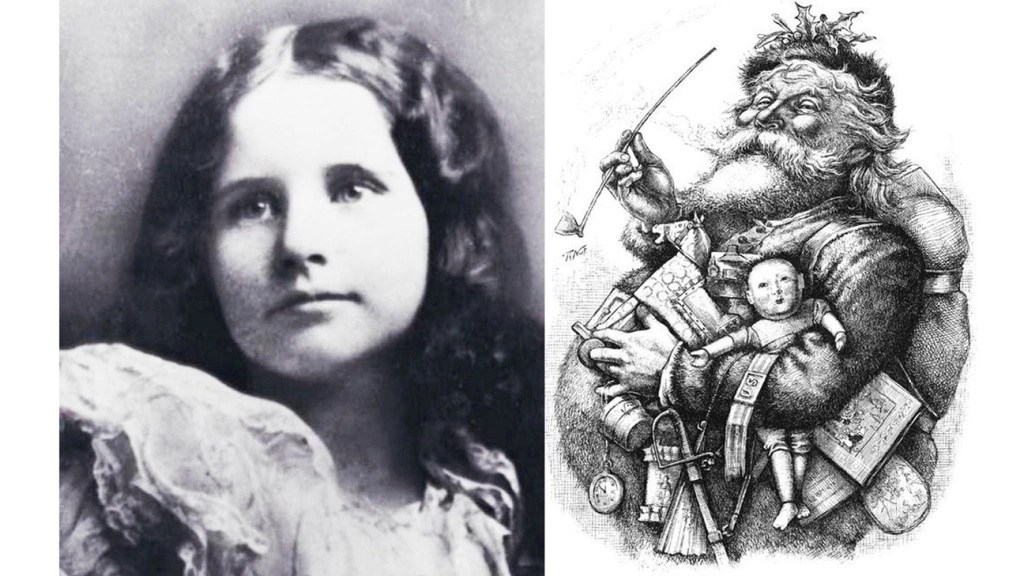
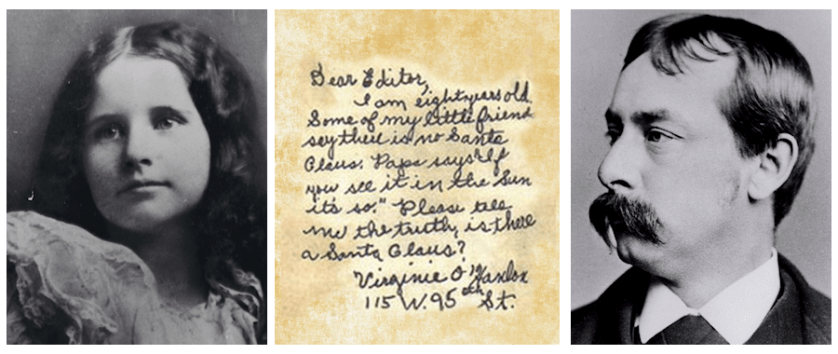
He was coroner’s assistant, Dr. Philip O’Hanlon. She was his daughter, 8-year-old Laura Virginia O’Hanlon.

Dr. O’Hanlon neither sent his little girl to ask her mother, nor did he try to answer himself. He suggested she write to the New York Sun newspaper. “If you see it in The Sun”, he said, “it’s so.”

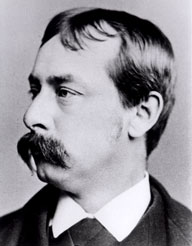
So it is a little girl’s note made its way across the city to the New York Sun, to the desk of Edward Page Mitchell. The hard core science fiction buff will remember Mitchell for tales about time travel, invisibility and man-computing-machine cyborgs long before the likes of H.G. Wells ever thought about such things but on this day, the editor and sometimes author had a job to do.

Mitchell believed the letter was worthy of reply. He brought the assignment to copy writer Francis “Frank” Pharcellus Church.

It was an unlikely choice.

Church was not the dilettante, partisan idler who’d style himself today, as “journalist”. This was a hard-bitten News Man of the old school, a cynic, street reporter, atheist and former Civil War correspondent who’d seen it all and didn’t believe the half of it.

Picture Perry White, the irascible editor-in-chief of the fictional Daily Planet newspaper in the old Superman series, and you’ve got a pretty good picture of Frank Church. You can almost hear the walrus-mustachioed old curmudgeon grumbling across the ages as he returned to his desk, a little girl’s note in his hand.

“Why me”?

The old grouch didn’t even want his name associated with the reply.

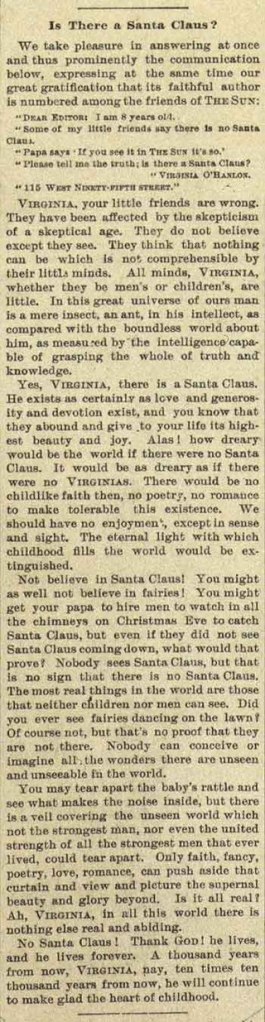
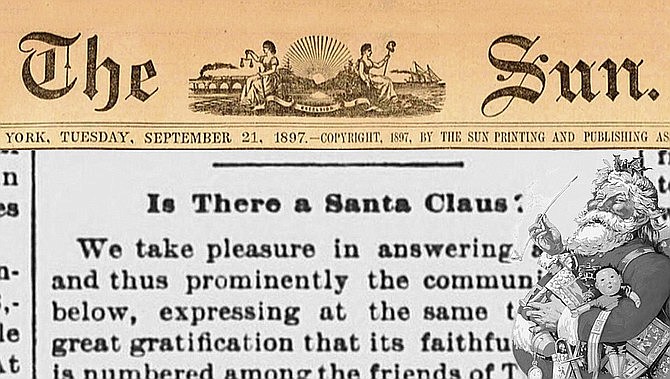
The New York Sun published Church’s response on September 21, 1897.

Dear Editor, I am 8 years old.
Some of my little friends say there is no Santa Claus.
Papa says, “If you see it in The Sun, it’s so.”
Please tell me the truth, is there a Santa Claus?
Virginia O’Hanlon
115 W. 95th St.

Virginia, your little friends are wrong. They have been affected by the skepticism of a skeptical age. They do not believe except they see. They think that nothing can be which is not comprehensible by their little minds. All minds, Virginia, whether they be men’s or children’s, are little. In this great universe of ours man is a mere insect, an ant, in his intellect, as compared with the boundless world about him, as measured by the intelligence capable of grasping the whole truth and knowledge. You tear apart the baby’s rattle and see what makes the noise inside, but there is a veil covering the unseen world which not the strongest man, nor even the united strength of all the strongest men that ever lived, could tear apart.

Only faith, fancy, poetry, love, romance can push aside that curtain and view and picture the supernal beauty and glory beyond. Is it all real? Ah, Virginia, in all this world there is nothing else real and abiding. No Santa Claus! Thank God he lives and he lives forever. A thousand years from now, Virginia, nay 10 times 10 thousand years from now, he will continue to make glad the heart of childhood”.

Frank Church’s friends, family and colleagues scarcely knew the man had it in him. You can almost imagine the excitement of a little girl, scouring the pages of The Sun for two months to find nothing and then…THAT. Through the rest of that Christmas season of 1897 and on for the rest of her life, Virginia O’Hanlon would never forget that reply.

Frank Church’s letter went on to become the most widely reprinted editorial in the history of the English language albeit anonymously until the year he died, in 1906. According to New York Sun internal policies, that’s when Church was finally revealed as responding editor and author of that timeless response.

Virginia went on to marry one Edward Douglas in 1910, a man who stuck around just long enough to abandon her with the couple’s first child, as yet unborn. Not exactly a credit to his sex, that one.

Perhaps the childlike sense of delight in that newspaper column is what helped the young mother through her darkest hours. Laura Virginia O’Hanlon Douglas went on to devote her life’s work to children.   Following Bachelor’s, Masters and Doctorate degrees at Hunter, Columbia and Fordham University, O’Hanlon went on to become a lifelong teacher, assistant principal and finally principal.

Virginia’s childhood home is now The Studio School offering an academic scholarship, named after Virginia O’Hanlon.

In 1932, The Sun’s response was adapted to a cantata, the only known newspaper editorial ever set to classical music.  The 1989 film Prancer contained a fictional editorial entitled “Yes, Santa, there is a Virginia“.
Every year at Christmas, Virginia’s letter and Frank’s response are read aloud at a Yule log ceremony at Church’s alma mater, Columbia College.

In a 1960 appearance on the Perry Como Show, Virginia told the host her letter has been “answered for me thousands of times.”

Laura Virginia O’Hanlon Douglas kept the name of her long-since absconded husband for the rest of her life, according to the custom of the day. She passed away on May 13, 1971, at the age of 81.

Throughout her long life she received a steady stream of mail about her letter and never failed to pen a personal reply, including a copy of Church’s column. Virginia grew sickly toward the end of her life but, throughout countless interviews over the course of her 81 years she’d always credit the Sun’s editorial with changing her life. For the better.

Perhaps it was the Christmas Spirit or whatever you’d like to call it, that most of us have learned to experience but one time a year. For Virginia O’Hanlon that sense of warmth, of generosity and kindness to be found at the bottom of all human hearts, never really went away.

So, let the cynics and the curmudgeons come to understand on this Christmas day and beyond. Yes, Virginia, there really is a Santa Claus.

December 24, 1942 The Padre of Guadalcanal

1st division Marines soon learned that, to “Padre” Gehring, this was no rear echelon ministry. During a particularly intense fire fight, one Marine dove for a foxhole only to find the Padre, already there. On spotting the crucifix around his neck the Marine asked, “Padre, what are you doing here?”. Where else would I be?”, came the reply.

Since 1775, a military chaplain is an officer who ministers to the spiritual needs of uniformed personnel and their families, and also civilians, working for the military. At first exclusively Christian, chaplains have long since come to represent every faith and denomination while honoring the rights of others, to their own faith traditions.

The first female military chaplain was officially commissioned, in 1973. During World War 2 theirs was a world exclusive to men.

Chaplains are found everywhere there are armed services, up to and including front lines. During the war in Korea, Father Emil Kapaun was captured by Chinese communists while performing last rights, for a dying soldier. This Shepherd in Combat Boots literally spent himself in service to his fellow POWs and died in a North Korean prison camp. In 2013 President Barack Obama awarded Fr. Kapaun the Medal of honor for his life saving ministrations, near Pyoktong.

This stained glass window at the Pentagon remembers the Four Chaplains drowned with the sinking of the USS Dorchester, in 1943.

Many chaplains have been decorated for bravery. In the United Kingdom, five chaplains have received the Victoria Cross, Britain’s highest decoration for gallantry in the line of duty. Nine have received the US’ Medal of Honor.

The Chaplain’s Medal for Heroism was specifically created to recognize the service of military chaplains, killed in the line of duty. To date this special decoration has been awarded only once, to the famous Four Chaplains who gave away their own life jackets, knowing they were about to be drowned.

During World War 2, US Army and Marine Corps chaplains experienced the third highest loss ratio of the war behind infantry, and Army Air Corps.

Sunday, December 7, 1941 dawned bright and clear on the Pacific naval anchorage in Pearl Harbor. Father Aloysius Schmitt was just beginning mass on board USS Oklahoma when the first of nine Japanese torpedoes, slammed home. The attack caused immediate flooding in multiple compartments as Oklahoma began her slow roll, to capsize. Below decks, Fr. Schmitt desperately helped push one sailor after another out of a small porthole, even as the compartment filled with water. 429 crewmen lost their lives on board Oklahoma that morning including Fr. Schmitt, drowned in the desperate act of saving others.

Celebrating mass on Iwo Jima, 1945

The Empire of Japan was all but unstoppable during the early months of WW2. The first major allied offensive began on August 7, 1942, with the objective of taking the Pacific islands of Guadalcanal, Tulagi, and Florida. Some 60,000 men would participate in the 6-month offensive, primarily United States Marines.

Near constant counter-attacks and artillery bombardments joined with tropical disease to make life on this mosquito infested jungle island…a living hell. Fully two-thirds of casualties in those early months resulted from malaria, and other tropical disease. All the while, Marines were forced to subsist on captured food rations of worm and maggot infested rice so paltry that even these already-thin children of the depression lost some 40-odd pounds…per man.

The national museum of WW2 museum website describes one such bombardment over the night of October 14:

“At 0133 hours, the battlewagons opened fire and for the next 83 minutes hurled 970 heavy naval shells at Henderson Field and the surrounding area. Two-ton shells as large as a Volkswagen Beetle smashed into the Marine positions, shaking everything from dental fillings to the emotions of the men themselves. The explosions sucked air from lungs and the concussion blew over trees and collapsed coconut log dugouts with ease. Men were buried alive in what they thought were safe shelters. While physical casualties were light as a result of the battleship shelling, mental casualties were high. Men emerged from their dugouts shaking violently, eyes wide, ears bleeding, unable to hear anything or see straight. Blast concussion rendered many men helpless and disoriented for hours and even days after an attack. Veterans of the Tenaru River and Bloody Ridge battles—who had stared death directly in the face—all recalled the night of October 14 to be the most frightening night of the entire campaign”.

Ordained as a priest on May 22, 1930, Father Frederic Gehring spent 1933 to 1939 laboring on missions to China enduring bandits, Chinese communists and Japanese occupation. One time under aerial strafing in 1938, Fr. Gehring ran out waving a large American flag to show Japanese fighter pilots this was a mission, of the then-neutral United States. Father Gehring was pleased when the pilots did in fact fly away. Until someone at the mission informed him. It was probably because they had run out of bullets.

The United States declared war on the Empire of Japan the day after the attack on Pearl Harbor. The following day Father Frederic enlisted as Navy chaplain. In September 1942 he joined the 1st Marine Division, the “Old Breed”, on Guadalcanal.

“Before Guadalcanal the enemy advanced at his pleasure. After Guadalcanal, he retreated at ours”.

Admiral William “Bull” Halsey

1st division Marines soon learned that, to “Padre” Gehring, this was no rear echelon ministry. During a particularly intense fire fight, one Marine dove for a foxhole only to find the Padre, already there. On spotting the crucifix around his neck the Marine asked, “Padre, what are you doing here?”. Where else would I be?”, came the reply.

That’s Father Gehring with his hat on, next to Barney Ross. The names of the parrots if any, have been lost to history.

Gehring routinely held masses so close to the fighting, Marines came to believe he would hold a mass in hell. So long as he could get his jeep there.

The Padre’s work wasn’t just on the lines where men were injured and dying but sometimes, behind enemy lines. With the help of Solomon Island natives, Fr. Gehring went deeply into enemy held territory no fewer than three times to rescue trapped missionaries on the island, mostly Marist priests and Sisters. By the time he was done 28 had been extracted, from Japanese occupied territory.

For this feat Father Gehring received the Legion of Merit from the President of the United States, the first Navy chaplain so decorated.

One day, islanders found a young Chinese girl at the bottom of a ditch. Only five or six years old and sick with malaria she’d been beaten and bayonetted by Japanese soldiers, and left for dead. The imprint of a rifle butt was clearly visible on her smashed skull. The examining physician said she wouldn’t make it through the night and yet, she did.

How a little girl apparently orphaned wound up that far from home, is a tale unto itself. As is the way an old China hand named Frederic Gehring nursed her to health in an active combat zone, along with the help of battle hardened Marines.

If such a feat was a small miracle, Christmas mass that year on Guadalcanal was not, though there may have been a wee bit of chuckling, divine intervention. With his first tent blown to bits by enemy artillery, some 700 Marines gathered at the new chapel tent on December 24, for Christmas mass.

In a world of hard men Barney Ross stood out, as a man not to be trifled with. An Orthodox Jewish kid from the streets of Chicago, Ross was a professional prize fighter, and three time champion. It was inevitable that the boxer and the priest from Brooklyn, would hit it off. they were two peas in a pod. Earlier that month, Ross and a group of Marines found themselves surrounded. The only man not wounded, Ross kept up a hail of gunfire and grenades keeping an unknown number of Japanese at bay. All…night…long. By morning, the only other man left alive was a single wounded Marine. Ross tossed the man on his back and carried him back to base.

So back to that Christmas mass…Ross had ambled up to the Padre and asked “who plays”, pointing to a small pump organ. Gehring was himself an accomplished violinist, but the answer was…no one knew how to play that thing.

Except…for Barney Ross.

So it is a Jewish kid from Chicago joined in on Catholic mass that night, learning the Christian canon by ear as 700 marines, hummed along. He ended the concert with a rousing rendition of “My Yiddishe Mama” in Yiddish no less, and there wasn’t a dry eye in the place.

Columnist Jimmy Breslin recalled: “There was a Jewish kid playing an organ and singing in Yiddish about his mama and a Catholic priest standing next to him with a violin trying to help it sound nice, and all around there were guys who came from every religion and some of them didn’t even have one, but they were all crying and thinking about the same thing.”

Many years later, Gehring typed up a paragraph reflecting on the war and that Christmas, in Guadalcanal. For years he would insert the piece in his Christmas cards of which he sent and received, many: “Our heroes, who gave their lives for their country and now lay beneath the white crosses that mark their final place, do not see the dark clouds of war hovering overhead in various parts of the world. The peace they fought and died for seems but temporary.”

In time that little Chinese girl who wasn’t supposed to make it through the night…did. Fr. Gehring called her Patsy Lee. In 1950, he brought her home to the US. Ms. Lee went to school and became a nurse. She met a man, and they married. Later on, Gehring even helped her find her own mother. Gehring himself tells the story of that little girl if you want to learn more in his 1962 memoir, “Child of Miracles”.

Fr. Frederic Gehring died in 1998, at the age of 95. Let his New York Times obituary, have the last word on this man of faith: “At Father Gehring’s funeral on Thursday at St. Vincent’s Seminary in Philadelphia, where he was ordained in 1930, she was there as was a Marine honor guard, reminders of a time when Guadalcanal was a name to reckon with and a little girl was a miracle of war”.

§§§§§

Chaplain deaths while on active duty (hat tip Wikipedia)
Death during service (combat and non-combat):

American Revolution: 25
War of 1812: 1
Mexican–American War: 1
Civil War
Union: 117
Confederacy: 41
World War I: 23
World War II: 182
Korean War: 13
Vietnam War: 15
Iraq and Afghan Wars: 1 (as of September 2010)

December 23, 1884 Lake Bacon

Lippincott’s monthly magazine, waxed rhapsodic: “This animal, homely as a steamroller, is the embodiment of salvation. Peace, plenty and contentment lie before us, and a new life with new experiences, new opportunities, new vigour, new romance, folded in that golden future, when the meadows and the bayous of our southern lands shall swarm with herds of hippopotami”.

Only hours from now, families will gather from far and near, around the Christmas table.  There will be moist and savory stuffing, and green bean casserole.  Creamy mashed potatoes and orange cranberry sauce.  And there, the centerpiece of the feast.  Slow-roasted and steaming in that silver tray the golden brown, delicious, roast hippopotamus.

Wait…Uhh…What?

water-hyacinth-eichornia-crassipes
Water Hyacinth

The World Cotton Centennial and World’s Fair of 1884 began its second week on December 23. Located in New Orleans, Louisiana that year, among its many wonders was the never-before seen Eichornia crassipes, a gift from the Japanese delegation.  The Water Hyacinth.

Visitors marveled at this beautiful aquatic herb, with yellow spots accentuating the petals of delicate purple and blue flowers floating across tranquil ponds on a mat of thick, green leaves.

The seeds of Eichornia crassipes are spread by wind, flood, birds and humans and remain viable, for 30 years.  Beautiful as it is to look at, the Water Hyacinth is an “alpha plant”, an aquatic equivalent to the Japanese invasive perennial Kudzu, the “vine that ate the south”.  Impenetrable floating mats choke out native habitats and species while thick roots impede the passage of vessels, large and small.  The stuff is toxic if ingested by humans and most animals and costs a fortune, to remove.

This plant native from the Amazon basin quickly broke the bounds of the 1884 World’s Fair, spreading across the bayous and waterways of Louisiana, and beyond.

Eichhornia_crassipes_field_at_Langkawi

During the first decade of the 20th century, an exploding American population could barely keep up with its own need for food. Especially, meat.  The problem reached crisis proportions in 1910, with over grazing and a severe cattle shortage.  Americans were seriously discussing the idea of eating dogs.

Enter Louisiana member of the House of Representatives, New Iberia’s own Robert Foligny Broussard, with a solution to both problems.  Lake Bacon.

The attorney from Louisiana’s 3rd Congressional district proposed H.R. 23621 in 1910, otherwise known as the “American Hippo” bill. Broussard’s proposed legislation enjoyed enthusiastic support from Theodore Roosevelt and the New York Times, alike.   One Agricultural official estimated that a free-range hippo herd could produce up to a million tons of meat, every year.

Lippincott’s monthly magazine waxed rhapsodic:  “This animal, homely as a steamroller, is the embodiment of salvation.  Peace, plenty and contentment lie before us, and a new life with new experiences, new opportunities, new vigour, new romance, folded in that golden future, when the meadows and the bayous of our southern lands shall swarm with herds of hippopotami”.

Hippo Steak

With a name deriving from the Greek term “River Horse”, the common hippopotamus is the third largest land animal living today.  Despite a physical resemblance to hogs and other even-toed ungulates, Hippopotamidae’s closest living relatives are cetaceans such as whales, dolphins and porpoises.

All well and good.  The problem is, those things are dangerous.

hippo-crocodile_1887702i

The adult bull hippopotamus is skittish, extremely aggressive, unpredictable and highly territorial.  Heaven help anyone caught between a cow and her young.  Hippos can gallop at short sprints of 19 mph, only a little less than the top speed of Jamaican Sprinter Usain Bolt, and he’s “the fastest man who ever lived”.

To keyword search the “10 most dangerous animals in Africa” is to be rewarded with the knowledge that hippos are #1, responsible for more human fatalities than any other large animal in Africa.

p-hippo-1_1467398c

Be that at it as it may, the animal is a voracious herbivore, spending daylight hours at the bottom of rivers & lakes, happily munching on vegetation.

Back to Broussard’s bill, what could be better than taking care of two problems at once?  Otherwise unproductive swamps and bayous from Florida to East Texas would become home to great hordes of free-range hippos.  The meat crisis would be averted.  America would become a nation of hippo ranchers.

As Broussard’s bill wended its way through Congress, the measure picked up steam with the enthusiastic support of two men, mortal enemies who’d spent ten years in the African bush trying to kill each other. No, really.

Frederick Russell Burnham

Frederick Russell Burnham argued for four years for the introduction of African wildlife into the American food stream.  A freelance scout and American adventurer, Burnham was known for his service to the British South Africa company, and to the British army in colonial Africa. The “King of Scouts’, commanding officers described Burnham as “half jackrabbit and half wolf”.  A “man totally without fear.”  One writer described Burnham’s life as “an endless chain of impossible achievements”, another “a man whose senses and abilities approached that of a wild predator”.  He was the inspiration for the Indiana Jones character and for the Boy Scouts.  Forget the Dos Equis guy. Frederick Burnham really was the real-life “most interesting man in the world“.

Fritz Duquesne? Well that’s another story. Frederick “Fritz” Joubert Duquesne was a Boer of French Huguenot ancestry, descended from Dutch settlers to South Africa.  A smooth talking guerrilla fighter, the self-styled “Black Panther” once described himself as every bit the wild African animal, as any creature of the veld.  An incandescent tower of hate for all things British, Duquesne was a liar, a chameleon, a man of 1,000 aliases who once spent seven months feigning paralysis, just so he could fool his jailers long enough to cut through his prison bars.

Destined to become a German spy it is he who lends his name to the infamous Duquesne Spy Ring, of World War 2. 

Frederick Burnham described Duquesne, his mortal adversary:  “He was one of the craftiest men I ever met. He had something of a genius of the Apache for avoiding a combat except in his own terms; yet he would be the last man I should choose to meet in a dark room for a finish fight armed only with knives“.

During the 2nd Boer war, these two men had sworn to kill each other.  Now in 1910 the pair became partners in a mission to bring hippopotamus, to the American dinner table.

Biologically, there is little reason to believe that Hippo ranching wouldn’t work along the Gulf coast.  Decades ago, Colombian drug kingpin Pablo Escobar introduced four hippos to the Columbian interior. Today, officials estimate that, within a few years, the hippo descendants of Escobar’s exotic animal menagerie will number 100 or more individuals.

Back to the American Hippo bill. Broussard’s measure went down to defeat by a single vote, but never entirely went away.  Always the political calculator, Representative and later-Senator Broussard died with the bill on his legislative agenda, waiting for the right moment to reintroduce the thing.

Over time, the solution to the meat question became a matter of doubling down on what was already taking shape. Factory farms and confinement operations came to replace free ranges while the massive use of antibiotics replaced even the notion of balanced biological systems.

in-1910-President-Roosevelt-supported-a-bill-that-would-have-released-hippopotamuses-into-Louisiana-to-eat-an-invasive-plant-species-and-to-provide-delicious-hippo-bacon-to-hungry-Americ

We may or may not have “traded up”.  Today we contend with all manner of antibiotic-resistant “Superbugs”. The Louisiana department of wildlife and fisheries maintains no fewer than 85 separate aquatic vegetation control plans, aimed at the water hyacinth.

The effluent from factory farms from Montana to Pennsylvania works its way into the nation’s rivers and streams, washing out to the Mississippi Delta to a biological dead zone, the size of New Jersey.

13453_gulf-of-mexico-dead-zone-image-credit-noaa
Gulf of Mexico dead zone, image credit NOAA

As for that once golden future, Lippincott’s hippo herds roam only in the meadows and bayous of the imagination.  Who knows, it may be for the best.  I don’t know if we could’ve seen each other across the table, anyway.  Not when that hippo came out of the oven.