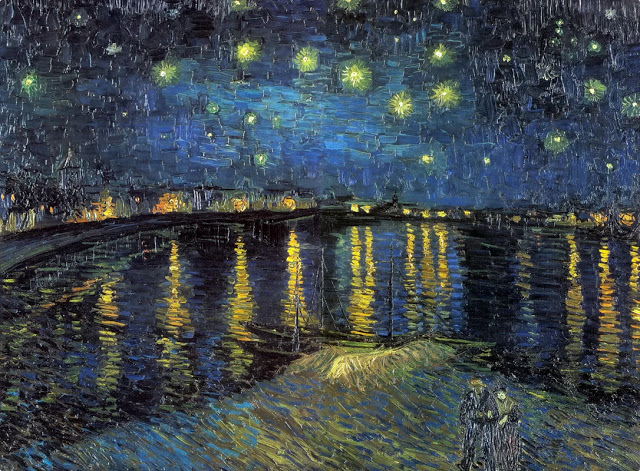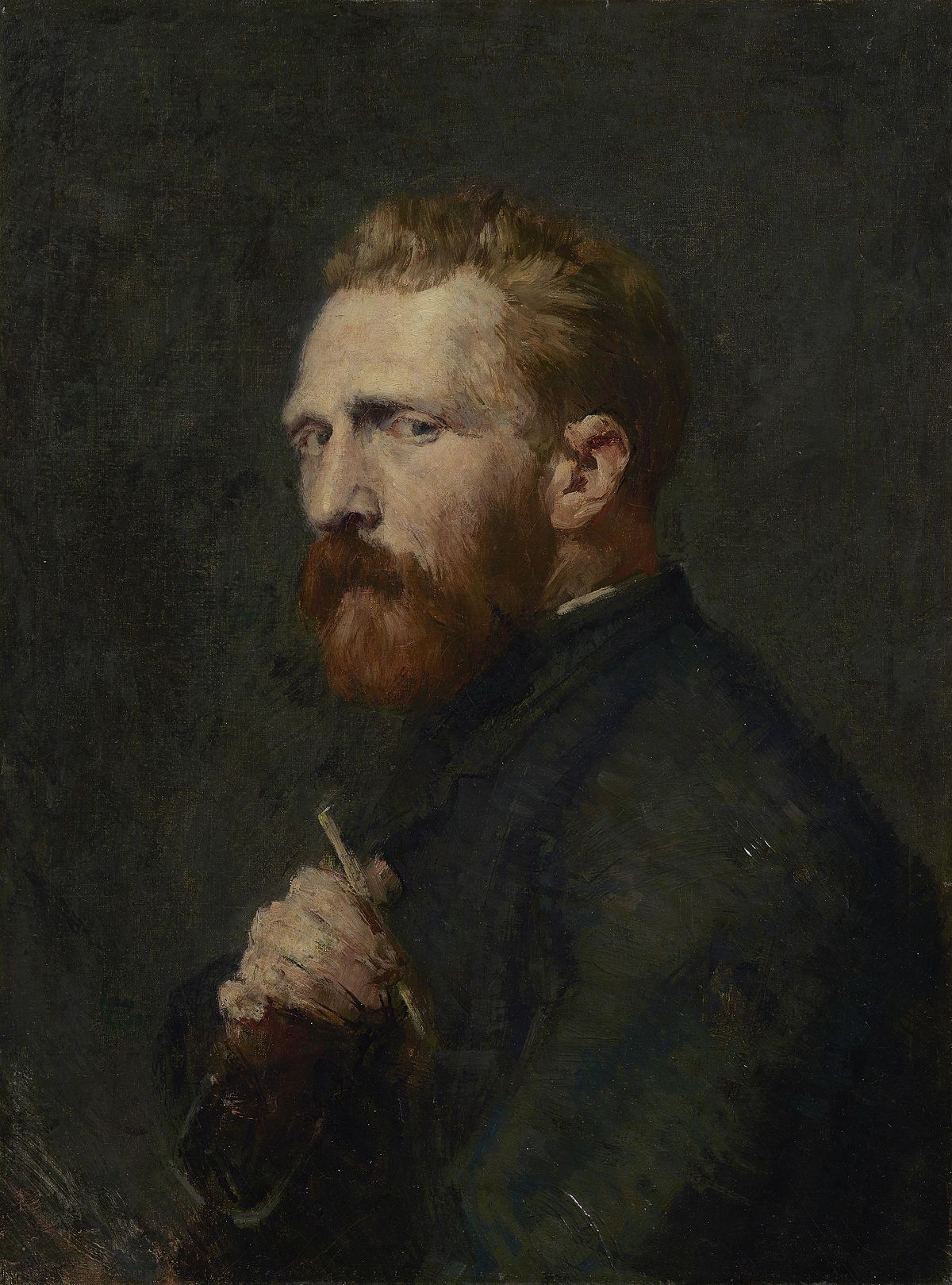
March 17, 1901 Vincent

Artists who became famous only in death read like a who’s who of painters including Monet, Gaugin, Cezanne and more but none so tragic, as Vincent van Gogh.

Herman Melville wrote more than 90 books and short stories in his 72 years. He was no stranger to some small fame but it was only after death that the man’s magnum opus Moby Dick, came to be seen as one of the finest works of literature, ever written. Edgar Allen Poe struggled as a writer. The Raven was sold for only $9 during his lifetime. Now a towering figure in the literary world his fame too, would only come after death. Shy and introverted in life, Emily Dickinson published only 8 poems during her lifetime. Her remaining body of work she hid carefully away, some 1,800 poems coming only to light, after she was gone.

Such a list could be long and includes the likes of Franz Kafka, Henry David Thoreau and Jane Austen. Artists who became famous only in death contain a who’s who of painters including Monet, Gaugin, Cezanne and more but none so tragic, as Vincent van Gogh.

Vincent Willem Van Gogh was born and died on March 30, 1852, a stillbirth. The artist with the same name was born one year later, to the day. Confusingly, the church register even assigned the infant the same number, as his dead brother. Vincent van Gogh, #29. It wasn’t unusual in those days for grieving parents to give the same name, as a child who had died. What it’s like to grow up a replacement, to visit a grave marked with your own name and birthdate minus a year, is something the rest of us can only guess at.
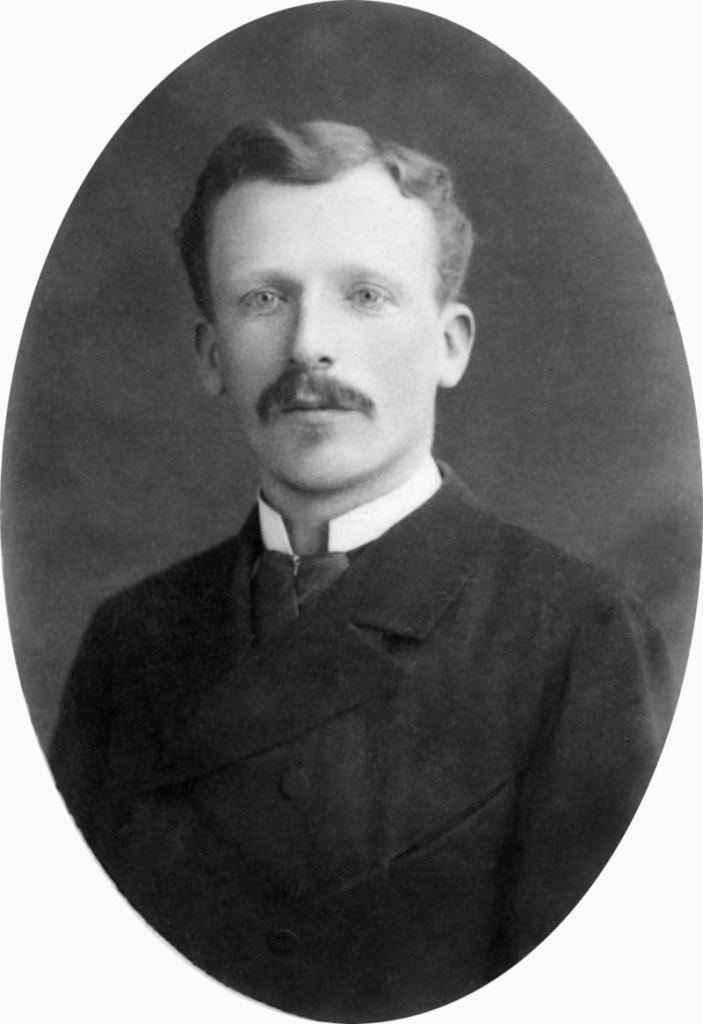
Vincent was close with his brother Theodorus, all but inseparable.

A successful Dutch art dealer, “Theo” had an important impact on the world of French and Dutch art. It is thanks to Theo van Gogh and his financial and emotional support of his older brother, that we’re able to enjoy much of the artist’s work.

Four years his junior it was Theo who encouraged his brother to paint, in the first place. Vincent could always draw but he didn’t pick up a brush, until he was 27.

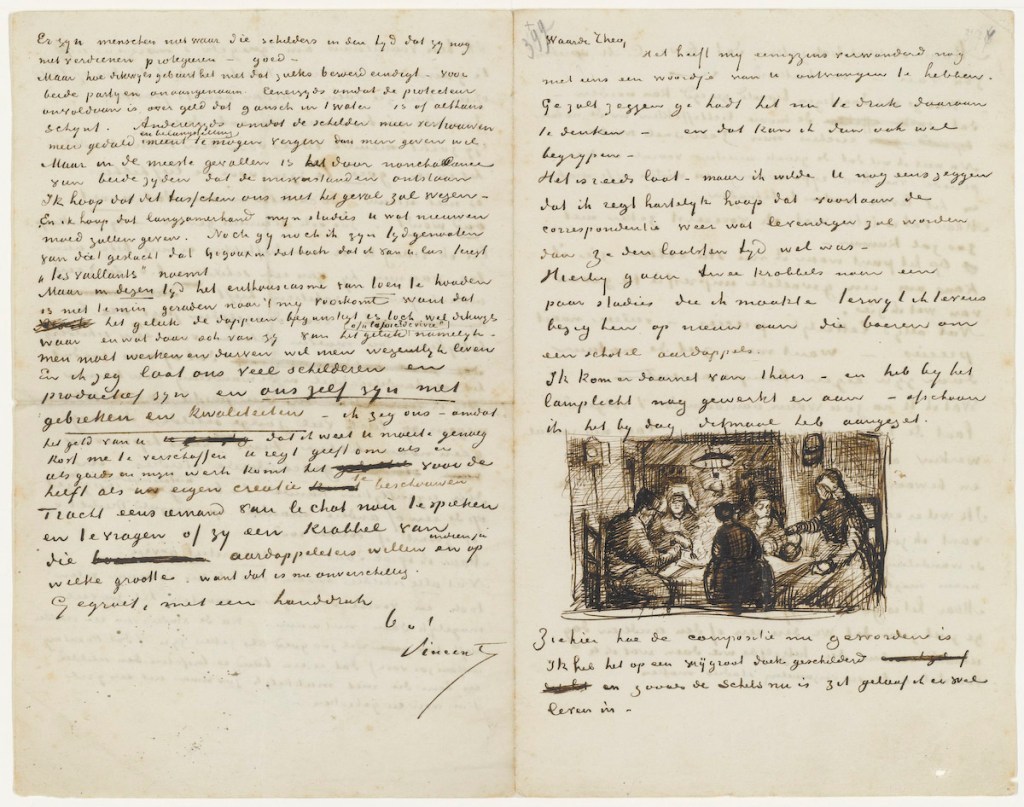
Van Gogh began to write letters in 1872, an average of one every ten days. Vincent would continue this practice for the rest of his life, some 903 in all. His sister Wil was a frequent recipient as were the artists Paul Gauguin, Anthon van Rappard and Émile Bernard, but none so much as his brother Theo. 663 of these letters are known to survive including this 1885 note describing the artist’s first masterpiece, “The Potato Eaters”. It is through these letters we know much of the life, of Vincent van Gogh.
2,300 years ago, Aristotle spoke of the confluence of Greatness, and mental illness. Even now that place where genius meets darkness, is imperfectly understood. Definitive diagnoses of historical figures are elusive and yet, history abounds with stories pointing toward mental illness in some of the great figures of the past. Michelangelo displayed signs of autism, as did Isaac Newton. The famous “scream” painting by Edvard Munch may be autobiographical of a man prone, to panic attacks. Ludwig von Beethoven suffered mood swings likely amounting to bipolar disorder as did Winston Churchill, Abraham Lincoln, and Vincent van Gogh.

Vincent tried his hand at dealing art but suffered depression during visits to London. There followed a period as Christian missionary in the south of Belgium before, feeling ill and depressed, van Gogh moved in with his parents. Theo, always the source of encouragement and support both financial and emotional convinced his brother, to take up the brush.

Vincent van Gogh had but ten years to live when he started to paint. In that time the man produced 2,100 artworks including 860 oil paintings, most of those, in the last two years of his life. First there were the dark colors of the “Dutch period” seen in peasant scenes, portraits and still life.
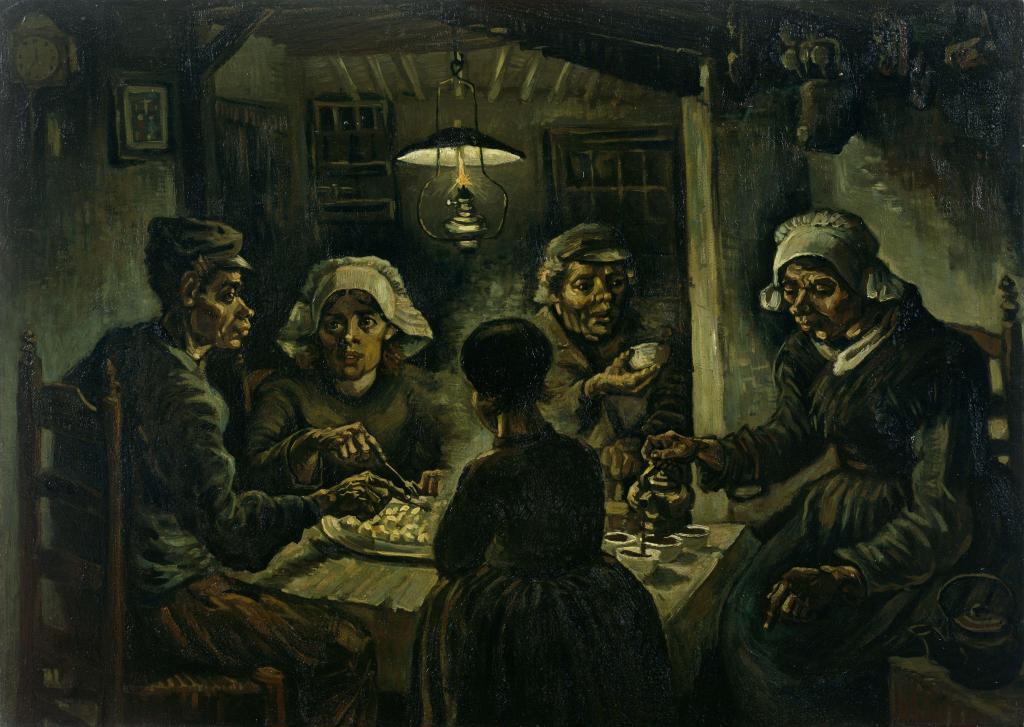
The Potato Eaters painted in April 1885 in Nuenen, Netherlands

Vincent moved to Paris in 1886 where he met members of the avant-garde art world, including Émile Bernard and Paul Gauguin. These were the iconoclasts, the radicals, the unorthodox who opened a whole new vision. Here we see the burst of bright colors and bold brush strokes for which Vincent is now known.

This too was a period of depression, of mental instability and psychotic episodes. The confrontation ending Vincent’s friendship with Paul Gaugin culminated in van Gogh cutting off his own ear, with a razor.

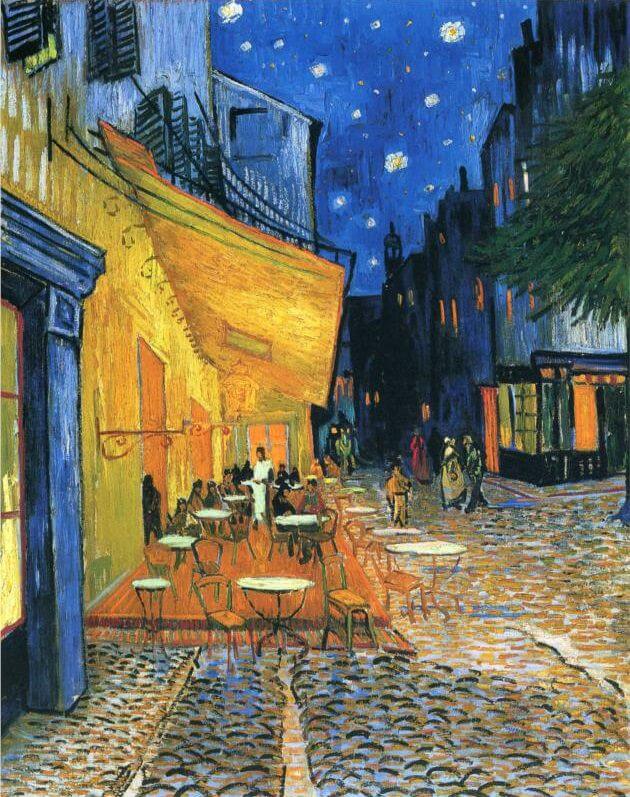
Thus began a period of mental decline, ending in Vincent’s suicide. A period spent in and out of psychiatric hospitals, of heavy drinking, poor diet and declining health. One day, this tortured soul would be recognized as one of the finest artists who ever lived. For now he was just another madman, a failure in work, and in life.

Fun Fact: Following the self-mutilation episode in which Vincent removed his own ear, van Gogh spent time in an asylum outside Saint-Rémy-de-Provence, in France. There he was fond of painting outdoors where he painted olive groves, and other pastoral scenes. If you look very closely just to the right of this 1889 portrait you will find the remains of a dead grasshopper, blown by the wind and trapped in wet paint. There no signs of struggle, indicating the insect was deceased before hitting the canvas. As for the Master he either didn’t notice, or did not care.


Olive Trees, 1889

For the man, the last two years were a downward spiral from which there would be no return. For Vincent’s art this was the most productive, the most brilliant period of a short career.

Theo alone understood his brother. His talent. His madness. For Vincent, Theo was the only person he could open up to. Vincent received a never-ending stream of letters from his brother, words of love, of encouragement, and always the painting supplies, and the money. Theo received a stream of letters in return with day-to-day news, plans for upcoming works but all the while, it wasn’t enough.

Around this time, Vincent set out on foot to visit the French naturalist Jules Breton, a walk of some 80 kilometers. Unlike van Gogh, Breton achieved considerable success, in his lifetime. Perhaps Vincent was intimidated by the high walls. The large estates. Nobody knows. After all that he turned and walked home. The man he intended to visit never knew he was there.

In Paris, Theo fell in love with one Johanna Bonger. The couple was married on April 17, 1889. Ten months later came a son, Vincent Willem van Gogh. The name was intended to honor his brother but, to Vincent, who knows? Perhaps in his madness the replacement felt that he himself, was now replaced. Theo had always been there with money, with painting materials and words of encouragement but to Vincent, he himself was nothing but a burden on a brother, now responsible for a family of three.
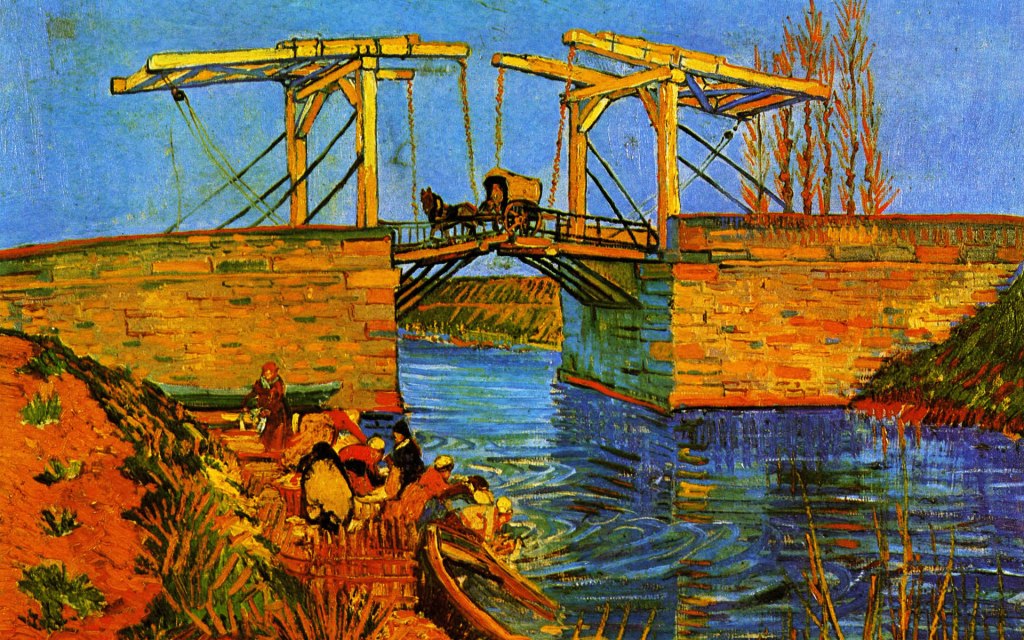
Visit allwallpapersfree.blogspot.com

In May of 1890, Vincent moved to a small attic room in the village of Ouvers-sur-Oisne. To be closer to Theo, and to Dr Paul Gachet, the quack homeopathic doctor Vincent himself described as “iller than I am, it seemed to me, or let’s say just as much.” On July 27, 1890, Vincent left his small apartment for the countryside. This time he carried no paints or brushes. Sick in body and mind and bereft of the Christian faith which had once bouyed his thoughts, Vincent had nothing to believe in anymore but his paintings and those, he couldn’t sell. No one knows where Vincent shot himself. The 7mm Lefaucheux à broche revolver. One bullet. In the stomach or the chest, depending on which version you happen to read. He managed to stagger back to his lodgings, lit up his pipe and lay down in his bed, to die. Gachet was called but the bullet, was too deep.
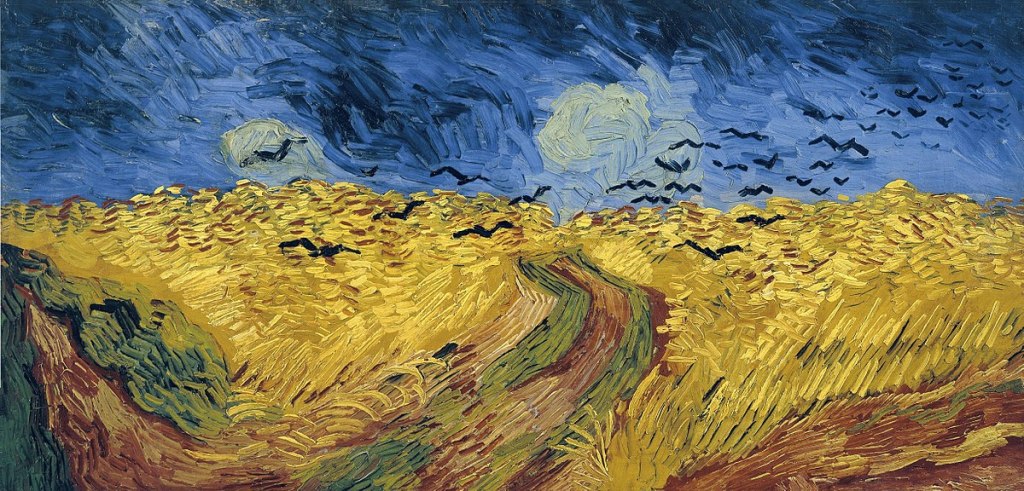
Wheatfield, with crows.

Infection began to set in as Theo was called and rushed to catch a train, to be there. Vincent van Gogh died in the arms of the brother to whom a last, unposted letter was found in his pocket. In it, Vincent describes a recently finished painting, called Wheatfield with crows. The letter said it depicted “vast fields of wheat beneath troubled skies,” adding “I did not have to go out of my way to express sadness and extreme loneliness.”

Theo van Gogh was destroyed over his brother’s death both physically, and mentally. A sharp decline ended six months later with his own death, at the age of 33. The cause of death was dementia paralytica caused by “heredity, chronic disease, overwork, sadness.” He was buried in Utrecht and later exhumed at the request of his widow to be re-interred, next to his brother
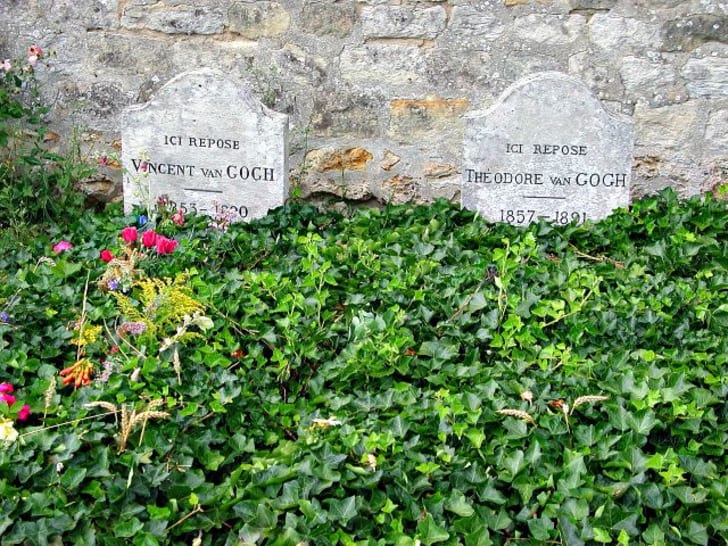
As for Johanna herself, she inherited the vast bulk of her brother-in-law’s paintings and drawings and spent the rest of her life, promoting his work.

On March 17, 1901, eleven years after his death, 71 van Gogh paintings were shown at the Bernheim-Jeune gallery, in Paris. A failure in life, Vincent’s work now hit the art world, like an electric shock. Today some of the artist’s works number among the most expensive paintings, ever sold.

Post script: Theo’s great-grandson, also called Theo van Gogh, was a Dutch film and television director, producer, actor and author. Working from a script provided by Somali-born Dutch-American activist, feminist and former politician Ayaan Hirsi Ali, van Gogh produced a ten-minute short film called Submission, concerning the plight of women in Islam. Both van Gogh and Hirsi Ali received death threats to which Theo responded “nobody kills the village idiot”. He often used that term in describing himself. On November 2, 2004, Islamist Mohammed Bouyeri shot and stabbed the director while bicycling to work, leaving a note pinned with a knife to his dead chest, containing threats against Jews, the west, and Ayaan Hirsi Ali.

March 16, 1968 Sittin’ on the Dock of the Bay

Otis Redding’s iconic song and #1 hit, “Sittin’ on the Dock of the bay“, became the first posthumous number-one record on both the Billboard Hot 100 and R&B charts. The album by the same name was the first posthumous album to reach number one on the UK Albums Chart.

With his father suffering tuberculosis and often hospitalized, Otis Ray Redding Jr. quit school at the age of fifteen to help support the family. He worked at a gas station, but it was the occasional musical gig that got him noticed.  From Macon (Georgia) talent contests to local bands, Redding later joined Little Richard’s band “The Upsetters” when the singer abandoned rock & roll music, for gospel.

Redding began his musical career touring the “chitlin circuit” at a time of racial segregation:  a string of venues hospitable to black musicians, comedians and entertainers throughout the American south, northeast and upper Midwest.  Harlem’s Apollo Theater, the Regal Theater in Chicago, the Howard Theater in Washington, D.C, the Royal Peacock in Atlanta, and others.

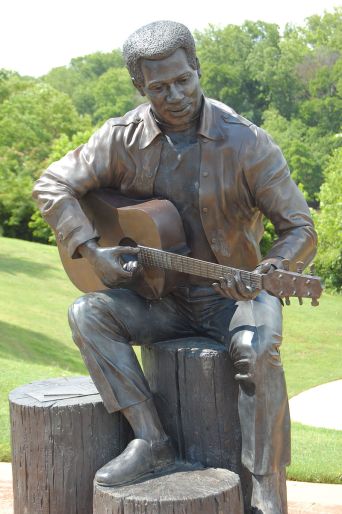
800px-otisreddingstatue

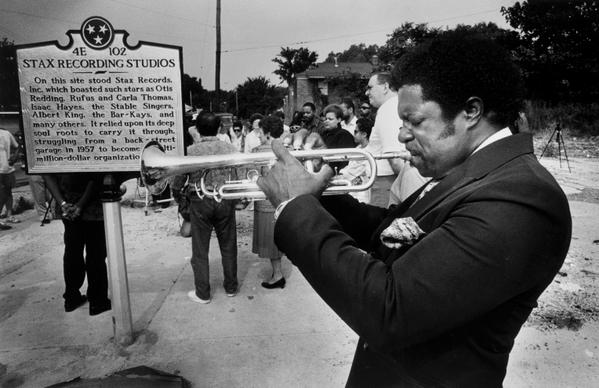
Redding joined STAX Records in 1962, a portmanteau of the founding partners and siblings Jim Stewart and his sister Estelle Axton (STewart/AXton = Stax).

The label’s use of a single studio and a small stable of musicians and songwriters produced a readily identifiable sound based on black gospel and rhythm & blues which came to be known as Southern soul, or Memphis soul.

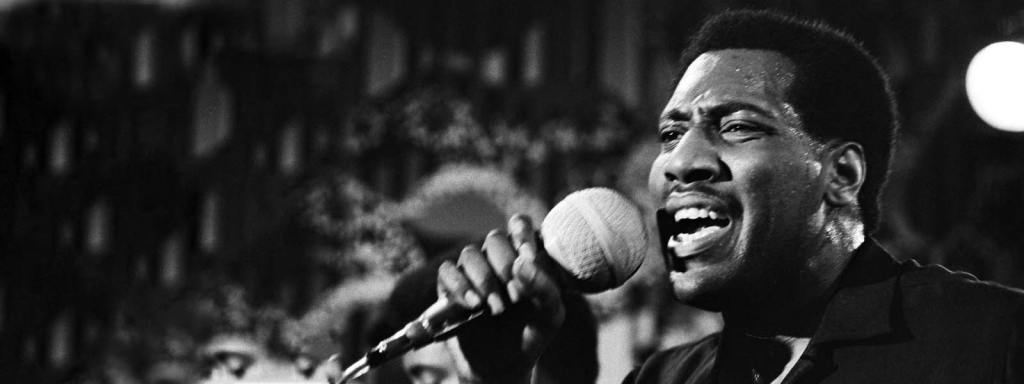
Singer-songwriter-musician Otis Redding became STAX Records’ biggest star in the five years before the plane crash that took his life: the “Big O”, the “King of Soul”.

Musicians from Led Zeppelin to Lynyrd Skynyrd to Janis Joplin and virtually every soul and R&B musician of the era have taken musical influence from Otis Redding. It was he who wrote the ballad R-E-S-P-E-C-T made famous by the “Queen of Soul”, Aretha Franklin.

His initial recordings were mainly popular with black audiences, but Redding and others crossed the “color barrier”, performing at “white owned” venues like Whisky a Go Go in LA, the Monterey Pop Festival of 1967, and venues throughout Paris, London and other European cities.

Redding’s iconic song and  #1 hit, “Sittin’ on the Dock of the bay“, became the first posthumous number-one record on both the Billboard Hot 100 and R&B charts.  The album by the same name was the first posthumous album to reach number one on the UK Albums Chart.

The song wasn’t intended to turn out the way it did.

Redding wanted to expand his musical footprint beyond the soul and R&B genre and took strong influence from the Beatles, particularly the layered sounds of Sgt. Pepper’s Lonely Hearts Club Band.  If you listen to the song – the seagulls, the sound of lapping waves – that’s what he was going for.  Redding remembered those sounds from the rented houseboat in Sausalito where he wrote the first lines and asked Stax producer and guitarist Steve Cropper, to dub them in.

The “outro”, the twenty-five seconds’ whistling at the end, were nothing but a place holder. Cropper explains there’s “this little fadeout rap he was gonna do, an ad-lib. He forgot what it was so he started whistling.” No trouble, it could all be fixed an a second recording session session, after the tour.

That second session was never meant to be.

The kid who once pumped gas to help support the family boarded his own Beechcraft H-18 aircraft on December 10, 1967 along with Bar-Kays guitarist Jimmy King, tenor saxophonist Phalon Jones, organist Ronnie Caldwell, trumpet player Ben Cauley, drummer Carl Cunningham, their valet Matthew Kelly and the pilot, Richard Fraser.

ben-cauley
Bar-Kays trumpet player, Ben Cauley

The band had played two nights in Cleveland.  The next stop was Madison, Wisconsin. The plane took off despite warnings of foul weather.  The show must go on. Ben Cauley remembers waking from a nap to see band-mate Phalon Jones look out a window and cry out “Oh No!”  He then found himself alone, clutching a seat cushion in the 34-degree waters of Lake Monona.  He was the only survivor.

True to his word, Cropper mixed Dock of the Bay as he said he would, adding in the crashing waves and the seagulls and keeping the outro, the way Otis had left it.

Rhythm & Blues stations were quick to add the song to playlists already saturated, with Otis Redding. The song shot to the top of R&B charts and pop charts, weren’t far behind. Dock of the Bay reached #1 on the billboard Hot 100 on March 16, 1968 and stayed there, for four weeks.

Since that time an impressive list of musical talent has joined Otis Redding, for producing # 1 songs released after the artist was gone. David Bowie. Biggie Smalls. Janis Joplin. Tupac Shakour. John Lennon.

It must be some kind of band they’ve got going up there.

March 16, 1914 The Cailloux Affair

Most of France was riveted by the Caillaux affair in July 1914, ignorant of the European crisis barreling down on them like the four horsemen, of the apocalypse.


We heard a lot this past election, about “Left” and “Right”, “Liberal” and “Conservative”.

The terms have been with us a long time, originating in the early days of the French Revolution. In those days, National Assembly members supportive of the Monarchy sat on the President’s right.  Those favoring the Revolution, on the left. The right side of the seating arrangement began to thin out and disappeared altogether during the “Reign of Terror”, but re-formed with the restoration of the Monarchy, in 1814-1815. By this time, it wasn’t just the “Party of Order” on the right and the “Party of Movement” on the left. Now the terms began to describe nuances in political philosophy, as well.

100 years later, differences between the French left and right of the period, would be recognizable to American political observers of today.

Joseph Caillaux
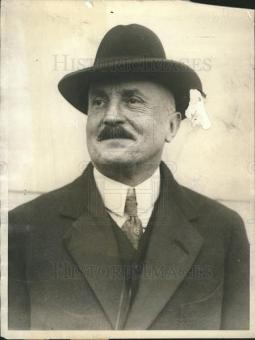
Joseph Cailloux

Joseph Cailloux (rhymes with “bayou”) was a left wing politician, appointed prime minister of France in 1911. The man was indiscreet in his love life, even for a French politician. Back in 1907, Cailloux paraded about with a succession of mistresses, finally carrying on with one Henriette Raynouard, while both were married to someone else. They were both divorced by 1911 and that October, Henriette Raynouard became the second, Mrs Cailloux.

The right considered Cailloux to be far too accommodating with Germany, with whom many believed war to be all but inevitable. While serving under the administration of President Raymond Poincare in 1913, Cailloux became a vocal opponent of a bill to increase the length of mandatory military service from two years to three, intended to offset the French population disadvantage between France’s 40 million and Germany’s 70 million.

Gaston Calmette
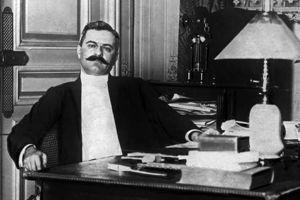
Gaston Calmette

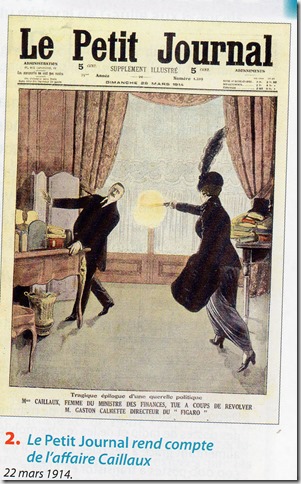
Gaston Calmette, editor of the leading Conservative newspaper Le Figaro, threatened to publicize love letters between the former Prime Minister and his second wife, written while both were still married for the first time.

Henriette Cailloux was not amused.

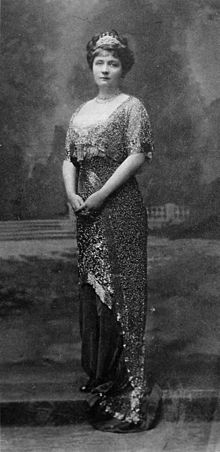
On March 16, 1914, Madame Cailloux took a taxi to the offices of Le Figaro. After being shown into Calmette’s office, the pair spoke only briefly, before Henriette withdrew the Browning .32 automatic, and fired six rounds at the editor. Two missed, but four were more than enough to do the job. Gaston Calmette was dead within six hours.

Henriette_Caillaux
Henriette Cailloux

German Chancellor Otto von Bismarck once said the next great European war would start with “some damn fool thing in the Balkans”. No one realized it at the time, but Bismarck got his damn fool thing on June 28, 1914, when a Serbian Nationalist assassinated the heir apparent to the Austro-Hungarian throne.

The July Crisis was a series of diplomatic mis-steps, culminating in the ultimatum from Austria-Hungary to the Kingdom of Serbia. Vienna, with tacit support from Berlin, made plans to punish Serbia for her role in the assassination, even as Russia mobilized armies in support of her Slavic ally.

Meanwhile, England and France looked the other way.  In Great Britain, officialdom was focused on yet another home rule crisis concerning Ireland, while all of France was distracted by the “Trial of the Century”.

affairecaillaux_thumb

Think of the OJ trial, only in this case the killer was a former First Lady. This one had everything: Left vs. Right, the fall of the powerful, and all the salacious details anyone could ask for. Most of France was riveted by the Caillaux affair in July 1914, ignorant of the European crisis barreling down on them like the four horsemen of the apocalypse. Madame Caillaux’s trial for the murder of Gaston Calmette began on July 20.

She was acquitted on July 28, the jury ruling the murder to be a “crime passionnel”.  A crime of passion. That same day, Austria-Hungary declared war on Serbia.

In the days that followed, the Czar would begin the mobilization of men and machines which would place Imperial Russia on a war footing. Imperial Germany invaded Belgium, in pursuit of the one-two punch strategy by which military planners sought first to defeat France, before turning to face the “Russian Steamroller”. England declared war in support of a 75-year old commitment to protect Belgian neutrality, a treaty obligation German diplomats dismissed as a “scrap of paper”.

Eleven million military service members and seven million civilians who were there in July 1914, wouldn’t be alive to see November 11, 1918.

March 14, 1805 A Candle in the Wind

Human sacrifice! Dogs and cats living together! Mass hysteria!

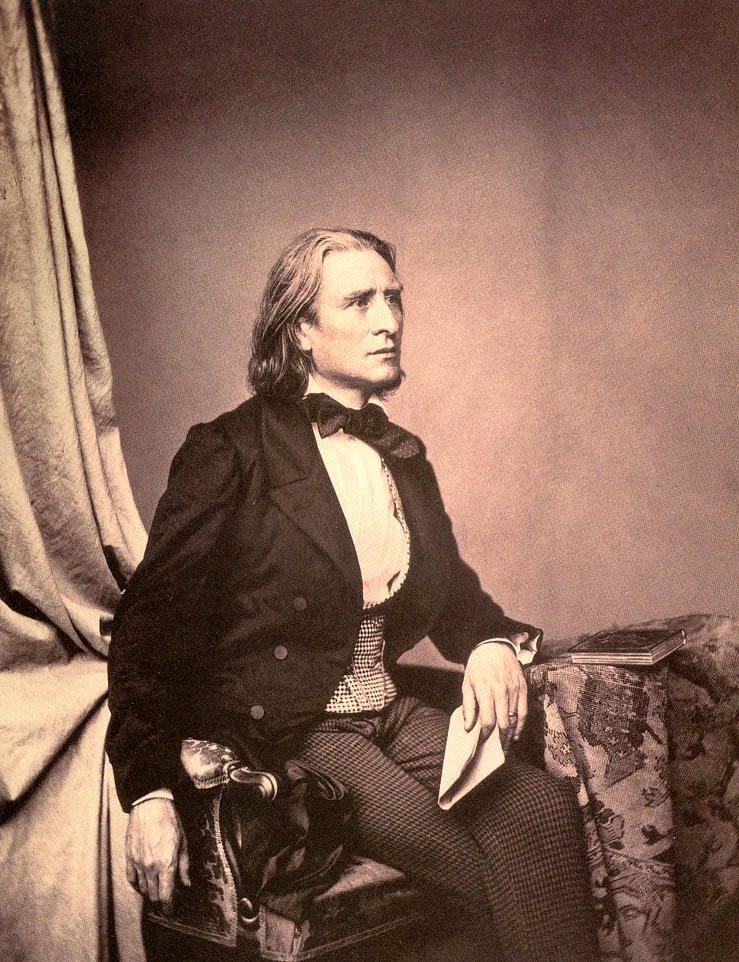
Accomplished as he was with the violin, cello, piano and guitar, Adam Liszt was a natural musician, a personal friend of Joseph Haydn and Ludwig von Beethoven. It was natural that Adam’s young son Franz would take to music, like a duck to water. That he did, beginning at the age of seven. Franz Liszt would come to be known as one of the greatest pianists of all time, but there was more. In an age of staid reserve not known for mass hysteria, the man’s mere appearance was capable of exciting paroxysms of adulation among his fans, heretofore rarely seen outside the realm of religious rapture.

Fans wore the man’s likeness in brooches and pendants. At concerts, women would literally fight to get at his gloves or his hat or even a broken piano string from which to fashion a bracelet. Female admirers would carry glass vials, in which to hold the dregs of his coffee. One infatuated lady-in-waiting once saw him toss a cigar butt, to the curb. Heedless of the stink of that malodorous object she picked the thing up and wore it in a locket bearing the diamond encrusted initials, F.L.

Franz Liszt in 1858

The German poet Heinrich Heine coined the phrase “Lisztomania” but this wasn’t the hysterical adulation directed at four lads from Liverpool, of a later age. Heine referred to a literal medical condition communicable to the public and requiring immunization measures, to control.

Frenzied adulation amounting to mass hysteria was unusual in the time of Franz Liszt, but not unheard of. The delirium of an earlier age would so thoroughly sweep through Great Britain that not even the Royal family, was exempt.

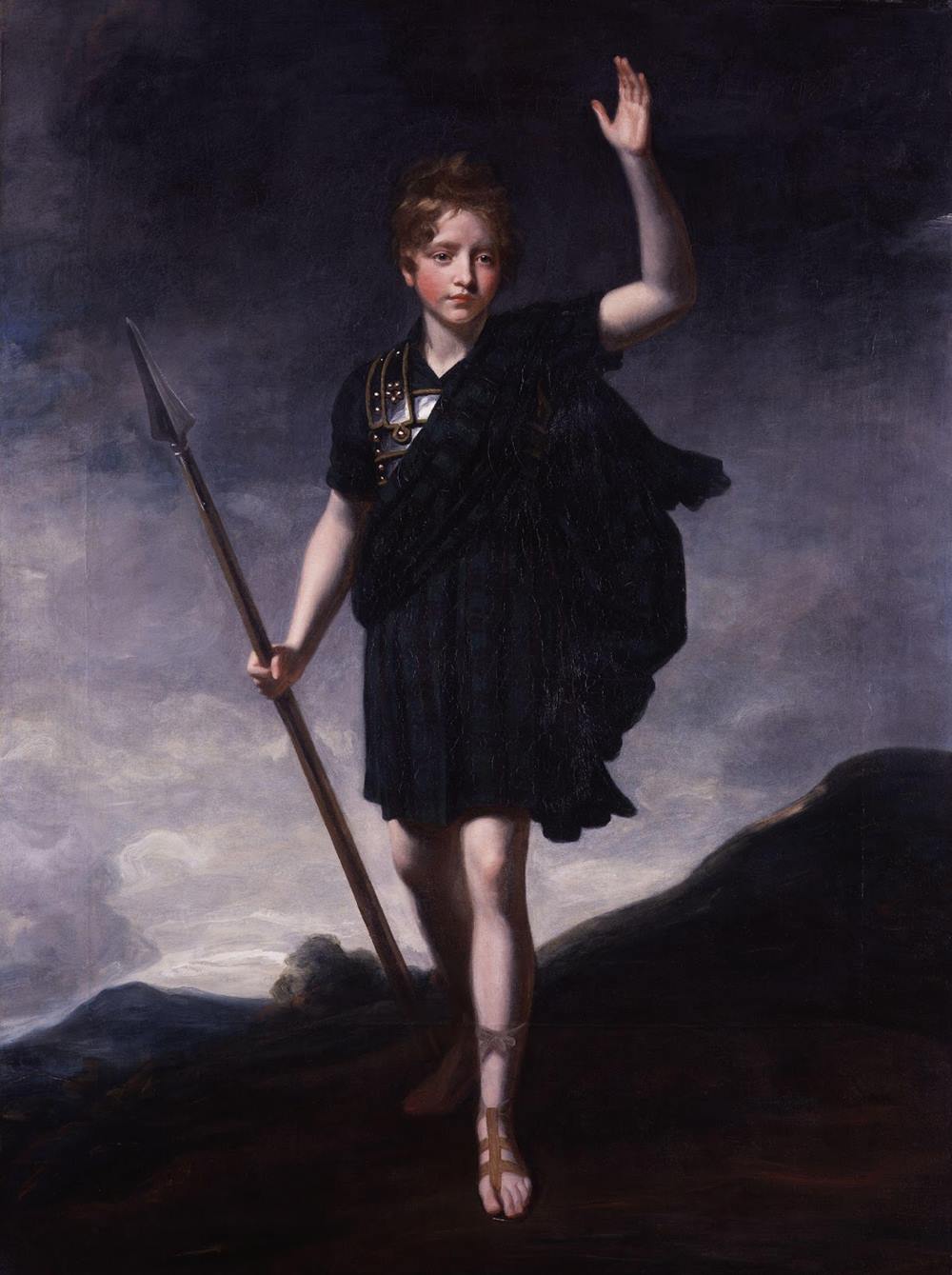
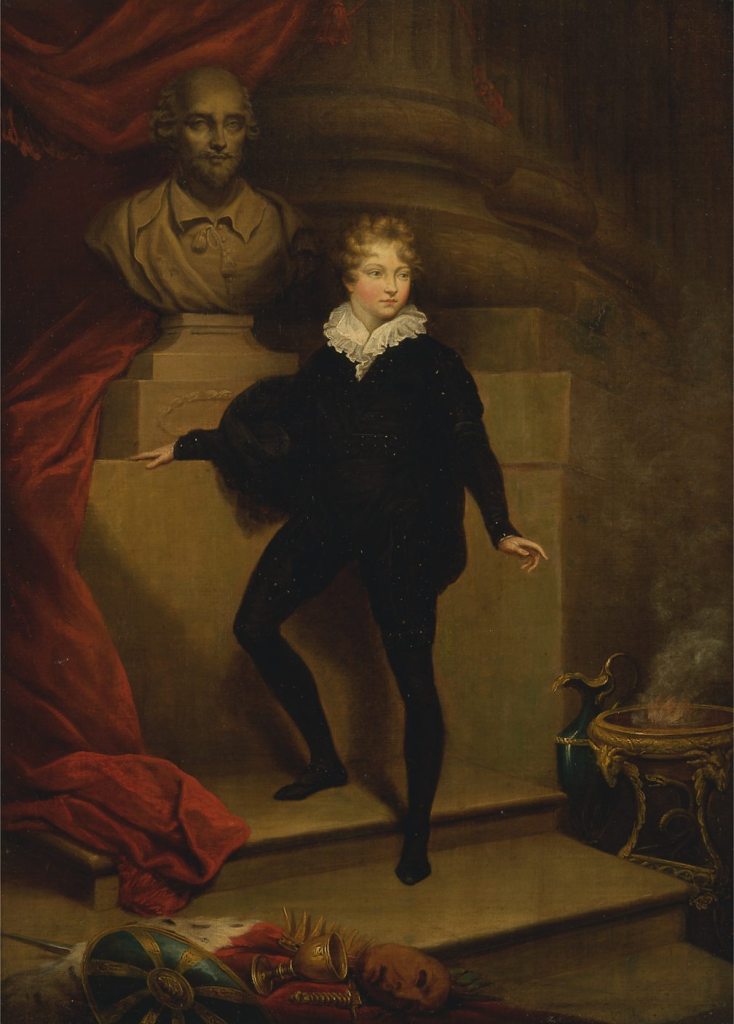
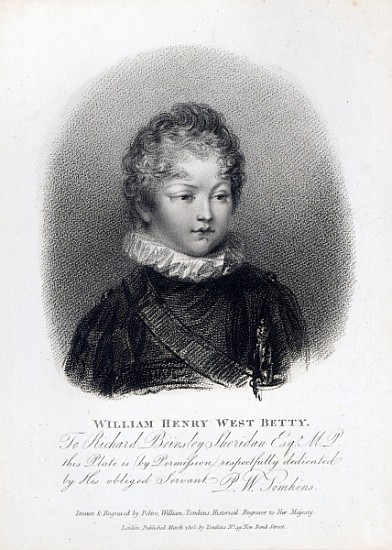
William Betty, the ‘Boy Wonder”

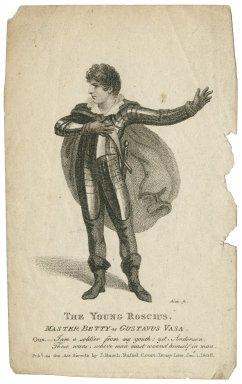
It all began in 1802 when William Henry West Betty attended a theater with his father in Belfast, at age 11. The boy was enthralled by what he had seen declaring to his father “I shall certainly die if I may not be a player.”

Anyone who’s raised a pre-teen can well imagine the badgering, that followed. At last relenting the father brought young “Master Betty” to the theater manager who must have seen some natural talent. There followed several weeks of training and that first performance, met with rave reviews.

Shakespearian acting is famously difficult in the world of thespians but Betty was a natural, even memorizing the famously wordy role of Hamlet, in three hours.

Hamlet. Romeo. Macbeth. The Boy Wonder trod the boards from Dublin to Glasgow to Edinburgh becoming a sensation across all Ireland, and Scotland.

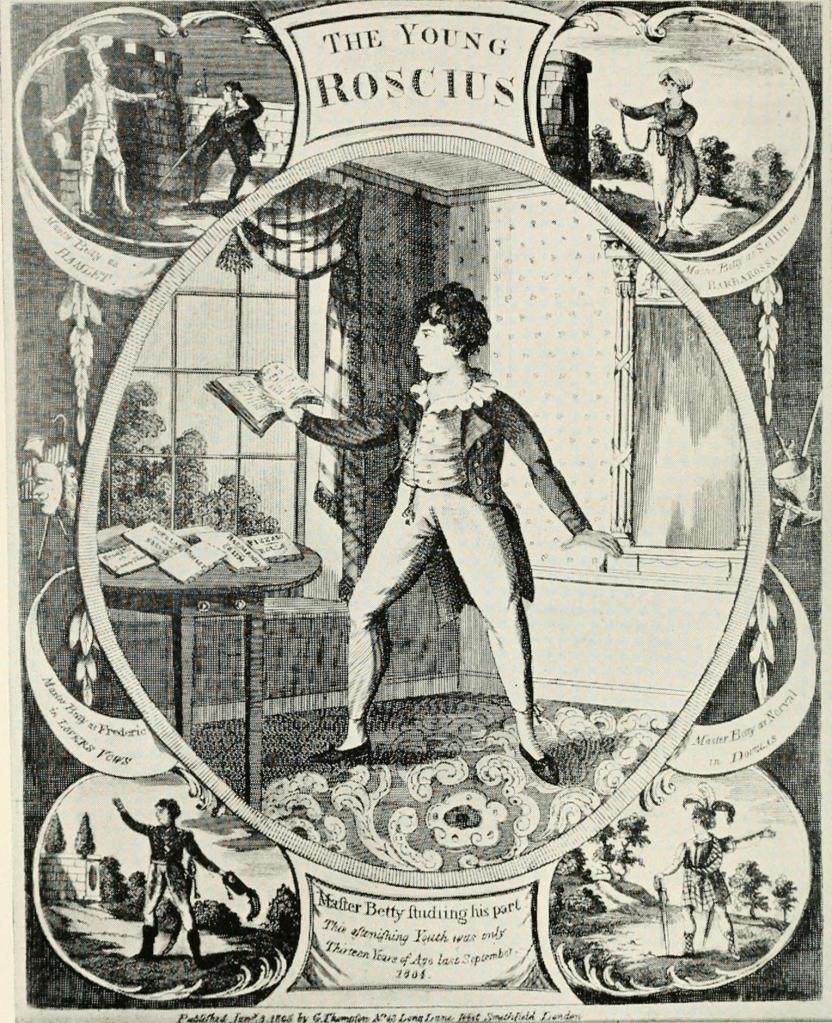
Paintings were made in his likeness. One cartoon depicted the young artist bestriding the bodies of older players, of the age. A medal was struck with the lad’s image and the inscription, “Not yet mature but matchless”.

The kid was earning a hundred pounds a night at a time when the average working man was lucky to receive one, in a week.

All across England, the kid was a sensation. He was “the Young Roscius”, a reference to the slave-turned-actor of Roman antiquity who inspired Quintus Lutatius Catulus to proclaim, “I stood by chance to greet the uprising Aurora, when suddenly, on the left, Roscius rose up. Please, o heavenly gods, give me leave to say that a mortal seemed to me more handsome than a god“.

At last, Master Betty was ready for London. Hopeful theater goers stood in line for hours just to get tickets in December, 1804. The Covent Garden theater hired policemen to control the crowd waiting outside to catch a glimpse, of the Boy Wonder. One reporter wrote: “Shrieks and screams of choking, trampled people were terrible. Fights for places grew; constables were beaten back, the boxes were invaded. The heat was so fearful that men, all but lifeless, were lifted and dragged through the boxes into the lobbies which had windows.”

Betty was celebrated by London society, invited to dine with none other than King George III and his wife, the Queen Consort Charlotte of Mecklenburg-Strelitz. The House of Commons was adjourned on March 14, 1805 so MPs could trek across London to see Betty play Hamlet.

In his short but meteoric career, Master Betty inspired a rash of child prodigies. For the Boy Wonder, the flame was destined to burn out. The novelty was gone, he couldn’t draw large enough crowds, to pay for the venue.

In 1806, a failed performance of Richard III caused him to be hissed, off the stage. Critics panned an attempted comeback in 1812 and another in 1819. There was a failed suicide attempt at the age of 30.

On September 6, 1997, Elton John performed “A Candle in the Wind” at the funeral for Princess Diana, a song about the meteoric rise and the tragic death, of Marilyn Monroe. For William Betty the candle blew out in 1824. Like so many child prodigies, this one retired to a life of lonely obscurity where he devoted his time and still-considerable fortune, to charitable causes. He died with barely a notice on August 24, 1874, at the age of 83.

March 12, 1790 A Momentary Lapse of Reason

In recent months we have learned from our “elites”, that math is racist. That men participating in women’s sports is perfectly reasonable, that men can give birth. Dumbo and Peter Pan have been canceled. Dr. Seuss is driven from polite society.

The news this morning spoke of an “elite” private school in New York, and the 12-page memorandum sent home to Moms and Dads. Turns out the Grace Church School doesn’t like the terms, “Mom” and “Dad”. Kids aren’t allowed to use them anymore. Even at home.

Leaving a reasonable person to wonder, what exactly renders these people, “elite”? And why would such a thing warrant any response at all, save for a one-finger salute?

In recent months we have learned from such “elites”, that math is racist. That men participating in women’s sports is perfectly reasonable, that men can give birth. Dumbo and Peter Pan have been canceled. Dr. Seuss is driven from polite society.

Scores of millions of women and men of all persuasions and all political stripes quietly shake their heads in hopes that this too, shall pass. And not for the first time. In 1688, no fewer than 19 counties in England and Wales mobilized to defend against armed and rampaging bands of non-existent Irishmen. In 1954, widespread observation of previously unnoticed pits and dings in windshields caused residents of Washington state to believe there was an epidemic of windshield pitting, attributed to everything from sand flea eggs, to nuclear testing.

History abounds with episodes of mass hysteria. The Dancing plague of 1518. The Witchcraft Hysteria of 1692 and the granddaddy of them all la Grande Peur, the Great Fear sweeping across 1789 France culminating in the French Revolution, the Napoleonic wars and an estimated 3.1 million dead Frenchmen.

All that to return back to the status quo, in 1815.

Imagine you were there, from the beginning. August 1789. Your personal politics are middle of the road, maybe a little to the left but in all respects, “Moderate”. Now imagine your nation’s politics have shifted so radically in the space of two short years, you find yourself on the “reactionary right”. You are hounded, subject to persecution, even execution, at the hands of your own government. And your personal convictions haven’t changed.

In early modern France, society broke into “three estates”: the Clergy (1st), the Nobility (2nd) and a 3rd Estate encompassing common women and men. The estates-general was a legislative body comprising three assemblies representing each of the three estates.

French society found itself at a crossroads in the late 18th century. Politically, the “commons” had become a caste of its own with a desire for parity, with the 1st and 2nd Estates. Culturally, the “Age of Enlightenment” brought with it an elevation of “Reason” at the expense of tradition and with it, a diminution of the Monarchy and the Church.

Economically, the French state carried massive debt at this time, a condition made worse by French support of the American Revolution a decade earlier. (Did we really just blow another two Trillion on a “Covid relief” package, with 7% actually going to Covid relief?)

The straw to break the camel’s back came in the form of successive crop failures. Across Europe, peasants tilled the lands of the manor houses of minor Lords who themselves owed fealty, to the higher nobility. The system had been around since Roman times. In 1789 France, successive crop failures spawned rumors of an aristocratic plot to wipe out the working classes. Peasants rose up to take action, against the seigneurs.

The fiscal and agricultural crises of 1789 pushed the nation over the edge. The “tennis court oath” that May asserted the autonomy of the third estate, a direct affront to the hereditary rights of Kings. The beast was unleashed. The mob stormed the Bastille that July leading to bread riots in the streets and a march on the King’s residence, at Versailles.

In three short months, King Louis XVI was stripped of executive authority.

On this day in 1790, the national Assembly decreed the sale of church-owned lands by municipalities, an affront to church authority unimaginable, in earlier ages.

King Louis XVI of France

King Louis XVI fled with his family in June 1791 only to be captured, returned to Paris and placed under guard. Even then the first French constitution approved that September, reflected the voices of moderation. While sharply limiting monarchical power the King still kept his head, still GOT to be King while enjoying veto power and the authority to appoint ministers.

Radical elements were inflamed, led by the likes of Maximilien de Robespierre, Camille Desmoulins and Georges Danton. The King must be put on trial. Louis XVI was deposed in August 1792 and thrown in prison, followed by an orgy of violence against suspected “counter-revolutionaries”.

Once absolute monarch of France, “Citizen Louis Capet” was executed by guillotine in January 1793 in front of a crowd of 100,000. Bloodthirsty sans culottes rejoiced, wrote The London Times, while “honest citizens… could not suppress their heartfelt grief and mourned in private”. Queen Marie-Antoinette followed her husband to the guillotine, nine months later. The son of the royal couple, Louis-Charles, was thrown into a stone prison cell at the age of 8. The boy was dead at ten. The physician who performed his autopsy expressed shock and dismay at the scars, covering his little body.

The Jacobins, the most radically leftist in a kaleidoscopic mélange of competing factions, were now in power. These people went so far as to abolish history itself, creating a new calendar with themselves at the beginning. Year one. Just like that proclaimed by Pol Pot in April, 1975.

“We are the ones we’ve been waiting for”.

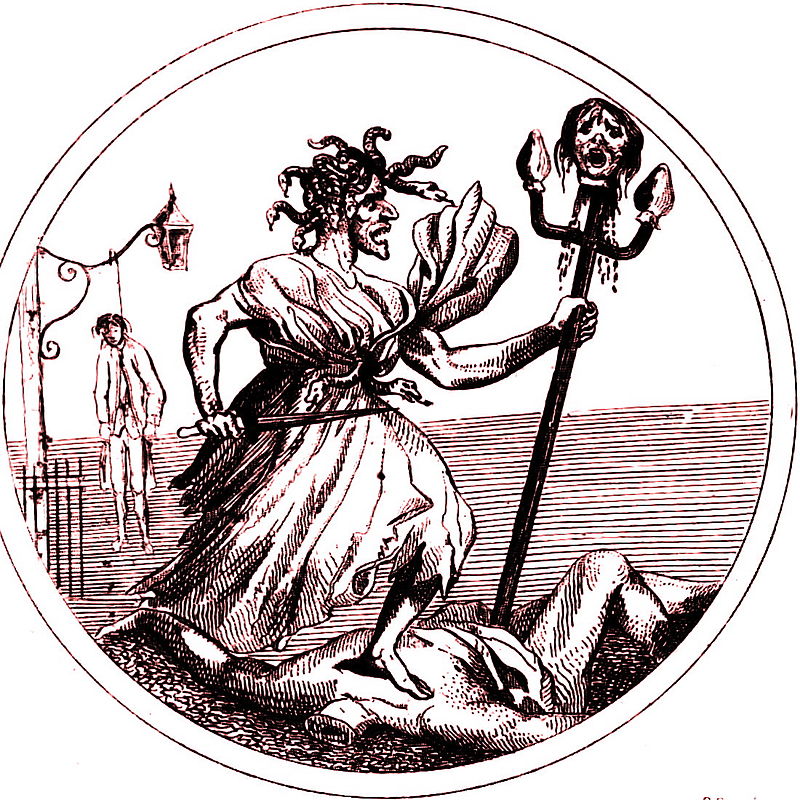
Historical caricature of the reign of terror

The revolution turned on itself and ate its own young in 1793-’94, a period described as the “reign of terror”. Victims by the tens of thousands walked their final steps to the guillotine, while equal numbers stood to face firing squads.

Robespierre, once the thought leader behind this whole mess, came to be seen as an enemy of the Revolution. Knowing all too well what would happen next Robespierre shot himself in the face, to prevent his own arrest. The suicide attempt succeeded only in destroying the man’s lower jaw, and several teeth. That visage, once the face of Revolution itself and now wrapped in blood soaked bandages, was separated from the rest of him the following day.

Fun fact: Joseph-Ignace Guillotin had nothing to do with the contraption, that bears his name. He didn’t even approve of capital punishment. As a physician, the torture inflicted by breaking on the wheel, burning at the stake, death by boiling and dismemberment was repugnant. To be hacked at by axe or sword was hardly any better. If capital punishment was to be carried out at all he believed, the quick, impersonal and painless death afforded by a decapitation machine might just be the first step toward abolishing the death penalty, altogether.

It was Tobias Schmidt who actually invented the thing. The association with the guillotine so embarrassed the doctor’s family they changed their name. One J.M.V. Guillotin, an unrelated physician practicing in Lyons, met his end on the guillotine, giving rise to the myth that the inventor was killed by his own machine. Dr. Joseph-Ignace Guillotin died at home of natural causes, in 1814.

Robespierre was barely in the ground when a certain Corsican corporal was thrown in prison, a suspected supporter of Robespierre. Napoleon Buonaparte would earn a place with the regime in October 1796, 13 Vendémiaire according to the new calendar, by putting down a royalist revolt in the streets.

The Napoleonic era had begun, fifteen years of violence pitting no fewer than 7 international coalitions, against the French war machine. French historian Hippolyte Taine has claimed the Revolution and Napoleonic wars took the lives of 3.1 million Frenchmen, alone. Precise numbers are impossible to determine.

Mark Twain once said that history doesn’t repeat itself, but it does rhyme.

Following a year-long government lockdown and four years of the most divisive politics in American history – even Civil War soldiers from the north and south agreed about 80% of the time – we find ourselves in a period of national hysteria. The capital is surrounded by armed troops, and razor wire. Social media billionaires with funny haircuts and weird beards arrogate to themselves who gets to say what, and when. 1st Amendment be damned.

The wealthiest man on the planet shuts down whole social media channels while #2 rains down cash on racists, claiming to root the racists out of math.

Or maybe men really can give birth and math really is, racist. Who knows, maybe everything will turn out right, after all. Now that we’ve unsexed Mr. Potato Head.

March 11, 1805 Why can I not Fight for my Country too?

“Wrought upon at length, you may say, by an enthusiasm and frenzy that could brook no control – I burst the tyrant bands, which held my sex in awe, and clandestinely, or by stealth, grasped an opportunity, which custom and the world seemed to deny, as a natural privilege”. – Deborah Sampson

Her mother was Deborah Bradford Sampson, great-granddaughter of William Bradford, the Mayflower passenger and later Governor of Plymouth Colony. As the mother of seven, Deborah did the best she could. She also raised her young niece whose parents and baby brother were killed and scalped, by Indians. She was not one to make great choices in men, though. Jonathan Sampson would abandon his wife and children to start a new life, in Maine.

Deborah Sampson was the 5th child of this union, born in 1760 in the southeastern Massachusetts town of Plympton. Her father left the family destitute, and all the Sampson children were sent off to live with friends and relatives, a common practice at that time.

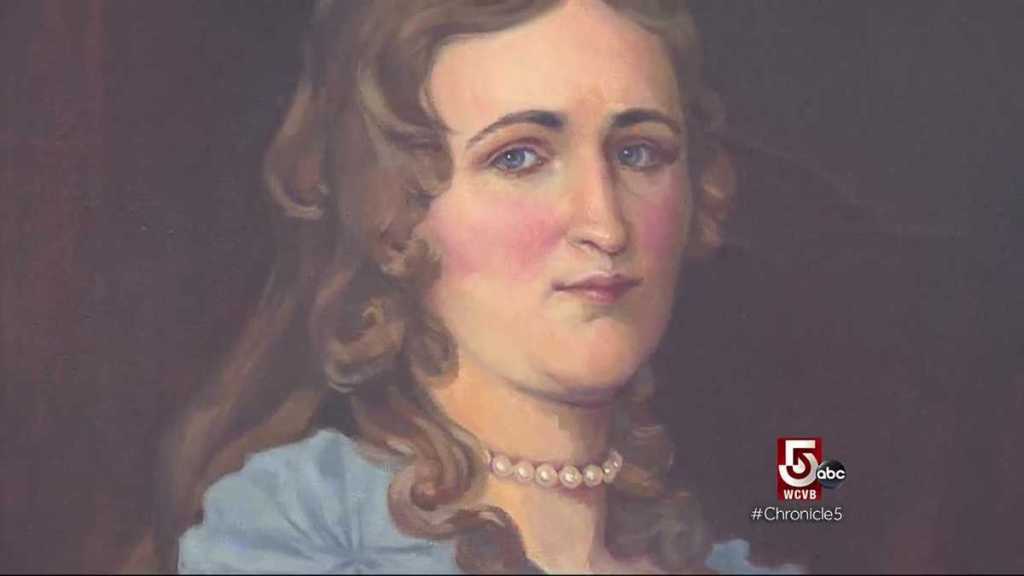
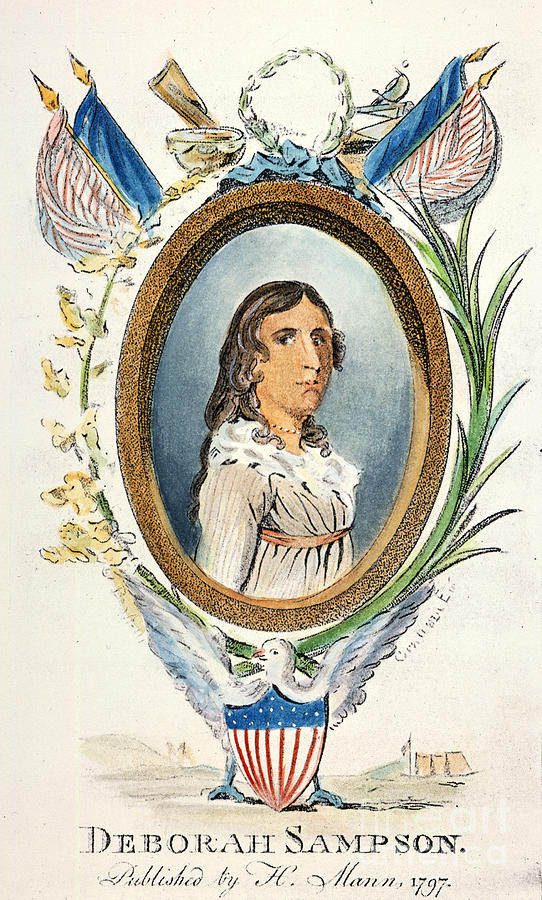
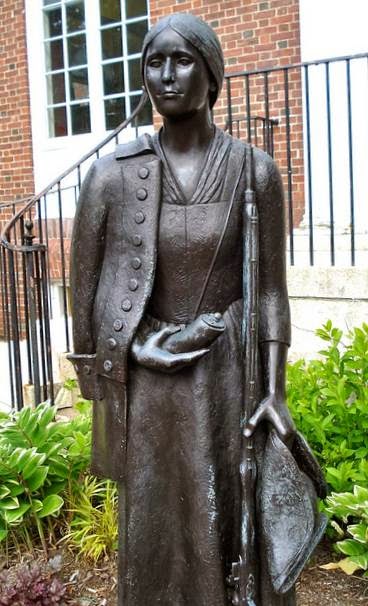
Today her bronze likeness greets visitors to the Sharon town library, 22 miles south of Boston. So, who is Deborah Sampson?

Sharon town library

At age ten, Deborah became an indentured servant to the family of Jeremiah Thomas, of Middleborough. She was treated well but, in 18th century New England, female education wasn’t a priority. Deborah would overcome the obstacle, persuading the Thomas sons to share their lessons with her. The episode would reveal a lot of who she’d become in later life.

As Revolution came to the soon-to-be former British colonies, Deborah supported herself as a schoolteacher. She became skilled at weaving and light carpentry and sold milking stools and pie crimpers, door to door.

In 1782, Deborah Sampson entered the life for which we know her, today. She bound her breasts with a linen cloth, donned male attire and went to war for her country. As a soldier.

In an age when the average man stood five-foot six-inches tall, Deborah stood 5’8″. With “plain features” according to a neighbor and what her biographer described as a “waist [which] might displease a coquette”, the transition wasn’t as unlikely as it would seem.

She joined an army unit in Middleborough under the assumed name of Timothy Thayer. She almost pulled it off too before being recognized, by a local. She paid back that part of her signing bonus not already spent and tried again, this time where she wouldn’t be known. Fifty miles away, in Uxbridge.

Sampson joined a light infantry unit under the assumed name of Robert Shirtliff, part of the 4th Massachusetts Regiment.

Deborah Sampson fought for a year and a half, as a man, and not in some rear-echelon outfit. The light infantry soldier was specifically chosen to be bigger and stronger than average, charged with rapid flanking movements, rearguard defense and forward reconnaissance, for units on the move. It was not a place where anyone would expect to find someone of her sex.

That baby-smooth chin earned her no end of grief from her fellow soldiers, but she persevered. Sampson fought in several skirmishes, the first outside Tarrytown New York, on July 3, 1782. There she received a deep gash on the forehead and two musket balls, to her thigh. Terrified that her sex would be discovered, she begged her fellow soldiers not to intervene. Her pleas fell on deaf ears. She was put on a horse, and dragged off to the hospital.

Doctors tended to her forehead but she sneaked out before they could get a look at that leg. Using a pen knife and sewing needle, Deborah removed one of the balls, herself. The other was too deep. She would carry it with her for the rest of her life, deep inside a wound that never quite healed.

The war was basically over following the American victory at Yorktown, yet negotiations dragged on, for a year. Even then, American soldiers remained in uniform.

On April 1, 1783, Sampson was assigned to be waiter to Major General John Paterson. That June a contingent of soldiers under General Paterson, were ordered to put down an anti-government protest by some 400 continental soldiers known as the Pennsylvania mutiny of 1783.

Deborah fell ill while in Philadelphia. Delirious, fading in and out of consciousness it was doctor Barnabas Binney who removed her clothes only to find the linen cloth, which bound her breasts. Thus discovered she was removed to the doctor’s home where the female members of the household joined in her care, with a trained nurse.

“Robert Shirtliff” recovered and, handed a note to give to General Paterson, assumed her secret was betrayed. She was right. Other women had been reprimanded for what she had done but Paterson seemed to admire what she’d accomplished. She was sent home with an honorable discharge, a few words of advice and enough money, to get home to Massachusetts.

She married one Benjamin Gannett two years later and moved to the Gannett family farm, in Sharon. There the couple raised three kids plus an orphan, but life was hard. As farms go this one was small, the soil depleted from generations of use.

In 1792 she petitioned the Massachusetts legislature for back pay, withheld because of her sex. She was awarded 34 pounds plus interest dating back to her 1783 discharge. The measure was signed by governor John Hancock.

Sampson went on a speaking tour where she’d extoll traditional feminine roles. Then she’d step out and return to the stage in uniform, flawlessly performing a long and taxing series of military drills. She did it for money but, once expenses were paid there was little left. She often borrowed money from her family and from a friend, named Paul Revere.

Revere wrote to Massachusetts member of Congress William Eustis in 1804: “I have been induced to enquire her situation, and character, since she quit the male habit, and soldiers uniform; for the more decent apparel of her own gender… humanity and justice obliges me to say, that every person with whom I have conversed about her, and it is not a few, speak of her as a woman with handsome talents, good morals, a dutiful wife, and an affectionate parent.

On this day in 1805, Congress approved her application. An invalid pension of $4 a month.

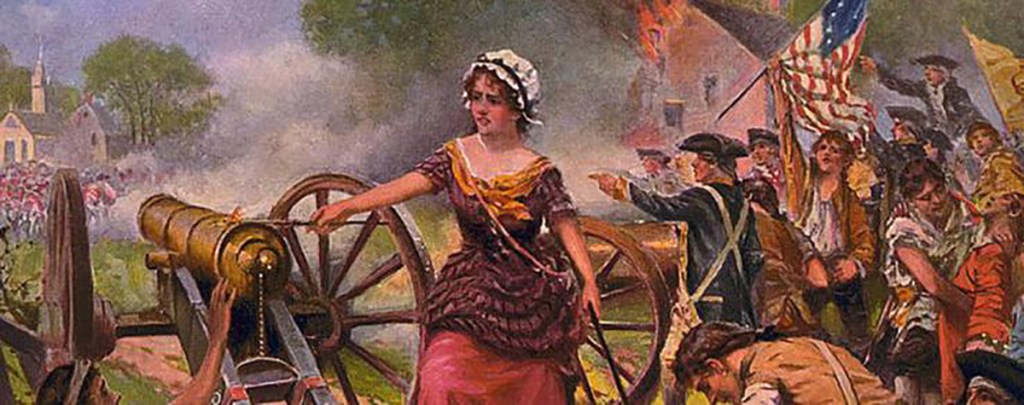
Deborah Sampson wasn’t the first woman awarded a military pension, that honor went to Margaret Cochran Corbin. At the battle of Fort Washington on November 16, 1776, Corbin continued to fire the gun in whose service her husband was killed, only minutes before. A fine job she did too, before being hit by enemy fire. With her jaw and her left breast severely damaged, her left arm all but ripped from her body, Corbin entered captivity following British victory.

Corbin never did regain use of that left arm. Gruff and thoroughly unfeminine she made few friends among the women of her age, preferring instead the rough and masculine company of fellow soldiers.

Deborah Sampson adopted the more traditional role of wife and mother and died of yellow fever in her 66th year. She went to her rest in the Rock Ridge cemetery in Sharon, Massachusetts. So it is the bronze likeness of Massachusetts’ “official heroine” greets visitors to the Sharon town library, the only person so honored, by an American state.

Every day, visitors of all ages pass her likeness, in front of that library. Do they know her name? Who knows, but wouldn’t she set a fine example for our daughters and granddaughters. Not at all the sort of role model our girls are subjected to, in our own day and age.

March 10, 2011 When I Fell from the Sky

Abraham Lincoln was neither the first nor the last to fall from a high place, and live to tell the tale.

In 1840, a young politician found himself in a legislative minority, opposed to a payment to the Illinois State Bank.  In order to prevent a quorum, a handful of Whigs attempted to leave the chamber.  Finding the door locked, our man stepped to a second-story window, and jumped out.  Abraham Lincoln would come to regret what he called his “window scrape”, but the future 16th President was far from the first person to fall from a high place.  Voluntarily, or otherwise.

The term is “Defenestrate”: to throw a person or thing, out of the window.

Jezebel, yeah that Jezebel, the unlovable Queen of Israel from the Bible, was executed by defenestration, in 842BC.

In 1618, three regents of the imperial crown were thrown from the window of the Prague castle, 70-feet from street level. Things hadn’t worked out so well 200 years earlier, when a burgomaster and 13 members of the Prague town council, were similarly defenestrated.

All three survived this time, thanks to the help of mythic angels, according to friends and supporters. Detractors weren’t quite so kind, attributing the trio’s survival to a pile of horseshit. Be that as it may, one of them became a noble thanks to the emperor, and received a title: Baron von Hohenfall. (“Baron of Highfall“). Honest. I couldn’t make up a thing like that.

Since the age of aircraft there are tales of survival, enough to make Baron Highfall’s adventures look like stepping from a curb.

The 2003 737 crash outside port Sudan airport killed 113 and left 2-year-old Mohammed el-Fateh Osman lying on a fallen tree, injured, but still alive.

In 2009, pilot error put Yemenia Flight 626 into aerodynamic stall over the Indian ocean. Alone among 153 passengers and crew, 14-year-old French schoolgirl Bahia Bakari found herself the sole survivor, clinging to wreckage and floating in pitch black heavy seas, for 13 hours.

Base jumper James Boole plunged 6000-feet landing on snow covered rocks in 2009 while filming another jumper, in Russia. “This is going to hurt a lot” he later recounted to the guardian newspaper, “or not at all”. Boole broke his back that time but he was at it again, a year later.

In December 1971, lighting struck LANSA Flight 508 over the Amazon rainforest, breaking the Lockheed Electra to pieces. 17-year-old Juliane Koepcke plunged 10,000 feet still strapped to her seat and survived despite deep gashes and a broken collarbone. Koepcke, the daughter of German scientists working in the Amazon, had grown up a “jungle child”. If you’re lost in the jungle her father would say, follow a stream. Water will always lead you to civilization. For ten exhausting days she trekked through knee-deep water, poking the ground ahead of her to scare away rays and dodging crocodiles.

With maggot infested wounds and nothing to live on but candy scrounged from the wreck, Juliane found her salvation on day 11 at the hands of remote fishermen. Following a period of recovery, she led search parties back to the scene of the crash. It was then that she learned, astonishingly, that her mother had also survived the crash only to succumb to her injuries, days later. Now Juliane Diller, she returned to Germany and followed her parents, into the physical sciences. Her autobiography came out on this day in 2011, if you want to learn more of her story. When I Fell from the Sky (German: Als ich vom Himmel fiel). That must be one hell of a story.

Julianne Koepcke Diller in 2019

In 1985, two sky divers became tangled during a 12,000-foot jump near Victoria Australia. Frank’s injuries were minor. Dave Hodgman wasn’t so lucky but still returned to jumping, within three months.

21 year old RAF Flight Sergeant Nicholas Stephen Alkemade found himself under attack by German aircraft on March 24, 1944. With his parachute burned away and his aircraft in a burning death spiral, Alkemade chose a quick death over being burned alive. At 18,000 feet. The tail gunner regained consciousness looking up from the snow, at the stars above. He lit a cigarette. With a sprained ankle, the airman was easily captured. German interrogators were so impressed with his story they gave him a certificate, attesting to his tale.

Joe Herman of the Royal Australian Air Force was blown out of his bomber, in 1944. Free falling through the night sky Herman grabbed wildly for anything he could get hold of. It happened to be the leg of fellow airman John Vivash. Herman hung on for dear life and returned the favor, hitting the ground first and breaking the fall, for his benefactor. Herman walked away with two broken ribs.

In 1943, American turret gunner Alan Magee was forced to jump from the B-17F Snap! Crackle! Pop!, four miles through the skies over France. He fell 22,000 feet, crashing through the glass roof of the St. Nazaire railroad station. On the ground, his German captors were astonished. With 28 shrapnel wounds, massive internal injuries and a right arm all but severed the man lived on, for another 61 years.

Turret gunner Alan Magee poses for the camera, halfway out of his “office”

Soviet Airforce Lieutenant Ivan Chisov bailed out of his Ilyushin Il-4 bomber, at 22,000 feet. He intended to freefall out of the combat zone so as not to be gunned down by vengeful German pilots, while dangling from his parachute. And a fine plan it was, too, until he lost consciousness, due to the altitude. Chisov hit the snowy embankment at somewhere between 120 and 150 miles per hour, breaking his pelvis and injuring his spine. He was flying again, three months later.

In January 1972, Croatian terrorists placed a briefcase bomb on JAT Air flight 367 from Stockholm, to Belgrade. The bomb exploded, breaking the aircraft into three pieces. Serbian flight attendant Vesna Vulović survived the fall with a fractured skull and brain bleeding, two broken legs and three broken vertebra. Vulović passed the next 27 days in a coma and remembers nothing after greeting passengers, on the flight. When offered sedatives for her return flight to Belgrade, she declined the injection. With no memory of the crash, there was nothing to be afraid of.

At 33,330 feet, Vesna Vulović is listed in the Guinness book of world records, for surviving the highest fall.

JAT flight attendant Vesna Vulović

If you’re ever caught in such a situation, experts advise that you spread out your arms and legs to create as much drag, as possible. How one becomes “expert” in such a subject, remains unexplained. Let me know how it works out, if you ever give it a try. As for myself I think I might bend down if I was a little more flexible, and kiss my behind goodbye.

March 9, 1953 Always be a Good boy

For that one moment one signal operator was the only man in the free world, who knew what the world would soon learn


All too often, history is measured in terms of the monsters.

Zimbabwe’s President Robert Mugabe once orchestrated the murder of 20,000 civilians from a single province, after failing to receive even one vote. During the late 1970s, Pol Pot and a revolutionary leftist cadre called the Angka murdered 1/5th the population of the southeast Asian nation, of Cambodia. Communist Chairman Mao Tse-Tung’s policies and political purges killed between 49 and 78 million fellow Chinese citizens, between 1949 and 1976.

You’re really playing in the Big Leagues when they can’t get your body count any closer than the nearest thirty million.

Life in Mao’s China was quite different from that depicted in the propaganda posters.

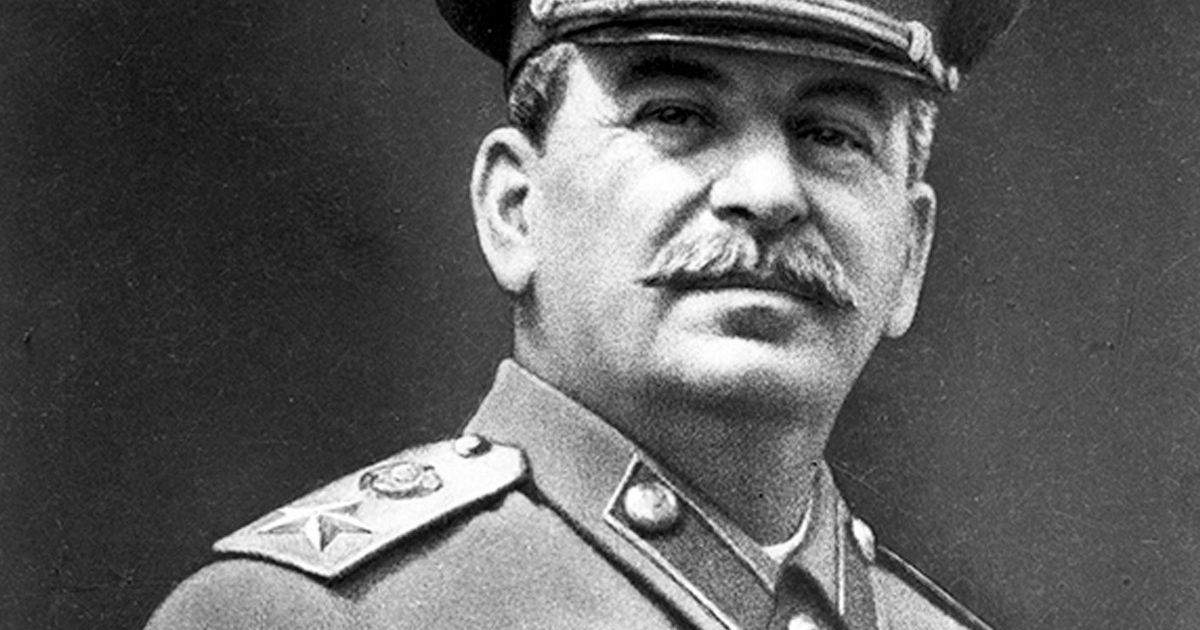
From Adolf Hitler to Idi Amin, the top ten dictators of the last 150 years account for the loss of nearly 150 million souls. Soviet dictator Josef Stalin joined this parade of horribles with the deliberate starvation of as many as ten million Ukrainians in 1932-’33, a political famine known as the Holodomor. Estimates of the dead attributed to the Communist monster run as high as 60 million, surpassing that of even the National Socialist dictator, Adolf Hitler.

Stalin suffered from poor health in his final years. He was found on the floor of his Kuntsevo Dacha on March 1, 1953, semiconscious, suffering from a brain hemorrhage. His was “a difficult and terrible death” according to Stalin’s daughter Svetlana, lasting four days. Josef Stalin died on March 5, perhaps of natural causes, perhaps he was murdered. Few knew. Fewer cared. The beast was dead.

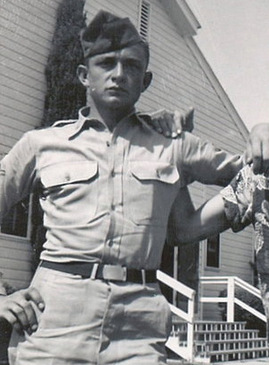
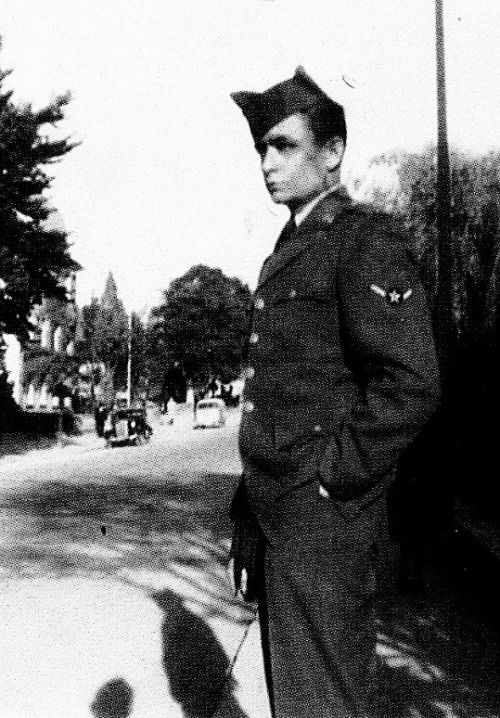
Fifteen hundred miles to the west in Landsberg Germany, a young staff sergeant was listening. Landsberg was a forward base at this time in the decades-long standoff we remember, as the “Cold war”.

John enlisted in the Air force in 1950, reporting for duty at Lackland AFB, in Texas. He met the woman who would become his first wife there, Vivian, but that was all four years in the future. For now, the budding romance would have to wait. John had deployment papers, to Landsberg.

Today if we want to talk with someone we pick up the phone, but it wasn’t always that easy. In the early 19th century, Europeans experimented with various electrical signaling devices.

Samuel Morse developed a system of timed signals in the early 1840s. Two tones, one short and one long, combined to represent every letter in the alphabet, and every number.

Dots and dashes. Dits and Dahs

John had talent when it came to Morse code. Signals were anything but clear but he could almost anticipate the patterns, coming out of the ether.

Rising to the rank of Staff Sergeant, John was often placed at the forward position, straining to derive meaning through the static from the distant Dits and Dahs of Soviet communications.

The work was demanding and highly secretive. He wasn’t allowed to leave base and when he did, privileges were sharply limited. He couldn’t even share the work with his sweetheart, back in Texas. In hundreds of letters home he never could talk about what he did. He may as well have been in prison.

John saw an American film around this time, a film noir crime drama called Inside The Walls of Folsom Prison. He could relate.

At night, “Johnny” would seek a kind of lonely solace with his old guitar. He found a rhythm, a melody of sorts in the dots and dashes, of Morse code.

Dit-Dah-Dah-Dah-Dit-Dit-Dah-Dah, Dit-Dah-Dah-Dit-Dah-Dah

He even started a band, called the “Landsberg Barbarians”.

So it was the young Staff Sergeant was listening to Soviet chatter on March 5, 1953, straining to pull some order out of faint and distant signals confused and all but obliterated, by static. And then it came to him. The one word standing out from the sequence.

DDah-Dit-Dit
EDit
ADit-Dah
DDah-Dit-Dit

He listened to it again, and again. The news was momentous if true but he had to get this right. In all the free world he alone knew, what the rest would soon learn. The Soviet leader, the Great Beast Josef Stalin, was dead.

Sergeant Cash told his superiors of what he had learned, and the rest is history. Josef Stalin lay in state for three days at Moscow’s House of Unions where the crush of crowds killed 100 people. He was laid to rest in Lenin’s Mausoleum in Red Square on March 9.

Johnny went back to his job. At night he’d pick up his guitar. The Dits and Dahs. The words would come later but, for now, the melody. A song begun in Landsberg so many would come to believe had arrived later, following that famous visit to Folsom Prison.

For many years, Johnny Cash could tell no one about the Stalin intercept. 3 Hall of Fame inductions, 9 CMA awards and 17 Grammys would have to wait. For now he went back to his job save for nights spent alone. Nights when the talent which had found its voice in that rare ability to find patterns in Morse code found another voice, one we could all understand.

Dit-Dah-Dah-Dah-Dit-Dit-Dah-Dah, Dit-Dah-Dah-Dit-Dah-DahWhen I was just a baby, my mama told me “Son, always be a good boy, don’t ever play with guns…“”

February 23, 1908 Whatever it Takes, to Sell a Paper

“The September 1906 edition of Cosmopolitan magazine recounts a story once told of an old Native American chieftain. The chieftain was given a tour of the modern city of New York. On this excursion, he saw the soaring heights of the grand skyscrapers and the majesty of the Brooklyn Bridge. He observed the comfortable masses gathered in amusement at the circus and the poor huddled in tenements. Upon the completion of the chieftain’s journey, several Christian men asked him, “What is the most surprising thing you have seen?” The chieftain replied slowly with three words: “little children working.” – H/T BLS.gov

During the early colonial period, American newspapers were “wretched little” sheets in the words of America’s “1st newsboy”, Benjamin Franklin.  Scarcely more than sidelines to keep presses occupied.

Newspapers were distributed by mail in the early years, thanks to generous subsidies from the Postal Act of 1792. In 1800, the United States could boast somewhere between 150 – 200 newspapers.  Thirty-five years later, some 1,200 were competing for readership.

We hear a lot today about “fake news”, but that’s nothing new.  In 1835, the New York Sun published a six-part series, about civilization on the moon. 

great-moon-hoax-1835-new-york-sun-lithograph-298px

 The “Great Moon Hoax”, ostensibly reprinted from the Edinburgh Courant, was falsely attributed to the work of Sir John Herschel, one of the best known astronomers of the time.

Whatever it took, to sell newspapers.

Two years earlier, Sun publisher Benjamin Day ran a Help-Wanted advertisement, looking for adults to help expand circulation. “To the unemployed — A number of steady men can find employment by vending this paper. A liberal discount is allowed to those who buy and sell again“. To Day’s surprise, his ad didn’t produce adult applicants as expected.  Instead, the notice attracted children.

Today, kids make up a minimal part of the American workforce, but that wasn’t always so. Child labor played an integral part in the agricultural and handicraft economy, working on family farms or hiring out to other farmers.  Boys customarily apprenticed to the trades, at 10 – 14. Girls went into domestic work. As late as 1900, fully 18% of the American workforce was under the age of sixteen.

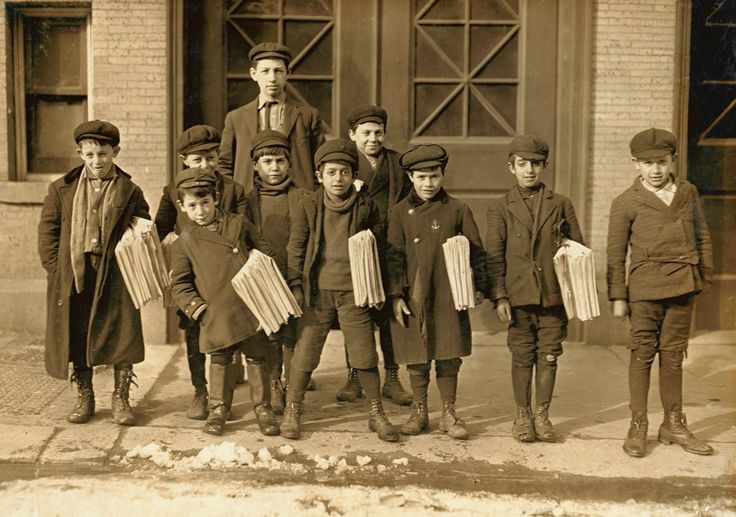
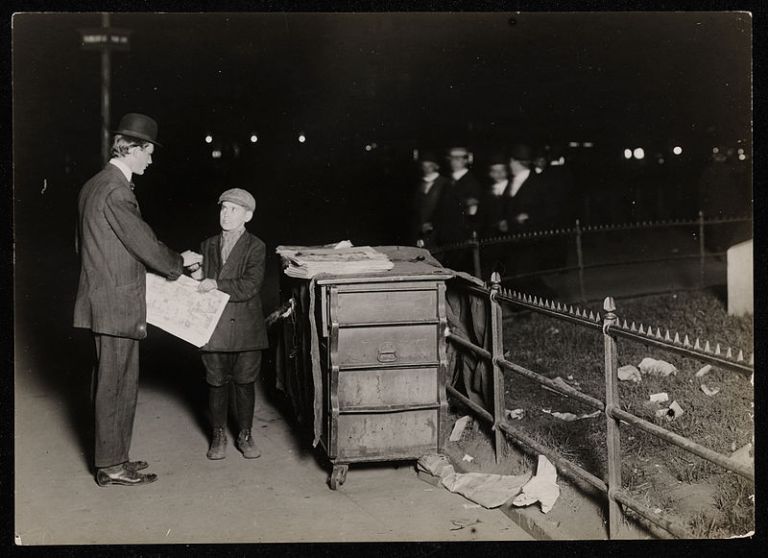
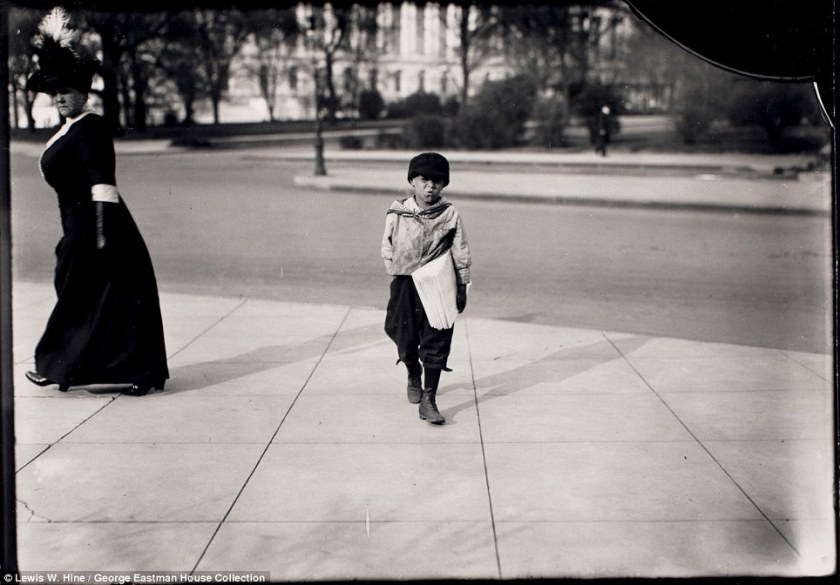
Newsies
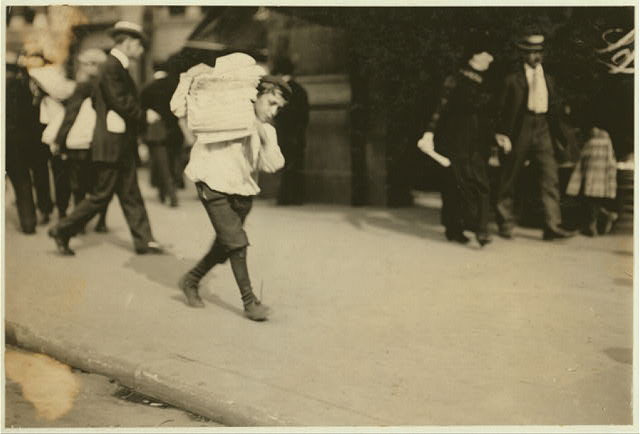
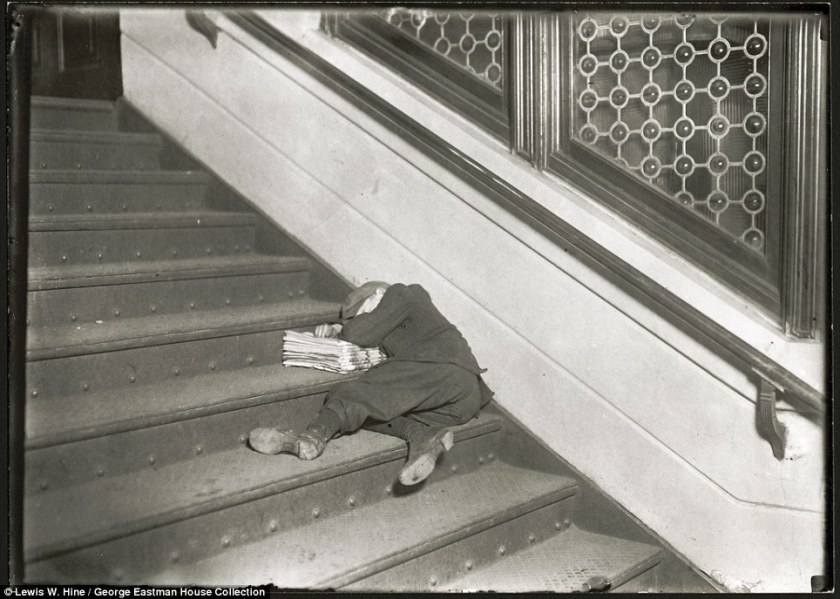
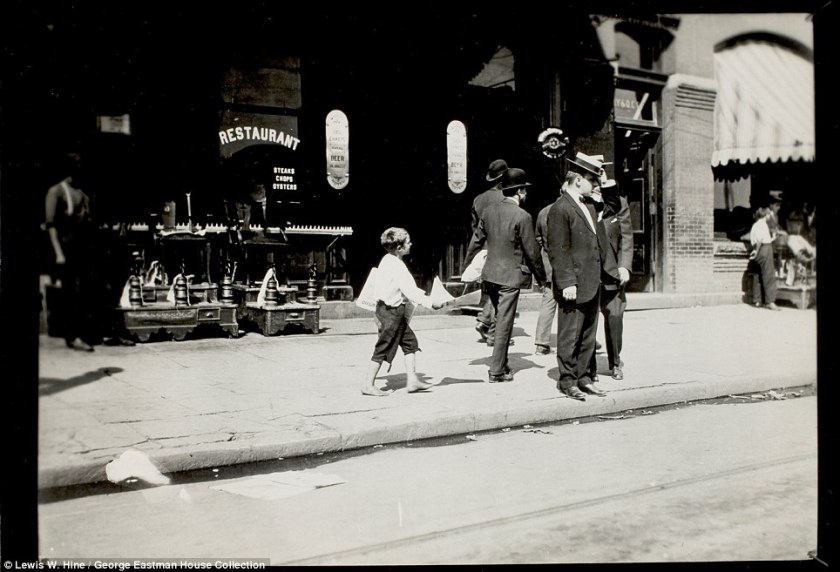
Brooklyn newsboy, ca. 1910 Photo by Lewis Hine (Library of Congress)

Benjamin Day’s first newspaper “hawker” was Bernard Flaherty, a ten-year-old Irish immigrant. The kid was good at it too, crying out lurid headlines, to passers-by: “Double Distilled Villainy!” “Cursed Effects of Drunkenness!” “Awful Occurrence!” “Infamous Affair!” “Extra! Extra! Read all about it!”

download-92

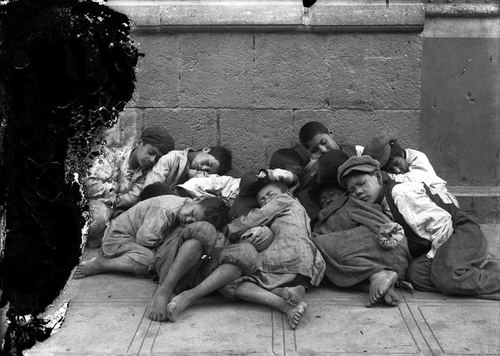
Hordes of street urchins swarmed the tenements and alleyways of American cities. During the 1870s, homeless children were estimated at 20,000 – 30,000 in New York alone, as much as 12% of school-age children in the city.

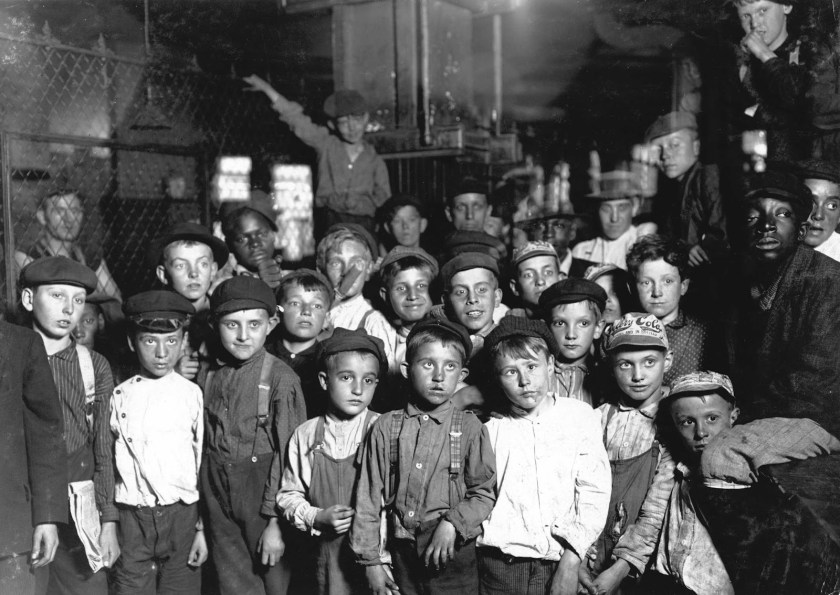
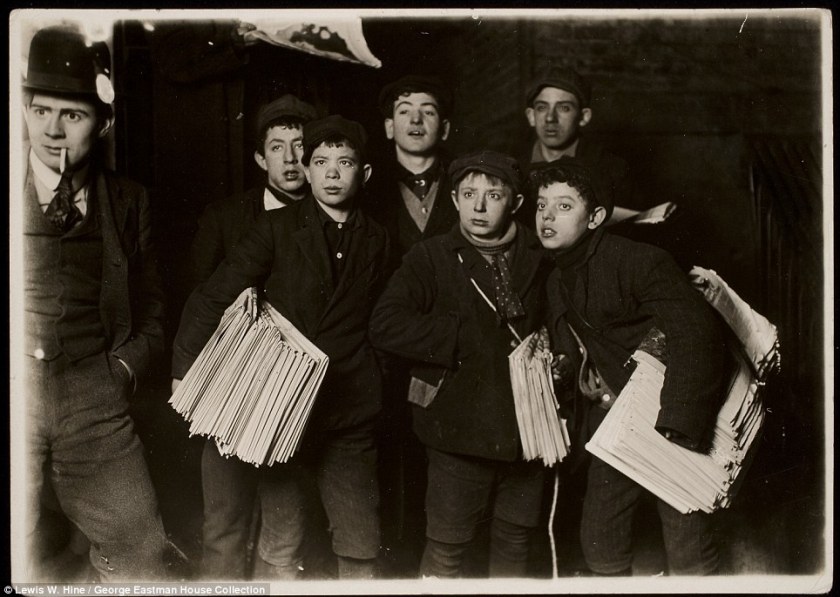
Lewis Hine - Indianapolis Newsboys waiting for the Base Ball edition, in a Newspaper office. Bad environment. Tough negroes etc., 1908
Indianapolis newsies, waiting for baseball edition

For thousands of them, newspapers were all that stood in the way of an empty belly.

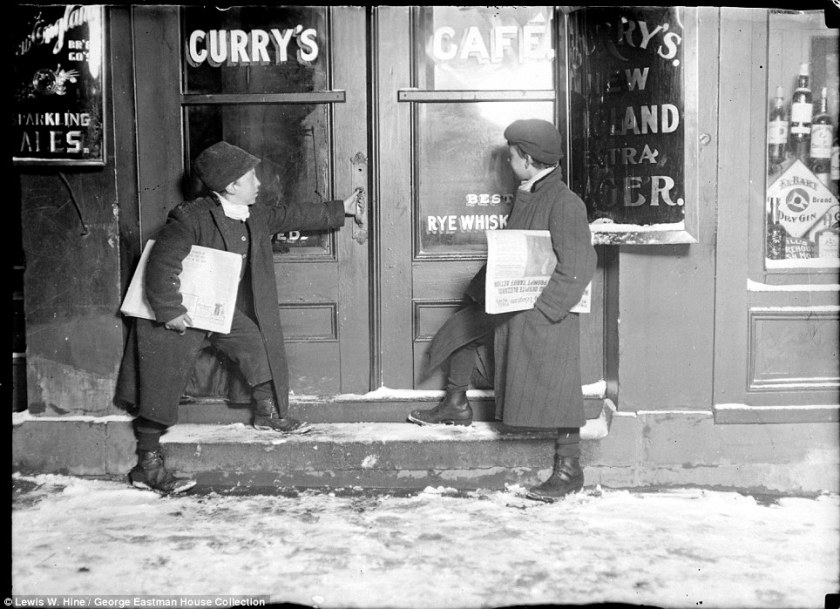
article-2467498-18D8276800000578-777_964x699Adults had no interest in the minuscule income, and left the newsboys (and girls) to their own devices.  “Newsies” bought papers at discounted prices and peddled them on the street.    Others worked saloons and houses of prostitution.  They weren’t allowed to return any left unsold, and worked well into the night to sell every paper.

article-2467498-18D8273A00000578-282_964x688For all that, newsies earned about 30¢ a day.  Enough for a bite to eat, to afford enough papers to do it again the following day, and maybe a 5¢ bed in the newsboy’s home.

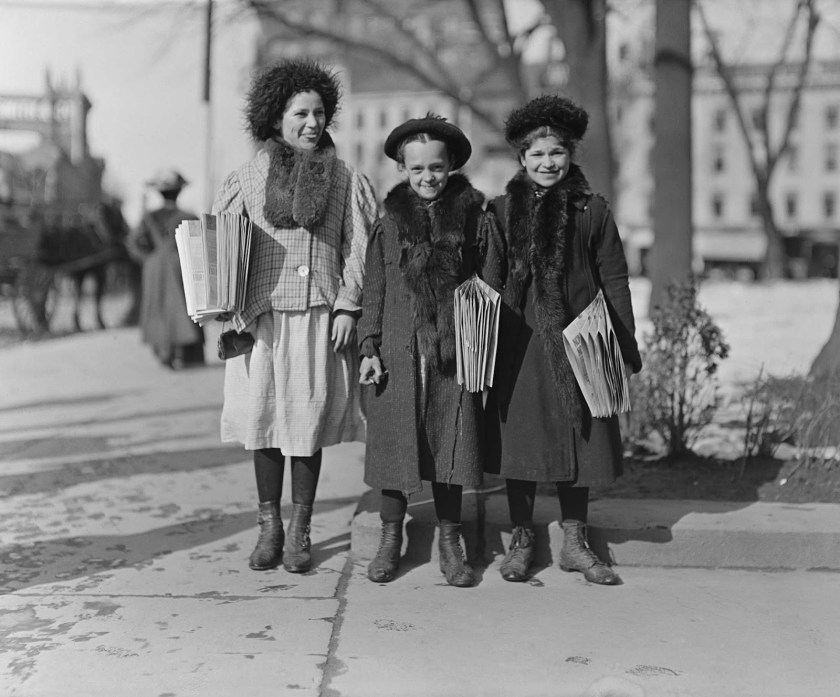
Lewis Hine - Have been selling 2 years. Youngest, Yedda Welled, is 11 years old. Next, Rebecca Cohen, is 12. Next, Rebecca Kirwin, is 14. Hartford, Connecticut, 1909
“Newsies” were not always, boys. These are Yedda Welled, 11 years old. Rebecca Cohen, 12. and, Rebecca Kirwin, 14. Hartford, Connecticut, 1909. H/T historyinphotos.blogspot.com

Competition was ferocious among hundreds of papers, and business practices were lamentable.  In 1886, the Brooklyn Times tried a new idea. The city was expanding rapidly, swallowing up previously independent townships along the Long Island shore. The Times charged Western District newsboys a penny a paper, while Eastern District kids paid 1 1/5¢.

The plan was expected to “push sales vigorously in new directions.” It took about a hot minute for newsies to get wise, when hundreds descended on the Times’ offices with sticks and rocks. On March 29, several police officers and a driver’s bullwhip were needed to get the wagons out of the South 8th Street distribution offices. One of the trucks was overturned, later that day.

article-2467498-18D8272400000578-972_964x686

That time, the newsboy strike lasted a couple of days, enforced by roving gangs of street kids and “backed by a number of roughs”. In the end, the Times agreed to lower its price to a penny apiece, in all districts. Other such strikes would not be ended so quickly, or so easily.

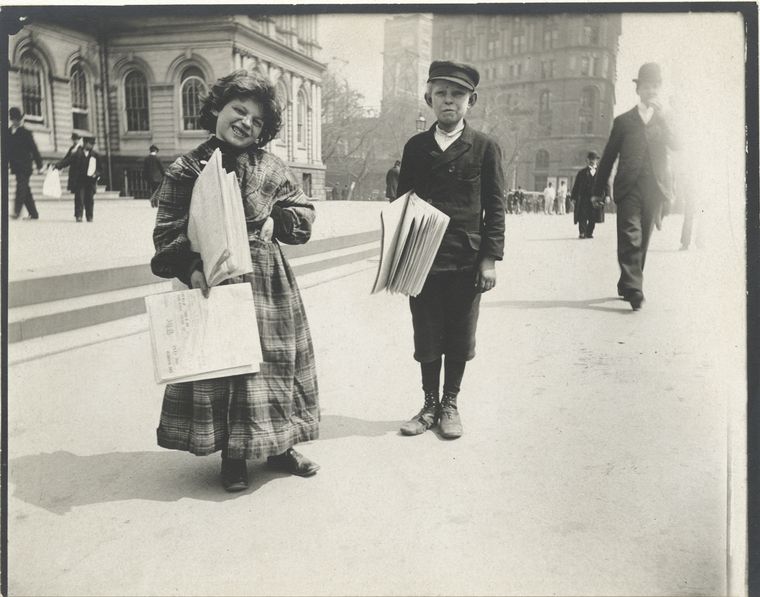
new-york-1896-alice-austen_newsboys
New York, 1896 Alice Austen newsboys

In those days, the Caribbean island of Cuba was ruled from Spain. After decades spent in the struggle for independence, many saw parallels between the “Cuba Libre” movement, and America’s own Revolution of the previous century.  In 1897-’98, few wanted war with Spain over Cuban interests more than Assistant Naval Secretary Theodore Roosevelt, and New York publishers Joseph Pulitzer & William Randolph Hearst.

maxresdefault (22)

This was the height of the Yellow Journalism period, and newspapers clamored for war. Hearst illustrator Frederic Remington was sent to Cuba, to document “atrocities”.  On finding none, Remington wired: “There will be no war. I wish to return”.  Hearst wired back: “Please remain. You furnish the pictures, and I’ll furnish the war.” President McKinley urged calm, but agreed to send the armored cruiser USS Maine, to protect US “interests”.

uss-maine-explosion

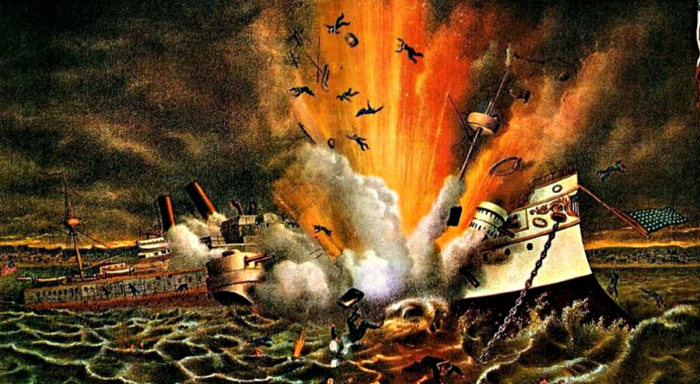
The explosion that sank the Maine on February 15 killing 268 Americans was almost certainly accidental, but that wouldn’t be known for decades. Events quickly spun out of control and, on April 21, 1898, the US blockaded the Caribbean island. Spain gave notice two days later, that it would declare war if US forces invaded its territory. Congress declared on April 25 that a state of war had existed between Spain and the United States, since the 21st.  Soon, newsboys were shouting the headline:  “How do you like the Journal’s war?

article-2467498-18D8275900000578-427_964x657

The Spanish-American War was over in 3 months, 3 weeks and 2 days, but circulation was great while it lasted.  Publishers cashed in, raising the cost of newsboy bundles from 50¢ to 60¢ – the increase temporarily offset by higher sales. Publishers reverted to 50¢ per 100 after the war, with the notable exceptions of Joseph Pulitzer’s New York World, and William Randolph Hearst’s New York Journal.

4825071_orig

Newsboys of the era weren’t the ambitious kids of a later age, hustling to make a buck after school.  These were orphans and runaways, with little to count on but themselves.  The half-cent profit on each paper was all these kids had to get through the day, with a little held back to buy more papers.

february_23rd_1908_boys_selling_newspapers_on_brooklyn_bridge (1)
Newsboys selling papers by the Brooklyn Bridge, February 23, 1908 H/T UK Guardian

50¢ to 60¢ for the same bundle was an insurmountable increase.   On July 18, 1899, a group of Long Island newsboys overturned a distribution wagon, refusing to sell Hearst or Pulitzer newspapers until prices were returned to 50¢.  Newsboys from Manhattan and Brooklyn joined the strike, the following day.

Blink4

Boys and men who tried to break the strike were mobbed and beaten, their papers destroyed.

Competing publishers such as the New York Tribune couldn’t get enough of the likes of strike “President” Dave Simmons, the boy “prize-fighter”, Barney “Peanuts”, “Crutch” Morris, and others.

The charismatic, one-eyed strike leader “Kid Blink”, was a favorite:

“Friens and feller workers. This is a time which tries de hearts of men. Dis is de time when we’se got to stick together like glue…. We know wot we wants and we’ll git it even if we is blind”.

The newsboy strike of 1899 lasted two weeks, in which Pulitzer’s New York World plummeted from 360,000 papers a day, to 125,000.  Women and girls had more success as strike breakers than boys and men.  As Kid Blink put it, “A feller can’t soak a lady.”  In the end, it didn’t matter.  Most news readers took the side of the strikers.  Neither Hearst nor Pulitzer ever dropped their price, but both agreed to buy back unsold papers.

child_labor_in_united_states_1910_working_night_shift (1)
Some worked well after midnight, to sell every paper

The New York newsboys’ strike of 1899 inspired later strikes including Butte, Montana in 1914, and a 1920s strike in Louisville, Kentucky.  In time, changing notions of urban child-welfare led to improvements in the newsboys’ quality of life.  For now, street kids had precious few to look out for them, beyond themselves.

article-2467498-18D8274600000578-403_964x672

Brooklyn’s “Racetrack Newsie” “Dutch” Johnson caught cold, in 1905.  The illness soon turned more serious.  He was found unconscious on a pile of catalogs.  Brought to Bellevue Hospital by the East River,  the 16-year-old was informed it was pneumonia.  This was before the age of antibiotics.  There was no hope.

download-92

“It goes”, Dutch said, in a voice so soft as to be barely audible.  “Only I ain’t got no money and I’d like to be put away decent”.

tumblr_ne0yqmwDCl1u0ndouo1_500 (1)

Bookmaker “Con” Shannon offered to take up a collection for the burial.  He could’ve easily produced hundreds from bookies and gamblers, but Dutch’s diminutive successor “Boston”, spoke up.  “Naw”, he said “we’re on de job and nobody else”.

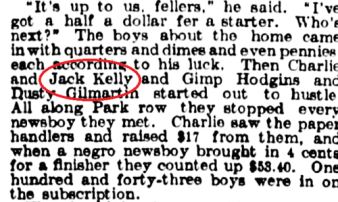
So it was that “Gimpy”, “Dusty”, and the other urchins of Sheepshead Bay pitched in with their pennies, their nickels and dimes.  $53.40 bought a plot in the Linden Hill Cemetery, with a little stone marker.  Dutch Johnson would be spared the plain black wagon and the nameless grave, in some anonymous Potter’s Field.

February 22, 1943 The White Rose

White Rose survivor Jürgen Wittenstein described what it was like for ordinary Germans to live in Nazi Germany:

The government—or rather, the party—controlled everything: the news media, arms, police, the armed forces, the judiciary system, communications, travel, all levels of education from kindergarten to universities, all cultural and religious institutions. Political indoctrination started at a very early age, and continued by means of the Hitler Youth with the ultimate goal of complete mind control. Children were exhorted in school to denounce even their own parents for derogatory remarks about Hitler or Nazi ideology.

— George J. Wittenstein, M.D., “Memories of the White Rose”, 1979

With Hitler’s appointment as chancellor on January 30, 1933, the National Socialist Worker’s Party (Nationalsozialistische Deutsche Arbeiterpartei, or NSDAP) lost no time in consolidating power. Two days later, the 876-member democratically elected deliberative body, the “Reichstag”, was dissolved.

The National Socialists never did call themselves “Nazis”. That was a derogatory term coined by opponents, long before the party came to power. Throughout the 1930s, it became increasingly dangerous to speak ill of the Nazi party. One such was the Württemberg politician Robert Scholl who criticised the ruling party before, during and after World War 2. Scholl was one of the lucky ones, he lived to tell the story, but not without spending some of that time, behind bars.

Robert and Magdalena (Müller) Scholl had six children together, four girls and two boys. The older of the two brothers, Hans Fritz joined the Hitler youth, against the express will of his father.

He even held a leadership position in the Deutsches Jungvolk in der Hitler Jugend (“German Youngsters in the Hitler Youth”), a section of the Hitler Youth aimed at indoctrinating boys, 10-14.

In 1935, Hans was selected to carry the flag at the 1935 Nazi party rally in Nuremberg, one of three standard-bearers, from Ulm.

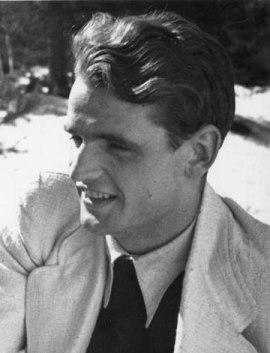
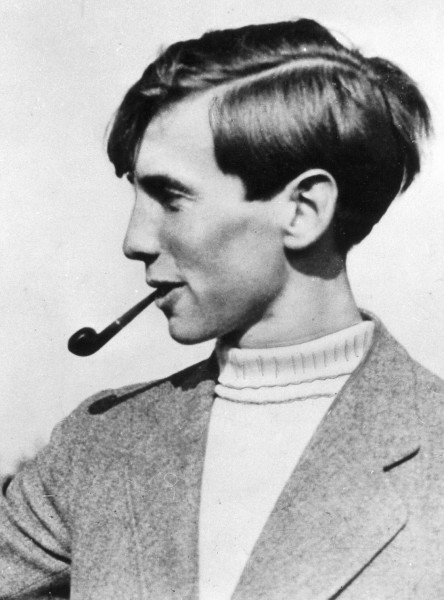
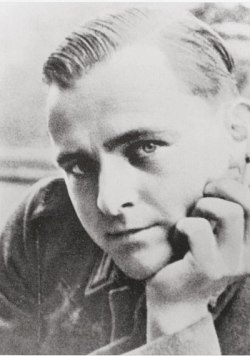
He joined the Reich Labor Service for two years before beginning medical school, in Munich. During a semester break, Scholl was drafted as a medic in the French campaign. Back at school, Scholl began to meet teachers and students, critical of the regime. Theirs was a Christian-ethical world view. One of them was Alexander Schmorrell.

Hugo Schmorell was a German-born doctor, living and working in Russia. He married Natalia Vedenskaya, the daughter of a Russian Orthodox priest. Alexander Schmorell was born to the couple in Orenberg Russia and baptised, in the Russian Orthodox church.

Hugo remarried after Natalia died of typhus, this time to a German woman who, like himself, grew up in Russia. Alexander grew up bilingual, able to speak German and Russian, as a native.

The family moved to Weimar Germany following the Russian Revolution. In later interrogations by the Gestapo, Alexander described himself as a German-Russian Tsarist who hated Bolsheviks.

In the Nazi mindset, slavs are part of the great horde of Untermenschen, people considered racially or socially, inferior. Alexander believed no such thing about himself. He was proud of both his German and his Russian sides.

In religion class, Schmorell displayed a stubborn refusal to bend to the will of others, crossing himself right-to-left in the manner of the Russian church, and not left to right. Alexander joined the Scharnhorst youth as a boy, mostly for the love of horseback riding. Once the organization was absorbed into the Hitler Youth movement he gradually stopped attending. Like Scholl, Schmorell joined the Wehrmacht, participating in the Anschluss and eventual invasion, of Czechoslovakia.

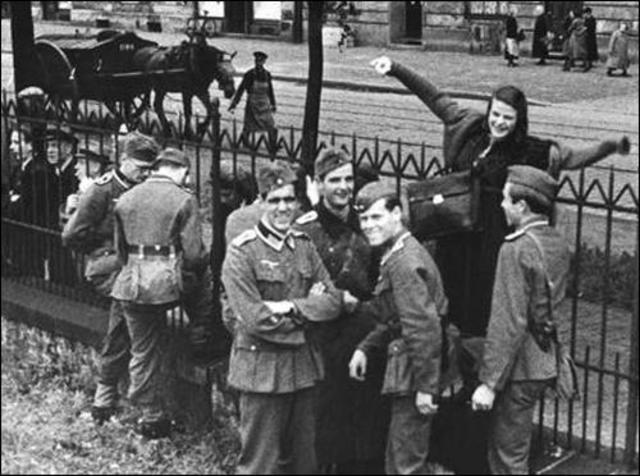
In 1941, Scholl and Schmorrell were drafted as medical auxiliaries, for service in the east. There the two witnessed the dark underbelly of the regime in whose service, they risked their lives. The Warsaw ghetto. The savage treatment of Russian prisoners. The deportations and dark rumors of extermination centers.

With the naivety of youth, Scholl and Schmorrell wanted better. Back in school the pair discussed this with Kurt Huber, professor of music and a vocal anti-Nazi. By June 1942, the pair started to write pamphlets, calling themselves, the “White Rose”.

“Isn’t it true that every honest German is ashamed of his government these days? Who among us has any conception of the dimensions of shame that will befall us and our children when one day the veil has fallen from our eyes and the most horrible of crimes—crimes that infinitely outdistance every human measure—reach the light of day?”— 1st leaflet of the White Rose

During later gestapo interrogations, Scholl gave differing stories as to the origin of the name. A poem of the same name by the German poet, Clemens Brentano. A work by the Cuban poet, José Martí. Perhaps it was nothing more than the purity of the white rose, in the face of evil. Or maybe Scholl meant to throw his tormenters off the scent of Josef Söhngen, the anti-Nazi bookseller who had helped them, in so many ways.

Since the conquest of Poland, 300,000 Jews have been murdered in this country in the most bestial way … The German people slumber on in dull, stupid sleep and encourage the fascist criminals. Each wants to be exonerated of guilt, each one continues on his way with the most placid, calm conscience. But he cannot be exonerated; he is guilty, guilty, guilty!”— 2nd leaflet of the White Rose.

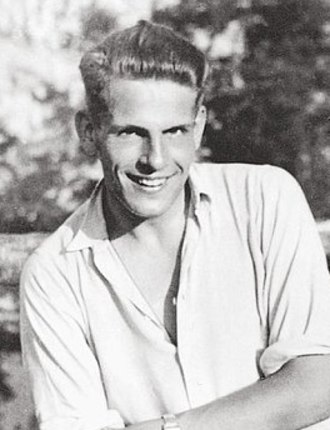
The group added members and supporters. Willi Graf who, unlike the founding members hated the Hitler Youth movement, from the beginning. Christoph Probst whose step-mother was Jewish and considered the Nuremberg laws an affront to human dignity. Hans’ sister Sophie who joined, despite her older brother’s protests. Like her brother, Sophie detested what the Nazis stood for.

“Why do you allow these men who are in power to rob you step by step, openly and in secret, of one domain of your rights after another, until one day nothing, nothing at all will be left but a mechanised state system presided over by criminals and drunks? Is your spirit already so crushed by abuse that you forget it is your right—or rather, your moral duty—to eliminate this system?”— 3rd leaflet of the White Rose

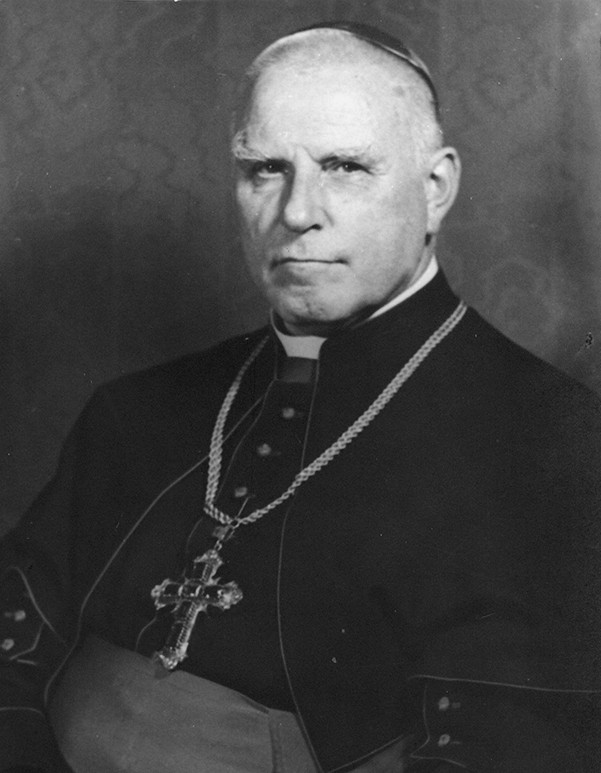
Bishop Clemens August Graf von Galen was critical of the Nazi movement from the beginning, denouncing Hitler’s “Worship of Race” as early as 1934.

Galen excoriated the Nazi euthanization program from the Catholic pulpits of Münster and across the German empire, condemning “the innocent and defenceless mentally handicapped and mentally ill, the incurably infirm and fatally wounded, innocent hostages and disarmed prisoners of war and criminal offenders, people of a foreign race or descent”.

Bishop Galen’s sermons were seminal in the formation of the White Rose. One of his sermons formed the basis for the first pamphlet.

Hand copied leaflets were inserted into phone books or mailed directly, to teachers and students.

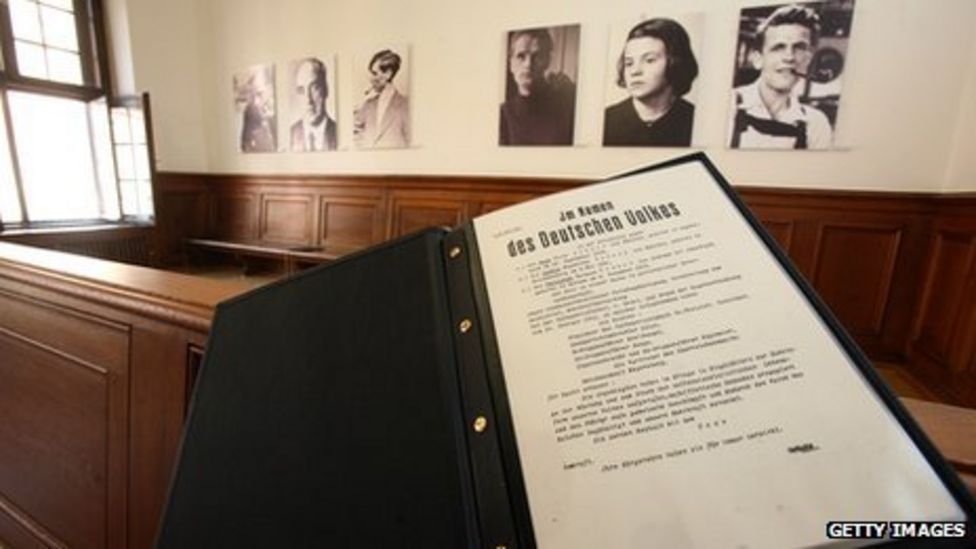
The grotesque sham trials conducted by Hitler’s “Blood Judge” Roland Feisler made short work of any who would oppose “Der Fuhrer”. Today, the “People’s Court” of Nazi Germany is best remembered in the wake of the July 20, 1944 plot to assassinate Adolf Hitler. In reality, this perversion of justice had been around for ten years, handing out death sentences, in the hundreds. This video gives a pretty good idea of “justice” meted out, in Roland Feisler’s court.

There were Germans throughout the war who objected to the murder of millions, but theirs was a forlorn hope. Clergymen Dietrich Bonhoeffer would state “the ultimate question for a responsible man to ask is not how he is to extricate himself heroically from the affair, but how the coming generation shall continue to live.” For his opposition to the Reich, Bonhoeffer would pay with his life.

Helmuth James Graf von Moltke, great grand-nephew of the famous Helmut von Moltke would lead 28 dissidents of the “Kreisau Circle”, against this “outrage of the Christian conscience.” These too would pay with their lives.

The most successful German opposition party came from the universities of Munich, with connections in Berlin, Hamburg, Stuttgart and Vienna, including the White Rose. These were a surprise to Nazi leaders as Universities had long been stalwart supporters of Nazi ideology.

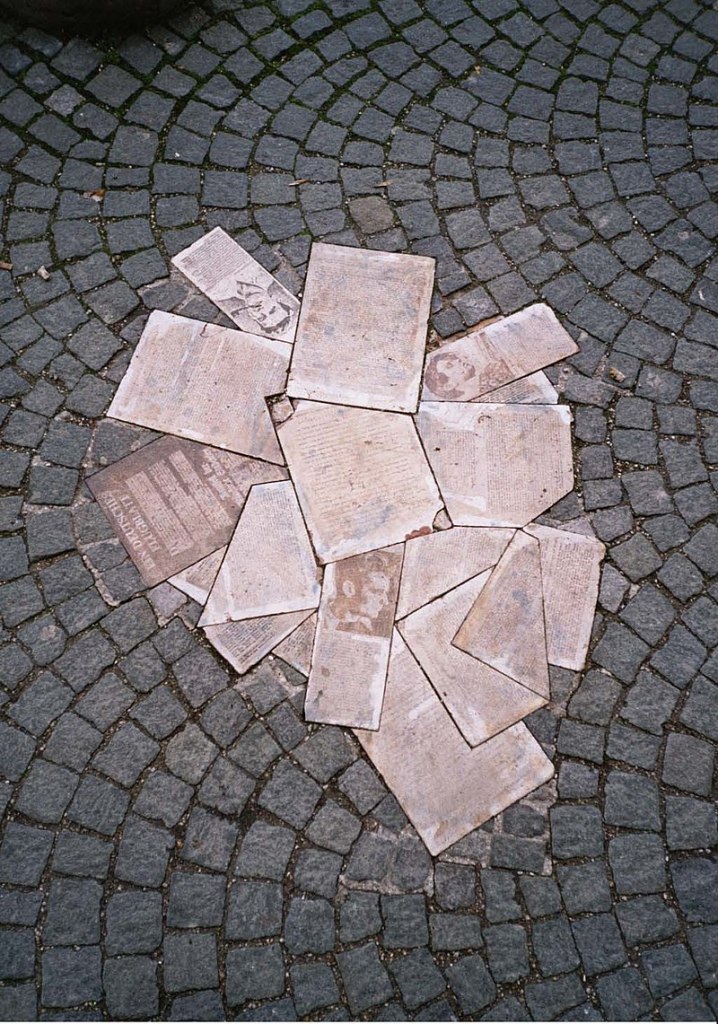
On February 18, Hans and Sophie Scholl arrived on campus with a suitcase full of pamphlets. This was their 6th. Hurriedly moving through the campus the Scholls left stacks of leaflets, outside full lecture halls:

Memorial to the “Weiße Rose” in front of the Ludwig Maximilian University of Munich

“…Fellow Fighters in the Resistance! Shaken and broken, our people behold the loss of the men of Stalingrad. Three hundred and thirty thousand German men have been senselessly and irresponsibly driven to death and destruction by the inspired strategy of our World War I Private First Class. Fuhrer, we thank you!…”Excerpt from pamphlet 6

Their task complete, the pair realized they still had a few. From the upper floor of the atrium, Sophie tossed them into the air and watched them flutter to the ground. It was reckless and stupid, an action witnessed by custodian Jakob Schmid who promptly called the police.

The Scholl siblings were quickly arrested. Hans had on his person the draft, of another pamphlet: #7, written by Christoph Probst. He tried to eat it but the Gestapo was too fast. Probst was arrested within hours, eighty more over the following days. On February 22, 1943, all three were tried before judge Feisler’s People’s Court. All three were sentenced to death and executed by guillotine, the same day.

Es lebe die Freiheit! (Let Freedom live!)— Hans Scholl’s last words before his execution

Graf, Schmorrell, Huber and 11 others were tried on April 13. All three received the same sentence: death by decapitation. All but one of the others received prison sentences, between 6 months and 10 years.

The last member to be executed was Hans Conrad Leipelt on January 29, 1945.

Despite the execution of the group’s leaders, the White Rose had the last word. That last pamphlet was smuggled out of Germany and copied, by the allies. Millions of copies rained down from the sky, dropped, by allied bombers.

Today, the “People’s Court” of the schweinhund Feisler is a district court, in Munich. That’s it, at the top of this page.

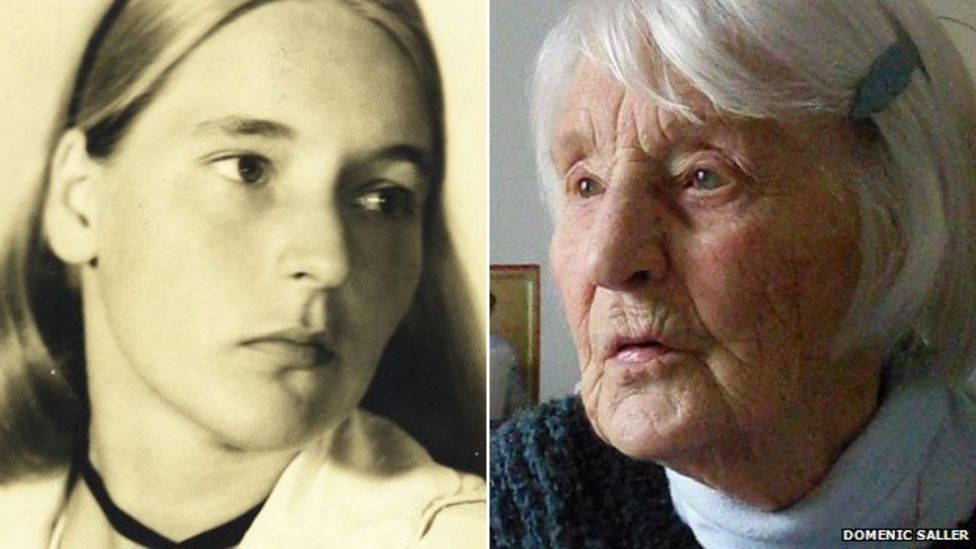
LLieselotte ″Lilo″ Fürst-Ramdohr

Lieselotte ″Lilo″ Fürst-Ramdohr was a war widow at 29 when she joined the White Rose, hiding pamphlets in an apartment closet and helping to make stencils, for graffiti. In 2013 she gave an interview for BBC Worldwide, three months before she died. She was 99.

Lieselotte was arrested and interrogated for a month by the Gestapo, and released. She thinks they’d hoped she would lead them, to fellow conspirators.

In 2012, Lilo’s friend Alexander Schmorell was awarded sainthood by the Russian Orthodox church.

She thinks it’s all too amusing. “He would have laughed out loud” she said, “if he had known. He wasn’t a saint. He was just a normal person.”